
RESEARCH INTO THE FLIGHT CALLS OF MIGRATING WARBLERS
 has found a way to investigate the nocturnal migrations of warblers using spectrograms. Many of the warblers featured in the project are found on Abaco and will be familiar to the more discerning birder – though I admit that ID of members of this large family of little yellowy birds, even in broad daylight, remains a blind spot for me (and I suspect I am not the only one). Click the chart below for a clearer view. A downloadable / printable version is available via the link given below. It is also worth visiting the page to compare the brief audio cheeps of the Northern Parula, Magnolia Warbler and Black-throated Green Warbler and their respective spectrograms
“These spectrograms are a visual representation of the very brief flight calls made by North American warblers during their nocturnal migrations. Some of these call notes sound almost identical to our ears, but spectrograms show minute differences between them. Scientists can compare spectrograms of night recordings to spectrograms of known species to identify nocturnal migrants in total darkness. Andrew Farnsworth, a scientist in the Cornell Lab’s Conservation Science program, developed this “Rosetta Stone” in 2006 in collaboration with Michael Lanzone, Cellular Tracking Technologies, William R. Evans, and Michael O’Brien. It covers all 48 warbler species of the U.S. and Canada (including Grace’s and Red-faced warblers, not shown), and is a major tool in our Acoustic Monitoring Project”
Click chart to enlarge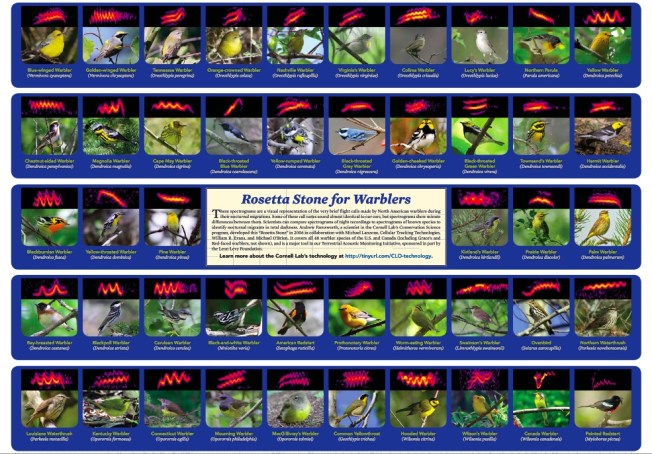
Putting Sound to Work for Conservation: “Our staff will use results from the Rosetta Stone… to “train” computers to identify the sounds of warblers and other nocturnally migrating birds, as well as other species including whales and forest elephants”
Working Toward a Bird Migration Forecast: “A new grant from the National Science Foundation will fund BirdCast, a project that will combine bird observations (both sightings and sound recordings) with weather models and terrain data to forecast migrations. The results of the predictions will help scientists understand migratory behavior and may aid decisions about wind turbine placement and other questions about environmental hazards to birds”
To see the complete article CLICK LOGO===>>>
To learn more about BirdCast and the Acoustic Monitoring Project from the original article CLICK LINK===>>> Cornell Chronicle
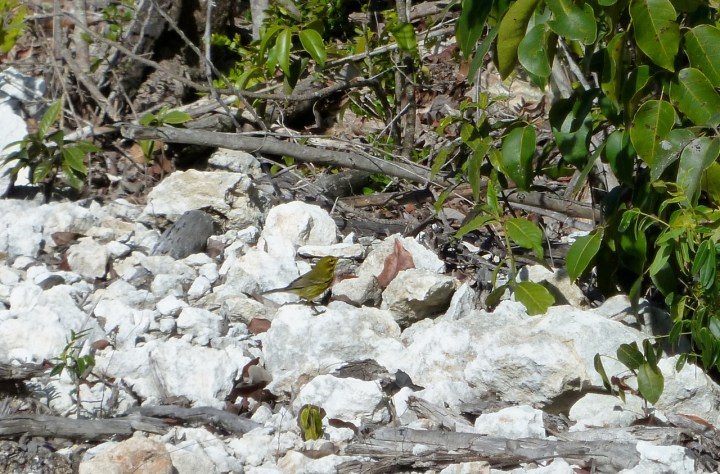
Prairie Warbler on the Delphi Club guest drive, Abaco




 ROLLING HARBOUR ABACO
You must be logged in to post a comment.