

HOLE-IN-THE-WALL, ABACO: A HISTORIC DESCRIPTION & AQUATINT FROM 1803
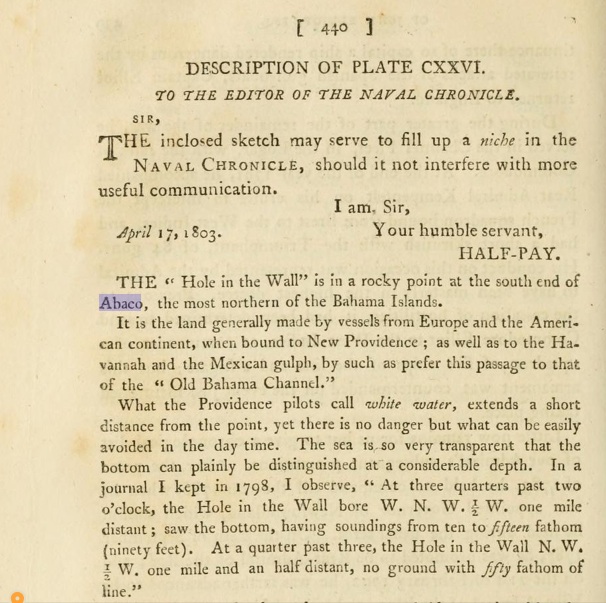
I recently traced the history of Hole-in-the-Wall, Abaco through maps from the 16th century onwards – its significance, the name changes, and so on. To see that post CLICK HERE . I have just come across some historical material about HITW that is so fascinating that I have awarded the accolade of a separate post, rather than lumping it in with the earlier one. The extract below is from THE NAVAL CHRONICLE (Vol 9) * for January – July 1803. It gives a short but detailed description of the Hole in the Wall in the context of a remarkable sketch (reproduced as a Plate in the book) submitted by the contributor, who signed himself ‘Half-Pay’. That was the name traditionally used in both Navy and Army to refer to the pay or allowance an officer received when in retirement or not in actual service – or, metonomously, to the officer receiving the reduced pay. I greatly like the charming deference with which the contribution is offered.
The whole book is well worth examining for the light it sheds on Naval matters at the very start of the c19. The comprehensive personnel and other lists hold plenty of interest. This was an era of almost continuous major military and naval campaigns on both sides of the Atlantic. The Battle of Trafalgar was still 2 years away when this book was published. If you want to see the downloadable online version CLICK HERE [I had to zoom the page and clip it in two to make it easily readable – hence the gap. And apologies for the purple highlight – it was my place-mark…]

Here is the amazing aquatint by J. Wells of Half-Pay’s sketch, published in the 1803 Naval Chronicle by founder J.Gold of Shoe Lane, London. It’s quite small, measuring 5½” x 9″. You may even be looking at a screen clip of a scan of the book plate of the earliest surviving depiction of Hole-in-the Wall. If anyone knows of an older one, please get in touch. And can anyone identify what kind of sailing vessels these are (I wouldn’t know a brigantine from a clipper…)?
To answer queries arising from my earlier post, I added a map and photos showing exactly where the actual Hole at HITW is, and how to get there (if you are wearing the right shoes). It’s worth revisiting the topic. People are always fascinated by the extremities of land – ‘Land’s End’, ‘Finisterre’, ‘Finistère’ and so on – especially where they are remote and relatively inaccessible. I think HITW qualifies. As far as I am aware, apart from the lighthouse its abandoned outbuildings at the southeast corner of the first map below, there is no other building in the area covered by this map. The nearest road is 15 miles up the inhospitable track to the north of the lighthouse.

Here is the map showing the location of the actual Hole in the Wall, and below that, a distance shot taken at sea



 ROLLING HARBOUR ABACO
You must be logged in to post a comment.