Unknown's avatar

“A WHALE OF A YEAR”: 12 MONTHS FROM ROLLING HARBOUR ABACO


Whale Tailing, Bahamas (BMMRO)

“A WHALE OF A YEAR”: 12 MONTHS FROM ROLLING HARBOUR ABACO

 JANUARY

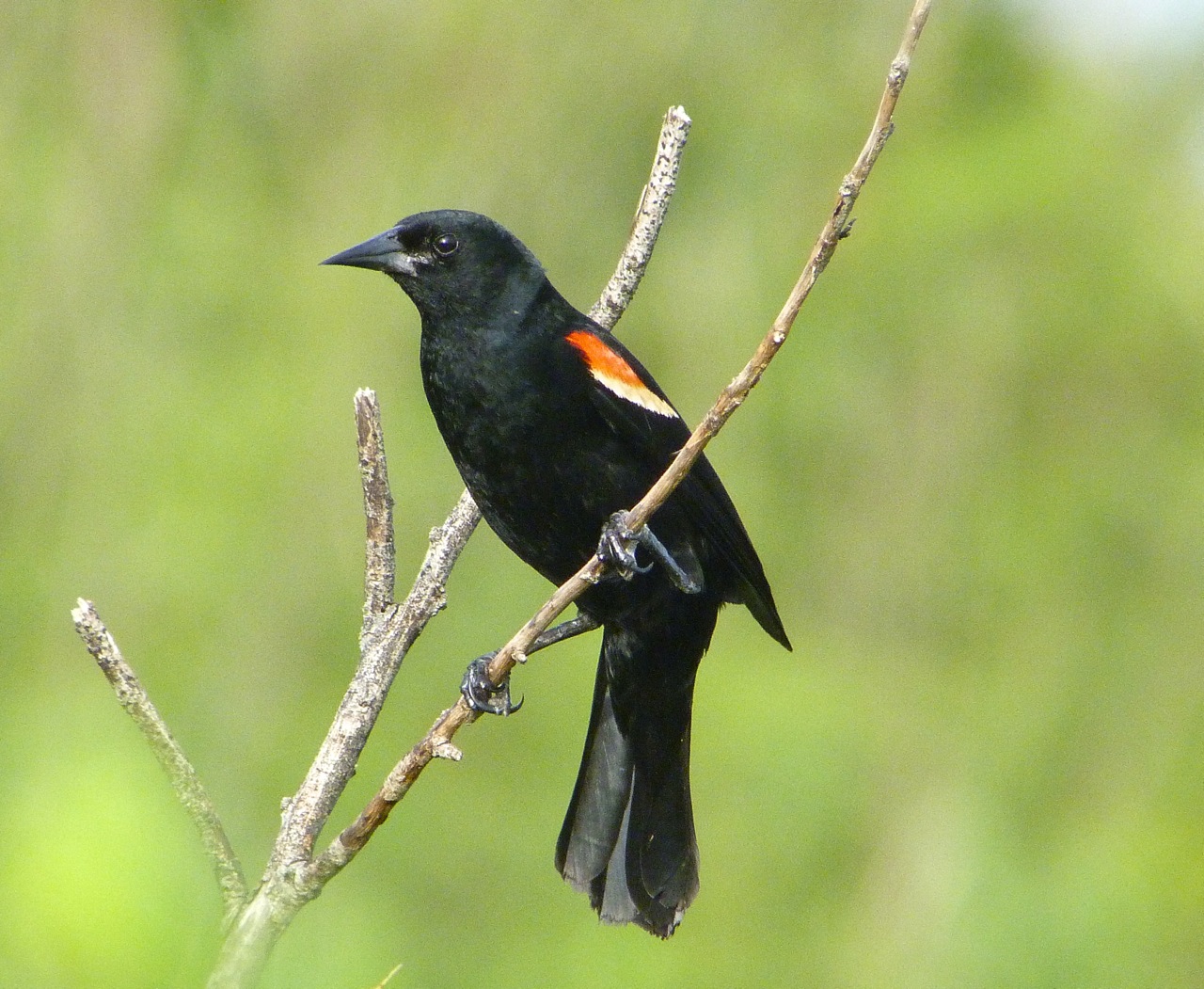
Red-winged Blackbird, Abaco

Red-winged Blackbird, Abaco Backcountry

FEBRUARY

French Angelfish (juv)

French Angelfish (juvenile), Bahamas

MARCH

Publication & Launch of “The Birds of Abaco”

dcbg2ba-jacket-grab-for-pm-v2-copy

book-launch-1 Author signing copies, with Bahamas birding gurus Tony White, Bruce Hallett & Woody Bracey

1900063_10152069487394482_984358031_n flyer-21

APRIL

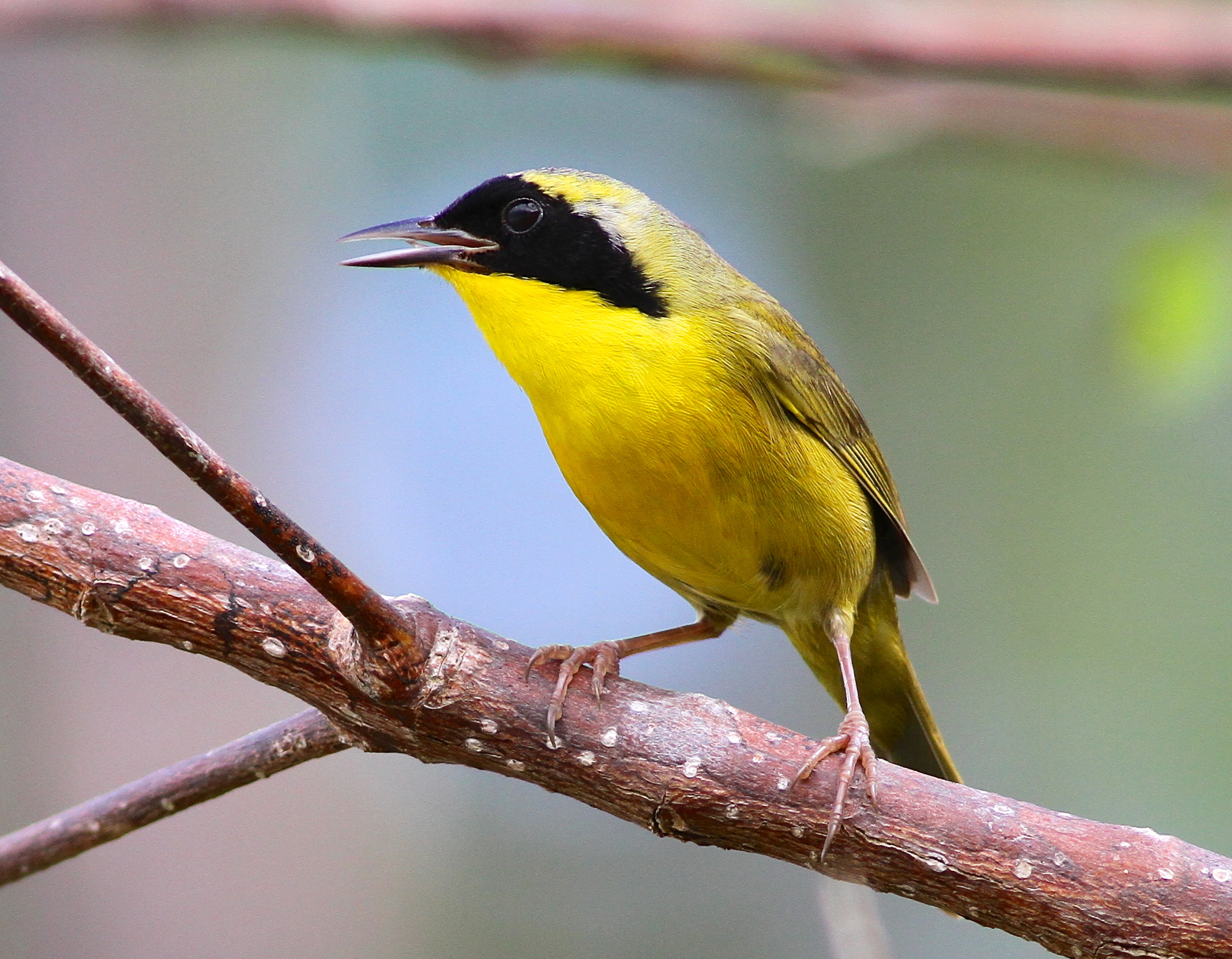
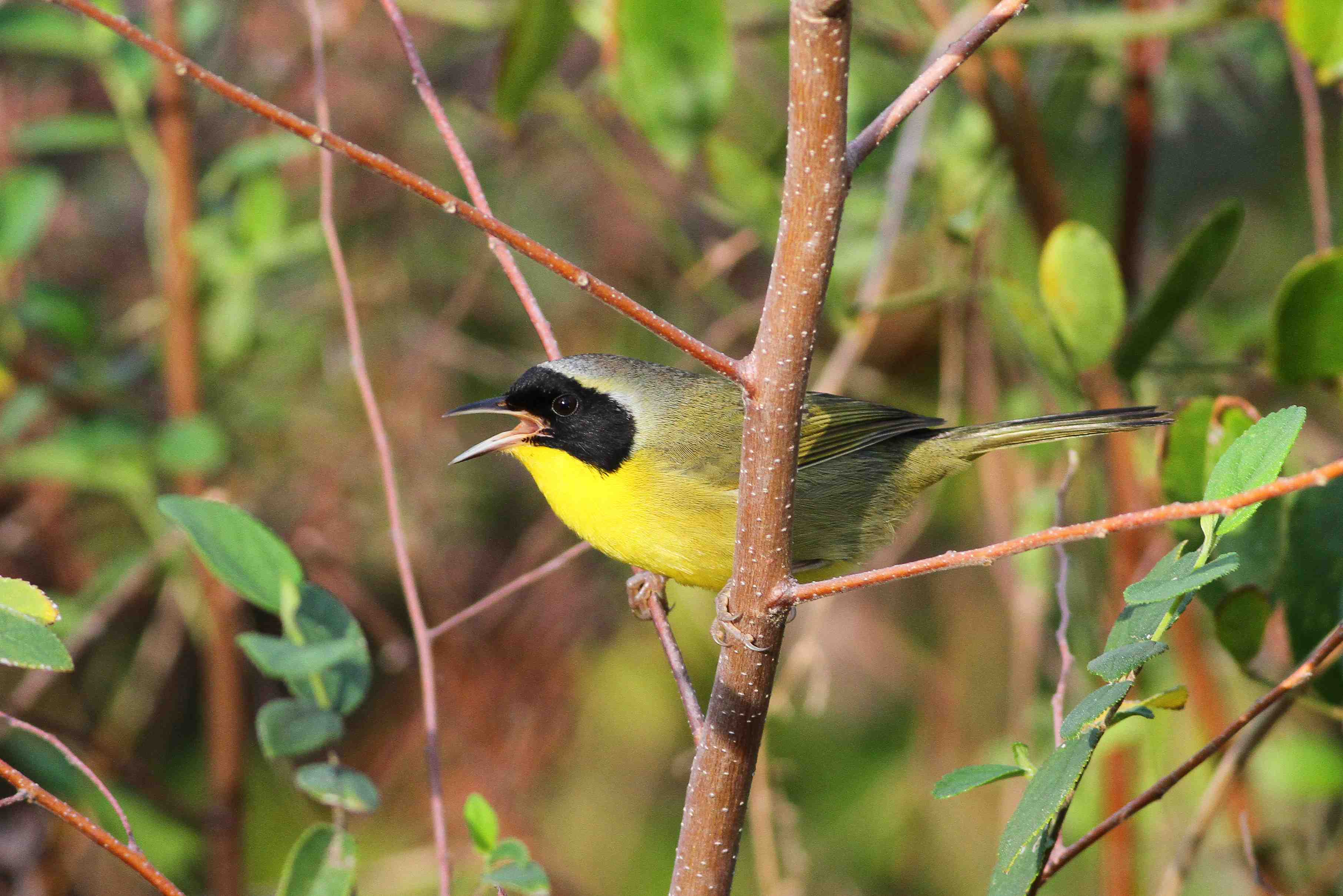
20130106_Bahamas-Great Abaco_4846_Bahama Yellowthroat_Gerlinde Taurer copy

Bahama Yellowthroat, Abaco

MAY

Bananaquit & palm, Delphi, Abaco, Bahamas 7

Bananaquit, Delphi Club, Abaco, Bahamas

JUNE

Black-bellied Whistling Ducks, Abaco : WWT - RH 3

Black-bellied Whistling Ducks, Abaco – first recorded sighting

JULY

Octopus ©Melinda Riger @ Grand Bahama Scuba

Octopus, Bahamas

AUGUST 

Bobwhite pair 2.Abaco Bahamas.Tom Sheley cr

Bobwhite pair, Abaco, Bahamas

SEPTEMBER

Black-necked stilt Alex Hughes, Abaco

Black-necked Stilt, Abaco

OCTOBER

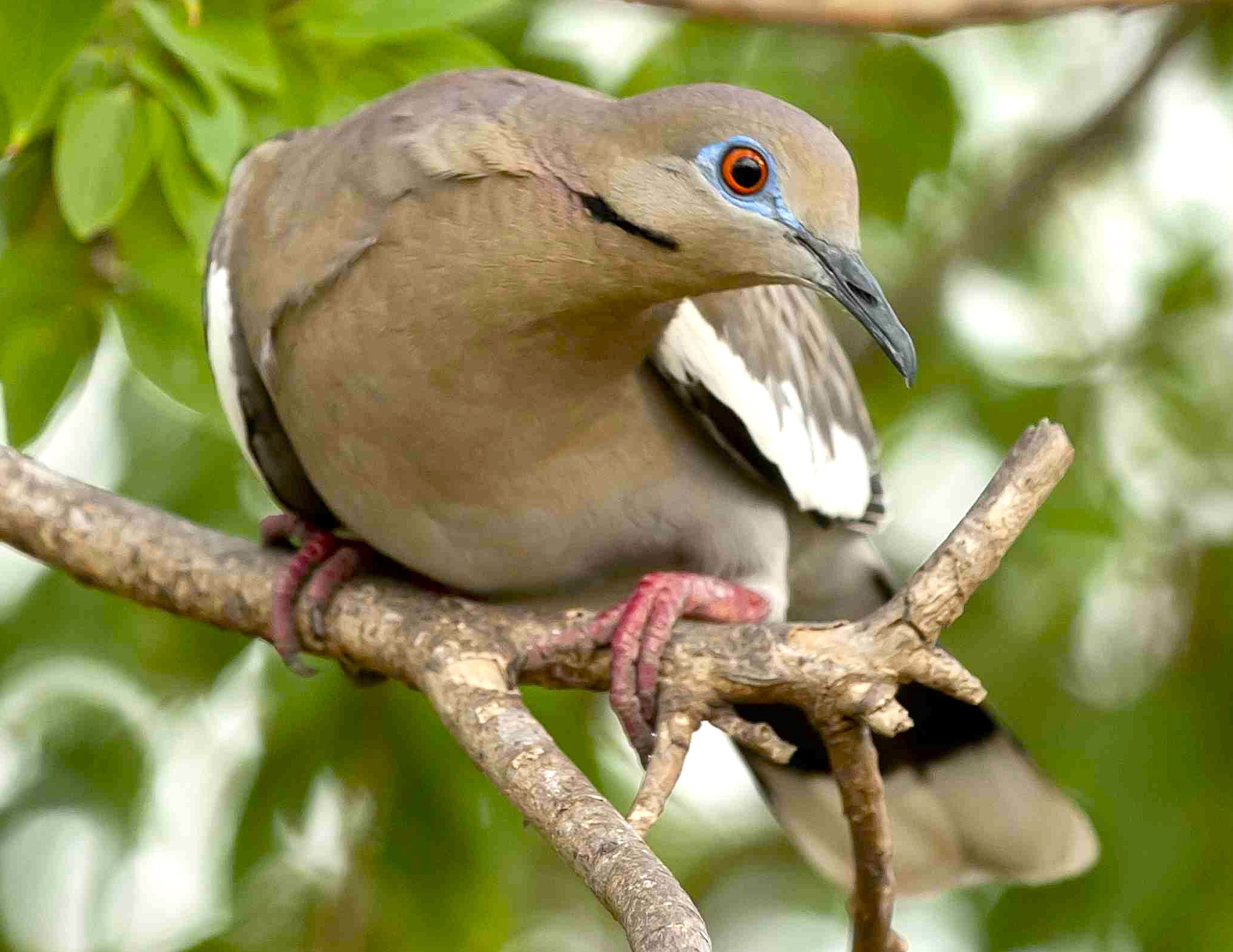
White-winged Dove, Abaco Bahamas - Tom Sheley

White-winged Dove, Abaco, Bahamas

NOVEMBER

Exploring Dan's Cave, Abaco

Exploring Dan’s Cave, Abaco

DECEMBER

Piping Plover, Abaco - Charmaine Albury

Piping Plover: a precious winter visitor to Man-o-War Cay, Abaco

All the best for 2015 to Rolling Harbour’s regular, occasional and random visitors

Credits: BMMRO, RH, Melinda Riger, Gerlinde Taurer, Tom Sheley, Alex Hughes, Brian Kakuk, Charmaine Albury

Unknown's avatar

“BEAUTIFUL BAHAMA BIRDS”: NEW BAHAMAS BIRD BOOK REVIEW


ABACO PARROTS MM 2

“Over the Moon” (Abaco Parrot / Melissa Maura)

“BEAUTIFUL BAHAMA BIRDS”: NEW BOOK REVIEW

Published 2014 ~ 128pp ~ $20, available from the BNT

A fine new book on the birds of the Bahamas has recently been published by the BAHAMAS NATIONAL TRUST and BIRDSCARIBBEAN. Compiled and edited by well-known Bahamas bird guide CAROLYN WARDLE  with the BNT’s Lynn Gape and Predensa Moore, this slim book is packed with valuable information. It doesn’t set out to be an exhaustive field guide, a task already fully covered by Bruce Hallett’s indispensable Birds of the Bahamas and the TCI. Nor is it anything like my own photographic tome ‘Birds of Abaco’, differing in scope and intention, and weighing a mere 225 gms as opposed to 2 kilos! Beautiful Bahama Birds is eminently a book for the pocket, day bag or backback, to be carried along with your Hallett.

I have illustrated this review with photos of sample pages of the book, invariably the best way to give a clear impression of this kind of publication. Apologies that some of my images are a bit wonky, my copy being new and individual pages being hard to keep flat…
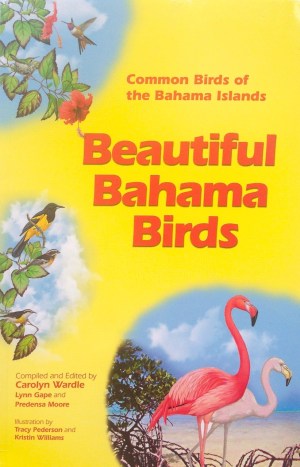
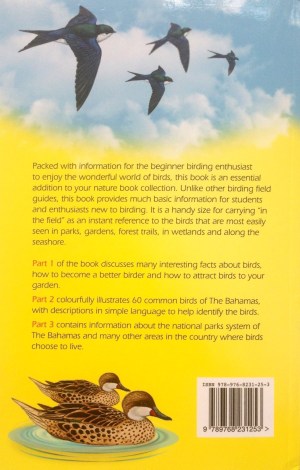
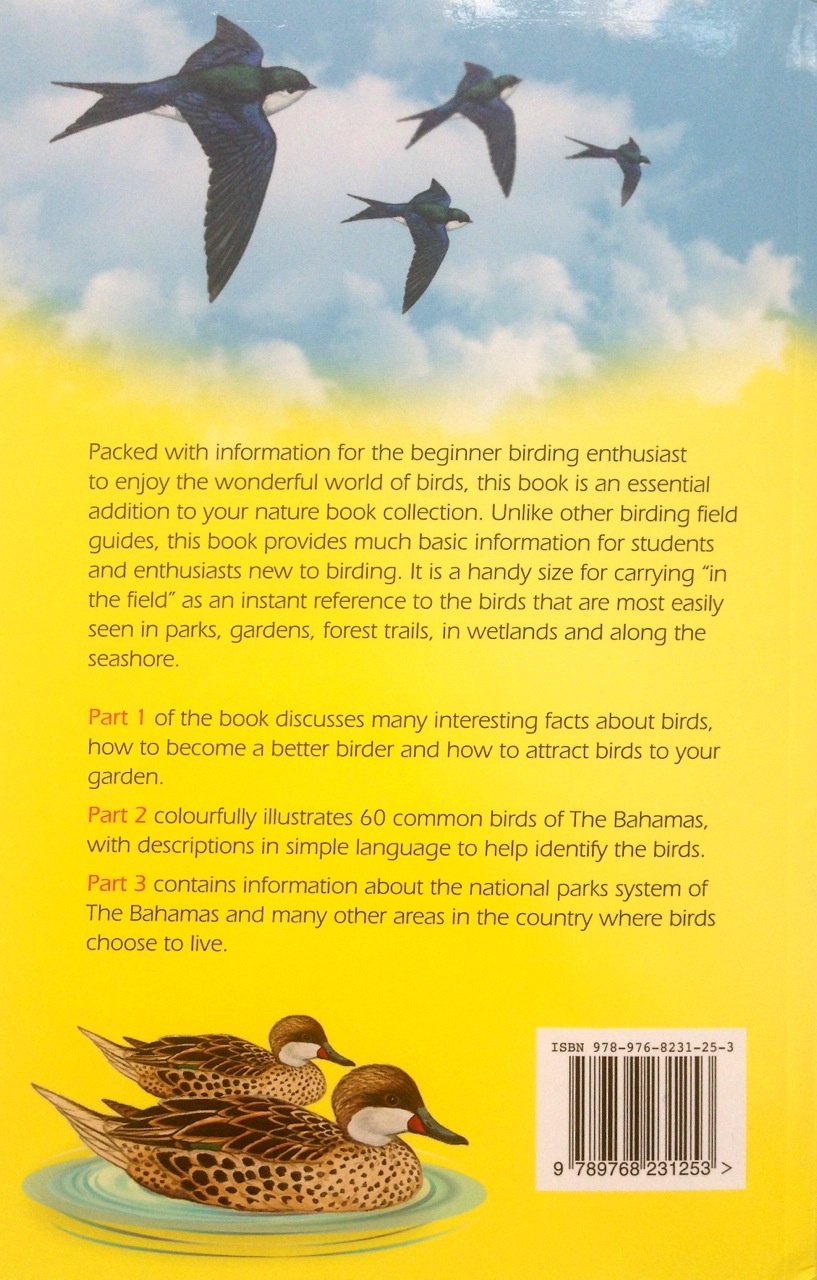
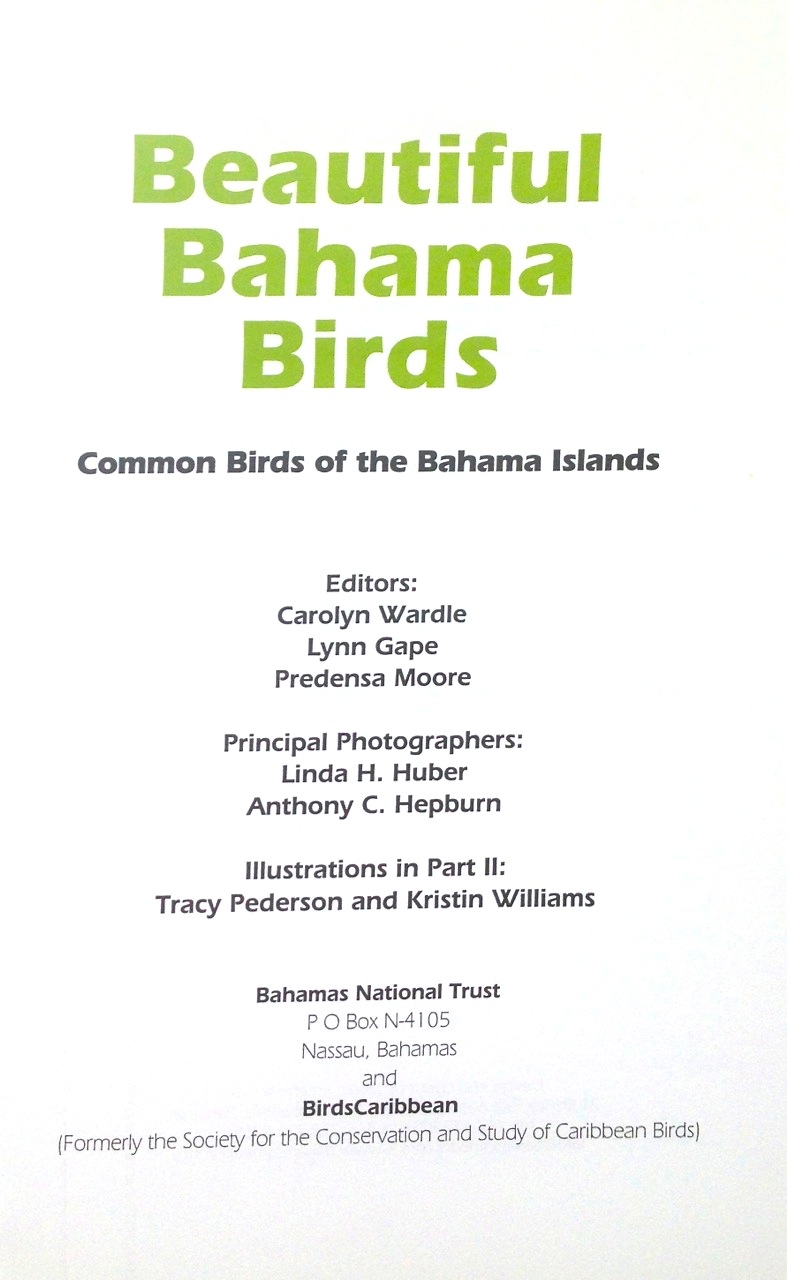
Beautiful Bahama Birds 1 Beautiful Bahama Birds 2

The photographs throughout the book are mainly the work of Linda Huber and the late Tony Hepburn. I was fortunate enough to be able to use some of Tony’s photographs for my own book, given with unreserved generosity; it is a fitting tribute to him that his images have now been published in Beautiful Bahama Birds, and that it  is dedicated to him.Beautiful Bahama Birds 3
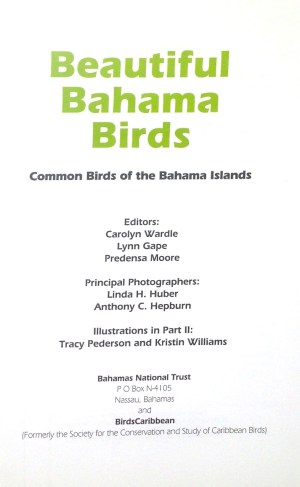
An idea of the broad scope and of the book and its usefulness to the birder can be gained from the contents pages, which I reproduce here. Click to enlarge them. The book is arranged in 3 parts: Let’s Go Birding; Field Guide to 60 Common Birds; and Conservation Now.

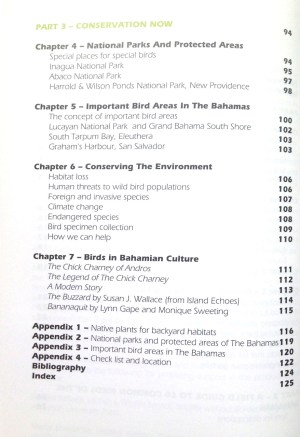
Beautiful Bahama Birds 4Beautiful Bahama Birds 5b

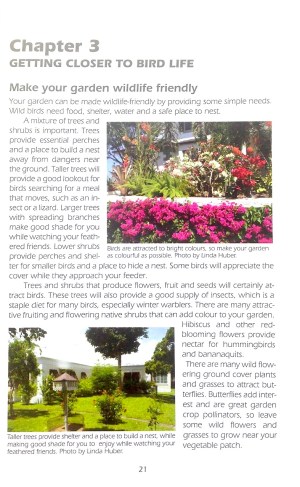
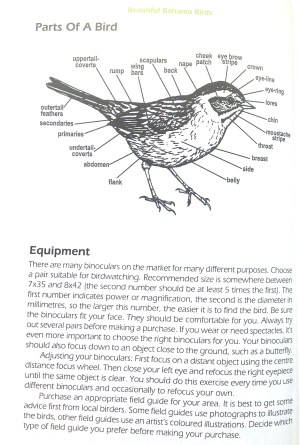
PART 1 offers plenty of useful information and practical advice about birding in general (I wish I could have read this before I started my own book!). Anyone who loves birds will benefit from this whole section, even if they would not call themselves a birder – especially Chapter 3 ‘Getting Closer to Bird Life’.
Beautiful Bahama Birds 6  Beautiful Bahama Birds 7

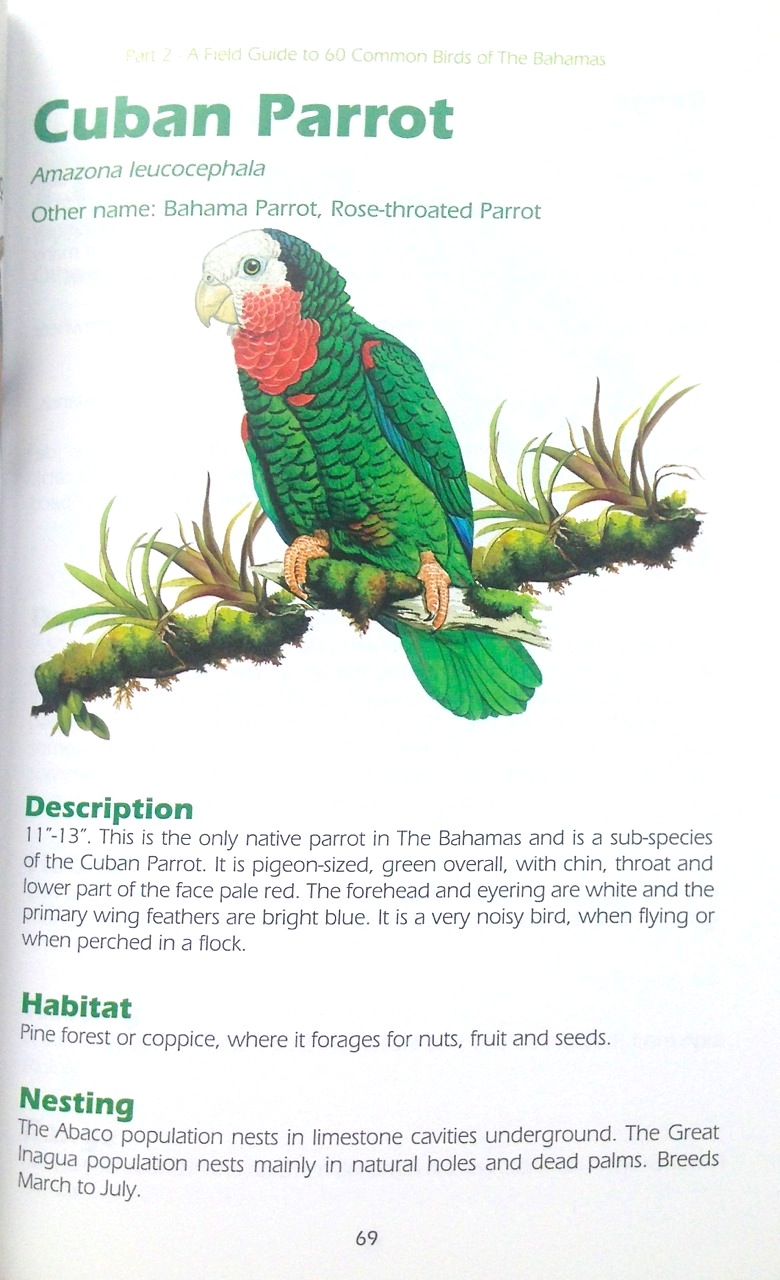
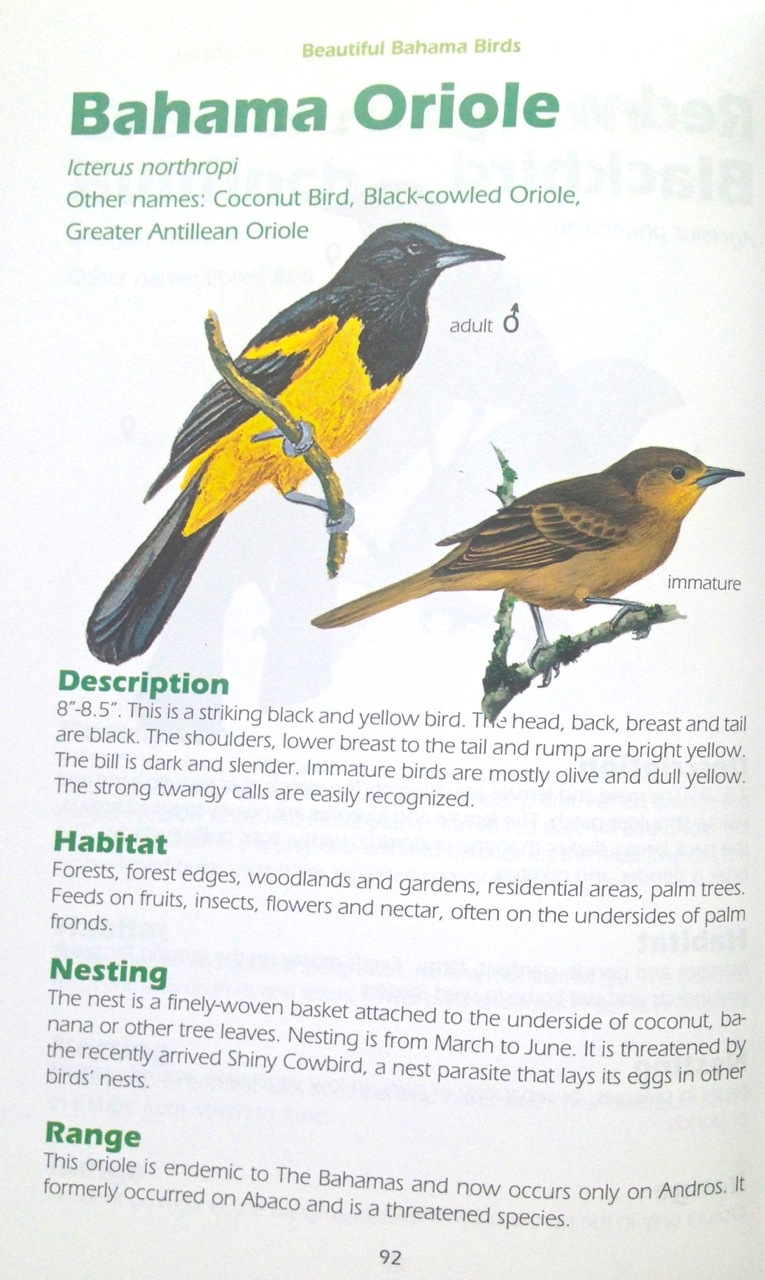
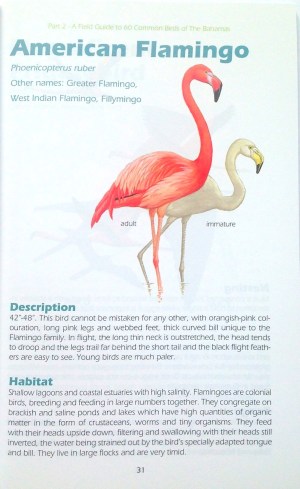
PART 2 All 5 Bahama endemics are featured in the main section, which is handily divided  very broadly into ‘waterbirds’ and ‘land birds’. Some birds are commonly found on most islands; some have more limited range: for example the Bahama Oriole is now found only on Andros; and breeding populations of the Cuban Parrot are found only on Abaco and Inagua (the increasing number of sightings on New Providence give some hope for a breeding population there too). I’ve chosen the parrot because the underground-nesting subspecies on Abaco is so special; and the Flamingo and Bahama Oriole, both very sadly extirpated from Abaco in recent memory.

The illustrations by Tracy Pederson and Kristin Willams are clear and highlight well the identifiers for each species. Where necessary, species variations are shown, for example between sexes, breeding / non-breeding plumage and adult / immature. This can be a confusing and even fraught area (as I constantly find), which this book usefully addresses.  Some birds in flight are also shown to aid ID.
   Beautiful Bahama Birds 8 Beautiful Bahama Birds 9

Beautiful Bahama Birds 10

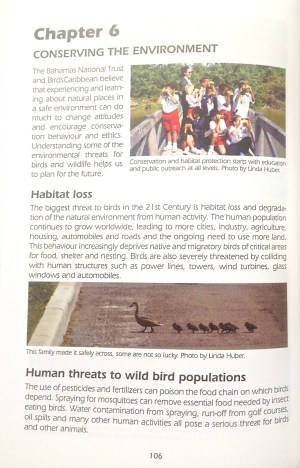
PART 3 covers the National Parks, important birding areas of the Bahamas, conservation matters, and a charming section on birds in Bahamian culture. Appendices include lists of Bahamas native plants and their importance for wildlife; National Parks and Protected Areas; important birding areas of the Bahamas; a Checklist; a Bibliography; and a user-friendly Index (not all are…).
 Beautiful Bahama Birds 13 Beautiful Bahama Birds 12

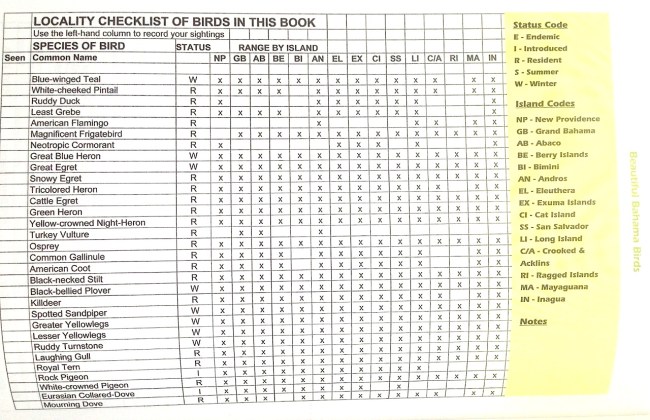
A good Checklist is a vital ingredient for any birder, whether visitor or local. Here, all the species occurring on the islands are shown on the left and their residential status and range throughout the islands across the top. Thus at a glance you can tell whether a given species is found on a particular island and when it may be found there. You would know not to look for Turkey Vultures on Eleuthera at any time; and that the black-bellied plover is a winter resident throughout the region and not to be seen during your trip in June…  I also like the tick-boxes on the left for species collectors.
Beautiful Bahama Birds 11

Overall I have thoroughly enjoyed this small book and unreservedly recommend it. It does not replace Hallett, but it complements it. Furthermore, I’m sure the straightforward style and presentation will appeal to bird-loving non-birders and also to younger birders – it may even encourage some out into the field! On p.20 the recommended reading list includes books that would appeal to young readers and links to appropriate websites, a thoughtful touch. I have learnt, or been reminded of, much from reading this book a couple of times. It is a welcome addition to the relatively sparse avian literature for the Bahamas, a prime birding region that is home to an astonishingly wide variety of birds including rare, threatened and vulnerable species like the Parrots, the Kirtland’s Warbler and the Piping Plover.

BOOK LINKS

RH BOOK REVIEW PAGE

BIRDER’S GUIDE TO THE BAHAMA ISLANDS (Tony White)

JAMES BOND (LICENSED TO WATCH BIRDS…)

SAN SALVADOR BIRDS

DELPHI CLUB GUIDE TO THE BIRDS OF ABACO

Unknown's avatar

SAW A SORA? SURE? RAIL TRACK ON ABACO


BAHAMAS - Sora 2 - Oct 2010 copy 2

SAW A SORA? SURE? RAIL TRACK ON ABACO

‘Furtive’. ‘Secretive’. ‘Skulking’. These are harsh epithets to chuck at a small inoffensive bird that just goes about its daily routine in watery places. And look at it from the Sora’s point of view: ‘intrusive’; ‘prying’; invasive’; ‘nosy’… That’s you with your camera, disturbing its quiet life in the reeds and on the margins of marsh and lake. And for that matter your careful attempts to get close to the shy sora without startling it could also be described as furtive, secretive and skulking. See how it feels?

Sora.Marsh Harbour.Abaco Bahamas.6.13.Tom Sheley copy

The Sora Porzana carolina is a species of rail, a winter resident on Abaco. The island also has the CLAPPER RAIL, Virginia Rail and the Black Rail. There are no recorded sightings of this last one, and certainly no photographs. But their distinctive call has been heard in several locations over the last few years –  for example, by two people in different places last June when we were in full bird mode for “THE BIRDS OF ABACO”.

Sora, Gilpin Point Abaco RH 1

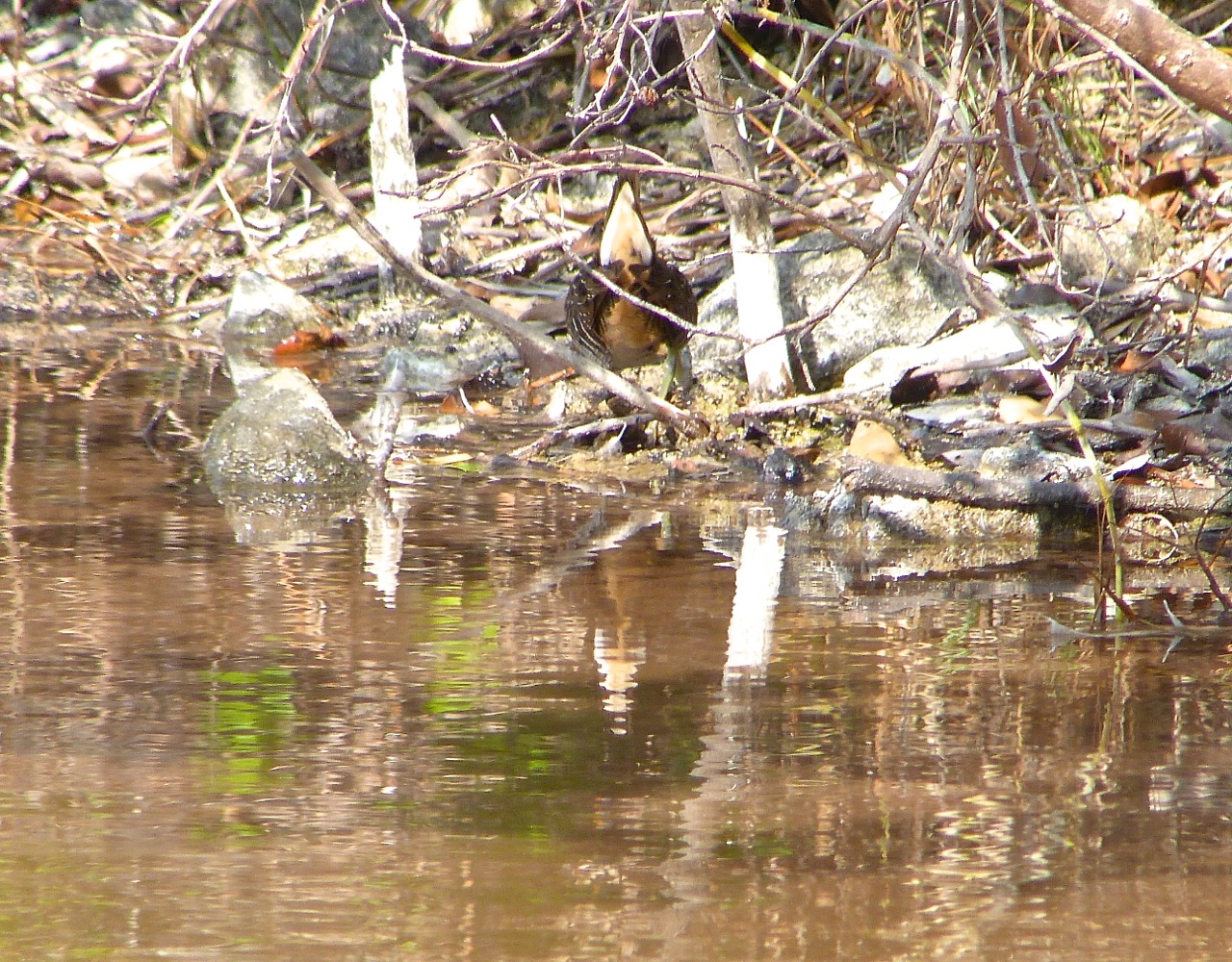
Although not uncommon, the sora is relatively hard to find; and if found, to photograph. As I wrote in the book, ‘these are most inconspicuous birds, so it is quite a coup if you manage to locate one. Their creamy beak and upturned tail may give their presence away as they work their way along the water’s edge, feeding intently’. Tom Sheley took the magnificent photo above of a sora peering out from cover – he’s a very patient man. Often, the best sight you’ll get is of the bird half-hidden in the reeds at a distance, as in my feeble effort above. Spot the Sora… I tracked the same bird, and later got a more open shot as the sora picked its way along the edge of a pond before disappearing again into the reeds. The bird was moving away from me. I was crouched on a small jetty, with a little blue heron nearby looking at me in puzzlement. Or sympathy. My best (ha!) shot below (beak and tail both visible? Check!) is followed by much the most usual view of a sora in my experience, the less photogenic end with the white… stern.

Sora, Gilpin Point Abaco RH 3Sora, Gilpin Point Abaco RH 4

I can’t improve on good old Wiki in summarising the diet of this little rail: “Soras are omnivores, eating seeds, insects and snails. Animals that are commonly reported as sora food items include snails, crustaceans, spiders, and insects – mainly beetles, grasshoppers, flies, and dragonflies. Soras often eat plant seeds. Plants in the sora’s diet include duckweed, pondweeds, and grasses.” Wiki’s own image is shown next.

Sora, Birding Center, Port Aransas, Texas

We were with our friend the ornithological scientist Caroline Stahala* when we – I should say she – saw my first sora at the pond at Gilpin Point near Crossing Rocks. She grabbed my camera and plunged into the rather thick undergrowth at the water’s edge. Actually, she had to plunge into the water itself at one stage. Here are 2 shots that further demonstrate how hard it can be to photograph these wretched creatures. They don’t pose prettily on a branch in the sunshine like a Spindalis, for example. They forage about in places where low light and thick vegetation combine to make focus and clarity difficult to achieve. *’The Parrot Lady’  Sora, Gilpin Point Abaco - Caroline Stahala 1 Sora, Gilpin Point Abaco - Caroline Stahala 2 The remarkable calls of the sora can be heard in the very short clips below, from the invaluable Xeno-Canto archive. They make three distinct types of sound, one described as “a descending whinny”. Apparently the use of ‘call broadcasts’ greatly increases the chances of hearing a sora. They also increase the chances of seeing a sora, as the bird will often investigate the source of the call. The propriety of using a recording to attract a bird is open to debate, but there’s no doubt that it can be far more effective than simply going ‘pish-wish’ repeatedly… CALL Ted Floyd ‘WHINNY’ CALL   Micah Riegner ‘WEEP CALL’  Todd Wilson This is a second Wiki image of a sora foraging in water. I like the fact that, as with Tom’s photo, you can see the feet.1024px-Porzana_carolina “SORA”. Where does the word come from? What does it mean? It sounds like some uninviting butter-style spread. Or is that ‘Flora’? I did some research and for a start it means ‘Sky’ in Japanese and ‘Seashell’ in Korean – both used as names. Six countries worldwide have places called Sora. There are various obscure usages (e.g. a little-known video game). Disappointingly, however, the best etymology I can find in a birding context is that the origin is ‘unknown’. I was too disheartened to explore the derivation of ‘Porzana’. Could so easily be a second-tier female character in a Shakespeare comedy: “Haply, Porzana, hast seen the Sora of the Prince, withal?”. Having started this post with a header shot by Becky Marvil, I’ll end with the etymological mystery and another photo by Becky of the same bird going for some underwater delicacy. Sora, Abaco - Becky Marvil 2.1

STOP PRESS Uli Nowlan has kindly sent a photo of a Sora taken at ponds north of Treasure Cay (below). It’s a timely reminder to me that this blog is somewhat South Abaco oriented. More than somewhat, in fact. That’s inevitable I’m afraid, owing to my base camp being south of MH. Also, I think it’s generally accepted that South Abaco is the place to find the best birding. I do include birds from the TC area – the golf course ponds and the creeks – but perhaps not enough. Contributions welcome!

Sora, Abaco (Treasure Cay area) - Uli Nowlan

Credits: Header and last image – Becky Marvil; Tom Sheley, RH, Wiki, Caroline Stahala; Uli Nowlan. Wiki-nod for some info also.

Unknown's avatar

“THE DELPHI CLUB GUIDE TO THE BIRDS OF ABACO” HAS LANDED…


JACKET GRAB JPG

WHAT HAS THE GESTATION PERIOD OF A WALRUS (16 MONTHS) AND WEIGHS THE SAME AS A PAIR OF FULLY GROWN PINEAPPLES (2 KILOS)?

“THE DELPHI CLUB GUIDE TO THE BIRDS OF ABACO”

A unique bird book is  been published and has arrived on Abaco today. Printed in Italy at the end of January, it has made its way from Florence via Bologna, Leipzig, Brussels, Cincinnati, Miami and Nassau. Having spent an unexpectedly long sojourn in Nassau,  2 pallets of books are now safely at the Delphi Club… at last!Cuban Pewee on Abaco

The Guide showcases the rich and varied bird life of Abaco, Bahamas and features both resident and migratory species including rarities and unusual sightings. It is available for sale now from the Delphi Club in a limited edition of 500.  The main features are as follows:

  • 272 pages with more than 350 photographs
  • 163 species shown in vivid colour – nearly two-thirds of all the bird species ever recorded for Abaco
  • Every single photograph was taken on Abaco or in Abaco waters
  • All birds are shown in their natural surroundings – no feeders or trails of seed were used
  • Several birds featured are the first ones ever recorded for Abaco or  even for the entire Bahamas

Clapper Rail Abaco Bahamas Tom Sheley

  • A total of 30 photographers, both experienced and amateur, have contributed to the project
  • The book has had the generous support of many well-known names of Abaco and Bahamas birding
  • Complete checklist of every bird recorded for Abaco since 1950 up to the date of publication
  • Specially devised codes indicating when you may see a particular bird, and the likelihood of doing so
  • Specially commissioned cartographer’s Map of Abaco showing places named in the book

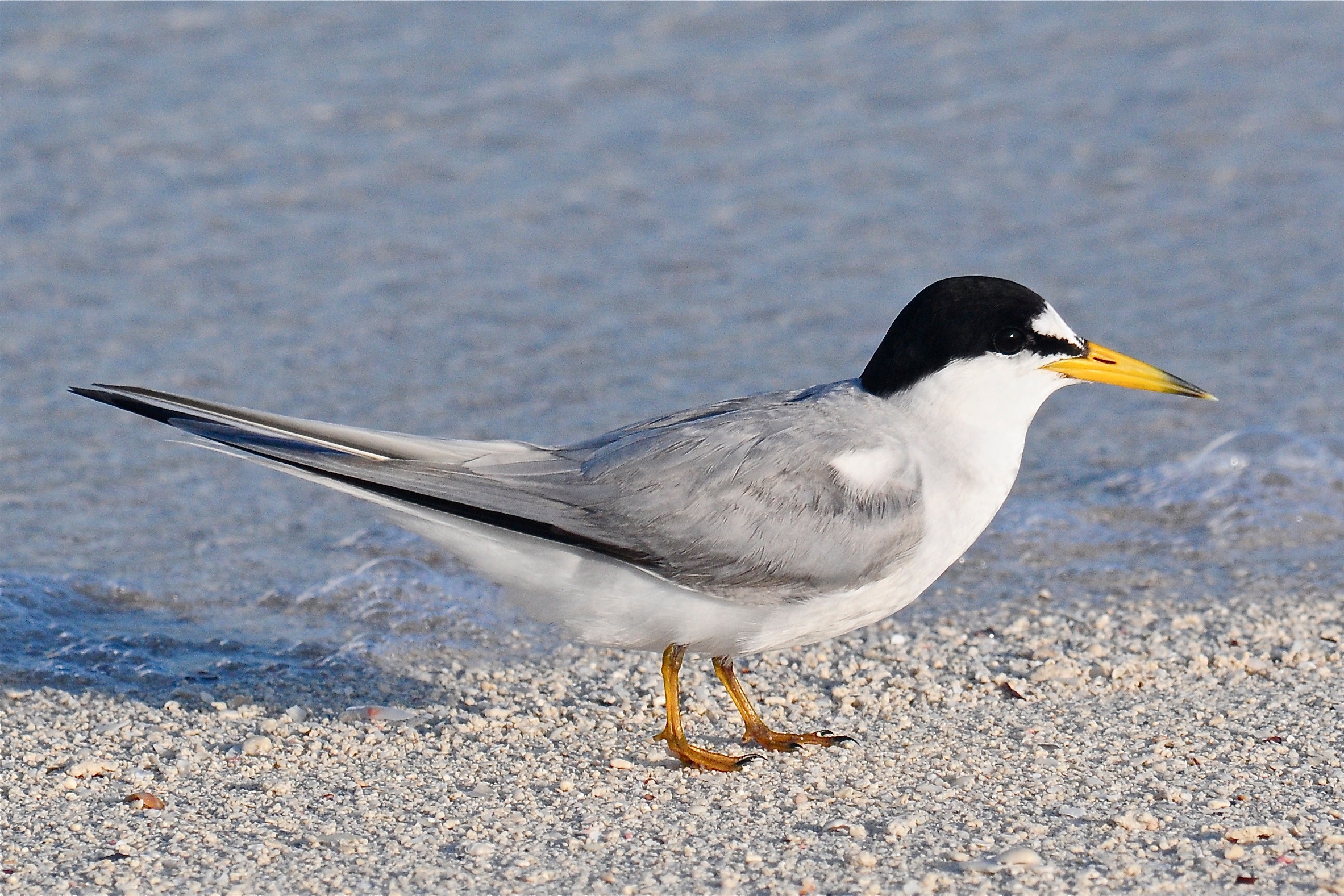
Least Tern_ACH3672 copy

  • Informative captions intentionally depart from the standard field guide approach…
  • …as does the listing of the birds in alphabetical rather than scientific order
  • Say goodbye to ’37 warbler species on consecutive pages’ misery
  • Say hello to astonishing and unexpected juxtapositions of species

Abaco_Bahama Yellowthroat_Gerlinde Taurer copy

  • The book was printed in Florence, Italy by specialist printers on grade-1 quality paper
  • Printing took pairs of printers working in 6 hour shifts 33 hours over 3 days to complete
  • The project manager and the author personally oversaw the printing

Smooth-billed Ani pair GT

  • The book is dedicated to the wildlife organisations of Abaco
  • A percentage of the proceeds of sale will be donated for the support of local wildlife organisations
  • A copy of the book will be presented to every school on Abaco

Piping Plover BH IMG_1919

The book is published by the Delphi Club (contact details below). The project was managed by a publishing specialist in art books. The author is the wildlife blogger more widely known on Abaco and (possibly) beyond as ‘Rolling Harbour’. Oh! So that would in fact be Mrs Harbour and myself. Well well. What are the chances?

cuban-emerald-delphi-abaco-3

The Delphi Club at Rolling Harbour
PO Box AB-20006, Marsh Harbour, Abaco, Bahamas
Tel: +1-242-366-2222
General Manager – Sandy Walker: +1-242-577-1698
delphi.bahamas@gmail.com

American Oystercatchers BH IMG_2000 copy 2Images by Tom Sheley,  Bruce Hallett, Gerlinde Taurer, Tony Hepburn, RH