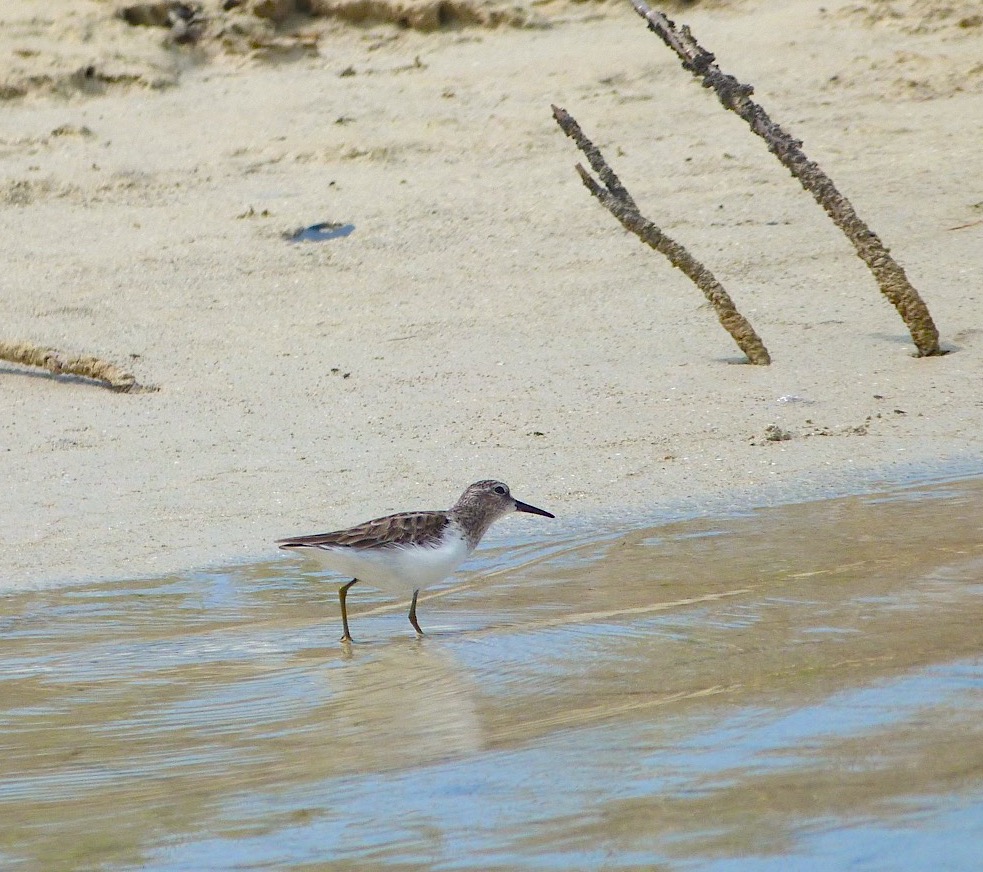
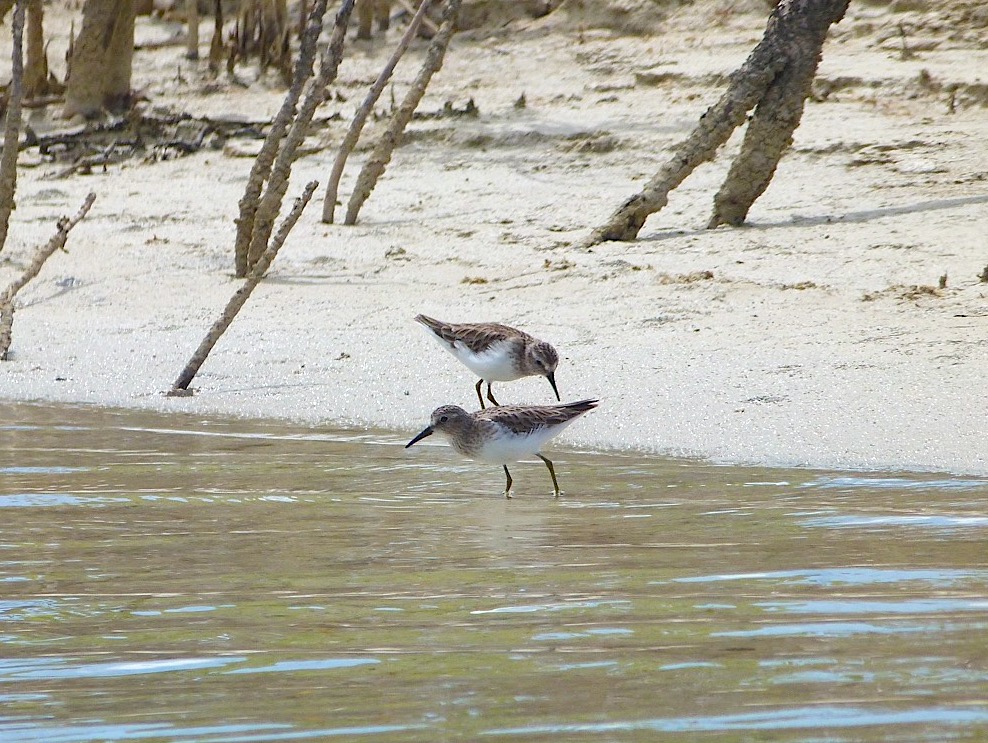
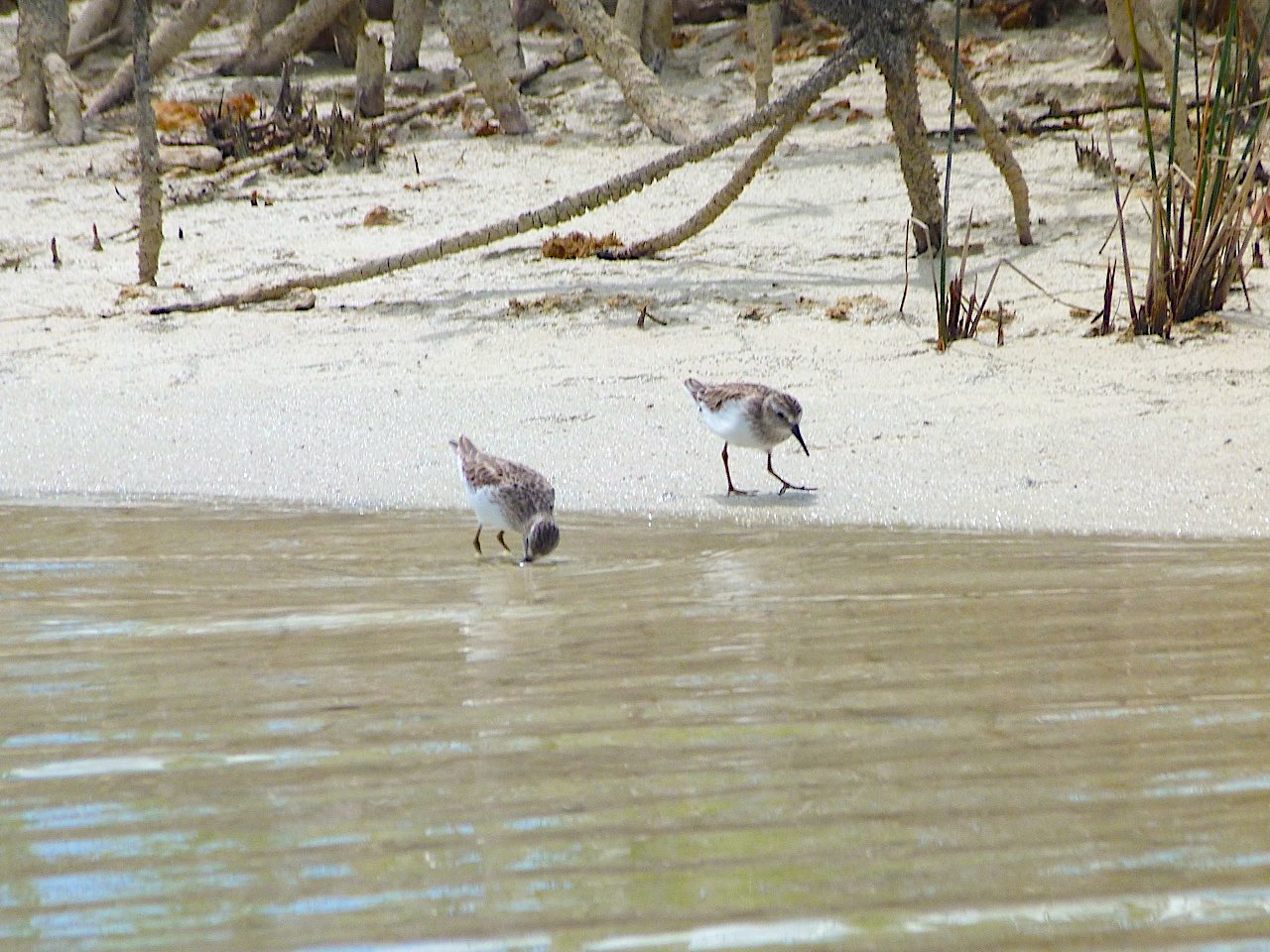
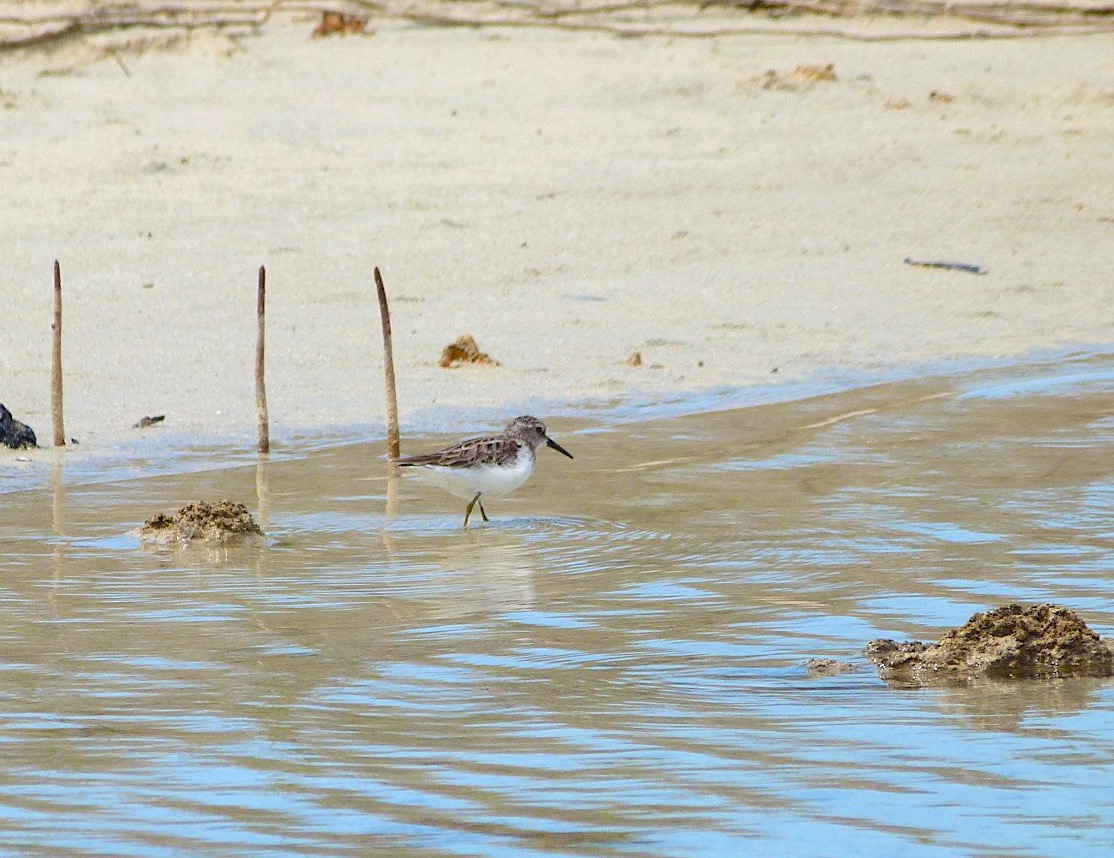
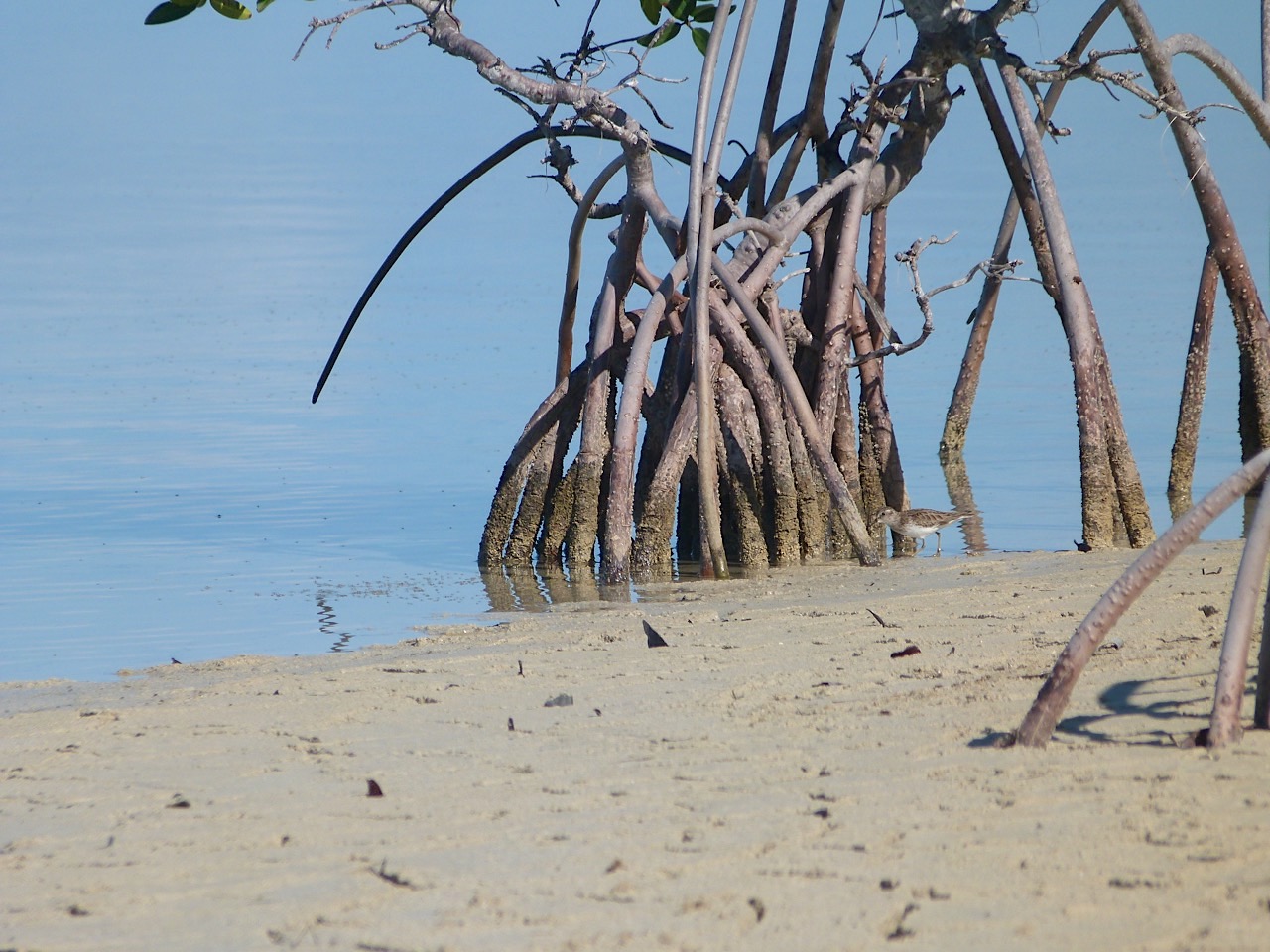
Least Sandpipers Calidris Minutilla are the smallest ‘peeps’ to be found on Abaco. There are plenty of other sandpiper species, but none so tiny as these. Take a look at the image above. See them? All 3 of them? Just look at their size in comparison with the mangrove stems.
I took these photos from the sharp end of a skiff a few days ago, way out on the Marls and with a fishing rod tucked under one arm. We were on a drift along the shoreline, and these little guys were foraging on the water’s edge as we silently floated past.
They were quite unperturbed by our presence, being far too busy feeding to be bothered with us. I have usually seen these little birds on the beach, busy in the wrack-line rootling out goodies. There, they look very small – but not nearly as tiny as when foraging among the mangrove stems.
I debated whether to do some cropping to magnify the details on the page, so to speak, but then I decided that these very sweet creatures deserved their own space without the indignity of close inspection. Context is all.
These mini-sandpipers may be Least by name, but they are very far from last in my personal list of favourite peeps. There are some down on the beach right now, but there’s some cloud cover today… I’ll wait for the sun to catch them in the best light.
South Abaco – the whole area south of Marsh Harbour – provides by far the best birding opportunities for a day of varied birding. A recent party led by birding guide Reginald Patterson included Charmaine Albury in the enthusiastic team. She sent me their checklist for the day – 40 species covering an impressive range of bird types. Here is the list, to which I have added some illustrative photographs.
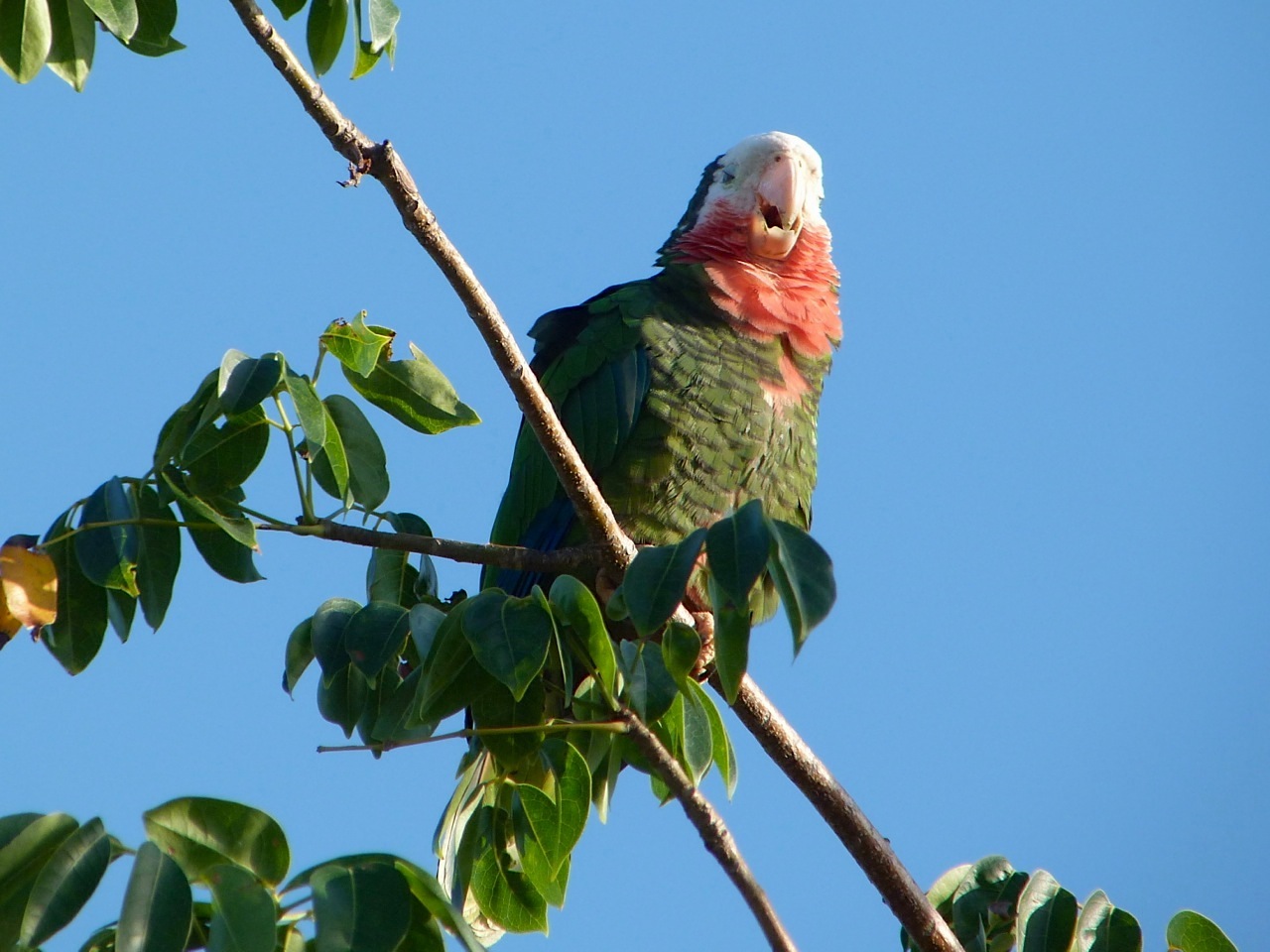
The checklist covers a broad range of birds that you might expect to see in habitats ranging from coppice to pine forest to water to shoreline. Most are permanent residents, with some winter residents (eg the painted bunting, Cape May warbler). Abaco specialities include the parrots of course, the West-Indian woodpecker and the olive-capped warbler.
And birds that might, on another day, be seen? Maybe the endemic Bahama Woodstar hummingbird and the endemic Bahama Swallow. At Gilpin Pond, black-necked stilts and perhaps a belted kingfisher. And at Sandy Point, brown pelicans fishing off the dock and the chance of white-tailed tropicbirds off-shore. But overall a ’40 day’ is a great day!
We are just back on Abaco last night, and without actually trying – and just from the balcony in about 20 minutes – we have scooped:
Turkey Vulture, Black-faced Grassquit, Bananaquit, Bahama Swallows, Loggerhead Kingbird, La Sagra’s Flycatcher, and Thick-billed Vireo – also Oystercatchers heard from the beach. Time to investigate further…
Credits: Tom Sheley (1); Keith Salvesen (2, 5, 8, 9); Craig Nash (3); Gerlinde Taurer (4, 6); Tom Reed (7); Nina Henry (10)
The sounds are unmistakeable – a discordant chorus of soft chuckling noises like tongue-clicks as the RWTs flock into a bush, interrupted by harsh, metallic calls like rusty metal gate-hinges being forced open. Or maybe a lone bird mournfully repeating its eerie call from the mangroves far out on the Marls as the bonefishing skiffs slip silently along the shoreline. No other species sound quite like Agelaius phoeniceus.
The handsome males sport flashy epaulets, most clearly visible in flight or in display – for example to impress a prospective mate. Again, they are unlikely to be confused with another species.
The females, as is often the way, are less showy. I have just read that they are ‘nondescript’, which is unnecessarily harsh I reckon. Here are a couple of examples.
And the darker brown ones that are clearly not handsome black males? These are young males in their first season, before they move on to the full adult male plumage. Previously I had designated them females (as I had assumed) until very gently corrected by the legendary Bruce Hallett. Not only was Bruce an essential part in the production of the Birds of Abaco, he also keeps a benign eye on my posts and occasionally steps in to clarify IDs etc. I took the first male juvenile at Casuarina, when I also made the sound recording (below). The second was at Delphi – and with some ‘light’ issues, I notice…
Fledglings are kind of cute…
SO WHAT DO THEY SOUND LIKE?
You may need to turn up the volume a bit. You will also here a lot of dove noise and, in the background, the sound of waves lapping onto the shore.
Photo Credits: Tom Sheley (1, 2, 4, 5, 8); Alex Hughes (3); Keith Salvesen (6, 7, 9 & audio)
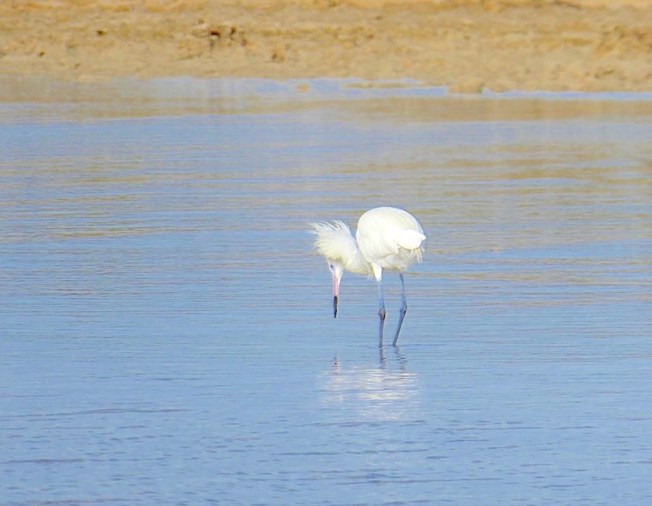
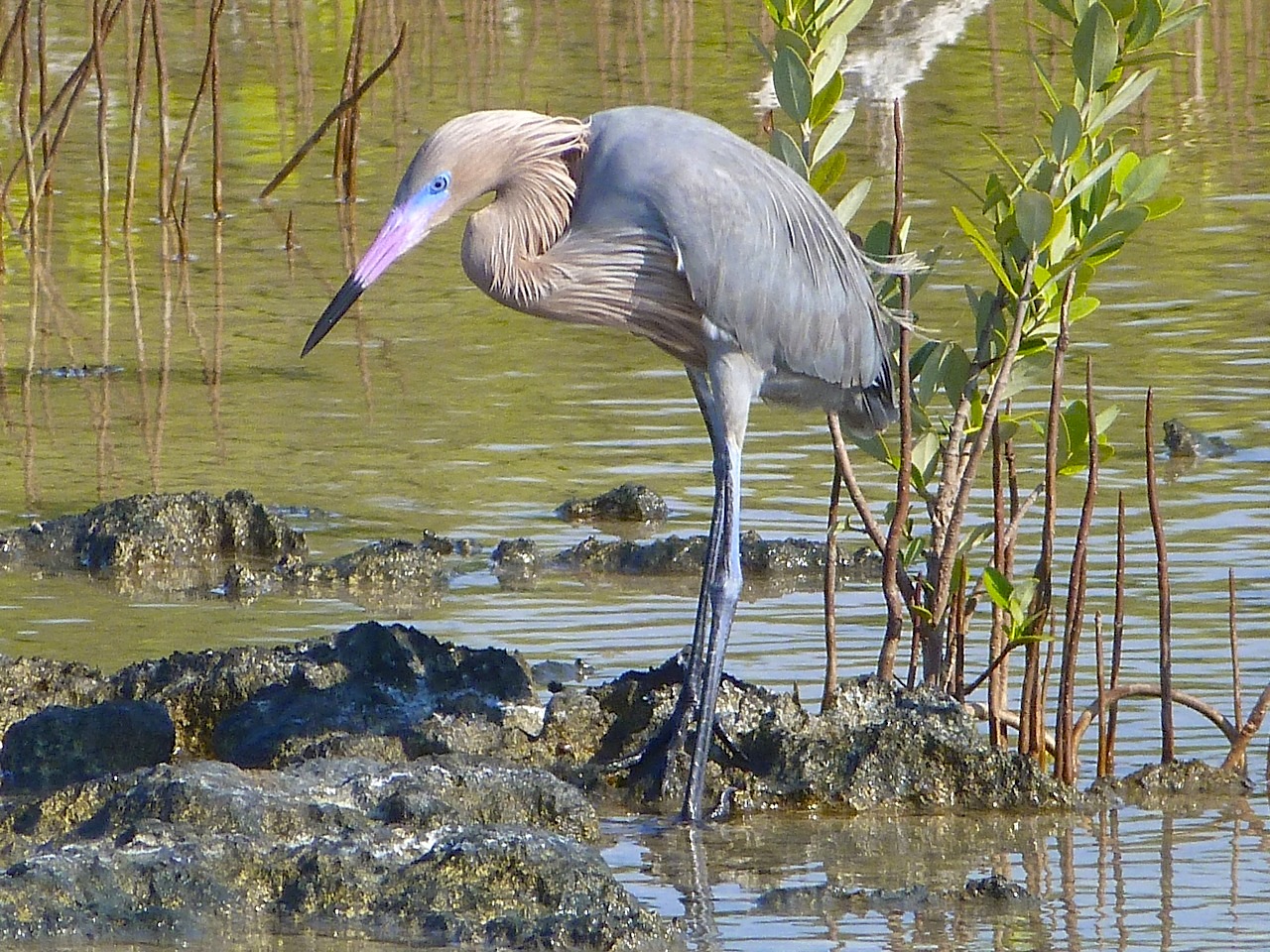
The trouble with reddish egrets is simple: they come in two colourways. There’s the conventional one which is indeed reddish, as one might hope and expect. Then there’s the snow white type (or ‘morph’). That’s the one featured here (with the other dark variety below, for comparison).
Both types are common breeding residents on Abaco. There are theories about which kind outnumbers the other; on balance I’m not sure the difference is very significant. Maybe reddish are a rather more frequently encountered than white, but there doesn’t seem to be much in it.
Looking back at photographs I took last spring, I found a sequence of a hunting white egret. Now these are not exhibition-quality photos. They were taken quite far out on the Marls, and a fair distance from the skiff I was standing on the front (prow?) of.
I had a smallish camera, and a fishing rod tucked under my arm rather hoping not to hear the usually welcome call “Hey RH**, bones at 10 o’clock moving left – 4 of them – give it 30 feet…” So this sequence is designed to give an idea of how the bird hunts the shallows. Rather than standing stock still and suddenly stabbing down to catch a fish, sometimes the egrets will stride purposefully though the shallow water, taking their chances as they move.
A small success at the start of the hunt (look carefully at the tip of the beak)A pause (and a slightly bad hair moment)
I always enjoy watching the actions of these birds make as they go about their work. But now the hunt is over; the egret has worked his way along the shoreline and he’s thinking out his next move…
…which is to fly off and try his luck elsewhere
Your compensation for some mediocre – but hopefully illustrative – shots is a header image from the camera of the highly experienced birdman and photographer Danny Sauvageau.
Finally, the way to tell that you are looking at a reddish egret, whichever version, rather than one of the other available egret / heron candidates is to look at the bill – pinkish, with a black tip. No other egreto-heronish species has this.
A ‘proper’ reddish reddish egret taken in one of the brackish ponds at Crossing Rocks – always a good place to pull in and check for herons and egrets. This one, photographed in March, is in his handsome breeding plumage. Compare the bill with the white morph above – just the same.
** This not in fact how I am customarily addressed. I have a real name. Probably.
Credits: header image, Danny Sauvageau with thanks as always; all mediocre white morphs RH – also the rather better effort comparative photo of a ‘proper’ reddish one; cartoon by the inimitable Birdorable.
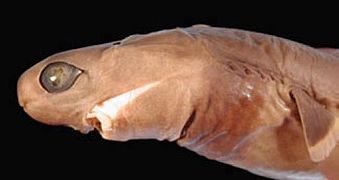
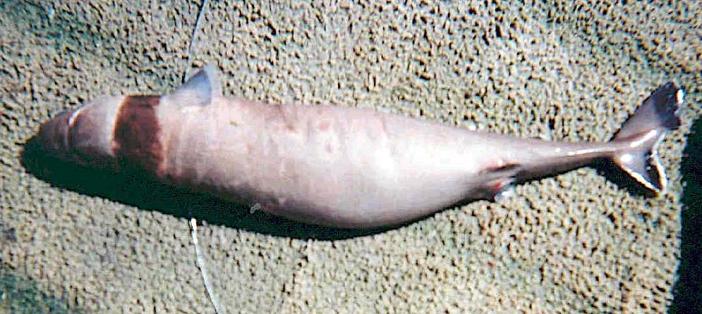
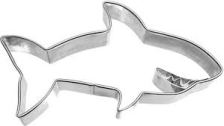
The Cookiecutter shark Isistius brasiliensis (aka the less scary, more genial sounding ‘cigar shark’), might be an ideal candidate for a Room 101 nemesis.** These little beasts – a species of dogfish shark – are found in several mainly island-based areas dotted around the globe, including in Abaco waters.
HOW COME THE NAME?
These sharky little b@st@rds (*technical term*) attack marine mammals and fishes, gouging out perfect round plugs of skin and flesh, leaving what are sometimes called ‘crater wounds’. Then they eat them. Imagine getting hold of a really sharp domestic cookie cutter with circular rows of razor-sharp teeth, and grinding it hard into your thigh. There! That!
The size of an adult shark:16″ max
The term ‘cookiecutter’ is also a pejorative slang term, meaning mass-produced, lacking in originality, or boringly samey, as in cookiecutter cars or TV genres etc. The little critters under consideration here are anything but…
HORRIFYING COOKIECUTTER FACTS
Live in the depths, rise vertically in the day & dive back down at dusk
Undersides have light-emitting ‘photophores’ which emphasise…
…the dark collar which acts as a lure, resembling a small innocent fish
Bioluminescence lures prey & confuses predators (more on this below)
The glow is so strong it may last for some time after removal from water
Their lips are ‘suctorial’ = they attach tightly to their target
The jaws then gouge out the victim’s flesh in a remarkably neat circle
Omni-vicious: any medium to large ocean creature is vulnerable to attack
There are even occasional reports of humans being targeted
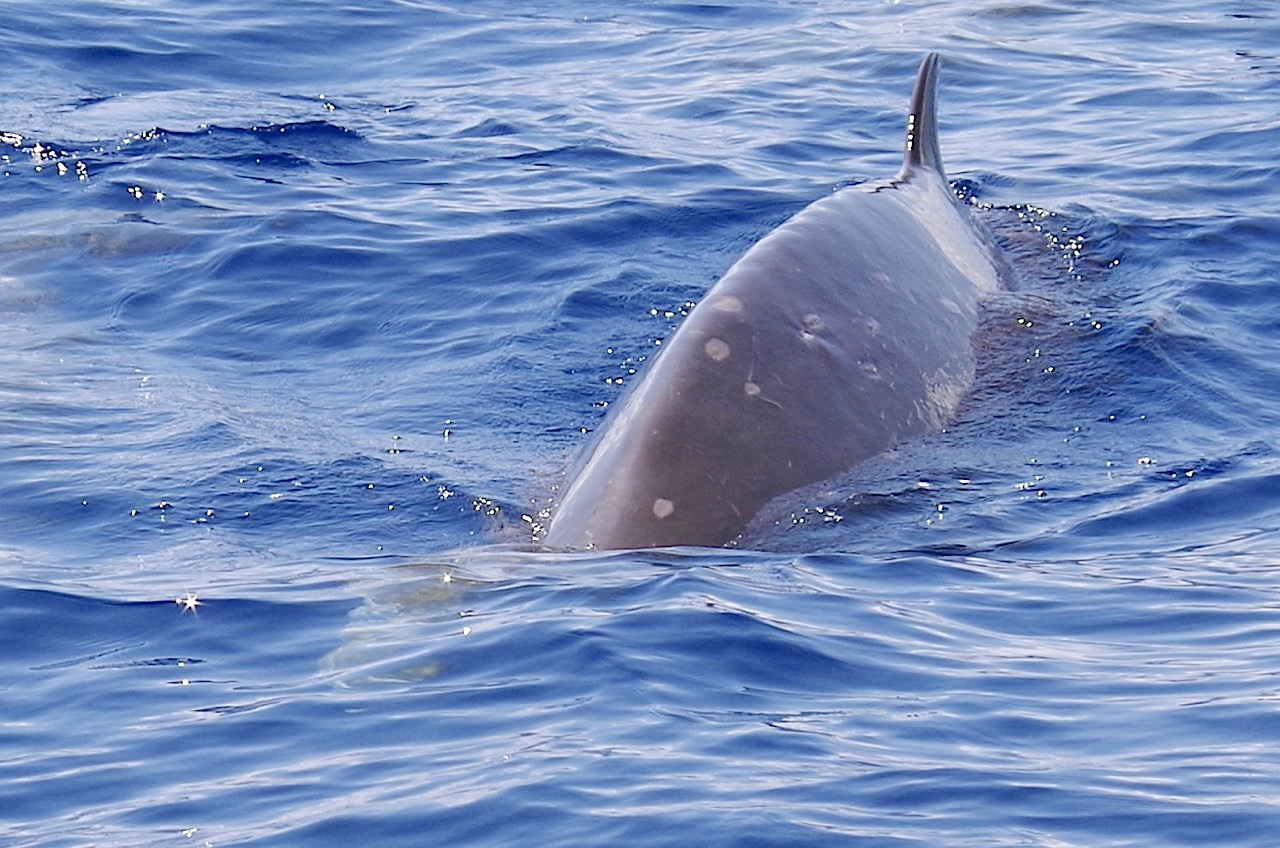
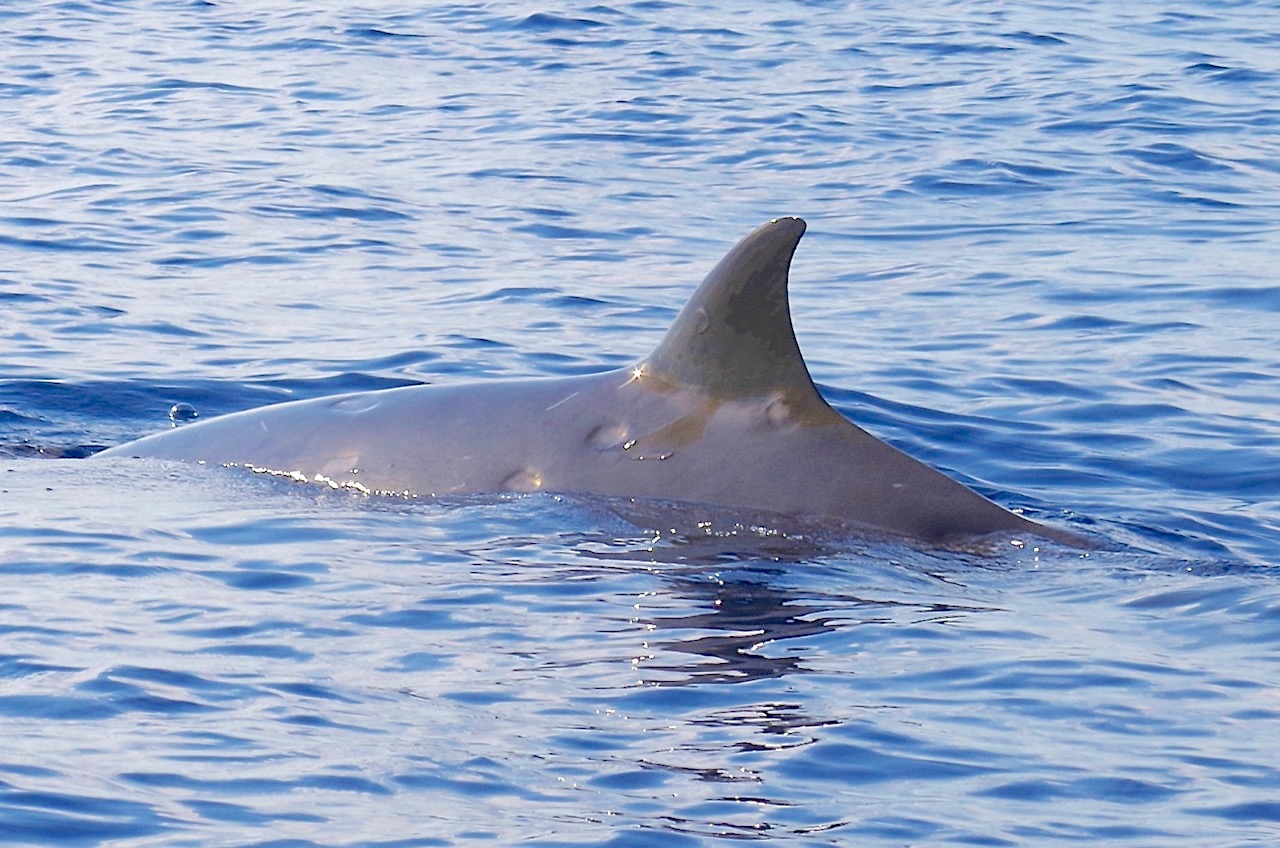
Here are two Blainville’s beaked whales that I photographed from the BMMRO research vessel. The top whale has a number of circular healed attack marks and a recent one. You can see how deep the gouged hole is. The other has well-healed scars.
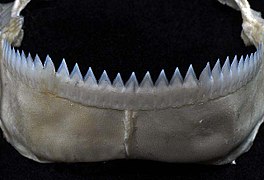
Multi-toothed: top rows of small teeth, rows of larger teeth on the bottom
The lower teeth are the cutters, acting like a saw when locked on
See header image and below for full details
HOW EXACTLY DO THEY DO WHAT THEY DO?
I can explain it no better than the renowned authority Prof. W. K. P. Dear: “the suctorial lips ensure a tight seal. It then bites, using its narrow upper teeth as anchors while its razor sharp lower teeth slices into the prey. Finally, the shark twists and rotates its body to complete a circular cut, quite possibly aided by the initial forward momentum and subsequent struggles of its prey. The action of the lower teeth may also be assisted by back-and-forth vibrations of the jaw, a mechanism akin to that of an electric carving knife”.
ARE THESE SHARKS ‘PARASITES’, WOULD YOU SAY?
The behaviour of these sharks is an example of a symbiotic relationship between two species that is parasitic. This means essentially that one gains and the other suffers (e.g. no-see-ums!). This is distinct from commensalistic symbiosis, where one species gains and the other is unaffected (e.g. cattle egrets with cattle); and mutualistic symbiosis, where both gain (e.g. cleaner fish & groupers). So, in a word, yes.
An ‘ambush predator’: they ‘hover’ in the water column waiting…
They are capable of rapid movement to catch up & latch onto prey
They will eat a passing small fish, crustacean or even squid as a snack
Sometimes they operate in schools; there is safety in numbers
The schools are thought to increase the ‘lure’ effect of the dark collar
A beached whale that’s been heavily targeted
FUN FACT TO COUNTERACT THE BAD STUFF
In the late c20, more than 30 U.S. Navy submarines were forced back to base to repair damage caused by cookiecutter shark bites, either to the neoprene footings of sonar domes or to rubber-sheathed cables. The problems were solved by using fibreglass. Oceanographic equipment and telecommunications cables are also recorded as being damaged by these sharks.
Cookiecutter Shark – the real deal
MONSTERS OF THE DEEP
These great cards from the weirdly spelledWIERD ‘N’ WILD CREATURESprovide excellent factual info. Their CCS card is no exception. You’ll find more details here about the effect of the bioluminescence and so on, written as clearly as I might hope to.
**“The worst thing in the world varies from individual to individual. It may be burial alive or death by fire, or by drowning, or by impalement, or fifty other deaths. There are cases where it is some quite trivial thing, not even fatal.” (George Orwell, 1984)
Alright now…
Credits: BMMRO – header image; beaked whale photos – Keith Salvesen / BMMRO; Te Ara NZ for the main jaw image; all small images with thanks to Wiki and respective photographers who took the time to upload them for all to enjoy & learn from; ‘wierdnwonderful creatures’ for the monster card; range map from Wiki
PS Apologies to anyone who bothered to wade through this, and stayed awake long enough to notice that formatting gremlins struck halfway through
I realise that the title of this post has its unattractive aspects. This is a family blog, and we try to keep references to ‘butts’ and so forth to a minimum. But like it or not, the Palm Warbler is one of two species** that have acquired the nickname ‘butterbutt’. They weren’t even consulted; birders just went ahead with it without checking how they’d feel about it.
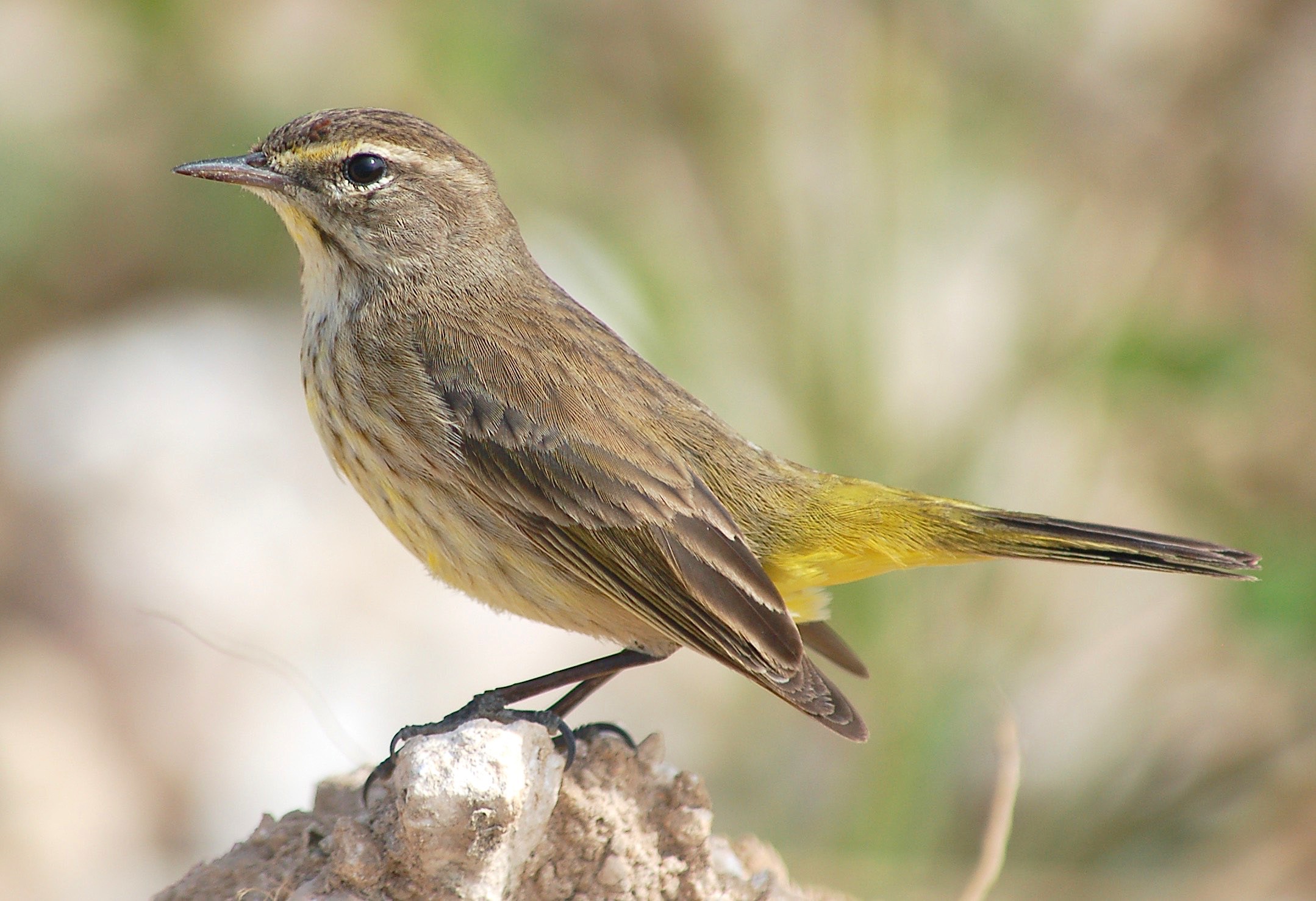
On the other hand, it’s easy to see how this minor linguistic outrage came about. It’s there for all to see, right under the bird’s… erm… stern. That flash of vivid yellow, together with the pale speckled front, a rusty brown cap and striking eye-stripe, is diagnostic for this Abaco winter resident species.
The ‘heads-up’ is because right now they are among you. In the gardens, on the grass, on the tracks, in the coppice, in the casuarinas. And they have an endearing habit of bobbing their… tails, let’s say, as they forage. Palm Warblers are inclined to be fairly inquisitive and tame, so if you are careful, they may stay around to let you watch them.
The PW above must, I think, have been photographed at the very end of the winter season, just before it headed north from Abaco. The strong colours suggest this guy is getting into the breeding mood. Compare him with the picture below, taken by the same photographer during the same period, of a slightly less garish stage of breeding plumage. But it’s on its way…
As often as not, a palm warbler will be fairly easy to spot. Not always, though. You may have to work a bit to locate one half-hidden in foliage. Its posterior may not even be visible.
Luckily, PWs are common enough in winter to give you a chance to shoot them in the open, as it were. Perched on a branch works just fine to capture the essential characteristics.
Keep an eye out for these pretty little warblers. They are enjoyable to watch, and relatively easy to get a photo of at close quarters. Just make sure you get the butterbutt into the picture.
** The other butterbutt bird is the descriptively-named YELLOW-RUMPED WARBLER, though its buttery bits are on the topside so there’s no risk of confusion (I photographed this one from a pool-side lounger, a distance shot at the top of a tree with a small camera – but it captures the essentials!)
Credits: Bruce Hallett (1)*; Gerlinde Taurer (2, 7); Nina Henry (3, 4, 5); Peter Mantle (6); Keith Salvesen (8, 9)
* Possibly Tom Sheley – all I have got on the filename is ‘Fruit Farm’ so I can’t be sure of the photographer’s ID – apologies
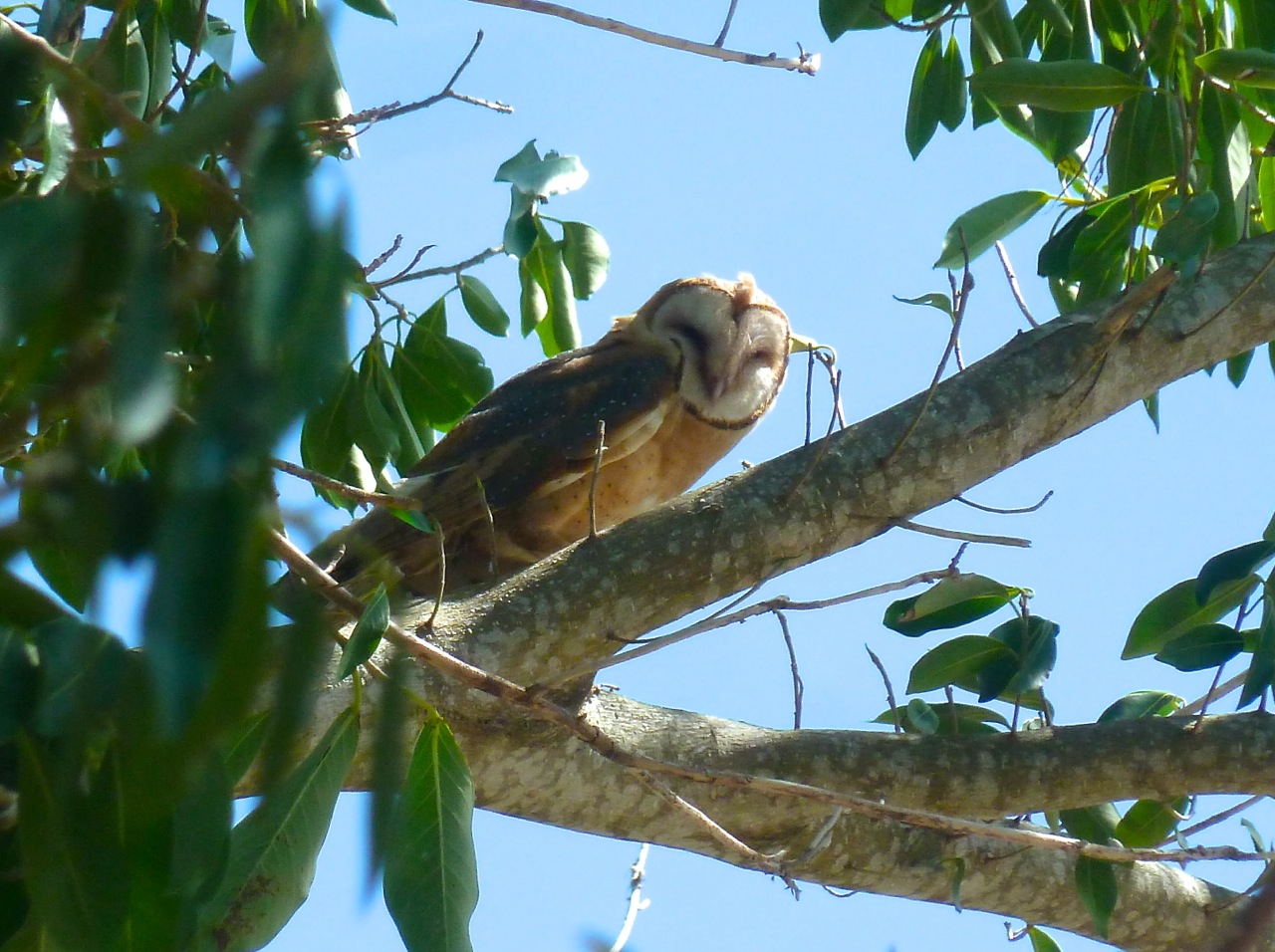
The Barn Owl (Tyto alba) is the only owl you are likely to see – and hear – on Abaco. The species is permanently resident, which is a good start in that sighting opportunities exist year-round. Although they are not at all common they can be found in particular locations, for example around Treasure Cay and Little Harbour; also on Elbow Cay, Lubbers Quarters (4 birds right now) and Man-o-War Cay (a while back). There are two other owl species recorded for Abaco: the rare Burrowing Owl (see link below for details); and the Northern Saw-whet Owl, a vanishingly rare vagrant recorded a handful of times that I don’t propose to feature unless and until it decides to visit Abaco more frequently…
I wrote about Barn Owls on Abaco many moons ago. I don’t usually rehash previous posts, but I am returning to the topic because of a recent barn owl sighting on Elbow Cay that caused interest, excitement and some speculation.
Barn Owl, Treasure Cay, Abaco Bahamas (Becky Marvil)
The shrill wheezing cry of the Barn Owl – known in some places as the ‘screech owl’ (which, strictly, is a different owl species) – is unmistakeable. Barn owls also make an intimidating hissing noise. Mainly nocturnal, they fly noiselessly like white ghosts in the night. If you are lucky enough to see one in the daytime, you’ll be struck by the beautiful heart-shaped face and (if close enough) the delicate markings.
Patrik Aberg Xeno-Canto
Both photos above were taken on Abaco. Woody Bracey’s header image is featured in “THE BIRDS OF ABACO“. Becky Marvil’s photo was taken near Treasure Cay. I’ve never seen a barn owl on Abaco, but I’ve been lucky enough to get close to them in the UK. For those who have never seen one, here are a few of my own images that show what wonderful birds they are. They were photographed at a raptor rescue centre, so I am not going to pretend that these shots were taken in the wild. That would never do.
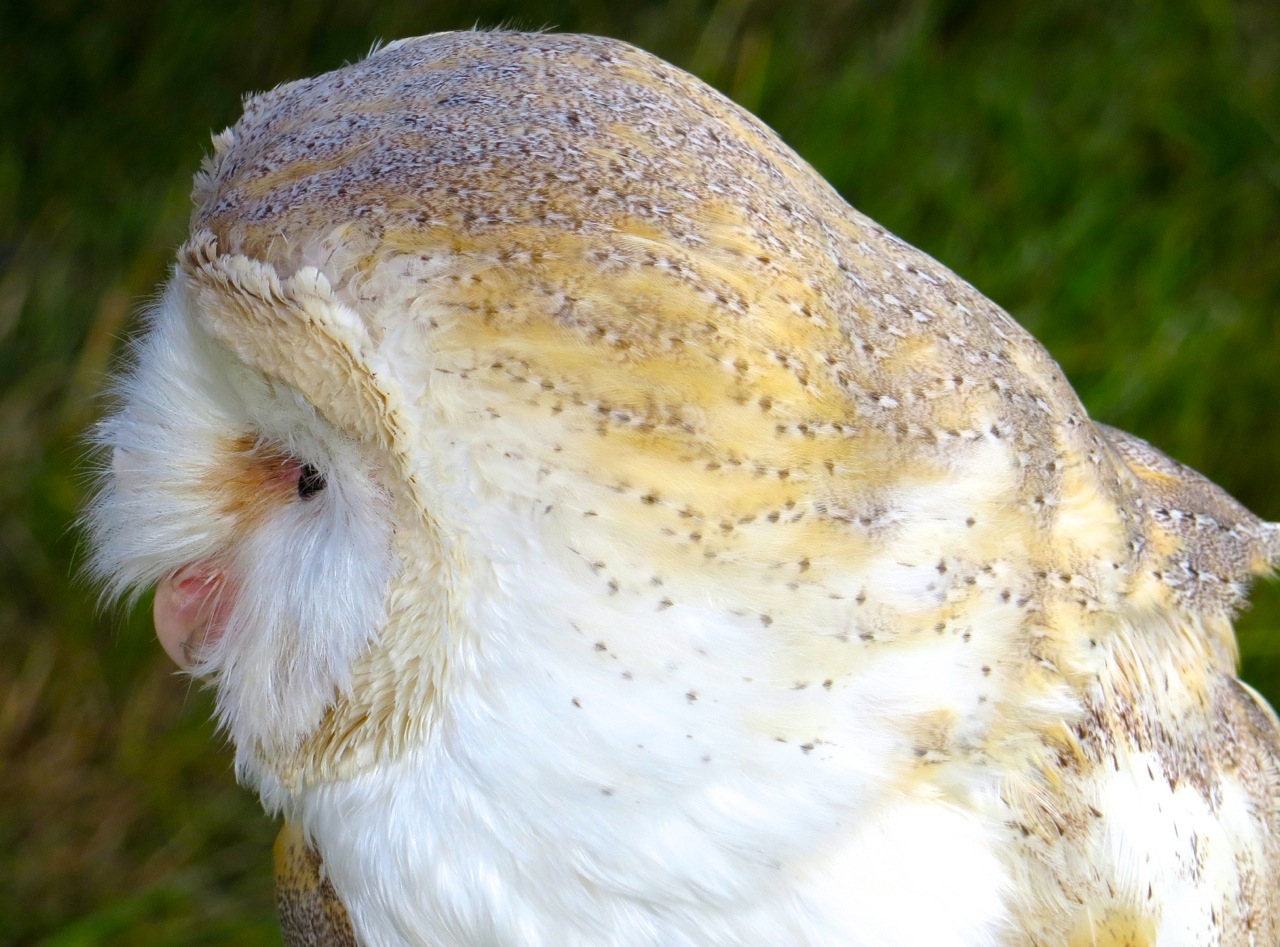
This close-up of the barn owl above shows the typical speckling on its pure white front, and the beautiful wing patterns. Amazingly for such a large bird, an adult weighs a mere 350g or so. As a comparison, The Birds of Abaco book weighs 2kg!
This fluffy baby barn owl had been rescued and was being cared for in a sanctuary before being returned to the wild. Whimsy is rarely permitted in this blog, but seriously, folks – cuteness overload!
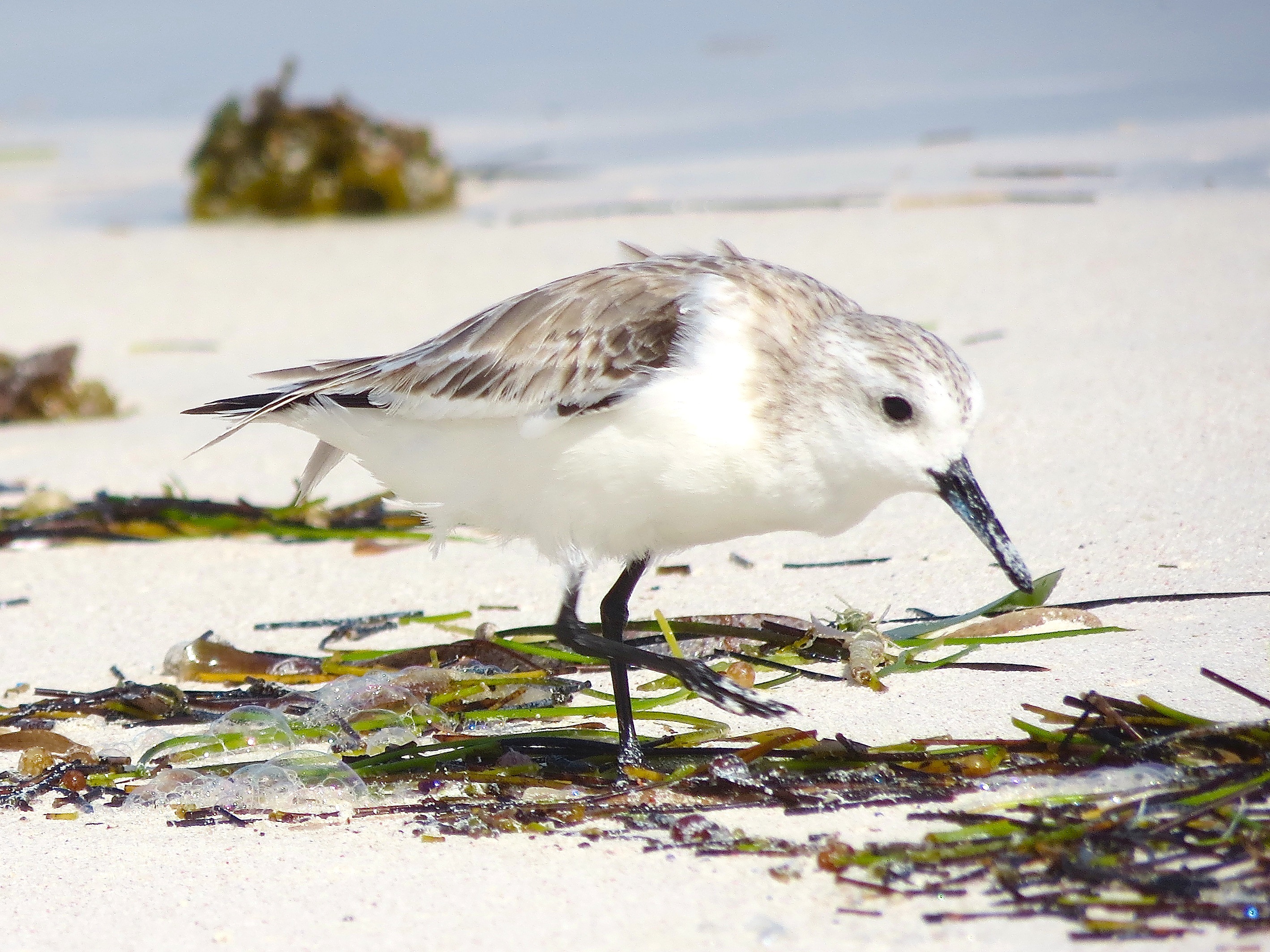
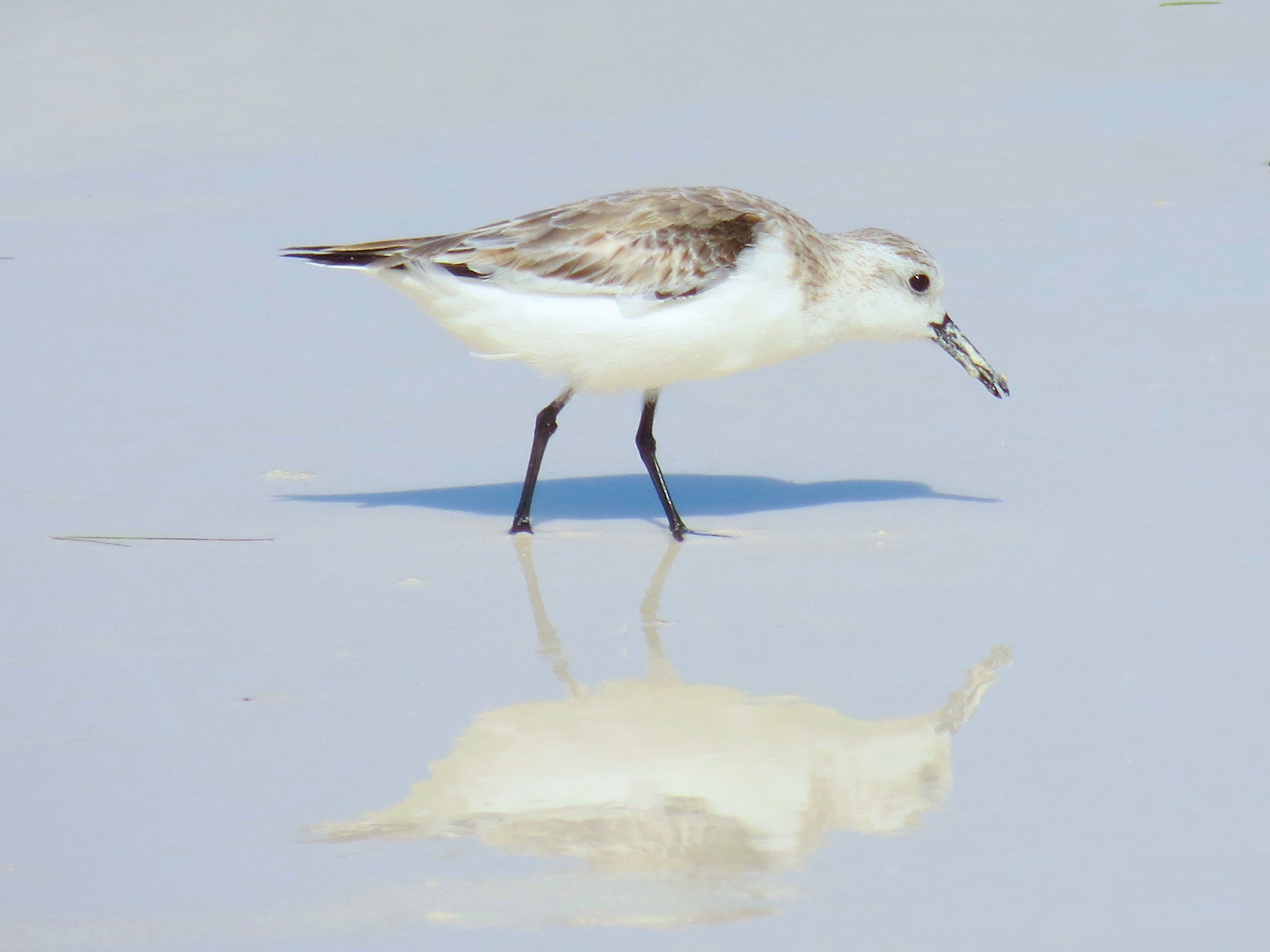
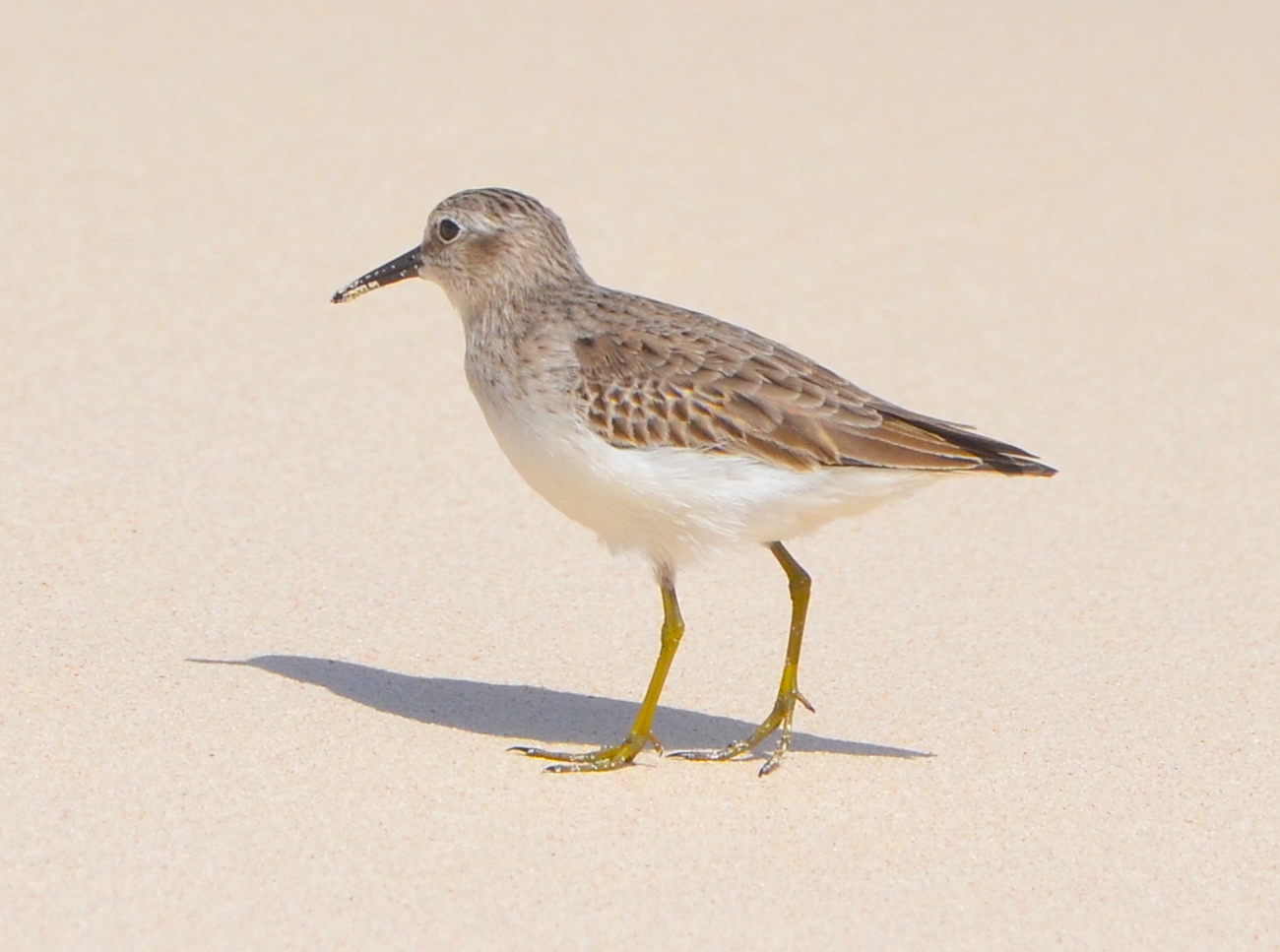
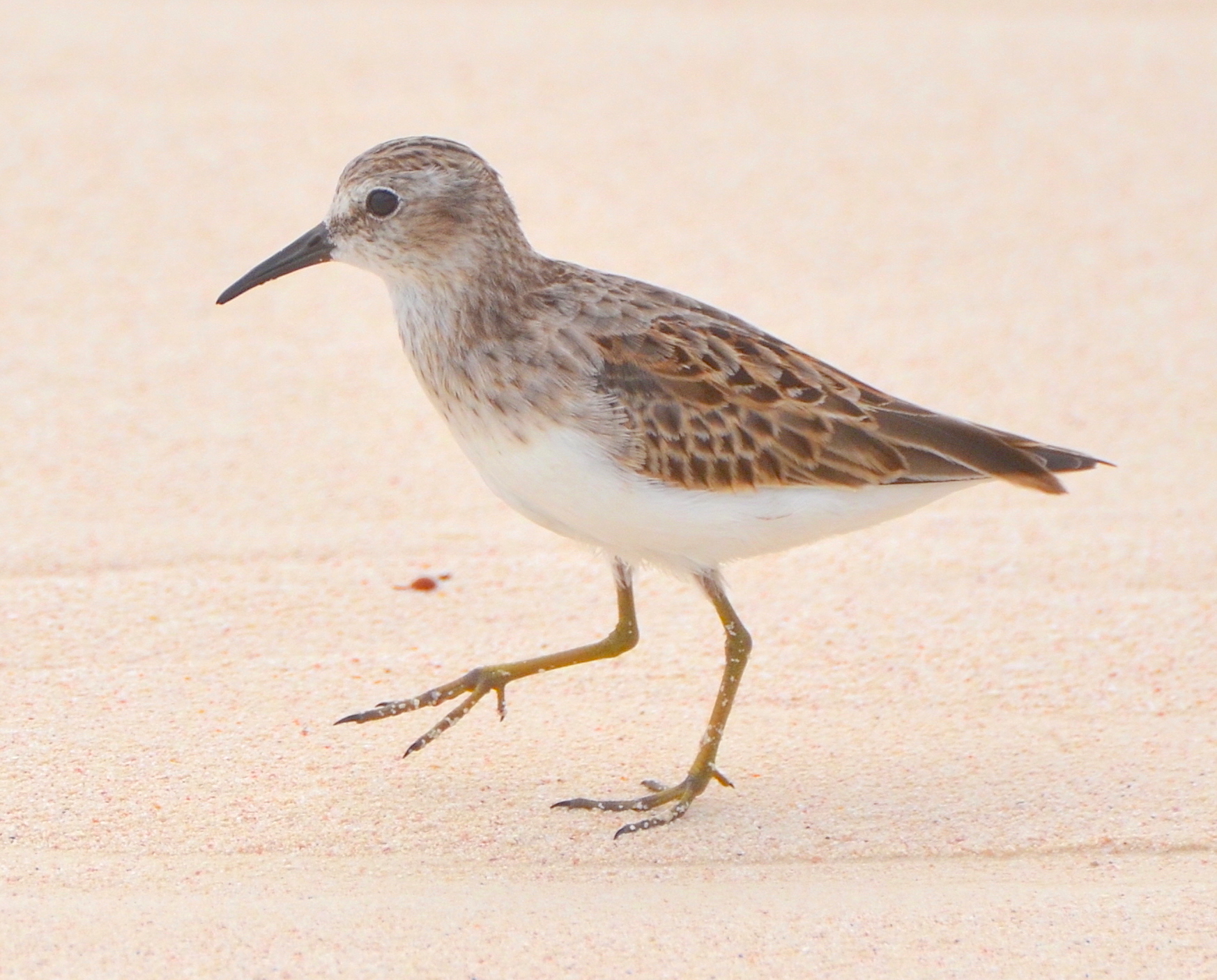
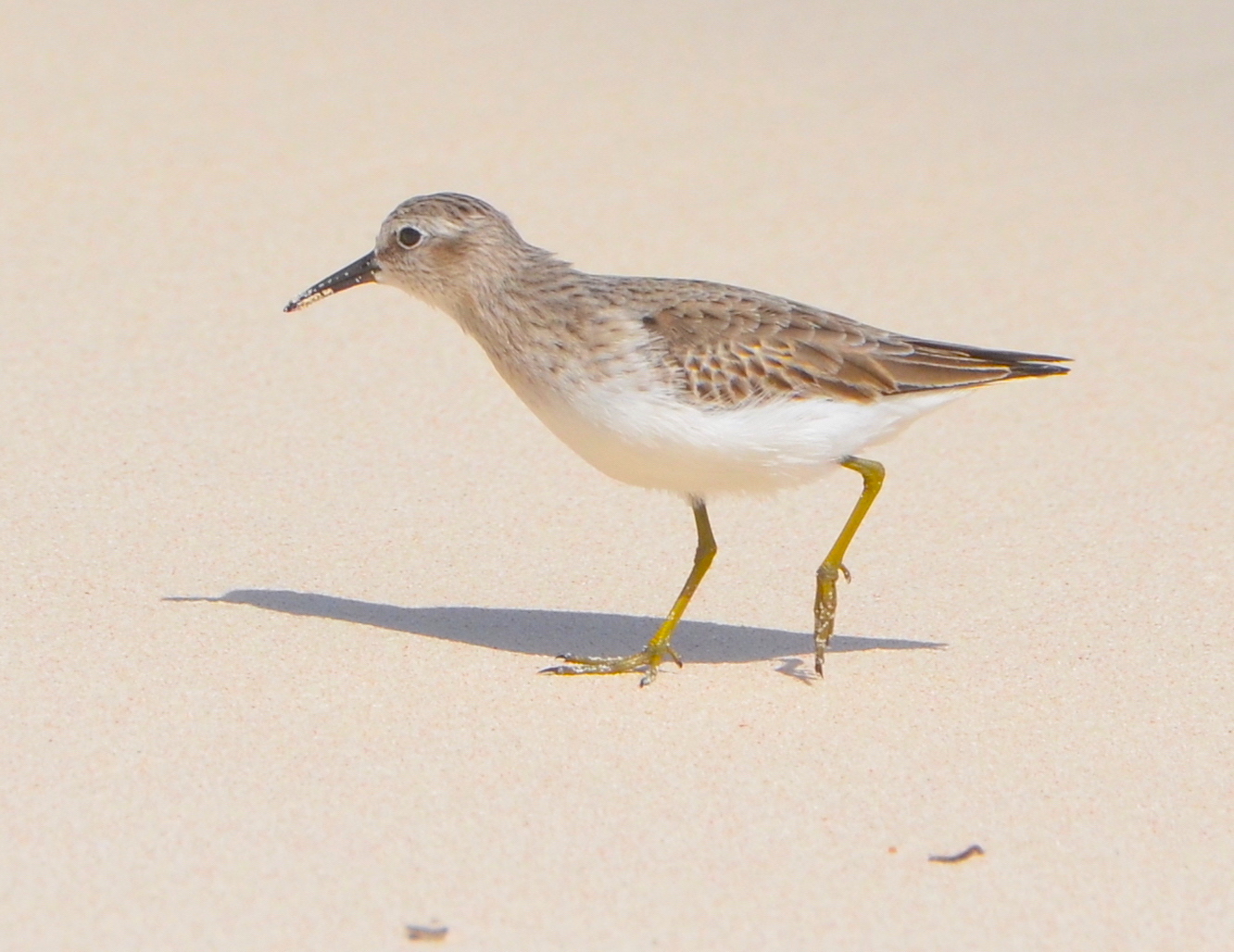
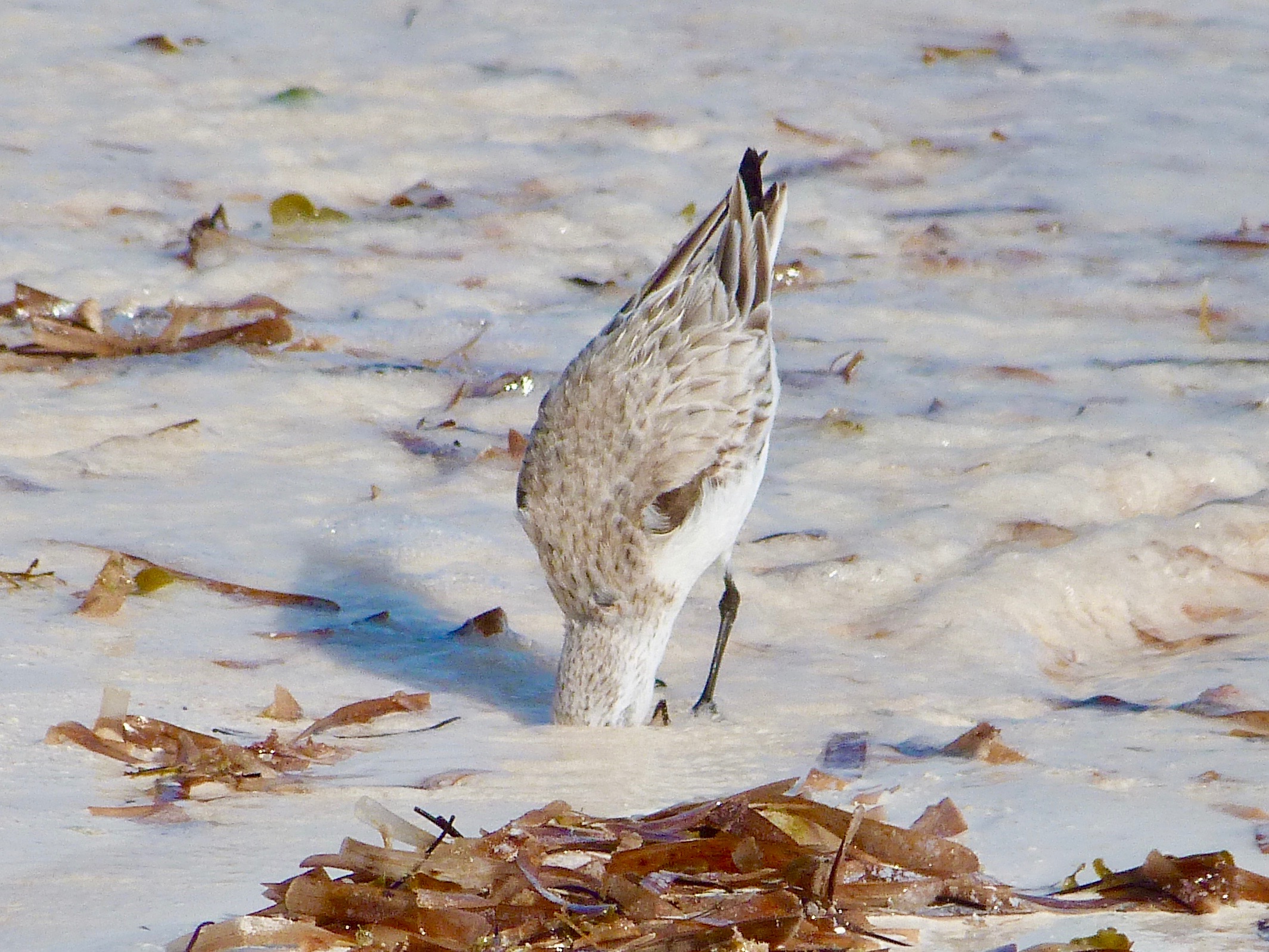
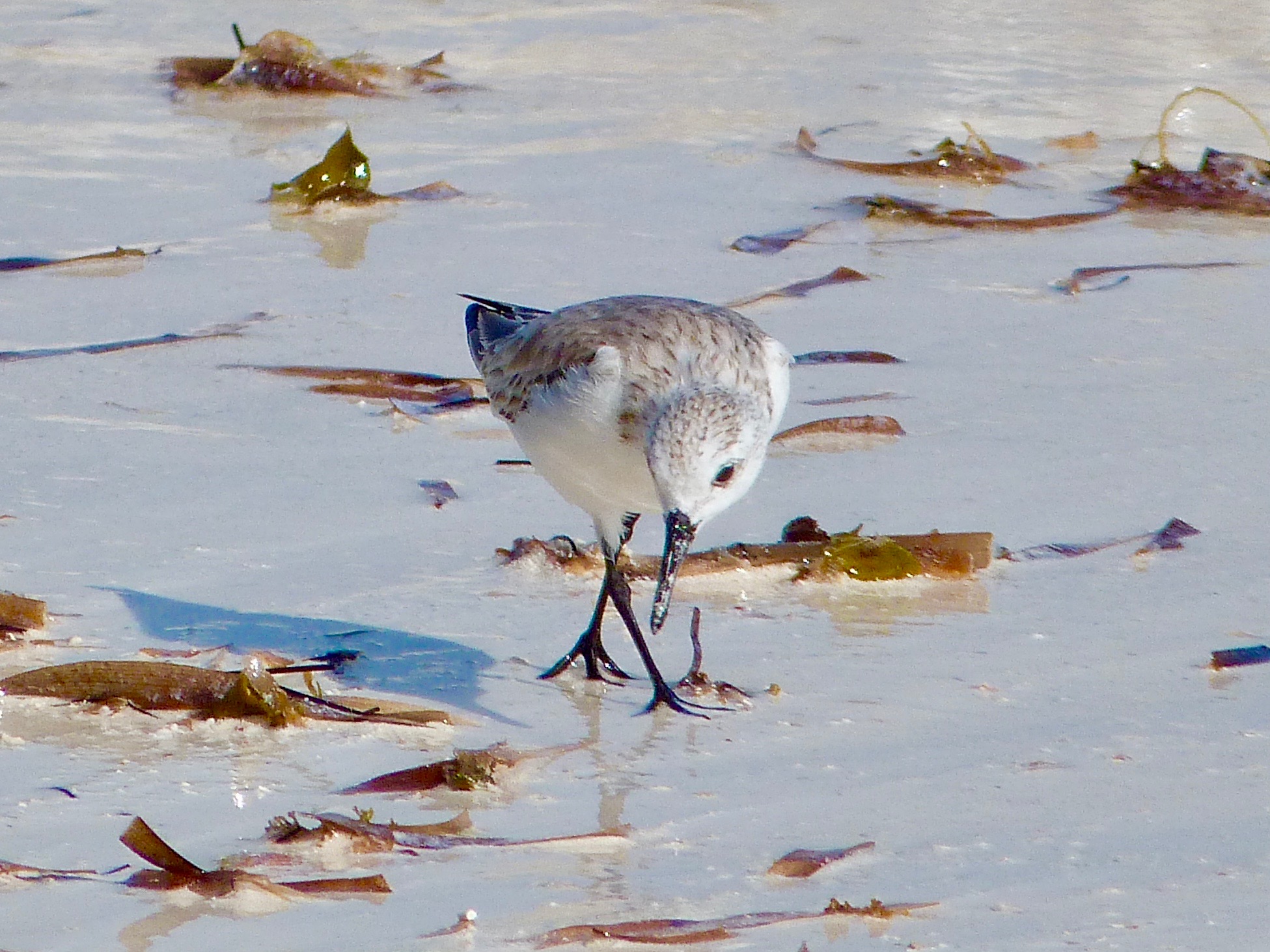
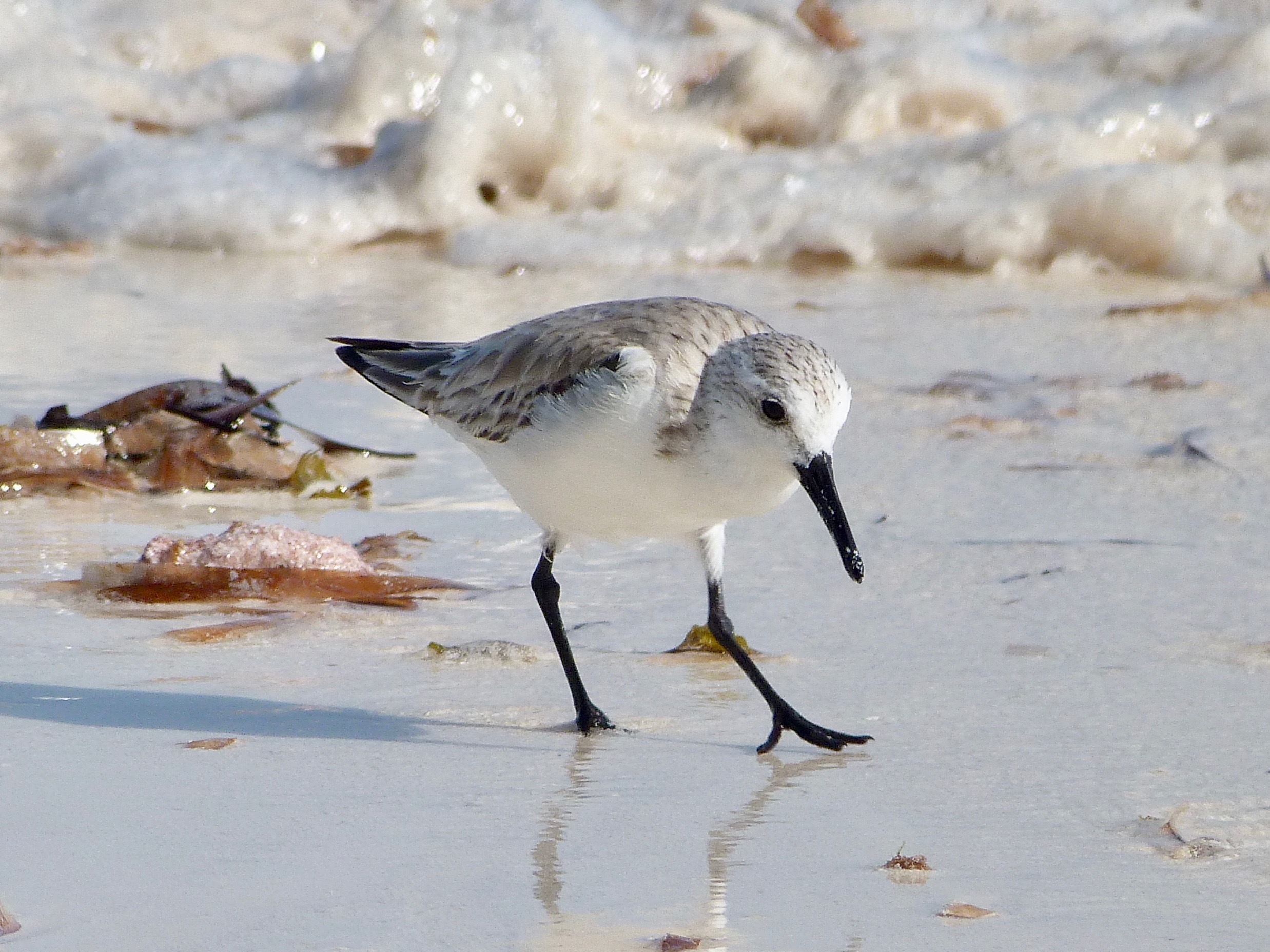
Looking back through some bird photo folders from last year, I came across these sanderlings that I photographed on the beach at Delphi. These little birds are far from rare, but watching a flock of them scuttling back and forth on the sand, in and out of the tide, is always a treat. And as you will notice, when they are foraging in earnest they not only stick their bills into the sand right up to the base… they go for total immersion of the head!
There are 23 sandpiper species recorded for Abaco. Of those, 4 or 5 are vanishingly rare vagrants recorded once or twice in recent history (i.e. since about 1950).
Discounting those, the ones you are likely to encounter range from the large (whimbrel, yellowlegs, dowitchers, stilts) to the small. Or, in the case of the least sandpiper, the least big of all. They are bigly little.
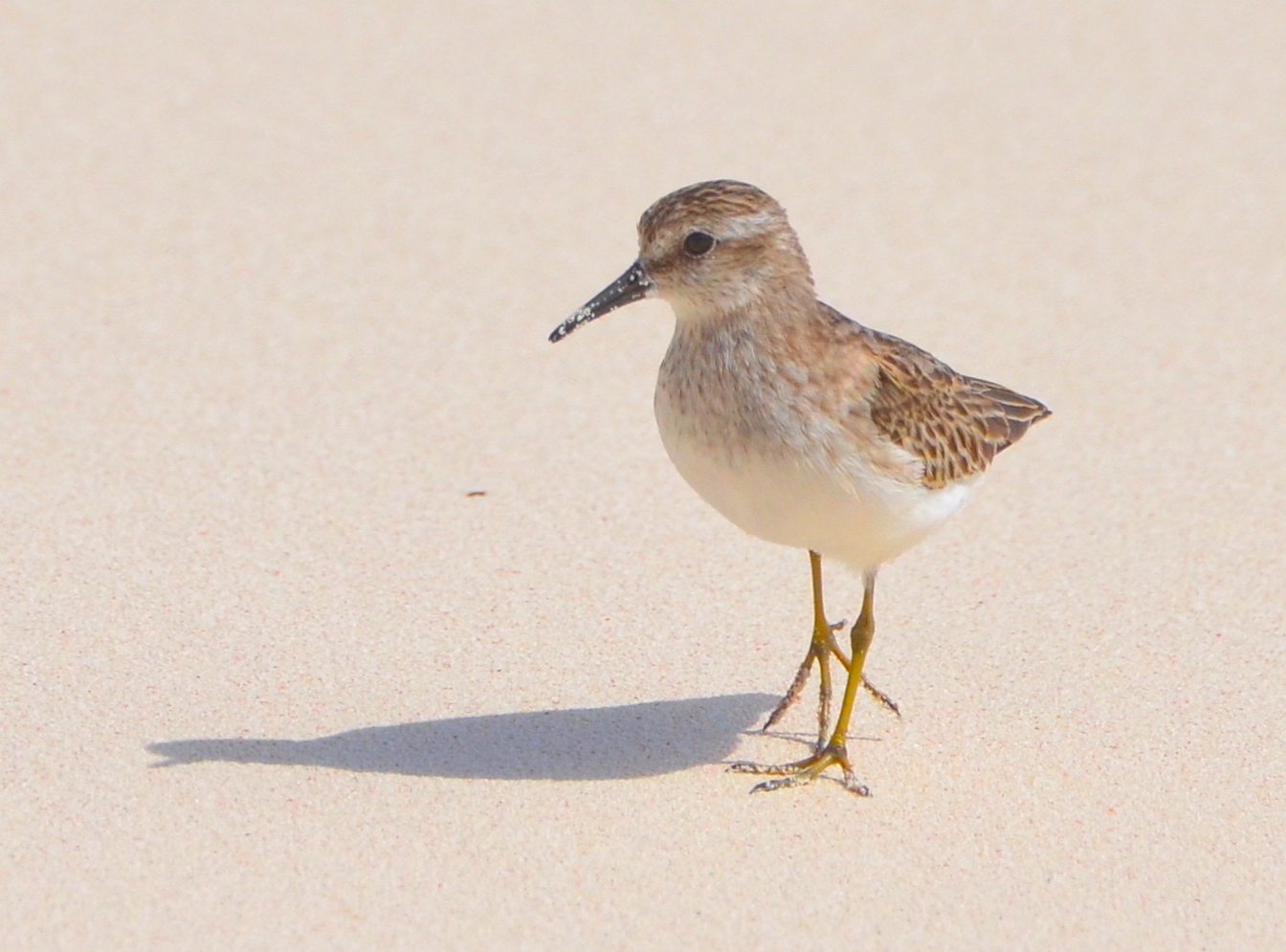
The binomial name of the least sandpiper – Calidris minutilla – is an apt clue to their size, the second part being Latin for “very small”. On Abaco, they are fairly common winter visitors, and each season a handful of them make their home on the beach at Delphi, where these photos were taken.
Along with their small sandpiper compadres such as SANDERLING, these busy, bustling birds of the shoreline are the ones known as “peeps” (also as stints).
Least Sandpipers breed in the northern tundra areas of North America. Like many or most shorebirds, newly hatched chicks are able to fend for themselves very quickly. It sounds unlikely I know, but within a couple of weeks or so they have fledged.
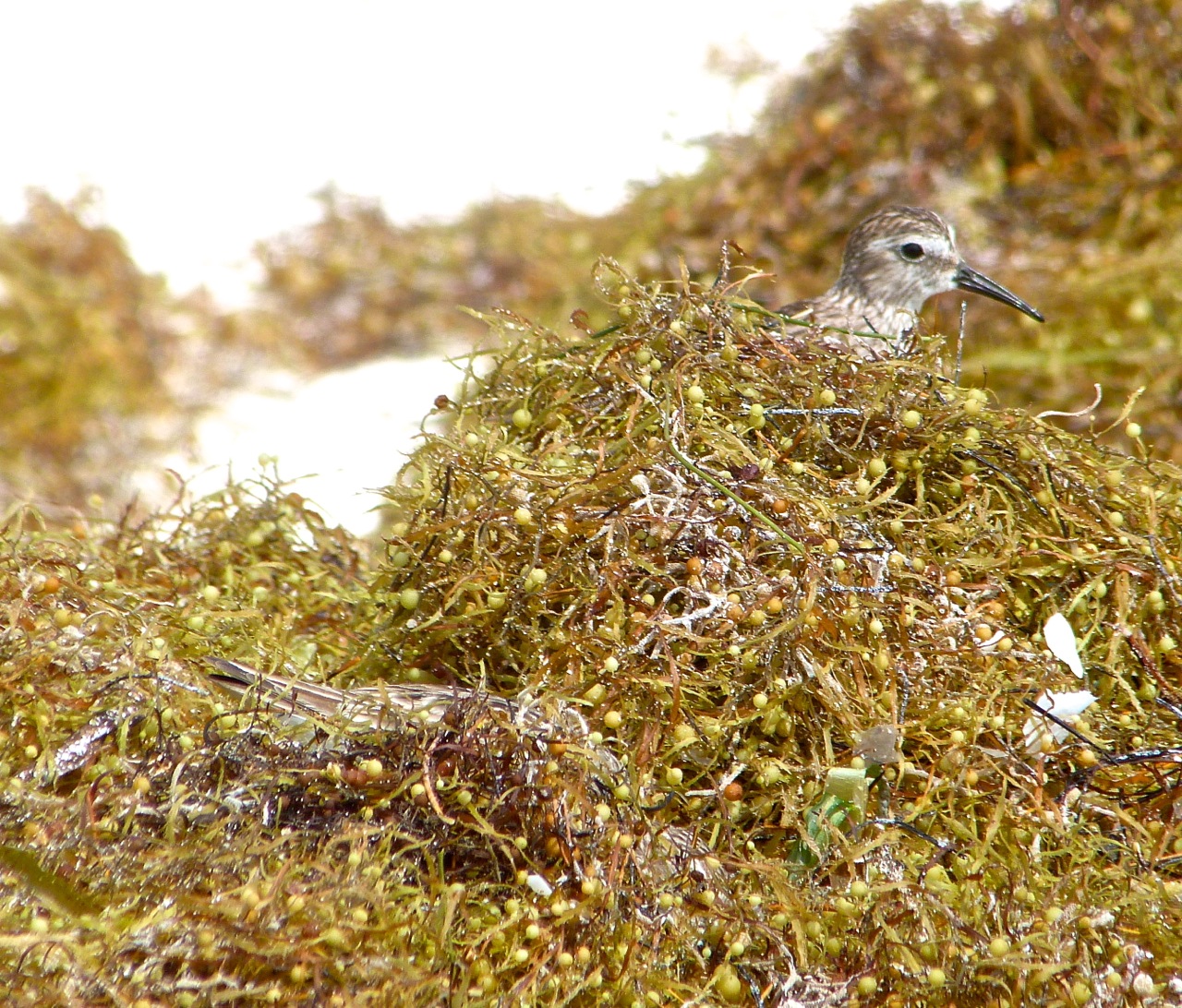
The birds forage on mudflats, in the tideline on beaches, and in wrack. They will probe into soft sand, sometimes the full length of their beak. They will even burrow right under weed to get at the concealed goodies. Their diet consists mainly of small crustaceans, insects, and snails.
Credits: All photos by Charles Skinner (contributor to “The Birds of Abaco”) except the wrack-burrowers above, by Keith Salvesen (also on the Delphi Beach).
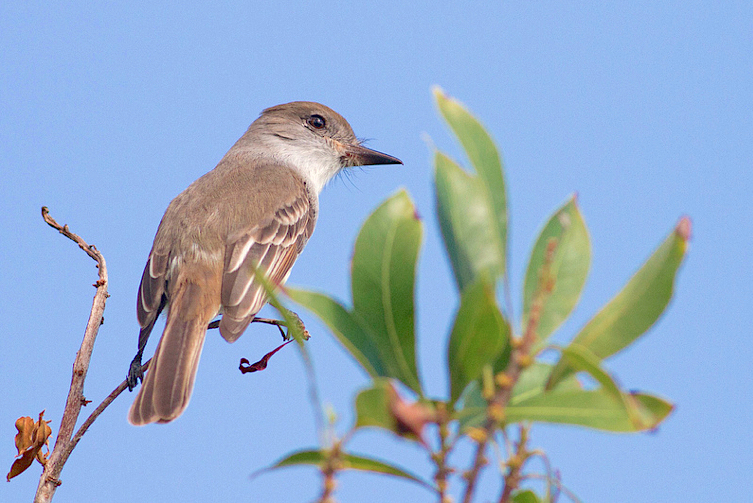
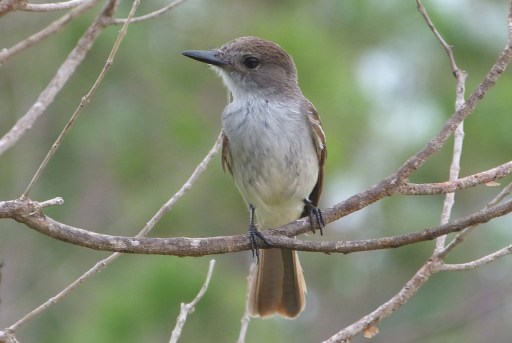
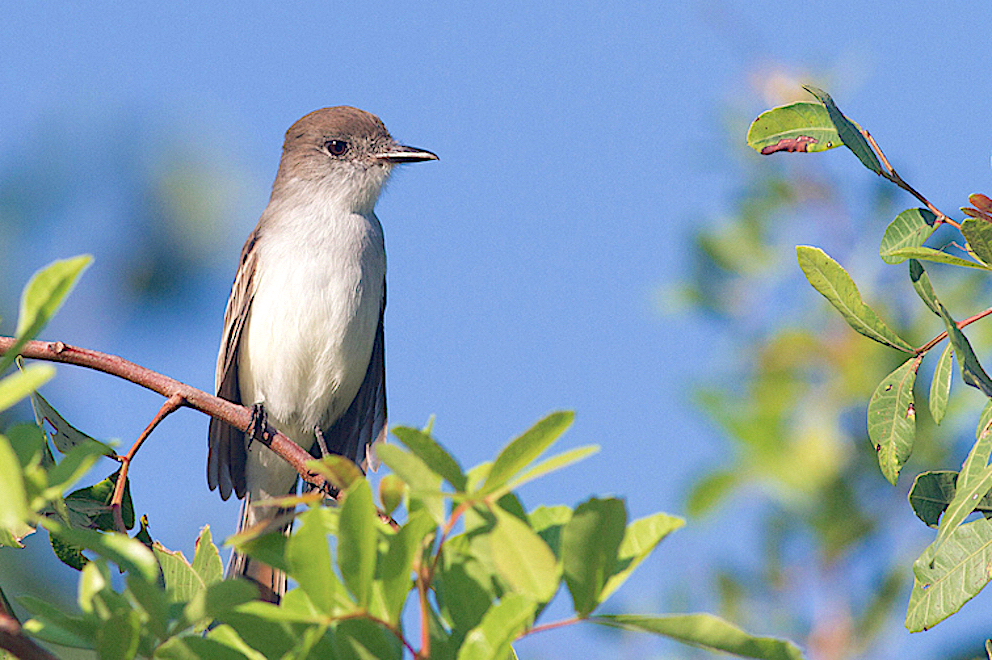
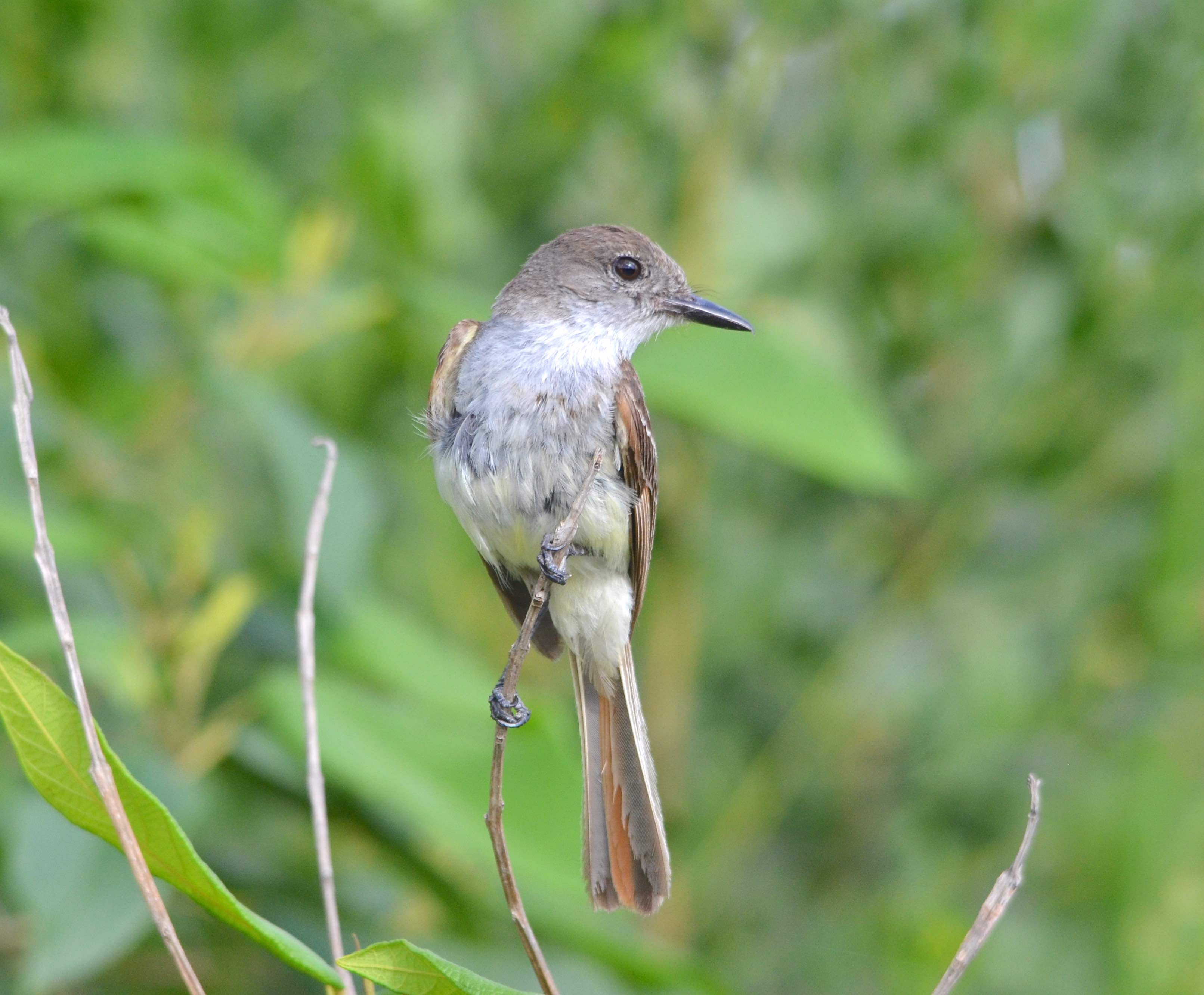
The LA SAGRA’S FLYCATCHER(Myiarchus sagrae) is a common resident breeding species of flycatcher on Abaco, and these very pretty small birds can be seen in many habitats – pine forest, scrubland, coppice and gardens, for example. They are insectivores, as the name suggests, but they also eat seeds and berries.
As a ‘tyrant flycatcher’, this little bird is a member of the large passerine order that includes kingbirds, pewees and phoebes, with which they are sometimes confused. I last wrote about LSFs in the infancy of this blog, illustrated with my own rather… ahem… ‘simple’** photos. Time to revisit them and to do them justice with some new, improved images.‘
‘Simple’ photo from a less complex era, taken with a 2mp ‘Cheepo’™ camera
Magnificent photo by Gelinde Taurer that you can actually enlarge (click pic– see?)
Unlike many bird species, adult LSFs are very similar in appearance in both sexes. Whatever the gender, they are sometimes confused with their cousins the Cuban Pewees, but those have a very distinctive eye-crescent.
Cuban Pewee – note eye-crescent, absent in the LSF
Both species have a tiny hook at the end of the (upper) beak – to help trap insects, I assume
Another thing to notice about LSFs is the amount of rufous brown in their plumage, particularly on the wings and tail – and even at the base of the beak. This coloration is absent from their larger cousin kingbirds, the loggerhead and the gray.
WHAT SHOULD I LISTEN OUT FOR?
“A high pitched single or double noted sound described as ‘wink’... ” Or it might be ‘bip‘. Or ‘weep‘. Or (on one recording I listened to, complete with sonograph) it sounded like ‘chi-chitty chew‘. But it may have been a misID.
Hans Matheve @ Xeno-Canto
A hint of a crest is visible in this photo
ANY IDEA WHAT LA SAGRA CHICKS LOOK LIKE?
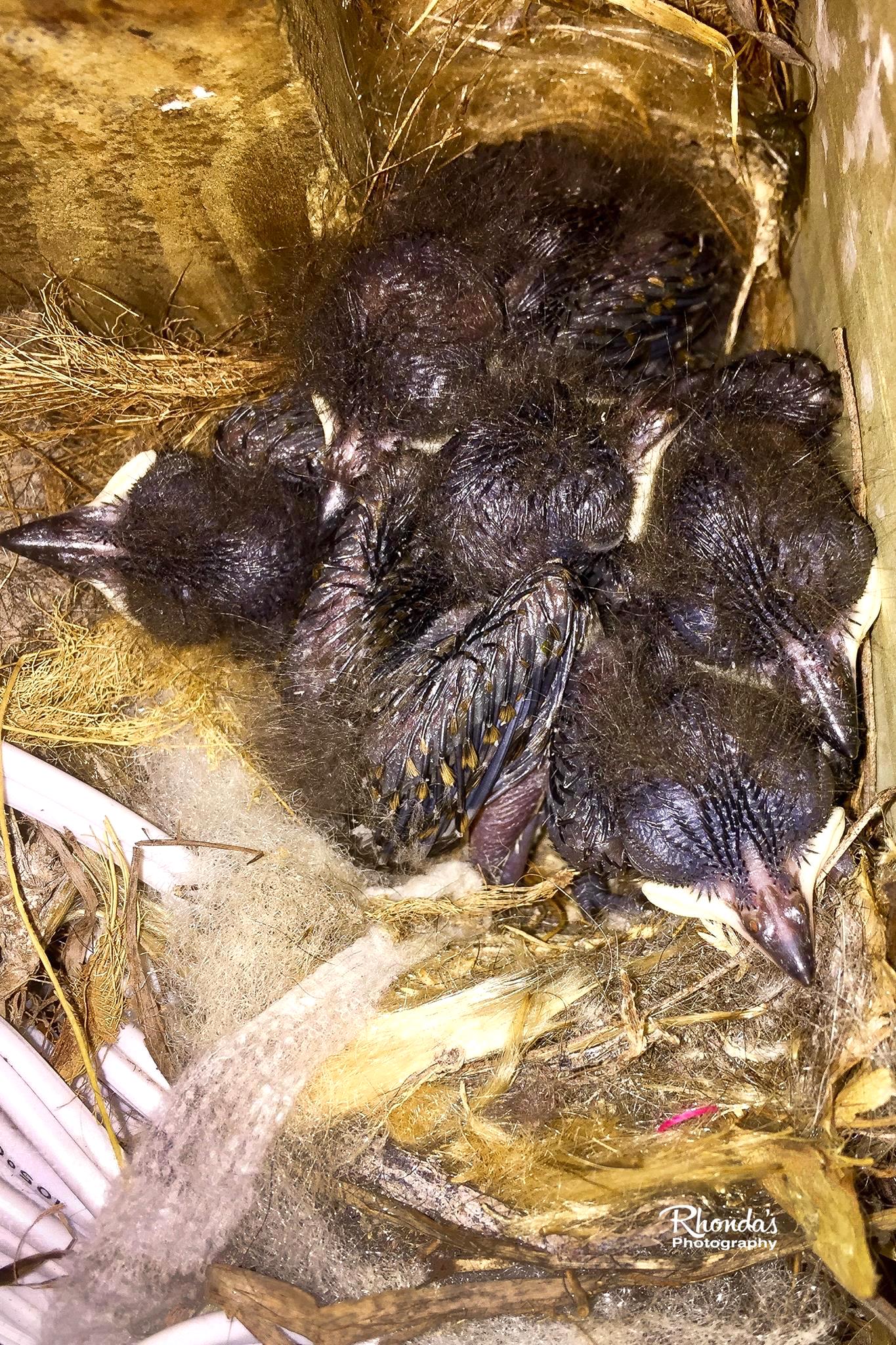
Well, as it happens, yes. By good fortune Abaco photographer and piping plover monitor Rhonda Pearce happens to have had a nest at hand this very season. So, happy to oblige…
WHO OR WHAT IS A ‘LA SAGRA’ WHEN IT’S AT HOME?
Mr La Sagra was a multi-talented Spanish botanist. Ramón Dionisio José de la Sagra y Peris(1798–1871) was also a writer, economist, sociologist, politician, anarchist, and founder of the world’s first anarchist journal El Porvenir (‘The Future’). At one time he lived in Cuba and became director of Havana’s Botanical Garden. His name lives on more significantly in ornithological than in anarchist circles (actually, ‘anarchist circles’ must be a contradiction in terms… that should be ‘anarchist disorganised squiggles’)
I note in passing that La Sagra is a provincial area in Spain, an Italian festive celebration, a chocolatier, and a small comet… All these meanings may have to be negotiated online before you get to the flycatcher…
Ramón Dionisio José de la Sagra y Peris
Continuing this blog’s philatelic natural history theme, here are stamps from the Cayman Islands and Cuba featuring the La Sagra’s Flycatcher. The Cuban stamp commemorates the death of Juan Gundlach, the man who chose La Sagra’s name to bestow on this bird. And Gundlach’s name lives on in the Bahama Mockingbird Mimus gundlachii…
** ‘Simple’, as in ‘not completely disastrous for an amateur effort but frankly not the sort of standard we have come expect around here’.
Photo Credits: Gerlinde Taurer (1, 4); Tom Reed (2, 6); Keith Salvesen (3 [!], 5, 12); Charles Skinner (7, 8); Peter Mantle (9); Rhonda Pearce (chicks) 10; Tom Sheley (11); Ramon and stamps, open source
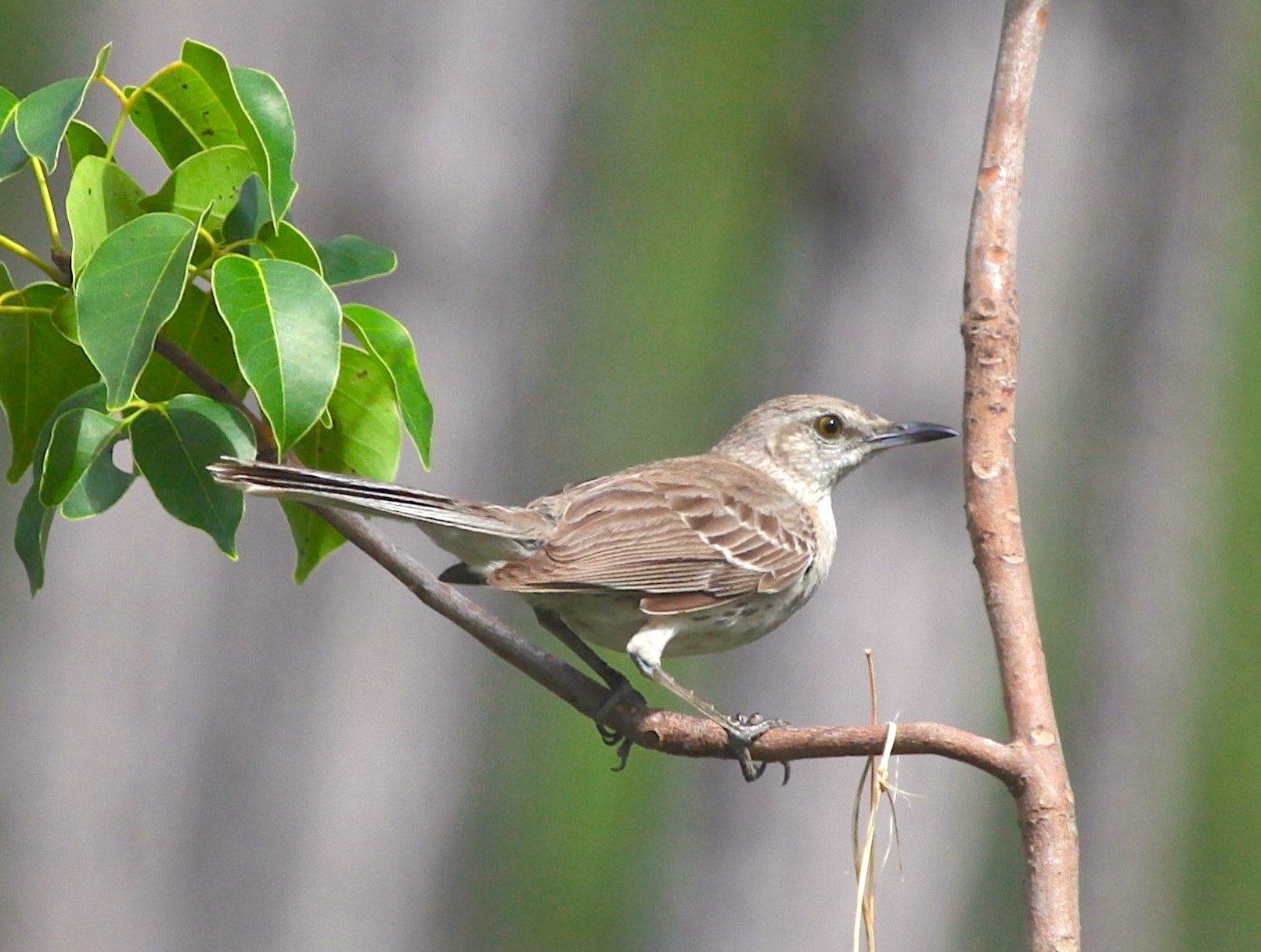
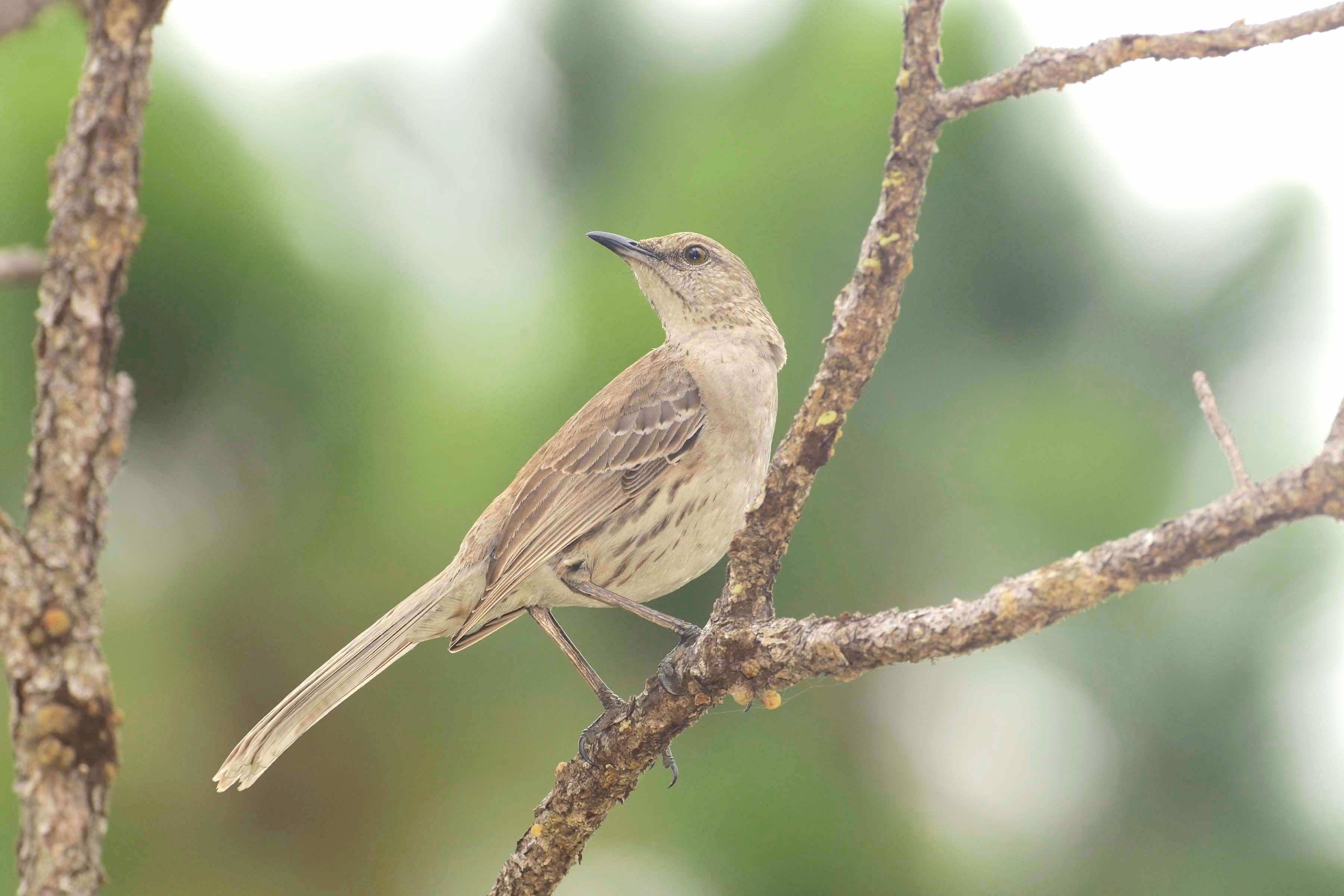
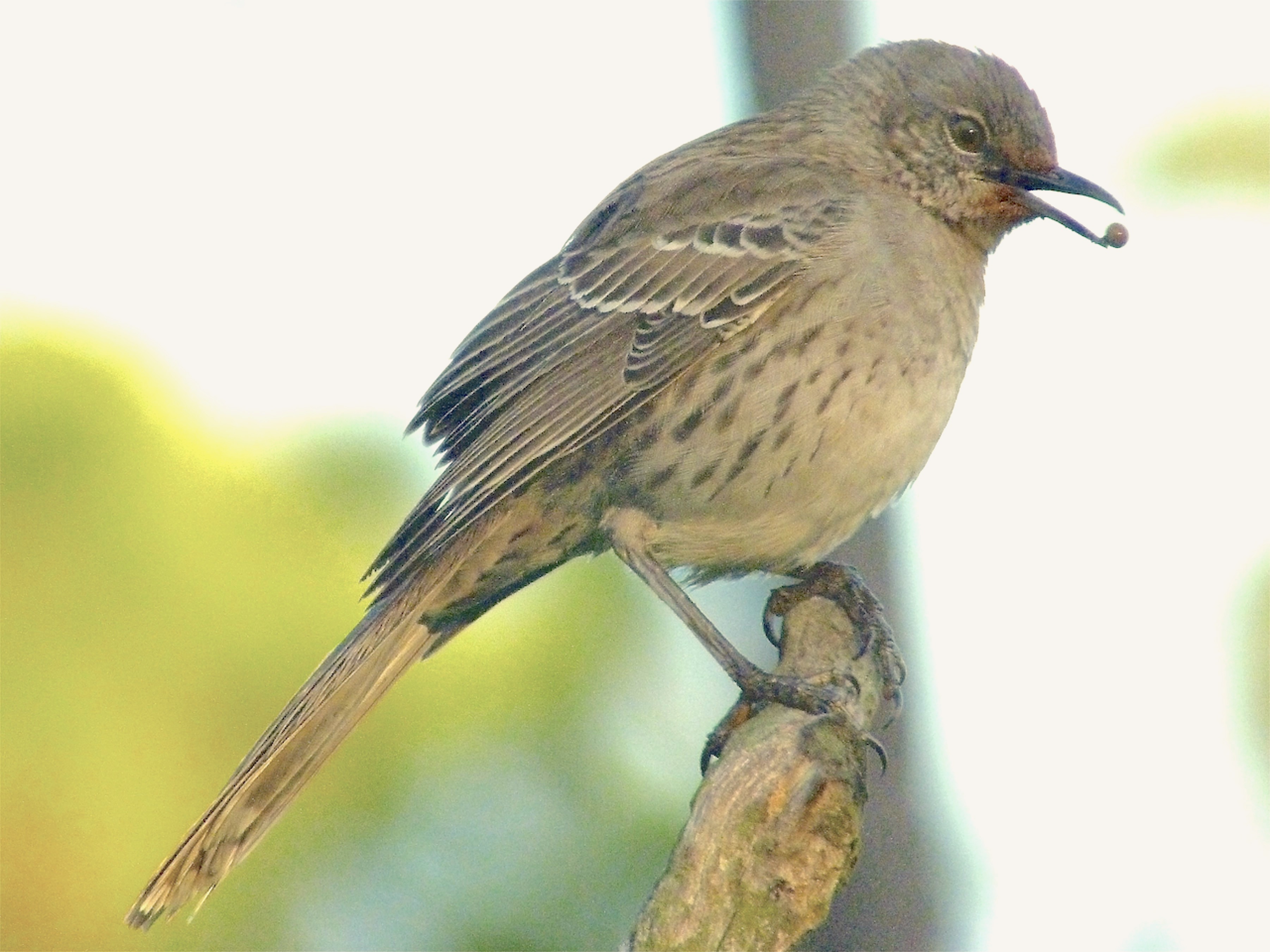
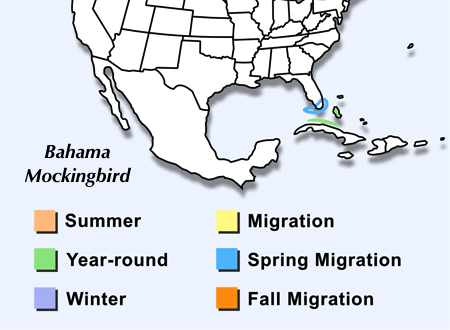
The Bahama Mockingbird Mimus gundlachii is similar to its slightly smaller cousin, the widespread Northern Mockingbird Mimus polyglottis. The range of Bahama Mockingbirds is not restricted to the Bahamas themselves, and includes areas of Cuba, Jamaica and TCI, so despite the name they are not an endemic species to the Bahamas. They are also occasional vagrants to the United States, especially – for reasons of proximity – southeastern Florida.
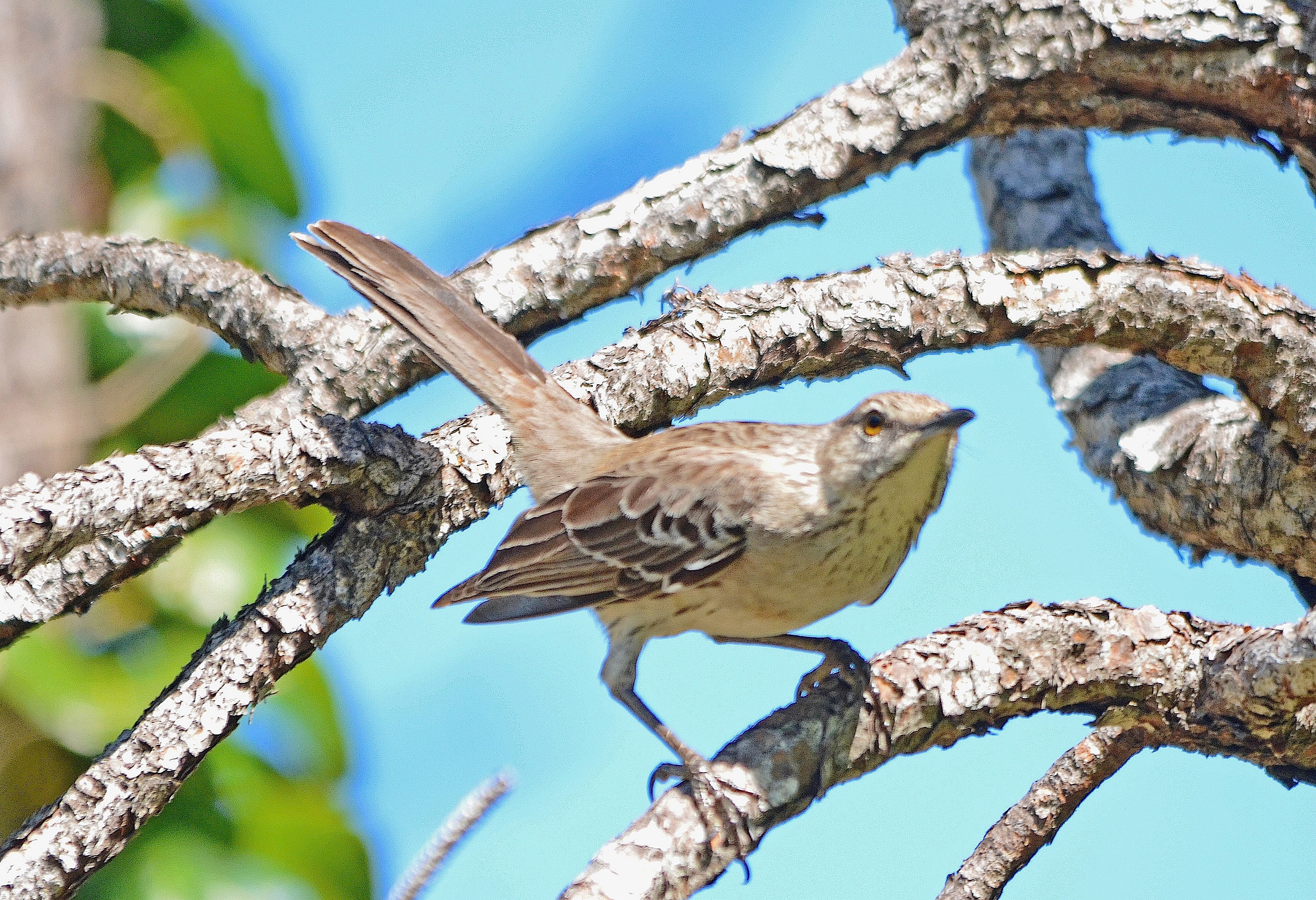
The Bahama Mockingbird is browner than the greyish Northern Mockingbird, and has distinctive streaking and spotting to its breast and undercarriage. This may extend to what you might describe as the bird’s ‘trouser legs’, though I’m sure there’s a more technically correct term.
Both mockingbird species are found on Abaco. The NMs are ubiquitous in towns, settlements, gardens, coppice and pine forest, whereas BMs are shyer and tend to be found in the pine forest and well away from humans and their operations. When we were putting together The Birds of Abaco, I went on a birding trip with Abaco birding legend Woody Bracey and Ohio bird photographer Tom Sheley. We took a truck into the pine forest down a logging track south of Delphi, and they were quick to locate a bird, not least because one was sitting prettily on a branch singing lustily and unmistakably. It was well within range of Tom’s massive lens; more of a struggle for my modest camera (below). Caught the cobwebs, though…
I was astounded by the beauty and variety of the song. It consisted of very varied notes and phrases, each repeated 3 or 4 times before moving on to the next sounds in the repertoire. Here is a short 18 second example I recorded, using my unpatented iPhone method, for which seeHERE.
For those with interest in birdsong, here is a longer 1:13 minute song from the same bird, with largely different sounds from the first recording made minutes earlier. There’s even a decent stab at imitation of a 1960s Trimphone™. Had we not had to move on to Sandy Point for an appointment with some cattle egrets and American kestrels, I could have stayed listening for far longer.
THE ‘SUBSPECIES’ THAT WASN’T…
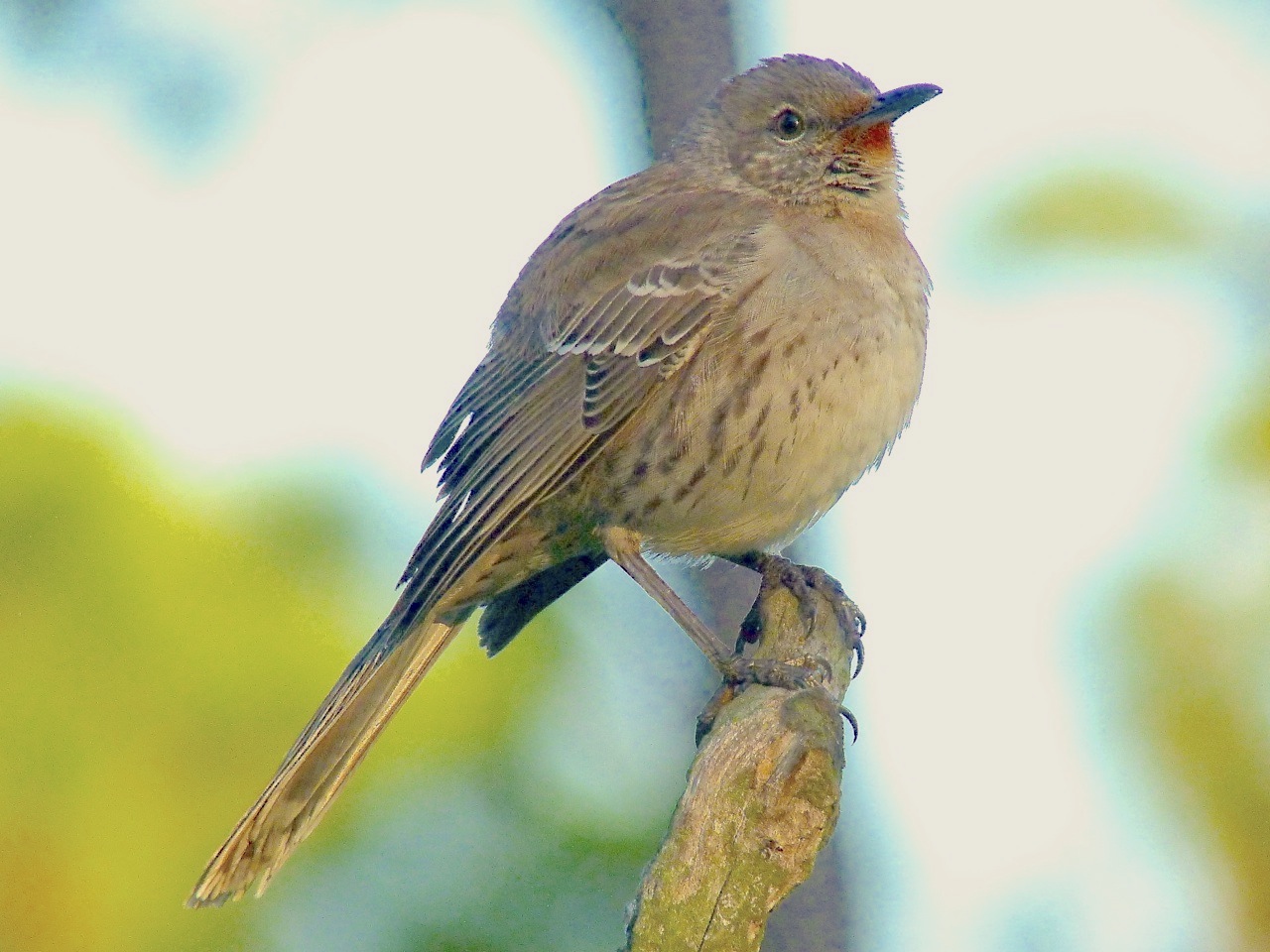
More recently, on a trip in backcountry to find Kirtland’s warblers – we saw 4 – the slow-moving truck jolted to halt in the middle of nowhere. This was because a Bahama Mockingbird was right by the track. I fired off some quick shots out of the window into a rather difficult light, to find that we appeared to have found a new subspecies, the scarlet-faced mockingbird.
The reason was clear, however. The bird had been pigging out on some red berries, and had managed to collect plenty of the juice round the base of its beak.
SO WHAT DOES A NORTHERN MOCKINGBIRD LOOK LIKE, THEN?
I photographed the Northern Mockingbird below in a garden at Casuarina. The species is far tamer than its cousin, and seen side-by-side they are clearly very different. The range maps show the stark contrast between the very limited range of the Bahama Mockingbird and the vast distribution of the Northern Mockingbird.
Photos Credits: Tom Sheley (1, 6); Peter Mantle (2); Charlie Skinner (3); Keith Salvesen (4, 7, 8, 9); Alex Hughes (5); Susan Daughtrey (10). Range maps eBird & wiki.
Six more sleeps. That’s all. Suddenly, a trip that seemed ages away is rushing towards us. Or, to put it more plausibly science-wise, we are rushing towards it. Abaco beckons, with bonefish, rays, sharks, reef fishes, whales, dolphins, birds and butterflies to investigate. Plus Kaliks to consume.
Idly thinking along those lines and vaguely plotting the first few days, took me to Sandy Point, home of the BMMRO(Bahamas Marine Mammal Research Organisation) and of course the legendary Nancy’s, the restaurant at the end of the road. From where it is a short step to the dock on which the pelicans gather and use as a launch pad for their fishing dives.
I photographed this bird at the end of the SP dock, looking rather bedraggled after a dive
Note the significant plumage differences between the male (above) & this female
I recently read somewhere that the brown pelican is (or has become) quite uncommon in the Bahamas. On Abaco it is a permanent resident breeding species, so a drop in numbers equals fewer nests, fewer chicks and… fewer numbers. It’s a classic cycle towards serious population decline and all that is implied. Has anyone noticed an apparent reduction in numbers, I wonder? Comments welcome.
The pelicans above were all photographed on Abaco. The two below were not, but are both by exceptional photographers. One, Phil Lanoue, specialises in dramatic sequences, and his work features elsewhere in this blog. The final image was sportingly uploaded by Alan Schmierer from Flickr into the ‘public domain’.
Coming in to land…
While we are on Abaco, I plan to keep posting as and when, subject to connectivity (always a proviso in the Bahamas). My big hope is that the piping plovers that were on the beach last year and returned this season, will have resisted the increasingly insistent call to fly north to the breeding grounds. If they could just hang on for just a few more days…
Credits: Tom Sheley (1); Tony Hepburn (2); Keith Salvesen (3, 4, 6); Woody Bracey (5); Phil Lanoue (7); Alan Schmierer (8); Birdorable (cartoon)
Hi, human friends, I’m a black-faced grassquit Tiaris bicolor and I have a couple of observations to make on behalf of BFGS, if I may. First, we seem to be universally described as ‘common’, whereas we are actually quite refined in our behaviour. Secondly, the words most used to portray us are ‘dull’ and ‘drab’. And ‘stubby’. Well, excuse me… I – we – ask you to give us a second look.
And I have some news for you. The perceptive classifications committee of the American Ornithological Union recently gave us an upgrade. That’s the way we see it anyway. For many years we have been classified under the heading Emberizidae.
We kept company with buddies like the Greater Antillean Bullfinches, but also with a lot of New World sparrows, with whom we (frankly) never felt entirely comfortable. Too chirpy, for a start.
Last year, it became official. We are really a type of Tanager. They reckon we are closely related toDarwin’s finches(so, we are “common”, huh?).Now we get to be with other birds that are dome-nesters like us. And how about this – we’ll be in the same list as some really cool birds…
How’s this for a colourful gang to be joining: scarlet tanager, summer tanager, rose-breasted grosbeak, indigo bunting, painted bunting – these are our new cousins. BFGs “dull” and “drab”? I don’t think so.
6 UNDULL FACTS ABOUT BFGS
Make grassy dome-nests (like Bananaquits) and line them with soft grasses
Both sexes build the nest together
Both share egg-sitting duties and later chick-feeding & maintenance
Though quite gregarious by day, for some reason they tend to roost alone
They have a short ‘display’ flight with vibrating wings and a strange buzzing call
Otherwise, their flight is ‘weak, bouncy & fluttering’ (Whatbird’s assessment)
THE EVERYDAY TWITTERING SONG
THE DISPLAY BUZZING SONG
STOP PRESS The day after I had pressed the ‘publish’ button on this post, I came across a great shot by Larry Towning of a BFG on Lubbers Quarters Cay, Abaco (think ‘Cracker P’s Restaurant’). An excellent addition of a bird from a small cay, showing its bright lower-wing flash.
Photo Credits: Alex Hughes (1, 10); Tom Sheley (2, 3); Bruce Hallett (4, 9); Tom Reed (5, 11); Becky Marvil (6); Peter Mantle (7); Gerlinde Taurer (8); Keith Salvesen (12) plus Larry Towning. Other Credits: ABA, AOU, Whatbird? (sound files)
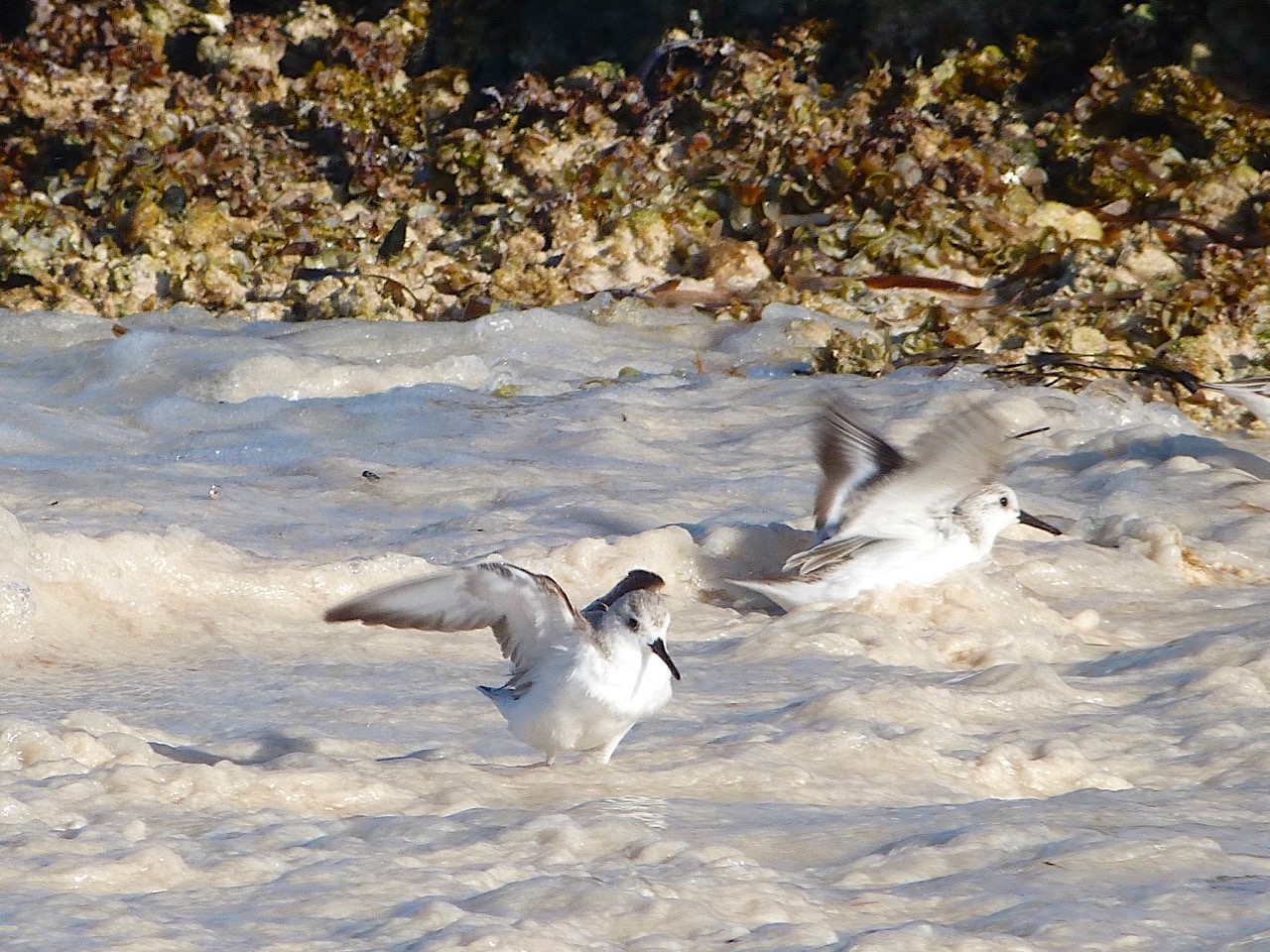
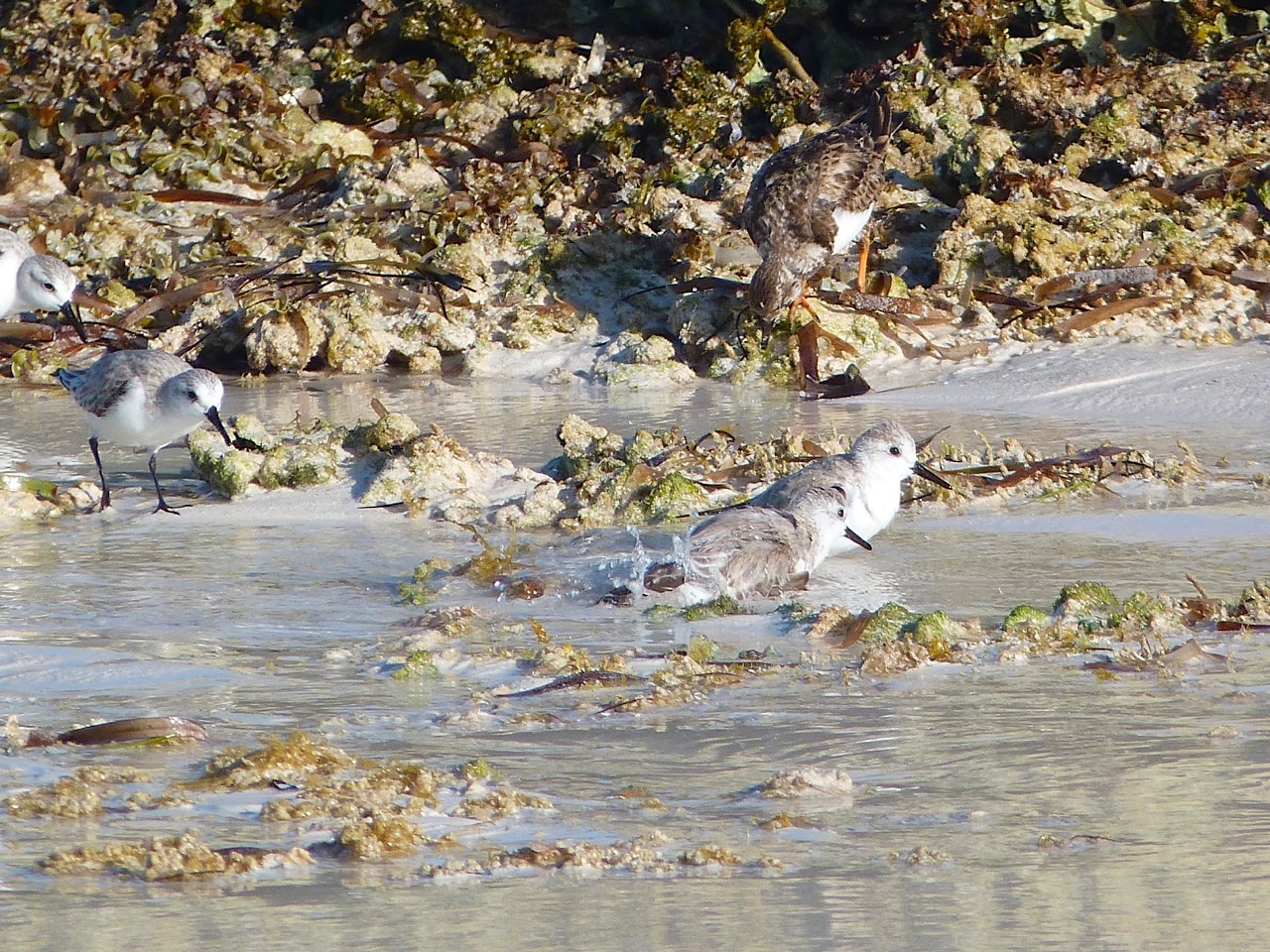
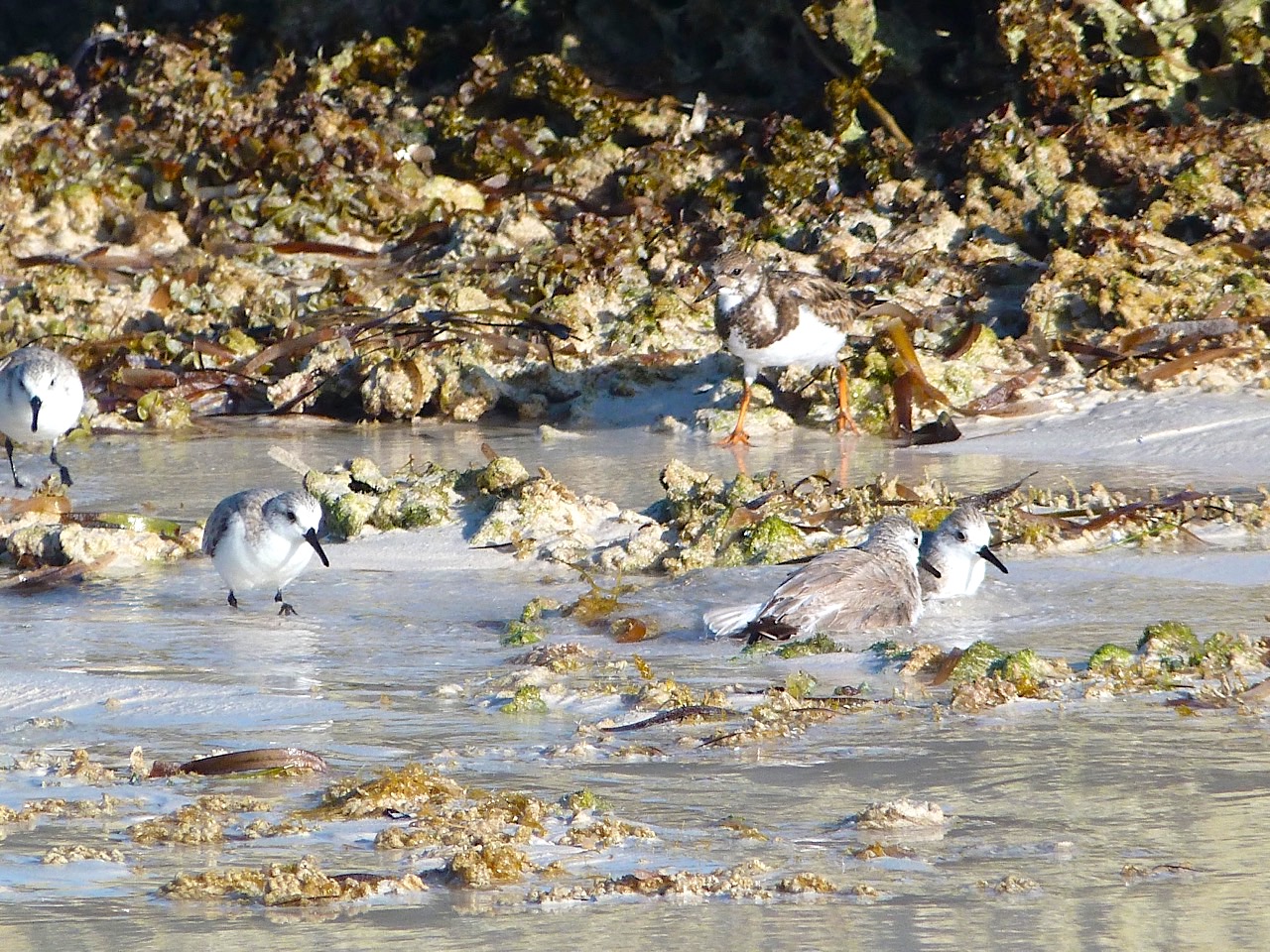
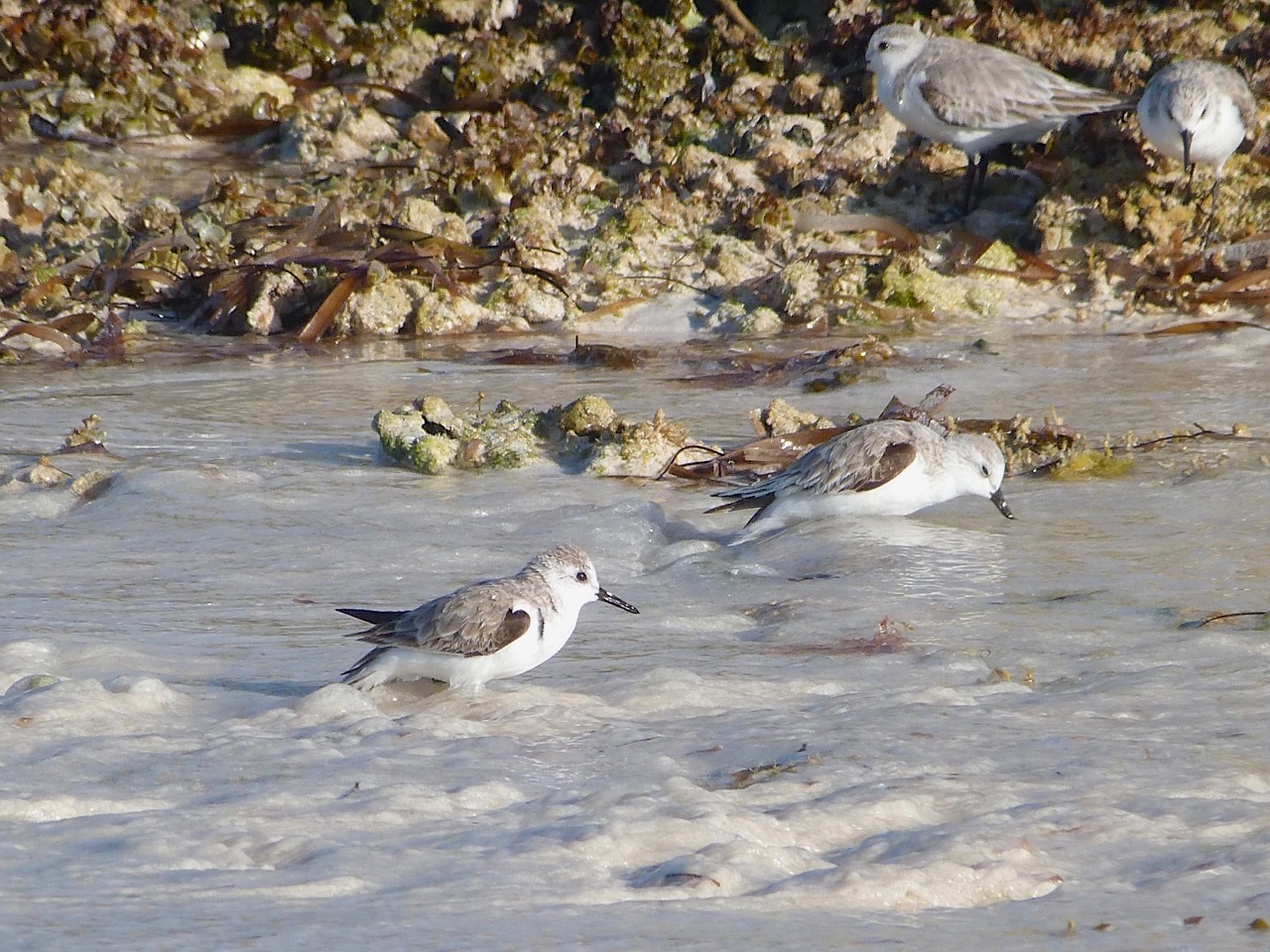
One of the pleasures of watching birds (as opposed toBIRDWATCHING, a more committed-sounding enterprise with its own Wiki entry, that may require equipment, books & mag subs…) is to spend some time observing them enjoying themselves. Perhaps you have a feeder, and like to watch the birds getting stuck into the seeds, carelessly flicking the husks around and throwing their ‘feeder shapes’ on the perches. Maybe you like to see the hummers, beaks deep into the little red plastic flowers on the rim of the sugar-water feeder, tiny bodies motionless and upright, wings a glistening blur of rapid movement in the sun.
Well, join me at Sanderling Bath Time on the Delphi Beach. We are the north end, where the exposed rocks of the reef curve round towards the beach. At low tide, there’s a sandbar bridge from beach to rocks. It is a perfect feeding area for shore birds. Sanderlings, ruddy turnstones, least sandpipers, Wilson’s plovers and the prized piping plovers forage happily together here.
Towards mid-tide on the rise, the water begins to creep round the rocks and encroach onto the sandbar. At high tide, it is well under water and fish are back in residence. Small sharks sometimes hang in the waves just behind their breaking point over the shallow sand. And so the tidal process repeats. But ± mid-tide is the time for the shore birds to bathe in the tidal pools that form – and become frothier as the water pours in. And it’s an excellent time to sit peacefully on the beach and watch the entertainment…
Substantial immersion is not out of the question…
These moments don’t last long. Soon the increasing force and height of the water spoils the fun, and the flock will suddenly take flight and move south a little way along the beach, away from the rocks. There’s the incoming tideline to play with – and more importantly, food to be uncovered with each incoming and retreating wave…
THE COLOUR OF CHRISTMAS: PAINTED BUNTINGS ON ABACO
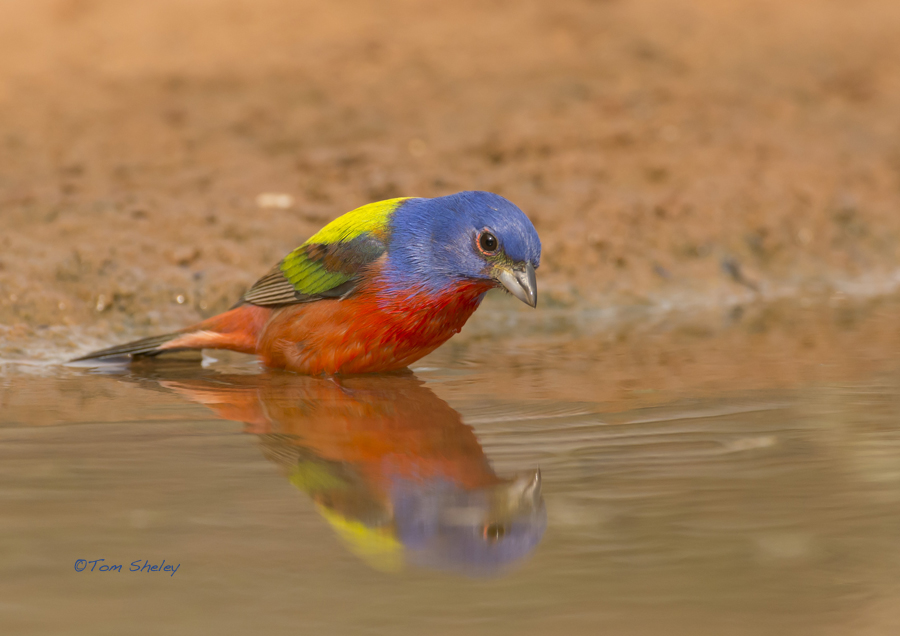
It’s a statistical fact that 99% of people “love” or “adore” painted buntings. The 1% were rather standoffish “Don’t Nose”, preferring to keep their views to themselves. PABU are winter residents on Abaco, not especially common but drawn irresistibly to feeders. To me they are the colour of Christmas, magically decorated with the favourite pigments from a child’s paintbox. So before I get stuck into the imminent festivities, I’ll leave you with a few of these gorgeous creatures to enjoy…
A male and female painted bunting sharing on of the Delphi Club feeders
Wishing all friends and followers of Rolling Harbour a wonderful Christmas and a very happy New Year. See you when I have been safely discharged from the festive recovery ward…
Credits: Tom Sheley (1, 5), Erik Gauger (2), Tara Lavallee (3, 4), Keith Salvesen (6)
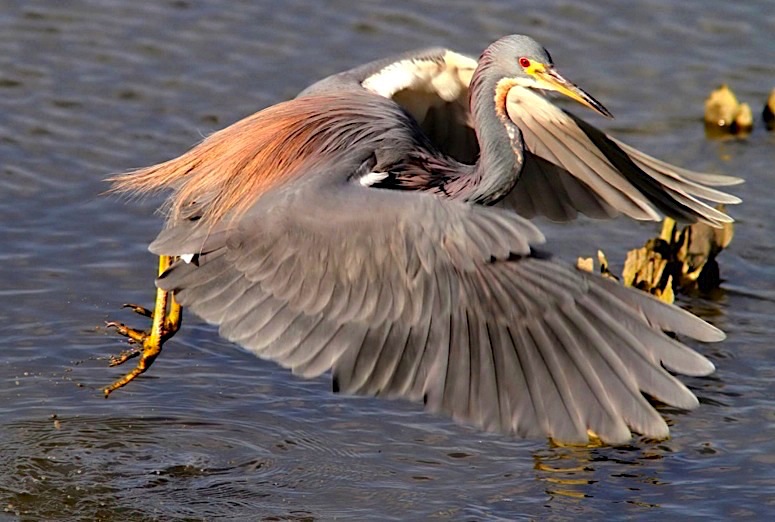
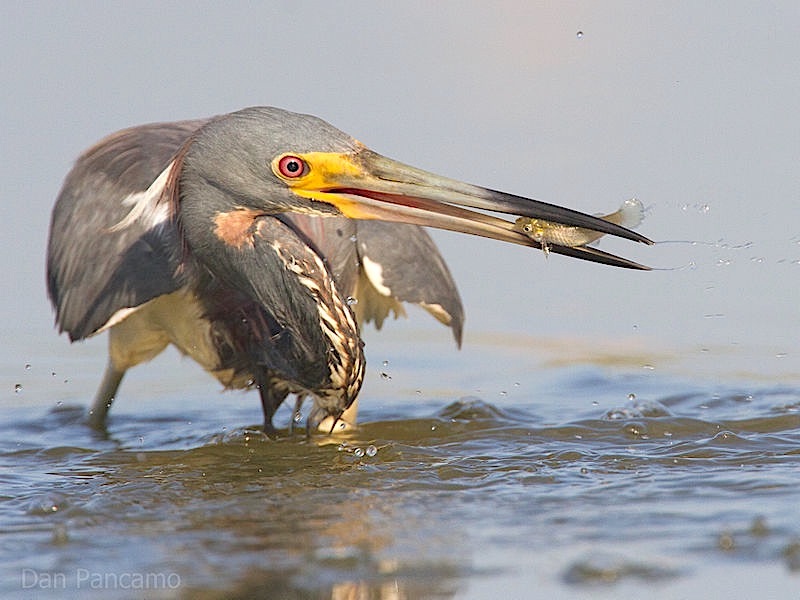
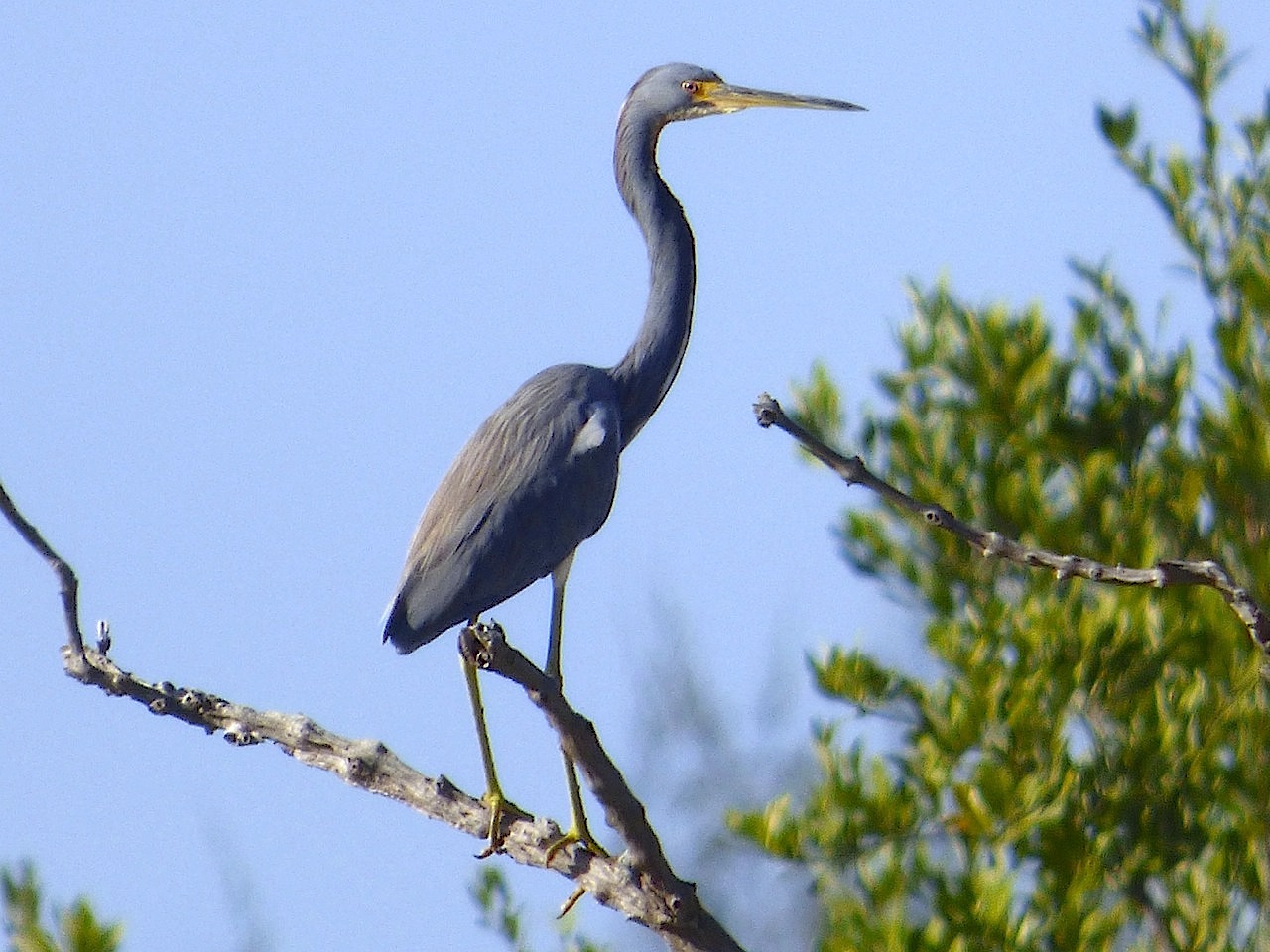
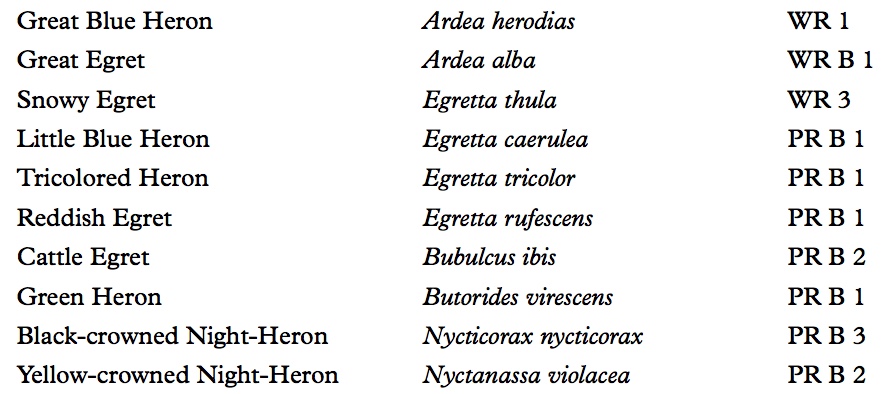
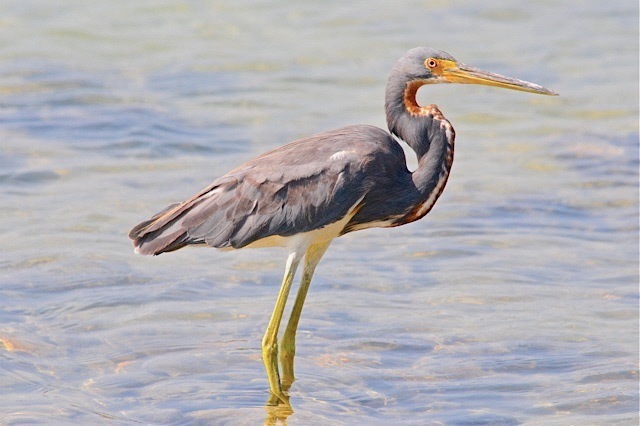
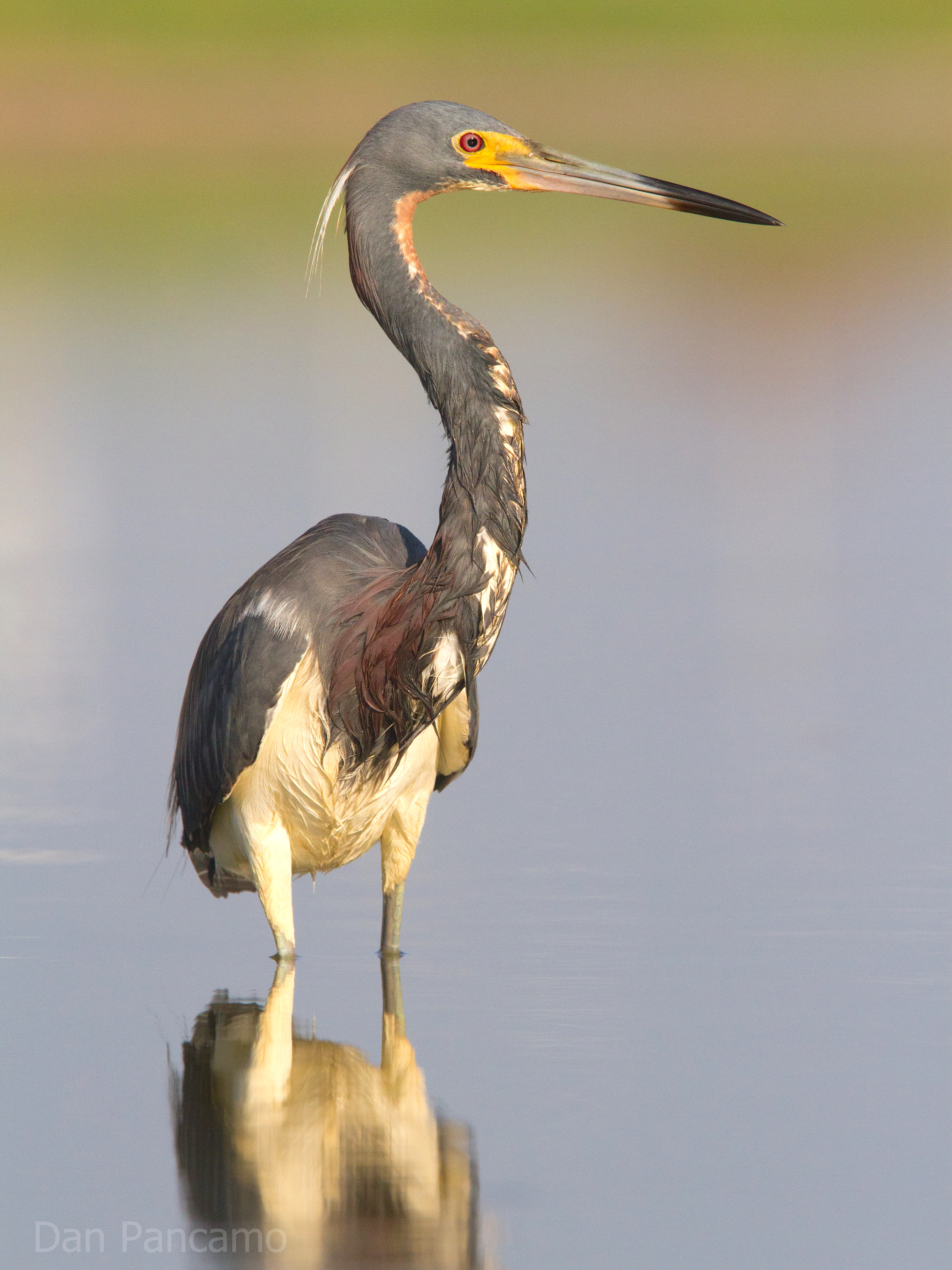
The Tricolored Heron Egretta tricolor is one of 6 heron species found on Abaco, and is a permanent breeding resident. To which can be added 4 sorts of egret to complete a line up of expert fishers, all equally at home hunting in the water or from the shore, or surveying the scene from nearby vantage points like bushes and trees.
A distance shot… and it was 20′ up, above the pond
The heron and egret species of Abaco
A long neck, a long bill and long legs make this heron species ideally adapted for wading. Like other herons and egrets, it will stand stock-still waiting for the perfect fish to swim into range. However they are also active hunters, and will stalk prey or chase it by striding quickly through the water in pursuit. They eat fish, crustaceans, reptiles, and insects.
On a mission…
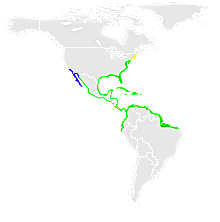
The tricolor has a wide resident breeding range, shown in green on the map
Coming in to land…
Breeding plumage: smart blue bill and a fish to put in it
Sanderlings. Wind them up with the concealed key under their left wing, and they will charge up and down the beach for an hour or two, pausing only to rip some small unsuspecting mollusk or crustacean from its sandy bed. These birds are tiny. And smart. They know all about how a retreating tide will expose the goodies. They are even happy to plunge their heads right under water (#2). They’re not really jumpy, if you don’t push your luck or have a dog with you. The best ploy of all is to find a flock near the tideline, choose a place to lie comfortably in dry sand (with a camera, I mean, otherwise you may look look a bit strange), and wait for them to come into range. Usually they are so busy, what with all that rushing around and feeding, that they will ignore you. So the hard part, after you have taken some photos, is catching the little so-and-sos to wind them up again…
VIDEO 1 In which we notice the scuttling and scooting around of sanderlings on a mission
VIDEO 2 In which we admire bathtime in a tide-pool and assorted comings & goings…
This is going to be a bit awkward for me. And for you. We are all going to have to be very adult about this. If you are sensitive about discussing… intimacies, then look away now. Because we are going to have to confront the facts with courage and fortitude. Ducks havesex.Oh, you didn’t quite catch that? They have Sex. SEX.SEX. Let’s call it something less.. well, I think mating is the correct word, although given the fact that the female suffers total submersion during the proceedings, ‘ducking’ would not be wholly out of place…
On Abaco, there are a number of muscovy ducks, all tame ones such as Perry Maillis’s at Gilpin Point shown in the Header image. They are not strictly an ‘official’ bird species of Abaco, but instead come into the classification “exotics”, in other words avian ‘also-rans’. This category also includes mallards, macaws and (for now) PEAFOWL – though I would fight to near-death to have these ranked as an established breeding introduced species (cf bobwhites), i.e. ‘proper’ Abaco birds. Many-time descendants of a few original tame birds, the population now is entirely feral and self-sustaining.
Muscovy ducks Cairina moschata turn out to be very interesting in the area of ‘Spring relationships’ (mallards and other ducks too, for that matter). A quick piece of research about them unearthed one unbeatable nugget of anatidaean anatomy:male muscovy ducks have spiralled penises which can become erect to 20 cm in one third of a second… Females have vaginas that spiral in the opposite direction to try to limit forced copulation by males, with ‘blind pouches’ if the female is unreceptive to advances…
So there you have it. Impressively rapid reactions from the male. And an equally clever response from the female. Something like this:
Male & Female Duck Corkscrews
NERVOUS DISPOSITION? STOP READING RIGHT NOW!
I once photographed the muscovy duck mating sequence (not on Abaco). Here are some images from the procedure. Until I looked at the images on my computer, I didn’t realise I had ‘caught’ (photo #2) the pink corkscrew in the process of inflation. So to speak. And with apologies for indelicacy.
SPRINGTIME. I THINK IT’S TIME TO FIND MYSELF… A LADY FRIEND
OH MY GOODNESS. THAT “1/3 OF A SECOND THING” IS STARTING TO HAPPEN…
QUICK! AHA! SHE LOOKS NICE. LET’S SEE HOW THINGS DEVELOP.
THAT SINKING FEELING…
THAT SUNKEN FEELING…
HEY! WHERE ON EARTH HAS SHE GOT TO?
OH! HELLO, DEAREST…
HOLD ON AGAIN…. JUST A…. MOMENT…
YAY! I ENJOYED THAT
BLEURGHHHHHHH… ME TOO… I THINK?
AH YES, ALL OK NOW. PLEASURE TO MEET YOU
Credits: Header, Gelinde Taurer; Ianare Sevi; all other photos RH; infographic, scientist.com
*BIRDWATCHER ALERT* A BIG DAY FOR BIRDS EVERYWHERE!
It’s here again – GBD, the second Global Big Day. A chance for anyone and everyone to participate in a worldwide celebration of birds at just the level you choose.
No need to try to cover 100 square miles in a day and record 300 species. Unless you want to, of course. You could as easily spend an hour or two in a garden. In a clearing in the coppice. Down a track in the pine forest. Sitting on the beach with a cooler full of beer. Whatever suits you.
Western Spindalis, Delphi, Abaco
As the second Saturday in May, today also happens to be the officialIMDB– International Migratory Bird Day – for the U.S. and Canada (the Caribbean is in October – reversed migration routes. Geddit?).
However, this post is not primarily about that event, but rather an encouragement to people to join in with some easygoing birding today. And if you happened to want to do it tomorrow, that’s OK too! If you want to send me your checklist (iphone photo should be fine), please do. Or send 2 or 3 best photos, and I’ll post my favourites – though preferably rather than post to my FB page, email to rollingharbour.delphiATgmail.com .
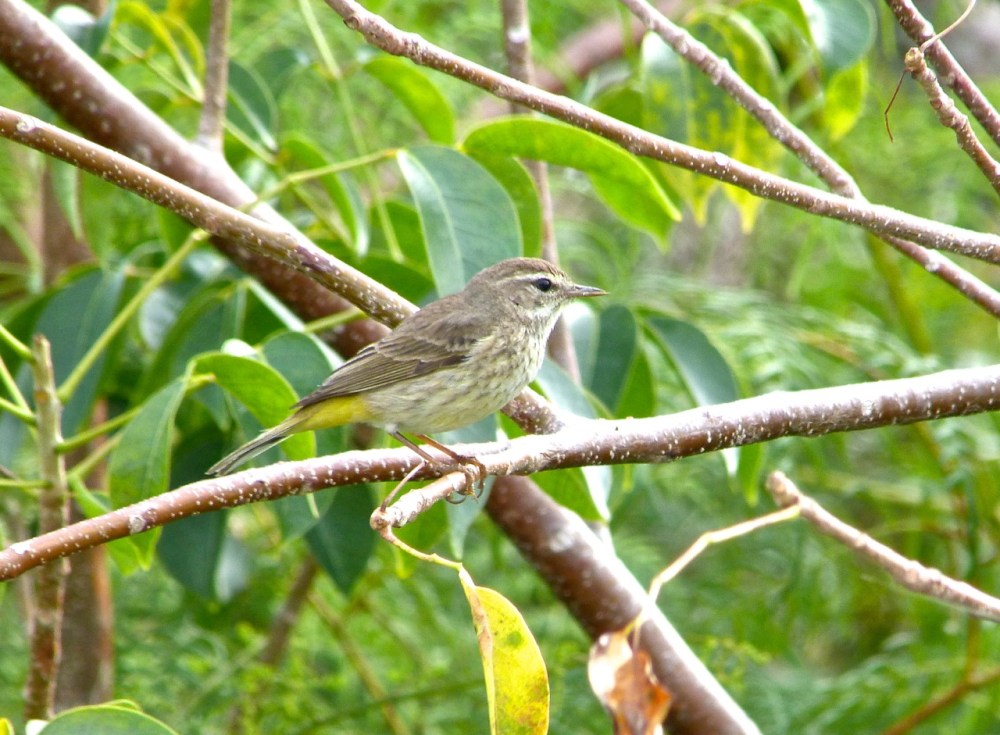
Palm Warbler, Delphi: a migratory warbler. Unlikely to be on Abaco – all hightailed north by now
Wherever you happen to be, just take a little time to look for some birds. There are plenty of places you can rule out straight away. Indoors for example. So it means being in the fresh air. And it’s probably best to set an hour or so as a minimum target time to spend on the task.
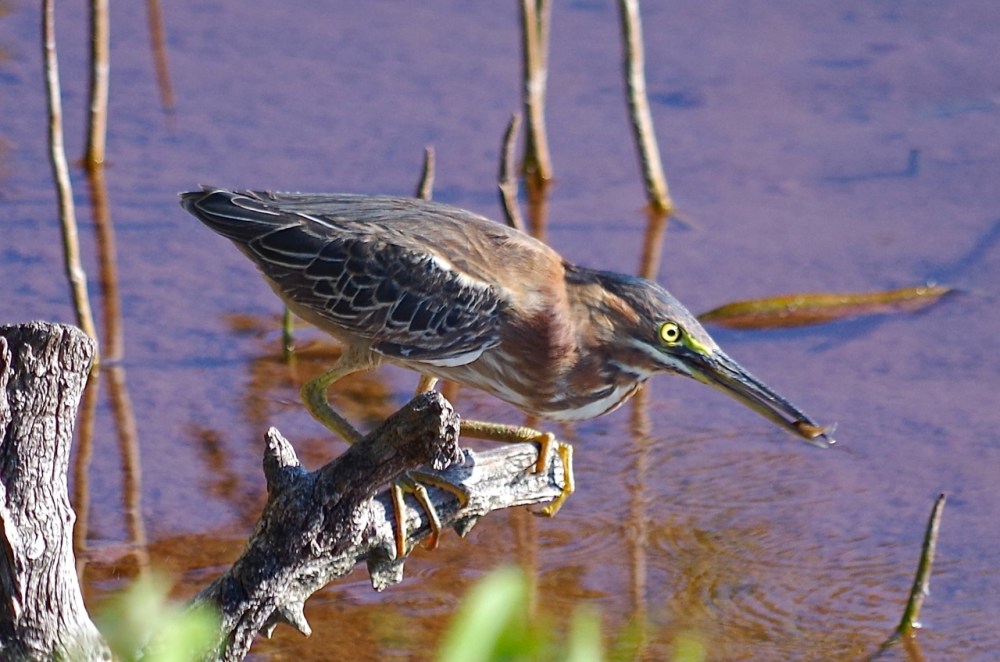
Green Heron hunting (successfully) – Gilpin Point pond, Abaco
WHAT DO I NEED?
Keep it simple. A pen that works. A spare pen just in case. A note book or even a large sheet of paper. Binoculars maybe. Camera if you are that way inclined. Sustenance. Maybe a friend for a joint effort. Possibly a bird book. If you have a North American one, it will help with most of the species you are likely to encounter.
Antillean Bullfinch, Delphi, Abaco
In an ideal world you would then upload your checklist officially to eBirdby May 17 so that your findings can be included in the global statistics. Or you could pass your record to a local birding group to upload for you. Or just have a bit of fun, why not, and see how many different birds you can find (even if you can’t put a name to them). Last year 268 Caribbean species were recorded. Imagine if one of yours was the only one of its kind to be seen?
Bananaquit, Delphi, Abaco
WHY DO IT?
The stats gleaned from this initiative, and others like it (‘Shorebird Day’; ‘Warbler Day’ etc) are a good indicator of the state of health of the bird population both in general and by location. Perhaps an area previously having worrying low numbers for a particular species will show an encouraging upswing, indicating a successful breeding season and / or effective habitat protection initiatives. Or maybe one species will show an unexpectedly low figure, indicating a need for research and the instigation of protection measures.
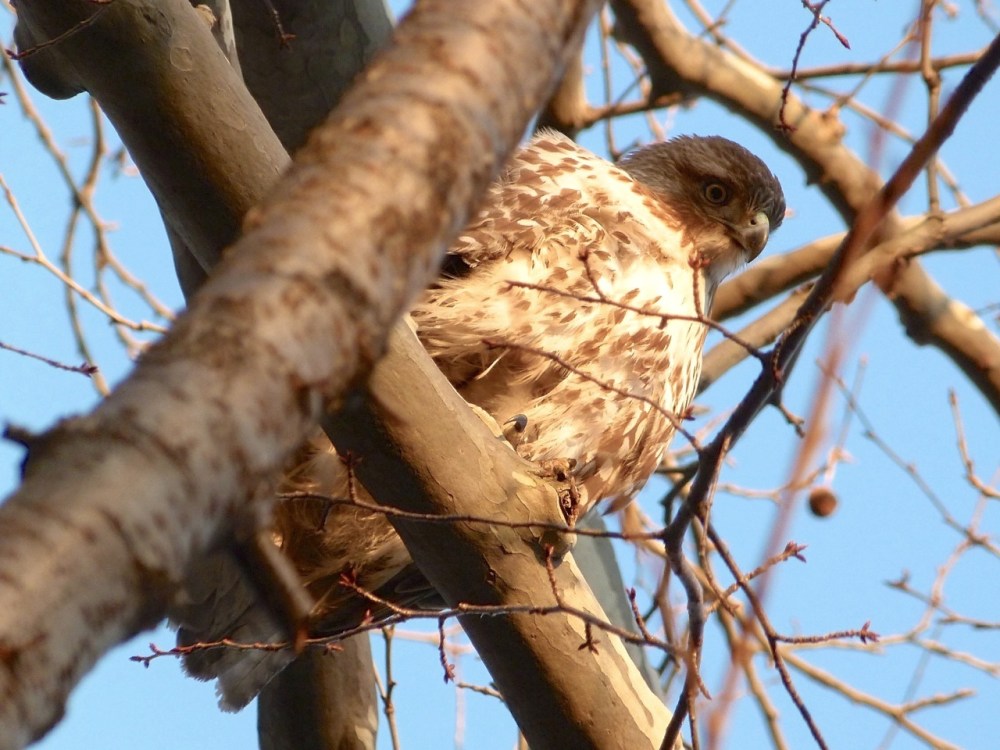
Red-tailed Hawk giving me ‘The Look’
So every return made for every region in the world is significant; and if you can add 20 species to the count, you will be adding to the vast fund of accumulated knowledge that in the long term helps to preserve the birds that surround us.
Let the count begin…
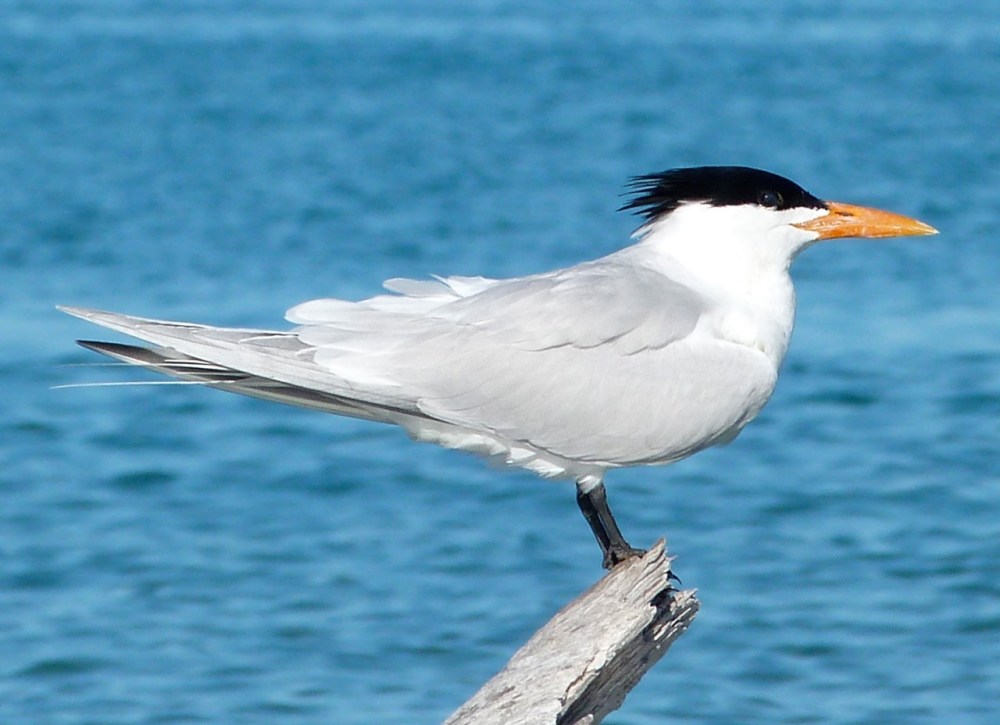
Royal Tern, The Marls, Abaco – taken while fishing. Camera + rod. Cool, huh?)
All photos: Keith Salvesen, taken on Abaco (ok, you got me there, not the red-tailed hawk, which is a cheat and was taken in Central Park NYC. Never got this close on Abaco. But I like it anyway)

































































 ROLLING HARBOUR ABACO
You must be logged in to post a comment.