


SHARKS! ALL YOU NEED (OR WANT) TO KNOW IN ONE SMALL BOOK
THE IDENTIFICATION, BEHAVIOUR & NATURAL HISTORY OF THE SHARKS OF FLORIDA, THE BAHAMAS, THE CARIBBEAN & GULF OF MEXICO
Jeremy Stafford-Deitsch, Trident Press 2000 (95 pp)
Occasionally I review books, apps, ‘meeja’ and so on, of general relevance to Abaco wildlife and ecology. You can find all this under the heading BOOKS ETC and its drop-down sub-menus. You’ll see comparative recommendations, mostly positive, with some frankly snidey comments on a few things not to waste your ‘hard-earned’ on.
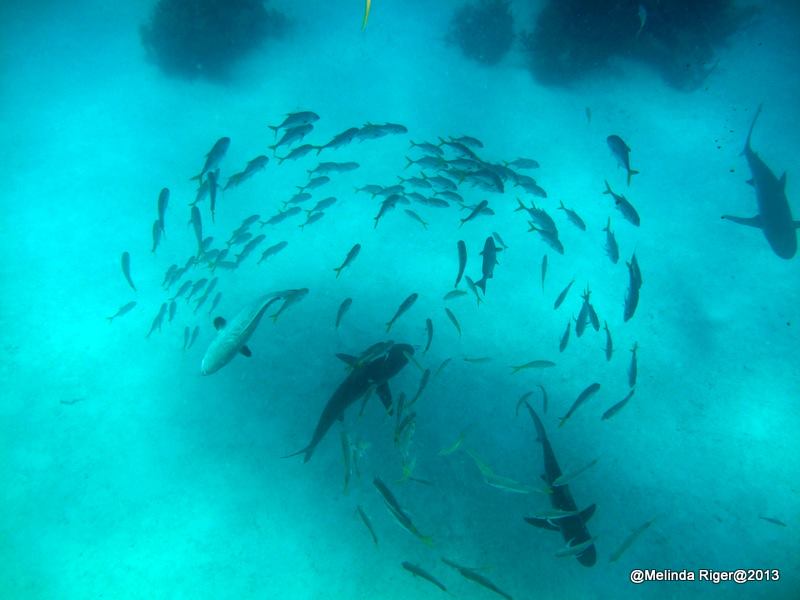
Here’s a book I bought on @m@z@n for a few coins + p&p (less than $5 total) just to see what it might have to offer. The answer is, a great deal. It’s not the book for those who want a detailed exploration the intricate mesopathy of selachimorphic exo-cartilege, if such a thing exists. But it has a mass of useful information, brief but helpful identification pages for many different shark species, and good illustrations, all compressed into a slim tome.
Although this book was published in 2000, sharks haven’t changed noticeably since then, so the contents still hold good. Here are a few pages to give an idea of how simple yet informative this book is.
A tour round a shark’s ‘bits’
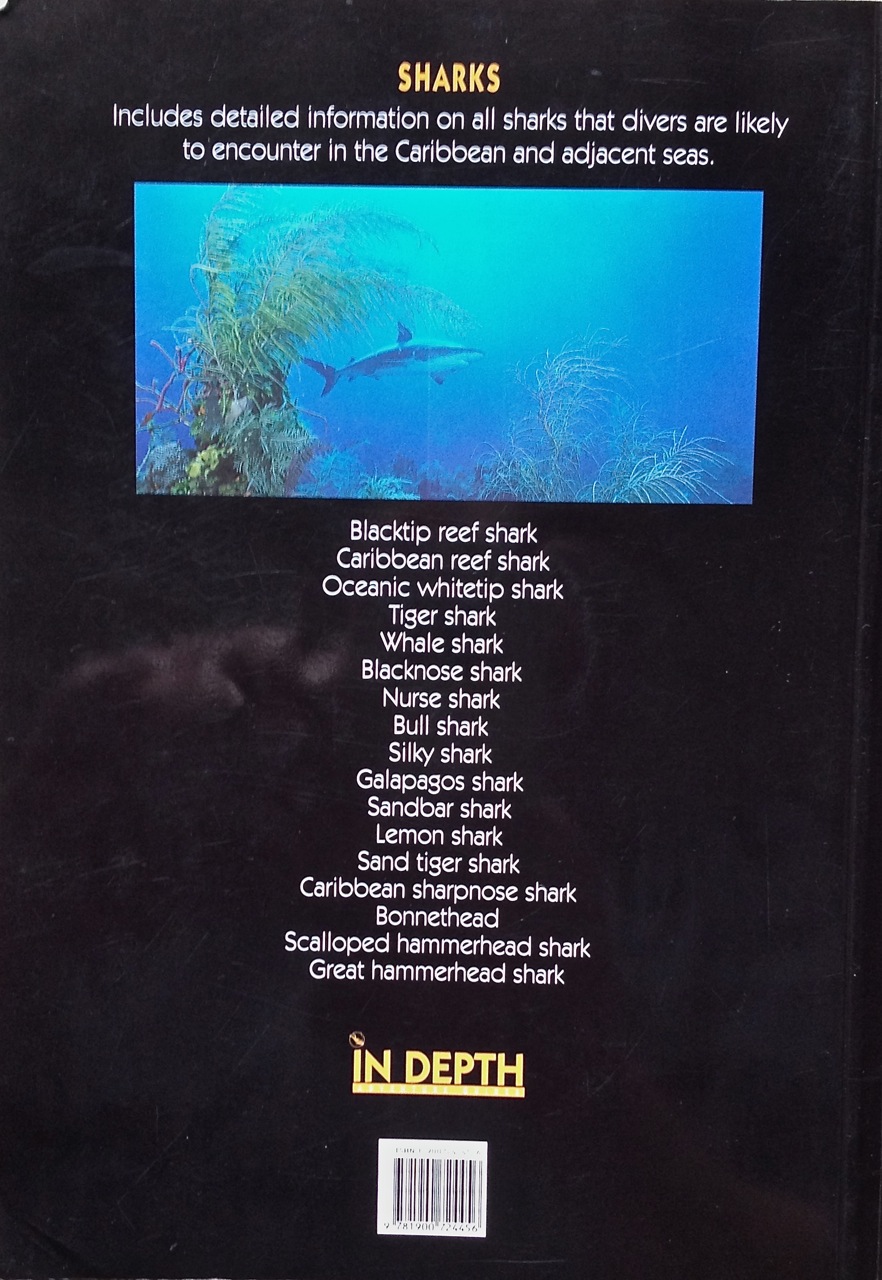
The Contents page gives a very clear idea of the scope of the book. Pages 34 to 54 are of particular interest for anyone intending to dive, spearfish, snorkel or indeed take a dip.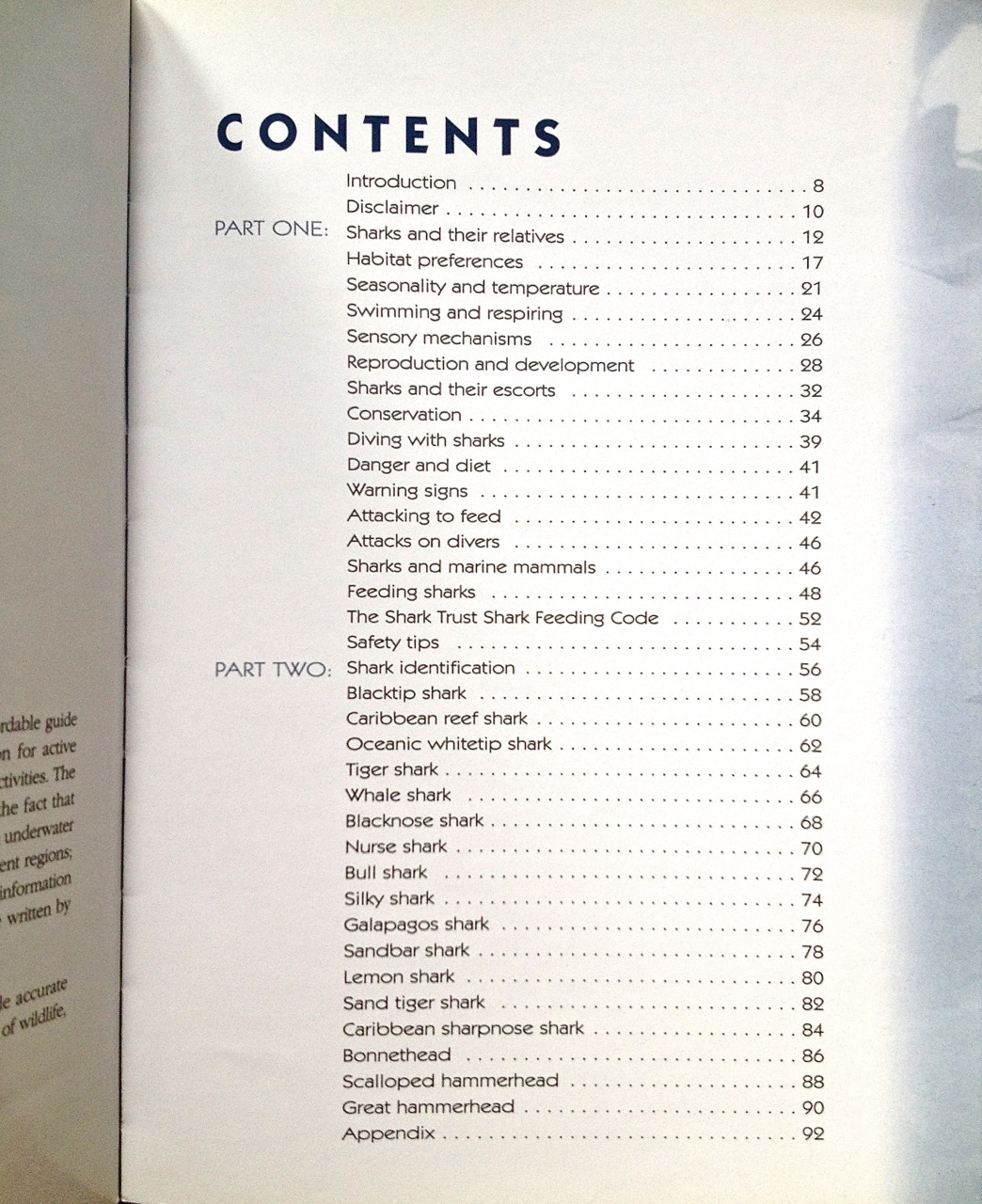
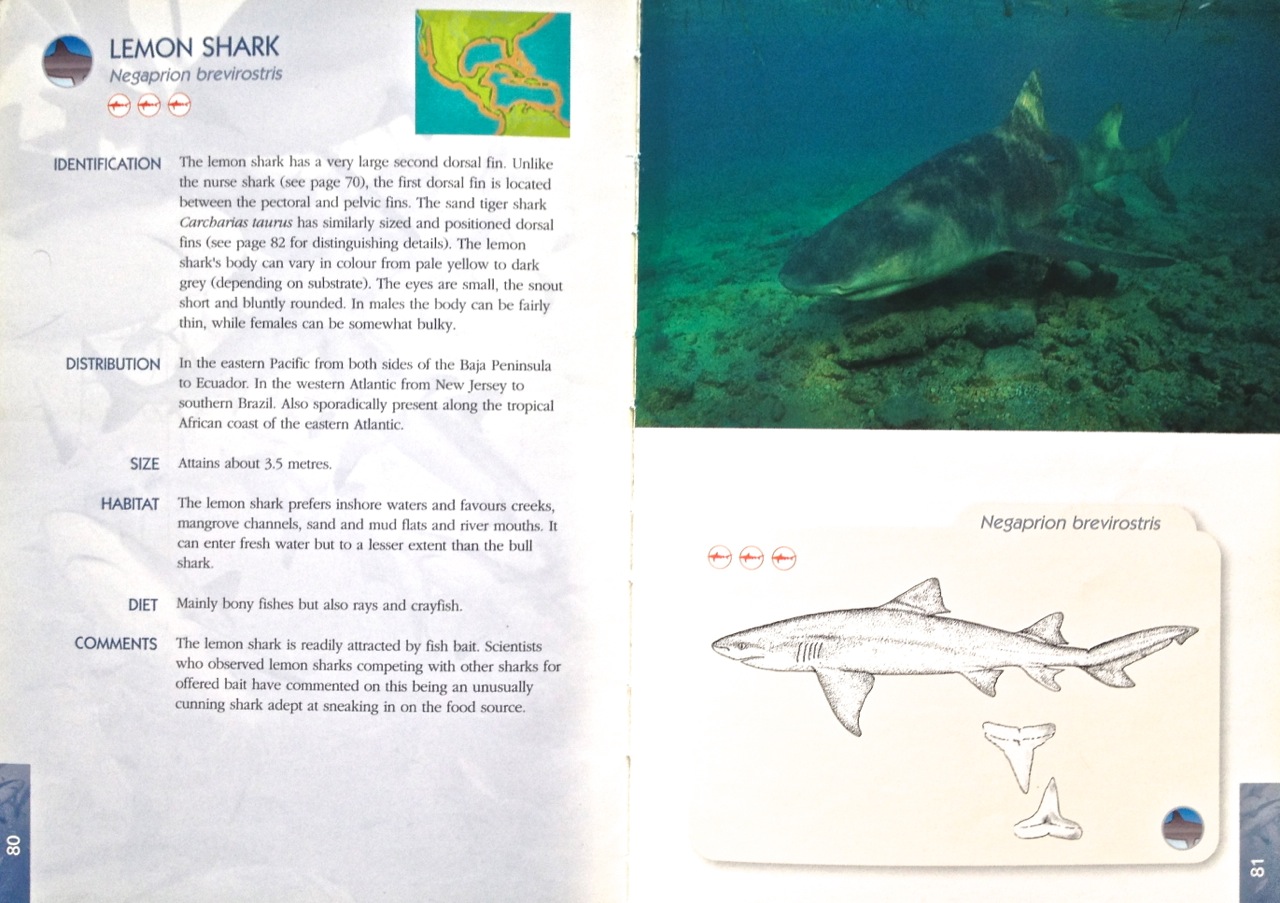
The entries for the Blacktip Shark and the Lemon Shark. Each entry features a useful range map, and an even more useful ‘potential danger rating’ for each species. It’s worth remembering, however, that there are sharks worldwide, and they all have teeth. Thousands of people dive and swim with many of the species every day in complete safety. There are simply some does and don’ts, mostly completely obvious, that will make the difference between enjoying their company (and they, yours); and pushing your luck with a wild creature when you have intruded into its habitat…
THE SHARK TRUST FEEDING CODE
This page interested me in the light of the chumming debate. Plenty of basic common sense here.
A useful illustration to help you understand what the book is all about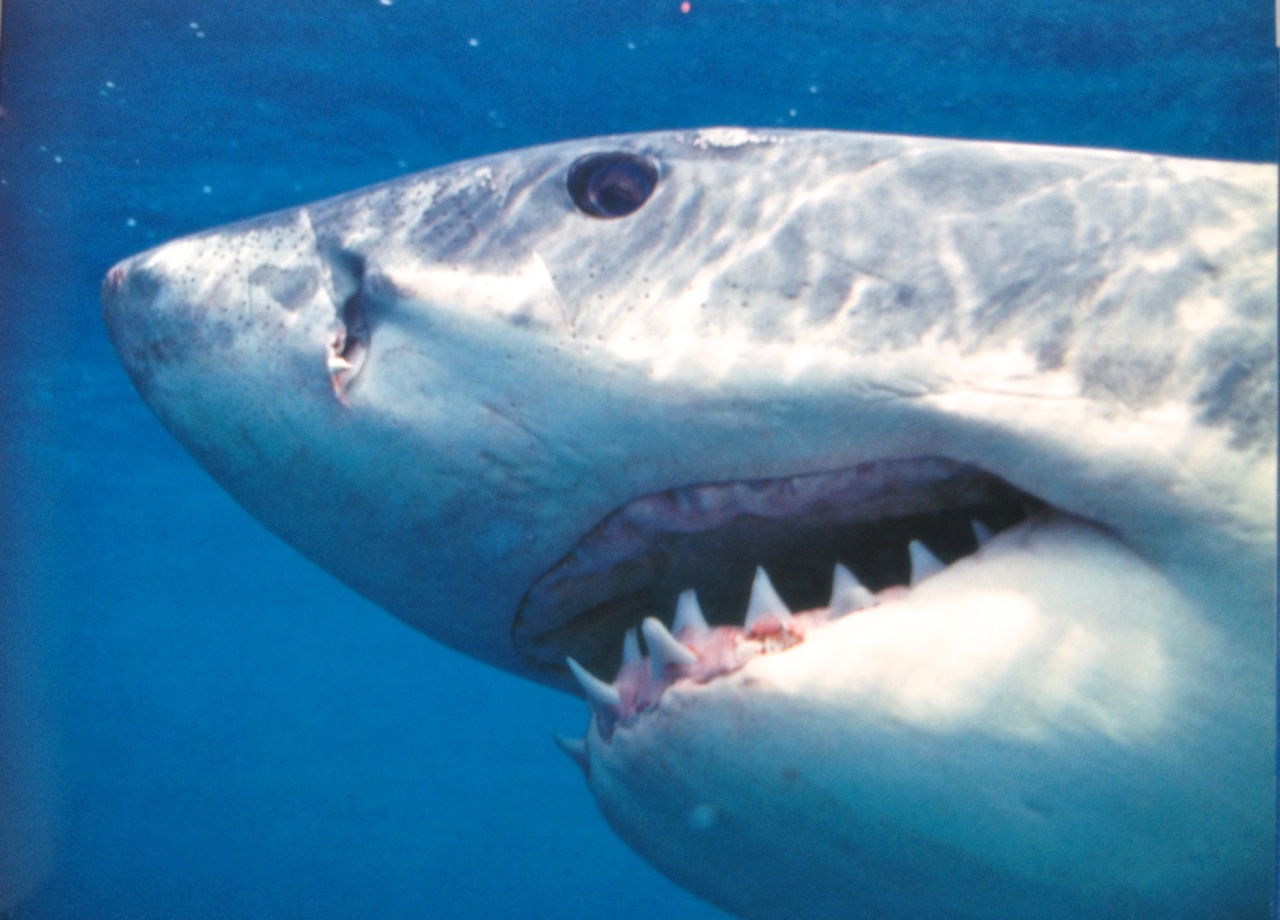
More shark information and some amazing images can be found HERE .
As I wrote elsewhere: “Take comfort from the fact that no fatalities and fewer than 10 injuries from shark attacks have been recorded in Abaco waters for over 250 years (since 1749)… By way of comparison, in the last 150 years there have been 36 recorded shark attacks in the Mediterranean, of which 18 have been fatal… Since 1845 there have been a number of shark attacks in British waters, with one fatality. There were two more fatalities in an incident in 1956 , but this was an ‘own-goal’ arising from an attempt to blow up a shark with dynamite. It can hardly be blamed on the shark.
WEIRD NON-SHARK RELATED STATISTIC: Amazingly, in the 3 years 2007 – 09 in England and Wales, 42 people died from being bitten by animals, only a few of which were dogs.
CONCLUSION You are statistically far safer to spend 250 years swimming off Abaco than spending 3 years stroking a cat in Manchester. Or Swansea.”

 ROLLING HARBOUR ABACO
I really do like sharks. At least, I really try to.
LikeLike
I’m quite certain, EST, that if they met you, they would like you too… 😎 Happy Xmas. RH
LikeLike
Aye that! In the 70’s and 80’s my oldest son and my good Mates lived off the sea for weeks at a time on a 44′ Ketch spearing in the mid and upper Bahamas. Never had a serious problem beyond their curiosity. We’re quite convinced its the abundant clarity of the water combined with common sense precautions what preserved us! BTW,Thanks Bahamians for sharing w/ us!
LikeLike
Hi, Rick, that’s interesting. I’m not knowledgeable about sharks (more so now I’ve read the book), but I suspect water clarity does help – that applies to both sides! And use of basic common sense when entering another creature’s environment where they are top of the food chain… All the best, RH
LikeLike
Hi RH! Considering that 94% of all human/shark incidents in Fla are cases of mistaken ID, where the turbidity is often very high within 100 yds of the beach, the visibility factor makes a lot of sense. Even in the surf zone , the viz in the Bahamas is quite good due to the courseness of coral sand, and the continuous flushing of near shore areas by currents. Also large, migratory bait-fish runs that occur along the linear Fla coast are rare in the open islands of the Bahamas.
Overall, the majority of sharks anywhere we have encountered them are simply quite wary of human eye contact. We found early on that they’re sensitive to what we emote, and “bluffing” them becomes routine with practice.
LikeLike
Most useful comments, for which thanks – and you clearly lived to tell the tale. I guess good visibility makes life easier on both sides. I can quite see why turbidity might lead to confusion between ‘legitimate lunch’ and ‘innocuous man’s leg’. Season’s Greetings. RH
LikeLike
Thanks for this excellent post RH – would love to swim in Abaco’s waters (even if for merely 20 years! :-)) kind regards – metiefly
LikeLike
Glad you enjoyed it, Mark. Even 20 minutes on a reef would be good – plenty to see there. Abaco has the 3rd largest barrier reef in the world. I can’t mention where the largest is because of the cricket! All the best over Xmas and for 2014.
LikeLike
Great review on a fine book, RH. Oh dear, do they look frightening!
Happy Holidays to you and yours!
Dina
Are you celebrating Christmas on this gorgeous island or will you be in Dorset? 🙂
LikeLike
It’s a very unassuming little book, but a good example of how to pare information down to the essentials! And the subject matter? Mmmmmmm, I half agree. ‘Jaws’ has plenty to answer for, though. Festive greetings to you, too. It’s Dorset for us – and Cley for you? Or Norway, maybe, and seasonal bunad? RH
LikeLike
Pingback: Great white sharks scavenging on dead whales | Dear Kitty. Some blog
Cheers for the link! Appreciated. RH
LikeLike