
WINTER WARBLERS ON ABACO: NORTHERN PARULA
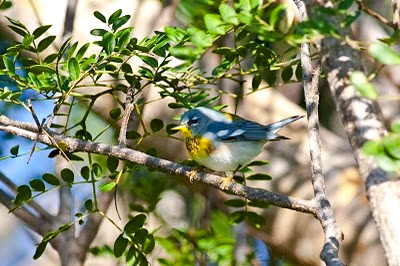
The NORTHERN PARULA Setophaga americana is a stumpy little migratory warbler with white arcs above and below the eyes, and with a slate-coloured back distinctively smudged with an olive patch in both sexes. These birds are winter residents on Abaco, and are common throughout the island and cays. They are arriving right now, including juveniles making their first trip to Abaco. Wonder what they’ll make of it?
This photo shows the distinctive colour difference between feet (orangey) and legs (grey-brown)
Range Map: Summer (Yellow) & Winter (Blue)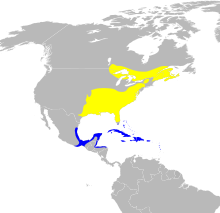
Parulas are primarily insect eaters, with a preference for caterpillars and spiders. They sometimes dart from a perch to snatch insect prey in mid-air. In winter they vary their diet with berries and fruit. You are most likely to see one foraging busily in bushes and low trees – maybe coming up for air by poking its head above the foliage…
TAXONOMY DOMINÉ
WHAT THE HECK IS A “PARULA”? Originally, Linnaeus classified this little bird at a Tit, or Parus. For some reason, “as taxonomy developed the genus name was modified first to Parulus and then the current form” (Wiki Hat-tip). But although none of the other 37 Abaco warbler species is a Parus, Parulus or Parula, they all come under the family name Parulidae. The august institutions that deal with these things have classified the Parula as a ‘Setophaga’, along with many other warblers.
This photo shows the distinctive upper chest band of the adult bird very clearly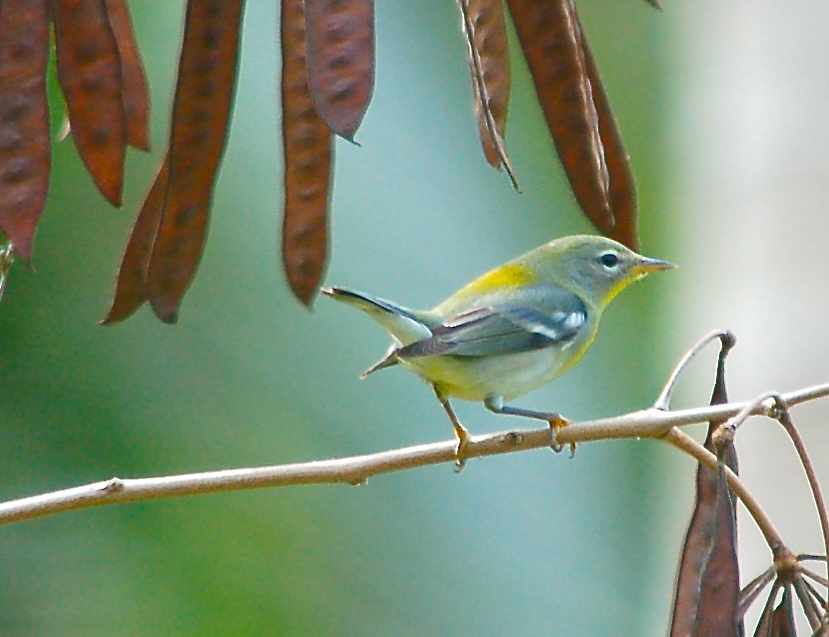
The CORNELL LAB list of adult Parula identifiers is shown below, with adult females being similar ‘but with greener backs’. These specifics are pretty much borne out by the birds shown here (except for the last bird, an immature female just beginning to develop the Parula characteristics). The next photo by Woody Bracey, is a perfect example of what to look out for.
- Small songbird.
- Blue-gray hood and wings.
- Yellow chest with black and reddish band across it.
- White crescents above and below eyes.
- Green back.
- Two white wingbars.
Parulas produce different sounds to listen out for – a ‘chip’ call that could be any number of birds (IMO); a song; and a trill. Here are examples of each from the essential bird call site Xeno Canto.
CHIP CALL Paul Marvin / Xeno Canto
SONG Paul Marvin / Xeno Canto
TRILL Jelmer Poelstra / Xeno Canto
This is an immature female parula, a ‘first fall’ bird, and therefore on its first visit to Abaco
I’ll end with an excellent 2:18 mins-worth of Parula-based video from Wild Bird Video Productions
[youtube https://www.youtube.com/watch?v=fn8uzlYnt50]RELATED POSTS
WARBLER GALLERY – ABACO’S 37 SPECIES
PERMANENT RESIDENT WARBLERS – THE ABACO 5
ENDEMIC BIRDS – ABACO’S 4, inc. 2 WARBLERS
CREDITS: Photos – Craig Nash, Bruce Hallett, Becky Marvil, Gerlinde Taurer; Audio – Xeno Canto; Video -Wild Bird Video Productions; Cornell Lab; a smidge of Wiki
 ROLLING HARBOUR ABACO
A beautiful collection of pictures and audio RH, though my favourite is the little blue bird’s beak smeared in blackberry juice 🙂
LikeLike
Thanks a lot EST – and well spotted on the detail! A beekeeper’s eye for detail, I’d say! RH
LikeLiked by 1 person
Such a delightful winter resident, how very fortunate for you. Really spectacular photos, as always. 😀
LikeLike
They are very sweet little birds. But then again, so many of them are! Thanks for the nice comment on the photos – none of which was mine! I am lucky enough to have a very good archive to draw from after the Abaco Bird Book project, all taken on Abaco.
LikeLiked by 1 person