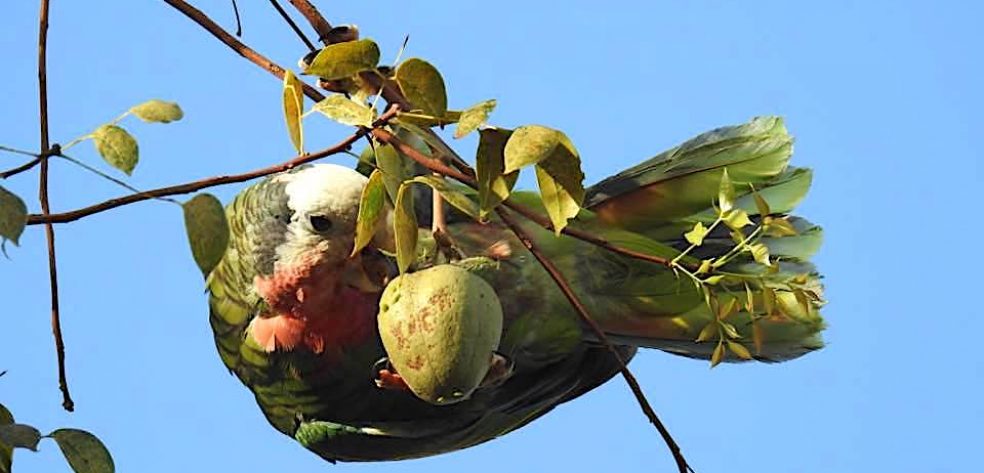
BEAUTIFUL DAMSELS: BAHAMAS REEF FISH (9)
YELLOWTAIL DAMSELFISH
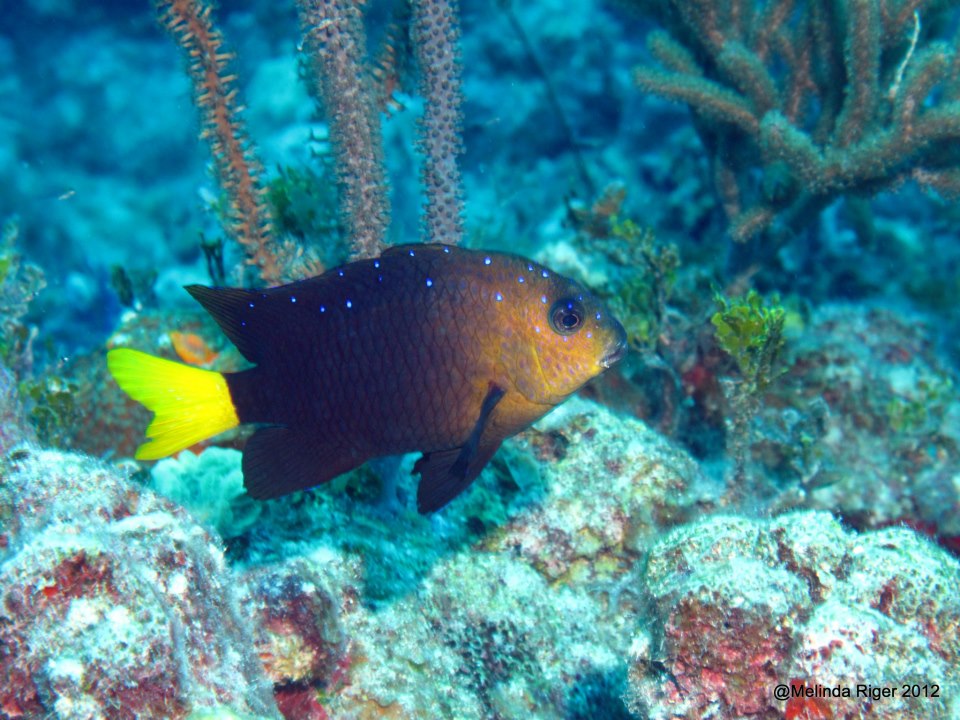 BICOLOR DAMSELFISH
 COCOA DAMSELFISH
 THREE-SPOT DAMSELFISH (JUV)
THREE-SPOT DAMSELFISH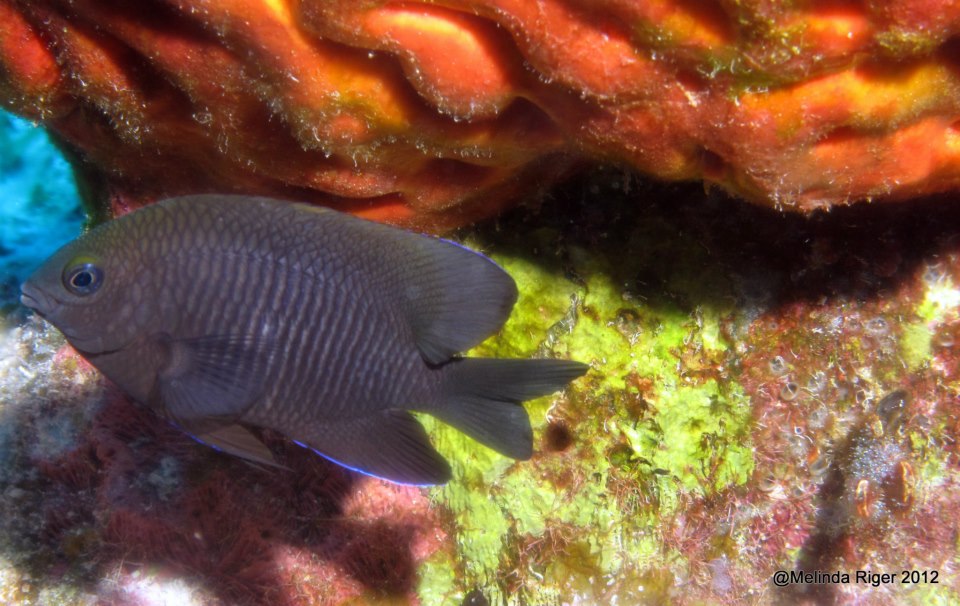
 Photo credits: Melinda Riger @ Grand Bahama Scuba (except header image – Wiki-cheers)

YELLOWTAIL DAMSELFISHBICOLOR DAMSELFISHCOCOA DAMSELFISHTHREE-SPOT DAMSELFISH (JUV)
THREE-SPOT DAMSELFISHPhoto credits: Melinda Riger @ Grand Bahama Scuba (except header image – Wiki-cheers)
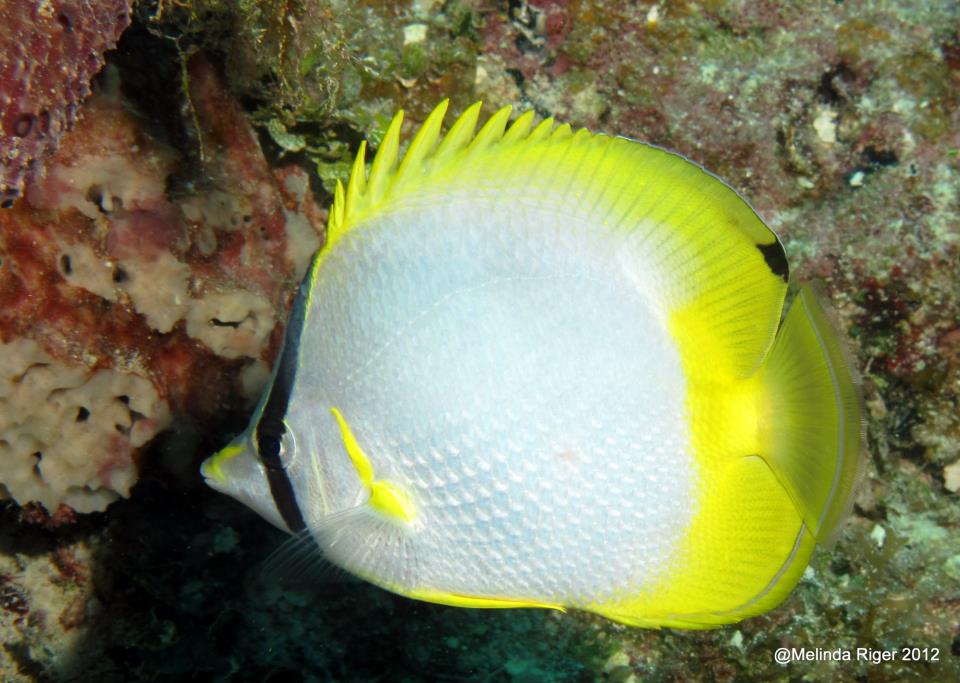
Butterflyfishes (Chaetodontidae) belong to a large worldwide family of small, colourful reef fishes. There are several sorts to be found in the Bahamas, of which 4 are shown below. These creatures resemble small angel fishes, and are invariably vividly coloured, strikingly patterned, or in many cases, both. Apart from that, the most interesting fact about them is that their species name Chaetodontidae derives from a Greek compound noun meaning ‘hair tooth’. This unsettling description relates to the rows of tiny, fine filament-like teeth inside their protuberant mouths. If I ever get a photo of a butterflyfish showing its teeth while feeding or yawning, I will add it here…
FOUR-EYED BUTTERFLYFISH
REEF BUTTERFLYFISH


SPOTFIN BUTTERFLYFISH
BANDED BUTTERFLYFISH

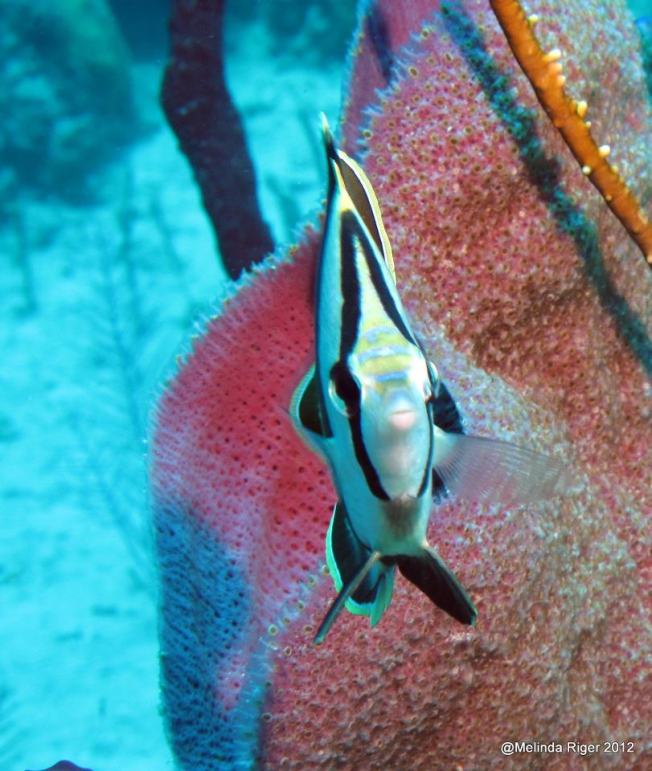 Photo Credit: Melinda Riger, Grand Bahama Scuba

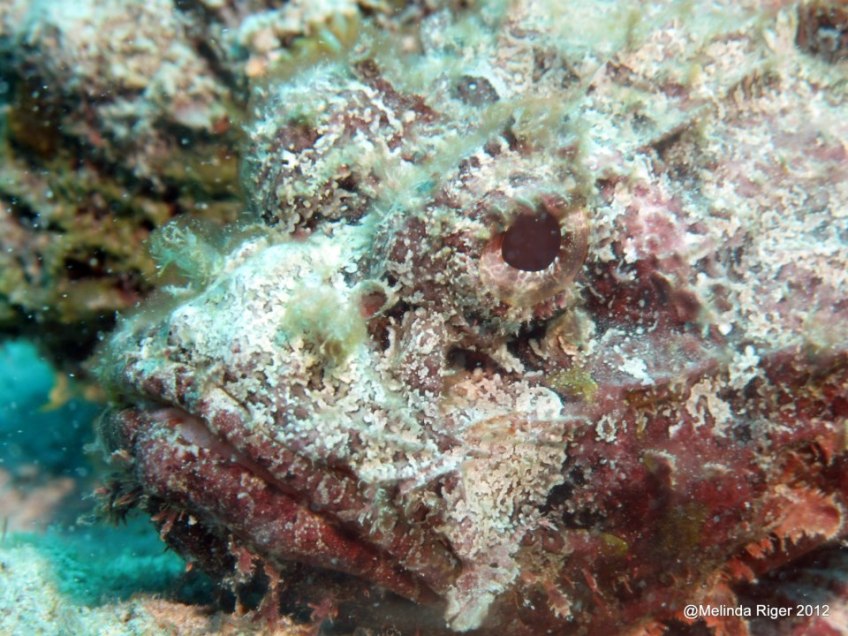
SCORPIONFISH
PEACOCK FLOUNDER or PLATE FISH Bothus lunatus
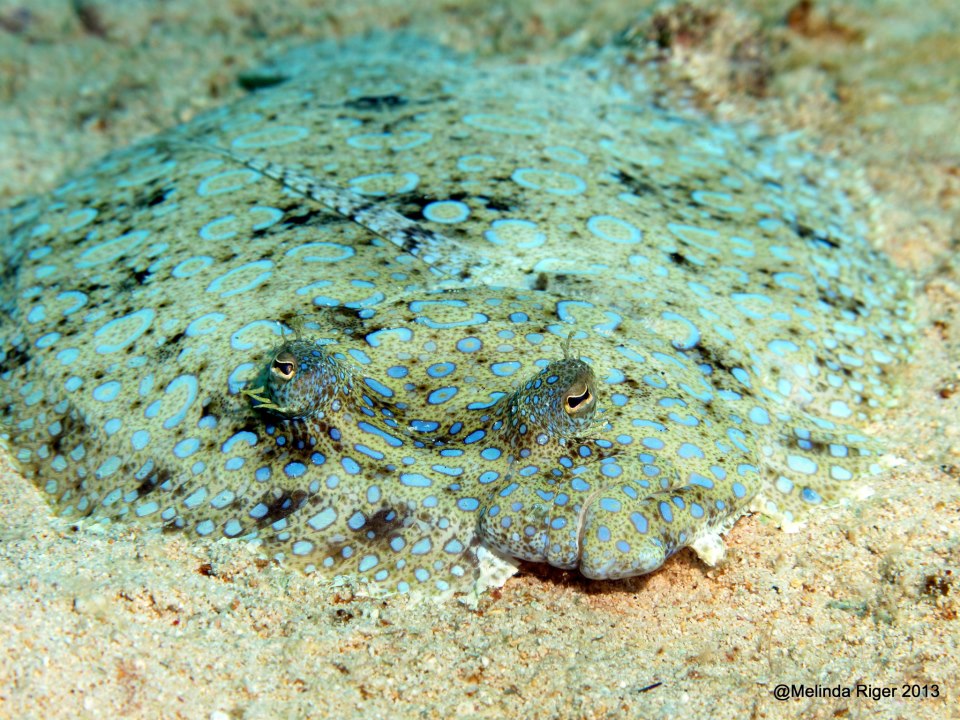
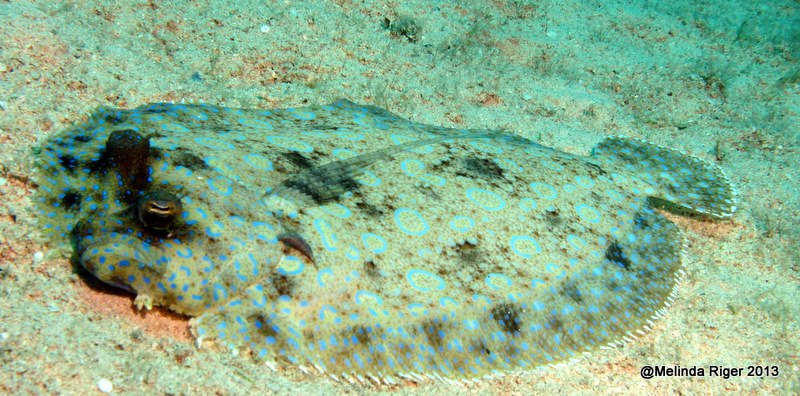 Photos: Melinda at Grand Bahama Scuba
This is my last post until next week, when apparently we can expect a snowy welcome. Hmmmm. Plenty of new material for kind followers – both of you..

DELPHI DAWN



Production still from the television series BAHAMA BLUE © 2014 Parallax FIlm Productions Inc.
The Mangrove Jellyfish Cassiopea, also called the ‘upside-down jellyfish’ for reasons I needn’t dwell on, is the only member of its particular jellyfish family. These creatures prefer warm waters, and typically live upside-down on the sea-bottom, which no doubt makes catching prey very simple. They can be found individually, though more likely in large groups, with individuals displaying different shades and colours.

NEW An excellent video by Melinda Riger of Grand Bahama Scuba
The Mangrove Jellyfish has one of the milder stings of the numerous species, though human reactions to the sting will vary with the individual. A greater problem may come from swimming around or over a mass of these creatures. Their stinging cells are excreted in a transparent mucus which may invisibly cover the unwary swimmer. Apart from skin-irritation and a rash, the stings are apparently very itchy. My guess is that scratching can only make things worse (cf No-see-ums…). The first of the two videos below was taken recently by Sarah Bedard (to whom thanks) who “found a great tidal pool full of them at the end of Rock Point Road, Treasure Cay (Abaco)”. The second is short, but with some amazing footage of the Jellyfish in action.
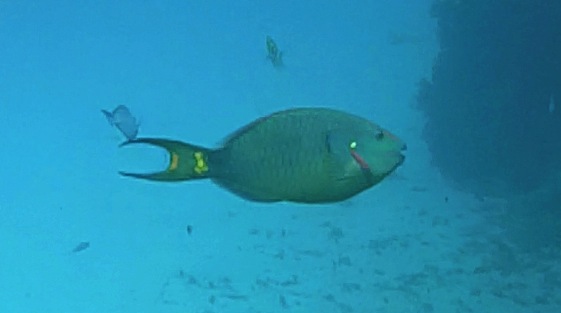
The term ‘PARROTFISH’ comprises many related species (80) around the world inhabiting shallow tropical and subtropical waters. They are commonly found in coral reefs and seagrass beds, and along rocky coasts. They play a significant role in BIOEROSION. Here are some examples of 5 of this species that inhabit the waters of the Northern Bahamas
BLUE PARROTFISH

PARROTFISH FACTS TO ASTOUND AND IMPRESS YOUR FRIENDS WITH
A. FEEDING HABITS
1. Named for their dental arrangements – a mouthful of teeth, forming the characteristic ‘beak’
2. Primarily herbivore but not above snacking on small creatures / organisms or even molluscs
3. Their teeth grow continuously, replacing ones worn away by feeding on coral
4. As they feed on algae etc, their teeth grind up the coral, which they ingest
5. Then (get this!) they digest it and excrete it as sand… it’s a component of your favourite beach!
6. “One parrotfish can produce 90 kilograms (200 lb) of sand each year”. Wiki says so – it must be true
7. They are a vital species in preventing algae from choking coral
PRINCESS PARROTFISH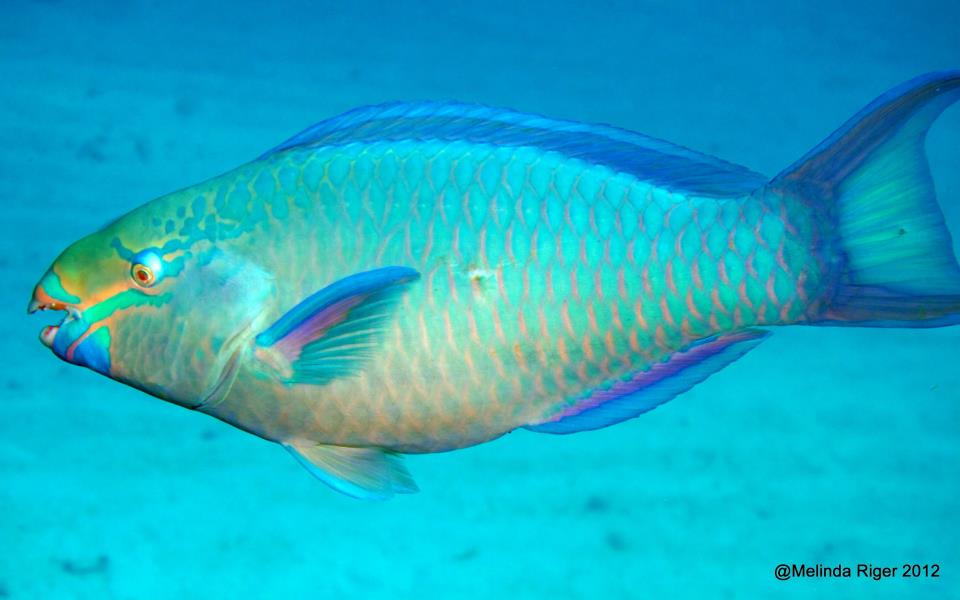 QUEEN PARROTFISH (initial phase)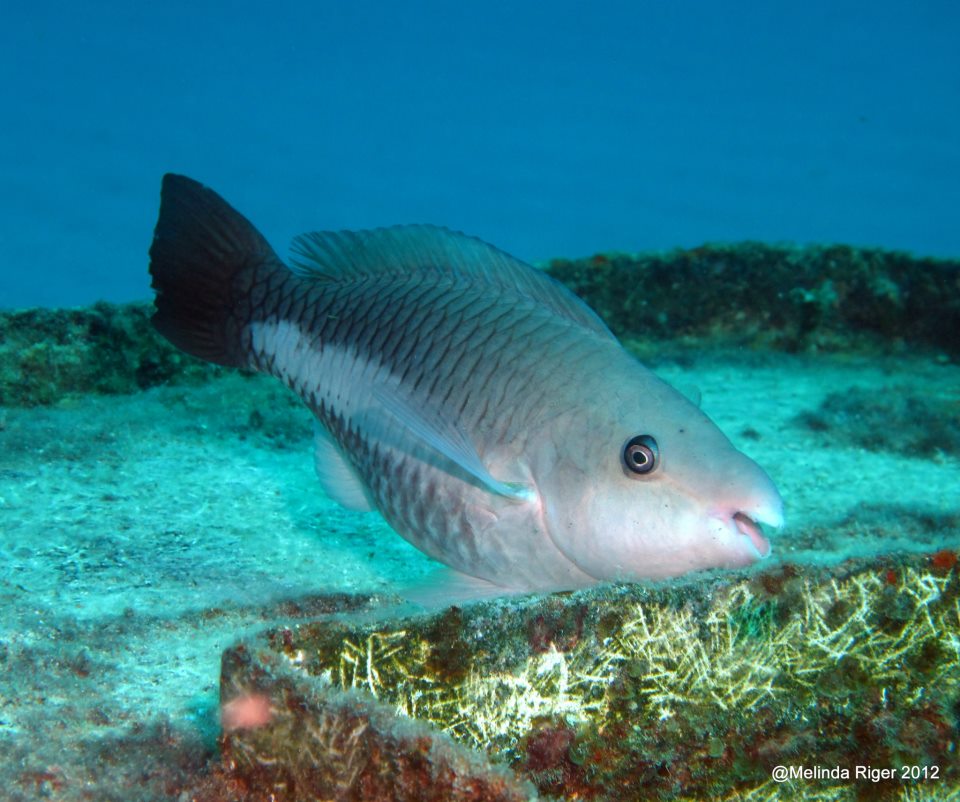
B. PERSONAL INFORMATION (theirs, I mean)
1. Some species secrete a protective mucous cocoon to sleep in or to conceal themselves from predators
2. A mucous substance also helps heal damage, repel parasites, & protect them from UV light
3. As they develop, most species change colour significantly to become vivid adults – “polychromatism”
4. Some juveniles can change colour temporarily to mimic other species as a protection
5. Most are “sequential hermaphrodites”, turning from female to male (a few change vice versa)
6. They tend to hang out in groups of similarly-sized / -developed fish
7. Single males tend to have several lady friends, and aggressively defend their love rights
8. Parrotfish are PELAGIC SPAWNERS. Females release many tiny buoyant eggs into the water, which float freely and settle into the coral until they hatch
9. Unlike other fishes, they use their pectoral fins to propel themselves
10. Their feeding behaviour makes them unsuitable for marine aquariums
RAINBOW PARROTFISH
Anyone interested in getting more information about Parrotfishes – maybe about that whole female / male transformation thing? – is recommended to look at an article by Tim Smith of Miami University, Ohio entitled THE BAHAMAS: A CLOSER LOOK AT THE COLORFUL AND UNIQUE PARROTFISH Click on the P-word to get to it directly.
If you are pressed for time, here is the article conveniently digested into bullet points:
REDBAND PARROTFISH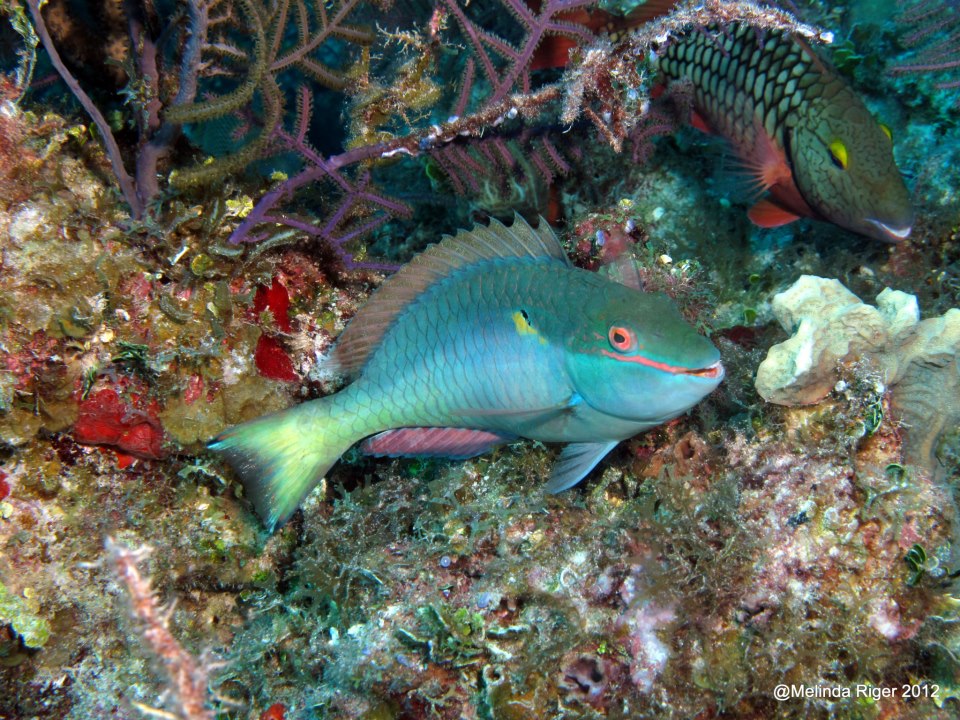

Some more bullet points from Tim Smith’s article:
STOPLIGHT PARROTFISH (adult and, below, juvenile form)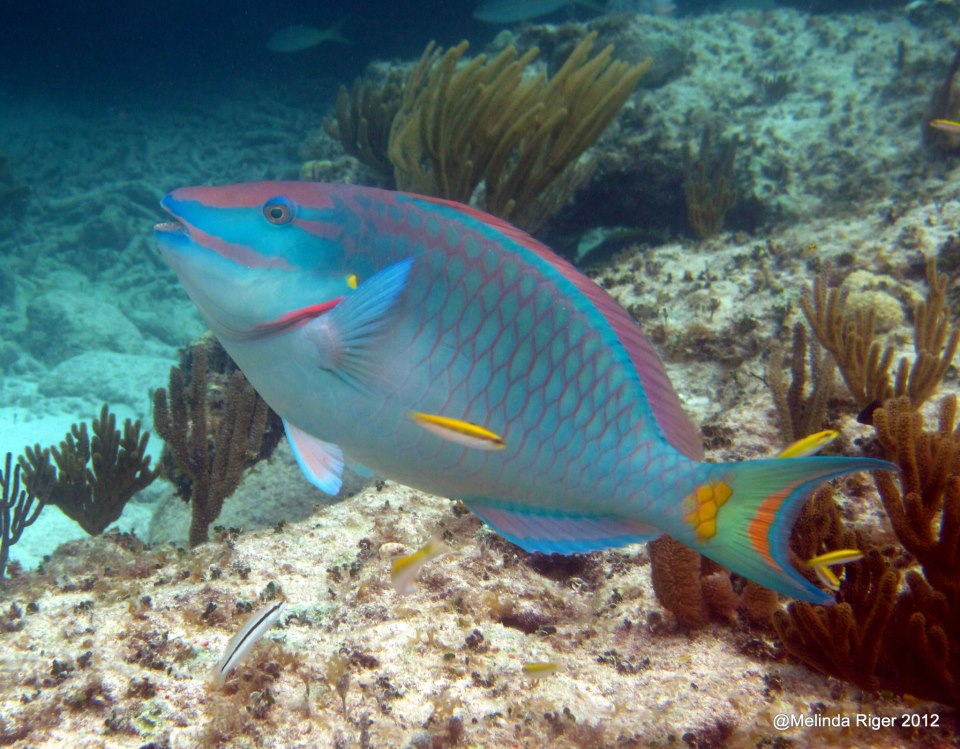
 Thanks to Melinda of Grand Bahama Scuba for her fantastic illustrative pics; the header is mine own
It’s possible that I won’t be quite as attentive with posts / replies to comments etc over the next couple of weeks or so. I’ve a few things in the pipeline, but it may depend on wifi access… I’m giving up trying to use an iPhone to post while on the move – fine for snaps, but not for anything more complicated. So apologies in advance, and like Arnie, I’m afraid I’ll be back…



(No, this is not all about you, Madge…)
The Rock Beauty is a species of small Angelfish, measuring up to 10 inches in length. They are bright yellow and dark blue, in varying proportions according to the stage of development, with startling blue eyelids. They are mainly sponge-feeders, but vary their diet with plankton, algae, corals and even small jellyfish. Although the cheerful colouring of the Rock Beauty might make many think “my aquarium”, their diet – particularly the need for sponges – makes them unsuitable for captivity (see below for details). They also become aggressive, and cannot be successfully bred in an aquarium which is an excellent lifestyle choice by them, and no doubt helps them to retain an IUCN listing of LC.
These fish inhabit the reefs of the tropical western Atlantic down to the northern areas of the Gulf of Mexico. Although mainly encountered on reefs, they are capable of living at considerable depths, and have been found at more than 90 meters.
ADULT ROCK BEAUTY
Adult Rock Beauties are often found in pairs year round, perhaps suggesting a long-term monogamous bond. The pairs reproduce by rising up in the water, bringing their bellies close together, and releasing clouds of sperm and eggs. The female can release anywhere from 25 to 75 thousand eggs each evening and as many as ten million eggs during each spawning cycle. The eggs are transparent, buoyant, and pelagic, floating in the water column. They hatch after 15 to 20 hours into larvae that lack effective eyes, fins, or even a gut. The large yolk sac is absorbed after 48 hours, during which time the larvae develop normal characteristics of free-swimming fish. Larvae are found in the water column and feed on plankton. The larvae grow rapidly and about 3-4 weeks after hatching the 15-20mm long juvenile settles on the bottom.
JUVENILE ROCK BEAUTY

The Rock Beauty Angelfish is considered to be a difficult fish to keep in captivity; it is ill-suited for all but the most experienced aquarists. They are highly specialised feeders that will likely perish without some marine-sponge formulation in their daily diet. They are an aggressive species. Most aquarists recommend a minimum tank size of 100 gallons. Young Rock Beauty Angelfish feed in part, on the slime of other fish and will persistently chase their tank-mates and nip at them. It is not a reef safe fish, and larger specimens may nip at or consume corals, particularly stony or soft ones, and ornamental invertebrates.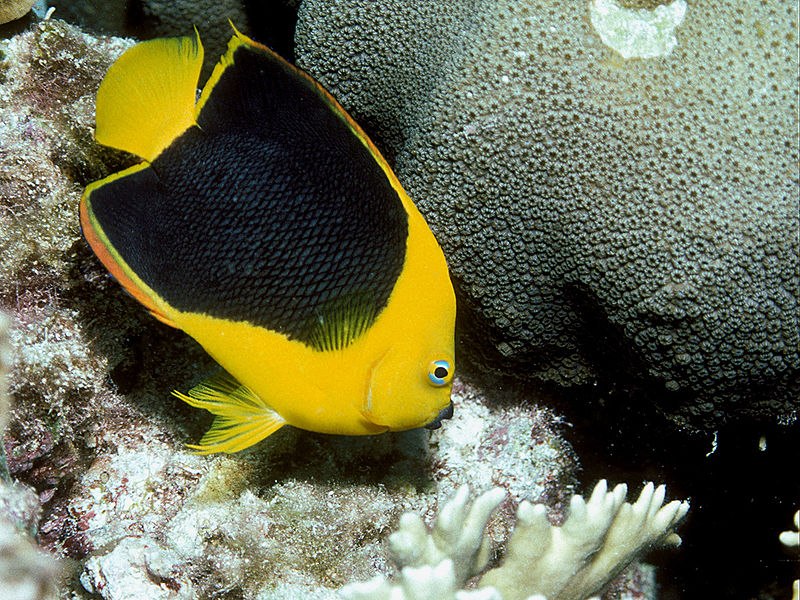
Credits: Melinda Riger of Grand Bahama Scuba, random pickings, ‘DT Wallpapers’ & wiki
 Gray Angelfish
I recently posted about the highly coloured QUEEN ANGELFISH, a striking coral reef resident glowing with fluorescent blues and yellows. It’s the Angelfish that went into showbiz and succeeded. Its close cousin the Gray Angelfish is a more sedate creature, with the appearance of a professional – law, possibly, or medicine. That thin blue fin-edging suggests a flamboyant streak. Slightly mean mouth? Lawyer.**
This species is found in the warm waters of Florida, and south through the Bahamas and Caribbean as far as Brazil. They are found at depths from 2 m. down to 30 m. You are most likely to encounter one on a coral reef feeding on sponges, its main diet. The fish below with the bluer face is a teenager, in transition between juvenile and adult. 
It’s clear from side on that Gray Angelfish are ‘upright flat’, but it’s surprising just how slim they actually are. Photographer Melinda Riger has captured this front view against a stunning red backdrop. Disappointingly, these fish seem to lead blameless and anodyne lives as reef-foragers, and I’ve been unable to turn up a single interesting fact about them. That’s lawyers for you.**
 Photo Credits: main images ©Melinda Riger, Grand Bahama Scuba; Header – Wikipix
** I can say this – I am one…

The Queen Angel is one of several reef fish species where the difference in colouring between juveniles and adults is marked. They are commonly found in the waters of Florida and the Bahamas, with a range extending to the Gulf of Mexico. Adults can grow to 3.5 lbs (to mix metric with avoirdupois) and they can live up to 15 years. Like all Angelfish, they rely on their pectoral fins for propulsion as they forage on the reefs for their mixed diet of sponges, coral, plankton, algae, and even jellyfish. As the photo below shows, they have no problem swimming upside down…
QUEEN ANGELFISH (JUVENILE) 
Evidence suggests that adult Queen Angels may form ‘monogamous’ pairings. Brief research in the factosphere suggests that the proposition is somewhat tenuous. Maybe pairs just like hanging out – possibly to gain some territorial advantage – and anthropomorphising that into lifelong partnership terms may be overstating the relationship… Whether wed for life or not, the actual mating process is remarkably efficient. The pair snuggle up close, simultaneously releasing large quantities of sperm and tens of thousands of eggs. The fertilised eggs hatch within a day. Respect!
QUEEN ANGELFISH (ADULT)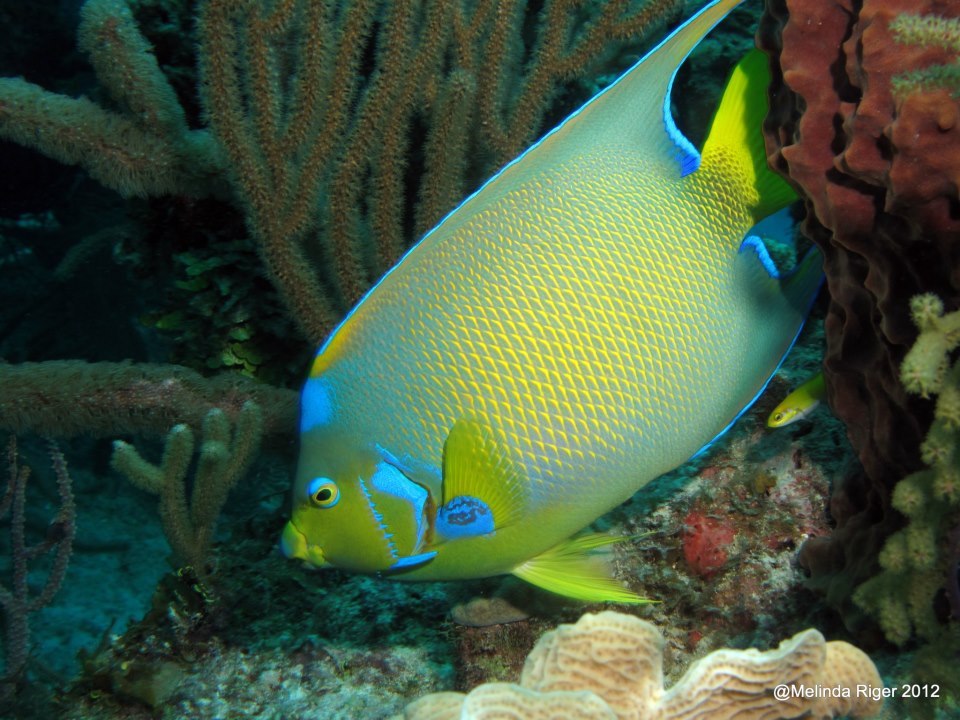

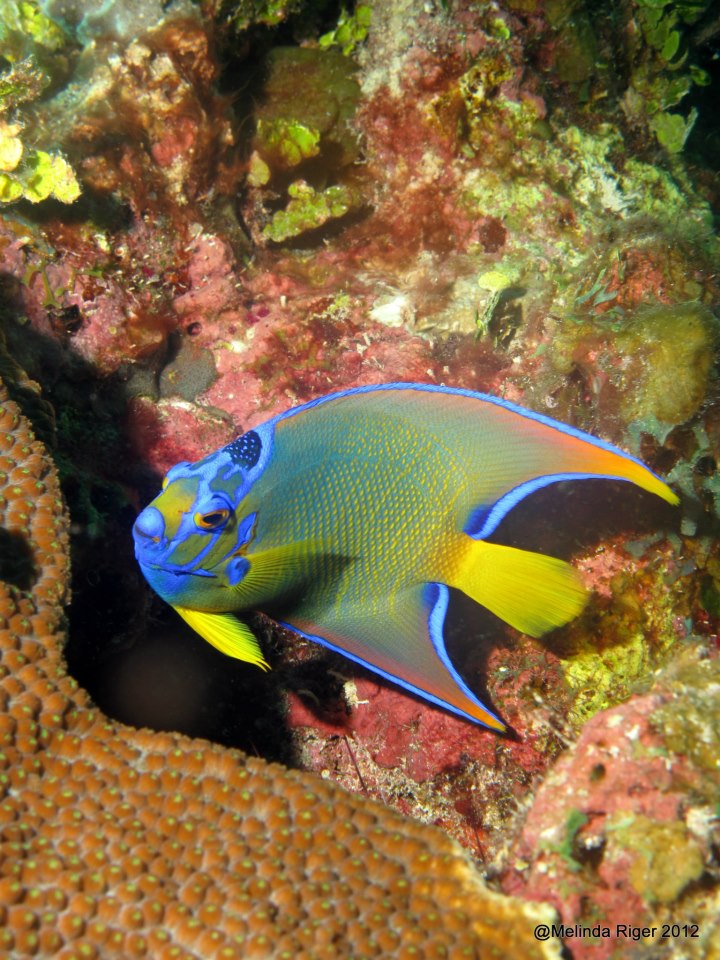
Photo Credits for the amazing main images: ©Melinda Riger (Grand Bahama Scuba), with thanks; header image WikiPic

This post is the first of a planned series on Bahamian reef fish. Those who follow this blog (I thank you both) may recall with horror (or worse, pity) my own efforts with reef fish, using a tiny cellphone-sized video camera. Misty stills culled from video footage. Enthusiastically wobbly movies as I struggle to swim and breathe simultaneously in an alien element. I am more underwater CLOUSEAU than COUSTEAU. However, thanks to Melinda Riger, who with husband Fred runs GRAND BAHAMA SCUBA, I have kind permission to borrow and display images from her stock of wonderful reef fish photographs.
The spotted drum fish (related to two other Caribbean drumfish, the High-Hat and the Jack-knife fish) belongs to a large worldwide family, the Sciaenidae. Besides other drum varieties, the family includes ‘croakers’. These species are all named for the repetitive throbbing or drumming sounds they make. This involves the fish beating its abdominal muscles against its swim bladder. If I find out the reason for this (Species communication? Food call? Alarm? Warning? A piscine ‘advance’? Happiness?) I will add it here in due course. Here an example of an atlantic croaker from the excellent DOSITS site (Discovery of Sounds in the Sea)
[audio http://www.dosits.org/files/dosits/croaker48.mp3]The spotted drum is one of the few fish of the species to inhabit coral reefs – most are bottom-dwellers (often in estuaries), avoiding clear water. These fish tend to be nocturnal feeders, feeding on small crabs, shrimp and small invertebrates. As far as I can make out they are solely (or primarily) carnivore, and do not graze on algae of other reef plant life.


The photos above are of adult spotted drums. The ones below are of juveniles, and show the remarkable growth-pattern of these fish, from the fragile slender creature in the top image, through the intermediate phase of the one below it (with the amazing brain coral), to the striking adult versions above. People like to keep these pretty fish in aquariums; fine, I’m sure there are plenty to go round, but these ones look pretty happy to me in their natural reef environment…
Juvenile Drum Fish (pre-school)
Juvenile drum fish (school-age)
 (Header image credit: Wiki-Cheers)
Finally, I’ve just come across this short video from a “Florida Aquarium”, showing how these fish swim. It rather looks as though it has been fin-clipped for some reason… or just damaged, maybe
[youtube http://www.youtube.com/watch?v=dqEWqfLeqOw]
 ROLLING HARBOUR ABACO

You must be logged in to post a comment.