Unknown's avatar

‘MERLIN’ – NEW ONLINE BIRD ID TOOL FROM CORNELL LAB FOR ORNITHOLOGY


STOP PRESS January 2014

Cornell are now re-promoting ‘MERLIN’ with a free App and a video to go with it.

[youtube http://youtu.be/OkH11ZiIL9E]

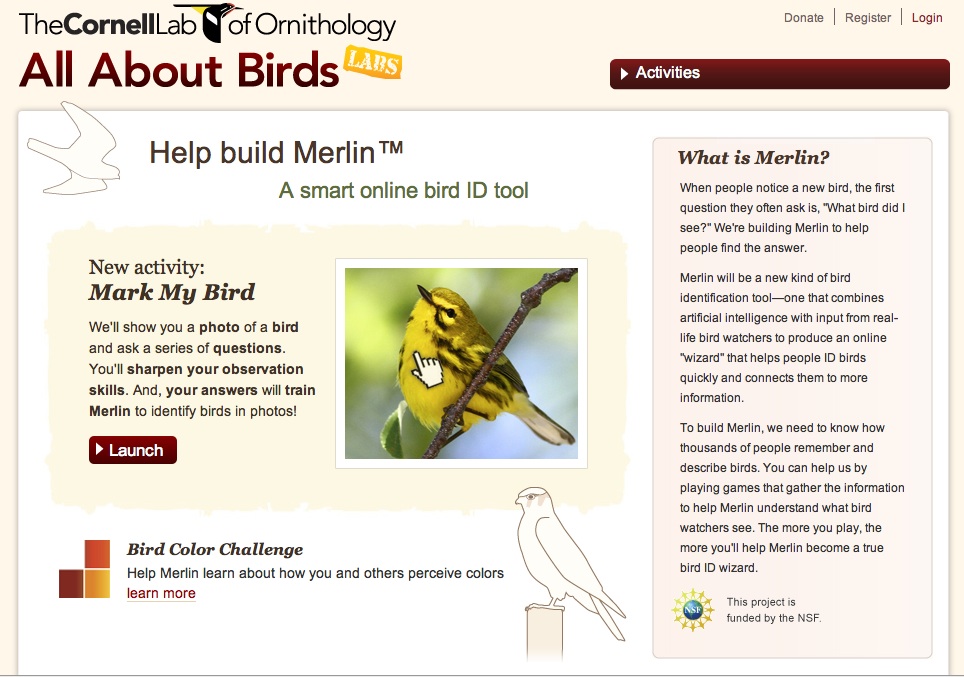
 has produced a new proactive bird identification gizmo called MERLIN (CLICK for direct link). They are trying to build up a user-friendly ID ‘wizard’ using the sort of variable descriptions that people like me use to describe birds they don’t recognise. Perhaps we’ve all been there – “well, it was a medium-size greyish bird, but I think it had white under the wings. Or maybe a lighter grey. And a sort of white streak on its head. Actually the bird was more bluey-grey…”etc. Merlin seeks to iron out the variations using AI, by showing a bird and asking a number of questions to get users to describe the colouring  they are looking at. I tried it with a teal, and it worked first time.

Gradually, the input of descriptions for each bird will be analysed, so that future users are more like to get a correct ID based on their description, even if others might describe the bird differently. With any luck it will also improve the chance to ID that pretty bird seen fleetingly at a distance. It’s worth trying this out even if you are a serious birder, because each ‘attempt’ adds to the picture. And anyway, there’s a very slight element of a game here – will the computer get it right?
Unknown's avatar

WOODPECKER COUSINS FROM ABACO & ACROSS THE POND


WEST INDIAN AND GREAT SPOTTED – WOODPECKER COUSINS

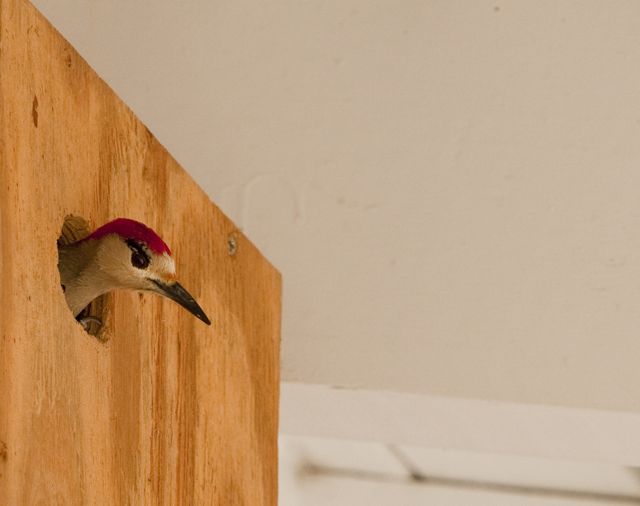
The starting point / excuse for this post is the nest box for West Indian woodpeckers under the eaves of the Delphi Club verandah. Put ‘woodpecker’ into the home page SEARCH box and you will find various posts about last season’s epic: the reluctance to use the box; the gradual acceptance; the summer nesting and breeding; the heroic stand of the male woodpecker who guarded the box throughout the rampage of Hurricane Irene

Happy to roost here – deeply suspicious of the new wooden structure over there

(Later) No place like Home(©Peter Wesley Brown)

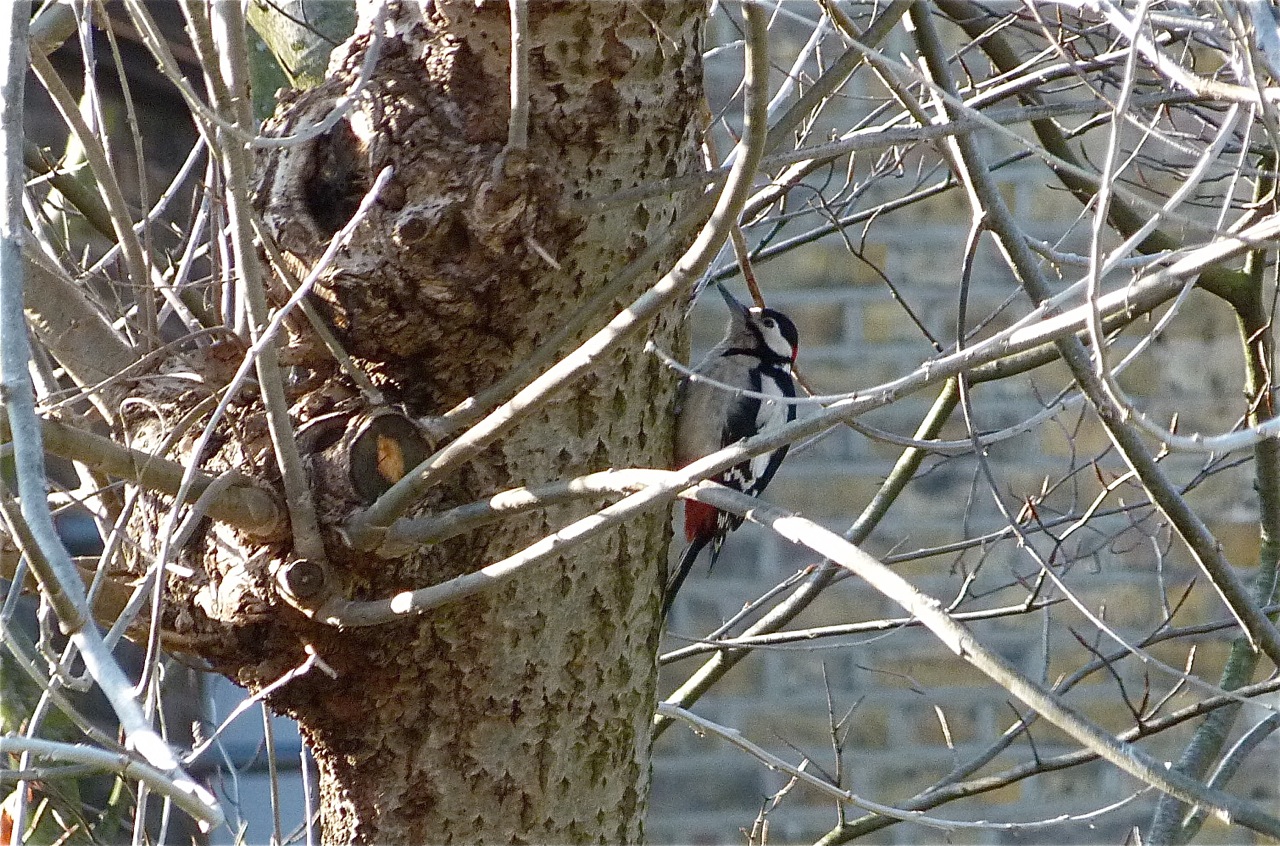
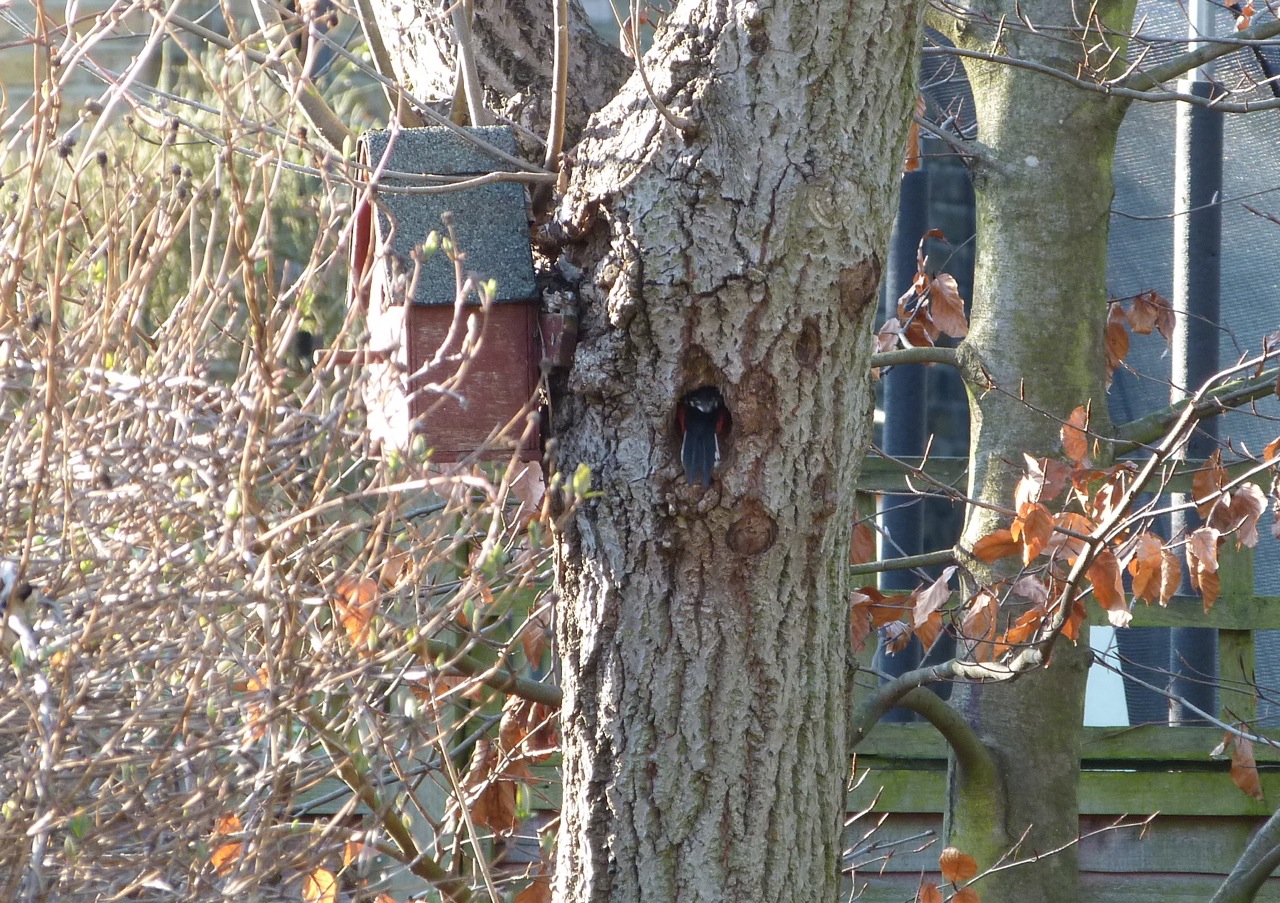
For some years, great spotted woodpeckers have drilled away at the grey poplar tree at the end of our small London garden. A male gouged out a number of exploratory holes near the top, strewing a carpet of wood chips onto the grass below. One year he attracted a mate, eggs were laid and hatched, a huge amount of chattering and scolding ensued – quite annoying at times in persistence and volume. One weekend we were away and returned to… silence. The fledgling woodpeckers had had their flying lessons and left for good. We missed them.

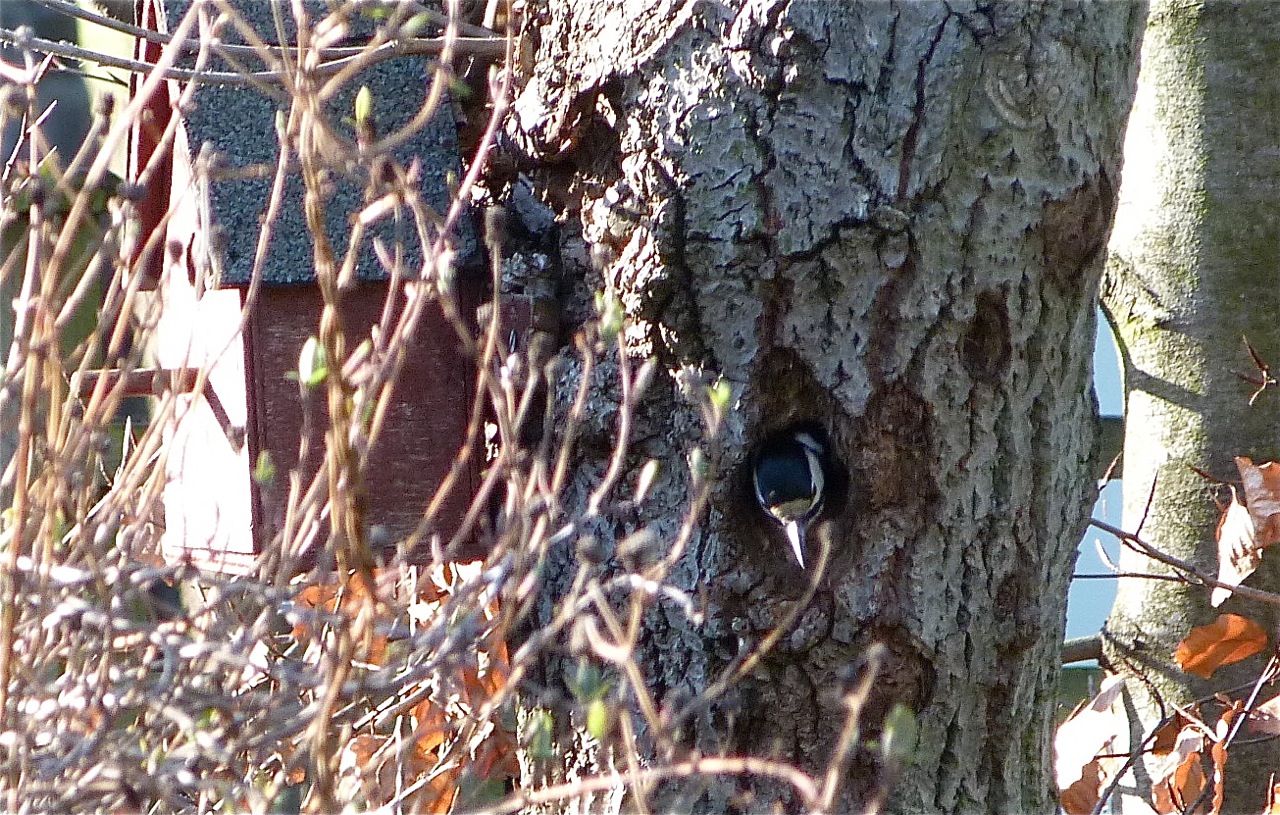
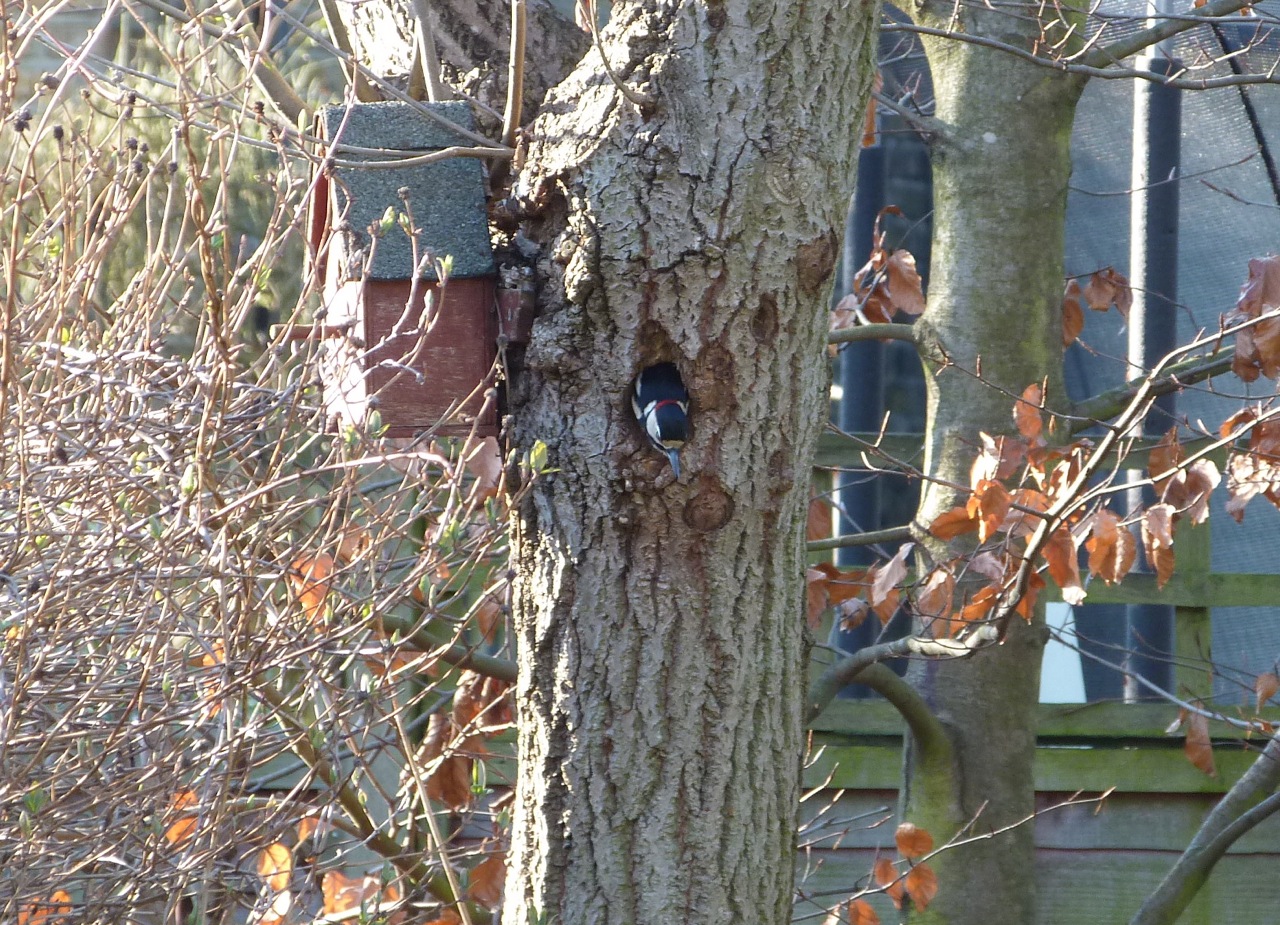
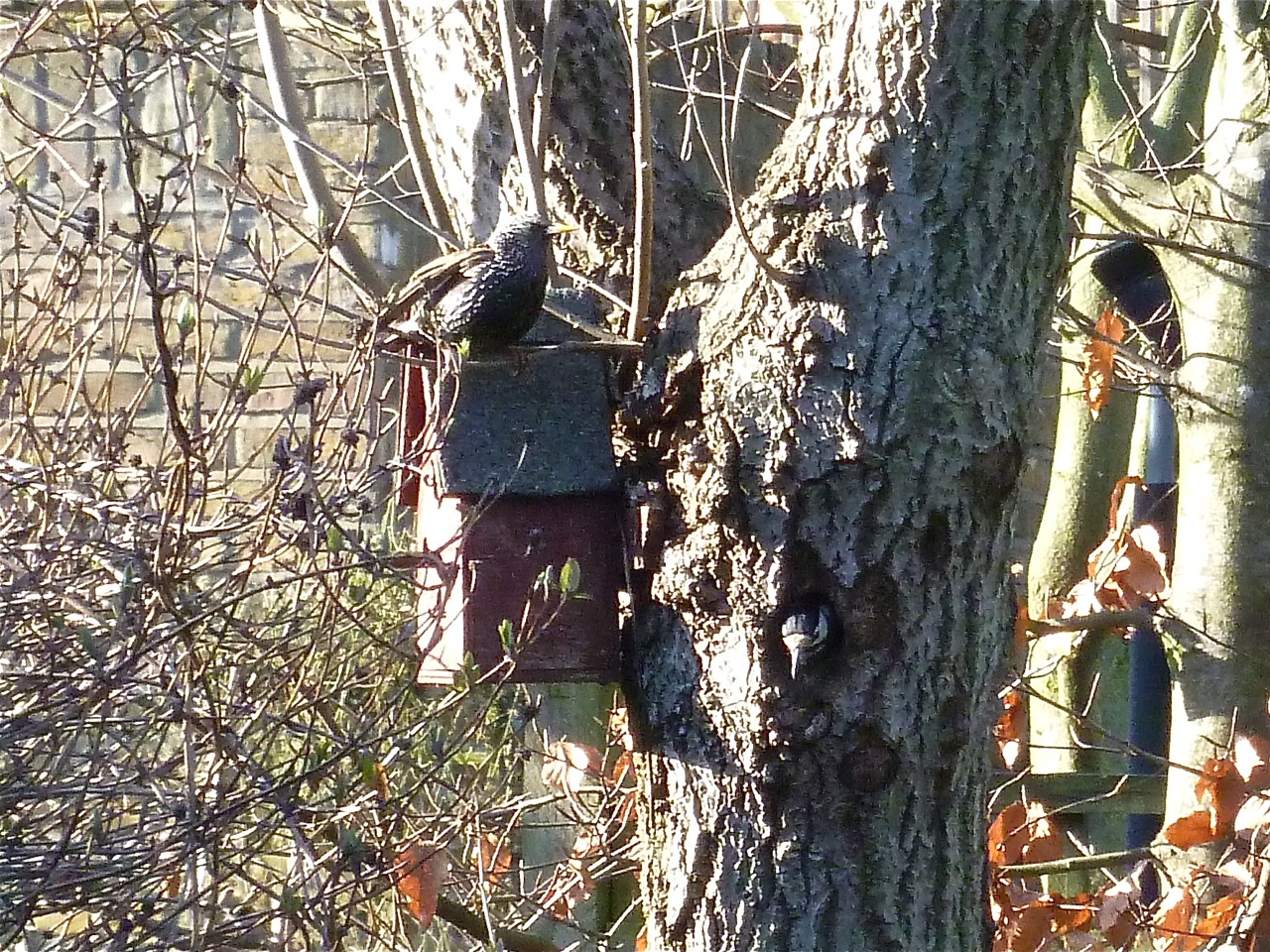
Since then, the male cleaned out the hole each Spring and drilled a few spare holes for practice, but despite his impressive real estate portfolio, he didn’t attract a mate. He made another, lower hole. No luck. Until this year. In January he brought a new bird home and together they mucked out the hole and settled in – about 2 months early, and with snow on the way. In the absence of current news of the West Indian woodpeckers and their nest at the Delphi Club, here are a few pictures of domestic bliss 4250 miles away… Click images to enlarge

A cosy home – hope the neighbours are nice 

Time to go and get a take-out…

…and bring it home for the wife

An act of gross provocation by a starling.  I predict trouble. News update soon

I can’t make out if the photo below is just a horrendously bad photo taken with a cheap camera, a fixed shutter speed, and cold shaking hands; or a powerful image of a beautiful bird artistically captured in full flight, the type of action shot that bird photographers strive for years to achieve (Mrs RH has a view on this). If the former, apologies. If the latter (highly unlikely), my professional tip is to use a tiny point ‘n’ shoot into the sun while moving around quite a bit. Whichever, I’ve awarded it a ‘cameo’ format to emphasise the essential artistry of the shot

Unknown's avatar

AN ABACO PARROT SAYS 3 LITTLE WORDS…


VALENTINE’S DAY IN TWO WEEKS? LEAP DAY IN A MONTH?              AN ABACO PARROT SAYS ‘I LOVE YOU’

Or it would if it could talk. Here is a win -win -win. ‘Adopt’ this miniature Abaco Parrot sculpture (ok, buy it) by Dou Dou Birds and all proceeds will go towards the conservation of the Abaco Parrot population. Then give it to someone. It’s an investment in art; a philanthropic deed; and a gift from the heart. Here’s the direct link (there are many other cute birds for sale too) To save parrots     CLICK THIS ONE===>>> 

Oh dear. Maybe someone else got there first. Never mind. How about making a donation to  PARROTS INTERNATIONAL?

This organisation allocates funding for the research into the Abaco Parrots and their conservation. You can now pay direct by Paypal or Credit Card (with gift tax benefits depending where you live). Please remember use the “Note to Seller” box to specify ‘ABACO PARROTS / CAROLINE STAHALA’

MEMBERSHIP /  DONATION PAGE   CLICK LOGO===>>> Parrots International

Then go ahead and buy that big box of chocolates you were going to get anyway…

Unknown's avatar

BAHAMA PARROTS: BAHAMAS NATIONAL TRUST DOCUMENTARY


BNT ABACO / INAGUA PARROT DOCUMENTARY

In August 2011 the Bahamas National Trust published a documentary about the resident Abaco and Inagua populations of this Cuban Parrot subspecies. It features research scientist Caroline Stahala, and contains plenty of information about these birds, their nesting and breeding habits, and the problems they face from predation. In places, some of the devastation caused by the extensive forest fires in March 2011 is still evident (see images in earlier POST). If you want to know more about these attractive (but noisy) birds, the documentary video below covers a great deal in 8 minutes…

Unknown's avatar

SOUTHEAST COAST & GULF OF MEXICO MARINE / COASTAL FIELD GUIDE: 5* YALE BOOK REVIEW


BOOK REVIEW

This is a superlative field guide: comprehensive, clear and approachable. The illustrations are excellent, and include helpful examples of birds in flight, different views of marine creatures (basking shark side view and head on), whale fluke comparisons and dolphin profiles. The 11 Chapters comprise marine and coastal plants and habitats; invertebrates; sharks; rays; fish; sea turtles; crocodiles and alligators; marine and coastal birds; baleen whales; toothed whales and dolphins; and finally seals and manatee

Yale University Press 386pp, £20 / $24  ISBN 978 0300 11328 0

rollingharbour rating: a rare and coveted 5*****

Obviously this isn’t the guide for land-based birds – you’ll still need Hallett  or Arlott to help with all those warblers, for example. But for all aspects of marine and coastal wildlife it is as thorough as you could ever wish for in a book that is readily portable. While slightly too large (8″ x 6″) and heavy for a pocket, it would be perfect for a day-bag. Convention dictates that the most enthusiastic reviews should include a couple of tiny niggles to prove a book has been read… so,  the shell section is very brief at 2 pages; and the coral section also, with some types (Mustard Hill, for example) omitted. But such an ambitious yet compact book couldn’t possibly be exhaustive. In practical terms, it has everything you could want from a Field Guide when exploring or researching this area.

Publisher’s Summary [added here to indicate the scope & depth of the book]

  • Entries on 619 coastal and ocean species including seabirds, cetaceans, fish, turtles, invertebrates, and plants
  • More than 1,100 color illustrations & 121 colour photographs
  • 452 up-to-date range maps
  • Overviews of key ecological communities, including mangroves, salt marshes, beaches, sand dunes, and coral reefs
  • Special attention to threatened and endangered species
  • Discussions of environmental issues, including such catastrophic events as Hurricane Katrina and the Deepwater Horizon blowout
  • Glossary
  • Excellent organizational aids for locating information quickly
To which I would add:
  • Clear text alerts for endangered / red list species
  • 12-page index (which works very well)
  • Handy front and back flaps place-markers
  • Colour-coded section divisions

To see the publisher’s UK or US webpages for the book CLICK LINK===>>>  YUP UK   or   YUP US – it can also be obtained from the other  conventional sources already mentioned in the book section of this site

Finally, a declaration of interest: Mrs rh works in the London office of YUP, so I have been consciously avoiding partiality. However this just happens to be an excellent book by any standards, so fortunately the frosty domestic fall-out from a bad crit has been easily avoided…
Unknown's avatar

THE INTRIGUING PARROTS OF GREAT ABACO ISLAND – PODCAST


A 5 minute PODCAST from ABC Radio’s ‘The Science Show’ featuring Caroline Stahala, research scientist and Abaco Parrot expert, and David Knowles of the Bahamas National Trust, Chief Park Warden for Abaco

The online report is headed by this: Holiday homes and resorts are replacing the forests in which the Bahamian parrot of Great Abaco Island breeds. When Christopher Columbus discovered the beautiful Bahamian islands in 1492, he wrote in his journal ‘the flocks of parrots obscure the sun’. Now the Bahamian parrot is confined to just two islands and they’re a protected species. On Great Abaco Island Bahamian parrots breed in the pine forests of the south and, as Pauline Newman discovered, their nesting behaviour is quite extraordinary”

CLICK HERE==>> ABACO PARROTS PODCAST – THE ABC SCIENCE SHOW

For the relevant web page and a transcript of the talk CLICK LOGO===>>> 

Thanks to the ABC Science Show for use approval – click name for more Podcasts

Abaco Parrot
Unknown's avatar

SUPPORT ABACO PARROTS – NEW YEAR WRITING CONTEST!


ABACO PARROT SUPPORTER ‘DOU DOU BIRDS’ runs a monthly bird-centric writing contest. Not content with sculpting a cute miniature clay ABACO PARROT with all proceeds of sale going to the parrots, she has now showcased the AP for her New Year writing competition. To see her Post, & indeed if you want to take part                                                                                                                     CLICK LOGO==>> & to see the AP in her shop window             CLICK LOGO==>> 

Unknown's avatar

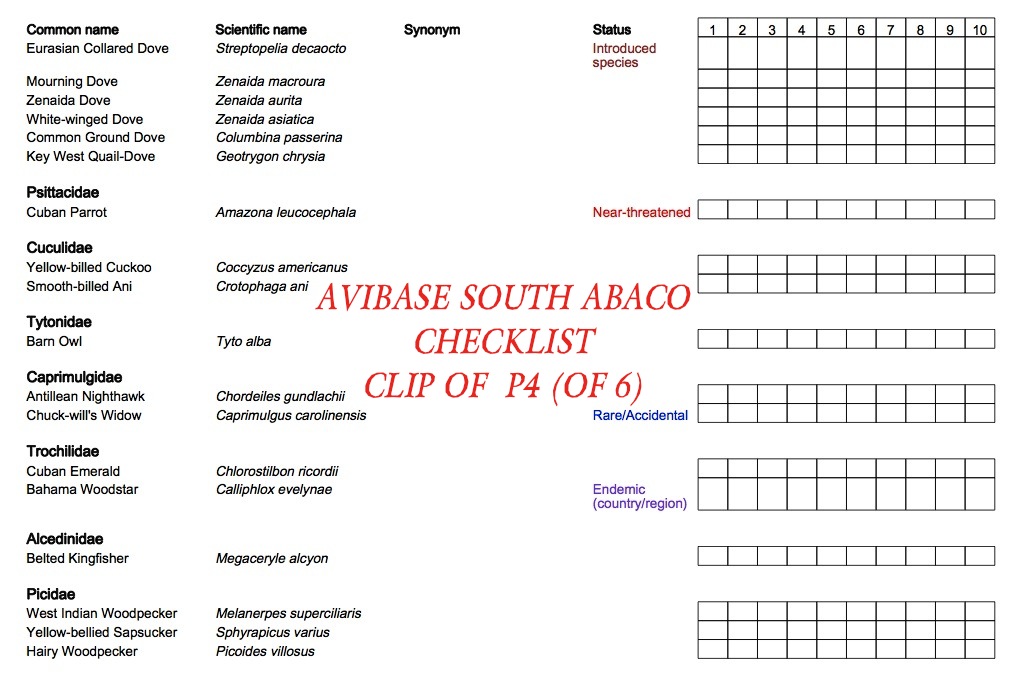
ESSENTIAL SOUTH ABACO BIRD CHECKLIST FROM AVIBASE


The superb AVIBASE is a massive world-wide bird database – an essential reference point for birders, even the occasional enthusiast. Checklists, range maps, bird links, photos, bird sounds,  and even the facility to make your own contribution, all in one place. AVIBASE has been a work in progress for 20 years and now contains over 5 million records of about 10,000 species and 22,000 subspecies of birds, including distribution information, taxonomy, synonyms in several languages, and much more

Here is the CHECKLIST FOR SOUTH ABACO, the area that I am most familiar with. It probably holds good for the whole of Abaco and the Cays. If you are staying at the Delphi Club, Rolling Harbour, you need this – and especially if you are planning a birding adventure with Ricky Johnson… Be prepared! The plan is that you can download it or print it out from here

SOUTH ABACO BIRD CHECKLIST  click to open!

Here is an illustrative clip of one of the 6 pages 

If you have a problem printing it from here – or for access to photos of a great many of the birds listed, with clips of their calls and songs –  use this direct link  CLICK LOGO===>>>

CREDITS: The Avibase website is managed by Denis Lepage and hosted by Bird Studies Canada, Canadian copartner of Birdlife International
Unknown's avatar

“ROSETTA STONE FOR WARBLERS” – Cornell Lab of Ornithology Research


RESEARCH INTO THE FLIGHT CALLS OF MIGRATING WARBLERS

  has found a way to investigate the nocturnal migrations of warblers using spectrograms. Many of the warblers featured in the project are found on Abaco and will be familiar to the more discerning birder – though I admit that ID of  members of this large family of little yellowy birds, even in broad daylight, remains a blind spot for me (and I suspect I am not the only one). Click the chart below for a clearer view. A downloadable / printable version is available via the link given below. It is also worth visiting  the page to compare the brief audio cheeps of the Northern Parula, Magnolia Warbler and Black-throated Green Warbler and their respective spectrograms

“These spectrograms are a visual representation of the very brief flight calls made by North American warblers during their nocturnal migrations. Some of these call notes sound almost identical to our ears, but spectrograms show minute differences between them. Scientists can compare spectrograms of night recordings to spectrograms of known species to identify nocturnal migrants in total darkness. Andrew Farnsworth, a scientist in the Cornell Lab’s Conservation Science program, developed this “Rosetta Stone” in 2006 in collaboration with Michael Lanzone, Cellular Tracking Technologies, William R. Evans, and Michael O’Brien. It covers all 48 warbler species of the U.S. and Canada (including Grace’s and Red-faced warblers, not shown), and is a major tool in our Acoustic Monitoring Project”

Click chart to enlarge

Putting Sound to Work for Conservation: “Our staff will use results from the Rosetta Stone… to “train” computers to identify the sounds of warblers and other nocturnally migrating birds, as well as other species including whales and forest elephants”

Working Toward a Bird Migration Forecast: “A new grant from the National Science Foundation will fund BirdCast, a project that will combine bird observations (both sightings and sound recordings) with weather models and terrain data to forecast migrations. The results of the predictions will help scientists understand migratory behavior and may aid decisions about wind turbine placement and other questions about environmental hazards to birds”

To see the complete article CLICK LOGO===>>> 

To learn more about BirdCast and the Acoustic Monitoring Project from the original article CLICK LINK===>>>  Cornell Chronicle 

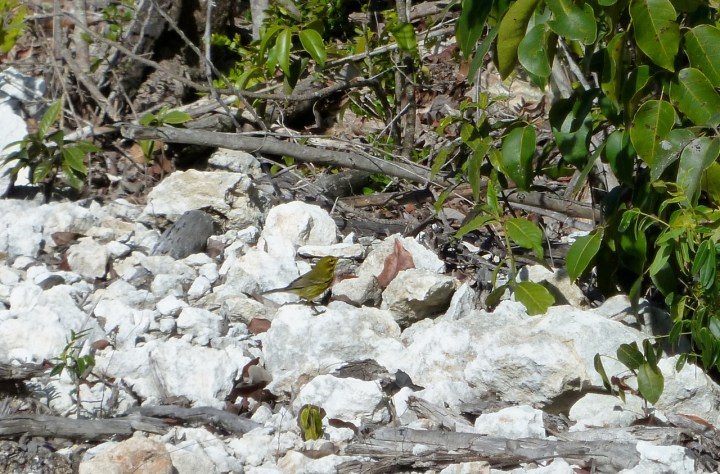
Prairie Warbler on the Delphi Club guest drive, Abaco

Unknown's avatar

HELP SAVE ABACO PARROTS – DOU DOU’S ART INITIATIVE


WELCOME BACK! Normal service is resumed after the family festivities of Christmas, with only the precious gift of a fractured wrist for rh to spoil an otherwise lovely few days. Immediately, I can report excellent parrot news…               DOU DOU, an avid birder and sculptor of most engaging miniature birds, has taken up the cause of the Abaco Parrot. We have been corresponding for a while about this, and I now reproduce her latest post, with the link to her site below

BIRD SCULPTURE – ABACO PARROT

“Help, the cats are eating my babies!” said the parrot. And it’s true. These parrots are endangered – only 1000 of them left. A woman named Caroline is trying to save them from the feral cats that have invaded their island in the Bahamas. Let’s help her out! All proceeds from the sale of this parrot are going to Parrots International, which supports Caroline’s work. 

This little parrot measures 3.5 x 1.5 x 1.5 inches. You can buy it HERE from me and I will send the money to Parrots International or you can use “Other” to check out, send me proof you donated at least $30 to Parrot’s International, and I will send you a code that gives you $30 discount on this parrot so you will just pay for shipping – I will verify that a donation was made.

We can save these parrots! Let’s do it!!!!!

Read about Caroline’s work to save the parrots: ABACO PARROT RESCUE

doudou      CLICK LOGO to visit website ===>>>      

More about this exciting development in due course – other ideas are afoot… Abaco Parrot conservation is strongly supported by the Delphi Club, Abaco; and the research scientist heading the project, Caroline Stahala, is delighted with dou dou’s initiative in helping to raise the profile of her conservation work and in contributing to the funding received through PARROTS INTERNATIONAL

This organisation allocates funding for the research into the Abaco Parrots and their conservation. You can now pay direct by Paypal or Credit Card (with gift tax benefits depending where you live). Please remember use the “Note to Seller” box to specify ‘ABACO PARROTS / CAROLINE STAHALA’

Membership and Donation page   CLICK LOGO===>>>       Parrots International

Unknown's avatar

SOUTH ABACO CHRISTMAS BIRD COUNT 2011


Here is a clip taken from the excellent website THE ABACO SCIENTIST, with the kind permission of Dr Craig Layman of FIU. The brief summary of the South Abaco Bird Count 2011 by Elwood D. Bracey is of great interest, not least for the Delphi Club, from where guided Nature Tours take place and where there is a lot of enthusiasm for the birdlife of the island. 75 separate species were recorded this year, including all the known Abaconian endemics.

It is also a very fine photo of a male Bahama Woodstar courtesy of BIRD FORUM

Unknown's avatar

CORNELL LAB OF ORNITHOLOGY: ANNUAL REPORT 2011


CORNELL LABORATORY OF ORNITHOLOGY                    ANNUAL REPORT 2011

The Annual Report 2011 contains a huge variety of reports, project news, images, and references. The direct link to the specific Bahamas Birding page can be found under BLOGROLL links on the SIDEBARThe Report is far wider-ranging. I post it in pdf form because anyone with an interest in birdlife is bound to find something worth following up, and  you should be able to download it (if you try & it doesn’t work, can you let me know – comment box or email – and I’ll change the format)

CLICK CORNELL LABORATORY OF ORNITHOLOGY ANNUAL REPORT 2011

Unknown's avatar

BAHAMA YELLOWTHROAT: ABACO’S ENDEMIC WARBLER


BAHAMA YELLOWTHROAT: AN ENDEMIC WARBLER

The Bahama Yellowthroat (Geothlypis rostrata) is a resident breeder species of warbler endemic to the Bahamas, closely related to the migratory Common Yellowthroat. The other birds endemic to Abaco / Bahamas are the Bahama Swallow, BAHAMA WOODSTAR and ABACO PARROT

HABITAT Dense low scrub, usually in drier areas than used by wintering Common Yellowthroats. It builds a cup nest low in dense vegetation and lays two eggs. Like other yellowthroats it feeds on insects and other small invertebrates in low vegetation

THE 3 VARIETIES The adult Bahama Yellowthroat is 15 cm long with a large bill. There are 3 subspecies: G. r. rostrata on Andros and New Providence islands (uncommon to rare);  G. r. tanneri on Grand Bahama, Great Abaco and associated islands (common); and G. r. coryi on Eleuthera and Cat islands (common). The noticeable distinction between these 3 types seems to be in the forecrown colour (not one I myself would readily spot…)

DIFFERENCES FROM COMMON YELLOWTHROAT The Bahama Yellowthroat is slightly larger than wintering Common Yellowthroat and has a heavier bill and ‘slower, more deliberate movements’. Males have ‘more extensively yellow underparts, a larger facemask extending onto the nape, and in the case of coryi the distinctive yellow forecrown. Females have a grey wash to the head not shown by Common Yellowthroat’.

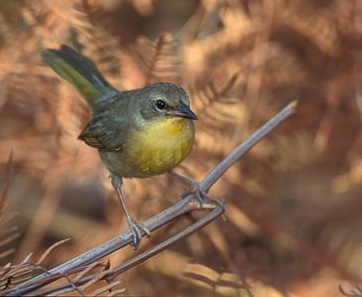
Bahama Yellowthroat (Adult female), Little Abaco                                    Photo credit ©Mike Danzenbaker  http://www.avesphoto.com

SONG Described as a loud wichety wichety wichety wich, similar to that of Common Yellowthroat, with the call a softer jip than that of Common Yellowthroat. This is meaningless to me – lots of warblery birds sound like that as far as I can make out. Here is a very short recording of a BY on Abaco courtesy of Xeno-Canto, but it’s not saying wichety to me – more like whee-hew 

Below is a short self-crediting video to illustrate the song of a Bahama Yellowthroat on Grand Cayman. There’s a hint of wichety there.

CONSERVATION The Bahama Yellowthroat population overall is quite small and is outnumbered in winter by migrant Common Yellowthroats. It appears not to be endangered. Its conservation is currently listed as ‘Least Concern’ (see Wiki-Box above). The population may be decreasing slightly due to habitat destruction, but not yet sufficiently to bring the species within the ‘vulnerable’ classification.

Here is an excellent clear image of an adult male by Craig Nash who has taken many wonderful photos around Delphi and further afield – see the 4 ‘Peregrine’s Blog’ links under the Blogroll in the SIDEBAR Highly recommended.                        [I am also clearing copyright permission to add a few other photos – I haven’t taken my own BY photo yet…]Photo credit: Craig Nash

Sources: various, including relevant books (see reviews in BOOKS BirdLife International and good old Wiki 

Unknown's avatar

ABACO BIRDING EXPEDITION WITH RICKY JOHNSON + CUBAN PARROTS


Ricky ushers us into his spacious, comfortable truck: 6 denizens of Delphi eager for adventure. Most have already been on a morning trip to see the Abaco Barbs (wild horses) of which more in a separate post. rollingharbour suffers from an unfortunate but mild form of equine indifference disorder, so gave it a miss.

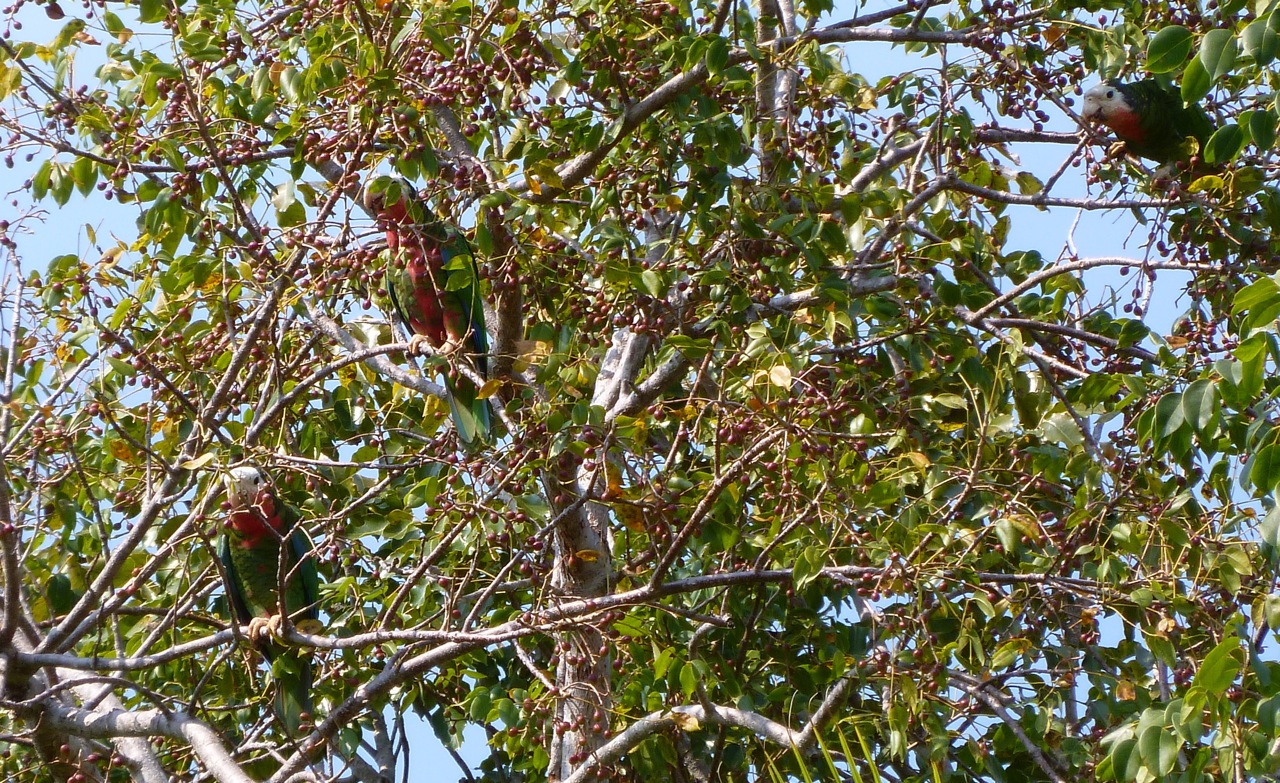
 We set off north on the highway, checking cameras, binoculars and other essential expeditionary impedimenta. Meanwhile, Ricky reveals his knowledge, experience and huge enthusiasm… this extends way, way beyond mere birds to the trees and plants, to poisons and herbal remedies, to geology and speleology, to geography and history. Soon we reach our destination, confident in Ricky’s renowned ability to know where the parrots (and many more birds besides) are to be found. We don’t have to wait very long – about two minutes after we turn off the highway, in fact… The parrots favour the Gumbo Limbo Tree (Bursera simaruba) as pictured, which invariably and most conveniently grows next to the Poisonwood tree (Metopium Toxiferum) and is its antidote. That’s the first place to look.

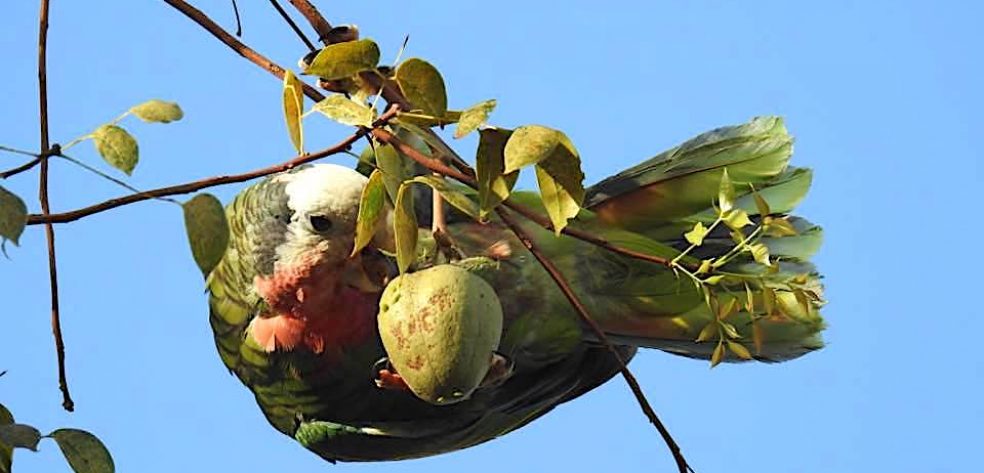
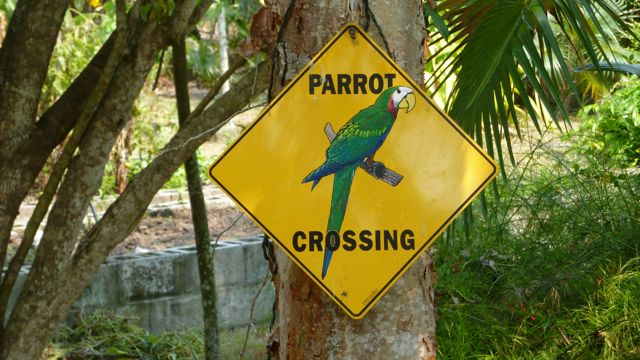
 ABACO PARROTS (Amazona leucocephala bahamensis) Here is a selection of our photos of these fantastic birds. I hadn’t expected to see so many, for so long, and at such close quarters. Their colouring was extraordinarily vivid, with a slash of blue on the wings. This was especially dramatic in flight. One parrot, shown below, had red frontal markings that extended almost to its tail. Ricky hadn’t seen one like it before.

CLICK on the images to enlarge them significantly [Mrs rollingharbour reports that this is as yet a theory and may not work in practice]

CAPTION COMPETITION (NON-COMPETITIVE): 3rd image down – what did parrot (a) say to parrot (b)?
To be continued… (I’m going to do this post piecemeal – other birds, flowers etc to follow)


Unknown's avatar

ULTIMATE LIST of the BIRDS of the BAHAMAS


Reddish Egret, Crossing Rocks, Abaco (Keith Salvesen)05 Say what you like about Wikipedia – no, not that, please – but in many fields it is very hard to beat. CLICK LINK ON BLOGROLL IN SIDEBAR–––>>>>ULTIMATE LIST OF BIRDS…’ for as comprehensive a list in accessible form as you could wish to find. Even allowing for a few ‘wiki-errors’ (is “Elton John” really a species of Gnatcatcher?), it’s an awesome basic resource a mere click away. There are click-throughs to individual birds, where you will find photos and all the other types of species information you need. Well worth a quick look, anyway, and you may find it extremely helpful to give it more attention.

Unknown's avatar

THE GOOD BOOK GUIDE – DELPHI CLUB, ABACO


Selected Birdyographyplease see the BOOKS page for full details – starting with the ‘Go-To’ reference book

Bruce Hallett

Birds of the Bahamas and the Turks & Caicos Islands

James Bond

Birds of the West Indies (Collins Field Guide)

Birds of the West Indies Norman Arlott

Birds of the West Indies (Collins Field Guide)

P G C Brudenell-Bruce

The Birds of New Providence and the Bahama Islands (1975) 

 Flieg and Sander

A Photographic Guide to Birds of the West Indies

 Herbert Raffaele et al

Field Guide to the Birds of the West Indies (Helm Field Guides)

Unknown's avatar

THE RELUCTANT WOODPECKER AT DELPHI, ABACO


“West Indian woodpeckers have now occupied the nesting boxes on the Club’s verandah”
S0 claimed the main DCB blog 7.04.11  But a few weeks before, one West Indian Woodpecker hadn’t quite got the idea…
The thoughtfully provided woodpecker accommodation
The chosen roost (at the opposite end of the verandah)
Unknown's avatar

THE GOOD BIRD GUIDE 2010 – DELPHI CLUB, ABACO


This guide was compiled after our visit to Delphi in February 2010. It was originally intended purely for domestic consumption, as a light-hearted personal record and aide memoire. However, others suggested it might be useful for people wanting to make a quick identification of a bird they have seen around the Club or further afield. I was persuaded to put a copy on the desktop of the computer in the Club Library, and there’s now a hard copy around as well. I am currently revising it to include our 2011 visit. And now here it is in blog format. I.T. progress.

CLICK LINK —››› DELPHI CLUB GOOD BIRD GUIDE 2010

Some of the images are my own; others are from freely-available resources – due thanks are given to those too numerous to mention individually (never mind being completely unidentifiable) whose images are featured…