 SUPPORT ABACO WILDLIFE CONSERVATION AND THE WORK OF THE BNT
LOCAL ARTISTS & ARTISANS; LECTURES; ENVIRONMENTAL GAMES; FRESH MARKET
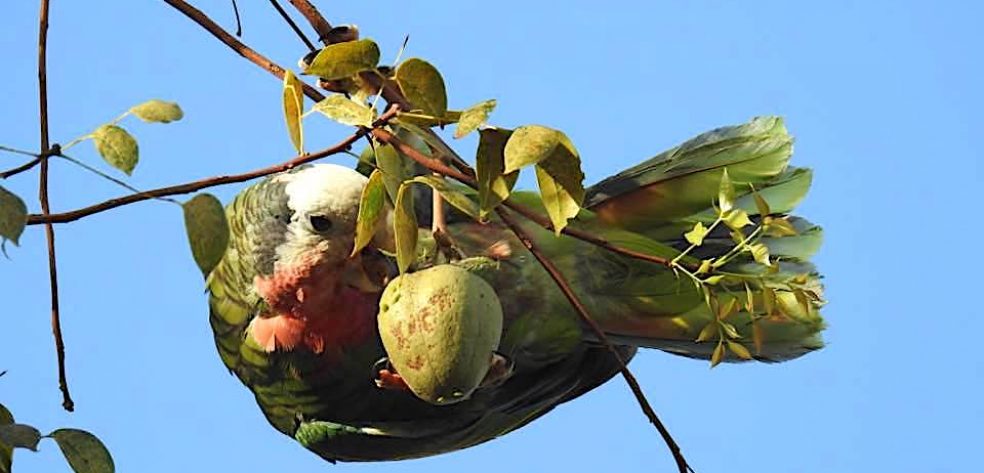
(Help to make sure that the creatures pictured below stay off the IUCN ‘threatened species’ list)


SUPPORT ABACO WILDLIFE CONSERVATION AND THE WORK OF THE BNT
LOCAL ARTISTS & ARTISANS; LECTURES; ENVIRONMENTAL GAMES; FRESH MARKET
(Help to make sure that the creatures pictured below stay off the IUCN ‘threatened species’ list)
“SO THIS IS CHRISTMAS…”  Image: ©RH
Christmas time. Holidays. Festive season. Yuletide. ġéohol*. Noel. Winterval. However you describe it, there’s a reassuring ritual each year. To many, the familiar religious carols and rites. To all, the cheerful sound of jingling tills. The exchange of presents happily bought and excitedly received. The groaning table weighted with victuals. Light and laughter. Glasses generously filled and refilled. Sudden growing dizziness and a strange lack of coordination. Wondering what others are saying. Wondering what you are saying. Drowsiness. Overwhelming sleepiness. The passage of time. The groaning hangover as seven West Indian woodpeckers attack your skull with hammer-drills… Time for a soothing image.
 Image ©BMMRO
Where was I? Oh yes. This is a very good time to draw attention to the various wildlife organisations based on Abaco and in the wider Bahamas. During the year they look after the birds, the marine mammals and so forth that help make Abaco such a very special place to be. I am simply going take the opportunity to post the link to my updated page for ABACO WILDLIFE CHARITIES. Oh. I just have. Well, is there one that appeals to you, I wonder? Just asking… Meanwhile, here’s the music of the heading to get you in the mood
 * Old English / Anglo-Saxon origin of “Yule”


THREATS TO SEA TURTLES: ABACO, BAHAMAS… IN FACT, EVERYWHERE
The Bahamas has breeding populations of 5 of the world’s 7 sea turtle species – Green, Loggerhead, Hawksbill, Leatherback and Kemp’s Ridley turtles (the other two are Olive Ridley – occasionally found in the Bahamas – and Flatback turtles). All are endangered. There’s no getting away from the fact that Man and Man’s activities are now the primary threats. The IUCN ratings below make for sad reading.
GREEN TURTLE (Chelonia mydas)
 .
.

HAWKSBILL TURTLE (Eretmochelys imbricata)
Hunted almost to extinction for their shells


LOGGERHEAD TURTLE (Caretta caretta)


LEATHERBACK TURTLE (Dermochelys coriacea)
The largest sea turtle


KEMP’S RIDLEY TURTLE (Lepidochelys kempii)
The smallest sea turtle

A helpful source of information about sea turtles and their protection is the BAHAMAS SEA TURTLE CONSERVATION GROUP Their excellent summary of the multiple threats to these creatures (below) puts the critical situation very well. Anyone who has watched a TV program about sea turtles and their breeding will be familiar with the vulnerability of turtle nests and hatchlings to predation – and that’s before they ever get to the sea. Despite that, all the species managed to flourish until human intervention (direct or indirect) tipped the balance of survival much further against them. So if we lose one or more of these wonderful species, at least we’ll know who to blame.
1. NATURAL THREATS
In nature, sea turtles face a host of life and death obstacles to their survival. Predators such as raccoons, crabs and ants raid eggs and hatchlings still in the nest. Once they emerge, hatchlings make bite-sized meals for birds, crabs and a host of predators in the ocean. After reaching adulthood, sea turtles are relatively immune to predation, except for the occasional shark attack. These natural threats, however, are not the reasons sea turtle populations have plummeted toward extinction. To understand what really threatens sea turtle survival, we must look at the actions of humans.
2. HUMAN-CAUSED THREATS
In many cultures around the world, people still harvest sea turtle eggs for consumption. Most countries forbid the taking of eggs, but enforcement is lax, poaching is rampant, and the eggs can often be found for sale in local markets. In these same areas, adult sea turtles are harvested for their meat. Turtle products, such as jewelry made from hawksbill shells, also create a direct threat to sea turtles. Lack of information about sea turtles leads many Americans to unwittingly support the international trade in these endangered species. Buying and selling turtle products within the U.S. is strictly prohibited by law, but turtle shell jewelry and souvenirs are the most frequent contraband seized by customs officials from tourists returning from the Caribbean. Indirect threats are harder to quantify, but they are likely causing the greatest harm to sea turtle survival.
Illegal turtle shells (IUCN)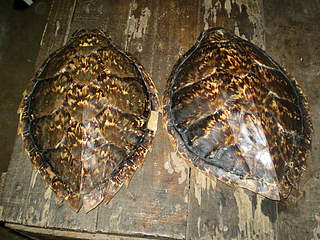
3. COMMERCIAL FISHING
The waters of the Gulf of Mexico and west Atlantic coast are a major habitat for turtles, but are also the main shrimping grounds in the U.S. Each year, thousands of turtles become entangled in fishing nets and drown. Worldwide, shrimp trawling probably accounts for the incidental death of more juvenile and adult sea turtles than any other source. At one time, as many as 55,000 sea turtles were killed each year in shrimp nets in the southeastern United States alone. Today, all U.S. shrimpers are required to put Turtle Excluder Devices (TEDs) in their trawl nets. Unfortunately, not all fishermen comply with the law, and sea turtles continue to drown in shrimp nets.

4. INGESTION OF DEBRIS AND PLASTIC
Thousands of sea turtles die from eating or becoming entangled in non-degradable debris each year, including packing bands, balloons, pellets, bottles, vinyl films, tar balls, and styrofoam. Trash, particularly plastic bags thrown overboard from boats or dumped near beaches and swept out to sea, is eaten by turtles and becomes a deadly meal. Leatherbacks especially, cannot distinguish between floating jellyfish — a main component of their diet — and floating plastic bags (my italics).
One sea turtle’s accumulated ingested plastic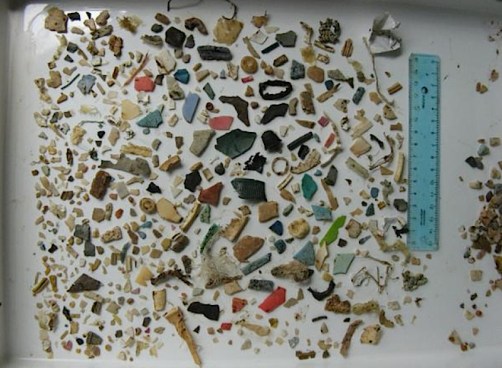 Credit: http://www.wired.com/wiredscience
5. ARTIFICIAL LIGHTING
Nesting turtles once had no trouble finding a quiet, dark beach on which to nest, but now they must compete with tourists, businesses and coastal residents for use of the beach. U.S. beaches are rapidly being lined with seaside condominiums, houses and hotels. Lights from these developments discourage females from nesting and cause hatchlings to become disoriented and wander inland, where they often die of dehydration or predation.

6. COASTAL ARMORING
Coastal armoring includes structures such as sea walls, rock revetments and sandbags that are installed in an attempt to protect beachfront property from erosion. These structures often block female turtles from reaching suitable nesting habitat and accelerate erosion down the beach. Armoring is especially problematic along the east coast of Florida, where beach development is occurring in the very places where sea turtles come to nest by the thousands.

7. BEACH NOURISHMENT
Beach nourishment consists of pumping, trucking or otherwise depositing sand on a beach to replace what has been lost to erosion. While beach nourishment is often preferable to armoring, it can negatively impact sea turtles if the sand is too compacted for turtles to nest in or if the sand imported is drastically different from native beach sediments, thereby potentially affecting nest-site selection, digging behavior, incubation temperature and the moisture content of nests. If renourishment is allowed to proceed during nesting season, nests can also be buried far beneath the surface or run over by heavy machinery.

8. POLLUTION
Pollution can have serious impacts on both sea turtles and the food they eat. New research suggests that a disease now killing many sea turtles (fibropapillomas) may be linked to pollution in the oceans and in nearshore waters. When pollution kills aquatic plant and animal life, it also takes away the food sea turtles eat. Oil spills, urban runoff of chemicals, fertilizers and petroleum all contribute to water pollution.
Although the problems of habitat destruction and exploitation seem almost too big to overcome, there are many things within our control that can be changed. Greater public awareness and support for sea turtle conservation is the first priority. By learning more about sea turtles and the threats they face, you can help by alerting decision-makers when various issues need to be addressed.
“Look on thy works, ye Humans, and despair…” [Gulf of Mexico]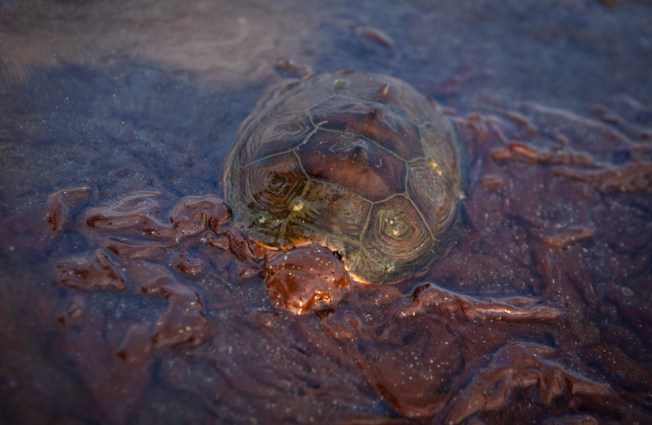 Credits boston.com / Reuters
FURTHER REFERENCES (click logos)
 BAHAMAS SEA TURTLE RESEARCH
 BAHAMAS SEA TURTLE CONSERVATION GROUP
 BAHAMAS NATIONAL TRUST (Factsheets)
 SEATURTLE.ORG (image library)
 SEA TURTLE CONSERVANCY

Credits: BSTCG; Wiki (images / IUCN tables); wire.com / wiredscience; Boston.com; Reuters; NASA; STC

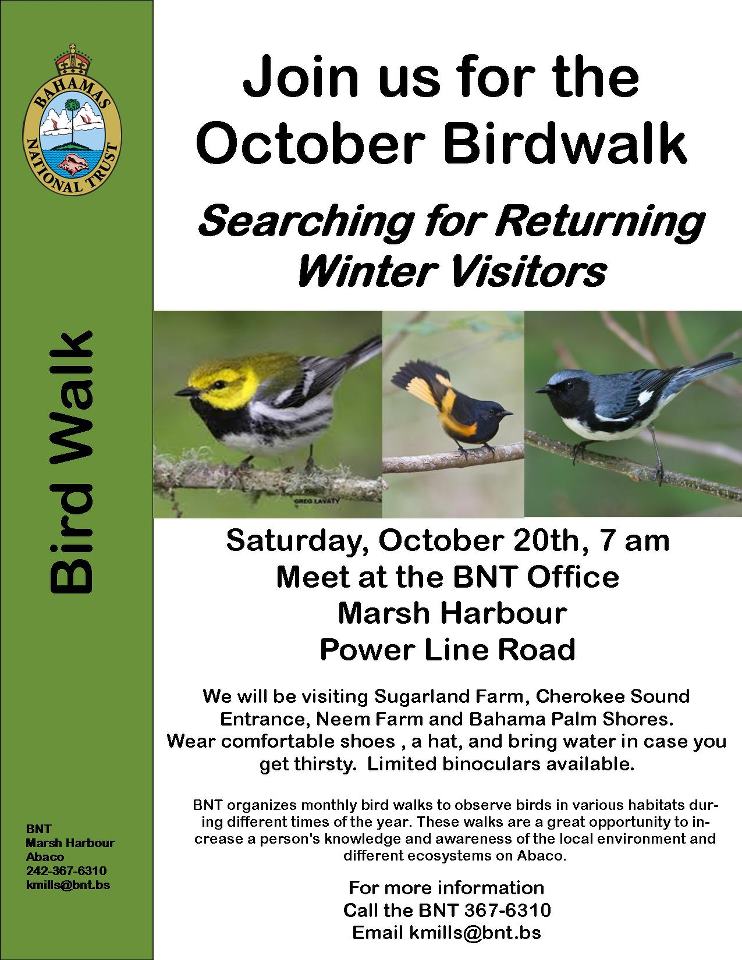
This sounds a lot of fun, and I wish I could be taking part. I’ve never been on Abaco in the autumn when the winter migrants start to arrive as the weather cools in their summer breeding grounds. It must be exciting to see the various species gradually reappear after their summer break, presumably with all the young birds born this year that will see Abaco (and the feeders!) for the first time. If any blog-follower goes on the expedition and happens to keeps a birding record, I would love to know which species you have seen . And if anyone gets some good pics, likewise…

SPIDER WASPS & TARANTULA HAWKS (PEPSIS WASPS)
I recently posted photos of an unknown aggressive-looking INSECT that I found in the coppice on Abaco. I could only get a partial shot of it, and I wondered whether to try to reach it and get a more complete shot. Perhaps I could have stroked its dear little back… or tickled its cute feelers…  I received various ID suggestions, ranging from the entomologically broad hedge-bet “big black beetle” to a more precise “black praying mantis”. I contacted the BNT to see what they thought. I’m glad I did. It turns out that this creature would be the hardest bastard insect on Planet Bastard. It is a SPIDER WASP of the Pompilidae family, almost certainly a TARANTULA HAWK aka PEPSIS WASP. It’s fortunate that I didn’t try to pet it or keep it in a matchbox. Note, for start, the scary eating apparatus… and it’s not nibbling leaves as I had thought, but chopping up a small insect. The leg claws and barbs are for pinning down its prey. You would not believe how unpleasant these little buddies are – and that’s before we even mention the sting…
SPIDER WASPS
These wasps (family name Pompilidae) are known in some countries as “horse-killers”. There are many species around the world, with 6 subspecies, one of which being the Tarantula Hawk or Pepsis Wasp – so-called because it hunts tarantulas and uses them in a most ingenious and cruel way… NB The BNT have rightly pointed out that these insects are unaggressive to humans. If you leave them alone, they will spare you. I’ve also read “The tarantula hawk is relatively docile and rarely stings without provocation” Now read on to see if it’s worth provoking one
SCARY CRITTERS & LIVING LARDERS
SPIDER WASPS are ‘Solitary’ insects that feed on ground spiders/ tarantulas by stinging them to paralyse them, then eating them. The females also make use of spiders for breeding purposes. They build a nest in a burrow, find a spider, paralyse it with their sting, drag it to the nest and lay a single egg on its abdomen. Then they seal up the burrow.
When the egg hatches the larva chews a hole on the spider’s abdomen and enters a living larder. It gradually eat its host as it grows. The spider’s vital organs are left till last, so that the spider stays alive as long as possible until the larva has reached full-size. After several weeks, the larva spins a cocoon and pupates (often over winter). Finally, the wasp becomes an adult, bursts Alien-like from the spider’s abdomen, and tunnels out of the burrow…
 Credit: Paul Nylander http://bugman123.com
SPIDER WASPS: MORE FEARFUL FACTS
Here is a hypnotically fascinating 3-minute video of the life-or-death struggle
SPIDER WASP –v- TARANTULA
THE STING
The sting of these wasps is among the most painful of any insect, though the most intense pain lasts on a few minutes. Entomologist Justin Schmidt bravely submitted himself to the stings of various insects and described this pain as “…immediate, excruciating pain that simply shuts down one’s ability to do anything, except, perhaps, scream. Mental discipline simply does not work in these situations.”
Schmidt produced his SCHMIDT STING PAIN INDEX The pain scale, based on 78 species, runs from 0 to 4, with 4 given for the most intense pain. Spider Wasps of the species Pepsis – i.e. Tarantula Hawks – have a sting rating of 4.0, described as “blinding, fierce, shockingly electric. A running hair drier has been dropped into your bubble bath” Only the bite of the Bullet Ant (not found on Abaco!) is ranked higher, with a 4.0+ rating, vividly described as “pure, intense, brilliant pain. Like fire-walking over flaming charcoal with a 3-inch rusty nail in your heel”
(Thanks to Erik Carey (BNT), Shelley Cant (BNT) and Dr Paul Deluca for their ID help and interest)
 LIGHT RELIEF
1. In 1989, New Mexico chose the Tarantula hawk wasp as the official state insect. The choice seems to have been left to schoolchildren and I’m guessing here (or gender-stereotyping) but I suspect it was the boys’ choice that won…
2. Tarantula Hawk is a “psychedelic progressive metal band” from San Diego, Ca. Their short discography includes their debut Tarantula Hawk (CD/LP, 1998); Burrow (Live CD, 2000, self-released); and Untitled. I’ll just check if… OMG!! you can even get these on iTunes… and (OMG!!!) Am@z@n. The cover of their debut provides the perfect ending for this post, vividly depicting the colour and texture of the swirling fiery pain you could experience (and I don’t really mean from listening to the music…)

AN ARGUABLY PAINFUL STING
Mr Gordon Sumner

AN ENJOYABLE STING
STOP PRESS 2 or 3 weeks on, I find that this entire post has been translated into Portugese! It can be seen HERE. It’s quite weird to read it, and I am tempted when I have a moment to re-use Google to translate it back into English. The two-way online translation game often leads to amusing results…

SATURDAY 28 JANUARY 2012 – A DATE FOR THE DIARY
CLICK  LOGO!
LOGO!
The images below tell you all you need to know about this excellent festival presented by the BNT in conjunction with the Abaco Beach Resort. From this blog’s point of view, the highlights are:
PRESENTATIONS by Nancy Albury on ‘The Blue Holes of Abaco’; by Ricky ‘Blue’ Jones on Bush Medicines / teas; and by Caroline Stahala on the Breeding & Behaviour of Abaco Parrots
ART The Art. Yes, all of it. Ok?
PRODUCE Something of everything, please.
OTHER Everything else on offer…
The very best of luck with this event and best wishes for successful fundraising from Rolling Harbour


BNT ABACO / INAGUA PARROT DOCUMENTARY
In August 2011 the Bahamas National Trust published a documentary about the resident Abaco and Inagua populations of this Cuban Parrot subspecies. It features research scientist Caroline Stahala, and contains plenty of information about these birds, their nesting and breeding habits, and the problems they face from predation. In places, some of the devastation caused by the extensive forest fires in March 2011 is still evident (see images in earlier POST). If you want to know more about these attractive (but noisy) birds, the documentary video below covers a great deal in 8 minutes…

 ROLLING HARBOUR ABACO
You must be logged in to post a comment.