
YELLOW WARBLER (female) Setophaga petechia


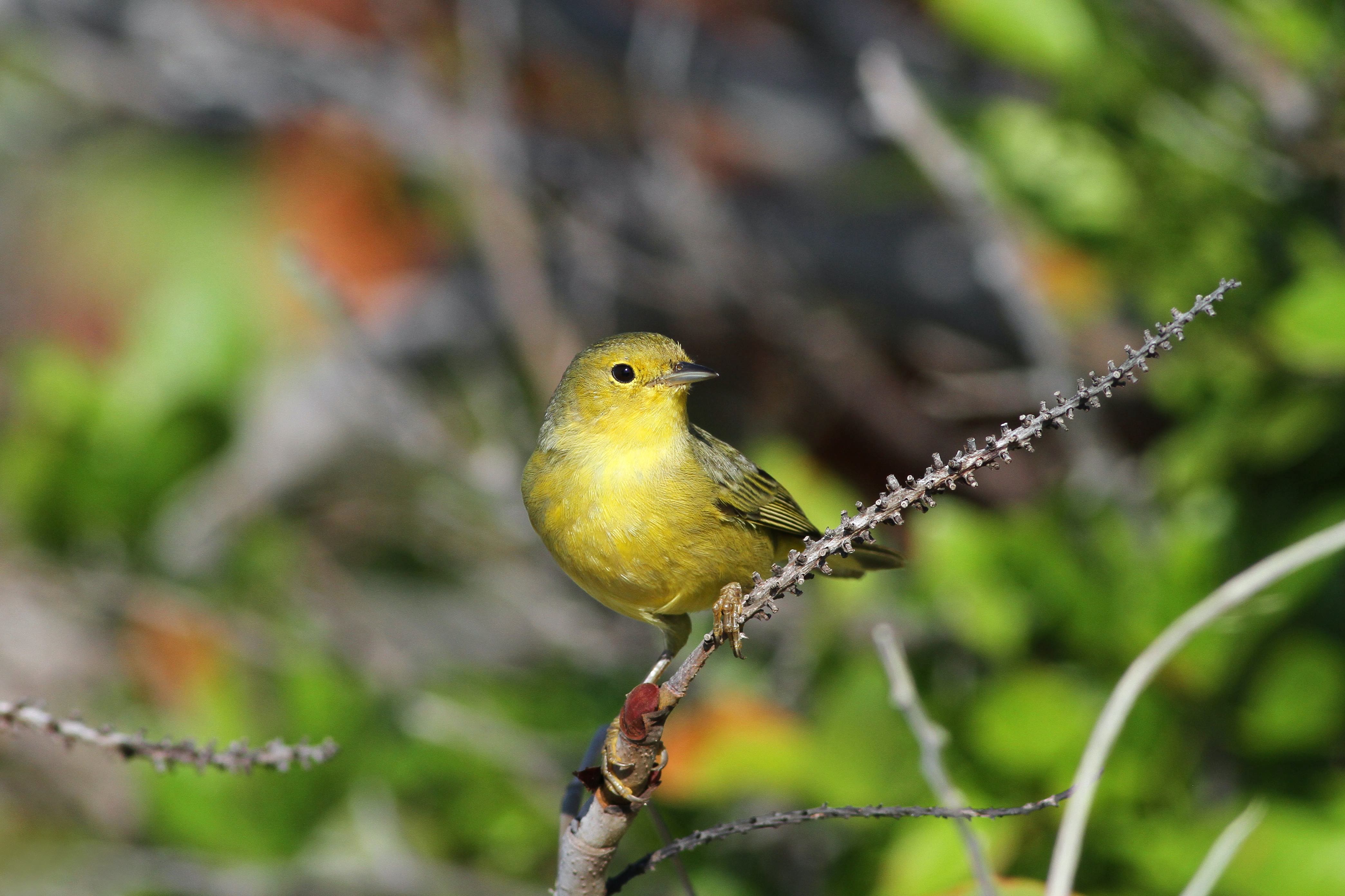
Photos taken on Abaco by Gerlinde Taurer, a major contributor to “Birds of Abaco”

YELLOW WARBLER (female) Setophaga petechia
Photos taken on Abaco by Gerlinde Taurer, a major contributor to “Birds of Abaco”

Olive-capped Warbler, Abaco
There are 37 Warbler species (Parulidae) recorded for Abaco. There is considerable scope for confusion between many of them. For a start, by no means all have the helpful word ‘warbler’ in their name. Secondly a great many of the species are to a greater or lesser extent yellow, with sub-variables for gender, age and season. It’s easy to get in muddle. A good place to start ID is with the warblers that are on Abaco all year round. Only 5 species are permanent residents on Abaco and the Cays: Bahama Warbler, Bahama Yellowthroat, Olive-capped Warbler, Pine warbler and Yellow Warbler. I have used images of these to illustrate this post.

Yellow Warbler (f) Abaco
The rest are mostly winter residents, with some being transient visitors passing through on their migration routes. Some are ‘everyday’ birds; some are unusual; and a few are extremely hard to find, the Kirtland’s warbler being the rarest and therefore the most prized sighting of all. I will be returning to the Kirtland’s in more detail in due course.
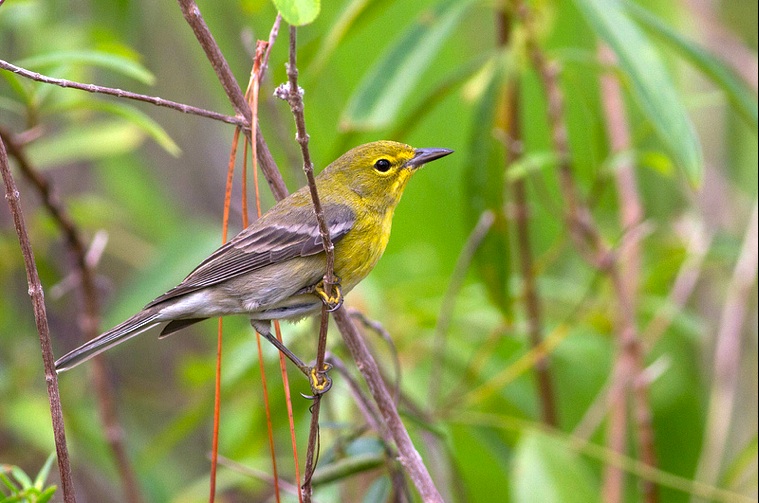
Pine Warbler, Abaco
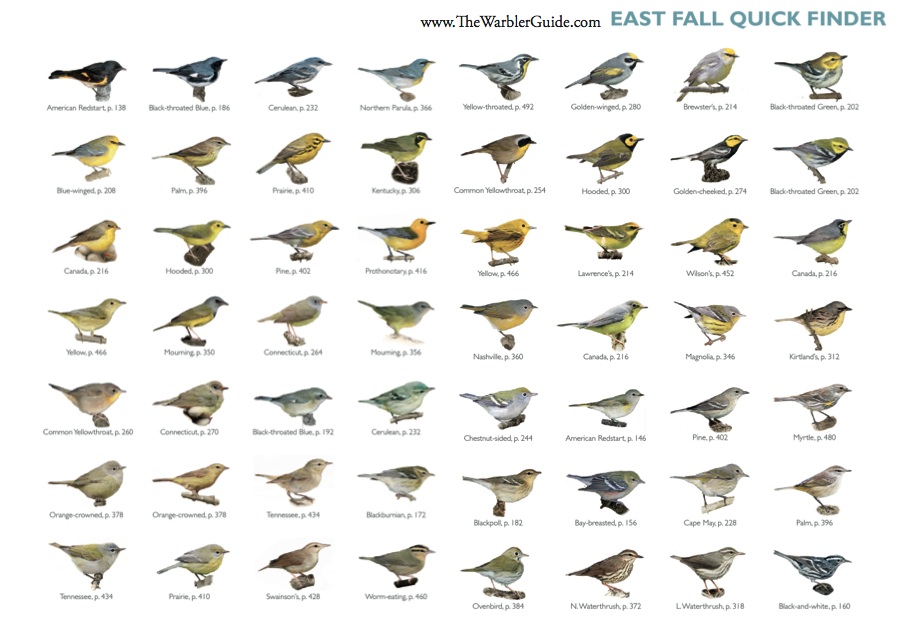
At the bottom of this post is a complete list of the Abaco warbler species, with Bahamas bird authority Tony White’s excellent codes indicating (a) when they may be seen; and (b) the likelihood of seeing a particular species (from 1 – 5). First however, news of a great resource for aiding warbler ID, produced by The Warbler Guide. Click on the blue link below to open a pdf with illustrative views of warbler species from several angles, spread of 8 pages. These are the warblers of North America, but you’ll find that almost all the Abaco warblers are featured.
SAMPLE PAGE

Bahama Warbler, Abaco
THE 37 WARBLER SPECIES RECORDED FOR ABACO
| WOOD-WARBLERS | PARULIDAE | CODE |
| Ovenbird | Seiurus aurocapilla | WR 1 |
| Worm-eating Warbler | Helmitheros vermivorum | WR 2 |
| Louisiana Waterthrush | Parkesia motacilla | WR 3 |
| Northern Waterthrush | Parkesia noveboracensis | WR 1 |
| Blue-winged Warbler | Vermivora cyanoptera | WR 3 |
| Black-and-white Warbler | Mniotilta varia | WR 2 |
| Prothonotary Warbler | Protonotaria citrea | TR 3 |
| Swainson’s Warbler | Limnothlypis swainsonii | WR 4 |
| Tennessee Warbler | Oreothlypis peregrina | TR 4 |
| Orange-crowned Warbler | Oreothlypis celata | TR 4 |
| Nashville Warbler | Oreothlypis ruficapilla | WR 4 |
| Connecticut Warbler | Oporonis agilis | TR 4 |
| Kentucky Warbler | Geothlypis formosa | TR 4 |
| Bahama Yellowthroat | Geothlypis rostrata | PR B 1 |
| Common Yellowthroat | Geothlypis trichas | WR 1 |
| Hooded Warbler | Setophaga citrina | WR 3 |
| American Redstart | Setophaga ruticilla | WR 1 |
| Kirtland’s Warbler | Setophaga kirtlandii | WR 4 |
| Cape May Warbler | Setophaga tigrina | WR 1 |
| Northern Parula | Setophaga americana | WR 1 |
| Magnolia Warbler | Setophaga magnolia | WR 3 |
| Bay-breasted Warbler | Setophaga castanea | TR 4 |
| Blackburnian Warbler | Setophaga fusca | TR 4 |
| Yellow Warbler | Setophaga petechia | PR B 1 |
| Chestnut-sided Warbler | Setophaga pensylvanica | TR 4 |
| Blackpoll Warbler | Setophaga striata | TR 3 |
| Black-throated Blue Warbler | Setophaga caerulescens | WR 2 |
| Palm Warbler | Setophaga palmarum | WR 1 |
| Olive-capped Warbler | Setophaga pityophila | PR B 1 |
| Pine Warbler | Setophaga pinus | PR B 1 |
| Yellow-rumped Warbler | Setophaga coronata | WR 2 |
| Yellow-throated Warbler | Setophaga dominica | WR 1 |
| Bahama Warbler | Setophaga flavescens | PR B 1 |
| Prairie Warbler | Setophaga discolor | WR 1 |
| Black-throated Green Warbler | Setophaga virens | WR 3 |
| Wilson’s Warbler | Cardellina pusilla | TR 4 |
| Yellow-breasted Chat | Icteria virens | TR 4 |

Bahama Yellowthroat, Abaco

Image credits: Bruce Hallett, Tom Reed, Woody Bracey, Charlie Skinner; PDF from ‘The Warbler Guide”

Palm Warblers Setophaga palmarum are cheerful little birds. Keen feeders, foraging around on the ground, in the coppice, or where there are pines. They are one of only 3 warbler species that bobs its tail, not just when it’s happy but much of the time. Maybe it is happy much of the time. The other 2 species are the relatively familiar Prairie Warbler; and the vanishingly rare – on Abaco, at least – Kirtland’s Warbler, the avian Holy Grail for birdwatchers on the island.

The male palm warbler in breeding plumage has a smart chestnut cap and what might be described as a ‘buttery’ BTM, to use a polite text-abbrev. The females are paler and have less yellow on them. The photos below were taken in March this year, mostly by Mrs RH (I can’t now recall who took what so I’ll give a general credit until she claims her ones). You’ll see the wide variety of types of place you might encounter one of these little birds. The last picture isn’t great as a photograph… but it’s a classic bit of acrobatic personal grooming.
CALL [audio http://www.xeno-canto.org/sounds/uploaded/HNJLXSFHYB/palm_warbler_callnotes_xc.mp3]


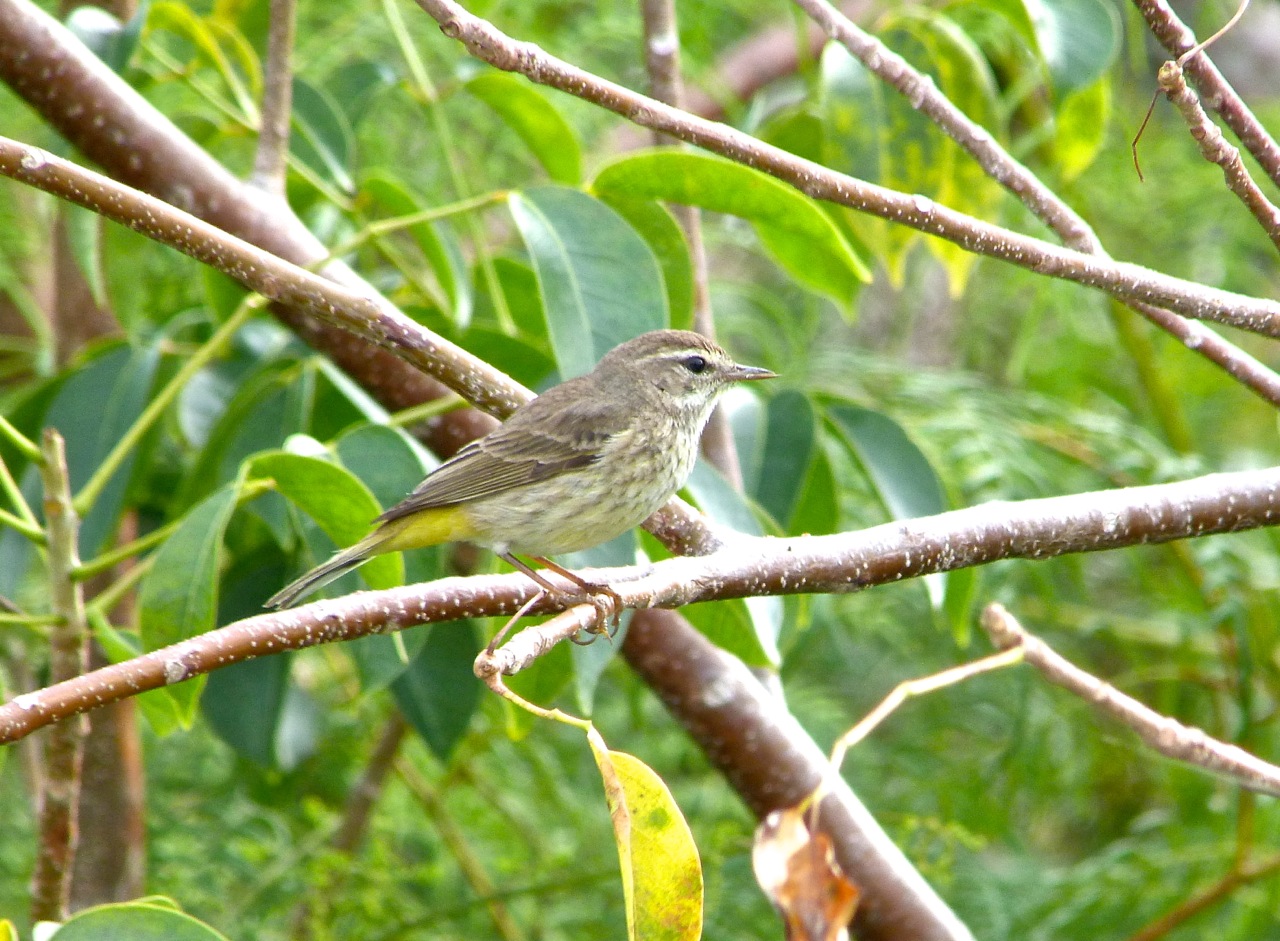
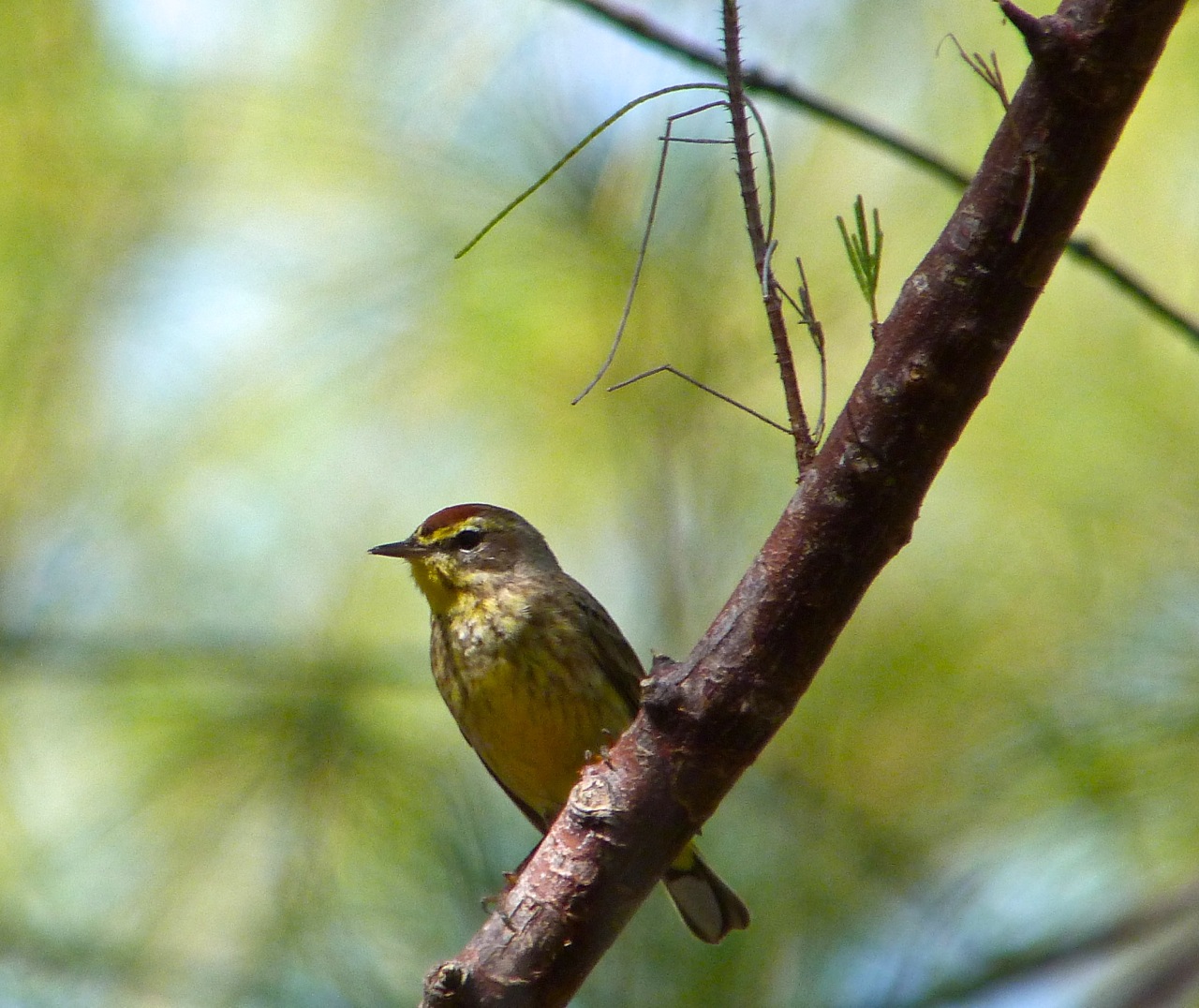
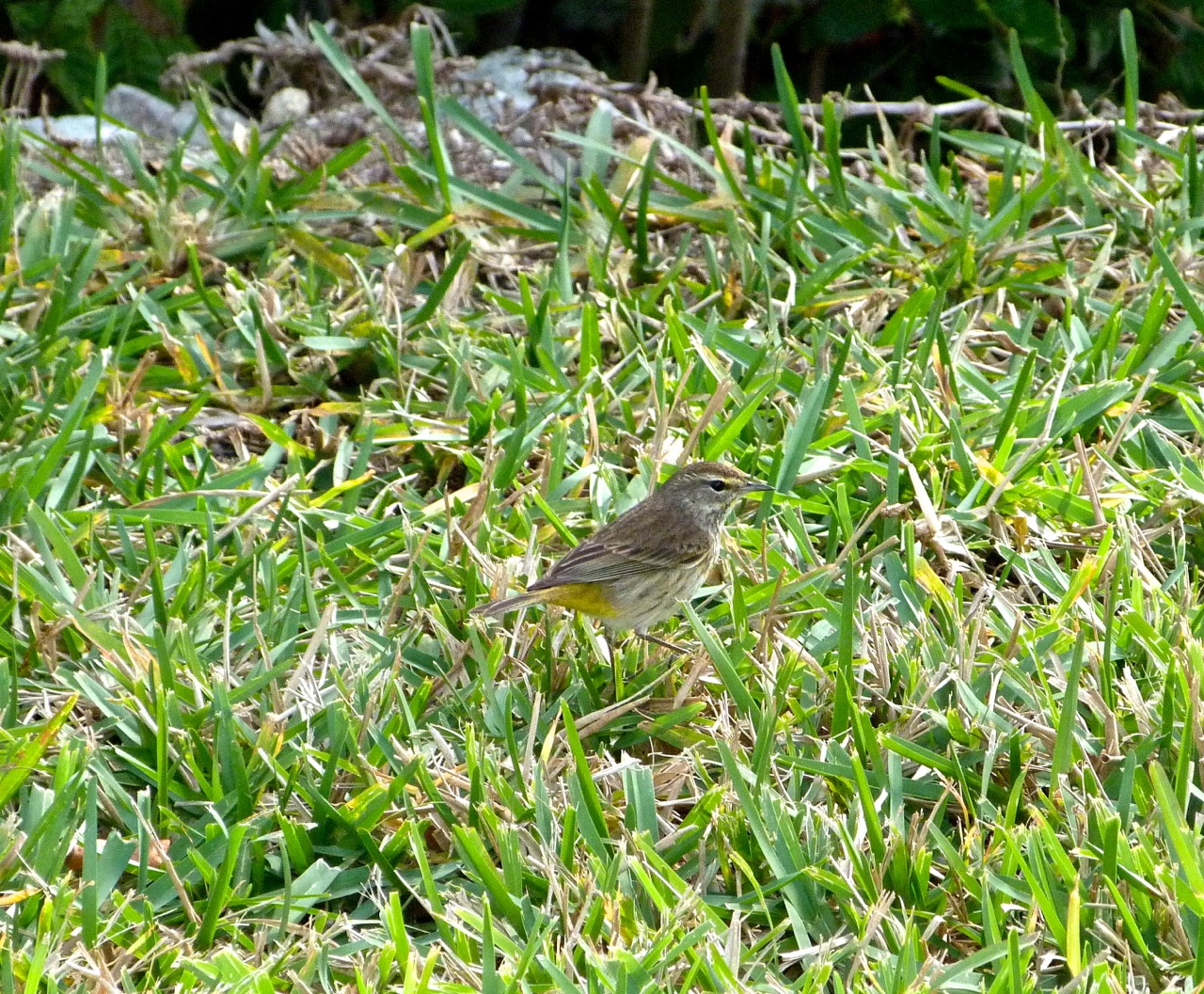 Thank you for admiring me…
 …now please excuse me if I scratch my ear for a moment…
 Header thumbnail image credit: Wiki

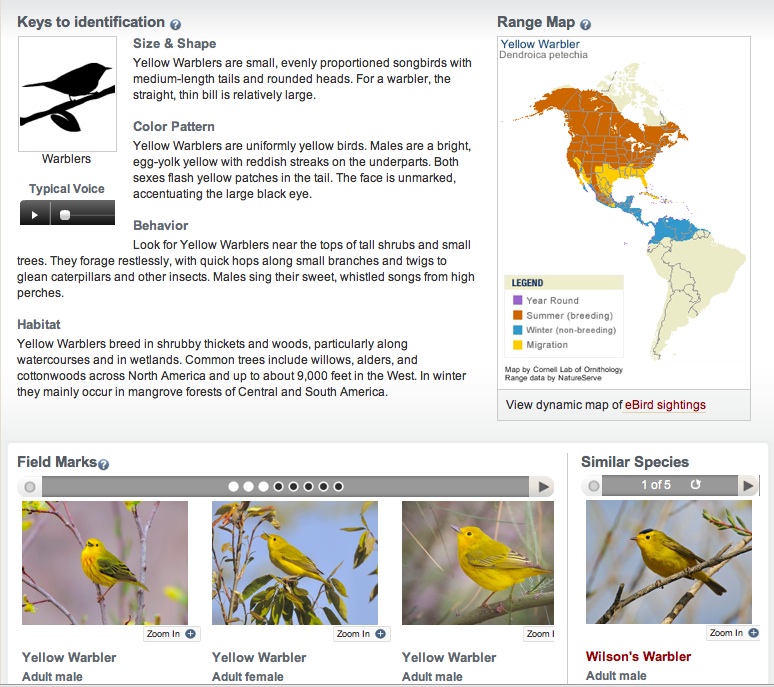
YELLOW WARBLER ©Cornell Lab
I’ve written before about the problems of ID of the multitude of small yellow birds on Abaco. They are mostly (but not all) warblers. The issue is further confused by the differences in each species between males, females and juveniles; and also, I expect, by colour variations during the season. YW song courtesy of Xeno-Canto
The CORNELL LAB OF ORNITHOLOGY has again come to the rescue with a helpful article. The link below takes as the starting point Yellow Warblers. Here is a grab of the page so you can see the well-thought-out format. You get

PROTHONOTARY WARBLERS ON ABACO, BAHAMAS
Janene Roessler has kindly sent news of a sighting yesterday of a prothonotary warbler on a feeder at Bahama Palm Shores, Abaco [Later addition] Now, with thanks to Ann Capling, here is that very warbler on the feeder – a fine photo considering it was taken indoors through glass. Apparently there hasn’t been one recorded there since 2007. I know of one seen further south on the island near the Delphi Club in April 2010 (see photo and caption below). I’ve never seen one myself. It seems fitting to celebrate the news with a post about these little birds…
This very pretty species of warbler Protonotaria citrea is the only member of its genus. The male birds are very colourful, with the females and juveniles being a bit duller. In flight, the underside of their tails are white at the base, and dark at the tip Photo Credit Craig Nash (Peregrine’s Blog) This fantastic photo was taken on the main drive of the Delphi Club, Abaco
STOP PRESS JULY 2018 this rather basic post was written in April 2012, in the earliest days of this blog when mistakes were (and undoubtedly still are) made. Tim Kalbach has just contacted me with the helpful observation “the Craig Nash photo is a Yellow Warbler, not a Prothonotary. Yellow – green tones in rump and tail don’t occur in Prothonotary; those areas would be blue-gray in color”. Which goes to show, I think, that after 6+ years I need to revisit this species in more detail and accuracy! Thanks for the comment, Tim.
These warblers are native to the eastern US where they breed, wintering further south in the West Indies and Central & South America. Their nesting arrangements are unusual: “It is the only eastern warbler that nests in natural or artificial cavities, sometimes using old downy woodpecker holes. The male often builds several incomplete, unused nests in his territory; the female builds the real nest” where she lays 3 – 7 eggs. So either the male is cleverly creating decoy nests away from the real nest; or maybe he is showing typically male behaviour in starting several home DIY projects at once and not getting round to finishing any of them…
Female Prothonotary Warbler (wiki)
I can never cope with those phonetic descriptions of bird calls… So many small birds are described as going ‘tseep’ or ‘tweep’ or ‘seeep’, yet in practice sound different from each other. So here, courtesy of the admirable Xeno-Canto and recordist Don Jones, is how they sound in real life
Listed as of ‘Least Concern’ (except in Canada, where they are ‘endangered’), the sad fact is that like so many species PNs are declining in numbers due to habitat loss. They are also bullied by other birds, in particular the brown-headed cowbird; and the house wren with which they compete for nest sites.
And the cumbersome name? Although at one time known by the helpful name ‘Golden Swamp Warbler’, the bird was renamed after senior Roman Catholic church officials called PROTONOTARII whose robes were (are?) supposedly golden. For full but quite dull details click on the green word back there. Bizarrely, the wiki-link doesn’t seem to confirm the goldenness of the robes at all. I think I’ll vote for a return to the simpler description…
Male Prothonotary Warbler (wiki)


 ROLLING HARBOUR ABACO
You must be logged in to post a comment.