Unknown's avatar

SAW A SORA? SURE? RAIL TRACK ON ABACO


BAHAMAS - Sora 2 - Oct 2010 copy 2

SAW A SORA? SURE? RAIL TRACK ON ABACO

‘Furtive’. ‘Secretive’. ‘Skulking’. These are harsh epithets to chuck at a small inoffensive bird that just goes about its daily routine in watery places. And look at it from the Sora’s point of view: ‘intrusive’; ‘prying’; invasive’; ‘nosy’… That’s you with your camera, disturbing its quiet life in the reeds and on the margins of marsh and lake. And for that matter your careful attempts to get close to the shy sora without startling it could also be described as furtive, secretive and skulking. See how it feels?

Sora.Marsh Harbour.Abaco Bahamas.6.13.Tom Sheley copy

The Sora Porzana carolina is a species of rail, a winter resident on Abaco. The island also has the CLAPPER RAIL, Virginia Rail and the Black Rail. There are no recorded sightings of this last one, and certainly no photographs. But their distinctive call has been heard in several locations over the last few years –  for example, by two people in different places last June when we were in full bird mode for “THE BIRDS OF ABACO”.

Sora, Gilpin Point Abaco RH 1

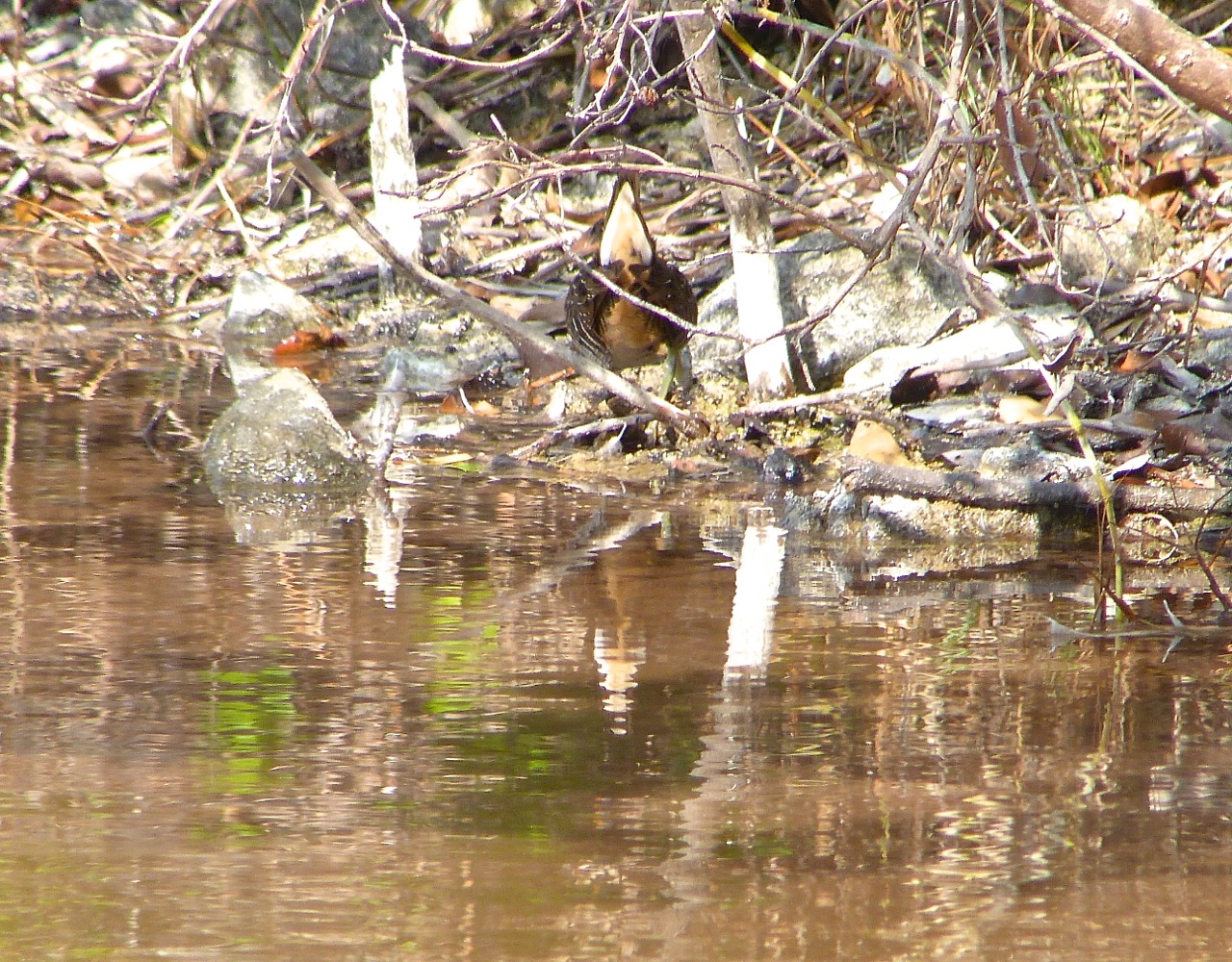
Although not uncommon, the sora is relatively hard to find; and if found, to photograph. As I wrote in the book, ‘these are most inconspicuous birds, so it is quite a coup if you manage to locate one. Their creamy beak and upturned tail may give their presence away as they work their way along the water’s edge, feeding intently’. Tom Sheley took the magnificent photo above of a sora peering out from cover – he’s a very patient man. Often, the best sight you’ll get is of the bird half-hidden in the reeds at a distance, as in my feeble effort above. Spot the Sora… I tracked the same bird, and later got a more open shot as the sora picked its way along the edge of a pond before disappearing again into the reeds. The bird was moving away from me. I was crouched on a small jetty, with a little blue heron nearby looking at me in puzzlement. Or sympathy. My best (ha!) shot below (beak and tail both visible? Check!) is followed by much the most usual view of a sora in my experience, the less photogenic end with the white… stern.

Sora, Gilpin Point Abaco RH 3Sora, Gilpin Point Abaco RH 4

I can’t improve on good old Wiki in summarising the diet of this little rail: “Soras are omnivores, eating seeds, insects and snails. Animals that are commonly reported as sora food items include snails, crustaceans, spiders, and insects – mainly beetles, grasshoppers, flies, and dragonflies. Soras often eat plant seeds. Plants in the sora’s diet include duckweed, pondweeds, and grasses.” Wiki’s own image is shown next.

Sora, Birding Center, Port Aransas, Texas

We were with our friend the ornithological scientist Caroline Stahala* when we – I should say she – saw my first sora at the pond at Gilpin Point near Crossing Rocks. She grabbed my camera and plunged into the rather thick undergrowth at the water’s edge. Actually, she had to plunge into the water itself at one stage. Here are 2 shots that further demonstrate how hard it can be to photograph these wretched creatures. They don’t pose prettily on a branch in the sunshine like a Spindalis, for example. They forage about in places where low light and thick vegetation combine to make focus and clarity difficult to achieve. *’The Parrot Lady’  Sora, Gilpin Point Abaco - Caroline Stahala 1 Sora, Gilpin Point Abaco - Caroline Stahala 2 The remarkable calls of the sora can be heard in the very short clips below, from the invaluable Xeno-Canto archive. They make three distinct types of sound, one described as “a descending whinny”. Apparently the use of ‘call broadcasts’ greatly increases the chances of hearing a sora. They also increase the chances of seeing a sora, as the bird will often investigate the source of the call. The propriety of using a recording to attract a bird is open to debate, but there’s no doubt that it can be far more effective than simply going ‘pish-wish’ repeatedly… CALL Ted Floyd ‘WHINNY’ CALL   Micah Riegner ‘WEEP CALL’  Todd Wilson This is a second Wiki image of a sora foraging in water. I like the fact that, as with Tom’s photo, you can see the feet.1024px-Porzana_carolina “SORA”. Where does the word come from? What does it mean? It sounds like some uninviting butter-style spread. Or is that ‘Flora’? I did some research and for a start it means ‘Sky’ in Japanese and ‘Seashell’ in Korean – both used as names. Six countries worldwide have places called Sora. There are various obscure usages (e.g. a little-known video game). Disappointingly, however, the best etymology I can find in a birding context is that the origin is ‘unknown’. I was too disheartened to explore the derivation of ‘Porzana’. Could so easily be a second-tier female character in a Shakespeare comedy: “Haply, Porzana, hast seen the Sora of the Prince, withal?”. Having started this post with a header shot by Becky Marvil, I’ll end with the etymological mystery and another photo by Becky of the same bird going for some underwater delicacy. Sora, Abaco - Becky Marvil 2.1

STOP PRESS Uli Nowlan has kindly sent a photo of a Sora taken at ponds north of Treasure Cay (below). It’s a timely reminder to me that this blog is somewhat South Abaco oriented. More than somewhat, in fact. That’s inevitable I’m afraid, owing to my base camp being south of MH. Also, I think it’s generally accepted that South Abaco is the place to find the best birding. I do include birds from the TC area – the golf course ponds and the creeks – but perhaps not enough. Contributions welcome!

Sora, Abaco (Treasure Cay area) - Uli Nowlan

Credits: Header and last image – Becky Marvil; Tom Sheley, RH, Wiki, Caroline Stahala; Uli Nowlan. Wiki-nod for some info also.

Unknown's avatar

HOW TO RECORD BIRDS EASILY ON ABACO (OR ANYWHERE ELSE…)


Red-winged Blackbird Abaco 3

RECORDING BIRDS: A LAYMAN’S GUIDE

YOU WILL NEED: an iPh@ne or similar  smartphone with a voice memo facility; patience; minimal non-natural background noises (traffic, yelling people, barking dogs, heavy machinery); a steady-ish hand; one or more birds nearby

RECORDING

  • Use the Voice Memo app on an iPh@ne (I presume most other smart phones have a similar app).
  • Once you have it onscreen, turn the phone round 180 deg and the image will swivel round too. Now you can point the microphone at the sound and have the controls the right way up facing you.
  • Turn the volume up to max before you record.
  • Handle the phone carefully so it doesn’t record you touching it as well. It probably won’t pick up pressing ‘record’, but it may when you press ‘stop’. But you can trim the end of the saved file on the file very simply.
  • The recording saves in m4p format, and you can email it to your computer direct from the app (or to anywhere or anyone else).
  • Drag / save the file onto your desktop from the email. When you open it, it will (a) play and (b) appear in your iTunes library (or whatever music storage system you use).

CONVERTING RECORDINGS TO MP3

  • Having opened the recording, to convert the file to an mp3 (generally the preferred version for uploading elsewhere) in iTunes, go to Songs in your iTunes library and search for Memo. There it is!
  • You can rename it at this stage if you wish.
  • Then go to File on the top bar, and in the drop-down menu, near the bottom, go to Create new version. It will offer you mp3.
  • Click mp3 and a second recording file will appear in your library. That’s your mp3.
  • Drag it onto your desktop and do what you want with it.

Apologies if this is all blindingly obvious and written in the elementary computer language ‘eggy-peggy’. It took me a while to get it sorted out, and I hope the details above will help the lo-tek computer user to record birds and use the results painlessly.

FIELD NOTES

  • I recommend recording for about 20 – 30 seconds max. The iPh@ne  allows easy trimming at the start and end of the saved file, but there’s no easy way to edit the middle to take out the barking dog.
  • Several short recordings of each bird will give a better choice of results than one or 2 long recordings.
  • The iPh@ne mic is surprisingly sensitive. It will pick up all nearby sounds – someone whispering at you “is it recording yet?”, for example. So ideally this is best done in the pine forest or coppice, away from the Highway. And maybe the loud whisperer.
  • Wind can be a problem. Not just for humans. The mic will pick up gusts of wind, or wind blowing across it if you change the direction you are pointing the phone as you record. So this is best done on a calm day.

Red-winged Blackbird Abaco 1

Here are two practice recordings I made in March. The first is the female red-winged blackbird above (and header) at Casuarina beach. The distinctive call is rather like a rusty hinge on a swinging gate, often heard far out in the mangrove swamps of the Marls. You’ll hear background noises from collared doves and also the sea lapping on the shore.

The second is thick-billed vireo in the coppice at Delphi. You’ll hear an answering vireo – and also some wind noise. I find these little birds frustratingly hard to see – they always seem to be lurking further back in the bushes than I think. I’ve never managed to take a good photo of one, so I’ll upload an illustrative poor one to be going on with. I am back on Abaco in a week, and a better TBV photo is on my avian hit list.

Thick-billed Vireo, AbacoFinally, you’ll find a longer recording I made of Abaco parrots squabbling noisily at Bahama Palm Shores near the end of a recent post HERE. I made an mp3 using the method described above, and uploaded it to the excellent Xeno-Canto bird sounds website, which is well worth exploring. You can find my recordings of the parrots and the birds in this post, plus sonograms, on my XC page, such as it is, HERE 

But if you just want to hear the parrots, here they are. Like schoolkids, only louder.

Abaco (Cuban) Parrot 2013 13Why do I do that annoying ‘iPh@ne’ thing? It’s a statistical fact that I have just made up that 373,597 people a minute world-wide g@@gle the correct word. Imagine the meta-crawlers and spam-splurgers that lock onto that word. I don’t want to cyber-meet them. I also use the form Am@z@n but for different reasons relating to their ingenious tax arrangements (alleged, obviously). Thus  with G@@gle as well (again, merely alleged – as Dusty Springfield memorable sang, “Nothing is proved…)

Unknown's avatar

ABACO’S UNIQUE PARROTS IN PICTURES, VIDEO & SOUND


Abaco (Cuban) Parrot 2013 4a

ABACO’S UNIQUE PARROTS IN PICTURES, VIDEO & SOUND

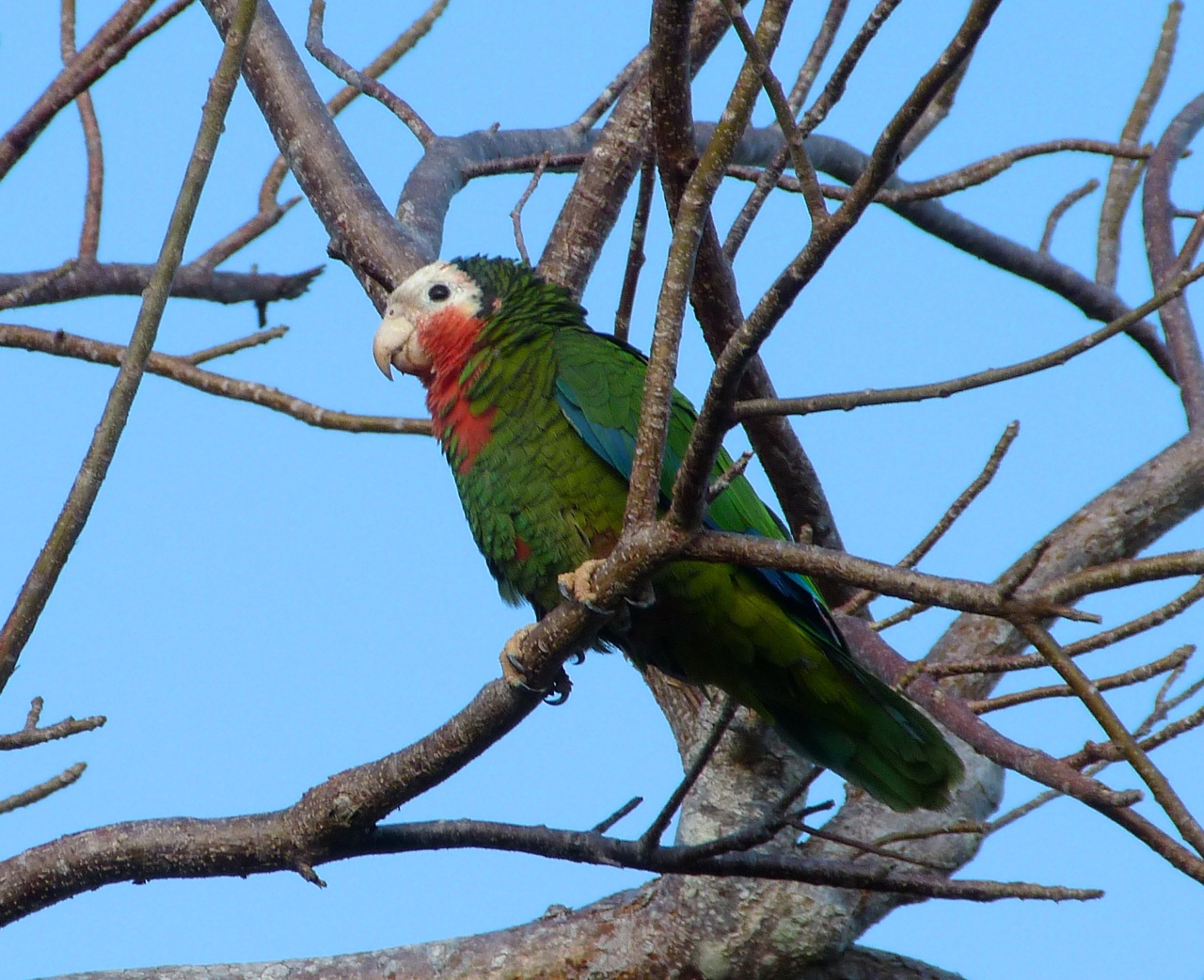
Abaco parrots. The only ground-nesting parrot species in the Bahamas. In the world, in fact. I’ve posted quite often about them – indeed they have their own page HERE – because, frankly, they are special and their story is one of encouraging success for intensive research and conservation programs. In 1492, Christopher Columbus was amazed by the vast number of parrots he saw in the Bahamas (not that the islands were called that then). In his journal he noted: “flocks of parrots darken the sun…”  Not many years ago, parrot numbers on Abaco had dwindled to fewer than 1000 – below the critical point for sustaining a viable population. Extinction of the Abaco parrot loomed, accelerated by increasing habitat change, predation, and (*euphemistically*) ‘human intervention’.  Thanks to the campaign of conservation, habitat preservation, anti-predation measures and vigilance, numbers have been restored to a sustainable level, perhaps as many as 4000. They are now a fairly common sight – and sound – in South Abaco. But not everyone who looks for them finds them, or even hears them. Especially not if they take pot luck in the vast areas of pine forest in the National Park, where they breed…

I’ve covered much of this ground before, but there is a slightly wider audience these days, so a few newcomers may be interested to learn about these lovely birds. The best thing is to have a look. All photos were taken by me during two early evenings in March.

Abaco (Cuban) Parrot 2013 1Abaco (Cuban) Parrot 2013 2 Abaco (Cuban) Parrot 2013 4aAbaco (Cuban) Parrot 2013 5

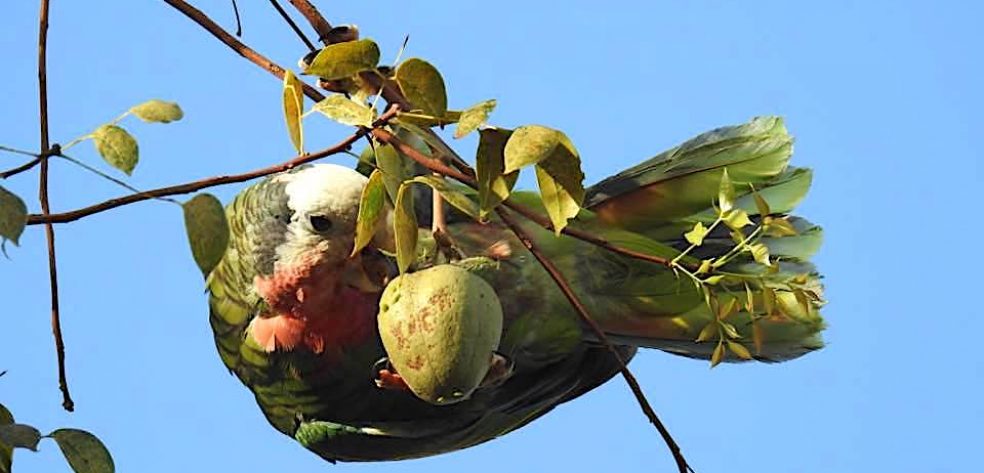
The parrots are extremely agile, and have very strong feet and claws that enable them to move around in the tree-tops – or to hang upside down if they choose to. The next photo is a close-up a foot; below that is short video showing a parrot manoeuvring itself in a tree. You’ll also see how the birds use their beaks as an extra limb, so to speak. The uninspiring title shown is only because I forgot to label it ‘Abaco Parrot’ in the first place, and can’t find how to edit it…Abaco (Cuban) Parrot 2013 6

In this image you can clearly see how their ‘opposable’ claws wrap round a branchAbaco (Cuban) Parrot 2013 8

If you suspect that this one has had some ‘work’ done, you’d be right. I normally leave my photos largely alone, apart from cropping and maybe basic light balancing where needed. Sometimes an image is nearly there, but needs a bit of extra cosmetic business – but one can usually tell. The left wing? Hmmmmm (users of ‘noise reduction’ will know what I am talking about!).Abaco (Cuban) Parrot 2013 9 Abaco (Cuban) Parrot 2013 10 Abaco (Cuban) Parrot 2013 11 Abaco (Cuban) Parrot 2013 12

The flocks of parrots are incredibly noisy. Sometimes they split into two or three groups, close together, and seem to compete in raucousness. Around 5.00 pm seemed to be the noisiest time. I took recordings of the racket, using the voice memo app on an iPh*ne, simply holding the phone with the speaker / mike end towards the parrots. Some come out pretty well – good enough to post on the excellent XENO-CANTO bird sound site. Here is a recording, with the first few seconds transcribed into a sonogram. I made a ring tone from this recording for Caroline Stahala, the scientist who, with her team, looks after the birds. She’s been too polite to say whether she uses it or (more likely) not!

Abaco (Cuban) Parrot 2013 13Abaco (Cuban) Parrot 2013 14Abaco (Cuban) Parrot 2013 15I find the parrots very hard to nail in flight (see above), possibly because of a shutter-speed issue (mine, not the camera’s). I nearly junked the picture below, but I liked the clash of the parrot colours with the purple bougainvillea, so I spared it.Abaco (Cuban) Parrot 2013 16B

If anyone is interested in making a small contribution towards the continuing research into and protection of these birds, please have a look at my ABACO WILDLIFE CHARITIES  page, where the relevant link to Parrots International can be found. Or visit doudoubirds, where you will find endearing Abaco Parrot prints by dou dou herself for sale in aid of the parrots. Or contact me at rollingharbour.delphi@gmail.comAbaco (Cuban) Parrot 2013 7

If anyone had a problem with the Xeno-Canto sound file above, here is a simplified version of the recording