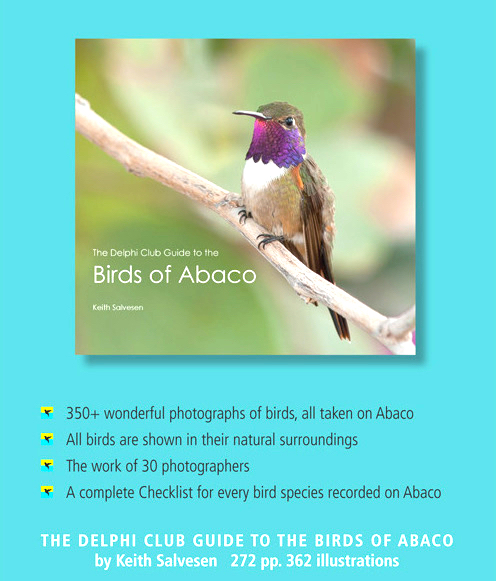
When, in 2014, Birds of Abaco had safely been hatched and was beginning to fledge, I started a companion site that was designed to add an additional dimension to the project. It was a bird-specific accessory to the main Rolling Harbour site that has always featured a far greater range of topics than birds.
The book exhibited Abaco birds in a deliberately perverse way (alphabetically, not by species grouping or other conventional methods). The loosely termed ‘Index’ was meant to be a quick alternative way to delve into the various species.
It was a side project and I did very little to promote it. Once put together (with a linked FB page) I pretty much left it to grow ‘organically’ (aka indolently and neglectfully). I’m bringing the site out of semi-retirement while I get on with my efforts to put the book online. Reach it HERE
A to Z
CAPE MAY WARBLER (Char Albury): as it turned out, an unpromising name. The first one was recorded on Cape May, NJ in the early nineteenth century. They were not recorded there again for more than a hundred years.
Q: WHAT HAS THE GESTATION PERIOD OF A WALRUS (16 MONTHS) AND WEIGHS THE SAME AS A PAIR OF FULLY GROWN PINEAPPLES (2 KILOS)? A: THE BIRDS OF ABACO
FIRST FLYER
It is February 2014, and two pallets carrying 500+ heavy books in boxes have just arrived in Nassau. Printed in Italy at the end of January, the cargo had made its way from specialist printers in Florence via Bologna, Leipzig, Brussels, Cincinnati, Miami to Nassau. They spent an unexpectedly long sojourn in Nassau while formalities were unhurriedly dealt with, then made their way safely to the Delphi Club. In early March, the book was launched in the Great Room at Delphi.
Delphi Lodge 2014
The book was generously received. The Delphi years rolled by: happy years of amateur birding, incompetent bonefishing (me), adventures, companionship, conviviality, Kalik. Then a change of ownership at Delphi; the destructive power of Dorian; and the tentacles of Covid spreading round the world.
10 years on at Rolling Harbour Towers HQ, a plan is hatching like an Abaco parrot’s precious egg. Might there be an audience ready for some kind of e-Edition of the whole book, checklists and all? Technology has moved on since 2014. Even I have now read an eBook. There’ll be some tech-stuff involved to get the most practical way to proceed. I’ll need to check with the birds first, and we will get back to you.
SECOND FLYER
Sanderlings on the beach at Delphi – more interested in snacking than eBook stardom
And not just the tail*. Other parts of a bird. Sometimes most of a bird. More rarely, an entire bird. Whichever, a bird affected by leucism stands out from the crowd – out of the ordinary and therefore startling to the eye. I’d be very surprised if the fine turkey vulture in the header image didn’t make you look twice – maybe even to check if some devious photoshop trickery had been at work. Yet it’s just a normal TUVU in the Florida Keys, living a normal vulturine life.
LEUCISTIC DISCOVERY ON ABACO
A leucistic Western Spindalis discovered on Abaco by birder Keith Kemp
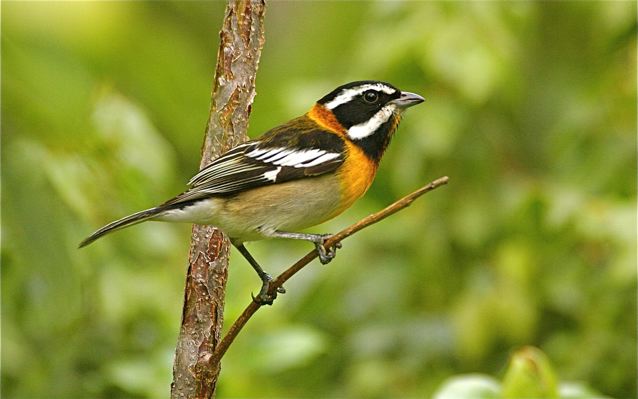
For comparison – the real deal
LEUCISM? EXCUSE ME, AND THAT IS?
First, what it is not. It is not albinism, which results from diminished or lost melanin production that affects pigmentation. One characteristic of the condition is the tendency to pink eyes, which of course is seen in humans as well as animals and birds. Meet the perfect example…
WELL, WHAT IS IT THEN?
Put simply(ish), melanin is only one of many ingredients of pigmentation. Leucism is caused through pigment loss involving many types of pigment, not just melanin. In birds this results in unnaturally light or white colouring of feathers that may be partial or entire. The eyes of a bird with leucism are unaffected. At one extreme, if all pigment cells fail, a white bird will result; at the other extreme, pigment defects cause patches and blotches of pale or white on the bird, often called a ‘pied’ effect. The condition can be inherited.
A mallard on Abaco. The species is known for its wide colour variations in both sexes. Sometimes the variations go beyond the usual range: this is a leucistic bird
A leucistic common gallinule (moorhen) on Abaco
Leucistic rock pigeon
BAHAMA (WHITE-CHEEKED) PINTAIL: A PIGMENT PUZZLE
I have found more examples of leucism in the ‘Bahama Duck’ than any other local species on Abaco. But there is also scope for confusion. First, here’s a pintail that is undoubtedly leucistic – note that the eyes and beak are unaffected by pigmentation deficiency:
But not all pale variants can be so confidently labelled. In the first picture, bottom right, there is an obviously an ‘odd’ pintail, silvery rather than ruddy brown like the rest of them (and yes, I do see the coot in the pack as well…). The second photo shows the same bird on dry land.
This is known as a ‘silver pintail’. These are said to be a leuchistic variant, and they are stocked by poultry dealers as ornamental ducks at a higher price than the much-loved standard brown version. However this bird clearly retains the essential markings of a normal pintail that you might expect to be absent (at least in patches) in the ‘true’ leucistic bird. I’ve seen it described as a ‘gray morph’. I wonder where the line is drawn between a noticeable colour variant or morph in a bird; and an obviously pigment-abnormal, leucistic bird where the incidence and extent of the condition seems to be random. I’d go with the morph idea.
A fine example of a ‘pied’ American Robin, an occasional visiting species on Abaco
Leucistic American Robin (Amy Evenstad, PoweredByBirds.com)
PIPING PLOVERS CAN BE LEUCISTIC TOO
PIPL are one of my bird species preoccupations, but until I checked them out I hadn’t imagined what a leucistic one would look like, or whether they had ever been recorded. I now have the answer…
These photos of a leucistic female were featured by Audubon Alliance for Coastal Waterbirds, Audubon Connecticut. They were taken by Jim Panaccione, a Biological Science Technician at Parker River National Wildlife Refuge, Newburyport, Massachusetts. I hope he won’t mind their illustrative use here… Despite the theory that leucistic birds may find it hard to find a mate – and might even be attacked by its own species – this pair successfully nested.
OPTIONAL MUSICAL & CULTURAL DIGRESSION
A WHITER SHADE OF PALE
* Obviously, it had to be ‘tail’ in the title to justify one of my clunky ‘jokes’ and an accompanying musical diversion. That’s just the way it is, I’m afraid. Bach’s well-known descending chord sequence of was of course shamelessly ripped off by ingeniously adapted by Procol Harum for ‘A Whiter Shade of Pale’, their first single in 1967. Relive a Summer of Love right here and now. And at 2.57 does he really sing ‘….might as well’ve been toast…’?
Any fret-tweakers might like to see the sheet music of Bach’s Air for guitar. You could even play it on Air Guitar – which is relatively easy, being in C major and having no strings.
‘BACH IN A MINUET’
The best known commercial use of the tune was in the famed series of adverts that equated a mild cigar called Hamlet with happiness, accompanied by an excerpt from a jazzy version of Bach’s ‘Air on the G String’. Here is one of the best – and possibly the only advert to my knowledge to feature not one, but two excellent Sir Walter Raleigh jokes.
Credits: thanks to Amy Evenstad (PoweredByBirds.com) for use permission for her wonderful TUVU & AMRO photos; other photos by Keith Kemp & Bruce Hallett (Spindalis); Pinterest (rabbit); Nina Henry (mallard); Tony Hepburn (moorhen); Wiki (pigeon); Jim Edmonson (leucistic pintail); Keith Salvesen (silver pintail); Jim Panaccione / Audubon (piping plovers); Procol Harum, esp. Robin Trower for building a great career round being ‘reminiscent of Jimi Hendrix’; J.S. Bach for a nagging tune; Hamlet cigars for ingenuity & making me laugh
The WTF? series is aimed at shedding light on fishes that are unusual. Or very unusual. Or puzzling, dangerous and maybe less than elegant in appearance. The scorpionfish is one such. It belongs to a large family, the Scorpaenidae, and many types are found throughout the world, especially in the Pacific and Indian oceans. LIONFISH, the newcomers to the western Atlantic, are a species of scorpionfish.
Just another rock on the seabed…
WHY ‘SCORPIONFISH’? THEY LOOK SCARY. ARE THEY DANGEROUS?
One feature common to many scorpionfish species is that they are highly venomous. As the name suggests, a sting is involved. Or several stings. These come from the creature’s sharp spines, which are coated with mucus, and are to be avoided. If you want to pet one, the dorsal, anal and pelvic fins are the ones to steer clear of – these all have venom glands at the base. The spines act like injection needles. Scorpionfish aren’t naturally aggressive (except to prey), but they know how to defend themselves if need be. If you get ‘got’, you are in for “extreme pain and burning sensation”.
DO THEY HAVE ANY OTHER TRICKS TO WATCH OUT FOR?
As many have written, scorpionfish are ‘Masters of Camouflage’. They are able to disguise themselves very effectively. Their appearance is a remarkably adapted to their surroundings, as if covered in a raggle-taggle of colourful algae. They can change colour to aid concealment. They can flick sand over themselves as they settle on the seabed. These ploys enable them to lie motionless on a coral reef or on the seabed, ready to ambush their prey. This consists mainly of small fishes and crustaceans, but really anything edible that will fit in their mouths is fair game.
Concealed against coral
HOW DO THEY FEED?
The large mouth of scorpionfishes has a particular function. They don’t have teeth because they have no need. A scorpionfish can open its mouth and its gills simultaneously, thereby creating an instant vacuum that will suck in its prey in a flash. I have seen this described as “a nearly imperceptible split-second movement (15 milliseconds)”…
THESE SCARY MONSTERS MUST BE HUGE, RIGHT? I’M KEEPING OUT OF THE WATER
Not so fast. When all is said and done – and in my view, most disappointingly – adult Caribbean Scorpionfish grow in the range of… erm… 7 – 14 inches. So now you are reassured, here’s a great short video from Ocean Frontiers Dive Shop, who kindly shared it on YT. I’ve used a couple of illustrative stills from it too.
ANYTHING ELSE WE NEED TO KNOW?
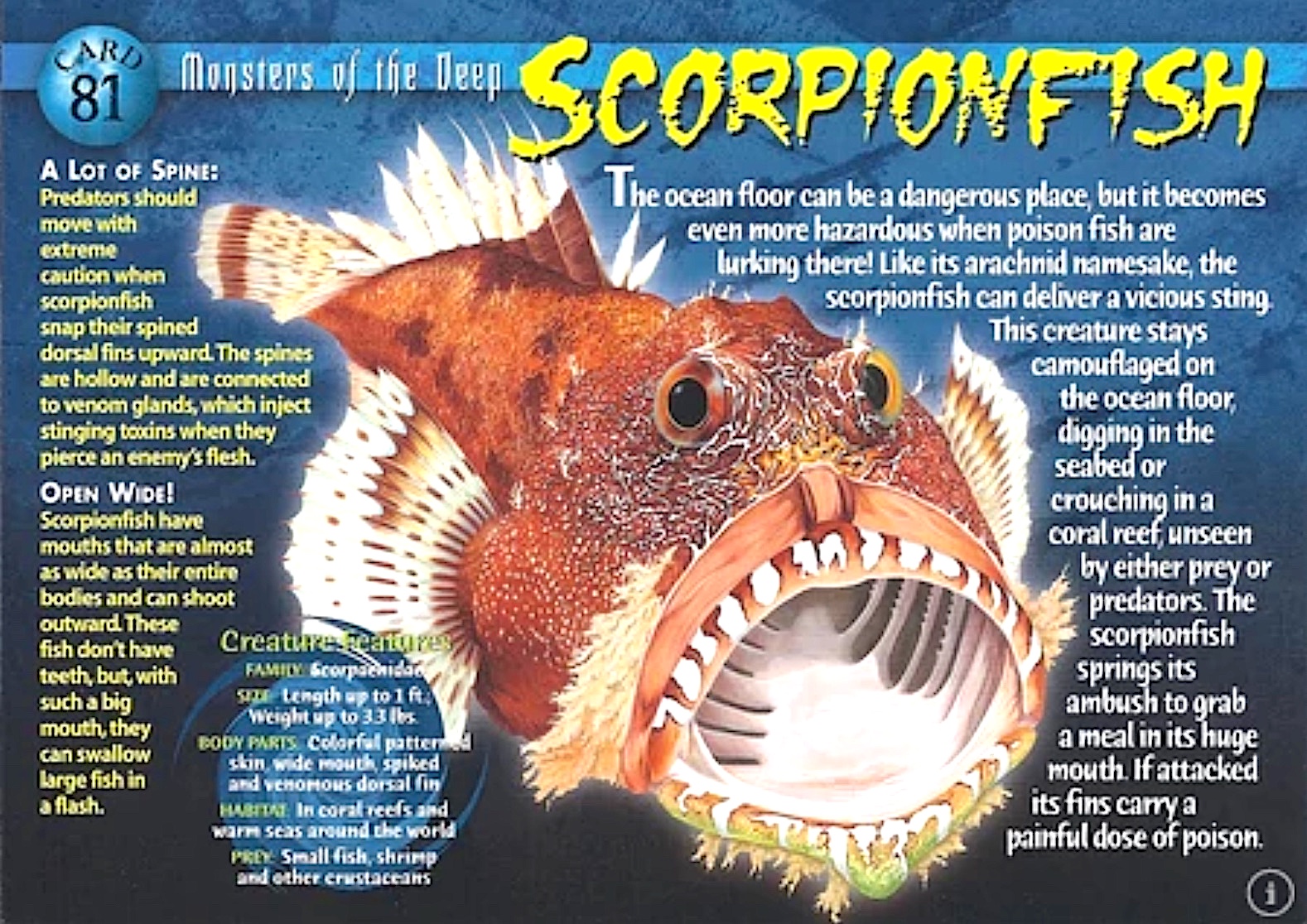
I can do no better than to turn to Card 81 to the excellent ‘Monsters of the Deep‘ series of trading cards (the link is to my MotD page). I do realise that this is a rather unscientific approach. On the other hand these guys pack memorable information into a very short space, and do it well. Note that you can get a reflex sting from a scorpionfish for up to a week after it has died. Eat dust, earthbound scorpions.
Credits: Melinda Riger / Grand Bahama Scuba (1, 2, 3, 4,); Ocean Frontiers Dive Shop (video from YT, 2 stills); Wierd (sic) Creatures / Monsters of the Deep (O/S)















 ROLLING HARBOUR ABACO
You must be logged in to post a comment.