The sounds are unmistakeable – a discordant chorus of soft chuckling noises like tongue-clicks as the RWTs flock into a bush, interrupted by harsh, metallic calls like rusty metal gate-hinges being forced open. Or maybe a lone bird mournfully repeating its eerie call from the mangroves far out on the Marls as the bonefishing skiffs slip silently along the shoreline. No other species sound quite like Agelaius phoeniceus.
The handsome males sport flashy epaulets, most clearly visible in flight or in display – for example to impress a prospective mate. Again, they are unlikely to be confused with another species.
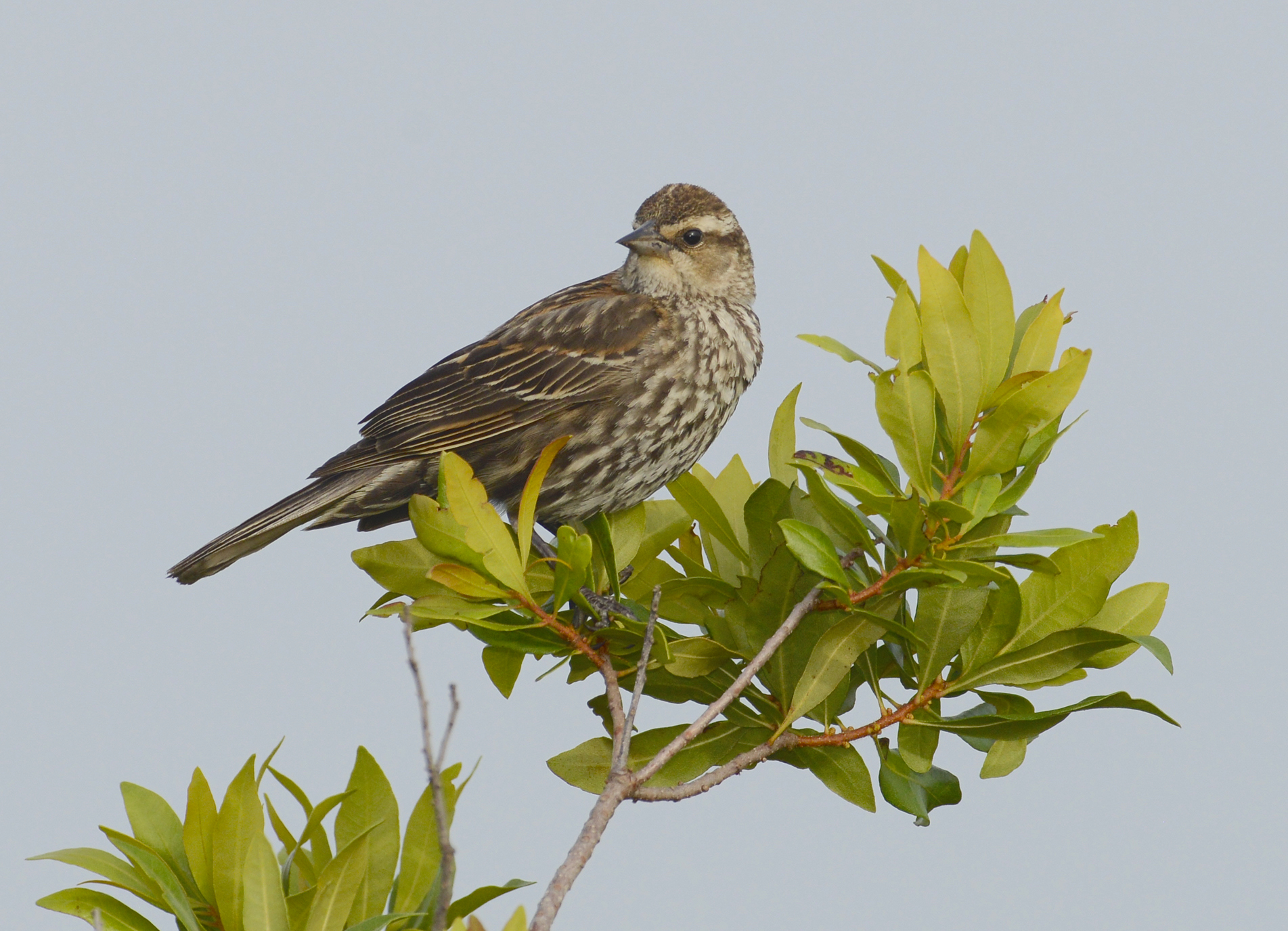
The females, as is often the way, are less showy. I have read that they are ‘nondescript’ or ‘dull’, which is unnecessarily harsh, I reckon. Here are a couple of examples.
And the darker brown ones that are clearly not handsome black males? These are young males in their first season, before they move on to the full adult male plumage. Originally I had designated them as females (as I had assumed). I was very gently corrected by the legendary bird expert Bruce Hallett. I took the first male juvenile at Casuarina, when I also made the sound recording (below). The second was at Delphi (with some ‘light’ issues, I notice…).
Fledglings are kind of cute…
SO WHAT DO THEY SOUND LIKE?
You may need to turn up the volume a bit. You will also here a lot of dove noise and, in the background, the sound of waves lapping onto the shore.
Photo Credits: Tom Sheley (1, 2, 4, 5, 8); Alex Hughes (3); Keith Salvesen (6, 7, 9 & audio)
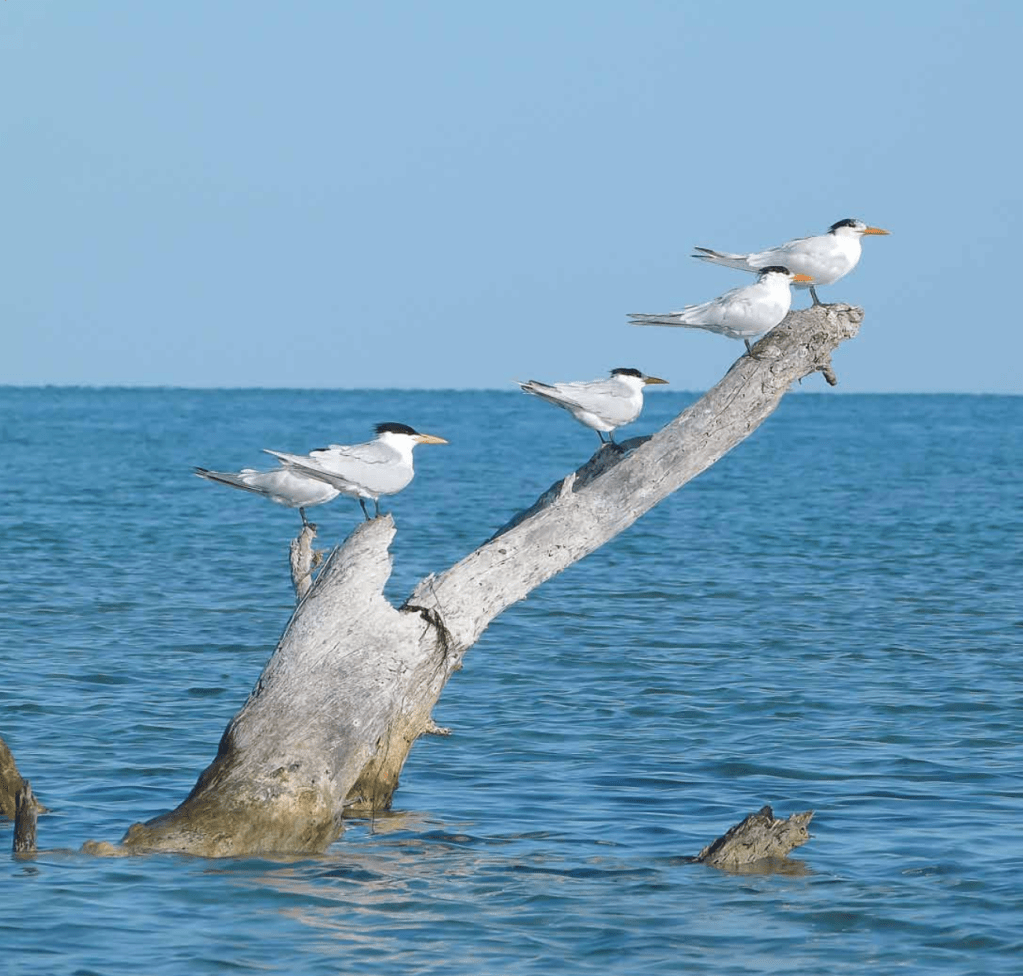
There are twelve species of tern – ‘swallows of the sea’ – that to a greater or lesser extent may be found on Abaco. Whether they will actually be visible at any given time is less certain, though. For a start, the only resident species is the lovely Royal Tern, available at many locations on Abaco and the cays throughout the year. Others are migratory, transitory or – rarest of all – vagrant birds blown off-course by wind or storm.
ROYAL TERNS Thalasseus maximus PR1
In the slightly less commonly-found category are the summer migrant terns that, by definition, are only in residence for around half the year. Four of these are fairly common in certain areas, and actually breed on Abaco; these include arguably the prettiest of all, the bridled tern. The other two tern species (gull-billed and sandwich) are more rare and do not generally breed locally.
LEAST TERN Sternula antillarum SR B 1
BRIDLED TERN Onychoprion anaethetus SR B 2
ROSEATE TERN Sterna Dougallii SR B 2
SOOTY TERN Onychoprion anaethetus SR B 2
GULL-BILLED TERN Gelochelidon nilotica SR 3
SANDWICH TERN Thalasseus sandvicensis SR 4
There is one rare winter resident migratory tern species. I had to check when the last one was recorded for Abaco. It was of course only in January this year, when ace birder-photographer Sally Chisholm saw one at Treasure Cay and managed to photograph it for posterity.
FORSTER’S TERN Sterna forsteri WR 4
The final four ‘Abaco’ terns are very much the occasional visitors. Three of them pass over the Bahamas on their longer migration, but may make a pit-stop around Abaco to take on fuel. Likelihood of sighting one? Slender but not impossible… The fourth, the Arctic Tern, is a very rare vagrant, a bird well away from its usual home or migration route as the result of storms or faulty satnav or sheer happenstance. Don’t travel to the Bahamas intent on seeing one.
CASPIAN TERN Hydroprogne caspia TR 4
As for the remaining three species, they are the transient black tern and common tern; and the vanishingly rare vagrant Arctic tern (the clue is in the name). No photos of any of these I’m afraid, so here’s a handy checklist instead.
ELECTIVE MUSICAL DIGRESSION
Written by Peter Seeger a few years earlier, Turn x 3 was released in 1965, the title track on the second album from the Byrds. At a rather febrile time in US history (Vietnam, draft riots, black civil rightists v cops and so on), this unusually palliative and thoughtful song with its religious connotations to some extent stood for peace and hope in a time of turmoil.
Photo credits: Keith Salvesen (1, 2, 3, 5, 18); Tony Hepburn (4); Alex Hughes (10, 11); Bruce Hallett (6, 7, 12); Woody Bracey (8, 13, 16); Duncan Wright (9); Dick Daniels (14); Sally Chisholm (15); Keith Kemp (17)
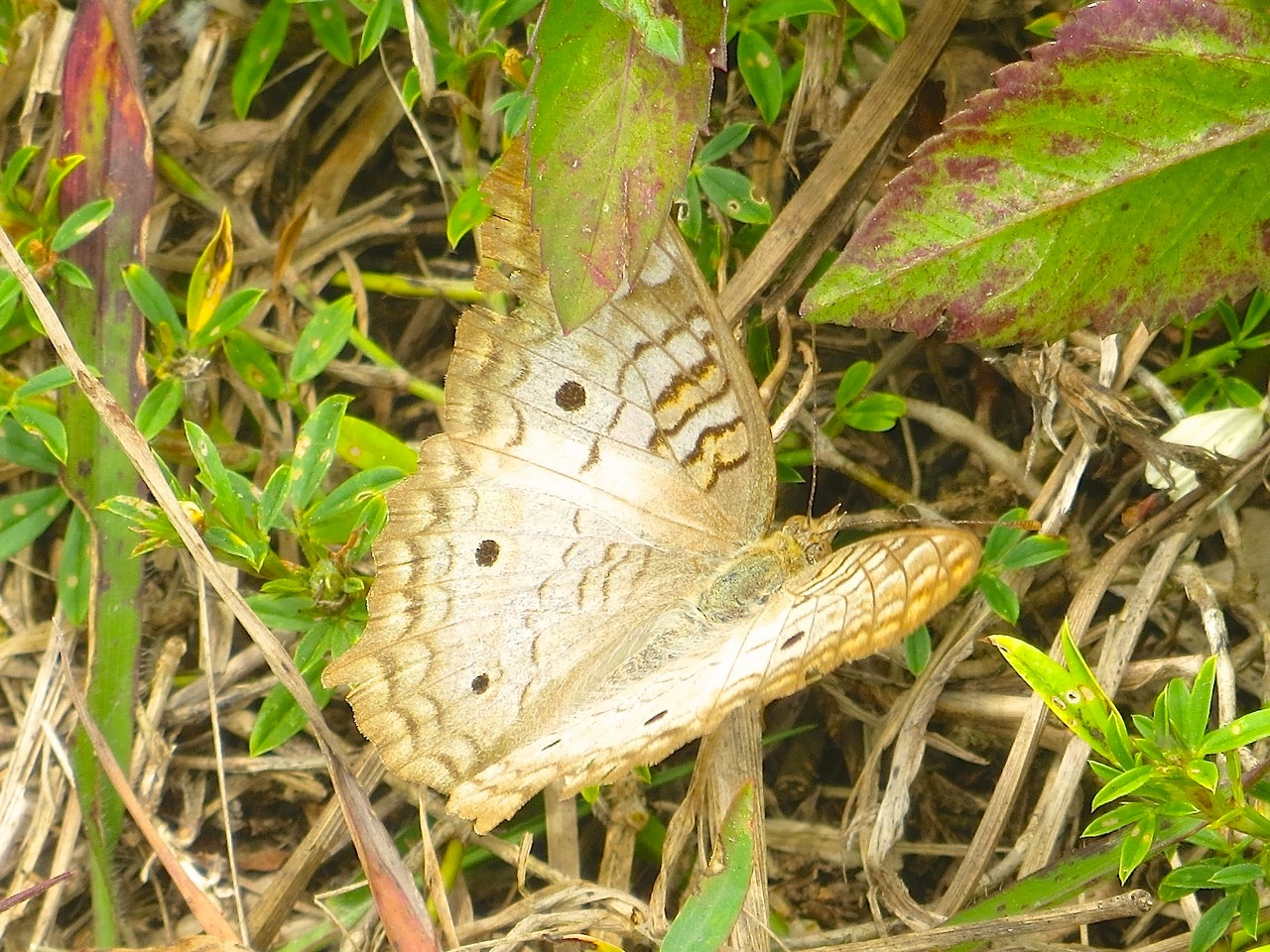
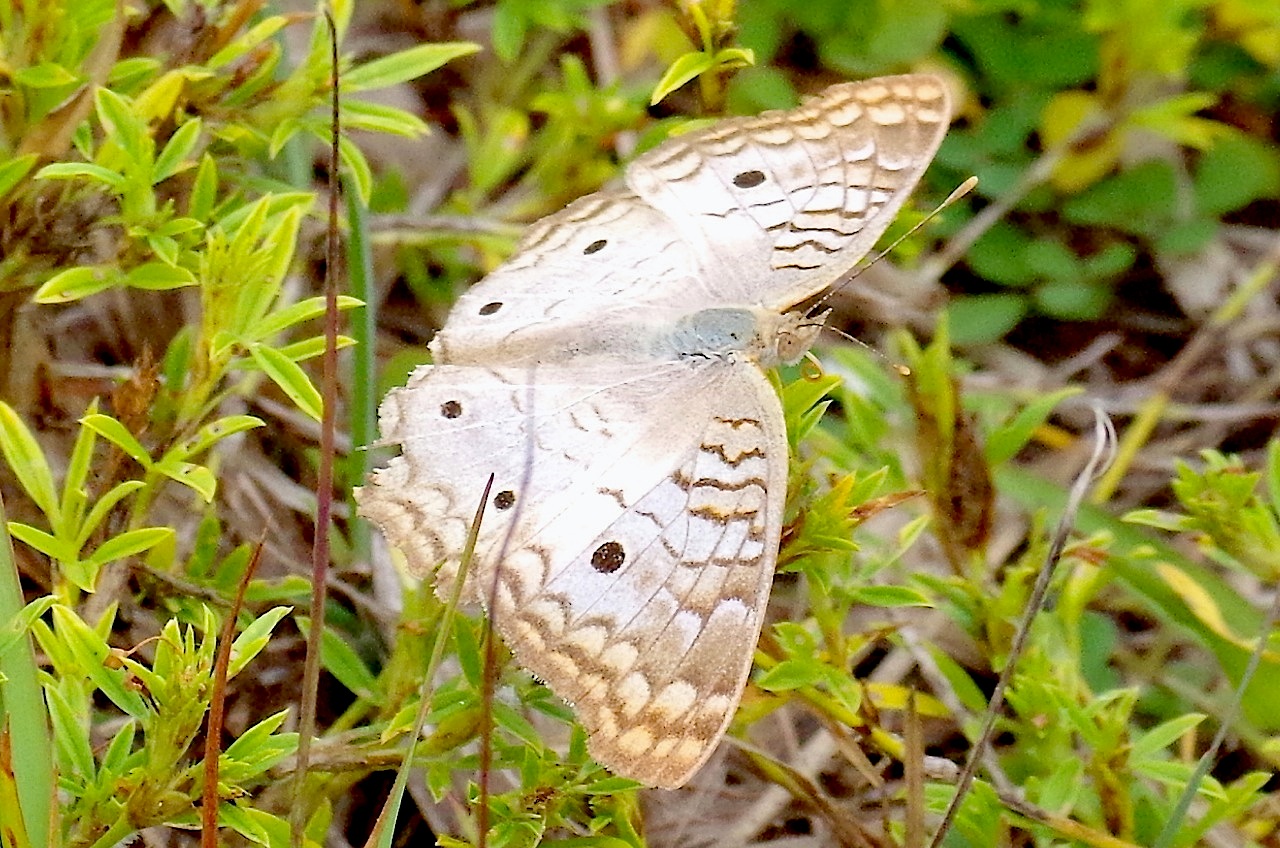
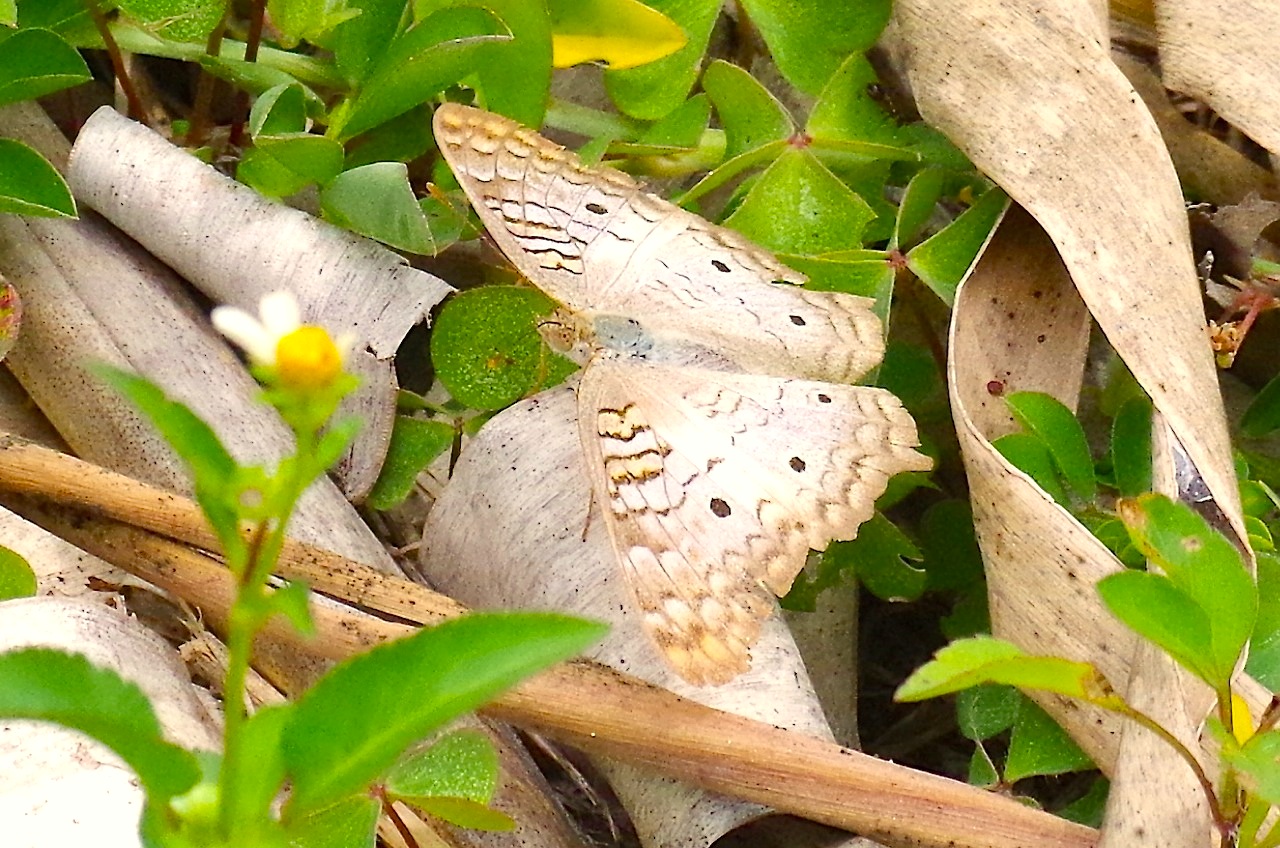
The white peacock (Anartia jatrophae) is not a rare butterfly in the northern Bahamas. However, until recently I had never – or never consciously – seen one before. Then we came across a few, all very frisky and mostly refusing to settle for more than 1/100 second. By the time I have remembered to remove my lens cap, they are 50 yards away.
I checked out these pretty but unassuming butterflies online because they seemed rather pale and anaemic. As far as I can make out this is because they were still in winter colouring; in summer they are more brightly marked. Here’s a photo of a dishevelled white peacock taken in June at Delphi by Charlie Skinner, which shows stronger colours.
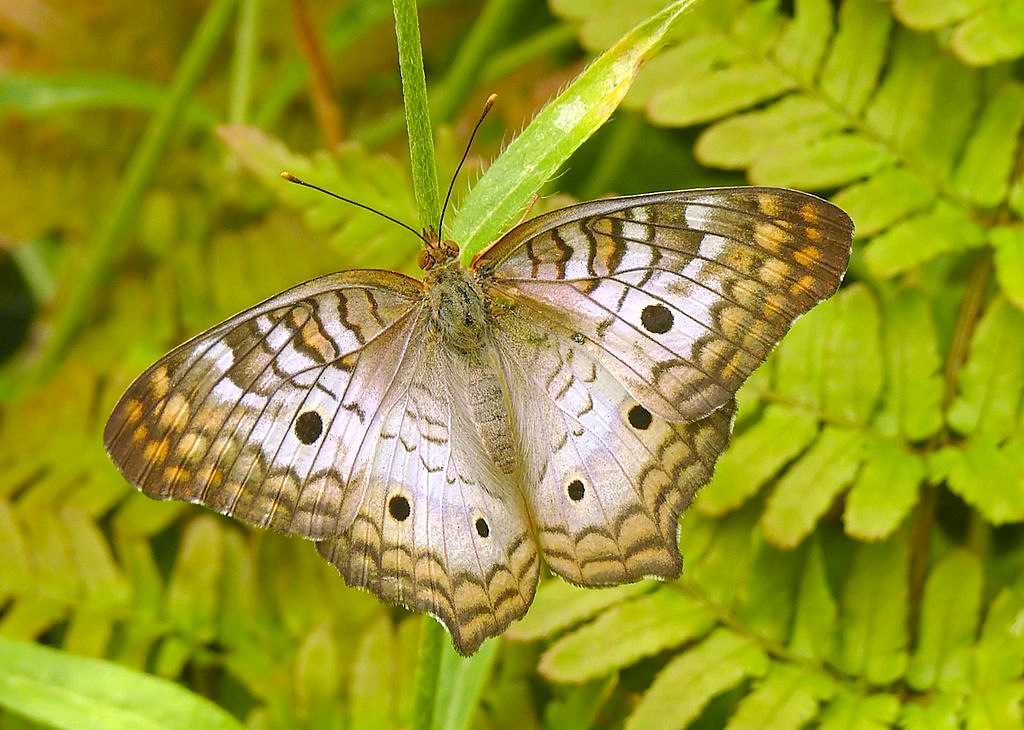
ARE THEY EVER FOUND LOOKING BRIGHT AND NOT FALLING APART?
Yes, of course, but interestingly, never ever in the field. The one below, non-anaemic and intact, was thoughtfully uploaded to Wiki by Greg Hume. He took it at a butterfly show, where presumably tatty butterflies are excluded…
Photos: Keith Salvesen 1 – 4; Charlie Skinner 5; Greg Hume 6
In January I will be returning to Abaco for a few happy days, for the BMMRO biennial Retreat. I haven’t been back since before Dorian and Covid. I am pretty excited by the prospect, having really missed the island, the friendships, the birdlife, and a whole lot more. During the long interval I have kept in close touch – most days, it seems – and continued with this blog.
Birds and marine mammals have always been the main theme, but there’s a great deal more to investigate in the MENUS. Between now and my visit, I plan to post some wonderful bird photos from my book BIRDS OF ABACO. Mostly they will by contributors; a few may by me.
BIRDS OF ABACO: THE DOWNLOAD
The whole edition was sold out ages ago, so unfortunately I wasn’t even able to replace lost / damaged copies. However I recently compressed the entire book into an 18mb file. Do pass it round; please don’t monetize it!
Reduced to 18mb for 10 – 15 second loading; no noticeable loss of definition
Below the screen BIRDS OF ABACO enlarges the screen, DOWNLOAD will do just that
The top bar contains all the usual ways to make adjustments to the contents
This is the penultimate version before printing, with a few crop marks etc
Please let me know if there are any problems with the download
The download is free and can be scrolled on-screen or saved in the usual way. Do share with family and friends. By all means use parts – eg the Checklist – to print for reference. It’s fine to print out a single complete copy for personal use only.
As mentioned in previous posts, I am asking those who choose to download the book to make a modest charitable donation to a local wildlife-related cause or to a local school or an organisation that inspires kids to get involved in the natural world around them.
KEITH SALVESEN
March 2024
rollingharbour.delphi@gmail.com
Thanks to all the many people who contributed to the book including 30 photographers who took brilliant photos; 3 Bahamas bird experts who contributed greatly to the composition and accuracy of the book; the superb printers Conti in Italy; Peter Mantle the inspiration and eminence grise; and my wife Sally whose publishing and editorial skills are second to none, and her patience limitless.
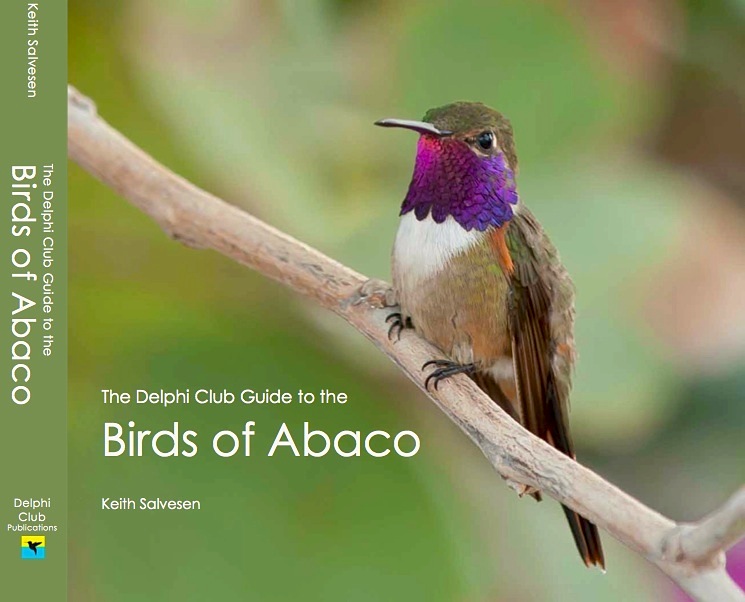
It is exactly 10 years since The Delphi Club Guide to the Birds of Abaco was launched in the Great Room at the Delphi Club, Abaco, Bahamas. Availability of the book had run its course by 2020. A decade after publication, preparations to compress the entire book into a downloadable e-book are now complete.
Cuban Emerald (M) – Keith Salvesen
FREE AS A BIRD
This has not been planned as a monetised project, so the ‘Book’ will be free to access online; and free to download using a linK. You can send the book to family and friends of course. By all means print out specific extracts, for example the checklist which might be fun to use for finding out the likelihood of seeing a particular bird and / or keeping a record of sightings.
It would be slightly disenchanting to find that the whole book is being printed out without checking first. This can be simply done using rollingharbour.delphi@gmail.com
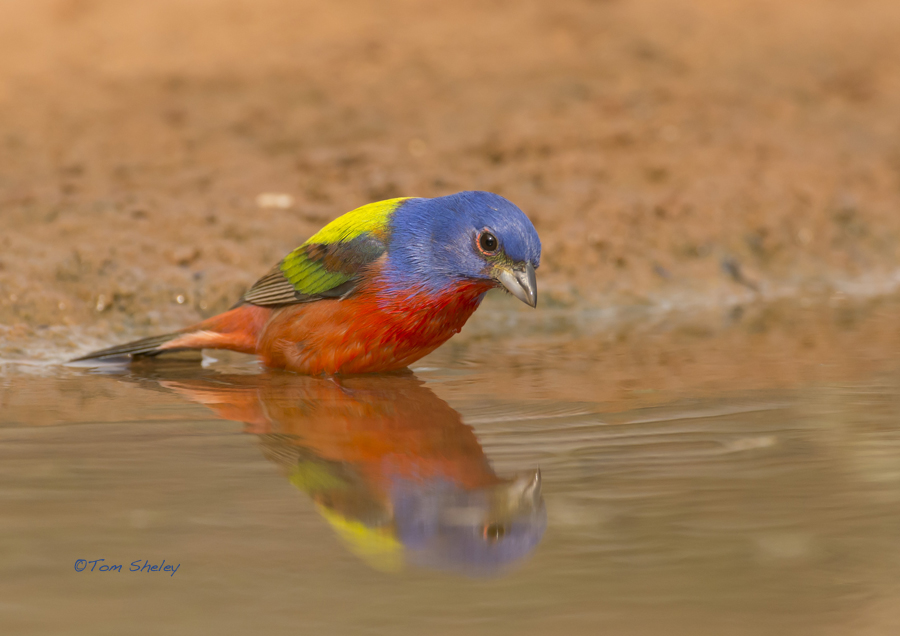
Painted Bunting – Tom Sheley
$10 TO CELEBRATE THE BIRDS OF ABACO AND THE JOY THEY BRING TO THE WHOLE COMMUNITY
I am asking those who choose to download the book to make a charitable donation of $10 (‘a dollar a year’ since publication) to a local wildlife-related cause or to a local school or an organisation that inspires kids to get involved in the natural world around them. Or more than $10 by all means. There’s plenty of choice on Abaco, as I am sure there is for kind followers of Rolling Harbour who live beyond the island’s shores.
Great Egret – Tom Sheley
Killdeer – Bruce HallettWestern Spindalis – Keith SalvesenCuban Pewee – Keith Salvesen
We birds want to know what’s going on please. The rest of the ‘Abaco Bird Book Club’ have nominated us to find out. So:
Q. How likely is it that we ‘guys’ will somehow be getting inside a machine and turning up in people’s homes / on their phones (whatever those are). A. Very
Q. How long must we wait before being admired on a screen by humans – we all quite fancy that. A. A week or so
Q. Are we birds going to get any seeds / insects / berries / fish in return. A. No. You will be free. And free as a bird as well.
Q: WHAT HAS THE GESTATION PERIOD OF A WALRUS (16 MONTHS) AND WEIGHS THE SAME AS A PAIR OF FULLY GROWN PINEAPPLES (2 KILOS)? A: THE BIRDS OF ABACO
FIRST FLYER
It is February 2014, and two pallets carrying 500+ heavy books in boxes have just arrived in Nassau. Printed in Italy at the end of January, the cargo had made its way from specialist printers in Florence via Bologna, Leipzig, Brussels, Cincinnati, Miami to Nassau. They spent an unexpectedly long sojourn in Nassau while formalities were unhurriedly dealt with, then made their way safely to the Delphi Club. In early March, the book was launched in the Great Room at Delphi.
Delphi Lodge 2014
The book was generously received. The Delphi years rolled by: happy years of amateur birding, incompetent bonefishing (me), adventures, companionship, conviviality, Kalik. Then a change of ownership at Delphi; the destructive power of Dorian; and the tentacles of Covid spreading round the world.
10 years on at Rolling Harbour Towers HQ, a plan is hatching like an Abaco parrot’s precious egg. Might there be an audience ready for some kind of e-Edition of the whole book, checklists and all? Technology has moved on since 2014. Even I have now read an eBook. There’ll be some tech-stuff involved to get the most practical way to proceed. I’ll need to check with the birds first, and we will get back to you.
SECOND FLYER
Sanderlings on the beach at Delphi – more interested in snacking than eBook stardom
I put together this little booklet ages ago, a composition of photos, science-based material, and amateur text. We used to give them to interested guests at Delphi in exchange for a small wildlife-based contribution. In due course I put together this short video. Tech was quite limited then so the quality isn’t great. If you have 2 -3 minutes to spare, I hope it won’t seem to be time wasted.
Almost all the contents are as relevant now as then. Changes in the parrot population have been affected regularly by various weather events, from storms to Dorian. The numbers seemed to be on the up after the hurricane, with increasing sighting reports, I notice, but at the moment I don’t have the latest information on population recovery.
Booklet and Video: Keith Salvesen aka Rolling Harbour. Fine to share this if you like, maybe a credit if you feel like it.
Thanks in particular to Caroline Stahala and her dedicated parrot research project; Sandy Walker; all photographers; the parrots.
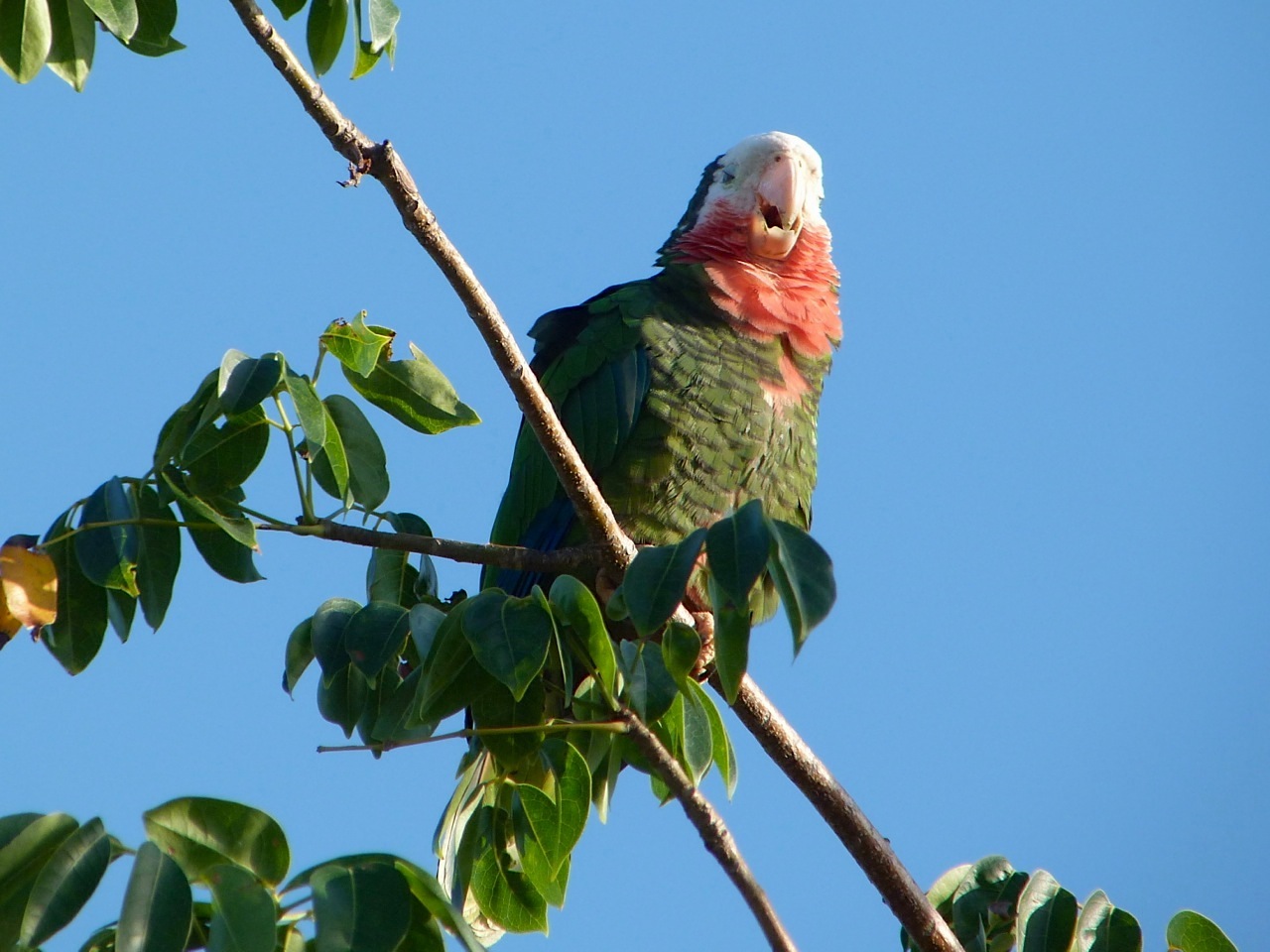
Abaco Parrot Amazona lecocephala bahamensis – Keith Salvesen
A small New World songbird of the cardinal subfamily
Flags and other colourful festive decorations
PAINTED BUNTING
Few birds radiate Yuletide vibes better than Painted Buntings, with their perfect festive colours. Here is a seasonal flock of them to enjoy. A very happy Christmas to those who kindly continue to visit Rolling Harbour, despite the unavoidable absence from the Bahamas of the Harbourmaster.
ABACO, BAHAMAS has been all but destroyed by Hurricane Dorian. The horrendous scale of the disaster in human terms alone is only now becoming clear as the days pass and new tragedies are revealed. Many established relief funds – international, national and local – are being very generously supported for the benefit of those who have suffered so grievously. I am adding to the number through my specific link to Abaco and its wildlife.
For obvious reasons, the GFM page (in edited form here) has a rather more formal , explicatory tone than I would usually use.
Sally and I were founder members of the Delphi Club, Abaco and retain strong connections with the island and the community. I run a conservation program for rare migratory plovers that overwinter on Abaco; and I am involved with BMMRO & its marine mammal research.
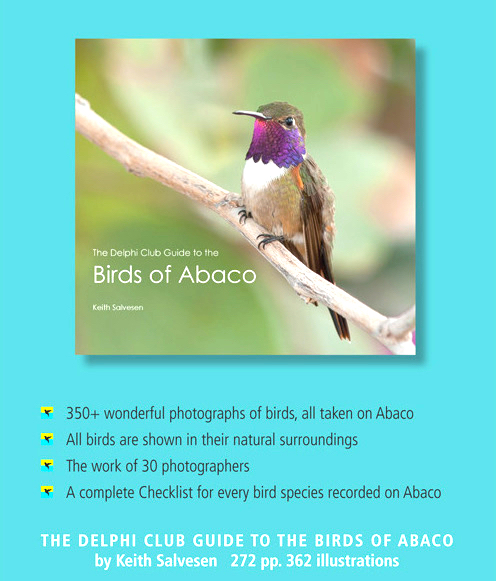
‘THE BIRDS OF ABACO’, of which I am the author, was published in 2014. The book was designed by Sally and published by Peter Mantle / The Delphi club. By the end of last year the edition had sold out, and all planned educational donations to schools, libraries and relevant organisations had been completed.
However, I have a couple of dozen books left in the UK. Through this fundraiser, I am offering a copy of the book in exchange for a donation of $150 (or the equivalent). The resulting fund (minus the cost of fulfilment from the UK) will be added to the funds achieved by the Delphi Club through theirDORIAN RELIEF FUND .
A higher donation is of course encouraged; and please note, it is not compulsory to receive a bird book. Smaller donations are extremely welcome too, and for those of $50+ I will offer the donors a high-res PDF of a bird of their choice from a selection of several significant species found on Abaco; or a PDF of the complete bird species checklist for Abaco. That’s voluntary too.
The original price of this large photographic book was $145. It showcases the wonderful birds of Abaco with contributions from 30 photographers. Almost all are either residents of Abaco, or have strong connections with – and affection for – the island and its cays.
The books can be sent to Bahamas, USA, Canada and Europe. For any other destination, please contact me before you make a donation. Books will not be dispatched before October.
Please note that the Delphi Club does not have a stock of books and is not directly involved with this fundraiser. Please contact me with any inquiries, even though the Club details are shown on the pre-publication flyer below.
BUNTING(S) FOR AN ABACO CHRISTMAS: AN OLD TRADITION
BUNTING /ˈbʌntɪŋ/ (Noun)
[A Christmas gift of a puntastic avian / festive double-meaning]
A small New World songbird of the cardinal subfamily
Flags and other colourful festive decorations
PAINTED BUNTING
One of the Winterval traditions at Rolling Harbour HQ – that haven of unreliable natural science powered by lazy insouciance and characterised by a regrettably unserious approach – is to break the rule that (mostly) forbids reposting old material without good reason (which there occasionally is). This means marking the imminence of Christmas with bunting. And indeed buntings, those lovely birds beautifully painted by nature. Nothing says ‘Happy Christmas’ better than a flock of PABU!
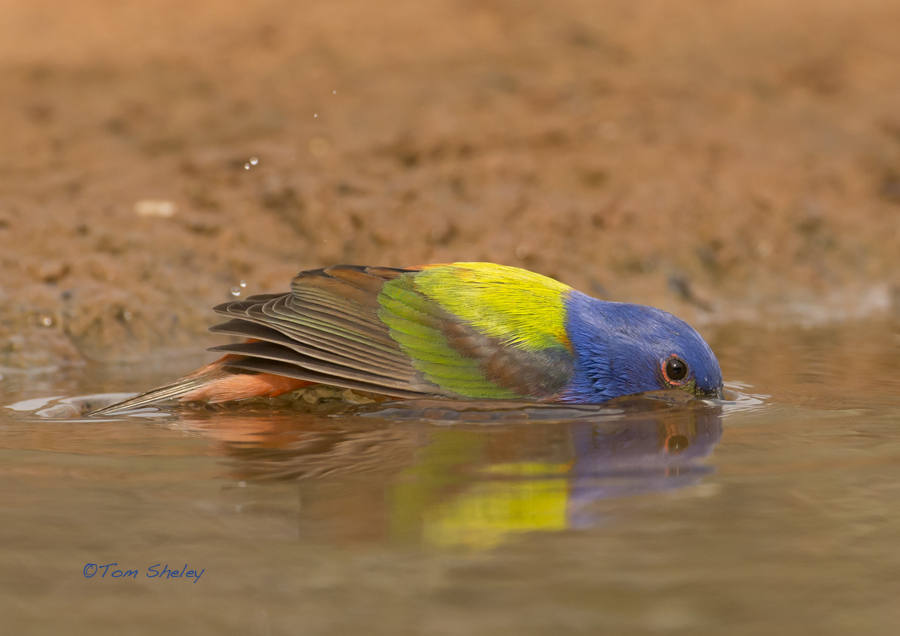
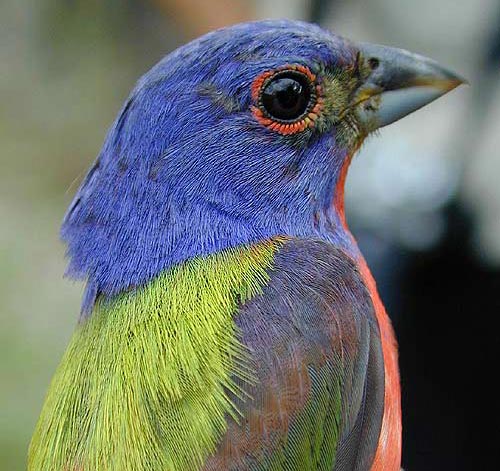
It’s hard to imagine a more Christmassy little bird than the Painted Bunting. Bright blue, red, green primary colours straight from a child’s paintbox make for a spectacular bird to grace the festive season. These are migratory winter residents, and the first reports of the bright and beautiful males on Abaco started to appear in late October. Some will stay around until March.
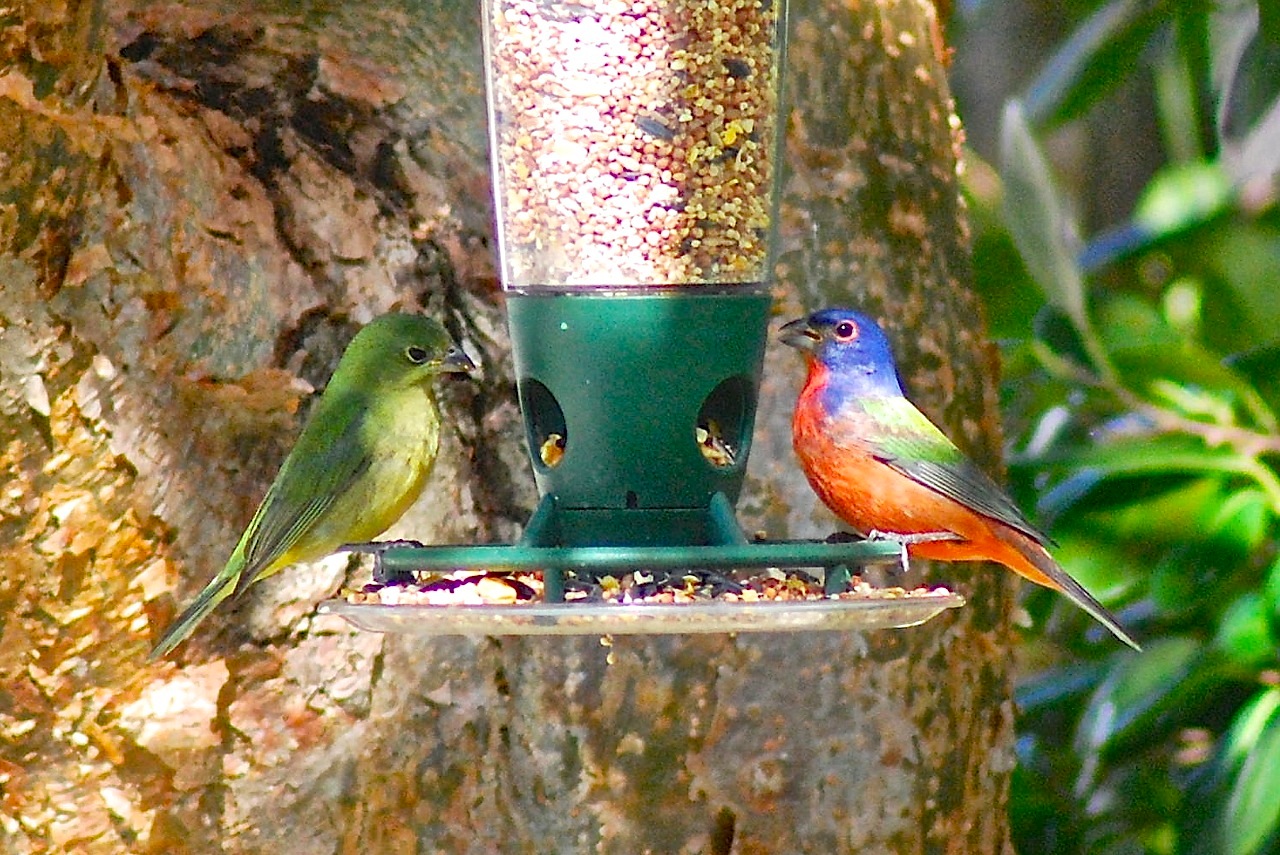
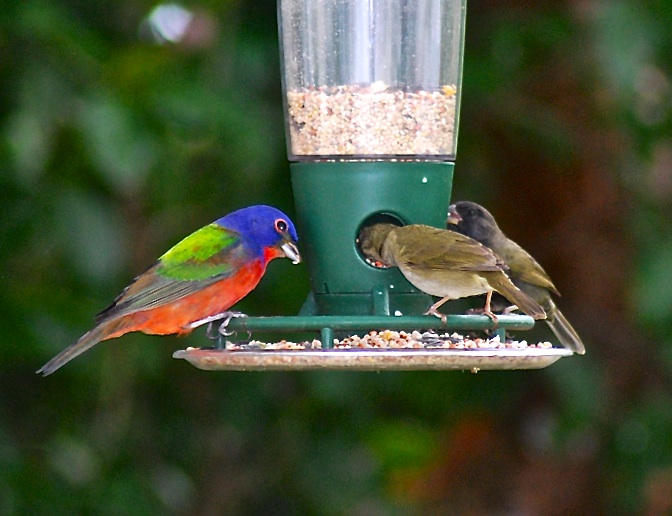
A female & a male PABU feeding together, and a male with a pair of black-faced grassquits
The two wonderful photos below are by Tom Sheley, a major photographic contributor to THE BIRDS OF ABACO. They were actually taken in Texas, but I include them because of Tom’s strong connection with the birdlife of Abaco; and also because they are fantastic shots…
This is my opportunity to wish a very Happy Christmas or [insert preferred seasonal appellation] to everyone who visits Rolling Harbour and especially those who, having done so, return for more! There could of course be anything from 600,000+ individuals who called in once, were put-off and never came back… to one sadly crazed person who has been pressing the ‘read’ button 600,000+ times over the last few years. If the former, thanks for trying, sorry to disappoint. If the latter, keep up the good work, buddy.
Credits: Tom Sheley (1, 7, 8), Erik Gauger (2), Tara Lavallee (3, 4), Keith Salvesen (5); Sandy Walker (6); Birdorable Cartoons
Every day of the year, or so it seems, at least one worthy creature has been awarded an ‘Appreciation Day’, a special day when a particular species has its profile raised and awareness spread around. It certainly seems to be the case with birds; I’m going to assume that it applies to all the other classes of animal – mammals, fish, reptiles, amphibians and invertebrates, each with their own worthy candidates for recognition. Except for no-see-ums, obviously. And fire ants, I hope. You’d think standing on a nest while taking photos just once in a lifetime would be a lesson. I’ve done it twice… Anyway, yesterday was Plover Appreciation Day 2018.
PLOVERS ON ABACO
Until recently Abaco had 33 recorded shorebird species but since the first-ever sightings of a BUFF-BREASTED SANDPIPER in 2016, the number has risen to 34. Of these, a mere 6 are plovers:
Black-bellied Plover Pluvialis squatarola WR 1
American Golden Plover Pluvialis dominica TR 4
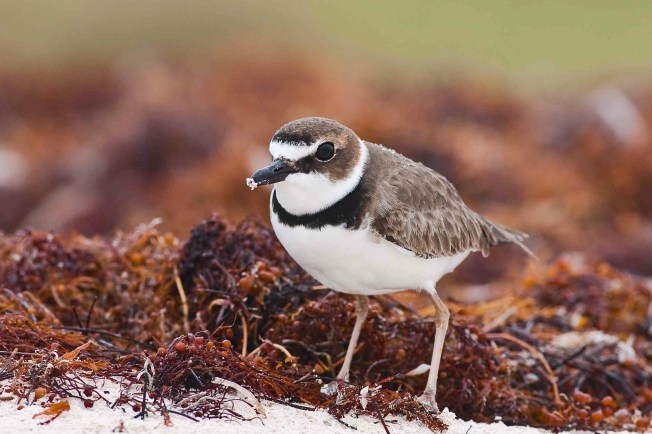
Wilson’s Plover Ochthodromus wilsonia PR B 2
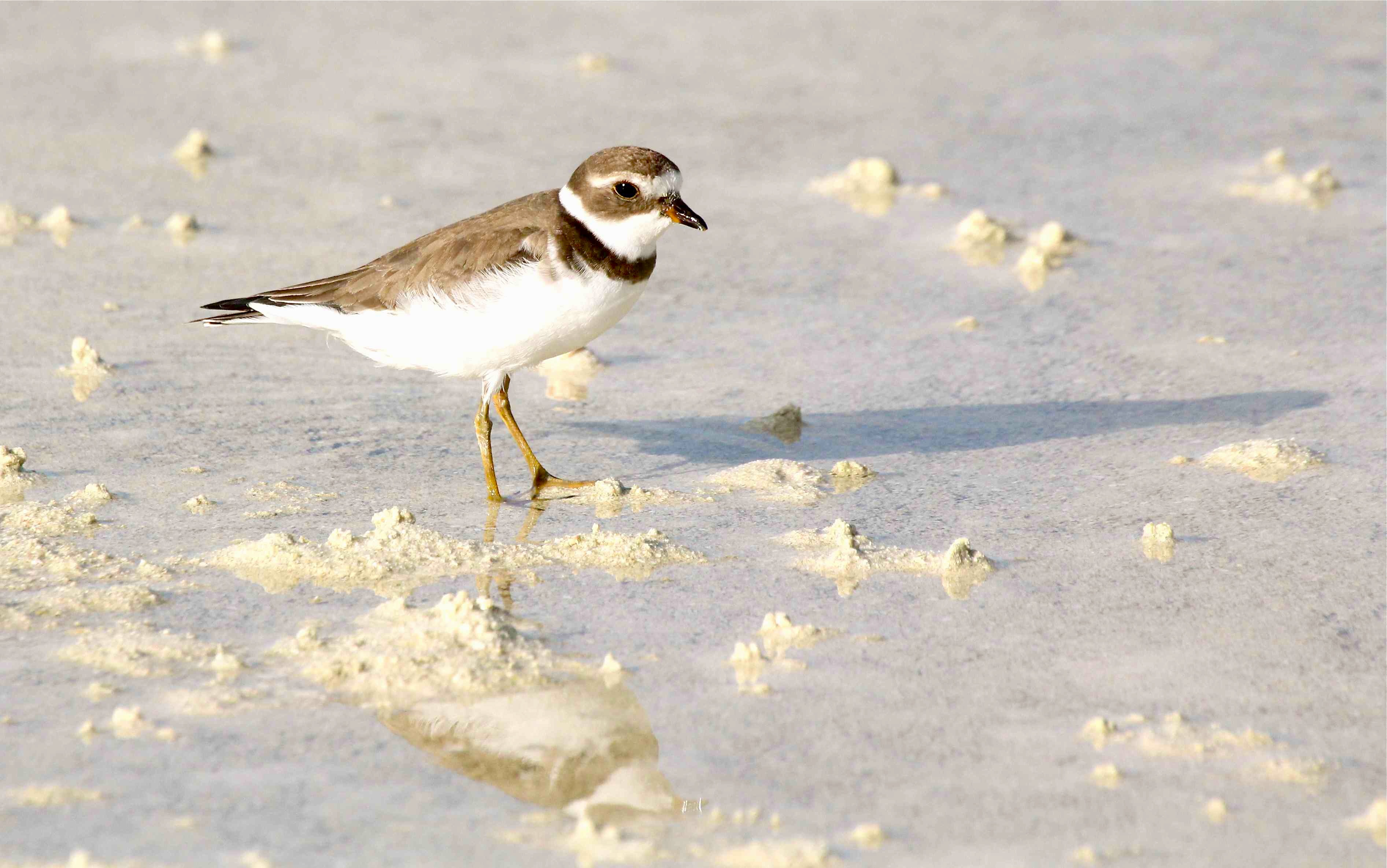
Semipalmated Plover Charadrius semipalmatus WR 2
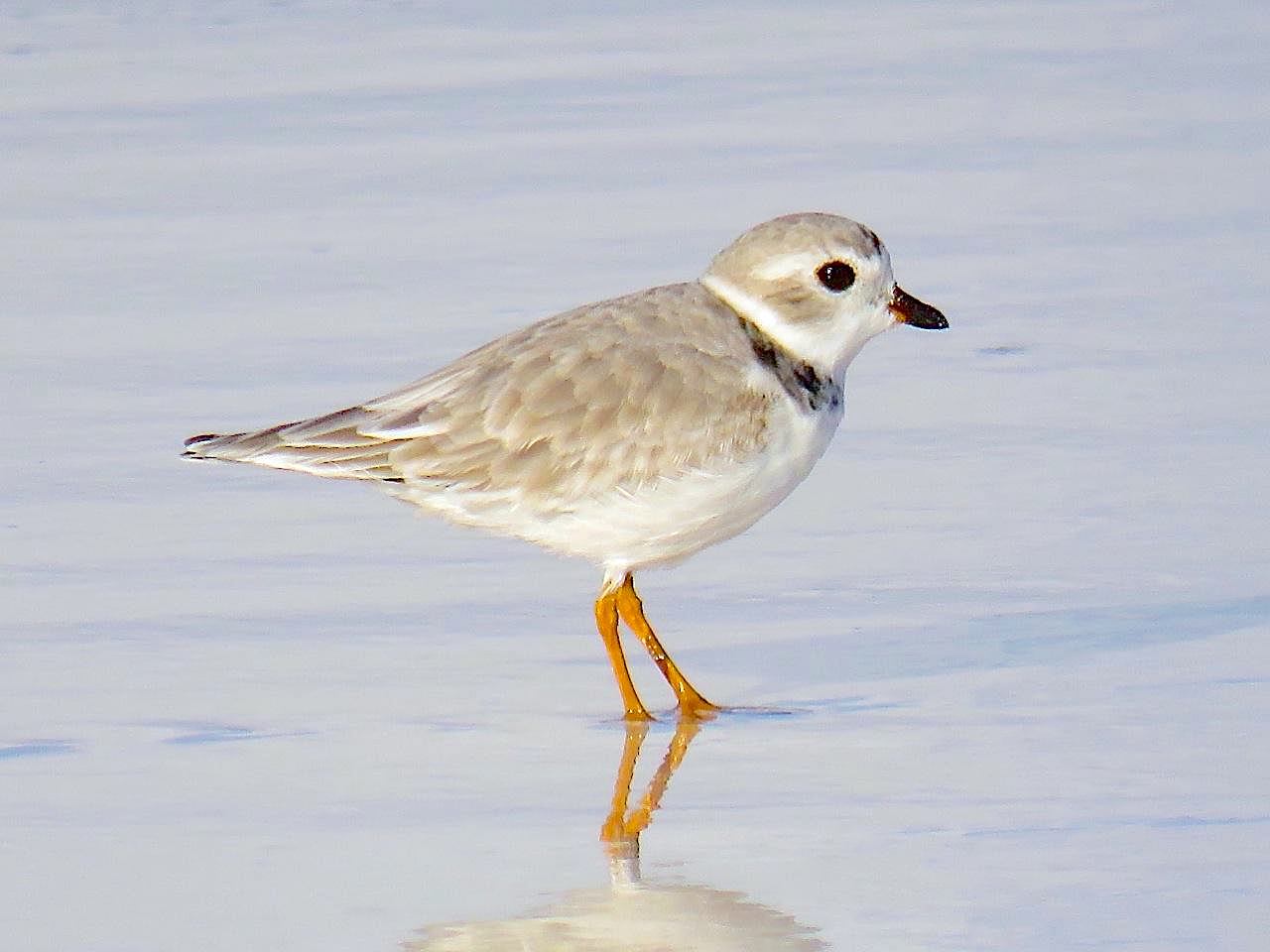
Piping Plover Charadrius melodus WR 3
Killdeer Charadrius vociferus WR 2
The codes tell you, for any particular bird, when you may see it (P = permanent, WR = winter resident, TR = transient); whether it breeds (B) on Abaco; and your chance of seeing it, graded from easy (1) to vanishingly unlikely (5)
The best-known of the 6 Abaco plover species is the Wilson’s Plover, because it is the only permanent resident. The American Golden Plover is a rare transient, but we luckily have a photo of one (below) taken on Abaco. All the others are winter residents and easy to middling hard to find.
The Piping Plover is the most interesting species, with a mere 8000 left in the world. There is a vigorous conservation program to protect them and their habitat, both in their breeding grounds in the North and their southern overwintering grounds. Their summer breeding range is in Canada and the Great Lakes, north-central US, and the eastern seaboard. In winter they migrate south, many to the Bahamas – and Abaco is one of their preferred homes. We count as many as we can between August and February, report the banded ones, and find out their origins and histories
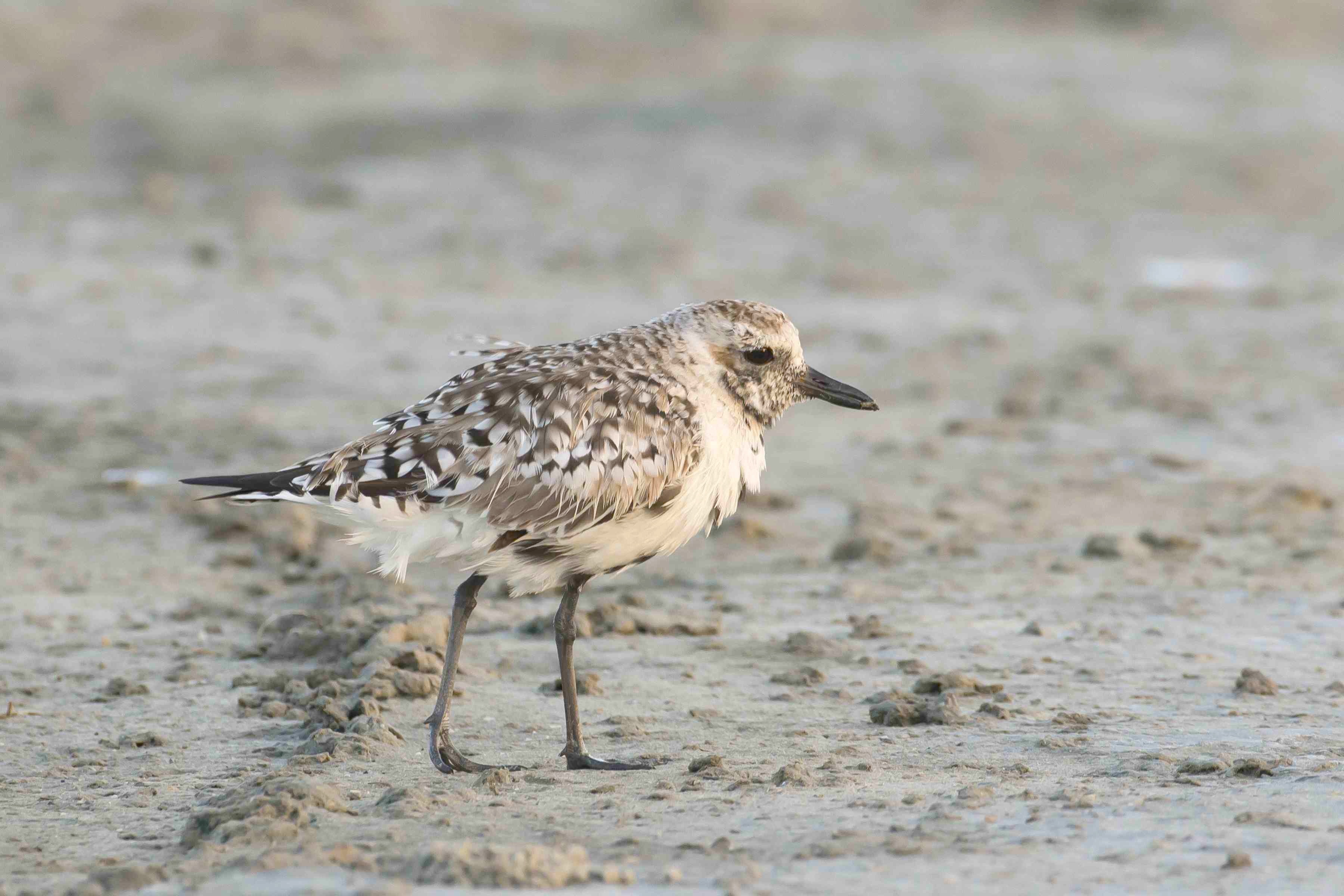
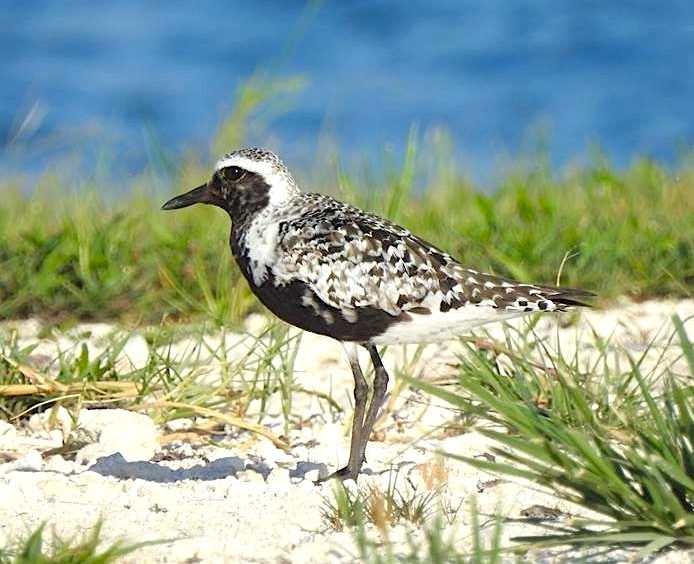
BLACK-BELLIED PLOVER Pluvialis squatarola WR 1
Non-breeding plumage (as you would see normally it on Abaco, without the black belly)
Breeding plumage – and the reason for the name
AMERICAN GOLDEN PLOVER Pluvialis dominica TR 4
SEMIPALMATED PLOVER Charadrius semipalmatus WR 2
KILLDEER Charadrius vociferus WR 2
PIPING PLOVER Charadrius melodus WR 3
WILSON’S PLOVER Ochthodromus wilsonia PR B 2
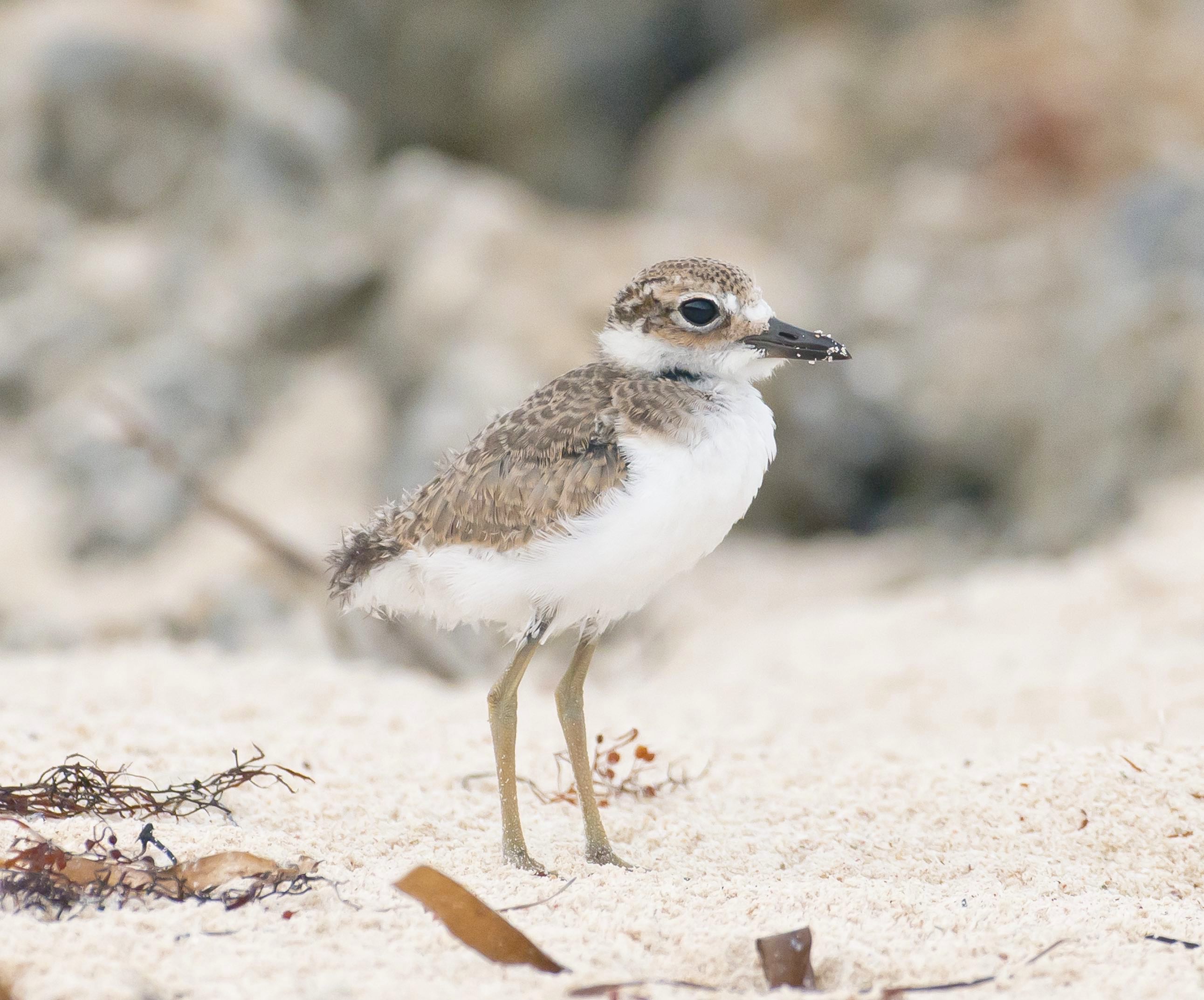
This permanent resident plover is a year-round presence on the Delphi Club beach, where in summer they nest and raise their tiny fluffball chicks. They are especially significant on Abaco as the only breeding plover species – it’s the only chance we get to see plover nests and chicks… (see header image and below).
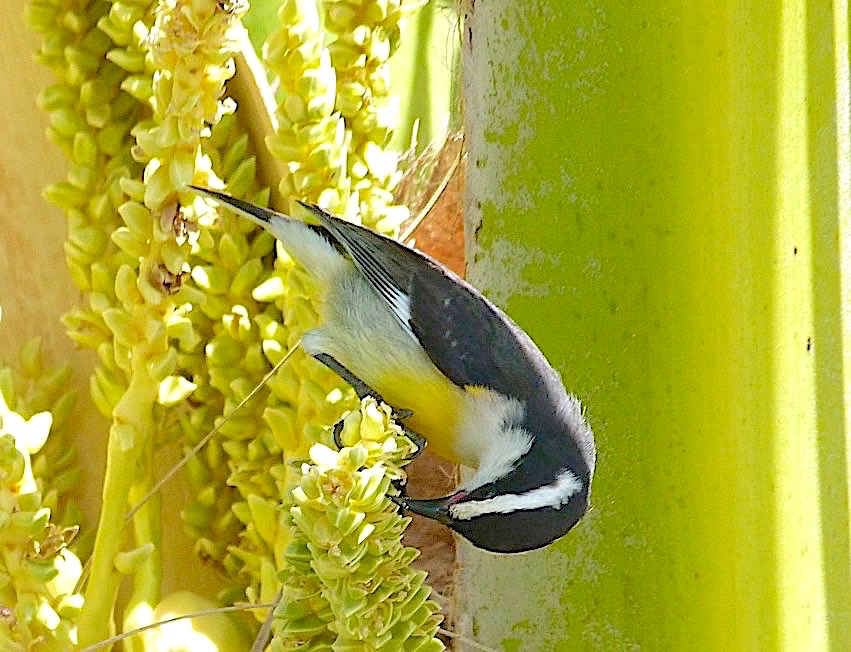
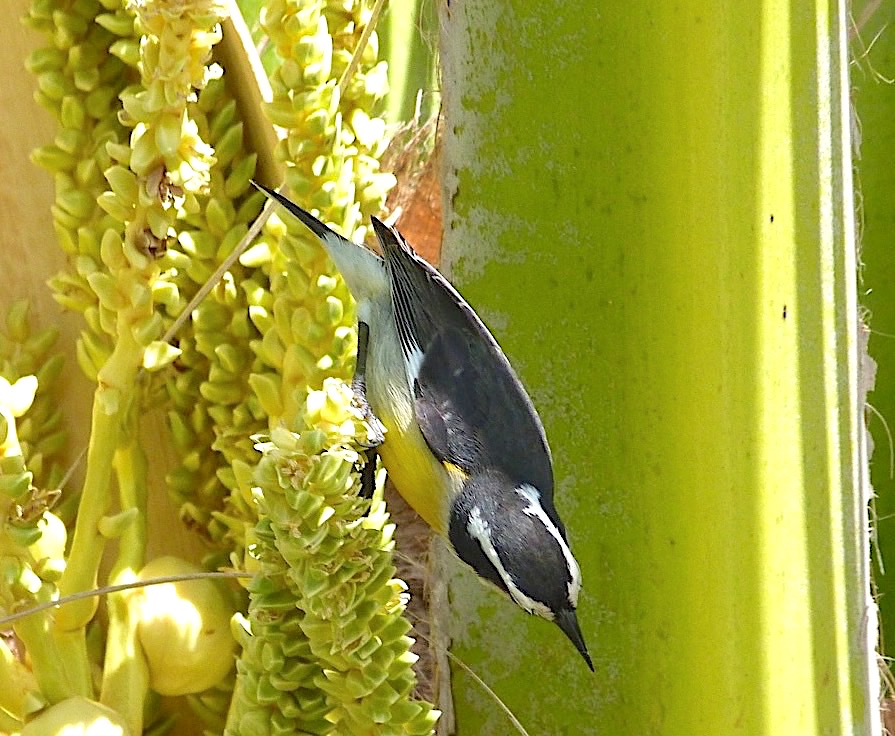
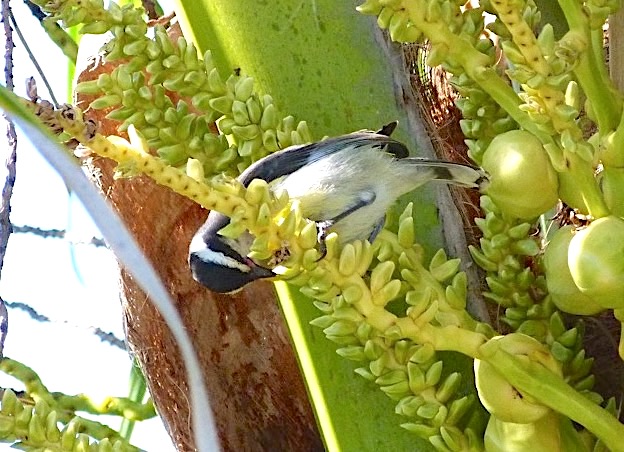
Bananaquits are smart. They look smart, of course, and they act smart too. Their diet consists mainly of nectar and fruit, so you’ll find them where there are flowering or fruiting trees and shrubs. Their sharp little beak curves slightly, enabling them to get right into where the good things are, as shown in this sequence of not-especially-good-so-I’ll-call-them-illustrative photos. And that beak gives then another method of reaching nectar – they can pierce the base of a flower and use the beak as a sort of probe to get at the nectar that way. And soft fruit? Easy!
All photos: Header, Craig Nash; the rest, Keith Salvesen – all at Delphi, Abaco Bahamas
“Nidification” was one of the new words I learned from the wonderful book Birds of the West Indies by James Bond (a different one – for the full story behind the name click HERE). It means, essentially, the nesting process of a bird. It sounds pleasingly technical for a straightforward concept: nest-building.
Soft furnishings being added
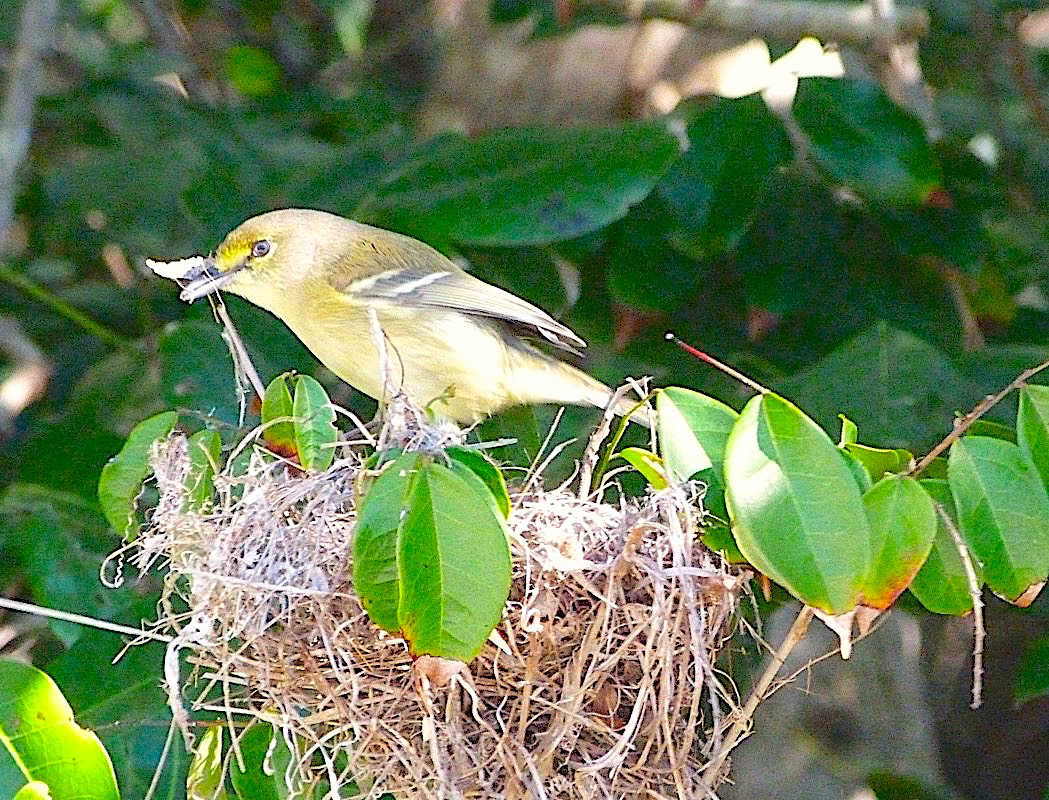
I spotted this TBV making its nest on the edge of the drive at Delphi. I usually think of these cheerful chirpy birds as ‘lurkers’, hanging back in the coppice and not making themselves easily visible. But this nest was right out in the open – possibly not the wisest place for nidification.
If you look up TBV’s in bird books, you may find a reference to nest building in the fork of shrubs or bushes – exactly what was going on here. It quite a messy nest, but then again it looks comfortable and firmly wedged in.
Although I only saw one of the pair actively engaged in the building, another TBV was ‘vocalising’ (there’s another technical term, = singing) nearby, presumably the mate. In a way that humans have been slow to adopt, both birds will be actively involved in raising their family, from incubating the eggs to chick care – feeding, cleaning out the nest and so on.
WHAT DO THEY SOUND LIKE WHEN THEY VOCALISE?
Let’s hope for a successful outcome to the nidification…
All photos Keith Salvesen, also the sound recording (made at Delphi)
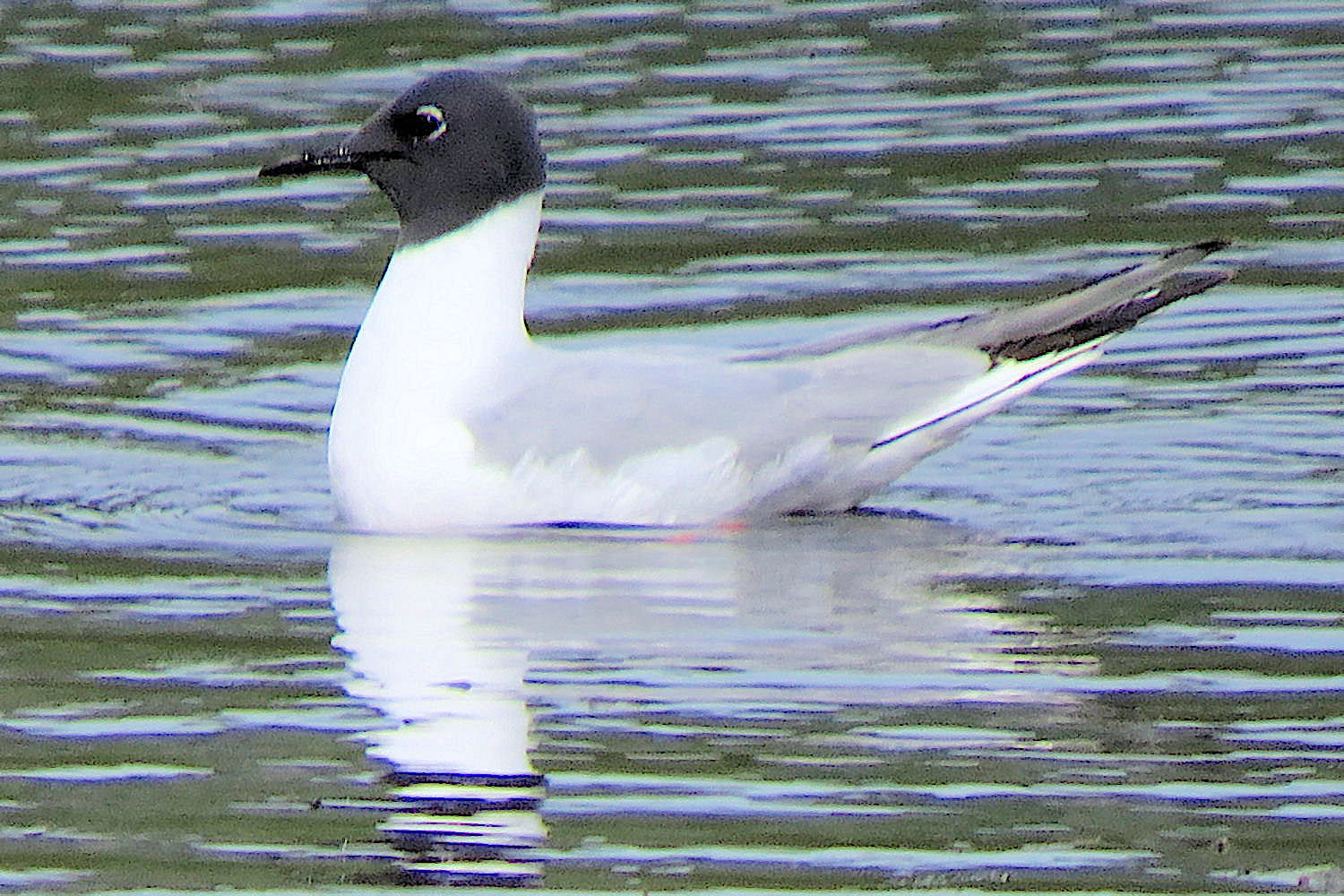
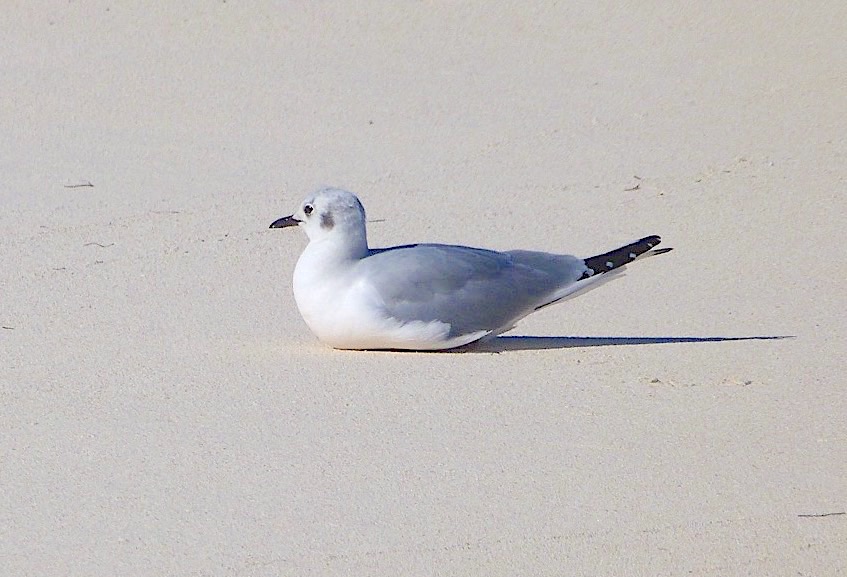
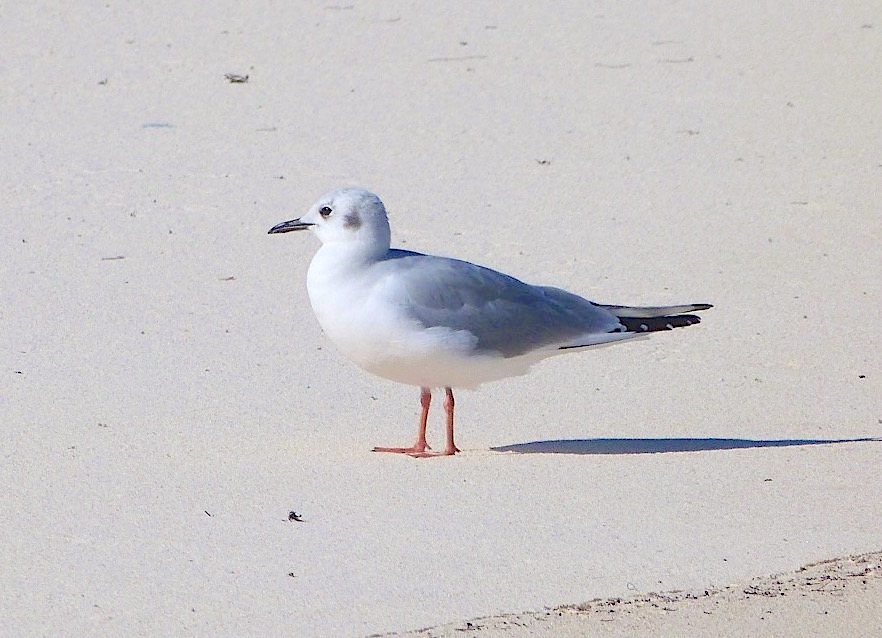
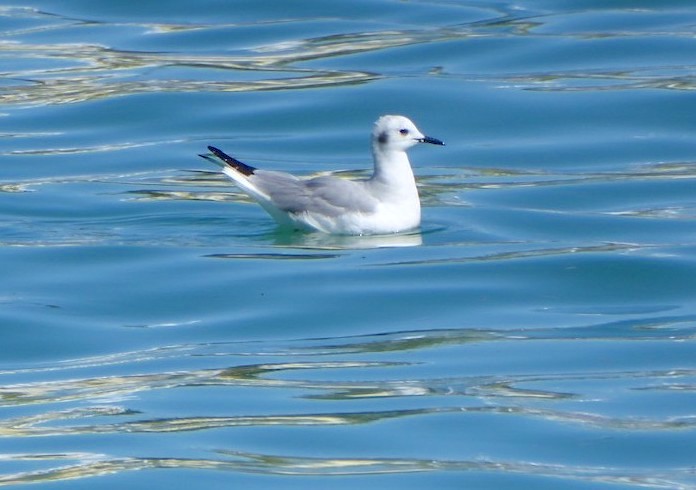
The Bonaparte’s gull Chroicocephalus philadelphia is one of the smallest gulls, and is found mainly in Canada and northern United States, though vagrants sometimes end up as far away as Europe. And Abaco. These birds are considered very uncommon winter residents on Abaco (categorised WR4). Yet within the last couple of months Elwood Bracey saw an amazing 4 in Treasure Cay harbour… Milton Harris reported seeing one at Hope Town harbour… Keith Kemp saw a couple on South Abaco (2 locations)… Eugene Hunn reported 1 on the Sandy Point dock… then suddenly there were 3 on the beach at Delphi. They have hung around there, too – let’s hope that all these birds find their way back to their breeding grounds safely. They have quite a journey ahead of them.
The species is named for Charles Lucien Bonaparte, a French ornithologist and nephew to the French emperor (see below for more about him). The philadelphia part of its Latin designation oddly results from the location from which the original ‘type specimen’ was collected (see below for the reason). This is not unlike the Cape May warbler, so named for the location of the original specimen, yet not recorded there again for more than a century (and still quite rare)…
The gulls shown here are in their winter plumage, with the characteristic dark blotch behind the eye. In the breeding season, they acquire smart slate-black hoods:
10 BONAPARTE’S GULL FACTS TO TELL YOUR GRANDCHILDREN
Graceful in flight, resembling terns as much as gulls
Monotypic: the sole representative of its taxonomic subgroup
Males and females have very much the same colouring
Believed to be monogamous
Showy breeders, with much display, swooping, diving, yelling at each other etc
Typically (and ungull-like) they nest in trees, preferring conifers eg jack pine
Share nest-building and parenting duties
Capable of considerable aggression to protect their nests / chicks
Have been known to live 18 years
The only bird species with an Emperor’s name (prove me wrong!**)
We saw these birds on the beach most days, usually just 2 of the 3 at any one time. They were quite shy and hard to get close to, however subtly. And they kept on the move – except when they decided to have a rest.
TELL US MORE ABOUT PRINCE BONAPARTEBonaparte’s gull, Zenaida dove
Charles Lucien Bonaparte, 2nd Prince of Canino & Musignano 1803 – 1853
Bonaparte was a French biologist and ornithologist, and the nephew of the Emperor Napoleon. He married his cousin Zenaïde, by whom he had twelve children. They moved from Italy to Philadelphia, by which time Bonaparte had already developed a keen interest in ornithology. He collected specimens of a new storm-petrel, later named after the Scottish ornithologist Alexander Wilson. And presumably that’s where he found his specimen gull.
Bonaparte studied the ornithology of the United States, and updated Wilson’s work American Ornithology. His revised edition was published between 1825 and 1833. He was a keen supporter of a (then unknown) ornithologist John James Audubon. Rather sweetly, he created the genus Zenaida, after his wife, applying it to the White-winged Dove Zenaida asiatica, Zenaida Dove Zenaida aurita and Mourning Dove Zenaida macroura. He himself was later honoured in the name ‘Bonaparte’s Gull’.
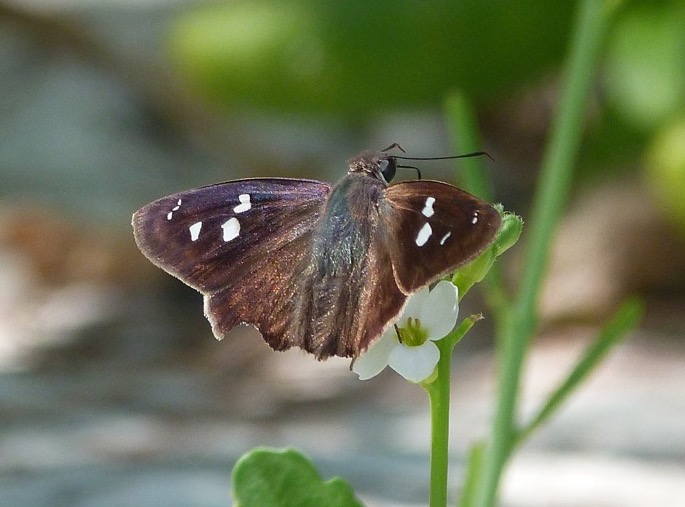
The Hammock Skipper Polygonus leo is quite a small butterfly. We found the ones shown here in the vegetation at the back of the Delphi beach. Having initially thought this was a Northern Cloudywing (and a ‘lifer’ for me), Colin Redfern has kindly corrected my (mis-)ID, and I have made the consequent changes.
Perhaps unusually for butterflies these skippers are sexually ‘monomorphic’, i.e. very similar in both sexes. Males and females both have completely dark brown wings except for the small white spots.
We noticed that the spots and patterns were (again, unusually?) not symmetrical as between the wings. [That should probably be ‘not reflectively symmetrical’, as with a Rorschach inkblot.]
All photos, Keith Salvesen; timely ID correction courtesy of Colin Redfern…
South Abaco – the whole area south of Marsh Harbour – provides by far the best birding opportunities for a day of varied birding. A recent party led by birding guide Reginald Patterson included Charmaine Albury in the enthusiastic team. She sent me their checklist for the day – 40 species covering an impressive range of bird types. Here is the list, to which I have added some illustrative photographs.
The checklist covers a broad range of birds that you might expect to see in habitats ranging from coppice to pine forest to water to shoreline. Most are permanent residents, with some winter residents (eg the painted bunting, Cape May warbler). Abaco specialities include the parrots of course, the West-Indian woodpecker and the olive-capped warbler.
And birds that might, on another day, be seen? Maybe the endemic Bahama Woodstar hummingbird and the endemic Bahama Swallow. At Gilpin Pond, black-necked stilts and perhaps a belted kingfisher. And at Sandy Point, brown pelicans fishing off the dock and the chance of white-tailed tropicbirds off-shore. But overall a ’40 day’ is a great day!
We are just back on Abaco last night, and without actually trying – and just from the balcony in about 20 minutes – we have scooped:
Turkey Vulture, Black-faced Grassquit, Bananaquit, Bahama Swallows, Loggerhead Kingbird, La Sagra’s Flycatcher, and Thick-billed Vireo – also Oystercatchers heard from the beach. Time to investigate further…
Credits: Tom Sheley (1); Keith Salvesen (2, 5, 8, 9); Craig Nash (3); Gerlinde Taurer (4, 6); Tom Reed (7); Nina Henry (10)
The sounds are unmistakeable – a discordant chorus of soft chuckling noises like tongue-clicks as the RWTs flock into a bush, interrupted by harsh, metallic calls like rusty metal gate-hinges being forced open. Or maybe a lone bird mournfully repeating its eerie call from the mangroves far out on the Marls as the bonefishing skiffs slip silently along the shoreline. No other species sound quite like Agelaius phoeniceus.
The handsome males sport flashy epaulets, most clearly visible in flight or in display – for example to impress a prospective mate. Again, they are unlikely to be confused with another species.
The females, as is often the way, are less showy. I have just read that they are ‘nondescript’, which is unnecessarily harsh I reckon. Here are a couple of examples.
And the darker brown ones that are clearly not handsome black males? These are young males in their first season, before they move on to the full adult male plumage. Previously I had designated them females (as I had assumed) until very gently corrected by the legendary Bruce Hallett. Not only was Bruce an essential part in the production of the Birds of Abaco, he also keeps a benign eye on my posts and occasionally steps in to clarify IDs etc. I took the first male juvenile at Casuarina, when I also made the sound recording (below). The second was at Delphi – and with some ‘light’ issues, I notice…
Fledglings are kind of cute…
SO WHAT DO THEY SOUND LIKE?
You may need to turn up the volume a bit. You will also here a lot of dove noise and, in the background, the sound of waves lapping onto the shore.
Photo Credits: Tom Sheley (1, 2, 4, 5, 8); Alex Hughes (3); Keith Salvesen (6, 7, 9 & audio)
















































 ROLLING HARBOUR ABACO


You must be logged in to post a comment.