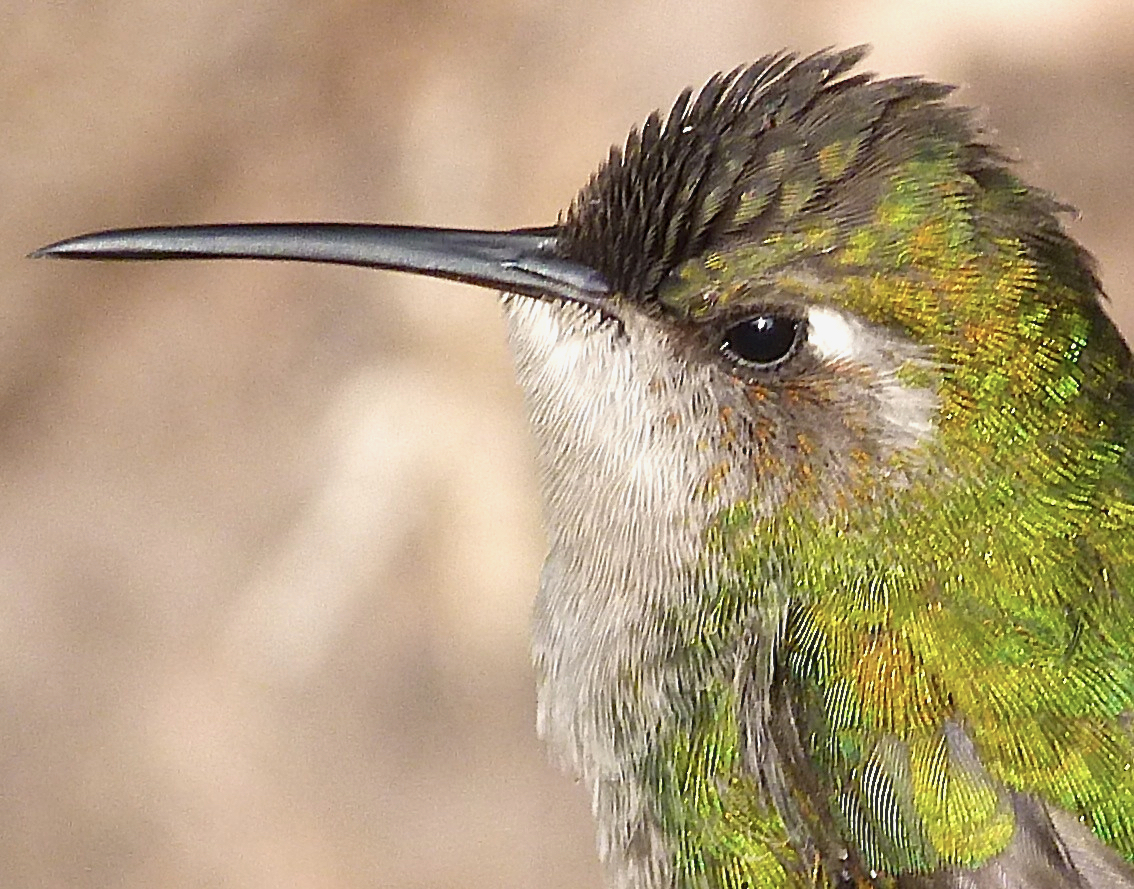
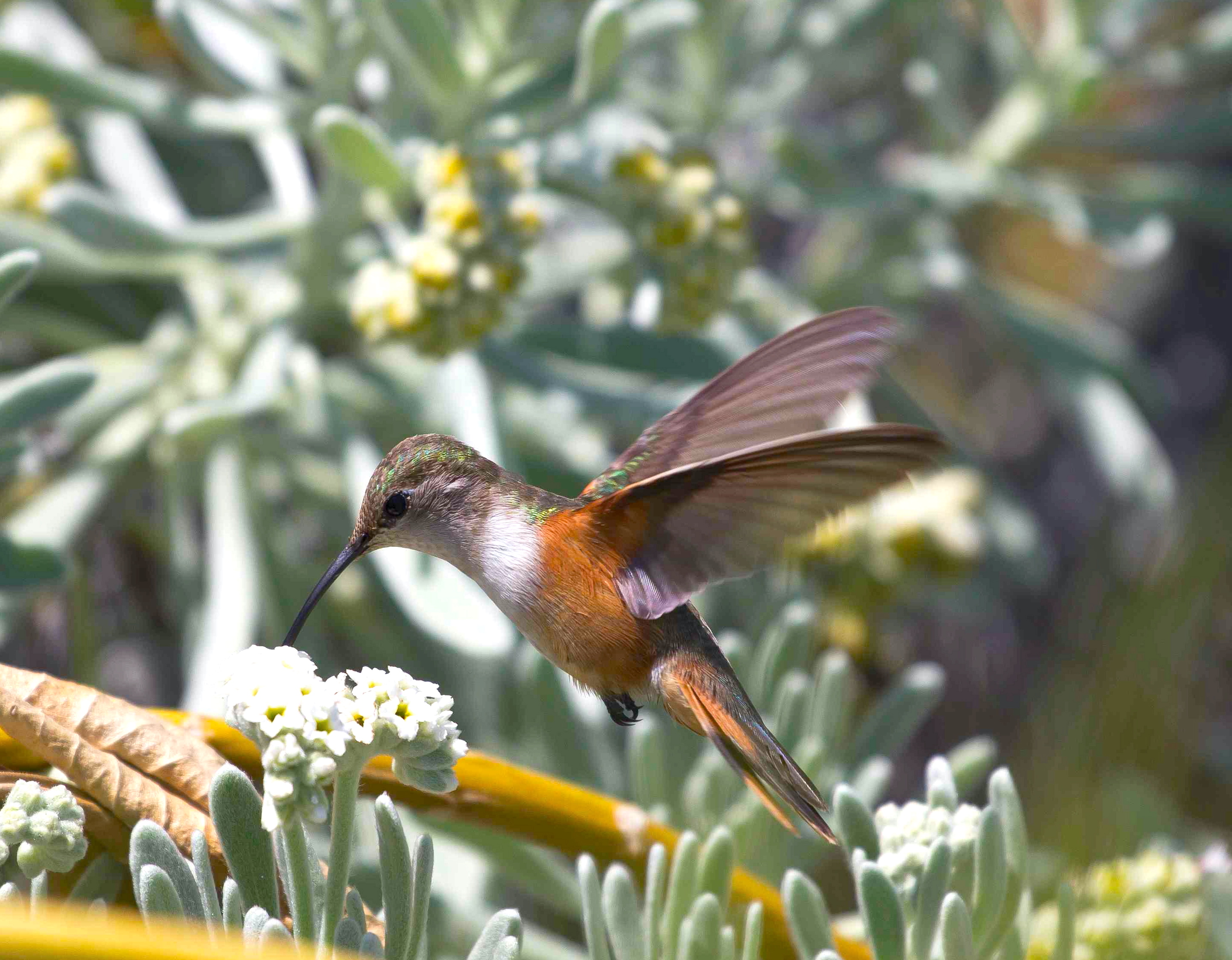
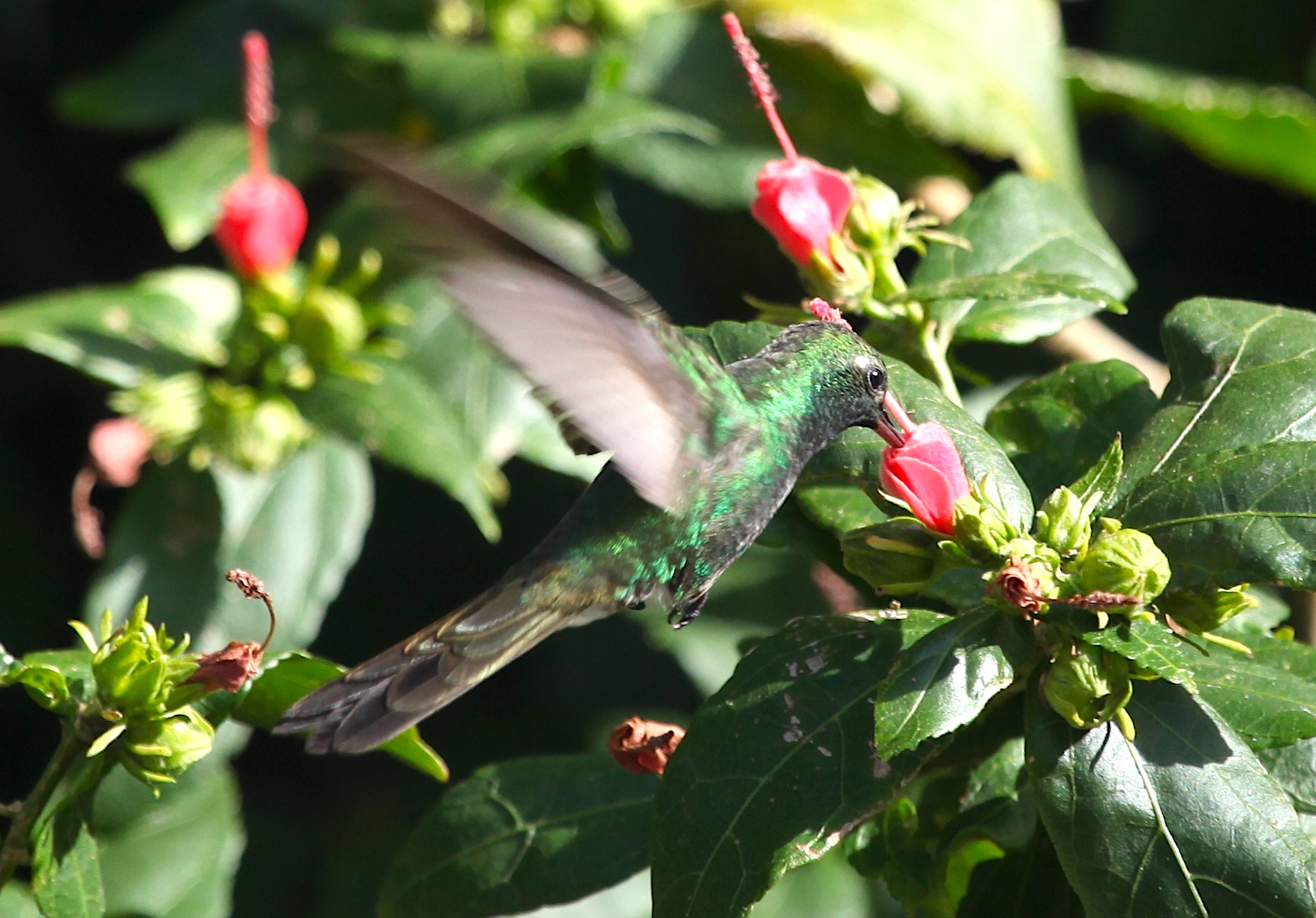
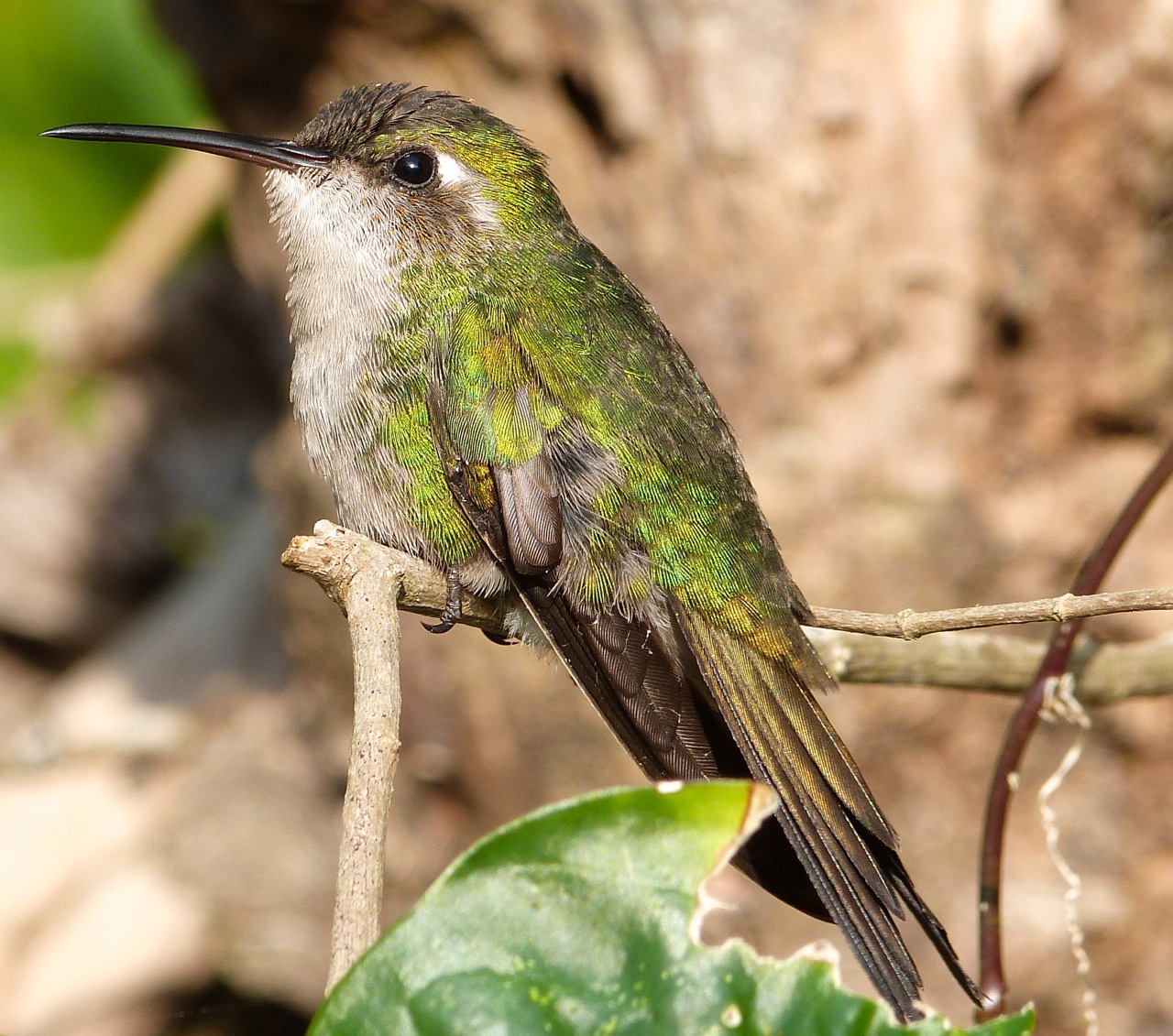
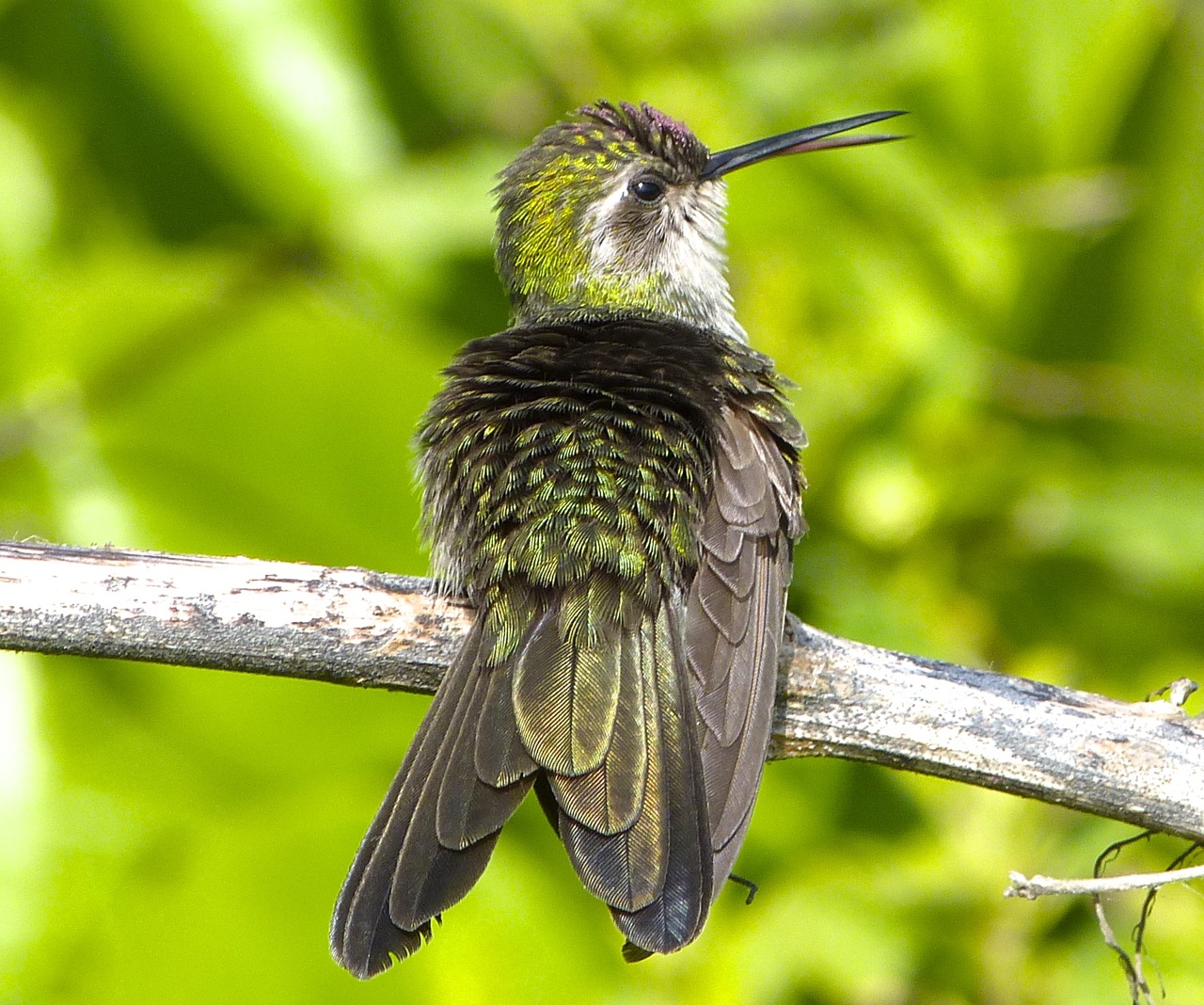
This post is not as indelicate as the title might imply. It is not a practical guide for intimate examinations of tiny birds. Nor does refer to some louche activity involving large motor vehicles. It’s all about plumage and recognition. And there are only two species – and two genders for each one – to wrestle with*.So here are the adult male and female Bahama Woodstars and Cuban Emeralds in all their glory…
Cuban Emerald (f) Gilpin Point, Abaco (Keith Salvesen)
And finally, a brilliant Woodstar photo taken by Tom Sheley, birdman and generous fishing partner, that spans the boundary between wildlife photography and art.
Bahama Woodstar female. Abaco Bahamas . Tom Sheley
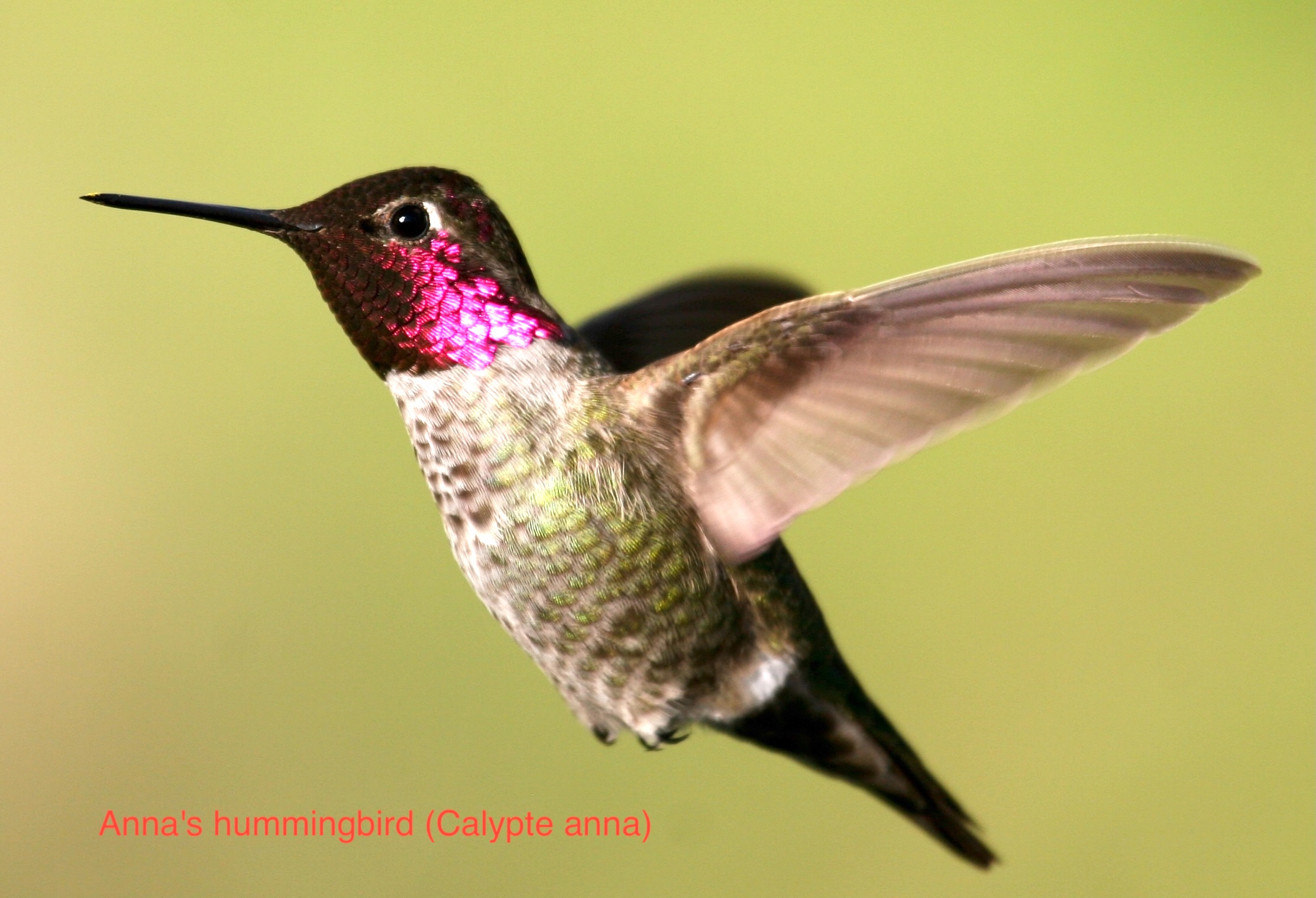
There have been very rare reports of vagrant sightings, in particular Anna’s Hummingbird
It’s often a hard decision whether to include a short piece of video footage in a post. By short, I mean less than a minute. On the one hand, there is usually a good reason for inclusion, even if only aesthetic. On the other, it simply takes up more time for busy people who may prefer to flick through an article and enjoy some nice images along the way. Today, you can have the best of both worlds.
Sanderlings are definitively ‘peeps’, a group name that embraces the smallest and squeakiest sandpiper species. They are the wave chasers, the tiny birds that scuttle along the beach, into the retreating tide for a snack from the sand, and back to the beach again as the waves creep in. Their little legs and feet move in a blur, and many people immediately think of wind-up clockwork toys as they watch the birds in action. But these charmers never wind down while there is shoreline foraging to be done.
One of the joys of being a sanderling is that rock pools fill and empty diurnally. At some time during daylight, there’s the certainty of a quick dip. I was lying on the beach when I took this short video, so that I didn’t spook the birds. I was equipped with a smallish camera (I drowned it the following day. By mistake I mean) so I kept my distance rather than try to get closer and spoil their joyful bathing.
I caught these little birds at a critical moment. You can tell that the tide is coming in fast. The peeps are becoming edgy, and weighing up the joys of immersion in a pool with the less enjoyable prospect of being washed out of the pool by the next wave. Within a minute or so, they had all flocked down the shoreline for a foraging session in new territory.
Waves and incoming tide getting a little too close for comfort on the edge of the pool…
Next to the migratory PIPING PLOVERS that favour Abaco as their winter home, the wave chasers are my favourite shorebirds. It was my keenness on them that killed my camera. I went out into the incoming waves to get shots back at the beach with the sun behind me. Great idea until I lost my balance with, as they say, hilarious consequences. Lesson learnt – never turn your back on waves.
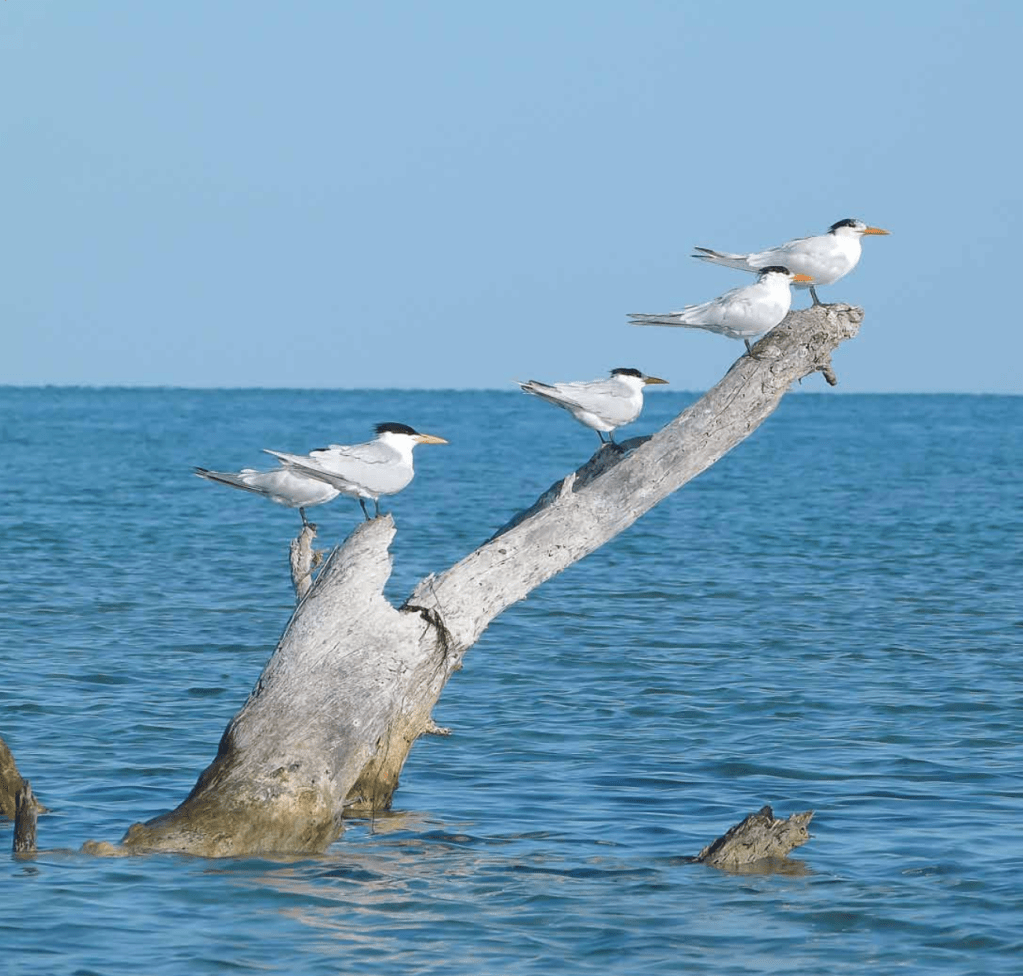
There are twelve species of tern – ‘swallows of the sea’ – that to a greater or lesser extent may be found on Abaco. Whether they will actually be visible at any given time is less certain, though. For a start, the only resident species is the lovely Royal Tern, available at many locations on Abaco and the cays throughout the year. Others are migratory, transitory or – rarest of all – vagrant birds blown off-course by wind or storm.
ROYAL TERNS Thalasseus maximus PR1
In the slightly less commonly-found category are the summer migrant terns that, by definition, are only in residence for around half the year. Four of these are fairly common in certain areas, and actually breed on Abaco; these include arguably the prettiest of all, the bridled tern. The other two tern species (gull-billed and sandwich) are more rare and do not generally breed locally.
LEAST TERN Sternula antillarum SR B 1
BRIDLED TERN Onychoprion anaethetus SR B 2
ROSEATE TERN Sterna Dougallii SR B 2
SOOTY TERN Onychoprion anaethetus SR B 2
GULL-BILLED TERN Gelochelidon nilotica SR 3
SANDWICH TERN Thalasseus sandvicensis SR 4
There is one rare winter resident migratory tern species. I had to check when the last one was recorded for Abaco. It was of course only in January this year, when ace birder-photographer Sally Chisholm saw one at Treasure Cay and managed to photograph it for posterity.
FORSTER’S TERN Sterna forsteri WR 4
The final four ‘Abaco’ terns are very much the occasional visitors. Three of them pass over the Bahamas on their longer migration, but may make a pit-stop around Abaco to take on fuel. Likelihood of sighting one? Slender but not impossible… The fourth, the Arctic Tern, is a very rare vagrant, a bird well away from its usual home or migration route as the result of storms or faulty satnav or sheer happenstance. Don’t travel to the Bahamas intent on seeing one.
CASPIAN TERN Hydroprogne caspia TR 4
As for the remaining three species, they are the transient black tern and common tern; and the vanishingly rare vagrant Arctic tern (the clue is in the name). No photos of any of these I’m afraid, so here’s a handy checklist instead.
ELECTIVE MUSICAL DIGRESSION
Written by Peter Seeger a few years earlier, Turn x 3 was released in 1965, the title track on the second album from the Byrds. At a rather febrile time in US history (Vietnam, draft riots, black civil rightists v cops and so on), this unusually palliative and thoughtful song with its religious connotations to some extent stood for peace and hope in a time of turmoil.
Photo credits: Keith Salvesen (1, 2, 3, 5, 18); Tony Hepburn (4); Alex Hughes (10, 11); Bruce Hallett (6, 7, 12); Woody Bracey (8, 13, 16); Duncan Wright (9); Dick Daniels (14); Sally Chisholm (15); Keith Kemp (17)
These days few creatures go without an Annual Day: Awareness / Appreciation / Protection / Support / and so on. These are obviously important and to be encouraged. In human terms the creatures tend to have a positive image. There’s little call for a Fire Ant Welfare Day. I am slightly concerned about World Earthworm day, also on Oct 21. Aren’t they food for some of the reptiles that share the day?
The northern curly-tailed lizard Leiocephalus carinatus, to give it its full name, resembles a tiny dragon with a twist in the tail. These little critters bask in the sun, or scuttle away into holes and crevices as you approach them. I suspect that even a confirmed herpophobic would find some charm in them. They are, of course, completely harmless to humans.
Surprisingly, the Bahamas is home not just to one but five different curly-tail species, and nine sub-species. Broadly-speaking, the variants are found on different and specific islands and have discrete local markings. Mostly they are brownish, but they may also be grey or with a greenish tinge like this one I recently photographed.
Curly-tail males, being territorial, turn somewhat aggressive around breeding time, which is basically most the the year, from February to October. Behaviours indicative of their territorial claims include tail curling / uncurling (of course), head-bobbing, strutting about in an agitated way and inflating the sides of their necks in a threatening kind of way. The tiny-tails, 2″ long when born, are known as ‘hatchlings’.
An impressive poolside ‘double curly’
THREATS TO CURLY TAILS
According to the Bahamas National Trust BNT, the main dangers to the curly-tails of the Bahamas are:
Dogs, cats, rats and introduced predators such as raccoons
Collection for the pet trade – curly tails are unprotected by CITES listing (also cute)
Collection of the rarer endemics by reptile enthusiasts seeking ‘exotics’
Development and habitat destruction (though it is noted that curly tails seem to adjust quite well in developed areas)
A curly tails sloughs its skin as it grows, as with snakes and other reptiles
WHY THE CURLY TAIL?
As mentioned above, for use in territorial posturing
In courtship displays by males to attract females (luckily a method not available to humans)
As a response to predators, confusing an attacker with movement at both ends
As a last resort, to detach to aid escape (the tail re-grows)
For fun and just because they can grow one and you cannot
Credits: all photos, Keith Salvesen except #2 & #6, Charles Skinner; BNT
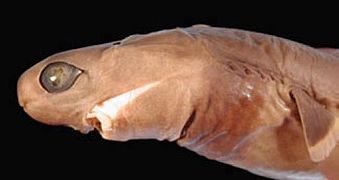
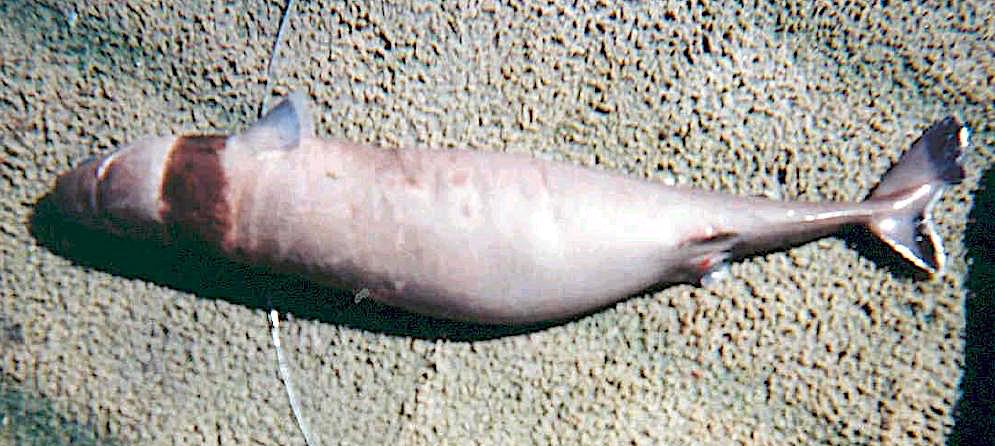
The Cookiecutter shark Isistius brasiliensis (aka the less scary, more genial sounding Cigar Shark), might be an ideal candidate for a Room 101 nemesis.** These little beasts – a species of dogfish shark – are found in several mainly island-based areas dotted around the globe, including in Bahamas waters.
HOW COME THE NAME?
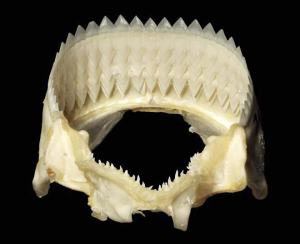
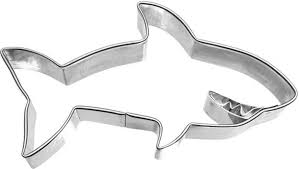
These sharky little b@st@rds (*scientific term*) attack marine mammals and fishes, attaching themselves by suction and gouging out perfect round plugs of skin and flesh, leaving what are sometimes called ‘crater wounds’. Then they eat them. Imagine getting hold of a really sharp domestic cookie cutter with circular rows of razor-sharp teeth, and grinding it hard into your thigh. There! That!
The size of an adult shark:16″ max
The term ‘cookiecutter’ is also a pejorative slang term, meaning mass-produced, lacking in originality, or boringly samey, as in cookiecutter cars or TV genres etc. Never apply that definition to these little critters…
.
HORRIFYING COOKIECUTTER FACTS
Live in the depths, rise vertically in the day & dive back down at dusk
Undersides have light-emitting ‘photophores’ which emphasise…
…the dark collar which acts as a lure, resembling a small innocent fish
Bioluminescence lures prey & confuses predators (more on this below)
The glow is so strong it may last for some time after removal from water
Their lips are ‘suctorial’ = they attach tightly to their target
The jaws then gouge out the victim’s flesh in a remarkably neat circle
Omni-vicious: any medium to large ocean creature is vulnerable to attack
There are even occasional reports of humans being targeted
WHERE IS YOUR EVIDENCE?
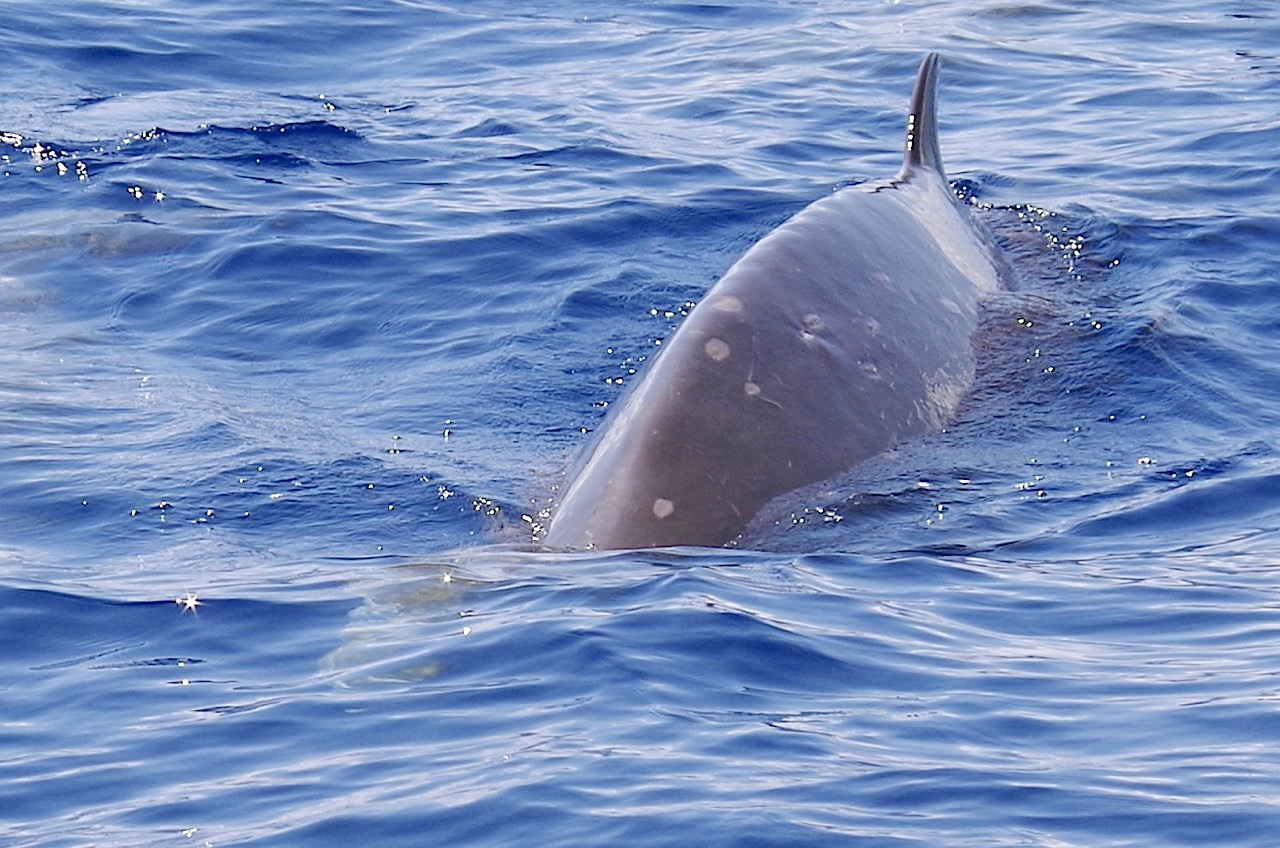
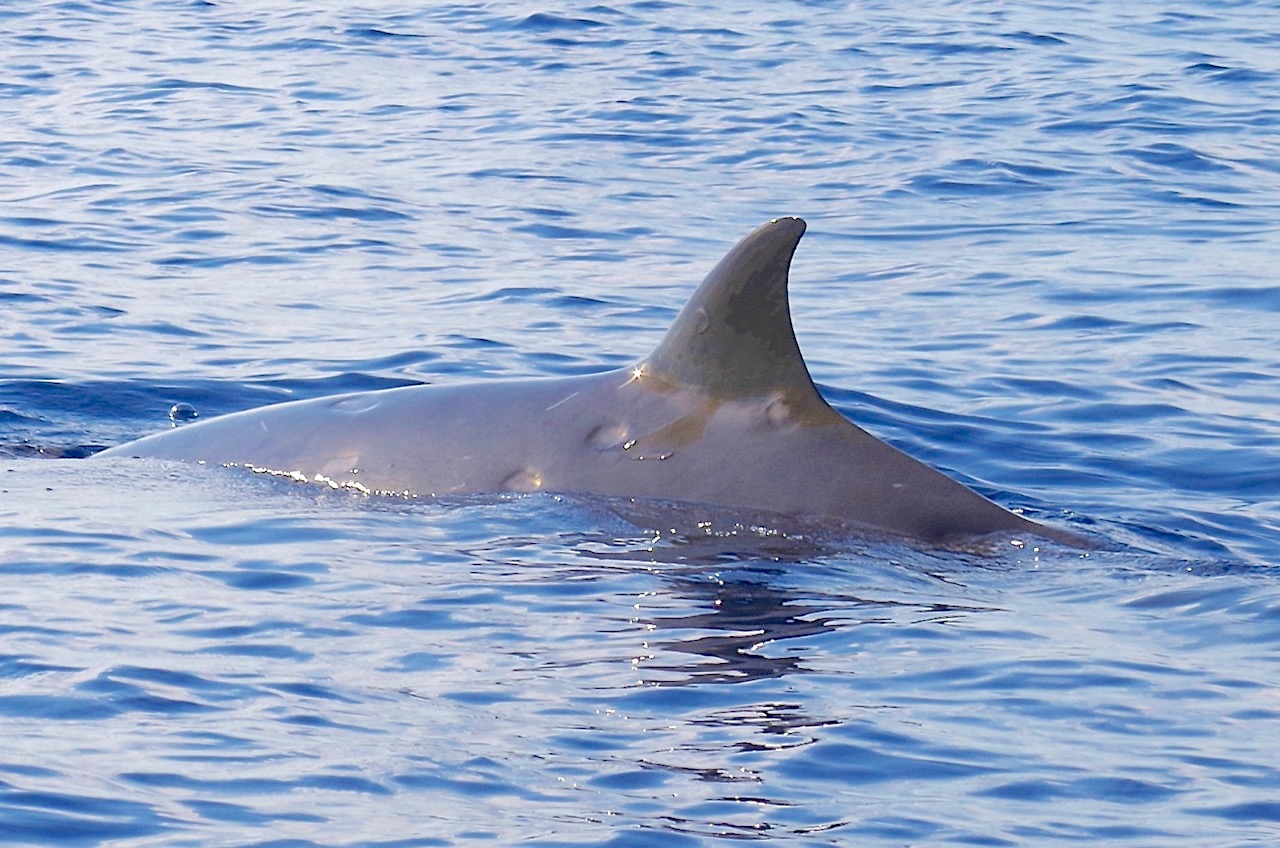
Here are two Blainville’s beaked whales that I photographed from the BMMRO research vessel. The top whale has a number of circular healed attack marks and a recent one. You can see how deep the gouged hole is. The other has plenty of well-healed scars.
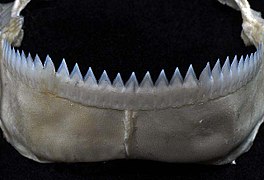
WHAT CUTTING EQUIPMENT ARE THEY BLESSED WITH?
Multi-toothed: top rows of small teeth, rows of larger teeth on the bottom
The lower teeth are the cutters, acting like a saw when locked on
HOW EXACTLY DO THEY DO WHAT THEY DO?
I can explain it no better than the renowned authority Prof. W. K. P. Dear: “the suctorial lips ensure a tight seal. It then bites, using its narrow upper teeth as anchors while its razor sharp lower teeth slices into the prey. Finally, the shark twists and rotates its body to complete a circular cut, quite possibly aided by the initial forward momentum and subsequent struggles of its prey. The action of the lower teeth may also be assisted by back-and-forth vibrations of the jaw, a mechanism akin to that of an electric carving knife”.
ARE THESE SHARKS ‘PARASITES’, WOULD YOU SAY?
The behaviour of these sharks is an example of a symbiotic relationship between two species that is parasitic. This means essentially that one gains and the other suffers (eg humans & no-see-ums). This is distinct from commensalistic symbiosis, where one species gains and the other is unaffected (e.g. cattle egrets with cattle); and mutualistic symbiosis, where both gain (e.g. cleaner fish & groupers). So, in a word, yes.
AMBUSH PREDATOR
These little sharks ‘hover’ in the water column waiting for their opportunities
They are capable of rapid movement to catch up & latch onto prey
They will eat a passing small fish, crustacean or even squid as a snack
Sometimes they operate in schools; there is safety in numbers
The schools are thought to increase the ‘lure’ effect of the dark collar
A beached whale that’s been heavily targeted
FUN FACT TO COUNTERACT THE BAD STUFF
In the late c20, more than 30 U.S. Navy submarines were forced back to base to repair damage caused by cookiecutter shark bites, either to the neoprene footings of sonar domes or to rubber-sheathed cables. The problems were solved by using fibreglass. Oceanographic equipment and telecommunications cables are also recorded as being damaged by these sharks.
Cookiecutter Shark – the real deal
MONSTERS OF THE DEEP
These great cards from the weirdly spelledWIERD ‘N’ WILD CREATURESprovide excellent factual info. Their CCS card is no exception. You’ll find more details here about the effect of the bioluminescence and so on, written as clearly as I might hope to.
**“The worst thing in the world varies from individual to individual. It may be burial alive or death by fire, or by drowning, or by impalement, or fifty other deaths. There are cases where it is some quite trivial thing, not even fatal.” (George Orwell, 1984). Being in a tank with some cookiecutters might count.
Alright now… the wounds eventually heal
Credits: BMMRO – header image; beaked whale photos – Keith Salvesen / BMMRO; Te Ara NZ for the main jaw image; all small images with thanks to Wiki and respective photographers who took the time to upload them for all to enjoy & learn from; ‘wierdnwonderful creatures’ for the monster card; range map from Wiki
Reduced to 18mb for 10 – 15 second loading; no noticeable loss of definition
Below the screen BIRDS OF ABACO enlarges the screen, DOWNLOAD will do just that
The top bar contains all the usual ways to make adjustments to the contents
This is the penultimate version before printing, with a few crop marks etc
Please let me know if there are any problems with the download
The download is free and can be scrolled on-screen or saved in the usual way. Do share with family and friends. By all means use parts – eg the Checklist – to print for reference. It’s fine to print out a single complete copy for personal use only.
As mentioned in previous posts, I am asking those who choose to download the book to make a modest charitable donation to a local wildlife-related cause or to a local school or an organisation that inspires kids to get involved in the natural world around them.
KEITH SALVESEN
March 2024
rollingharbour.delphi@gmail.com
Thanks to all the many people who contributed to the book including 30 photographers who took brilliant photos; 3 Bahamas bird experts who contributed greatly to the composition and accuracy of the book; the superb printers Conti in Italy; Peter Mantle the inspiration and eminence grise; and my wife Sally whose publishing and editorial skills are second to none, and her patience limitless.
It is exactly 10 years since The Delphi Club Guide to the Birds of Abaco was launched in the Great Room at the Delphi Club, Abaco, Bahamas. Availability of the book had run its course by 2020. A decade after publication, preparations to compress the entire book into a downloadable e-book are now complete.
Cuban Emerald (M) – Keith Salvesen
FREE AS A BIRD
This has not been planned as a monetised project, so the ‘Book’ will be free to access online; and free to download using a linK. You can send the book to family and friends of course. By all means print out specific extracts, for example the checklist which might be fun to use for finding out the likelihood of seeing a particular bird and / or keeping a record of sightings.
It would be slightly disenchanting to find that the whole book is being printed out without checking first. This can be simply done using rollingharbour.delphi@gmail.com
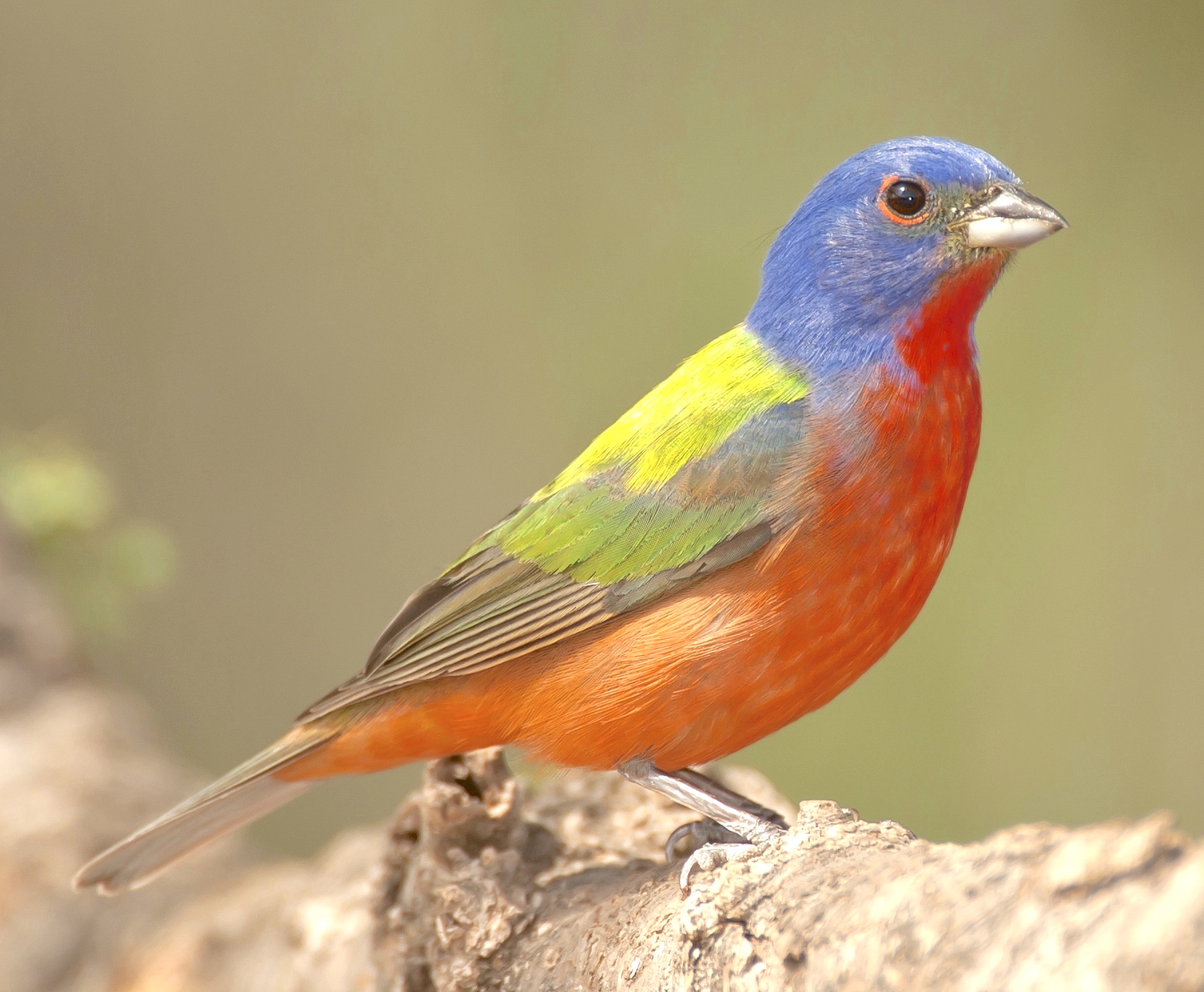
Painted Bunting – Tom Sheley
$10 TO CELEBRATE THE BIRDS OF ABACO AND THE JOY THEY BRING TO THE WHOLE COMMUNITY
I am asking those who choose to download the book to make a charitable donation of $10 (‘a dollar a year’ since publication) to a local wildlife-related cause or to a local school or an organisation that inspires kids to get involved in the natural world around them. Or more than $10 by all means. There’s plenty of choice on Abaco, as I am sure there is for kind followers of Rolling Harbour who live beyond the island’s shores.
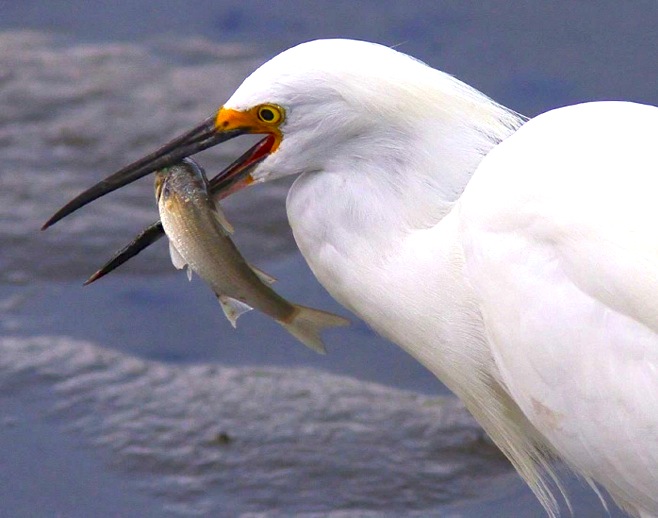
Great Egret – Tom Sheley
Killdeer – Bruce HallettWestern Spindalis – Keith SalvesenCuban Pewee – Keith Salvesen
We birds want to know what’s going on please. The rest of the ‘Abaco Bird Book Club’ have nominated us to find out. So:
Q. How likely is it that we ‘guys’ will somehow be getting inside a machine and turning up in people’s homes / on their phones (whatever those are). A. Very
Q. How long must we wait before being admired on a screen by humans – we all quite fancy that. A. A week or so
Q. Are we birds going to get any seeds / insects / berries / fish in return. A. No. You will be free. And free as a bird as well.
When, in 2014, Birds of Abaco had safely been hatched and was beginning to fledge, I started a companion site that was designed to add an additional dimension to the project. It was a bird-specific accessory to the main Rolling Harbour site that has always featured a far greater range of topics than birds.
The book exhibited Abaco birds in a deliberately perverse way (alphabetically, not by species grouping or other conventional methods). The loosely termed ‘Index’ was meant to be a quick alternative way to delve into the various species.
It was a side project and I did very little to promote it. Once put together (with a linked FB page) I pretty much left it to grow ‘organically’ (aka indolently and neglectfully). I’m bringing the site out of semi-retirement while I get on with my efforts to put the book online. Reach it HERE
A to Z
CAPE MAY WARBLER (Char Albury): as it turned out, an unpromising name. The first one was recorded on Cape May, NJ in the early nineteenth century. They were not recorded there again for more than a hundred years.
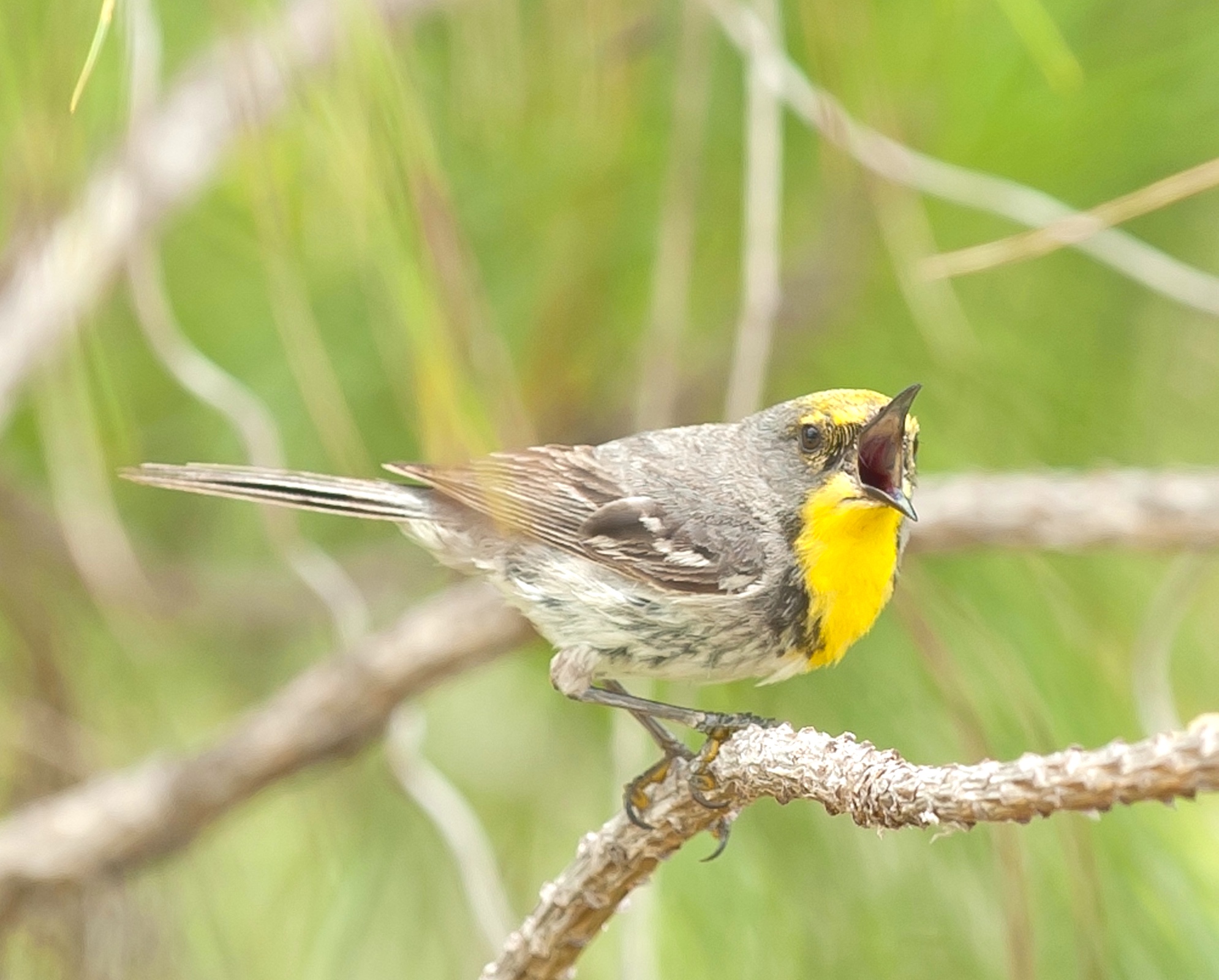
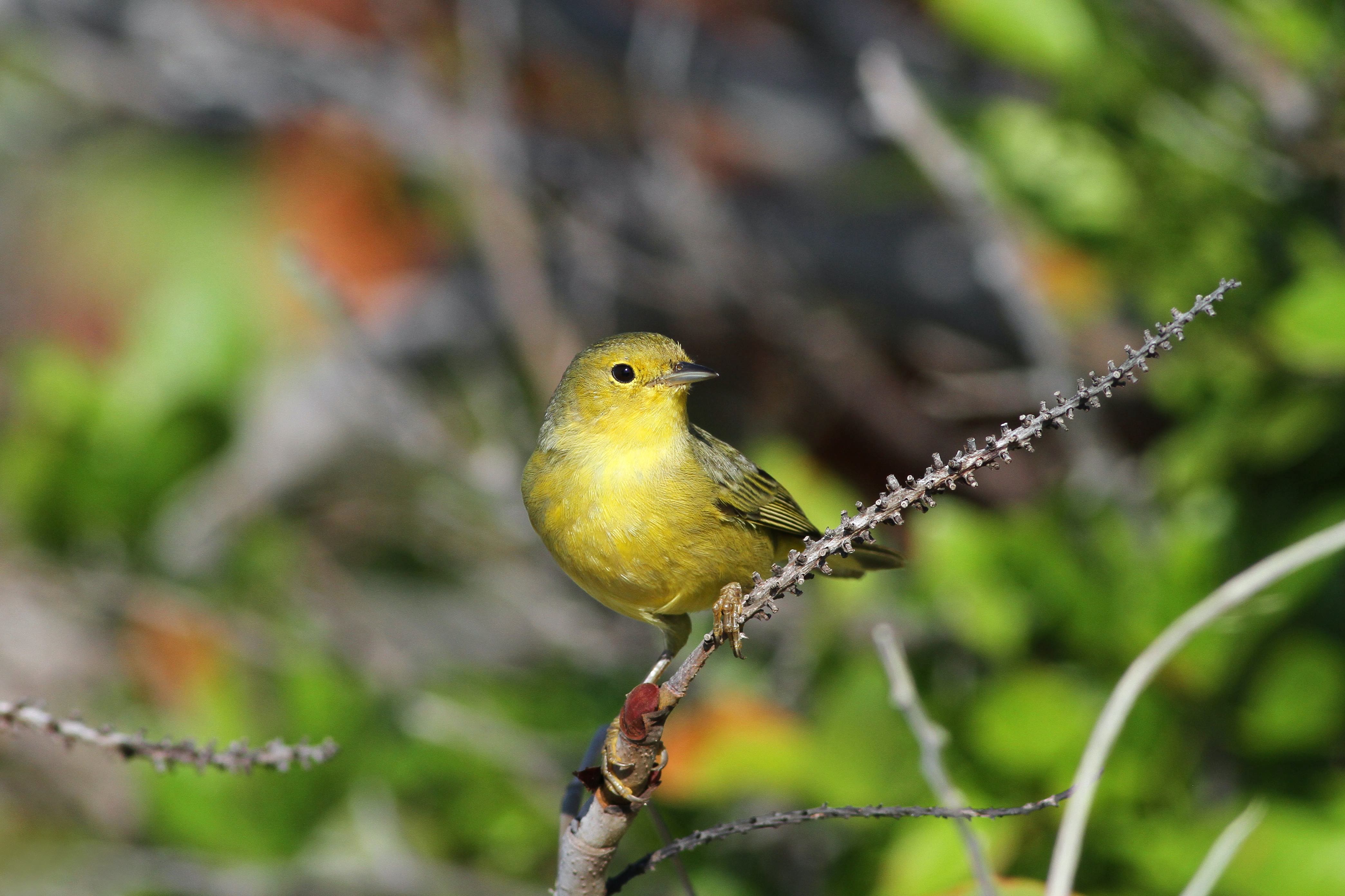
The great winter migration of warblers and their arrival in The Bahamas is underway. Reports are appearing – the latest being the Northern Parula. They will have made long journeys – hundreds of miles – and in the spring they will wing their way home for the summer. On Abaco, 38 warbler species are recorded for the main island and the cays, the latest being the first sighting of a Canada Warbler in 2018. Since Dorian the situation has undoubtedly been different, especially with the transients and rare species. The 5 permanent resident warbler are still resident. Sighting records of the winter visitors have been scarce. Many migrants and transients have not been recorded since Dorian, and the rarest perhaps never will be. The hope must be that at least the most common winter warblers will continue to arrive, and in increasing numbers.
First-ever Canada Warbler for Abaco & the entire Bahamas: Aug 2018 (Chris Johnson)
This guide divides the 38 species into categories, with a code for each bird to show:
Resident status – permanent / breeding, migratory or transient
Frequency – likelihood of seeing each species in its season, rated from 1 (very likely) to 5 (extreme rarities, maybe recorded only once or twice since c1950 when recording began)
Numerically, the division breaks down into 3 categories of warbler:
5 permanent residents (PR) that breed on Abaco (B), of which two are ENDEMIC
21 winter residents (WR) ranging from ‘everyday’ species to extreme rarities like the very vulnerable Kirtland’s Warbler that needs a specific winter habitat that Abaco can provide
11 transients, most of which you will be very lucky to encounter
Palm Warbler, Abaco Bahamas (Nina Henry)
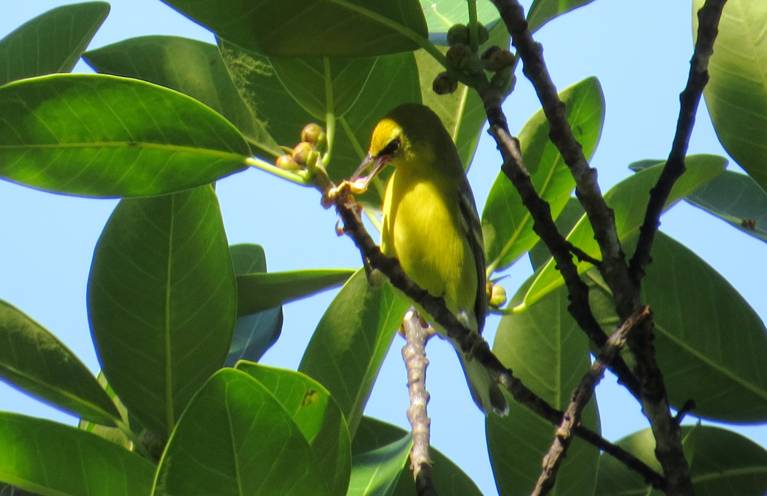
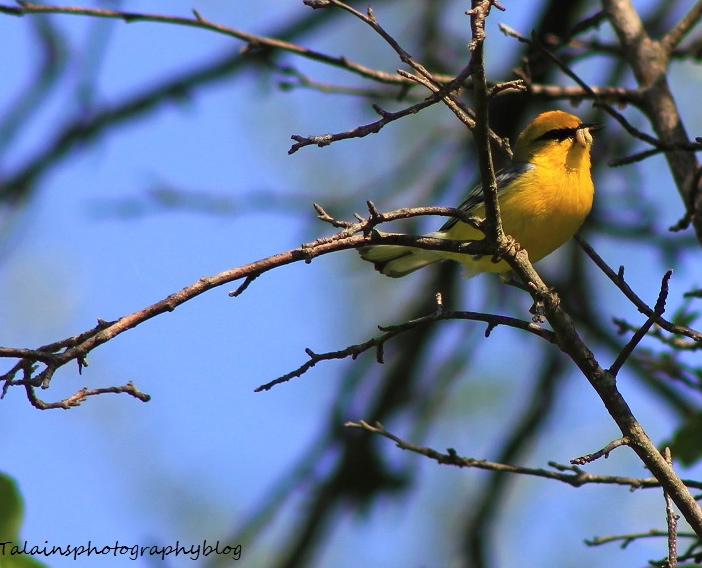
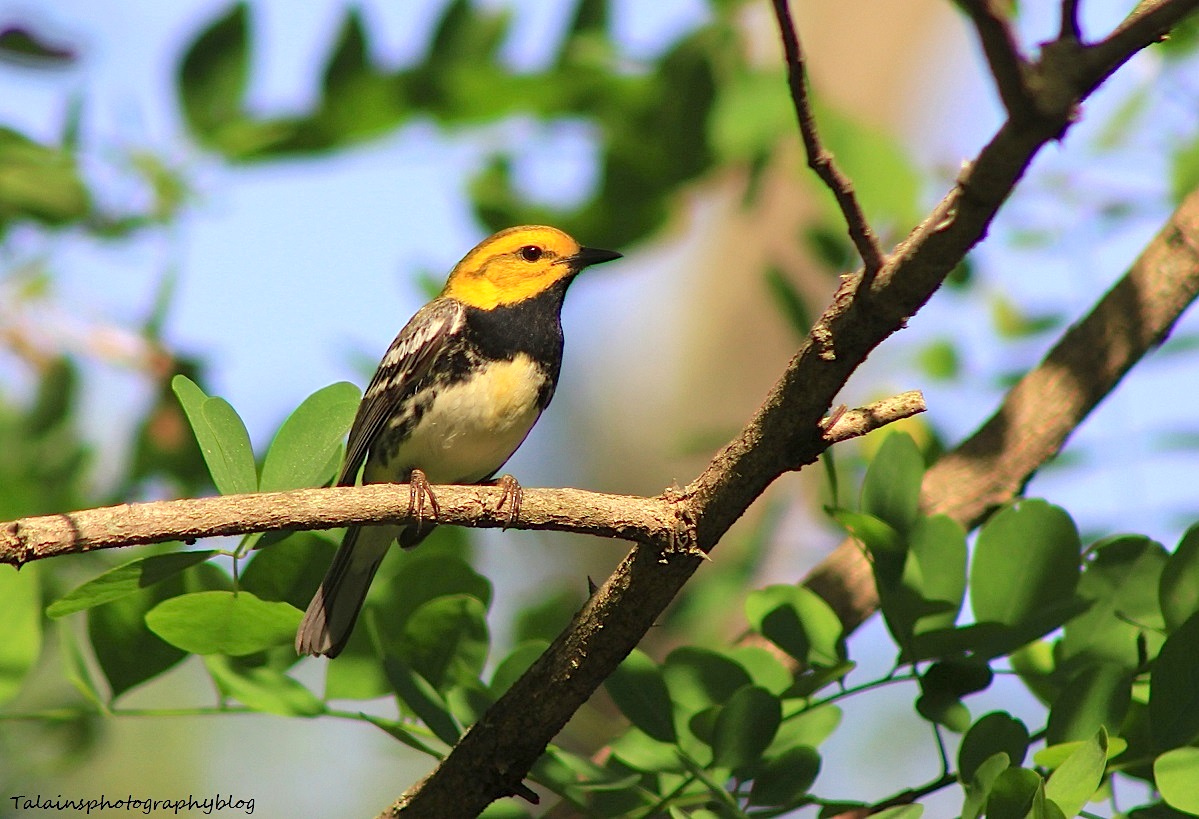
The photos that follow show an example of each warbler, where possible both (1) male and (2) taken on Abaco. Where I had no Abaco images – especially with the transients – I have used other mainstream birding resources and Wiki. All due credits at the foot of the post.
PHOTO CREDITS (1 – 37) Bruce Hallett (Header, 3, 9, 12, 14, 17, 21, 22); Tom Reed (1, 4); Cornell Lab (2); Tom Sheley (7, 10); Alex Hughes (5); Gerlinde Taurer (6, 11, 18); Becky Marvil (8, 20a); Woody Bracey (13, 24); Peter Mantle (15); Keith Salvesen (16); William H. Majoros wiki (19); talainsphotographyblog (20b, 26, 34); Charmaine Albury (23); Craig Nash (25); Ann Capling (27); Jerry Oldenettel wiki (28); Dominic Sherony wiki (29); 10000birds (30); Steve Maslowski wiki (31); MDF wiki (32, 33); Avibirds (35); Michael Woodruff wiki (36); Emily Willoughby wiki (37)
CHECKLISTbased on the complete checklist and codes for Abaco devised by Tony White with Woody Bracey for “THE DELPHI CLUB GUIDE TO THE BIRDS OF ABACO” by Keith Salvesen
The northern curly-tailed lizard Leiocephalus carinatus, to give it its full name, resembles a tiny dragon with a twist in the tail. These little critters bask in the sun, or scuttle away into holes and crevices as you approach them. I suspect that even a confirmed herpophobic would find some charm in them. They are, of course, completely harmless to humans.
Surprisingly, the Bahamas is home not just to one but five different curly-tail species, and nine sub-species. Broadly-speaking, the variants are found on different and specific islands and have discrete local markings. Mostly they are brownish, but they may also be grey or with a greenish tinge like this one I recently photographed.
Curly-tail males, being territorial, turn somewhat aggressive around breeding time, which is basically most the the year, from February to October. Behaviours indicative of their territorial claims include tail curling / uncurling (of course), head-bobbing, strutting about in an agitated way and inflating the sides of their necks in a threatening kind of way. The tiny-tails, 2″ long when born, are known as ‘hatchlings’.
An impressive poolside ‘double curly’
THREATS TO CURLY TAILS
According to the Bahamas National Trust BNT, the main dangers to the curly-tails of the Bahamas are:
Dogs, cats, rats and introduced predators such as raccoons
Collection for the pet trade – curly tails are unprotected by CITES listing (also cute)
Collection of the rarer endemics by reptile enthusiasts seeking ‘exotics’
Development and habitat destruction (though it is noted that curly tails seem to adjust quite well in developed areas)
A curly tails sloughs its skin as it grows, as with snakes and other reptiles
WHY THE CURLY TAIL?
As mentioned above, for use in territorial posturing
In courtship displays by males to attract females (luckily a method not available to humans)
As a response to predators, confusing an attacker with movement at both ends
As a last resort, to detach to aid escape (the tail re-grows)
For fun and just because they can grow one and you cannot
Credits: all photos, Keith Salvesen except #2 & #6, Charles Skinner; BNT
The drastic effects of Hurricane Dorian on Abaco’s birdlife continue, with recent reports suggesting that all species remain affected, and some severely so. However there are signs of a slow improvement, and this good news includes the two hummingbird species, the endemic Bahama Woodstar and the Cuban Emerald. A couple of recent posts on FB indicate that sightings of both these species have been a very welcome surprise. So, a good time to write about them and to show their beauty.
Cuban Emerald (male) Abaco (Charlie Skinner)
The subject matter of this post is not as indelicate as the title might imply; nor is it a ‘hands-on’ practical guide for intimate examinations of tiny birds. In particular it does not publicise some recently discovered louche activity involving unfeasibly large motor vehicles. It’s all about plumage and recognition. And there are only two species – and two genders for each one – to wrestle with.So here are the adult male and female Bahama Woodstars and Cuban Emeralds in all their glory…
And finally, a brilliant Woodstar photo taken by Tom Sheley, birdman and generous fishing partner, that I spans the boundary between wildlife photography and art.
Bahama Woodstar female. Abaco Bahamas . Tom Sheley
The Cookiecutter shark Isistius brasiliensis (aka the less scary, more genial sounding ‘cigar shark’), might be an ideal candidate for a Room 101 nemesis.** These little beasts – a species of dogfish shark – are found in several mainly island-based areas dotted around the globe, including in Bahamas waters.
HOW COME THE NAME?
These sharky little b@st@rds (*scientific term*) attack marine mammals and fishes, attaching themselves by suction and gouging out perfect round plugs of skin and flesh, leaving what are sometimes called ‘crater wounds’. Then they eat them. Imagine getting hold of a really sharp domestic cookie cutter with circular rows of razor-sharp teeth, and grinding it hard into your thigh. There! That!
The size of an adult shark:16″ max
The term ‘cookiecutter’ is also a pejorative slang term, meaning mass-produced, lacking in originality, or boringly samey, as in cookiecutter cars or TV genres etc. The little critters under consideration here are anything but…
HORRIFYING COOKIECUTTER FACTS
Live in the depths, rise vertically in the day & dive back down at dusk
Undersides have light-emitting ‘photophores’ which emphasise…
…the dark collar which acts as a lure, resembling a small innocent fish
Bioluminescence lures prey & confuses predators (more on this below)
The glow is so strong it may last for some time after removal from water
Their lips are ‘suctorial’ = they attach tightly to their target
The jaws then gouge out the victim’s flesh in a remarkably neat circle
Omni-vicious: any medium to large ocean creature is vulnerable to attack
There are even occasional reports of humans being targeted
Here are two Blainville’s beaked whales that I photographed from the BMMRO research vessel. The top whale has a number of circular healed attack marks and a recent one. You can see how deep the gouged hole is. The other has well-healed scars.
Multi-toothed: top rows of small teeth, rows of larger teeth on the bottom
The lower teeth are the cutters, acting like a saw when locked on
See header image and below for full details
HOW EXACTLY DO THEY DO WHAT THEY DO?
I can explain it no better than the renowned authority Prof. W. K. P. Dear: “the suctorial lips ensure a tight seal. It then bites, using its narrow upper teeth as anchors while its razor sharp lower teeth slices into the prey. Finally, the shark twists and rotates its body to complete a circular cut, quite possibly aided by the initial forward momentum and subsequent struggles of its prey. The action of the lower teeth may also be assisted by back-and-forth vibrations of the jaw, a mechanism akin to that of an electric carving knife”.
ARE THESE SHARKS ‘PARASITES’, WOULD YOU SAY?
The behaviour of these sharks is an example of a symbiotic relationship between two species that is parasitic. This means essentially that one gains and the other suffers (eg humans & no-see-ums). This is distinct from commensalistic symbiosis, where one species gains and the other is unaffected (e.g. cattle egrets with cattle); and mutualistic symbiosis, where both gain (e.g. cleaner fish & groupers). So, in a word, yes.
An ‘ambush predator’: these little sharks ‘hover’ in the water column waiting…
They are capable of rapid movement to catch up & latch onto prey
They will eat a passing small fish, crustacean or even squid as a snack
Sometimes they operate in schools; there is safety in numbers
The schools are thought to increase the ‘lure’ effect of the dark collar
A beached whale that’s been heavily targeted
FUN FACT TO COUNTERACT THE BAD STUFF
In the late c20, more than 30 U.S. Navy submarines were forced back to base to repair damage caused by cookiecutter shark bites, either to the neoprene footings of sonar domes or to rubber-sheathed cables. The problems were solved by using fibreglass. Oceanographic equipment and telecommunications cables are also recorded as being damaged by these sharks.
Cookiecutter Shark – the real deal
MONSTERS OF THE DEEP
These great cards from the weirdly spelledWIERD ‘N’ WILD CREATURESprovide excellent factual info. Their CCS card is no exception. You’ll find more details here about the effect of the bioluminescence and so on, written as clearly as I might hope to.
**“The worst thing in the world varies from individual to individual. It may be burial alive or death by fire, or by drowning, or by impalement, or fifty other deaths. There are cases where it is some quite trivial thing, not even fatal.” (George Orwell, 1984). Being in a tank with some cookiecutters might count.
Alright now… the wounds eventually heal
Credits: BMMRO – header image; beaked whale photos – Keith Salvesen / BMMRO; Te Ara NZ for the main jaw image; all small images with thanks to Wiki and respective photographers who took the time to upload them for all to enjoy & learn from; ‘wierdnwonderful creatures’ for the monster card; range map from Wiki
IT’S STARTED The great winter migration of warblers and their imminent arrival in The Bahamas is underway. Any day now – if not already – the ‘winter’ (in fact autumn & early spring as well) warblers will be arriving on Abaco. There are 38 warbler species recorded for the main island and the cays. For years, it was just 37. Then in 2018 a CANADA WARBLER was seen and photographed by well-known Bahamas birder Chris Johnson. It was a first for Abaco – and the first-ever report for the Bahamas as well. You’ll find the story HERE.
This article is updated from an earlier one written pre-Dorian and the situation will undoubtedly be different now, especially with the transients and rare species. Consider it as a historical record of the prolific warbler species recorded for Abaco and more generally the northern Bahamas before the hurricane struck. The 5 permanent resident warbler are still resident. Many migrants and possibly all transients have sadly not been recorded since, and the rarest perhaps never will be. The hope must be that at least the most common winter warblers will continue to arrive, and in increasing numbers.
First-ever Canada Warbler for Abaco & the entire Bahamas: Aug 2018 (Chris Johnson)
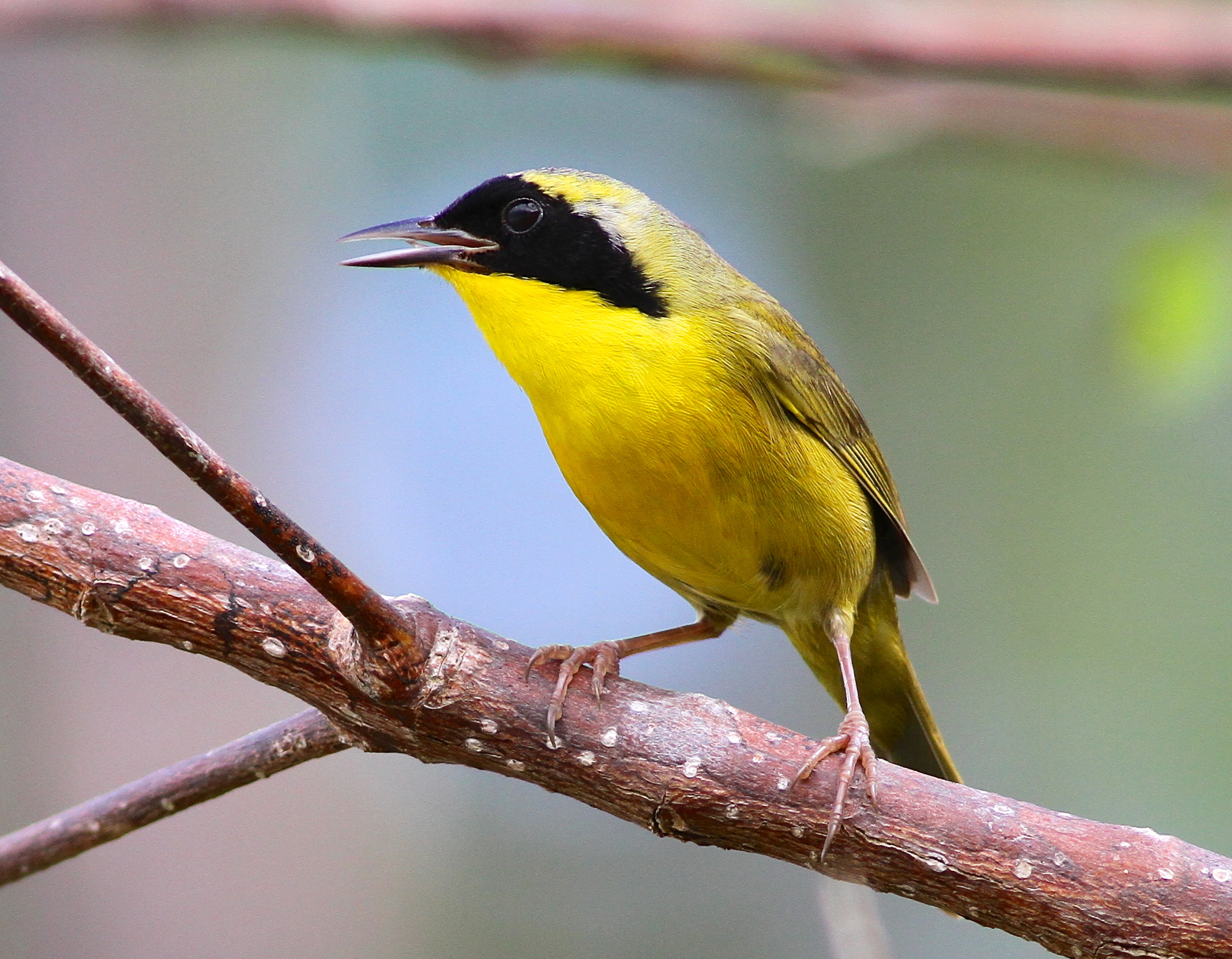
Hooded Warbler, Abaco Bahamas (Chris Johnson)
The guide divides the original 37 species (excluding the Canada warbler) into categories, with a code for each bird to show:
Resident status – permanent / breeding, migratory or transient
Frequency – likelihood of seeing each species in its season, rated from 1 (very likely) to 5 (extreme rarities, maybe recorded only once or twice since c1950 when recording began)
Numerically, the division breaks down into 3 categories of warbler:
5 permanent residents (PR) that breed on Abaco (B), of which two are ENDEMIC
21 winter residents (WR) ranging from ‘everyday’ species to extreme rarities like the very vulnerable Kirtland’s Warbler that needs a specific winter habitat that Abaco can provide
11 transients, most of which you will be very lucky to encounter
Palm Warbler, Abaco Bahamas (Nina Henry)
The photos that follow show an example of each warbler, where possible both (1) male and (2) taken on Abaco. Where I had no Abaco images – especially with the transients – I have used other mainstream birding resources and Wiki. All due credits at the foot of the post.
PHOTO CREDITS (1 – 37) Bruce Hallett (Header, 3, 9, 12, 14, 17, 21, 22); Tom Reed (1, 4); Cornell Lab (2); Tom Sheley (7, 10); Alex Hughes (5); Gerlinde Taurer (6, 11, 18); Becky Marvil (8, 20a); Woody Bracey (13, 24); Peter Mantle (15); Keith Salvesen (16); William H. Majoros wiki (19); talainsphotographyblog (20b, 26, 34); Charmaine Albury (23); Craig Nash (25); Ann Capling (27); Jerry Oldenettel wiki (28); Dominic Sherony wiki (29); 10000birds (30); Steve Maslowski wiki (31); MDF wiki (32, 33); Avibirds (35); Michael Woodruff wiki (36); Emily Willoughby wiki (37)
CHECKLISTbased on the complete checklist and codes for Abaco devised by Tony White with Woody Bracey for “THE DELPHI CLUB GUIDE TO THE BIRDS OF ABACO” by Keith Salvesen
West Indian Woodpecker . Abaco . Bahamas (π Keith Salvesen)
The WEST INDIAN WOODPECKER Melanerpes superciliaris is one of Abaco’s specialist birds. Islanders and regular visitors will be familiar with the sight – and indeed the raucous sound – of these beautiful birds. They are commonly found throughout Abaco and the cays. Possibly their rarity across the wider Bahamas is underestimated. The only other island where these birds are found is San Salvador. Formerly resident on Grand Bahama, they are believed to be extirpated there. Abaco is very fortunate to enjoy their noisy company.
The hot news hereabouts is that my troll friend is back. I mention it not because it remotely bothers me but so that he? she? they? they all? will know that I have noticed. That must be the point. If I didn’t notice, all that effort working through my posts of the last 3 months would be wasted. Where’s the joy in that? So it’s kindest to let you know that I know that you know that I know. And well done you – it’s your second outing this year. It’s been twice a year for about 4 years, so it may be that the medication periodically wears off. Time for a top up, you may think. Meanwhile, you are more than welcome to comment on any post you find disagreeable or offensive. Natural History can be so aggravating, can it not?
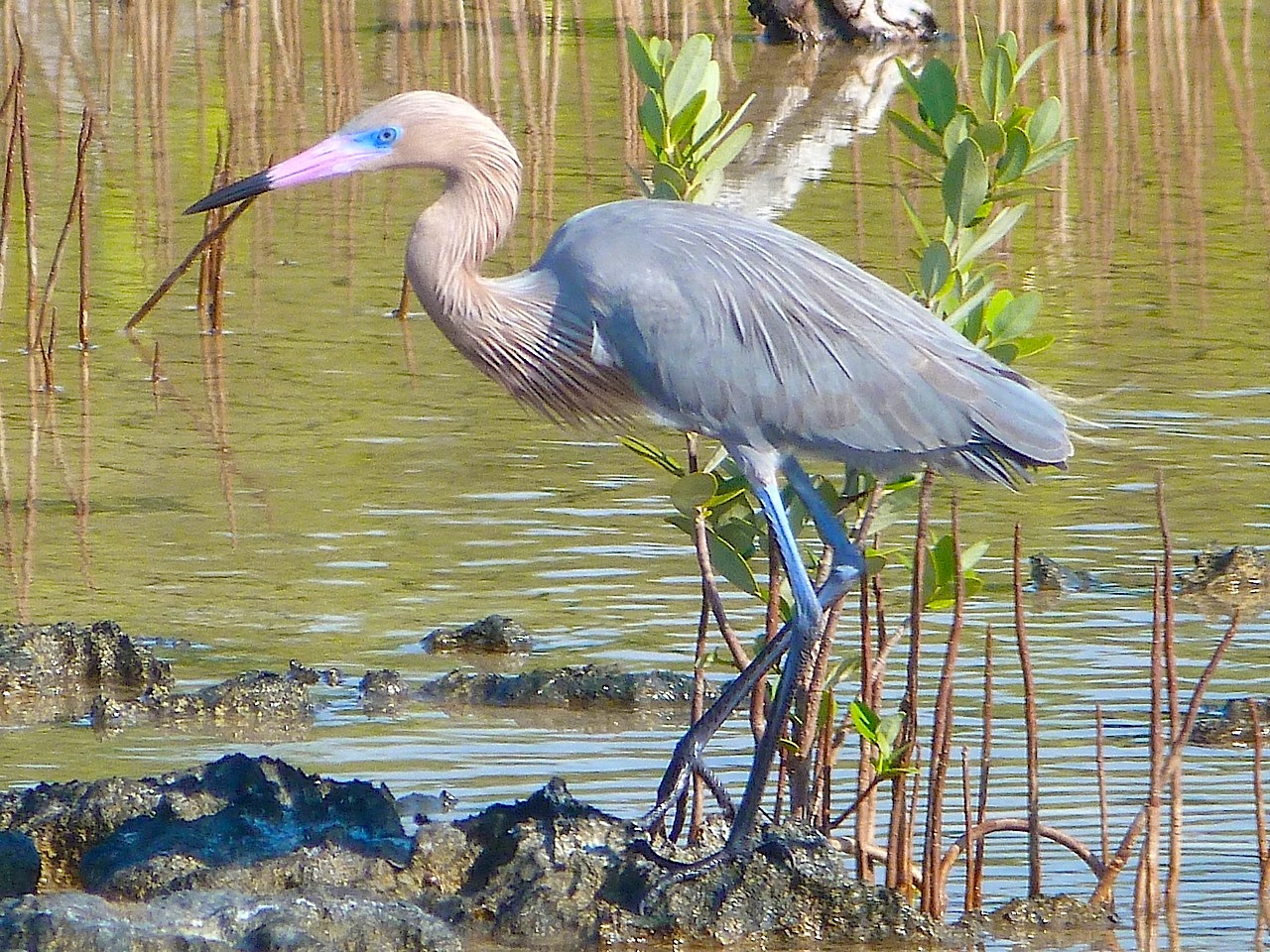
Reddish Egret (white morph)
Reddish egret credits: white morphs – Danny Sauvageau and Phil Lanoue; standard version in full breeding plumage at Crossing Rocks Abaco – Keith Salvesen / Rolling Harbour
This is not the ‘pink’ supermoon you saw the other day, but one from a couple of years back. I only had a bridge camera with me with a cheapo 1.7 teleconverter, but luckily a sturdy windowsill as well to reduce the shakes (that kind, anyway…). I marked a few prominent features on the image. Some of these took me back to a childhood astronomy book (‘Imbrium!’; ‘Nubium!’) where I learned about stars well beyond Orion, Ursa ma. & mi., and Cassiopeia – about the only constellations I can reliably point to these days.
This week’s supermoon shone very brightly where I am now, but the moon itself was rather hazy. It certainly wasn’t pink but rather more of a pale cold white. As it turns out, the ‘pink’ doesn’t refer to the lunar colouring anyway, but to the full moon in Spring that occurs when the early-blooming wild pink comes into flower. So, it’s a seasonally-based name and a bit like the harvest moon not being harvest coloured…
Photo: Tom Sheley, taken at Bahama Palm Shores, Abaco
This wonderful and mood-brightening photo was taken by Tom while we were compiling an archive for my book BIRDS OF ABACOIt is one of the most memorable images of the very large number of photographs featured. Every one of them was taken on Abaco (photos taken ‘off-island’ were ruthlessly excluded); and each one in natural surroundings (no seed-trails, recorded calls and so on). Sadly the edition sold out well before Hurricane Dorian so we have been unable to replace any of the many lost copies. However, I am contemplating producing a pdf version of the pre-print draft (a Covid displacement activity). If that goes ahead I will devise a way to distribute it simply, and possibly in return for a modest donation towards the work of Abaco wildlife organisations.










 .
.




































 ROLLING HARBOUR ABACO


You must be logged in to post a comment.