ABACO, BAHAMAS has been all but destroyed by Hurricane Dorian. The horrendous scale of the disaster in human terms alone is only now becoming clear as the days pass and new tragedies are revealed. Many established relief funds – international, national and local – are being very generously supported for the benefit of those who have suffered so grievously. I am adding to the number through my specific link to Abaco and its wildlife.
For obvious reasons, the GFM page (in edited form here) has a rather more formal , explicatory tone than I would usually use.
Sally and I were founder members of the Delphi Club, Abaco and retain strong connections with the island and the community. I run a conservation program for rare migratory plovers that overwinter on Abaco; and I am involved with BMMRO & its marine mammal research.
‘THE BIRDS OF ABACO’, of which I am the author, was published in 2014. The book was designed by Sally and published by Peter Mantle / The Delphi club. By the end of last year the edition had sold out, and all planned educational donations to schools, libraries and relevant organisations had been completed.
However, I have a couple of dozen books left in the UK. Through this fundraiser, I am offering a copy of the book in exchange for a donation of $150 (or the equivalent). The resulting fund (minus the cost of fulfilment from the UK) will be added to the funds achieved by the Delphi Club through theirDORIAN RELIEF FUND .
A higher donation is of course encouraged; and please note, it is not compulsory to receive a bird book. Smaller donations are extremely welcome too, and for those of $50+ I will offer the donors a high-res PDF of a bird of their choice from a selection of several significant species found on Abaco; or a PDF of the complete bird species checklist for Abaco. That’s voluntary too.
The original price of this large photographic book was $145. It showcases the wonderful birds of Abaco with contributions from 30 photographers. Almost all are either residents of Abaco, or have strong connections with – and affection for – the island and its cays.
The books can be sent to Bahamas, USA, Canada and Europe. For any other destination, please contact me before you make a donation. Books will not be dispatched before October.
Please note that the Delphi Club does not have a stock of books and is not directly involved with this fundraiser. Please contact me with any inquiries, even though the Club details are shown on the pre-publication flyer below.
Getting close to a herring gull is not a particularly heroic act, and yet… they look quite intimidating. The glint in the eye is somewhat evil. And they can be fairly aggressive when the mood takes them. I once had my scalp raked by a herring gull when I got too near a breeding area on a small island in Scotland. It got me from behind. There was blood. Plenty of it. It was my own stupid fault, and a lesson learned.
Behold a fine herring gull stepping ashore with its beady eye fixed on me. Behold it starting to advance towards me in a purposeful way… Then it noticed the camera and decided to pose instead of attack.
One complication for amateur birders is that these (and other) gulls take 4 years to reach maturity and the full adult plumage shown here . We’ve all seen those huge browny-gray-speckled babies crying pitifully to be fed, when they are nearly the same size as the food-providing parent. Over those few first years the plumage goes through several stages, and other colour changes – eyes and feet, for example – take place. Eventually they get to look as handsome as this one.
I photographed the bird featured here only last week, on the south coast of Ireland, which is a bit of a cheat. Strictly, you are looking at a European herring gull, although the differences from the American ‘Smithsonian’ herring gull is relatively small. I’ll say ‘negligible’ for present purposes.
WHAT’S THE PURPOSE OF THE RED BLOB ON THE UNDER-BEAK?
Good question, and one that historically was the subject of hot debate in ornithological circles. The short answer is that scientific investigation and experimentation led to the conclusion that the red blob is a kind of feeding cue for chicks, a target area for them to aim for food or to peck to say they are hungry. Some other gull species also have this clever beak feature.
“HAPPY FEET”
As we all know, there are gull species with yellow legs (not least the apty-named yellow-legged gull in Europe). Herring gulls have decidedly pink legs and feet, and interestingly constructed ones at that. This isn’t the moment for a lot of technical blurb about it – just take a look at these 2 images. Extraordinary, huh?
It’s often a hard decision whether to include a short piece of video footage in a post. By short, I mean less than a minute. On the one hand, there is usually a good reason for inclusion, even if only aesthetic. On the other, it simply takes up more time for busy people who may prefer to flick through an article and enjoy some nice images along the way. Today, you can have the best of both worlds.
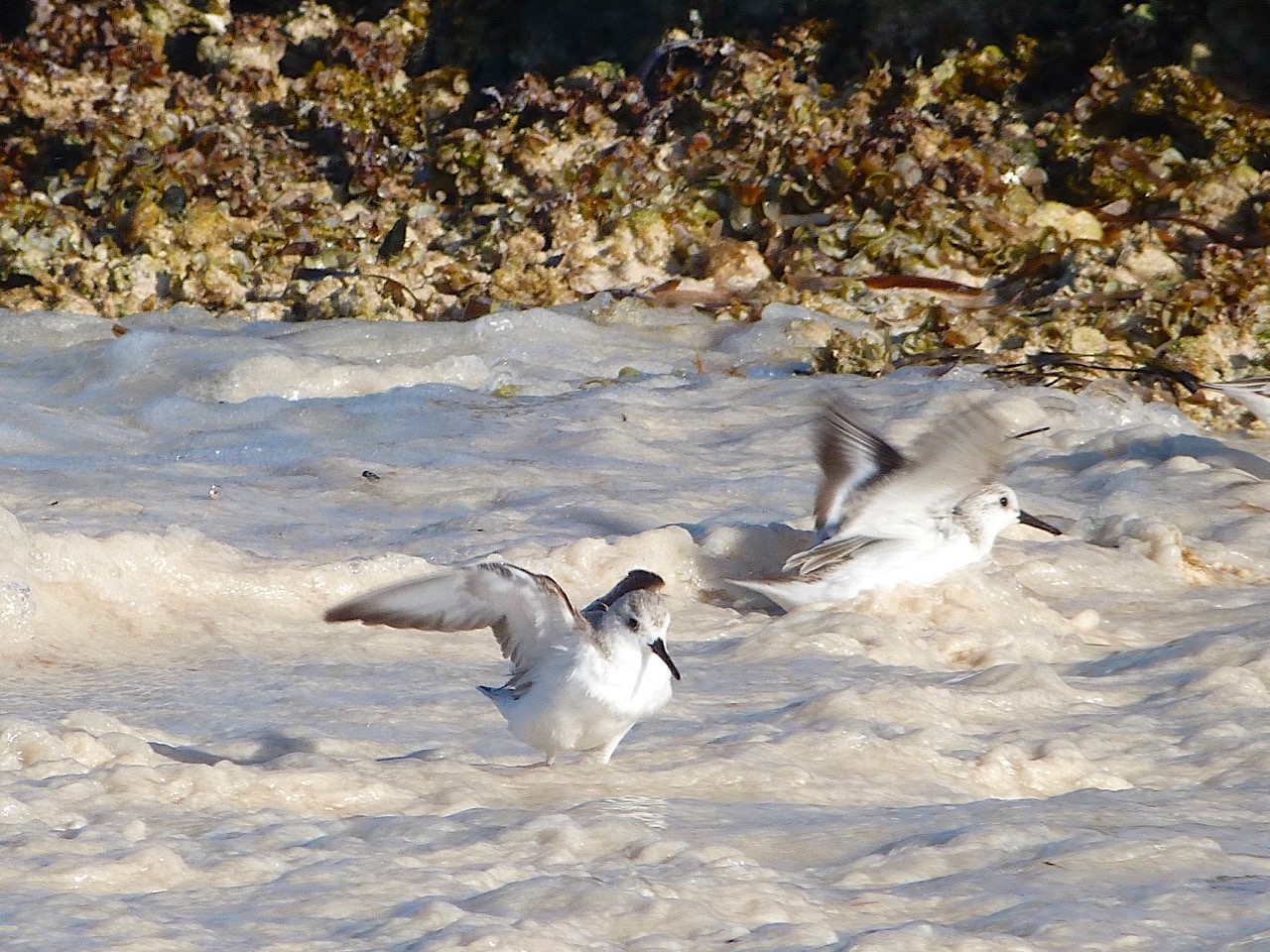
Sanderlings are definitively ‘peeps’, a group name that embraces the smallest and squeakiest sandpiper species. They are the wave chasers, the tiny birds that scuttle along the beach, into the retreating tide for a snack from the sand, and back to the beach again as the waves creep in. Their little legs and feet move in a blur, and many people immediately think of wind-up clockwork toys as they watch the birds in action.
One of the joys of being a sanderling is that rock pools fill and empty diurnally. At some time during daylight, there’s the certainty of a quick dip. I was lying on the beach when I took this short video, so that I didn’t spook the birds. I was equipped with a smallish camera (I drowned it the following day. By mistake I mean) but I kept my distance rather than try to get closer and spoil their joyful bathing.
I caught these little birds at a critical moment. You can tell that the tide is coming in fast. The peeps are becoming edgy, and weighing up the joys of immersion in a pool with the less enjoyable prospect of being washed out of the pool by the next wave. Within a minute or so, they had all flocked down the shoreline for a foraging session.
Waves and incoming tide getting a little too close for comfort on the edge of the pool…
Next to the migratory PIPING PLOVERS that favour Abaco as their winter home, the wave chasers are my favourite shorebirds. My keenness on them killed my camera. I went out into the incoming waves to get shots back at the beach with the sun behind me. Great idea until I lost my balance with, as they say, hilarious consequences. Lesson learnt – never turn your back on waves.
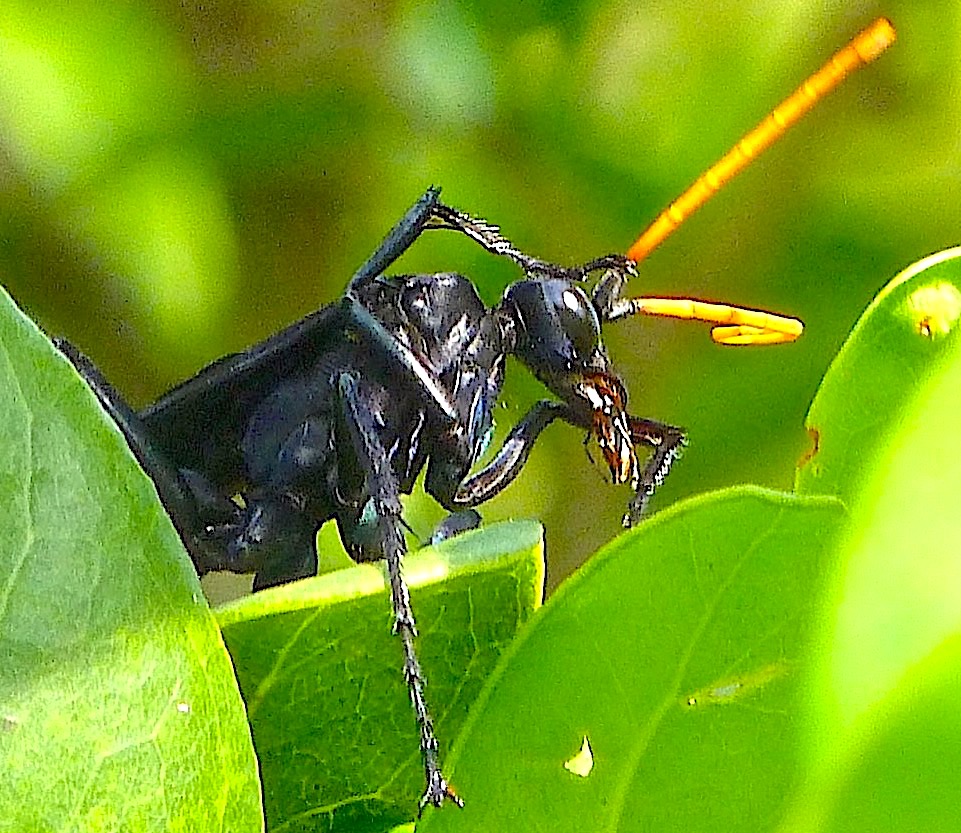
I’ve recently had a flood of online hits for a creature I wrote about several years ago. It’s an aggressive-looking insectthat I found in the coppice on South Abaco. I have revisited and revised the original article, with some better images than my own original ones. I could only get a partial shot of the insect, and I wondered whether to try to reach it and get a more complete shot. Perhaps I could have, but very fortunately for for me (as it later turned out) I didn’t touch it.
This creature turned out to be a Spider Wasp (aka Pepsis Wasp), of the Pompilidae family. The insect is familiarly known as a Tarantula Hawk, for reasons give in unsparing detail below. For it turns out that this creature would be the hardest bastard insect on Planet Bastard in the Galaxy Bastardium.
It’s lucky that I didn’t try to try to collect it to keep it in a matchbox (if those even exist now). Note, for start, the scary eating apparatus… and it’s not for nibbling leaves as I had thought, but chopping up small insects. The leg claws and barbs are for pinning down its prey. You would not believe how unpleasant these little buddies are – and that’s before we even mention the sting…
SPIDER WASPS IN ACTION
These wasps are known in some countries as “horse-killers”. There are many species around the world, with 6 subspecies, one of which being the Tarantula Hawk or Pepsis Wasp – so-called because it hunts tarantulas and uses them in a most ingenious and cruel way… NB theBNT have rightly pointed out that these insects are unaggressive to humans. If you leave them alone, they will spare you. I’ve also read that“The tarantula hawk is relatively docile and rarely stings without provocation”Now read on to see if it might be sensible to provoke one or not.
SCARY CRITTERS & LIVING LARDERS
(Trigger Warning: this is really rather gross)
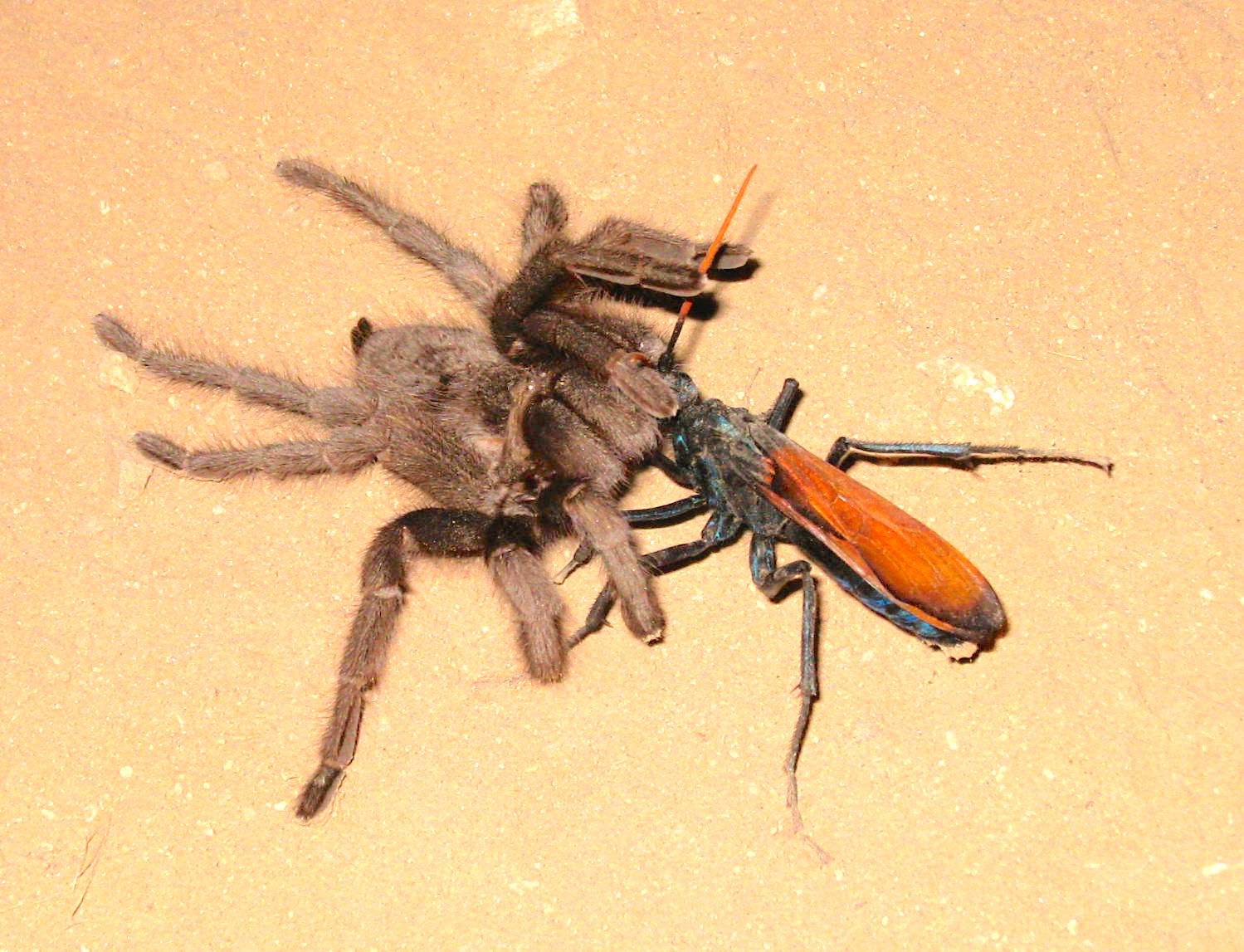
SPIDER WASPS are ‘solitary’ insects that feed on ground spiders/ tarantulas by stinging them to paralyse them, then eating them. In the most sinister way, the females also make use of spiders for breeding purposes. Hear this! They build a nest in a burrow, find a spider (a tarantula for choice), paralyse it with their sting, drag it to the nest and lay a single egg on its abdomen. Then they seal up the burrow.
When the egg hatches, the larva chews a hole on the spider’s abdomen and enters a living larder. It gradually eat its host as it grows. The spider’s vital organs are left till last, so that the spider stays alive as long as possible until the larva has reached full-size. After several weeks, the larva spins a cocoon and pupates (often over winter). Finally, the wasp becomes an adult, bursts Alien-like from the spider’s abdomen (deftly evading Ripley), and tunnels out of the burrow…
Do NOT try this at home or more than 10 yards from a medical centre
SPIDER WASPS: MORE FEARFUL FACTS
Their hunting improves with experience – the more spiders they eat, the quicker they find, attack & kill them
Males use ‘perch territories’ to scan for receptive females from a tall plant or other vantage point, a behaviour known as HILL-TOPPING
Adult wasps also feed on a variety of plants for nectar & pollen. They may become intoxicated on fermented fruit, which affects their ability to get around (I think we’ve all been there at some time…)
The female Pepsis gets her spider in two main ways: approaching a tarantula causing it to rear up defensively on its legs, thus exposing its abdomen to the sting or
She locates a tarantula’s burrow, using her sense of smell. She tricks the spider into emerging by tweaking the web at the burrow’s entrance or ‘intruding’ (see video below)
The wasp uses her long stinger to stab her prey. The poison rapidly paralyses the spider. She then drags it to her burrow, lays her egg onto the tarantula’s abdomen, seals the burrow and leaves. Job done
The hooked claws and barbs on the wasps’ long legs are weapons for grappling with victims
The stinger of a female tarantula hawk can be up to 7 mm (1/3 inch) long – and the sting is among the most painful insect stings in the world (see below)
Only the females sting (males may pretend to) because the stinger is linked to the ovipositor (egg-laying organ)
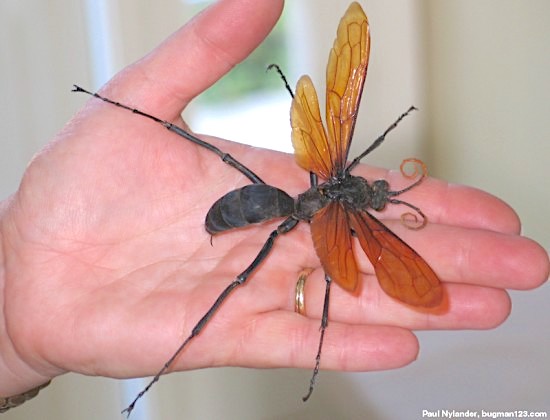
You can distinguish females from males by the curled antennae of the female. Mine was therefore female
The Pepsis wasp has (unsurprisingly) very few predators, though apparently roadrunners and bullfrogs may tackle them
Here is a hypnotically fascinating 3-minute video of the life-or-death struggle
SPIDER WASP –v- TARANTULA
THE STING
The sting of these wasps is among the most painful of any insect, though the most intense pain lasts on a few minutes. Entomologist Justin Schmidt bravely submitted himself to the stings of various insects and described this pain as“…immediate, excruciating pain that simply shuts down one’s ability to do anything, except, perhaps, scream. Mental discipline simply does not work in these situations.”
Schmidt produced his SCHMIDT STING PAIN INDEXThe pain scale, based on 78 species, runs from 0 to 4, with 4 awarded for the most intense pain. Spider Wasps of the species Pepsis – i.e. Tarantula Hawks – have a sting rating of 4.0, described as“blinding, fierce, shockingly electric. A running hair drier has been dropped into your bubble bath”Only the bite of the Bullet Ant – and the sting of the Warrior Wasp – is ranked higher, with a 4.0+ rating, vividly described as“pure, intense, brilliant pain. Like fire-walking over flaming charcoal with a 3-inch rusty nail in your heel”
LIGHT RELIEF AFTER THE PAIN
1. In 1989, New Mexico chose the Tarantula hawk wasp as the official state insect. The choice seems to have been left to schoolchildren and I’m guessing here (or gender-stereotyping) but I suspect it was the boys’ choice that won…
2. Tarantula Hawk is a “psychedelic progressive metal band” from San Diego, Ca. Their short discography includes their debut Tarantula Hawk (CD/LP, 1998); Burrow (Live CD, 2000, self-released); and Untitled. The cover of their debut provides the perfect ending for this post, vividly depicting the colour and texture of the swirling fiery pain you could experience (and I don’t really mean from listening to the music…)
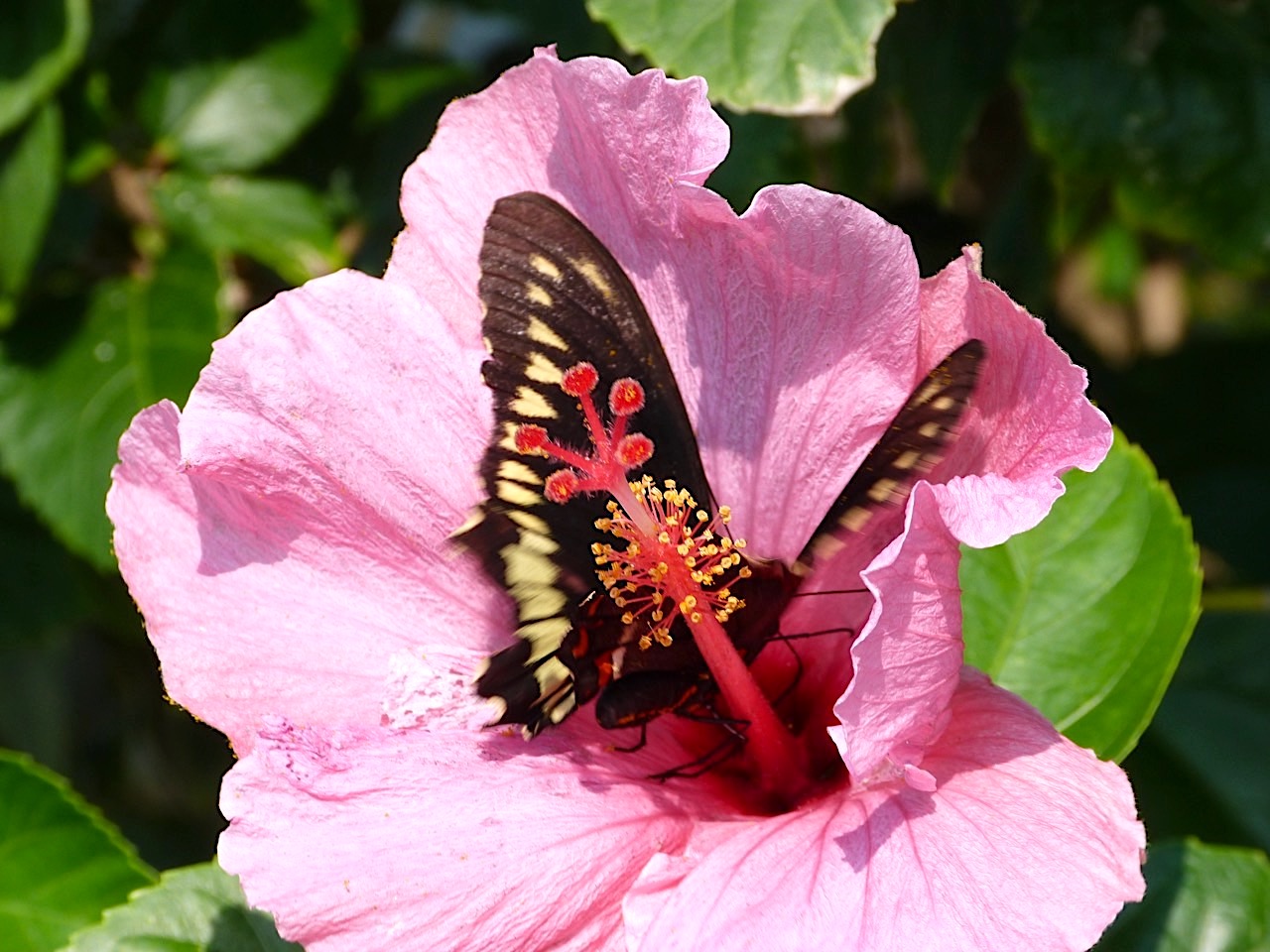
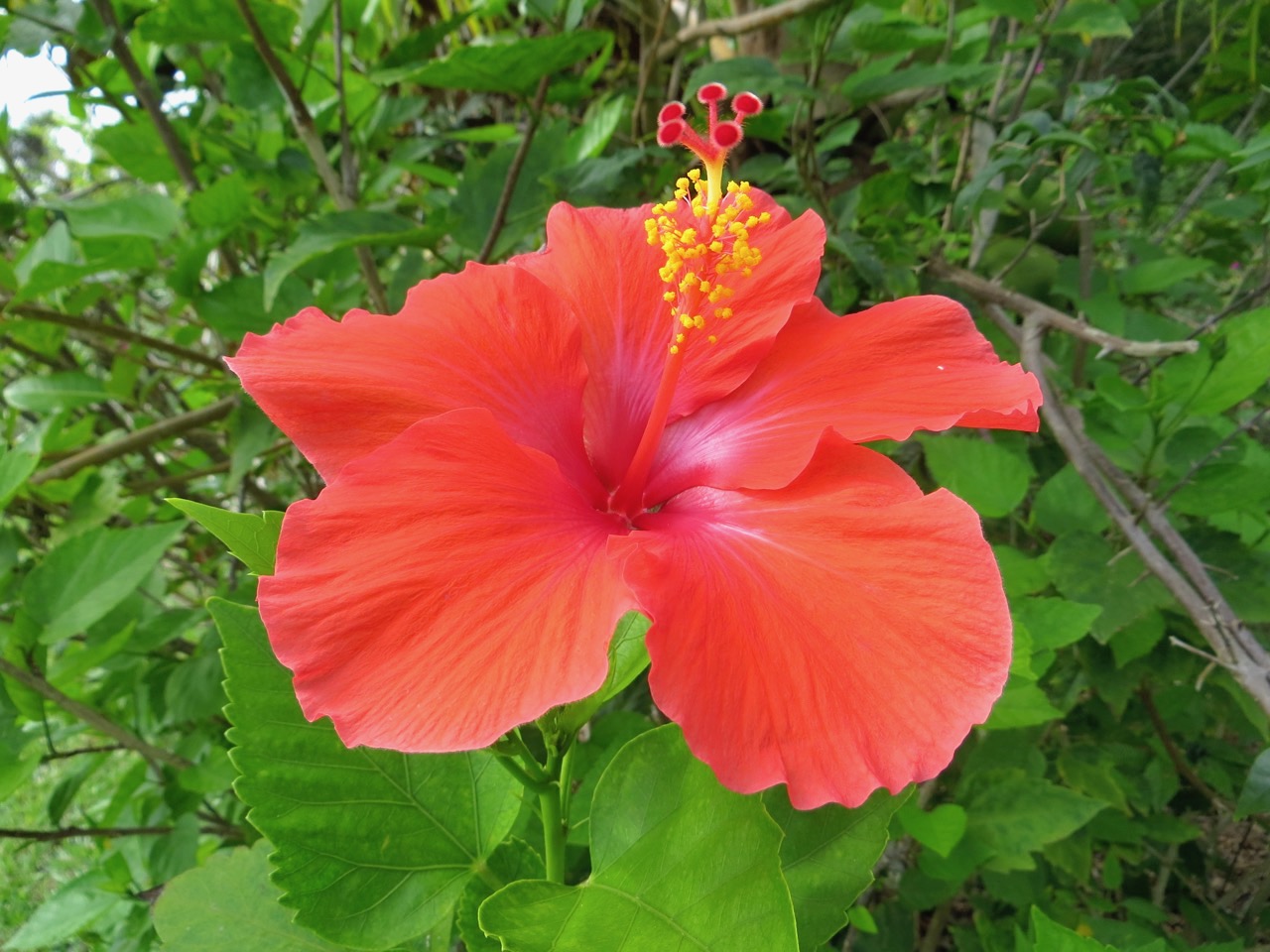
‘HIBISCUSES’ as the plural for more than one Hibiscus schizopetalus looks wrong somehow (hibisci?) but is in fact right. It’s similar to the problem with the correctPLURAL OF OCTOPUS, a name that is also of Greek and Latin origin. The ‘schizo’ part reflects the division of the petals (though this characteristic surely applies plenty of other species).
The flower above is being visited by the familiar and lovelyPOLYDAMAS SWALLOWTAIL or Gold-rimmed butterfly. They are extraordinarily difficult to photograph when their wings are open – they flutter by, and carry on fluttering non-stop. I have always found it hard to get an entirely in-focus open wing shot. And when I say hard, on reflexion I don’t think I ever have…
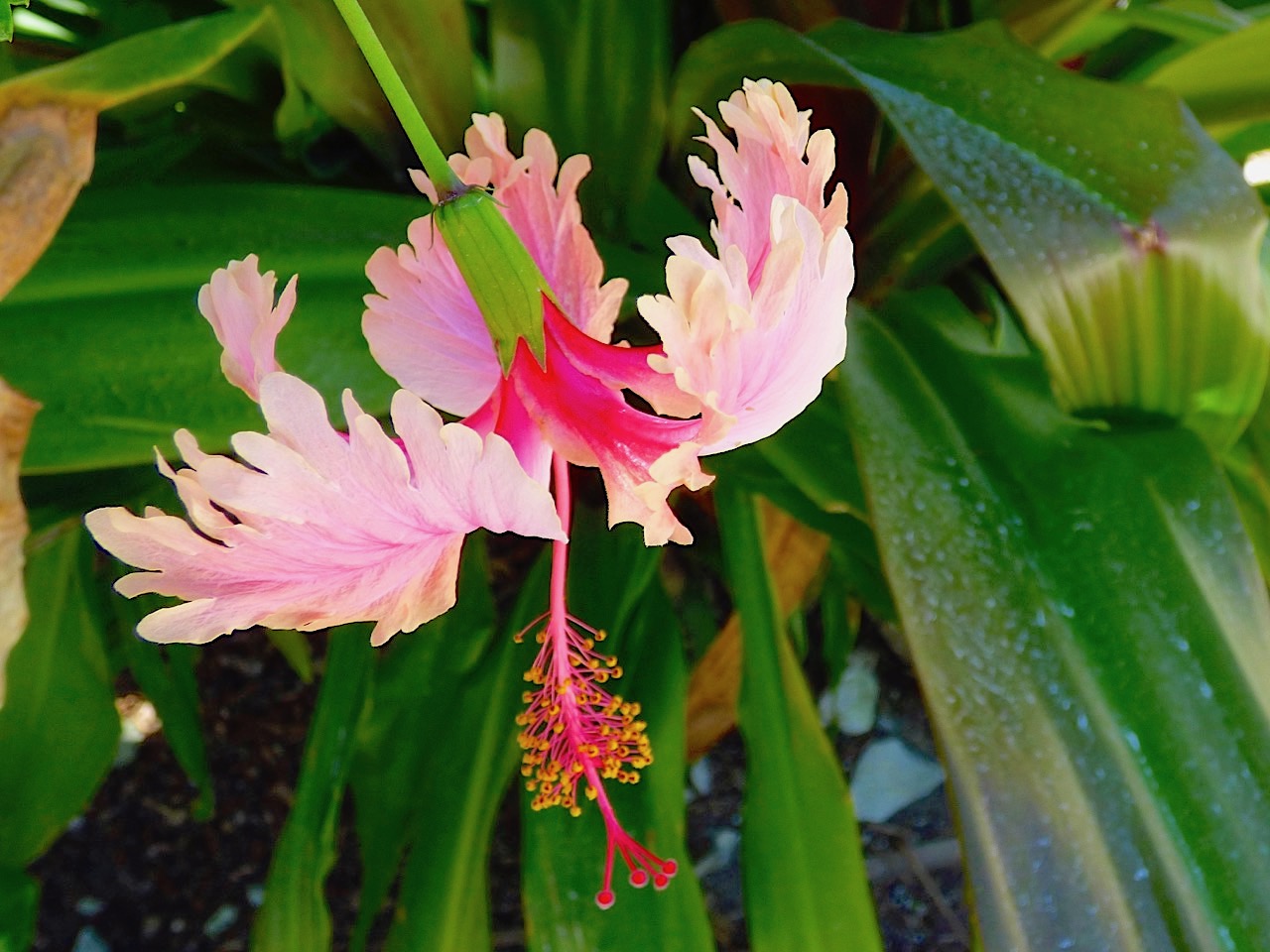
Elegant coral hibiscus
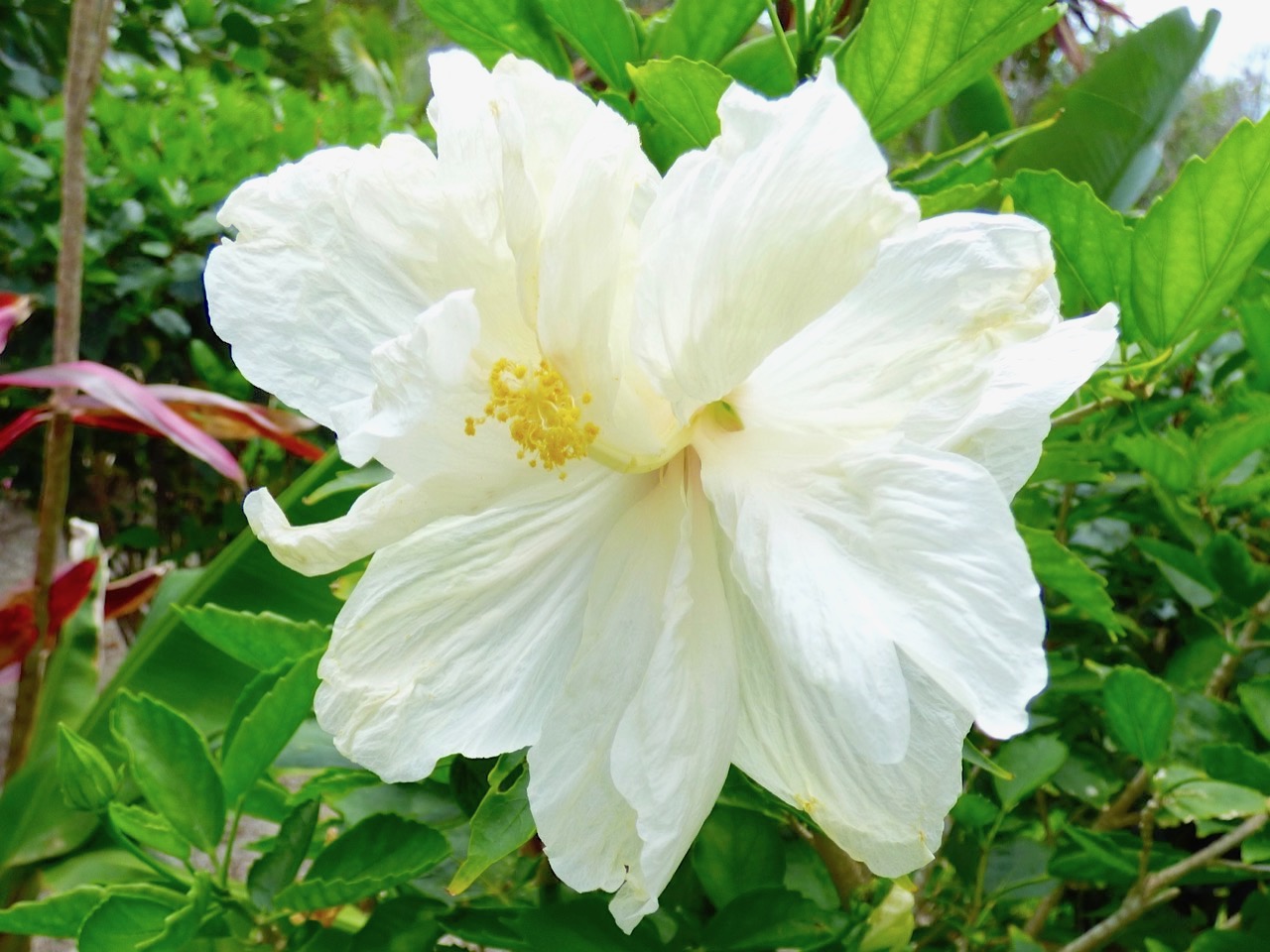
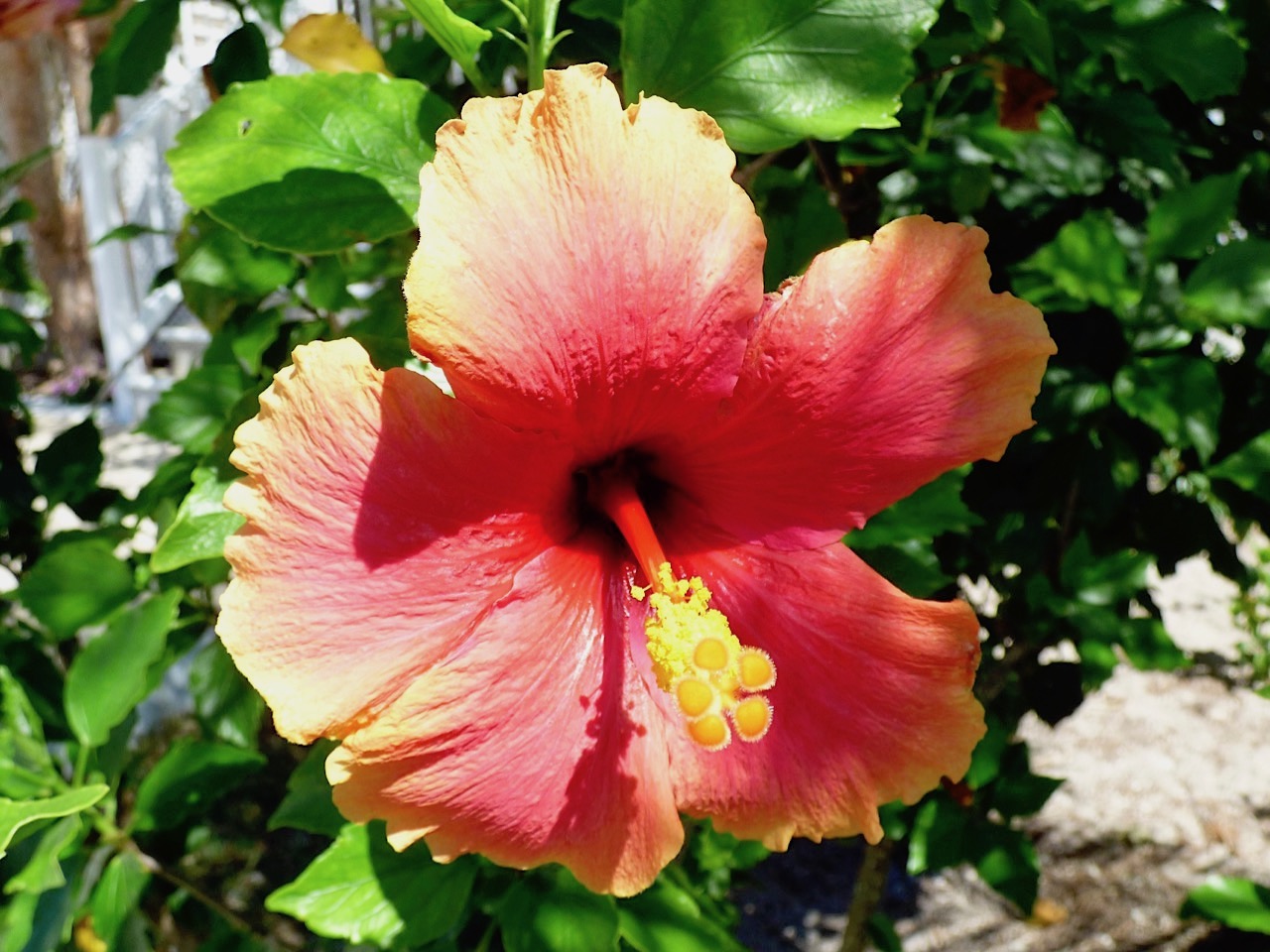
The hibiscus is kind of mallow, a large and colourful family found throughout the world in warm-to-hot areas. Apart from the bright colours and pretty looks, the plant makes for a nice cup of tea (cf camomile tea) that some say may help to lower blood pressure.
There’s a lot of technical stuff to say about the petal construction and leaf forms, but I prefer to leave you to look it up if you want a deeper analysis than I am minded to give. I love flowers to look at and even to grow – who does not – but unlike the mechanics of birds, botanical intricacies seem *whisper* quite dull.
IS THERE A STIGMA ATTACHED TO THESE FLOWERS?
Yes indeed, but not in the more common usage for disgrace, disrepute or dishonour. In the botanical sense, it is the central part where the pollen of a flower is to be found. It’s the part that the bees are looking for.
A massive stigma
Besides the tea / blood-pressure reduction benefits of hibiscus mentioned earlier, the plant is used in many places round the world for folk medicine for a variety of ailments. I don’t actually know if it is used in the Bahamas, where bush medicine certainly has its place in the treatment of some conditions. Any comments on this would be welcome.
One of the pleasures of watching birds (as opposed toBIRDWATCHING, a more committed-sounding enterprise with its own Wiki entry, that may require equipment, books & mag subs…) is to spend some time observing them enjoying themselves. Perhaps you have a feeder, and like to watch the birds getting stuck into the seeds, carelessly flicking the husks around and throwing their ‘feeder shapes’ on the perches. Maybe you like to see the hummers, beaks deep into the little red plastic flowers on the rim of the sugar-water feeder, tiny bodies motionless and upright, wings a glistening blur of rapid movement in the sun.
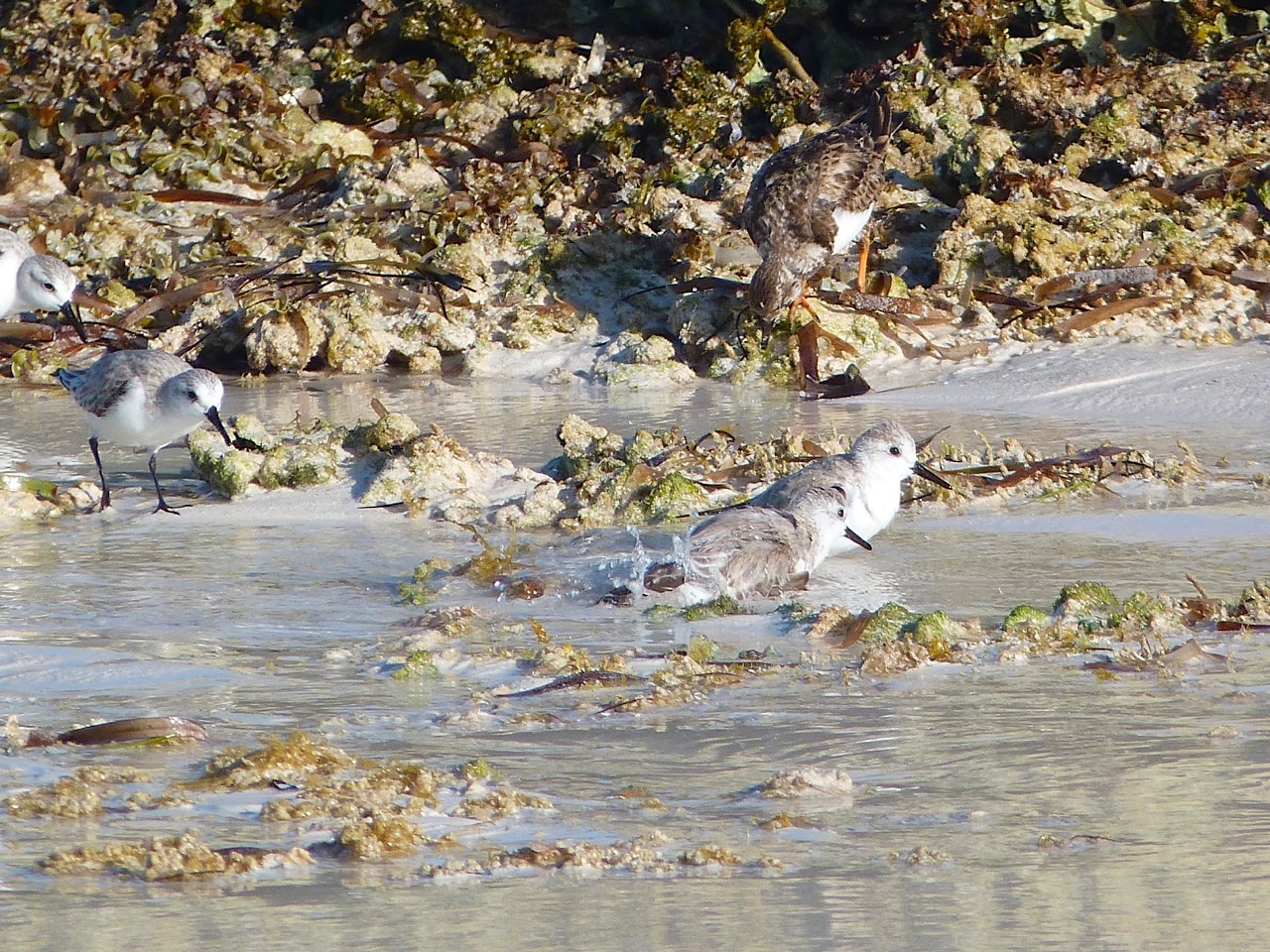
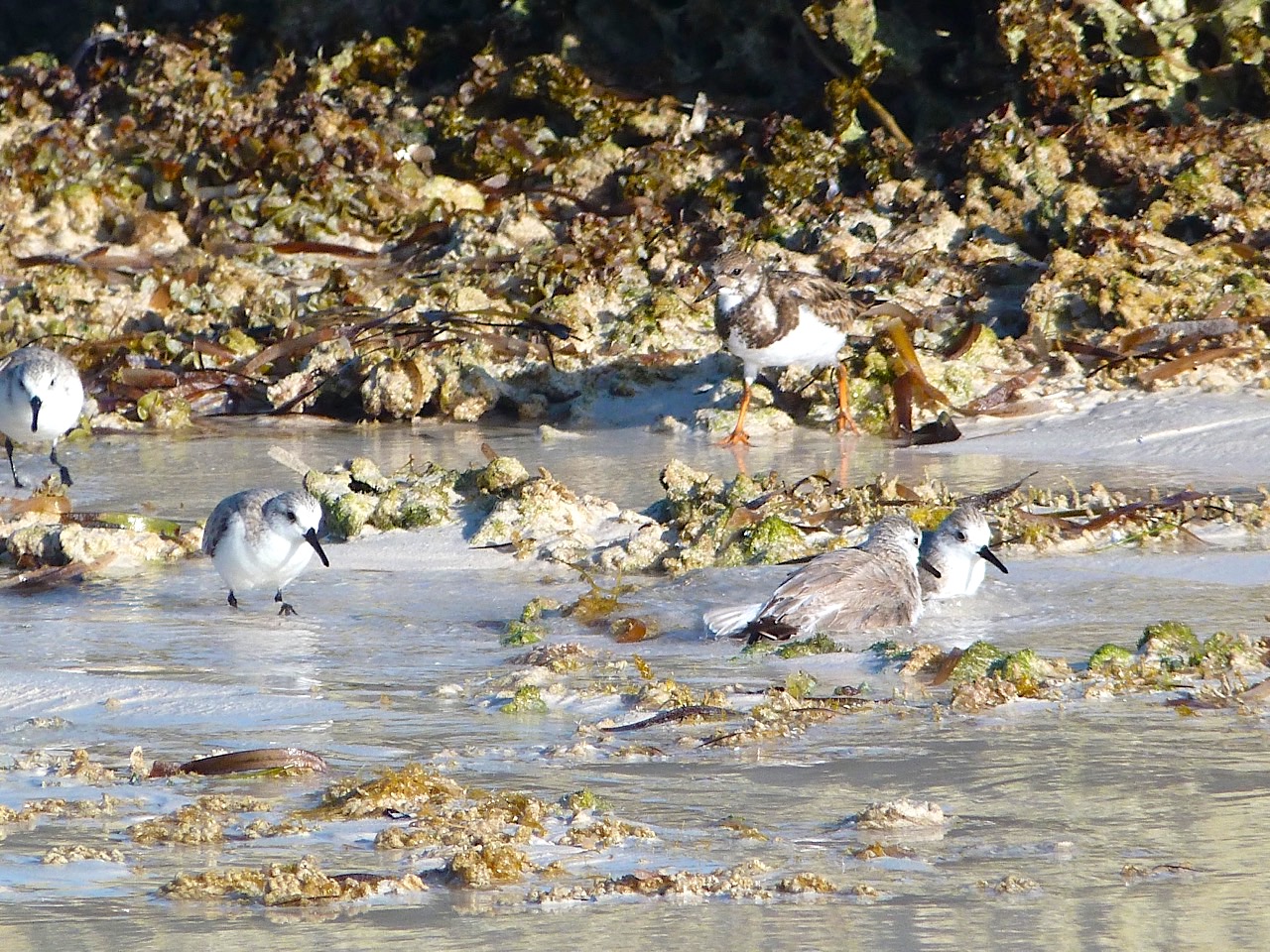
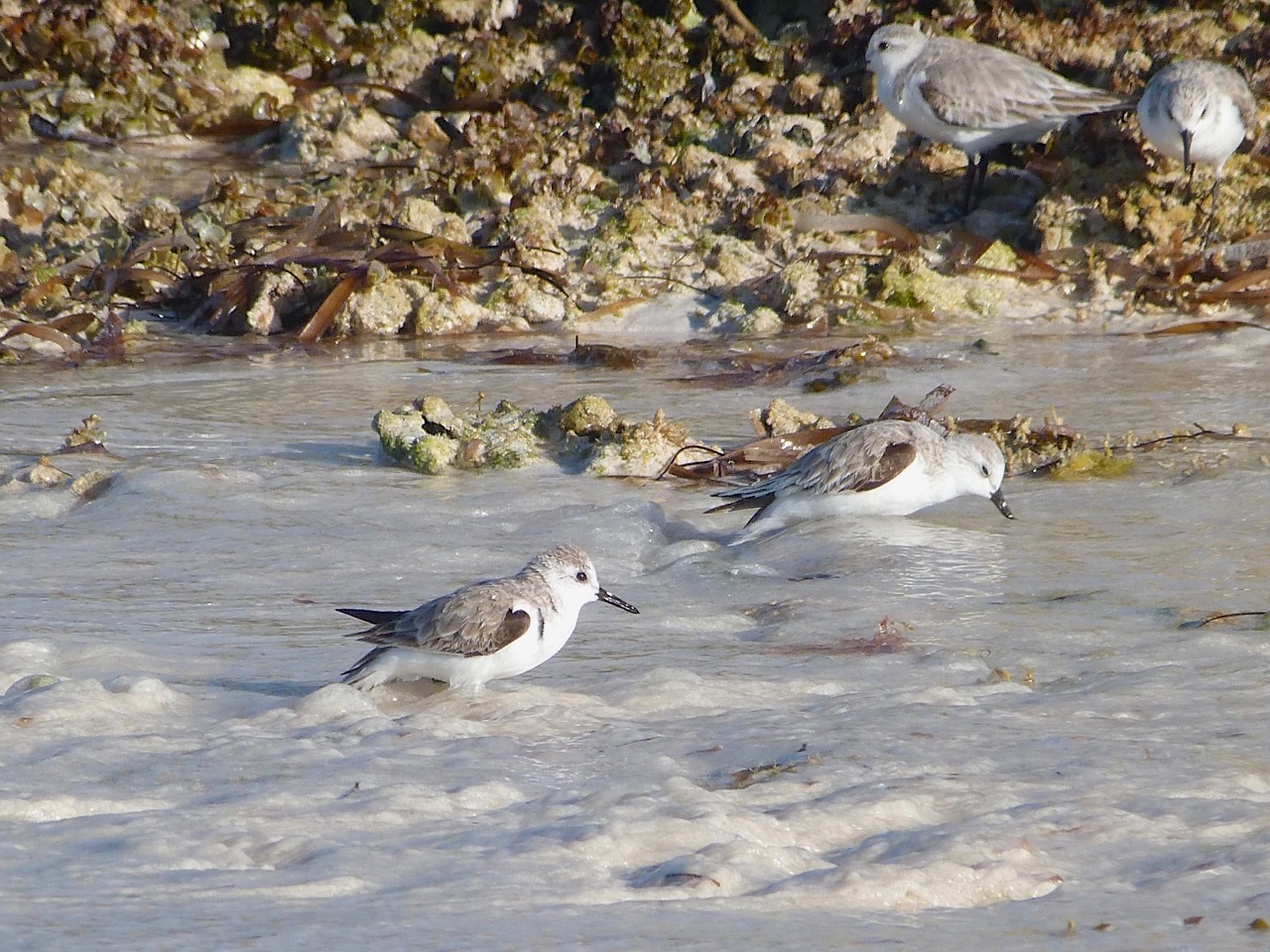
It is 5.30 pm. The sun is sinking in the early evening sky. The tide is on the rise at the north end of the Delphi beach where the reef joins the land. There is a small spit of sand that will be covered quite soon, but meanwhile two dozen sanderlings mixed in with assorted ruddy turnstones are doing their idiot feeding thing, rushing around on their tiny legs, stabbing in the sand, and generally behaving like clockwork toys on speed. Meanwhile a handful have found the fun to be had in the swirling tide as it pours round the head of the reef onto the sand spit. Yes, it’s sandpiper bath-time!
Towards mid-tide on the rise, the water begins to creep round the rocks and encroach onto the sandbar. At high tide, it is well under water and fish are back in residence. Small sharks sometimes hang in the waves just behind their breaking point over the shallow sand. And so the tidal process repeats.
For the sanderlings, the best part of the day is when the tide is rising. At ± mid-tide is the time for the shore birds to bathe in the tidal pools that form – and as the water pours in around the end of the rocks, it froths like an overenthusiastic bubblebath. Right then is an excellent time to sit peacefully on the beach and watch the entertainment…
Substantial immersion is not out of the question…
These moments don’t last long. Soon the increasing force and height of the water spoils the fun, and the flock will suddenly take flight and move south a little way along the beach, away from the rocks. There’s the incoming tideline to play with – and more importantly, food to be uncovered with each incoming and retreating wave…
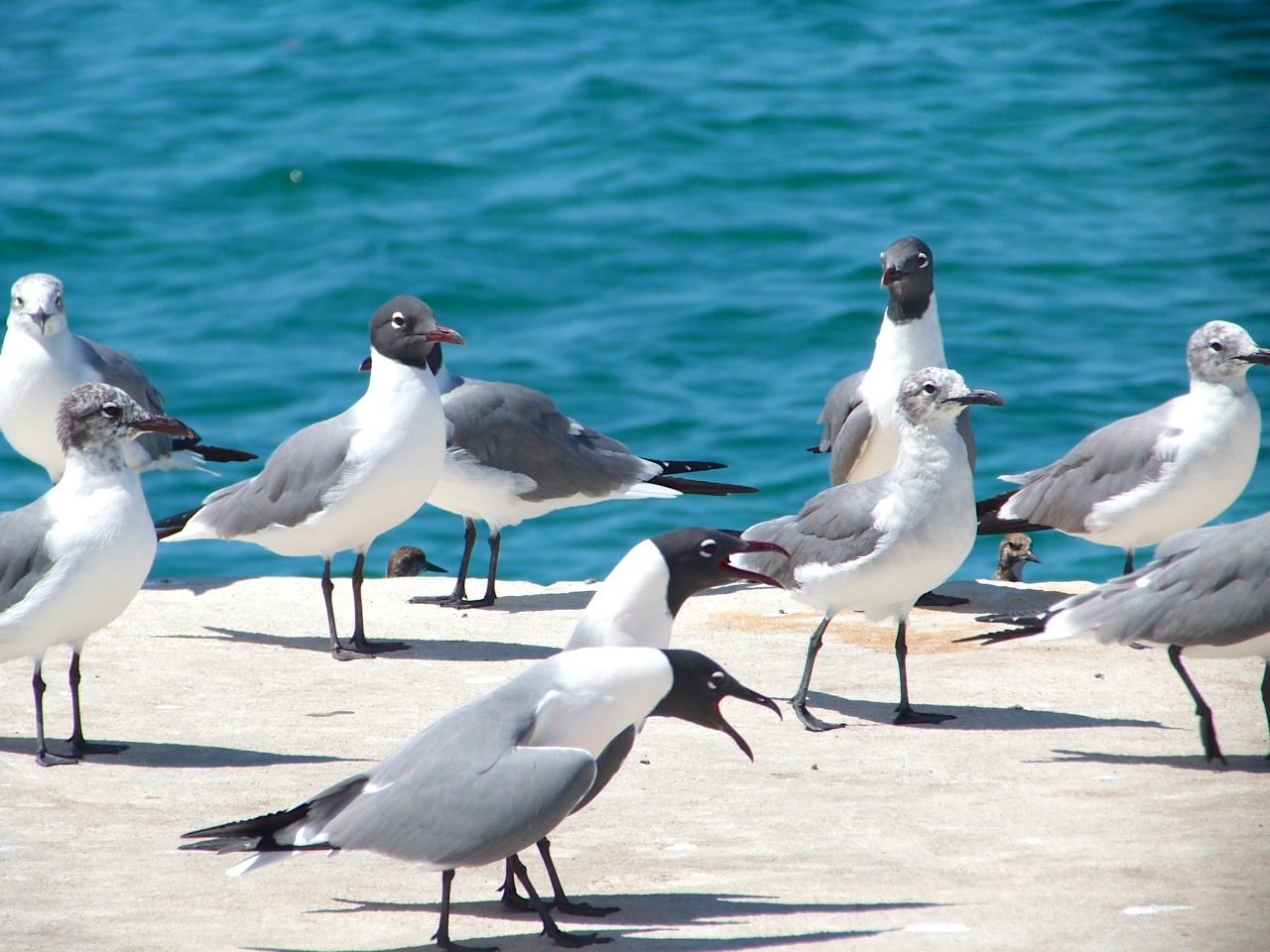
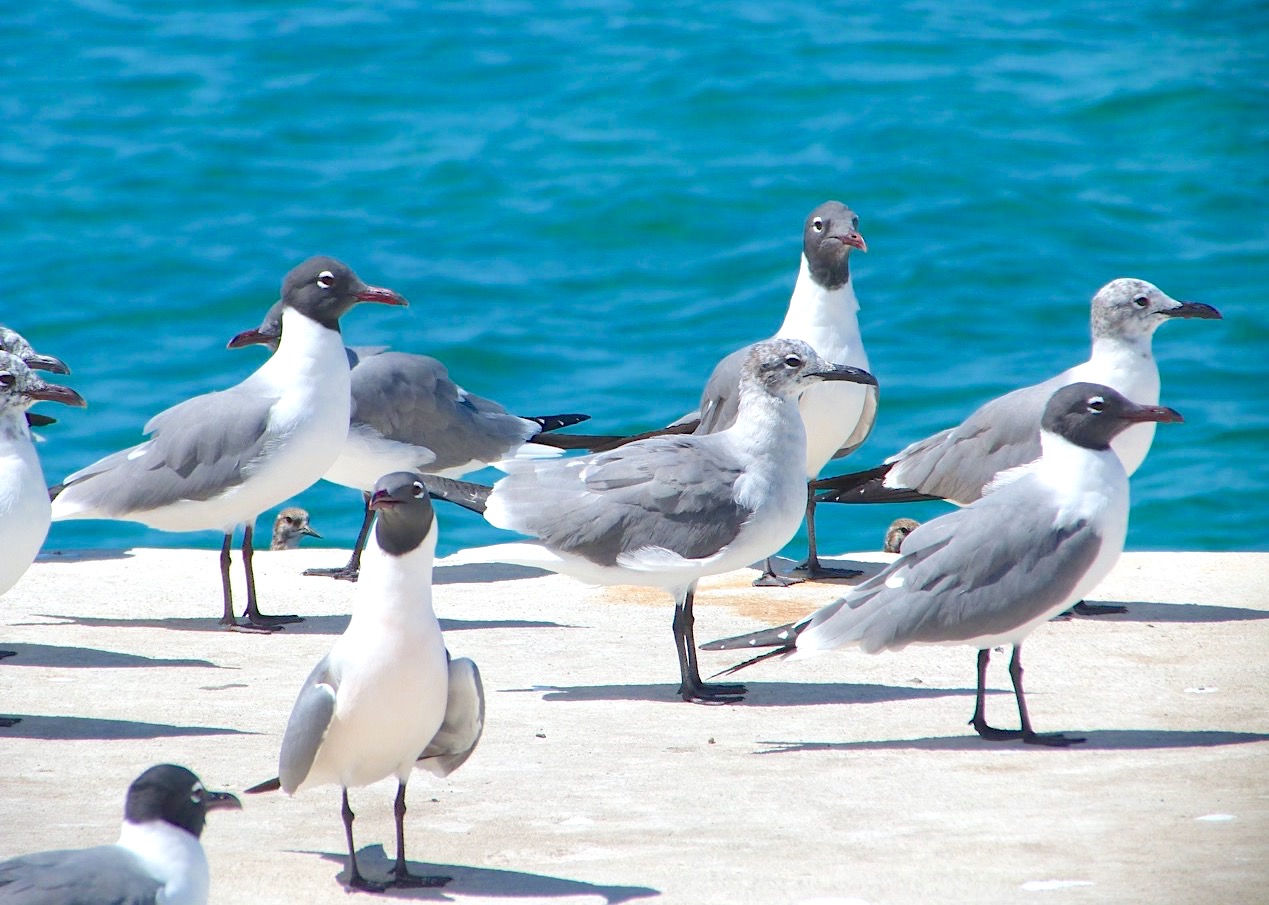
By the end of day 2 during my recent stay at Sandy Point, I thought that I had had just about enough of the laughing gulls Leucophaeus atricilla. They are delightful of course, and (in small doses) a joy to listen to. But their incessant outbursts of humour were getting beyond a joke.
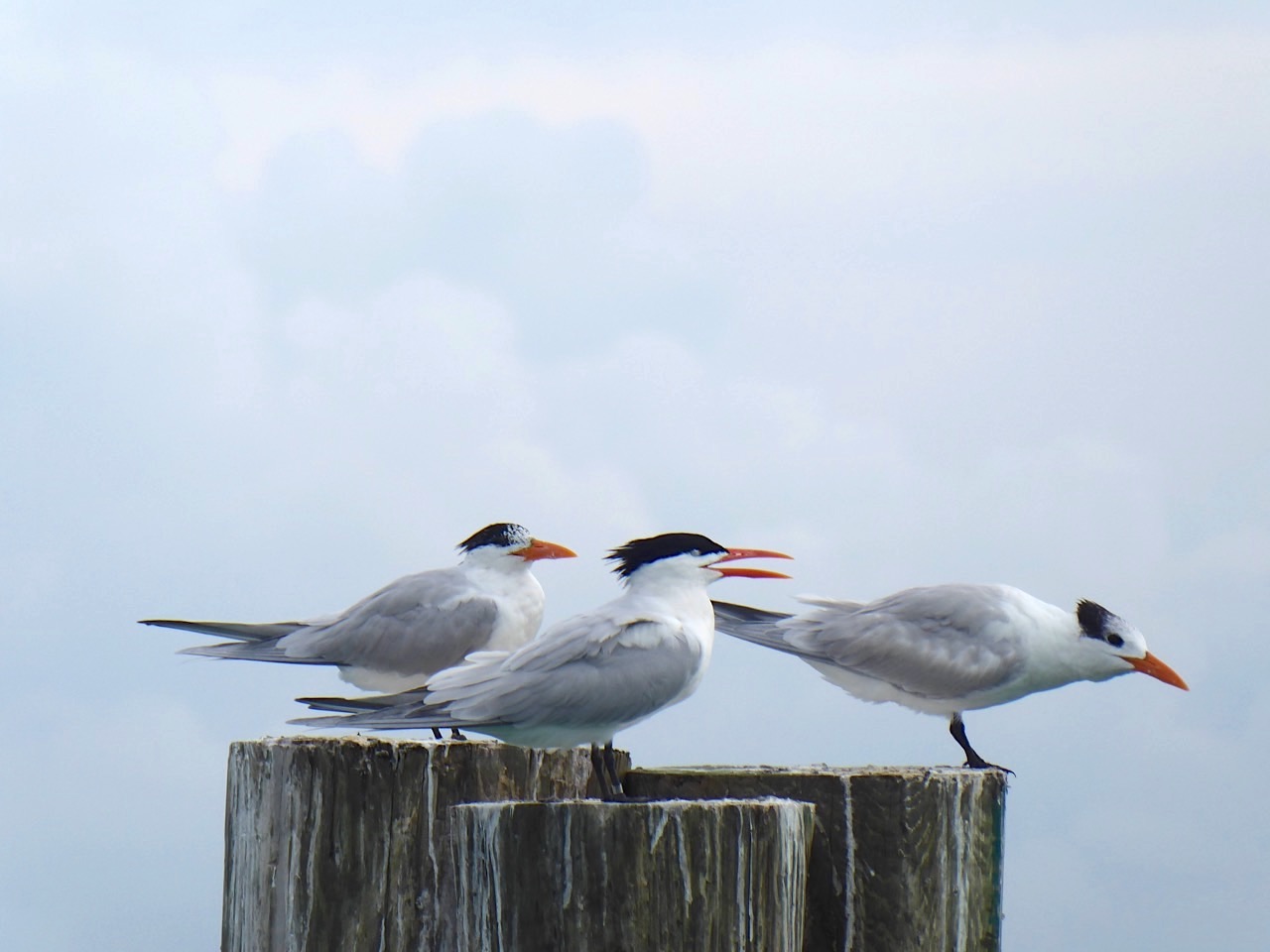
The next day, on the nearby jetty, the gulls were in full cry. A lone brown pelican stood on top of a piling, looking out to sea. A few Royal Terns turned their faces, characteristically, into the light wind. I wandered over and slowly walked down the jetty. This generated some laughter, but the birds were quite content to watch me edge slowly towards them.
Probably, the gulls feel safety in numbers. Maybe they hope the din will send you away. Or perhaps, if approached very carefully, they are simply curious. I got close to the birds, and one in particular caught my eye. It was plainly having a bad-feather day. I took it to be a non-breeding adult, but it lacked the white spots on the tail-feathers (primaries). Maybe it was a first winter juvenile. Whichever, it was happy to pose for me.
I realised, of course, that the jetty belonged to the birds, including the ruddy turnstones that had just joined the gang at the end of the jetty. I was the intruder in their world, and I had willingly visited their territory. So their racket was entirely their business, and absolutely none of mine**.
WHAT DO LAUGHING GULLS SOUND LIKE? ARE YOU OVERSENSITIVE?
I made a couple of short recordings of the gulls in full humour mode. If you have never heard them before, you might want to listen to the full 30 seconds. For anyone else there’s a convenient lull at around 15 secs before they kick off again.
Breeding adult (Birdorable)
**In the UK there’s a thing where someone buys an attractive cottage next to the c15 village church. Then they discover that the clock chimes. And the bell-ringers practise their art on Monday and Thursday evenings. And on Sunday all hell breaks loose, especially if there is Sunday cricket on the village green in the mix. And the occasional ball being hit into the flowerbed. So, complaints are made to the Council, noise abatement orders are sought, legal letters fly round the Parish. And everyone hates the newcomers. Adopting village life with no research? Way to go!
All photos + audio clip: Keith Salvesen / Rolling Harbour
I’m just back from Abaco. Mostly, it was about Marine Mammals (i.e. whales, dolphins, manatees) and the biennial Retreat for the Bahamas Marine Mammal Research Organisation (BMMRO). There was still time for some birding in Sandy Point, though. It’s a good place at any time for bird-watching BUT the settlement is rather remote. Specifically it is the terminus of the single 120-mile Highway that stretches south from Little Abaco in the north. Then the tarmac abruptly runs out and gives way at once to white sand. If that doesn’t halt you, you’ll wish your vehicle was amphibious…
Loggerhead kingbirds, with their hooky flycatcher beaks, cresty hair and dashing yellowish undersides, are intriguing companions. If they get interested in you (or maybe your camera bleep, as I have discovered), they will accompany you on a walk, flying ahead until you catch up, then doing it again. And if they are ‘hawking’ for flies from a favourite perch, they are fun to watch and… a big bonus… they won’t stop because you are spectating.
Like all the Bahamas flycatchers, from the little cuban pewee upwards, the Kingbirds have a charming way of cocking their head to one side or dropping it down towards their chest. Slightly posey, always endearing.
OPTIONAL MUSICAL DIGRESSION
‘Bird on the Wire’ was originally sung by Judy Collins, though written by Leonard Cohen. His own definitive version from 1968’s ‘Songs from a Room‘ is arguable the best known recording and preceded several hundred later cover versions. LC is a really “difficult” artist, however. Many will agree with his expressed view that the song is ‘a prayer and an anthem’. Others might say that it is simply growly dirge-like maundering. The (then-modish) mouth-harp twangling in the background may also be an opinion-divider. Since I have shoehorned Cohen’s song title into my blog title, you might as well have the song too, for contemplation. Is it a life-affirming ‘upper’ or a funereal ‘downer’? You be the judge!
Photos: Keith Salvesen / Rolling Harbour, Sandy point, Abaco.
I’ve been checking out jetties at Sandy Point, of which there are several. They look a bit rickety but are in fact sound except for having to step rounds piles of (empty) conch shells and occasional evidence on the timbers of recent fish-cleaning. This is a time of Laughing Gulls, and I have been recording their raucous hilarity. I may add a couple of sound files when I’ve downloaded them.
Sharing a joke
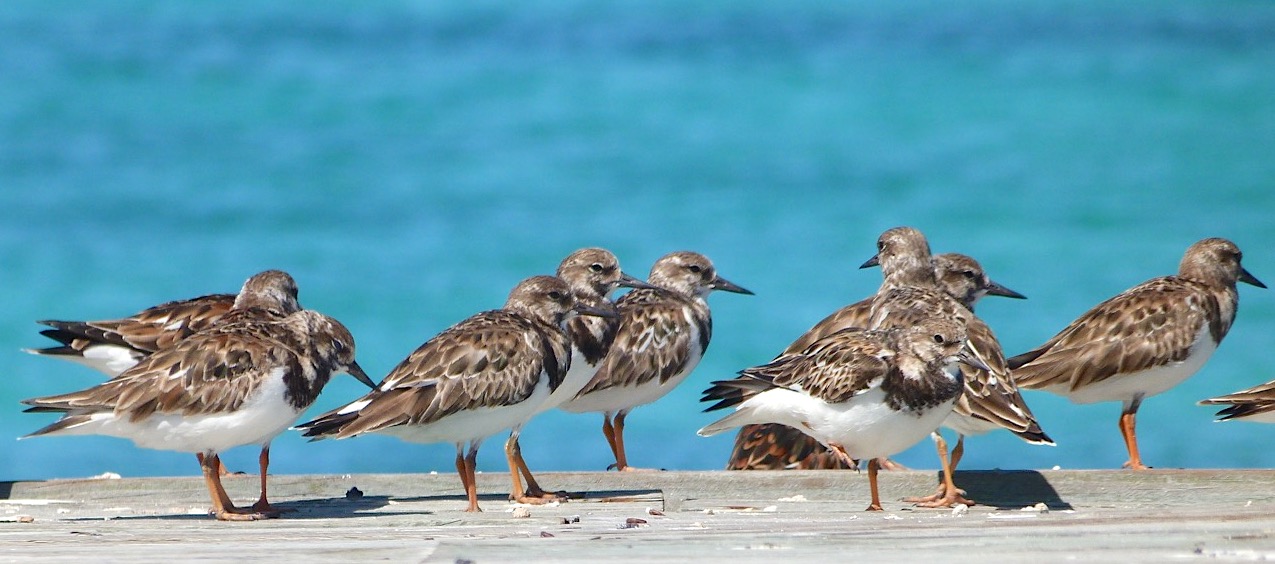
Right now, ruddy turnstones and laughing gulls seems to have formed a team of jetty birds, with a few royal terns in the mix and (as here) a random sanderling. The turnstones like to lie down in the hot sun on the jetty, possibly because it’s a bit breezier than on the burning sand of the beach.
Exhausted from turning stones
Random sanderling
These jokers are wild…
The jetties also attract pelicans, which use them to sun themselves and also to fish from. I will post about these remarkable birds another time. The largest flock of them I have seen so far is 5, one with a gold ‘breeding crown’.
The gulls also spend time on the beach, and flock on the sandbars that emerge at low tide
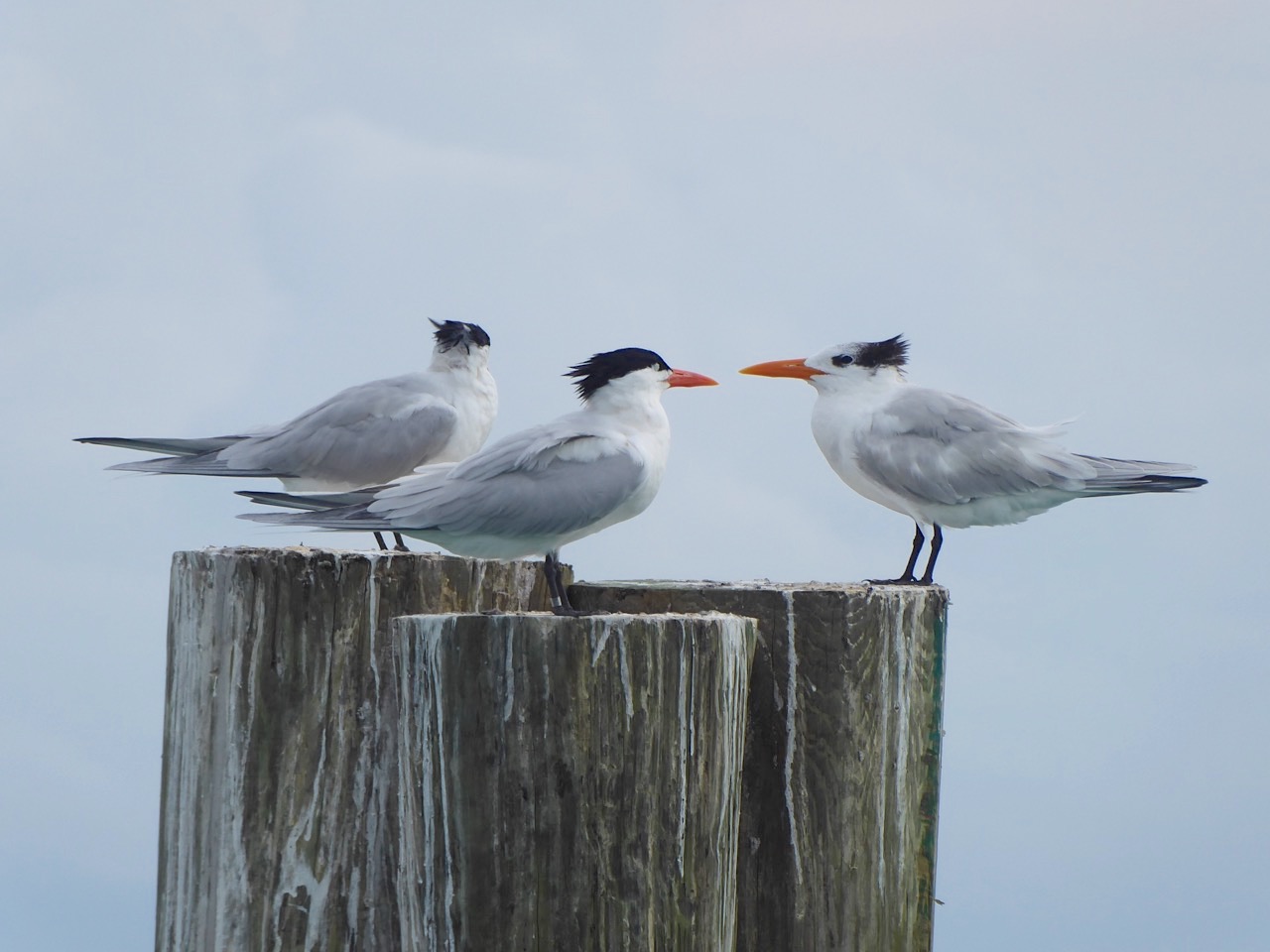
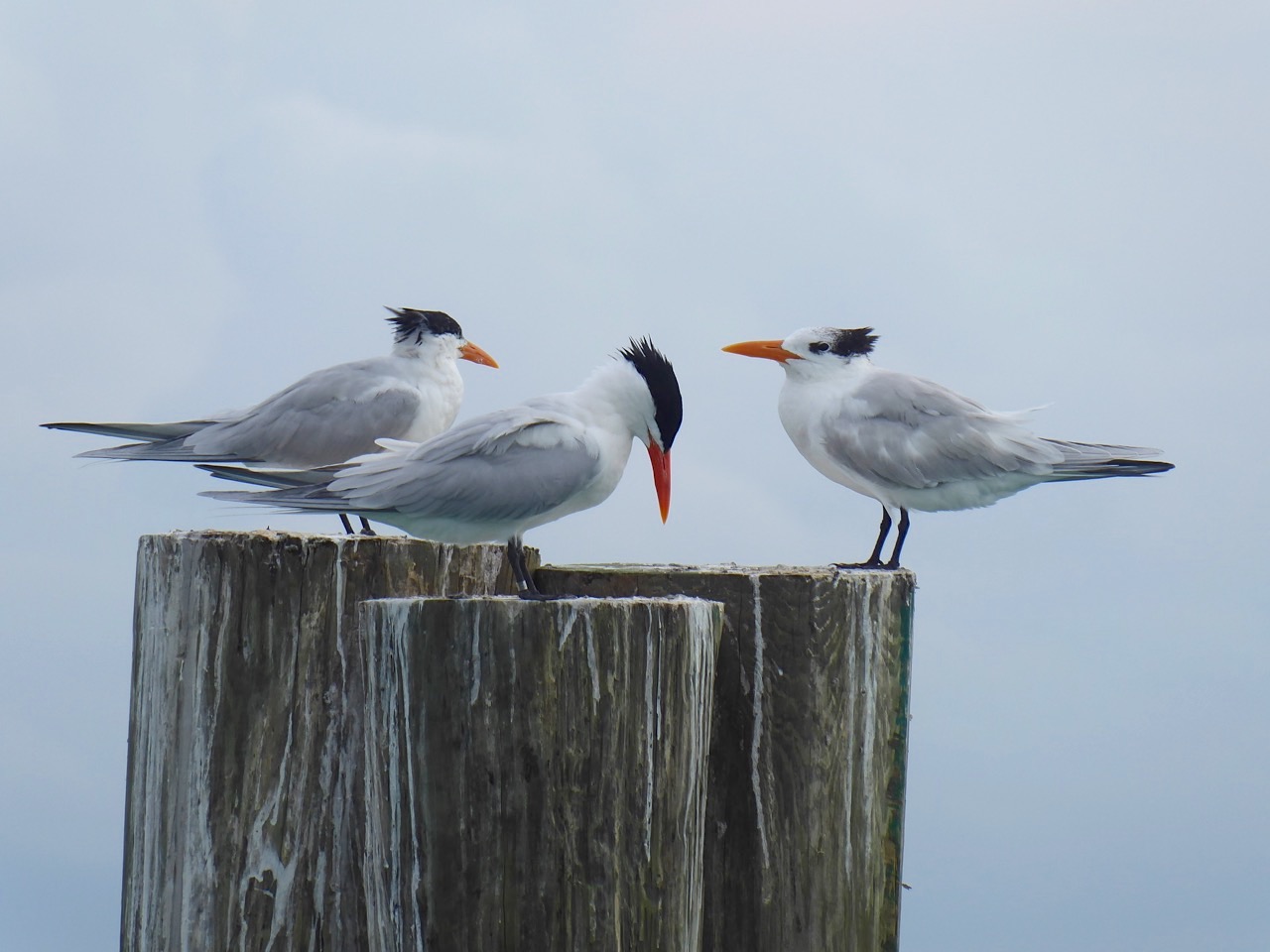
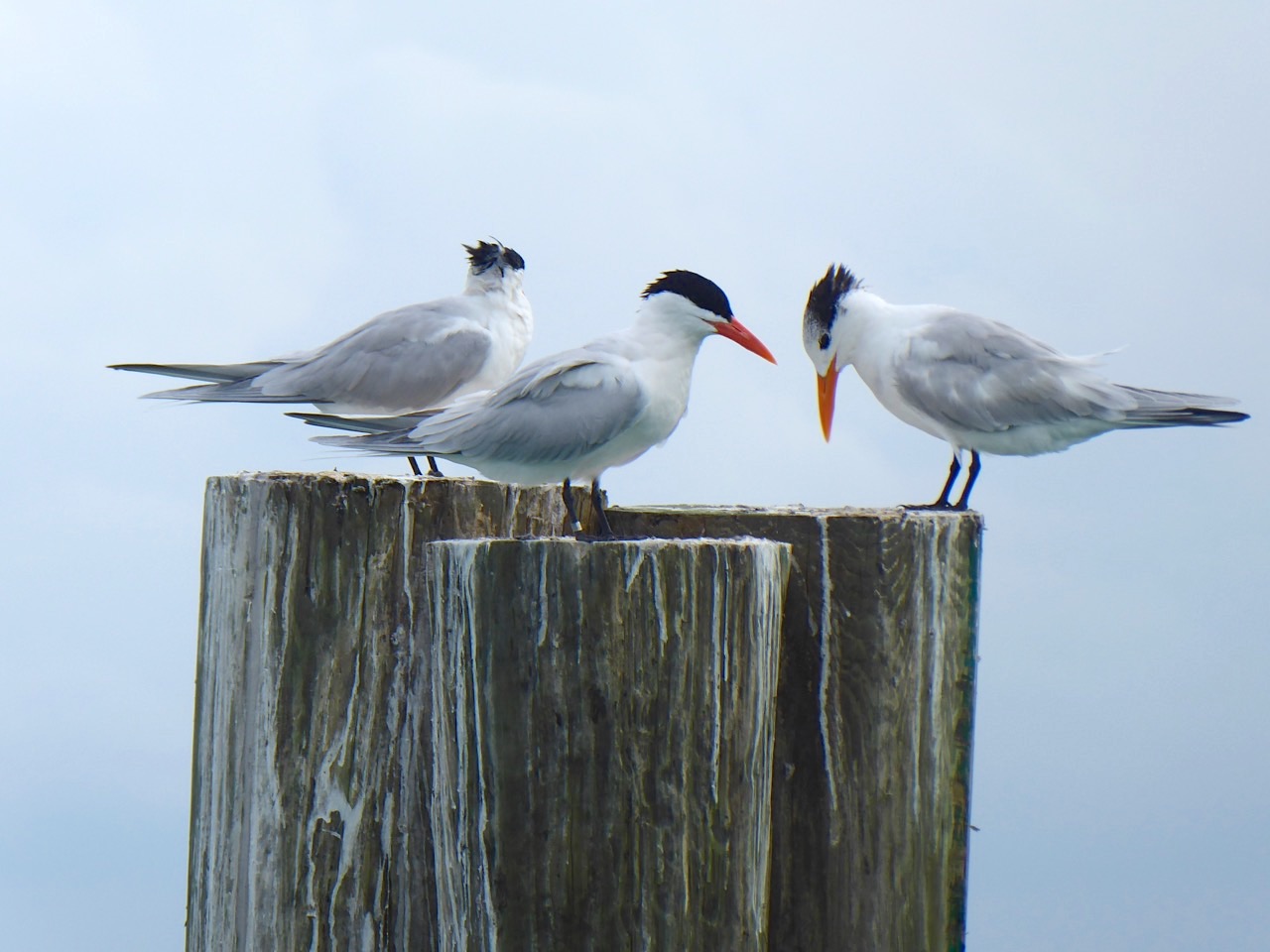
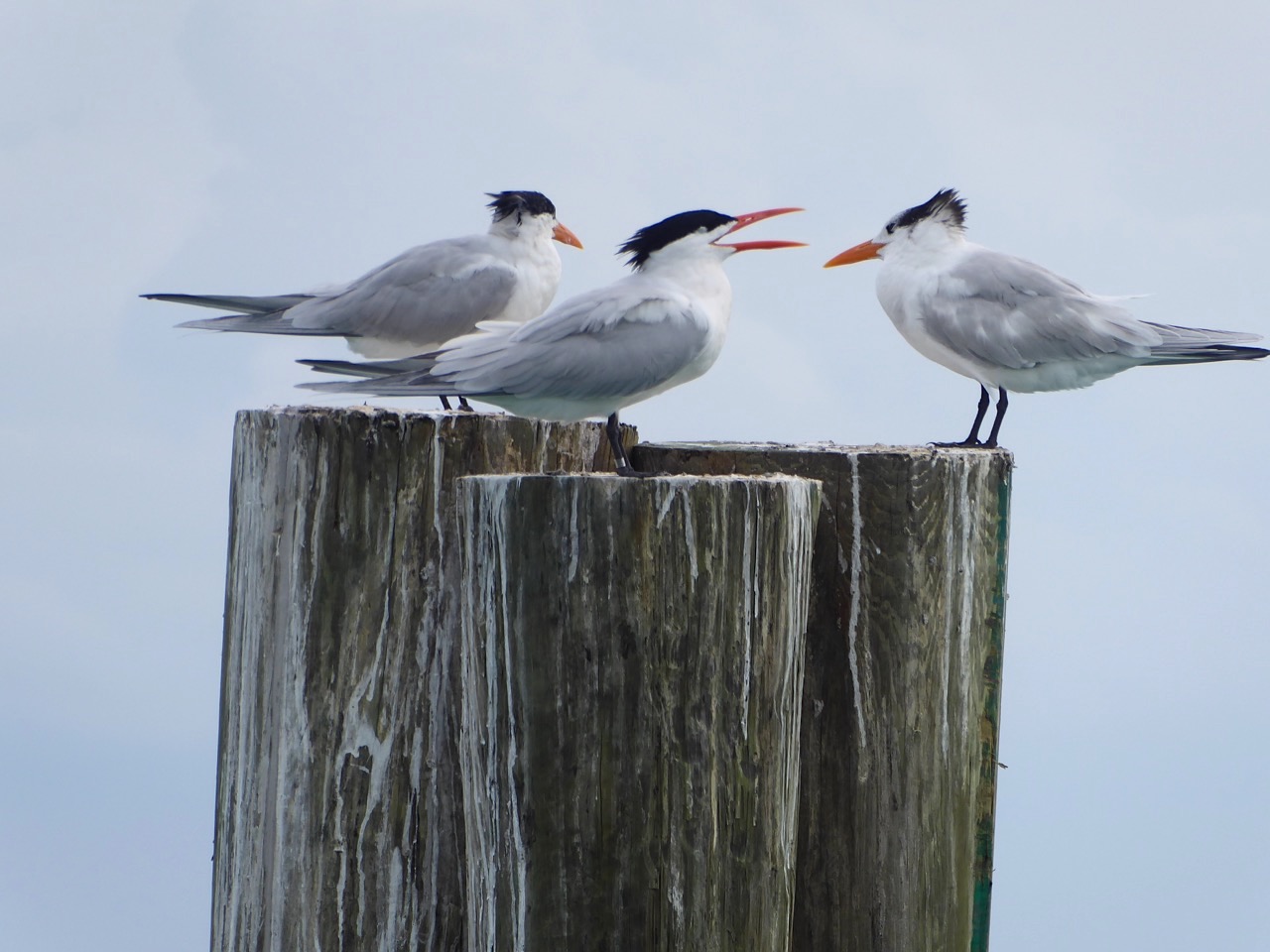
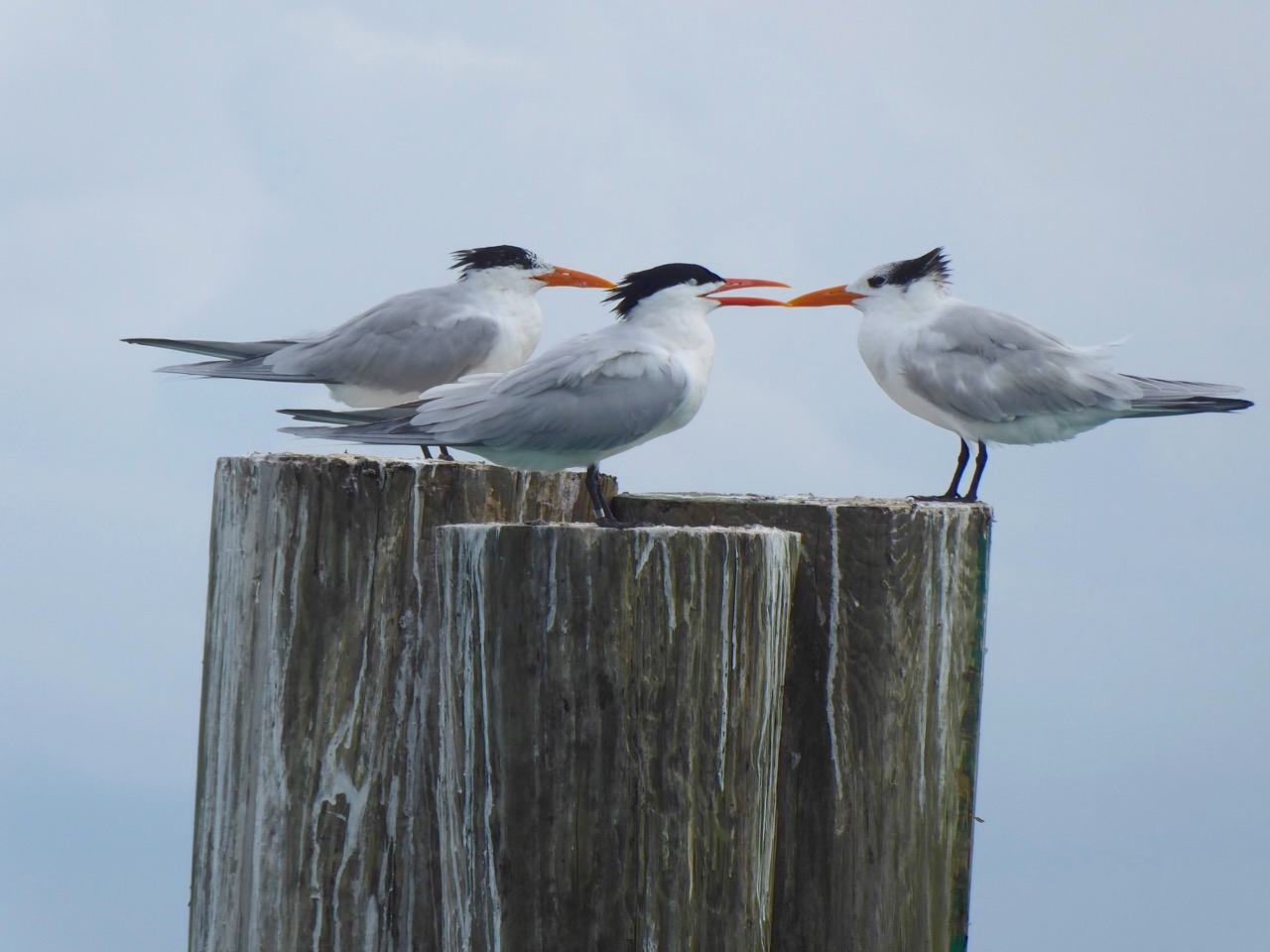
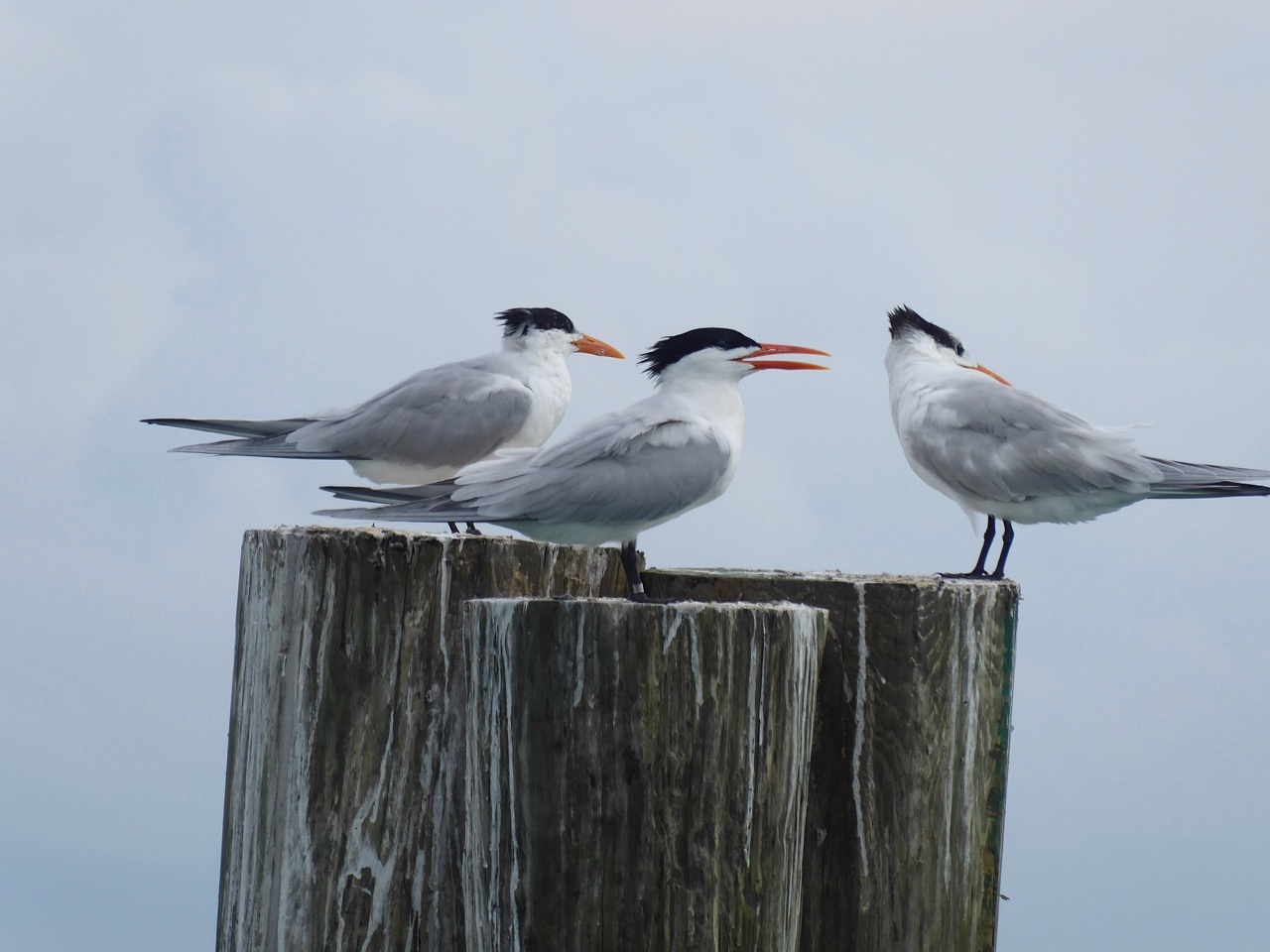
There’s a time and a place for anthropomorphising animal behaviour in terms of human responses. Usually it’s best done with caution or not at all… I’m going to press ahead, though, with a romantic encounter between two Royal terns today at Sandy Point, Abaco. Ultimately, this appeared to be an approach, a come-on, a poorly executed attempt at intimacy, and ultimately a rejection. Or else it’s just bird interchange that we should not read too much into…
Good afternoon, I should like to get to know you better…
Would you do me the honour of commencing a relationship?
Indeed I would, kind Sir!
*Boastfully* I happen to be the most handsome and regal tern this side of Marsh Harbour
I’m going to give you a peck that you’ll never forget…
Whaaaaaa? Wait… Too much, too soon. I hardly know you
You’ve moved as far away as possible on this post – you have no idea what you’re missing
I’ll be the judge of that. I’m off, don’t try to follow me…
Credits: all photos (artfully taken in fairly poor light), corny storyline, inappropriate anthropomorphism – Keith Salvesen
The brackish pond at Gilpin Point near Crossing Rocks is generally a reliable place to find waterbirds. For those birding on South Abaco (in many respects, one big hotspot) Gilpin is definitely worth a visit at almost any time. Bear in mind it is (a) a longish private road (we got a puncture down there once…**) and (b) it is private land. However, the owner Perry Maillis is always welcoming to tidy birders who bring only enthusiasm and take only pictures. Plus he very kindly changed our wheel!
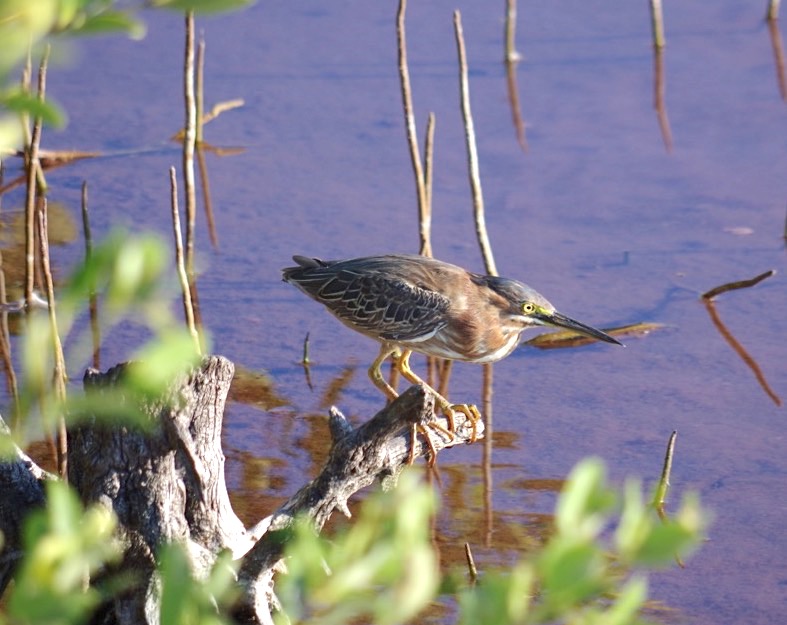
We found this small Green Heron quite easily. We’d watched it fly onto a stump in the pond near the jetty, then fly closer to the shoreline. By tiptoeing onto the jetty, we could see the bird perched close to the water, inspecting it with a fierce and predatory eye. Both eyes, in fact.
The hunting technique is deceptively simple. Note the long sharp stabbing beak. Note the large feet and claws for gripping securely Here’s how it is done. As a fish is sighted, so the heron leans gradually forwards, beak dipping closer to the water, the body more streamlined to look at. The procedure is beginning in the image above.
The stance means ‘small fish – 5 feet off – moving left and closing – prepare to strike‘. As the prey unwittingly approaches, the bird slowly tilts further forward unless its beak almost touches the water, the quicker and closer to strike.
The actual strike is so rapid that it is barely possible to see with the naked eye, let alone to photograph it clearly (not on my type of camera anyway). But the end result is rarely in doubt, with a small fish struggling but securely held in that long, clamping beak. It will be down the heron’s gullet in a matter of seconds.
I left the heron as it settled slowly back into ‘scanning the water mode’ while I went to watch some lesser yellowlegs nearby. Some minutes later, the heron was still contentedly fishing from its vantage point.
ROUGH GILPIN CHECKLIST
Species we have found on and around the pond include black-necked stilts, little blue heron, great blue heron, tricolored heron, snowy egret, reddish egret, yellow-crowned night heron, the relatively rare and very shy sora, hordes of white-cheeked pintails, northern pintails, lesser yellowlegs, belted kingfisher, turkey vulture, smooth-billed ani, American kestrel, Bahama woodstar, Cuban emerald, Mucovy duck (Perry’ pet!) – and the green heron of course.
As a bonus, Gilpin has become an increasingly regular stop for raucous flocks of Abaco parrots. Rarer species found there include American flamingo (rare vagrant), brown pelican, double-crested cormorants, and limpkins. On the beach 5 minutes walk away, there are usually shorebirds including rare piping plovers, Wilson’s plovers, turnstones; gull and tern species; and passing tropicbirds & magnificent frigatebirds flying high over the water.
** I realise that strictly I should be saying ‘flat’ here, but that might be confusing for Euro-readers, who would understand that to mean that we had rented (or purchased) an apartment in a larger dwelling house containing similar accommodation.
All photos, Keith Salvesen except the cute chick, Charlie Skinner; and the cute cartoon GH, Birdorable…
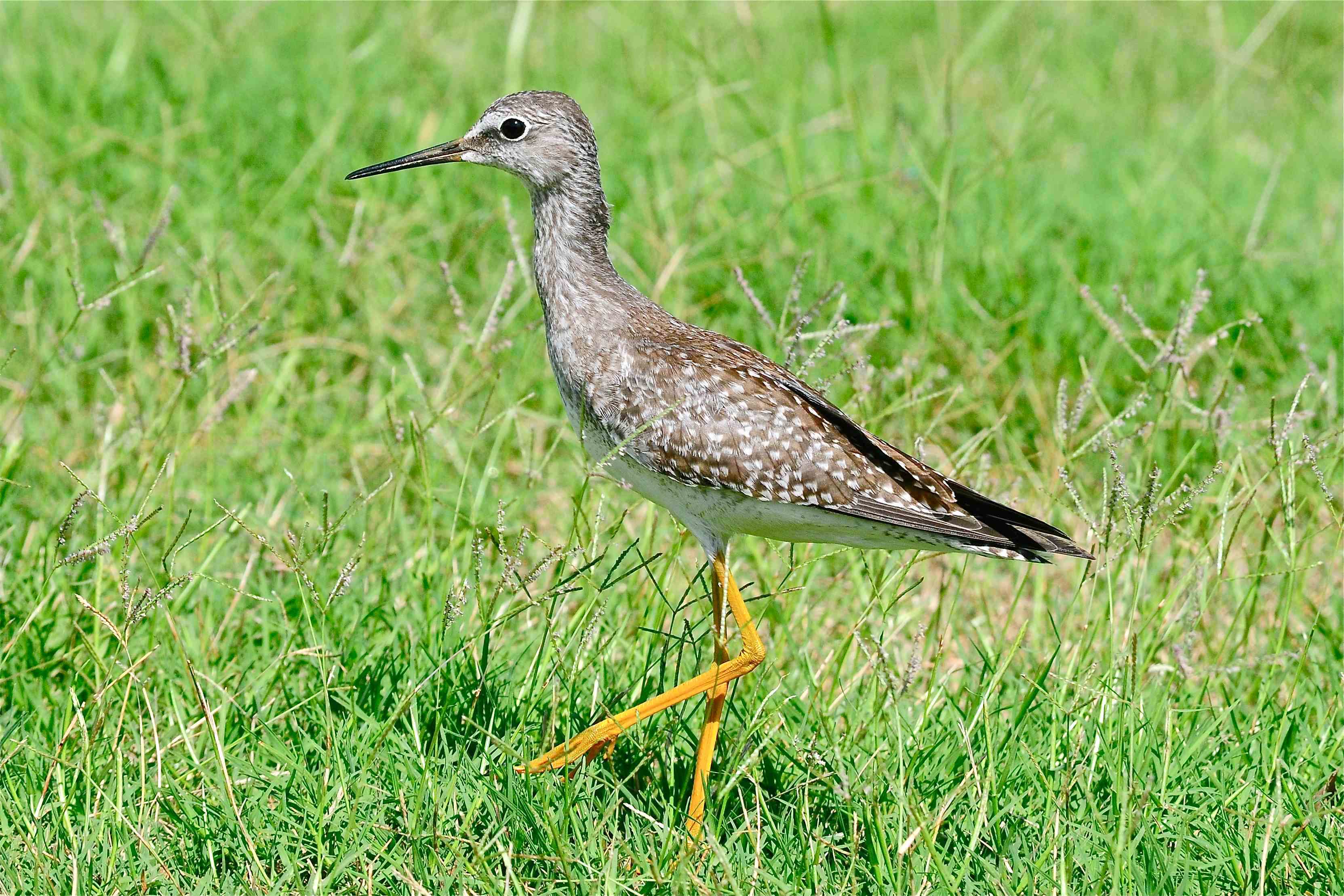
YELLOWLEGS (LESSER) ON ABACO: OUT STANDING IN THE WATER
It’s always helpful when a bird ends up with a descriptive name (after translation from the Latin binomial) that actually matches the creature. Burrowing owl, Roseate Spoonbill, White-crowned pigeon, Red-legged Thrush, Black-and-white Warbler – you know where you are at once. So it is with the Yellowlegs, the only question being whether the one you are looking at is ‘greater’ (Tringa melanoleuca) or ‘lesser’ (Tringa flavipes). Both are found on Abaco, and a single bird on its own – with no size comparison – can be a potential source of confusion.
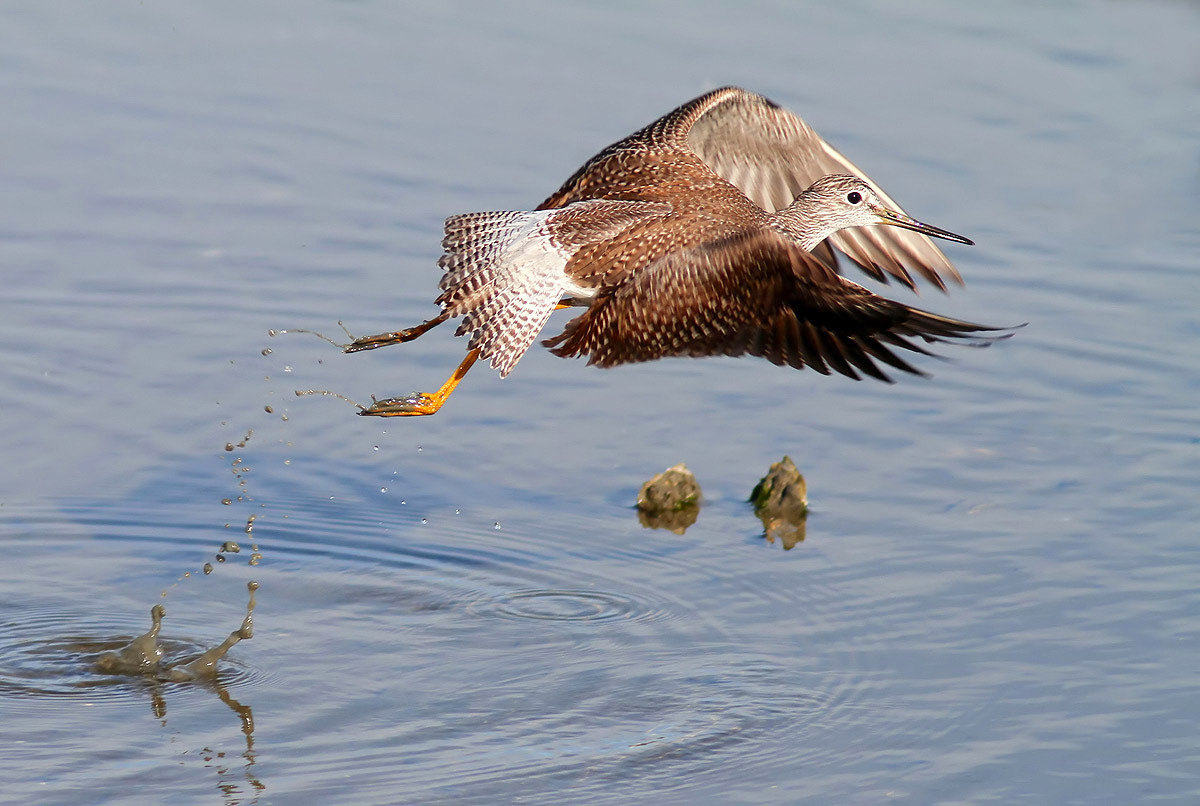
This last post for 2018 features the lesser yellowlegs, a winter resident, a rather off-beat choice you may think. The reason is that in clearing out some archive folders, I found some LEYE images in the wrong album. They reminded me what lovely birds they are when photographed well (so, not by me), with the subtle sheen of their plumage contrasting with their Malvolio-yellow legs.
Taking flight… we have lift-off
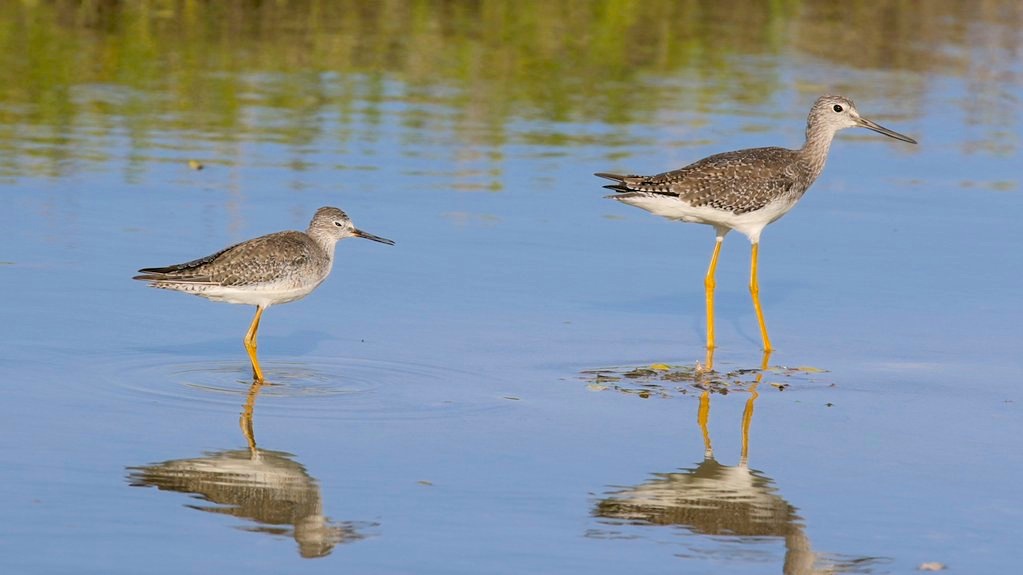
Apart from size, the greater and lesser yellowlegs have some not-necessarily-very-noticeable differences in bill length (in comparison with head-size), plumage and vocalisation. Here is an excellent example of the yellowlegs cousins together, to give you a comparison.
Little and Large
DO THESE SHOREBIRDS EVER GO ON LAND?
A: YES
*ALERT* AMATEUR PHOTOGRAPHY CORNER *ALERT*
DO YOU HAPPEN TO HAVE A PHOTO OF THE LEYE WING UNDERSIDES?
Yup. This bird was at Gilpin Pond. There aren’t many ‘underside’ photos out there. Will this do?
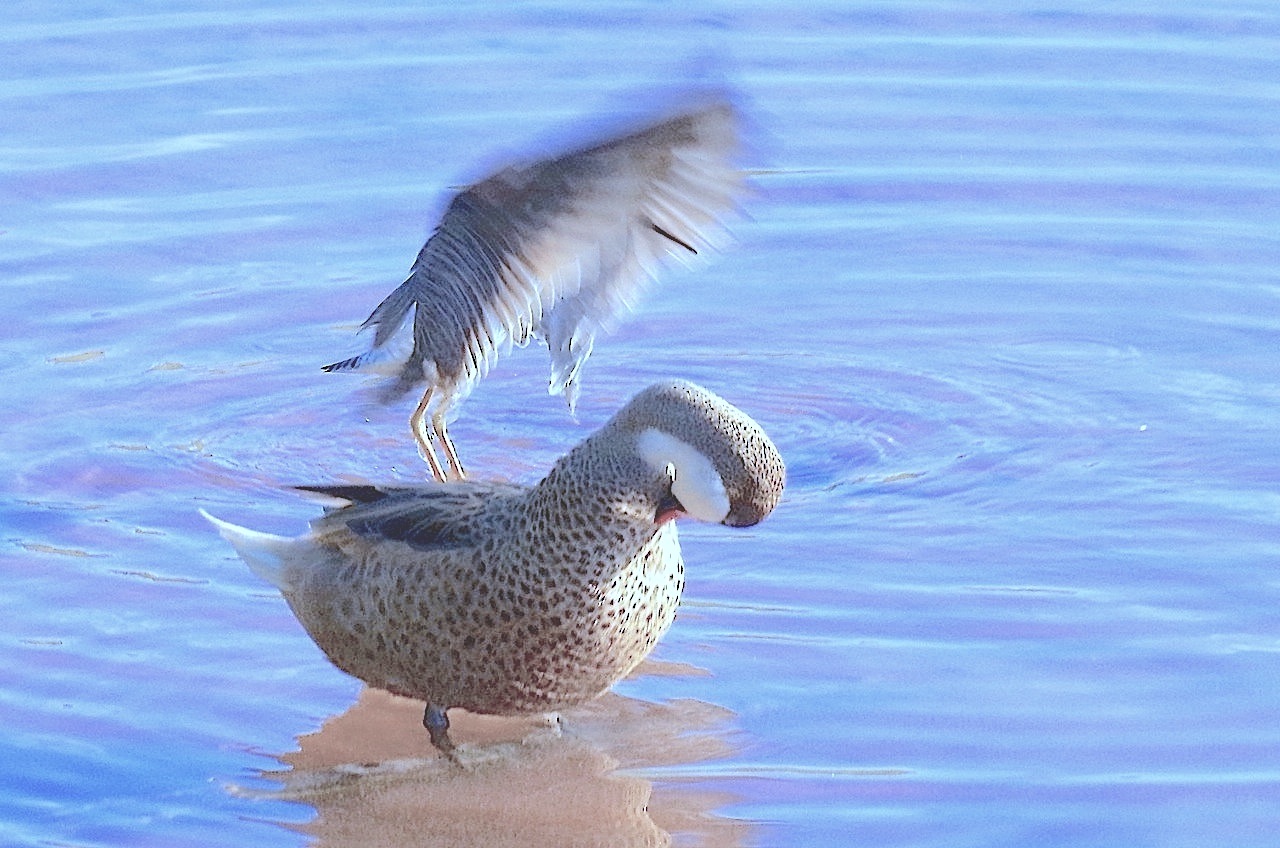
Q: DO THEY EVER DO PHOTOBOMBS?
A: INDEED! (BOMBING A BAHAMA DUCK)Weird blue tint due to radical colour correction for bad red algal bloom on the pond
Credits: Tom Sheley (1, 2, 9); Phil Lanoue (3); Matt Scott (4); Tony Hepburn (6); ID concealed to protect the guilty (7, 8)
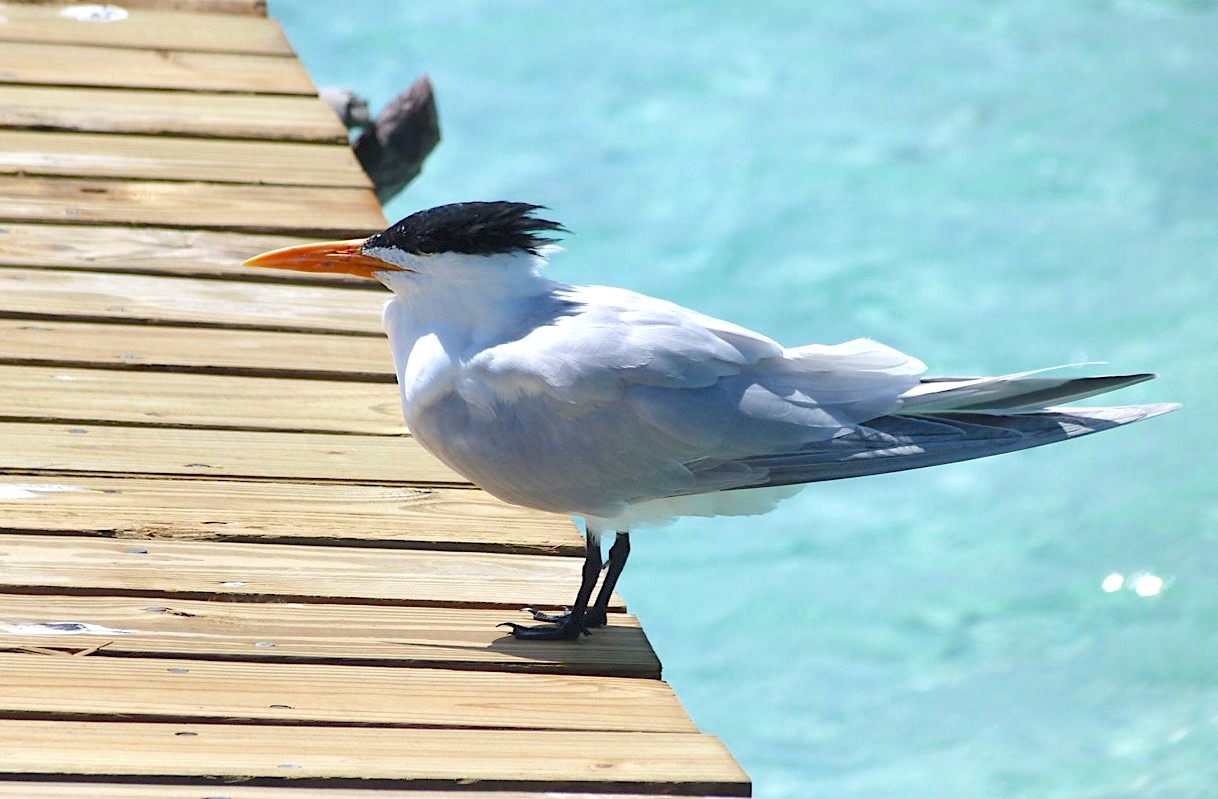
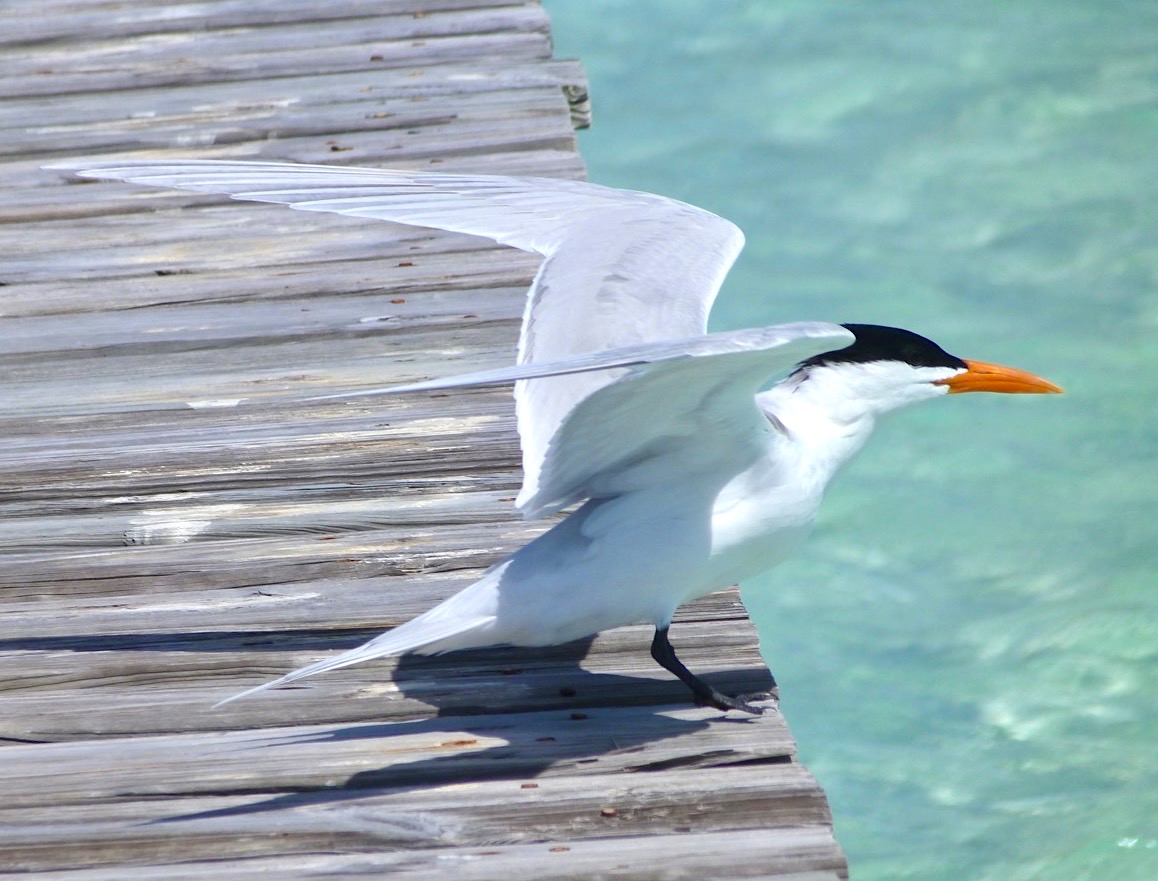
Royal terns Thalasseus maximus seem to have a great liking – quite rightly – for the charms of Cherokee, Abaco. Of the 12 tern species recorded for Abaco, ROTEs are the only permanent residents. Most of the others are summer visitors; a couple are winter visitors; and the rest pass through as migrating ‘transients’, stopping to rest and refuel on their long journeys. So ROTEs are undoubtedly the most commonly found terns on Abaco, and some might say the finest. And Cherokee Long Dock is one place to find them.
The historicLONG DOCKat Cherokee stretches far out into the sea to accommodate the varying tide levels of the area – click the link for more information and photos. It is a memorable feature for visitors, and much loved by locals. Also by the royal terns.
The dock provides an ideal safe platform for ROTEs to congregate and hang out. They have a perfect view of the small fishes that make up their diet as they swim in the clear turquoise waters a few feet below. Watching these birds diving off the dock after a fish is nearly as entertaining as watching brown pelicans dive off the jetty at Sandy Point.
There are buoys in the bay as well, and individual birds will fly from the dock to perch on a buoy and check out the fishing round it, before returning to the dock – hopefully with a fish in its beak. And the juveniles, with their endearing beginner ‘hair’styles (see #3) can learn the ropes from their elders and betters.
People often stroll the length of the dock, or pause on it to pass the time of day and watch the optimistic bonefishers casting hopefully at their silver prizes. These fish are often easier to see from the dock than from wading level – people sometimes shout helpful encouragement: “There… going left…look!… 20 feet in front of you… no, THERE…” and so on. The terns take little notice of all this. A group of people, especially with a dog, might persuade the birds to take flight, but they return as soon as they can; or simple move along the dock and settle in a different place.
The plaque for the long dock shows its importance to the community
The dock is so long that it tapers to a vanishing point on the horizon
KNOW YOUR TERNS (WITH THE ADMIRABLE BIRDORABLE)
Abaco has these species plus three more
Credits: Keith Salvesen Photography; BIRDORABLE, with thanks for their wit and amazingly effective highlighting of the essential distinguishing features of bird species
BUTTERFLIES ON ABACO (11): LONG-TAILED SKIPPER & NORTHERN CLOUDYWING
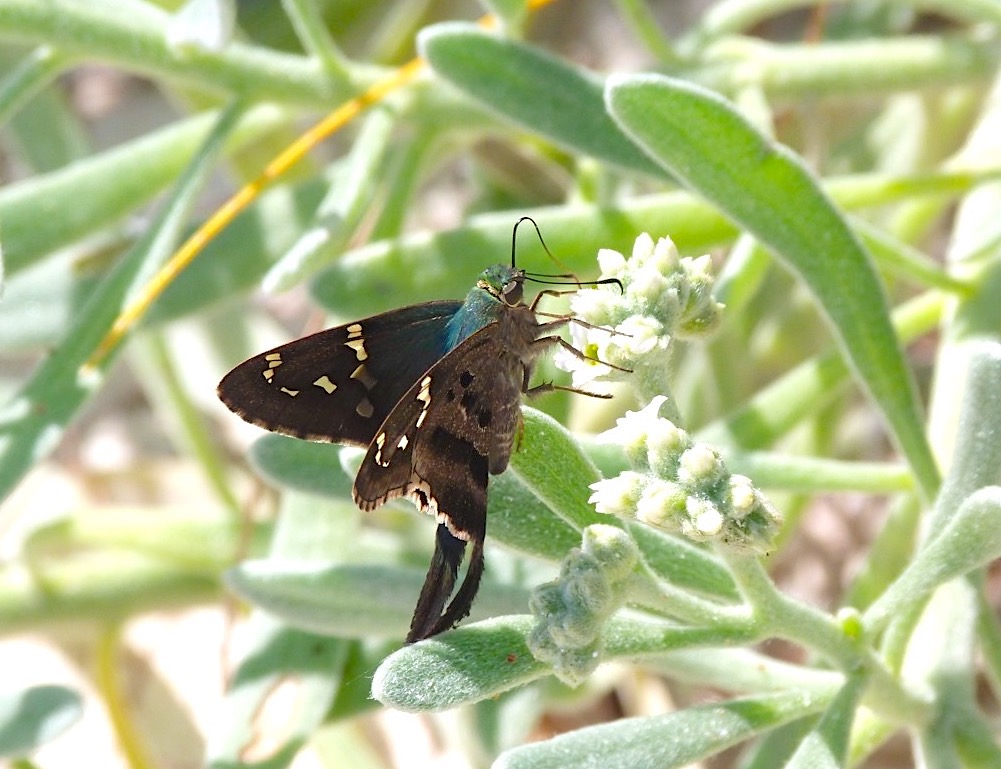
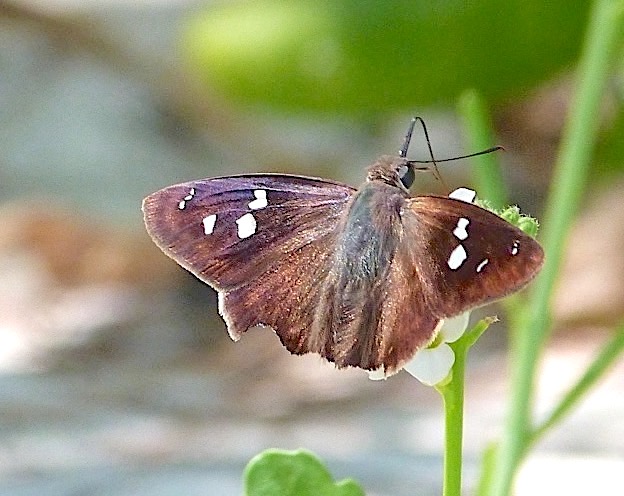
Two butterflies caught my attention on the same afternoon. The first was a Long-tailed Skipper Urbanus proteus, a species I have featured before. The other was new to me – the Northern Cloudywing Thorybes pylades. New to me in the sense that I have never managed to get near one that stayed still enough to photograph. You know how butterflies are – they use their antennae to detect when there’s a camera about, and redouble their skittishness and wing speed.
LONG-TAILED SKIPPER
Long-tailed skipper have… long tails, and a pretty bluish body
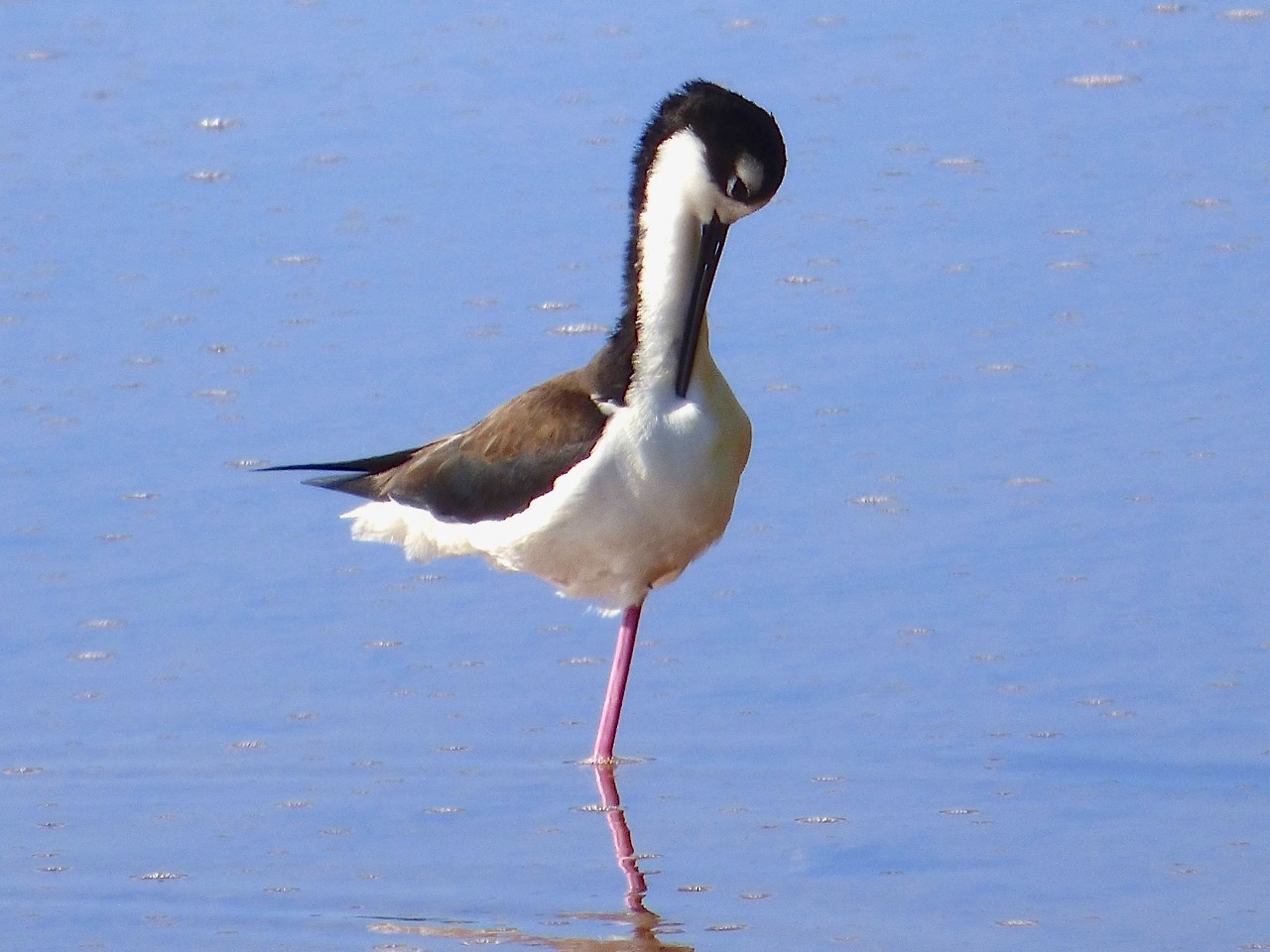
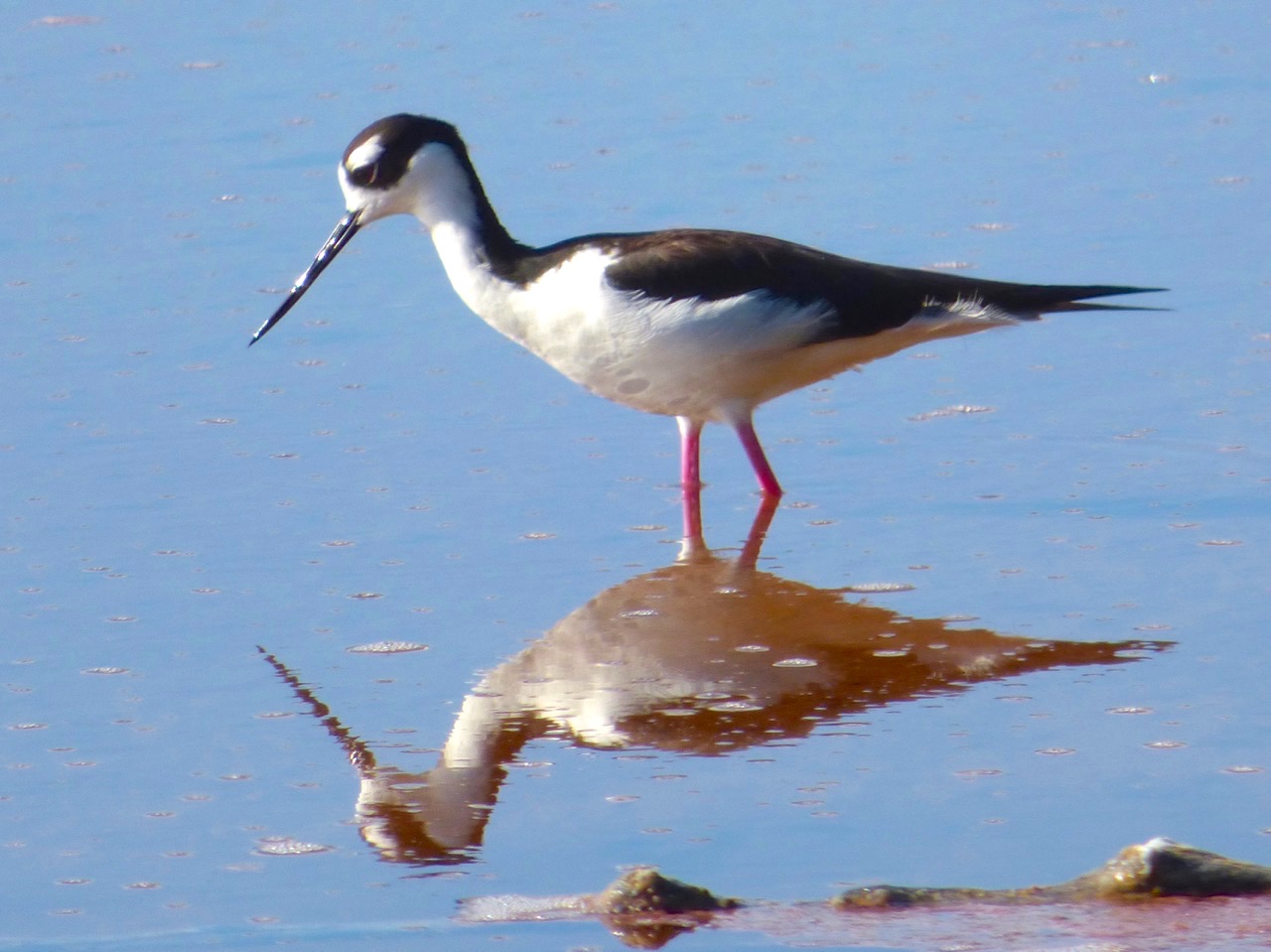
There’s something wrong in the picture above (no, I don’t mean about the photograph itself). Count up how many pink legs you can see. No, not including the reflections. Give up? It’s three. Between two birds. I assumed of course that ‘Oner’ had a perfectly good serviceable leg tucked up into its undercarriage. I admired the balancing skills involved in resting one leg while nonchalantly standing on the other.
We were watching this pair of black-necked stilts Himantopus mexicanus at the pond at Gilpin Point, which at certain times can be ‘Stilt Central’. These birds are permanent breeders on Abaco and are without a doubt the most beautiful of all the waders (avocets, being extremely uncommon winter visitors, are disqualified from consideration for lack of presence).
It gradually dawned on me that Oner really did only have one stilt to stand on. After 10 minutes observing them and the other birds around them, there was no question about it – the right leg was completely and utterly missing. This unipedal deficit had no obvious ill-effects on the bird – nor on its ability to throw a good pose (above). Or to preen (below).
I’m in danger of losing sight of Twoer here, a bipedal bird that deserves its own place in the story, not just a wade-on part in Oner’s story.
Twoer as Ringmaster…
BNSs are territorial and in particular can become ‘proactive’ (ie aggressive) in protecting the area near a nest. I once mistakenly got close to a nest, not even knowing it was there. I soon learnt – a parent BNS came wading towards me, zigzagging in the water, shouting and carrying on in a way that immediately said ‘my nest is nearby’. And when I meanly stood my ground it suddenly took off and flew straight at my head…
A shouty stilt
BLACK-NECKED STILT ALARM CALL
Jim Holmes / Xeno Canto
On reflection…
All photos: Keith Salvesen / Rolling Harbour Abaco(and, if anyone noticed, sorry about some formatting issues which I can’t get rid of…); Audio file Jim Holmes / Xeno Canto
The narrowest point on Abaco is just north of Crossing Rocks. The 120-mile long highway that splits the Island down the middle passes over a narrow strip of land. On the west side, there are mangrove swamps, an inlet of sea, and a small jetty used by bonefishers to reach the productive waters further out. On the east side? Well, there’s more mangrove swamp, giving way to thick jungly coppice before reching the top end of Crossing Rocks beach – and not much else. Except for a long thin brackish pond by the road, that is.
If you are interested in birds – maybe on your way to the pond at Gilpin Point for Bahama Duck and waders, or returning from a Bahama mockingbird hunt in the National Park – it’s worth pulling over at the pond. Or preferably on the other side of the road so you can approach it stealthily. There’s plenty of roadside cover for birder discretion. Chances are, you’ll encounter one or more of the several heron or egret species found on Abaco – and that they’ll be fishing.
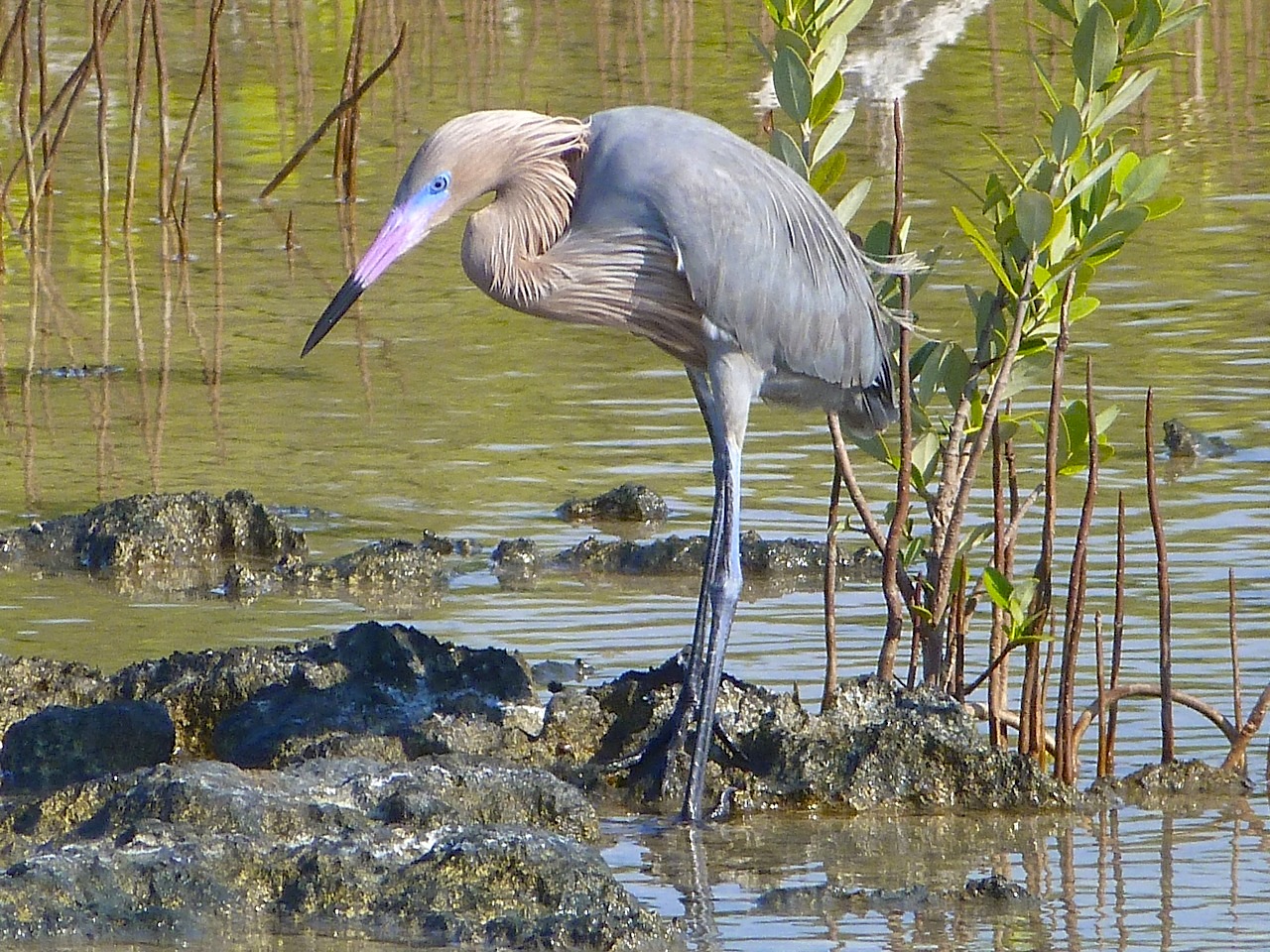
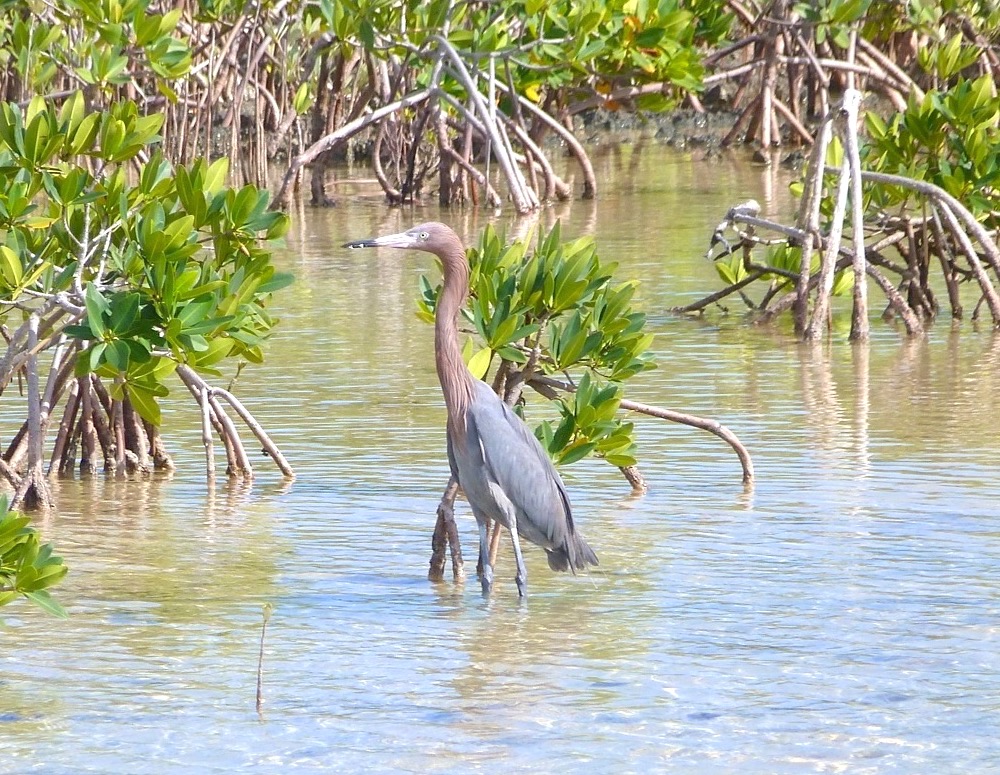
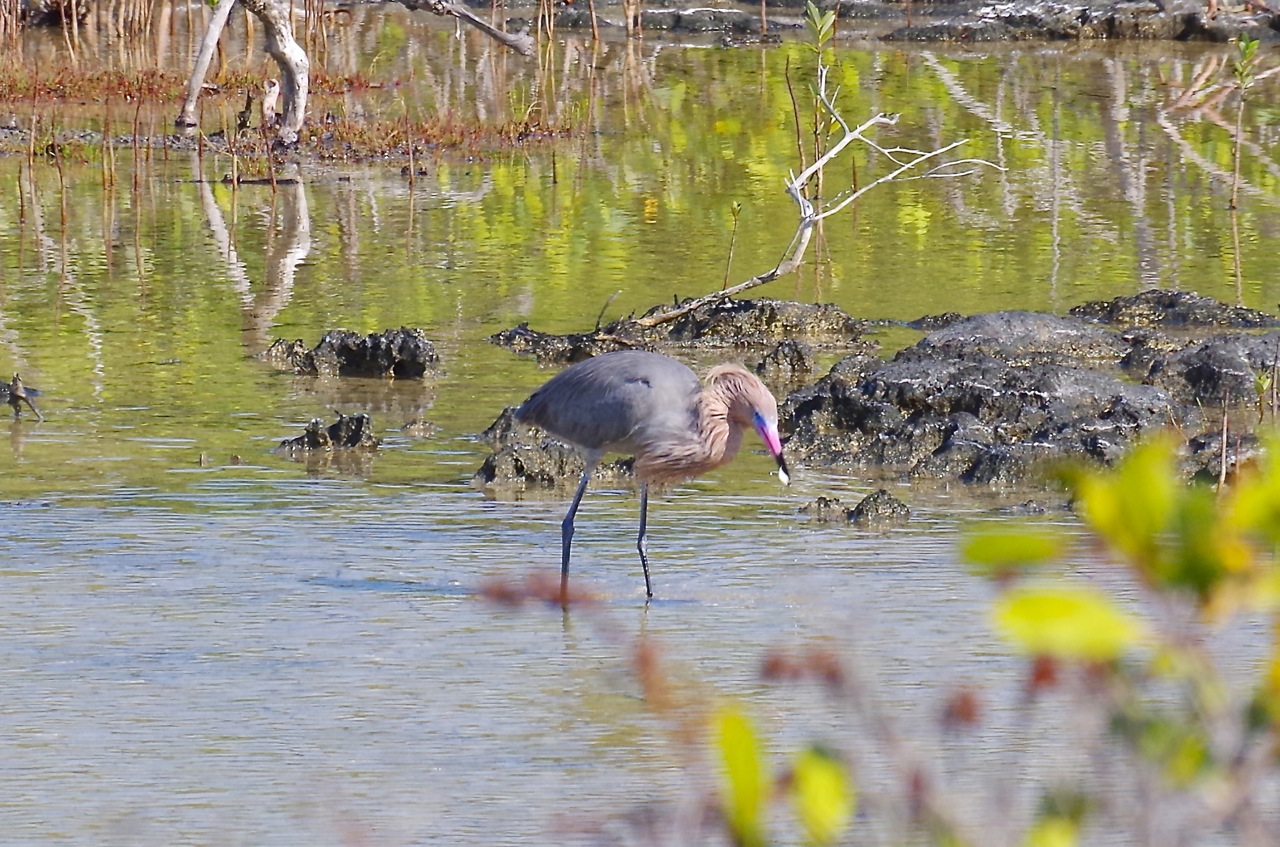
You can see how clear the water can be. It’s no wonder that this reddish egret has ‘hunched up’ to get that cruel beak closer to the surface to stab down on a small silver snack. In the short time we watched, he had no success (hence ‘Where’s the Catch?’ – there was none). But I’ve seen reddish egrets including the white morph successfully snacking at the pond; and a tricolored heron. A couple of years ago we had a great scoop in late March – a male reddish egret fishing in his wonderful breeding colours. Compare the ‘routine’ plumage of the bird above with this gorgeous creature.
And to show I am not making up the fishing part, a shot of this bird actually making a catch…
THE PRINCE OF WHALES: BLAINVILLE’S BEAKED WHALES IN ABACO
There’s a strange affinity between humans and whales. Humans seem to think so, anyway – and whales seem to tolerate them amiably, perhaps now that the decimation of their populations by humans is (largely) a thing of the past. The Bahamas in general and Abaco in particular are in the mainstream of progressive cetacean research, led by the BMMRO at Sandy Point.
One of the speciality research species is the Blainville’s Beaked Whale. These magnificent creatures are deep divers, and although they are found in many parts of the world, the Bahamas is one of only 3 locations with a significant population for study. Most of the whales here were photographed within sight of land (and a few with the Castaway Island Disney Cruise Ship visible on the horizon!).
I’ve been lucky enough to be on the BMMRO research vessel on a beaked whale outing – and luckier still that we were able to spend plenty of time with a group of them, including some males. The header image is of a mature male with his huge teeth that protrude upwards from the lower jaw, and in time become encrusted with barnacles.
The whales were quite undisturbed by our presence – indeed they behaved much like dolphins, circling the boat and swimming under it; moving away and returning. This was an opportunity to count the whales, to identify those that had already been recorded, and to document any new ones. Each whale has its own unique pattern of marks, striations and in some cases healed wounds. The pair below are a good example.
Also, the whales have individually distinctive dorsal fins, with nicks and tears that also act as a means of identification. These can often be made out from a distance with powerful binoculars or photographed with a long lens for later analysis (this ID method also works reliably for dolphins).
Beaked whales often bear the healed scars from the gouging bites of COOKIE-CUTTER SHARKS, a vicious little species that I recently featured. The distinctive circular scars on the back of the whale below result from encounters with these unpleasant creatures.
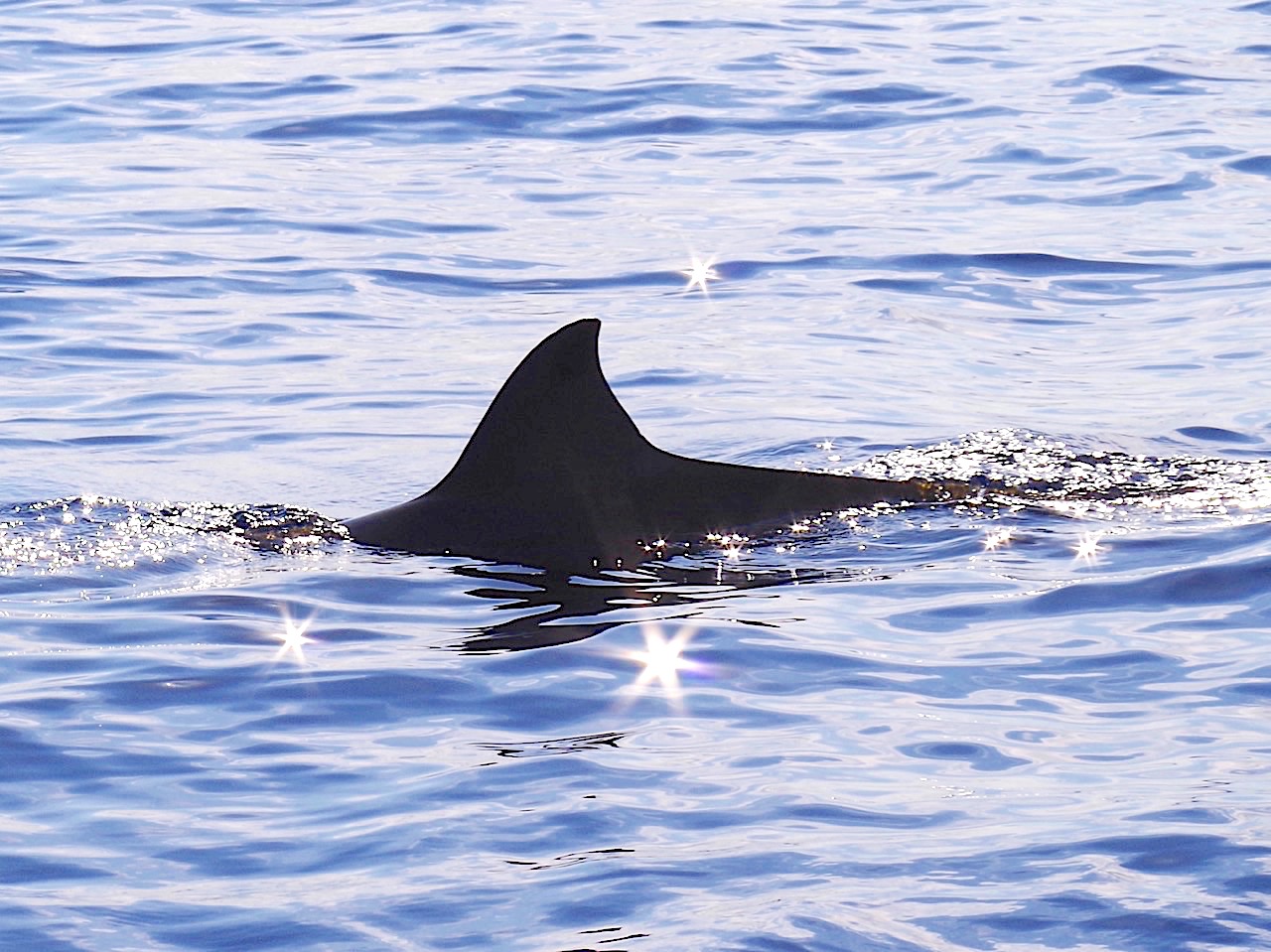
Finally, the photo below. It has no merit, photographically speaking, but I love the way that sometimes a ‘risk’ shot – into the sun, perhaps – produces rather magical effects. The unexpected ‘sea stars’ were a bonus!
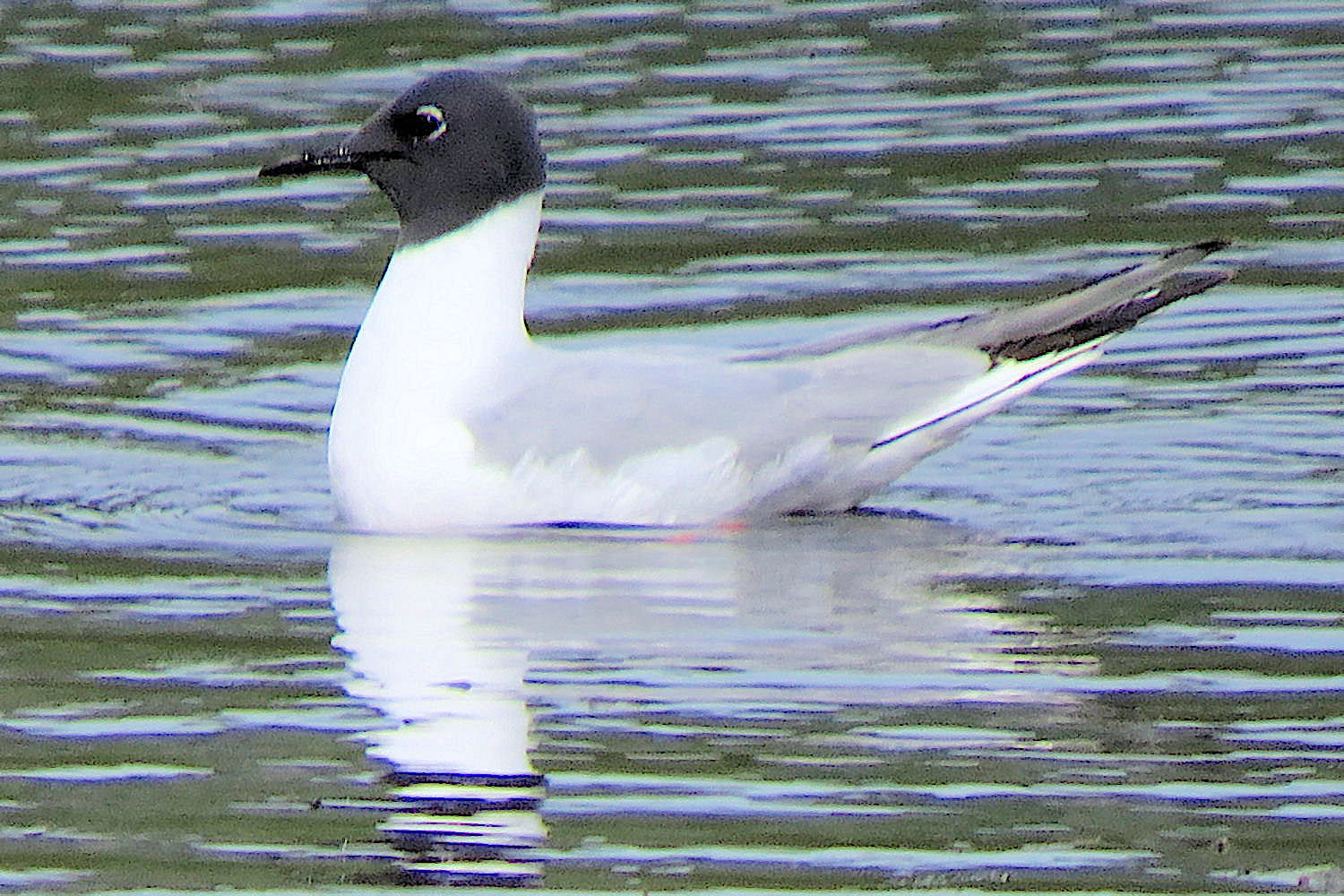
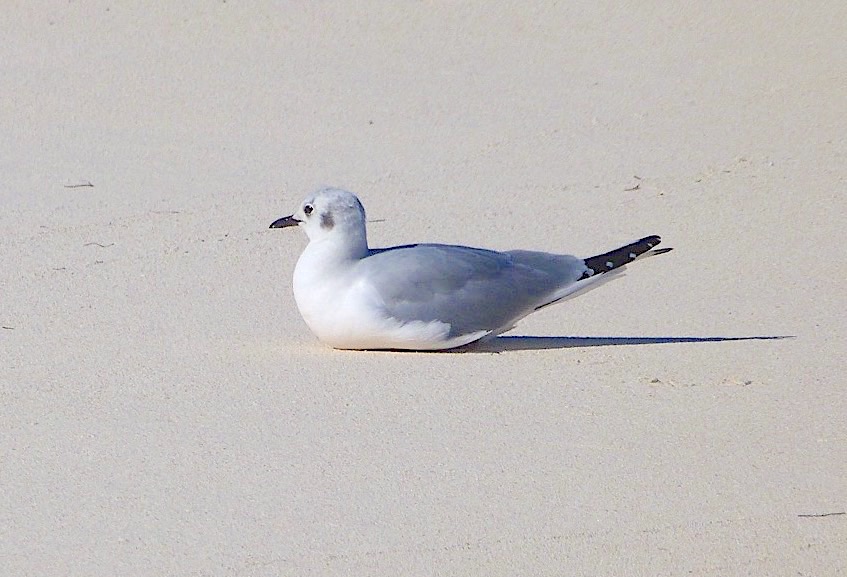
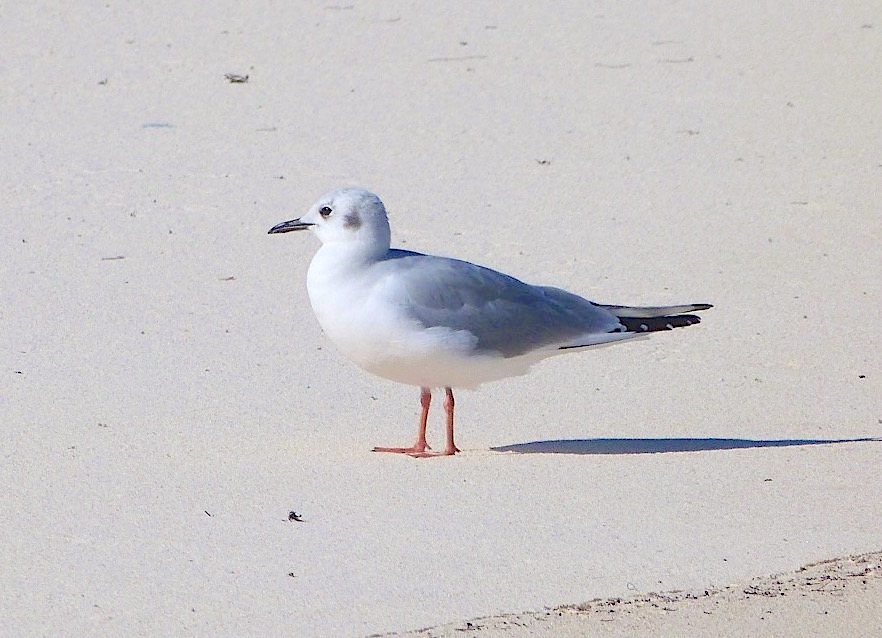
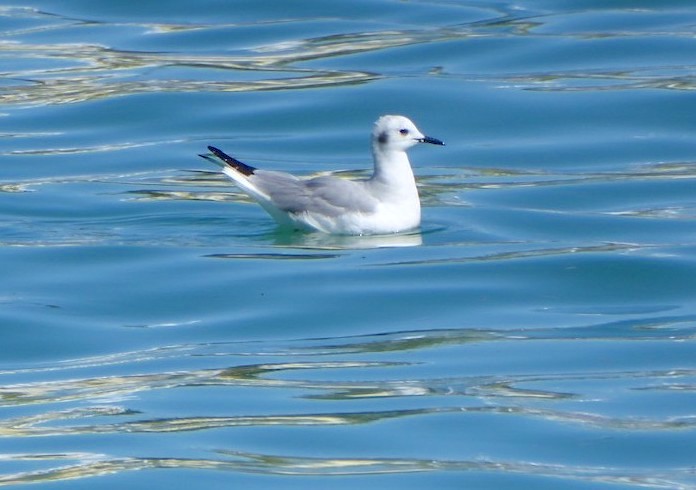
The Bonaparte’s gull Chroicocephalus philadelphia is one of the smallest gulls, and is found mainly in Canada and northern United States, though vagrants sometimes end up as far away as Europe. And Abaco. These birds are considered very uncommon winter residents on Abaco (categorised WR4). Yet within the last couple of months Elwood Bracey saw an amazing 4 in Treasure Cay harbour… Milton Harris reported seeing one at Hope Town harbour… Keith Kemp saw a couple on South Abaco (2 locations)… Eugene Hunn reported 1 on the Sandy Point dock… then suddenly there were 3 on the beach at Delphi. They have hung around there, too – let’s hope that all these birds find their way back to their breeding grounds safely. They have quite a journey ahead of them.
The species is named for Charles Lucien Bonaparte, a French ornithologist and nephew to the French emperor (see below for more about him). The philadelphia part of its Latin designation oddly results from the location from which the original ‘type specimen’ was collected (see below for the reason). This is not unlike the Cape May warbler, so named for the location of the original specimen, yet not recorded there again for more than a century (and still quite rare)…
The gulls shown here are in their winter plumage, with the characteristic dark blotch behind the eye. In the breeding season, they acquire smart slate-black hoods:
10 BONAPARTE’S GULL FACTS TO TELL YOUR GRANDCHILDREN
Graceful in flight, resembling terns as much as gulls
Monotypic: the sole representative of its taxonomic subgroup
Males and females have very much the same colouring
Believed to be monogamous
Showy breeders, with much display, swooping, diving, yelling at each other etc
Typically (and ungull-like) they nest in trees, preferring conifers eg jack pine
Share nest-building and parenting duties
Capable of considerable aggression to protect their nests / chicks
Have been known to live 18 years
The only bird species with an Emperor’s name (prove me wrong!**)
We saw these birds on the beach most days, usually just 2 of the 3 at any one time. They were quite shy and hard to get close to, however subtly. And they kept on the move – except when they decided to have a rest.
TELL US MORE ABOUT PRINCE BONAPARTEBonaparte’s gull, Zenaida dove
Charles Lucien Bonaparte, 2nd Prince of Canino & Musignano 1803 – 1853
Bonaparte was a French biologist and ornithologist, and the nephew of the Emperor Napoleon. He married his cousin Zenaïde, by whom he had twelve children. They moved from Italy to Philadelphia, by which time Bonaparte had already developed a keen interest in ornithology. He collected specimens of a new storm-petrel, later named after the Scottish ornithologist Alexander Wilson. And presumably that’s where he found his specimen gull.
Bonaparte studied the ornithology of the United States, and updated Wilson’s work American Ornithology. His revised edition was published between 1825 and 1833. He was a keen supporter of a (then unknown) ornithologist John James Audubon. Rather sweetly, he created the genus Zenaida, after his wife, applying it to the White-winged Dove Zenaida asiatica, Zenaida Dove Zenaida aurita and Mourning Dove Zenaida macroura. He himself was later honoured in the name ‘Bonaparte’s Gull’.
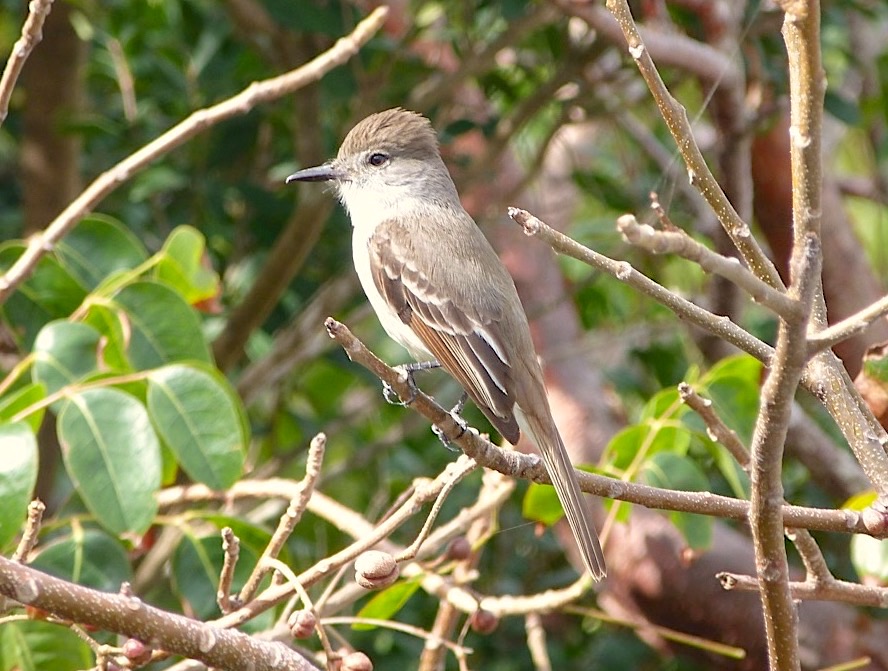
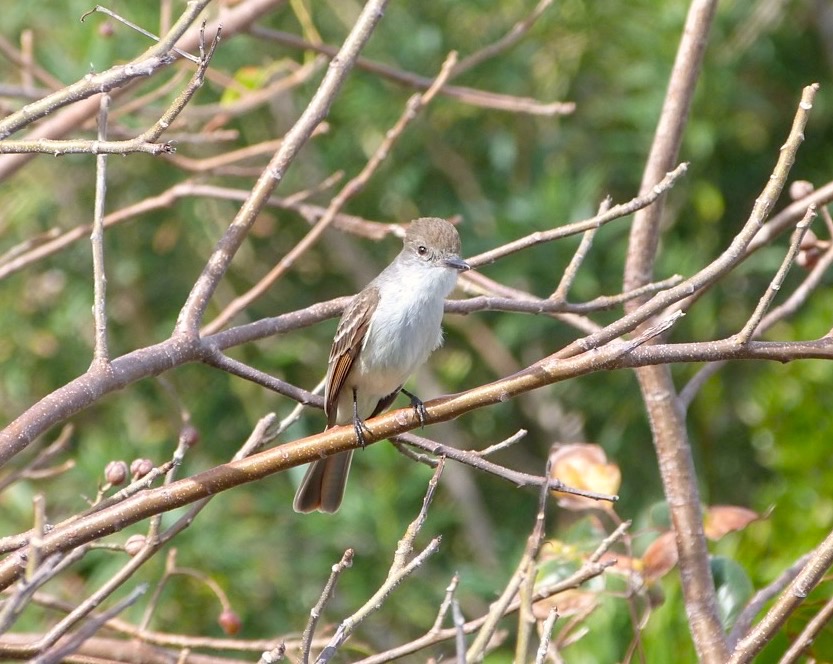
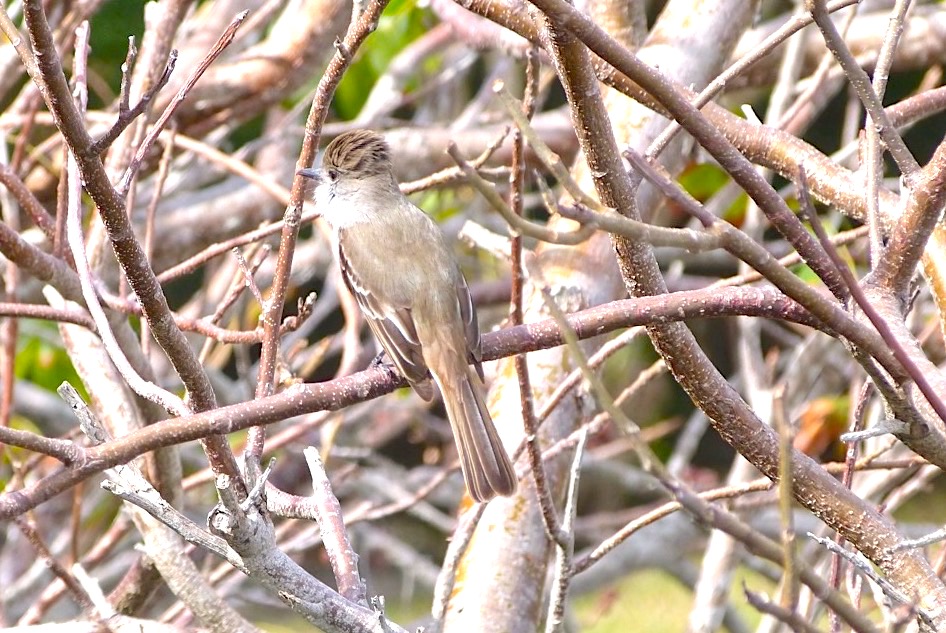
LA SAGRA’S FLYCATCHERMyiarchus sagrae is one of 3 permanent resident ‘tyrant’ flycatchers found on Abaco, the others being theCUBAN PEWEE and the LOGGERHEAD KINGBIRD. In the summer, they are joined by another commonly-found species, theGRAY KINGBIRD. There are other flycatchers, but they are seasonal, transient or vagrant, and far less common.
Two classic LSF poses: ‘head-on-one-side’ & ‘watching-for-insects’
I have just been watching one of these frankly rather very cute little birds as it patiently watched me watching it. I wasn’t very close, and I kept my distance because it seemed a little wary and I didn’t want to blow the chance of a couple of photos – the familiar ‘bird-flies-off-just-as-shutter-pressed’ syndrome.
Sized between the little cuban pewee, with its diagnostic crescent eyes, and the larger loggerhead kingbird (see below), the LSF shares with them the ability to raise its crest. I was luckily able to catch this on camera – and also some singing.
As the name suggests, the species is primarily insectivore, fly-catching in the undergrowth and low scrub or ‘hawking’ from branches. However these birds also eat berries and seeds. Their call is a high pitched single or double noted sound described as ‘wink’. Here’s a Bahamian example.
Paul Driver / Xeno-Canto
The LSF’s natural habitat is coppice and rough scrubland. It builds its nest in a tree cavity or similar natural hole, and usually lays a clutch of two to four eggs. And this morning by coincidence, Abaco birder Rhonda Pearce posted a photo of a LSF nest with its eggs.
ID CONFUSION
Here are the two flycatcher species, mentioned above, that might cause confusion:
CUBAN PEWEE
LOGGERHEAD KINGBIRD
Ramón Dionisio José de la Sagra y Peris (1798–1871)
For those who may be wondering who – or what – a ‘La Sagra’ is, the answer is: a multi-talented Spanish botanist. He was also a writer, economist, sociologist, politician, anarchist, and founder of the world’s first anarchist journal El Porvenir (“The Future”). At one time he lived in Cuba and became director of Havana’s Botanical Garden. His name lives on arguably more significantly in ornithological than in anarchist circles (actually, an ‘anarchist circle’ must surely be an oxymoron…)
[I note in passing that La Sagra is a provincial area in Spain, an Italian festive celebration, a chocolatier, or a small comet – all of which meanings may have to be negotiated online before you get to the flycatcher…]
To continue with the occasional PHILATELIC theme of this blog, here are stamps from the Cayman Islands and Cuba featuring the La Sagra’s Flycatcher. The Cuban stamp commemorates the death of Juan Gundlach, the man who chose La Sagra’s name to bestow on the LSF. The colouring is… somewhat unrealistic!
Credits: All photos Keith Salvesen except nest (Rhonda Pearce) and loggerhead kingbird (Mrs RH); recording by Paul Driver / Xeno-Canto; stamps O/S
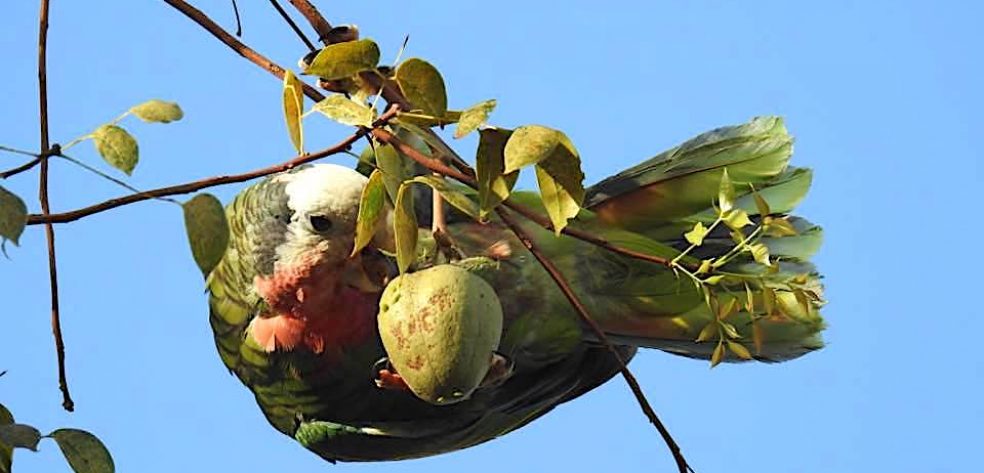
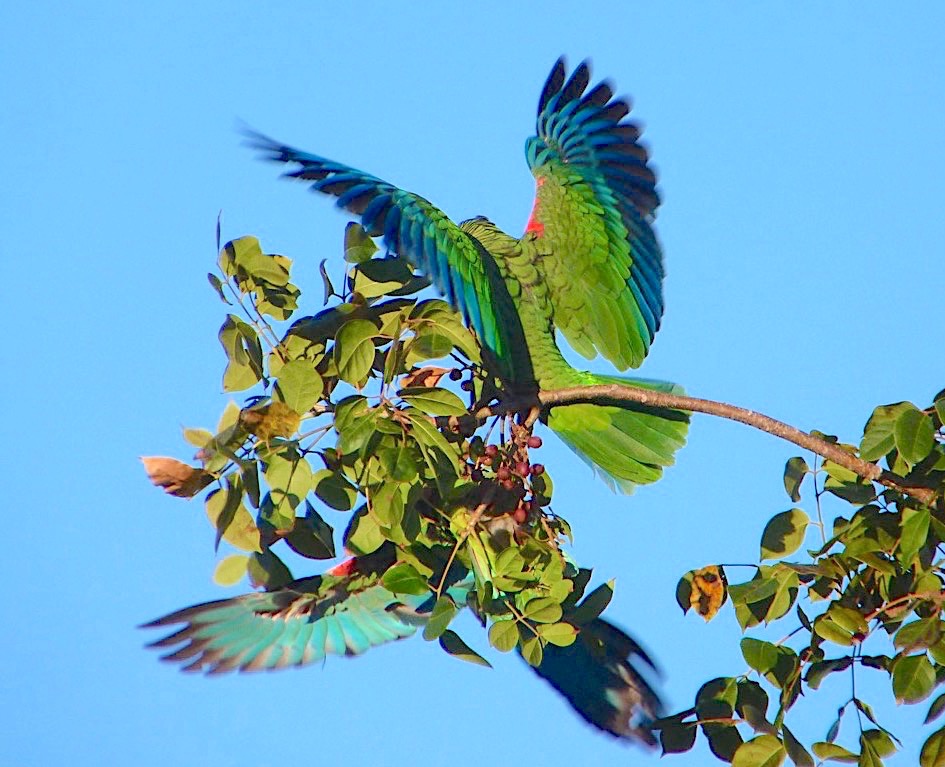
Mmmmm… gumbo limbo berries at Bahama Palm Shores. My favourite evening snack as we parrots head south to the National Park in the evening.
There’s a flock of about 60 of us tonight. I hope I’m left alone to get stuck in – there are plenty of trees to choose from here…
Uh oh! That was never going to happen. We are a noisy rowdy gang, and no one gets to eat alone for long…
This is really bad news… this guy’s hungry, and he’s swooped in higher up the branch, so he’s got an advantage.
Time to take a stand. I’m getting on a level with him. I was here first – these are MY berries… But he’s getting shouty. And there’s aggro in the air…
Right, I’m backing off here. I never did much like gumbo limbo berries, now I come to think of it… And he looks mean as hell. But wait – I’m not just going to back down. Let’s give him a little surprise to remember me by.

























 Weird blue tint due to radical colour correction for bad red algal bloom on the pond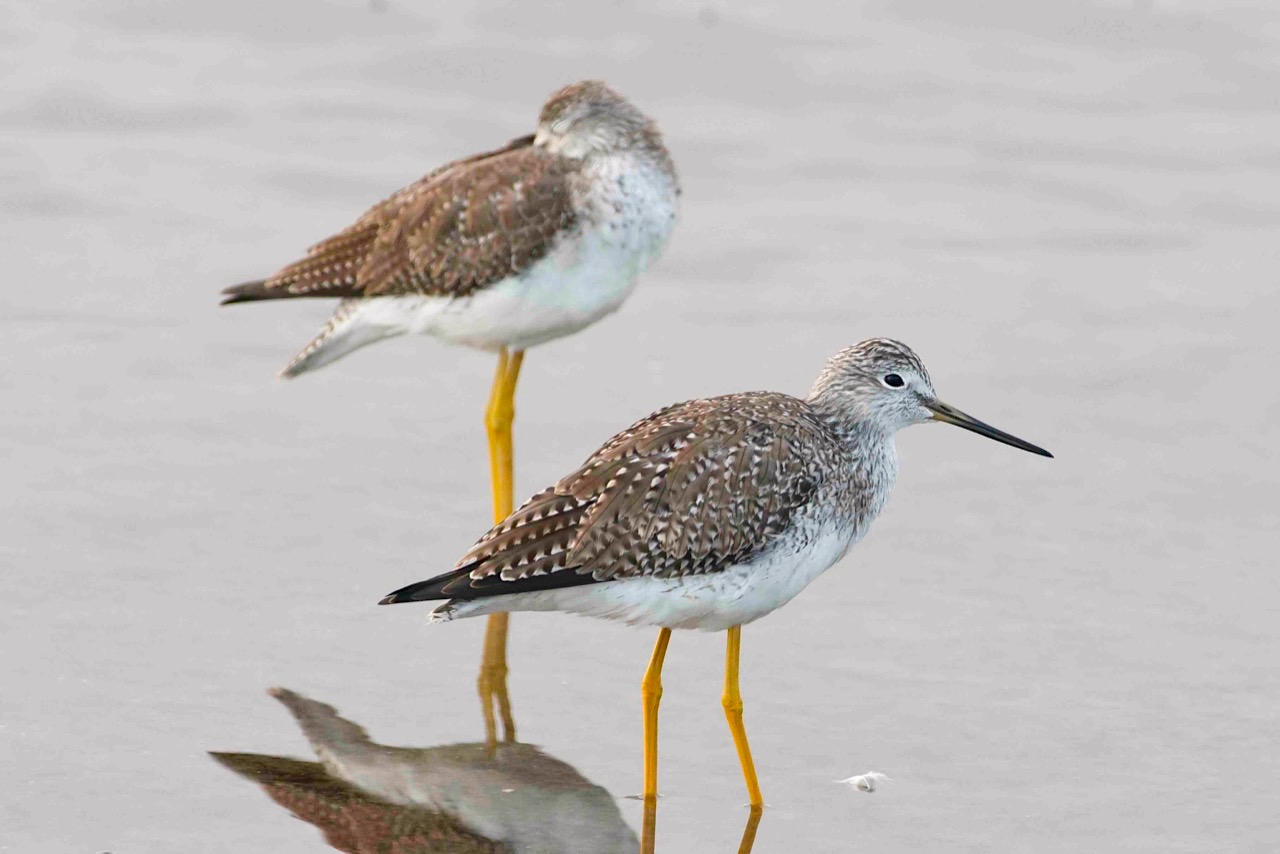




























 ROLLING HARBOUR ABACO
You must be logged in to post a comment.