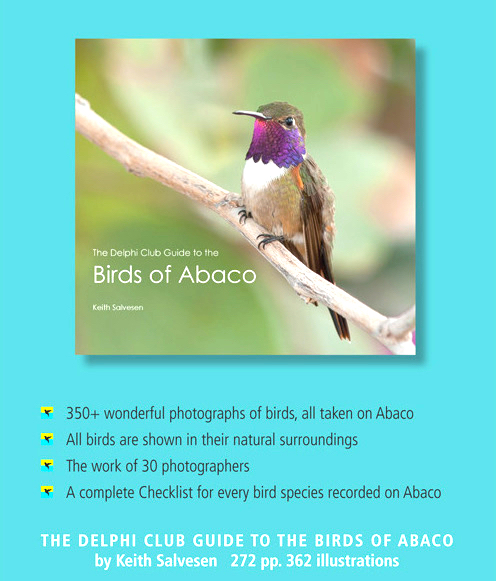
When, in 2014, Birds of Abaco had safely been hatched and was beginning to fledge, I started a companion site that was designed to add an additional dimension to the project. It was a bird-specific accessory to the main Rolling Harbour site that has always featured a far greater range of topics than birds.
The book exhibited Abaco birds in a deliberately perverse way (alphabetically, not by species grouping or other conventional methods). The loosely termed ‘Index’ was meant to be a quick alternative way to delve into the various species.
It was a side project and I did very little to promote it. Once put together (with a linked FB page) I pretty much left it to grow ‘organically’ (aka indolently and neglectfully). I’m bringing the site out of semi-retirement while I get on with my efforts to put the book online. Reach it HERE
A to Z
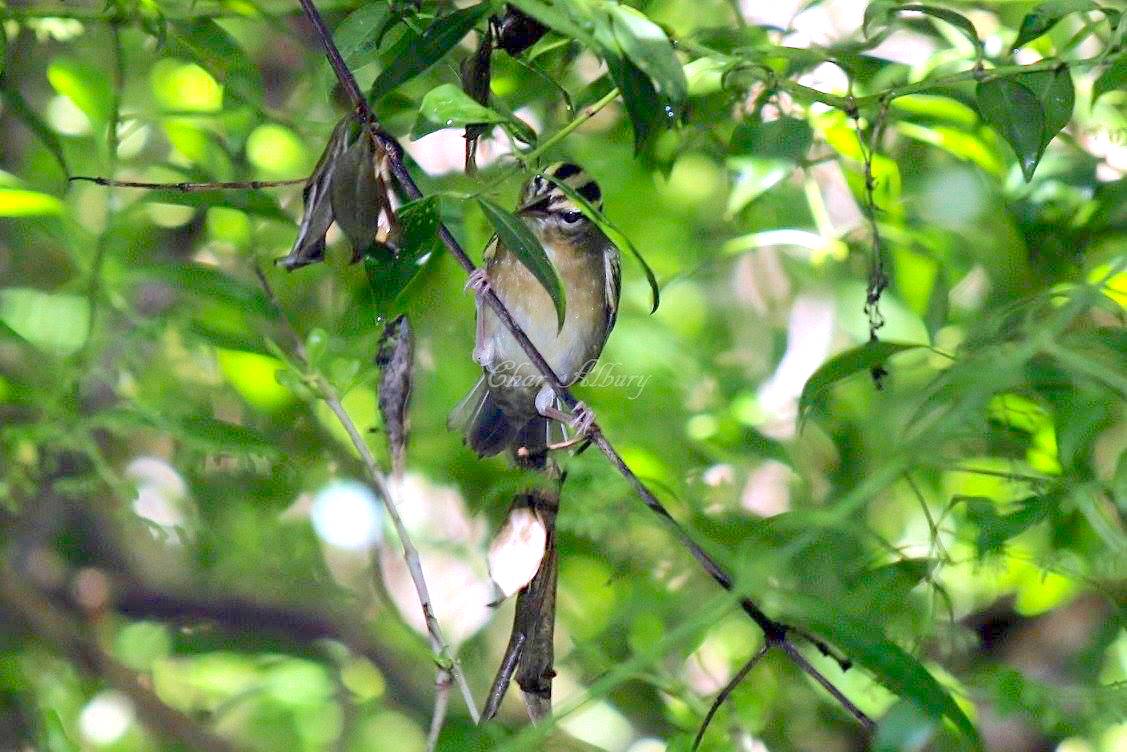
CAPE MAY WARBLER (Char Albury): as it turned out, an unpromising name. The first one was recorded on Cape May, NJ in the early nineteenth century. They were not recorded there again for more than a hundred years.
Q: WHAT HAS THE GESTATION PERIOD OF A WALRUS (16 MONTHS) AND WEIGHS THE SAME AS A PAIR OF FULLY GROWN PINEAPPLES (2 KILOS)? A: THE BIRDS OF ABACO
FIRST FLYER
It is February 2014, and two pallets carrying 500+ heavy books in boxes have just arrived in Nassau. Printed in Italy at the end of January, the cargo had made its way from specialist printers in Florence via Bologna, Leipzig, Brussels, Cincinnati, Miami to Nassau. They spent an unexpectedly long sojourn in Nassau while formalities were unhurriedly dealt with, then made their way safely to the Delphi Club. In early March, the book was launched in the Great Room at Delphi.
Delphi Lodge 2014
The book was generously received. The Delphi years rolled by: happy years of amateur birding, incompetent bonefishing (me), adventures, companionship, conviviality, Kalik. Then a change of ownership at Delphi; the destructive power of Dorian; and the tentacles of Covid spreading round the world.
10 years on at Rolling Harbour Towers HQ, a plan is hatching like an Abaco parrot’s precious egg. Might there be an audience ready for some kind of e-Edition of the whole book, checklists and all? Technology has moved on since 2014. Even I have now read an eBook. There’ll be some tech-stuff involved to get the most practical way to proceed. I’ll need to check with the birds first, and we will get back to you.
SECOND FLYER
Sanderlings on the beach at Delphi – more interested in snacking than eBook stardom
And not just the tail*. Other parts of a bird. Sometimes most of a bird. More rarely, an entire bird. Whichever, a bird affected by leucism stands out from the crowd – out of the ordinary and therefore startling to the eye. I’d be very surprised if the fine turkey vulture in the header image didn’t make you look twice – maybe even to check if some devious photoshop trickery had been at work. Yet it’s just a normal TUVU in the Florida Keys, living a normal vulturine life.
LEUCISTIC DISCOVERY ON ABACO
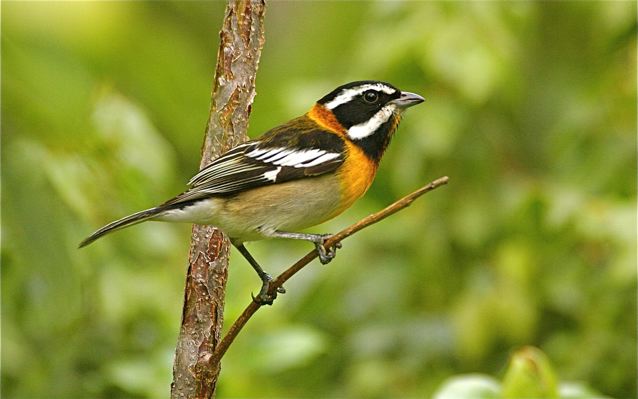
A leucistic Western Spindalis discovered on Abaco by birder Keith Kemp
For comparison – the real deal
LEUCISM? EXCUSE ME, AND THAT IS?
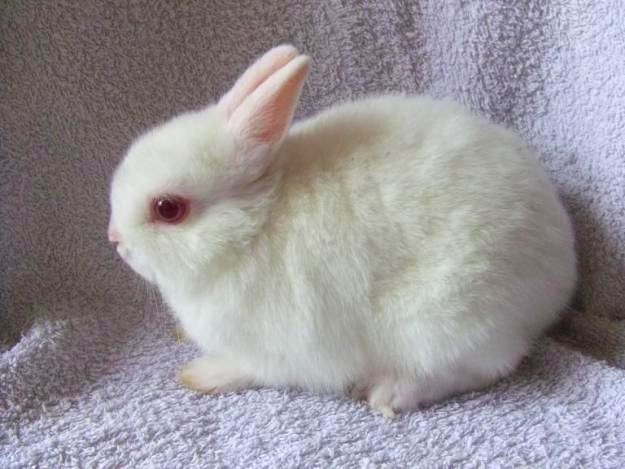
First, what it is not. It is not albinism, which results from diminished or lost melanin production that affects pigmentation. One characteristic of the condition is the tendency to pink eyes, which of course is seen in humans as well as animals and birds. Meet the perfect example…
WELL, WHAT IS IT THEN?
Put simply(ish), melanin is only one of many ingredients of pigmentation. Leucism is caused through pigment loss involving many types of pigment, not just melanin. In birds this results in unnaturally light or white colouring of feathers that may be partial or entire. The eyes of a bird with leucism are unaffected. At one extreme, if all pigment cells fail, a white bird will result; at the other extreme, pigment defects cause patches and blotches of pale or white on the bird, often called a ‘pied’ effect. The condition can be inherited.
A mallard on Abaco. The species is known for its wide colour variations in both sexes. Sometimes the variations go beyond the usual range: this is a leucistic bird
A leucistic common gallinule (moorhen) on Abaco
Leucistic rock pigeon
BAHAMA (WHITE-CHEEKED) PINTAIL: A PIGMENT PUZZLE
I have found more examples of leucism in the ‘Bahama Duck’ than any other local species on Abaco. But there is also scope for confusion. First, here’s a pintail that is undoubtedly leucistic – note that the eyes and beak are unaffected by pigmentation deficiency:
But not all pale variants can be so confidently labelled. In the first picture, bottom right, there is an obviously an ‘odd’ pintail, silvery rather than ruddy brown like the rest of them (and yes, I do see the coot in the pack as well…). The second photo shows the same bird on dry land.
This is known as a ‘silver pintail’. These are said to be a leuchistic variant, and they are stocked by poultry dealers as ornamental ducks at a higher price than the much-loved standard brown version. However this bird clearly retains the essential markings of a normal pintail that you might expect to be absent (at least in patches) in the ‘true’ leucistic bird. I’ve seen it described as a ‘gray morph’. I wonder where the line is drawn between a noticeable colour variant or morph in a bird; and an obviously pigment-abnormal, leucistic bird where the incidence and extent of the condition seems to be random. I’d go with the morph idea.
A fine example of a ‘pied’ American Robin, an occasional visiting species on Abaco
Leucistic American Robin (Amy Evenstad, PoweredByBirds.com)
PIPING PLOVERS CAN BE LEUCISTIC TOO
PIPL are one of my bird species preoccupations, but until I checked them out I hadn’t imagined what a leucistic one would look like, or whether they had ever been recorded. I now have the answer…
These photos of a leucistic female were featured by Audubon Alliance for Coastal Waterbirds, Audubon Connecticut. They were taken by Jim Panaccione, a Biological Science Technician at Parker River National Wildlife Refuge, Newburyport, Massachusetts. I hope he won’t mind their illustrative use here… Despite the theory that leucistic birds may find it hard to find a mate – and might even be attacked by its own species – this pair successfully nested.
OPTIONAL MUSICAL & CULTURAL DIGRESSION
A WHITER SHADE OF PALE
* Obviously, it had to be ‘tail’ in the title to justify one of my clunky ‘jokes’ and an accompanying musical diversion. That’s just the way it is, I’m afraid. Bach’s well-known descending chord sequence of was of course shamelessly ripped off by ingeniously adapted by Procol Harum for ‘A Whiter Shade of Pale’, their first single in 1967. Relive a Summer of Love right here and now. And at 2.57 does he really sing ‘….might as well’ve been toast…’?
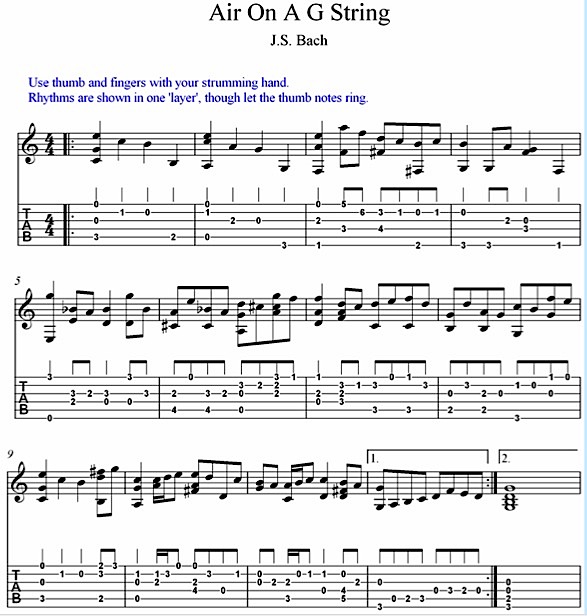
Any fret-tweakers might like to see the sheet music of Bach’s Air for guitar. You could even play it on Air Guitar – which is relatively easy, being in C major and having no strings.
‘BACH IN A MINUET’
The best known commercial use of the tune was in the famed series of adverts that equated a mild cigar called Hamlet with happiness, accompanied by an excerpt from a jazzy version of Bach’s ‘Air on the G String’. Here is one of the best – and possibly the only advert to my knowledge to feature not one, but two excellent Sir Walter Raleigh jokes.
Credits: thanks to Amy Evenstad (PoweredByBirds.com) for use permission for her wonderful TUVU & AMRO photos; other photos by Keith Kemp & Bruce Hallett (Spindalis); Pinterest (rabbit); Nina Henry (mallard); Tony Hepburn (moorhen); Wiki (pigeon); Jim Edmonson (leucistic pintail); Keith Salvesen (silver pintail); Jim Panaccione / Audubon (piping plovers); Procol Harum, esp. Robin Trower for building a great career round being ‘reminiscent of Jimi Hendrix’; J.S. Bach for a nagging tune; Hamlet cigars for ingenuity & making me laugh
“THE DIET OF WORMS”: WORM-EATING WARBLERS ON ABACO
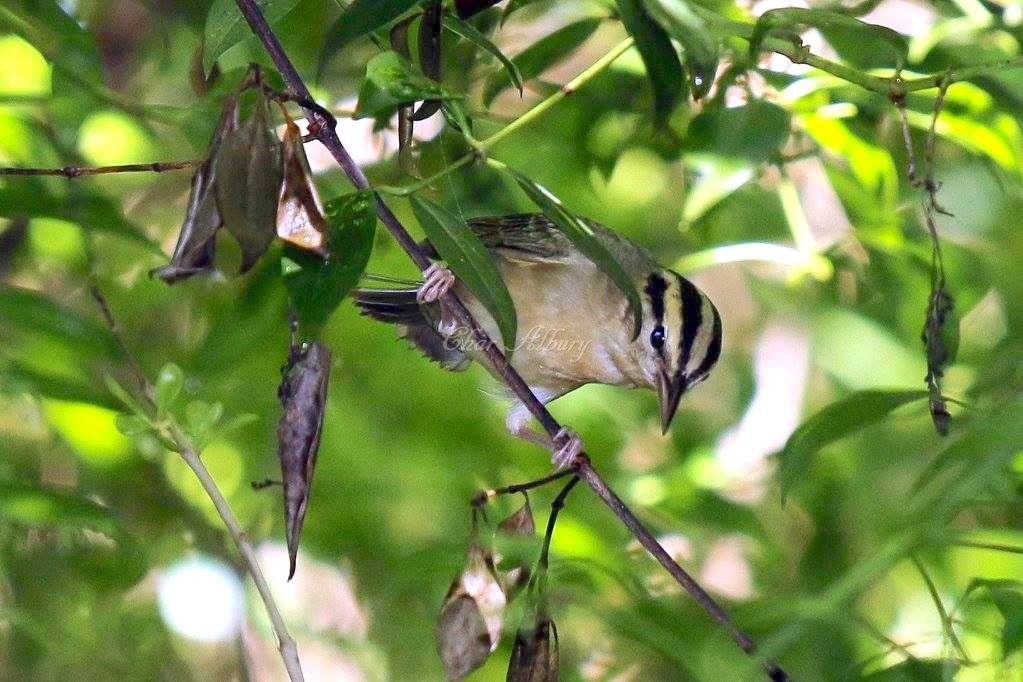
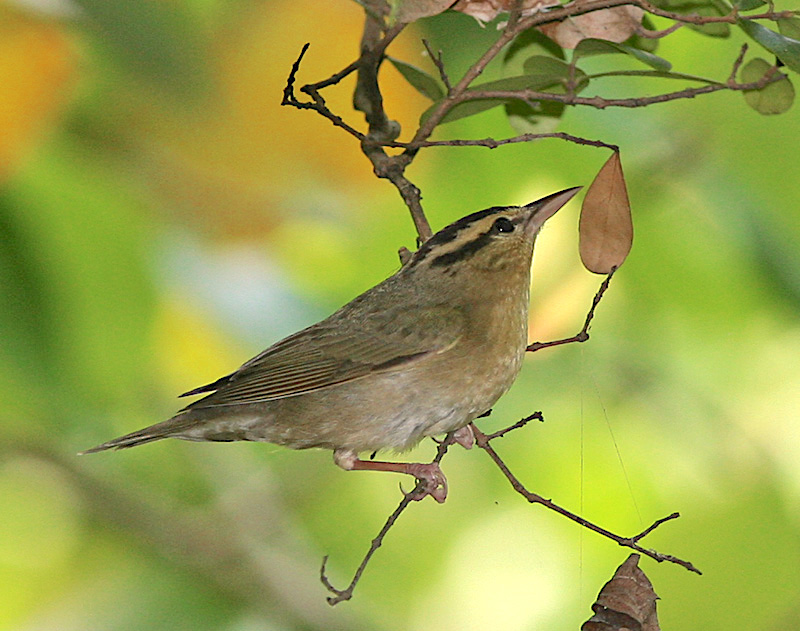
The little worm-eating warbler (Helmitheros vermivorum) is unique. Not because of its worm-eating propensities or its warbler-ishness (or the combination), but because it is the only species currently classified in the genus Helmitheros. TheSwainson’s warbler was once in the same genus, but the WEWA saw off the competition.
SO WHAT IS A HELMITHEROS THEN, IF IT’S SO SPECIAL?
The word is Greek, meaning something like ‘grub-hunter’. And the Latin-derived vermivorum reflects the diet of a VERMIVORE – an eater of worms. But this description is, like a worm, somewhat elastic. It includes caterpillars, larvae, grubs, spiders and similar creatures. But whereas there are other warbler vermivores there is only one Helmitheros.
SOME WORM-EATING FACTS TO DIGEST
WEWAs are sexually monomorphic. Males & females are indistinguishable for most of the year
They can only be reliably sexed at the height of the breeding season…
…don’t ask. OK, a magnifying glass may be needed
They are believed to eat actual earthworms quite rarely. Moth larvae are their best treat
They are ground-nesting birds, one of only 5 new-world warblers to do this
Like some shore-birds, adults may feign injury to lure predators away from the nest
They are vulnerable to nest parasitism by brown-headed cowbirds& feral cats
Fires, deforestation, habitat change & diminished food resources are all threats to the species
As are pesticides, which destroy the primary food source and are in any case potentially toxic
DISTRIBUTION & CONSERVATION STATUS
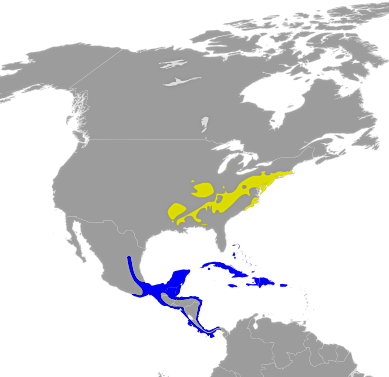
The breeding range of the worm-eating warbler covers much of the eastern half of the US as far south as the Gulf Coast. It winters in the West Indies, Central America and southeastern Mexico. There is no overlap between summer and winter habitat. Because of the vulnerability of this ground-nesting species to a number of threats (see FACTS above), they are now IUCN listed as ‘Special Concern’ in New Jersey.
WHAT DO THEY SOUND LIKE?
In this case the song and call, as transposed into human, really does sound like the bird itself. The song is a rapid squeaky trill; and the calls for once do actually sound like ‘chip’ or ‘tseet’. See what you think (turn up the volume a bit).
Paul Marvin / Xeno-Canto
THE (ORIGINAL) DIET OF WORMS – A DIGRESSION
Studied European history? Had a laugh over The Diet of Worms in 1521? This was an assembly (or ‘Diet’) of the Holy Roman Empire that took place in the City of Worms in Germany. There had already been several of them. This one resulted in an edict concerning Martin Luther and protestant reformation, with the consequence that… [sorry, I’ll spare you the details. I’ve started yawning already, just as I did at school I expect]
It is always instructive to look at Audubon’s fine depictions from the early c19. Here is his WEWA. Notice that it is here called Sylvia vermivora. So he had the worm-eating part, but the first part of the name – referencing woods – rather strangely relates to a group of old-world warblers. No, I’ve no idea why.
Credits: Photos – Tom Sheley (1); Charmaine Albury (2, 4, 6); Andy Reago & Chrissy McClarren (3, 7); Tom Friedel (5). Research material – CWFNJ / Michael J Davenport; Tom Fegely / The Morning Call; assorted magpie pickings & open source
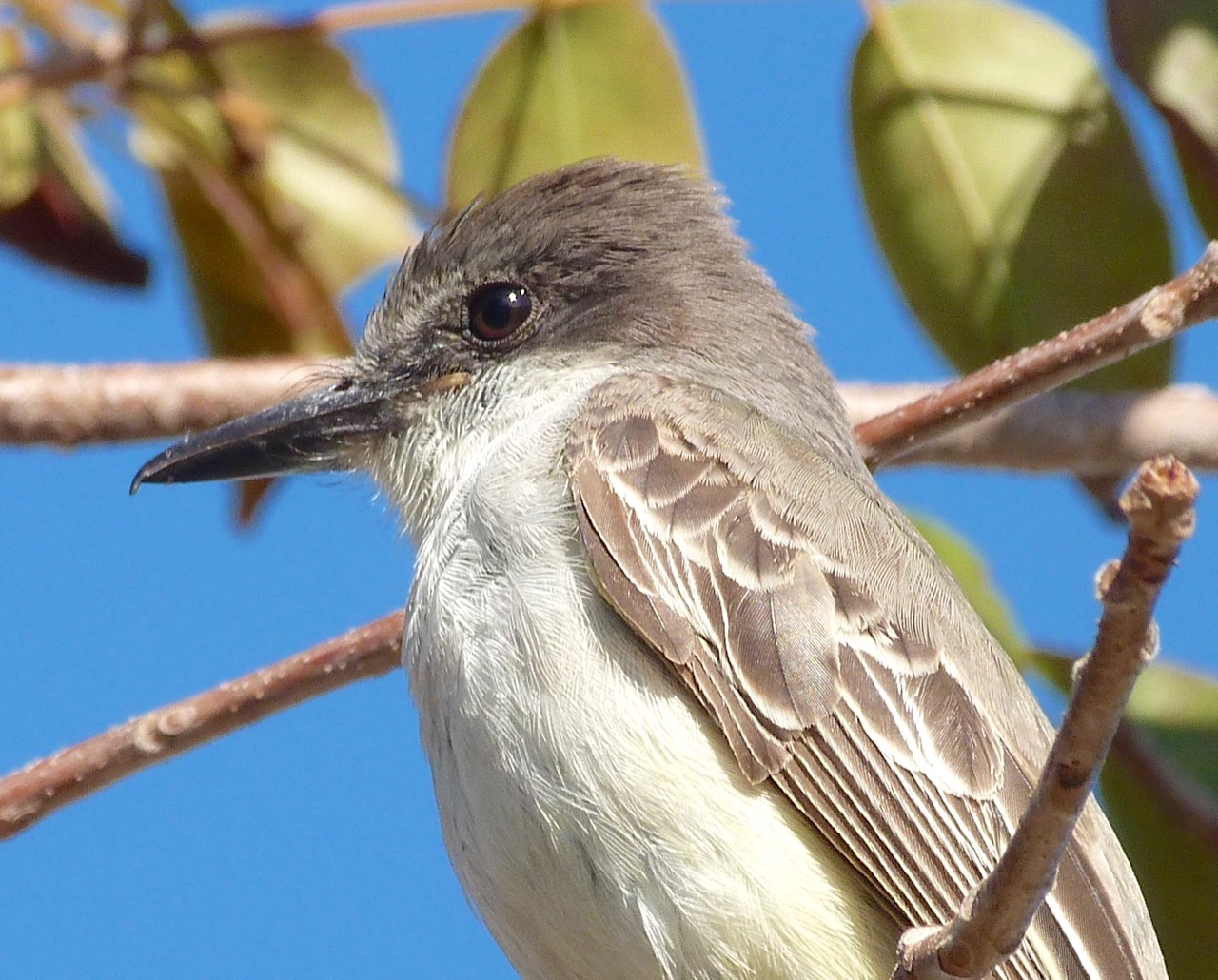
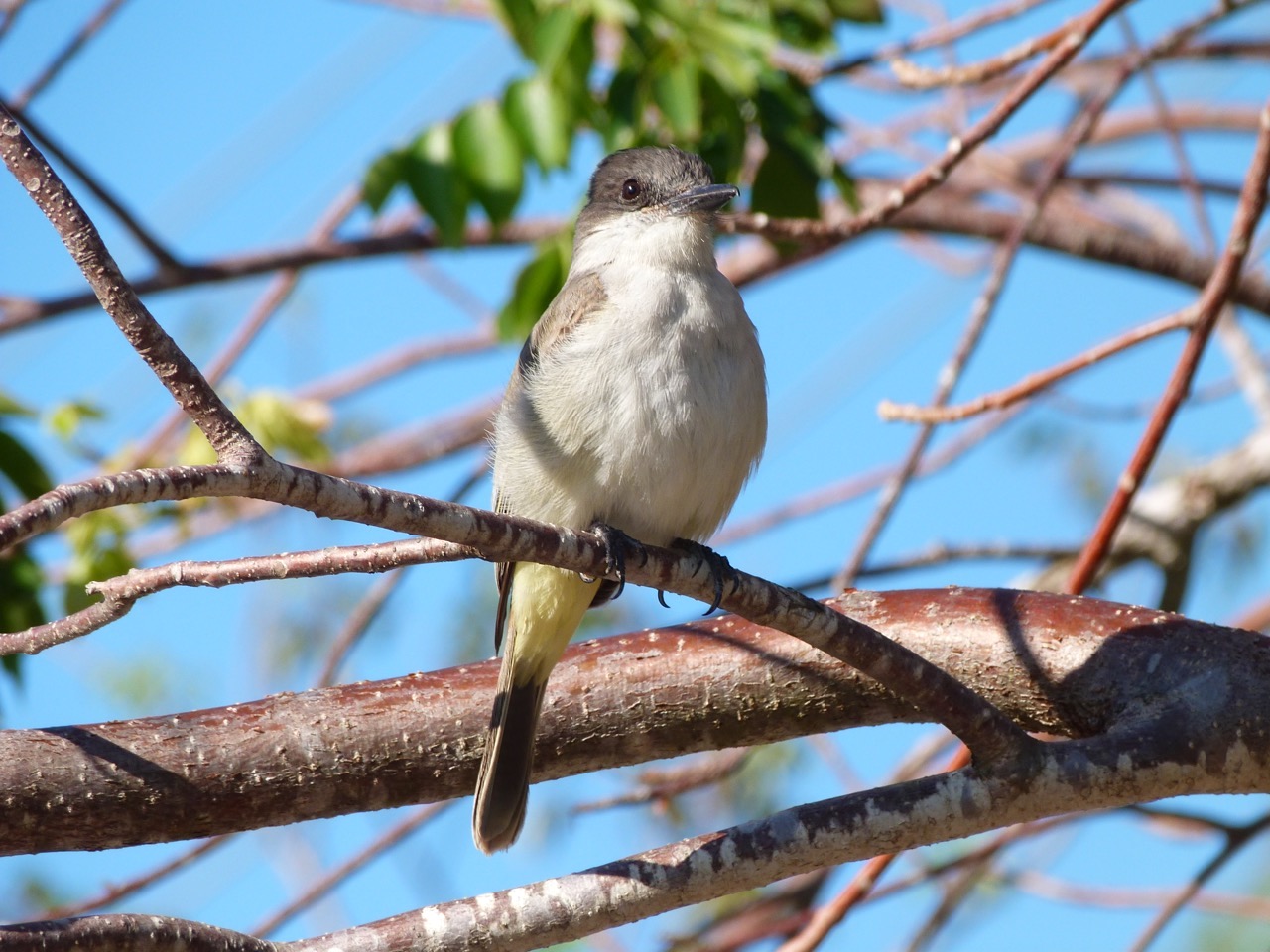
There are four main species of so-called ‘tyrant flycatchers’ (Tyrannidae) found on Abaco: the loggerhead kingbird, the gray kingbird, theLa Sagra’s flycatcher and the Cuban pewee. Three are common permanent residents; the gray kingbird is a summer resident only. Several other flycatcher species are found on Abaco, but they are very uncommon winter residents, rare transients, or vagrants.
The loggerhead featured here became quite a good companion. Like other flycatchers – and indeed the cute little blue-gray gnatcatchers – loggerheads are curious and inquisitive birds, and relatively tame. One can get quite close without ruffling their feathers.
Loggerheads seem to have two methods of observing humans and their mysteries. One is by perching on a branch or in a shrub, watching intently. They stay quite still… until suddenly launching into the air to intercept some passing insect with their hooked beaks (so-called ‘hawking’), before returning to their perch. And staring at you again. The other method is to follow you round, either flying slightly ahead as you progress; or fluttering in the coppice alongside you; or playing catch-up from behind.
A typical quizzical loggerhead sideways look… all flycatchers do this
Loggerhead and gray kingbirds are similar in size, and can be quite easy to confuse. Top seasonal tip: because the grays are summer visitors only, it’s a fairly safe bet that any kingbirds seen between, say, October and April will be the resident loggerheads.
MEMORABLE FACT TO DEPLOY IN CONVERSATION
The collective names for a group of kingbirds are: a Court, a Coronation, or (of course) a Tyranny
Photo Credits: Keith Salvesen Abaco Bahamas; ‘Lordy’ the Loggerhead
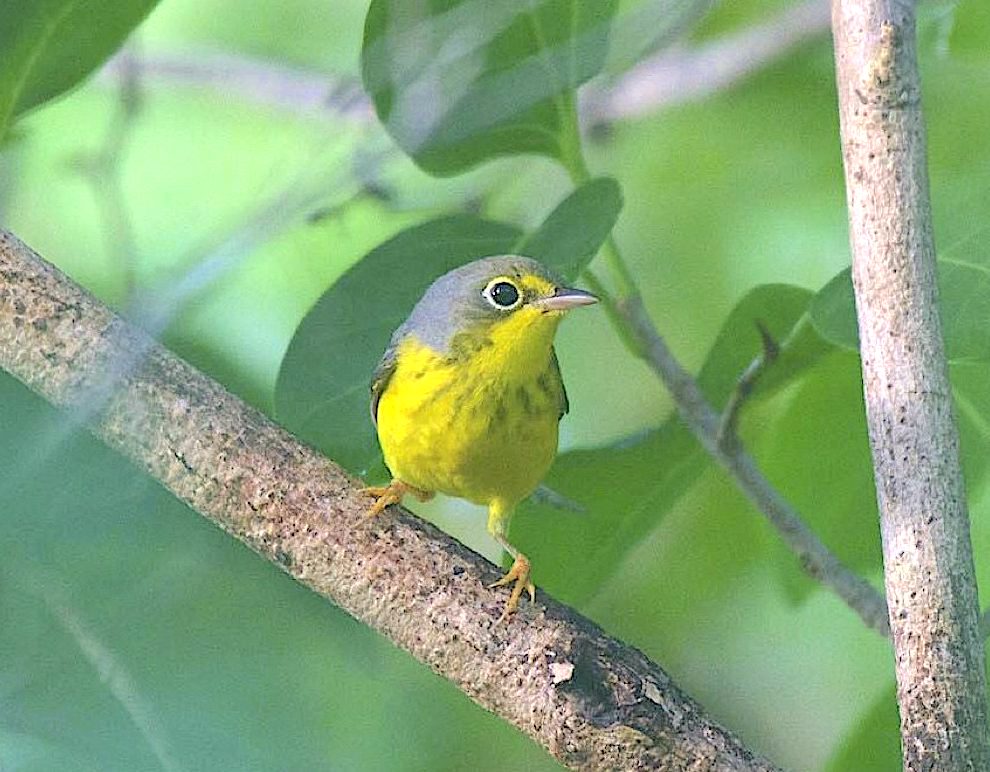
The great winter migration of warblers and their arrival in The Bahamas is underway. Reports are appearing – the latest being the Northern Parula. They will have made long journeys – hundreds of miles – and in the spring they will wing their way home for the summer. On Abaco, 38 warbler species are recorded for the main island and the cays, the latest being the first sighting of a Canada Warbler in 2018. Since Dorian the situation has undoubtedly been different, especially with the transients and rare species. The 5 permanent resident warbler are still resident. Sighting records of the winter visitors have been scarce. Many migrants and transients have not been recorded since Dorian, and the rarest perhaps never will be. The hope must be that at least the most common winter warblers will continue to arrive, and in increasing numbers.
First-ever Canada Warbler for Abaco & the entire Bahamas: Aug 2018 (Chris Johnson)
This guide divides the 38 species into categories, with a code for each bird to show:
Resident status – permanent / breeding, migratory or transient
Frequency – likelihood of seeing each species in its season, rated from 1 (very likely) to 5 (extreme rarities, maybe recorded only once or twice since c1950 when recording began)
Numerically, the division breaks down into 3 categories of warbler:
5 permanent residents (PR) that breed on Abaco (B), of which two are ENDEMIC
21 winter residents (WR) ranging from ‘everyday’ species to extreme rarities like the very vulnerable Kirtland’s Warbler that needs a specific winter habitat that Abaco can provide
11 transients, most of which you will be very lucky to encounter
Palm Warbler, Abaco Bahamas (Nina Henry)
The photos that follow show an example of each warbler, where possible both (1) male and (2) taken on Abaco. Where I had no Abaco images – especially with the transients – I have used other mainstream birding resources and Wiki. All due credits at the foot of the post.
PHOTO CREDITS (1 – 37) Bruce Hallett (Header, 3, 9, 12, 14, 17, 21, 22); Tom Reed (1, 4); Cornell Lab (2); Tom Sheley (7, 10); Alex Hughes (5); Gerlinde Taurer (6, 11, 18); Becky Marvil (8, 20a); Woody Bracey (13, 24); Peter Mantle (15); Keith Salvesen (16); William H. Majoros wiki (19); talainsphotographyblog (20b, 26, 34); Charmaine Albury (23); Craig Nash (25); Ann Capling (27); Jerry Oldenettel wiki (28); Dominic Sherony wiki (29); 10000birds (30); Steve Maslowski wiki (31); MDF wiki (32, 33); Avibirds (35); Michael Woodruff wiki (36); Emily Willoughby wiki (37)
CHECKLISTbased on the complete checklist and codes for Abaco devised by Tony White with Woody Bracey for “THE DELPHI CLUB GUIDE TO THE BIRDS OF ABACO” by Keith Salvesen
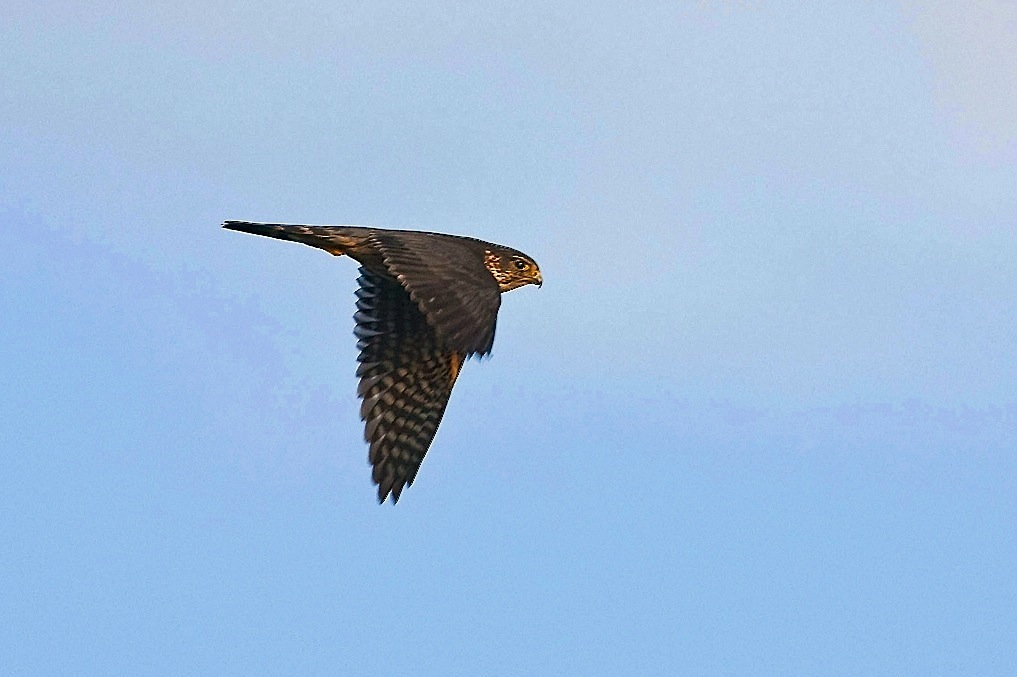
Merlins (Falco columbarius) are fierce small falcons that are fast and agile in flight. On Abaco, they are fairly common winter residents – though finding one and managing to photograph it may take a bit of doing. And maybe a dose of luck. The ‘columbarius‘ part of their taxonomy reflects their colloquial name ‘Pigeon Hawk’. Merlins are found throughout much of the northern hemisphere. They are classified as a New World species and an Old World / Eurasian subspecies, F c aesalon. Some argue for two distinct species, the gene pools of the two versions apparently having parted company ten of thousands of years ago. The birds aren’t overly bothered by the debate.
Merlin World Range Map: yellow = summer, blue = winter
HOW DO MERLINS DIFFER FROM AMERICAN KESTRELS (AMKE)?
Slightly larger and notably heavier (thus having more speed and endurance in flight)
Different colouring, e.g. lacking the indicative reddish-browns of the AMKE
Distinctive tail-barring as against black ends to the tail feathers with a white fringe
Unlike the AMKE they don’t hover, but close in directly on the small birds that are the main prey, often flying very low to surprise the victim.
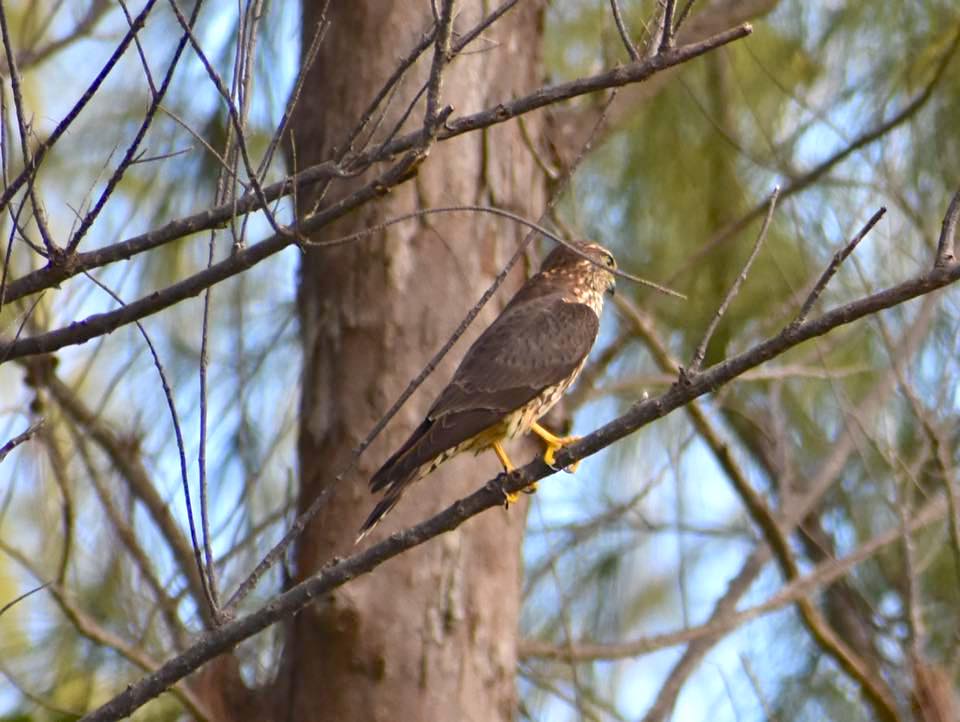
For comparison: Merlin in South Abaco, American kestrel at Sandy Point
SO JUST HOW FIERCE ARE MERLINS?
Formidable! If you are a small or even medium-sized bird, you need to keep your wits about you. Merlins are largely ‘omni-habitat’ within their range, which includes open country, shrubland, light forest, and grasslands. They are fast, agile and strong. They can fly high, at medium height or at ground level, and are expert in surprise attack and rapid pursuit of prey. If you are a large bird of prey – a red-tailed hawk, perhaps – they may attack you with ferocity. They may not actually be trying to nail you, but to get you out of their territory and their catchment area.
Most of a merlin’s prey is taken in flight, and their speciality is ‘tail-chasing’ terrified birds. Breeding pairs may hunt cooperatively, with one bird flushing prey from cover into the open for its mate to… well, you get the picture – they are clever too. They may even pursue birds that have been flushed out by another bird of prey in the vicinity.
MERLINS AND PHOTOGRAPHERS
This is a slightly fraught relationship, because Merlins do not always pose as one might wish. Sometimes they are hard to see, being fairly well camouflaged unless they choose to ‘go out on a limb’.
And sometimes they don’t play by the rules relating to light and focus, making a clear shot difficult
This photo (2017) was taken on Elbow Cay (north end) by Jan Purdy Hulme Metcalf. It’s the first merlin photo from one of the Cays that I have come across.
FALCONRY AND MEDIEVAL HISTORY
Merlins were popular birds in medieval English falconry, and according to the 1486 Boke of Seynt Albans, the ‘Marlyon’ was considered the appropriate hunting bird for a lady. This book contained an essay on hunting attributed to Dame Juliana Berners, the prioress of a Priory near St Albans, who, game lady that she must have been, also contributed to one of the earliest treatises on fishing, ‘Fysshynge wyth an Angle‘ (hence, angling).
FURTHER HISTORICAL DIGRESSION (feel free to skip to final para)
While reading up further about Dame Juliana, I came across (wiki-tnx) a wonderful ranking for birds of prey matched to status that I hadn’t encountered before. Here’s the list, from Emperor to Knave / Servant. A Tercel was / is a male falcon, especially a Peregrine or Gyrfalcon. A Musket is a sparrowhawk.
The Boke of Seynt Albans also contains list of collective nouns for animals and birds, many familiar today such as “gaggle of geese”. There are also humorous collective nouns for different professions, such as a “diligence of messengers”, a “melody of harpers”, a “blast of hunters”, “a subtlety of sergeants”, and a “superfluity of nuns”…
Merlins are still trained for hunting smaller birds; and because of their speed and agility they are used in falconry displays. Despite changing habitat, and a perceptible dip in population from the use of pesticides now banned (such as DDT), the Merlin seems to be holding its own very well 5 centuries after the Boke was written.
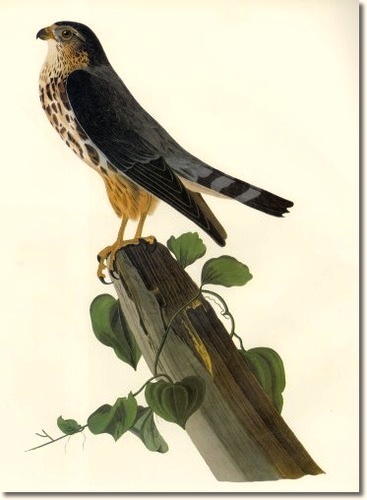
AND FINALLY… AUDUBON’S HANDSOME MERLINS
Credits: Becky Marvil (1 & 7); RH (2); Rhonda Pearce (3); Craig Nash (4 & 5); Gerlinde Taurer (6); Prairie Boy; (8) Jan Purdy Hulme Metcalf (2017 photo); (9) wiki – not taken on Abaco, but I liked it; Dame Juliana Berners (1486); Magpie Pickings
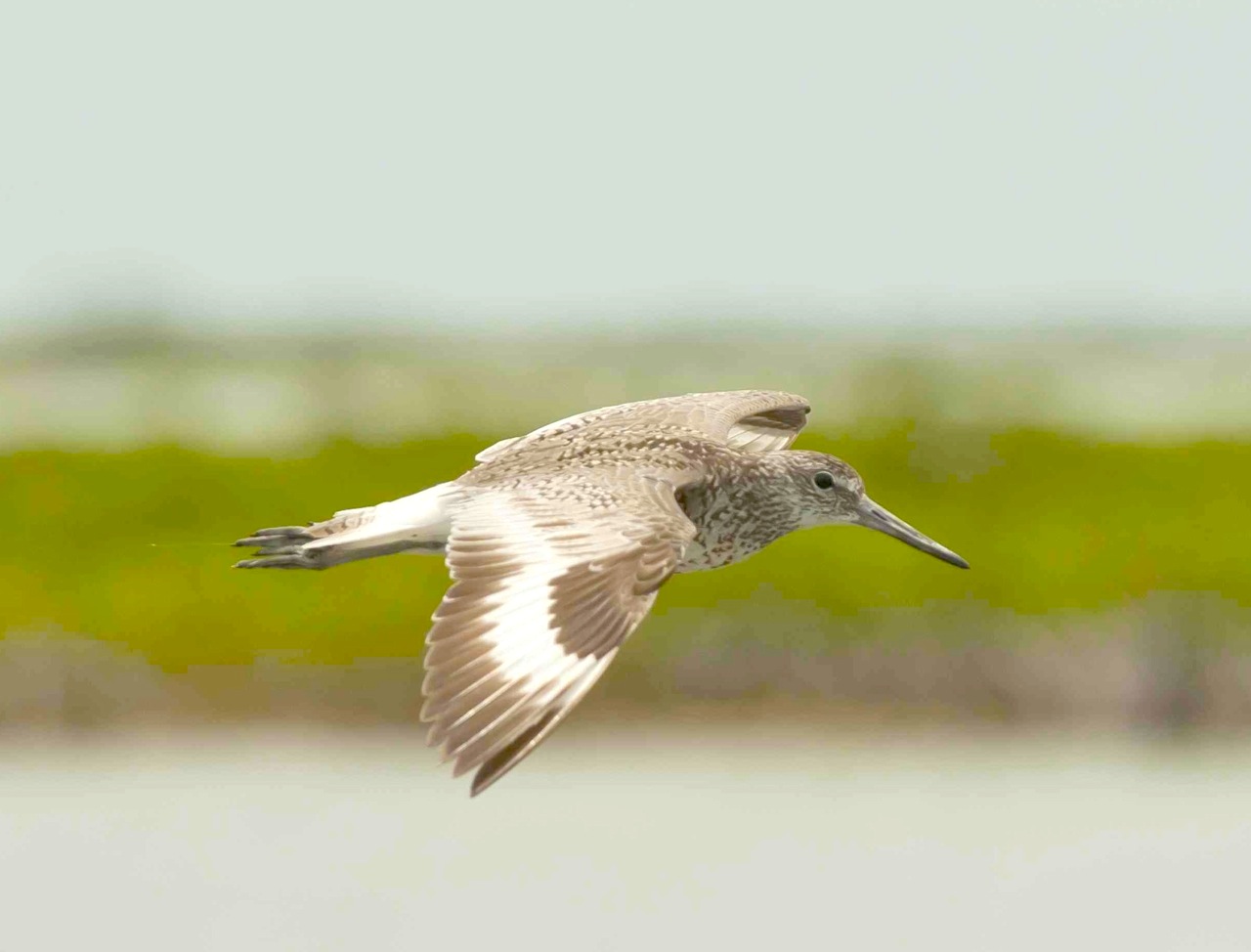
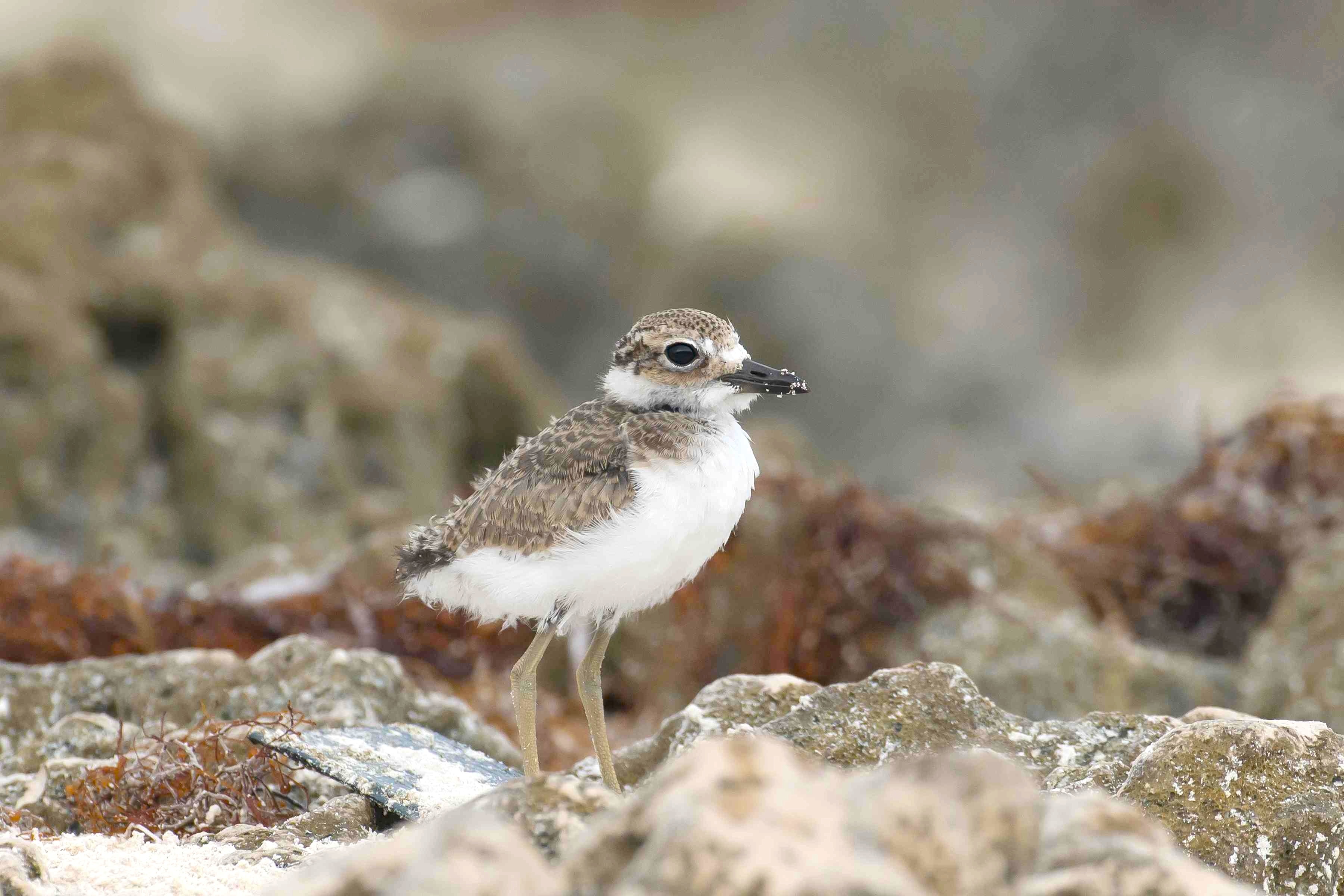
Abaco’s birding records compiled for over 20 years include 33 shorebird species. For a few, the islands and cays are a permanent residence; for many others they are winter quarters; some species are visitors transient in their migrations; a few are rare vagrants. The complete checklist of Abaco’s shorebirds is below, along with 3 links to specific posts.
I have divided the species into 3 categories: sandpipers & kin; plovers; and a catch-all ‘large shorebird’ group that includes one or two sandpipers. Of the 26 birds featured and shown in the main checklist below, 23 are ones you might reasonably hope or expect to encounter on Abaco, though some only if you are lucky or your field-craft is excellent. The others are the long-billed dowitcher, American avocet and Wilson’s phalarope (of which only one has ever been seen on Abaco, with a photo to prove it). Many of these are showcased in my book The Birds of Abaco.
The codes tell you, for any particular bird, when you may see it (P = permanent, WR = winter resident, TR = transient, V = vagrant); whether it breeds (B) on Abaco; and your chance of seeing it, graded from easy (1) to vanishingly unlikely (5).
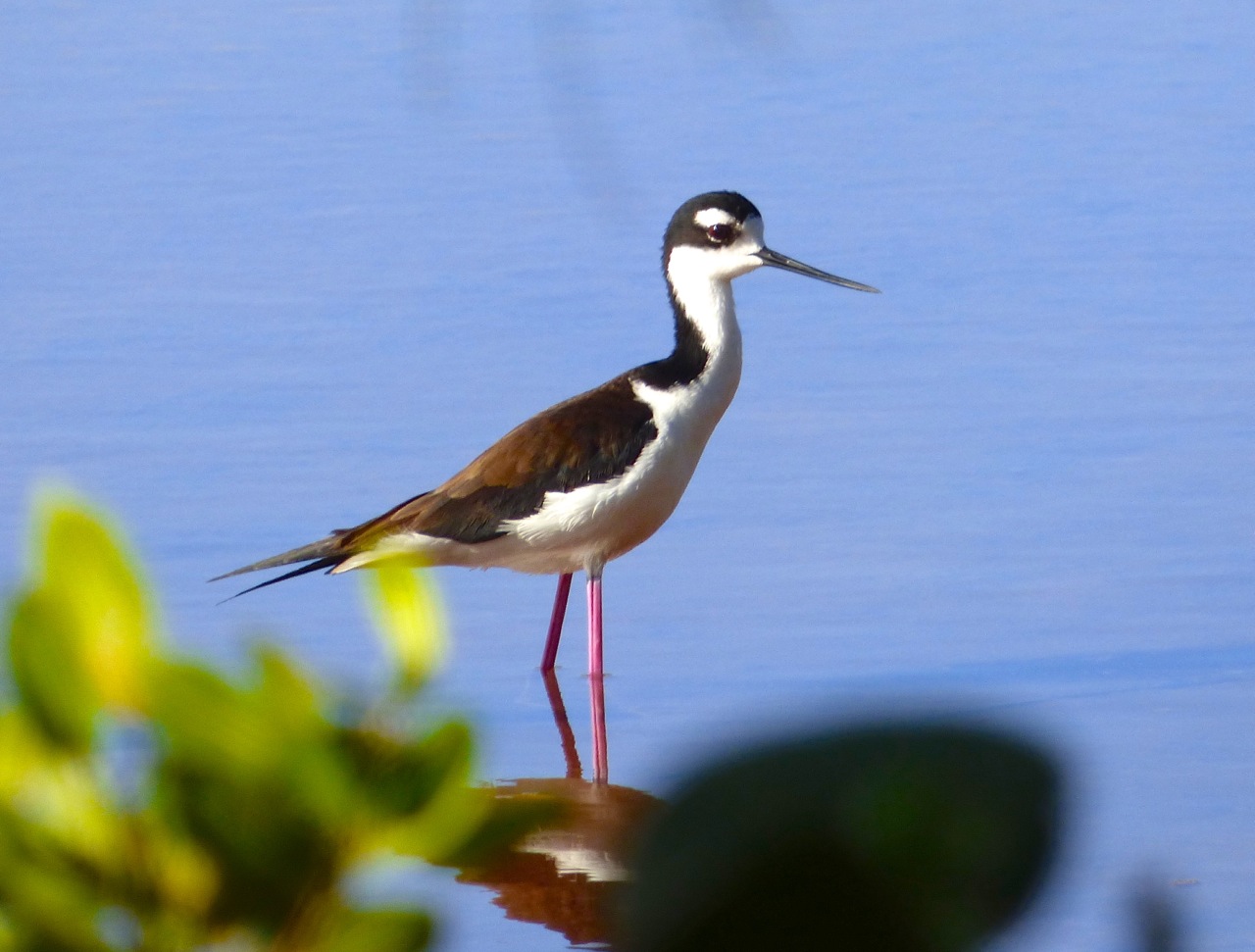
Black-necked Stilt Himantopus mexicanus PR B 3
American Avocet Recurvirostra americana WR 4
American Oystercatcher Haematopus palliatus PR B 2
“CATCHING THE EYE”: OYSTERCATCHERS (+ BONUS ID TIP)
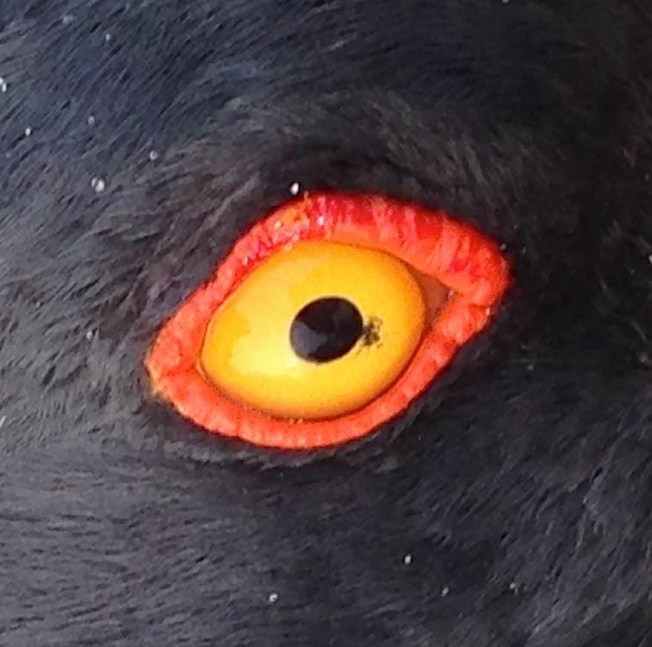
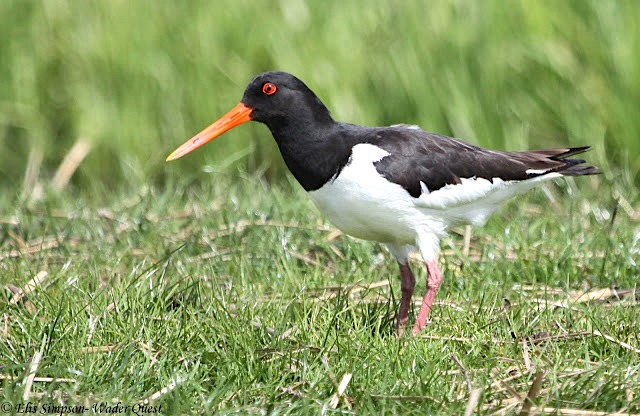
I’m focusing (ha!) on oystercatchers and their eyes. Like the extraordinary one in the header image. Notice the bright orangey-red ‘orbital ring’, the egg-yolk-reminiscent eye and the pitch black iris. An eye-catching and unmistakeable feature of this handsome black and white shorebird, the American Oystercatcher.
Here’s another AMOY eye, with a different smudge of black by the iris. I don’t know for sure, but I suspect that AMOY specialists are able to ID individual birds at least in part by their different eye markings. And you can see that the eye-ring smartly matches the beak into the bargain.
This wonderful photograph of a loving AMOY pair with their precious egg safely encircled by a rocky nest was taken on LBI, NJ by ‘Northside Jim’, whose amazing photos I sometimes include. See how brightly the eyes of each bird stand out, like tiny archery targets.
The World is Mine Oyster
This well-captioned AMOY shot was generously put on Wiki by photographer Dan Pancamo
OYSTERCATCHER ID TIPS
A while ago, when I was choosing AMOY photographs for publication, I idly wondered what was the difference between them and Eurasian Oystercatchers (yes, yes, I hear you – apart from geographical, I mean…). At a first comparative glance, to me they looked remarkably similar in coloration and size. Assuming both species were to be discovered on the same shoreline, how best might one distinguish them? The main differences seemed to be:
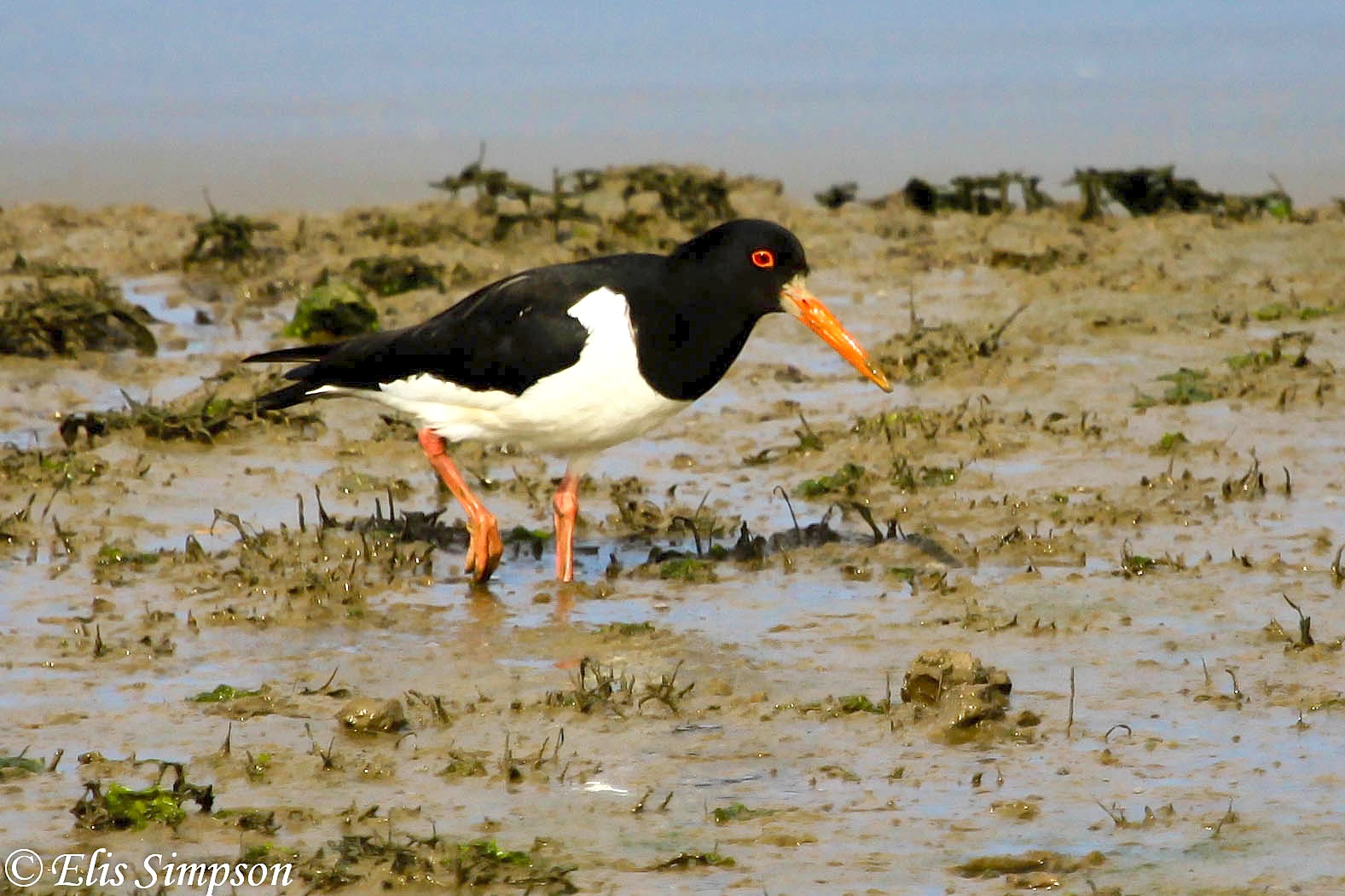
Leg colouring differs, AMOY legs being generally pale pink as opposed to the stronger coloured legs of the EUROY (if they can be called that). However there are considerable EUROY variations (see below), from pink to orange to reddish, that are presumably seasonal. The leg colour, assuming they are visible to the watcher, is not quite a definitive identifier.
Both species have black heads and necks, but the AMOY’s back plumage shades to dark brown. But how distinctive would that be in low light or indifferent weather?
Mrs RH, looking over my shoulder, saw it at once: the eyes. If you can see the eyes, you can tell instantly what make of OY you are looking at. Here are a some Eurasian Oystercatchers showing their own distinctively red eyes and orbital rings.
As so often, I have since found that the excellent Birdorable site has nailed the differences clearly and simply. Eye colour, leg colour and – less obviously – the AMOY’s brownish back as opposed to the EUROY’s entirely black and white body. Sorted.
Quite a while back (in the Pre-Covid Era), Black-faced Grassquits Tiaris bicolor were honoured by the American Ornithological Union with a classification change from emberizid to tanager. For the reasons that follow, the species regarded this both as scientific promotion and as merited status elevation. I invited an authoritative Spokesquit to explain why.
*******************
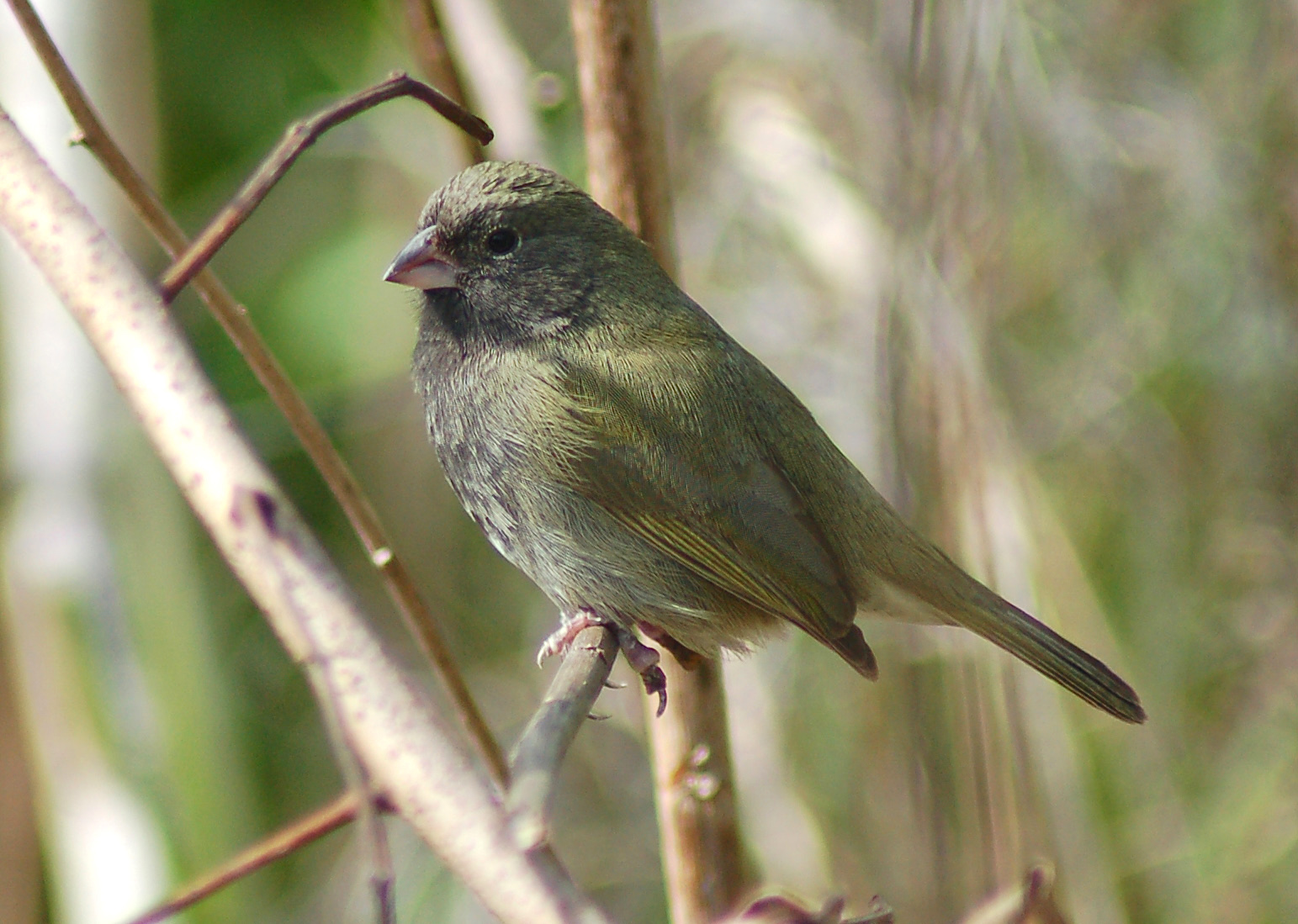
Hi, human friends, I’m a black-faced grassquit and I have a couple of observations to make on behalf of BFGs, if I may. First, we seem to be universally described by you as ‘common’, whereas we are actually quite refined in our behaviour. Secondly, the words most used to portray us are ‘dull’ and ‘drab’. And ‘stubby’. Well, excuse me… I – we – ask you to give us a second look. Maybe check out these images for a start.
Unsurprisingly we were very excited when the perceptive classifications committee of the American Ornithological Union gave us an upgrade. That’s the way we saw it anyway. For many years we were classified under the heading emberizidae.
We kept company with some buddies like the handsome Greater Antillean Bullfinches, but also with a lot of New World sparrows. Frankly, we never felt entirely comfortable with them. Annoyingly chirpy, for a start. And in truth, more drab than us (I’m told).
And so we officially became a type of tanager. Scientists even reckon (rather late in the day, in my view) that we are closely related toDarwin’s finches. Posh relations suddenly. And now we get to be with other birds that are dome-nesters like us. And how about this – we are now in the same category as some really cool birds…
How’s this for a colourful gang to be joining: scarlet tanager, summer tanager, rose-breasted grosbeak, indigo bunting, painted bunting – these are our new cousins. It’s like being related to an avian rainbow that can fly. BFGs “dull” and “drab”? I don’t think so.
6 UNDULL FACTS ABOUT BFGS
Make grassy dome-nests (like Bananaquits) and line them with soft grasses
Both sexes build the nest together
Both share egg-sitting duties and later chick-feeding & maintenance
Though quite gregarious by day, for some reason they tend to roost alone
They have a short ‘display’ flight with vibrating wings and a strange buzzing call
Otherwise, their flight is ‘weak, bouncy & fluttering’ (Whatbird assessment)
THE EVERYDAY TWITTERING SONG
THE DISPLAY BUZZING SONG
Photo Credits: Alex Hughes (1, 10); Tom Sheley (2, 3); Bruce Hallett (4, 9); Tom Reed (5, 11); Becky Marvil (6); Peter Mantle (7); Gerlinde Taurer (8); Keith Salvesen (12); Larry Towning (13). Other Credits: ABA, AOU, Whatbird? (sound files)
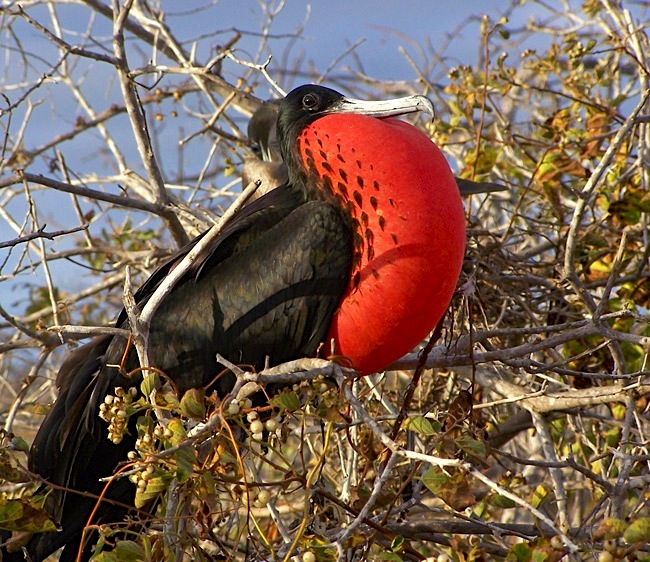
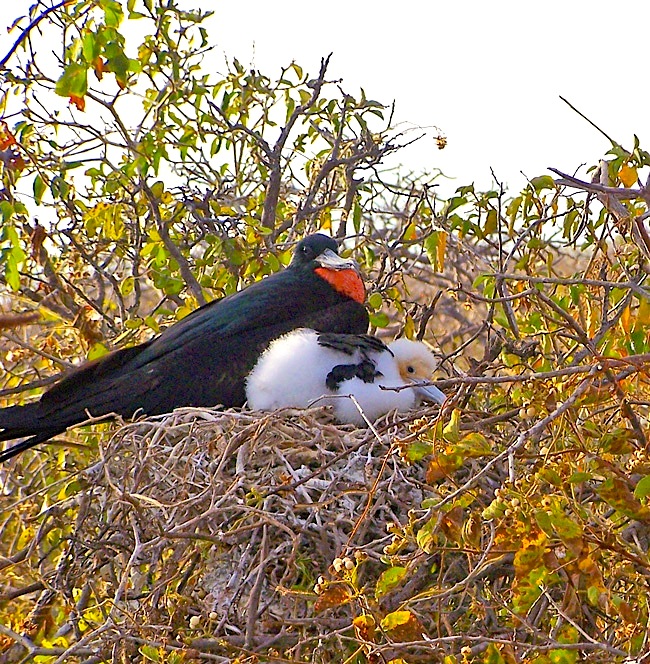
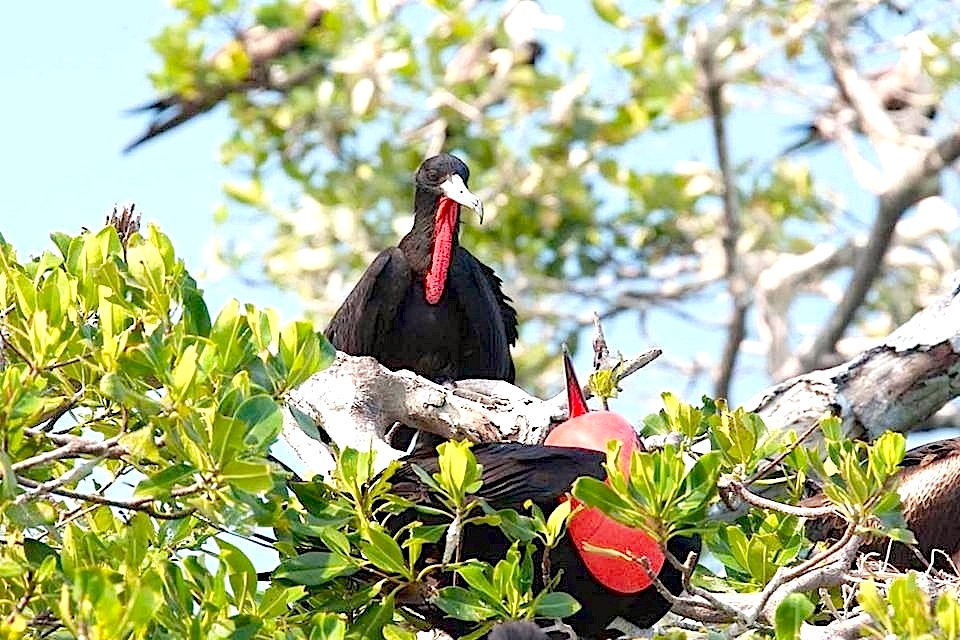
This is a male frigatebird (Fregata magnificens) in the breeding season, with his extraordinary inflatableGULAR POUCHfully blown up. He is at his most chest-burstingly dashing, at least to female frigatebirds, and this great capture by photographer Athena Alexander from the excellent blog of JET ELIOT, shows one of the wonders of the bird world. A glimpse of his mate can be seen just behind his head, but frankly he has made the story his own! And just look at the size of his wings. If a bird can steal limelight, he has effortlessly done so.
COURTSHIP DISPLAY
The image below shows the male enacting his courtship display. Jet Eliot describes it thus: “During courtship display this balloon-like sac takes about 20 minutes to fully inflate. It is featherless, scarlet red, and tight as a drum. It’s so big it distorts him. When he’s ready and has a suitable audience of females flying overhead, he points his face skyward and rapidly beats his wings against the balloon, creating a low, booming sound”. The male’s pouch is not entirely inflated. A female is nestled under the his protective wing. Presumably she has been won over and mating will soon occur once the performance ends. Or maybe she’s bored with the whole routine – she looks rather as though she has seen it all before…
NESTING
Even on the nest, males are keen to be in the picture. Not for them the ‘absentee father’ role, out fishing the entire day. Instead, they share chick-care duties, looking after the single enormous, fluffy chick. An adult pair stays together for the year, forsaking all other. Chick care takes a long time from egg to fledging and beyond – so much so that frigatebirds only breed every other year, and always produce a single egg. For this reason, habitat destruction of breeding grounds has a far greater effect on population numbers than for birds that breed annually.
10 MAGNIFICENT FACTS ABOUT FRIGATEBIRDS
Magnificent Frigatebirds are the largest of several frigatebird species around the world
They are found in tropical and subtropical waters
Females have white fronts that make them easily distinguishable in flight
An adult’s wingspan is 7+ feet, with the largest wing-area / bodyweight ratio of any bird
Frigatebirds can remain in flight and far out to sea for many days
They are KLEPTOPARASITESand will rob other seabirds of their food
Their diet is mainly fish & squid snatched from the water’s surface; also seabird chicks
They nest in colonies, producing a single egg every other season
They don’t actually land on water, as they don’t float; and they are feeble at walking on land
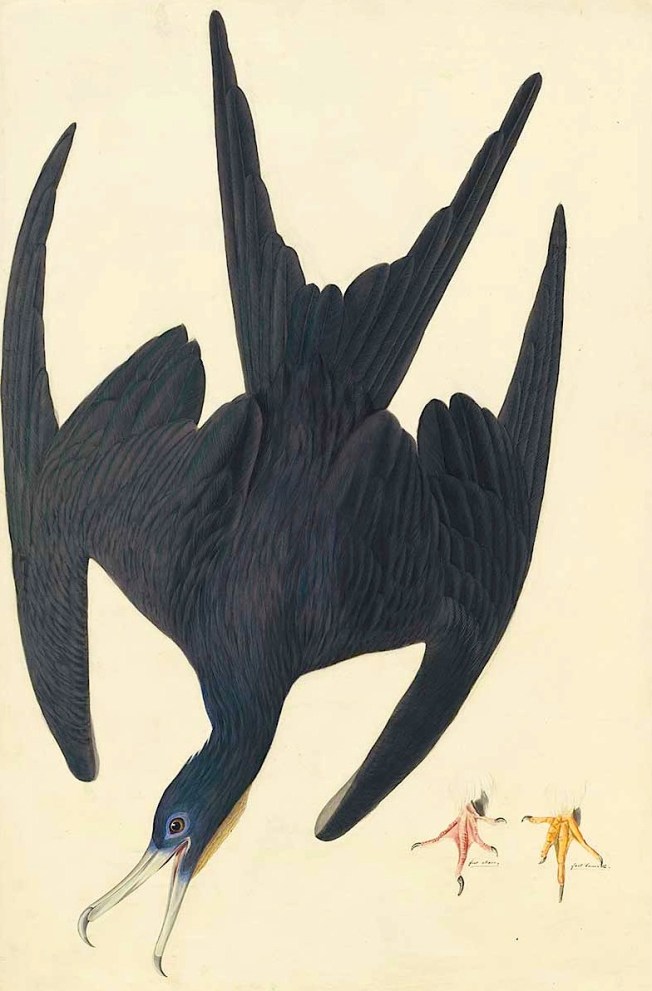
One of the earliest depictions of a frigatebird is by Eleazar Albin in 1737. He was a naturalist contemporary ofMARK CATESBYand pre-dated AUDUBON
NAMING THE FRIGATEBIRD: A POTTED HISTORY
Columbus encountered them on his first voyage in 1492, but knew them by their Spanish name rabiforçado or ‘fork-tail’.
The use of the name ‘frigatebird’ was first recorded in 1667 and referenced the frigate warship, a powerful sea-vessel
‘Man-o-War Bird’ was the name given to the bird by English mariners in the Caribbean, being the colloquial name given by sailors to a frigate.
A MAN-O-WAR GALLERY
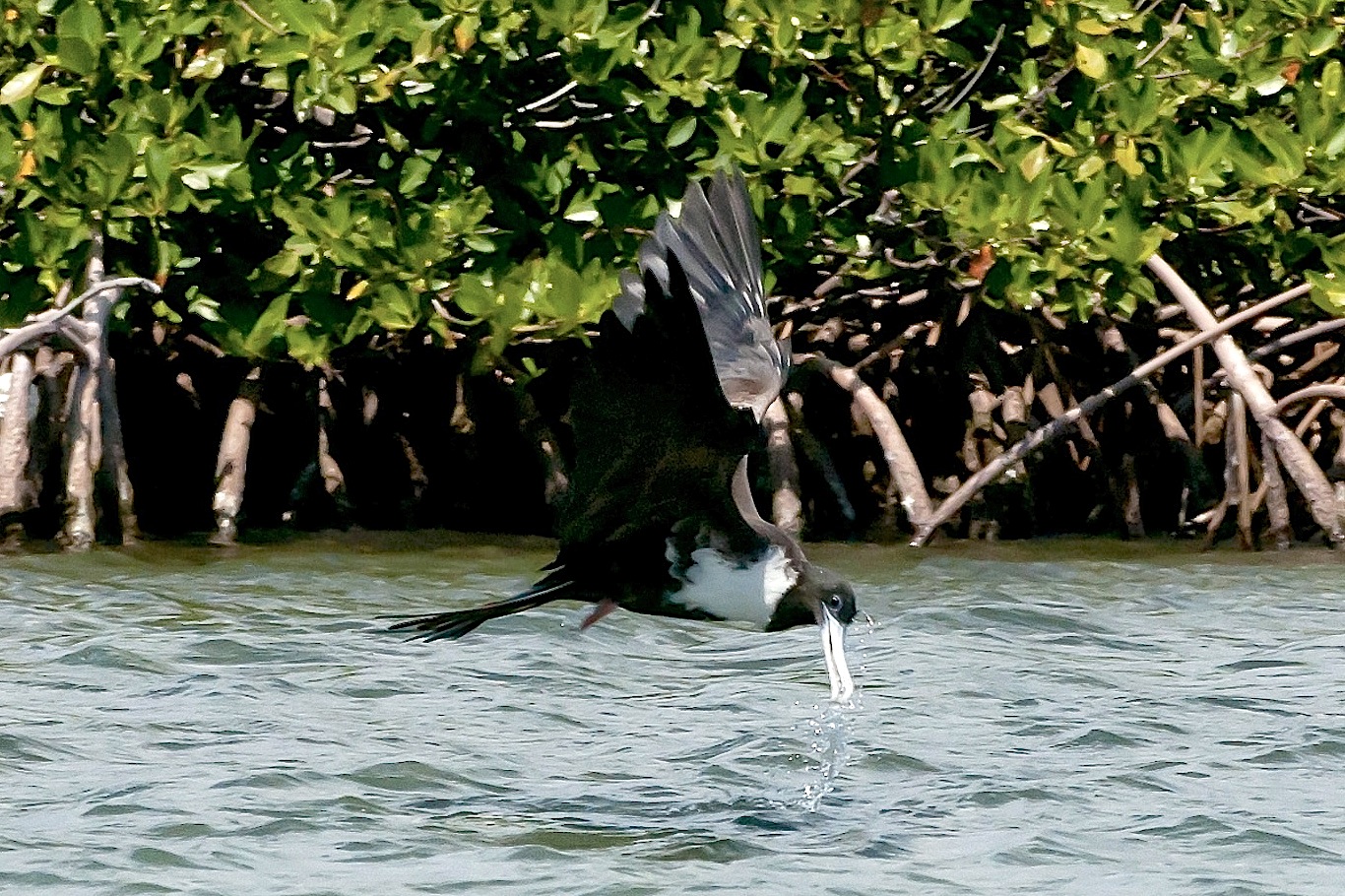
A female frigatebird hunts for food among the mangroves on Abaco
A female frigatebird soars high over Marsh Harbour
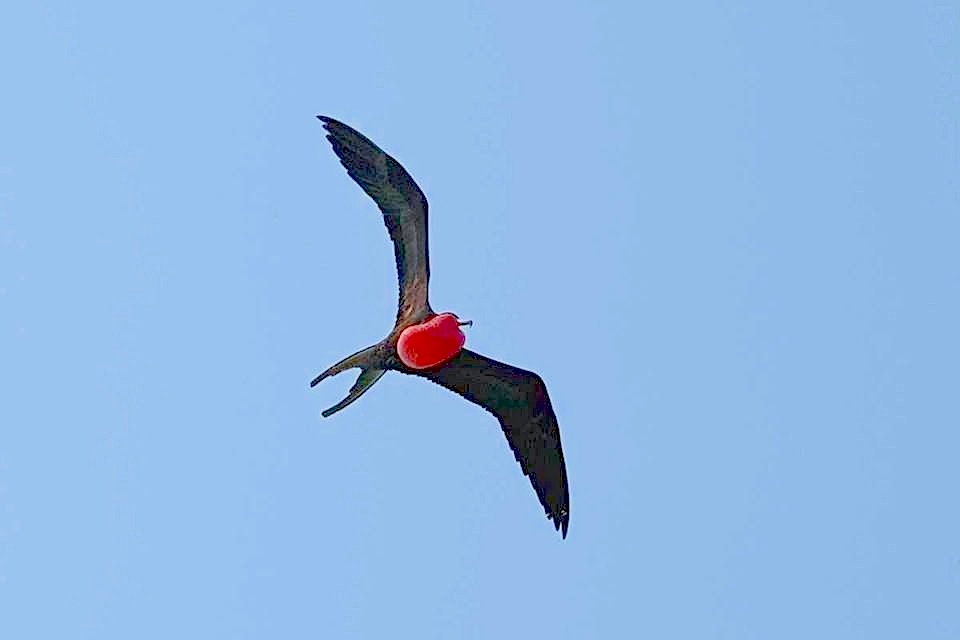
This male has taken off before his gular pouch has had time to deflate fully
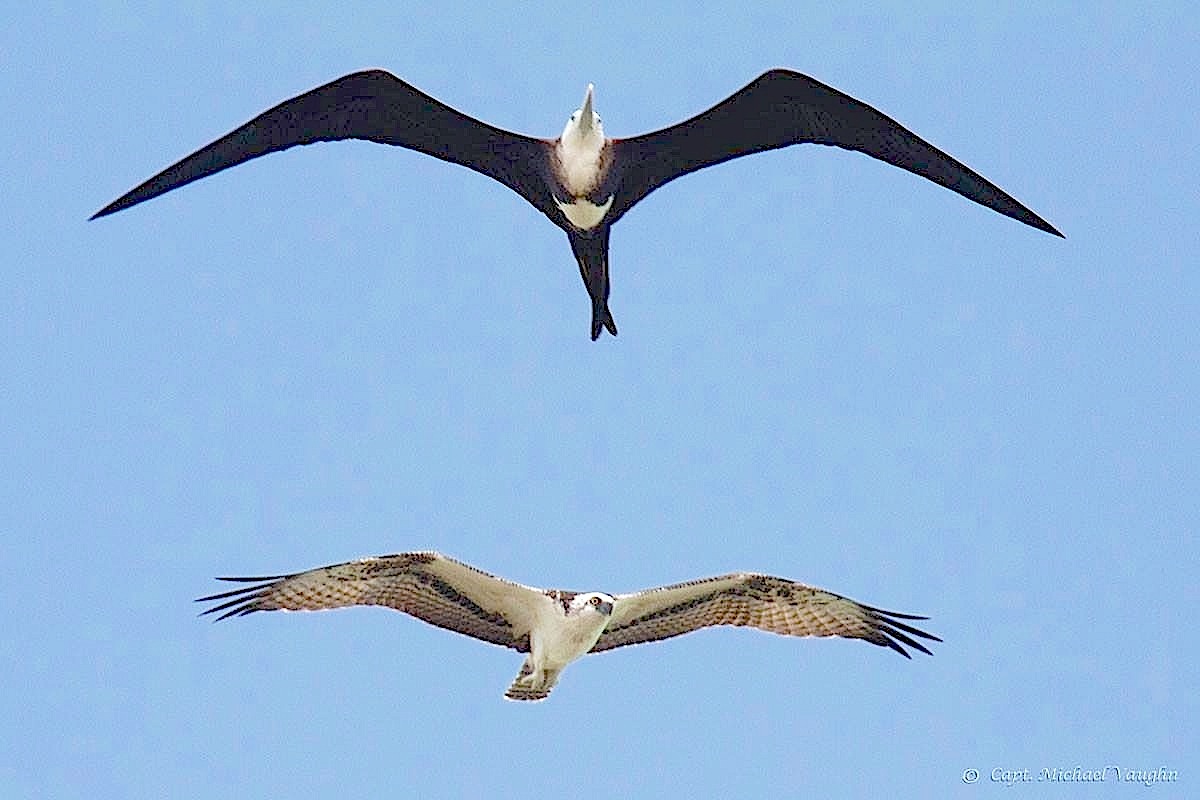
An osprey escorts a female frigatebird from his territory to a different bit of sky…
Juvenile frigatebird
A fully-inflated male with a droopy one who needs to get started quick if he’s going to get a mate
ARE FRIGATEBIRDS ANY USE TO MAN OR BEAST?
Yes, emphatically so, to man anyway. Mariners through the ages have used frigatebirds as indicators of nearby land – not necessarily visible, but within sailing distance. And fishermen through the ditto have used them as reliable indicators of where fish are to be found. As an example from personal experience on Abaco, going fishing out of Casuarina into the deep waters of the open sea, the sight of high-flying frigatebirds signals ‘get ready to fish’. They are scouting around for fish, and so are you. But they know where the fish are. Follow them and you will may be rewarded. Because where there are fish for seabird predators, there are fish for the large fish predators – mahi mahi, tuna and wahoo, for example. This is not my main type of fishing, but each time we have been out in those waters – with the Delphi Club often a still-visible speck on the horizon – the frigatebirds have led us to good catches of mahi mahi (= dorado or ‘dolphin’). Last year, under the watchful gaze of the frigatebirds, in a heart-stopping moment I jumped a wahoo. If that sounds slightly rude, it isn’t – and I didn’t catch it anyway. It just leapt vertically right out of the water without taking the goodies…
STOP PRESS Cheryl Wile Ferguson sent me a great photo of a female MF being sociable with humans in the Galapagos. She hitched a ride for 2 hours during a sea crossing…
Audubon’s Magnificent Frigatebird
Credits: first and foremost to Athena Alexander and Jet Eliot for use permission for images 1 – 3 (taken on Galapagos) and much invaluable info; as ever to Tom Sheley (4), Tom Reed (5) and Michael Vaughn (6,7,8,9) for their photos; Cartoon from Birdorable; other images open source; magpie pickings for facts and figures; and some limited personal experience (regrettably but unsurprisingly all my photos of frigatebirds flying, diving, triumphantly catching fish etc are too crap to use)
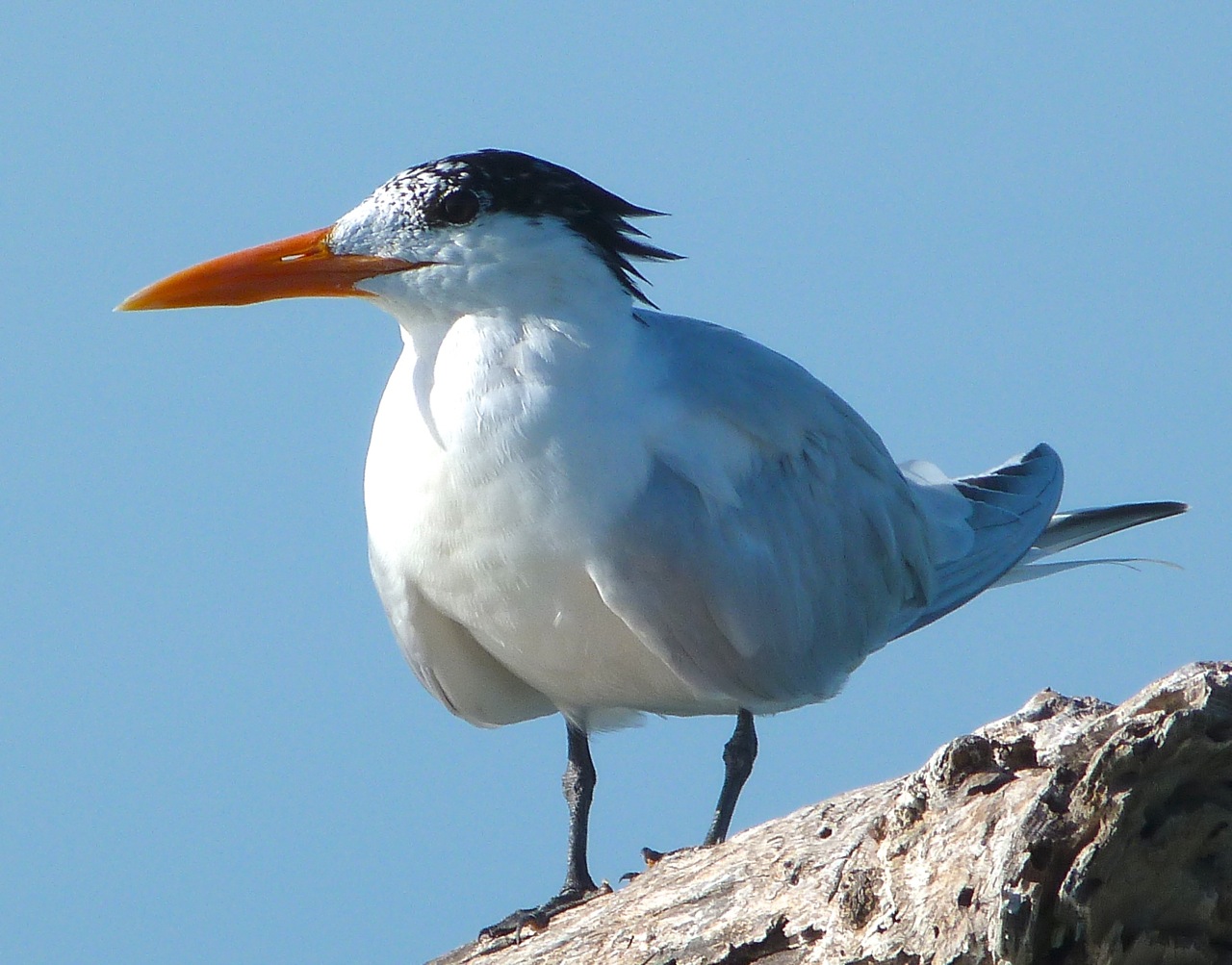
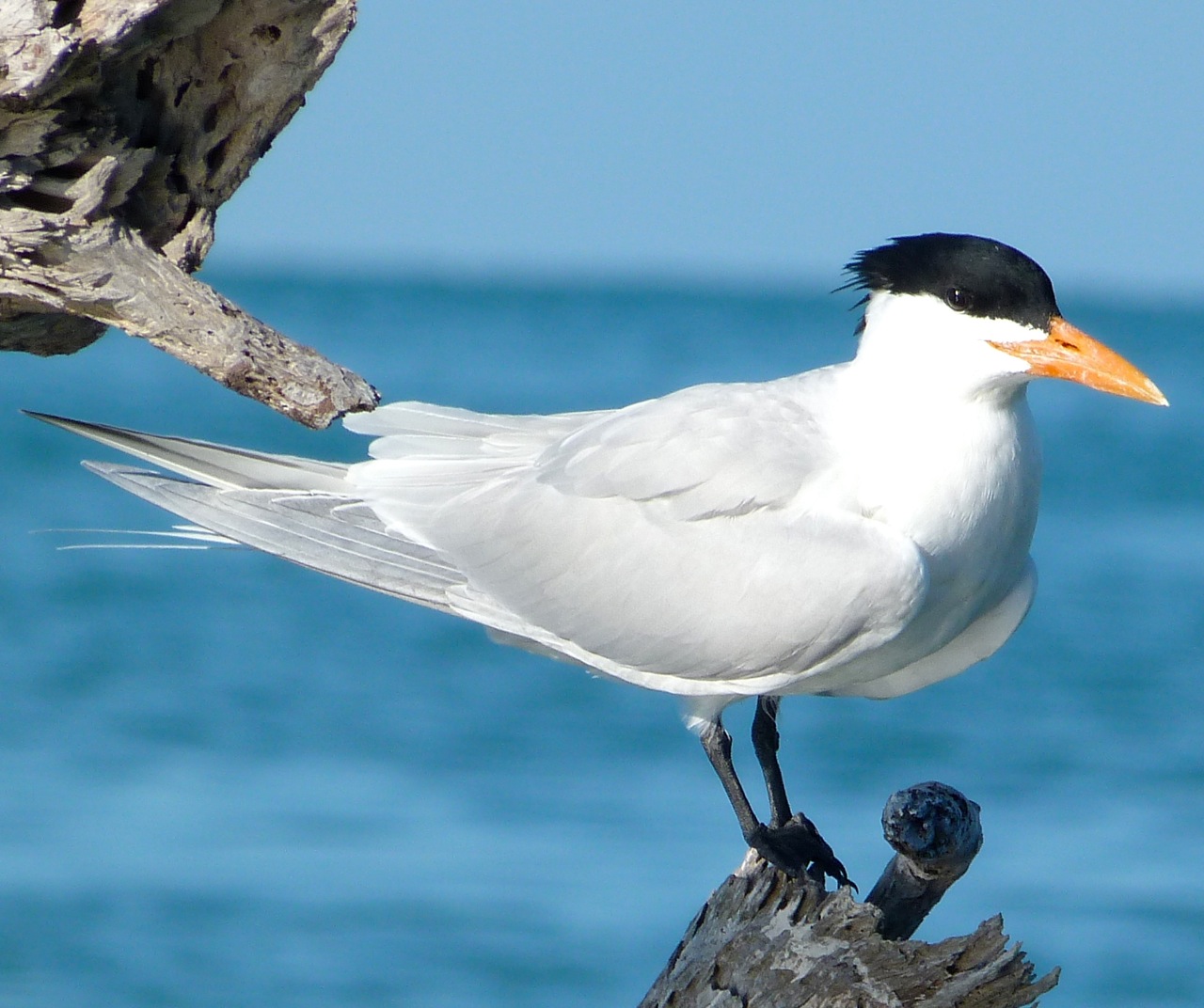
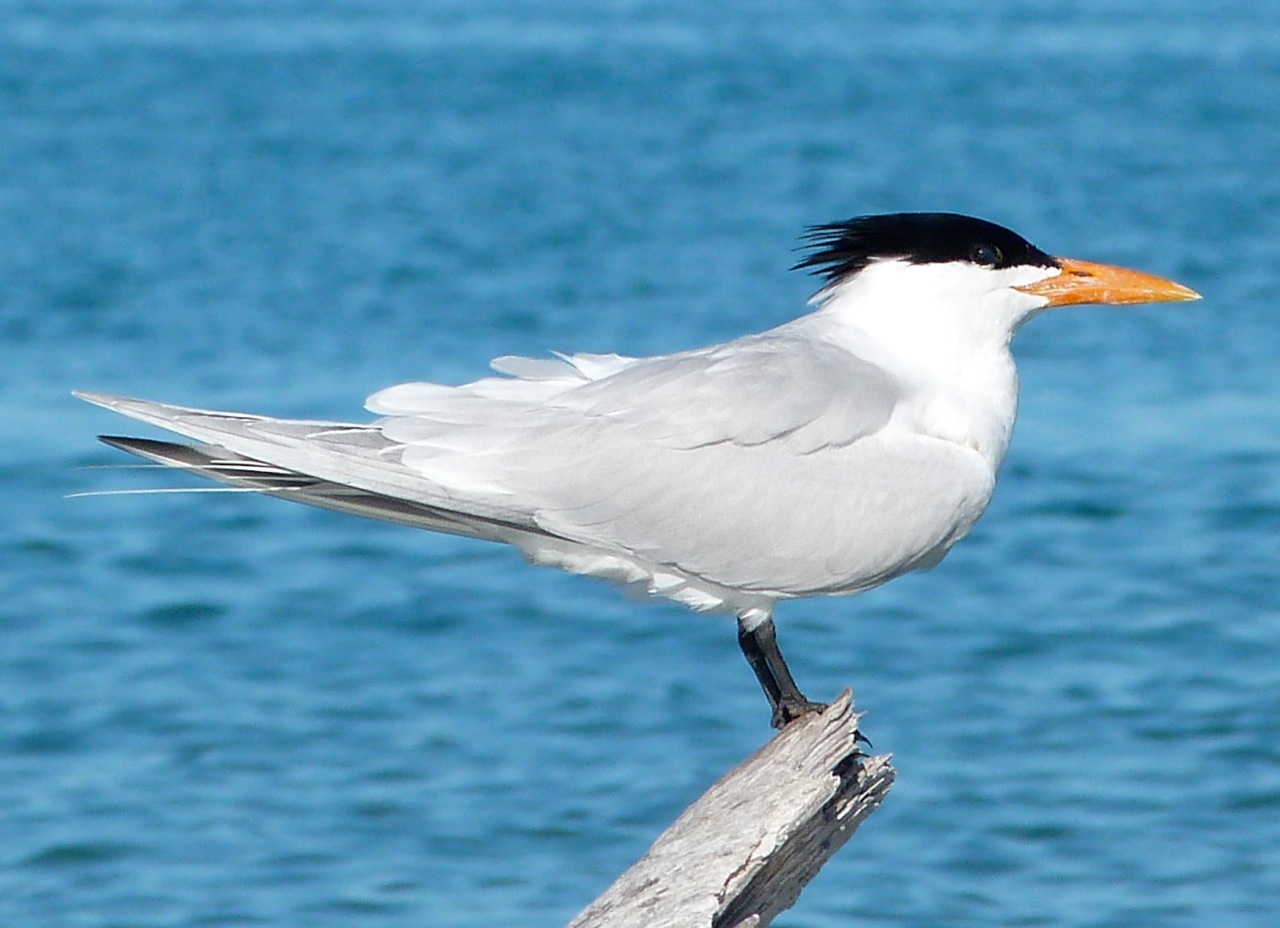
I wrote this post about Royal Terns Thalasseus maximus* quite some time ago, in the early days of Delphi (and indeed Rolling Harbour™ ® ). Bonefishing was a completely new experience and my skills were embryonic. As they continued to be for the duration. By then the amazing birdlife of Abaco had reeled me in and BIRDS OF ABACO was in the planning stage.
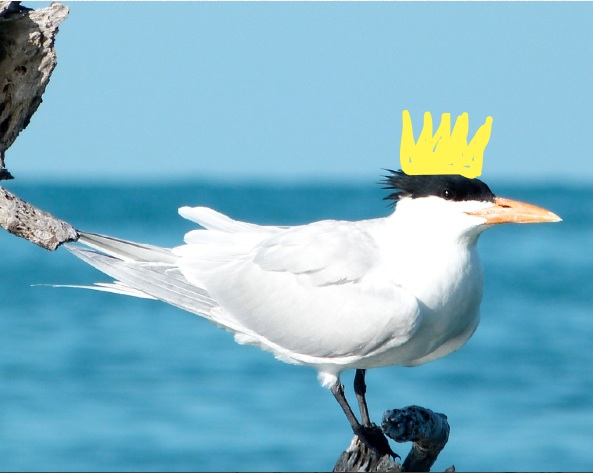
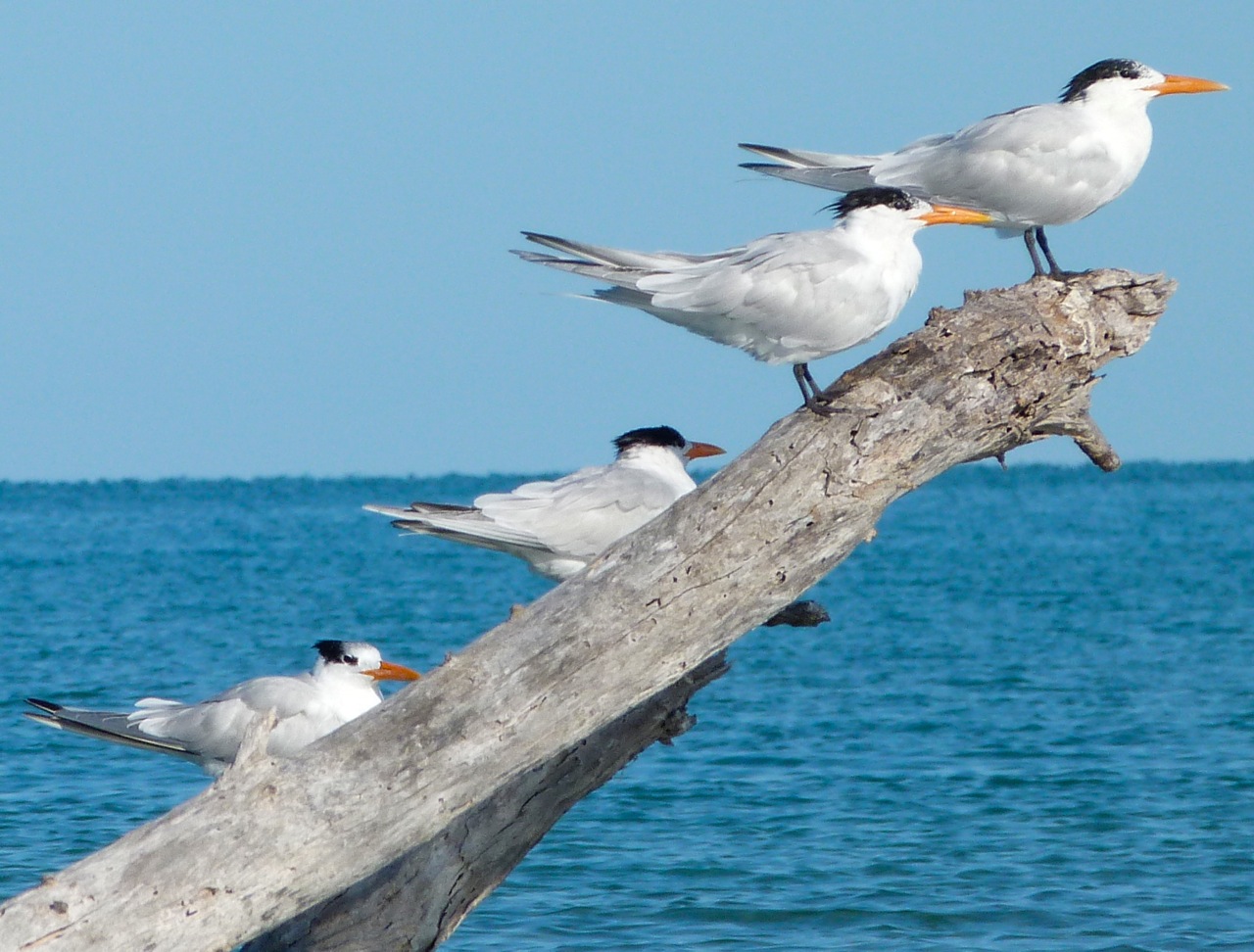
If there’s a magnificent golden bandwagon drawn by 8 horses passing by, why not just hop on? I’ve skipped the info about the range and nesting arrangements of these birds. Here are a few, in all their regal glory, posing in the sunshine on a dead tree way out on the Abaco Marls. The header image was taken on Cherokee Long Dock, long pre-Dorian and its magnificent replacement.
** Now to be renamed Thalasseus carolus rex magnificans. Not worldwide, obviously.
PS No terns were injured in trying to get the yellow crown to fit one of them
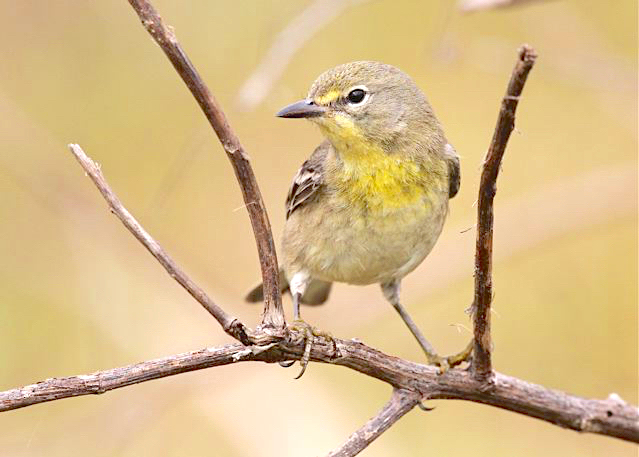
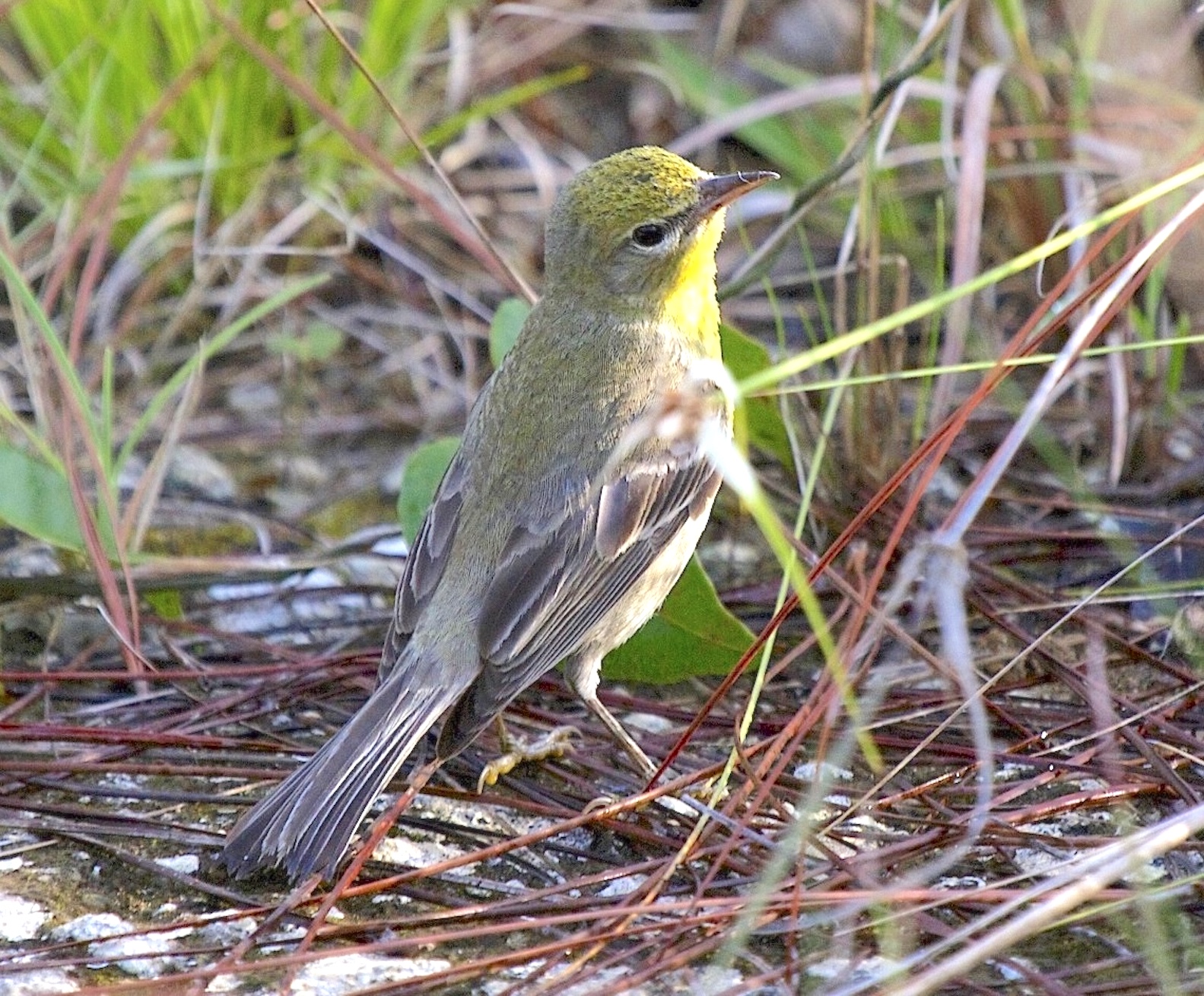
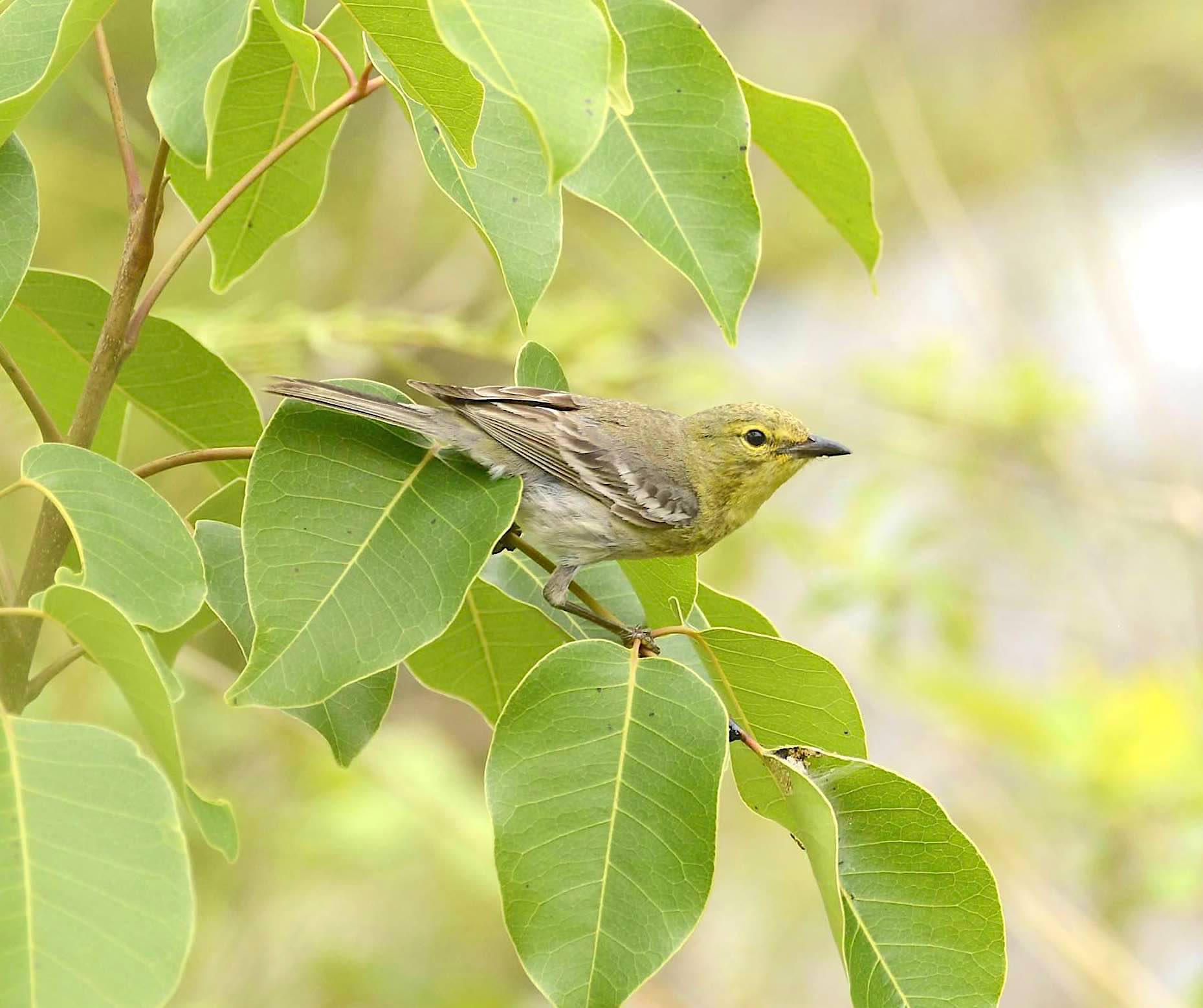
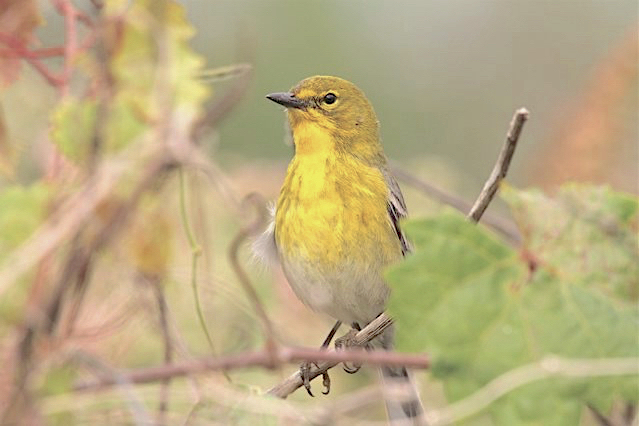
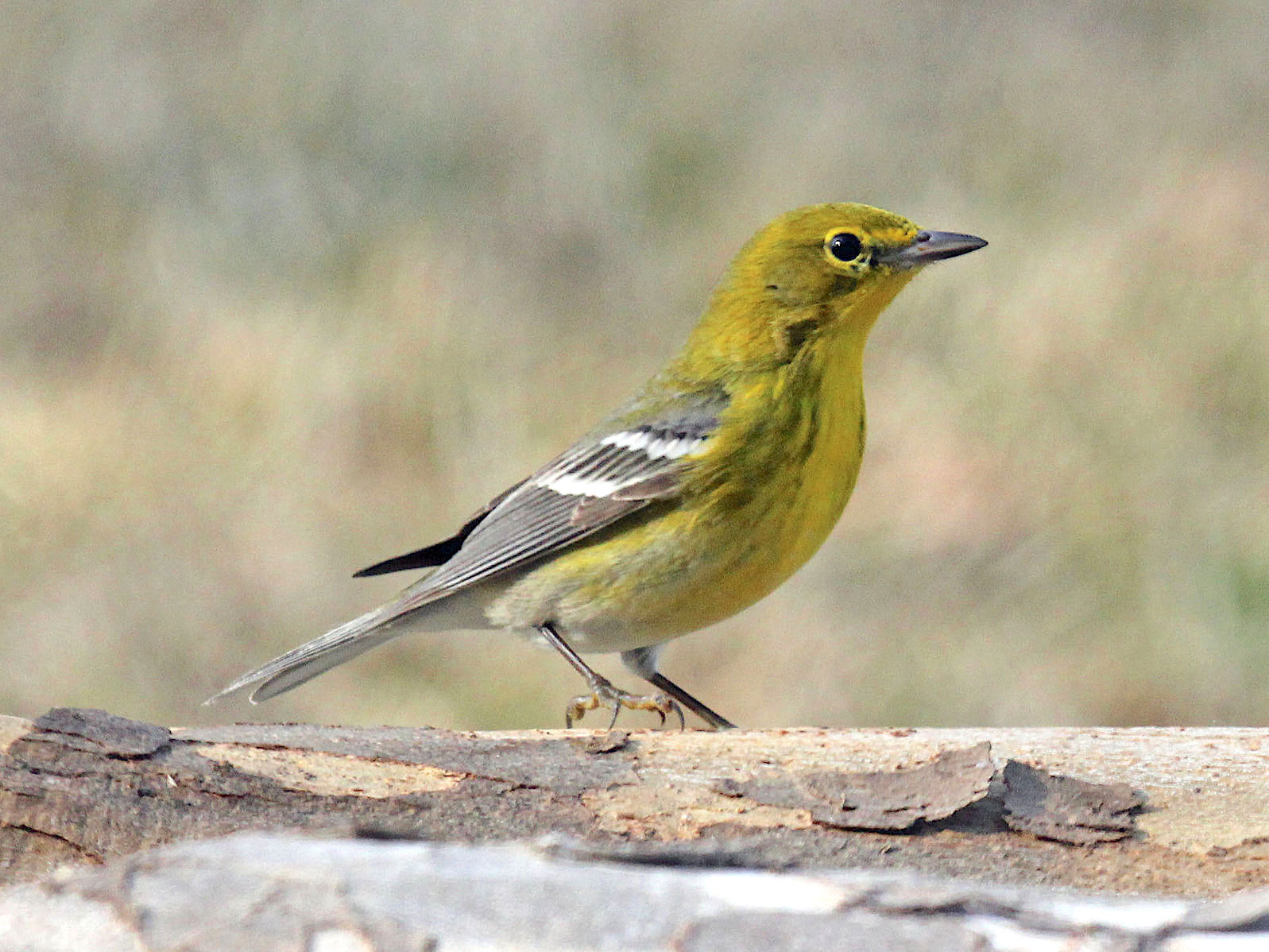
The Pine Warbler Setophaga pinus is one of 5 year-round resident warblers (endemics) on Abaco. All are to be admired, of course. The others are Bahama yellowthroat; Bahama warbler; olive-capped warbler; and yellow warbler.
The pine warbler is also to be envied for several reasons:
Like most Setophagae, they are bright, lively and attractive birds
Bahamas residents all year round – no long exhausting migration flights twice a year
Abaco has vast areas of their preferred pine forest habitat
They are plentiful – the population is largely untroubled by usual habitat concerns
They are one of the few seed-eating warbler species, so feeders are a bonus
As the name strongly hints, the pine warbler is primarily a bird of the pine forests, of which Abaco has an abundance. The tall, straight trees of Abaco were once a vital local source of timber (SAWMILL SINKq.v.). As a historical note, felled pines were also exported to the UK to be made into the strong pit-props needed for coal-mines.
Immature
Q. WHAT IS THE NORMAL YEAR-ROUND RANGE OF THIS BIRD? A. THIS IS!
Pine warblers have a broad diet and forage methodically. Pine cones are a fertile source for food, and those robust, stabby, slightly down-curved beaks are ideal for getting the seeds out of the cones. Equally, these warblers use their beaks to prise / pry out insects from the rough pine trunks and branches.
WHAT OF THEIR NIDIFICATION?
The pine forest is obviously the preferred nesting habitat for these birds. The warblers also nest in the smaller groups of pines found (for example) in or near some of the settlements; or in backcountry around the edges of former sugar cane fields and the like. One nesting habit is slightly unusual – pine warblers tend to build their nests near the end of branches rather than near the trunk, a position that seems far less secure. One theory on pine warbler nest location is that they feel safer from predators by building at the end of a small branch*.
WHAT DO THEY SOUND LIKE?
One source states that “The song of this bird is a musical trill. Their calls are slurred chips“. I think we’ve all been there at some time, possibly when lunching at Pete’s Pub.
MUSICAL TRILL Paul Driver / Xeno Canto
SLURRED CHIP Don Jones / Xeno-Canto
Photo Credits: Bruce Hallett (1, 3, 6); Alex Hughes (2); Tom Reed (4); Tom Sheley (5); Dick Daniels (7); Wiki (range map); Nat Geo (species drawings); Paul Driver / Xeno Canto – call; Don Jones / Xeno Canto – chips; Milton Harris – nesting theory
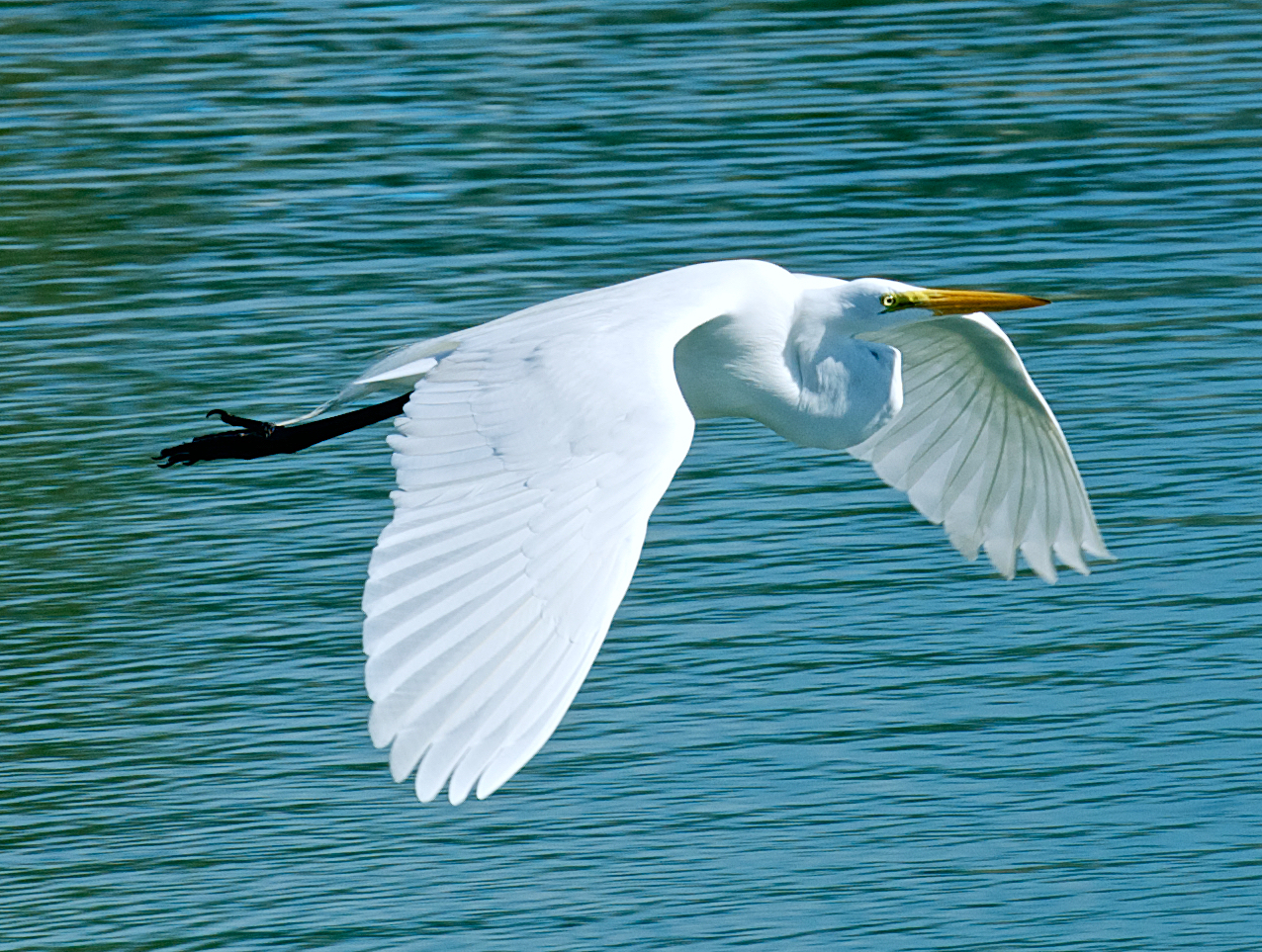
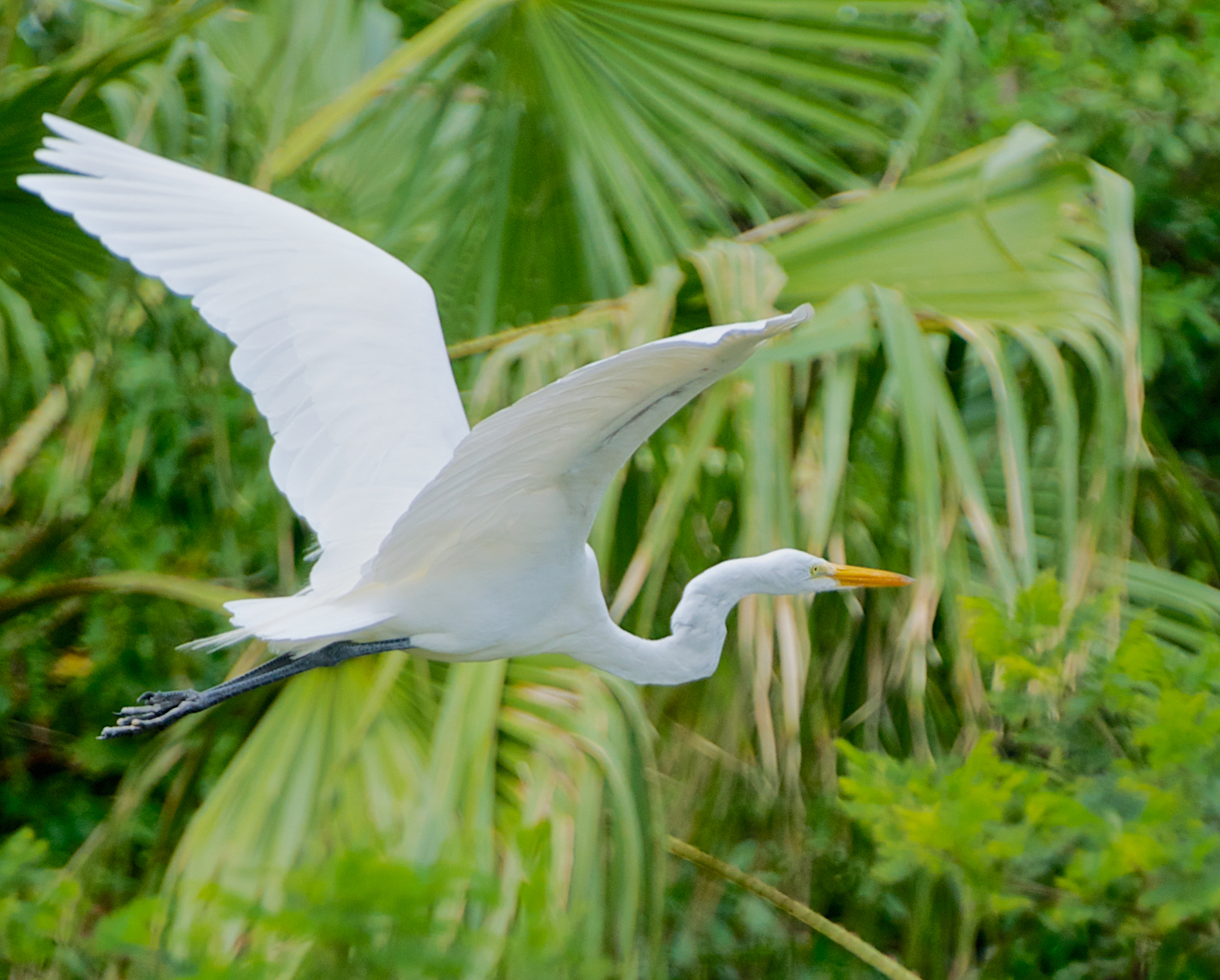
The Great Egret is actually a heron rather than an egret. It’s a Great Heron. All egrets are members of the heron family Ardeidae, but the converse is not true. As long ago as 1758,Linnaeus awarded the bird the binomial name Ardea alba i.e. ‘Heron white‘. Why it should have been so hard to stick to that authoritative nomenclature, I can’t imagine. Perhaps in time all heron and egret species became so hopelessly confusing for people that it ceased to matter much what they were called.
Maybe it was that type of carelessness that led to people from the mid-c19 onwards eyeing up GREGs as a source of hat feathers and other decorative necessities. As with flamingos and many other beautiful avian species, mankind’s millinery and other fashion needs were satisfied at the expense of gorgeous plumage. Actually, at the cost of the birds’ lives: they were simply shot in huge numbers.
Healthy populations were decimated; for some species they never recovered. For others, the great egret among them, the passage of time and the passing of fashions – backed in many cases with conservation programs – have successfully restored the populations. In 1953 theNational Audubon Society, which was formed at least in part to discourage the killing of birds for their feathers, took a decisive step in the cause of the great egret by making the bird the emblem of the organisation.
Photo Credit: Nina Henry photographed all the egrets in this post. Her wonderful images of this magnificent egret heron made a significant contribution to the “BIRDS OF ABACO” project.
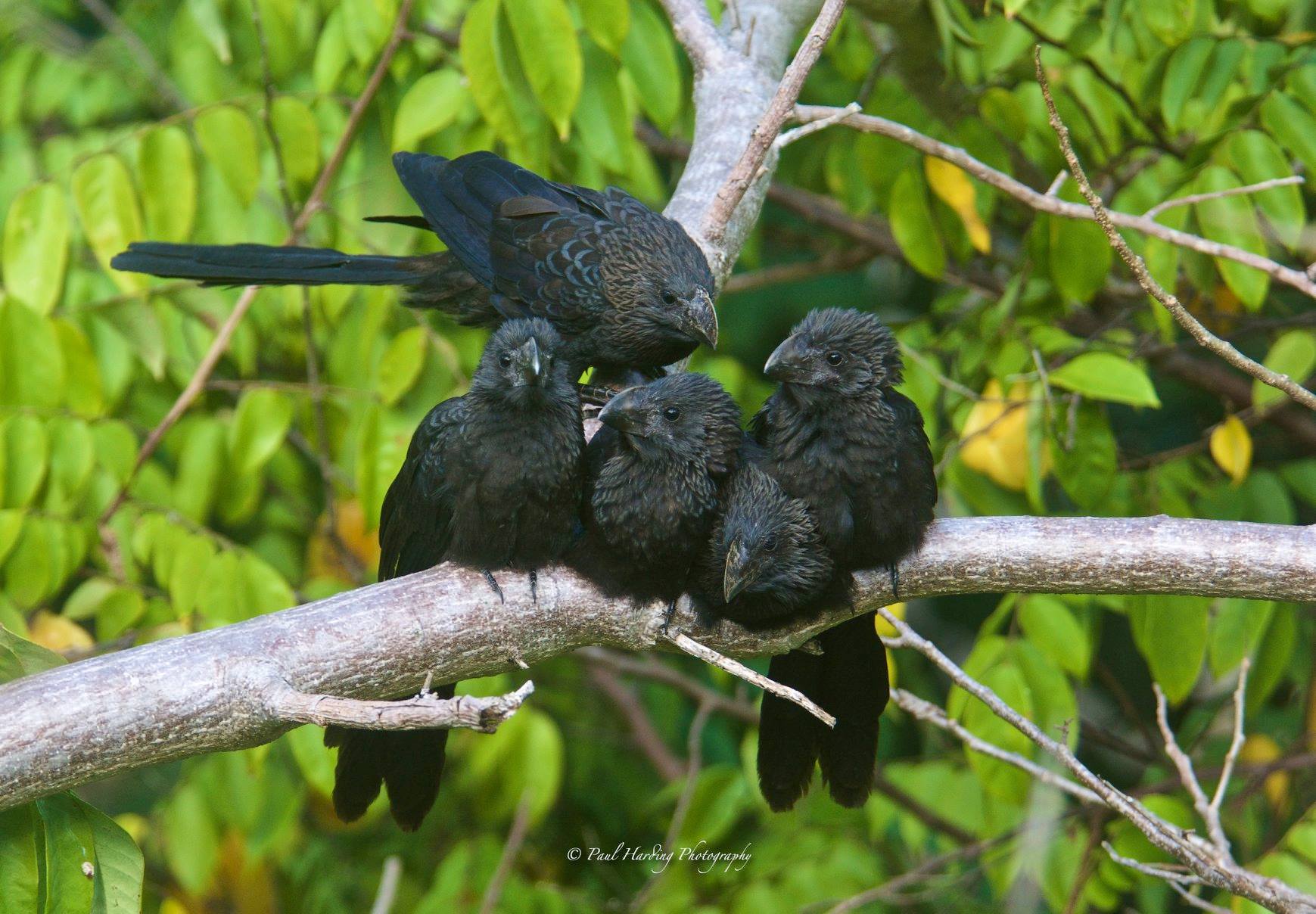
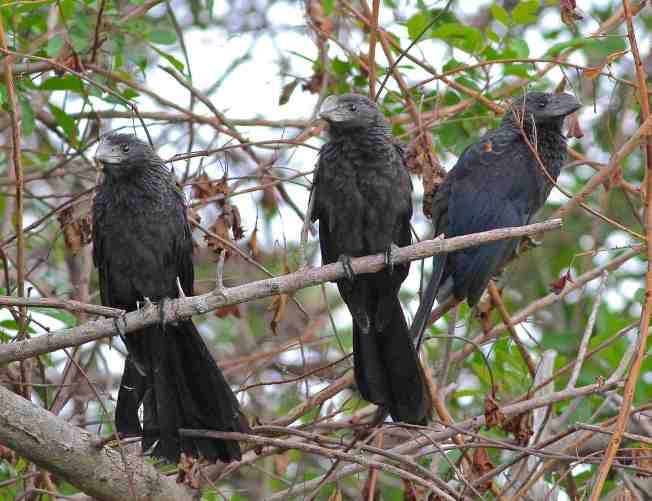
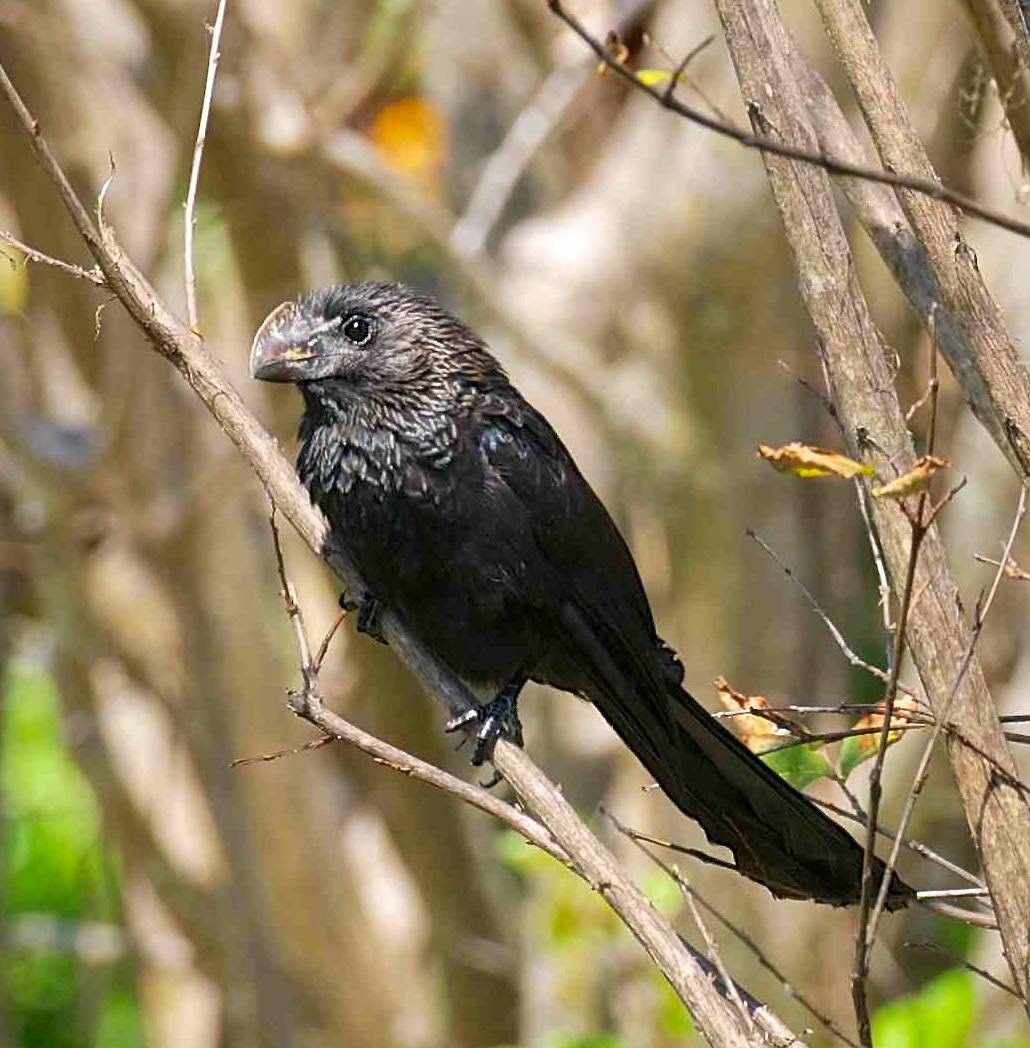
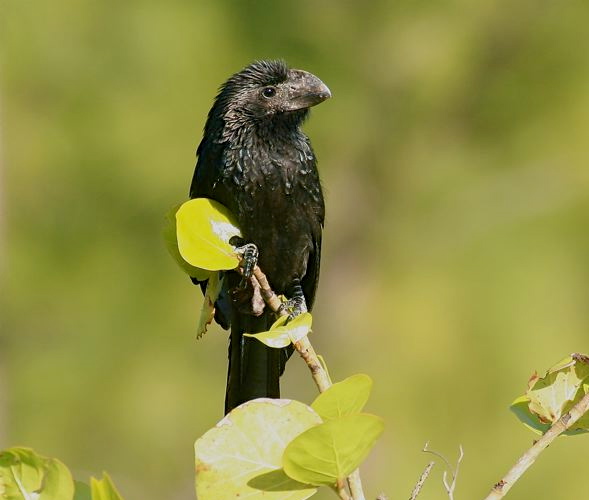
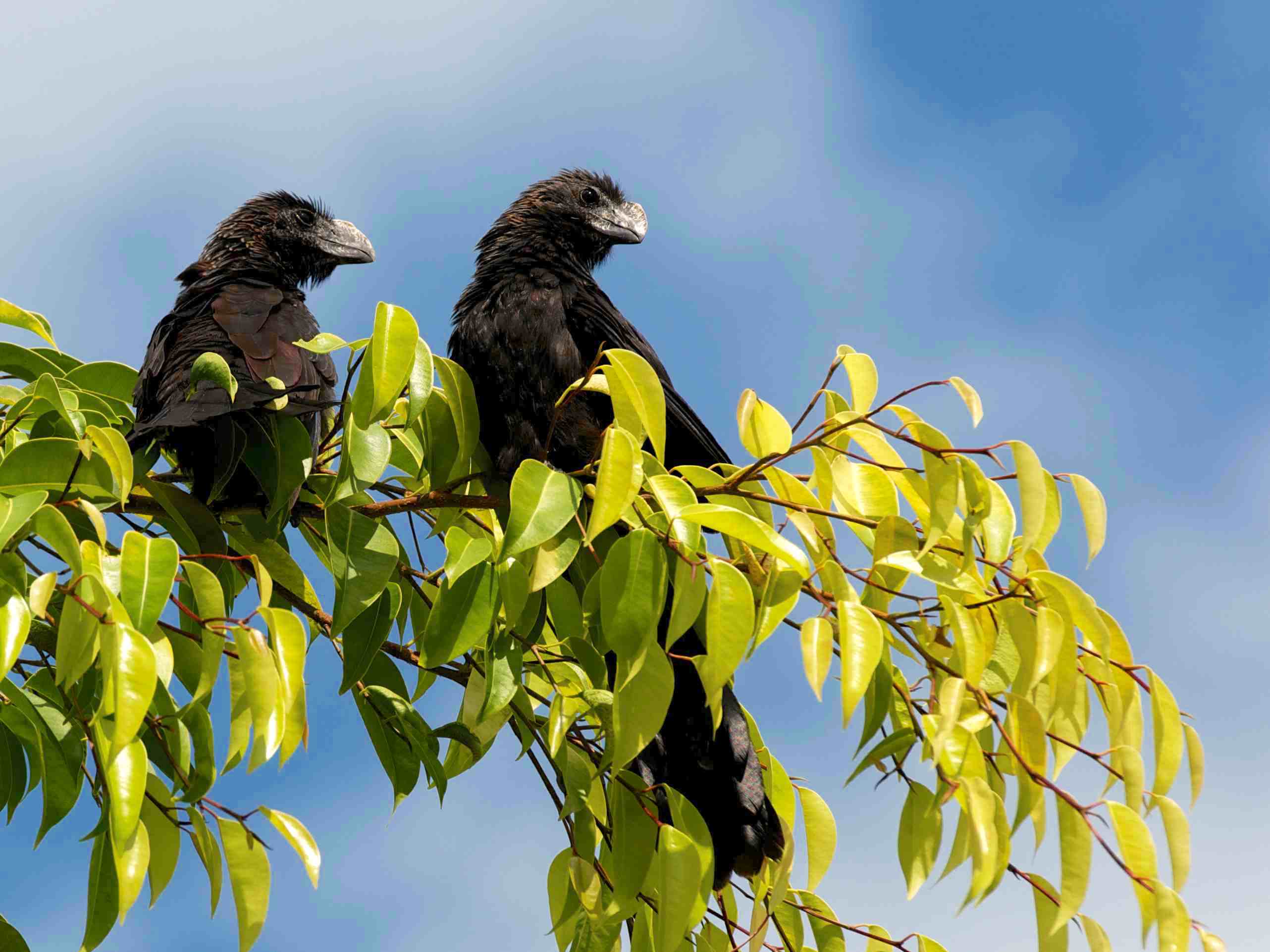
The Smooth-billed Ani (Crotophaga ani) is one of three members of the cuckoo family found on Abaco, the others being theMANGROVE CUCKOO and theYELLOW-BILLED CUCKOO. Anis range from Florida and the Bahamas in the north down through the Caribbean to South America, where they are widespread.
Unlike their shy and retiring cuckoo cousins, anis are extrovert shouty birds that like to hang out in noisy gangs and family groups. They can often be found in low scrub, bickering, squawking, and generally fluttering around in a disorderly way. You’ll probably hear them from some way off, sounding like this:
Anis have advanced social, parenting and chick-rearing skills. They build a communal nest for the group, and all share in egg incubation and chick-feeding duties They may raise up to three broods in a season, which keeps the numbers up. Rather touchingly, the young of earlier broods help to feed more recent chicks.
It follows from this that unlike many other cuckoo species, the ani is not a brood parasite. So the species does not lay its eggs in the nests of other, smaller birds which then unwittingly rear the interloper(s), who in turn push the legitimate hatchlings out of the nest and get all the food and attention.
I have tried to discover why an ani’s beak is as it is, without much success. Very often beak shape relates directly to the feeding habits and preferences of a species, but it is hard to see how a diet consisting mainly of insects and small reptiles such as lizards would account for such a prominently protuberant proboscis. Here is a close-up of the item in question.
On Abaco (and indeed elsewhere) Anis are sometimes known as ‘Cemetery Birds’, no doubt because of their all-black appearance (though their raucous tendencies would be quite inappropriate for a graveyard). However although at a distance these birds may look completely black, catch one in the sun at the right angle, and you’ll find that the plumage is far more varied, and with some intricate patterning.
Look for Anis in low scrubland and coppice, cultivated areas, perched in unsteady noisy rows on utility lines, or foraging on the ground.
The appearance and flying abilities of Anis are wonders to behold. As I wrote in The Birds of Abaco, “Their curious heavy beaks, their clumsy flight and their untidy take-off and landing routines suggest a design fault”.
AIMEE MANN INTERLUDE **
“One… is the loneliest number…” Oh, hang on a moment…
…”two of us…standing solo in the sun…”
The Philatelic Bureau of the Bahamas Postal Service is commendably committed to featuring the natural history of the Bahamas. Although probably not in the top-ten of anyone’s bird list, the ani nevertheless got its own stamp in a 1991 bird issue.
As far as I know, there is not yet a collective noun for a group of anis. There should be. I put forward “A Commotion of Anis”
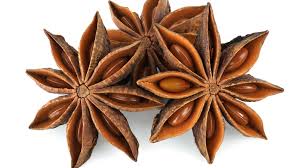
DO NOT CONFUSE WITH STAR ANISE
Credits (all photos taken on Abaco): Becky Marvil, Nina Henry, Paul Harding, Gerlinde Taurer, Roselyn Pierce, Tom Sheley, Bruce Hallett, Keith Salvesen; sound files from Xeno Canto and FMNH; range map from IUCN; hat tip to the always excellent Aimee Mann. ** yes yes I know these aren’t her original songs but I like the AM versions as much
I have featured bird comparatives from time to time, not least because scope for confusion meant that I needed to investigate for my own peace of mind. These included the tyrant flycatchers; a number of superficially similar warbler species (mostly with yellow bits); varied vireos; all those heron-y / egret-y types and their disconcerting morphs (hello, white reddish egret).
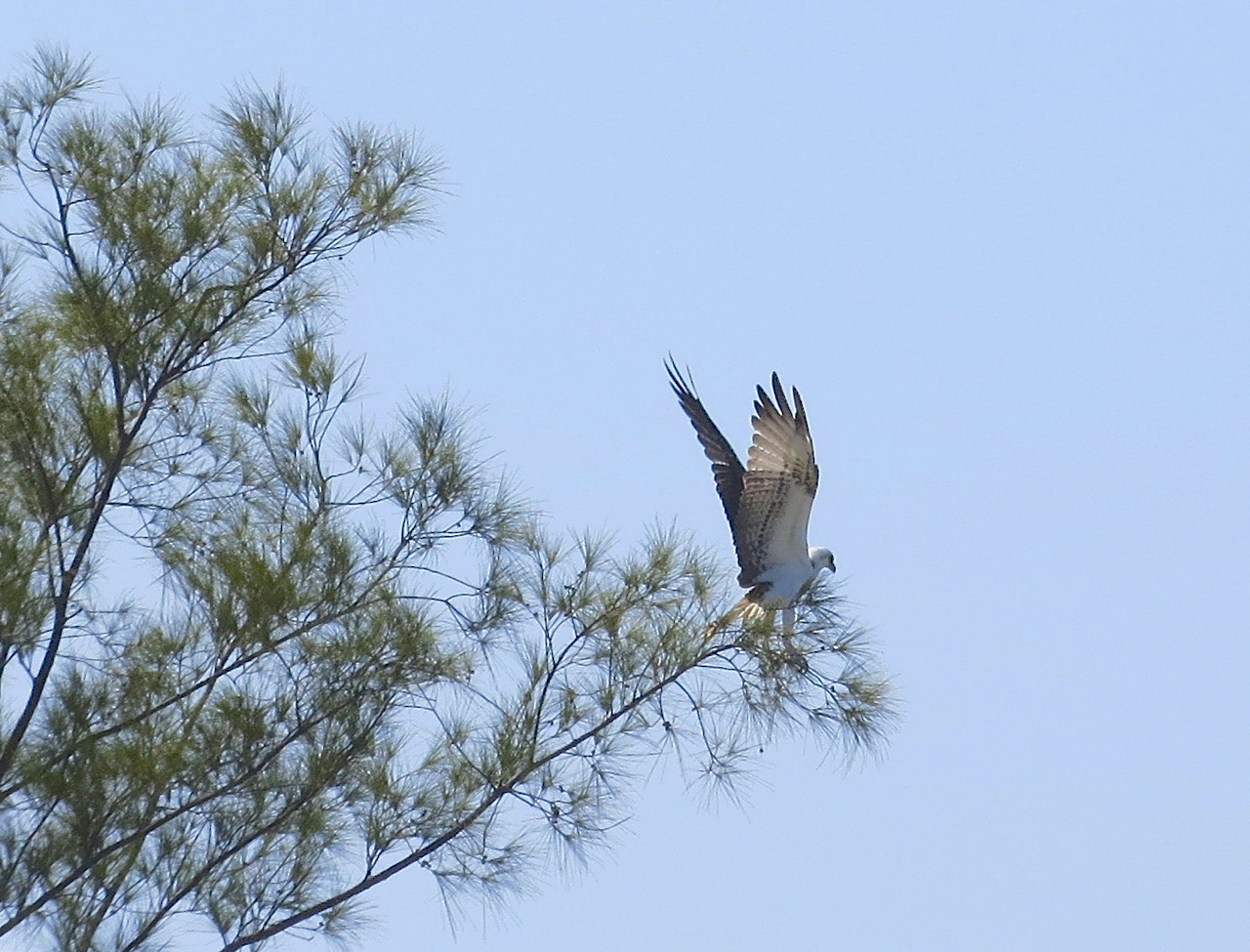
And so to the magnificent osprey Pandion haliaetus. This time, the comparison is between two subspecies, broadly the North American P. h. carolinensis and the Caribbean P.h. ridgwayi. There is some overlap in Florida, and some evidence of interbreeding. In the northern Bahamas in particular there is also an overlap, so an osprey seen on Abaco could be either variety. You’ll probably be too excited watching it to care much which type it is, but this article will help you if you do…
The two ospreys shown below were photographed at Spanish Wells, Eleuthera by Barbara Crouchley. This is a ‘bingo’ photographic scoop, because each type of bird was found in the same region; now we can check out the differences between the two birds.
The first is a North American bird. Note in particular its distinctive eye mask, and the clearly marked upper breast – more so in the female than the male (which may even be white). The overall impression of the upper-parts is dark brown. They are slightly larger than their cousins in the south.
Osprey P.h. carolinensis
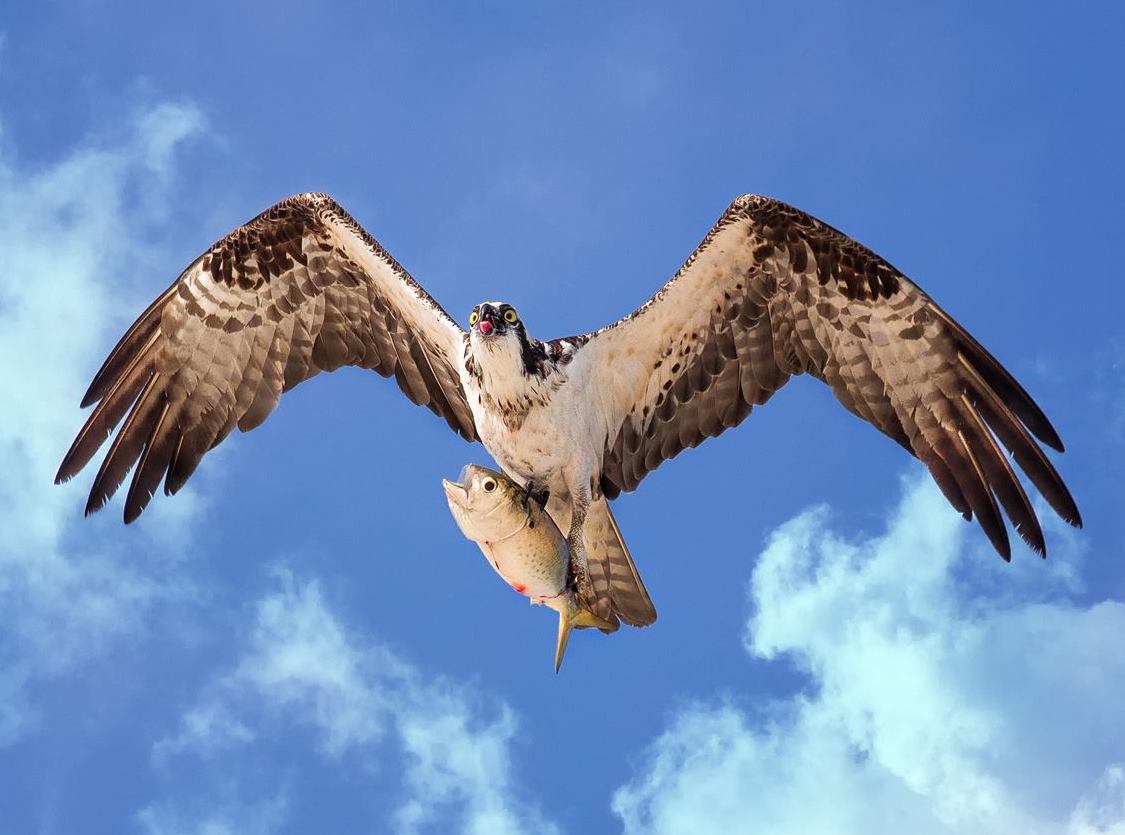
In this Caribbean bird, below, with its trophy fish, the eye-mask is absent and the facial / nape markings are less pronounced. Furthermore, the breast and under-parts are white in both sexes (though slight marking may be apparent in some birds). And the impression is of lighter upper-parts, even allowing for variable lighting and distance when the photos were taken. Conveniently, there’s not much detectable difference between male and females in the respective populations.
Osprey P.h. ridgwayi
EXAMPLES OF P. h. carolinensis
EXAMPLES OF P. h. ridgwayi
THE EYES HAVE IT?
After I had looked into the noted distinctions I wrote “I’m going to stick my neck out here – I’ve not seen this mentioned anywhere, and I need to do some more comparative research”. When I saw Barbara’s pair of photos, I noticed that the eyes of the P.h.r were much paler compared with the bright orangey-yellow of P.h.c. This distinction is found in all the comparative photos above. The P.h.cs were photographed in Florida and further north and have the strikingly vivid eyes. The P.h.rs were photographed on Abaco and Grand Bahama at different times by different people. All have noticeably paler irises, more a light greeny-yellow.
I haven’t seen this commented on since my original piece, but if anyone has a view it would be welcome.
UNDERWING DIFFERENCES
There’s a further comparison that can be made with the two subspecies in flight. Without going into technical and linguistic detail, the underwings of the P.h.cs are much darker than the Bahamas birds, whereas P.h.rs are notably paler and in some cases mostly white. As an example, below is a distance shot I took when bonefishing out on the Abaco Marls, with a small pocket camera in one hand and a rod in the other. This is definitely a local bird! Compare with the dramatic image below it, where the strong darker markings are all too evident. It’s a great shot with which to bring the lesson to an end.
ADDENDUM: Thanks to LSulikM for pointing out that female carolinensis (besides being larger than males) have frontal freckling, sometimes called a necklace, that is a prominent ID marker (see bottom image). Males may also have freckling but it is much less conspicuous. For ridgwayi the freckling is absent or (see the bird on the utility pole above) very sparse.
Photo credits: Tom Sheley (1); CWFNJ (2); Barbara Crouchley (3, 4); Danny Sauvageau (5, 6, 7); Jim Todd (8); Linda Barry Cooper (9); Woody Bracey (10); Keith Salvesen (11); the inimitable Northside Jim (12). Thanks for all use permissions – also to Steve Connett for the idea! Original post in 2020.
There are 3 cuckoo species recorded for Abaco, all permanent residents. Two are relatively scarce; the third is the much-loved gregarious and raucous Ani. Recently I was contacted about a cuckoo seen on Man-O-War Cay. The photo revealed more of a glimpse than a sighting… but it clearly was not an all-black Ani. So here are the 3 species to admire in all their glory – and in the case of the first 2, to highlight the differences between them.
YELLOW-BILLED CUCKOO (and header image)
MANGROVE CUCKOO
SMOOTH-BILLED ANI
Photo Credits: Tom Sheley, Tony Hepburn, Alex Hughes, Gerlinde Taurer, Nina Henry
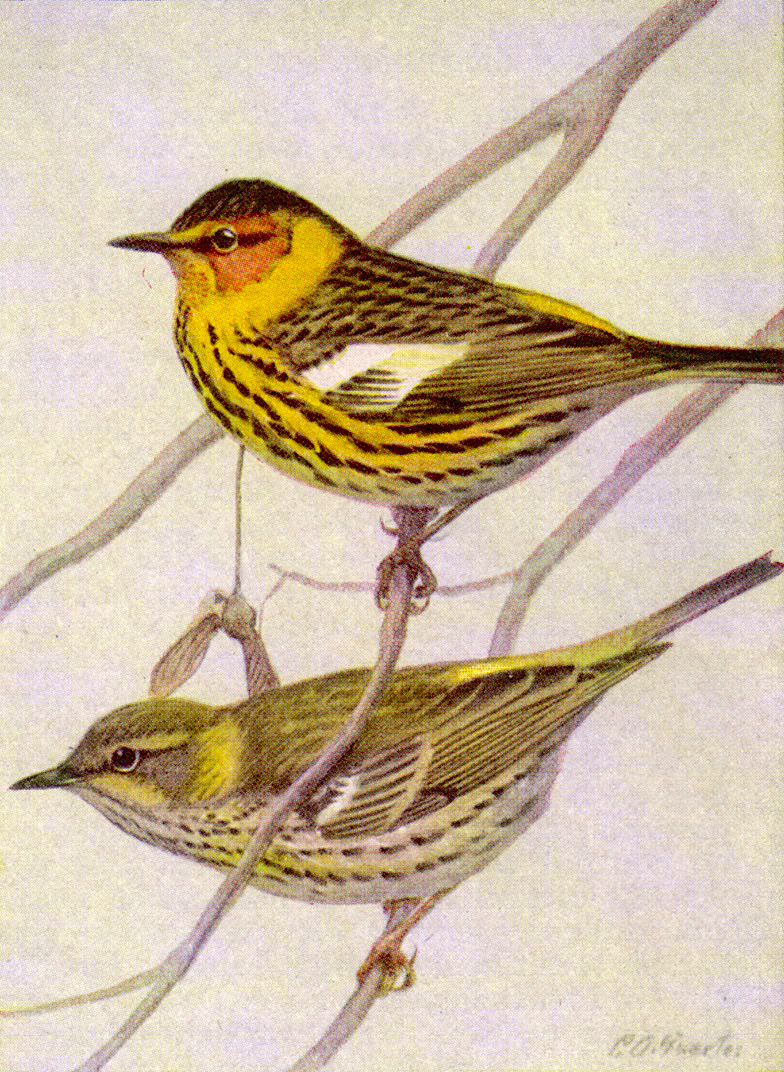
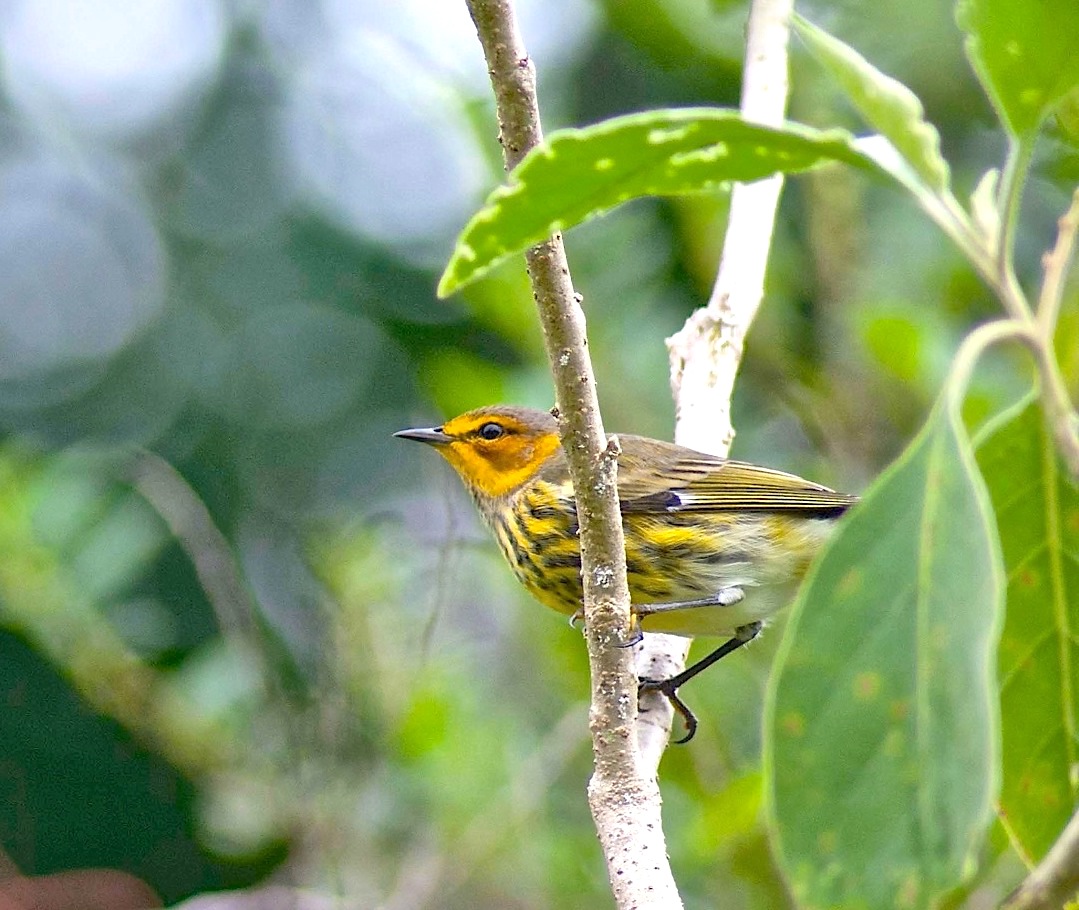
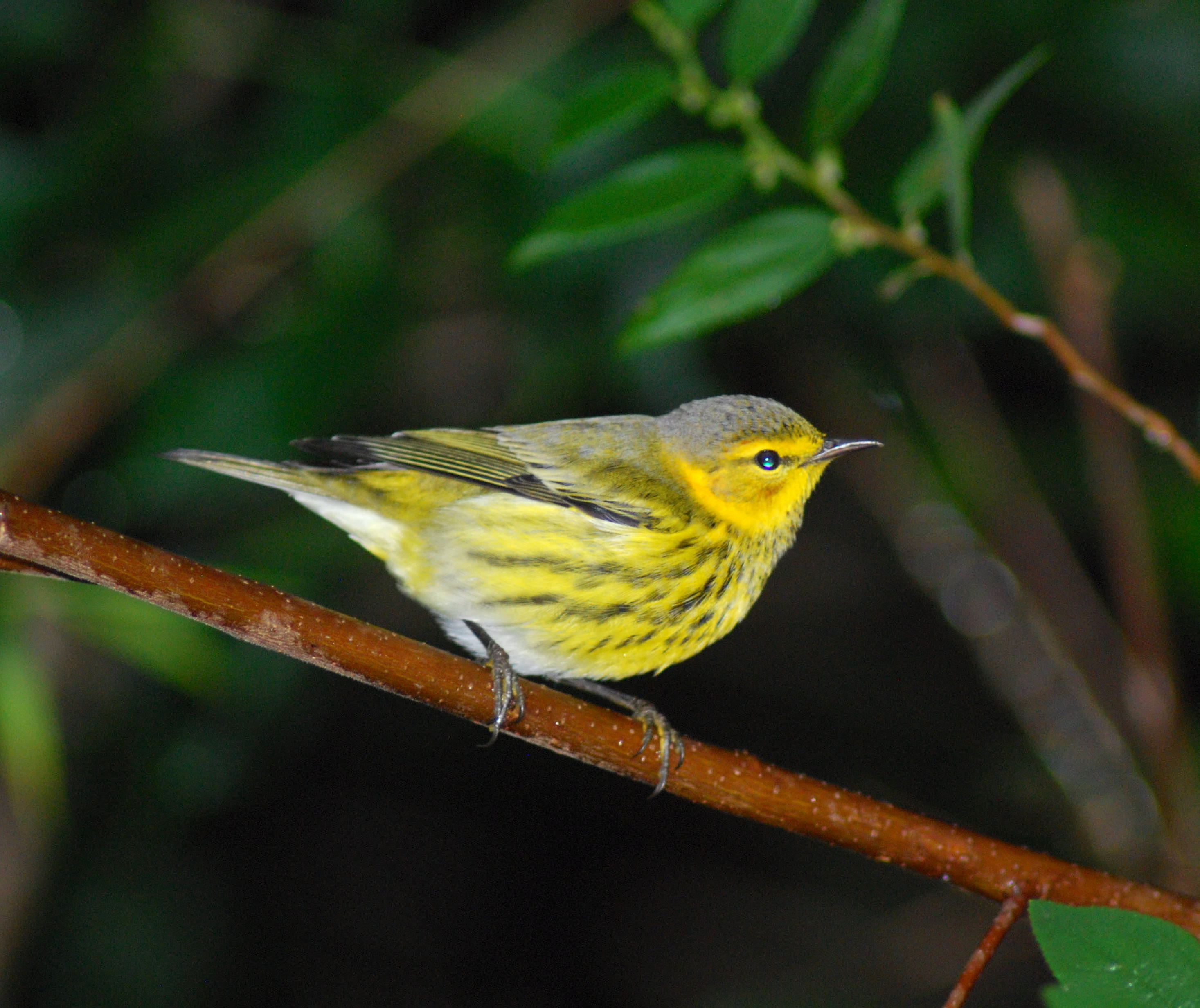
The history of ornithological classification and nomenclature is littered with peculiarities. The attractive migratory Cape May Warbler Setophaga tigrina is a very good example of premature evaluation.
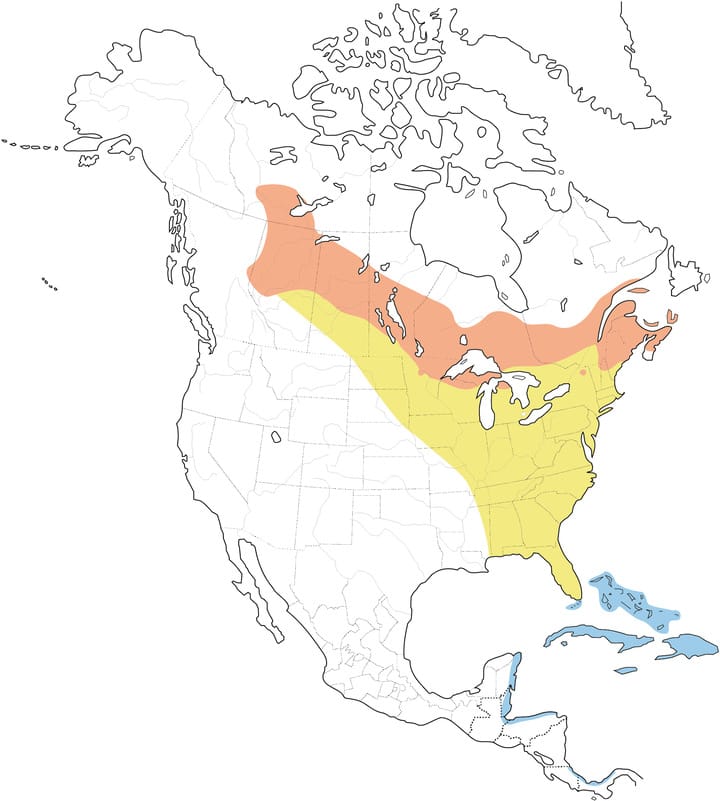
The range of the species is well defined. In the summer the birds live within a broad band that straddles northern USA and Canada. In the winter they head south with all their migratory warbler cousins across the yellow band to (mainly) the Bahamas.
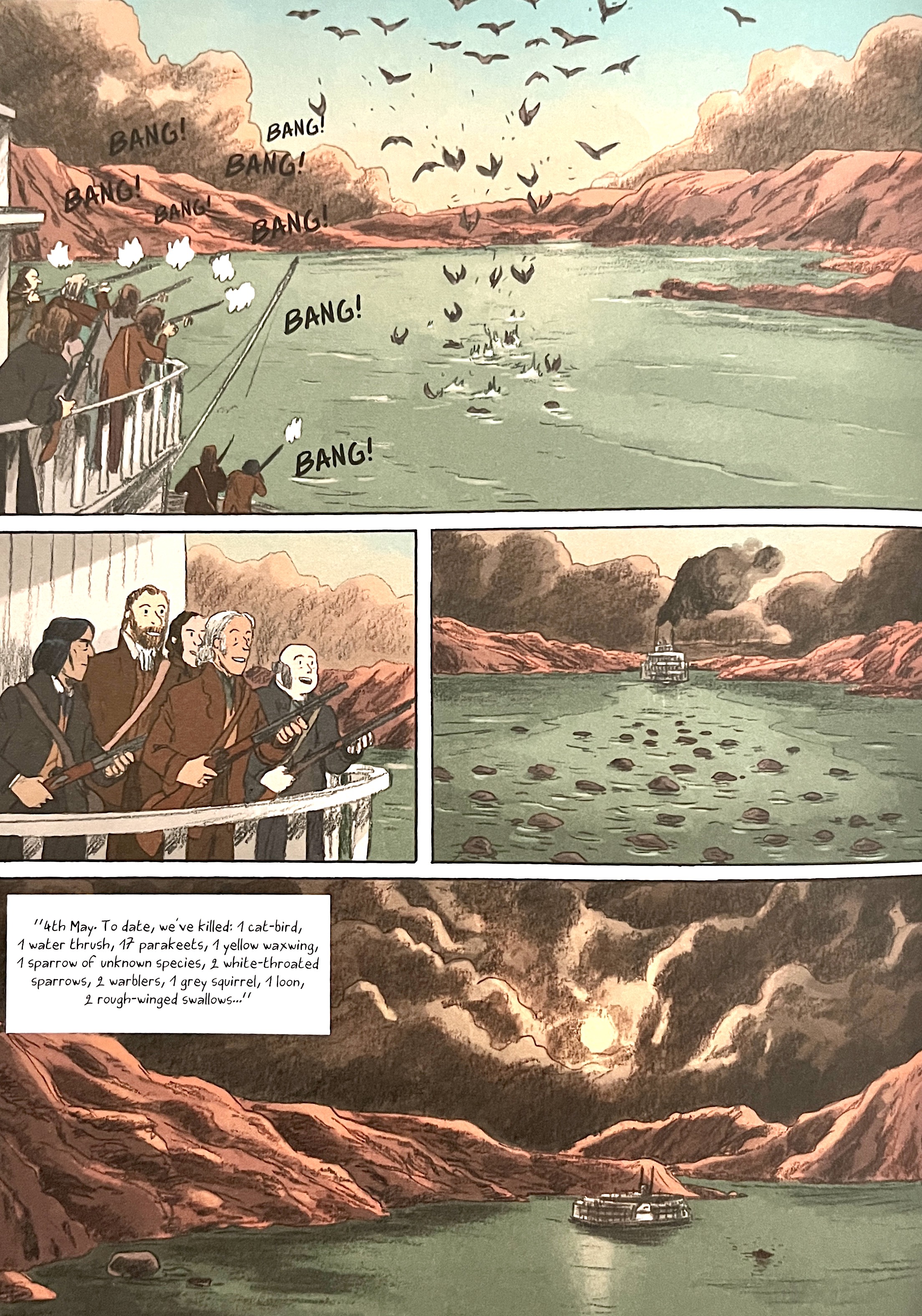
As with all migratory species, some birds each year will wander or be blown off-course; or will take a rest stop en route and decide to stick around. And so it was that in May 1812, a month before the Battle of Waterloo, the first ever specimen of the species was collected on Cape May NJ by George Ord during an exploratory trip with naturalistALEXANDER WILSON(he of plover & snipe fame). To be specific, they had gone to shoot the birds they wanted to collect. The bodies, from large down to tiny, were after all the only irrefutable evidence of a new ‘find’ at that time. Detailed drawings could be made and descriptions composed. The later display of the specimens enabled the expansion of ornithological knowledge and methodology, and brought consequent renown. The great Audubon took the research method *treading very carefully here* rather further than one might be comfortable with today, with somewhat indiscriminate use of lead shot.
As Wilson later wrote (note the words ‘beautiful little species, ‘shooting excursion’ and ‘ransacked’):
THIS new and beautiful little species was discovered in a maple swamp, in Cape May county, not far from the coast, by Mr. George Ord of this city, who accompanied me on a shooting excursion to that quarter in the month of May last…The same swamp that furnished us with this elegant little stranger, and indeed several miles around it, were ransacked by us both for another specimen of the same; but without success. Fortunately it proved to be a male, and being in excellent plumage, enabled me to preserve a faithful portrait of the original.
The odd (indeed ‘Ord’) thing was that the first-ever specimen was a complete one-off in that location at that time. Not a single sighting of the species (named Sylvia maritima by Wilson) was reported on Cape May or in that area for more than a century. Then at last in 1920, another example was found. Nowadays the CMW is not in the least unusual in the location that gave it its name.
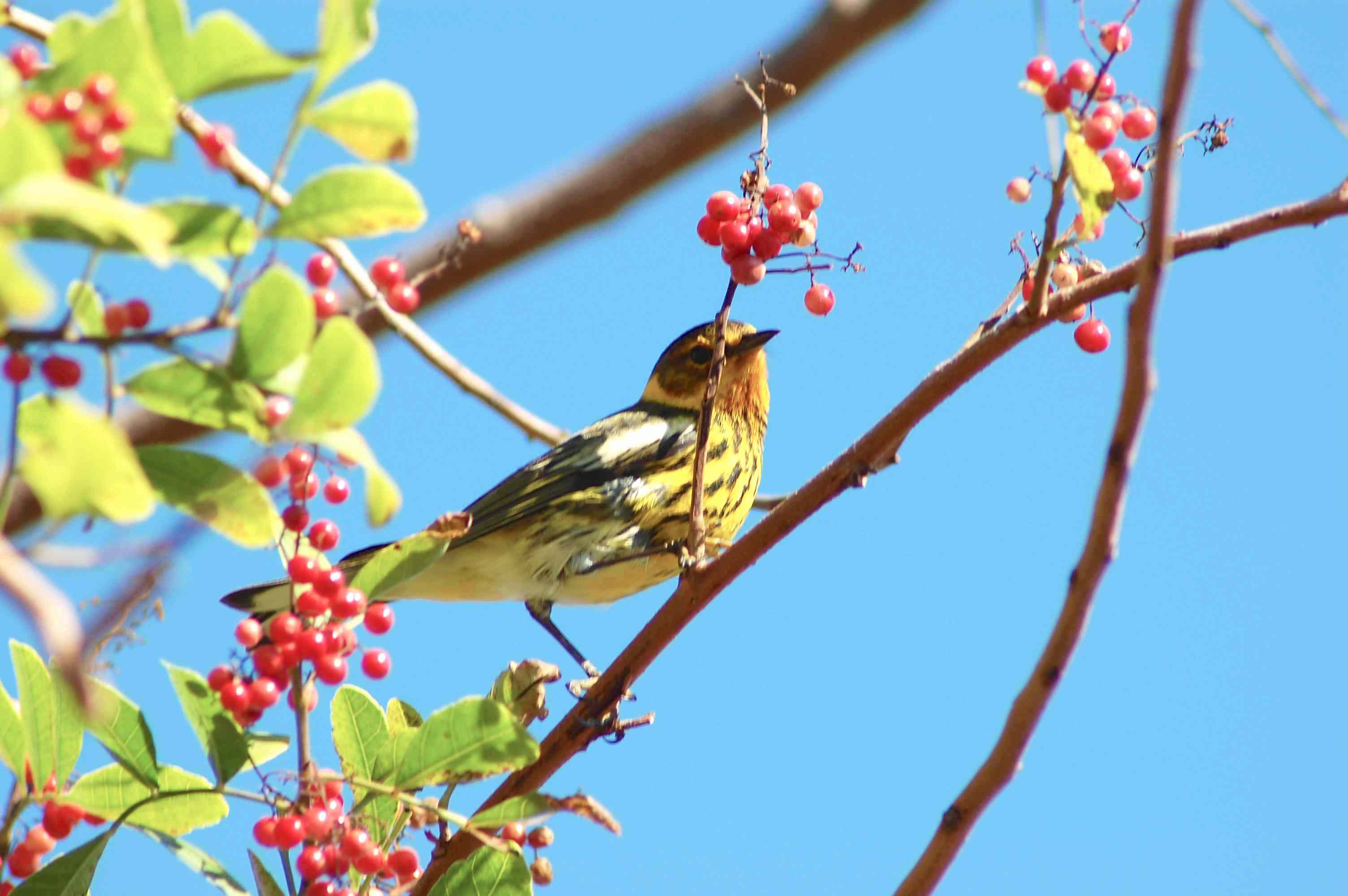
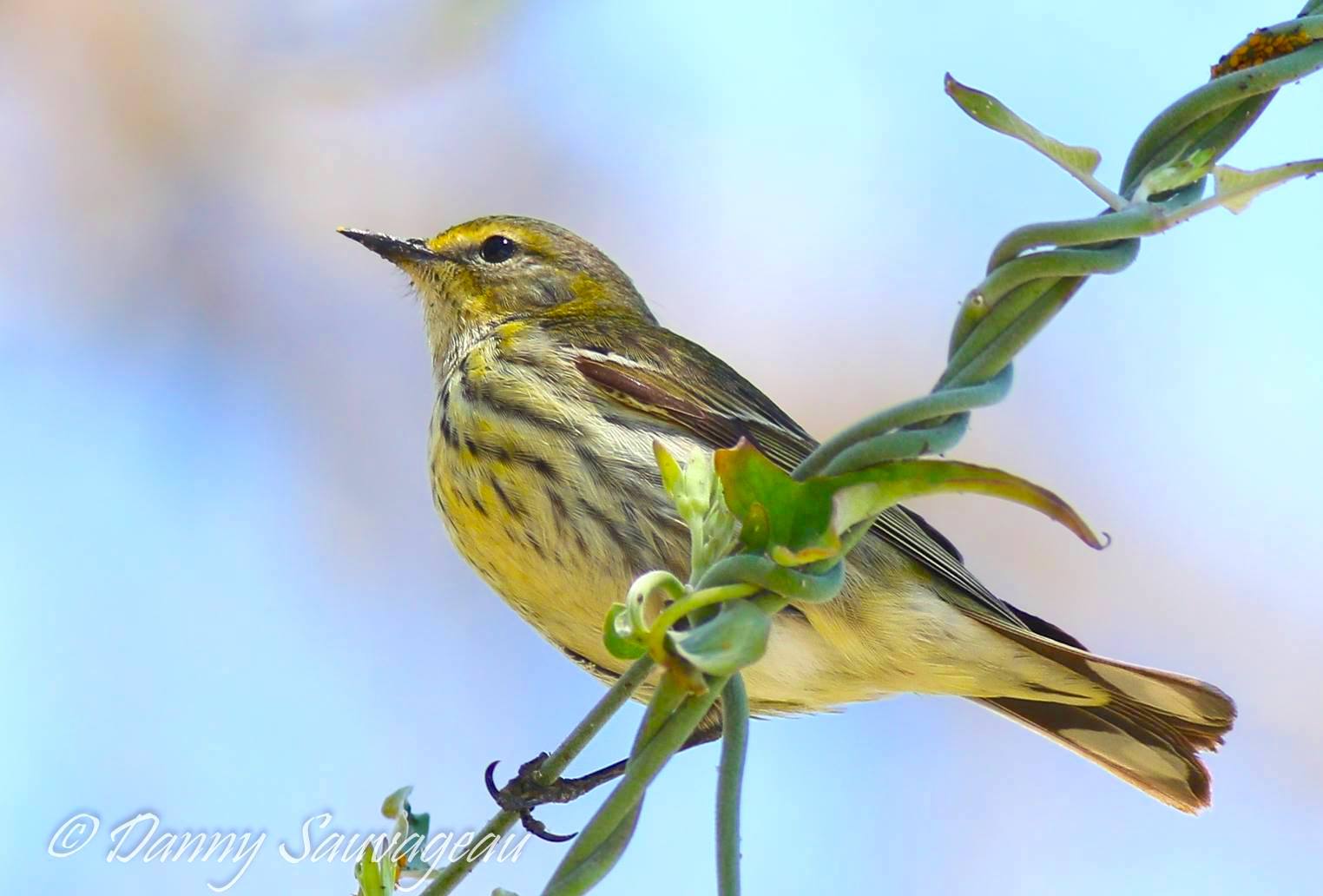
On Abaco, CMWs are classified as WR1, which is to say common winter residents. Males have striking chestnut cheeks in the breeding season, with strong streaking on the underside. Note also the black eyestripe. Females and juveniles are paler and the marking is less prominent. These warblers are insectivorous; in winter they may also feed on nectar and fruit. Behaviour-wise, they have aggressive tendencies in defence of their territory and of their food sources.
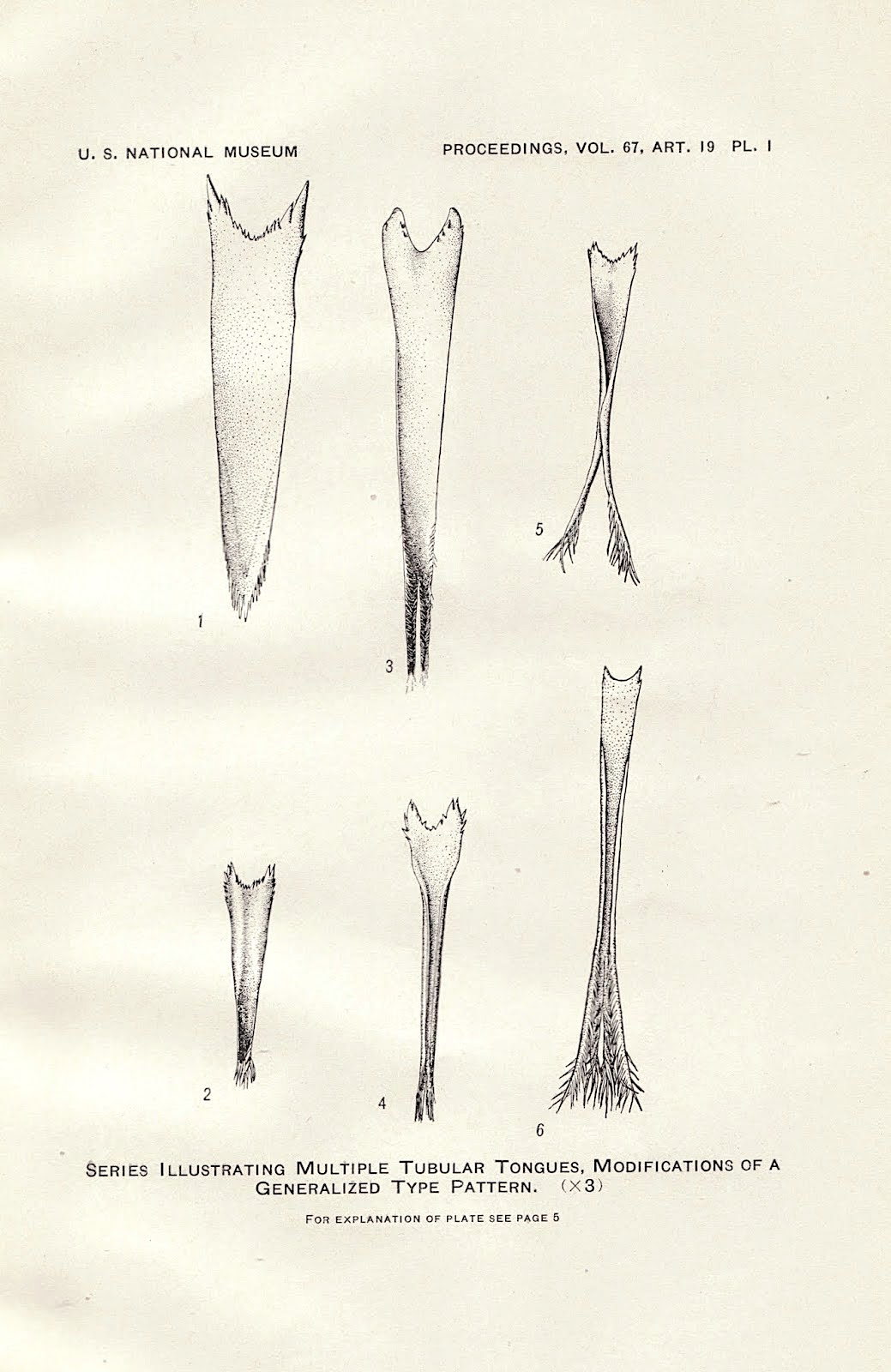
In researching this post, I discovered a strange (but slightly dull) fact. The CMW is unique among warblers in having a tubular tongue to enable nectar feeding (as with hummingbirds). This random fact hardly has the makings of lively conversation (though you might want to try it out) but considering the multitude of warbler species in existence, the CMW has the benefit of a rather special adaptation.
Tongue 2 (bottom left) is the CMW; No.5 is a bananaquit’s feathery tongue
WHAT SHOULD I LISTEN OUT FOR?
Unhelpfully, even the authorities have a tough time describing the song and call of a CMW. As with so many song-birds, variations on the theme “the song is a simple repetition of high tsi notes; the call is a thin sip” are the best you can hope for. However, it’s worth noting that the species generally prefers to sing from high perches, which might help with ID. But then so do other warblers I’m afraid. Here’s something more practical – the tsi and the sip:
ALL BIRDS, EXCEPT THE LAST, PHOTOGRAPHED ON ABACO, BAHAMAS
Photo Credits: Charmaine Albury [from The Birds of Abaco] (1); Bruce Hallett (2, 6); Sandy Walker (3, 4, 7); Becky Marvil (5); Danny Sauvageau (8).
Audubon Cartoon: On the Wings of the World; Grolleau & Royer / Nobrow (highly recommended)
Drawing, Nat Geo
Range map, Allaboutbirds / Cornell
Audio clips Martin St-Michel / Xeno-Canto;
Research refs include, with thanks, American Ornithological Society / Bob Montgomerie (Queen’s University); Camino Travel Costa Rica; OS
Abaco’s birding records compiled for over 20 years include 33 shorebird species. For a few, the islands and cays are a permanent residence; for many others they are winter quarters; some species are visitors transient in their migrations; a few are rare vagrants. The complete checklist of Abaco’s shorebirds is below, along with 3 links to specific posts.
I have divided the species into 3 categories: sandpipers & kin; plovers; and a catch-all ‘large shorebird’ group that includes one or two sandpipers. Of the 26 birds featured and shown in the main checklist below, 23 are ones you might reasonably hope or expect to encounter on Abaco, though some only if you are lucky or your field-craft is excellent. The others are the long-billed dowitcher, American avocet and Wilson’s phalarope (of which only one has ever been seen on Abaco, with a photo to prove it). Many of these are showcased in my book The Birds of Abaco.
The codes tell you, for any particular bird, when you may see it (P = permanent, WR = winter resident, TR = transient, V = vagrant); whether it breeds (B) on Abaco; and your chance of seeing it, graded from easy (1) to vanishingly unlikely (5).
Black-necked Stilt Himantopus mexicanus PR B 3
American Avocet Recurvirostra americana WR 4
American Oystercatcher Haematopus palliatus PR B 2
And not just the tail*. Other parts of a bird. Sometimes most of a bird. More rarely, an entire bird. Whichever, a bird affected by leucism stands out from the crowd – out of the ordinary and therefore startling to the eye. I’d be very surprised if the fine turkey vulture in the header image didn’t make you look twice – maybe even to check if some devious photoshop trickery had been at work. Yet it’s just a normal TUVU in the Florida Keys, living a normal vulturine life.
LEUCISTIC DISCOVERY ON ABACO
A leucistic Western Spindalis discovered on Abaco by birder Keith Kemp
For comparison – the real deal
LEUCISM? EXCUSE ME, AND THAT IS?
First, what it is not. It is not albinism, which results from diminished or lost melanin production that affects pigmentation. One characteristic of the condition is the tendency to pink eyes, which of course is seen in humans as well as animals and birds. Meet the perfect example…
WELL, WHAT IS IT THEN?
Put simply, melanin is only one of many ingredients of pigmentation. Leucism is caused through pigment loss involving many types of pigment, not just melanin. In birds this results in unnaturally light or white colouring of feathers that may be partial or entire. The eyes of a bird with leucism are unaffected. At one extreme, if all pigment cells fail, a white bird will result; at the other extreme, pigment defects cause patches and blotches of pale or white on the bird, often called a ‘pied’ effect. The condition can be inherited.
A mallard on Abaco. The species is known for its wide colour variations in both sexes. Sometimes the variations go beyond the usual range: this is a leucistic bird
A leucistic common gallinule (moorhen) on Abaco
Leucistic rock pigeon
BAHAMA (WHITE-CHEEKED) PINTAIL: A PIGMENT PUZZLE
I have found more examples of leucism in the ‘Bahama Duck’ than any other local species on Abaco. But there is also scope for confusion. First, here’s a pintail that is undoubtedly leucistic – note that the eyes and beak are unaffected by pigmentation deficiency:
But not all pale variants can be so confidently labelled. In the first picture, bottom right, there is an obviously an ‘odd’ pintail, silvery rather than ruddy brown like the rest of them (and yes, I do see the coot in the pack as well…). The second photo shows the same bird on dry land.
This is known as a ‘silver pintail’. These are said to be a leuchistic variant, and they are stocked by poultry dealers as ornamental ducks at a higher price than the much-loved standard brown version. However this bird clearly retains the essential markings of a normal pintail that you might expect to be absent (at least in patches) in the ‘true’ leucistic bird. I’ve seen it described as a ‘gray morph’. I wonder where the line is drawn between a noticeable colour variant or morph in a bird; and an obviously pigment-abnormal, leucistic bird where the incidence and extent of the condition seems to be random.
A fine example of a ‘pied’ American Robin, an occasional visiting species on Abaco
Leucistic American Robin (Amy Evenstad, PoweredByBirds.com)
PIPING PLOVERS CAN BE LEUCISTIC TOO
PIPL are one of my bird species preoccupations, but until I checked them out I hadn’t imagined what a leucistic one would look like, or whether they had ever been recorded. I now have the answer…
These photos of a leucistic female were featured by Audubon Alliance for Coastal Waterbirds, Audubon Connecticut. They were taken by Jim Panaccione, a Biological Science Technician at Parker River National Wildlife Refuge, Newburyport, Massachusetts. I hope he won’t mind their illustrative use here… Despite the theory that leucistic birds may find it hard to find a mate – and might even be attacked by its own species – this pair successfully nested.
OPTIONAL MUSICAL & CULTURAL DIGRESSION
A WHITER SHADE OF PALE
*Obviously, it had to be ‘tail’ in the title to justify one of my clunky ‘jokes’ and an accompanying musical diversion. That’s just the way it is, I’m afraid. Bach’s well-known descending chord sequence of was of course shamelessly ripped off by ingeniously adapted by Procol Harum for ‘A Whiter Shade of Pale’, their first single in 1967. Relive a Summer of Love right here and now.
Any fret-tweakers might like to see the sheet music of Bach’s Air for guitar – you could even play it on Air Guitar – which is relatively easy, being in C major.
‘BACH IN A MINUET’
The best known commercial use of the tune was in the famed series of adverts that equated a mild cigar called Hamlet with happiness, accompanied by an excerpt from a jazzy version of Bach’s ‘Air on the G String’. Here is one of the best – and possibly the only advert to my knowledge to feature not one, but two excellent Sir Walter Raleigh jokes.
Credits: thanks to Amy Evenstad (PoweredByBirds.com) for use permission for her wonderful TUVU & AMRO photos; other photos by Keith Kemp & Bruce Hallett (Spindalis); Pinterest (rabbit); Nina Henry (mallard); Tony Hepburn (moorhen); Wiki (pigeon); Jim Edmonson (leucistic pintail); Keith Salvesen (silver pintail); Jim Panaccione / Audubon (piping plovers); Procol Harum, esp. Robin Trower for building a great career round being ‘reminiscent of Jimi Hendrix’; J.S. Bach for a nagging tune; Hamlet cigars for ingenuity & making me laugh































 FIERCE LITTLE FALCONS: MERLINS ON ABACO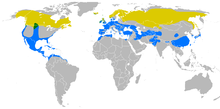




















































 ROLLING HARBOUR ABACO
You must be logged in to post a comment.