Unknown's avatar

WTF? (WHAT’S THAT FISH?) 14: ARROW CRABS


Arrow Crab (Melinda Riger / Grand Bahama Scuba)

WTF? (WHAT’S THAT FISH?) 14: ARROW CRABS

It’s been a while since the last in the WTF? series, which is dedicated to the wilder, less conventionally fish-shaped side of reef life – those creatures that you may come across, blink into your face-mask,  and silently mouth the words ‘What’s That Fish?’ (that’s what it looks like you are saying, anyway).

Arrow Crab (Adam Rees)

Let’s meet some Arrow Crabs Stenorhynchus seticornis, one of the very few creatures surely to have a triangular body plus a huge pointy nose (rostrum), supported on long skinny legs. To which add, they wear tiny blue gloves on their two front claws.

Arrow Crab (Melinda Riger / Grand Bahama Scuba)

These crabs are coral reef dwellers and mostly stay concealed during the day. Their body is protected by a carapace, and the rostrum has serrated edges like a tiny rasp or file. I haven’t found a definitive reason for this gadget, but I suspect it is more for probing than for piercing or fighting.

Arrow Crab (Melinda Riger / Grand Bahama Scuba)

There’s a considerable colour variation among these crabs, as these images show. The body may even have blue iridescent lines (#2, above). And those claws may be any of 50 shades of blue…

Arrow Crab (Melinda Riger / Grand Bahama Scuba)

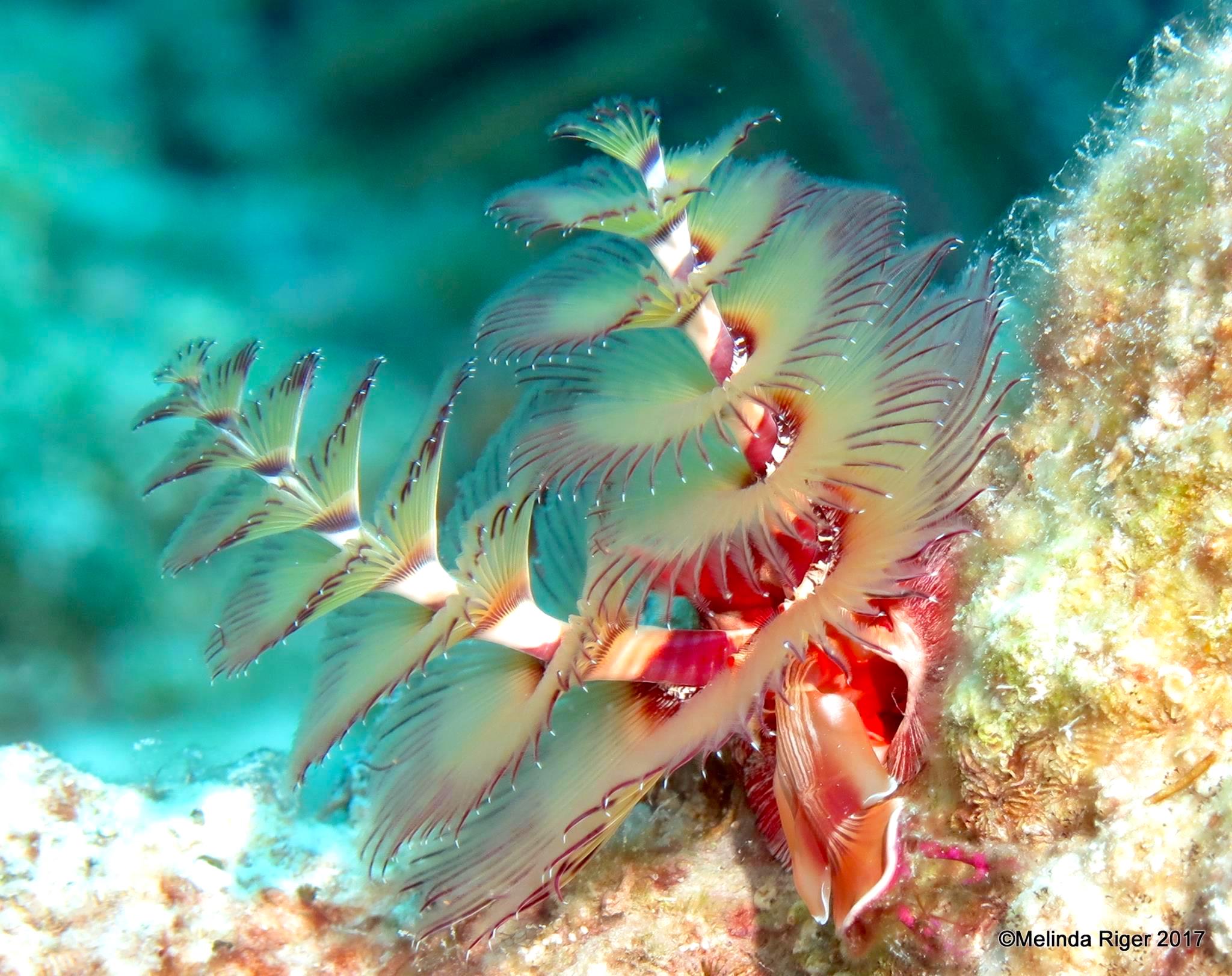
Arrow crabs are most active at night. They eat feather-duster worms (illus.) and similar invertebrates such as bristle worms.

Feather-duster worm (Melinda Riger / G B Scuba)

Arrow Crab Meal

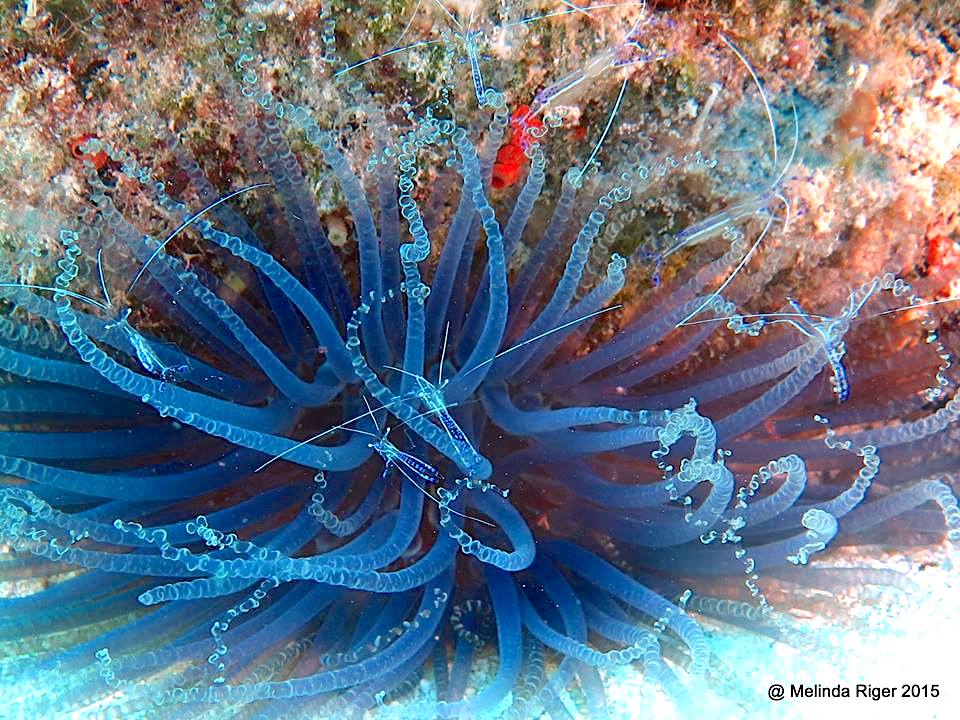
Like certain types of shrimp, they also have a symbiotic relationship with anemones, whereby they make use of an anemone to benefit from the food it captures – and possibly for cover too. They are protected from anemone stings, whereas some of their predators are not.

This was the place where I was going to tell you about the arrow crab’s private life, but, well… “it’s complicated”. Briefly it is: male passes sperm-filled capsule to female; she uses it in some way whereby it fertilises her eggs; she then ‘broods’ the eggs in one of her ‘swimming legs’; the eggs hatch into larvae and swim off to eat plankton; each one then grows & moults, repeating the process until it has reached adult form. On balance, humans have arguably perfected a preferable method.

Arrow Crab (Nick Hobgood / Wiki)

Arrow Crabs are apparently popular aquarium creatures, although they sound to me rather a disagreeable challenge. They can move quickly on those long legs, and it seems as if they inclined to be aggressive to other inhabitants of the tank. As far as I can make out, it’s best not to put 2 of them together: they certainly won’t be doing the sperm capsule thing described earlier… 

Arrow Crab (Adam Rees)

Master of Disguise

Photo credits: Melinda Riger / G B Scuba (1, 3, 4, 5, 6); Adam Rees / Scuba Works (2, 8, 9); Nick Hopgood,Wiki (7); Chuck Elliot – video

Arrow Crab (Adam Rees)

Unknown's avatar

SOUTHERN STINGRAYS: BAHAMAS REEF FISH (41)


Southern Stingrays, Bahamas (Melinda Riger / Grand Bahama Scuba)

SOUTHERN STINGRAYS: BAHAMAS REEF FISH (41)

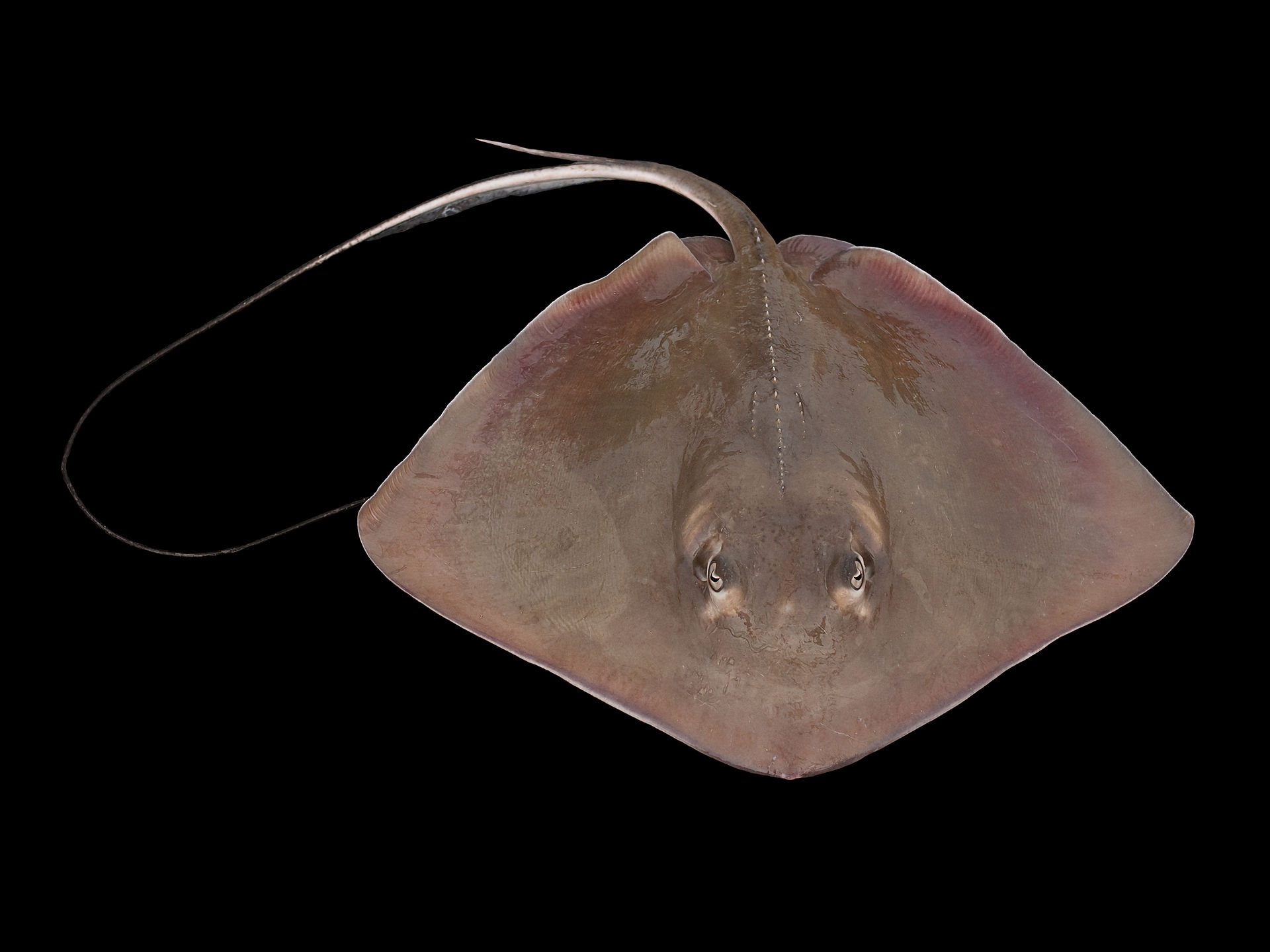
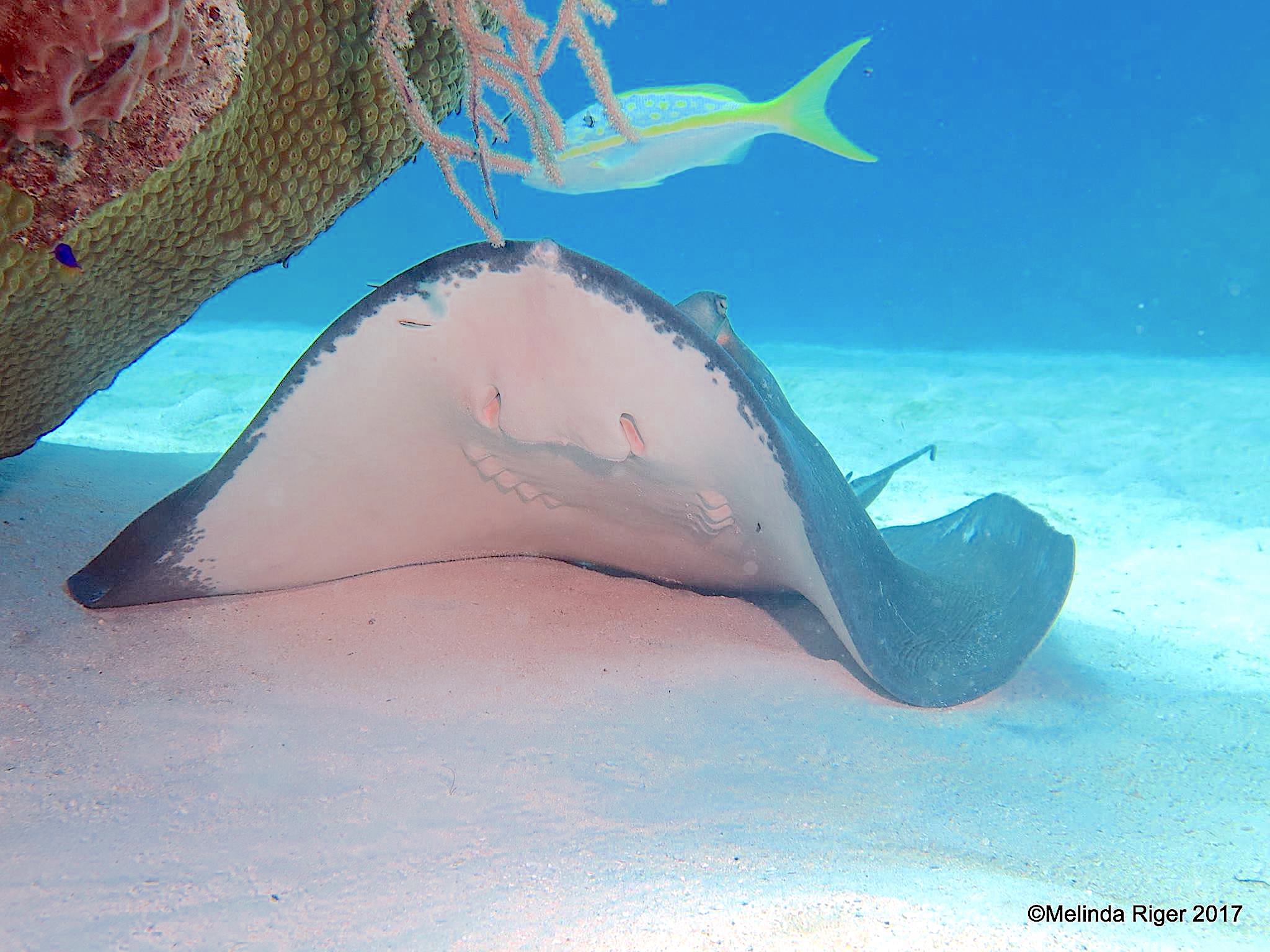
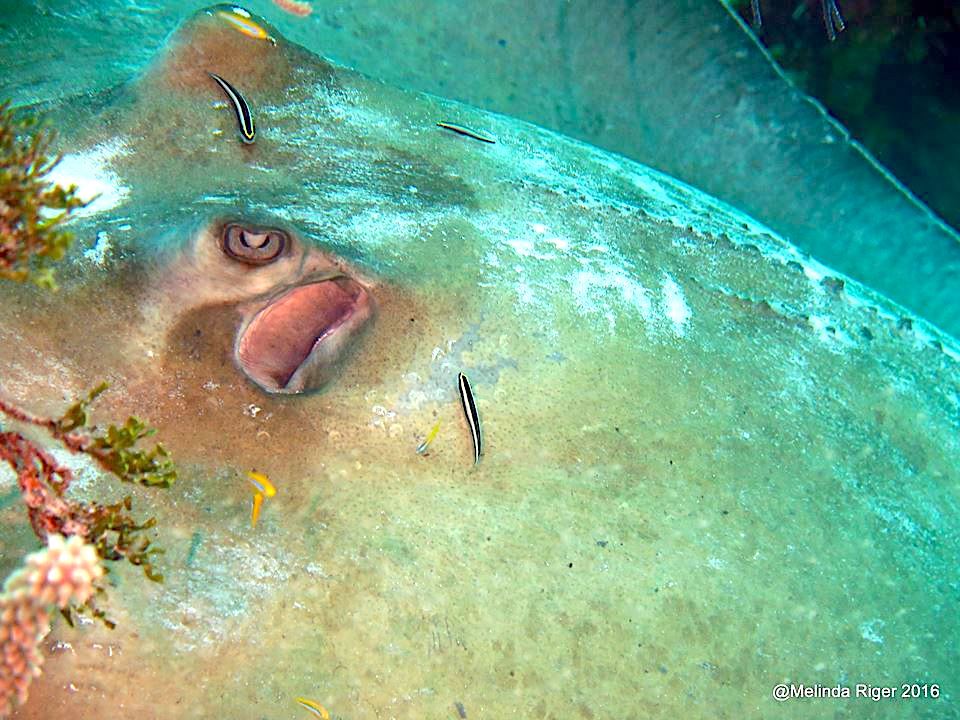
Anyone who has scuba-dived or snorkelled around the bright coral reefs of the Bahamas, or hunted bonefish out on the Abaco Marls will have come across Southern Stingrays Dasyatis americana. And there are certain places (eg Manjack Cay) where you can actually feed them – and not come to any harm

Southern Stingrays, Manjack Cay, Bahamas (Samantha Regan)

FEED THEM? AREN’T THESE GUYS LETHALLY DANGEROUS CREATURES?

Southern Stingrays, Bahamas (Melinda Riger / Grand Bahama Scuba)

The name that always comes to mind in connection with stingrays is poor Steve Irwin, the charismatic Australian wildlife expert who was tragically ‘stung’ over his heart as he swam close over a ray while filming underwater. But this was, it would appear, a dreadful combination of circumstances with a terrible outcome.

Southern Stingrays, Bahamas (Melinda Riger / Grand Bahama Scuba)

The ray’s stinger is in fact an erectile venomous barbed spine near the base of the tail and not on the end of it (as one might expect). But these creatures are not out to harm you – though of course when you are in their environment you should accord them the respect that they merit.

Southern Stingray (Tomas Willams, wiki)

If you are walking / wading in the water, avoid the risk of accidentally treading on a ray. Best to shuffle your feet forward in the sand; if there’s a half-concealed ray feeding or resting on the bottom nearby, it will swim away peacefully. I took the photo below while bonefishing on the Marls; the ray directly ahead slowly makes off as the skiff drifts closer. The next one is of a ray with its young – completely aware of us as we glide past to one side, but not especially bothered.

Southern Stingrays, Bahamas  (Keith Salvesen)Southern Stingray adult and young, Bahamas  (Keith Salvesen)

If you are swimming, snorkelling or diving, don’t get too close – especially by swimming directly over a ray (apparently Steve Irwin’s mistake, so that he was struck right in the chest by the stinger when the ray reacted).

Southern Stingrays, Bahamas (Melinda Riger / Grand Bahama Scuba)

Enough of the potential dangers. The southern stingray is a magnificent creature, as Melinda’s wonderful photographs show. She spends half her life underwater and I’m not aware that she has had a problem with a ray. 

Southern Stingrays, Bahamas (Melinda Riger / Grand Bahama Scuba)

Like many larger sea creatures, stingrays need help with their personal care – the removal of parasites, dead skin and so forth. And so they make use of the services offered by small fish like gobies, wrasses and shrimps at a CLEANING STATION. Here are 2 photos of rays doing just that. You can see the tiny fish by the reef, going about their work. There’s a mutual benefit in this symbiotic relationship, in which it is understood that the cleaners are unharmed. Indeed, they will often enter the mouths and gills of a fish to clean… including the teeth. So there’s dental hygiene on offer too…

Southern Stingrays, Bahamas (Melinda Riger / Grand Bahama Scuba)

Southern Stingrays, Bahamas (Melinda Riger / Grand Bahama Scuba)

RELATED POSTS

YELLOW STINGRAY

GRACE WITH ATTITUDE

TAKEN TO THE CLEANERS

Photo Credits: Melinda Riger / Grand Bahama Scuba, except for the feeding photo (cheers, Samantha Regan), the ‘specimen’ from Tomas Willems (Wiki) and my two noted above

Unknown's avatar

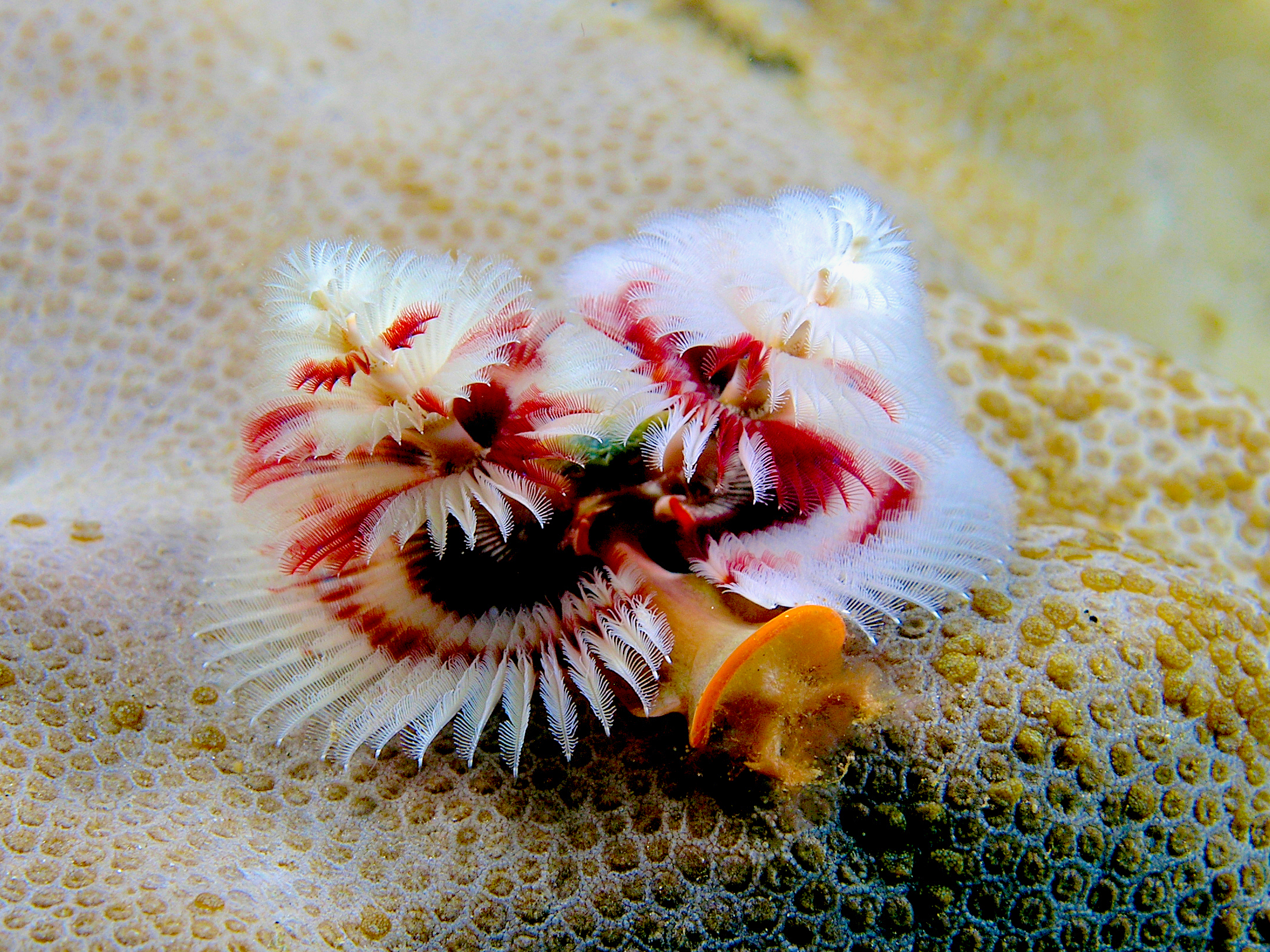
CHRISTMAS TREE WORMS: SEASONAL SPIROBRANCHES


Christmas Tree Worm (Melinda Riger / Grand Bahama Scuba)

CHRISTMAS TREE WORMS: SEASONAL SPIROBRANCHES

music-notes-clip-art-png-musicDeck the Reefs with Worms Like Christmas Trees… Fal-La-La-etc-etc ” is a traditional Carol familiar to all. Well, most. Ok, some, then. Oh right – maybe with different words? Anyway, now is the perfect time to take another look at these remarkable subsurface symbols of seasonal good cheer (nb they are animals not plants).

christmas-tree-worm-melinda-riger-g-b-scuba

10 CHRISTMAS TREE WORM FACTS TO PONDER

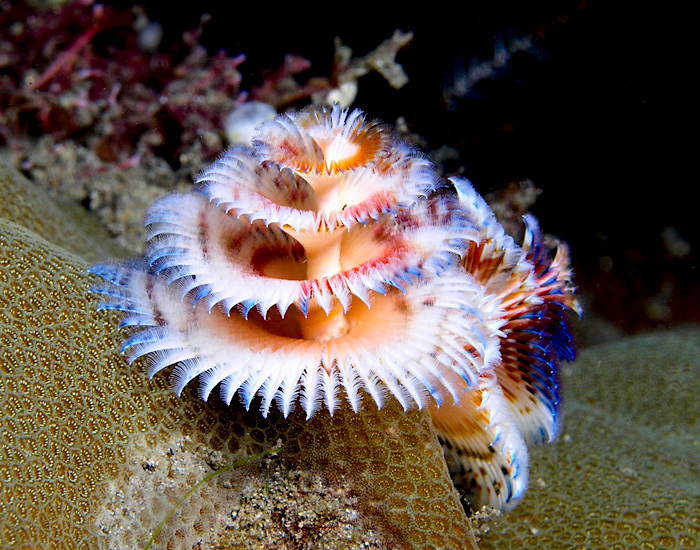
  • The 2 colourful spirals are not the worm, but complex structures for feeding & respiration
  • The spirals act as specialised mouth extensions for ‘filter-feeding’
  • Prey is trapped by the feathery tentacles & guided by cilia (microscopic hairs) to the mouth
  • The tentacle things are radioles and act as gills for breathing as well as prey traps
  • It is not believed that prey slide down the spiral to their doom, like on a helter-skelter

Christmas Tree Worm (Neil Hobgood Wiki)Christmas Tree Worm (Melinda Riger / Grand Bahama Scuba)

  • The actual worm lives in a sort of segmented tube, with extremely limited mobility skills
  • It contains digestive, circulatory & nervous systems – and a brain in the middle of it all
  • The worm also has a tiny drainage tube (I think I have this right) for excretion etc
  • They embed themselves into heads of coral such as brain coral. And stay there
  • And yes, the Christmas trees are retractable… (see below for some action)

spirobranchus_giganteus_orange_christmas_tree_worm-nick-hobgood-wiki

HOW DO THE WORMS… YOU KNOW…  ERM… REPRODUCE?

This is a delicate area. They don’t tend to talk about it much, but as far as I can make out they eject gametes from their what-I-said-above. There are mummy and daddy worms, and their respective gametes (eggs and spermatozoa) drift in the current and presumably into each other to complete the union. The fertilised eggs develop into larvae, which settle onto coral and burrow into it, build their protective tubes and the process begins again.

christmas_tree_worm-nick-hobgood-wiki

YOU DON’T REALLY UNDERSTAND THESE CREATURES, DO YOU?

I won’t lie. I found it hard to work out how the CTWs function in practice. There are plenty of resources showing them in their full glory, but that only takes one so far. Then I came across a short video that shows it all brilliantly simply (except for the reproduction part).

The worms, in their coral burrows, hoist their pairs of ‘trees’. You can easily see small particles – possibly zooplankton – drifting in the water, and the radioles swaying to catch potential food. Suddenly it all makes sense (except the repro bit – I haven’t found footage of that).  Next: the New Year Worm (there is no Easter worm).

A WHOLE FESTIVAL OF CHRISTMAS TREE WORMSChristmas Tree Worms (Neil Hobgood Wiki)

Credits: Melinda Riger (G B Scuba); Nick Hobgood; Betty Wills; Video by ‘Super Sea Monkey’;Reef Collage by RH; MarineBio; Wikibits & Magpie Pickings

Happy Christmas to all those who put up with RH with such fortitude
blue_christmas_tree_worm-betty-wills-wiki

Unknown's avatar

NASSAU GROUPER: ENDANGERED… AND PROTECTED


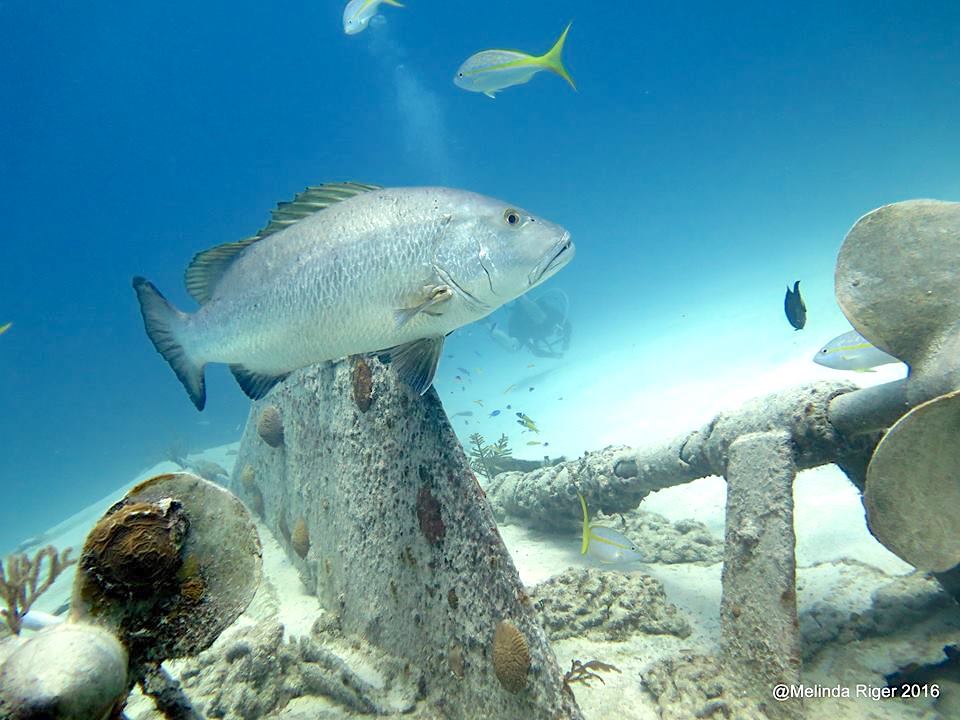
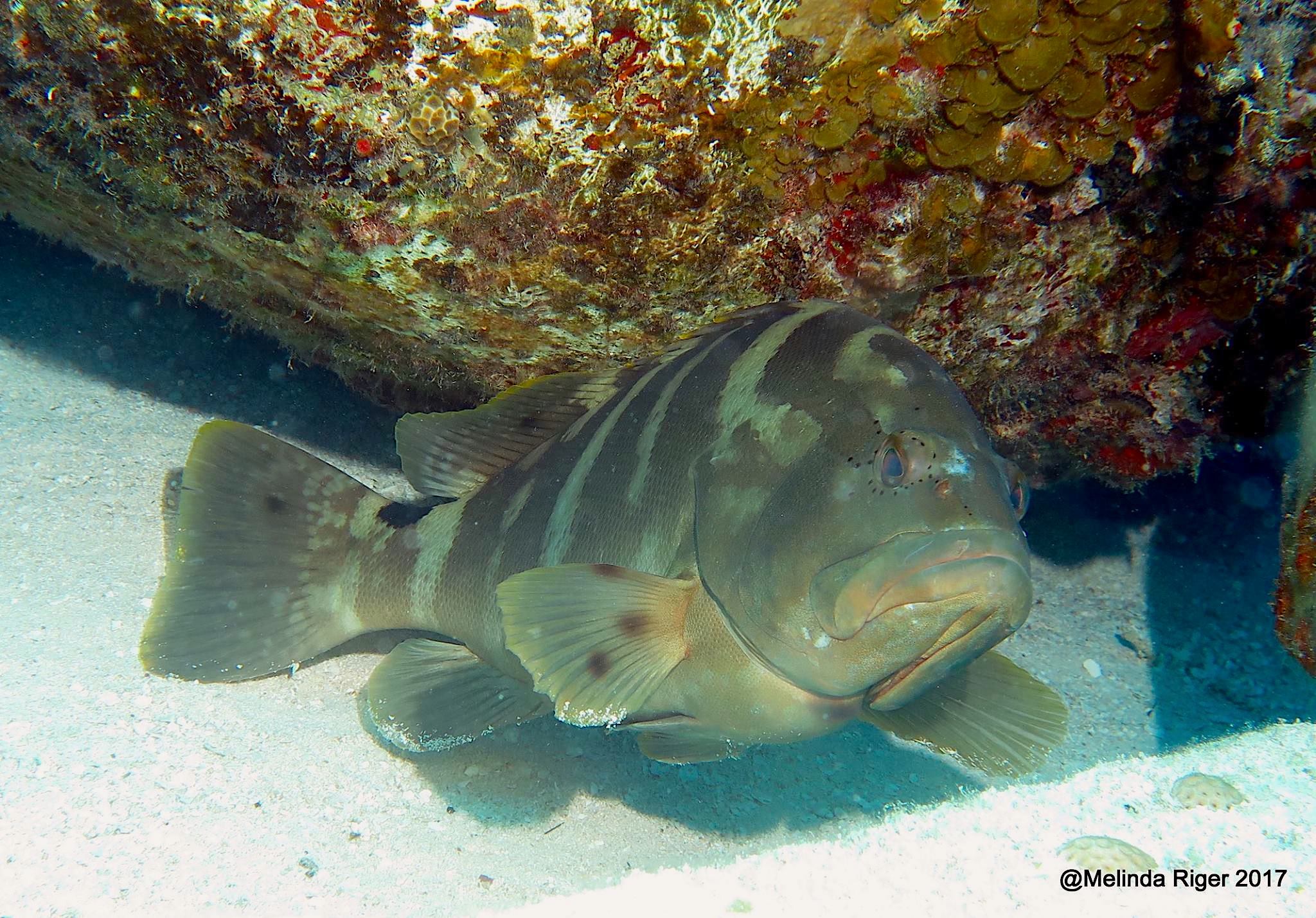
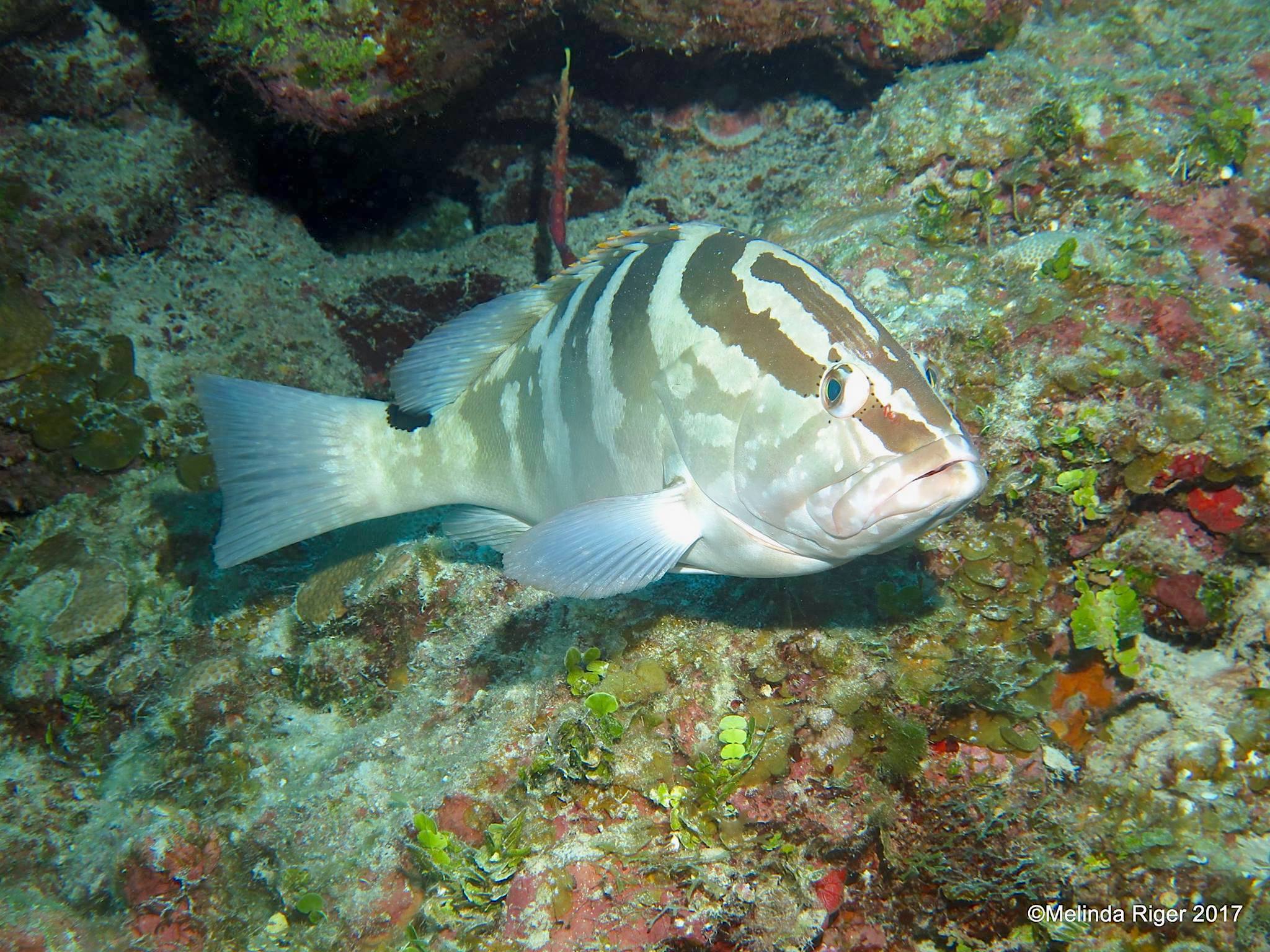
Nassau Grouper (Melinda Riger / Grand Bahamas Scuba)

NASSAU GROUPER: ENDANGERED… AND PROTECTED

Most creatures need some space for creative activity of one sort or another. Especially one particular sort, namely breeding. And for vulnerable and endangered species, this is especially important in order to maintain a sustainable population, and preferably to increase it year on year. Which is why there are closed seasons for certain fish, ensuring a time when they can be left alone to breed in peace and to perpetuate their species.

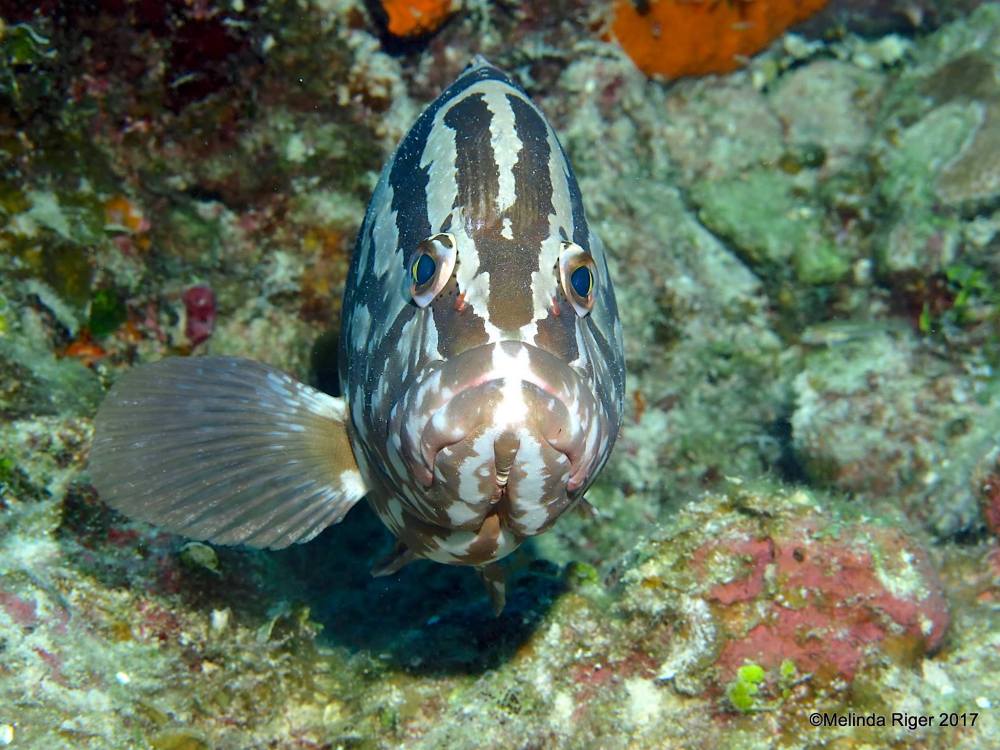
Nassau Grouper (Melinda Riger / Grand Bahamas Scuba)

The Nassau grouper Epinephelus striatus is just one of a number of grouper species that inhabit Bahamian waters. They are mostly found in the Northern Bahamas but only the Nassau grouper is on the IUCN Red List as an Endangered Species in need of protection.

Nassau Grouper (Melinda Riger / Grand Bahamas Scuba)

WHY ARE THESE FINE FISH ENDANGERED?

Sad to say, mankind is the main cause of the population fragility that has led to the official listing, and the imposition of a strict closed season for 3 months between December 1st and February 28th. Scientific studies have shown that commercial overfishing has reduced a thriving population to fewer than 10,000 mature fish. That may sound plenty to be going on with… until you consider that a net annual loss of only 10% would lead to extinction in a decade.

Nassau Grouper Infographic (Royal Defence Force)

10 CONVENIENTLY COLLECTED NASSAU GROUPER FACTS TO PONDER

  • An adult can grow to more than a metre long, and weigh 25 kg
  • They tend to be solitary daytime feeders, eating small fish & crustaceans
  • Their large mouths are use to ‘inhale’ or suck in prey
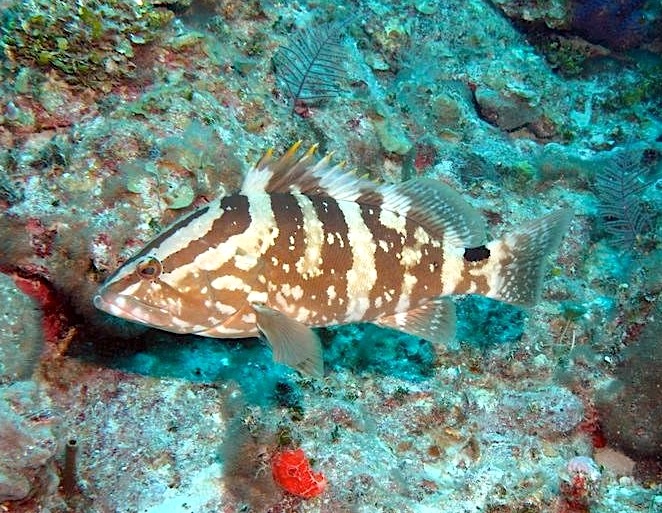
  • The colouring of an individual can vary from red to brown
  • These fish have little black spots around the eyes (I’ve no idea why).
  • Their habitat is in the vicinity of coral reefs, from shallows to 100 m deep
  • Spawning occurs in Dec & Jan during a full moon
  • Large numbers gather in a single location to mate in a mass spawning
  • These groupers are slow breeders, which compounds the overfishing problem
  • They are easy mass targets at spawning time; hence the need for a closed season

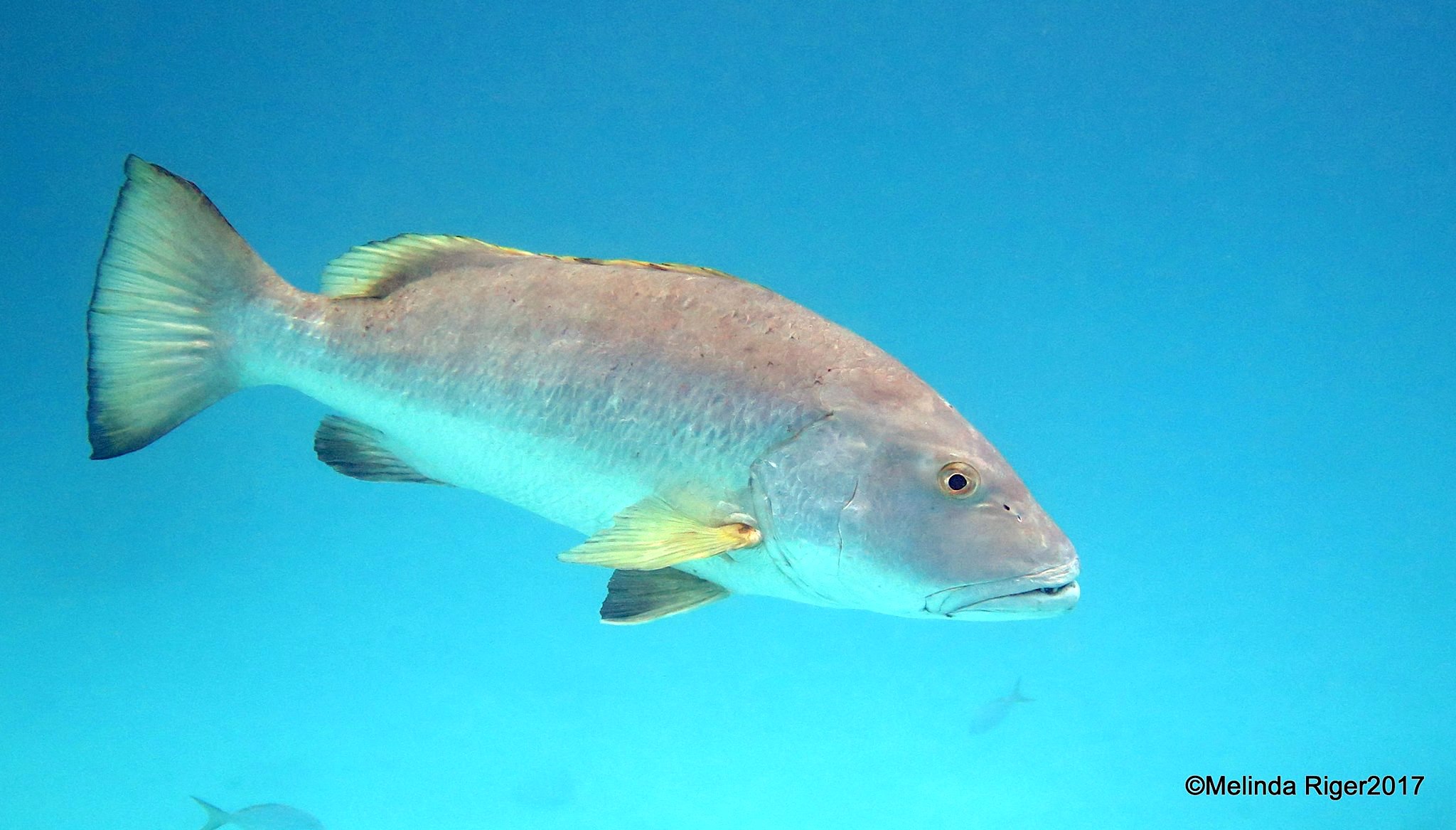
Nassau Grouper (Melinda Riger / Grand Bahamas Scuba)

Department of Fisheries information sheet (interesting if you have the time)

A Nassau Grouper glumly contemplates the possibility of extinctionNassau Grouper (Melinda Riger / Grand Bahamas Scuba)

RELATED POSTS

BLACK GROUPER

TIGER GROUPER

RED HIND

NASSAU GROUPER 1

CLEANING STATIONS

Nassau Grouper (Melinda Riger / . Grand Bahama Scuba)

Credits: all photos, Melinda Riger; Infographic by Royal Defence Force (tip o’ the  hat to Char Albury); Info Sheet, Dept of Fisheries

Unknown's avatar

BAHAMAS REEF FISH (40): FOUR-EYED BUTTERFLYFISH


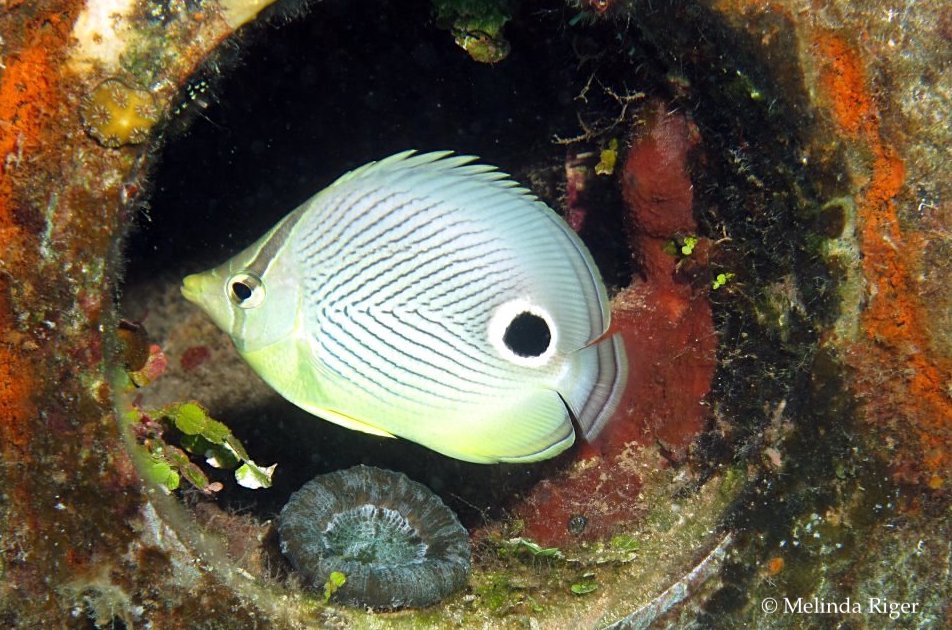
Four-eyed Butterflyfish, Bahamas (Melinda Riger / G B Scuba)

BAHAMAS REEF FISH (40): FOUR-EYED BUTTERFLYFISH

Four-eyed (or foureye) butterflyfish (Chaetodon capistratus) are small, somewhat circular fish with an endearingly pointy little snout. They are one of several butterflyfish species found in Bahamian waters. On their sides are smart ‘go-faster’ chevrons, with the unmistakeable white-circled black ‘eye’ at the back. The real eyes, in the conventional position, are small and far less noticeable, not least because of the stripe that passes right through them.

Four-eyed Butterflyfish, Bahamas (Melinda Riger / G B Scuba)

WHY THIS EXOTIC PATTERNING?

This type of misleading pattern is not uncommon in fishes and indeed in terrestrial creatures. It creates confusion in predators – and when this little fish is threatened it swims away with its large ‘eye’ prominent to the pursuer.  It acts as a warning and an off-putting feature that suggests ‘don’t eat me’. If you half-close your eyes and look at the image below, the large eyes stand out against the reef background and hint at a creature not to be tangled with. Why reef predators don’t rumble this ruse within minutes, I have no idea.

Four-eyed Butterflyfish, Bahamas (Melinda Riger / G B Scuba)

WHAT IF THE RUSE FAILS?

Foureyes are very agile swimmers and can take advantage of narrow gaps and clefts in the reef  by swimming sideways or even upside-down to manoeuvre away from danger and to safety where the predator cannot reach it. 

Four-eyed Butterflyfish, Bahamas (Melinda Riger / G B Scuba)

AND IF THAT DOESN’T WORK?

If the foureye is in deep trouble, it has an alternative cunning plan. It will turn and face the pursuer, head down and dorsal spines erect. This posture says both ‘I’m very spiny – watch out’ and ‘I’m coming atcher’. 

Four-eyed Butterflyfish, Bahamas (Lazlo Ilyes wiki)

AND IF THAT DOESN’T WORK? I’M WORRIED FOR IT NOW…

Curtains. It’s lunchtime, I’m afraid.

♦ ♦ ♦ ♦ ♦ ♦ ♦ ♦ ♦

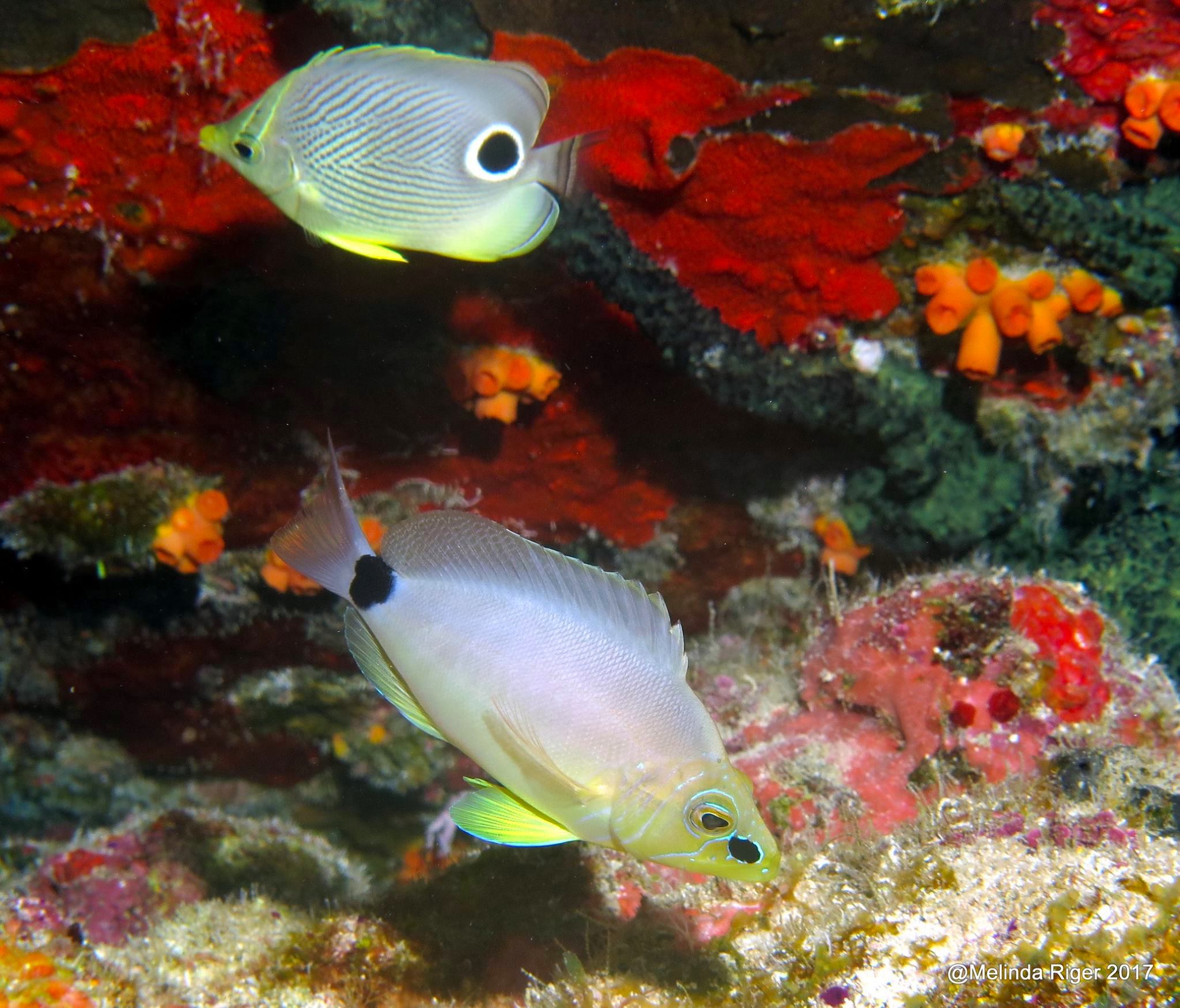
Foureyes are far from the only reef dwellers that have predator-confusing markings. In the image below, the foureye at the top is swimming with a larger BUTTER HAMLET, a species that also relies on an abnormal spot pattern to put off predators. This is a great capture, and it also illustrates how the smaller reef fishes can hang out together amicably.

Four-eyed Butterflyfish, Bahamas (Melinda Riger / G B Scuba)

RELATED POSTS

REEF BUTTERFLYFISH 

SPOTFIN BUTTERFLYFISH

LONGSNOUT BUTTERFLYFISH

Image Credits: 1, 2, 3, 4, 6, Melinda Riger / Grand Bahama Scuba; 5, Lazlo Ilyes


Unknown's avatar

SPERM WHALES – BMMRO FIELD TRIP, BAHAMAS


Sperm Whales, Bahamas (BMMRO)

SPERM WHALES – BMMRO FIELD TRIP, BAHAMAS

I can never quite get my head around the fact that the waters around Abaco are home to the twin leviathans, sperm whales and humpback whales. And before anyone points it out, I realise they can’t actually be twins: sperms whales (cachelots) are TOOTHED WHALES whereas humpback whales are BALEEN WHALES

Sperm Whales, Bahamas (BMMRO)

During November, the Bahamas Marine Mammal Research Organisation (BMMRO) undertook a rather special field trip. Using sophisticated devices, the scientists first located a group of sperm whales, and then tracked them through the night using the communications between the creatures – ‘vocalisations’ – to follow them. Later analysis of the recordings will have made it possible to identify the individuals through their unique vocal patterns – and so to recognise them again. 

Sperm Whale, Bahamas (BMMRO)

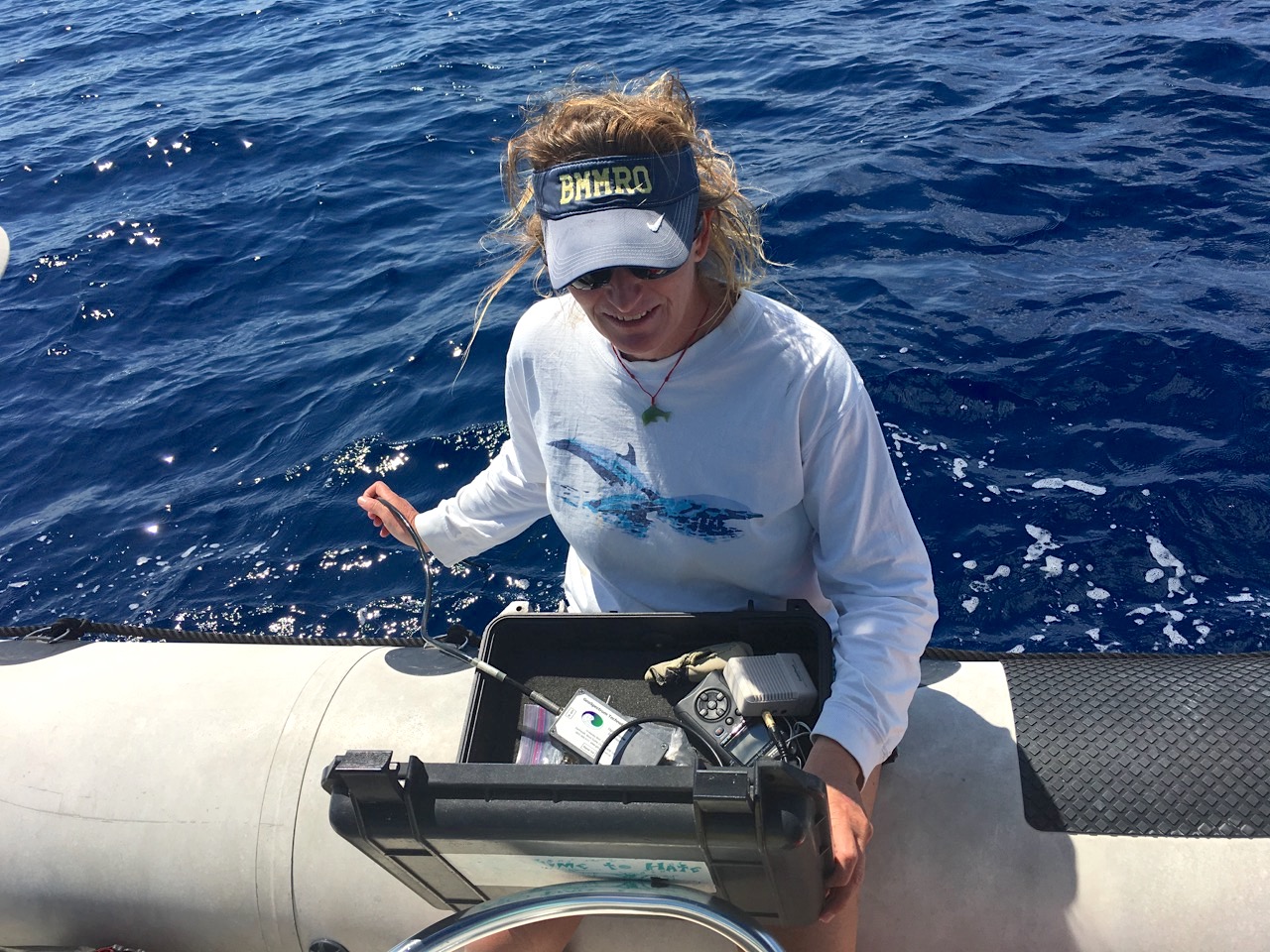
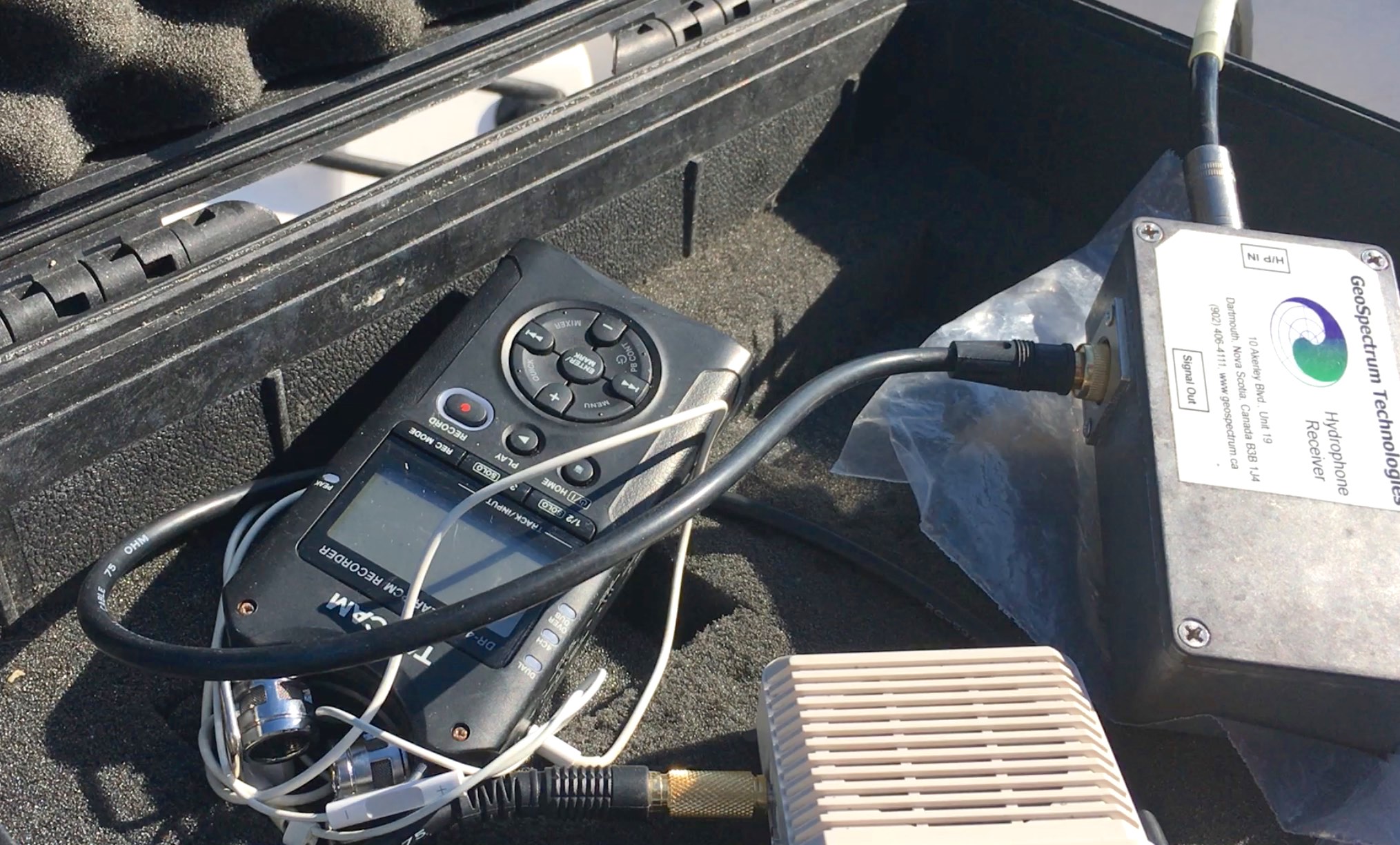
The hydrophonic equipment used is extremely sensitive, and can pick up the sounds made by whales and dolphins over a great distance. The box of tricks looks deceptively modest – I took these photos on a previous trip when we were looking for beaked whales and dolphins. Charlotte Dunn holds the microphone submerged on a cable and underwater sounds are amplified so that the slightest chirrup of a dolphin can be heard by everyone on the vessel. The sounds are recorded and locations carefully logged.

Besides the sperm whales, the BMMRO team also had sightings of spotted dolphins, bottlenose dolphins and beaked whales during the field trip. These bonus sightings will also have been logged for future reference. It all adds to the detailed research data that assists the conservation of the prolific marine mammal life in Bahamian waters.

Atlantic Spotted DolphinsAtlantic Spotted Dolphins, Bahamas (BMMRO)

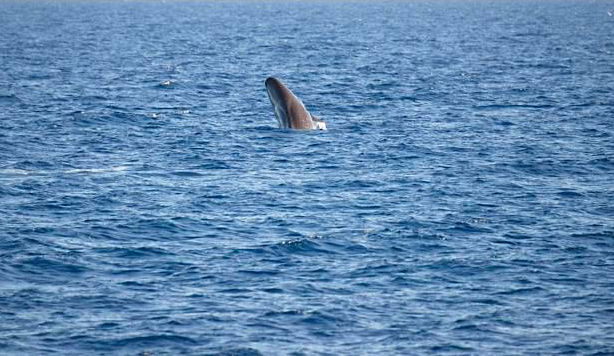
By the time one of the whales decided to breach, it was some distance away, so I’m afraid I can’t bring you a dramatic close-up from the trip. But just to see this view at all is breathtaking.

All photos BMMRO except the 2 hydrophone ones on the research boat (Keith Salvesen)

Unknown's avatar

BAHAMAS REEF FISH (39): YELLOWTAIL DAMSELFISH


Yellowtail Damselfish (©Melinda Riger / Grand Bahama Scuba)

BAHAMAS REEF FISH (39): YELLOWTAIL DAMSELFISH

Yellowtails are just one of several damselfish species in Bahamas waters. These small fish are conspicuous not just for the bright tails that give them their name. More striking if anything – especially if seen underwater in sunlight against the coral – are the electric blue spots visible in both adults and juveniles.

Yellowtail Damselfish (©Melinda Riger / Grand Bahama Scuba)

The body of adults is dark blue to brownish to almost black 

The body of juveniles is blue

Yellowtails are a common and widespread variety of damselfish. They have a limited ability to change colour according to their surroundings, but with their bright tails and luminous blue flecks, it’s hard to see how they can look, to a predator, anything other than a tasty snack.

I have enjoyed seeing these little fish at Fowl Cay Marine Preserve, Abaco. The reef there makes for easy and rewarding snorkelling, with a wide variety of small and medium-size reef fishes to be seen. It’s an expedition I would definitely recommend to anyone wanting to see a healthy and active reef in a completely natural protected area.

I found that a video I took with a tiny camera was sadly of use only to myself. No one else would be able to make anything out due to the marked camera shake. Novices, huh? You are spared that: here’s a brief example of yellowtails swimming instead, showing the difference between juveniles and adults.

Credits: all photos, Melinda Riger / Grand Bahama Scuba; video from Desert Diving

Unknown's avatar

BLAINVILLE’S BEAKED WHALES IN ABACO WATERS


Blainville's Beaked Whale, Abaco (BMMRO)

BLAINVILLE’S BEAKED WHALES IN ABACO WATERS

It’s hard to believe that the seas around Abaco and its cays are home to a number of whale species, from huge sperm and humpback whales down to so-called dwarf or pygmy species. In the middle of this range come the beaked whales, the most common being the Blainville’s Beaked Whale. I say ‘most common’, but in fact they are rare in the world, being found in only two other main locations on earth. 

Blainville's Beaked Whale, Abaco (BMMRO)

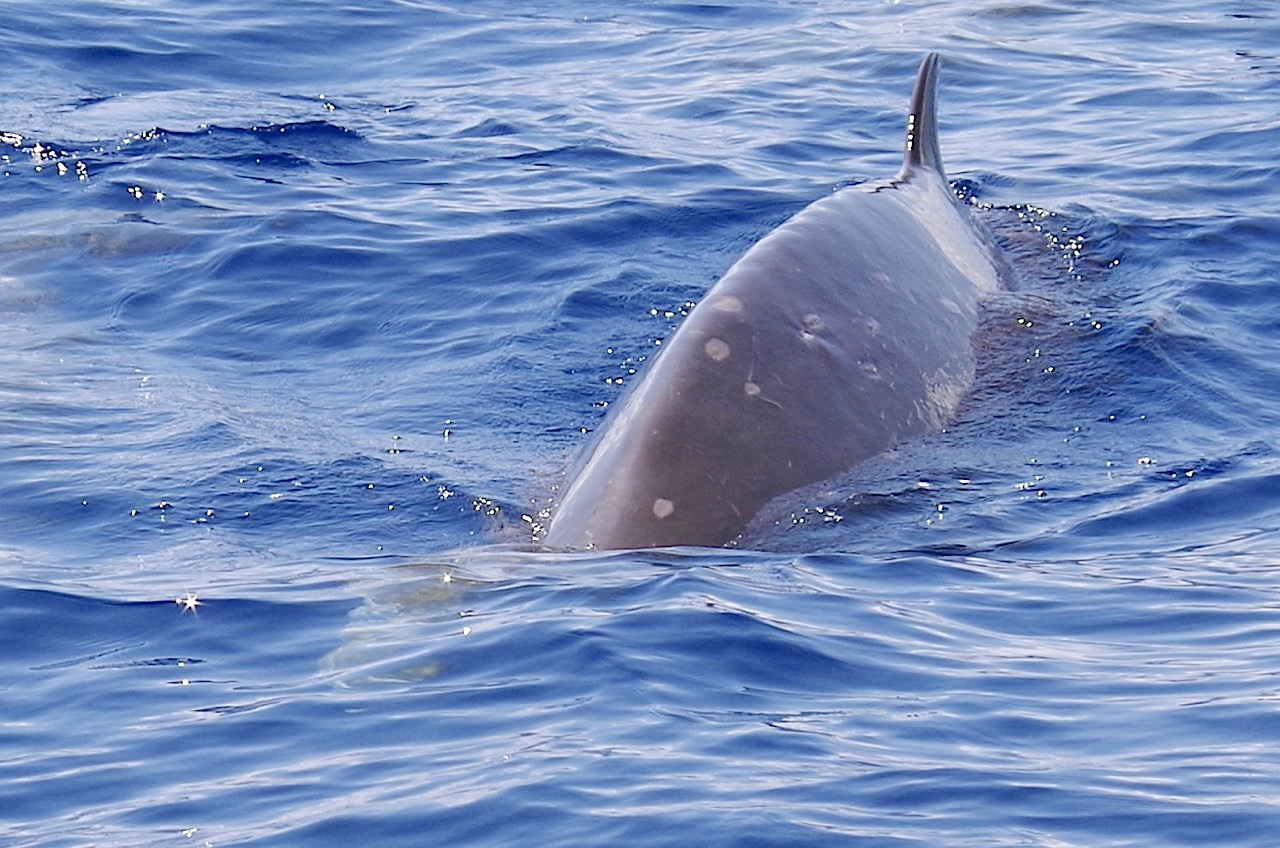
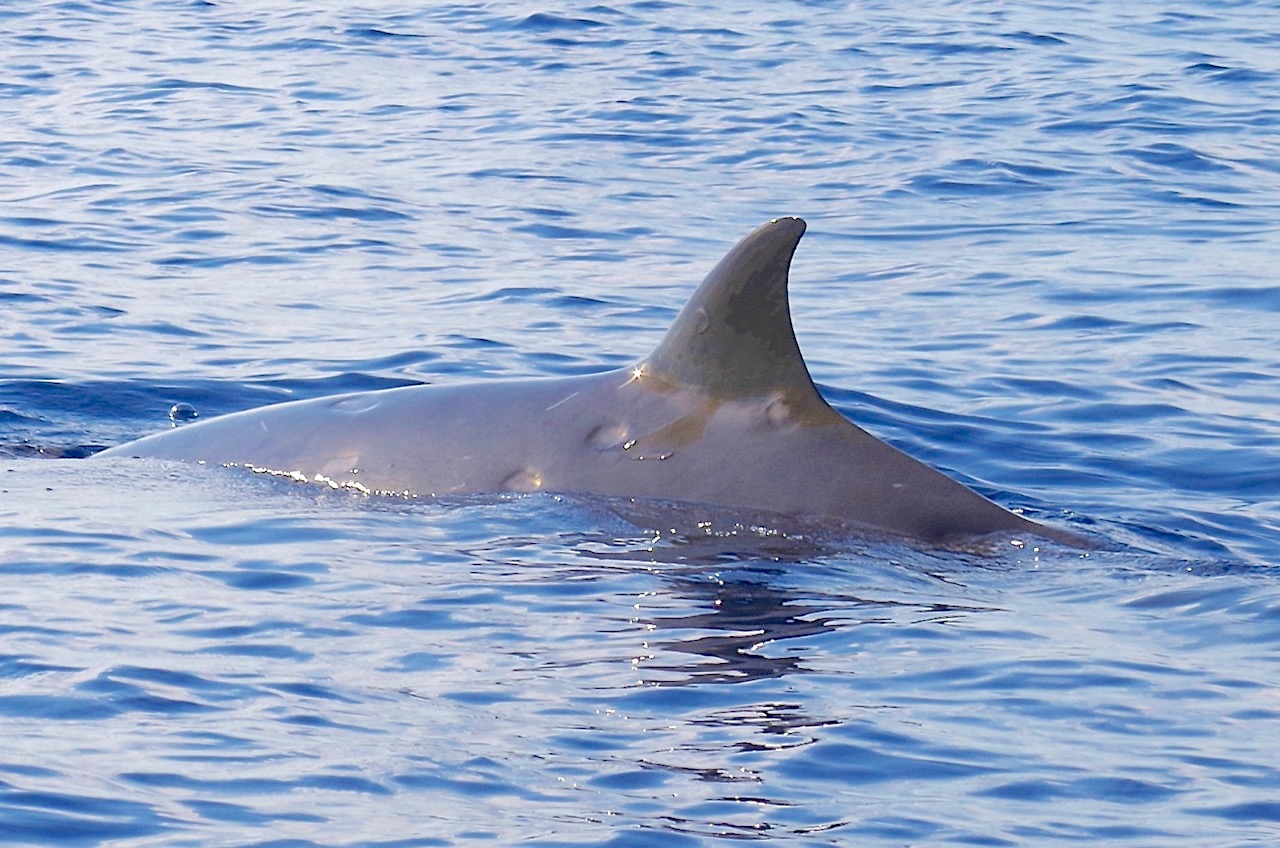
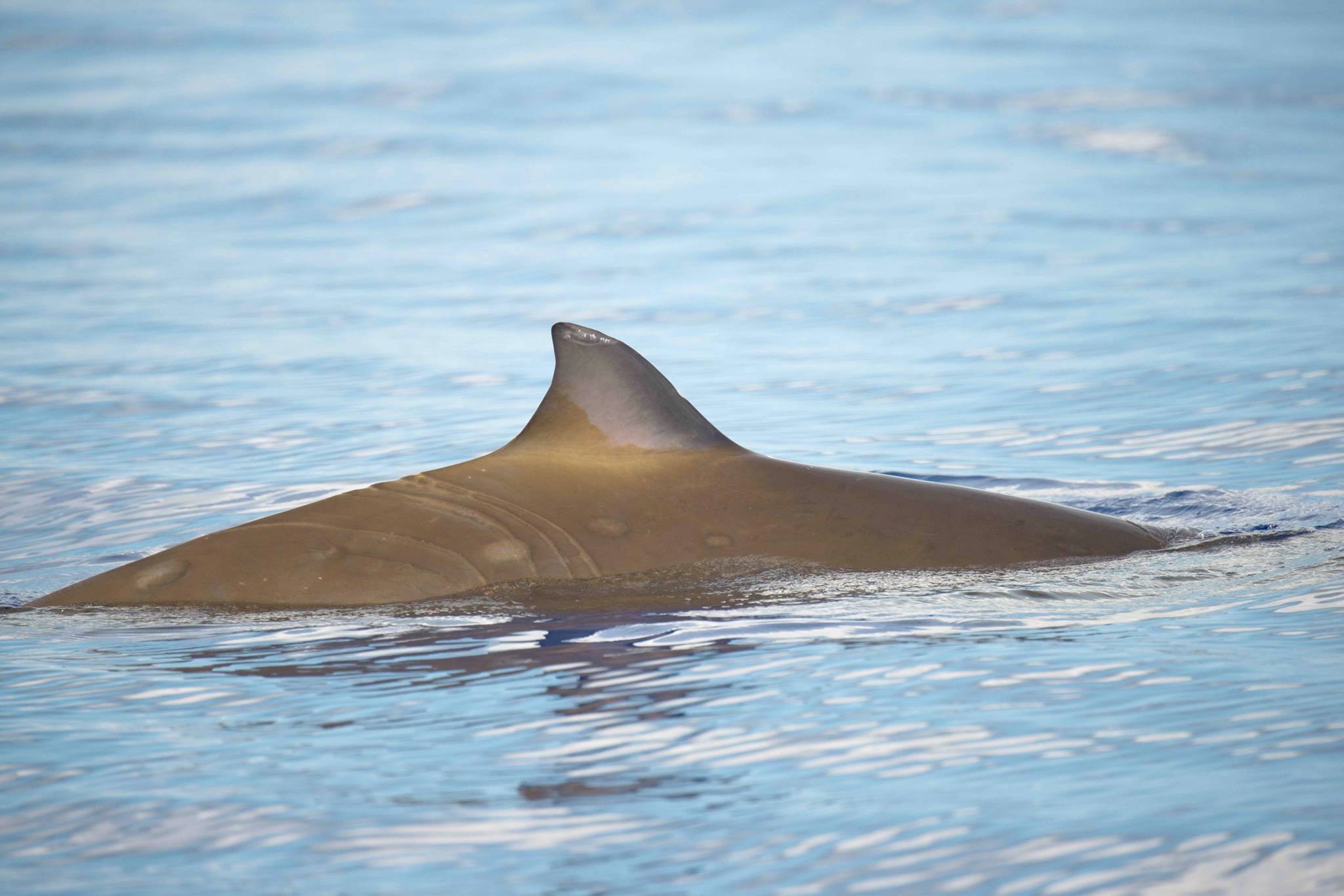
These whales are carefully monitored by the Bahamas Marine Mammal Research Organisation (BMMRO), and there is a tagging program to keep track of them. As with dolphins, individuals are identified by markings on the dorsal fin, which vary for each whale. The one above has distinctive scarring at the tip. There are also striations on the body, and conspicuous circular marks that are healed wounds caused by cookie-cutter sharks.

Blainville's Beaked Whale, Abaco (BMMRO)

To the untrained eye, there are no noticeable marks on the dorsal fin of the whale above. However, the whale’s back has a prominent pattern of scarring and healed cookie-cutter wounds. The whale below really looks as though it has been in the wars, with long deep healed wounds behind the head.

Blainville's Beaked Whale, Abaco (BMMRO)

I can’t tell without seeing the head, but I wonder if it is a male and the scars have been caused in a fight with another male – adult males have prominent tusks with which they do battle. Here is an photo that I took from the research boat on a different occasion. The tusks protrude upwards from the lower jaw, and are often covered in barnacles. They are capable of causing serious injury.

Blainville's Beaked Whale male, Abaco (Keith Salvesen)

Blainville’s beaked whales are amongst the deepest divers of all whales. But that and other whale topics will have to wait for another day… My computer malware / virus has been removed professionally with no data loss, and I have some catching up to do. Cost in terms of panic and stress: huge. Cost in real terms: $90.

Blainville's Beaked Whale, Abaco (BMMRO)

All photos BMMRO except the tusked male, Keith Salvesen

Unknown's avatar

‘RAISE AWARENESS’: SPOTTED EAGLE RAYS


Spotted Eagle Rays, Abaco, Bahamas (Gabrielle Manni)

Spotted Eagle Rays – Abaco, Bahamas

‘RAISE AWARENESS’: SPOTTED EAGLE RAYS

Mention of rays may conjure up thoughts of the familiar southern stingrays that populate the bright shallows and colourful reefs of the Bahamas. But there are other ray species out there gracefully patrolling the coral reefs – and one of these species is the spotted eagle ray (Aetobatus narinari).

Spotted Eagle Rays, Abaco, Bahamas (Catherine / Tara Pyfrom)

These fish (for that is what they are) are not uncommon. In fact they are found in tropical oceans worldwide (though there is a taxonomic distinction between the Atlantic version and the Pacific / Indo-Pacific ones). Note the concentration in the Caribbean sea.

Spotted Eagle Rays, Grand Bahama, Bahamas (Melinda Riger / GB Scuba)

Spotted eagle rays obviously have spots, but they are not notably eagle-like to look at. In fact, their snouts resemble a duck’s bill, and in some place they are less glamorously known as the duckbill ray. The ‘eagle’ part relates to the way in which they use their wings and appear to be soaring as they glide effortlessly through the water (see videos below).

Spotted Eagle Rays (Lazlo-photos Wiki)

Despite their global presence, these rays are categorised as ‘near-threatened’ on the IUCN Red List. Aside from vulnerability to predators including many types of shark, the rays may be caught as bycatch. In some areas they suffer entanglement in shark nets. And unsurprisingly there is a trade for them for large commercial aquariums. For the Atlantic species, Florida has taken a lead by banning fishing for, landing, buying or trading in spotted eagle rays. 

Spotted Eagle Rays, Abaco, Bahamas (Gabrielle Manni)

10 ESSENTIAL FACTS ABOUT SPOTTED EAGLE RAYS

  • They have 2 – 6 venomous barbed spines at the base of the tail
  • Adults are among the largest rays, with a 10 ft wingspan
  • They can leap clear of the water, and may do this more than once at a time
  • Occasionally they land in boats, to the consternation of all concerned
  • Their main diet is small fish and crustaceans, & sometimes octopuses
  • Their broad snouts are used to dig food out of the seabed as they forage
  • The rays are basically shy but may be curious of divers & snorkellers
  • They suffer from parasites, both externally and in their gills
  • Ray sex is quite physical, yet actual mating is brief (up to 90 secs…)
  • The female hatches her eggs internally, then her ‘pups’ are born live a year later

SPOTTED EAGLE RAY PUP


Spotted Eagle Ray (John Norton Wiki)

 VIDEO SHOWCASE
These 3 short videos demonstrate the grace and beauty of spotted eagle rays as they glide elegantly around the reefs. The first (50s) was taken off Grand Bahama by Fred Riger (Melinda’s husband, for those who follow the underwater forays hereabouts); then one by Stephen Dickey (2:12) ; and finally one from Wildscreen Arkive (2:00).

WEIRD CREATURE CORNER

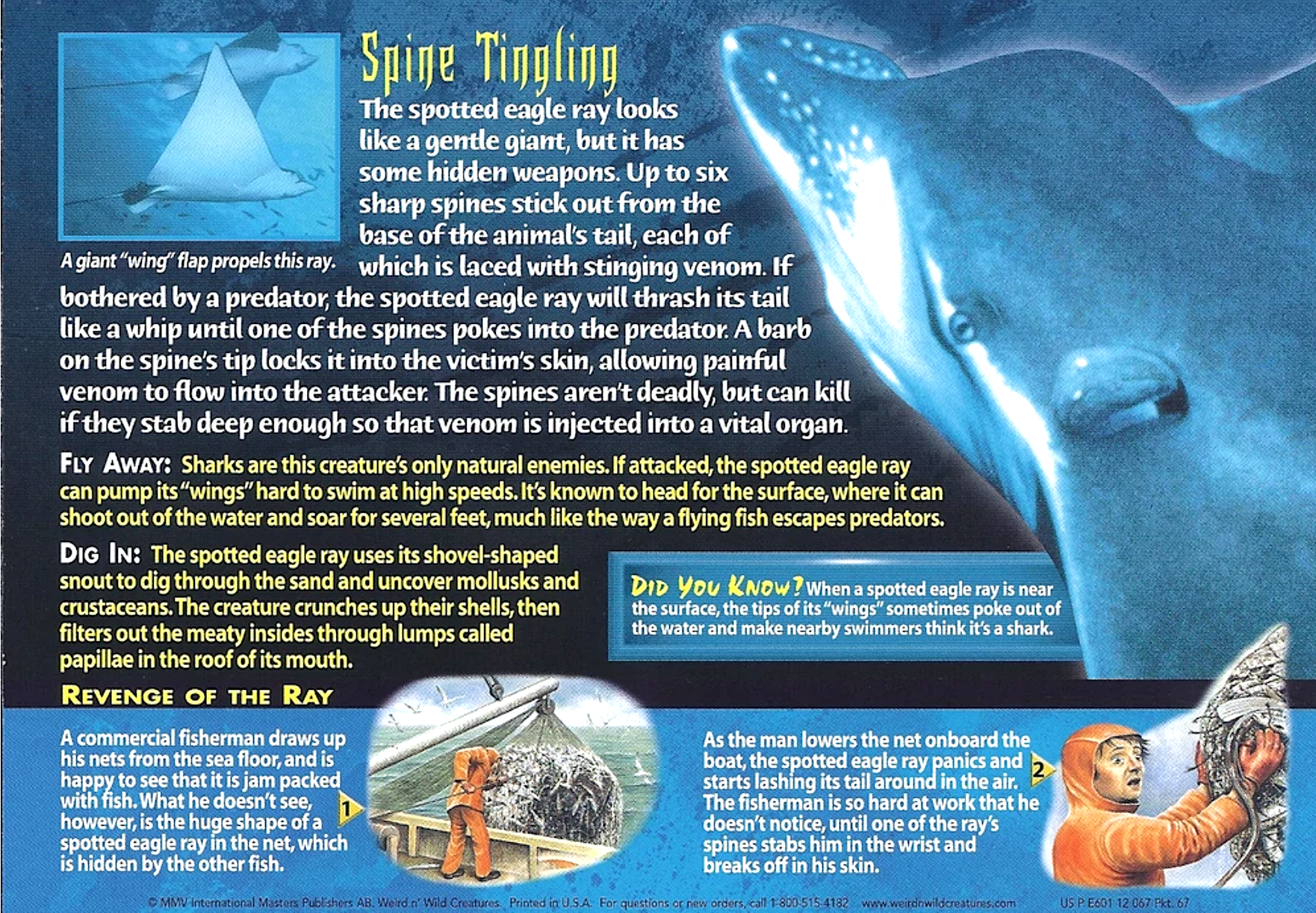
I have a lot of time for these cards produced by ‘Weird ‘n’ Wild Creatures’. In their unique style they are simple, educative and often give information nuggets not found elsewhere. The link is to their 4th series, Monsters of the Deep.


Photo credits: Gabrielle Manni (1), (5); Catherine & Tara Pyfrom (2); Melinda Riger / Grand Bahama Scuba (3); Lazlo-photos Wiki (4); Wiki (baby ray thumbnails); John Norton Wiki (6); Jacob Robertson Wiki (7); Weird ‘n’ Wild Creatures – card images. Videos as credited in text.

Spotted Eagle Ray, TCI (Jacob Robertson, Wiki)
Unknown's avatar

HAWKSBILL TURTLES: DIVERS VIEWS…


Hawksbill Turtle (Adam Rees / Scuba Works)

HAWKSBILL TURTLES: DIVERS VIEWS…

Daydream for a moment. Imagine that you had a different occupation. And your new one involved daily contact with spectacular wildlife underwater (this assumes you can swim – debatable in my case). And access to some upmarket camera equipment. And the ability to use it effectively. Oh, and use of a reliable boat. And some sea.

Hawksbill Turtle (Adam Rees / Scuba Works)

Say, for example, you joined a dive operation. Then the chances are very high that these wonderful creatures would be a part of your daily 9-to-5. 

Hawksbill Turtle (Adam Rees / Scuba Works)

You wake up with a start. Oh no! Half an hour gone, and that crucial email still half-written… Where did the time go?

Hawksbill Turtle (Adam Rees / Scuba Works)

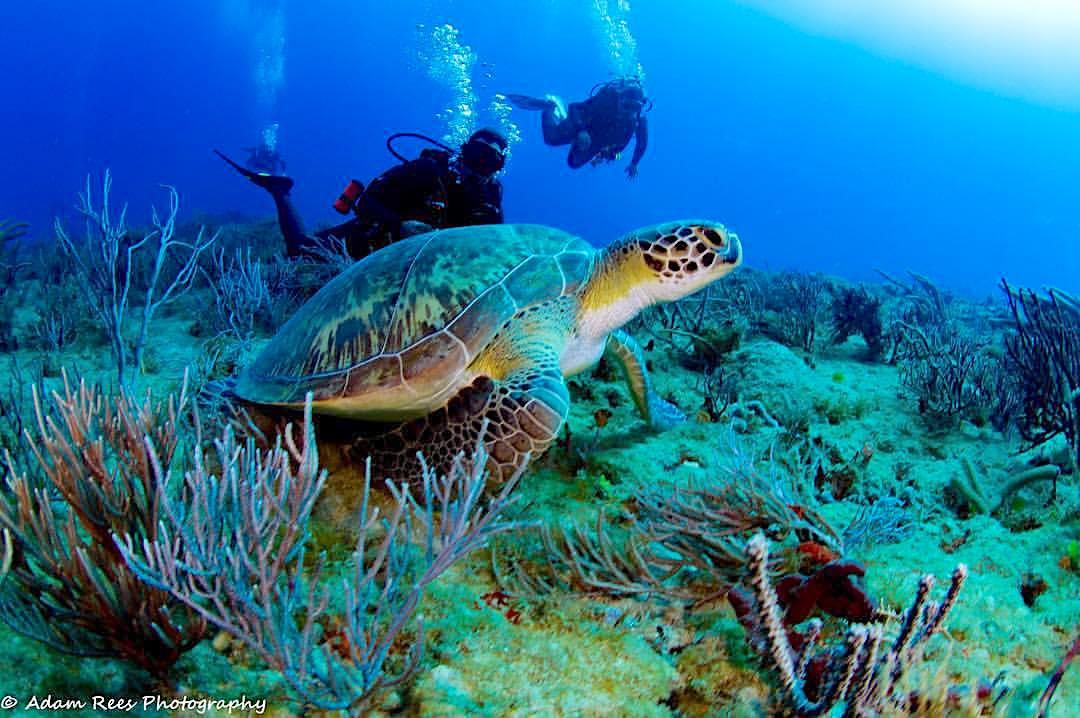
All gorgeous turtles taken by Adam Rees of Scuba Works (slogan: “Land is so overrated”) in the course of his everyday working life. Some people, eh?

Hawksbill Turtle (Adam Rees / Scuba Works)

Unknown's avatar

AN ‘EXHILARATION’ OF ABACO DOLPHINS


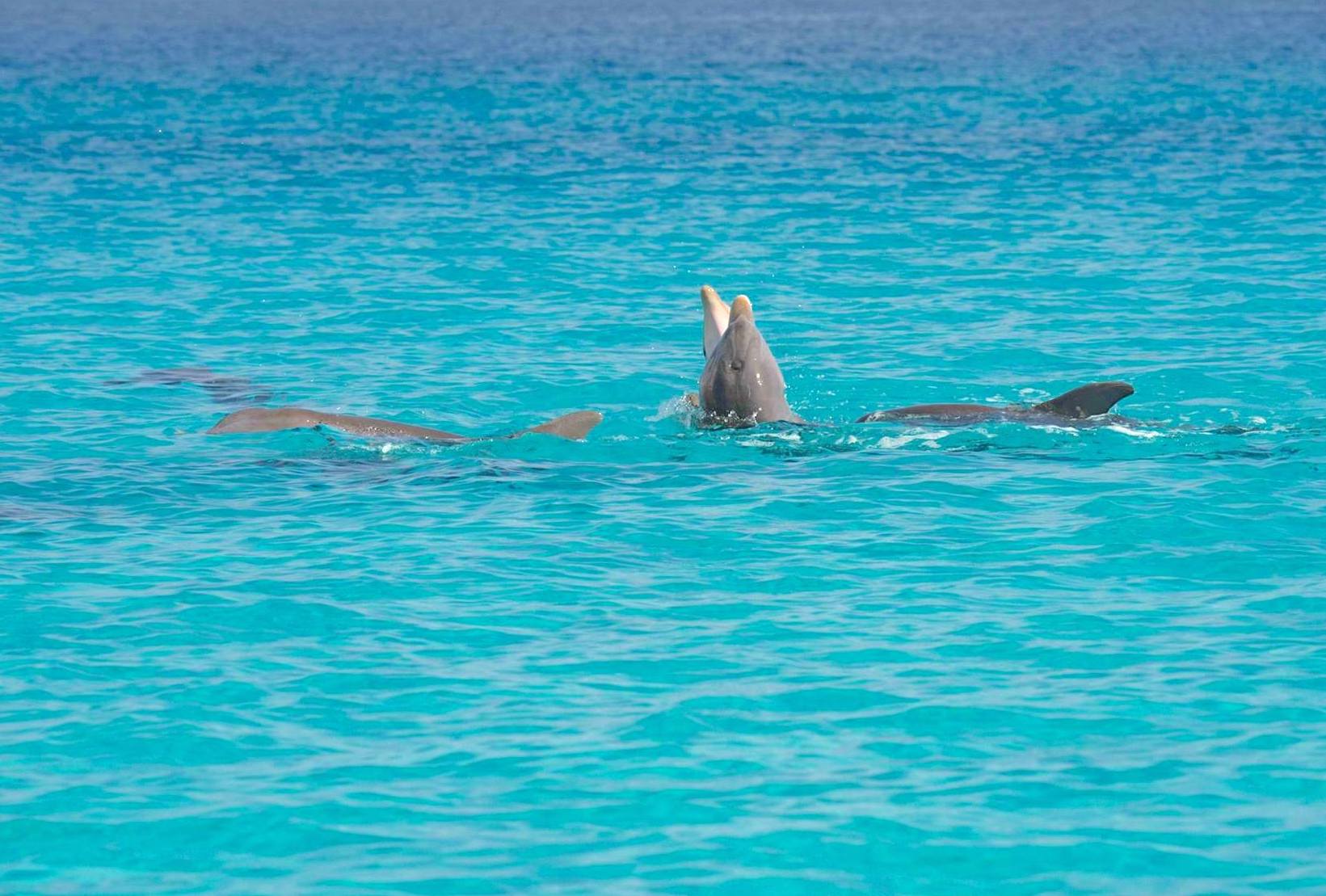
Bottlenose Dolphins, Abaco Bahamas (BMMRO)

AN ‘EXHILARATION’ OF ABACO DOLPHINS

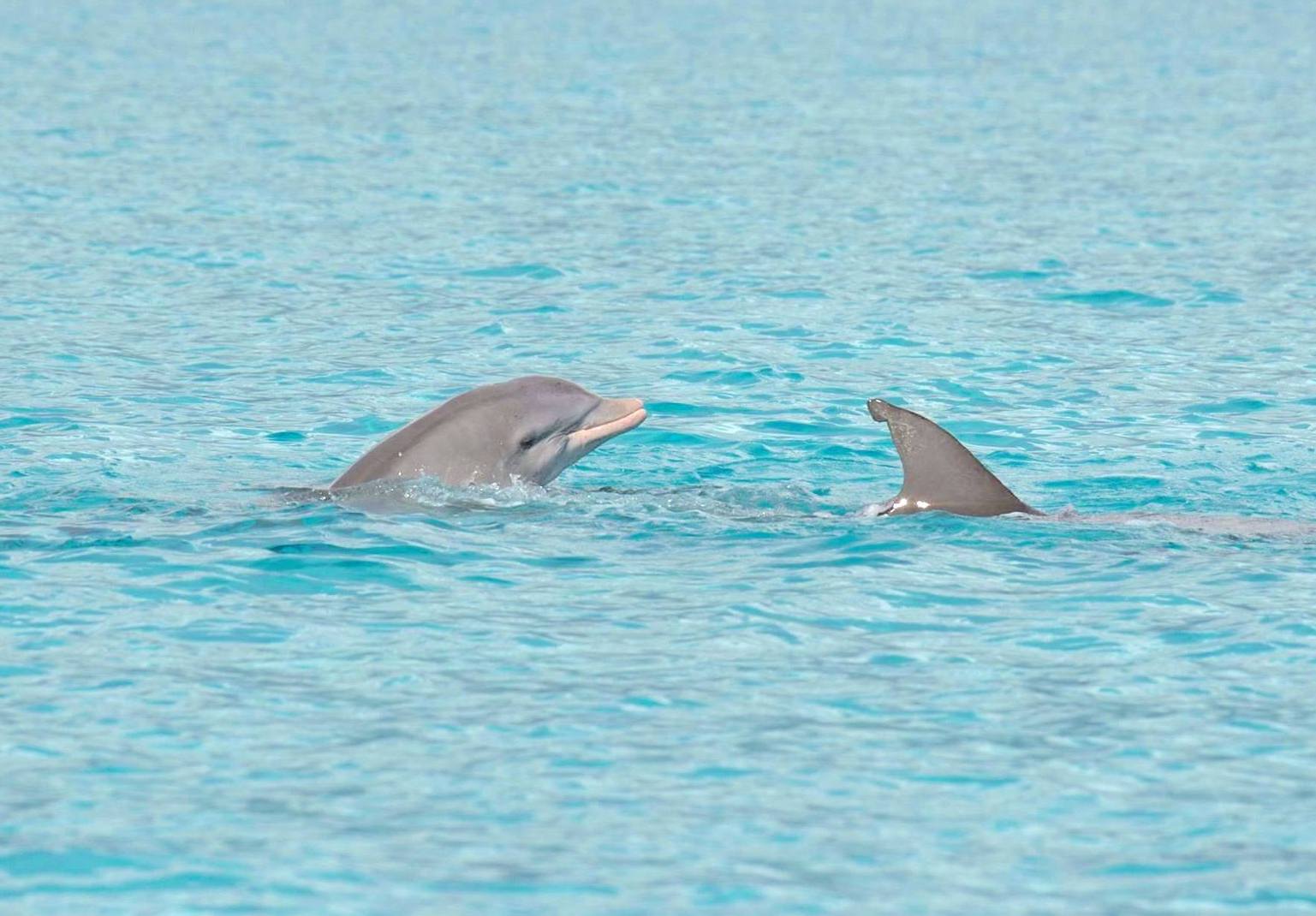
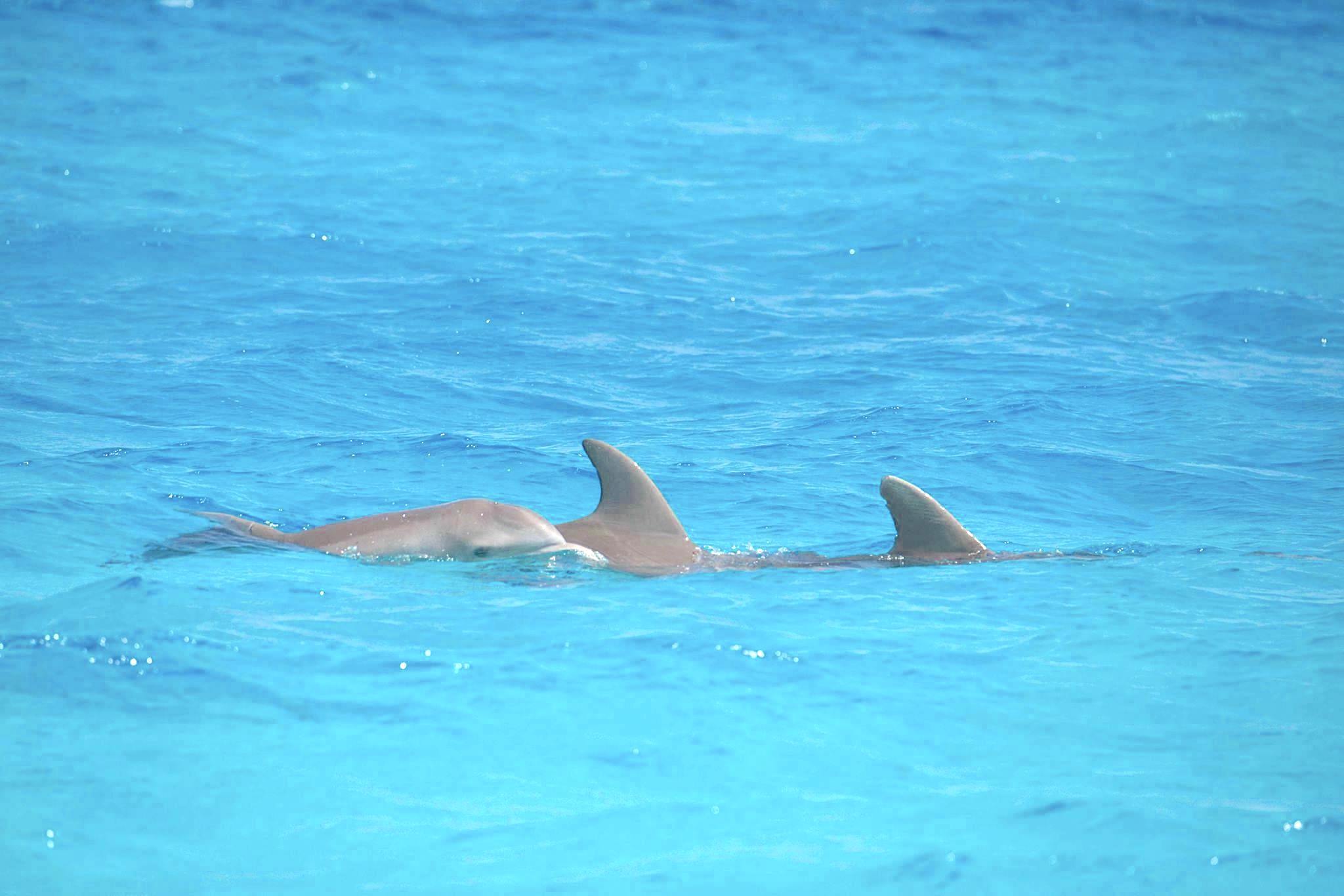
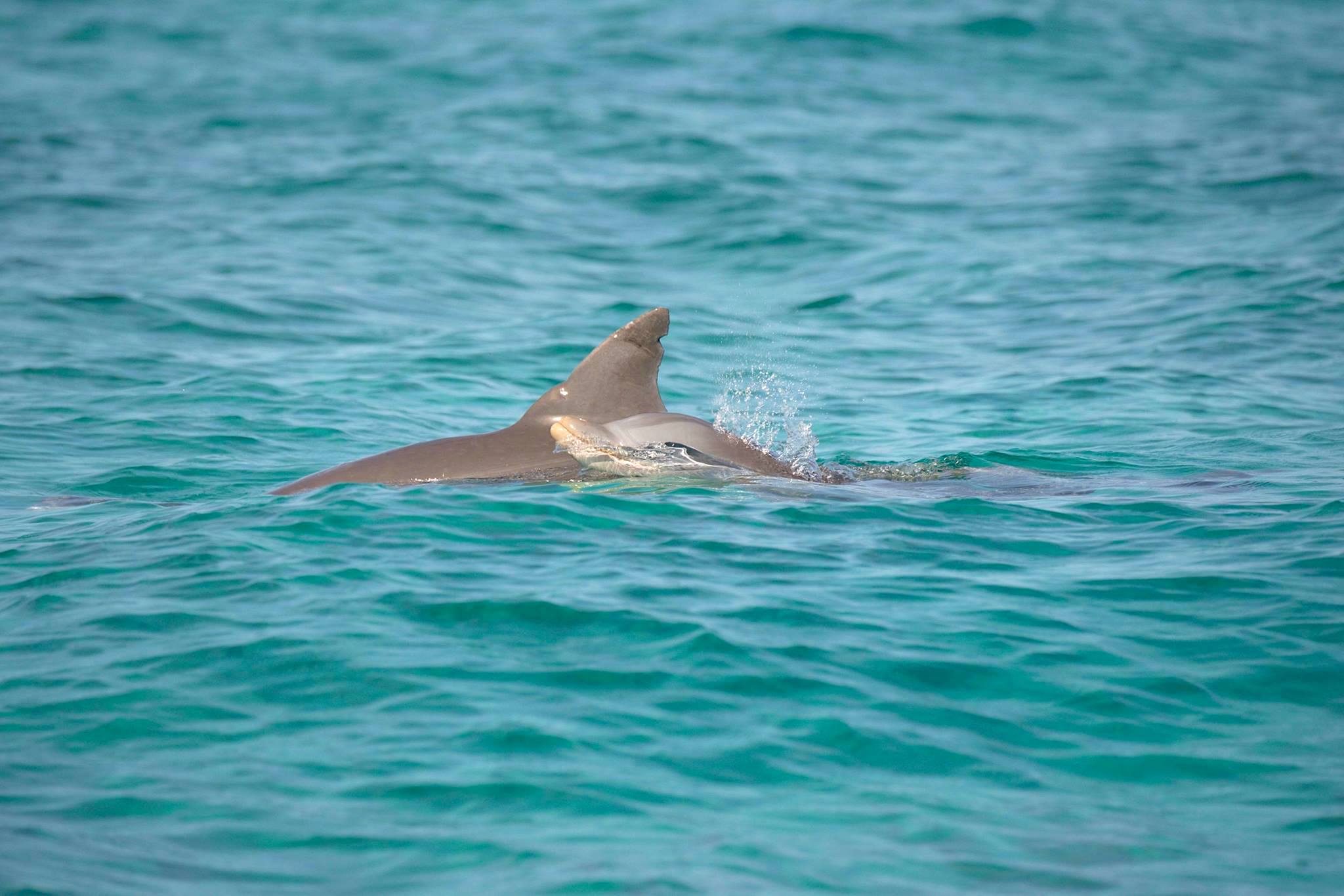
Bottlenose dolphins! Tursiops truncatus! These engagingly playful show-offs of the inshore waters round Abaco are 99.99% adorable**. It’s been a harrowing few weeks in the western Atlantic, and everyone is hoping that the 2017 hurricane season has had enough of causing death and destruction over vast swathes of vulnerable islands and on the US mainland. Some cheer is needed.

Bottlenose Dolphins, Abaco Bahamas (BMMRO)

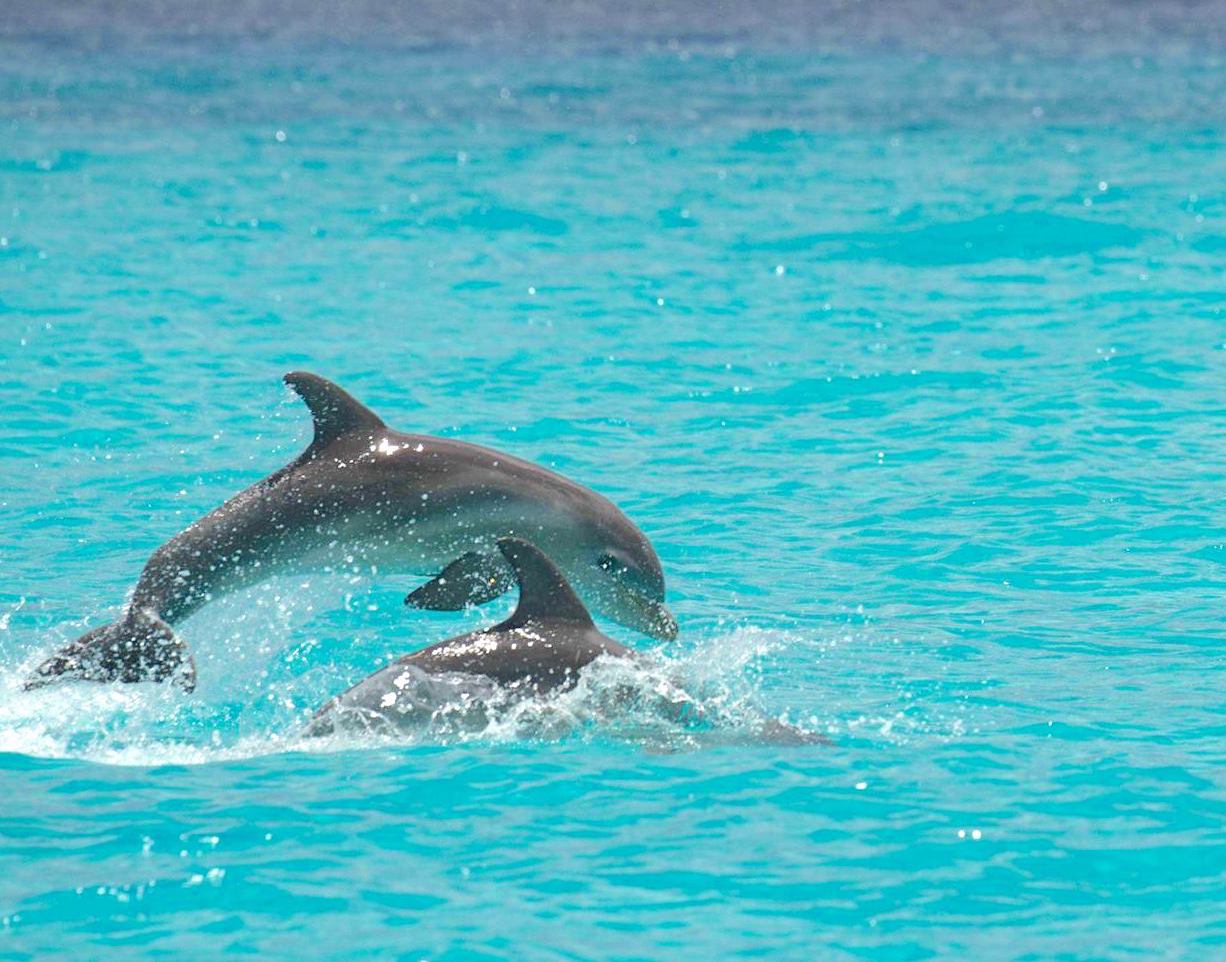
Dolphins are good for the soul. And if you are out on a boat watching them – and especially tracking them for a whole day – every encounter reinforces the impression that all the leaping, bow-wave riding, boat under-swimming, and general sociability and interaction is often as much for sheer enjoyment as anything else. 

Bottlenose Dolphins, Abaco Bahamas (BMMRO)

Abaco is fortunate in having the HQ of the Bahamas Mammals Research Organisation (BMMRO) based at Sandy Point. That just happens to be an excellent area for bottlenose dolphin spotting in the turquoise shallows. Many sightings are made within clear sight of land. Further south, where the bright blue gives way to darker and deeper water, live the equally frolicsome Atlantic spotted dolphins. The 3 photos above were all taken on the margins of where the colour of the sea changes from light to dark.

Bottlenose Dolphins, Abaco Bahamas (BMMRO)

I’m a bit of a collector of collective nouns. For dolphins, apart from the matter-of-fact ‘group’ or ‘pod’, there is no exotic word to describe a number of them when they are having fun. No equivalent of ‘exaltation’ (larks), ‘charm’ (goldfinches) or ‘parliament’ (owls). So I’m nominating an ‘exhilaration’ as a candidate to fill the gap…

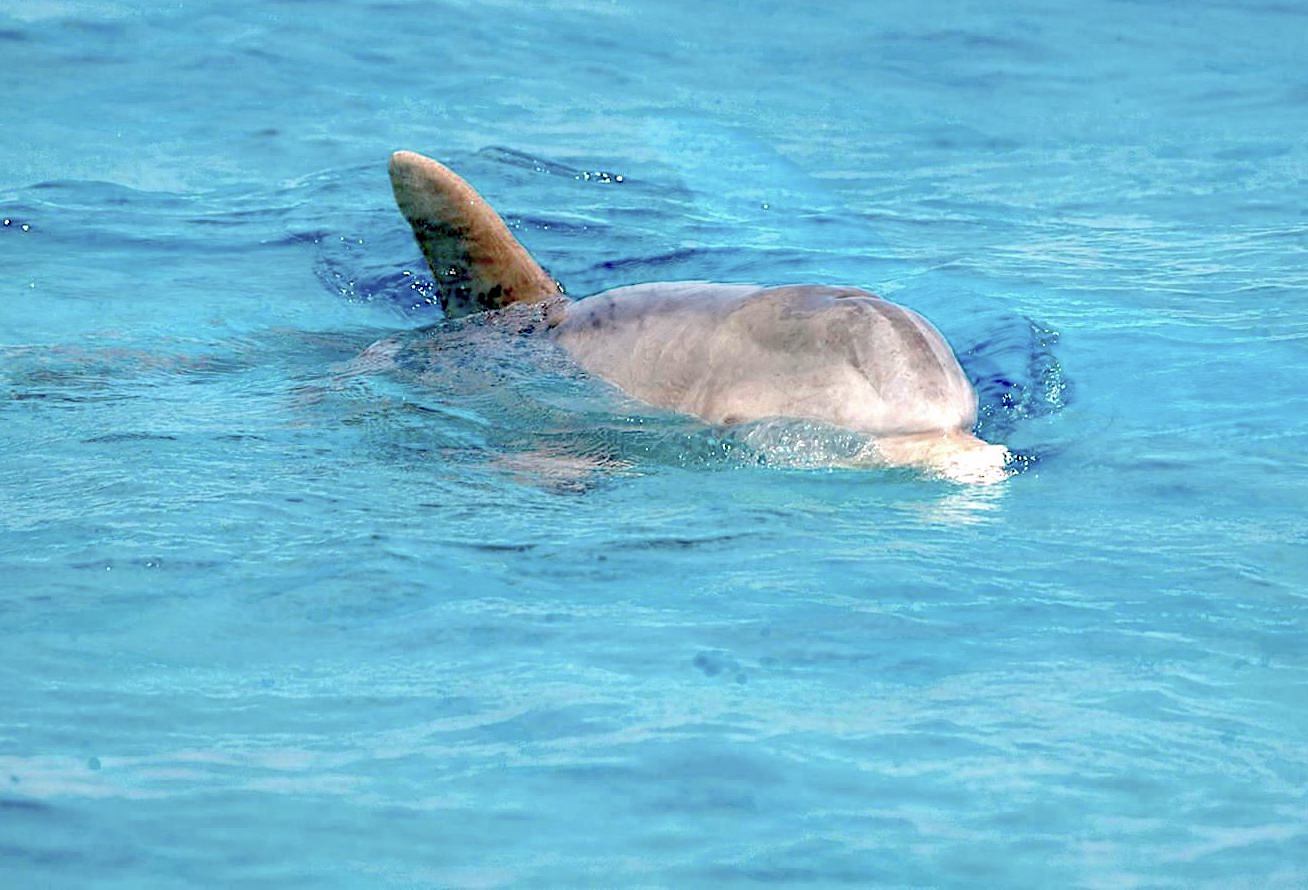
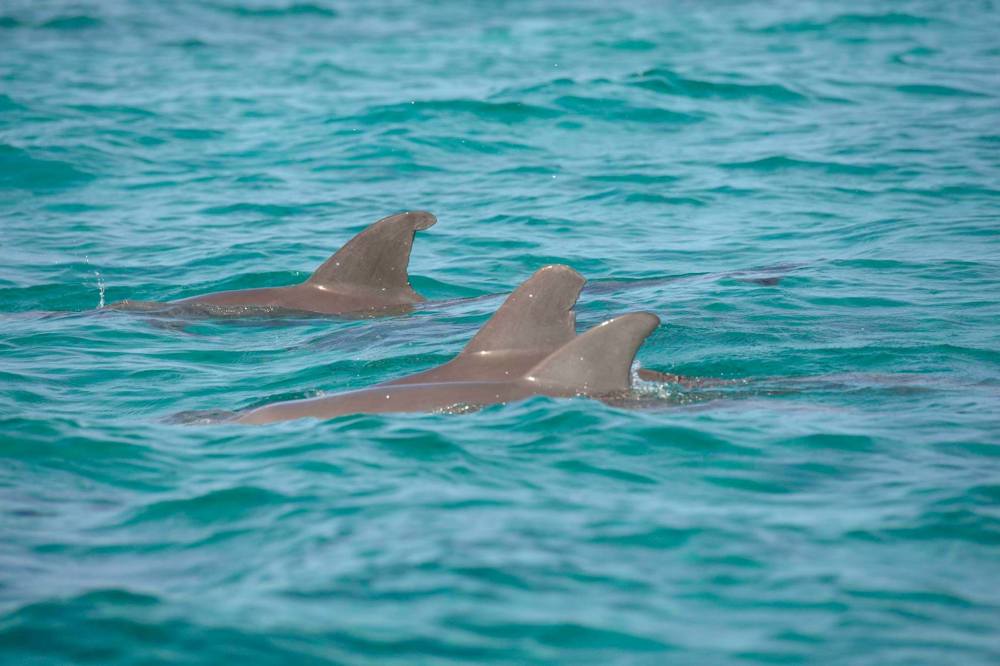
The photo above shows clearly how individual dolphins can be identified by researchers. All tend to have scars or tears to their dorsal fins that enable them to be distinguished. The closest has distinctive scars near the tip. The furthest has a W-shaped nick at the back. In fact, it could even be Rocky, a well-known dolphin on Abaco that has been sighted over many years. There are regular reports annually. I saw him myself once, in 2012, playing about in Hopetown harbour. 

STOP PRESS To demonstrate how the ID methods work, I’ve now cross-checked with the BMMRO photo ID archive. Here is Rocky’s original dorsal fin ID image (“Tt15”) from October 2010. There’s a W-shaped nick, sure, but my speculation above was wrong because overall the two fins are clearly different…

Rocky the Dolphin Tt15, from BMMRO ID photo archive

** The 0.01%? Dolphins may, rarely, be alarming for divers in circumstances I won’t repeat here (hint: to do with over-friendliness, ok? Yes, the thing that dogs do)

Credits: all photos BMMRO – and taken in the last 2 months

Unknown's avatar

QUEEN TRIGGERFISH AND GOOD RIDDANCE TO MARIA


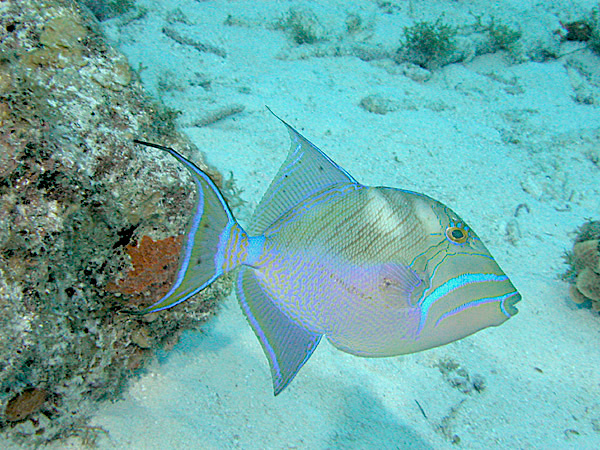
Queen Triggerfish Bahamas (Melinda Riger / Grand Bahama Scuba)

QUEEN TRIGGERFISH AND GOOD RIDDANCE TO MARIA

I can think of no sensible connection between the colourful yet undoubtedly strange and grumpy-looking looking queen triggerfish Balistes vetula, and a hurricane. However, Hurricanes Irma and Maria have been rightly dominating the news and everyone’s thoughts for nearly 3 weeks now. And most of the recent posts from Rolling Harbour, for that matter. It’s not been a great time for looking at the birds, beasts and fishes. So, as Maria drifts eastwards and away from the Bahamas into the open ocean, it’s time for a splash of colour – and a fish I have not featured before. 

Hurricane Maria tracking at 11.00 EST on Sept 22

Queen Triggerfish Bahamas (Melinda Riger / Grand Bahama Scuba)Queen Triggerfish Bahamas (Melinda Riger / Grand Bahama Scuba)

The queen triggerfish, sometimes known as an Old Wife, is an Atlantic reef fish. This species is sometime fished for as game, and I know that a few have been taken from off the rocks at the south end of Delphi beach over the years – though perhaps not exactly on purpose.

Queen Triggerfish Bahamas (Mark Peter, Wiki)Queen Triggerfish Bahamas (Melinda Riger / Grand Bahama Scuba)

This fish typically is coloured with shades of  blue, purple, turquoise and green with a yellowish throat, with pale blue lines fins on head and fins. It’s minor superpower is to be able to change its coloration to some extent to match its reef surroundings and assist camouflage. Its favourite food is the sea urchin.

Queen Triggerfish Bahamas (Clark Anderson / Aqua-images)

Let’s hope this is the last post to feature anything about hurricanes for a good long time, as we think of all those still struggling to make sense of the terrible destruction they have recently experienced – in some places, twice over.

Credits: Melinda Riger / Grand Bahama Scuba; Mark Peter, Wiki; Clark Anderson / Aqua-images

Unknown's avatar

CLEANING UP IN THE BAHAMAS: PEDERSON SHRIMPS


Pederson's Cleaning Shrimp, Bahamas (Melinda Riger, GB Scuba)

CLEANING UP IN THE BAHAMAS: PEDERSON SHRIMPS 

Pederson’s Shrimps Ancylomenes pedersoni (also known locally as Peterson’s shrimps), are one of several species of cleaner shrimp found in The Bahamas and more generally in the Caribbean seas. The species was named in 1958 by a multifaceted medico-oceanologist-zoologist Fenner A. Chace. He seems to have specialised in shrimps, finding distinct and differing species and naming them (not unreasonably) after himself (chacei);or colleagues and people he knew / admired; and in one case his wife. Mr Pederson was among them.

Pederson's Cleaning Shrimp, Bahamas (Melinda Riger, GB Scuba)

This tiny transparent creature with its vivid blue / purple markings and straggling pale antennae is unmistakeable, and helpfully cannot be confused with any other locally found shrimp species. Here’s an idea of its size, compared with a human finger and a blue parrotfish.

Pederson's Cleaning Shrimp, Bahamas (Melinda Riger, GB Scuba)

WHERE DO THESE SHRIMPS LIVE?

Their preferred home is… and it’s certainly a left field choice among sea creatures… in amongst the stinging tentacles of certain sea anemones. Not only do they not get stung, but of course they are well-protected by the defensive pain that their hosts can inflict. They are usually found singly or in pairs, but sometimes a whole colony may inhabit the same anemone.

SO EXPLAIN HOW THEY DON’T GET STUNG

Ok. The shrimps gradually build up a kind of resistance by pressing their bodies and antennae against the tentacles of the host anemone for increasing lengths of time, until they become immune. It’s like one of those kids’ electric buzzer / rheostat machines. Or a TENS machine (for those who know about backache).

 IS THERE A DOWNSIDE TO ALL THIS?

Yes indeed. If a shrimp moves away from its host for a few days, it has to start the process of immunisation all over again. So presumably they tend to stay home-lovin’.

Home sweet home for the Pederson shrimpsPederson's Cleaning Shrimp, Bahamas (Melinda Riger, GB Scuba)

SOMETHING ABOUT THE CLEANING, PLEASE

These shrimps offer ‘cleaning services’ to passing fish. When on duty, as it were, they wave their antennae vigorously to attract attention. A fish being cleaned will remain stationary and passive while external parasites and dead skin are removed. Many fish will open their mouths and gill covers for internal cleaning, with the tacit agreement that the cleaner will not become a snack. Shrimps often work in conjunction with small cleaner fish such as some species of goby and wrasse – see the links below for more on this topic, with copious images…

Pederson's Cleaning Shrimp, Bahamas (Melinda Riger, GB Scuba)

RELATED POSTS

CLEANING STATIONS

CLEANER FISH

Credits: all photos by Melinda Riger / Grand Bahama Scuba

Unknown's avatar

BAHAMAS REEF FISH (38): SPOTFIN BUTTERFLYFISH


Spotfin Butterflyfish, Bahamas (Melinda Riger / G B Scuba)

BAHAMAS REEF FISH (38): SPOTFIN BUTTERFLYFISH

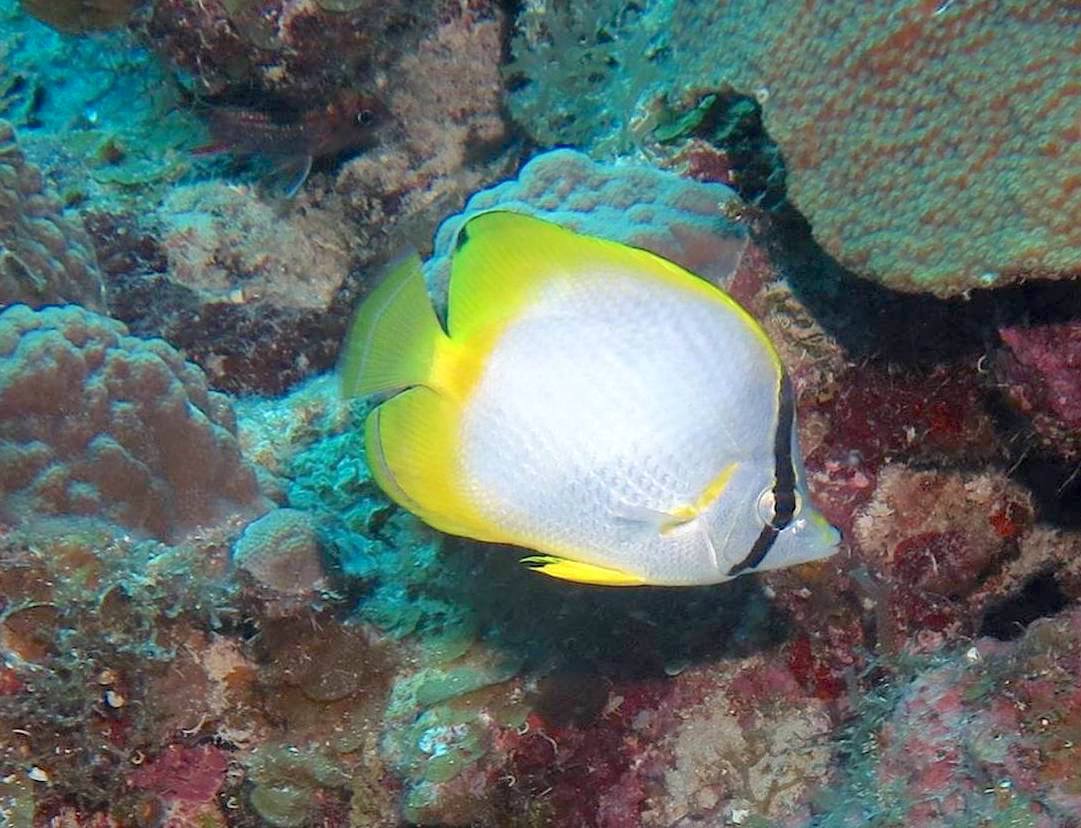
Butterflyfishes are a large family of mainly colourful small fish somewhat like mini-angelfish. The spotfin butterflyfish (Chaetodon ocellatus) is one of several types of butterflyfish found in the western Atlantic Ocean; and one of half a dozen or so you are likely to see nosing around the coral reefs of the Bahamas.

Spotfin Butterflyfish, Bahamas (Melinda Riger / G B Scuba)

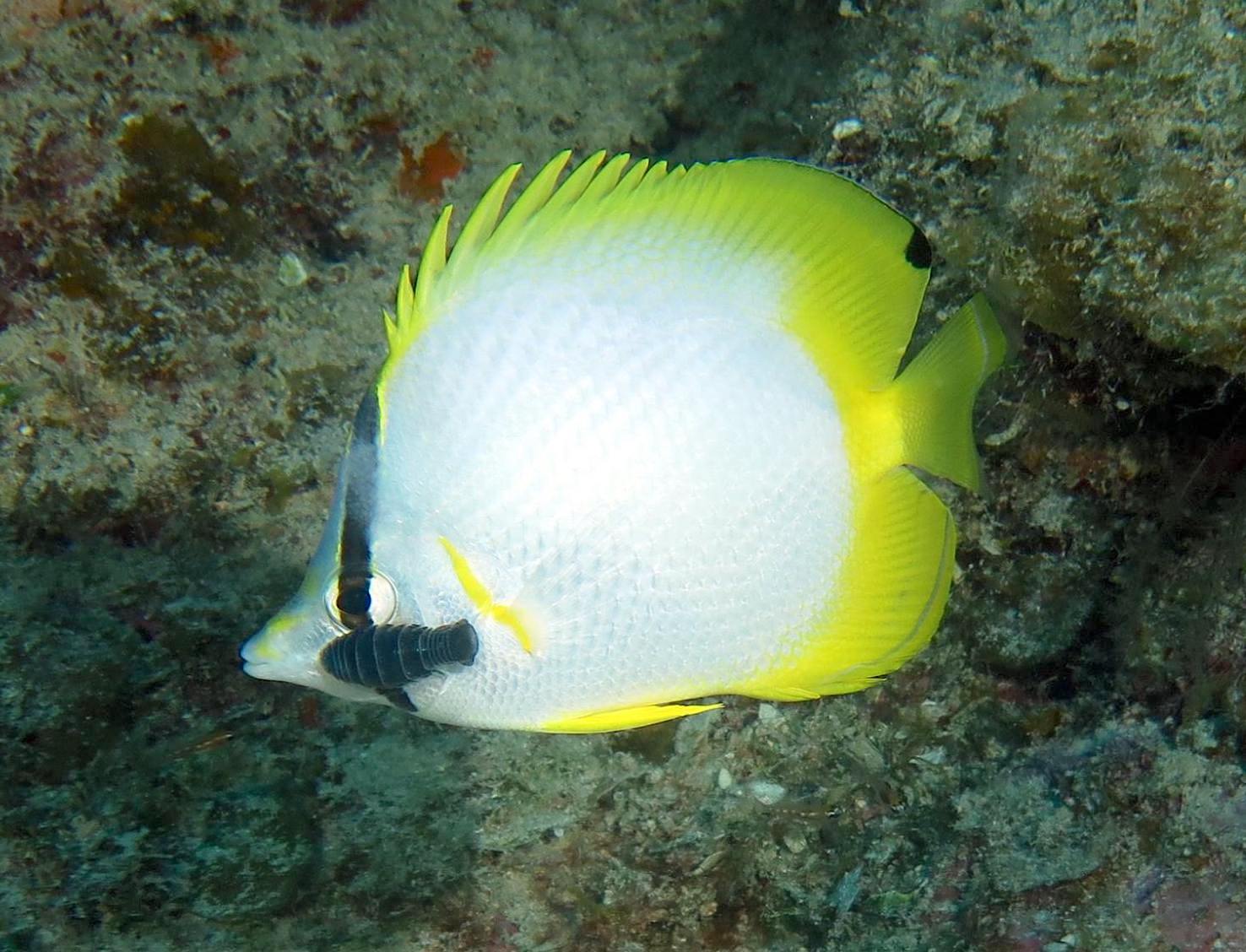
The name ‘spotfin’ derives from the dark spot on the dorsal fin. At the front end, there is a distinctive black vertical stripe that passes right through the eye. Combined with the vivid colouring, predators are in theory confused or warned off.  The spotfin’s superpower (on a modest scale) is that at night, a change of appearance occurs in adults. The dark patch on the dorsal fin increases in size, and dark bands appear on the body. This seems to be in order to provide further protection during the darker hours.

Spotfin Butterflyfish, Bahamas (Melinda Riger / G B Scuba)

The spotfin above has an isopod attached to it, a type of crustacean with a segmented body. Primitive fossils of these creatures have been dated back some 3m years. Want to know want this one is up to? These things “are mostly external parasites of fish or crustaceans and feed on blood, having piercing and sucking mouthparts and clawed limbs adapted for clinging onto their hosts”.

Soldierfish photobombs a spotfin. Or maybe it’s vice versa?Parasitic species are mostly external parasites of fish or crustaceans and feed on blood. The larvae of the Gnathiidae family and adult cymothoidids have piercing and sucking mouthparts and clawed limbs adapted for clinging onto their hosts.

Reading about this particular species of  butterfly fish, I discovered that the spotfin “is very common and very hard to maintain in a tank” –  as if the two facts are somehow connected. So might they be coarse or vulgar, and thus unsuitable companions for better bred and perhaps sensitive aquarium fish? As it turns out, it may be because they are vulnerable to predation, and so can coexist only with peaceable tank friends. 

Spotfins are perfectly happy swimming upside down; and their party trick apparently is to rise to the surface and squirt a jet of water in the air. Sadly, I couldn’t come up with a photo of this…

RELATED POSTS

LONGSNOUT BUTTERFLYFISH

REEF BUTTERFLYFISH

Credits: All fab photos by Melinda Riger / Grand Bahamas Scuba

Unknown's avatar

EYES ON STALKS: CONCH WATCH ON ABACO


Conch Man-o-War Cay, Abaco, Bahamas (Charmaine Albury)

EYES ON STALKS: CONCH WATCH ON ABACO

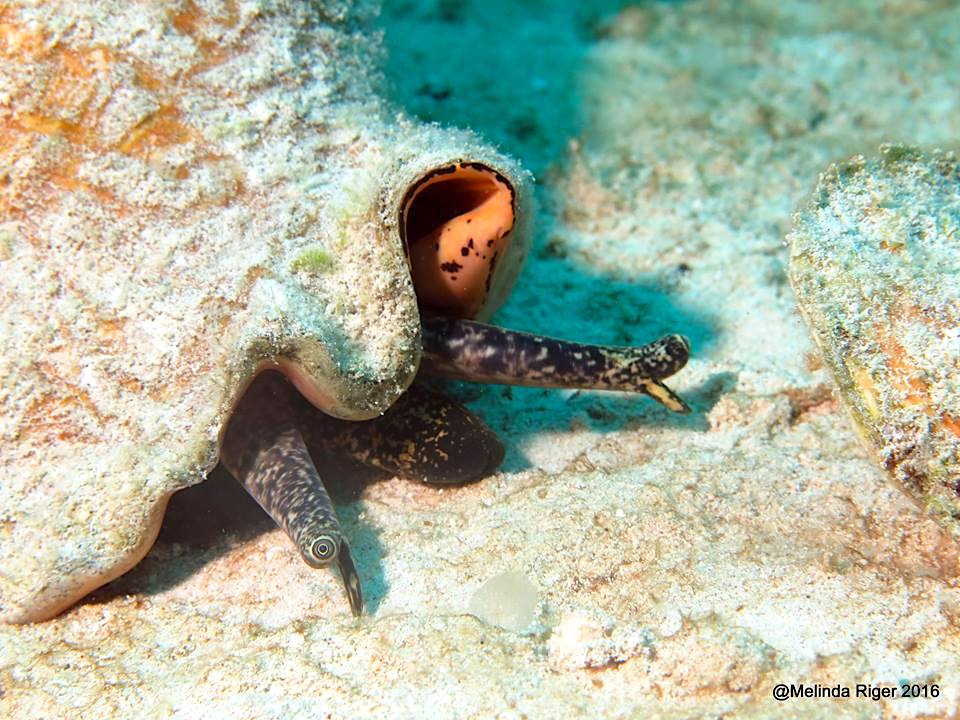
This is not so much about you looking at, and admiring (without salivating too much, I trust) conchs in their natural element. More about them watching you watching them – and focusing on their rather remarkable stalk-based eyes. Take a look at these examples of the ‘watcher in the shallows‘ (to misquote a well-known book title).

Conch and their eyes, Bahamas (Melinda Riger)Conch and their eyes, Bahamas (Melinda Riger)

HALF A DOZEN CONCH EYE FACTS TO PONDER

  • The eyestalks are attached to an extendable ‘snout’
  • The two eyestalks (ommatophores) are retractable within the shell
  • Their purpose is to provide a wider field of vision around the shell
  • The eyes at the tip of each eyestalk have ‘proper’ lenses, pupils and irises 
  • Amazingly, amputated eyes normally regenerate completely
  • The small projection below the eye is a ‘sensory tentacle’ or feeler

Conch and their eyes, Bahamas (Melinda Riger)Conch and their eyes, Bahamas (Melinda Riger)

CAUTIONARY WARNING

For a rather depressing view of the current state of conch populations, check out this recent article in the MIAMI HERALD. Not a great deal to be optimistic about…

I’M WATCHING YOU…

CREDITS: All remarkable ‘conch watching’ photos by Melinda Riger / Grand Bahama Scuba – except for the wonderful header image by Charmaine Albury (contributor the The Birds of Abaco), taken on Man-o-War Cay; Cindy James Pinder for the heads-up for the Miami Herald article

Unknown's avatar

DOLPHINS DISPORTING IN THE BAHAMAS


Atlantic Spotted Dolphin, Bahamas (BMMRO)

DOLPHINS DISPORTING IN THE BAHAMAS

‘Disporting’. Not a word I’ve used very often. Or possibly ever. It looks a bit like ‘unsporting’, which is emphatically what dolphins are not. Basically, it just describes what dolphins are doing when you see them on the surface: amusing themselves, frolicking around in the waves, and simply enjoying themselves.Bottlenose Dolphin, Bahamas (BMMRO)

True, they are probably keeping an eye out for food… But when you have a group sociably following alongside the boat your are in, moving in front, dropping behind, diving under, and generally playing around, it’s quite hard to believe that these are completely wild creatures. They seem to be performing just for you, simply because they want to. You don’t even have to throw fish at them to earn this free display.

Atlantic Spotted Dolphin, Bahamas (BMMRO)Atlantic Spotted Dolphin, Bahamas (BMMRO) Atlantic Spotted Dolphin, Bahamas (BMMRO)

As is well-known, the BAHAMAS MARINE MAMMAL RESEARCH ORGANISATION (BMMRO) is the custodian for the welfare of these beautiful creatures for the entire Bahamas. However, being based on Abaco and carrying out the majority of the research from the HQ at Sandy Point means that many of the great images that get taken are from Abaco waters. Indeed some are taken within swimming distance (not mine) of the shore.  Bottlenose Dolphin, Bahamas (BMMRO)Bottlenose Dolphin, Bahamas (BMMRO)Bottlenose Dolphin, Bahamas (BMMRO)Bottlenose Dolphin, Bahamas (BMMRO)

The photographs featured here were taken during the last few weeks. Some are of the familiar bottlenose dolphins. The others – with speckled undersides clearly visible in the header image & below – are of Atlantic spotted dolphins. There’s even one of my own taken from the research vessel. Atlantic Spotted Dolphin, Abaco Bahamas (Keith Salvesen)Atlantic Spotted Dolphin, Bahamas (BMMRO)

For the researchers, the most important part of an individual dolphin is its dorsal fin. Unique patterns of cuts and scars mean that each dolphin sighted can be logged and their profiles built up. Some have been found in the same area for many years. They are not usually given jocular names – ‘Davy Jones’, ‘Finny Phil’ or whatever. The first time we went out on the research vessel we were slightly surprised by the practical, scientific calls during a sighting of a dolphin group: “there’s B4 again” and “over there – D5 is back”. All said fondly however – many of the dolphins are old friends.

This dolphin has a notable notch on the dorsal fin with a nick below, & a scar line – with a prominent white scar on the lower front edge Bottlenose Dolphin, Bahamas - Dorsal Fin Damage (BMMRO)

Notice how these 3 dolphins all have quite different fin profiles.  The nearest one’s fin looks unblemished, but has a paler tip. Powerful binoculars and a serious camera can pick out small  differences at a distance that the eye could notBottlenose Dolphin, Bahamas - Dorsal Fin Damage (BMMRO)

Coming soon: Manatees & Man in the Bahamas

All photos (bar one by me) BMMRO, with thanks to Diane & Charlotte, and a tip of the hat to the current interns involved in the research projects (Hi, UK Thomas!)

Unknown's avatar

ROCK BEAUTY: BAHAMAS REEF FISH (37)


Rock Beauty, Bahamas (Melinda Riger / Grand Bahama Scuba)

 ROCK BEAUTY: BAHAMAS REEF FISH (37)

The Rock Beauty Holacanthus tricolor is a small species of Angelfish. Seen swimming around the reefs they are unmistakeable, not least because of their bright yellow hi-viz jackets, remarkable blue eyeliner and blue-black lippy. They featured near the start of this series HERE, and a recent online search (for something else completely, as is often the way) reminded me to give them another swim round Rolling Harbour.

Rock Beauty, Bahamas (Melinda Riger / Grand Bahama Scuba)

In addition to the hi-viz-and-eyeliner combo, the Beauty above has chosen a fetchingly cheeky pair of matching ISOPODS (crustacean parasites) to adorn its face –  possibly the piscine equivalent of a tat…

Rock Beauty, Bahamas (Melinda Riger / Grand Bahama Scuba)

Rock Beauties look like prime candidates for anyone’s aquarium, but their dietary requirements and tendency for aggression make them unsuitable. They are highly specialised feeders, needing marine sponge in their daily diet. They are also prone to chase their tank-mates and nip them. On balance, they look more fetching nosing about the coral anyway.

WHAT DO JUVENILES LOOK LIKE?

Juvenile rock beauties are cute mini-versions of the adults, only more yellow (including the lips). In some development stages, they have a smart blue circle in the middle of the dark patch on their sides (bottom image).


Rock Beauty (Juvenile)

NOTE Rock Beauties have no known relationship to Chrissie, Debbie, Lita, Stevie, Joanna, Madge and the rest of the accredited ‘Rock Beauties aka Chicks’.  

NOT A TRUE ‘ROCK BEAUTY’ (no offence, Lita)

A TRUE ROCK BEAUTY
800px-Holacanthus_tricolor_1

Credits: Melinda Riger, Grand Bahama Scuba,Wiki

Unknown's avatar

MARK CATESBY, PIONEER NATURALIST: NEW BOOK


MARK CATESBY, PIONEER NATURALIST: NEW BOOK

Exactly two years ago, I wrote about the publication of a lavish limited edition facsimile of Mark Catesby’s renowned work The Natural History of Carolina, Florida and the Bahama Islands in 4 volumes to mark the 300th anniversary of Catesby’s arrival in the New World. Unsurprisingly, the cost of the set was prodigious (a rather nice car) – but only a fraction of the cost of a vanishingly rare original set (a rather nice house). Reader, I didn’t buy one.

Now the CATESBY MEMORIAL TRUST has produced an excellent and inexpensive illustrated introduction to Catesby’s great work that will transport you back through the centuries to the earliest days of natural historical research by Europeans abroad. It’s worth remembering that Catesby antedated the more famous John James Audubon (1785-1851) by a whole century.

Catesby’s signature

The new book has over 40 illustrations from Catesby’s The Natural History of Carolina, Florida and the Bahama Islands. These are paired with relevant extracts from the work, and there is additional commentary. Click on Catesby’s Tropicbird below for a sample of the book.

Click me for book sample!

To buy the book – it’s $25 – click HERE

Mark Catesby - 'Bahama Titmous' (Bananaquit)

Mark Catesby – ‘Bahama Titmous’ (Bananaquit)

MARK CATESBY? JUST REMIND ME…

Mark Catesby (1683 – 1749) was a pioneering English naturalist and artist who published his magnum opus based on a number of expeditions he undertook from 1712 onwards. His was the first ever published account of the flora and fauna of North America, and the 2 volumes (with a supplement) included some 220 colour plates of the creatures and plants of land and sea that he had come across. After his travels, Catesby spent some 20 years producing his masterwork and died soon after, perhaps from the sheer effort of it all.

Red-legged Thrush in Gumbo Limbo Tree (HM QE2)

Red-legged Thrush in Gumbo Limbo Tree

AND HIS RELEVANCE TO THE BAHAMAS IS…?

On behalf of the Royal Society Catesby undertook expeditions, first to Carolina and then more widely in America and eventually in the Bahamas. On these trips he drew and painted detailed pictures of birds, fish, turtles, flowers and corals, many of which are familiar in the Bahamas to this day – and a few of which are included here.

Mark Catesby - Angelfish

Mark Catesby – Angelfish

Flamingo Head + Gorgonian Coral (HM QE2)

Flamingo Head & Gorgonian Coral

Mark Catesby - plate 139 Hawksbill Turtle

Mark Catesby – Hawksbill Turtle

Mark Catesby (Black-faced Grassquit)

Mark Catesby (Black-faced Grassquit)

RELATED POSTS

CHARLES CORY & ABACO 1891

THE PIONEERS (Wilson, Audubon, et al)  

MR SWAINSON (on his 224th Birthday)

Bahama Finch (Western Spindalis)

RELATED BOOK

51C+Zz+7CSL._SX363_BO1,204,203,200_

Information about the Catesby Commemorative Trust and the book The Curious Mister Catesby can be found HERE. I have the book: it is wonderful, but as an amateur I find it quite a difficult read, and I have to take it in small chunks.

For anyone tempted to look further into the importance of this ground-breaking naturalist, the CCT produced a 50 minute film that is well worth watching if you are interested to know more.

Credits: HM QE2, Catesby Commemorative Trust, National Geographic, Mariners’ Museum Library, sundry open source info-&-pic-mines inc. Wiki, Addison Publs, 

“Illuminating natural history is so particularly essential to the perfect understanding of it”   (Mark Catesby)

Unknown's avatar

HAWKSBILL TURTLES + ANGELS = REEF HEAVEN


Hawksbill Turtle & Angelfish (Melinda Riger / Grand Bahama Scuba)

HAWKSBILL TURTLES + ANGELS = REEF HEAVEN

Hawksbills on their own, nosing around the colourful coral reefs of the Bahamas, are a beautiful sight. I don’t want to overdo the religious tendency of the title, but they are indeed wonderful to behold. Add FRENCH ANGELFISH and a QUEEN ANGELFISH and it’s as close to perfection as a reef scene gets. Click on the links above for more pictures and details about the two angelfish species seen here with the turtle. As ever, Melinda Riger was ready with her camera to capture these great images.

Hawksbill Turtle & Angelfish (Melinda Riger / Grand Bahama Scuba) Hawksbill Turtle & Angelfish (Melinda Riger / Grand Bahama Scuba) Hawksbill Turtle & Angelfish (Melinda Riger / Grand Bahama Scuba) Hawksbill Turtle & Angelfish (Melinda Riger / Grand Bahama Scuba)

This astonishing photo was of course achieved by carefully balancing a GoPro on the turtle’s back, wrapping duct tape around it, and pressing ‘go’ (camera and turtle simultaneously). **

Hawksbill Turtle & Angelfish (Melinda Riger / Grand Bahama Scuba)

** This is not true. It’s just a cleverly shot turtle’s-eye view as it forages on the reef

This short video shot by Melinda’s husband Fred of a turtle ‘loving’ the camera is one of those wildlife events that cannot be predicted… but when it happens, it’s frankly a bit of a scoop.

OPTIONAL MUSICAL DIGRESSION

As I was writing this, an earworm started up and grew insidiously in both ears and then inside my head… the dread words “Elenore, gee I think you’re swell”. Followed by “so happy together…”. And then “she’d rather be with me…” Yes, I’ve now got TURTLES in my head, the (?long-and-hitherto-forgotten) band from the second half of the 60’s, with their cheery anodyne soppy-poppy love songs. And dammit, they’ve stuck… Here’s a reminder for those whose memory I have jogged. For anyone under, say, 75, step away from this area. Nothing to hear here.

Hawksbill Turtle & Angelfish (Melinda Riger / Grand Bahama Scuba)

Credits: Grand Bahama Scuba: all photos – Melinda Riger & video – Fred Riger; Turtle music – someone else’s music collection, not mine, honestly… (oh dear another lie I am afraid – cred gone)

Unknown's avatar

BAHAMAS REEF FISH (36): REEF BUTTERFLYFISH


Reef Butterflyfish, Bahamas - Melinda Riger / Grand Bahama Scuba

 BAHAMAS REEF FISH (36): REEF BUTTERFLYFISH

Butterflyfishes come in several varieties in Bahamian waters; and there are more than 120 species worldwide. Not so long ago I wrote about the LONGSNOUT variety, also known as the “Butterbun”. Now it’s time to take a look at the Reef Butterfyfish.

Reef Butterflyfish, Bahamas - Melinda Riger / Grand Bahama Scuba

In some ways butterflyfishes resemble small angelfishes – adult Reefs are just a few inches long. As the name suggests, these are creatures of the reefs, and of shallow waters. As one might expect, these colourful fish are popular for aquariums (or, strictly I suppose, aquaria). 

Reef Butterflyfish, Bahamas - Melinda Riger / Grand Bahama Scuba

Butterflyfishes have interesting spawning patterns. They release large numbers of buoyant eggs into the water. These become mixed in with plankton and suchlike, and float where the tides take them until they hatch. Then, most unusually, they go through a larval stage when they are covered by bony material, which they lose as they mature. This is known as an ‘armoured’ stage, which I can only assume is to provide protection to the tiny fry – perhaps by making them crunchy and unappetising. I’ve been trying to find a usable illustrative drawing, without success so far.

Reef Butterflyfish, Bahamas - Melinda Riger / Grand Bahama Scuba

OPTIONAL MUSICAL DIGRESSION

In some parts of the world the butterflyfish is called a BORBOLETTA, which is Portugese for ‘butterfly’. It is also the title of Santana’s criminally underrated sixth album (1974). For sure it’s no 1st, Abraxas, 3rd or Caravanserai… but if you can tolerate the man’s move to ‘jazz-funk-fusion’ – maybe John McLaughlin had a hand in that – there is much to enjoy. There’s less searing guitar and there’s some strange ‘soundscape’ stuff that’s maybe not to everyone’s taste. But still – it stand up pretty well in comparison with some of the later Carlos creations where a certain tiresomeness began to creep in and some tracks are (IMVHO) not really listenable-to. Anyway, the recently released (2016) Santana IV is a welcome return to the good old days, and the good old team.

Here’s ‘Promise of a Fisherman’ – 8 minutes of  Santana, from which you can judge the direction he’s taken by Album 6…

Reef Butterflyfish, Bahamas - Melinda Riger / Grand Bahama Scuba

All photos by Melinda Riger of Grand Bahama Scuba – mainstay, with Adam Rees, of the underwater photos I use, what with me being a feeble swimmer and all. Tip o’ the Hat to Carlos, who I have even managed to see Live a couple of times.