Unknown's avatar

BMMRO: WHALE ETC SIGHTINGS; BLAINVILLE’S BEAKED WHALES; WINTER NEWSLETTER


D

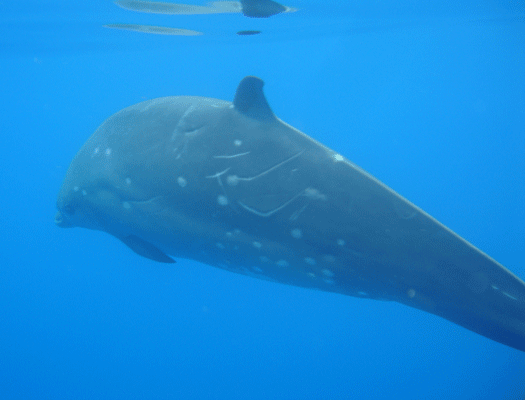
Blainville’s Beaked Whale, Abaco, Bahamas

SIGHTINGS REPORT OCT – DEC 2012

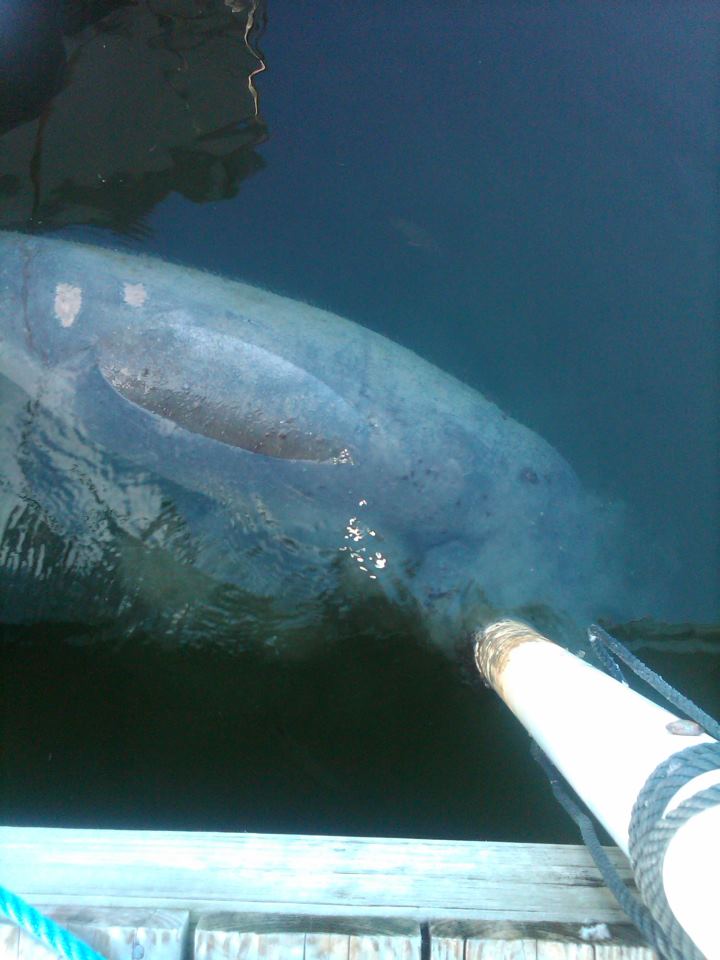
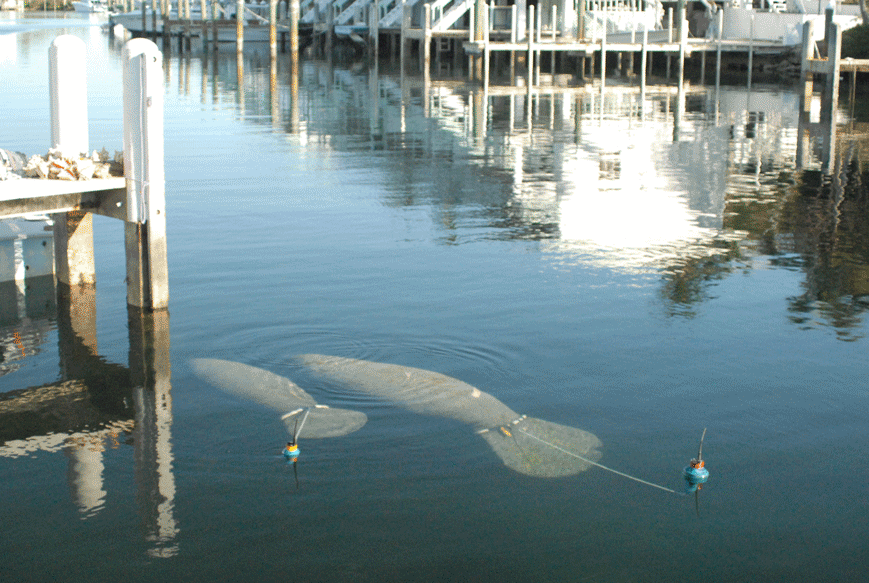
The last quarter of 2012 produced relatively few open-ocean CETACEAN sightings, not least because of a reduction in spotting trips during the period, with some members of the team elsewhere in the world completing their research. SIRENIAN activity is thankfully on the increase, with reporting opportunities increased by the manatees’ preference for sticking close inshore, usually in harbour areas. Georgie has gained her first yellow spot as Abaco’s only resident manatee following her long trip over from the Berry Is. (and away from mother Rita) last summer. She has  taken up residence in Cherokee. She performed a worrying vanishing trick during Hurricane Sandy, holing up (presumably) in seagrass off-shore, and (definitely) in an inshore channel for some of the time. She went AWOL again before Christmas, but has returned to Cherokee in good condition after a short vacation. Having shed her tag (several times) it was not possible to track her. The big plus is that she has proved capable of independent living, and has not become reliant on proximity to humans and their offerings of cabbage leaves etc… This photo was taken at Cherokee a few days ago.

Manatee Georgie, Abaco, Bahamas

The other notable new entry is a manatee sighting in the Freeport area of Grand Bahama. A single photo exists – a head shot – but it hasn’t been possible to identify the creature as a known one. (S)he may be a new visitor to the Bahamas. People in the area are asked to report any further sightings in the area to the BMMRO – and if possible to get a picture!
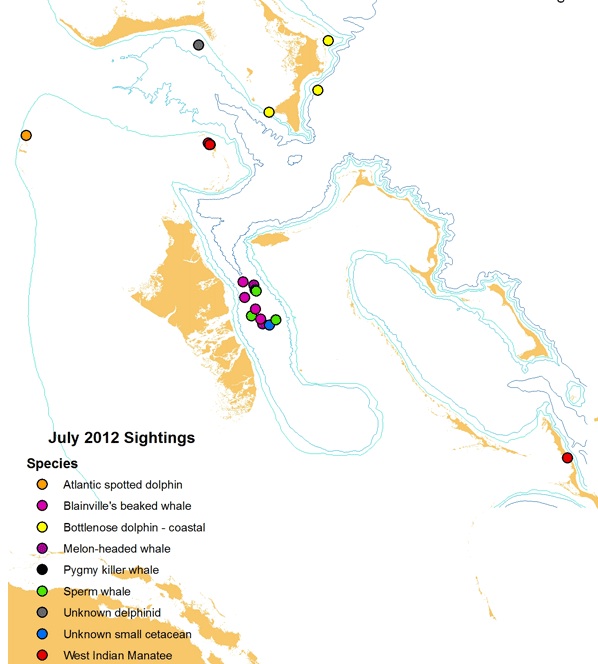
BMMRO CETACEAN SIGHTINGS OCT:DEC 12

BLAINVILLE’S BEAKED WHALES

RANGE MAP                                                         IUCN RATING “DATA DEFICIENT”


Mid-frequency broadband sounds of Blainville’s beaked whales

Recent research has been carried out on the sound variations of this relatively little-understood species of whale. “Recordings from acoustic tags show that five Blainville’s beaked whales produced mid-frequency broadband sounds on all of their deep dives, with each sex producing two different sound types. These broadband sounds are atypical of the regular echolocation sounds previously described for this species. One male produced a total of 75 sounds over four dives, between the depths of 109 and 524 meters, and four females produced a total of 71 sounds over 18 dives, between the depths of 305 and 1289 meters. Ninety-six percent of the male sounds and 42 percent of the female sounds were produced before the onset of foraging echolocation sounds, and all were produced before the deepest point of the dives. These sounds may be candidate communication signals, with their production timed to mitigate the risk of both predation and hypoxia (oxygen deprivation).”

The report includes sample sounds from the 3 BBWs shown below, and the one heading the page. I haven’t found a way to embed the sounds, but I am working on it (there’s a time -consuming method involving conversion to MP3, but maybe another day…)

Blainville’s Beaked Whales, Abaco, Bahamas Blainville's Beaked Whale AbacoDA
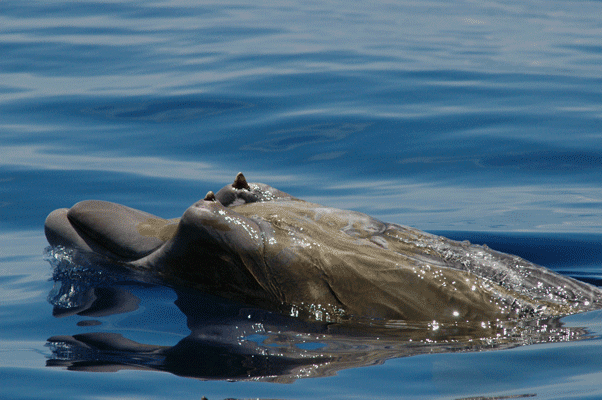
Thanks to the prolific DEAR KITTY for a cross-reference to this topic on her website, featuring a fine video of  BBW in French Polynesia

[youtube http://youtu.be/Ks1aLp5_hqo]

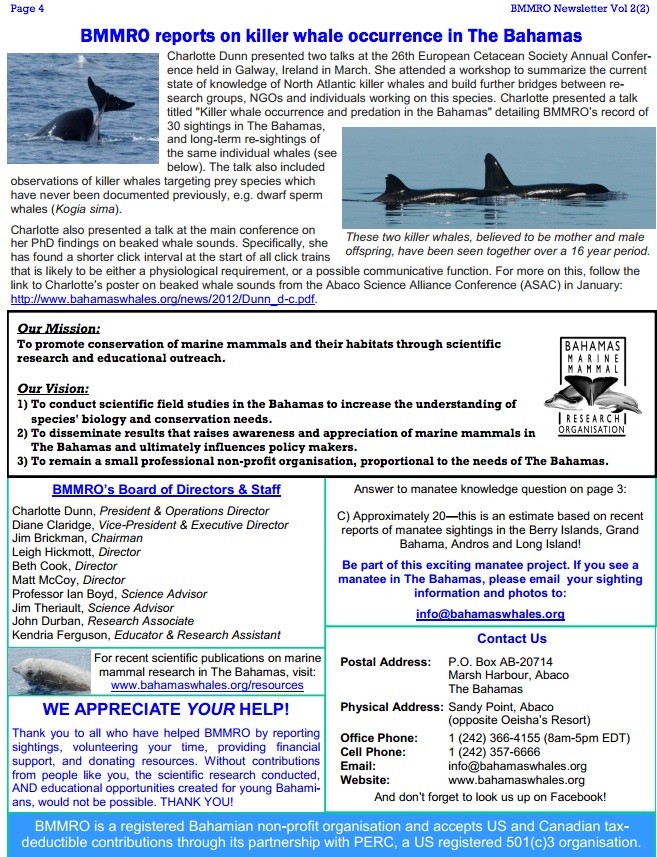
Finally, the action-packed, information-filled, image-laden 4 page winter newsletter. Click below to open.

BMMRO WINTER NEWSLETTER 2012 (Jan13)

Georgie Manatee BMMRO SUPPORT LOGO

mantsw~1

Unknown's avatar

ABACO: WHALES, DOLPHINS & MANATEES – BMMRO POST-SANDY REPORT


HURRICANE SANDY – AND AFTER

A report by Kendria Ferguson on the impact of Hurricanes Sandy for the BMMRO

After all the exciting but unexpected events of October, slowly life is returning to normal. As the whimsical but intimidating winds of Hurricane Sandy encompassed the research center, we felt a few limited blockbuster hits. Without power for four days and no contact with the world outside of Sandy Point, we felt like we were in a twilight zone! Hurricane force winds crept up on Abaco during the wee hours on Thursday, October 25th; predicted to be a Category 1, Hurricane Sandy surely made her presence felt! Luckily, we only had a few minor leaks at the research center but the community of Sandy Point and other parts of Abaco had severe flooding and extensive damage. 

Trapped in a house for four days with a hurricane that refused to leave, our concern for Georgie (the Christopher Columbus of our Bahamian manatees) began to grow. Georgie recently separated from her mother (Rita) in June of this year, and shortly thereafter decided to take a detour to Abaco, over 70 miles from the Berry Islands, Northern Bahamas, where she previously resided with a small population of manatees. Having travelled a tremendous distance around Abaco, she finally settled in at a small community called Cherokee Sound, located on the eastern side of Abaco. During Hurricane Irene, October 2011, Georgie and her mother swam from Spanish Wells, Eleuthera to Nassau. Whether this shift in locations was entirely due to the passing of a hurricane is unknown but scientists feared that Georgie could possibly get confused during the storm and take off to an unknown location.

Last sighted on the 24th of October, Georgie wasn’t seen again until November 4th, almost a week after Sandy had passed the community of Cherokee. She returned with a back covered in moss, an outstandingly healthy looking figure and thankfully no visible injuries/wounds as a result of the storm (these photos were taken on November 5th).

After hurricanes, an increase in shark bites has been documented amongst the dolphin population that inhabit the Little Bahama Bank (Fearnbach et al. 2012). Scientists believe that hurricanes may be the driving force for the relocation of dolphins to waters deeper than their preferred habitat which therefore makes them more accessible to predators such as oceanic sharks. Increase in wave height, storm surge, sediment erosion and deposition can make these once tranquil shallow habitats confusing for dolphins and manatees to navigate.

Photograph of a juvenile dolphin with a fresh and severe shark-bite wound on its flank

In the 1980’s and 1990’s, a decline in adult survival rate after the passing of major hurricanes (Category 3 and higher) among manatee populations in Florida were attributed to possible injury from debris, strandings and displacement of animals as a result of habitat loss and strong water currents (Langtimm et al. 2003).

As we hoped, Georgie appeared to have tucked herself into the nearby mangroves and returned within eyesight when she felt it was safe enough to leave the shelter she sought out during hurricane Sandy. Now that the storm has passed, falling debris has been cleared and our shallow water habitats have returned to the calm and often crystal clear waters we remembered them to be. We can all now let out a huge sigh of relief! We all survived Super-Storm-Sandy!

Fearnbach, H. D. (2012). Seasonality of calving and predation risk in bottlenose dolphins on Little Bahama Bank. . Marine Mammal Science, 28(2), 402-411. 
Langtimm, C. A. (2003). Lower survival probabilities for adult Florida manatees in years with intense coastal storms. Ecological Applications, 13:257-268.

Story by Kedria Ferguson, BMMRO’s education officer and manatee expert

The End

Unknown's avatar

GEORGIE THE ABACO MANATEE: IS SHE RELATED TO AN ELEPHANT?


GEORGIE THE ABACO MANATEE: IS SHE RELATED TO AN ELEPHANT?

Georgie, having returned to Cherokee after Hurricane Sandy, is still around there and seems to have made it her home. While she was missing, it was thought she had headed off instinctively for the protection of the mangroves. However a number of sighting reports made since Sandy suggest that she had sensibly swum up the canal at Casuarina, where she was able to keep her head down until the storm had safely cleared northwards, and she was able to return to base. Because she had shed her tag, we’ll never know the full story… 

Georgie safely back at Cherokee after Hurricane Sandy

Recently an interesting article by BEACH CHAIR SCIENTIST considered the relationship between sirenians and pachyderms, and added some handy comparative facts (you can seen more manatee facts on this blog HERE). Thanks, BCS, for use permission (the relevant credits are contained in the article).

Are manatees and elephants related?

by Beach Chair Scientist

It might be very difficult to imagine, but manatees (also known as ‘sea cows’) share a common ancestor with elephants which might come as a surprise if you thought manatees shared a common ancestor with other marine mammals such as dolphins, whales, or sea lions. Here are 10 facts that link manatees and elephants are long-lost relatives.

1. Scientifically, manatees and elephants are classified as subungulates. Other mammals in the Subungulata superorder are hyraxes and aardvarks.
2.Manatees and elephants have an uncommon-shaped heart that is spherical. To compare, most mammals have a single-pointed tip at the base (i.e., “heart”—shaped).
3. The West Indian and West African manatee have three or four fingernail-like structures on the tip of their flippers, just like that of the toenails on the feet of elephants.
4. Manatees and elephants both have a thick, gray skin with very sparse hair.
5. Manatees and elephants have molars which move toward the front of the mouth, eventually break off, and are restored by those at the rear. Elephants have a limited number while manatees are never-ending.
6. Manatees have two incisors that bear a resemblance to elephant tusks.
7. Manatees use their large, flexible muscular lips to break apart vegetation in the water and skillfully steer food to their mouths. This is very similar to the action of the elephant eating with his trunk.
8. Manatees and elephants are herbivores. Manatees tend to feast on sea grass and freshwater plants and consume up to 100-150 pounds a day. Elephants tend to feast on small plants, bushes, fruit, twigs, tree bark, and roots and consume up to 330-375 pounds a day.
9. Male manatees and elephants are known as bulls. Female manatee and elephants are known as cows. Young manatee and elephants are known as calves.
10. Manatees and elephants are both endangered. Their numbers have dropped due in a large part to human activities.

Manatee image (c) cruisenaplesflorida.com, elephant image (c) gallery.hd.org

Here is a fantastic TEACHING RESOURCE from the University of Florida and Se Grant extension I uncovered while pulling this post together.

Credit: SavetheManatee.org

To whom thanks also for this: WHAT DO MANATEES SOUND LIKE? 

[audio http://www.savethemanatee.org/Manatee%20Sounds/Track03mp3.mp3]


Unknown's avatar

“MANATEE MANIA IN THE ABACOS” BMMRO FALL 2012 NEWSLETTER


“MANATEE MANIA IN THE ABACOS” – BMMRO FALL 2012 NEWSLETTER

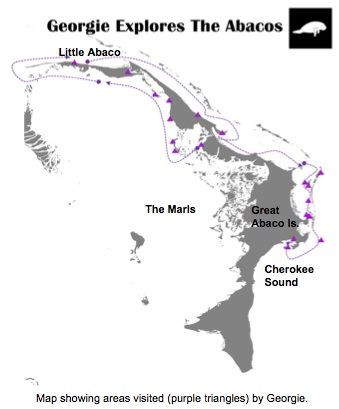
The BMMRO has just published the Fall 2012 newsletter, and it’s no surprise to find that the front page news is the arrival of young manatee Georgie on Abaco. After nosing and indeed grazing her way around Abaco and the Cays, she still appears to be contentedly moored in Cherokee after the best part of a month. Here’s the official map of her wanderings 

Besides the manatee there’s plenty more to read and look at including 

  • Charlotte Dunn’s ‘President’s Update’
  • Articles on whales, and a friendly bottlenose dolphin’s visit to Hope Town
  • Fall ‘cetacean sightings’ map
  • Students at ‘Whale Camp’
  • A quiz to make sure you have taken it all in…

To read the four-page document –  and admire the photos – CLICK BMMRO FALL 2012 NEWSLETTER

Unknown's avatar

GEORGIE THE ABACO MANATEE – CHEROKEE’S SIRENIAN VISITOR STAYS ON…


GEORGIE THE ABACO MANATEE – CHEROKEE’S SIRENIAN VISITOR  STAYS ON…

There must be something special about Cherokee on Abaco. Georgie the Manatee, having travelled over from the Berry Is. early last month, spent 4 weeks or so on the move. She was tracked on the west side of Abaco in the Marls, moving north and rounding Little Abaco, then travelling south visiting various Cays along the way, ending up in Hope Town harbour. After a few days she moved across from Elbow Cay to the Little Harbour area, before settling down in Cherokee. That was nearly 3 weeks ago. She’s still there, by far the longest she has stayed in one place

Maybe the sea grass is especially good there. Or maybe she has found a tasty freshwater spring. Or it could be that she is enjoying the company there, and the welcome from the community – though she of course has been a very popular visitor in all her ports of call. Whatever the reason, she seems to be happy and in good health. Kendria Ferguson (BMMRO) has just sent me 3 photos from her visit to Cherokee today. Georgie has managed to shed her tag – again – but since everyone knows where she is, it doesn’t matter for now…

The image below is also posted on the BMMRO’s FACEBOOK PAGE and maybe gives a clue to why Georgie is so content – calm, friendly interest and attention. The next one is of a young boy inspecting Georgie, also in Cherokee. Equally peaceful.

Let’s compare and contrast those serene pictures with another taken recently – the woman below who was detained in Florida for her ‘manatee riding’ antics…

Unknown's avatar

“GEORGIE” THE MANATEE MOVIE: ON LOCATION AT CHEROKEE, ABACO


UPDATE 17 OCT I gather that Georgie is so pleased with her new home at Cherokee, she’s still there. Not sure if she is with or without her tag, but I suppose if she has decided to stay put in one area, tracking her is not a priority. Maybe the sea grass there is a particularly good kind – or perhaps she has found natural springs to her liking. Maybe it’s the folk who live there… yes, I think it must be that. I’m hoping to get some more specific news soon, and some more photos.

UPDATE 7 OCT Kendria says that Georgie has managed to lose her tag yet again. She’s still at Cherokee, but if she decides to make a move, she can now be tracked only from reported sightings. Maybe she just doesn’t like to accessorise…

UPDATE 6 OCT Georgie has taken to life in Cherokee. She is still there – the longest she has stayed on one place during her epic journey. She’s a very popular guest, of course, and  has generated a lot of local interest and affection. Here’s a BMMRO photo taken yesterday of Georgie enjoying some quality algae browsing on the pilings in the dock

“GEORGIE” THE MANATEE MOVIE: ON LOCATION AT CHEROKEE, ABACO

The story of Georgie, the young female manatee currently undertaking a round trip of Abaco, has further raised the profile of these unusual and fascinating creatures in the northern Bahamas. Like many others who have been enthused by this important conservation and research project, I’ve been following her story since her release with her mother Rita in the Berry Is. earlier this year. In June she was weaned. In September she decided to set off to sea grass pastures new –  see GEORGIE for details

Yesterday she was still in the Cherokee area, but had lost her tag. The task was to locate her, find the tag and reattach it, and check her wellbeing. All were accomplished in the course of the day and the BMMRO posted: “Today was another day in Georgie’s ‘world according to Georgie’!!! A special BMMRO thank you and Manatee high five to Andrew Lowe, Cindy & Buddy, and the community of Cherokee! Georgie is lucky to have such caring people around! She is still parked at Cherokee and BMMRO will do their best to continue to monitor her health and habitat use in the area!”

Things have moved on a bit since then, and I am really grateful to Kendria Ferguson for finding the time to email me; and to Cindy James Pinder  for permission to use her excellent photographic material from her time spent with Georgie. Her latest news is that Georgie is moving south towards Casuarina. There are blue holes in the area where she can find fresh water. Cindy adds “She may show up in the canal in Casuarina today. If you see her please offer her fresh water from a hose.”

It’s time to showcase a short video taken by Cindy at Cherokee yesterday. In order to post it here I have had to make a derivative movie from the original. It’s like an uncontentious bootleg, i.e. made with the artist’s approval (for which many thanks!). The quality isn’t as good of course, but you will clearly see what is endearing about these inquisitive, gentle and trusting creatures – and why this makes them so vulnerable and in need of protection. Only today, a woman has been detained in Florida for riding a manatee – a strictly unlawful act that has been strongly condemned.

Here are some stills also taken by Cindy yesterday, who says “…in case you are wondering . . . a manatee feels like leather!”. They depend on having some fresh water, and these great pictures show various methods of supplying it. The top one is my favourite.

HELP NEEDED If you would like to support manatee research and conservation in The Bahamas, please email info@bahamaswhales.org or rollingharbour.delphi@gmail.com 
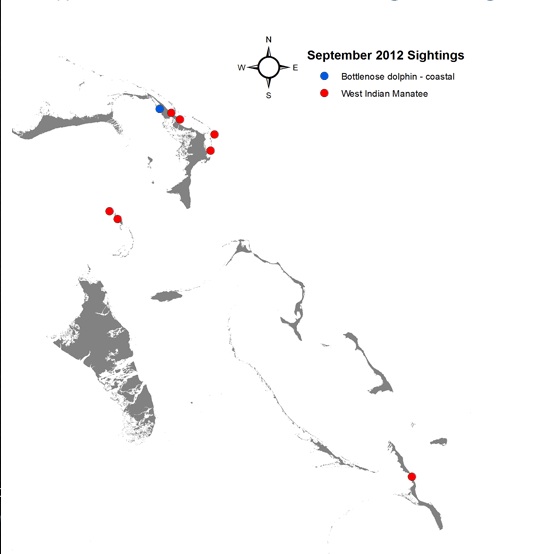
This is the perfect place and time to post the BMMRO September 2012 Whale, Dolphin and Manatee sightings map. Last month the cetacean count was very low – no whales at all, a solitary dolphin. However, manatees are starting to feature much more, and the Abaco sightings – presumably of Georgie as she progresses round the Islands  – are the first ones recorded there (I think) since manatee sightings began to be included towards the end of last year. A cause for breaking out the fresh water to celebrate.
*  *  *  *  *  *  *
MUSICAL AFTERNOTES The video music is Rizraklaru by Ralph McTell (before he arguably spoilt it all with the mawkish ‘Streets of London’) from ‘Spiral Staircase’ (credit / plug for RM). He wrote it in 1967 while living in an old caravan in deepest Cornwall. He and his mates had only mother nature’s ‘Rural Karzi’ to use, and the song title is an anagram. It’s a long story that ends, in RM’s words, “After he’d stopped laughing, Henry and I explained the title’s origin [to him] and he suggested an anagram, so we put the first letter last and spelt the whole thing backwards, and there you have it ! RIZRAKLARU !” 
Unknown's avatar

MANATEES: CONSERVATION, AWARENESS PROGRAMS & DISTRIBUTION MAP


MANATEES: CONSERVATION, AWARENESS PROGRAMS & DISTRIBUTION MAP

The “SAVE THE MANATEE CLUB” is a very active organisation that I have mentioned in previous manatee posts. These gentle creatures are in need of protection, and much effective conservation work is in progress. The BMMRO‘s wonderful work for the MANATEES OF THE BERRY ISLES is featured in this blog because of the proximity to Abaco (might those manatees visit one day?) – and of course because BMMRO HQ is at Sandy Point.

[ADDED 25 SEPT]…and lo, just as I pressed the ‘publish’ button, the BMMRO posted this news:

Georgie is currently exploring the Abacos. Help us monitor her movement patterns by reporting sightings!! 

“Earlier this year we tagged & released 2 West Indian manatees in Great Harbour Cay, Berry Islands. These were the same manatees from Spanish Wells that were captured after they swam to Nassau when hurricane Irene passed in late August 2011. After release at Great Harbour Cay in May 2012, they explored most of the Berry Islands but centered their use around Great Harbour. In September one of these manatees, a young female named Georgie, swam from the Berrys to Abaco, has traveled within The Marls, north towards Little Abaco & is now traveling south on the eastern side of Abaco. We received a sighting of her on 23 September at the Green Turtle Cay Ferry landing, just north of Treasure Cay. We anticipate she will continue to travel south and may venture into marinas and harbours along the way. We would like to make the public aware of her presence in the area. Although we believe she is in good health and is exploring new areas, the tag is not functioning properly now so sightings from the public will help us locate and monitor her progress. If possible, please share with anyone in the Abaco area or make an announcement encouraging people that see her to report any sightings”

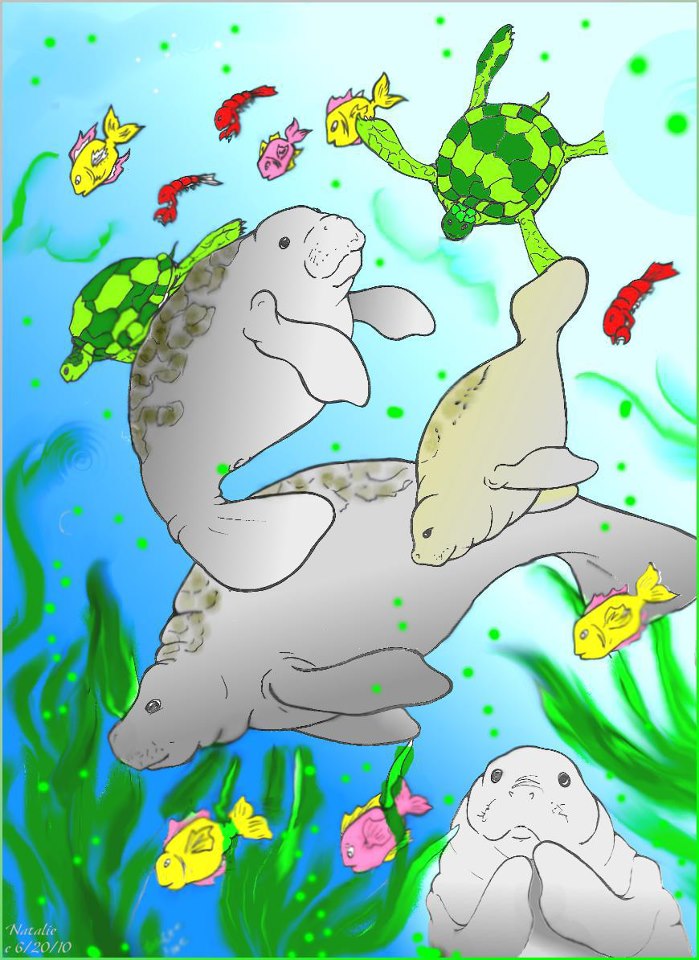
[ORIGINAL POST CONTINUES] The SMC is a Florida-based organisation and it recently posted a new cheerful cover picture by Natalie Prayor on its FACEBOOK PAGE. I have recently noticed some searches on the blog such as ‘Manatees facts for Kids’, so this post might be helpful. You could  even (I can’t believe I even thought of checking this out!) knit one… Want a pattern? Click HERE In fact, I might even…

To see more of Natalie’s artwork, just search ‘Natalie Prayor in Facebook. She can be contacted at dracodawnstar@gmail.com

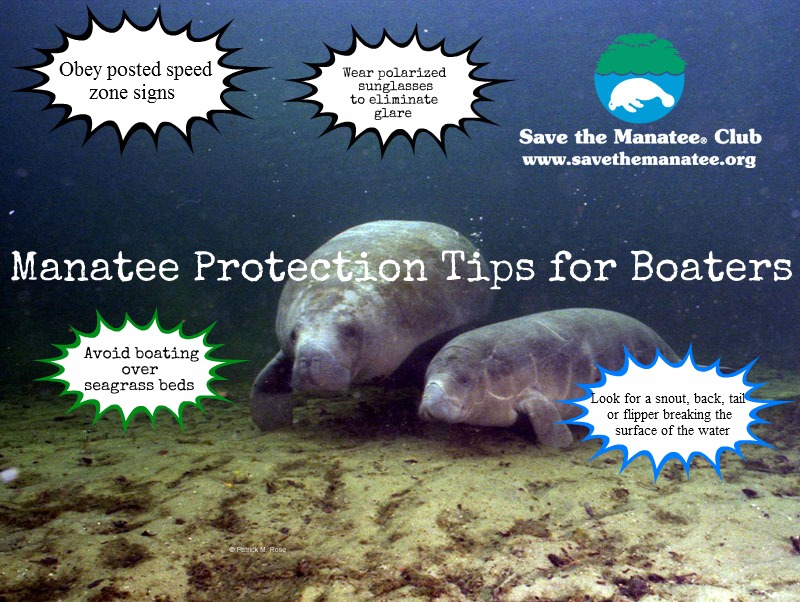
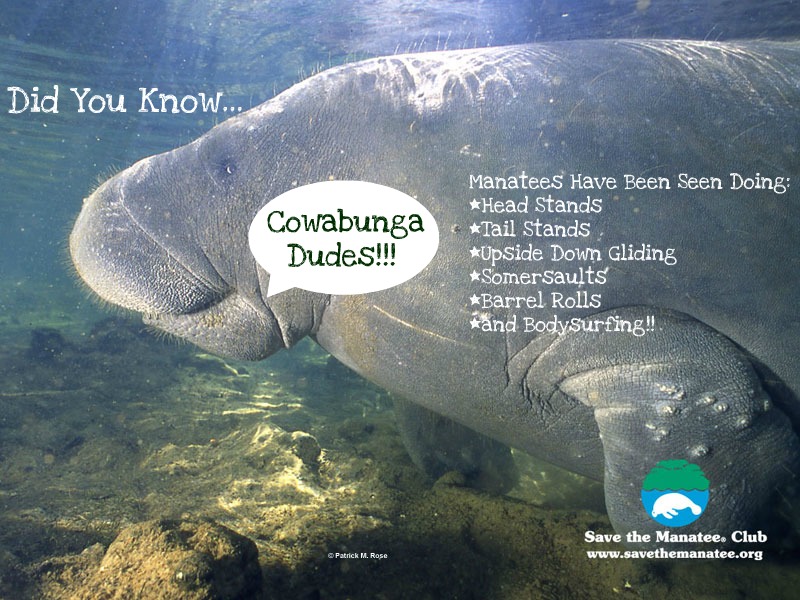
The SMC also posts Manatee facts and advice, from which I have selected the examples shown below

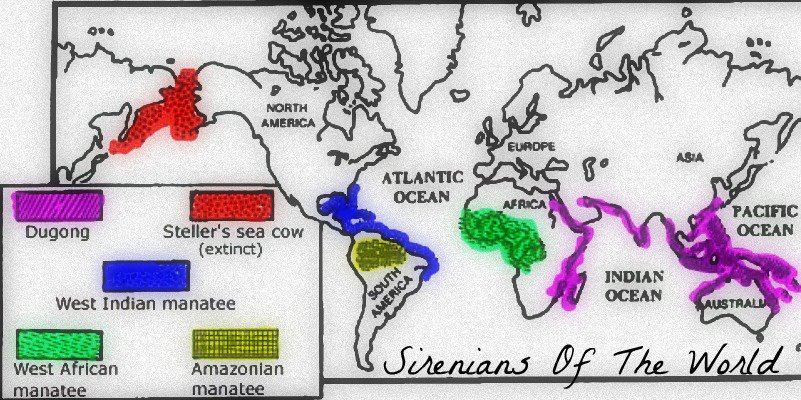
This map shows the world distribution of the 4 extant sirenian branches as well as the extinct STELLER’S SEA COW of the north Pacific. It is a melancholy fact that by 1768, a mere 27 years after its discovery by Europeans, this slow-moving, tame and easily-captured sea cow was hunted to extinction. 250 years on, the world’s sirenian population remains vulnerable and, as with whales and dolphins, in need of active monitoring and protection measures

Finally, I liked this manatee cartoon from Rachel Arnow, with its incongruous and enjoyably unfeasible suggestion of manatees in Loch Ness. Rachel has a great sirenian-centric website  http://mvsm.omnomzom.com/ featuring her excellent and charming cartoon series “MAN VERSUS MANATEE”. 

Credit: savethemanatee.org

Unknown's avatar

ABACO / BAHAMAS WHALE, DOLPHIN & MANATEE SIGHTINGS AUGUST 2012


ABACO / BAHAMAS WHALE, DOLPHIN & MANATEE SIGHTINGS AUGUST 2012 

ANOTHER PYGMY WHALE STRANDING ON ELEUTHERA

The BMMRO has posted the cetacean / sirenian sightings for August. The main concentration off Abaco is in the food-rich south-west coast from Rocky Point down to Hole-in-the-Wall. This is where the deep water of the Great Bahama Canyon meets the shallow underwater coast of Abaco, providing an ideal feeding ground for whales and dolphins. This canyon is the largest underwater canyon in the world.

Plenty of dolphins were reported last month, and the sperm whales (including pygmy and dwarf) were still around (but for some sad Eleuthera pygmy sperm whale news, see below). Meanwhile, the yellow spot on the Berry Is. shows that all is well with the manatees.

STRANDING NOTIFICATION: PYGMY SPERM WHALE 

Last week the BMMRO was notified about a whale that had stranded dead on an Eleutheran beach on 27 August. The species was identified from the photographs as a pygmy sperm whale – the same species that stranded on the other side of Eleuthera the previous week.

Thanks to the Stranding Network, it was possible take a tissue sample and teeth for DNA, as well as more photos.The animal was about 6 feet long and moderately decomposed – possibly dead for up to 3 days. Unfortunately due to the state of decomposition a cause of death could not be determined. However more information about the animal will be obtained from the samples taken. With samples taken, the carcass can now be buried.

Unknown's avatar

“RITA & GEORGIE’S EXCELLENT ADVENTURE”: A BAHAMAS MANATEE MOVIE


“RITA & GEORGIE’S EXCELLENT ADVENTURE”: A BAHAMAS MANATEE MOVIE

The BMMRO has produced and distributed, courtesy of the always watchable CONCH SALAD TV, a fantastic 7 minute movie of the story of Rita and Georgie. It’s a heart warming tale of a West Indian manatee mother and calf pair that made the journey from Eleuthera via Nassau and then via cradle and boat transport to the Berry Islands for a new life. It’s a tale of conservation, preservation and  hopefully (if they continue to get on well with the small resident population there) procreation… The main natural difficulty facing manatees in the Bahamas is the lack of fresh water – see how this is tackled. The main man-made problem comes from man’s use of the waters. For example, boat-strike / propeller damage is an ever-present danger. To see more about Manatees in this blog CLICK HERE To reach the BMMRO Facebook page CLICK HERE

BMMRO INTRO

IT’S HERE!! MANATEES IN THE BAHAMAS. PRESENTED BY LOGGERHEAD PRODUCTIONS 

Grab your popcorn and everyone in the community, office or home…ENJOY! SHARE! ♥ MANATEES !

REVIEWS

“The Manatees were moved. As indeed was I…”              The Wall Street Journal

“An uplifting experience…”                                                     The Washington Post

“Seeing these manatees made me a man at ease…”          Florida Herald Tribune

“Lovely Rita…”                                                                            Sir Paul McCartney, Kt, MBE 

Credit: savethemanatee.org

Unknown's avatar

WEST INDIAN MANATEES: GOOD NEWS FROM BMMRO, BAHAMAS


GEORGIE THE MANATEE IS WEANED

It’s good to look beyond the immediate area of Abaco and the Cays when the occasion calls for it – for example, more good news about the BMMRO’s painstaking research and careful protective monitoring of the very small West Indian Manatee population in the Bahamas. I’ve written before about these gentle, unhurried, curious creatures and their vulnerability – particularly to man’s usage of their natural habitat CLICK ===>>> MANATEES 

Kendria Ferguson’s story below shows just one aspect of the BMMRO’s commitment to the conservation of the cetaceans and sirenians in the seas around Abaco and beyond. The Manatees have excited the interest of the whole local community including the schoolchildren. If you have ever been moved by the sight of dolphins in Marsh Harbour or whales further out to sea, you can be sure someone is keeping an eye on their well-being. You might even be moved to help this important conservation work, in which case CLICK ===>>> HERE

KENDRIA’S REPORT

Adult female manatees are considered sexually mature at 6-10 years of age and have a gestation period that lasts up to 13 months. The first two years of a calf’s life is spent with its mother. During this time they are taught where to find food, fresh water, warmth and shelter. Generally, after two years the calf separates from its mother. This separation is known as ‘weaning’.

On the 14th of June 2012 Argos satellite locations received from both Rita and Georgie’s satellite tags indicated that they were no longer traveling together. Georgie had been weaned. Georgie was born on the 25th June 2010, therefore Georgie was now old enough to survive on her own in the wild

Georgie fitted with a paddle belt around the base of her tail. A flexible nylon tether is then attached to this belt with the satellite tag, which floats when it’s near the surface.Photo provided by Jim Reid-USGS Sirenia Project

After tracking Rita and Georgie for the last three months, it was hard to fathom a two year old being old enough to take on the world. But like they say – mothers know best!

Rita and Georgie fitted with satellite tags

Rita and Georgie were released in Great Harbour Cay (GHC) on April 19th of this year. They travelled to Nassau during Hurricane Irene (late August 2011) from Spanish Wells, Eleuthera and ended up in Nassau harbour. Concerned for their safety, The Department of Marine Resources gave Atlantis-Dolphin Cay permission to capture the animals and house them until a decision was made as to their release. After spending over twenty-five weeks in captivity, scientists feared that Georgie would be weaned before she was returned to the wild and given the opportunity to learn how to survive in her natural habitat. The mother-calf pair was transported to The Berry Islands on April 19th, where they were released and fitted with VHF data log satellite tags.

A map showing areas visited by Georgie pre-weaning and post-weaning

There are four resident West Indian Manatees (Trichechus manatus) residing in Great Harbour Cay, Berry Islands. Notably, an adult female, “Gina” (known previously from Florida), has been residing in Great Harbour Cay since 1999. Since then she reportedly has had 3-4 calves and is currently accompanied by her female calf, JJ, which was born in the late winter of 2011.

Within Rita’s and Georgie’s first week of being released they travelled over 50 miles around the east coast of GHC to as far south as Ambergris Cays and back into the harbour where they were released. During the winter months, Floridian West Indian Manatees (Trichechus manatus latirostris) travel vast distances in search of warm waters. So it isn’t uncommon for these agile species to explore the shallow waters in which they inhabit.

Georgie is now re-visiting important habitat areas she visited in the past with her mother. Since their separation in June, Rita and Georgie have been seen together in the harbour by the local community.

Scientists will continue to monitor Georgie’s movement patterns around The Berry Islands throughout the hurricane and winter seasons. This data will assist us in developing a management plan for manatees in The Bahamas.

Story written by Kendria Ferguson, BMMRO’s resident manatee expert

Unknown's avatar

BMMRO WHALE, DOLPHIN & MANATEE SIGHTINGS ABACO / BAHAMAS JULY 2012


BMMRO WHALE & DOLPHIN SIGHTINGS ABACO JULY 2012

Last month there were bottlenose dolphins for Abaco; manatees for the Berry Is. [Hi, Rita & Georgie! – check out their progress on FACEBOOK BMMRO] with a first manatee sighting (I think) off the west coast of Long Island; and quite a few whale reports off the east coast of Andros. I wonder why the whales are all in that area at the moment? Maybe the reports are high for that area because that’s where the whale spotters congregated in July…

STOP PRESS Georgie the Manatee is now weaned – for details CLICK===>>> HERE

STOP PRESS 21 AUG As a sad coda to these sightings, the BMMRO has posted news of the stranding and death of  pygmy sperm whale on Eleuthera

Stranding Event: August 19th, 2012
A blackfish stranded in Eleuthera:

Photos confirmed the species to be a pygmy sperm whale. The animal stranded alive but later died. Many thanks to Tom Glucksman and his wife for their efforts in providing pictures and getting a skin sample, which will allow us to get even more information about this animal

For more information on how to report a stranding event, please visit  http://bahamaswhales.org/stranding

BMMRO (Website)

FACEBOOK BMMRO

Unknown's avatar

BMMRO WHALE & DOLPHIN SIGHTINGS ABACO JUNE 2012


BMMRO WHALE & DOLPHIN SIGHTINGS ABACO JUNE 2012

Actually, I say ‘Abaco’ but the most activity – and the most varied, species-wise – is off the southern coast of Grand Bahama. Abaco sightings are also confined to the south, with shows from a PIGMY SPERM WHALE and a BLAINVILLE’S BEAKED WHALE  and dolphins in the arc between Rocky Point and Hole-in-the-Wall. To see recent aerial photos of this section of coast CLICK===>>> HERE

The manatees of the Berry Is. are no longer shown on this map. Their happy story (and their fame) has spread and they now have their own entries on the BMMRO FACEBOOK PAGE, like any self-respecting stars. You can reach it anytime direct from the Sidebar if you you want to keep track of the story of Rita and her calf Georgie’s rehabilitation – and the other manatees they have encountered as they get used to their freedom. 

ADDED The latest BMMRO quarterly newsletter has just been published – highly recommended for anyone with an interest in active whale / dolphin research, or in the latest news of the manatees of Berry Is. To see it CLICK===>>> BMMRO NEWSLETTER JULY 2012

Unknown's avatar

RITA & GEORGIE’S BIG ADVENTURE: BAHAMAS MANATEES TAKE A TRIP


RITA & GEORGIE’S BIG ADVENTURE

It’s Week 4 since mother and calf were released. Since then, they have made some manatee friends and gradually increased their range of exploration as their confidence continues to grow. The week’s big news is that in five days, Rita and Georgie travelled over 70 miles around Great Harbour Cay, extending their interest further south than ever before. Here are the other mother and calf pair from the area, Gina & JJ

The logo at the top is clickable straight through to the excellent BMMRO weekly reports of the lives of these gentle creatures, where you will find all the details of their progress. I have also add a click-thru’ logo near the top of the sidebar so that manatee-watchers can go straight there from this blog at any time.

So may I encourage all you nice followers out there to keep an eye on the developing story; and remind you in a subtle – oh, ok then, rather direct way – that this kind of vital conservation research in our oceans can only be carried out with support. That could include direct support for the BMMRO’s work… and / or maybe even adopting a manatee (details on the Manatee blog)

Rita and Georgie Tracking Map  Week 4 

Unknown's avatar

BAHAMAS MANATEE UPDATE – CHECK OUT RITA & GEORGIE’S PROGRESS


The BMMRO’s brilliant new  charting the progress of mother Rita and calf Georgie after their release (and showing wonderful pictures) is becoming addictive. How far have they ventured this week? Are there any more out there? 

Here, Rita and Georgie are wearing their tags. I really recommend a visit to the  for the full reports, but here’s a quick review of the highlights of weeks 2 and 3 since their release:

WEEK 2

  • Rita & Georgie are beginning to attract a bit of a following
  • During the week their confidence grew and they undertook a longer expedition (see map below)
  • During their travels they were joined by 2 other manatees, first a juvenile male, then an adult male
  • Rita’s tag became disconnected. It was retrieved, the data downloaded, and it was successfully reattached
  • Audio recordings were made of underwater manatee communication
  • At one stage there were six manatees seen together, with manatees Gina and JJ joining the 4 others

Rita nurses Georgie


WEEK 2 ADVENTURES

A far more complicated pattern than the simple explorations in WEEK 1

WEEK 3 

  • Continued careful monitoring of more complex (= braver) exploration
  • A great deal of local interest generated. 
  • A ‘Save the Manatee’ campaign started
  • Presentations for groups of school students, including involving them in actual monitoring. 
  • The juvenile male has stayed with Rita and Georgie.

——————————

Rita examines the camera. Meanwhile Georgie checks out the bottom of the BMMRO boat…    

                                               A tender moment between calf and mother                                                                   

 WEEK 3 EXPEDITIONS 
Confidence growing, and more interest in investigating to the south


Unknown's avatar

BAHAMAS MANATEES: INTRODUCING RITA & GEORGIE – FOLLOW THEIR BLOG


BMMRO MANATEE BLOG

A couple of weeks ago I posted about the Manatees of the Bahamas, including the news that a female manatee and her calf had recently been reintroduced into the wild. To see that post CLICK===>>> RITA & GEORGIE

The BMMRO have now set up a Rita and Georgie blog so that the news of their progress and tracking reports can be seen by all. This will be a regular feature on the BMMRO site, and I reproduce with permission the first report below so that you can see what is involved. 

To follow the tale of Rita and Georgie CLICK LOGO===>>>     I will repeat this logo link in future monthly cetacean sighting reports, with a short summary, so you can get the latest on the sirenian situation. At the end of this page is a map showing their movements for the last week. Here also is a clip of the blog headings so you can see what is covered. Hint-laden note: there is a way to help this valuable research by means of adoption. You don’t get to keep one (or both) in the bath, of course, but you get a certificate and you will know you are helping to protect a species that is all too rare in the Bahamas

_____________________________________

RITA AND GEORGIE ARE RELEASED!

This blog was created to allow the public to follow two manatees, Rita and her calf Georgie, as scientists track them after their release back into the wild. Please return for weekly updates

NOTES FROM THE FIELD – WEEK 1
19-April-2012
At 10:30 am, Rita and Georgie arrived at the Great Harbour Cay Marina in Bullock’s Harbour on the Atlantis vessel Sea Keeper. High school students and interested locals had gathered at the marina for this exciting event. At 11:00 am, Dolphin Cay-Atlantis Animal Rescue Team carefully lowered Georgie into the water, and then Rita followed as quickly as possible. Both animals immediately paired up underwater and surfaced swimming towards the mangroves at the east end of the marina.
During the time of the release, two male manatees were observed in the marina and later paired up with the tagged animals. All four manatees were observed socialising as they slowly travelled out of the marina. Jim Reid (USGS) set up the VHF tracking gear and the tracking team started to track Rita and Georgie from land.
After a few detours through the bush, we found all four animals at the northern end of the T-canal; which is a ‘T’ shape cut in the harbour. We observed both males interacting with Rita while Georgie milled nearby. All four were seen feeding on algae on the canal wall. We left them at 4:30 PM.
20-April-2012
In the early morning, the juvenile male was seen in the marina and came very close to one of our vessels. The single animal remained in the harbor for more than 3 hours. This was a great opportunity for Matt McCoy (Loggerhead Productions) to get underwater footage of the juvenile male, which will be used in an educational film about ‘Manatees in The Bahamas.’
Rita and Georgie were later found in the marina but Rita’s tag was missing! Jim successfully placed a temporary tag on Rita and the original tag was found and later reattached. Kendria Ferguson (BMMRO) made acoustic recordings of both animals, which will be used to identify individuals from their vocalisations.
Later Jim collected genetic samples from both the adult and juvenile males. These samples will be used to determine if these individuals are both offspring of Gina and help to develop a family tree of Great Harbour Cay manatees.
21-April-2012
At 8:30 am GPS locations from the tags showed that Rita and Georgie were in Shark Creek along the west side of Great Harbour Cay, about 2 miles south of the harbour. When the tracking team arrived they found mother and calf both in good health and feeding on seagrass beds in the creek system.
22-April-2012  
With winds up to 20 knots the weather was not favorable for the tracking team to hit the open waters in search of Rita and Georgie so we decided to put up manatee warning signs. These signs were provided by Florida’s Save the Manatee Club, along with other educational material that will distribute throughout the island to raise awareness of the local population of manatees.
The tracking team was able to track them by land and both animals were found on the east side of the island swimming along the beach. The tracking team stayed with them for over 3 hours and monitored their breathing and movement patterns. We also got some underwater photos!!
23-April-2012
At 10:40 am local residents of Great Harbour Cay notified the “manatee lady” (Kendria) that four manatees were in front of the marina office. Gina and her calf JJ were both observed feeding on algae on the pilings and JJ was seen nursing occasionally. Both the adult male and juvenile male were there and remained close to Gina and JJ during their stay in the marina.
Jim was able to collect a genetic sample from JJ and also confirm that she is in fact a female calf. Both males continued to remain close and watched Jim constantly!
GPS locations from Rita and Georgie tags showed that they traveled as far south as Ambergris Cays. During the night, the tracking team closely monitored their movements as they were received via satellite. They entered Shark Creek shortly after 6pm from the west side of the island and remained there for approximately 5 hours. During this time, scientists believe that they were feeding and resting, as this area has extensive seagrass bed coverage. The tracking team continued to monitor their movements throughout the night and hoped that they turned to head back north very soon!
24-April-2012
At 4:30am, GPS locations showed that Rita and Georgie took ‘the channel’ cut and headed back north into the harbour of Great Harbour Cay.
At 8am we located both mother and calf under Al’s dock (our local fish provider). Both animals were resting and Georgie was observed nursing. The tracking team obtained photos, videos and acoustic recordings of both animals during this 3.5 hour encounter.
From their departure from the harbour early Sunday morning to their return Monday morning, they managed to complete a 50 mile trip around Great Harbour. A very happy ending to a very long journey!
25-April-2012
Rita and Georgie remained in the marina overnight and at 7:15am were found just a few houses down from the tag team’s home. Both animals swam towards our tracking vessel, “Feresa” and remained in the area for 15 minutes. Georgie has quite the personality! She began sucking on Feresa’s inflatable tubes and eating the algae off another inflatable boat a few feet away.
Both animals remained very close and traveled under the docks towards the end of the marina towards the mangroves. The local residents occasionally report seeing Gina and the other manatees at these mangroves and believe there is a fresh water discharge. This is also very close to the area of Rita and Georgie’s initial release back into the wild.
WEEK 1
‘An Awfully Big Adventure’ (© P.Pan)
Unknown's avatar

BAHAMAS MANATEE & BMMRO SPRING 2012 CETACEAN REPORTS


The BMMRO has just published two online reports that will interest anyone who follows the news about Whales, Dolphins and Manatees in the Bahamas.

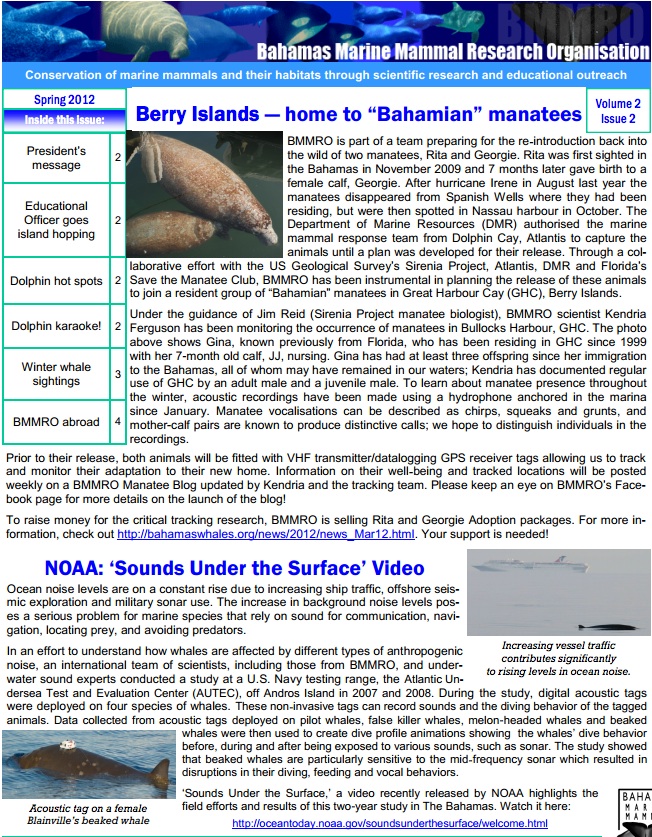
The first concerns the reintroduction of manatees to the wild – and offers the opportunity to adopt one of them in order to support the continuing work of the conservation of the small manatee population of the Bahamas. You could have a guess now at the number of recently recorded manatees: the answer is right at the bottom of the page. If you have followed this blog’s cetacean posts, you will have noticed my own interest in the continuing monthly sightings (mainly off the Berry Is.) I have had to reduce the size of the article, but if you click on it once – or twice – it enlarges to make it more legible.

To see the article on the BMMRO website CLICK==>> BMMRO MANATEES

To go directly to my manatee page CLICK==>> ROLLING HARBOUR MANATEES

Click article to enlarge it

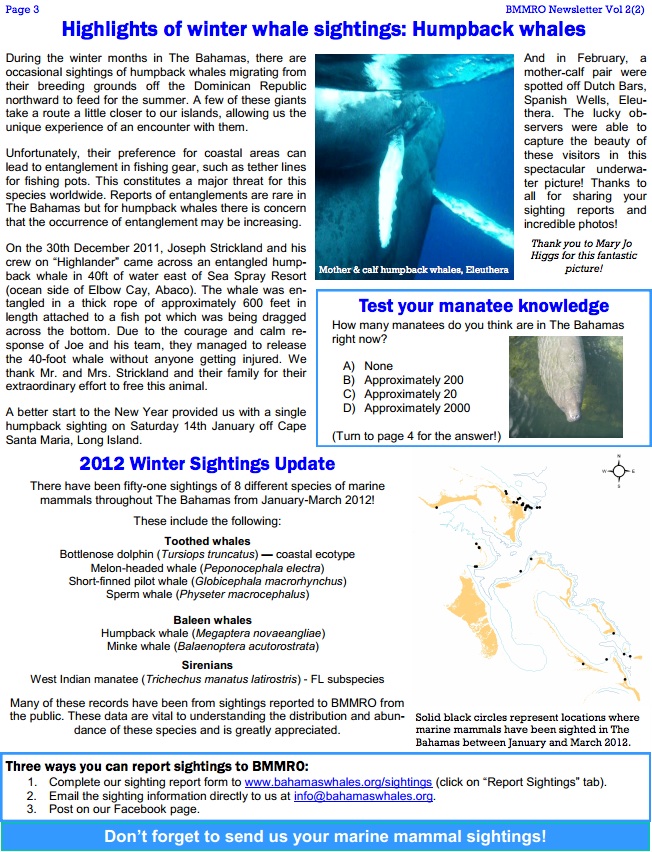
BMMRO REPORT SPRING 2012

I have summarised past BMMRO quarterly reports, highlighting particular features and photos. This time I’ve put in the whole report in (I hope) legible format. To see it on the BMMRO site CLICK===>>> BMMRO SPRING 2012

Approximately 20

Unknown's avatar

BMMRO WHALE, DOLPHIN & MANATEE SIGHTINGS MARCH 2012


BMMRO WHALE, DOLPHIN & MANATEE SIGHTINGS MARCH 2012

Hard on the heels of the BMMRO’s Fisheries Report for 2011 – see previous posts – comes the map of last month’s sightings. First, let’s hear it for the manatees, featuring for the 4th consecutive month off the Berry Is. The 2 reports of an ‘unknown large cetacean’ off Elbow Cay are the puzzles of the month. There was a sperm whale in that area in January, but presumably it would have moved away in the meantime…. I wonder what the likely candidates are for ‘large’ besides sperm and humpbacks?

Unknown's avatar

BMMRO WHALE, DOLPHIN & MANATEE SIGHTINGS FEB 2012


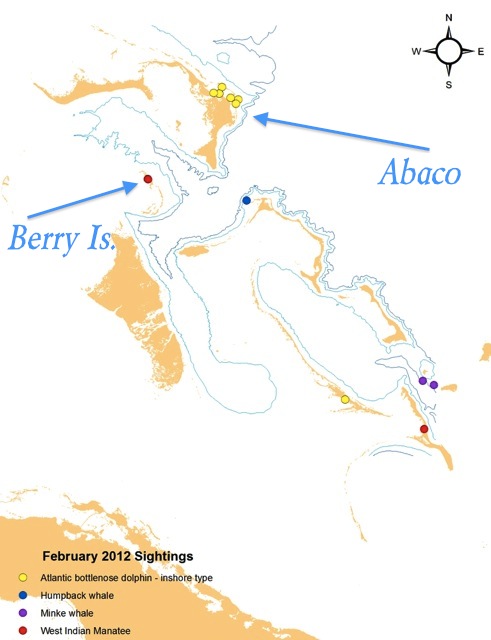
BMMRO WHALE, DOLPHIN & MANATEE SIGHTINGS ABACO / BAHAMAS FEBRUARY 2012

From an Abaconian point of view, the news is of Dolphin activity in the Marsh Harbour area / nearby Cays and northwards from there. No whale reports last month, though. Further afield, another manatee report from the Berry Is makes three consecutive monthly reports of sirenians. There was a humpback to the south but other reports are concentrated further away

Unknown's avatar

ABACO WHALE, DOLPHIN & MANATEE SIGHTINGS JANUARY 2012


ABACO CETACEANS AND SIRENIANS                                        BMMRO SIGHTING REPORTS JANUARY 2012

For the second month in succession MANATEES have been seen in the area: again in the Berry Is region, and additionally off Grand Bahama. With luck they will now be a fixture on the BMMRO monthly sightings map. The main reported Abaco activity, including a sperm whale, was on the ocean side of Elbow Cay. Thanks to Charlotte Dunn / BMMRO for permission to use their material

Unknown's avatar

HUMANS’ TASTE FOR DOLPHINS & MANATEES ON RISE


 HUMANS’ TASTE FOR DOLPHINS & MANATEES ON RISE

I am reblogging (thanks to Ann Novek at http://havehest.wordpress.com/the above link to an article by Jennifer Welch of LiveScience, published in Biological Conservation. It’s of particular relevance on these pages, since I have just posted about manatees and the threats to their survival; and also because dolphins are a regular feature of this blog. A quick G**gle search reveals a number of sites with recipes for marine mammals (including manatees), many species of which are protected by law… I suspect that the slow and inquisitive manatee will always be easy meat, as one might say. NB ‘Dolphin’ here does not include the dolphinfish (dorado) commonly found on menus as ‘dolphin’, for which there are no current conservation concerns (although there are officially preferred methods of catch)