‘MEN AT WORK’: CLEANING UP MAN’S DEBRIS IN THE OCEAN
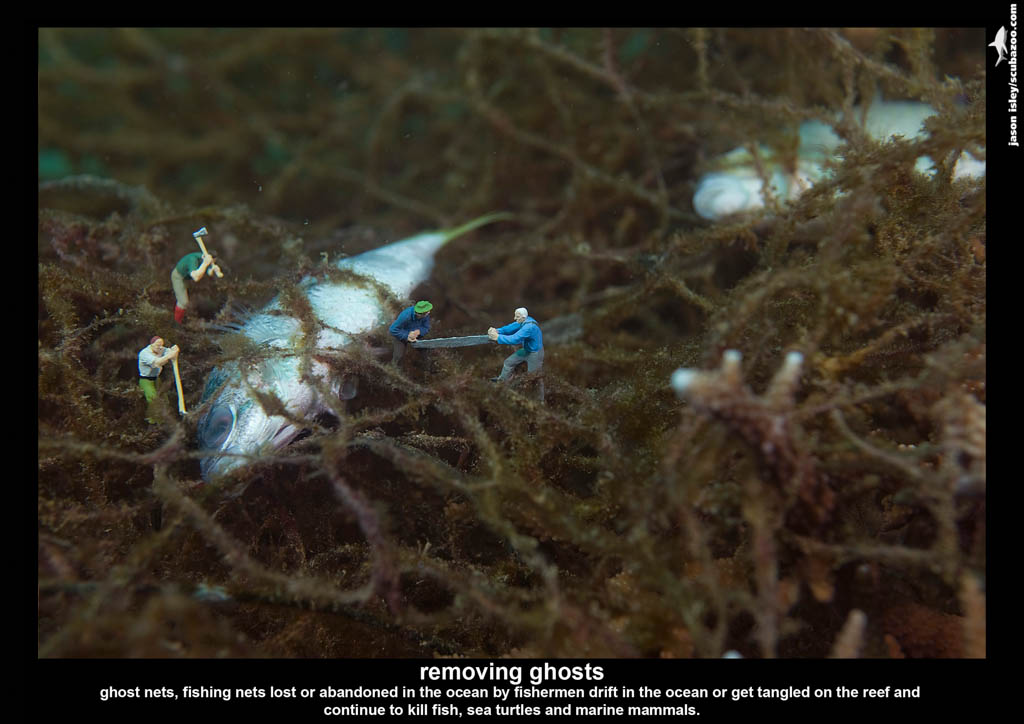
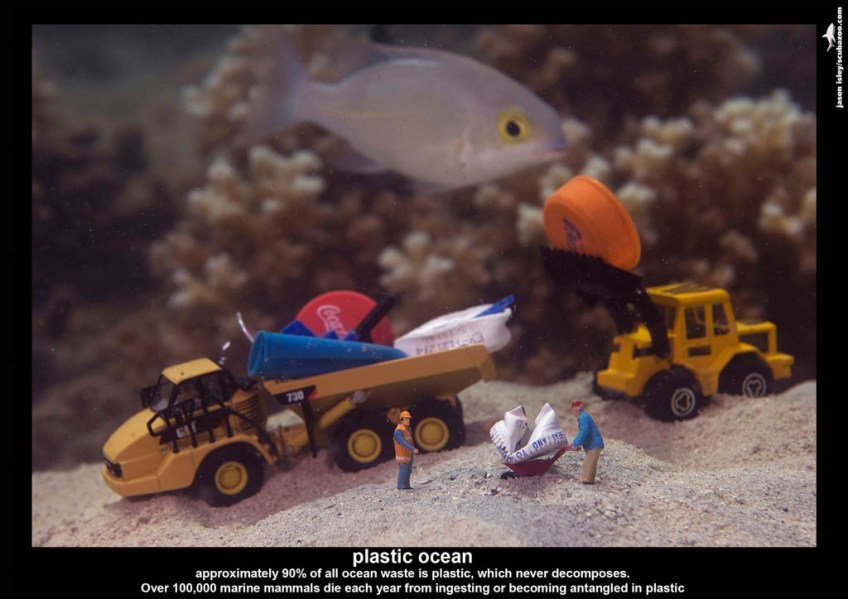
I keep an eye on the websiteSCUBAZOO. As ever, the alert ABACO SCIENTIST (highly recommended to follow) has beaten me to this latest post from Jason Isley, diver / photographer and creative thinker. He demonstrates the wonders and (human) blunders of the deep with wit and style. In the gallery below, he tackles the issue of man’s pollution of pristine waters. In a simple way, he manages to use humour to get across a message that can easily become obscured by lengthy sermonising. See what you think.
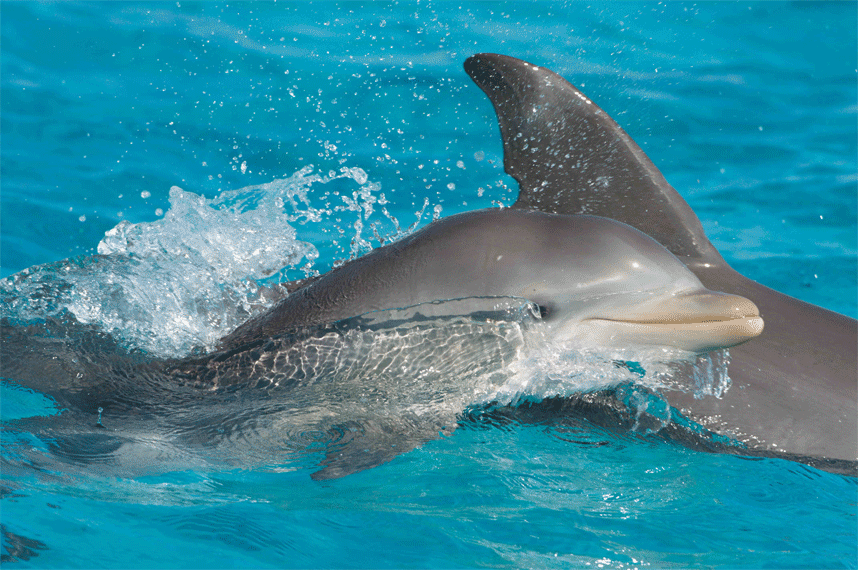
The legendaryCONCH SALAD TVis a great resource for Bahamas wildlife and way-of-life enlightenment. Their instructive videos are very well put together, and cover Nature, Marine, Art, Science, Music, Culture, Cooking, and broader Bahamas issues. The video below is 9 minutes of Bottlenose Dolphin action, and is recommended for relaxation, gentle instruction, and Kalik-swigging accompaniment…
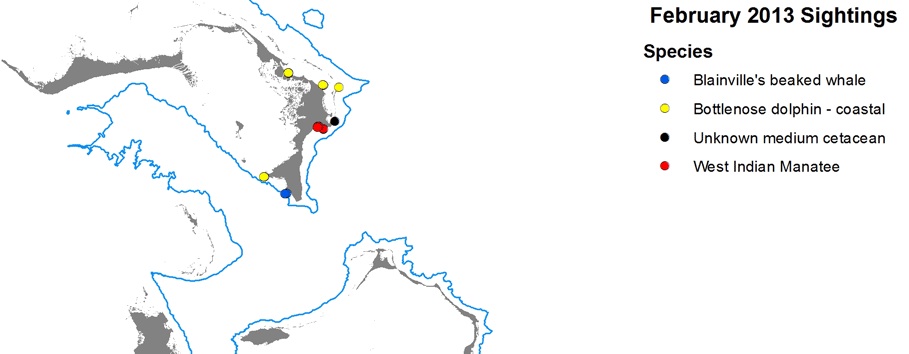
It time to catch up with last month’s Cetacean sightings around Abaco. The Manatee reports are of Georgie in the Cherokee area – alas no longer resident on Abaco but safely at Atlantis where she is being cared for. To know more about the Blainville’s beaked whale on Abaco, click HERE
SHARK FINS – OOOP! A MODEL USE OF HUMOUR
TO CONVEY A SERIOUS MESSAGE
(VIDEO)
TheCAPE ELEUTHERAFOUNDATIONhas produced a short video about sharks and shark fins that manages to be both amusing and to carry a powerful conservation message. It’s a hard trick to pull off successfully. Attempts to use humour to leaven a serious message or to modify earnestness in presentation so often trespass into the no-man’s land known as ‘Meh’ (twinned with ‘Wotevah’). I’m grateful to the always-interesting ABACOSCIENTIST for sharing this item. Photo credit: Melinda Riger, with thanks for use permission [I am posting this from NYC via iPhone, so any weird formatting or typos will have to be dealt with next week]
GEORGIE THE ABACO MANATEE: IS SHE RELATED TO AN ELEPHANT?
Georgie, having returned to Cherokee after Hurricane Sandy, is still around there and seems to have made it her home. While she was missing, it was thought she had headed off instinctively for the protection of the mangroves. However a number of sighting reports made since Sandy suggest that she had sensibly swum up the canal at Casuarina, where she was able to keep her head down until the storm had safely cleared northwards, and she was able to return to base. Because she had shed her tag, we’ll never know the full story…
Georgie safely back at Cherokee after Hurricane Sandy
Recently an interesting article by BEACH CHAIR SCIENTISTconsidered the relationship between sirenians and pachyderms, and added some handy comparative facts (you can seen more manatee facts on this blog HERE). Thanks, BCS, for use permission (the relevant credits are contained in the article).
It might be very difficult to imagine, but manatees (also known as ‘sea cows’) share a common ancestor with elephants which might come as a surprise if you thought manatees shared a common ancestor with other marine mammals such as dolphins, whales, or sea lions. Here are 10 facts that link manatees and elephants are long-lost relatives.
1. Scientifically, manatees and elephants are classified as subungulates. Other mammals in the Subungulata superorder are hyraxes and aardvarks.
2.Manatees and elephants have anuncommon-shaped heart that is spherical. To compare, most mammals have a single-pointed tip at the base (i.e., “heart”—shaped).
3. The West Indian and West African manatee have three or four fingernail-like structures on the tip of their flippers, just like that of the toenails on the feet of elephants.
4. Manatees and elephants both have a thick, gray skin with very sparse hair.
5. Manatees and elephants have molars which move toward the front of the mouth, eventually break off, and are restored by those at the rear. Elephants have a limited number while manatees are never-ending.
6. Manatees have two incisors that bear a resemblance to elephant tusks.
7. Manatees use their large, flexible muscular lips to break apart vegetation in the water and skillfully steer food to their mouths. This is very similar to the action of the elephant eating with his trunk.
8. Manatees and elephants are herbivores. Manatees tend to feast on sea grass and freshwater plants and consume up to 100-150 pounds a day. Elephants tend to feast on small plants, bushes, fruit, twigs, tree bark, and roots and consume up to 330-375 pounds a day.
9. Male manatees and elephants are known as bulls. Female manatee and elephants are known as cows. Young manatee and elephants are known as calves.
10. Manatees and elephants are both endangered. Their numbers have dropped due in a large part to human activities.
This very short time-lapse video was posted on the always informativeABACO SCIENTIST website administered by Craig Layman of FIU (Florida International University). The site benefits from the wide knowledge of a variety of contributors in many different fields. As it says, “Abaco, just like all of the Bahamian Islands, hosts a wealth of natural wonders. From parrots to whales to blue holes to mangrove wetlands, it is no wonder that scientific research is thriving on the island. The Abaco Scientist is intended as your one-stop source for all things science on Abaco and throughout The Bahamas“.
The coral reefs of Abaco and the Bahamas (as elsewhere) are vital yet vulnerable eco-systems. The adverse effects of global warming (or however you describe it if you shy away from that specific term) are increasingly evident. To that damage can be added a slew of other major threats to coral survival – and to the marine life that thrives on the reefs. There are a number of research projects in progress in the Bahamas into the effectiveness of artificial reefs as a means of conservation of the ecology of reef waters. One of these is by FIU undergraduate student Martha Zapata. In her words, “We have recently been capturing time lapse video of the artificial reefs at night. Many reef fishes, like grunts, will leave the reef around dusk to forage in the nearby seagrass beds during the night. We wanted to be able to observe the fish on the reefs without influencing their behavior, so we used infrared light (which fish cannot see) to illuminate the reef. The image sequences have shown a stark difference in fish abundance from day to night. Also, we have been able to observe some of the more cryptic organisms that have made these reefs their home. Usually masters of disguise, urchins roam about the surface of the reef. Look out for the banded coral shrimp and crab that crawl up the side of the reef to graze on algae and detritus while the fish are away. Even a moray eel makes an appearance near the end!“
Besides specially constructed artificial reefs, other man-made objects provide good foundations for an artificial reefs and marine life – in particular, wrecks. There are many of these in the low waters of the Bahamas, some centuries old, others recent. Fred and Melinda Riger of Grand Bahama Scuba, Freeport, take their diving schools to wrecks because of the profusion of marine life that gathers around – and indeed inside – them.
A short time ago I posted in some detail about the poisonousLIONFISH. I included material about the rapid increase of this Pacific species in Caribbean and Floridian waters following accidental / deliberate releases in recent years. I also included videos from Grand Bahama scuba-expert FRED RIGER to balance the anti-lionfish orthodoxy, showing that the fish in fact do some good on the reefs. The post provoked a few comments, and had a surprising number of hits. Here is some further research courtesy of the excellent SEA MONSTERwhich adds a dimension to the debate and concludes with a very good point… Incidentally, in a recent morning snorkelling at Fowl Cay Marine Preserve, Abaco, I did not encounter a single one of these creatures (Mrs RH was unluckily stung by a jellyfish, though…). But I guess the Preserve is well policed against such intrusive species, which are otherwise found in large numbers in the area.
Why are lionfish populations exploding across the Caribbean?
Author: John Bruno on June 6, 2012
Lionfish are an exotic fish now found throughout the Greater Caribbean and eastern Atlantic that have become incredibly abundant on many reefs, especially in the Bahamas and off North Carolina. Lionfish are piscivores (fish that eat other fish) and were introduced from the Indo-Pacific by the aquarium trade in the late 1990s off Florida. Mostly likely, someone got tired of their fish and released them purposefully.
One hypothesis explaining their great success is the absence of natural enemies; predators, parasites and competitors. This is probably compounded by the fact that few Caribbean reefs have any predators left that could eat them (thanks to overfishing).
Another – and I think much more likely explanation – is because there is so much to eat in the Caribbean! Not because there are more fish, but because it is so much easier to catch them. Unlike fish in the Indo-Pacific, native Caribbean fishes do not appear to recognize lionfish as a potential threat. So the lionfish gobble them up, grow faster, make more babies, spread to new islands, etc.
Case in point: My lab group was working in Belize last week on the lionfish invasion. One of the things we were doing was collecting the otoliths and gonads from lionfish that we speared on a number of reefs to compare their fitness across the Caribbean (e.g., on reefs with and without native predators, etc). We also looked at stomach contents and many of them had parrotfishes in their tummies or still in their throats! The photo above is of the eggs from one lionfish we caught near Glovers Reef Atoll and the partial contents of it’s stomach (a juvenile striped parrotfish)!
Lionfish appear to be little more than machines that convert parrotfishes to baby lionfishes. Which is pretty much the purpose of all animals (consuming others and transforming them into your own genotype and species). But jeez, couldn’t those aquarium hobbyists have released a herbivore that could be converting macroalgae to fish biomass? That would have been much more useful.
We rebooked our storm-tossed flights. We spent an extra night at Delphi and one in Marsh Harbour. We went to check in online. Zilch. Nada. Niente. No trace of Mr & Mrs Harbour. One hour on the phone and it’s sorted, and with an upgrade to World International Club Class Traveller Special Plus or similar ( = more leg room? An extra bacon roll? We’ll see…)
More importantly, though, today is WORLD OCEANS DAY
You can find 100 Ocean-related quotes to sprinkle into your conversation if you tune in to the excellent BEACH CHAIR SCIENTISTfrom whom I have ‘borrowed’ this sea-loving image
Quote 33 is slightly disturbing…
Apologies for premature publication omitting title and later tweaks. Posting on an iPhone is a fiddly business.
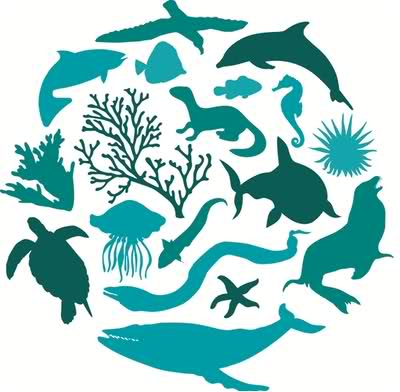
Yesterday was an important day in the marine conservation and research calendar. Me neither! I had a heads up from the redoubtable SEAMONSTER late last night. So at least I found out on the right day. I am posting the excellent logo to help to raise awareness retrospectively… I ‘get’ everything depicted in this clever sea creature globe – except for the tiny dinosaur… or is it a sea otter?
CLICK this large logo to link the the relevant website, where there are articles catering for every conceivable marine interest
I recently put some lionfish details and images on my MARINE LIFE page. I wrote: “…their existence and rapid increase in the waters of the Bahamas is a cause of great concern, and they are keenly hunted. Last year’s inaugural Lionfish Derby on Green Turtle Cay brought in more than 1400 of these creatures in the day, ranging in size from a 57mm juvenile to a 349mm fish. Here, fromTHE ABACO SCIENTISTis where in the world the 2 species of Lionfish ought by rights to be. Well away from the Caribbean, that’s where!
Photo credit: Brigitte Carey of Tilloo Cay
Two great lionfish photos from GRAND BAHAMA SCUBA (thanks to Fred & Melinda Riger )
———————————————————
LIONFISHPterois
1o UNCOMFORTABLE LIONFISH FACTS
A genus of spiny venomous fish indigenous to the Indo-Pacific area, of which there are 9 species
In the mid 1990s 2 species were introduced to the US Atlantic coast and Caribbean (see below)
Unaccountably popular as aquarium fish; cooked and eaten by people (though not by me)
An adult can weigh 1/2 kilo and may live up to 15 years
They have ‘complex courtship and mating behaviour’, presumably to avoid each other’s spines
Females release two egg cluster bombs every month containing up to fifteen thousand eggs…
Lionfish prey voraciously on small fish, invertebrates and molluscs which they gooble up in one gulp
They have bilateral swim-bladder muscles to alter their centre of gravity to attack their prey better
Apart from a tendency to species cannibalism, they have very few predators. The spines work well…
Sharks are not affected by the venom, and attempts have been made to train them to feed on lionfish
LIONFISH STINGS are painful and can take several days to resolve. Tests on frogs, clams and rabbits… well, you don’t want to hear about those. In humans the venom causes systemic symptoms ranging from nausea, vomiting, fever, breathing difficulties and dizziness to convulsions and paralysis. For the very young, the elderly, the allergic or those with immune system weakness the sting can be fatal. TREATMENT: If stung it is recommended that you remove the spine(s) if possible and immerse the wound in hot water for at least 15 minutes… and seek medical treatment as soon as possible
THE CARIBBEAN INVASION supposedly started in the mid-1990s, perhaps following hurricane damage to an aquarium in southern Florida. A few earlier sightings had been recorded, possibly the result of deliberate aquarium releases. Two of the 9 species are involved: the red lionfish P. volitans (93%) and the common lionfish P. miles (7%). It’s a measure of their rapid breeding, habitat adaptability and near-immunity from predation that the first recorded lionfish in the Bahamas was as recent as 2004. A mere 8 years later they’ve spread throughout the region.
POPULATION INCREASE AND CONTROL The population is increasing exponentially despite efforts at control. Their voraciousness and territorial aggression must certainly be affecting the indigenous populations of reef marine life. The problem is already extreme. It is now unlikely that lionfish can ever be eradicated. Even to confine the population to its current level would require more than a quarter of the adult population to be killed monthly. Lionfish are able to reproduce throughout the year, so there is no seasonal respite. In this conservation-minded era, official encouragement of organised hunting bucks the trend towards creature protection. Lionfish do have food value, if natural human reluctance to eat a venomous species can be overcome, and there are now many lionfish recipes. Whether killing lionfish for sport or for food, humans are their only effective predators. Below is an example, from Oceans Watch, of the sort of campaign that will surely become commonplace throughout the region. Time to reach for the speargun…
THE COUNTER-ARGUMENT
The above is the orthodox view, widely held throughout the region. Some will ask whether the arrival of the lionfish in the Caribbean has any positives; whether they actually make a contribution to the ecology of the area; whether there is a convincing case to put forward in favour of the species; whether there is evidence to back it up. So to redress the balance I commend these 4 short videos from the enormously experienced Grand Bahama diver Fred Riger, in which he cogently demonstrates the value of this imported species. In short, the videos reveal that the adverse effect on endemic fish populations is not merely overstated but wrong; that the spreading menace to the coral reefs of choking algal growth is actually reversed by lionfish; and that important grazing crab species are thriving as a result.
I posted the bad lionfish stuff last night; by this morning Fred had rightly taken me to task for only giving one side of the story: “Far from being a pest, lionfish are solving a huge problem created by the mother of all invasive species HUMANS, who have over fished the ocean, wiped numerous species out of existence, killed most of the world’s coral, the very stuff we in the Bahamas live on. Targeting lionfish sets conservation efforts back thirty years or more and contributes to the decline of the coral reef”. So here are the videos giving the case in favour of lionfish, and they certainly provide a fresh perspective and plenty of food for thought…
The BMMRO’s brilliant newcharting the progress of mother Rita and calf Georgie after their release (and showing wonderful pictures) is becoming addictive. How far have they ventured this week? Are there any more out there?
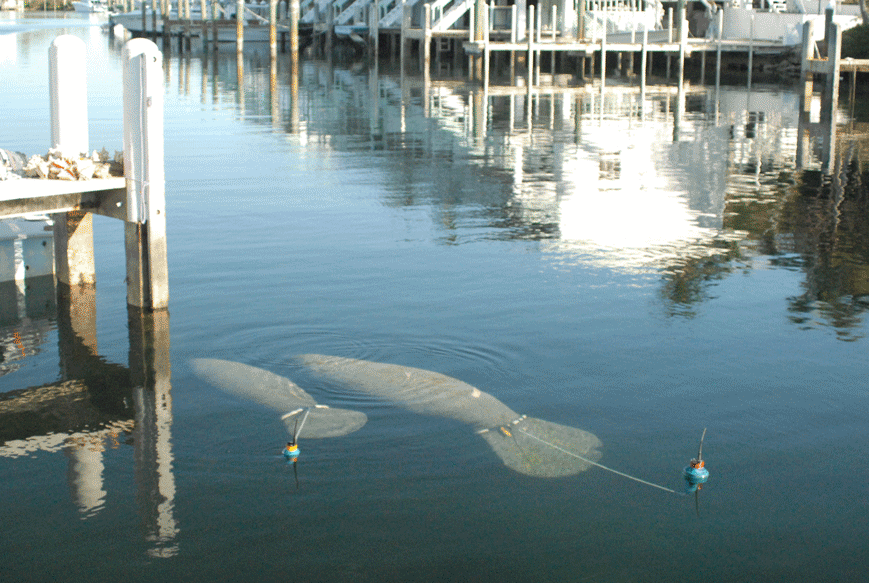
Here, Rita and Georgie are wearing their tags. I really recommend a visit to thefor the full reports, but here’s a quick review of the highlights of weeks 2 and 3 since their release:
WEEK 2
Rita & Georgie are beginning to attract a bit of a following
During the week their confidence grew and they undertook a longer expedition (see map below)
During their travels they were joined by 2 other manatees, first a juvenile male, then an adult male
Rita’s tag became disconnected. It was retrieved, the data downloaded, and it was successfully reattached
Audio recordings were made of underwater manatee communication
At one stage there were six manatees seen together, with manatees Gina and JJ joining the 4 others
Rita nurses Georgie
WEEK 2 ADVENTURES
A far more complicated pattern than the simple explorations in WEEK 1
WEEK 3
Continued careful monitoring of more complex (= braver) exploration
A great deal of local interest generated.
A ‘Save the Manatee’ campaign started
Presentations for groups of school students, including involving them in actual monitoring.
The juvenile male has stayed with Rita and Georgie.
——————————
Rita examines the camera. Meanwhile Georgie checks out the bottom of the BMMRO boat…
A tender moment between calf and mother
WEEK 3 EXPEDITIONS
Confidence growing, and more interest in investigating to the south
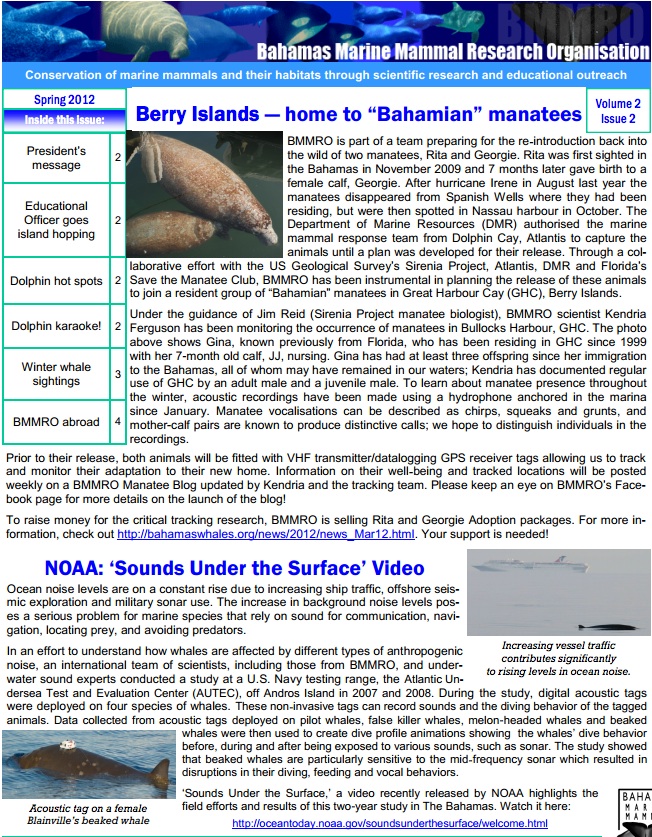
The BMMRO has just published two online reports that will interest anyone who follows the news about Whales, Dolphins and Manatees in the Bahamas.
The first concerns the reintroduction of manatees to the wild – and offers the opportunity to adopt one of them in order to support the continuing work of the conservation of the small manatee population of the Bahamas. You could have a guess now at the number of recently recorded manatees: the answer is right at the bottom of the page. If you have followed this blog’s cetacean posts, you will have noticed my own interest in the continuing monthly sightings (mainly off the Berry Is.) I have had to reduce the size of the article, but if you click on it once – or twice – it enlarges to make it more legible.
To see the article on the BMMRO websiteCLICK==>>BMMRO MANATEES
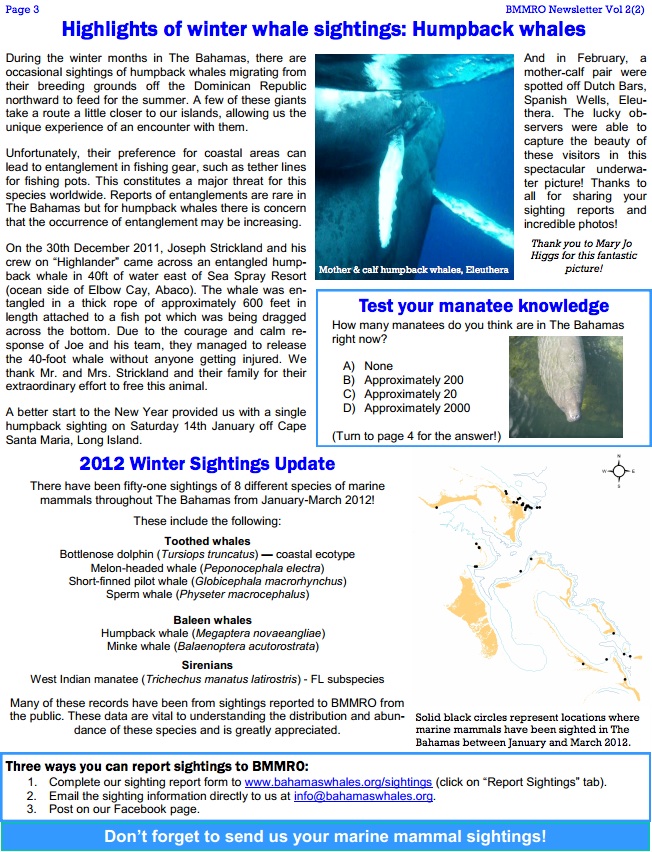
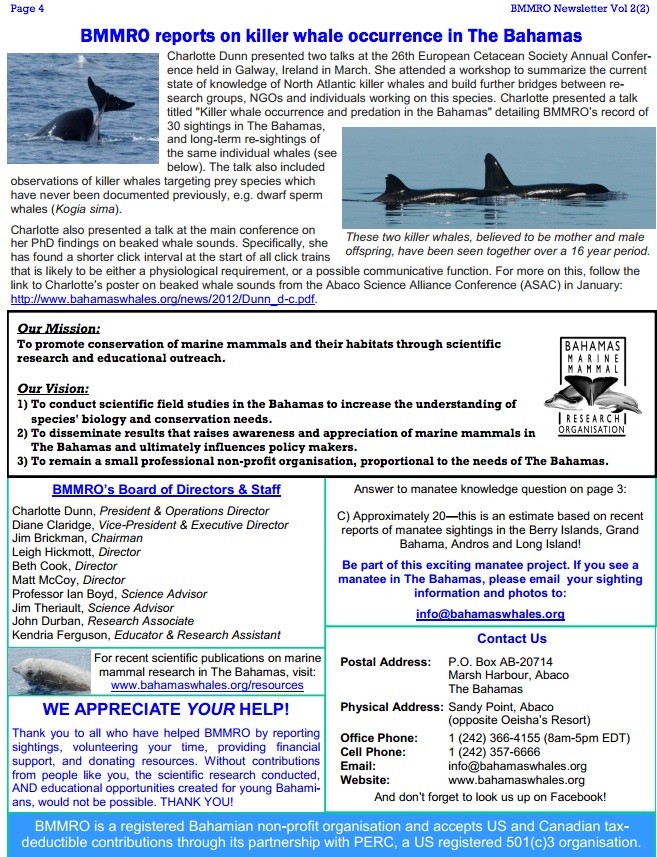
I have summarised past BMMRO quarterly reports, highlighting particular features and photos. This time I’ve put in the whole report in (I hope) legible format. To see it on the BMMRO site CLICK===>>>BMMRO SPRING 2012
On 7 January 2012 the enormous Panama-registered cruise ship MSC Poesia – 100 foot long, 100,000 tons, 6000 + 1000 crew capacity – ran aground on the coral reef off Lucaya Beach, Grand Bahama. She was refloated by tugs on the evening high tide, leaving a trail of destruction to the reef behind her.
Video footage posted by FREDGBSCUBA shows the predicament of this huge vessel above the surface; his subsequent underwater footage graphically shows the extent of damage and explains the longer-term consequences of the incident, including the toxic effects of the anti-fouling paint scraped off the hull (video 3).
STOP PRESS Jan 18 The first video has now been blacked out, with the message that it has been “removed by the user”. Hmmmmm. No comment.
But through the magic of techo-wizardary it has been restored to life and can be now be seen again by clicking===>>>VIDEO 1 HERE
Video 2 has survived intact
Whoops! Video 3, a scientific analysis of the toxic anti-fouling paint, has now ‘gone’ too. Let’s see if we can… Good, here it is again
I’m no mariner, but wouldn’t a ship of that size and weight in known shallow water and reef territory have (a) navigators (b) detailed nautical charts (c) depth gauges or sounders and (d) one or more pairs of eyes keeping a look out? Or does this sort of thing happen all the time?
This is not Poesia’s first brush with misfortune. I see from Wiki that in her first year of operation, 2008, “…MSC Poesia and Costa Classica collided in the Adriatic Sea near Dubrovnik. No one was hurt, and the damage was minimal. The cause of it was that MSC Poesia’s anchor loosened and precipitated (sic) her to hit Costa Classica. Both continued their scheduled itinerary with no delays”. The coral has not escaped so lightly…
I see that this ship also plies the Venice lagoon. I hope she knows not to stray from the deepwater channels: the average depth elsewhere is ± 1 metre…
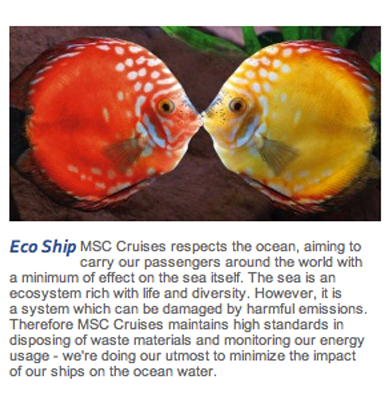
The website of MSC Cruises sets out an encouragingly positive environmental mission statement (below), so let’s hope the company swiftly applies these principles and comes up with proposals for redressing the adverse environmental consequences of this episode…
The vessel’s name means ‘Poetry’ – so, an inspiration for some hot doggerel:It really is beyond belief / That she should ground upon a reef / For ‘Poetry’, once set in motion / Upon a pristine turquoise ocean / Should avoid such Eco-griefs / And steer well clear of coral reefs…
Credits: Thanks to Fred Riger of Freeport for approval for using his 3 videos
STOP PRESSFor a report of the incident in the Freeport News 14 January 2012 CLICK LOGO===>>>
Here’s a report I’ve turned up, which may well be of interest from a crawfish conservation viewpoint. And it’s also an excuse to post the excellent campaign song, which needs no added comment from me – see video below. The campaign slogan is… a delight. The Rare Planet website is well worth a rootle round – click the link below
Campaign manager: D’Shan Maycock Partner: Friends of the Environment
“When D’Shan Maycock launched a Pride campaign to rally her community around protecting marine life off of Abaco Island, she didn’t necessarily imagine her slogan becoming part of the daily lexicon for fishers, students, international conservation organizations, and even the Prime Minister. But thanks to a catchy phrase – Size Matters – and the idea of the locally-treasured crawfish shrinking due to overfishing, her campaign has caught on everywhere.
Crawfish are an important species for the biodiversity of Abaco Island, providing 60% of the total commercial fish catch and sustenance for other marine life in the region. However, due to unsustainable fishing practices and lack of local awareness, each year’s crawfish yield declines in numbers, total poundage, and average size. D’Shan discovered a heavy incidence of illegal fishing of juvenile crawfish, as well as a dearth of the formerly large crawfish that lay many times more eggs. There are 5 national land and sea parks around the island, yet it is a challenge for law enforcement to manage every landing dock. Community support is critical. So D’Shan has gotten creative.
Progress on the campaign…
• Secured pledges from local fishers not to catch juvenile crawfish under 5.5 inches – their yield monitored through a new certification process
• Built awareness among key influencers and the general public about the importance of protecting juvenile crawfish
• Garnered the attention and support of high profile players in the region, including The Nature Conservancy, which is interested in taking the certification process to other islands in the Bahamas, and the Bahamian Prime Minister, who at a recent All-Abaco Expo on Food Security, called out the slogan of the campaign and pledged ongoing support for fisheries protection
(To whom thanks for this… but, hey guys, your ‘CONTACT’ page only gives long-distance phone numbers (wot no email?) Are you ok with me using this? If not please ring +44 763549390 between 19.00 and 21.00 and ask for ‘Tarquin’)
STOP PRESS: here is a news clip about the new campaign mural in M H, posted by campaign manager d”Shan on The Abaco Scientist
MARINE BROCHURE, ABACO, BAHAMAS A basic blueprint for environmental protection on Abaco
The various interested organisations have produced a simple 2-page brochure designed to promote responsible preservation of the island’s natural resources. If you click on a page below it will enlarge. If you want to go to the webpage to download the pdf for yourself (or pass it on) CLICK==>MARINE BROCHURE

















 ROLLING HARBOUR ABACO

You must be logged in to post a comment.