
‘CARRION SCAVENGING’: TURKEY VULTURES IN ABACO BAHAMAS
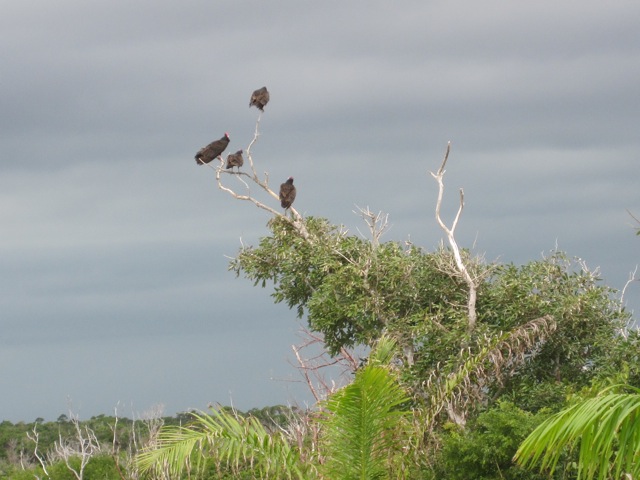
Turkey Vultures (Cathartes aura) manage to be simultaneously majestic, hideous, revolting and socially vital, all packed into a single species. There is, as yet, no ‘International Turkey Vulture Appreciation Day’. But perhaps there ought to be?
THE FACTS
The word ‘vulture’ derives from the latin word ‘vulturus‘ meaning ‘ripper’, ‘shredder’, or ‘very loud Metallica song*‘.
TUVUs have very good eyesight, and an acute sense of smell that enables them to detect the scent of decay (from the release of the chemical ethyl mercaptan) from a distance. They head for the source with relish. To them, it is just a meal. A breeding pair will raise two chicks, which revoltingly are fed by the regurgitation of all the rank… oh, you fill in the rest…
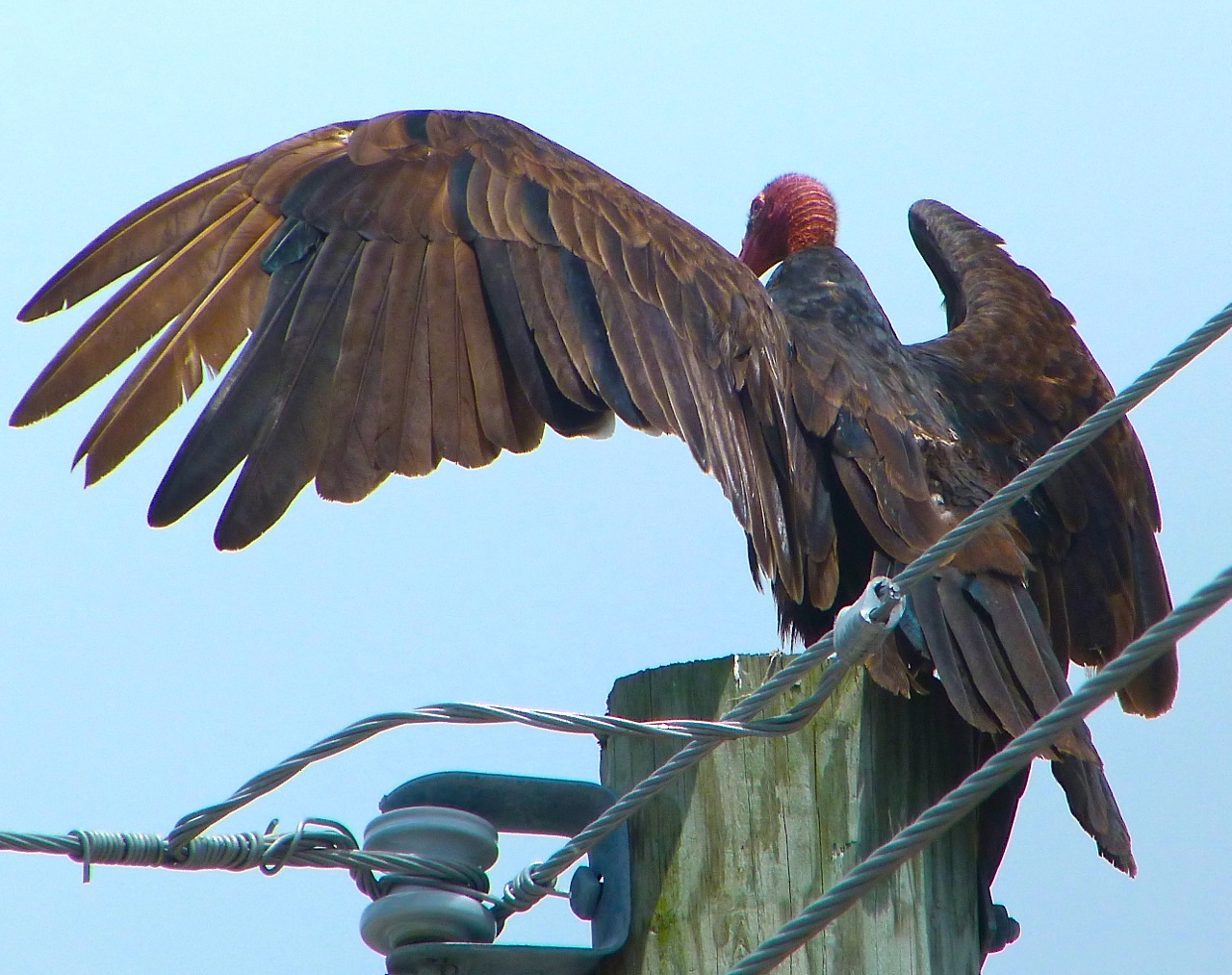
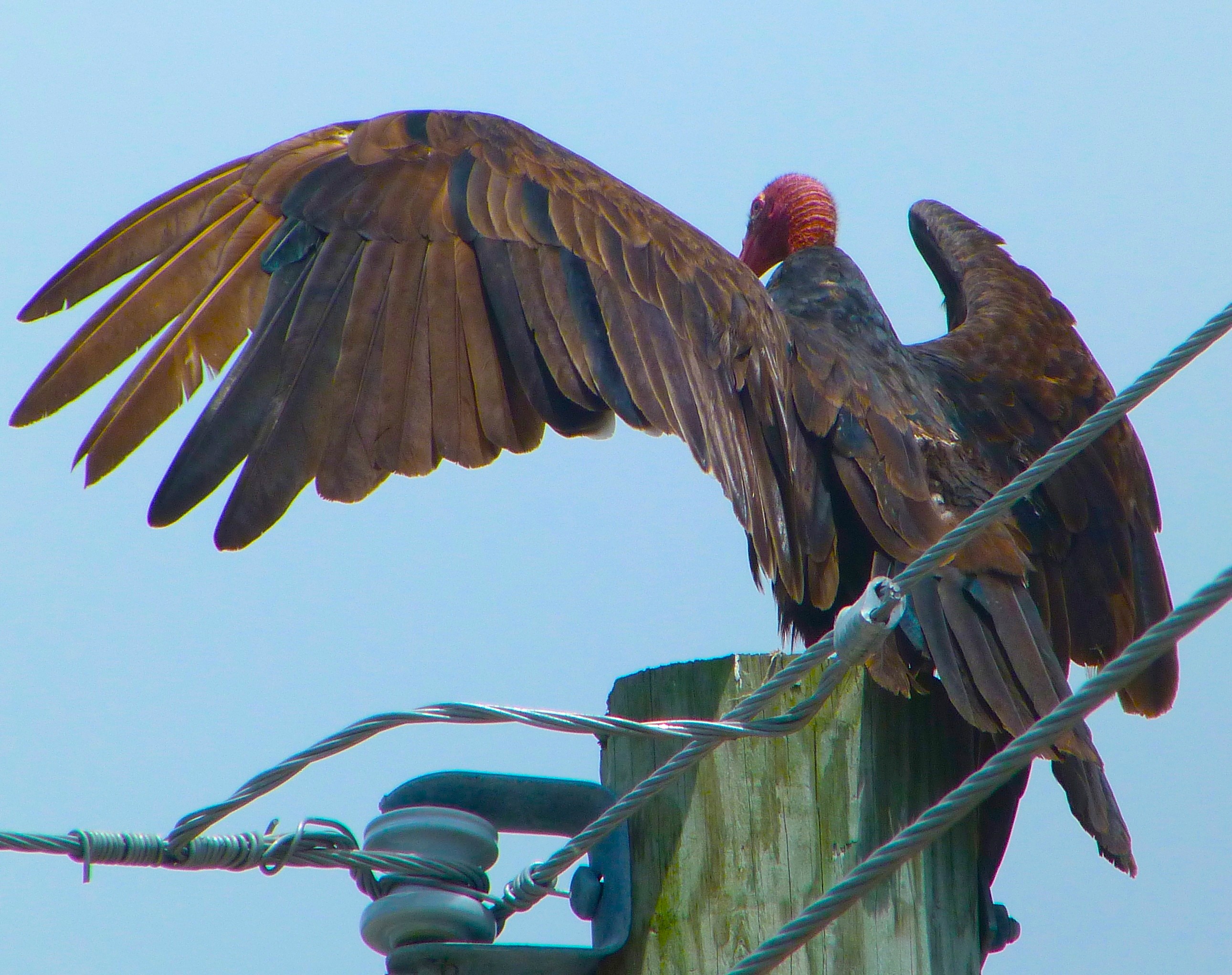
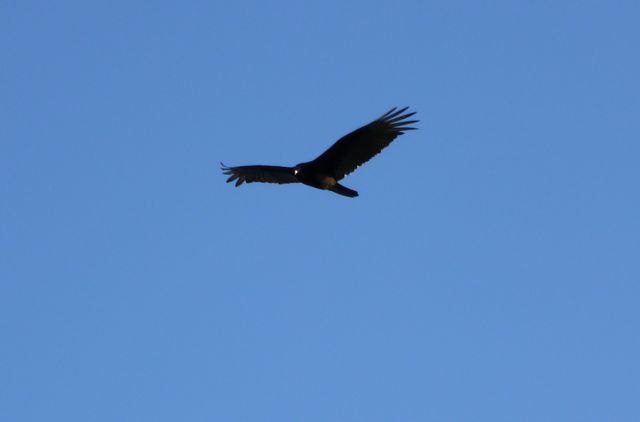
These large vultures are often seen in a spread-winged stance, which is believed to serve multiple functions that include drying the wings, warming the body, and baking bacteria. Possibly it also reduces the miasma of rotting meat that may surround them after a good lunch.
TUVUs like best to perch on a vantage point – utility posts or wires are ideal.

You won’t ever hear them sing or call. They lack a SYRINX (the avian equivalent of a larynx), and their vocalisation is confined to grunting or hissing sounds. Here’s a hiss (at 10 / 15 secs).
10 SCAVENGED TURKEY VULTURE FACTS FOR YOU TO PICK OVER
- One local name for TUVUs is ‘John Crow’
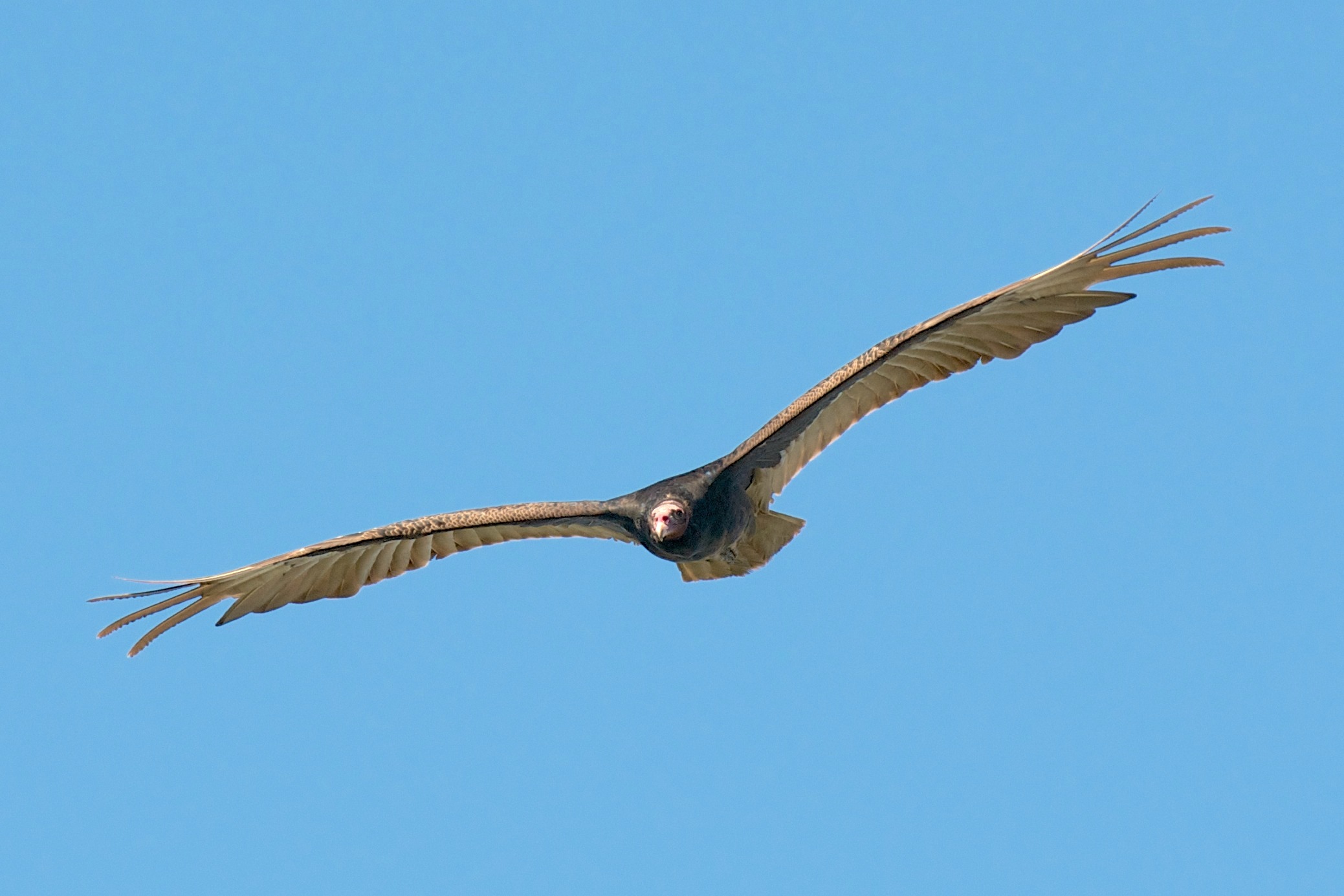
- An adult has a wingspan of up to 6 feet
- Sexes are identical in appearance, although the female is slightly larger
- The eye has a single row of eyelashes on the upper lid and two on the lower lid
- TUVUs live about 20 years. One named Nero had a confirmed age of 37
- LEUCISTIC (pale, often mistakenly called “albino”) variants are sometimes seen

- TUVUs are gregarious and roost in large community groups
- They have few natural predators (perhaps for reasons of their hygiene deficiency)
- Elegant in flight and users of thermals, but ungainly on the ground and in take-off
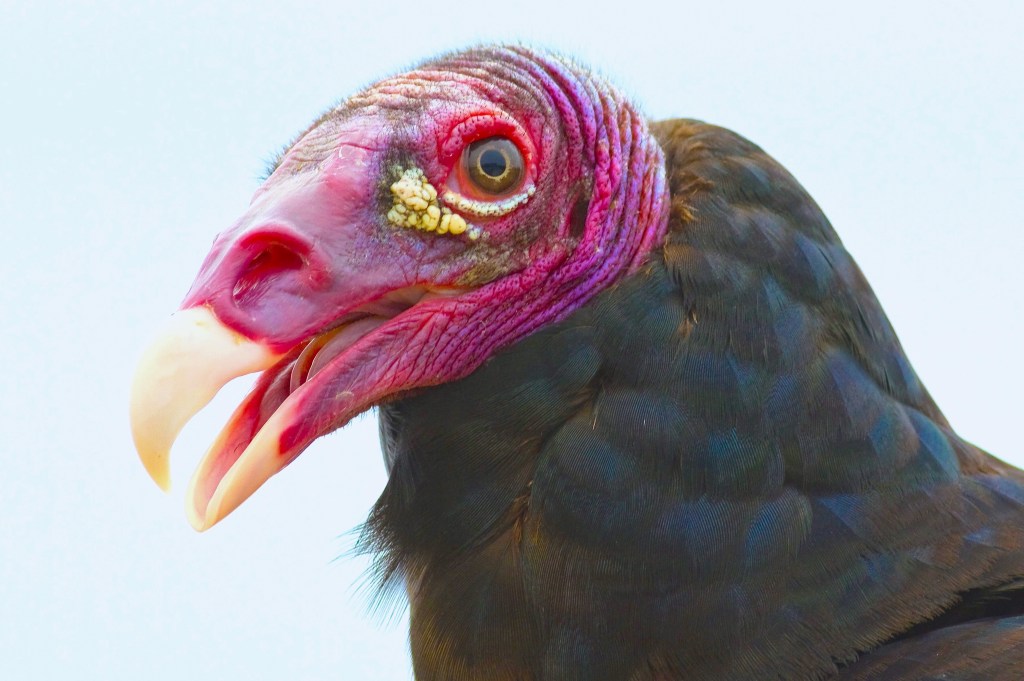
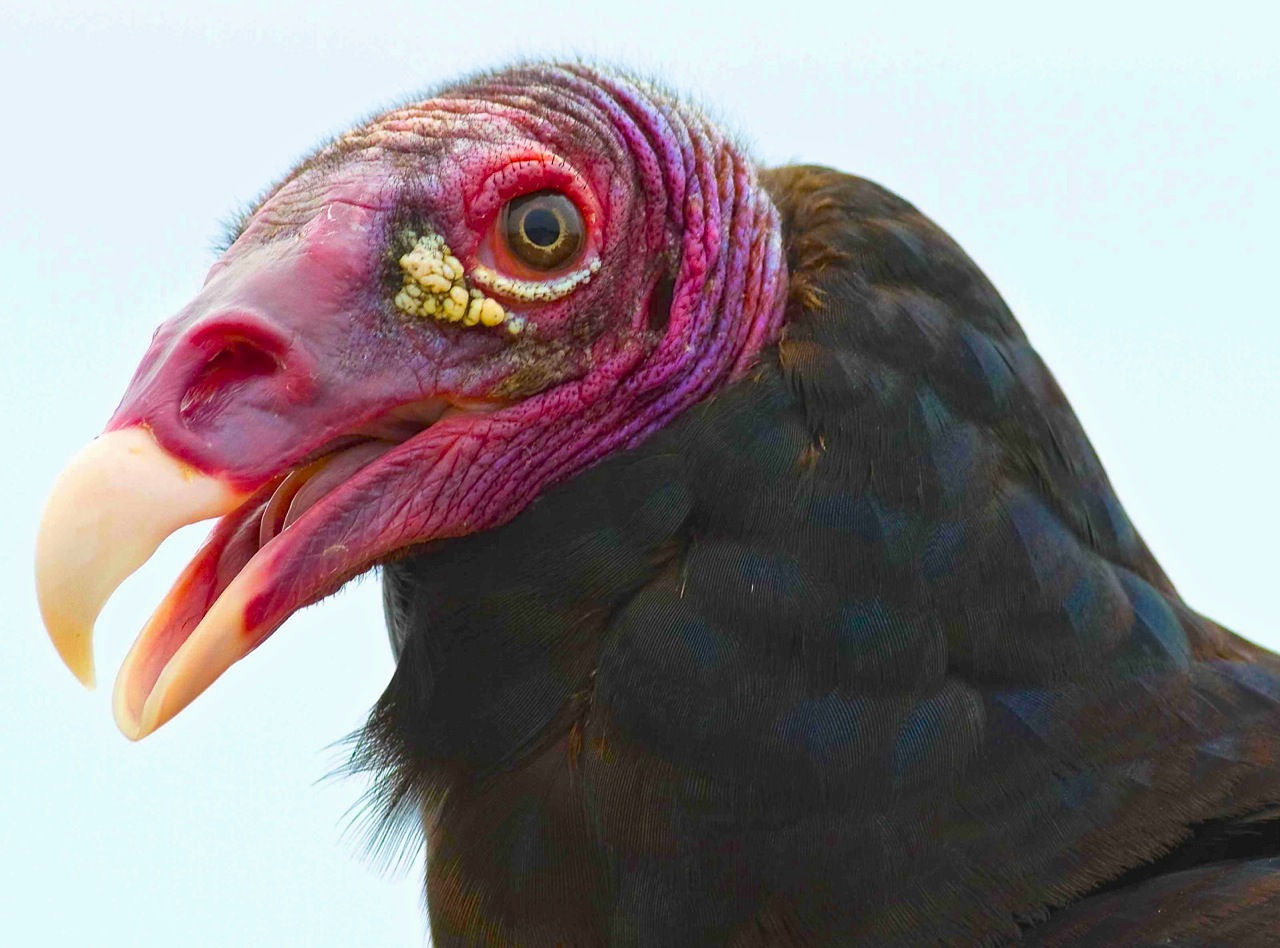
- Nostrils are not divided by a septum, but are perforated so…
- From the side one can see through the beak

REVOLTING CORNER / DEPT OF ‘WAY TOO MUCH INFORMATION’
SQUEAMISH? THEN LOOK AWAY NOW
UNATTRACTIVE HABITS The Turkey Vulture “often defecates on its own legs, using the evaporation of the water in the feces and/or urine to cool itself, a process known as UROHIDROSIS. This cools the blood vessels in the unfeathered tarsi and feet, and causes white uric acid to streak the legs”. The droppings produced by Turkey Vultures can harm or kill trees and other vegetation. Maybe don’t park your nice car under one of their perching posts…
HORRIBLE DEFENCES The main form of defence is “regurgitating semi-digested meat, a foul-smelling substance which deters most creatures intent on raiding a vulture nest. It will also sting if the predator is close enough to get the vomit in its face or eyes. In some cases, the vulture must rid its crop of a heavy, undigested meal in order to take flight to flee from a potential predator”
DIETARY NOTES TUVUs tend to prefer recently dead creatures, avoiding carcasses that have reached the point of putrefaction. They will occasionally resort to vegetable matter – plants and fruit (you could view this as their side-salad). They rarely, if ever, kill prey – vehicles do this for them, and you’ll often see them on roadsides feeding on roadkill. They also hang around water, feeding on dead fish or fish stranded in shallow water.
ECO-USES If you did not have birds like this, your world would be a great deal smellier and less pleasant place, with higher chance of diseases from polluted water and bacterial spread. TUVUs kept the highways clear and work their way round the town dumps recycling noisome items. Humans need them although, conversely, they don’t need humans.

FORAGING TUVUs forage by smell, which is uncommon in birds. They fly low to the ground to pick up the scent of ethyl mercaptan, the gas produced by the beginnings of decay in dead animals. Their olfactory lobe in the brain is particularly large compared to that of other animals.
SEX TIPS Courtship rituals of the Turkey Vulture involve several individuals gathering in a circle, where they perform hopping movements around the perimeter of the circle with wings partially spread. In humans, similar occasions are called ‘Dances’. A pair will fly, with the female closely following the male while they flap & dive… then they land somewhere private and we draw the veil…


Credits: Craig Nash (1); Keith Salvesen (2); Nina Henry (3, 5, 6); amy-at-poweredbybirds (4); Charlie Skinner (7); Xeno-Canto / Alvaric (sound file); Birdorable (TUVU cartoon); depressingnature.com (puking TUVU); Source material OS & magpie pickings. Adapted and updated from a previous version written a while back
*As Metallica so appropriately wrote and sweatily sang (luckily there’s no verse referencing urination, defecation and puking). ALERT don’t actually play the video if you check on YouTube etc – the song hasn’t aged well! In fact… it was always terrible. Woe woe indeed…
The vultures come
See the vultures come for me
Fly around the sun
But now too late for me
Just sit and stare
Wait ’til I hit the ground
Little vultures tear
Little vultures tear at flesh




























 ROLLING HARBOUR ABACO
You must be logged in to post a comment.