HELLO, HANDSOME! WESTERN SPINDALIS IN THE MOOD FOR LURVE…
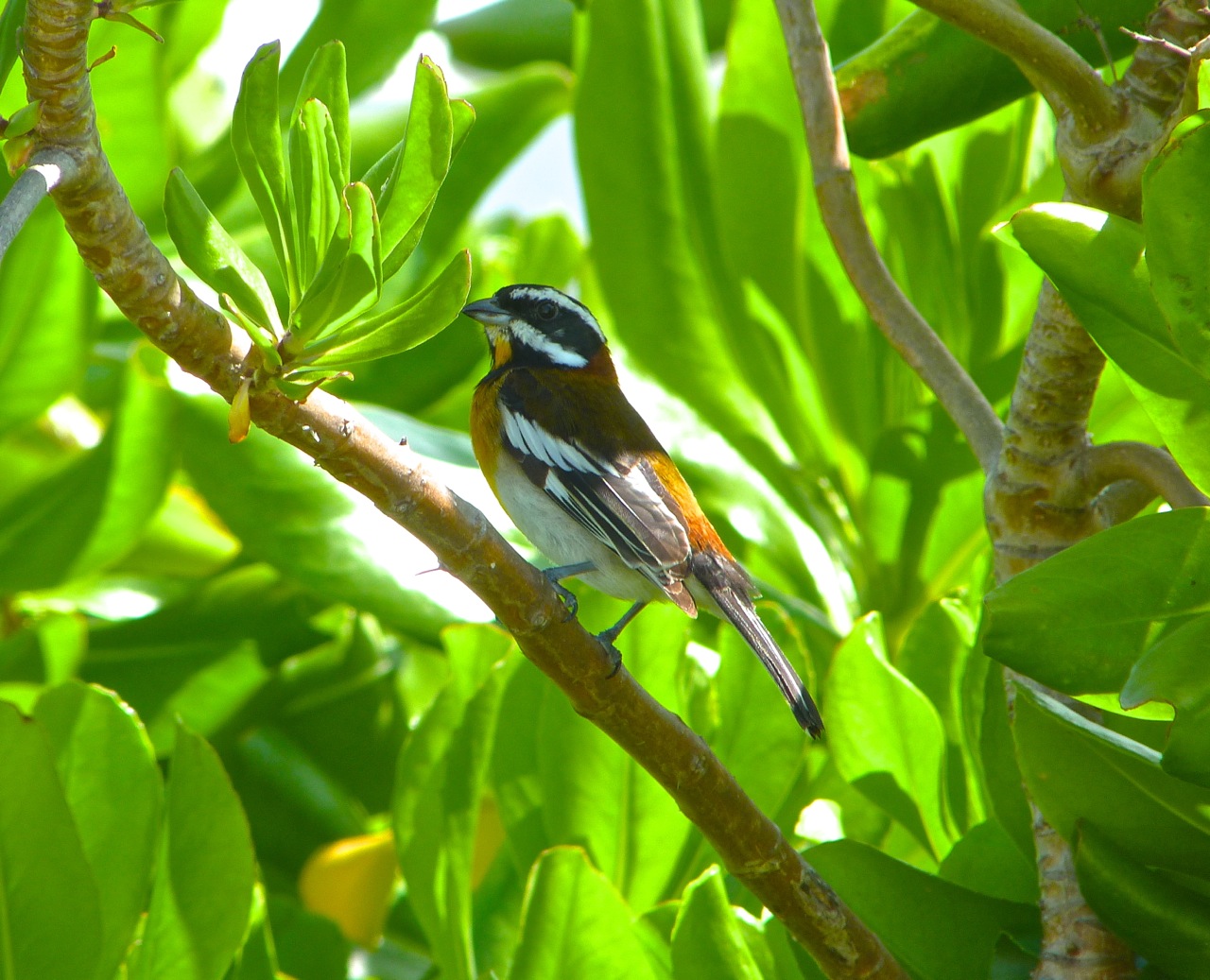
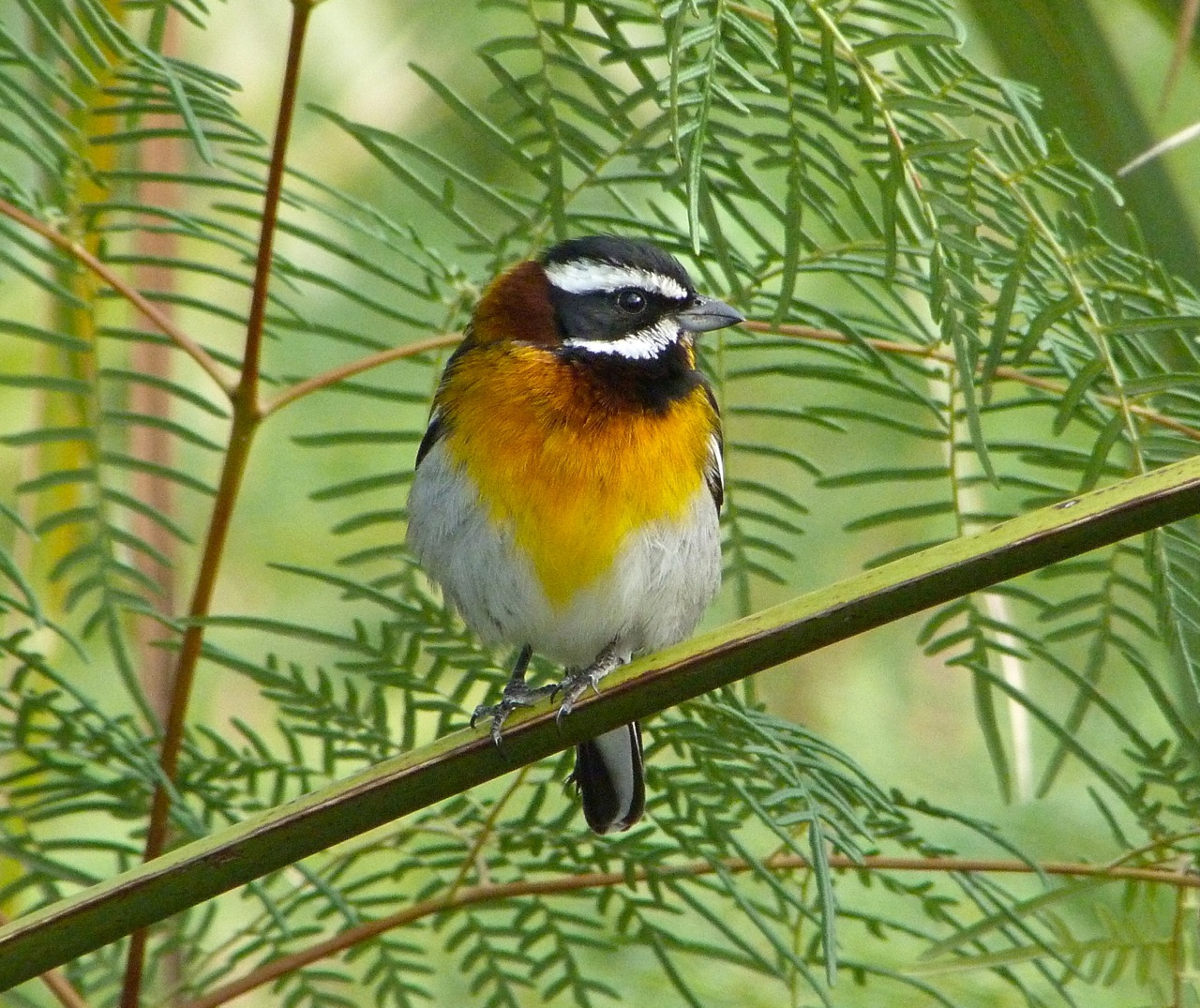
Nearly two years ago, when this blog was still in its mewling infancy, I posted about one of my favourite small birds on Abaco, the WESTERN SPINDALIS (Spindalis zena, formerly known as the Stripe-headed Tanager). It is a strikingly handsome creature by any standards, often seen posing ‘tall’ on a branch looking splendid in its orange, black and white livery.
Perching proudly…… or dining elegantly…
The spindalis is one of the birds to look out for if you are walking along one of the drives at Delphi, or (*recommended 1/2 hour stroll*) walking the drive circuit. You’ll see them in the coppice or in the undergrowth alongside the drives in the pine forest area, almost certainly a little way in from the front. We spotted one quite close to the Highway, looking most decorative in the greenery. This one had an uncharacteristic hunched look about him, and we soon discovered why – he was courting. Not the black-faced grassquit near the bottom of the photo, but a female spindalis well-hidden low down and further back in the undergrowth to the left. So we edged nearer to get a better look.
You’ll see that this male bird’s hunched posture has produced a rather impressive neck ruff, an adornment presumably irresistible to female spindalises. Both birds were ‘chucking’ softly to each other, and the male turned his head regularly to show off his glories from all angles. I can’t unfortunately reveal the outcome of this encounter. We never saw the female, and we had probably got too close for her to feel comfortable about breaking cover. The male, however, was too absorbed refining his pulling techniques to be greatly bothered by our presence, though he did keep a beady black eye on us. Is this male preoccupation when courting found in other animal species, I wonder? Reader, we made our excuses and left…
YOU WILL NEED: an iPh@ne or similar smartphone with a voice memo facility; patience; minimal non-natural background noises (traffic, yelling people, barking dogs, heavy machinery); a steady-ish hand; one or more birds nearby
RECORDING
Use the Voice Memo app on an iPh@ne (I presume most other smart phones have a similar app).
Once you have it onscreen, turn the phone round 180 deg and the image will swivel round too. Now you can point the microphone at the sound and have the controls the right way up facing you.
Turn the volume up to max before you record.
Handle the phone carefully so it doesn’t record you touching it as well. It probably won’t pick up pressing ‘record’, but it may when you press ‘stop’. But you can trim the end of the saved file on the file very simply.
The recording saves in m4p format, and you can email it to your computer direct from the app (or to anywhere or anyone else).
Drag / save the file onto your desktop from the email. When you open it, it will (a) play and (b) appear in your iTunes library (or whatever music storage system you use).
CONVERTING RECORDINGS TO MP3
Having opened the recording, to convert the file to an mp3 (generally the preferred version for uploading elsewhere) in iTunes, go to Songsin your iTunes library and search for Memo. There it is!
You can rename it at this stage if you wish.
Then go toFile on the top bar, and in the drop-down menu, near the bottom, go to Create new version. It will offer you mp3.
Clickmp3 and a second recording file will appear in your library. That’s your mp3.
Drag it onto your desktop and do what you want with it.
Apologies if this is all blindingly obvious and written in the elementary computer language ‘eggy-peggy’. It took me a while to get it sorted out, and I hope the details above will help the lo-tek computer user to record birds and use the results painlessly.
FIELD NOTES
I recommend recording for about 20 – 30 seconds max. The iPh@ne allows easy trimming at the start and end of the saved file, but there’s no easy way to edit the middle to take out the barking dog.
Several short recordings of each bird will give a better choice of results than one or 2 long recordings.
The iPh@ne mic is surprisingly sensitive. It will pick up all nearby sounds – someone whispering at you “is it recording yet?”, for example. So ideally this is best done in the pine forest or coppice, away from the Highway. And maybe the loud whisperer.
Wind can be a problem. Not just for humans. The mic will pick up gusts of wind, or wind blowing across it if you change the direction you are pointing the phone as you record. So this is best done on a calm day.
Here are two practice recordings I made in March. The first is the female red-winged blackbird above (and header) at Casuarina beach. The distinctive call is rather like a rusty hinge on a swinging gate, often heard far out in the mangrove swamps of the Marls. You’ll hear background noises from collared doves and also the sea lapping on the shore.
The second is thick-billed vireo in the coppice at Delphi. You’ll hear an answering vireo – and also some wind noise. I find these little birds frustratingly hard to see – they always seem to be lurking further back in the bushes than I think. I’ve never managed to take a good photo of one, so I’ll upload an illustrative poor one to be going on with. I am back on Abaco in a week, and a better TBV photo is on my avian hit list.
Finally, you’ll find a longer recording I made of Abaco parrots squabbling noisily at Bahama Palm Shores near the end of a recent post HERE. I made an mp3 using the method described above, and uploaded it to the excellent Xeno-Canto bird sounds website, which is well worth exploring. You can find my recordings of the parrots and the birds in this post, plus sonograms, on my XC page, such as it is, HERE
But if you just want to hear the parrots, here they are. Like schoolkids, only louder.
Why do I do that annoying ‘iPh@ne’ thing? It’s a statistical fact that I have just made up that 373,597 people a minute world-wide g@@gle the correct word. Imagine the meta-crawlers and spam-splurgers that lock onto that word. I don’t want to cyber-meet them. I also use the form Am@z@n but for different reasons relating to their ingenious tax arrangements (alleged, obviously). Thus with G@@gle as well (again, merely alleged – as Dusty Springfield memorable sang, “Nothing is proved…)
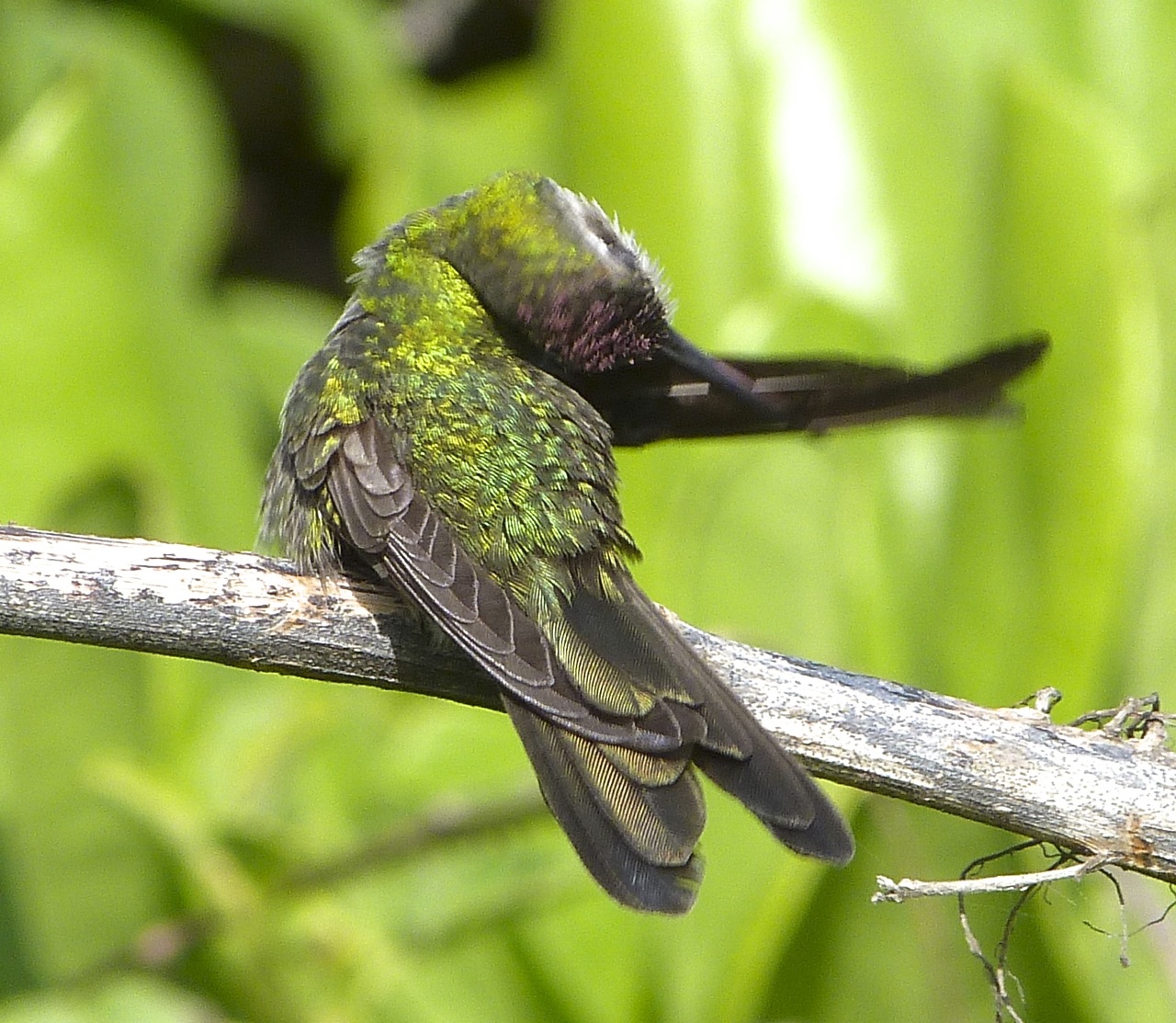
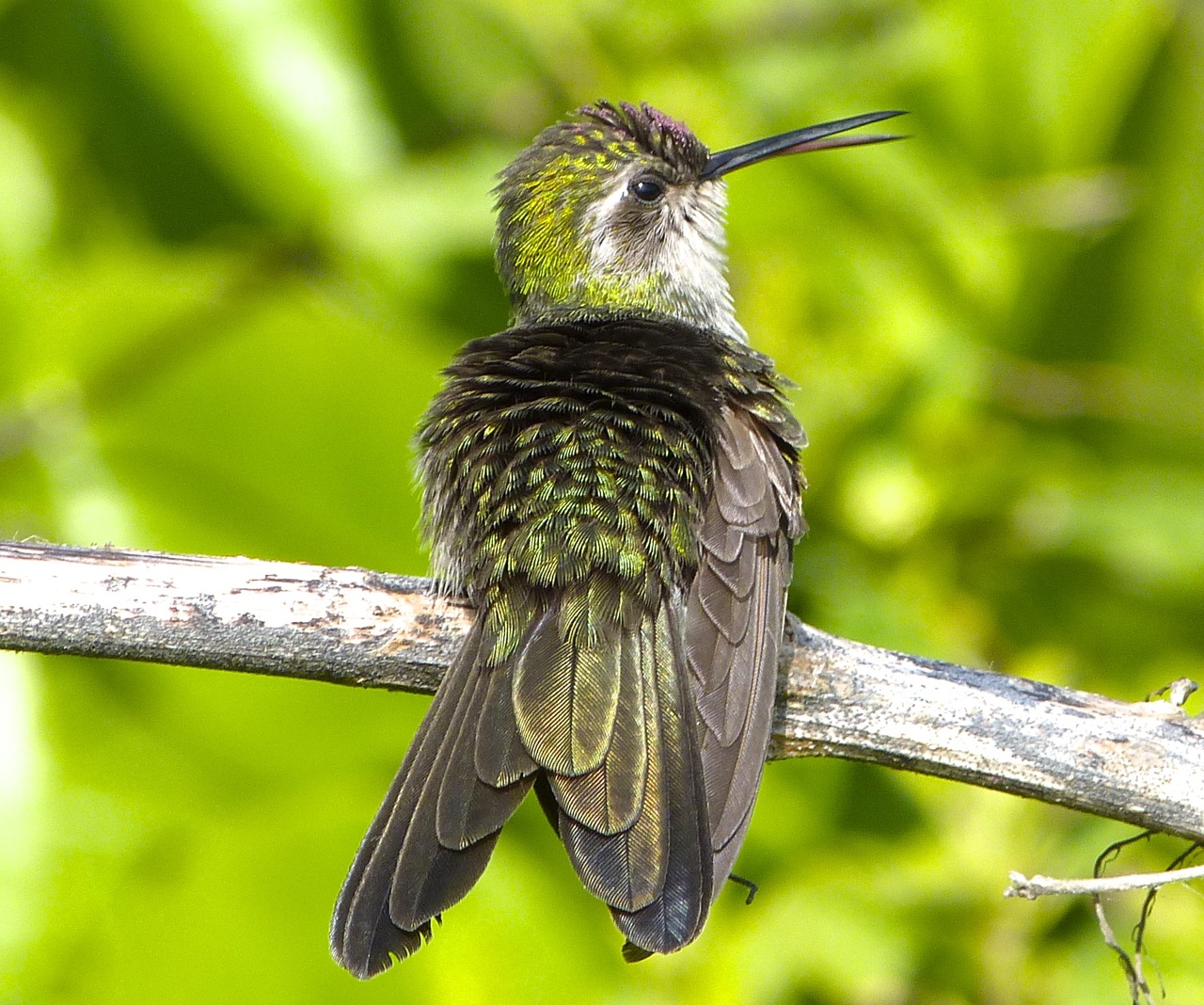
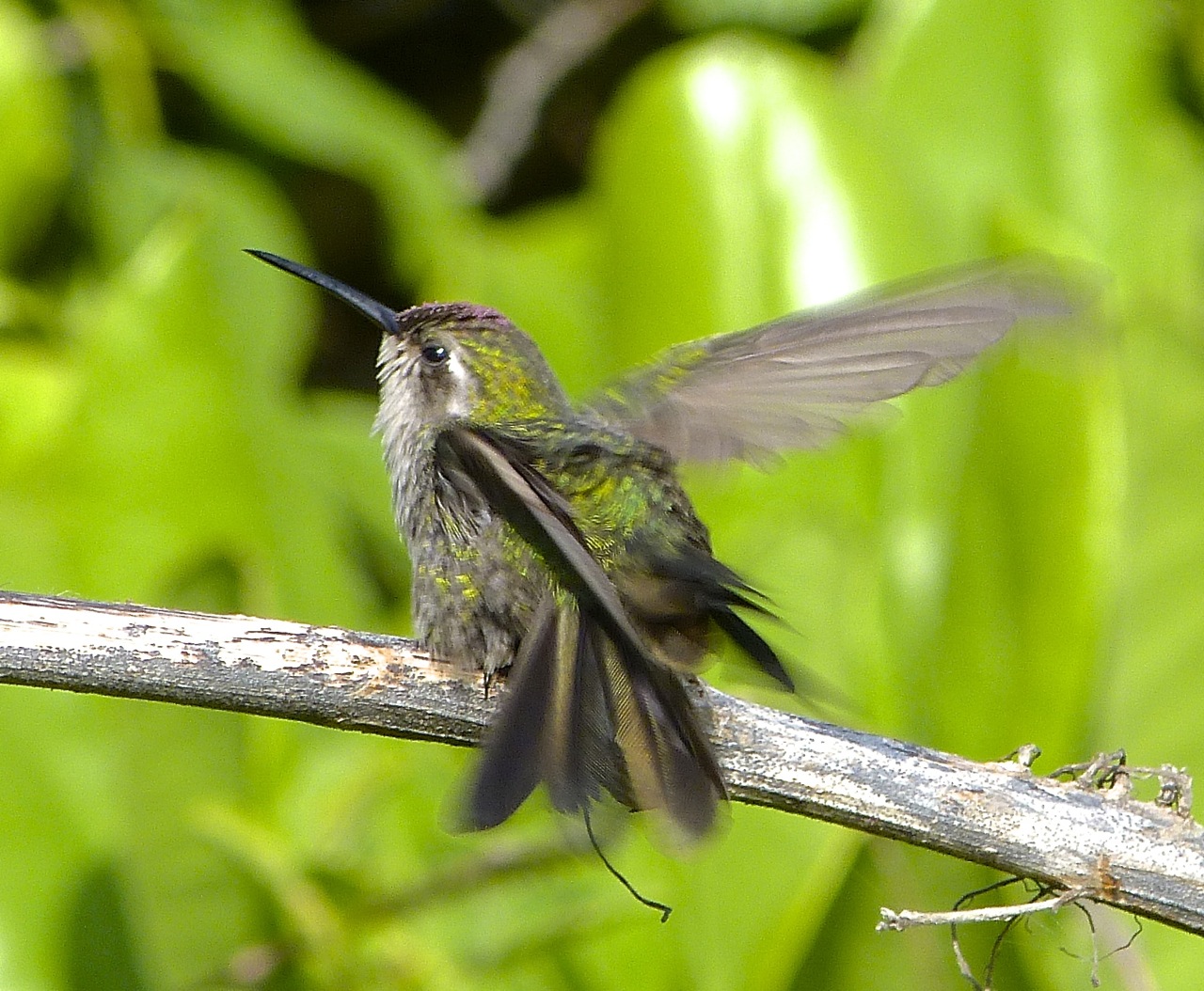
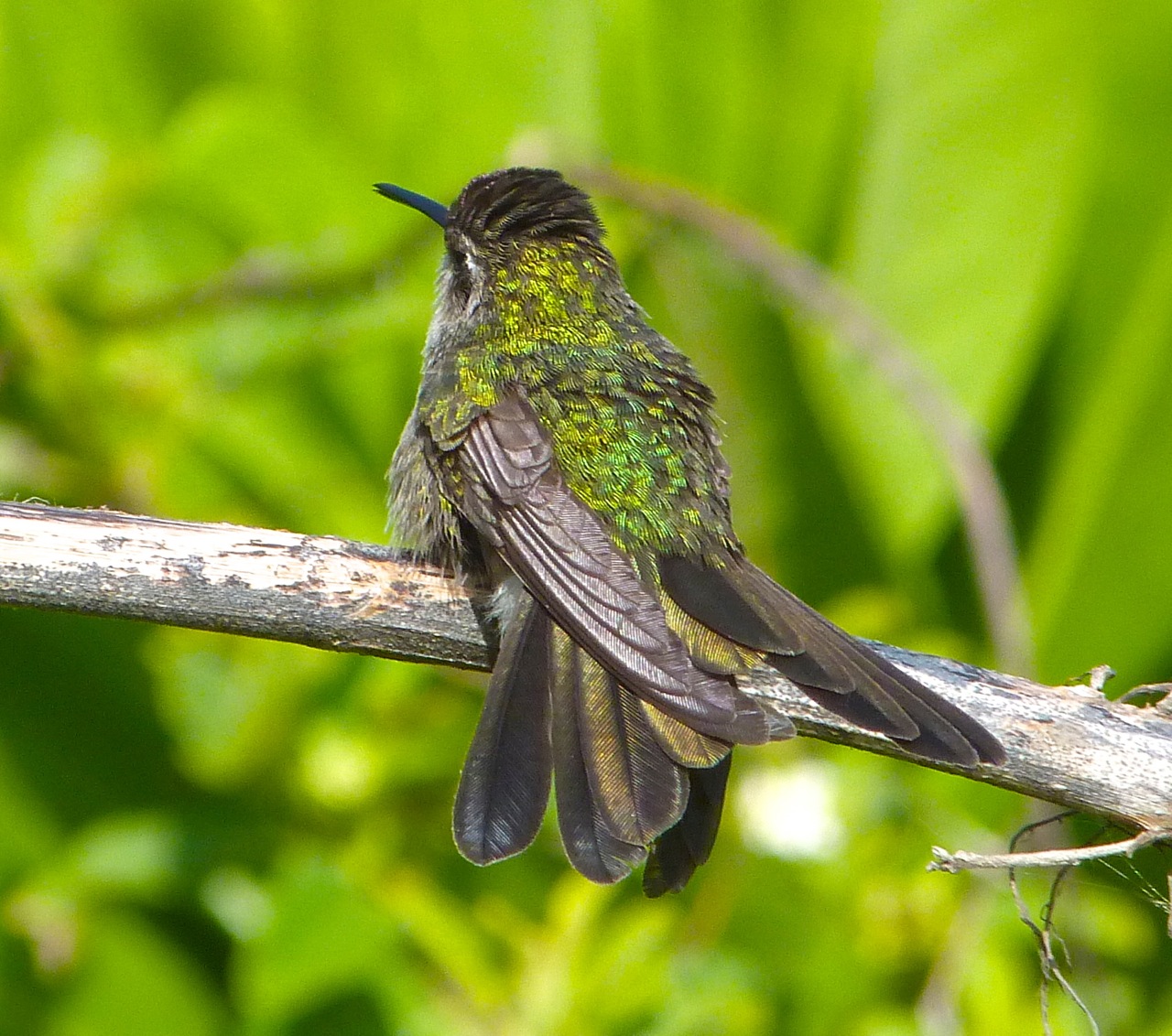
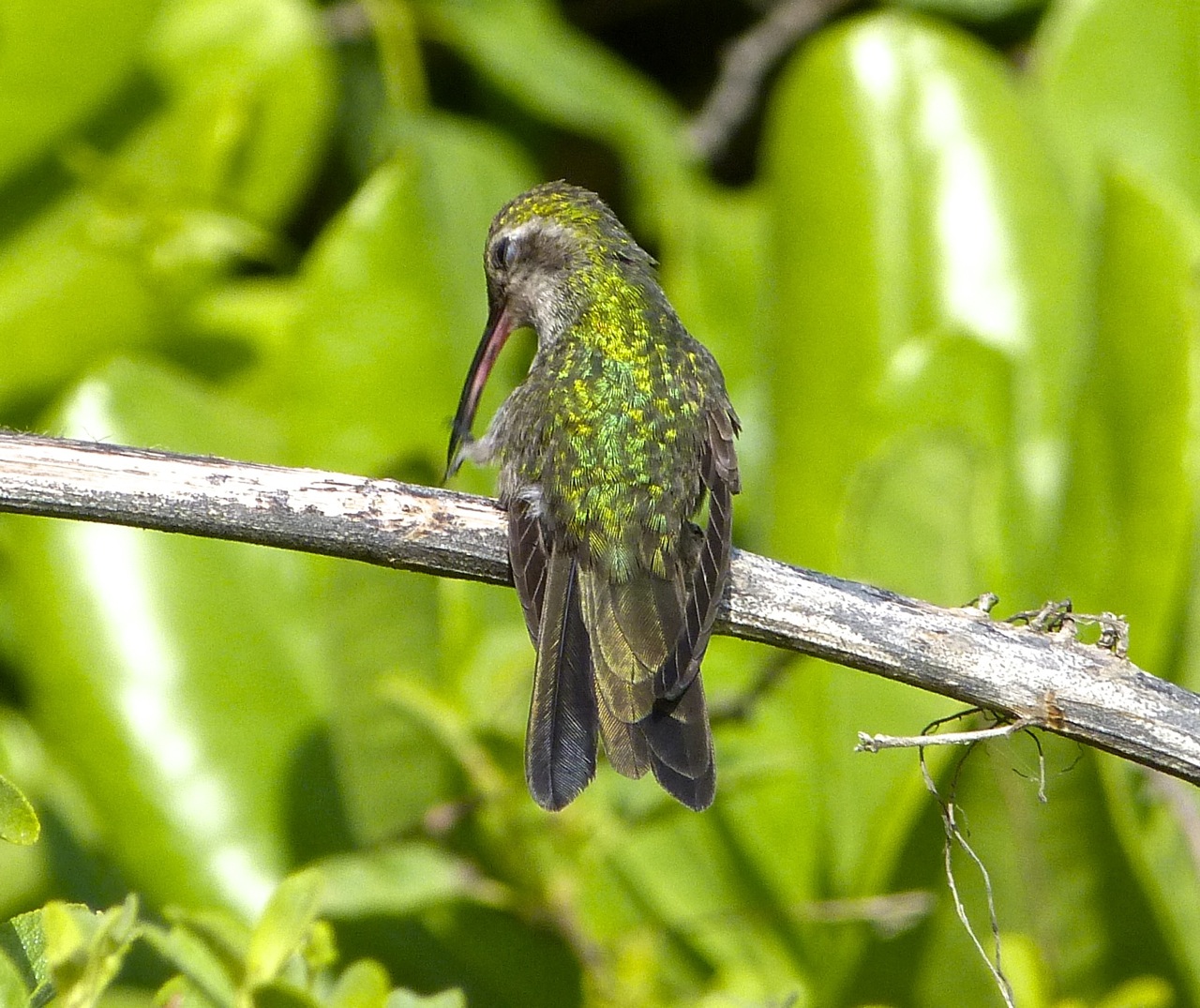
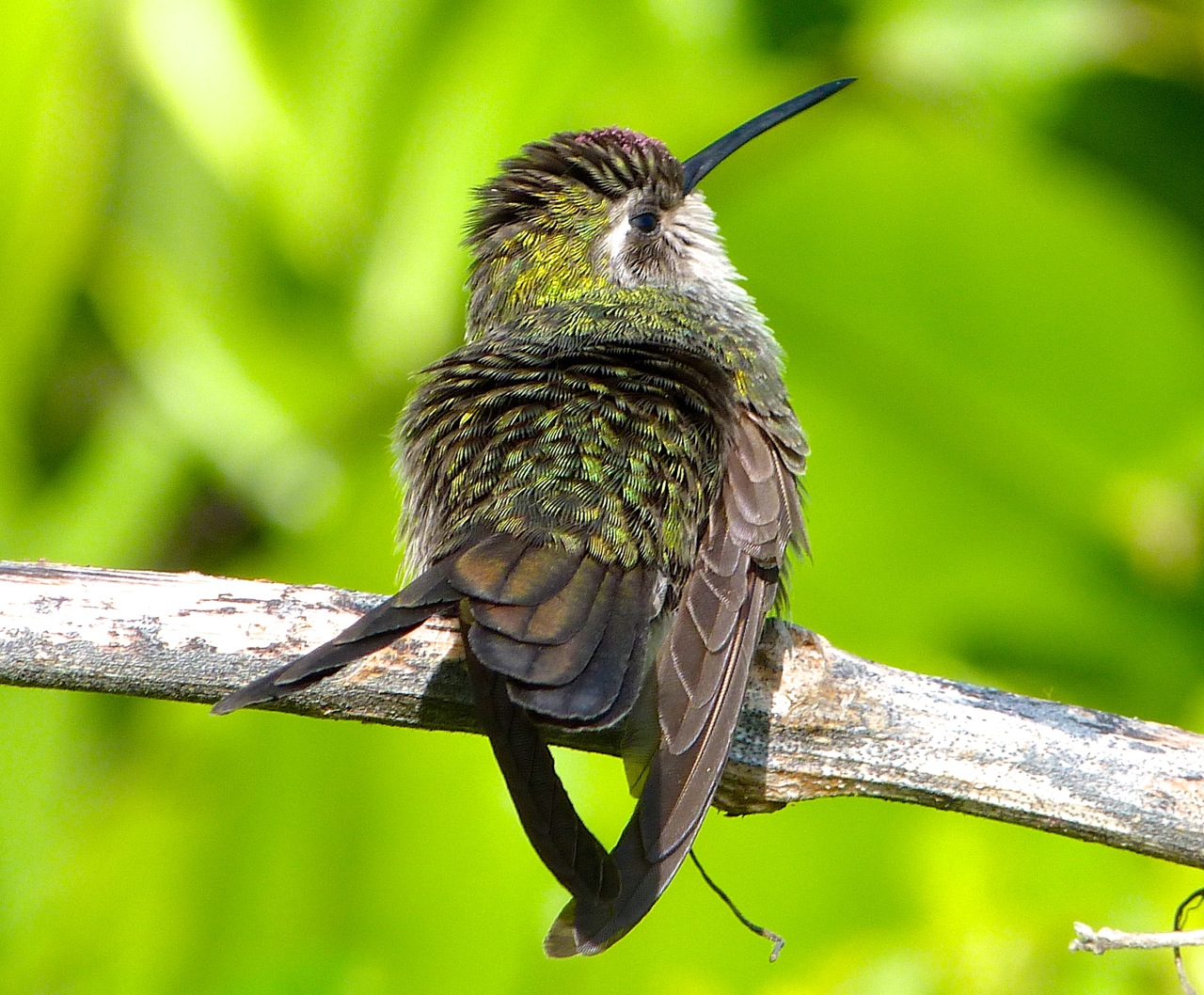
This tiny bird was in the Abaco coppice, well off the beaten track. Nearly two miles down a notably unbeaten track, in fact, that later was to lead to a puncture-and-@$%^&*-I-forgot-my-cellphone drama. Trauma, even. The hummer knew perfectly well that I had crept up behind it, but it had presumably seen few bipeds. It would not have known of their urge to bulldoze wild habitat and turn it into massive unsold developments, as has happened a short way up the coast… So it just carried on with what a bird has to do to keep itself looking presentable, while I, feeling rather rude and intrusive, took some quick pictures before leaving it in peace. Rather than sell these intimate studies to Hello!, OK!, Chirpy! or Tweet!, I am displaying them free for your enjoyment.
In addition to the Cuban Emerald, the Bahamas has its own endemic hummingbird, the Bahama Woodstar. In the faltering early days of this blog, I posted about them both atBAHAMA WOODSTARS & CUBAN EMERALDS: THE HUMMINGBIRDS OF ABACOAt that time, I was not really a ‘birder’ at all, and had only a very basic camera, so my own pictures were… very basic. But you may be interested in some of the info in the post about these two species, so I mention it in passing.
I haven’t posted Abaco whale, dolphin & manatee news for a while. Time for a catch-up. Georgie the young manatee that left her mother Rita and came to Abaco from the Berry Is. alone, is no longer here. She survived a very long journey, and investigated various coastal areas of Abaco – all the while being tracked. In the end she settled down in the Cherokee area. There were anxious times during Hurricane Sandy when she went missing (having by now shed her tracking device) but she eventually reappeared at Cherokee having found a safe haven from the storm. Sadly, however, her condition deteriorated and in the New Year she was relocated to Atlantis Dolphin Cay Marine Mammal Rescue Center. Some weeks ago a healthy Georgie was moved to a sea-pen to acclimatise her for release back into the wild.
Read more about Georgie the Manatee’s epic tripHEREand about the operation to relocate herHERE
ABACO DOLPHINS – A MOTHER & HER CALF
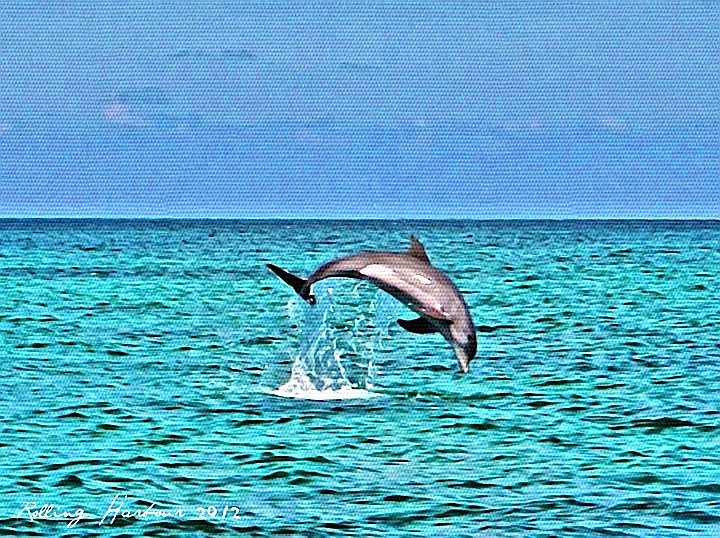
The Bahamas Marines Mammal Research Organisation (BMMRO) is based at Sandy Point, Abaco. A number of research projects are underway, and recently these have involved work on Andros. The team are now back, and encountering Abaco’s own dolphins and whales. The main photos on the page have all been taken in the last week or so. [The header is by Norwegian artist Roll Inge Haaver]
BOTTLENOSE DOLPHIN, ABACO
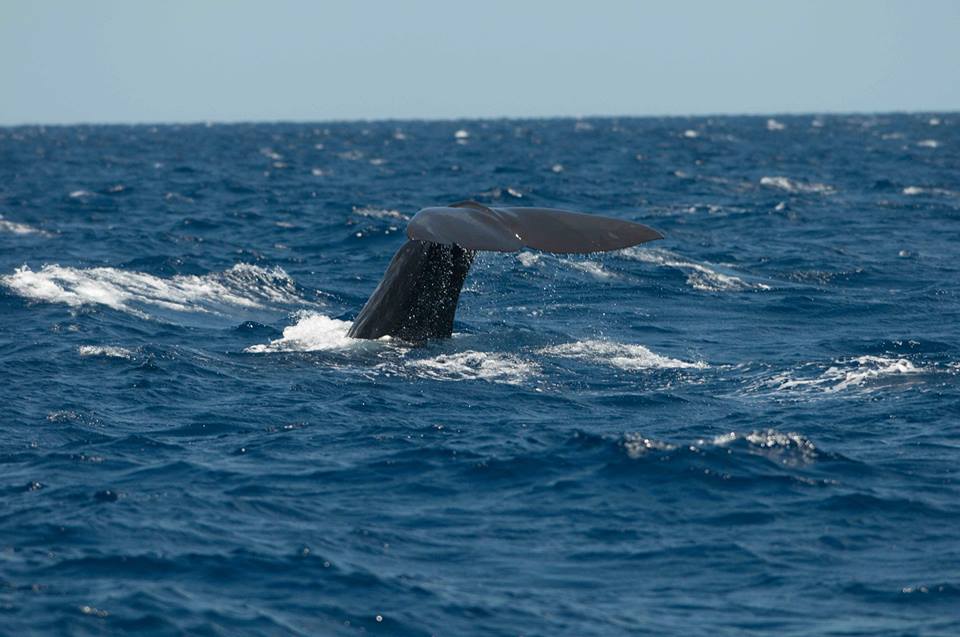
SPERM WHALE ‘TAILING’, ABACO (1 of 3 found yesterday using acoustic tracking)
BMMRO CHART OF CETACEAN SIGHTINGS FOR MARCH 2013
Of special note are the big whales – 3 sperm whales, and a humpback whale reported close to Cherokee.
Sperm whales. Humpbacks. How big are they? This useful chart shows the average lengths of various whales. I grabbed it off the internet a while ago, but regrettably forgot to mark the source. So, apologies to the originator for using it uncredited, a cyber-sin I try to avoid.
Finally, the BMMRO’s latest 4-page Newsletter contains a wealth of information about their current activities, some great pictures, and even a quiz – check outBMMRO NEWSLETTER_Apr13
The flowers and plants below were mostly photographed in the grounds of The Delphi Club, Abaco or nearby. I expect most or many are already securely on the SD chips or hard drives of every visitor to an agreeably floral place like the Bahamas. Who can resist a pretty flower? I have confessed in earlier plant-based posts (links below) to a certain lack of aptitude around flowers. They just… are. Let’s see how this pans out – corrections and (for the last two) IDs welcome.
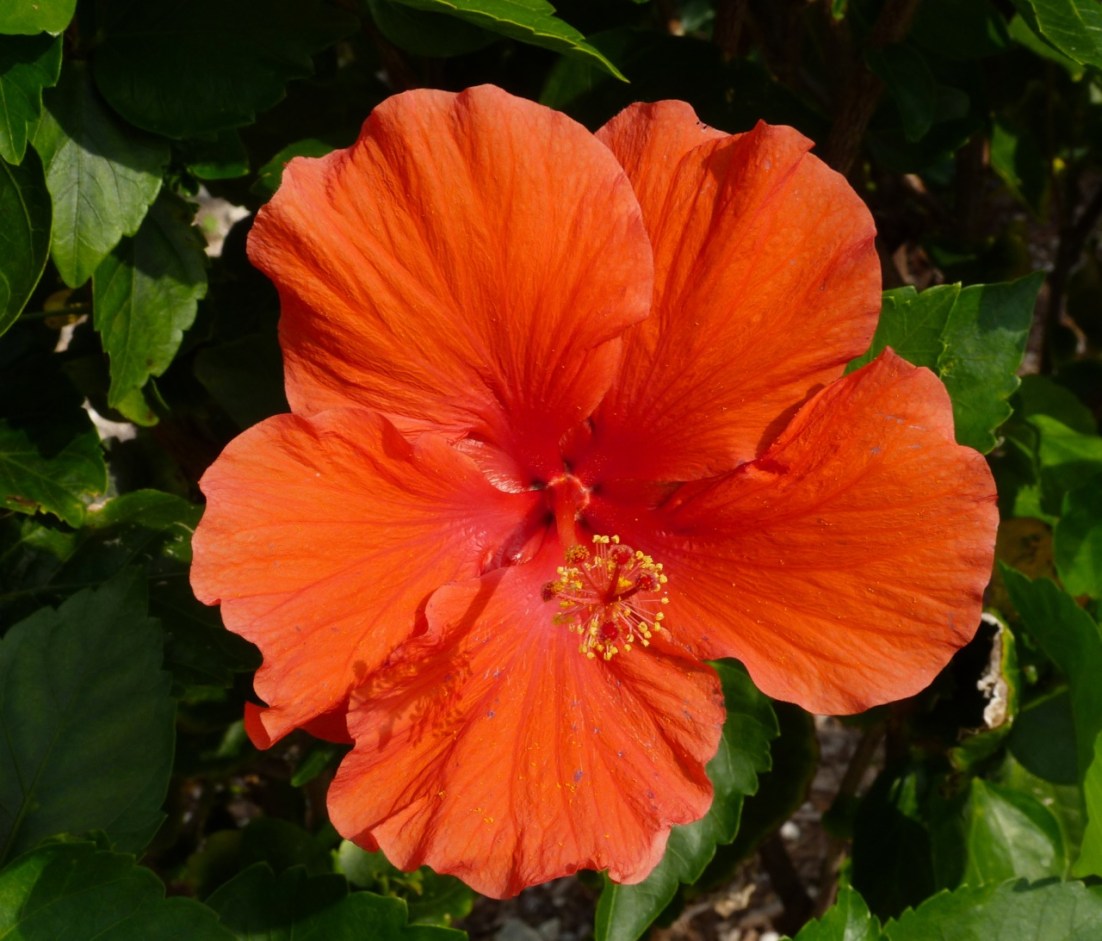
HIBISCUS
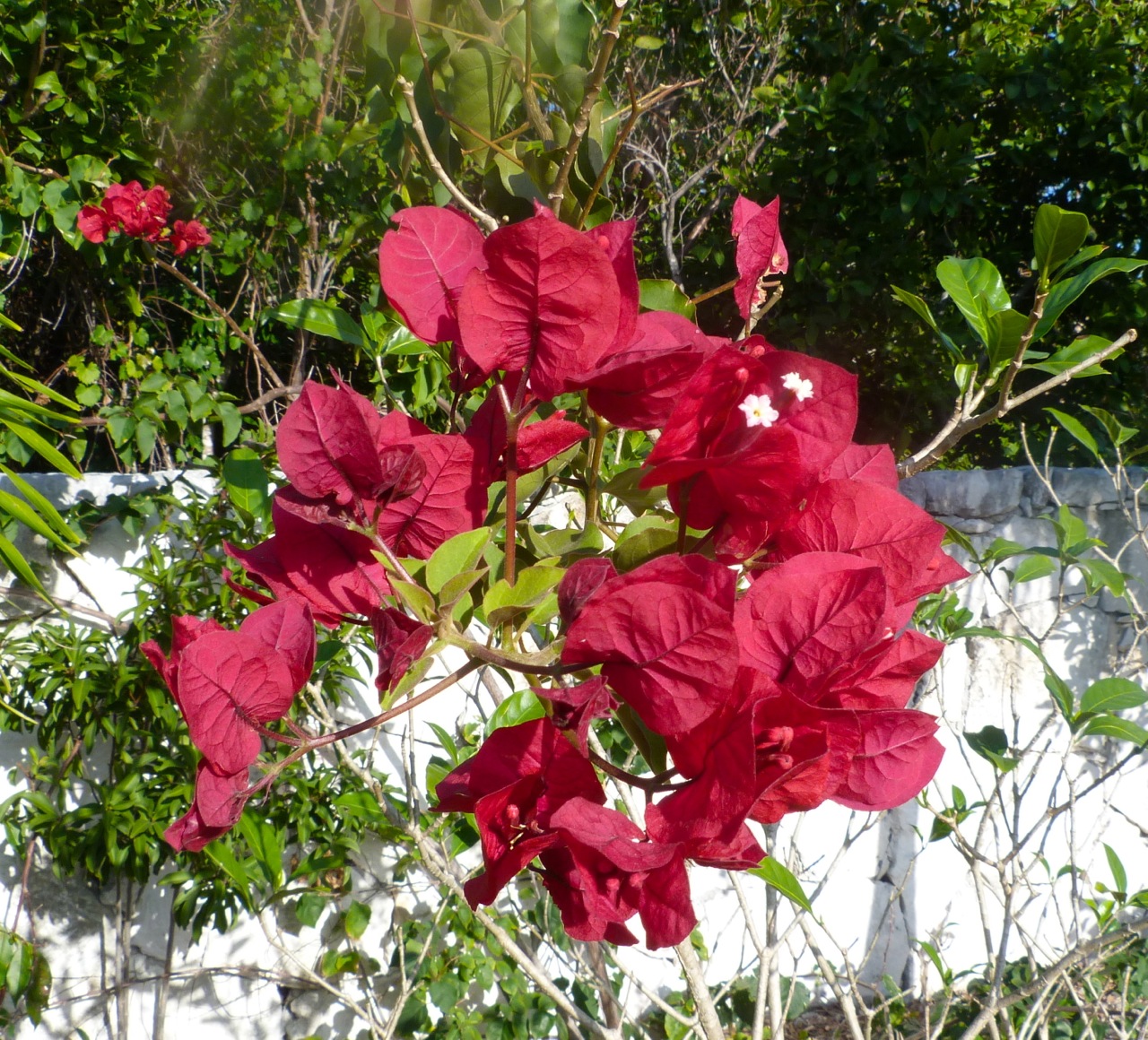
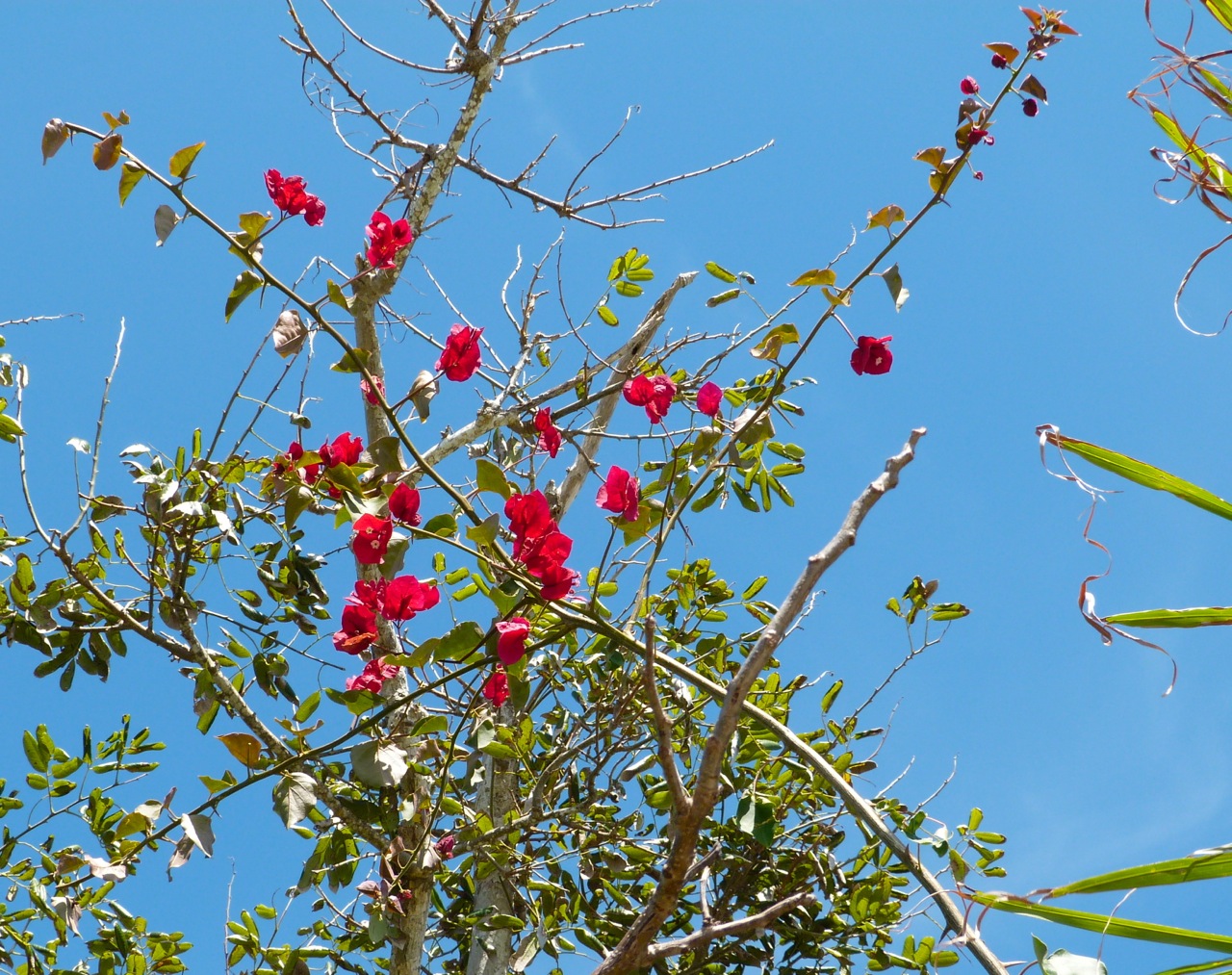
BOUGAINVILLEAThe butterfly is a Polydamus Swallowtail (also in the header image)
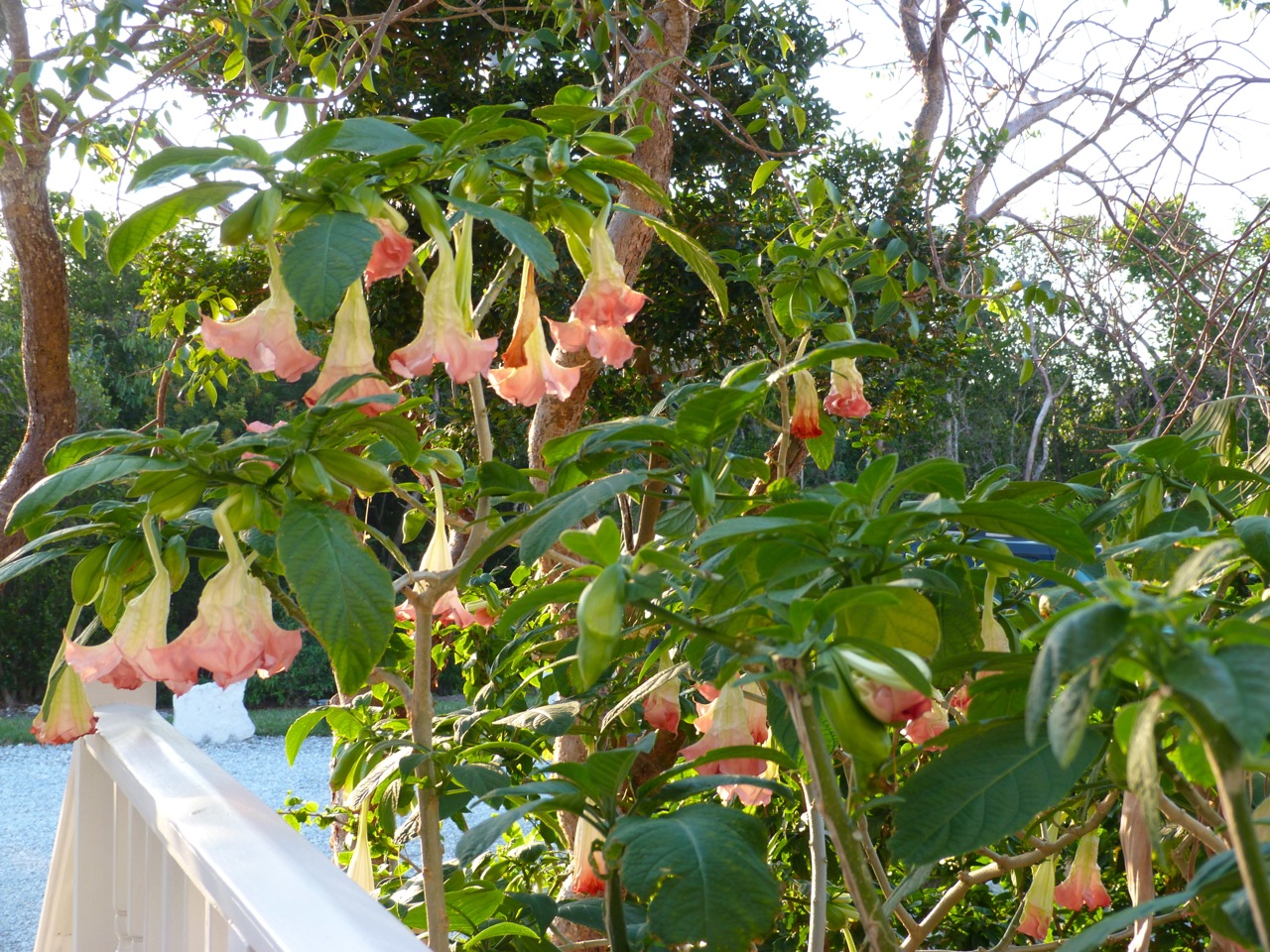
DATURA (ANGEL’S TRUMPET)This one has a cuban emerald hummingbird feeding from it – a lucky, but frankly not very good, shot
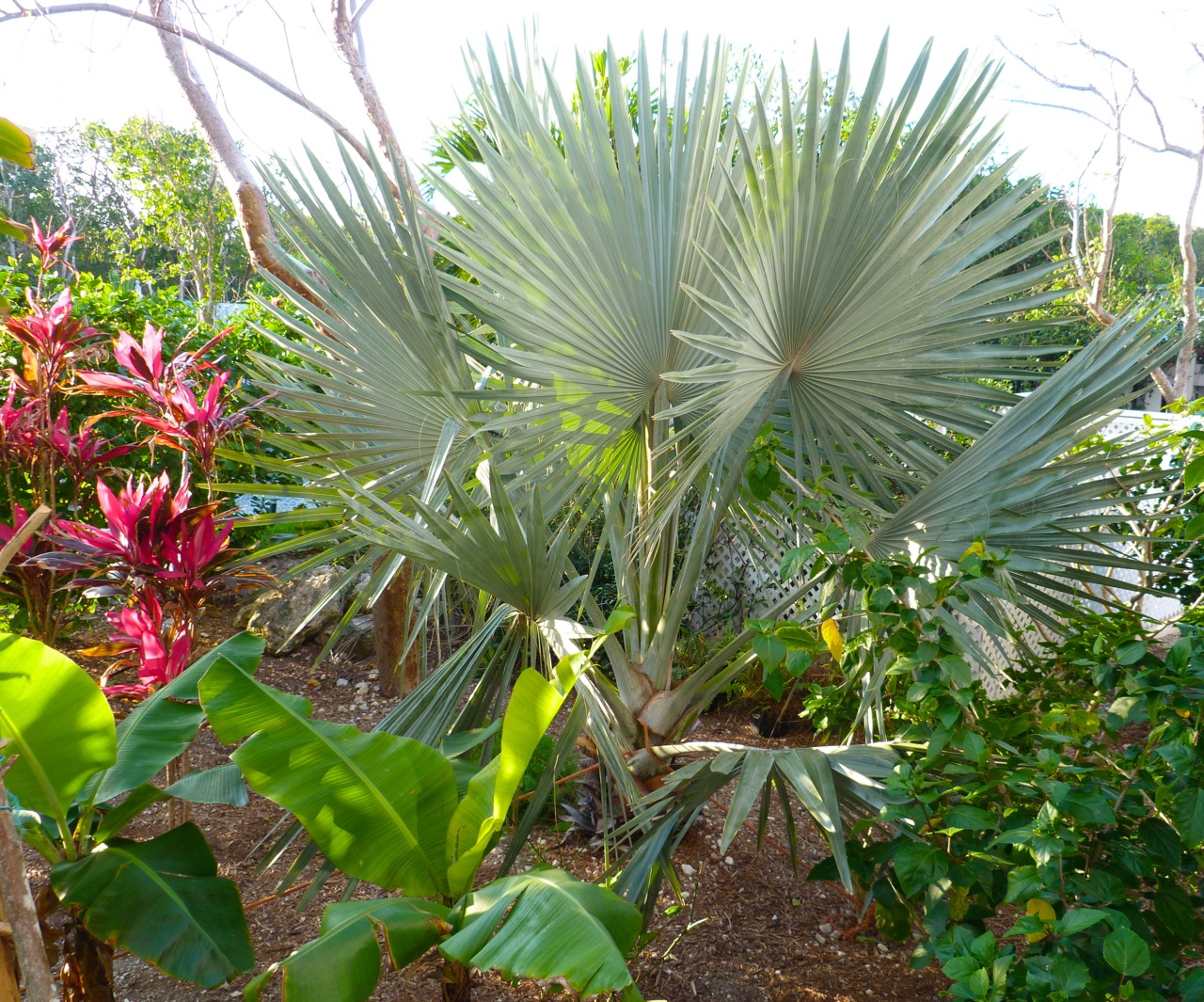
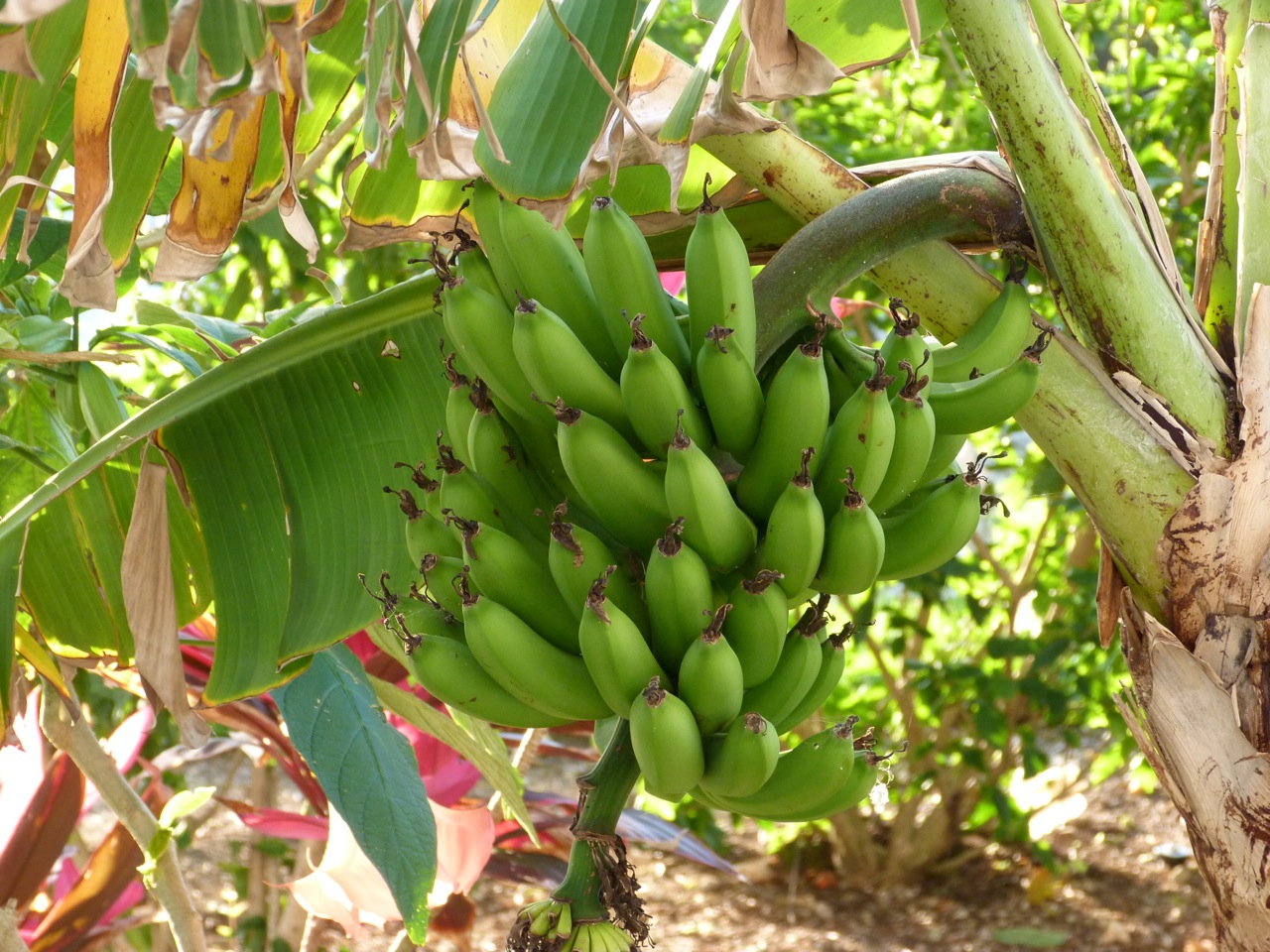
FIRECRACKER PLANT RusseliaMARSH FLEABANE (WITH HONEY BEE) PlucheaHORSERADISH TREE (WITH CUBAN EMERALD HUMMINGBIRD) Moringa oleiferaBISMARCK PALMBANANASThese were growing just outside our bedroom. Pity they weren’t quite ripe…
I’m beginning to struggle now. The next two plants are probably completely obvious, but I am losing my floral grip. Suggestions welcome via the comment box or email (Bridget on Tilloo, that means you…)
STOP PRESSID within 24 hours, thanks to Nick Kenworthy who says via the comment box that this bright pink one “is loosely referred to as the Orchid tree (or Hong Kong Orchid Tree) as the blooms are very like an orchid but it comes on a tree rather than a plant”. I’ve checked my cheat books, where it is named Bauhinia pupurea, aka Orchid Tree, Butterfly Tree or (from the leaf shape) Bull Hoof Tree. The tree originates from India and Southeast Asia. Nick has undoubtedly nailed it, for which many thanks. One more to go…
ORCHID TREEBauhinia pupurea
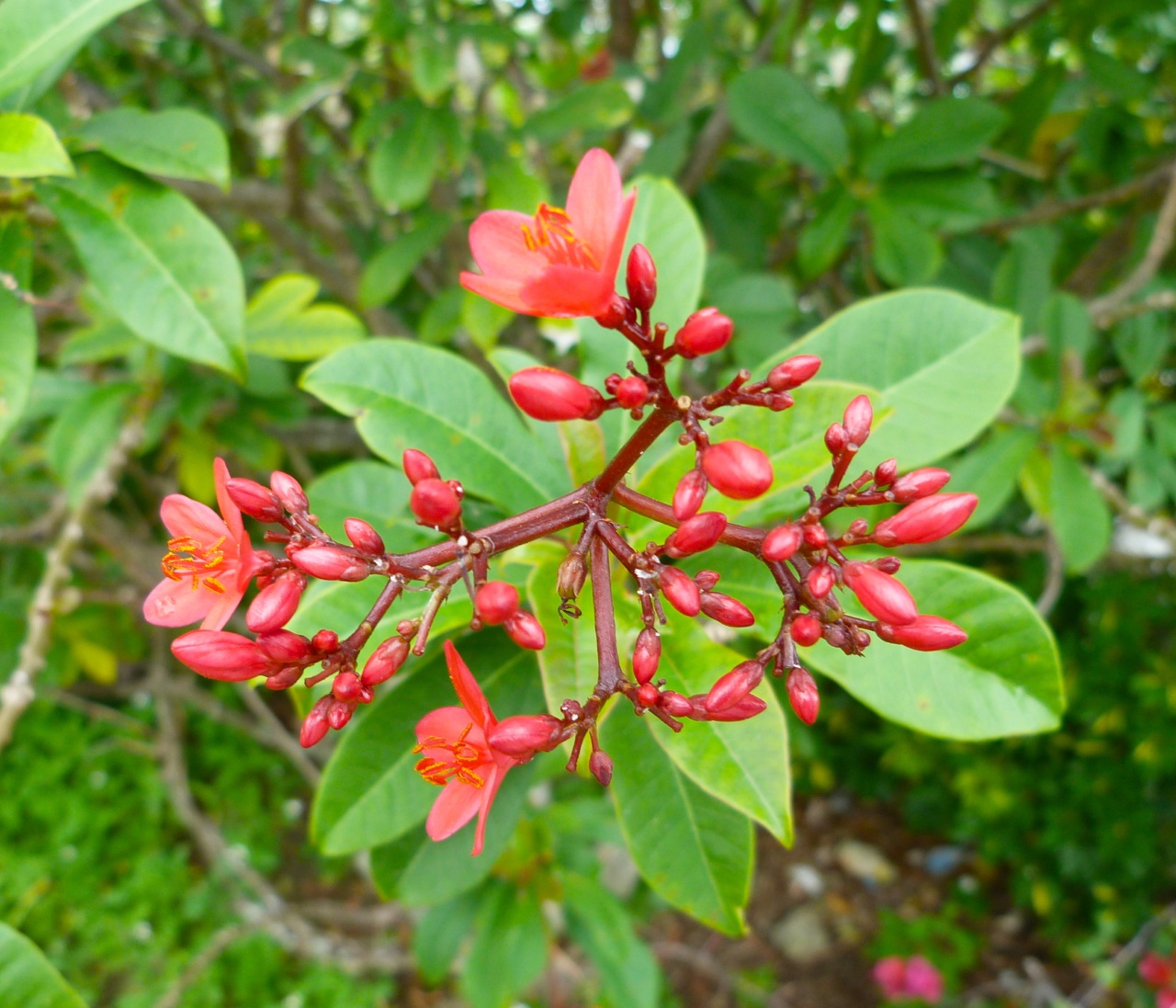
STOP PRESS 2Nick has solved the second ID as well. His interesting information about this striking waxy plant can be seen in detail in the comments below. The answer, in a word, is ‘Jatropha’, of which there are a great many varieties – and quite a number of informal names, most of which (‘Firecracker’; ‘Star of Bethlehem’) are confusingly assigned to other plant species as well. It doesn’t feature in either of my Caribbean plant /tree reference books, so my amateur eyes didn’t actually let me down this time… This plant (there was were two of three) was in a small park area by the beach at Treasure Cay. I haven’t seen it elsewhere on Abaco.
JATROPHA
Here are the links to a couple of my previous Abaco flower / plant posts:
There’s a larger collection on the dedicated FLORA page, including some of the above, but also featuring articles on LIGNUM VITAE, YELLOW ELDER, Bird of Paradise flowers STRELITZIA and more
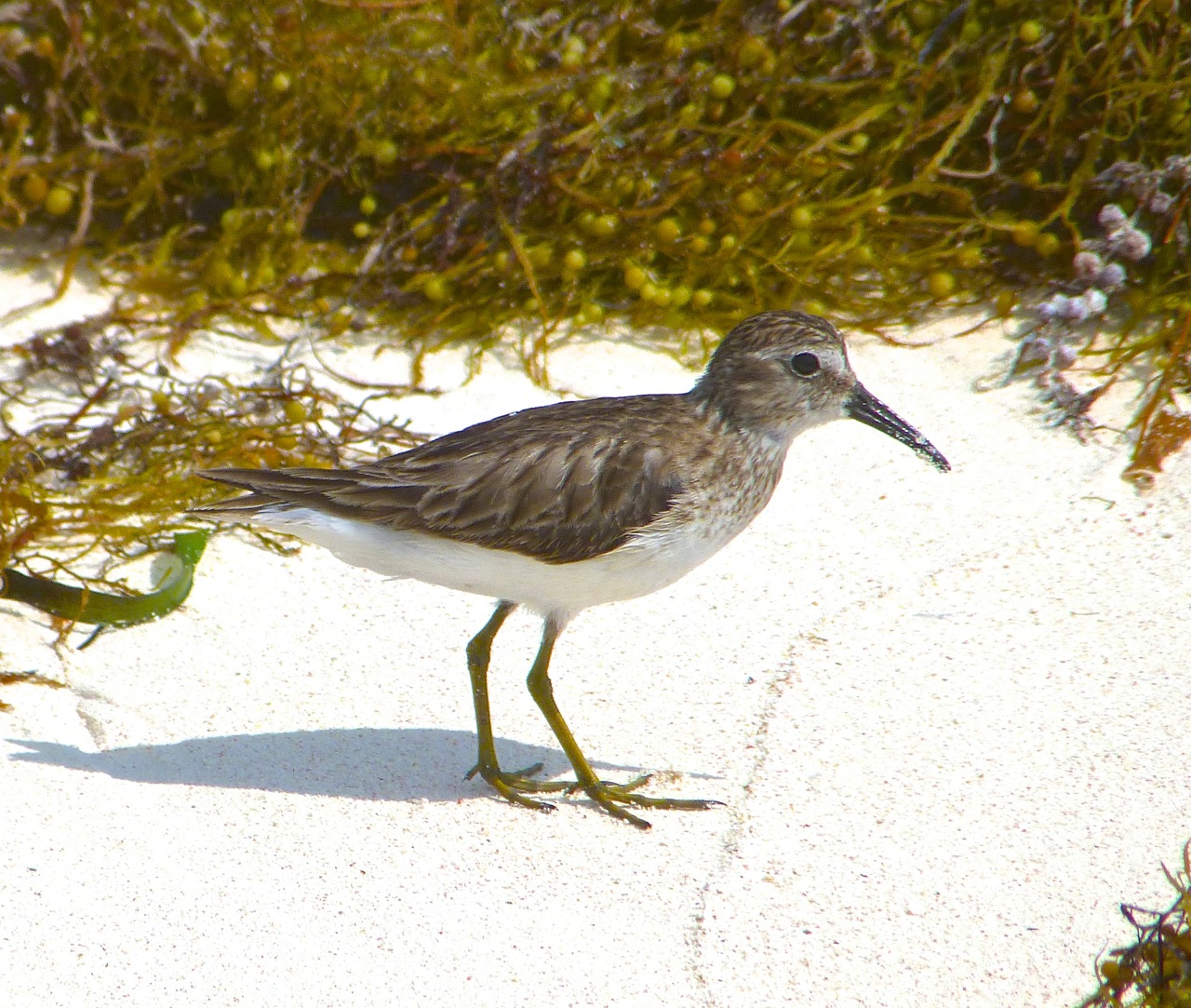
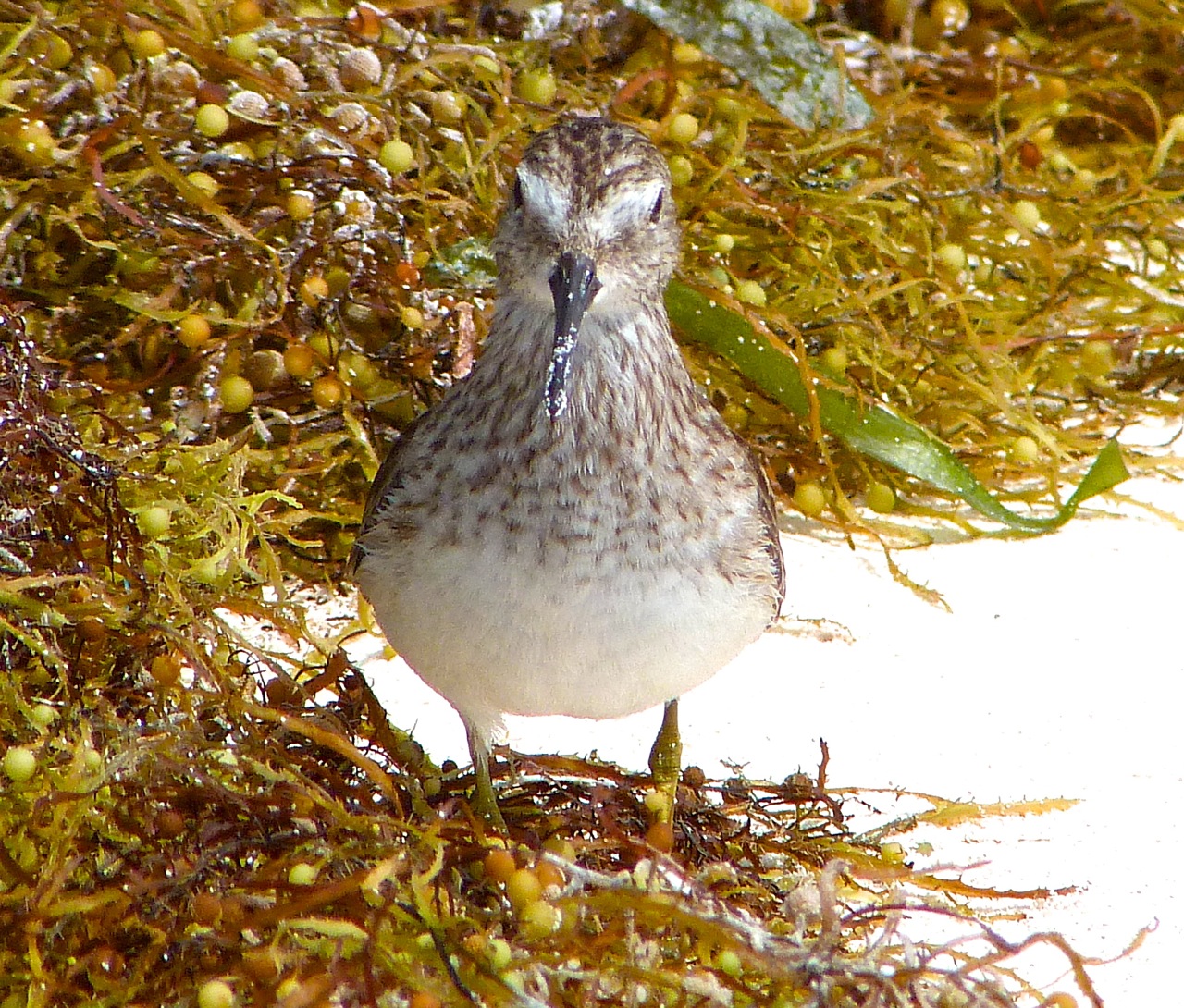
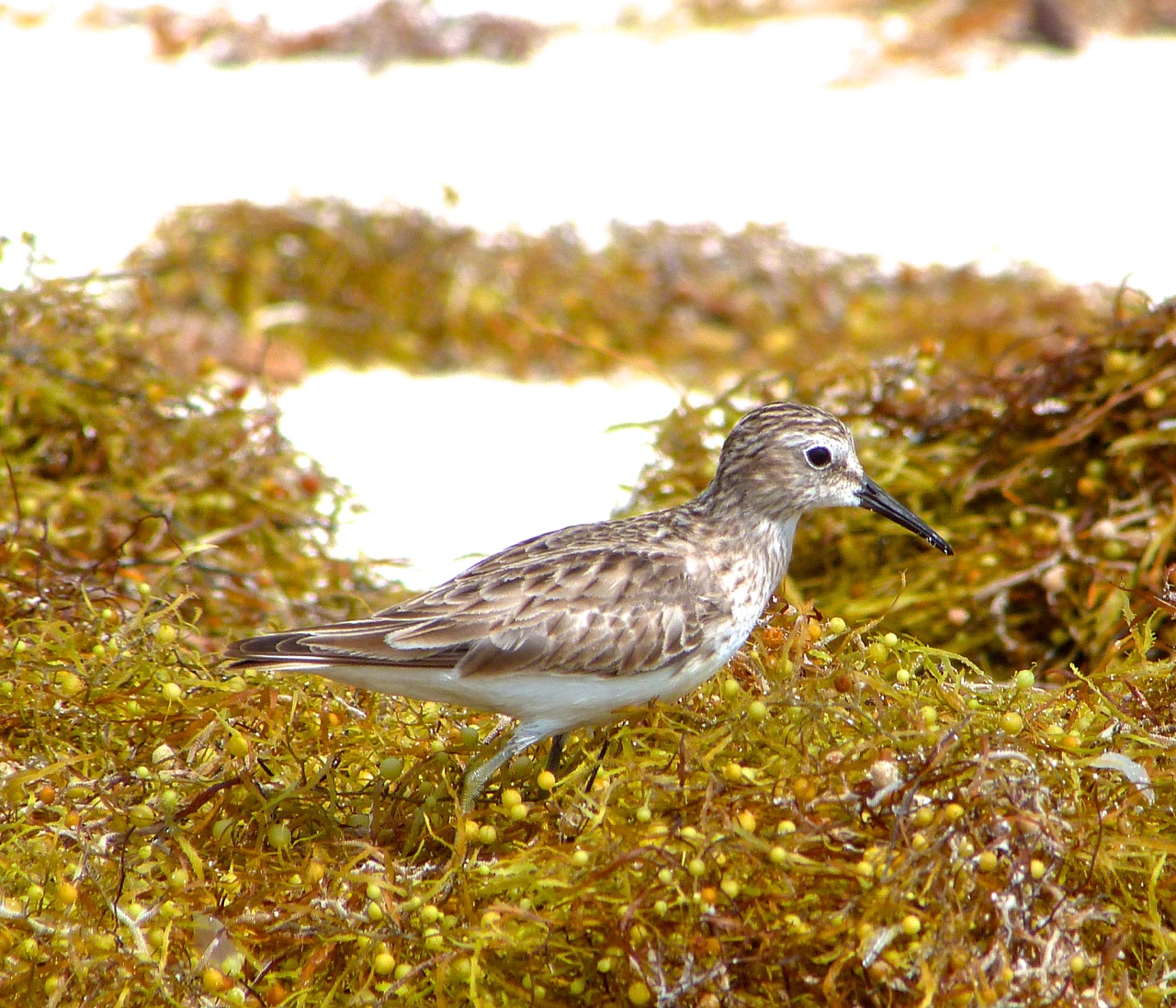
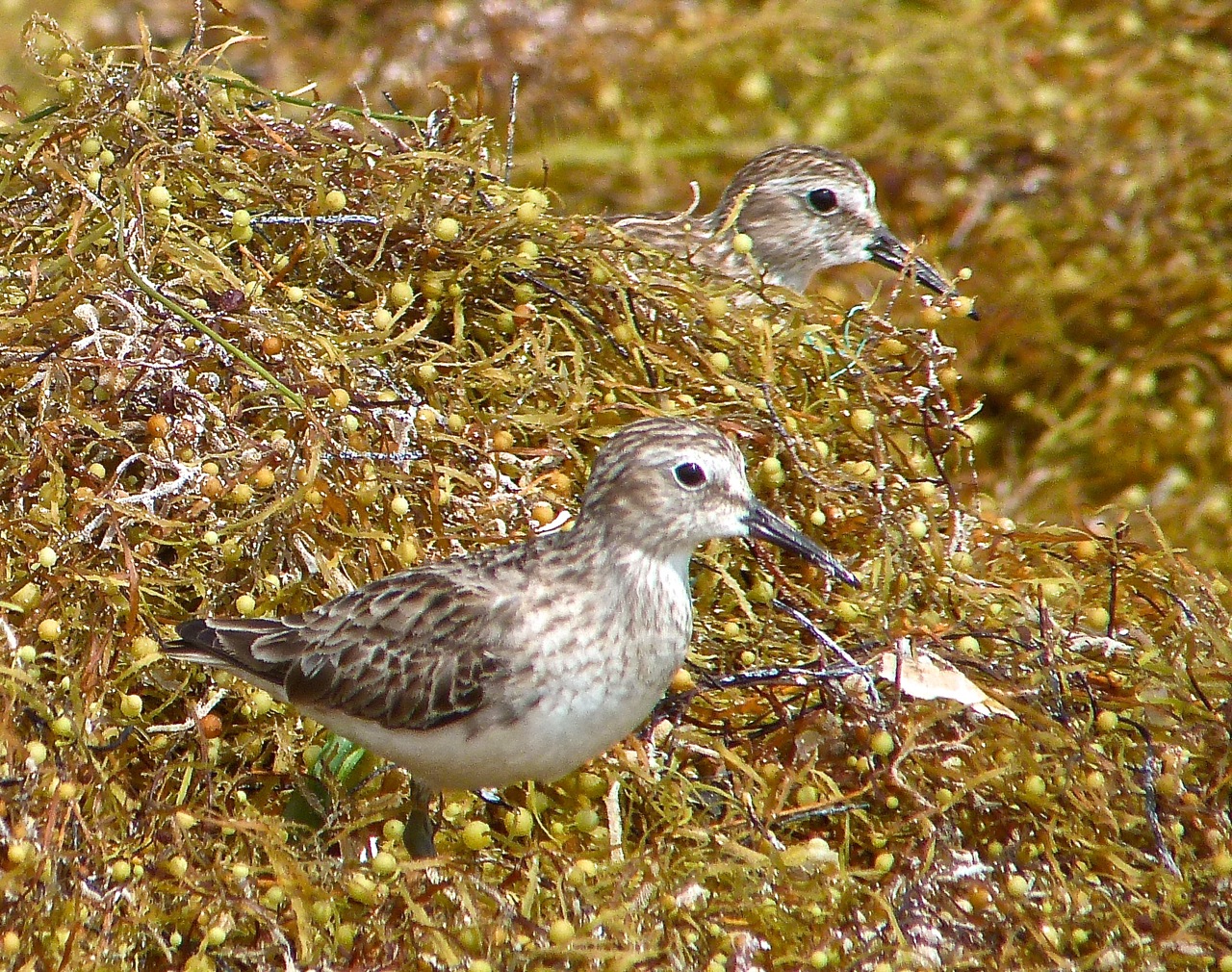
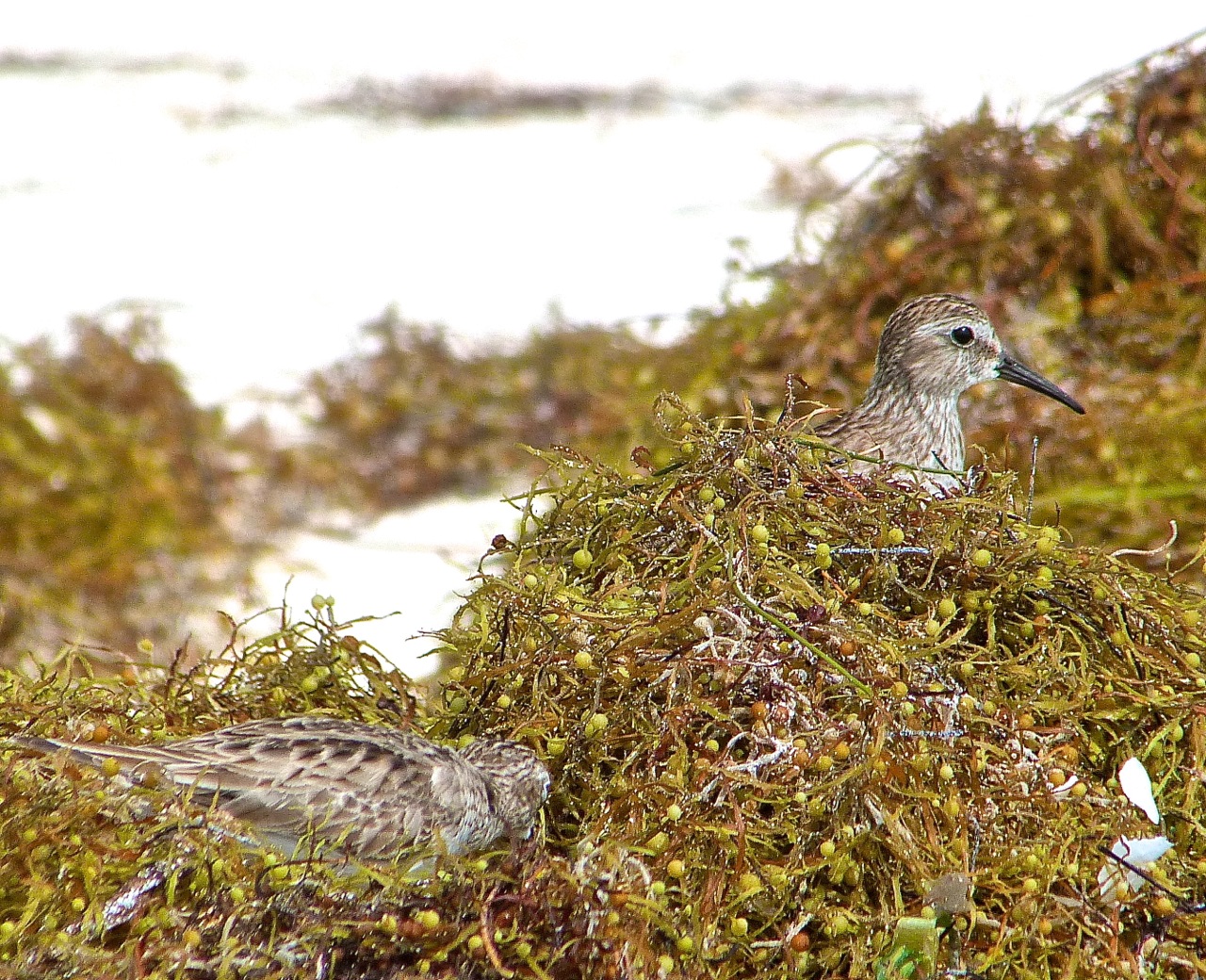
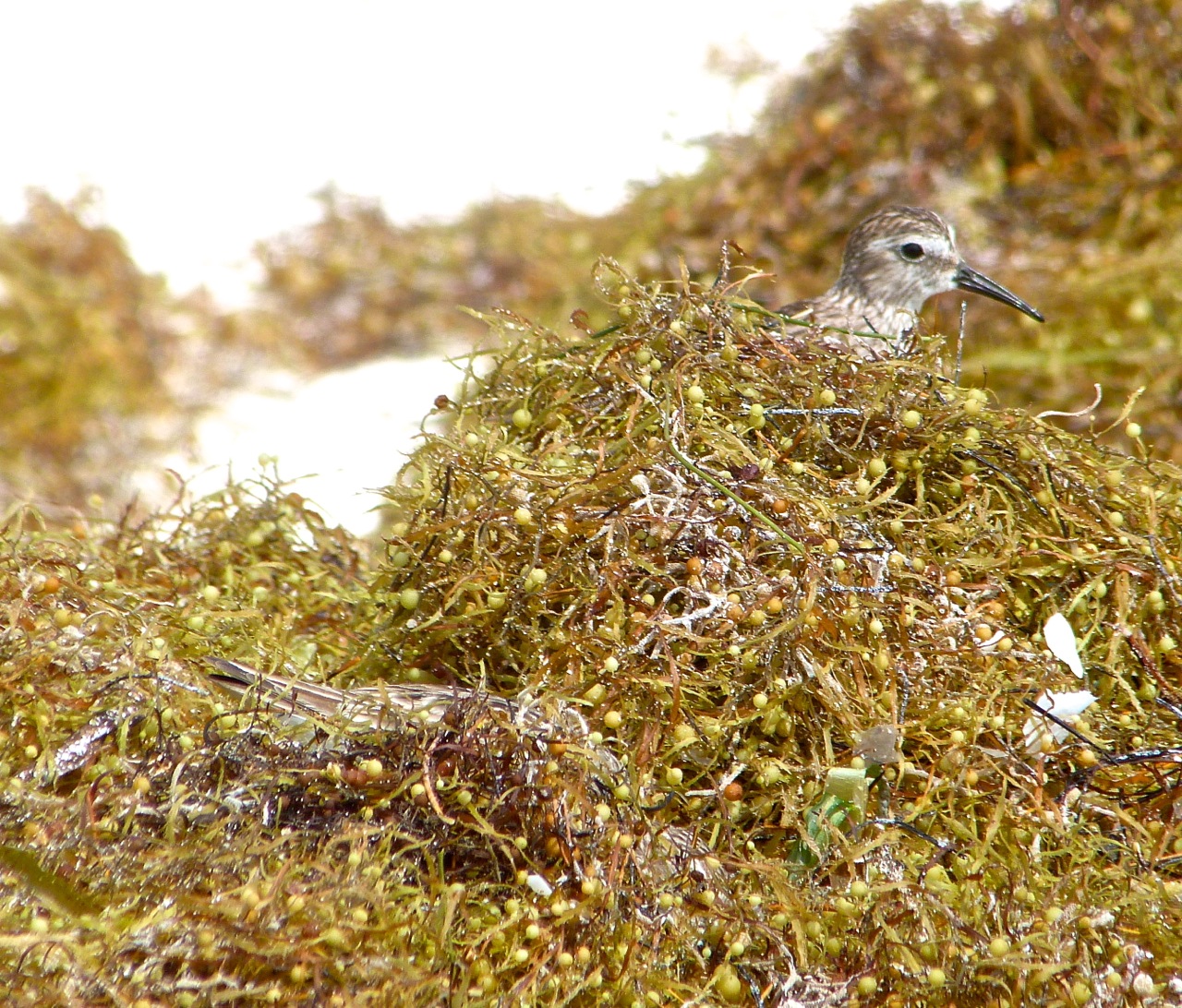
The LEAST SANDPIPER (Calidris minutilla) is the smallest shorebird, the definitive “peep”. An adult is only about 6″ long. They are to be found in pairs or groups, busily foraging in the sand and seaweed. Often they will mix in with other shorebirds. These birds nest in scrapes close to the water, with both parents involved in incubating the eggs. The female will usually leave the nest before the young birds fledge – perhaps (bizarrely?) sometimes even before the eggs hatch. Deal with it, male Least Sandpipers. Fortunately the hatchlings can feed themselves very soon, and are able to fly within two weeks of birth.
The “peep” call will no doubt be instantly familiar, although how to differentiate between the various types of sandpiper may be more of a problem… Here’s a short recording via Xeno-Canto (credit: Mike Nelson)
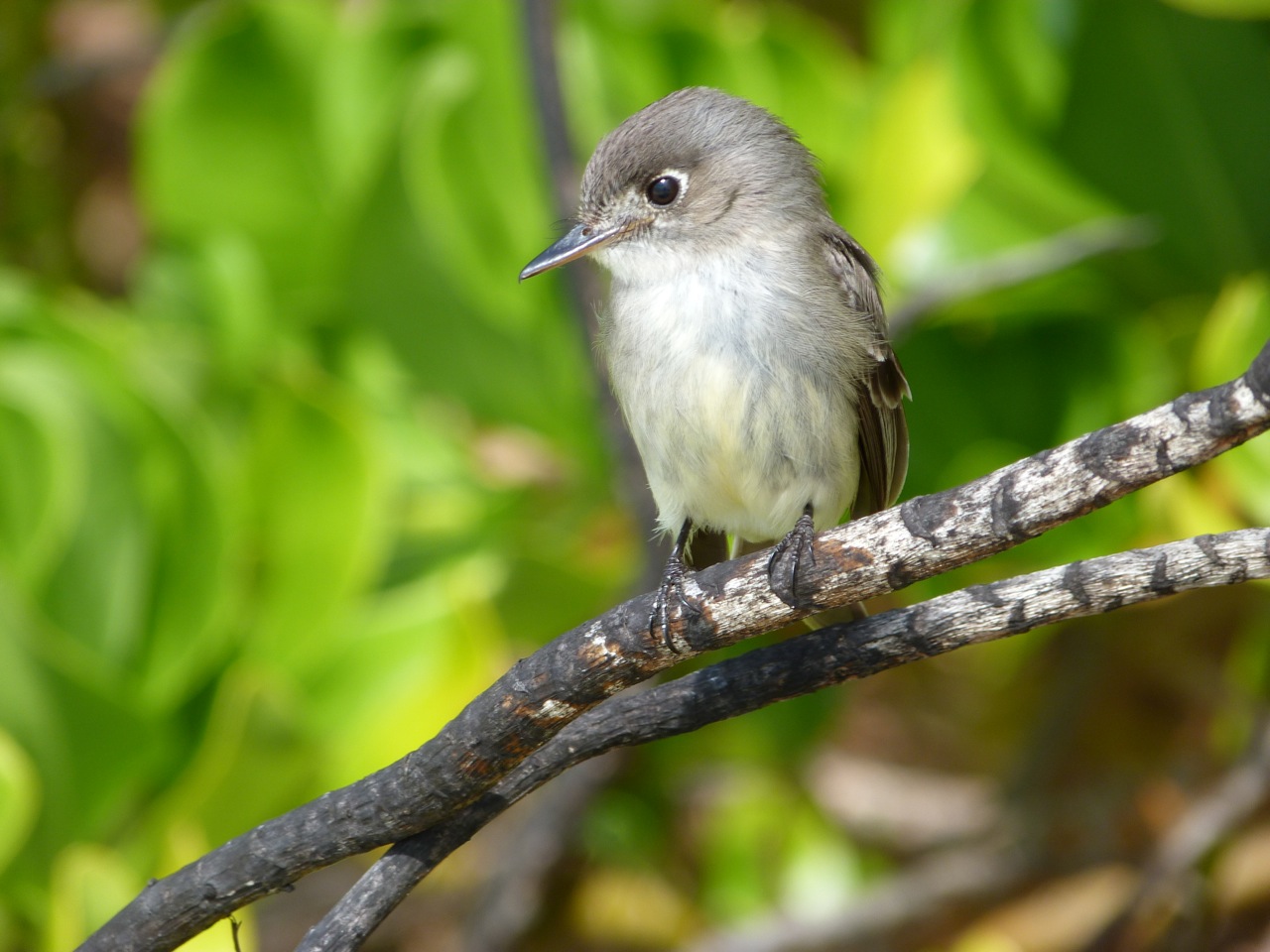
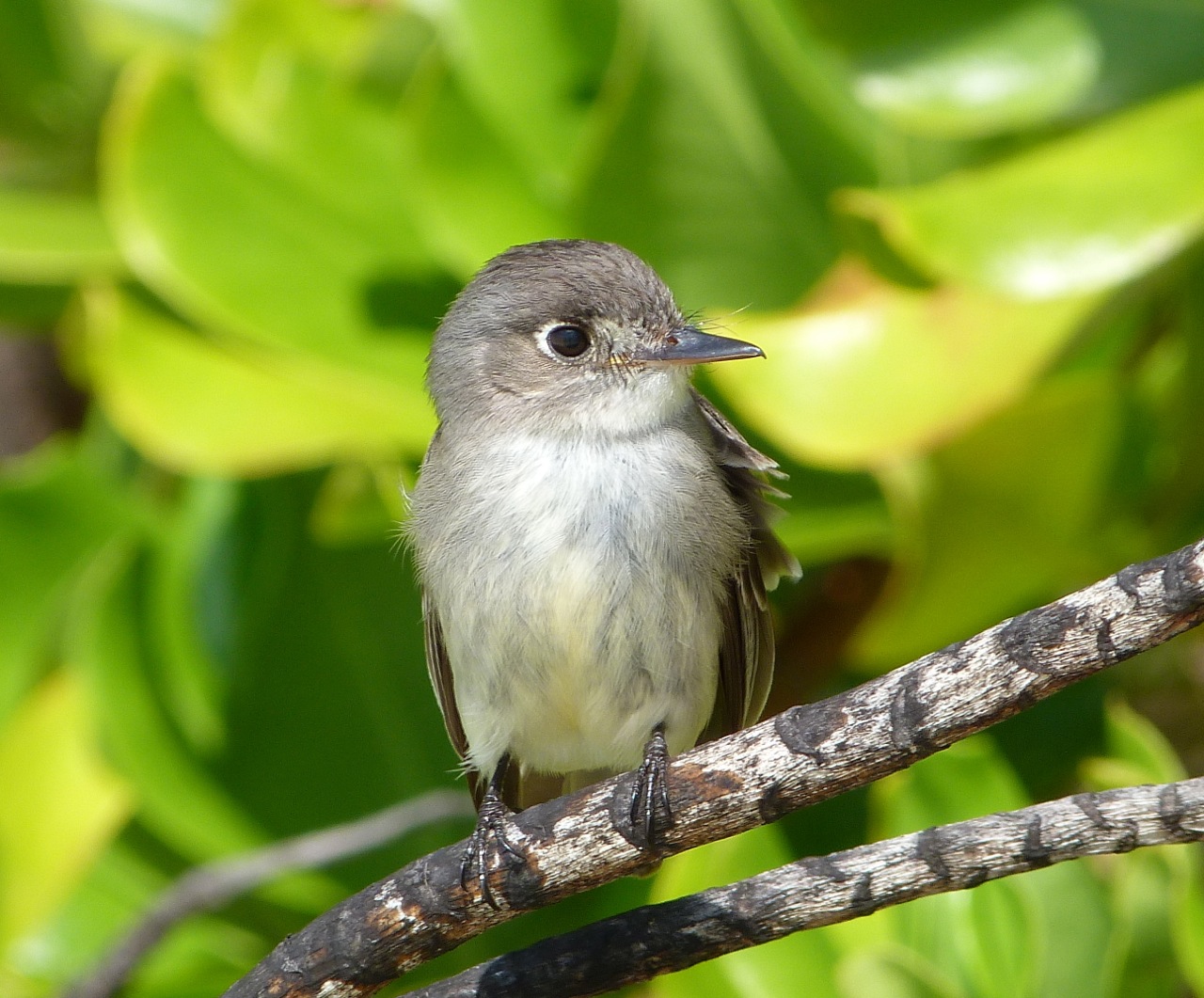
The CUBAN PEWEE Contopus caribaeus bahamensis, also known as the Crescent-eyed Pewee (see photos for details), is a tyrant. At 6″ long , the smallest tyrant you are likely to encounter in the Bahamas, but undoubtedly a member of the family Tyrranidae. These are the flycatchers, and include the larger LA SAGRA’S FLYCATCHER and the still larger Loggerhead and Gray Kingbirds. The Cuban Pewee is permanently resident on Abaco, and can be found in both pine woods and coppice. When returning to its perch after a flycatching sortie, this bird gives a characteristic flick of the tail.
The little bird below was in the edge of the coppice bordering the long sandy beach at Casuarina. Bruce Hallett, in his essential book ‘Birds of the West Indies…’ notes that Cuban Pewees are ‘usually approachable’, so I decided to test this out. I was about 20 feet from the bird when I first saw it. By sliding one foot forward in the sand and pausing before moving the other foot, I got to within 5 feet of the bird, while it watched my approach with apparent indifference. Unlike some creatures, it did not seem discomfited by eye-contact. It responded when I made a faint clicking sound by rather sweetly putting its head on one side. Then it began to fidget slightly – possibly feeling camera-shy. So I shuffled slowly back so as not to disturb it in its own territory.
The close-ups at the end clearly show the tiny hooked tip at the end of the upper beak – I imagine this somehow relates to the business of catching flies. Like other flycatchers, the Cuban Pewee has very distinctive whiskers around the base of the beak – again I presume this assists with feeding in some way, perhaps helping to sense the approach of an insect. Any expert views welcome via the comment box.
It’s occasionally tempting to anthropomorphise such close encounters in terms of imputed human / creature empathy. Much best to resist that. But as I withdrew, leaving this little bird undisturbed on its branch, I did experience a strange feeling of… [I must interrupt myself here. I’m a lawyer, so that’s quite enough of that sort of nonsense]
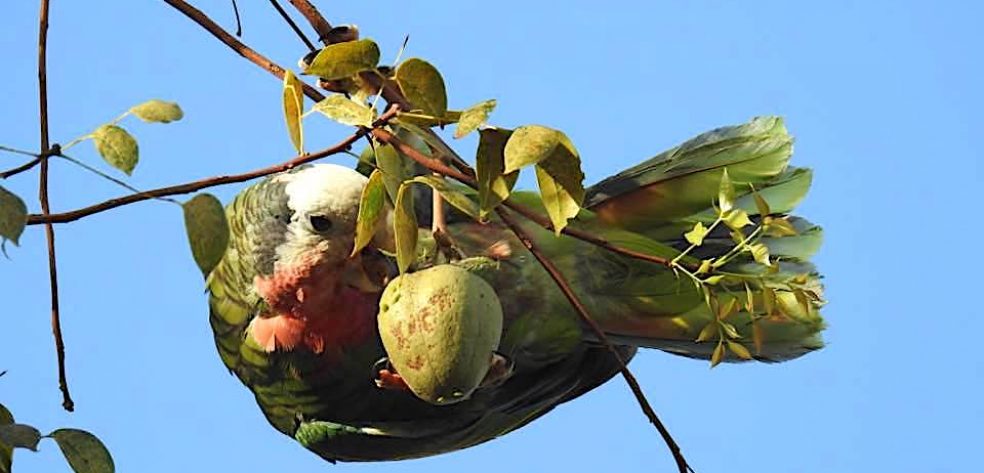
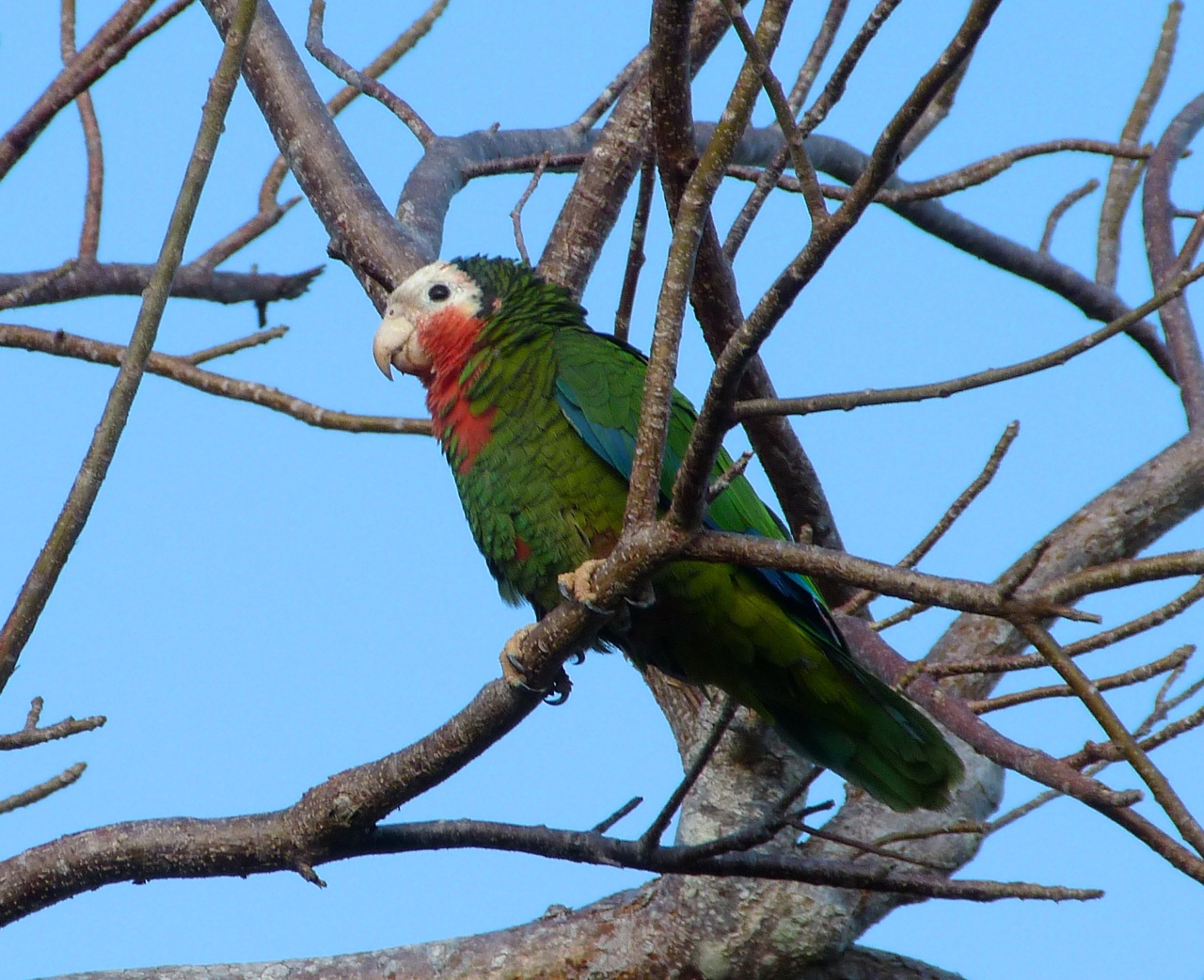
Abaco parrots. The only ground-nesting parrot species in the Bahamas. In the world, in fact. I’ve posted quite often about them – indeed they have their own page HERE – because, frankly, they are special and their story is one of encouraging success for intensive research and conservation programs. In 1492, Christopher Columbus was amazed by the vast number of parrots he saw in the Bahamas (not that the islands were called that then). In his journal he noted: “flocks of parrots darken the sun…” Not many years ago, parrot numbers on Abaco had dwindled to fewer than 1000 – below the critical point for sustaining a viable population. Extinction of the Abaco parrot loomed, accelerated by increasing habitat change, predation, and (*euphemistically*) ‘human intervention’. Thanks to the campaign of conservation, habitat preservation, anti-predation measures and vigilance, numbers have been restored to a sustainable level, perhaps as many as 4000. They are now a fairly common sight – and sound – in South Abaco. But not everyone who looks for them finds them, or even hears them. Especially not if they take pot luck in the vast areas of pine forest in the National Park, where they breed…
I’ve covered much of this ground before, but there is a slightly wider audience these days, so a few newcomers may be interested to learn about these lovely birds. The best thing is to have a look. All photos were taken by me during two early evenings in March.
The parrots are extremely agile, and have very strong feet and claws that enable them to move around in the tree-tops – or to hang upside down if they choose to. The next photo is a close-up a foot; below that is short video showing a parrot manoeuvring itself in a tree. You’ll also see how the birds use their beaks as an extra limb, so to speak. The uninspiring title shown is only because I forgot to label it ‘Abaco Parrot’ in the first place, and can’t find how to edit it…
In this image you can clearly see how their ‘opposable’ claws wrap round a branch
If you suspect that this one has had some ‘work’ done, you’d be right. I normally leave my photos largely alone, apart from cropping and maybe basic light balancing where needed. Sometimes an image is nearly there, but needs a bit of extra cosmetic business – but one can usually tell. The left wing? Hmmmmm (users of ‘noise reduction’ will know what I am talking about!).
The flocks of parrots are incredibly noisy. Sometimes they split into two or three groups, close together, and seem to compete in raucousness. Around 5.00 pm seemed to be the noisiest time. I took recordings of the racket, using the voice memo app on an iPh*ne, simply holding the phone with the speaker / mike end towards the parrots. Some come out pretty well – good enough to post on the excellentXENO-CANTObird sound site. Here is a recording, with the first few seconds transcribed into a sonogram. I made a ring tone from this recording for Caroline Stahala, the scientist who, with her team, looks after the birds. She’s been too polite to say whether she uses it or (more likely) not!
I find the parrots very hard to nail in flight (see above), possibly because of a shutter-speed issue (mine, not the camera’s). I nearly junked the picture below, but I liked the clash of the parrot colours with the purple bougainvillea, so I spared it.
If anyone is interested in making a small contribution towards the continuing research into and protection of these birds, please have a look at myABACO WILDLIFE CHARITIESpage, where the relevant link to Parrots International can be found. Or visit doudoubirds, where you will find endearing Abaco Parrot prints by dou dou herself for sale in aid of the parrots. Or contact me at rollingharbour.delphi@gmail.com
If anyone had a problem with the Xeno-Canto sound file above, here is a simplified version of the recording


 … or dining elegantly…


 I can’t unfortunately reveal the outcome of this encounter. We never saw the female, and we had probably got too close for her to feel comfortable about breaking cover. The male, however, was too absorbed refining his pulling techniques to be greatly bothered by our presence, though he did keep a beady black eye on us. Is this male preoccupation when courting found in other animal species, I wonder? Reader, we made our excuses and left…





























 ROLLING HARBOUR ABACO
You must be logged in to post a comment.