Unknown's avatar

BAHAMA (WHITE-CHEEKED) PINTAIL


THE BAHAMA(S) PINTAIL aka WHITE-CHEEKED PINTAIL  Anas Bahamensis

This very pretty duck species is getting a mention not because I have ever seen one on Abaco, but because I have seen them at WWT Barnes in London. [Later note: see end of post – turns out it was at Pensthorpe Nature Reserve Norfolk]. We went there last weekend to photograph one for your (plural, not single reader I hope) exclusive pleasure, but sadly they haven’t got any at the moment – they have been moved to WWT Slimbridge. I’ve decided to post about them anyway. As ever, thanks to wiki for its handy conservation and classification label, plus basic species details which always get things off to a scientific-looking start before the nose-dive into amateurism…

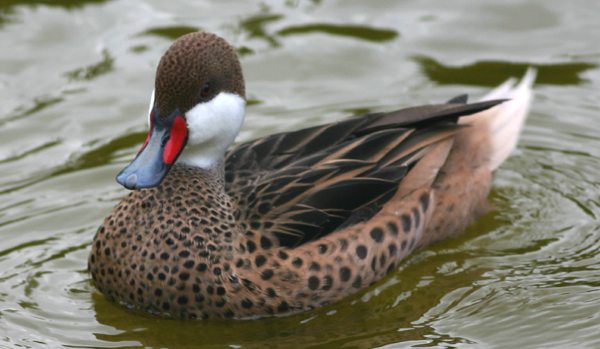
There follow 2 open-use non-© images, with a dip of the beak to the anon photographers

           BAHAMA PINTAILS                                                  
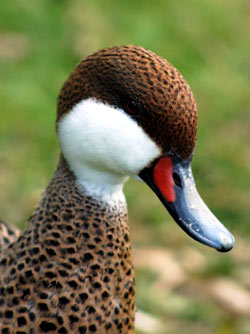
The White cheeked Pintail or Bahama Pintail (Anas bahamensis) is a dabbling duck first listed by LINNAEUS in his Systema naturae in 1758, under its current scientific name.

There are three subspecies: A. b. bahamensis in the Caribbean (and vagrant in south Florida); A. b. galapagensis on the Galapagos; and the slightly larger A. b. rubirostris in South America.  The sexes are similar. It is mainly brown with white cheeks and a red-based grey bill (young birds lack the pink). Conveniently for amateurs, it “cannot be confused with any other duck in its range” – though I’ll believe that when I have first-hand experience of personal non-muddle.

These ducks are found on saline waters such as brackish lakes, estuaries and mangrove swamps. They feed on aquatic plants and small creatures rootled out by dabbling. The nest is on the ground under vegetation and near water.

Mike Bergin, a naturalist, has very kindly let me use 2 of his wonderful images for this post. There are others to be found at CLICK==>>  http://10000birds.com/white-cheeked-pintails.htm Indeed the whole site is well worth a good rummage around
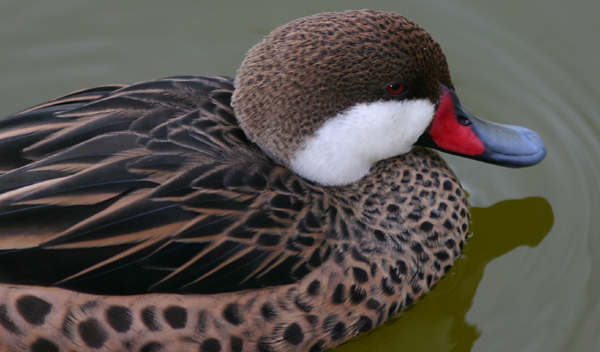
Photo Credits Mike Bergin 1000 Birds

Here’s what they sound like (credit Xeno-Canto / George Armistead)

SPECIES LISTING (Jan 2012): This duck is on the threatened species list – not actually endangered but experiencing “moderate decline or facing imminent threats which warrant specific conservation measures”. Sadly, there are 3 separate causes of decline, each of which may be difficult to combat: habitat loss; hunting; and predation by introduced species.

Finally, here are links to more material about and images of these pretty ducks:

OISEAUX-BIRDS (an excellent resource for many other birds – merci Nicole for link approval)

BAHAMAS NATIONAL TRUST  2-page article on Pintails / Endangered birds

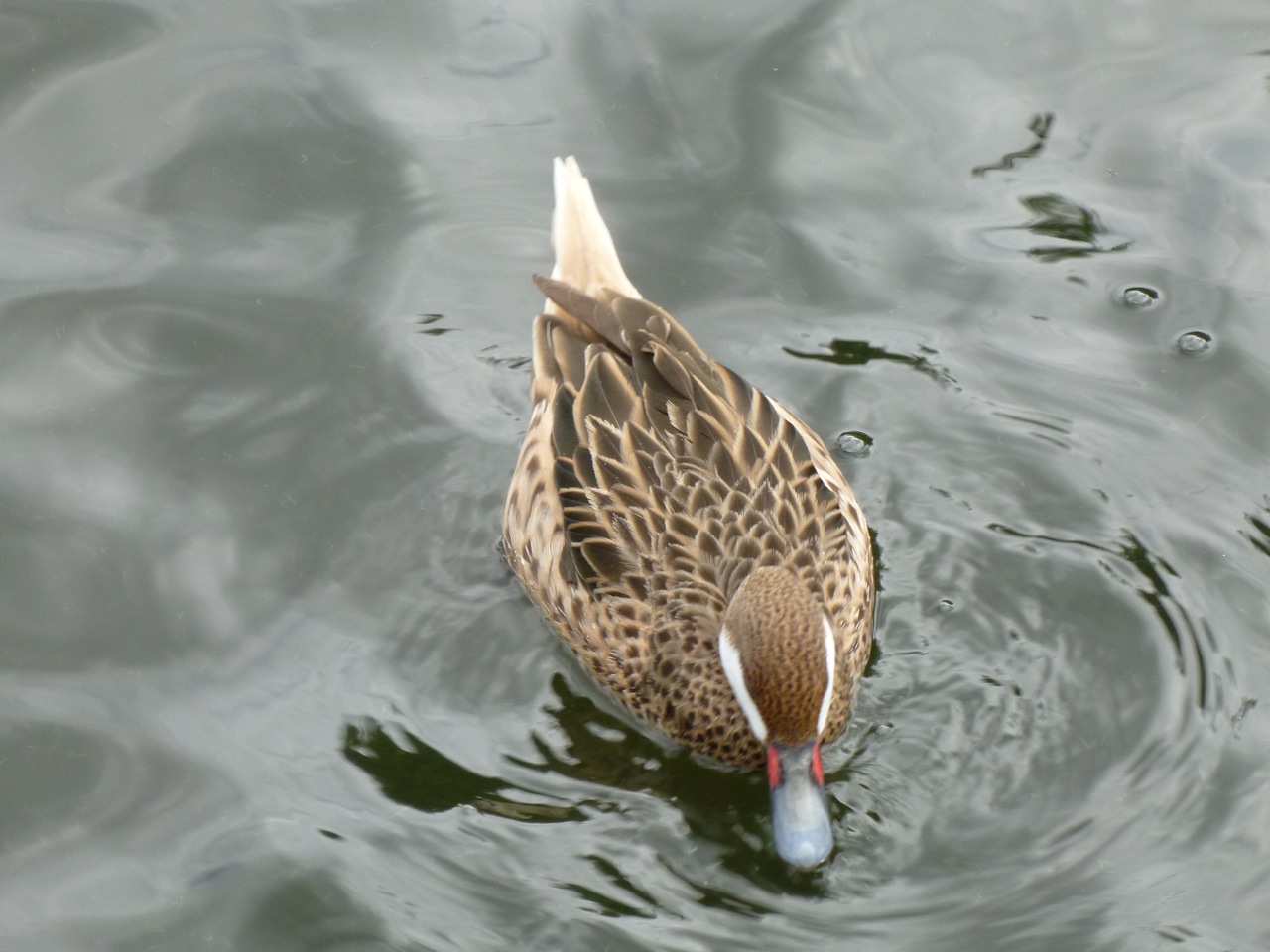
STOP PRESS To my complete surprise, I now discover that I have got my very own quite respectable picture of a Bahama Pintail, taken in July 2010 at the Pensthorpe Nature Reserve, Norfolk. So here it is…
STOP PRESS Feb 2012 Ricky Johnson, Abaco’s renowned bird expedition leader, has posted a fine example of a Bahama Pintail on his Facebook page, taken near his home. And, with permission (thanks, Ricky) here it is 

Unknown's avatar

ABACO ISLAND BOA: THE ONLY ABACO SNAKE


THE ABACO ISLAND BOA (or NORTHERN BAHAMAS BOA)

[Epicrates exsul] RENAMED 2013 Chilabothrus exsul

Kingdom: Animalia * Phylum: Chordata * Subphylum: Vertebrata * Class: Reptilia * Order: Squamata * Suborder: Serpentes * Family: Boidae * Subfamily: Boinae * Genus: Epicrates * Species: Epicrates exsul

COMMON NAMES: Abaco Island boa, Northern Bahamas boa Abaco Boa (BNT) Chilabothrus exsul

EPICRATES CHILABOTHRUS EXSUL is a non-venomous species of boa, the only one of its species and genus. These snakes are grey with a reddish sheen. They grow to a maximum of 80 cm / 2ft 6″ in length [now see end of post] and feed on small mammals, birds and lizards. They are found throughout the Abacos, including Elbow Cay; and on Grand Bahama; but not elsewhere in the Bahamas (wiki-aided inc. image)

And if you can’t get to Abaco, there’s one in Oklahoma City Zoo: OKCZ ABACO ISLAND BOA 

LATEST NEWS DEC 2011 a surprising visitor to the Friends of the Environment offices on 7 Dec 2011, posted on their Facebook page 

A visitor at the FRIENDS office this afternoon, a Bahama Boa! This snake flattened itself pretty thin to try sneak out under the door frame! The door is open now so it can leave easily 

STOP PRESS: a convincing refutation of the general consensus that the maximum length of these snakes is around 2′ 6″, with thanks to Brigitte Bowyer Carey. This specimen was photographed on Tilloo Cay in 2008, held at arms length by Don Allen 

ABACO ISLAND BOA, TILLOO CAY 2008

Unknown's avatar

BAHAMA WOODSTARS & CUBAN EMERALDS: THE HUMMINGBIRDS OF ABACO


THE HUMMINGBIRDS OF ABACO

At last I have got round to the hummingbirds. It’s quite simple. There are only two species of hummingbird on Abaco. The endemic variety is the Bahama Woodstar, one of only 3 endemic bird species on Abaco (the others are the Bahama Yellowthroat and the Bahama Swallow). The settled migrant is the Cuban Emerald.

               BAHAMA WOODSTAR                                    

 Calliphlox evelynae

Male and female Bahama Woodstars  (Photo Credit: Phil Brown – and VG too)

These hummingbirds are found throughout the Bahamas. They do not migrate, although are occasional vagrants in SE Florida. They breed all year round, the main season being in April. The female lays 2 elliptical white eggs, which she incubates for 15-18 days. As with humans, the female is mainly responsible for childcare while males go drinking at the nectar bar and hang out with their mates.

This BW was one of a small group at Hole-in-the-Wall. They were completely unconcerned by our presence, and we could get within arm’s length of them. Woodstars, though tame in human terms, can be aggressive and territorial. They are plentiful throughout the Bahamas except on Grand Bahama, Abaco and Andros. Significantly those are the only islands where the Cuban Emerald is found in any numbers. As with the native red and import grey squirrel problem in the UK, the migrant emerald is aggressive towards the woodstar, which is consequently rare where emeralds are abundant.

Here is their call (credit Jesse Fagan Xeno-canto)

Addition April 2012 Here is a seriously cute female Woodstar photographed by Ann Capling at Bahama Palm Shores, close to Ocean Drive – a really pretty little bird

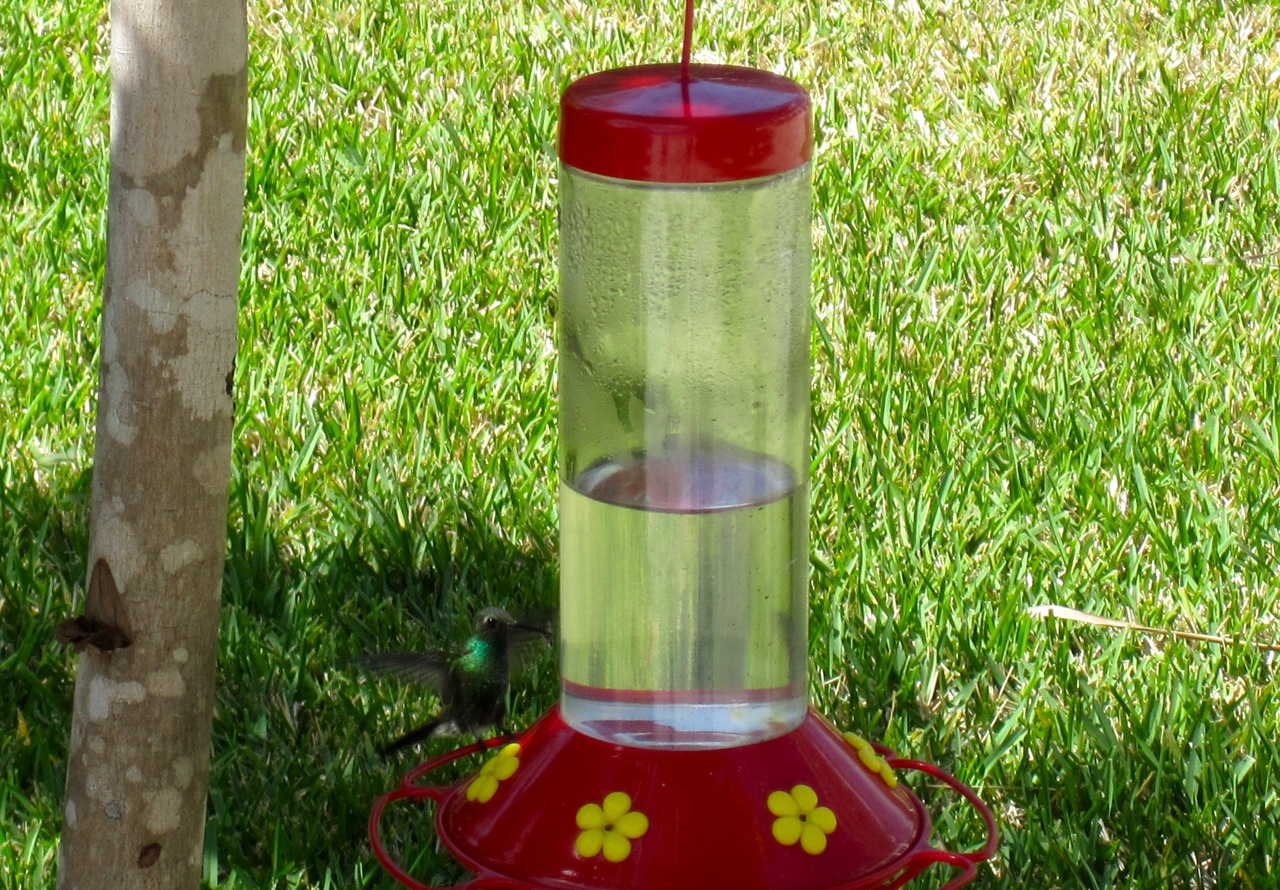
At Delphi, you’ll frequently see emeralds, especially now that feeders with sugar water have been hung up for them. The pool area is a very good place to watch them. But there are occasional woodstars to be seen as well – in the coppice on the drives for example, and even on the feeders. The vague blur to the left of the feeder below is a woodstar in the millisecond between me pointing the camera and it flying away… Don’t bother to click to enlarge it – it’s a useless photo, I know, but it is evidence even at the lowest level

CUBAN EMERALD Chlorostilbon ricordii


There’s probably a great deal to be written about the emeralds, but not by me. Or not now, anyway.  The little you need to know from me is already covered above, and I haven’t yet discovered whether their childcare arrangements differ significantly from the woodstars. Probably not. So I’ll put in a selection of photos, and remark that it is strange how quickly they can change from sleek and slender birds to small rather cold and dispirited looking bundles of feathers. Both states are depicted below. Here’s what to listen for (credit Xeno-canto.org) 


Delphi – pool feeder

Delphi – pool feeder

Delphi – pool feeder

Delphi – far side of pool

Delphi – near pool

Delphi – front drive

Delphi – front drive

All the above birds were photographed at Delphi. We saw emeralds elsewhere, of course – in the pine forest, flicking across the logging tracks; on other Cays. The best sighting was during our day trip reef-snorkelling and island-hopping with Kay Politano, when we had an excellent lunch for 14 at Cracker P’s on Lubbers Cay (see future post about this and the island-hops). There was a bird feeder by our table, to which emeralds came and went throughout the meal. Here are some photos – I wanted to get them hovering, and kind of succeeded. More or less.


This link may or may not result in you hearing an emerald’s call. Let’s see if I can make it work…
http://www.xeno-canto.org/sounds/uploaded/LNEEOOWCQR/Emerald_Cuban_feedingcall_10122010_0831_0075.mp3

HUMMER FACTS
  • The colourful throat of a (male) bird is known as a ‘gorget’
  • Hummingbirds are the only birds that can fly backwards
  • There are 320 species of hummingbird worldwide
  • The smallest is the bee hummingbird of Cuba, at 2″ for an adult
  • John Gould, the c19 ornithologist and artist, invented many of the names to reflect the varied and iridescent colours of the birds.
  • Hummingbird wings beat as much as 75 times per second
  • Hummingbirds have the highest metabolic rate of any warm-blooded creature; also the largest hearts (proportionately, obviously…)
  • On TCI, the Bahama Woodstar is known as ‘The God Bird
  • There are many collective nouns, including a “bouquet”, “glittering”, “hover”, “shimmer”, and “tune” of hummingbirds 

Unknown's avatar

THE BAHAMIAN HUTIA: ABACO’S EXTINCT RODENT


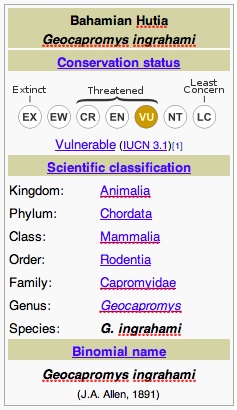
THE BAHAMIAN HUTIA  (Geocapromys ingrahami)

HUTIAS are cavy-like rodents of the Caribbean Islands. They range in size from 20 to 60 cm (8 to 24 in), and can weigh up to 7 kg (15 lb). Twenty species of hutia have been identified, of which half may now be extinct. Their tails vary from vestigial to prehensile. They have stout bodies and large heads. Most species are herbivorous, though some eat small animals. Instead of burrowing underground, they nest in trees or rock crevices. Of extant species, only a few are common; most have become vulnerable or endangered. In Cuba they are hunted for food, and are often cooked in a large pot with wild nuts and honey. One of the recipes is hutia stew: sauté with green peppers, onions, tomato sauce and lots of garlic. (Source: Wiki)

         Photo WWF/ G. Clough

The Bahamian species of Hutia is endemic to the Bahamas. It is listed as a vulnerable species. Its natural habitats are moist forests, dry shrubland and rocky areas. Hutias are a nocturnal species, remaining underground during the day. Two subspecies became extinct in modern times. The Crooked Island Hutia (G. i. irrectus) and the Great Abaco Hutia (G. i. abaconis) were mentioned by early European voyagers, and are believed to have become extinct by 1600. This is thought to be due to land clearance rather than direct hunting. However, they are found elsewhere in the Bahamas – the Exumas, for example.

————————————————————–

IT’S OFFICIAL: the extinct species listing

Great Abaco Hutia  Geocapromys ingrahami abaconis West Indies, Bahamas, Great Abaco Extinct in 1600

For more details, check out Rod Attrill’s excellent website, for which this is the relevant link: http://www.motygido.co.uk/bahamas_hutia.html  

Tail of a Hutia (nb quite different from a rat)IMG_7500.jpeg

STOP PRESS: THIS SMALL POST HAS RECEIVED A SURPRISINGLY LARGE NUMBER OF HITS – CAN ANYONE EXPLAIN WHY? 

NEW: HUTIA VIDEO (added Dec 2011)

Image added April 2012 (credit as annotated)

Unknown's avatar

PICK A PAIR OF PIPING PLOVERS… ABACO BIRD VIDEO BY RICKY JOHNSON


NOW PROUDLY PRESENTING…

RICARDO JOHNSON’S 6 MINUTE VIDEO ‘PIPING PLOVERS’                            

Ricky is a well-known, infectiously enthusiastic, and compendiously knowledgeable Abaco nature guide  (this guy gets way too much free publicity in this blog…). In this video he focusses his binoculars on piping plovers, a threatened species of tiny plover which annually makes a long migration to the Bahamas, including Abaco – and then heads all the way north again.

If this video doesn’t make you smile at some stage, I suspect a SOH bypass and / or your ‘anti-cute’ setting is jammed on. You’ll also see the differences between the piping plover and the more familiar Wilson’s plover.

PS Missed an obvious tongue-twister component out of the original title – now amended to tip a hat to Mine (and Thine) Host

Unknown's avatar

AN ABACO BIRDING EXPEDITION WITH RICKY JOHNSON (PART DEUX)


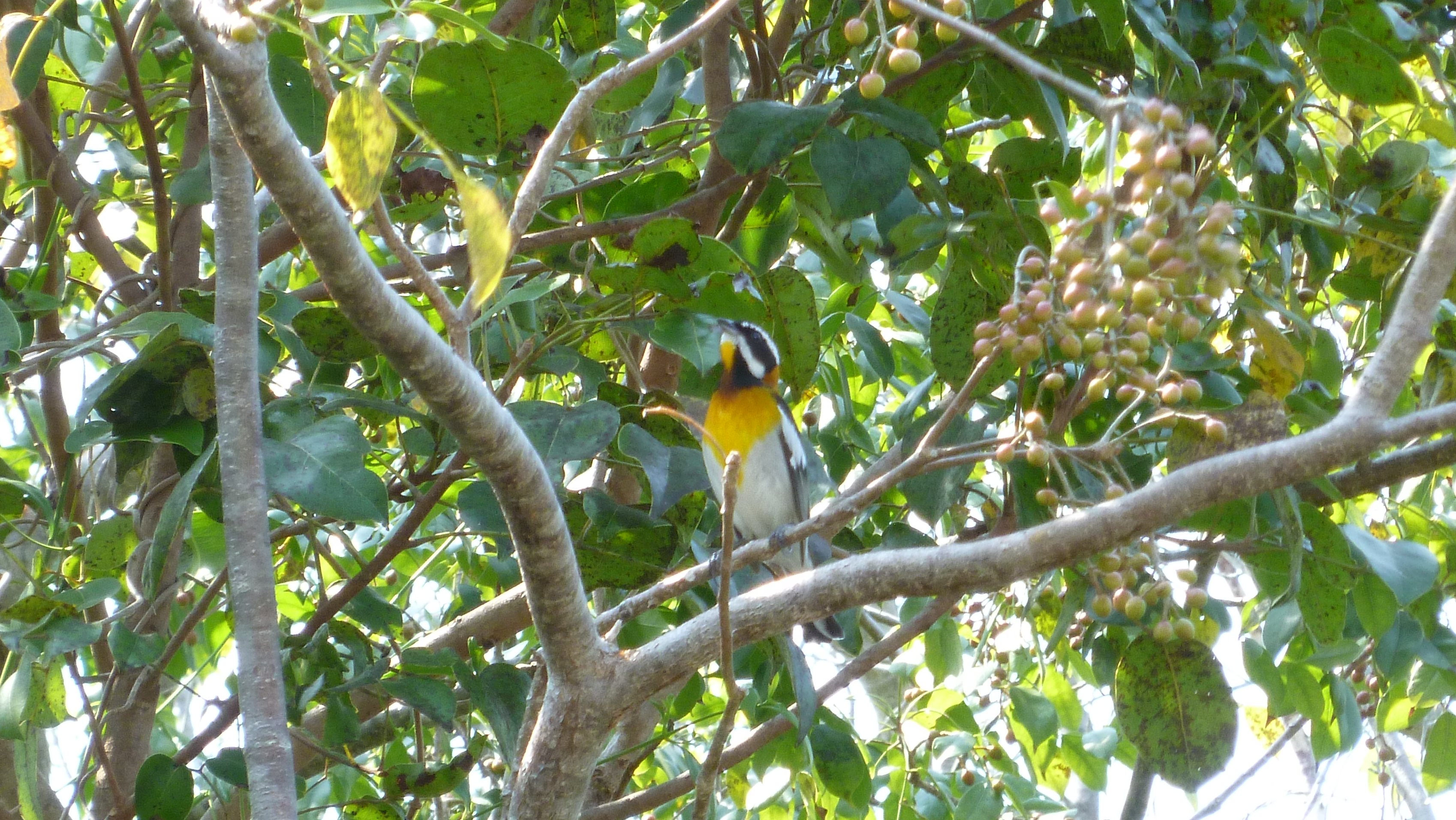
During our parrot observations, we had plenty of opportunity to see other birdlife. We were especially fortunate to be able to visit a large and very beautiful private garden on the shoreline at Bahama Palm Shores which Ricky showed us round; and to meet the benevolent owner who permits this intrusion. We saw between us a wide variety of birds in or near the garden, of which these are a small sample – starting with my favourite bird of all

Western Spindalis / Stripe-headed Tanager

Western Spindalis / Stripe-headed Tanager

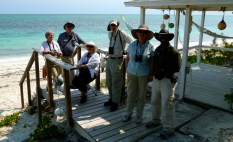
                                                           POINTING AND SHOOTING                                                  THE TEAM PHOTO
Black-faced Grassquit

Black-faced Grassquit (?juvenile)

Red-legged Thrush

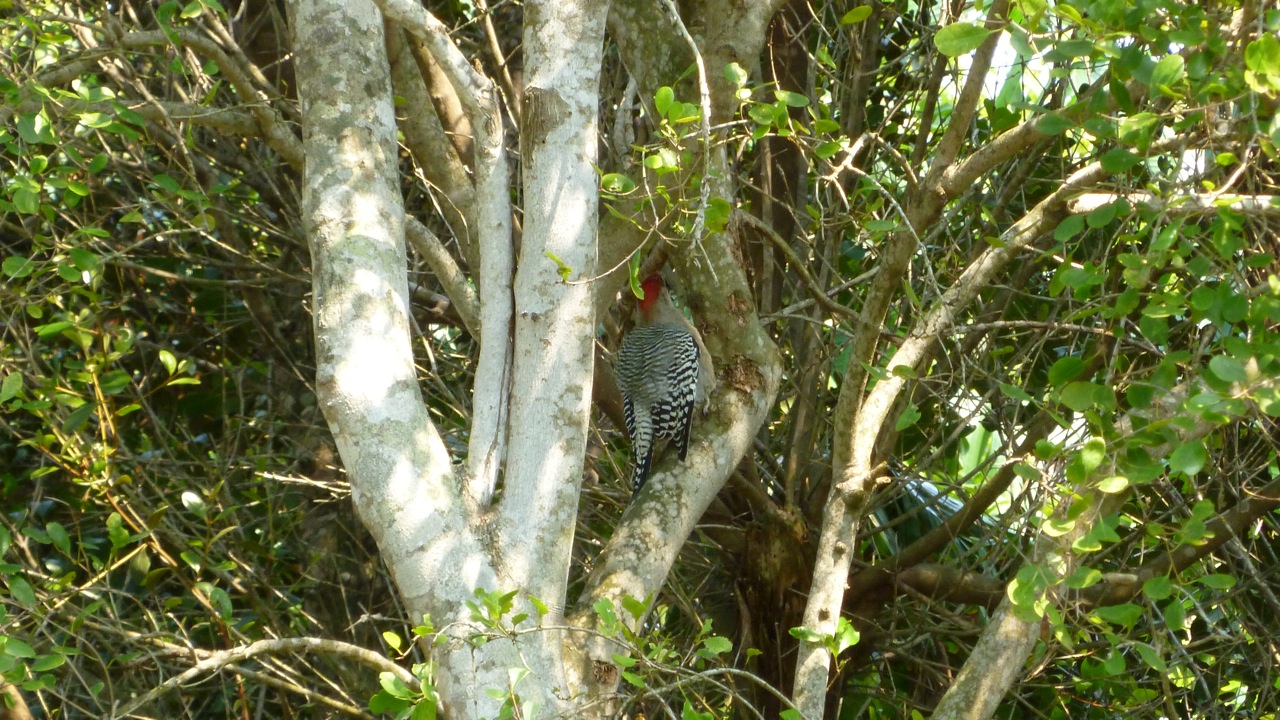
West Indian Woodpecker

I’ve no idea. Small. Dark. Finchy. Grassquit? Hard to see. Any ideas? Sorry

Team Leader Ricky

Unknown's avatar

ABACO BIRDING EXPEDITION WITH RICKY JOHNSON + CUBAN PARROTS


Ricky ushers us into his spacious, comfortable truck: 6 denizens of Delphi eager for adventure. Most have already been on a morning trip to see the Abaco Barbs (wild horses) of which more in a separate post. rollingharbour suffers from an unfortunate but mild form of equine indifference disorder, so gave it a miss.

 We set off north on the highway, checking cameras, binoculars and other essential expeditionary impedimenta. Meanwhile, Ricky reveals his knowledge, experience and huge enthusiasm… this extends way, way beyond mere birds to the trees and plants, to poisons and herbal remedies, to geology and speleology, to geography and history. Soon we reach our destination, confident in Ricky’s renowned ability to know where the parrots (and many more birds besides) are to be found. We don’t have to wait very long – about two minutes after we turn off the highway, in fact… The parrots favour the Gumbo Limbo Tree (Bursera simaruba) as pictured, which invariably and most conveniently grows next to the Poisonwood tree (Metopium Toxiferum) and is its antidote. That’s the first place to look.

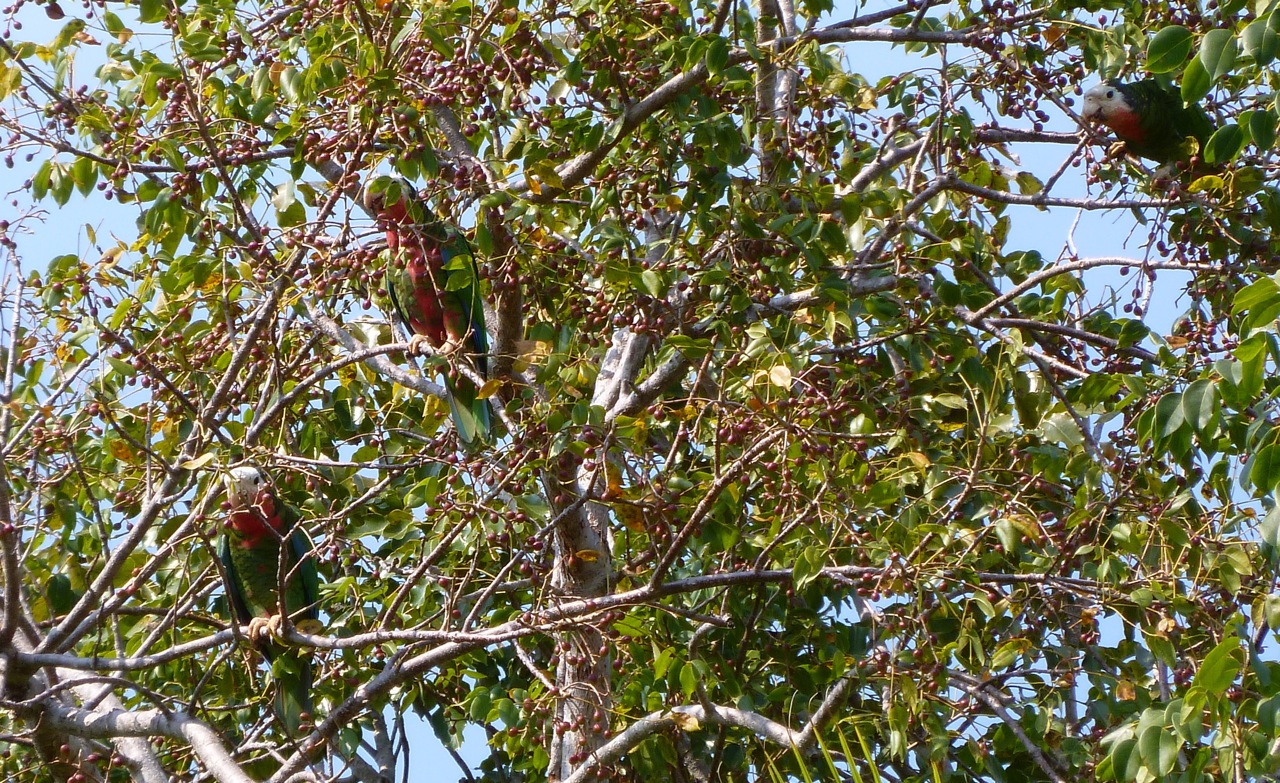
 ABACO PARROTS (Amazona leucocephala bahamensis) Here is a selection of our photos of these fantastic birds. I hadn’t expected to see so many, for so long, and at such close quarters. Their colouring was extraordinarily vivid, with a slash of blue on the wings. This was especially dramatic in flight. One parrot, shown below, had red frontal markings that extended almost to its tail. Ricky hadn’t seen one like it before.

CLICK on the images to enlarge them significantly [Mrs rollingharbour reports that this is as yet a theory and may not work in practice]

CAPTION COMPETITION (NON-COMPETITIVE): 3rd image down – what did parrot (a) say to parrot (b)?

To be continued… (I’m going to do this post piecemeal – other birds, flowers etc to follow)


Unknown's avatar

HOT SHOTS: WOODPECKER & BUTTERFLY UPDATE FROM DELPHI, ABACO


I have returned from “The Other Delphi” to find that Peter Wesley Brown has provided 3 excellent images, now uploaded to the CONTRIBUTIONS / PHOTOGRAPHS page. Two are excellent pictures of a Gold Rim / Polydamas Swallowtail, dramatically… no, badly photographed by me for the BUTTERFLIES post and later identified by PM; the third shows that THE RELUCTANT WOODPECKER has finally made herself / himself at home in the nesting box… 

Unknown's avatar

THE NATIONAL PARKS OF ABACO


The National Parks of Abaco

Abaco National Park Created in 1994, it encompasses over 20,500 acres of pine forest / coppice and is the principal habitat for the endangered Bahama Parrot and other important species of Bahamian wildlife. The tract covers a large area of the Great Abaco water table and has significant recreational value for the people of Abaco. 

Black Sound Cay Nature Reserve This two acre mangrove reserve is nestled in the harbour of Abaco’s historic Green Turtle Cay. The reserve was established in 1988 to protect a vital waterfront ecosystem and wildlife.

Pelican Cays Land & Sea Park A 2,100 acre area just north of Cherokee Sound in Great Abaco that contains stunning undersea caves, extensive coral reefs and is noted for its fish, plant and bird life.

Tilloo Cay National Park Acquired by the Trust through private donation, this 11 acre area encompasses a tropical wilderness shoreline of outstanding beauty. Exposed to the Atlantic Ocean, the area is an important sea bird nesting site.

Fowl Cay Land and Sea Park Recently created in 2009, an excellent place for reef snorkelling [I will be posting about this in due course…] 

CLICK LINK for Article (Abaconian March 3 2011): The Two Abaco Sea Parks, Fowl Cay & Pelican Cay (BNT)

(Info mostly courtesy of Bahamas National Trust; Article “The Abaconian”)

Unknown's avatar

A STROLL ROUND THE DELPHI GARDENS ON ABACO


There is a wealth of birdlife on the Delphi doorstep. You don’t even have to go out of the front gateway to find it. You’ll hear a great many more birds than you ever see – many are small and very hard to spot in the bushes, even when you can hear loud chirrups. Here are a few examples of what you might see, all taken within the Club precincts

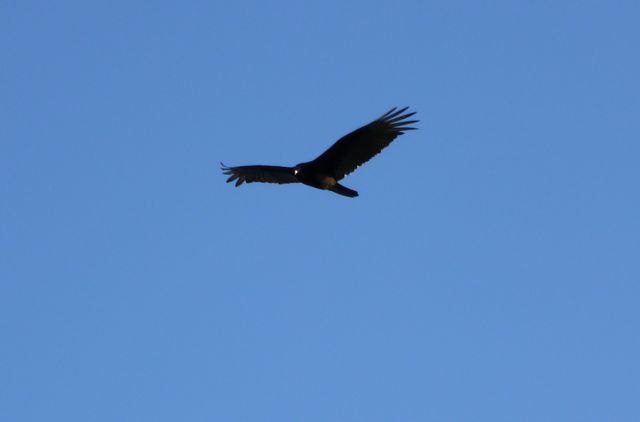
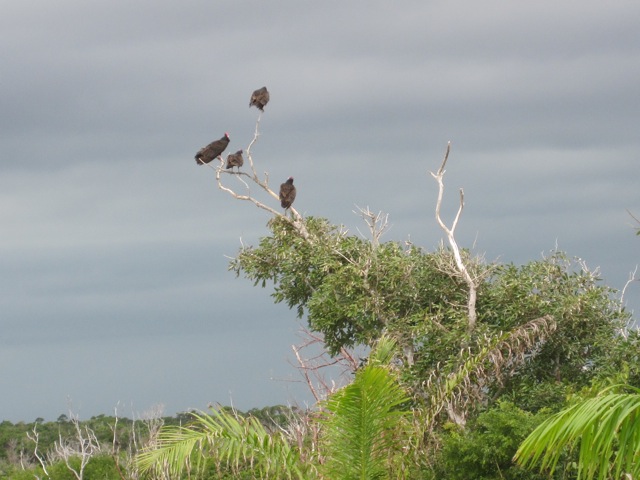
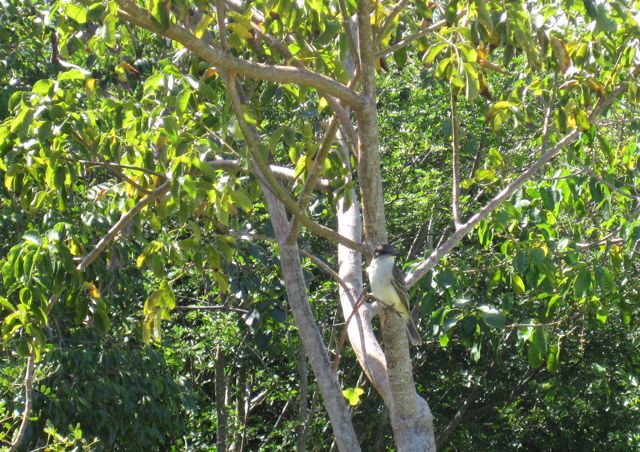
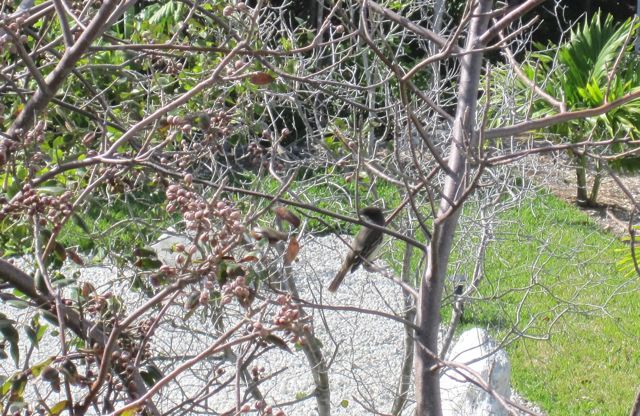
TURKEY VULTURES, ever present, wheeling above the bay, sometimes in flocks of 20 or more. Their grace in flight is slightly spoiled by the knowledge that their heads are red, wrinkled, bald and… frankly unattractive. You may also see them hunched on a dead branch along the drive (second photo) LOGGERHEAD KINGBIRDS, one of several types of ‘Tyrant Flycatcher’, so-called because of their robust attitude to defending their territory. The first one is on the far side of the pool; the second is taken from the verandah.

 WEST INDIAN WOODPECKER, resident initially under the verandah eaves before moving to the upscale nesting box further along. Often seen during the day in the gardens, sometimes shouting raucously: the second photo is near the pool

ANTILLEAN BULLFINCH (previously wrongly ID’d as American Redstart – thanks CN) I’d never seen one of these before, nor indeed heard of them. This one was photographed in the trees along the drive while I was in fact looking for another bird altogether…

THICK-BILLED VIREO, one of several vireo species. Believe me, they are much less blurry in real life than here… They chirp a lot and seem quite tame.

BANANAQUIT My second favourite bird (after the western spindalis). Smart black and white heads, yellow underparts, and a sharply curved beak used to pierce the base of flowers for nectar. They aren’t choosy though, and eat insects and fruit too. Very chirpy, and VERY hard to see in the bushes, even when you can clearly hear exactly where you think it must be… Look for moving foliage. This one was in the shrubs by the main staircase.They sound like this (credit Xeno-canto.org)

NORTHERN MOCKING BIRD at a distance… above the skiff park. We heard it singing melodiously. ID (in close up – click on image for a marginally better view) from cocked and slightly spread tail, and (you won’t see this) white wing markings. This species is apparently beginning to displace the larger but unaggressive Bahama Mockingbird.

NORTHERN PARULA Small yellow warbler, of which there are many types. This is the one that unwisely tried to fly into the Great Room through the plate glass, and had to be revived by Sandy. It perked up quite quickly, and flew off none the worse for its encounter either with the glass or Sandy…

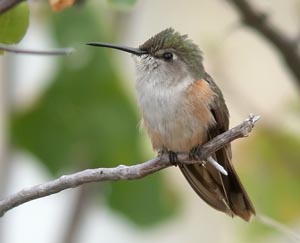
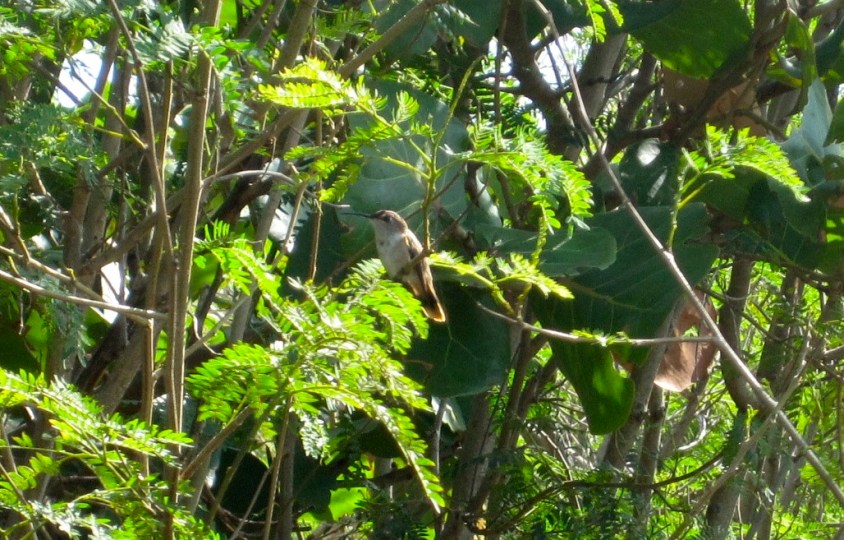
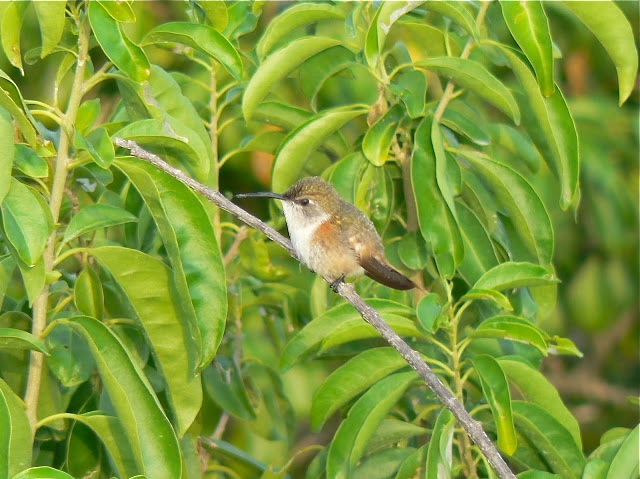
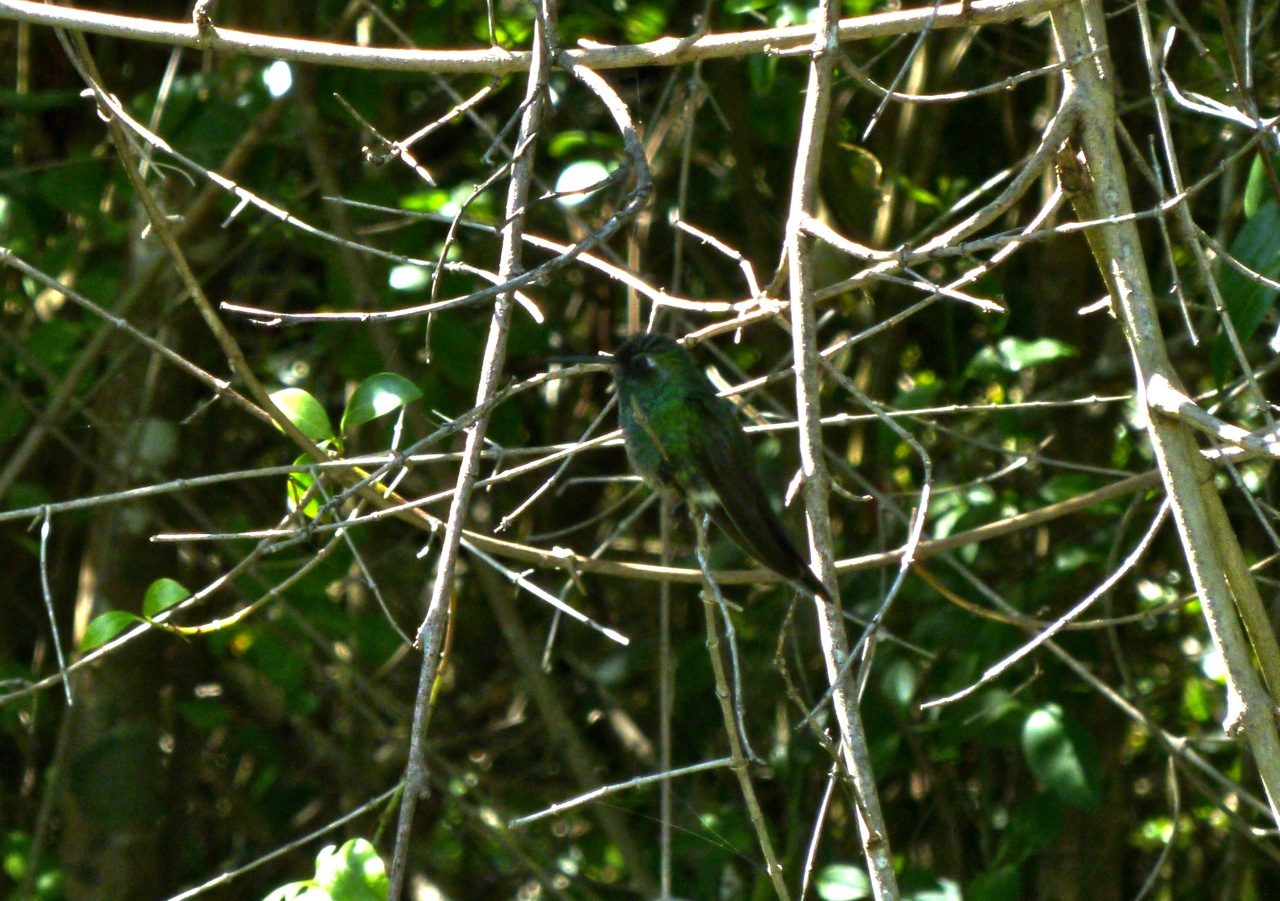
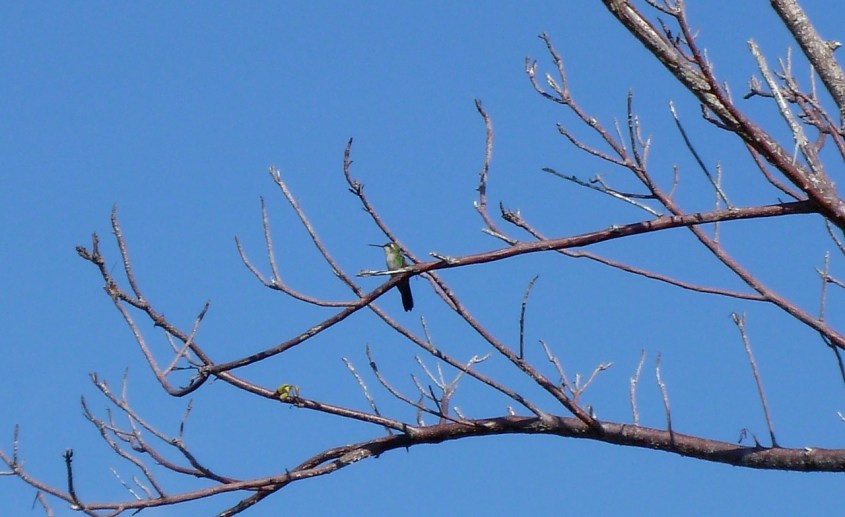
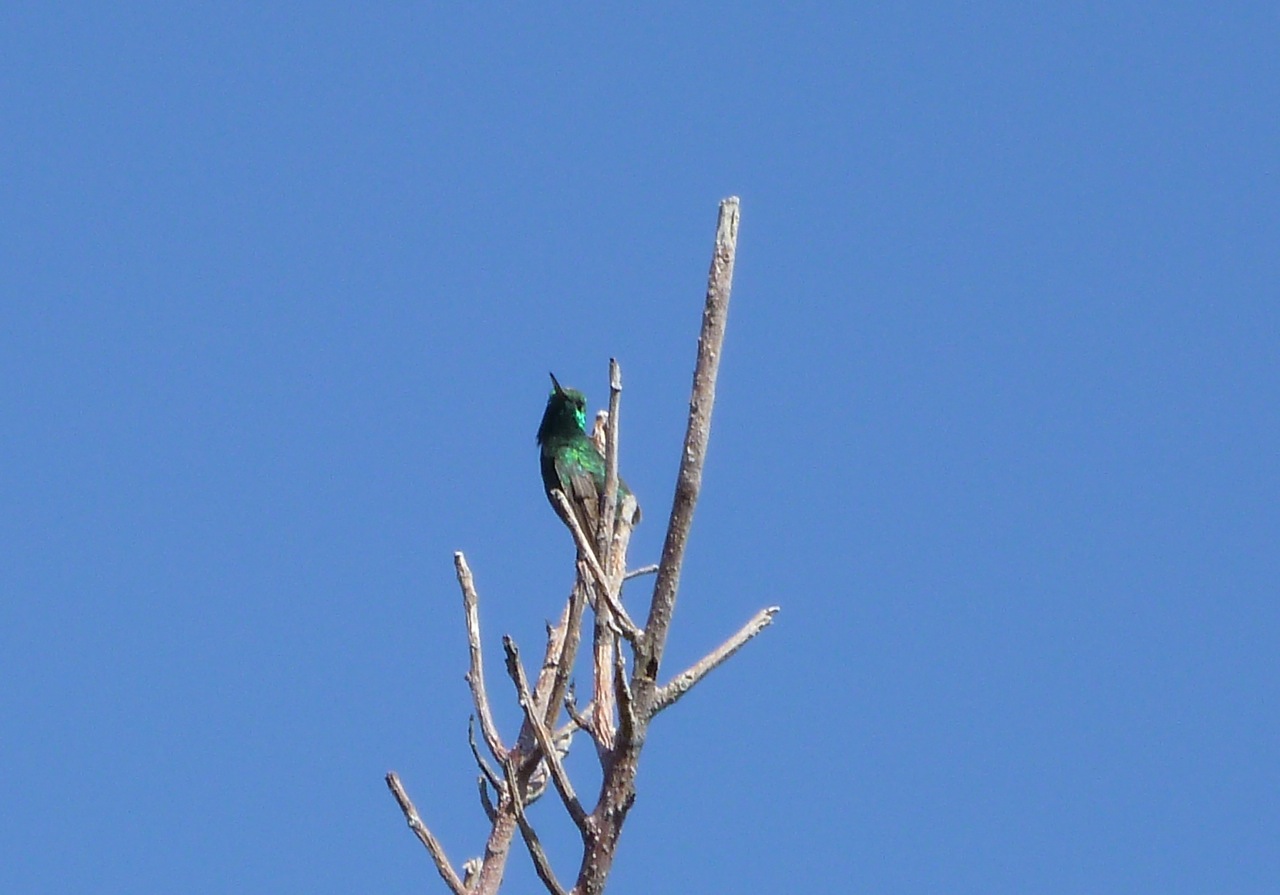
HUMMINGBIRDS are a fascinating topic in themselves, and I’ll post about them separately. There is the Cuban Emerald and the endemic Bahama Woodstar, both of which can be seen at Delphi (though the latter are rare where the former predominate). There is a 3rd type of hummer on Abaco, which I will leave you with for now:

Unknown's avatar

ABACO BUTTERFLIES AT DELPHI / CONTRIBUTIONS / BLOG FORMAT CHANGES


As a change from birds, here are some other flying items, mostly from around Delphi itself, with a redesigned logo in their honour.

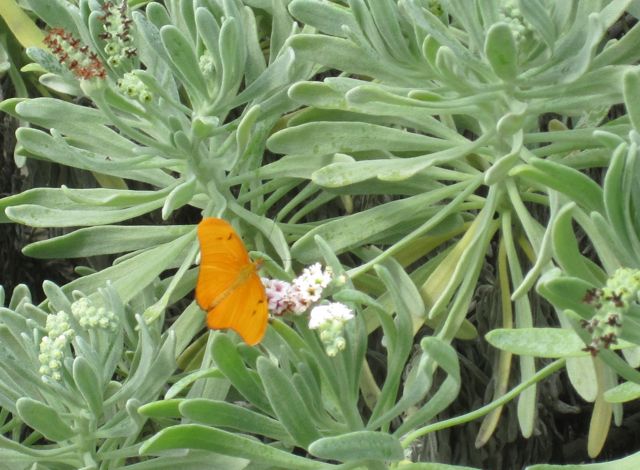
JULIA LONGWING Dryas Julia (Delphi Beach – plant now ID’d as a Bay Cedar Suriana maritima, much enjoyed by butterflies and bees)

HAMMOCK SKIPPER Polygonus Leo (Delphi Service Drive)


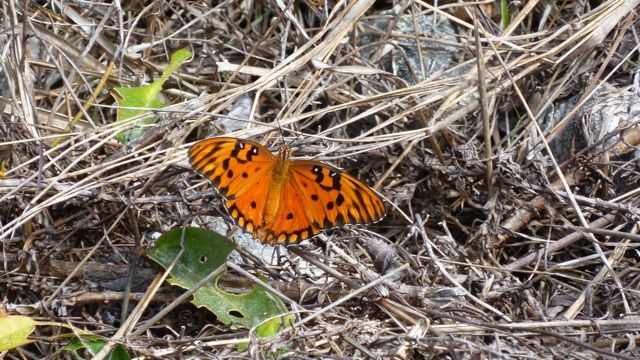
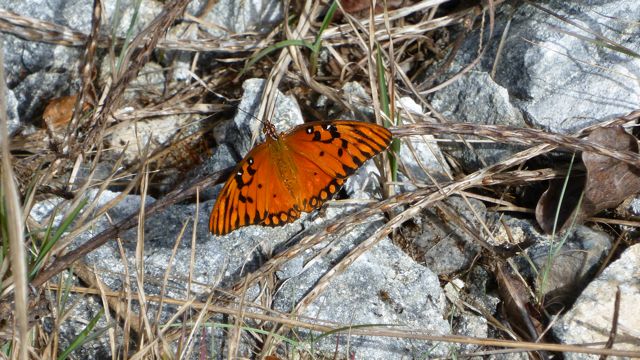
GULF FRITILLARY Agraulis vanillae (Delphi Guest Drive)


I haven’t nailed the ID of this one yet. Any ideas appreciated. [See later post for ID as GOLD RIM SWALLOWTAIL / POLYDAMUS SWALLOWTAIL     (Battus Polydamus Lucaeus) ]
Seen all round Delphi this March. These are on the move the whole time, and are surprisingly hard to pin down (not a very sensitive way to put it for a butterfly…) The bottom photo looks like a rubbish picture, I know, but in fact the butterfly is at rest (the body / legs / feelers aren’t blurred) while the wings beat fast and constantly while it feeds

AND FINALLY… Pride of place goes to this Atala Hairstreak, photographed during a Delphi outing with Ricky Johnson to one of the Blue Holes in the pine forest. It’s the only place I have seen these small butterflies, and there were only four or five. This one stayed still for just long enough

ATALA HAIRSTREAK Eumaeus Atala

===========================================

BLOG NEWS UPDATE 

23.04.11

  • Email Share added to the main pages
  • Pages Menu added to sidebar
  • Contributions received now posted on the appropriate page…

Note I am trying to reorganise this blog to increase accessibility of categories and sub-categories. Struggling a bit… one major accidental deletion so far… proposed pages under construction or at least under contemplation… please bear with me!  

============================================

Unknown's avatar

THE GOOD BIRD GUIDE 2010 – DELPHI CLUB, ABACO


This guide was compiled after our visit to Delphi in February 2010. It was originally intended purely for domestic consumption, as a light-hearted personal record and aide memoire. However, others suggested it might be useful for people wanting to make a quick identification of a bird they have seen around the Club or further afield. I was persuaded to put a copy on the desktop of the computer in the Club Library, and there’s now a hard copy around as well. I am currently revising it to include our 2011 visit. And now here it is in blog format. I.T. progress.

CLICK LINK —››› DELPHI CLUB GOOD BIRD GUIDE 2010

Some of the images are my own; others are from freely-available resources – due thanks are given to those too numerous to mention individually (never mind being completely unidentifiable) whose images are featured…