Unknown's avatar

ABACO: THE PERFECT PLACE FOR BAHAMAS BIRDING


ABACO: THE PERFECT PLACE FOR BAHAMAS BIRDING

I’ve  fairly very often mentioned the remarkable diversity of the bird species on Abaco. This small island has a wide variety of permanent resident species and the advantage of being on a primary migration route so that it has both winter and summer migratory visitors. Here’s an example of some of the species a visitor might reasonably expect to find during a day’s birding. This isn’t an ‘invented inventory’, easy though that would be to compile. It records a birding outing by Abaco visitor Susan Daughtrey, guided by the legendary Woody Bracey, with sightings of 53 species from A (baco Parrot) to Z (enaida Dove). Here are some of Susan’s photos of the birds she encountered. At the end is the full list of the 34 species she photographed.There’s nothing very rare – most of those shown are permanent residents (PR), breed on Abaco (B) and are commonly found (1). Hence the code* PR B 1. SR is for the 2 summer residents, I is for the introduced collared dove. The best ‘get’ is the Bahama Mockingbird (PR B 3), a bird mainly of the pine forests and not so easy to find.

ADDENDUM Susan has now sent me her complete record for a great day out in which 53 species were seen. The list shows the numbers seen for each species. I have had to reformat the list from the original to make it work in this blog. I have added links for the first bird, the Black-bellied Whistling Duck, which was recorded on Abaco for the first time in early June. Of the six seen at any one time to begin with (including at Delphi), the reported numbers dropped to 2, then 1. The latest news is an unconfirmed sighting of a single bird at Treasure Cay Golf Course.

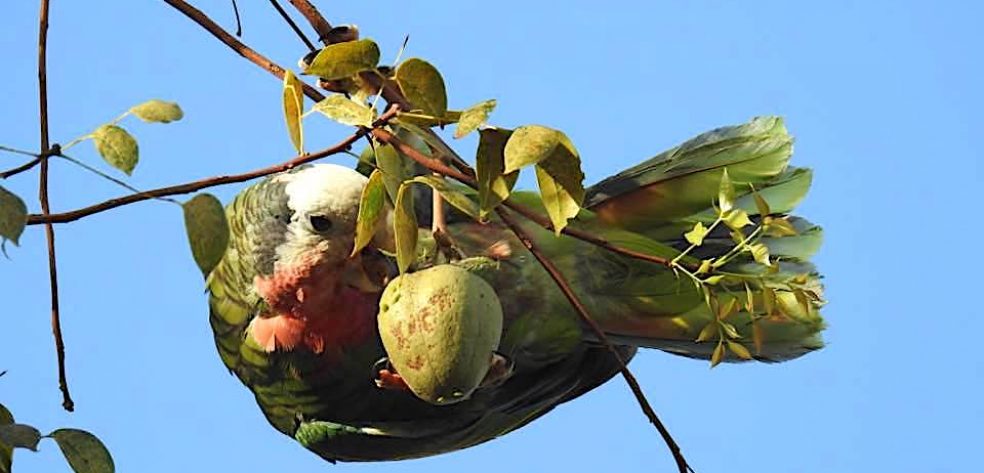
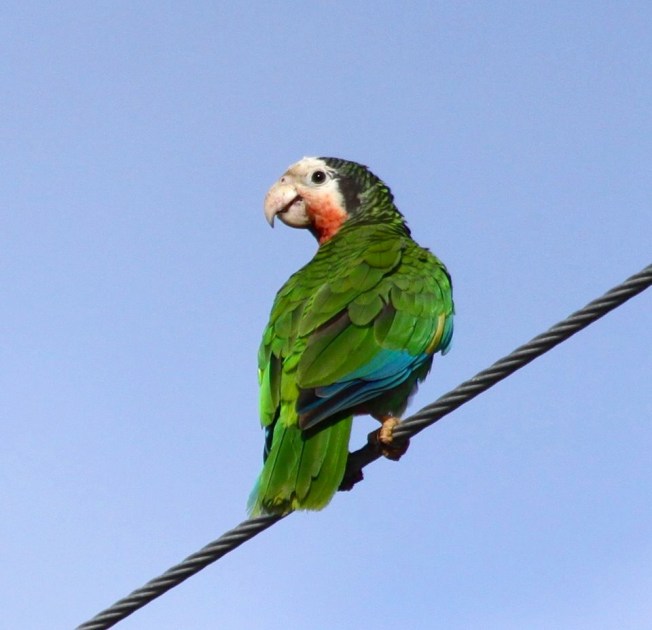
ABACO (CUBAN) PARROT Amazona leucocephala PR B 1

ANTILLEAN NIGHTHAWK Chordeiles gundlachii SR 1Amazon (Cuban) Parrot, Abaco (Susan Daughtrey)Antillean Nighthawk, Abaco  (Susan Daughtrey)
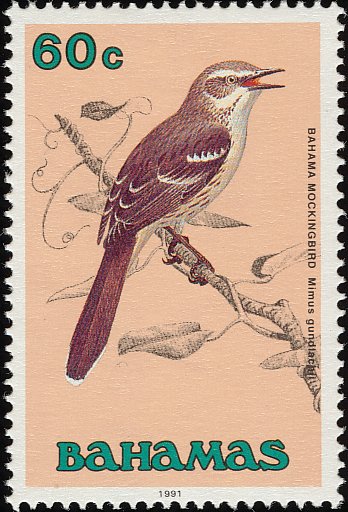
BAHAMA MOCKINGBIRD (ENDEMIC) Mimus gundlachii PR B 3Bahama Mockingbird, Abaco  (Susan Daughtrey)

BAHAMA SWALLOW (ENDEMIC) Tachycineta cyaneoviridis PR B 1Bahama Swallow, Abaco  (Susan Daughtrey)

BAHAMA PINTAIL (WHITE-CHEEKED PINTAIL) Anas bahamensis PR B 1
Bahama (White-cheeked) Pintail, Abaco  (Susan Daughtrey)

BLUE-GRAY GNATCATCHER Polioptera caerulea PR B 1Blue-gray Gnatcatcher, Abaco  (Susan Daughtrey)

CUBAN PEWEE Contopus caribaeus PR B 1Cuban Pewee, Abaco  (Susan Daughtrey)

EURASIAN COLLARED DOVE Streptopelia decaocto  I PR B 1Eurasian Collared Dove, Abaco  (Susan Daughtrey)

HAIRY WOODPECKER Picoides villosus PR B 1Hairy Woodpecker, Abaco  (Susan Daughtrey)

LEAST TERN Sternula antillarum SR B 1Least Tern, Abaco  (Susan Daughtrey)

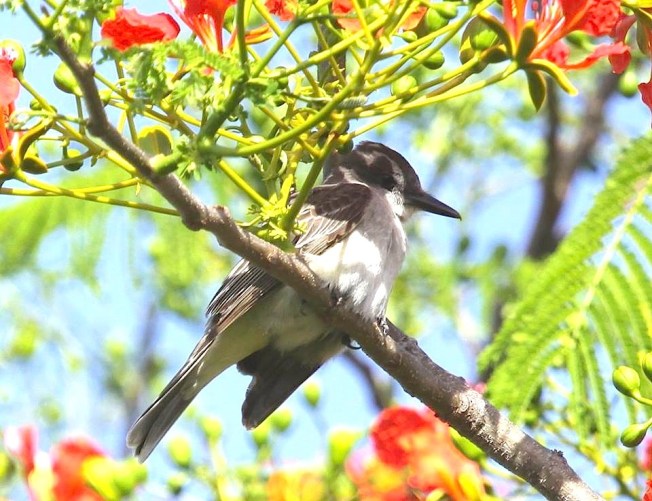
LOGGERHEAD KINGBIRD Tyrannus caudifasciatus PR B 1Loggerhead Kingbird, Abaco  (Susan Daughtrey)
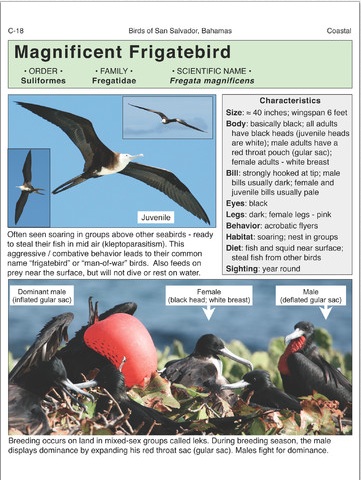
MAGNIFICENT FRIGATEBIRD (female)  Fregata magnificens PR B 1Magnificent Frigatebird, Abaco  (Susan Daughtrey)

OLIVE-CAPPED WARBLER Setophaga pityophila PR B 1                                            Olive-capped Warbler, Abaco  (Susan Daughtrey)

RED-LEGGED THRUSH  Turdus plumbeus PR B 1Red-legged Thrush, Abaco  (Susan Daughtrey)

RED-WINGED BLACKBIRD Agelaius phoeniceus PR B 1Red-winged Blackbird, Abaco  (Susan Daughtrey)

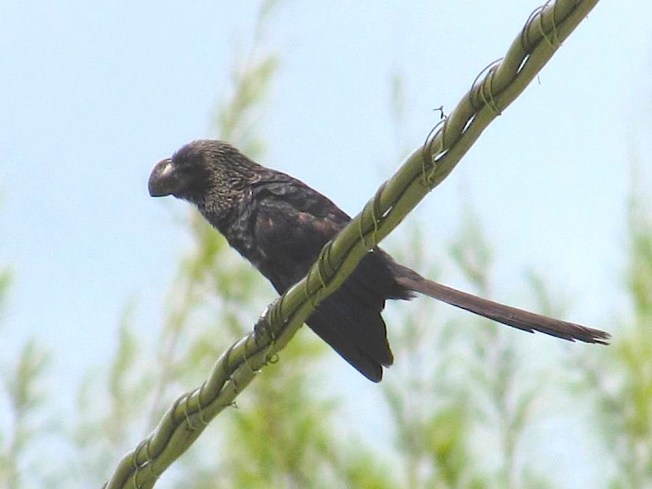
SMOOTH-BILLED ANI Crotophaga ani PR B 1Smooth-billed Ani, Abaco (Susan Daughtrey)
THICK-BILLED VIREO Vireo crassirostris PR B 1
Thick-billed Vireo, Abaco  (Susan Daughtrey)

WESTERN SPINDALIS Spindalis zena PR B 1Western Spindalis, Abaco  (Susan Daughtrey)

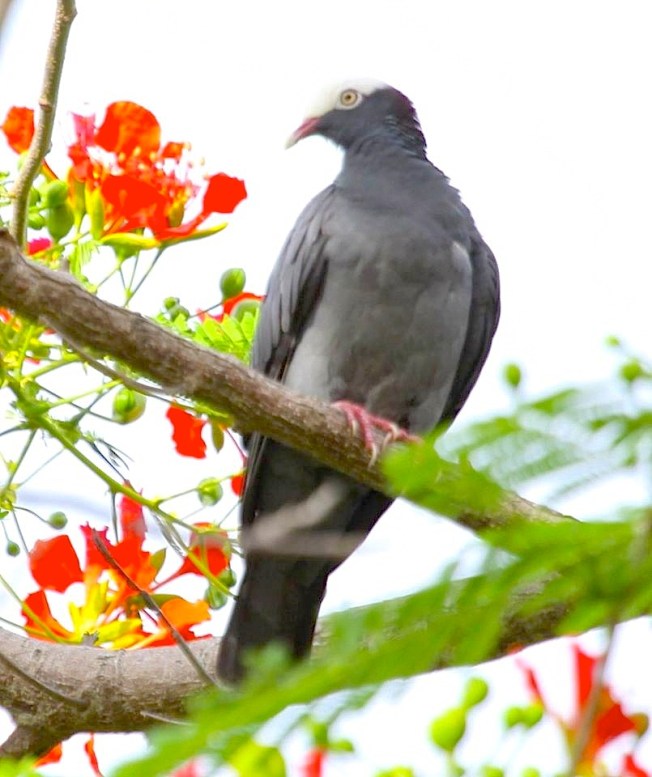
WHITE-CROWNED PIGEON Patagioenas leucocephala PR B 1White-crowned Pigeon, Abaco  (Susan Daughtrey)
SUSAN’S LIST OF BIRDS PHOTOGRAPHED

SUSAN'S SPECIES jpg

SUSAN’S COMPLETE LIST FOR THE DAY – 53 SPECIES

To learn about Abaco’s latest new species the Black-bellied Whistling Duck click HERE & HERE
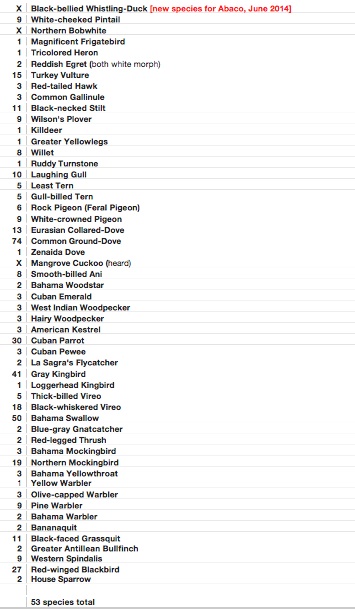
Susan's fuller list JPG

Credits: all photos, Susan Daughtrey; *the excellent birding code was devised by ornithologist Tony White with Woody Bracey

Unknown's avatar

WHAT’S IN A NAME? NORTHERN BOBWHITE ON ABACO


Northern Bobwhite female 2.Abaco Bahamas.6.13.Tom Sheley

WHAT’S IN A NAME? NORTHERN BOBWHITE ON ABACO

220px-Status_iucn3.1_NT.svg

A part of me would like Bob White to have been a legendary hero – perhaps holding his post against impossible odds; or a courageously reforming politician; or scoring a stupendous winning goal in the dying seconds of a famous tournament. Or maybe just a nice guy, popular in the local bar. Instead, the bobwhite Colinus virginianus is a small plump game bird of the quail family, named for its call which (as I have written elsewhere) “does indeed sound something like ‘bob…white?’ played on a slide-whistle”. This bird is an introduced species on Abaco where it breeds and is quite common. It is more often heard than seen, since it is a shy creature and not so easy to find. If they see you first, you’ll glimpse them scurrying away at best and you may well not see them at all. At Delphi, some set up home at the highway end of the drive where they can be heard and, from time to time, seen. Photographer Tom Sheley bided his time in order to capture these wonderful shots of a pair.
Bobwhite pair.Abaco Bahamas.Tom Sheley crBobwhite pair 2.Abaco Bahamas.Tom Sheley cr

I recently wrote about another game bird, the WHITE-CROWNED PIGEON. The bobwhite also appears in the excellent Bahamas National Trust’s BNT HUNTERS GUIDE 

Northern Bobwhite BNT Hunters Guide

Unfortunately one of the consequences of enjoying game bird status – coupled with other factors such as habitat loss – is that the species is IUCN-listed ‘near threatened’. That’s not a cause for immediate concern, but the next stage may be…

The northern bobwhite can be found year-round in fields, grassland, open woodland areas, roadsides and wood edges. Sightings of bobwhites are most usually made when they are in cover such as long grass or undergrowth, as in the header photo and the one below.Bobwhite male in habitat.Abaco Bahamas.6.13.Tom Sheley copy

When we went out searching for bobwhites last year to photograph for the book, we drove along tracks in open farmland and remote backcountry. We could hear them but we only saw a few, mostly too briefly to photograph. My own attempts were abject failures, small brown blurs of backside as the birds scuttled away. Tom Sheley fortunately had what it took to get results – patience, skill and a great camera.

Photo credits: Tom Sheley

Unknown's avatar

BIRDS OF SAN SALVADOR, BAHAMAS: BOOK REVIEW


Birds of San Salvador (cover) JPG

THE BIRDS OF SAN SALVADOR, BAHAMAS

  • Authors: R. Hays Cummins, Mark R. Boardman, Mark L. McPhail
  • Published 1 Jan 2013, 132pp with 400+ images covering 54 species
  • Available spiral bound for $29.95 on Am@zon; and a steal at $3.16 for Kindle (£5.99 in the UK)
  • STOP PRESS Also available on iTunes for iPhone / iPad, where I imagine it looks great. Once downloaded, author Hays says it can be viewed on a Mac, certainly if you have the latest OS X Mavericks. UK price: a very modest £1.99 (= $3.30)

Within a couple of weeks of the decision to use Tom Sheley’s wonderful Bahama Woodstar as the ‘cover bird’ for “THE BIRDS OF ABACO”, another Bahamas bird book was announced. The same colourful and enchanting endemic bird had also commended itself to the authors for their cover. I wrote to Hays Cummins at once to check whether he would mind another Bahamas bird book encroaching on the territory, especially one using the same cover bird into the bargain. He very charmingly said it would be fine and declared his support for our (luckily) rather different project.

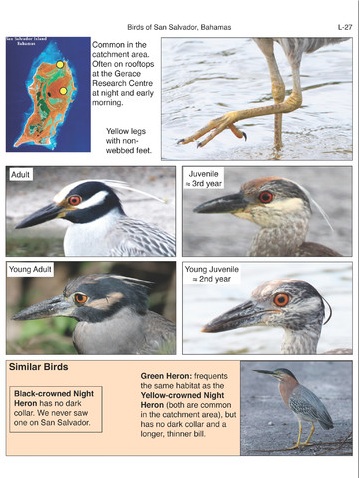
It’s been a while since I added to the section BOOKS, but I thought I’d mention this one for two reasons. First, it is described as ‘A Photo Essay of Common Birds’, which in practical terms means that most if not all of the species featured will be common to the northern Bahamas and therefore familiar on Abaco. Secondly, I very much like the format of the book: there are clear photos; and all necessary general information including notes on individual characteristics and similar species is presented in an easily assimilable way. Were the Delphi book not designed to be the 2 kg bird-showcasing non-field guide doorstop it is, the San Salvador book is one I should liked to have produced! Birds of San Salvador (sample page 1) Birds of San Salvador (sample page 2) DESCRIPTION “This enchanting book addresses a need for an important audience, the budding naturalist, which many of our students are. Without fanfare and pomposity, the book presents beautiful and inspiring photos and lively discussion, but does not indulge in the details of the accomplished birder. The authors present information about the natural history of birds on San Salvador, Bahamas, not through the eyes of a professional or advanced birder, but through the eyes and photographic lenses of inquiring educators and naturalists. This book will help capture and catalyze the interests of aspiring birders and will be an asset for introductions to the birds of the Bahamas and neighboring Caribbean. Over 400 images, representing 54 species, are all original and include a variety of behaviors and highlight recognition characteristics. The authors’ aesthetic photography, printed on high quality paper, will help reinforce identification and enjoyment. Birds are organized by habitat (Coastal, Interior, and Lakes & Ponds), not by taxonomic affinities. A taxonomic index is included.” 

I’m pleased to see the decision to depart from the usual taxonomic ordering of species, though I recognise that for a serious field guide that tradition is pretty much sacrosanct. We played around with categories and sub-categories a bit (sea birds, water birds, land birds; big, medium, small; cute, splendid, dull, plug-ugly) before settling on Peter Mantle’s excellent idea of straight alphabetical organisation. For a mainly photographic book this gives an element of surprise to turning the pages, and avoids  e.g. 37 pages of warblers species, mostly yellow, all huddled together.  Birds of San Salvador (sample page 4) Birds of San Salvador (sample page 5) I notice that there is a single Amazon review, a good one, that says “This guide to one of the lesser known islands in the Bahamas is a nice one. While not exhaustive, it covers most of the species likely to be seen on San Salvador. The style is unorthodox for a field guide (elements of humor, gives brief description of species, but no real key field marks), the descriptions, locations on the island, and behaviors make this guide useful for those visiting San Salvador. The photographs are excellent.” Birds of San Salvador (sample page 3)For anyone interested in a useful reference guide to the common birds of Abaco, and in possession of a Kindle, this book is easily worth getting electronically.  ‘To be brutally honest’ (™ Sandy Walker), I’d like in due course to produce a small book very like this for Abaco, but it would obviously be naked plagiarism to do that, so of course I won’t. Still, all the same…

Unknown's avatar

“FAIR GAME” ON ABACO: THE ATTRACTIVE BUT SADLY DELICIOUS WHITE-CROWNED PIGEON


White-crowned Pigeon, Abaco, Bahamas (Tony Hepburn)

 “FAIR GAME” ON ABACO: THE ATTRACTIVE BUT SADLY DELICIOUS WHITE-CROWNED PIGEON

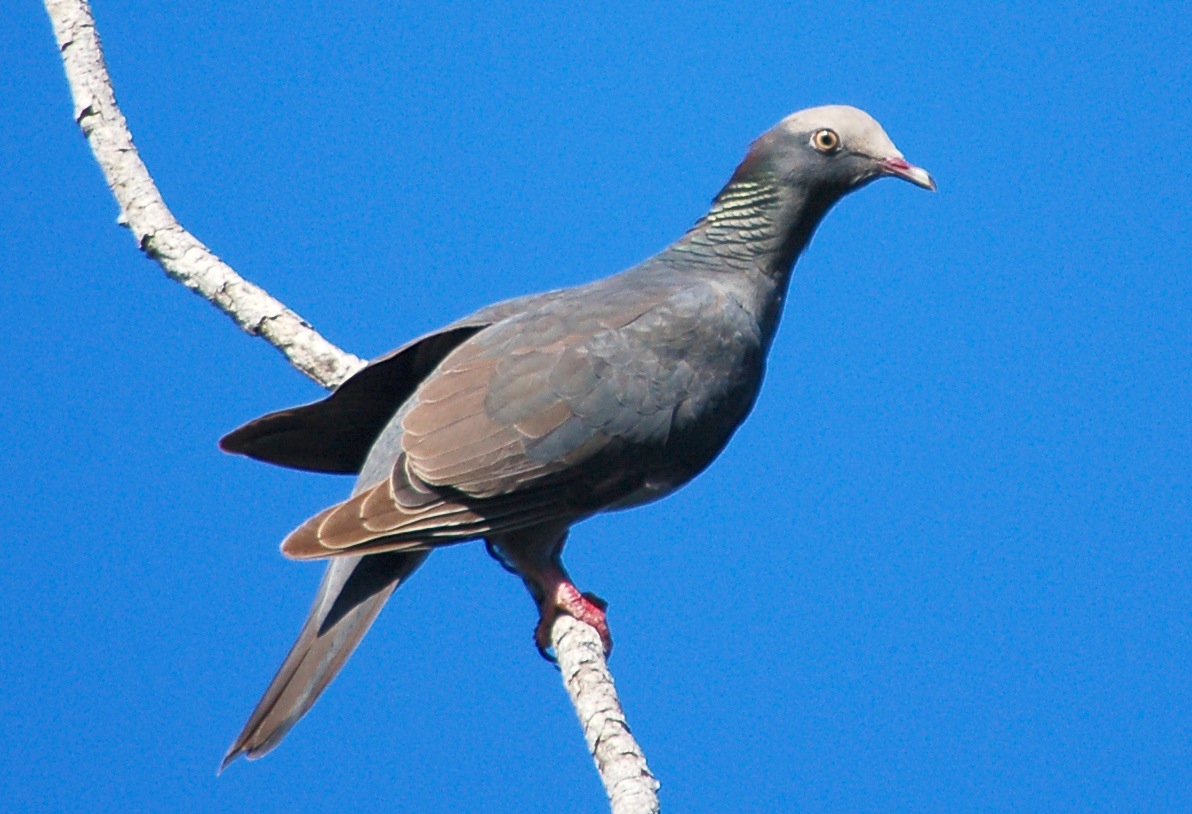
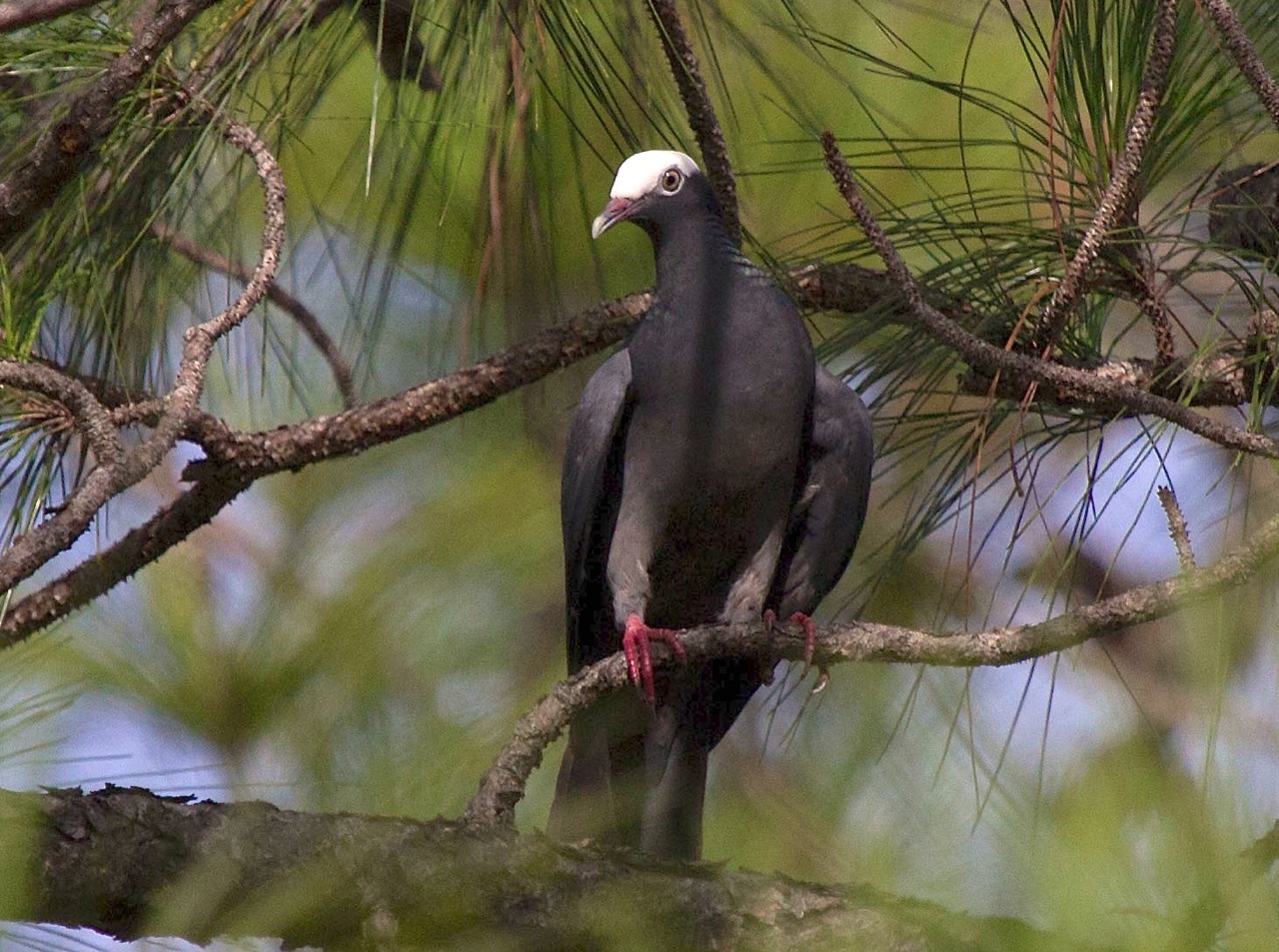
Fishing is the mainstay of Abaco’s sporting life, but hunting runs it a close second. Whether it’s the hog hunters plunging down remote backcountry tracks with their dogs or the shooters plying their trade, there is plenty on the hunter’s menu. The WHITE-CROWNED PIGEON Patagioenas leucocephala is one of the species that’s fair game in season. The bright white of its crown rather gives away its position. A permanent resident on Abaco, this pigeon is quite commonly found.

White-crowned Pigeon, Abaco, Bahamas (Gerlinde Taurer)

The Bahamas hunting season for this species is between the end of September and March. Here is the relevant extract from the excellent BNT HUNTERS GUIDE, a very useful publication packed with information that is well worth a look at. WCP BNT Hunters Guide

220px-Status_iucn3.1_NT.svg

Unfortunately, this pigeon is no longer as prolific as it once was, and is now IUCN-listed ‘near-threatened’. Hunting is one reason. Habitat loss is another. And apparently in Florida (the only US State that has these birds), car-strike is a major cause of population decline (with time, they may learn to fly higher. Unless it’s too late for the species by then…).

White-crowned Pigeon, Abaco (Alex Hughes)

The balance of species preservation and the perceived need of humans to encroach on habitat or their wish to shoot for the pot, is a always a hard one to judge. ‘Near-threatened’ sounds bad, but it’s probably not until the next stage is reached – ‘vulnerable’ or ‘endangered’ – that there is real cause for concern. But as the title says (props to Peter Mantle for this pithy observation, duly incorporated into the WCP entry in THE BIRDS OF ABACO) these inoffensive pigeons are indeed ‘sadly delicious…’

White-crowned Pigeon, Abaco, Bahamas (Gerlinde Taurer)Photo credits: Gerlinde Taurer, Alex Hughes, Tony Hepburn plus BNT for the hunters guide


Unknown's avatar

BAHAMAS STAMPS & ABACO BIRDS: ‘IMITATION IS THE SINCEREST FORM OF PHILATELY’


BAHAMAS STAMPS & ABACO BIRDS: ‘IMITATION IS THE SINCEREST FORM OF PHILATELY’ 

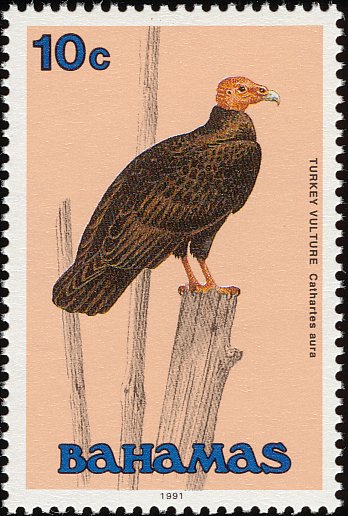
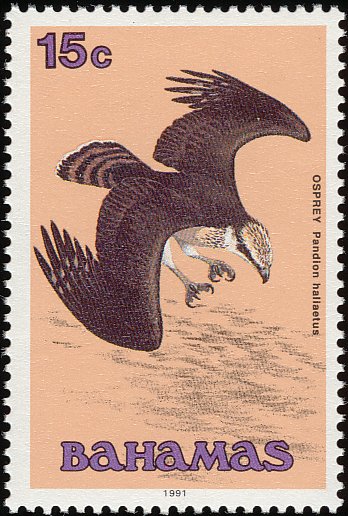
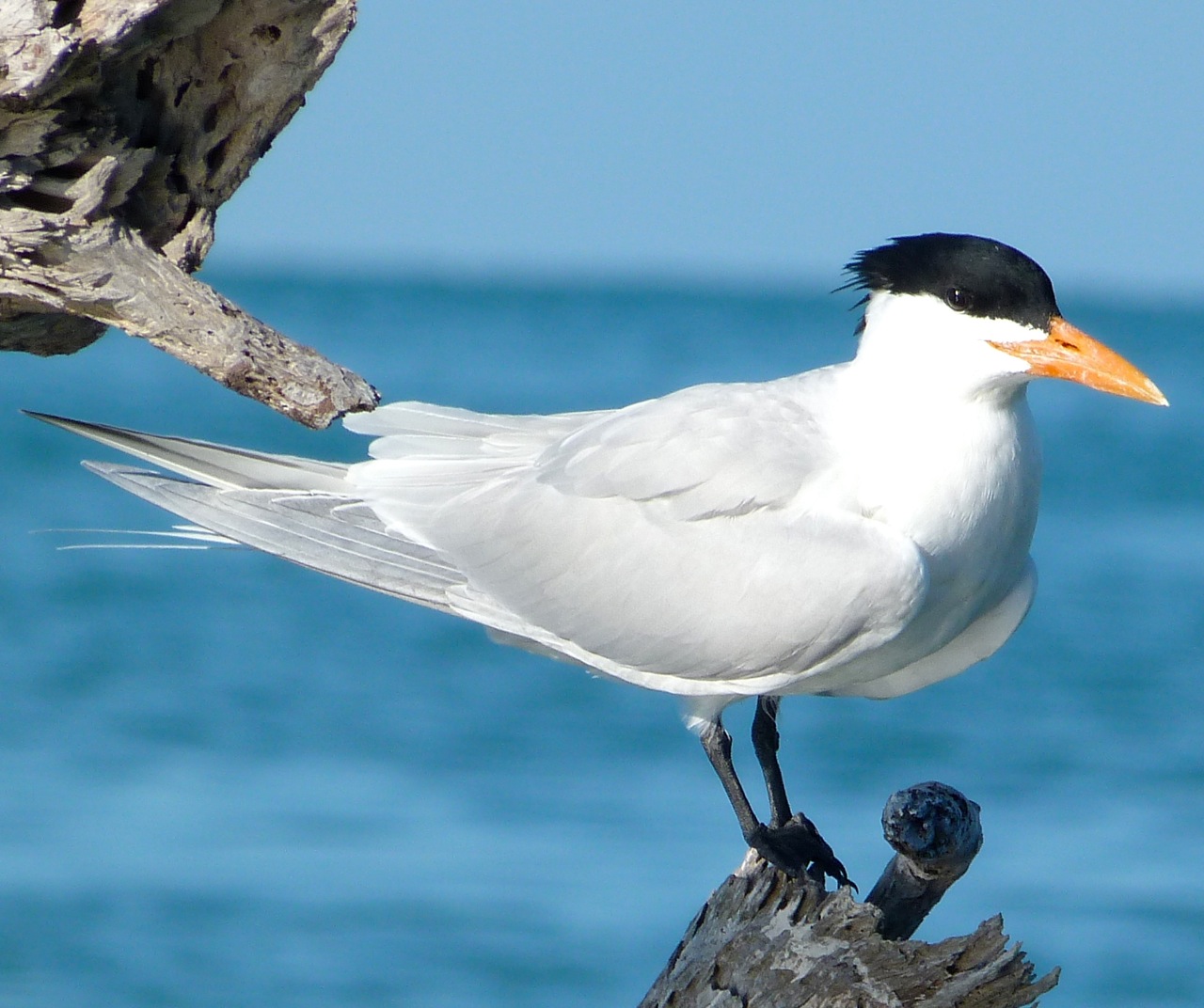
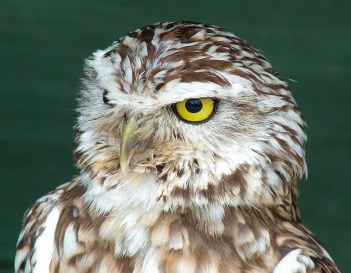
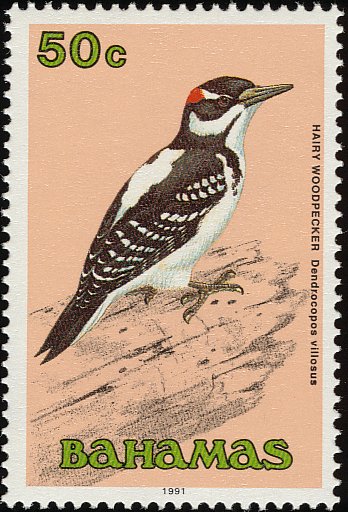
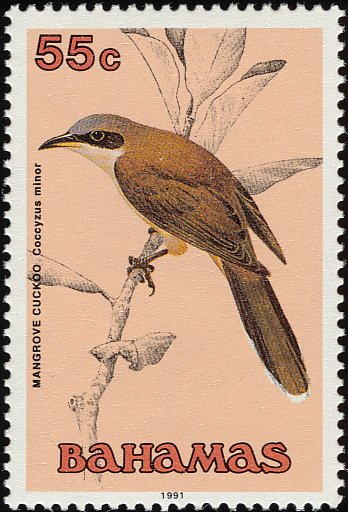
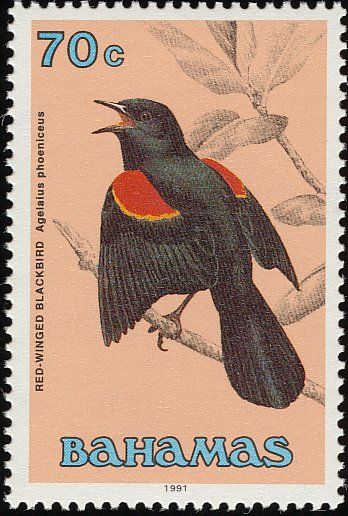
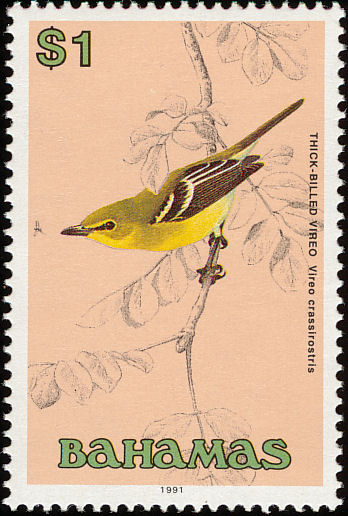
The Bahamas produces frequent issues of wildlife stamps. Mostly birds, but also reef fish and sea creatures, animals, butterflies and flowers. I am gradually collecting an album of Bahamas wildlife stamps on a PHILATELY page. I’ve been having a look at a 16-bird issue from 1991 which reflects the wide diversity of species extremely well. Here is the set, with comparative photos of each bird. All but one were taken on Abaco, the rare Burrowing Owl being the exception. All the other 15 birds may be found on Abaco as permanent residents, either easily or with a bit of a look and some luck. I personally have not seen the Clapper Rail (though I saw a SORA) or the rarer Key West Quail-Dove.

bah199101l                       GREEN HERON, Abaco (Nina Henry)


bah199102l                       Turkey Vulture Abaco (Keith Salvesen)

bah199103l                      Osprey - Abaco Marls (Keith Salvesen)

bah199104l                      Clapper Rail, Abaco (Erik Gauger)

bah199105l                     Royal Tern Abaco (Keith Salvesen)

bah199106l                     BAHAMAS - Key West Quail-dove (Becky Marvil)

bah199107l                    Smooth-biled Ani, Abaco (Bruce Hallett)

bah199108l                    Burrowing Owl (Keith Salvesen)

bah199109l                  Hairy Woodpecker, Abaco (Tony Hepburn)

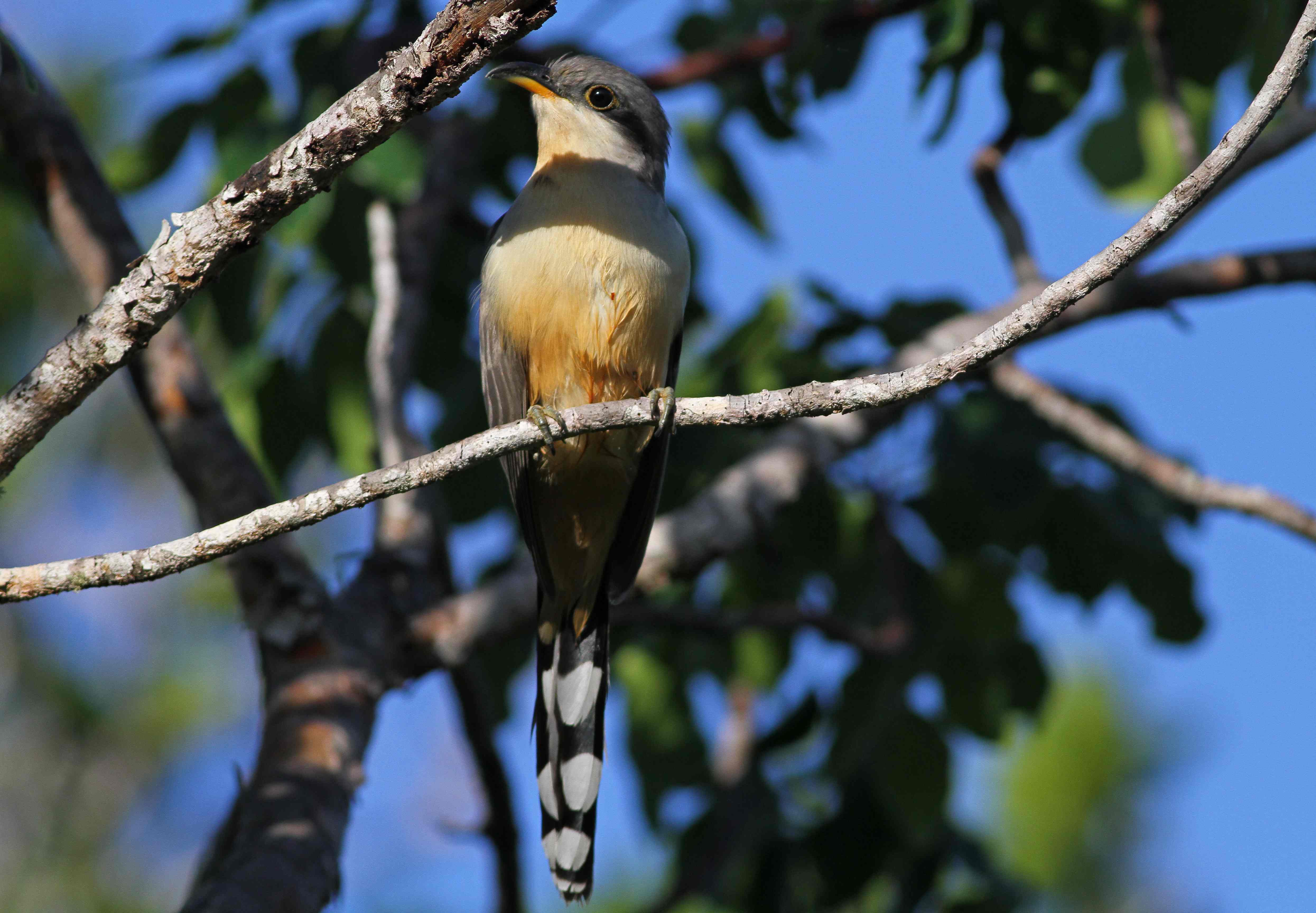
bah199110l                   Mangrove Cuckoo, Abaco, Bahamas (Tony Hepburn) copy

bah199111l                   Bahama Mockingbird, Abaco (Keith Salvesen)

bah199112l                 Red-winged Blackbird Abaco Bahamas (Keith Salvesen)

bah199113l                 Thick-billed Vireo, Abaco (Susan Daughtrey)

bah199114l                 Bahama Yellowthroat vocalizing.Abaco Bahamas.Tom Sheley

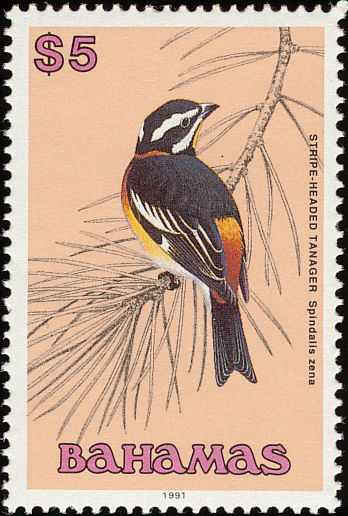
bah199115l                 Western Spindalis Abaco (Janene Roessler)

bah199116l                  Greater Antillean Bullfinch, Abaco (Bruce Hallett)

 The bird list and image credits

 Green Heron                     Butorides virescens               Nina Henry

Turkey Vulture                   Cathartes aura                     Keith Salvesen / RH (Delphi)

Western Osprey                Pandion haliaetus                 Keith Salvesen / RH (Marls)

Clapper Rail                      Rallus longirostris                 Erik Gauger

Royal Tern                         Thalasseus maximus            Keith Salvesen / RH (Marls)

Key West Quail-Dove      Geotrygon chrysia                 Becky Marvil

Smooth-billed Ani            Crotophaga ani                      Bruce Hallett

Burrowing Owl                  Athene cunicularia              Keith Salvesen / RH (UK)

Hairy Woodpecker             Picoides villosus                   Tony Hepburn

Mangrove Cuckoo             Coccyzus minor                     Tony Hepburn

*Bahama Mockingbird     Mimus gundlachii              Keith Salvesen / RH (National Park)

Red-winged Blackbird      Agelaius phoeniceus       Keith Salvesen / RH (Backcountry Abaco)

Thick-billed Vireo              Vireo crassirostris               Susan Daughtrey

*Bahama Yellowthroat       Geothlypis rostrata            Tom Sheley

Western Spindalis              Spindalis zena                       Janene Roessler

Greater Antillean Bullfinch  Loxigilla violacea            Bruce Hallett

* Endemic species for Bahamas

STAMPS            http://freestampcatalogue.com            Tony Bray

Unknown's avatar

THE ABACO PARROT: BEAUTIFUL, NOISY AND UNIQUE [Video]


 Abaco (Cuban) Parrot 2013 (Keith Salvesen)

THE ABACO PARROT: BEAUTIFUL, NOISY AND UNIQUE [Video]

I’ve posted quite often about Abaco’s unique ground-nesting parrots. They have their own page at ABACO PARROTS; and there’s a link in the right sidebar to a small illustrated booklet about them wot I writ in conjunction with Caroline Stahala. I have just found a very short bit of video footage that’s ideal for anyone who is extremely busy and /or has a short attention span. Spend a happy 10 seconds to  (a) admire the bright colours and (b) listen to the raucous cries of a flock of Abaco parrots. 

Abaco Parrots (Melissa Maura)Credits: Header photo & video RH; 2-parrot pic Melissa Maura with thanks


Unknown's avatar

LHUDE SING, CUCCU! THE MANGROVE CUCKOO ON ABACO


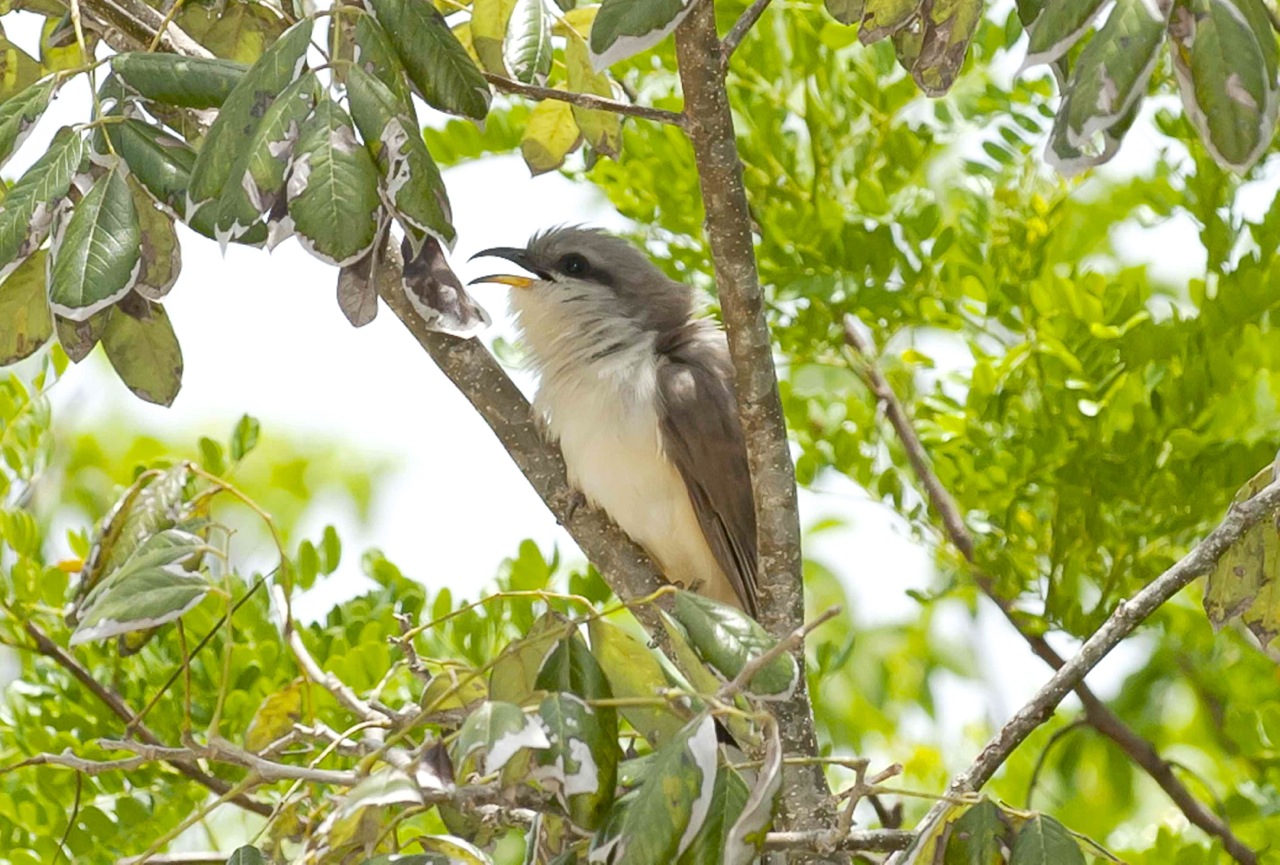
 Mangrove Cuckoo, Abaco, Bahamas (Bruce Hallett)

LHUDE SING, CUCCU! THE MANGROVE CUCKOO ON ABACO

Summer is icumen in, that’s for sure. Has already cumen in, to be accurate. The approach of summer is the time when cuckoos tend to sing loudly (not lewdly, as the old lingo might suggest). The YELLOW-BILLED CUCKOO, recently featured, is one. The MANGROVE CUCKOO (Coccyzus minor) is another. Before I get on to some gorgeous pictures (none taken by me!), let’s have a sample of how this species sounds. The call has been described in various ways, for example as “gawk gawk gawk gawk gauk gauk”. I’m not so sure. And I can’t think of a sensible way to write it out phonetically. So I won’t. Please try, via the comment box…

Jesse Fagan / Xeno-Canto

Cornell Lab / Allaboutbirds  

MANGROVE CUCKOO, Abaco (Alex Hughes)Mangrove Cuckoo with insect.Delphi Club, Abaco, Bahamas (Tom Sheley)

You will notice that all three birds above have got fat insects in  their beaks. A lot of photos in the archive show feeding mangrove cuckoos. Maybe that’s when they are most likely to break cover, for they are quite a shy species.  Their preference is for caterpillars and grasshoppers, but they are happy to eat other insects, spiders, snails, lizards and (with a nod to an all-round healthy diet) fruit.

Mangrove Cuckoo, Delphi Club, Abaco, Bahamas (Tom Sheley) copyMangrove Cuckoo, Abaco, Bahamas (Gerlinde Taurer) Mangrove Cuckoo, Abaco Alex Hughes

Delphi is lucky to have some of these handsome birds lurking in dense foliage along the drives – the guest drive in particular. Some of these photographs were taken there. Occasionally you may see one flying across a track ahead of a vehicle, flashing its distinctive tail. It’s significant that only the last of these photos shows the bird right out in the open – the rest are all deeper in the coppice.

Mangrove Cuckoo, Abaco, Bahamas (Tony Hepburn) copyMangrove Cuckoo, Abaco, Bahamas (Tony Hepburn)  copyCredits: Bruce Hallett, Alex Hughes,  Tom Sheley, Gerlinde Taurer and the late Tony Hepburn; Audio – Xeno-Canto & Cornell Lab. All photos taken on Abaco!

SumerIsIcumenIn-line


Unknown's avatar

“I HEAR YOU KNOCKING”: THE YELLOW-BILLED CUCKOO ON ABACO


Coccyzus-americanus_ Factumquintus Wiki

“I HEAR YOU KNOCKING”: THE YELLOW-BILLED CUCKOO ON ABACO

The Yellow-billed Cuckoo (Coccyzus americanus) is the least common of three cuckoo species found on Abaco. All are permanent residents.  It is similar to the more frequently seen Mangrove Cuckoo. Both are avid consumers of insects in general and caterpillars in particular. The YBC is shy and you are quite unlikely to see one out in the open, though you may hear its distinctive ‘knocking’ call. The third species classified with the ‘cuculidae’ is the Smooth-billed Ani. Here’s what to listen out for:

Mike Nelson / Xeno-Canto

Yellow-billed Cuckoo, Abaco, Bahamas (Tom Sheley) copy

The YBC has, obviously, a yellow bill. It also has yellow eye-rings and pure white underparts. Photographer Tom Sheley, a major contributor t0 “The Birds of Abaco”, is a very patient man. He managed to capture these two beautiful birds by knowing the right place to be at the right time… and waiting. The results for this little-seen species are spectacular.

Yellow-billed Cuckoo, Abaco Bahamas (Tom Sheley)

For those whose memories are stirred by the reference to “I hear you knocking” (Rick from Nassau – you!), I include archive material of Dave Edmunds hamming it up. Get a load of the Clothes! The Dancing! The Moves of the guy in the top left corner / centre back, at once rhythmic yet disconcertingly bizarre.

Unknown's avatar

OWLS OF ABACO (1): THE BARN OWL


Barn Owl, Abaco2

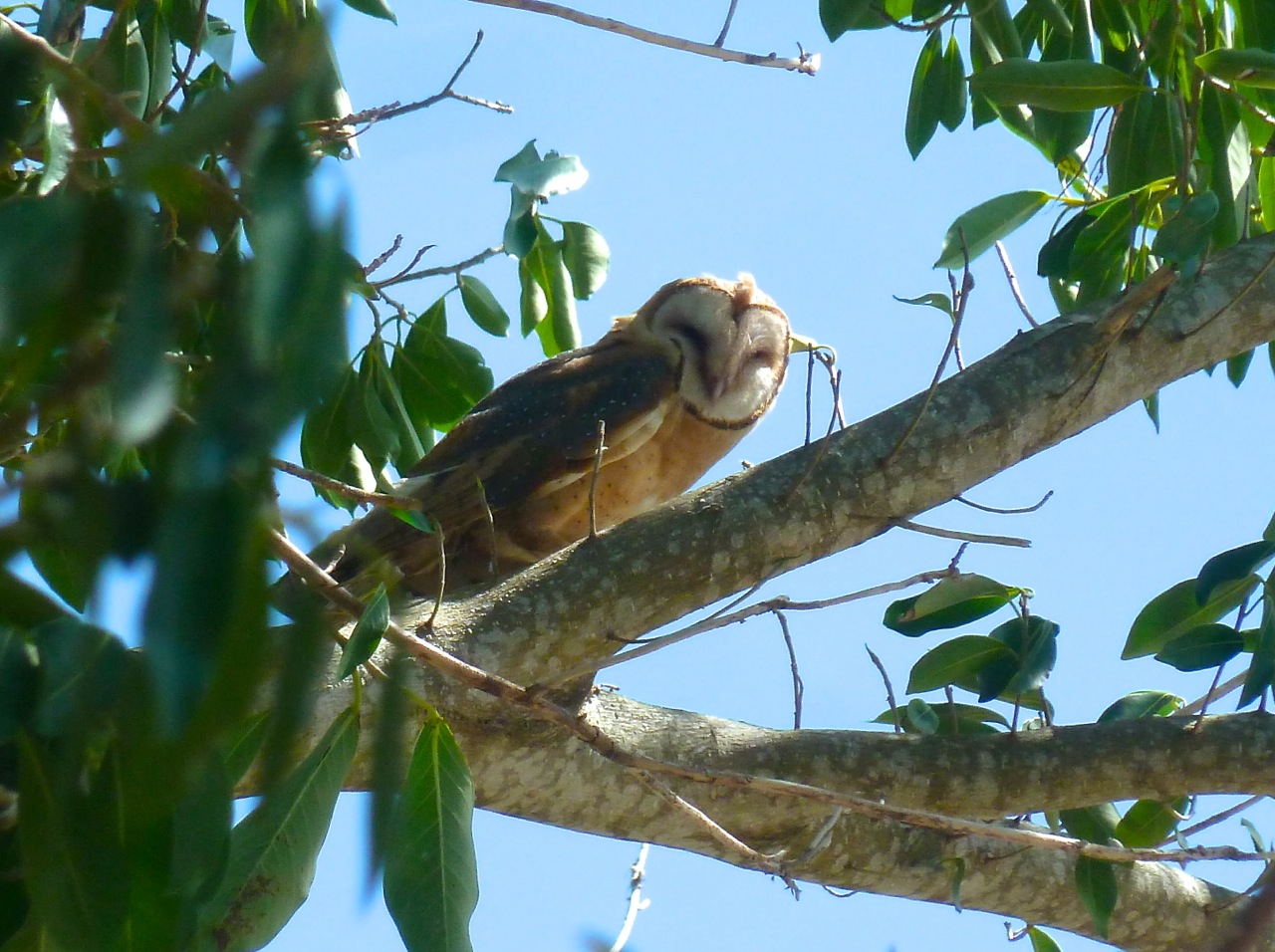
Barn Owl, Abaco, Bahamas (Woody Bracey)

OWLS OF ABACO (1): THE BARN OWL

Realistically, the Barn Owl (Tyto alba) is the only owl you are likely to see – and hear – on Abaco. The species is permanently resident, which is a good start in that the opportunities for sighting one exist year-round. Although they are not at all common they can be found in particular locations, for example the Treasure Cay area. There are two other owl species recorded for Abaco: the Burrowing Owl, a rare vagrant (post coming soon); and the Northern Saw-whet Owl, a vanishingly rare vagrant recorded a handful of times that I don’t propose to feature unless and until it decides to visit Abaco more frequently…

Barn Owl, Treasure Cay, Abaco Bahamas (Becky Marvil)

Barn Owl, Treasure Cay, Abaco Bahamas (Becky Marvil)

The shrill banshee cry of the Barn Owl – known in many places as the ‘screech owl’ (which, strictly, is a different owl species) – is unmistakeable. Mainly nocturnal, they fly noiselessly like white ghosts in the night. If you are lucky enough to see one in daytime, you’ll be struck by the beautiful heart-shaped face and (if close enough) the delicate markings. We are lucky enough to live in barn owl country in the UK. In summer we often hear them at night as they hunt for rodents and other small mammals. Last night, for example, at 2.30 a.m. Barn owls also make an intimidating hissing noise.

[audio http://www.xeno-canto.org/sounds/uploaded/BPSDQEOJWG/XC186611-Tornuggla-%282014-06-01%29-LS114612.mp3] Patrik Aberg Xeno-Canto

Both photos above were taken on Abaco. Woody Bracey’s header image is featured inTHE BIRDS OF ABACO“. Becky Marvil’s photo was taken near Treasure Cay. I’ve never seen a barn owl on Abaco, but  I’ve been lucky enough to get close to a couple – last summer in Dorset, and last week in Cornwall. For those who have never seen one, here is a gallery of my own images that show what wonderful birds they are.

Barn Owl (Keith Salvesen)Barn Owl Dorset 3 copy Barn Owl Dorset 2 copyBarn Owl 2 (Keith Salvesen)Barn Owl 4 (Keith Salvesen)

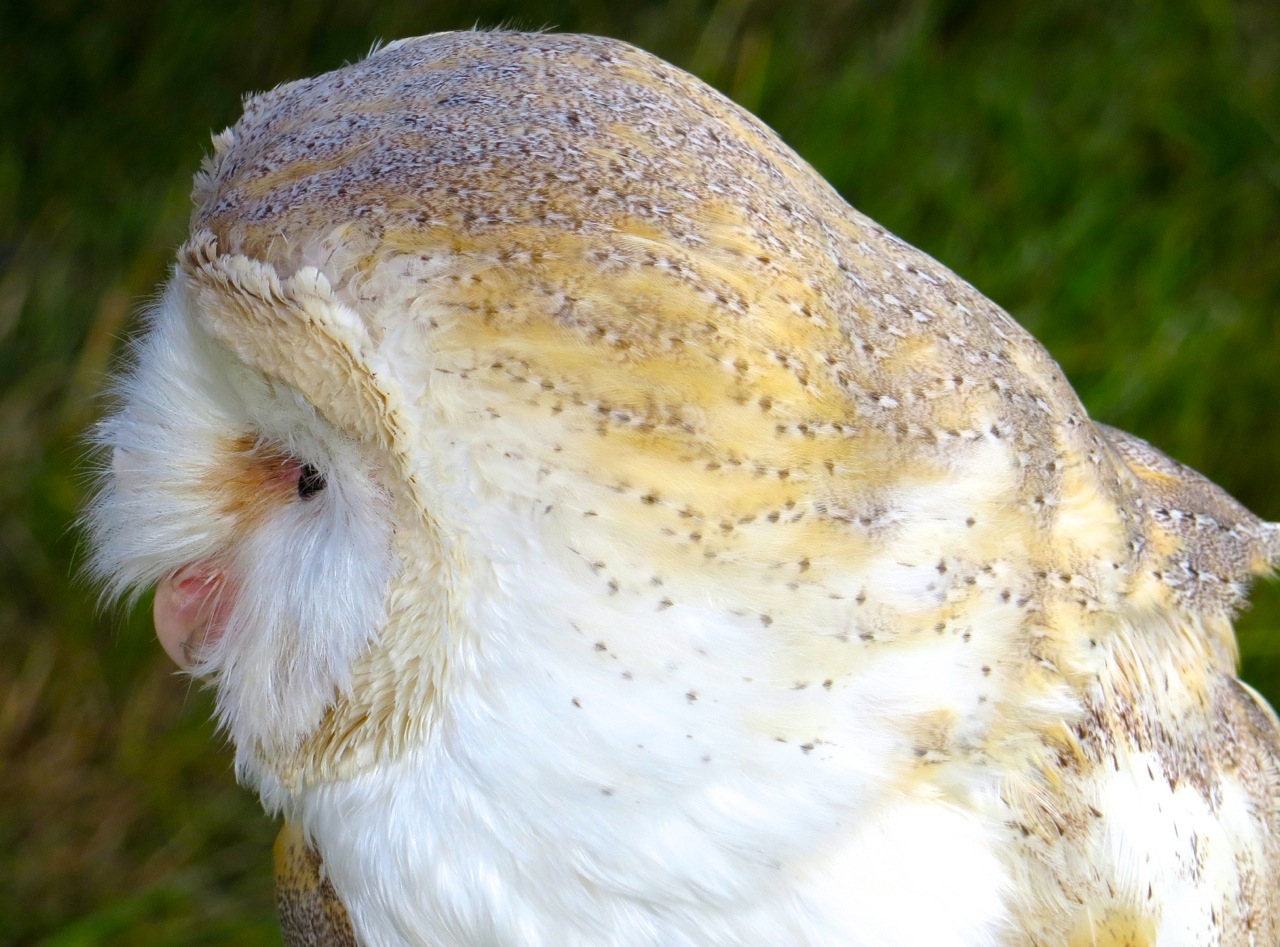
 This close-up of a barn owl shows the typical speckling on its pure white front, and the wing patternsBarn Owl 5 (Keith Salvesen)

This fluffy baby barn owl was recently rescued and is being cared for in a sanctuary before being returned to the wild. Whimsy is rarely permitted  in this blog, but seriously, folks – cute overload!Barn Owl 6 (Keith Salvesen)

Credits: Woody Bracey, Becky Marvil, RH, Xeno-Canto (audio), RSPB (video)