BAHAMAS MARINE MAMMAL RESEARCH ORGANISATION NEWSLETTER OCTOBER 2011
The BMMRO’s fully illustrated Fall Newsletter has just been published. The newletter is as always an eclectic mix of cetacean-centric material, with a headline article about the summer whale poop project. I have lived my life and had a professional career of sorts without once giving the remotest thought to whale poop, yet here I am immersed in the stuff yet again… But there’s plenty more besides that. The newsletter gives you an overview of the current work of the BMMRO and articles including the following:
A stranded Fin whale on the Berry Islands
News of the Irene effect at Whale HQ in Sandy Point
An Orca sighted off Eleuthera
Education program update
A quarterly chart of the summer whale and dolphin sightings – 82 reports for 10 species.
Thanks as ever to Charlotte Dunn for permission to link to BMMRO material. To see the newsletterCLICK LINK===>>>BMMRO newsletter Oct 2011
To visit the informative BMMRO websiteCLICK LOGO===>>>Supplementary info: without going into details of the consistency of the output etc, I’ve just found the suggestion online that whales can excrete 3% of their body weight in a day. And a large whale weighs..? Mind where you swim
It’s 7.15 and breakfast time at Delphi. At 8.00 the trucks, skiffs, guides and fishers will set off to the fishing grounds for the day, leaving you with an empty beach, shells, warm sea, the pool, the hammock and your book. For the moment, the talk is of the excellent ‘Full Abaco’ breakfast, the weather, ‘Delphi daddies’ & ‘crazy charlies’ and someone’s mislaid reel. Sandy enters to announce that there’s a place free on your partner’s skiff… and offers it to you. So what should you, a non-angler, expect of a day out on the flats?
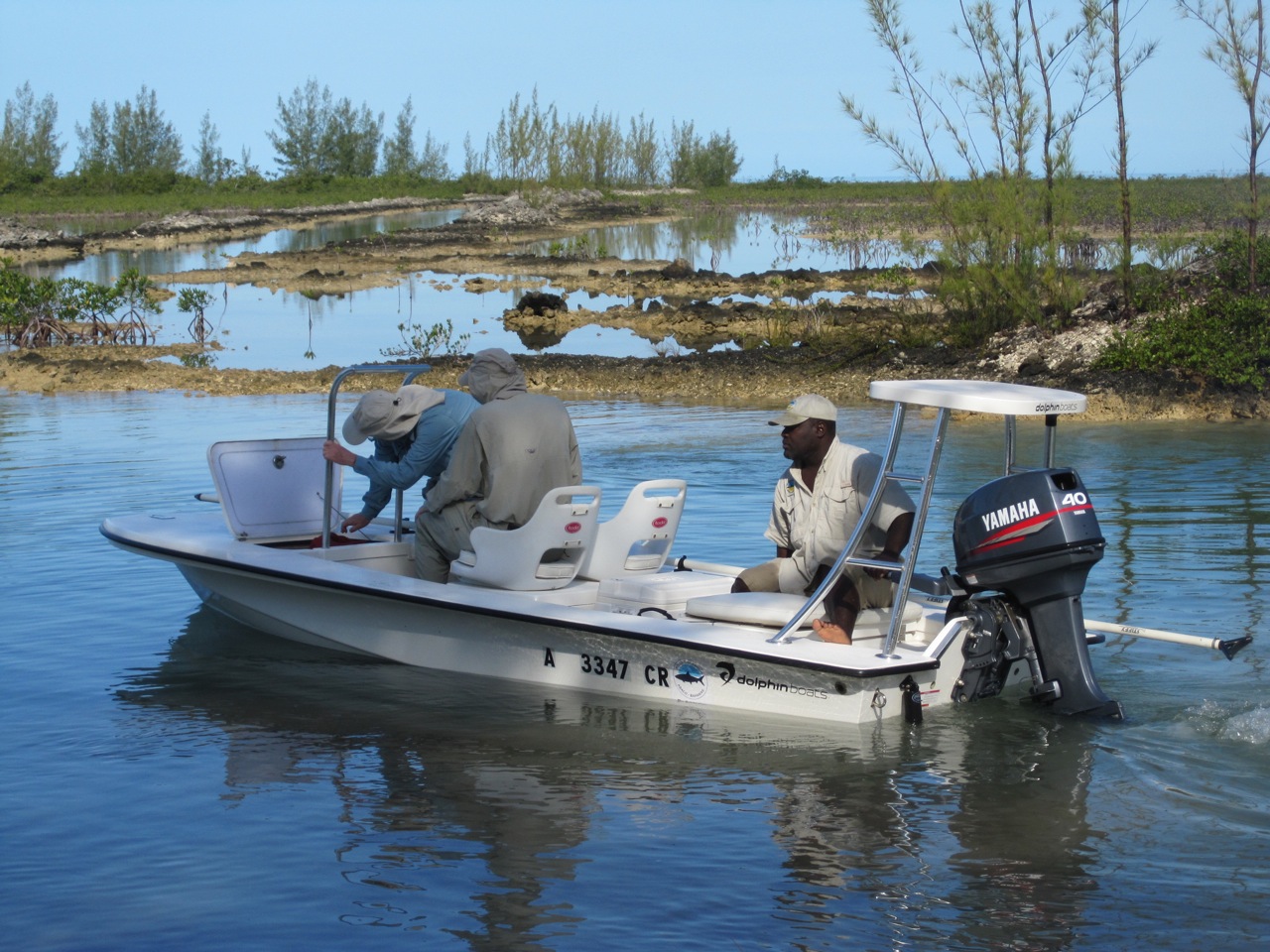
THE SKIFFS These are top-of-the range boats, capable of considerable speed getting out to the fishing grounds. The ride can be bumpy, splashy and even chilly in the early morning, so bring a fleece and a waterproof top. Camera? Essential. Here is a Delphi skiff on a sand bar in Cherokee Sound, parked for lunch and some quality conch and sand-dollar hunting. So for a start, the day isn’t ALL about fishing…
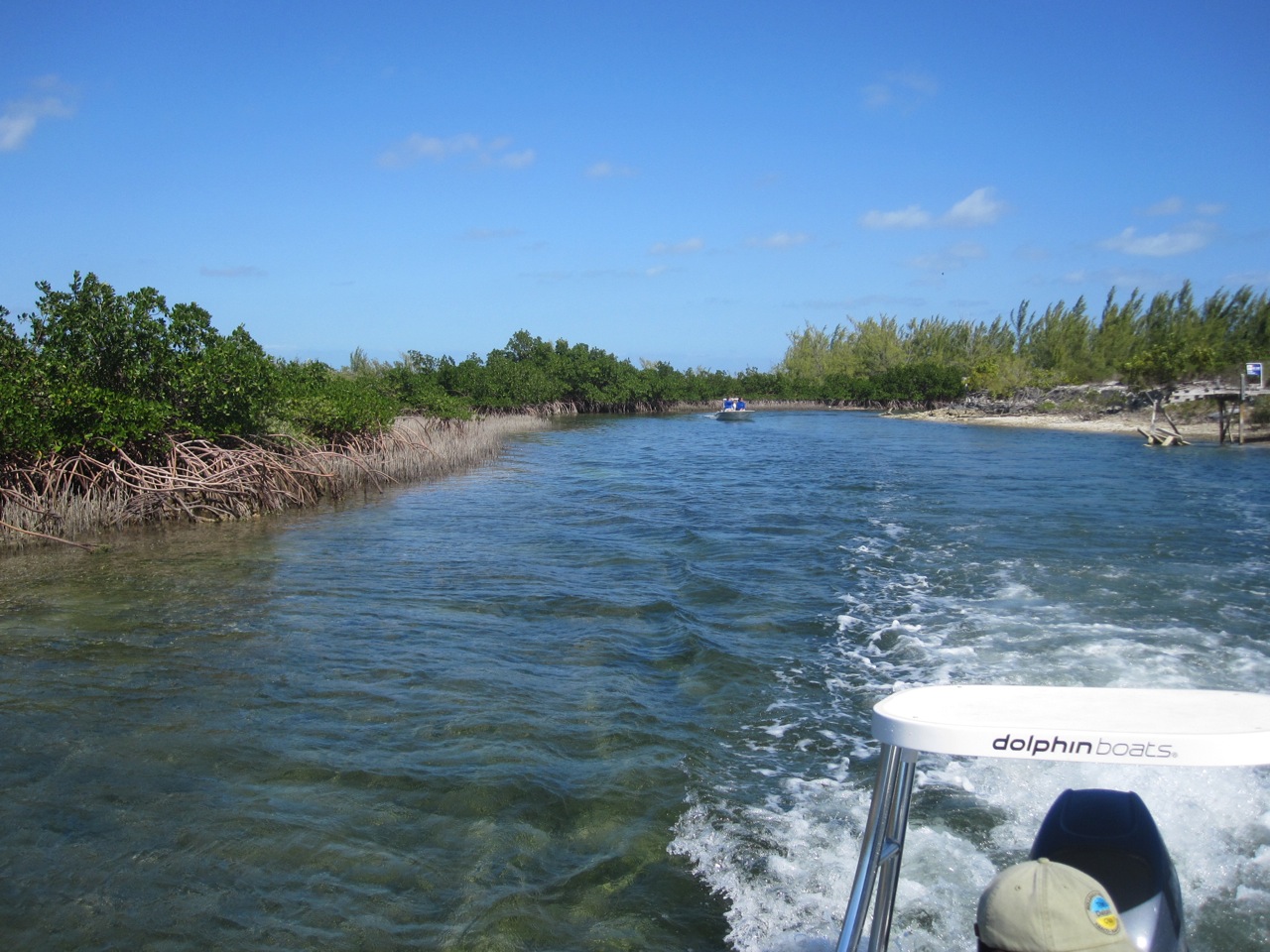
THE FISHING GROUNDS You will leave from one of three launch points and speed across the water to the bonefishing areas. The main one is “Nettie’s”, with access via a narrow man-made channel to the Marls…
… more than two hundred square miles of mangrove swamp, islets, channels and fish. The journey to Nettie’s may seem quite a long way as you bump along through the pine forest on a network of logging tracks. Watch out for small birds flickering all around as you pass.
———————————
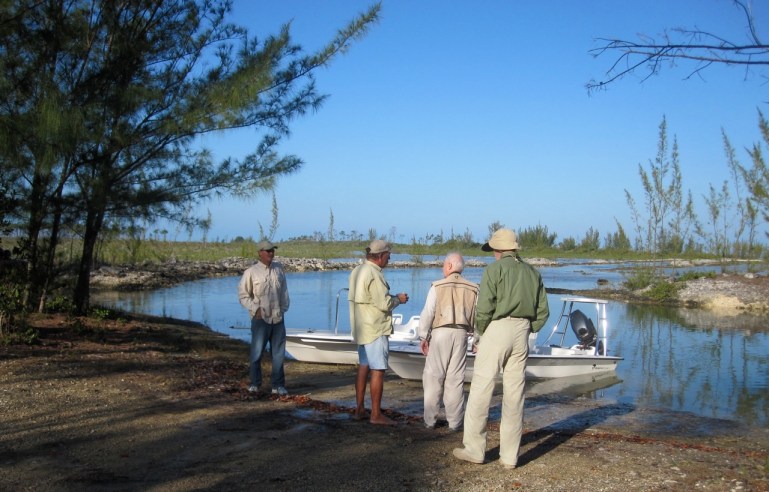
Launching a skiff at Nettie’s
Plans are hatchedGood to go…
Stowing gear in the front (forrard?) locker. There’s also one behind the seats for the lunch cool boxes. And the fuel…
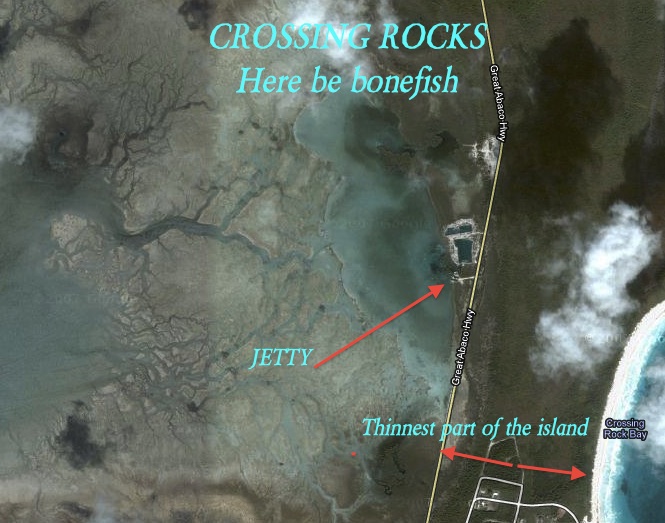
The other two launch areas are Crossing Rocks (a short drive south of DCB) or Casuarina Point for Cherokee Sound (a slightly longer drive north of DCB)
The jetty at Crossing Rocks – skiffs being prepared
The launch point at Casuarina. A channel leads out to Cherokee Sound
Two boats in the channel – the authentic James Bond chase experience
WHAT’S THE POINT? Bonefishing! You’ve heard all the Club talk, you’ve seen your partner fussing over all those bits and pieces in your room: now see it in action. Once you get out to a fishing area, the guide cuts the engine… and suddenly you are being poled very slowly and almost noiselessly across the shallow flats
The guide stands on the platform at the back of the skiff, using the advantage of height to scan the shallow water; the fisher stands at the front looking tensely for grey shadows underwater, waiting for the magic words…
“…hey, bonefish, 10 o’clock, 4 of them moving right, 30 feet… see them?”
And it’s ‘game on’. This isn’t the place for a discourse about casting technique and style – I have neither (Sandy, of me: “Muppet”) – but I promise that you will get completely caught up in the excitement when a fish takes the fly and takes off towards the horizon, stripping the line and backing from the reel… (I realise the image above may suggest… well he’s just fishing, OK?)
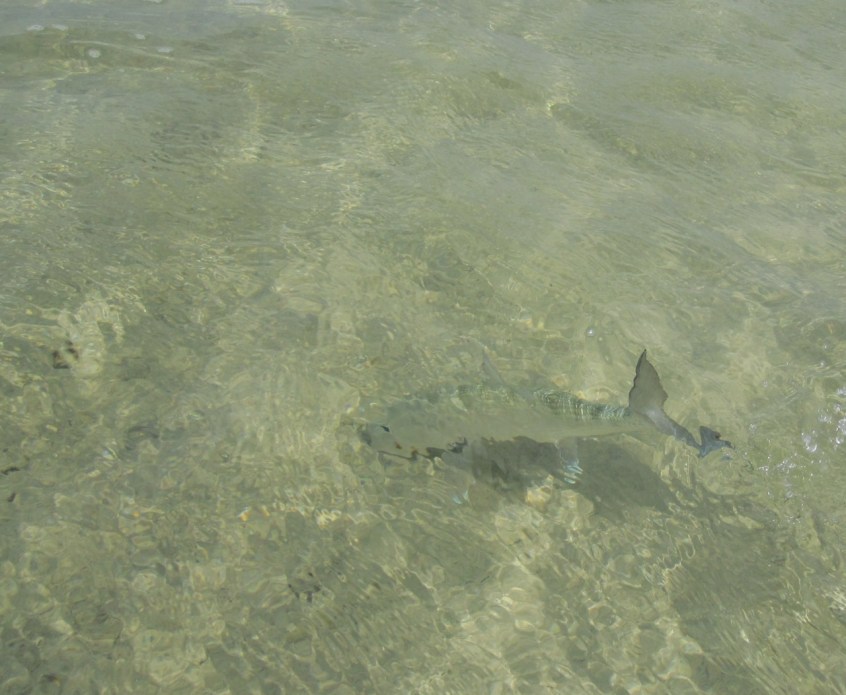
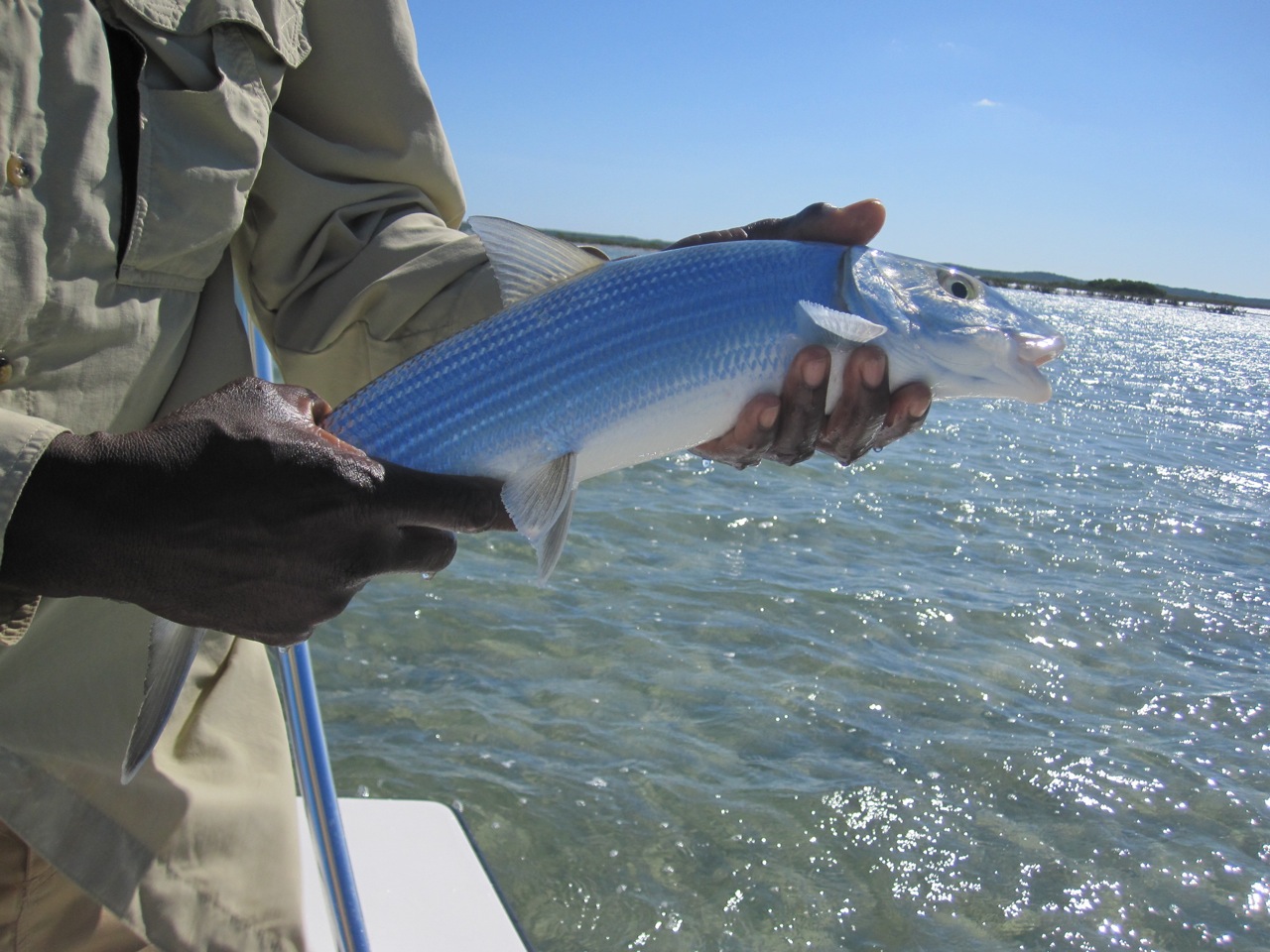
THE QUARRY – grey ghosts below water, bars of silver above. Caught on the ‘fly’ which are in fact shrimp or crab imitations, with barbless hooks to make the chance of losing a fish that much greater… This ensures that a boated fish can be returned to the water as easily and quickly as possible. It’s all ‘catch and release’, though some (me) find that mostly the fish very sensibly self-release long before they ever reach the boat…
Abaco bonefish off Crossing Rocks (just caught and released)Guide Ishi with Abaco bonefish caught on the MarlsGuide Robin Albury removes the barbless hook before returning the fishA good specimen‘Ishi’s Fishy’, as he would say
There is even the possibility that at some stage you may unexpectedly be handed a rod (even if you have never held one before, or wanted to) with ‘fish on’… Here, Robin has hooked a 2.5 lb fish and handed the rod to Mrs RH (then engrossed in eating a cheese roll) who successfully played and brought in her first ever fish…
PART 2 will deal with what else goes on during the day: the scenery, birdlife, sharks, turtles, blue holes and so forth. For now, here is a short clip of the skiff ride out to the Marls, to give you an idea. NB this was a very calm day – things can get a little bumpier and wetter at times. The seats are padded, but not very…
[Ultra-cautious music credit to Joe Satriani who sued Coldplay for alleged tune ‘borrowing’ saying “I felt like a dagger went right through my heart. It hurt so much”. Case dismissed + unspecified settlement… Way to go, Joe! Want to check? Cut ‘n’ paste this: http://www.youtube.com/watch?v=zjB024bZoB4&feature=fvwrel Then by way of counterbalance try John Lennon’s Imagine vs Coldplay’s ‘Fix you’ at (cut ‘n’ paste) http://www.youtube.com/watch?v=DksjpsAe3vk&feature=endscreen&NR=1]
A while ago, I posted stills from a reef-snorkelling video – my first ever underwater video attempt, and indeed my first snorkel for about 40 yearsCLICK===>>>REEF FISH I started with a stingray, producing some rather… ok, very… modest results, but it was at least identifiable if you looked carefully and felt benign.
I’ve learned a few tricks since then. Here is the whole clip, still hopeless in most respects but there’s something quite cute about the creature. Mercifully it is only 37 seconds long. I reserve the right to delete this post when I realise no one has actually watched it! [LATER: Oh! I find a few hardy souls have done so. It’s a democratic vote for the ray to stay, as I see it]
[Belated credit to the fairly litigious Joe Satriani (see JS v Coldplay 2009) for borrowing the intro to one of his songs. It’s a non-commercial tribute, Joe]
These two different types of coral skeleton are from the northern end (and just beyond) of the Delphi beach. The red marking on the second coral is some kind of natural accretion, I think – I have temporarily lost the exact details somewhere on my hard drive, but doubtless they will turn up sooner or later… You will find these red patches on shells as well as coral
COMMON ROSE CORAL
ANY IDEAS – OR IS THIS WORM-RELATED?
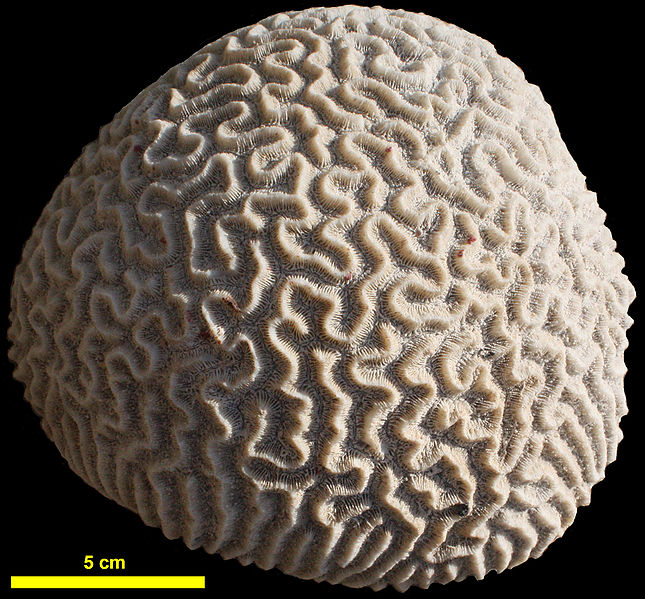
Another dramatic coral you may come across – not least because there are usually one or two in the beach-harvested collection on the steps down to the beach – is Brain Coral (Diploria). Here is an example (Photo credit J. Stuby)
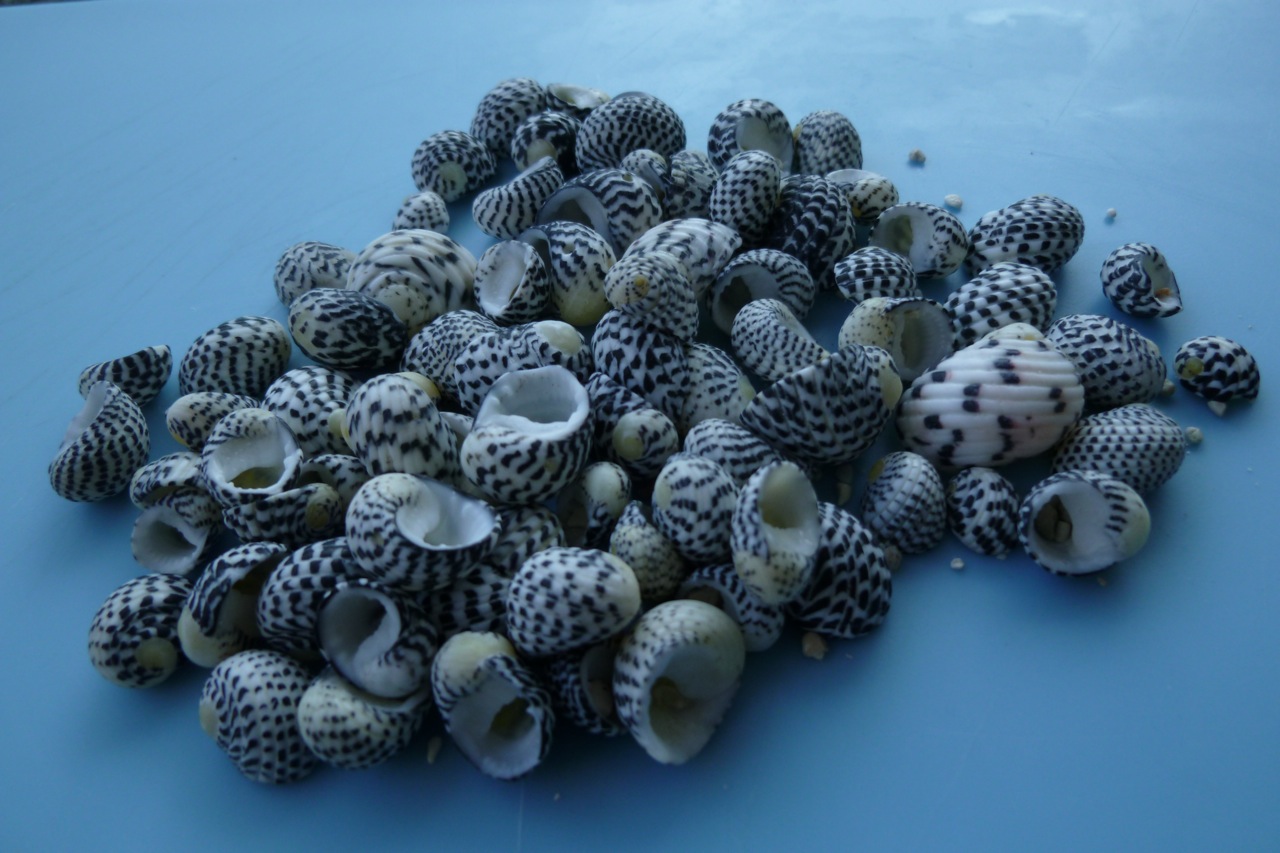
NERITES (Nerita)
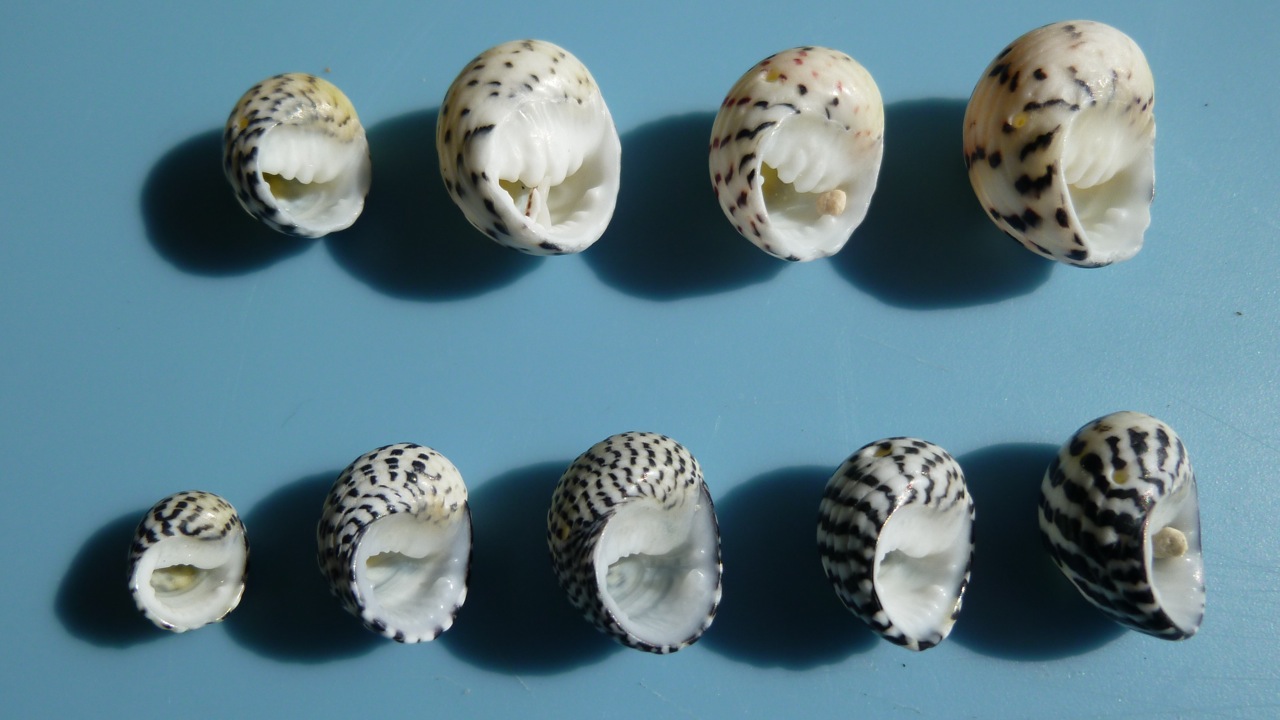
Nerites are small sea-snails (gastropod molluscs) found in tropical waters around the world. Precise ID of the many types is confused by the different names used for many of them, both taxonomic and local. The majority of the black and white nerites in the pile below, all collected from the Delphi beach, are Checkered Nerites (Nerita Tessellata). In the heap there are a few larger whiter shells with red markings, which are the Four-Toothed Nerite (Nerita Versicolor).
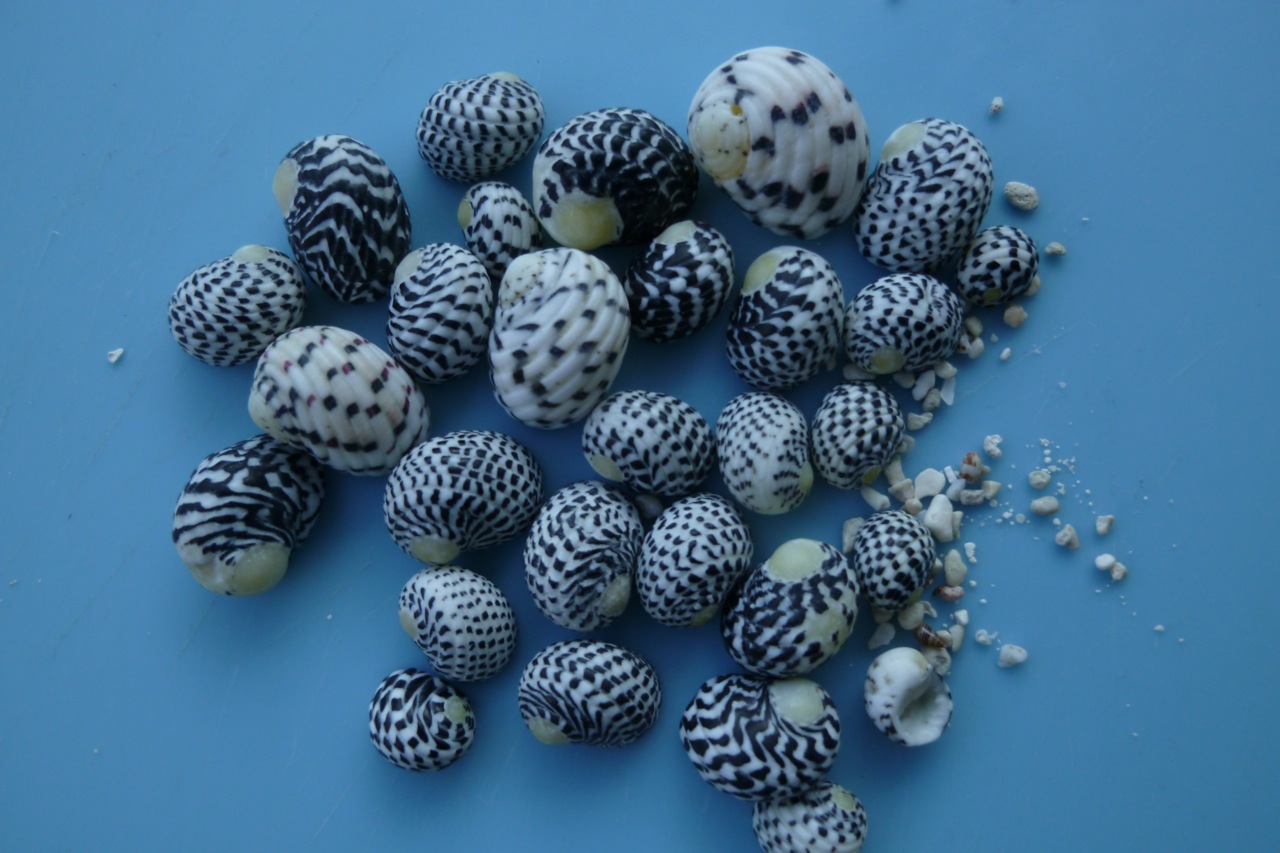
Here are some of the above shells showing their varying patterns and sizes, seen with a few grains of sand for comparison. The 3 larger whiter ones with the flecks of red on them are the Four-Toothed Nerites.
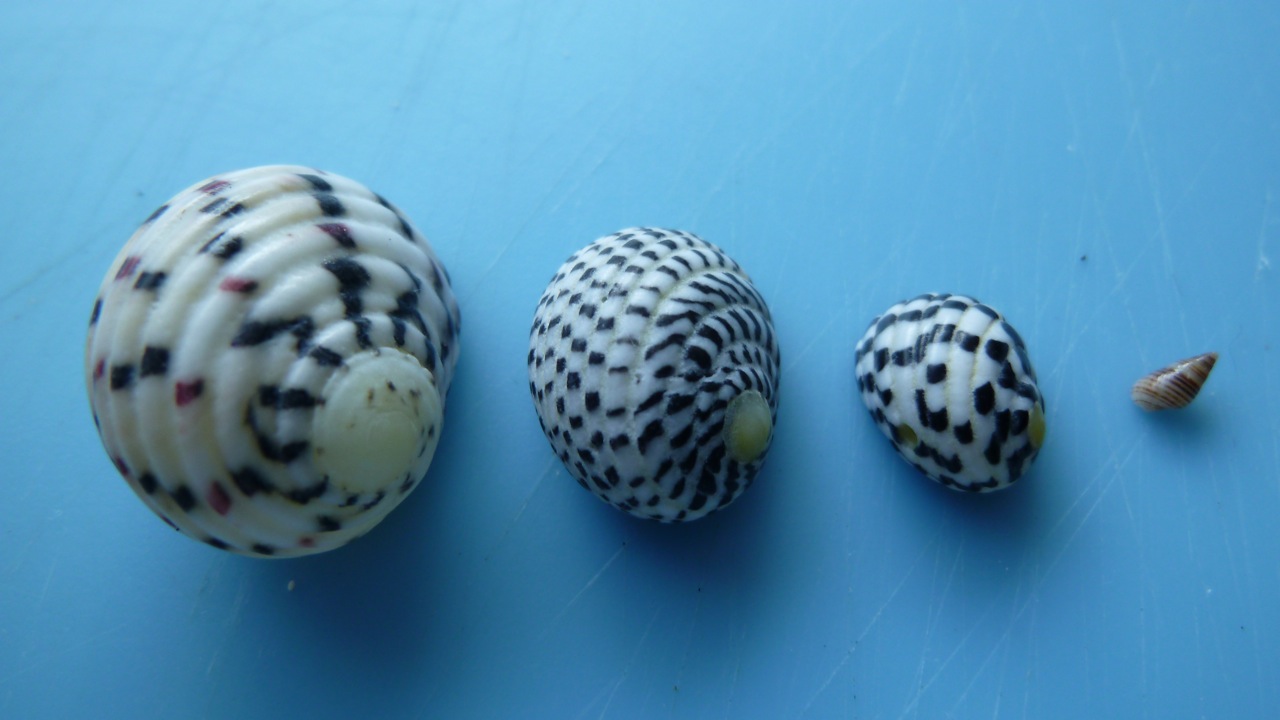
Here are 3 example shells in close-up, together with a tiny, perfect Dwarf Atlantic Planaxis (Hinea lineata) at the end (previously misidentified as a Littorine). I didn’t notice it until I was sorting through the shells – in fact you can just see it towards the bottom right of the previous photo, above the small nerite that’s on its back. It may even have fallen out of a nerite, as did many of the sand grains.
These four upturned nerites show the dentate entrance, common (to a greater or lesser extent) to most nerites – maybe all. The top row are Four-toothed Nerites; the bottom row are Checkered Nerites. Another Nerite type found in the Bahamas is the Bleeding-tooth nerite (Nerita Peloronta). These are similar to the top ones, but have vivid orangey-red markings on the ‘teeth’ – hence their name.
Nerites, sand grains and the Planaxis: size comparison
A close up of the Planaxis, showing how amazingly detailed the pattern of such a tiny shell can be
All this may sound a bit learned and somewhat solemn. Dull even. In fact I had absolutely no idea about any of the above details until I got these shells out of their glass jar last week to photograph (apologies for using a chopping board) and did some digging… So if any shellologists or neritophiles read this and have corrections to suggest, be my guest… Use the comment box or the email address on theCONTACTpage. ADDENDUM: many thanks to Colin Redfern for confirming the small nerites as Checkered, as opposed to Zebra; and the ‘littorine’ as a Dwarf Atlantic Planaxis Hinea lineata
You will need: swimming kit; sweatshirt (it can be cold on the boat after snorkelling); stuff for Island Hopping later on, inc. camera, money etc; snorkel practice in the pool if you haven’t used one for (say) 20+ years – use the Club gear; Ian Took’s slim ‘Fishes of the Caribbean Reefs’. NB there is limited room on the boat, so you’ll need a bit of a nifty towel work to preserve modesty when changing…
Kay Politano of Abaco Above and Below in Marsh Harbour pencils in an unspecified number of places for a day’s island-hopping and reef-snorkelling while I find out how many non-fishing-that-day Delphi guests might be interested. Seven sign up, and one morning we all set off to Marsh Harbour. In Kay’s shop we try on our flippers, marvel at the scuba possibilities (a completely implausible proposition for most of us…), then we troop off to the marina and Kay’s reassuringly powerful and safe-looking catamaran. It takes 12 passengers; the other 5 are already aboard. We set off towards a threatening-looking weather front; rain later is a certainty…
Kay and rh at the controls
Passing by several Cays, we arrive at Fowl Cay Marine Preserve and drop anchor. We don our flippers, wrestle with our masks and snorkels, and in turn drop off the back of the boat (ok, stern, is it?) into warmish water, under thick grey cloud. My practice in the Delphi pool has paid off, and soon I am wheezing and gurgling my way towards the reef with my head (mostly) under water, a situation I generally avoid.
I am completely unprepared for what I find when I get to the reef. David Attenborough’s favourite production team has kindly arranged for a wide variety of bright fish, some electrically charged, to come up close and inspect me, an intruder in their world. I’ll spare you the colour-supp superlatives and graphic intensifiers – you’re probably blasé and have seen it all before – but I am totally gobsmacked, even with my mouthpiece in place. It’s all real! It’s even better than TV! And don’t get me started on the coral…
Sergeant Major
Parrot Fish
Blue Tang / Ocean Surgeonfish
Blue Chromis
Sting Ray
While I gasp and bubble my way around, I keep a small waterproof video camera running (see GADGETS review). My swimming is feeble at the best of times, but somehow it all seems to be coming together – my flailing limbs, the laboured breathing, the reef, the fish and the footage. We circle round the reef – occasional pale figures appear in my lateral vision – for about 25 minutes, then return to the boat and the struggle to remove our flippers… Everyone is excited about what they have seen (some saw barracudas).Who cares that it’s started drizzling… we are wet already and it’s off to Lubbers Cay for lunch; see forthcoming Island-Hopping Post. And see MARINE LIFEpage for more reef fish photos taken on this expedition.
ADDITION April 2012 I notice there have been a few specific searches ‘what is the plural of Sergeant Major?’ Good question. The strict grammatically correct answer is, I suspect (as with the military rank), ‘sergeants major’ because it’s the sergeants who are plural and the ‘major’ is a qualifier to distinguish from other degrees of sergeant (were there sergeants minor, for example). It’s the same with courts martial – not ‘court martials’. BUT it sounds all wrong and pernickety. I reckon the whole fish is a sergeant major. If there are 2 or more, you’ve got some sergeant majors to play with.
A TRIP TO HOLE-IN-THE-WALL THROUGH THE NATIONAL PARK
You will need: One truck with plenty of fuel (for the return journey); courage, patience and determination; picnic; bird book – borrow the HALLETT (KS copy) from Club library; camera / binoculars; willingness to cope with and explore derelict buildings; good shoes if you want to walk from the lighthouse; life insurance if you want to climb the uninvitingly hazardous lighthouse stairs
Map credit as elsewhere
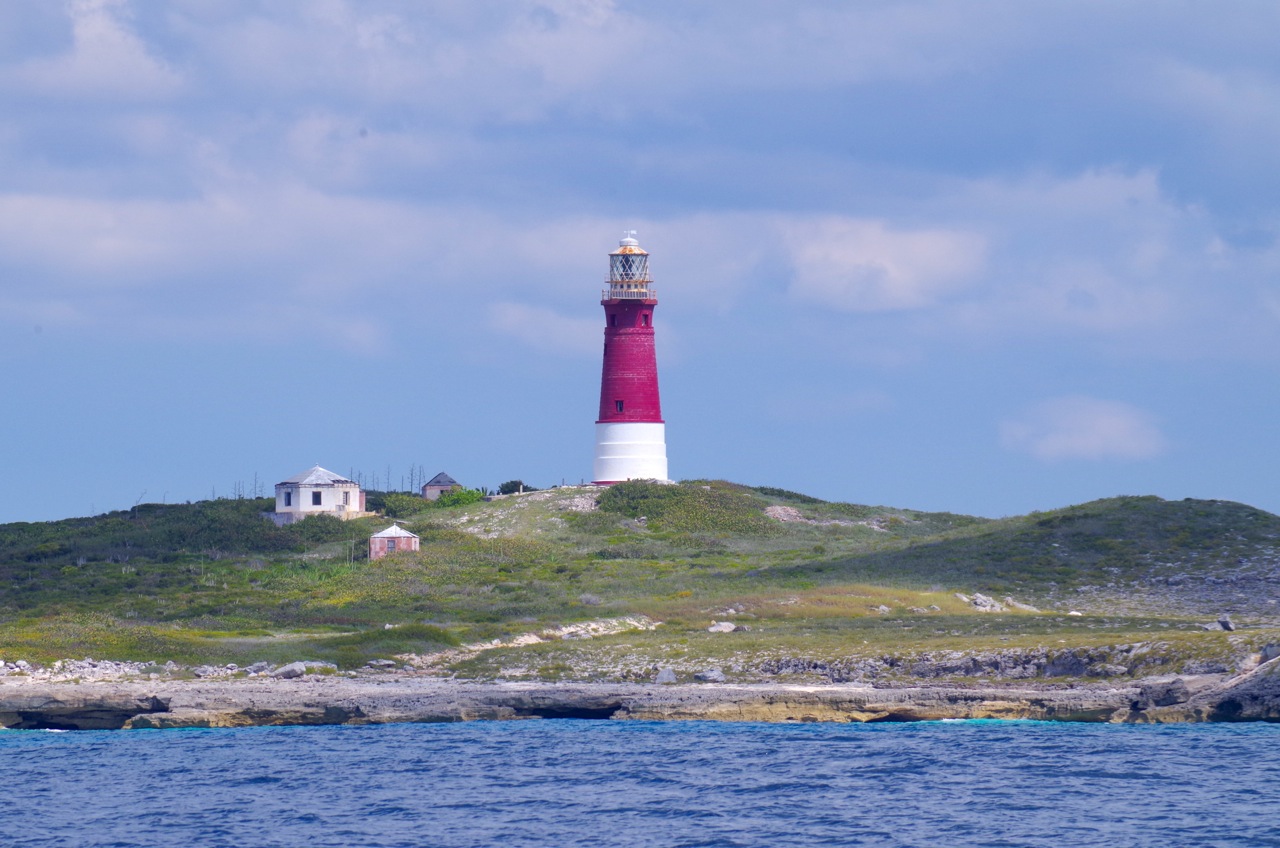
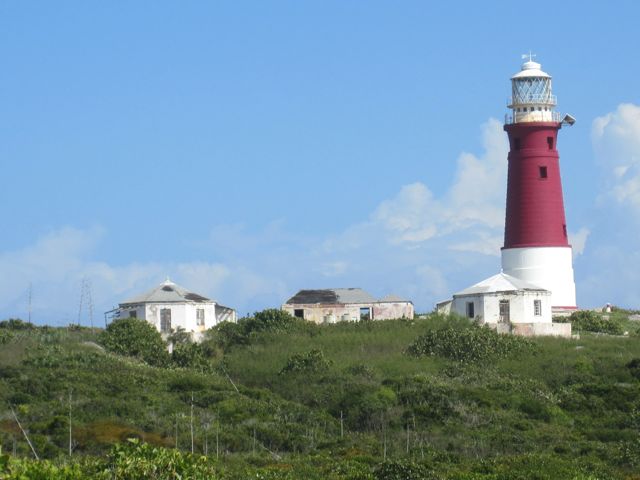
Like marriage, this expedition is not by any to be undertaken lightly or ill- advisedly… Driving to the lighthouse at Hole-in-the-Wall involves a 15-mile (each way) return journey on a track south from the Highway. It starts promisingly but gradually turns nasty as the track degenerates. Rental cars are banned; Sandy will have strong views about using the Club car… Realistically, it can only be done in a truck. We took a truck… I don’t want to be unduly off-putting but we were still considering turning back at mile 14. Especially at mile 14. The view is as shown below for most of the way, the trees thinning out as one nears the coast.An optimistically good stretch of track
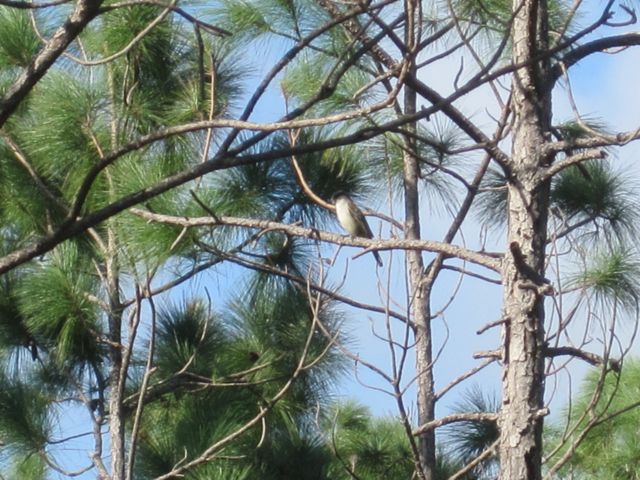
During the journey, you pass through the heart of the National Park, breeding ground for the Abaco Parrots. Uniquely for this species, they nest on the ground in limestone holes, making them vulnerable to predators. Logging roads cross the track at regular intervals, and are a good place to pull in and look for the birds of the pine forest –from large red-tailed hawks through gray catbirds, loggerhead kingbirds and hairy woodpeckers down to small warblers. If you take a picnic with you, you’ll have an excellent opportunity to bird watch.Loggerhead Kingbird in the National Park
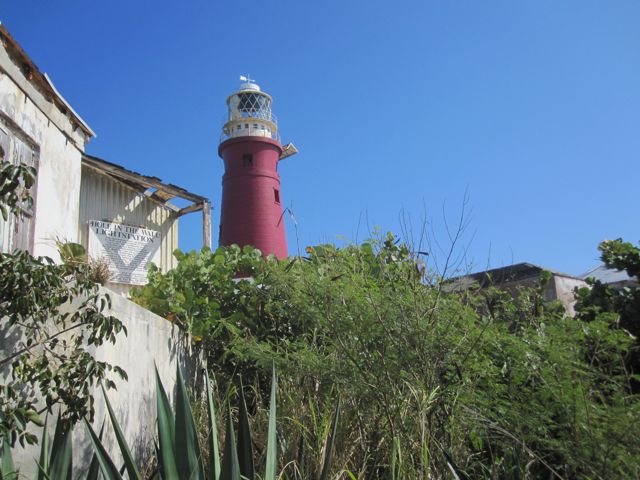
This is what you will find when (if?) you reach the end of the road…
Park here. Mind the rocks. Far from advisable to continue further…
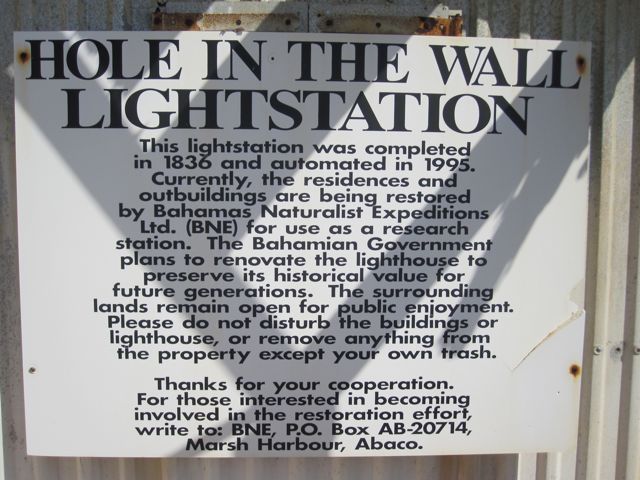
Hole-in-the-wall Lighthouse and outbuildings
The Entrance
No sign of renovation in Spring 2010
Land’s End – the southern tip of Great Abaco, and a good place for whale-watching
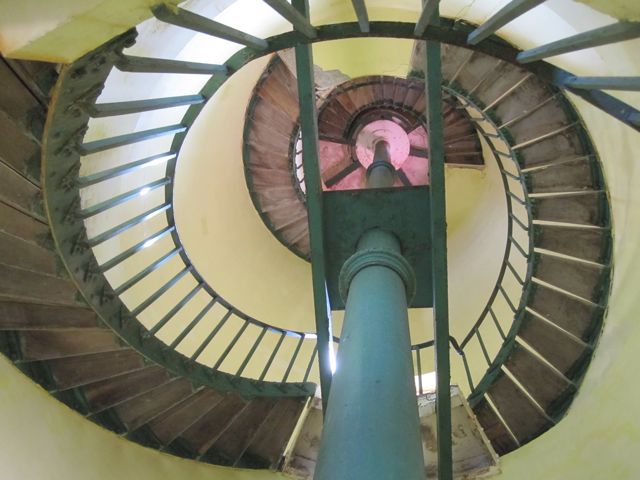
The internal staircase – access is easy, the door isn’t even kept shut let alone locked
THE UNEXPECTED REWARD for our endurance was to find, beside the path back to the car, a small group of Bahama Woodstars. This is the endemic species of hummingbird, and they are rare where there are the Cuban Emerald imports (at Delphi, for example). The ones we saw were all female – the males are iridescent green with a purple front. They were amazingly unafraid of us, flying back and forth around us, and quite happy to perch almost within arms’ reach and watch us watching them. They were completely enchanting, and cheered us up for the forthcoming journey back – fortunately it gets easier – and a picnic by a logging road once the track-terror had subsided.
STOP PRESS: Courtesy of batfa242 / Panoramio who braved the dodgy-looking spiral staircase in the lighthouse, here is a fantastic shot of ‘Land’s End’ taken across the lamp and through the glass. Many thanks for permission to use this – it makes me regret not having had the spirit of adventure to make the climb… Double-click for a very detailed view, including the in-built fresnel lens… (and see HOPE TOWN LIGHTHOUSE post)


 Supplementary info: without going into details of the consistency of the output etc, I’ve just found the suggestion online that whales can excrete 3% of their body weight in a day. And a large whale weighs..? Mind where you swim


 Good to go…



















 ROLLING HARBOUR ABACO
You must be logged in to post a comment.