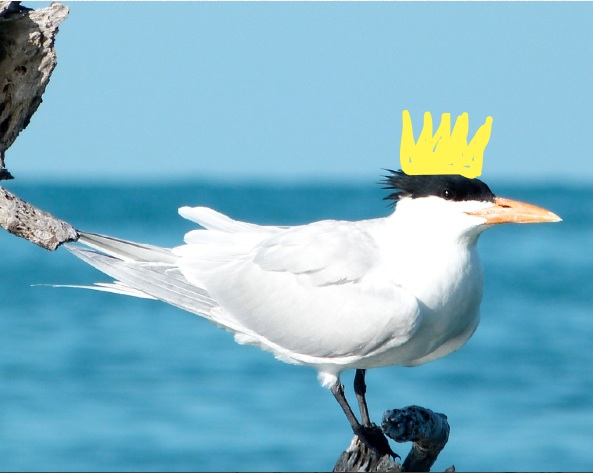
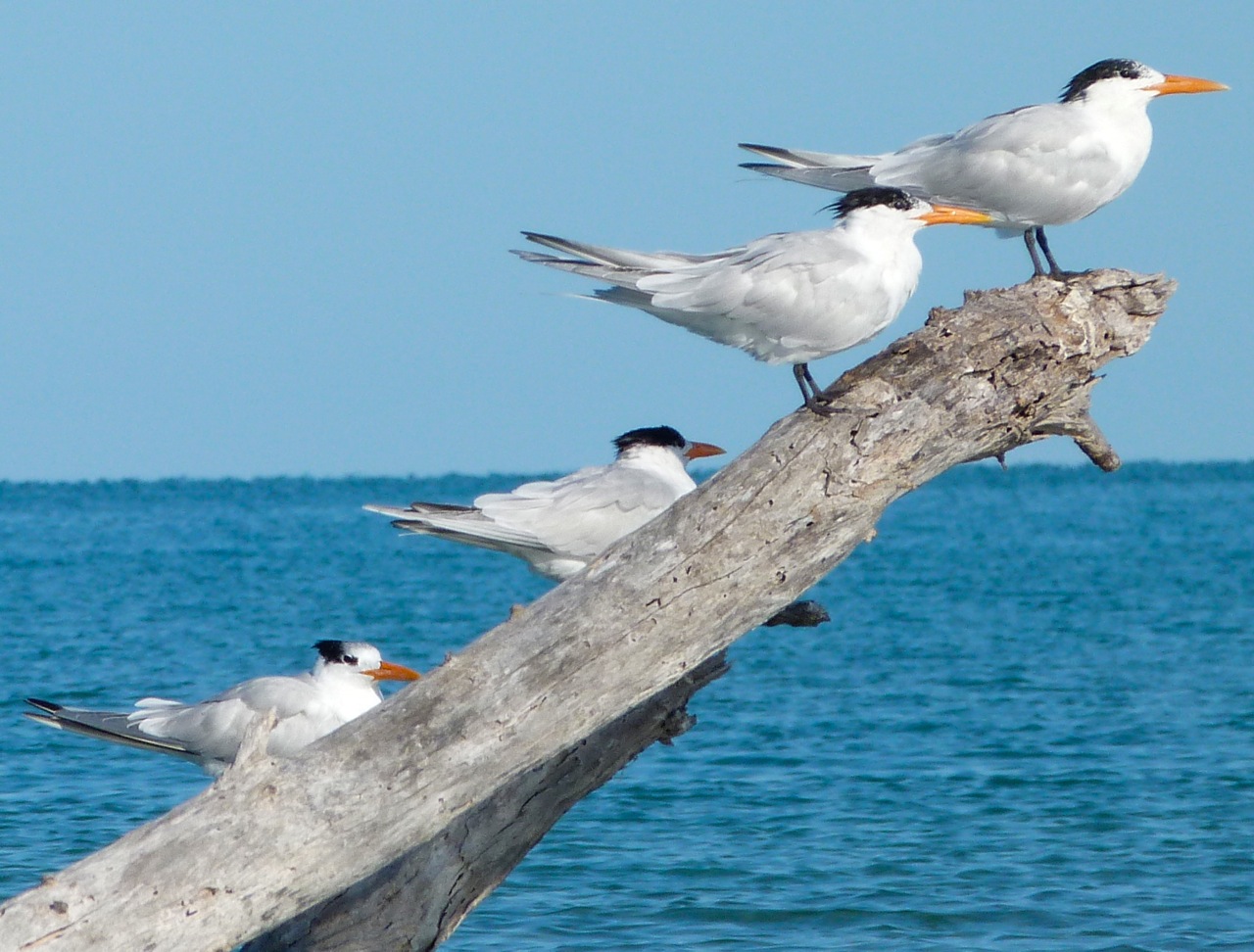
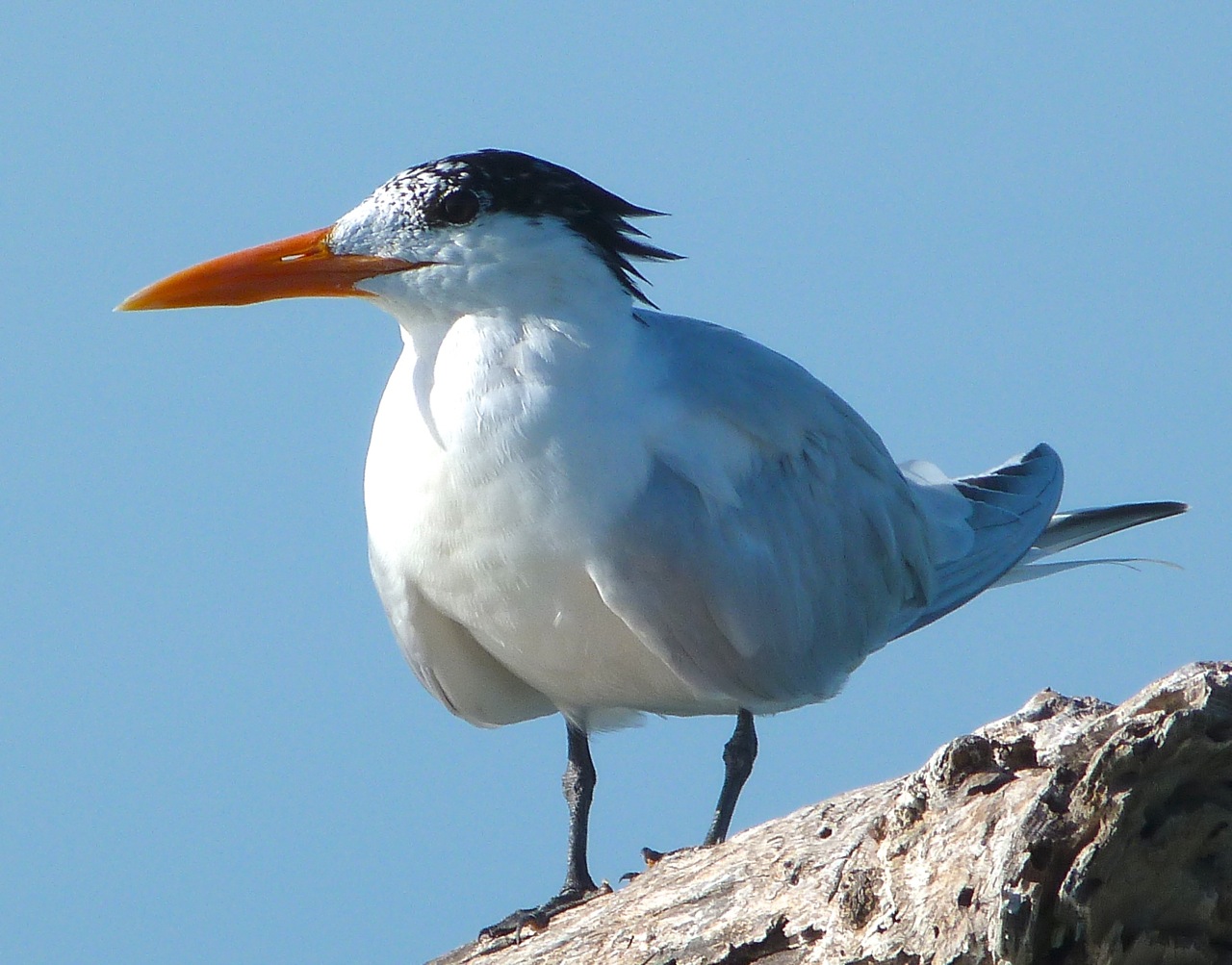
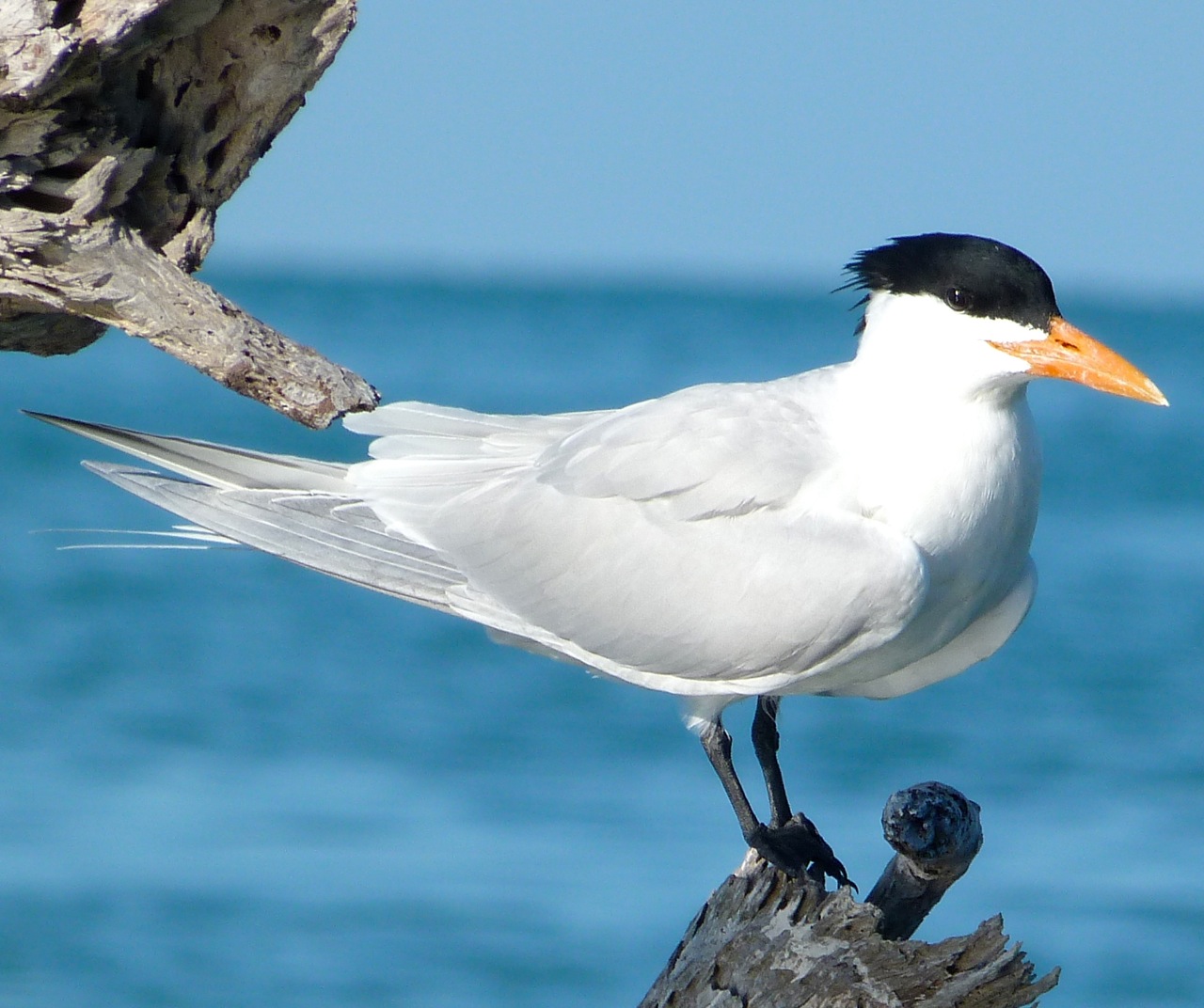
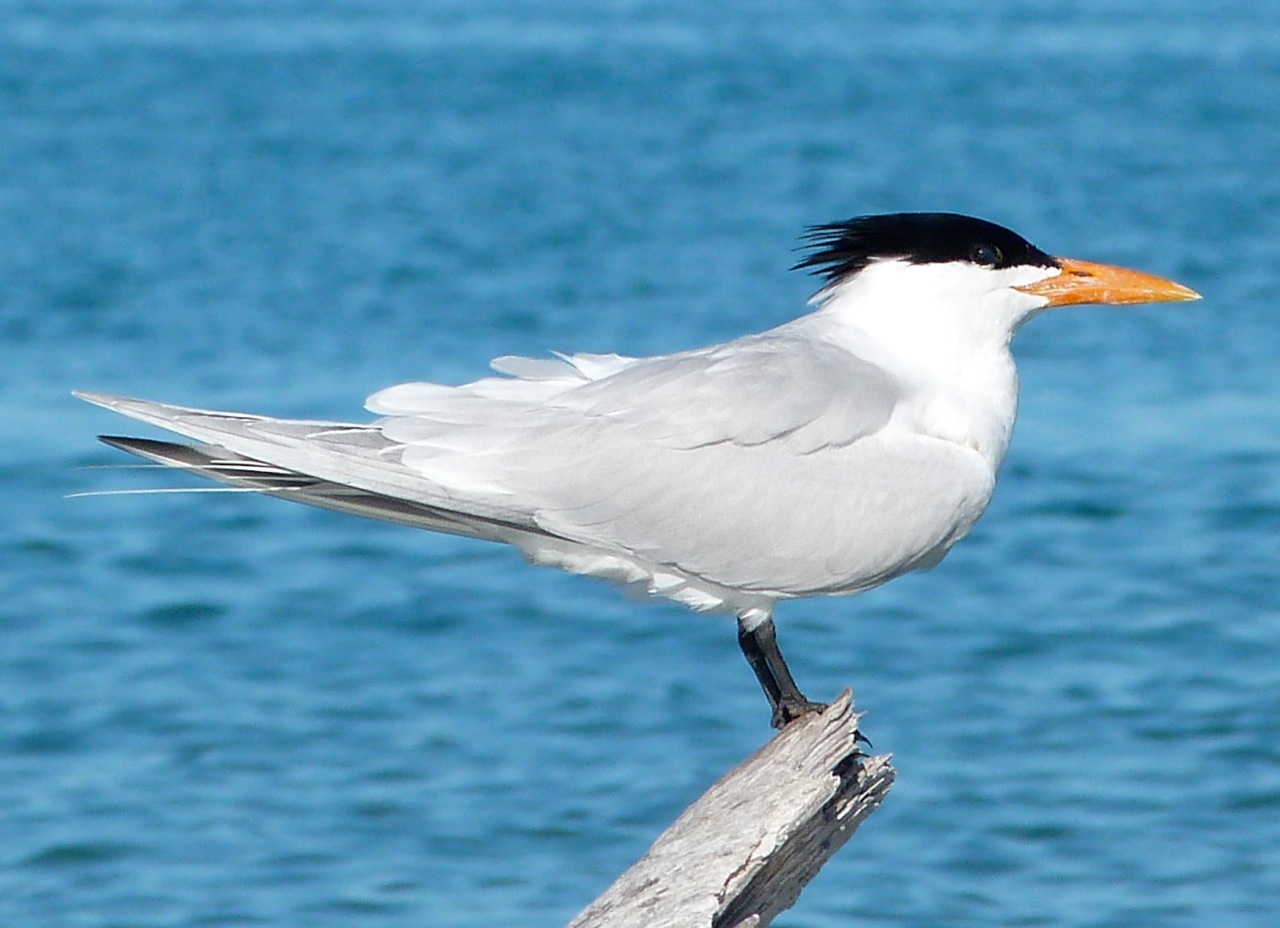
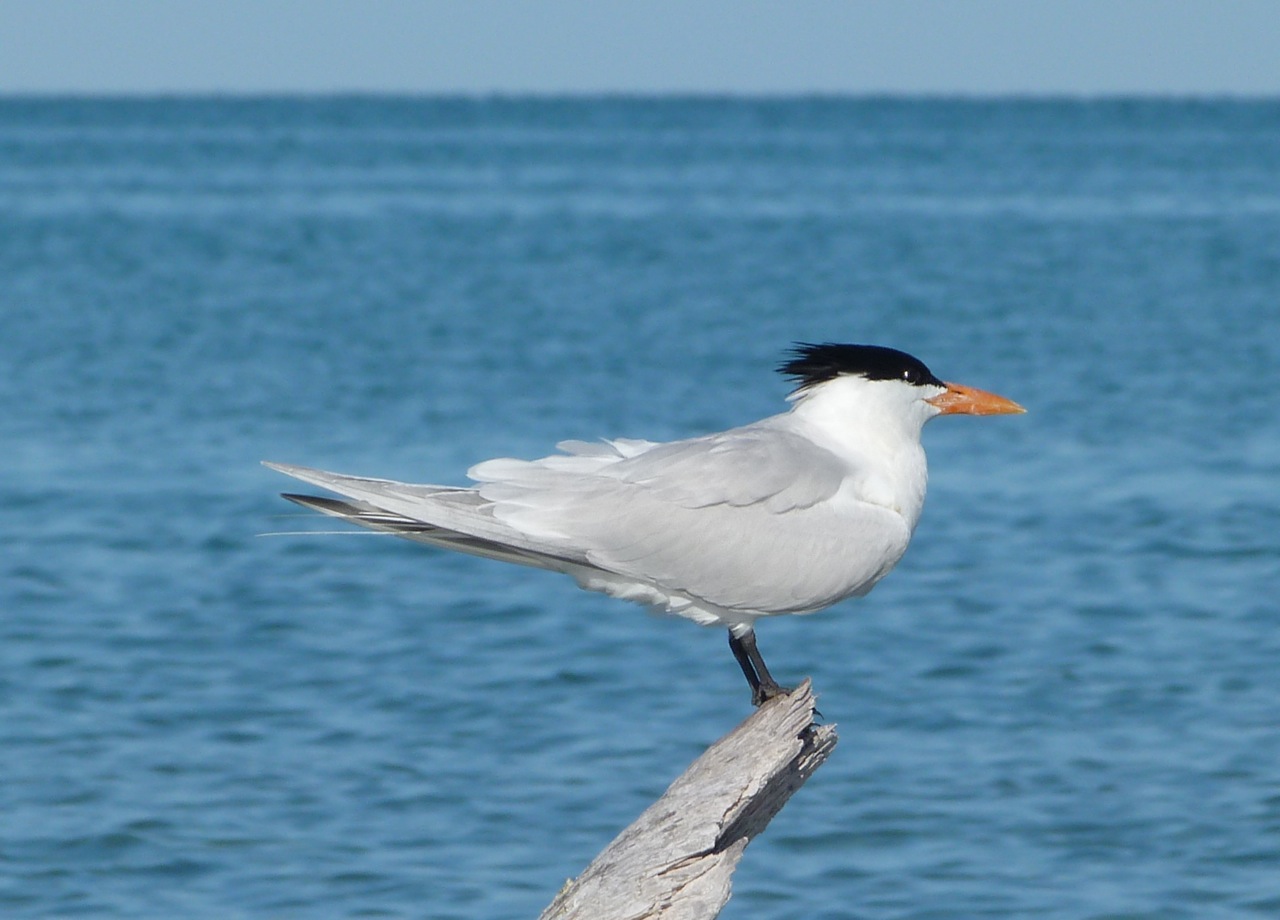
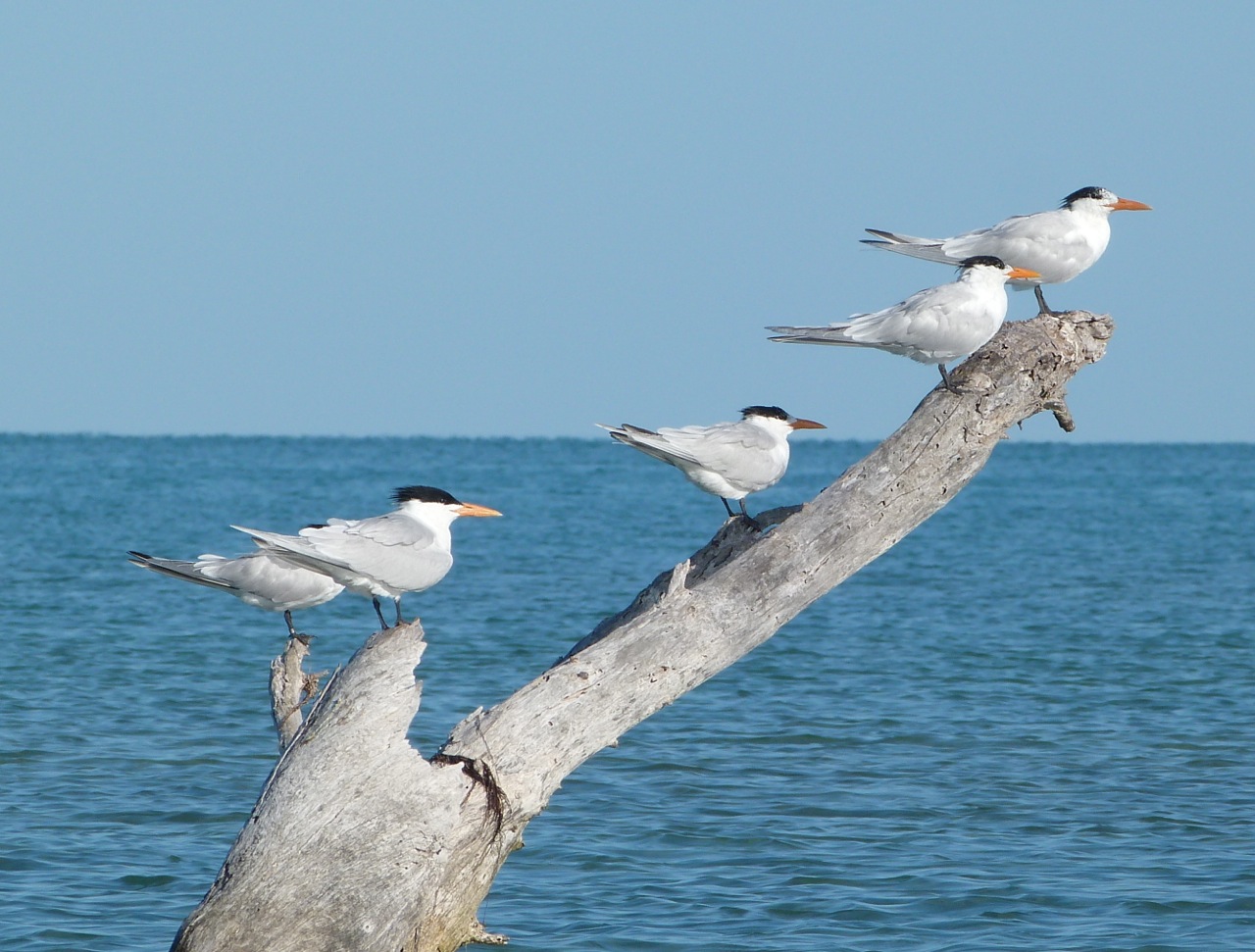
I posted briefly about ROYAL TERNS (Thalasseus maximus) on the Abaco Marls earlier this year HERE. Yesterday’s news from the Lindo Wing (anti-Monarchists look away now) surely justifies a few more photos of these fine and noble seabirds. Everyone else is using the event to sell newspapers / magazines / products (‘Royal’ Baby Lotion – so gentle, so soft – fit for a future King’s delicate…’ etc etc). If there’s a cheerful bandwagon passing, why not just hop on? I’ll skip the info about the range and nesting arrangements of these birds and show some them in all their glory, posing in the sunshine on a dead tree way out in the Abaco Marls.
PS No terns were hurt trying to get the yellow crown to fit one of them. In fact, they rather enjoyed it…
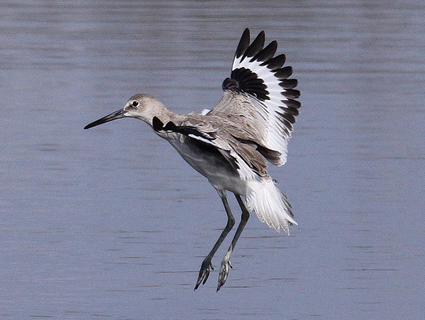
Willets (Tringa semipalmata) are large sandpipers, familiar as shore birds, foragers on sand bars and mudflats, or out in the mangrove swamps. Some might describe them as quite solid and plain to look at. Until they take flight, when their gorgeous wing patterns are revealed.
Willets are ground-nesting birds, often breeding in colonies. They use their stout bills to forage on mudflats or in shallow water for insects, crustaceans, marine worms and occasionally plant-life. They tend to keep their distance, and in the past I have only managed this sort of unimpressive snapshot, not least because I normally only take a small basic camera out on the water in case it – or I – should fall in.
However, we recently fished from the prow of a skiff parked on a sandy spit on the Abaco Marls, as bonefish came past on the tide. It was a productive hour for my boat-partner, though frankly less so for his boat-partner… As we fished, and to our surprise, a willet landed of the point of the spit to feed, and gradually worked its way towards us seemingly unconcerned by the skiff, by us or by the fish action. It started off about 30 feet away, and at close quarters it was far less drab and notably more elegant than expected.
It foraged slowly towards us, keeping a beady inky-black eye on us
At one time it came within a very few feet of us, then decided it had come close enough. We watched it stepping delicately away on its semi-palmated feet. The shot isn’t clear enough to show the slight webbing between the toes. However, you can clearly see the barred tail.
In the c19 and early c20 there was a sharp population decline of these fine birds due to hunting. I’m not sure if it was for feathers, food or fun. All three, probably. Their population has recovered and their IUCN status is currently ‘Least Concern’, but like so many similar species they remain at risk, especially through continued habitat loss.
The Willet call and song are very distinctive, and are reproduced here via the great bird-noise resource Xeno-Canto
CALL
SONG
All images RH except header (Wikimedia) & in-flight image (Greg Page @ Cornell Lab for Ornithology)
(PS if you think the traditional RH puntastic title is laboured, be grateful I didn’t proceed with the initial idea of working ‘Bruce Willets’ into this post. It didn’t work, on any level…)
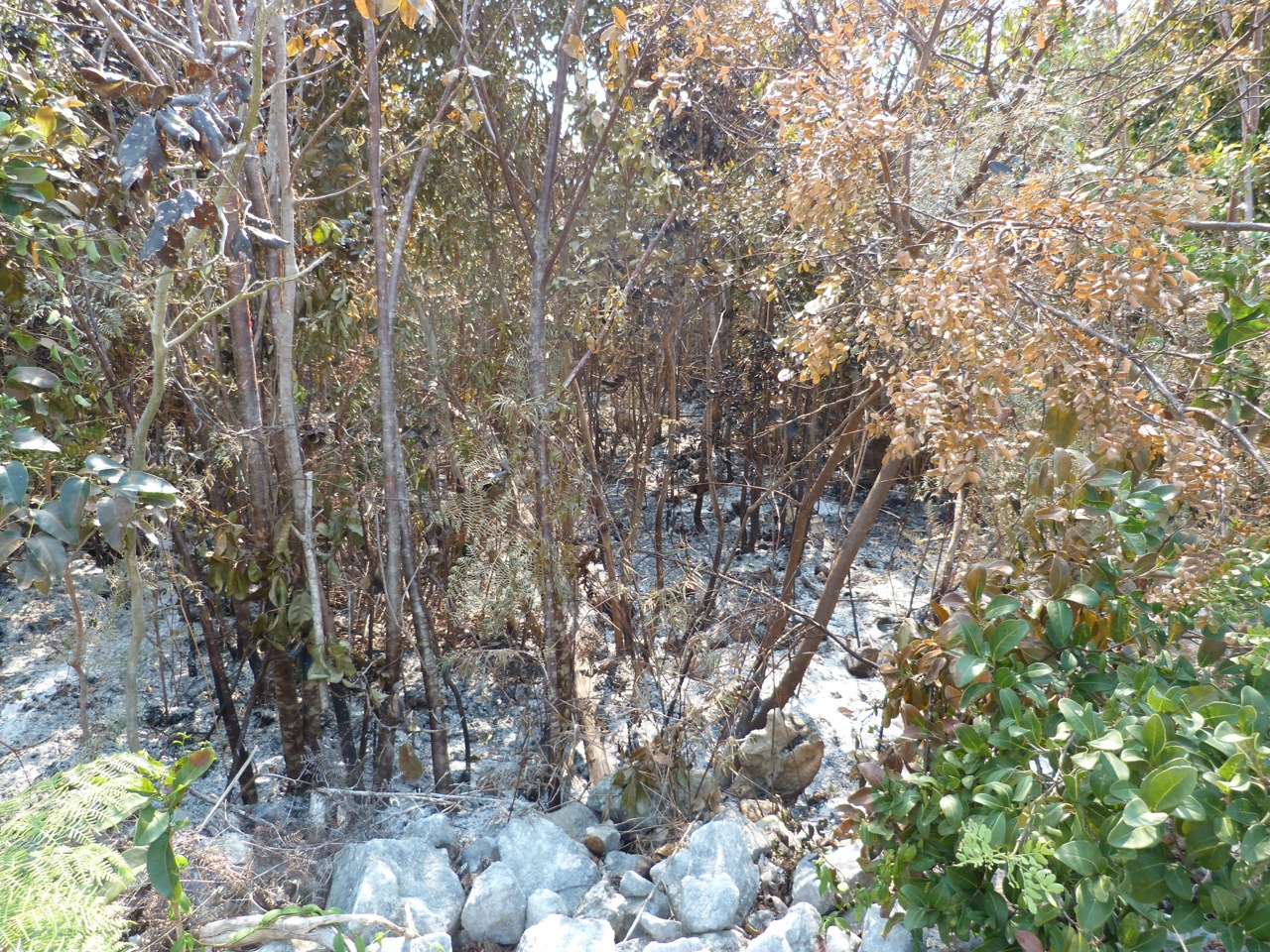
My last post was about SAWMILL SINK – not the famous Blue Hole itself, but the detritus of past logging activity in that part of the Abaco pine forests revealed by last month’s forest fires. I mentioned that this destructive burning of the shrubby understorey is (allegedly) the work of hunters making it easier for their dogs to pursue the hog denizens of the forest. The evidence suggests that nature alone could not cause so many separate seats of fire to appear in a matter of days over such a wide area – and in springtime at that.
This year, the fires came uncomfortably close to several small communities and outlying residences – and to the Delphi Club itself. Many people spent nights hosing down undergrowth and building on the edge of settlements, with neighbours all joining in. Electricity poles are vulnerable, with obvious consequences for the supply should they burn through at the bottom, as often happens. One pole a short way south of Delphi on the highway has the burnt remains of 3 utility posts beside the current (ha!) one. At Delphi itself, the vegetation from around all the poles along the mile of drive had to be cleared.
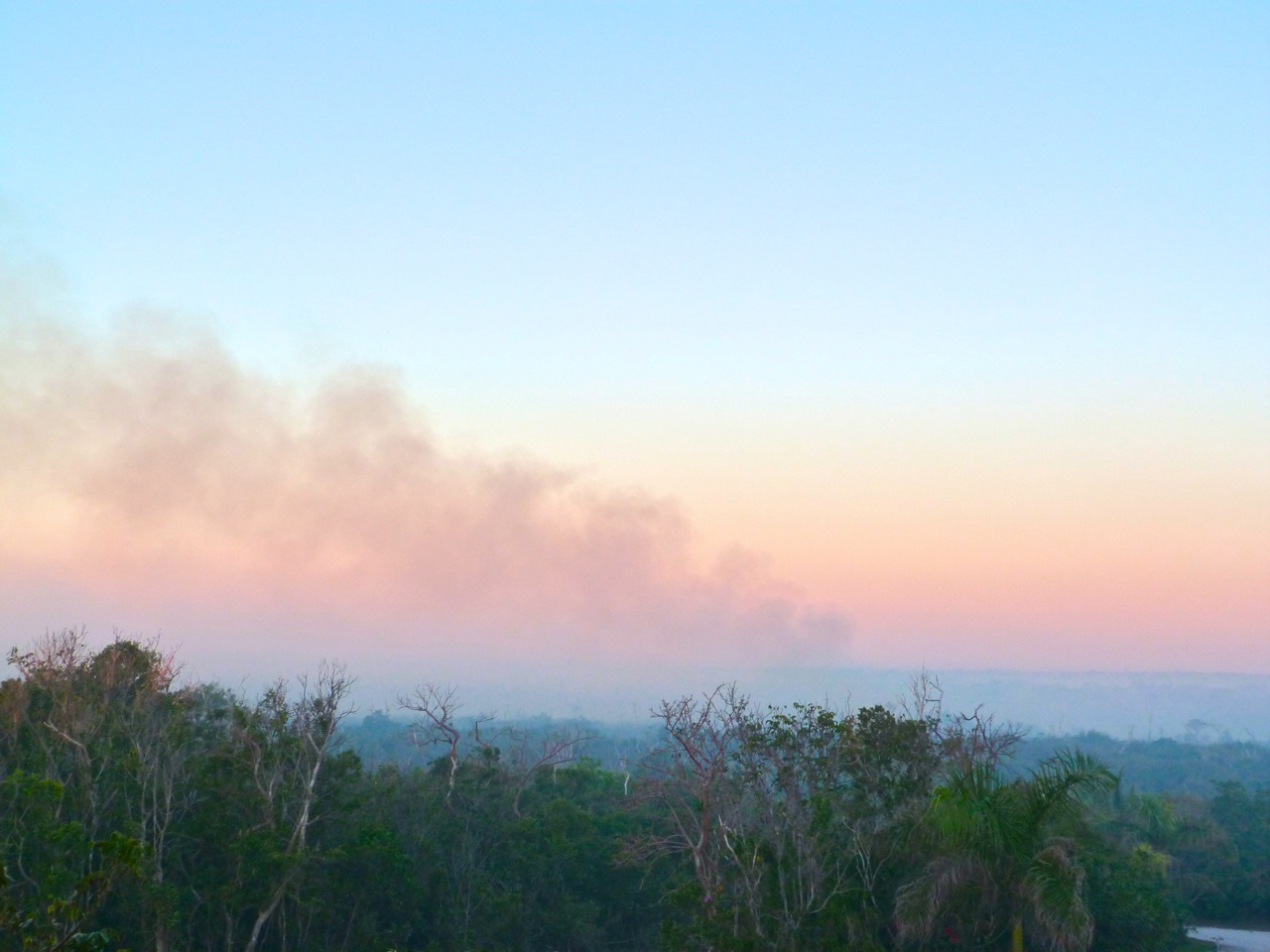
This iPhone photo was taken from the Delphi balcony. The fire is in fact on the far side of the highway, with the pall of smoke – and therefore the fire’s direction – heading south. The question is, when and where will it jump the highway, and what will be the wind direction then…
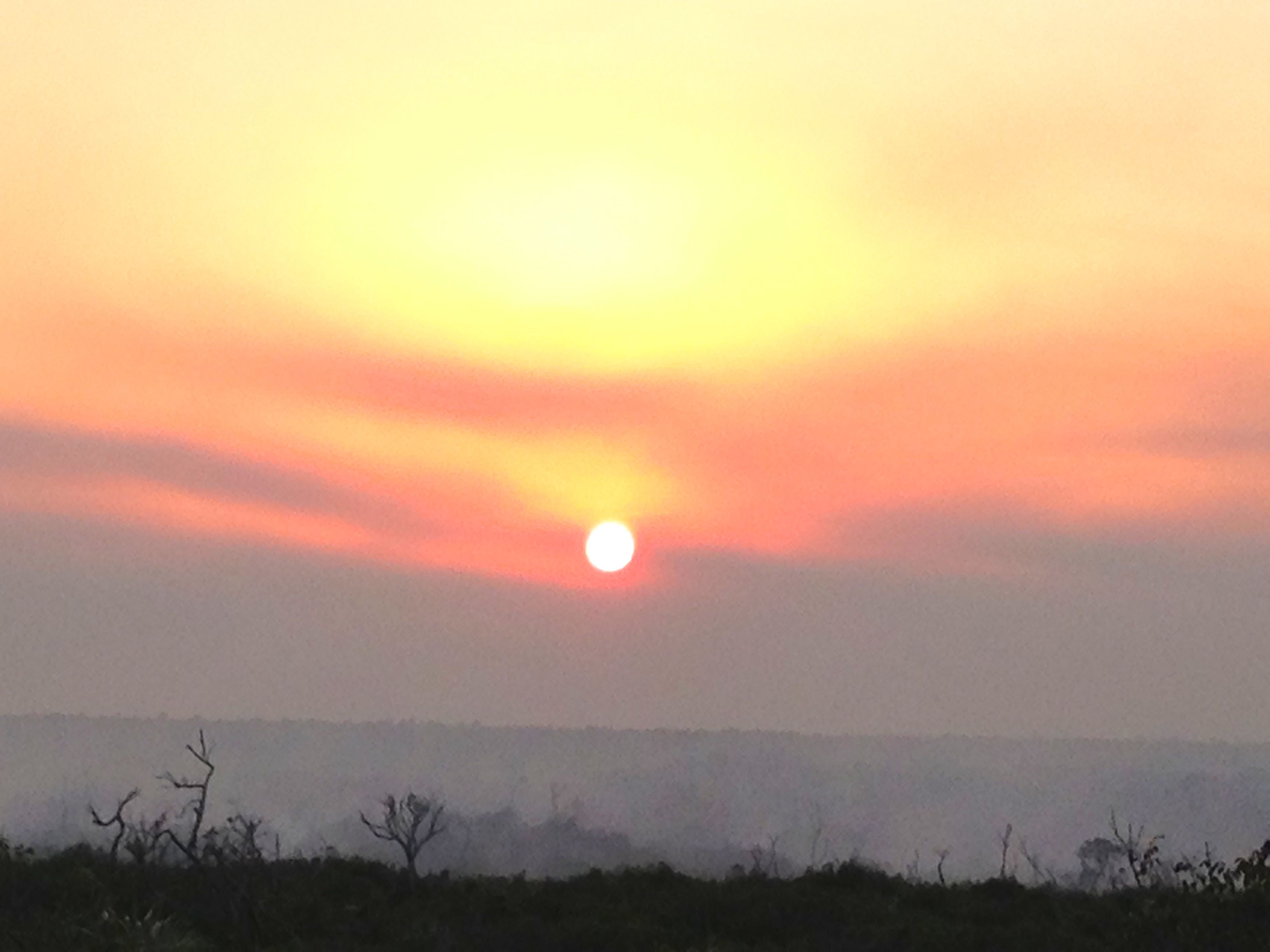
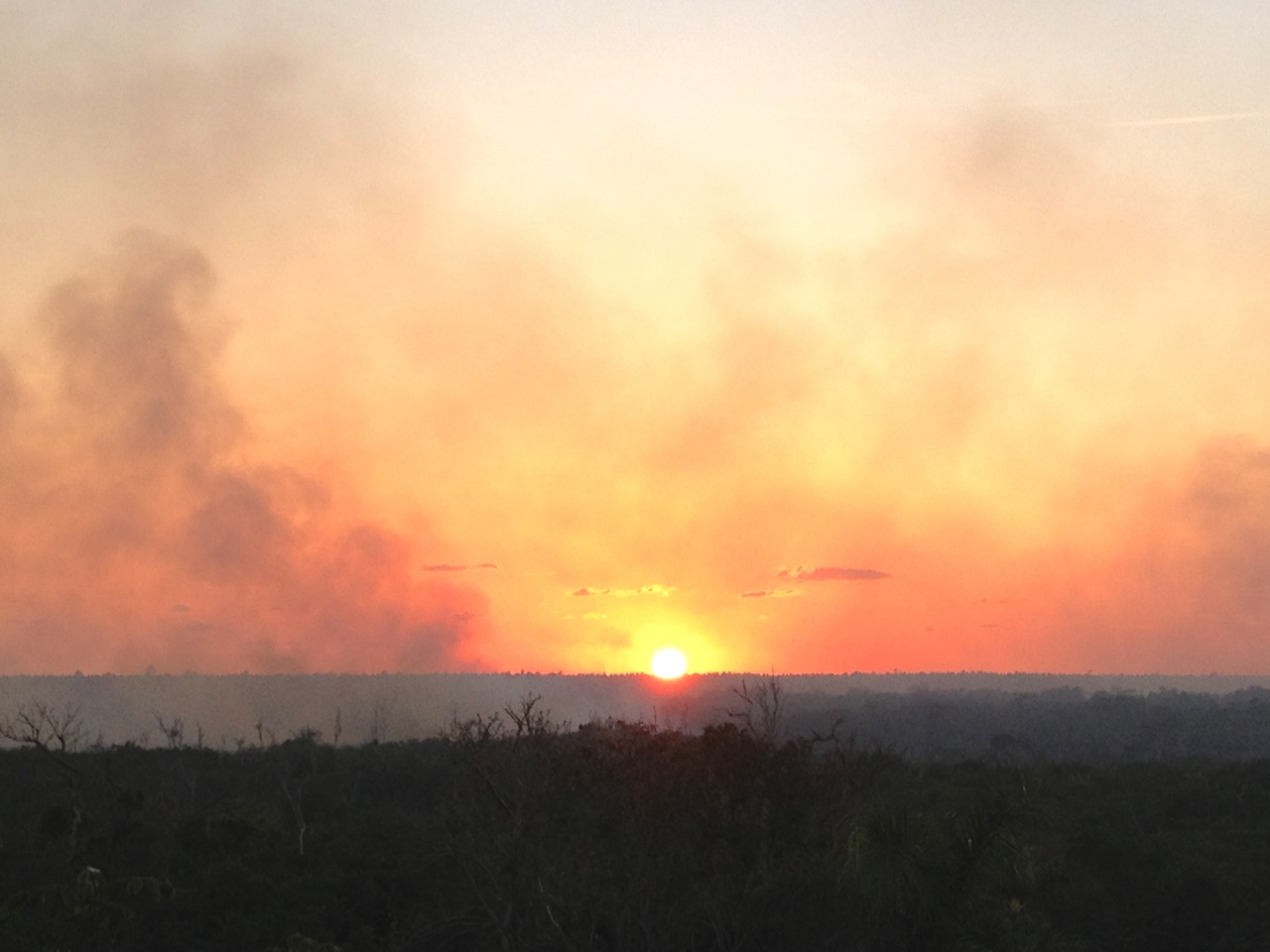
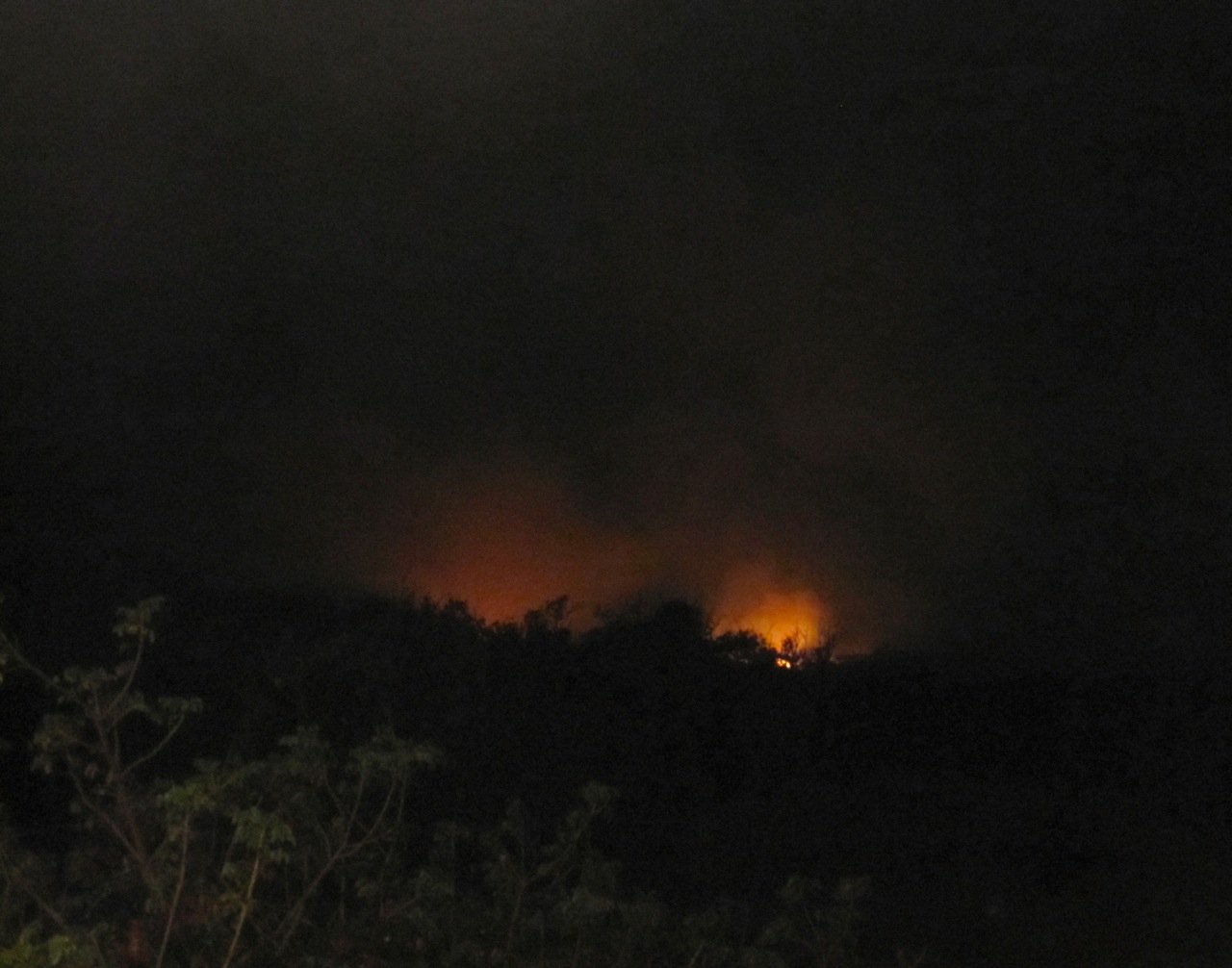
This picture shows the extraordinary effect of the smoke-laden atmosphere on the sunset. The header picture is another example. The fire is now into the pine woods between the Club and the highway, and the theory that the damp coppice nearer the Club will act as a barrier to prevent its spread is about to be put to the test overnight…
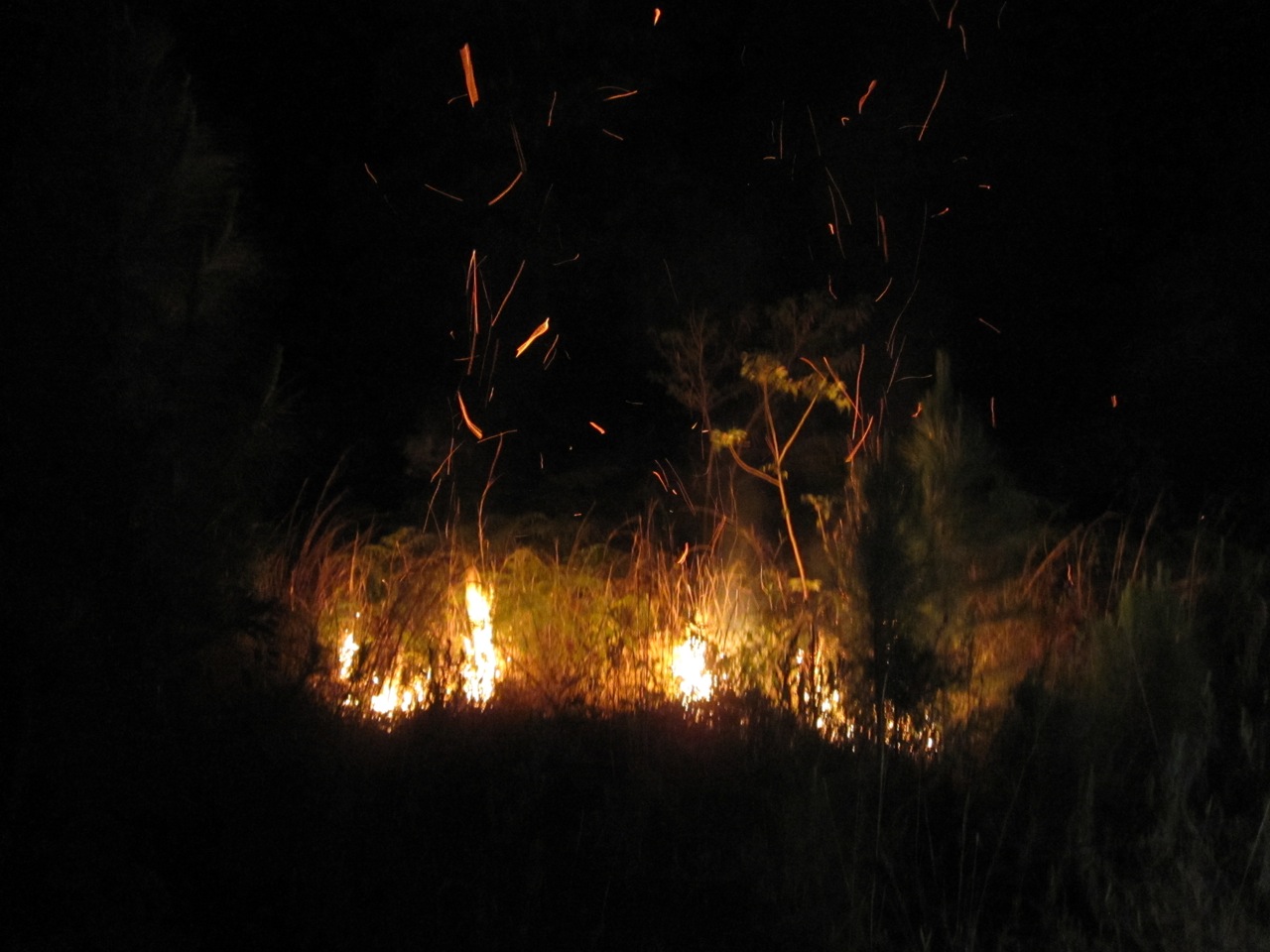
It soon became clear that the fires were not going to be discouraged by the coppice. Sandy is always eager to find volunteers to go out in a truck to feel the heat, so to speak. He is apt to dismiss concerns that one is sitting on top of a large tank of inflammable liquid by pointing out that diesel is less combustible than petrol. This is invariably comforting to all occupants of the vehicle. So with the fire burning bright, and with tree-tops suddenly bursting into flame like torches, off we go…
In the morning, a smokey mist lies over the trees and the bay to the north
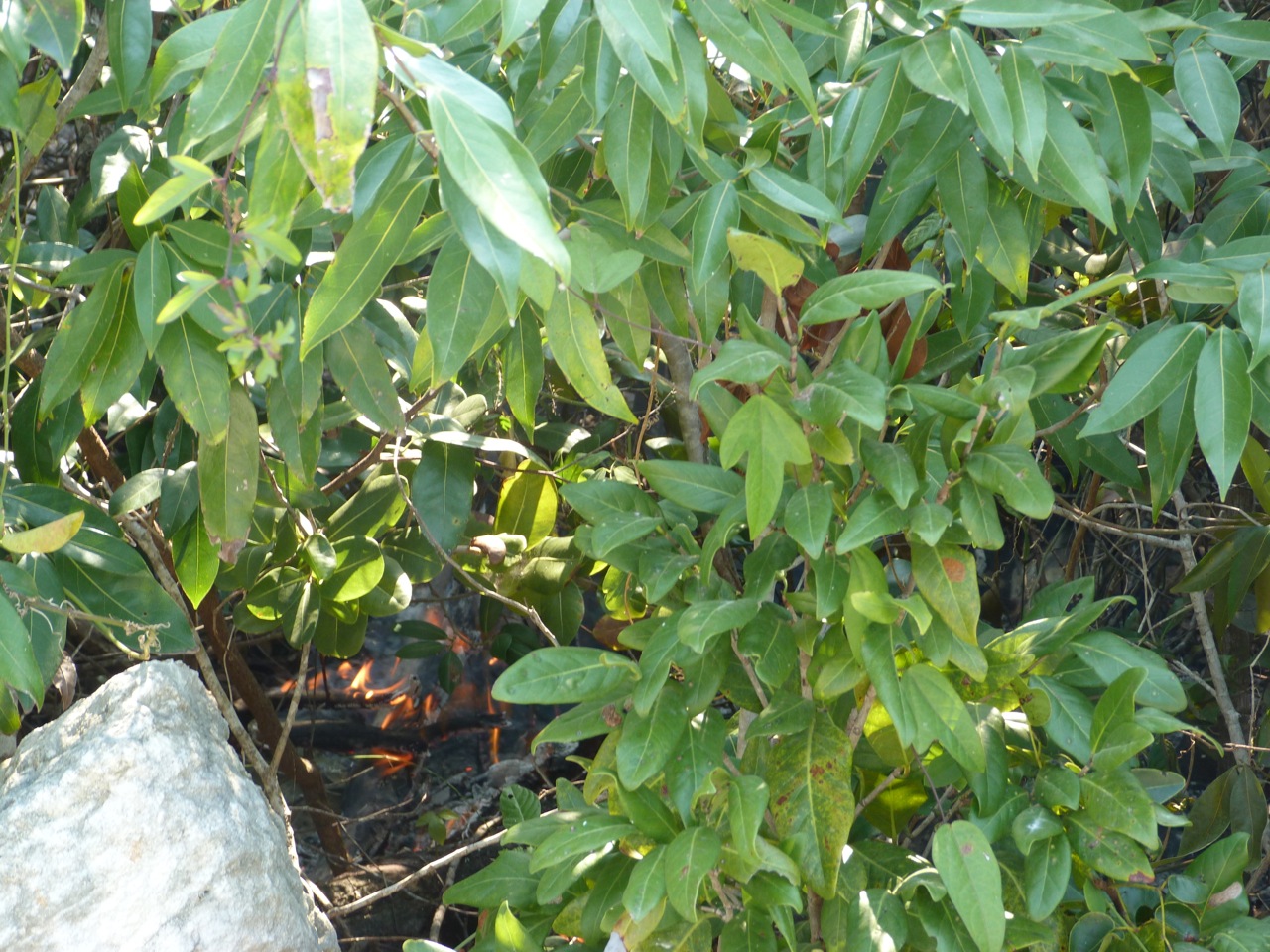
An uncomfortably short distance along the guest drive, it is clear that the coppice has burnt quite easily, though not devastatingly. In fact there are still flames to be seen…
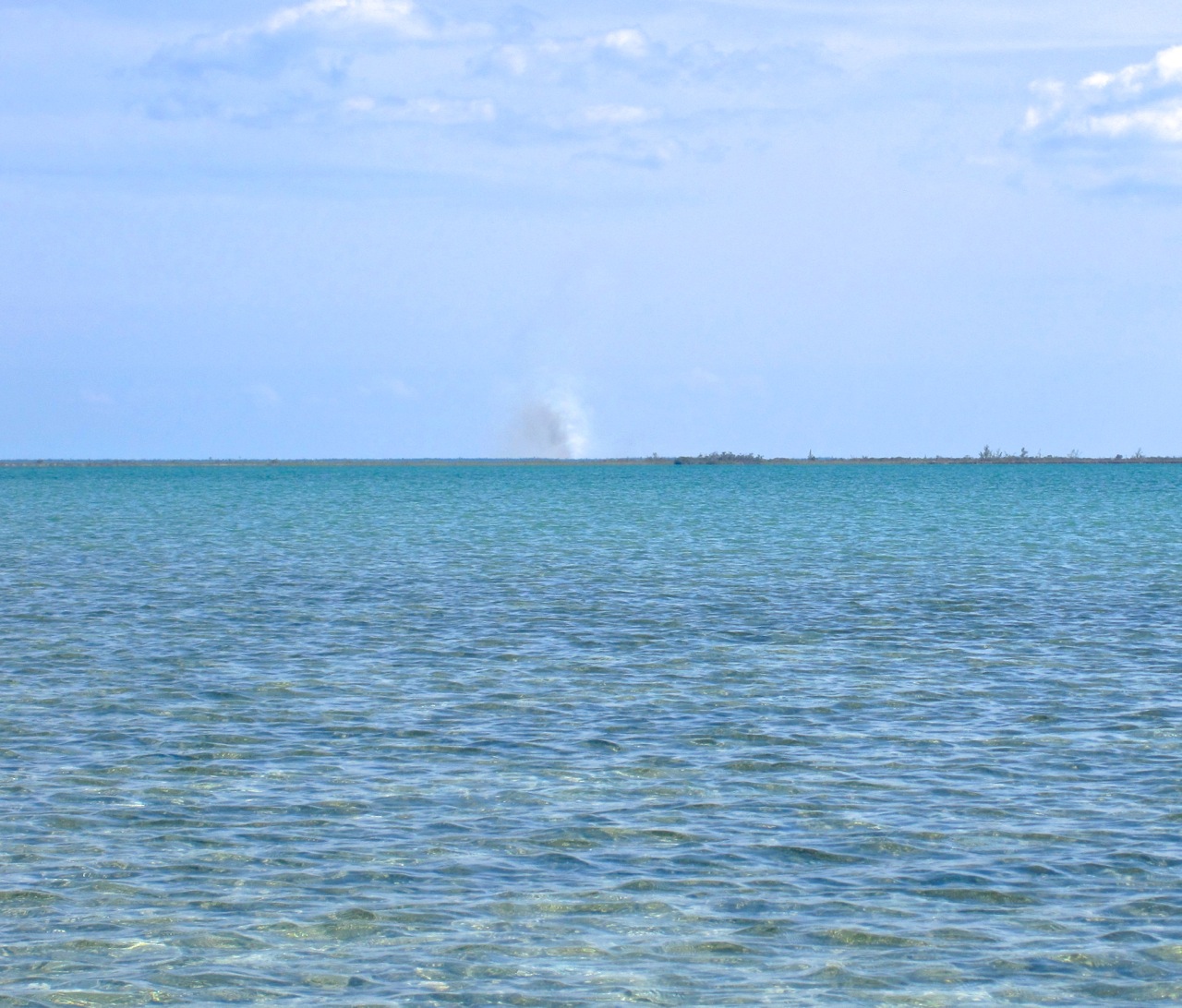
Later, out on the Marls, a plume of smoke is visible, with several more in either direction
Despite the widespread damage caused by the fires, the capacity for regeneration is amazing. New growth is visible very quickly, and within the year the burnt-out areas are mostly back to normal. I’ll end on that optimistic note, and with another dramatic sunset above the haze of smoke over the tree canopy.
BABY BONEFISH, CASUARINA, ABACO: HIDING IN PLAIN SIGHT…
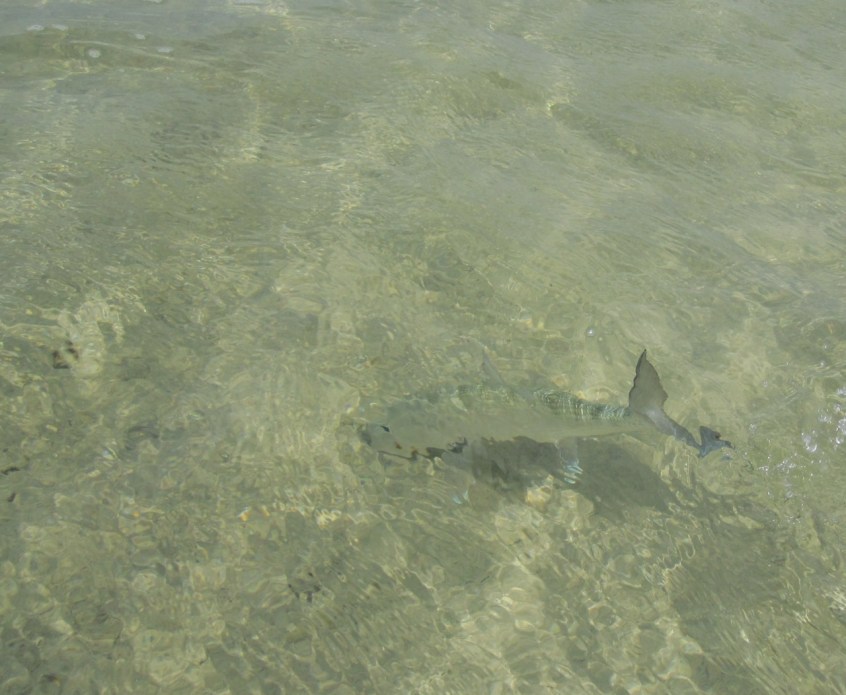
Bonefish are difficult to see in the water at the best of times. Shining silver out of water, but pale grey shadows underwater. Fishing under cloud cover and / or (especially ‘and’) when there’s a ripple on the water can be atritional. Sight-casting becomes impossible, and the best recourse is to locate the cloudy patches of water that show where the fish are feeding on the bottom. Chucking the fly into – or beyond – one of these and stripping back may be the only way to get a fish in such adverse conditions. What’s needed is clear sky, sunlight, good polaroids, patience, and keen eyes to scan the water for dark shadows moving across the sand… Or, in my case, simply waiting for the guide to hiss “Hey! Rolling Harbour. Three fish, 40 feet, 10 o’clock moving right, see them? Go now!”. By then, there’s a 50 / 50 chance I may have located them and got my act together enough to (try to) cast at them…
This picture of an adult fish, just caught on the Marls and released at once, shows how a bonefish can easily blend in with its underwater surroundings… but it can’t hide the dark shadow it casts.
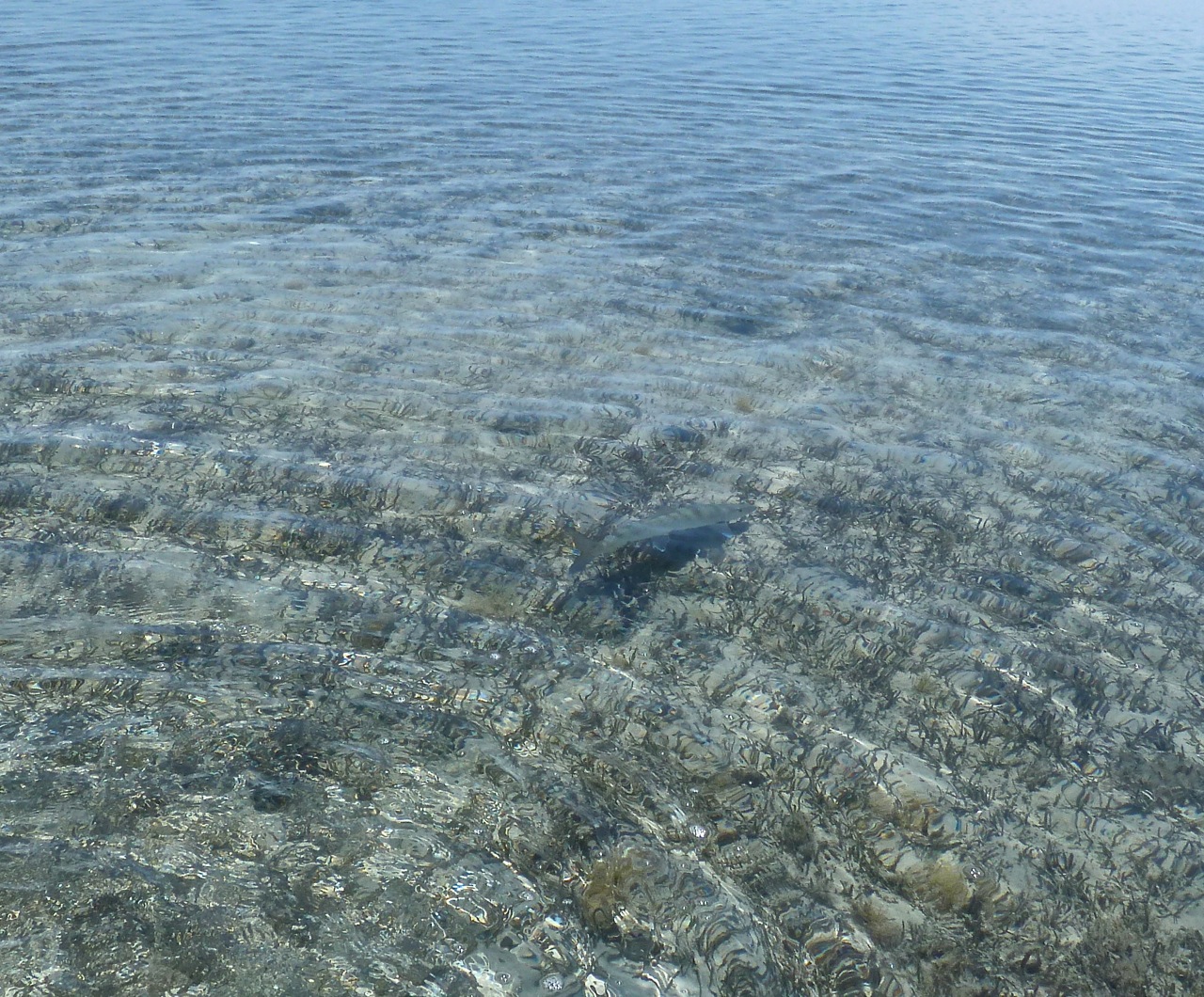
Two days later we went to Casuarina with friends who wanted a day’s wading on the extensive flats there. This photo shows a juvenile fish close to the beach there, on a glorious sunny day with a light breeze (the header picture [double-click] was taken the same day – low water over pale sand as far as the eye can see). I’d never have noticed this little fish, had I not seen the dark shadow it cast on the sand, magnified by the distorting effect of the ripples.
Without the distortion from surface ripples, the bonefish shape can be clearly seen. It’s hard to imagine that by the time this little fish has reached a weight of 2 lbs, he will be capable of stripping your line down to the backing in seconds… or could he?
No, not, in fact. This fish, with its deeply forked ‘bonefish’ tail, is in fact a YELLOWFIN MOJARRAalso known as shad. As Zach Zuckerman of the CAPE ELEUTHERA INSTITUTEwrites in kindly emphasising that the fish above is not a bonefish, “the yellowfin mojarra… is related to the mottled mojarra mentioned in Chris Haak’s text(see below). Yellowfin mojarra and bones share the same habitats, and mojarra also feed off of benthic invertebrates”. Which brings me to some interesting recent findings by the CAPE ELEUTHERA INSTITUTEin conjunction with the BONEFISH & TARPON TRUST. We saw a single small fish. It looked like a bonefish (though I guess the yellow fin markings suggested otherwise). It was in fact a similar-looking species. Where are all the young bones? The babies? How do they protect themselves from the many predators of juvenile fish?
EVER WONDER WHY YOU DON’T SEE SCHOOLS OF TINY BONEFISH ON THE FLATS?
“Since May 2011, Christopher Haak, a PhD student (and avid fisherman) at the University of Massachusetts, Amherst, along with other scientists, has been trying to solve the mystery of where juvenile bonefish live, from settlement through the time they join adult populations on the flats. Exhaustive efforts to locate juveniles along the densely-developed coastlines of Florida were met with little success, leading researchers to the comparatively pristine shorelines of The Bahamas to continue their search.
For the past one-and-a-half years, they have scoured the coastlines of South Eleuthera, conducting 1000+ seine hauls, encompassing a broad range of coastal habitats. This project is funded by Bonefish & Tarpon Trust and based out of CEI. These efforts (with the help of South-Eleutherans; thanks Denny and Kelsey Rankin!) have succeeded in locating over 800 juvenile bonefish as small as one inch in length, and have revealed some intriguing trends. For example, contrary to what might be expected, juvenile bonefish do not appear to frequent the mangrove creek systems or expansive tidal flats commonly used by adults, preferring instead to remain along shallow, sheltered shorelines near deeper basins or channels.”
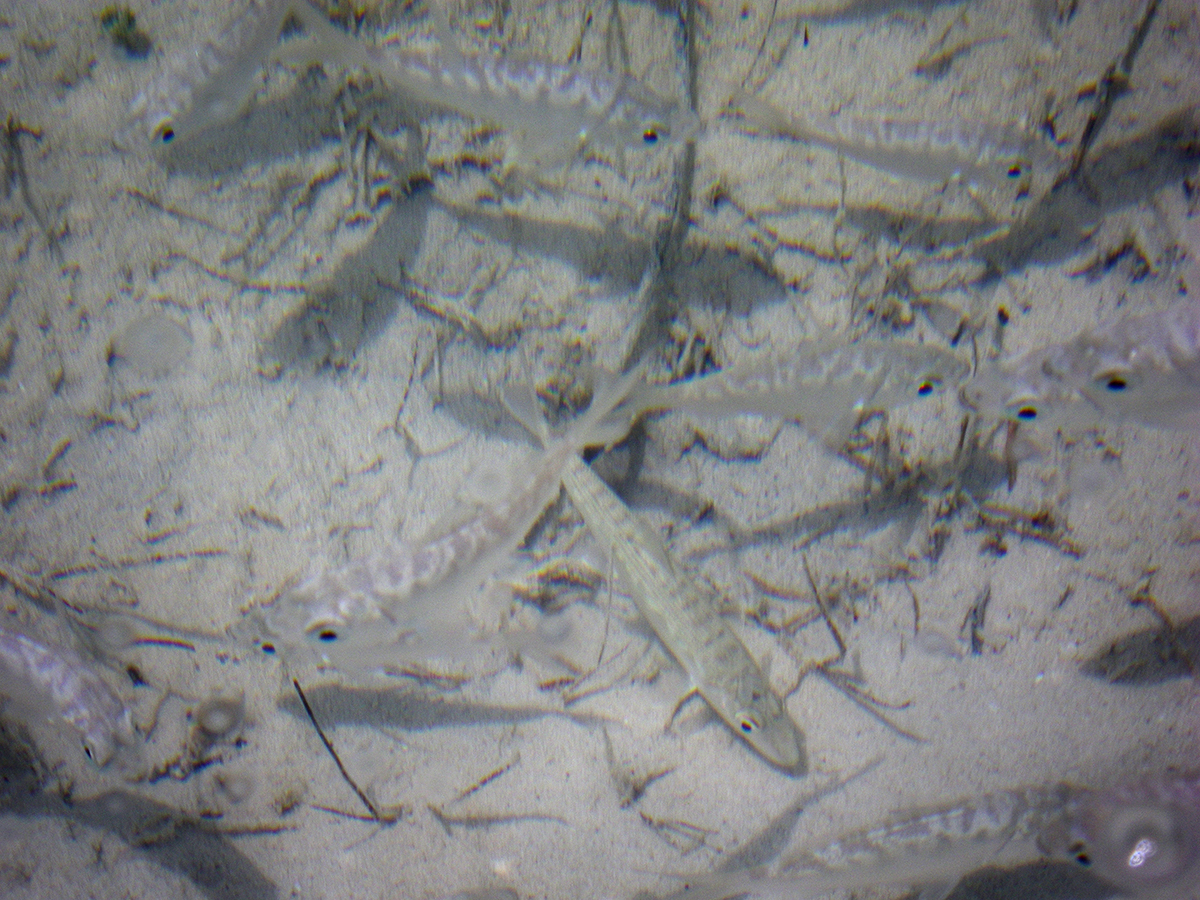
Can you find the juvenile bonefish among the mojarra in the picture below?
“Perhaps the most remarkable finding to date is that nearly every bonefish collected was in the company of much greater numbers of like-sized mojarras (a common schooling baitfish known to Bahamians as shad). These juvenile bonefish exhibited markings and coloration not apparent in adult bonefish, but very similar to the mojarras with which they were caught. By blending in with considerably greater numbers of the model species, the mimics may be reducing their predation risk, and increasing their chances of survival. In the case of bonefish, this hypothesis would also explain why juveniles are so rarely observed; they are well hidden within schools of mojarras! From a conservation perspective, this suggests that bonefish populations may be dependent upon healthy mojarra populations, important information for resource managers.
This research is also producing valuable information about the diverse juvenile fish communities that inhabit Eleuthera’s shores. Myriad seine hauls of the island’s beaches, bays, sounds, and creeks have catalogued juvenile fishes from a wide array of species, including other flats inhabitants like permit, reef fish such as parrotfish, jacks, and wrasses, and some very unusual demersal critters such as shortnose batfish. The high densities and diversity of juvenile fishes revealed by this study serves to highlight the importance of these nearshore habitats to healthy adult fish populations of all kinds, underscoring the need to preserve and care for our coastlines.”
ADDENDUMWith thanks to Aaron Adams of theBONEFISH & TARPON TROUT for use permission, here is a great size indicator for baby bonefish, taken by him some years back in connection with a juvenile bonefish project.
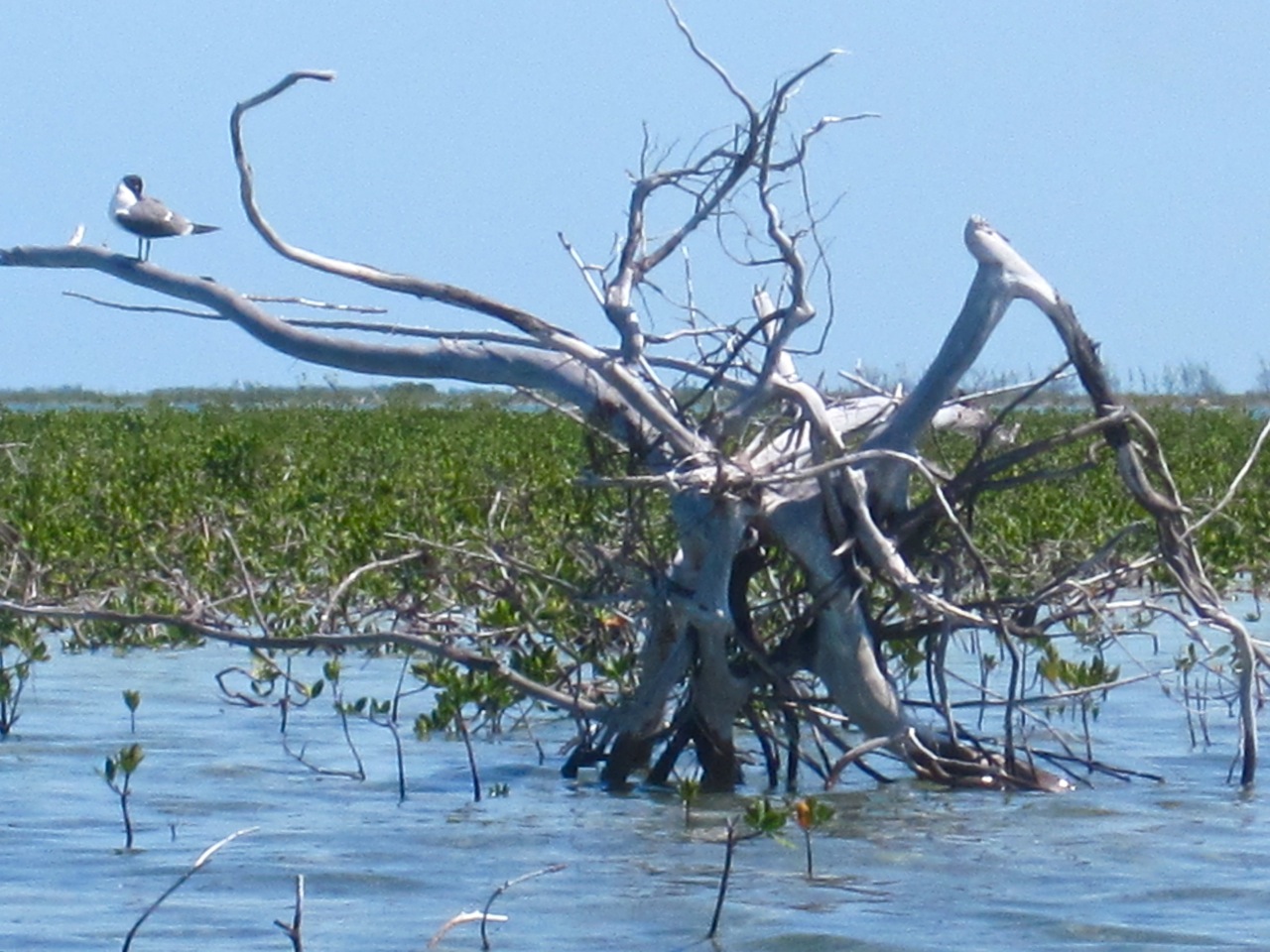
We passed these fine Royal Terns during the boat ride ride out to the bonefishing grounds of the Abaco Marls. The single dead tree lay alone in a vast expanse of open water near the mangrove swamps, providing a perfect perch and vantage point for the birds. Their positioning on the tree suggested a distinct “pecking order”, which turned out to be literally true. The terns were unembarrassed by our presence, but at one stage they all took off and circled lazily round once before settling back on the tree. Those that tried to take a higher perch were aggressively treated by the original occupant. In the end, things settled down much as before. However, one disappointed claimant to promotion was dispossessed of the main trunk entirely. He ended up, uncomfortable and huffy, on a small stump facing the opposite way to the rest of the birds – perhaps from wounded dignity, or to make his feelings known through body language….
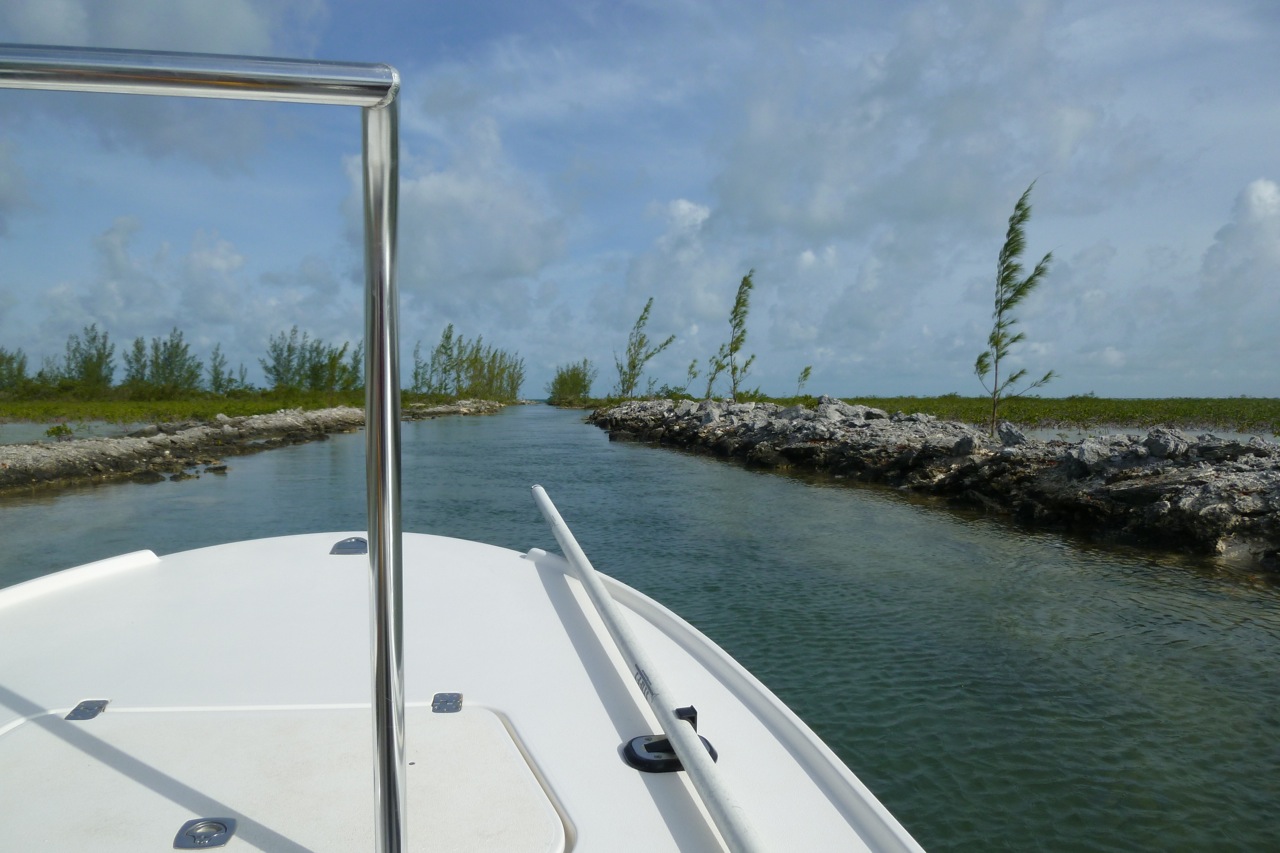
As a companion-piece to the previous post about Abaco bonefishing, I’ve made a short movie of the final stage of the skiff trip after a day out on the Marls back to Nettie’s Point and the skiff launching / landing ground there. It’s always a interesting ride, and I took the footage just for the fun of it. At very high tide, the channel can (must?) be taken at speed, and end with an 007 flourish. When the tide is low, however, it can be slow progress with the propeller precariously close to the rock for much of the channel’s length… Small crabs scuttle for cover in limestone holes as you pass, and you can see clearly what a huge amount of rock had to be cleared out.
Approaching the mouth of the channel at high tide, with rock spoil on both sides
Then I got to thinking about the originator of this canal cut through rock from the firm ground of the pine forest through to the open sea. ‘Nettie’s’ is named after Nettica Symonette, Eleutheran-born owner of ‘Different of Abaco’, the now defunct bonefishing lodge on the road off the main highway to Casuarina. She was clearly a striking figure – tall, strong-minded, and a passionate promoter of out-island tourism. She must have had plenty of insight into the importance of the natural resources that might make Abaco attractive to visitors, for she was not just a bonefishing pioneer, but also a wildlife enthusiast.
Flamingos and chicks on Inagua, 2012 (photo credit: Melissa Maura)
Nettie attempted to reintroduce flamingos to Abaco as breeding birds (there had been none breeding on Abaco for some 50 years). That involved the relocation of a number of juvenile birds from the National Park on Inagua (see FLAMINGO POST). They were flown to Abaco and resettled in the Casuarina area with their wings clipped. This was 15 – 20 years ago, and I don’t know if there was any successful breeding. I believe further birds were brought over, but for some reason the hoped-for breeding colony did not become established. It’s possible that there were problems with predation, as with the Abaco parrots.
Unhitching a skiff into the boat basin at high tide
Nettie’s lasting legacy is the construction of the canal cut through to the mangrove swamps and the ocean, and the ‘boat basin’ that allows safe launch and return for skiffs. This made possible what must have been very difficult given the geology of the terrain – easy boat access to the prolific fishing grounds over the vast area of mangroves and the labyrinthine water channels that is the Marls. It’s worth the comment that the whole project is entirely natural – it involves no man-made materials of any description. Contrast this with what might have been: concrete, iron, steel, wood – maybe a bit of plastic trim to round it off…
The first skiff sets off for the day…
I don’t know (perhaps someone can help via the comment box or email me) when and how this was done or how long it took, But when you watch the video as it follows the channel’s full length, you will see the rock spoil and appreciate the feat – and the vision – involved. And in places you can also see the shelving rock below the waterline that makes steering a steady central course advisable…
Aha! More arcane music from the Rolling Harbour archive, I hear you say. The music is Preston Reed’s ‘Along the Perimeter’ from ‘Handwritten Notes’ – an astonishing guitarist with a two-handed playing technique that also involves hitting and slapping various areas of the guitar (saves the cost of a drummer). He uses experimental open tunings that are found in no ‘How to play guitar nicely’ manuals. And if you like this, try Erik Mongrain who is simply astounding. Almost a trick guitarist. But I digress…
[I published the original of this post a year ago. I discovered that it had been put badly out of kilter by recent blog format change, so I have amended and to an extent updated it, with larger photos (NB the video was my first feeble foray). So yes, it’s a retread, which I rarely do; but I wasn’t tooled up with Facebook & Twitter then, and thankfully a couple more people now read this thing, so it possibly deserves a fresh outing. No? Well I’m doing it, regardless]
It’s 7.15 and breakfast time at Delphi. At 8.00 the trucks, skiffs, guides and fishers will set off to the fishing grounds for the day, leaving you with an empty beach, shells, warm sea, the pool, the hammock and your book. For the moment, the talk is of the excellent ‘Full Abaco’ breakfast, the weather, ‘Delphi daddies’ & ‘crazy charlies’ and someone’s mislaid reel. Sandy enters to announce that there’s a place free on your partner’s skiff… and offers it to you. So what should you, a non-angler, expect of a day out on the flats?
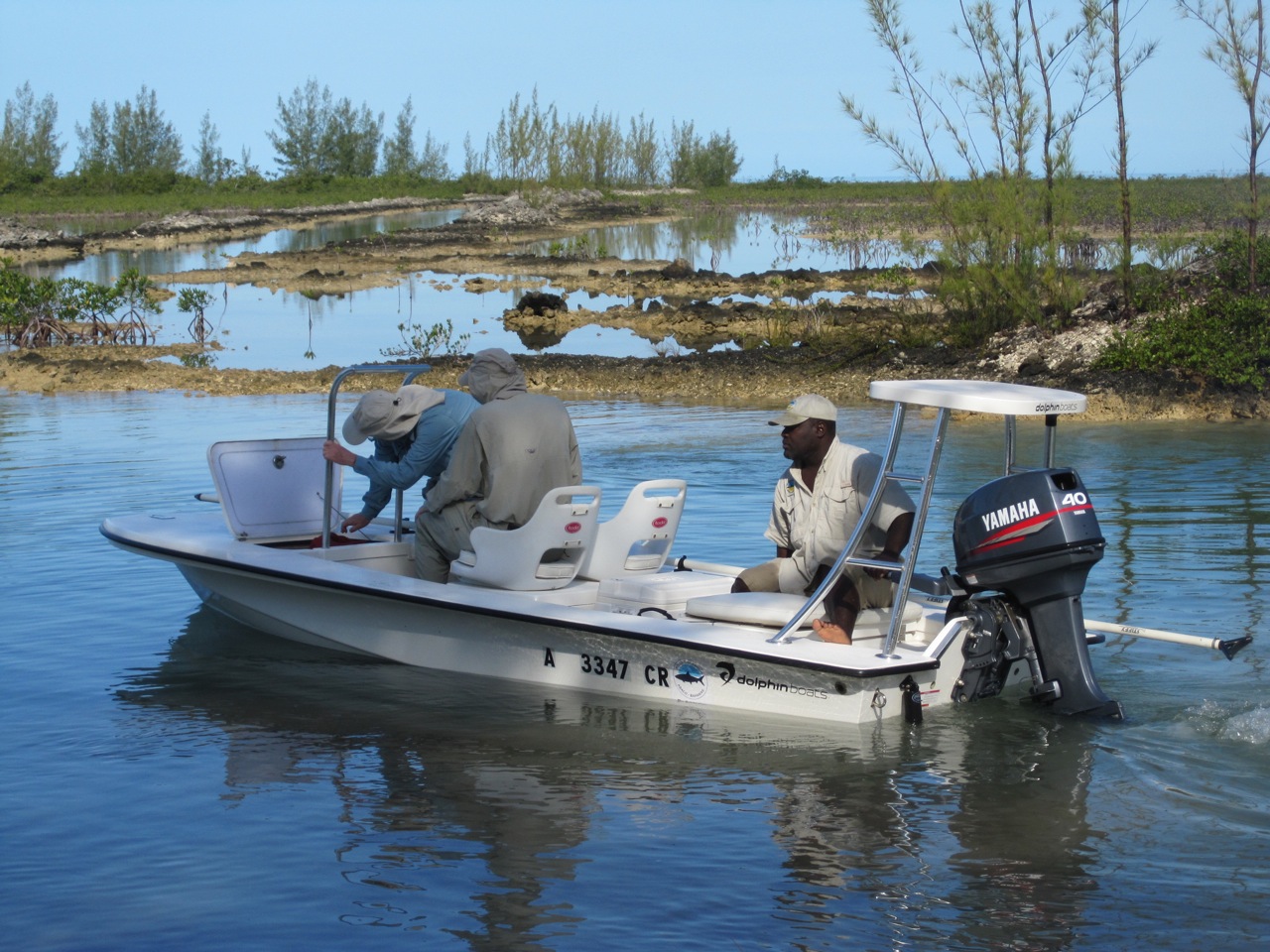
THE SKIFFS These are top-of-the range boats, capable of considerable speed getting out to the fishing grounds. The ride can be bumpy, splashy and even chilly in the early morning, so bring a fleece and a waterproof top. Camera? Essential. Here is a Delphi skiff on a sand bar in Cherokee Sound, parked for lunch and some quality conch and sand-dollar hunting. So for a start, the day isn’t ALL about fishing…
THE FISHING GROUNDS You will leave from one of three launch points and speed across the water to the bonefishing areas. The main one is “Nettie’s”, with access via a narrow man-made channel to the Marls…
… more than two hundred square miles of mangrove swamp, islets, channels and fish. The journey to Nettie’s may seem quite a long way as you bump along through the pine forest on a network of logging tracks. Watch out for small birds flickering all around as you pass.
———————————
Launching a skiff at Nettie’s
Plans are hatchedGood to go…
Stowing gear in the front (forrard?) locker. There’s also one behind the seats for the lunch cool boxes. And the fuel…
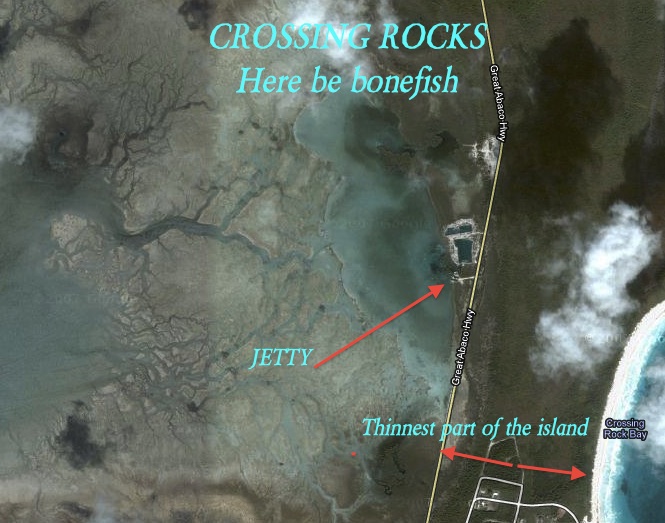
The other two launch areas are Crossing Rocks (a short drive south of DCB) or Casuarina Point for Cherokee Sound (a slightly longer drive north of DCB)
The jetty at Crossing Rocks – skiffs being prepared
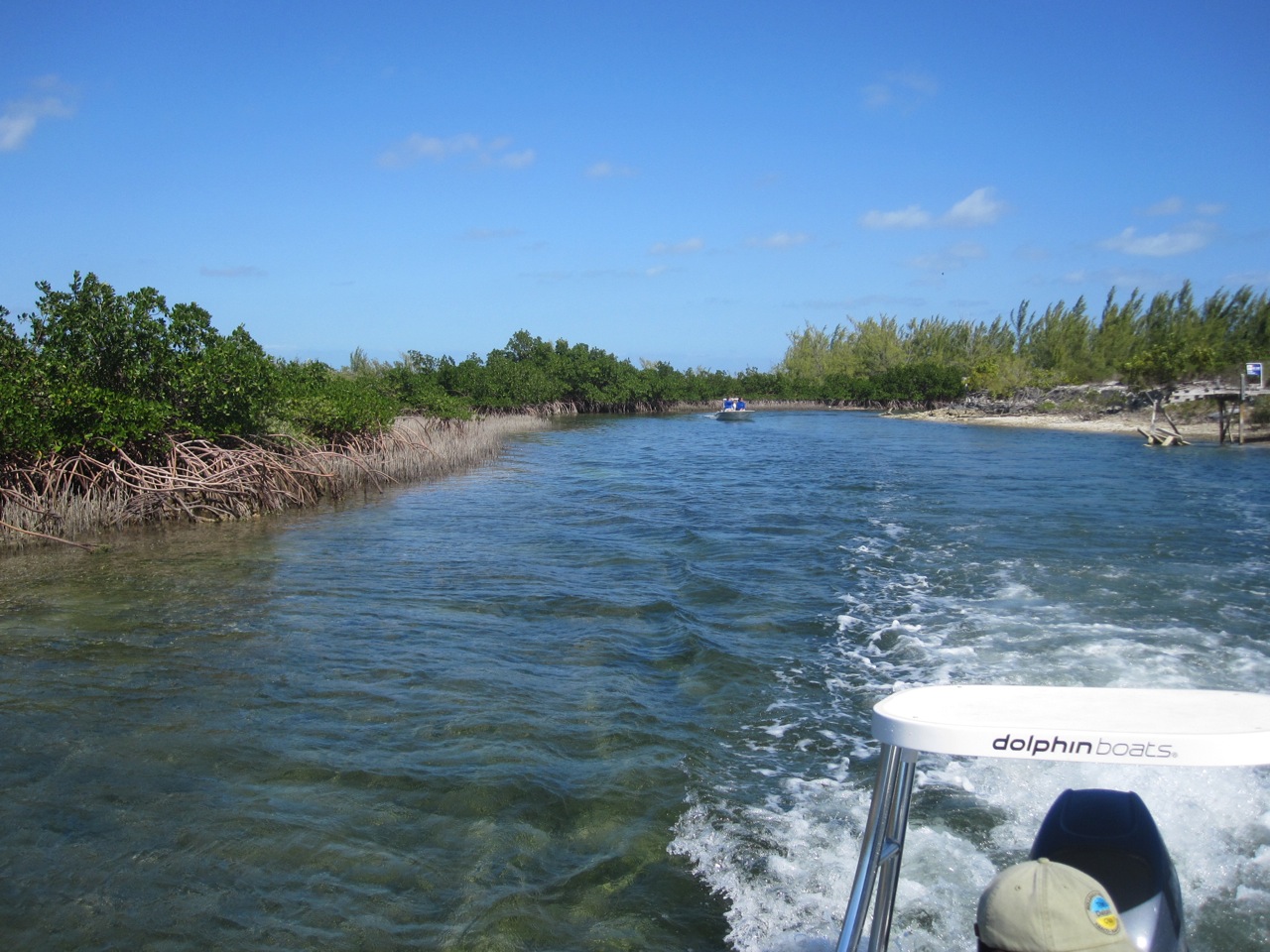
The launch point at Casuarina. A channel leads out to Cherokee Sound
Two boats in the channel – the authentic James Bond chase experience
WHAT’S THE POINT? Bonefishing! You’ve heard all the Club talk, you’ve seen your partner fussing over all those bits and pieces in your room: now see it in action. Once you get out to a fishing area, the guide cuts the engine… and suddenly you are being poled very slowly and almost noiselessly across the shallow flats
The guide stands on the platform at the back of the skiff, using the advantage of height to scan the shallow water; the fisher stands at the front looking tensely for grey shadows underwater, waiting for the magic words…
“…hey, bonefish, 10 o’clock, 4 of them moving right, 30 feet… see them?”
And it’s ‘game on’. This isn’t the place for a discourse about casting technique and style – I have neither (Sandy, of me: “Muppet”) – but I promise that you will get completely caught up in the excitement when a fish takes the fly and takes off towards the horizon, stripping the line and backing from the reel… (I realise the image above may suggest… well he’s just fishing, OK?)
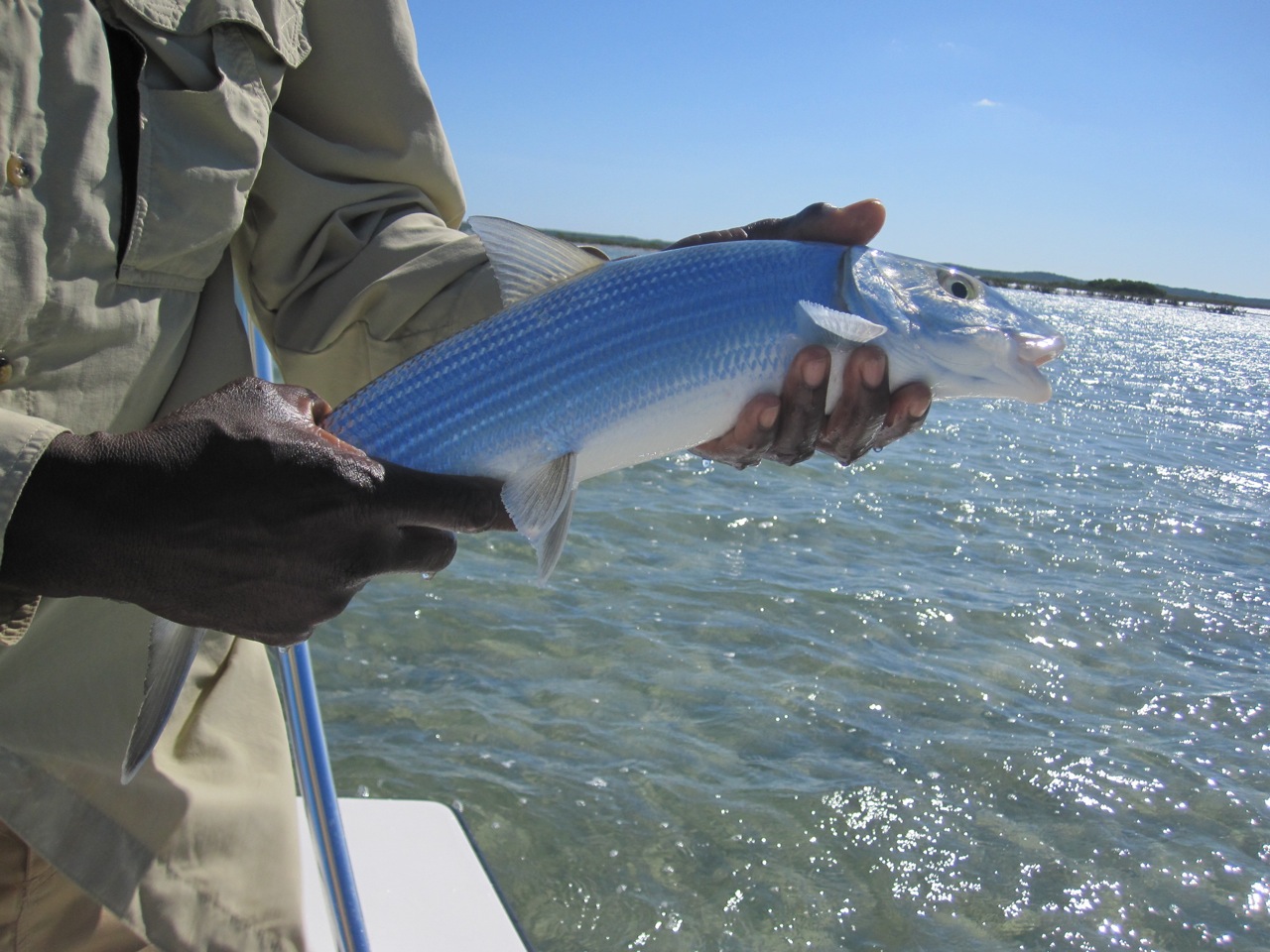
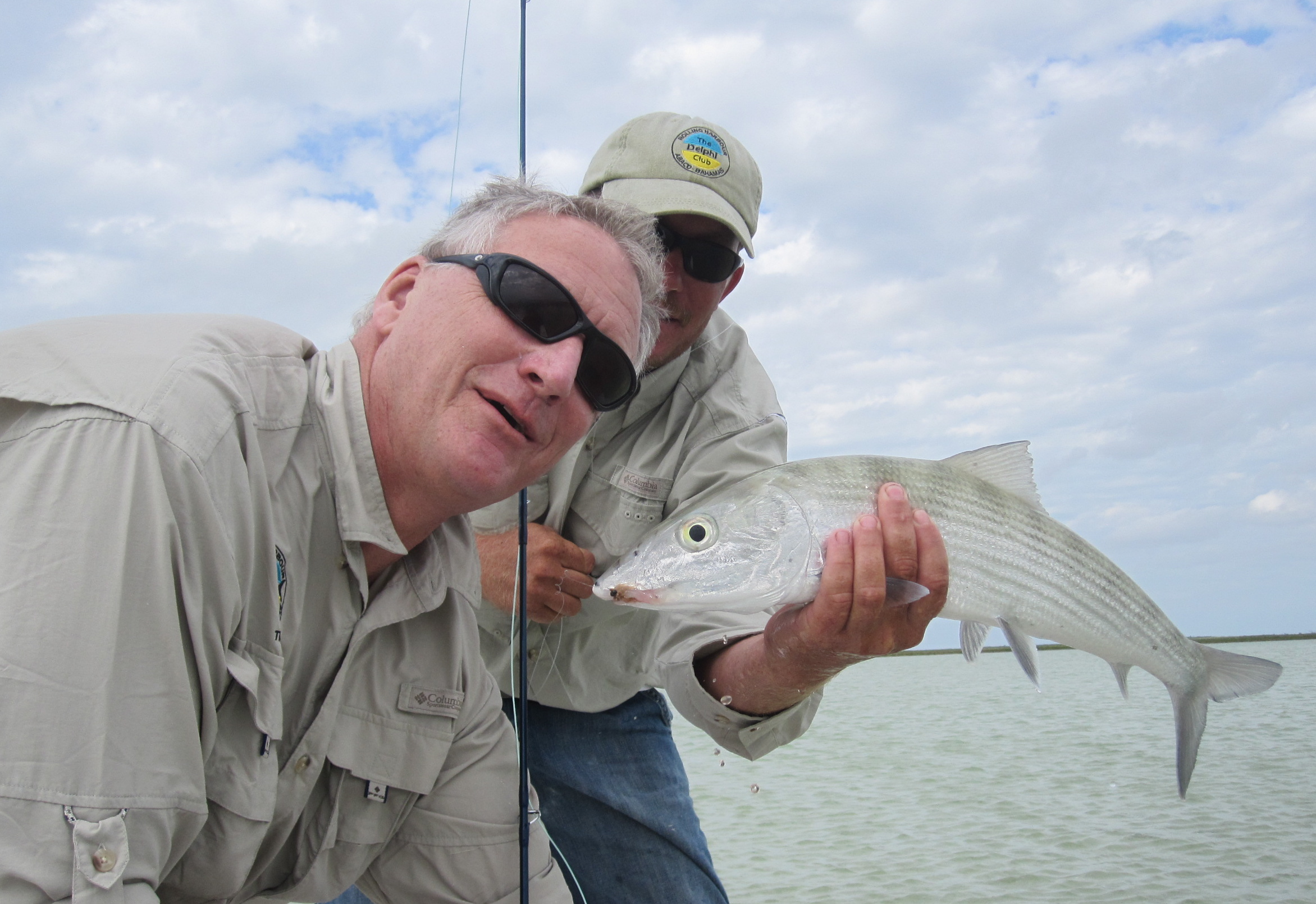
THE QUARRY – grey ghosts below water, bars of silver above. Caught on the ‘fly’ which are in fact shrimp or crab imitations, with barbless hooks to make the chance of losing a fish that much greater… This ensures that a boated fish can be returned to the water as easily and quickly as possible. It’s all ‘catch and release’, though some (me) find that mostly the fish very sensibly self-release long before they ever reach the boat…
Abaco bonefish off Crossing Rocks (just caught and released)Guide Ishi with Abaco bonefish caught on the MarlsGuide Robin Albury removes the barbless hook before returning the fishA good specimen‘Ishi’s Fishy’, as he would say
There is even the possibility that at some stage you may unexpectedly be handed a rod (even if you have never held one before, or wanted to) with ‘fish on’… Here, Robin has hooked a 2.5 lb fish and handed the rod to Mrs RH (then engrossed in eating a cheese roll) who successfully played and brought in her first ever fish…
PART 2 will deal with what else goes on during the day: the scenery, birdlife, sharks, turtles, blue holes and so forth. For now, here is a short clip of the skiff ride out to the Marls, to give you an idea. NB this was a very calm day – things can get a little bumpier and wetter at times. The seats are padded, but not very…
[Ultra-cautious music credit to Joe Satriani who sued Coldplay for alleged tune ‘borrowing’ saying “I felt like a dagger went right through my heart. It hurt so much”. Case dismissed + unspecified settlement… Way to go, Joe! Want to check? Cut ‘n’ paste this: http://www.youtube.com/watch?v=zjB024bZoB4&feature=fvwrel Then by way of counterbalance try John Lennon’s Imagine vs Coldplay’s ‘Fix you’ at (cut ‘n’ paste) http://www.youtube.com/watch?v=DksjpsAe3vk&feature=endscreen&NR=1]
Laughing gulls. Amusingly raucous and raucously amusing. Unless, maybe, you are living right next to a breeding colony during a collective fit of hysterics. These gulls, Leucophaeus atricilla, will be familiar to anyone on the Atlantic coast of North America; in the Caribbean; and further south to the northern coastal areas of South America. In winter, their migration pattern simply involves relocating to the southern parts of their range. They are easily recognisable in the breeding season by their smart black caps, though this fades in winter. And by their unmistakeable call, of course. Immature birds tend to be darker than adults. They breed in large colonies, each female laying 3 – 4 eggs. And like most (all?) gulls, they’ll eat pretty much anything.
Laughing Gull Conservation Status
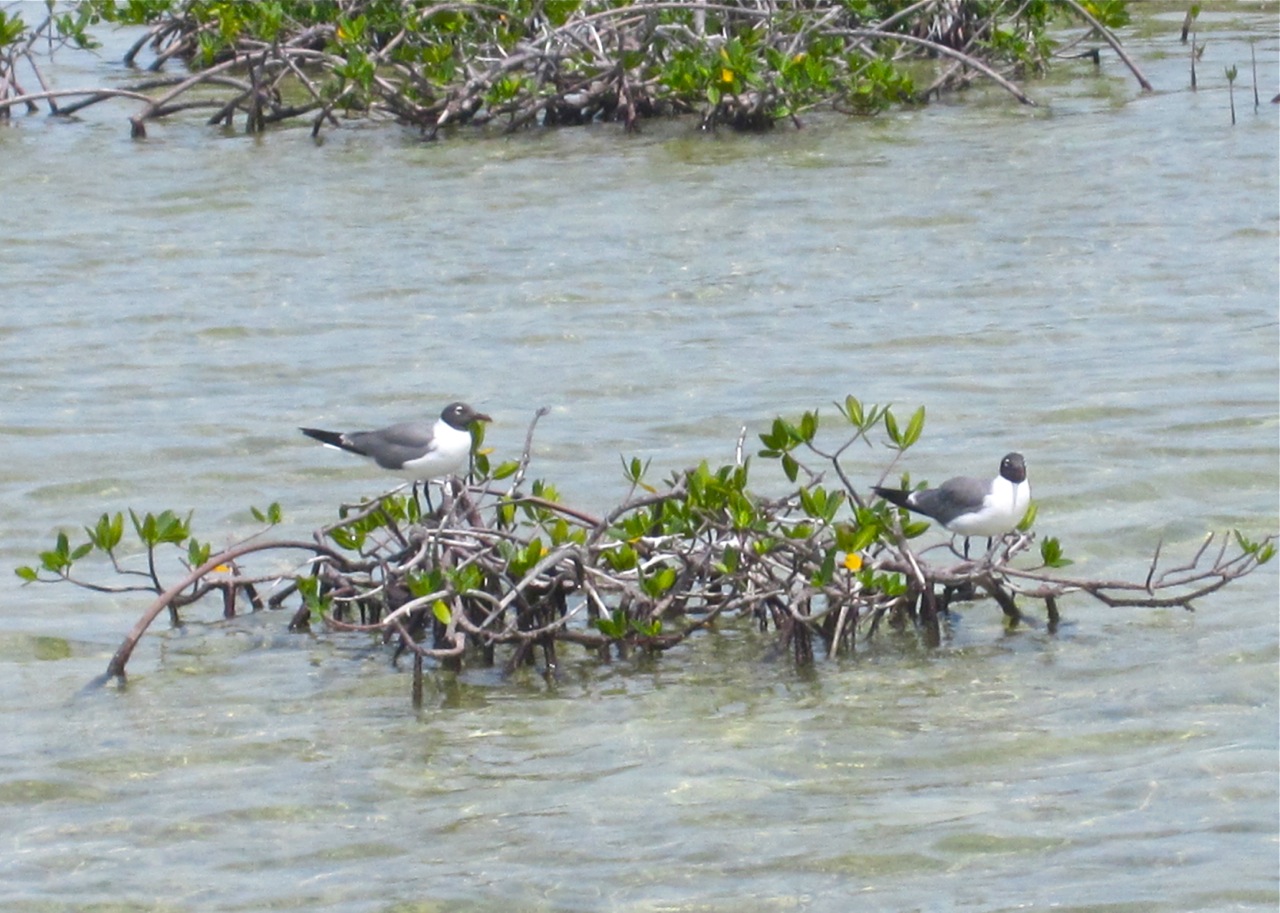
We saw – and heard – plenty while bonefishing on the Abaco Marls in June. I took some rather grainy distance shots, as they tended to fly off as the skiff was slowly poled towards them. This gull has found a good vantage point for some quality preening among the mangroves.
The pair below stayed put, and watched our gradual approach with suspicion that turned into noisy protest as we poled past them. I presume they were defending their territory – probably a nest site nearby.
I took a very short video just before they flew off as we drifted by. Apologies for the sound of the breeze – I’ve no idea if it’s possible to reduce the background noise while retaining the bird call. Listening to online bird sound clips (e.g. on the excellent Xeno-Canto) I think not. Or not without expensive editing equipment of a complexity I can’t face…
[vimeo https://vimeo.com/48076405]
And here (thanks, Don Jones @Xeno-Canto) is what laughing gulls sound like when one of them has told the one about the bonefish and the shrimp…
BONEFISH! POLING THROUGH THE MANGROVES ON THE ABACO MARLS
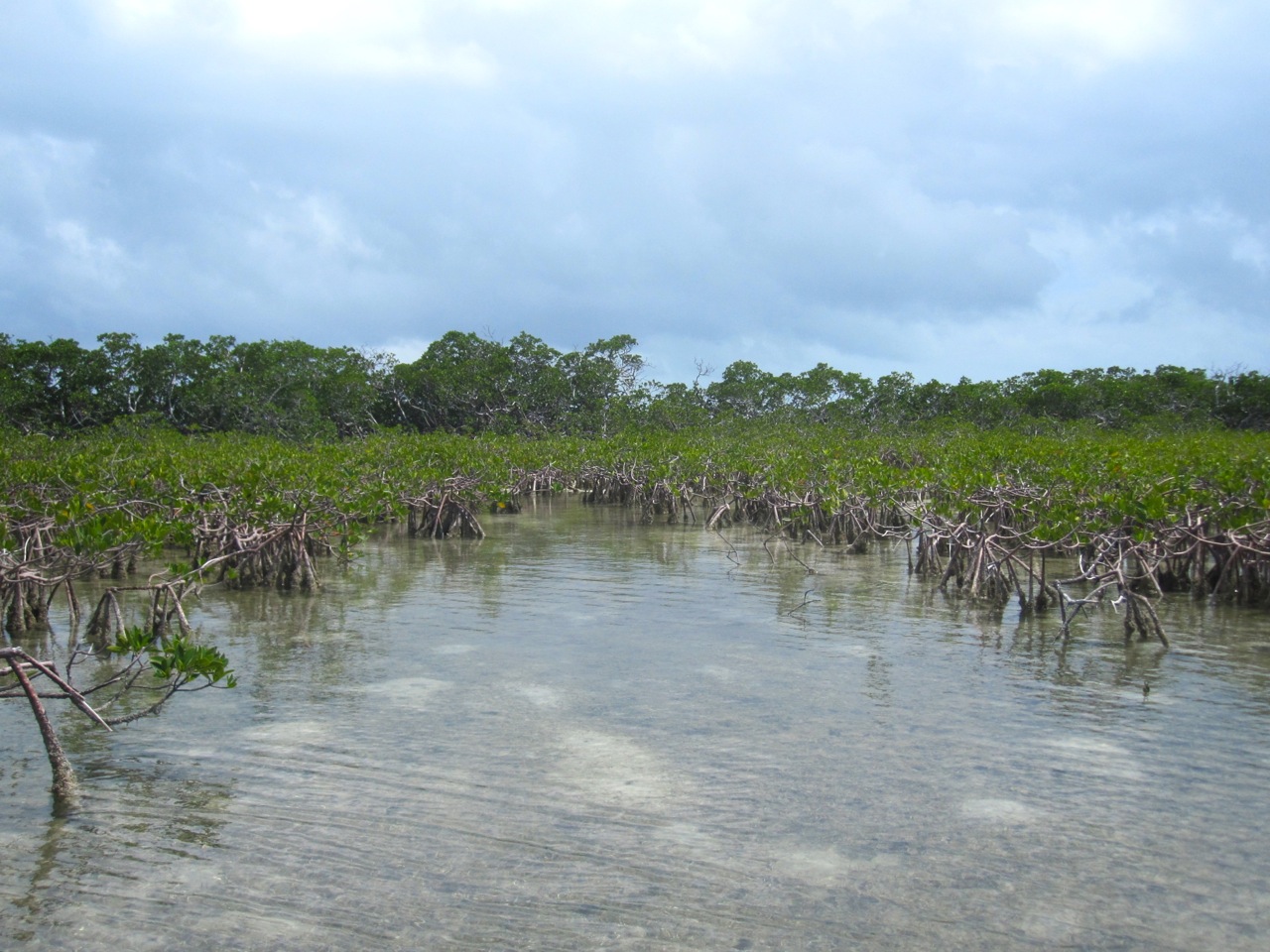
I recently posted a short video giving an idea what it is like on a skiff as it skims fast over the water to the bonefish feeding grounds of the Abaco MarlsSKIFF VIDEOHaving arrived among the mangroves where the bonefish are lurking, the game changes. Instead of the roar of the engine and bump of the waves, the engine is cut and in near-silence the guide poles the skiff very slowly through the low water…
There’s a regular gentle scrape of the long pole on the sea-bed, as all eyes – guide, the fisher ‘up front’, and fishing partner – scan the water and the margins of the mangroves for bonefish or signs of their feeding. There might be tell-tale grey holes in the sandy bottom – or, as below, a ‘push’ wave as one or more bonefish move on to another area
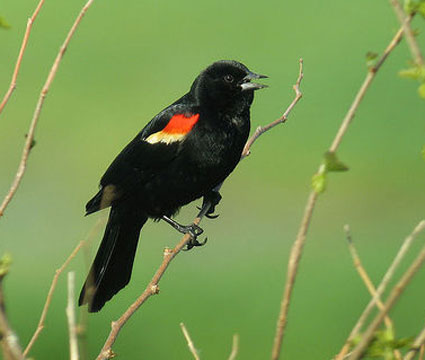
There are bird calls such as the strangely melancholic metallic double-note of the RED-WINGED BLACKBIRD sounding like a rusty door-hinge.
Otherwise, very little noise until… the urgently whispered “Hey! Bonefish 9 o’clock, 30 feet, moving right, 3 of them…” and the hunt is on
This short video shows the skiff’s slow progress across low clear water close to the edge of the mangroves, while we search for the dark shadows cast on the sand by the bonefish as they work their way through the flats hunting shrimps and small crabs… and in due course, with luck a well-placed “Delphi Daddy”
[vimeo https://vimeo.com/45498544]
Credits: Red-winged Blackbird call – Xeno-Canto; Video Music – Albert Ross (formerly of Fleetwood Mac); R-WB below – Cornell Lab of Ornithology
A SKIFF RIDE TO THE BONEFISHING GROUNDS OF THE ABACO MARLS
With a film budget of $2 (excluding travel costs to Abaco, incidental expenses at Delphi etc), RH Productions is proud to be able to bring you another movie that is arguably slightly less incompetent than the ones that have preceded it (the wretched STINGRAY; the marginally better BLUE TANGand REEF FISH & CORAL). Parts of this one are almost satisfactory. There’s a beginning, a middle and an end – in that order. And, best of all, it’s only a minute long. So sit back with your tub of popcorn and enjoy… oh, is that it already?
The skiff trip can be as much as 5 miles to reach the best places for bonefishing in the mangroves (I’ll post a video of that later on). The exact location can vary daily and depends on a variety of factors including the state of the tide, the wind strength / direction, and cloud cover. On this day the sea was glassy still; mostly it’s quite a choppy trip across open ocean; and when the wind has whipped up some waves, it is (a) exhilarating and (b) a constant reminder of the thin cushioning on the seats… I mention in passing that apart from topping and tailing the clip, muting the noise of the engine / wind, and adding music, this scene is just as it was live. There’s been no subtle blurring of the horizon or other work done – my editing techniques are far too rudimentary (i.e. non-existent). Best viewed full-screen, if you can find the gizmo (bottom right small square thing)
Music credit to the erstwhile litigious Joe Satriani
BONEFISHING! We will soon be back at the Delphi Club at last and out on the Marls in 10 days time. The slow-poled movement through the shallow waters. Keen eyes searching for moving shadows on the sand. The urgent half-whispered directions as bones are sighted. The swift confident raise of the arm and flick forward of the cast… and the tangled mass that lands 15 feet short and well behind the vanishing fish. I love it! The guides don’t, of course, but they are generally kind enough to keep their muttered imprecations barely audible. And occasionally there is a fortuitous hook-up. If exceedingly lucky, the obstacle of playing and bringing in the fish without it self-releasing prematurely is surmounted, and RH eventually boats a bone (see above).
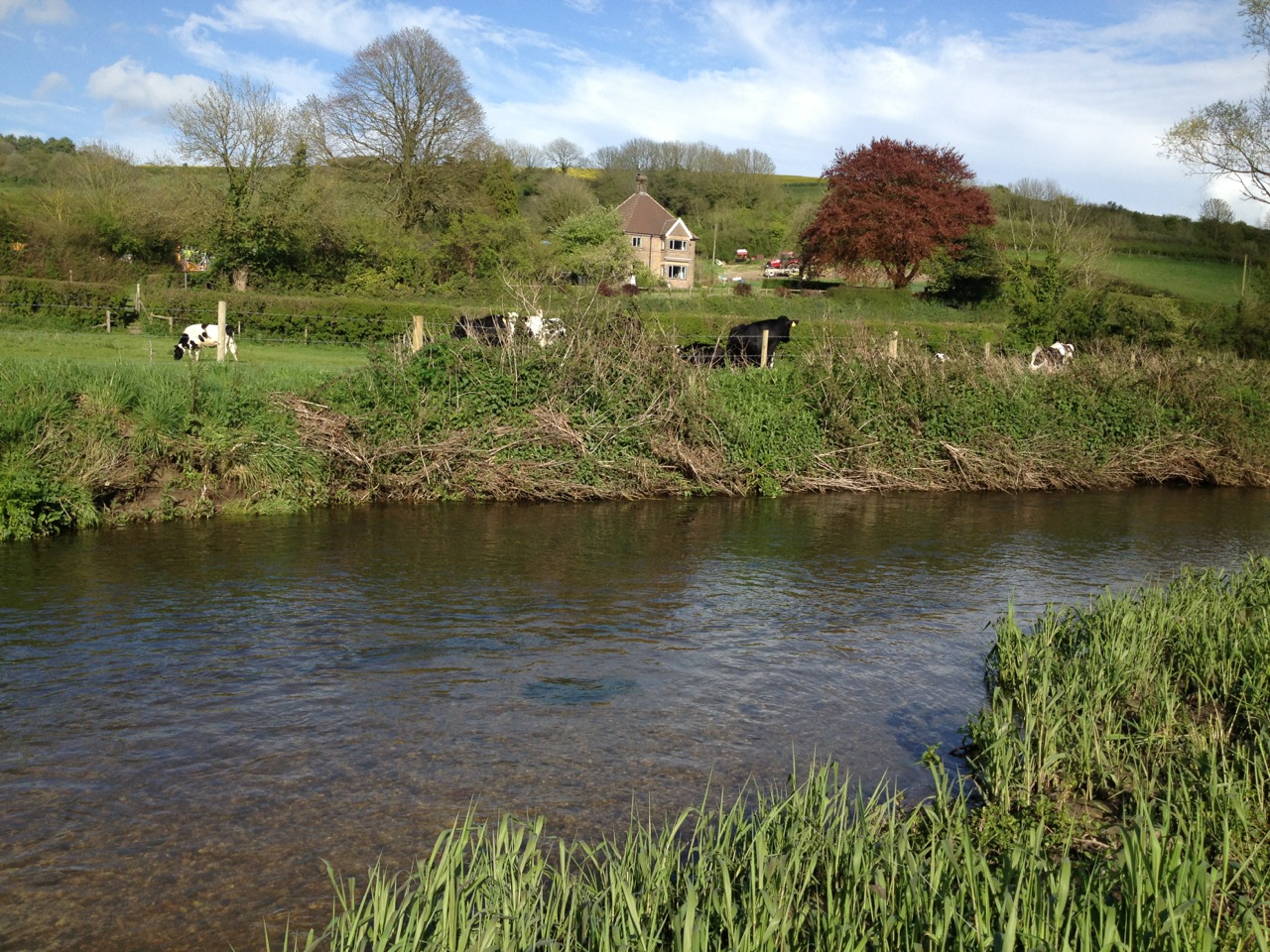
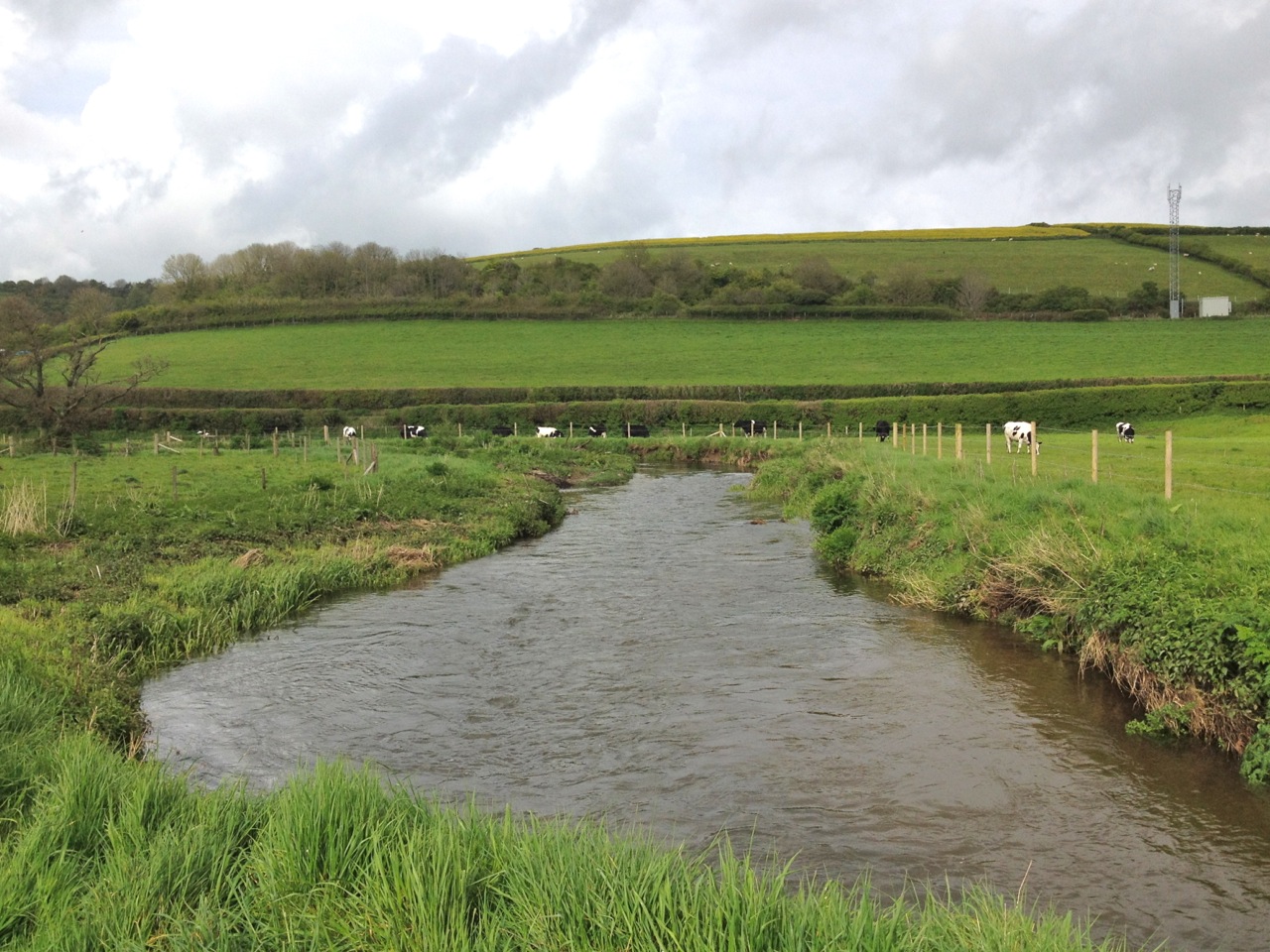
TROUTFISHING! At the moment I am sporadically fishing on the River Frome, the westernmost of the southern English chalk rivers. I’m after small wild brown trout, though the river also has sea trout and salmon. The weather has been cold, wet (hail!) and windy, and I have had roughly the same rate of success as with the bones. There have been experimental tugs at the fly. Times when, as I watch swallows skimming the water surface, a fish takes the fly and has spat it out by the time I have turned round to glimpse it dive below. And, as happened yesterday, it’s ‘Fish On’ – until it leaps clear of the water, effortlessly shakes out the (barbless) hook, and fins me a rude gesture as it plunges back. Plainly I need a brand new rod. And reel. And line. And jacket. And… It can’t possibly be operator error, can it? Anyway, this is all a world away (4,250 miles, in fact) from the Marls. It is pastoral fishing at its finest, even if the fish come out on top. Practice makes perfect, as they say… out with the willows, bring on the mangroves
(All exaggerations are strictly for comic effect. Except, tragically, there aren’t really any…)
It’s 7.15 and breakfast time at Delphi. At 8.00 the trucks, skiffs, guides and fishers will set off to the fishing grounds for the day, leaving you with an empty beach, shells, warm sea, the pool, the hammock and your book. For the moment, the talk is of the excellent ‘Full Abaco’ breakfast, the weather, ‘Delphi daddies’ & ‘crazy charlies’ and someone’s mislaid reel. Sandy enters to announce that there’s a place free on your partner’s skiff… and offers it to you. So what should you, a non-angler, expect of a day out on the flats?
THE SKIFFS These are top-of-the range boats, capable of considerable speed getting out to the fishing grounds. The ride can be bumpy, splashy and even chilly in the early morning, so bring a fleece and a waterproof top. Camera? Essential. Here is a Delphi skiff on a sand bar in Cherokee Sound, parked for lunch and some quality conch and sand-dollar hunting. So for a start, the day isn’t ALL about fishing…
THE FISHING GROUNDS You will leave from one of three launch points and speed across the water to the bonefishing areas. The main one is “Nettie’s”, with access via a narrow man-made channel to the Marls…
… more than two hundred square miles of mangrove swamp, islets, channels and fish. The journey to Nettie’s may seem quite a long way as you bump along through the pine forest on a network of logging tracks. Watch out for small birds flickering all around as you pass.
———————————
Launching a skiff at Nettie’s
Plans are hatchedGood to go…
Stowing gear in the front (forrard?) locker. There’s also one behind the seats for the lunch cool boxes. And the fuel…
The other two launch areas are Crossing Rocks (a short drive south of DCB) or Casuarina Point for Cherokee Sound (a slightly longer drive north of DCB)
The jetty at Crossing Rocks – skiffs being prepared
The launch point at Casuarina. A channel leads out to Cherokee Sound
Two boats in the channel – the authentic James Bond chase experience
WHAT’S THE POINT? Bonefishing! You’ve heard all the Club talk, you’ve seen your partner fussing over all those bits and pieces in your room: now see it in action. Once you get out to a fishing area, the guide cuts the engine… and suddenly you are being poled very slowly and almost noiselessly across the shallow flats
The guide stands on the platform at the back of the skiff, using the advantage of height to scan the shallow water; the fisher stands at the front looking tensely for grey shadows underwater, waiting for the magic words…
“…hey, bonefish, 10 o’clock, 4 of them moving right, 30 feet… see them?”
And it’s ‘game on’. This isn’t the place for a discourse about casting technique and style – I have neither (Sandy, of me: “Muppet”) – but I promise that you will get completely caught up in the excitement when a fish takes the fly and takes off towards the horizon, stripping the line and backing from the reel… (I realise the image above may suggest… well he’s just fishing, OK?)
THE QUARRY – grey ghosts below water, bars of silver above. Caught on the ‘fly’ which are in fact shrimp or crab imitations, with barbless hooks to make the chance of losing a fish that much greater… This ensures that a boated fish can be returned to the water as easily and quickly as possible. It’s all ‘catch and release’, though some (me) find that mostly the fish very sensibly self-release long before they ever reach the boat…
Abaco bonefish off Crossing Rocks (just caught and released)Guide Ishi with Abaco bonefish caught on the MarlsGuide Robin Albury removes the barbless hook before returning the fishA good specimen‘Ishi’s Fishy’, as he would say
There is even the possibility that at some stage you may unexpectedly be handed a rod (even if you have never held one before, or wanted to) with ‘fish on’… Here, Robin has hooked a 2.5 lb fish and handed the rod to Mrs RH (then engrossed in eating a cheese roll) who successfully played and brought in her first ever fish…
PART 2 will deal with what else goes on during the day: the scenery, birdlife, sharks, turtles, blue holes and so forth. For now, here is a short clip of the skiff ride out to the Marls, to give you an idea. NB this was a very calm day – things can get a little bumpier and wetter at times. The seats are padded, but not very…
[Ultra-cautious music credit to Joe Satriani who sued Coldplay for alleged tune ‘borrowing’ saying “I felt like a dagger went right through my heart. It hurt so much”. Case dismissed + unspecified settlement… Way to go, Joe! Want to check? Cut ‘n’ paste this: http://www.youtube.com/watch?v=zjB024bZoB4&feature=fvwrel Then by way of counterbalance try John Lennon’s Imagine vs Coldplay’s ‘Fix you’ at (cut ‘n’ paste) http://www.youtube.com/watch?v=DksjpsAe3vk&feature=endscreen&NR=1]



 PS No terns were hurt trying to get the yellow crown to fit one of them. In fact, they rather enjoyed it…




















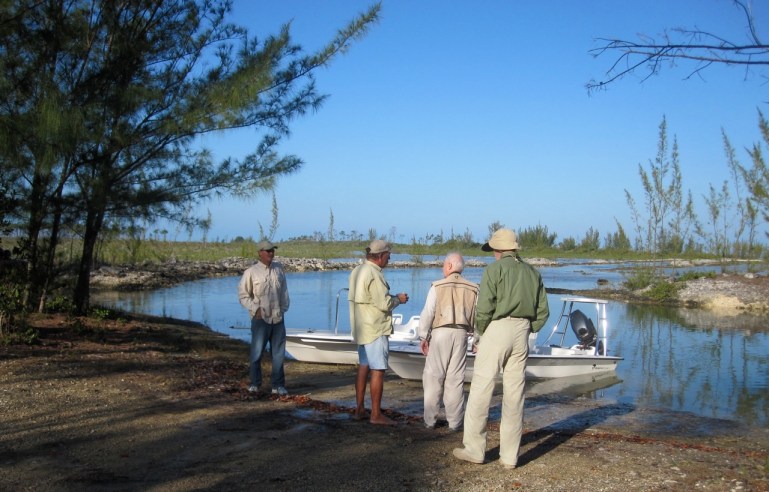 Good to go…











 ROLLING HARBOUR ABACO
You must be logged in to post a comment.