Unknown's avatar

MAKE FRIENDS WITH ANEMONE (2): SPECTACULAR REEF LIFE


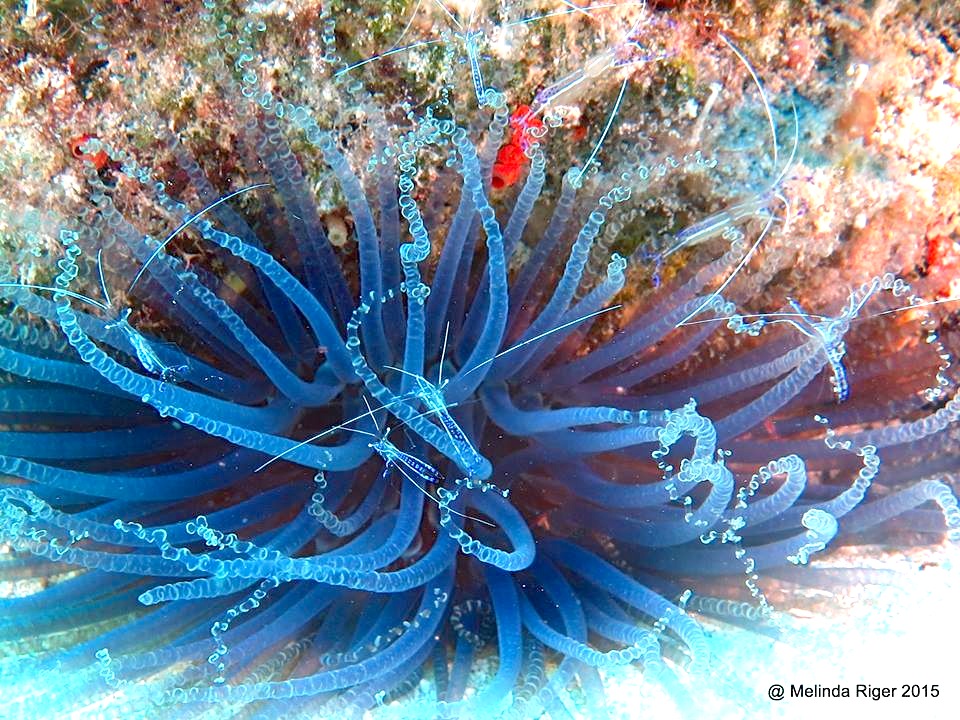
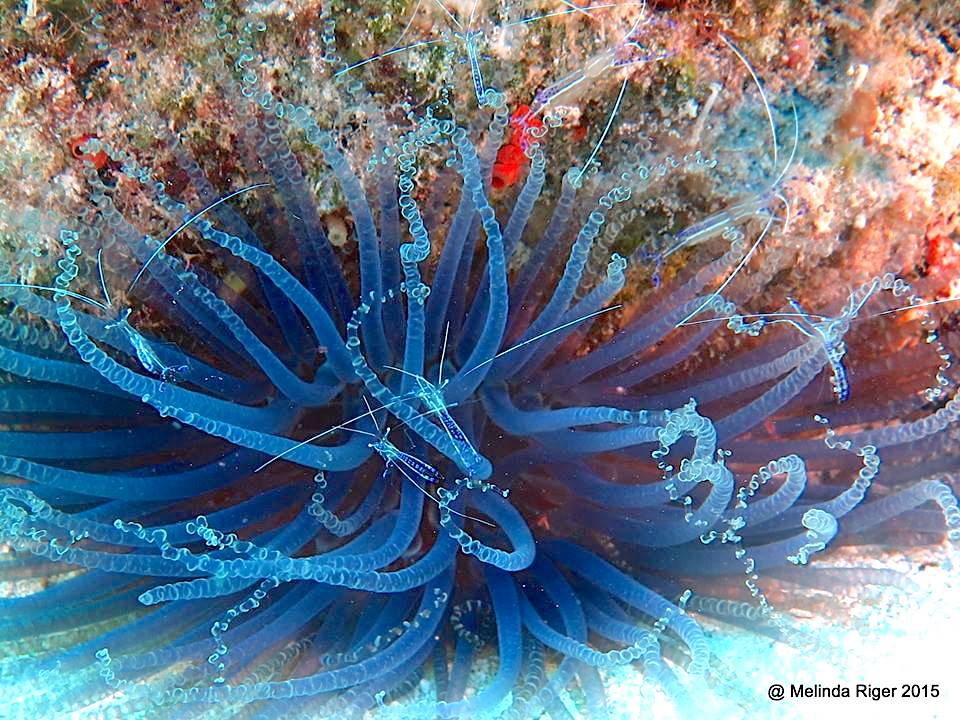
Corkscrew Anenome = Peterson Cleaner Shrimps ©Melinda Riger @G B Scuba copy

Corkscrew Anemone with Peterson Cleaner Shrimps

MAKE FRIENDS WITH ANEMONE

Going snorkelling? Planning a scuba day on the reef? You’ll see wonderful fish and amazing coral for sure. But sometimes the beauty of other life on the reef can be overlooked. Check out the anemone in the header image, with the camouflaged cleaner shrimps playing around it. You wouldn’t want to miss a sight like that. The many and varied forms and colours of anemone on the reefs of the Bahamas make up a vital component of a spectacular underwater world and its astonishing variety.

Giant Anenome ©Melinda Riger @ G B Scuba copy

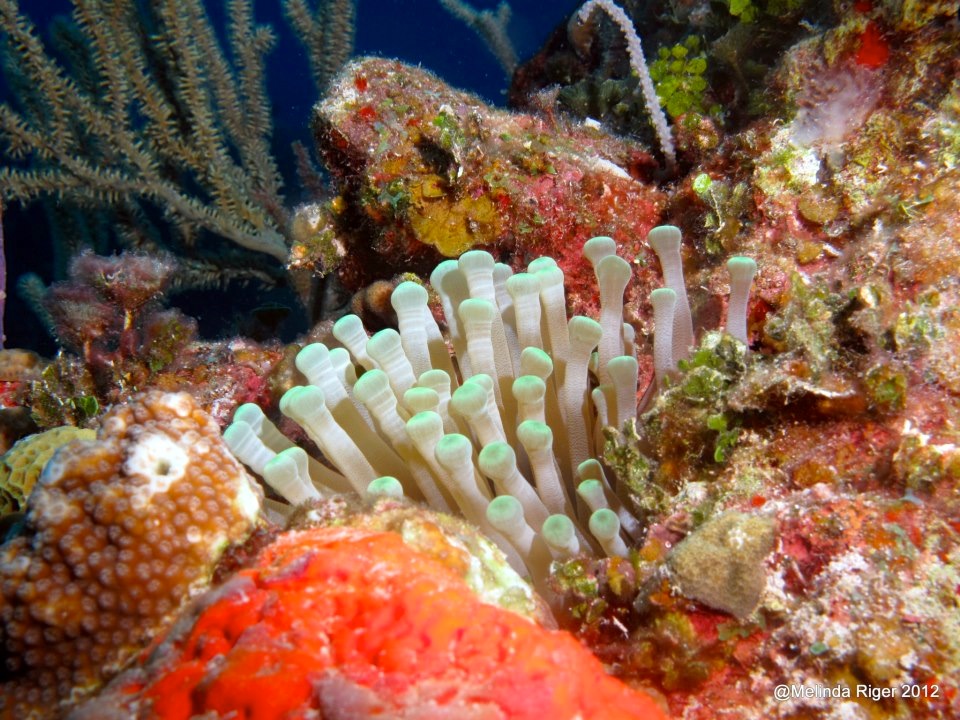
Anemones are living animals of the invertebrate type. Basically living corals without skeletons. All have stinging cells of several varieties to sting or entangle their prey such as small fish, or other invertebrate species.

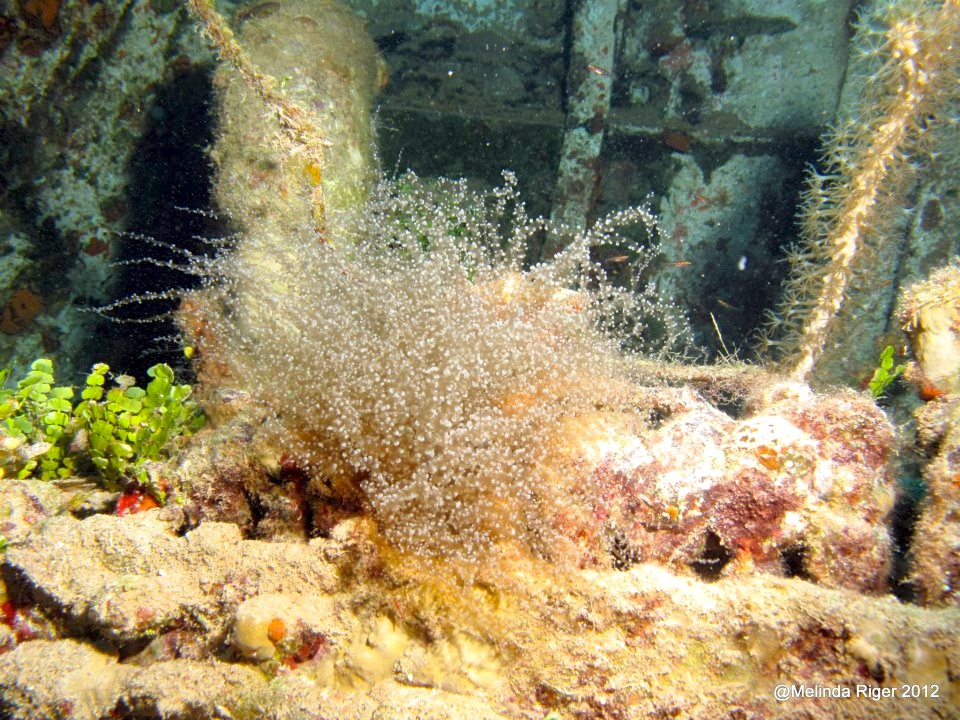
Anemone on Rope ©Melinda Riger @ G B Scuba

Most anemones host varieties of cleaner shrimps. They also provide a base for the snapping shrimps that can stun their own prey. Some of these can (painfully) penetrate human skin.

Anemone ©Melinda Riger @ Grand Bahama Scuba

Some crabs pull particular species of anemone off the reef and attach them to their carapace. This is thought to have a double purpose of providing both camouflage and protection.

Anemone (Giant) ©Melinda Riger @GBS copy

All great archive photos: Melinda Riger of Grand Bahama Scuba, with thanks; also Rick Guest for info

Anemone ©Melinda Riger @ GB Scuba


Unknown's avatar

CLEANING UP IN THE BAHAMAS: PEDERSON SHRIMPS


Pederson's Cleaning Shrimp, Bahamas (Melinda Riger, GB Scuba)


CLEANING UP IN THE BAHAMAS: PEDERSON SHRIMPS 

Pederson’s Shrimps Ancylomenes pedersoni (also known locally as Peterson’s shrimps), are one of several species of cleaner shrimp found in The Bahamas, and more generally in the Caribbean seas. The species was named in 1958 by a multifaceted medico-oceanologist-zoologist Fenner A. Chace. He seems to have specialised in shrimps, finding distinct and differing species and naming them (not unreasonably) after himself (chacei); or colleagues and people he knew / admired; and in one case his wife. Mr Pederson was among the lucky ones.

Pederson's Cleaning Shrimp, Bahamas (Melinda Riger, GB Scuba)

This tiny transparent creature with its vivid blue / purple markings and straggling pale antennae is unmistakeable, and helpfully cannot be confused with any other locally found shrimp species. Here’s an idea of its size, compared with a human finger and a blue parrotfish (on its flank).

Pederson's Cleaning Shrimp, Bahamas (Melinda Riger, GB Scuba)

WHERE DO THESE SHRIMPS LIVE?

Their preferred home is… and it’s certainly a left field choice among sea creatures… in amongst the stinging tentacles of certain sea anemones. Not only do they not get stung, but of course they are well-protected by the defensive pain that their hosts can inflict on intruders. They are usually found singly or in pairs, but sometimes a whole colony may inhabit the same anemone.

SO EXPLAIN HOW THEY DON’T GET STUNG

Ok. The shrimps gradually build up a kind of resistance by pressing their bodies and antennae against the tentacles of the host anemone for increasing lengths of time, until they become immune. It’s like one of those kids’ electric buzzer / rheostat machines. Or a TENS machine (for those who know about backache).

 IS THERE A DOWNSIDE TO ALL THIS?

Yes indeed. If a shrimp moves away from its host for a few days, it has to start the process of immunisation all over again. So presumably they tend to stay home-lovin’.

Home sweet home for the Pederson shrimpsPederson's Cleaning Shrimp, Bahamas (Melinda Riger, GB Scuba)

SOMETHING ABOUT THE CLEANING, PLEASE

These shrimps offer ‘cleaning services’ to passing fish. When on duty, as it were, they wave their antennae vigorously to attract attention. A fish being cleaned will remain stationary and passive while external parasites and dead skin are removed. Many fish will open their mouths and gill covers for internal cleaning, with the tacit agreement that the cleaner will not become a snack. Shrimps often work in conjunction with small cleaner fish such as some species of goby and wrasse – see the links below for more on this topic, with copious images…

Pederson's Cleaning Shrimp, Bahamas (Melinda Riger, GB Scuba)

RELATED POSTS

CLEANING STATIONS

CLEANER FISH

Credits: all photos by Melinda Riger / Grand Bahama Scuba

Unknown's avatar

IS THIS THE REAL LIFE? IS THIS JUST FANS AT SEA?


Purple sea fan, Bahamas (Melinda Riger / Grand Bahama Scuba)


IS THIS THE REAL LIFE? IS THIS JUST FANS AT SEA?


A GALLERY OF GORGEOUS GORGONIANS 

Purple Sea Fans, Abaco, Bahamas (Dive Abaco / Keith & Melinda Rogers)

The waters of Abaco teem with myriads of fish that depend on the coral reefs for shelter and safety, for breeding, for growing up in, and for nourishment. Sea fans (or gorgonians, to use the technical name) are animals too. They may look like plants and stay rooted to the spot, but like anemones these ‘soft corals’ are creatures of the reef and essential indicators of its health.

Purple sea fan, Bahamas (Melinda Riger / Grand Bahama Scuba)

Purple sea fan, Bahamas (Melinda Riger / Grand Bahama Scuba)

The purple sea fan Gorgonia ventalina (classified by Linnaeus in 1785) is one of the most common species of sea fan, and a spectacular one at that. The main branches are linked by a lattice of smaller branches. Below the ‘skin’ is a skeleton made of calcite compounded with a form of collagen.

Purple sea fan, Bahamas (Melinda Riger / Grand Bahama Scuba)

Purple Sea Fans, Abaco, Bahamas (Dive Abaco / Keith & Melinda Rogers)

Sea fans are filter-feeders, and have polyps with eight tiny tentacles that catch plankton as it drifts past. They develop so that their orientation is across the prevailing current. This maximises the water passing by and consequently the supply of food as the fans gently wave in the flow.

Purple Sea Fans, Abaco, Bahamas (Dive Abaco / Keith & Melinda Rogers)

Purple Sea Fans, Abaco, Bahamas (Dive Abaco / Keith & Melinda Rogers)

Gorgonians have a chemical defence mechanism that protects against potential troublemakers. The main effect is to make themselves unpleasant to nibble or uproot.

Purple Sea Fans, Abaco, Bahamas (Dive Abaco / Keith & Melinda Rogers)

One species impervious to this deterrent is the fascinating FLAMINGO TONGUE SNAIL. Other ‘safe’ species include the fireworm and BUTTERFLYFISHES.

Purple Sea Fans, Abaco, Bahamas (Dive Abaco / Keith & Melinda Rogers)

One benefit of sea fans to mankind is that their defensive chemicals have been discovered to provide the basis for drug research and development, specifically in the field of  anti-inflammatories. Another benefit, of course, is that they are very beautiful to look at. Thank you, Fans

Purple Sea Fans, Abaco, Bahamas (Dive Abaco / Keith & Melinda Rogers)

Purple Sea Fans, Abaco, Bahamas (Dive Abaco / Keith & Melinda Rogers)

Credits: these wonderful photos were taken by Melinda & Keith Rodgers / Dive Abaco, Marsh Harbour; and Melinda & Fred Riger / Grand Bahama Scuba. Huge thanks to them all for allowing me to freely use their skilful underwater photography in this blog for the best part of a decade.


A SPECIAL FAN FOR A HAPPY AND HOPEFUL TURN OF THE YEAR

Purple Sea Fans, Abaco, Bahamas (Dive Abaco / Keith & Melinda Rogers)

Unknown's avatar

PURPLE VASE SPONGES: BAHAMAS REEF ORNAMENTS


Purple Vase Sponge, Bahamas (Melinda Riger / G B Scuba)

PURPLE VASE SPONGES: BAHAMAS REEF ORNAMENTS

The Purple Vase is an unmistakeable sponge, a colourful reef creature (for they are animals, of course) that stands even out amongst the bright corals that surround it. And like corals, sponges are vulnerable to all the usual threats (mainly human-generated).

Purple Vase Sponge, Bahamas (Melinda Riger / G B Scuba)

Catch them while you can in the clear waters of the Bahamas while stocks last. I say this because as study after study concludes, the prospects of reef-mageddon get closer each year. When the corals die off, so in all probability will the sponges and anemones…

Purple Vase Sponge, Bahamas (Melinda Riger / G B Scuba)

After such a depressing intro, let’s move on to take a positive look at the purple vase sponge. As with all sponges, once a newborn sponge is wafted by the current to a place on the reef, it takes root there throughout its life. There, these attractive sponges exist by filtering the water that surrounds them, separating out plankton to feed on. Static filter-feeders, if you will.

Purple Vase Sponge, Bahamas (Melinda Riger / G B Scuba)

You’ll notice that in some of the photographs, the sponges have guests. These are BRITTLE STARS, and they are often found on – and indeed in – purple vases. This is a form of symbiotic relationship known as commensalism, in which one species benefits and the other is neither benefitted nor harmed. The brittle star gains a shelter and a safe base for feeding; the vase gets a harmless companion. Small fishes benefit from the vases in a similar way.

Purple Vase Sponge, Bahamas (Melinda Riger / G B Scuba)

Besides the impact of damaging human interventions (which may be permanent), extreme weather events also affect reef life and the static inhabitants adversely. Storms and hurricanes can cause localised havoc, but the damage is not necessarily permanent. The reef can in time repopulate naturally and flourish again. Humans can even promote this recovery. The photograph above shows a purple vase sponge that was detached from the reef by Hurricane Matthew in October 2016. Melinda Riger in effect replanted it on the reef and it reattached itself and grew. In due course it even acquired its brittle star occupant. 

Purple Vase Sponge, Bahamas (Melinda Riger / G B Scuba)

*JIMI AND ‘PURPLE VASE’ – A VOLUNTARY MUSICAL DIGRESSION

In an interview with NME Hendrix is reported to have said that Purple Haze “was about a dream I had that I was walking under the sea.” Originally the song was intended to be ‘Purple Vase’, and reflect the psychedelic experience of life on a coral reef. Realising he was getting bogged down by sub-aquatic imagery (he was a non-swimmer), he toked for a while and then ‘Purple Haze’ emerged almost fully formed. Jimi was always far happier kissing the sky than wandering about under water. Most covers of the song are pale imitations of the original, but here’s a rather unusual take that succeeds by trying a different approach. 

Credits: Melinda Riger / Grand Bahama Scuba for all great photos; magpie pickings for bits and pieces, with a shout-out to ‘Critter Squad’ for its informative site aimed at kids. And amateur grown-ups can benefit too… commensalism in humans; Friend ‘n’ Fellow audio

Purple Vase Sponge, Bahamas (Melinda Riger / G B Scuba)

Unknown's avatar

CHRISTMAS TREE WORMS: SEASONAL SPIROBRANCHES


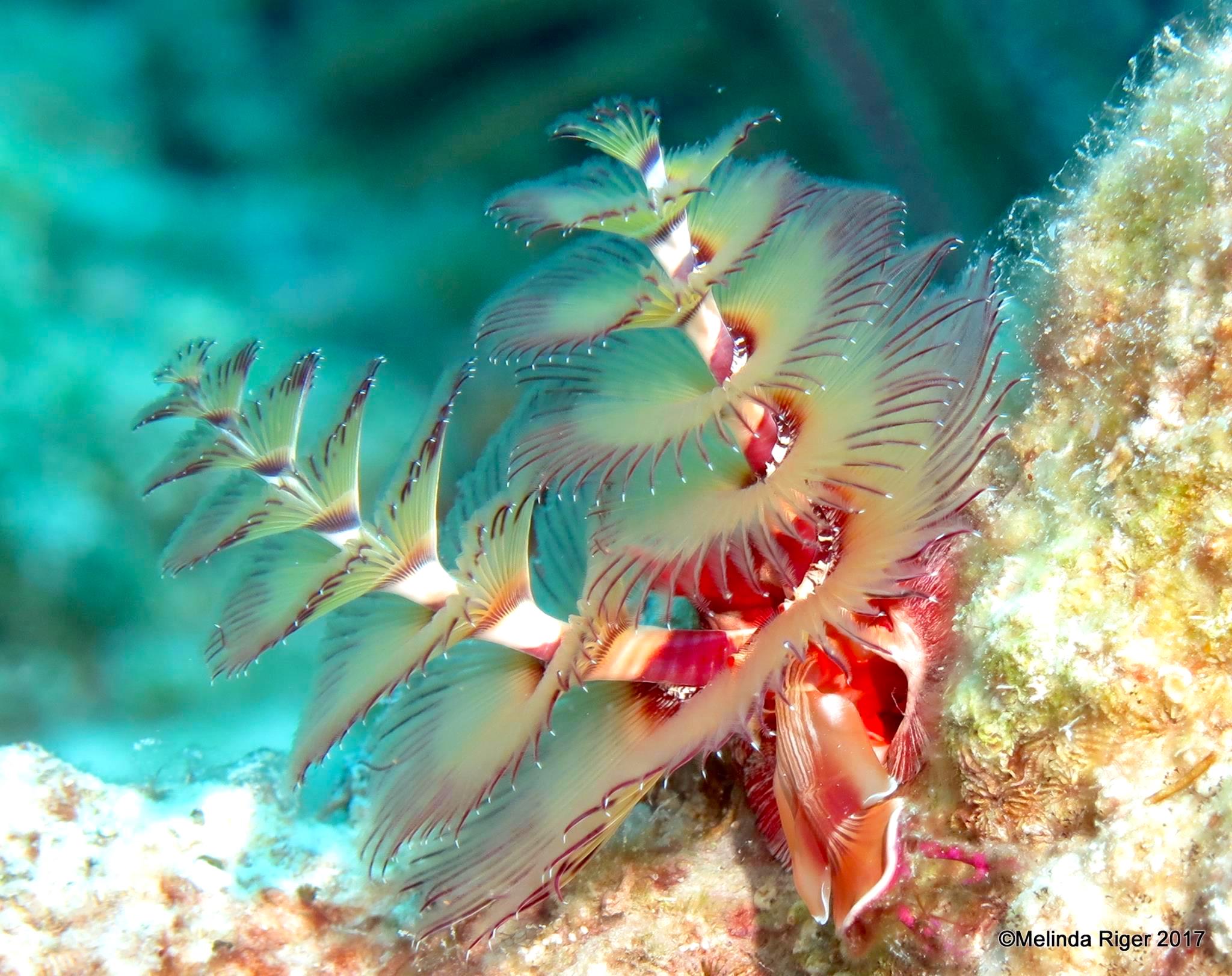
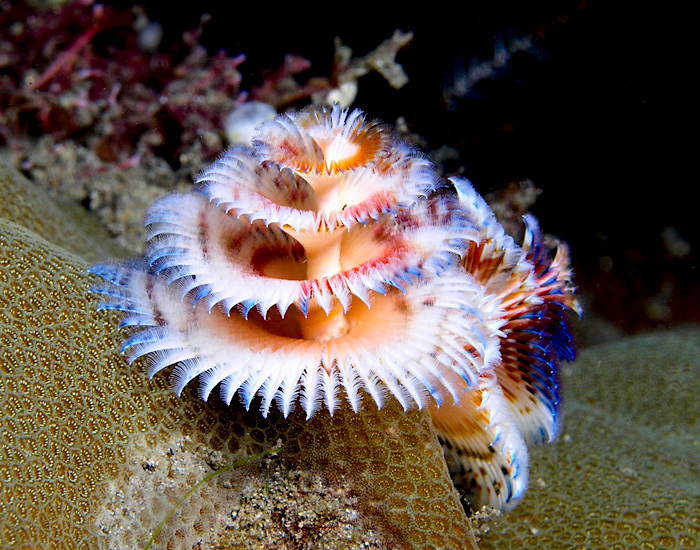
Christmas Tree Worm (Melinda Riger / Grand Bahama Scuba)

CHRISTMAS TREE WORMS: SEASONAL SPIROBRANCHES

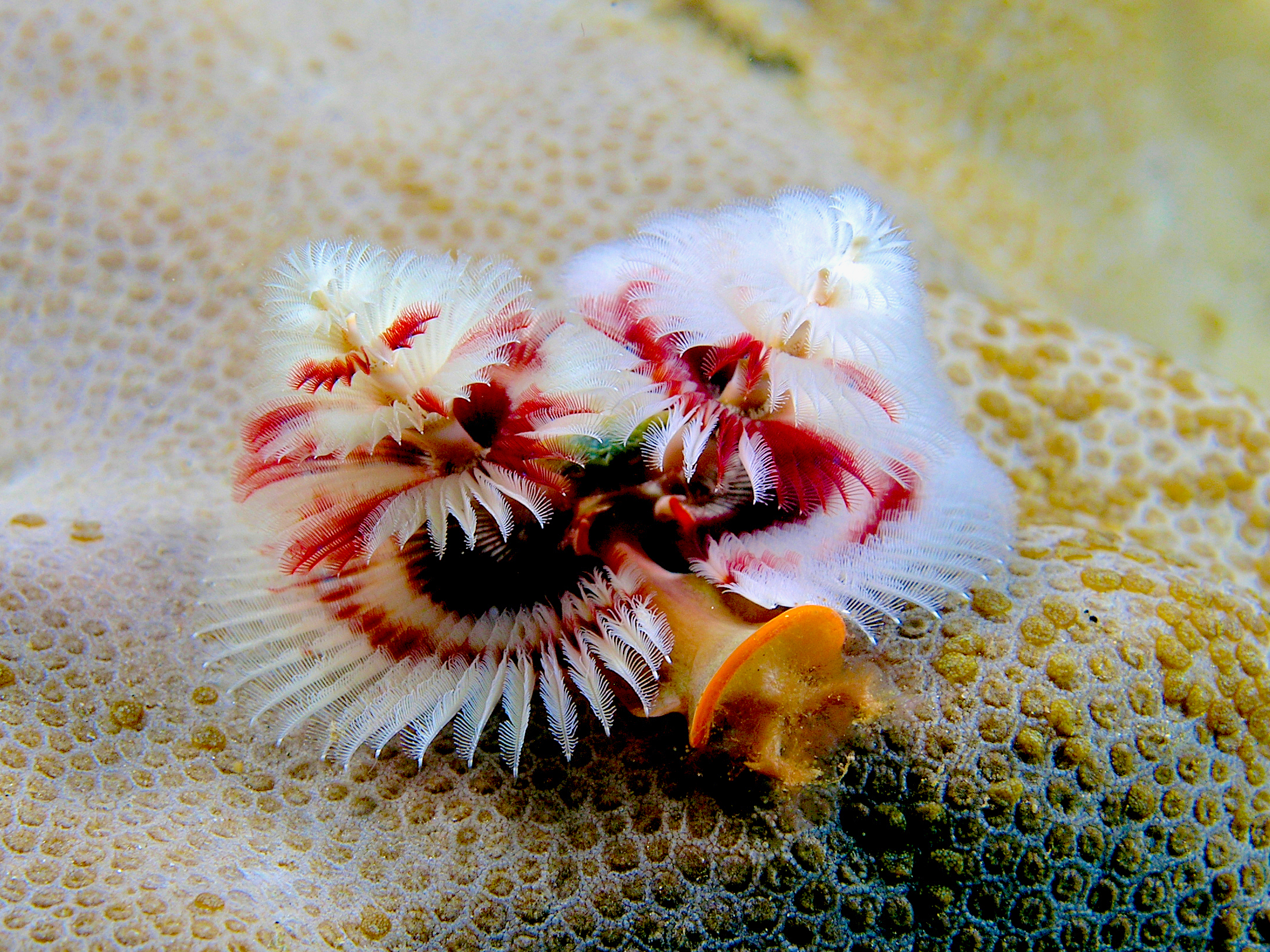
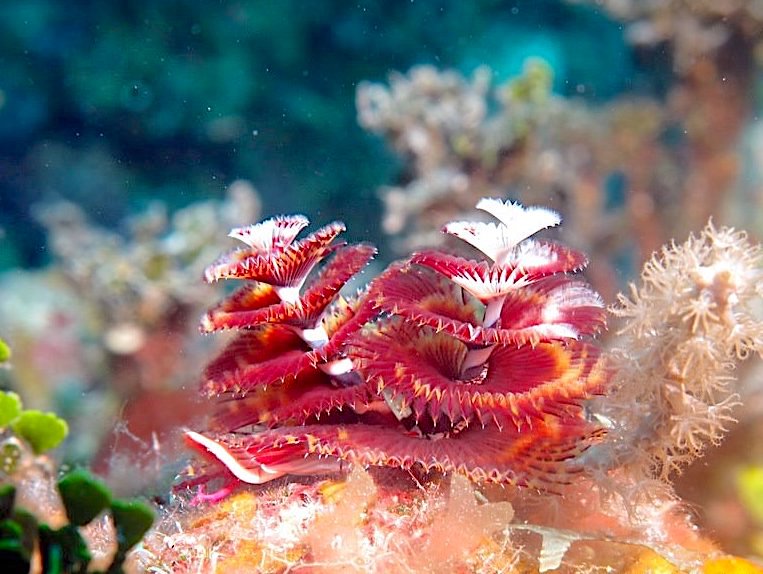
music-notes-clip-art-png-musicDeck the Reefs with Worms Like Christmas Trees… Fal-La-La-etc-etc ” is a traditional Carol familiar to all. Well, most. Ok, some, then. Oh right – maybe with different words? Anyway, now is the perfect time to take a look at these remarkable subsurface symbols of seasonal good cheer (nb they are wonderful animals not gorgeous plants).

christmas-tree-worm-melinda-riger-g-b-scuba

10 CHRISTMAS TREE WORM FACTS TO PONDER

  • The 2 colourful spirals are not the worm, but complex structures for feeding & respiration
  • The spirals act as specialised mouth extensions for ‘filter-feeding’
  • Prey is trapped by the feathery tentacles & guided by cilia (microscopic hairs) to the mouth
  • The tentacle things are radioles and act as gills for breathing as well as prey traps
  • There is little evidence that prey slide down the spiral to their doom, like on a helter-skelter

Christmas Tree Worm (Neil Hobgood Wiki)Christmas Tree Worm (Melinda Riger / Grand Bahama Scuba)

  • The actual worm lives in a sort of segmented tube, with extremely limited mobility skills
  • It contains digestive, circulatory & nervous systems – and a brain in the middle of it all
  • The worm also has a tiny drainage tube (I think I have this right) for excretion etc
  • They embed themselves into heads of coral such as brain coral. And stay there
  • And yes, the Christmas trees are retractable… (see below for some action)

spirobranchus_giganteus_orange_christmas_tree_worm-nick-hobgood-wiki

HOW DO THE WORMS… YOU KNOW…  ERM… REPRODUCE?

This is a delicate area. They are very discreet, but as far as I can make out they eject gametes from their what-I-said-above. There are mummy and daddy worms, and their respective gametes (eggs and spermatozoa) drift in the current and into each other to complete the union. The fertilised eggs develop into larvae, which settle onto coral and burrow into it as their parents did, build their protective tubes, and the process begins again.

christmas_tree_worm-nick-hobgood-wiki

blue_christmas_tree_worm-betty-wills-wiki

YOU DON’T REALLY UNDERSTAND THESE CREATURES, DO YOU?

I won’t lie. I found it hard to work out how the CTWs function in practice. There are plenty of resources showing them in their full glory, but that only takes one so far. Then I came across a short video that shows it all brilliantly simply (except for the reproduction part).

The worms, in their coral burrows, hoist their pairs of ‘trees’. You can easily see small particles – zooplankton – drifting in the water, and the radioles swaying to catch potential food. Suddenly it all makes sense (except the repro bit – I haven’t found footage of that).  Next: the New Year Worm (there is no Easter worm).

A WHOLE FESTIVAL OF CHRISTMAS TREE WORMSChristmas Tree Worms (Neil Hobgood Wiki)

Credits: Melinda Riger (Grand Bahama Scuba); Nick Hobgood; Betty Wills; Video by ‘Super Sea Monkey’; Reef Collage by RH; MarineBio; Wikibits & Magpie Pickings

Happy Christmas to all those who put up with RH with such fortitude over many years

Unknown's avatar

URCHIN RESEARCHIN’: SEA HEDGEHOGS OF THE REEF


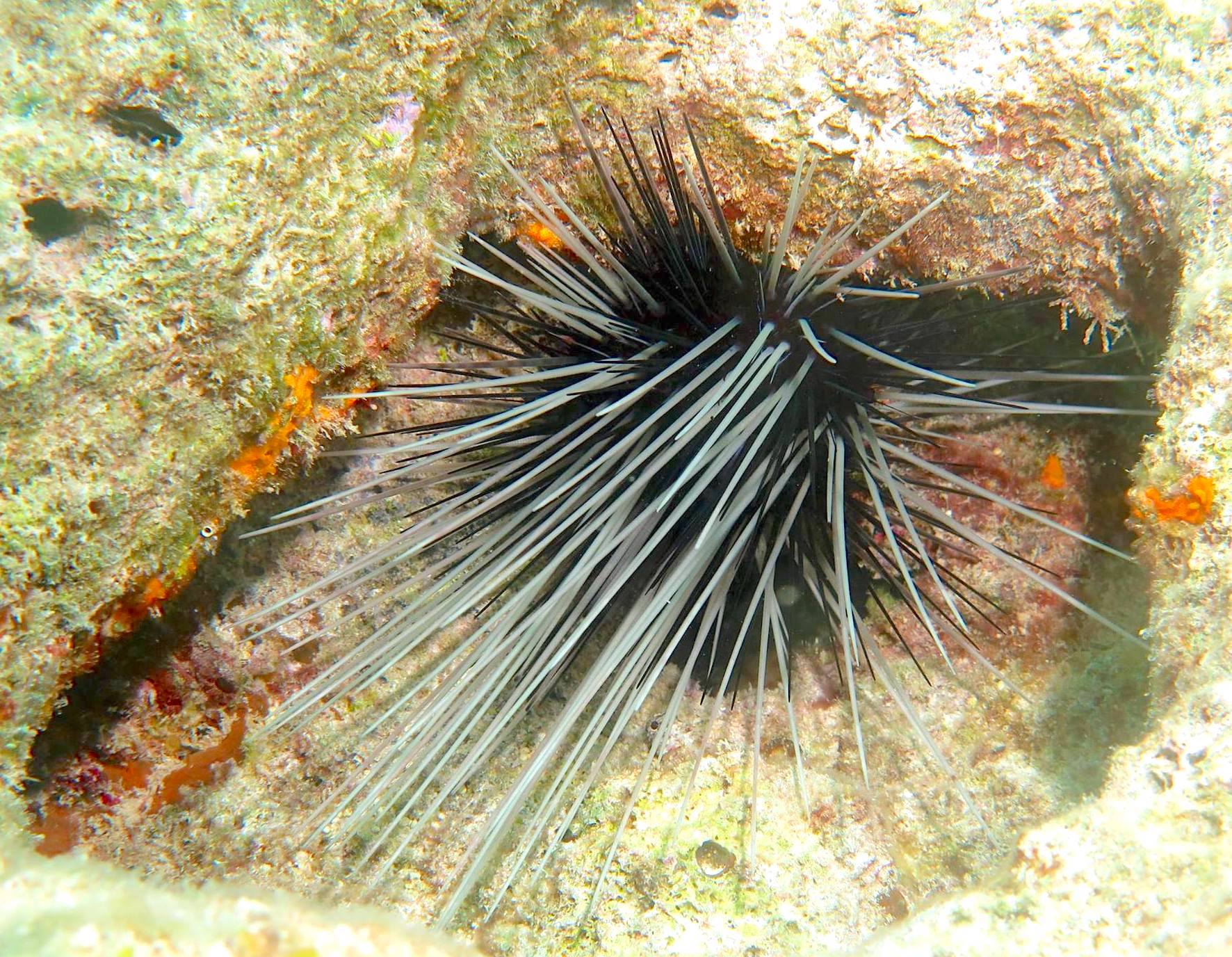
Long-spined sea urchin Diadema antillarum (Melinda Rodgers / Dive Abaco)


URCHIN RESEARCHIN’: SEA HEDGEHOGS OF THE REEF

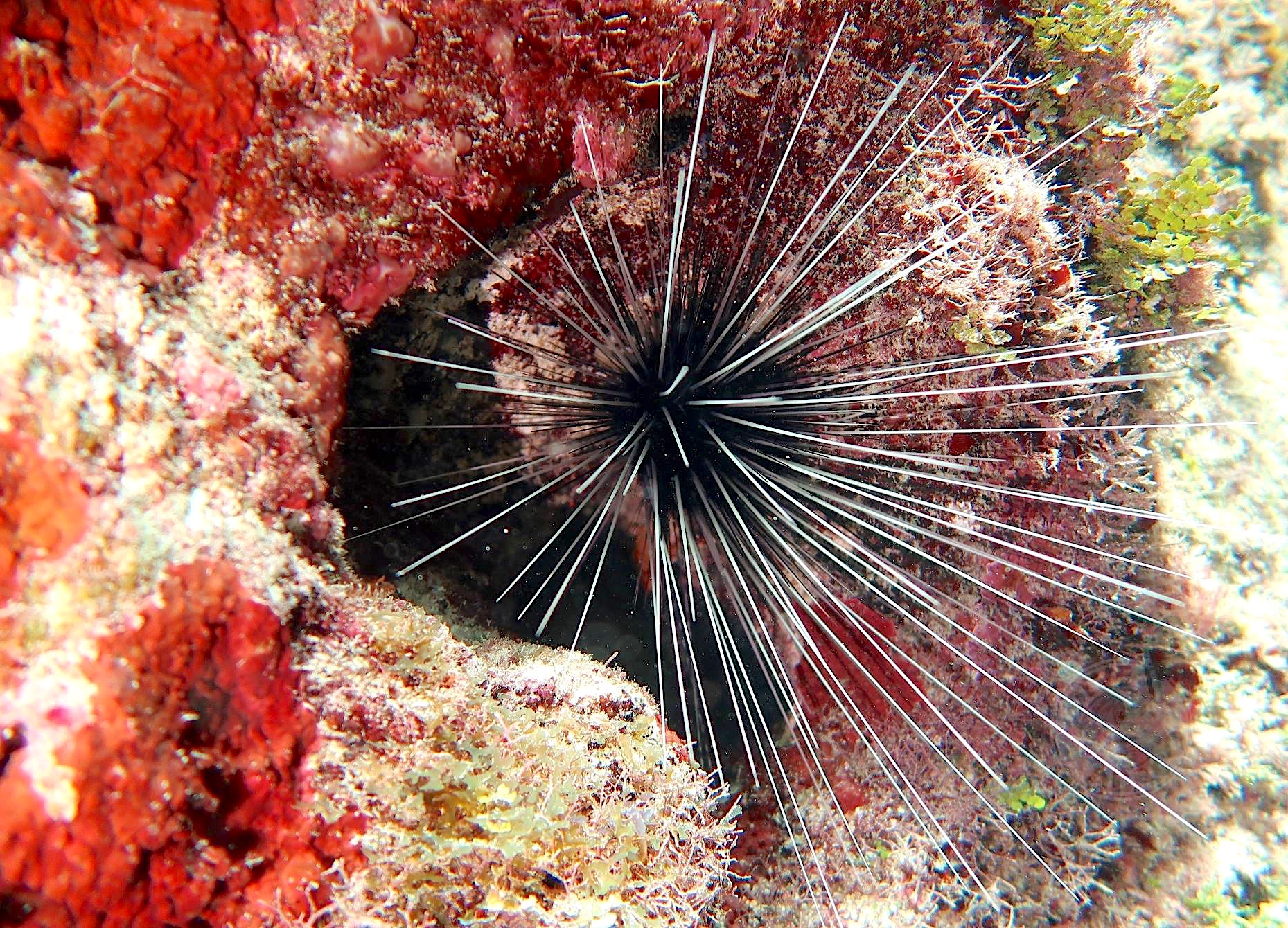
The long-spined sea urchin Diadema antillarum featured in this post is one of those creatures that handily offers its USP in its name, so you know what you are dealing with. Something prickly, for a start. These are creatures of the reef, and many places in the Caribbean and in the western Atlantic generally sustain healthy populations.

Long-spined sea urchin Diadema antillarum (Melinda Rodgers / Dive Abaco)

These animals are essentially herbivores, and their value to vulnerable coral reefs cannot be overstated. Where there is a healthy population of these urchins, the reef will be kept clean from smothering algae by their methodical grazing. They also eat sea grass.

Long-spined sea urchin Diadema antillarum (Melinda Rodgers / Dive Abaco)

HOW DO THE SPINES OF DIFFERENT KINDS OF URCHIN COMPARE?

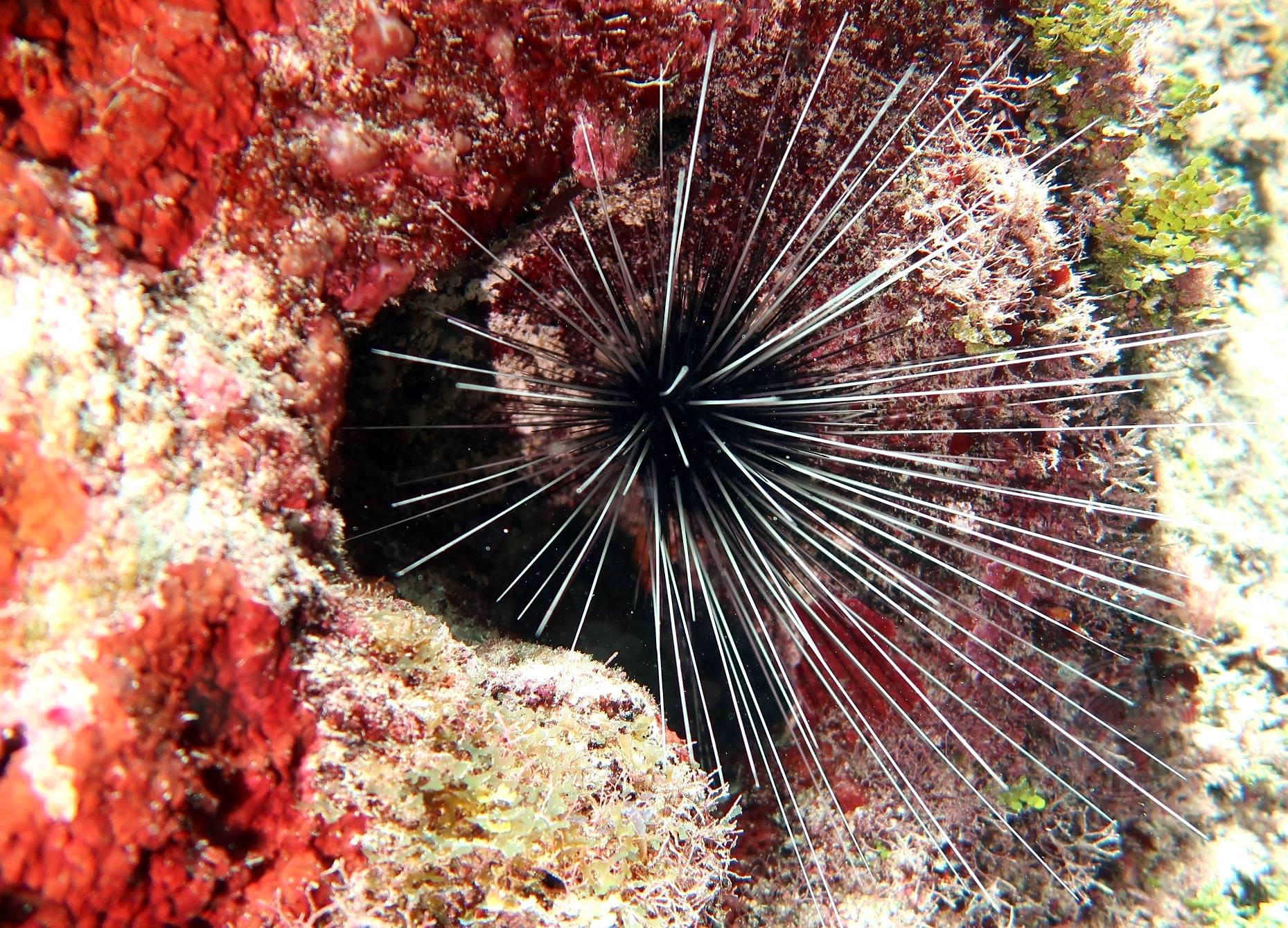
Small sea urchin species have spines a few cms long at most. The long-spine variety can exceed 10 cms, and the largest may have spines up to 30 cms (= 1 foot) long. The length, as shown here, means that when the creatures are safely lodged in crevices near their algae supply, their spines remain very visible.
 
Long-spined sea urchin Diadema antillarum (Melinda Riger / G B Scuba)
 
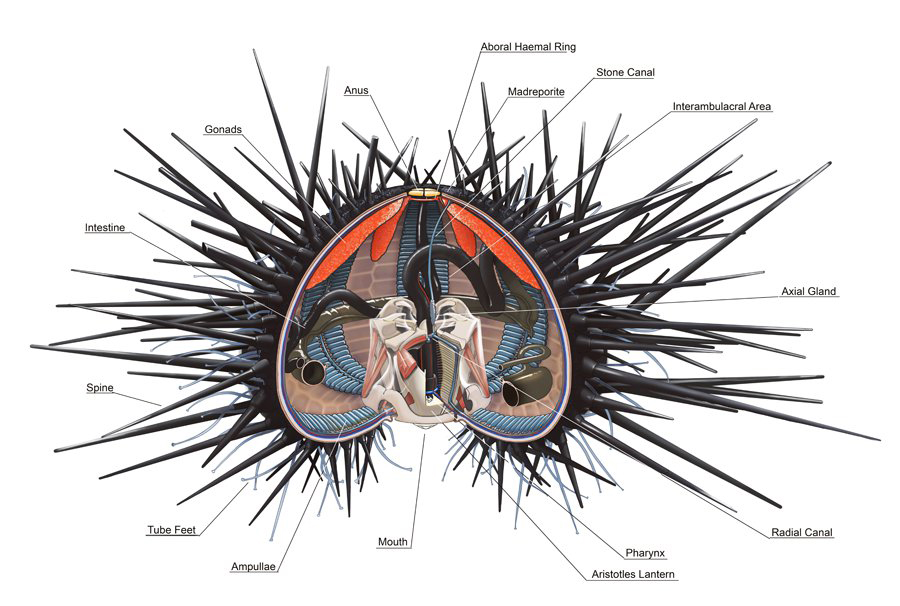
Anatomy of a long-spined sea urchin. You may possess a few of these organs yourself…

Long-spined sea urchin Diadema antillarum anatomy diagram (wiki)

Long-spined sea urchin Diadema antillarum (Melinda Rodgers / Dive Abaco)

CAN YOU GIVE US A TEST, PLEASE?

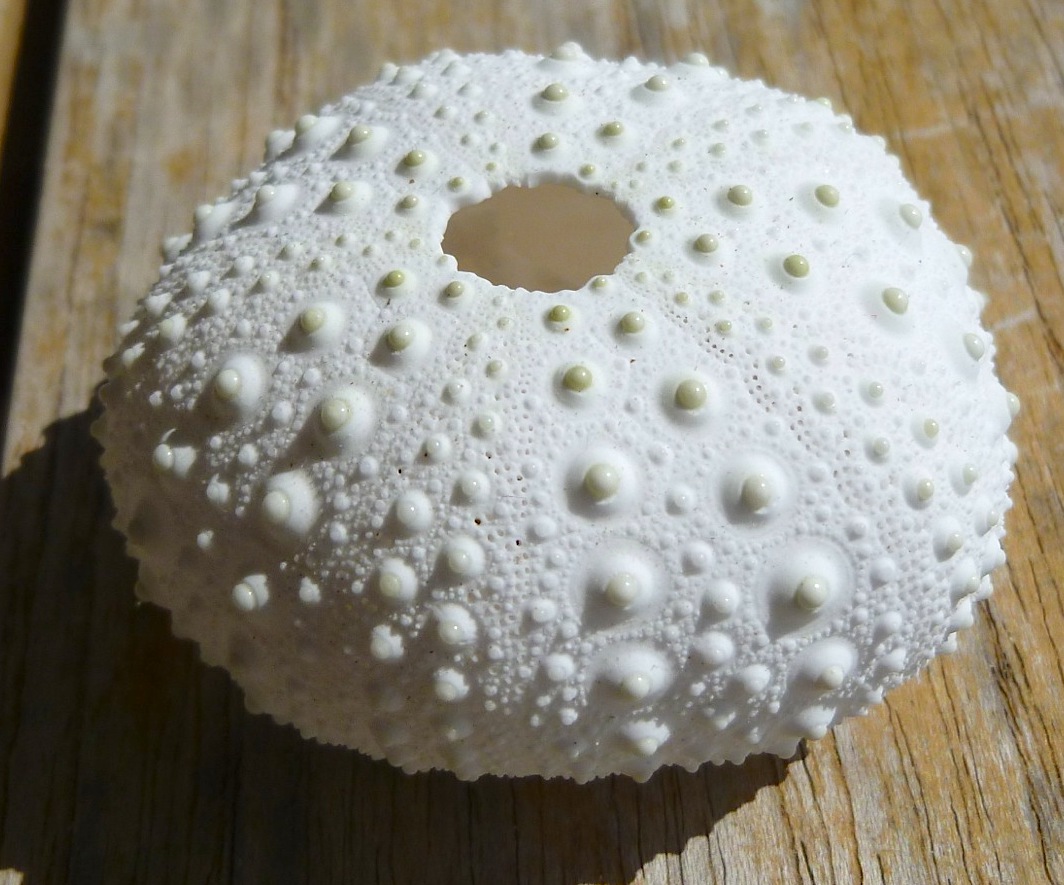
As with SAND DOLLARS and similar creatures, the skeleton of a sea urchin is known as a ‘test’. Urchin tests are remarkably beautiful, especially seen in sunlight. Here are 2 examples I photographed a while ago. You’ll immediately notice the delicate colours and the amazing complexity of the pattern and symmetry. The top one is (or is most like) a long-spined urchin test.
 
 
Long-spined sea urchin Test / Skeleton Diadema antillarum (Keith Salvesen / Rolling Harbour) Long-spined sea urchin Test / Skeleton Diadema antillarum (Keith Salvesen / Rolling Harbour)

A BIT ABOUT SYMMETRY

Sea urchins are born with bilateral symmetry – in effect, you could fold one in half. If you wear gloves. As they grow to adulthood, they retain symmetry but develop so-called ‘fivefold symmetry’, rather as if an orange contained 5 equal-sized segments. The graphic above gives a good idea of how the interior is arranged inside the segments.

Long-spined sea urchin Diadema antillarum (Melinda Rodgers / Dive Abaco)

A FEW FACTS TO HAND DOWN TO YOUR CHILDREN

  • Urchin fossil records date the species back to the Ordivician period c 40m years ago
  • In the ’90s the population was decimated and still has not recovered fully
  • Urchins feel stress: a bad sign that the spines here are white rather than black
  • Urchins are not only warm water creatures: some kinds live in polar regions
  • Urchins are of particular use in scientific research, including genome studies
  • Some urchins end up in aquariums / aquaria, where I doubt the algae is so tasty
  • Kindest not to prod or tread on them
  • Their nearest relative (surprisingly) is said to be the Sea Cucumber 

Sea Cucumber (Melinda Riger / G B Scuba)

ARE THEY EDIBLE?

They are eaten in some parts of the world, but only where the gonads and roe are considered a delicacy. Personally, I could leave them or leave them.

CREDITS: Melinda Rogers / Dive Abaco (1, 2, 3, 6, 9) taken Abaco; Melinda Riger / G B Scuba (4, 10, 11) taken Grand Bahama; Keith Salvesen / Rolling Harbour (7, 8) taken Abaco; Wiki graphic (5) CC . RESEARCH Fred Riger for detailed  information; otherwise magpie pickings… This is an archive post

Long-spined sea urchin Diadema antillarum (Melinda Riger / G B Scuba)

Unknown's avatar

IS THIS THE REAL LIFE? IS THIS JUST FANS AT SEA?


Purple sea fan, Bahamas (Melinda Riger / Grand Bahama Scuba)

IS THIS THE REAL LIFE? IS THIS JUST FANS AT SEA?

I am re-posting this sea fan article as 2021 rolls over into 2022 with much the same disruption, anxiety, and (for many) grief that we were all facing a year ago. The converse and somewhat rhapsodic title reflects the experience of many people since Covid engulfed the world. Life has become simultaneously real and surreal. It continues in many respects as normal yet who would have guessed that as we entered a new decade in 2020, the face mask would quickly become an essential (or anyway a medically recommended) part of daily life and remain so? 

This post was written at a time of sunshine, normality and optimism, before Covid and even before the violent destructive force of Dorian in autumn 2019. Here’s some cheer from sea fans on the coral reefs of the Bahamas.  

GALLERY OF GORGONIANS 

Purple Sea Fans, Abaco, Bahamas (Dive Abaco / Keith & Melinda Rogers)

The waters of Abaco teem with myriads of fish that depend on the coral reefs for shelter and safety, for breeding, for growing up in, and for nourishment. Sea fans (or gorgonians, to use the technical name) are animals too. They may look like plants and stay rooted to the spot, but like anemones these ‘soft corals’ are creatures of the reef and essential indicators of its health.

Purple sea fan, Bahamas (Melinda Riger / Grand Bahama Scuba)

Purple sea fan, Bahamas (Melinda Riger / Grand Bahama Scuba)

The purple sea fan Gorgonia ventalina (classified by Linnaeus in 1785) is one of the most common species of sea fan, and a spectacular one at that. The main branches are linked by a lattice of smaller branches. Below the ‘skin’ is a skeleton made of calcite compounded with a form of collagen.

Purple sea fan, Bahamas (Melinda Riger / Grand Bahama Scuba)

Purple Sea Fans, Abaco, Bahamas (Dive Abaco / Keith & Melinda Rogers)

Sea fans are filter-feeders, and have polyps with eight tiny tentacles that catch plankton as it drifts past. They develop so that their orientation is across the prevailing current. This maximises the water passing by and consequently the supply of food as the fans gently wave in the flow.

Purple Sea Fans, Abaco, Bahamas (Dive Abaco / Keith & Melinda Rogers)

Purple Sea Fans, Abaco, Bahamas (Dive Abaco / Keith & Melinda Rogers)

Gorgonians have a chemical defence mechanism that protects against potential troublemakers. The main effect is to make themselves unpleasant to nibble or uproot.

Purple Sea Fans, Abaco, Bahamas (Dive Abaco / Keith & Melinda Rogers)

One species impervious to this deterrent is the fascinating FLAMINGO TONGUE SNAIL. Other ‘safe’ species include the fireworm and BUTTERFLYFISHES.

Purple Sea Fans, Abaco, Bahamas (Dive Abaco / Keith & Melinda Rogers)

One benefit of sea fans to mankind is that their defensive chemicals have been discovered to provide the basis for drug research and development, specifically in the field of  anti-inflammatories. Another benefit, of course, is that they are very beautiful to look at. And in bad times, that can only be good .

Purple Sea Fans, Abaco, Bahamas (Dive Abaco / Keith & Melinda Rogers)

Purple Sea Fans, Abaco, Bahamas (Dive Abaco / Keith & Melinda Rogers)

Credits: these wonderful photos were taken by Melinda & Keith Rodgers / Dive Abaco, Marsh Harbour; and Melinda & Fred Riger / Grand Bahama Scuba. Huge thanks to them all for allowing me to freely use their skilful underwater photography in this blog for the best part of a decade.

A SPECIAL FAN FOR A HAPPY AND HOPEFUL 2022

Purple Sea Fans, Abaco, Bahamas (Dive Abaco / Keith & Melinda Rogers)

Unknown's avatar

CHRISTMAS TREE WORMS: SEASONAL SPIROBRANCHES


Christmas Tree Worm (Melinda Riger / Grand Bahama Scuba)

CHRISTMAS TREE WORMS: SEASONAL SPIROBRANCHES

music-notes-clip-art-png-musicDeck the Reefs with Worms Like Christmas Trees… Fal-La-La-etc-etc ” is a traditional Carol familiar to all. Well, most. Ok, some, then. Oh right – maybe with different words? Anyway, now is the perfect time to take a look at these remarkable subsurface symbols of seasonal good cheer (nb they are wonderful animals not gorgeous plants).

christmas-tree-worm-melinda-riger-g-b-scuba

10 CHRISTMAS TREE WORM FACTS TO PONDER

  • The 2 colourful spirals are not the worm, but complex structures for feeding & respiration
  • The spirals act as specialised mouth extensions for ‘filter-feeding’
  • Prey is trapped by the feathery tentacles & guided by cilia (microscopic hairs) to the mouth
  • The tentacle things are radioles and act as gills for breathing as well as prey traps
  • It is not believed that prey slide down the spiral to their doom, like on a helter-skelter

Christmas Tree Worm (Neil Hobgood Wiki)Christmas Tree Worm (Melinda Riger / Grand Bahama Scuba)

  • The actual worm lives in a sort of segmented tube, with extremely limited mobility skills
  • It contains digestive, circulatory & nervous systems – and a brain in the middle of it all
  • The worm also has a tiny drainage tube (I think I have this right) for excretion etc
  • They embed themselves into heads of coral such as brain coral. And stay there
  • And yes, the Christmas trees are retractable… (see below for some action)

spirobranchus_giganteus_orange_christmas_tree_worm-nick-hobgood-wiki

HOW DO THE WORMS… YOU KNOW…  ERM… REPRODUCE?

This is a delicate area. They are very discreet, but as far as I can make out they eject gametes from their what-I-said-above. There are mummy and daddy worms, and their respective gametes (eggs and spermatozoa) drift in the current and into each other to complete the union. The fertilised eggs develop into larvae, which settle onto coral and burrow into it as their parents did, build their protective tubes, and the process begins again.

christmas_tree_worm-nick-hobgood-wiki

YOU DON’T REALLY UNDERSTAND THESE CREATURES, DO YOU?

I won’t lie. I found it hard to work out how the CTWs function in practice. There are plenty of resources showing them in their full glory, but that only takes one so far. Then I came across a short video that shows it all brilliantly simply (except for the reproduction part).

The worms, in their coral burrows, hoist their pairs of ‘trees’. You can easily see small particles – zooplankton – drifting in the water, and the radioles swaying to catch potential food. Suddenly it all makes sense (except the repro bit – I haven’t found footage of that).  Next: the New Year Worm (there is no Easter worm).

A WHOLE FESTIVAL OF CHRISTMAS TREE WORMSChristmas Tree Worms (Neil Hobgood Wiki)

Credits: Melinda Riger (Grand Bahama Scuba); Nick Hobgood; Betty Wills; Video by ‘Super Sea Monkey’; Reef Collage by RH; MarineBio; Wikibits & Magpie Pickings

Happy Christmas to all those who put up with RH with such fortitude over the years
blue_christmas_tree_worm-betty-wills-wiki

Unknown's avatar

SEA URCHINS: PICTURE PERFECT ABACO (11)


SEA URCHINS: PICTURE PERFECT ABACO (11)

Sea Urchin, Abaco, Bahamas (Melinda Rogers / Dive Abaco)

As every swimmer knows, or eventually finds out the hard way, it’s not only Blue Suede Shoes that should not be stepped on. But however painful the consequences of a misstep, it’s hard not to find some beauty in an urchin living in a thriving reef environment. The wonderful anatomical diagram by Alex Ries shows everything you could conceivably want to know about one of nature’s most proficient foot-stabbers (if only all such diagrams were presented so simply and clearly).

Sea urchin anatomy (Alex Ries)

The internal organs depicted resemble a bad trip in the bowels of a vacuum cleaner; or (narrow your eyes) an experimental painting from one of the less successful schools of early c20 modern art, soon to be swept aside by Cubism. Note that the mouth is located where you might expect to find the opposite end, and vice versa.

I photographed the urchin test (skeleton) below at Delphi. It was large and almost entirely undamaged (very rare in my experience). The bright faintly greenish white is set off by the palest of pinks. Whatever your view of how creatures came to exist, imagine the creation or evolution of calcium carbonate into a small symmetrical structure as beautiful, detailed and complex as this. If you are short of a lockdown recreation, maybe try to draw it.

Sea Urchin Test / Skeleton, Abaco Bahamas (Keith Salvesen / Rolling Harbour Abaco)

Photo credits: #1 Melinda Rogers / Dive Abaco; #2 Anatomy Diagram, Alex Reis (5 stars for making it available free on Wikimedia); #3 Keith Salvesen / Rolling Harbour Abaco

Unknown's avatar

WTF? (WHAT’S THAT FISH?): THE FROGFISH


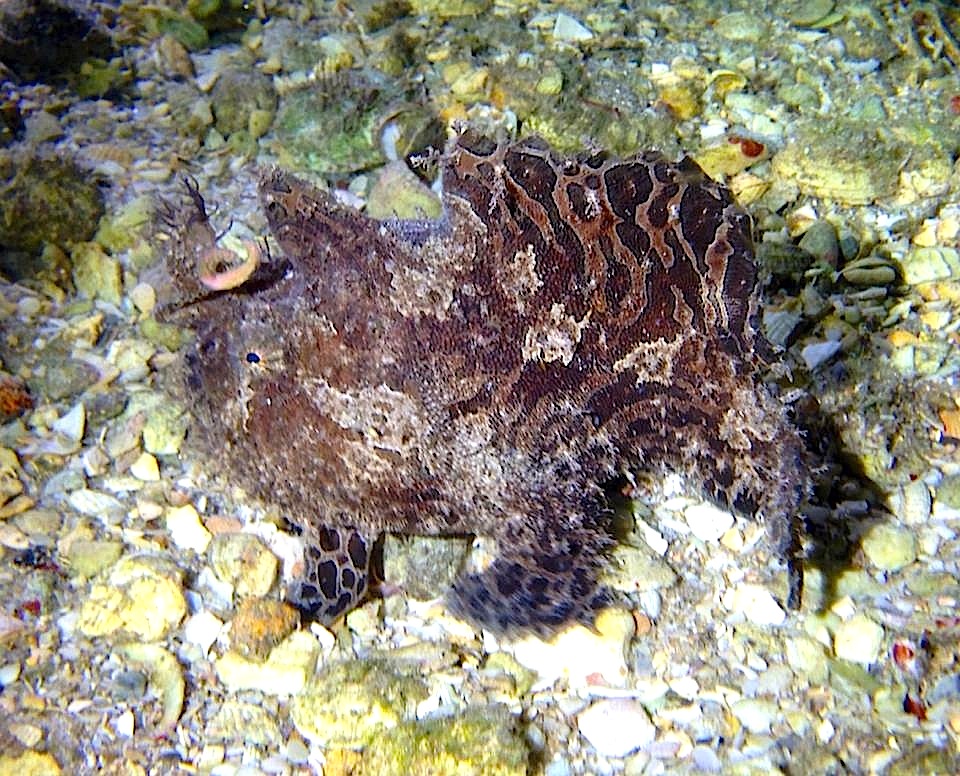
Frogfish (Adam Rees / Scuba Works)

The Astoundingly 5* Strange Frogfish (Adam Rees / Scuba Works)

WTF? (WHAT’S THAT FISH?)

A COMPENDIUM OF SUBSURFACE WEIRDNESS

A SERIES OF 15 OF THE STRANGEST SEA CREATURES IN BAHAMAS WATERS

INTRODUCTION

WTF? stands for ‘What’s That Fish’? But it might also be your exclamation when you come across one of these creatures. The WTF? series highlights some of the unusual, curious, weird and downright extraordinary fishes that inhabit the waters of the northern Bahamas. Some represent local forms of a species found elsewhere in the world; others are in their own evolutionary cul-de-sac. Just as I think I have seen it all, so another oddity crops up somewhere that demands inclusion. 

The WTF? series, put together over several years, is intended to be the most direct route to an underwater menagerie of piscine strangeness, with some great photos to whet your appetite to learn more about these fascinating denizens of the ocean. 

1. THE FROGFISH

* CLICK ON THIS TITLE TO BE TRANSPORTED TO THE STRANGE WORLD OF THE FROGFISH *

Frogfish (Adam Rees, Scuba Works)Credits are given in the individual articles. Thanks to all those that have provide the photos, without which this type of illustrated, unscientifically scientific poke around in the ocean depths would not be possible.

Unknown's avatar

IS THIS THE REAL LIFE? OR IS THIS JUST FANS AT SEA?


Purple sea fan, Bahamas (Melinda Riger / Grand Bahama Scuba)

IS THIS THE REAL LIFE? OR IS THIS JUST FANS AT SEA?

I wrote the original post on this theme, with its somewhat Bohemian and rhapsodic title, a while back. It was put together at a time of sunshine, normality and optimism. The 2019 hurricane season was far in the future, and the prospect of one – let alone two – of the finest islands in the Bahamas being virtually eradicated overnight was unthinkable.

Purple Sea Fans, Abaco, Bahamas (Dive Abaco / Keith & Melinda Rogers)

Right now, in the aftermath of the devastation wrought by Hurricane Dorian, and as the communities gradually start on the long road to recovery, the priorities remain personal and community safety, food, fresh water, medical supplies and access to all the other necessities that the major relief operation has so effectively enabled. However, as gradual improvements to daily life are achieved, so a degree of interest in the natural world is returning.

Purple sea fan, Bahamas (Melinda Riger / Grand Bahama Scuba)

The despoliation of the land is there for all to see, visible even from space. As yet – as far as I know – no one has had the time or opportunity, or even a boat and the right equipment to investigate below the surface of the sea. What of the reefs: the bright darting reef fish; the larger denizens of the deep; the corals, sponges and anemones? The massive Cat 5 storm caused an unprecedented 23′ surge. It’s hard to see how the reefs can have remained unaffected, and there must be the possibility that the THIRD LARGEST BARRIER REEF in the world will have been altered irrevocably.

Purple sea fan, Bahamas (Melinda Riger / Grand Bahama Scuba)

Since Dorian, the related organisations have been unable to operate. Abaco’s ‘Dive Abaco’ was virtually annihilated along with the rest of Marsh Harbour. Grand Bahama Scuba has just reopened, although it may take a while before dive trips are anywhere back to normal. This post contains beautiful photos from both the Melindas concerned, taken in happier times before the dark cloud swept over the islands just one month ago.

Purple sea fan, Bahamas (Melinda Riger / Grand Bahama Scuba)

NOTES FROM THE PRE-DORIAN PAST

The waters of Abaco teem with myriads of fish that depend on the coral reefs for shelter and safety, for breeding, for growing up in, and for nourishment. Sea fans (or gorgonians, to use the technical name) are animals too. They may look like plants and stay rooted to the spot, but like anemones these ‘soft corals’ are creatures of the reef and essential indicators of its health.

Purple Sea Fans, Abaco, Bahamas (Dive Abaco / Keith & Melinda Rogers)

At the moment it can still be said that the static (‘sessile’) members of the Abaco reef community are relatively unscathed by the impact of (and I don’t want to get into any arguments here) whatever causes mass bleaching and the death of reefs elsewhere in the world.

Purple Sea Fans, Abaco, Bahamas (Dive Abaco / Keith & Melinda Rogers)

Purple Sea Fans, Abaco, Bahamas (Dive Abaco / Keith & Melinda Rogers)  Purple Sea Fans, Abaco, Bahamas (Dive Abaco / Keith & Melinda Rogers)

The purple sea fan Gorgonia ventalina (classified by Linnaeus in 1785) is one of the most common species of sea fan, and a spectacular one at that. The main branches are linked by a lattice of smaller branches. Below the ‘skin’ is a skeleton made of calcite compounded with a form of collagen. 

Purple Sea Fans, Abaco, Bahamas (Dive Abaco / Keith & Melinda Rogers)

Sea fans are filter-feeders, and have polyps with eight tiny tentacles that catch plankton as it drifts past. They develop so that their orientation is across the prevailing current. This maximises the water passing by and consequently the supply of food as the fans gently wave in the flow.

Purple Sea Fans, Abaco, Bahamas (Dive Abaco / Keith & Melinda Rogers)  Purple Sea Fans, Abaco, Bahamas (Dive Abaco / Keith & Melinda Rogers)

Gorgonians have a chemical defence mechanism that protects against potential troublemakers. The main effect is to make themselves unpleasant to nibble or uproot.

Purple Sea Fans, Abaco, Bahamas (Dive Abaco / Keith & Melinda Rogers)

One species impervious to this deterrent is the fascinating FLAMINGO TONGUE SNAIL (more of which quite soon). Other ‘safe’ species include the fireworm and BUTTERFLYFISHES.

Purple Sea Fans, Abaco, Bahamas (Dive Abaco / Keith & Melinda Rogers)

One benefit of sea fans to mankind is that their defensive chemicals have been discovered to provide the basis for drug research and development, specifically in the field of  anti-inflammatories. Another benefit, of course, is that they are very beautiful to look at. And in bad times, that can only be good .

Purple Sea Fans, Abaco, Bahamas (Dive Abaco / Keith & Melinda Rogers)

Purple Sea Fans, Abaco, Bahamas (Dive Abaco / Keith & Melinda Rogers)    Purple Sea Fans, Abaco, Bahamas (Dive Abaco / Keith & Melinda Rogers)

Most of the photos featured are by courtesy of Capt. Keith and Melinda Rogers of the well-known local scuba dive and snorkel centre DIVE ABACO, located in central Marsh Harbour. As prime enablers of reef exploration in Abaco waters, it can truly be said that they too have plenty of fans.

Purple Sea Fans, Abaco, Bahamas (Dive Abaco / Keith & Melinda Rogers)

Credits: Melinda and Keith Rodgers / Dive Abaco, Marsh Harbour; Melinda and Fred Riger / Grand Bahama Scuba (1, 3, 4, 5)

** The answer to the questions in the Title is… it’s both!

FINALLY, A SPECIAL FAN FOR ABACO AND GRAND BAHAMA

Purple Sea Fans, Abaco, Bahamas (Dive Abaco / Keith & Melinda Rogers)

Unknown's avatar

URCHIN RESEARCHIN’: SEA HEDGEHOGS OF THE REEF


Long-spined sea urchin Diadema antillarum (Melinda Rodgers / Dive Abaco)

URCHIN RESEARCHIN’: SEA HEDGEHOGS OF THE REEF

The long-spined sea urchin Diadema antillarum featured in this post is one of those creatures that handily offers its USP in its name, so you know what you are dealing with. Something prickly, for a start. These are creatures of the reef, and many places in the Caribbean and in the western Atlantic generally sustain healthy populations.

Long-spined sea urchin Diadema antillarum (Melinda Rodgers / Dive Abaco)

These animals are essentially herbivores, and their value to vulnerable coral reefs cannot be overstated. Where there is a healthy population of these urchins, the reef will be kept clean from smothering algae by their methodical grazing. They also eat sea grass.

Long-spined sea urchin Diadema antillarum (Melinda Rodgers / Dive Abaco)

HOW DO THE SPINES OF DIFFERENT KINDS OF URCHIN COMPARE?

Small sea urchins species have spines a few cms long at most. The long-spine variety exceed 10 cms, and the largest may have spines up to 30 cms (= 1 foot) long. The length, as shown here, means that when the creatures are safely lodged in crevices near their algae supply, their spines remain very visible.
Long-spined sea urchin Diadema antillarum (Melinda Riger / G B Scuba)
Anatomy of a long-spined sea urchin. You may possess a few of these organs yourself…

Long-spined sea urchin Diadema antillarum anatomy diagram (wiki)

Long-spined sea urchin Diadema antillarum (Melinda Rodgers / Dive Abaco)

CAN YOU GIVE US A TEST, PLEASE?

As with SAND DOLLARS and similar creatures, the skeleton of a sea urchin is known as a ‘test’. Urchin tests are remarkably beautiful, especially seen in sunlight. Here are 2 examples I photographed a while ago. You’ll immediately notice the delicate colours and the amazing complexity of the pattern and symmetry. The top one is (or is most like) a long-spined urchin test.
Long-spined sea urchin Test / Skeleton Diadema antillarum (Keith Salvesen / Rolling Harbour) Long-spined sea urchin Test / Skeleton Diadema antillarum (Keith Salvesen / Rolling Harbour)

A BIT ABOUT SYMMETRY

Sea urchins are born with bilateral symmetry – in effect, you could fold one in half. As they grow to adulthood, they retain symmetry but develop so-called ‘fivefold symmetry’, rather as if an orange contained 5 equal-sized segments. The graphic above gives a good idea of how the interior is arranged inside the segments.

Long-spined sea urchin Diadema antillarum (Melinda Rodgers / Dive Abaco)

A FEW FACTS TO HAND DOWN TO YOUR CHILDREN

  • Urchin fossil records date the species back to the Ordivician period, c 40m years ago
  • In the ’90s the population was decimated and still has not recovered fully
  • Urchins feel stress: a bad sign that the spines here are white rather than black
  • Urchins are not only warm water creatures: some kinds live in polar regions
  • Urchins are of particular use in scientific research, including genome studies
  • Some urchins end up in aquariums / aquaria, where I doubt the algae is so tasty
  • Kindest not to prod or tread on them
  • Their nearest relative (surprisingly) is said to be the Sea Cucumber 

Sea Cucumber (Melinda Riger / G B Scuba)

ARE THEY EDIBLE?

Apparently they are eaten in some parts of the world; their gonads and roe are considered a delicacy. As far as I know, they are not generally on the menu in the Bahamas. Correction invited. Personally, I could leave them or leave them.

CREDITS: Melinda Rodgers / Dive Abaco (1, 2, 3, 6, 9) taken Abaco; Melinda Riger / G B Scuba (4, 10, 11) taken Grand Bahama; Keith Salvesen / Rolling Harbour (7, 8) taken Abaco; Wiki graphic (5) taken from internet. RESEARCH Fred Riger for detailed  information; otherwise the usual magpie pickings…

Long-spined sea urchin Diadema antillarum (Melinda Riger / G B Scuba)

Unknown's avatar

‘REEF ENCOUNTER’ 1: GRAY ANGELFISH


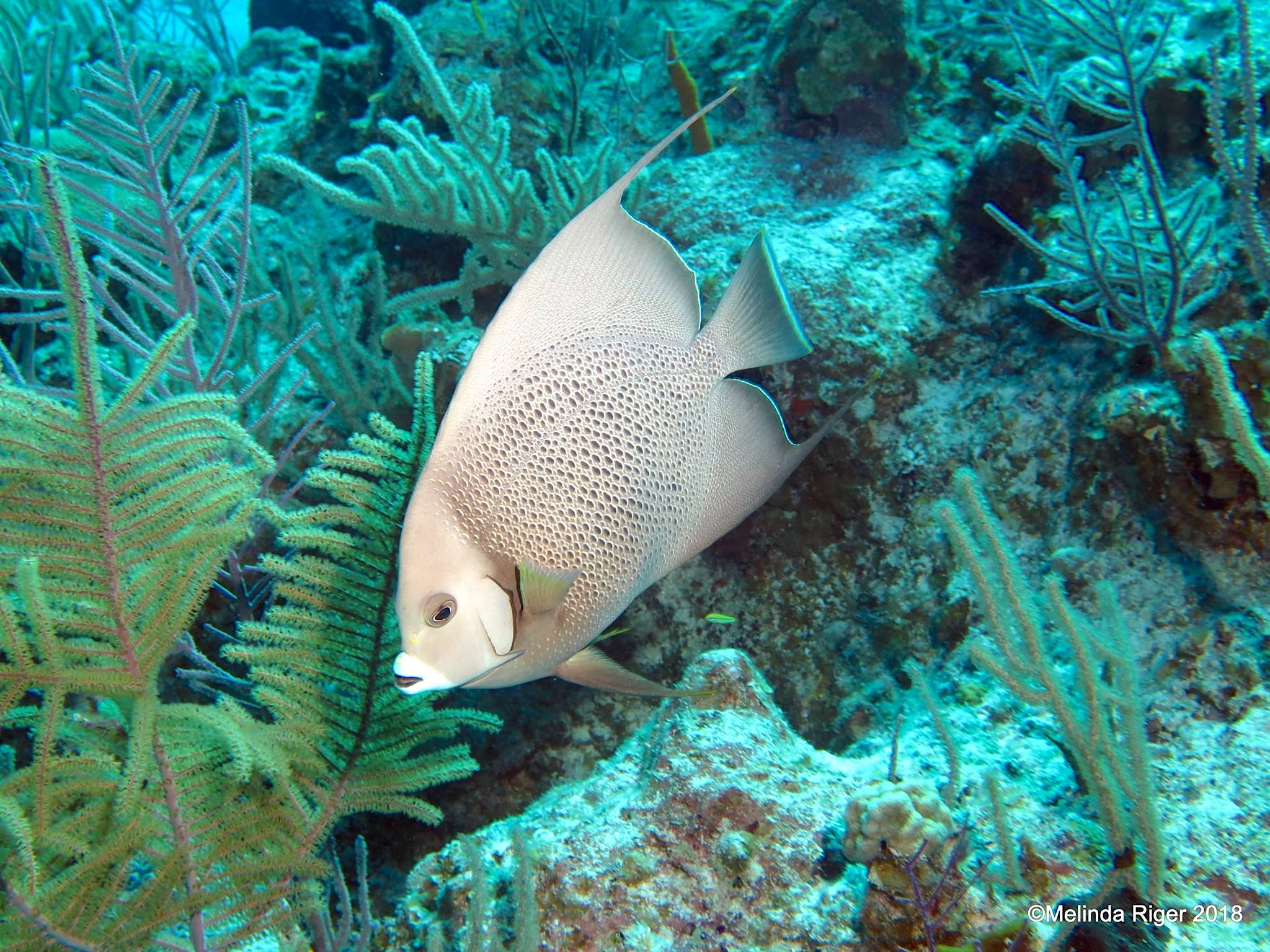
Gray Angelfish 9with four-eyed butterflyfish), Bahamas (Melinda Riger / Grand Bahama Scuba)

‘REEF ENCOUNTER’ 1: GRAY ANGELFISH

Today I learn from a cheery message from WordPress that my illustrated ramblings have been going on for exactly X years, where X is greater than 5 but less than 10. Time to start a new theme: channelling my inner Noel Coward, I am introducing a new mainly pictorial series provisionally called ‘Reef Encounter’. All the awesome beauty of reef life will be here.

Gray Angelfish, Bahamas (Melinda Riger / Grand Bahama Scuba)

In the past I have posted about GRAY ANGELFISH, one of three kinds of angelfish found in the northern Bahamas. Today, I am featuring some more recent images of these pretty creatures. Note in particular the striking shape and colour of their mouths, the blue being found also on the fin edges at the back.

Gray Angelfish, Bahamas (Melinda Riger / Grand Bahama Scuba)Gray Angelfish, Bahamas (Melinda Riger / Grand Bahama Scuba)

On this otherwise gray fish, you’ll also find touches of yellow on the face and the edges of the front fins. In the header image there’s another little fish in the bottom right corner. Not a baby angelfish, but a FOUR-EYED BUTTERFLYFISH – a species that will feature in own right in due course

Gray Angelfish, Bahamas (Melinda Riger / Grand Bahama Scuba)

All fabulous photos by Melinda Riger / Grand Bahama Scuba

Gray Angelfish, Bahamas (Melinda Riger / Grand Bahama Scuba)

Unknown's avatar

IS THIS THE REAL LIFE? OR IS THIS JUST FANS AT SEA?


Purple Sea Fans, Abaco, Bahamas (Dive Abaco / Keith & Melinda Rogers)

IS THIS THE REAL LIFE? OR IS THIS JUST FANS AT SEA?

The waters of Abaco teem with myriads of fish that depend on the coral reefs for shelter and safety, for breeding, for growing up in, and for nourishment. Sea fans (or gorgonians, to use the technical name) are animals too. They may look like plants and stay rooted to the spot, but like anemones these ‘soft corals’ are creatures of the reef and essential indicators of its health.

Purple Sea Fans, Abaco, Bahamas (Dive Abaco / Keith & Melinda Rogers)

At the moment it can still be said that the static (‘sessile’) members of the Abaco reef community are relatively unscathed by the impact of (and I don’t want to get into any arguments here) whatever causes mass bleaching and the death of reefs elsewhere in the world.

Purple Sea Fans, Abaco, Bahamas (Dive Abaco / Keith & Melinda Rogers)

Purple Sea Fans, Abaco, Bahamas (Dive Abaco / Keith & Melinda Rogers)  Purple Sea Fans, Abaco, Bahamas (Dive Abaco / Keith & Melinda Rogers)

The purple sea fan Gorgonia ventalina (classified by Linnaeus in 1785) is one of the most common species of sea fan, and a spectacular one at that. The main branches are linked by a lattice of smaller branches. Below the ‘skin’ is a skeleton made of calcite compounded with a form of collagen. 
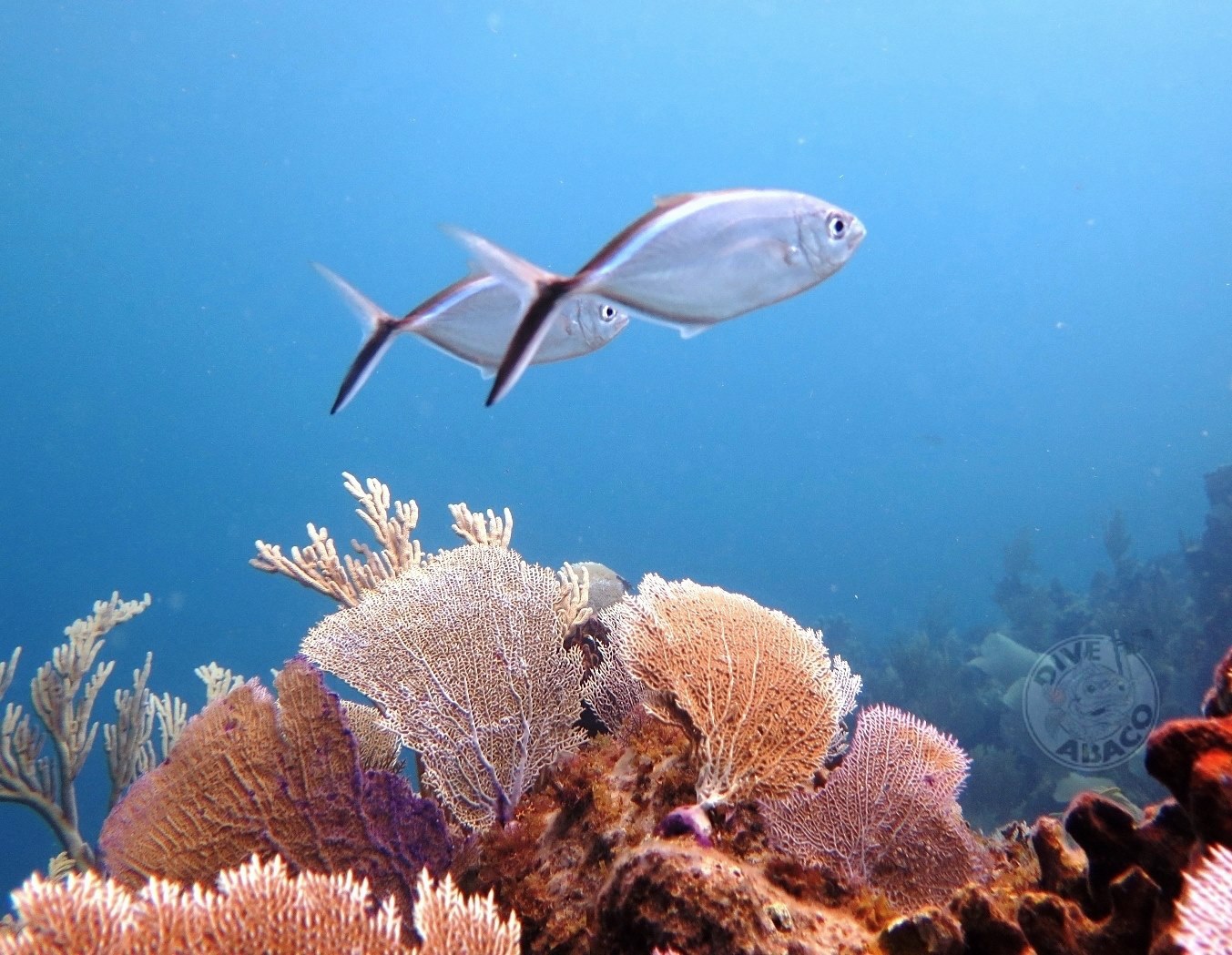
Purple Sea Fans, Abaco, Bahamas (Dive Abaco / Keith & Melinda Rogers)

Sea fans are filter-feeders, and have polyps with eight tiny tentacles that catch plankton as it drifts past. They develop so that their orientation is across the prevailing current. This maximises the water passing by and consequently the supply of food as the fans gently wave in the flow.

Purple Sea Fans, Abaco, Bahamas (Dive Abaco / Keith & Melinda Rogers)  Purple Sea Fans, Abaco, Bahamas (Dive Abaco / Keith & Melinda Rogers)

Gorgonians have a chemical defense mechanism that protects against potential troublemakers. The main effect is to make themselves unpleasant to nibble or uproot.
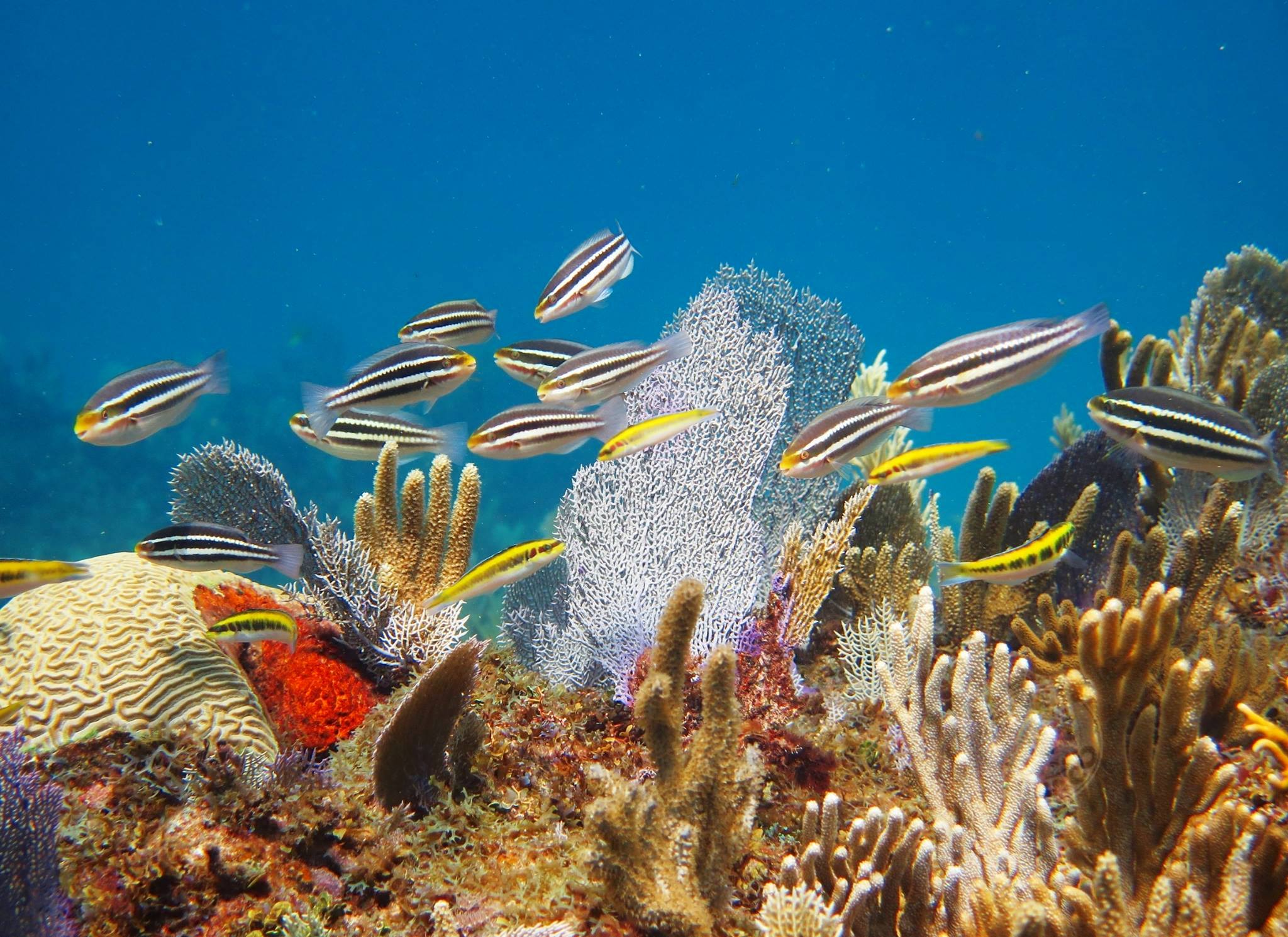
Purple Sea Fans, Abaco, Bahamas (Dive Abaco / Keith & Melinda Rogers)

One species impervious to this deterrent is the fascinating FLAMINGO TONGUE SNAIL (more of which quite soon). Other ‘safe’ species include the fireworm and BUTTERFLYFISHES.

Purple Sea Fans, Abaco, Bahamas (Dive Abaco / Keith & Melinda Rogers)

One benefit of sea fans to mankind is that their defensive chemicals have been discovered to provide the basis for drug research and development. It’s tempting to say that by way of gratitude, we pollute the waters they need for their very existence. So, consider it said…

Purple Sea Fans, Abaco, Bahamas (Dive Abaco / Keith & Melinda Rogers)

Purple Sea Fans, Abaco, Bahamas (Dive Abaco / Keith & Melinda Rogers)    Purple Sea Fans, Abaco, Bahamas (Dive Abaco / Keith & Melinda Rogers)

All the photos featured are by courtesy of Capt. Keith and Melinda Rogers of the well-known local scuba dive and snorkel centre DIVE ABACO, located in central Marsh Harbour. As prime enablers of reef exploration in Abaco waters, it can truly be said that they too have plenty of fans.
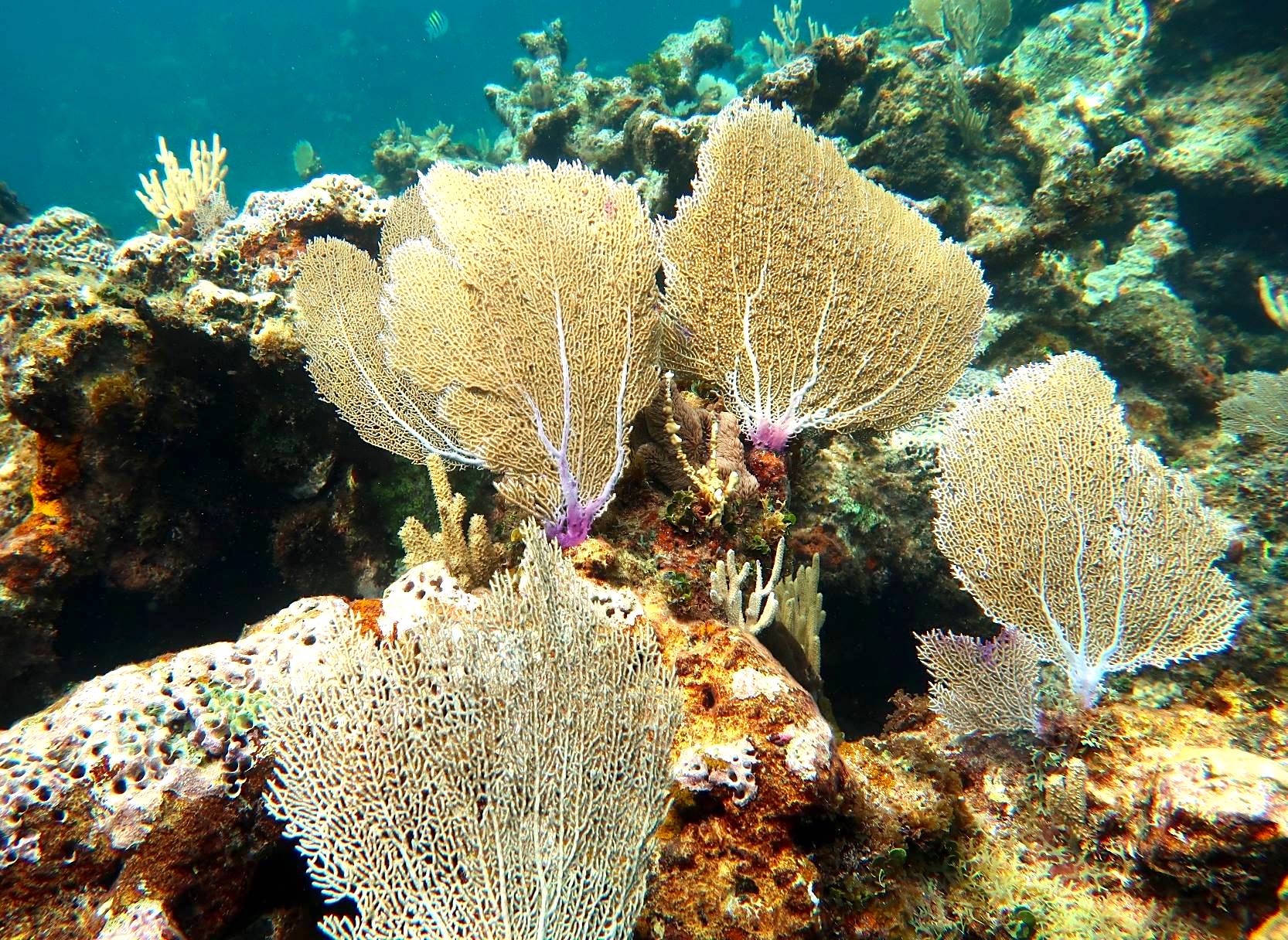
Purple Sea Fans, Abaco, Bahamas (Dive Abaco / Keith & Melinda Rogers)

Credits: Keith and Melinda Rodgers; Dive Abaco @DiveAbaco, Marsh Harbour, The Bahamas ** The answer to the questions in the Title is… it’s both!

Purple Sea Fans, Abaco, Bahamas (Dive Abaco / Keith & Melinda Rogers)

Unknown's avatar

PURPLE VASE SPONGES: BAHAMAS REEF ORNAMENTS


Purple Vase Sponge, Bahamas (Melinda Riger / G B Scuba)

PURPLE VASE SPONGES: BAHAMAS REEF ORNAMENTS

The Purple Vase is an unmistakeable sponge, a colourful reef creature (for they are animals, of course) that stands even out amongst the bright corals that surround it. And like corals, sponges are vulnerable to all the usual threats (mainly human-generated).

Purple Vase Sponge, Bahamas (Melinda Riger / G B Scuba)

Catch them while you can in the clear waters of the Bahamas while stocks last. I say this because as study after study concludes, the prospects of reef-mageddon get closer each year. When the corals die off, so in all probability will the sponges and anemones…

Purple Vase Sponge, Bahamas (Melinda Riger / G B Scuba)

After such a depressing intro, let’s move on to take a positive look at the purple vase sponge. As with all sponges, once a newborn sponge is wafted by the current to a place on the reef, it takes root there throughout its life. There, these attractive sponges exist by filtering the water that surrounds them, separating out plankton to feed on. Static filter-feeders, if you will.

Purple Vase Sponge, Bahamas (Melinda Riger / G B Scuba)

You’ll notice that in some of the photographs, the sponges have guests. These are BRITTLE STARS, and they are often found on – and indeed in – purple vases. This is a form of symbiotic relationship known as commensalism, in which one species benefits and the other is neither benefitted nor harmed. The brittle star gains a shelter and a safe base for feeding; the vase gets a harmless companion. Small fishes benefit from the vases in a similar way.

Purple Vase Sponge, Bahamas (Melinda Riger / G B Scuba)

Besides the impact of damaging human interventions (which may be permanent), extreme weather events also affect reef life and the static inhabitants adversely. Storms and hurricanes can cause localised havoc, but the damage is not necessarily permanent. The reef can in time repopulate naturally and flourish again. Humans can even promote this recovery. The photograph above shows a purple vase sponge that was detached from the reef by Hurricane Matthew in October 2016. Melinda Riger in effect replanted it on the reef and it reattached itself and grew. In due course it even acquired its brittle star occupant. 

Purple Vase Sponge, Bahamas (Melinda Riger / G B Scuba)

*JIMI AND ‘PURPLE VASE’ – A VOLUNTARY MUSICAL DIGRESSION

In an interview with NME Hendrix is reported to have said that Purple Haze “was about a dream I had that I was walking under the sea.” Originally the song was intended to be ‘Purple Vase’, and reflect the psychedelic experience of life on a coral reef. Realising he was getting bogged down by sub-aquatic imagery (he was a non-swimmer), he toked for a while and then ‘Purple Haze’ emerged almost fully formed. He was always far happier kissing the sky than wandering about under the waves. Most covers of the song are pale imitations of the original, but here’s a rather unusual take that succeeds by trying a different approach…

Credits: Melinda Riger / Grand Bahama Scuba for all great photos; magpie pickings for bits and pieces, with a shout-out to ‘Critter Squad’ for its informative site aimed at kids. And amateur grown-ups can benefit too… commensalism in humans; Friend ‘n’ Fellow audio

Purple Vase Sponge, Bahamas (Melinda Riger / G B Scuba)

Unknown's avatar

BAHAMAS REEF FISH (48): SCHOOLMASTER SNAPPER


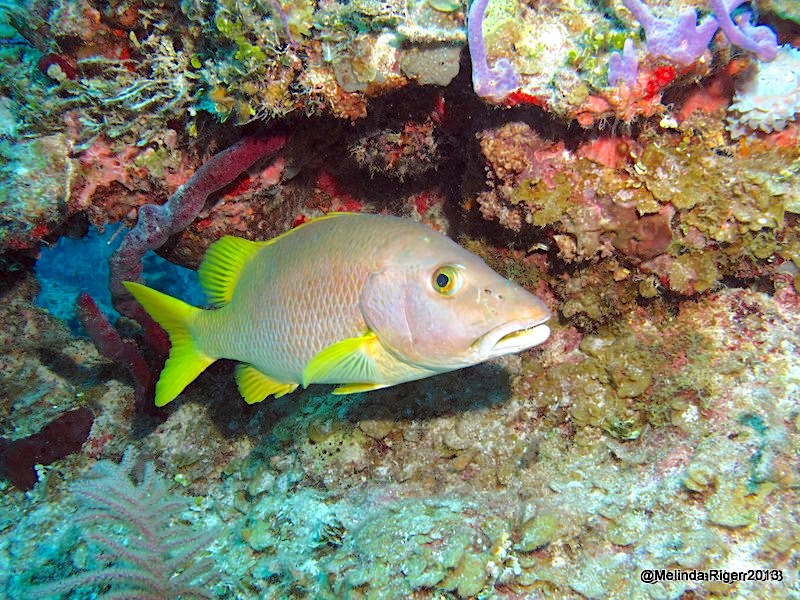
Schoolmaster Snapper (Melinda Riger @ G B Scuba)

BAHAMAS REEF FISH (48): SCHOOLMASTER SNAPPER

November 1st already, and the first time I am prepared to consider the possibility of the onset of Christmas, with its attendant joys yet complications… Meanwhile, I thought I might have run out of types of reef fish to feature in this series long before I got to 50. Yet here we are, two short of that target, with a species of snapper I haven’t even mentioned before. I am (frankly) a rather feeble swimmer, and do not possess a viable underwater camera. So there’s no way I could show these denizens of the not-especially-deep without heavy reliance on others, in particular the outstanding photos of diver Melinda Riger of Grand Bahama Scuba; and the memorable ones from Adam Rees of Scuba Works that include some of the more obscure species that appear in my WTF? (What’s That Fish) series. 

Schoolmaster Snapper (Melinda Riger @ G B Scuba)

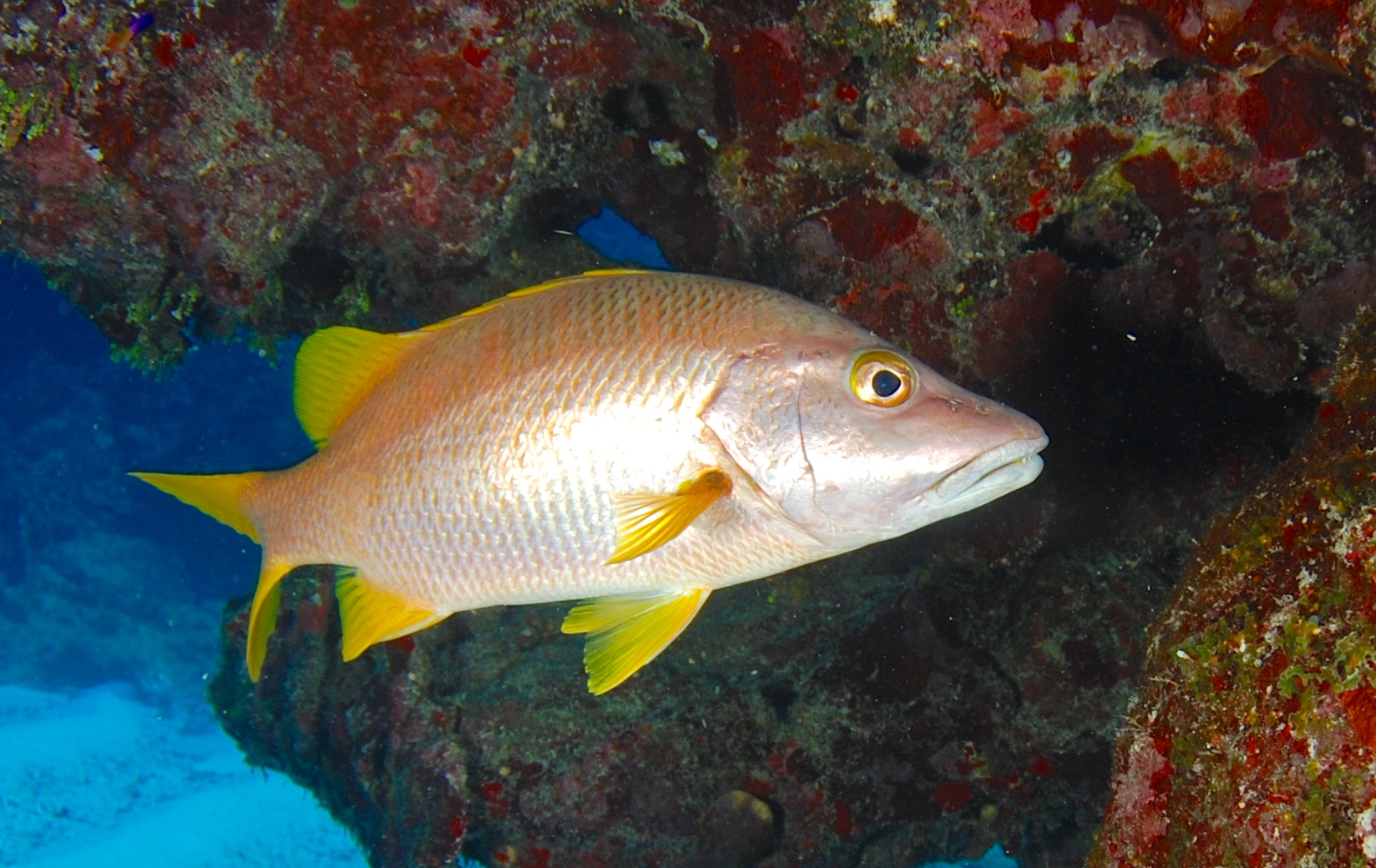
The schoolmaster snapper (Lutjanus apodus) lives among the coral reefs and mangroves of the Caribbean and further north to the northern Bahamas and Florida. Generally they are quite small, not much more than 12- 18 inches. They tend to hang out in ‘schools’, which several sources suggest as the reason they got their common name. But schoolmasters don’t really move around in large groups, do they? It’s school pupils that do that, but ‘Pupil Snapper’ wouldn’t cut it as a fish name I guess.

Schoolmaster Snapper (Melinda Riger @ G B Scuba)

10 SCHOOLMASTER SNAPPER FACTS TO PONDER

  • One pair of upper teeth are so large they protrude when the fish shuts its mouth
  • Their side scales are so arranged that diamond shapes are produced
  • There’s plenty to learn about their fin arrangements, but not necessarily to remember
  • Their jaws don’t open very wide, so their prey tends to be quite small
  • Unlike fish that change sex as they grow, these ones retain their birth gender for life
  • When they spawn they produce their gametes simultaneously, and swim away
  • The fertilised eggs sink to the bottom, where they have to take their chances
  • Though small, they are good to eat and are fished for recreation and commercially
  • Regionally there are specific regulations as to catch length & limits, hook type, bait etc
  • Like all snappers and many other fish species, these fish are associated with ciguatera

Schoolmaster Snapper (Melinda Riger @ G B Scuba)

RECIPES

For those who enjoy cooking (whatever that is), you probably know exactly how you like to cook your snappers. For anyone else, here’s a site that proposes several different ways to cook them, with helpful tips. These seem to apply to all snapper species, most of which are available free in the Bahamas. http://www.allfishingbuy.com/Fish-Recipes/Snapper-Recepies.htm

My favourite schoolmaster snapper photo of those featured hereSchoolmaster Snapper (Melinda Riger @ G B Scuba)

POSSIBLE MEDICAL BENEFITS FROM EATING SNAPPERS

These are alleged to include (except when fried): protection against certain types of stroke, reduction of heart arrhythmia, and defence against certain types of cancer. Don’t take my word for it, though. And definitely don’t rely on a snapper-based diet regime. I think the most that can safely be said is that eating snapper will do you no harm (except when fried) and may conceivably have a marginal benefit on health along with a balanced diet, exercise, minimal alcohol intake and all the routines that we strictly adhere to for a healthy life. In our dreams, anyway.

Schoolmaster Snapper (Albert Kok)

Credits: All great pics by Melinda Riger / GB Scuba except #6 Albert Kok; range map, Wiki. Magpie pickings.

Schoolmaster Snapper (Melinda Riger @ G B Scuba)


Unknown's avatar

CHRISTMAS TREE WORMS: SEASONAL SPIROBRANCHES


Christmas Tree Worm (Melinda Riger / Grand Bahama Scuba)

CHRISTMAS TREE WORMS: SEASONAL SPIROBRANCHES

music-notes-clip-art-png-musicDeck the Reefs with Worms Like Christmas Trees… Fal-La-La-etc-etc ” is a traditional Carol familiar to all. Well, most. Ok, some, then. Oh right – maybe with different words? Anyway, now is the perfect time to take another look at these remarkable subsurface symbols of seasonal good cheer (nb they are animals not plants).

christmas-tree-worm-melinda-riger-g-b-scuba

10 CHRISTMAS TREE WORM FACTS TO PONDER

  • The 2 colourful spirals are not the worm, but complex structures for feeding & respiration
  • The spirals act as specialised mouth extensions for ‘filter-feeding’
  • Prey is trapped by the feathery tentacles & guided by cilia (microscopic hairs) to the mouth
  • The tentacle things are radioles and act as gills for breathing as well as prey traps
  • It is not believed that prey slide down the spiral to their doom, like on a helter-skelter

Christmas Tree Worm (Neil Hobgood Wiki)Christmas Tree Worm (Melinda Riger / Grand Bahama Scuba)

  • The actual worm lives in a sort of segmented tube, with extremely limited mobility skills
  • It contains digestive, circulatory & nervous systems – and a brain in the middle of it all
  • The worm also has a tiny drainage tube (I think I have this right) for excretion etc
  • They embed themselves into heads of coral such as brain coral. And stay there
  • And yes, the Christmas trees are retractable… (see below for some action)

spirobranchus_giganteus_orange_christmas_tree_worm-nick-hobgood-wiki

HOW DO THE WORMS… YOU KNOW…  ERM… REPRODUCE?

This is a delicate area. They don’t tend to talk about it much, but as far as I can make out they eject gametes from their what-I-said-above. There are mummy and daddy worms, and their respective gametes (eggs and spermatozoa) drift in the current and presumably into each other to complete the union. The fertilised eggs develop into larvae, which settle onto coral and burrow into it, build their protective tubes and the process begins again.

christmas_tree_worm-nick-hobgood-wiki

YOU DON’T REALLY UNDERSTAND THESE CREATURES, DO YOU?

I won’t lie. I found it hard to work out how the CTWs function in practice. There are plenty of resources showing them in their full glory, but that only takes one so far. Then I came across a short video that shows it all brilliantly simply (except for the reproduction part).

The worms, in their coral burrows, hoist their pairs of ‘trees’. You can easily see small particles – possibly zooplankton – drifting in the water, and the radioles swaying to catch potential food. Suddenly it all makes sense (except the repro bit – I haven’t found footage of that).  Next: the New Year Worm (there is no Easter worm).

A WHOLE FESTIVAL OF CHRISTMAS TREE WORMSChristmas Tree Worms (Neil Hobgood Wiki)

Credits: Melinda Riger (G B Scuba); Nick Hobgood; Betty Wills; Video by ‘Super Sea Monkey’;Reef Collage by RH; MarineBio; Wikibits & Magpie Pickings

Happy Christmas to all those who put up with RH with such fortitude
blue_christmas_tree_worm-betty-wills-wiki

Unknown's avatar

CLEANING UP IN THE BAHAMAS: PEDERSON SHRIMPS


Pederson's Cleaning Shrimp, Bahamas (Melinda Riger, GB Scuba)

CLEANING UP IN THE BAHAMAS: PEDERSON SHRIMPS 

Pederson’s Shrimps Ancylomenes pedersoni (also known locally as Peterson’s shrimps), are one of several species of cleaner shrimp found in The Bahamas and more generally in the Caribbean seas. The species was named in 1958 by a multifaceted medico-oceanologist-zoologist Fenner A. Chace. He seems to have specialised in shrimps, finding distinct and differing species and naming them (not unreasonably) after himself (chacei);or colleagues and people he knew / admired; and in one case his wife. Mr Pederson was among them.

Pederson's Cleaning Shrimp, Bahamas (Melinda Riger, GB Scuba)

This tiny transparent creature with its vivid blue / purple markings and straggling pale antennae is unmistakeable, and helpfully cannot be confused with any other locally found shrimp species. Here’s an idea of its size, compared with a human finger and a blue parrotfish.

Pederson's Cleaning Shrimp, Bahamas (Melinda Riger, GB Scuba)

WHERE DO THESE SHRIMPS LIVE?

Their preferred home is… and it’s certainly a left field choice among sea creatures… in amongst the stinging tentacles of certain sea anemones. Not only do they not get stung, but of course they are well-protected by the defensive pain that their hosts can inflict. They are usually found singly or in pairs, but sometimes a whole colony may inhabit the same anemone.

SO EXPLAIN HOW THEY DON’T GET STUNG

Ok. The shrimps gradually build up a kind of resistance by pressing their bodies and antennae against the tentacles of the host anemone for increasing lengths of time, until they become immune. It’s like one of those kids’ electric buzzer / rheostat machines. Or a TENS machine (for those who know about backache).

 IS THERE A DOWNSIDE TO ALL THIS?

Yes indeed. If a shrimp moves away from its host for a few days, it has to start the process of immunisation all over again. So presumably they tend to stay home-lovin’.

Home sweet home for the Pederson shrimpsPederson's Cleaning Shrimp, Bahamas (Melinda Riger, GB Scuba)

SOMETHING ABOUT THE CLEANING, PLEASE

These shrimps offer ‘cleaning services’ to passing fish. When on duty, as it were, they wave their antennae vigorously to attract attention. A fish being cleaned will remain stationary and passive while external parasites and dead skin are removed. Many fish will open their mouths and gill covers for internal cleaning, with the tacit agreement that the cleaner will not become a snack. Shrimps often work in conjunction with small cleaner fish such as some species of goby and wrasse – see the links below for more on this topic, with copious images…

Pederson's Cleaning Shrimp, Bahamas (Melinda Riger, GB Scuba)

RELATED POSTS

CLEANING STATIONS

CLEANER FISH

Credits: all photos by Melinda Riger / Grand Bahama Scuba

Unknown's avatar

DUSKY DAMSELFISH: BAHAMAS REEF FISH (34)


Dusky Damselfish, Bahamas (Melinda Riger)

DUSKY DAMSELFISH: BAHAMAS REEF FISH (34)

The dusky damselfish Stegastes fuscus is one of a number of damselfish species found in Bahamian waters. These small reef fish, in adult form, are dark coloured as their name suggests. Their appearance is brightened by having distinctive blue edges to their fins.

Dusky Damselfish, Bahamas (Melinda Riger)

These fish feed mainly on algae, with a preference for red. They top up their diet with small invertebrates. Their value to the reef is that their feeding patterns help to prevent coarser seaweeds from becoming dominant in areas where these are prevalent. 

Dusky Damselfish, Bahamas (Melinda Riger)

Like many damselfish, the dusky is a territorial species, guarding its chosen area of seabed and the food sources within it by repelling intruders – often seeing off far larger algae-grazing fishes such as parrotfish and wrasse. Yet besides their aggressive traits, they are also rather cute, as photo #2 shows!

Dusky damselfish, Bahamas (Melinda Riger)

All photos: Melinda Riger / Grand Bahama Scuba

Unknown's avatar

CHRISTMAS TREE WORMS: FABULOUSLY FESTIVE


christmas-tree-worms-adam-rees-scuba-works-copy

CHRISTMAS TREE WORMS: FABULOUSLY FESTIVE

music-notes-clip-art-png-music“Deck the Reefs with Worms Like Christmas Trees… Fal-La-La-etc-etc ” is a traditional Carol familiar to all. Well, most. Ok, some, then. Oh right – maybe with different words. Anyway, now is as good time as any to take a look at these remarkable plants creatures and subsurface symbols of good cheer.

christmas-tree-worm-melinda-riger-g-b-scuba

10 CHRISTMAS TREE WORM FACTS TO PONDER

  • The 2 colourful spirals are not the worm, but complex structures for feeding & respiration
  • The spirals act as specialised mouth extensions for ‘filter-feeding’
  • Prey is trapped by the feathery tentacles & guided by cilia (microscopic hairs) to the mouth
  • The tentacle things are radioles and act as gills for breathing as well as prey traps
  • It is not believed that prey slide down the spiral to their doom, like on a helter-skelter

christmas-tree-worms-melinda-riger-g-b-scuba

  • The actual worm lives in a sort of segmented tube, with extremely limited mobility skills
  • It contains digestive, circulatory & nervous systems – and a brain in the middle of it all
  • The worm also has a tiny drainage tube (I think I have this right) for excretion etc
  • They embed themselves into heads of coral such as brain coral. And stay there
  • And yes, the Christmas trees are retractable…

spirobranchus_giganteus_orange_christmas_tree_worm-nick-hobgood-wiki

HOW DO THE WORMS… YOU KNOW…  ER… REPRODUCE?

This is a delicate area. They don’t tend to talk about it much, but as far as I can make out they eject gametes from their what-I-said-above. There are mummy and daddy CTWs, and their respective gametes (eggs and spermatozoa) drift in the current and presumably into each other to complete the union. The fertilised eggs develop into larvae, which settle onto coral and burrow into it, build their protective tubes and the process begins again.

christmas_tree_worm-nick-hobgood-wiki

LOOK, YOU DON’T REALLY UNDERSTAND THESE CREATURES, DO YOU?

I won’t lie. I found it hard to work out how the CTWs function in practice. There are plenty of resources showing them in their full glory, but that only takes one so far. Then I came across a short video that shows it all brilliantly simply (except for the reproduction part). So maybe I should have just posted this first and saved you (and me) some trouble…

The worm, invisible in its coral burrow, hoists its pair of trees. You can easily see small particles – possibly zooplankton – drifting in the water, and the radioles swaying to catch potential food. Bingo. It all makes sense! Next: the New Year Worm

Credits: Melinda Riger (G B Scuba); Adam Rees (Scuba Works); Nick Hobgood; Betty Wills; Absolutely Wild Visuals; MarineBio; Wikibits & Magpie Pickings

blue_christmas_tree_worm-betty-wills-wiki