THE DELPHI CLUB, ABACO, BAHAMAS TROUT & SALMON MAGAZINE ARTICLE
Trout & Salmon Magazine is essential reading for the freshwater game- fisherman. However, it occasionally spreads its net wider than rivers and lakes, and this month’s issue trails important news for the Delphi Club: an article in the December issue to be published on 24 November 2011 entitled BONEFISH DELPHI STYLE – Michael Shortt finds hard-fighting fish in a Bahamian home from home. I expect further details will appear on the Club website but I mention it in passing before turning to another feature in this month’s T&S issue. For DCB website CLICK ===>>>DELPHI CLUB ABACO
TROUT & SALMON NOV 2011: WATERPROOF CAMERAS REVIEW You’ll find details of an early version of a cheap and cheerful Kodak underwater camera at the end of the rollingharbour GADGETS page. This straightforward little camera is now into its third version at much the same price, and in due course I will update my original post.
T&S has now reviewed 3 other waterproof cameras, all in a higher price bracket. They may be of interest for those planning a stay in 2011–12. For a fishing trip on a skiff a waterproof camera is not really a necessity. However, it is highly desirable if you are planning a scuba or snorkelling trip, for example with Kay Politano’s excellentABACO ABOVE AND BELOW – seeFOWL CAY REEFposts.
AFTERTHOUGHT:if you arrived on this page via a G**gle search for Trout & Salmon Delphi Club / Abaco / Bonefishing, and all you got ‘was a lousy camera review’, bad luck – this is the unruly younger sibling of the main DCB website, to which the correct re-directions areCLICK ===>>> DELPHI CLUB ABACO
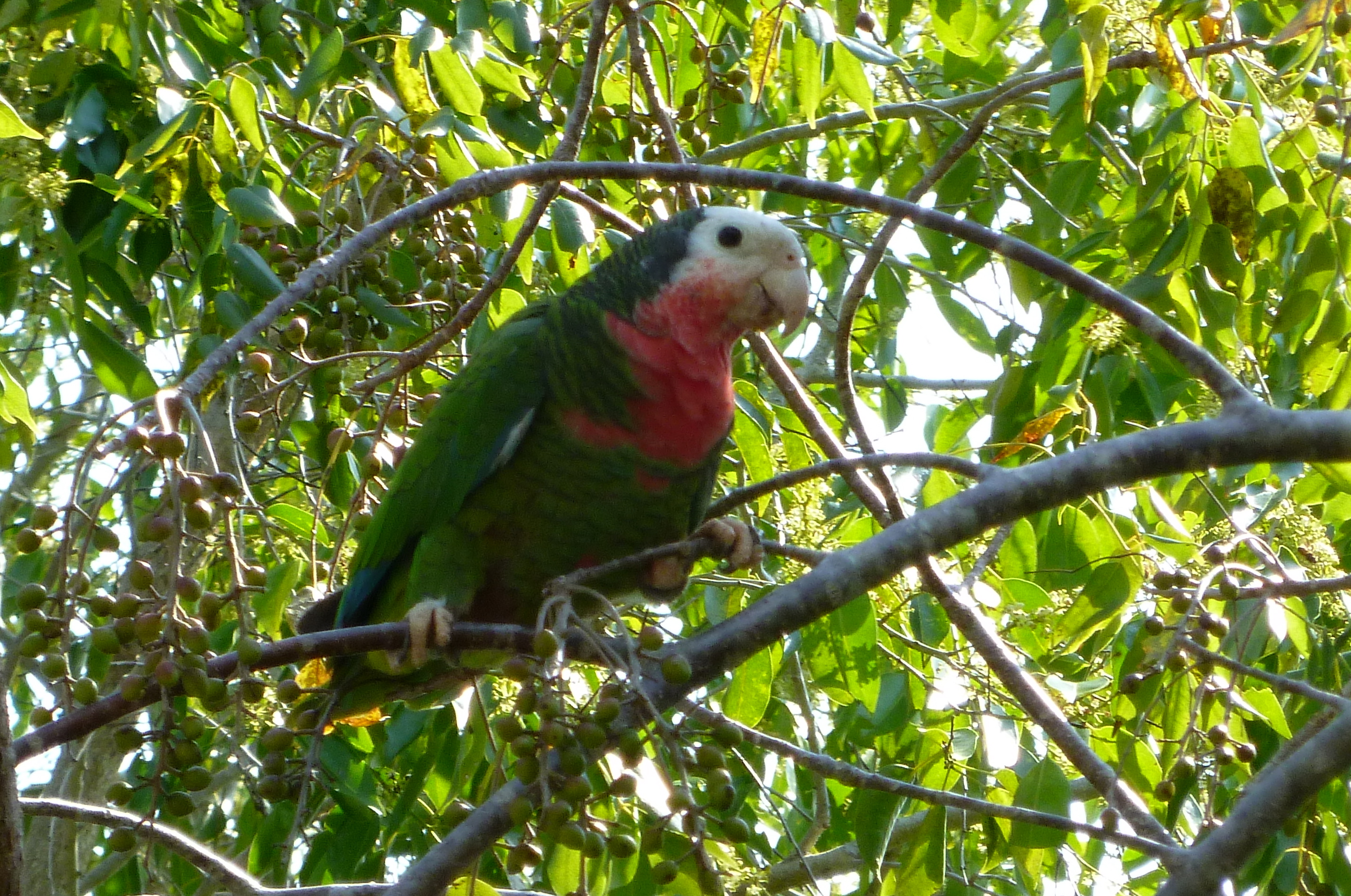
This is one of a number of sequential images posted by cfinke3856 on the website Webshots. It seems to have been taken in 2004, and shows 4 Abaco parrots in a pine tree (location unspecified – the National Park, maybe?). They look pleasingly convivial, and they provide a chance to roll out the newly created rh parrot logo
Normally I would have cleared permission for use (and slight cropping) and given a click-through link so you could see the rest of the (similar) images. However, the website is a nightmare. A pop-up offered me the chance – apparently a near-certainty – of winning $10,000, and froze my cursor when I tried to delete it. Twice. Other untempting offers were made in a rage-inducing way. So I’ll spare you all that, warn you briskly off the site, and apologise to Mr or Ms Finke for ‘borrowing’ the image, duly credited but in tiny writing…
Scotch bonnets (or ‘ridged bonnets’)Semicassis granulata or Phalium granulatum are a medium-sized species of sea snail found in the tropical and subtropical western Atlantic from North Carolina to Uruguay. They are predators, foraging on sandy stretches of the ocean floor for echinoderms such as sand dollars, sea biscuits, and other sea urchins (Caution: ‘Oxford comma’)
SCOTCH BONNET FACTS
It takes approximately six years for a Scotch bonnet to mature
The shells grows 2 – 4 ins long (5 – 10 cm), showing distinct growth stages
Scotch bonnets live on sand, usually in fairly shallow water (but see below)
The more a Scotch bonnet eats the more elaborate its shell, the glossier its sheen & the brighter its colours (research suggests this doesn’t work for humans)
Divers frequently find Scotch bonnets at depths of 50 – 150 feet (15 to 46 m). Specimens have been found in depths up to 308 ft (94 m)
Shipwrecks provide a good habitat for this species
Crabs are its main predators, crushing the shell to get at the occupant. Since the snails’ main defence mechanism is to withdraw into their shells, they urgently need to evolve a new tactic
The empty shell of this sea species is often used by hermit crabs
In 1965 the state of North Carolina made the Scotch bonnet its official state shell, in honor of the Scottish settlers who founded the state
The ridge on my shell, below, may be somewhat unusual. I haven’t found any images showing such a very distinct dorsal growth, though many show a sort of fault line there. STOP PRESS shell expert Colin Redfern explains: “The dorsal ridge on your shell is a varix, indicating a previous position of the outer lip during the growth process. Varices on Scotch Bonnets are usually thicker (as in the image above).”
dear wiki: how kind to help
CASSIS RUFA (Cypraecassis rufa)
There are many different sorts of Phalium worldwide. By way of comparison, here is another type, Cassis Rufa, from the Pacific (commonly, east Africa to New Guinea). It’s colloquially known as a Bullmouth, Red Mouth or Grinning Mouth Helmet – and also as a ‘Cameo Shell’, because it is often used for making cameos (see eBay for examples)
[rh provenance / historical note: it’s not an area I’ve ever been to, nor am I likely to go. This shell was collected by my late father-in-law when he oversaw the building of the original Gan airstrip on Addu Atoll (Maldives) in… in…. many years ago, as a naval project. It is now ‘Gan International Airport’ and sells giant Toblerone & ‘Parfum de Jordan’ from the Katie Price ‘Scentsless’ range]
BAHAMAS MARINE MAMMAL RESEARCH ORGANISATION NEWSLETTER OCTOBER 2011
The BMMRO’s fully illustrated Fall Newsletter has just been published. The newletter is as always an eclectic mix of cetacean-centric material, with a headline article about the summer whale poop project. I have lived my life and had a professional career of sorts without once giving the remotest thought to whale poop, yet here I am immersed in the stuff yet again… But there’s plenty more besides that. The newsletter gives you an overview of the current work of the BMMRO and articles including the following:
A stranded Fin whale on the Berry Islands
News of the Irene effect at Whale HQ in Sandy Point
An Orca sighted off Eleuthera
Education program update
A quarterly chart of the summer whale and dolphin sightings – 82 reports for 10 species.
Thanks as ever to Charlotte Dunn for permission to link to BMMRO material. To see the newsletterCLICK LINK===>>>BMMRO newsletter Oct 2011
To visit the informative BMMRO websiteCLICK LOGO===>>>Supplementary info: without going into details of the consistency of the output etc, I’ve just found the suggestion online that whales can excrete 3% of their body weight in a day. And a large whale weighs..? Mind where you swim
It’s 7.15 and breakfast time at Delphi. At 8.00 the trucks, skiffs, guides and fishers will set off to the fishing grounds for the day, leaving you with an empty beach, shells, warm sea, the pool, the hammock and your book. For the moment, the talk is of the excellent ‘Full Abaco’ breakfast, the weather, ‘Delphi daddies’ & ‘crazy charlies’ and someone’s mislaid reel. Sandy enters to announce that there’s a place free on your partner’s skiff… and offers it to you. So what should you, a non-angler, expect of a day out on the flats?
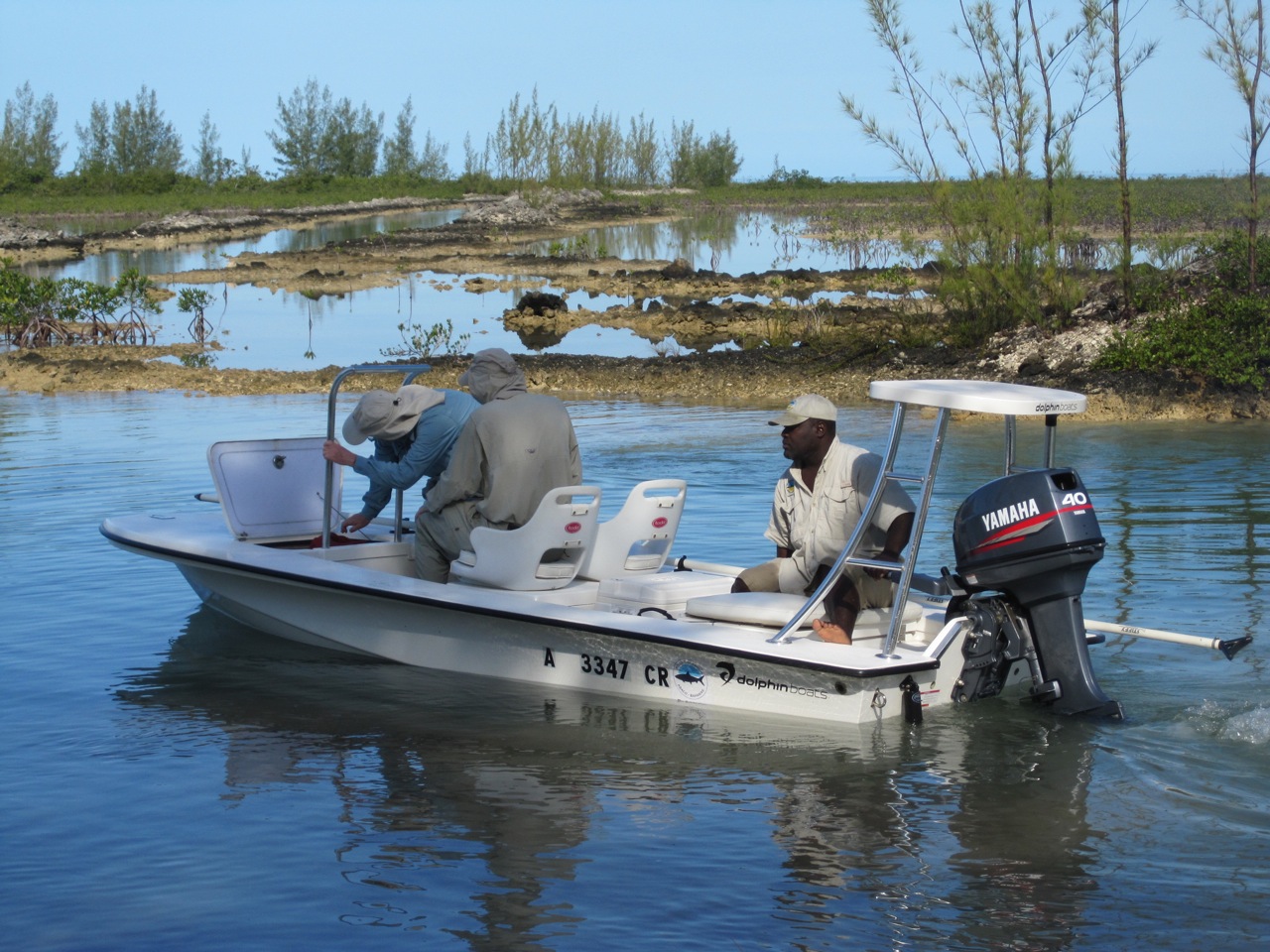
THE SKIFFS These are top-of-the range boats, capable of considerable speed getting out to the fishing grounds. The ride can be bumpy, splashy and even chilly in the early morning, so bring a fleece and a waterproof top. Camera? Essential. Here is a Delphi skiff on a sand bar in Cherokee Sound, parked for lunch and some quality conch and sand-dollar hunting. So for a start, the day isn’t ALL about fishing…
THE FISHING GROUNDS You will leave from one of three launch points and speed across the water to the bonefishing areas. The main one is “Nettie’s”, with access via a narrow man-made channel to the Marls…
… more than two hundred square miles of mangrove swamp, islets, channels and fish. The journey to Nettie’s may seem quite a long way as you bump along through the pine forest on a network of logging tracks. Watch out for small birds flickering all around as you pass.
———————————
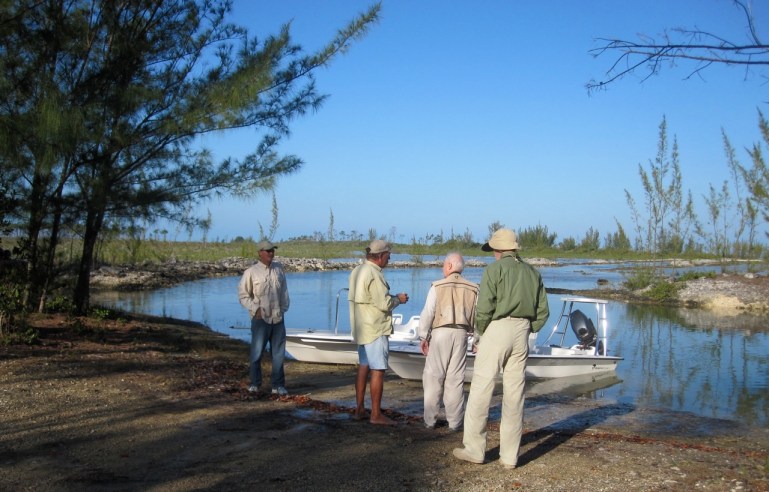
Launching a skiff at Nettie’s
Plans are hatchedGood to go…
Stowing gear in the front (forrard?) locker. There’s also one behind the seats for the lunch cool boxes. And the fuel…
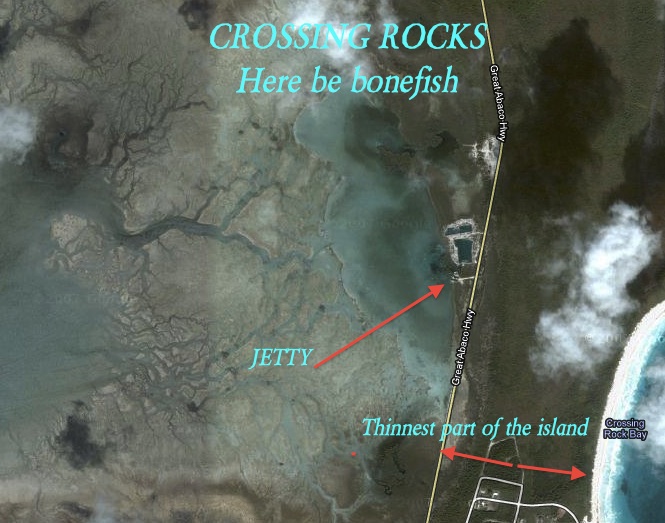
The other two launch areas are Crossing Rocks (a short drive south of DCB) or Casuarina Point for Cherokee Sound (a slightly longer drive north of DCB)
The jetty at Crossing Rocks – skiffs being prepared
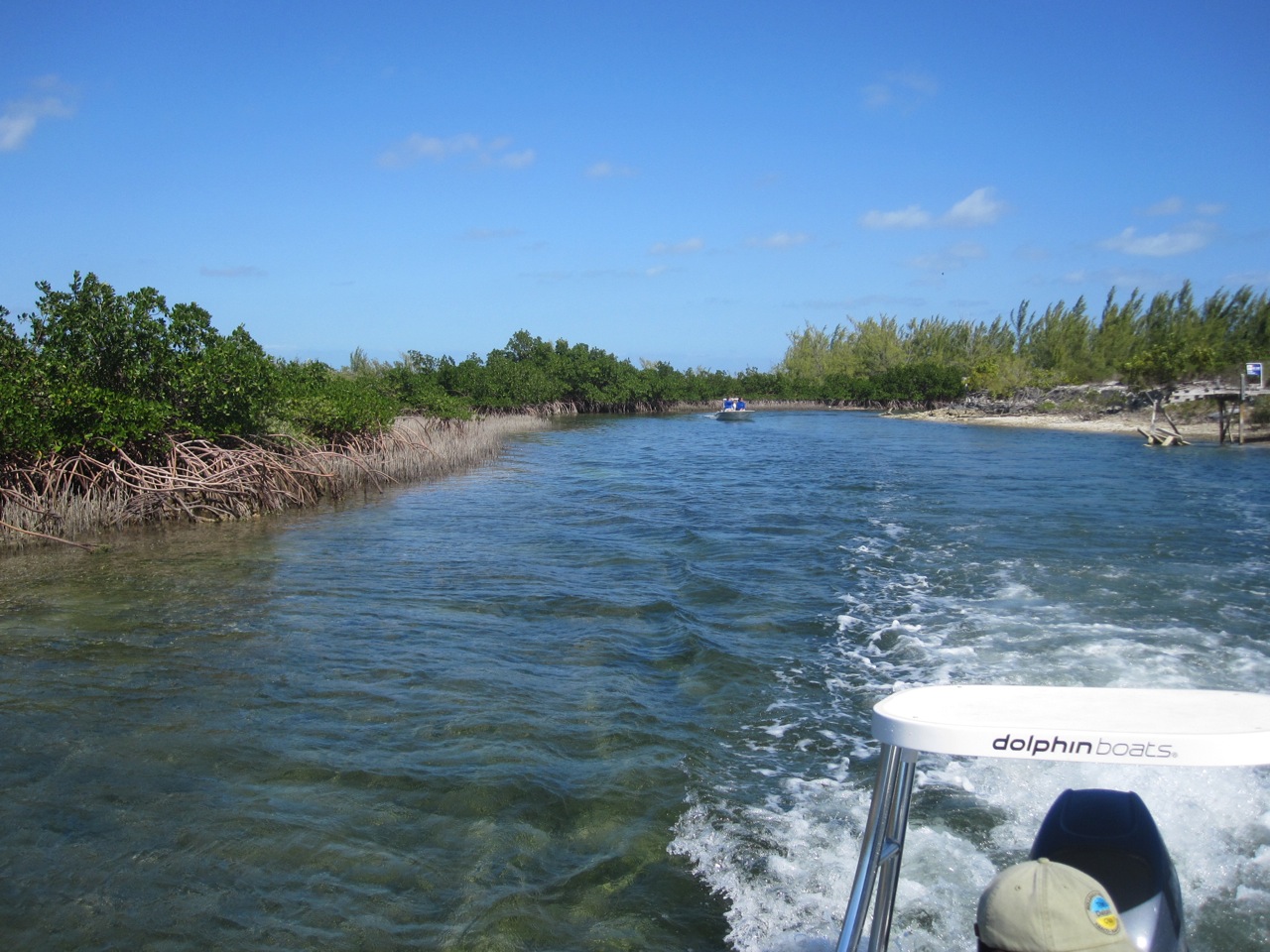
The launch point at Casuarina. A channel leads out to Cherokee Sound
Two boats in the channel – the authentic James Bond chase experience
WHAT’S THE POINT? Bonefishing! You’ve heard all the Club talk, you’ve seen your partner fussing over all those bits and pieces in your room: now see it in action. Once you get out to a fishing area, the guide cuts the engine… and suddenly you are being poled very slowly and almost noiselessly across the shallow flats
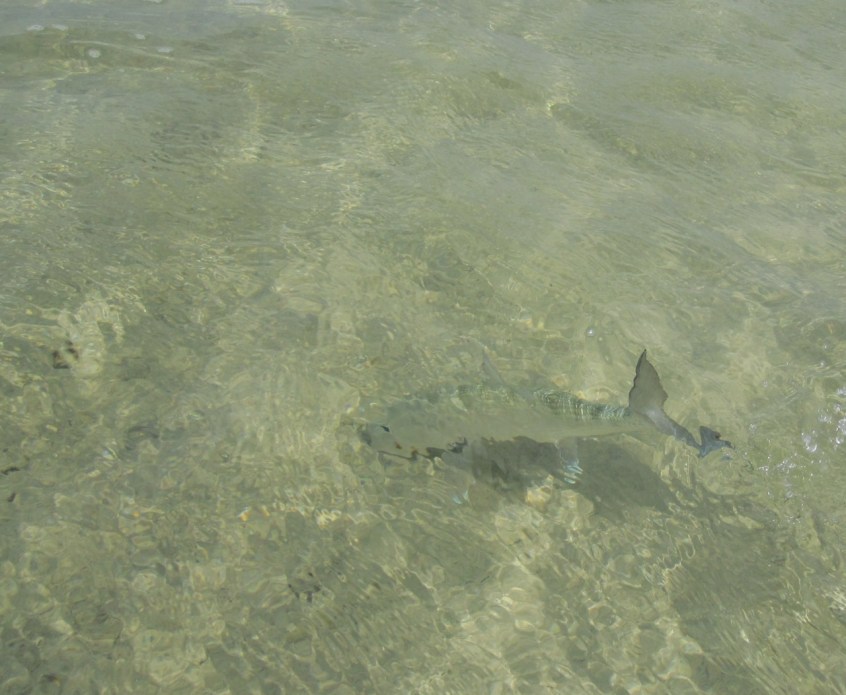
The guide stands on the platform at the back of the skiff, using the advantage of height to scan the shallow water; the fisher stands at the front looking tensely for grey shadows underwater, waiting for the magic words…
“…hey, bonefish, 10 o’clock, 4 of them moving right, 30 feet… see them?”
And it’s ‘game on’. This isn’t the place for a discourse about casting technique and style – I have neither (Sandy, of me: “Muppet”) – but I promise that you will get completely caught up in the excitement when a fish takes the fly and takes off towards the horizon, stripping the line and backing from the reel… (I realise the image above may suggest… well he’s just fishing, OK?)
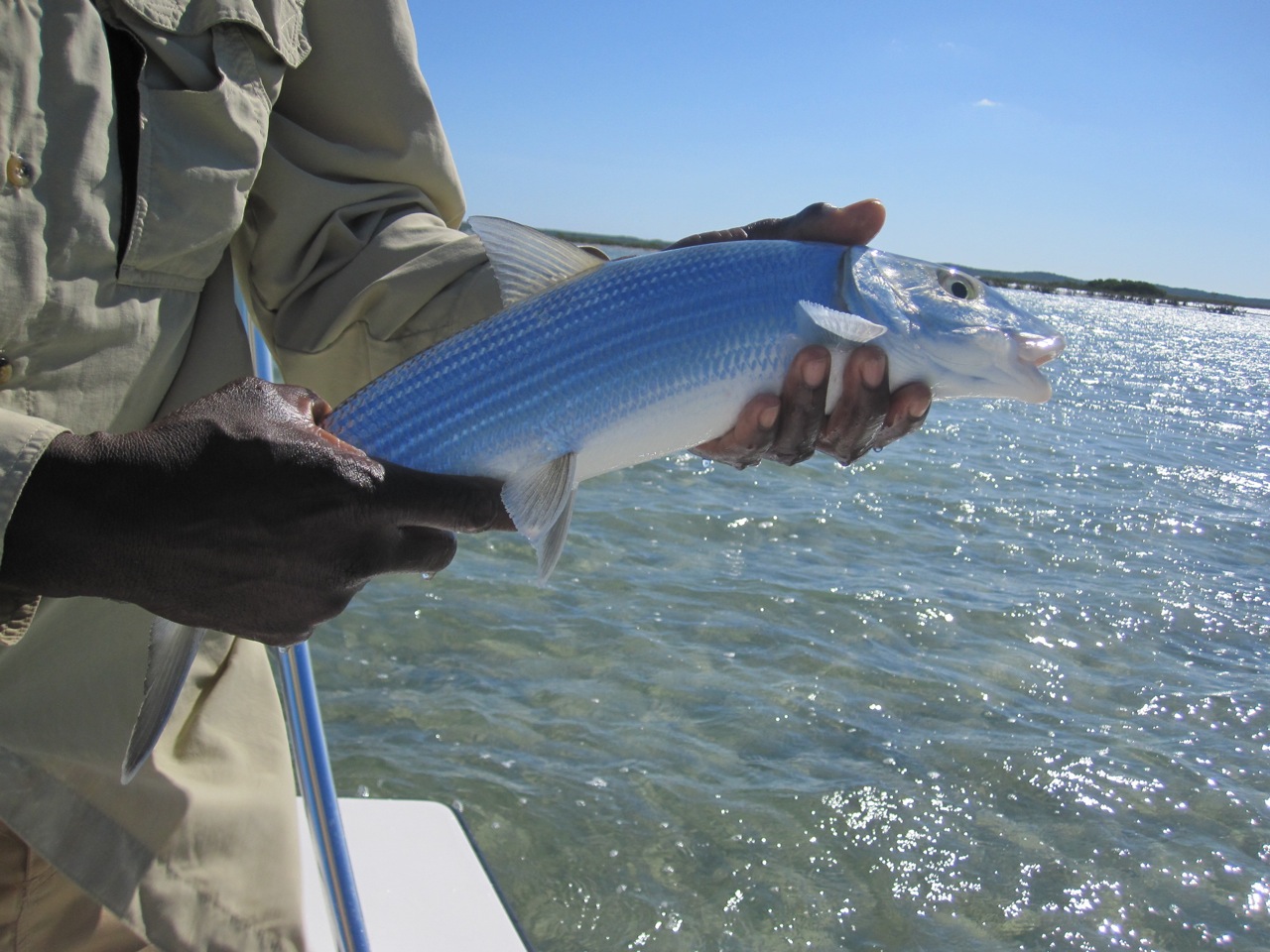
THE QUARRY – grey ghosts below water, bars of silver above. Caught on the ‘fly’ which are in fact shrimp or crab imitations, with barbless hooks to make the chance of losing a fish that much greater… This ensures that a boated fish can be returned to the water as easily and quickly as possible. It’s all ‘catch and release’, though some (me) find that mostly the fish very sensibly self-release long before they ever reach the boat…
Abaco bonefish off Crossing Rocks (just caught and released)Guide Ishi with Abaco bonefish caught on the MarlsGuide Robin Albury removes the barbless hook before returning the fishA good specimen‘Ishi’s Fishy’, as he would say
There is even the possibility that at some stage you may unexpectedly be handed a rod (even if you have never held one before, or wanted to) with ‘fish on’… Here, Robin has hooked a 2.5 lb fish and handed the rod to Mrs RH (then engrossed in eating a cheese roll) who successfully played and brought in her first ever fish…
PART 2 will deal with what else goes on during the day: the scenery, birdlife, sharks, turtles, blue holes and so forth. For now, here is a short clip of the skiff ride out to the Marls, to give you an idea. NB this was a very calm day – things can get a little bumpier and wetter at times. The seats are padded, but not very…
[Ultra-cautious music credit to Joe Satriani who sued Coldplay for alleged tune ‘borrowing’ saying “I felt like a dagger went right through my heart. It hurt so much”. Case dismissed + unspecified settlement… Way to go, Joe! Want to check? Cut ‘n’ paste this: http://www.youtube.com/watch?v=zjB024bZoB4&feature=fvwrel Then by way of counterbalance try John Lennon’s Imagine vs Coldplay’s ‘Fix you’ at (cut ‘n’ paste) http://www.youtube.com/watch?v=DksjpsAe3vk&feature=endscreen&NR=1]
Sandy Walker has emailed with some news in the “Delphi Club Creatures (Non-Guest)” category. It is the first report I have seen / heard of a sighting…
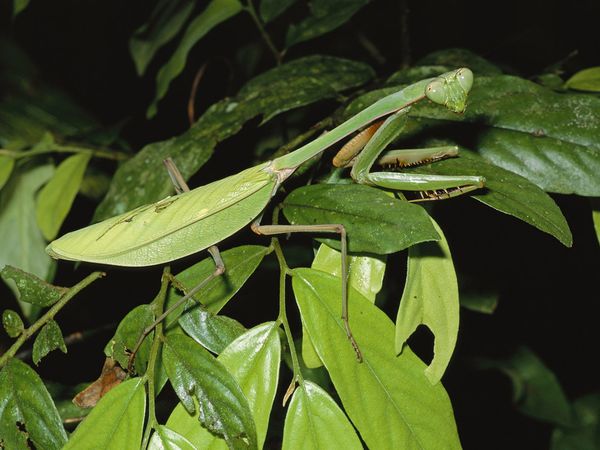
“Just thought that you might like to add the fact that there are praying mantises here on Abaco. There was one on my staircase today. 4 inches long and bright green. I did take pics but they just didn’t work as I was in a rush…”
We’ve all been there with photos and rushes, have we not? So here is one such below (Image credit: animals.nationalgeographic.co
There isn’t much specific info about these in the Bahamas, let alone on Abaco, other than the fact that Eleuthera is said to resemble one. I think I’d need to have a few Kaliks first. See what you think…
Accordingto the Indolent Bloggers’ Bible (Wiki) Mantodea (or Mantises) is an order of insects with approximately 2,200 species in 15 families worldwide in temperate and tropical habitats… Technically the term only refers to one family, meaning the other 14 families are not true mantids. Tough on them. The colloquial name ‘praying mantis’ is sometimes misspelled as ‘preying mantis’, since mantises are predatory. They are related to cockroaches & termites; and are not to be confused with stick/leaf insects, cicadas, grasshoppers or crickets. As if!
[Note: this post replaces the preliminary, typo-ridden and imageless draft that subscribers may have received, for which I stupidly pressed the ‘publish’ button rather than ‘save draft’… Not the 1st time, either… Sorry]
Scientist Caroline Stahala has spent 10 years researching the Abaco population of the Bahama parrot. Her aim is to develop understanding of their behaviour so that conservation and management strategies for this rare sub-species can be optimised. Particular protection problems arise because Abaco parrots, uniquely, nest underground. Their main vulnerability is to predation by feral cats, racoons and rodents which kill adults, chicks and fledglings in the nest
Predator monitoring and control programs have been in place for several years, removing surprising numbers of feral cats prior to and during the breeding season. Prevention techniques have been refined as predation data has accumulated. In 2011 for the first time motion-sensitive cameras were used, positioned near the openings of vulnerable active nests (shallow or with large openings), monitored 24/7 with infra-red night-time flash. Constant technical adjustments were needed to determine optimum filming distance and memory card size, and to avoid ‘false triggers’ (eg wind)
A great deal of vital data was collected, particularly at night when predation can’t otherwise be effectively monitored. Feral cats were the most frequent visitors, followed by rodents. No racoons were recorded, so these may be less of a threat than expected. One northern mockingbird (above) was caught on film up to no good. It it seems that the camera flash itself may act as a deterrent, something that bears further study. There is also new evidence that some predators approach a nest and ‘case the joint’ for later use. All this data will make it possible to target predator control preventatively, rather than in the sad aftermath of predation – a great step forward.
Overall, during the 2011 breeding season none of 55 nests monitored was lost due to predation. In previous years, the attrition rates have been around 25%. The use of cameras avoids any disturbance of the parrots and chicks and provides round-the-clock monitoring. If the cameras / flash are in themselves deterrents, that is a simple method of predation control. The new banding project means that it is now possible to be certain whether same parrot (or pair) is using the same nest cavity each year – and of course individuals can more readily be identified
Finally, Caroline confirms that the parrots weathered Hurricane Irene well. She was still monitoring the breeding territory then, and when she returned to check active nests after the storm, she found the chicks and fledglings safe in their nest cavities
Abaco Parrot chick safe and sound - the first post-Irene image
Peter Mantle reports that a recent ferocious 4-day storm caused further havoc in the gardens, which had just about recovered from the depredations of Hurricane Irene. Even fishing was impossible. Yes, it really was that bad. However, the birds seem remarkably resilient to everything the weather gods throw at them. Parrots are plentiful around the club and are seen and / or heard almost daily. Peter also says“We had a spectacular exhibition yesterday of a peregrine repeatedly dive-bombing (for fun, we think) several turkey vultures in high wind, with another peregrine cruising nearby.”
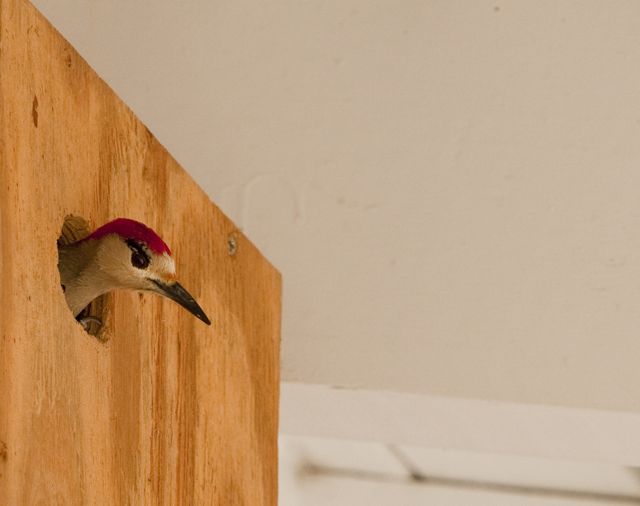
Caroline Stahala has given me a West Indian Woodpecker update. These charming if noisy birds have been a bit of a leitmotif of this blog. We met their early reluctance to use the perfectly nice nesting box provided for them; their eventual moving in; their use of the club vehicles’ wing-mirrors for vanity purposes; their attempts to raise 2 broods of chicks with varied success (that’s a deliberate euphemism); and stoutly resisting the force of Irene. The male woodpecker is still using the nesting box for roosting. The breeding season is long over, but perhaps next season his home in the eaves of the verandah will be tempting for a mate… And finally, the hummingbirds are plentiful – so as Caroline says, “now is a good time to be birdwatching…”
A while ago, I posted stills from a reef-snorkelling video – my first ever underwater video attempt, and indeed my first snorkel for about 40 yearsCLICK===>>>REEF FISH I started with a stingray, producing some rather… ok, very… modest results, but it was at least identifiable if you looked carefully and felt benign.
I’ve learned a few tricks since then. Here is the whole clip, still hopeless in most respects but there’s something quite cute about the creature. Mercifully it is only 37 seconds long. I reserve the right to delete this post when I realise no one has actually watched it! [LATER: Oh! I find a few hardy souls have done so. It’s a democratic vote for the ray to stay, as I see it]
[Belated credit to the fairly litigious Joe Satriani (see JS v Coldplay 2009) for borrowing the intro to one of his songs. It’s a non-commercial tribute, Joe]
Michelle, a resident of Green Turtle Cay who contacted me just after Irene had hit, has emailed this update of the situation there. I’m still getting searches from people asking for news on GTC, so I’m posting this now – there may be some images to add in due course. I have a feeling that many people outside Abaco / Bahamas have no idea that the comms are still down over many areas 6 weeks later, and that the great repair and clean up continues
“Thankfully everyone is fine except for the continuous cleaning up and trying to restore the phone service. I hear BATELNET has been sold by the gov. So there is now one hapless phone line repairman scampering around trying to get all the lines drained of water and serviceable… Irene came in on both sides and on high tide (as usual… remember Floyd?). It would have been good to have been able to receive news in the US while Irene was approaching the chain, but typical that unless it directly concerns [the US], you have to have other news sources. The patience of Bahamians is simply amazing!”
Although I have stood down from temporary hurricane-watch commentary, I will continue to post with news from individual areas for as long as I am getting online queries. All credit to WordPress for the detailed daily stats breakdowns…
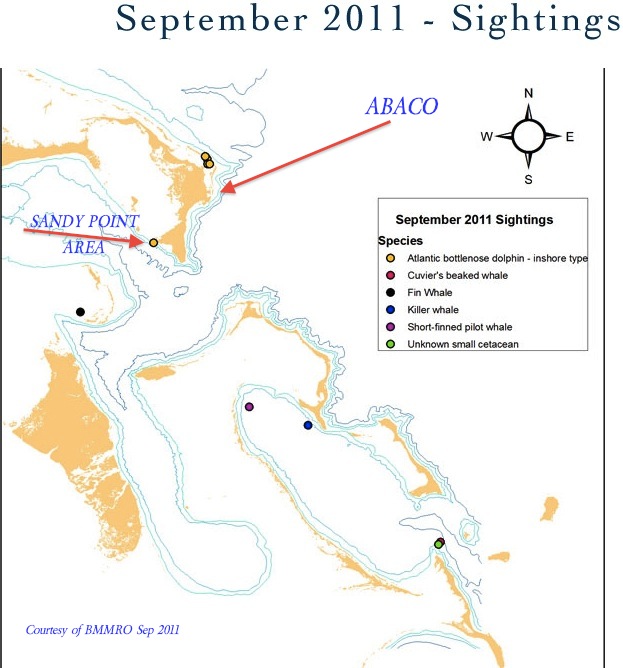
The BMMRO has just posted its sightings chart for September 2011. There are more sightings than in August (when the boats didn’t go out, and Irene interposed herself somewhat assertively). I am not sure that the research boats went out much last month, but Bahamas-wise there were clearly a few more reports of sightings, including another Fin whale. Here is the chart:-
NATIONAL TREE OF THE BAHAMAS & THE WOOD OF CRICKET BAILS
LIGNUM VITAE The “tree of life” (Guaiacum sanctum) is a very heavy wood with clusters of small blue flowers at the branch tips. Its strength, density and durability made it a valuable trade wood historically. It easily sinks in water and is the densest of all trade woods. As alternative materials and compounds have been discovered, the demand for LV has fallen… which is fortunate, since Lignum Vitae (also commonly known as Greenheart and Ironwood) is now considered a potentially endangered tree species.
LIGNUM VITAE TREE IN HOPE TOWN, ELBOW CAY, ABACO
The wood had – and still has – many important uses. All cricketers know that bails of lignum vitae are used in windy conditions to forestall any “…and the bowler charges in… reaches his delivery stride and… oh my goodness the bails have blown off…” dramas. The wood is also used in other sports: for bowls and skittle balls, and croquet mallets Flower Image Credit Grooko
LIGNUM VITAE TREE ON MAN-O-WAR CAY, ABACO
Photo credit: Eric Forsyth of the Yacht Fiona
10 MEMORABLE FACTS ABOUT LIGNUM VITAE
Traditionally, it was used for making British Police Truncheons (now made of soft fluffy pink fabric to reflect new caring policing methods)
Its physical qualities made it widely used in shipbuilding (though presumably not the whole ship, which would sink instantly)
Cabinet-makers, stone-carvers and gem-cutters all use the wood in their crafts
LV has many engineering uses. The wood is self-lubricating and is ideal for bearings. The 1st nuclear submarine had some of these
The world-renowned UK fishing rod maker Hardy’s made a famous ‘Greenheart’ rod
LV has medical uses, including for arthritis; and its bark / shavings allegedly make a nice cup of “tea”… (Any evidence of this?)
A 1920’s calypso song “LignumVitae” was sensationally saucy for its allusions to the bark tea’s prophylactic quality in addition to exploiting the phallic connotations
Gabriel Garcia Márquez incorporates uses for the wood in two of his novels (neither of which I have read. Oh dear. The guilt)
Pete Seeger, singer / songwriter, made the neck of his banjo from LV
The wood is also connected to mauve tiling, vitamin glue, anti-evil gum and the ‘vigilant emu’ by anagrammatic chance
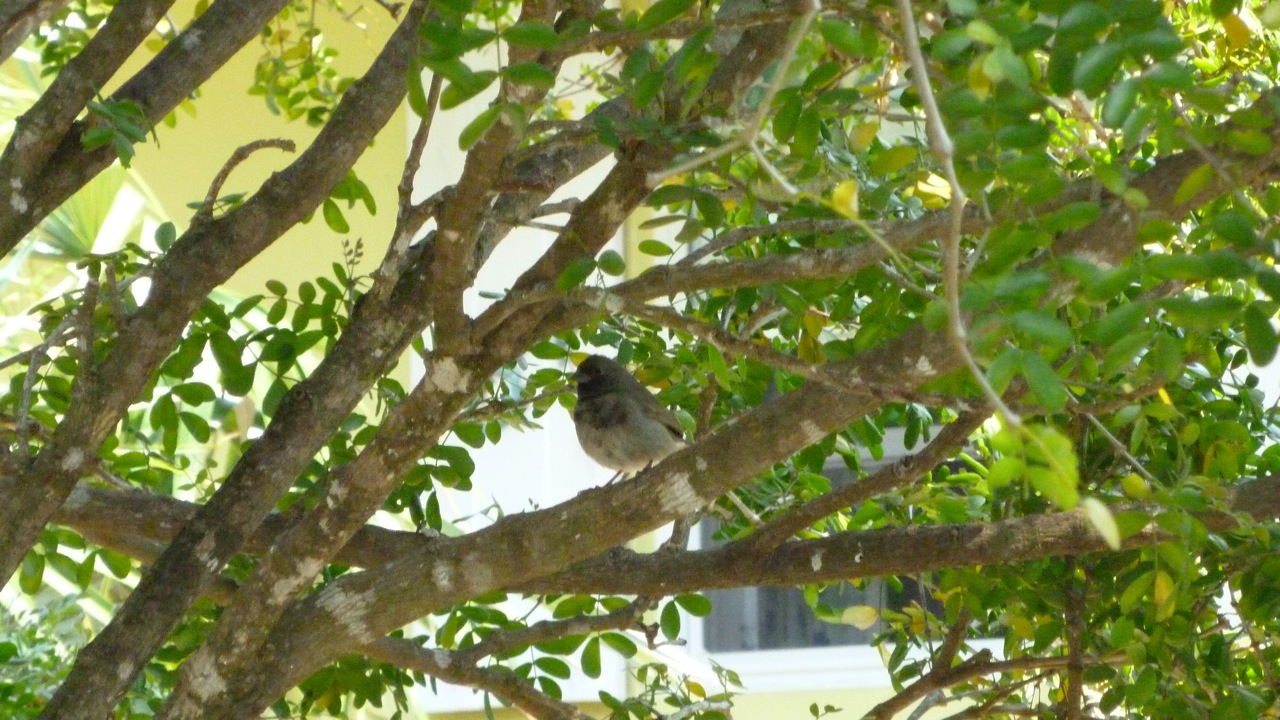
A Lignum Vitae tree at Bahama Palm Shores, Abaco, with a camera-shy juvenile black-faced grassquit
JANKA HARDNESS TEST
The Janka Hardness Test is an international test of the hardness of a given wood by measuring the force needed to embed a steel ball to half its diameter. The size of the ball is internationally standardised, though the reading may be given in ‘local’ units. The hardest wood (using pounds/force units) is the Australian Buloke (5060); Lignum Vitae is the second hardest (4500). Other examples are Ebony (3220); Satinwood (1820); Zebrawood (1575); Caribbean Pine (1280); Teak (1000); Mahogany (800) Balsa (100).
A single lignum vitae flower
Some examples of items traditionally made from lignum vitae: gavels (auctioneers, TV Judiciary eg in Perry Mason); bowls; pestle & mortar; and (for dudes) a seriously cool guitar pick (less than $5 too)
PS 2012: I now have 2 hardwood plectrums (plectra?) to try out. The Lignum is nearly 3 times as hard as the Zebra wood. This does not imply that I am a dude (or even a superannuated one), but merely that I haven’t had the heart to dispose of my guitars. Mrs RH has a view about that… a strong one, I think
Info Card by Scott Johnson of the Bahamas National Trust
The above is cobbled together from Wiki and other snippets. Ta to all. An interesting site for a look at LV’s practical uses and some helpful information is Lignum-Vitae.com CLICK LOGO===>>>
The mention of cricket has made me nostalgic for the season just ended… UK – indeed any – cricket nuts will know exactly where I am coming from with this…
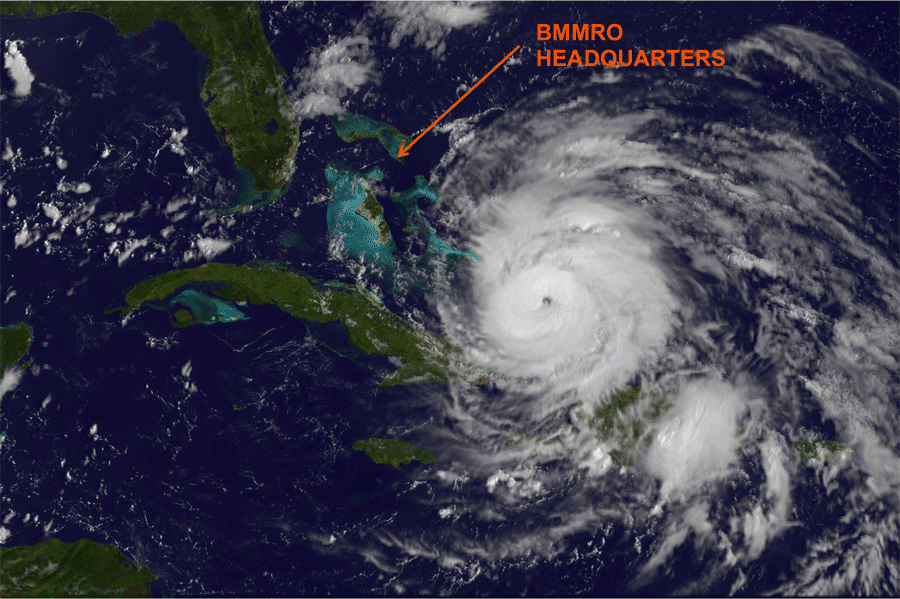
Charlotte Dunn has posted a report of events at Sandy Point in August on the BBMRO site. Her account includes photos of Hurricane Irene as it passed over Sandy Point, and of some of the damage in the aftermath
For the direct link to Charlotte’s blog CLICK DOLPHIN ===>>>
Hurricane Irene on its way towards Abaco, directly in its path …Image credit BMMRO



 © Trout & Salmon Magazine, reproduced without express permission yet but in the hope that they will approve of the publicity, and not cancel my sub…


 Good to go…














 ROLLING HARBOUR ABACO
You must be logged in to post a comment.