Unknown's avatar

ABACO CHECKLIST: 40 BIRDS IN A DAY


Painted Bunting, Abaco Bahamas (Tom Sheley)

ABACO CHECKLIST: 40 BIRDS IN A DAY

South Abaco – the whole area south of Marsh Harbour – provides by far the best birding opportunities for a day of varied birding. A recent party led by birding guide Reginald Patterson included Charmaine Albury in the enthusiastic team. She sent me their checklist for the day – 40 species covering an impressive range of bird types. Here is the list, to which I have added some illustrative photographs.

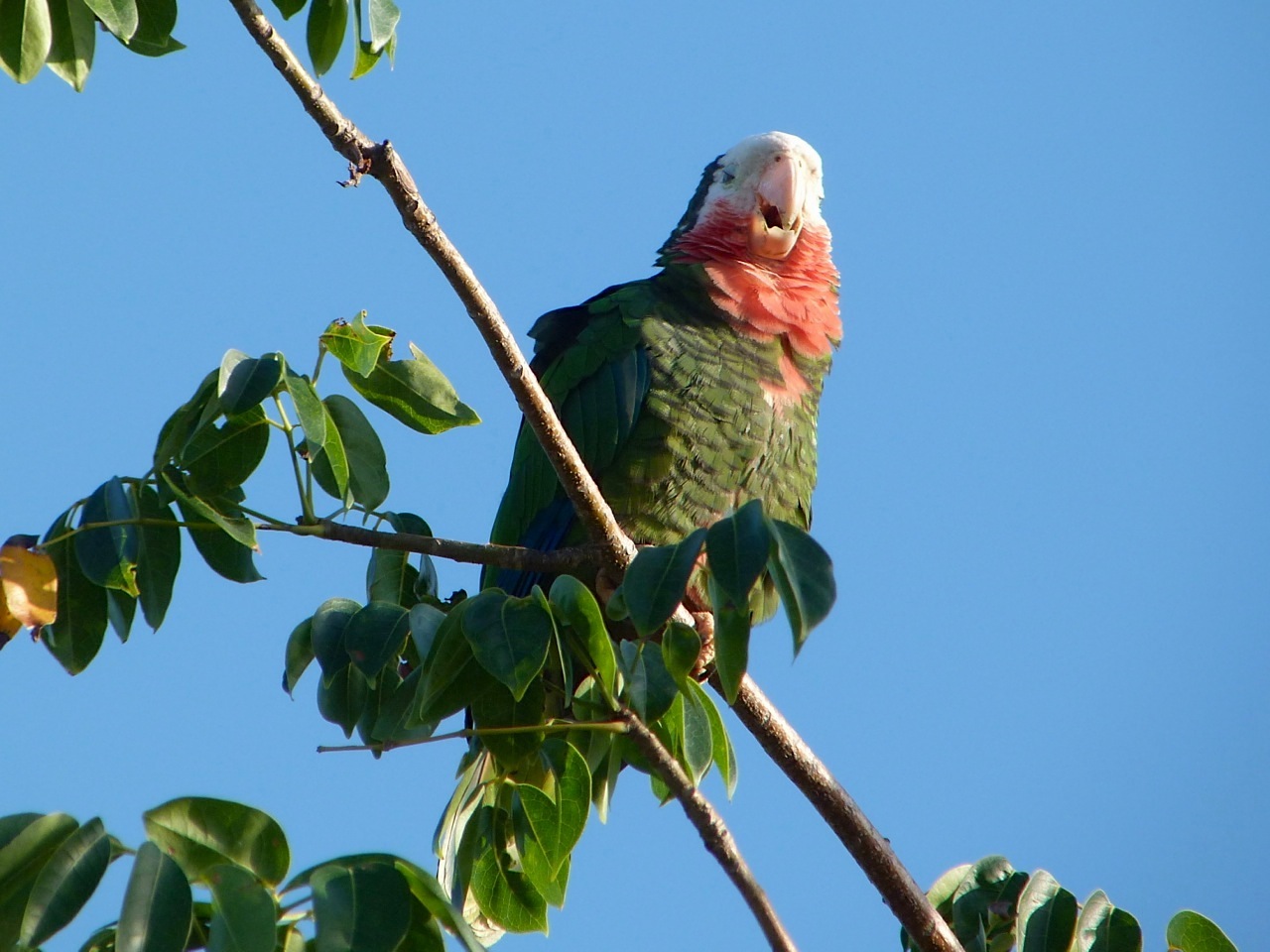
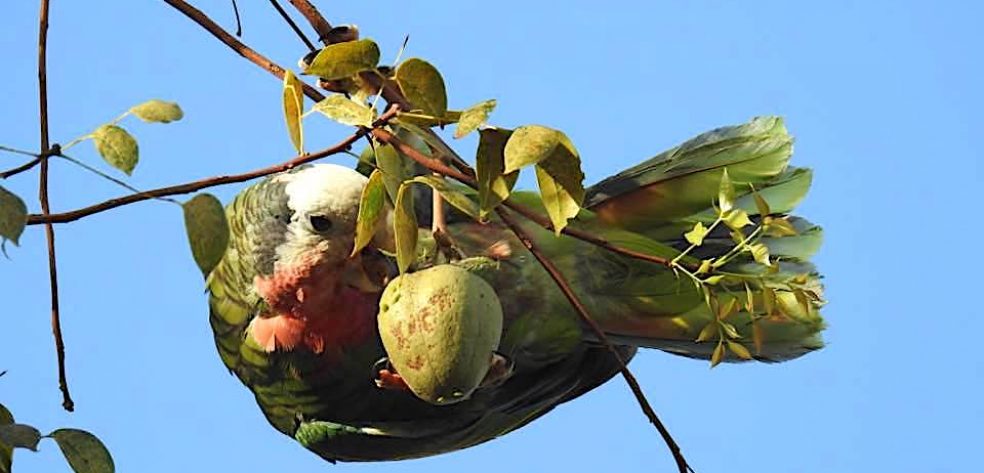
Abaco (Cuban) Parrot (Keith Salvesen)

BAHAMA PALM SHORES

1. Blackfaced Grassquit
2. Greater Antillean Bullfinch
3. Red-winged Blackbird
4. Gray Catbird
5. Abaco (Cuban) Parrots
6. Painted Bunting
7. Northern Mockingbird
8. La Sagra’s Flycatcher
9. Cuban Pewee
10. Yellow-throated Warbler

Western Spindalis, Abaco (Craig Nash)

11. Western Spindalis
12. West Indian Woodpecker
13. Cape May Warbler
14. Ovenbird
15. Eurasian Collared Dove
16. Common Ground Dove
17. Bananaquit
18. Red-legged Thrush
19. Turkey Vulture
20. Cuban Emerald Hummingbird
21. Thick-billed Vireo

Thick-billed Vireo, Abaco (Gerlinde Taurer)

BPS Duck Pond

22. Blue-winged Teal
23. Green-winged Teal
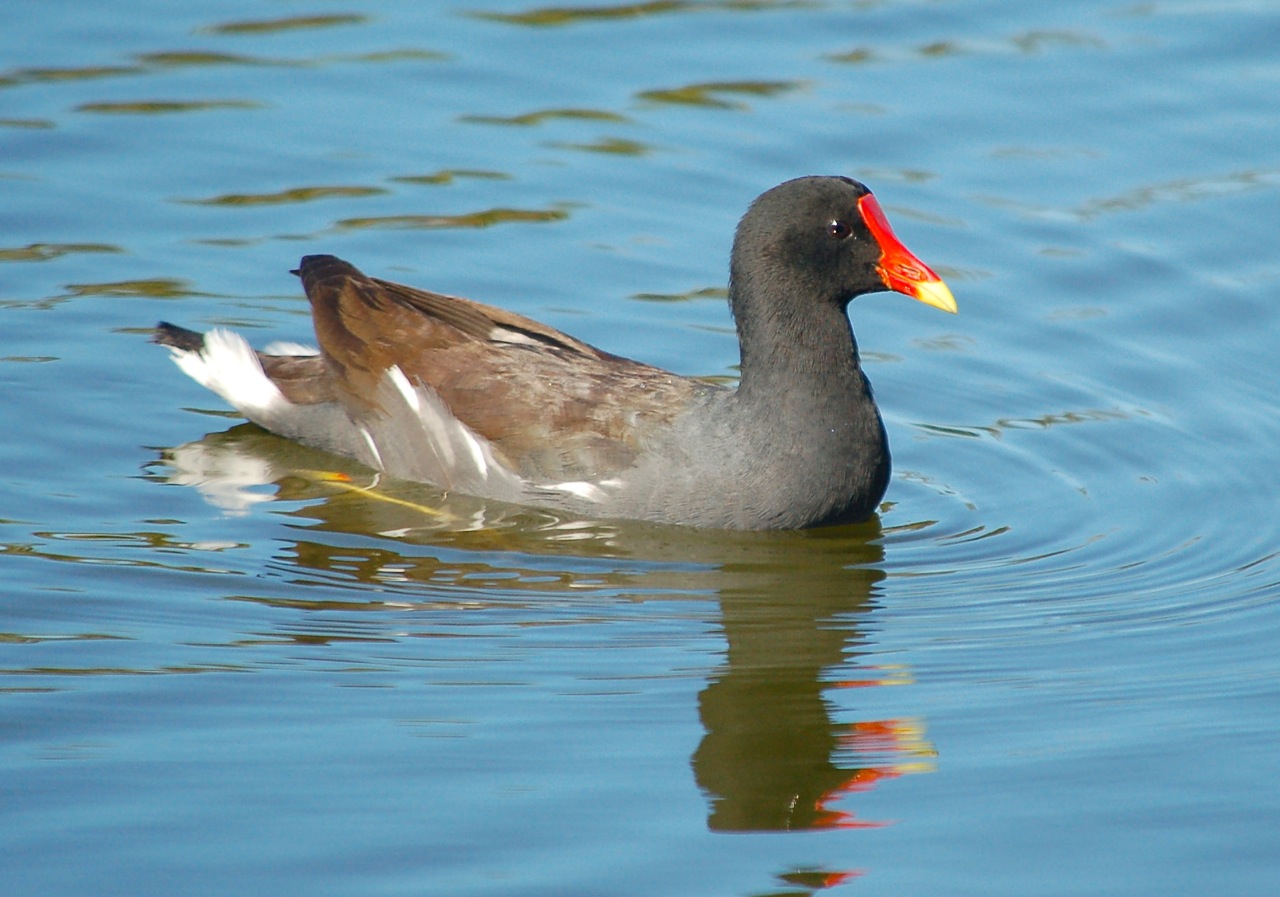
24. Common Gallinule

Common Gallinule, Abaco (Keith Salvesen)

SAWMILL SINK BLUE HOLE

25. Olive-capped Warbler
26. Yellow-rumped Warbler
27. Loggerhead Kingbird
28. Prairie Warbler

Prairie Warbler, Abaco (Gerlinde Taurer)

HIGHWAY ROADSIDE

29. Bahama Warbler
30. American Kestrel

American Kestrel, Abaco (Tom Reed)

GILPIN POND

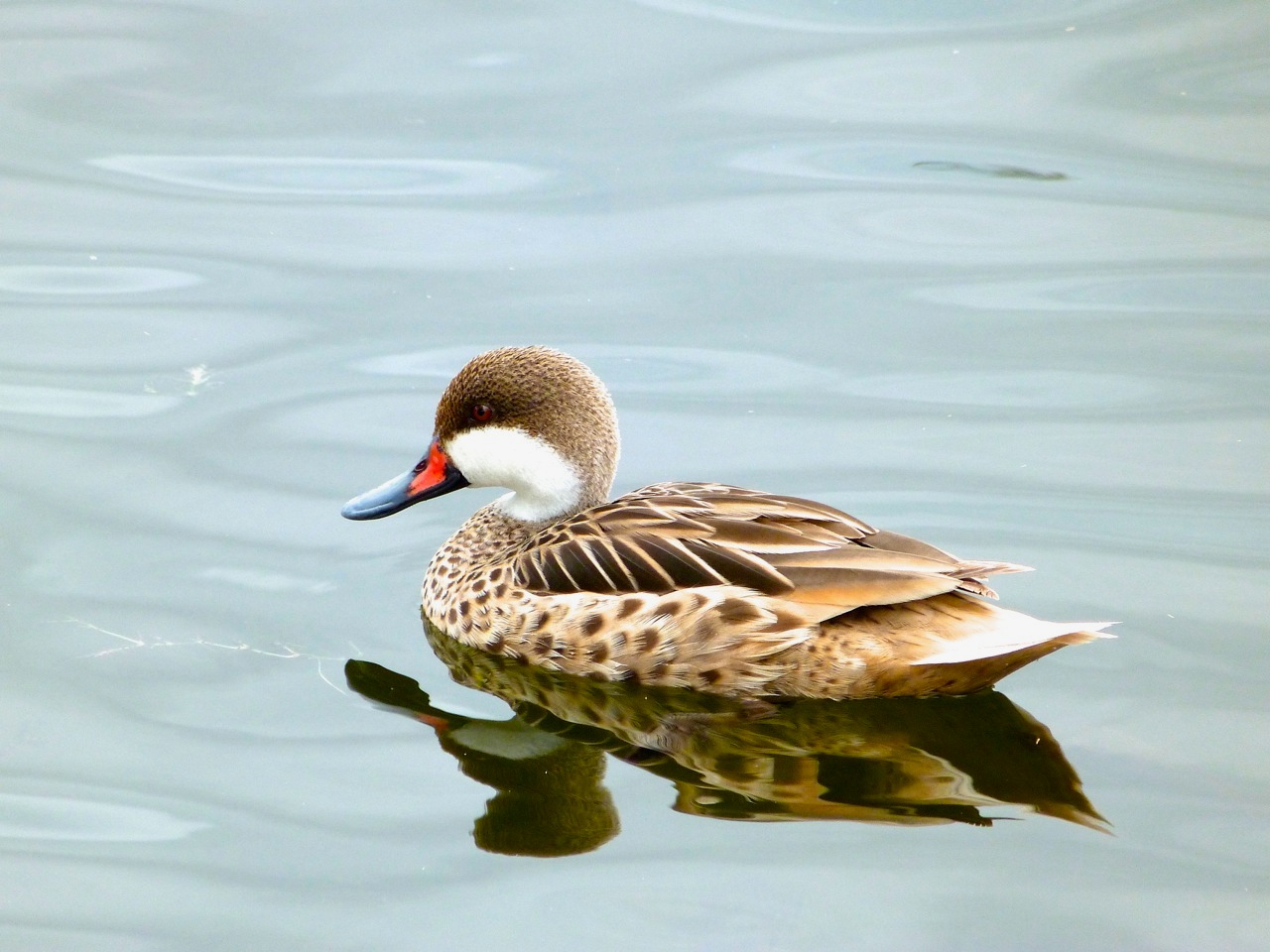
31. White-cheeked (Bahama) Pintail
32. Great Egret
33. Great Blue Heron
34. Tricolored Heron
35. Lesser Yellowlegs
36. Solitary Sandpiper

White-cheeked (Bahama) Pintail, Abaco (Keith Salvesen)

SANDY POINT

37. Laughing gulls
38. Ruddy turnstone
39. Sanderlings
40. Royal terns

Sanderlings, Abaco (Keith Salvesen)

The checklist covers a broad range of birds that you might expect to see in habitats ranging from coppice to pine forest to water to shoreline. Most are permanent residents, with some winter residents (eg the painted bunting, Cape May warbler). Abaco specialities include the parrots of course, the West-Indian woodpecker and the olive-capped warbler.

And birds that might, on another day, be seen? Maybe the endemic Bahama Woodstar hummingbird and the endemic Bahama Swallow. At Gilpin Pond, black-necked stilts and perhaps a belted kingfisher. And at Sandy Point, brown pelicans fishing off the dock and the chance of white-tailed tropicbirds off-shore. But overall a ’40 day’ is a great day!

Great Egret, Abaco Bahamas (Nina Henry)

We are just back on Abaco last night, and without actually trying – and just from the balcony in about 20 minutes – we have scooped:

Turkey Vulture, Black-faced Grassquit, Bananaquit, Bahama Swallows, Loggerhead Kingbird, La Sagra’s Flycatcher, and Thick-billed Vireo – also Oystercatchers heard from the beach. Time to investigate further…

Credits: Tom Sheley (1); Keith Salvesen (2, 5, 8, 9); Craig Nash (3); Gerlinde Taurer (4, 6); Tom Reed (7); Nina Henry (10)

Unknown's avatar

BAHAMAS REEF FISH (44): PORKFISH


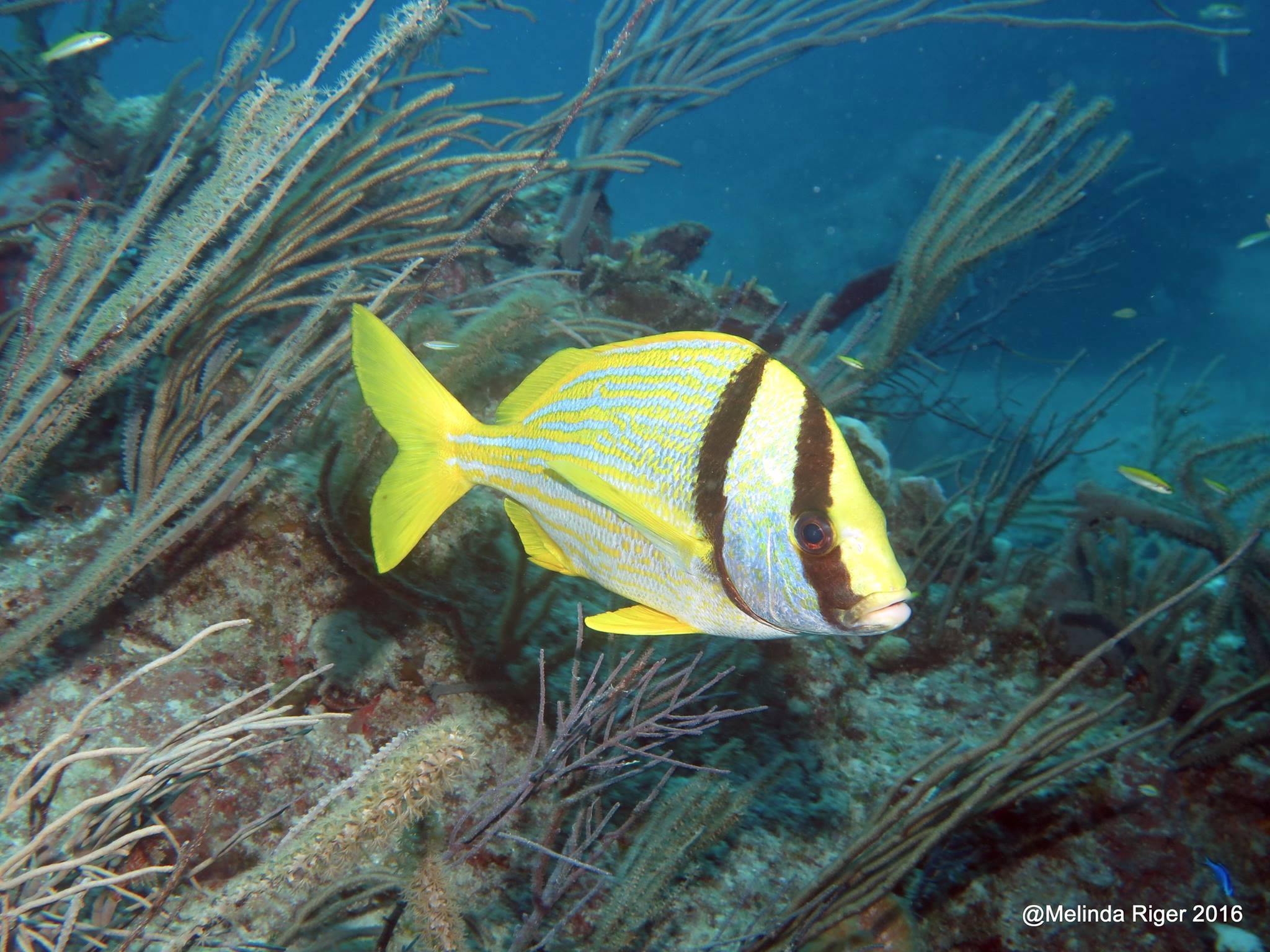
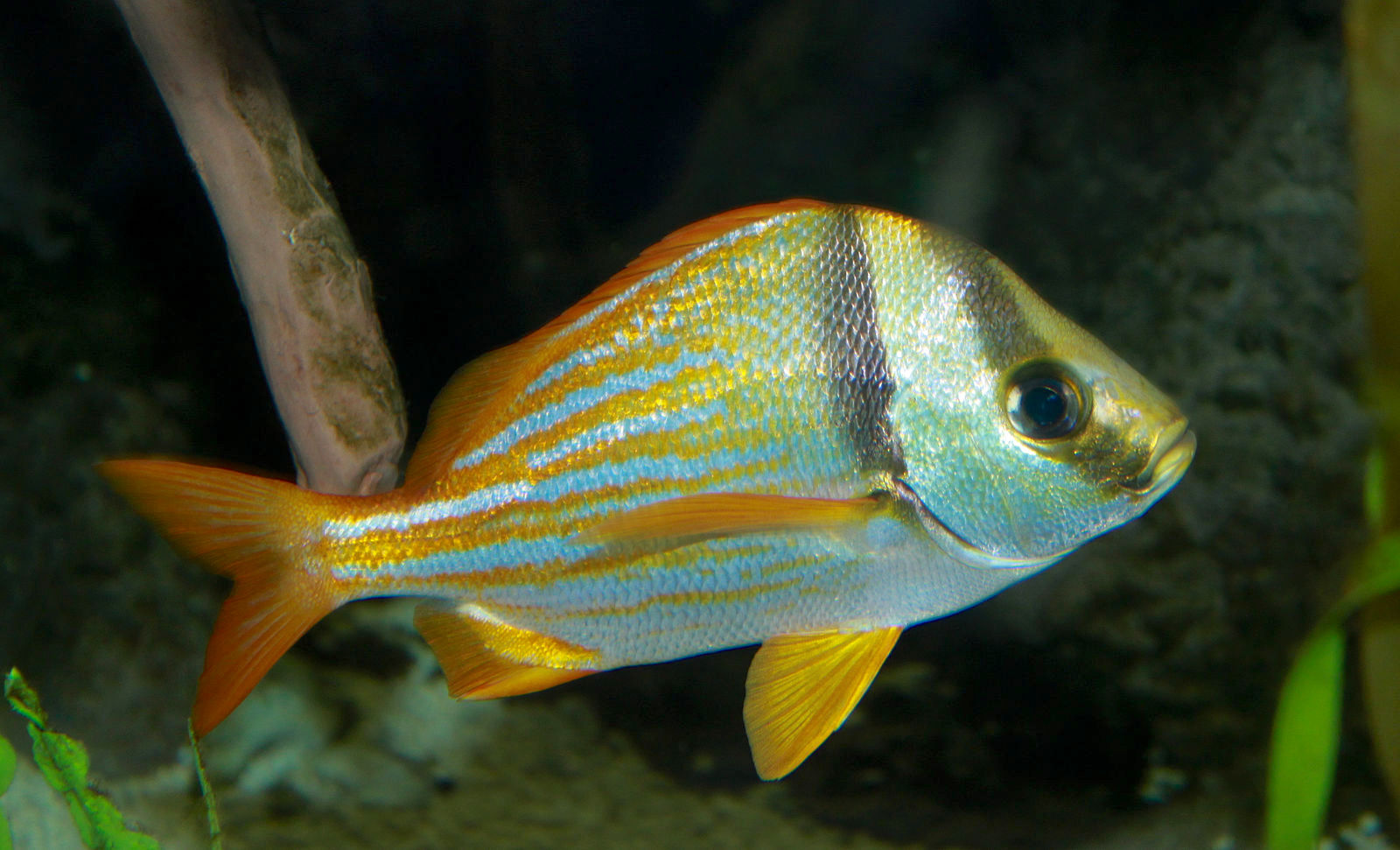
Porkfish (Grunt), Bahamas - Melinda Riger / Grand Bahama Scuba

BAHAMAS REEF FISH (44): PORKFISH

Behold the porkfish Anisotremus virginicus, the slightly unattractively named representative of the (arguably) even less attractively named grunt species. These small, bright-coloured reef dwellers are rarely more than 12 inches long. They are mainly nocturnal fish, feeding on small crustaceans, mollusks and so on. Juveniles have been observed acting as cleaners to larger species, feeding on parasites – an example of mutualism between species, in which both sides benefit from the arrangement.

Porkfish (Grunt), Bahamas - Melinda Riger / Grand Bahama Scuba

WHY IS A ‘PORKFISH’ A ‘GRUNT’

The terminology seems to be somewhat confused by local usages, but in general terms all porkfish are grunts; but not vice versa. Yet I notice that the term ‘porkfish’ is used to describe other types of grunt. A good rule of thumb is the the Atlantic Porkfish is the only grunt with two black vertical bars and yellow stripes… Note that grunts differ from their cousins the snappers by having a different dental arrangement – no canine teeth.

Porkfish (Grunt), Bahamas - Melinda Riger / Grand Bahama Scuba

AND WHY ‘GRUNT’ ANYWAY? DO THEY SOUND LIKE PIGS?

Well, perhaps a bit. All grunts, including porkfish, are capable of producing grunt-like sounds from some kind of grinding of their back teeth that is too technical to go into here**. The sound is associated with ‘situations of duress and danger’ – such as being caught and unhooked…

Porkfish (Grunt), Bahamas - Melinda Riger / Grand Bahama Scuba

DO YOU HAPPEN TO HAVE A RECORDING?

As it so happens I do. This is taken from a rather longer Youtube video in which a grunt was caught, unhooked and returned.You’ll hear a couple of grunts as the fish was unhooked, and some (perhaps understandable) hilarity on the boat. I guess you had to be there.

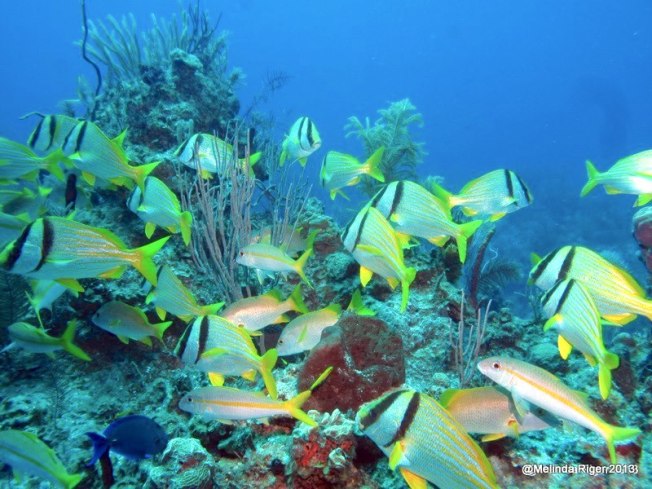
Porkfish are gregarious, and also mix with other speciesPorkfish (Grunt), Bahamas - Melinda Riger / Grand Bahama Scuba

ARE PORKFISH EDIBLE?

Like most if not all grunts, they are, with the proviso that there is some association with ciguatera. I’ve never knowingly eaten one myself, but I gather that “grits and grunts” is a popular culinary combo in some places. For those that might want to know more, a quick look at a couple of threads reveals the following:

  • They taste great, a bit like ham
  • Their white meat cooks very well
  • They taste better than black margates (another grunt species)
  • Eat them in enchilado or breaded fillets
  • ‘Big-ass head’ on them so not much if you filet
  • If you scale and cook whole you get a better yield on them
  • When fishing for supper, ‘shoot ’em up and hold off for the bigger ones’

Porkfish (Grunt) - Brian Gratwicke (wiki)

Credits: all great photos by Melinda Riger /  Grand Bahama Scuba, except the last by Brian Gratwicke (wiki); soundbite from Youtube video 2010 by peachyree; research from seaworld.org; britannica.com and the usual suspects…

** Subtle code for “I haven’t really understood it…”

Unknown's avatar

THE ARTICULATE WHALE (1): TELLING A TALE AFTER DEATH


False Killer Whale (Endless Ocean-wiki)

THE ARTICULATE WHALE (1): TELLING A TALE AFTER DEATH

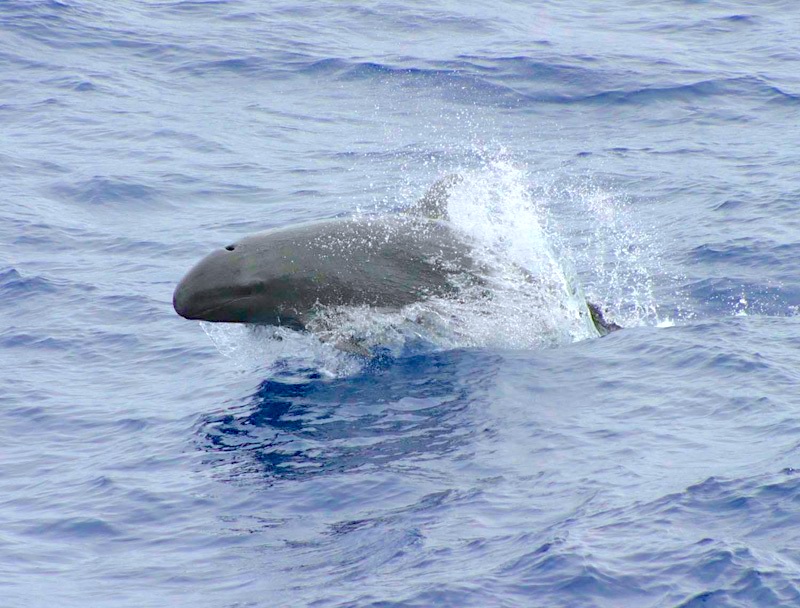
The ‘false killer whale’ Pseudorca crassidens has a somewhat misleading name: first (as implied), it is not a killer whale; second, it’s not actually a whale at all, but a large species of dolphin. However, it does have some killer whale tendencies – attacking and killing smaller marine mammals for example – and perhaps a passing resemblance, so the species has been given something of an upgrade, name-wise.

False Killer Whale (NOAA-wiki)

Although these fine creatures are distributed widely around the globe, the overall numbers are thought to be small, and relatively little is known about them in the wild. They are, of course, used as aquarium exhibits but the knowledge gleaned in captivity cannot provide much of an overview of their oceanic behaviour, which remains relatively unstudied.

False Killer Whale range map - wiki

However, there is one source of valuable data – the scientific study of stranded animals. And as it happens, Abaconians will very soon be able to obtain at least a skeleton knowledge of the FKW, the end-product of a long and complicated research project by the BMMRO in conjunction with Friends of the Environment. Just a quick word of warning before you read further – some images below are not especially pleasant to look at, so be prepared for them… They are illustrative and not intended for close inspection (unless you want).

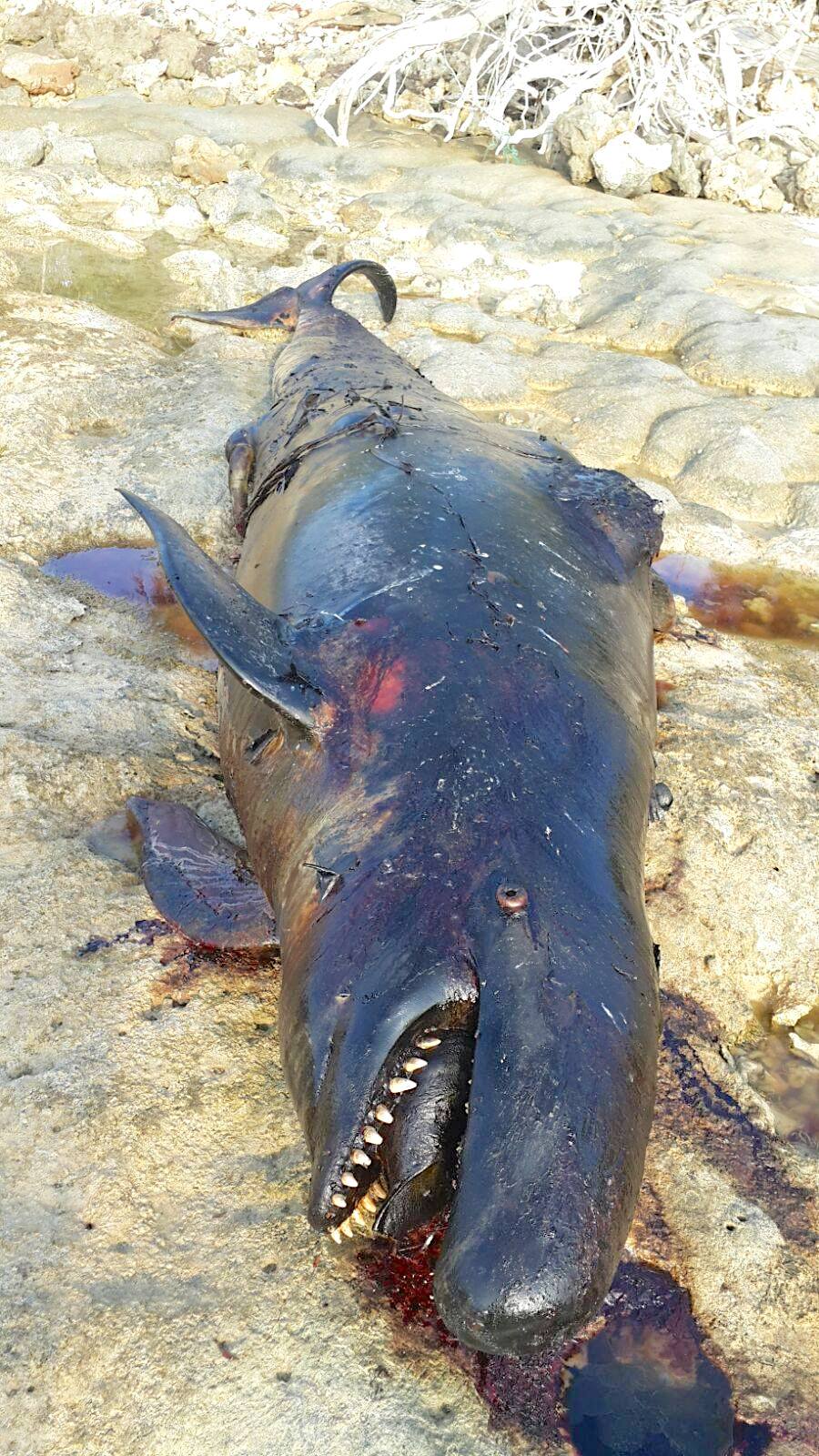
Exactly a year ago an FKW was reported to have stranded on Duck Cay, off Cherokee Sound. BMMRO were quickly on the scene, and hoping to undertake the usual procedure of a necropsy, in which post-mortem samples are taken for analysis. However the poor creature was in an advancing state of decomposition, so only skin samples and photographs could be taken.
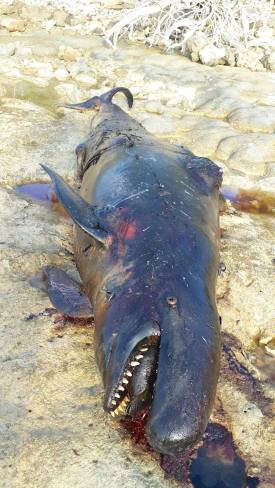
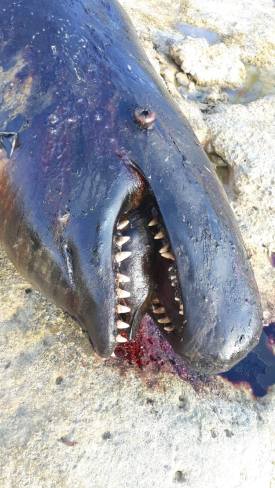
False Killer Whale, Abaco Bahamas (BMMRO)         False Killer Whale, Abaco Bahamas (BMMRO)

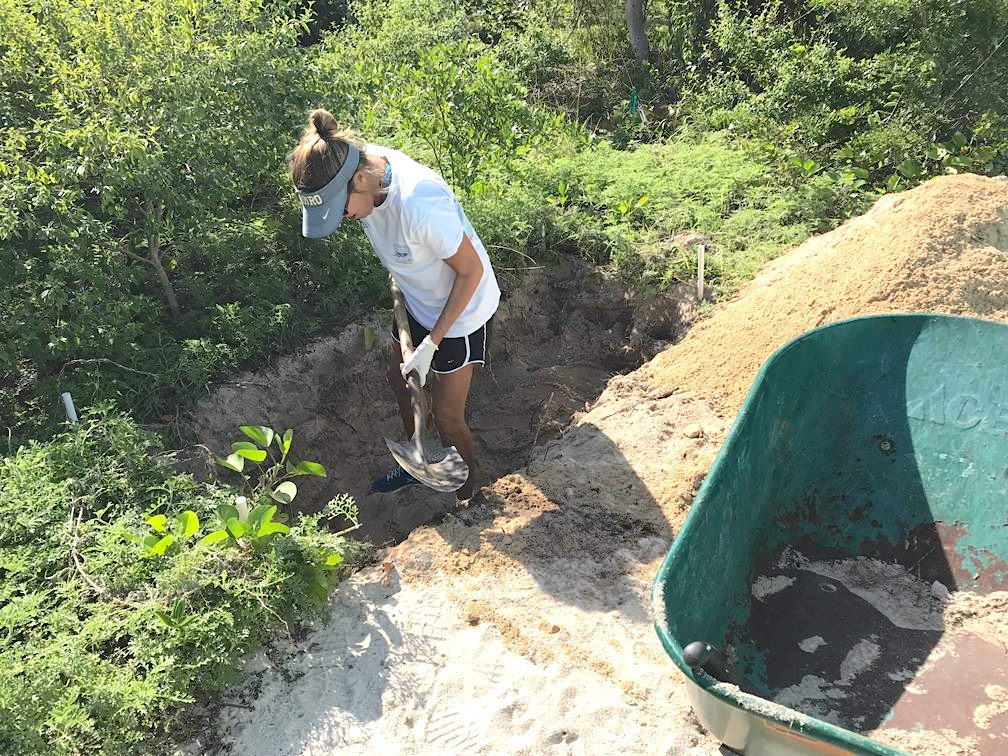
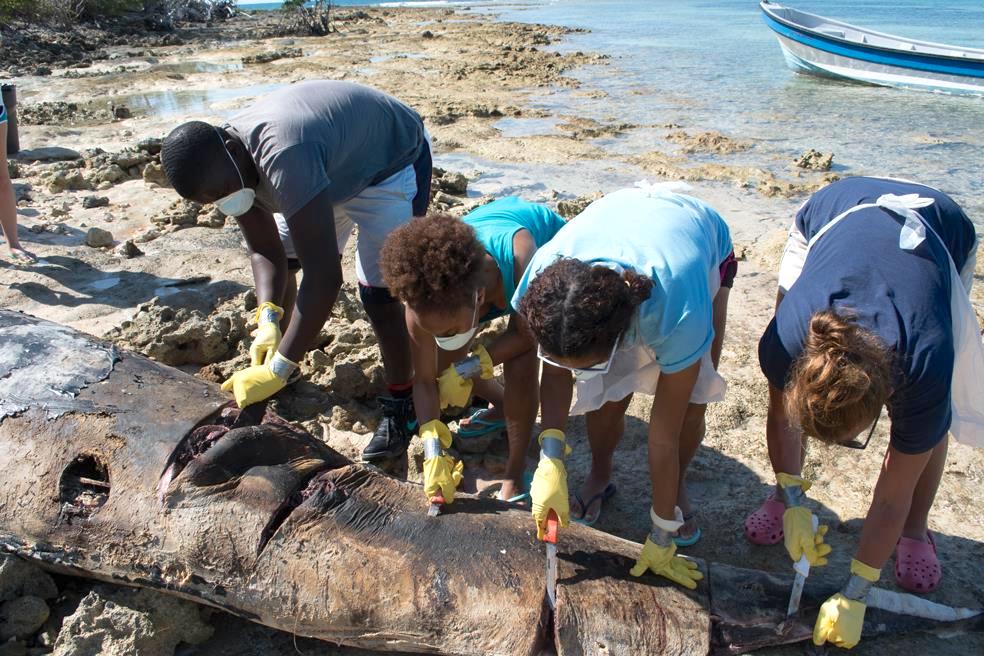
Telescoping the intervening months for the sake of brevity, the decision was made to cut up the carcass (note the face-masks) and bury it where it was, so that its integrity would be preserved for later retrieval, cleaning, reconstruction (‘re-articulation’) and exhibition for educational purposes.

False Killer Whale, Abaco Bahamas (BMMRO) False Killer Whale, Abaco Bahamas (BMMRO) False Killer Whale, Abaco Bahamas (BMMRO)

False Killer Whale, Abaco Bahamas (BMMRO)

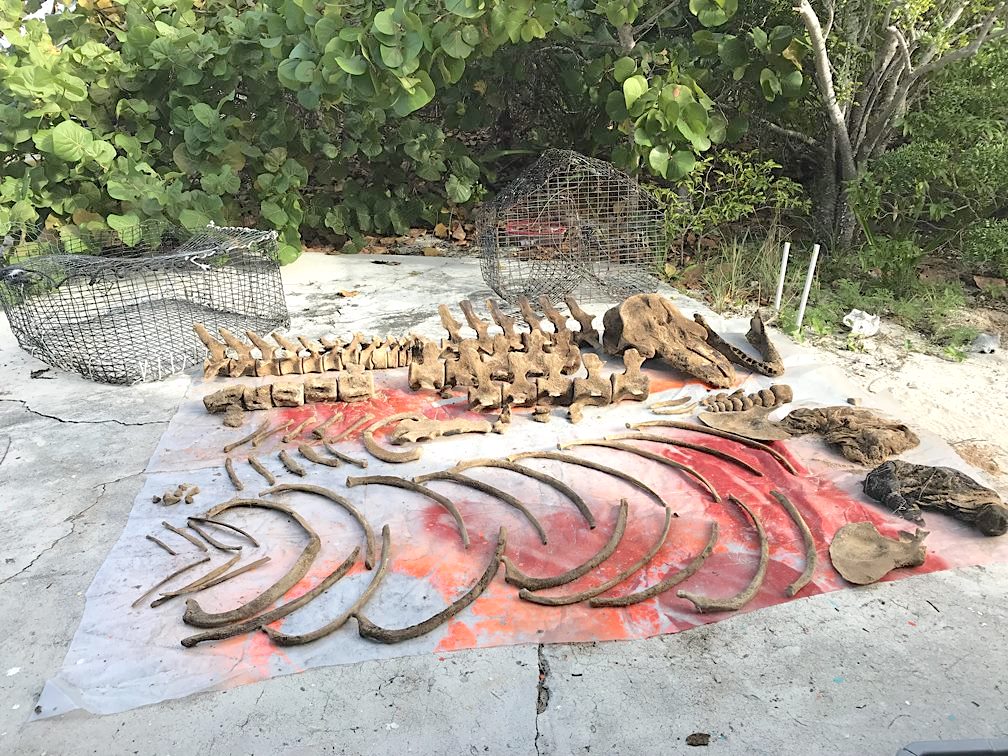
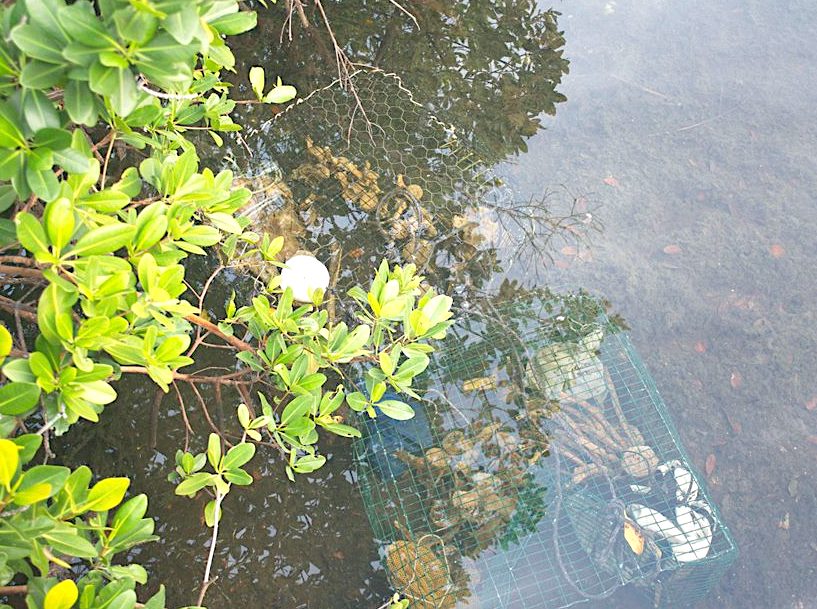
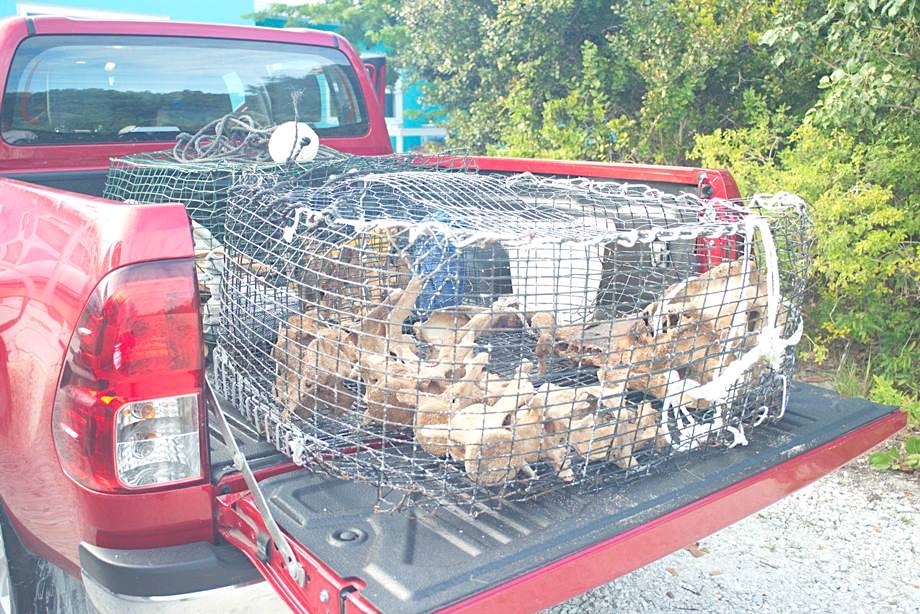
In December, the remains were exhumed for the next phase of the animal’s decomposition – submersion in cages in the mangroves – before the final cleaning of the bones in readiness for its re-articulation and display.

False Killer Whale bones, Abaco Bahamas (BMMRO)False Killer Whale, Abaco Bahamas (BMMRO)False Killer Whale bones, Abaco Bahamas (BMMRO)

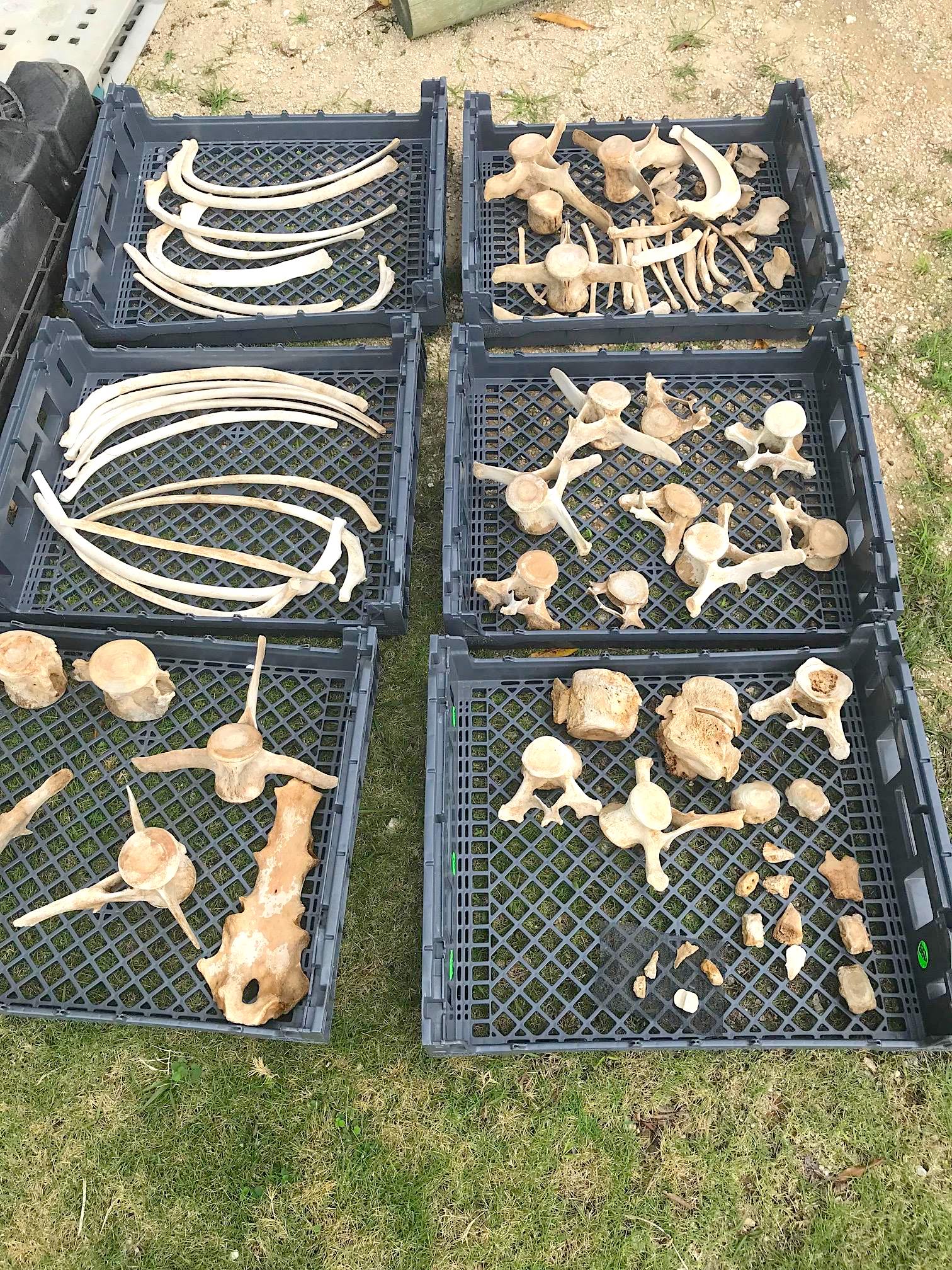
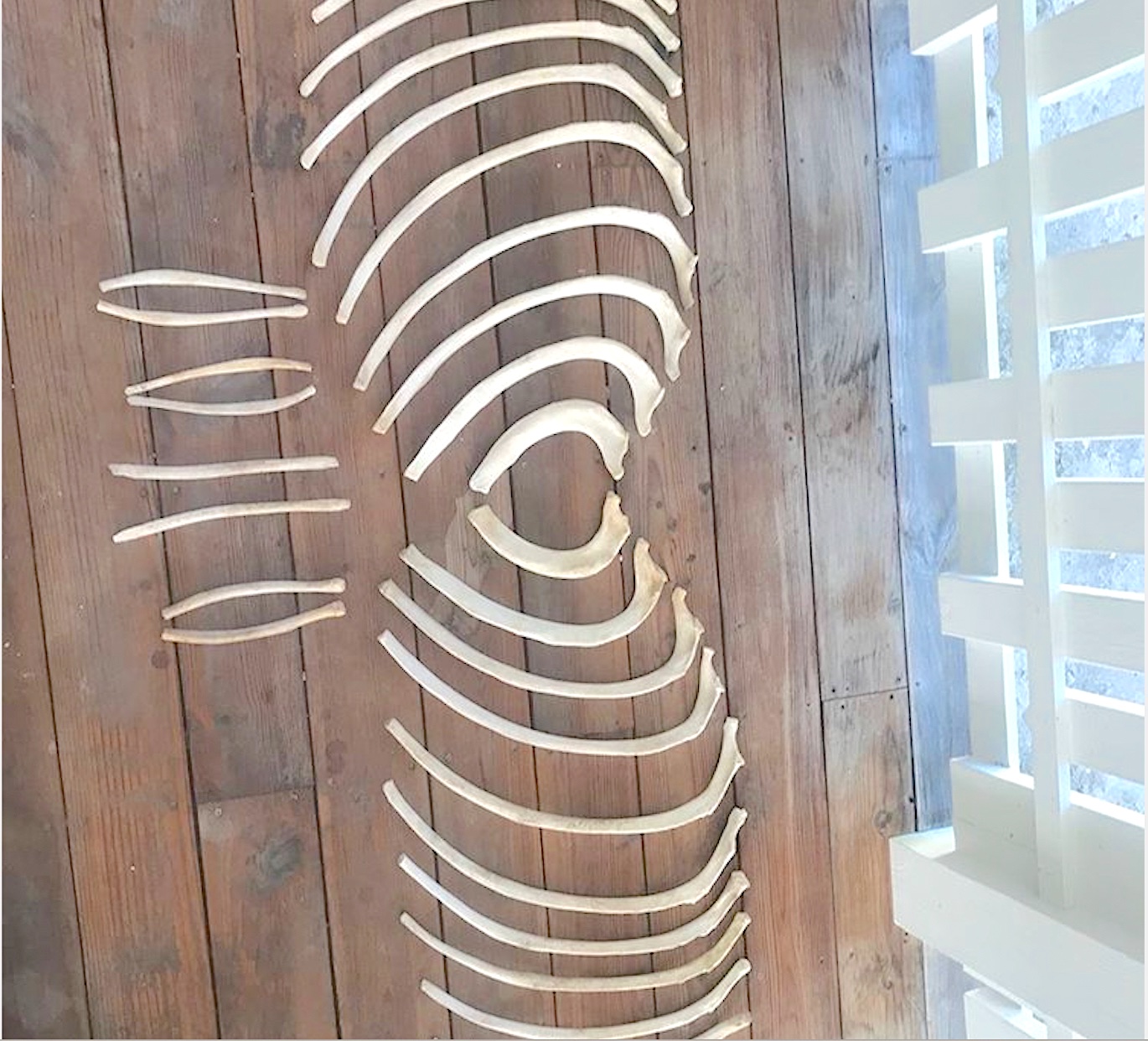
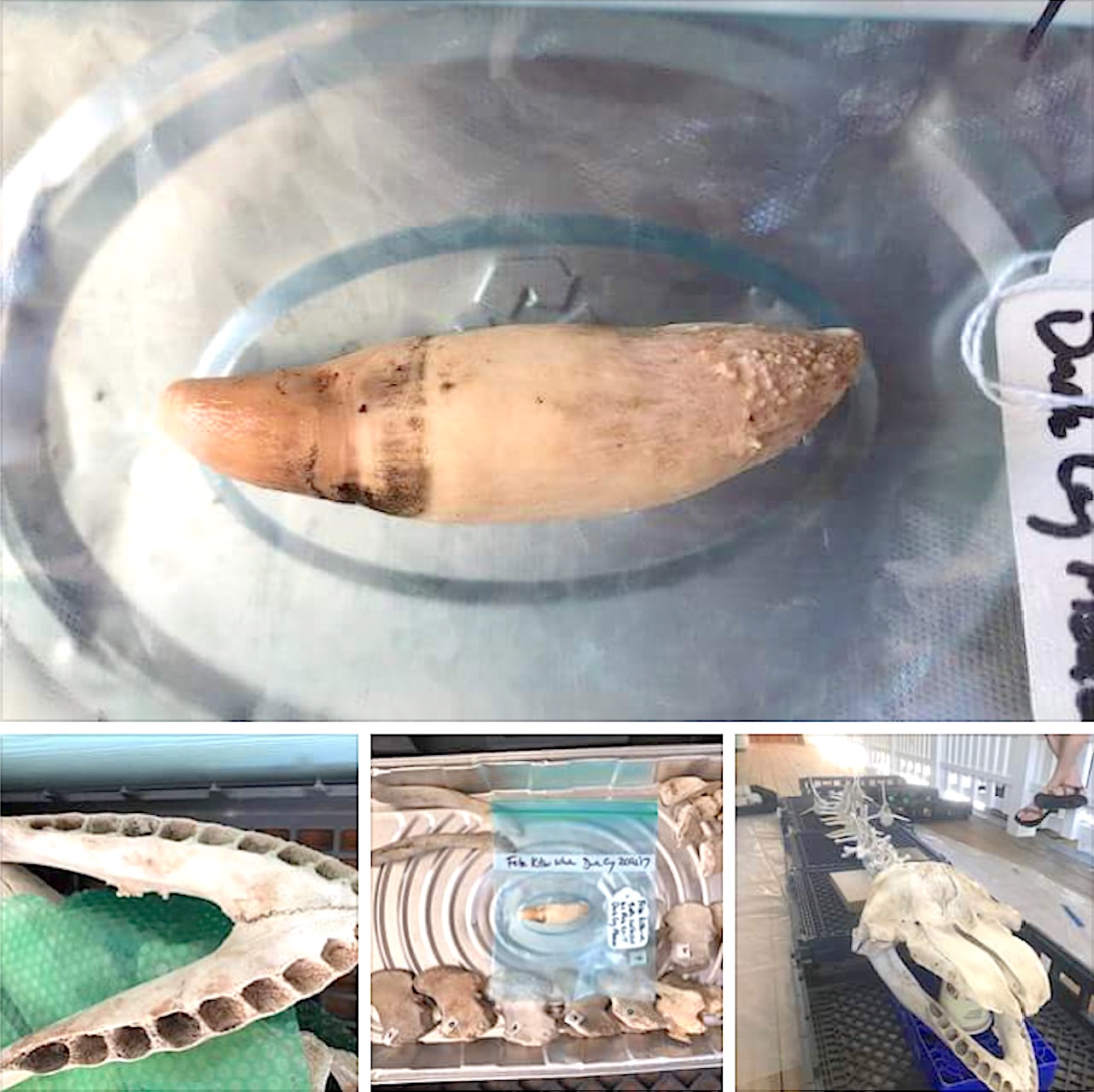
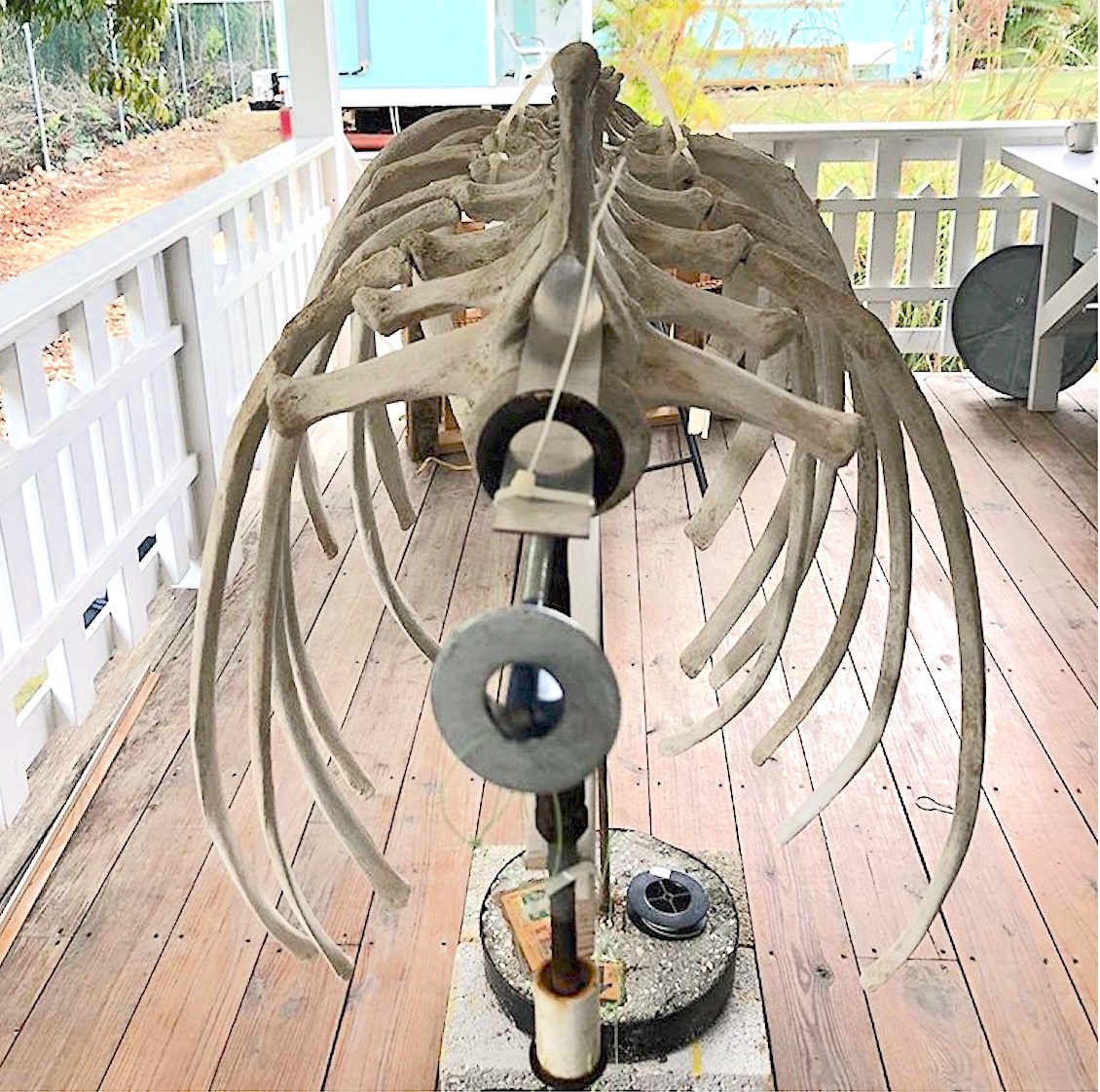
Cleaning the bones has been a meticulous process, leaving the resulting skeleton ready to reconstruct in situ at Friends of the Environment’s Kenyon Research Centre in Marsh Harbour. Adult FKWs can grow up to 6 metres long, so there are a great many bones from large to very small to place correctly – and plenty of teeth (see below). The re-articulation is nearly finished, and it is hoped that the completed skeleton will be on display in the very near future. I am planning to see it in about 2 weeks time, and – this sounds quite strange, I know – I’m very excited about it.
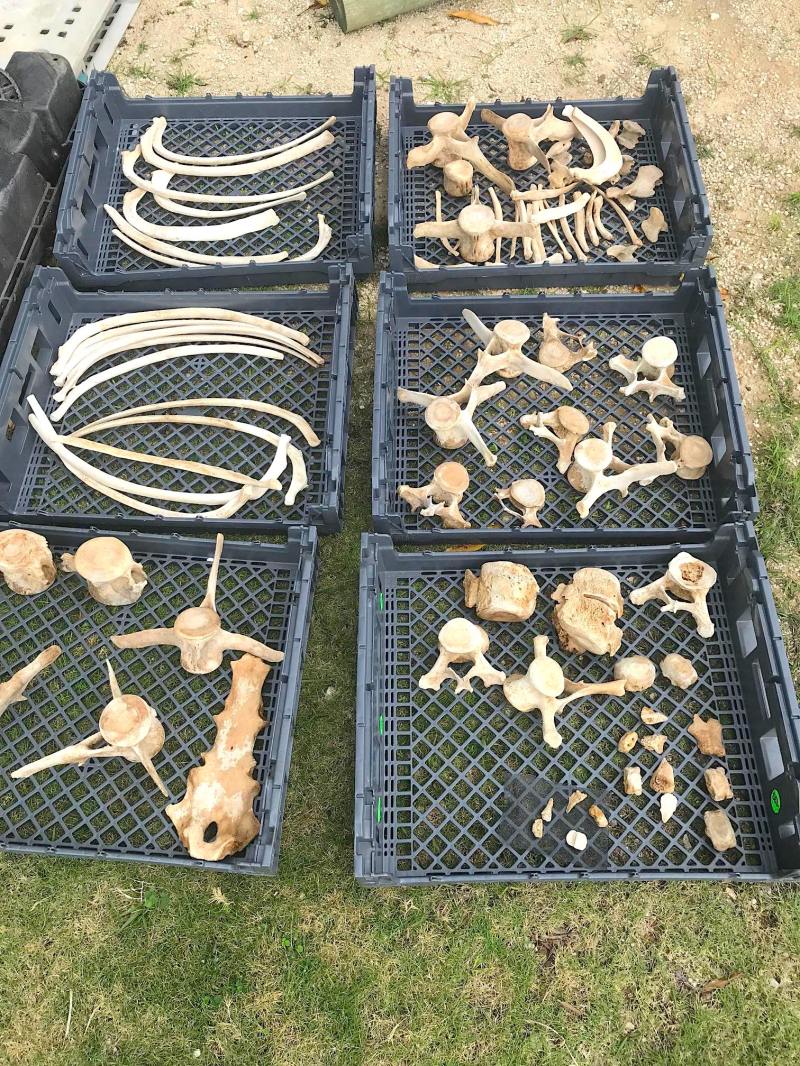
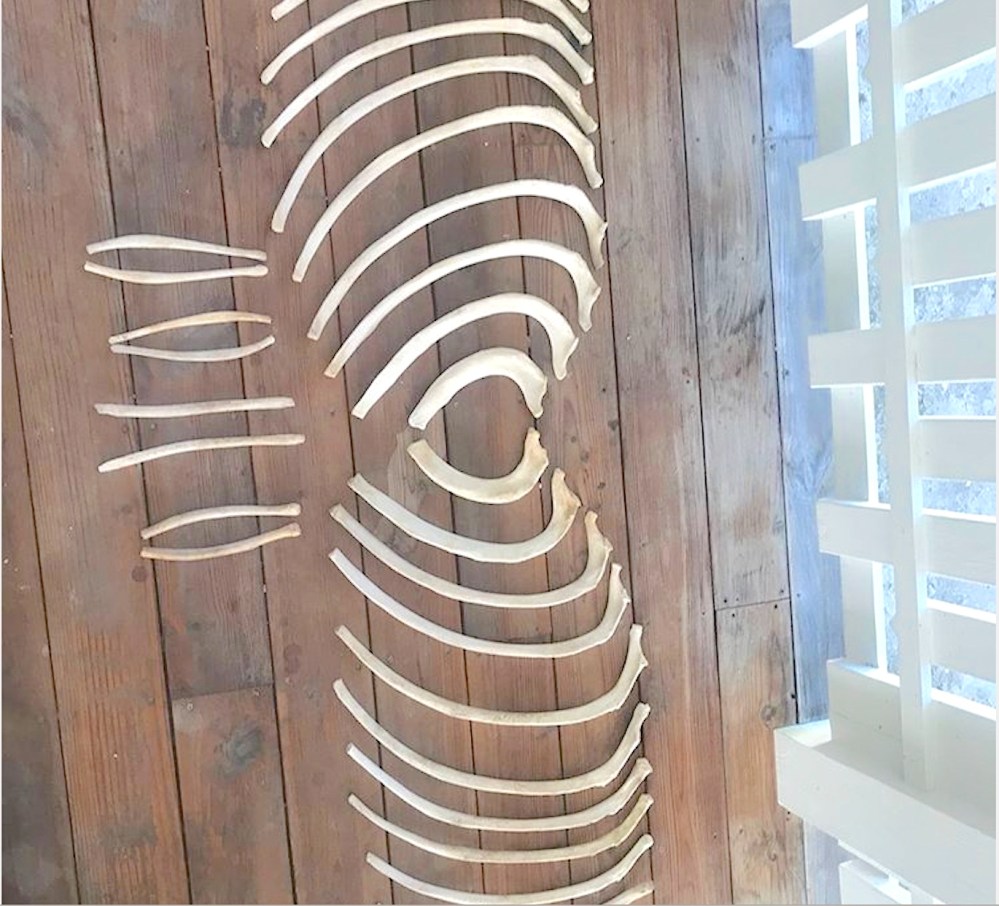
False Killer Whale bones, Abaco Bahamas (BMMRO)False Killer Whale bones, Abaco Bahamas (BMMRO)False Killer Whale tooth & bones, Abaco Bahamas (BMMRO)False Killer Whale skeleton, Abaco Bahamas (BMMRO)

This ambitious year-long project has involved BMMRO, FOTE, BEP (Bahamas Environment Protection Foundation), interns, and volunteers. I am keen to know whether, in the modern way, an affectionate name has been chosen for the skeleton. ‘Duck Cay’ doesn’t provide a very promising start. Well, maybe Donald is in vogue…? 

ARE STRANDINGS FREQUENT – AND WHY REPORT THEM?

Each year there may be half-a-dozen reports of cetacean strandings in Abaco waters, both whales and dolphins. As far as I can make out, the animals are almost invariably dead. If still alive, reporting is clearly urgent to ensure a quick response and to maximise the creature’s chances of survival. If dead, a carcass can provide scientists with valuable data on the biology and health of marine mammals and, in turn, the health of our marine ecosystems. This includes basic information, such as an animal’s age, its size, the types of prey it consumes, and the occurrence of diseases. Necropsies can provide more detailed information to add to the growing knowledge-base of marine mammal populations.

And a project like this one, with its great educational potential, can in effect enable a stranded marine mammal to tell its story even after death.

STRANDING NETWORK HOTLINE NUMBER +1 242 366 4155
(or +1 242 357 6666 / +1 242 577 0655)
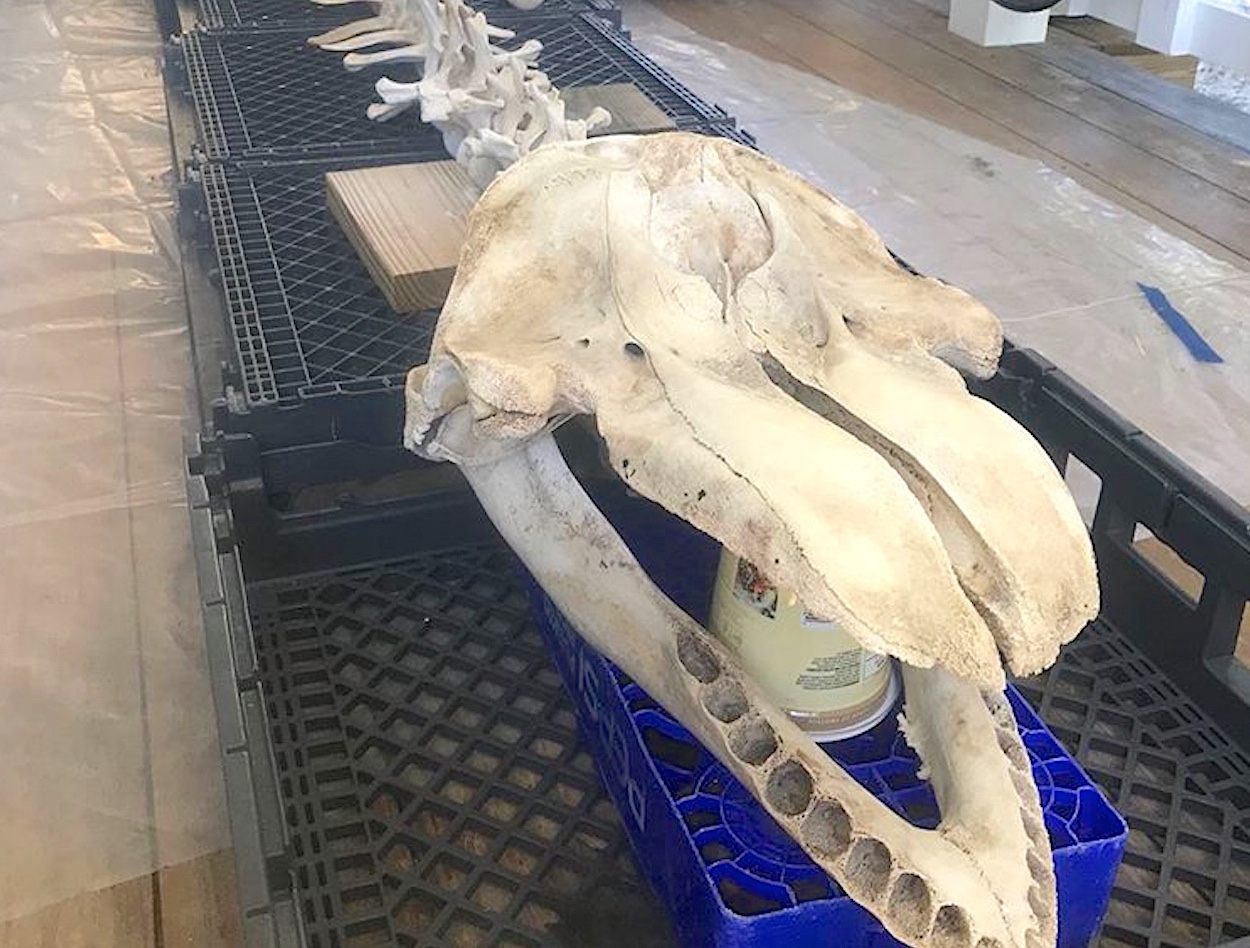
False Killer Whale skull, Abaco Bahamas (BMMRO)

Credits: header image, Endless Ocean / wiki; #1 NOAA; all other photos BMMRO or FOTE, with thanks; range map wiki 
Unknown's avatar

RED-WINGED BLACKBIRDS ON ABACO BAHAMAS


Red-winged Blackbird, Abaco (Tom Sheley)

RED-WINGED BLACKBIRDS ON ABACO

The sounds are unmistakeable – a discordant chorus of soft chuckling noises like tongue-clicks as the RWTs flock into a bush, interrupted by harsh, metallic calls like rusty metal gate-hinges being forced open. Or maybe a lone bird mournfully repeating its eerie call from the mangroves far out on the Marls as the bonefishing skiffs slip silently along the shoreline. No other species sound quite like Agelaius phoeniceus.

Red-winged Blackbird, Abaco (Tom Sheley)

The handsome males sport flashy epaulets, most clearly visible in flight or in display – for example to impress a prospective mate. Again, they are unlikely to be confused with another species.

Red-winged Blackbird, Abaco Bahamas (Alex Hughes)

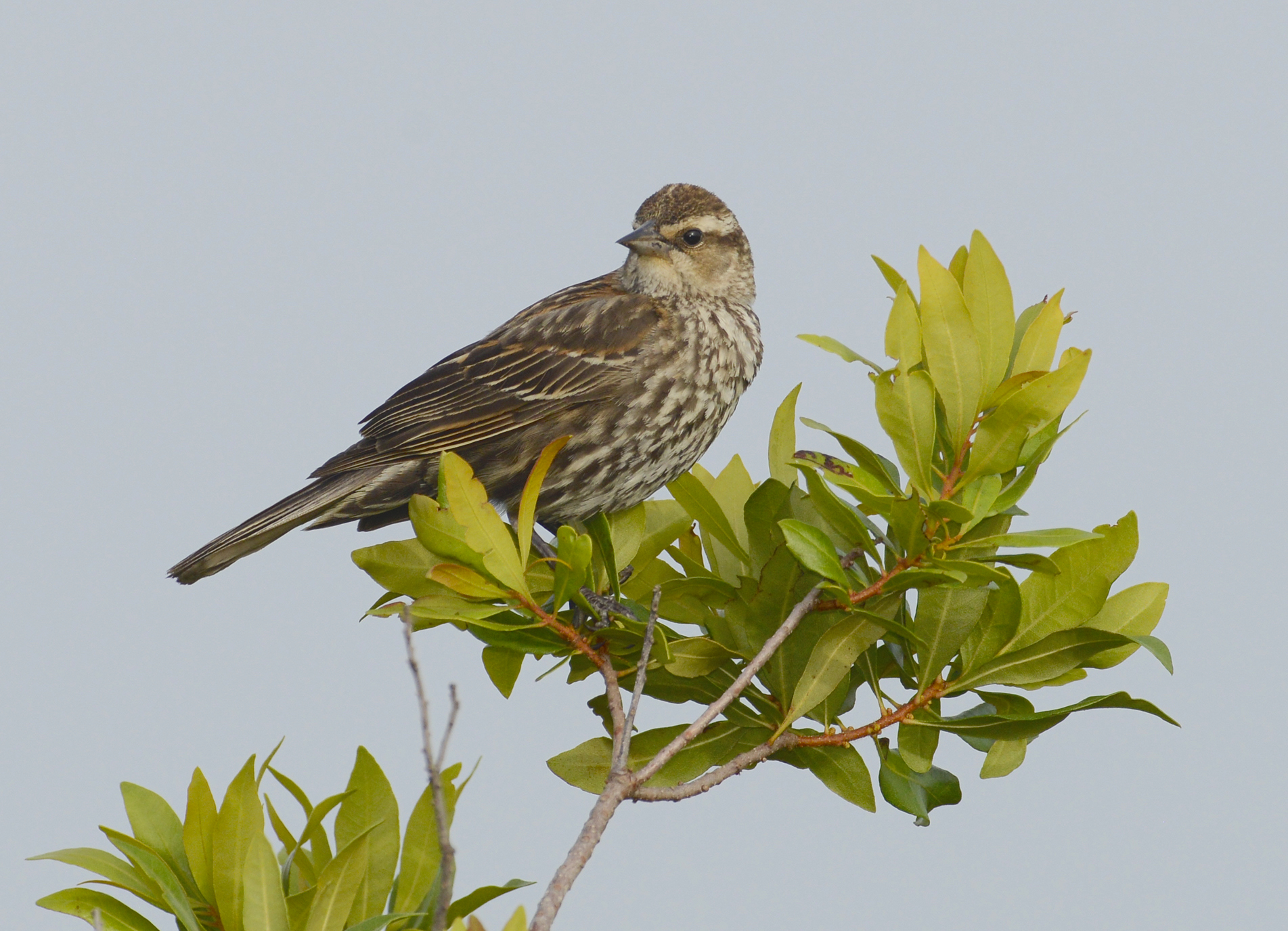
The females, as is often the way, are less showy. I have just read that they are ‘nondescript’, which is unnecessarily harsh I reckon. Here are a couple of examples.

And the darker brown ones that are clearly not handsome black males? These are young males in their first season, before they move on to the full adult male plumage. Previously I had designated them females (as I had assumed) until very gently corrected by the legendary Bruce Hallett. Not only was Bruce an essential part in the production of the Birds of Abaco, he also keeps a benign eye on my posts and occasionally steps in to clarify IDs etc.  I took the first male juvenile at Casuarina, when I also made the sound recording (below). The second was at Delphi – and with some ‘light’ issues, I notice…

Red-winged Blackbird, Abaco (Keith Salvesen / Rolling Harbour)Red-winged Blackbird, Abaco (Keith Salvesen / Rolling Harbour)

Fledglings are kind of cute…Red-winged Blackbird, Abaco (Tom Sheley))

SO WHAT DO THEY SOUND LIKE?

You may need to turn up the volume a bit. You will also here a lot of dove noise and, in the background, the sound of waves lapping onto the shore.

Red-winged Blackbird, Abaco (Keith Salvesen / Rolling Harbour)

Photo Credits: Tom Sheley (1, 2, 4, 5, 8); Alex Hughes (3); Keith Salvesen (6, 7, 9 & audio)

Unknown's avatar

MANATEES IN THE BAHAMAS? WE GOTTEM!


MANATEES IN THE BAHAMAS? WE GOTTEM!

Not so long ago, most people had no idea that the waters of the Bahamas in general – and Abaco in particular – contained a small population of these curious, gentle, trusting creatures. When I first wrote about them and their adventures, there was surprise – maybe disbelief. A few years later, all that has changed thanks to the BMMRO and an outreach program that raised awareness – and consequently the sighting and reporting – of manatees. They are now widely recognised as they nose their way round harbours, docks and landing stages – and quite rightly they still excite delight and a degree of wonderment. 

You can find out more – lots more – about Bahamas manatees on my page HERE. I have a post in progress about recent manatee developments with a rescue one but alas I have found I have already run out of week through some kind of bizarre time / space continuum dislocation (specifically, flagrant time-mismanagement). So I am posting a few adorable images to be going on with. 

And remember, if you happen to see one, please do report it to the BMMRO or let me know. Useful data includes date, location and a description if possible of any damage – notches and nicks – to the paddle (= tail). It’s a good method for ID. Photos a bonus.  Every sighting adds to the database of knowledge about these strangest of creatures of the Bahamian seas. And you’ll be pleased to know that they are undoubtedly managing to breed in the Bahamas: there are baby manatees to prove it…

All photos: BMMRO

Unknown's avatar

REDDISH EGRET HUNTING ON THE MARLS, ABACO


REDDISH EGRET HUNTING ON THE MARLS, ABACO

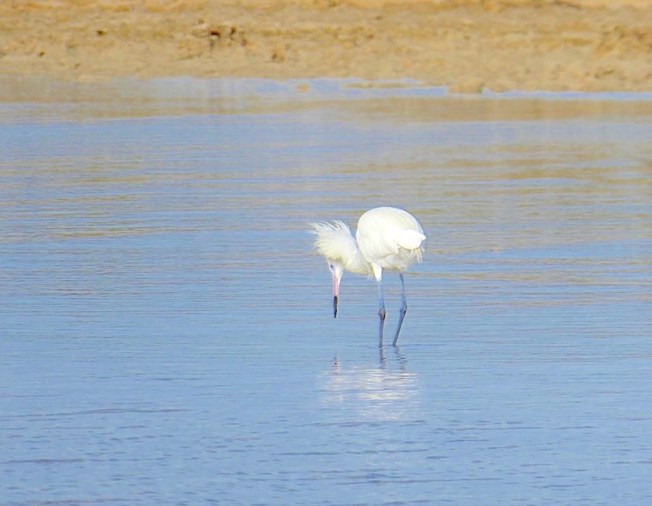
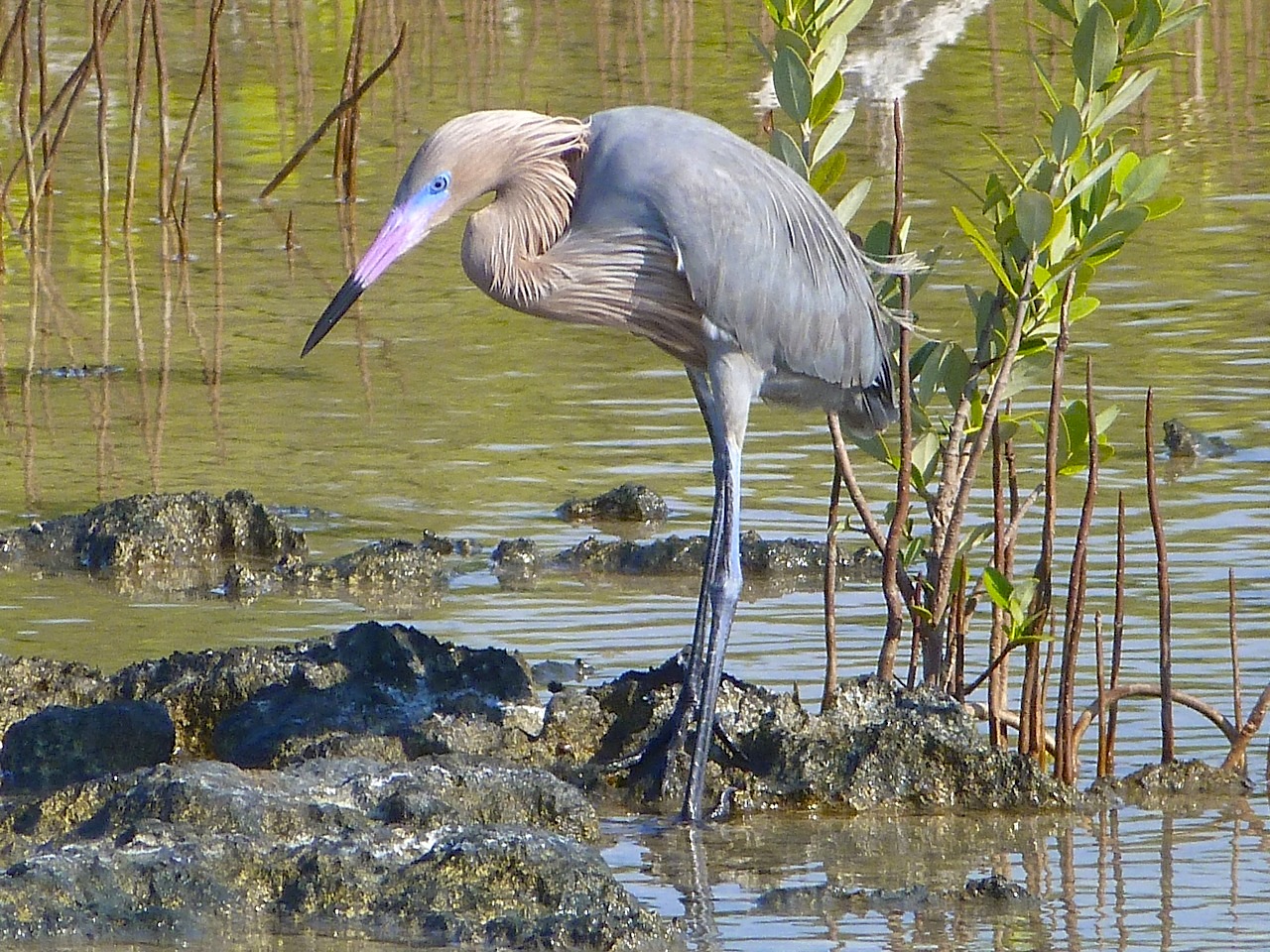
The trouble with reddish egrets is simple: they come in two colourways. There’s the conventional one which is indeed reddish, as one might hope and expect. Then there’s the snow white type (or ‘morph’). That’s the one featured here (with the other dark variety below, for comparison).

Both types are common breeding residents on Abaco. There are theories about which kind outnumbers the other; on balance I’m not sure the difference is very significant. Maybe reddish are a rather more frequently encountered than white, but there doesn’t seem to be much in it.

Looking back at photographs I took last spring, I found a sequence of a hunting white egret. Now these are not exhibition-quality photos. They were taken quite far out on the Marls, and a fair distance from the skiff I was standing on the front (prow?) of.

I had a smallish camera, and a fishing rod tucked under my arm rather hoping not to hear the usually welcome call “Hey RH**, bones at 10 o’clock moving left – 4 of them – give it 30 feet…” So this sequence is designed to give an idea of how the bird hunts the shallows. Rather than standing stock still and suddenly stabbing down to catch a fish, sometimes the egrets will stride purposefully though the shallow water, taking their chances as they move.

A small success at the start of the hunt (look carefully at the tip of the beak) A pause (and a slightly bad hair moment)

I always enjoy watching the actions of these birds make as they go about their work. But now the hunt is over; the egret has worked his way along the shoreline and he’s thinking out his next move… 

…which is to fly off and try his luck elsewhere

Your compensation for some mediocre – but hopefully illustrative – shots is a header image from the camera of the highly experienced birdman and photographer Danny Sauvageau. 

Finally, the way to tell that you are looking at a reddish egret, whichever version, rather than one of the other available egret / heron candidates is to look at the bill – pinkish, with a black tip. No other egreto-heronish species has this. 

A ‘proper’ reddish reddish egret taken in one of the brackish ponds at Crossing Rocks – always a good place to pull in and check for herons and egrets. This one, photographed in March, is in his handsome breeding plumage. Compare the bill with the white morph above – just the same.

** This not in fact how I am customarily addressed. I have a real name. Probably.

Credits: header image, Danny Sauvageau with thanks as always; all mediocre white morphs RH – also the rather better effort comparative photo of a ‘proper’ reddish one; cartoon by the inimitable Birdorable.

Unknown's avatar

BIRD WING FEATHERS: A SIMPLE GUIDE TO THE MYSTERIES


BIRD WING FEATHERS: A SIMPLE GUIDE TO THE MYSTERIES
Thanks to the excellent ‘Myr’s Bytes’, say goodbye to ‘what’s the difference between primary & secondary feathers’ misery… This could be the clearest illustration and explanation of a bird’s wing you or I will ever see.

Paper Bird Studio's avatarMyr's Bytes

It has been a while since I participated in Draw a Bird Day. I was happy to see some bird drawings in my blog reader this morning and decided to get inspired. I’ve been mostly sketching lately and none of the results have looked quite showable. But I did have a partially coloured drawing of some bird wings. And now, it’s fully coloured!

When I look at open and folded wings in bird photos, I often wonder – how do they fold and which feathers go where? John Muir Laws came to the rescue! The Laws Guide to Drawing Birds explains all this with beautiful illustrations. My two wing drawings are based on his illustrations of a passerine wing (dark grey with two white wing bars… I don’t know the species… some kind of flycatcher???). I did a good job of illustrating the layout of the different feather groups, but…

View original post 199 more words

Unknown's avatar

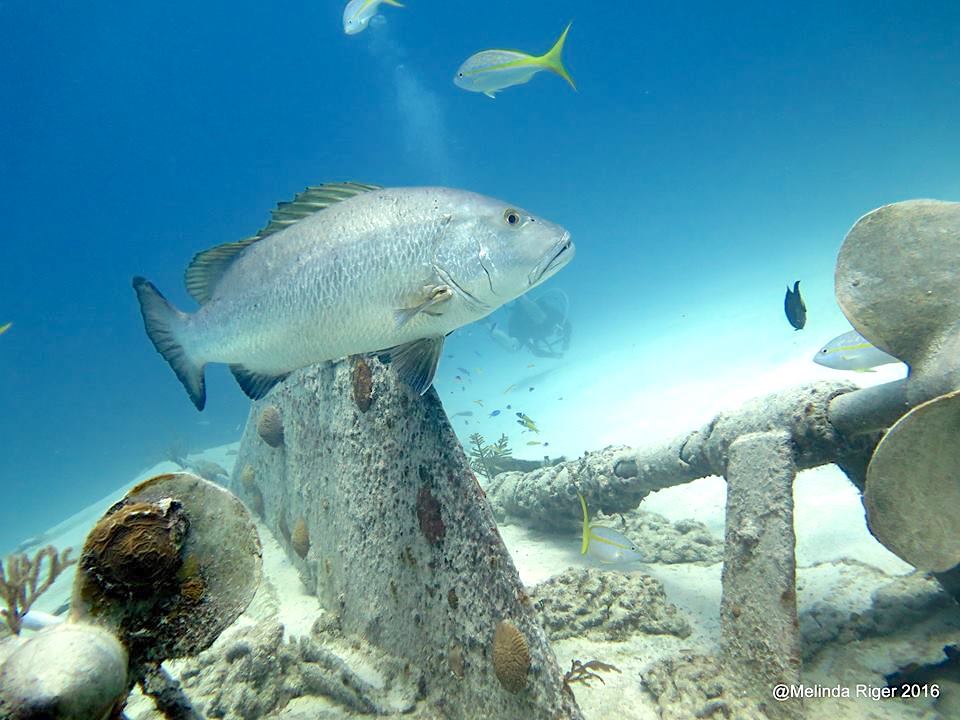
BAHAMAS REEF FISH (43): CUBERA SNAPPER


BAHAMAS REEF FISH (43): CUBERA SNAPPER

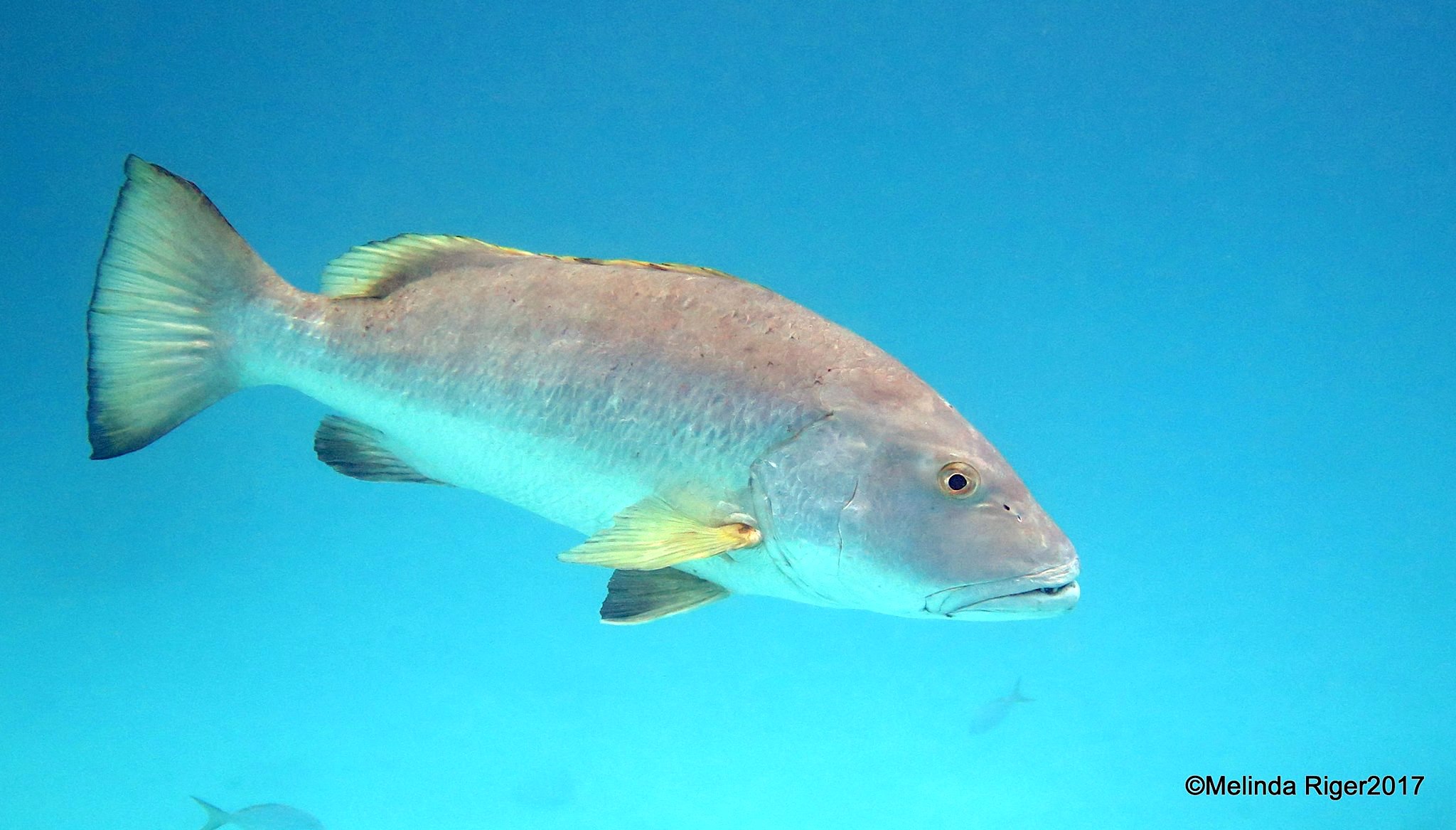
The cubera snapper (Lutjanus cyanopterus) is the largest snapper species. Adults may grow to 5′ long but they average around 3′ long and weigh 40 lbs or so (the record apparently stands at a massive 126 lbs). These are game fish, and they are a commercially important species. They are also IUCN listed as vulnerable, perhaps for that very reason. 

10 CUBERA SNAPPER SNAPPY  FACTS

  • The largest of a large number of snapper species in the western Atlantic
  • Feed on fish, shrimps & crabs, with large strong teeth (see pics) and jaws
  • Among their (few) predators are sharks, barracuda, and moray eels
  • Edible, but beware of the danger of CIGUATERA poisoning
  • In summer months, spawning is governed by lunar cycles
  • Cuberas form huge spawning masses (to 10k) in offshore shallows
  • Sadly the resulting eggs and larvae are rich pickings for predators…
  • Youngsters live in sea grass or mangroves for protection
  • Cuberas are game fish with commercial importance
  • IUCN listed as vulnerable – largely courtesy of mankind (see »)

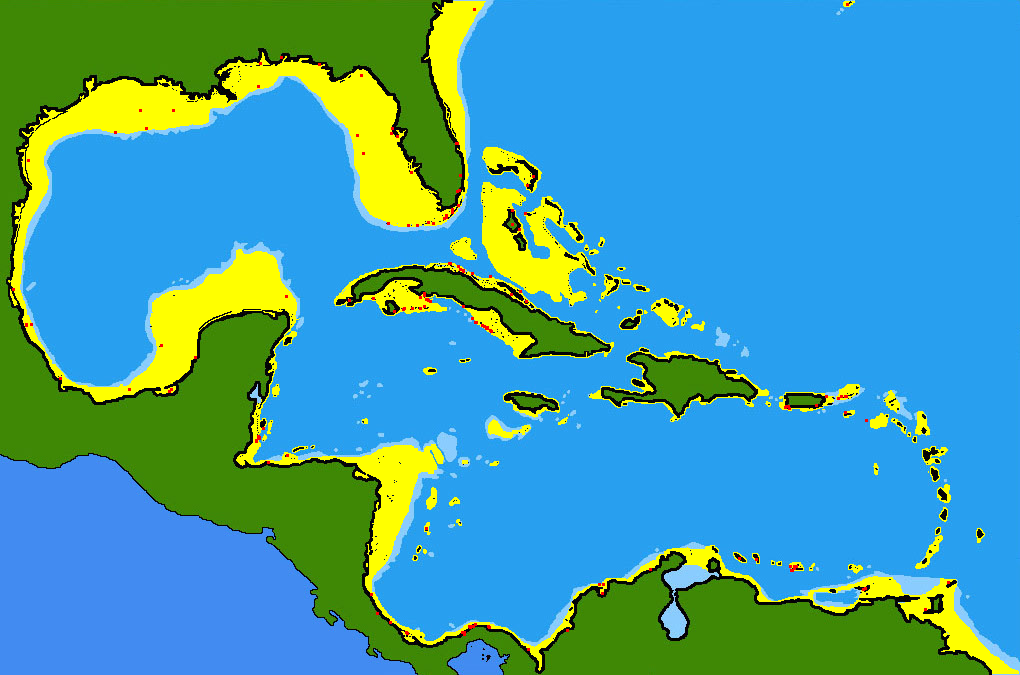
RANGE FINDER

Cubera Snapper Range Map (wiki)

CONSERVATION MATTERS

Overfishing is one of the greatest threats to the species. Those young fish that are not predated naturally and grow to adulthood are targets for fishermen. There’s no prissy ‘catch & release’, as with bonefish. At spawning time, as the fish instinctively (and predictably) mass as the moon dictates, so do the human predators. The spawning sites are where the best protection can be given, to ensure the annual reproductive cycle is uninterrupted. If not, ‘vulnerable’ will soon give way to ‘endangered’…

I’d been going to pull apart a long recipe for the “wonderfully sweet white meat ” of this fish for the tastiest morsels of info, then (not being a cook) I quickly tired of the idea. Sorry to disappoint. 

Credits: Melinda Riger for the wonderful photos; range map from wiki; magpie research pickings, including (but not limited to ) Nat Geo

Unknown's avatar

COOKIECUTTER SHARKS: BEASTLY LITTLE SUCKERS


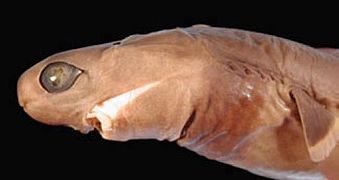
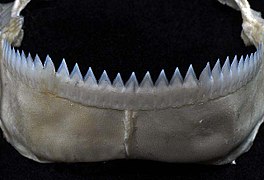
Cookiecutter Shark mouth, jaws & teeth (BMMRO Bahamas)

COOKIECUTTER SHARKS

BEASTLY LITTLE SUCKERS

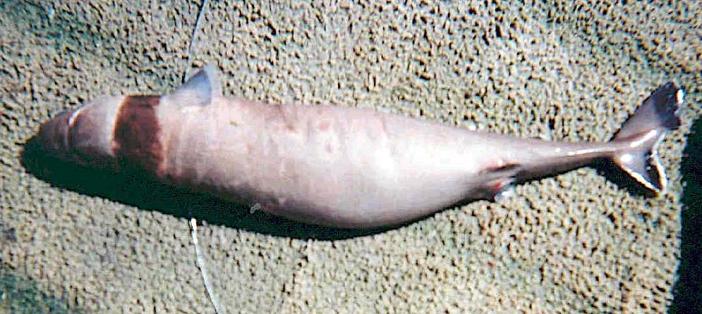
The Cookiecutter shark Isistius brasiliensis (aka the less scary, more genial sounding ‘cigar shark’), might be an ideal candidate for a Room 101 nemesis.** These little beasts – a species of dogfish shark – are found in several mainly island-based areas dotted around the globe, including in Abaco waters.


HOW COME THE NAME?
These sharky little b@st@rds (*technical term*) attack marine mammals and fishes, gouging out perfect round plugs of skin and flesh, leaving what are sometimes called ‘crater wounds’. Then they eat them. Imagine getting hold of a really sharp domestic cookie cutter with circular rows of razor-sharp teeth, and grinding it hard into your thigh. There! That! 
The size of an adult shark:16″ max
The term ‘cookiecutter’ is also a pejorative slang term, meaning mass-produced, lacking in originality, or boringly samey, as in cookiecutter cars or TV genres etc. The little critters under consideration here are anything but…
                        

HORRIFYING COOKIECUTTER FACTS

  • Live in the depths, rise vertically in the day & dive back down at dusk
  • Undersides have light-emitting ‘photophores’ which emphasise…
  • …the dark collar which acts as a lure, resembling a small innocent fish
  • Bioluminescence lures prey & confuses predators (more on this below)
  • The glow is so strong it may last for some time after removal from water

  • Their lips are ‘suctorial’ = they attach tightly to their target
  • The jaws then gouge out the victim’s flesh in a remarkably neat circle
  • Omni-vicious: any medium to large ocean creature is vulnerable to attack
  • There are even occasional reports of humans being targeted

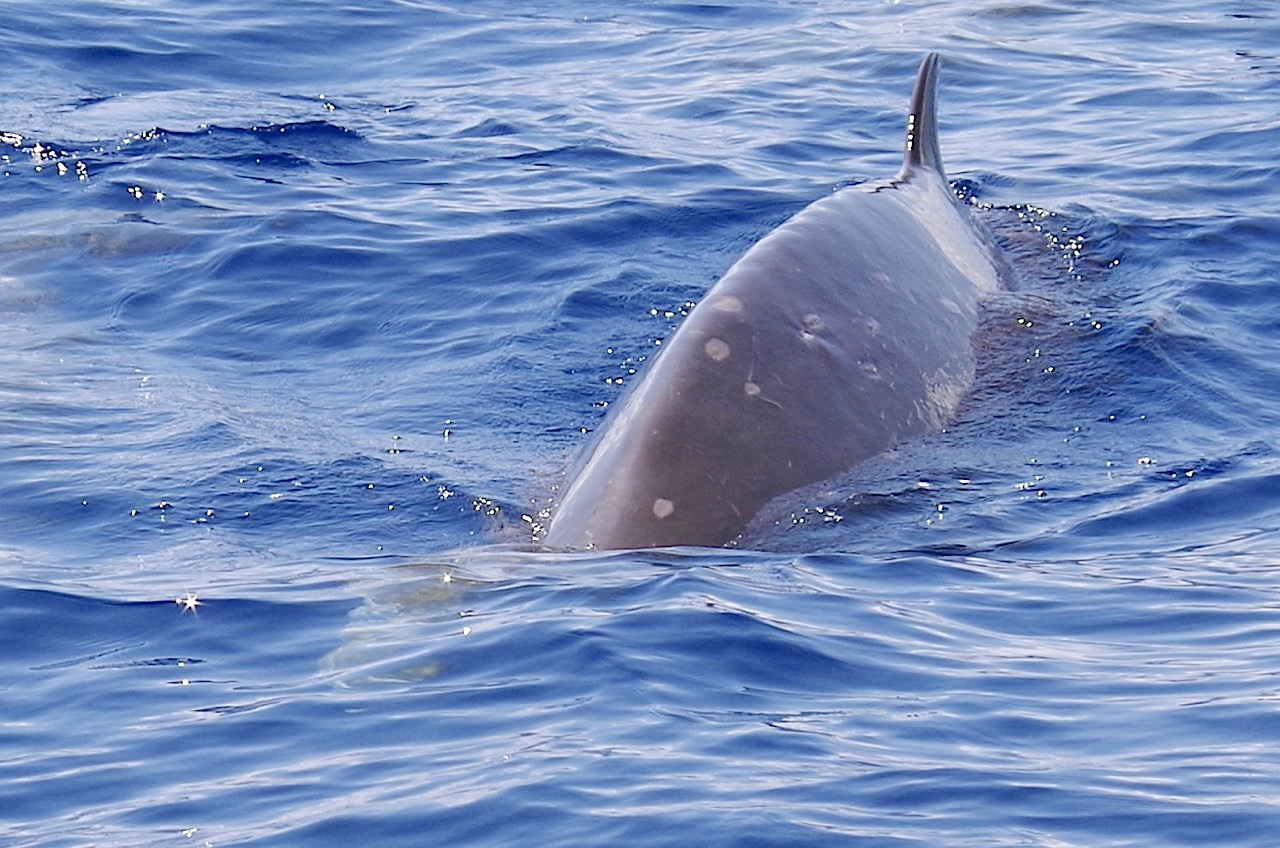
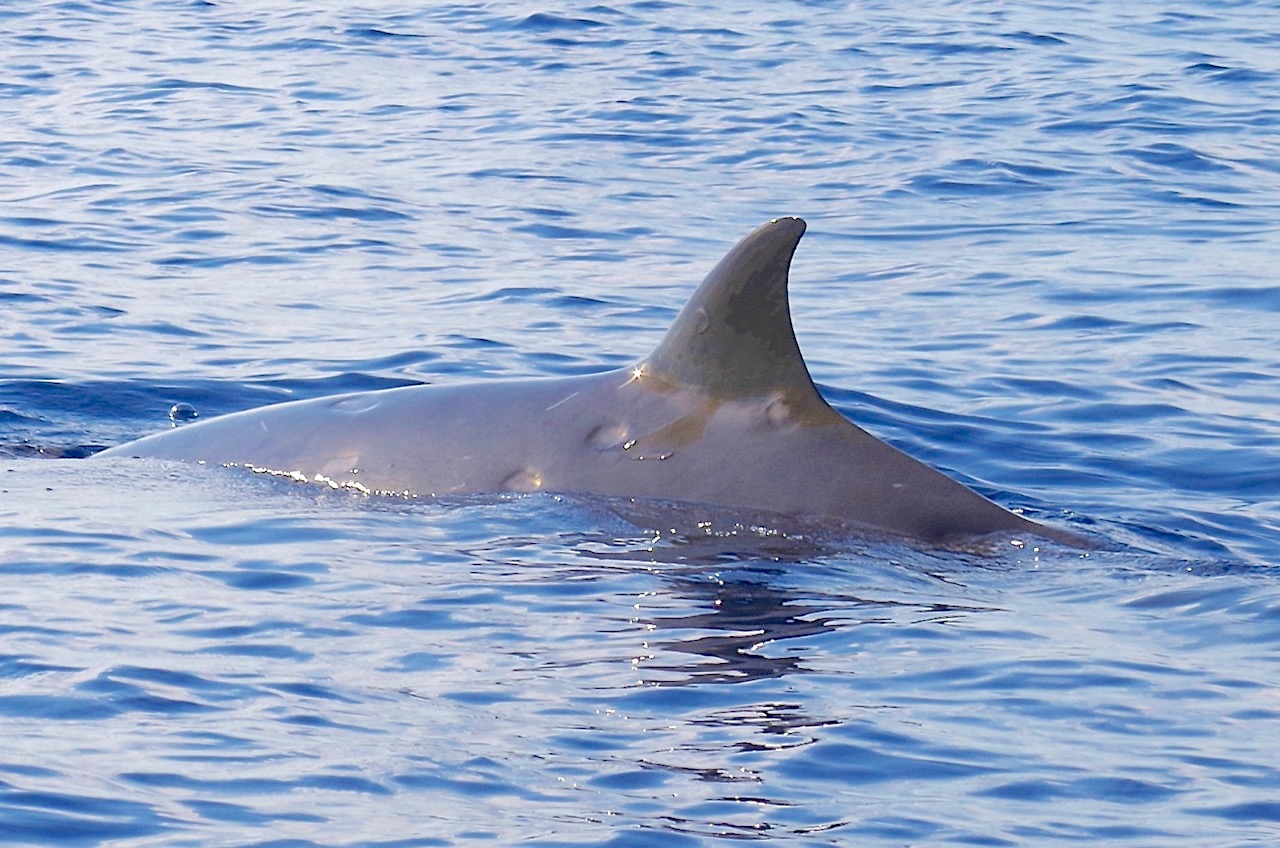
Here are two Blainville’s beaked whales that I photographed from the BMMRO research vessel. The top whale has a number of circular healed attack marks and a recent one. You can see how deep the gouged hole is. The other has well-healed scars.

Blainville's Beaked Whale - cookiecutter shark damage (Keith Salvesen)Blainville's Beaked Whale - cookiecutter shark damage (Keith Salvesen)

  • Multi-toothed: top rows of small teeth, rows of larger teeth on the bottom
  • The lower teeth are the cutters, acting like a saw when locked on
  • See header image and below for full details


HOW EXACTLY DO THEY DO WHAT THEY DO?
I can explain it no better than the renowned authority Prof. W. K. P. Dear:  “the suctorial lips ensure a tight seal. It then bites, using its narrow upper teeth as anchors while its razor sharp lower teeth slices into the prey. Finally, the shark twists and rotates its body to complete a circular cut, quite possibly aided by the initial forward momentum and subsequent struggles of its prey. The action of the lower teeth may also be assisted by back-and-forth vibrations of the jaw, a mechanism akin to that of an electric carving knife”.

                 ARE THESE SHARKS ‘PARASITES’, WOULD YOU SAY?

The behaviour of these sharks is an example of a symbiotic relationship between two species that is parasitic. This means essentially that one gains and the other suffers (e.g. no-see-ums!). This is distinct from commensalistic symbiosis, where one species gains and the other is unaffected (e.g. cattle egrets with cattle); and mutualistic symbiosis, where both gain (e.g. cleaner fish & groupers). So, in a word, yes.

  • An ‘ambush predator’: they ‘hover’ in the water column waiting…
  • They are capable of rapid movement to catch up & latch onto prey
  • They will eat a passing small fish, crustacean or even squid as a snack
  • Sometimes they operate in schools; there is safety in numbers
  • The schools are thought to increase the ‘lure’ effect of the dark collar

A beached whale that’s been heavily targeted

FUN FACT TO COUNTERACT THE BAD STUFF

In the late c20, more than 30 U.S. Navy submarines were forced back to base to repair damage caused by cookiecutter shark bites, either to the neoprene footings of sonar domes or to rubber-sheathed cables. The problems were solved by using fibreglass. Oceanographic equipment and telecommunications cables are also recorded as being damaged by these sharks.

Cookiecutter Shark – the real deal


MONSTERS OF THE DEEP

These great cards from the weirdly spelled WIERD ‘N’ WILD CREATURES provide excellent factual info. Their CCS card is no exception. You’ll find more details here about the effect of the bioluminescence and so on, written as clearly as I might hope to. 

Cookiecutter Shark Facts (Monsters of the Deep)Cookiecutter Shark Facts (Monsters of the Deep)

** “The worst thing in the world varies from individual to individual. It may be burial alive or death by fire, or by drowning, or by impalement, or fifty other deaths. There are cases where it is some quite trivial thing, not even fatal.” (George Orwell, 1984)

Alright now…Blainville's Beaked Whale - cookiecutter shark damage (Keith Salvesen)

Credits: BMMRO – header image; beaked whale photos – Keith Salvesen / BMMRO; Te Ara NZ for the main jaw image; all small images with thanks to Wiki and respective photographers who took the time to upload them for all to enjoy & learn from; ‘wierdnwonderful creatures’ for the monster card; range map from Wiki

PS Apologies to anyone who bothered to wade through this, and stayed awake long enough to notice that formatting gremlins struck halfway through

Unknown's avatar

GRAYSBY (GROUPER): BAHAMAS REEF FISH (42)


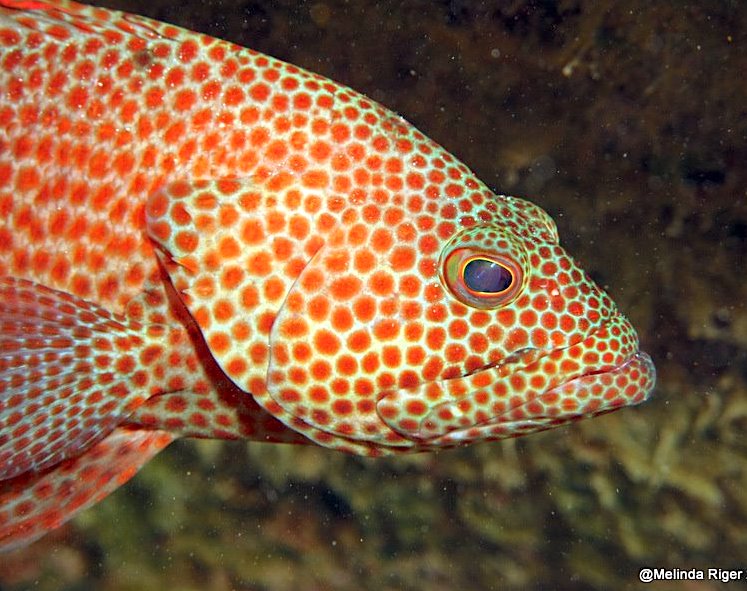
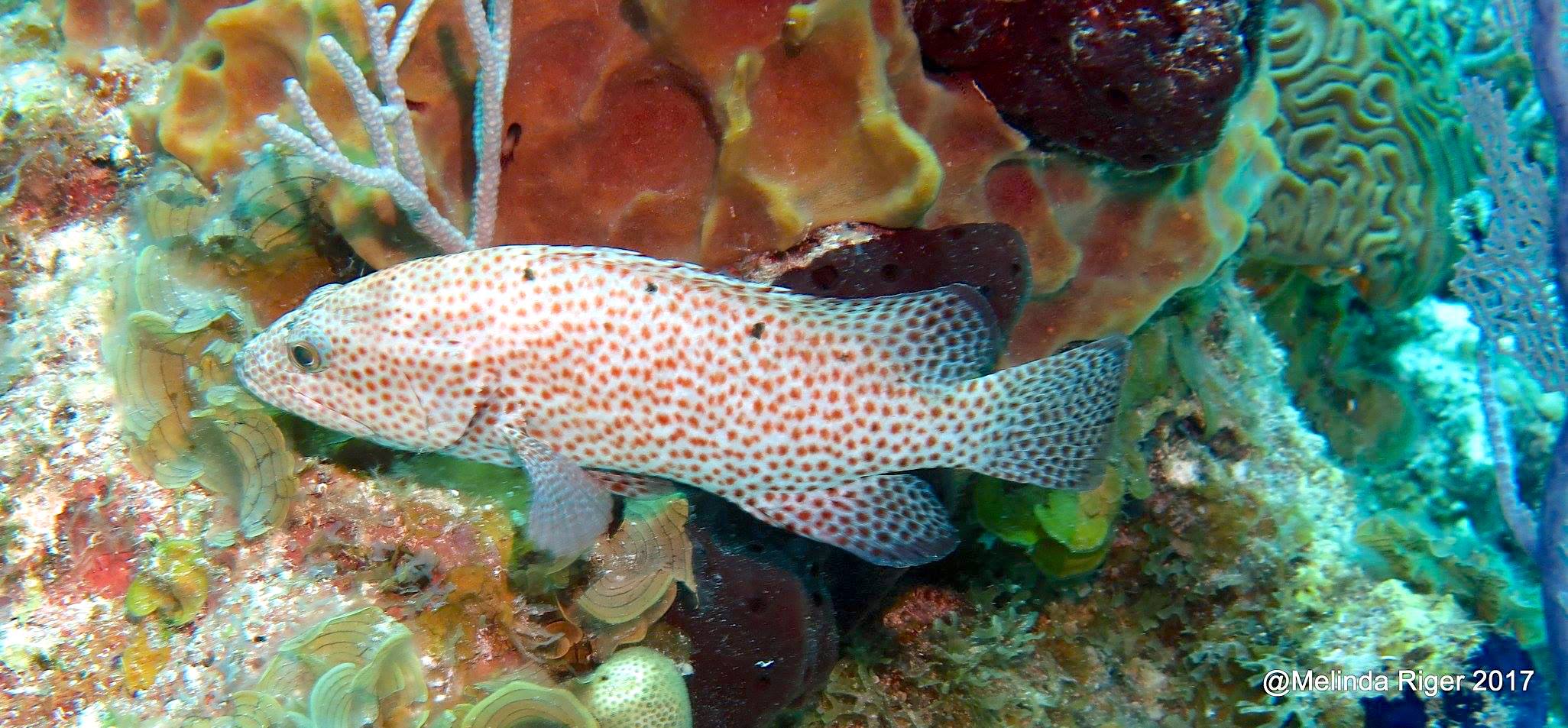
Graysby (grouper) - Melinda Riger / Grand Bahama Scuba

GRAYSBY (GROUPER): BAHAMAS REEF FISH (42)

The Graysby Cephalopholis cruentata is a small, spotty grouper, which grows to a maximum of around 16 inches. These rather unassuming and solitary fish have a preference for coral reefs, where they can blend in with their surroundings on ledges and in caves and crevices during the day. At night, they become active – that’s when they feed on feed on small fish, crabs and shrimps. 

Graysby (grouper) - Melinda Riger / Grand Bahama ScubaGraysby (grouper) - Melinda Riger / Grand Bahama Scuba

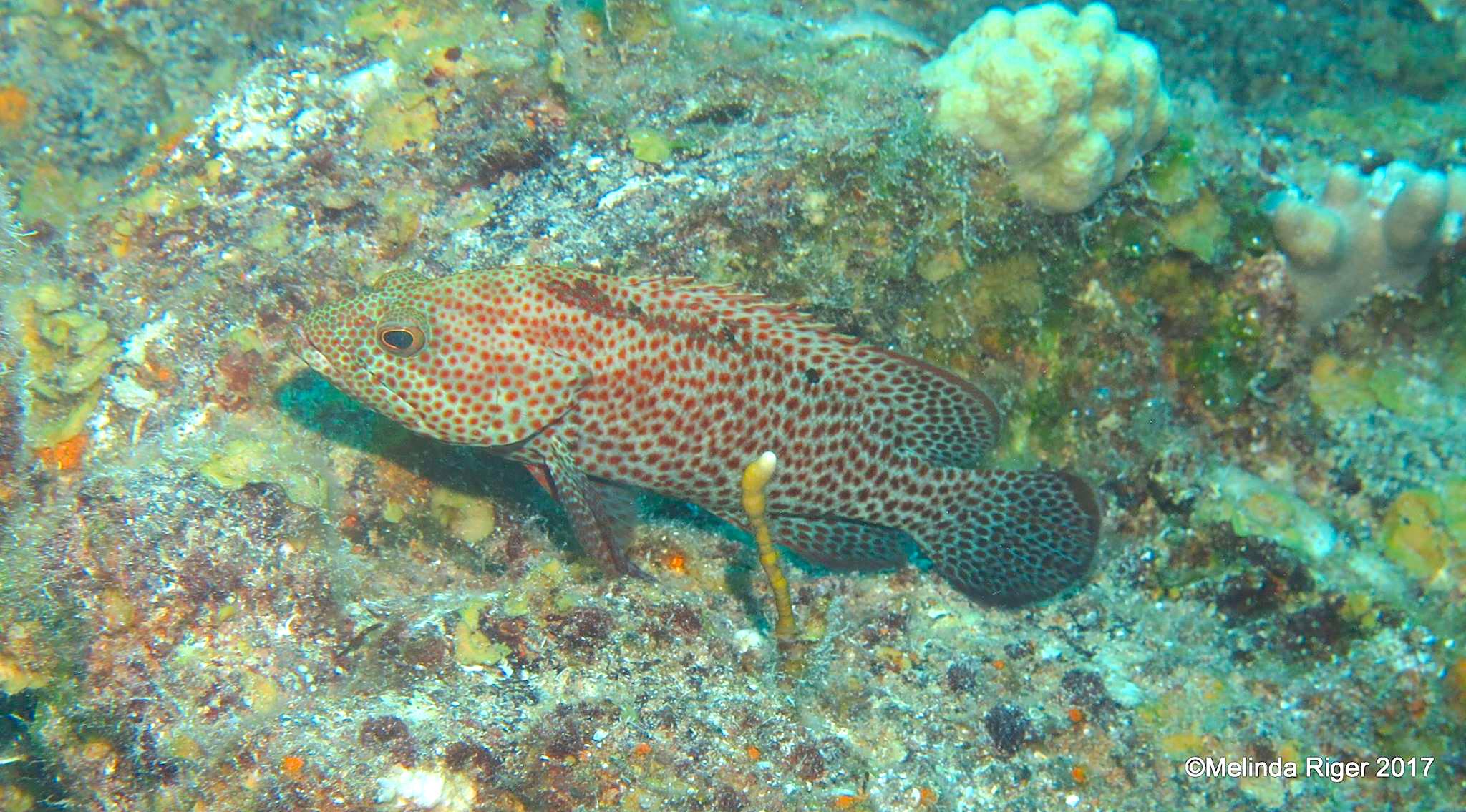
The graysby has variable colouring in a range from light brown to pale gray, with all-over spots that may be red, orange or brownish. Often, they have 3 to 5 contrasting spots on their backs, along the base of the dorsal fin, as below:

Graysby (grouper) - Melinda Riger / Grand Bahama ScubaGraysby (grouper) - Melinda Riger / Grand Bahama Scuba

The long erectile dorsal fin comprises both spines and ‘rays’ – spines at the front, rays at the back. Like this:

The spots of a graysby can change in colour (at least to a limited extent), becoming either paler or darker. I imagine this is a protective feature to enable the fish to blend in more easily with its reef surroundings. 

Graysby (grouper) - Melinda Riger / Grand Bahama Scuba

Signalling to turn right…

I wondered if they are edible. I believe so – but then I also read that the larger adults carry the risk of ciguatera and raised mercury levels. So I’ll give it a miss thanks.

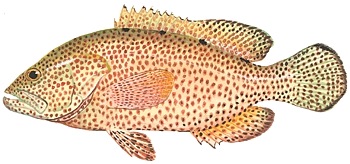
Photo & other credits: all photographs by Melinda Riger / Grand Bahama Scuba; aqua.org; SAMFC (drawing)

Unknown's avatar

BLACK-LEGGED KITTIWAKE: A RARE SPECIES FOR ABACO


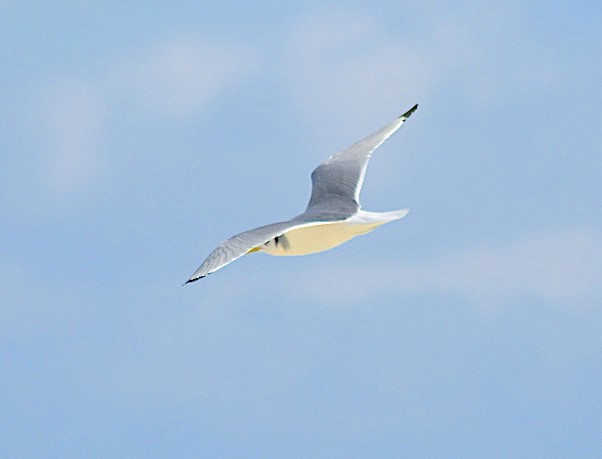
Black-legged Kittiwake (Dick Daniels / carolinabirds.org / Wiki

BLACK-LEGGED KITTIWAKE: A RARE SPECIES FOR ABACO

I recently posted about the sighting of an entirely new bird species for Abaco, the CINNAMON TEAL. Almost at once, another species was sighted – not a new one, but in the next category of rarity, the V5 and V4. ‘Vagrant’ birds that have been credibly recorded on Abaco / in Abaco waters fewer than 5 times – and maybe only once – are classified as V5 or ‘accidentals’.  Birds seen a few times more than that, but irregularly and unpredictably (‘casuals’) are V4s. One such is the fine black-legged kittiwake, also known as the seahawk and a close relative of gulls.

Black-legged Kittiwake (Yathin S Krishnappa / Wiki)

During the Abaco Christmas Bird Count in December, avid birder Keith Kemp and a small group were checking the beach at Crossing Rocks. In due course he uploaded a list of birds seen, with selected images, to the excellent eBird site. This included a royal tern. Or make that “royal tern”.

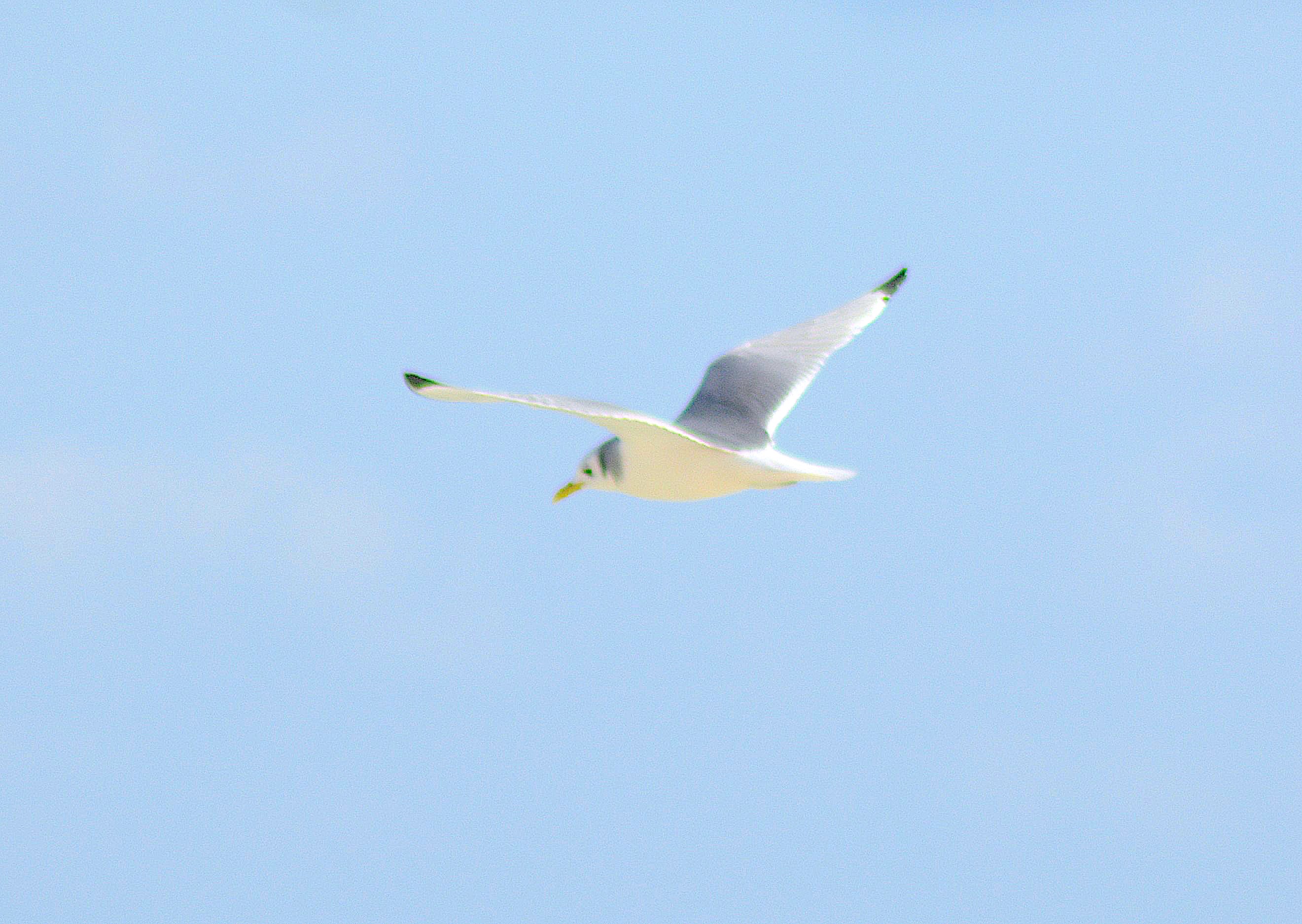
Black-legged Kittiwake (Keith Kemp)It wasn’t long before sharp-eyed Bruce Purdy from Cornell contacted Keith to say “You shot a picture of an adult non-breeding black-legged kittiwake!!!!!!!!”. This was confirmed by Bruce Hallett, author of the definitive field guide to the birds of the Bahamas.

Black-legged Kittiwake (Keith Kemp)

As Bruce Purdy commented:

“This is the first kittiwake reported that I know of in the last 20 years.  Tony [White] shows a few reports but I don’t know if they were documented.  Probably not since most people just started carrying cameras, so you may have the first documented kittiwake… It is a great find”

So you are looking at (almost certainly) the first photographs of a kittiwake ever taken on Abaco. Actually, make that the Bahamas – no others are shown on eBird for the whole region; the nearest being a handful of sightings on the Florida coast.

STOP PRESS Keith’s sighting was in December 2017. The very day I pressed ‘publish’ on this post, January 30, two people immediately contacted me to say they had seen this bird in the Crossing dock area in Marsh Harbour! Thanks to Philip Sawyer and Nancy Albury for their sharp eyes and immediate response. Neither managed to get a photo, but two independent witnesses on one day in the same location make for a compelling ID. I imagine this is the same bird (rare enough as a single – the first in over 20 years – so exceptionally unlikely as a pair). Maybe there are rich fish pickings to be had in the MH harbour area.

Any further reports would be most welcome; a photo would earn the theoretical Kalik reward…

Black-legged Kittiwake (Keith Kemp)

These kittiwakes are a pelagic species, birds of the open sea. They spent most of their time over the ocean, where they live on fish. However, they return to land to breed – often on cliffs, and in large, noisy, nesting colonies. Here’s a very short idea of what that might look and sound like.

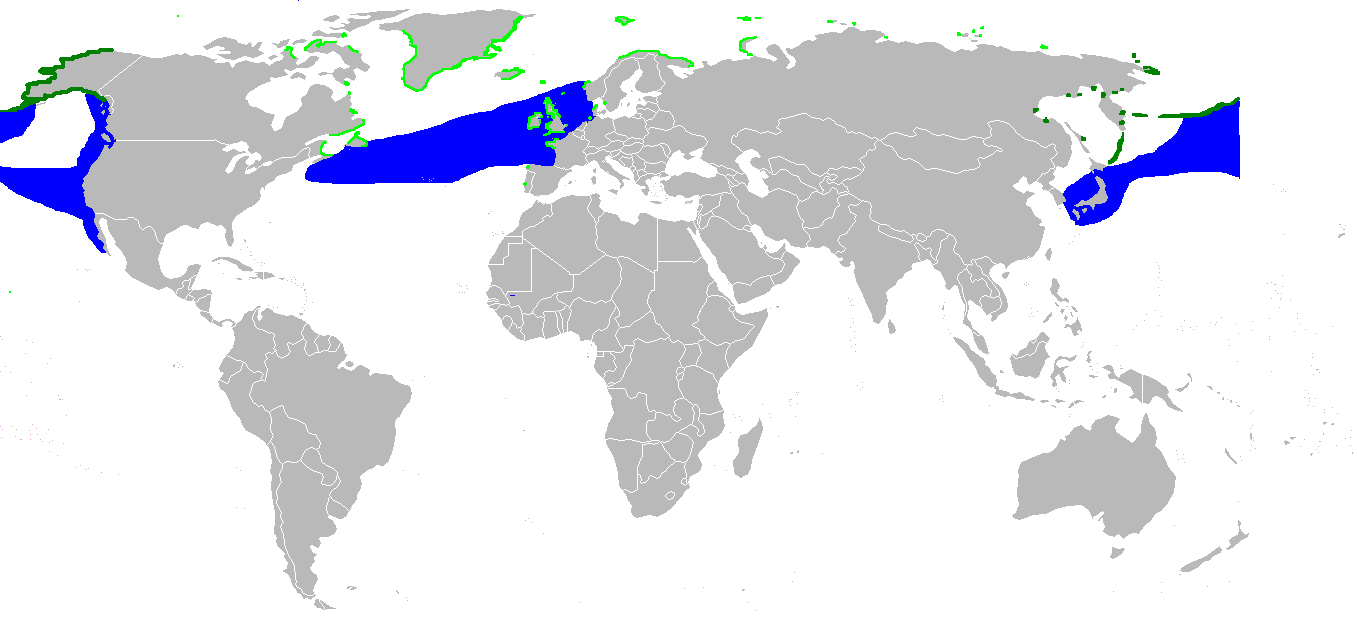
Keith’s Kittiwake was way out of its normal range. This map shows just how far.

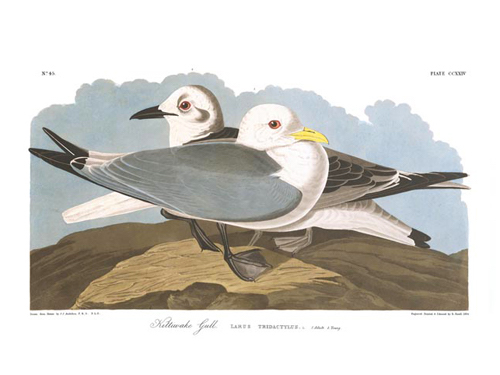
I always like to include an image of a species under discussion, as it was depicted by one of the early pioneers such a Mark Catesby or (as here) Audubon.
Black-legged Kittiwake (Audubon)

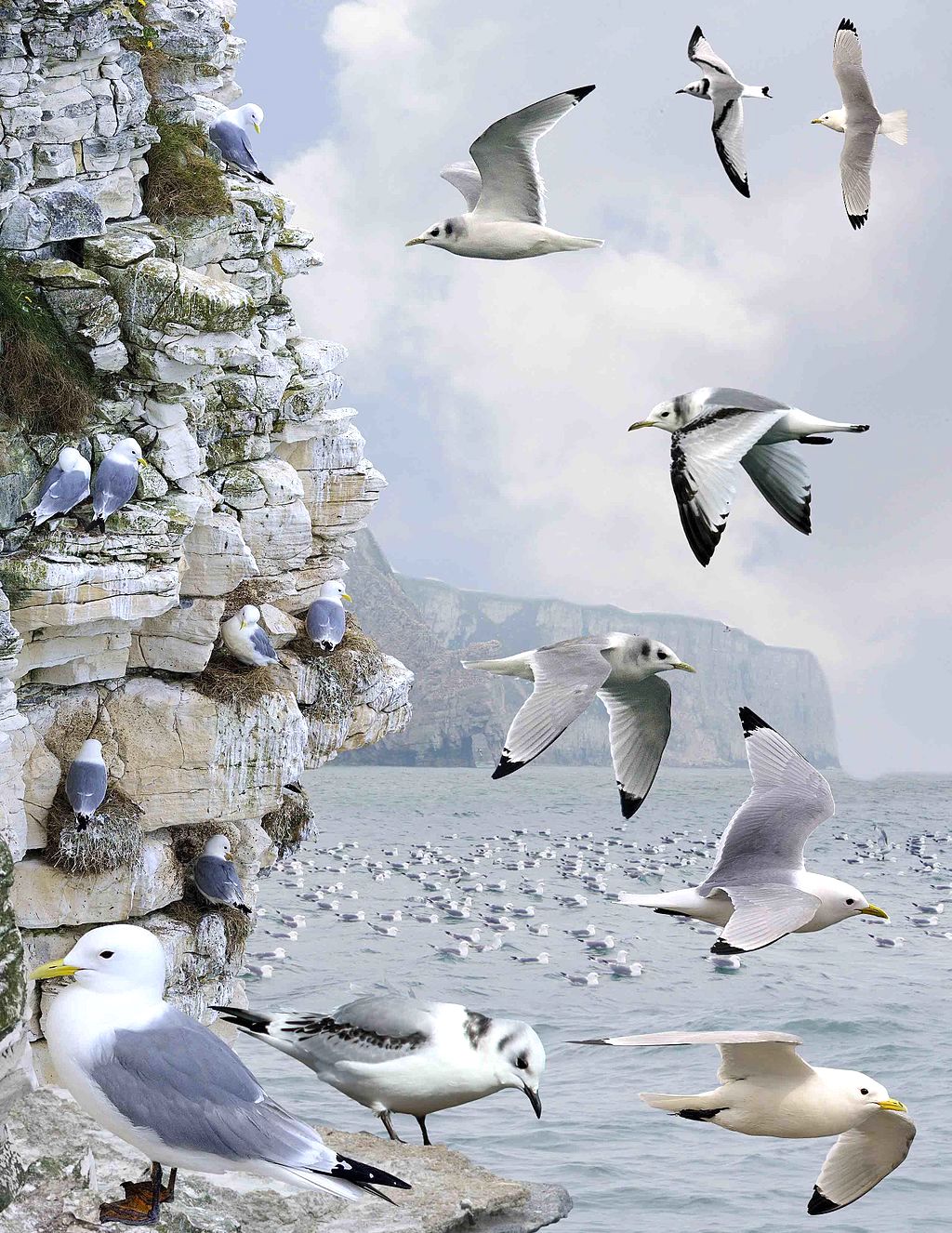
I’ll round off the story with another great source for comparative images – especially as between sexes, ages and seasons – the Crossley guide. The image below comes from the guide to Britain & Ireland, where kittiwakes are not uncommon locally where there are cliffs. Keith’s bird was in winter (non-breeding) plumage, as seen below, top left.

Kittiwakes (Crossley ID Guide Britain / Ireland)

Credits: Dick Daniels / carolinabirds.org (1); Yathin S Krishnappa (2); Keith Kemp (3, 4, 5); RSPB Britain (video); Audubon (OS) (6); Crossley Guide (OS) (7); range map Wiki

Unknown's avatar

AWESOME HURRICANES & MAGNIFICENT FRIGATEBIRDS


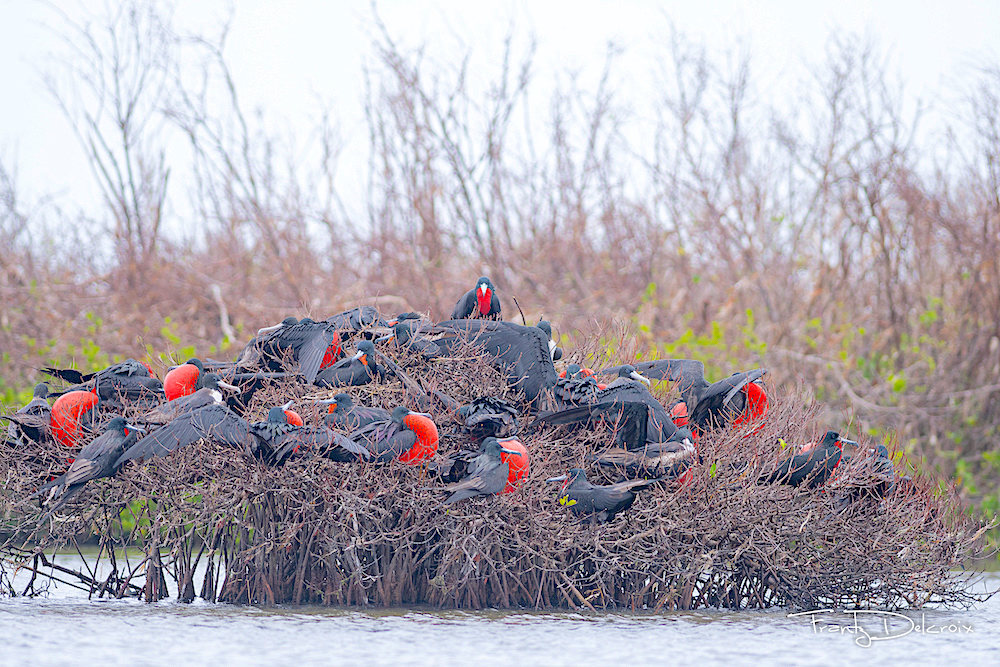
Magnificent Frigatebirds, Barbuda (Frantz Delcroix & Eric Delcroix)

AWESOME HURRICANES & MAGNIFICENT FRIGATEBIRDS

‘Awesome’ in its original (and biblical) sense of ‘inspiring awe and fear’, I mean – as with hurricanes; not as in ‘awesome cupcakes’. And Magnificent because that’s what frigatebirds effortlessly are.

This post is about the resilience of birds after extreme weather events, and their powers of recovery. As we all recall, last autumn large areas of the Caribbean region were devastated by those twin furies, Irma and Maria. Islands that received direct hits from these destructive hurricanes were trashed with unimaginable ferocity, at a massive human, infrastructure and ecological cost from which slow recovery is still in progress. Barbuda was one of those islands.

Magnificent Frigatebirds, Barbuda (Frantz Delcroix & Eric Delcroix)

This is the heartening story of a colony of frigatebirds on Barbuda, where in the aftermath of the storms BirdsCaribbean members offered to survey the effects of the storms in terms of the natural history of the region. These included Frantz Delcroix and Eric Delcroix, who spent time on Barbuda in mid-October, 6 weeks after Hurricane Irma.

Magnificent Frigatebirds, Barbuda (Frantz Delcroix & Eric Delcroix)

Their assignment was to visit Codrington Lagoon, Barbuda, to carry out a survey of the Magnificent Frigatebirds to check how – or if – the sanctuary and its population was recovering six weeks after Hurricane Irma hit. The boat trip to the colony must have been tense; there might have been little or no colony left to survey.

Magnificent Frigatebirds, Barbuda (Frantz Delcroix & Eric Delcroix)

As they neared the location, and to their delight, they saw hundreds of frigatebirds in flight, with bushes adorned with the bright red gular pouches the males. In all they estimated 1,710 frigatebirds were in the colony. In a count of seven bushes alone, 279 birds (83 females and 196 males) were counted. Amazingly, 90% of the females were on nests and some of the birds were observed courting and mating, with males even carrying nest materials.

Magnificent Frigatebirds, Barbuda (Frantz Delcroix & Eric Delcroix)

Before the hurricane, the 4,000–5,000-strong frigatebird colony had chicks in the nest. Surveys just after the hurricane found no surviving chicks and only around 300 birds. Now, one and a half months later, there were more than 1,700 frigatebirds starting a new breeding period with almost all of the females nesting!

Magnificent Frigatebirds, Barbuda (Frantz Delcroix & Eric Delcroix)

The team were of course deeply affected by the damage and desolation on Barbuda, and the suffering of its people. In a purely environmental context, the frigatebirds were a small sign of hope. As was noted at the time, “witnessing the power of nature—its ability to inflict such damage, but also how it can quickly rebound—was an extraordinary experience. So, we did not leave without hope. Nature is resilient!

Magnificent Frigatebirds, Barbuda (Frantz Delcroix & Eric Delcroix)

BirdsCaribbean is an excellent and wide-ranging organisation that deserves support. You can ‘like’ it or follow it on FB HERE, sign up for regular emails, volunteer to get involved or donate on the website HERE, and maybe even consider a contribution to its ongoing hurricane recovery efforts HERE

Special thanks to Frantz Delcroix and Eric Delcroix for permission to use some of their wonderful photos taken during the survey; and to use parts of their review (with some adjustment to apply to the specifics of this post). Many thanks also to Lisa Sorenson, Executive Director of BirdsCaribbean, for her kind support whenever the occasion has arisen! 


Unknown's avatar

SEVEN NEW BIRD SPECIES ON ABACO


Black-bellied Whistling Duck (Keith Salvesen)

Black-bellied Whistling Duck June 2014

SEVEN NEW BIRD SPECIES ON ABACO

THE BIRDS OF ABACO was published very nearly 4 years ago. At the time, the checklist of species recorded for Abaco at the back of the book, so meticulously compiled by Tony White and Woody Bracey, was definitive for as long as records have existed (in practical terms, since 1950). The final new species included in the book was a Black-browed albatross amazingly spotted in Abaco waters from the BMMRO research vessel by a keen-eyed intern the previous summer.

Brown Thrasher (Manjith Kainickara - Wiki)

Brown Thrasher Nov 2014

Within 3 months of publication, the checklist had been rendered out of date. A totally new species had touched down on Abaco – a small flock of 6 black-bellied whistling ducks. They worked their way up South Abaco from down by Crossing Rocks up to MH Airport via Schooner Bay, Delphi and Bahama Palm Shores. By then, numbers were down to 2. Soon even they disappeared, heading presumably from wherever the flock had intended to go in the first place. Maybe they got tired en route. Maybe their internal Satnav suffered a collective failure. Maybe senior BBWD had had a bright idea for a shortcut…

Masked Booby (Duncan Wright wiki)

Masked Booby January 2015

We are not talking here of rarities in global terms, but species that have never been seen before on Abaco. Or, if seen, went unremarked. Or, if remarked, without awareness of the significance! The advent of the current enthusiasm for birding in the Bahamas plus the ease with which a quick photo can be taken – on a phone for example – as evidence of a sighting and to aid a clear ID, may well increase the number of new species sightings in the future.

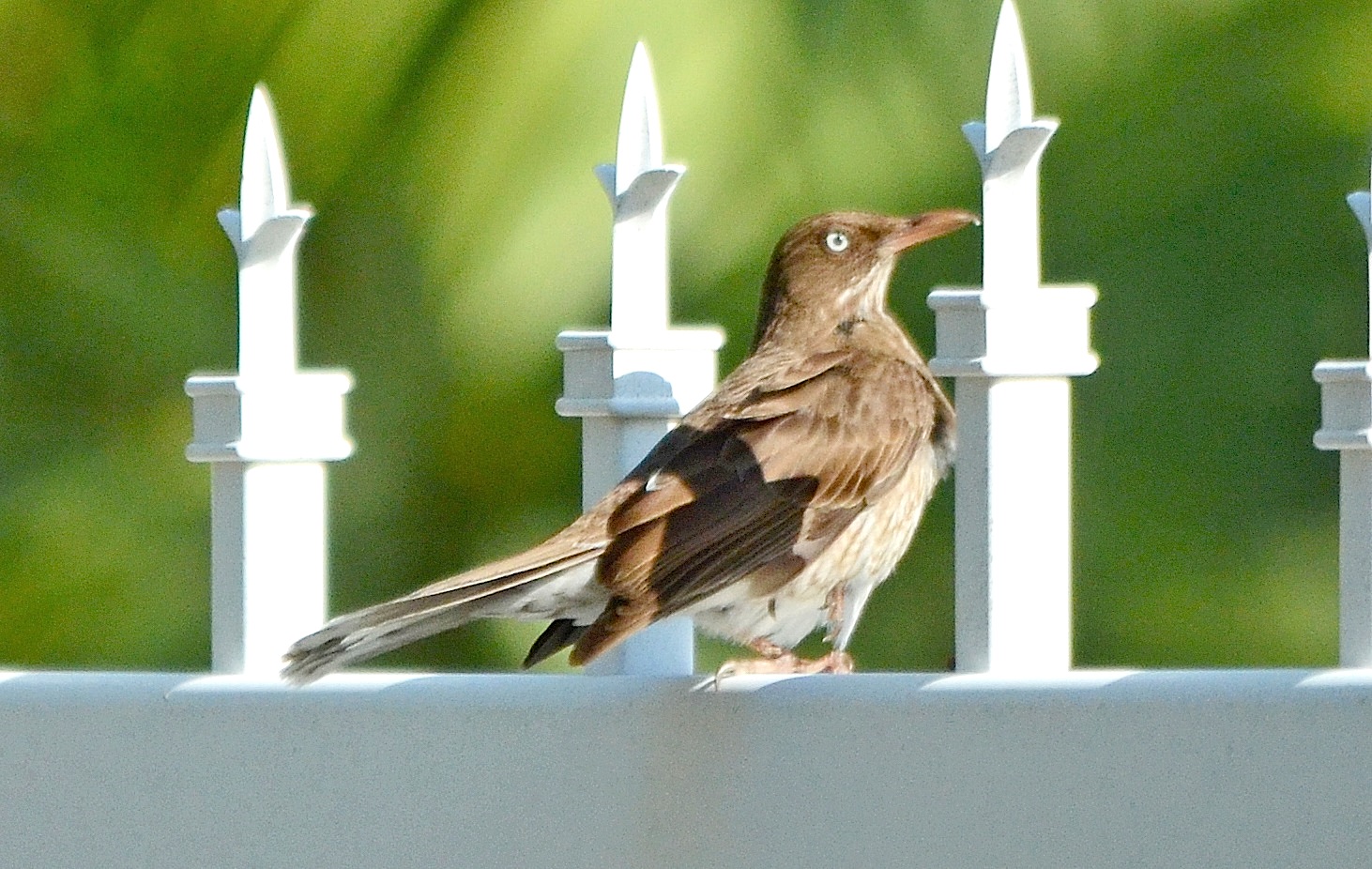
Pearly-Eyed Thrasher, Treasure Cay, Abaco (Woody Bracey)

Pearly-Eyed Thrasher March 2015

There’s the added benefit from the ease with which photos can be taken and distributed – people will no longer have to do any of the following:

  • Shoot birds and take them as samples (hello, J.J. Audubon & historical cohorts)
  • Pack a sketch pad & crayons to draw birds before they fly away (or from memory)
  • Rely on scribbled notes made in low light and a light drizzle
  • Listen to, or read, a query about a “sort of brownish medium sized bird with maybe a bit of yellow on the wings, and a black tail I think, but I didn’t get a very good look and oh yes it had sort of beady eyes and sounded a bit like ‘Kalik Kalik Kalik’ “. 
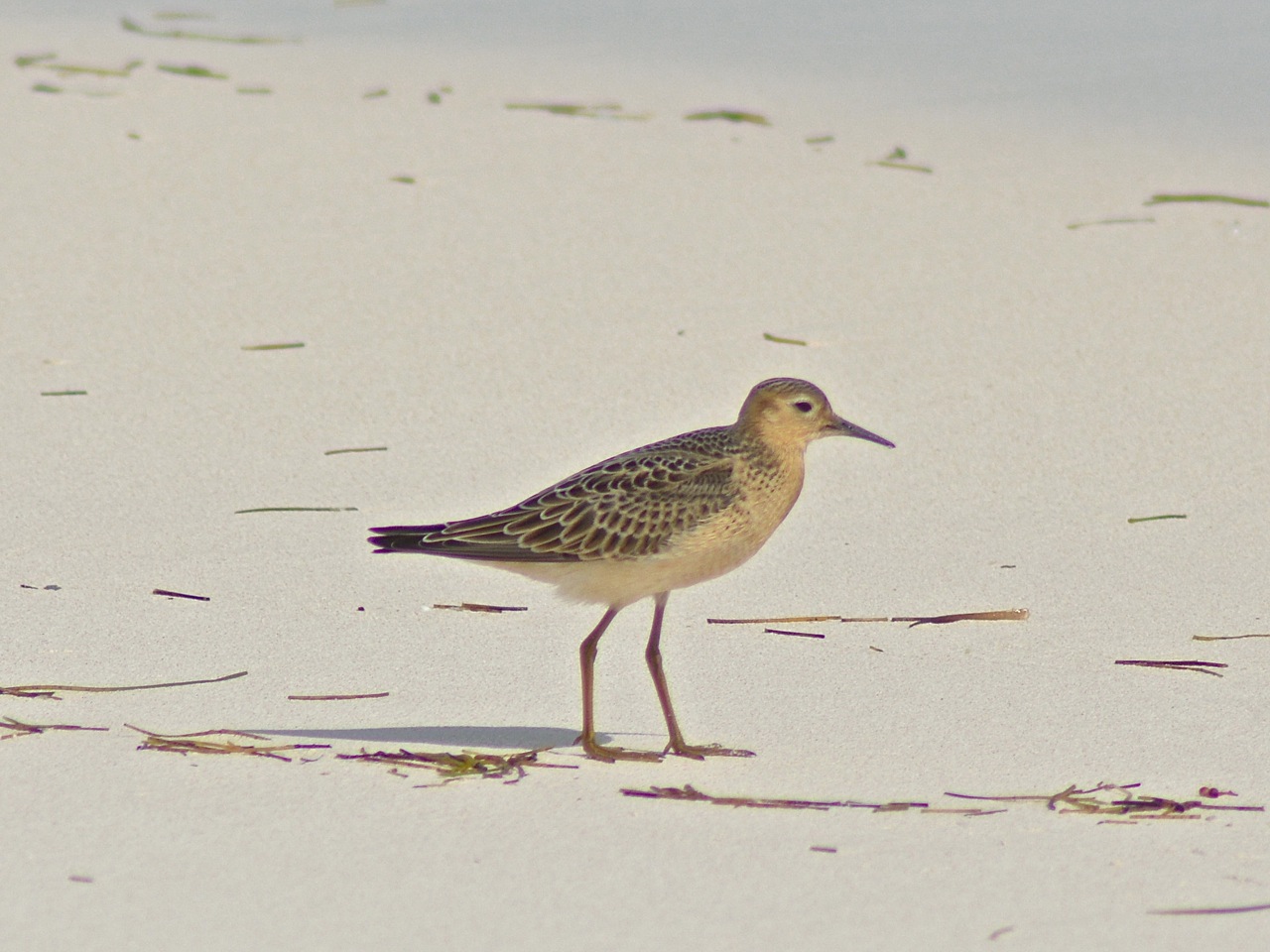
Buff-breasted Sandpiper, Abaco (Keith Kemp)

Buff-breasted Sandpiper Oct 2016

Over the 4 years, there have been a few birds that, although not ‘first evers’, are second or third ever – and the first ones with supporting photos. These include the fabulous scissor-tailed flycatcher; and the bald eagle that was sighted several times over south Abaco last year. I’ll return to these rarities another time. Let’s see the sixth new bird, from late last year.

Scaly-naped pigeon (Dick Daniels / carolinabirds.org wiki)

Scaly-naped pigeon Nov 2107

To complete the set, so to speak, 2017 ended with another gorgeous duck, the cinnamon teal. You can read more about all these birds using the following links to the relevant posts.

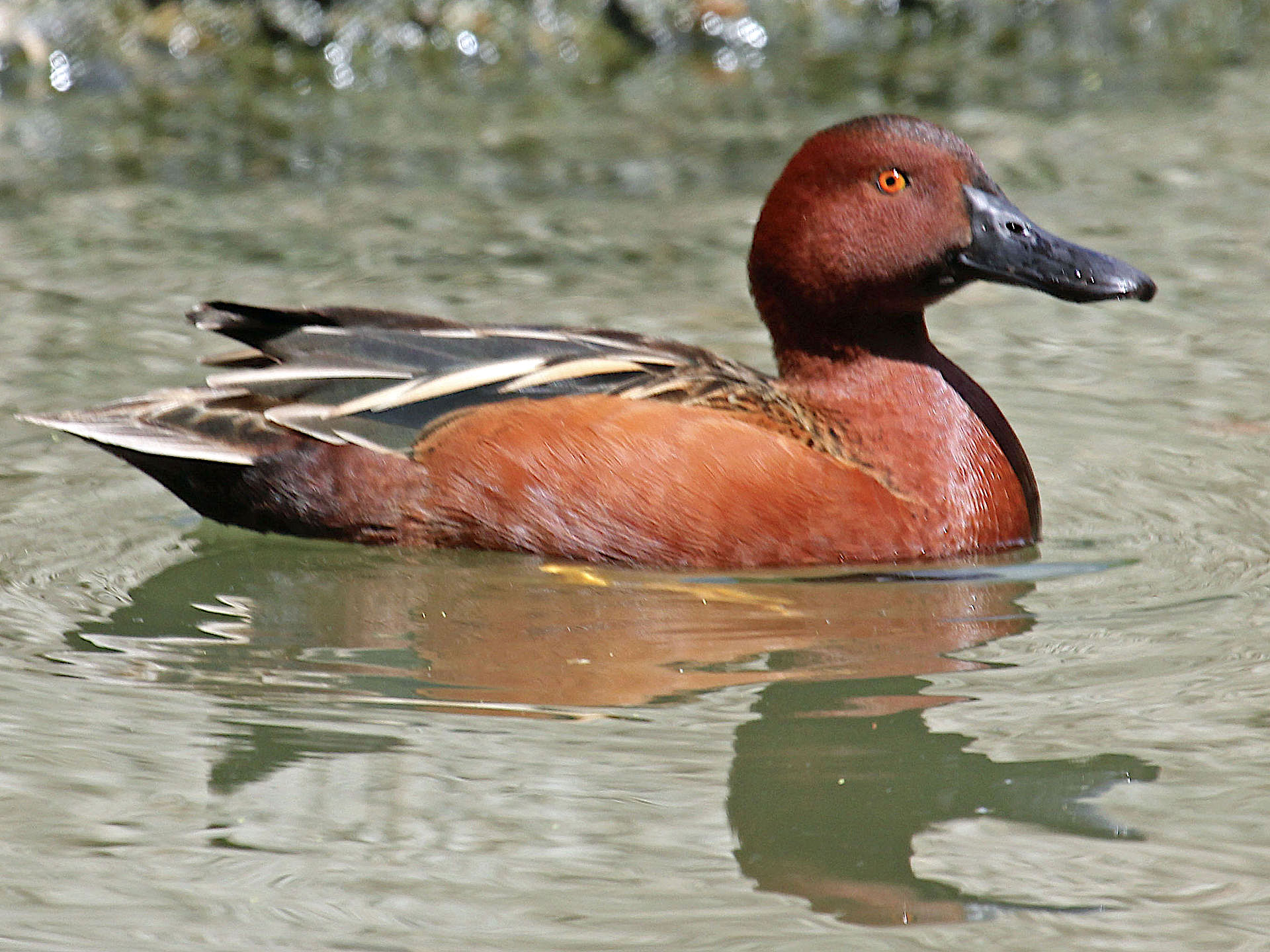
Cinnamon Teal (Dick Daniels / carolinabirds.org)

Cinnamon Teal Dec 2017

Credits: Keith Salvesen (1); Manjith Kainickara (2); Duncan Wright (3); Woody Bracey (4); Keith Kemp (5); Dick Daniels / carolinabirds.org / wiki (6, 7)
Unknown's avatar

OSPREYS: ID GUIDE TO THE BAHAMAS SUBSPECIES


Osprey, Abaco Bahamas (Tom Sheley)

OSPREYS: ID GUIDE TO THE BAHAMAS SUBSPECIES

I sometimes feature bird comparatives, not least because there is so much scope for confusion that I have to keep checking for myself. Tyrant flycatchers; a number of superficially similar warbler species (all with yellow bits); those vireos; all those heron-y / egret-y types and their disconcerting morphs (hello, white reddish egret).

Osprey P.h.carolinensis (CWFNJ)

And so to the magnificent osprey Pandion haliaetus. This time, the comparison is between two subspecies, broadly the North American P. h. carolinensis and the Caribbean P.h. ridgwayi. There is some overlap in Florida, and some evidence of interbreeding. In the northern Bahamas in particular there is also an overlap, so an osprey seen on Abaco could be either variety. You’ll probably be too excited watching it to care much which type it is, but this article will help you if you do…

The two ospreys shown below were recently photographed at Spanish Wells, Eleuthera by Barbara Crouchley. This is a ‘bingo’ photographic scoop, because each type of bird was found in the same region; now we can check out the differences between the two birds. 

The first is a North American bird. Note in particular its distinctive eye mask, and the clearly marked upper breast, more so in the female than the male (which may even be white). The overall impression of the upper-parts is dark brown. They are slightly larger than their cousins in the south.

Osprey P.h. Carolinensis, Eleuthera Bahama (Barbara Crouchley)

Osprey P.h. carolinensis

In this Caribbean bird with its trophy fish, the eye-mask is absent, and the facial / nape markings are less pronounced. Furthermore, the breast and under-parts are white in both sexes (though slight marking may be apparent in some birds). And  the impression is of lighter upper-parts, even allowing for variable lighting and distance when the photos were taken. Conveniently, there’s not much detectable difference between male and females in the respective populations.

Osprey P.h. Ridgwayi, Eleuthera Bahama (Barbara Crouchley)

Osprey P.h. ridgwayi

EXAMPLES OF P. h. carolinensis

Osprey P.h. Carolinensis, Florida (Danny Sauvageau)Osprey P.h. Carolinensis, Florida (Danny Sauvageau)Osprey P.h. Carolinensis, Florida (Danny Sauvageau)

EXAMPLES OF P. h. ridgwayi

Osprey P.h. ridgwayi, Grand Bahama (Linda Barry Cooper)Osprey P.h. ridgwayi, Abaco (Jim Todd)Osprey P.h. ridgwayi, Abaco (Woody Bracey)

I’m going to stick my neck out here – I’ve not seen this mentioned anywhere, and I need to do some more comparative research. When I saw Barbara’s pair of photos, I immediately noticed that the eyes of the P.h.r were paler than the bright orangey-yellow of P.h.c. This distinction carries on through the comparative photos above: the P.h.cs were photographed in Florida and further north and have strikingly vivid eyes. The P.h.rs were photographed on Abaco and Grand Bahama at different times by different people. All have noticeably paler irises, more a light greeny-yellow. 

I’d welcome any views on this rash amateur theory. Preferably supportive ones…

UNDERWING DIFFERENCES

There’s a further comparison that can be made with the two subspecies in flight. Without going into technical and linguistic detail, the underwings of the P.h.cs are much darker than the Bahamas birds, whereas P.h.rs are notably paler and in some cases mostly white.  As an example, below is a distance shot I took when bonefishing out on the Abaco Marls, using a pocket camera. This is definitely a local bird! Compare with the dramatic image below it, where the strong darker markings are all too evident. It’s a great shot with which to bring the lesson to an end.

Osprey P.h. ridgwayi, Abaco Marls (Keith Salvesen)

Osprey in flight with fish (Northside Jim)

Photo credits: Tom Sheley (1); CWFNJ (2); Barbara Crouchley (3, 4); Danny Sauvageau (5, 6, 7); Jim Todd (8); Linda Barry Cooper (9); Woody Bracey (10); Keith Salvesen (11); the inimitable Northside Jim (12). Thanks for all use permissions – also to Steve Connett for the idea!

Unknown's avatar

WTF? (WHAT’S THAT FISH?) 14: ARROW CRABS


Arrow Crab (Melinda Riger / Grand Bahama Scuba)

WTF? (WHAT’S THAT FISH?) 14: ARROW CRABS

It’s been a while since the last in the WTF? series, which is dedicated to the wilder, less conventionally fish-shaped side of reef life – those creatures that you may come across, blink into your face-mask,  and silently mouth the words ‘What’s That Fish?’ (that’s what it looks like you are saying, anyway).

Arrow Crab (Adam Rees)

Let’s meet some Arrow Crabs Stenorhynchus seticornis, one of the very few creatures surely to have a triangular body plus a huge pointy nose (rostrum), supported on long skinny legs. To which add, they wear tiny blue gloves on their two front claws.

Arrow Crab (Melinda Riger / Grand Bahama Scuba)

These crabs are coral reef dwellers and mostly stay concealed during the day. Their body is protected by a carapace, and the rostrum has serrated edges like a tiny rasp or file. I haven’t found a definitive reason for this gadget, but I suspect it is more for probing than for piercing or fighting.

Arrow Crab (Melinda Riger / Grand Bahama Scuba)

There’s a considerable colour variation among these crabs, as these images show. The body may even have blue iridescent lines (#2, above). And those claws may be any of 50 shades of blue…

Arrow Crab (Melinda Riger / Grand Bahama Scuba)

Arrow crabs are most active at night. They eat feather-duster worms (illus.) and similar invertebrates such as bristle worms.

Feather-duster worm (Melinda Riger / G B Scuba)

Arrow Crab Meal

Like certain types of shrimp, they also have a symbiotic relationship with anemones, whereby they make use of an anemone to benefit from the food it captures – and possibly for cover too. They are protected from anemone stings, whereas some of their predators are not.

This was the place where I was going to tell you about the arrow crab’s private life, but, well… “it’s complicated”. Briefly it is: male passes sperm-filled capsule to female; she uses it in some way whereby it fertilises her eggs; she then ‘broods’ the eggs in one of her ‘swimming legs’; the eggs hatch into larvae and swim off to eat plankton; each one then grows & moults, repeating the process until it has reached adult form. On balance, humans have arguably perfected a preferable method.

Arrow Crab (Nick Hobgood / Wiki)

Arrow Crabs are apparently popular aquarium creatures, although they sound to me rather a disagreeable challenge. They can move quickly on those long legs, and it seems as if they inclined to be aggressive to other inhabitants of the tank. As far as I can make out, it’s best not to put 2 of them together: they certainly won’t be doing the sperm capsule thing described earlier… 

Arrow Crab (Adam Rees)

Master of Disguise

Photo credits: Melinda Riger / G B Scuba (1, 3, 4, 5, 6); Adam Rees / Scuba Works (2, 8, 9); Nick Hopgood,Wiki (7); Chuck Elliot – video

Arrow Crab (Adam Rees)

Unknown's avatar

LONG-BILLED DOWITCHER PICTURES FOR TWITCHERS


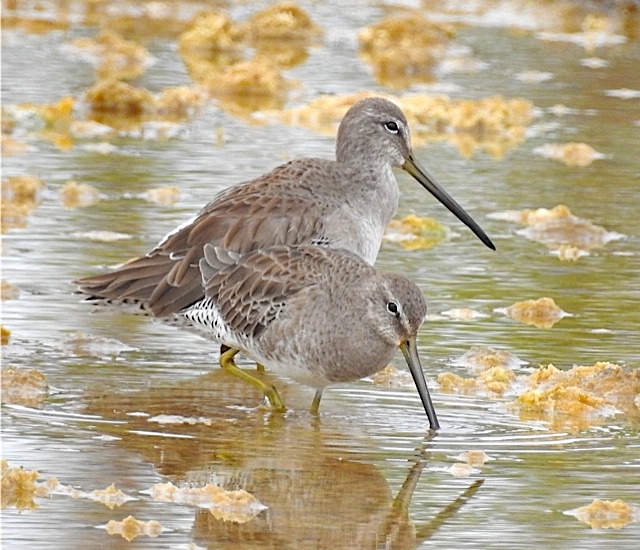
Short-billed Dowitcher Bahamas (Erika Gates)

LONG-BILLED DOWITCHER PICTURES FOR TWITCHERS

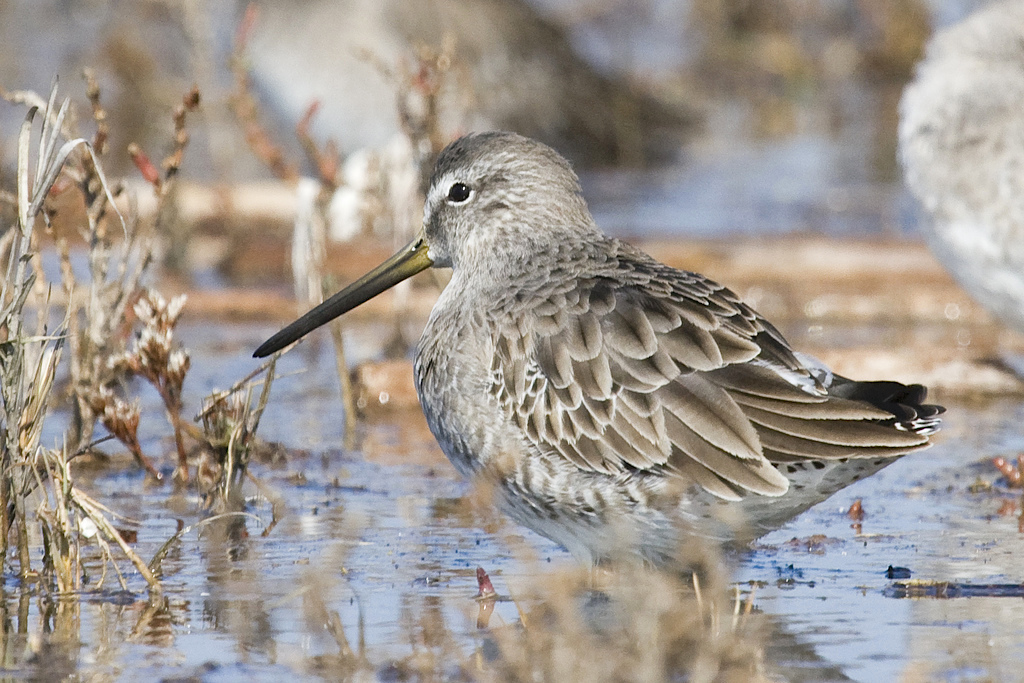
It’s about 3 years since I featured dowitchers. There are two types, short-billed and long-billed. They are disconcertingly similar, especially if you are only looking at one bird with no comparator. However, on Abaco a good rule of thumb is that if you see a dowitcher it will almost certainly be a SBD, a common winter resident. The LBD is a rare visitor to the Northern Bahamas. And if you just happen to be wrong? Well, so might anyone else be…

Short-billed Dowitcher Bahamas (Erika Gates)

I’m returning to the topic because recently Erika Gates, well-known bird authority and guide on Grand Bahama, took some excellent photos of some LBDs, and has kindly let me feature them. These birds are very unusual on Abaco, not least because they prefer fresh water rather than brackish, which is in short supply on the island and cays.

Short-billed Dowitcher Bahamas (Erika Gates)

 Phoenix Birder / Xeno Canto

Short-billed Dowitcher Bahamas (Erika Gates)

HOW DID THE DOWITCHER GET ITS NAME?

I had assumed that the strange name for these birds was onomatopoeic, in the same way that a Killdeer is supposed to call “Kill…Deer”; and a Bobwhite, an interrogative “Bob…White?”. When I tried to check this online, I found that the usually valuable primary sources for bird info were silent on the topic. In the end, I tracked down a Merriam Webster entry that simply said “probably of Iroquoian origin; akin to Oneida tawístawis. First Known Use: 1841”. Me neither!

Short-billed Dowitcher Bahamas (Erika Gates)

LONG OR SHORT – HOW ON EARTH DO I TELL? 

1. HELPFUL(ISH) WAYS

  • On Abaco, if you see a Dowitcher the overwhelming likelihood is that it’s a SBD
  • The species prefer different habitats, with the LBS preferring freshwater even in coastal regions
  • The SBD prefers coastal areas, shorelines and brackish / muddy ponds
  • The SBD’s call is said to be “mellower” than the LDB – though unless you have heard both for comparison, that’s not a very useful identifier
  • The body shapes are apparently subtly different, in ways I can only begin to guess
  • In breeding plumage, the species have perceptible colour / pattern differences (if you have binoculars?)

Short-billed Dowitcher Bahamas (Erika Gates)

 2. CONFUSING / UNHELPFUL FACTORS
  • LBDs may occasionally join SBDs that are foraging on open tidal flats
  • Bill length may not help, there’s an overlap – some SBDs may have longer bills and vice versa.
  • There are theories about bill-length / head size comparison as a field ID method. Do they work? Only if you get it right, I guess.
  • “Winter plumage of both species is very similar” (grey). Both are only in the Bahamas in winter. So, not a lot of help.

Short-billed Dowitcher Bahamas (Erika Gates)

DOES THE DOWITCHER HAVE ANY PRACTICAL APPLICATION?

Yes! In Scrabble you can form a stonking 315 words from just those 9 letters, all permitted under Scrabble rules (though not my own house rules, which forbid ridiculous 2 and 3 letter words that sound invented for the purpose of winning at Scrabble). Apart from the full 9 letter original, there’s one 8 letter word – ‘witherod’, a type of viburnum plant; and 13 words of 7 letters, of which I’d say 8 are in common though not everyday usage. I’ll leave you to work out the remaining 301 words…

Credits: Erika Gates, with many thanks for use permission; the excellent Xeno Canto / Phoenix Birder for the sound file

Unknown's avatar

SOUTHERN STINGRAYS: BAHAMAS REEF FISH (41)


Southern Stingrays, Bahamas (Melinda Riger / Grand Bahama Scuba)

SOUTHERN STINGRAYS: BAHAMAS REEF FISH (41)

Anyone who has scuba-dived or snorkelled around the bright coral reefs of the Bahamas, or hunted bonefish out on the Abaco Marls will have come across Southern Stingrays Dasyatis americana. And there are certain places (eg Manjack Cay) where you can actually feed them – and not come to any harm

Southern Stingrays, Manjack Cay, Bahamas (Samantha Regan)

FEED THEM? AREN’T THESE GUYS LETHALLY DANGEROUS CREATURES?

Southern Stingrays, Bahamas (Melinda Riger / Grand Bahama Scuba)

The name that always comes to mind in connection with stingrays is poor Steve Irwin, the charismatic Australian wildlife expert who was tragically ‘stung’ over his heart as he swam close over a ray while filming underwater. But this was, it would appear, a dreadful combination of circumstances with a terrible outcome.

Southern Stingrays, Bahamas (Melinda Riger / Grand Bahama Scuba)

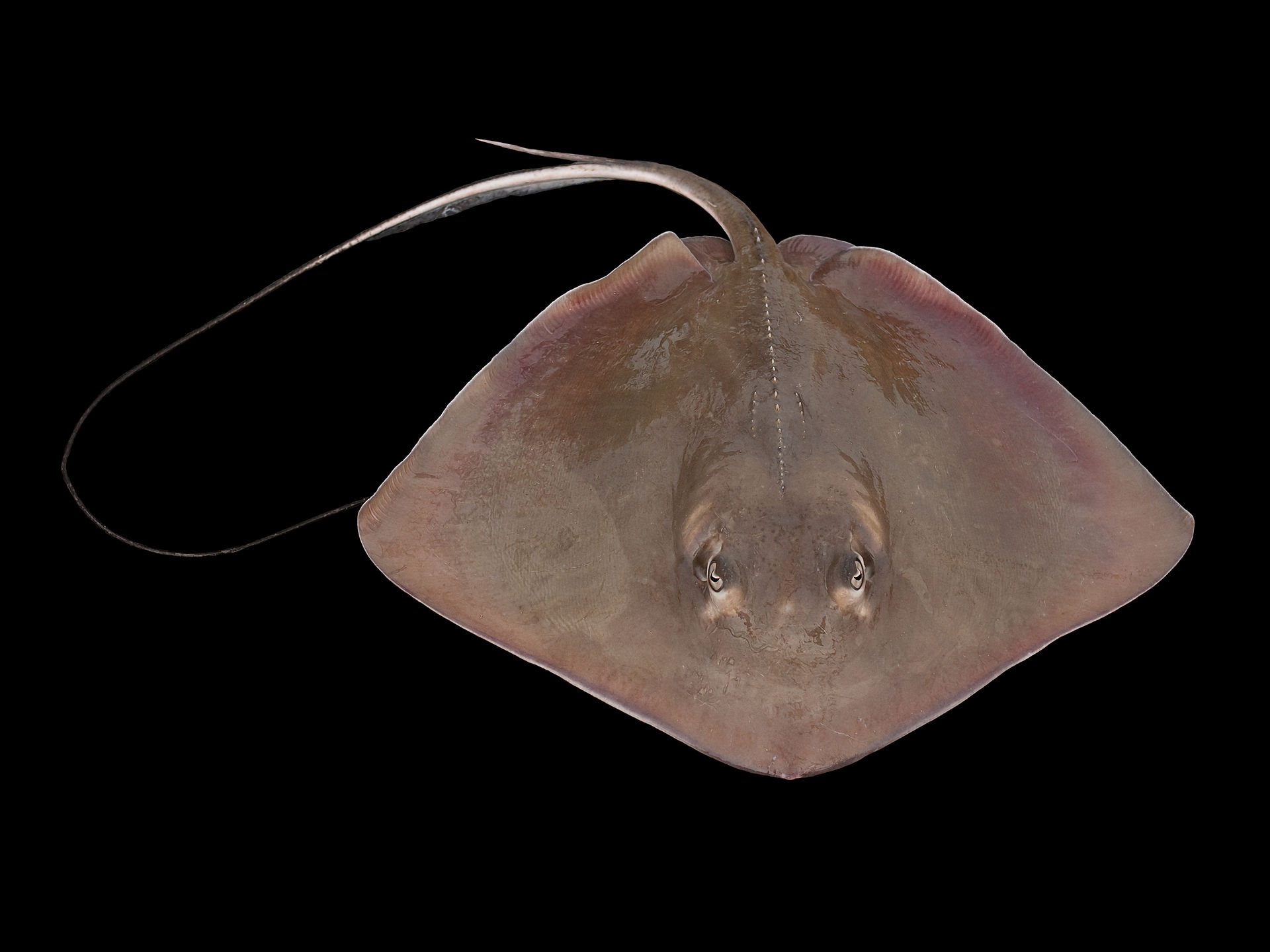
The ray’s stinger is in fact an erectile venomous barbed spine near the base of the tail and not on the end of it (as one might expect). But these creatures are not out to harm you – though of course when you are in their environment you should accord them the respect that they merit.

Southern Stingray (Tomas Willams, wiki)

If you are walking / wading in the water, avoid the risk of accidentally treading on a ray. Best to shuffle your feet forward in the sand; if there’s a half-concealed ray feeding or resting on the bottom nearby, it will swim away peacefully. I took the photo below while bonefishing on the Marls; the ray directly ahead slowly makes off as the skiff drifts closer. The next one is of a ray with its young – completely aware of us as we glide past to one side, but not especially bothered.

Southern Stingrays, Bahamas  (Keith Salvesen)Southern Stingray adult and young, Bahamas  (Keith Salvesen)

If you are swimming, snorkelling or diving, don’t get too close – especially by swimming directly over a ray (apparently Steve Irwin’s mistake, so that he was struck right in the chest by the stinger when the ray reacted).

Southern Stingrays, Bahamas (Melinda Riger / Grand Bahama Scuba)

Enough of the potential dangers. The southern stingray is a magnificent creature, as Melinda’s wonderful photographs show. She spends half her life underwater and I’m not aware that she has had a problem with a ray. 

Southern Stingrays, Bahamas (Melinda Riger / Grand Bahama Scuba)

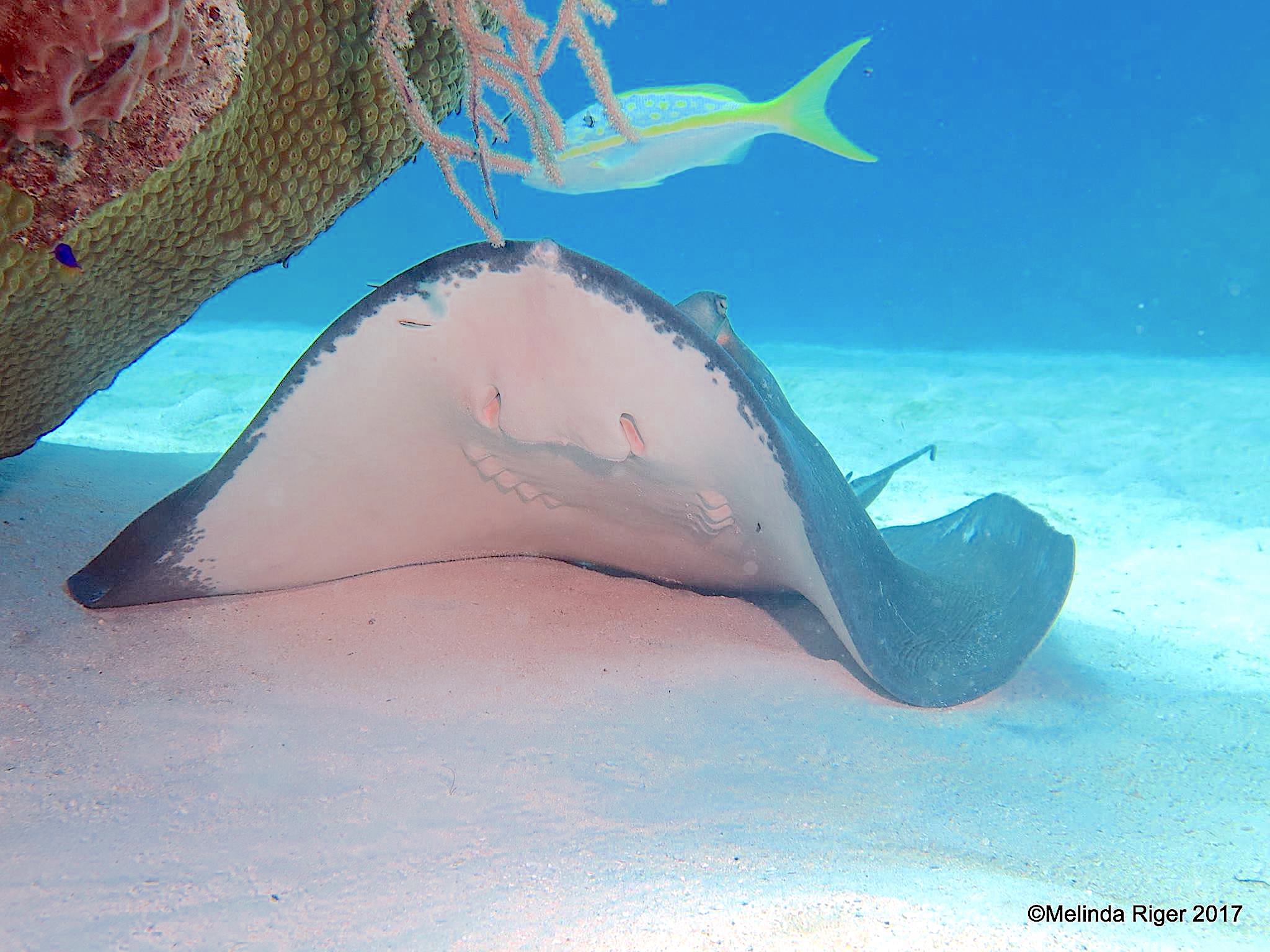
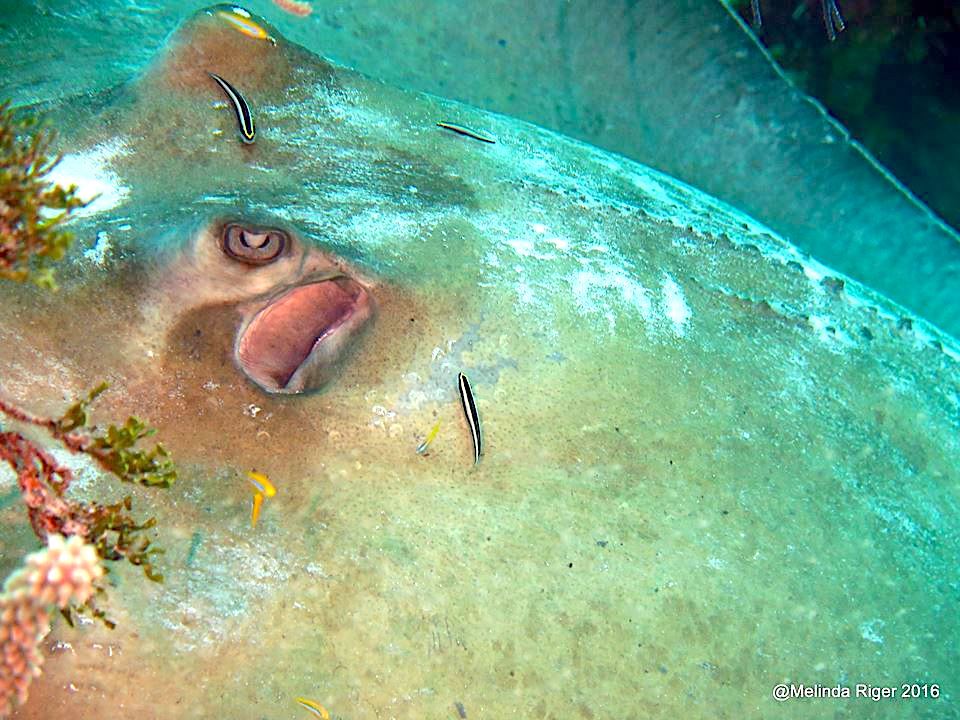
Like many larger sea creatures, stingrays need help with their personal care – the removal of parasites, dead skin and so forth. And so they make use of the services offered by small fish like gobies, wrasses and shrimps at a CLEANING STATION. Here are 2 photos of rays doing just that. You can see the tiny fish by the reef, going about their work. There’s a mutual benefit in this symbiotic relationship, in which it is understood that the cleaners are unharmed. Indeed, they will often enter the mouths and gills of a fish to clean… including the teeth. So there’s dental hygiene on offer too…

Southern Stingrays, Bahamas (Melinda Riger / Grand Bahama Scuba)

Southern Stingrays, Bahamas (Melinda Riger / Grand Bahama Scuba)

RELATED POSTS

YELLOW STINGRAY

GRACE WITH ATTITUDE

TAKEN TO THE CLEANERS

Photo Credits: Melinda Riger / Grand Bahama Scuba, except for the feeding photo (cheers, Samantha Regan), the ‘specimen’ from Tomas Willems (Wiki) and my two noted above

Unknown's avatar

ABACO PARROTS FOR THE NEW YEAR!


Abaco (Cuban) Parrot, Bahamas (Gerlinde Taurer)

ABACO PARROTS FOR THE NEW YEAR!

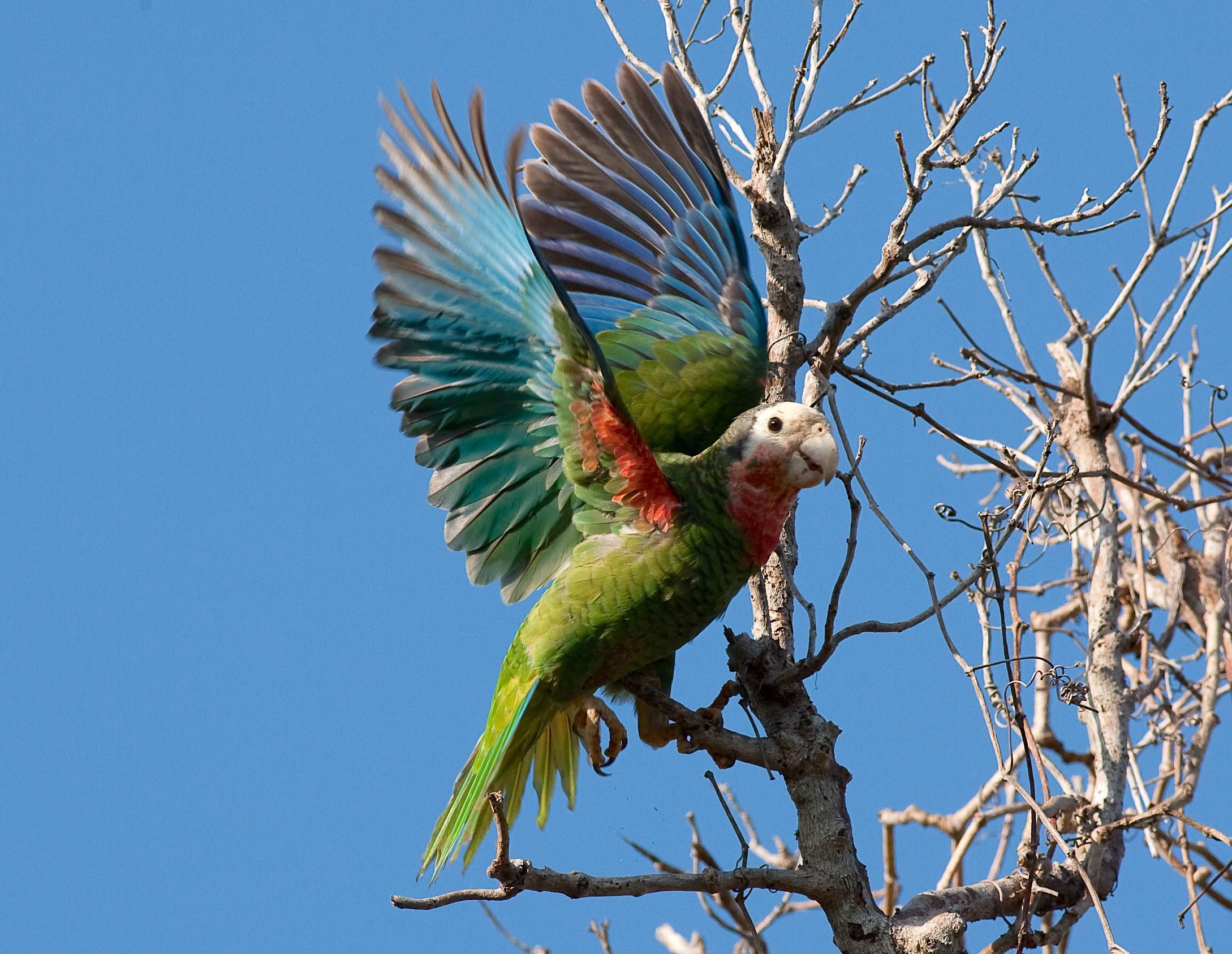
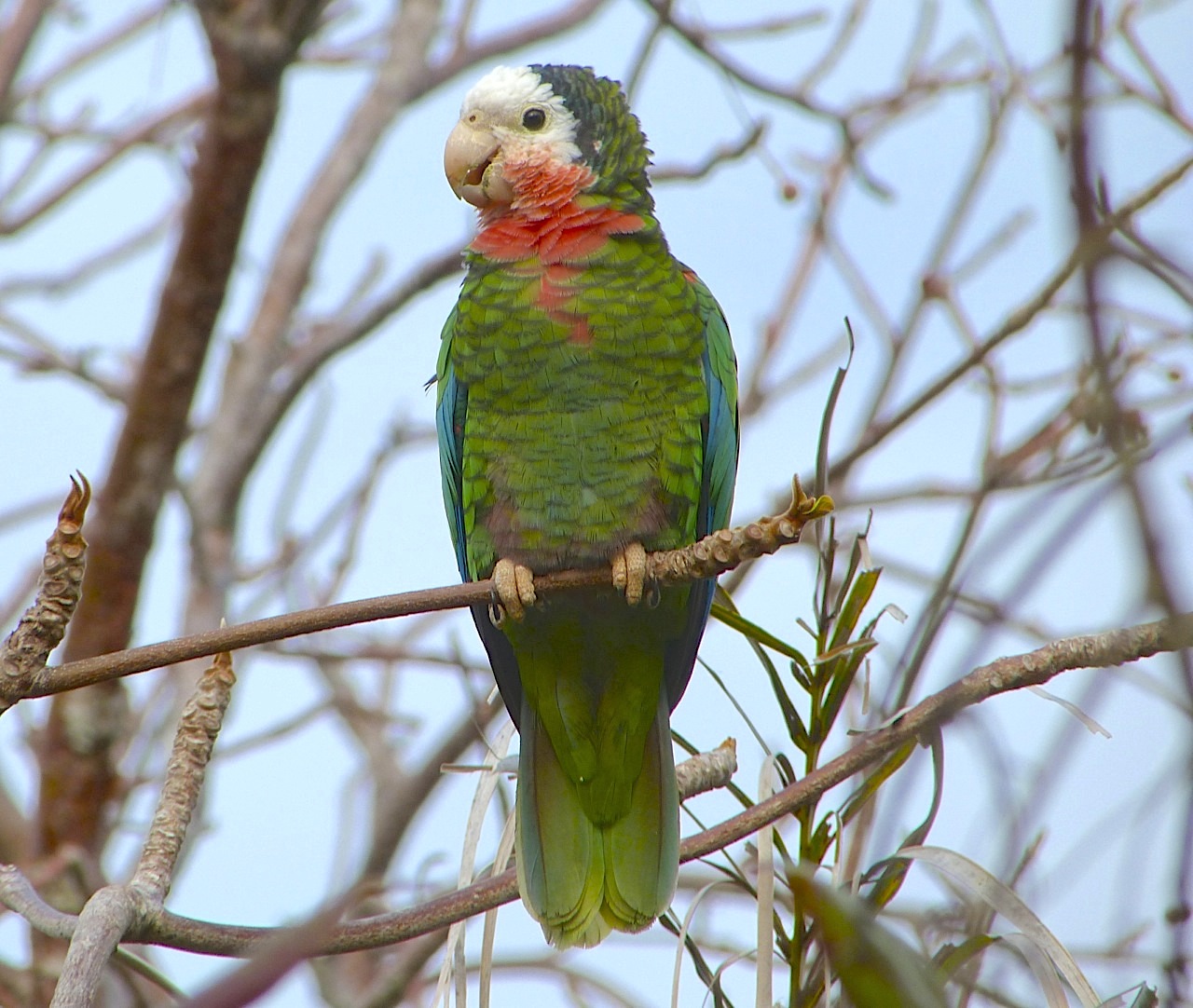
Red, green, blue, and a touch of snowy white. The colours of Christmas, sort of. We are past all that for another year, but for those on Abaco the unique, ground-nesting Abaco parrots Amazona leucocephala flash those same colours throughout the year.

Abaco (Cuban) Parrot, Bahamas (Craig Nash)

These birds have cousins on Inagua that nest conventionally; and there are now a handful of NASSAU PARROTS on New Providence, of uncertain origin (click link for more on these).

Abaco (Cuban) Parrot, Bahamas (Tom Sheley)

The parrots are only found in South Abaco, between Marsh Harbour and the National Park where they live and breed in limestone holes in the forest floor. 

Abaco (Cuban) Parrot, Bahamas (Caroline Stahala)

You are most likely to hear these birds before you see them, as they make their way daily north in the morning and back again in the evening.

Abaco (Cuban) Parrot, Bahamas (Keith Salvesen)

Despite the racket they make, finding the parrots in the National Park is a bit ‘needle-in-haystack’. Instead, try the Gilpin Point point area, and coppice areas to the north. They pass back and forth over Delphi, pausing to squabble noisily, almost daily. I have made several recordings of them – here’s one example.

Abaco (Cuban) Parrot, Bahamas (Peter Mantle)

Far and away the best location is Bahama Palm Shores, where the mix of dense coppice with their favourite gumbo limbo trees and the open gardens is much to their liking. And frankly, it’s a great place for birding anyway, even if you blank for the parrots. 

Abaco (Cuban) Parrot, Bahamas (Nina Henry)

Just think: a dozen years ago, these fine birds were sliding towards extinction, with an unsustainable population of fewer than 900. Conservation efforts and in particular attention to habitat protection and predator control have resulted in population increases year-on-year, and the total now stands at around 5000 adults.

Abaco (Cuban) Parrot, Bahamas (Keith Salvesen)

I’ve posted quite a lot about these parrots over the years, so if you are already familiar with them, I hoped you felt free to skip the text, and simply to admire these wonderful creatures. 

Credits: Gerlinde Taurer, Craig Nash, Tom Sheley, Caroline Stahala, Keith Salvesen, Peter Mantle, Nina Henry, Erik Gauger; audio recording Keith Salvesen

Abaco (Cuban) Parrot, Bahamas (Erik Gauger)

Unknown's avatar

NEW YEAR, NEW WORLD, NEW COMMS AT LAST!


Bahamas Map Stamp

NEW YEAR, NEW WORLD – NEW COMMS AT LAST!

Rolling Harbour downtime is coming to an end. Christmas is a cheery (bleary?) memory, with evidential leftovers in the kitchen and (thankfully) some overbought (accidentally, maybe?) drink in the cupboard, under the table, oh! look! there’s another bottle on the bookcase. The last of the grandchildren is with us and a bright shiny New Year is… good grief, tomorrow. In the interim, we have had a wifi blackout of 5 days and a power outage for 2 days – and this is in the UK, not Abaco as you might expeect! So, no viable internet, and indeed no electrics at all. But we have wood fires and plenty of wood; a large supply of candles; and gas to cook on. 
All of which leads up to an apology for emails undealt with, bird ID queries apparently ignored, comments unanswered and similar impolitenesses. Normal service will be resumed next week. That is my first (and easiest) New Year’s Resolution, before we come to the more testing things I’ll resolve not to do…

Bahamas Map Stamp (First Day Cover)

I thought I’d post these Bahamas stamp images (from ‘Mr Columbus’ on eBay) to celebrate (symbolically) the imminent New Year. I suspect they are somewhat contentious fact-wise. For example, I wonder if Columbus and his crew really believed they had covered such a relatively short distance before making landfall. 

For now, a very Happy New Year to all those that take the trouble to follow the musings from Rolling Harbour. There’s some great stuff lined up for 2018. Here’s an example of the Bahamas Postal Service’s excellent work in producing eye-catching wildlife stamps to end with (nb these particular birds are very rare on Abaco – the island’s third and least reported hummer).

Bahamas Hummingbird Stamp

Unknown's avatar

BEHOLD! SOME BUNTING(S) FOR AN ABACO CHRISTMAS


Painted Bunting.Bahama Palm Shores.Abaco Bahamas.Tom Sheleyimagesimagesimagesimages

BEHOLD! SOME BUNTING(S) FOR AN ABACO CHRISTMAS

painted-bunting copy

BUNTING  /ˈbʌntɪŋ/  (Noun)

[A Christmas gift of a puntastic avian / festive double-meaning]
  1. A small New World songbird of the cardinal subfamily
  2. Flags and other colourful festive decorations

imagesimagesimages

PAINTED BUNTINGPainted Bunting, Abaco (Erik Gauger)
Painted Bunting, Abaco (Tara Lavallee)Painted Bunting, Abaco (Tara Lavallee)

It’s hard to imagine a more Christmasy little bird than the Painted Bunting. Bright blue, red, green primary colours straight from a child’s paintbox make for a spectacular bird to grace the festive season. These are migratory winter residents, and the first reports of the bright and beautiful males on Abaco started to appear in November. Some will stay around until March.

                                                           painted-buntingimagespainted-bunting copy

Feeders at the Delphi Club. The first image shows a female & a male PABU feeding together. The second is a male with a pair of black-faced grassquitsPainted Buntings (M & F), Delphi, Abaco (Keith Salvesen)Painted Bunting, Delphi, Abaco (Sandy Walker)
                                                        painted-buntingimagespainted-bunting copy

The two wonderful photos below are by Tom Sheley, a major photographic contributor to THE BIRDS OF ABACO. They were taken in Texas, not on Abaco, but I include them because of Tom’s strong connection with the birdlife of Abaco; and because on any view they are fantastic shots…
Painted Bunting reflection LR.Laguna Seca.South TX. 4.16.13.Tom SheleyPainted Bunting dip reflection LR.Laguna Seca.South TX. 4.16.13.Tom Sheley

painted-bunting copy

This is probably my last post until after Christmas, what with one thing and another, so it’s a good opportunity to wish a very Happy Christmas or [insert preferred seasonal appellation] to everyone who visits Rolling Harbour and especially those who, having done so, return for more!

Credits: Tom Sheley (1, 7, 8), Erik Gauger (2), Tara Lavallee (3, 4), Keith Salvesen (5) Sandy Walker (6); Birdorable Cartoons

imagesimagesimagesimagesPainted Bunting, Abaco Bahamas