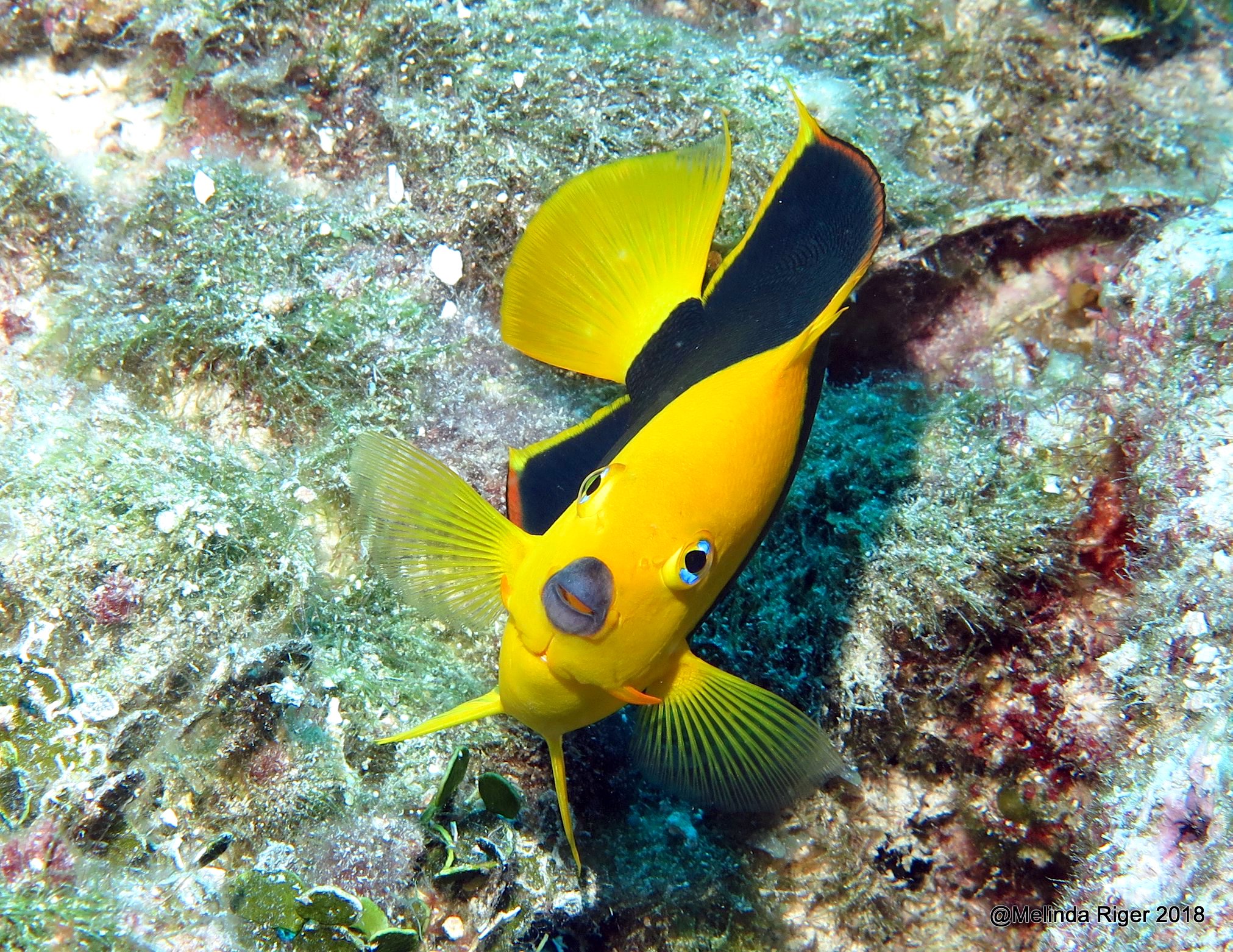
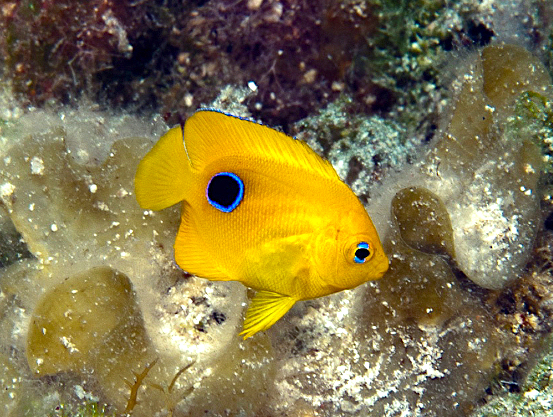
I last featured the cheerfully-coloured Rock Beauty Holacanthus tricolor 2 or 3 years back. Time has passed; new photos exist; new people have signed up to follow this eclectic menagerie (thank you both). Time for another look at these beauties, which also happen to be cuties.
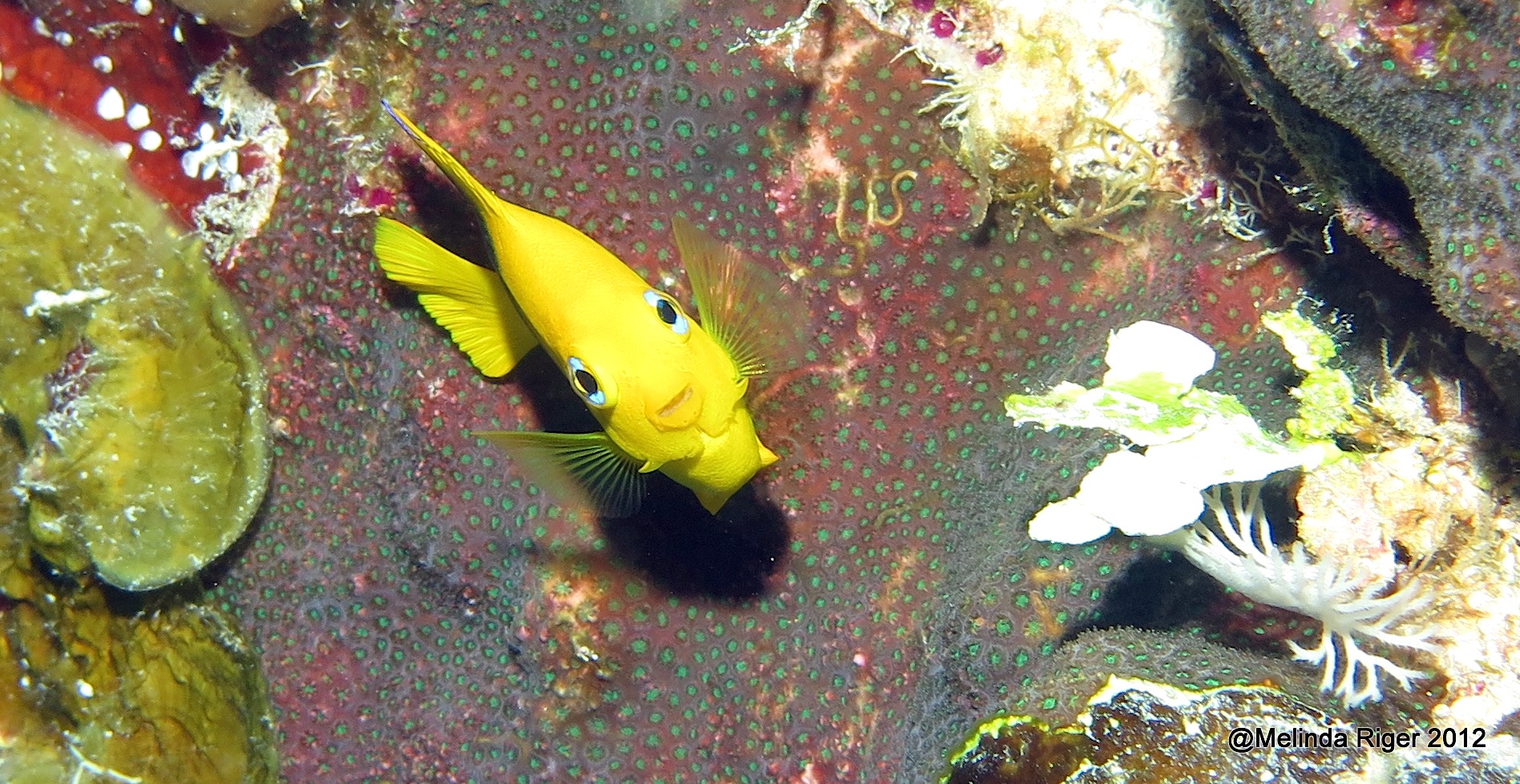
Look at the little guy above – posing for Pixar, adorably hoping to star in Part 3 of the Nemo / Dory trilogy
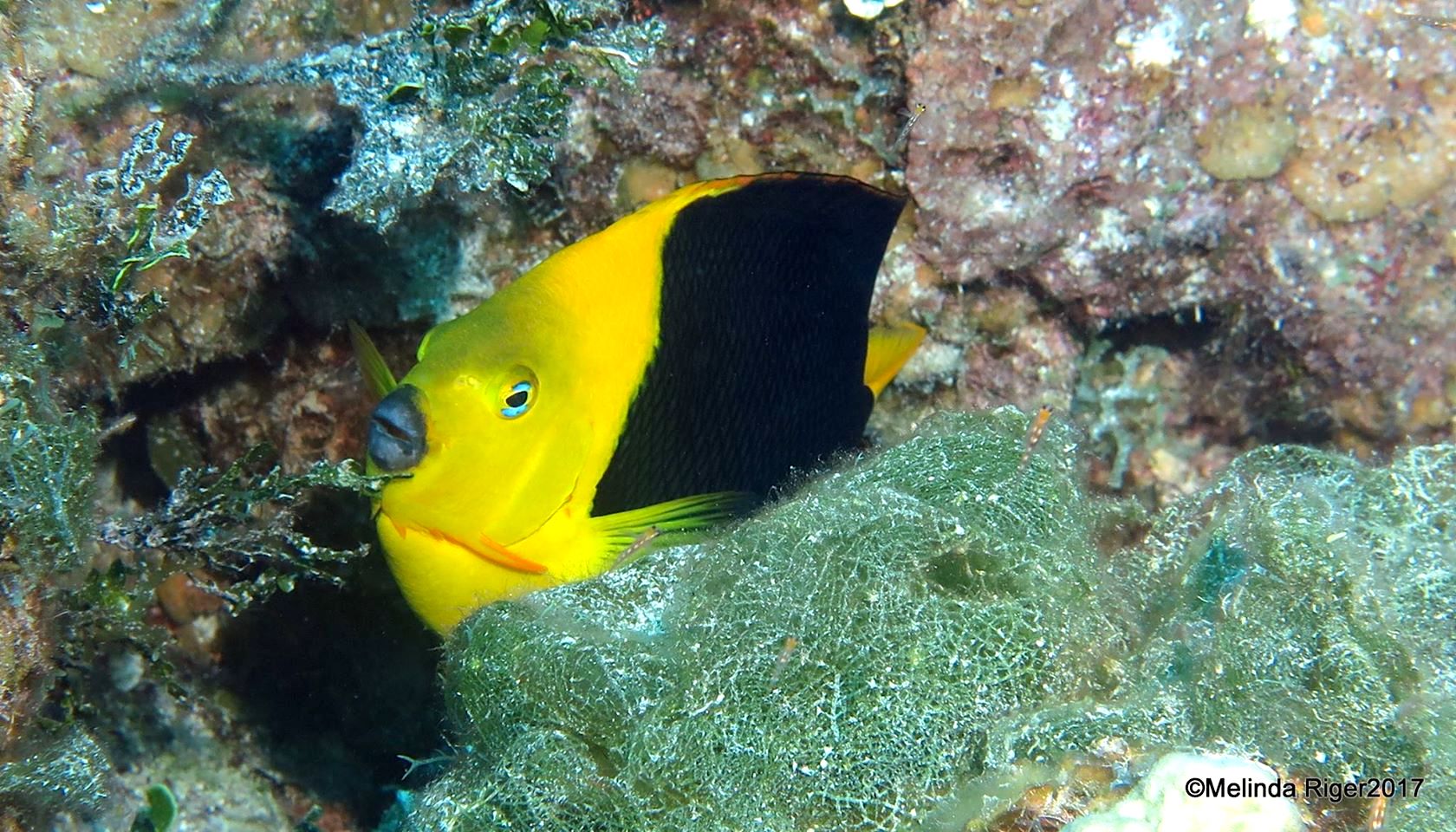
These fish are a small species of angelfish. Seen swimming around the reefs they are unmistakeable, not least because of their bright yellow hi-viz jackets, remarkable blue eyeliner and blue-black lippy.
Rock Beauties look like prime candidates for anyone’s aquarium, but their picky dietary requirements and tendency for aggression make them unsuitable.
They are highly specialised feeders, needing marine sponge in their daily diet. They are also prone to chase their tank-mates and nip them. On balance, they look more fetching nosing about the coral anyway.
WHAT DO JUVENILES LOOK LIKE?
Juvenile rock beauties are cute mini-versions of the adults, only more yellow and with yellow lips. In some development stages, they have a smart blue circle around the dark patch on their sides (bottom image).
NOTE Rock Beauties have no known kinship with Chrissie, Debbie, Lita, Joan, Jennifer, Stevie, Madge and the rest of the accredited ‘Rock Beauties aka Chicks’
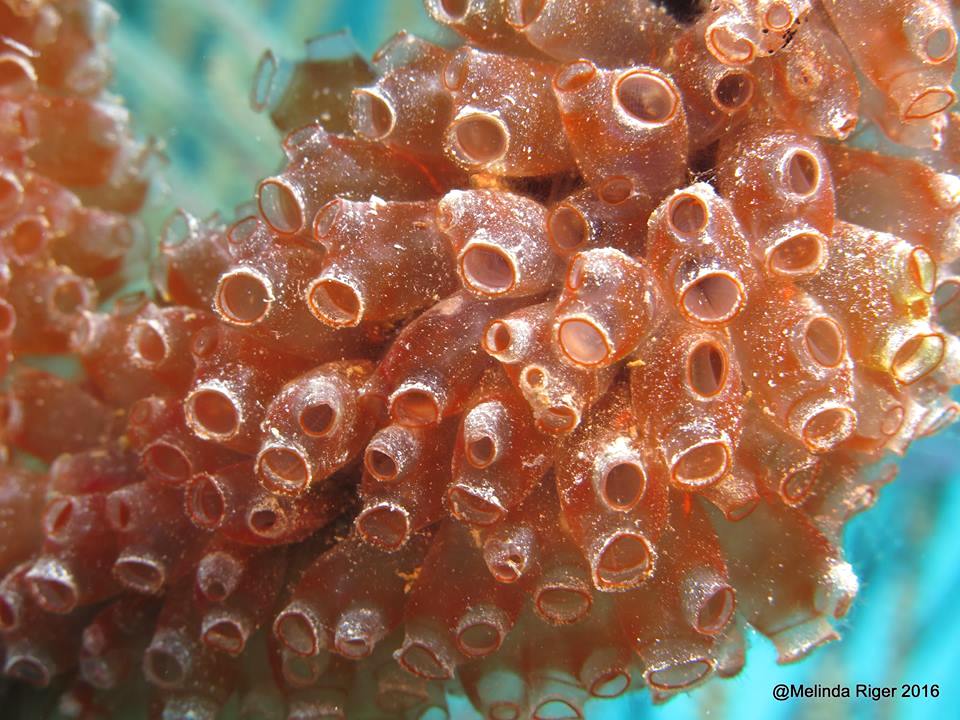
Painted Tunicates Clavina picta are one of several species of tunicate ‘sea-squirts’ found in Bahamas and Caribbean waters. These creatures with their translucent bodies are usually found clustered together, sometimes in very large groups. One reason for this is that they are ‘sessile’, unable to move from where they have taken root on the coral.
HOW DO THEY FEED?
Like most if not all sea squirts, tunicates are filter feeders. Their structure is simple, and enables them to draw water into their body cavity. In fact they have 2 openings, an ‘oral siphon’ to suck in water; and an exit called the ‘atrial siphon’. Tiny particles of food (e.g. plankton) are separated internally from the water by means of a tiny organ (‘branchial basket’) like a sieve. The water is then expelled.
WHAT DOES ‘TUNICATE’ MEAN?
The creatures have a flexible protective covering referred to as a ‘tunic’. ‘Coveringcates’ didn’t really work as a name, so the tunic aspect became the name.
IF THEY CAN’T MOVE, HOW DO THEY… (erm…) REPRODUCE?
Tunicates are broadly speaking asexual. Once a colony has become attached to corals or sponges, they are able to ‘bud’, ie to produce clones to join the colony. These are like tiny tadpoles and their first task is to settle and attach themselves to something suitable – for life – using a sticky secretion. Apparently they do this head first, then in effect turn themselves upside down as they develop the internal bits and pieces they need for adult life. The colony grows because (*speculation alert*) the most obvious place for the ‘tadpoles’ to take root is presumably in the immediate area they were formed.
APART FROM BEING STATIONARY & ASEXUAL, ANY OTHER ATTRIBUTES?
Some types of tunicate contain particular chemicals that are related to those used to combat some forms of cancer and a number of viruses. So they have a potential use in medical treatments, in particular in helping to repair tissue damage.
Credits: all fabulous close-up shots by Melinda Riger / Grand Bahama Scuba; diagram from depts.washington.edu; magpie pickings with a particular mention of an article by Sara MacSorley
Today I learn from a cheery message from WordPress that my illustrated ramblings have been going on for exactly X years, where X is greater than 5 but less than 10. Time to start a new theme: channelling my inner Noel Coward, I am introducing a new mainly pictorial series provisionally called ‘Reef Encounter’. All the awesome beauty of reef life will be here.
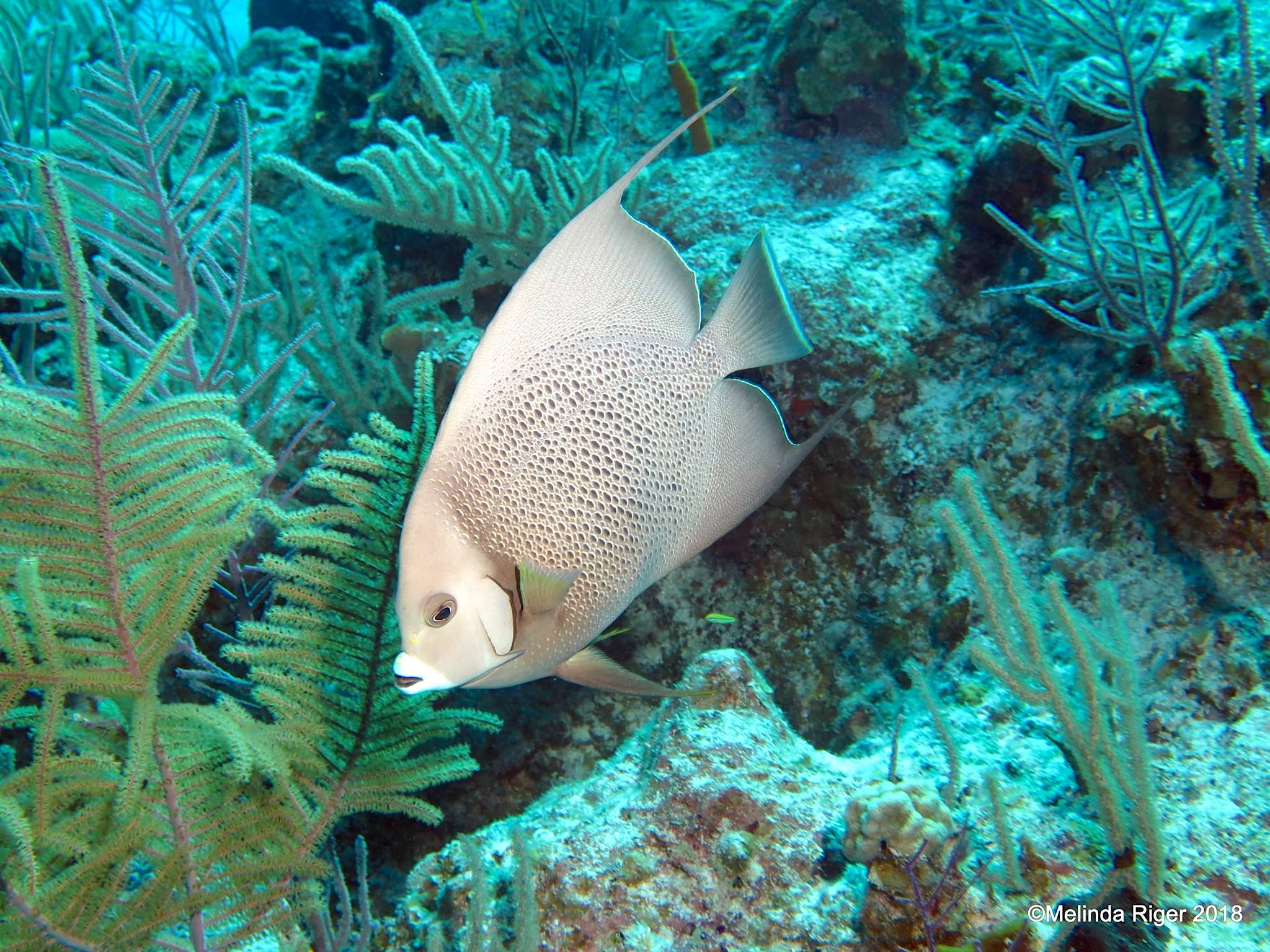
In the past I have posted aboutGRAY ANGELFISH, one of three kinds of angelfish found in the northern Bahamas. Today, I am featuring some more recent images of these pretty creatures. Note in particular the striking shape and colour of their mouths, the blue being found also on the fin edges at the back.
On this otherwise gray fish, you’ll also find touches of yellow on the face and the edges of the front fins. In the header image there’s another little fish in the bottom right corner. Not a baby angelfish, but a FOUR-EYED BUTTERFLYFISH – a species that will feature in own right in due course
All fabulous photos by Melinda Riger / Grand Bahama Scuba
IS THIS THE REAL LIFE? OR IS THIS JUST FANS AT SEA?
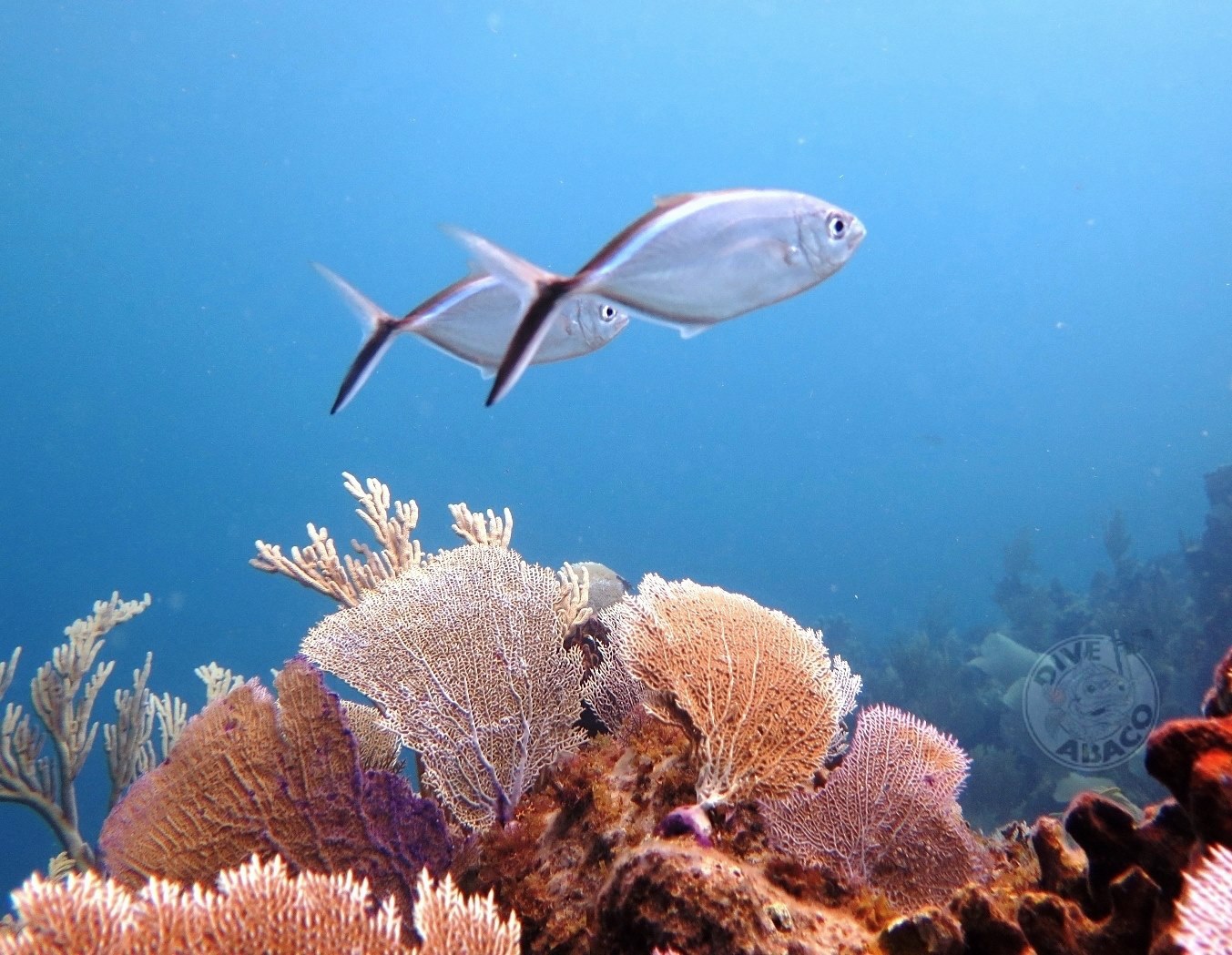
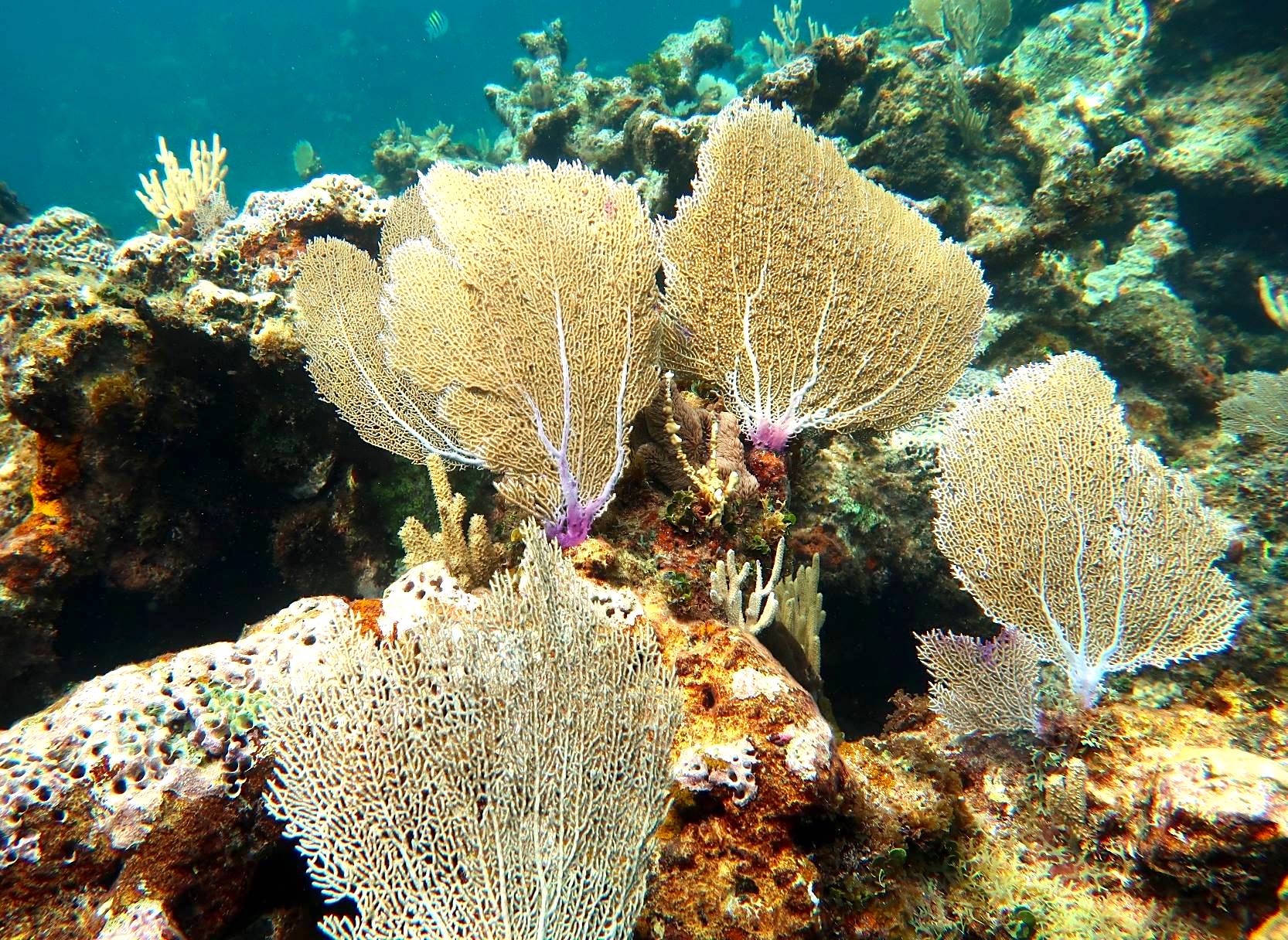
The waters of Abaco teem with myriads of fish that depend on the coral reefs for shelter and safety, for breeding, for growing up in, and for nourishment. Sea fans (or gorgonians, to use the technical name) are animals too. They may look like plants and stay rooted to the spot, but like anemones these ‘soft corals’ are creatures of the reef and essential indicators of its health.
At the moment it can still be said that the static (‘sessile’) members of the Abaco reef community are relatively unscathed by the impact of (and I don’t want to get into any arguments here) whatever causes mass bleaching and the death of reefs elsewhere in the world.
The purple sea fan Gorgonia ventalina (classified by Linnaeus in 1785) is one of the most common species of sea fan, and a spectacular one at that. The main branches are linked by a lattice of smaller branches. Below the ‘skin’ is a skeleton made of calcite compounded with a form of collagen.
Sea fans are filter-feeders, and have polyps with eight tiny tentacles that catch plankton as it drifts past. They develop so that their orientation is across the prevailing current. This maximises the water passing by and consequently the supply of food as the fans gently wave in the flow.
Gorgonians have a chemical defense mechanism that protects against potential troublemakers. The main effect is to make themselves unpleasant to nibble or uproot.
One species impervious to this deterrent is the fascinating FLAMINGO TONGUE SNAIL (more of which quite soon). Other ‘safe’ species include the fireworm and BUTTERFLYFISHES.
One benefit of sea fans to mankind is that their defensive chemicals have been discovered to provide the basis for drug research and development. It’s tempting to say that by way of gratitude, we pollute the waters they need for their very existence. So, consider it said…
All the photos featured are by courtesy of Capt. Keith and Melinda Rogers of the well-known local scuba dive and snorkel centre DIVE ABACO, located in central Marsh Harbour. As prime enablers of reef exploration in Abaco waters, it can truly be said that they too have plenty of fans.
Credits: Keith and Melinda Rodgers; Dive Abaco @DiveAbaco, Marsh Harbour, The Bahamas ** The answer to the questions in the Title is… it’s both!
It’s been a little time since I added to the WTF? series, in which some of the more outlandish reef denizens come under close scrutiny. Jawfishes (Opistognathidae) come into this category, not least because of their interesting ways with their eggs. Also, they tend to stick upright out of the substrate, which is not especially fishy behaviour.
More than 50 species of jawfish are found around the world. In the Bahamas, you are most likely to encounter the Yellowhead (or Yellow-headed) variety. And if you think they look slightly… primitive, that’s because they are. In fact, their forebears (forefishes?) originated in prehistoric times, specifically the Miocene era (a lot of million years ago, I didn’t count exactly).
These rather extraordinary little fish superficially resemble certain types ofBLENNY. Their modus operandi is to burrow down into sandy, gravelly or other loose substrate. They do so by cramming their mouths with sand and spitting it out to one side. By this means they form a tunnel of sorts in which they can live, and from which they can emerge, or half-emerge and take a look around them. As they do so, they hoover up passing food, mostly plankton and suchlike.
If something looks threatening while they are feeding or having a look around, they can simply duck down into their burrow for safety. They guard their patch against rivals, and behave ‘territorially’ in the jawfish community. One method is to ingest and and then eject sand or gravel at a would-be intruder.
YES, BUT WHERE IS THE REAL ‘WTF?’ FACTOR HERE?
Good question. With a good and original answer. These little creatures are so-called ‘MOUTHBROODERS‘, meaning that they carry their eggs in their mouths. Depending on the species, females, males or even both parents (don’t try this at home) will do this at or after fertilisation. In effect the eggs are safely incubated until they hatch as fry. Then they are on their own.
ARE THERE ANY DRAWBACKS TO THIS UNUSUAL GESTATION METHOD?
Apart from accidentally swallowing the occasional potential junior, the eggs need aeration from time to time. This is achieved by expelling the eggs from the mouth, and quickly sucking them back in again. Try this very short video to see this rather improbable behaviour in action. It’s only 8 seconds blink and you’ll miss the action. The eggs hatch into fry in 8 – 10 days, after which both parents can relax. Until the next time.
Photo Credits: all images from Melinda Riger / Grand Bahama Scuba except (4) Virginia Cooper / GBS; (5) Michael Wolf / Wikimedia; video, Alan Keller. Research: magpie picking, not excluding yet not limited to Wiki…
The black margate (Anisotremus surinamensis) is a type of GRUNT (see also PORKFISH) found among the reefs and rocks of (mostly) the western Atlantic seaboard, from Florida as far south as Brazil. They are relatively ‘shallow’ fish and they prefer to be close to place where they can live safely and avoid the predators that lurk in open or deep water.
Margates are not usually very large, mostly growing to between 18″ and 30″, although they can grow larger. Thanks to the awesomeness of Wiki and other reliable sources I can confidently report that “…the maximum recorded weight for this species is 5.8 kg (13 lb)“.
MAY WE HAVE THE TRADITIONAL 10 FUN FACTS PLEASE?
Local names include burriquete (Sp) and zapatero or burros (Mex)
There are 10 margate species world wide, including 2 Pacific versions
Their heads slope down to a notably thick lipped mouth in which they have strong teeth
Margates have erectile spines, presumably for defence (I’ve not tested that)
They like to shelter in caves and crevices, on ledges, and in wrecks (see pics)
Margates are ‘solitary fish’ or hang out in small groups
They are night-feeders on a diet of crustaceans, mollusks, smaller fish & urchins
Sadly for them, they are valued by commercial fisheries using baited drift fishing…
…and also targeted by anglers during the spawning season when they shoal (?unfair)
… and also caught as aquarium fish, adding to stock depletion
I was always taught ‘keep your mind open and your mouth closed’. Bad advice. Such bad advice. The worst. So many reasons to be exactly the opposite in these troubled times…
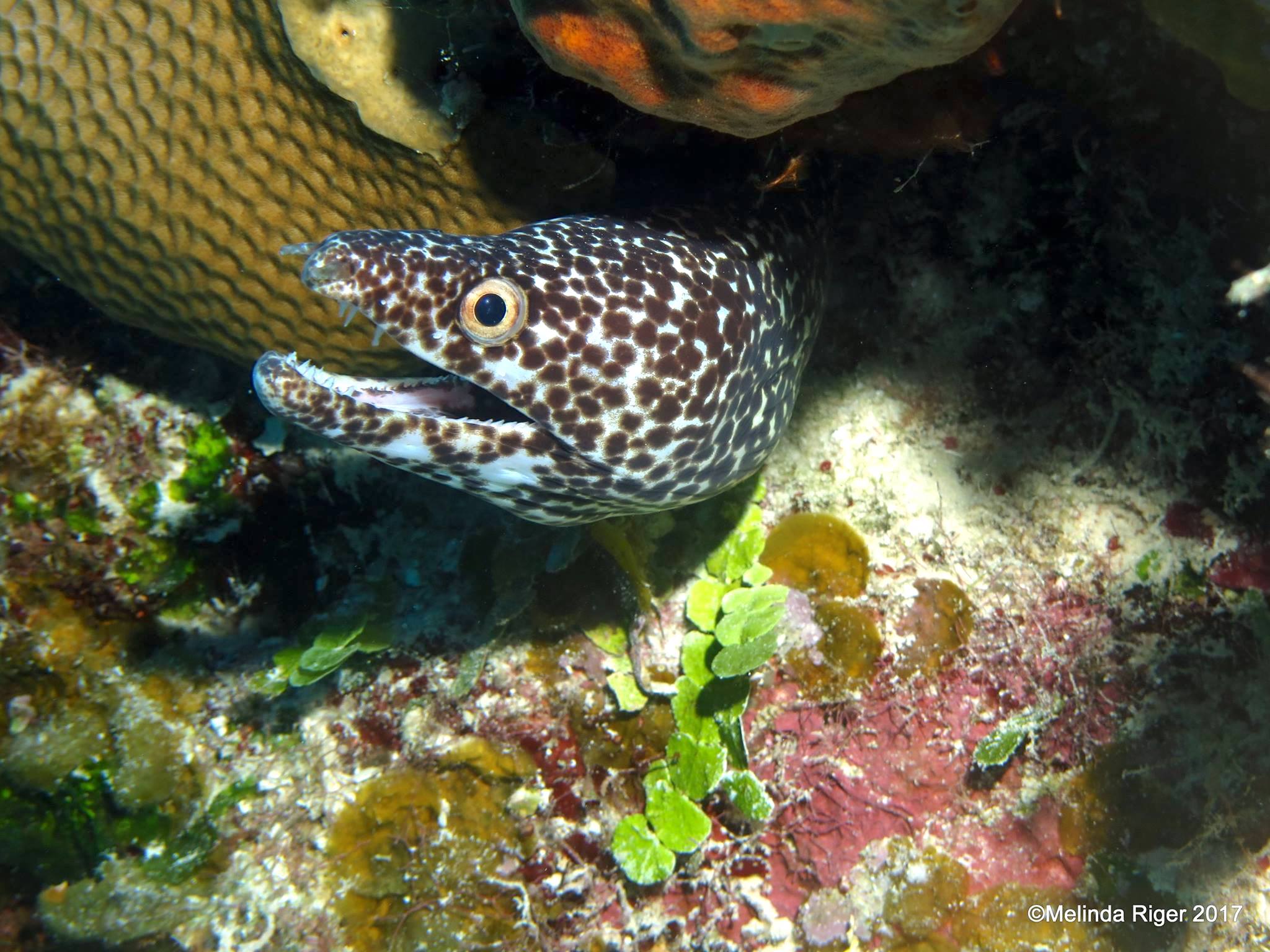
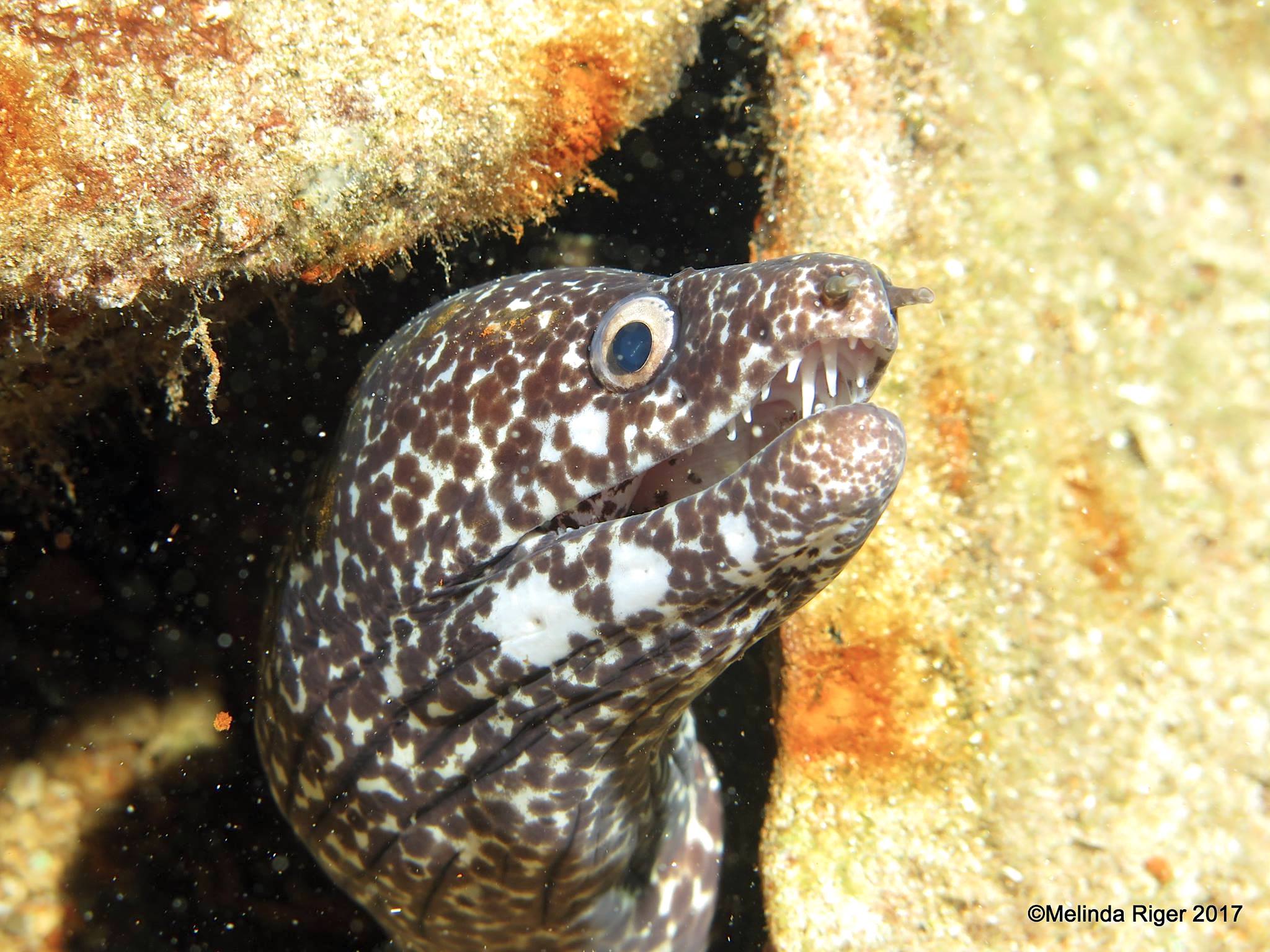
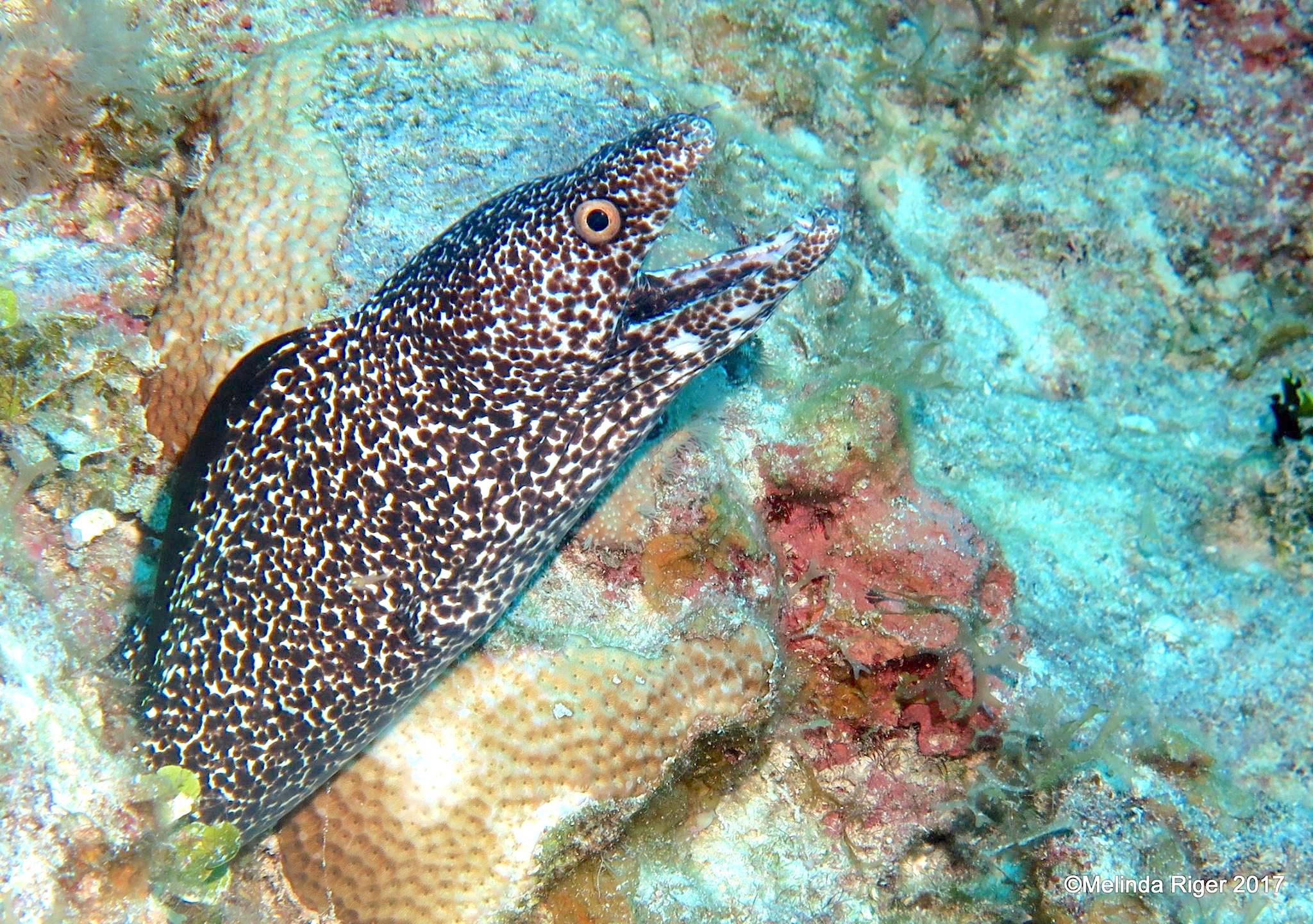
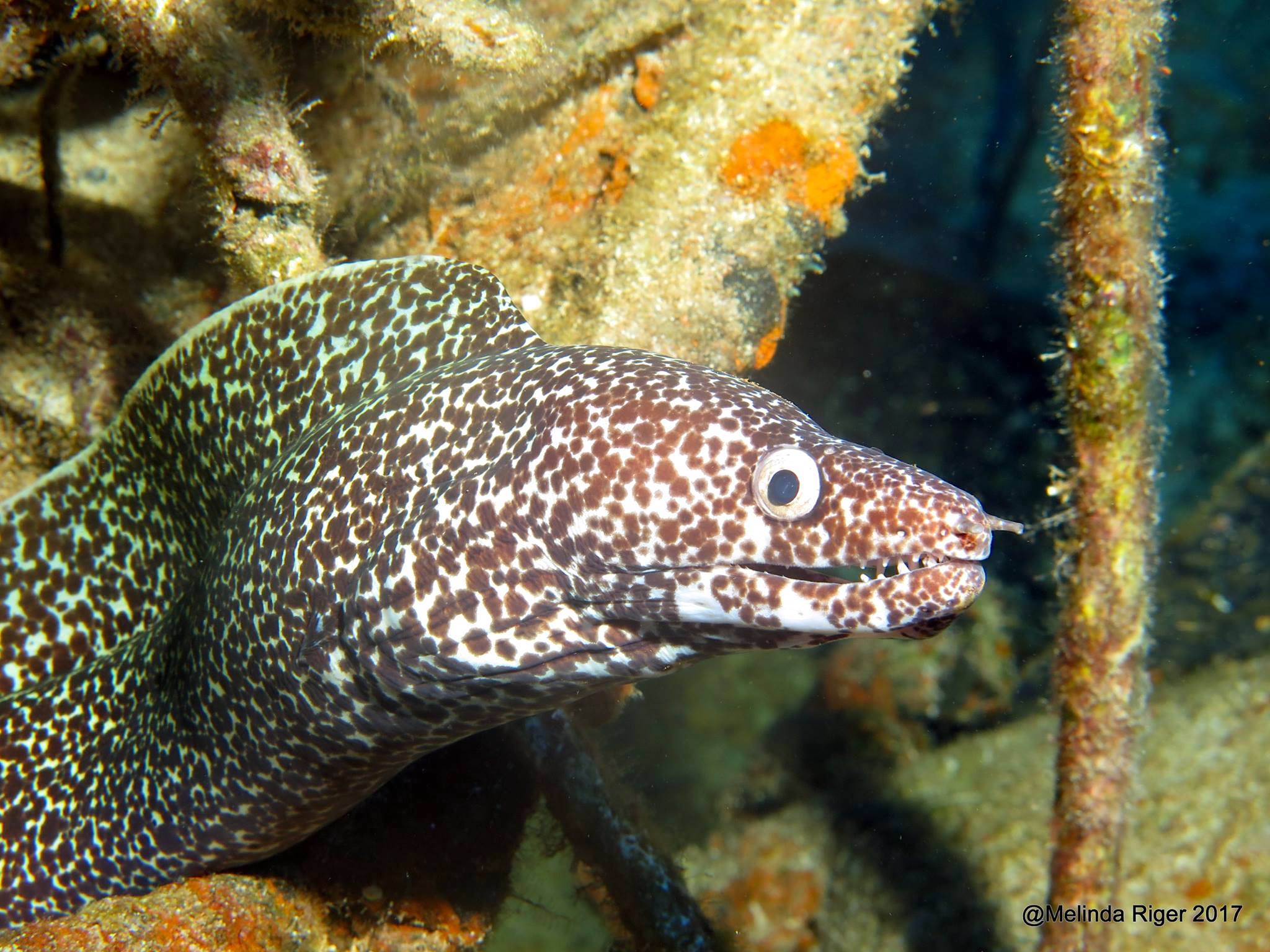
Spotted Moray eels Gymnothorax moringa, however, seem to have their own rules to live by. They appear to be open-minded and fairly sensible creatures around the reef. They tend to keep themselves to themselves, hanging out unassumingly in holes and crevices in the coral.
They do tend to stick their necks out a bit, but unless provoked (see below) they seem to be reasonably amiable (except maybe to the small fish and crustaceans that make up their diet).
They do keep their mouths open a lot, though. And as you can see, they have sharp-looking teeth that you mightn’t want too near to you. I say that because their bite can be dangerous and should be avoided. To start with, the teeth are slightly backward-facing, so that when they bite there is a ‘pull-back’ effect when you react (not unlike a barb on a fish hook). They are not aggressive as such, but they know how to deal with unwanted interference in their lives…
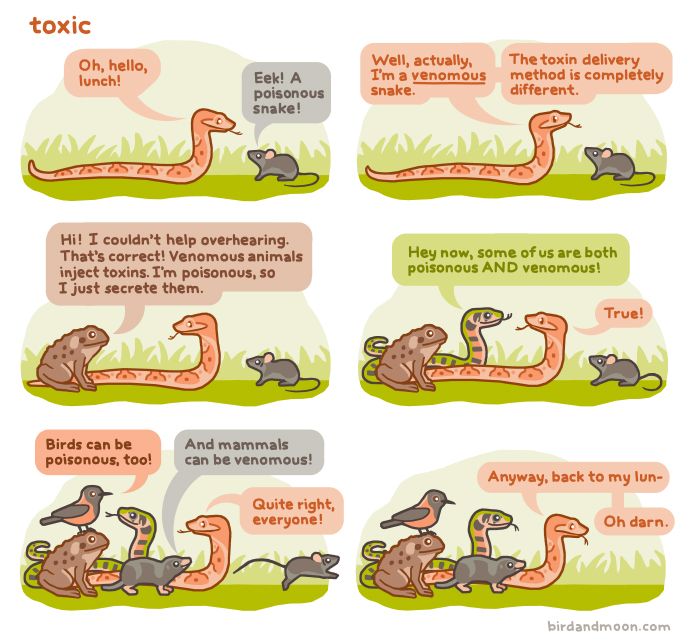
Apart from the unpleasant bite and associated pain that moray eels can inflict in defence, they are also poisonous (as opposed to venomous). Specifically they can release toxins into the wound; and in some species their skin contains toxins as well**. Serious infection may result.
CAN YOU GIVE THE POISONOUS / VENOMOUS DISTINCTION AGAIN
I could, but ace natural history cartoonist Rosemary Mosco makes a better job than I can:
**Before I leave the topic, maybe I ought to mention one bit of research I have just come across at Dove Med, from which I take away the message that you definitely don’t want to annoy a moray eel or get bitten by one. Ever. They are fine and interesting denizens of the reef, to be admired from a respectful distance…
Photo credits: all amazing photos courtesy of Melinda Riger, Grand Bahama Scuba; cute yet educative cartoon by Rosemary Mosco. Check out her website HERE – and birders, she v good on your specialist subject…
Welcome to #50 in the Bahamas Reef Fish series. I chose this fish to honour the landmark before thinking about its features. Grumpy. Also, associated with a narcotic and dangerous drug. And a fish one probably wouldn’t bother to smoke (even if one could get it to light underwater). In the Bahamas you’ll find these little fish around the coral reefs where they play their part as reef denizens, which includes being prey to larger species. If one looks them up online, however, the overwhelming impression from the websites and images available is that they exist largely for the benefit of the aquarium industry.
Tobacco basslets (Serranus tabacarius) – more commonly just called tobacco fish or tobaccofish – are related to the HARLEQUIN BASS(LET), a species that was most unfairly included as #9 in my parallel WTF? series among all the seriously weird sea creatures that feature in that category. A wrong I must right one day.
Tobacco fish are considered to be hardy, unaggressive (except towards the tiny fishes and crustaceans they feed on) but apparently they need quite a large tank to hold them. The ocean might be suitably large for the purpose. Especially as it seems that in an aquarium there needs to be a cover on top: “these fish are expert jumpers…“, as one source puts it…
BESIDES THE BAHAMAS & AQUARIUMS WHERE ELSE DO THEY LIVE?
APART FROM THE HIGH JUMP THING, ANY OTHER TRICKS?
Yes indeed. The Tobacco Basslet is hermaphroditic, like all other members of its genus.
DON’T LEAVE IT AT THAT… HOW DO THEY, YOU KNOW?
I didn’t want you to ask. All their FB pages say “It’s complicated“, but here’s a rough idea…
All individuals start life as simultaneous hermaphrodites (with sex organs of both sexes)
The largest fish lose their female functions and become active sperm-producing males
Each male leads a group of hermaphrodites and protects them from other males
This gives them exclusive rights to the female parts of members of their ‘harem’
Sometimes hermies may use their male bits to join in & release sperm – ‘streaking’
There are rarer mating strategies… Oh heck, please look at the abstract of a scientific paper for details. I had to! And all because you, gentle reader, asked that question.
With some relief, here is very short video. It probably doesn’t accurately show how Tobacco fish might behave on a Bahamian reef. In captivity, from the look of it, they get pushed around by bigger fish. But maybe, if their co-residents are carefully selected, the bonus is that they don’t risk getting eaten.
OPTIONAL MUSICAL INTERLUDE
There are no songs ever that mention tobacco fish or tobacco basslets (though lots involve bass). And more oddly, apart from a couple of old blues songs the only truly mainstream song about tobacco by name (as opposed to content) is Tobacco Road, a song as frequently and thoroughly covered as an aquarium tank containing jumpy tobacco fish.
Rare photos from the actual sea captured by Melinda Riger of Grand Bahama Scuba; Science Direct plus magpie pickings; Captive Aquatic Ecosytems (video)
I didn’t enjoy this article about me very much. I am NOT grumpy.
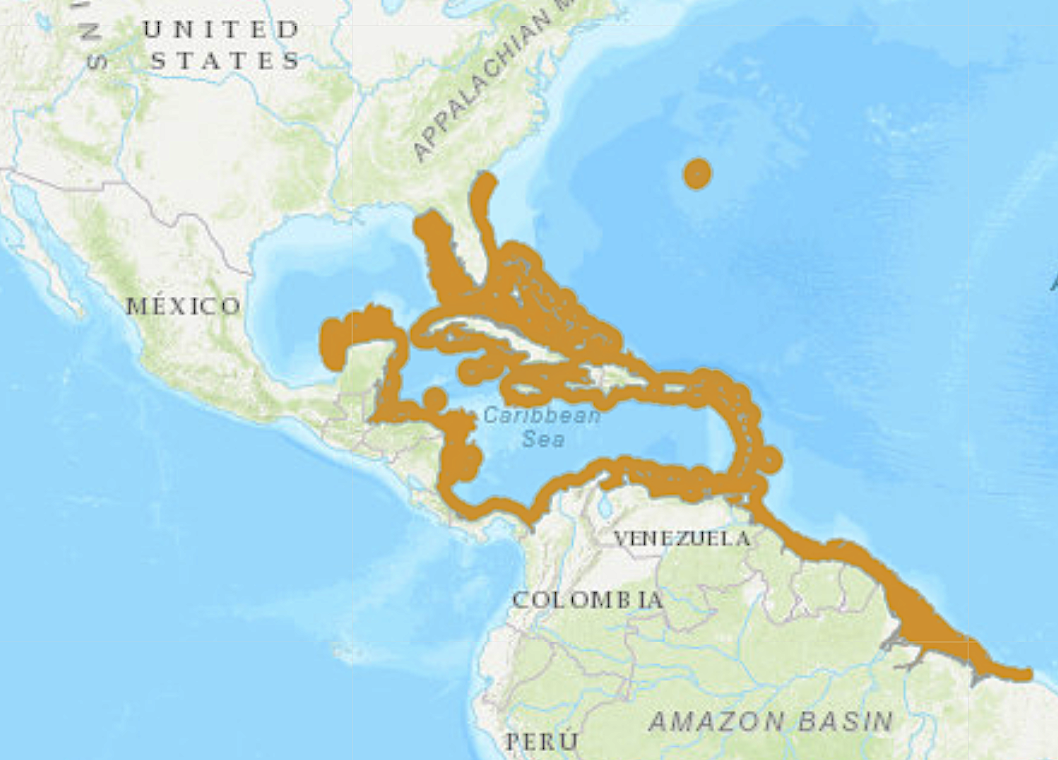
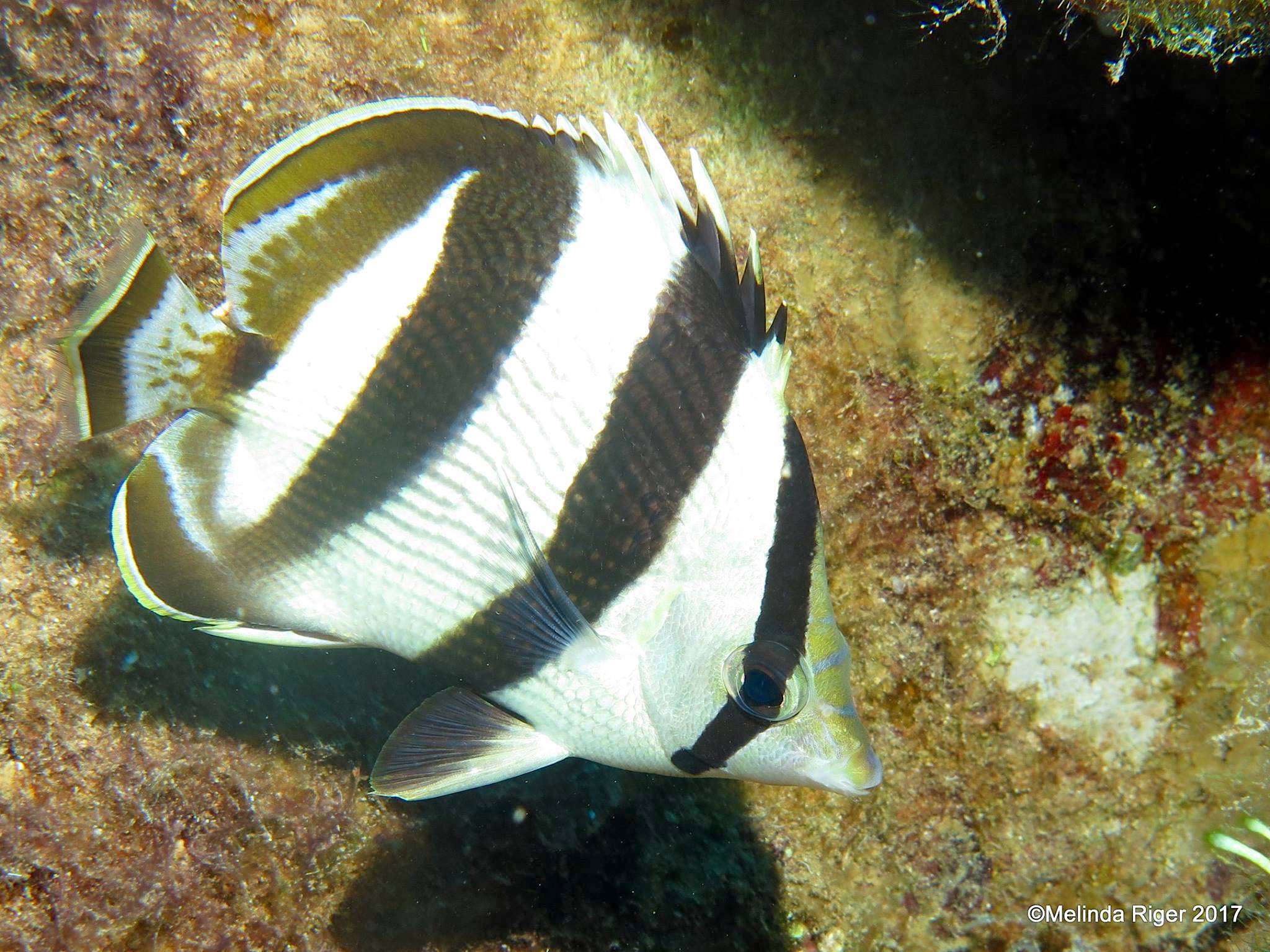
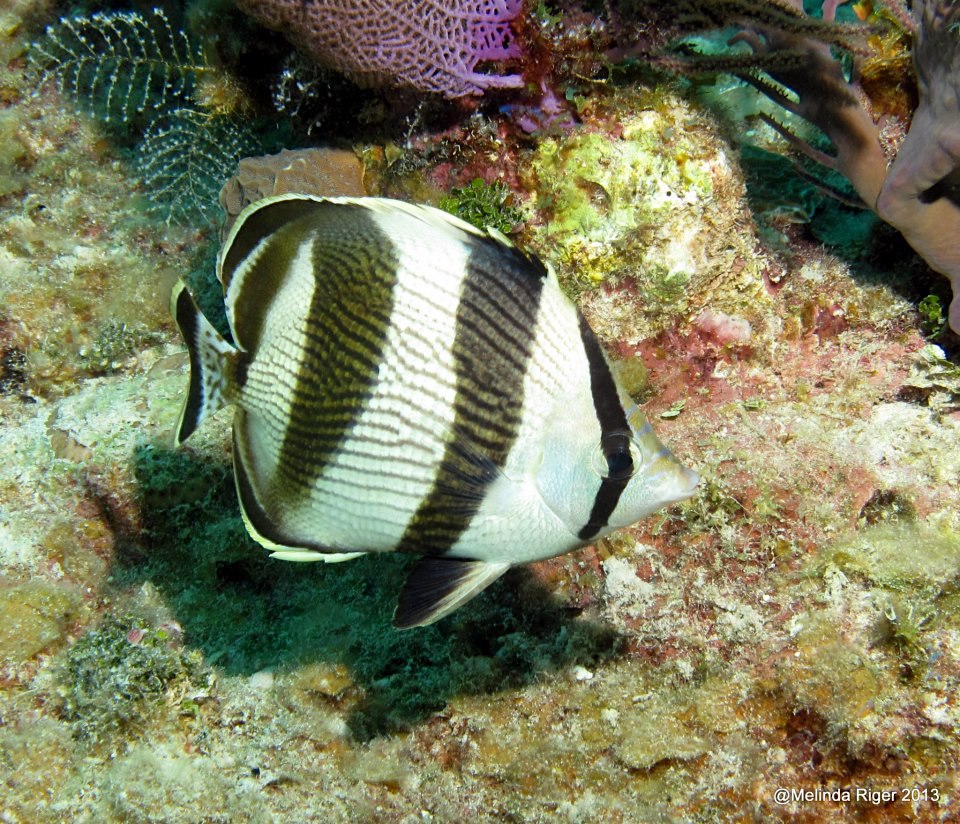
The banded butterflyfish (Chaetodon striatus) is one of several butterflyfish species found in Bahamas waters. There are links to some of the others at the end of this post. The reason for the name is obvious. The purpose of the patterning (striatus) is to act as an adaptive anti-predator defence when seen against the varied landscape of the coral reefs that are its home.
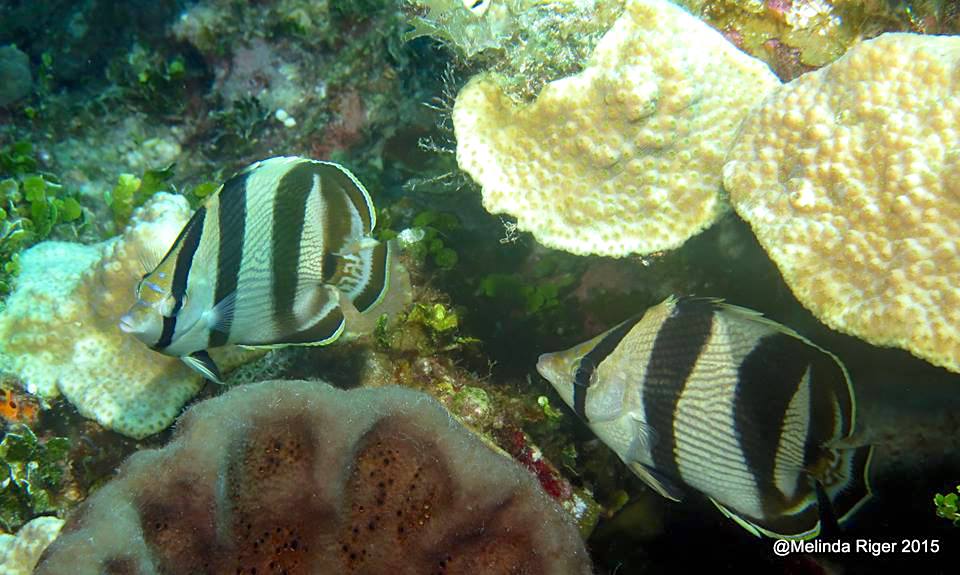
These little fish tend to be found either singly or in pairs. Two of them together may play a form of chase game among the corals and anemones of the reef.
Banded butterfishes, like their cousins, have a varied diet that includes small crustaceans, worms, and coral polyps. They also have a valuable role on the reef by acting a cleaner fish for larger species like grunts, tangs and parrot fish. This sort of relationship, where one party benefits from this kind of interaction , is known as ‘commensalism’, one of the 4 types of symbiotic relationship.
The Purple Vase is an unmistakeable sponge, a colourful reef creature (for they are animals, of course) that stands even out amongst the bright corals that surround it. And like corals, sponges are vulnerable to all the usual threats (mainly human-generated).
Catch them while you can in the clear waters of the Bahamas while stocks last. I say this because as study after study concludes, the prospects of reef-mageddon get closer each year. When the corals die off, so in all probability will the sponges and anemones…
After such a depressing intro, let’s move on to take a positive look at the purple vase sponge. As with all sponges, once a newborn sponge is wafted by the current to a place on the reef, it takes root there throughout its life. There, these attractive sponges exist by filtering the water that surrounds them, separating out plankton to feed on. Static filter-feeders, if you will.
You’ll notice that in some of the photographs, the sponges have guests. These are BRITTLE STARS, and they are often found on – and indeed in – purple vases. This is a form of symbiotic relationship known as commensalism, in which one species benefits and the other is neither benefitted nor harmed. The brittle star gains a shelter and a safe base for feeding; the vase gets a harmless companion. Small fishes benefit from the vases in a similar way.
Besides the impact of damaging human interventions (which may be permanent), extreme weather events also affect reef life and the static inhabitants adversely. Storms and hurricanes can cause localised havoc, but the damage is not necessarily permanent. The reef can in time repopulate naturally and flourish again. Humans can even promote this recovery. The photograph above shows a purple vase sponge that was detached from the reef by Hurricane Matthew in October 2016. Melinda Riger in effect replanted it on the reef and it reattached itself and grew. In due course it even acquired its brittle star occupant.
*JIMI AND ‘PURPLE VASE’ – A VOLUNTARY MUSICAL DIGRESSION
In an interview with NME Hendrix is reported to have said that Purple Haze “was about a dream I had that I was walking under the sea.” Originally the song was intended to be ‘Purple Vase’, and reflect the psychedelic experience of life on a coral reef. Realising he was getting bogged down by sub-aquatic imagery (he was a non-swimmer), he toked for a while and then ‘Purple Haze’ emerged almost fully formed. He was always far happier kissing the sky than wandering about under the waves. Most covers of the song are pale imitations of the original, but here’s a rather unusual take that succeeds by trying a different approach…
Credits: Melinda Riger / Grand Bahama Scuba for all great photos; magpie pickings for bits and pieces, with a shout-out to ‘Critter Squad’ for its informative site aimed at kids. And amateur grown-ups can benefit too… commensalism in humans; Friend ‘n’ Fellow audio
November 1st already, and the first time I am prepared to consider the possibility of the onset of Christmas, with its attendant joys yet complications… Meanwhile, I thought I might have run out of types of reef fish to feature in this series long before I got to 50. Yet here we are, two short of that target, with a species of snapper I haven’t even mentioned before. I am (frankly) a rather feeble swimmer, and do not possess a viable underwater camera. So there’s no way I could show these denizens of the not-especially-deep without heavy reliance on others, in particular the outstanding photos of diver Melinda Riger of Grand Bahama Scuba; and the memorable ones from Adam Rees of Scuba Works that include some of the more obscure species that appear in my WTF? (What’s That Fish) series.
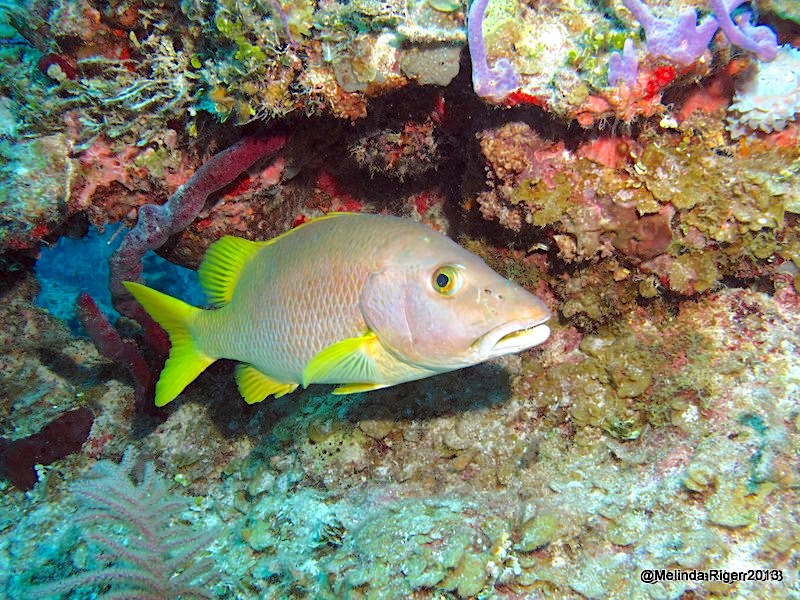
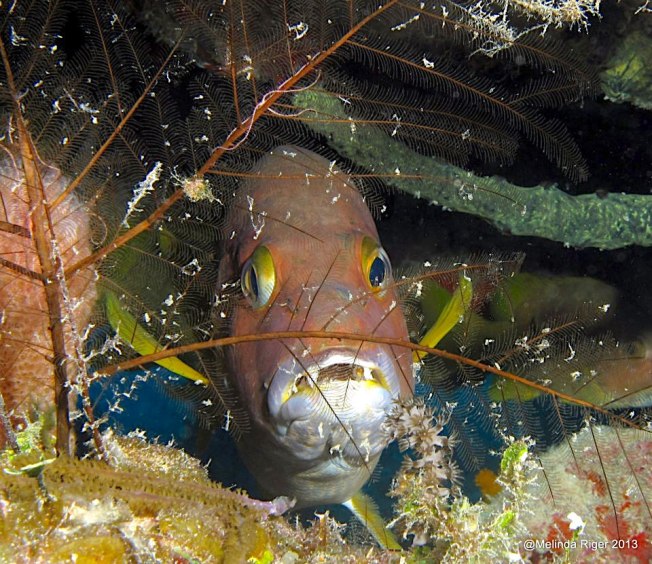
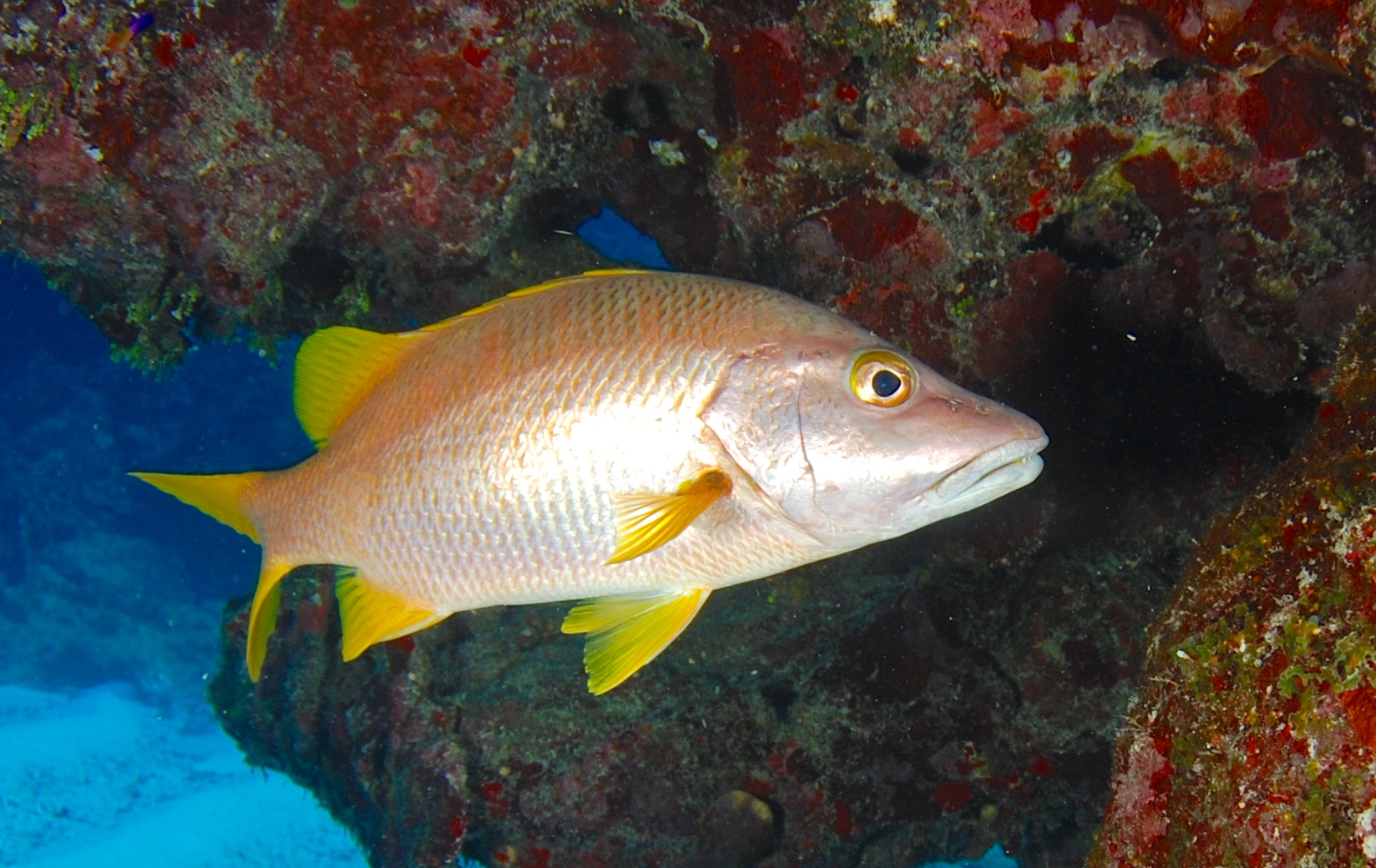
The schoolmaster snapper (Lutjanus apodus) lives among the coral reefs and mangroves of the Caribbean and further north to the northern Bahamas and Florida. Generally they are quite small, not much more than 12- 18 inches. They tend to hang out in ‘schools’, which several sources suggest as the reason they got their common name. But schoolmasters don’t really move around in large groups, do they? It’s school pupils that do that, but ‘Pupil Snapper’ wouldn’t cut it as a fish name I guess.
10 SCHOOLMASTER SNAPPER FACTS TO PONDER
One pair of upper teeth are so large they protrude when the fish shuts its mouth
Their side scales are so arranged that diamond shapes are produced
There’s plenty to learn about their fin arrangements, but not necessarily to remember
Their jaws don’t open very wide, so their prey tends to be quite small
Unlike fish that change sex as they grow, these ones retain their birth gender for life
When they spawn they produce their gametes simultaneously, and swim away
The fertilised eggs sink to the bottom, where they have to take their chances
Though small, they are good to eat and are fished for recreation and commercially
Regionally there are specific regulations as to catch length & limits, hook type, bait etc
Like all snappers and many other fish species, these fish are associated with ciguatera
RECIPES
For those who enjoy cooking (whatever that is), you probably know exactly how you like to cook your snappers. For anyone else, here’s a site that proposes several different ways to cook them, with helpful tips. These seem to apply to all snapper species, most of which are available free in the Bahamas.http://www.allfishingbuy.com/Fish-Recipes/Snapper-Recepies.htm
My favourite schoolmaster snapper photo of those featured here
POSSIBLE MEDICAL BENEFITS FROM EATING SNAPPERS
These are alleged to include (except when fried): protection against certain types of stroke, reduction of heart arrhythmia, and defence against certain types of cancer. Don’t take my word for it, though. And definitely don’t rely on a snapper-based diet regime. I think the most that can safely be said is that eating snapper will do you no harm (except when fried) and may conceivably have a marginal benefit on health along with a balanced diet, exercise, minimal alcohol intake and all the routines that we strictly adhere to for a healthy life. In our dreams, anyway.
Credits: All great pics by Melinda Riger / GB Scuba except #6 Albert Kok; range map, Wiki. Magpie pickings.
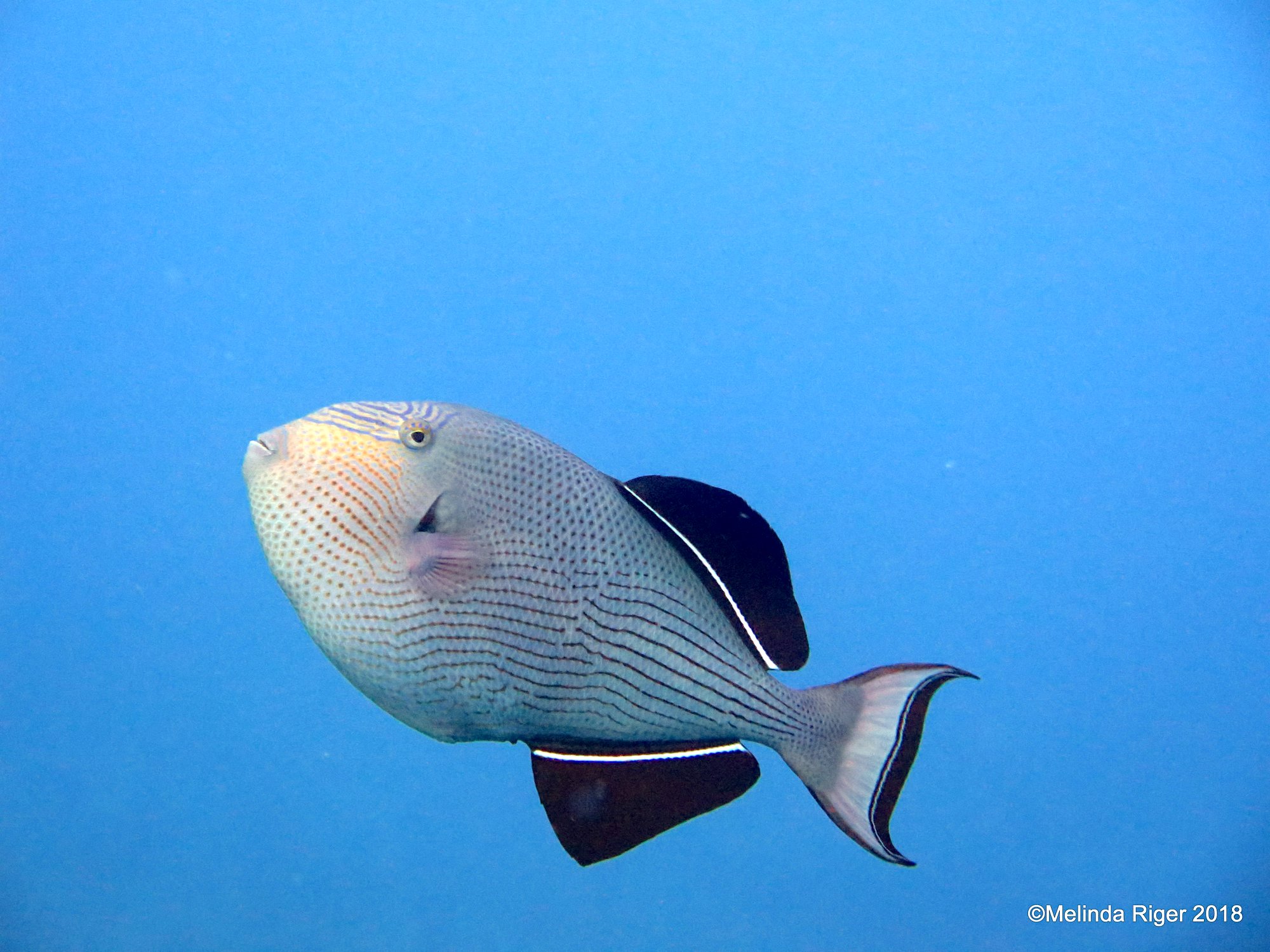
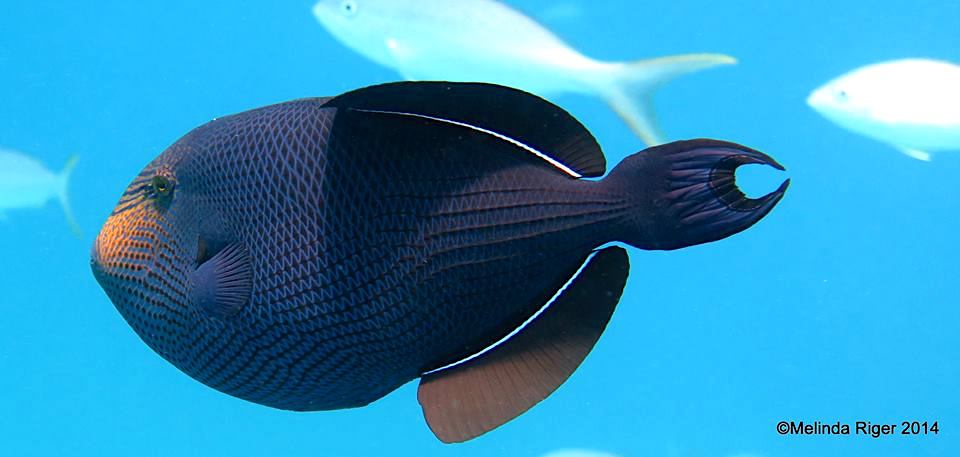
The Black Durgon (Black Triggerfish) seems to be a fairly rare triggerfish in Bahamas waters. I say that not because I know, but because there is very little mention of them in a Bahamas context. In fact, the (not especially profound) research I have done suggests it is not (originally?) really native to the Bahamas region at all. Correction of this impression welcome!
These fish have the ability to change colour, according to their surroundings. Mostly, they seem completely black. However they have intricate blue markings to the head, and regular patterning on their flanks that resembles the sort of thing one idly doodles during a long and less then attention-holding phone call (or the ‘hold music’) – see Header Image. They also have dramatic pale stripes where their fins join the body.
These fish have a varied diet that includes small fish, squid and shrimps, with side-helpings of algae, zooplankton and marine plants. And…
FUN FACT (REALLY!)
The Black Durgon has been studied, of course. One piece of research discovered that they… erm… ingested the feces and vomit of a species of dolphin. Other reef fish in the area did so too, but the Black Durgon was much the keenest on this distinctive diet. So these are ‘offal-eating’ fish… and welcome to it. Here’s a short video to take your mind off it all…
I’d be interested to hear from anyone who has encountered these fish in Abaco waters. I ought to look further into their prevalence. Maybe they just don’t get much publicity. They need a new agent.
Credits: Photos by Melinda Riger / Grand Bahama Scuba except #3, Getty Images; Kwik-Viddy, Cassandra-Tel; inadequate research, Author
The WTF? series is aimed at shedding light on fishes that are unusual. Or very unusual. Or puzzling, dangerous and maybe less than elegant in appearance. The scorpionfish is one such. It belongs to a large family, the Scorpaenidae, and many types are found throughout the world, especially in the Pacific and Indian oceans. LIONFISH, the newcomers to the western Atlantic, are a species of scorpionfish.
Just another rock on the seabed…
WHY ‘SCORPIONFISH’? THEY LOOK SCARY. ARE THEY DANGEROUS?
One feature common to many scorpionfish species is that they are highly venomous. As the name suggests, a sting is involved. Or several stings. These come from the creature’s sharp spines, which are coated with mucus, and are to be avoided. If you want to pet one, the dorsal, anal and pelvic fins are the ones to steer clear of – these all have venom glands at the base. The spines act like injection needles. Scorpionfish aren’t naturally aggressive (except to prey), but they know how to defend themselves if need be. If you get ‘got’, you are in for “extreme pain and burning sensation”.
DO THEY HAVE ANY OTHER TRICKS TO WATCH OUT FOR?
As many have written, scorpionfish are ‘Masters of Camouflage’. They are able to disguise themselves very effectively. Their appearance is a remarkably adapted to their surroundings, as if covered in a raggle-taggle of colourful algae. They can change colour to aid concealment. They can flick sand over themselves as they settle on the seabed. These ploys enable them to lie motionless on a coral reef or on the seabed, ready to ambush their prey. This consists mainly of small fishes and crustaceans, but really anything edible that will fit in their mouths is fair game.
Concealed against coral
HOW DO THEY FEED?
The large mouth of scorpionfishes has a particular function. They don’t have teeth because they have no need. A scorpionfish can open its mouth and its gills simultaneously, thereby creating an instant vacuum that will suck in its prey in a flash. I have seen this described as “a nearly imperceptible split-second movement (15 milliseconds)”…
THESE SCARY MONSTERS MUST BE HUGE, RIGHT? I’M KEEPING OUT OF THE WATER
Not so fast. When all is said and done – and in my view, most disappointingly – adult Caribbean Scorpionfish grow in the range of… erm… 7 – 14 inches. So now you are reassured, here’s a great short video from Ocean Frontiers Dive Shop, who kindly shared it on YT. I’ve used a couple of illustrative stills from it too.
ANYTHING ELSE WE NEED TO KNOW?
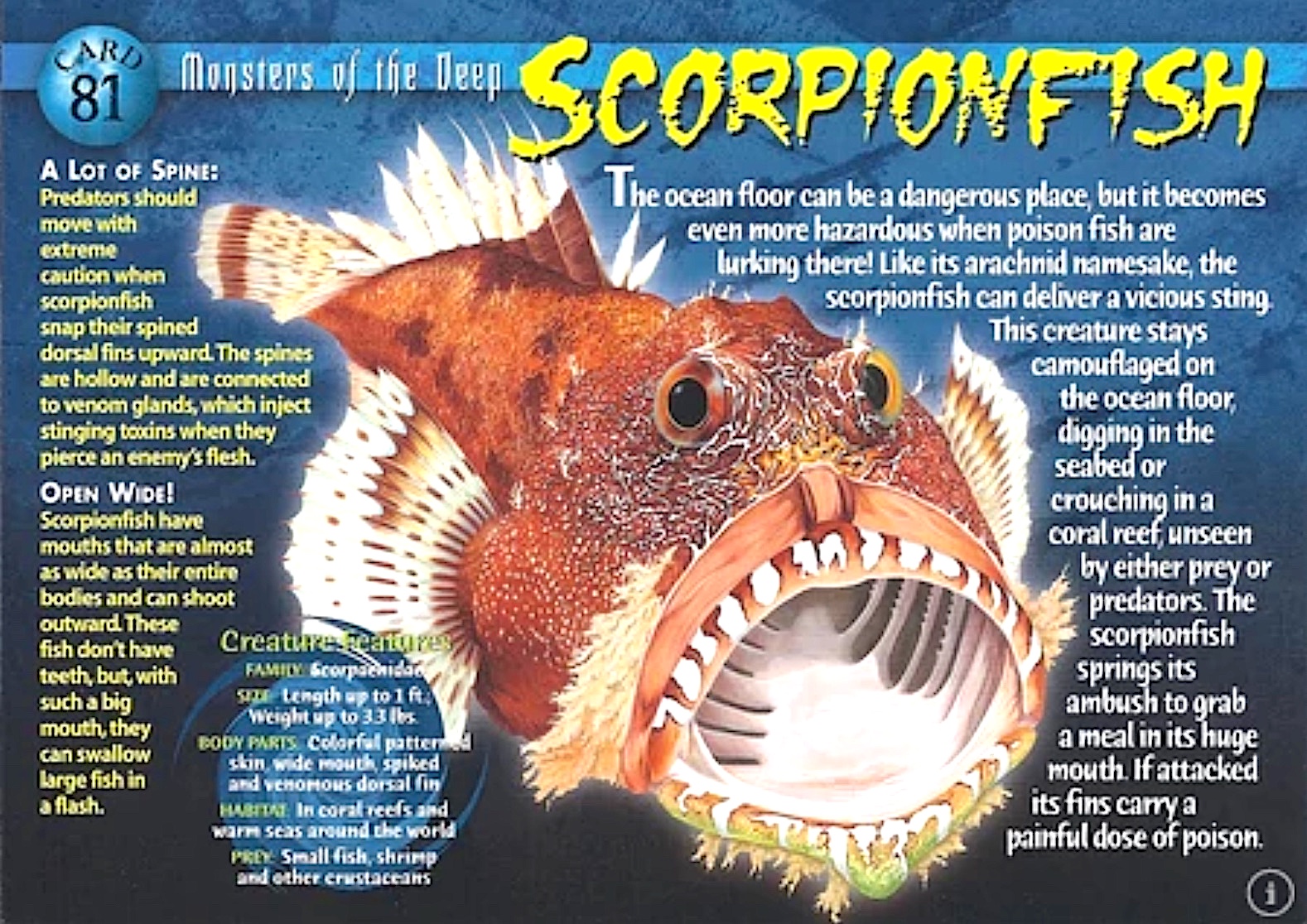
I can do no better than to turn to Card 81 to the excellent ‘Monsters of the Deep‘ series of trading cards (the link is to my MotD page). I do realise that this is a rather unscientific approach. On the other hand these guys pack memorable information into a very short space, and do it well. Note that you can get a reflex sting from a scorpionfish for up to a week after it has died. Eat dust, earthbound scorpions.
Credits: Melinda Riger / Grand Bahama Scuba (1, 2, 3, 4,); Ocean Frontiers Dive Shop (video from YT, 2 stills); Wierd (sic) Creatures / Monsters of the Deep (O/S)
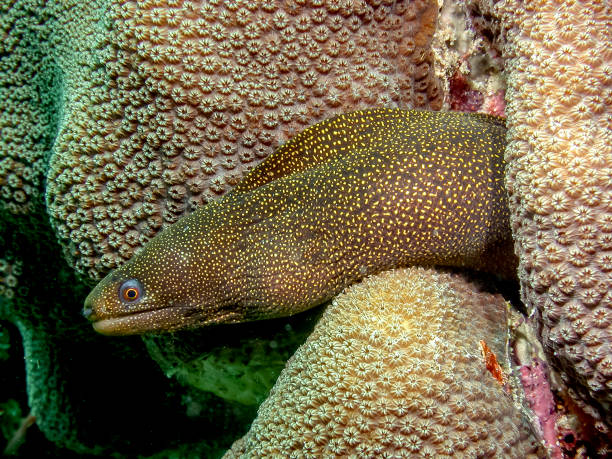
The Goldentail Moray Eel Gymnothorax miliaris is one of the half-dozen moray species found in Bahamas waters. Adults range in length from about 1.5 to 2.5 feet, and they are creatures of the reefs and rocks of the western Atlantic. As far as I can make out, the goldentails are rather less common than green or spotted morays, the two main eel species of the Bahamas.
Like their moray cousins, goldentails likes to keep themselves to themselves, and lead largely solitary lives. That said, sometimes they have been observed hunting in a group. They live in holes, clefts, and caverns which they leave both during the day and at night to hunt for prey along the reefs, aided by an acute sense of smell. Their diet is mainly of crustaceans, mollusks, and small fishes.
ARE GOLDENTAILS DANGEROUS?
Like many other eels, goldentails secrete a protective mucus that contains a toxin, making them unattractive prey for large predators such a groupers and barracudas. They are also associated with ciguatera poisoning, the active ingredients of which are found in the mucus coating. They are sometimes found in aquariums – the associated sites give a warning of painful bites, because they have backwards-pointing teeth (aka prey traps) – see header image for a clear view of this.
CAN YOU EAT THESE FISH?
Well I wondered that too, so I checked. The answer seems to be yes, if you real really want to. Comments on forums include:
“Yes they are edible, I just ate one few weeks ago. Some parts are little bony and skinning it is a bitch. But the meat is very soft and white, delicious. Deep fry works”.
“After eating our moray eel something changed. The next morning, we were decidedly feeling ill. I won’t get into the details, but let’s just say that “gastrointestinal effects”
“…symptoms (of ciguatera) include gastronomic effects, and neurological effects which include headaches, numbness, paresthesia, muscle ache, and even hallucinations”.
“Before you can eat one you have to kill it. They are amazingly hard to kill. I would skip it.”
“I would rather eat a shoe”
So I’ll be moving straight on to the next course, please. Or just a Kalik would do, thanks.
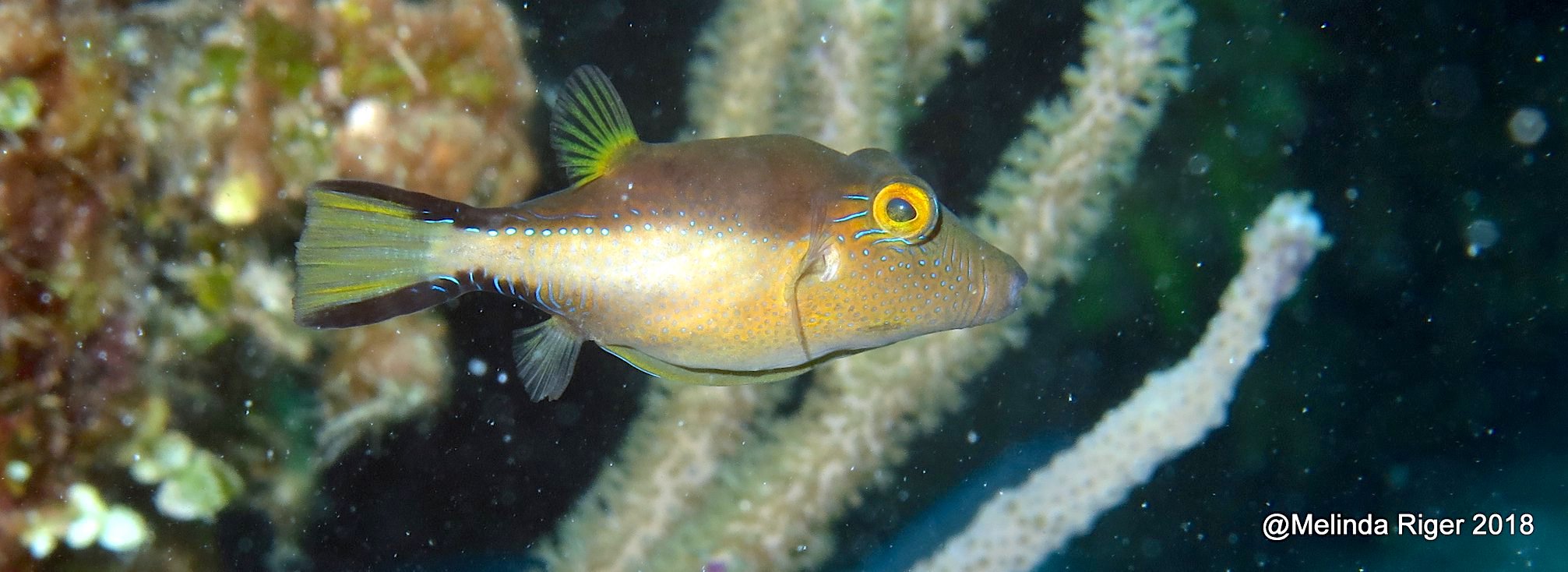
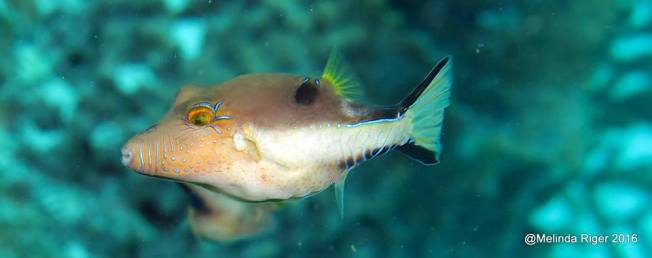
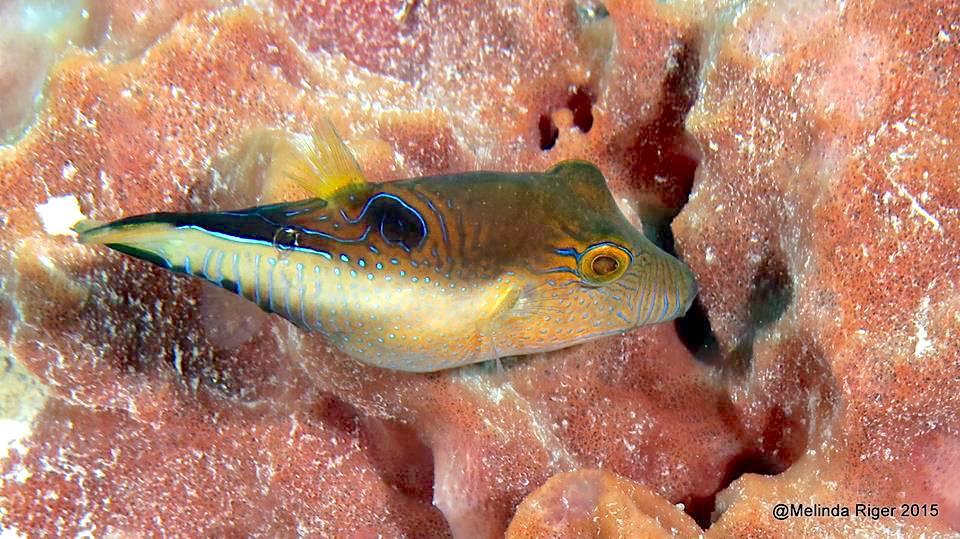
It’s more than 4 years since I last wrote about these intriguing creatures and their endearing ways. It’s time for another look, with a new batch of great photos too. This is a species that lends itself to the ‘Fun Fact’ treatment, a method that tells you at least as much as you probably need – or want – to know about puffers. The message to take away is, best not to handle one – let alone eat one – unless you know exactly what you are doing…
10 PUFFER FISH FACTS TO ASTONISH YOUR FAMILY & FRIENDS
1. Puffers can inflate their bodies in an instant by ingesting huge amounts of water and becoming water-filled balloons. Then their tiny spines stick out.
2. They need a startling form of defence (or ‘piscatorial superpower’ Linnaeus 1763*) like this because they can’t swim very well to escape from predators: it’s surprising and intimidating – and it also makes them hard to eat.
3. However, a persistent predator undeterred by the trick will find that the puffer contains a toxin (tetrodotoxin TTX) that is said to be ‘1,200 times stronger than cyanide’. One puffer fish has enough toxin to kill up to 30 humans (National Geographic).
4. Notwithstanding the risks, selected parts of a puffer fish are a delicacy in some cultures (known as ‘fugu’ in Japan). Specially trained chefs are used to avoid mass deaths among diners. The insurance premiums must be huge.
5. Sharks are thought to be the only species immune to the puffer fish, and are not much bothered by a small fish that can blow itself up.
6. Puffers have skin, not scales; most have toxic fins or spines of some sort, besides toxic innards. Bright coloured kinds are likely to be more toxic than their duller cousins. This warning colouration in creatures is known as aposematism.
7. It’s worth finding out what an uninflated puffer looks like before you try to pet a random passing fish and have a toxic encounter. There is as yet no known antidote.
8. In all, there are more than a hundred puffer species in the world, all found where there are warm shallow waters. At least 3 main species – sharpnose, band-tail and chequered – are found in the Bahamas.
9. Some puffer species are not toxic at all; and some – especially in Pacific waters – are far more toxic than others. That’s the region where they are treated as a delicacy.
10. I’ve checked several research papers but I can’t find an evaluation of the relative toxicity as between the Bahamas puffer species. However it’s clear that the sharpnose is certainly not one play with. Take care!
Q. SO WHAT DOES AN INFLATED PUFFER LOOK LIKE? A. THIS!
Brian Lockwood took his life in his hands to get this fantastic shot…
Photo Credits: All puffer fish taken by Melinda Riger of Grand Bahama Scuba except for the photo of an inflated one from recent Abaco permanent resident Brian Lockwood
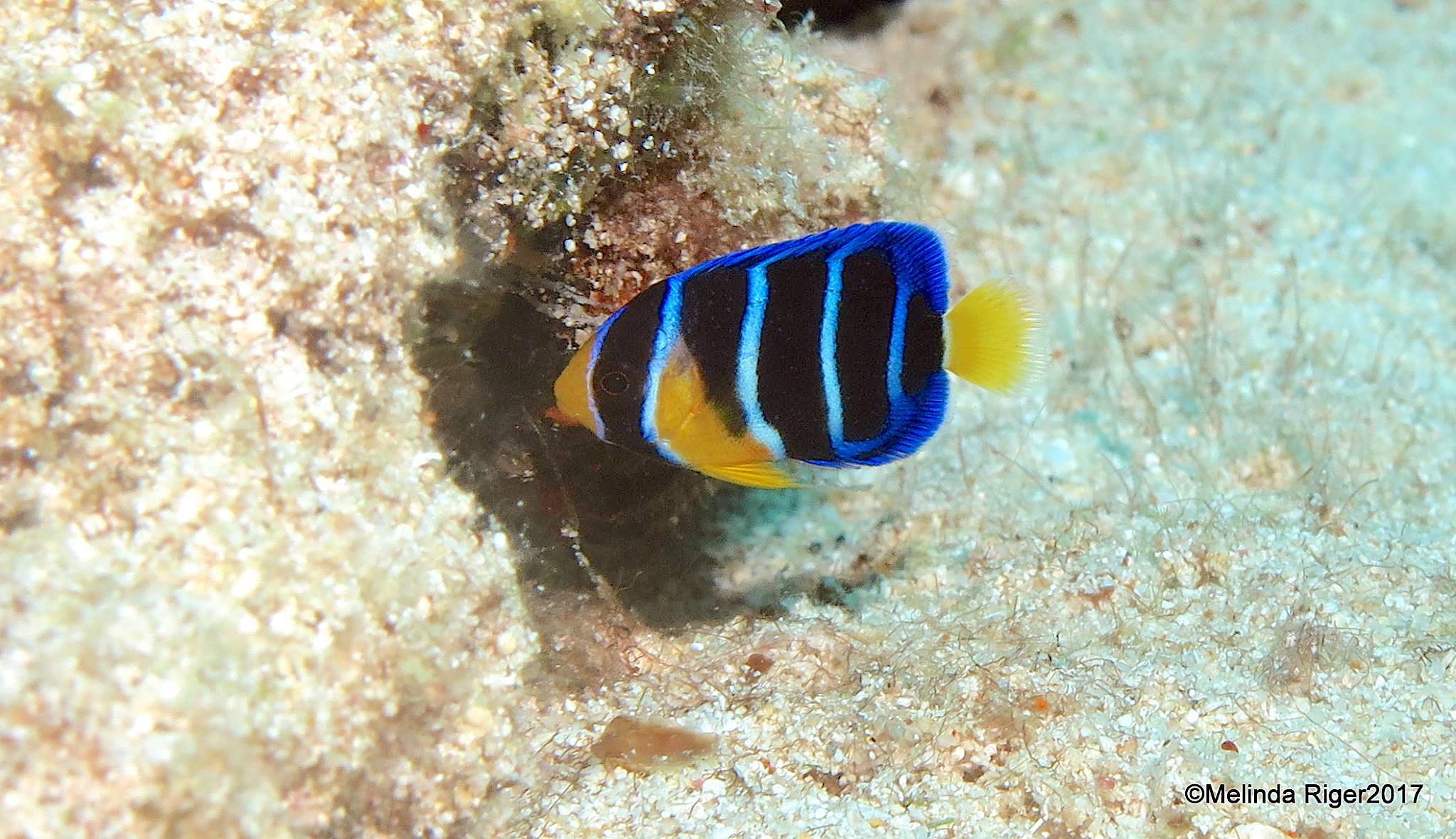
The Queen Angelfish Holacanthus ciliarisis is without doubt one of the most beautiful of all reef fishes in the Bahamas – and the competition is very strong. I have posted about them before, but to my surprise not for nearly 5 years. Too long: here are some much more recent photographs of adults and cute juveniles.
The bright colours, the pouty expressions, the appealing poses – these fish are true Beauty Queens. And helpfully, they are unlikely to be mistaken for any other fish species.
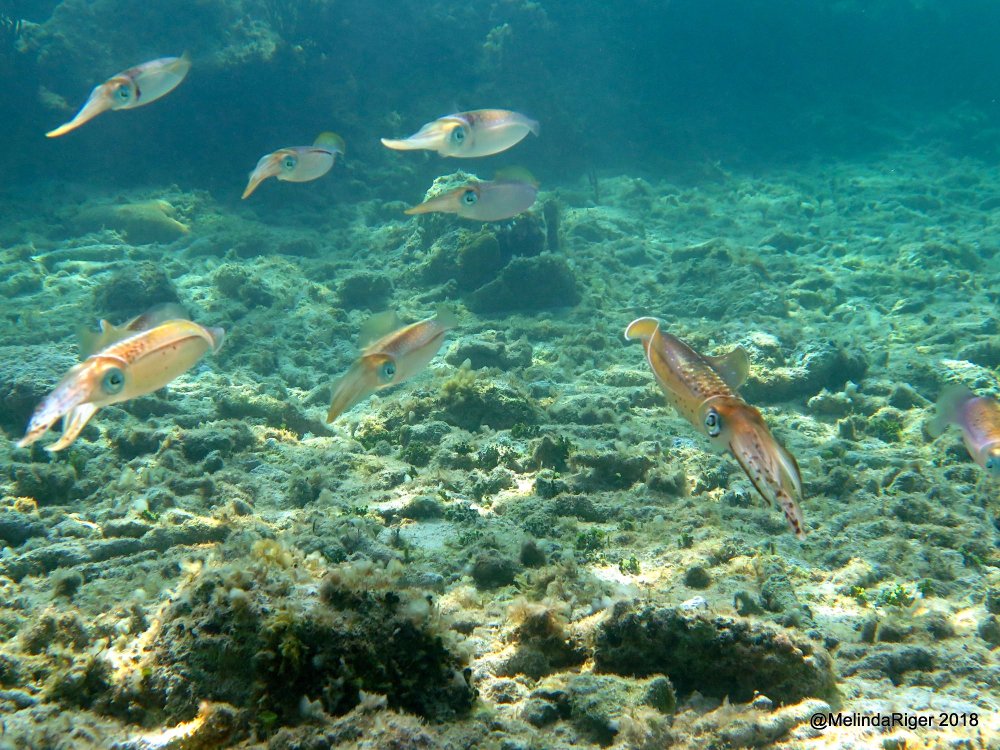
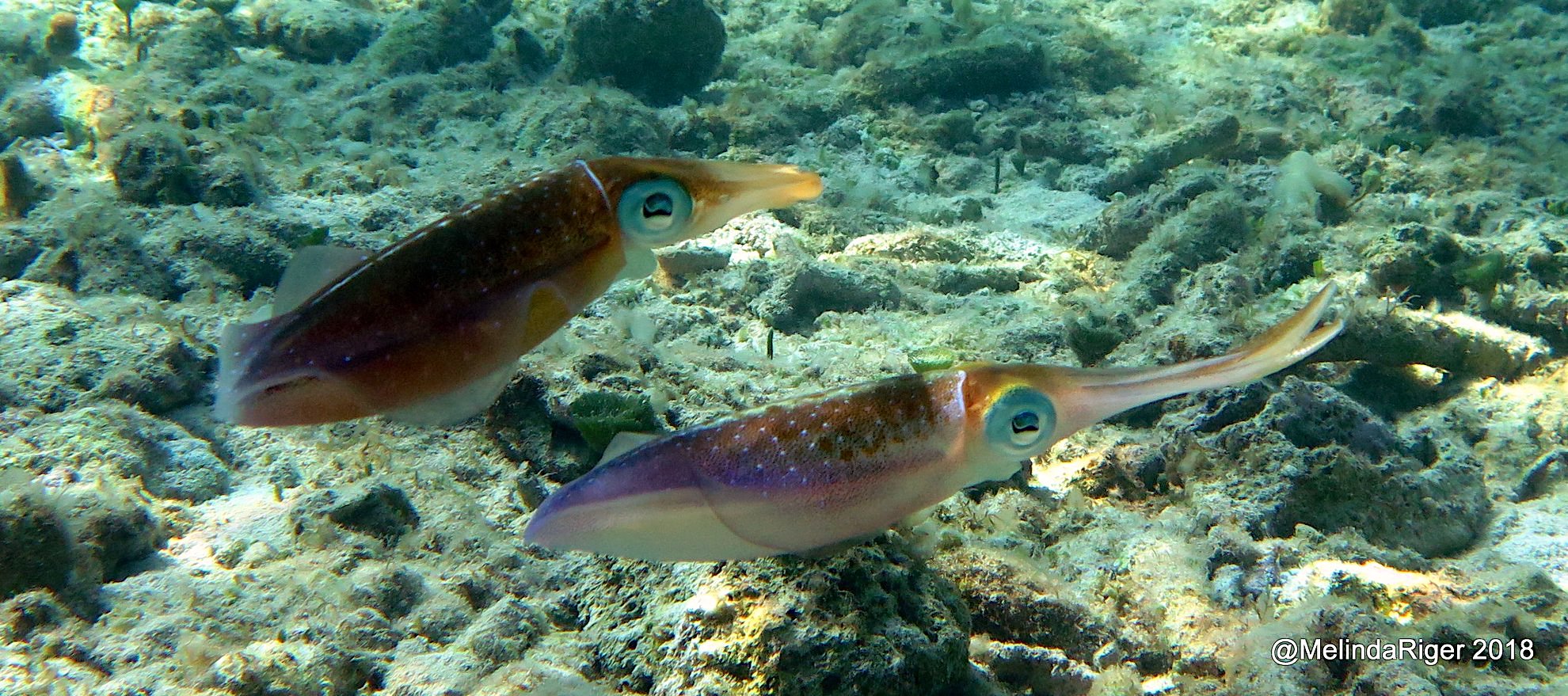
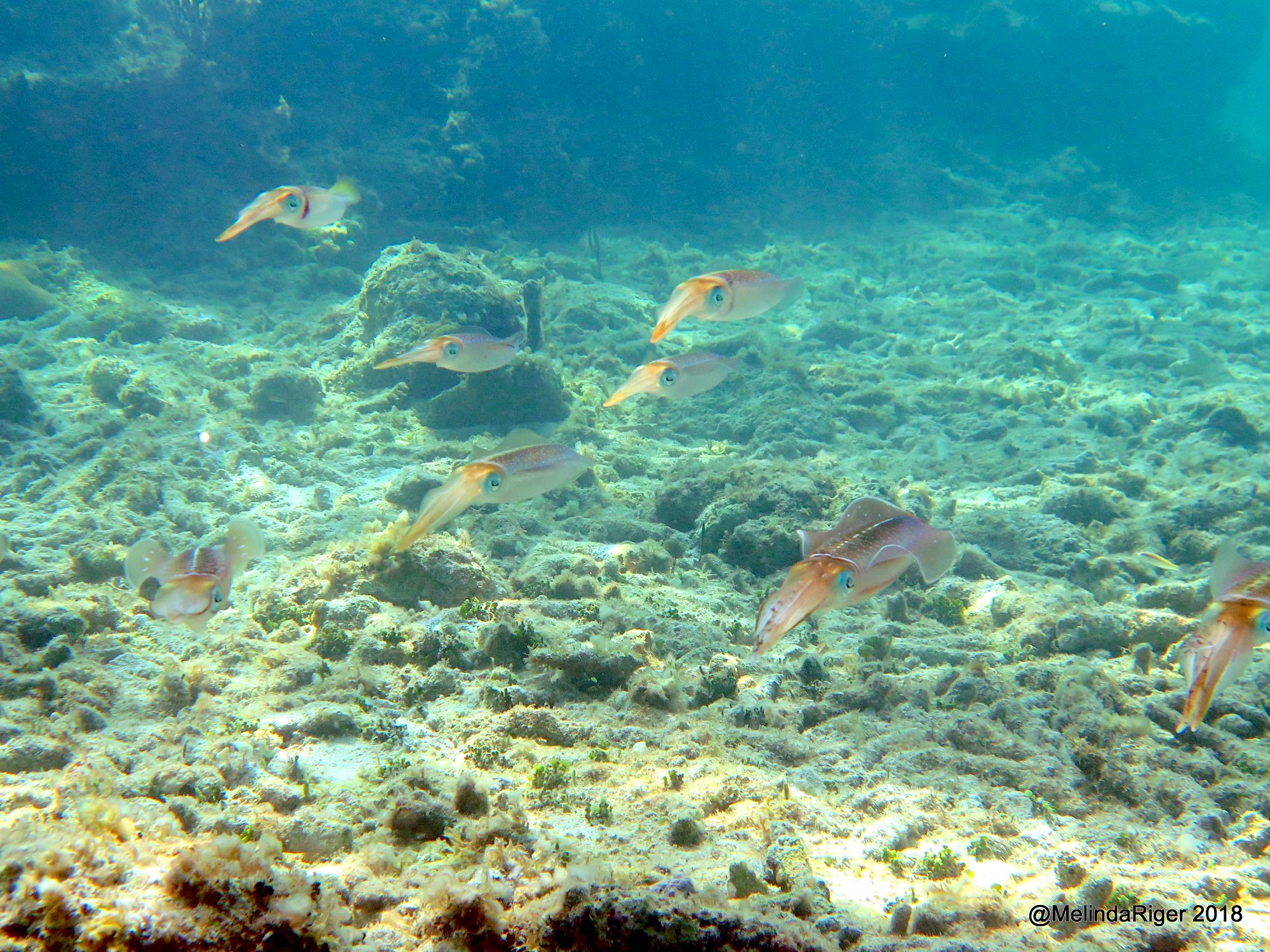
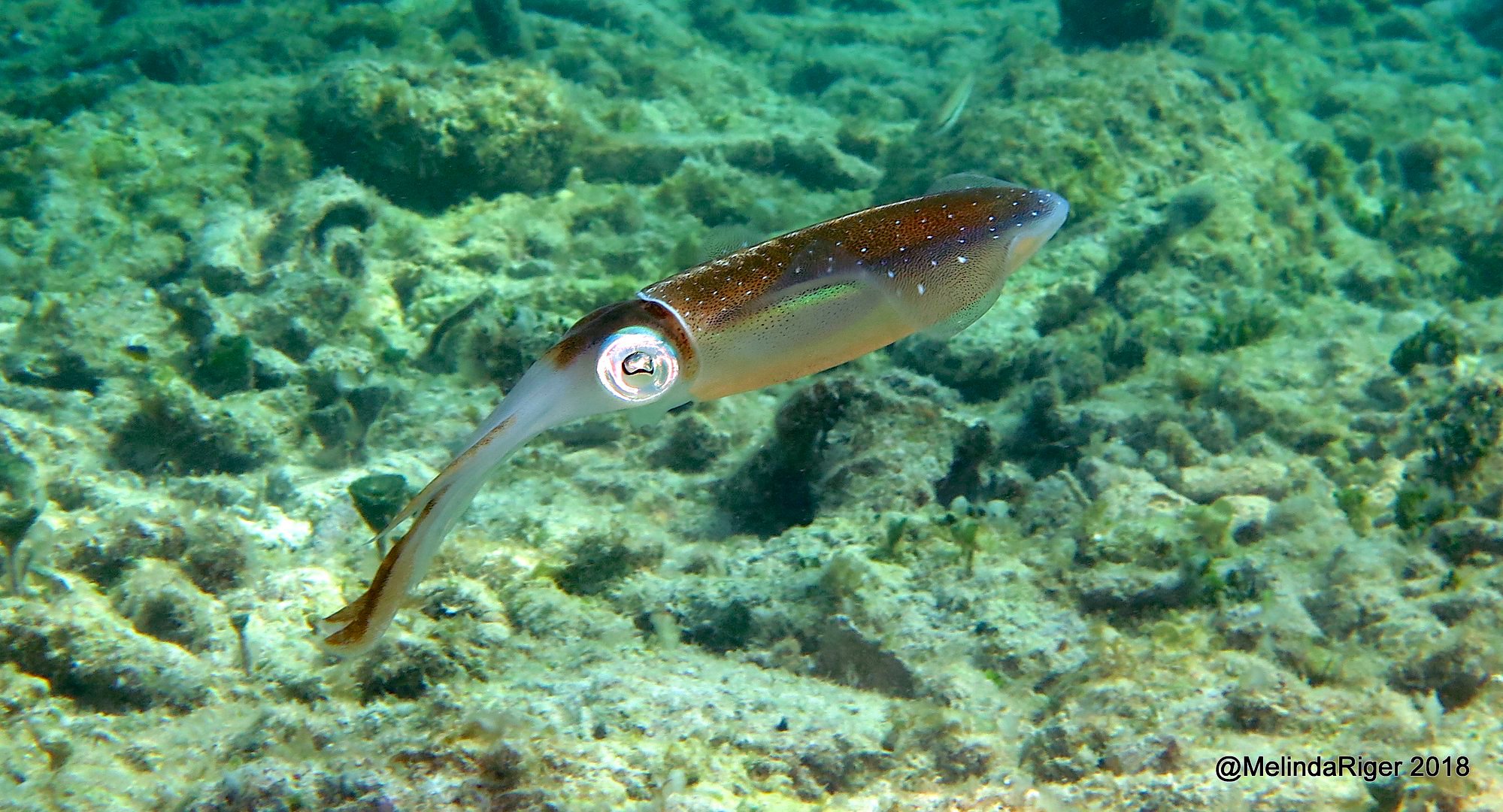
CARIBBEAN REEF SQUID REVISITED: SUPERPOWERS & SQUID SEX
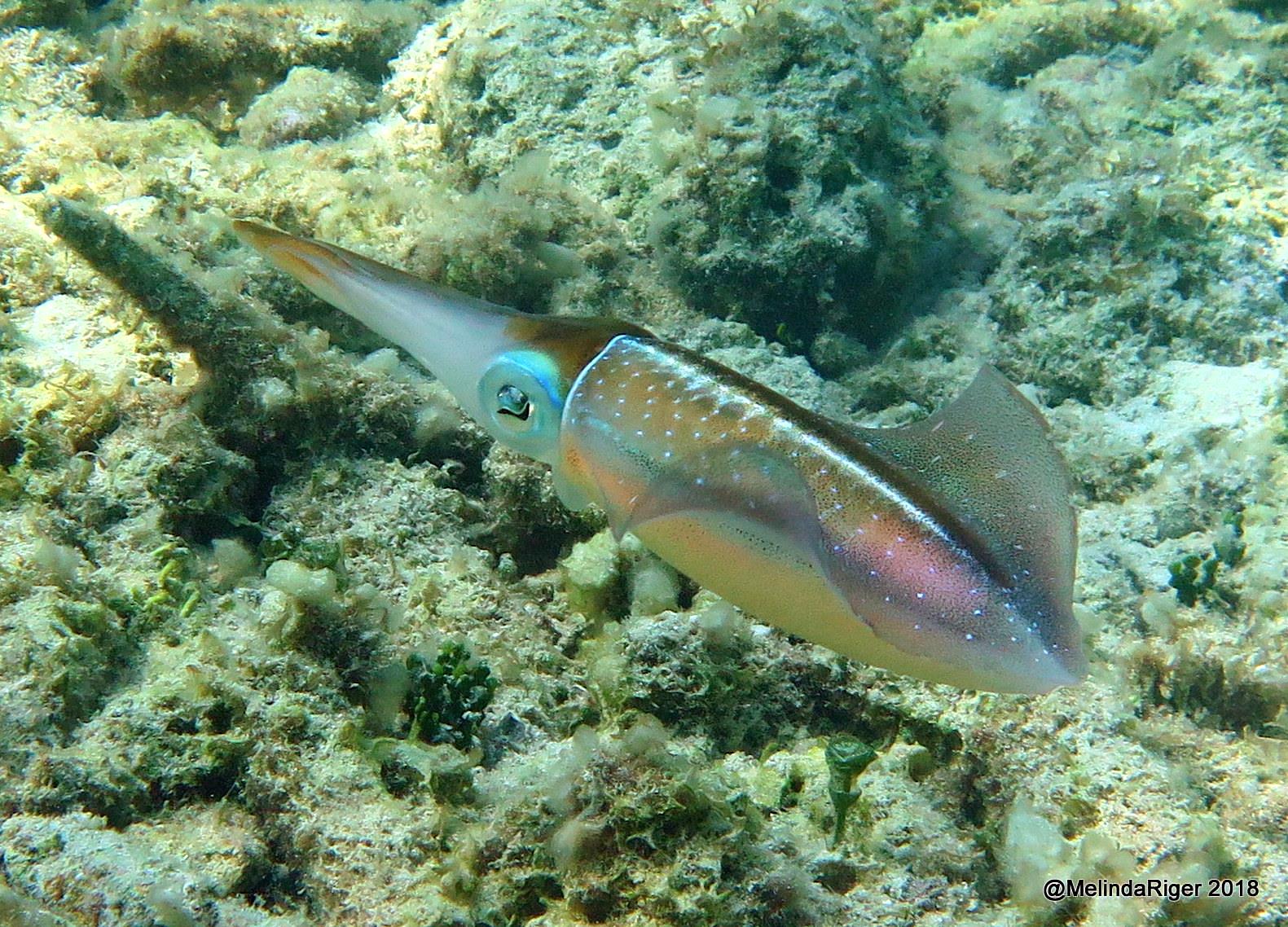
The Caribbean reef squid Sepioteuthis sepioidea is a small squid species of (mainly) the Caribbean Sea and the Floridian coast, and the most common in its range. These squid tend to form small shoals in and around reefs. Right now, in June, is a good time to find these creatures swimming in groups – all these photos were taken during the last fortnight. I wrote about squid a while back (3 years, maybe)? This post includes some parts of the earlier one, with all-new images. Squidmages, even.
Squid are voracious eaters, dragging their prey to their mouths with some or all of their 10 limbs and using their beak to cut it up. The target species are small fish, molluscs and crustaceans. The squid have a ‘raspy tongue’ known as a radula which further breaks up the food for easy consumption.
REEF SQUID SUPERPOWERS (SUPERCOOL)
Squid are capable of brief flight out of the water (a fairly recent discovery)
They can also hide from / confuse predators by ejecting a cloud of black ink
Squid can change colour, texture and shape, and can even match their surroundings
This enviable power is used defensively as camouflage or to appear larger if threatened
It is also used in courtship rituals (something that humans might find most disconcerting)
Colour patterns are also used for routine squid-to-squid communication AND GET THIS:
A squid can send a message to another on one side, and a different one to a squid on the other side
SQUID SEX (1) “ROMANCING THE SQUID”
A male will gently stroke a female with his tentacles
The female will (most likely) flash an ‘alarm’ pattern. She’s hard to get.
The male soothes her (don’t try this at home, guys) by blowing and jetting water at her
If this doesn’t go well, he’ll move off, then repeat the routine until she sees his good points
However this on / off courtship can last for hours until at last he succeeds and then…
… he attaches a sticky packet of sperm onto the female’s body (romance is not dead on the reef)
Meanwhile he stays close, emitting a pulsing pattern, as well he might after all that palaver
She then finds a safe place to lay her eggs. Job done.
SQUID SEX (2) IT ALL ENDS BADLY. VERY BADLY.
As soon the female squid has laid her eggs, she dies at once
The male squid lives a bit longer and… may have other packets to stick on other lady squid
But then in the end he dies too
It’s all horribly reminiscent of Romeo and Juliet. The lovers die. But no the balcony scene
THE CORRECT PLURAL OF SQUID
I had an unwise look online, always a hotbed of conflicting opinions. Inserting an algorithm into the interstices of the internet proves conclusively that the plural of squid is… squid. One squid, ten squid, a group of squid, a plate of squid. Unless, that is, you are talking about more than one of the many squid species, when you could also have ‘I collect both reef and giant squids’. “Squidses” sounds fun but is sadly not permitted.
Credits: As ever (for fabulous underwater pics) Melinda Riger of Grand Bahama Scuba; research sources include MarineBio; Animal Diversity Web (Michigan Uni)
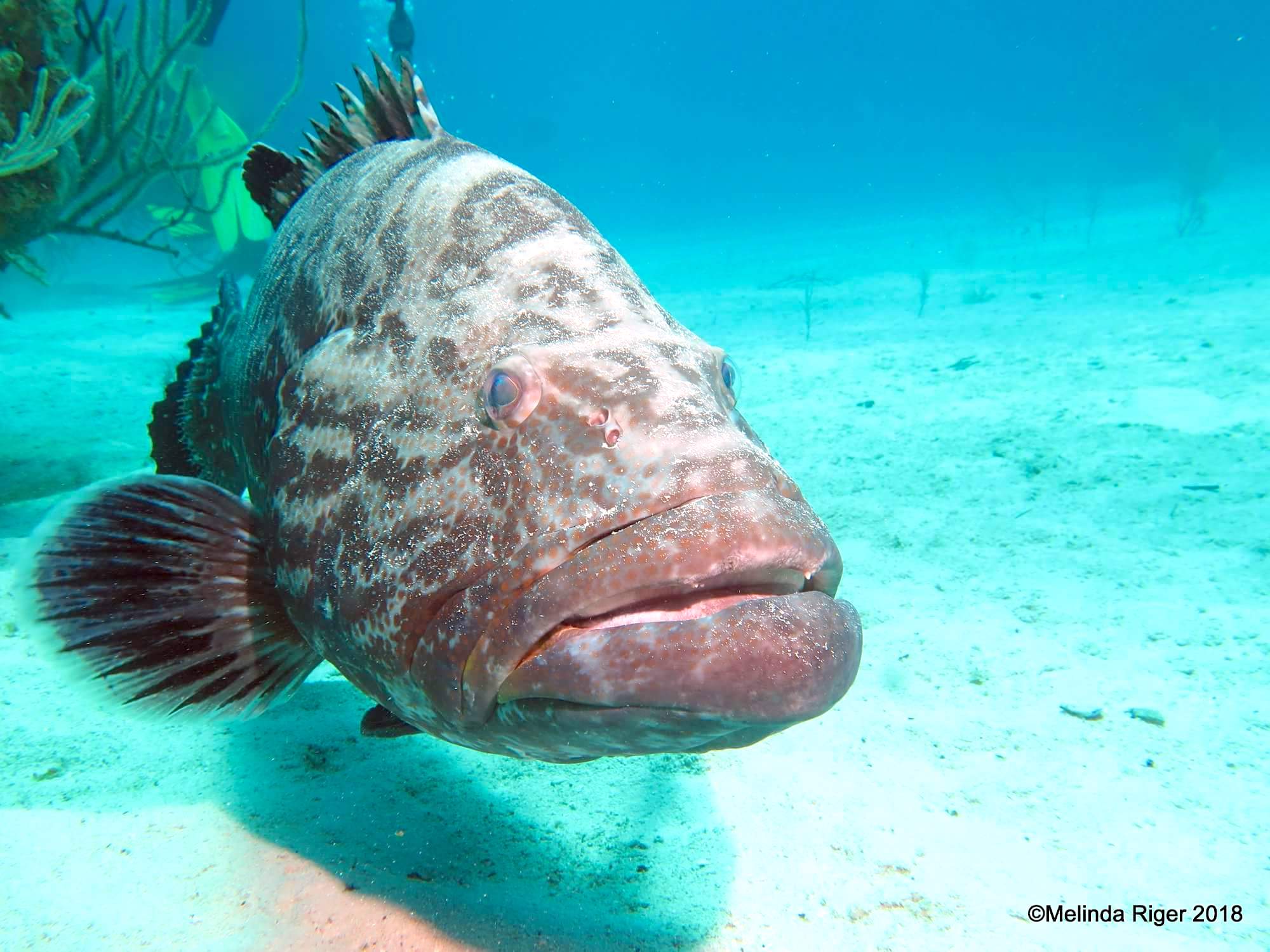
Fish, like humans, have a wide variety of temperaments, or so it seems. Resorting to anthropomorphic analysis of animal behaviour is a favourite pastime for humans. Who really knows if a creature is actually feeling shy or confident or playful or aggressive or indeed inquisitive. Often it just seems that way and we are happy to categorise dolphins as playful, sharks as vicious, angelfish as serene, small darting fish as timid and so on.
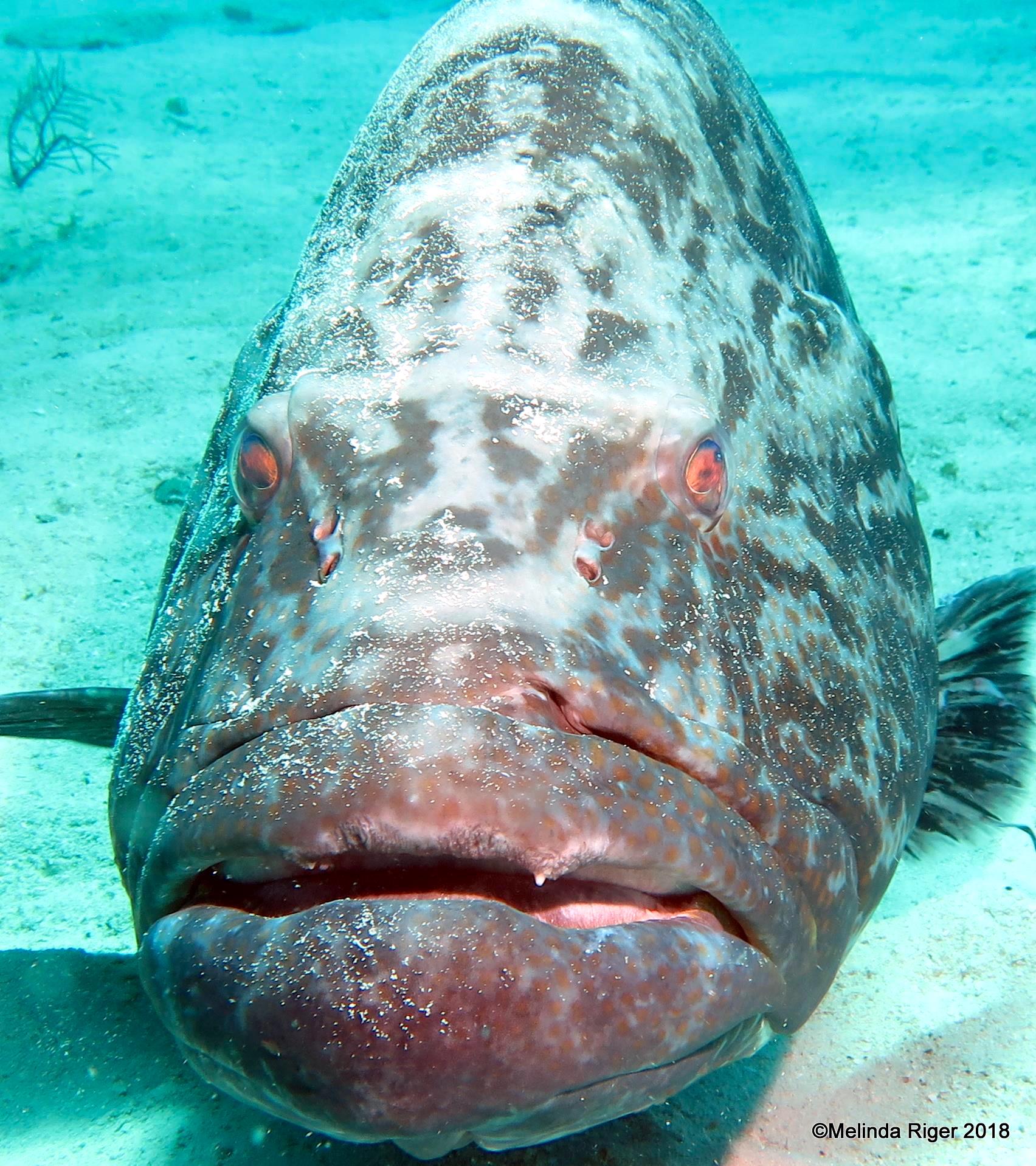
Occasionally a creature displays a ‘human’ characteristic that seems undeniable. One such is Curious George. He has become used to the divers around the reef where he lives, and greets them. He enjoys the photography sessions and the equipment, even though they may be for recording other fish. He demonstrates inquisitiveness for the strange-looking black-suited creatures that visit his patch. Like many groupers, he likes to be gently patted and stroked.
All this curiosity and friendliness evidences a benign interspecies relationship of symbiotic mutualism, through which both species (man and fish) benefit from the interaction. The mutually beneficial feeling might in broad terms be described as ‘pleasure’.
Or maybe I am just indulging in a bit of over-anthropomorphisation (if there is such a word)…
All photos by one half of the symbiotic mutualism here, Melinda Riger (Grand Bahama Scuba)
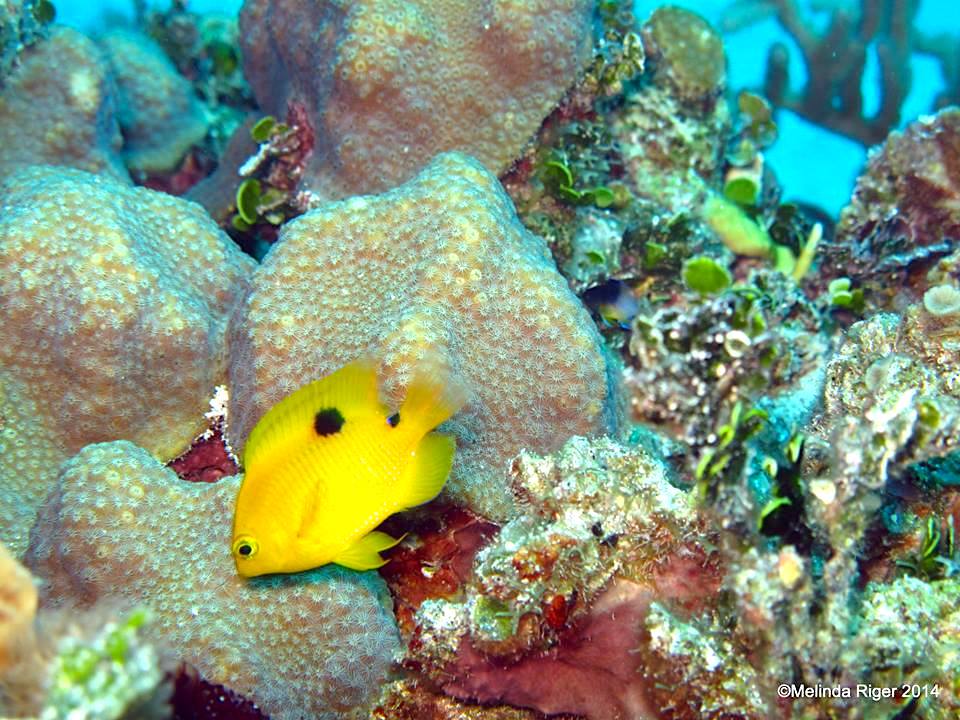
The threespot damselfish Stegastes planifrons is one of several damselfish types found in the Bahamas and more generally in the western Atlantic. As with so many reef species, there is a marked difference in coloration between juveniles (bright yellow) and darker-hued adults (above).
These are bony little creatures, equipped with both spines and ‘soft rays’ on some of their fins. This perhaps make them unappealing to potential predators; and maybe the very brightness and ‘hi-viz’ of the juveniles is aposematic, a coloration thats acts as a warning or repellent to potential predators.
On the reef it seems threespots favour staghorn coral as a daytime base. Their diet is mainly seaweed, with small molluscs, gastropods and worms for variety. At night they retire to crevices and caves.
Adults are, for such small fish, vigorously protective of their territories. They will chase and nip intruders into their domains, even far larger creatures (up to and including humans).
A breeding pair will both be involved in egg care. Once the female has laid her eggs, they adhere to the lower reef and seabed. The male guards them and rather sweetly fans them with his fins to keep them oxygenated. And then another generation hatches and the threespot life cycle repeats.
Credits: All fantastic photos by Melinda Riger / Grand Bahama Scuba
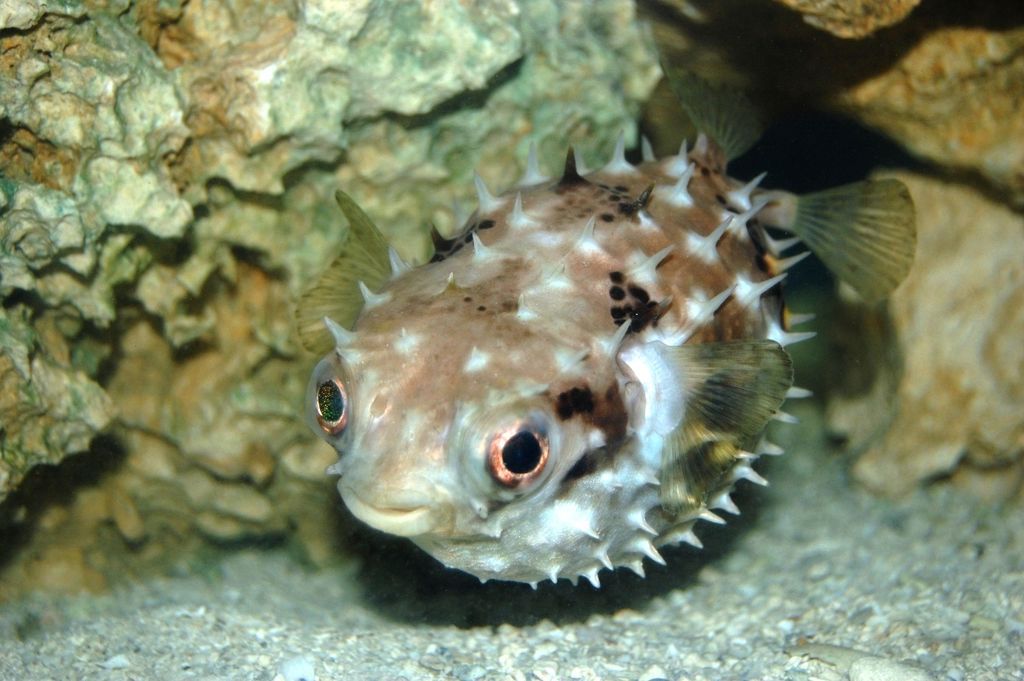
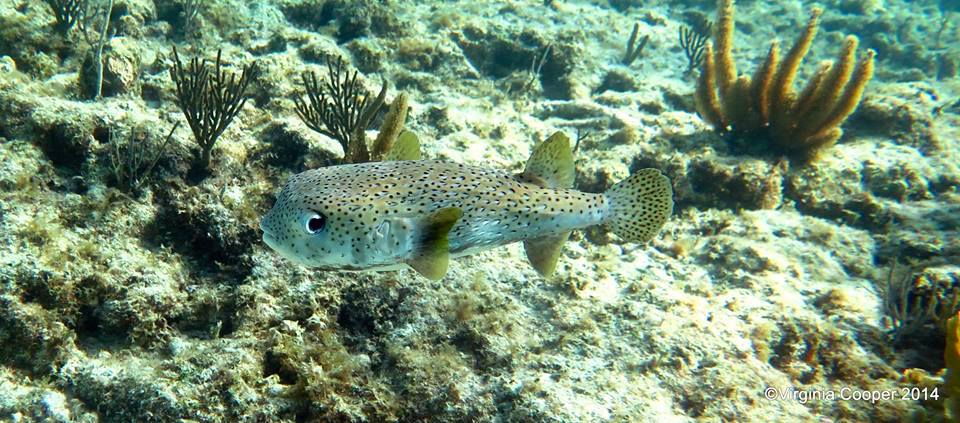
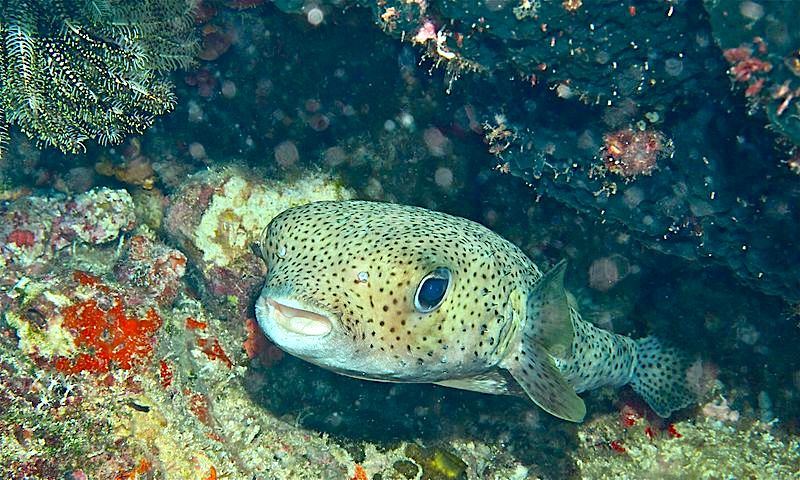
The porcupinefish Diodon hystrix falls into the general category ‘pufferfish’, though the particular species named PUFFERFISH are distinct in their own right. There are other similar species – e.g. balloonfish, blowfish and burrfish – with which there is scope for confusion. The relationship is something like this: all porcupinefish are pufferfish (in a broad sense); but not all pufferfish (in its species sense) are porcupinefish.
Porcupinefish are slow-moving reef dwellers and like their puffer cousins, they can inflate themselves by ingesting water, turning them into spiny balloons. This defence mechanism is a response to threat and works in two way: only predators with large mouths would consider them a meal; and even then they have to deal with the spines that become prominent when the fish is bloated.
I’VE HEARD PUFFERFISH ARE POISONOUS? WHAT ABOUT THIS GUY?
Good question. Checking it out, I’ve found some contrary statements about this. The truth seems to be that unlike pufferfish, they do not produce toxic secretions from their skins, so are not poisonous to touch (if you must**).
However porcupinefish do contain powerful (neuro)toxins in their internal organs and are best not eaten – though in some parts of the world they are considered a minor delicacy. They may also suffer the ignominy of being dried in their inflated state and sold to tourists as novelties – with lightbulbs inside for added amusement value.
ARE PORCUPINEFISH FAMOUS IN ANY RESPECT?
Indeed they are. They had the honour of being recorded by Charles Darwin. He gives a surprisingly long account of this creature, encountered during his renowned voyage on the Beagle. It clearly fascinated him. I’ve ‘ripped’ the relevant passage (open source – it’s ok) and turned it into an eezi-reed pdf if you want to check out Darwin’s careful observations in more detail:
Yes! In ‘Finding Nemo’, Bloat the Porcupinefish was part of the ‘Tank Gang’ in a dentist’s office. He had an encore in the closing credits of ‘Finding Dory’. Enough of fame already. Here’s a 50 second video demonstrating the puffer / porcupine distinction.
Photo Credits: Melinda Riger (1, 2); George Parilla (3); Virgini Cooper (4); Bernard Dupont (5); Adam Rees (6, 7); Video, ‘AquariumKids’ (I do high-powered research, see?)
**Incidentally, it’s apparently not considered an act of animal kindness to catch them / scare them so you can have the pleasure of watching them blow up
















































 ROLLING HARBOUR ABACO
You must be logged in to post a comment.