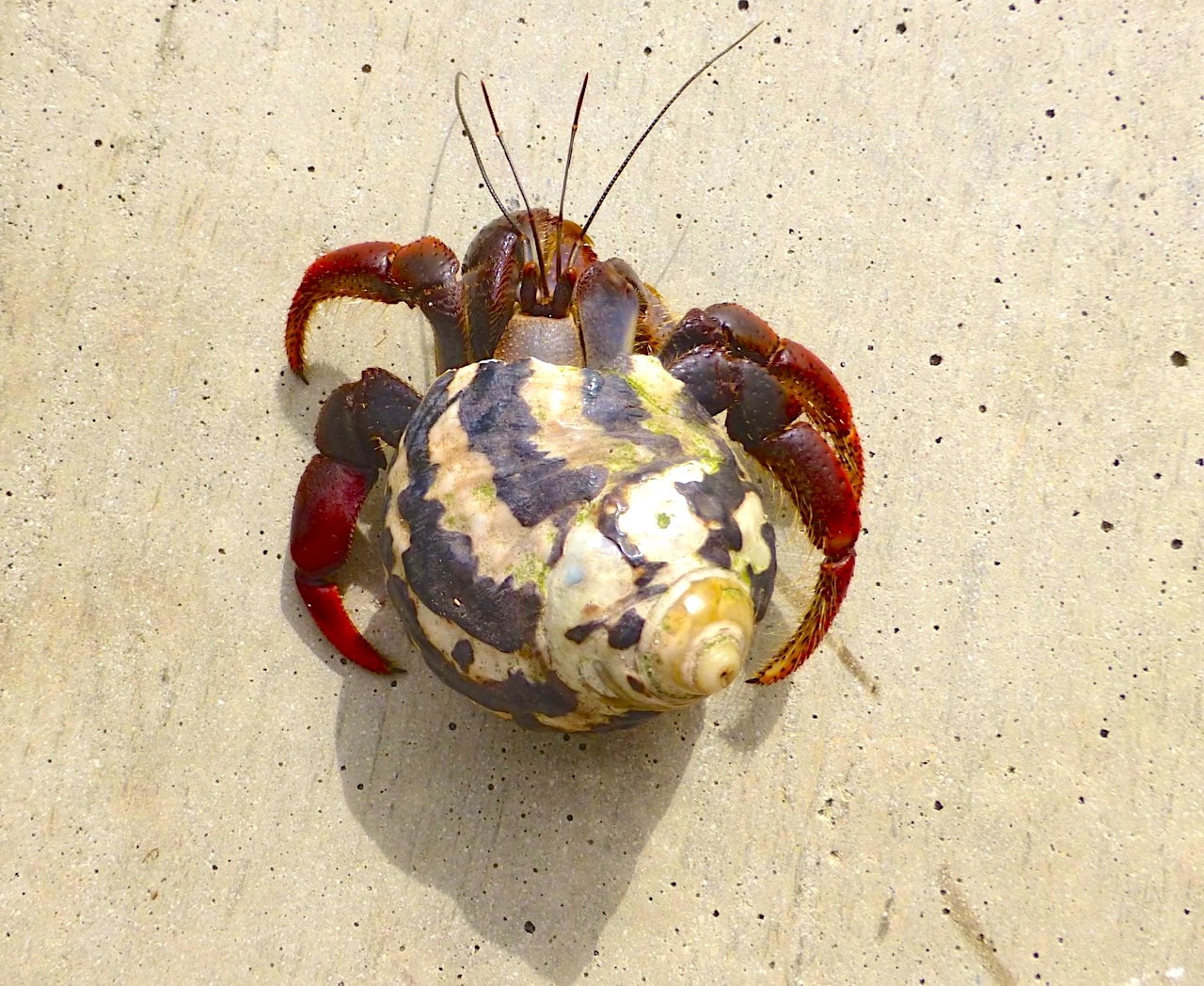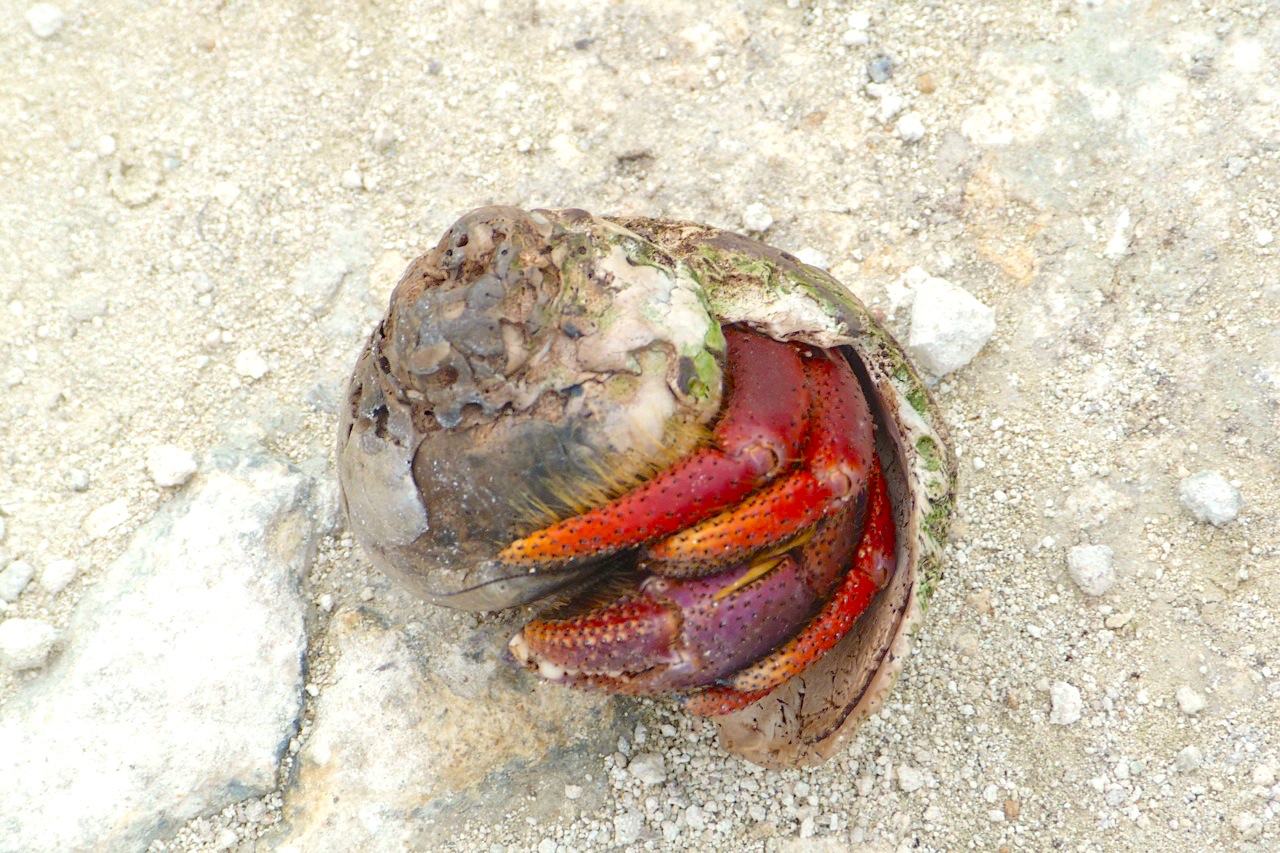
As everyone knows, Hermit Crabs get their name from the fact that from an early age they borrow empty seashells to live in. As they grow they trade up to a bigger one, leaving their previous home for a smaller crab to move into. It’s a benign** chain of recycling that the original gastropod occupant would no doubt approve of, were it still alive… The crabs are able to adapt their flexible bodies to their chosen shell. Mostly they are to be found in weathered (‘heritage’) rather than newly-empty shells for their home. [**except for fighting over shells]
HERMIT CRAB FACTS TO ENLIVEN YOUR CONVERSATION
The crabs are mainly terrestrial, and make their homes in empty gastropod shells
Their bodies are soft, making them vulnerable to predation and heat.
They are basically naked – the shells protect their bodies & conceal them from predators
In that way they differ from other crab species that have hard ‘calcified’ shells / carapaces
Ideally the shell should be the right size to retract into completely, with no bits on display
As they grow larger, they have to move into larger and larger shells to hide in
As the video below shows wonderfully, they may form queues and upsize in turns
Occasionally they make a housing mistake and chose a different home, eg a small tin
The crabs may congregate in large groups which scatter rapidly when they sense danger
The demand for suitable shells can be competitive and the cause of inter-crab battles
Sometimes two or more will gang up on a rival to prevent its move to a particular shell
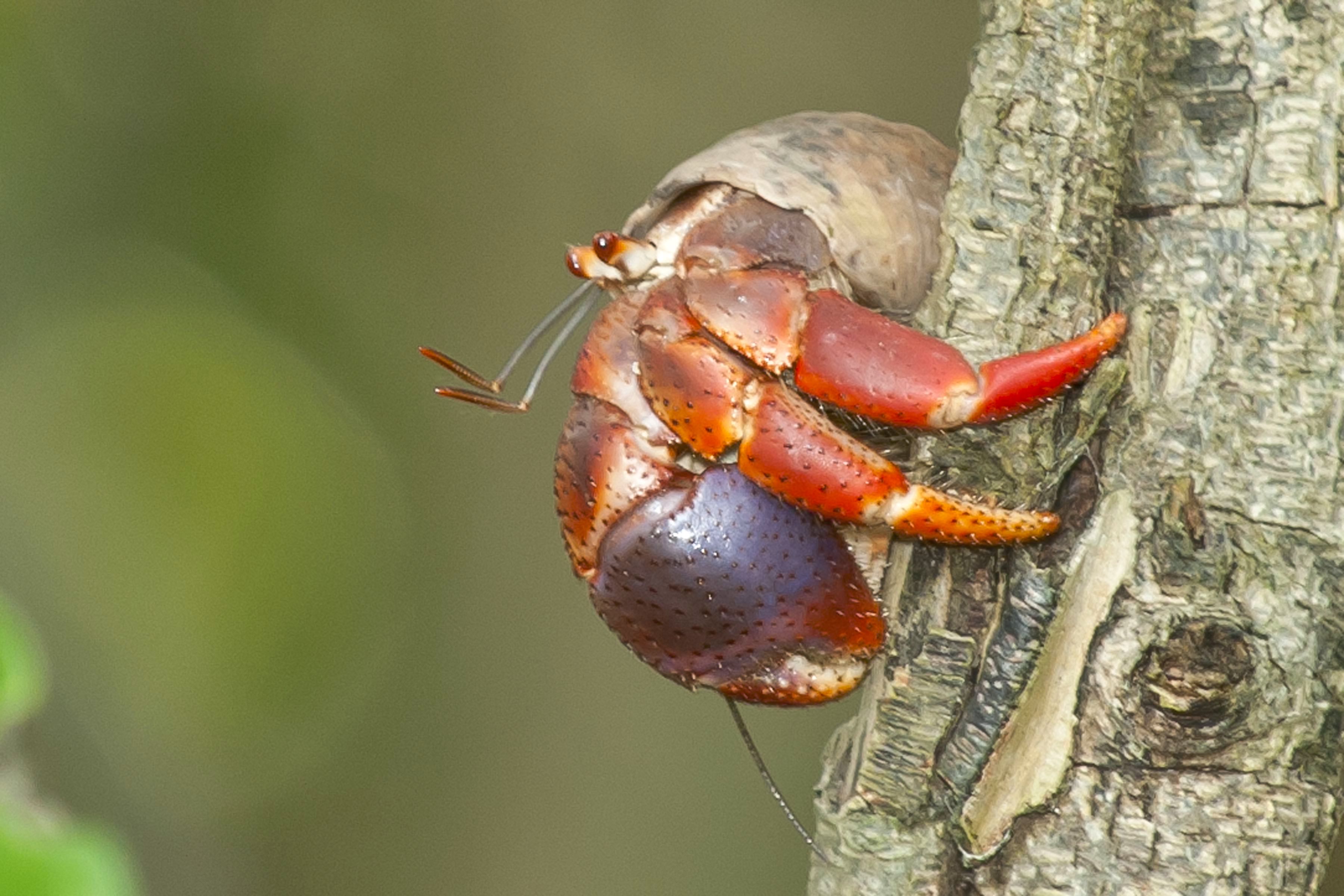
HERMIT CRABS CAN EVEN CLIMB TREES – WITH THEIR SHELLS ON TOO
HERMIT CRABS EXCHANGING HOMES with DAVID ATTENBOROUGH
This is a short (c 4 mins) extract from BBC Earth, with David Attenborough explaining about the lives and habits of these little crabs with his usual authoritative care and precision . If you have the time I highly recommend taking a look.
Credits: All photos taken on Abaco by Keith Salvesen except for the tree-climber crab photographed by Tom Sheley; video from BBC Earth
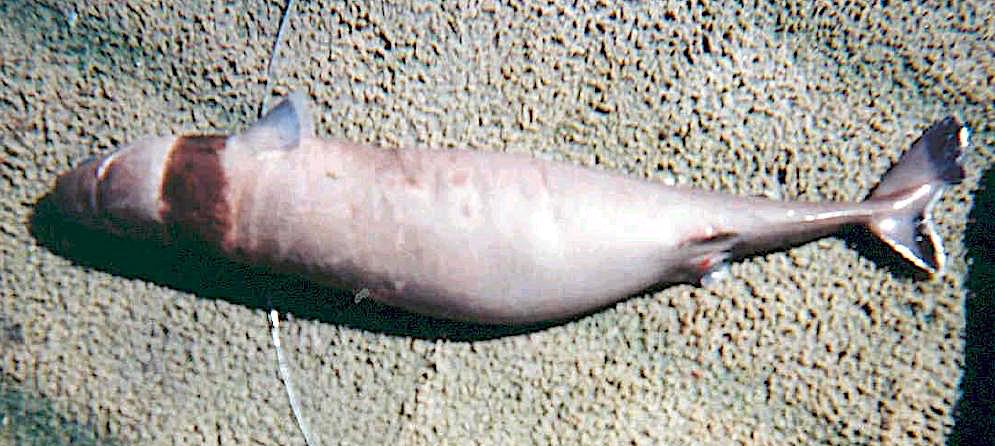
The Cookiecutter shark Isistius brasiliensis (aka the less scary, more genial sounding ‘cigar shark’), might be an ideal candidate for a Room 101 nemesis.** These little beasts – a species of dogfish shark – are found in several mainly island-based areas dotted around the globe, including in Bahamas waters.
HOW COME THE NAME?
These sharky little b@st@rds (*scientific term*) attack marine mammals and fishes, attaching themselves by suction and gouging out perfect round plugs of skin and flesh, leaving what are sometimes called ‘crater wounds’. Then they eat them. Imagine getting hold of a really sharp domestic cookie cutter with circular rows of razor-sharp teeth, and grinding it hard into your thigh. There! That!
The size of an adult shark:16″ max
The term ‘cookiecutter’ is also a pejorative slang term, meaning mass-produced, lacking in originality, or boringly samey, as in cookiecutter cars or TV genres etc. The little critters under consideration here are anything but…
HORRIFYING COOKIECUTTER FACTS
Live in the depths, rise vertically in the day & dive back down at dusk
Undersides have light-emitting ‘photophores’ which emphasise…
…the dark collar which acts as a lure, resembling a small innocent fish
Bioluminescence lures prey & confuses predators (more on this below)
The glow is so strong it may last for some time after removal from water
Their lips are ‘suctorial’ = they attach tightly to their target
The jaws then gouge out the victim’s flesh in a remarkably neat circle
Omni-vicious: any medium to large ocean creature is vulnerable to attack
There are even occasional reports of humans being targeted
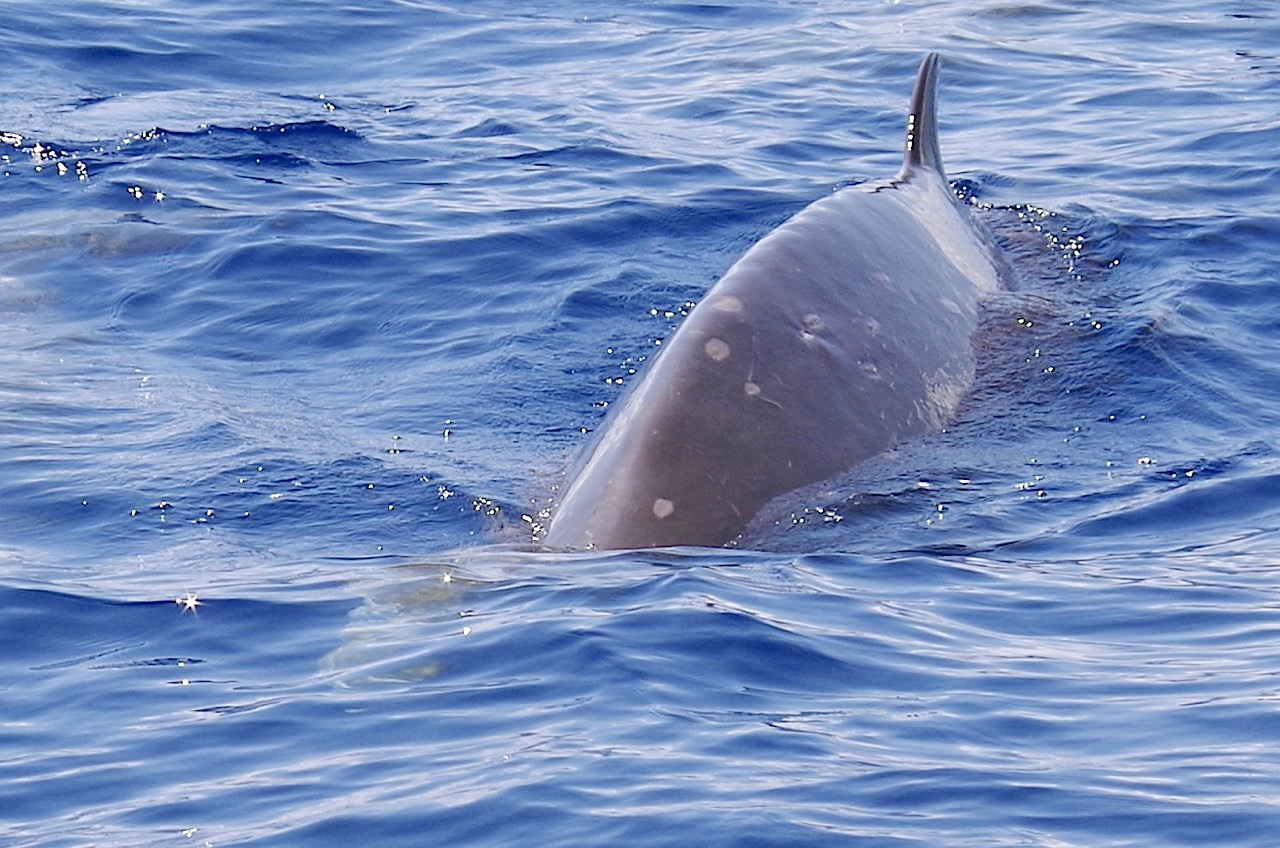
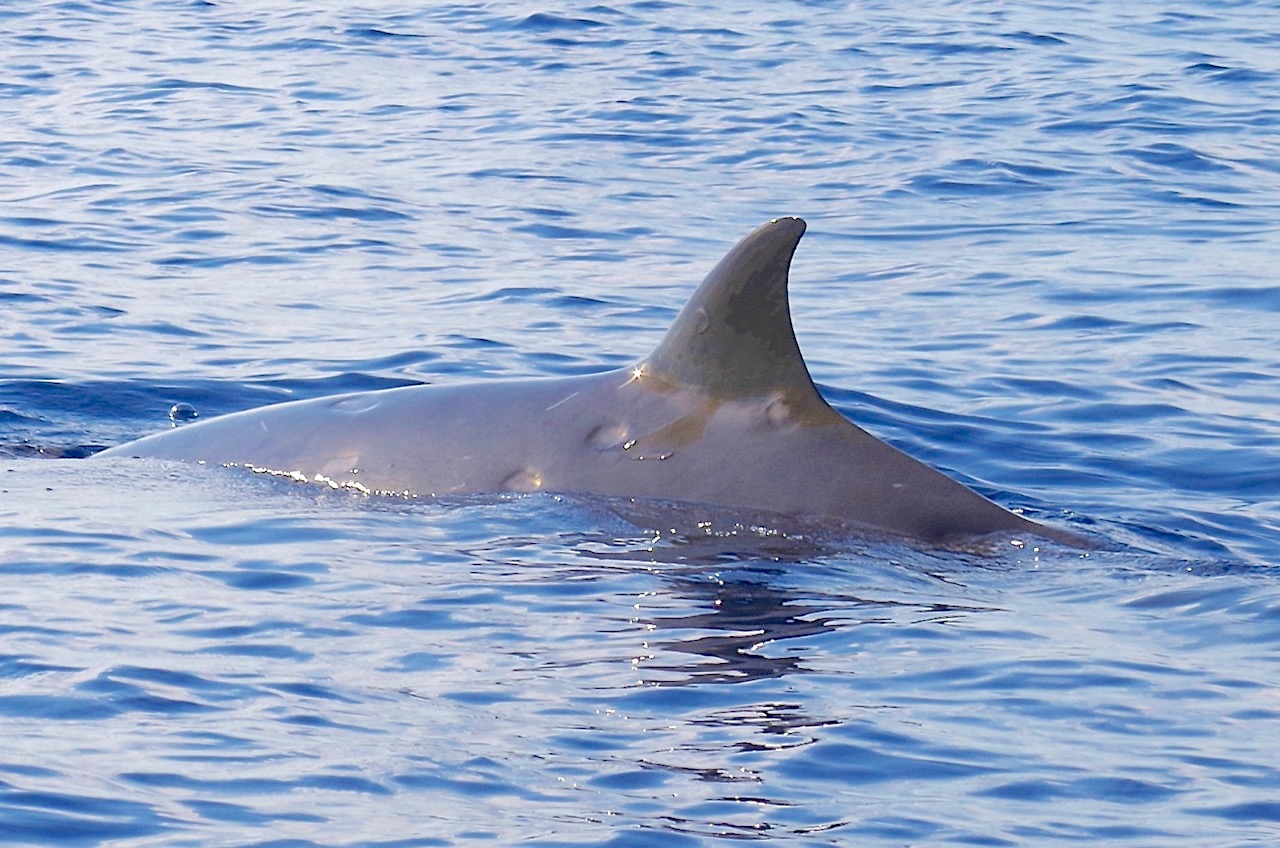
Here are two Blainville’s beaked whales that I photographed from the BMMRO research vessel. The top whale has a number of circular healed attack marks and a recent one. You can see how deep the gouged hole is. The other has well-healed scars.
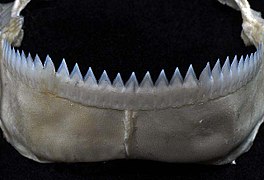
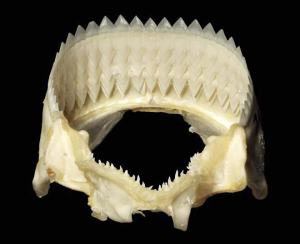
Multi-toothed: top rows of small teeth, rows of larger teeth on the bottom
The lower teeth are the cutters, acting like a saw when locked on
See header image and below for full details
HOW EXACTLY DO THEY DO WHAT THEY DO?
I can explain it no better than the renowned authority Prof. W. K. P. Dear: “the suctorial lips ensure a tight seal. It then bites, using its narrow upper teeth as anchors while its razor sharp lower teeth slices into the prey. Finally, the shark twists and rotates its body to complete a circular cut, quite possibly aided by the initial forward momentum and subsequent struggles of its prey. The action of the lower teeth may also be assisted by back-and-forth vibrations of the jaw, a mechanism akin to that of an electric carving knife”.
ARE THESE SHARKS ‘PARASITES’, WOULD YOU SAY?
The behaviour of these sharks is an example of a symbiotic relationship between two species that is parasitic. This means essentially that one gains and the other suffers (eg humans & no-see-ums). This is distinct from commensalistic symbiosis, where one species gains and the other is unaffected (e.g. cattle egrets with cattle); and mutualistic symbiosis, where both gain (e.g. cleaner fish & groupers). So, in a word, yes.
An ‘ambush predator’: these little sharks ‘hover’ in the water column waiting…
They are capable of rapid movement to catch up & latch onto prey
They will eat a passing small fish, crustacean or even squid as a snack
Sometimes they operate in schools; there is safety in numbers
The schools are thought to increase the ‘lure’ effect of the dark collar
A beached whale that’s been heavily targeted
FUN FACT TO COUNTERACT THE BAD STUFF
In the late c20, more than 30 U.S. Navy submarines were forced back to base to repair damage caused by cookiecutter shark bites, either to the neoprene footings of sonar domes or to rubber-sheathed cables. The problems were solved by using fibreglass. Oceanographic equipment and telecommunications cables are also recorded as being damaged by these sharks.
Cookiecutter Shark – the real deal
MONSTERS OF THE DEEP
These great cards from the weirdly spelledWIERD ‘N’ WILD CREATURESprovide excellent factual info. Their CCS card is no exception. You’ll find more details here about the effect of the bioluminescence and so on, written as clearly as I might hope to.
**“The worst thing in the world varies from individual to individual. It may be burial alive or death by fire, or by drowning, or by impalement, or fifty other deaths. There are cases where it is some quite trivial thing, not even fatal.” (George Orwell, 1984). Being in a tank with some cookiecutters might count.
Alright now… the wounds eventually heal
Credits: BMMRO – header image; beaked whale photos – Keith Salvesen / BMMRO; Te Ara NZ for the main jaw image; all small images with thanks to Wiki and respective photographers who took the time to upload them for all to enjoy & learn from; ‘wierdnwonderful creatures’ for the monster card; range map from Wiki
Capt. William Bligh achieved fame for all the wrong reasons. Despite a distinguished and wide-ranging seafaring career he is widely remembered for just two things: (1) The Bounty and (2) Mutiny On. In 1787, he was dispatched to Tahiti to collect specimens of BREADFRUIT (a fruit of the Pacific islands, in particular Polynesia) to help provide food for the British colonies in the West Indies. To be clear, the breadfruit was intended to be a basic and cheap staple food not just for settlers but also for the indigenous population. I think we can all guess the status of the latter at that time.
‘BLIGH’S BLIGHT’ – MUTINY!
Capt. Bligh’s Bounty crew unfortunately mutinied – possibly to do with the amount of water the breadfruit required in transit, compared to their own meagre rations. So they threw overboard the hundreds of breadfruit plants that were in transit. Then they set Bligh with his loyal officers and crew adrift… He was later court-martialled but cleared of culpability for provoking a mutiny by his conduct (from a strictly legal viewpoint and on the bare facts, not a surprising ruling you might think).
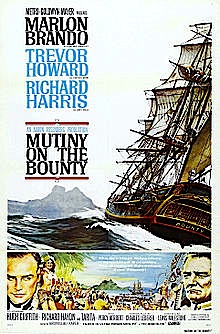
This isn’t the place for a disquisition on the Mutiny. You can read all about itHERE. Or better still, watch one of the rollicking all-star-cast films based loosely on the episode for a careful and accurate historical record of the events that will buckle your swash…
BLIGH’S SECOND CHANCE
Following that skirmish, and indeed blemish, on his record, in 1793 Capt. Bligh was yet again charged with the task of shipping breadfruit trees from their origin to the Caribbean. His heart must have sunk at the prospect, yet finally he succeeded. However, he completed his journey only for those on the consumption end to express considerable distaste for such a bland, starchy fruit. It took a long time to catch on, and even longer for its culinary versatility to become appreciated.
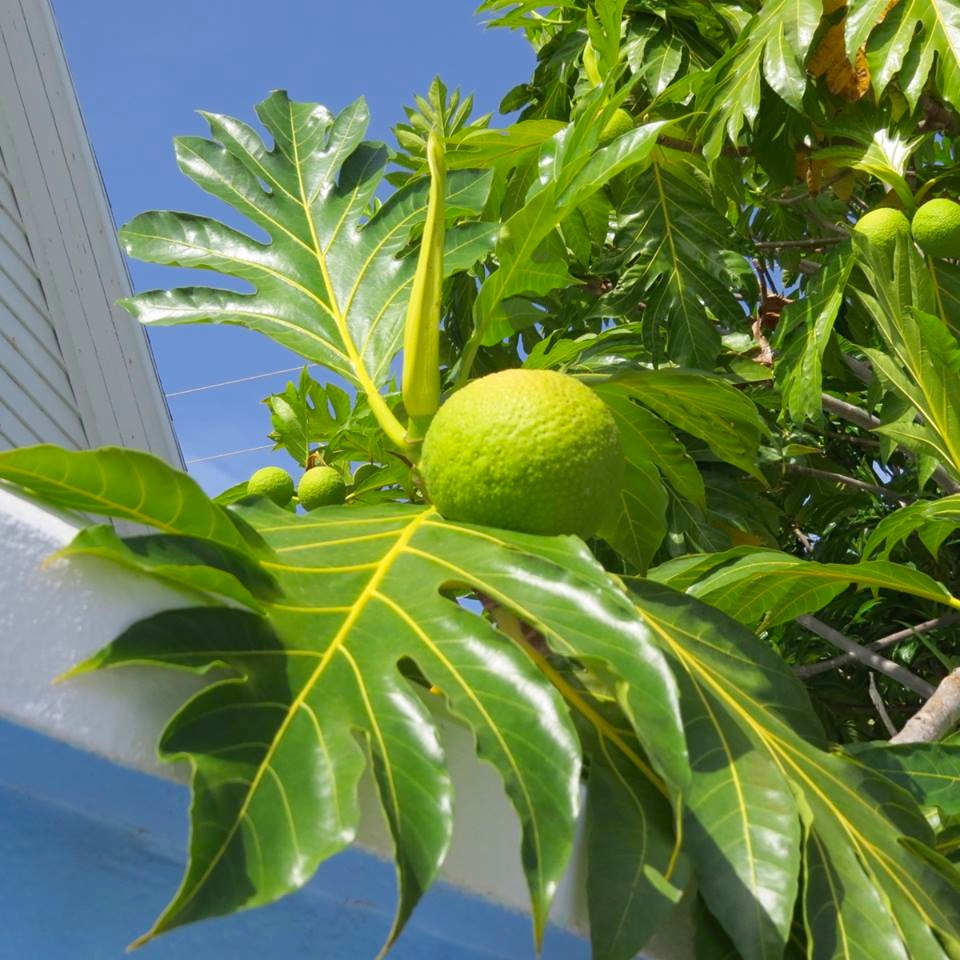
The most famous breadfruit tree in all Abaco is to be found in Hope Town, on Elbow Cay. I can do no better than display the notice that proudly proclaims the historic significance of the tree and its eponymous fruit.
Unusually for a fruit plant, a true breadfruit Artocarpus altilis does not produce seeds. It is propagated by removing the suckers that grow at at the base of the tree.
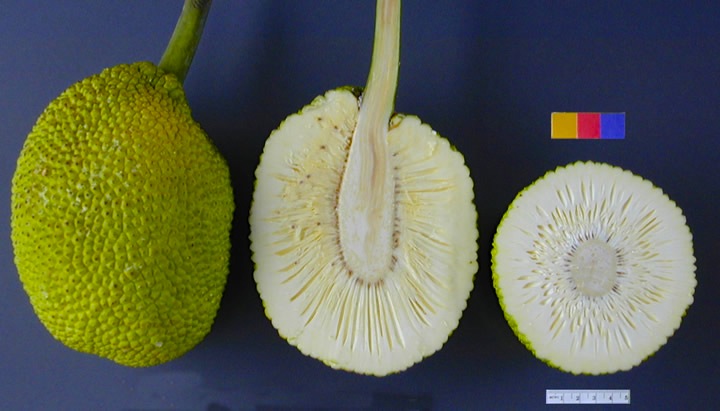
For those unfamiliar with the fruit and its interior, here it is in both slice and cross-section
BREADFRUIT IN ART
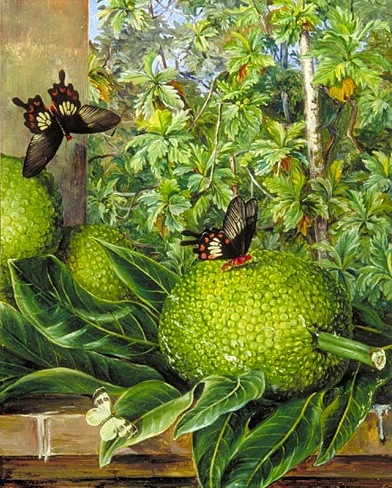
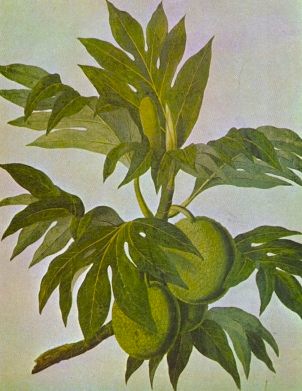
Breadfruit has (somewhat surprisingly?) received some artistic recognition over the years. Here are a few examples. The first, very jolly, includes early representations of the Polydamus Swallowtail butterfly; the second is quite dull; the third is instructional (oddly equating breadfruit with tea, coffee and chocolate); and the fourth is not at all appetising to look at… nor, in the days of adhesive stamps, to lick.
Breadfruit with butterflies (Royal Botanic Garden, Kew)
Breadfruit (John Frederick Miller)
Breadfruit & related plants used as food (William Rhind (1841)
SO WHERE DOES BREADFRUIT GROW NOW?
Breadfruit will flourish only within a certain latitude range where the rainfall and temperature suit it, as this map shows. I include this information in case you ever find yourself in the awkward position of being socially stranded with someone whose conversation has become soporific. Be armed with some useful worldwide breadfruit stats for just such an occasion – the fact that Madagascar is a suitable yet not a very good location, for example (not enough rainfall). You will soon find yourself alone…
A CULINARY TREAT
Breadfruit is sometimes thought to be a dull and un-tasty, at least compared with many other fruits. I thought I’d include a recipe or two that rather appealed to me – the second because even I could do that… it’s within my shamefully limited culinary skill-set.
BAKED BREADFRUIT
Large, ripe breadfruit 1 cup water Butter 1 lime or lemon
Heat oven to 350 degrees F. Put the water in a shallow pan and place the whole breadfruit in the water. Bake in oven for three hours. Remove from oven, allow to cool slightly, peel, removing the large core and stem. Cut the fruit into sections and place in a serving dish. Cover with butter and a squeeze of lime or lemon juice.
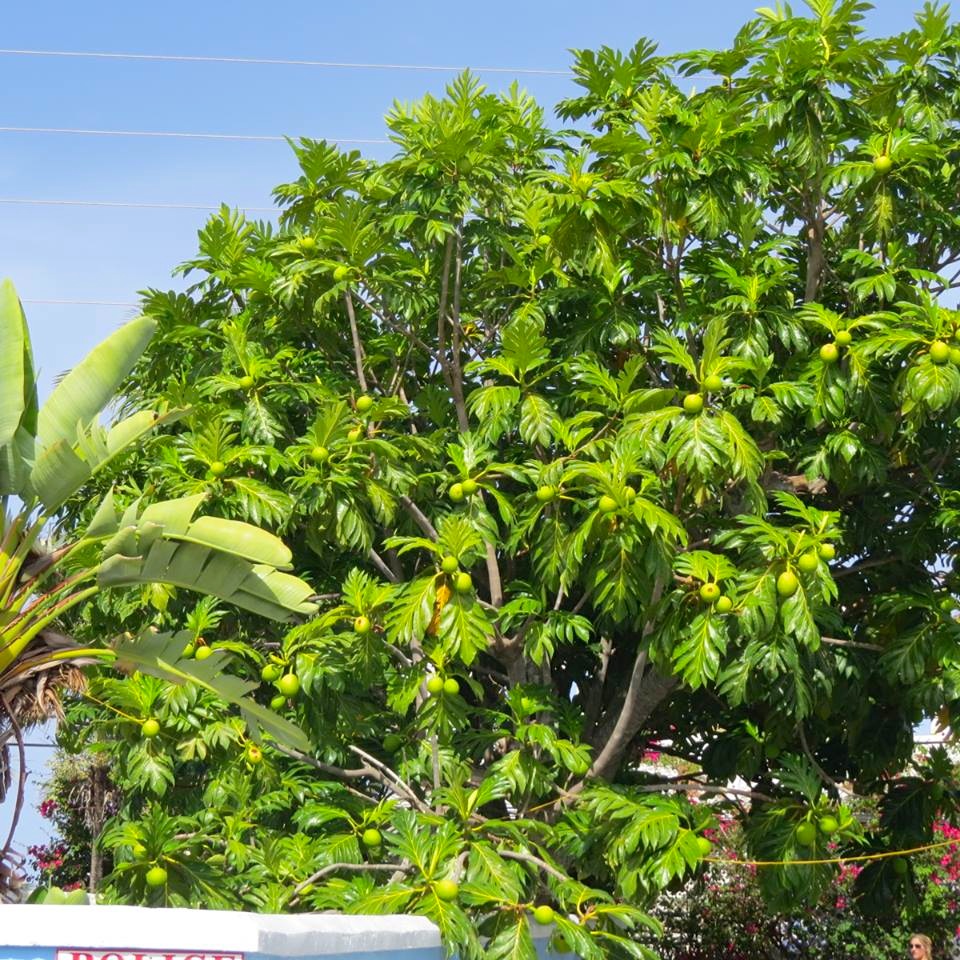
A PERFECT HOPE TOWN BREADFRUIT
BLIGH’S END
Capt. Bligh managed to put his breadfruit adventures and the mutiny behind him. He continued a distinguished naval career with successive command of an impressive number of ships. He ended up as a Vice-Admiral, and (on his death in 1817) in a grave in Lambeth, London.
This post was originally published a while back, inspired by an article on breadfruit and the Hope Town tree by local historian Deb ‘DP’ Patterson, known to many for her committed involvement with the Wyannie Malone Historical Museum in Hope Town. I’m grateful to her for permission to use her idea and indeed some of her material, in particular her photos of the tree and its notice.
HMS BOUNTY II (Full Sails). A 1960 reconstruction (Dan Kasberger)
Credits: First and foremost, Deb Patterson; Magpie Pickings including Hans Hillewaert, US Pacific Basin Agricultural Research Center, Royal Botanic Garden Kew, myrecipefriends, M Kwek, whatsonbahamas, Wyannie Malone Historical Museum, ‘Geograph’, Dan Kasberger, and Wiki; and anyone else I have omitted…
I am re-posting this sea fan article as 2021 rolls over into 2022 with much the same disruption, anxiety, and (for many) grief that we were all facing a year ago. The converse and somewhat rhapsodic title reflects the experience of many people since Covid engulfed the world. Life has become simultaneously real and surreal. It continues in many respects as normal yet who would have guessed that as we entered a new decade in 2020, the face mask would quickly become an essential (or anyway a medically recommended) part of daily life and remain so?
This post was written at a time of sunshine, normality and optimism, before Covid and even before the violent destructive force of Dorian in autumn 2019. Here’s some cheer from sea fans on the coral reefs of the Bahamas.
GALLERY OF GORGONIANS
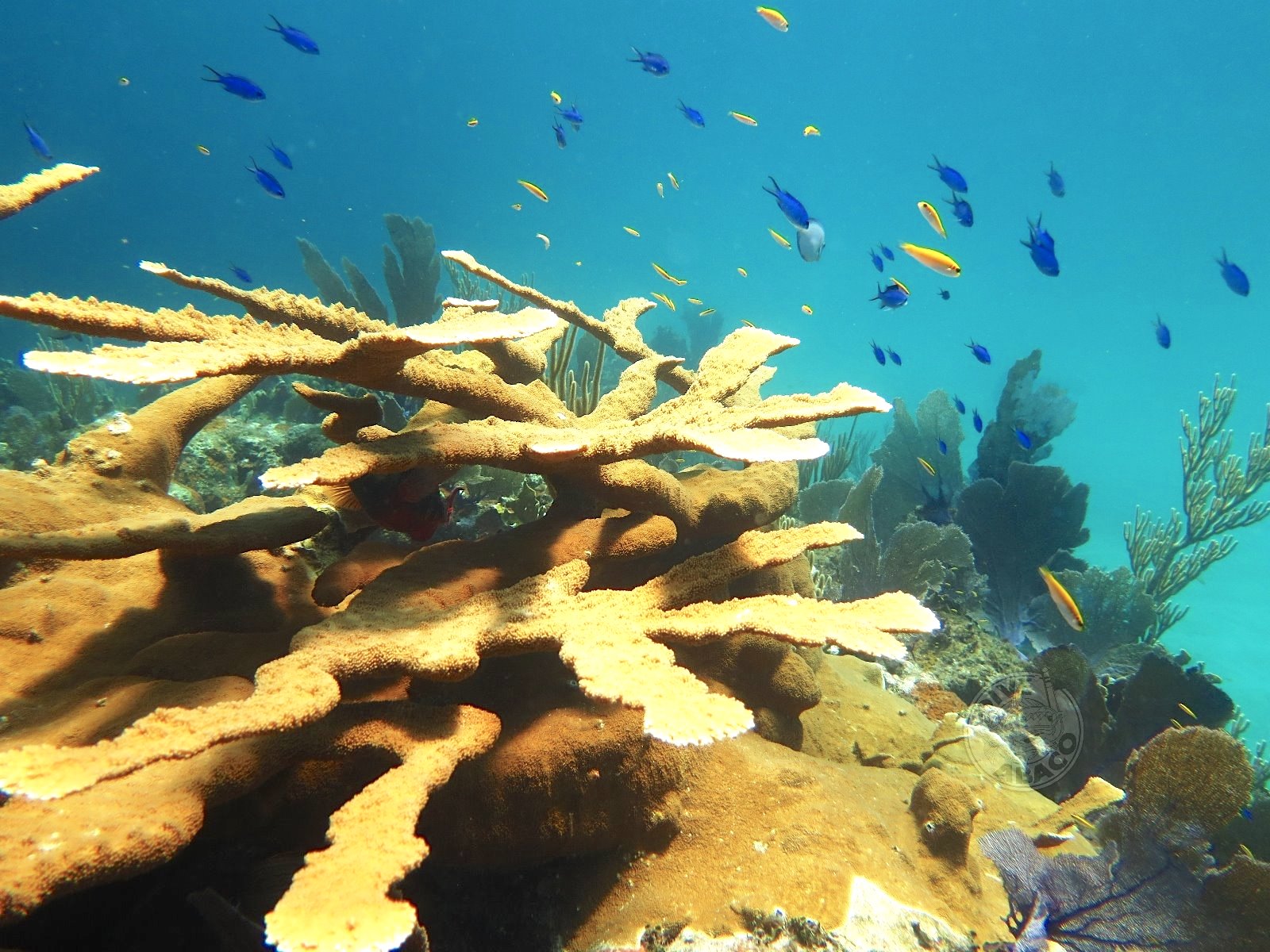
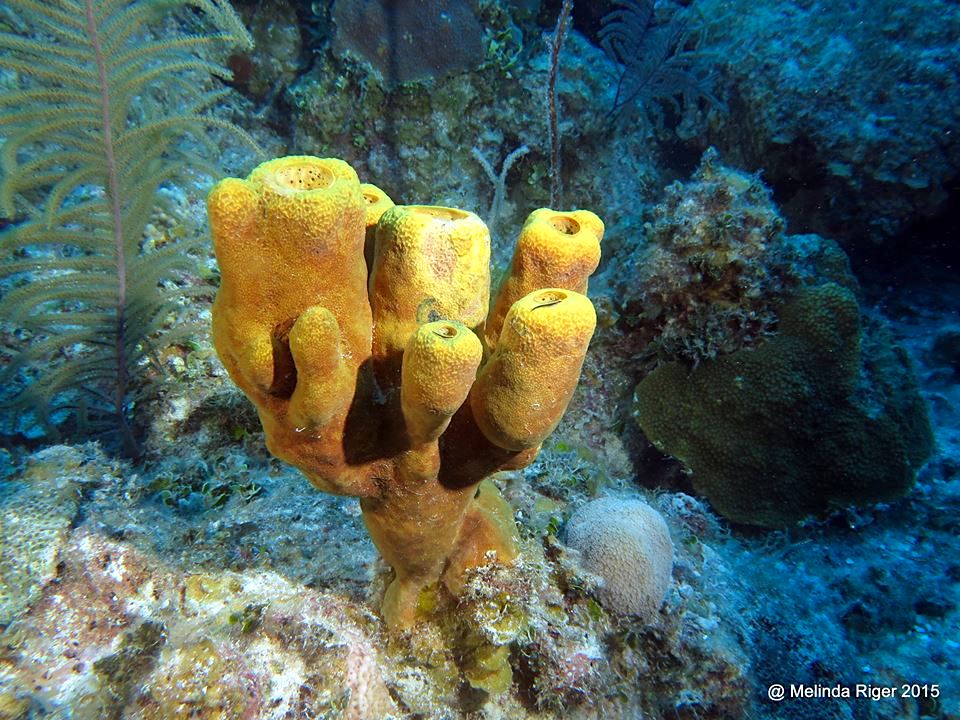
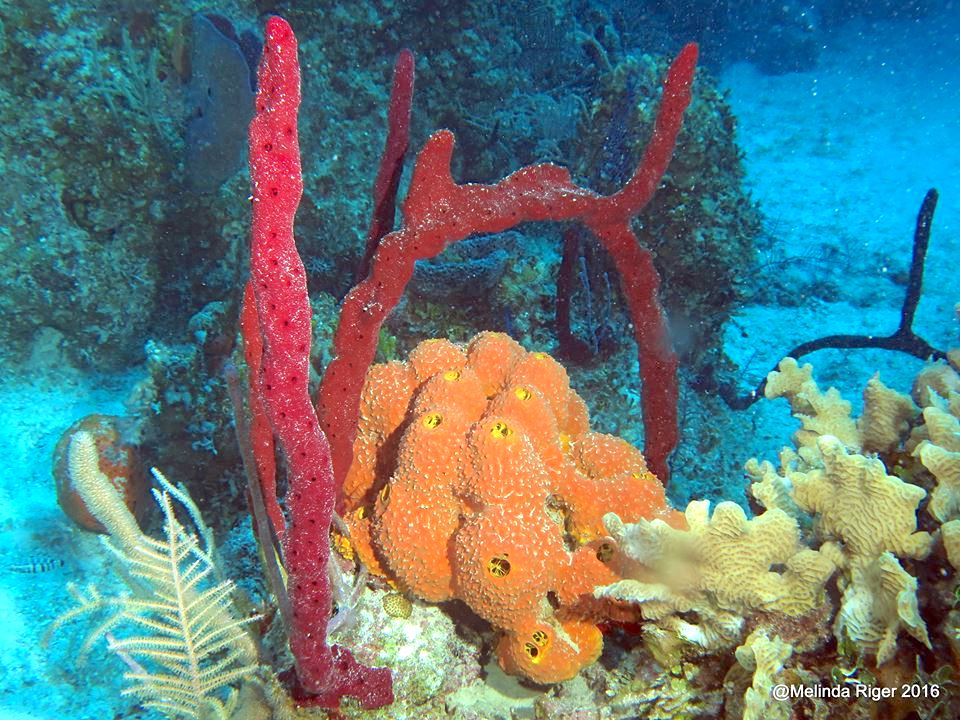
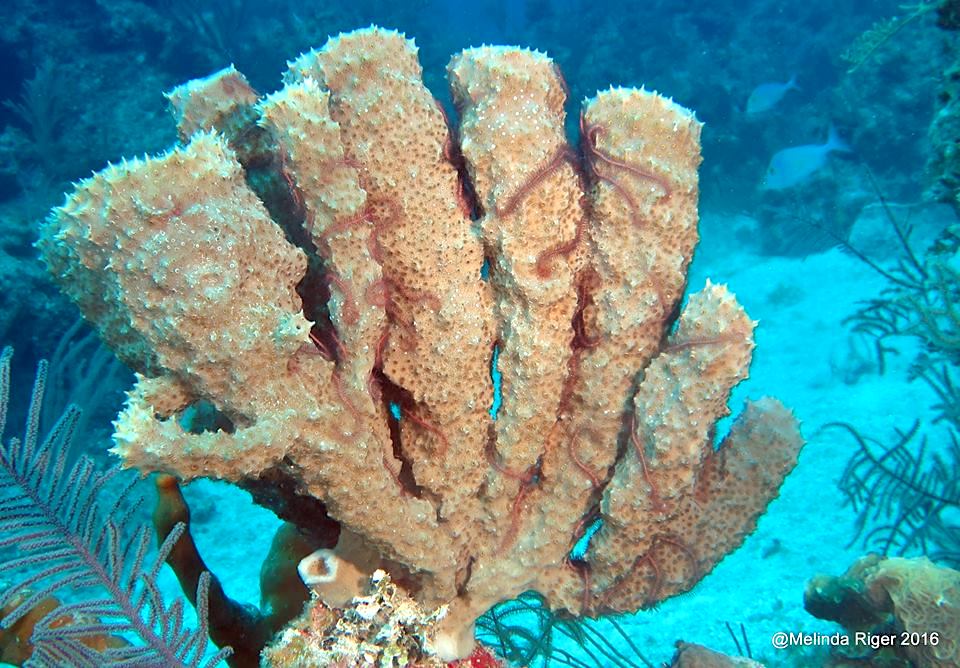
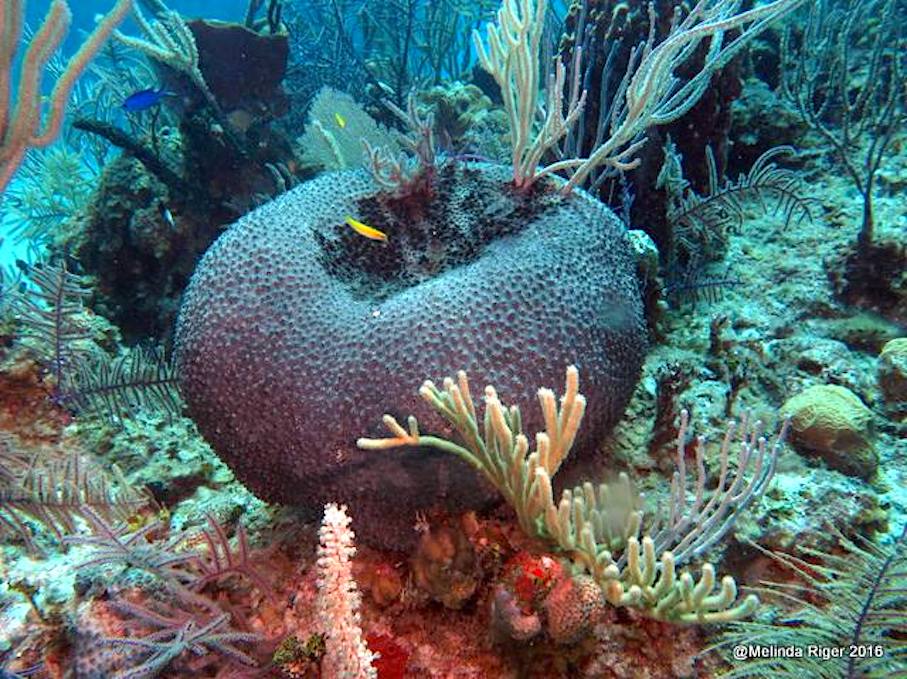
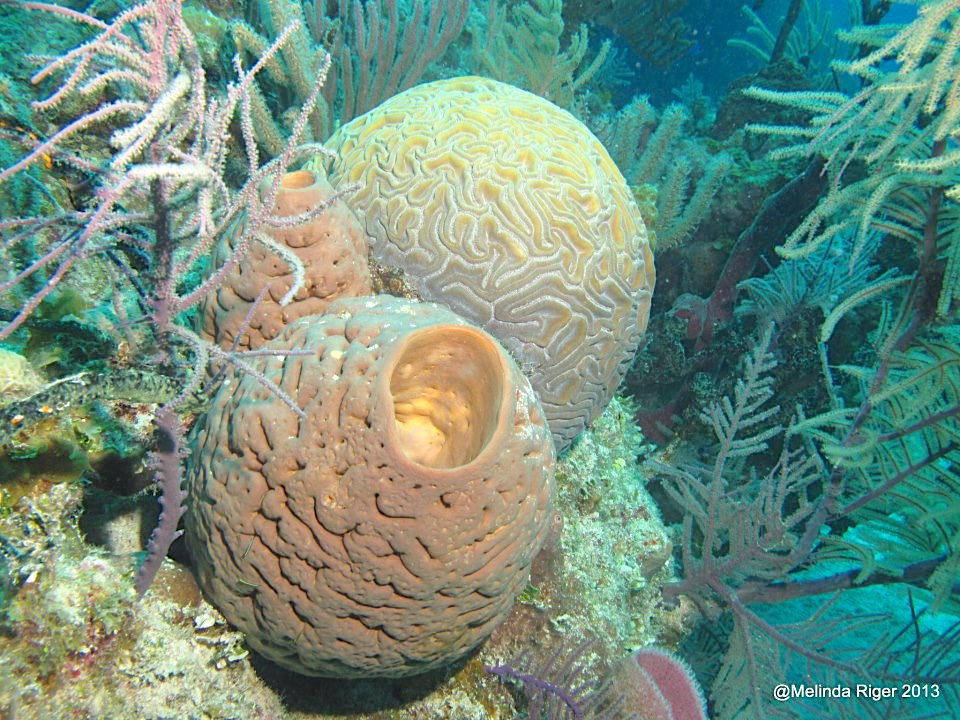
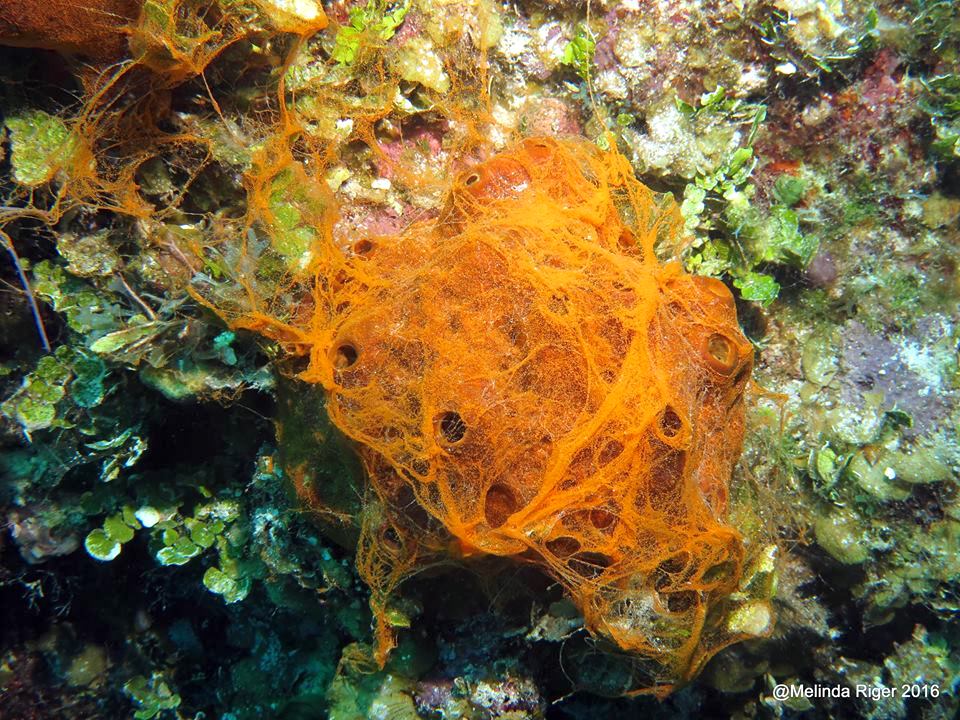
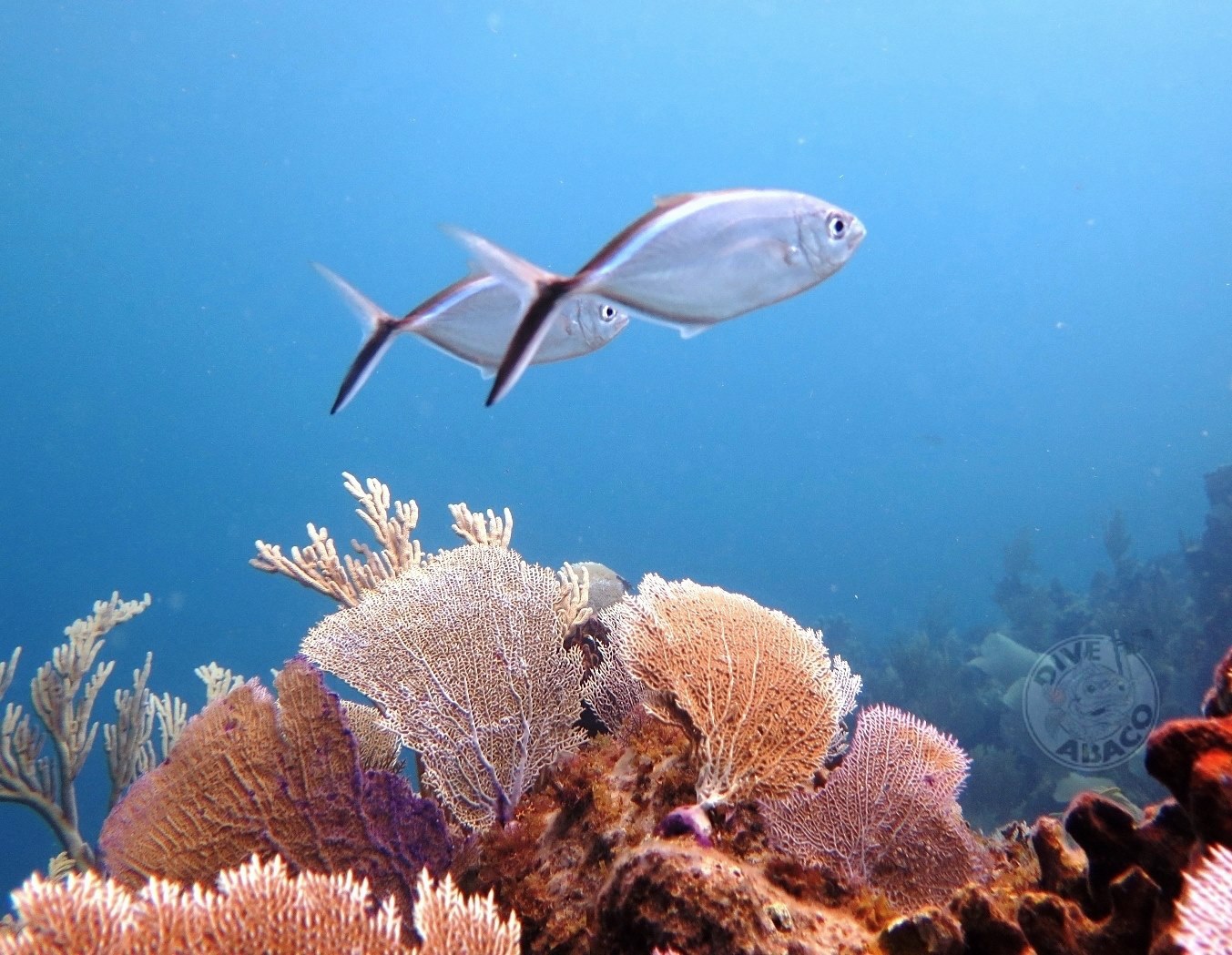
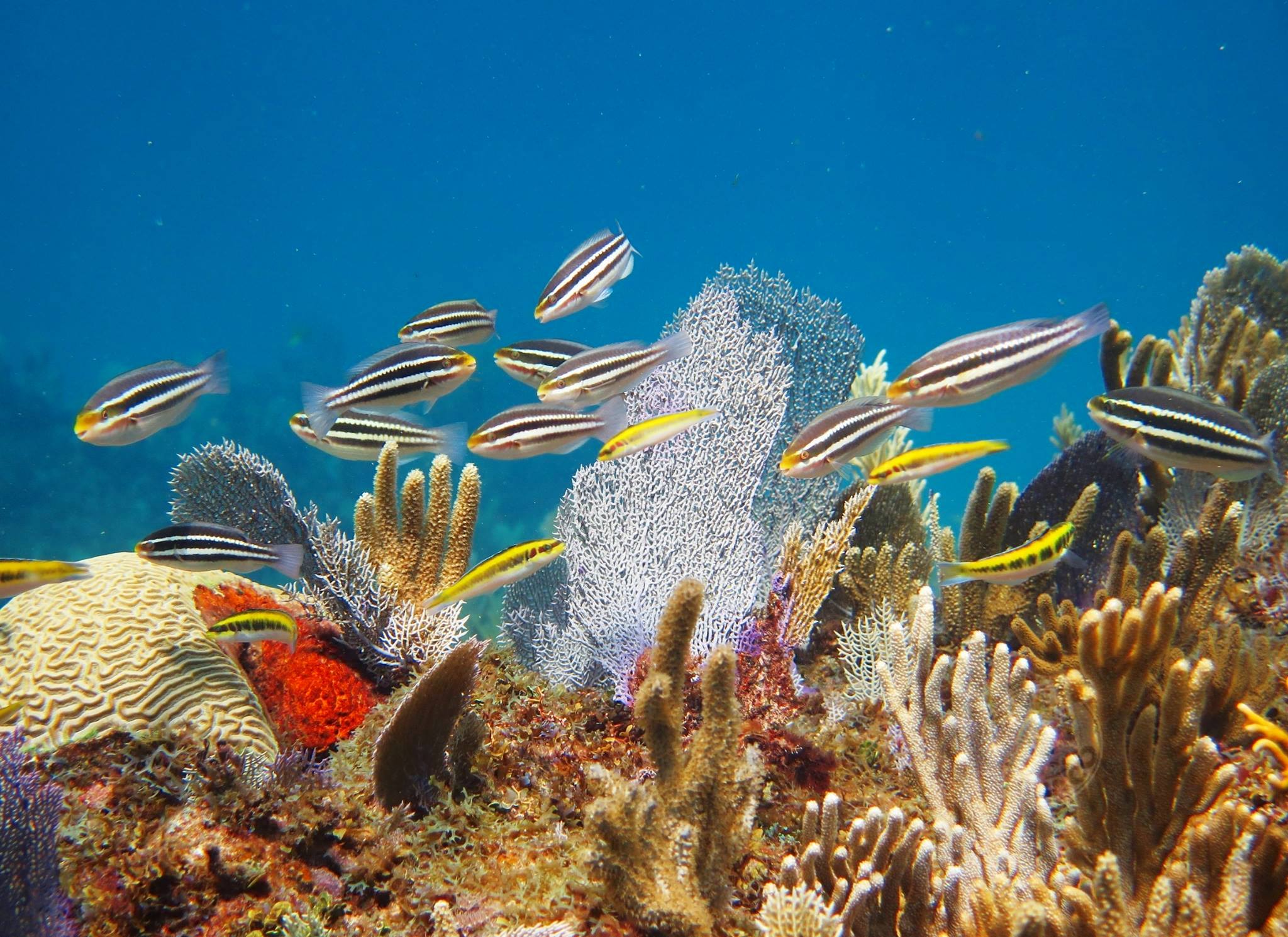
The waters of Abaco teem with myriads of fish that depend on the coral reefs for shelter and safety, for breeding, for growing up in, and for nourishment. Sea fans (or gorgonians, to use the technical name) are animals too. They may look like plants and stay rooted to the spot, but like anemones these ‘soft corals’ are creatures of the reef and essential indicators of its health.
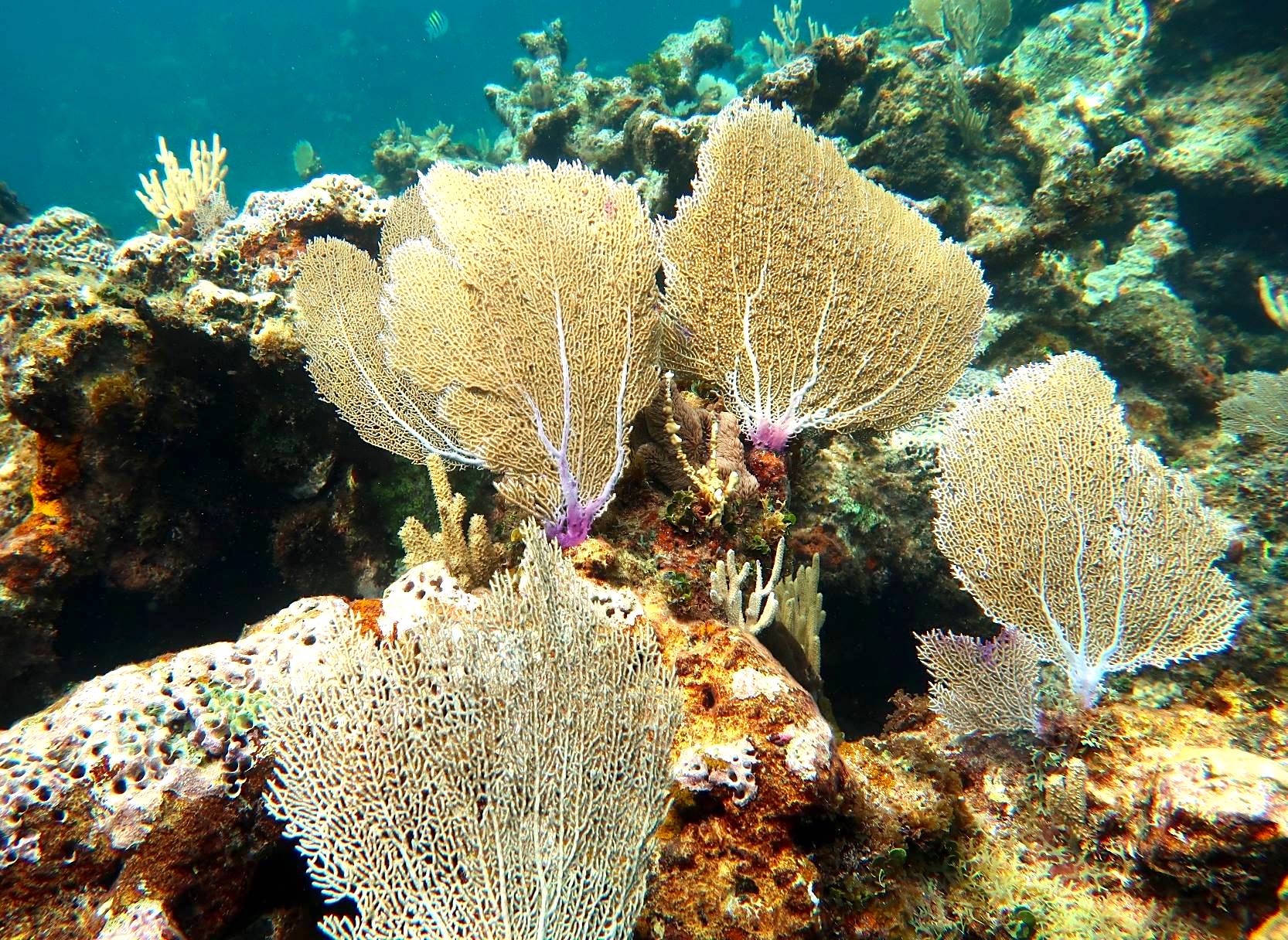
The purple sea fan Gorgonia ventalina (classified by Linnaeus in 1785) is one of the most common species of sea fan, and a spectacular one at that. The main branches are linked by a lattice of smaller branches. Below the ‘skin’ is a skeleton made of calcite compounded with a form of collagen.
Sea fans are filter-feeders, and have polyps with eight tiny tentacles that catch plankton as it drifts past. They develop so that their orientation is across the prevailing current. This maximises the water passing by and consequently the supply of food as the fans gently wave in the flow.
Gorgonians have a chemical defence mechanism that protects against potential troublemakers. The main effect is to make themselves unpleasant to nibble or uproot.
One benefit of sea fans to mankind is that their defensive chemicals have been discovered to provide the basis for drug research and development, specifically in the field of anti-inflammatories. Another benefit, of course, is that they are very beautiful to look at. And in bad times, that can only be good .
Credits: these wonderful photos were taken by Melinda & Keith Rodgers / Dive Abaco, Marsh Harbour; and Melinda & Fred Riger / Grand Bahama Scuba. Huge thanks to them all for allowing me to freely use their skilful underwater photography in this blog for the best part of a decade.
A small New World songbird of the cardinal subfamily
Flags and other colourful festive decorations
PAINTED BUNTING
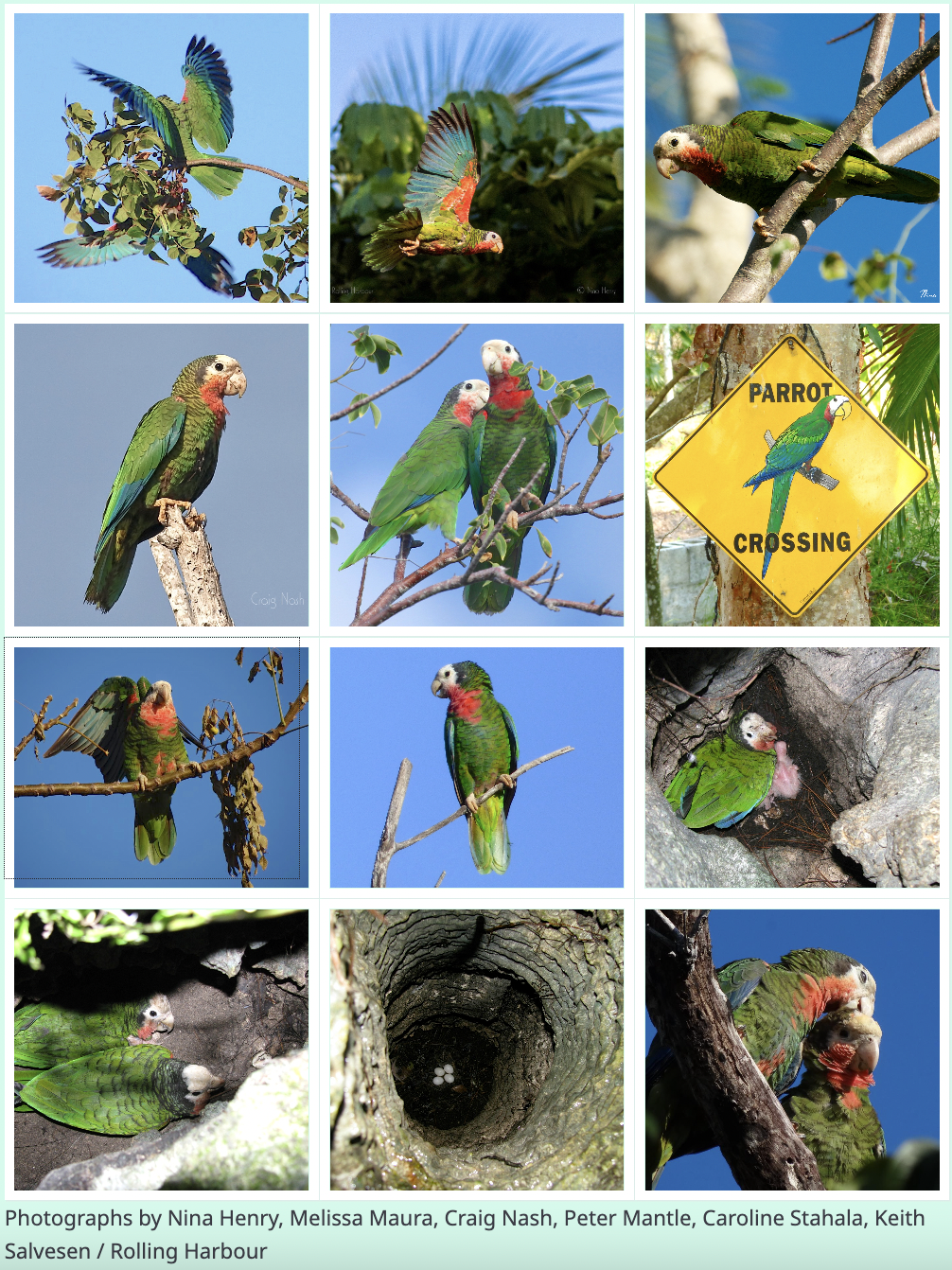
Few birds radiate Yuletide vibes better than Painted Buntings, with their perfect festive colours. Here is a seasonal flock of them to enjoy. A very happy Christmas to those who kindly continue to visit Rolling Harbour, despite the unavoidable absence from the Bahamas of the Harbourmaster.
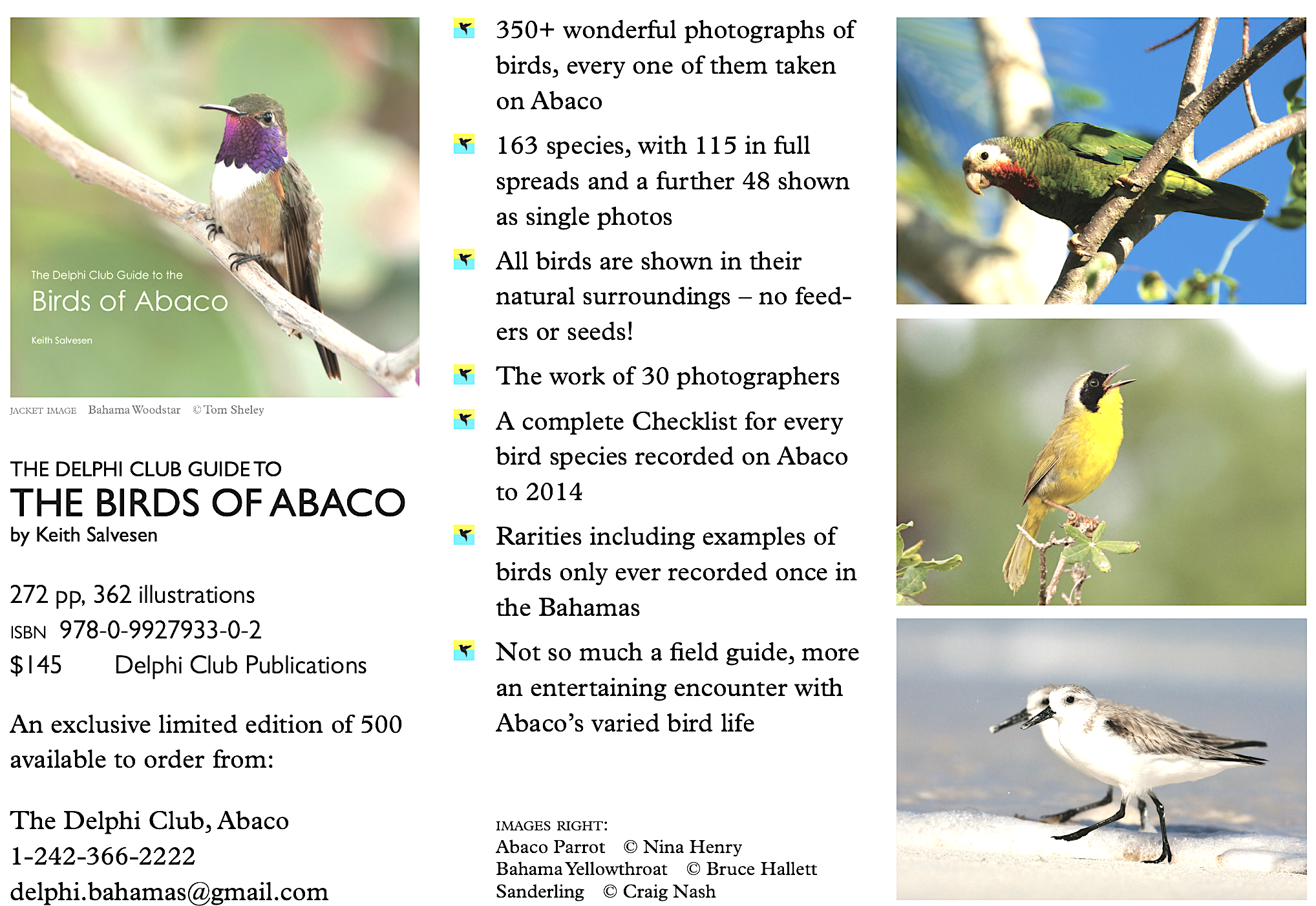
There’s nothing like a massive house clear-out (after 42 years) to reveal lost possessions, forgotten treasures, and (for that matter) a few things best forgotten… Last Spring we began to prepare for a house-move, during which I found a box of bird books that I duly reported here (and happily sold). Recently, sorting through a packed shipping container parked in the unlikely setting of a local farm has revealed plenty of surprises, including a couple more boxes of BIRDS OF ABACO. There definitely aren’t any more. There may be one or two people who might like one / who lost their copy during Dorian / who are new to Abaco and its wonderful birdlife. Here is a chance to own one…
In the spirit of recycling I am reusing the original blurb because it still holds good today. The book is only ‘out of date’ to the extent that since publication about a dozen new species have been reported. Most were seen just the once, some for a few weeks at most. So although exciting, the newcomers were more ‘Birds Passing Through…’ than ‘Birds Of…’ Abaco
The originator of the idea for the book – as with the entire Delphi Club project – was Peter Mantle, the publisher. He took a risk based on my (then) quite feeble Rolling Harbour blog about the birds and other attractions of the island. The 2kg book took 16 months from conception to the arrival of three pallets of printed books on the dockside in Marsh Harbour, having travelled by a tortuous route from specialist printers in Italy.
As part of the project, Abaco schools, libraries and wildlife organisations were given copies for educational purposes. A percentage of profits was given to local wildlife causes. We quickly sold a great many copies, and couldn’t have been more pleased with the response to the book, a unique publication for the Bahamas. The captions (below) about the book and content were written much nearer the time, so I’ll leave them as they are. I hope you enjoy the photos even if you don’t want a copy!
The Guide showcases the rich and varied bird life of Abaco, Bahamas and features both resident and migratory species including rarities and unusual sightings. The main features are as follows:
272 pages with more than 350 photographs
163 species shown in vivid colour – nearly two-thirds of all the bird species ever recorded for Abaco
Every single photograph was taken on Abaco or in Abaco waters
All birds are shown in their natural surroundings – no feeders or seed trails were used
Several birds featured are the first ones ever recorded for Abaco or even for the entire Bahamas
A total of 30 photographers, both experienced and amateur, contributed to the project
The book has had the generous support of many well-known names of Abaco and Bahamas birding
A complete checklist of every bird recorded for Abaco since 1950 up to the date of publication was compiled specially for the book.
A neat code was devised to show at a glance when you may see a particular bird, and the likelihood of doing so. Birds found at Delphi are also marked.
Specially commissioned cartographer’s Map of Abaco showing places named in the book
Informative captions intentionally depart from the standard field guide approach…
…as does the listing of the birds in alphabetical rather than scientific order
Say goodbye to ’37 warbler species on consecutive pages’ misery
Say hello to astonishing and unexpected juxtapositions of species
The book was printed in Florence, Italy by specialist printers on Grade-1 quality paper
Printing took pairs of printers working in 6 hour shifts 33 hours over 3 days to complete
The project manager and the author personally oversaw the printing
The book is dedicated to the wildlife organisations of Abaco
A percentage of the proceeds of sale will be donated for the support of local wildlife organisations
A copy of the book has been presented to every school and library on Abaco
The book is published by the Delphi Club. The project was managed by a publishing specialist in art and architecture books. The author is the wildlife blogger more widely known on Abaco and (possibly) beyond as ‘Rolling Harbour’. Oh! So that would in fact be Mrs Harbour and myself. Well well! What were the chances?
BOOK LAUNCH BAHAMAS BIRDING ROYALTY (Tony White, Bruce Hallett, Woody Bracey), A COMMONER… & AN EMBARRASSING AMOUNT OF REFRESHMENT
BOOK SALE DETAILS
I am pricing the books at $120 inc. shipping. They are in England, heavy, and expensive to post. 1/3 of the price will be the flight of the birds across the Atlantic. If you would like a copy and do not already have my contact details, email me at rollingharbour.delphi@gmail.com
Photos: Tom Sheley (3,4,9,10), Bruce Hallett (6,8), Gerlinde Taurer (1,7), Tony Hepburn (5), Keith Salvesen (2,11)
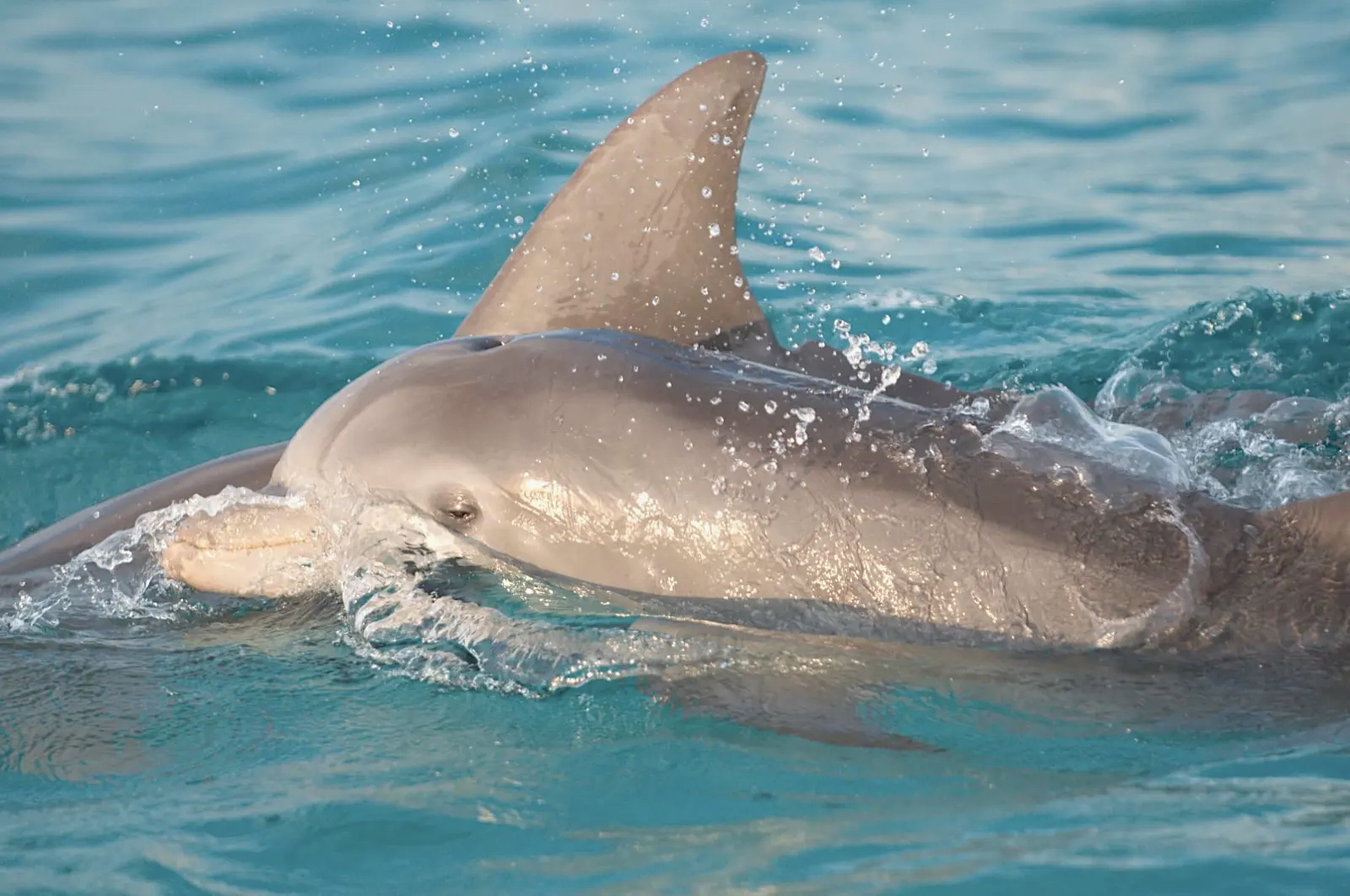
Recent weather conditions have mostly been perfect for launching the new BMMRO boat and continuing with ongoing marine mammal research. The field work at the moment is one aspect of the ‘Saving Abaco’s Dolphins after Hurricane Dorian’ project.
Acoustic research involves deploying specialised recorders to monitor sub-surface noise levels such as ship-generated sound. This helps to determine the effects of underwater noise pollution on marine mammals. Areas of concern can be identified and monitored. Naturally the dolphins take a keen interest as well, and there is plenty of opportunity to enjoy their company out on the water.
More general research includes compiling intricate records of dolphins encountered, noting specific characteristics. The dorsal fin is generally the most helpful ID marker, as they are all different – especially when there is some wear and tear to go by.
BMMRO records for dolphins go back a long way, and often involve two or more generations of the same family. Amazingly, during the last few days, a dolphin was encountered whose mother was first seen as a calf in 1992…
BMMRO are hosting a meeting in Hope Town to explain recent work and its results
BMMRO intern Jaylen gets to admire dolphins at close quarters in the Sea of Abaco
There are twelve species of tern – ‘swallows of the sea’ – that to a greater or lesser extent may be found on Abaco. Whether they will actually be visible at any given time is less certain, though. For a start, the only resident species is the lovely Royal Tern, available at many locations on Abaco and the cays throughout the year. The rest are migratory or just passing through.
PERMANENT RESIDENTS
ROYAL TERNS Thalasseus maximus PR1
MIGRATORY TERNS: SUMMER
In the slightly less commonly-found category are the summer migrant terns that, by definition, are only in residence for around half the year. Four of these are fairly common in certain areas, and actually breed on Abaco; these include arguably the prettiest of all, the bridled tern. The other two tern species (gull-billed and sandwich) are more rare and as far as I can make out do not breed locally; or perhaps only rarely.
LEAST TERN Sternula antillarum SR B 1
BRIDLED TERN Onychoprion anaethetus SR B 2
ROSEATE TERN Sterna Dougallii SR B 2
SOOTY TERN Onychoprion anaethetus SR B 2
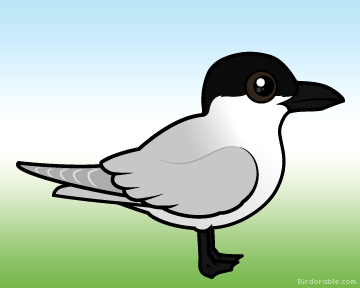
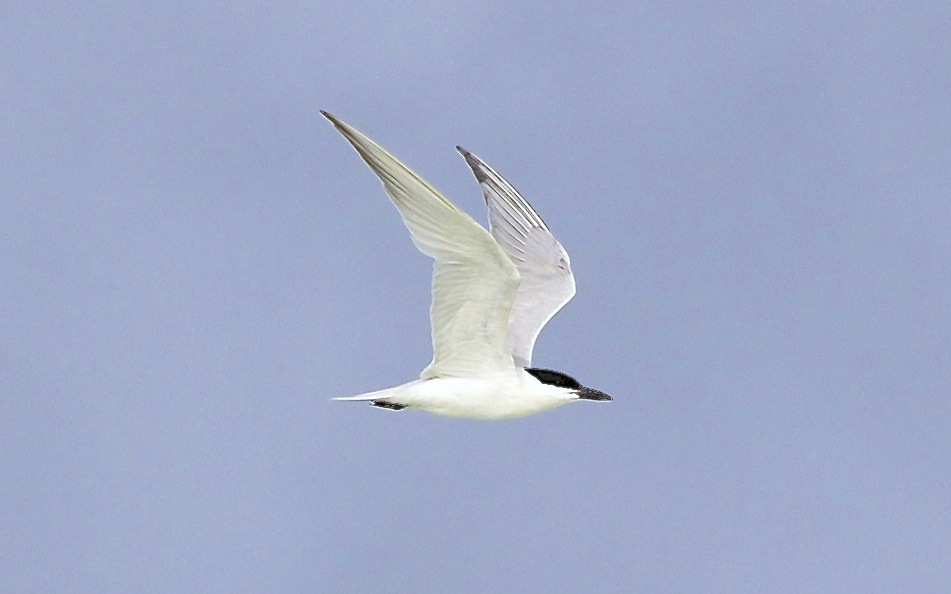
GULL-BILLED TERN Gelochelidon nilotica SR 3
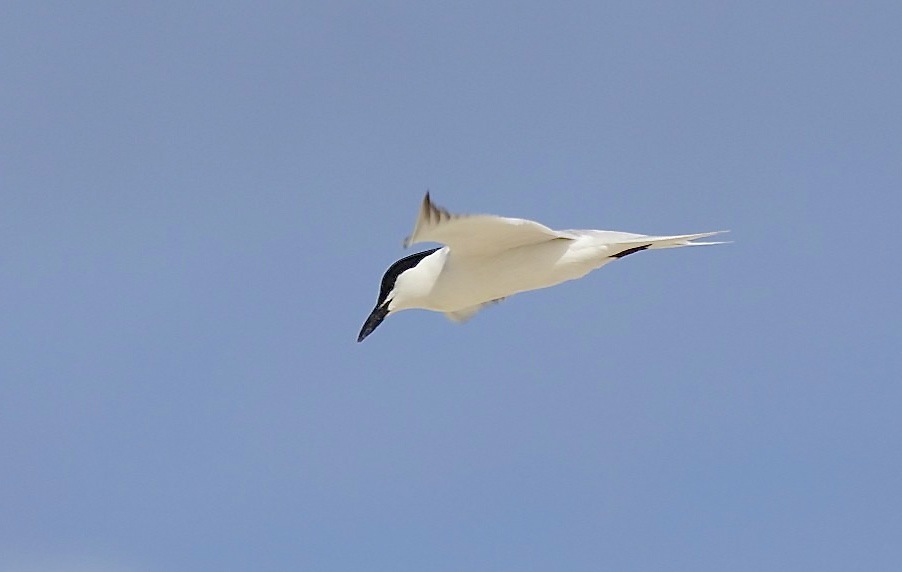
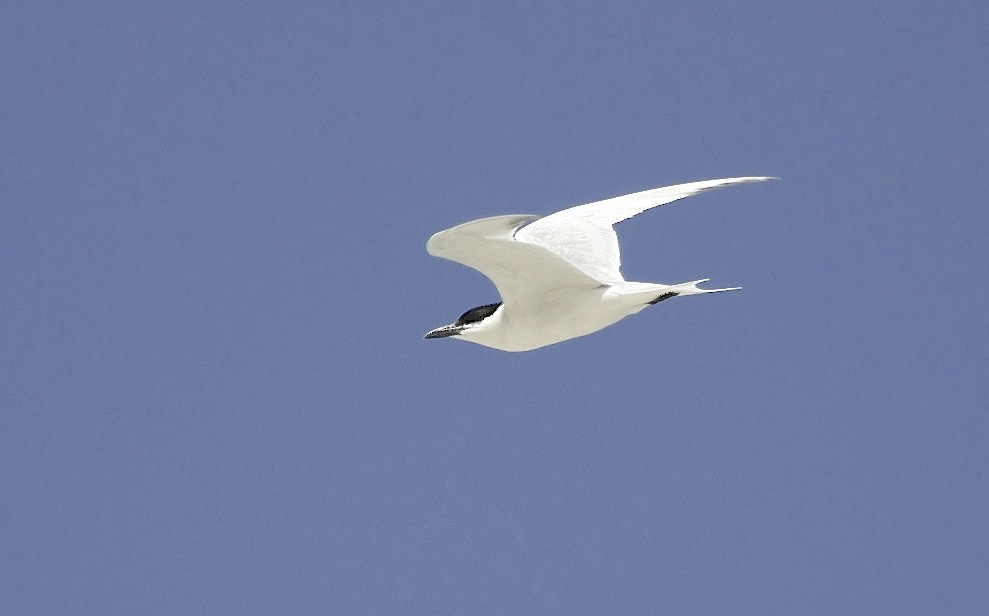
SANDWICH TERN Thalasseus sandvicensis SR 4
MIGRATORY TERNS: WINTER
There is one very rare winter resident migratory tern species, with few records of sightings for Bahamas and until early 2019, no photographic record for Abaco until Sally Chisholm saw one at Treasure Cay and managed to capture it for posterity.
FORSTER’S TERN Sterna forsteri WR 4
OCCASIONAL & RARE VISITORS
A further four tern species are very much occasionals that drop by. Three of them pass over the Bahamas on their longer migration, but may make a pit-stop around Abaco to take on fuel. Likelihood of sighting one? Slender but not impossible… the Caspian tern below was photographed on Abaco. The fourth, the Arctic Tern, is a very rare vagrant, a bird well away from its usual home or migration route as the result of storms or faulty satnav or sheer happenstance. Don’t travel to the Bahamas intent on seeing one.
CASPIAN TERN Hydroprogne caspia TR 4
The remaining species are the transient black tern and common tern; and the vanishingly rare vagrant Arctic tern. No photos of any of these I’m afraid. Here’s a handy checklist of all the tern species.
ELECTIVE MUSICAL DIGRESSION
Written by Pete Seeger, Turn x 3 was released in 1965, the title track on the second album by The Byrds. At a rather febrile time in US history (Vietnam, draft riots, civil rightists v cops and so on), this unusually palliative and thoughtful song with its religious connotations to some extent stood for peace and hope in a time of turmoil.
PS the somewhat laboured title of this post shoehorns in the name of another Byrds album, ‘The Notorious Byrd Brothers’
Photo credits: Keith Salvesen (1, 2, 3, 5, 18); Tony Hepburn (4); Alex Hughes (10, 11); Bruce Hallett (6, 7, 12); Woody Bracey (8, 13, 16); Duncan Wright (9); Dick Daniels (14); Sally Chisholm (15); Keith Kemp (17)
‘CARRION SCAVENGING’: TURKEY VULTURES IN ABACO BAHAMAS
Turkey Vultures (Cathartes aura) manage to be simultaneously majestic, hideous, revolting and socially vital, all packed into a single species. There is, as yet, no ‘International Turkey Vulture Appreciation Day’. But perhaps there ought to be?
THE FACTS
The word ‘vulture’ derives from the latin word ‘vulturus‘ meaning ‘ripper’, ‘shredder’, or ‘very loud Metallica song*‘.
TUVUs have very good eyesight, and an acute sense of smell that enables them to detect the scent of decay (from the release of the chemical ethyl mercaptan) from a distance. They head for the source with relish. To them, it is just a meal. A breeding pair will raise two chicks, which revoltingly are fed by the regurgitation of all the rank… oh, you fill in the rest…
These large vultures are often seen in a spread-winged stance, which is believed to serve multiple functions that include drying the wings, warming the body, and baking bacteria. Possibly it also reduces the miasma of rotting meat that may surround them after a good lunch.
TUVUs like best to perch on a vantage point – utility posts or wires are ideal.
You won’t ever hear them sing or call. They lack aSYRINX(the avian equivalent of a larynx), and their vocalisation is confined to grunting or hissing sounds. Here’s a hiss (at 10 / 15 secs).
10 SCAVENGED TURKEY VULTURE FACTS FOR YOU TO PICK OVER
One local name for TUVUs is ‘John Crow’
An adult has a wingspan of up to 6 feet
Sexes are identical in appearance, although the female is slightly larger
The eye has a single row of eyelashes on the upper lid and two on the lower lid
TUVUs live about 20 years. One named Nero had a confirmed age of 37
LEUCISTIC (pale, often mistakenly called “albino”) variants are sometimes seen
Leucistic TUVU
TUVUs are gregarious and roost in large community groups
They have few natural predators (perhaps for reasons of their hygiene deficiency)
Elegant in flight and users of thermals, but ungainly on the ground and in take-off
Nostrils are not divided by a septum, but are perforated so…
From the side one can see through the beak
REVOLTING CORNER / DEPT OF ‘WAY TOO MUCH INFORMATION’
SQUEAMISH? THEN LOOK AWAY NOW
UNATTRACTIVE HABITS The Turkey Vulture“often defecates on its own legs, using the evaporation of the water in the feces and/or urine to cool itself, a process known asUROHIDROSIS.This cools the blood vessels in the unfeathered tarsi and feet, and causes white uric acid to streak the legs”. The droppings produced by Turkey Vultures can harm or kill trees and other vegetation. Maybe don’t park your nice car under one of their perching posts…
HORRIBLE DEFENCES The main form of defence is“regurgitating semi-digested meat, a foul-smelling substance which deters most creatures intent on raiding a vulture nest. It will also sting if the predator is close enough to get the vomit in its face or eyes. In some cases, the vulture must rid its crop of a heavy, undigested meal in order to take flight to flee from a potential predator”
DIETARY NOTES TUVUs tend to prefer recently dead creatures, avoiding carcasses that have reached the point of putrefaction. They will occasionally resort to vegetable matter – plants and fruit (you could view this as their side-salad). They rarely, if ever, kill prey – vehicles do this for them, and you’ll often see them on roadsides feeding on roadkill. They also hang around water, feeding on dead fish or fish stranded in shallow water.
ECO-USES If you did not have birds like this, your world would be a great deal smellier and less pleasant place, with higher chance of diseases from polluted water and bacterial spread. TUVUs kept the highways clear and work their way round the town dumps recycling noisome items. Humans need them although, conversely, they don’t need humans.
FORAGING TUVUs forage by smell, which is uncommon in birds. They fly low to the ground to pick up the scent of ethyl mercaptan, the gas produced by the beginnings of decay in dead animals. Their olfactory lobe in the brain is particularly large compared to that of other animals.
SEX TIPS Courtship rituals of the Turkey Vulture involve several individuals gathering in a circle, where they perform hopping movements around the perimeter of the circle with wings partially spread. In humans, similar occasions are called ‘Dances’. A pair will fly, with the female closely following the male while they flap & dive… then they land somewhere private and we draw the veil…
My favourite graphic of all time
Credits: Craig Nash (1); Keith Salvesen (2); Nina Henry (3, 5, 6); amy-at-poweredbybirds (4); Charlie Skinner (7); Xeno-Canto / Alvaric (sound file); Birdorable (TUVU cartoon); depressingnature.com (puking TUVU); Source material OS & magpie pickings. Adapted and updated from a previous version written a while back
*As Metallica so appropriately wrote and sweatily sang (luckily there’s no verse referencing urination, defecation and puking). ALERT don’t actually play the video if you check on YouTube etc – the song hasn’t aged well! In fact… it was always terrible. Woe woe indeed…
The vultures come See the vultures come for me Fly around the sun But now too late for me Just sit and stare Wait ’til I hit the ground Little vultures tear Little vultures tear at flesh
The Great Egret is actually a heron rather than an egret. It’s a Great Heron. All egrets are members of the heron family Ardeidae, but the converse is not true. As long ago as 1758,Linnaeus awarded the bird the binomial name Ardea alba i.e. ‘Heron white‘. Why it should have been so hard to stick to that authoritative nomenclature, I can’t imagine. Perhaps in time all heron and egret species became so hopelessly confusing for people that it ceased to matter much what they were called.
Maybe it was that type of carelessness that led to people from the mid-c19 onwards eyeing up GREGs as a source of hat feathers and other decorative necessities. As with flamingos and many other beautiful avian species, mankind’s millinery and other fashion needs were satisfied at the expense of gorgeous plumage. Actually, at the cost of the birds’ lives: they were simply shot in huge numbers.
Healthy populations were decimated; for some species they never recovered. For others, the great egret among them, the passage of time and the passing of fashions – backed in many cases with conservation programs – have successfully restored the populations. In 1953 theNational Audubon Society, which was formed at least in part to discourage the killing of birds for their feathers, took a decisive step in the cause of the great egret by making the bird the emblem of the organisation.
Photo Credit: Nina Henry photographed all the egrets in this post. Her wonderful images of this magnificent egret heron made a significant contribution to the “BIRDS OF ABACO” project.
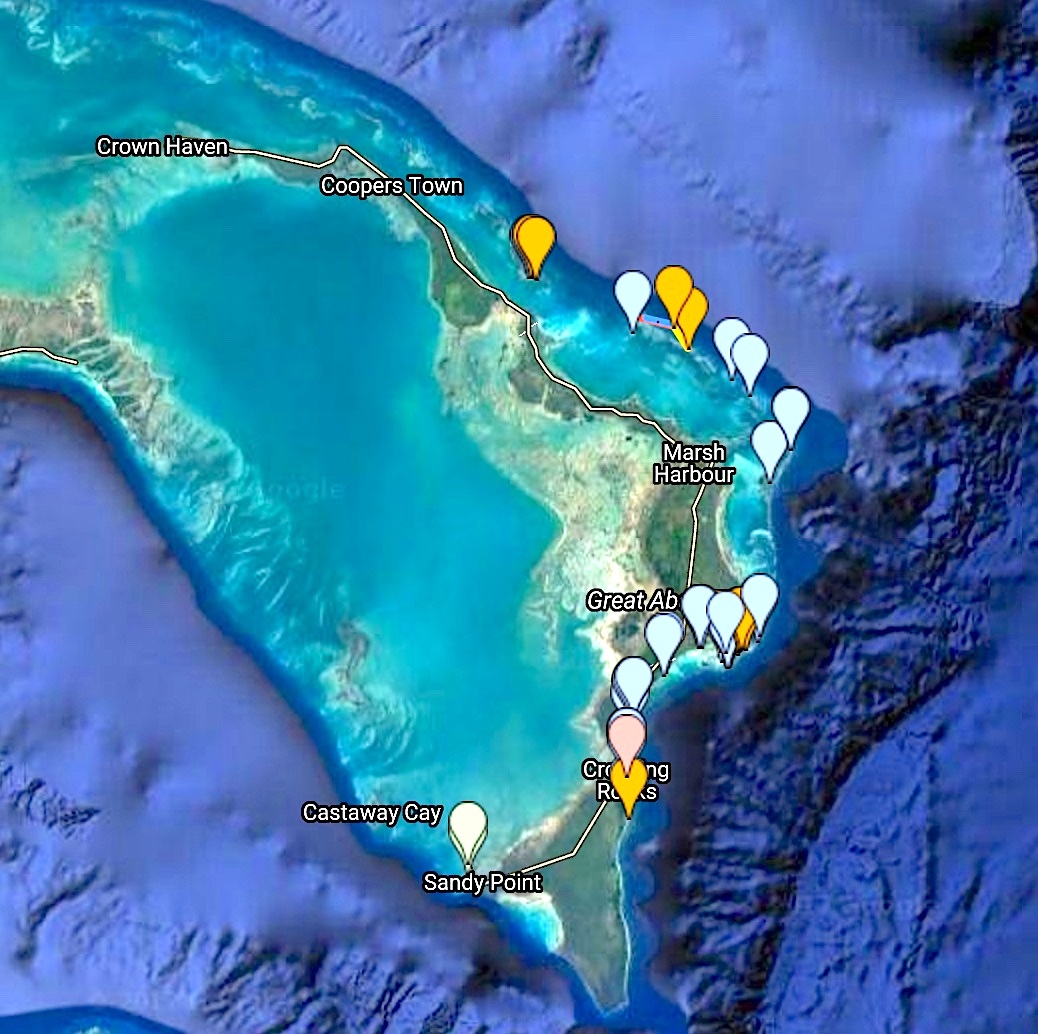
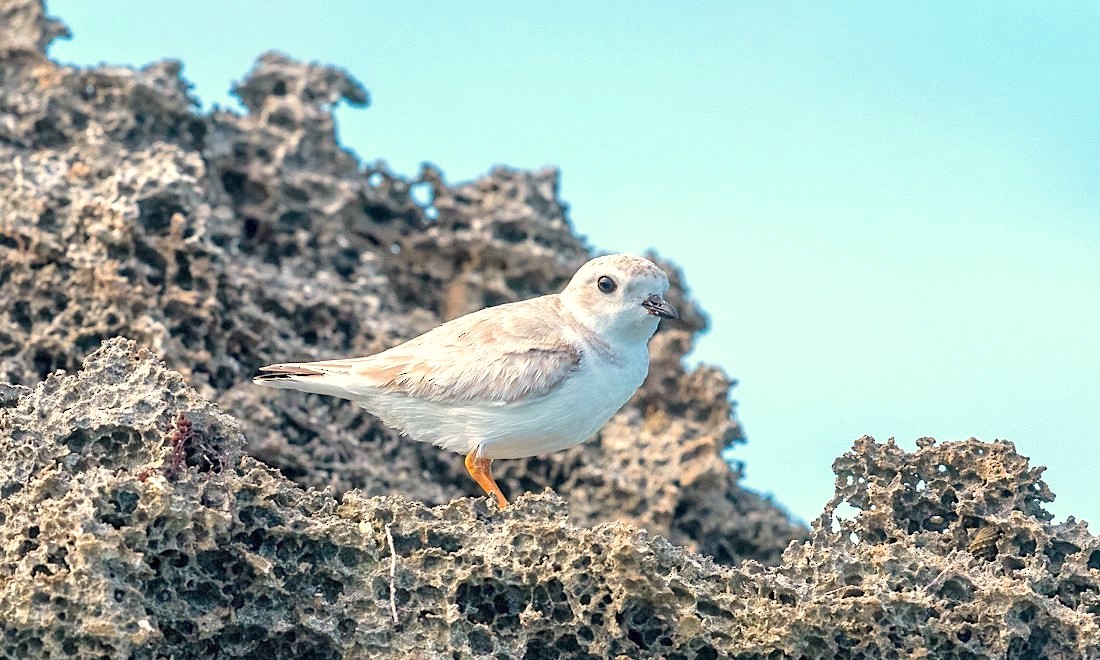
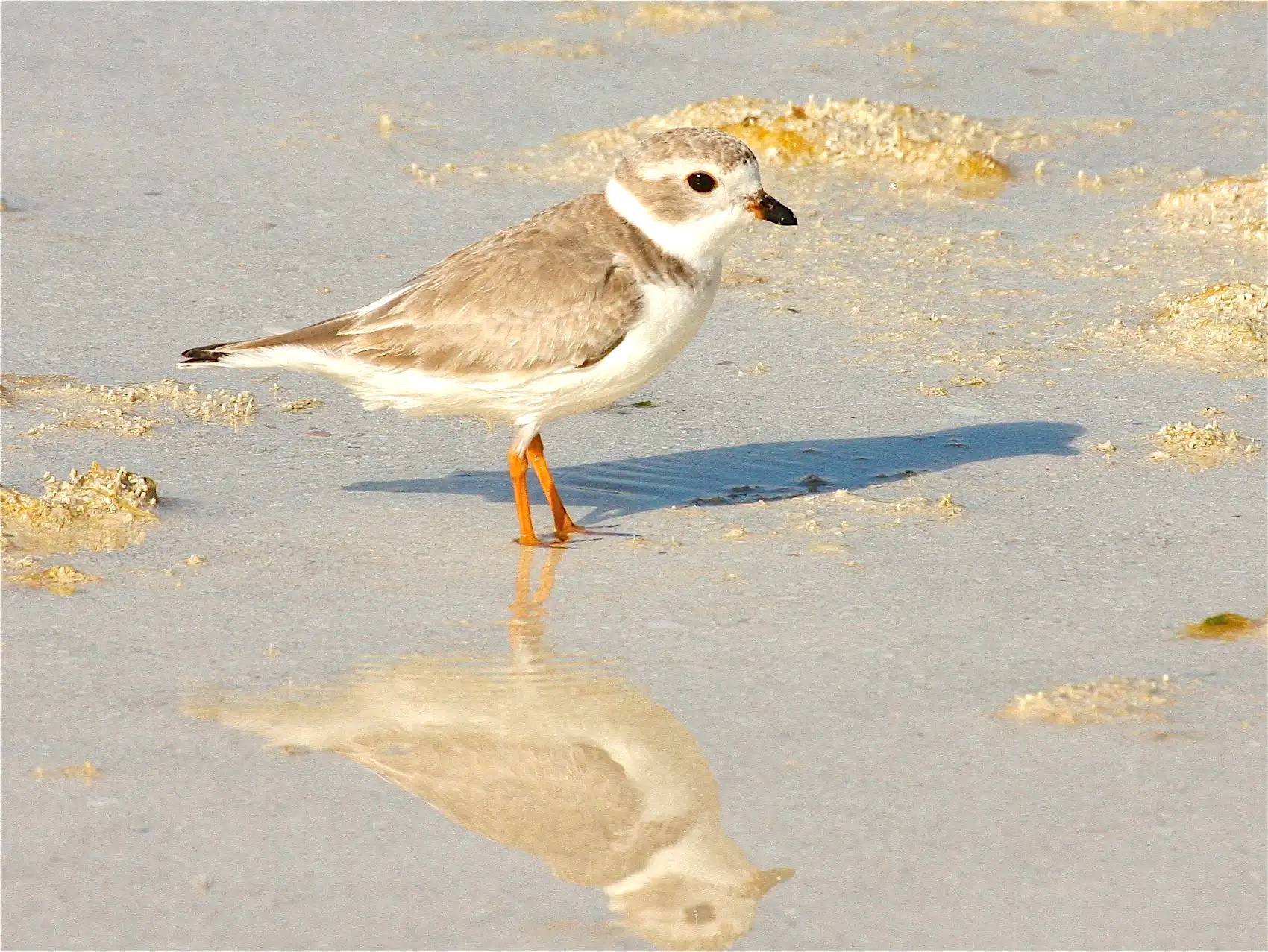
As so often I have missed by 2 days a crucial ‘International Day of the… Whatever’. This time we are celebrating plovers. This group of little shorebirds is appreciated every September 16, and they are high up in my favourites list. Here are examples of the 6 species that you will find on Abaco. Of these, most significant are the piping plovers that chose Abaco beaches – more than 1000 miles from their home beaches in the north – as their migration destination for overwintering (in fact, they start to arrive from the end of July and have left by mid- March).
Semipalmated Plover . Abaco . Bahamas (π Alex Hughes)
KILLDEER
Killdeer . Abaco . Bahamas (π Bruce Hallett)
AMERICAN GOLDEN PLOVER
American Golden Plover . Abaco . Bahamas (π Alex Hughes)
PIPING PLOVERS
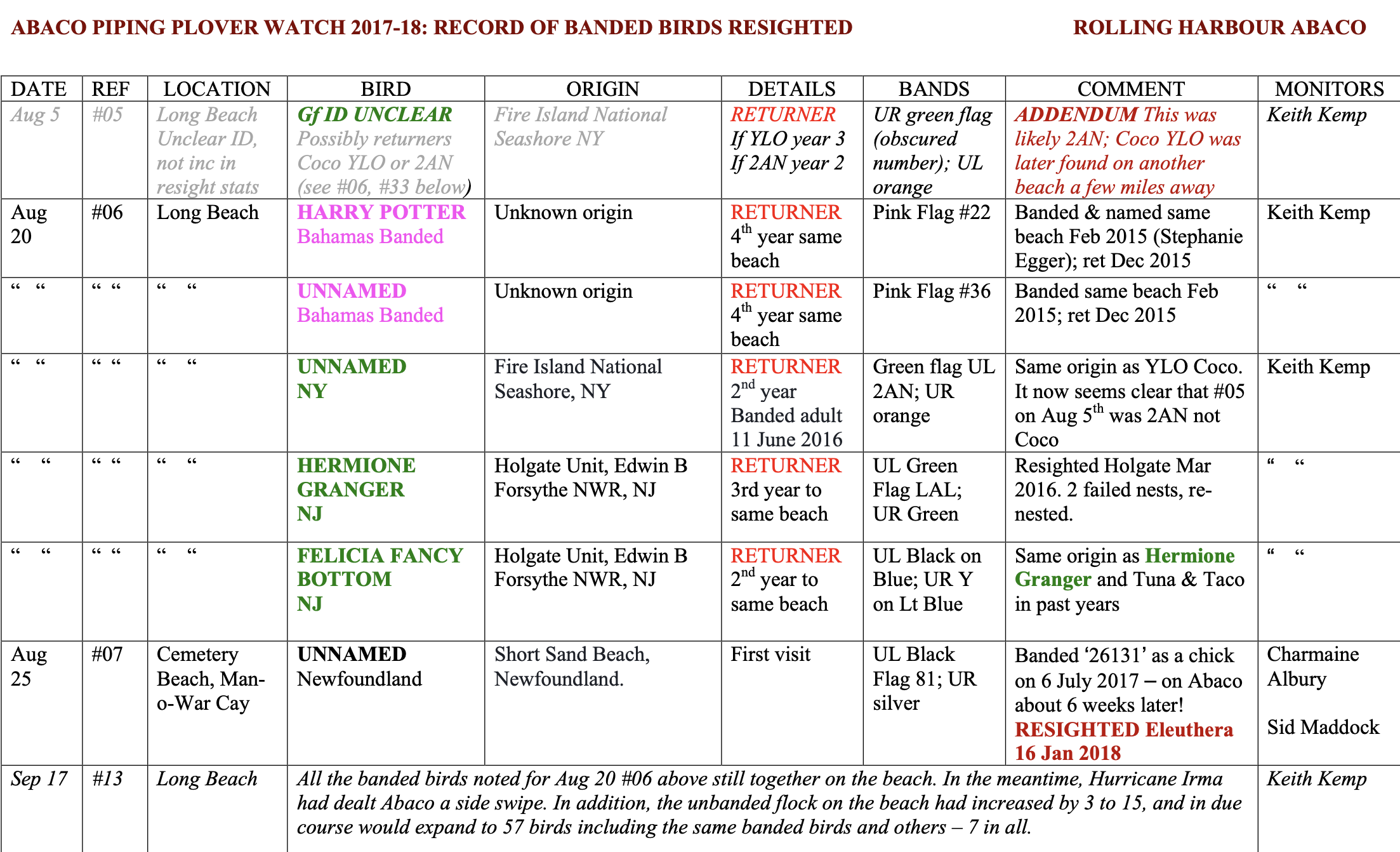
These rare little birds were the subject of a 5-year citizen science project on Abaco involving tracking banded birds sighted on Abaco beaches and tracing their origins to their home beach where the birds had hatched and and fledged. Much remarkable data was recorded, not least that many of the birds made the same journey from their home beach to Abaco and back in the spring 2, 3 and even 4 years running. Each time and at each end of the migration, they chose the same beach. Often the dates almost matched as well. You can find out more HERE
IT’S STARTED The great winter migration of warblers and their imminent arrival in The Bahamas is underway. Any day now – if not already – the ‘winter’ (in fact autumn & early spring as well) warblers will be arriving on Abaco. There are 38 warbler species recorded for the main island and the cays. For years, it was just 37. Then in 2018 a CANADA WARBLER was seen and photographed by well-known Bahamas birder Chris Johnson. It was a first for Abaco – and the first-ever report for the Bahamas as well. You’ll find the story HERE.
This article is updated from an earlier one written pre-Dorian and the situation will undoubtedly be different now, especially with the transients and rare species. Consider it as a historical record of the prolific warbler species recorded for Abaco and more generally the northern Bahamas before the hurricane struck. The 5 permanent resident warbler are still resident. Many migrants and possibly all transients have sadly not been recorded since, and the rarest perhaps never will be. The hope must be that at least the most common winter warblers will continue to arrive, and in increasing numbers.
First-ever Canada Warbler for Abaco & the entire Bahamas: Aug 2018 (Chris Johnson)
Hooded Warbler, Abaco Bahamas (Chris Johnson)
The guide divides the original 37 species (excluding the Canada warbler) into categories, with a code for each bird to show:
Resident status – permanent / breeding, migratory or transient
Frequency – likelihood of seeing each species in its season, rated from 1 (very likely) to 5 (extreme rarities, maybe recorded only once or twice since c1950 when recording began)
Numerically, the division breaks down into 3 categories of warbler:
5 permanent residents (PR) that breed on Abaco (B), of which two are ENDEMIC
21 winter residents (WR) ranging from ‘everyday’ species to extreme rarities like the very vulnerable Kirtland’s Warbler that needs a specific winter habitat that Abaco can provide
11 transients, most of which you will be very lucky to encounter
Palm Warbler, Abaco Bahamas (Nina Henry)
The photos that follow show an example of each warbler, where possible both (1) male and (2) taken on Abaco. Where I had no Abaco images – especially with the transients – I have used other mainstream birding resources and Wiki. All due credits at the foot of the post.
PHOTO CREDITS (1 – 37) Bruce Hallett (Header, 3, 9, 12, 14, 17, 21, 22); Tom Reed (1, 4); Cornell Lab (2); Tom Sheley (7, 10); Alex Hughes (5); Gerlinde Taurer (6, 11, 18); Becky Marvil (8, 20a); Woody Bracey (13, 24); Peter Mantle (15); Keith Salvesen (16); William H. Majoros wiki (19); talainsphotographyblog (20b, 26, 34); Charmaine Albury (23); Craig Nash (25); Ann Capling (27); Jerry Oldenettel wiki (28); Dominic Sherony wiki (29); 10000birds (30); Steve Maslowski wiki (31); MDF wiki (32, 33); Avibirds (35); Michael Woodruff wiki (36); Emily Willoughby wiki (37)
CHECKLISTbased on the complete checklist and codes for Abaco devised by Tony White with Woody Bracey for “THE DELPHI CLUB GUIDE TO THE BIRDS OF ABACO” by Keith Salvesen
‘THE DITZY CHICKS’ & ‘THE BEACH BYRDS’: BANDS TO ADMIRE
WORLD SHOREBIRDS DAY – PIPING PLOVER MIGRATION
Piping plovers are rare, tiny, unutterably cute, weigh about 2oz – and every Fall they fly south 1000 miles or more to warmer climes. Abaco is one such clime. The data collected during the 4 years of the ABACO PIPING PLOVER WATCHproject shows annual counts of ±250 individual birds found either in flocks in specific hotspots, or more randomly in small groups, pairs or singles. Certain areas on the Cays are also popular. Of all these, around 10% have been banded in their breeding grounds, almost always as chicks – many with in a day or two of hatching.
‘CHEROKEE’
SQUID’S KIDS
To set the scene (the story is developed below). The 3 tiny chicks with the ring bling in the large photos hatched at a Wildlife Refuge in New Jersey about 10 days ago. Their parents are Squid and Sophie. The scientists who captured, weighed, measured and banded them also named them, for reasons which will become apparent, Keith, Cherokee and Abaco. This post aims to explain the background story, and in particular the great significance of banding as a tool of research into rare species.
At the outset – and because a few people express concern – I’d better add that no deleterious effects arise from banding. The bands are not constricting, and the birds are unaware of them. Individual banded birds are often seen year after year at either end of their migration or at both; and sometimes during stopovers along the way: they have all survived being banded, Also, if the scientists and conservationists were to take risks with the chicks in their care by using inappropriate methods, they would in fact be damaging or destroying the very creatures they have dedicated their skills to preserving.
WHAT’S SO SPECIAL ABOUT THIS SPECIES?
PIPL are not just rare, they are IUCN Red-listed as ‘near-threatened’. Last Autumn the IUCN estimate for adult birds was 8000 (now, in 2021, a greater number). The summer breeding grounds are located in quite specific areas of North America and Canada.
These vulnerable little shorebirds nest in scrapes on the beaches and forage on the shoreline. They face many dangers including predation (eg gulls, cats, foxes), human activities and disturbance (eg the inalienable right to use beaches for off-road fun), and habitat degradation (eg. development, encroachment, and pollution). This last is the greatest problem of the three, and it is of course the responsibility – or fault – of humans. Fortunately, the establishment of extensive coastal / shoreline wildlife refuges has provided managed habitat and careful protection in some areas.
‘ABACO’
WHERE DOES BANDING COME INTO ALL THIS?
For the purposes of the ongoing scientific investigation and conservation research, the wildlife organisations in each area carry out programs to examine, measure, weigh and band birds on their ‘home’ beach. This process builds a database year on year against which the health of the birds and also the habitat can be measured.
Banding enables individuals to be identified and observed in the breeding grounds; and crucially, where the birds overwinter (see below). Birds are given flags or bands or both in unique combinations. These may be put on one or both legs; mostly they will be on the upper leg(s), but sometimes the lower legs are also used; unique alphanumerics or coloured dots provide further means of ID. Some locations have a tradition of naming the chicks during banding. Thus one Abaco bird ‘Green Flag AH3’ became ‘Atari’ . Felicia Fancybottom is the most exotic name so far (she had a random posterior-feather sticking out when banded).
On Abaco, we sometimes give unnamed overwintering banded birds an ID to avoid confusion, for easy reference, or actually just for fun. For example Green Flag 70E became (obviously) ‘Joe’.
Bander’s Box
HOW THE SYSTEM WORKS IN PRACTICE
MANY HAPPY RETURNS FOR ‘SQUID’
January 2, 2018 a female bird called ‘SQUID’ was resighted on Abaco at Casuarina. Her bands were: upper left, blue on black; upper right, green on red (photo below). Checks of the band combination produced the following information:
originated from the Holgate unit of Edwin B. Forsythe NWR in NJ, banded there as a female
monitored and researched by Conserve Wildlife Foundation NJ
recorded at the same location the previous summer so had already completed Fall and Spring migration, returning to the same beach where she hatched and fledged.
named for the bander’s mom’s cat
‘SQUID’
July 29 2018 SQUID was resighted for the second year at the same location on Casuarina flats, Abaco, the first banded bird of the season. She was also the last to leave, in mid-March – a stay of of around 8 months. During that time, APPW beach monitor Keith Kemp saw Squid on several occasions, all in the immediate area of Cherokee Sound (of which Casuarina is a part).
LATE MAY / EARLY JUNE 2019 Resighted for the third season at EBF, and nested with male (as it has turned out) called Sophia! Sexing tiny newly hatched chicks is not an exact science. Originally there were 4 eggs, but on June 2 only 3 chicks hatched – ‘nature’ had intervened with the 4th. They were named ABACO, CHEROKEE… and KEITH (a kindly nod both to monitor Keith Kemp and perhaps to me as well). The chicks were captured by Michelle Stantial of SUNY, in conjunction with CWFNJ, to be banded, weighed, and measured so they can be monitored and assessed for growth, beach activity, and protection purposes. In a couple of months these chicks will themselves feel the urge to fly south, and will continue the annual PIPL migration cycle.
Squid being banded by Michelle Stantial in July 2017
WHAT HAS THE RESEARCH REVEALED SO FAR – AND IS IT USEFUL?
SQUID is an excellent example of conservation, research, and science (both pro and citizen) in action. From his story we can conclude the following:
Squid has been on the same summer beach in NJ for 3 years running
She has also overwintered for 2 years running in the same location on Abaco
So she has flown 4 migrations of c1000 miles with extraordinary location accuracy
This is a prime example of ‘beach loyalty’, a vital ingredient for species conservation
At 2 oz, she is a doughty and determined survivor of all the dangers arising from such long journeys
The habitats at both ends of the migration are good and safe, without notable degradation
The nesting success with A, C and K adds 3 more birds to the population, if they all fledge and survive
There is every chance that Squid will be seen on Abaco this Fall
There is some chance that at least one of the chicks will turn up on Abaco too; or in the Bahamas anyway
This story is one example of many similar ones that occur every season. One plover, Bahama Mama from Michigan, has spent the last 5 winters on the same Abaco shoreline. Overall, there is optimism that the conservation measures in place will prevent the decline and encourage the increase of the species. There’s a lot of dedication that goes into all this. I think it can be fairly said that the story of Squid and Sophia’s little family is a both reward for that dedication, and a sign of hope for the future.
NOT THE DITZY CHICKS!
Credits: Michelle Stantial / SUNY; Todd Pover / CWFNJ; Holgate Unit EBF NWR; Stephanie Egger (now with NOAA); photos from Keith Kemp, Kim / CWFNJ, ‘Northside’ Jim Verhagen LBI
Goodbye, and well done for sticking it out to the end
West Indian Woodpecker . Abaco . Bahamas (π Keith Salvesen)
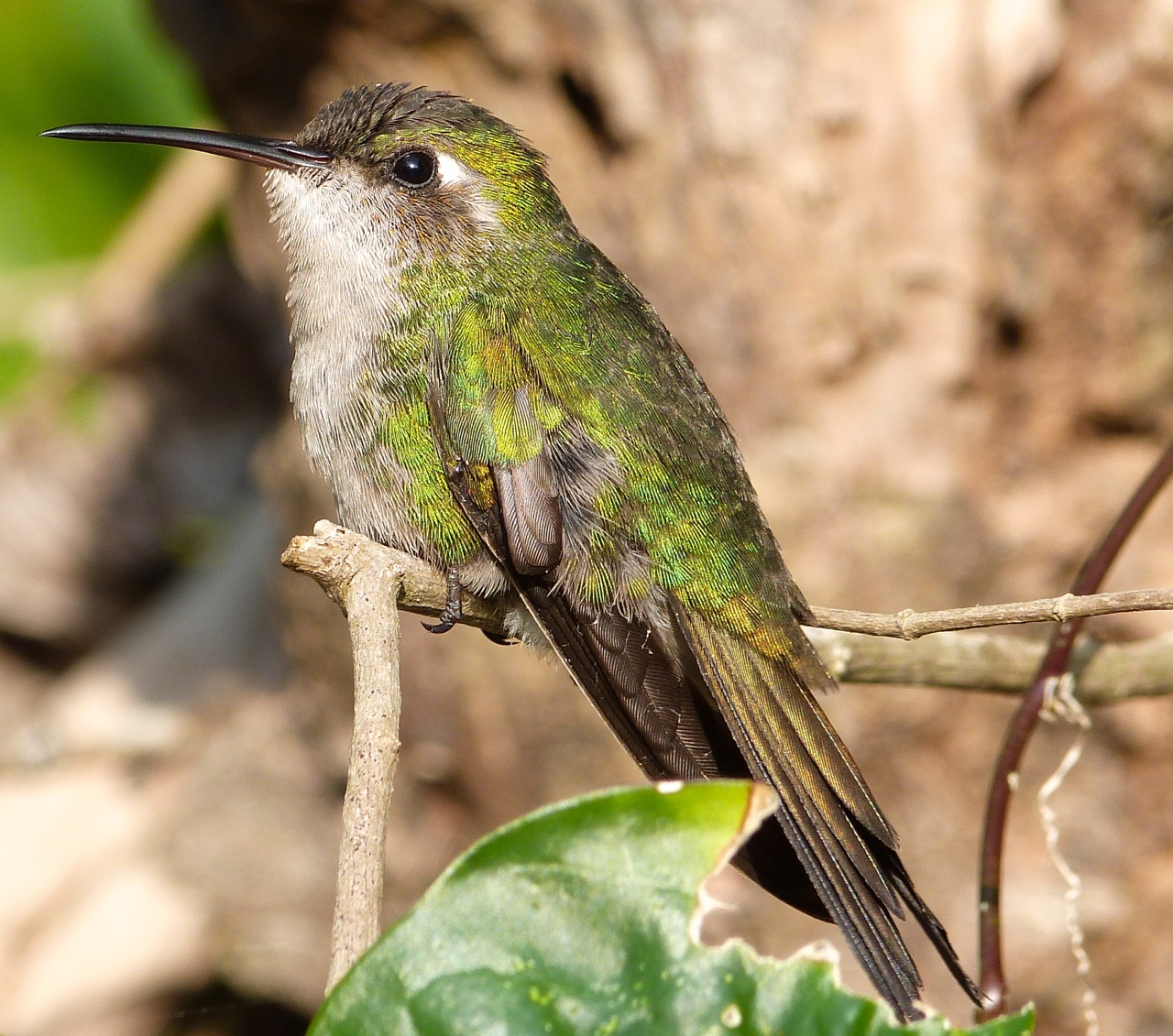
The WEST INDIAN WOODPECKER Melanerpes superciliaris is one of Abaco’s specialist birds. Islanders and regular visitors will be familiar with the sight – and indeed the raucous sound – of these beautiful birds. They are commonly found throughout Abaco and the cays. Possibly their rarity across the wider Bahamas is underestimated. The only other island where these birds are found is San Salvador. Formerly resident on Grand Bahama, they are believed to be extirpated there. Abaco is very fortunate to enjoy their noisy company.
These little birds are far from rare, but watching a flock of them scuttling back and forth on the sand, in and out of the tide, is always a treat. And as you will notice, when they are foraging in earnest they not only stick their bills into the sand right up to the base… they go for total immersion of the head!
These very pretty shells, with their striking pink radials, are sometimes known as ‘rose-petal shells’. They are always tempting to pick up from the sand. The ‘hinges’ (muscles) are very delicate, however, and with many of these shells that wash up on the beach the two halves have separated naturally.
Sunrise tellins are not uncommon, and make good beachcombing trophies They can grow up to about 7 cms / 2.75 inches, and the colouring is very varied, both outside and inside.
TELLIN: THE TRUTH
The occupant of these nice shells is a type of very small clam. They live on the sea-floor, often buried in the sand and with the lid (mostly) shut. When they die (or their shells are bored into by a predator and they are eaten) the shells eventually wash up empty on the beach. There’s not much more to say about them – they perform no tricks and are believed to have vanilla sex lives. Other small clams are quite inventive, doing backflips and copulating with enthusiasm.
Inside Story… not much to tell except (a) very pretty & (b) possible predator bore-hole top right
WHAT ELSE IS THERE TO KNOW ABOUT THEM?
These clamlets have 5 tiny teeth to chew up their staple diet, mainly plant material
These include one ‘strong’ tooth and one ‘weak’ one, though it isn’t clear why. How someone found this fact out remains a mystery
Tellins are native to the Caribbean and north as far as Florida
They live mainly in quite shallow water, but have been found as deep as 60 foot
They have no particular rarity value, and are used for marine-based crafting.
TELLIN LAW
You know those lovely tellins you collected during your holiday and took back home to your loved ones? You did take them, didn’t you? You may have committed a crime! In the Bahamas there is no specific prohibition on the removal of tellin shells, certainly not for personal use… but the general rule – law, even – seems to be “in most countries it is illegal to bring back these shells from holidays”.
Linnaean Examples
As ever, the very excellent Bahamas Philatelic Bureau has covered seashells along with all the other wildlife / natural history stamp sets they have produced regularly over the years. The sunrise tellin was featured in 1995. You can find more – much more – on myPHILATELYpage.
All photos Keith Salvesen / Rolling Harbour; Rhonda Pearce, O/S Linnean Poster, O/S BPB stamp
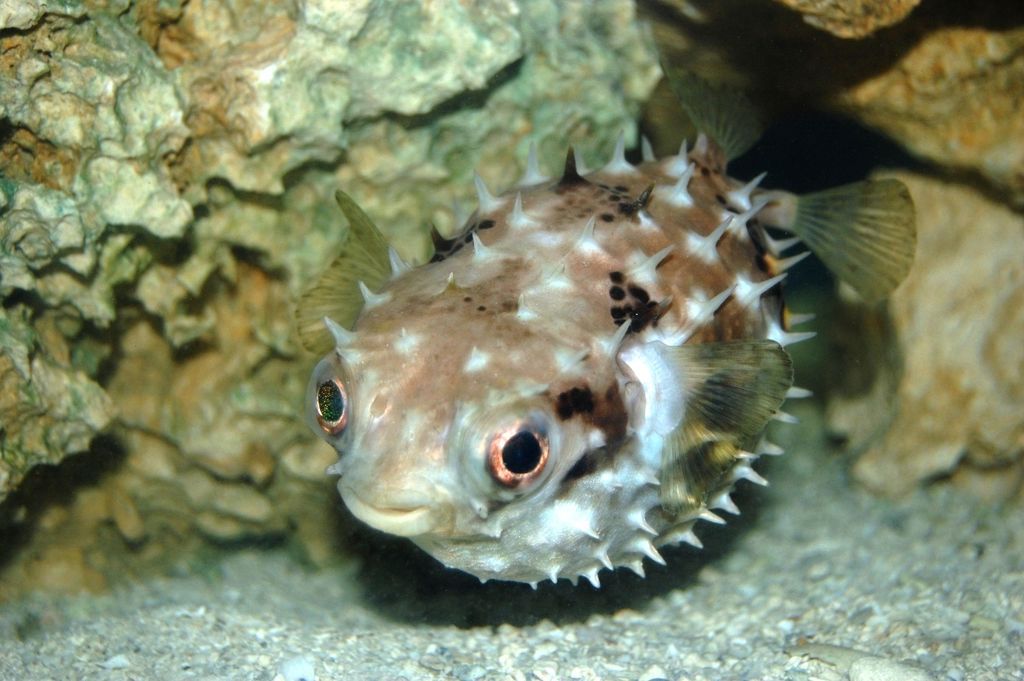
I learn today that this week is Insect Week (or, as it may prefer, The International Week for Insect Appreciation and Protection). I’m all for it. There are annual Days for almost any creature you can think of – Warthogs; Fruit Bats; Porcupine Fish, and so on. There are few whole Weeks devoted to an entire taxonomic class. Here is an insect I wrote about several years ago. It’s an aggressive-looking creaturethat I found in the coppice on South Abaco. I could only get a partial shot of the insect, and I wondered whether to try to reach it and get a more complete shot. Perhaps I could have, but very fortunately for for me (as I later found out) I didn’t touch it.
This creature turned out to be a Spider Wasp (aka Pepsis Wasp), of the Pompilidae family. The insect is familiarly known as a Tarantula Hawk, for reasons given in unsparing detail below. For it turns out that this creature would be the hardest bastard insect on Planet Bastard in the Galaxy Bastardium.
It’s lucky that I didn’t try to try to collect it to keep in a small box as a pet. Note, for start, the scary eating apparatus… and it’s not for nibbling leaves as I had thought, but chopping up small insects. The leg claws and barbs are for pinning down its prey. You would not believe how unpleasant these little buddies are – and that’s before we even mention the sting…
SPIDER WASPS IN ACTION
These wasps are known in some countries as “horse-killers”. The Pepsis wasp is a sub-species, and is called Tarantula Hawk because it hunts tarantulas and uses them in a most ingenious and cruel way… NB theBNT have rightly pointed out that these insects are unaggressive to humans. If you leave them alone, they will spare you. I’ve also read that“The tarantula hawk is relatively docile and rarely stings without provocation”Now read on to see if it might be sensible to provoke one or not.
SCARY CRITTERS & LIVING LARDERS
(Trigger Warning: this is really rather gross)
SPIDER WASPS are ‘solitary’ insects that feed on ground spiders / tarantulas by stinging them to paralyse them, then eating them. In the most sinister way, the females also make use of spiders for breeding purposes. Hear this! They build a nest in a burrow, find a spider (a tarantula for choice), paralyse it with their sting, drag it to the nest and lay a single egg on its abdomen. Then they seal up the burrow.
When the egg hatches, the larva chews a hole on the spider’s abdomen and enters a living larder. It gradually eat its host as it grows. The spider’s vital organs are left till last, so that the spider stays alive as long as possible until the larva has reached full-size. After several weeks, the larva spins a cocoon and pupates (often over winter). Finally, the wasp becomes an adult, bursts Alien-like from the spider’s abdomen (deftly evading Ripley), and tunnels out of the burrow…
Do NOT try this at home or more than 10 yards from a medical centre
SPIDER WASPS: MORE FEARFUL FACTS
Their hunting improves with experience – the more spiders they eat, the quicker they find, attack & kill them
Males use ‘perch territories’ to scan for receptive females from a tall plant or other vantage point, a behaviour known as HILL-TOPPING
Adult wasps also feed on a variety of plants for nectar & pollen. They may become intoxicated on fermented fruit, which affects their ability to get around (I think we’ve all been there at some time…)
The female Pepsis gets her spider in two main ways: approaching a tarantula causing it to rear up defensively on its legs, thus exposing its abdomen to the sting or
She locates a tarantula’s burrow, using her sense of smell. She tricks the spider into emerging by tweaking the web at the burrow’s entrance or ‘intruding’ (see video below)
The wasp uses her long stinger to stab her prey. The poison rapidly paralyses the spider. She then drags it to her burrow, lays her egg onto the tarantula’s abdomen, seals the burrow and leaves. Job done
The hooked claws and barbs on the wasps’ long legs are weapons for grappling with victims
The stinger of a female tarantula hawk can be up to 7 mm (1/3 inch) long – and the sting is among the most painful insect stings in the world (see below)
Only the females sting (males may pretend to) because the stinger is linked to the ovipositor (egg-laying organ)
You can distinguish females from males by the curled antennae of the female. Mine was therefore female
The Pepsis wasp has (unsurprisingly) very few predators, though apparently roadrunners and bullfrogs may tackle them
Here is a hypnotically fascinating 3-minute video of the life-or-death struggle
SPIDER WASP –v- TARANTULA
THE STING
The sting of these wasps is among the most painful of any insect, though the most intense pain lasts on a few minutes. Entomologist Justin Schmidt bravely submitted himself to the stings of various insects and described this pain as“…immediate, excruciating pain that simply shuts down one’s ability to do anything, except, perhaps, scream. Mental discipline simply does not work in these situations.”
Schmidt produced his SCHMIDT STING PAIN INDEXThe pain scale, based on 78 species, runs from 0 to 4, with 4 awarded for the most intense pain. Spider Wasps of the species Pepsis – i.e. Tarantula Hawks – have a sting rating of 4.0, described as“blinding, fierce, shockingly electric. A running hair drier has been dropped into your bubble bath”Only the bite of the Bullet Ant – and the sting of the Warrior Wasp – is ranked higher, with a 4.0+ rating, vividly described as“pure, intense, brilliant pain. Like fire-walking over flaming charcoal with a 3-inch rusty nail in your heel”
LIGHT RELIEF AFTER THE PAIN
1. In 1989, New Mexico chose the Tarantula hawk wasp as the official state insect. The choice seems to have been left to schoolchildren and I’m guessing here (or gender-stereotyping) but I suspect it was the boys’ choice that won…
2. Tarantula Hawk is a “psychedelic progressive metal band” from San Diego, Ca. Their short discography includes their debut Tarantula Hawk (CD/LP, 1998); Burrow (Live CD, 2000, self-released); and Untitled. The cover of their debut provides the perfect ending for this post, vividly depicting the colour and texture of the swirling fiery pain you could experience (and I don’t really mean from listening to the music…)
You must be logged in to post a comment.