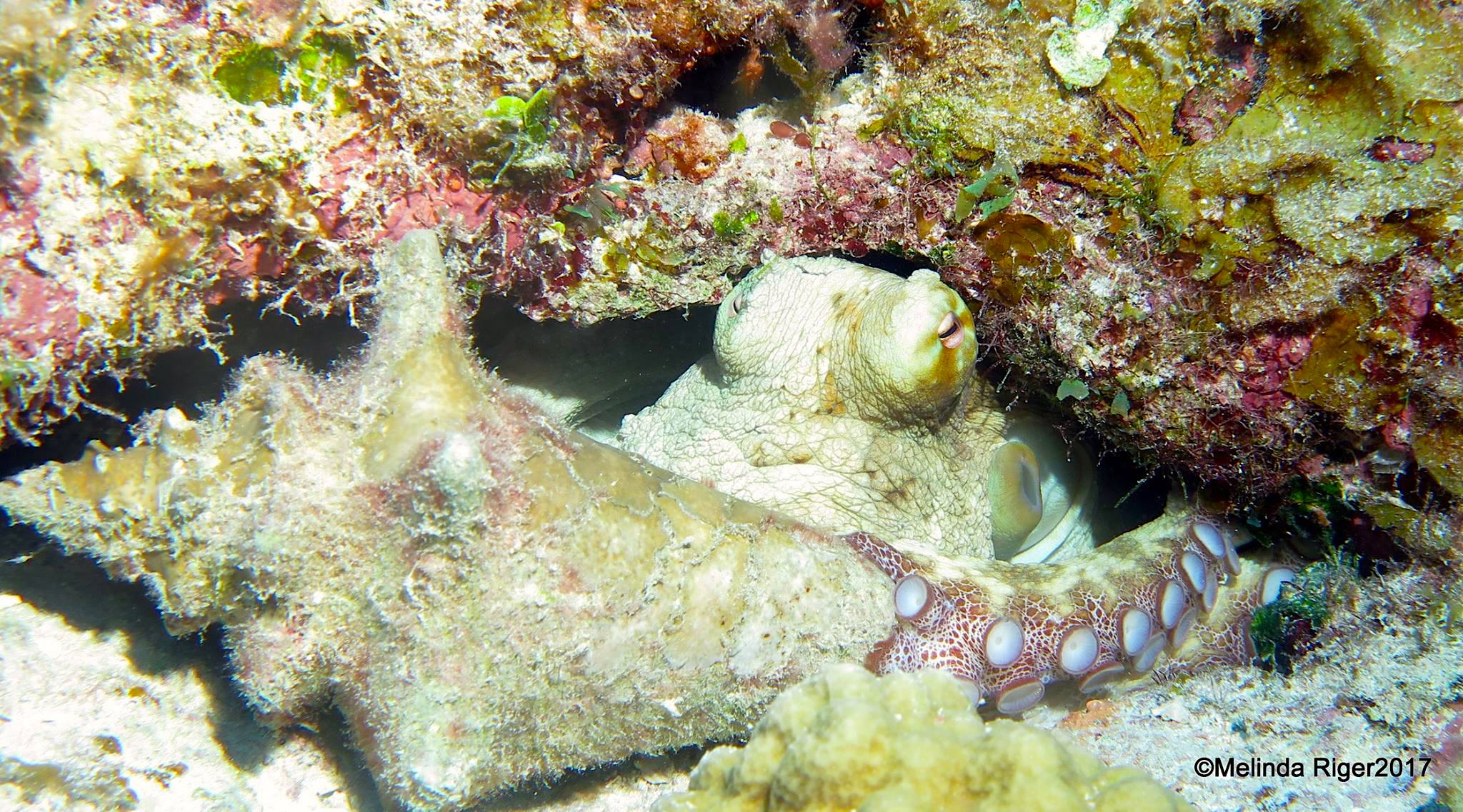
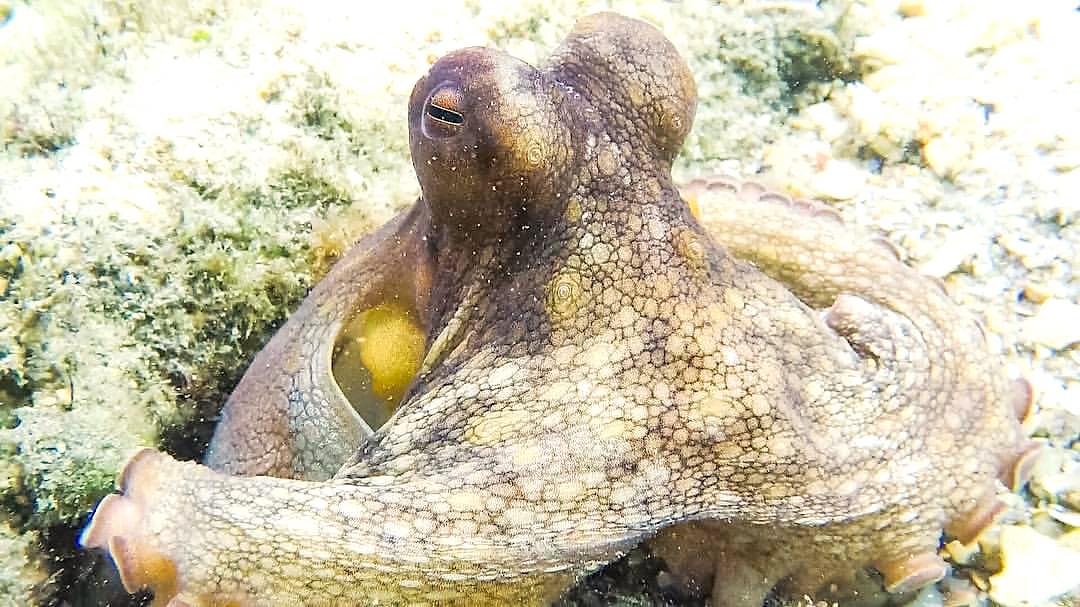
We haven’t seen many octopuses in these parts for quite a while. Time to put that right. The seas of the Bahamas teem with many many marine species, but few are as fascinating or indeed versatile as the octopus. Don’t take my word for it, just watch ‘Finding Dory’ to see how amazing Hank the… [what’s that, Skippy? It’s fiction?]. As you were. That these extraordinary creatures even exist let alone thrive in our waters is a truly wonderful thing. Here are a few to admire – or in the case of the one below, to admire you.
‘Here’s lookin’ at you…’
You can find out some more about octopuses – including the correct plural for ‘octopus’ – by clicking the links below. More importantly, you’ll see more of them too.
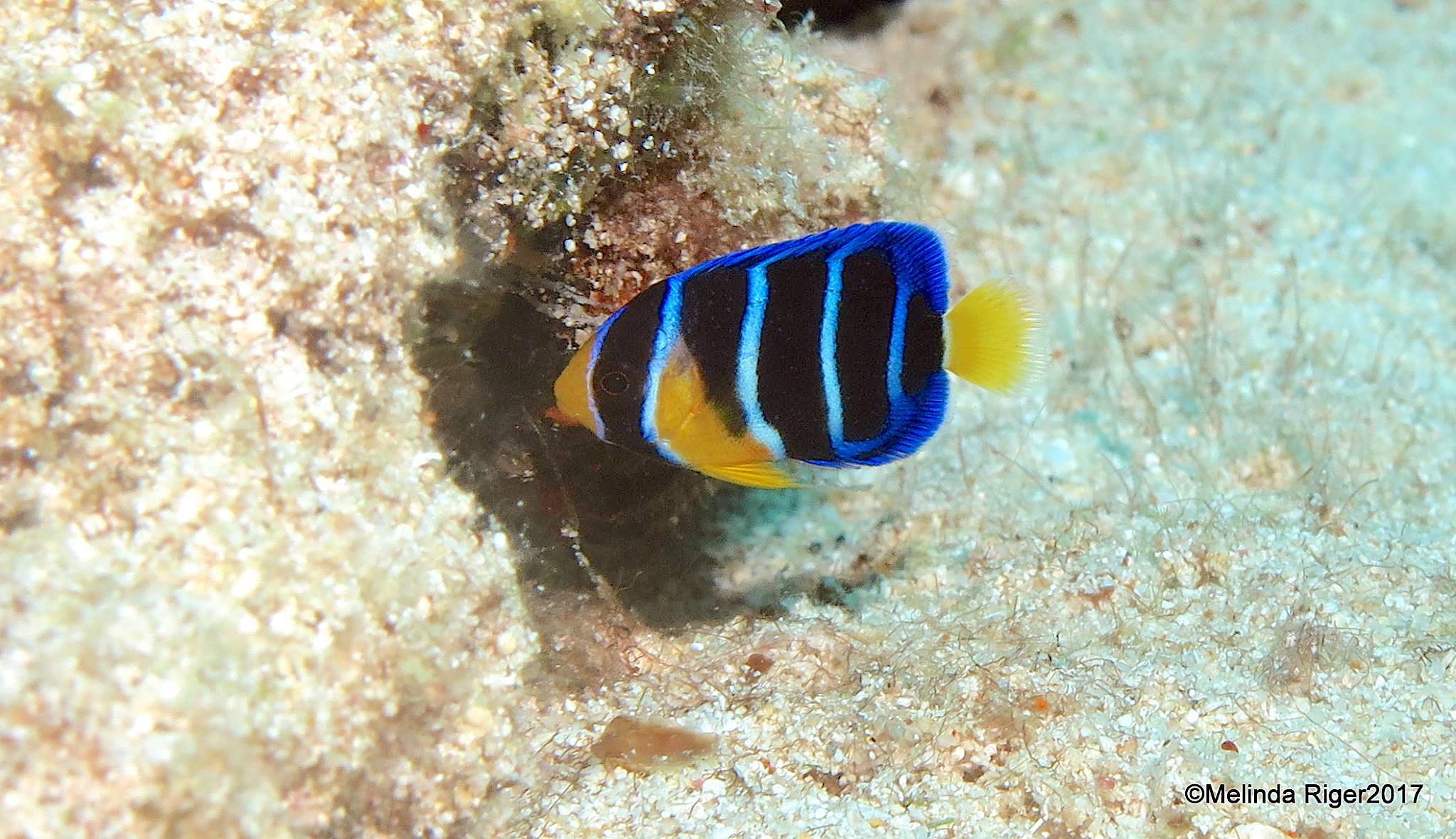
The Queen Angelfish Holacanthus ciliarisis is without doubt one of the most beautiful of all reef fishes in the Bahamas – and the competition is very strong. I have posted about them before, but to my surprise not for nearly 5 years. Too long: here are some much more recent photographs of adults and cute juveniles.
The bright colours, the pouty expressions, the appealing poses – these fish are true Beauty Queens. And helpfully, they are unlikely to be mistaken for any other fish species.
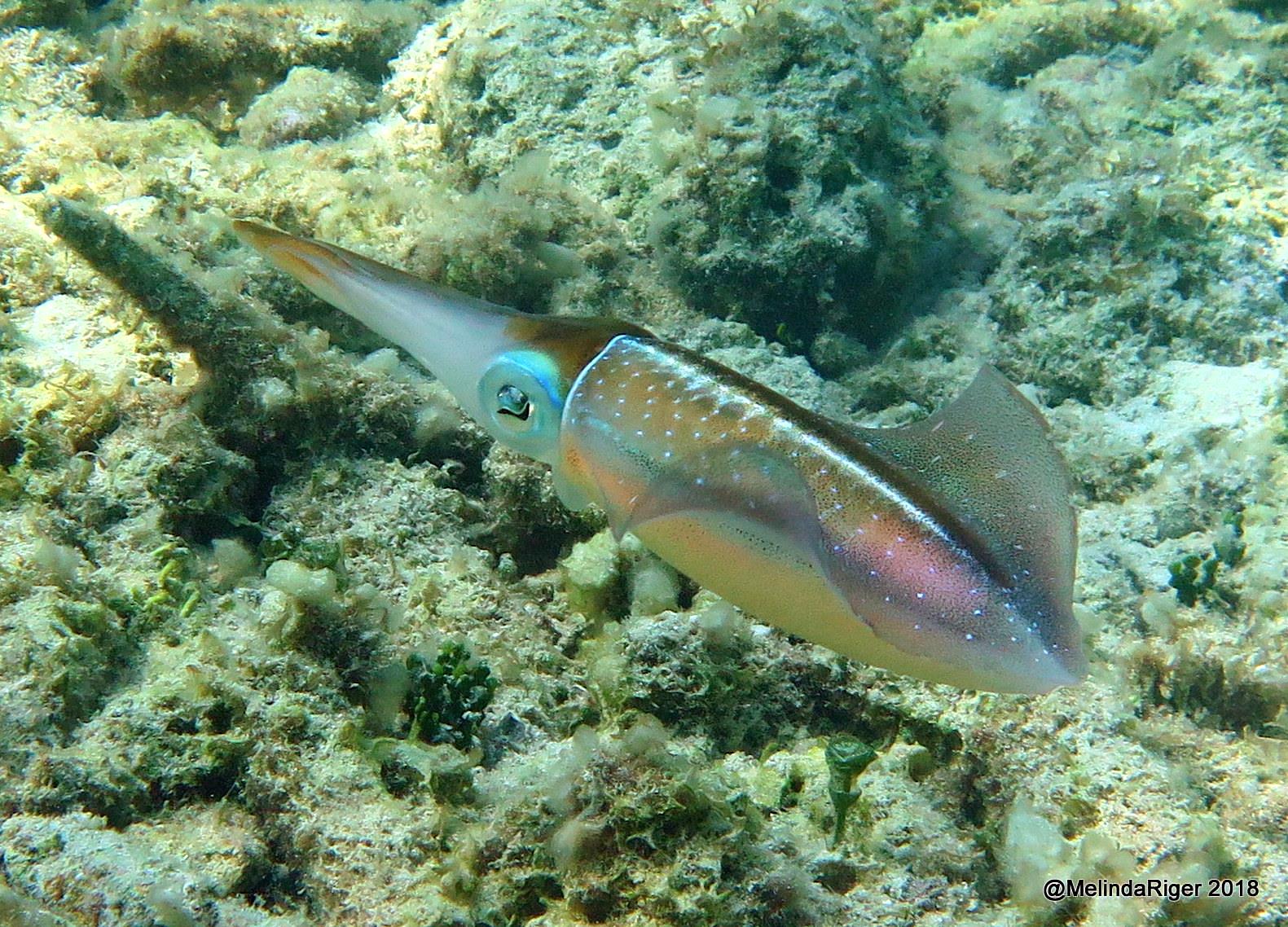
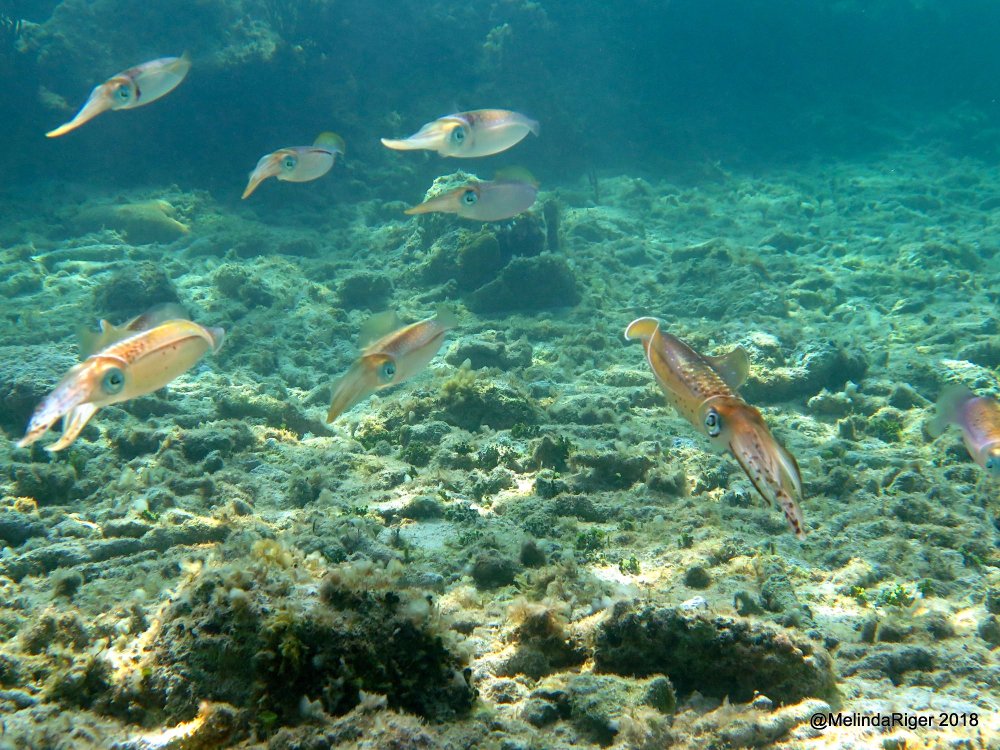
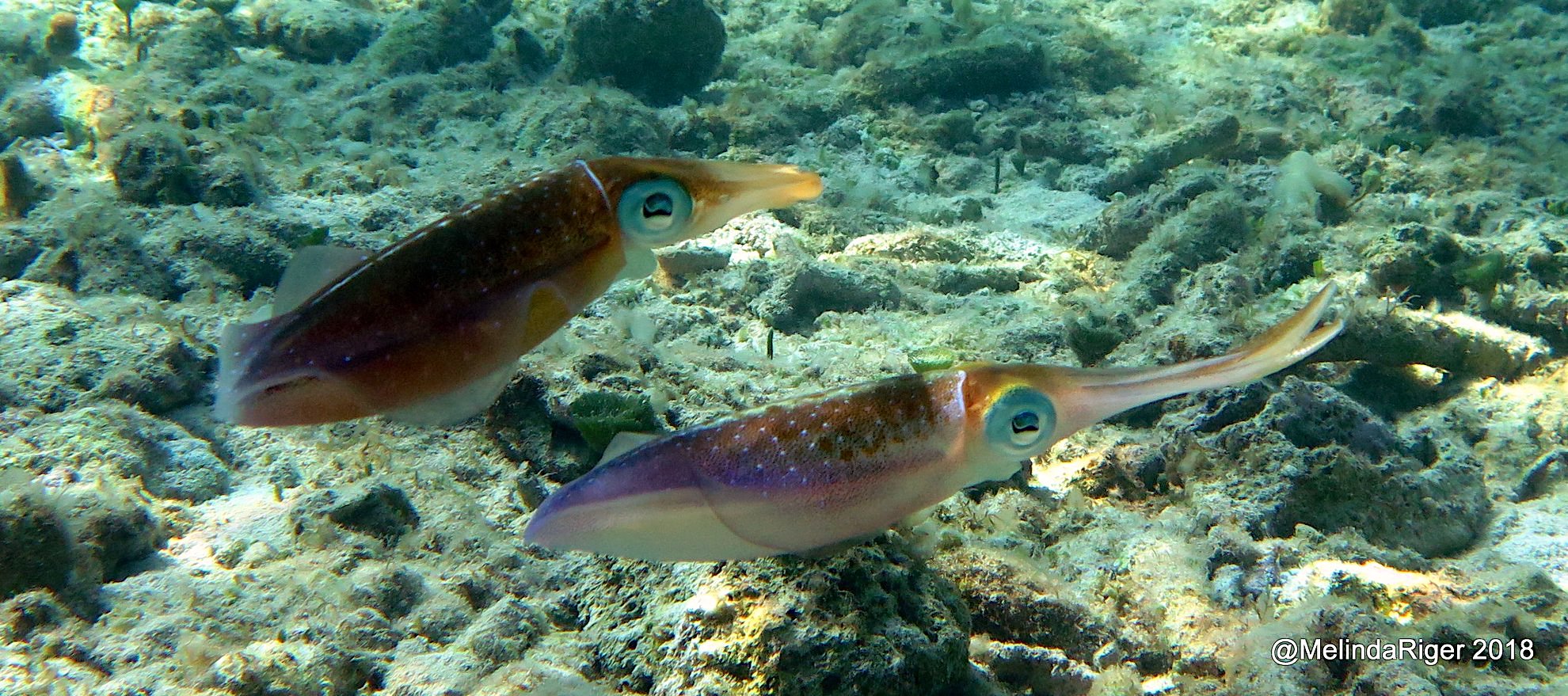
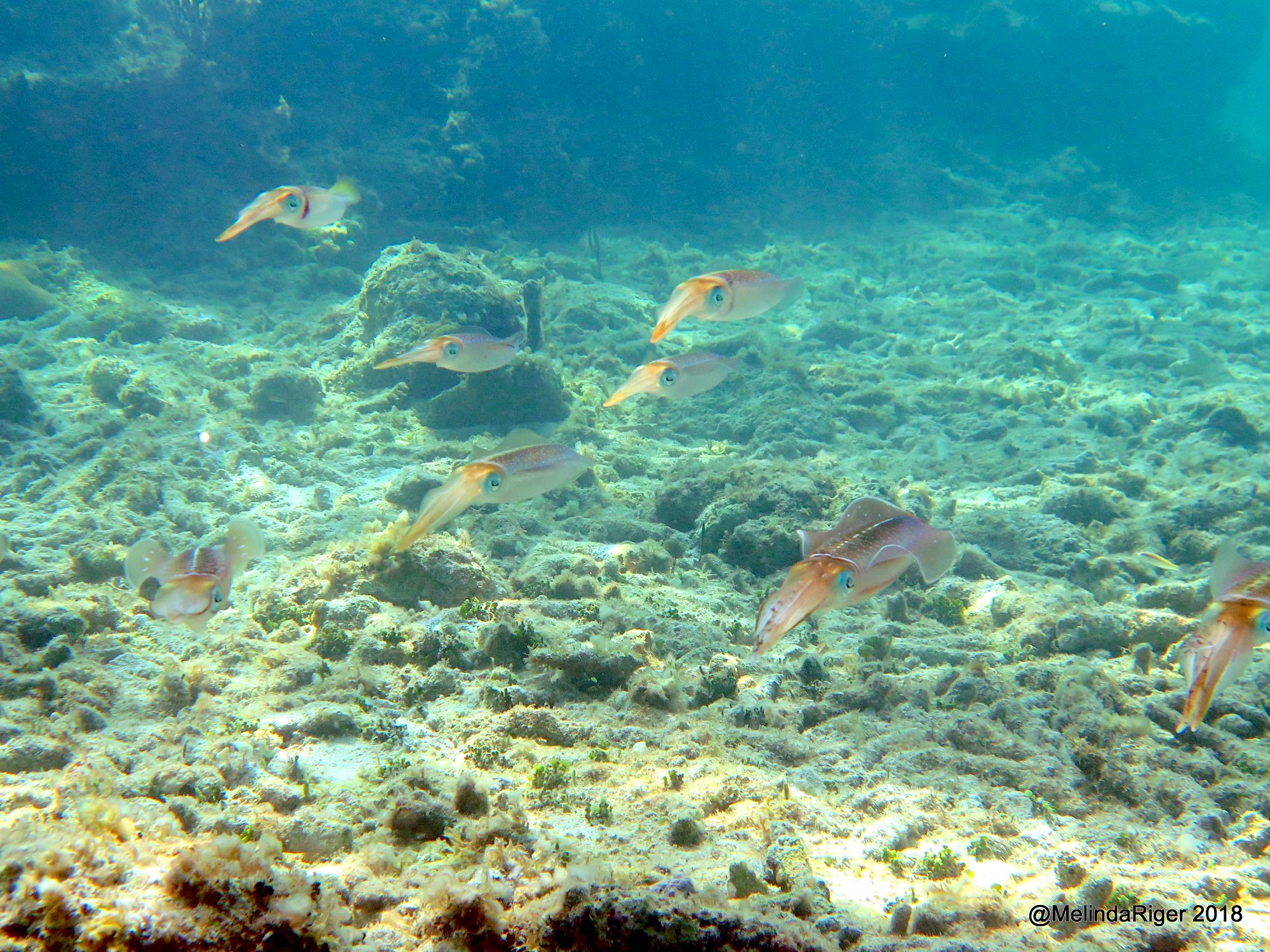
CARIBBEAN REEF SQUID REVISITED: SUPERPOWERS & SQUID SEX
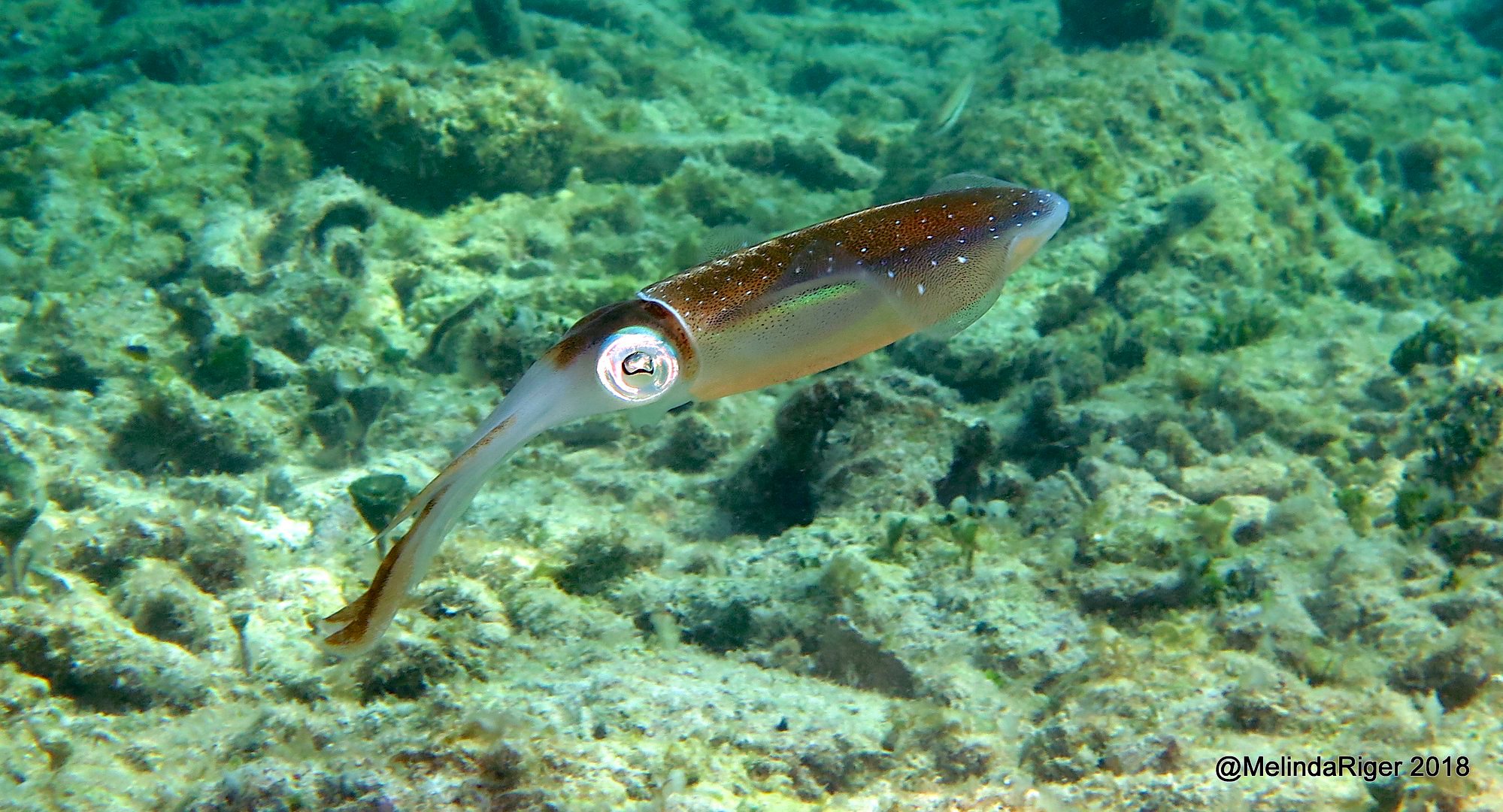
The Caribbean reef squid Sepioteuthis sepioidea is a small squid species of (mainly) the Caribbean Sea and the Floridian coast, and the most common in its range. These squid tend to form small shoals in and around reefs. Right now, in June, is a good time to find these creatures swimming in groups – all these photos were taken during the last fortnight. I wrote about squid a while back (3 years, maybe)? This post includes some parts of the earlier one, with all-new images. Squidmages, even.
Squid are voracious eaters, dragging their prey to their mouths with some or all of their 10 limbs and using their beak to cut it up. The target species are small fish, molluscs and crustaceans. The squid have a ‘raspy tongue’ known as a radula which further breaks up the food for easy consumption.
REEF SQUID SUPERPOWERS (SUPERCOOL)
Squid are capable of brief flight out of the water (a fairly recent discovery)
They can also hide from / confuse predators by ejecting a cloud of black ink
Squid can change colour, texture and shape, and can even match their surroundings
This enviable power is used defensively as camouflage or to appear larger if threatened
It is also used in courtship rituals (something that humans might find most disconcerting)
Colour patterns are also used for routine squid-to-squid communication AND GET THIS:
A squid can send a message to another on one side, and a different one to a squid on the other side
SQUID SEX (1) “ROMANCING THE SQUID”
A male will gently stroke a female with his tentacles
The female will (most likely) flash an ‘alarm’ pattern. She’s hard to get.
The male soothes her (don’t try this at home, guys) by blowing and jetting water at her
If this doesn’t go well, he’ll move off, then repeat the routine until she sees his good points
However this on / off courtship can last for hours until at last he succeeds and then…
… he attaches a sticky packet of sperm onto the female’s body (romance is not dead on the reef)
Meanwhile he stays close, emitting a pulsing pattern, as well he might after all that palaver
She then finds a safe place to lay her eggs. Job done.
SQUID SEX (2) IT ALL ENDS BADLY. VERY BADLY.
As soon the female squid has laid her eggs, she dies at once
The male squid lives a bit longer and… may have other packets to stick on other lady squid
But then in the end he dies too
It’s all horribly reminiscent of Romeo and Juliet. The lovers die. But no the balcony scene
THE CORRECT PLURAL OF SQUID
I had an unwise look online, always a hotbed of conflicting opinions. Inserting an algorithm into the interstices of the internet proves conclusively that the plural of squid is… squid. One squid, ten squid, a group of squid, a plate of squid. Unless, that is, you are talking about more than one of the many squid species, when you could also have ‘I collect both reef and giant squids’. “Squidses” sounds fun but is sadly not permitted.
Credits: As ever (for fabulous underwater pics) Melinda Riger of Grand Bahama Scuba; research sources include MarineBio; Animal Diversity Web (Michigan Uni)
Like many of the blues musicians who covered Robert Johnson’s originals, we got ramblin’ on our minds. Specifically to ‘Delphi East’ in Ireland, thus stupidly exchanging 82F sunshine in southern UK for 46F rain in the Emerald Isle. Good for the fishing, if nothing else… So (always remembering that corals are actually creatures and not plants) here’s a bouquet of coral to be going on with until we next meet with wifi!
OPTIONAL MUSICAL RAMBLING
Robert Johnson’s output – a meagre 29 songs in all – formed the bedrock for later bluesmen and the blues / rock crossovers that followed. They mined Johnson’s talent and formed their own new material from it. Here’s the original – you’ve probably heard it or variations of it with different names, a thousand times – some good, some bad, most so-so.
Entire coral pot pourri by Melinda Riger / Grand Bahama Scuba
Fish, like humans, have a wide variety of temperaments, or so it seems. Resorting to anthropomorphic analysis of animal behaviour is a favourite pastime for humans. Who really knows if a creature is actually feeling shy or confident or playful or aggressive or indeed inquisitive. Often it just seems that way and we are happy to categorise dolphins as playful, sharks as vicious, angelfish as serene, small darting fish as timid and so on.
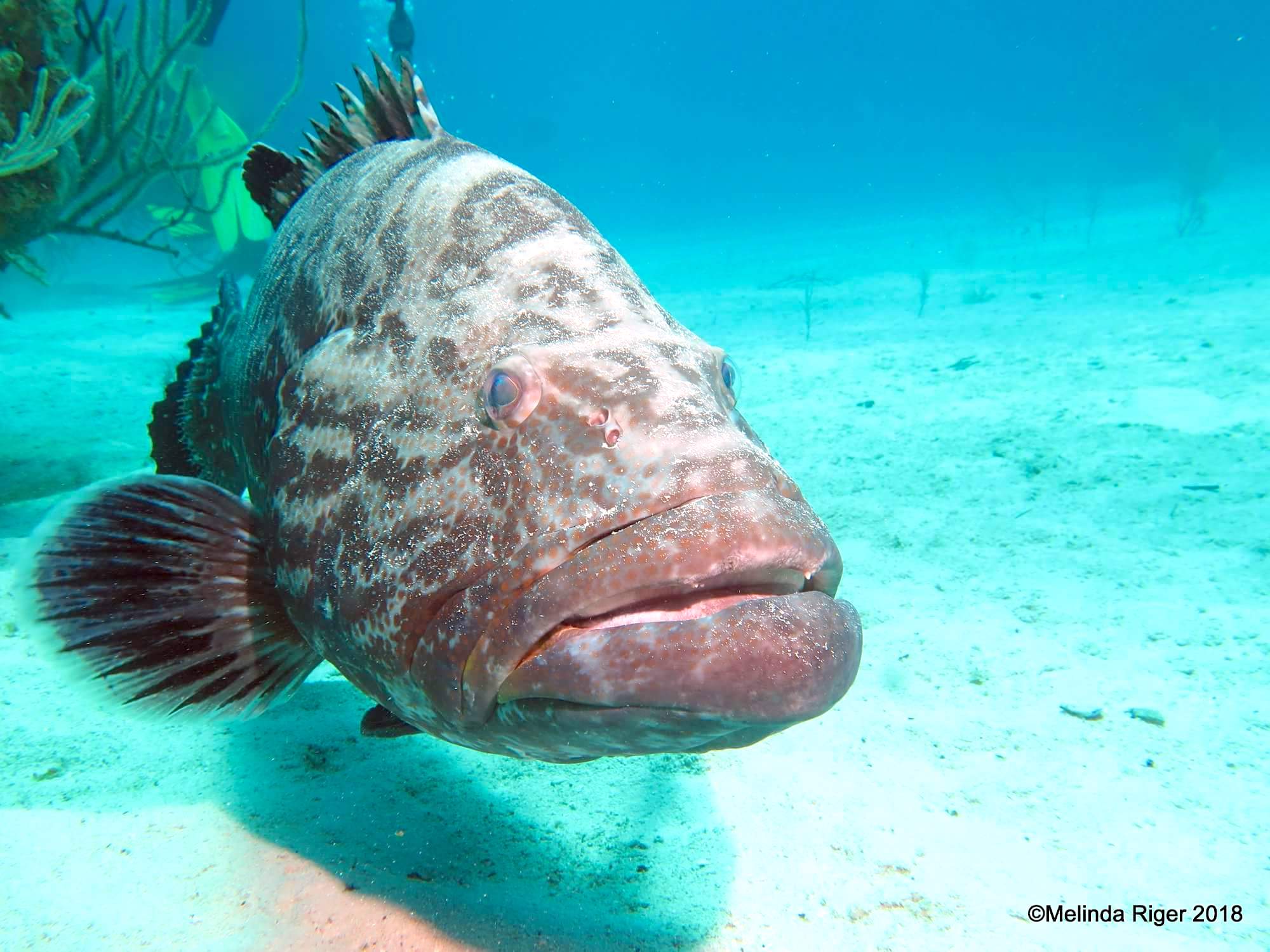
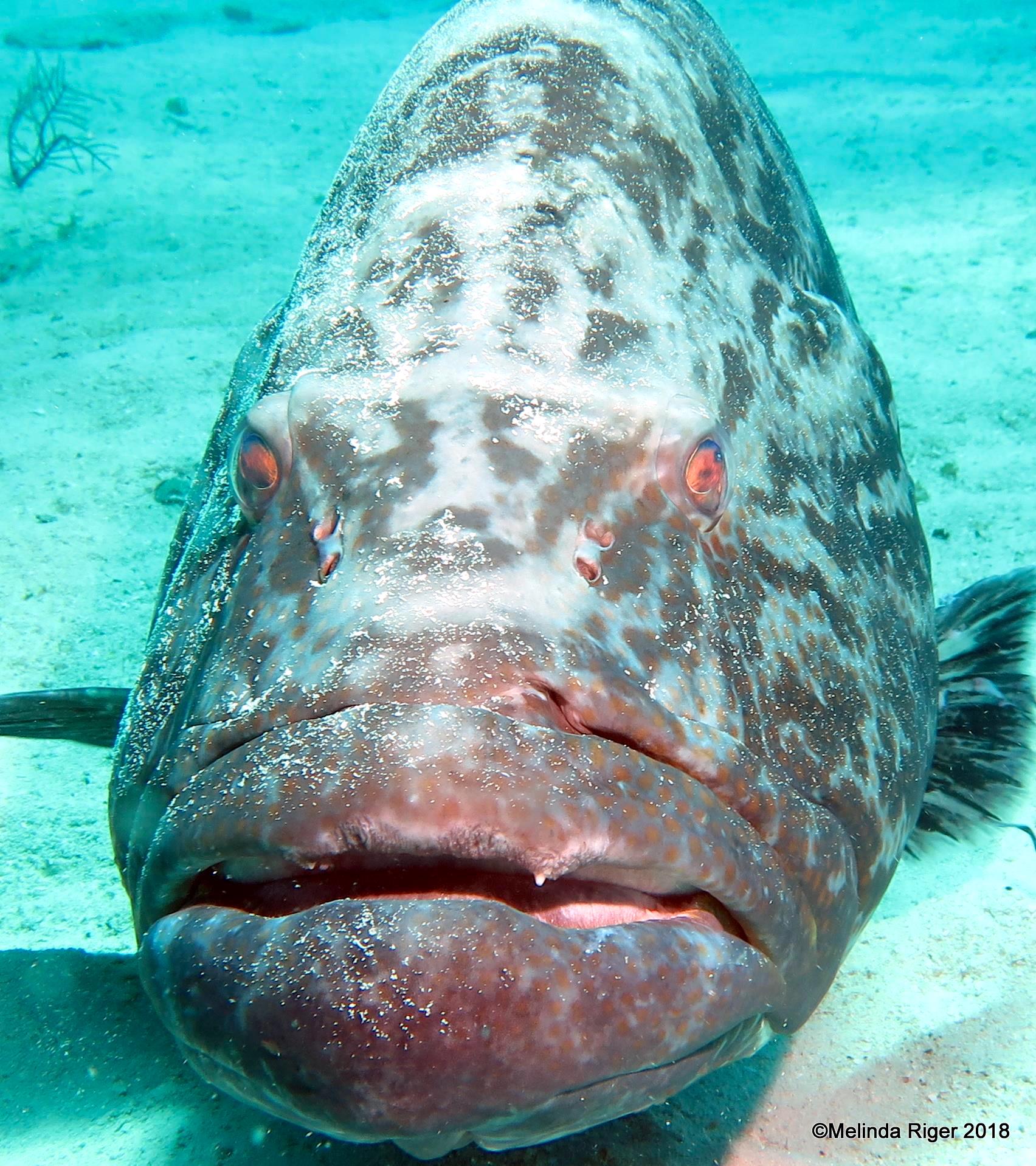
Occasionally a creature displays a ‘human’ characteristic that seems undeniable. One such is Curious George. He has become used to the divers around the reef where he lives, and greets them. He enjoys the photography sessions and the equipment, even though they may be for recording other fish. He demonstrates inquisitiveness for the strange-looking black-suited creatures that visit his patch. Like many groupers, he likes to be gently patted and stroked.
All this curiosity and friendliness evidences a benign interspecies relationship of symbiotic mutualism, through which both species (man and fish) benefit from the interaction. The mutually beneficial feeling might in broad terms be described as ‘pleasure’.
Or maybe I am just indulging in a bit of over-anthropomorphisation (if there is such a word)…
All photos by one half of the symbiotic mutualism here, Melinda Riger (Grand Bahama Scuba)
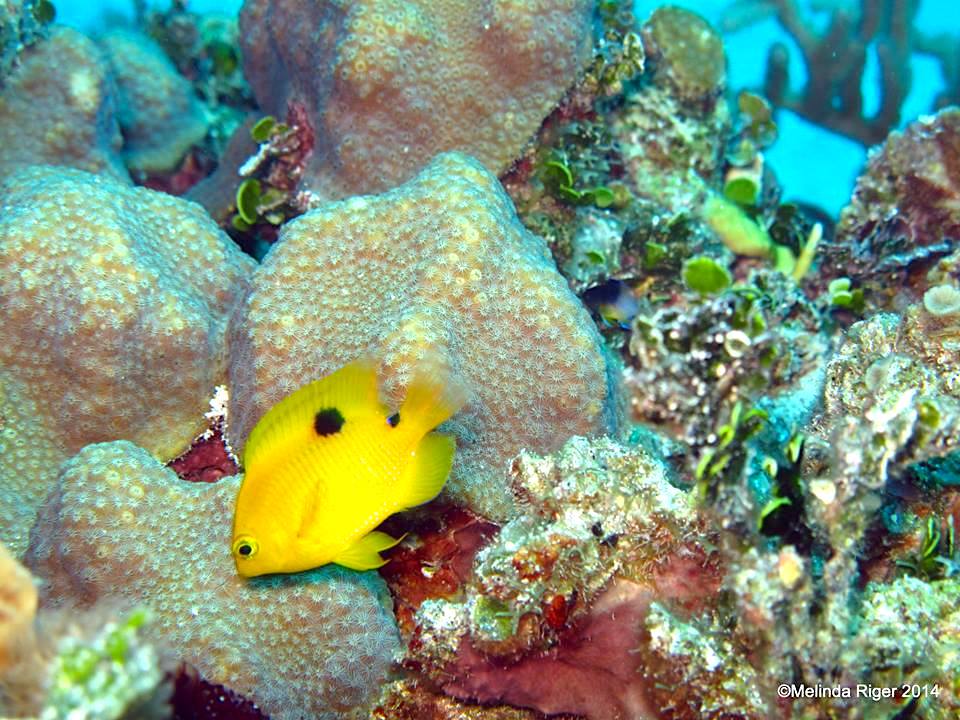
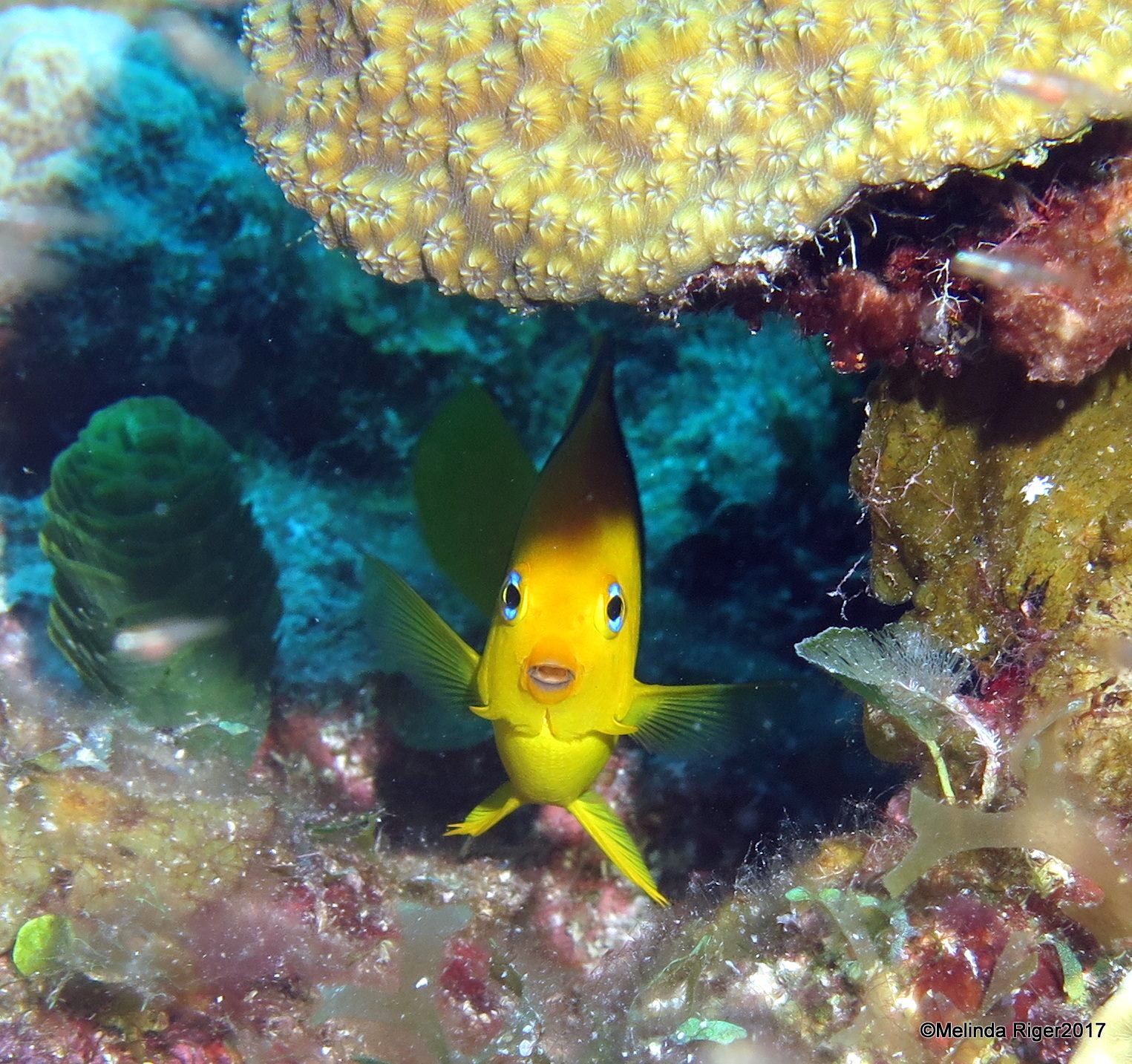
The threespot damselfish Stegastes planifrons is one of several damselfish types found in the Bahamas and more generally in the western Atlantic. As with so many reef species, there is a marked difference in coloration between juveniles (bright yellow) and darker-hued adults (above).
These are bony little creatures, equipped with both spines and ‘soft rays’ on some of their fins. This perhaps make them unappealing to potential predators; and maybe the very brightness and ‘hi-viz’ of the juveniles is aposematic, a coloration thats acts as a warning or repellent to potential predators.
On the reef it seems threespots favour staghorn coral as a daytime base. Their diet is mainly seaweed, with small molluscs, gastropods and worms for variety. At night they retire to crevices and caves.
Adults are, for such small fish, vigorously protective of their territories. They will chase and nip intruders into their domains, even far larger creatures (up to and including humans).
A breeding pair will both be involved in egg care. Once the female has laid her eggs, they adhere to the lower reef and seabed. The male guards them and rather sweetly fans them with his fins to keep them oxygenated. And then another generation hatches and the threespot life cycle repeats.
Credits: All fantastic photos by Melinda Riger / Grand Bahama Scuba
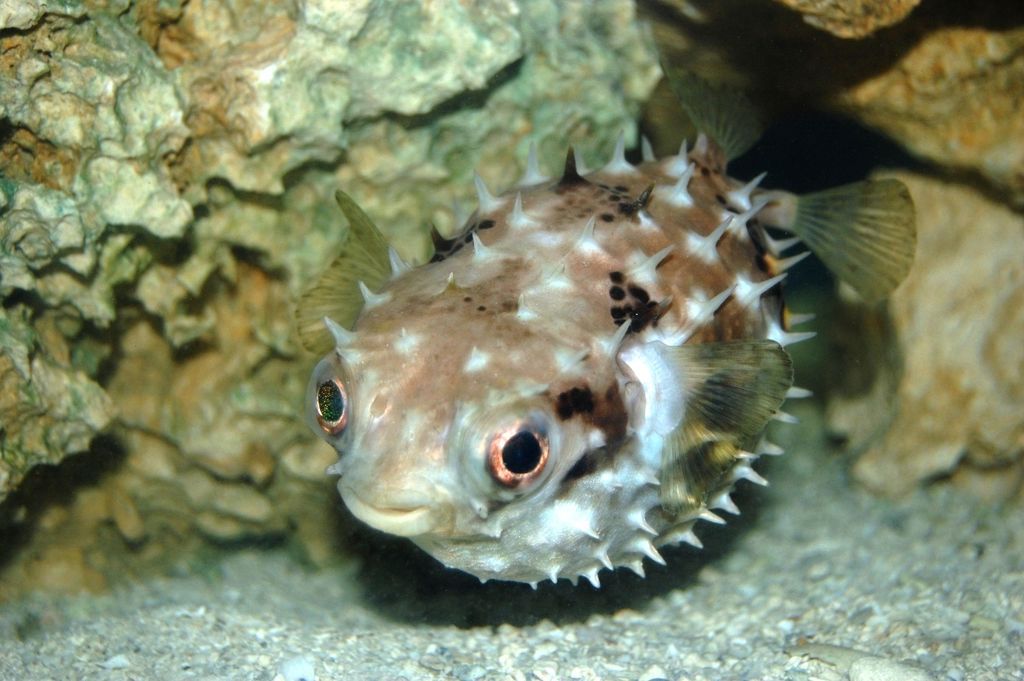
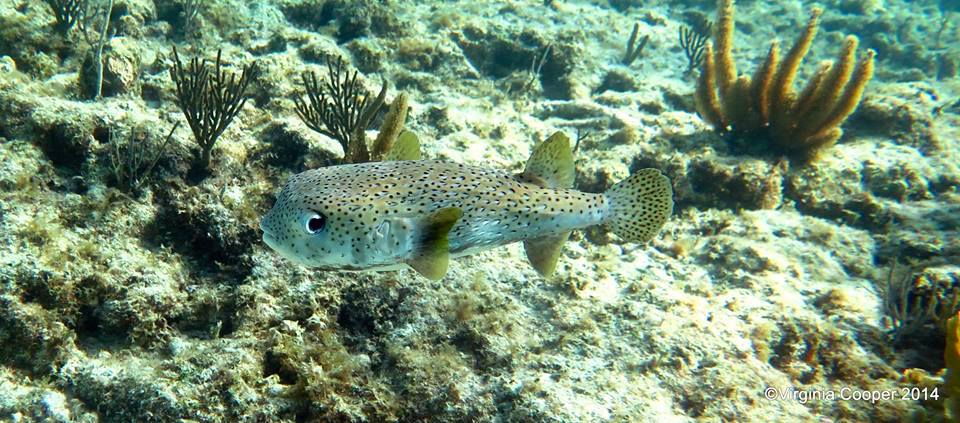
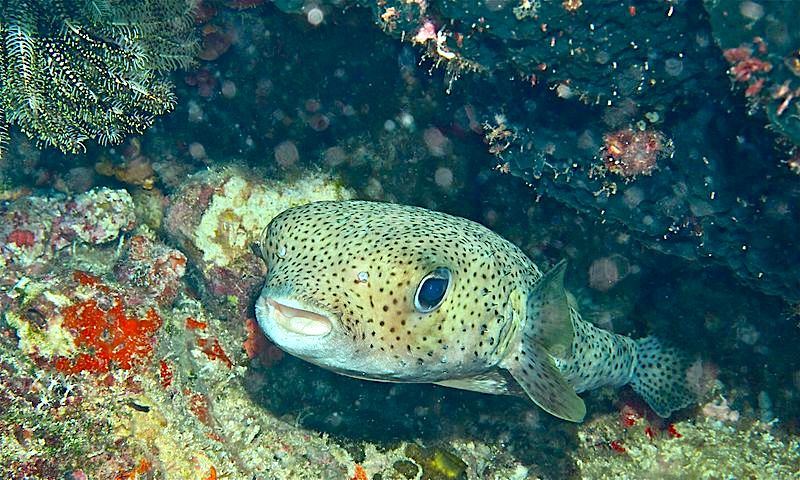
The porcupinefish Diodon hystrix falls into the general category ‘pufferfish’, though the particular species named PUFFERFISH are distinct in their own right. There are other similar species – e.g. balloonfish, blowfish and burrfish – with which there is scope for confusion. The relationship is something like this: all porcupinefish are pufferfish (in a broad sense); but not all pufferfish (in its species sense) are porcupinefish.
Porcupinefish are slow-moving reef dwellers and like their puffer cousins, they can inflate themselves by ingesting water, turning them into spiny balloons. This defence mechanism is a response to threat and works in two way: only predators with large mouths would consider them a meal; and even then they have to deal with the spines that become prominent when the fish is bloated.
I’VE HEARD PUFFERFISH ARE POISONOUS? WHAT ABOUT THIS GUY?
Good question. Checking it out, I’ve found some contrary statements about this. The truth seems to be that unlike pufferfish, they do not produce toxic secretions from their skins, so are not poisonous to touch (if you must**).
However porcupinefish do contain powerful (neuro)toxins in their internal organs and are best not eaten – though in some parts of the world they are considered a minor delicacy. They may also suffer the ignominy of being dried in their inflated state and sold to tourists as novelties – with lightbulbs inside for added amusement value.
ARE PORCUPINEFISH FAMOUS IN ANY RESPECT?
Indeed they are. They had the honour of being recorded by Charles Darwin. He gives a surprisingly long account of this creature, encountered during his renowned voyage on the Beagle. It clearly fascinated him. I’ve ‘ripped’ the relevant passage (open source – it’s ok) and turned it into an eezi-reed pdf if you want to check out Darwin’s careful observations in more detail:
Yes! In ‘Finding Nemo’, Bloat the Porcupinefish was part of the ‘Tank Gang’ in a dentist’s office. He had an encore in the closing credits of ‘Finding Dory’. Enough of fame already. Here’s a 50 second video demonstrating the puffer / porcupine distinction.
Photo Credits: Melinda Riger (1, 2); George Parilla (3); Virgini Cooper (4); Bernard Dupont (5); Adam Rees (6, 7); Video, ‘AquariumKids’ (I do high-powered research, see?)
**Incidentally, it’s apparently not considered an act of animal kindness to catch them / scare them so you can have the pleasure of watching them blow up
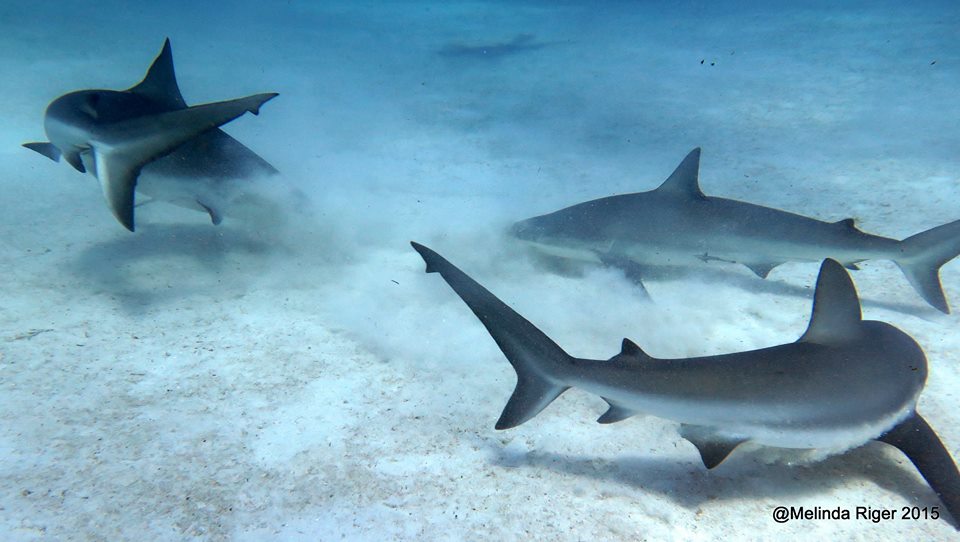
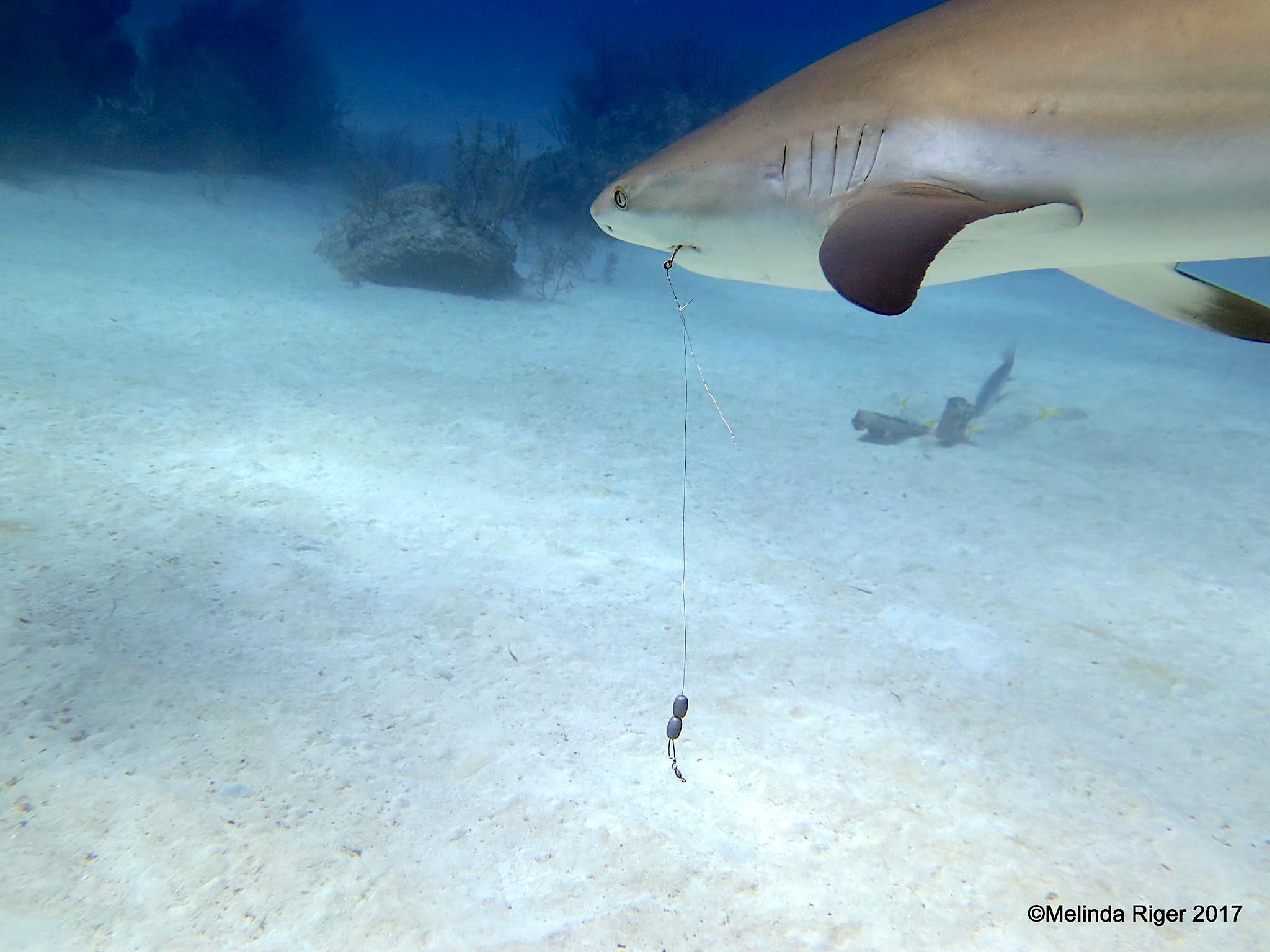
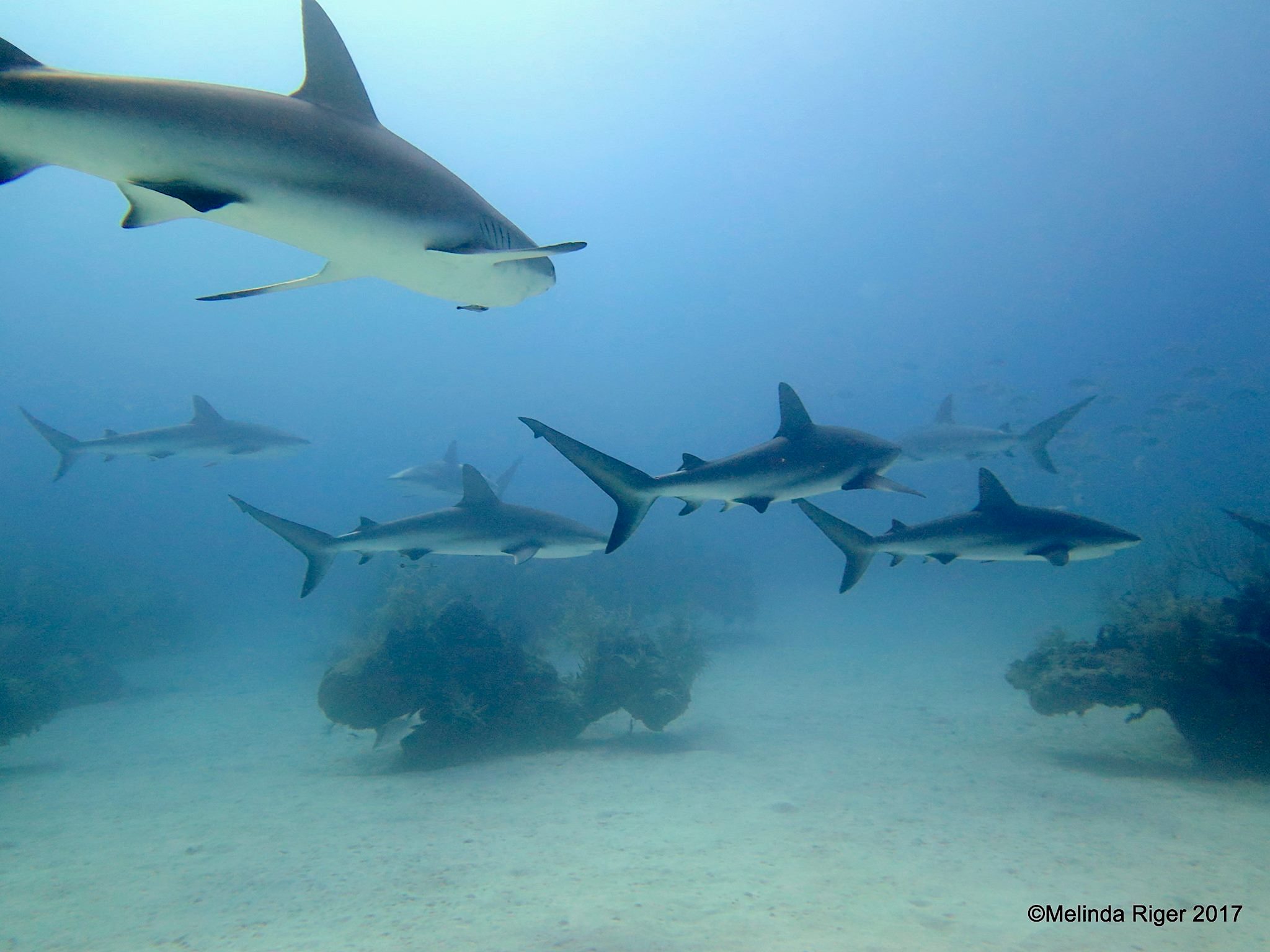
Immersion in current affairs these days brings inevitable acquaintance with sharks of various kinds, and all best avoided. Let’s have a look the real thing, the apex marine predators that in the Bahamas are all around you once you leave the safety of the shore. I haven’t featured them for ages, and it’s always a pleasure – a slight thrill, even.
I don’t do scuba, indeed my swimming would easily be outclassed by a competent four-year old. But I see these creatures when I’m out fishing; or as they hang in the breaking waves off the Delphi beach, watching intently for a meal.
We watch them (and stingrays) from the balcony as they lazily make their way round the margins of the wide bay, from little ‘uns to (recently) a huge bull shark. We watch as, when someone is in the water, they change course slightly to pass by them. So far, anyway…
Feeding sharks
The one that got away… (a sad sight)
I once took a rather primitive underwater camera with me while snorkelling in Fowl Cays National Park. This was several years ago, when I believed a cheap 2mb camera might turn me into one of the Blue Planet team. I was wrong. The shark I saw, apparently some 20 miles away (when I examined the image) – well, that’s its tail, top left…
Just to look at these images is to understand that when you are in the sea, you are in the sharks’ environment. They are the masters of it. They have their rules, and they are not much interested in you… unless you break them. Or so the theory goes.
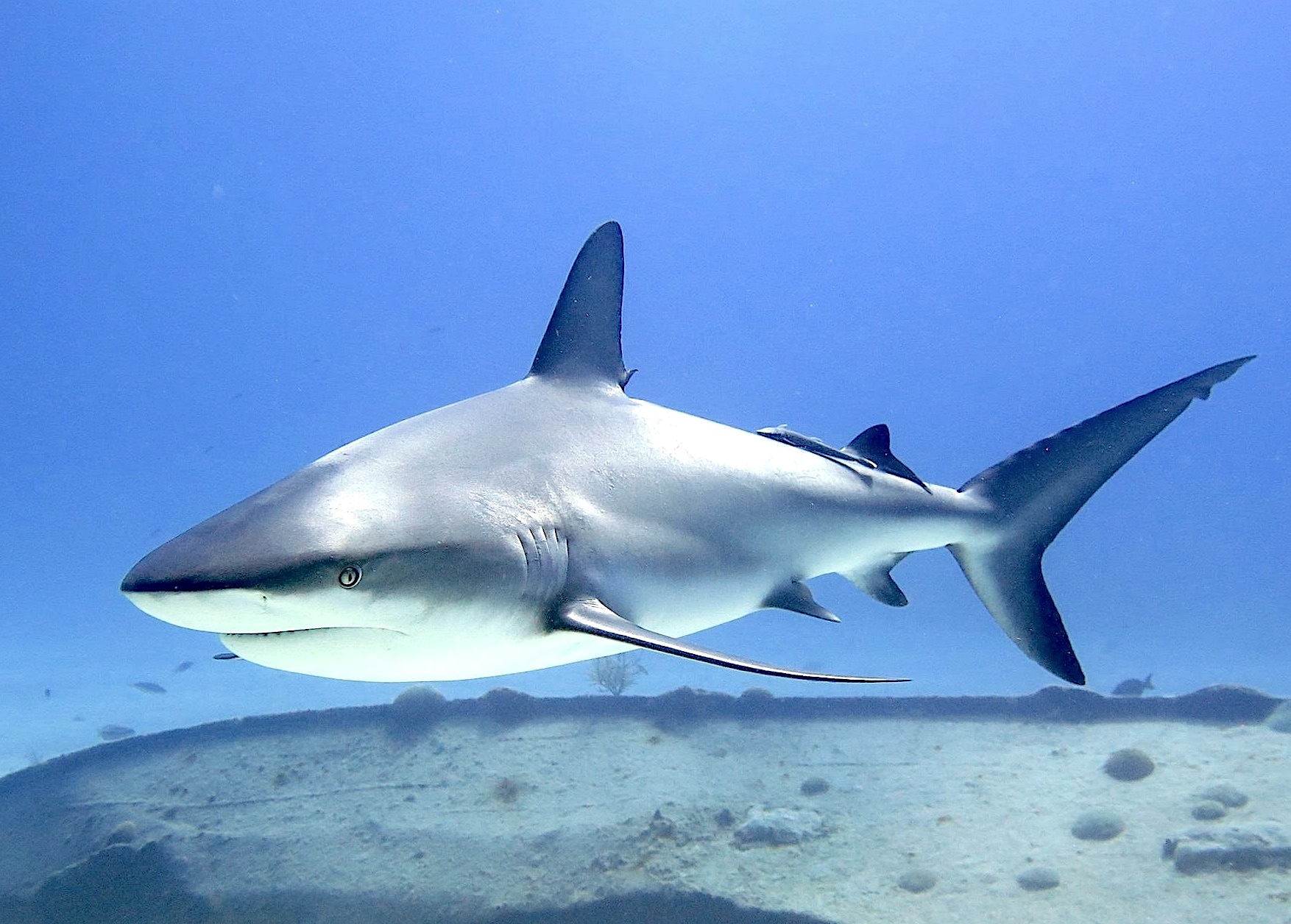
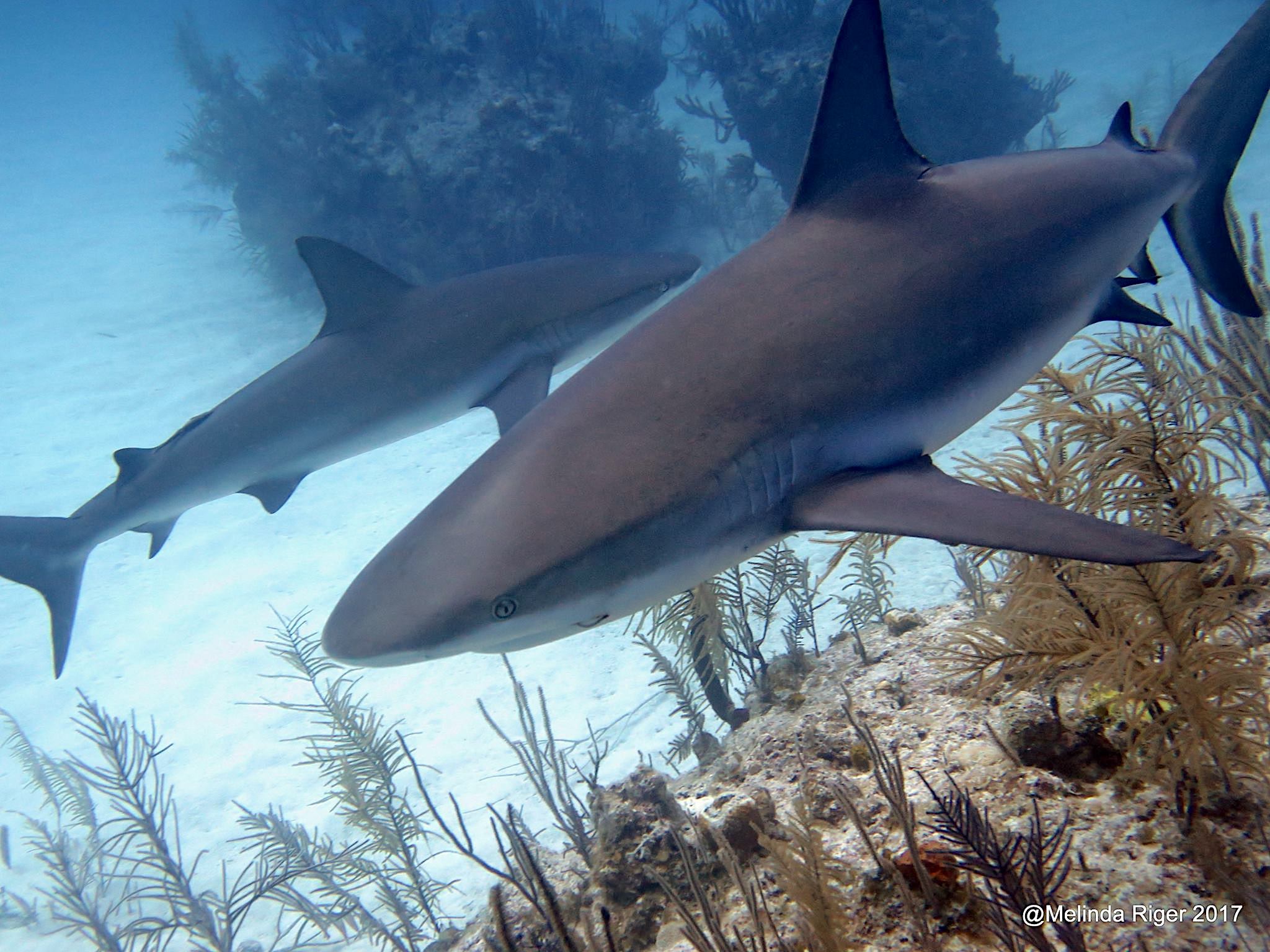
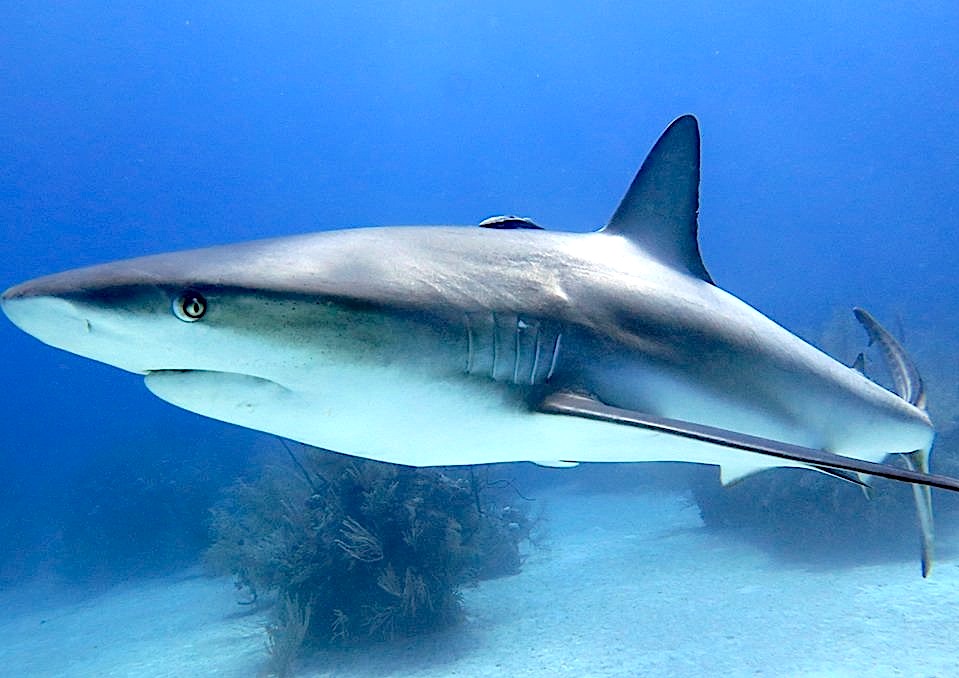
This fine shark below exemplifies the power and the menace of the shark. A creature to be admired, but also to be respected.
All fantastic photos: Melinda Riger / Grand Bahama Scuba
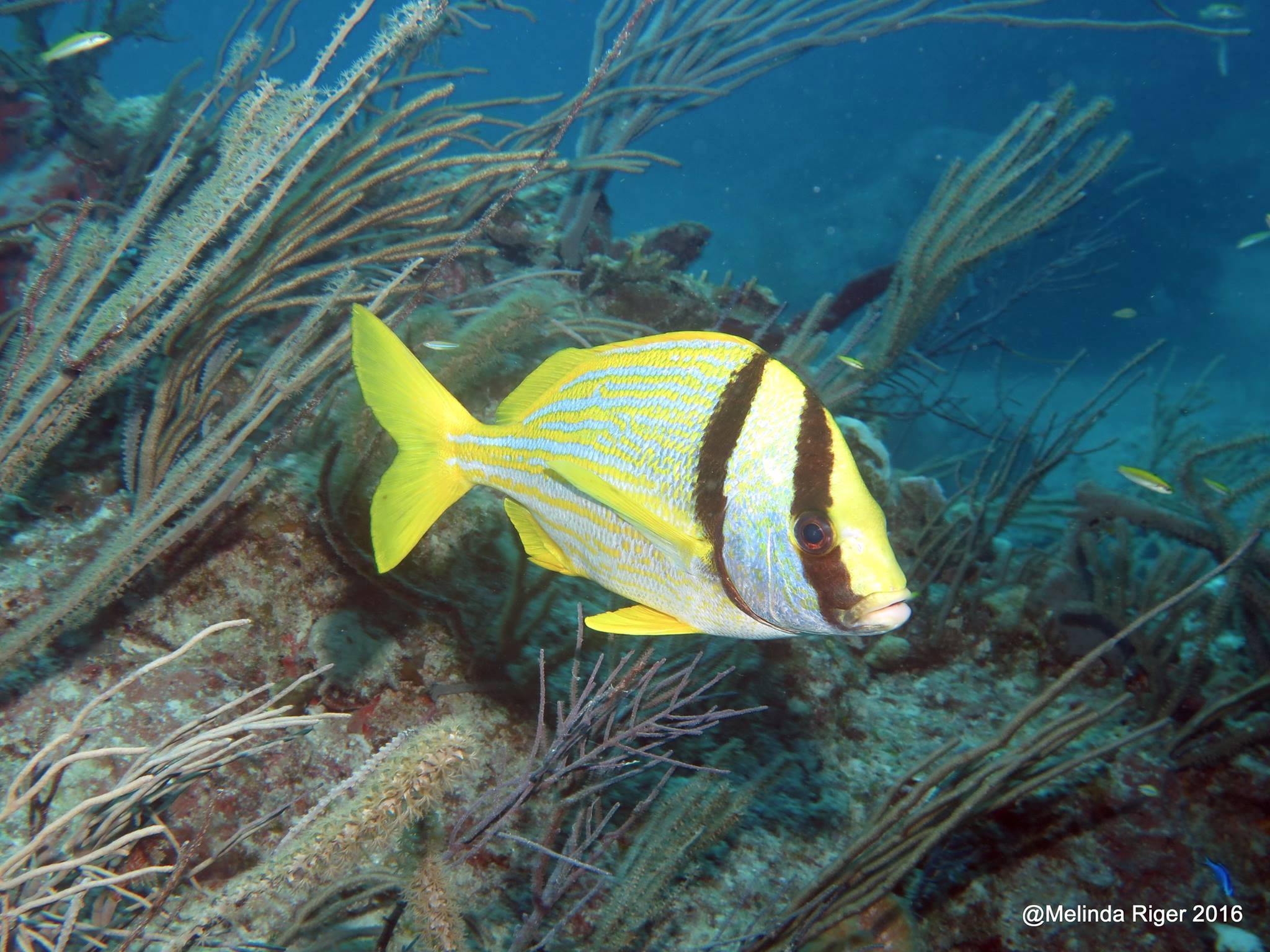
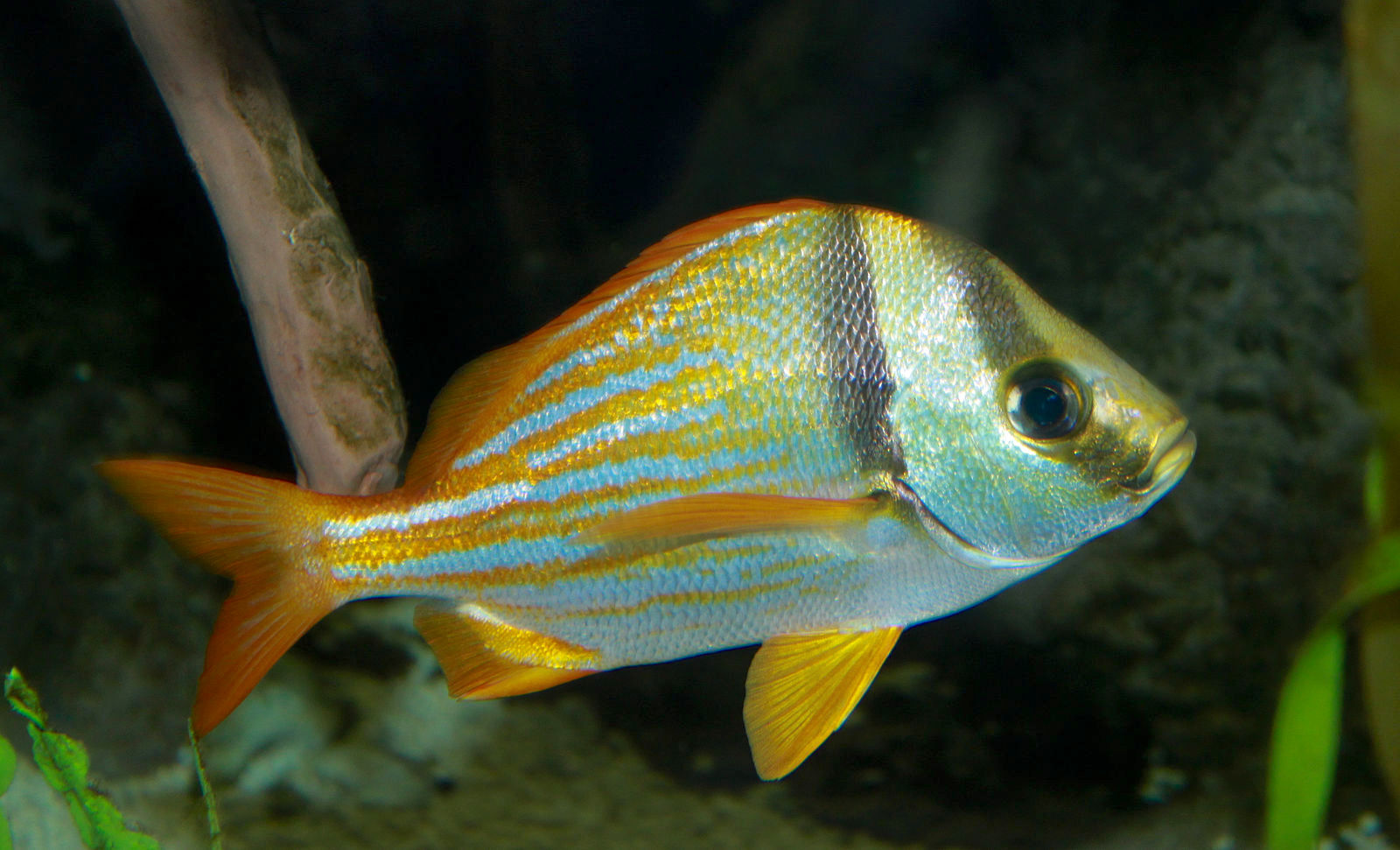
Behold the porkfish Anisotremus virginicus, the slightly unattractively named representative of the (arguably) even less attractively named grunt species. These small, bright-coloured reef dwellers are rarely more than 12 inches long. They are mainly nocturnal fish, feeding on small crustaceans, mollusks and so on. Juveniles have been observed acting as cleaners to larger species, feeding on parasites – an example of mutualism between species, in which both sides benefit from the arrangement.
WHY IS A ‘PORKFISH’ A ‘GRUNT’
The terminology seems to be somewhat confused by local usages, but in general terms all porkfish are grunts; but not vice versa. Yet I notice that the term ‘porkfish’ is used to describe other types of grunt. A good rule of thumb is the the Atlantic Porkfish is the only grunt with two black vertical bars and yellow stripes… Note that grunts differ from their cousins the snappers by having a different dental arrangement – no canine teeth.
AND WHY ‘GRUNT’ ANYWAY? DO THEY SOUND LIKE PIGS?
Well, perhaps a bit. All grunts, including porkfish, are capable of producing grunt-like sounds from some kind of grinding of their back teeth that is too technical to go into here**. The sound is associated with ‘situations of duress and danger’ – such as being caught and unhooked…
DO YOU HAPPEN TO HAVE A RECORDING?
As it so happens I do. This is taken from a rather longer Youtube video in which a grunt was caught, unhooked and returned.You’ll hear a couple of grunts as the fish was unhooked, and some (perhaps understandable) hilarity on the boat. I guess you had to be there.
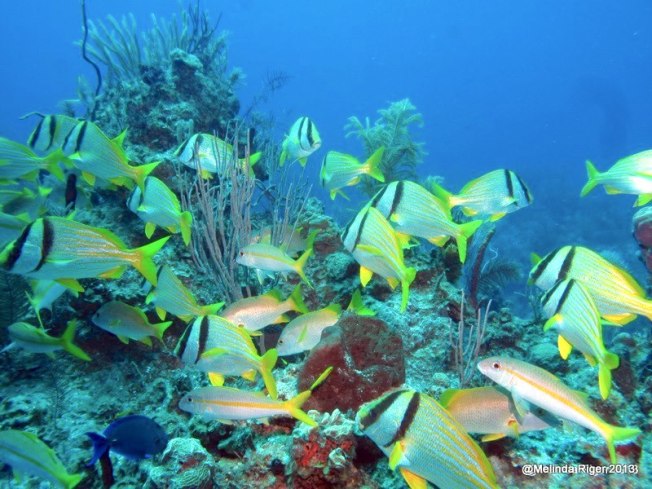
Porkfish are gregarious, and also mix with other species
ARE PORKFISH EDIBLE?
Like most if not all grunts, they are, with the proviso that there is some association with ciguatera. I’ve never knowingly eaten one myself, but I gather that “grits and grunts” is a popular culinary combo in some places. For those that might want to know more, a quick look at a couple of threads reveals the following:
They taste great, a bit like ham
Their white meat cooks very well
They taste better than black margates (another grunt species)
Eat them in enchilado or breaded fillets
‘Big-ass head’ on them so not much if you filet
If you scale and cook whole you get a better yield on them
When fishing for supper, ‘shoot ’em up and hold off for the bigger ones’
Credits: all great photos by Melinda Riger / Grand Bahama Scuba, except the last by Brian Gratwicke (wiki); soundbite from Youtube video 2010 by peachyree; research from seaworld.org; britannica.com and the usual suspects…
** Subtle code for “I haven’t really understood it…”
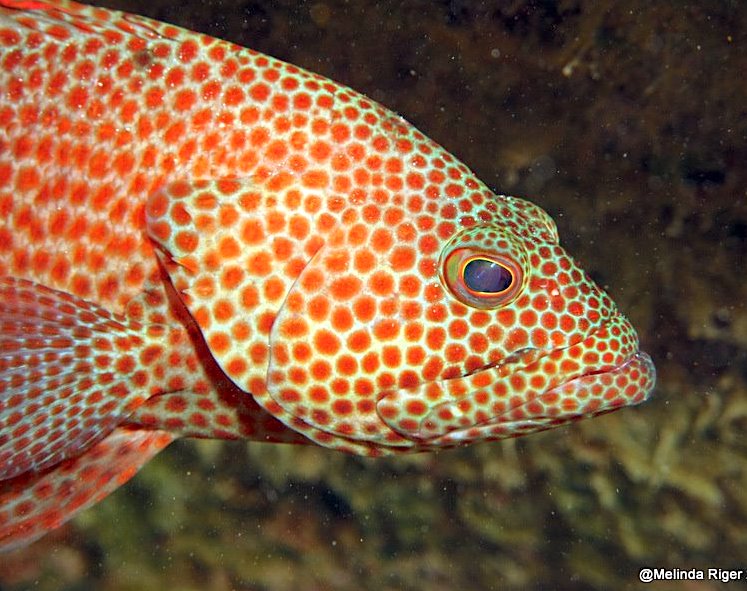
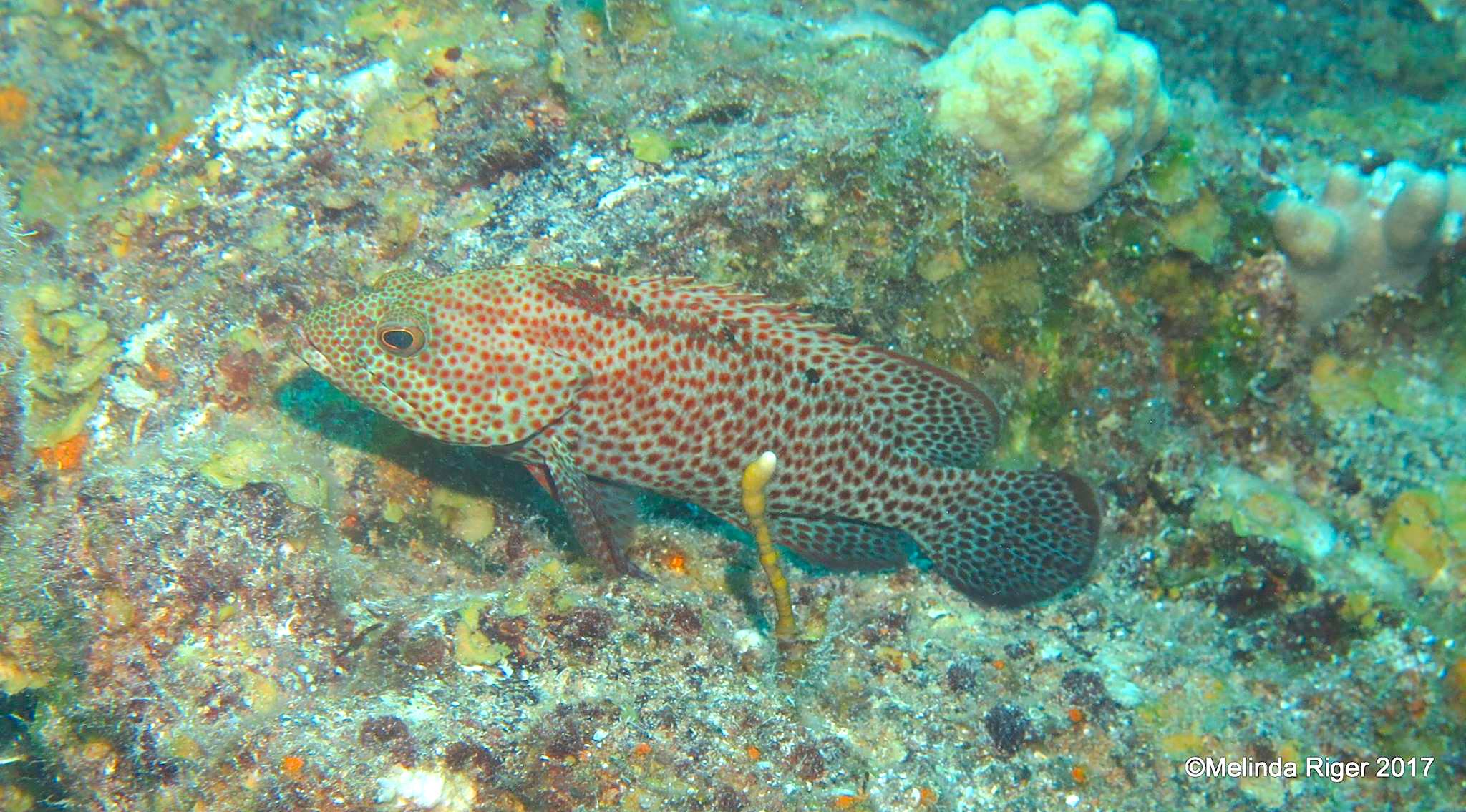
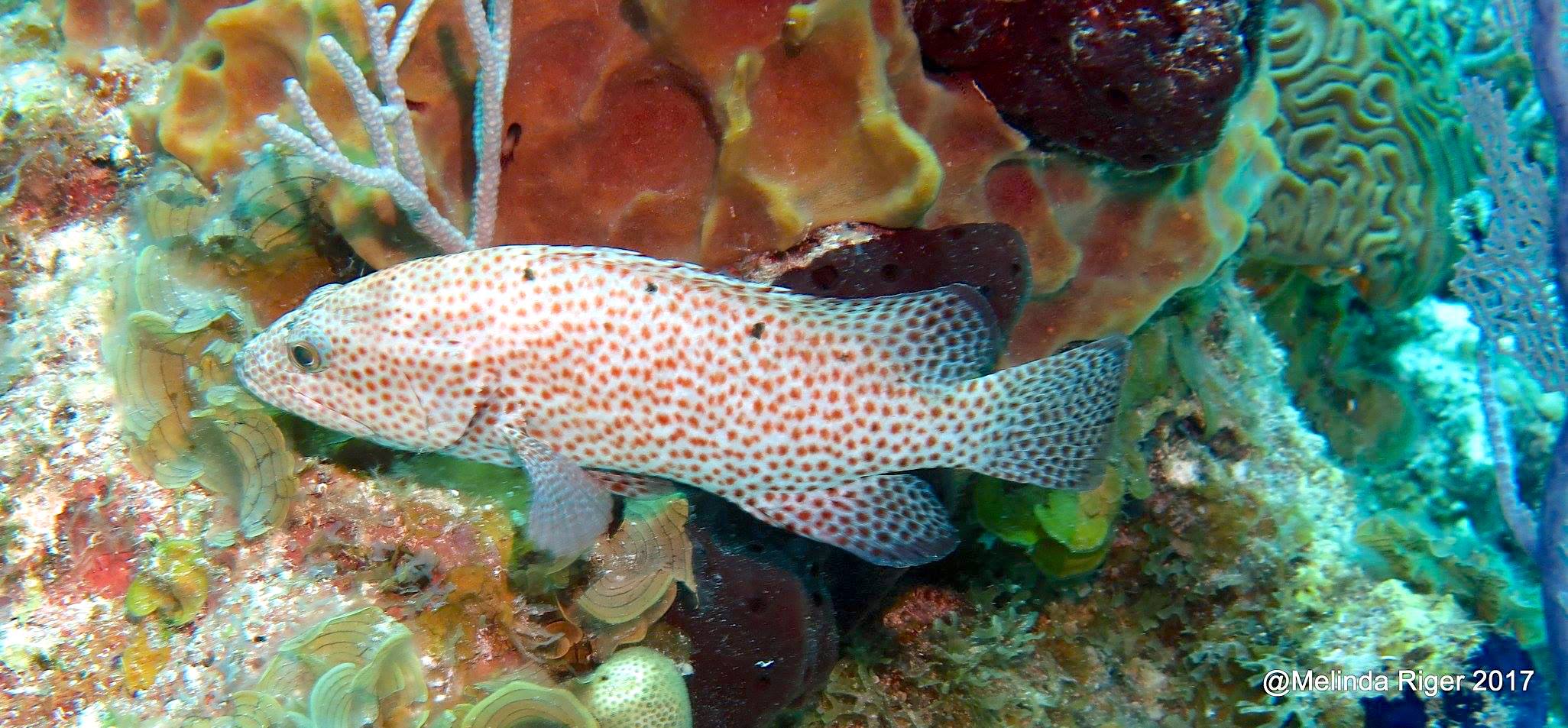
The Graysby Cephalopholis cruentata is a small, spotty grouper, which grows to a maximum of around 16 inches. These rather unassuming and solitary fish have a preference for coral reefs, where they can blend in with their surroundings on ledges and in caves and crevices during the day. At night, they become active – that’s when they feed on feed on small fish, crabs and shrimps.
The graysby has variable colouring in a range from light brown to pale gray, with all-over spots that may be red, orange or brownish. Often, they have 3 to 5 contrasting spots on their backs, along the base of the dorsal fin, as below:
The long erectile dorsal fin comprises both spines and ‘rays’ – spines at the front, rays at the back. Like this:
The spots of a graysby can change in colour (at least to a limited extent), becoming either paler or darker. I imagine this is a protective feature to enable the fish to blend in more easily with its reef surroundings.
Signalling to turn right…
I wondered if they are edible. I believe so – but then I also read that the larger adults carry the risk of ciguatera and raised mercury levels. So I’ll give it a miss thanks.
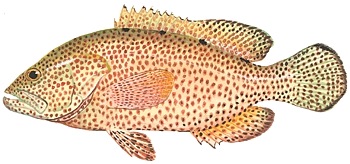
Photo & other credits: all photographs by Melinda Riger / Grand Bahama Scuba; aqua.org; SAMFC (drawing)
It’s been a while since the last in the WTF? series, which is dedicated to the wilder, less conventionally fish-shaped side of reef life – those creatures that you may come across, blink into your face-mask, and silently mouth the words ‘What’s That Fish?’ (that’s what it looks like you are saying, anyway).
Let’s meet some Arrow Crabs Stenorhynchus seticornis, one of the very few creatures surely to have a triangular body plus a huge pointy nose (rostrum), supported on long skinny legs. To which add, they wear tiny blue gloves on their two front claws.
These crabs are coral reef dwellers and mostly stay concealed during the day. Their body is protected by a carapace, and the rostrum has serrated edges like a tiny rasp or file. I haven’t found a definitive reason for this gadget, but I suspect it is more for probing than for piercing or fighting.
There’s a considerable colour variation among these crabs, as these images show. The body may even have blue iridescent lines (#2, above). And those claws may be any of 50 shades of blue…
Arrow crabs are most active at night. They eat feather-duster worms (illus.) and similar invertebrates such as bristle worms.
Arrow Crab Meal
Like certain types of shrimp, they also have a symbiotic relationship with anemones, whereby they make use of an anemone to benefit from the food it captures – and possibly for cover too. They are protected from anemone stings, whereas some of their predators are not.
This was the place where I was going to tell you about the arrow crab’s private life, but, well… “it’s complicated”. Briefly it is: male passes sperm-filled capsule to female; she uses it in some way whereby it fertilises her eggs; she then ‘broods’ the eggs in one of her ‘swimming legs’; the eggs hatch into larvae and swim off to eat plankton; each one then grows & moults, repeating the process until it has reached adult form. On balance, humans have arguably perfected a preferable method.
Arrow Crabs are apparently popular aquarium creatures, although they sound to me rather a disagreeable challenge. They can move quickly on those long legs, and it seems as if they inclined to be aggressive to other inhabitants of the tank. As far as I can make out, it’s best not to put 2 of them together: they certainly won’t be doing the sperm capsule thing described earlier…
Master of Disguise
Photo credits: Melinda Riger / G B Scuba (1, 3, 4, 5, 6); Adam Rees / Scuba Works (2, 8, 9); Nick Hopgood,Wiki (7); Chuck Elliot – video
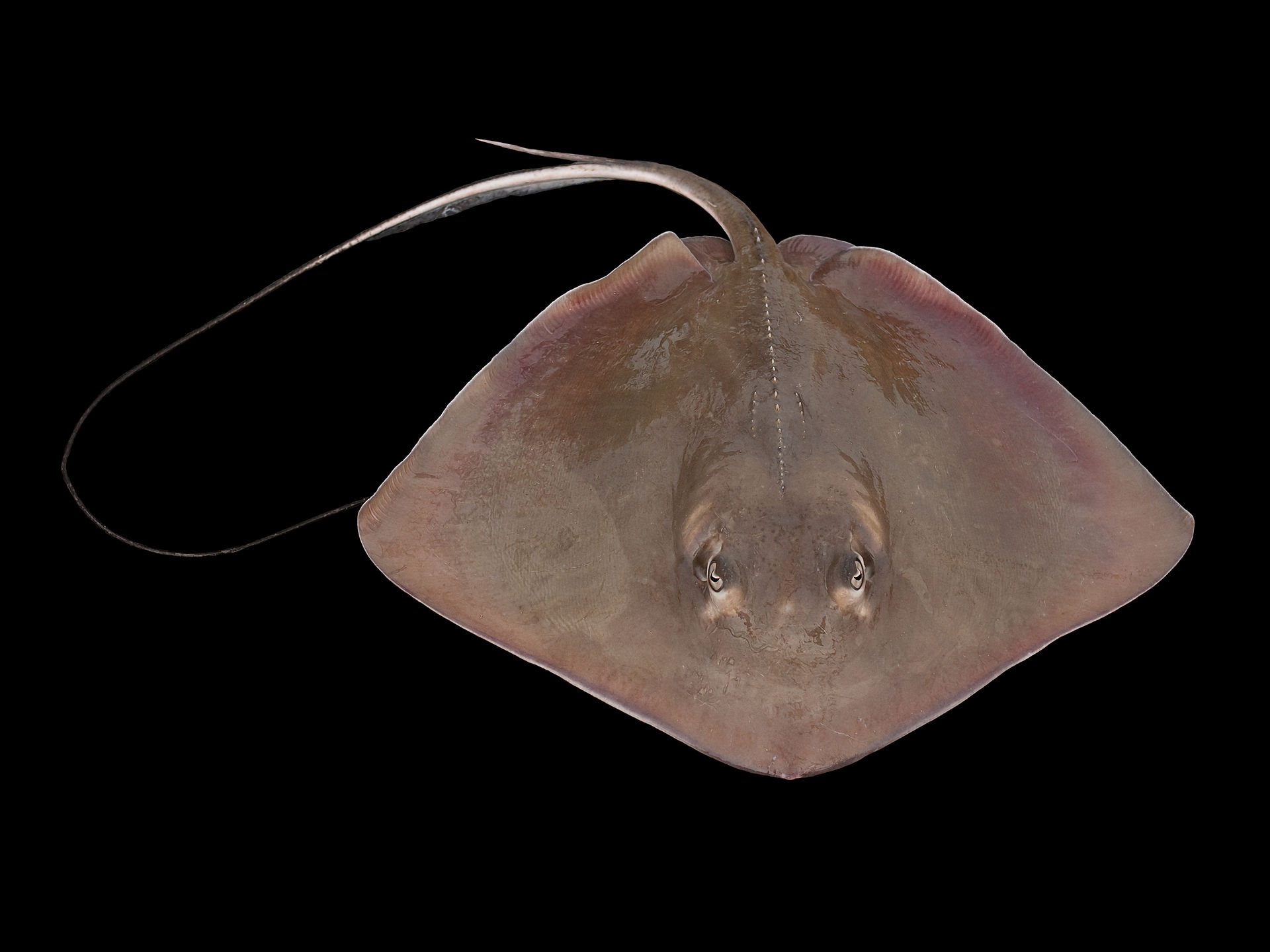
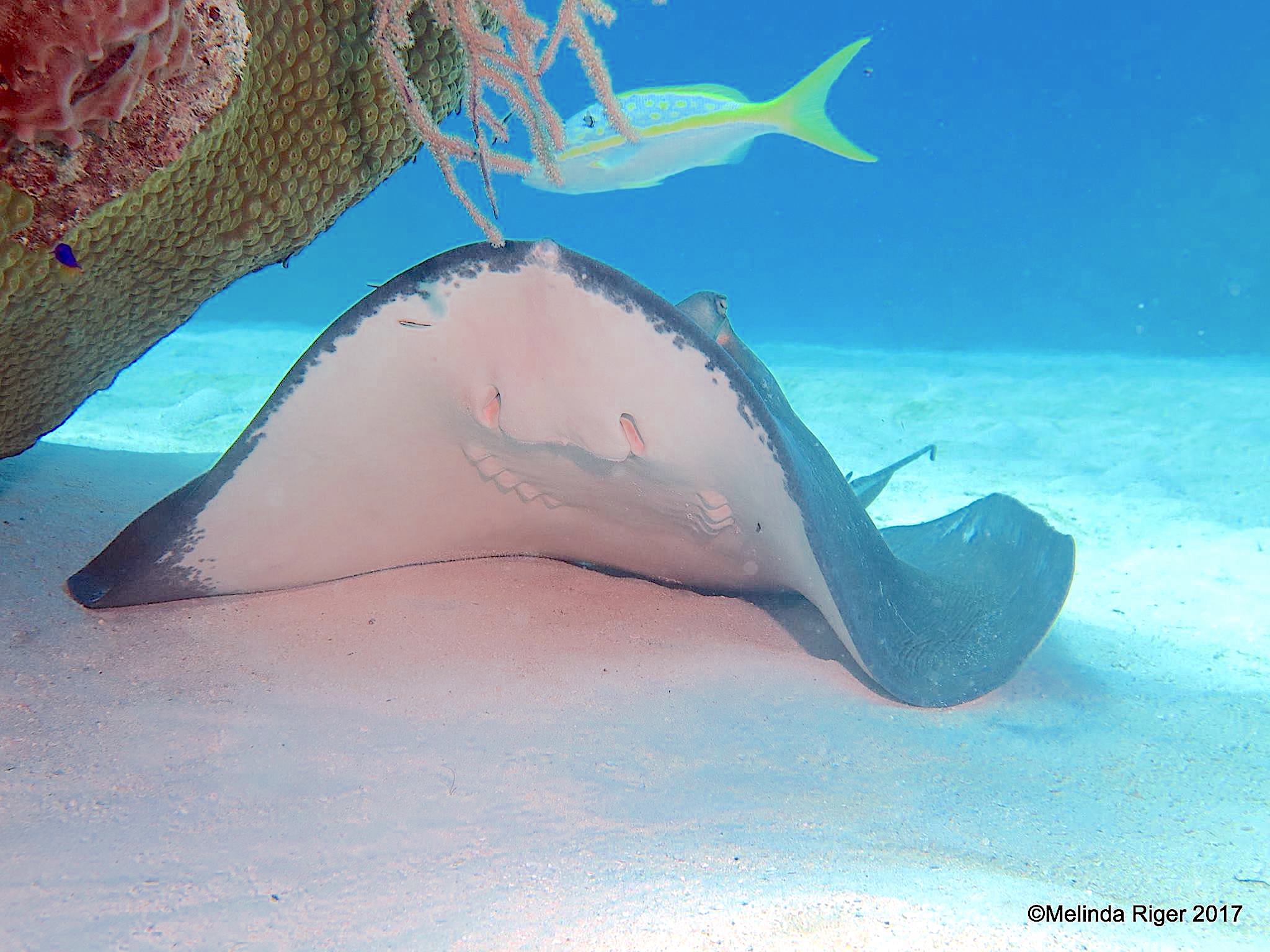
Anyone who has scuba-dived or snorkelled around the bright coral reefs of the Bahamas, or hunted bonefish out on the Abaco Marls will have come across Southern Stingrays Dasyatis americana. And there are certain places (eg Manjack Cay) where you can actually feed them – and not come to any harm…
FEED THEM? AREN’T THESE GUYS LETHALLY DANGEROUS CREATURES?
The name that always comes to mind in connection with stingrays is poorSteve Irwin, the charismatic Australian wildlife expert who was tragically ‘stung’ over his heart as he swam close over a ray while filming underwater. But this was, it would appear, a dreadful combination of circumstances with a terrible outcome.
The ray’s stinger is in fact an erectile venomous barbed spine near the base of the tail and not on the end of it (as one might expect). But these creatures are not out to harm you – though of course when you are in their environment you should accord them the respect that they merit.
If you are walking / wading in the water, avoid the risk of accidentally treading on a ray. Best to shuffle your feet forward in the sand; if there’s a half-concealed ray feeding or resting on the bottom nearby, it will swim away peacefully. I took the photo below while bonefishing on the Marls; the ray directly ahead slowly makes off as the skiff drifts closer. The next one is of a ray with its young – completely aware of us as we glide past to one side, but not especially bothered.
If you are swimming, snorkelling or diving, don’t get too close – especially by swimming directly over a ray (apparently Steve Irwin’s mistake, so that he was struck right in the chest by the stinger when the ray reacted).
Enough of the potential dangers. The southern stingray is a magnificent creature, as Melinda’s wonderful photographs show. She spends half her life underwater and I’m not aware that she has had a problem with a ray.
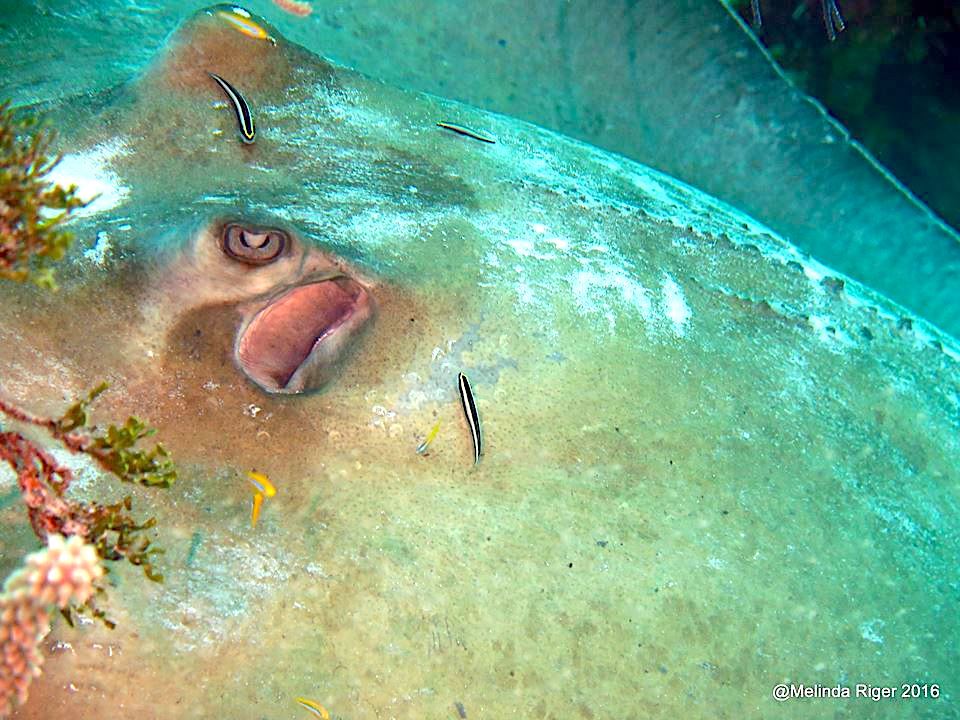
Like many larger sea creatures, stingrays need help with their personal care – the removal of parasites, dead skin and so forth. And so they make use of the services offered by small fish like gobies, wrasses and shrimps at a CLEANING STATION. Here are 2 photos of rays doing just that. You can see the tiny fish by the reef, going about their work. There’s a mutual benefit in this symbiotic relationship, in which it is understood that the cleaners are unharmed. Indeed, they will often enter the mouths and gills of a fish to clean… including the teeth. So there’s dental hygiene on offer too…
Photo Credits: Melinda Riger / Grand Bahama Scuba, except for the feeding photo (cheers, Samantha Regan), the ‘specimen’ from Tomas Willems (Wiki) and my two noted above
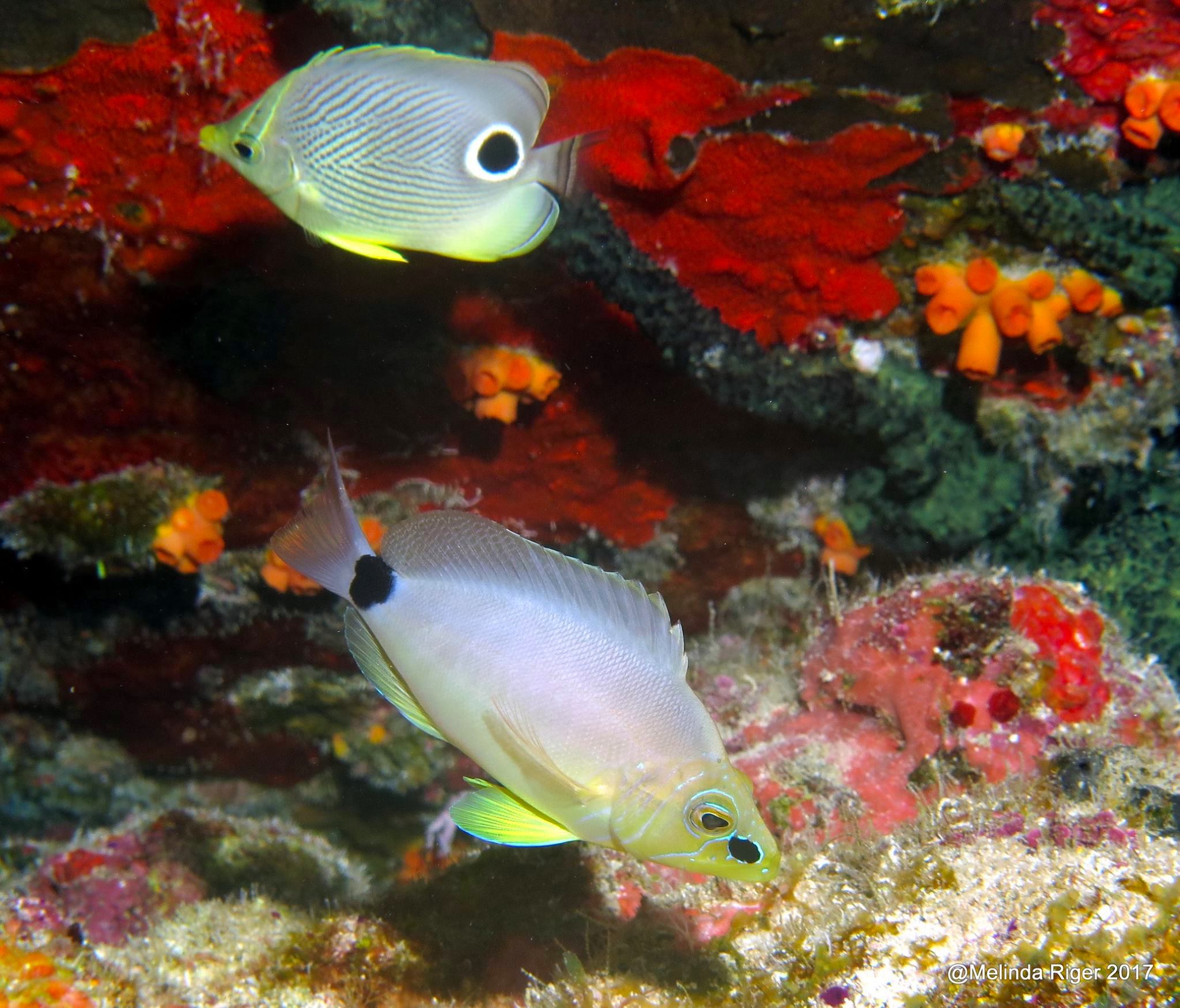
Four-eyed (or foureye) butterflyfish (Chaetodon capistratus) are small, somewhat circular fish with an endearingly pointy little snout. They are one of several butterflyfish species found in Bahamian waters. On their sides are smart ‘go-faster’ chevrons, with the unmistakeable white-circled black ‘eye’ at the back. The real eyes, in the conventional position, are small and far less noticeable, not least because of the stripe that passes right through them.
WHY THIS EXOTIC PATTERNING?
This type of misleading pattern is not uncommon in fishes and indeed in terrestrial creatures. It creates confusion in predators – and when this little fish is threatened it swims away with its large ‘eye’ prominent to the pursuer. It acts as a warning and an off-putting feature that suggests ‘don’t eat me’. If you half-close your eyes and look at the image below, the large eyes stand out against the reef background and hint at a creature not to be tangled with. Why reef predators don’t rumble this ruse within minutes, I have no idea.
WHAT IF THE RUSE FAILS?
Foureyes are very agile swimmers and can take advantage of narrow gaps and clefts in the reef by swimming sideways or even upside-down to manoeuvre away from danger and to safety where the predator cannot reach it.
AND IF THAT DOESN’T WORK?
If the foureye is in deep trouble, it has an alternative cunning plan. It will turn and face the pursuer, head down and dorsal spines erect. This posture says both ‘I’m very spiny – watch out’ and ‘I’m coming atcher’.
AND IF THAT DOESN’T WORK? I’M WORRIED FOR IT NOW…
Curtains. It’s lunchtime, I’m afraid.
♦ ♦ ♦ ♦ ♦ ♦ ♦ ♦ ♦
Foureyes are far from the only reef dwellers that have predator-confusing markings. In the image below, the foureye at the top is swimming with a largerBUTTER HAMLET, a species that also relies on an abnormal spot pattern to put off predators. This is a great capture, and it also illustrates how the smaller reef fishes can hang out together amicably.
Yellowtails are just one of several damselfish species in Bahamas waters. These small fish are conspicuous not just for the bright tails that give them their name. More striking if anything – especially if seen underwater in sunlight against the coral – are the electric blue spots visible in both adults and juveniles.
The body of adults is dark blue to brownish to almost black
The body of juveniles is blue
Yellowtails are a common and widespread variety of damselfish. They have a limited ability to change colour according to their surroundings, but with their bright tails and luminous blue flecks, it’s hard to see how they can look, to a predator, anything other than a tasty snack.
I have enjoyed seeing these little fish at Fowl Cay Marine Preserve, Abaco. The reef there makes for easy and rewarding snorkelling, with a wide variety of small and medium-size reef fishes to be seen. It’s an expedition I would definitely recommend to anyone wanting to see a healthy and active reef in a completely natural protected area.
I found that a video I took with a tiny camera was sadly of use only to myself. No one else would be able to make anything out due to the marked camera shake. Novices, huh? You are spared that: here’s a brief example of yellowtails swimming instead, showing the difference between juveniles and adults.
Credits: all photos, Melinda Riger / Grand Bahama Scuba; video from Desert Diving
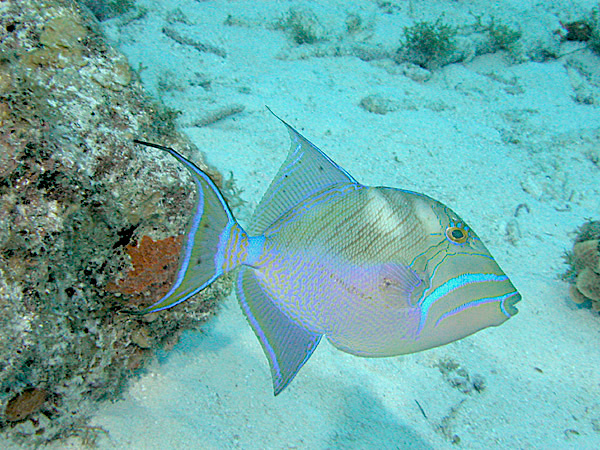
I can think of no sensible connection between the colourful yet undoubtedly strange and grumpy-looking looking queen triggerfish Balistes vetula, and a hurricane. However, Hurricanes Irma and Maria have been rightly dominating the news and everyone’s thoughts for nearly 3 weeks now. And most of the recent posts from Rolling Harbour, for that matter. It’s not been a great time for looking at the birds, beasts and fishes. So, as Maria drifts eastwards and away from the Bahamas into the open ocean, it’s time for a splash of colour – and a fish I have not featured before.
Hurricane Maria tracking at 11.00 EST on Sept 22
The queen triggerfish, sometimes known as an Old Wife, is an Atlantic reef fish. This species is sometime fished for as game, and I know that a few have been taken from off the rocks at the south end of Delphi beach over the years – though perhaps not exactly on purpose.
This fish typically is coloured with shades of blue, purple, turquoise and green with a yellowish throat, with pale blue lines fins on head and fins. It’s minor superpower is to be able to change its coloration to some extent to match its reef surroundings and assist camouflage. Its favourite food is the sea urchin.
Let’s hope this is the last post to feature anything about hurricanes for a good long time, as we think of all those still struggling to make sense of the terrible destruction they have recently experienced – in some places, twice over.
Credits: Melinda Riger / Grand Bahama Scuba; Mark Peter, Wiki; Clark Anderson / Aqua-images
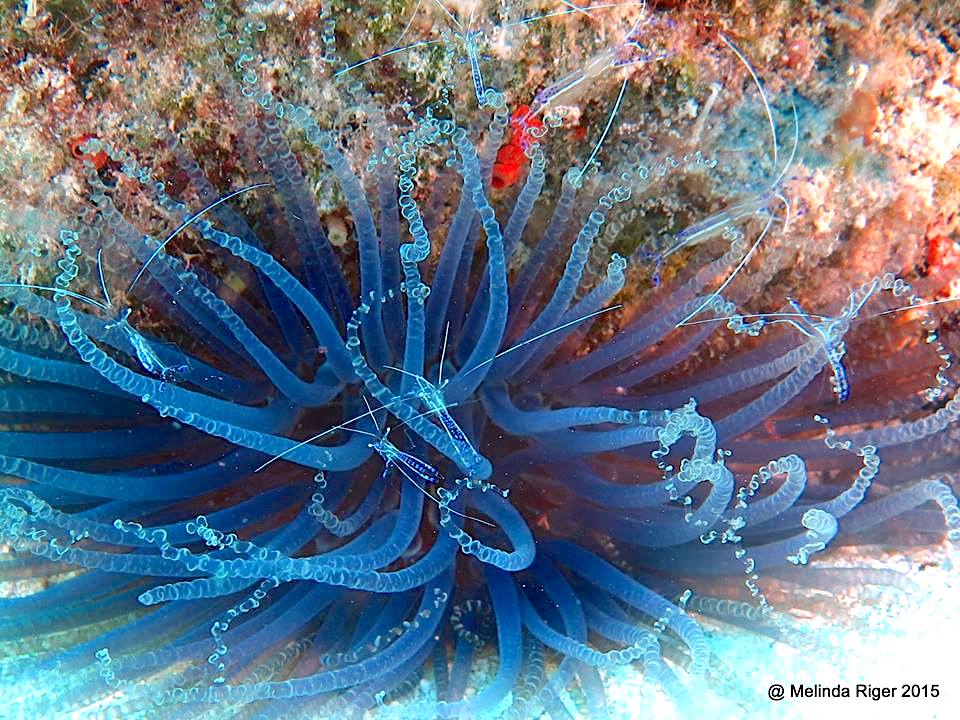
Pederson’s Shrimps Ancylomenes pedersoni(also known locally as Peterson’s shrimps), are one of several species of cleaner shrimp found in The Bahamas and more generally in the Caribbean seas. The species was named in 1958 by a multifaceted medico-oceanologist-zoologist Fenner A. Chace. He seems to have specialised in shrimps, finding distinct and differing species and naming them (not unreasonably) after himself (chacei);or colleagues and people he knew / admired; and in one case his wife. Mr Pederson was among them.
This tiny transparent creature with its vivid blue / purple markings and straggling pale antennae is unmistakeable, and helpfully cannot be confused with any other locally found shrimp species. Here’s an idea of its size, compared with a human finger and a blue parrotfish.
WHERE DO THESE SHRIMPS LIVE?
Their preferred home is… and it’s certainly a left field choice among sea creatures… in amongst the stinging tentacles of certain sea anemones. Not only do they not get stung, but of course they are well-protected by the defensive pain that their hosts can inflict. They are usually found singly or in pairs, but sometimes a whole colony may inhabit the same anemone.
SO EXPLAIN HOW THEY DON’T GET STUNG
Ok. The shrimps gradually build up a kind of resistance by pressing their bodies and antennae against the tentacles of the host anemone for increasing lengths of time, until they become immune. It’s like one of those kids’ electric buzzer / rheostat machines. Or a TENS machine (for those who know about backache).
IS THERE A DOWNSIDE TO ALL THIS?
Yes indeed. If a shrimp moves away from its host for a few days, it has to start the process of immunisation all over again. So presumably they tend to stay home-lovin’.
Home sweet home for the Pederson shrimps
SOMETHING ABOUT THE CLEANING, PLEASE
These shrimps offer ‘cleaning services’ to passing fish. When on duty, as it were, they wave their antennae vigorously to attract attention. A fish being cleaned will remain stationary and passive while external parasites and dead skin are removed. Many fish will open their mouths and gill covers for internal cleaning, with the tacit agreement that the cleaner will not become a snack. Shrimps often work in conjunction with small cleaner fish such as some species of goby and wrasse – see the links below for more on this topic, with copious images…
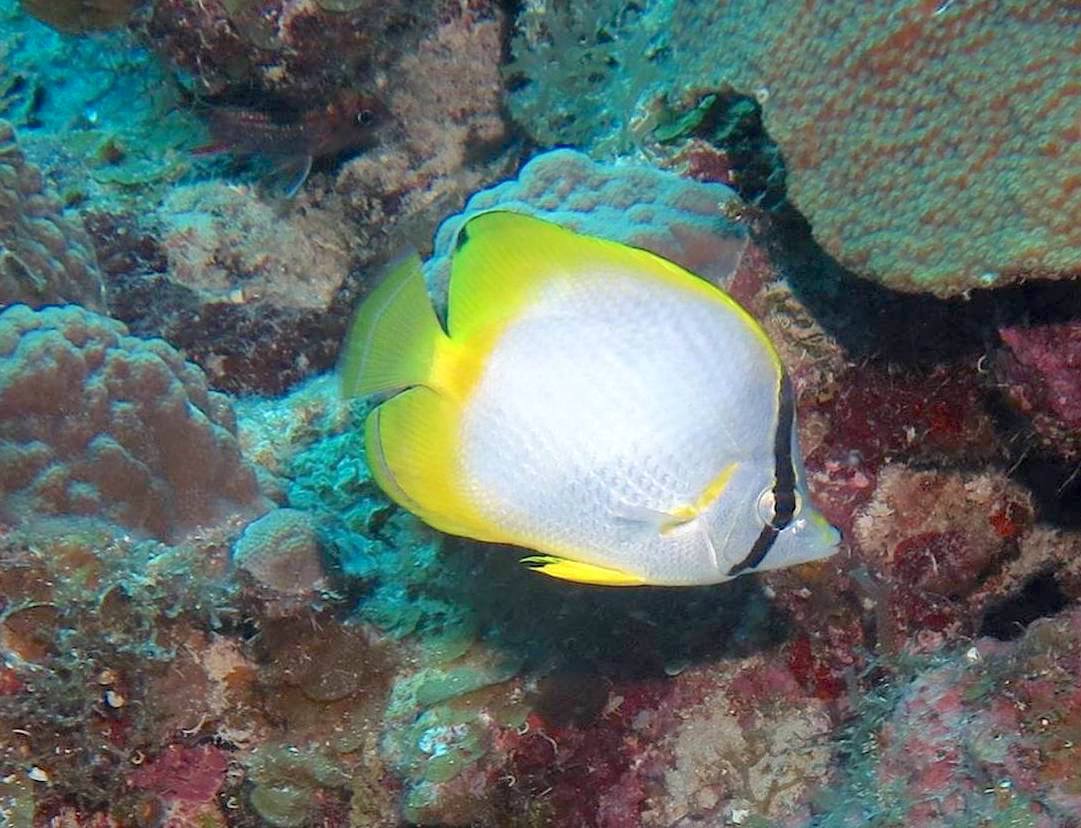
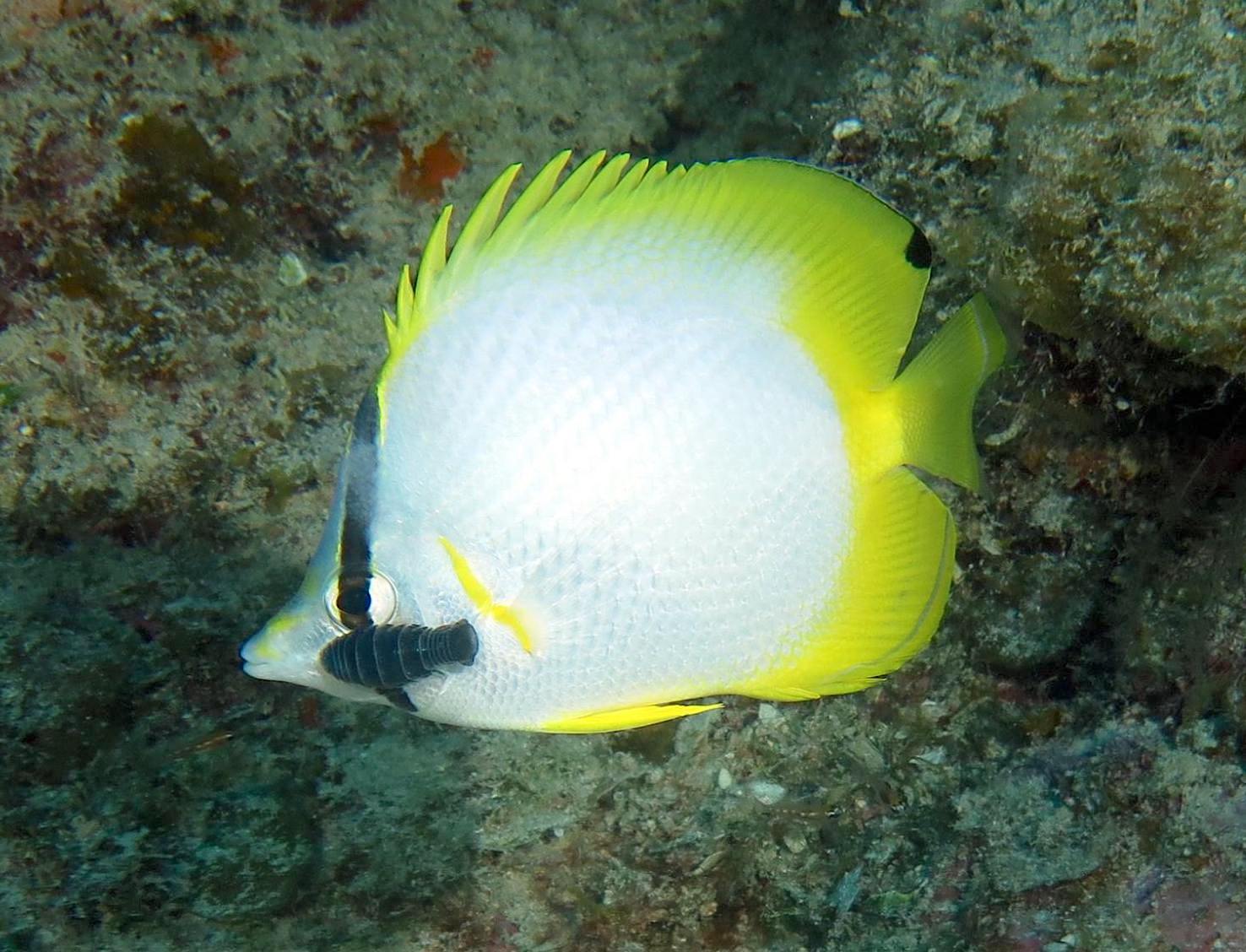
Butterflyfishes are a large family of mainly colourful small fish somewhat like mini-angelfish. The spotfin butterflyfish (Chaetodon ocellatus) is one of several types of butterflyfish found in the western Atlantic Ocean; and one of half a dozen or so you are likely to see nosing around the coral reefs of the Bahamas.
The name ‘spotfin’ derives from the dark spot on the dorsal fin. At the front end, there is a distinctive black vertical stripe that passes right through the eye. Combined with the vivid colouring, predators are in theory confused or warned off. The spotfin’s superpower (on a modest scale) is that at night, a change of appearance occurs in adults. The dark patch on the dorsal fin increases in size, and dark bands appear on the body. This seems to be in order to provide further protection during the darker hours.
The spotfin above has an isopod attached to it, a type of crustacean with a segmented body. Primitive fossils of these creatures have been dated back some 3m years. Want to know want this one is up to? These things“are mostly external parasites of fish or crustaceans and feed on blood, having piercing and sucking mouthparts and clawed limbs adapted for clinging onto their hosts”.
Soldierfish photobombs a spotfin. Or maybe it’s vice versa?
Reading about this particular species of butterfly fish, I discovered that the spotfin “is very common and very hard to maintain in a tank” – as if the two facts are somehow connected. So might they be coarse or vulgar, and thus unsuitable companions for better bred and perhaps sensitive aquarium fish? As it turns out, it may be because they are vulnerable to predation, and so can coexist only with peaceable tank friends.
Spotfins are perfectly happy swimming upside down; and their party trick apparently is to rise to the surface and squirt a jet of water in the air. Sadly, I couldn’t come up with a photo of this…
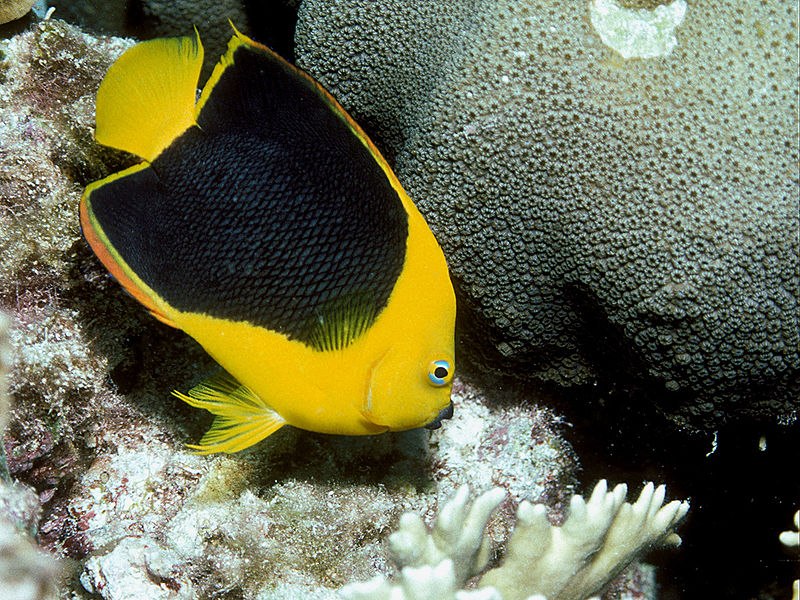
The Rock Beauty Holacanthus tricolor is a small species of Angelfish. Seen swimming around the reefs they are unmistakeable, not least because of their bright yellow hi-viz jackets, remarkable blue eyeliner and blue-black lippy. They featured near the start of this series HERE, and a recent online search (for something else completely, as is often the way) reminded me to give them another swim round Rolling Harbour.
In addition to the hi-viz-and-eyeliner combo, the Beauty above has chosen a fetchingly cheeky pair of matching ISOPODS(crustacean parasites) to adorn its face – possibly the piscine equivalent of a tat…
Rock Beauties look like prime candidates for anyone’s aquarium, but their dietary requirements and tendency for aggression make them unsuitable. They are highly specialised feeders, needing marine sponge in their daily diet. They are also prone to chase their tank-mates and nip them. On balance, they look more fetching nosing about the coral anyway.
WHAT DO JUVENILES LOOK LIKE?
Juvenile rock beauties are cute mini-versions of the adults, only more yellow (including the lips). In some development stages, they have a smart blue circle in the middle of the dark patch on their sides (bottom image).
NOTE Rock Beauties have no known relationship to Chrissie, Debbie, Lita, Stevie, Joanna, Madge and the rest of the accredited ‘Rock Beauties aka Chicks’.
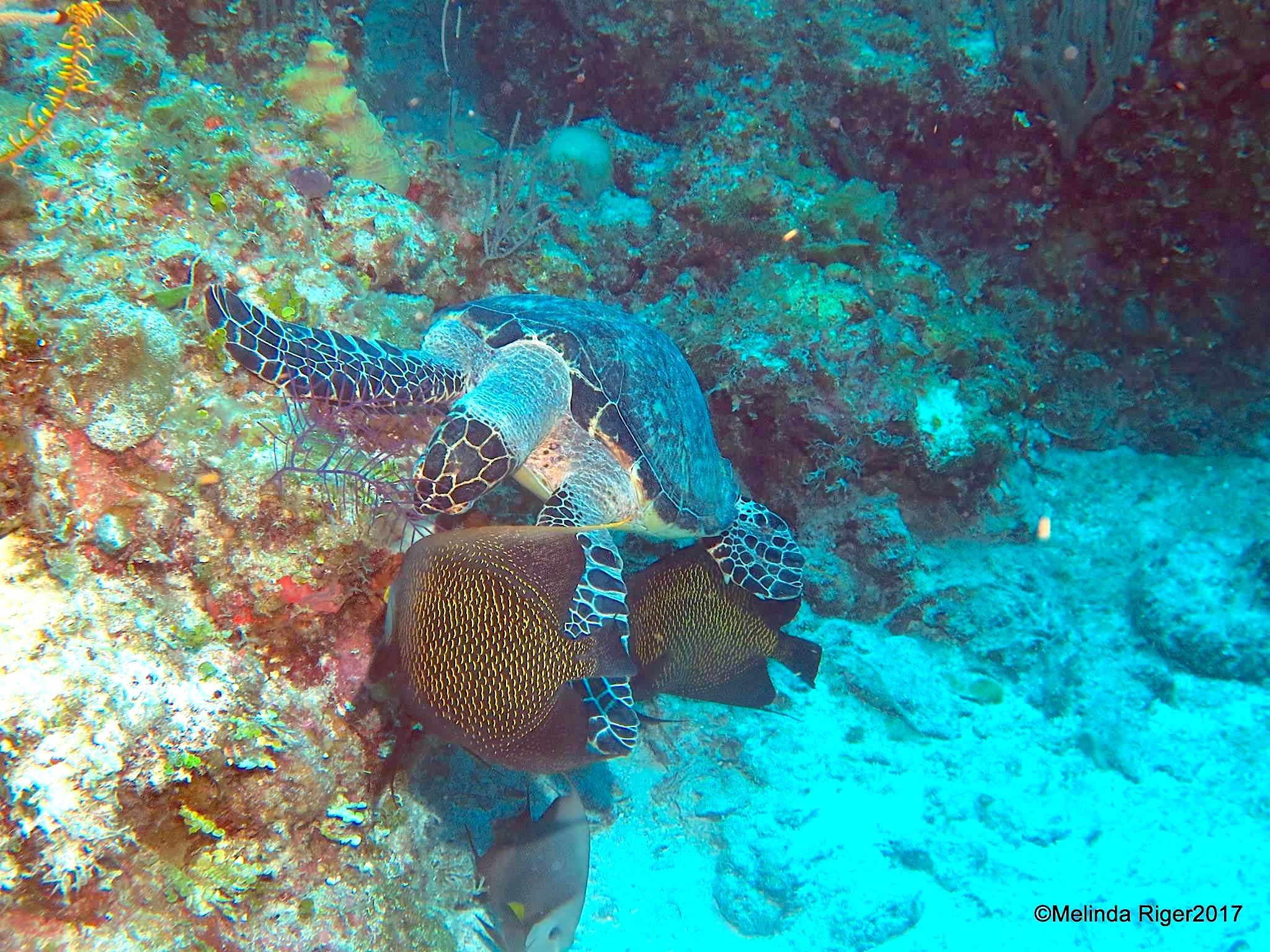
Hawksbills on their own, nosing around the colourful coral reefs of the Bahamas, are a beautiful sight. I don’t want to overdo the religious tendency of the title, but they are indeed wonderful to behold. Add FRENCH ANGELFISH and a QUEEN ANGELFISH and it’s as close to perfection as a reef scene gets. Click on the links above for more pictures and details about the two angelfish species seen here with the turtle. As ever, Melinda Riger was ready with her camera to capture these great images.
This astonishing photo was of course achieved by carefully balancing a GoPro on the turtle’s back, wrapping duct tape around it, and pressing ‘go’ (camera and turtle simultaneously). **
**This is not true. It’s just a cleverly shot turtle’s-eye view as it forages on the reef
This short video shot by Melinda’s husband Fred of a turtle ‘loving’ the camera is one of those wildlife events that cannot be predicted… but when it happens, it’s frankly a bit of a scoop.
OPTIONAL MUSICAL DIGRESSION
As I was writing this, an earworm started up and grew insidiously in both ears and then inside my head… the dread words “Elenore, gee I think you’re swell”. Followed by “so happy together…”. And then “she’d rather be with me…” Yes, I’ve now gotTURTLESin my head, the (?long-and-hitherto-forgotten) band from the second half of the 60’s, with their cheery anodyne soppy-poppy love songs. And dammit, they’ve stuck… Here’s a reminder for those whose memory I have jogged. For anyone under, say, 75, step away from this area. Nothing to hear here.
Credits: Grand Bahama Scuba: all photos – Melinda Riger & video – Fred Riger; Turtle music – someone else’s music collection, not mine, honestly… (oh dear another lie I am afraid – cred gone)
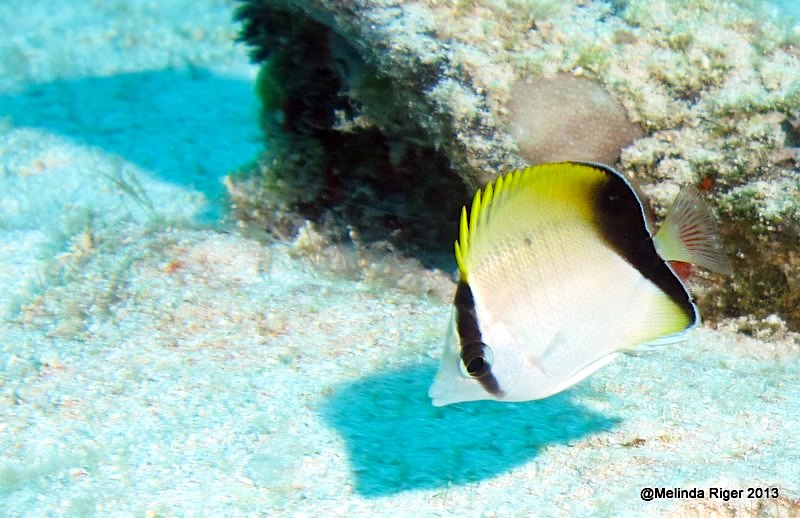
Butterflyfishes come in several varieties in Bahamian waters; and there are more than 120 species worldwide. Not so long ago I wrote about the LONGSNOUT variety, also known as the “Butterbun”. Now it’s time to take a look at the Reef Butterfyfish.
In some ways butterflyfishes resemble small angelfishes – adult Reefs are just a few inches long. As the name suggests, these are creatures of the reefs, and of shallow waters. As one might expect, these colourful fish are popular for aquariums (or, strictly I suppose, aquaria).
Butterflyfishes have interesting spawning patterns. They release large numbers of buoyant eggs into the water. These become mixed in with plankton and suchlike, and float where the tides take them until they hatch. Then, most unusually, they go through a larval stage when they are covered by bony material, which they lose as they mature. This is known as an ‘armoured’ stage, which I can only assume is to provide protection to the tiny fry – perhaps by making them crunchy and unappetising. I’ve been trying to find a usable illustrative drawing, without success so far.
OPTIONAL MUSICAL DIGRESSION
In some parts of the world the butterflyfish is called a BORBOLETTA, which is Portugese for ‘butterfly’. It is also the title of Santana’s criminally underrated sixth album (1974). For sure it’s no 1st, Abraxas, 3rd or Caravanserai… but if you can tolerate the man’s move to ‘jazz-funk-fusion’ – maybe John McLaughlinhad a hand in that – there is much to enjoy. There’s less searing guitar and there’s some strange ‘soundscape’ stuff that’s maybe not to everyone’s taste. But still – it stand up pretty well in comparison with some of the later Carlos creations where a certain tiresomeness began to creep in and some tracks are (IMVHO) not really listenable-to. Anyway, the recently released (2016) Santana IV is a welcome return to the good old days, and the good old team.
Here’s ‘Promise of a Fisherman’ – 8 minutes of Santana, from which you can judge the direction he’s taken by Album 6…
All photos by Melinda Riger of Grand Bahama Scuba – mainstay, with Adam Rees, of the underwater photos I use, what with me being a feeble swimmer and all. Tip o’ the Hat to Carlos, who I have even managed to see Live a couple of times.

















































 ROLLING HARBOUR ABACO
You must be logged in to post a comment.