“CLINGING TO THE WRECKAGE”: BAHAMAS CLINGING CRABS
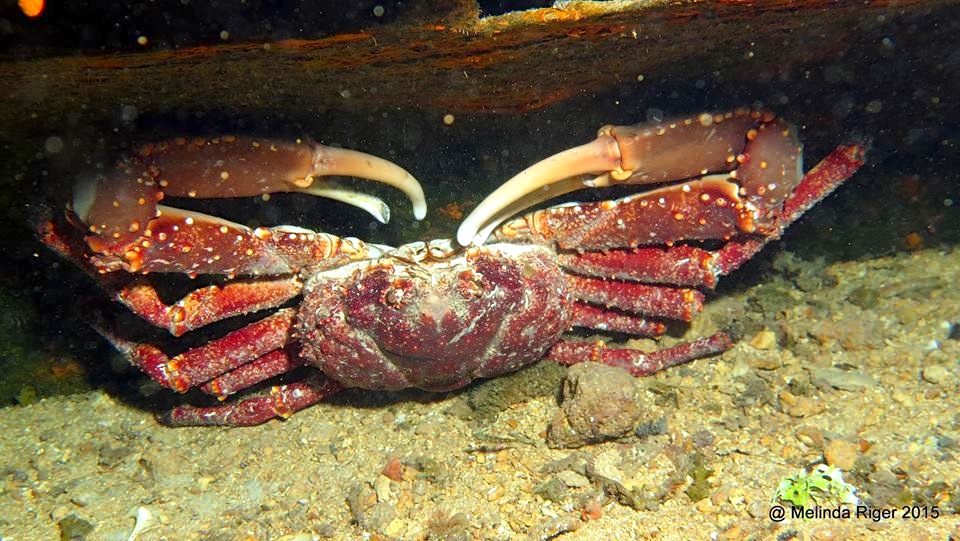
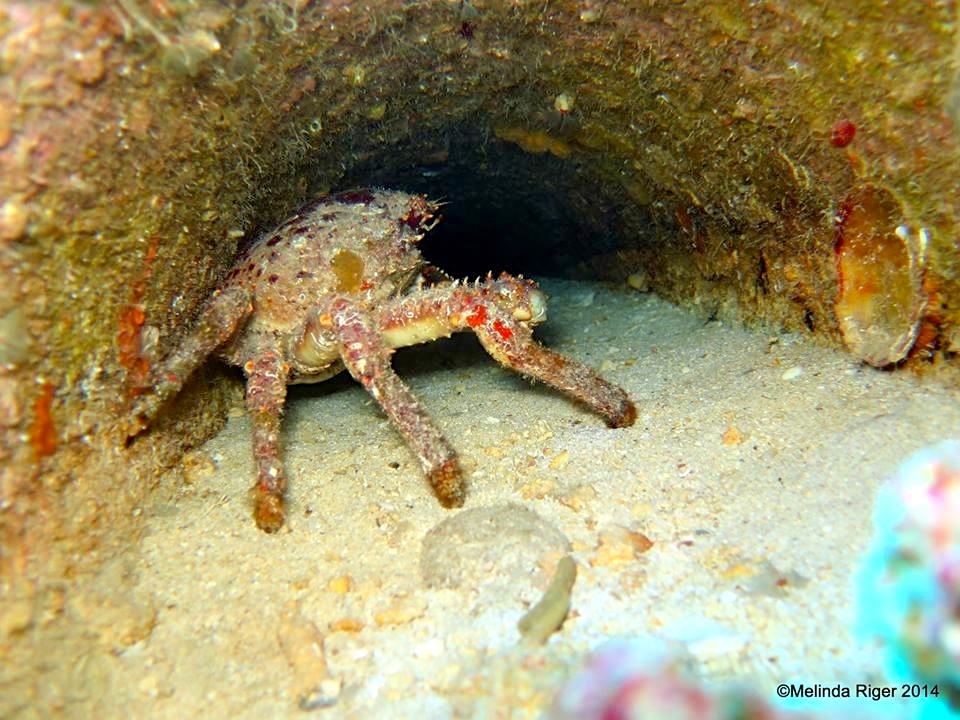
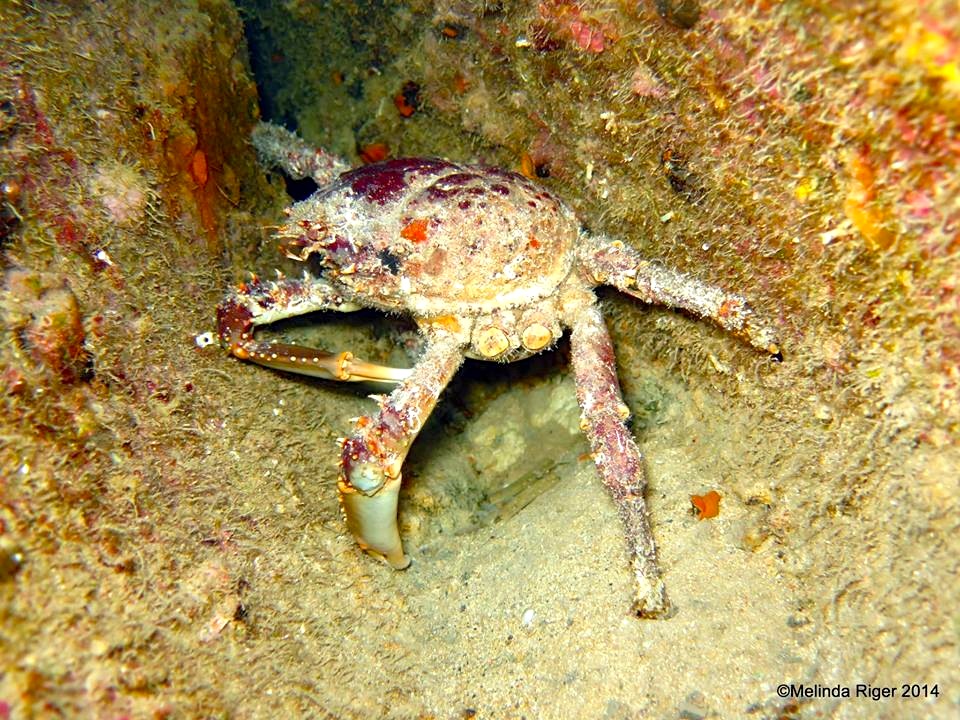
The Clinging Crab Mithrax spinosissimusanswers to a number of names: West Indian spider crab; channel clinging crab; reef or spiny spider crab; or coral crab. It is found throughout the waters of South Florida and the Caribbean.
These are crabs of the reefs, or indeed of the wrecks that may be found around reefs. Some of the crabs in this post have chosen wrecks as their home – in the header image the crab is living inside the smoke stack of ‘Theo’s Wreck’, Grand Bahama.
The clinging crab is believed to be omniverous, its main diet being algae and carrion. They can grow to 2 kg, and it is the largest species of reef crab found in the Caribbean.
LAID BACK
Credits: Melinda Riger of Grand Bahama Scuba (all photos), with thanks as always for use permission
Imagine that you are swimming along resplendent in your snorkeling gear (me) – or in scuba gear for the advanced swimmer (you). There, below you, camouflaged against the sea bottom is a fish. A strange-shaped brown sort of creature with odd side fins. As it progresses over the gravelly sand, your immediate reaction is ‘What the f…?’ Its fins seem to be turning into… wings. Like this:
Yes, it’s a flying gurnard. Unlike flying fish, it can’t actually fly through the air. But once its wings are fully spread, it certainly looks as though it could.
WHAT’S THE POINT OF THE WINGS IF THE THING CAN’T FLY?
This gurnard species usually gets around using its ventral fins as ‘legs’, with the pectoral fins (‘wings’) close to the body. There seem to be several possible reasons for possessing the ‘sudden-deployment-of-flashy-wings’ superpower.
It surprises and deters predators by movement, turning prospective prey into an apparently different creature
Bright or lurid colouring may be a deterrent warning of a foul-tasting or poisonous species (APOSEMATISM)
A creature may actually be harmless and even tasty (as here) but may appear to be unpalateable or poisonous(BATESIAN MIMICRY)
In any event, the wings enable the fish to take off from the sea bottom and travel faster by ‘flying’ thought the water to escape a predator
Here’s a short video of a flying gurnard on the move, from ‘Sia Big Fish’
Credits: All main images Adam Rees / Scuba Works with many thanks as ever, except final one ‘cralize wiki’; Hyperallergic for the historic image; Sia Big Fish for the video
BRITTLE STARS are closely related to starfish, and in particular to Basket Stars. They are commonly known as “serpent stars”, having 5 long, thin arms that may grow as long as 2 feet long. There are lots of different types of brittle star – at least 2000 – and they are found in every ocean on earth from the poles to the tropics. In Bahamian waters they a commonly found living on reefs.
Although these creatures look primitive, their structure, nervous systems, respiratory systems, digestive systems, sex lives and transportation methods are incredibly complex. Take it from me – I’ve just read about it all. So I’ve decided to pick a few aspects of these creatures to highlight rather than discuss the minutiae of their ossicles (tiny bones), madroporites (a sort of water filter / pressure balancer) and viscera.
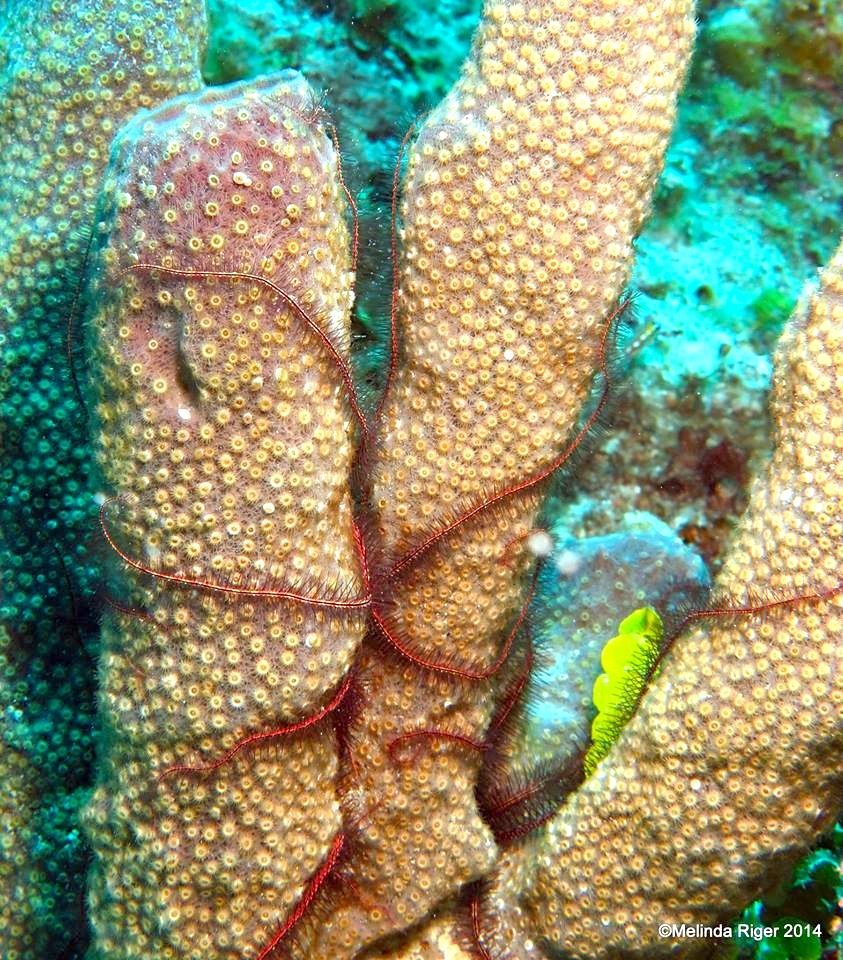
You are most likely to see Brittle Stars clinging to coral or sponges
A DOZEN BRITTLE STAR FACTS TO PLAY WITH
The star has no eyes and no sense organs as we know them, but can detect light chemically; and (why would they need this?) sense smell through their ‘feet’… [Not a superpower I would prize, but still]
The mouth is on the underside of the central disc (‘body’) of 5 segments, each with a toothed jaw
The mouth is used both for ingestion and, putting it delicately, egestion. [Nor that superpower]
Stars eat tiny organisms suspended in the water or mini-worms, gathering them with their arms
If I have understood this, they breathe through their armpits, and can excrete from here also
The arms fit the main part with ball and socket joints, and are flexible in all directions
The genitals seem to be located in or between the armpits (lucky we are not descended from stars)
Stars readily regenerate lost arms until they lose the 5th – then they are in real trouble
This enables them to shed an arm in a predator attack, like a lizard its tail
Trials indicate that a jettisoned arm cannot regenerate from itself
They use only 4 arms to move along, with the fifth ‘steering’ out in front or trailing behind
Brittle Stars are inedible but non-toxic
Often, brittle stars will cling on inside a sponge
Here is a great video from Neptune Canada of a brittle star fight on the ocean floor over the remains of a shrimp. If you watch the ones joining the fight, you will clearly see the locomotion method described above, with one limb pathfinding and the other four ‘walking’.
I’m not renowned for extreme sensitivity, so I feel no shame in showing mating brittle stars, courtesy of Channel Banks. It’s not exactly Lady Chatterley and Mellors, but the entwined arms are rather romantic, no?
Credits: all wonderful photos by Melinda Riger of Grand Bahama Scuba; BS infographic and viddys as credited
FAIRY BASSLET (‘MIND YOUR GRAMMA’): BAHAMAS REEF FISH (33)
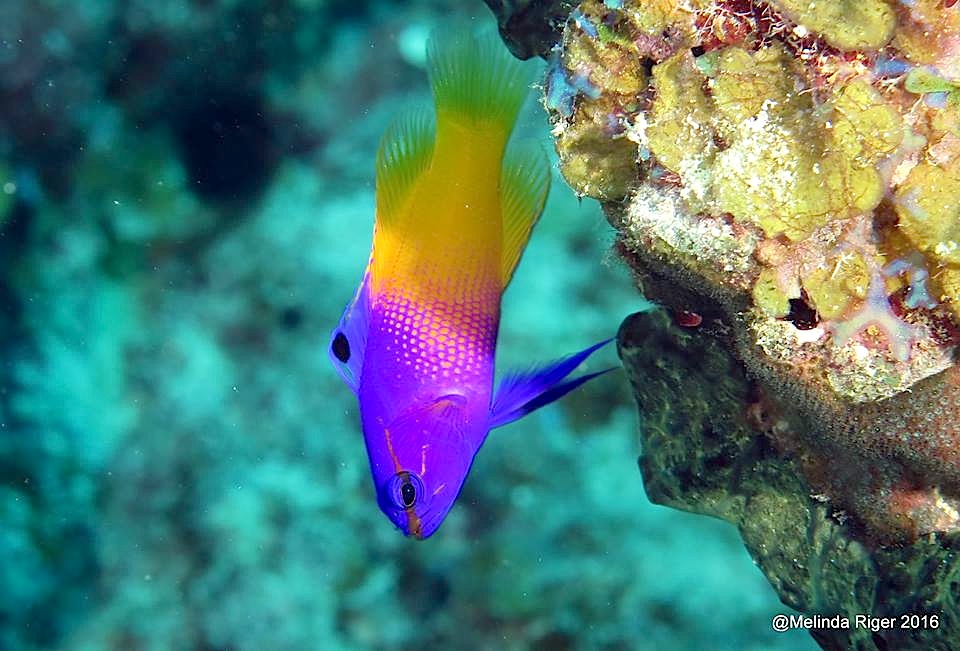
The Fairy Basslet is a tiny brightly-coloured fish with a pretentious alternative name. It is otherwise known as the Royal Gramma (Gramma loreto). These fish are found in the coral reefs of the (sub)tropical western Atlantic. They are also found in aquariums anywhere you like, being small, bright, placid and generally good-natured.
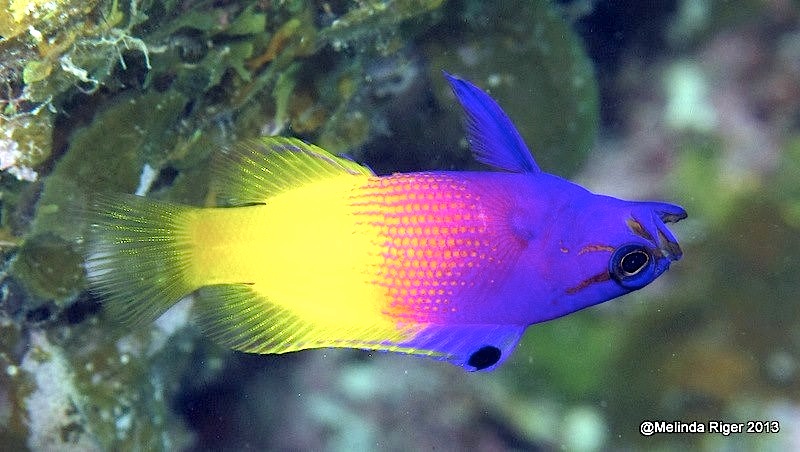
Conveniently, the basslet is unlikely to be confused with any other species. Its striking two-tone colour scheme of purple and yellow is hard to miss. The purple front half (which is presumably where the ‘royal’ comes from, being a regal or imperial colour) may also be violet or even blue in some fish and / or in some light conditions. Another identification pointer is a black spot on the dorsal fin.
You’ll notice that the basslet above appears to be upside down. Which is because it is – this isn’t an inadvertent photo-flip. These little fish tend to orientate themselves to be parallel with the closest surface. This leads to them happily swimming upside down, or aligning vertically. As one article I read says severely, “this behaviour is not to be mistaken for illness”.
Fairy basslets / royal grammas are also CLEANER FISH. They pick parasites and dead skin off larger fish that visit so-called cleaning stations to be attended to by tiny fish and cleaner shrimps. The basslets also their customer’s gills and even their teeth. The deal is that, in return, the large fish do not eat the cleaners, even the snack-sized ones rootling around inside their mouths.
MUTUALISM
The relationship is a good example of mutualism, a type of symbiotic relationship where both species involved benefit from their interactions. Think also of cattle egrets and cows.
WHAT ABOUT BREEDING?
I really can’t improve on this rather touching description from Wiki:
“The male will build the nest among rocks using pieces of algae.The male will then lead the female to the nest, where she will deposit 20-100 eggs in the nest. During the breeding period, this behaviour is repeated almost every day for a month or longer. The eggs are equipped with small protuberances over the surface with tiny threads extending from them which hold onto the algae of the nest and keep the eggs in place. The eggs will hatch in five to seven days, normally in the evening…”
HOW COME THE NAME ‘GRAMMA LORETO’?
This official name became a brainworm with me after I started this post. I had to check it out. The ‘Gramma’ part simply denotes a member of the genus of fishes in the family Grammatidae.
The Loreto part is more mysterious. It is an an ancient town in Italy; and the name of several British schools, including – almost too good to be true – a school called Loreto Grammar. But it was also the name of Señorita Loreto Martínez, who caught the ‘type specimen’ while fishing in the bay at Matanzas, Cuba.
MISC
I failed to be able to resist finding out whether any country of the world has a purple and yellow flag. The answer is, no. However I am delighted to be able to report that the flag of the Independent Party of Uruguay is basslet-coloured.
Credits: all fantastic photos by Melinda Riger of Grand Bahama Scuba; magpie pickings of an unacademic sort for facts and speculation
YELLOWTAIL (REDFIN) PARROTFISH: BAHAMAS REEF FISH (54)
The yellowtail parrotfish (sometimes known as a redfin) is one of around half-a-dozen kinds of parrotfish found among the coral reefs of the Bahamas, and sometimes in seagrass areas. There are many other related species worldwide (about 80). Parrotfish are among the most important fishes on the reef because they play a major role inBIOEROSION , a vital process for the health of the reef.
A. FEEDING & BEACH BUILDING
Their dental arrangements – a mouthful of meshing teeth – form the characteristic ‘beak’
Primarily herbivores but also snack on small creatures, organisms, or even molluscs
As they feed on their favourite algae, their teeth grind up the coral which they ingest
They digest the coral & excrete it as sand, becoming a component of your favourite beach
The teeth grow continuously, replacing ones worn away by grinding coral as they graze
They are a vital species in preventing algae from choking coral: essential reef cleaners
B. PARROTFISH: PERSONAL INFORMATION
Some secrete a protective mucous cocoon to sleep in or as concealment from predators
Mucous also helps to heal damage, repel parasites, & protect them from UV light
As they develop from the juvenile stage, most species change colour significantly
In some species, juveniles change colour temporarily for protective purposes
These are “sequential hermaphrodites”, turning from female to male (‘protogyny’)
Single males tend to have several lady friends, and aggressively defend their love rights
Parrotfish arePELAGIC SPAWNERS. Females release many tiny buoyant eggs into the water
The eggs float freely then eventually sink to the coral until they hatch
Unlike almost all other fishes, they use their pectoral fins to propel themselves
Feeding behaviour / dietary requirements make them (thankfully) unsuitable for aquariums (or aquaria, if you prefer)
WHAT WAS THAT ABOUT CHANGING SEX?
Parrotfish may undergo sex reversal in which developing female fish become males
Parrotfish born male remain male throughout their lives (“primary males”)
Female-born fish may change sex & colour to become male (“secondary males”)
Secondary males are fertile and generally mate with a single female
Females that stay female live in harems protected by a dominant “supermale” BUT…
…if the supermale dies, the largest female in the group changes sex to become male…
…AND amazingly adopts the coloration of the supermale (best ‘astounding fact’ of all)
ARE PARROTFISH EDIBLE? JUST ASKING…
Parrotfish skin is very tough but their flesh is soft and degenerates quickly
Some species (eg blue parrotfish) carry ciguatera toxins – to be avoided
They are not considered a fishing target in Bahamas, nor a food-fish
Parrotfish are eaten elsewhere in the world however, for example Jamaica (cooked)
In Hawaii they are eaten raw – at one time they were reserved for royalty
Credits: Melinda Rogers / Dive Abaco for her great illustrative images. All photographs were taken on the reefs of Abaco; Florida Museum to cross-check facts; VIDEO – Angari Foundation
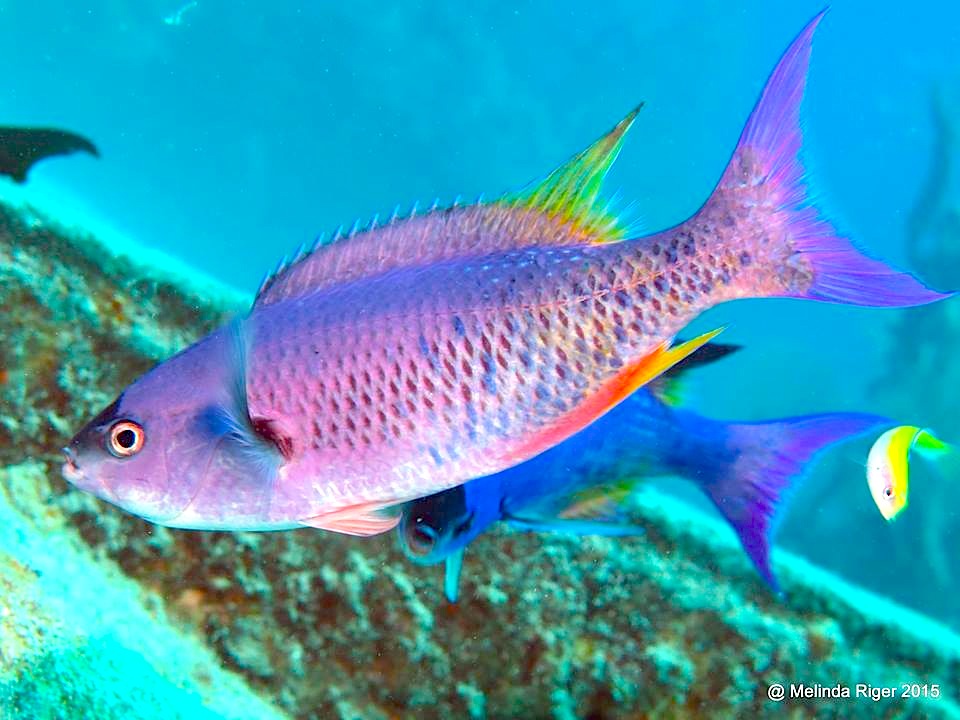
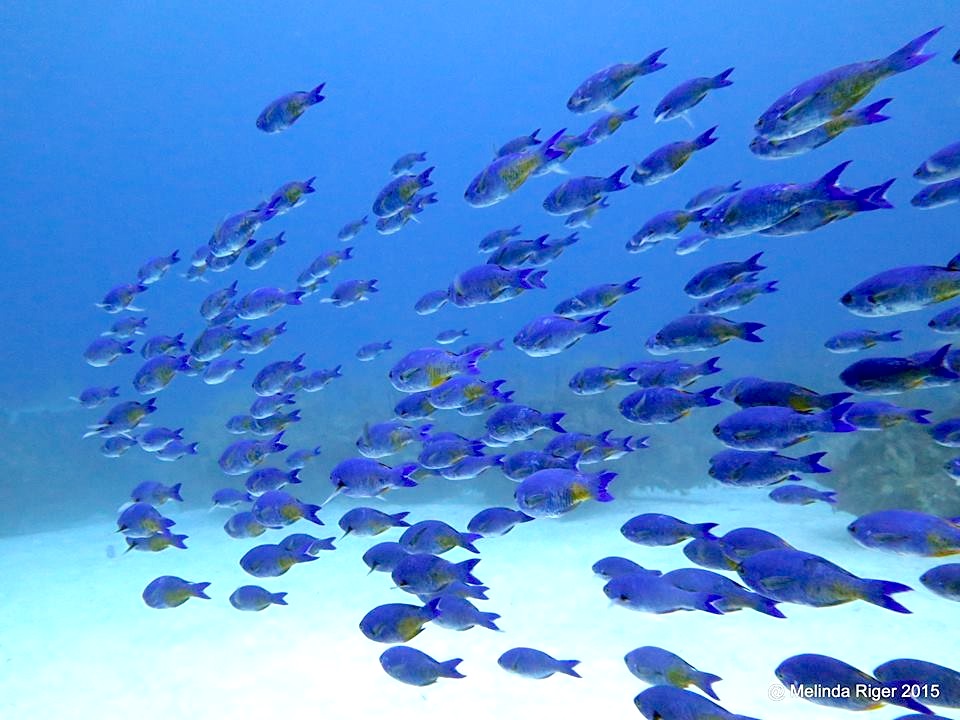
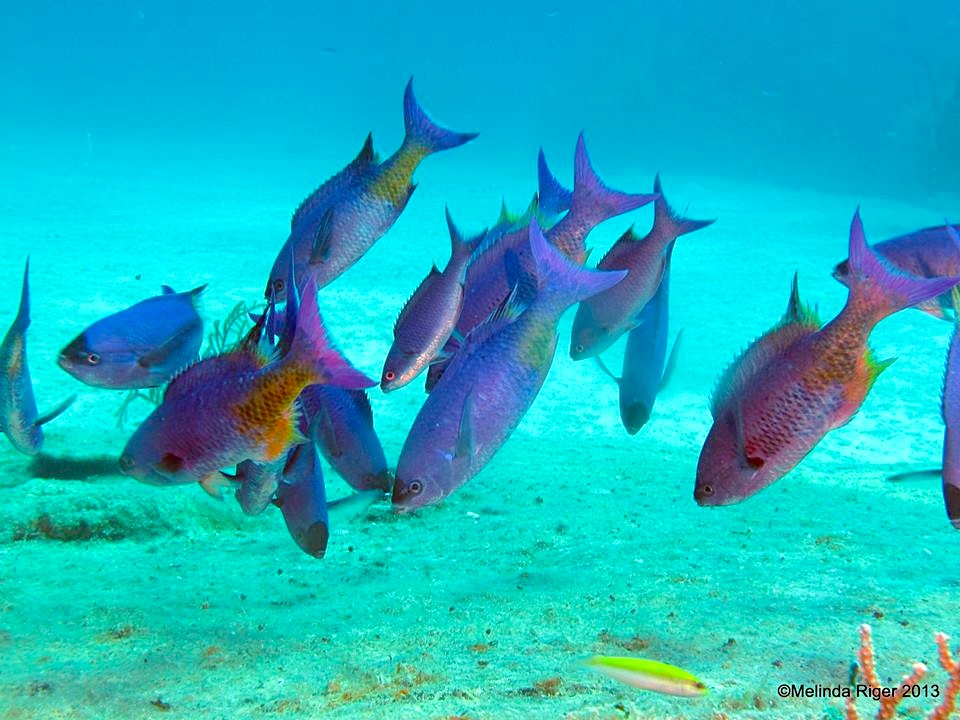
The creole wrasse Clepticus parrae is a small wrasse species, with adult males reaching about 12 inches long. During its life, the fish will change colour significantly. A juvenile is almost completely violet-purple. As it matures, it becomes paler and develops patches of yellow on the rear part of its body.
Creole wrasse are found throughout the tropical and subtropical waters of the western Atlantic, from Florida south to Brazil. The habitat includes Bermuda, the Caribbean Sea, and the Gulf of Mexico. Their conservation status is LCLeast Concern.
These are social fish that live in groups around coral reefs. They are usually found in shallow water, but – perhaps surprisingly for such small creatures – they have also been found as deep as 100m.
The groups of wrasse feed on plankton, small jellyfish, pelagicTUNICATES, and invertebrate larvae. They are active in groups by day, but at night they separate and each fish finds its own safe crevice in the reef to sleep.
ANYTHING ELSE WE NEED TO KNOW?
Yes indeed. Their intriguing breeding regime – how unlike our own dear species. The creole wrasse is aprotogynous hermaphrodite. The largest fish in a group is a dominant breeding male, while smaller fish remain female. If the dominant male dies, the largest female changes sex. Mature males congregate atleksto breed, at which they display and are approached by females before mating with them. These leks are reminiscent of certain clubs and bars in the less reputable parts of some towns and cities. Or so I am told.
It’s been a while since I included a Rolling Harbour musical diversion. However, the colour of this small fish nudged my memory back to 1968 and DP’s debut album (line-up Mk 1 of several hundred, or so it seems now). Hence the post title. Anyone who remembers this ‘wasn’t there’. Anyone who doesn’t remember it obviously wasn’t there either…
FUN FACT: an early appraisal of the Purp’s music includes the description “a slow and pompous din, somewhere between bad Tchaikovsky and a B-52 taking off on a bombing run”
I don’t think this guy thinks much of that. And quite right too
All wrasse photos from Melinda’s archive; DP cover borrowed from Am@z@n; MP3 moi
The ‘WTF?’ series started with relatively conventional species eg REMORAS and became progressively more bizarre. In due course, having covered the excellently strange BATFISH it was time to ramp up the stakes: with many thanks to scuba expert Adam Rees for use permission for his terrific photos, I present… the FROGFISH.
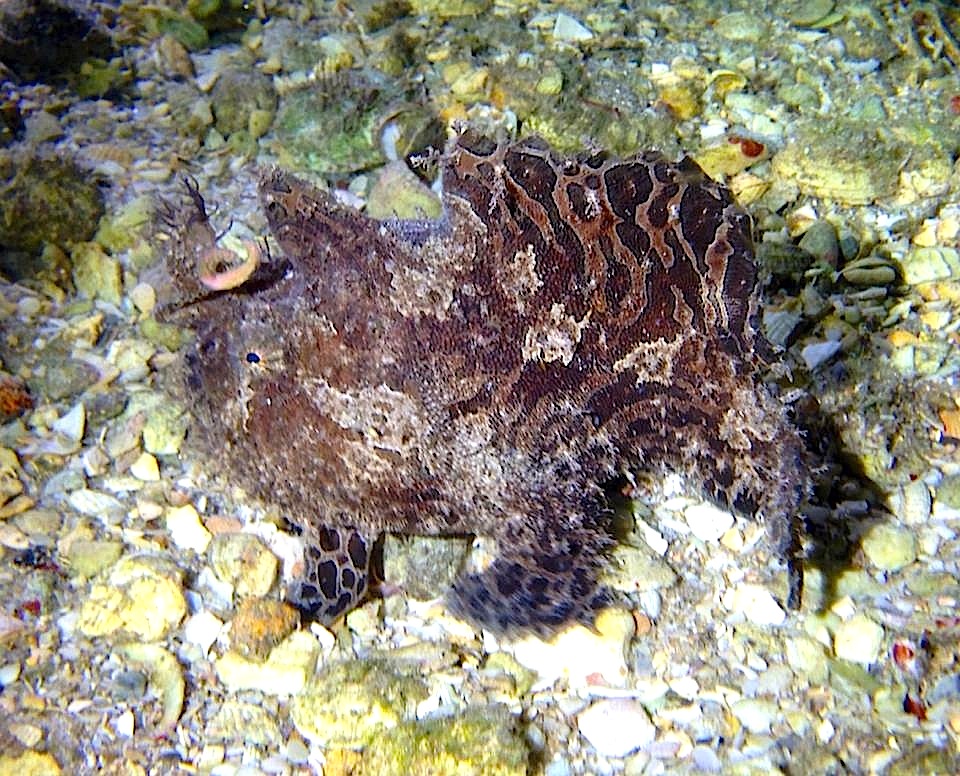
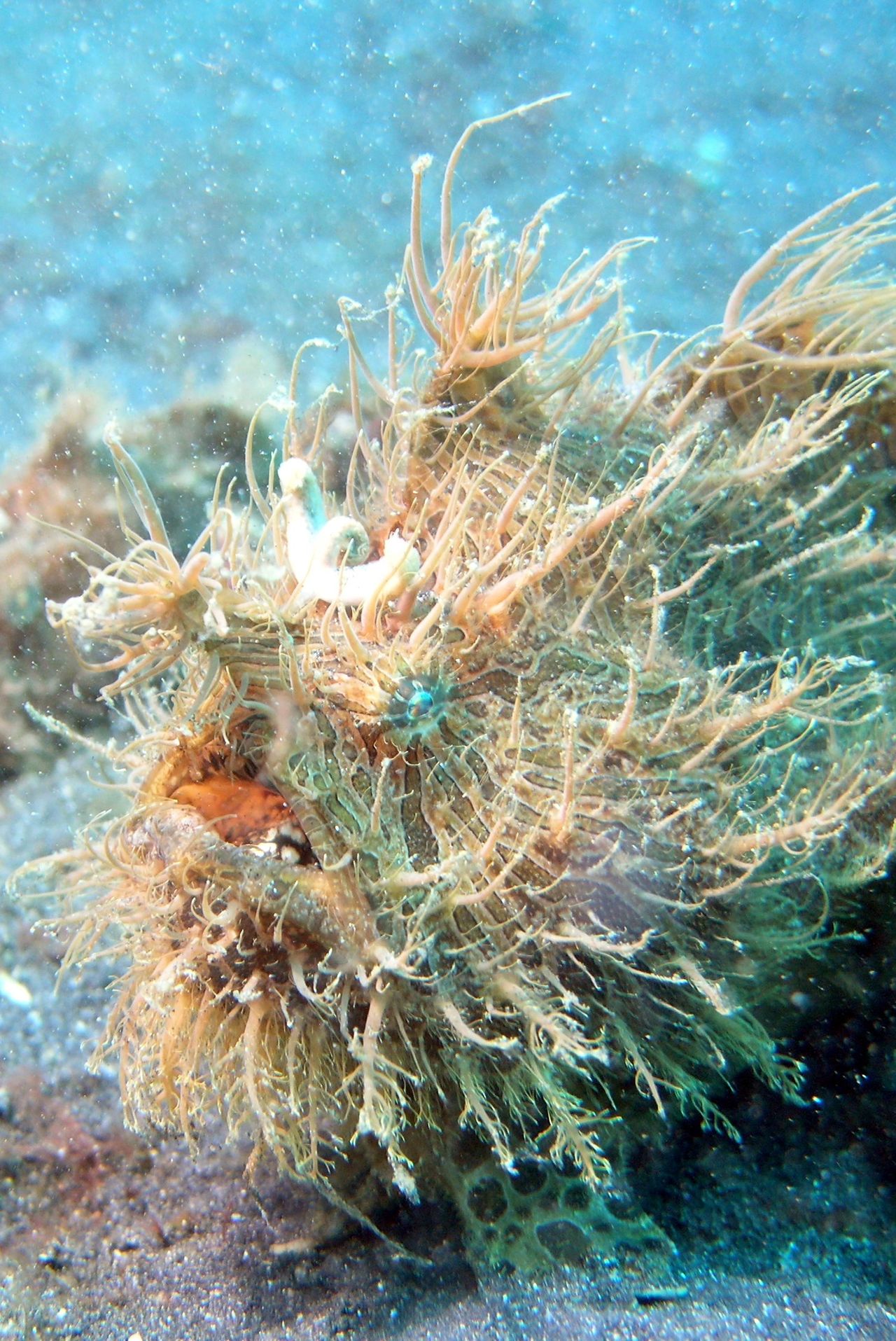
The frogfish is a kind of anglerfish found in almost all tropical and subtropical oceans and seas. There are about 50 different species worldwide, covering an astonishing range of strange appearances. They generally live on the sea floor around coral or rock reefs. In size they vary from tiny to about 15 inches long – although ‘long’ is a flexible concept because they are to an extent shape-changers in height and width.
FROGFISH SUPERPOWERS YOU MAY WISH TO HAVE
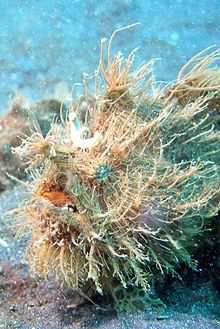
INVISIBILITY CLOAK . Frogfish are masters of disguise and camouflage. This enables them to catch their prey with minimal effort and also to avoid predators. Their camouflage methods – broadly known as ‘aggressive mimicry’ – include
Ability to change colour for days or even weeks to mimic their surroundings
Getting covered in algae and other organic matter that matches their habitat or
Looking inherently like a plump rock or in some cases, plant
Fear for the life of the spider crab…
IRRESISTIBLE ATTRACTION
A sort of frontal dorsal fin called an illicium to which is attached a
Lure called an esca which may mimic a worm, shrimp or small fish etc and which is
Retractable in many species and
Regenerates if it gets mislaid
The ‘dollop of cream’ thing is the esca. Note the characteristic large mouth
BUOYANCY CONTROL & SHAPE-SHIFTING
Most frogfish have a ‘gas bladder’ to control their buoyancy.
Some species can change shape or even inflate themselves by sucking in quantities of water in a so-called defensive ‘threat display’.
HOW DO FROGFISH REPRODUCE?
Although not conventionally attractive creatures, frogfish clearly manage to reproduce. Little is known about the techniques in the wild, but one is probably ‘with care’, especially for a male frogfish who may not survive for long if he hangs around after fertilisation has taken place. It has been noted that females tend to select far smaller males to fertilise their huge numbers of eggs, perhaps for that very reason.
Spot the esca…
FROGFISH FEEDING SKILLS – GOOD OR BAD?
When deploying the lure, potential prey that comes too close to that wide mouth stands no chance. A frogfish will strike in a fraction of a second. Frogfishes have voracious appetites for crustaceans, other fish, and even each other. I can do no better than borrow this vivid description of a feeding frogfish:
“When potential prey is first spotted, the frogfish follows it with its eyes. Then, when it approaches within roughly seven body-lengths, the frogfish begins to move its illicium in such a way that the esca mimics the motions of the animal it resembles. As the prey approaches, the frogfish slowly moves to prepare for its attack; sometimes this involves approaching the prey or “stalking” while sometimes it is simply adjusting its mouth angle. The catch itself is made by the sudden opening of the jaws, which enlarges the volume of the mouth cavity up to twelve-fold, pulling the prey into the mouth along with water. The attack can be as fast as 6 milliseconds. The water flows out through the gills, while the prey is swallowed and the oesophagus closed with a special muscle to keep the victim from escaping. In addition to expanding their mouths, frogfish can also expand their stomachs to swallow animals up to twice their size.“
HOW DO FROGFISHES GET AROUND? SWIM? WALK? CRAWL?
Frogfishes do not in fact move around a great deal. Using their camo advantages, they prefer to lie on the sea floor and wait for prey to come to them. As mentioned in the quote above, they may slowly approach prey using their pectoral and pelvic fins to “walk” along the sea bottom. They can swim using their tail fin (or in some species by simple ‘jet propulsion’ by forcing water out of their gills) but rarely do so – they don’t feed on the move, and they are adapted to the sea floor environment where they food is readily available. However their “walking” ability is limited to short distances.
DO FROGFISH HAVE OTHER COLOUR SCHEMES?
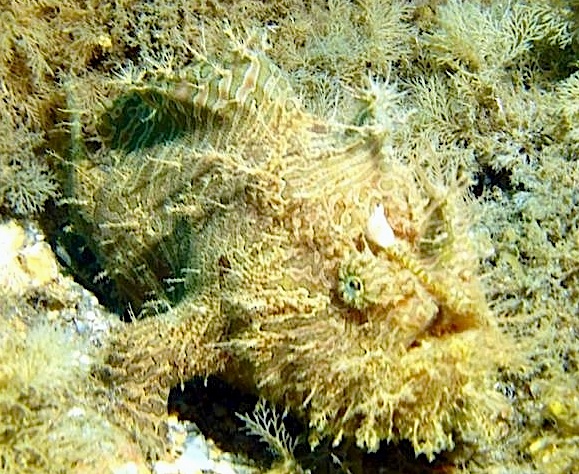
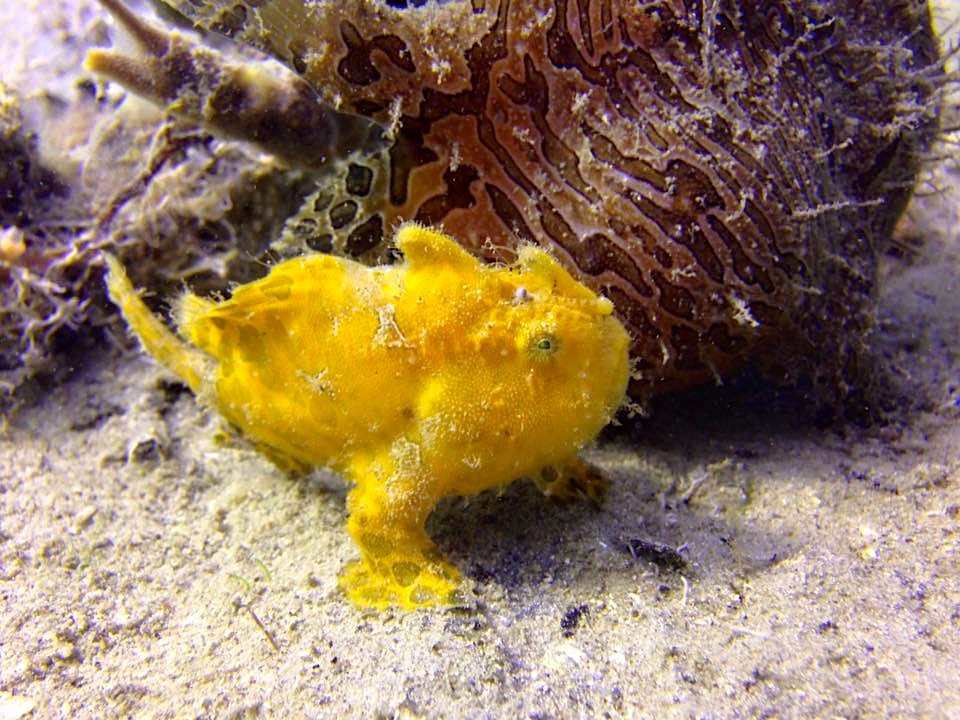
Indeed they do. In stark contrast to the camo species, some frogfishes are hi-lighter bright. Here are two of my favourite photos by Adam that show this clearly. I’ve no idea if these are a male and female. I suspect they are different species. I think the brown one is a striated frogfish and the other is… a yellow frogfish. Some people keep these creatures in aquaria, but apparently it is impossible to sex them, and they have to be kept on their own for everyone’s peace of mind…
FROGFISH INFOGRAPHICS
FROGFISH VIDEOS
These two videos, from Lester Knutsen and Daan Van Wijk respectively, show some of the characteristics I have written about above. Both are short and both are fascinating.
Credits: All main photos, Adam Rees of Scuba Works with many thanks; wiki for ‘spot the esca’, red quote & basic info; videos Lester Knutsen & Daan Van Wijk; Jens Petersen /wiki; Teresa Zubi for website & gifs; infographics, authors u/k
The WTF? series is aimed at shedding light on fishes that are unusual. Or very unusual. Or puzzling, dangerous and maybe less than elegant in appearance. The scorpionfish is one such. It belongs to a large family, the Scorpaenidae, and many types are found throughout the world, especially in the Pacific and Indian oceans. LIONFISH, the newcomers to the western Atlantic, are a species of scorpionfish.
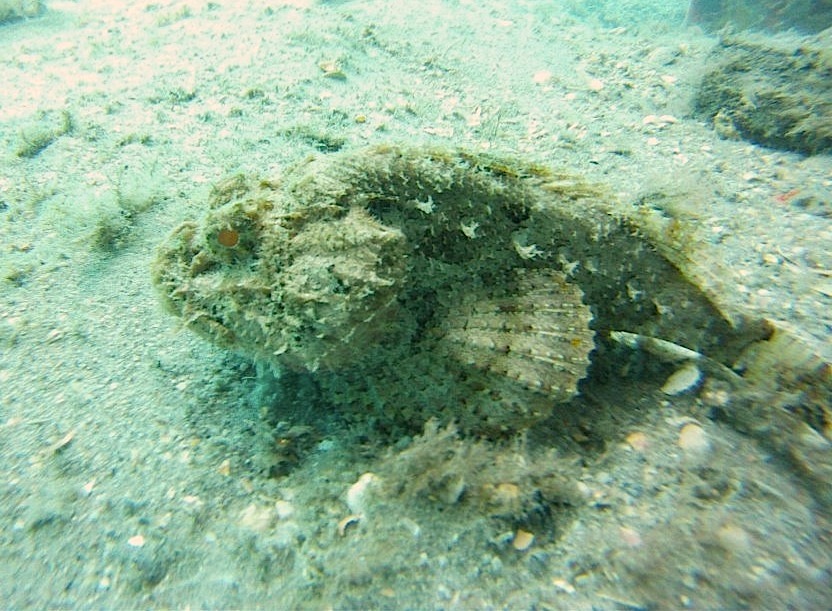
Just another rock on the seabed…
WHY ‘SCORPIONFISH’? THEY LOOK SCARY. ARE THEY DANGEROUS?
One feature common to many scorpionfish species is that they are highly venomous. As the name suggests, a sting is involved. Or several stings. These come from the creature’s sharp spines, which are coated with mucus, and are to be avoided. If you want to pet one, the dorsal, anal and pelvic fins are the ones to steer clear of – these all have venom glands at the base. The spines act like injection needles. Scorpionfish aren’t naturally aggressive (except to prey), but they know how to defend themselves if need be. If you get ‘got’, you are in for “extreme pain and burning sensation”.
DO THEY HAVE ANY OTHER TRICKS TO WATCH OUT FOR?
As many have written, scorpionfish are ‘Masters of Camouflage’. They are able to disguise themselves very effectively. Their appearance is a remarkably adapted to their surroundings, as if covered in a raggle-taggle of colourful algae. They can change colour to aid concealment. They can flick sand over themselves as they settle on the seabed. These ploys enable them to lie motionless on a coral reef or on the seabed, ready to ambush their prey. This consists mainly of small fishes and crustaceans, but really anything edible that will fit in their mouths is fair game.
Concealed against coral
HOW DO THEY FEED?
The large mouth of scorpionfishes has a particular function. They don’t have teeth because they have no need. A scorpionfish can open its mouth and its gills simultaneously, thereby creating an instant vacuum that will suck in its prey in a flash. I have seen this described as “a nearly imperceptible split-second movement (15 milliseconds)”…
THESE SCARY MONSTERS MUST BE HUGE, RIGHT? I’M KEEPING OUT OF THE WATER
Not so fast. When all is said and done – and in my view, most disappointingly – adult Caribbean Scorpionfish grow in the range of… erm… 7 – 14 inches. So now you are reassured, here’s a great short video from Ocean Frontiers Dive Shop, who kindly shared it on YT. I’ve used a couple of illustrative stills from it too.
ANYTHING ELSE WE NEED TO KNOW?
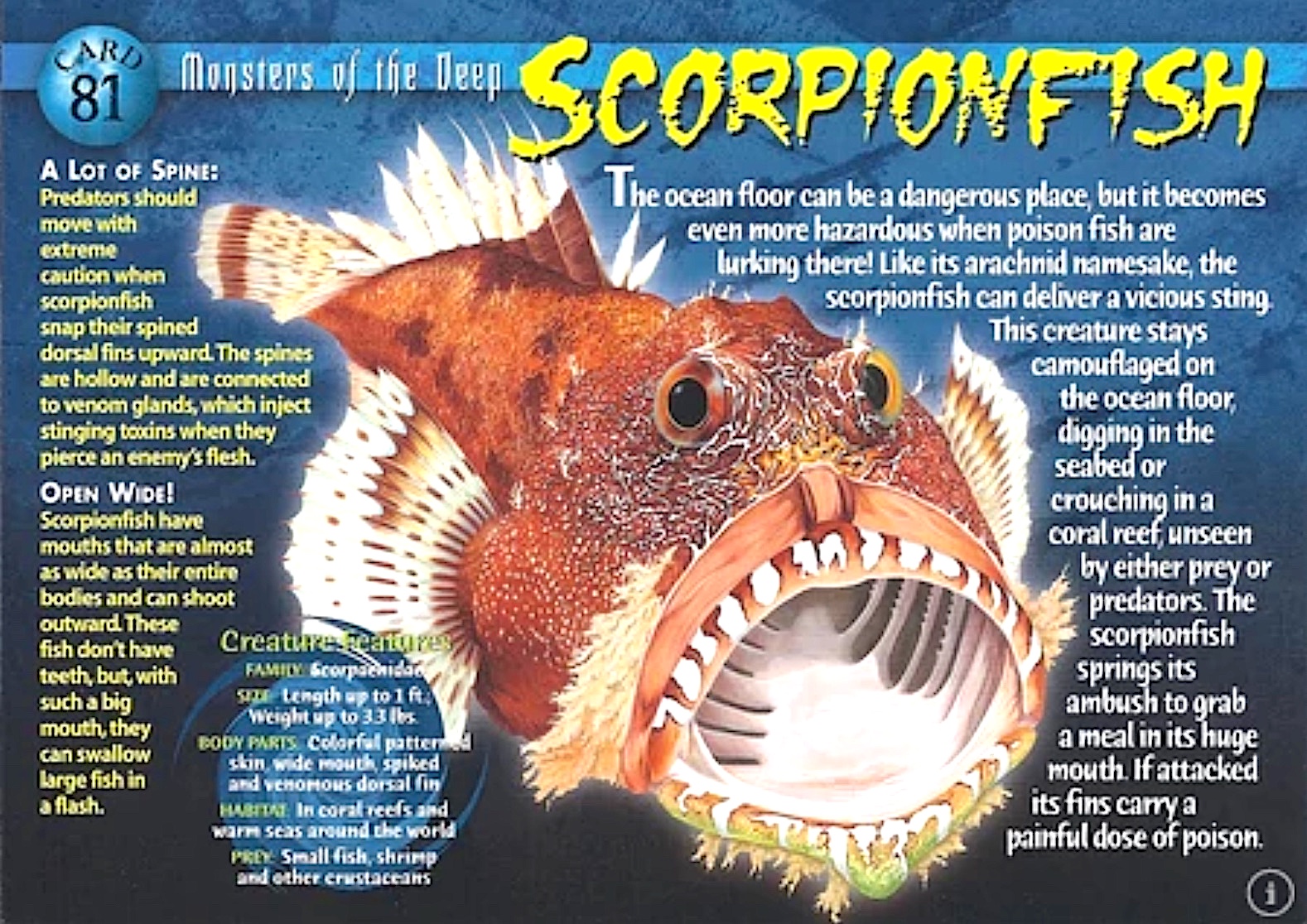
I can do no better than to turn to Card 81 to the excellent ‘Monsters of the Deep‘ series of trading cards (the link is to my MotD page). I do realise that this is a rather unscientific approach. On the other hand these guys pack memorable information into a very short space, and do it well. Note that you can get a reflex sting from a scorpionfish for up to a week after it has died. Eat dust, earthbound scorpions.
Credits: Melinda Riger / Grand Bahama Scuba (1, 2, 3, 4,); Ocean Frontiers Dive Shop (video from YT, 2 stills); Wierd (sic) Creatures / Monsters of the Deep (O/S)
Imagine that you are swimming along resplendent in your snorkelling gear (me) – or in scuba gear for the advanced swimmer (you). There, below you, camouflaged against the sea bottom is a fish. A strange-shaped brown sort of creature with odd side fins. As it progresses over the gravelly sand, your immediate reaction is ‘what the…?’ Its fins seem to be turning into… wings. Like this:
Yes, it’s a flying gurnard. Unlike flying fish, it can’t actually fly through the air. But once its wings are fully spread, it certainly looks as though it could.
WHAT’S THE POINT OF THE WINGS IF THE THING CAN’T FLY?
This gurnard species usually gets around using its ventral fins as ‘legs’, with the pectoral fins (‘wings’) close to the body. There seem to be several possible reasons for possessing the ‘sudden-deployment-of-flashy-wings’ superpower.
It surprises and deters predators by movement, turning prospective prey into an apparently different creature
Bright or lurid colouring may be a deterrent warning of a foul-tasting or poisonous species (APOSEMATISM)
A creature may actually be harmless and even tasty (as here) but may appear to be unpalateable or poisonous(BATESIAN MIMICRY)
In any event, the wings enable the fish to take off from the sea bottom and travel faster by ‘flying’ thought the water to escape a predator
Here’s a short video of a flying gurnard on the move, from ‘Sia Big Fish’
Credits: All main images Adam Rees / Scuba Works with many thanks, except final one ‘cralize wiki’; Hyperallergic for the historic image; Sia Big Fish for the video
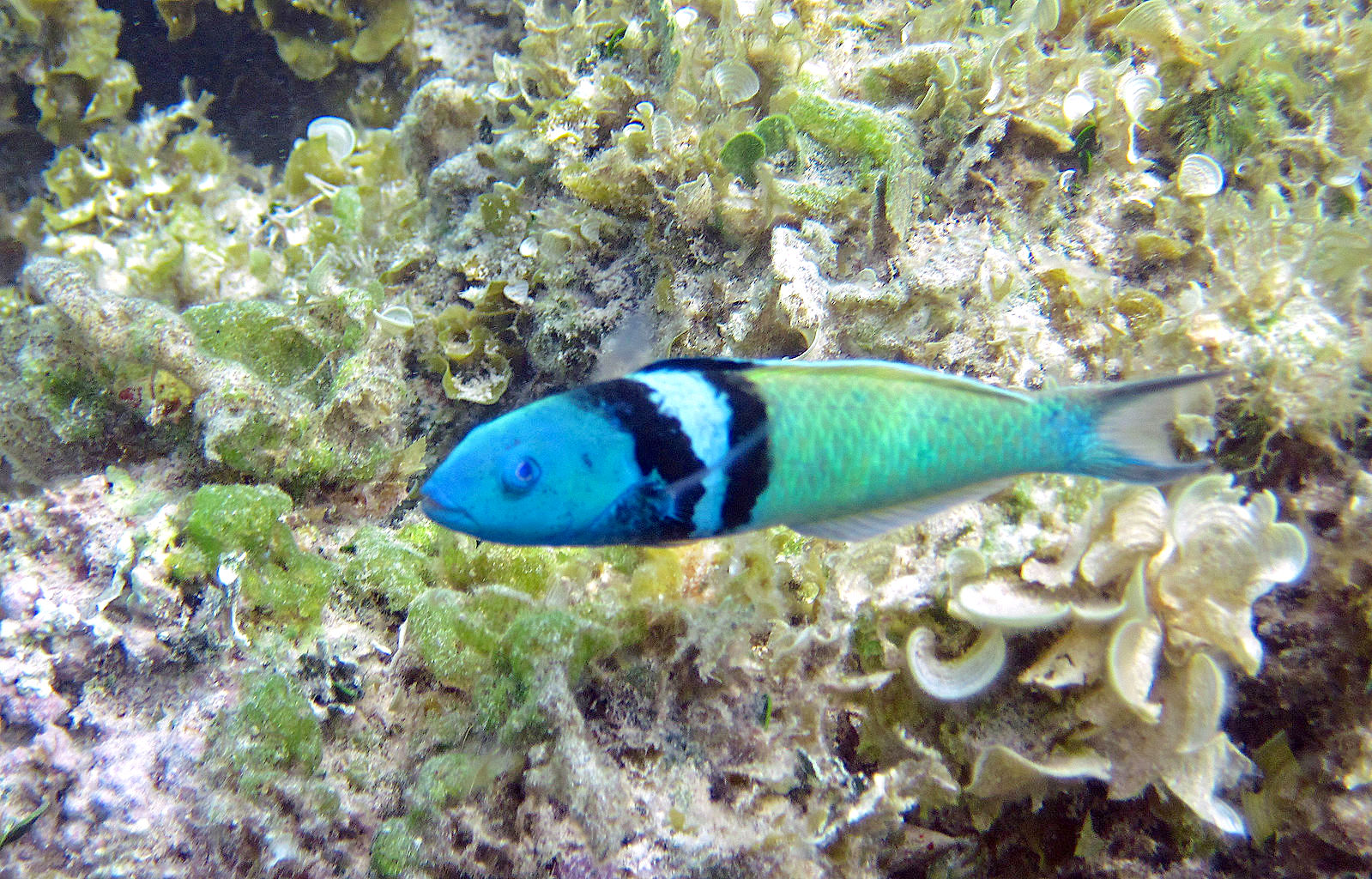
The bluehead wrasse (or blue-headed wrasse) Thalassoma bifasciatum is a denizen of the coral reefs in the tropical waters of the western Atlantic Ocean. This bright little 4-inch fish is… a wrasse with a blue head. No more and no less. Unless it’s a juvenile. Then it is mainly bright yellow. It’s similar to BLUE TANG (aka ‘the Disney Dory’), which starts life bright yellow and grows up to be blue.
The species may be found singly, in pairs or small groups, or in schools. They have an important role to play in the life of the reef. They are CLEANER FISH, vital to the health and wellbeing of the larger species they attend to, and thus of the reef itself. This is ‘cleaning symbiosis’, a relationship of mutual benefit. The big fish get cleaned; the little fish have a useful function and – importantly for them – therefore don’t get eaten.
Having said that, blueheads are of course fair game as a snack for species that aren’t in the market for their cleaning services. Rather unfairly, some species that are quite content to let cleaner gobies pick around their gills and mouths are not so considerate of the wrasse (some types of grouper and moray eel, for example).
TELL US EXACTLY SEVEN BLUEHEAD WRASSE FACTS
Juveniles can alter the intensity of their colour, stripes & bars
The bluehead wrasse is a ‘protogynous sequential hermaphrodite’
All are born female**. Some change sex to male during maturation (see below)
Food includes zooplankton, small molluscs and small crustaceans…
…and parasites / other juicy bits (fungal growths, anyone?) from bigger fish
Main threats to the species are coral reef degradation / destruction and pollution
The bright colours invite aquarium use, but the trade in this species is not critical.
** Some sources suggest some are born male and remain male.
A juvenile bluehead – mostly yellow, with a pale underside
THE REMARKABLE SEX LIFE OF THE BLUEHEAD WRASSE
This is an unavoidable topic, I’m afraid. The bluehead’s sex life is the most interesting thing about them, and this is no time to be prudish. It has been the subject of extensive scientific research. As with many human relationships, “it’s complicated” but in a conch shell it boils down to this:
To recap, BWs are born female and as they mature, some become male.
Males reach an ‘initial phase’ when they can breed in groups with females
Some males grow larger & reach full colouration. This is the ‘terminal phase’
These large males aggressively chase away smaller ones & seek females to pair with
Their state of readiness is signalled by colour changes BUT the females know…
…that the smaller males have a sperm count higher than dominant males.
As the excellent organisation OCEANA puts it: Bluehead Wrasses may reproduce in four different ways throughout their lifetime: 1) as a female in a group spawning event; 2) as a female in a pair spawning event within the territory of a large male; 3) as a small male in a group spawning event; and 4) as a dominant, terminal male in a pair spawning event within its own territory.
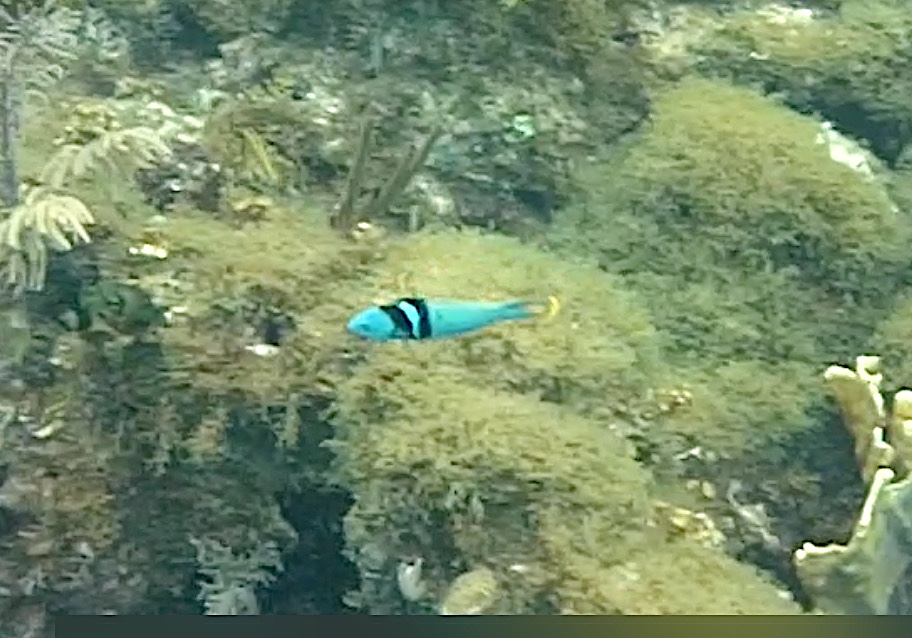
A cropped still from a video I took at Fowl Cay marine reserve. I’ve looked at dozens of images online and not found one that was all blue with a yellow end to its tail fin. Perhaps it is just an all-blue alpha male.
Credits & Sources: Melinda Riger; Adam Rees; James St John; Oregon State edu / Pinterest; Wiki images; self; Oceana; IUCN; magpie pickings
I featured the extraordinary, colour-transforming PEACOCK FLOUNDER Bothus lunatus a while back as part of a Bahamas Reef Fish series. These really are remarkable creatures, and I have decided to return to them mainly because of the wonderful illustrative photos I was able to incorporate. There are plenty of flounder facts too, but if you just enjoy the pictures and skip the blurb I’ll understand.
ROVING EYES
In the fish shown here, you’ll see that – surprisingly – both eyes are on the upper-side of the fish, above the rather grumpy mouth, whereas the head is horizontal to the ocean floor. Oddest of all, juveniles are constructed conventionally with bilateral eyes, and look like ‘normal’ fish rather than flatfish.
As the fish matures, in some magic way the mechanics of which I can only guess at**, the right eye grows round to the topside and the flounder transforms from a ‘vertical’ fish to a flatfish. For this reason, the PF is known as a ‘left-eye’ flounder. Maybe in other flounder species in the world – the southern hemisphere maybe? – the eye that moves round to the upper-side is the left eye.
The eyes of this fish have another special trick up their sleeves (so to speak). They operate completely independently. Thus the creature can look left and right, or forwards and backwards, simultaneously. It’s an excellent system for detecting predators coming from any angle. It’s a superpower we might all benefit from.
DO THEY HAVE ANY OTHER TRICKS WE SHOULD KNOW ABOUT?
Yes they do indeed. If you have been admiring the fish shown so far, you’ll have noticed that the colour of each one differs from the others. In addition to the predator-protection that the eyes provide, the peacock flounder can make itself (near) invisible. They can rapidly change colour to match their surroundings. There are 3 reasons for this: to avoid / confuse predators; to conceal themselves on the sea-floor to catch passing prey; and, as dive expert Fred Riger has pointed out, “the male peacock flounder can, and does greatly intensify his colours to declare territory and attract females. When doing this the males will also signal with the left pectoral fin, sticking it straight up and waving it around.”
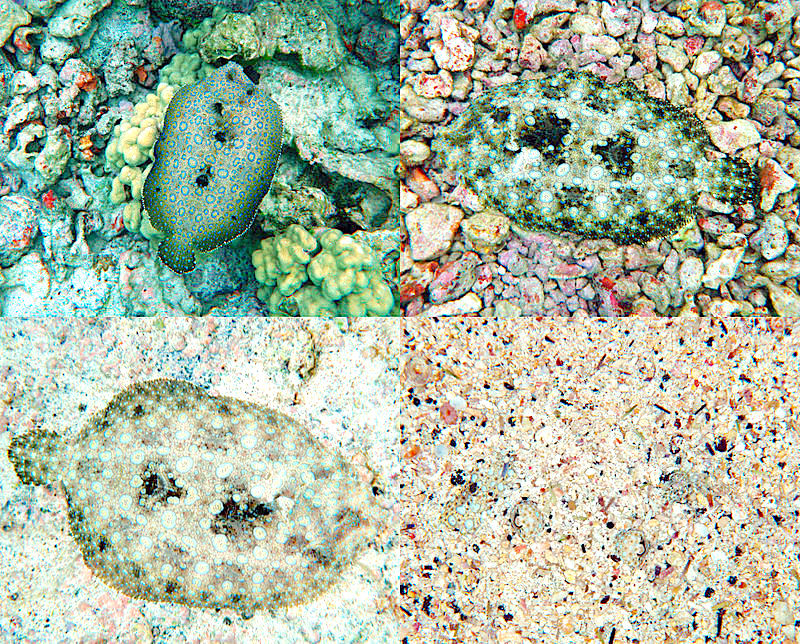
The same fish, photographed over several minutes as it moves over the ocean floor
Matching the background happens as the fish swims, and in a few seconds. When they rest on the sea-floor, the camouflage may even become total. In #4 above you can just about make out the eyes. The whole effect is known as ‘cryptic coloration’ or CRYPSIS. In contrast, the image below shows just how adaptable the transformation can be. Note how the fish can even mimic the pinkish tinge of the sand perfectly. If threatened, the fish will bury itself in the sand, with just its eyes showing.
HOW DO THEY MANAGE TO CHANGE COLOUR IN SECONDS?
It’s complicated! A simple answer is: a mix of hormones, pigment-cells and vision, all coordinating rapidly. The colour change works in two ways: pigments are selectively released to the skin cells; and other pigments can be selectively suppressed. An analogy might be image manipulation using variations in brightness, saturation etc. Not convinced? Then watch this short video and prepare to be impressed. Astonished, even.
WHAT IF A FLOUNDER CAN’T SEE CLEARLY FOR SOME REASON?
As with many (all?) superpowers, there is usually some kryptonite-style flaw. A flounder with a damaged eye, or one temporarily covered (by sand, for example) will have difficulty in changing colour – possibly at all, or at any rate with the swiftness it needs to have.
THESE SIDEWAYS FISH – HOW DO THEY… YOU KNOW…?
Take a look at the fish above with its top fin raised. It’s a ‘ready’ signal in a harem. Male flounders have a defined and defended territory within which live up to 6 females – a so-called ‘harem.’ I can do no better than borrow the description of the rituals from an article derived from scientific papers byKonstantinou, 1994; Miller, et al., 1991in the websiteanimaldiversity.org/…ounts/Bothus_lunatusTo which I can only add, ’15 seconds, eh?’
“Mating activities usually begin just before dusk. At this time, a male and a female approach each other with the ocular pectoral fin erect. The two fish arch their backs and touch snouts. After this interaction the female swims away, and the male sometimes follows, approaching the female again from the left side. At this point the male pectoral fin is erect and the female pectoral fin moves up and down, possibly signalling willingness to mate. The male then positions himself underneath the female and mating begins. This process consists of a mating rise, during which the female and male rise in the water column together. On average, these rises last about 15 seconds. At the highest point of this rise, usually around 2 m above the substrate, gametes from both fish are simultaneously released, producing a cloud of sperm and eggs. Once the couple returns from the rise, the male “checks” to make sure mating was successful, and the pair separates quickly, swimming away from each other in opposite directions. Not all mating rises are successful, and the process of “checking” is thus important. The exact purpose of the mating rise in these flounders unknown; possible reasons for rising include better dispersal of gametes and predator avoidance.”
Peacock Flounder – Kim Rody Art
**This may in fact have been through sheer laziness
Credits: Melinda Riger & Virginia Cooper / Grand Bahama Scuba; Melinda Rogers / Dive Abaco; Adam Rees / Scuba Works; Kim Rody; animaldiversity.org; magpie pickings and other credits in the text
FAIRY BASSLET (‘MIND YOUR GRAMMA’): BAHAMAS REEF FISH (33)
The Fairy Basslet is a tiny brightly-coloured fish with a pretentious alternative name. It is otherwise known as the Royal Gramma (Gramma loreto). These fish are found in the coral reefs of the (sub)tropical western Atlantic. They are also found in aquariums anywhere you like, being small, bright, placid and generally good-natured.
Conveniently, the basslet is unlikely to be confused with any other species. Its striking two-tone colour scheme of purple and yellow is hard to miss. The purple front half (which is presumably where the ‘royal’ comes from, being a regal or imperial colour) may also be violet or even blue in some fish and / or in some light conditions. Another identification pointer is a black spot on the dorsal fin.
You’ll notice that the basslet above appears to be upside down. Which is because it is – this isn’t an inadvertent photo-flip. These little fish tend to orientate themselves to be parallel with the closest surface. This leads to them happily swimming upside down, or aligning vertically. As one article I read says severely, “this behaviour is not to be mistaken for illness”.
Fairy basslets / royal grammas are also CLEANER FISH. They pick parasites and dead skin off larger fish that visit so-called cleaning stations to be attended to by tiny fish and cleaner shrimps, and in some instances to have their gills and even their teeth cleaned. The deal is that, in return, the large fish do not eat the cleaners. Even snack-sized ones rootling around inside their mouths.
WHAT ABOUT BREEDING?
I really can’t improve on this rather touching description from Wiki: “The male will build the nest among rocks using pieces of algae.The male will then lead the female to the nest, where she will deposit 20-100 eggs in the nest. During the breeding period, this behaviour is repeated almost every day for a month or longer (my italics). The eggs are equipped with small protuberances over the surface with tiny threads extending from them which hold onto the algae of the nest and keep the eggs in place. The eggs will hatch in five to seven days, normally in the evening…”
HOW COME THE NAME ‘GRAMMA LORETO’?
This official name became a brainworm with me after I started this post. I had to check it out. The ‘Gramma’ part is unrelated to the fond name for a grandmother; rather, it simple denotes a member of the genus of fishes in the family Grammatidae.
The Loreto part is more mysterious. It is an an ancient town in Italy; and the name of several British schools, including – almost too good to be true – a school called Loreto Grammar. In a nutshell, the link between the town and places of education is that the Sisters of Loreto, founded in the c17 and named for a shrine in the Italian village, are dedicated to education in their Ministry.
How that ties in with a tiny Caribbean reef fish, I have yet to find out. I probably never will… Here’s a short video to alleviate the disappointment.
I failed to be able to resist finding out whether any country of the world has a purple and yellow flag. The answer is, no. However I am delighted to be able to report that the flag of the Independent Party of Uruguay is basslet-coloured.
Credits: all fantastic photos by Melinda Riger of Grand Bahama Scuba; magpie pickings of an unacademic sort for facts and speculation
I have just been lightly involved in a long online thread showcasing the weirdest / most science fiction-y creatures around the world. Trust me, there are plenty. There were quite a few duplications. My own contribution was the frogfish, which no one else had nominated. They are so special – and so weird – that I am reposting my article about them. Don’t miss the last video!
This ‘WTF?’ series started with a relatively conventional species, the REMORA. It has been getting progressively more bizarre. We moved onto an omnium gatherum of WEIRDO FISHES, then the remarkable LETTUCE SEA SLUG, and most recently the BATFISH. Time to ramp up the stakes: with many thanks to scuba expert Adam Rees for use permission for his terrific photos, I present… the FROGFISH.
The frogfish is a kind of anglerfish found in almost all tropical and subtropical oceans and seas. There are about 50 different species worldwide, covering an astonishing range of strange appearances. They generally live on the sea floor around coral or rock reefs. In size they vary from tiny to about 15 inches long – although ‘long’ is a flexible concept because they are to an extent shape-changers in height and width.
FROGFISH SUPERPOWERS YOU MAY WISH TO HAVE
INVISIBILITY CLOAK . Frogfish are masters of disguise and camouflage. This enables them to catch their prey with minimal effort and also to avoid predators. Their camouflage methods – broadly known as ‘aggressive mimicry’ – include
Ability to change colour for days or even weeks to mimic their surroundings
Getting covered in algae and other organic matter that matches their habitat or
Looking inherently like a plump rock or in some cases, plant
Fear for the life of the spider crab…
IRRESISTIBLE ATTRACTION
A sort of frontal dorsal fin called an illicium to which is attached a
Lure called an esca which may mimic a worm, shrimp or small fish etc and which is
Retractable in many species and
Regenerates if it gets mislaid
The ‘dollop of cream’ thing is the esca. Note the characteristic large mouth
Spot the esca…
BUOYANCY CONTROL & SHAPE-SHIFTING
Most frogfish have a ‘gas bladder’ to control their buoyancy.
Some species can change shape or even inflate themselves by sucking in quantities of water in a so-called defensive ‘threat display’.
HOW DO FROGFISH REPRODUCE?
Although not conventionally attractive creatures, frogfish clearly manage to reproduce. Little is known about the techniques in the wild, but one is probably ‘with care’, especially for a male frogfish who may not survive for long if he hangs around after fertilisation has taken place. It has been noted that females tend to select far smaller males to fertilise their huge numbers of eggs, perhaps for that very reason.
FROGFISH FEEDING SKILLS – GOOD OR BAD?
When deploying the lure, potential prey that comes too close to that wide mouth stands no chance. A frogfish will strike in a fraction of a second. Frogfishes have voracious appetites for crustaceans, other fish, and even each other. I can do no better than borrow this vivid description of a feeding frogfish:
“When potential prey is first spotted, the frogfish follows it with its eyes. Then, when it approaches within roughly seven body-lengths, the frogfish begins to move its illicium in such a way that the esca mimics the motions of the animal it resembles. As the prey approaches, the frogfish slowly moves to prepare for its attack; sometimes this involves approaching the prey or “stalking” while sometimes it is simply adjusting its mouth angle. The catch itself is made by the sudden opening of the jaws, which enlarges the volume of the mouth cavity up to twelve-fold, pulling the prey into the mouth along with water. The attack can be as fast as 6 milliseconds. The water flows out through the gills, while the prey is swallowed and the oesophagus closed with a special muscle to keep the victim from escaping. In addition to expanding their mouths, frogfish can also expand their stomachs to swallow animals up to twice their size.“
HOW DO FROGFISHES GET AROUND? SWIM? WALK? CRAWL?
Frogfishes do not in fact move around a great deal. Using their camo advantages, they prefer to lie on the sea floor and wait for prey to come to them. As mentioned in the quote above, they may slowly approach prey using their pectoral and pelvic fins to “walk” along the sea bottom. They can swim using their tail fin (or in some species by simple ‘jet propulsion’ by forcing water out of their gills) but rarely do so – they don’t feed on the move, and they are adapted to the sea floor environment where they food is readily available. However their “walking” ability is limited to short distances.
DO FROGFISH HAVE OTHER COLOUR SCHEMES?
Indeed they do. In stark contrast to the camo species, some frogfishes are highlighter bright. Here are two of my favourite photos by Adam that show this clearly. I’ve no idea if these are a male and female. I suspect they are different species. I think the brown one is a striated frogfish and the other is… a yellow frogfish. Some people keep these creatures in aquaria, but apparently it is impossible to sex them, and they have to be kept on their own for everyone’s peace of mind…
FROGFISH INFOGRAPHICS
FROGFISH VIDEOS
These two videos, from Lester Knutsen and Daan Van Wijk respectively, show some of the characteristics I have written about above. Both are short and both are fascinating.
To read more about frogfishes and for some fabulous photos I highly recommend the websiteFROGFISH.CHYou can reach the main page(s) but the link seem to be broken so I have not been able to contact Teresa Zubi, whose site it is. She clearly has a sense of humour and uses a neat pair of gifs which I hope she won’t mind my using…
Credits: All main photos, Adam Rees of Scuba Works with many thanks; wiki for ‘spot the esca’, red quote & basic info; videos Lester Knutsen & Daan Van Wijk; Teresa Zubi for website & gifs; infographics, authors u/k
YELLOWTAIL (REDFIN) PARROTFISH: BAHAMAS REEF FISH (54)
The yellowtail parrotfish (sometimes known as a redfin) is one of around half-a-dozen kinds of parrotfish found among the coral reefs of the Bahamas, and sometimes in seagrass areas. There are many other related species worldwide (about 80). Parrotfish are among the most important fishes on the reef because they play a major role inBIOEROSION , a vital process for the health of the reef.
A. FEEDING & BEACH BUILDING
Their dental arrangements – a mouthful of meshing teeth – form the characteristic ‘beak’
Primarily herbivores but also snack on small creatures, organisms, or even molluscs
As they feed on their favourite algae, their teeth grind up the coral which they ingest
They digest the coral & excrete it as sand, becoming a component of your favourite beach
The teeth grow continuously, replacing ones worn away by grinding coral as they graze
They are a vital species in preventing algae from choking coral: essential reef cleaners
B. PARROTFISH: PERSONAL INFORMATION
Some secrete a protective mucous cocoon to sleep in or as concealment from predators
Mucous also helps to heal damage, repel parasites, & protect them from UV light
As they develop from the juvenile stage, most species change colour significantly
In some species, juveniles change colour temporarily for protective purposes
These are “sequential hermaphrodites”, turning from female to male (‘protogyny’)
Single males tend to have several lady friends, and aggressively defend their love rights
Parrotfish arePELAGIC SPAWNERS. Females release many tiny buoyant eggs into the water
The eggs float freely then eventually sink to the coral until they hatch
Unlike almost all other fishes, they use their pectoral fins to propel themselves
Feeding behaviour / dietary requirements make them (thankfully) unsuitable for aquariums (or aquaria, if you prefer)
WHAT WAS THAT ABOUT CHANGING SEX?
Parrotfish may undergo sex reversal in which developing female fish become males
Parrotfish born male remain male throughout their lives (“primary males”)
Female-born fish may change sex & colour to become male (“secondary males”)
Secondary males are fertile and generally mate with a single female
Females that stay female live in harems protected by a dominant “supermale” BUT…
…if the supermale dies, the largest female in the group changes sex to become male…
…AND amazingly adopts the coloration of the supermale (best ‘astounding fact’ of all)
ARE PARROTFISH EDIBLE? JUST ASKING…
Parrotfish skin is very tough but their flesh is soft and degenerates quickly
Some species (eg blue parrotfish) carry ciguatera toxins – to be avoided
They are not considered a fishing target in Bahamas, nor a food-fish
Parrotfish are eaten elsewhere in the world however, for example Jamaica (cooked)
In Hawaii they are eaten raw – at one time they were reserved for royalty
Credits: Melinda Rogers / Dive Abaco for her great illustrative images. All photographs were taken on the reefs of Abaco, before the devastation and destruction of Hurricane Dorian last September; Florida Museum to cross-check facts; VIDEO – Scientific American
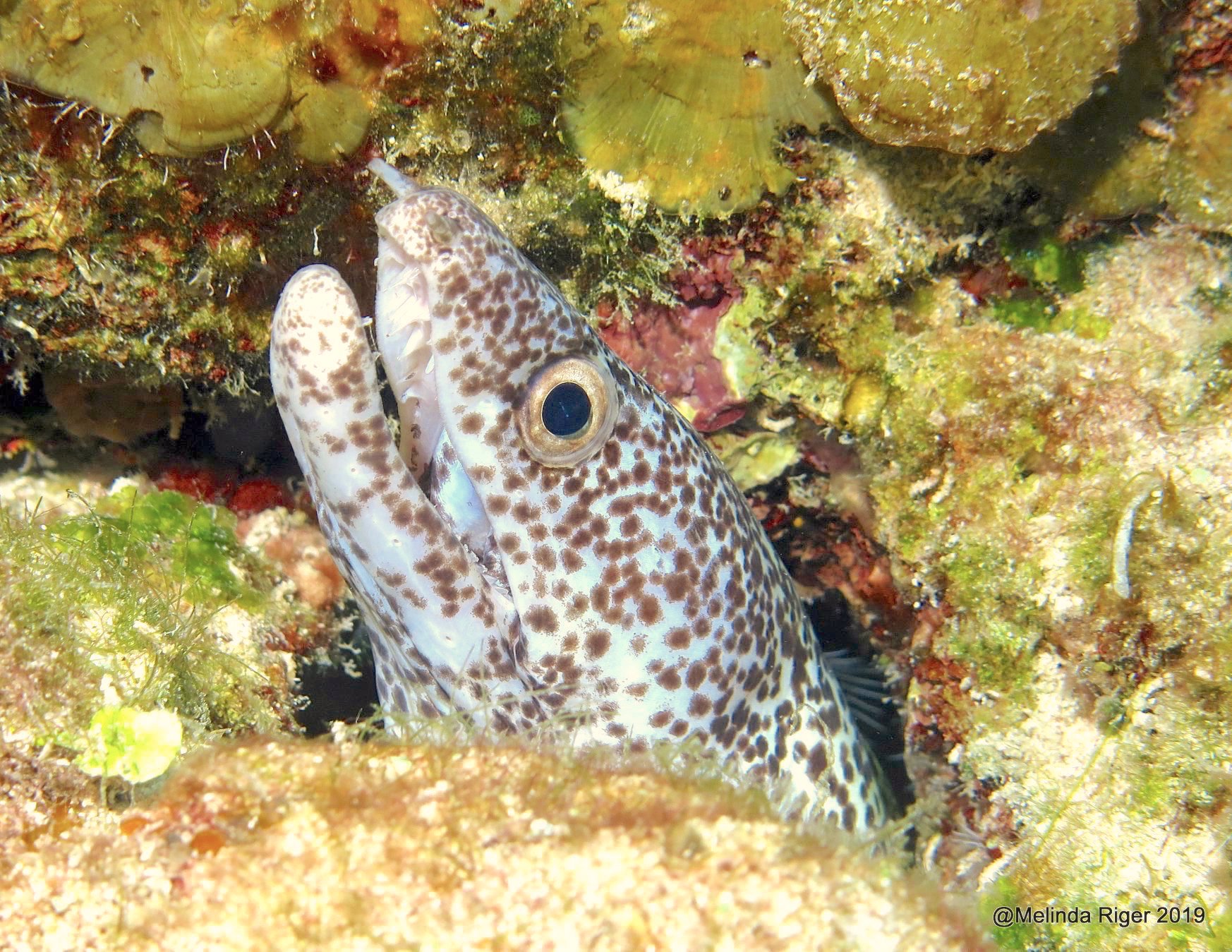
MORAY EELS are plentiful around the reefs of the Bahamas. Some species, anyway. The ones you are most likely to encounter are green morays, and the spotted morays shown here. Less common are chain and golden-tail morays and, rarer still I suspect (because I have only one image in the archive…) is the ‘purple-mouth’.
Despite their moderately intimidating appearance – an adult may grow to 1.5 meters or more, with sharp teeth at the front end – these eels are not especially aggressive unless provoked. Best to assume that all humans will behave respectfully around them and remember that people are the intruders in the eels’ domain.
Morays tend to be loners of the reefs, but they do gather in groups from time to time. And as shown below, they will also hunt with other species, for example this tiger grouper.
Sharp-eyed, sharp-toothed
Looks friendly enough…
A long and surprisingly large body, generally concealed in the crevices of the reef
I featured the extraordinary, colour-transforming PEACOCK FLOUNDER Bothus lunatus about 3 years ago in the Bahamas Reef Fish series (No. 21 I think). These really are remarkable creatures, and I am pleased to be able to show some more wonderful illustrative photos.
ROVING EYES
In the fish shown here, you’ll see that – surprisingly – both eyes are on the upperside of the fish, above the rather grumpy mouth, whereas the head is horizontal to the ocean floor. Oddest of all, juveniles are constructed conventionally with bilateral eyes, and look like ‘normal’ fish rather than flatfish.
As the fish matures, in some magic way the mechanics of which I can only guess at**, the right eye grows round to the topside and the flounder transforms from a ‘vertical’ fish to a flatfish. For this reason, the PF is known as a ‘lefteye’ flounder. Maybe in other flounder species in the world – the southern hemisphere maybe? – the eye that moves round to the upperside is the left eye.
The eyes of this fish have another special trick up their sleeves (so to speak). They operate completely independently. Thus the creature can look left and right, or forwards and backwards, simultaneously. It’s an excellent system for detecting predators coming from any angle. It’s a superpower we might all benefit from.
DO THEY HAVE ANY OTHER TRICKS WE SHOULD KNOW ABOUT?
Yes they do indeed. If you have been admiring the fish shown so far, you’ll have noticed that the colour of each one differs from the others. In addition to the predator-protection that the eyes provide, the peacock flounder can make itself (near) invisible. They can rapidly change colour to match their surroundings. There are 3 reasons for this: to avoid / confuse predators; to conceal themselves on the sea-floor to catch passing prey; and, as dive expert Fred Riger has pointed out, “the male peacock flounder can, and does greatly intensify his colours to declare territory and attract females. When doing this the males will also signal with the left pectoral fin, sticking it straight up and waving it around.”
The same fish, photographed over several minutes as it moves over the ocean floor
Matching the background happens as the fish swims, and in a few seconds. When they rest on the sea-floor, the camouflage may even become total. In #4 above you can just about make out the eyes. The whole effect is known as ‘cryptic coloration’ or CRYPSIS. In contrast, the image below shows just how adaptable the transformation can be. Note how the fish can even mimic the pinkish tinge of the sand perfectly. If threatened, the fish will bury itself in the sand, with just its eyes showing.
HOW DO THEY MANAGE TO CHANGE COLOUR IN SECONDS?
It’s complicated! A simple answer is: a mix of hormones, pigment-cells and vision, all coordinating rapidly. The colour change works in two ways: pigments are selectively released to the skin cells; and other pignments can be selectively suppressed. An analogy might be image manipulation using variations in brightness, saturation etc. Not convinced? Then watch this short video and prepare to be impressed. Astonished, even.
WHAT IF A FLOUNDER CAN’T SEE CLEARLY FOR SOME REASON?
As with many (all?) superpowers, there is usually some kryptonite-style flaw. A flounder with a damaged eye, or one temporarily covered (by sand, for example) will have difficulty in changing colour – possibly at all, or at any rate with the swiftness it needs to have.
THESE SIDEWAYS FISH – HOW DO THEY… YOU KNOW…?
Take a look at the fish above with its top fin raised. It’s a ‘ready’ signal in a harem. Male flounders have a defined and defended territory within which live up to 6 females – a so-called ‘harem.’ I can do no better than borrow the description of the rituals from an article derived from scientific papers byKonstantinou, 1994; Miller, et al., 1991in the websiteanimaldiversity.org/…ounts/Bothus_lunatusTo which I can only add, ’15 seconds, eh?’
“Mating activities usually begin just before dusk. At this time, a male and a female approach each other with the ocular pectoral fin erect. The two fish arch their backs and touch snouts. After this interaction the female swims away, and the male sometimes follows, approaching the female again from the left side. At this point the male pectoral fin is erect and the female pectoral fin moves up and down, possibly signalling willingness to mate. The male then positions himself underneath the female and mating begins. This process consists of a mating rise, during which the female and male rise in the water column together. On average, these rises last about 15 seconds. At the highest point of this rise, usually around 2 m above the substrate, gametes from both fish are simultaneously released, producing a cloud of sperm and eggs. Once the couple returns from the rise, the male “checks” to make sure mating was successful, and the pair separates quickly, swimming away from each other in opposite directions. Not all mating rises are successful, and the process of “checking” is thus important. The exact purpose of the mating rise in these flounders unknown; possible reasons for rising include better dispersal of gametes and predator avoidance.”
Peacock Flounder – Kim Rody Art
**This may in fact be through sheer laziness
Credits: Melinda Riger & Virginia Cooper / Grand Bahama Scuba; Melinda Rogers / Dive Abaco; Adam Rees / Scuba Works; Kim Rody; animaldiversity.org; magpie pickings and other credits in the text
Today I learn from a cheery message from WordPress that my illustrated ramblings have been going on for exactly X years, where X is greater than 5 but less than 10. Time to start a new theme: channelling my inner Noel Coward, I am introducing a new mainly pictorial series provisionally called ‘Reef Encounter’. All the awesome beauty of reef life will be here.
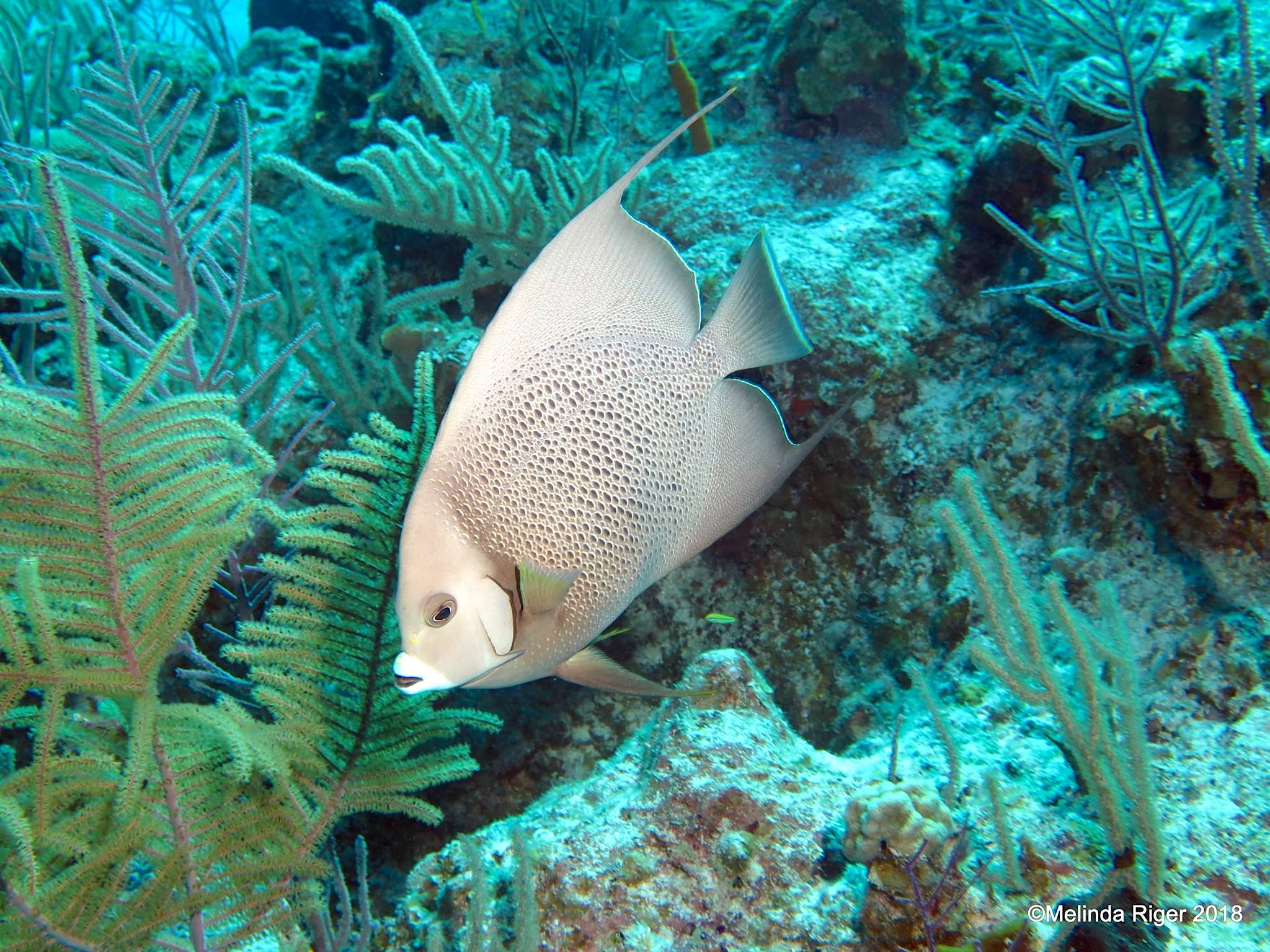
In the past I have posted aboutGRAY ANGELFISH, one of three kinds of angelfish found in the northern Bahamas. Today, I am featuring some more recent images of these pretty creatures. Note in particular the striking shape and colour of their mouths, the blue being found also on the fin edges at the back.
On this otherwise gray fish, you’ll also find touches of yellow on the face and the edges of the front fins. In the header image there’s another little fish in the bottom right corner. Not a baby angelfish, but a FOUR-EYED BUTTERFLYFISH – a species that will feature in own right in due course
All fabulous photos by Melinda Riger / Grand Bahama Scuba
The black margate (Anisotremus surinamensis) is a type of GRUNT (see also PORKFISH) found among the reefs and rocks of (mostly) the western Atlantic seaboard, from Florida as far south as Brazil. They are relatively ‘shallow’ fish and they prefer to be close to place where they can live safely and avoid the predators that lurk in open or deep water.
Margates are not usually very large, mostly growing to between 18″ and 30″, although they can grow larger. Thanks to the awesomeness of Wiki and other reliable sources I can confidently report that “…the maximum recorded weight for this species is 5.8 kg (13 lb)“.
MAY WE HAVE THE TRADITIONAL 10 FUN FACTS PLEASE?
Local names include burriquete (Sp) and zapatero or burros (Mex)
There are 10 margate species world wide, including 2 Pacific versions
Their heads slope down to a notably thick lipped mouth in which they have strong teeth
Margates have erectile spines, presumably for defence (I’ve not tested that)
They like to shelter in caves and crevices, on ledges, and in wrecks (see pics)
Margates are ‘solitary fish’ or hang out in small groups
They are night-feeders on a diet of crustaceans, mollusks, smaller fish & urchins
Sadly for them, they are valued by commercial fisheries using baited drift fishing…
…and also targeted by anglers during the spawning season when they shoal (?unfair)
… and also caught as aquarium fish, adding to stock depletion
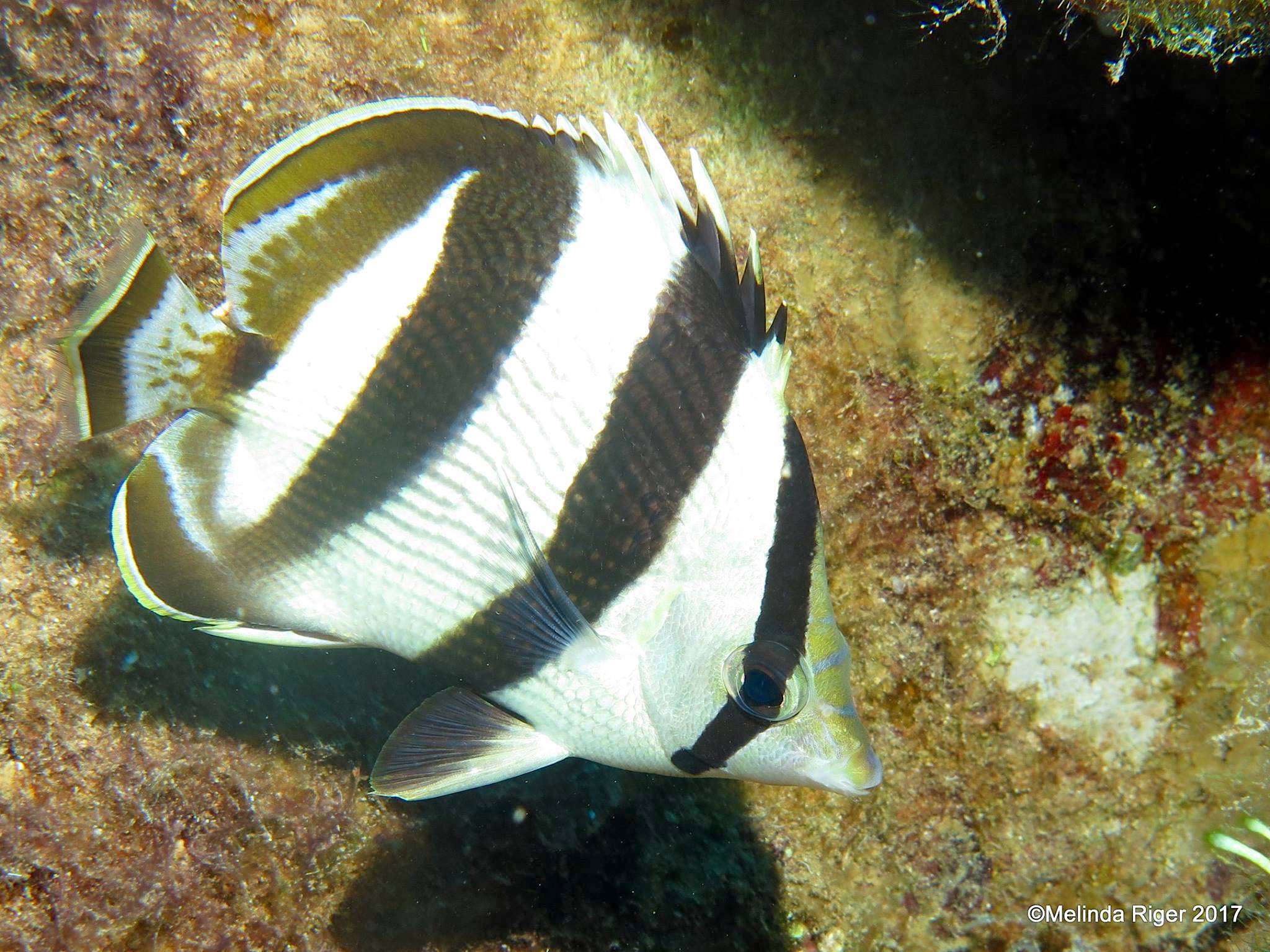
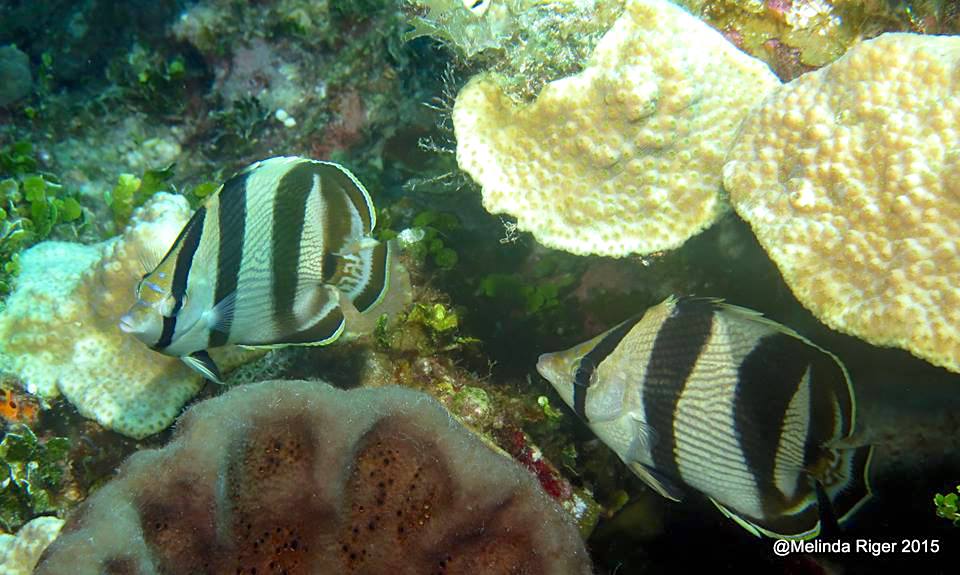
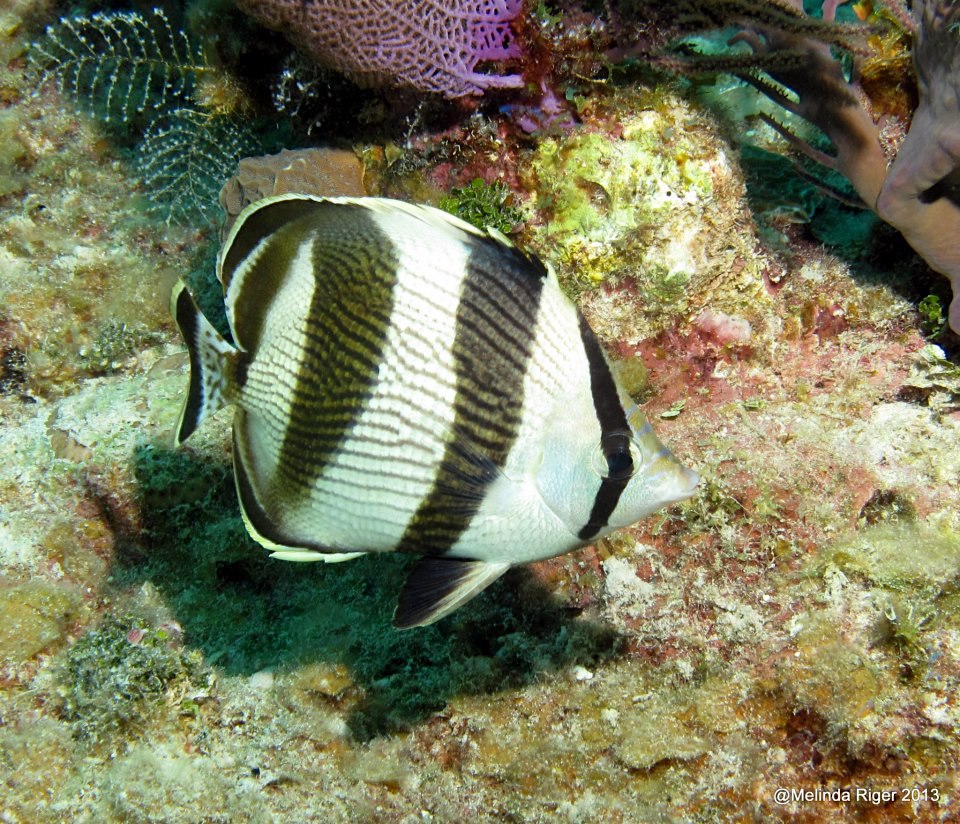
The banded butterflyfish (Chaetodon striatus) is one of several butterflyfish species found in Bahamas waters. There are links to some of the others at the end of this post. The reason for the name is obvious. The purpose of the patterning (striatus) is to act as an adaptive anti-predator defence when seen against the varied landscape of the coral reefs that are its home.
These little fish tend to be found either singly or in pairs. Two of them together may play a form of chase game among the corals and anemones of the reef.
Banded butterfishes, like their cousins, have a varied diet that includes small crustaceans, worms, and coral polyps. They also have a valuable role on the reef by acting a cleaner fish for larger species like grunts, tangs and parrot fish. This sort of relationship, where one party benefits from this kind of interaction , is known as ‘commensalism’, one of the 4 types of symbiotic relationship.
The WTF? series is aimed at shedding light on fishes that are unusual. Or very unusual. Or puzzling, dangerous and maybe less than elegant in appearance. The scorpionfish is one such. It belongs to a large family, the Scorpaenidae, and many types are found throughout the world, especially in the Pacific and Indian oceans. LIONFISH, the newcomers to the western Atlantic, are a species of scorpionfish.
Just another rock on the seabed…
WHY ‘SCORPIONFISH’? THEY LOOK SCARY. ARE THEY DANGEROUS?
One feature common to many scorpionfish species is that they are highly venomous. As the name suggests, a sting is involved. Or several stings. These come from the creature’s sharp spines, which are coated with mucus, and are to be avoided. If you want to pet one, the dorsal, anal and pelvic fins are the ones to steer clear of – these all have venom glands at the base. The spines act like injection needles. Scorpionfish aren’t naturally aggressive (except to prey), but they know how to defend themselves if need be. If you get ‘got’, you are in for “extreme pain and burning sensation”.
DO THEY HAVE ANY OTHER TRICKS TO WATCH OUT FOR?
As many have written, scorpionfish are ‘Masters of Camouflage’. They are able to disguise themselves very effectively. Their appearance is a remarkably adapted to their surroundings, as if covered in a raggle-taggle of colourful algae. They can change colour to aid concealment. They can flick sand over themselves as they settle on the seabed. These ploys enable them to lie motionless on a coral reef or on the seabed, ready to ambush their prey. This consists mainly of small fishes and crustaceans, but really anything edible that will fit in their mouths is fair game.
Concealed against coral
HOW DO THEY FEED?
The large mouth of scorpionfishes has a particular function. They don’t have teeth because they have no need. A scorpionfish can open its mouth and its gills simultaneously, thereby creating an instant vacuum that will suck in its prey in a flash. I have seen this described as “a nearly imperceptible split-second movement (15 milliseconds)”…
THESE SCARY MONSTERS MUST BE HUGE, RIGHT? I’M KEEPING OUT OF THE WATER
Not so fast. When all is said and done – and in my view, most disappointingly – adult Caribbean Scorpionfish grow in the range of… erm… 7 – 14 inches. So now you are reassured, here’s a great short video from Ocean Frontiers Dive Shop, who kindly shared it on YT. I’ve used a couple of illustrative stills from it too.
ANYTHING ELSE WE NEED TO KNOW?
I can do no better than to turn to Card 81 to the excellent ‘Monsters of the Deep‘ series of trading cards (the link is to my MotD page). I do realise that this is a rather unscientific approach. On the other hand these guys pack memorable information into a very short space, and do it well. Note that you can get a reflex sting from a scorpionfish for up to a week after it has died. Eat dust, earthbound scorpions.
Credits: Melinda Riger / Grand Bahama Scuba (1, 2, 3, 4,); Ocean Frontiers Dive Shop (video from YT, 2 stills); Wierd (sic) Creatures / Monsters of the Deep (O/S)






































 ROLLING HARBOUR ABACO
You must be logged in to post a comment.