Unknown's avatar

BLACK-FACED GRASSQUITS ON ABACO – PRETTY FAMILIAR BIRDS


BLACK-FACED GRASSQUITS ON ABACO – PRETTY FAMILIAR BIRDS

Both pretty and familiar, in fact. Birds of the pine-woods, coppice, garden… and feeder. They are an unremarkable species, they don’t have off-beat avian habits, they aren’t scarce… but if they weren’t there, you’d probably miss them. Males and females have notably different colouring, with the female having a bright eye-ring. They tend to hang out in pairs or small groups. These little birds are abundant in the north Bahamas, but like many species found there, they are only very rarely found in south Florida.

MALE BFG IN THE COPPICE NEAR THE DELPHI CLUB

A MALE BFG DEEP IN THE PINE FOREST NEAR THE SAWMILL SINK BLUE HOLE

No two books describe their call in the same way. I’m not venturing into the vexed field of avian phonetics of the ‘chip chip chip kerrrrr–ching’ variety… so here’s a very clear recording of the song of Tiaris bicolor from the excellent Xeno-Canto (Paul Driver)

FEMALE BFGs EAGERLY SNACKING ON THE FEEDERS AT THE DELPHI CLUBTHESE TWO PHOTOS SHOW THE DISTINCTIVE EYE RING OF THE FEMALE BFG

Unknown's avatar

FLAMINGOS & PELICANS: BIRDS OF ABACO… YET NOT IN ABACO


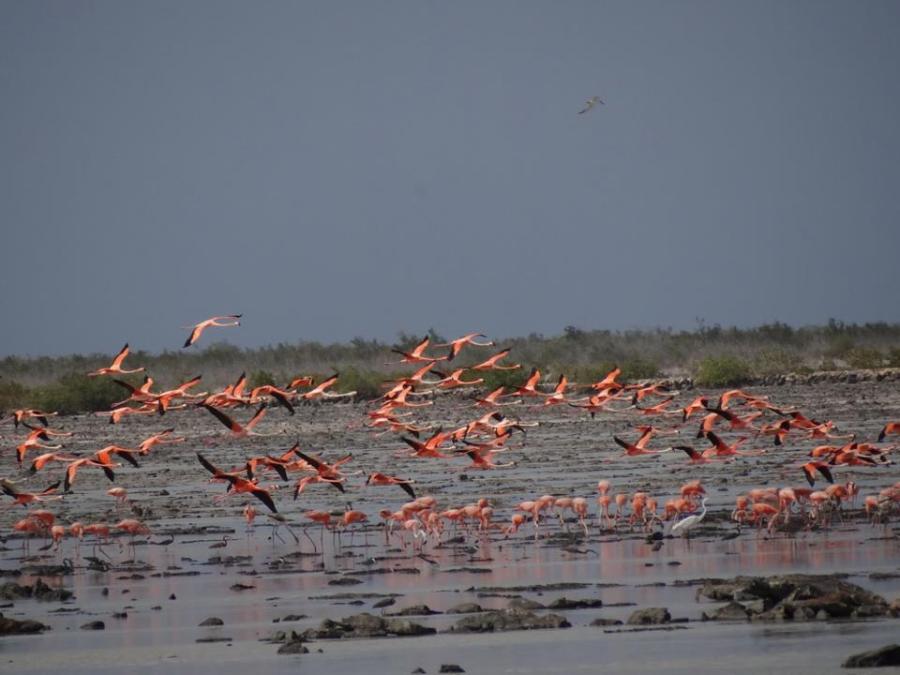
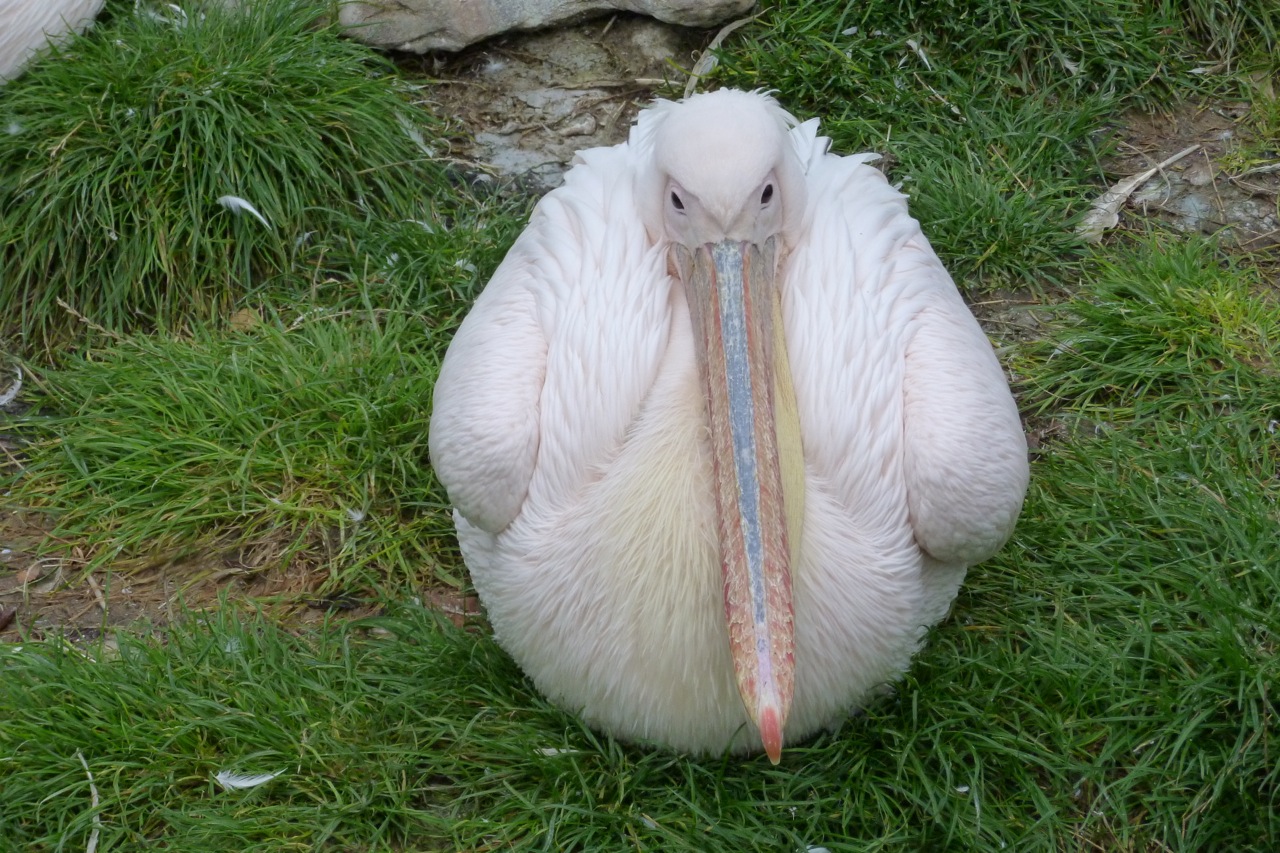
PINK FLAMINGOS & WHITE PELICANS

BIRDS OF ABACO… YET NOT IN ABACO

This post is a slight, alright huge, cheat. It’s been a Hurricane Sandy-dominated week. I have been posting / updating daily about the storm: the before, during and after for Abaco. Weather predictions. Trackers. Pics. Views from space. Several thousand hits later, and I realise that, as for Irene last year, the world is thirsty for information about cyclones and the communities affected by extreme weather. The power and communication problems faced by Abaco (as elsewhere) at these times increases the global concern. There have been emails asking for information about damage at Green Turtle Cay; if I know how uncle Fred on Elbow Cay is faring; and what of Saucy Sue in Marsh Harbour (the boat, not the person)…

Now that the storm has passed, power and comms are mostly restored, and the clean-up underway on Abaco it’s thankfully back to wildlife. Some interesting birds are called for to spread some cheer.These two species will be familiar but not in the setting shown…

PINK FLAMINGOS (Phoenicopterus)

Cheat 1: These birds were photographed… in captivity. Not quite the same as the real wild thing, I agree. To see wild ones on Inagua during the past breeding season, check out my earlier post with wonderful photographs by Melissa Maura CLICK HERE

Cheat 2: They are not in fact the Bahamas / Caribbean species, now I come to think of it. But they are undeniably pretty and cheering.

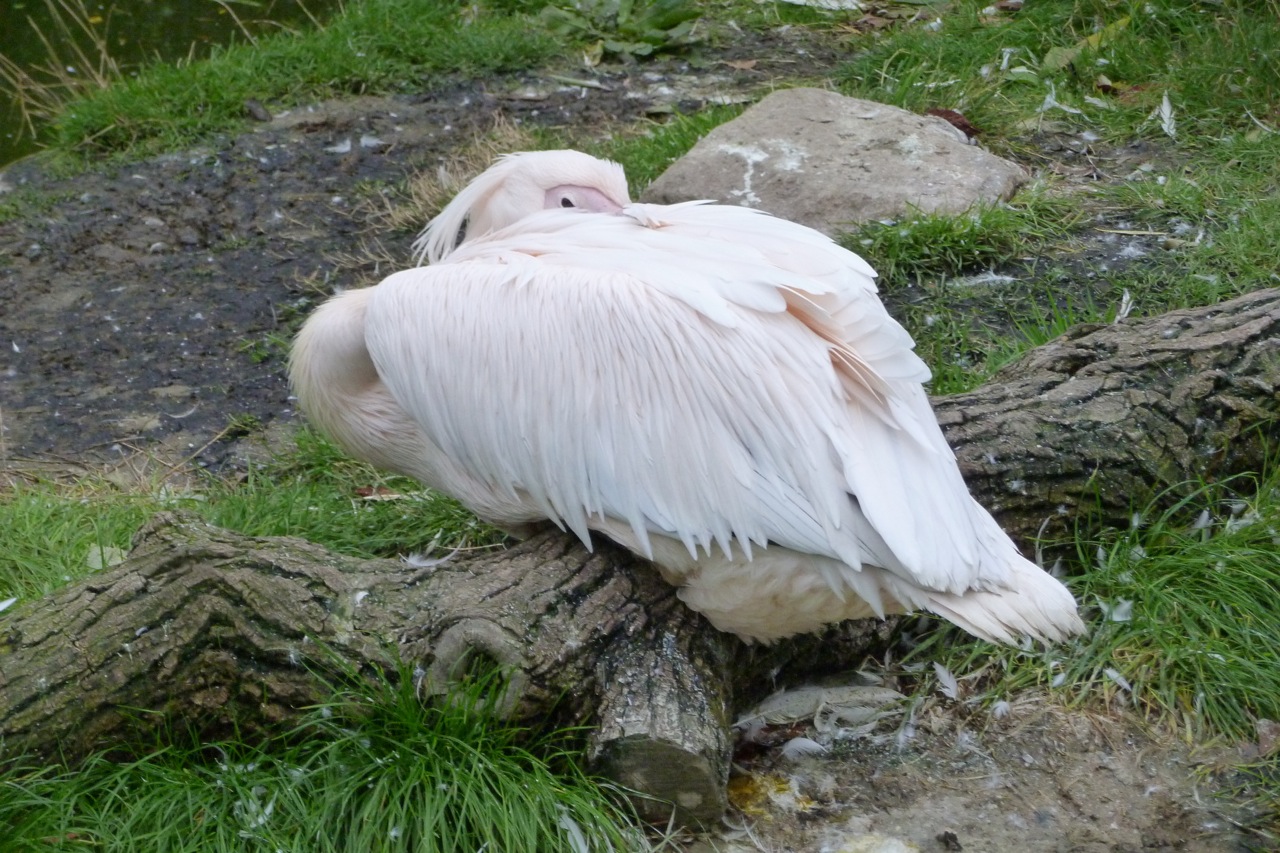
WHITE PELICANS (Pelicanus)

The birds below are American White Pelicans, not the Brown Caribbean Pelican familiar in the Bahamas. This isn’t a real cheat, however, since these birds are listed (in some sources at least) as ‘accidentals’ in the Bahamas. These’s always the chance that you might see a stray one. And if anyone has – especially if they have a photo – I’d be most interested to know.

Unknown's avatar

“MANATEE MANIA IN THE ABACOS” BMMRO FALL 2012 NEWSLETTER


“MANATEE MANIA IN THE ABACOS” – BMMRO FALL 2012 NEWSLETTER

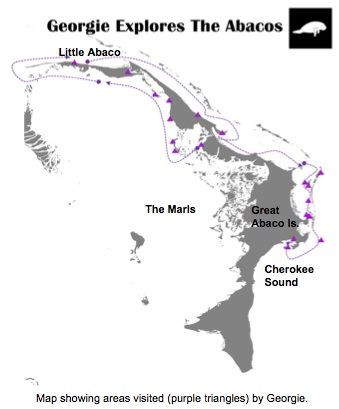
The BMMRO has just published the Fall 2012 newsletter, and it’s no surprise to find that the front page news is the arrival of young manatee Georgie on Abaco. After nosing and indeed grazing her way around Abaco and the Cays, she still appears to be contentedly moored in Cherokee after the best part of a month. Here’s the official map of her wanderings 

Besides the manatee there’s plenty more to read and look at including 

  • Charlotte Dunn’s ‘President’s Update’
  • Articles on whales, and a friendly bottlenose dolphin’s visit to Hope Town
  • Fall ‘cetacean sightings’ map
  • Students at ‘Whale Camp’
  • A quiz to make sure you have taken it all in…

To read the four-page document –  and admire the photos – CLICK BMMRO FALL 2012 NEWSLETTER

Unknown's avatar

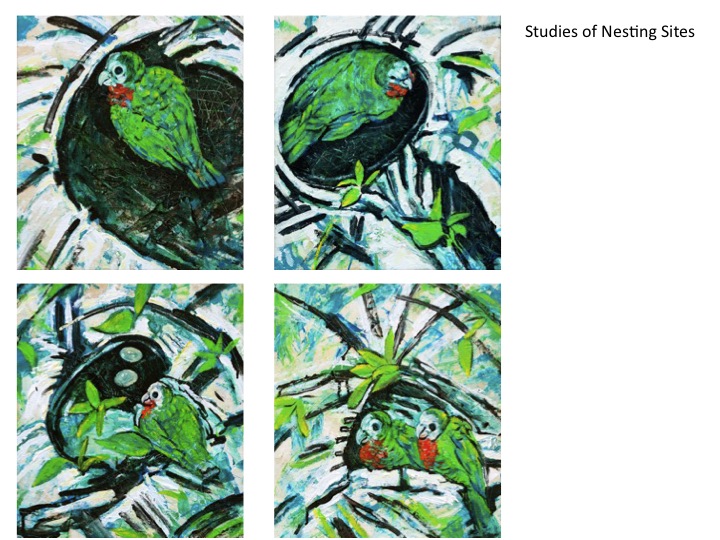
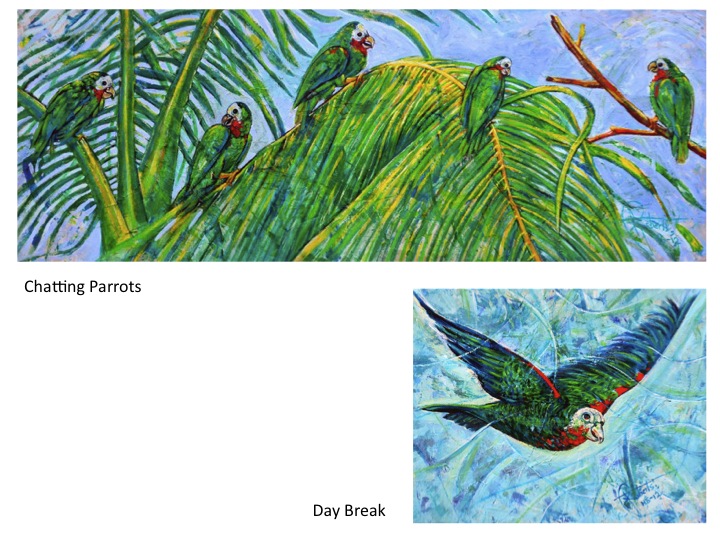
‘PARROTS OF THE BAHAMAS’: ABACO PARROT PAINTINGS BY ANTONIUS ROBERTS


‘PARROTS OF THE BAHAMAS’

A SERIES OF ABACO PARROT PAINTINGS BY ANTONIUS ROBERTS

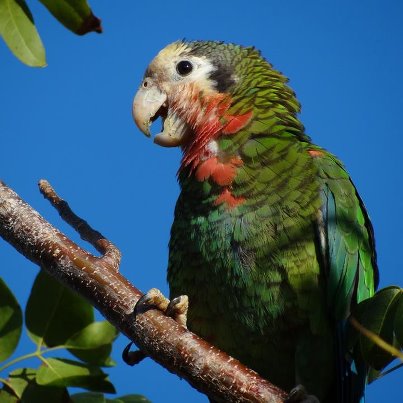
The wonderful parrots of Abaco are often featured hereabouts, and with good reason. They are the only subspecies of cuban parrot to nest underground, a unique species adaptation that protects them from fires in the pine forest of the ABACO NATIONAL PARK where they breed. However this in turn makes them vulnerable to predation. An intensive long-term conservation and predation-reduction program headed by scientist Caroline Stahala has reversed the decline of this iconic bird. Numbers have increased from fewer than 2500 some years ago to an estimated 4000. 

There are places on Abaco – south Abaco in particular – where the parrots congregate in noisy groups during the day. Many people manage to take photographs of them. Good photographers with a decent lens can get outstanding results. Even the camera-incompetent (I hear my name!) can manage the occasional first-class photo, given time and plenty of spare space on the camera card… But very few can do justice to these colourful birds in paint.

The spectacular series of paintings below are by well-known Bahamian artist and sculptor Antonius Roberts. Caroline has already posted about these on the ABACO PARROT RESEARCH F/B page. The originals of these paintings have (unsurprisingly) been sold, but they are available as limited-edition prints. Antonius will generously be donating proceeds of sale from the series to support the on-going parrot research. The images are ©Antonius Roberts – thanks to him and to Caroline for use permission

A recent reception was held in Nassau to showcase this series of paintings. You will find more about them by clicking the link to open a pdf of the reception brochure ABACO PARROT PAINTINGS Caroline Stahala contributed an excellent one-page article about the Abaco Parrots and their conservation – click on it to enlarge to legible size

Contact Antonius via email to hillsidehousebs@gmail.com or check out his website by clicking the parrot

Unknown's avatar

GEORGIE THE ABACO MANATEE – CHEROKEE’S SIRENIAN VISITOR STAYS ON…


GEORGIE THE ABACO MANATEE – CHEROKEE’S SIRENIAN VISITOR  STAYS ON…

There must be something special about Cherokee on Abaco. Georgie the Manatee, having travelled over from the Berry Is. early last month, spent 4 weeks or so on the move. She was tracked on the west side of Abaco in the Marls, moving north and rounding Little Abaco, then travelling south visiting various Cays along the way, ending up in Hope Town harbour. After a few days she moved across from Elbow Cay to the Little Harbour area, before settling down in Cherokee. That was nearly 3 weeks ago. She’s still there, by far the longest she has stayed in one place

Maybe the sea grass is especially good there. Or maybe she has found a tasty freshwater spring. Or it could be that she is enjoying the company there, and the welcome from the community – though she of course has been a very popular visitor in all her ports of call. Whatever the reason, she seems to be happy and in good health. Kendria Ferguson (BMMRO) has just sent me 3 photos from her visit to Cherokee today. Georgie has managed to shed her tag – again – but since everyone knows where she is, it doesn’t matter for now…

The image below is also posted on the BMMRO’s FACEBOOK PAGE and maybe gives a clue to why Georgie is so content – calm, friendly interest and attention. The next one is of a young boy inspecting Georgie, also in Cherokee. Equally peaceful.

Let’s compare and contrast those serene pictures with another taken recently – the woman below who was detained in Florida for her ‘manatee riding’ antics…

Unknown's avatar

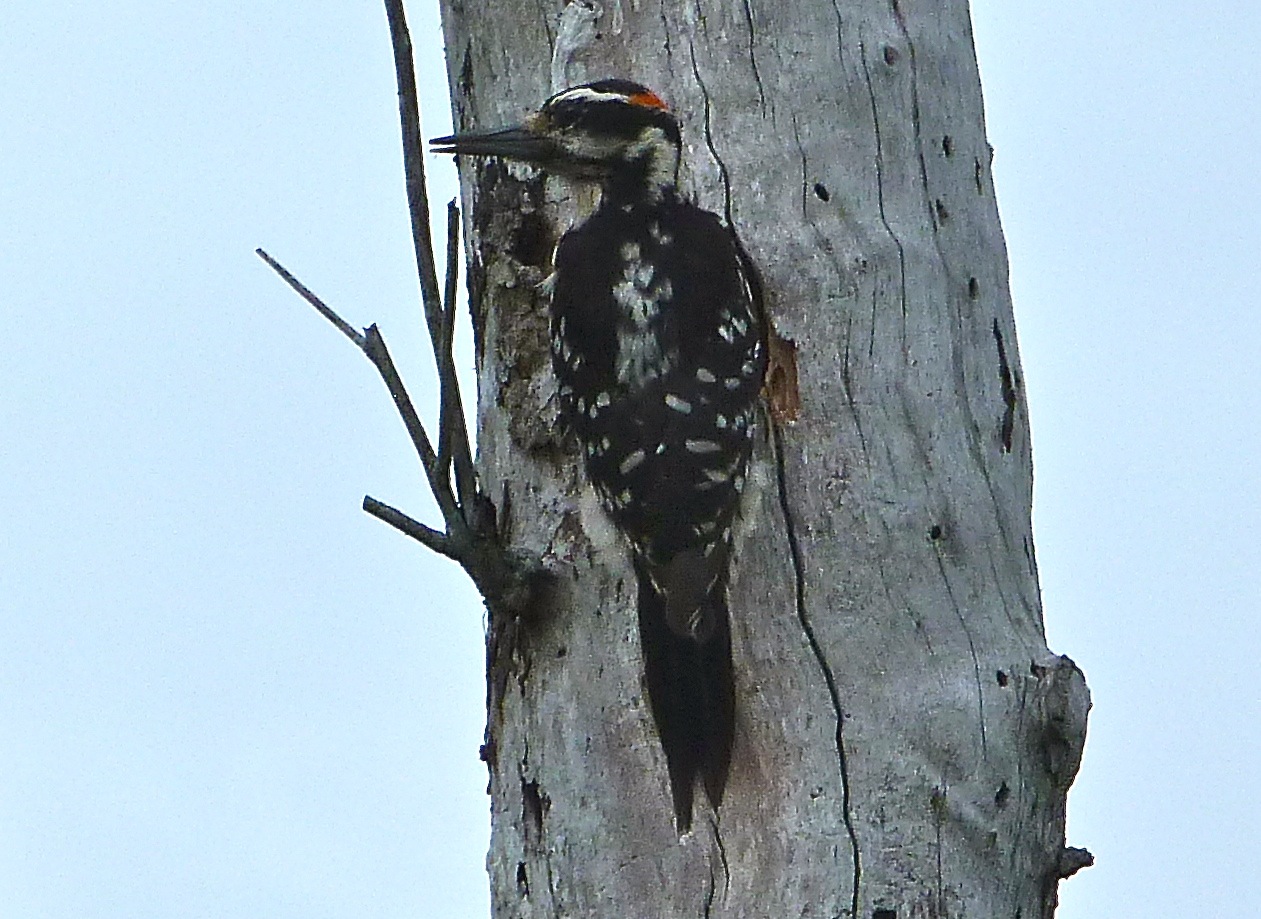
HAIRY WOODPECKERS IN THE ABACO COPPICE


HAIRY WOODPECKERS IN THE ABACO COPPICE

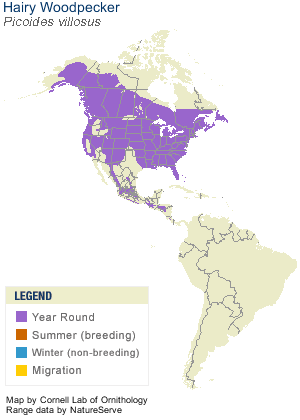
The hairy woodpecker (Picoides villosus) inhabits forest, woodland or coppice over a wide area of the North American continent and the islands to the east, including the Bahamas. They are mostly permanent residents, though there is a degree of migration within their territorial area.

They are a very familiar sight on Abaco, along with their larger cousins the West Indian Woodpecker. These birds forage on trees for insects, turning over bark or excavating deeper. They also feed on fruits, berries and nuts. It’s not unusual for them  to attack the woodwork on houses in a search for bugs…

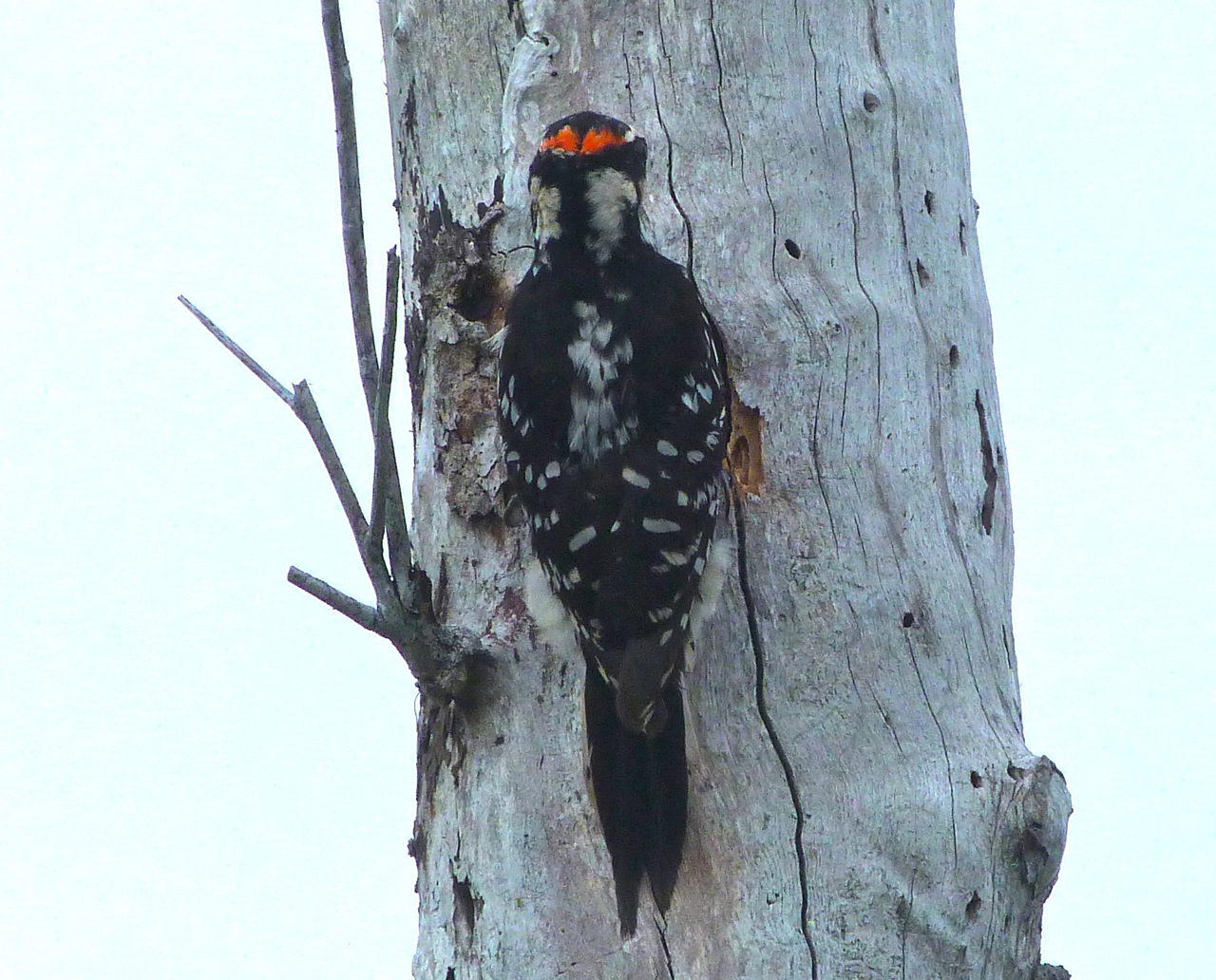
This male hairy woodpecker is prospecting a promising hole near the Delphi Club guest driveThe marks at the bottom of the hole suggest this may be a nesting hole – past, present or futureIt’s certainly deemed worth further investigation… if only he had someone to share it with

He may be in luck! This female hairy woodpecker was in the coppice not far away… A female HW is smaller than the male and lacks the male’s distinctive red head marking. They nest in a tree hole like the one above, where the female usually produces four white eggs. 

Unknown's avatar

BEDRAGGLED ABACO PARROTS, & AN AMERICAN KESTREL TAKES OFF…


BEDRAGGLED ABACO PARROTS, & AN AMERICAN KESTREL TAKES OFF…

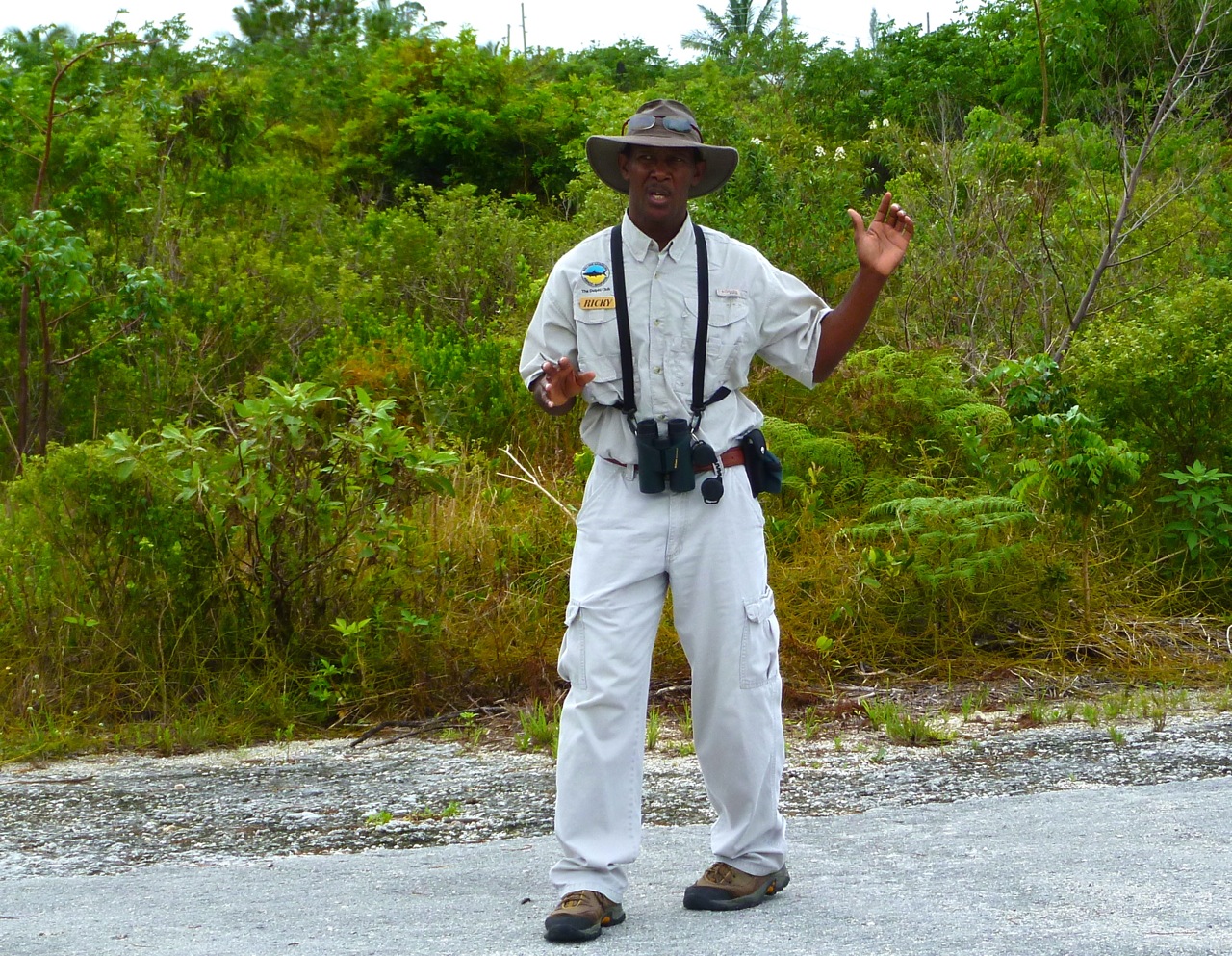
It’s a fine June day. Perfect for a morning out with Ricky Johnson, the omniscient leader of  ABACO NATURE TOURS. Want parrots? He’ll take you to them. Want a Bahama Woodstar ‘pished’ from its deep cover into the open? He’s your man. And as for wrassling land crabs – see LANDCRAB and LANDCRAB: THE SEQUEL We set off from the Delphi Club in sunshine and hope…

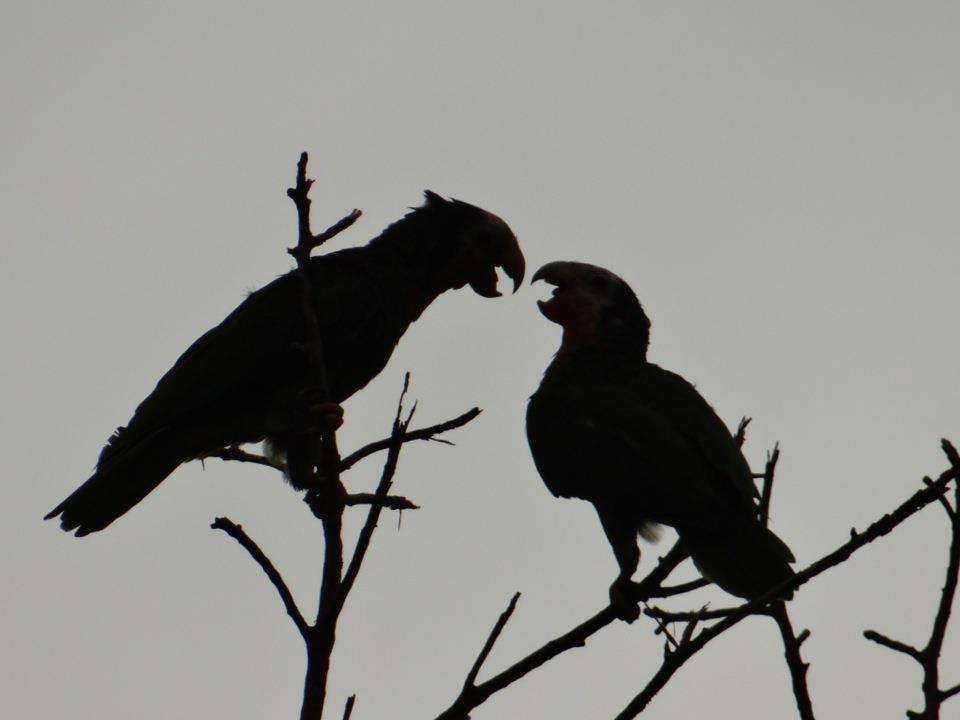
Sure enough, we found the parrots at Bahama Palm Shores, so often a good bet. This was (Ricky said) a non-breeding flock, the breeders all being otherwise detained in the National Park with their nests and eggs. Out of nowhere, a sudden short, sharp downpour arrived, and 5 minutes later, everything – everyone – was soaked. And so, of course, were the parrots. At first I discounted the resulting photos for use. These lovely, rare birds are made to be seen in their bright cheerful livery of green, red and blue. These wet ones looked… black. I usually try to avoid doing much (or any) ‘work’ on my photos, but for these I tried changing the contrast a bit and realised that they looked rather appealing with their dark, damp feathers and unkempt appearance. So I’ve decided to use a few images. Here they are, then: some sodden parrots!

While we were damply watching the parrots, Ricky spotted an American Kestrel near the top of a tree. Heads swivelled. It was some way away, but we could see it looking a bit dejected, huddled in the palm fronds. Then suddenly, just as I pressed the camera button, the kestrel stretched itself upright, raised its wings, and launched itself into the sky. The two photos below are frankly of marginal quality (on a high “blur setting”, as you might say) but the second one has caught the rain-drenched kestrel’s take-off about as well as a point ‘n’ shoot at that distance could… 

Unknown's avatar

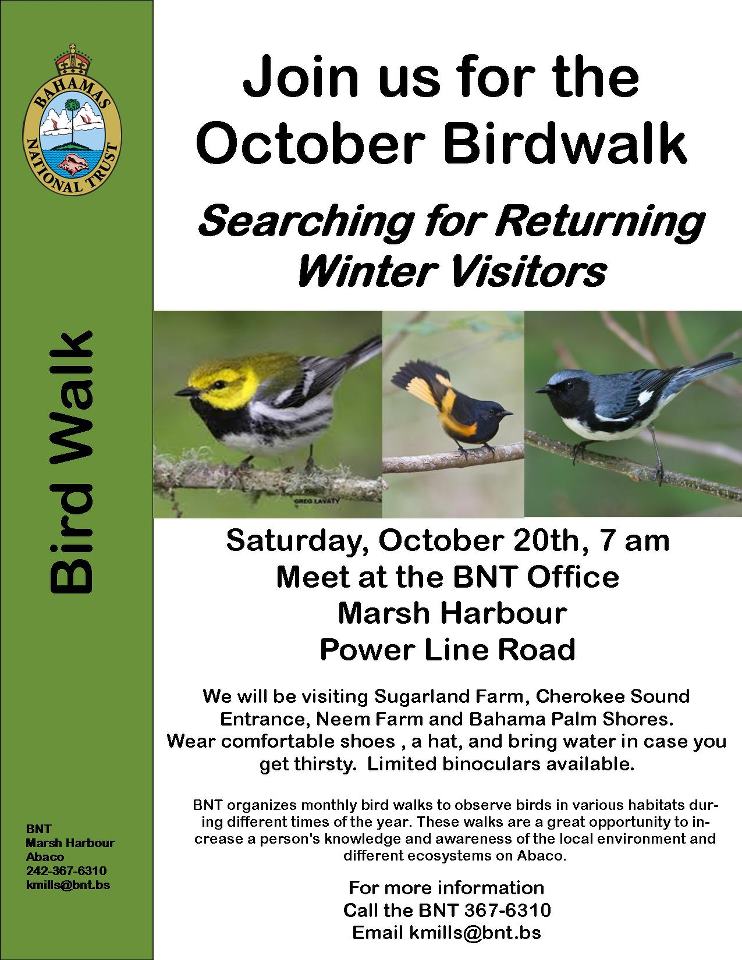
ABACO BIRDWALK WITH THE BAHAMAS NATIONAL TRUST – OCTOBER 20th


ABACO BIRDWALK WITH THE BAHAMAS NATIONAL TRUST – OCTOBER 20th

This sounds a lot of fun, and I wish I could be taking part. I’ve never been on Abaco in the autumn when the winter migrants start to arrive as the weather cools in their summer breeding grounds. It must be exciting to see the various species gradually reappear after their summer break, presumably with all the young birds born this year that will see Abaco (and the feeders!) for the first time. If any blog-follower goes on the expedition and happens to keeps a birding record, I would love to know which species you have seen . And if anyone gets some good pics, likewise…

Unknown's avatar

ABACO BIRD ID CHALLENGE (FOR NON-EXPERTS): THE SOLUTION


ABACO BIRD ID CHALLENGE (FOR NON-EXPERTS ONLY): THE SOLUTION

This small bird (Oh. I’ve given away the size already) was photographed in June. I was looking through a batch of downloaded photos recently. When I saw it again, I knew at once which bird species it belonged to – but not the specific make. I did some research and came up with the answer. I’d nailed the ID – or thought I had. The photo was a long shot which I had to enlarge to see the markings more clearly, hence a lower overall quality. I sent the jpeg to an officially  avian-knowledgeable person for confirmation (hi, Alex!). The reply was swift. No, not the bird ‘swift’, I mean it was quick. It turns out that I was, as so often, completely wrong. Barking up the wrong tree. Chirping in the wrong nest. Perched on the wrong branch…

I’d say there are two definitely plausible candidates, and you may even think of others. So what bird is it? You can click on it to enlarge it. Please join in and give your answer using ‘leave a comment’ (tiny letters at the end of this post) or email rollingharbour.delphi@gmail.com  Or, if you are seeing this on Facebook, please reply on that.

UPDATE Thanks for emails. Opinion is divided, but one of the 2 candidates is definitely ahead… I’ll leave this over the weekend

SOLUTION Of the few replies, most were right. One or 2 were (wrongly) with me – I reckoned it was a SWAINSON’S WARBLER. No one suggested turkey vulture. The correct ID, and the reasons for it, were provided by Alex Hughes, to whom thanks: “The first bird is a BLACK-WHISKERED VIREO.  The black supercilium going through the eye and the heavy bill are good marks, which can resemble a Swainson’s Warbler, but a clinching mark here is the yellow wash underneath the tail at the rear of the bird”.

While I am dealing with mystery birds, I posted photos of a very sweet little JUVENILE  BANANAQUIT about a month ago. At the end I added a photo, which again has since been positively identified (thanks again, Alex)

“Finally, this bird was a distance shot. At the time, it looked larger than a bananaquit – more Loggerhead Kingbird-sized. Before I had downloaded the image and could see it clearly [rather than on the screen on the back of the camera], I’d wondered about a mangrove cuckoo. Then I saw at once that it didn’t tick the right boxes. So I decided it must just be a huge bananaquit with an orange rather than yellow front. If it’s anything else (a rare hybrid spindalisquit?), please say so!” It is a indeed bananaquit, but in my limited experience I have never seen one with a spindalis-orange front. Can anyone say if that is a common colouring on Abaco, or unusual?

Unknown's avatar

“GEORGIE” THE MANATEE MOVIE: ON LOCATION AT CHEROKEE, ABACO


UPDATE 17 OCT I gather that Georgie is so pleased with her new home at Cherokee, she’s still there. Not sure if she is with or without her tag, but I suppose if she has decided to stay put in one area, tracking her is not a priority. Maybe the sea grass there is a particularly good kind – or perhaps she has found natural springs to her liking. Maybe it’s the folk who live there… yes, I think it must be that. I’m hoping to get some more specific news soon, and some more photos.

UPDATE 7 OCT Kendria says that Georgie has managed to lose her tag yet again. She’s still at Cherokee, but if she decides to make a move, she can now be tracked only from reported sightings. Maybe she just doesn’t like to accessorise…

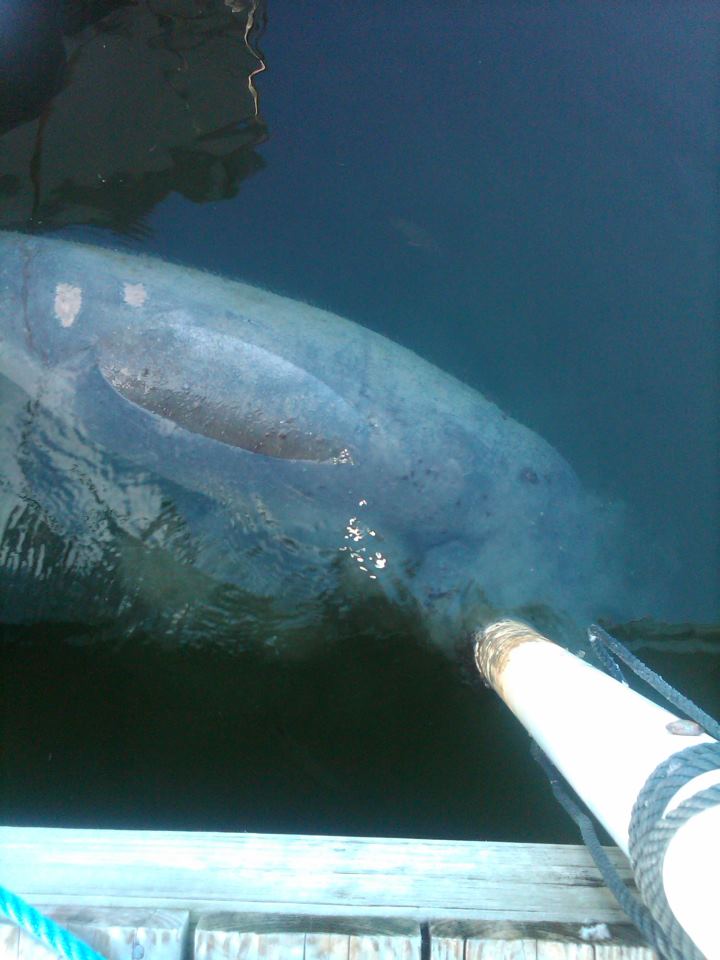
UPDATE 6 OCT Georgie has taken to life in Cherokee. She is still there – the longest she has stayed on one place during her epic journey. She’s a very popular guest, of course, and  has generated a lot of local interest and affection. Here’s a BMMRO photo taken yesterday of Georgie enjoying some quality algae browsing on the pilings in the dock

“GEORGIE” THE MANATEE MOVIE: ON LOCATION AT CHEROKEE, ABACO

The story of Georgie, the young female manatee currently undertaking a round trip of Abaco, has further raised the profile of these unusual and fascinating creatures in the northern Bahamas. Like many others who have been enthused by this important conservation and research project, I’ve been following her story since her release with her mother Rita in the Berry Is. earlier this year. In June she was weaned. In September she decided to set off to sea grass pastures new –  see GEORGIE for details

Yesterday she was still in the Cherokee area, but had lost her tag. The task was to locate her, find the tag and reattach it, and check her wellbeing. All were accomplished in the course of the day and the BMMRO posted: “Today was another day in Georgie’s ‘world according to Georgie’!!! A special BMMRO thank you and Manatee high five to Andrew Lowe, Cindy & Buddy, and the community of Cherokee! Georgie is lucky to have such caring people around! She is still parked at Cherokee and BMMRO will do their best to continue to monitor her health and habitat use in the area!”

Things have moved on a bit since then, and I am really grateful to Kendria Ferguson for finding the time to email me; and to Cindy James Pinder  for permission to use her excellent photographic material from her time spent with Georgie. Her latest news is that Georgie is moving south towards Casuarina. There are blue holes in the area where she can find fresh water. Cindy adds “She may show up in the canal in Casuarina today. If you see her please offer her fresh water from a hose.”

It’s time to showcase a short video taken by Cindy at Cherokee yesterday. In order to post it here I have had to make a derivative movie from the original. It’s like an uncontentious bootleg, i.e. made with the artist’s approval (for which many thanks!). The quality isn’t as good of course, but you will clearly see what is endearing about these inquisitive, gentle and trusting creatures – and why this makes them so vulnerable and in need of protection. Only today, a woman has been detained in Florida for riding a manatee – a strictly unlawful act that has been strongly condemned.

Here are some stills also taken by Cindy yesterday, who says “…in case you are wondering . . . a manatee feels like leather!”. They depend on having some fresh water, and these great pictures show various methods of supplying it. The top one is my favourite.

HELP NEEDED If you would like to support manatee research and conservation in The Bahamas, please email info@bahamaswhales.org or rollingharbour.delphi@gmail.com 
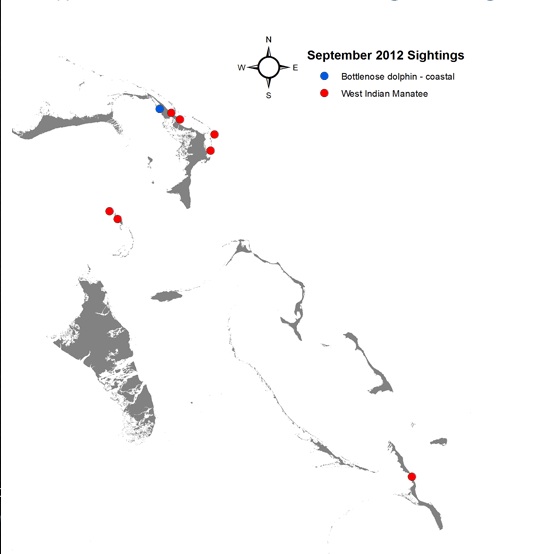
This is the perfect place and time to post the BMMRO September 2012 Whale, Dolphin and Manatee sightings map. Last month the cetacean count was very low – no whales at all, a solitary dolphin. However, manatees are starting to feature much more, and the Abaco sightings – presumably of Georgie as she progresses round the Islands  – are the first ones recorded there (I think) since manatee sightings began to be included towards the end of last year. A cause for breaking out the fresh water to celebrate.
*  *  *  *  *  *  *
MUSICAL AFTERNOTES The video music is Rizraklaru by Ralph McTell (before he arguably spoilt it all with the mawkish ‘Streets of London’) from ‘Spiral Staircase’ (credit / plug for RM). He wrote it in 1967 while living in an old caravan in deepest Cornwall. He and his mates had only mother nature’s ‘Rural Karzi’ to use, and the song title is an anagram. It’s a long story that ends, in RM’s words, “After he’d stopped laughing, Henry and I explained the title’s origin [to him] and he suggested an anagram, so we put the first letter last and spelt the whole thing backwards, and there you have it ! RIZRAKLARU !” 
Unknown's avatar

ABACO MANATEE GEORGIE’S TRIP: HOPE TOWN TO CHEROKEE


ABACO’S MANATEE, GEORGIE, SWIMS  FROM HOPE TOWN VIA LITTLE HARBOUR TO CHEROKEE

GEORGIE UPDATE 2 OCT Cindy James Pinder has posted on Facebook “Oh no, Georgie the manatee has lost her tracking device. Be on the look out for it in the Cherokee area. We are going to go out and look for her tomorrow with BMMRO. We are hoping that she goes back to the dock area looking for fresh water.” 

BMMRO UPDATE 1 OCT I’ve just heard from Diane Claridge and Kendria Ferguson. They have kindly clarified the details of Georgie’s route, which makes her journey longer than my guesstimate (see below). Georgie has continued on her way, and after some resting and some quality sea grass munching, Kendria says (yesterday ) “…right now she is in CHEROKEE!”. I’m not sure where the fresh water springs are along the east coast, but I am beginning to think that Georgie may be on her way to check out Rolling Harbour and the Delphi Club, drawn by telepathic and symbiotic forces as yet unexplained, projected from the blogosphere… 

BMMRO FACEBOOK “Georgie the manatee is creating quit a stir in Cherokee! Thank you for the sighting reports! (get some photos please!) To everyone there please don’t feed her lettuce. Manatees become very dependent on humans-their fast learners! It also teaches them to come into marinas which is where their number one predator lives – BOATS!! We want to ensure Georgie’s safety whiles she is here! We are unfamiliar with the area-so if anyone knows of any natural freshwater resources (shallow water seepage/blueholes) please do share that info! It is ok to give her a hose, mainly because we are not sure if she’s getting adequate freshwater in the area. Please remember she is a toddler and her belly is never full so have a cut off limit!  See you tomorrow Cherokee!! Take care of Georgie!”

Georgie’s next stop?

BMMRO report 30 SEP Georgie the manatee continues to travel around the Abaco’s! Fitted with a new satellite tag, she is currently exploring LITTLE HARBOUR. Yesterday, scientists caught up with her by CORNISH CAY where she was taking a quick nap and feeding on seagrass. We will continue to update the public on her whereabouts. Thank you to everyone for all their assistance in locating Georgie and ensuring her safety whiles she takes a much needed vacation from the Berry Islands.

A short time ago I wondered (in print) when a manatee would next be seen in Abaco waters – the nearest candidates being the small Berry Is. population. The answer was quick. Now! Georgie – the recently weaned calf of Rita – had swum across from the Berrys to Abaco, explored the Marls, headed  north to Little Abaco, then travelled south on the eastern side of Abaco. She was spotted at Green Turtle Cay, but it had become clear that her satellite tag was malfunctioning, so locating Georgie and monitoring her progress depended on reported sightings.

The BMMRO reported yesterday “Georgie the manatee was sighted at the Sailing Club dock in Hope Town Harbour just after 2pm today! We’d appreciate any further sighting reports as to her whereabouts! Please drive carefully in and around Hope Town Harbour.” Hope Town resident Stafford Patterson was able to get 2 fine photos of Georgie. I contacted him about using them, and he has replied “Permission granted!! And we were happy to host Georgie yesterday.” So here is Abaco’s sole resident manatee (as far as I am aware) enjoying her visit to Elbow Cay.

A team was able to fit a new satellite tag to Georgie (see below), so following her adventures will now be much easier. But where will she go next? What this space or, better still, check out the BMMRO FACEBOOK page

STOP PRESS I’ve been wondering about the distance Georgie has travelled (remembering always that she was weaned only recently). So with the the help of an online map measuring thingy (Free! Cool!), here’s a calculation based loosely on more assumptions than you will find on ASSUMPTION ISLAND. For a start, I don’t know where in the Berry Is. Georgie officially set off from; nor where she was seen on  the Marls; nor how she negotiated Little Abaco and the Cays along the east coast of Abaco; nor how many times she circled round exploring as she went. However, taking the ‘as the manatee swims’ direct line approach and assuming no significant deviations, the gizmo reckons the journey was a minimum of 150 miles. With any luck the recovered defective tag will have recorded her exact route, and amply demonstrate that I have wasted 1/2 an hour on this. Still, I wanted to know…


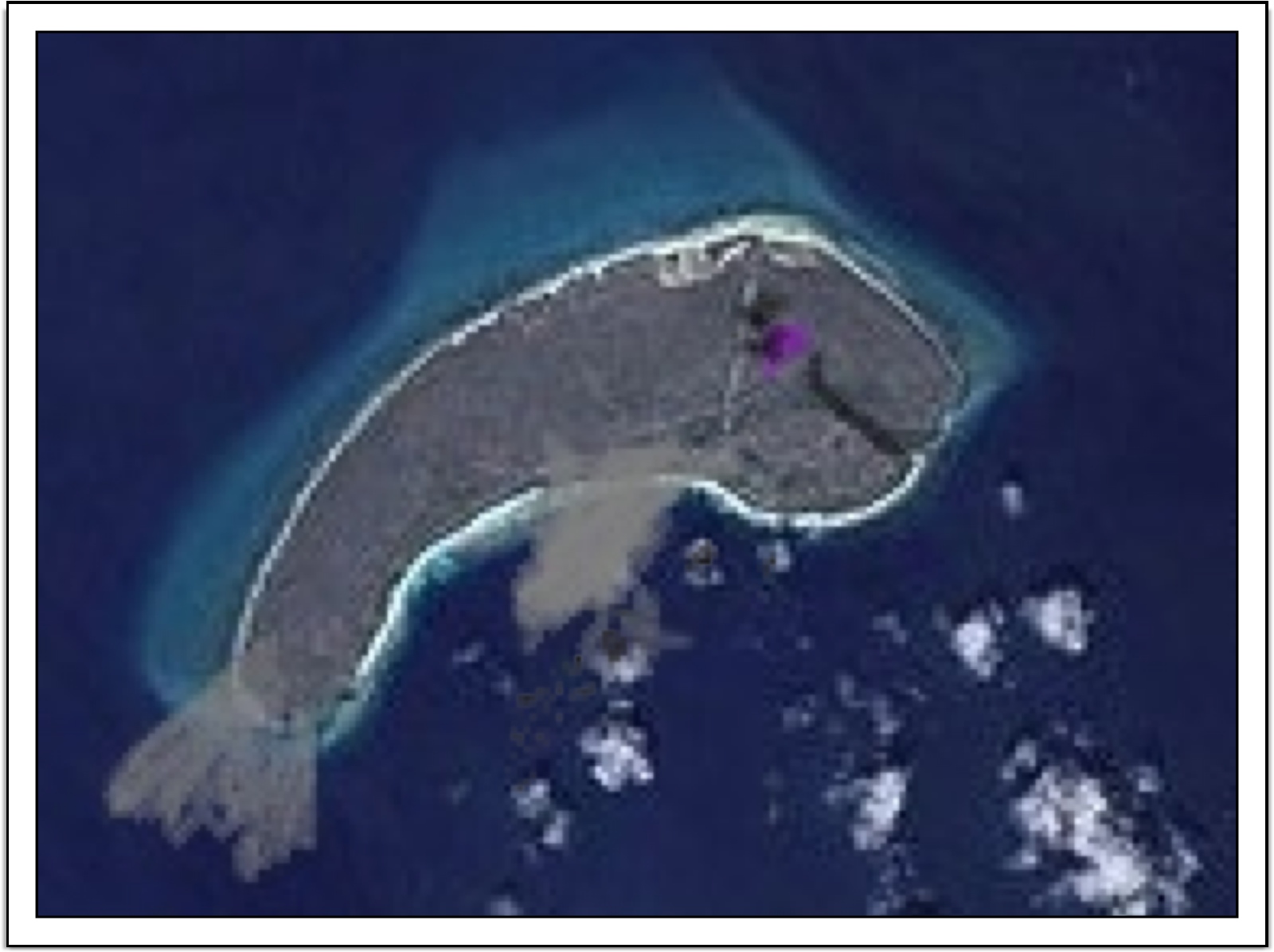
And for anyone wondering about Assumption Island, it does indeed exist, located in the Indian Ocean north of Madagascar. And the spooky thing is… it is shaped remarkably like a manatee! Well, quite like one, anyway.

Assumption Island (geographically correct)  Assumption Island (manatee rotation)      Awww…Cute!!!


Credit: savethemanatee.org

Unknown's avatar

MANATEES: CONSERVATION, AWARENESS PROGRAMS & DISTRIBUTION MAP


MANATEES: CONSERVATION, AWARENESS PROGRAMS & DISTRIBUTION MAP

The “SAVE THE MANATEE CLUB” is a very active organisation that I have mentioned in previous manatee posts. These gentle creatures are in need of protection, and much effective conservation work is in progress. The BMMRO‘s wonderful work for the MANATEES OF THE BERRY ISLES is featured in this blog because of the proximity to Abaco (might those manatees visit one day?) – and of course because BMMRO HQ is at Sandy Point.

[ADDED 25 SEPT]…and lo, just as I pressed the ‘publish’ button, the BMMRO posted this news:

Georgie is currently exploring the Abacos. Help us monitor her movement patterns by reporting sightings!! 

“Earlier this year we tagged & released 2 West Indian manatees in Great Harbour Cay, Berry Islands. These were the same manatees from Spanish Wells that were captured after they swam to Nassau when hurricane Irene passed in late August 2011. After release at Great Harbour Cay in May 2012, they explored most of the Berry Islands but centered their use around Great Harbour. In September one of these manatees, a young female named Georgie, swam from the Berrys to Abaco, has traveled within The Marls, north towards Little Abaco & is now traveling south on the eastern side of Abaco. We received a sighting of her on 23 September at the Green Turtle Cay Ferry landing, just north of Treasure Cay. We anticipate she will continue to travel south and may venture into marinas and harbours along the way. We would like to make the public aware of her presence in the area. Although we believe she is in good health and is exploring new areas, the tag is not functioning properly now so sightings from the public will help us locate and monitor her progress. If possible, please share with anyone in the Abaco area or make an announcement encouraging people that see her to report any sightings”

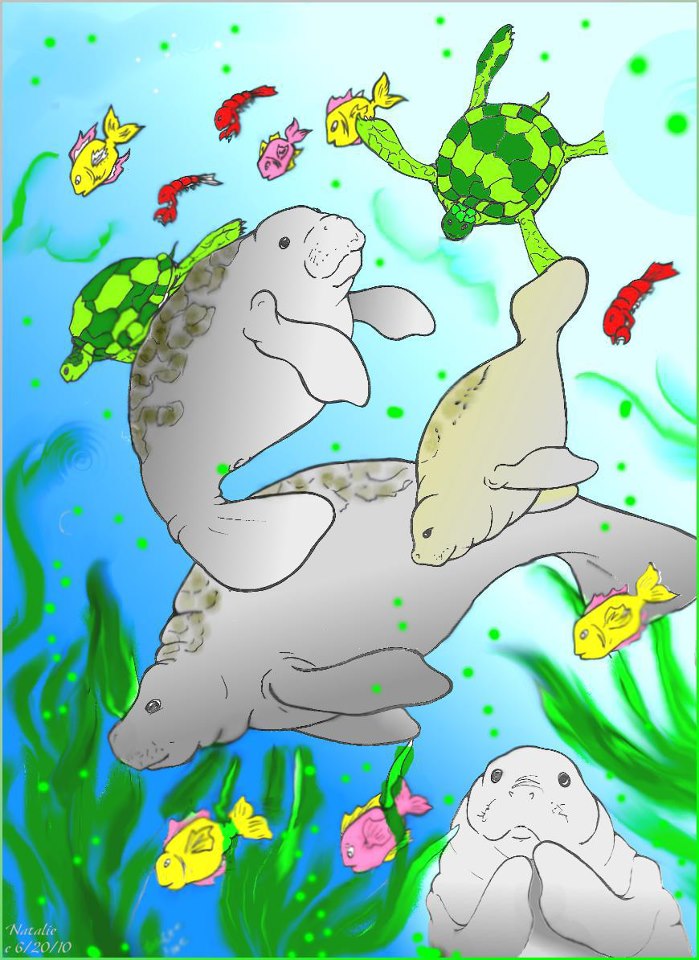
[ORIGINAL POST CONTINUES] The SMC is a Florida-based organisation and it recently posted a new cheerful cover picture by Natalie Prayor on its FACEBOOK PAGE. I have recently noticed some searches on the blog such as ‘Manatees facts for Kids’, so this post might be helpful. You could  even (I can’t believe I even thought of checking this out!) knit one… Want a pattern? Click HERE In fact, I might even…

To see more of Natalie’s artwork, just search ‘Natalie Prayor in Facebook. She can be contacted at dracodawnstar@gmail.com

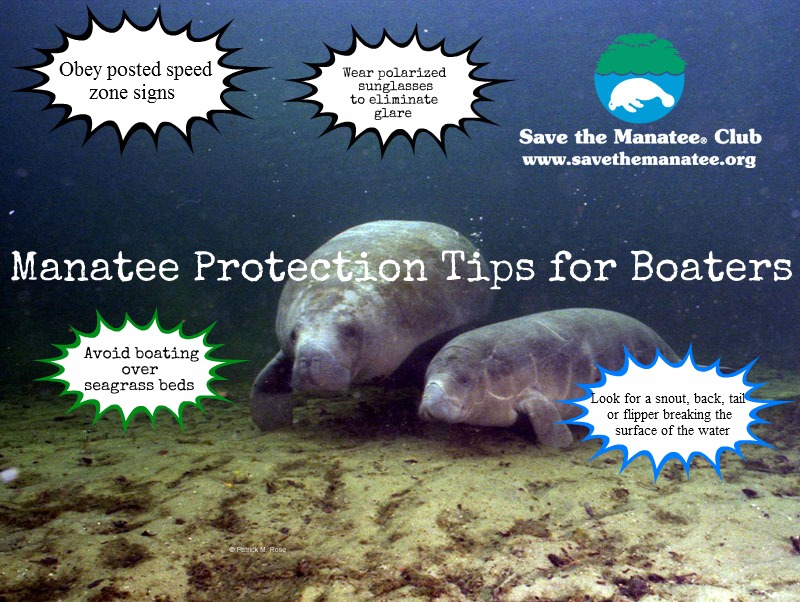
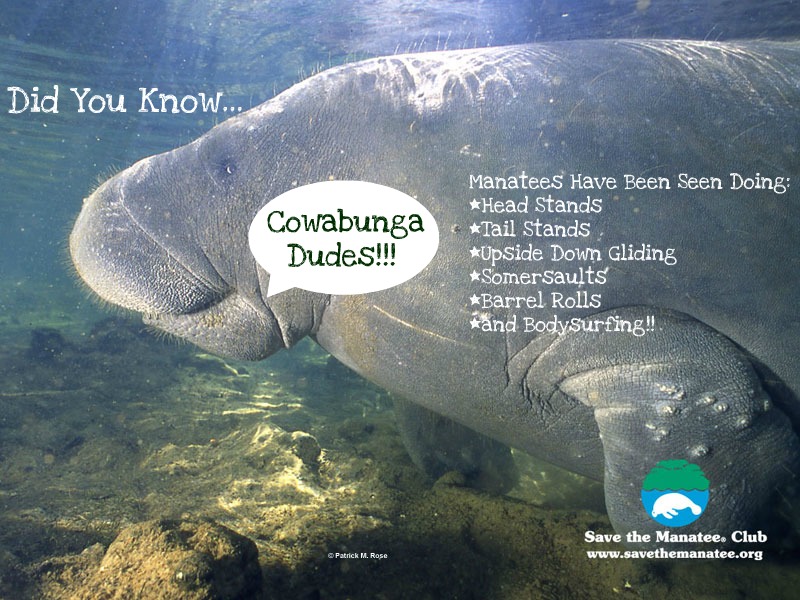
The SMC also posts Manatee facts and advice, from which I have selected the examples shown below

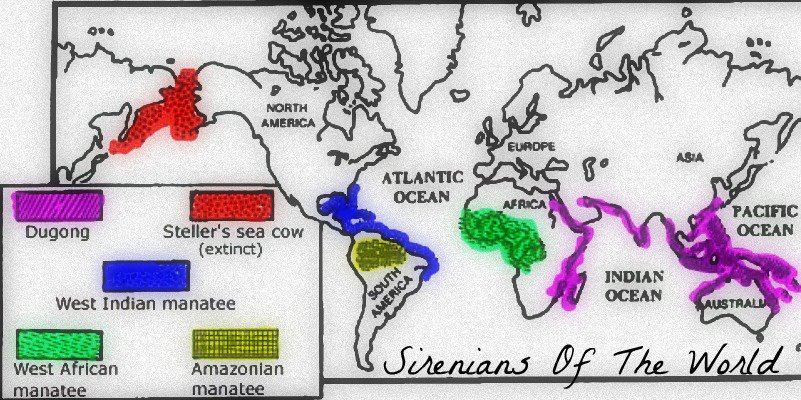
This map shows the world distribution of the 4 extant sirenian branches as well as the extinct STELLER’S SEA COW of the north Pacific. It is a melancholy fact that by 1768, a mere 27 years after its discovery by Europeans, this slow-moving, tame and easily-captured sea cow was hunted to extinction. 250 years on, the world’s sirenian population remains vulnerable and, as with whales and dolphins, in need of active monitoring and protection measures

Finally, I liked this manatee cartoon from Rachel Arnow, with its incongruous and enjoyably unfeasible suggestion of manatees in Loch Ness. Rachel has a great sirenian-centric website  http://mvsm.omnomzom.com/ featuring her excellent and charming cartoon series “MAN VERSUS MANATEE”. 

Credit: savethemanatee.org

Unknown's avatar

A PRAYING MANTIS – AT LAST, MY VERY OWN MANTODEA PHOTOS…


About a year ago, Sandy Walker encountered a praying mantis at the Delphi Club. For technical reasons his photo(s) of it didn’t work out. Undaunted (and because I’d never seen one outside an insectarium) I turned an essentially non-event into a short post SANDY’S PRAYING MANTIS, in the course of which I learnt a bit about these strange creatures. There isn’t a great deal of compelling information to pass on, to be honest. And I still don’t buy their supposed resemblance (for the sober observer) to Eleuthera.

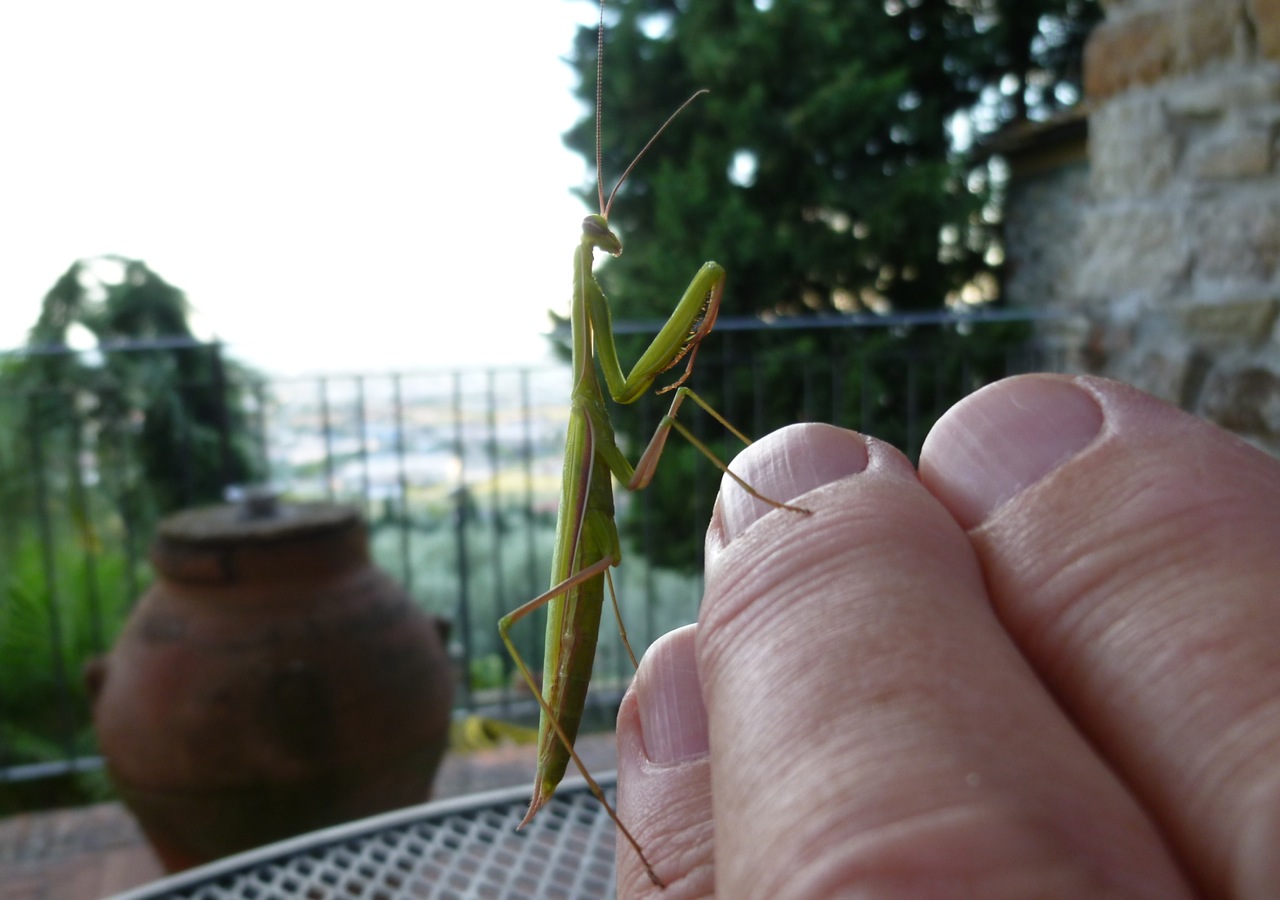
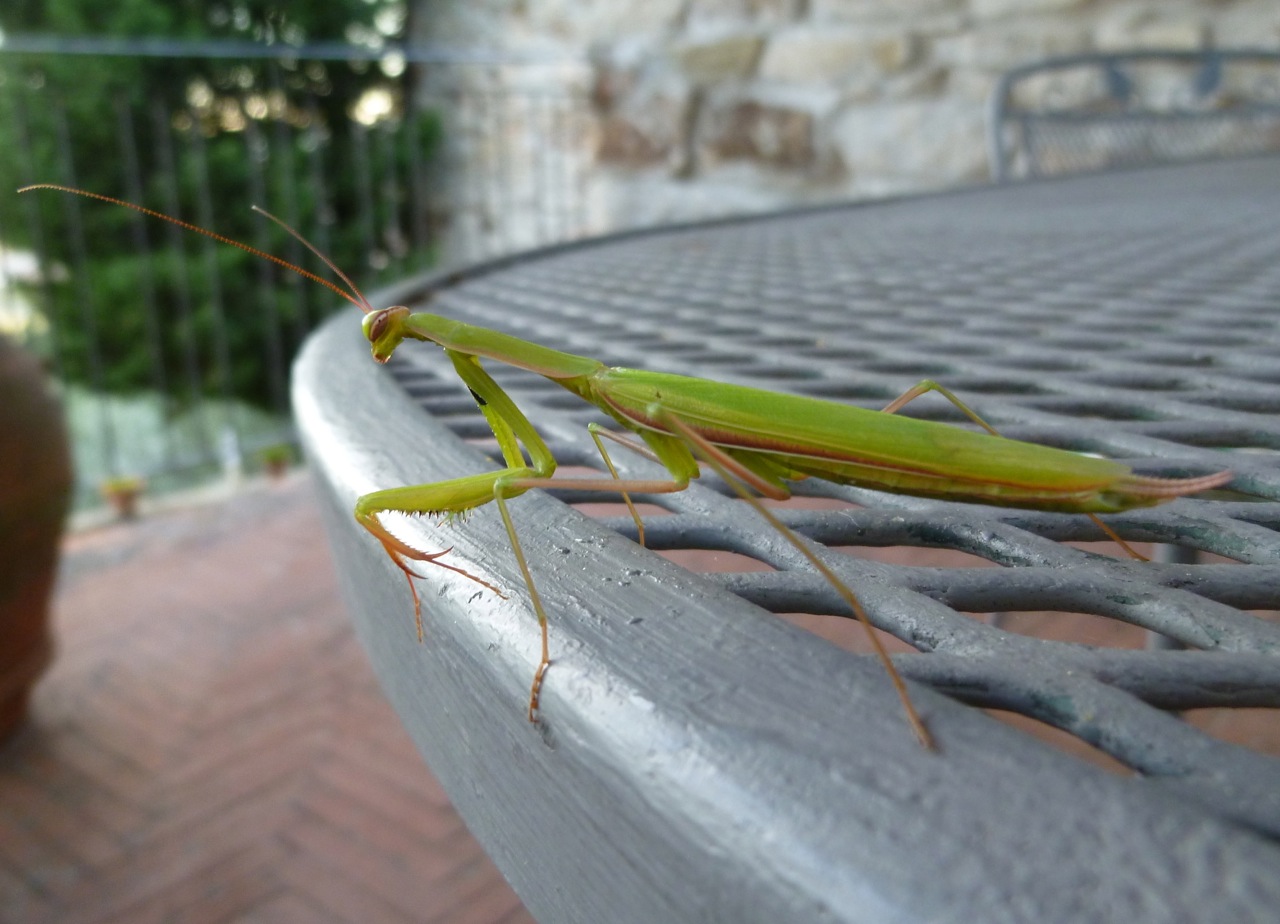
We saw no mantises this summer on Abaco, and I forgot about them completely until a week ago… And there, nonchalantly strolling across an outdoor table where we were staying for a few days in Italy, was the very creature. It obligingly posed for some prayerful snaps, then I put it gently on a balcony railing where it clung upside down and apparently content overnight. It was still there at breakfast, gone by lunchtime, and we never saw it again. But the images live on…*

Please note that the fingerprints in photo 1 are copyright…

Unknown's avatar

FLAMINGO BREEDING SEASON ON INAGUA, BAHAMAS with MELISSA MAURA


FLAMINGO BREEDING SEASON ON INAGUA, BAHAMAS with MELISSA MAURA

Flamingos. The national bird of the Bahamas, featured in the nation’s Coat of Arms. But sadly no longer available to view on Abaco**, despite sporadic attempts to reintroduce them as breeding birds on the island (the last, I believe, about 15 years ago). By the end of the c19, numbers were already small. During his field trip in 1886, naturalist F.H.Herrick noted “The rare flamingo is now reduced to a colony of a few hundred on Abaco, where, as I was informed by an old settler, they numbered thousands several years ago, and similarly the beautiful tropic bird, which is hunted chiefly for food, is being gradually exterminated”.

Ornithologist Charles Cory noted none on his visit to Abaco in 1891 (though he does seem to have been concentrating on smaller birds). In 1905, naturalist Glover M. Allen reported his Abaco findings in THE AUK Magazine, which I have summarised elsewhere: Of particular interest is… the apparently imminent loss of the flamingo (“fillymingo”) from the Northern Bahamas – a single colony only still surviving on the Abaco Marls by 1905″. There remained a breeding population on the Abaco Marls until the mid-c20, but they then appear simply to have died out there (and more generally in the northern Bahamas). 

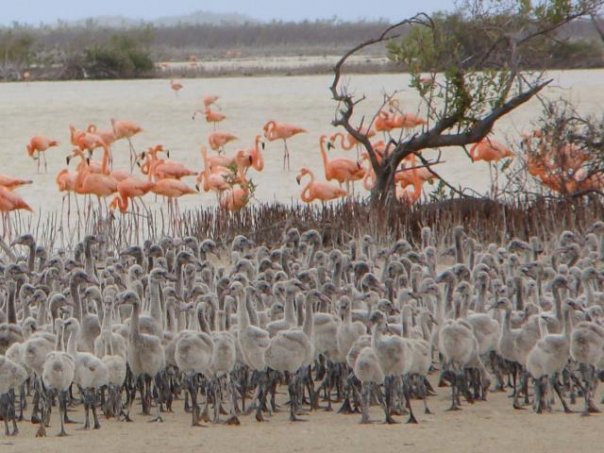
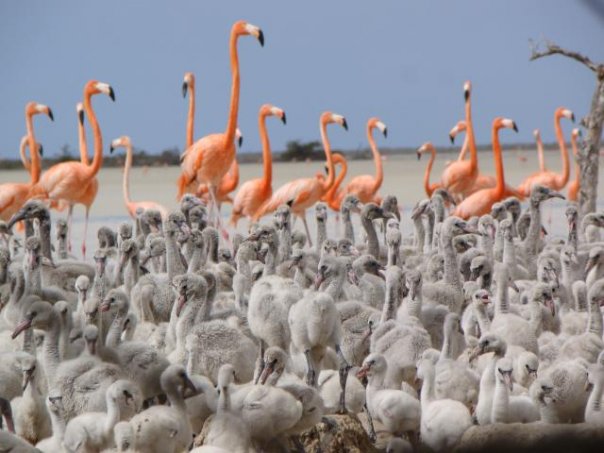
So to see these gorgeous birds, you will have to go elsewhere. Inagua, to be precise, where in the INAGUA NATIONAL PARK you will find the world’s largest West Indian flamingo colony (around 50,000 of them). Melissa Maura, whose superb photos of ABACO PARROTS I recently featured, visited Inagua during the 2012 breeding season, and took some wonderful photographs that she has kindly allowed me to use. They certainly deserve wider publicity. The collection below (©Melissa) shows adults in flight; adults standing around; the remarkable cup nests; and this year’s chicks… overall, a gallery of 50 shades of pink and grey…

** For the second time this week, nature has outshone mere bloggery. First, I wondered when a manatee might visit Abaco. Answer: right now! Georgie has taken her first long trip from her new home on the Berry Is to visit Abaco – see HERE. And now Sean Giery has responded to a link to this flamingo post on the excellent ABACO SCIENTIST website to say “I just saw my first flamingo last week flying over the beach at Crossing Rocks. It would be great to see them make a comeback on Abaco”. That’s a wonderful prospect.
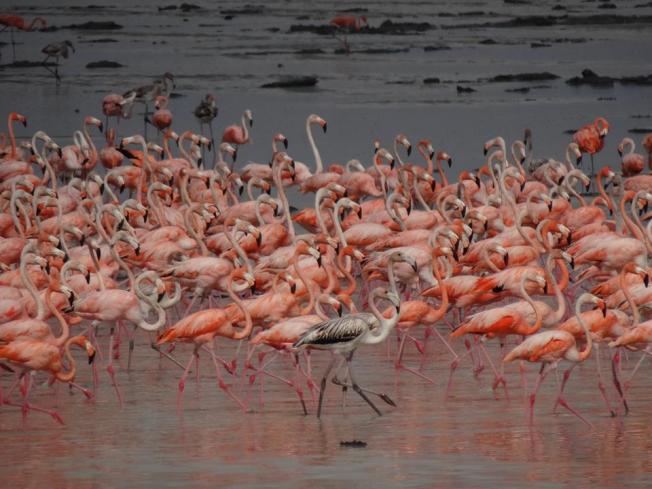
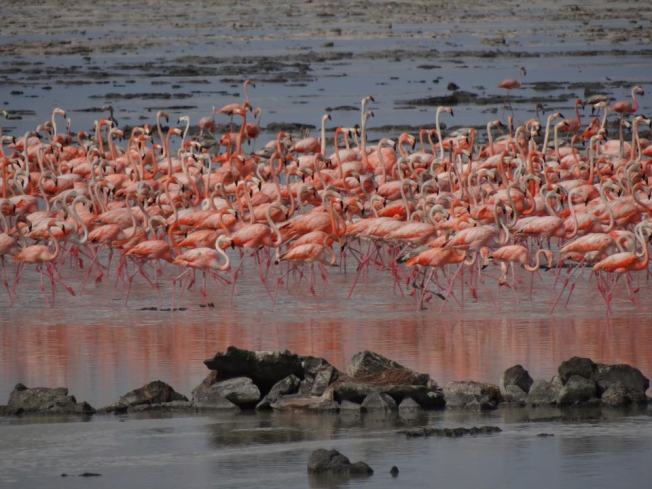
A brief clip of the sound of Caribbean Flamingos

[audio http://www.birdforum.net/opus/images/b/b8/Phoenicopterus_ruber_%28song%29.mp3]
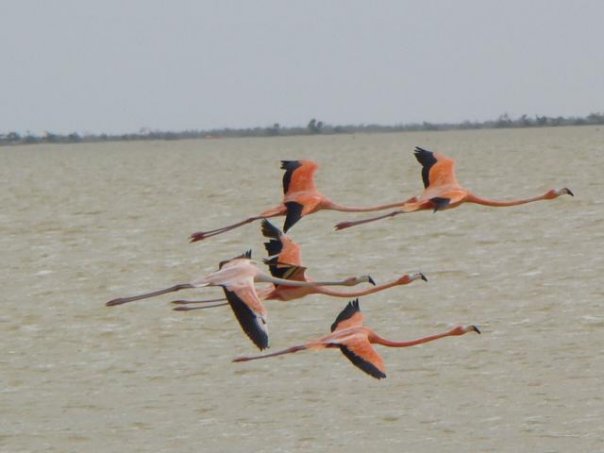
Please note: these photos are © Melissa Maura; please contact me if you want to use any of them…
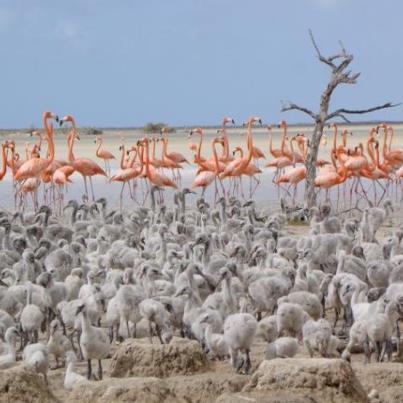
WEST INDIAN FLAMINGO Phoenicopterus ruber (BNT Article)

DESCRIPTION

The West Indian Flamingo is hardly one to get confused with other birds. Its long legs, long neck and characteristic pink colour make these birds like no other. The West Indian Flamingo has a large, heavy, down curved bill that is most often described by the layperson as “strange”. Adults can reach up to five feet in height.

HABITAT

Even though the Flamingo is a strong flier, it is really quite shy and prefers to live in remote and lonely places. Usually these are rather desert-like spots, dry islands and shorelines where salt is made, and where few other creatures can survive. The island of Great Inagua fits that portfolio perfectly. This is where the majority of West Indian Flamingos are found in The Bahamas. The flock breeds around Lake Windsor (Rosa) which lies within the boundaries of Inagua National Park.

DISTRIBUTION

The West Indian Flamingo which once roamed the entire neo-tropical region (tropical Americas) was hunted to a near extinction. Today the West Indian Flamingo is mostly found on the island of Great Inagua in the Bahamas but has also recolonized islands in the Bahamas such as Mayaguana, Crooked and Acklin islands, Exumas, Long Island and Andros.The West Indian Flamingo has also recolonized other countries such as Aruba; Brazil; Colombia; Cuba; Dominican Republic; Ecuador; French Guiana; Guyana; Haiti; Jamaica; Mexico; Netherlands Antilles; Suriname; Trinidad and Tobago; Turks and Caicos Islands; United States and Venezuela.

DIET

Flamingos are filter feeders and feed on the microscopic plants and animals found in ponds and mud. The larvae of the salt marsh fly is one of the major constituents of the diet of West Indian Flamingos. They also eat brine shrimp, small snails as well as other forms of animal and vegetable life so small that they can scarcely be seen without the aid of a microscope! Although small in size, this food is rich in a protein called beta-carotene which gives Flamingos their characteristic colour. Flamingos stir up their food from shallow water and separate it from the mud and water by pumping and straining it through their bill. They are the only birds which feed with their bill upside down!

REPRODUCTION

Flamingo breeding activity usually begins in early March when huge flocks gather and engage in elaborate and loud courtship displays. This is almost like a very large dance – the massed birds parade together shoulder to shoulder, preforming head flagging (waving the head from side to side), wing salutes (opening the wings to expose the black flight feathers) and the twist preen (twisting the neck over the back and pretending to preen itself whilst stretching out on of its wings. The chorus of courting birds can be heard miles away. This synchronized courtship dance stimulates the birds to breed at the same time, ensuring that the chicks are hatched around the same time.

When the courtship displays are all over the pairs are formed and the building of the nest mounds begins usually around April. Nests are built on the ground out of mud and are baked hard by the sun. The nest which resembles small volcanoes, can be from a few inches high to sometimes over two feet high a shallow crater at the top. This is where the single egg is deposited. Flamingos lay one white egg that is about twice the size of a hen’s egg. Both parents share in incubation which takes exactly 28 days to hatch.

Flamingo chicks look nothing like their parents. They are covered with a thick coat of white down and have pink bills and feet. Both parents feed the chick a secretion from the crop gland in the neck known as “flamingo milk” or “crop milk”. This “milk” is a concentration of fats and proteins (similar to mammals milk) and has a very high amount of beta-carotene making it a bright red colour. When they are about 30 days old the chicks have changed to a dark gray down and start to feed themselves but still eat from their parents if they can. By three months the chicks are fully grown and become a bright pink colour signalling that they are sexually mature to the rest of the colony.

STATUS

In the 1950’s it was thought that was hunted down to a small population of about 5,000 only on the island of Inagua, Bahamas. With the help of the National Audubon Society in the United States, the creation of the Bahamas National Trust and the appointment of park wardens, the Inagua population grew to approximately 60,000 – a true conservation success story. It also became illegal to harm or capture this bird under the Bahamas Wild Bird (Protection) Act. The IUCN redlist of threatened species lists the West Indian Flamingo as a species of Least Concern due to the fact that the population is currently expanding and increasing its range. However, The Convention on the International Trade of Endangered Species (CITES) lists the West Indian Flamingo in Appendix II which limits the exportation of the species as it can cause the species to become endangered.

THREATS

Natural threats: Building nests directly on the ground make Flamingos vulnerable to a number of predators. The eggs can be trampled by wild donkeys and boar that roam freely in the same area where Flamingos live and nest.

Hunting: As flamingos only bare one chick a year, it makes them vulnerable to over exploitation. Although Flamingo meat is eaten in other Caribbean countries, it is illegal to harm, capture or kill the Flamingo in The Bahamas.

Historical Threats: The Flamingo was hunted for its big, pink feathers that were used to decorate hats and other nonessential items. Low flying planes of World War II over Andros wreaked havoc on the Flamingo population. This noisy disturbance drove these shy birds away- so much so that their return was doubtful.

INTERESTING FACTS

The Flamingo is the national bird of The Bahamas.
The West Indian Flamingo is also refered to as the American, Caribbean or Rosey Flamingo.
There are a total of 6 species of flamingos in the world. The other species are Andean Flamingo (Phoenicoparrus andinus), Chilean Flamingo (Phoenicopterus chilensis), Greater Flamingo (Phoenicopterus roseus), Lesser Flamingo (Phoeniconaias minor), Puna (James’s) Flamingo (Phoenicoparrus jamesi).
The Greater Flamingo is closest related to the West Indian Flamingo. Despite the Greater Flamingo being a larger size and considerably less brightly coloured, some authorities consider them the same species but different sub-species.

Unknown's avatar

BOBOLINKS: MIGRATORY SONGBIRDS OF ABACO & THE BAHAMAS


BOBOLINKS: MIGRATORY SONGBIRDS OF ABACO & THE BAHAMAS

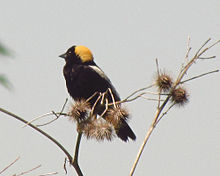
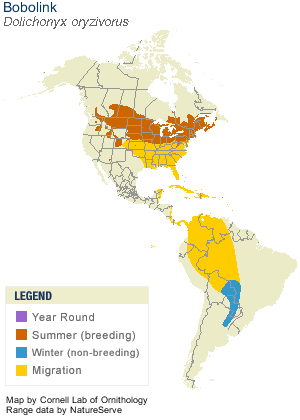
Occasionally vacation plans disrupt the flow in the smoothest of operations. A smear of suntan cream in the well-oiled machinery of a blog. Or a well-oiled operator over-sampling the local produce – wine, in these parts. So it pays to follow the Blue Peter principle of ‘Here’s one I prepared earlier’. Except regrettably I didn’t do it properly and have been struggling to unpick some html on an iPhone. Don’t ever try it. Luckily the ever-resourceful Mrs RH brought an iPad along. Much less fiddly. So I am now able to feature the BOBOLINK (Dolichonyx oryzivorus), a small New World blackbird

14 ESSENTIAL BOBOLINK FACTS TO ENTERTAIN YOUR FAMILY & FRIENDS

  • Adults weigh about 1 ounce (28 g)
  • The collective name for a group of Bobolinks is a ‘chain’
  • One bird was tracked flying 12,000 miles (19,000 km) in one year
  • A bobolink has been tracked covering 1,100 miles (1,800 km) in one day
  • The birds migrate in flocks, feeding on cultivated grains and rice, which may annoy farmers
  • Despite their flying stamina Bobolinks have rarely been sighted in Europe

  • In South American they are known as “ricebirds”
  • In Jamaica they are sometimes eaten and are called “butterbirds”
  • Bobolinks forage on or near the ground eating seeds and insects.
  • Their breeding habitats are open grassy fields across North America
  • Males are often polygynous, and take their vows shamefully lightly
  • Females lay 5 to 6 eggs in a cup-shaped nest on the ground, hidden in dense vegetation
  • Both parents feed the young, except when the male has some important singing to do (often)
  • Although currently rated “of least concern” their numbers are declining due to loss of habitat

WAYS IN WHICH THE BOBOLINK HAS INSPIRED ARTISTS (despite its unpromising name)

Emily Dickinson wrote several poems about the bird, including “The nicest bird, I always think / Is the tiny Bobolink / To me, it never had occurred / Thus to name a songstrel bird” *

The Bobolink is also mentioned in a song called Evelina, from a musical called “Bloomer Girl” (me neither): “Evelina, won’t ya ever take a shine to that moon? / Evelina, ain’t ya bothered by the Bobolink’s tune?”**

The Bobolink is name-checked by Nabokov; in a poem by Sophia Jewett, An Exile’s Garden (1910); and it has a fly-on part in a film “The Mouse on the Moon”

Finally, a wonderful video showcasing the bubbling song of the bobolink (Credit: Themusicofnature)

* and ** I can’t be sure which of these is made up. Maybe neither. Or both.

Unknown's avatar

ABACO PARROTS: A FLAMBOYANT PHOTO GALLERY BY MELISSA MAURA


ABACO PARROTS: A FLAMBOYANT PHOTO GALLERY

BY MELISSA MAURA

I have been planning a Parrot Post for a while, but I’d like to be able to include a report on the breeding season – the eggs, the chicks, the fledging, the ringing, and the overall picture. It will be interesting to see if the recent trend of improvement in the population of these rare ground-nesting parrots has continued this year. Parrot expert Caroline Stahala, who leads the research and field work, is completing the season’s review, so there will be news, photos and perhaps short videos soon.

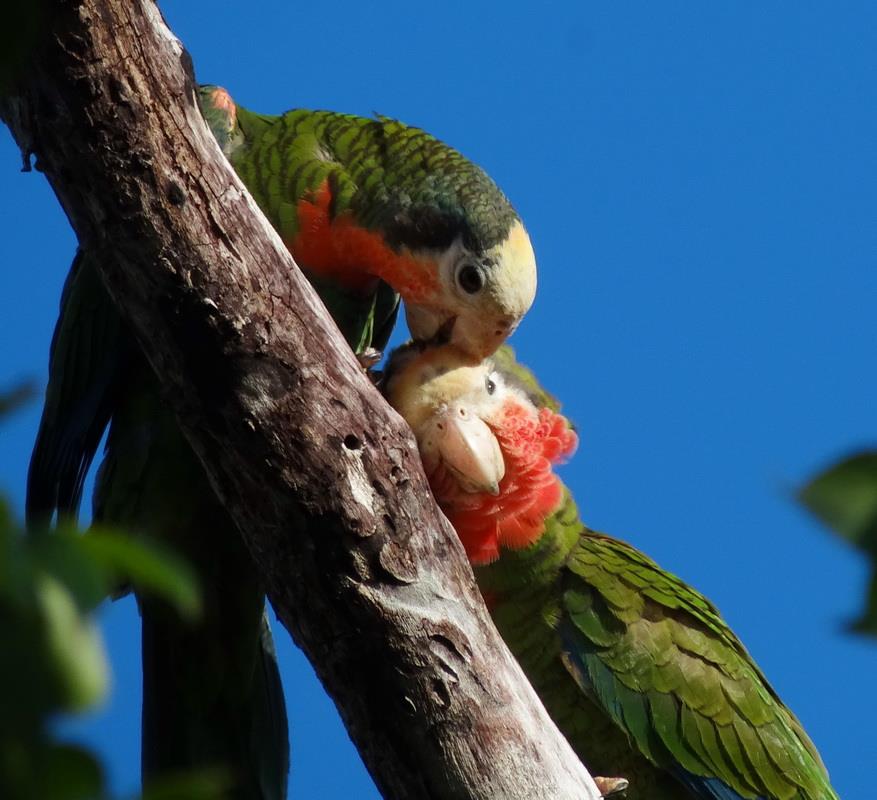
In the meantime, I have had a request from the US for news of the parrots. This has fortunately coincided with my discovery of some wonderful parrot photos taken by Melissa Maura [©] of Nassau. Most were taken on Abaco at Bahama Palm Shores; some at Winding Bay. So here is a gallery of Melissa’s work, which needs no other comment from me than… superb pictures! Oh, and many thanks for use permission, of course. The next photo is worthy of a caption competition – all suggestions welcome via the ‘Comment’ link below…

OVER THE MOON…

Unknown's avatar

“GLIMPSES OF LIFE ALONG A CORAL REEF” A c19 NATURALIST VISITS ABACO


GLIMPSES OF LIFE ALONG A CORAL REEF by F. H. HERRICK

This post is aimed at those with a particular interest in the flora and fauna – especially avifauna – of Abaco and its Cays. It is a naturalist’s account from 1886 of an expedition to Abaco, interspersed with a few line drawings. It’s an easy read if you are interested in Abaco, its history, and the state of natural life on the islands 125 years ago. Those who have come to this site for the photos and / or even the occasional jest are warned to expect neither. However, to tempt waverers I’ll highlight below (by way of a quiz) some intriguing aspects of the 9-page article. I have had to edit it to correct the many ‘literals’ in the open-source material; however the c19 spellings are retained. I’ve also added coloured subject-matter codes as follows: PLACE NAMES; BIRDS; PLANTS; FISH; CREATURES

In 1886, Herrick visited Abaco with a party of naturalists. This trip predated by 3 years the publication of Charles Cory’s groundbreaking ‘Birds of the West Indies‘. There would have been scant readily-available published material about the natural history of the Bahamas, let alone of Abaco itself. Herrick and a friend left the main party and went on their own wider explorations of Abaco with two local guides. Herrick recorded their findings, which were subsequently published in ‘Popular Science Monthly‘ in 1888. In Herrick’s wide-ranging account of the adventure you will find the answers to the following 15 questions. If any one of them whets your appetite to read this historic account, press the link below the quiz!

  • What fruit might you have found growing in fields on Abaco in 1886?
  • What was the local name for the perforated rock at Hole-in-the-Wall?
  • What is an “egg-bird”?
  • What was causing “the gradual extermination” of flamingos?
  • What were “shanks” and “strikers”?
  • To what human use were Wilson’s Terns put?
  • How many eggs does a tropic-bird lay?
  • What law prevented the shooting of tropic-birds, and indeed any other bird, by naturalists?
  • What sort of creature is a “sennet”?
  • Which was rated the better for eating – grouper or ‘barracouta’ (sic)?
  • Who or what is or are “grains”?
  • What common creature had a burning touch like a sharp needle?
  • What bird was reckoned to have the call ‘loarhle-ee’ ?
  • What – or indeed who – was described as a “pilepedick”?
  • What creature laid 139 eggs?

ABACO NATURAL HISTORY Popular Science Monthly Volume 32 January 1888

Unknown's avatar

ABACO BANANAQUITS – MORE DISPATCHES FROM ‘CUTE BIRD’ CENTRAL


A couple of months back I posted about Bananaquits on Abaco – specifically, at the Delphi Club. I featured images of a recently fledged bird, still with its ‘too big for my face’ orange-based beak. You’ll find other bananaquit information there, including audio of their call. I won’t repeat it all here – to see that post CLICK BANANAQUIT 

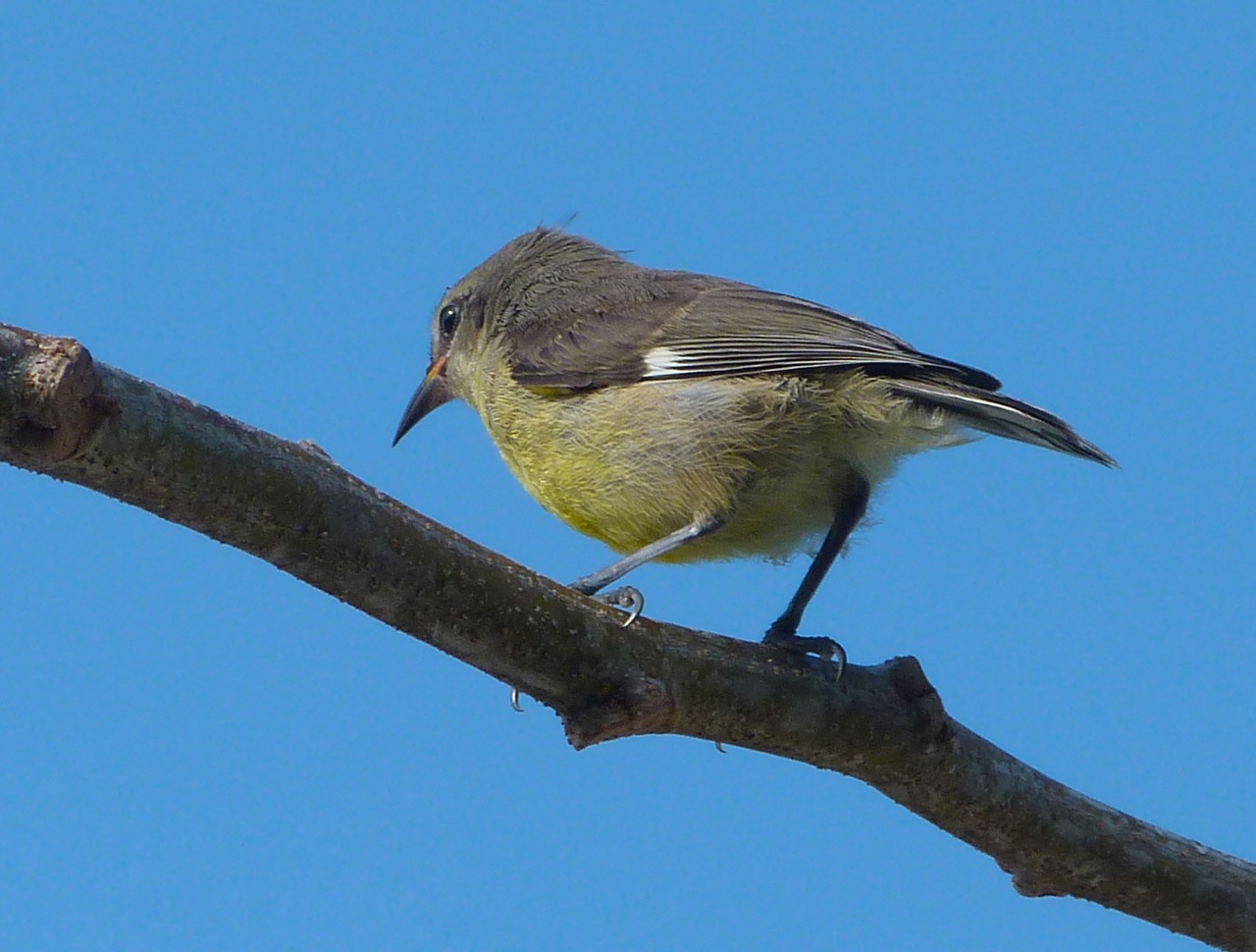
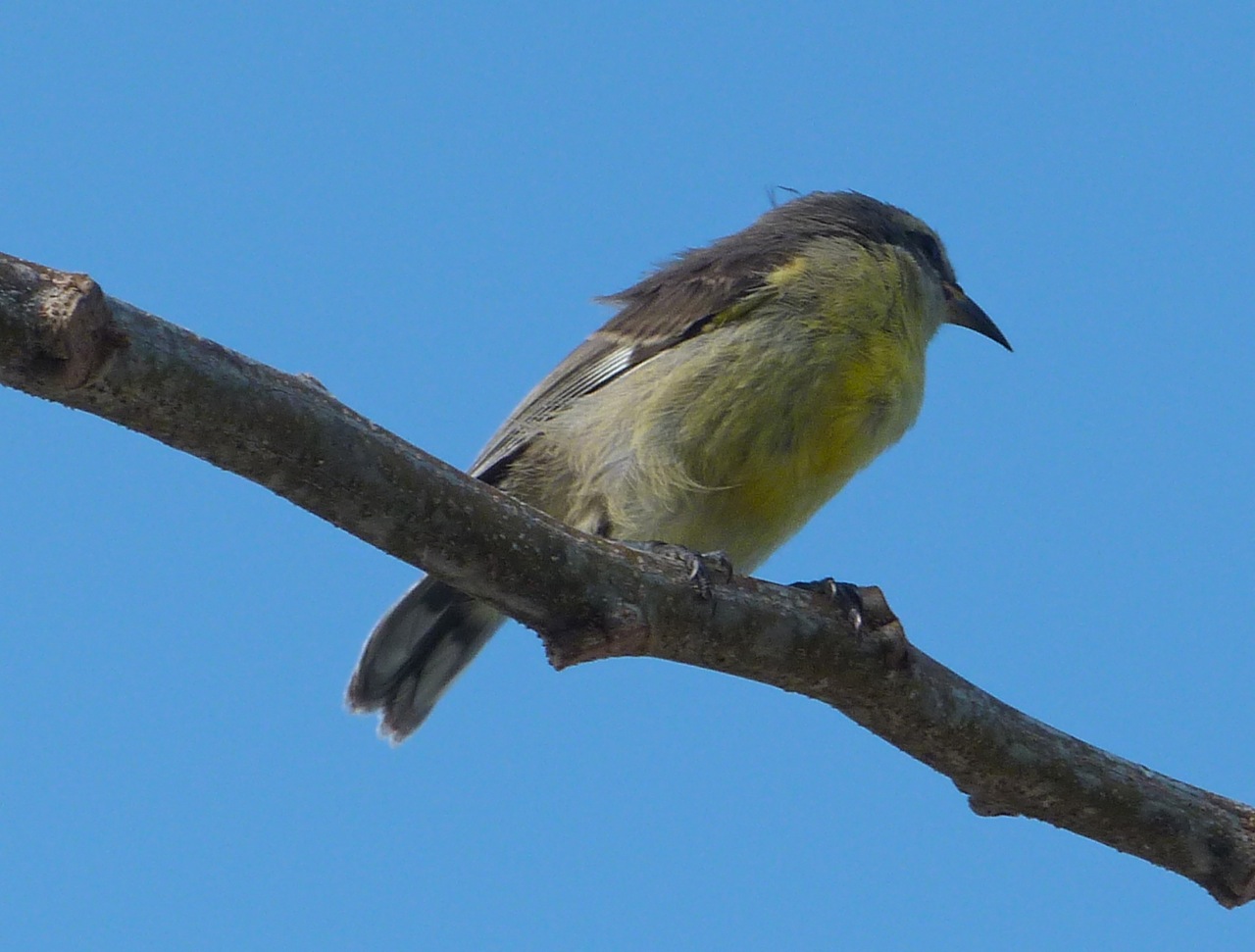
The small bird below looks like a slightly older juvenile – an early teen, let’s say, before the troublesome stage. There’s something very sweet about its feathers. It’s still more like fluff. This one is growing into its beak, which has also lost the very bright orange at the base.

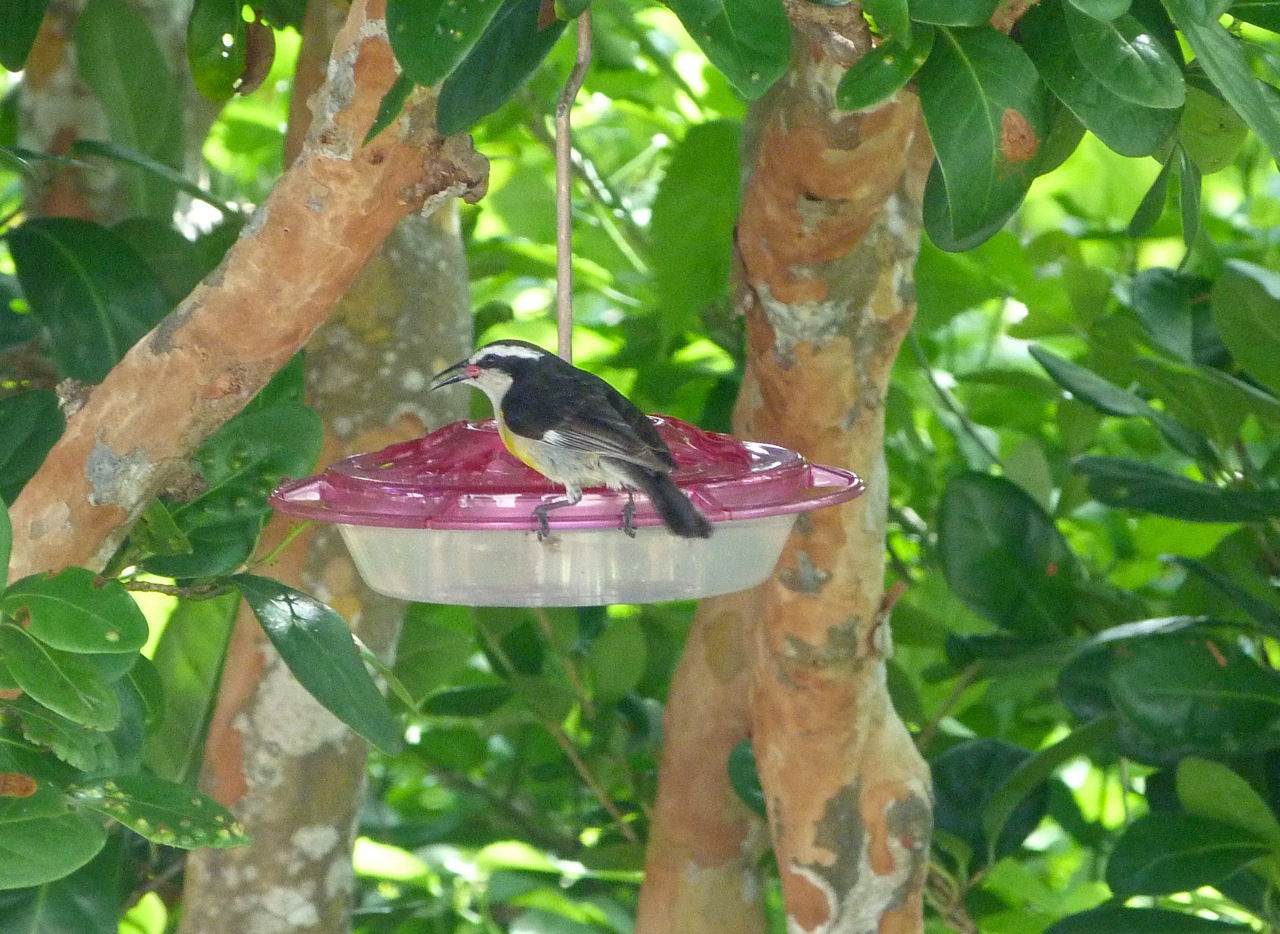
This handsome adult was a regular at one of the feeders at Delphi. The base of its beak is red as opposed to orange (I don’t know the technical term  for this bird part. Is ‘mouth’ too simple? Someone tell me, by all means, via the comment  box). Bananaquits enjoy the hummingbird feeders, which their narrow curved beaks seem to manage. There, they are not pestered by the (very greedy) black-faced grassquits and the larger Greater Antillean Bullfinches who enjoy the other types of feeder available and take priority in the pecking order.

Finally, this bird was a distance shot. At the time, it looked  larger than a bananaquit – more Loggerhead Kingbird-sized. Before I had downloaded the image and could see it clearly, I’d wondered about a mangrove cuckoo. Then I saw at once that it didn’t tick the right boxes. So I decided it must just be a huge bananaquit with an orange rather than yellow front. If it’s anything else (a rare hybrid spindalisquit?), please say so!

Unknown's avatar

LAUGHING GULLS ON THE ABACO MARLS


LAUGHING GULLS ON THE ABACO MARLS

Laughing gulls. Amusingly raucous and raucously amusing. Unless, maybe, you are living right next to a breeding colony during a collective fit of hysterics. These gulls, Leucophaeus atricilla, will be familiar to anyone on the Atlantic coast of North America; in the Caribbean; and further south to the northern coastal areas of South America. In winter, their migration pattern simply involves relocating to the southern parts of their range. They are easily recognisable in the breeding season by their smart black caps, though this fades in winter. And by their unmistakeable call, of course. Immature birds tend to be darker than adults. They breed in large colonies, each female laying 3 – 4 eggs. And like most (all?) gulls, they’ll eat pretty much anything.

Laughing Gull Conservation Status

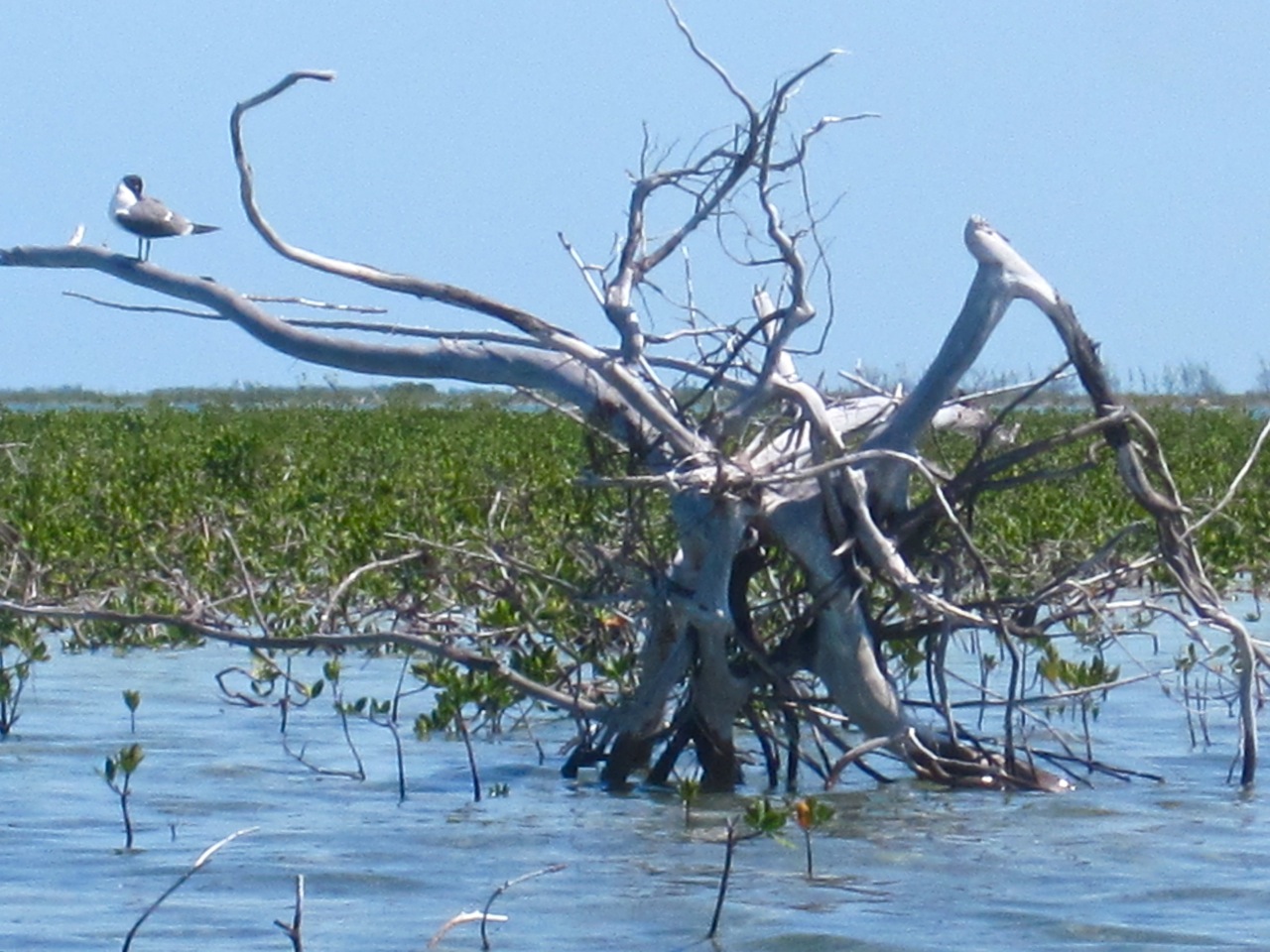
We saw – and heard – plenty while bonefishing on the Abaco Marls in June. I took some rather grainy distance shots, as they tended to fly off as the skiff was slowly poled towards them. This gull has found a good vantage point for some quality preening among the mangroves.

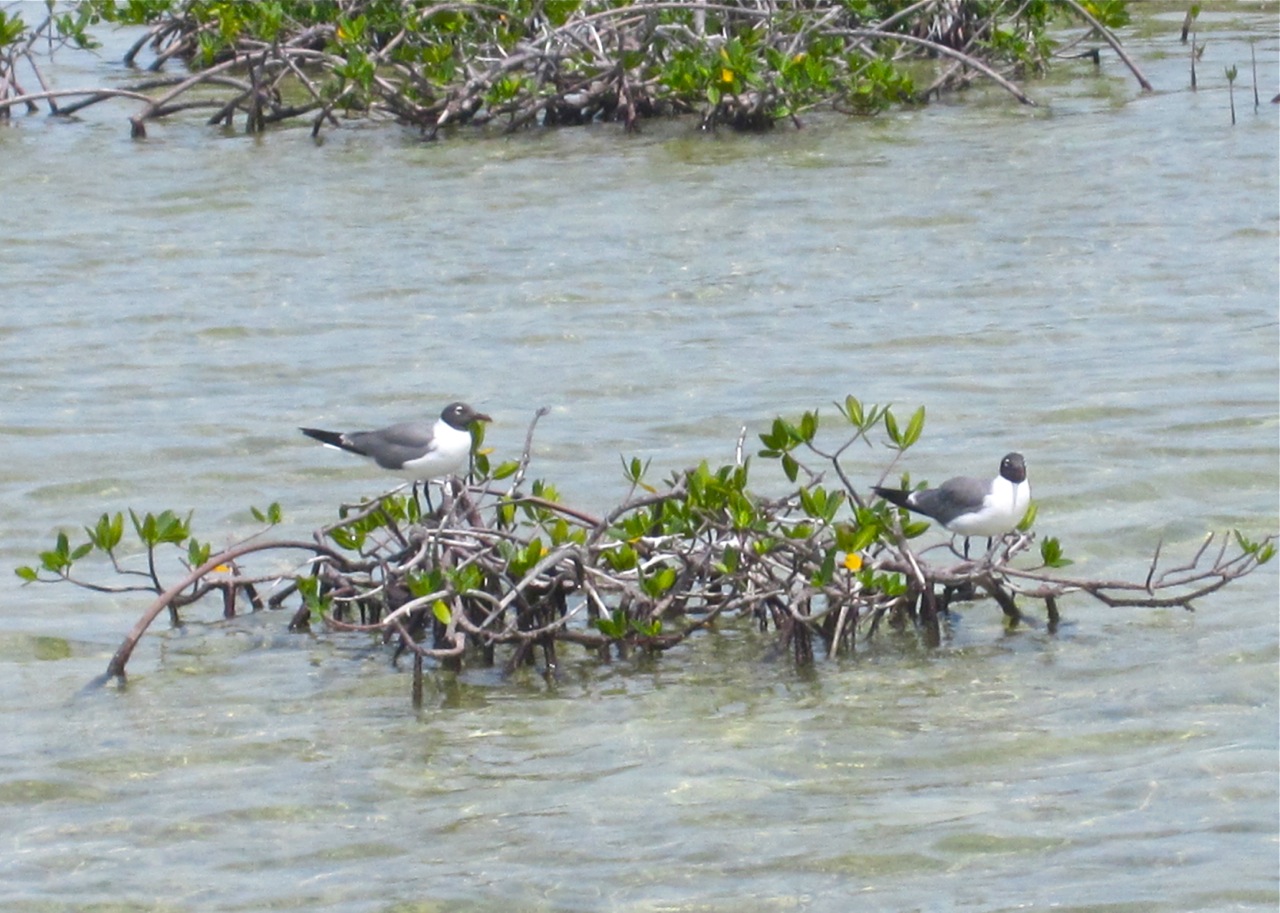
The pair below stayed put, and watched our gradual approach with suspicion that turned into noisy protest as we poled past them. I presume they were defending their territory – probably a nest site nearby.

I took a very short video just before they flew off as we drifted by. Apologies for the sound of the breeze – I’ve no idea if it’s possible to reduce the background noise while retaining the bird call. Listening to online bird sound clips (e.g. on the excellent Xeno-Canto) I think not. Or not without expensive editing equipment of a complexity I can’t face…

[vimeo https://vimeo.com/48076405]

And here (thanks, Don Jones @Xeno-Canto) is what laughing gulls sound like when one of them has told the one about the bonefish and the shrimp…

[audio http://www.xeno-canto.org/sounds/uploaded/BCWZQTGMSO/bird109.mp3]

Unknown's avatar

ABACO LAND CRAB vs RICKY JOHNSON: ROUND 2 (VIDEO)


A few weeks back, I wrote a post called ‘LAND CRABS: HOW TO STALK & WRESTLE THEM. It features stills of famed Abaco nature guide Ricky Johnson in a face-off with a land crab at Bahama Palm Shores. I noted that the large, heavy claw of these crabs is in fact the less worrying one, being used to intimidate and to grip. It’s the small claw that you need to watch out for… 

I have now sorted out an annoying camera card v Mac format incompatibility problem (well, $30 of software has dealt with it. Dear Apple, please make friends with the Panasonic Lumix asap) and to my great surprise I find that I took a video of Ricky and a land crab that perfectly demonstrates the claw point. He did mess with the large claw, but he wisely left the small one well alone… 

The footage starts with Ricky’s trademark laugh to get you into the right spirit (it’s impossible to go on one of his Eco-Tours and not have fun while learning). The volume of the commentary drops off a bit halfway through. I haven’t found the gizmo for changing the audio during the video: it’s all or nothing, I’m afraid

[vimeo https://vimeo.com/47535538]

If you want to find out more about Land Crabs on Abaco – including Hermit Crabs – you won’t do much better than to check out the comprehensive account by ‘Bob H’ on Yahoo! Answers ABACO LAND CRAB FACTS

Ricky the guide? Here he is in full-on enthusiastic guide mode, ‘pishing’ for male Bahama Woodstar hummingbirds in low open coppice near Crossing Rocks. He has just had a responding call and is keeping us quiet while he locates the bird

ADDENDUM Tragically in the second half of 2012 Ricky developed a horrible disease that spread rapidly and unstoppably. Within 6 months he was dead, not yet 50. His sad passing, and the cruel manner of it, made me wonder if I should take down some of the many posts in which he features. But he would not have wanted that, so I have left them unaltered. 

MUSICAL DIGRESSION

Those who braved the video may have wondered about the guitar chord at the beginning and end. A few – of a certain age – may have thought it familiar. One or two may have recognised it as the opening chord of A Hard Day’s Night (Beatles 1964). It is one of the most controversial and interesting chords in modern music, with more theories about its exact construction than you can shake a Rickenbacker 12-string at (as played by George Harrison). There have been more than a dozen claimed ‘correct’ chord  identities. According to Harrison, it is in fact simply an ‘F add 9’ chord augmented by Macca’s crucial 5th fret, A string ‘D’ on his Hofner bass. Trouble is, there are half a dozen ways to play ‘F add 9’ at various points on the neck, and most of them don’t sound quite right… But that’s enough about that. Anyone who wants to follow this musical meander further  – much further – should click HERE===>>> THAT CHORD