Unknown's avatar

CONCH SHELLS & CONCHUPISCENCE ON ABACO


Conchs at Sandy Point a1

CONCH SHELLS & CONCHUPISCENCE ON ABACO

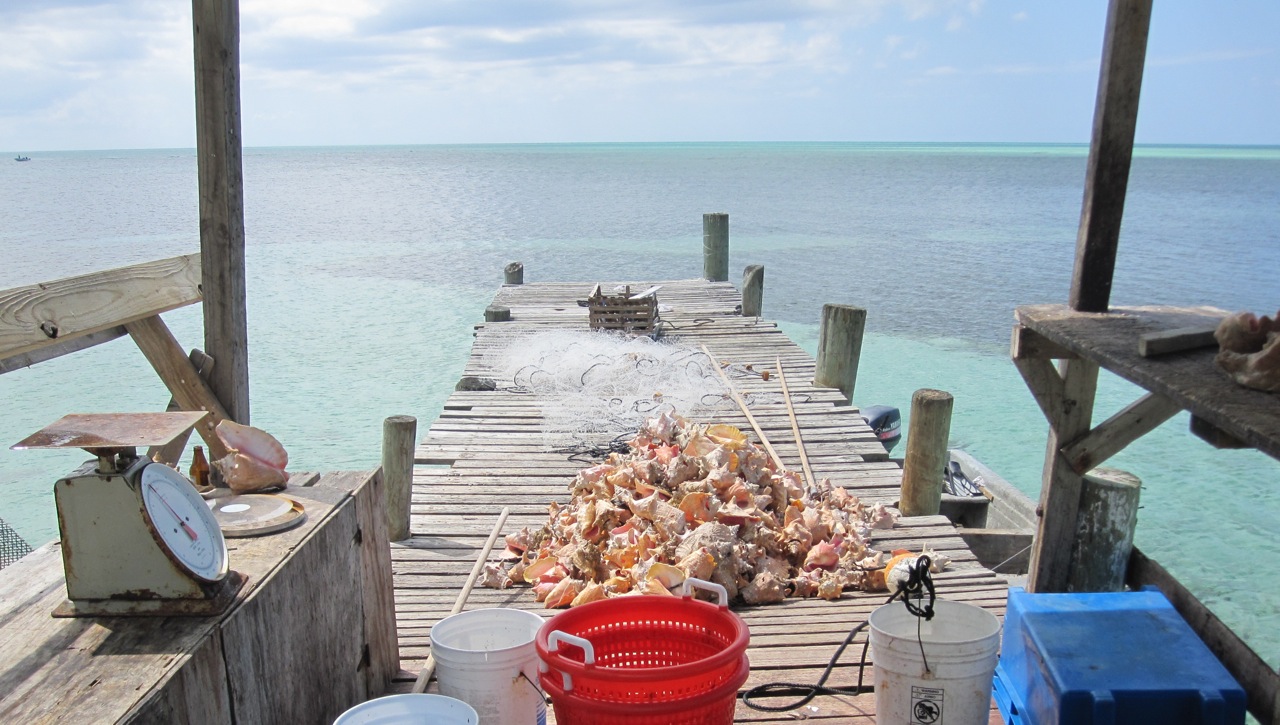
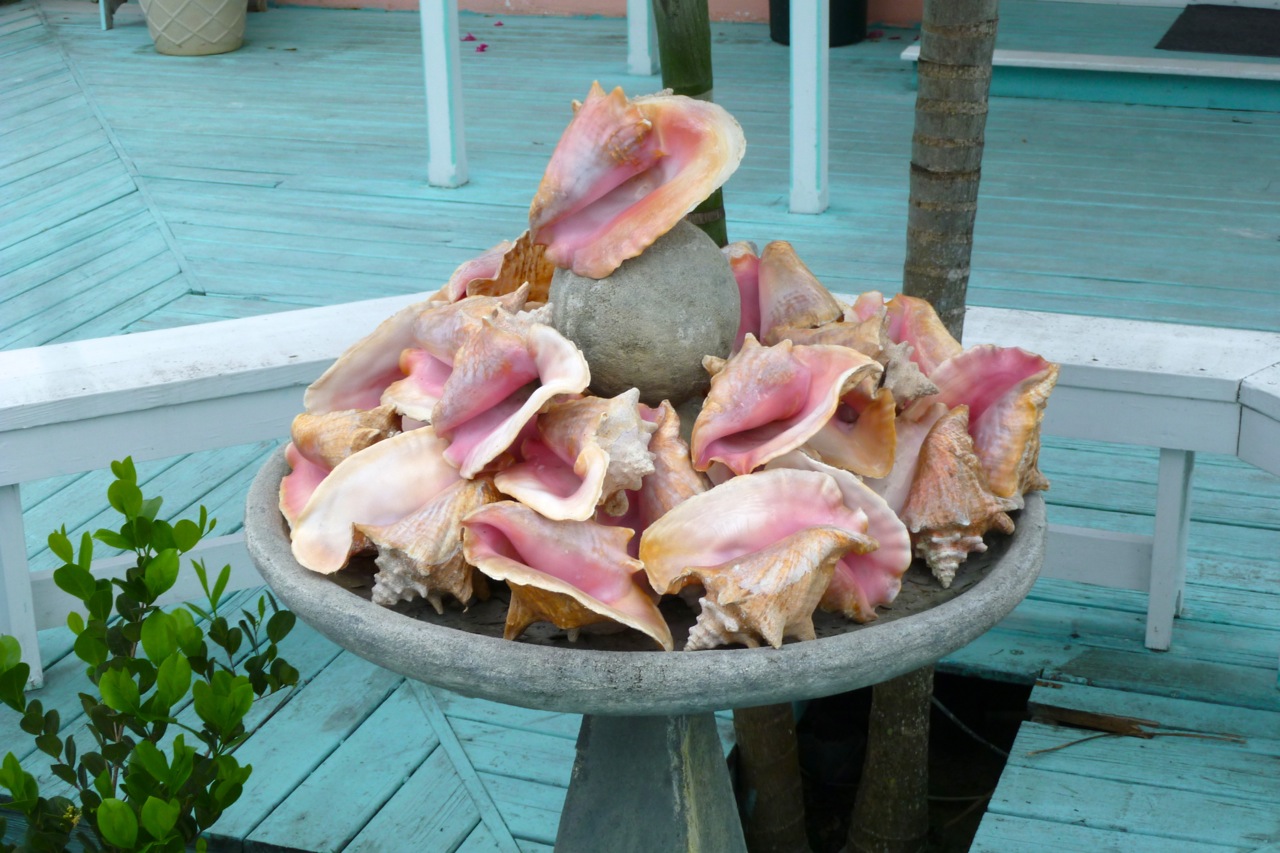
Most conchs encountered in daily life are lying peacefully on the beach; or are artfully displayed; or are found in conch heaps (often in the vicinity of restaurants) like the ones below at Sandy Point. Conchs at Sandy Point Abaco 2Conchs at Sandy Point Abaco 4

These shells at Sandy Point are so plentiful that they form a small spit of ‘land’ into the seaConch at Sandy Point (Clare)

An attractive display of conch shells in Marsh HarbourConchs Marsh Harbour Abaco

A less formal arrangement along the jetty at Man o’ War Cay (after a storm)Conch Man 'o War Cay jetty Abaco

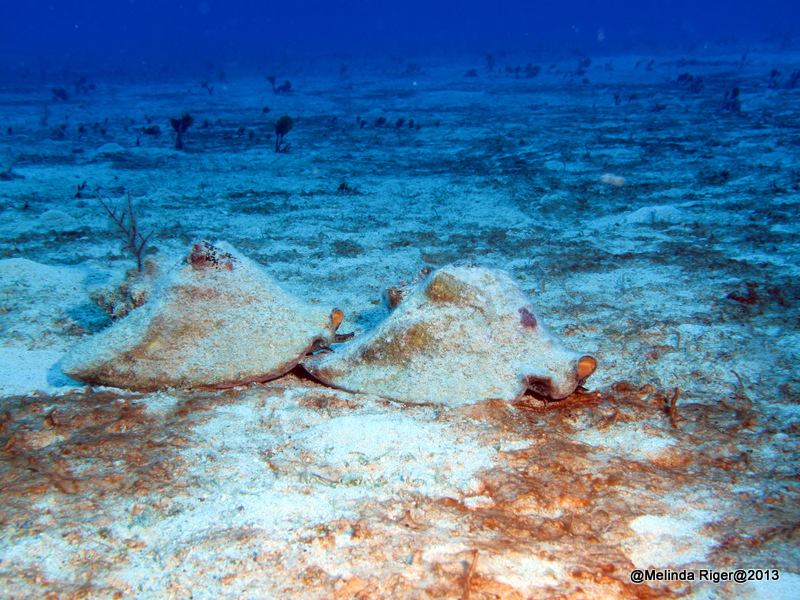
It’s easy to forget that these shells are more than just a garden adornment, or pretty containers for a ubiquitous Caribbean food. Under the sea, and not very far at that, are living creatures going about their daily lives.Conch ©Melinda Riger @G B ScubaConch ©Melinda Riger @ GB Scuba

And that includes reproducing. This sounds as if it might be a cumbersome process, but (like porcupines) they seem to manage. Here is a pair preparing to mate. The male behind is presumably about to… well never mind. I’ve never seen the process, so it’s a case of using imagination. Or just accepting that, whatever it is that they do, it works. [I haven’t located a video online – I’ll post one if I do]Conch preparing to mate ©Melinda Riger @ GB Scuba

You’ll find some more about Conchs in a previous post HERE, including 12 Unputdownable Conch Facts, notes on conservation matters and… a photo of Honeychile Rider, arguably the most famous conch-carrier ever. Oh, she was fictional, you say? But I always though she… How very disappointing.

And if you want to know how to clean a conch, a dude will  show you in a video on this page HERE 

Finally, check out the very informative website COMMUNITY CONCH, a charitable conservation organisation community conch logo

Photo credits: Melinda, Clare, RH

Unknown's avatar

‘FAMILIAR FECES’: CETACEAN POOP-SCOOPING BY SPECIES


1238860_644550912230805_1918179367_n

‘FAMILIAR FECES’: CETACEAN POOP-SCOOPING BY SPECIES

UPDATE I name-checked BMMRO intern Oscar Ward’s blog below. Now he’s been out on the ocean on ‘poop patrol’. You can read Oscar’s account of his experiences HERE

Among the many pleasures for cetacean research scientists must be the joy of whale poop collection. Followed by close inspection and analysis. The Bahamas  Marine Mammal Research Organisation BMMRO conducts research expeditions, in conjunction with such organisations as the New England Aquarium NEAQ and Friends of the Environment FOTE, in Abaco waters and further afield in the Bahamas. The attention this year has been on beaked whale feces, though available sperm whale feces are not to be sniffed at. Images and info below are courtesy of the organisations mentioned above, with thanks for use permission

TopHead_070815o_01_Md_DEC_035

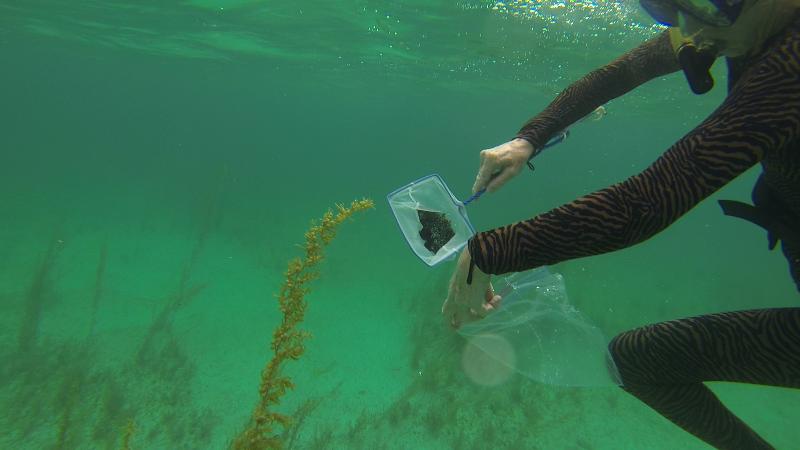
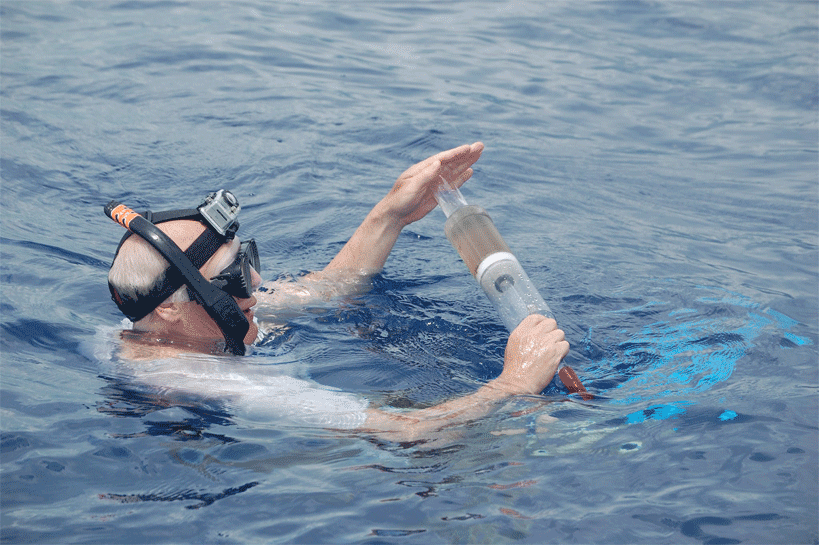
A researcher working with BMMRO demonstrates feces collection using coffee grounds. She collects the coffee granules in her net and places the entire sample into a ziplock bag, ready to hand to the boat for processing 269

The purpose of feces collection is to look at the stress and reproductive hormones of the whales and to gather a baseline for these animals with which to compare other populations that are under threat3

An alternative method of collectionpoop15

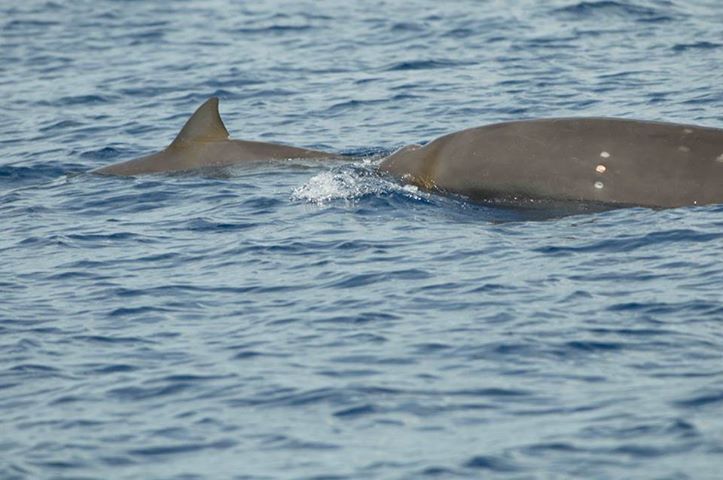
Blainville’s Beaked Whales (suppliers of raw research material)Blainville's Beaked Whale AbacoBeaked whale - supplier of poop BMMRO

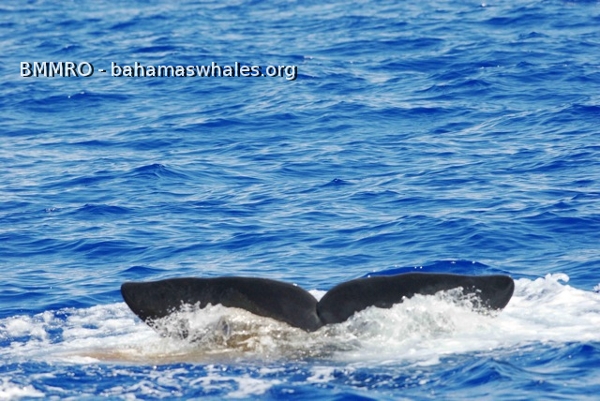
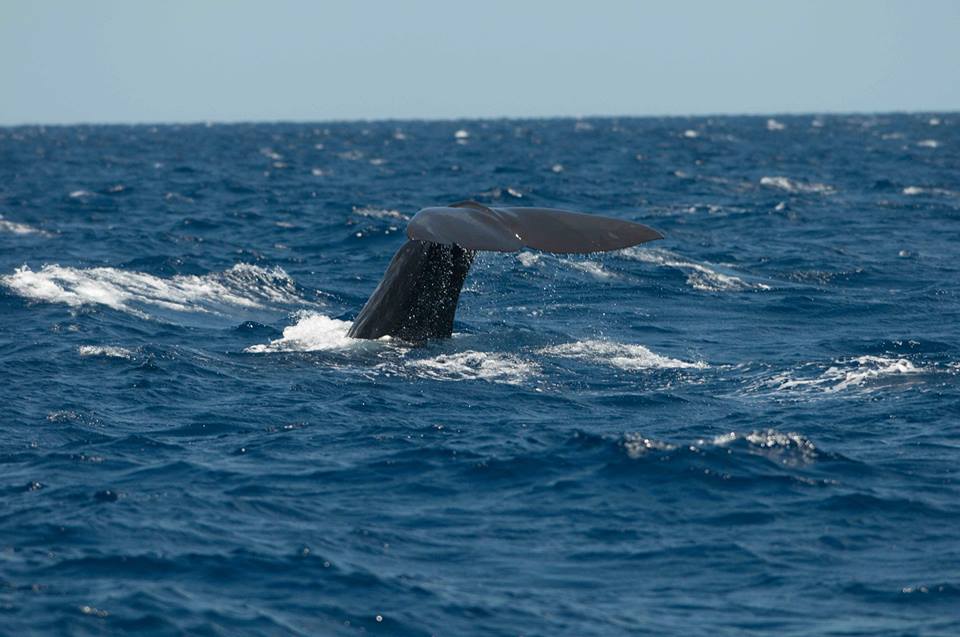
There are some conditions – dare I say windy ones – when Blainville’s beaked whales may be hard to locate. At such times, collection of pieces of other species feces rarely ceases… Here is a sperm whale in the act of producing laboratory samplesTail_18Jun10_01_Pm_CAD_123

Weather of the sort that makes the day’s collection more complicated. Indeed, it looks and uphill task…GOPR0109

That’s enough on the topic for now. Later in the month there will be some great dolphin pictures to enjoy. Below is the BMMRO sightings chart for July, which I forgot to publish sooner.

Finally, a young UK friend of ours, Oscar Ward, has recently won his place to study marine biology at university next Autumn. He has just arrived on Abaco to start an internship with the BMMRO at Sandy Point. He will then be moving to Friends of the Environment in MH. He has set up an excellent blog to record his experiences, with his first Abaco post going up today, I notice. You can follow Oscar at SEVENTYPERCENT.COM And if you see him around, do say hi! to him.

BMMRO SIGHTINGS JULY 2013

Unknown's avatar

UNDERWATER BAHAMAS: REEF GARDENS (2) – CORALS


Purple Seafan Coral ©Melinda Riger @GBS

UNDERWATER REEF GARDENS IN THE BAHAMAS (2): CORALS

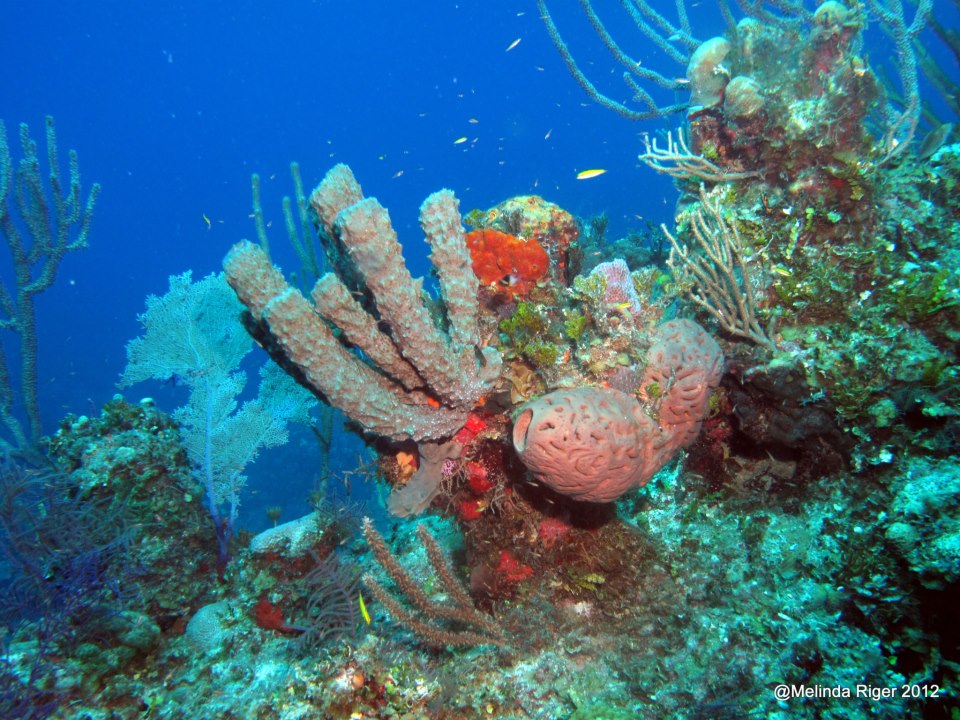
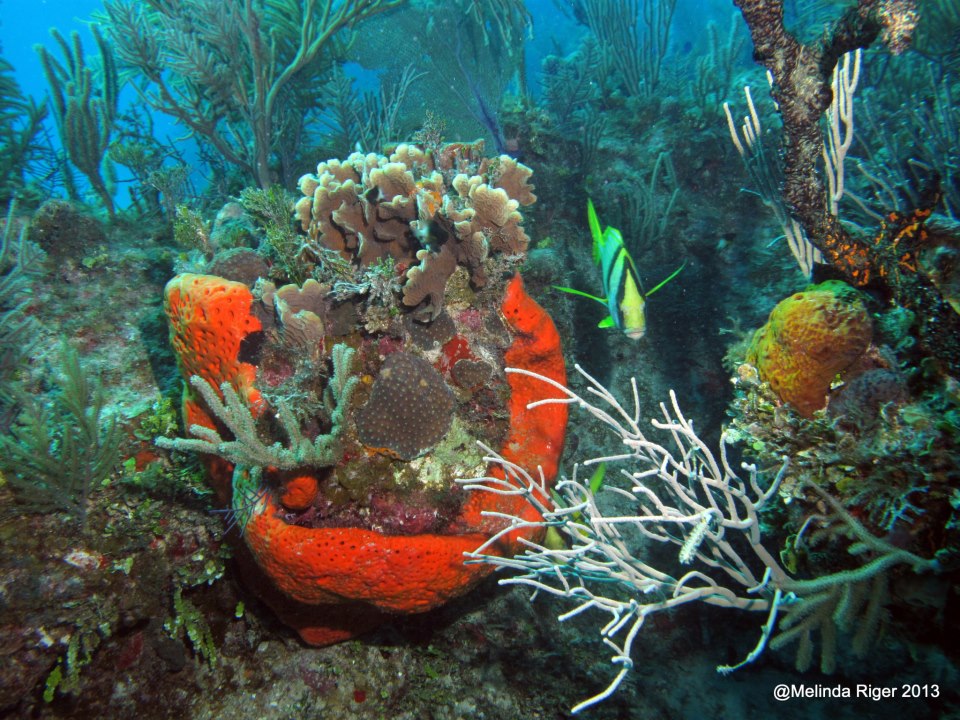
This is part 2 of a series that started out HERE with a selection of anemones, basket stars and Christmas tree worms. The images below show a wide variety of corals. In among them are also sponges and anemones. These photos are evidence of a healthy reef environment in the waters of the northern Bahamas. Abaco’s coral reef is the third largest barrier reef in the world (yes, I hear you – the Great Barrier… And the second is???), providing wonderful and accessible diving / snorkelling opportunities. However, monitoring shows that the incidence of coral bleaching and disease is increasing in the Bahamas, as elsewhere in the world.  It’s a sobering thought that your grandchildren may never swim in an environment with any of the living corals shown below…

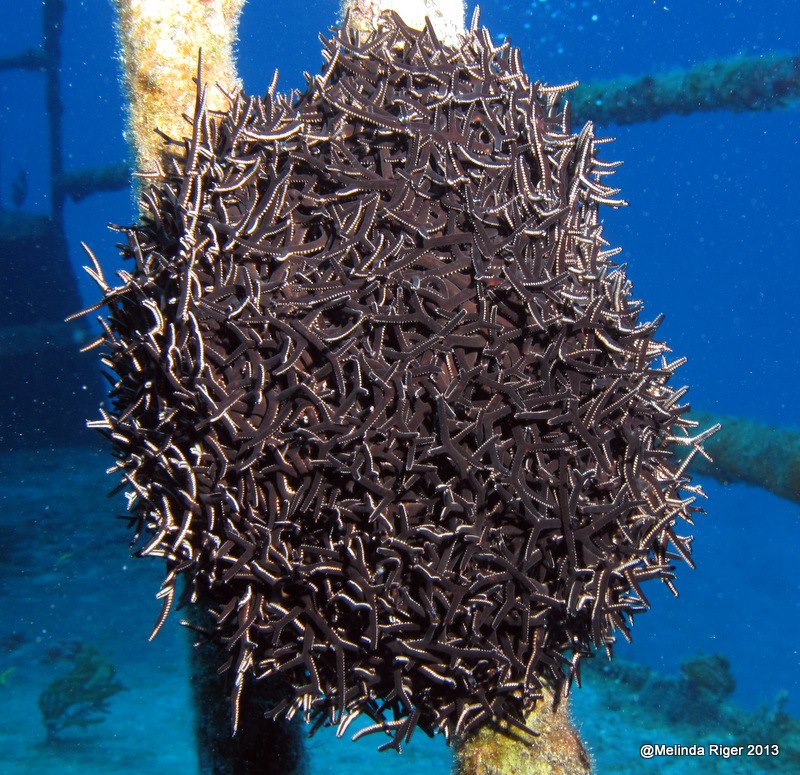
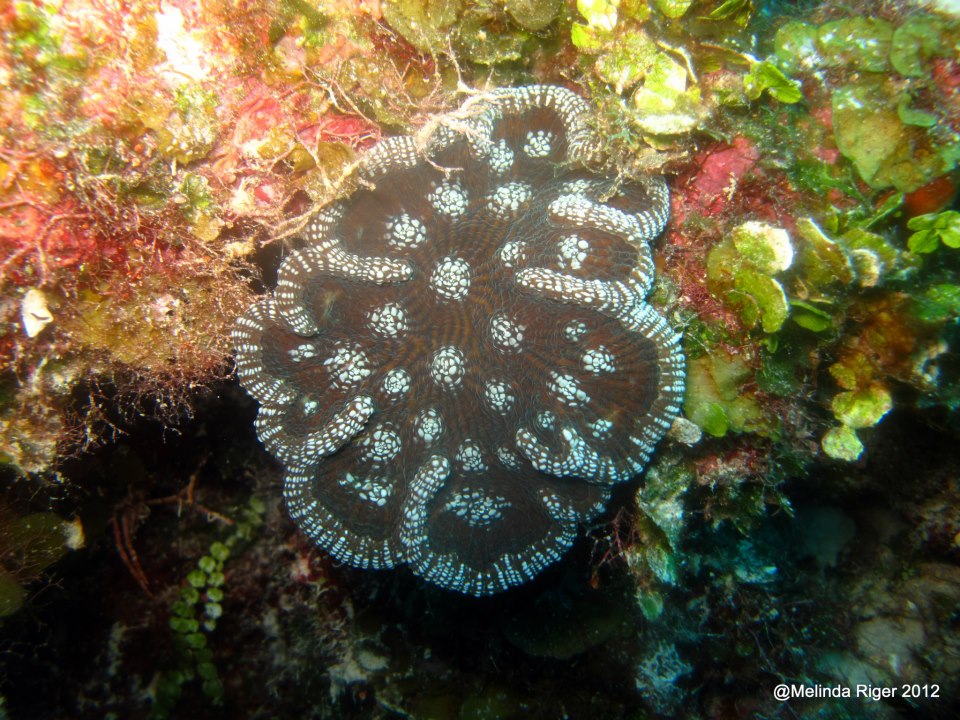
Corals ©Melinda Riger @ G B ScubaCoral ©Melida Riger @ G B  ScubaCoral ©Melinda Riger @ G B Scuba 1Coral ©Melinda Riger @ G B Scuba 2Coral ©Melinda Riger @GBSImage Credits: ©Melinda Riger @ Grand Bahama Scuba

Unknown's avatar

ABACO’S RAREST VISITOR: MEET ALBERT ROSS… THE ALBATROSS


ABACO’S RAREST VISITOR: MEET ALBERT ROSS… THE ALBATROSS

I can find no record for the sighting of an albatross in the waters around Abaco. Nor for anywhere else in the Bahamas for that matter. It must have come as some surprise to the BMMRO team out at sea on their research vessel off Sandy Point to see a large and unusual seabird bobbing tranquilly on the water. A black-browed albatross Thalassarche melanophrys. Diane Claridge managed to get a great shot of it and I’m really pleased to be able to use it here.

Black-browed Albatross, Abaco © DC BMMROBlack-browed albatross off Sandy Point, Abaco, Bahamas. Photographed by Diane Claridge.

© Bahamas Marine Mammal Research Organisation 2013

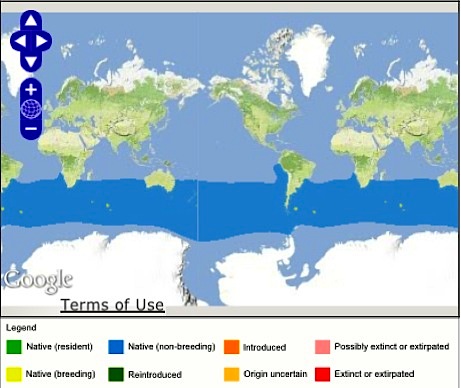
This bird was way out of the normal range for the species. They are birds of the southern oceans, breeding in colonies on such islands as the Falklands, South Georgia and Macquarie Island. As far as I can make out, they have no business to be north of the equator at all.

Black-browed Albatross Range Map BirdLife Int

SIGHTING A BLACK-BROWED ALBATROSS: A REPORT

During a three-hour survey for whales off Sandy Point, Abaco on Sunday, July 21st scientists from the Bahamas Marine Mammal Research Organisation had an exceptional sighting. Dr Diane Claridge, the group’s Executive Director recalls details of the sighting:

“We were drifting waiting for a beaked whale to resurface when our intern Tristan Albury pointed towards a white object floating in the distance and asked what it was. We decided that it was a piece of trash, unfortunately a common sighting, and continued to focus our search for the whale. A half hour later, we still had not re-sighted the whale and believed that it may have gone down on one of its one-hour long feeding dives. So with time to kill and the “trash” still in sight, we had another look with binoculars. We realised immediately that it was a very large bird and slowly motored towards it for a closer look. I began taking photographs of it because we already knew it was unusual and we wanted to be sure to identify the species. As we got closer, Roxy Corbett, a visiting scientist and avid birder exclaimed that it was an albatross! I couldn’t believe it. We were able to approach within 100 feet at which point it swam towards us providing an opportunity for us to document its body condition; it appeared healthy with no obvious signs of distress.

Later when back ashore, we compared our photographs with those available online and learned that it was a juvenile Black-browed albatross, an endangered bird with a 7-foot wing span known from subtropical to polar regions of the southern hemisphere! As far as I know this species has never been recorded previously in the tropical North Atlantic. I have seen albatross during whale surveys in Alaska but never dreamed that I’d ever see one in The Bahamas. Although we are thrilled by the rarity of this sighting, the outcome for a bird so far out of its normal range is not usually good. However, there are two Black-browed albatross that strayed into the North Atlantic previously that have taken up long-term residence in Scotland and the Faroe Islands so who knows where this one may end up. Sunday afternoon was indeed exceptional: in addition to this remarkable sighting, we also saw 4 different species of whales and dolphins, all within 5 miles of Sandy Point.”

These are huge strong birds, with a massive wingspan. I wondered what they might sound like – it’s like this… (Credit: Xeno-Canto & recordist Sofia Wasylyk)

For more information on the normal range and status of the Black-browed albatross, the BMMRO recommended links are:

Link to Birdlife International’s site:
http://www.birdlife.org/datazone/speciesfactsheet.php?id=3959

Link to IUCN’s species red list:
http://www.iucnredlist.org/details/106003959/0

Unknown's avatar

FORAYS WITH MORAYS (1): EEL APPEAL IN THE BAHAMAS


Wasabi the Eel 2

FORAYS WITH MORAYS (1): EEL APPEAL IN THE BAHAMAS

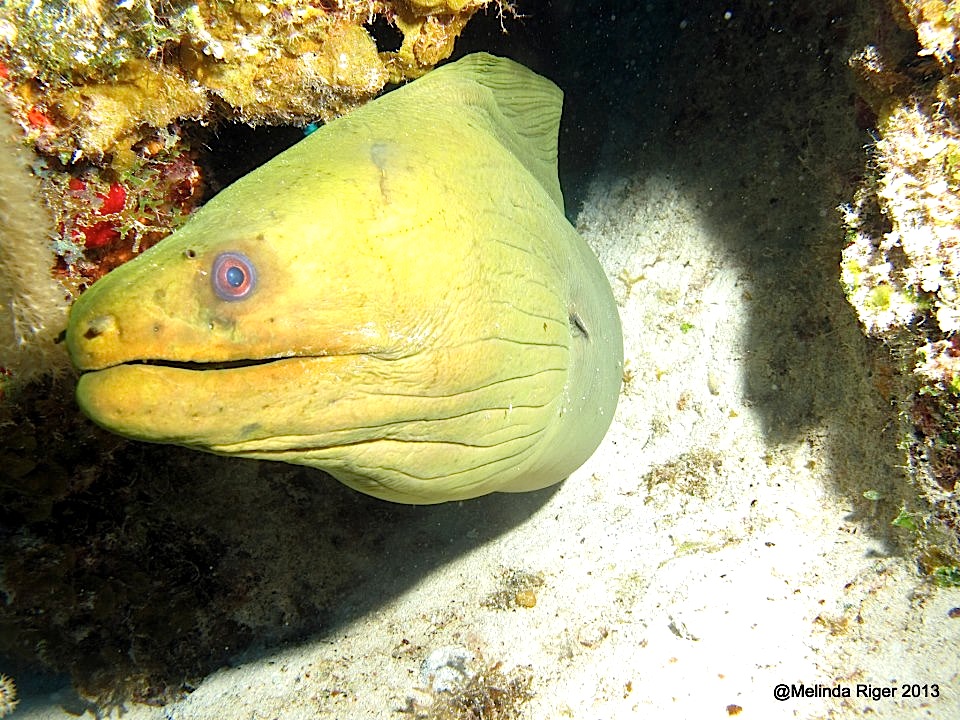
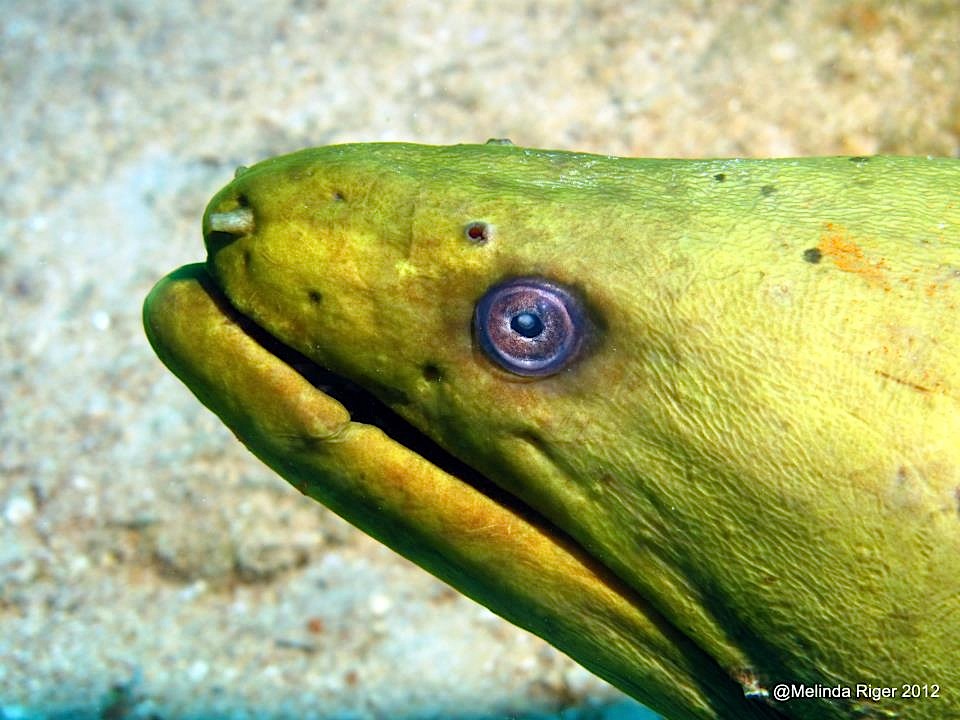
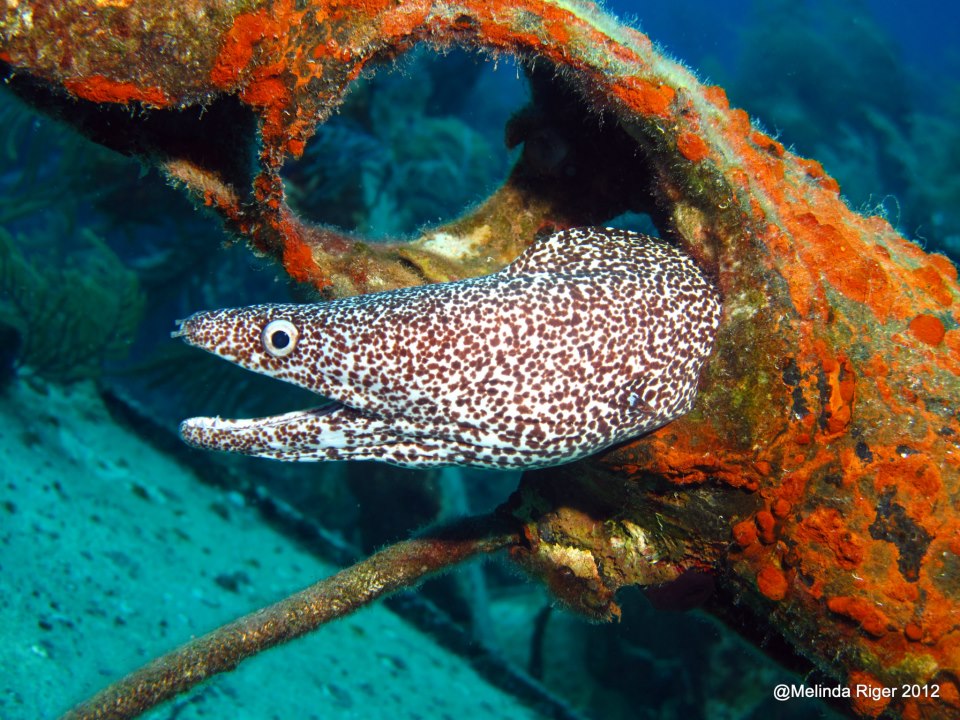
MORAY EELS are found in most oceans, with around 200 species worldwide. In Bahamian waters, the 3 most common are the green, yellow and spotted morays, all featured below. These ones have been given affectionate names by the divers who encounter them regularly in their home surroundings – Rico, Judy, Wasabi and Earl. Moray Eel

Morays have something of a reputation for aggression, though (like many creatures with teeth) they much prefer to swim away or hide rather than attack. They will defend themselves resolutely, however, so it might be a mistake the get too close.Moray Eel ©Melinda Riger @GBS

Hand-feeding morays has become a popular dive activity. However there can be drawbacks. They have poor vision, and may find it difficult to distinguish between food, finger-food and fingers. There are many cases of divers who have lost a finger while hand-feeding moray eels; in some places it has been banned. Yellow Moray Eel©Melinda Riger @GBS copy

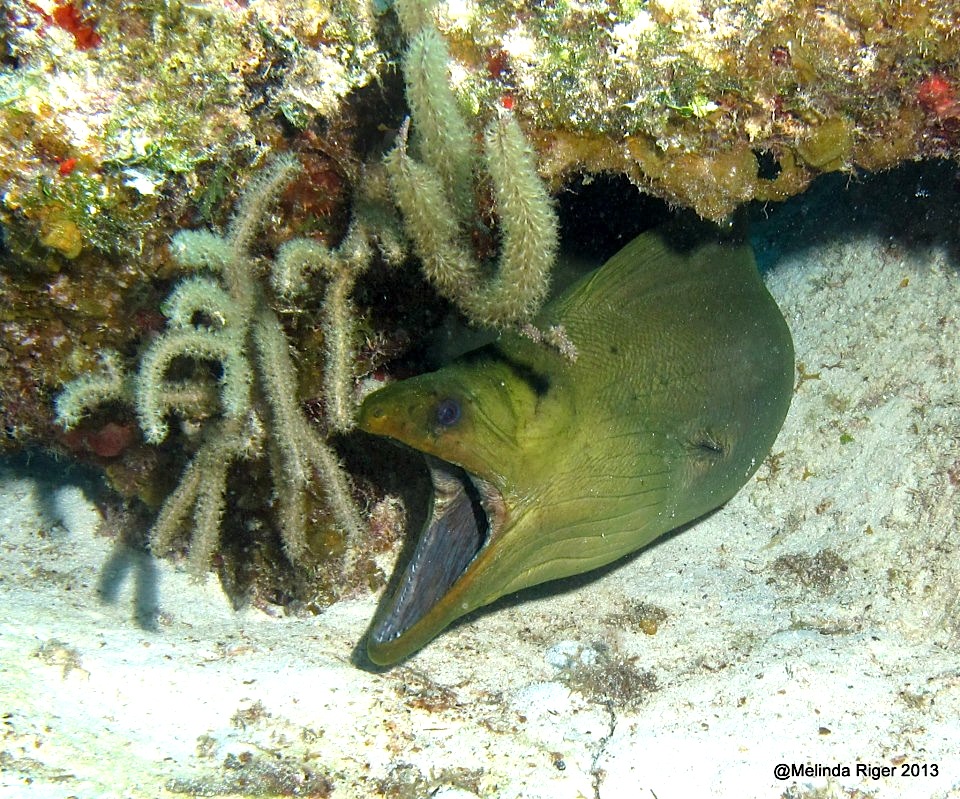
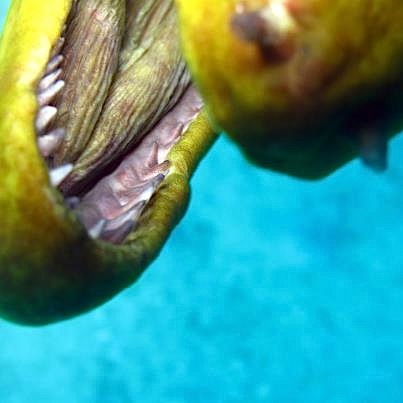
The moray eel has strong clamping jaws, and its sharp teeth point backwardsMoray Eel mouth (interior)Green Moray Eel ©Melinda Riger @GBS

This has two effects. A finger will be held as if by a fish-hook barb; and the eel will not release the grip of its powerful jaws without them being prised apart.Wasabi the Moray Eel

Moray eels have a strong sense of smell, and curious nostrilsMoray Eel (Rico) ©Melinda Riger @GBSMoray Eel copy

Finally, here are two images of a fine spotted moray eel known as ‘Earl’, and a video of a different one%22Earl the Eel%22Spotted Moray Eel ©Melinda Riger @ GBS

Credits: All images ©Melinda Riger @ Grand Bahama Scuba


Unknown's avatar

POSTING POSTERS: 5 OUTSTANDING ECO-EDUCO-INFO POSTERS


LRE Logo

LOXAHATCHEE RIVER DISTRICT POSTERS

EXCELLENT ECO POSTERS FROM LRD: FOR WEBSITE CLICK HERE

TO ENLARGE (CONSIDERABLY), DOUBLE-CLICKLoxahatchee River District Coral Reef Poster

Loxahatchee River District Bonefish Poster

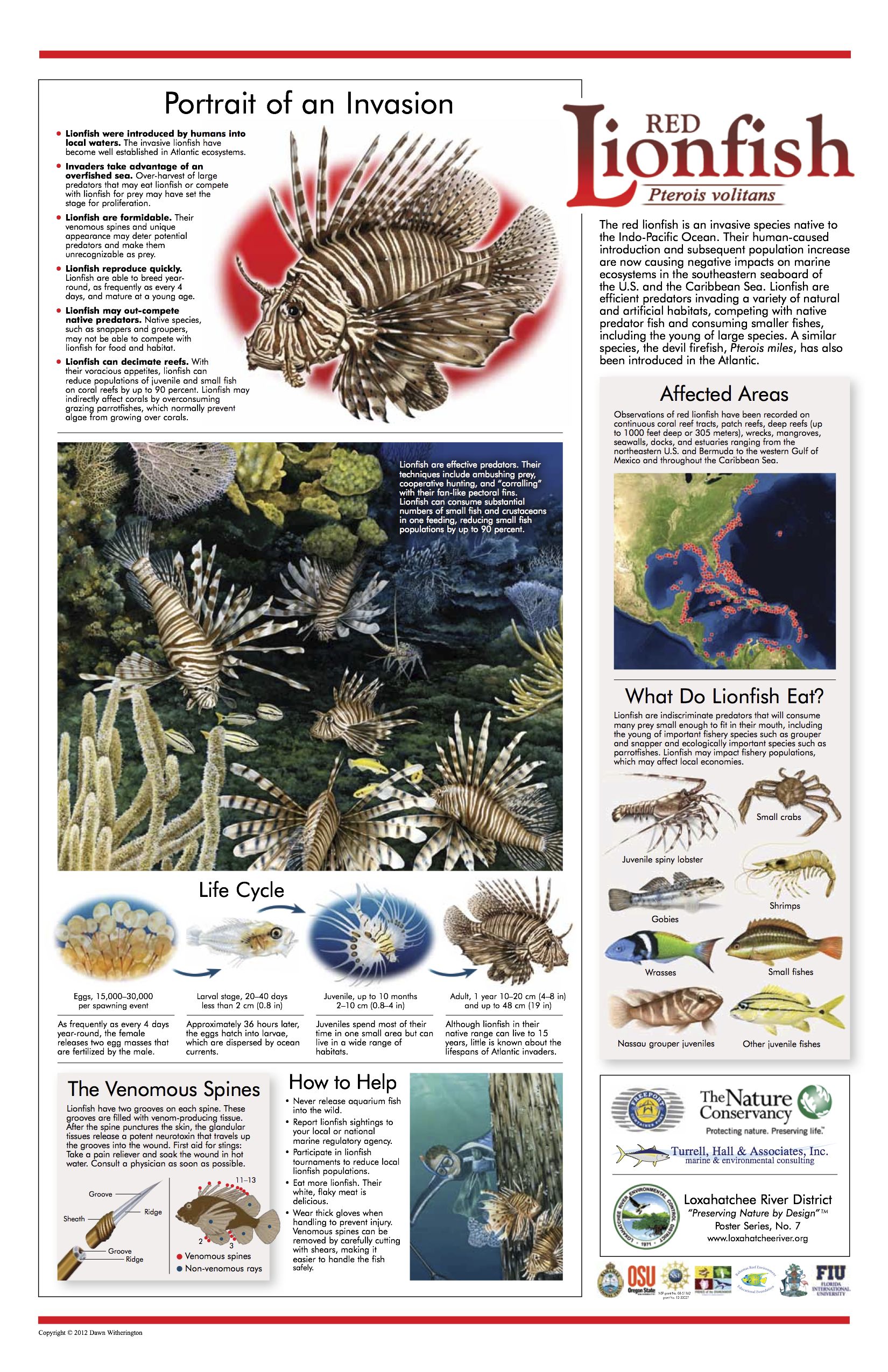
Loxahatchee River District Lionfish Poster tarponposter.inddseagrasses_poster_8.5x11

CREDIT thanks to Loxahatchee River District for use permission for this website. Please note that these posters are ©Loxahatchee River District, and may not be used without permission. Especially not for commercial purposes. Please resist any temptation to drag them out and use them without contacting LRD first (website link at top of page). RH

BTT LOGOClick me for Bonefish & Tarpon Trust

Nature Conservancy Logo

Click me for Nature Conservancy, Bahamas

Unknown's avatar

CONSERVATION PIECE: AN ABACO ECO-MISCELLANY


CONSERVATION PIECE: AN ABACO ECO-MISCELLANY

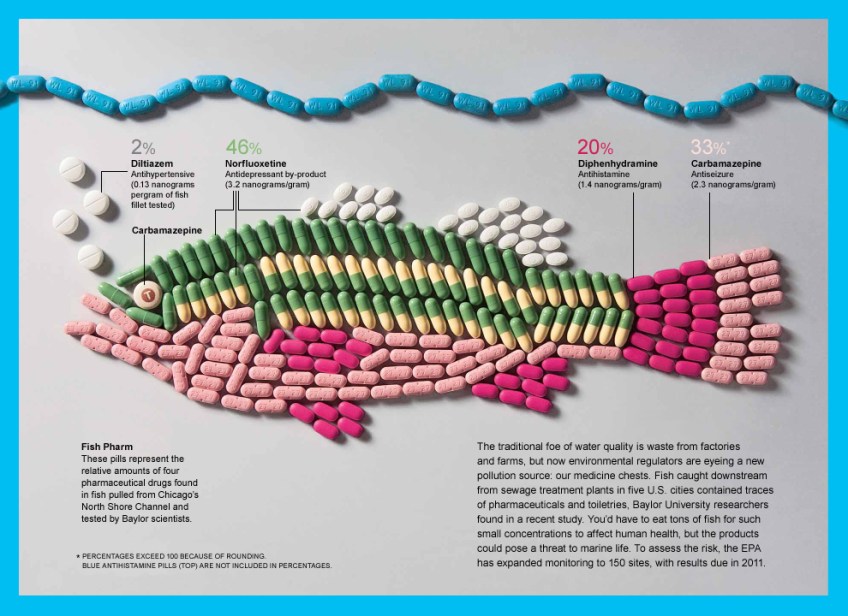
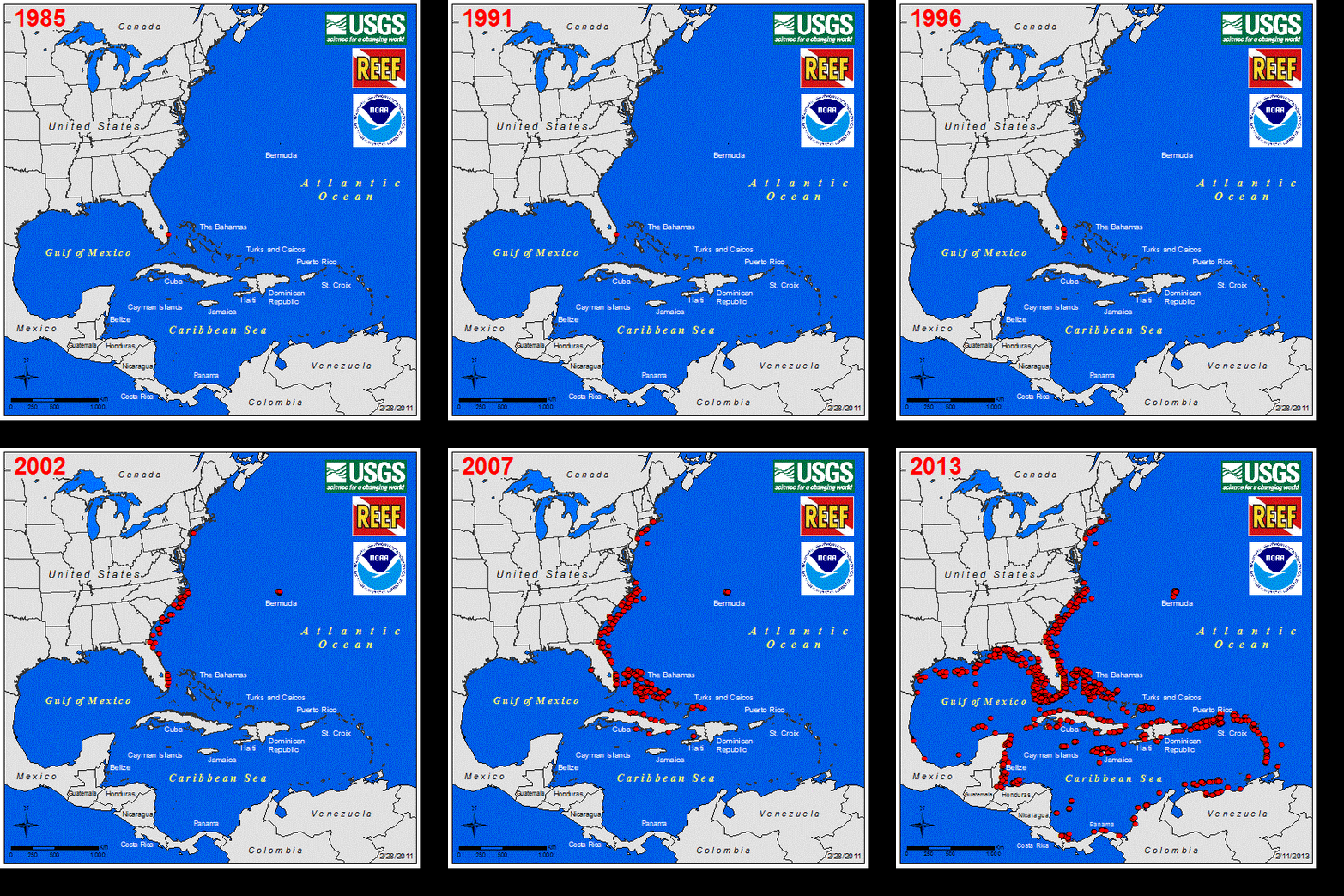
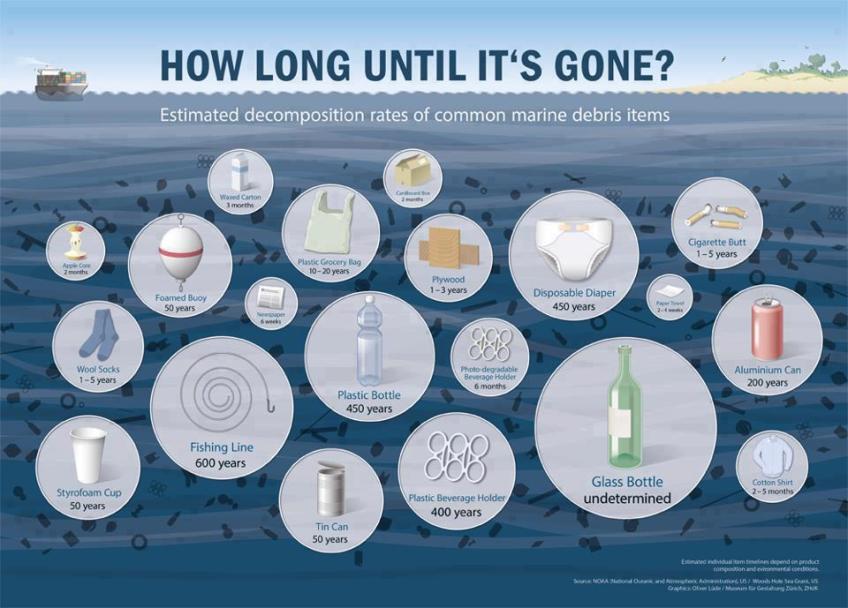
From time to time I post individual items on the CONSERVATION page. This comprises an assortment of articles, photos, videos and graphics with an eco-message relevant to Abaco and its waters. They accumulate gradually, and occasionally it is good to post a selection for consideration. What is the most frequently found item of detritus on a beach? Is it ok to eat striped bass? How many uses does a coconut have? How quickly does the invasive lionfish population spread? What is Fish Pharm? How many years does it take for an aluminium can to decompose? These and many other questions are answered below.

184790_196532023698608_1805444_aClick logo for website!

NOAA MARINE DEBRIS PROGRAM

Keepin’ the Sea Free of Debris!

ICC volunteers clean 10 million lbs of trash from our coasts
May 16, 2013 by NOAA Marine Debris Program

By: Dianna Parker

One rubber chicken, 117 mattresses, 4,159 candles, and 689,274 utensils. What do all of these things have in common?

They’re all marine debris collected last September at the Ocean Conservancy’s 2012 International Coastal Cleanup®, sponsored in part by the NOAA Marine Debris Program.The numbers are in: more than 550,000 volunteers came together to collect 10 million pounds of marine debris.  In the United States, volunteers found enough bottles that, when stacked end to end, equal the height of 1,000 Empire State Buildings. That’s a lot of trash on our beaches and in our waterways!This litter is threatening our marine environment, economy, and health, and the problem will only get worse unless we change the way we consume and dispose of products. There are solutions, and we can prevent litter from ending up in the ocean.So here’s a challenge: the next time you use a throw-away item: a bag, bottle, or utensil, answer the question, “Where it’s going?” How will you keep your items from becoming litter in our oceans, rivers, and streams? Head to Ocean Conservancy’s data release page for some neat infographics on last year’s trash haul. Here are the top 10 types volunteers found this year

top-10-items-found

THE PELAGIC OCEAN: AN INVESTIGATION INTO POLLUTION – BY KIDS

Prepare to be astounded – and horrified – by the cruel damage inflicted on sea life by humans and their prolific plastic trash. Credit: Friends of the Environment, Abaco

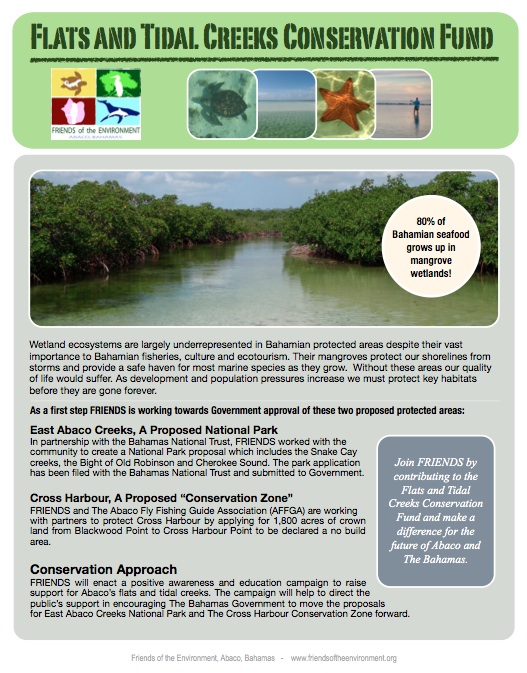
PROPOSED MARINE PROTECTED AREAS / EAST ABACO CREEKS VIDEOAbaco-park
coconut-uses 2Bahamas Lighthouse Pres Soc Logo

BAHAMAS LIGHTHOUSE PRESERVATION SOCIETY

BLPS NEWSLETTER JAN 2013 FINAL

LIONFISH

IMG_0383e.img_assist_custom-246x336

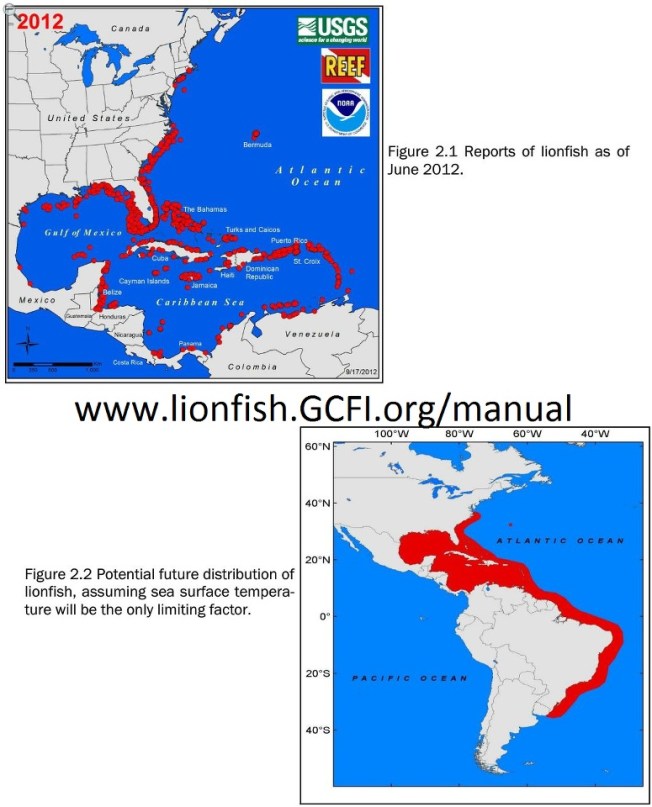
The debate about the seemingly unstoppable spread of the invasive lionfish species is well known. There are some who argue strongly that lionfish have their uses, and not merely as a food source. To see ongoing lionfish research by the organisation REEF click HERE To supplement the static projection graphic for lionfish spread (below), here is an active graphic that vividly shows how the species (love them or hate them) has expanded exponentially in numbers and range over a very short period

lionfishanimation 2013

 REEF lionfish progam graphics Conch Conservation Notice EGO -ECO graphic fishNational Geographic

Abaco Crawfish Logo

LOBSTERS – WE GOTTEM! OVERFISH THEM – WE AIN’T!

Video courtesy the fabulous CONCH SALAD TV; heads-up from ABACO SCIENTIST; campaign by SIZE MATTERS

BLPS LOGO

BAHAMAS LIGHTHOUSE PRESERVATION SOCIETY Read the Society’s 4-page January 2013 Newsletter HERE BLPS NEWSLETTER JAN 2013 

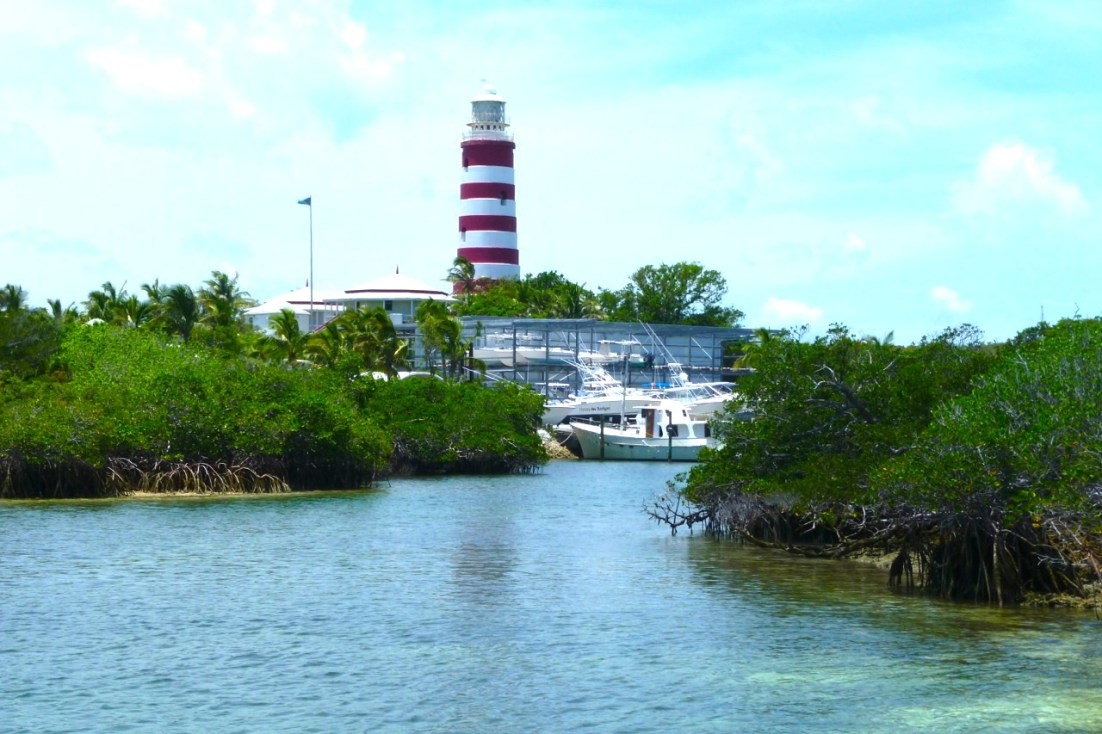
The Society was founded in 1995, and it has already achieved much to preserve and protect the lighthouses of the Bahamas. Of particular interest to Abaconians will be the news about the Hope Town lighthouse, and about the work done at Hole-in-the-Wall. If you’d like to support this hard-working not-for-profit organisation and help to preserve a part of Abaco’s maritime history, the email address is blps.bah@gmail.com  Hope Town Lighthouse
bpa_logo

A new environmental organisation has been announced: to find out more

CLICK===>>> BPFA 

IUCN CUBAN PARROT RED LIST RANGE MAP FOR AT RISK SPECIES
I have annotated this IUCN map of the Cuban Parrot population range. It’s worth noting that the Bahamian subspecies is now found only as a breeding population on Abaco and Inagua, being defunct on all other islands since the mid-c20. Of these populations, only the Abaco parrot breeds underground, a unique feature among the whole species.
I am puzzled by the suggestion of an ‘extant (resident)’ population on the Bimini Is. That would suggest that they breed there. I don’t know the date of the map, but I have checked with the Avibase bird database, and the Cuban parrot is indeed included in the list of Bimini birds. I’ve put a query on the map because I don’t know what the position is in 2012.
Click me!
FRIENDS OF THE ENVIRONMENT (ABACO)
This conservation organisation has recently completely redesigned its website (click logo above), and presents comprehensive and easily navigated information about a myriad aspects of conservation on Abaco and its fragile ecology. The fragility is mostly directly or indirectly caused by mankind (a broad statement, I know, but it’s an arguable stance), so it’s worth checking out the measures that are being undertaken to preserve the natural resources of the island and its cays. Below is a post about one feature highlighted on the FotE site that I am particularly interested in. Overall all the new website is definitely one for any Abaconian (or, like me, regular visitor) to study. If you want to contribute your support (either generally or to a specific cause) go to the FotE website (click logo) or visit the Rolling Harbour wildlife charity page HERE

THE EFFECT OF RISING SEA LEVELS IN THE CARIBBEAN

This map has been posted by the SCSCB, with the very interesting and definitely worrying text “The map shows projected impacts of a 2 meter sea level rise in the Caribbean. The orange is the impact of 2 meters, while the yellow is the 25 meter line. The last time the ice caps melted the sea rose between 18 and 25 meters. The most conservative estimates indicate a 1-meter rise by the end of the century (concurrent with a 2 degree C rise in temperature). From the position of planning, I am curious about the estimates being used by Caribbean resource managers in their long-range planning. For example, what percentage of Caribbean seabirds nest below 2 meters…”

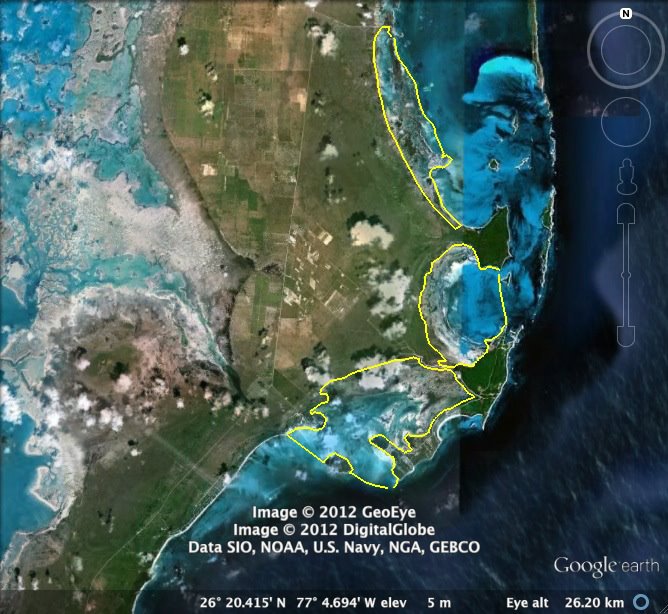
EAST ABACO CREEKS NATIONAL PARK PROPOSAL

Click on the title above to see the BNT’s proposal for this major conservation proposal for the east Abaco creeks. It’s in .pdf form and you can (probably) copy / save it if you wish. The map below shows the 3 areas concerned. You can check out more details – and photos – on Facebook at EACNP

A VISUAL TO PONDER FROM ‘SCIENCE IS AWESOME’
CONSERVATION ON ABACO AND IN THE BAHAMAS

This new page (June 2012) is intended to showcase the achievements of the various organisations and individuals involved with the protection and conservation of the fragile ecology and wildlife in a small and rapidly developing area. A number of posts and articles from other pages will gradually migrate to this page.

I have posted on Facebook a statement by the new Environment Minister which praises the environmental work carried out in the Bahamas and pledges Government support MINISTER’S STATEMENT Let’s hope it’s forthcoming…

community conch logo

CONCH CONSERVATION

The supply of conchs is not infinite. Overfish them, take them before maturity  or pollute their habitat and this valuable marine resource depletes – and conchs, as with so many marine species, will become threatened. Fortunately there is a Bahamas-wide conservation organisation with a website packed with interest.  COMMUNITY CONCH is “a nonprofit organization that aims to protect queen conchs in the Bahamas, a species of mollusk threatened by aggressive over-fishing. We promote sustainable harvest of queen conch through research, education and community-based conservation”

“Helping to sustain a way of life in the Bahamas”

Much of the research has been carried out in Berry Is, Andros and Exuma Cays. However the team has recently been based at Sandy point, Abaco CLICK===>>> ABACO EXPEDITION  The full Conch Conservation post can be found at CONCH QUEST

BAHAMAS MARINE MAMMAL RESEARCH ORGANISATION (BMMRO)

The BMMRO is featured many times in this blog, in particular in the pages WHALES & DOLPHINS and MANATEES. They now have a Facebook page with all the latest news, photos, newsletters links and cetacean / sirenian goss in one easily-digested timelined place. To reach it CLICK ===>>> BMMRO FACEBOOK PAGE

For the latest quarterly newsletter, just published, CLICK ===>>> BMMRO NEWSLETTER JULY 2012
A RECENT FLYER FOR THE ‘SIZE MATTERS’ CRAWFISH CAMPAIGN

BAHAMAS NATIONAL TRUST PRESS RELEASE JUNE 2012

ABACO PARROT POPULATION ON THE RISE
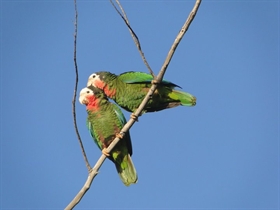
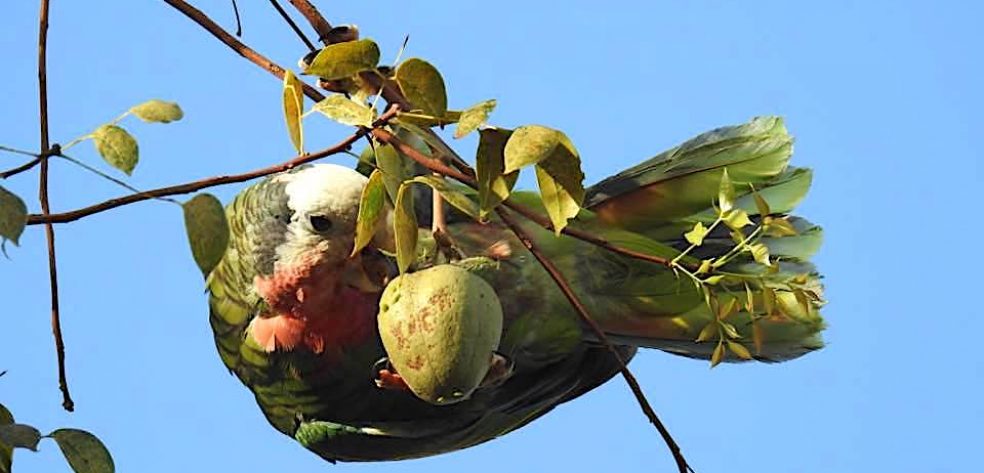
The Bahamas National Trust  in conjunction with Dr. Frank Riviera and Caroline Stahala recently conducted an intensive survey of the Bahama Parrot on Abaco Population surveys conducted in 2002 resulted in estimates of the Abaco parrot population of about 2,500 parrots with similar values in the following years. This year Dr. Frank Rivera and Caroline Stahala, who took part in the initial surveys, helped by  BNT wardens and volunteers, conducted a 10 year follow up survey to determine the change in the Abaco parrot population since management began. The results indicate that the Abaco parrot population has increased since the BNT’s management efforts were implemented with a new estimate of just over 4,000 parrots on Abaco. The BNT has been concerned about the Bahama Parrot Population since the 1980’s. Studies indicated that the major threat to the parrots were feral cats who cause serious problems to the parrots during the nesting season by entering the underground nesting cavities and killing the breeding adults and chicks. The BNT implemented an intensive predator control effort in 2009 throughout the parrot nesting area culminating in the hiring of Marcus Davis as Deputy Park whose primary responsibility is to oversee the predator control program. During the breeding seasons the BNT has seen a decrease in the number of breeding parrots killed and nest success increase. The question, though, remained whether this effort would translate into an increase in the Abaco parrot population size. Survey results indicated that predator control has led to an increase in nest success.  In addition, the Abaco parrots have weathered several hurricanes (Frances, Jean and Irene) over the last 10 years and still appear to show  a population increase. Hopefully with continued management efforts a healthy and viable  endemic parrot population on Abaco will continue to thrive. According to David Knowles, BNT Director of Parks “This gives us hope that with continued management efforts we can continue to have a healthy and viable endemic parrot population on Abaco.”
Unknown's avatar

‘SLOW BLUES IN SEA’: BAHAMAS REEF FISH (10)


BLUES IN C tab

‘SLOW BLUES IN SEA’: BAHAMAS REEF FISH (10)

Albert King, Lead Belly and Mike Bloomfield are prime examples of foremost bluesmen guitar-slingers who, in their own distinctive styles, favoured the key of… I’m sorry, what did you say? Oh yes, quite right. My misunderstanding. Apologies, I’ll take it from the top…

Deep blue sea. Deep blue fish. *Deep breath*. All better now. The fish below may all readily be found nosing around the coral reefs of the Bahamas in a leisurely manner. Mostly, they are feeding. Fowl Cay Marine Preserve, Abaco, is a great place for watching them. No need to have all the gear – a simple snorkel, mask and flippers, and an ability to float a bit, would be sufficient.

BLUE CHROMIS Chromis cyanea

Blue Chromis, Fowl Cay, Abaco fish12 These dazzling little blue fish will be one of the first you’ll meet (along with the omnipresent yellow and black striped sergeant majors, so friendly they will come right up to your mask). You can’t miss them. Though very small, their electric blue colouring cuts through the water even on the dullest of days up-top. They can reach 5 inches in length, but most that you see will be tiddlers. They are frequently seen in the company of larger fish.Blue Chromis ©Melinda Riger @ GB Scuba

Blue Chromis ©Melinda Riger @ GB Scuba

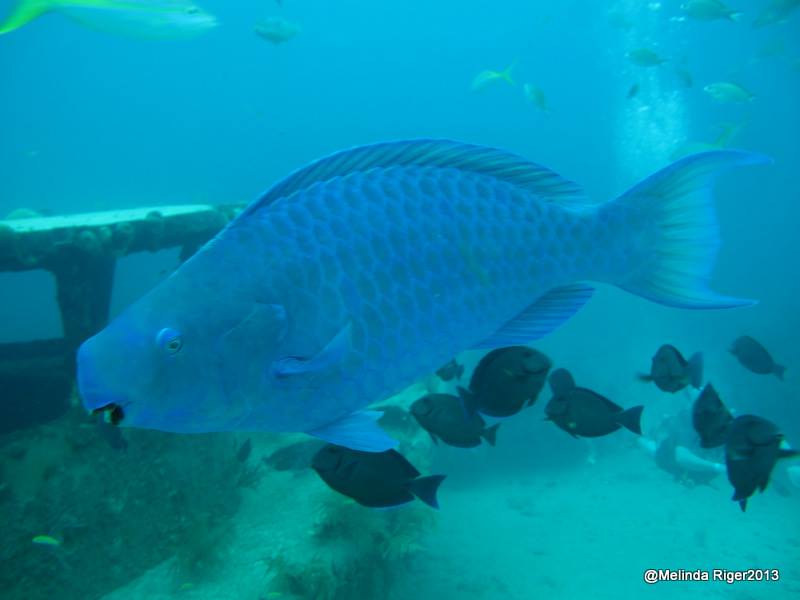
BLUE PARROTFISH Scarus coeruleusBlue Parrot Fish ©Melinda Riger @ G B Scuba

Parrotfish play a vital part in the ecology and health of the coral reef. They graze on algae, cleaning the coral and grinding the surface with their teeth. They take the nutrients and excrete the rest as… sand. This helps to form your beach! To find out more about their uses and habits, click PARROTFISH. You’ll find a great deal of interesting info about the species, conveniently compressed into factual bullet points. Blue parrotfish 2Blue Parrotfish

BLUE TANG Acanthurus coeruleus

The blue tang is a type of surgeonfish, all-blue except for a yellow spot near the tail. The blueness can vary considerably, from very pale to dark. They tend to swim elegantly around in large groups.Blue Tang ©Melinda Riga @ G B Scuba Blue Tang ©Melinda Riger @ GB Scuba

Here are some images of schools of blue tang that I took with a cheapo underwater camera at Fowl Cay. They are a lovely sight as they drift slowly past alongside the reef. The top one also has a sergeant major (see above).fishx fishu4 Blue Tang, Abaco fish28 fish20

CREOLE WRASSE Clepticus parraeCreole Wrasse ©Melinda Riger @GBS

This wrasse can grow up to a foot long, and may be found at considerable depths on deep-water reefs – 300 feet or more. They are active by day, and hide in rock clefts at night. This species is sociable, moving around in shoals. They develop yellow markings with age. Creole Wrasse School ©Melinda Riger @GBS

QUEEN TRIGGERFISH Balistes vetula

There are several species of triggerfish. The queen is capable of changing colour to match its surroundings, or (it is said) if subjected to stress. I think we have all been there. It is an aggressive and territorial fish, and its favourite prey is the sea urchin, a testament to its courage…Queen Triggerfish

QUEEN ANGELFISH (JUVENILE)

I have featured this species before HERE, and strictly it as much yellow as blue. But the blue earns double points, surely, for its startling vividness. Anyway, I like the way it hangs casually upside down, and the bubbles in this photo.

Juvenile Queen Angel ©Melinda Riger GB Scuba

Credits: Good photos – Melinda Riger of Grand Bahama Scuba; Poor photos – RH

From time to time I end a post with something musical. Just for fun (toxic concept). So here is a real “Slow Blues in C” from the fantastic guitarist Stefan Grossman off  his eclectic ‘Yazoo Basin Boogie’ album. 22 quality tracks. Buy from Am*z*n – much cheaper than iT*nes.    


61xe+fzzYUL._SL500_AA280_

Unknown's avatar

WHALE & DOLPHIN RESEARCH, PHOTOS & SIGHTINGS REPORT


WHALE & DOLPHIN RESEARCH, PHOTOS & SIGHTINGS REPORT

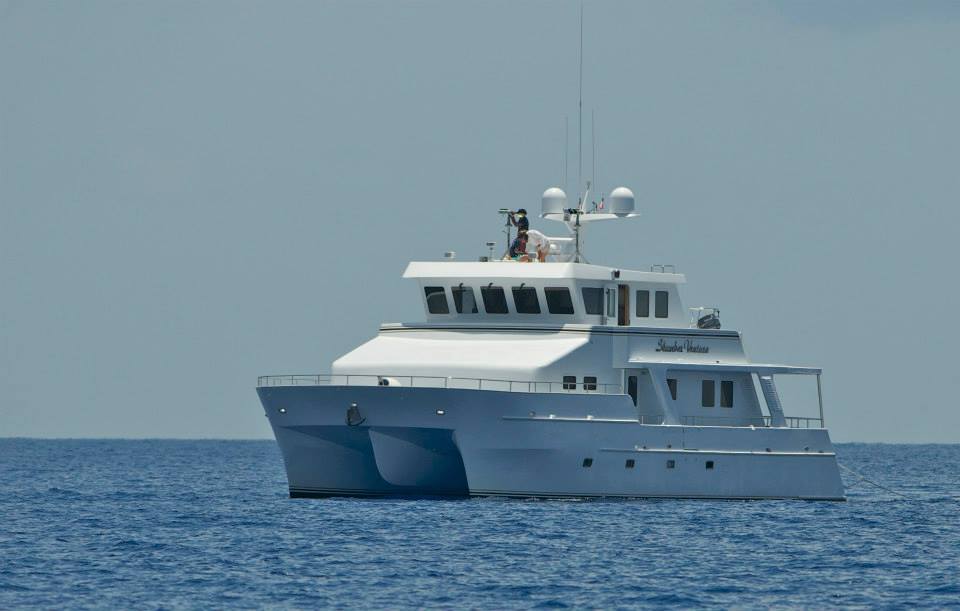
The Bahamas Marine Mammal Research Organisation (BMMRO) has recently been involved in a major tagging and monitoring program  around Andros, in particular using sonar to test the responses of beaked whales. Being all at sea for a few weeks meant that many other marine mammals were encountered. Thanks to Charlotte and Diane for permission to use some of their photographs taken during the research trip – and also in Abaco waters – to illustrate the amazing diversity of cetacean life in the waters of the northern Bahamas.

Click me!

RESEARCH VESSEL “SLUMBER VENTURE”'Slumber Venture' survey vessel

WHALES

A Sperm Whale with unusual pigmentation

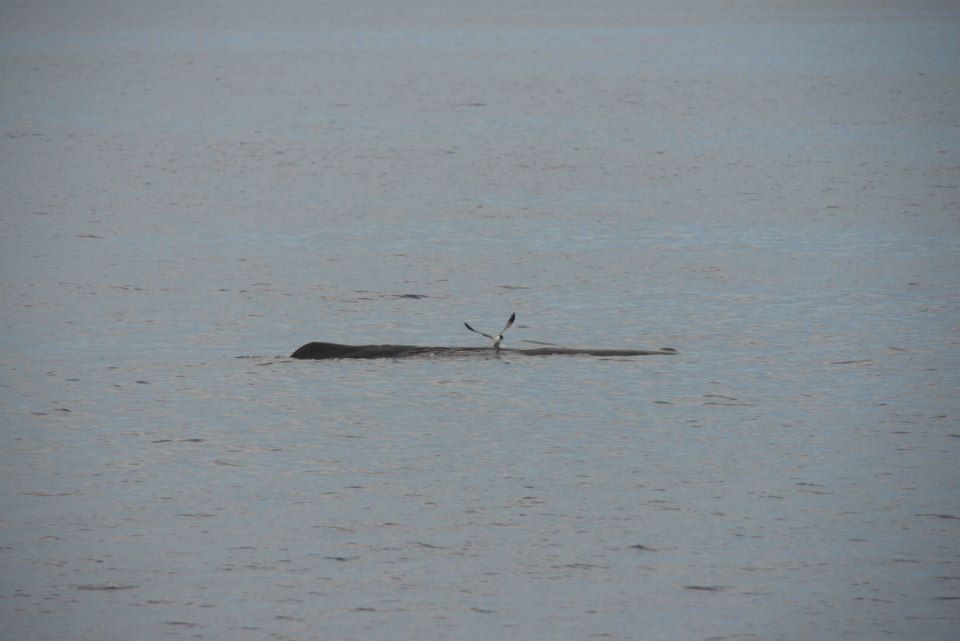
SPERM WHALES OFF ANDROSSperm WhalesSPERM WHALE TAILINGSperm Whale tailingTHAT GULL SURELY CAN’T BE CRAZY ENOUGH TO…Gull landing on Sperm WhaleWELL, IT JUST DID!Gull landed on Sperm Whale

MELON-HEADED WHALES – MOTHER & NEW-BORN CALF

Melon-headed Whale mother with new calf

THE FIN OF A MALE BEAKED WHALEBeaked whales - the fin of a male

DOLPHINS

BOTTLENOSE DOPHIN & CALFBottlenose Dolphin & Calf, Abaco

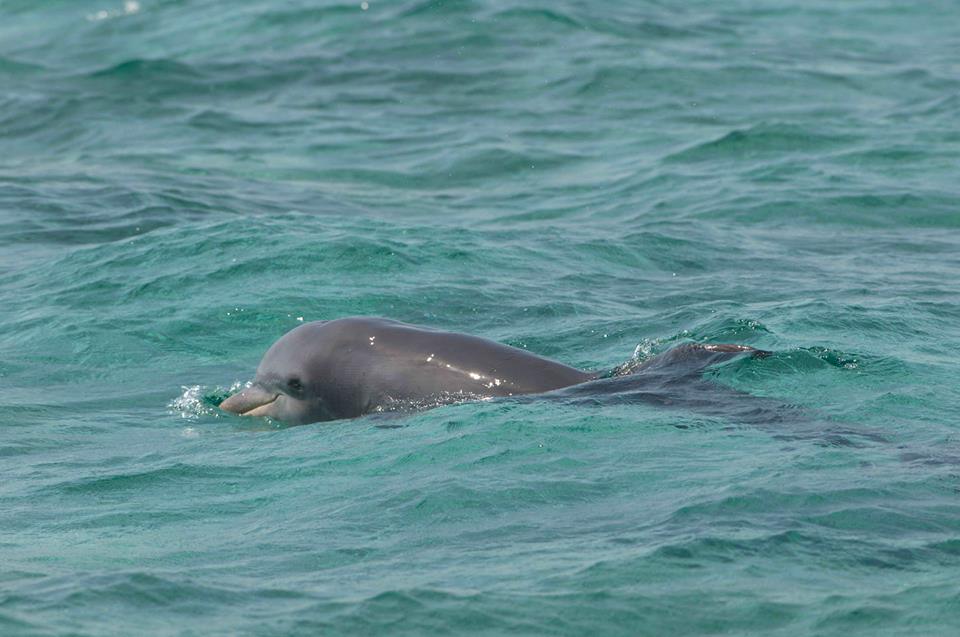
BOTTLENOSE DOLPHINBottlenose Dolphin near Gorda Cay

DOLPHINS BOW-RIDINGDolphins bow-riding

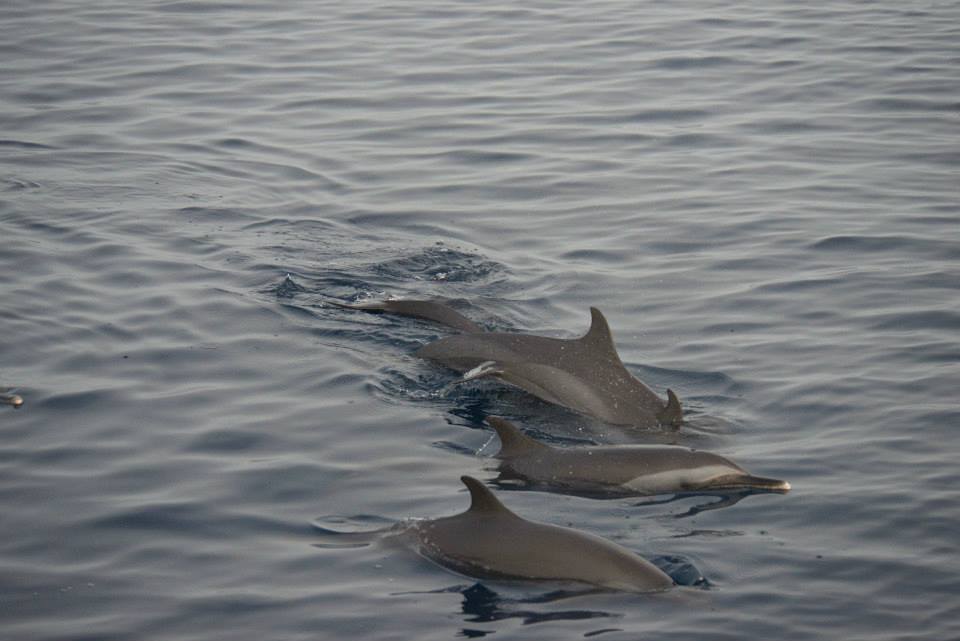
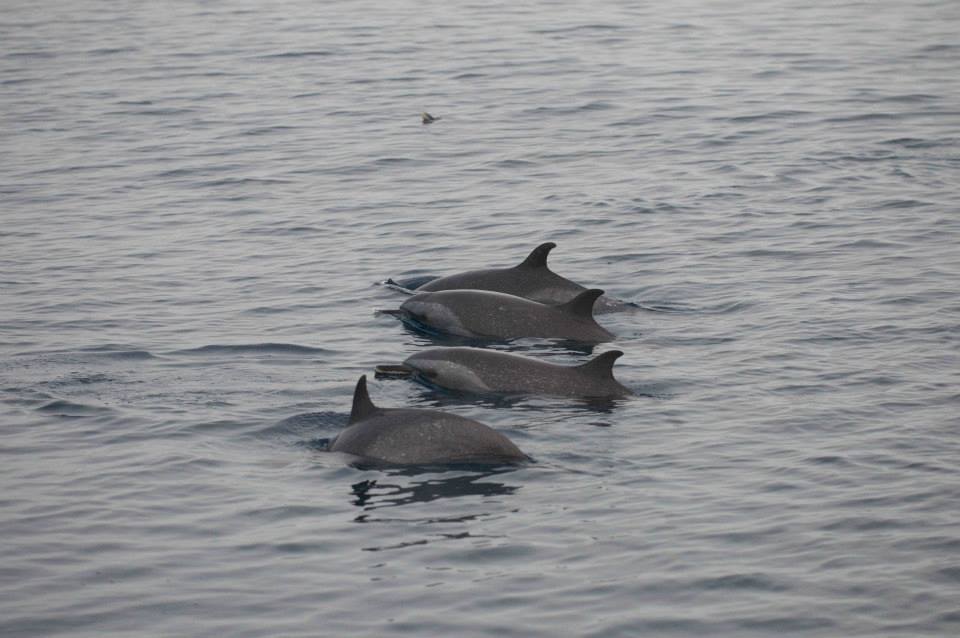
SPOTTED DOLPHINSSpotted Dolphins Spotted Dolphins x 4

ROUGH-TOOTHED DOLPHINS

The research, tagging and monitoring programs pay dividends in conservation and species preservation terms… but then along comes a brutal reminder, way out in the pristine ocean, of the far-reaching extent of man’s reckless damage of the planet and the creatures in it. This poor animal has become swathed in plastic.  The likelihood is that its stomach will have dozens of pieces of plastic in it, from microscopic to potentially damaging – or fatal. We made it all, and we chucked it away.Marine Mammals & plastic

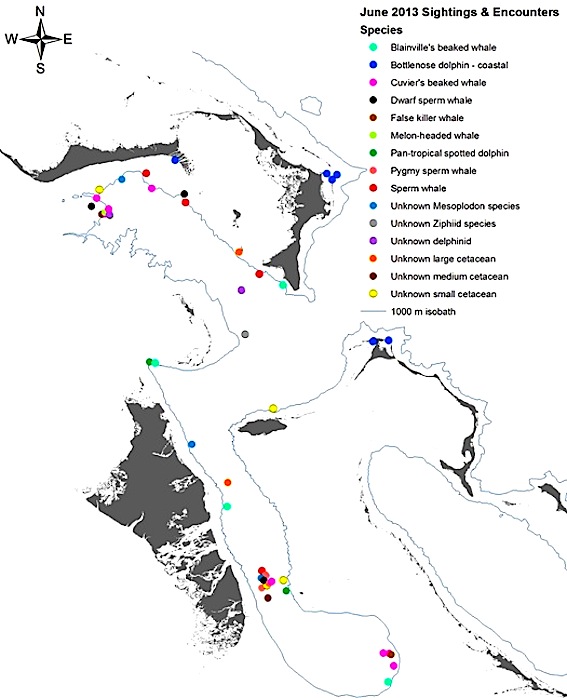
Moving into less contentious areas, here is the BMMRO sightings list for the last month, with a great deal of activity recorded. For once there is even a sighting included of my very own, of 3 bottlenose dolphins in Hope Town harbour one lunchtime in mid-June. See HERE

BMMRO June Sightings

Finally, the latest news from the BMMRO is that Dr Diane Claridge, besides being awarded her PhD earlier this year for her research on beaked whales, has graduated from the ancient scottish university of St Andrews, founded in  1413. It is the third-oldest university in the english-speaking world (and the oldest in the scottish-speaking world…).Dr Diane Claridge, St Andrews Uni

Georgie Manatee BMMRO SUPPORT LOGO

Credit: savethemanatee.org

Unknown's avatar

UNDERWATER BAHAMAS: REEF GARDENS & DENIZENS (1)


Christmas Tree Worms ©Melinda Riger @ G B Scuba

UNDERWATER REEF GARDENS IN THE BAHAMAS (1)

Animal, vegetable or mineral? If you dive down and take a close look at a reef, you’ll soon find that it isn’t easy to tell what is what… That ‘plant’ is a magic worm;  this ‘creature’ is a tentacled plant…

ANEMONESAnemone ©Melinda Riger @ GB ScubaAnenome ©Melinda Riger @ G B ScubaAnenome (Giant) ©Melinda Riger @GBS

BASKET STARS

A species of ‘brittle star’ that, as the images suggest, like to ‘hang’ togetherBasket Star ©Melinda Riger @ GB ScubaBasket Star ©Melinda Riger @GBS

REEF MIX29801_478636495491078_987749415_n 299343_478636145491113_873966996_n 526981_465306386824089_928061136_n

CHRISTMAS TREE WORMS Spirobranchus giganteusChristmas Tree Worms ©Melinda Riger @ G B Scuba


Thanks to scuba photographer extraordinaire Melinda Riger of Grand Bahama Scuba; & wiki-minipics

Delphi Bonefish Logo

Unknown's avatar

ABACO WHALES & DOLPHINS, BMMRO SIGHTINGS & NEWSLETTER


Dolphin Leap copy

ABACO WHALES & DOLPHINS: BMMRO SIGHTINGS & NEWSLETTER

I haven’t posted Abaco whale, dolphin & manatee news for a while. Time for a catch-up. Georgie the young manatee that left her mother Rita and came to Abaco from the Berry Is. alone, is no longer here. She survived a very long journey, and investigated various coastal areas of Abaco – all the while being tracked. In the end she settled down in the Cherokee area. There were anxious times during Hurricane Sandy when she went missing (having by now shed her tracking device) but she eventually reappeared at Cherokee having found a safe haven from the storm. Sadly, however, her condition deteriorated and in the New Year she was relocated to Atlantis Dolphin Cay Marine Mammal Rescue Center. Some weeks ago a healthy Georgie was moved to a sea-pen to acclimatise her for release back into the wild.

Read more about Georgie the Manatee’s epic trip HERE and about the operation to relocate her HERE

ABACO DOLPHINS – A MOTHER & HER CALF 428475_595355517150345_807197303_n-1

The Bahamas Marines Mammal Research Organisation (BMMRO) is based at Sandy Point, Abaco. A number of research projects are underway, and recently these have involved work on Andros. The team are now back, and encountering Abaco’s own dolphins and whales. The main photos on the page have all been taken in the last week or so. [The header is by Norwegian artist Roll Inge Haaver]

BOTTLENOSE DOLPHIN, ABACO971695_596998516986045_1649965583_n

SPERM WHALE ‘TAILING’, ABACO (1 of 3 found yesterday using acoustic tracking)374338_596998896986007_1736456956_n

DCB GBG Cover Logo dolphin

BMMRO CHART OF CETACEAN SIGHTINGS FOR MARCH 2013

Of special note are the big whales – 3 sperm whales, and a humpback whale reported close to Cherokee.
BMMRO SIGHTINGS March 2013

Sperm whales. Humpbacks. How big are they? This useful chart shows the average lengths of various whales. I grabbed it off the internet a while ago, but regrettably forgot to mark the source. So, apologies to the originator for using it uncredited, a cyber-sin I try to avoid.what-largest-whale-cetacea-size-comparison-chart-590x338

Finally, the BMMRO’s latest 4-page Newsletter contains a wealth of information about their current activities, some great pictures, and even a quiz – check out BMMRO NEWSLETTER_Apr13

Click logo to linkbmmro_logo

Unknown's avatar

ABACO’S UNIQUE PARROTS IN PICTURES, VIDEO & SOUND


Abaco (Cuban) Parrot 2013 4a

ABACO’S UNIQUE PARROTS IN PICTURES, VIDEO & SOUND

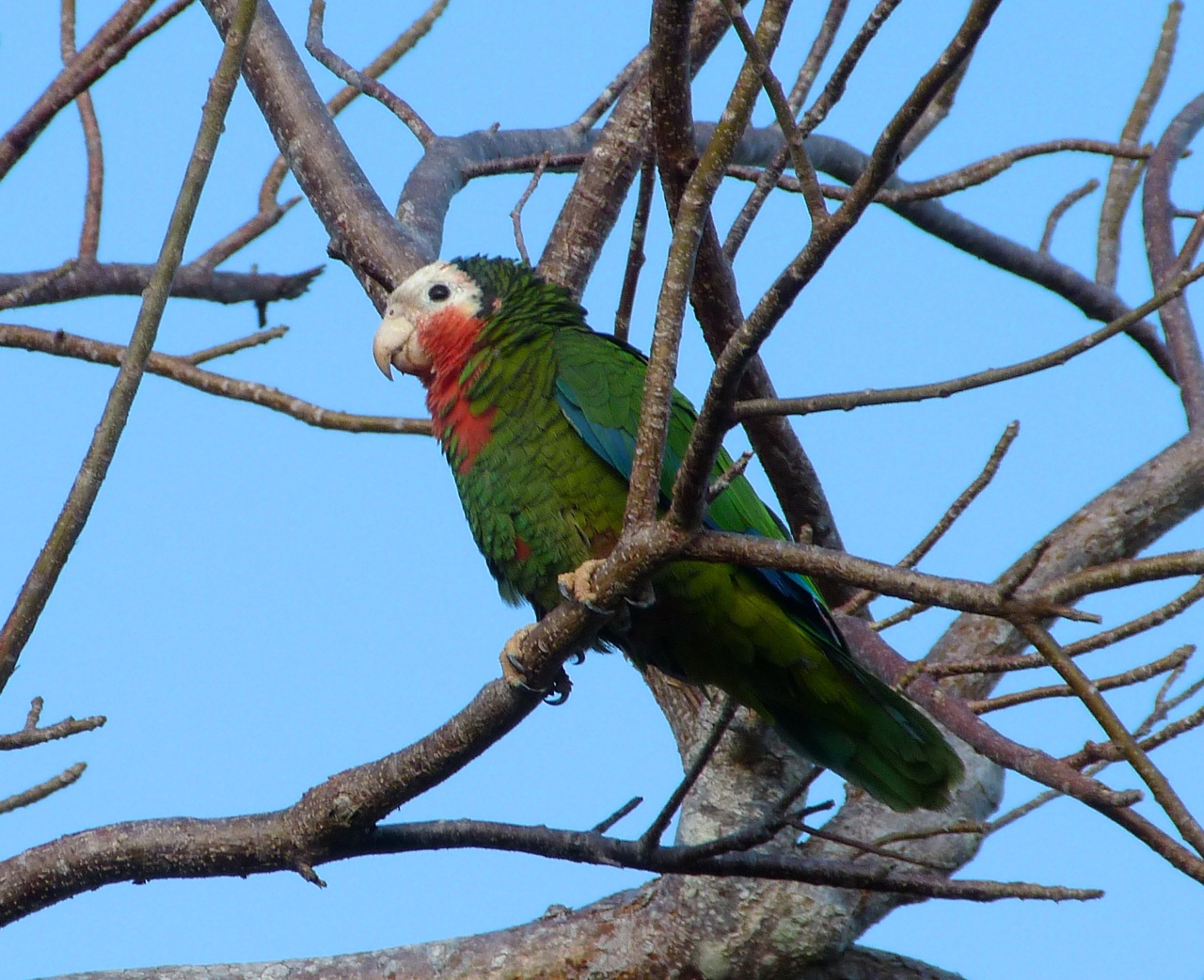
Abaco parrots. The only ground-nesting parrot species in the Bahamas. In the world, in fact. I’ve posted quite often about them – indeed they have their own page HERE – because, frankly, they are special and their story is one of encouraging success for intensive research and conservation programs. In 1492, Christopher Columbus was amazed by the vast number of parrots he saw in the Bahamas (not that the islands were called that then). In his journal he noted: “flocks of parrots darken the sun…”  Not many years ago, parrot numbers on Abaco had dwindled to fewer than 1000 – below the critical point for sustaining a viable population. Extinction of the Abaco parrot loomed, accelerated by increasing habitat change, predation, and (*euphemistically*) ‘human intervention’.  Thanks to the campaign of conservation, habitat preservation, anti-predation measures and vigilance, numbers have been restored to a sustainable level, perhaps as many as 4000. They are now a fairly common sight – and sound – in South Abaco. But not everyone who looks for them finds them, or even hears them. Especially not if they take pot luck in the vast areas of pine forest in the National Park, where they breed…

I’ve covered much of this ground before, but there is a slightly wider audience these days, so a few newcomers may be interested to learn about these lovely birds. The best thing is to have a look. All photos were taken by me during two early evenings in March.

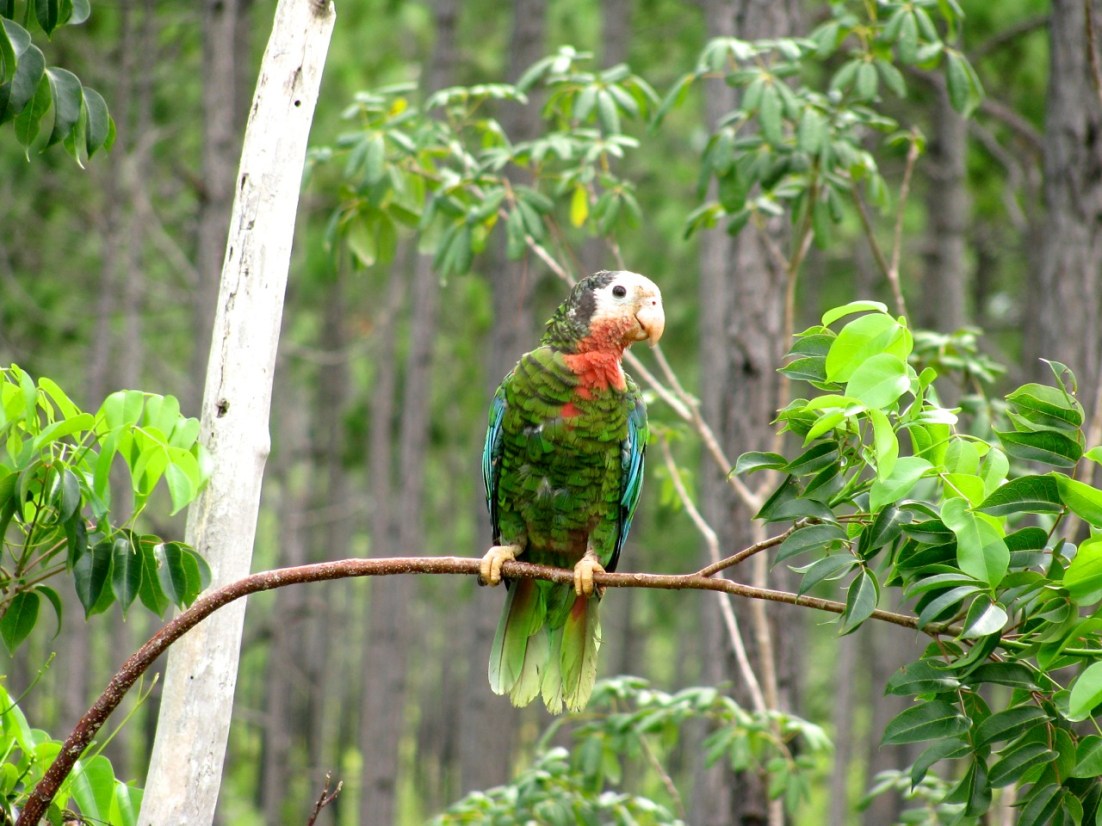
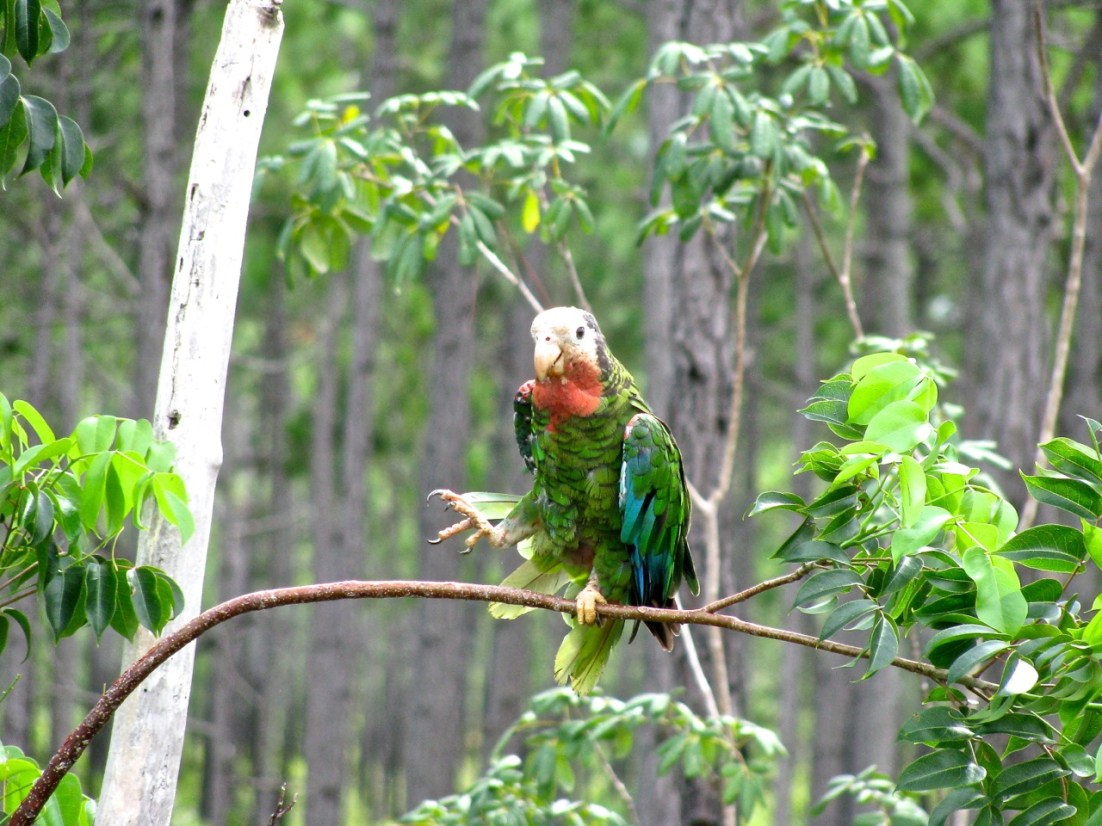
Abaco (Cuban) Parrot 2013 1Abaco (Cuban) Parrot 2013 2 Abaco (Cuban) Parrot 2013 4aAbaco (Cuban) Parrot 2013 5

The parrots are extremely agile, and have very strong feet and claws that enable them to move around in the tree-tops – or to hang upside down if they choose to. The next photo is a close-up a foot; below that is short video showing a parrot manoeuvring itself in a tree. You’ll also see how the birds use their beaks as an extra limb, so to speak. The uninspiring title shown is only because I forgot to label it ‘Abaco Parrot’ in the first place, and can’t find how to edit it…Abaco (Cuban) Parrot 2013 6

In this image you can clearly see how their ‘opposable’ claws wrap round a branchAbaco (Cuban) Parrot 2013 8

If you suspect that this one has had some ‘work’ done, you’d be right. I normally leave my photos largely alone, apart from cropping and maybe basic light balancing where needed. Sometimes an image is nearly there, but needs a bit of extra cosmetic business – but one can usually tell. The left wing? Hmmmmm (users of ‘noise reduction’ will know what I am talking about!).Abaco (Cuban) Parrot 2013 9 Abaco (Cuban) Parrot 2013 10 Abaco (Cuban) Parrot 2013 11 Abaco (Cuban) Parrot 2013 12

The flocks of parrots are incredibly noisy. Sometimes they split into two or three groups, close together, and seem to compete in raucousness. Around 5.00 pm seemed to be the noisiest time. I took recordings of the racket, using the voice memo app on an iPh*ne, simply holding the phone with the speaker / mike end towards the parrots. Some come out pretty well – good enough to post on the excellent XENO-CANTO bird sound site. Here is a recording, with the first few seconds transcribed into a sonogram. I made a ring tone from this recording for Caroline Stahala, the scientist who, with her team, looks after the birds. She’s been too polite to say whether she uses it or (more likely) not!

Abaco (Cuban) Parrot 2013 13Abaco (Cuban) Parrot 2013 14Abaco (Cuban) Parrot 2013 15I find the parrots very hard to nail in flight (see above), possibly because of a shutter-speed issue (mine, not the camera’s). I nearly junked the picture below, but I liked the clash of the parrot colours with the purple bougainvillea, so I spared it.Abaco (Cuban) Parrot 2013 16B

If anyone is interested in making a small contribution towards the continuing research into and protection of these birds, please have a look at my ABACO WILDLIFE CHARITIES  page, where the relevant link to Parrots International can be found. Or visit doudoubirds, where you will find endearing Abaco Parrot prints by dou dou herself for sale in aid of the parrots. Or contact me at rollingharbour.delphi@gmail.comAbaco (Cuban) Parrot 2013 7

If anyone had a problem with the Xeno-Canto sound file above, here is a simplified version of the recording

Unknown's avatar

‘MEN AT WORK’: CLEANING UP MAN’S DEBRIS IN THE OCEAN


bird1

‘MEN AT WORK’: CLEANING UP MAN’S DEBRIS IN THE OCEAN

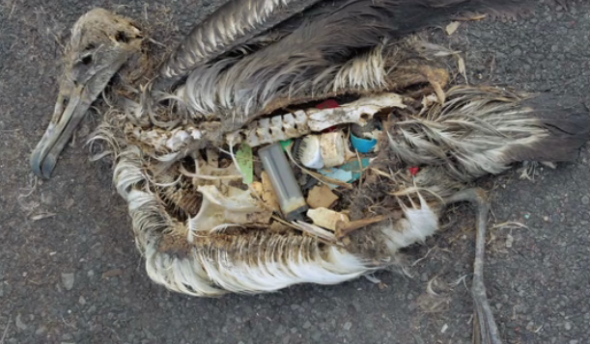
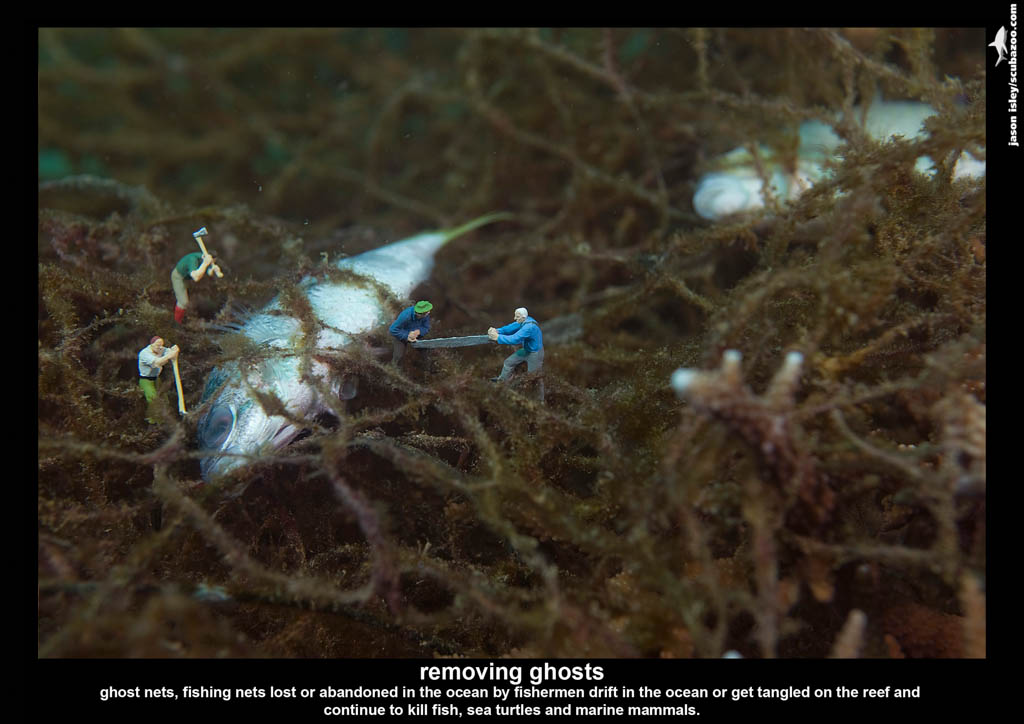
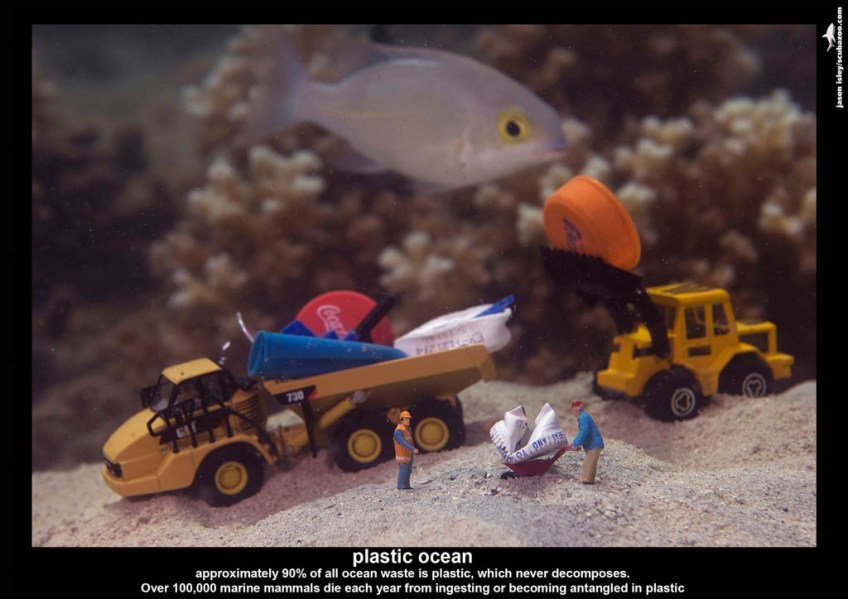
I keep an eye on the website SCUBAZOO. As ever, the alert ABACO SCIENTIST (highly recommended to follow) has beaten me to this latest post from Jason Isley, diver / photographer and creative thinker. He demonstrates the wonders and (human) blunders of the deep with wit and style. In the gallery below, he tackles the issue of man’s pollution of pristine waters. In a simple way, he manages to use humour to get across a message  that can easily become obscured by lengthy sermonising. See what you think.            

Pollution01Pollution02Pollution04Pollution03pollution06pollution05

Unknown's avatar

BOTTLENOSE DOPHINS (VIDEO) & BMMRO ABACO CETACEAN SIGHTINGS


safe_image.php

BOTTLENOSE DOPHINS (VIDEO) & BMMRO ABACO CETACEAN SIGHTINGS

The legendary CONCH SALAD TV is a great resource for Bahamas wildlife and way-of-life enlightenment. Their instructive videos are very well put together, and cover Nature, Marine, Art, Science, Music, Culture, Cooking, and broader Bahamas issues. The video below is 9 minutes of Bottlenose Dolphin action, and is recommended for relaxation, gentle instruction, and Kalik-swigging accompaniment…

BMMRO Whale Camp Dolphin Image FV

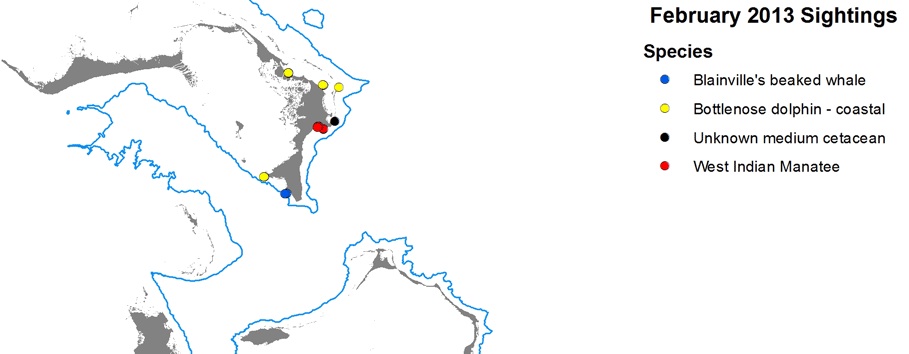
It time to catch up with last month’s Cetacean sightings around Abaco. The Manatee reports are of Georgie in the Cherokee area – alas no longer resident on Abaco but safely at Atlantis where she is being cared for. To know more about the Blainville’s beaked whale on Abaco, click HEREBMMRO sightings 2013

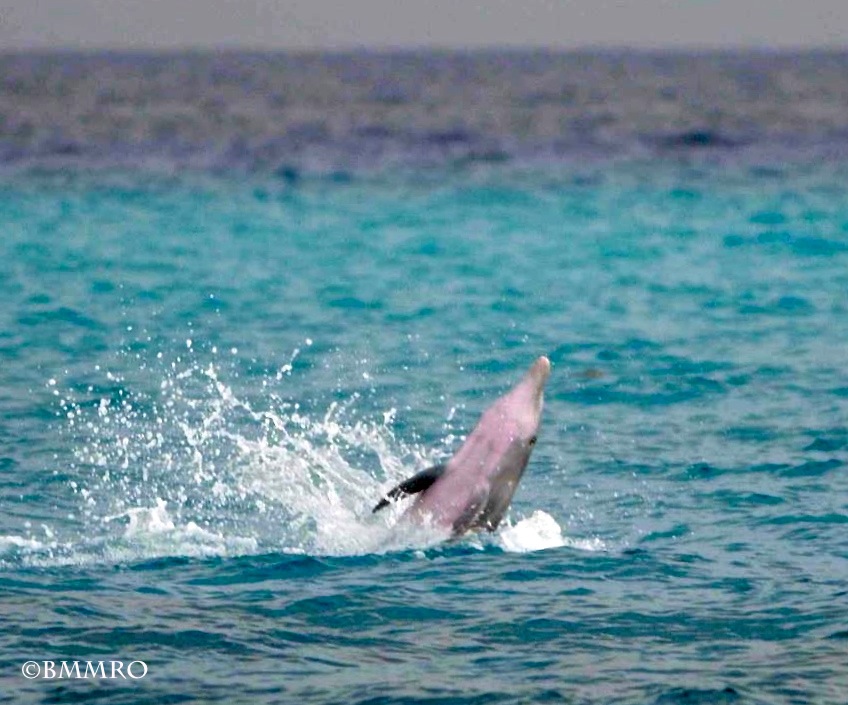
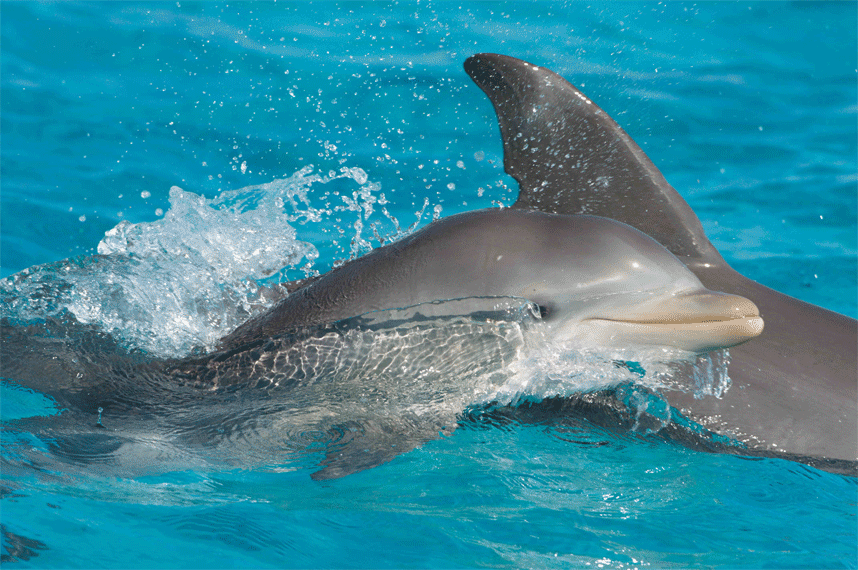
stop pres gif BMMRO’s executive director DIANE CLARIDGE has been awarded her PhD by St Andrews University for her research on beaked whales.  Dr Claridge’s new status is celebrated by humans and cetaceans alike (see image ©BMMRO below…)Bottlenose Dolphins Abaco ©BMMRO

mantsw~1

Unknown's avatar

MANGROVE JELLYFISH: AN UPSIDE-DOWN UNDERWATER LIFE


250px-Fkeysmacro

MANGROVE JELLYFISH: AN UPSIDE-DOWN UNDERWATER LIFE

220px-Status_iucn3.1_LC.svg

Production still from the television series BAHAMA BLUE © 2014 Parallax FIlm Productions Inc.

             Production still from the television series BAHAMA BLUE © 2014 Parallax FIlm Productions Inc.

The Mangrove Jellyfish Cassiopea, also called the ‘upside-down jellyfish’ for reasons I needn’t dwell on, is the only member of its particular jellyfish family. These creatures prefer warm waters, and typically live upside-down on the sea-bottom, which no doubt makes catching prey very simple. They can be found individually, though more likely in large groups, with individuals displaying different shades and colours.

NEW An excellent video by Melinda Riger of Grand Bahama Scuba

The Mangrove Jellyfish has one of the milder stings of the numerous species, though human reactions to the sting will vary with the individual. A greater problem may come from swimming around or over a mass of these creatures. Their stinging cells are excreted in a transparent mucus which may invisibly cover the unwary swimmer. Apart from skin-irritation and a rash, the stings are apparently very itchy. My guess is that scratching can only make things worse (cf No-see-ums…). The first of the two videos below was taken recently by Sarah Bedard (to whom thanks) who “found a great tidal pool full of them at the end of Rock Point Road, Treasure Cay (Abaco)”. The second is short, but with some amazing footage of the Jellyfish in action.

Unknown's avatar

A RARE ABACO PARROT DISPLAYS A RARE TALENT…


DCB GBG Cover Logo

A RARE ABACO PARROT DISPLAYS A RARE TALENT…

WOULD YOU LIKE TO SEE MY LITTLE TRICK?ABACO PARROT CS 13-3

I’M A BIT CAMERA-SHY – I’LL JUST TURN ROUNDABACO PARROT CS 13-4

THAT’S BETTER. ARE YOU SURE YOU ARE READY FOR THIS?ABACO PARROT CS 13-2

TA DAAAAAAAAAAAAAAAAAAAABACO PARROT CS 13-1

The Abaco Parrot is a unique subspecies of Cuban Parrot found on only Abaco. They are the only parrot to nest underground, in limestone caves in the pine forest. Their numbers have increased from near extinction to a sustainable population as the result of an intensive program of conservation and anti-predation. They get plenty of publicity hereabouts, and have their own page HERE. We normally avoid too much whimsy in these parts, but I am in parrot territory right now, so I have given myself permission to break my own rule. Photos: ©Caroline Stahala (who looks after them)

Unknown's avatar

THE CUBAN AMAZON PARROT: A WORK OF ART & NATURE


THE CUBAN AMAZON PARROT: A WORK OF ART & NATURE

FEATURED BY ‘ARTMAGENTA

I have just posted a gallery of bird art by Artmagenta, showing varous species from his global ‘Bird of the Day’ series that can be found on Abaco. He asked for further suggestions, so naturally I suggested the avian symbol of the Abacos. A few days later, it has flown in, in all its glory, with his description below it. So I’ll step back and let the bird do the talking.Abaco-Parrot

“The Cuban Amazon (Amazona leucocephala) also known as Cuban Parrot or the Rose-throated Parrot, is a medium-sized mainly green parrot found in woodlands and dry forests of Cuba, the Bahamas and Cayman Islands in the Caribbean. The Cuban Amazon lives in different habitats on different islands. It was once found throughout Cuba, but it is now mainly confined to the forested areas of the main island and Isla de la Juventud. On the Cayman Islands the parrot lives in dry forest and on agricultural land. Cuban Amazons nest in tree cavities throughout most of its range, the only exception being that the parrots living on the Abaco Islands nest underground in limestone solution holes, where they are protected from pineyard wildfires.”
Unknown's avatar

YELLOW STINGRAY Uboritas jamaicensis: BAHAMAS REEF FISH (4)


240px-Yellow_Stingray,_Belize,_2007-09

BAHAMAS REEF FISH (4) – YELLOW STINGRAY Uboritas jamaicensis

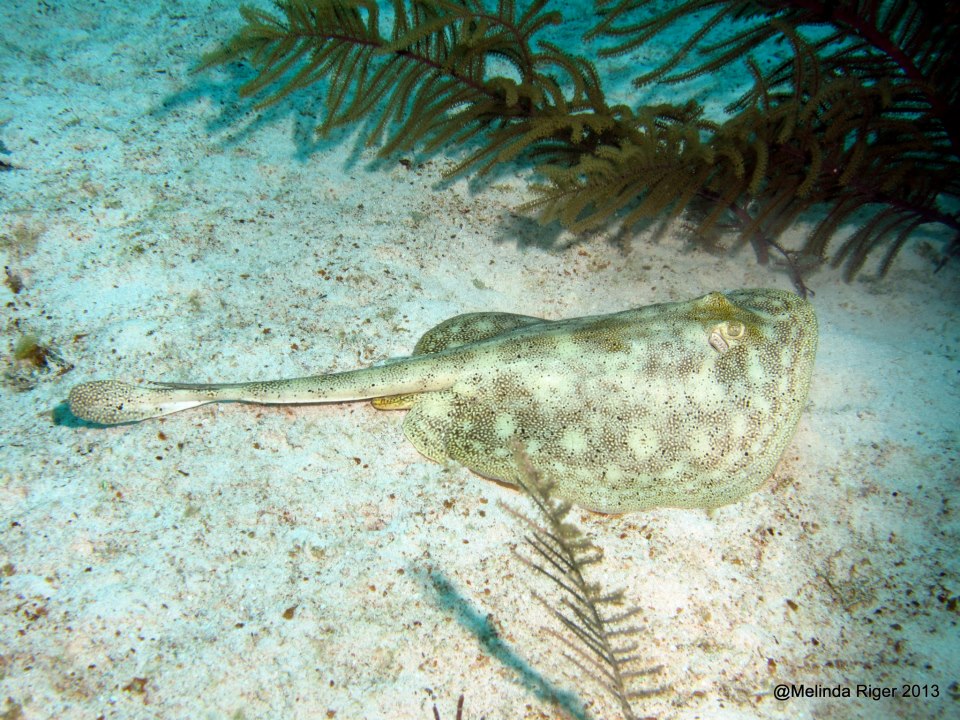
The YELLOW STINGRAY (Uboratis jamaicensis) is one of several ray species found in the tropical western Atlantic ocean. They live  in shallow water on sandy or seagrass bottoms, and are commonly found near coral reefs. Their light and dark splotchy colouring can rapidly change according to the surroundings and the need for camouflage. Look at the photos below with half-closed eyes and (apart from knowing perfectly well that there’s a ray there), the blending in is remarkable.

The yellow stingray feeds on small invertebrates and fishes. It can use its ‘wings’ to uncover buried / hiding prey by disturbing the sand. It also has a subtle ‘passive’ method of hunting by using its mantle to form a lethal ‘cave’ that attracts shelter- or shade-seeking prey.Yellow Stingray ©Melinda Riger GB Scuba Bahamas

Yellow stingrays breed in seagrass. They are quite prolific, breeding year round and usually having two litters a year of up to 7 young. This species is ‘aplacental viviparous’: the developing embryos are sustained initially by yolk and later by uterine milk. To find out more about viviparity, you’ll find a section at the bottom of this post where the inquiring may opt in… Not everyone’s sac of yolk, I quite understand.

The yellow stingray is innocuous towards humans, but can inflict a painful injury with its venomous tail spine. The threats to the species are (1) taking as bycatch by commercial fisheries;  (2) collection for the aquarium trade; (3) negative impact from habitat degradation, both of reef areas and seagrass breeding grounds. For now, it remains common and widespread and retains its IUCN LISTING of ‘Least Concern’.Yellow Stingray

REPRODUCTIVE STRATEGIES (Marine Biodiversity, Canada)

As with all elasmobranchs, skate and rays are internal fertilizers.  Internal fertilization is beneficial because it increases the likelihood and efficiency of fertilization by reducing sperm wastage.  In addition, it ensures that the energy-rich eggs produced by the female are not consumed by predators, and that all the energy allocated to reproduction is passed to the embryos and not lost to the environment.  This is especially the case for species that retain their embryos until the embryos have completely developed, a reproductive mode termed viviparity.  Elasmobranches that practice viviparity are called viviparous (or live-bearing).  There are many types of viviparity, which can be divided into two broad categories: aplacental and placental viviparity. Placental viviparity is the most advanced mode of reproduction, during which the embryos are initially dependent on stored yolk but are later nourished directly by the mother through a placental connection.  This type of reproduction is not exhibited by any type of batoid.  Ovoviviparity (or aplacental viviparity), on the other hand, is the only mode of reproduction employed by rays.  In rays, the embryos rely on the substantial yolk within the ovulated egg only during the initial stages of development. After the nutrients stored in the egg have been consumed, the embryo ingests or absorbs an organically rich histotroph (or “uterine milk”) produced by the mother and secreted into uterus.  The most highly developed of these strategies occurs in some rays in which the lining of the uterus forms tiny, finger-like projections (termed trophonemata) that increase the surface area for histotroph secretion.  This form of nutrient supply (or maternal investment) results in very large offspring, which is characteristic of most species of ray.

For those now fluent in viviparity, the treat of one of Melinda Riger’s fabulous aquatic close-up photos –  keeping a close eye on you…Up close of the eye of a yellow stingrayCredits: Melinda Riger of Grand Bahama Scuba, with thanks; Wiki for other images / source material; selected online pickings

Unknown's avatar

SHARK FINS – OOOP! A MODEL USE OF HUMOUR TO CONVEY ASERIOUS MESSAGE (VIDEO)


306092_500604003294327_1470960886_n

SHARK FINS – OOOP! A MODEL USE OF HUMOUR
TO CONVEY A SERIOUS MESSAGE
(VIDEO)

The CAPE ELEUTHERA FOUNDATION has produced a short video about sharks and shark fins that manages to be both amusing and to carry a powerful conservation message. It’s a hard trick to pull off successfully. Attempts to use humour to leaven a serious message or to modify earnestness in presentation so often trespass into the no-man’s land known as ‘Meh’ (twinned with ‘Wotevah’). I’m grateful to the always-interesting ABACO SCIENTIST for sharing this item. Photo credit: Melinda Riger, with thanks for use permission [I am posting this from NYC via iPhone, so any weird formatting or typos will have to be dealt with next week]

Unknown's avatar

GRAY ANGELFISH (Pomacanthus arcuatus) BAHAMAS REEF FISH (3)


Gray_angelfish
Gray Angelfish

GRAY ANGELFISH (Pomacanthus arcuatus) BAHAMAS REEF FISH (3)

I recently posted about the highly coloured QUEEN ANGELFISH, a striking coral reef resident glowing with fluorescent blues and yellows. It’s the Angelfish that went into showbiz and succeeded. Its close cousin the Gray Angelfish is a more sedate creature, with the appearance of a professional – law, possibly, or medicine. That thin blue fin-edging suggests a flamboyant streak. Slightly mean mouth? Lawyer.**Gray Angelfish ©Melinda Riger GB Scuba

This species is found in the warm waters of Florida, and south through the Bahamas and Caribbean as far as Brazil. They are found at depths from 2 m. down to 30 m. You are most likely to encounter one on a coral reef feeding on sponges, its main diet.  The fish below with the bluer face is a teenager, in transition between juvenile and adult. Gray Angelfish between juvenile and adult phase

It’s clear from side on that Gray Angelfish are ‘upright flat’, but it’s surprising just how slim they actually are. Photographer Melinda Riger has captured this front view against a stunning red backdrop. Disappointingly, these fish seem to lead blameless and anodyne lives as reef-foragers, and I’ve been unable to turn up a single interesting fact about them. That’s lawyers for you.**Gray Angelfish (front view) ©Melinda RigerGray Angelfish ©Melinda Riga @ BP ScubaPhoto Credits: main images ©Melinda Riger, Grand Bahama Scuba; Header – Wikipix

[youtube http://youtu.be/QETF9UWeXFk]

** I can say this – I am one…