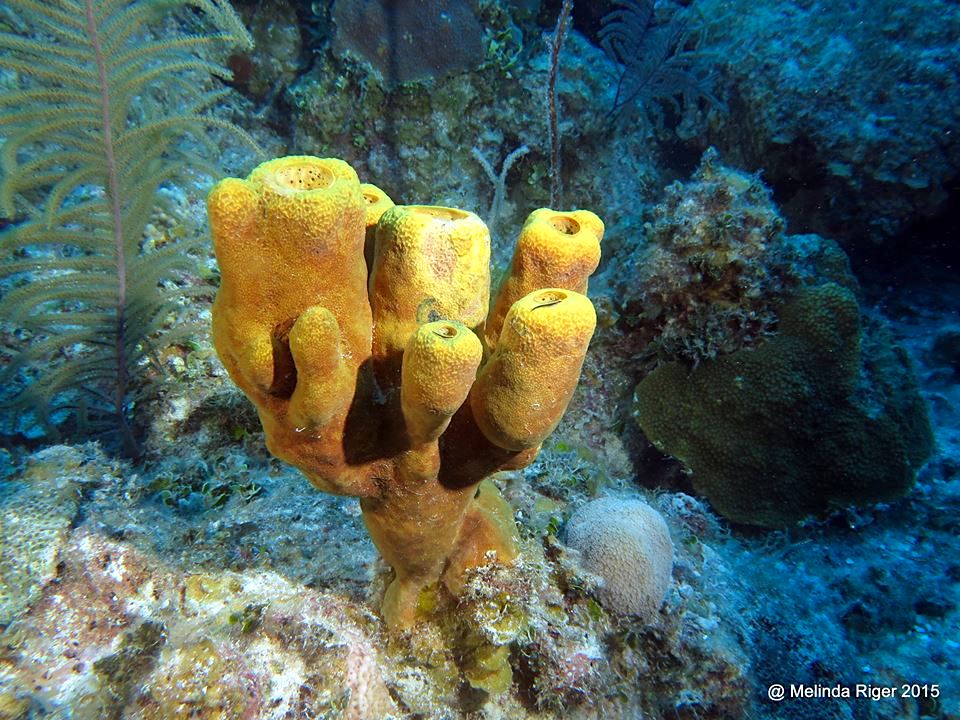
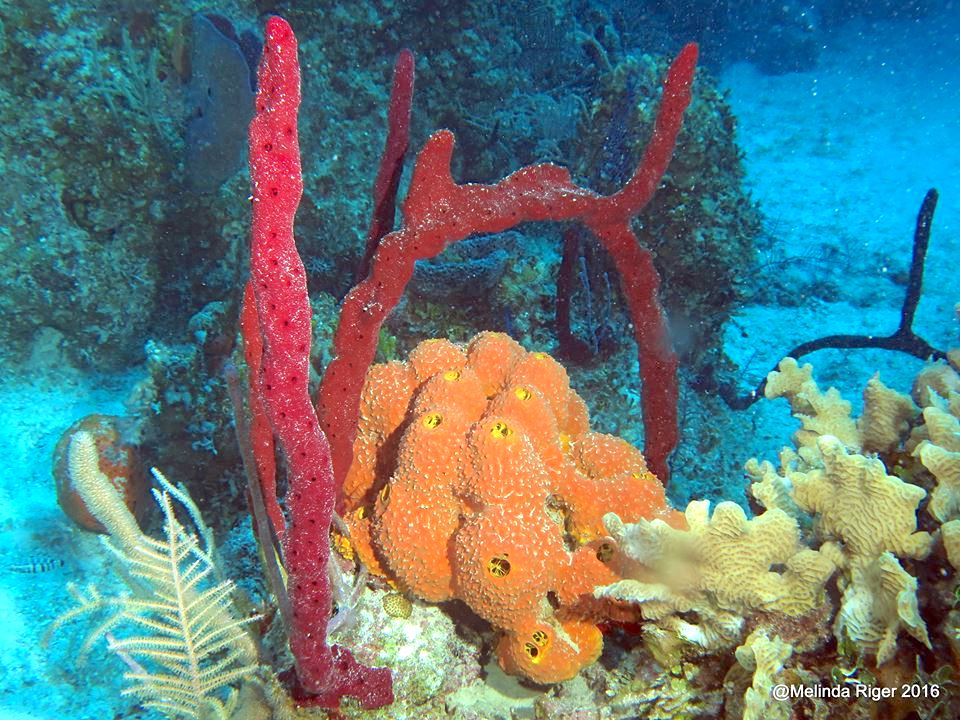
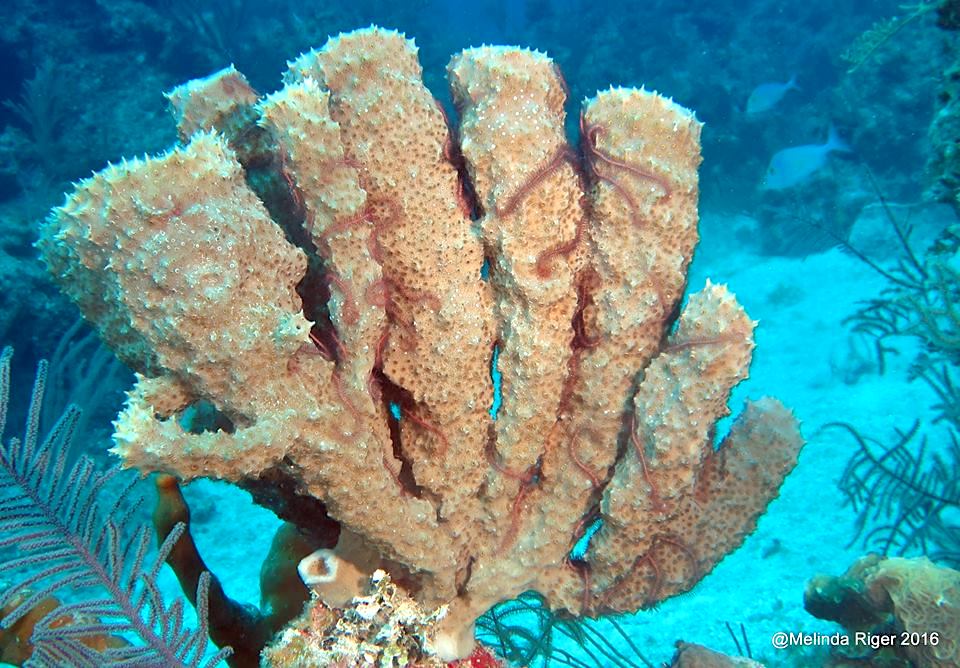
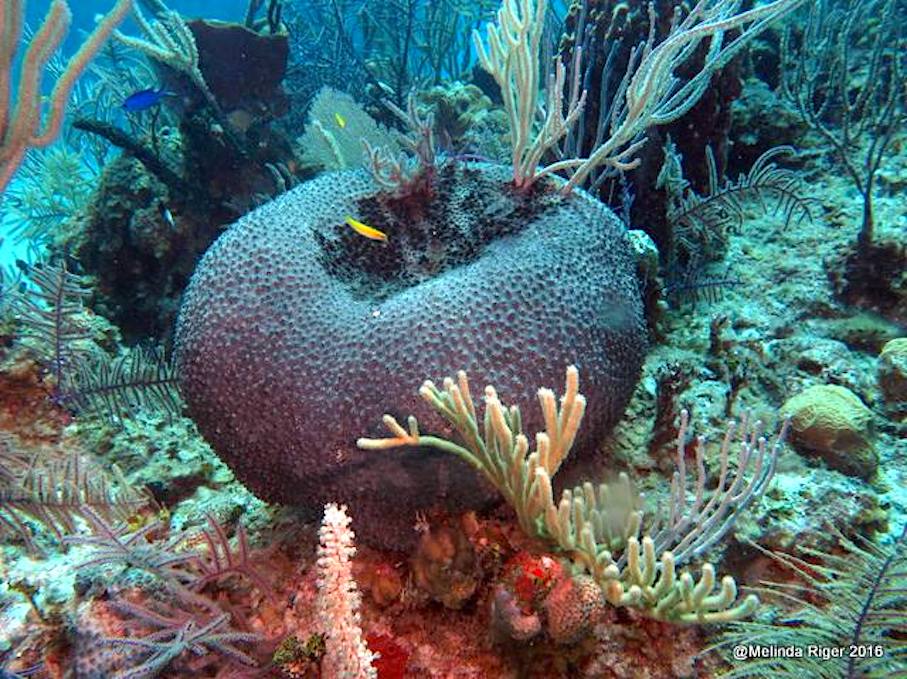
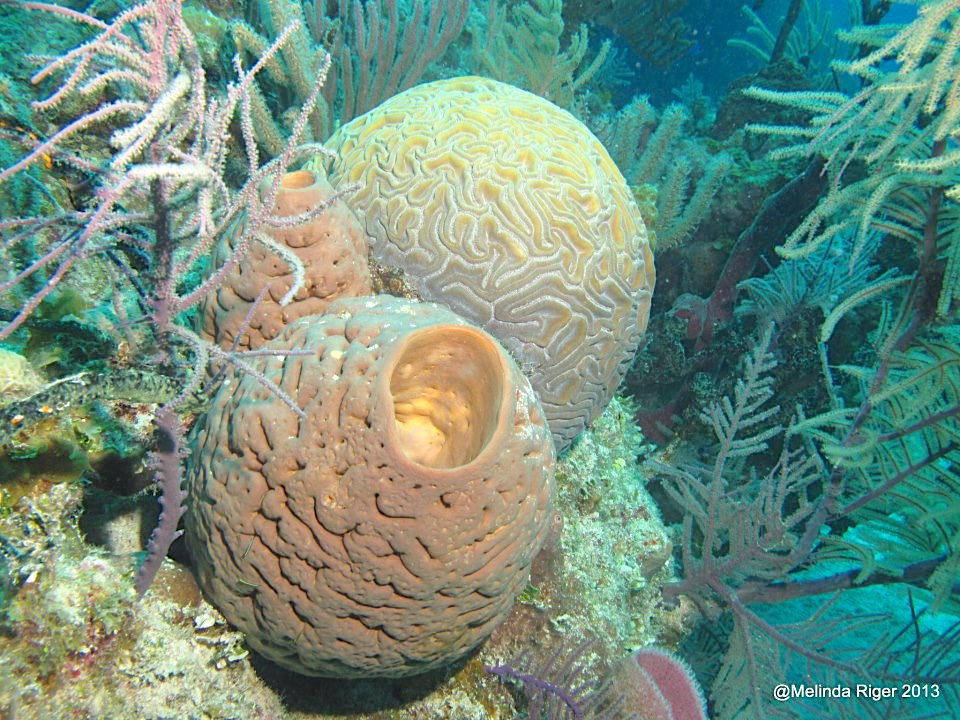
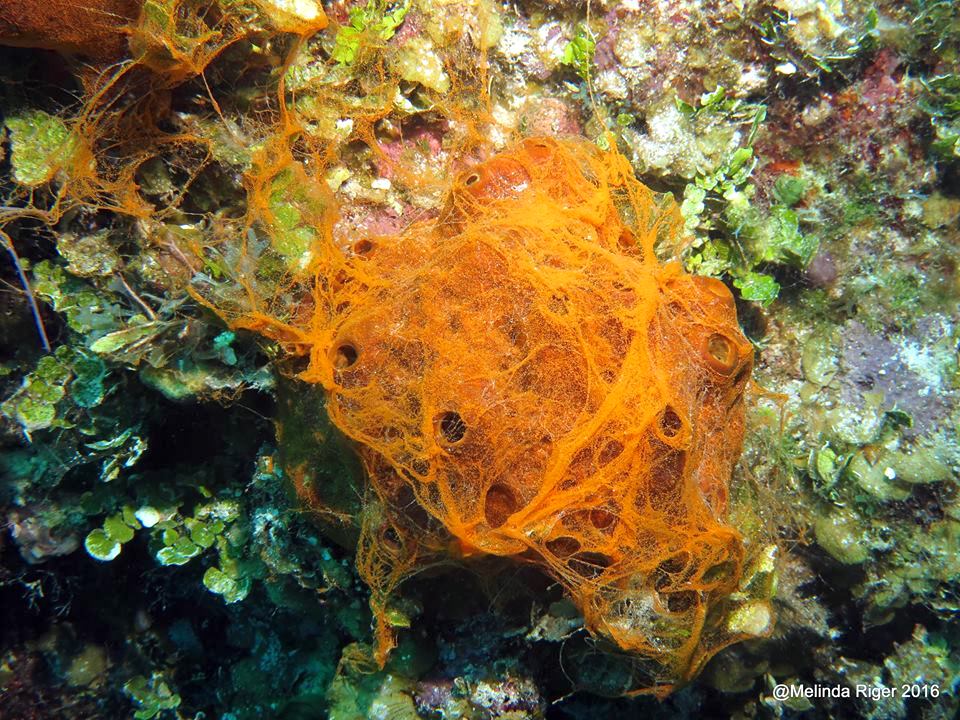
It is a rather special and indeed specialist day today: it is #spongethursday, a component of the 11th World Sponge Conference (I’d add the logo, but it closely resembles a pink Covid symbol). Poriferaphiles everywhere should be celebrating these beautiful creatures today. Here are some gorgeous examples. Now you know why sponges deserve a day of their own.
Candelabra Songe (with brittle stars attached)
Black Ball Sponges
One for Valentine’s Day
Vase Sponges
Spawning Brown Encrusting Sponge
All photos: Melinda Riger, Grand Bahama Scuba – with thanks as ever
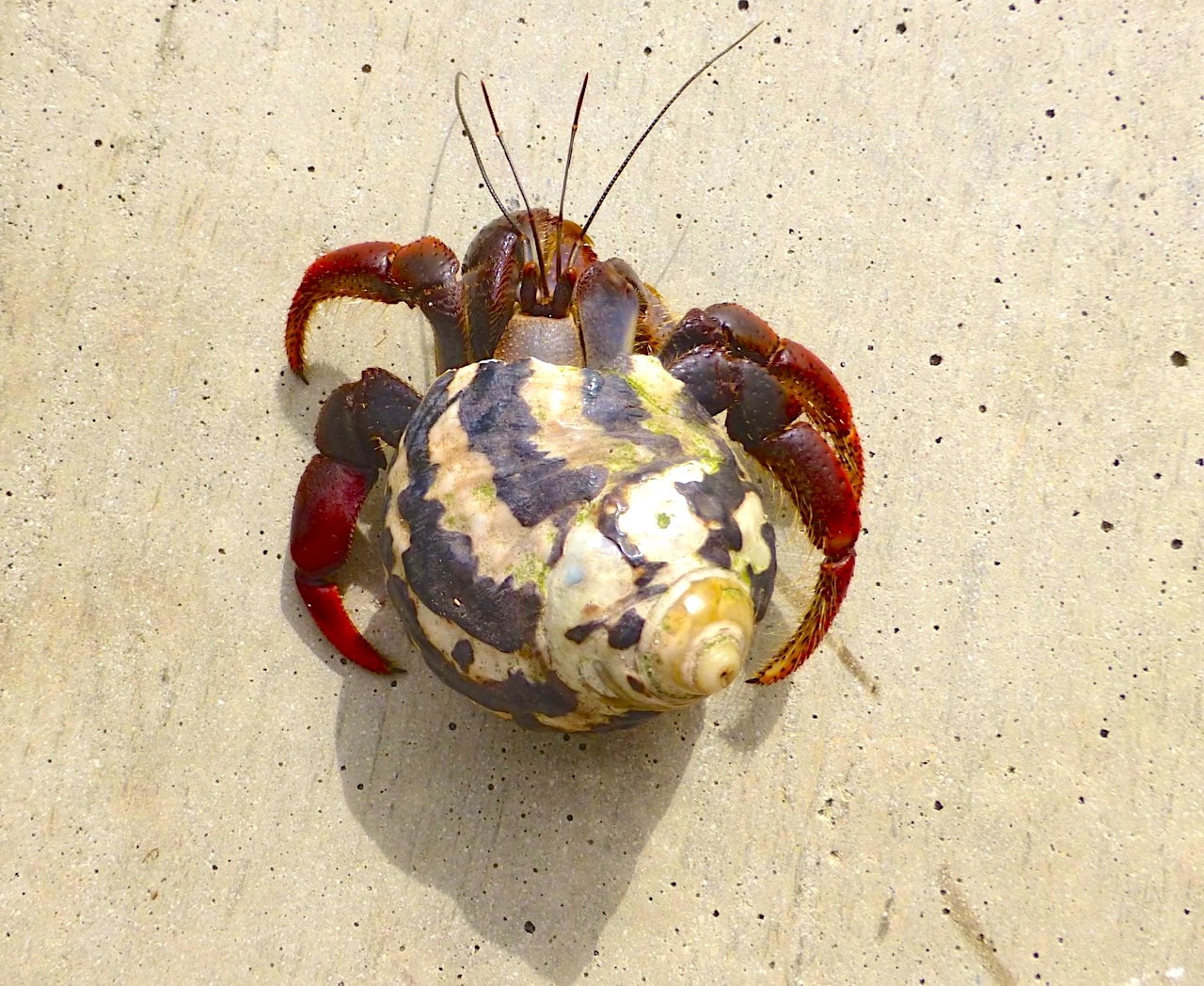
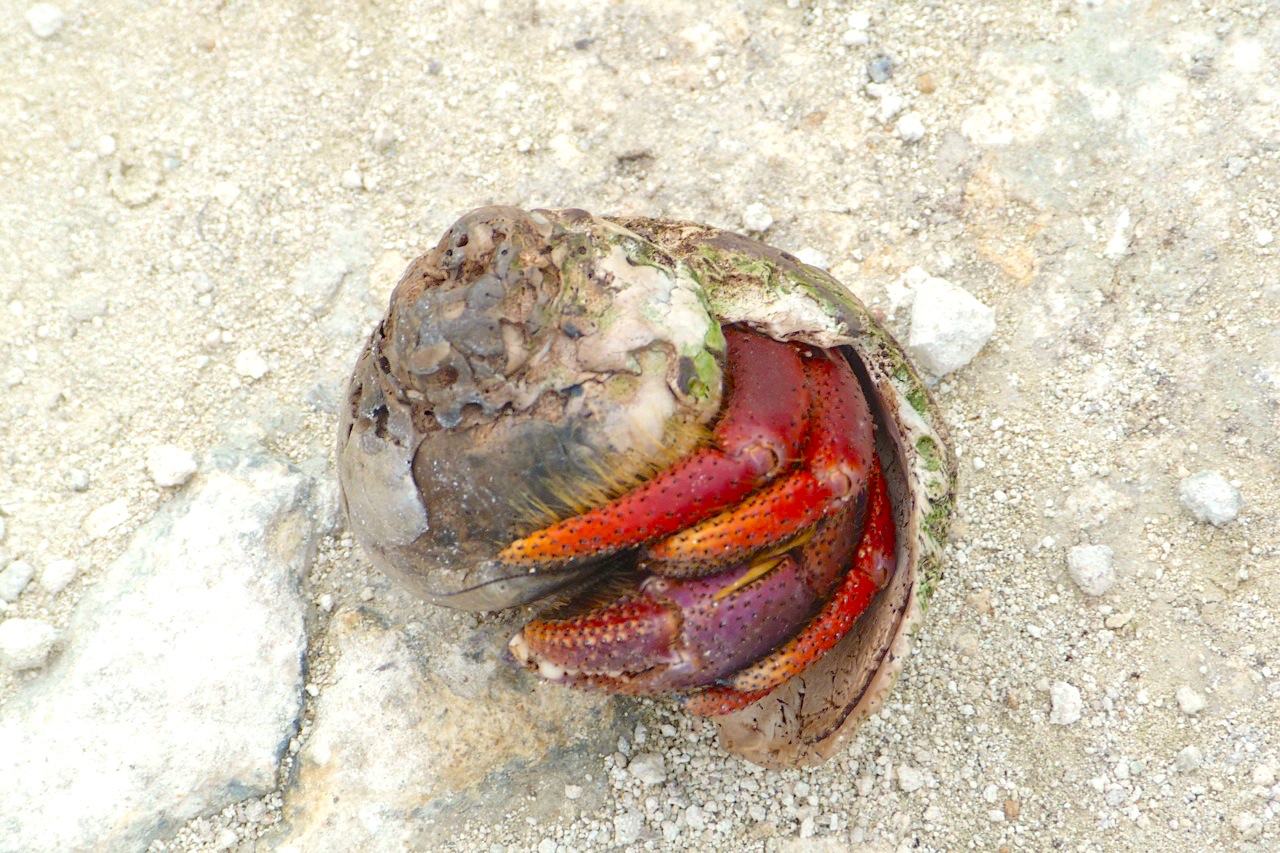
As everyone knows, Hermit Crabs get their name from the fact that from an early age they borrow empty seashells to live in. As they grow they trade up to a bigger one, leaving their previous home for a smaller crab to move into. It’s a benign** chain of recycling that the original gastropod occupant would no doubt approve of, were it still alive… The crabs are able to adapt their flexible bodies to their chosen shell. Mostly they are to be found in weathered (‘heritage’) rather than newly-empty shells for their home. [**except for fighting over shells]
HERMIT CRAB FACTS TO ENLIVEN YOUR CONVERSATION
The crabs are mainly terrestrial, and make their homes in empty gastropod shells
Their bodies are soft, making them vulnerable to predation and heat.
They are basically naked – the shells protect their bodies & conceal them from predators
In that way they differ from other crab species that have hard ‘calcified’ shells / carapaces
Ideally the shell should be the right size to retract into completely, with no bits on display
As they grow larger, they have to move into larger and larger shells to hide in
As the video below shows wonderfully, they may form queues and upsize in turns
Occasionally they make a housing mistake and chose a different home, eg a small tin
The crabs may congregate in large groups which scatter rapidly when they sense danger
The demand for suitable shells can be competitive and the cause of inter-crab battles
Sometimes two or more will gang up on a rival to prevent its move to a particular shell
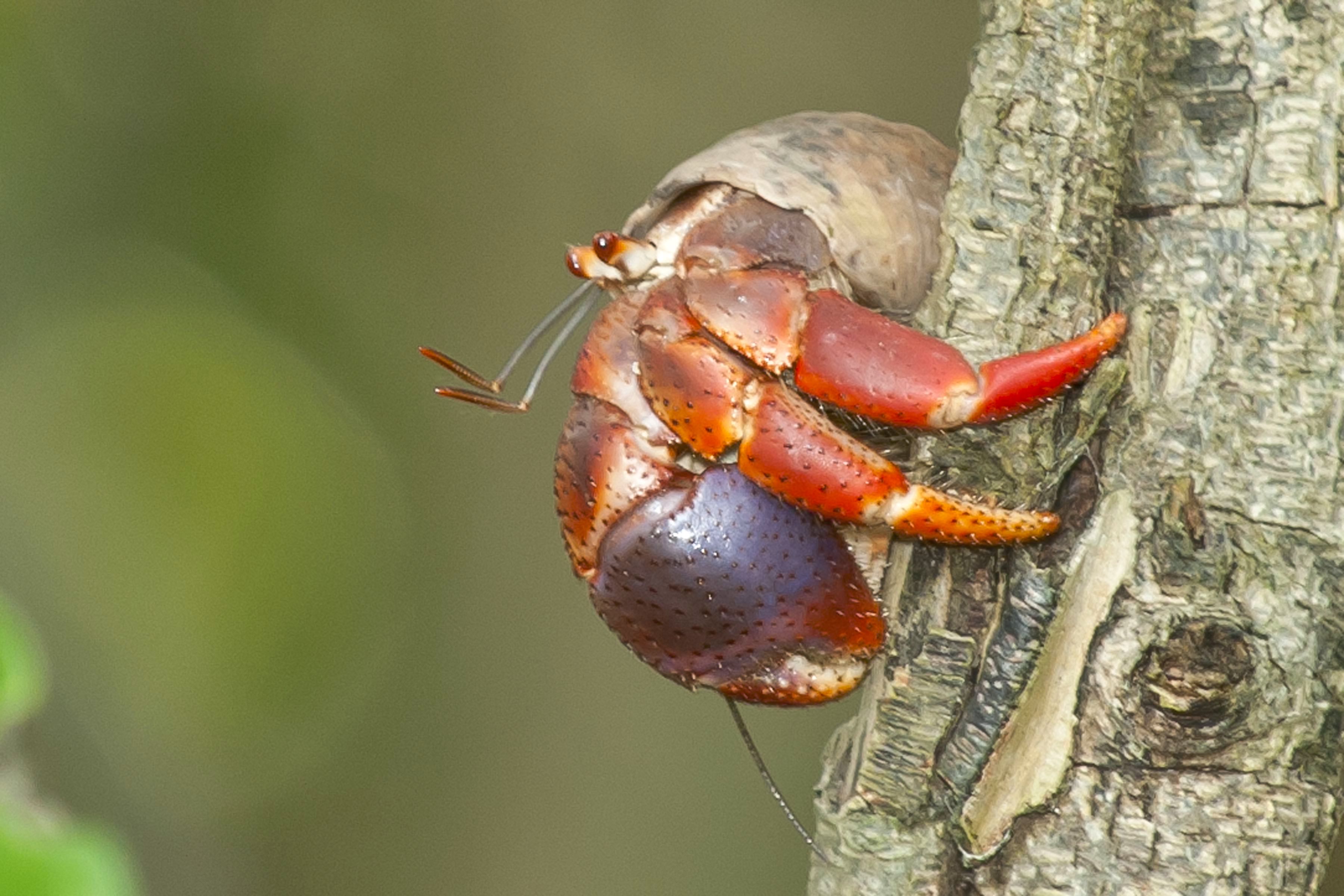
HERMIT CRABS CAN EVEN CLIMB TREES – WITH THEIR SHELLS ON TOO
HERMIT CRABS EXCHANGING HOMES with DAVID ATTENBOROUGH
This is a short (c 4 mins) extract from BBC Earth, with David Attenborough explaining about the lives and habits of these little crabs with his usual authoritative care and precision . If you have the time I highly recommend taking a look.
Credits: All photos taken on Abaco by Keith Salvesen except for the tree-climber crab photographed by Tom Sheley; video from BBC Earth
The Cookiecutter shark Isistius brasiliensis (aka the less scary, more genial sounding ‘cigar shark’), might be an ideal candidate for a Room 101 nemesis.** These little beasts – a species of dogfish shark – are found in several mainly island-based areas dotted around the globe, including in Bahamas waters.
HOW COME THE NAME?
These sharky little b@st@rds (*scientific term*) attack marine mammals and fishes, attaching themselves by suction and gouging out perfect round plugs of skin and flesh, leaving what are sometimes called ‘crater wounds’. Then they eat them. Imagine getting hold of a really sharp domestic cookie cutter with circular rows of razor-sharp teeth, and grinding it hard into your thigh. There! That!
The size of an adult shark:16″ max
The term ‘cookiecutter’ is also a pejorative slang term, meaning mass-produced, lacking in originality, or boringly samey, as in cookiecutter cars or TV genres etc. The little critters under consideration here are anything but…
HORRIFYING COOKIECUTTER FACTS
Live in the depths, rise vertically in the day & dive back down at dusk
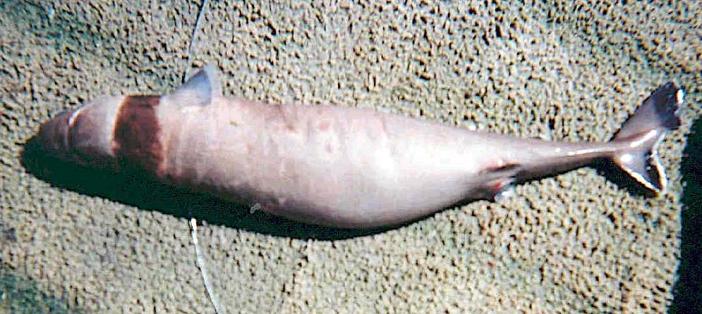
Undersides have light-emitting ‘photophores’ which emphasise…
…the dark collar which acts as a lure, resembling a small innocent fish
Bioluminescence lures prey & confuses predators (more on this below)
The glow is so strong it may last for some time after removal from water
Their lips are ‘suctorial’ = they attach tightly to their target
The jaws then gouge out the victim’s flesh in a remarkably neat circle
Omni-vicious: any medium to large ocean creature is vulnerable to attack
There are even occasional reports of humans being targeted
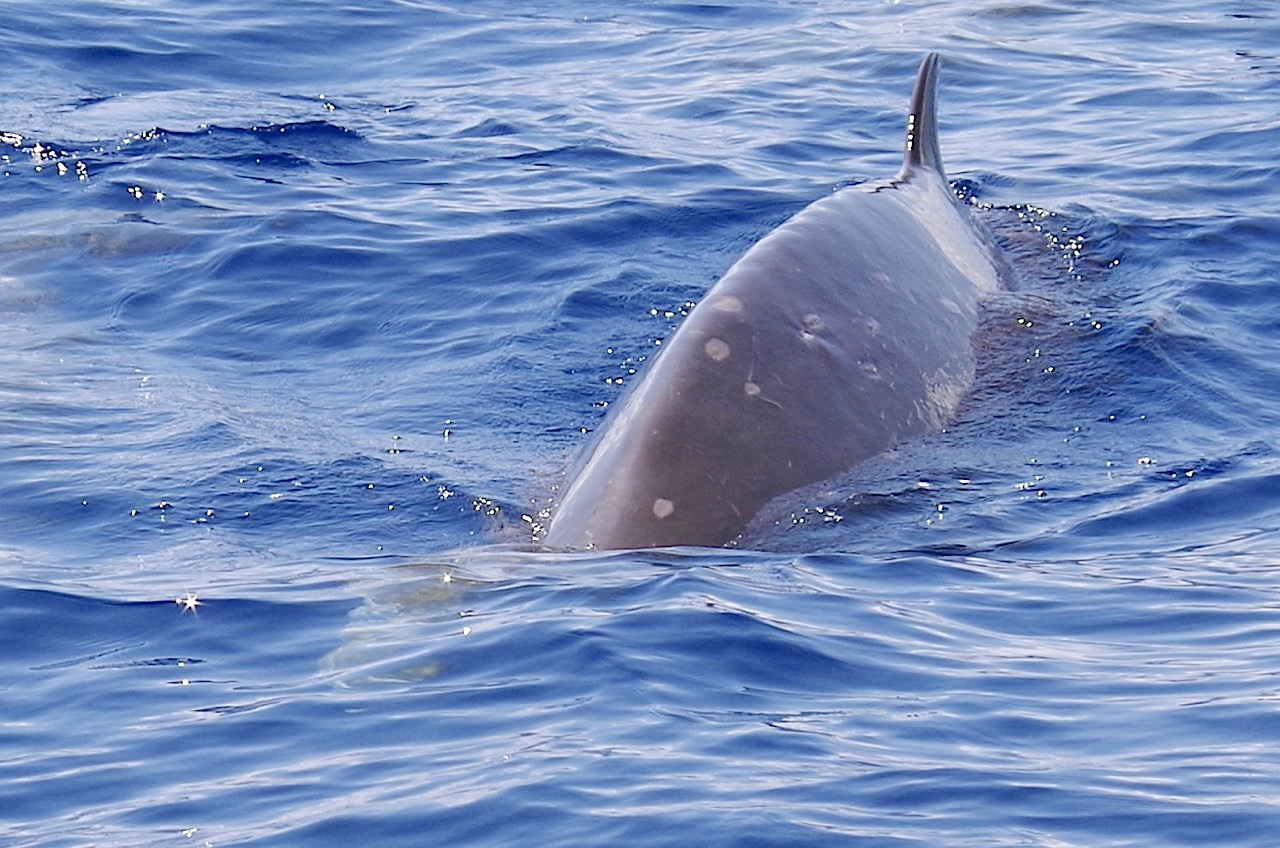
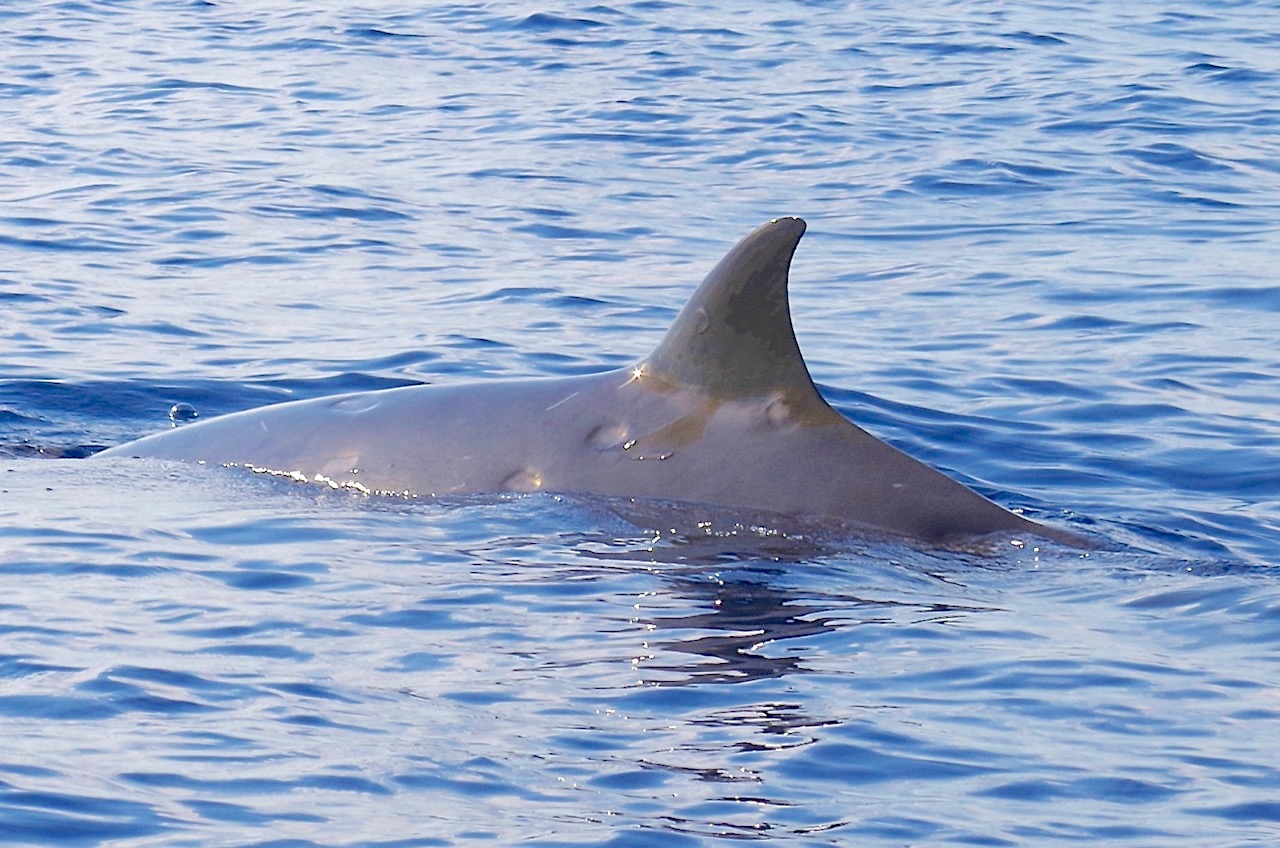
Here are two Blainville’s beaked whales that I photographed from the BMMRO research vessel. The top whale has a number of circular healed attack marks and a recent one. You can see how deep the gouged hole is. The other has well-healed scars.
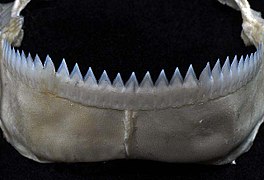
Multi-toothed: top rows of small teeth, rows of larger teeth on the bottom
The lower teeth are the cutters, acting like a saw when locked on
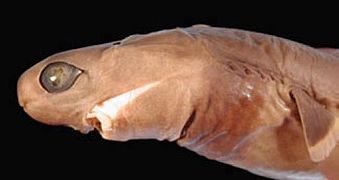
See header image and below for full details
HOW EXACTLY DO THEY DO WHAT THEY DO?
I can explain it no better than the renowned authority Prof. W. K. P. Dear: “the suctorial lips ensure a tight seal. It then bites, using its narrow upper teeth as anchors while its razor sharp lower teeth slices into the prey. Finally, the shark twists and rotates its body to complete a circular cut, quite possibly aided by the initial forward momentum and subsequent struggles of its prey. The action of the lower teeth may also be assisted by back-and-forth vibrations of the jaw, a mechanism akin to that of an electric carving knife”.
ARE THESE SHARKS ‘PARASITES’, WOULD YOU SAY?
The behaviour of these sharks is an example of a symbiotic relationship between two species that is parasitic. This means essentially that one gains and the other suffers (eg humans & no-see-ums). This is distinct from commensalistic symbiosis, where one species gains and the other is unaffected (e.g. cattle egrets with cattle); and mutualistic symbiosis, where both gain (e.g. cleaner fish & groupers). So, in a word, yes.
An ‘ambush predator’: these little sharks ‘hover’ in the water column waiting…
They are capable of rapid movement to catch up & latch onto prey
They will eat a passing small fish, crustacean or even squid as a snack
Sometimes they operate in schools; there is safety in numbers
The schools are thought to increase the ‘lure’ effect of the dark collar
A beached whale that’s been heavily targeted
FUN FACT TO COUNTERACT THE BAD STUFF
In the late c20, more than 30 U.S. Navy submarines were forced back to base to repair damage caused by cookiecutter shark bites, either to the neoprene footings of sonar domes or to rubber-sheathed cables. The problems were solved by using fibreglass. Oceanographic equipment and telecommunications cables are also recorded as being damaged by these sharks.
Cookiecutter Shark – the real deal
MONSTERS OF THE DEEP
These great cards from the weirdly spelledWIERD ‘N’ WILD CREATURESprovide excellent factual info. Their CCS card is no exception. You’ll find more details here about the effect of the bioluminescence and so on, written as clearly as I might hope to.
**“The worst thing in the world varies from individual to individual. It may be burial alive or death by fire, or by drowning, or by impalement, or fifty other deaths. There are cases where it is some quite trivial thing, not even fatal.” (George Orwell, 1984). Being in a tank with some cookiecutters might count.
Alright now… the wounds eventually heal
Credits: BMMRO – header image; beaked whale photos – Keith Salvesen / BMMRO; Te Ara NZ for the main jaw image; all small images with thanks to Wiki and respective photographers who took the time to upload them for all to enjoy & learn from; ‘wierdnwonderful creatures’ for the monster card; range map from Wiki
I am re-posting this sea fan article as 2021 rolls over into 2022 with much the same disruption, anxiety, and (for many) grief that we were all facing a year ago. The converse and somewhat rhapsodic title reflects the experience of many people since Covid engulfed the world. Life has become simultaneously real and surreal. It continues in many respects as normal yet who would have guessed that as we entered a new decade in 2020, the face mask would quickly become an essential (or anyway a medically recommended) part of daily life and remain so?
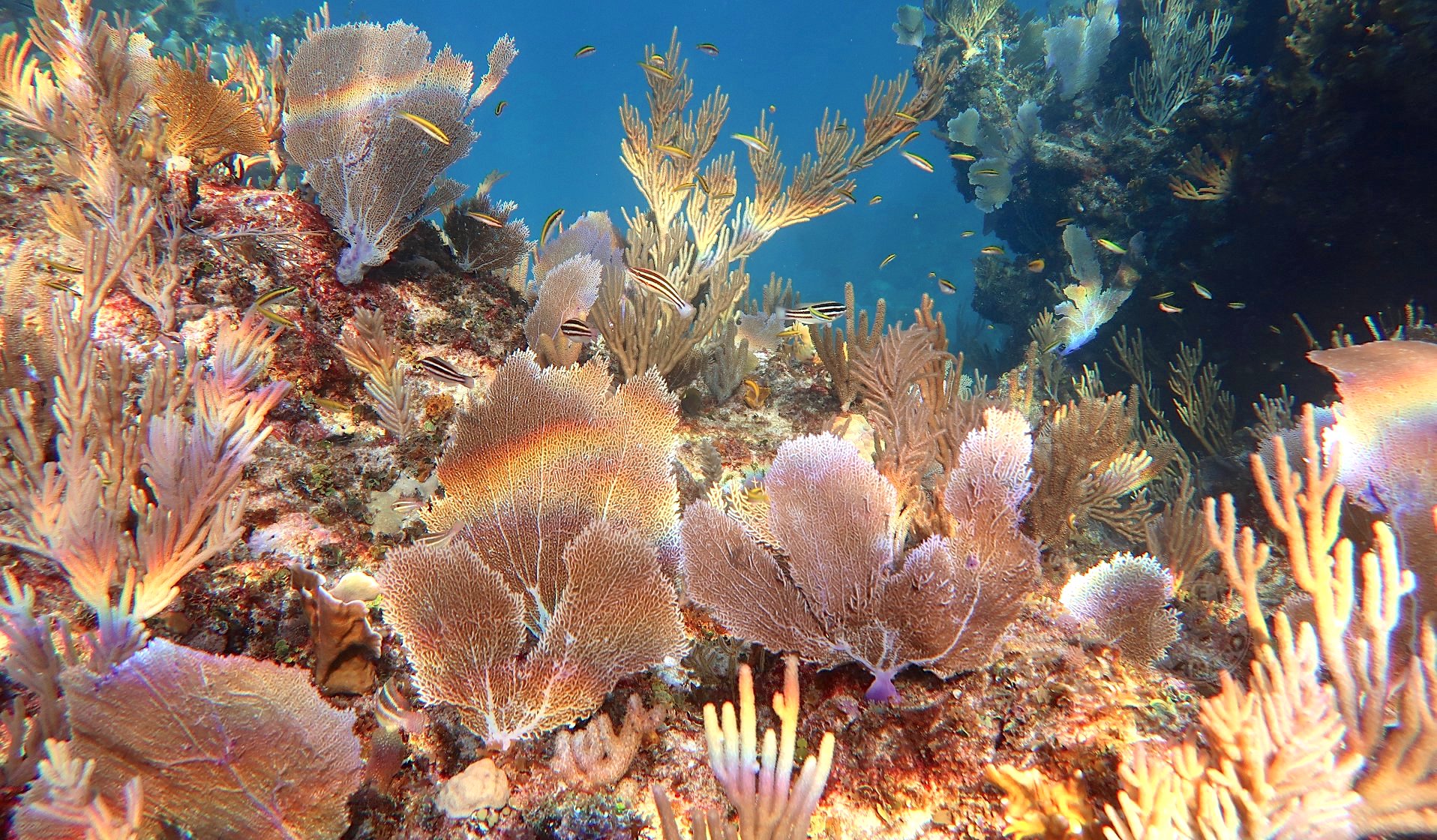
This post was written at a time of sunshine, normality and optimism, before Covid and even before the violent destructive force of Dorian in autumn 2019. Here’s some cheer from sea fans on the coral reefs of the Bahamas.
GALLERY OF GORGONIANS
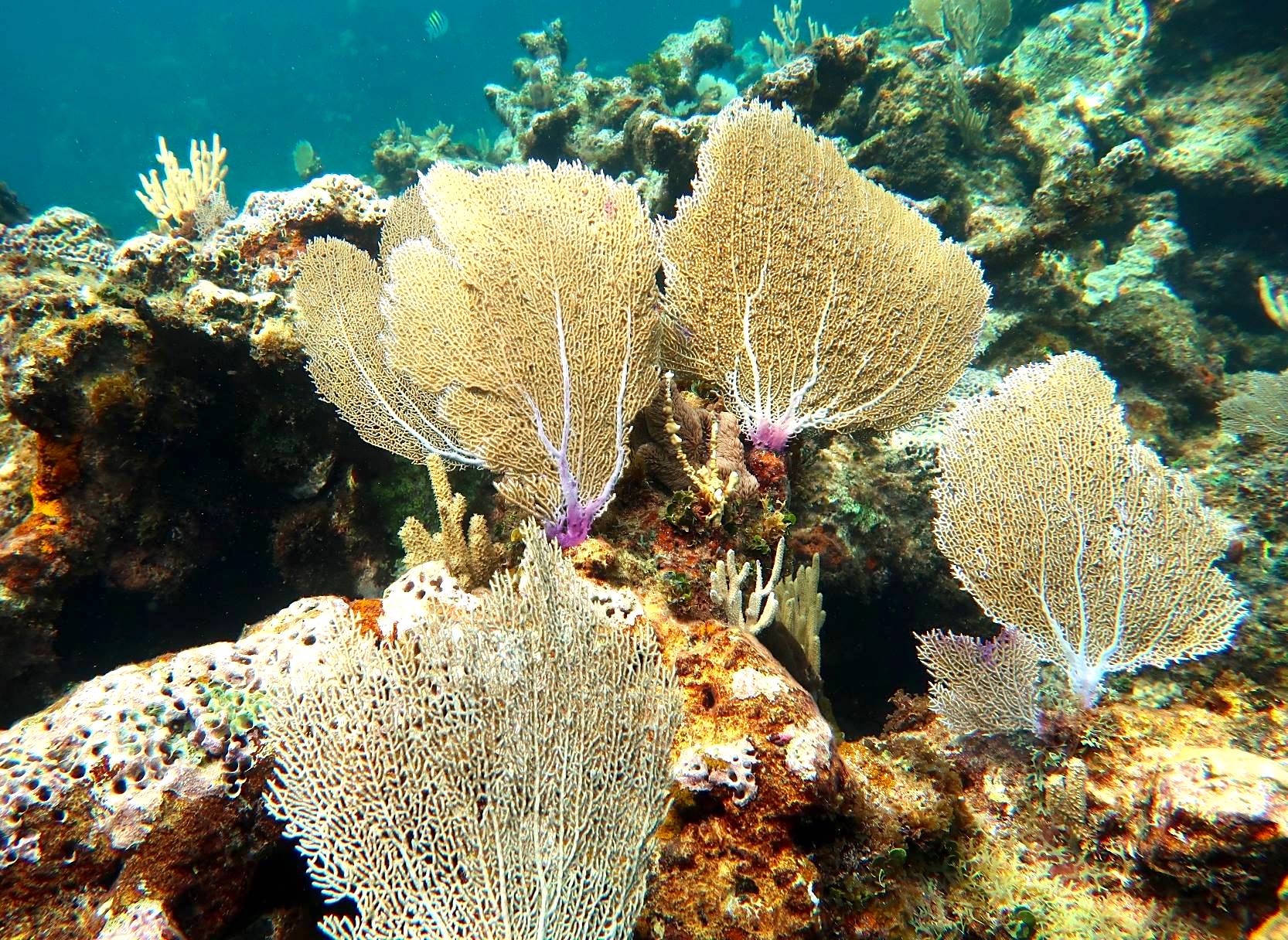
The waters of Abaco teem with myriads of fish that depend on the coral reefs for shelter and safety, for breeding, for growing up in, and for nourishment. Sea fans (or gorgonians, to use the technical name) are animals too. They may look like plants and stay rooted to the spot, but like anemones these ‘soft corals’ are creatures of the reef and essential indicators of its health.
The purple sea fan Gorgonia ventalina (classified by Linnaeus in 1785) is one of the most common species of sea fan, and a spectacular one at that. The main branches are linked by a lattice of smaller branches. Below the ‘skin’ is a skeleton made of calcite compounded with a form of collagen.
Sea fans are filter-feeders, and have polyps with eight tiny tentacles that catch plankton as it drifts past. They develop so that their orientation is across the prevailing current. This maximises the water passing by and consequently the supply of food as the fans gently wave in the flow.
Gorgonians have a chemical defence mechanism that protects against potential troublemakers. The main effect is to make themselves unpleasant to nibble or uproot.
One benefit of sea fans to mankind is that their defensive chemicals have been discovered to provide the basis for drug research and development, specifically in the field of anti-inflammatories. Another benefit, of course, is that they are very beautiful to look at. And in bad times, that can only be good .
Credits: these wonderful photos were taken by Melinda & Keith Rodgers / Dive Abaco, Marsh Harbour; and Melinda & Fred Riger / Grand Bahama Scuba. Huge thanks to them all for allowing me to freely use their skilful underwater photography in this blog for the best part of a decade.
Recent weather conditions have mostly been perfect for launching the new BMMRO boat and continuing with ongoing marine mammal research. The field work at the moment is one aspect of the ‘Saving Abaco’s Dolphins after Hurricane Dorian’ project.
Acoustic research involves deploying specialised recorders to monitor sub-surface noise levels such as ship-generated sound. This helps to determine the effects of underwater noise pollution on marine mammals. Areas of concern can be identified and monitored. Naturally the dolphins take a keen interest as well, and there is plenty of opportunity to enjoy their company out on the water.
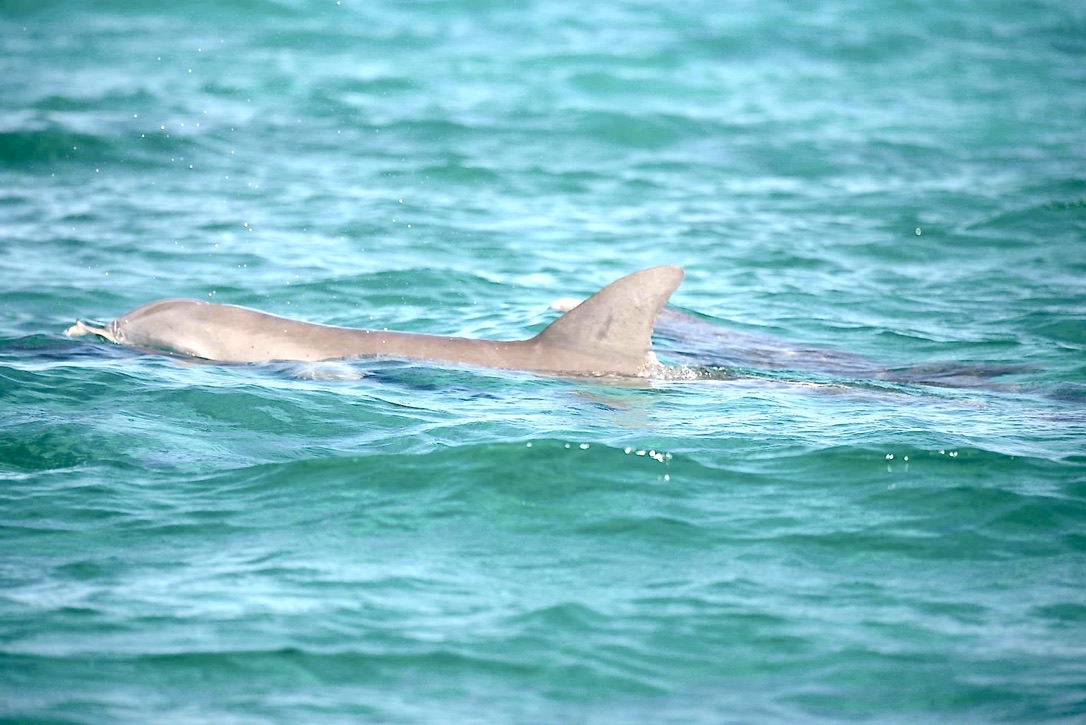
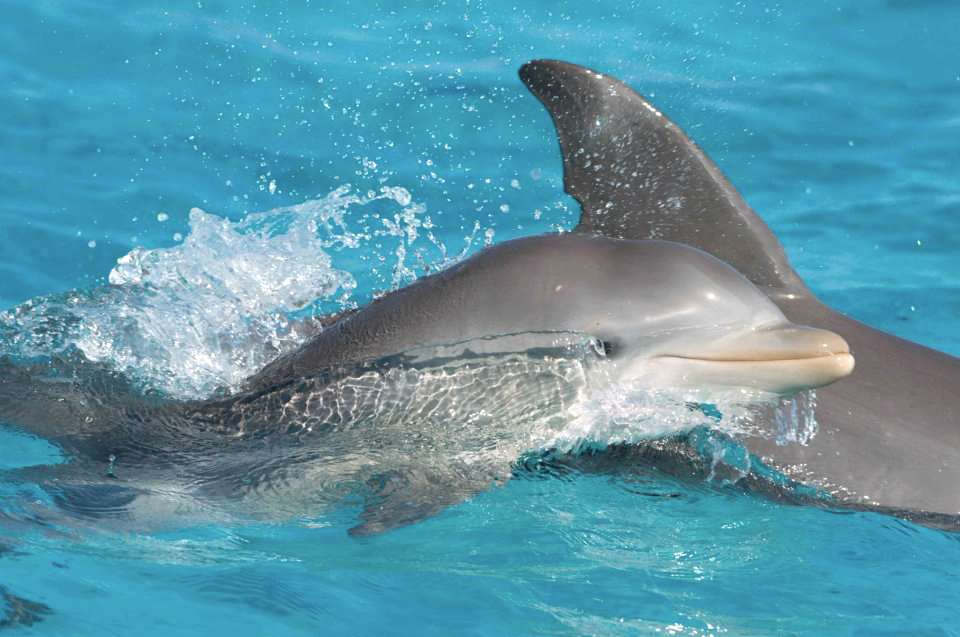
More general research includes compiling intricate records of dolphins encountered, noting specific characteristics. The dorsal fin is generally the most helpful ID marker, as they are all different – especially when there is some wear and tear to go by.
BMMRO records for dolphins go back a long way, and often involve two or more generations of the same family. Amazingly, during the last few days, a dolphin was encountered whose mother was first seen as a calf in 1992…
BMMRO are hosting a meeting in Hope Town to explain recent work and its results
BMMRO intern Jaylen gets to admire dolphins at close quarters in the Sea of Abaco
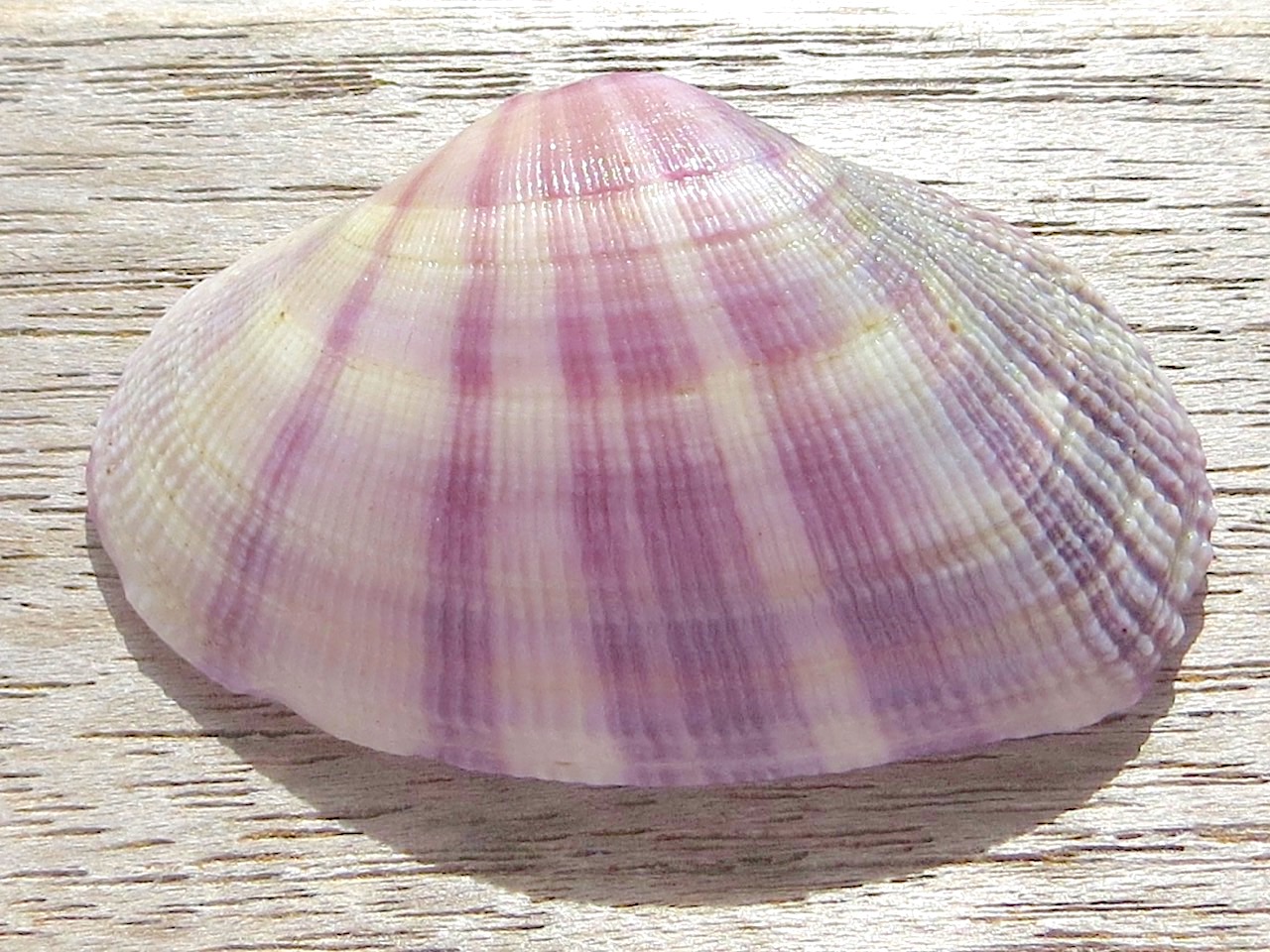
These very pretty shells, with their striking pink radials, are sometimes known as ‘rose-petal shells’. They are always tempting to pick up from the sand. The ‘hinges’ (muscles) are very delicate, however, and with many of these shells that wash up on the beach the two halves have separated naturally.
Sunrise tellins are not uncommon, and make good beachcombing trophies They can grow up to about 7 cms / 2.75 inches, and the colouring is very varied, both outside and inside.
TELLIN: THE TRUTH
The occupant of these nice shells is a type of very small clam. They live on the sea-floor, often buried in the sand and with the lid (mostly) shut. When they die (or their shells are bored into by a predator and they are eaten) the shells eventually wash up empty on the beach. There’s not much more to say about them – they perform no tricks and are believed to have vanilla sex lives. Other small clams are quite inventive, doing backflips and copulating with enthusiasm.
Inside Story… not much to tell except (a) very pretty & (b) possible predator bore-hole top right
WHAT ELSE IS THERE TO KNOW ABOUT THEM?
These clamlets have 5 tiny teeth to chew up their staple diet, mainly plant material
These include one ‘strong’ tooth and one ‘weak’ one, though it isn’t clear why. How someone found this fact out remains a mystery
Tellins are native to the Caribbean and north as far as Florida
They live mainly in quite shallow water, but have been found as deep as 60 foot
They have no particular rarity value, and are used for marine-based crafting.
TELLIN LAW
You know those lovely tellins you collected during your holiday and took back home to your loved ones? You did take them, didn’t you? You may have committed a crime! In the Bahamas there is no specific prohibition on the removal of tellin shells, certainly not for personal use… but the general rule – law, even – seems to be “in most countries it is illegal to bring back these shells from holidays”.
Linnaean Examples
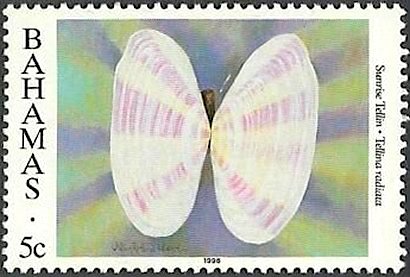
As ever, the very excellent Bahamas Philatelic Bureau has covered seashells along with all the other wildlife / natural history stamp sets they have produced regularly over the years. The sunrise tellin was featured in 1995. You can find more – much more – on myPHILATELYpage.
All photos Keith Salvesen / Rolling Harbour; Rhonda Pearce, O/S Linnean Poster, O/S BPB stamp
FLAMINGO TONGUE SNAILS Cyphoma gibbous are small marine gastropod molluscs related to cowries. The living animal is brightly coloured and strikingly patterned, but that colour only exists in the ‘live’ parts – the so-called ‘mantle’. The shell itself is usually pale, and characterised by a thick ridge round the middle. These snails live in the tropical waters of the Caribbean and the wider western Atlantic. Whether alive or dead, they are gratifyingly easy to identify.
THE IMPORTANCE OF CORAL
Flamingo tongue snails feed by browsing on soft corals. Often, they will leave tracks behind them on the coral stems as they forage (see image below). But corals are not only food – they provide the ideal sites for the creature’s breeding cycle.
Adult females attach eggs to coral which they have recently fed upon. About 10 days later, the larvae hatch. They eventually settle onto other gorgonian corals such as Sea Fans. Juveniles tend to live on the underside of coral branches, while adults are far more visible and mobile. Where the snail leaves a feeding scar, the corals can regrow the polyps, and therefore the snail’s feeding preference is generally not harmful to the coral.
The principal purpose of the patterned mantle of tissue over the shell is to act as the creature’s breathing apparatus. The tissue absorbs oxygen and releases carbon dioxide. As it has been (unkindly?) described, the mantle is “basically their lungs, stretched out over their rather boring-looking shell”.
THREATS AND DEFENCE
The species, once common, is becoming rarer. The natural predators include hogfish, pufferfish and spiny lobsters, though the spotted mantle provides some defence by being rather unpalatable. Gorgonian corals contain natural toxins, and instead of secreting these after feeding, the snail stores them. This supplements the defence provided by its APOSEMATIC COLORATION, the vivid colour and /or pattern warning sign to predators found in many animal species.
MANKIND’S CONTRIBUTION
It comes as little surprise to learn that man is now considered to be the greatest menace to these little creatures, and the reason for their significant decline in numbers. The threat comes from snorkelers and divers who mistakenly / ignorantly think that the colour of the mantle is the actual shell of the animal, collect up a whole bunch from the reef, and in due course are left with… dead snails and “boring-looking shells” (see photos below). Don’t be a collector; be a protector…
The photos below are of nude flamingo tongue shells from the Delphi Club Collection. Until I read the ‘boring-looking shell’ comment, I believed everyone thought they were rather lovely… I did, anyway. You decide!
Image Credits: Melinda Rogers / Dive Abaco; Keith Salvesen / Rolling Harbour
There’s never ever a wrong time for dolphins to have some fun in the water. It’s what they expect. It’s what we (if we are lucky enough to see them) expect. It’s what they expect that we expect if we are out in a boat – hence the joyful bow-riding, the rapid crossing back and forth. From time to time there’s a single dolphin in a group that takes the opportunity to show off. In the deeper water off the southern tip of Abaco, in sight of the lighthouse, this is a good example of such carefree behaviour.
Atlantic Spotted Dolphins . Abaco Bahamas . BMMRO
There’s more excitement to be found in this group. If you look carefully at #3 in the gallery, you’ll see a very small dorsal fin. There’s a calf in the group, being guided and watched over by two adults. Imagine being out there in a boat and encountering this group. That would in itself be something to show off about…
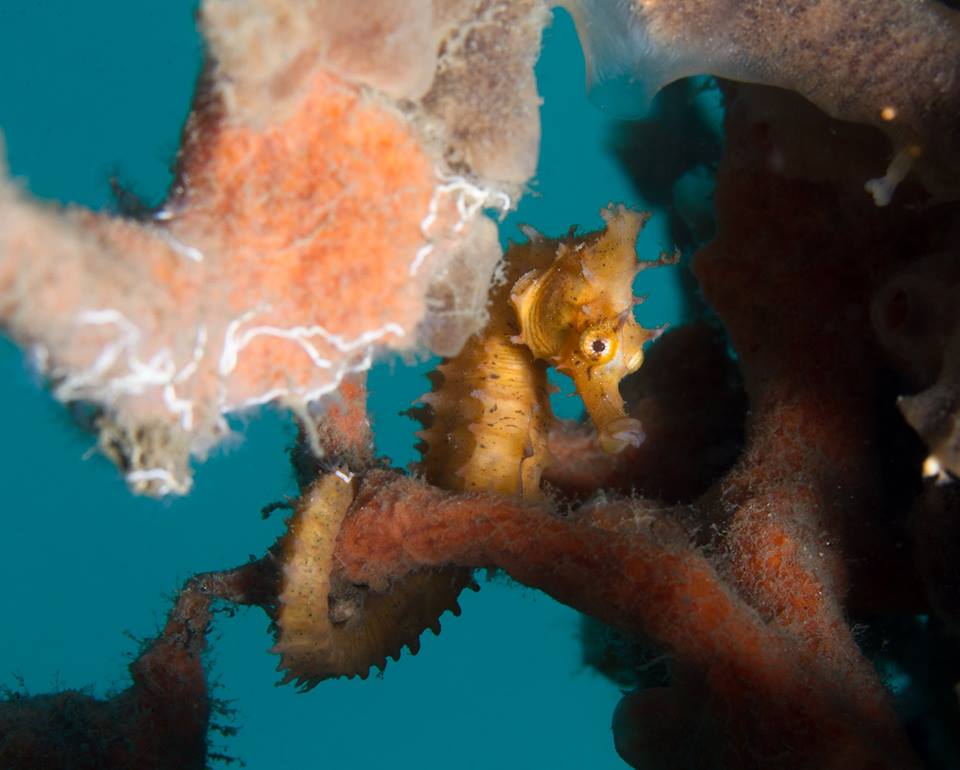
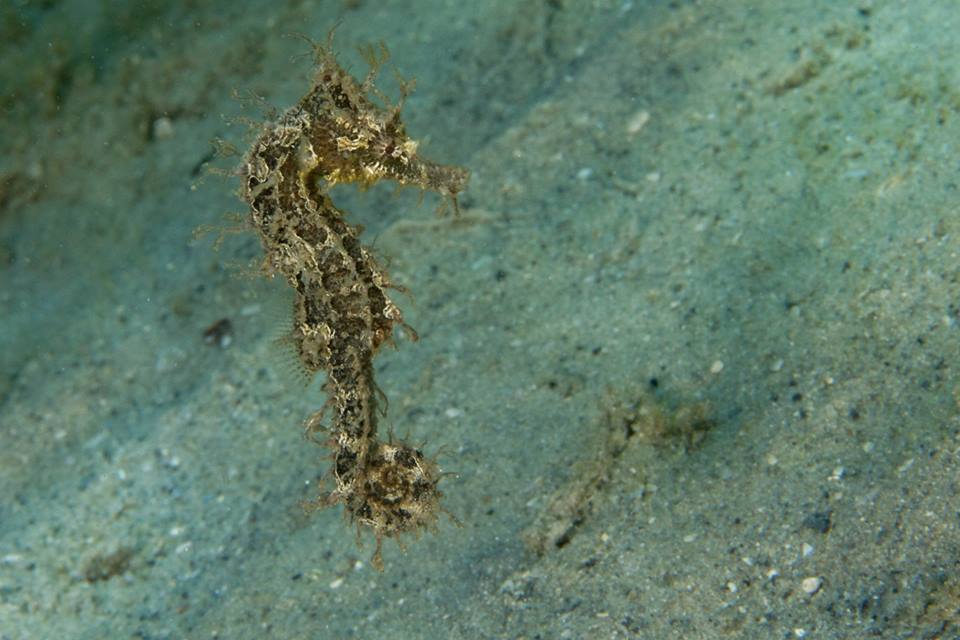
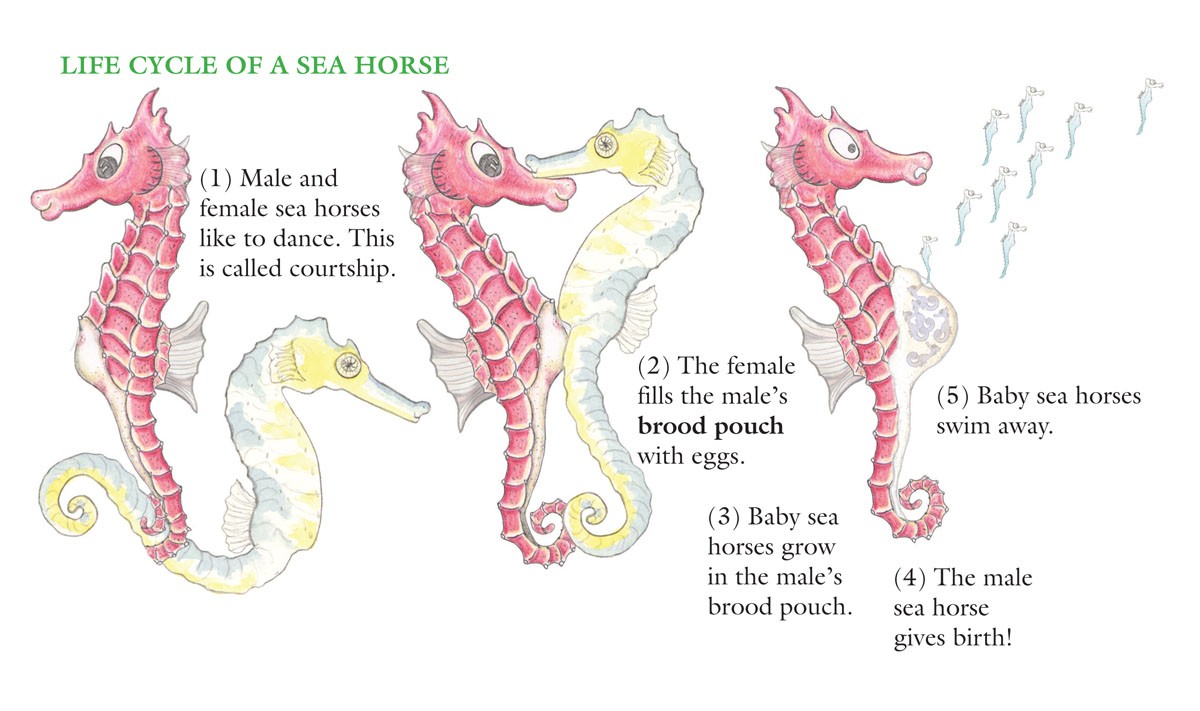
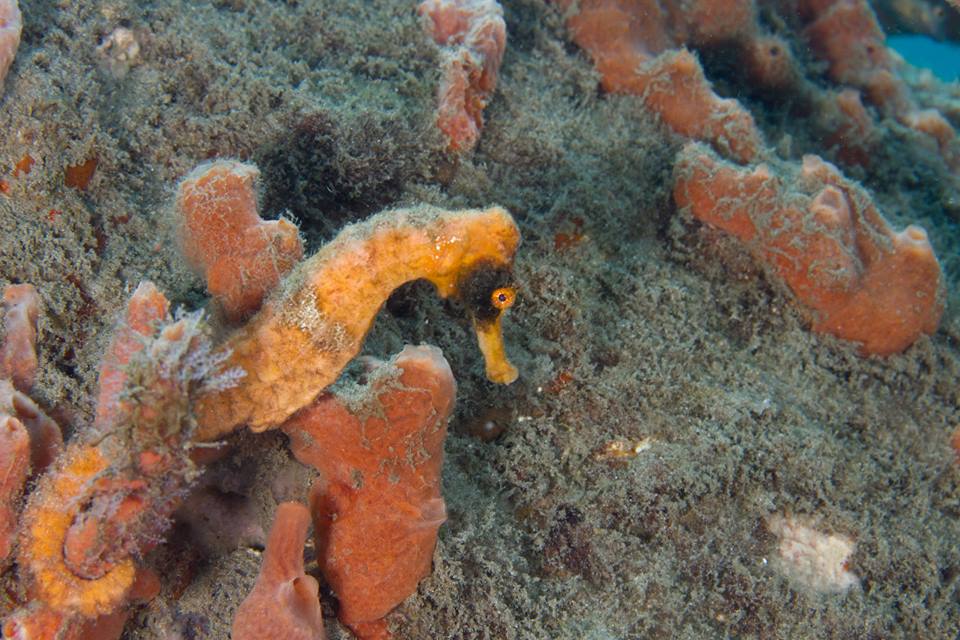
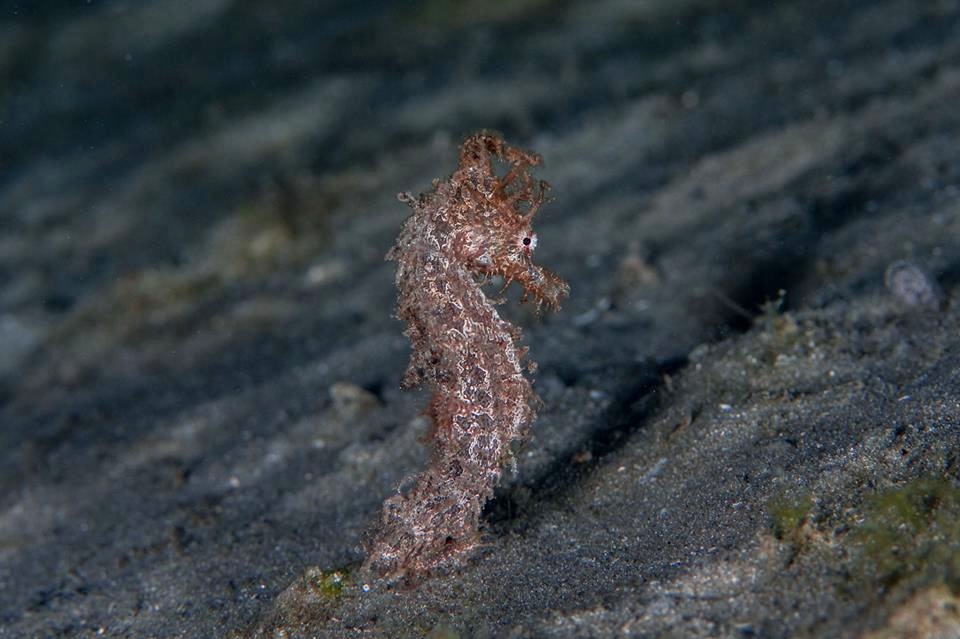
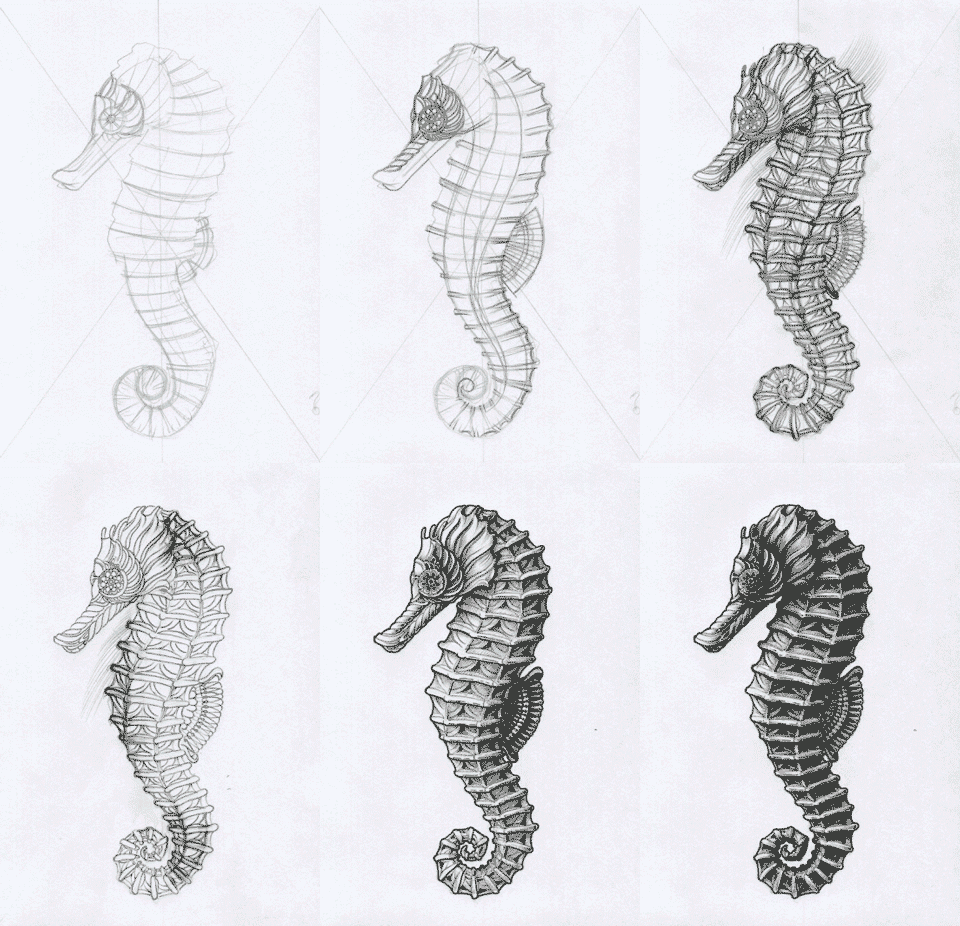
It’s a while since I showcased these astonishing little creatures. Adam Rees of SCUBA WORKS is a diver who combines great underwater experience with wonderful photographic skills. Here is a showcase for some of Adam’s seahorse photography and the amazing detail he captures. If these images don’t make you want to get your head underwater and explore the reefs, I can’t think what will…
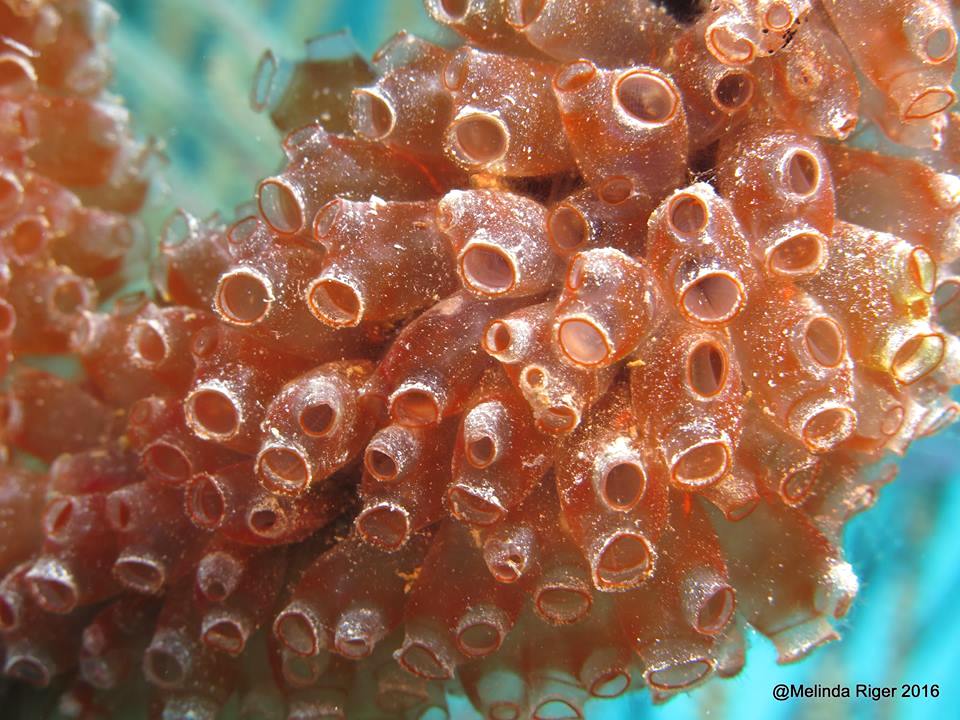
Painted Tunicates Clavina picta are one of several species of tunicate ‘sea-squirts’ found in Bahamas and Caribbean waters. These creatures with their translucent bodies are usually found clustered together, sometimes in very large groups. One reason for this is that they are ‘sessile’, unable to move from where they have taken root on the coral.
HOW DO THEY FEED?
Like most if not all sea squirts, tunicates are filter feeders. Their structure is simple, and enables them to draw water into their body cavity. In fact they have 2 openings, an ‘oral siphon’ to suck in water; and an exit called the ‘atrial siphon’. Tiny particles of food (e.g. plankton) are separated internally from the water by means of a tiny organ (‘branchial basket’) like a sieve. The water is then expelled.
WHAT DOES ‘TUNICATE’ MEAN?
The creatures have a flexible protective covering referred to as a ‘tunic’. ‘Coveringcates’ didn’t really work as a name, so the tunic aspect became the name.
IF THEY CAN’T MOVE, HOW DO THEY… (erm…) REPRODUCE?
Tunicates are broadly speaking asexual. Once a colony has become attached to corals or sponges, they are able to ‘bud’, ie to produce clones to join the colony. These are like tiny tadpoles and their first task is to settle and attach themselves to something suitable – for life – using a sticky secretion. Apparently they do this head first, then in effect turn themselves upside down as they develop the internal bits and pieces they need for adult life. The colony grows because (*speculation alert*) the most obvious place for the ‘tadpoles’ to take root is presumably in the immediate area they were formed.
APART FROM BEING STATIONARY & ASEXUAL, ANY OTHER ATTRIBUTES?
Some types of tunicate contain particular chemicals that are related to those used to combat some forms of cancer and a number of viruses. So they have a potential use in medical treatments, in particular in helping to repair tissue damage.
Credits: all fabulous close-up shots by Melinda Riger / Grand Bahama Scuba; diagram from depts.washington.edu; magpie pickings with a particular mention of an article by Sara MacSorley
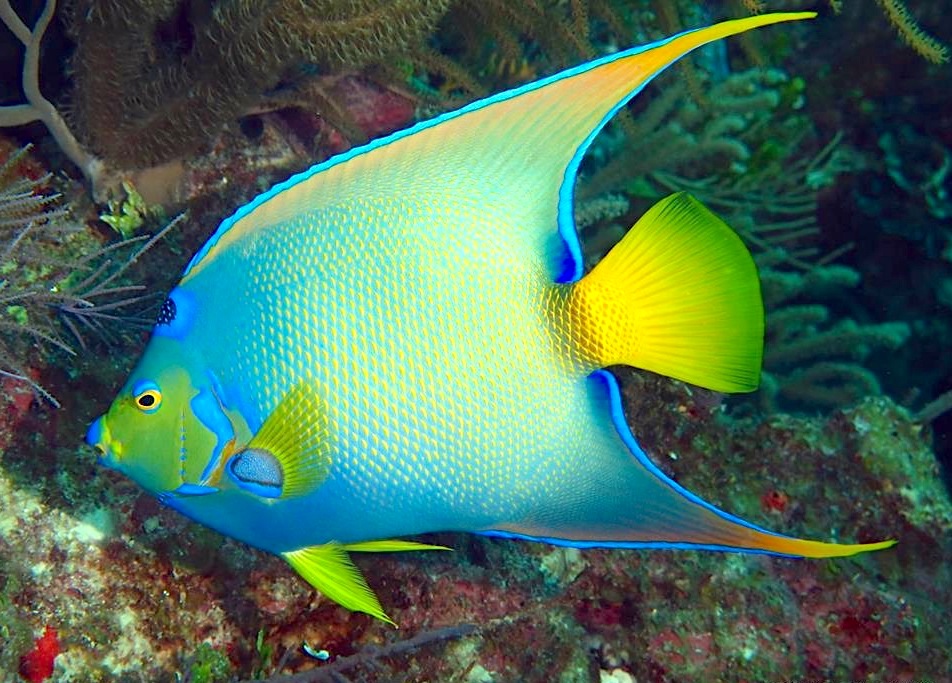
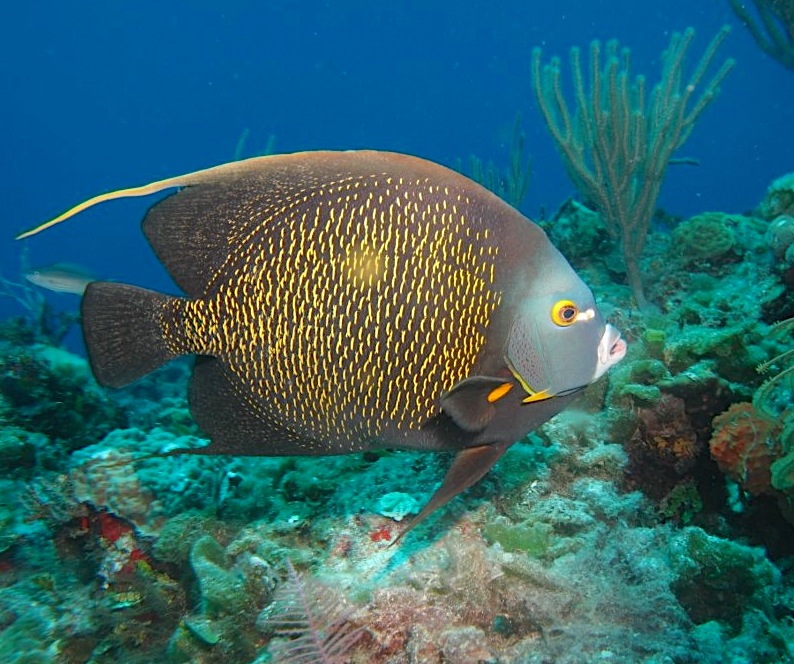
The images below show the three species of angelfish commonly found among the coral reefs of the Bahamas. These were photographed by diver Melinda Riger in the waters round Grand Bahama. The Queen, French and Gray Angels are shown in both adult and juvenile forms.
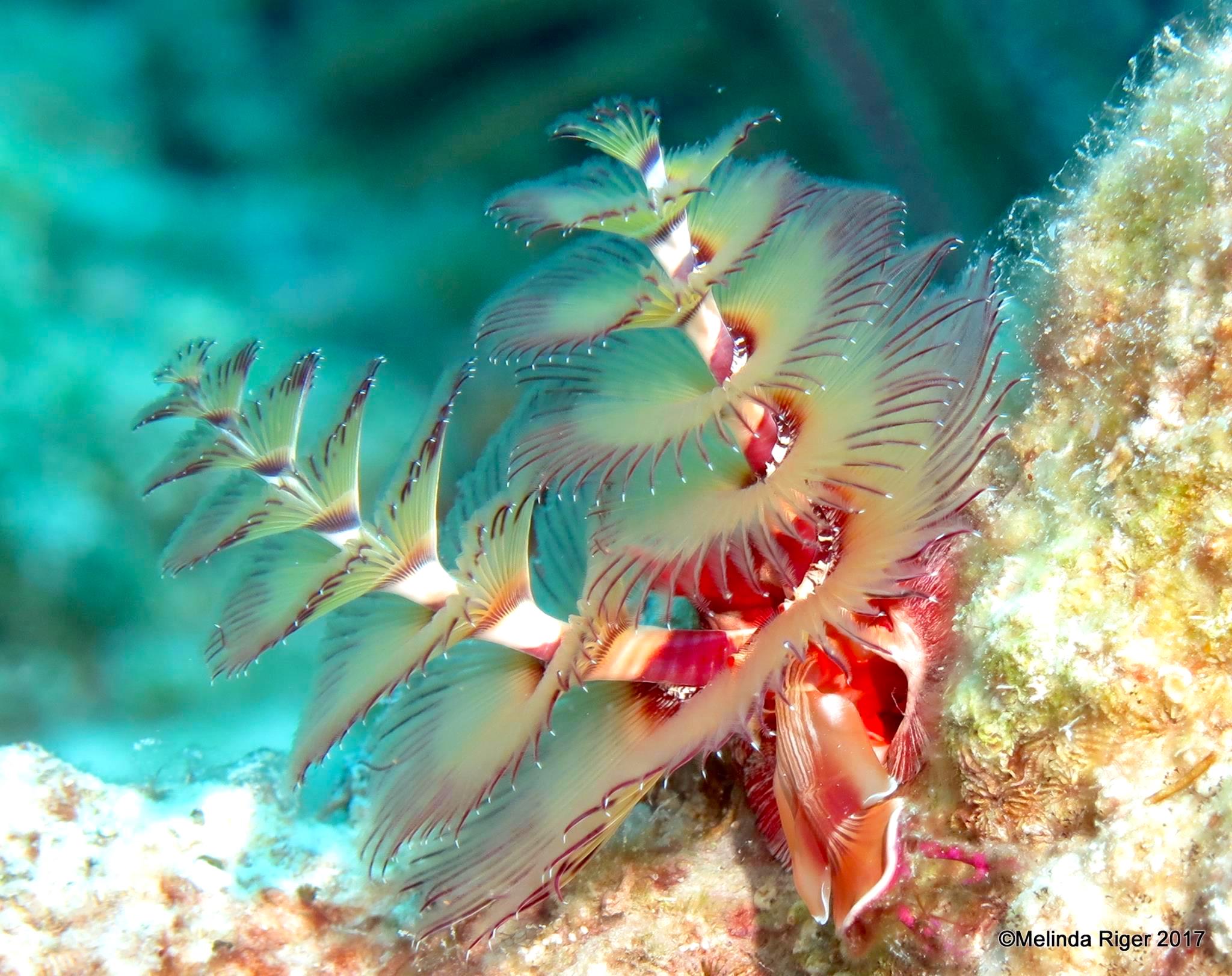
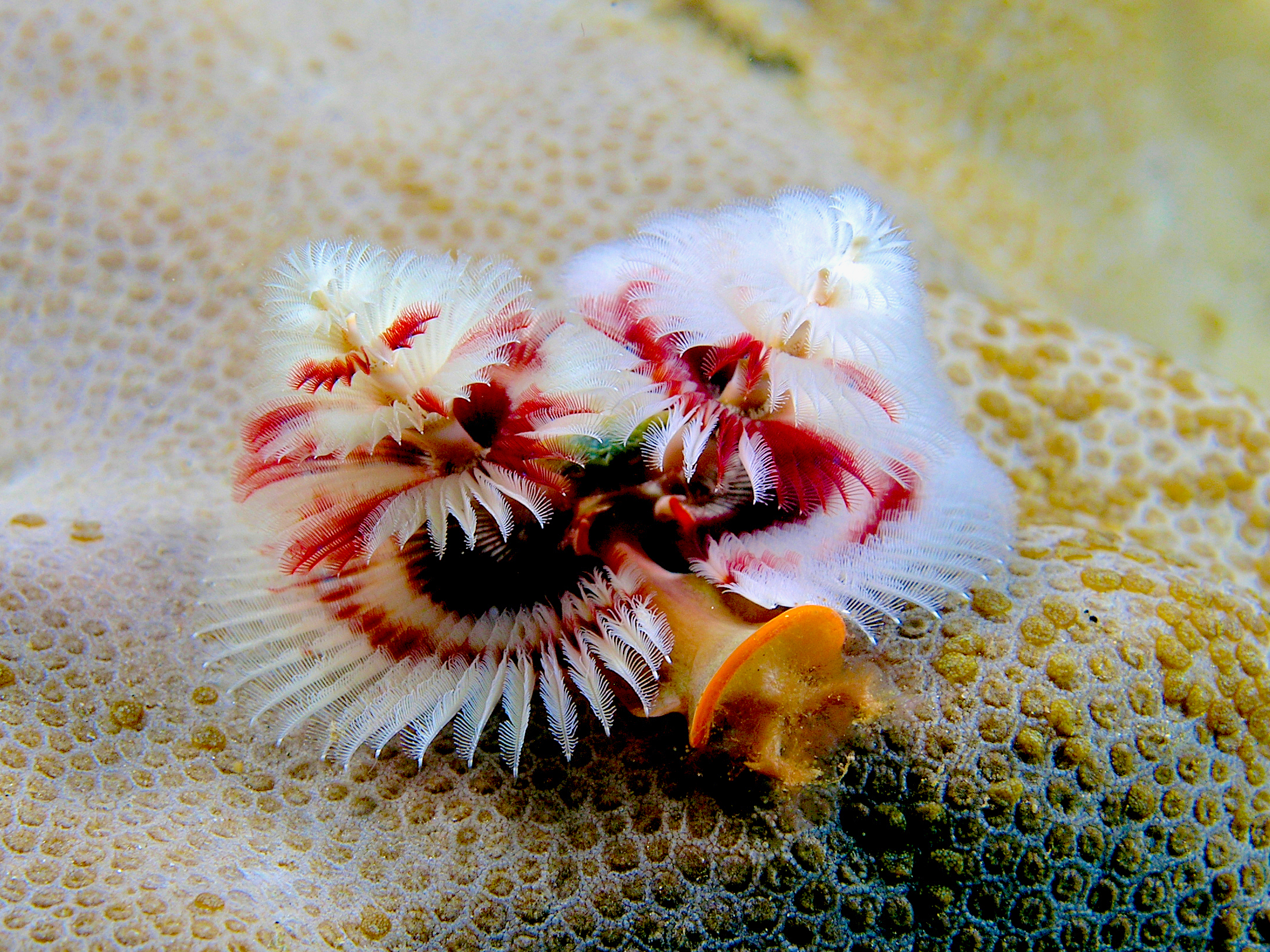
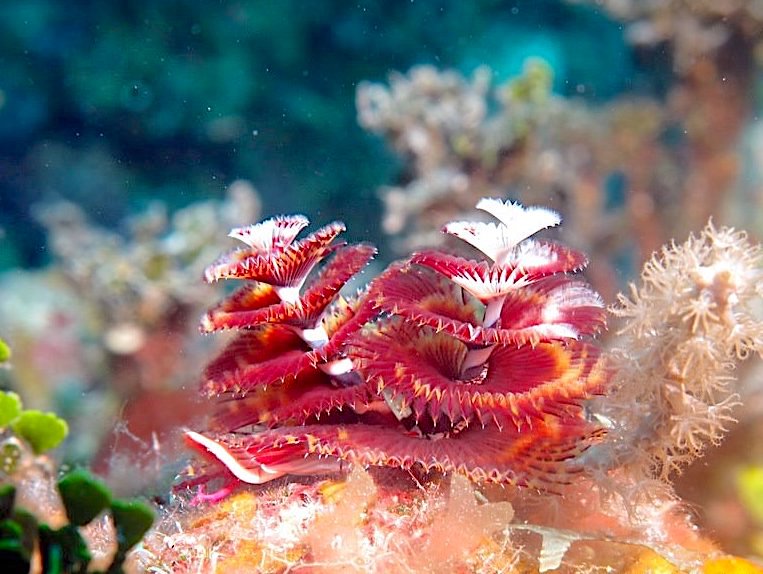
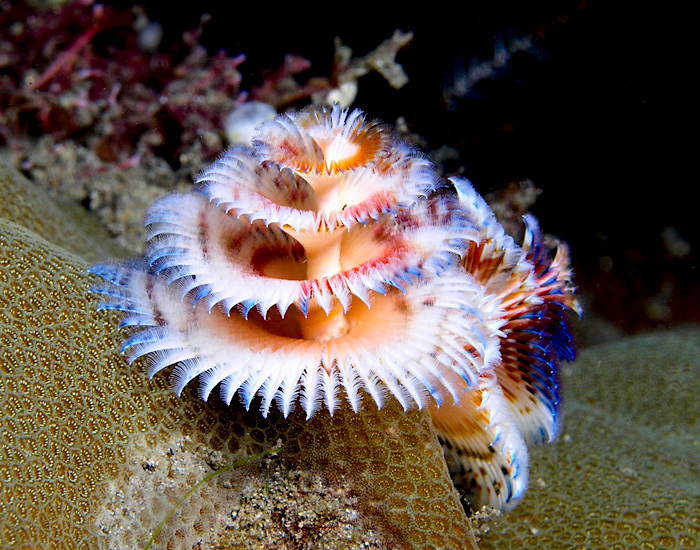
“Deck the Reefs with Worms Like Christmas Trees… Fal-La-La-etc-etc ” is a traditional Carol familiar to all. Well, most. Ok, some, then. Oh right – maybe with different words? Anyway, now is the perfect time to take a look at these remarkable subsurface symbols of seasonal good cheer (nb they are wonderful animals not gorgeous plants).
10 CHRISTMAS TREE WORM FACTS TO PONDER
The 2 colourful spirals are not the worm, but complex structures for feeding & respiration
The spirals act as specialised mouth extensions for ‘filter-feeding’
Prey is trapped by the feathery tentacles & guided by cilia (microscopic hairs) to the mouth
The tentacle things are radioles and act as gills for breathing as well as prey traps
It is not believed that prey slide down the spiral to their doom, like on a helter-skelter
The actual worm lives in a sort of segmented tube, with extremely limited mobility skills
It contains digestive, circulatory & nervous systems – and a brain in the middle of it all
The worm also has a tiny drainage tube (I think I have this right) for excretion etc
They embed themselves into heads of coral such as brain coral. And stay there
And yes, the Christmas trees are retractable… (see below for some action)
HOW DO THE WORMS… YOU KNOW… ERM… REPRODUCE?
This is a delicate area. They are very discreet, but as far as I can make out they eject gametes from their what-I-said-above. There are mummy and daddy worms, and their respective gametes (eggs and spermatozoa) drift in the current and into each other to complete the union. The fertilised eggs develop into larvae, which settle onto coral and burrow into it as their parents did, build their protective tubes, and the process begins again.
YOU DON’T REALLY UNDERSTAND THESE CREATURES, DO YOU?
I won’t lie. I found it hard to work out how the CTWs function in practice. There are plenty of resources showing them in their full glory, but that only takes one so far. Then I came across a short video that shows it all brilliantly simply (except for the reproduction part).
The worms, in their coral burrows, hoist their pairs of ‘trees’. You can easily see small particles – zooplankton – drifting in the water, and the radioles swaying to catch potential food. Suddenly it all makes sense (except the repro bit – I haven’t found footage of that). Next: the New Year Worm (there is no Easter worm).
A WHOLE FESTIVAL OF CHRISTMAS TREE WORMS
Credits: Melinda Riger (Grand Bahama Scuba); Nick Hobgood; Betty Wills; Video by ‘Super Sea Monkey’; Reef Collage by RH; MarineBio; Wikibits & Magpie Pickings
HappyChristmas toallthosewho putupwithRHwithsuchfortitude over the years
Manatees are apex ‘gorgeous marine mammals’. Gentle, inquisitive, brave, long-distance-but-rather-slow-swimming, grass-grazing miracle ur-elephant descendants. They never made it out of the sea in the Miocene epoch.
Incongruous in a world of fast sharks, huge whales and leaping dolphins, they contentedly mooch around the seagrass beds. No one in the world has ever objected to or dissed a manatee. They bring only delight to the sea-world, and offer only charm to mankind.
I’ve written quite often about the small number of manatees that inhabit the turquoise inner waters of the Bahamas. Almost all are named and some are tracked (until they lose their trackers). Their friendships and amorous hook-ups are recorded. Despite their relative scarcity in the Bahamas and a 16-month birth cycle, they produce manatee-lets and the family trees are very gradually growing.
Gina and Calf, Bahamas (BMMRO)
IS THERE A DOWNSIDE FOR THESE APPARENTLY BLISSFUL AND PEACEFUL CREATURES?
Yes indeed. It’s mankind. Among the threats to the survival of these unusual, endearing, and legally protected creatures are, in no particular order:
Pollution of inshore waters and canals
Degradation of the (formerly limitless) sea-grass beds where they feed
Reduction or tainting of the fresh water sources that they need to survive
Understandable over-enthusiasm by admirers – especially in harbours – in dousing them with water from hoses and feeding them lettuce…
…and similar behaviours that may lead to a trusting dependance on humans
Unthinking or speed-selfish boat behaviour in or near harbours resulting in collisions
Simply not caring at all and carving them up, leaving often deep prop-scars. Few manatees escape at least a few of these. Some may not survive.
Let’s celebrate this special day for manatees. Let’s hope that they can survive and prosper in these increasingly difficult and dangerous times for almost all species. Look at any of these photos… can we agree that these wonderful animals deserve care and protection.
All photos: Charlotte Dunn / BMMRO and research contributors
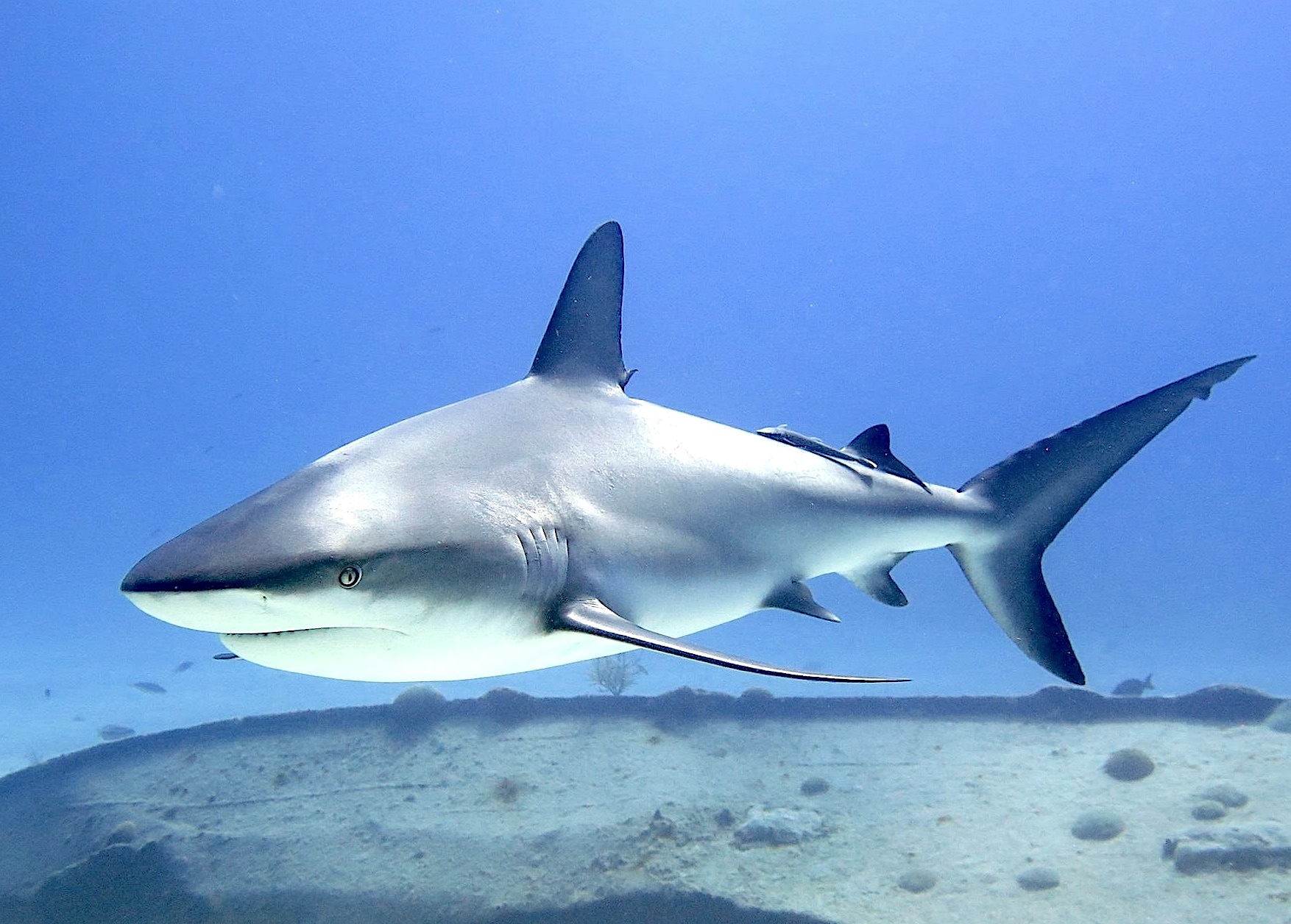
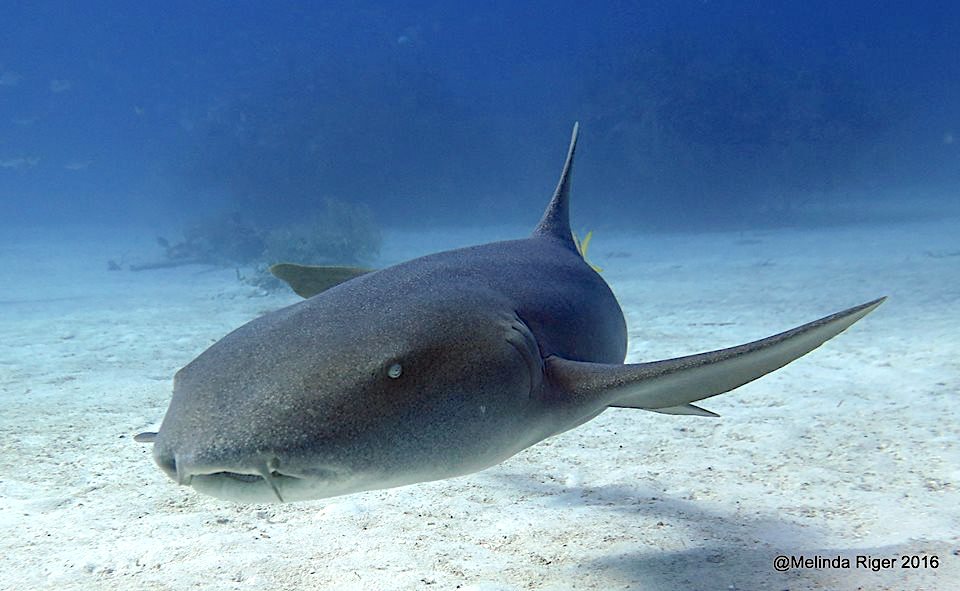
Two days ago, a woman was tragically killed by a shark off Nassau. She and her husband were paddleboarding nearly a mile offshore. Few details have been reported at present, as is only right in the circumstances. In November there had been a presumed fatality off West End, Grand Bahama when a woman diver was attacked and has not been found. Such incidents are exceptionally rare for the region, with Bahamas having a consistent history of low attack figures.
This page has had a great many visits over the past 48 hours, for obvious reasons. At this time further comment would be quite inappropriate. We extend deep and respectful sympathy to the families and friends of those involved. Such terrible events should be given due privacy for those who are grieving.
This notice has also been posted on the other differently arranged Shark Attack page HERE
Global total of unprovoked shark bites significantly lower than average
Country
Total
Fatal
USA
41
1
Australia
9
0
Egypt
2
2
South Africa
2
2
Brazil
1
0
New Zealand
1
0
Thailand
1
0
Worldwide
57
5
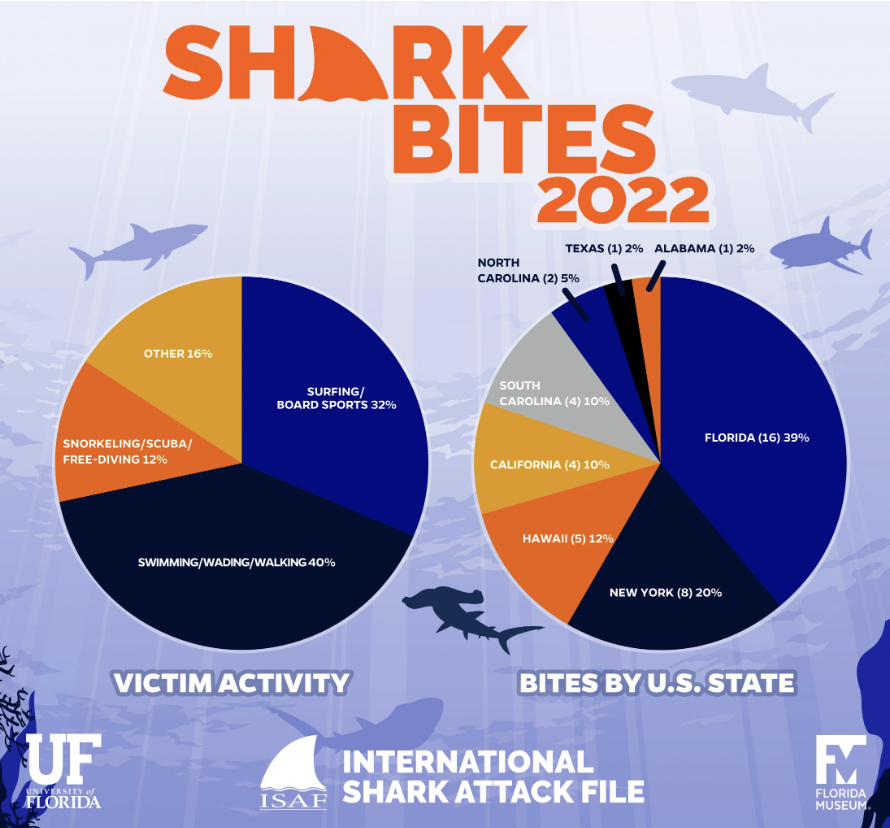
The 2022 worldwide total of 57 confirmed unprovoked cases is lower than the most recent five-year (2017-2021) average of 70 incidents annually. There were nine shark-related fatalities this year, five of which are assigned as unprovoked. This number is in line with the 5 year annual global average of six unprovoked fatalities per year.
Annual fluctuations in shark-human interactions are common. Despite 2021’s spike in fatalities, 2022 was a return to typical long-term trends which show a decreasing number of annual fatalities. Year-to-year variability in oceanographic, socioeconomic and meteorological conditions significantly influences the local abundance of sharks and humans in the water.
BAHAMAS STATS
Confirmed Unprovoked Shark Attacks (1749-Present)
32
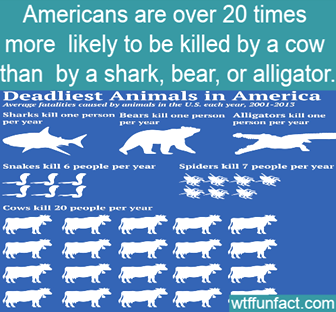
Risk of being bitten by a shark remains extremely low
Short-term trends show both fatal and non-fatal bites to be decreasing. The total number of unprovoked shark bites worldwide is extremely low, given the number of people participating in aquatic recreation each year. Fatality rates have been declining for decades, reflecting advances in beach safety, medical treatment and public awareness.
DATABASE UPDATE 2021
INTERNATIONAL SHARK ATTACK FILE
Over the last couple of weeks or so I have been getting a lot of hits for Shark Attack information. There have been 2 or 3 recent incidents including a tragic (and very rare) death in Maine, which may well account for this. The Shark Attack details I have accumulated and posted over the years are buried in an historical sub-sub-page, so to make things easier I have re-checked and updated the latest data resources and their links, and put them in a mainstream post. This is it.
DATABASE UPDATE 2020
INTERNATIONAL SHARK ATTACK FILE
PRIMARY RESOURCE
This resource is the portal to a mass of current, recent, and historical data, presented with authority and clarity. It provides undoubtedly the most comprehensive and accessible global shark-incident data of all.
Last year I included informative screen-shots taken from this site. For now I am confining the information to the most useful direct links. More work for the reader, perhaps, but also a better chance to explore and understand the hows, whens and wherefores of shark-related incidents – and how best to avoid the situation in the first place.
“The 2019 worldwide total of 64 confirmed unprovoked cases were lower than the most recent five-year (2014-2018) average of 82 incidents annually. There were five fatal attacks this year, two of which were confirmed to be unprovoked. This number is in line with the annual global average of four fatalities per year“
For anyone thinking of entering waters where sharks live – eg scuba divers, spear-fishers, swimmers, boaters – with relatively little experience or knowledge, these links will be incredibly useful. Local knowledge is well worth having as well. A young friend of ours, an intern on Abaco, was warned against spearfishing at a particular location: “Fish there, you’ll get ate”. He did. He very nearly was.
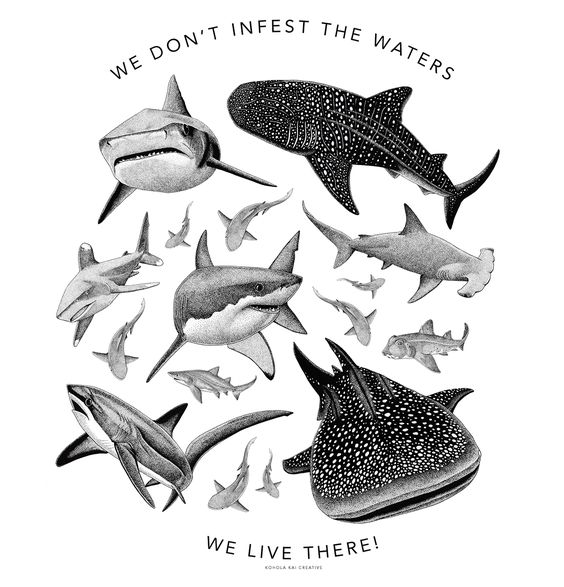
“Humans are not on the menu of sharks. Sharks bite humans out of curiosity or to defend themselves”
The SRI produces a downloadable Global Shark Attack File that provides:
Even the most optimistic lovers of unmolested wildlife, unpolluted oceans, un-degraded habitats, unextinguished species and understanding humans will be beginning to lose heart. Even as reports increase of resurgent wildlife during these Covid months, so it is gradually becoming clear that once humans are unlocked again, the only way will be down.
Humpback whale
Here are just a few magnificent marine mammals to admire. All were photographed from the BMMRO research vessel in Abaco or adjacent waters. They are protected, recorded, researched, and watched over in their natural element – some individuals for more than a decade.
Pantropical spotted dolphins
Today we contemplate our oceans at a time when the human species is having to confront a sudden and indiscriminate destructive force. Maybe the impact will lead to a recalibration of the ways we treat other species and their environment. We have contaminated the world’s oceans, perhaps irreparably, in a single generation. We could start by committing our support to those that tackle the plastic saturation, oil / chemical pollution, acoustic bombardment, ‘ghost gear’, and all the other unwelcome attritional activities we are responsible for. We could continue by supporting those that monitor and protect all the marine creatures struggling in a polluted environment that, in natural law, should be theirs.
Bottlenose Dolphins
Below is a male Blainville’s beaked whale, with its remarkable barnacled tusks that protrude upwards from its lower jaw. This is a specialist research species in the Bahamas. Below that is a short video of these whales that I took from the BMMRO research vessel. Turn up the volume – you will clearly hear them breathing as they slowly pass by (and others in the group, under) the boat. Note that land is clearly visible. These whales can sometimes be found just beyond the shallow turquoise waters, where the sea deepens as the depth drops down to an underwater canyon.
Blainville’s beaked whale (m)
Hope for the future…
All photos taken in (or adjacent to) Abaco waters, Bahamas: Charlotte Dunn / Bahamas Marine Mammal Research Organisation (BMMRO), except for the beaked whale image and video by Keith Salvesen / Rolling Harbour (BMMRO)
Note: prognostications and personal views – and their intensity – detectable here are mine and do not necessarily reflect those of my colleagues at BMMRO…
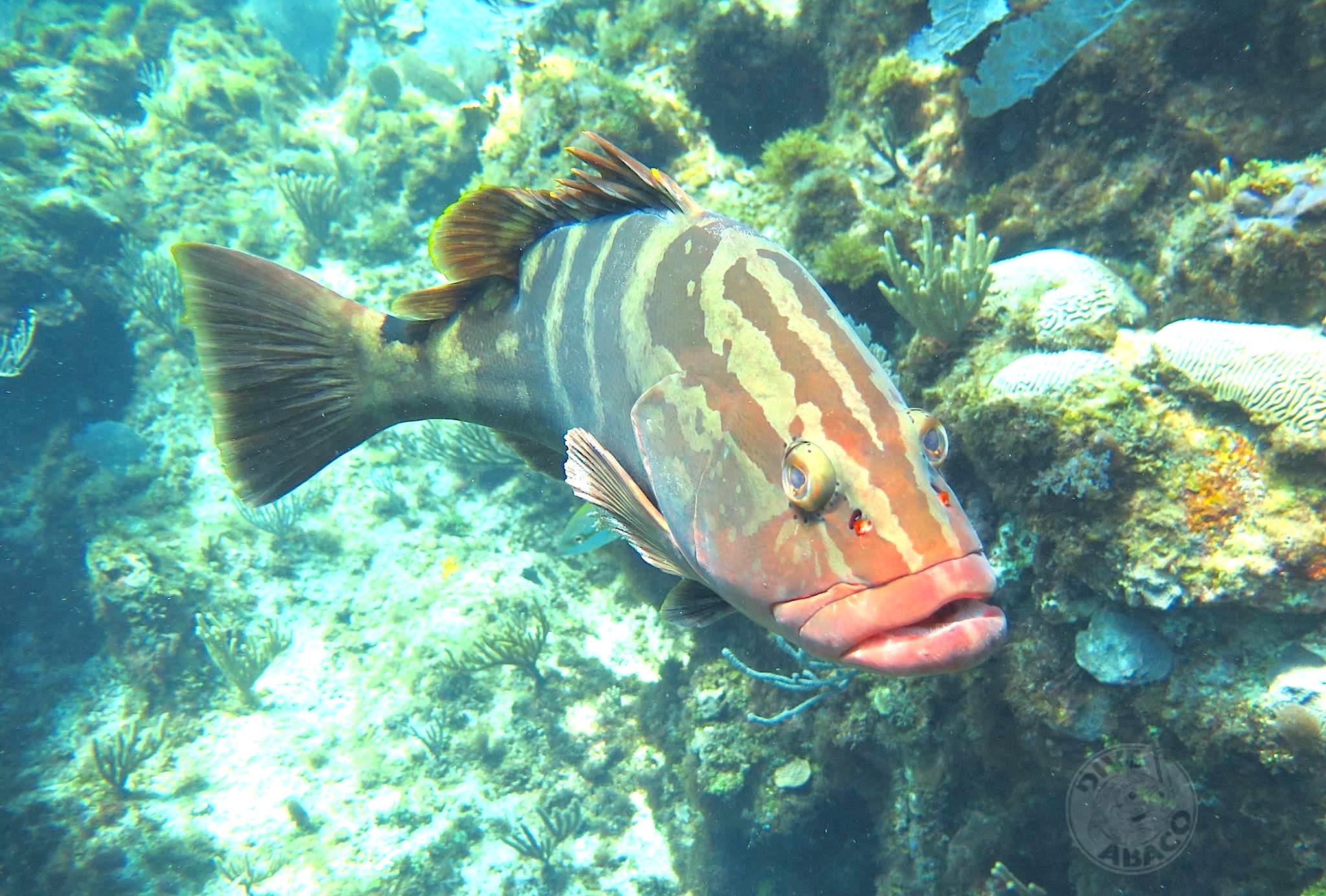
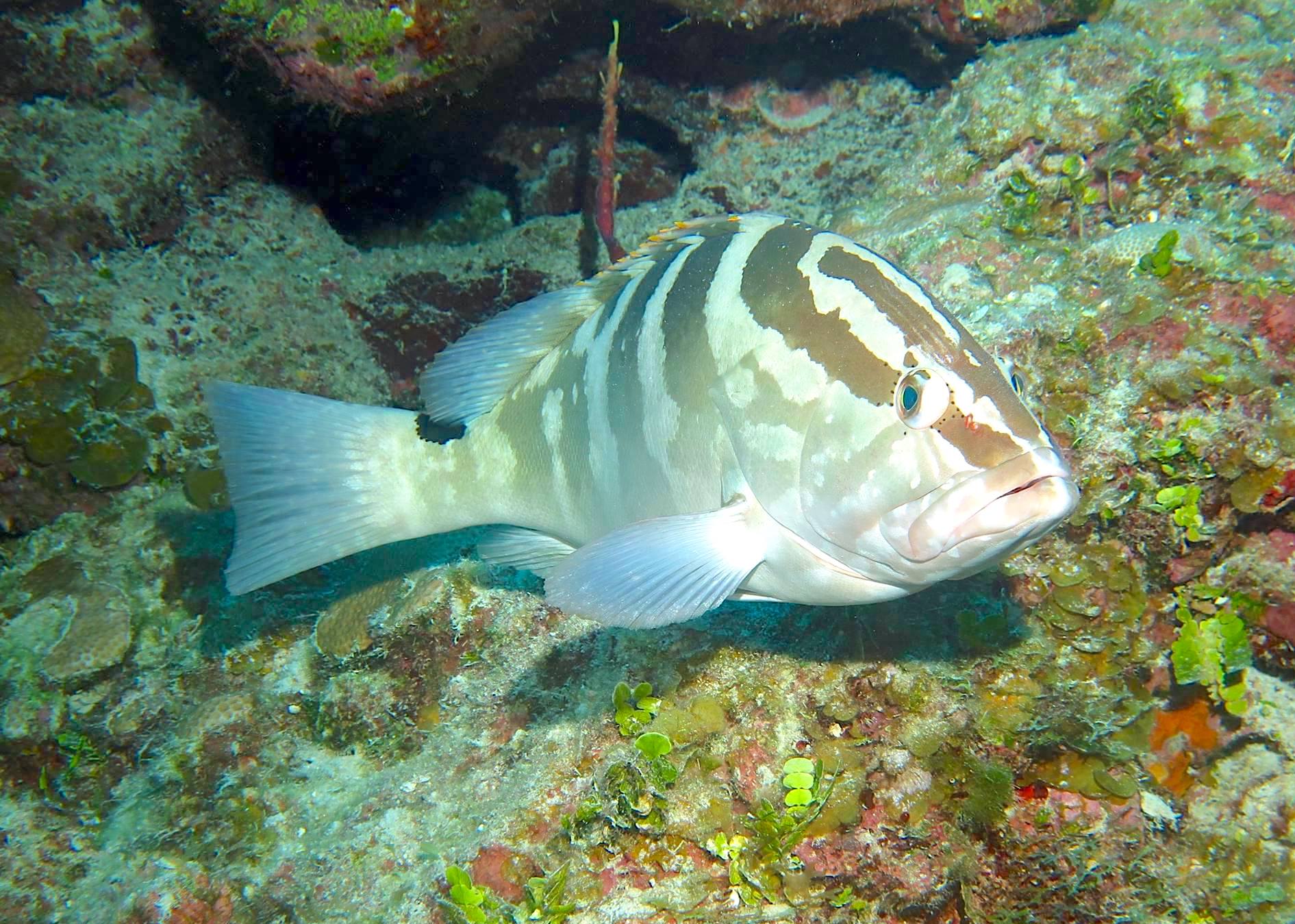
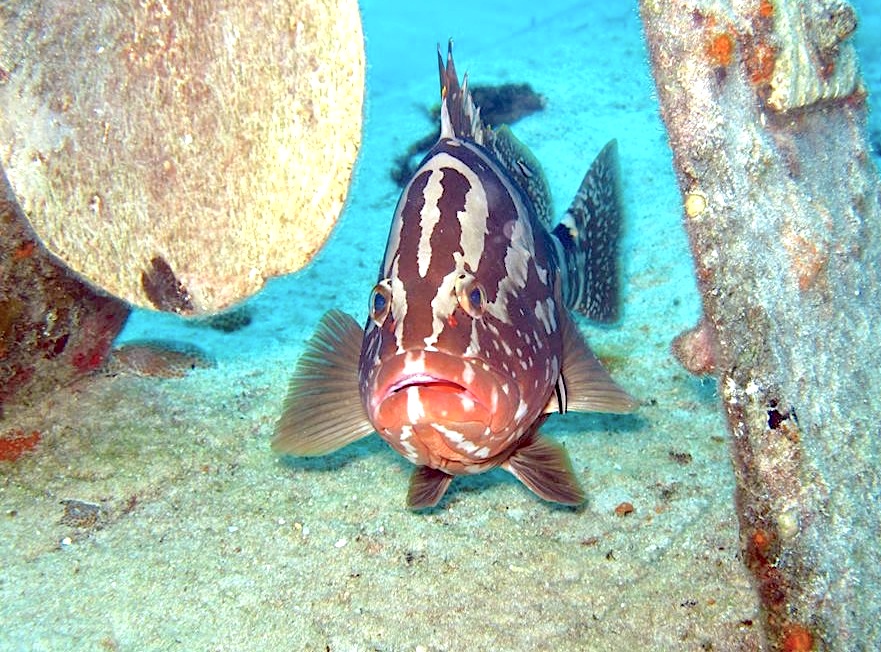
The Nassau grouper Epinephelus striatus is one of a number of grouper species found in Bahamian waters. Of these, only the Nassau grouper is on the IUCN Red List, as Critically Endangered. When I last wrote about them they were in the lesser category ‘Threatened’.
In order to sustain a viable population, it is vital to maintain numbers and preferably to increase them year on year. Once it became clear that year-round commercial overfishing was a prime component of the steep decline in the population, a 3-month closed season during the breeding period was imposed. This has ensured that at the most critical time in the lifecycle of the species, the groupers are left alone to breed in peace and to perpetuate their species.
The closed season operates from December to February to maximise the chances of breeding success. As with some other fish species, reproduction occurs around the full moon. The fish gather at spawning sites and the process is at its height around sunset.
10 CONVENIENTLY COLLECTED NASSAU GROUPER FACTS
An adult can grow to more than a metre long, and weigh 25 kg
They tend to be solitary daytime feeders, eating small fish & crustaceans
Their large mouths are use to ‘inhale’ or suck in prey
The colouring of an individual can vary from red to brown
These fish have little black spots around the eyes (I’ve no idea why).
Their habitat is in the vicinity of coral reefs, from shallows to 100 m deep
Spawning mainly occurs in Dec & Jan during a full moon
Large numbers gather in a single location to mate in a mass spawning
These groupers are slow breeders, which compounds the overfishing problem
They are easy mass targets at spawning time; hence the need for a closed season
A Nassau Grouper glumly contemplates the possibility of extinction
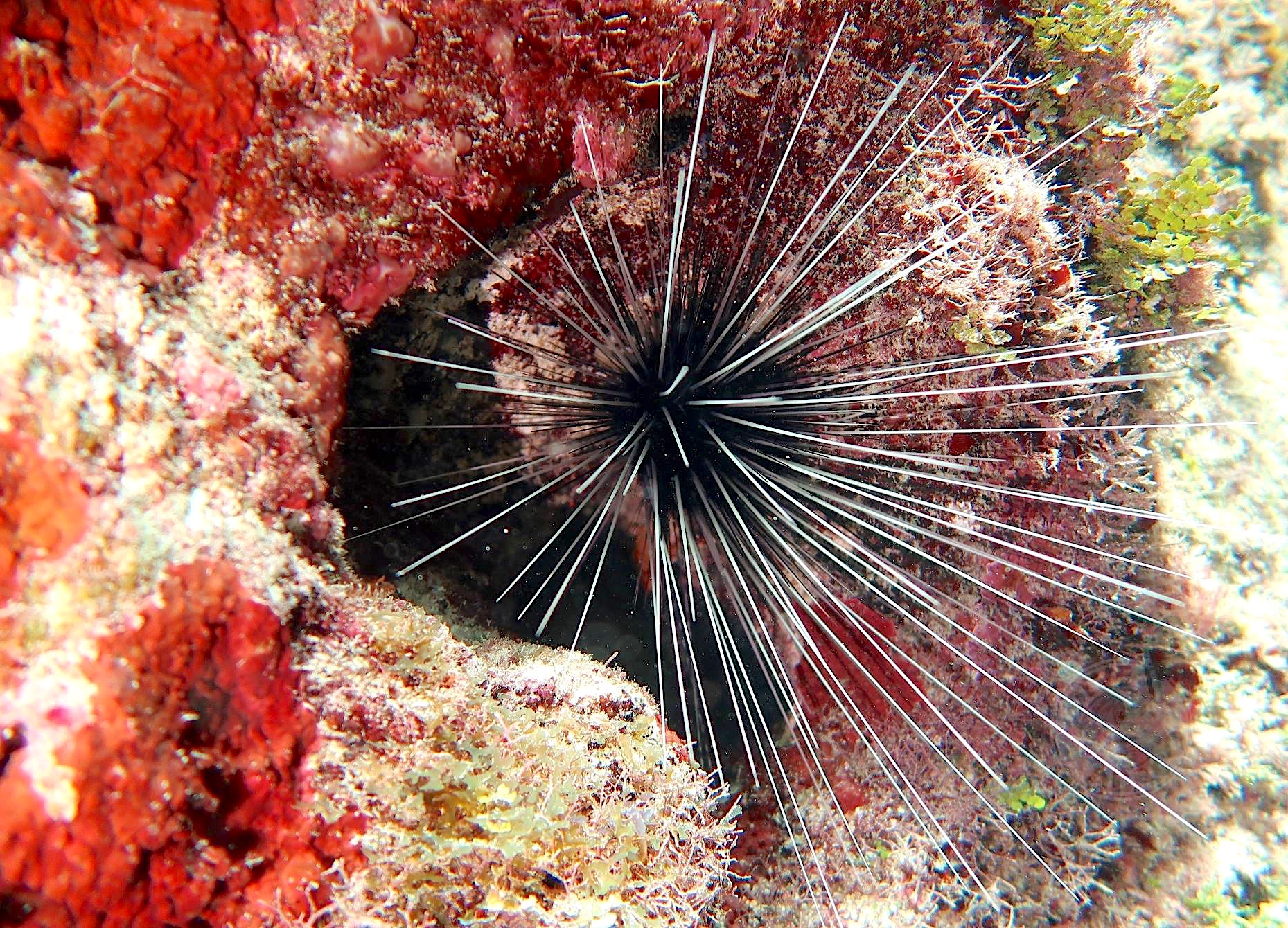
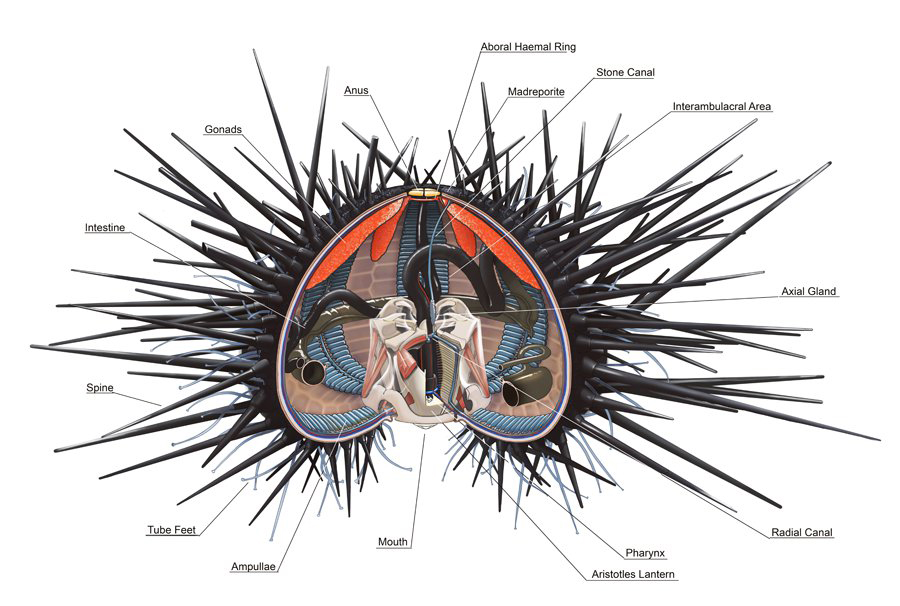
As every swimmer knows, or eventually finds out the hard way, it’s not only Blue Suede Shoes that should not be stepped on. But however painful the consequences of a misstep, it’s hard not to find some beauty in an urchin living in a thriving reef environment. The wonderful anatomical diagram by Alex Ries shows everything you could conceivably want to know about one of nature’s most proficient foot-stabbers (if only all such diagrams were presented so simply and clearly).
The internal organs depicted resemble a bad trip in the bowels of a vacuum cleaner; or (narrow your eyes) an experimental painting from one of the less successful schools of early c20 modern art, soon to be swept aside by Cubism. Note that the mouth is located where you might expect to find the opposite end, and vice versa.
I photographed the urchin test (skeleton) below at Delphi. It was large and almost entirely undamaged (very rare in my experience). The bright faintly greenish white is set off by the palest of pinks. Whatever your view of how creatures came to exist, imagine the creation or evolution of calcium carbonate into a small symmetrical structure as beautiful, detailed and complex as this. If you are short of a lockdown recreation, maybe try to draw it.
Photo credits: #1 Melinda Rogers / Dive Abaco; #2 Anatomy Diagram, Alex Reis (5 stars for making it available free on Wikimedia); #3 Keith Salvesen / Rolling Harbour Abaco
Off the east coast of Abaco lies one of the longest barrier reefs in the world. Some authorities suggest it is the third longest, but the exact ranking of the top dozen coral barriers is a matter for considerable debate. None of the lists I have just checked agree, except that the Great Barrier Reef is the outright winner. I suspect that the problem lies in the loosely generalised description of ‘barrier reef’ and in variations of the appropriate criteria for determining length (it may also depend on who is doing the measuring, of course).
Melinda Rogers of Dive Abaco took this bright sunlit ‘Coralscape’ in the Fowl Cays National Park. It’s a place I have tentatively snorkelled around with great pleasure, despite being in the top dozen most useless swimmers in the world (my appalling underwater videos were disqualified from the rankings for being… rank).
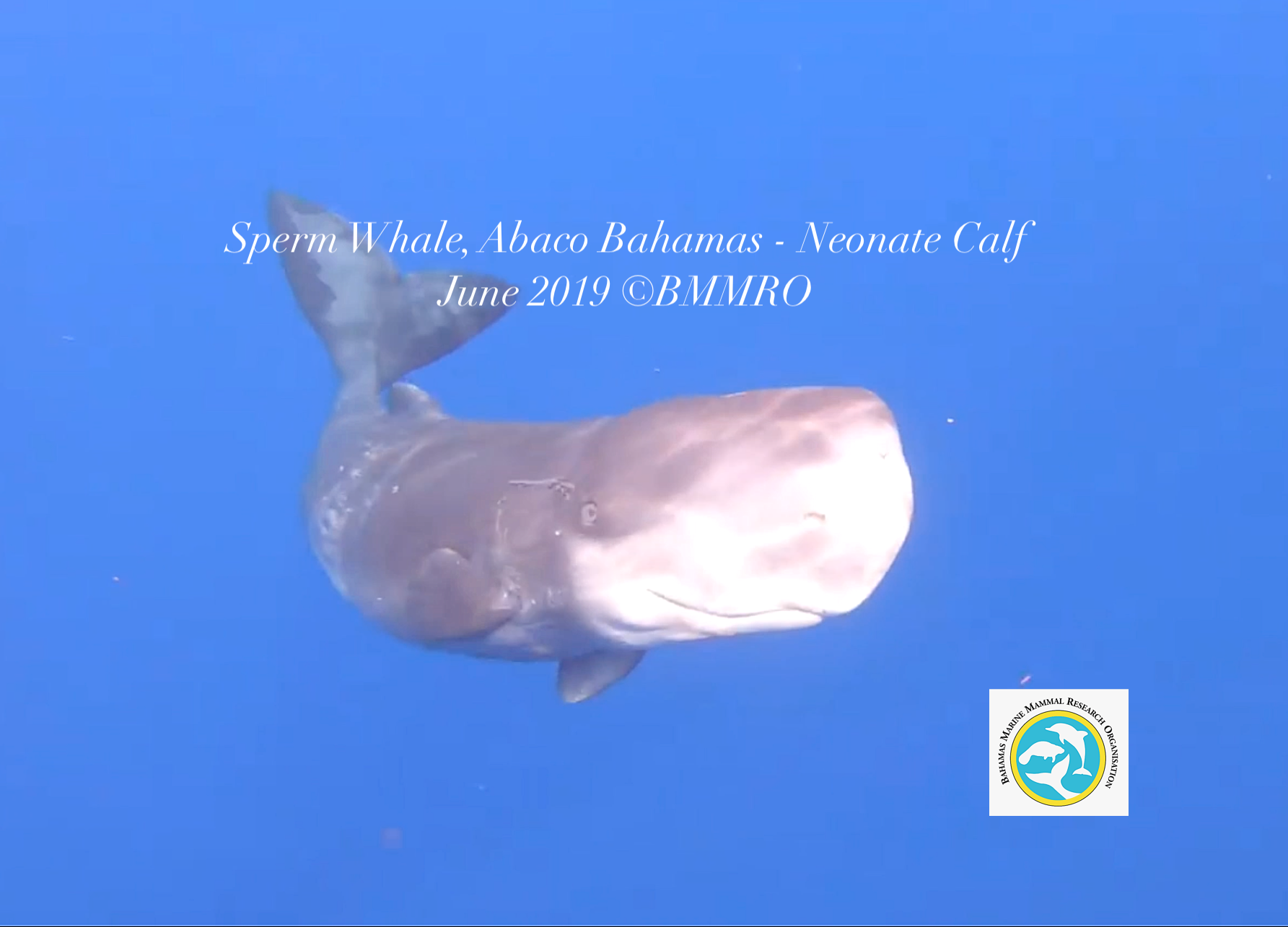
I made this short video last year at BMMRO HQ, Sandy Point, Abaco. A sperm whale had stranded earlier in the year, and after the necropsy some of the bones were taken from the beach for research. In order to clean them, the bones were sunk and anchored to the seabed offshore in quite shallow water. Strandings are always sad, of course, but it is good to know that even after death the creature makes an important contribution to scientific research. In a sense, it has life after death.
GROUPER AT A CLEANING STATION: PICTURE PERFECT BAHAMAS (5)
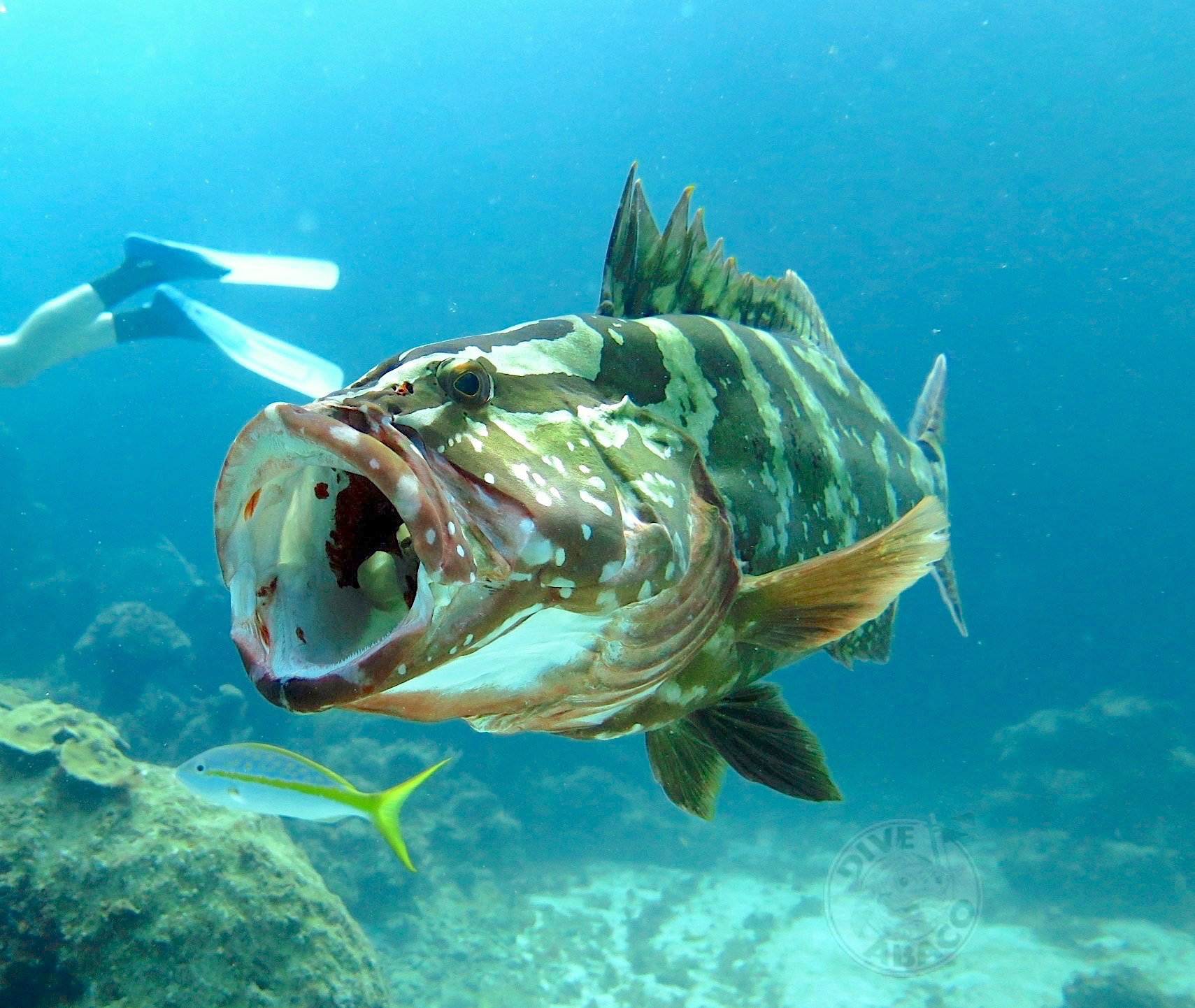
This black grouper (‘Arnold’) is at a so-called CLEANING STATION, being groomed by gobies. The process is an example of species symbiosis known as MUTUALISM. This is a transaction between individuals of two species that is mutually beneficial. Here, the primary creature pauses at a locally familiar cleaning station and allows itself to be expertly cleaned by tiny fishes such as gobies and wrasses to remove parasites, dead skin and so forth. This nurture even includes, as here, inside the mouth and gills. The gobies benefit by feeding on the proceeds of their endeavours removed from the host (or ‘client’ as one might say). And of course, in return for their favours a collateral benefit is that they can feed freely without being eaten by a potential predator.





























































You must be logged in to post a comment.