ENJOYING THE POOL: YELLOW-CROWNED NIGHT HERONS ON ABACO
The Yellow-crowned Night Heron (Nyctanassa violate) is a smallish heron, and avian counterpart to the Black-crowned Heron (Nycticorax nycticorax). The clue to the main difference between them is in the names. The juveniles of both species are similar. The ‘night’ part of the name refers to their preferred time for feeding. They have broad appetites that include crustaceans, molluscs, frogs, fish, and aquatic insects.
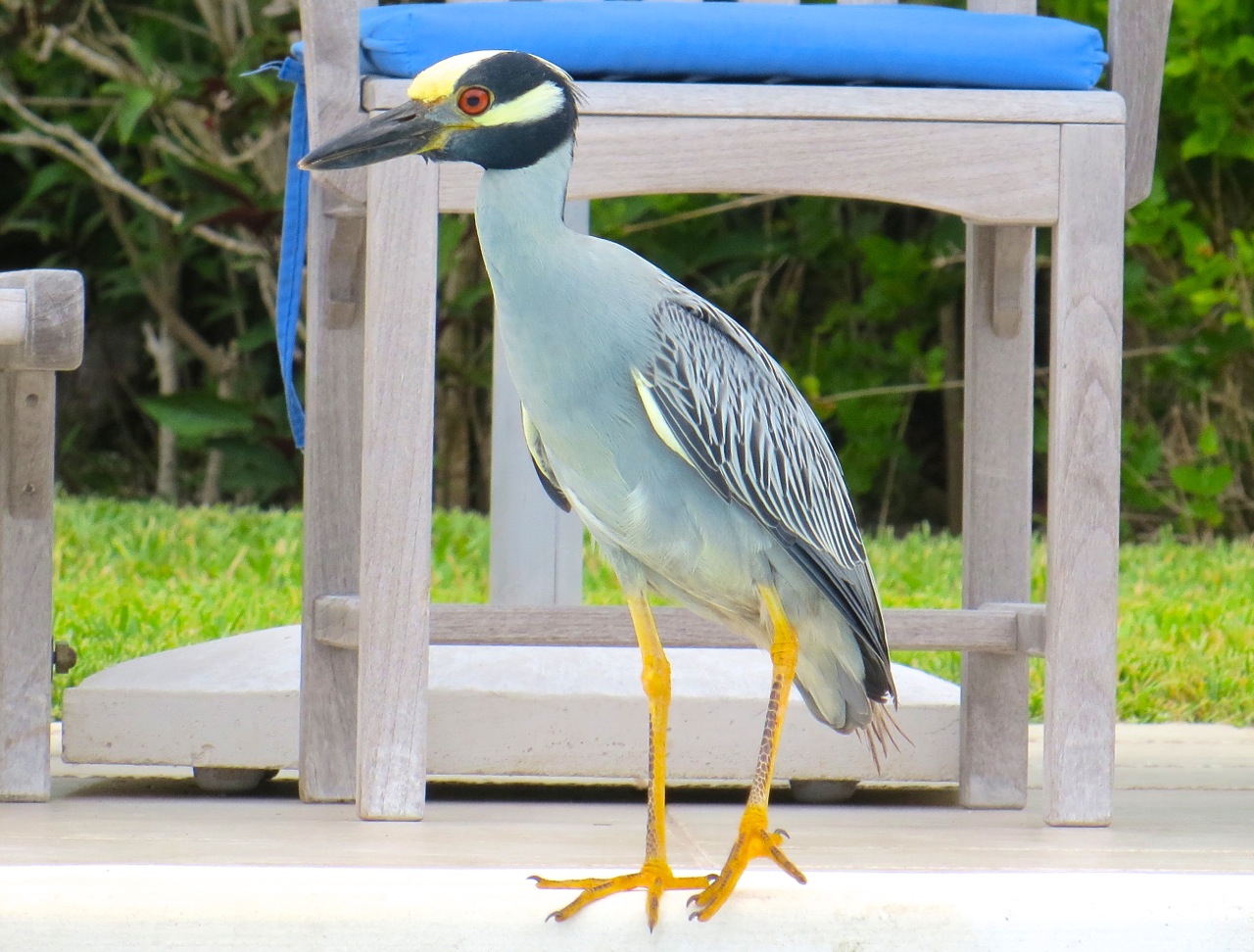
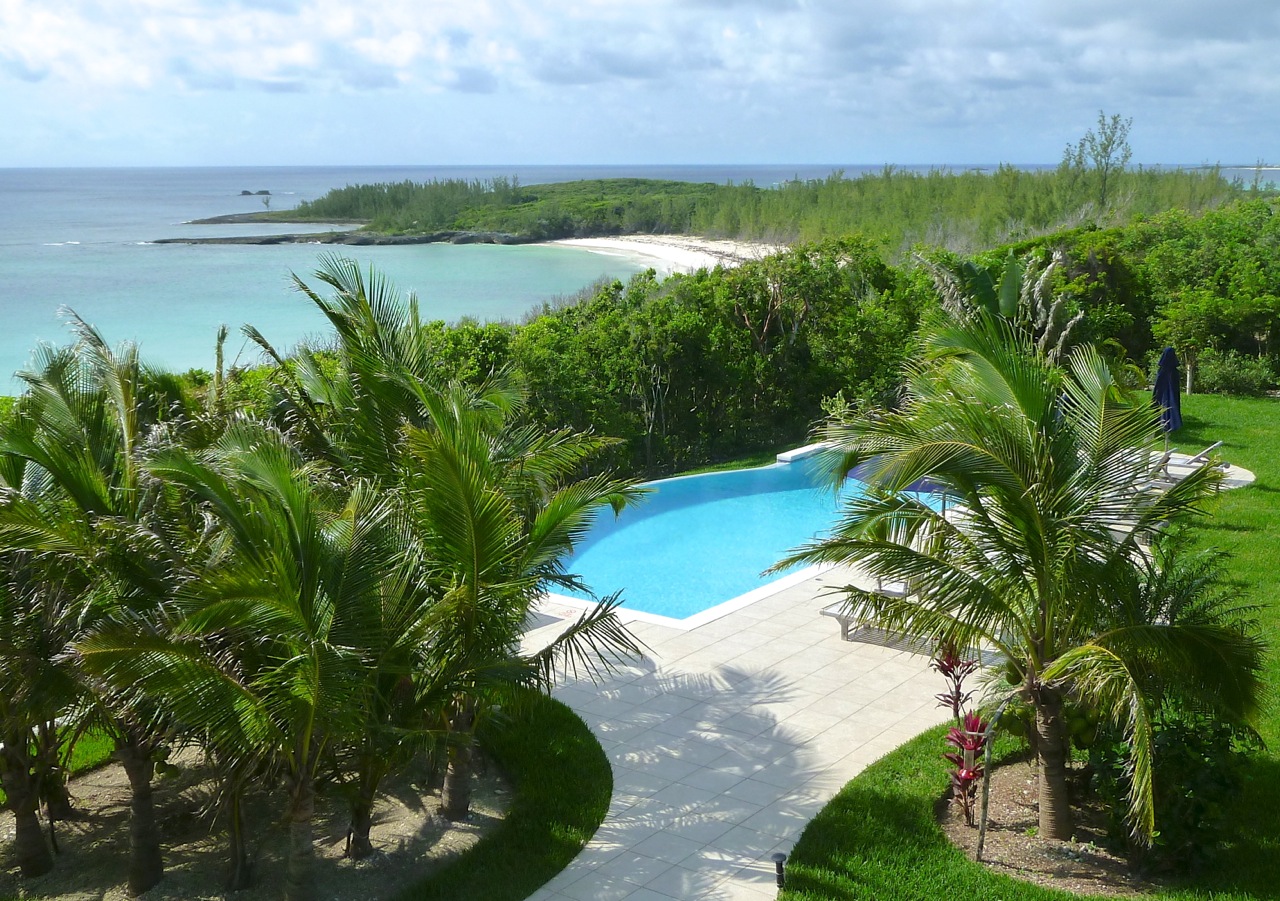
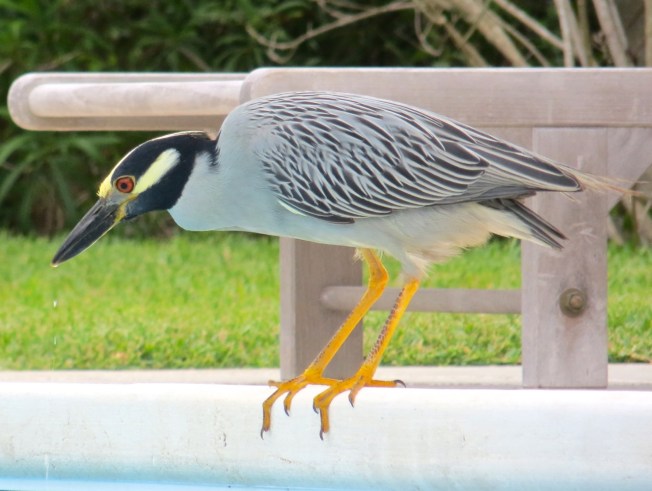
At Delphi, these lovely birds are regularly seen in gardens round the pool; drinking from the pool; standing hopefully waiting for prey to show itself in the water; and occasionally getting a bit confused by the whole thing (see below).
Looking right
Looking wet and ruffled
Looking hungry
Looking contented
The YNCH will stand motionless, waiting to ambush its prey. So a human, wandering to the pool laden with towel, book, iWotsit™, sun stuff and a cool Kalik, may easily not spot the bird at first. It will have seen you first, anyway, and moved away quietly if it isn’t too sure about you. However, they can be surprisingly tame if not startled. You may settle down, and suddenly sense that you are being watched from the other side of the pool…
Peter Mantle managed to capture a wonderful moment when a juvenile YCNH made a bit of a mistake early one morning while the pool cover was still in place… It looks embarrassed and slightly apologetic.
Usually, these birds are to be found in marshy areas, or by brackish ponds where (unlike the pool) there is a ready supply of food for them. A few miles south of Delphi is an excellent pond for birding near Crossing Rocks, where there is always the chance of seeing an unusual or rare species. Herons and egrets often use the landing stage as a vantage point for scoping out the feeding opportunities. The next pictures are of a juvenile (?teenage) YCNH doing just that – and fortunately, the pond does not have a cover to cause discombobulation of the species.
Black-crowned night heron for comparison
Photo credits: All RH except the across-pool-starer (David Rainford); the confused juvenile on the pool cover (Peter Mantle); and the last 2 comparatives (Wiki)
THE CROSS LITTLE WOODPECKER: A TRUE HAIRY TALE FROM ABACO
ONCE UPON A TIME, on a magical far away island called Abaco, where the sun always shone and the people were always friendly and smiling, there lived a little woodpecker. It was a beautiful little woodpecker with long shiny golden locks and its name was Hairy… oh look, I can’t go on with this drivel and neither can you, I’m sure. Sorry about that. Let’s take it from the top…
♦♦ ♦ ♦♦ ♦ ♦♦ ♦ ♦♦ ♦
I have mentioned before the excellent birding opportunities that a wander round the Delphi drive circuit has to offer. It’s the best part of 2 miles. I am working on a list of all species encountered on the route from the Lodge, along the guest drive to the white rock on the road, and back down the service drive. It is turning out to be a gratifyingly long one.
During your stroll, it’s worth checking out the dead trees, especially the upper trunk and branches, as you go. For a start, these provide excellent places for birds to pause and scope out the territory below. They also have a good chance of finding insects there. And for some species, like the Hairy Woodpecker Picoides villosus, it is home.
The Hairy Woodpecker is very similar to the Downy Woodpecker Picoides pubescens, the smallest woodpecker of North America. Male HWs have a prominent red patch on the back of the head. You can find an earlier post about a male HW and its nest in the Delphi coppice, with some HW species facts, HERE
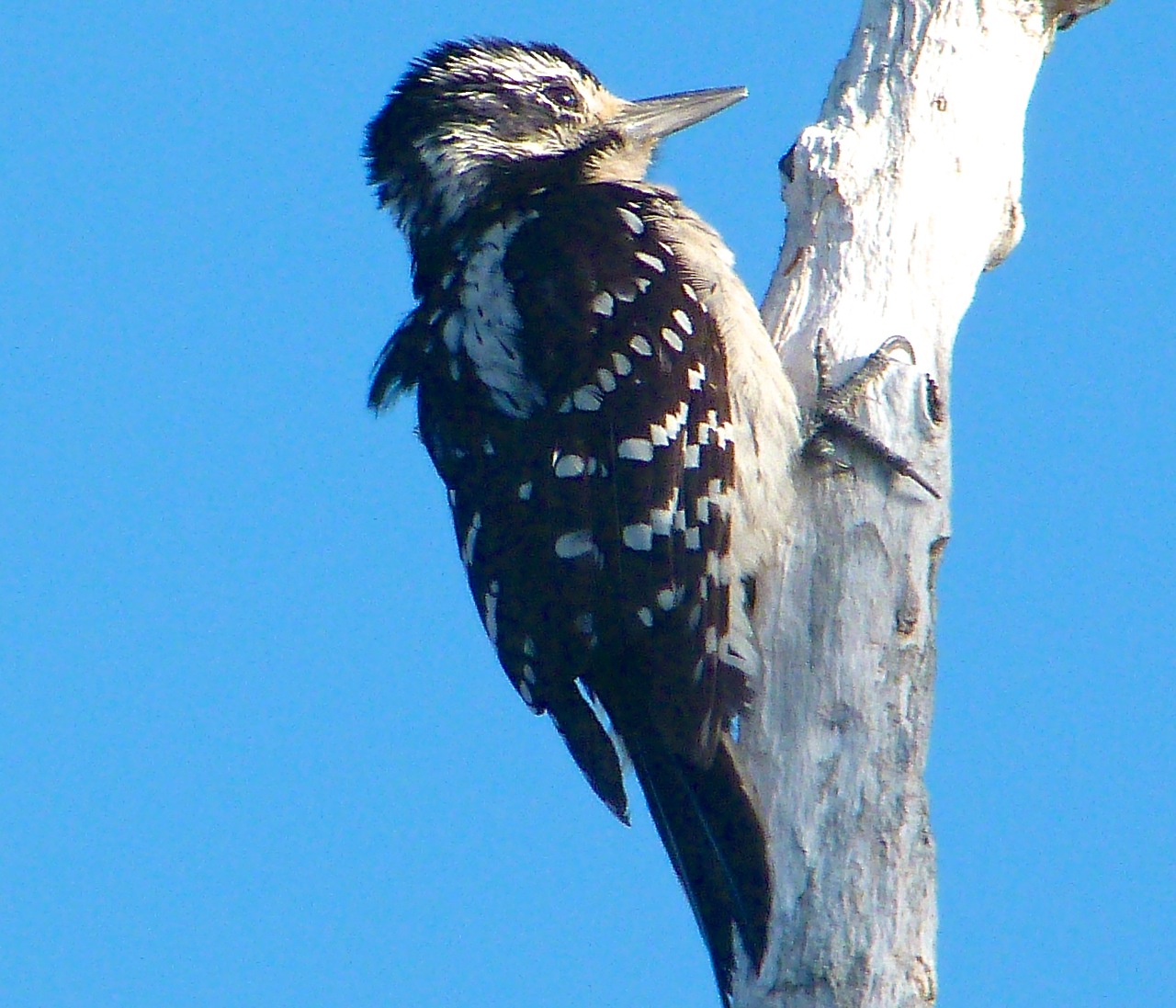
Last June Tom Sheley, a birding expert and photographer from Ohio with serious (by which I mean huge camo-covered camera and tripod) equipment, was staying at Delphi. He tipped me off about a woodpecker nest he’d found 1/3 of the way along the guest drive, just before the first bend. So I grabbed a camera – the wrong one, as it turned out, but my main camera battery was charging – and headed out. I found the nest at the top of a dead tree near the edge of the drive (shown above) and a female HW close to it.
She watched my approach carefully, and as soon as I paused close to the nest tree, she went into a fascinating ‘diversionary tactic’ routine to distract me from the nest. She flew across the track close in front of me, and settled on a tree on the other side of the drive, about 1/3 of the way up its trunk. There, she proceeded to scold me loudly as I fiddled about with the camera…
Still scolding, she then started to climb the tree quite slowly, pausing occasionally to fire off some more angry woodpecker abuse at me.
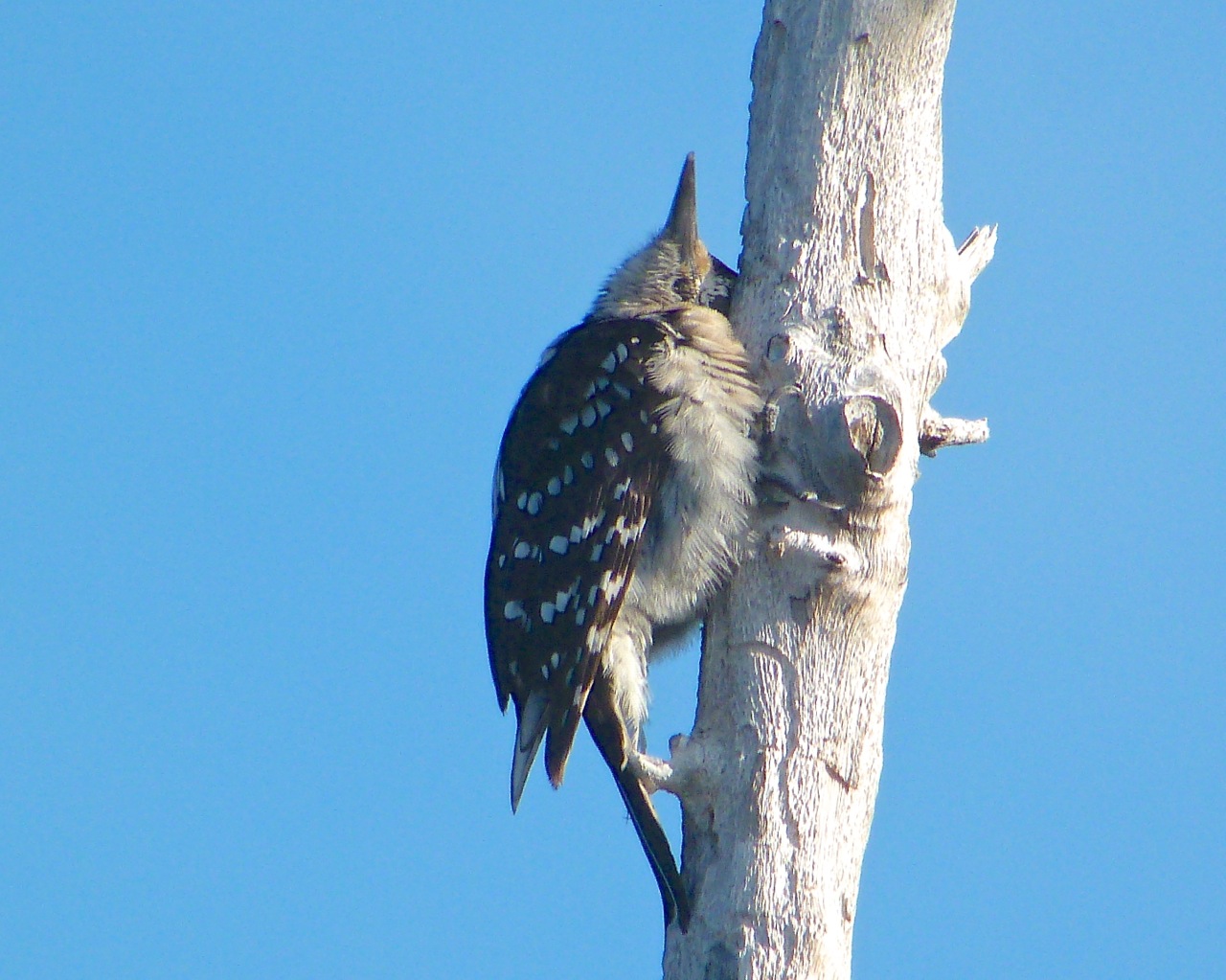
From time to time, she would change tack, closing her eyes gradually and hugging the trunk. This was presumably to make herself appear vulnerable to a predator (me), and therefore retain its (my) interest. If anyone is familiar with this behaviour, please leave a comment.
The woodpecker carried on up the tree, chattering as she went…
…before performing the closed eye / sleepy routine again
By now she was nearing the top of the tree, and I was thinking of giving in…
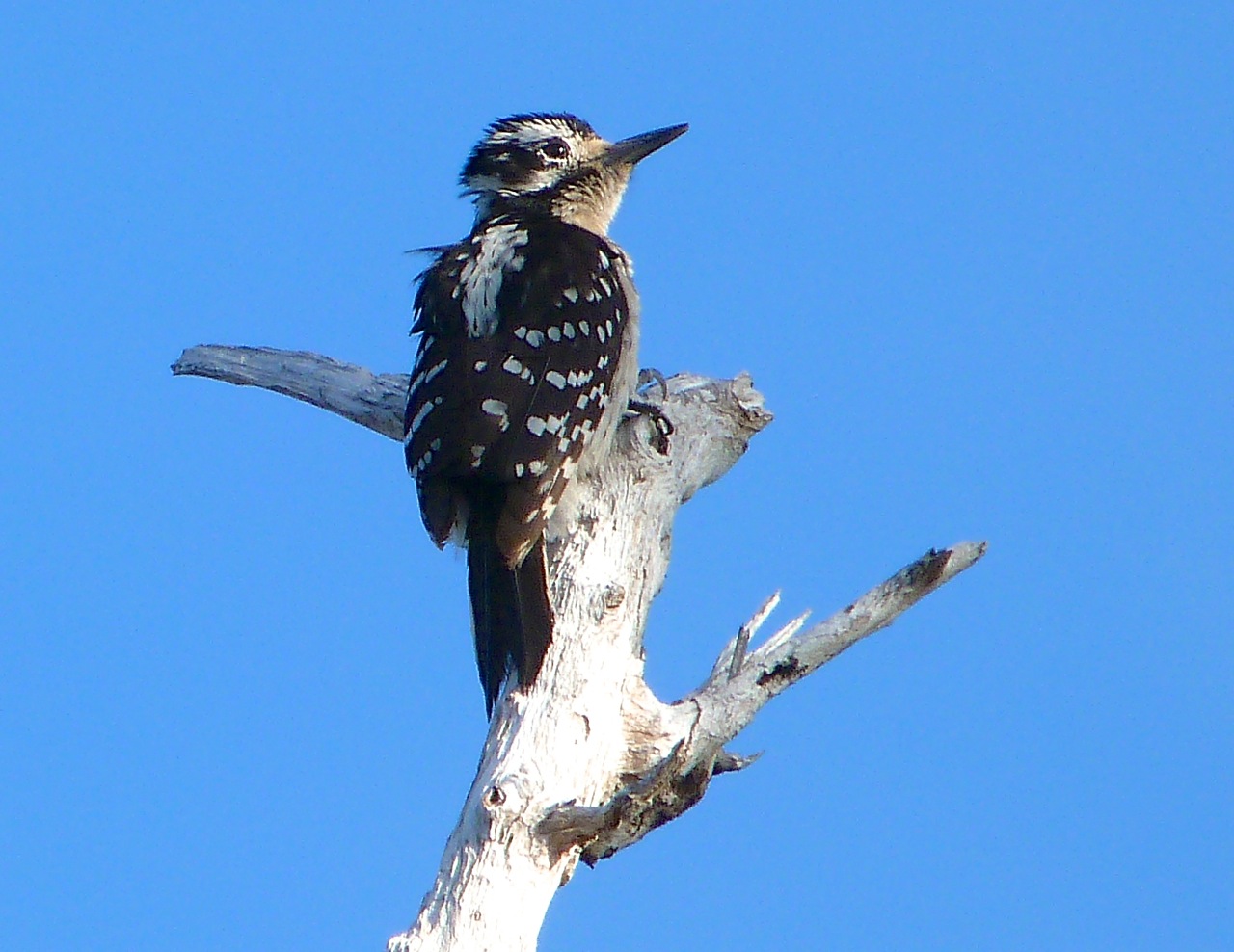
Once she had reached the very top, I made the decision to move on, marvelling at her persistence in taking on a two-legged predator 6ft 5″ high and… not exactly a bantam-weight. Then I realised that, in all of this, I hadn’t thought of the nest behind me a single time. She and her distraction technique had won, and so I made my apologies for disturbing her and left. HW 1, Human 0. At least I knew that on a hot cloudless day I had something to look forward to back at the ranch…
Q: WHAT IS CUTER THAN A BAHAMA WOODSTAR HUMMINGBIRD ON ABACO?
A: A BABY BAHAMA WOODSTAR HUMMINGBIRD ON ABACO
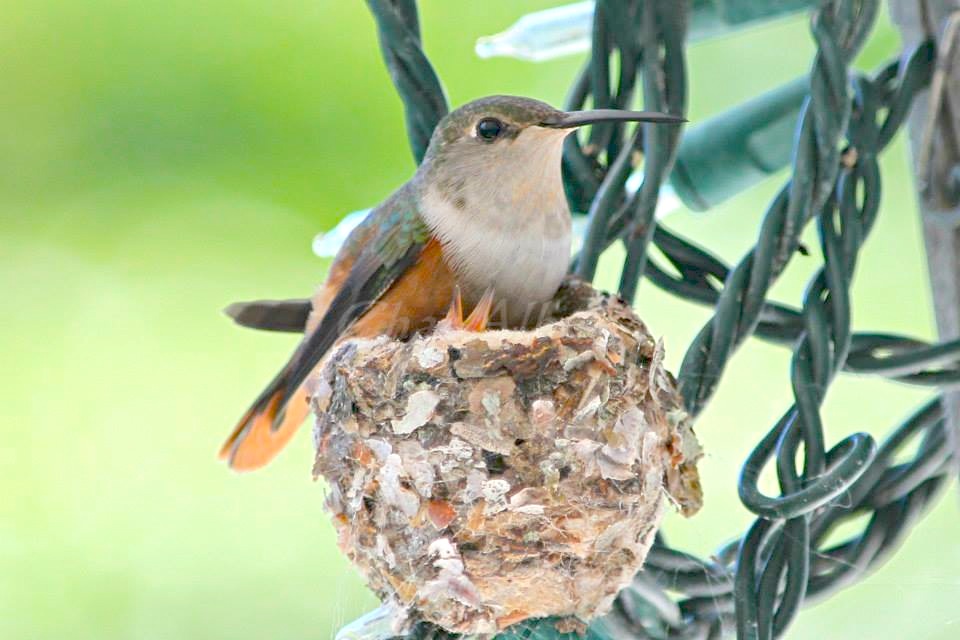
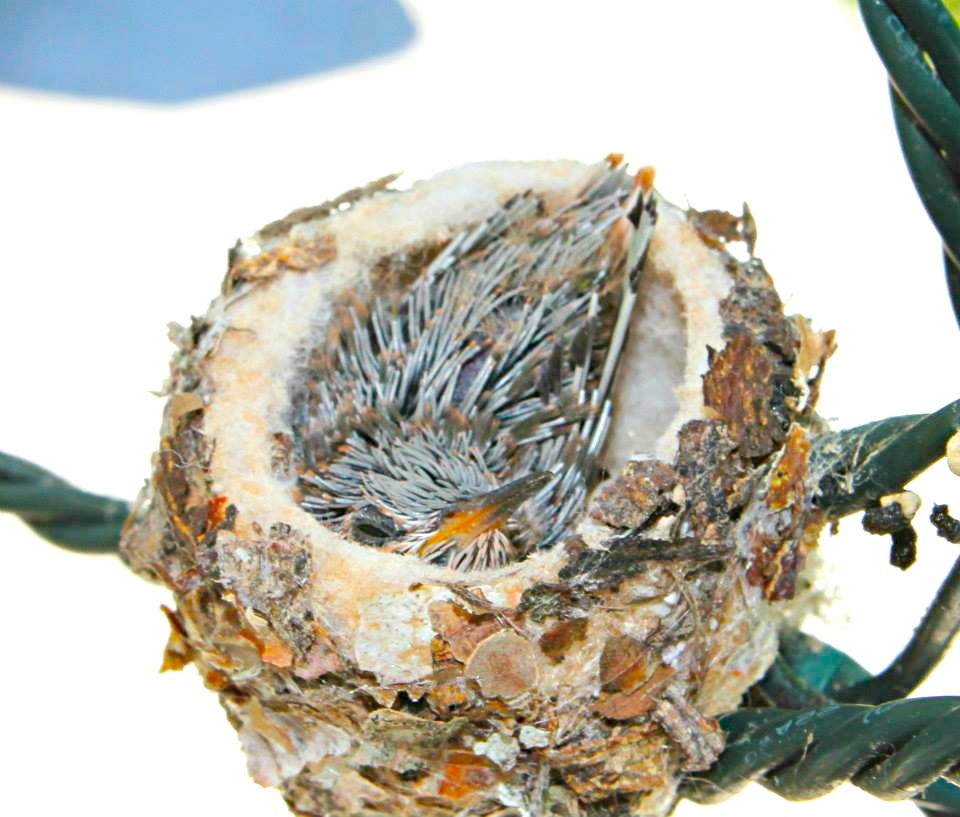
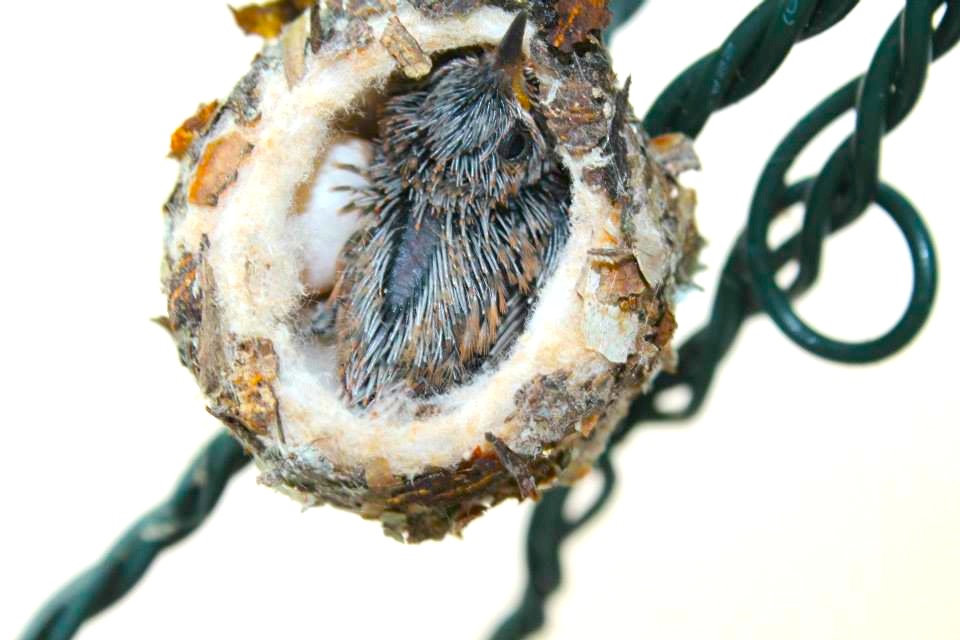
Charmaine Albury from Man-o-War Cay, Abaco, has taken some fabulous photographs of a nesting Bahama Woodstar Hummingbird at her home. With her kind permission, I am delighted to display a selection of them below. The adult is a female, and lacks the striking purple gorget of the male. The baby’s plumage is… spiky! The cup nest is beautifully constructed, made from plant down, bark and cobwebs, balanced in a string of lights. The size of the bulbs give a very clear idea how tiny these sweet little birds are. These are photos to be viewed in wonderment and awwwwwwwwww….
This hummingbird species nests all year round. The female lays 2 elliptical white eggs, which she incubates for 15–18 days. Not only is the baby in these pictures in a very small nest, it is sharing it with an unhatched and presumably sterile egg. Then again, two babies would be even more of a squash…
The Bahama Woodstar Calliphlox evelynae is endemic to the Bahamas, found only on there and as an occasional vagrant in south east Florida. On Abaco, it is one of four endemic species found on the island – the others are the Bahama Swallow, the Bahama Warbler and the Bahama Yellowthroat. Together with the unique ground-nesting ABACO PARROT, these are among the most special birds of Abaco.
‘TAKING OFF’ ON ABACO: NORTHERN MOCKINGBIRDS & MIMICRY
The Northern Mockingbird (Mimus polyglottos) is commonly found in North America, but also has a wide range further afield. The species is plentiful on Abaco and in the northern Bahamas generally. I recently posted about Abaco’s other mocker, the local Bahama Mockingbird,HERE.
A DOZEN MEMORABLE MOCKINGBIRD FACTS TO ENLIVEN YOUR CONVERSATION
Only male mockingbirds sing
The Latin name means ‘many-tongued mimic’
They are omniverous and eat fruits, seeds, insects and even small lizards
They been shown in experiments to be capable of recognising individual humans
They are the State Bird of Florida, Arkansas, Mississippi, South Carolina, Tennessee, & Texas
Thomas Jefferson had a pet mockingbird named “Dick” [wish I’d invented this one…]
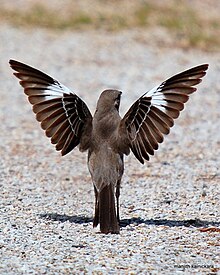
Courting males fly around females to impress them with their splendid wing patterns
Mockingbirds are monogamous & mate for life (though known to play away on occasion…)
Both the male and female are involved in the nest building
Cowbirds are inclined to lay their eggs in mockingbird nests
Both male and female feed their chicks, in the modern way
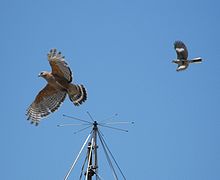
Mockers will confront larger birds including hawks; also cats and dogs; & even humans
IMITATIONAL SKILLS
Besides having a particularly wide song repertoire, the mockingbird will mimic other birds, other natural sounds (including dogs) and even man-made / mechanical sounds – car alarms, sirens and a whole lot more besides. Good old Wiki has this to say:
“There are four recognized calls for the Mockingbird: the nest relief call, hew call, chat or chatburst, and the begging call. The Hew call is mainly used by both sexes for potential nest predators, conspecific chasing, and various interactions between mates. The differences between chats and chatbursts are frequency of use, as chats are year-round, and chatbursts occur in the fall. Another difference is that chatbursts appear to be used in territorial defense in the fall, and the chats are used by either sex when disturbed. The nest relief and begging calls are only used by the males.”
IMITATIVE MEMORY?
Remarkably, it seems that Northern Mockingbirds can inherit and store the imitations of their ancestors. We listened to a young one in the Abaco National Park with Caroline Stahala, the scientist i/c Abaco Parrot conservation. The bird was accurately mimicking a tufted titmouse, a bird it will never have heard and so cannot have learned from directly (and no other bird on Abaco sounds like the titmouse).
NEW! Another remarkable nugget, gleaned from Bahamas bird authority and author Tony White, is that in early Spring you may hear the calls of Grey Kingbirds starting to arrive for their summer vacations. Do not be fooled; Northern Mockingbirds begin imitate the calls of this species about 2 weeks before they begin to arrive…
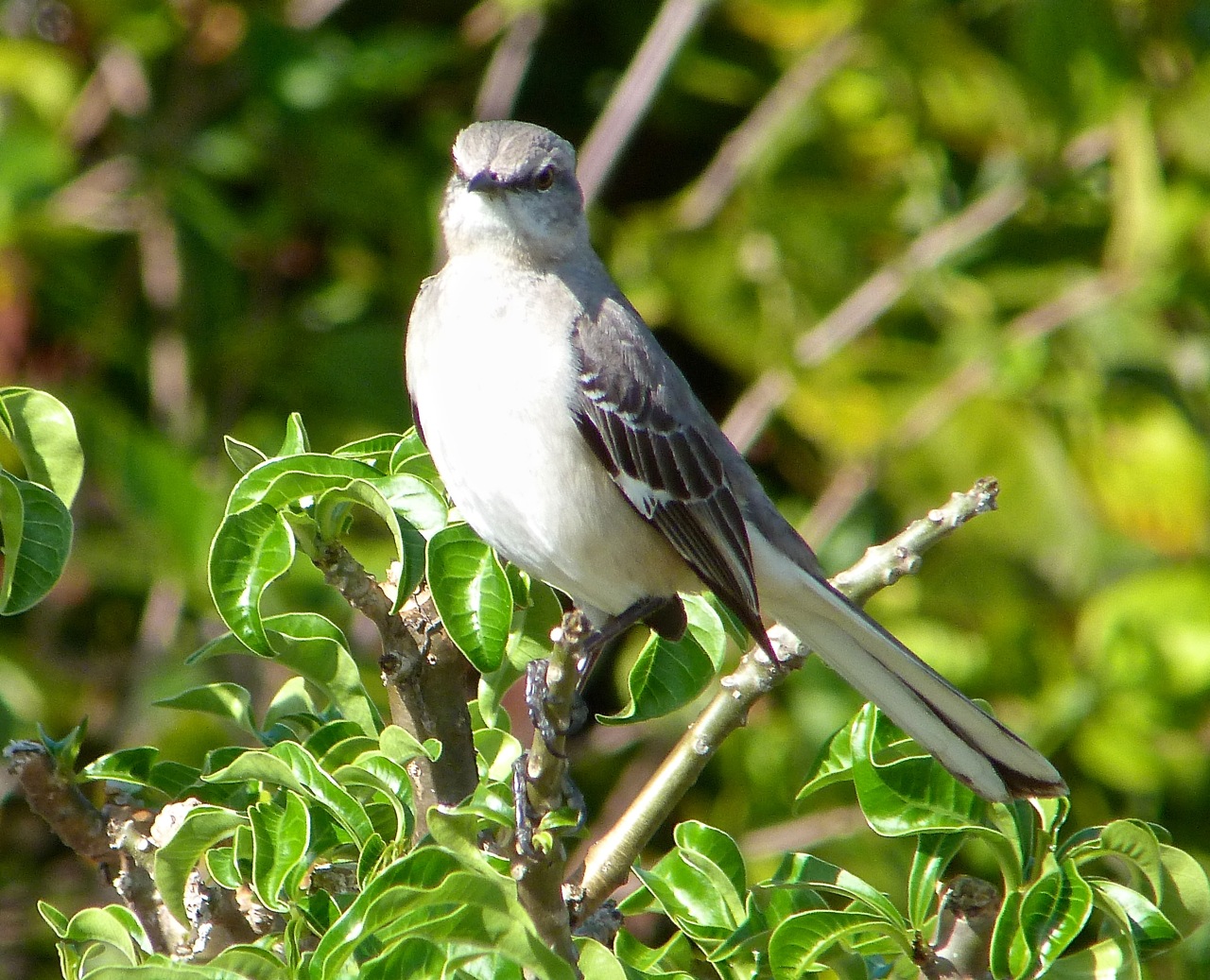
By way of comparison, here is a Northern Mockingbird I photographed at the beginning of the year in New York while walking the High Line (if you get the opportunity to do this, take it. The perfect solution for a defunct high-level railway track is to turn it into a walkway-cum-park-cum-viewing platform). There are detectable differences, not least the brown frontal flecking.
THE INFLUENCE OF MOCKINGBIRDS ON THE ARTS
“To Kill a Mockingbird”, Harper Lee, (1960); Film version (1962) starring, by amazing coincidence, Gregory Peck
“Listen to the Mocking Bird” (1855) An American folk song popular in the mid-19th century
“Mockingbird” (1974) Carly Simon duets with James Taylor, her (then) husband, one of several (though not simultaneous)
“Mockin’ Bird Hill” (1951) Les Paul & Mary Ford, later massacred in 1964 by ‘The Migill 5’
Star of the Lullaby that starts “Hush, little baby, don’t say a word, Mama’s gonna buy you a mockingbird…” That’s quite enough of that to be going on with
It turns out Mr Eminem has rapped up a ‘parental advisory’ and ‘explicit warning’ “Mockingbird” for our delectation. I was going to post the mp3 in a vaguely satirical way, but it is so numbingly dire that even his mum Mrs Mathers can’t bear to listen to it. So just enjoy the cover, then move on quickly to the birdsong video below…
WILLIAM SWAINSON, ORNITHOLOGIST: 224 YEARS OLD TODAY
Happy Birthday, William Swainson, 224 years old today, honoured with a Google emblem, and… oh, sorry, we’ve run out of tiny candles for your cake…
Swainson (1789 – 1855) was an English ornithologist, entomologist, conchologist, natural historian, and a gifted illustrator of the natural world. He was a pioneer of the new lithographic technology, which enabled quicker reproduction of his work than engraving.
Moluccan King Parrot from Zoological Illustrations
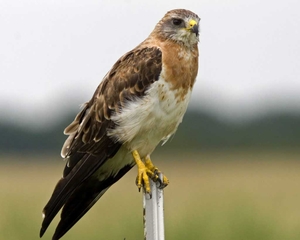
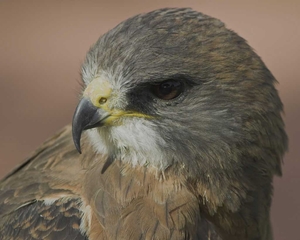
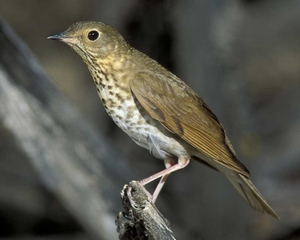
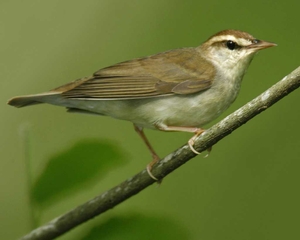
Swainson lent his name to a number of avian species, three of which may be found on Abaco. These are the Swainson’s Hawk, Thrush and Warbler. The hawk is a rare visitor; the thrush is a transient, passing through the Bahamas during migration; and the warbler is a hard-to-find winter resident. Here are the three species, courtesy of AUDUBON.ORGand for each, an illustrative video.
WHITE SOUND, ABACO: MANGROVES, MUD & (REALLY) GREAT EGRETS
The piratically named Treasure Cay (aaarrrrrr…) is north of Marsh Harbour, and home to one of the larger communities on Abaco. It has a wonderfully long white sand beach, a golf course, condos and villas, a marina and a cheerful atmosphere. It is also one of the best areas in North Abaco for birding. There are the shorebirds, of course, and all the usual ‘settlement’ species. In addition, the golf course has freshwater ponds where you will find a wide variety of duck and other water species. NB Check in at the Club House and get permission first – amiably given if politely requested (see map below).
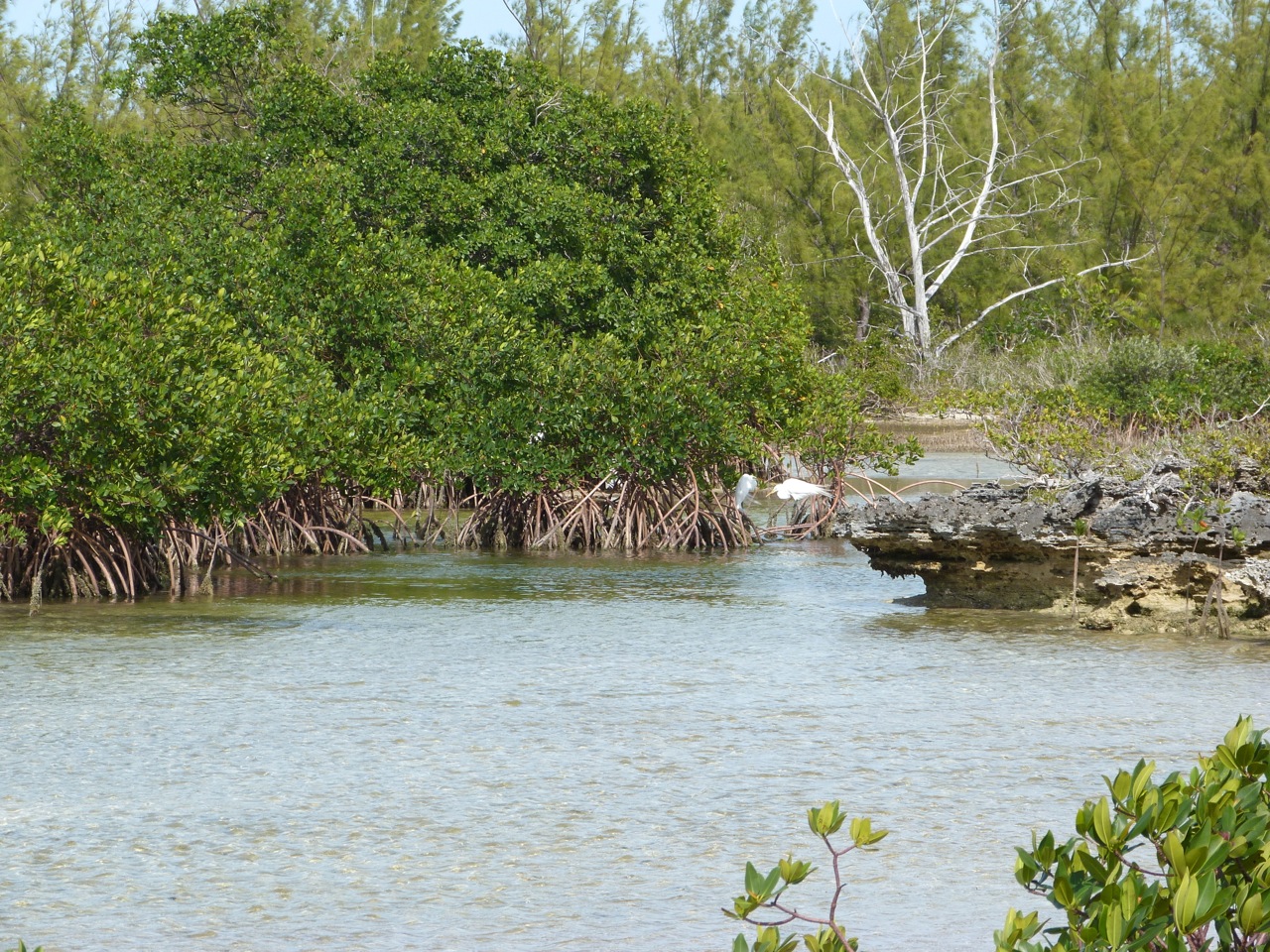
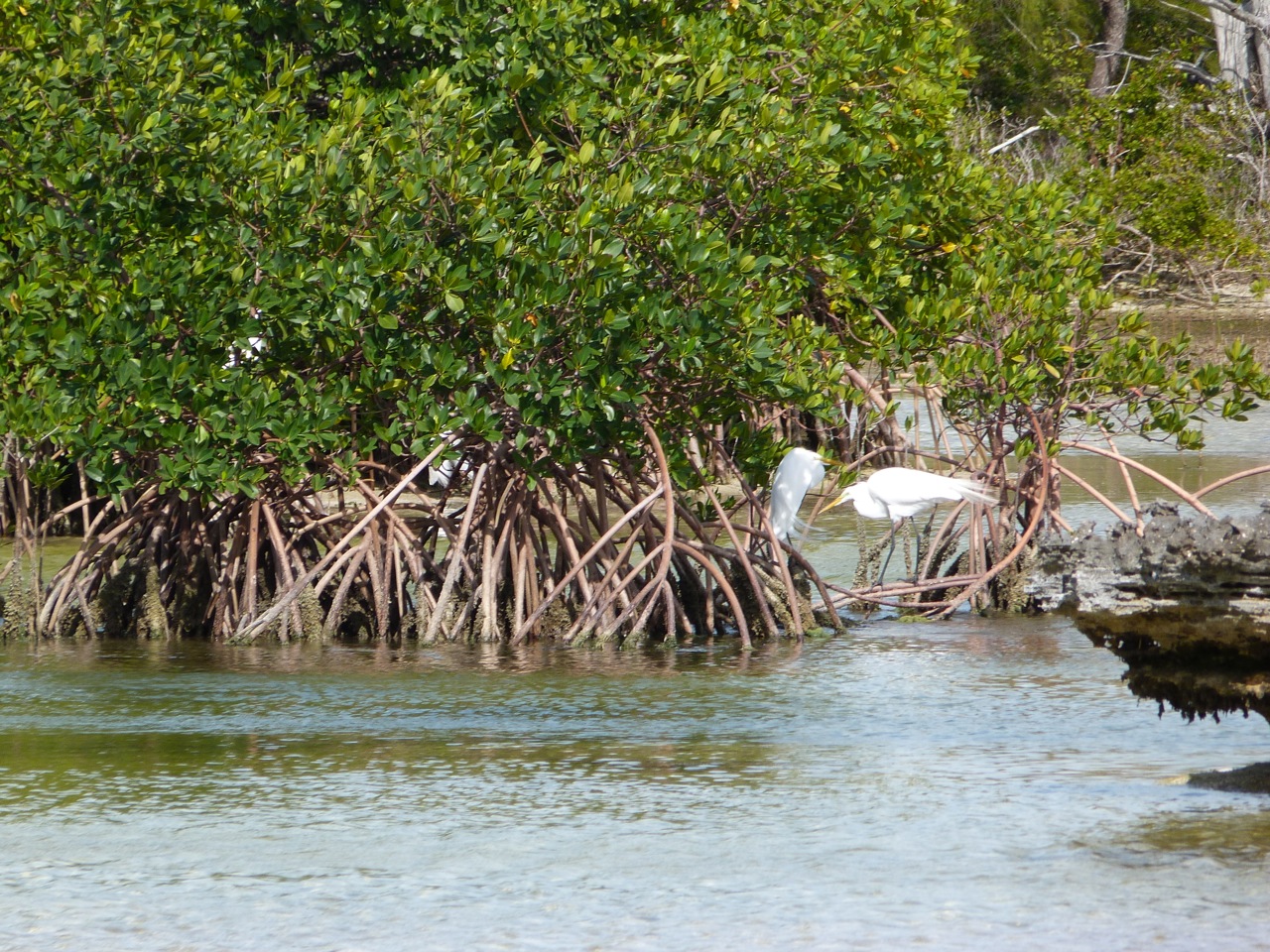
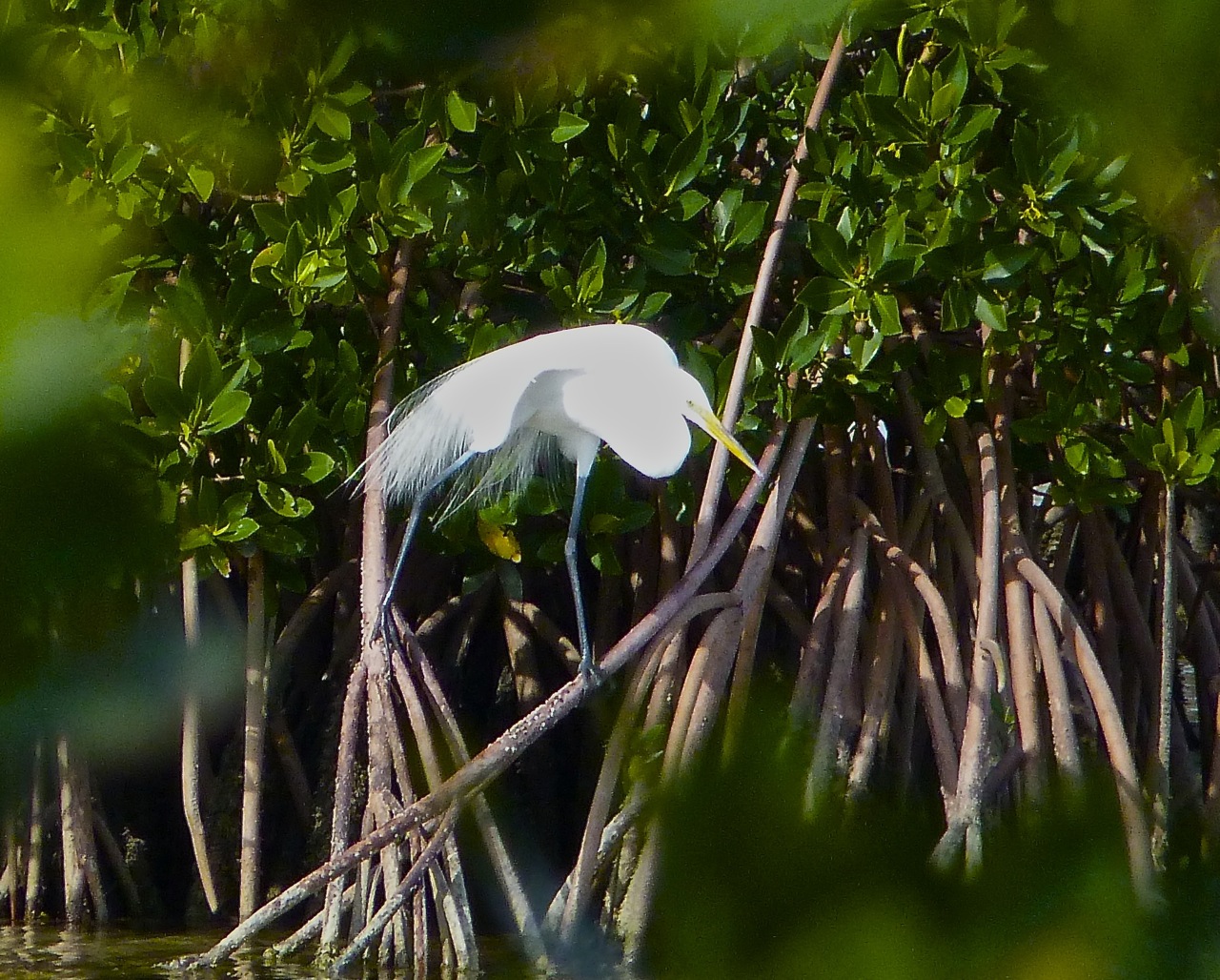
Treasure Cay also has a large area of bays, brackish inlets and lagoons, including – to continue the pirate theme – Galleon Bay, Brigantine Bay, Cannon Bay and Gun Powder Creek. And also White Sound. This can be reached by luck (which may run out) or good management (ask for directions; wait for me to get back the map I have lent to someone and post a grab from it). Drive (with care) along the uneven track beside the lagoon and there is a good chance you will see Great Egrets in the mangrove islands dotted around the middle of the water. This is what to look out for…
Zoom in a bit, and you’ll see two more egrets on the far side of the clump of mangroves. It’s a colony… in the end we were able to count 9 birds on this one mangrove island.
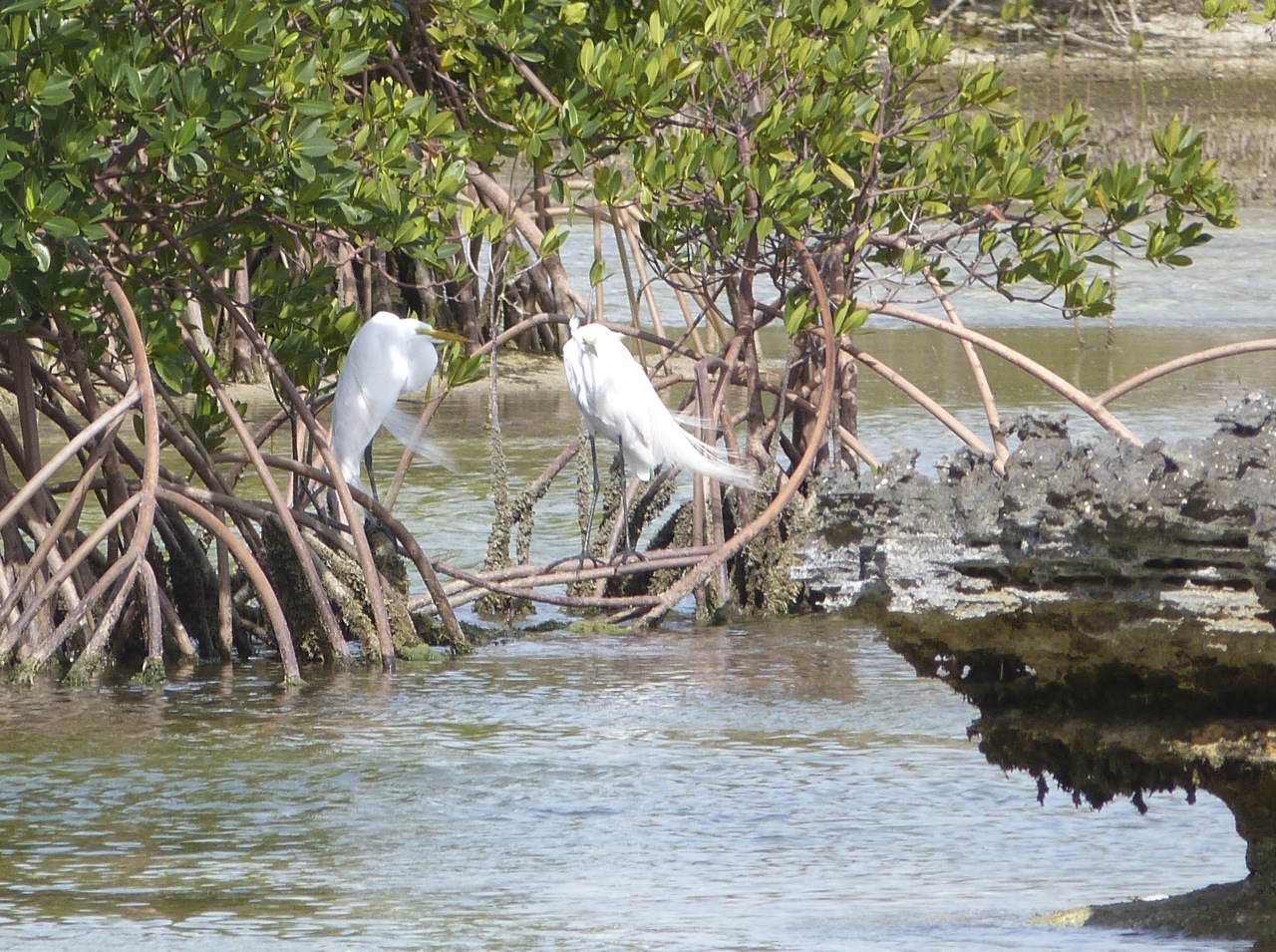
One of the loveliest features of these fine birds in breeding season is the way that even a slight breeze will blow their long plumes away from their bodies like streamers
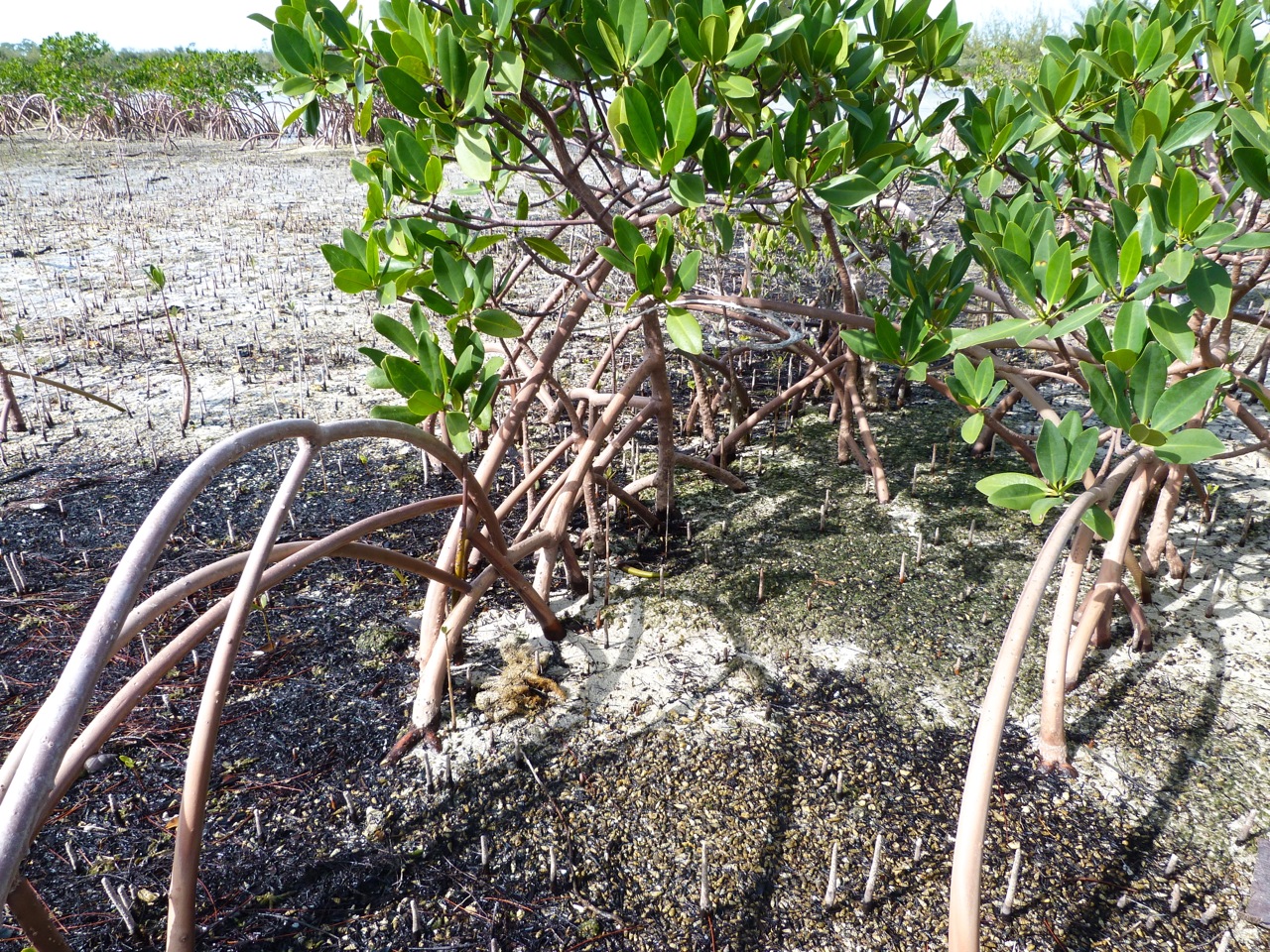
We were some way from the birds, as these rather indifferent photos suggest, so we decided to try and get closer. The water was fairly low, leaving expanses of firm-looking marly mud around the edge. There was an apparent causeway to an overgrown rocky outcrop that would enable us to get closer to a vantage point without being spotted. As it turned out, the mud was only… ankle deep. It could have been messier. And we had a chance to see at close quarters the remarkable way in which mangrove entanglements develop.
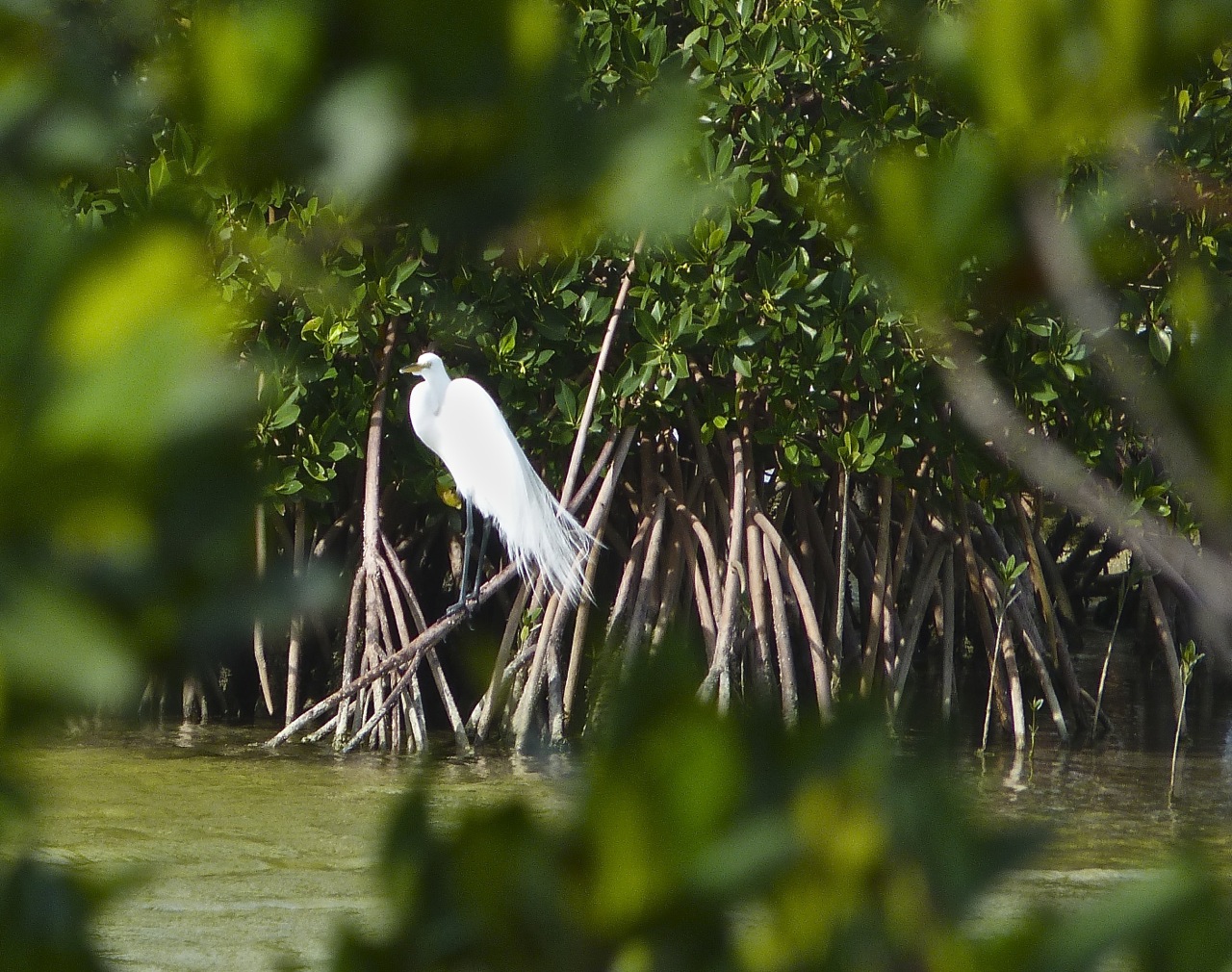
We reached the outcrop muddier and slightly wiser, and clambered up through the scrubby and scratchy bushes to the top, nothing if not intrepid. My wading stick came in handy for beating a rough path. And by adopting strange stances in the manner of someone trying to pick up a faint cellphone signal, we could peer through the foliage to establish whether we were indeed a bit closer to the egrets.
The answer was yes. But there was another obstacle, familiar to all fellow ‘focus fail’ offenders. Shooting a bird through a hole in a bush straight in front of you is complicated. You get a vivid detailed frame of greenery, with a blurry centre of unintentional and unwanted BOKEH instead of the intended subject. A lens entension (the poor man’s zoom that I use) tends to make it worse. So you’ll have to make do with these pictures for now, until you can visit White Sound and get your own with your natty Nikon.
My favourite ‘stance’ shot
That wasn’t the end of the adventure. After we had squidged our way back through the slightly smelly mud, we moved further along the sound, to find a further egret colony on the far shore just in time to watch them from afar as they took flight.
TREASURE CAY, LOCATIONS OF WHITE SOUND & THE GOLF CLUB, & SOME PIRATICAL NAMES
TREASURE CAY IN RELATION TO OTHER ABACO PLACES
When leaving Treasure Cay, visitors receive a friendly reminder to return, in terms reminiscent of, yet far nicer than, a Scottish Tourist Board brochure. Maybe this reflects the historic significance of the Scots in the history of the Bahamas, to the extent that there is even a Bahamas tartan.
TC Map credit: Abaco Estate Services. They send me emails, so I guess they won’t mind publicity here
‘Rolling Harbour: The Blog’ had humble beginnings – a dodgy structure built on foundations formed of an unpromising mix of ignorance and incompetence. Gradually it has come together, to the extent that it has just passed the 125,000 visits mark. Abaco is a small and uncrowded island, so the audience demographic [to use biz-speak] isn’t large. However the wildlife, scenery and lifestyle have turned out to have a wider appeal. 1/8 of a million people (or perhaps 1 crazy punter with repetitive strain injury from checking in unhealthily often) deserve a few of Abaco’s unique parrots in return.
I THANK YOU ALL
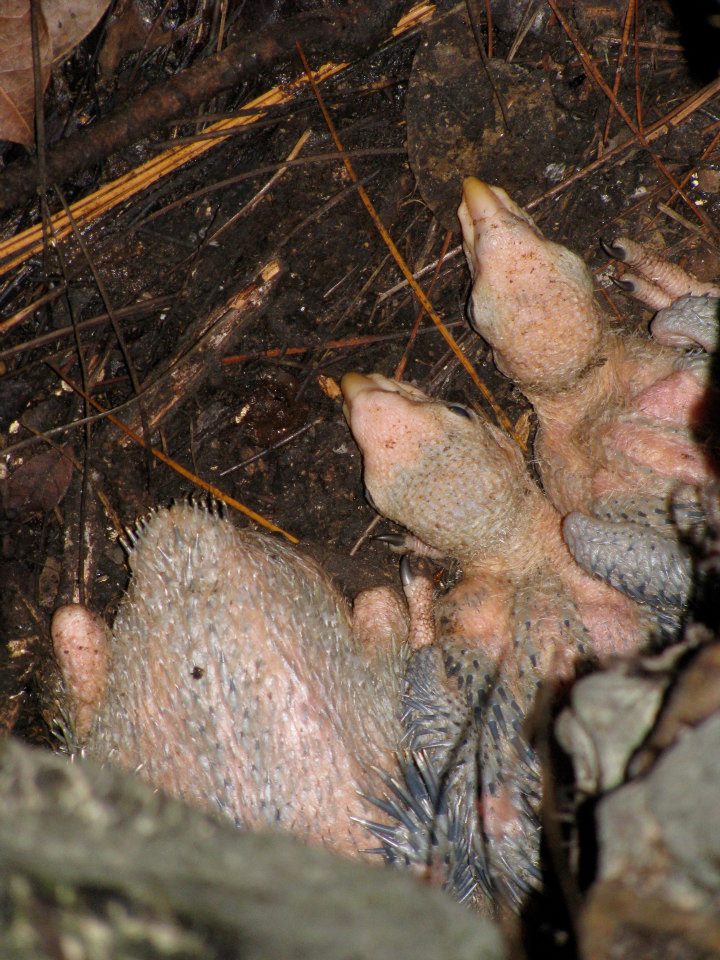
WHERE IT ALL BEGINS – AN UNDERGROUND NEST DEEP IN THE NATIONAL FOREST
EVENTUALLY THE CHICKS HATCH…
…AND GROW
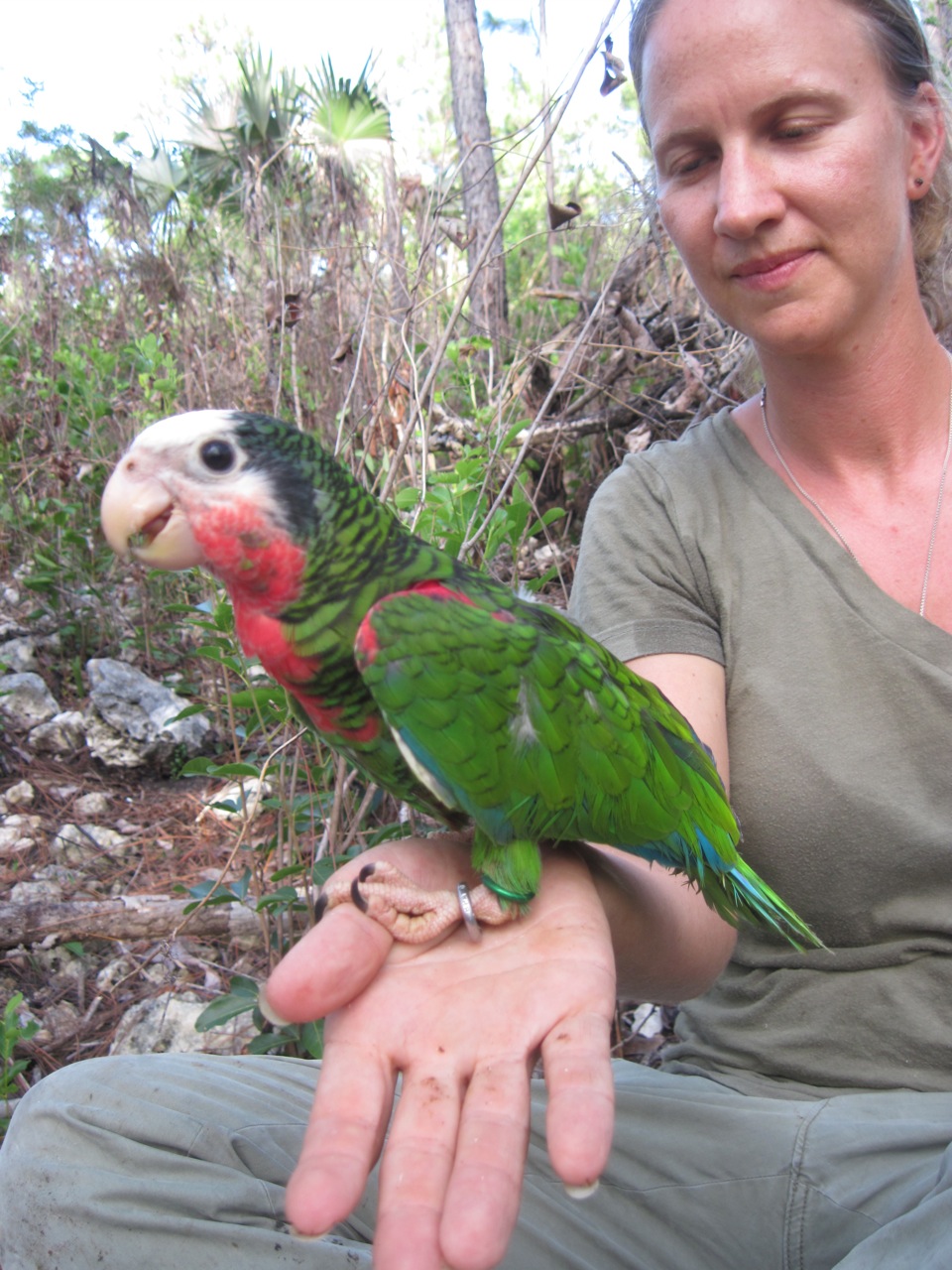
IN DUE COURSE THEY ARE READY TO BE CHECKED OVER AND RINGED
THEY HAVE NO FEAR OF THE ‘PARROT LADY’, SCIENTIST CAROLINE
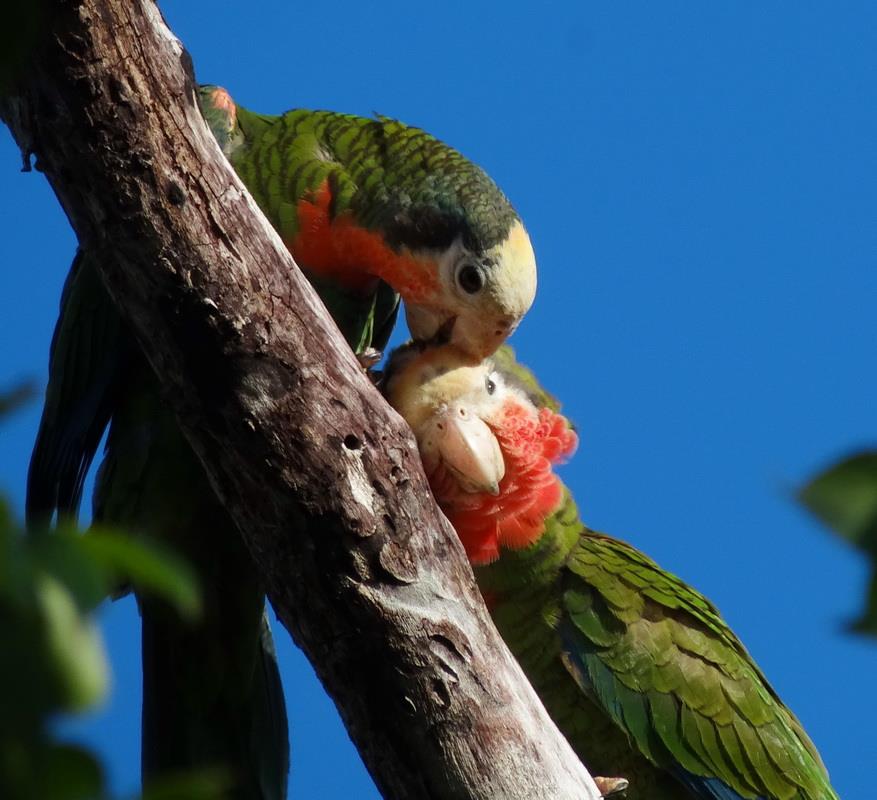
SOON THEY ARE INDEPENDENT AND DISCOVERING THE JOYS OF GUMBO LIMBO BERRIES
KEEPING A BEADY EYE OUT…
DOMESTIC HARMONY…
…BUT NOT ALL THE TIME
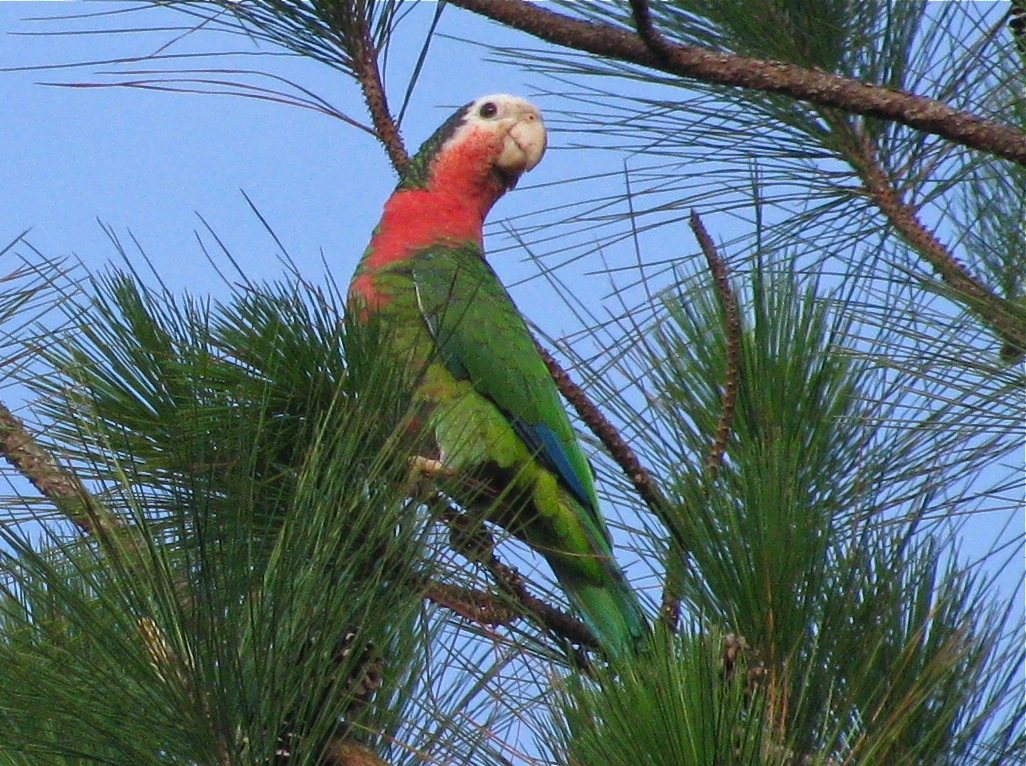
‘HOW DO I LOOK AGAINST A BRIGHT BLUE SKY?’
PARROTS HAVING AN EARLY EVENING GET-TOGETHER AT BAHAMA PALM SHORES
‘GOODNESS ME, IS THAT THE TIME? I MUST FLY…’
Credits: Caroline Stahala, Melissa Maura, RH; recording and video RH
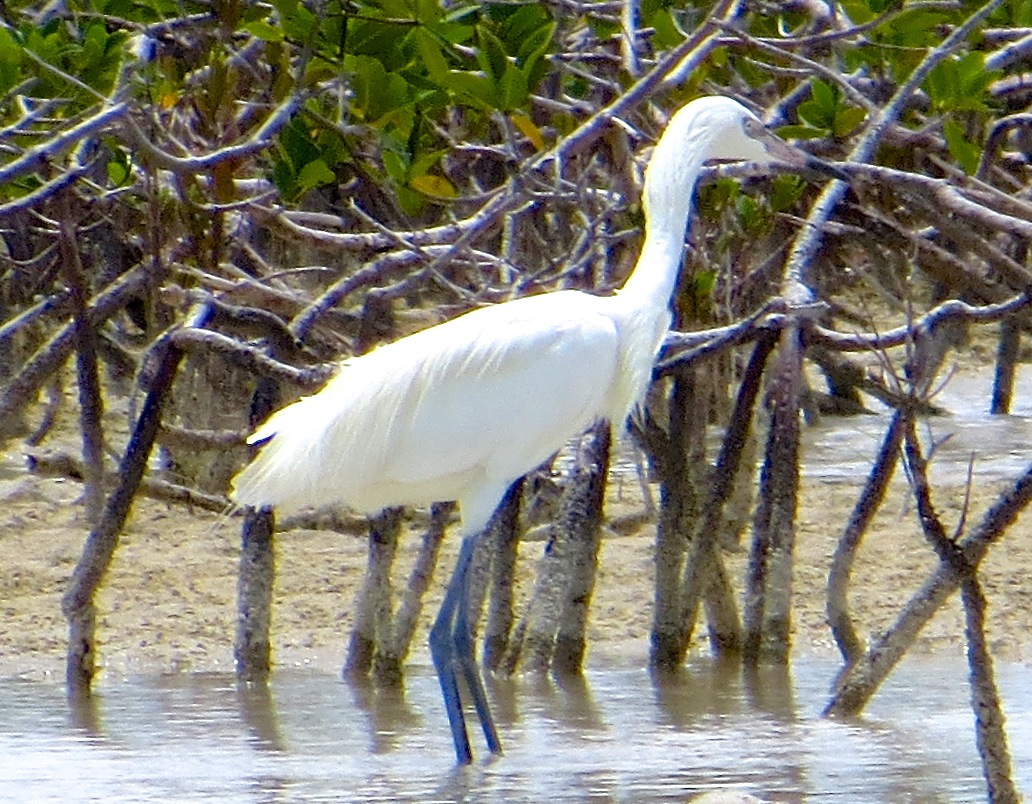
Contrary to appearances from the header image and the one below, Reddish Egrets (Egretta rufescens) do not yet use cellphones to communicate. Nevertheless, the trick of having a good ear-scratch while standing in water on one leg is a good posey accomplishment.
All these photos were taken while we were bonefishing from a skiff far out on the Marls in the mangroves. Ishi poled us closer so that boat-partner Tom – a real photographer – could get some shots. Meanwhile, I did my best with my little camera that I take out on the boat – the one that won’t matter too much when it slips from my hand or pocket into the drink. These things happen: I lost a good pair of Costas that a gust of wind unkindly whisked away when I took them off to change a fly.
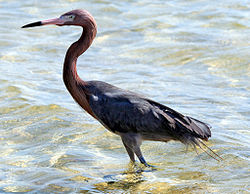
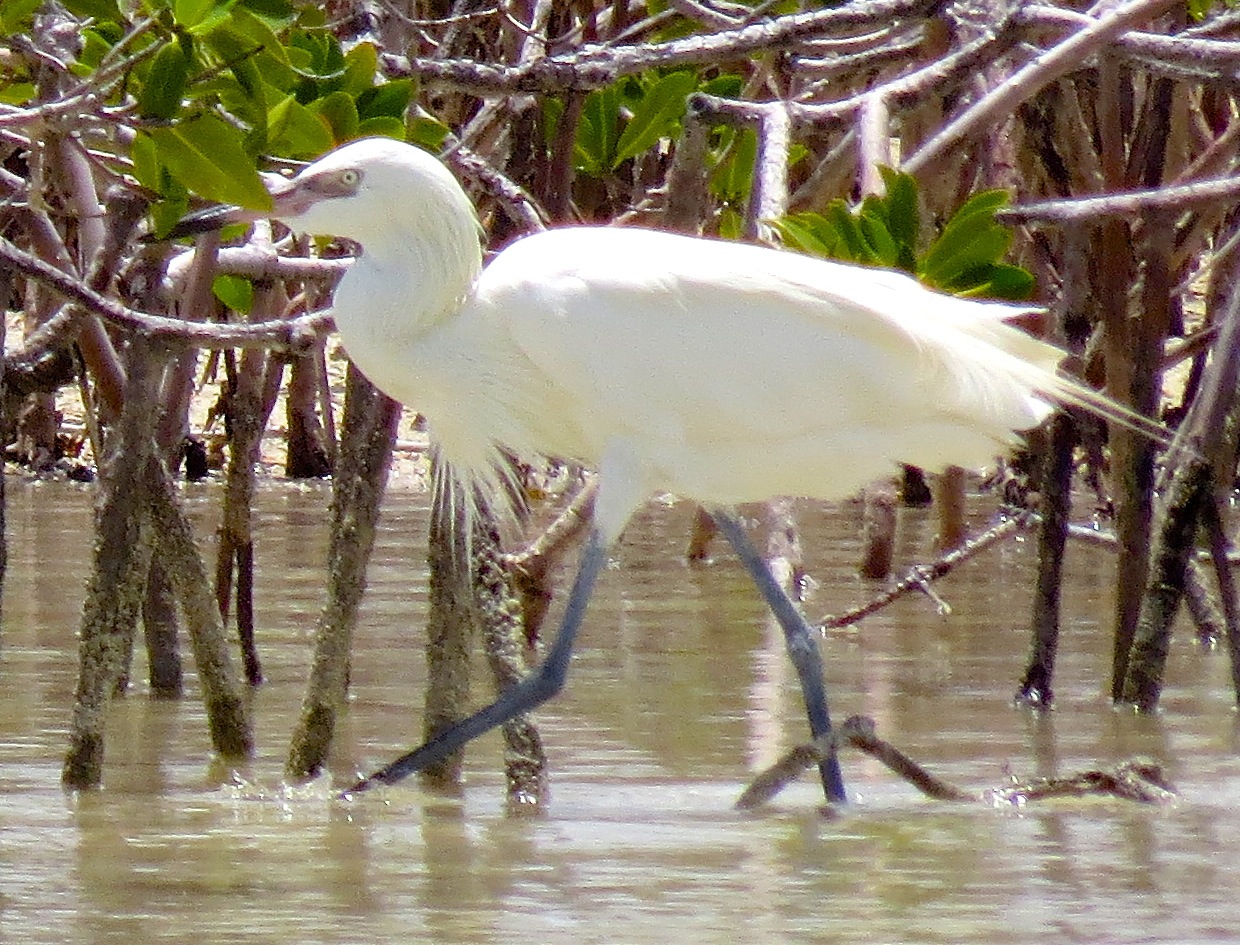
This egret comes in two very different ‘colourways’. The classic version has a slatey-blue body and a reddish head and plumes. The white morph is pure white. The only similarities between the two are the two-tone bills with the black tip; and the blue-grey legs and feet.
True Reddish Egret, as you might expect it to look
The white morph
I’m not certain of the proportions of each type on Abaco, but I have certainly seen twice as many white ones as true reddish ones. There seem to be quite a few around – there are plenty of fish for them and dozens of square miles of human-free space in which to stalk them. However as with many (most?) of the bird species, there is a declining population for all the usual man-related reasons, and these fine birds have now had to be put on the IUCN ‘near-threatened’ list.
The bird kept an eye on us as we drifted closer, but was unperturbed. It continued to poke around in the mud, and occasionally it moved delicately but quite quickly to a different patch.
We watched the bird for about 10 minutes. Then we returned to what we were really there for – Tom to catch bones with practised skill, and me to wave the rod incompetently around until some passing fish took pity on me and grabbed my fly, knowing it would soon be released once all the fuss was over…
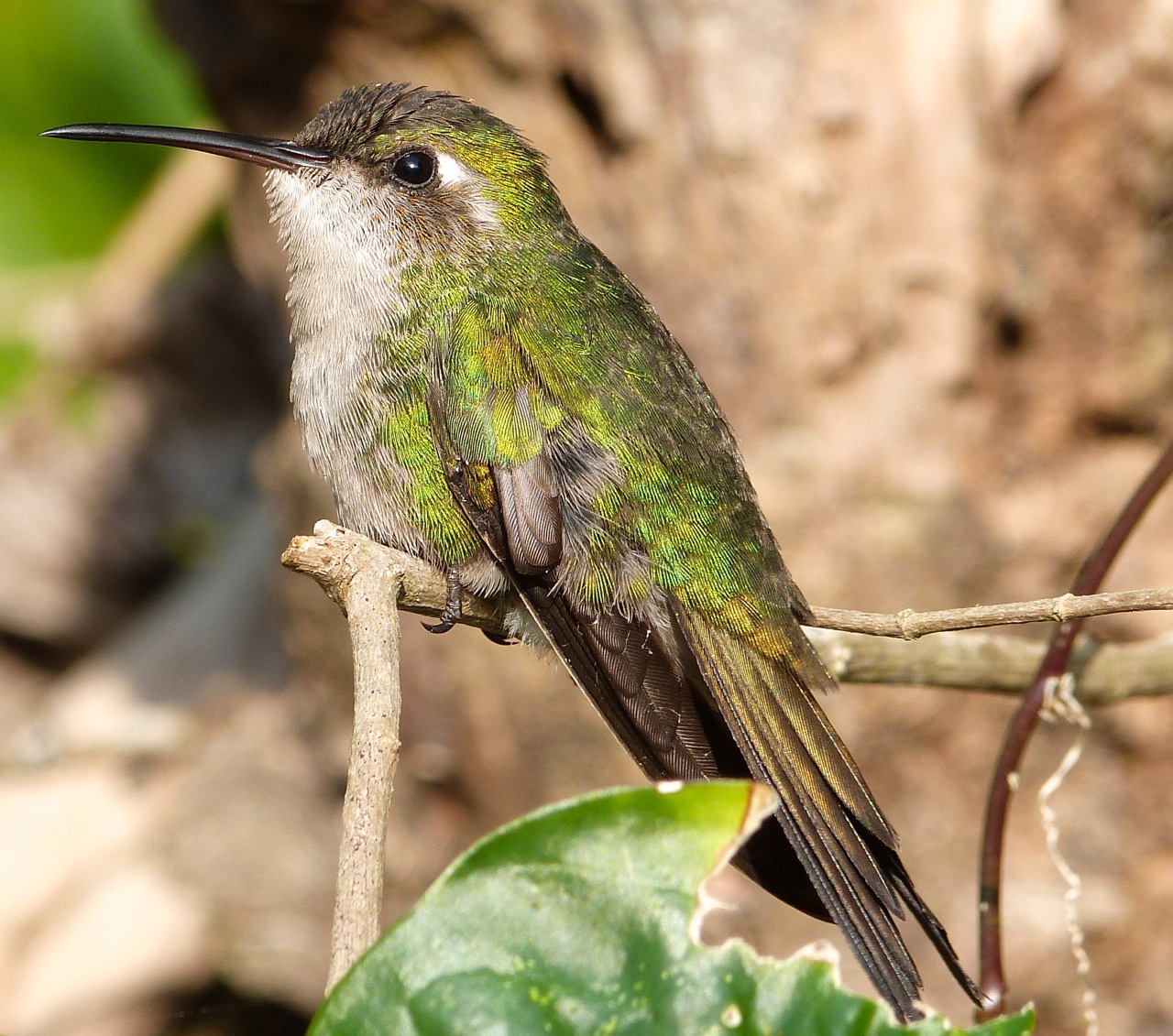
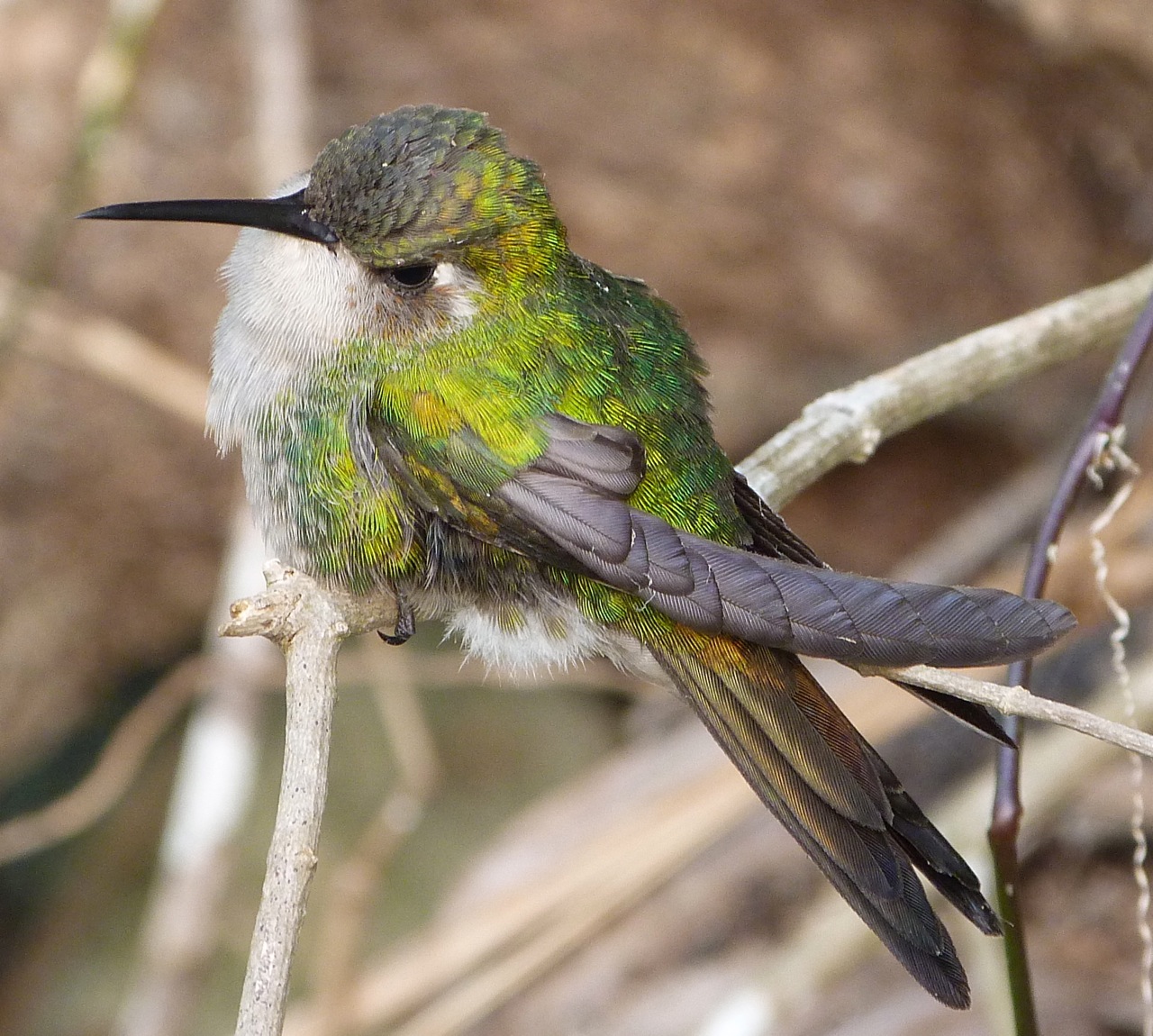
PRECIOUS EMERALDS ON ABACO: GREEN HUMMINGBIRD JEWELS
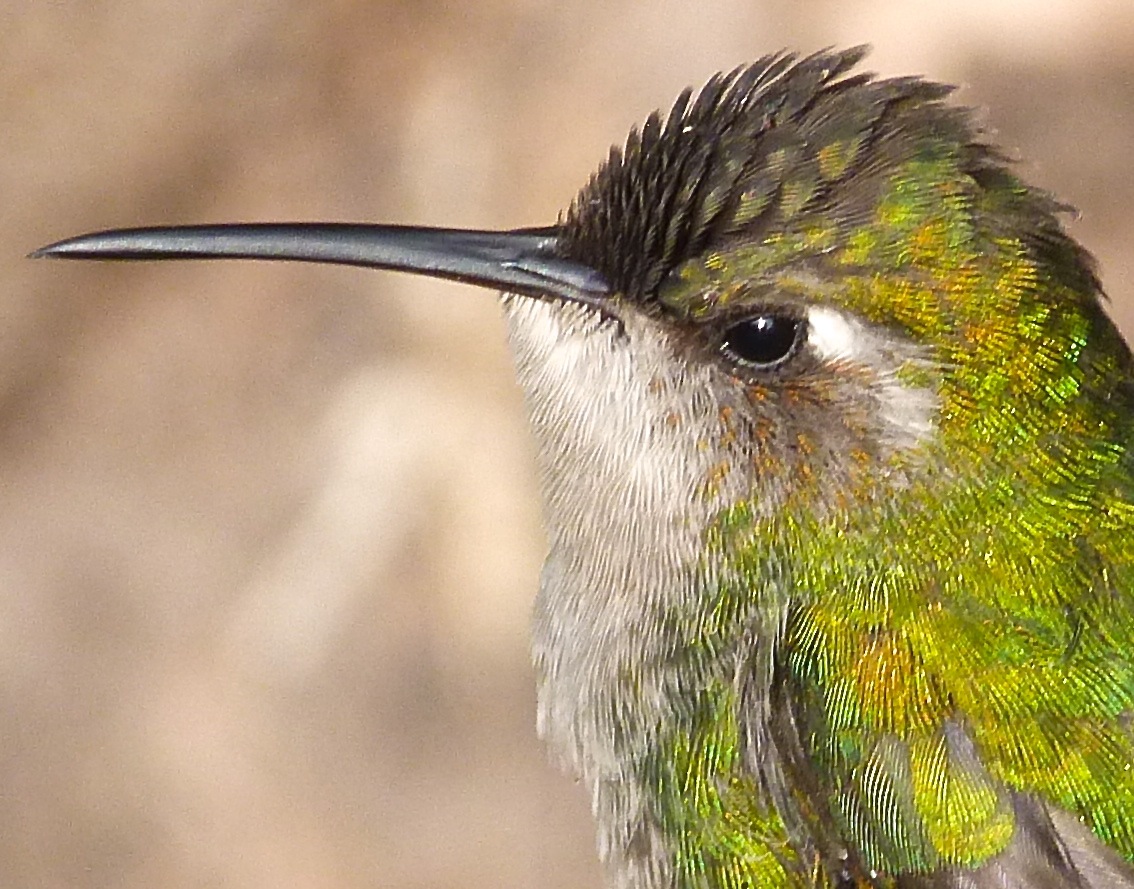
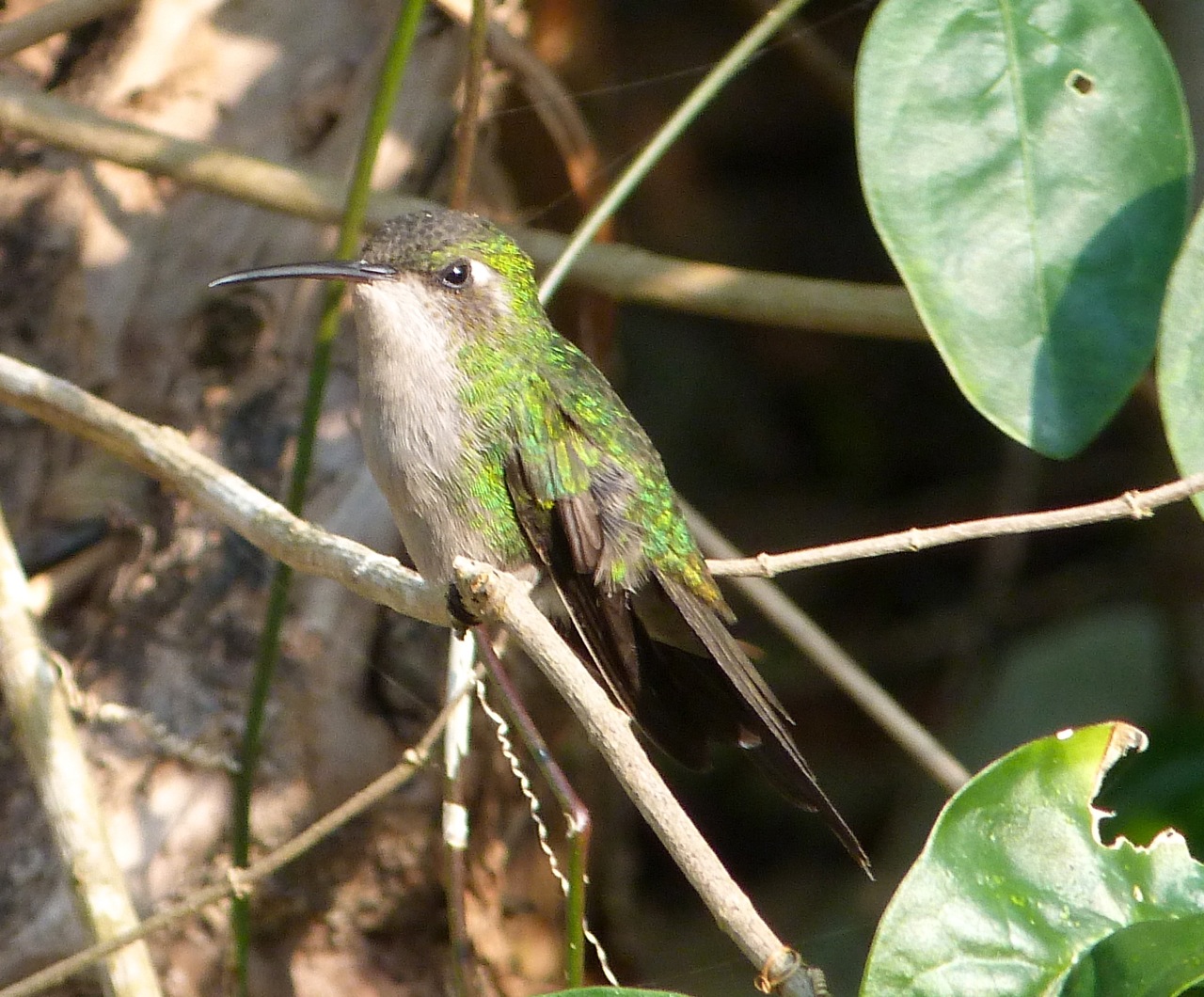
There are two resident hummingbird species on Abaco: the beautiful endemic Bahama Woodstar; and the lovely non-native Cuban Emerald. The species don’t get on, and tend to keep to separate territories. At Delphi the Emeralds predominate, though luckily there are Woodstars as well. Both species of these tiny birds have featured in previous posts, but this little hummer was a special one.
There’s a small patch of cleared coppice at Delphi, the ‘Farm’. This is where plants are ‘grown on’ for the gardens. In particular, there are coconuts planted in soil to germinate, to provide replacements for any palms that are trashed in the hurricane season. Since both Irene (in 2011) and Sandy (2012) passed directly over Delphi, you can see the sense in having an on-site garden centre. It can be a good place for birds, having both sun and shade. It’s where I suddenly spotted this Emerald, a few feet away from me.
It seemed quite relaxed, so I decided to see how close I could get. My attempt at stealth was slightly spoiled by my inexplicable need to make totally unnecessary “soothing” clicking and chooking noises as I crept forward. But the bird just watched peacefully, assuming me to be insane and probably harmless.
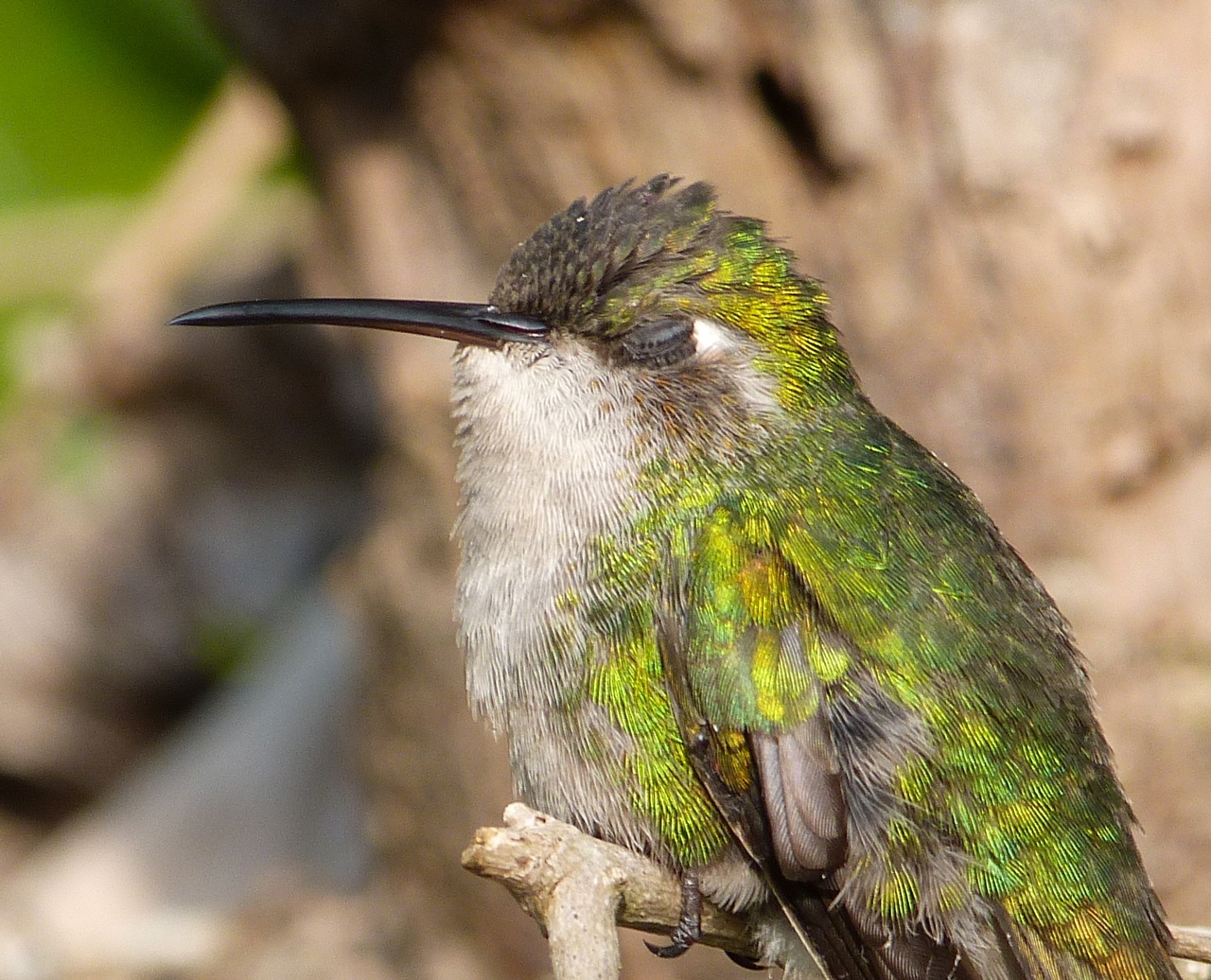
I shuffled forwards, expecting the bird to fly off at any moment. Instead, it seemed to go to sleep… By now I was a couple of feet away, and felt it was time to stop the ridiculous noises. The bird could not have been more at ease if I had sung it a lullaby. [Apart from the fact that I can’t sing, that is]
By now the metallic glint of the feathers in the sun was extraordinary, with colours other than green clearly visible, especially on the tail. Does this bird look nervous? I was a foot away from it.
In the end I actually reached the bird. I stood over it and could easily have touched it. I quite see that it had probably been using the sugar water feeders, and was used to seeing people. But still. It was mini and I am… not. Here is my last shot, an aerial view. Then I crept away again, leaving the bird in peace and doubtless wondering what on earth that had all been about. I have a general rule against anthropomorphic ‘special moments’ but if I did not, then this was one…All photos RH armed with a Panasonic Lumix. If you want to use a photo – surprisingly, people occasionally do – please ask first and it will probably be fine. One or more of my images may be published shortly, and I don’t want a wrangle on my hands. Or anywhere else…
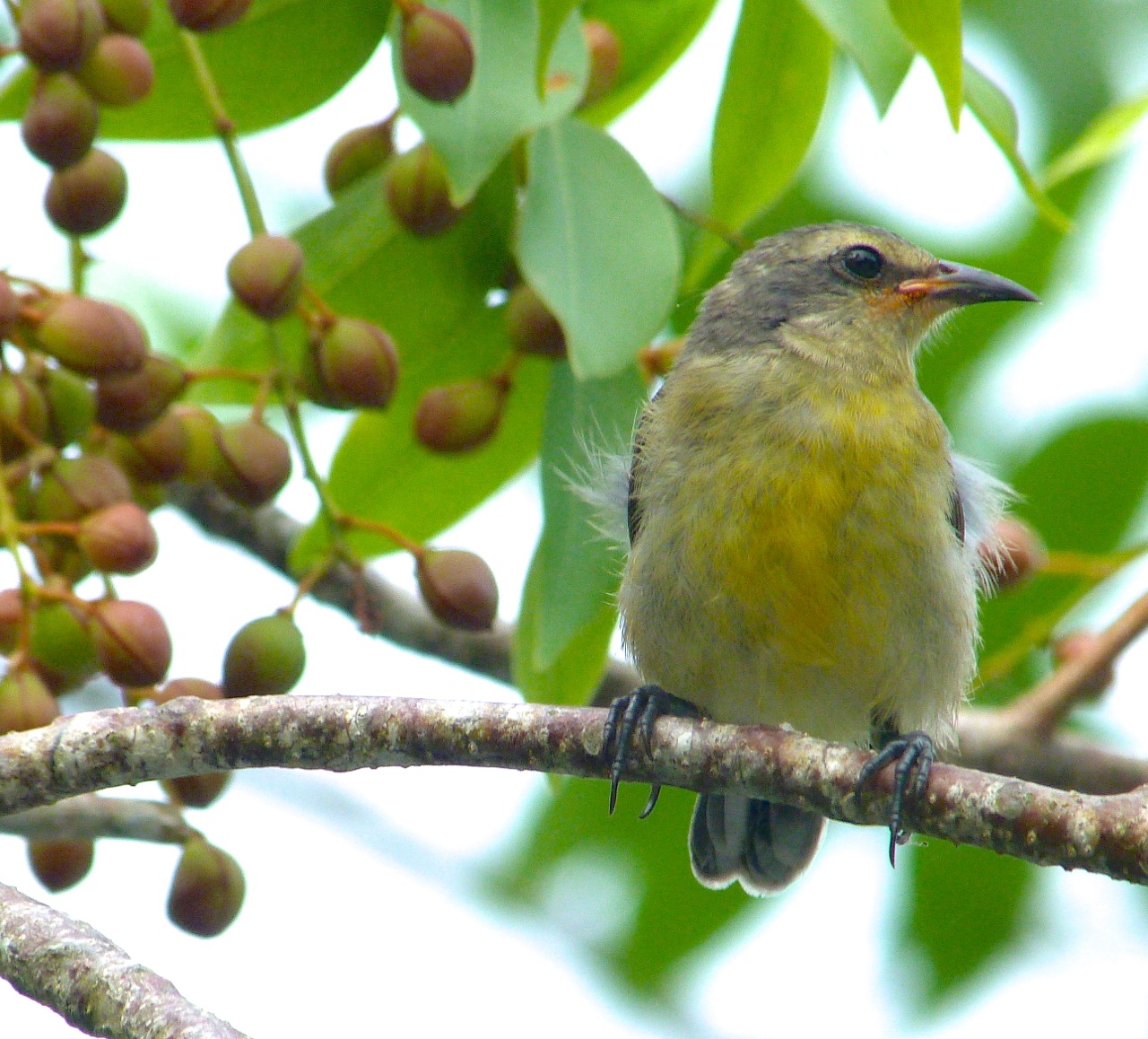
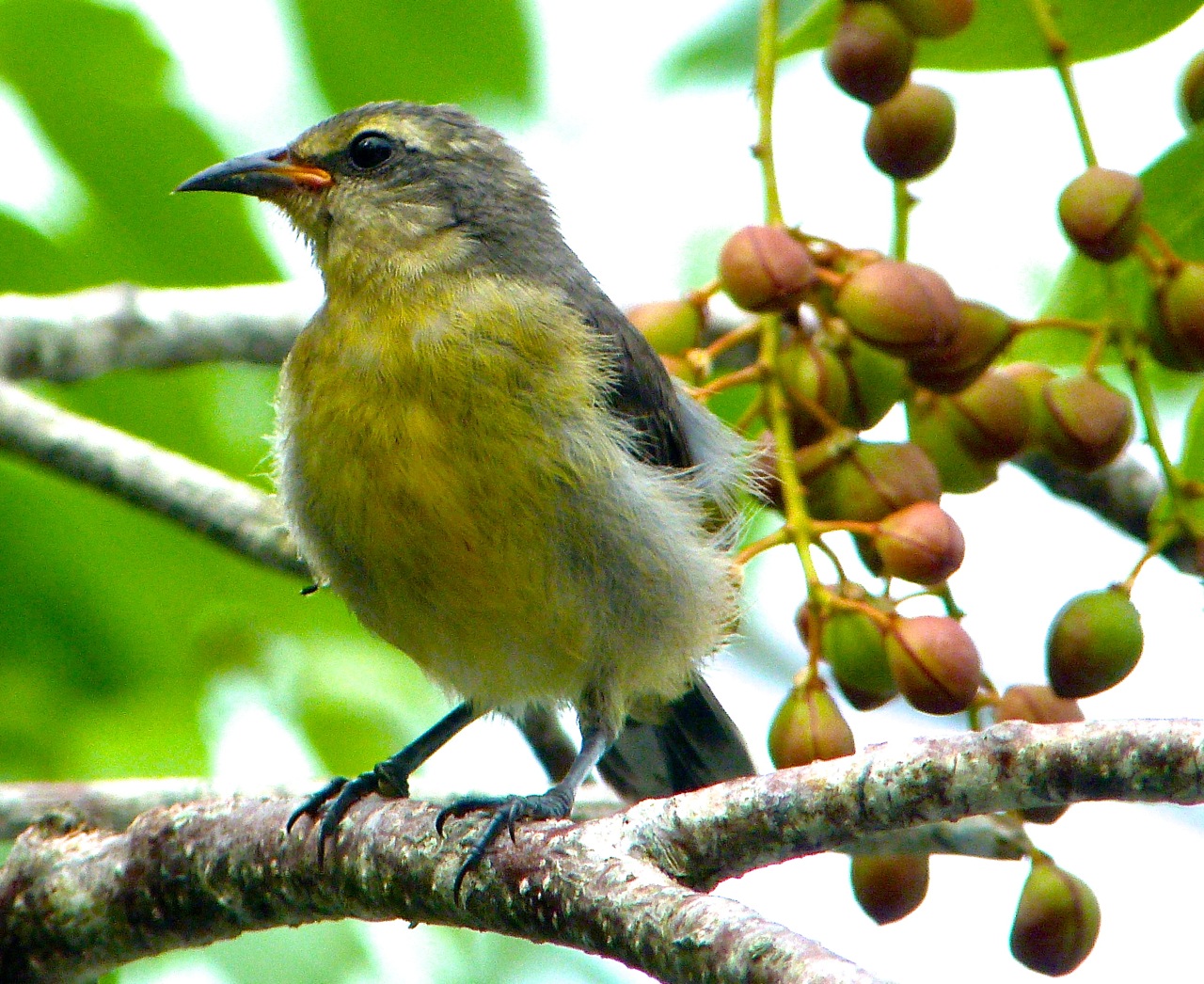
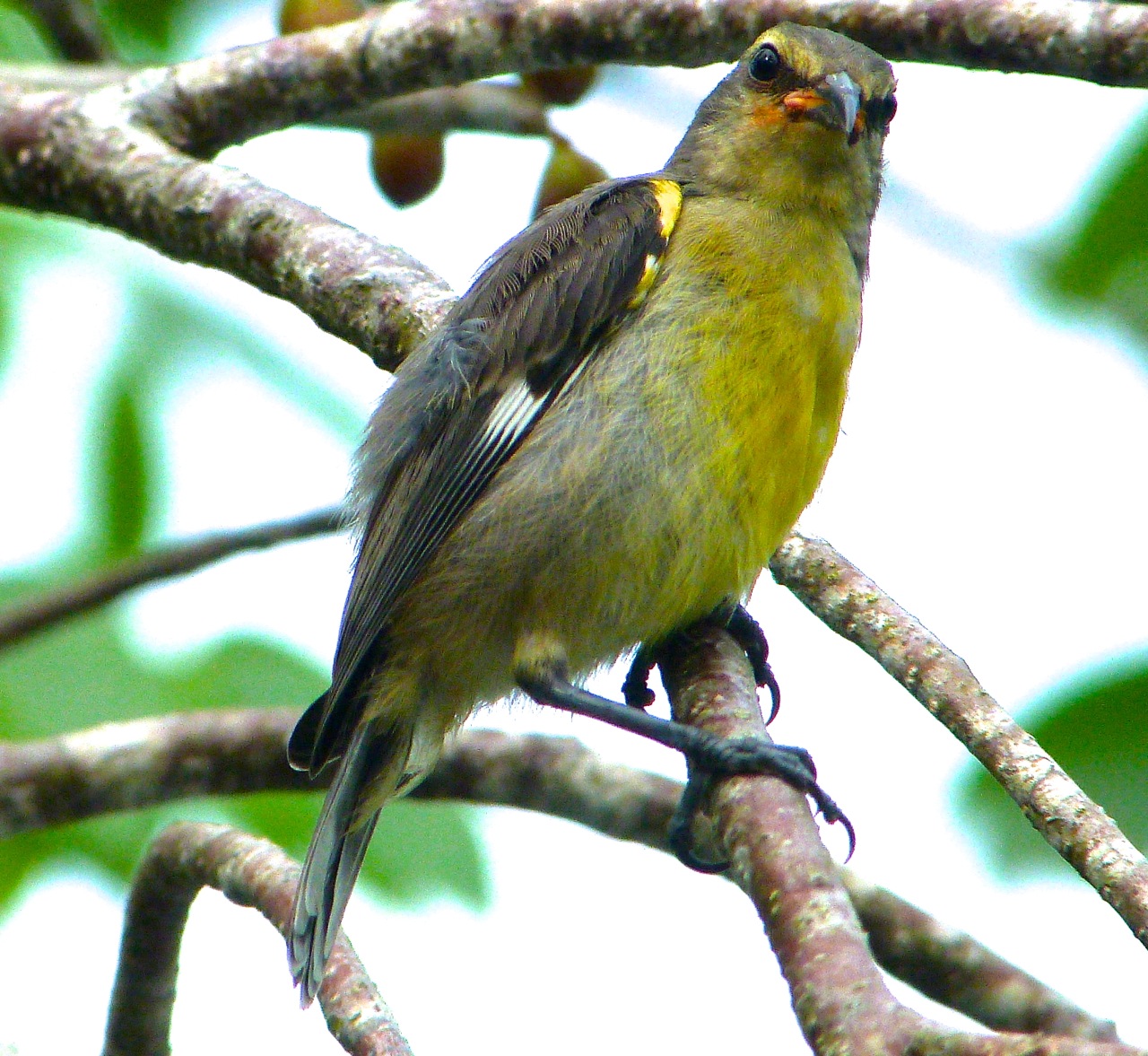
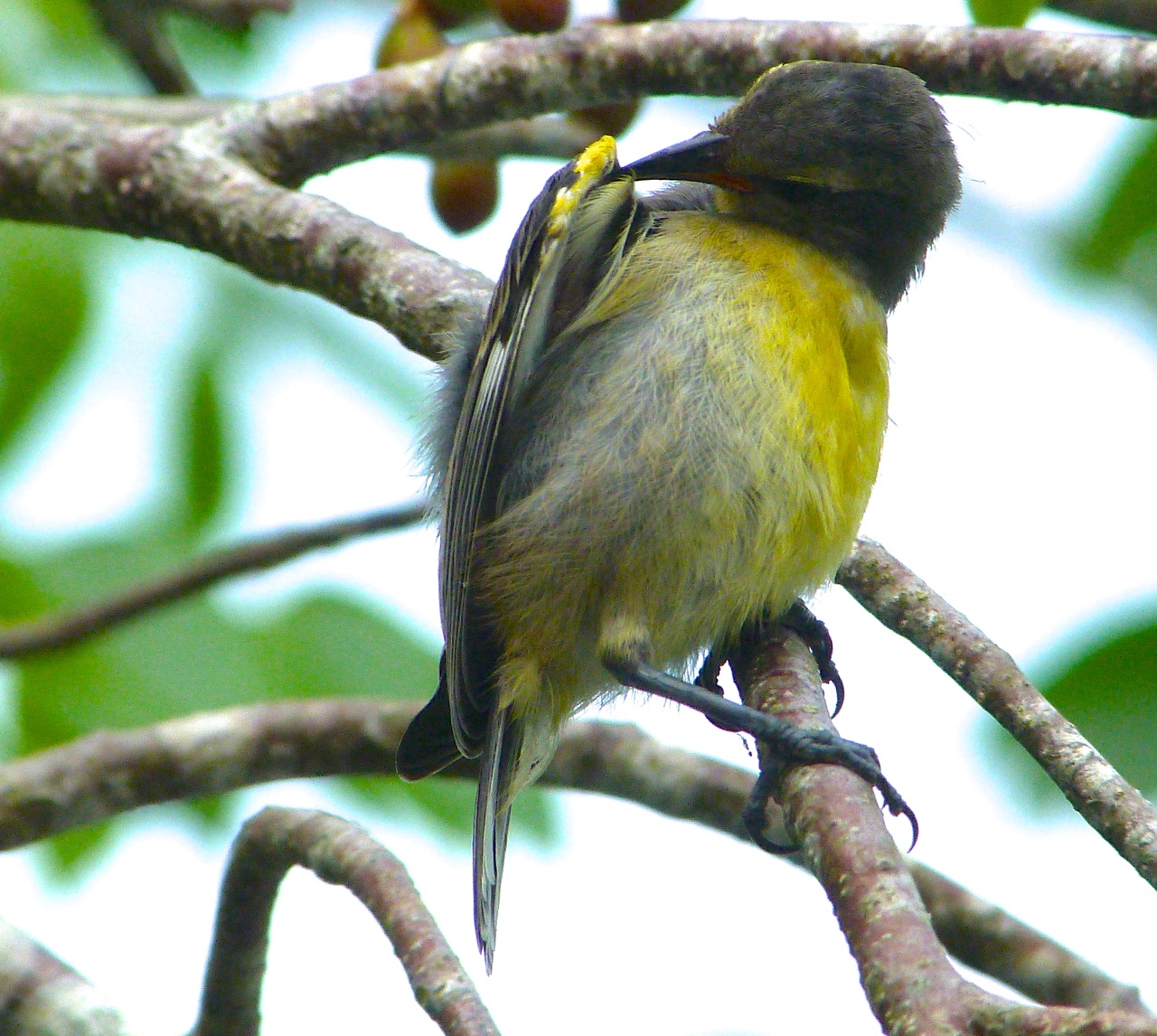
I’m not generally into whimsy and such stuff BUT… I can’t get enough of small bananaquits (Coereba flaveola). I’ve featured them beforeHEREandHERE AGAIN, but then I see another one, take some photos, and awwwwww – look at its little fluffy feathers… and its tiny sharp claws! The two shown below are summer babies. They aren’t really babies, though, are they? Teenagers, more like. Like many Abaco birds – especially the parrots – they are keen on the fruit of the Gumbo Limbo tree Bursera simaruba shown here. They also love flowers, piecing the base with their beaks to get at the nectar. They are quite as happy on a feeder – or indeed sipping sugar water from a hummingbird feeder, living up to their nickname ‘sugar bird’.
“Watching you watching me…”
This second bird is a bit older, and has developed some smart citrus lemon shoulder flashes. Bananaquits have many regional variations throughout the caribbean and beyond. These birds are, or were, generally lumped in with the tanager species. They have an official classification of ‘uncertain placement’ in the taxonomic scheme for now, while their exact status is debated. Not that anyone watching them worries about that sort of technicality.
Here is what a Bahamas bananaquit sounds like, recorded on Andros (Credit: Paul Driver at Xeno-Canto)
MAKING A GOOD IMPRESSION: BAHAMA MOCKINGBIRDS ON ABACO
The Bahama Mockingbird Mimus gundlachii is similar to its slightly smaller cousin, the widespread Northern Mockingbird Mimus polyglottis. The range of Bahama Mockingbirds is slightly wider than the Bahamas themselves, and includes areas of Cuba, Jamaica and TCI. It is also a vagrant to the United States, especially southeastern Florida.
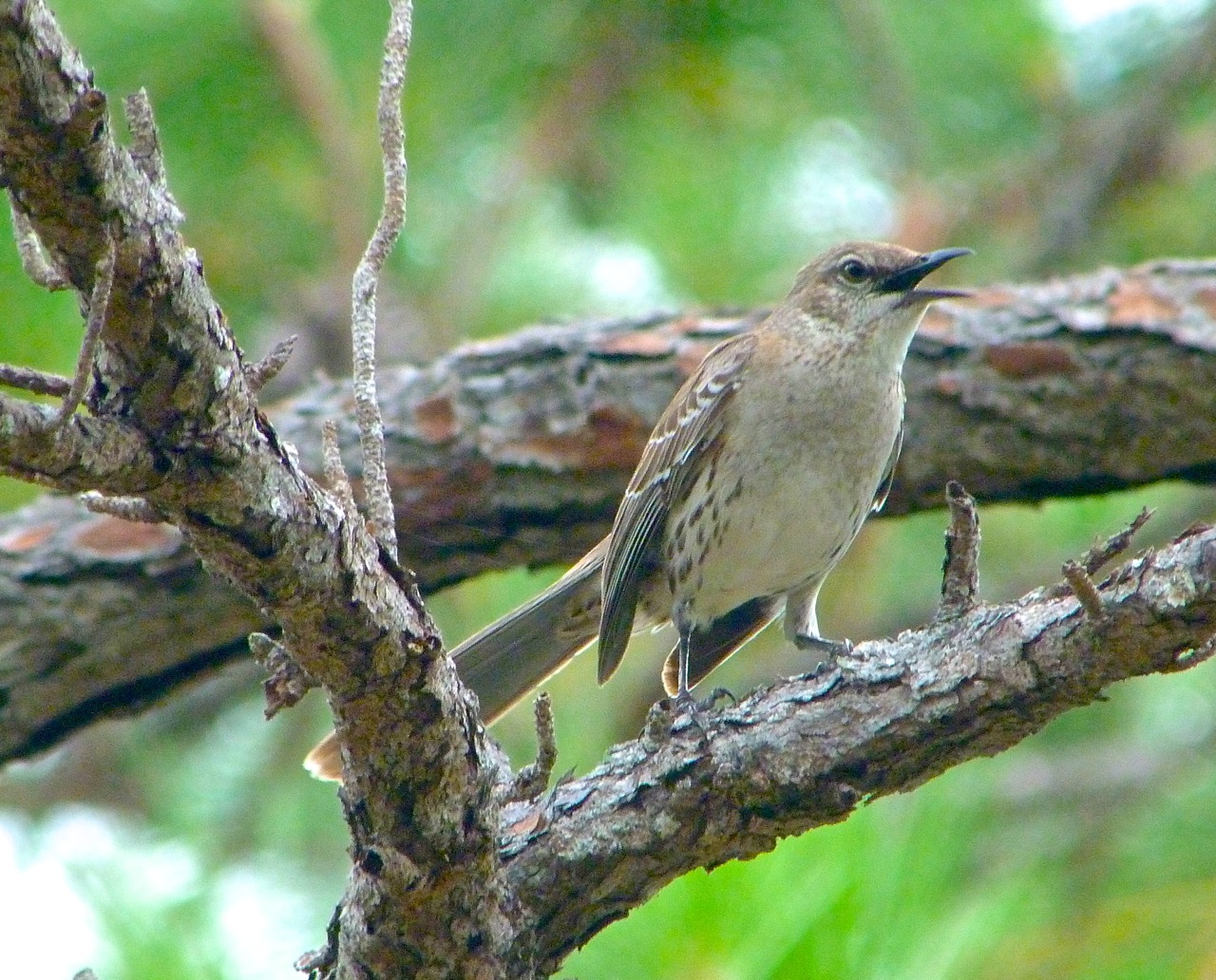
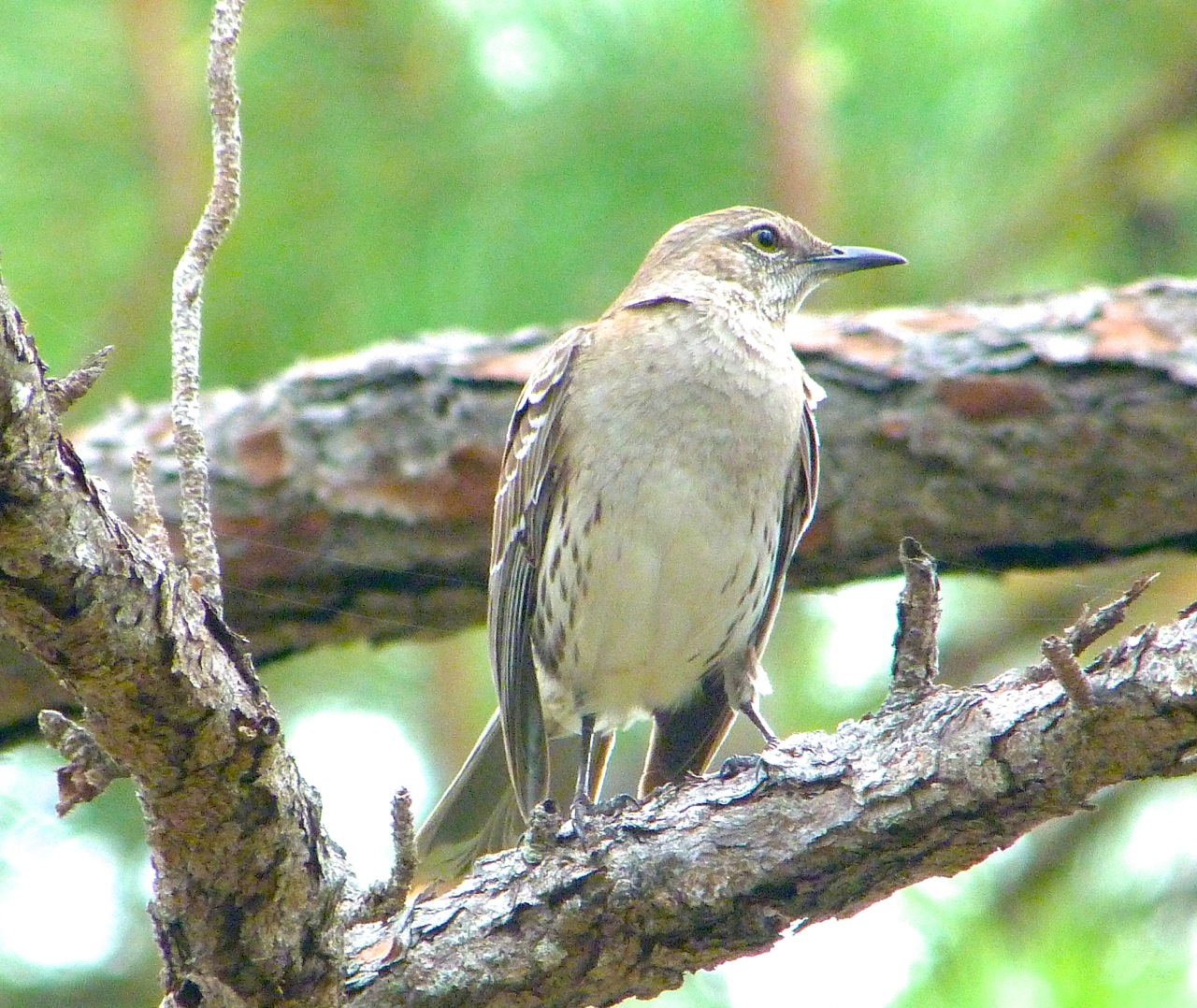
The Bahama Mockingbird is browner than the Northern Mockingbird, and has distinctive streaking and spotting to its breast and undercarriage.
Both species are found on Abaco. The NMs are ubiquitous in towns, settlements, gardens, coppice and pine forest, whereas BMs are shyer and tend to be found in the pine forest and well away from humans and their operations.We took a truck into the pine forest south of Delphi with well-known Abaco birder Woody Bracey and Ohio bird photographer Tom Sheley. They were quick to locate a bird, in part because one was sitting prettily on a branch singing lustily. It was well within range of Tom’s massive lens; more of a struggle for my modest Lumix (as you may detect). I was astounded by the beauty and variety of the song. It consisted of very varied notes and phrases, each repeated 3 or 4 times before moving on to the next sounds in the repertoire. Here is a short 18 second example I recorded, using my unpatented iPhone method, for which seeHERE.
For those with interest in birdsong, here is a longer 1:13 minute song from the same bird, with largely different sounds from the first recording made minutes earlier. There’s even a decent stab at imitation of a 1960s Trimphone™. Had we not had to move on to Sandy Point for an appointment with some cattle egrets and American kestrels, I could have stayed listening for far longer.
Finally, the Northern Mockingbird below was photographed in a garden at Casuarina – far tamer and clearly very different from its cousin. The range map shows the stark contrast with the very limited range of the Bahama Mockingbird.
ABACO’S RAREST VISITOR: MEET ALBERT ROSS… THE ALBATROSS
I can find no record for the sighting of an albatross in the waters around Abaco. Nor for anywhere else in the Bahamas for that matter. It must have come as some surprise to the BMMRO team out at sea on their research vessel off Sandy Point to see a large and unusual seabird bobbing tranquilly on the water. A black-browed albatross Thalassarche melanophrys. Diane Claridge managed to get a great shot of it and I’m really pleased to be able to use it here.
Black-browed albatross off Sandy Point, Abaco, Bahamas. Photographed by Diane Claridge.
This bird was way out of the normal range for the species. They are birds of the southern oceans, breeding in colonies on such islands as the Falklands, South Georgia and Macquarie Island. As far as I can make out, they have no business to be north of the equator at all.
SIGHTING A BLACK-BROWED ALBATROSS: A REPORT
During a three-hour survey for whales off Sandy Point, Abaco on Sunday, July 21st scientists from the Bahamas Marine Mammal Research Organisation had an exceptional sighting. Dr Diane Claridge, the group’s Executive Director recalls details of the sighting:
“We were drifting waiting for a beaked whale to resurface when our intern Tristan Albury pointed towards a white object floating in the distance and asked what it was. We decided that it was a piece of trash, unfortunately a common sighting, and continued to focus our search for the whale. A half hour later, we still had not re-sighted the whale and believed that it may have gone down on one of its one-hour long feeding dives. So with time to kill and the “trash” still in sight, we had another look with binoculars. We realised immediately that it was a very large bird and slowly motored towards it for a closer look. I began taking photographs of it because we already knew it was unusual and we wanted to be sure to identify the species. As we got closer, Roxy Corbett, a visiting scientist and avid birder exclaimed that it was an albatross! I couldn’t believe it. We were able to approach within 100 feet at which point it swam towards us providing an opportunity for us to document its body condition; it appeared healthy with no obvious signs of distress.
Later when back ashore, we compared our photographs with those available online and learned that it was a juvenile Black-browed albatross, an endangered bird with a 7-foot wing span known from subtropical to polar regions of the southern hemisphere! As far as I know this species has never been recorded previously in the tropical North Atlantic. I have seen albatross during whale surveys in Alaska but never dreamed that I’d ever see one in The Bahamas. Although we are thrilled by the rarity of this sighting, the outcome for a bird so far out of its normal range is not usually good. However, there are two Black-browed albatross that strayed into the North Atlantic previously that have taken up long-term residence in Scotland and the Faroe Islands so who knows where this one may end up. Sunday afternoon was indeed exceptional: in addition to this remarkable sighting, we also saw 4 different species of whales and dolphins, all within 5 miles of Sandy Point.”
These are huge strong birds, with a massive wingspan. I wondered what they might sound like – it’s like this… (Credit: Xeno-Canto & recordist Sofia Wasylyk)
For more information on the normal range and status of the Black-browed albatross, the BMMRO recommended links are:
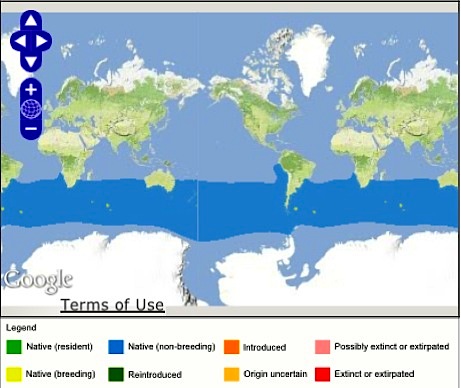
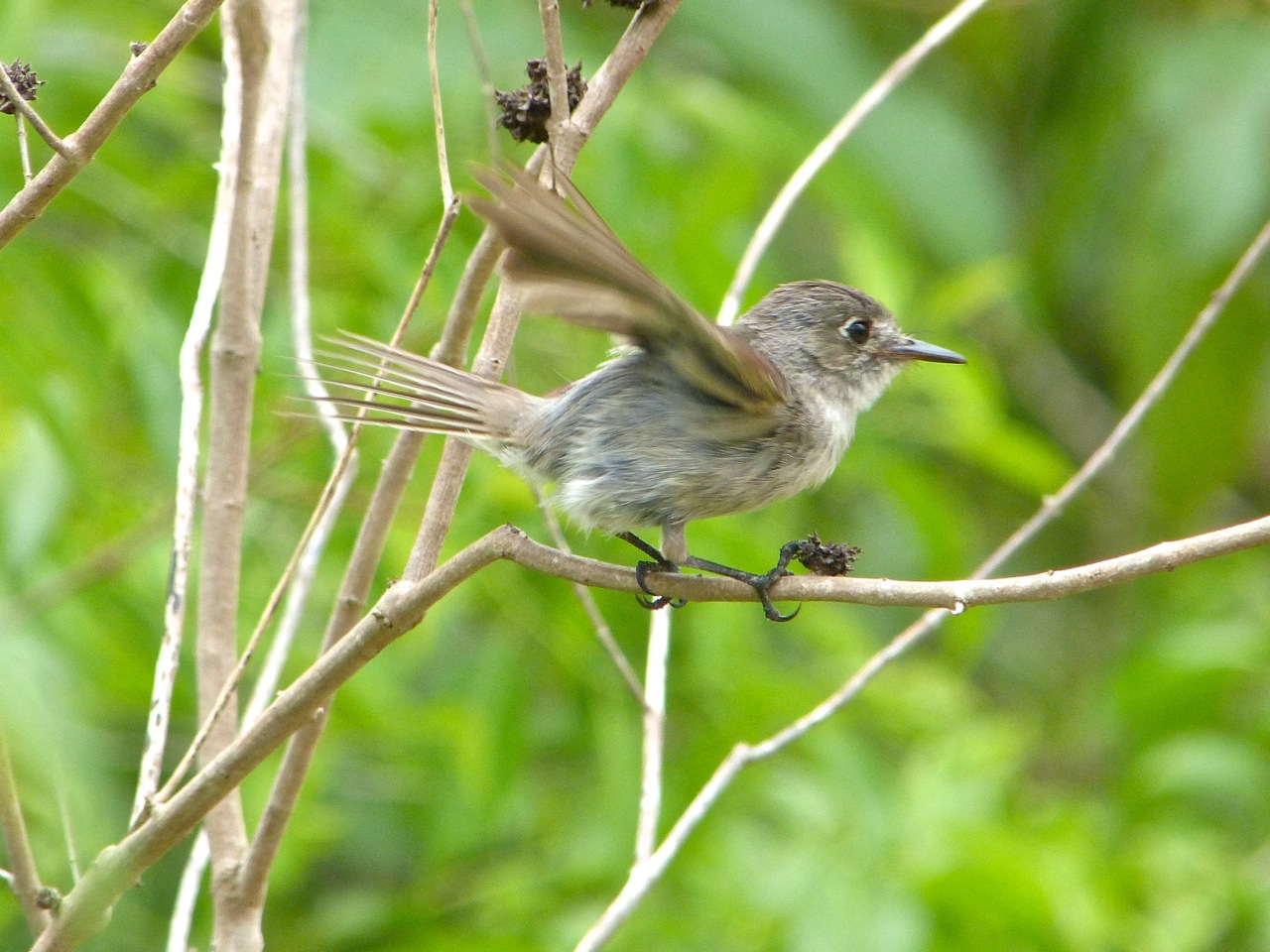
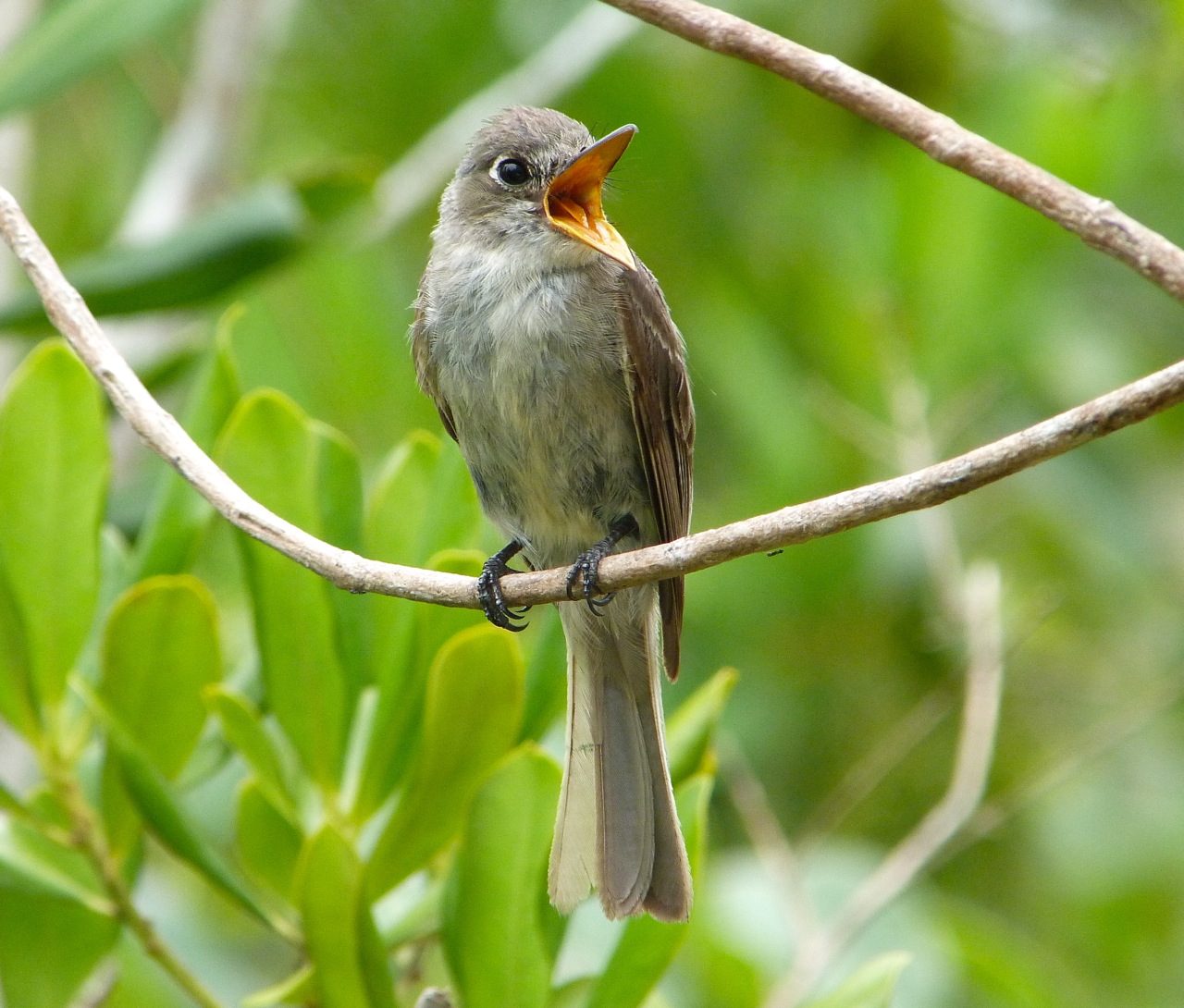
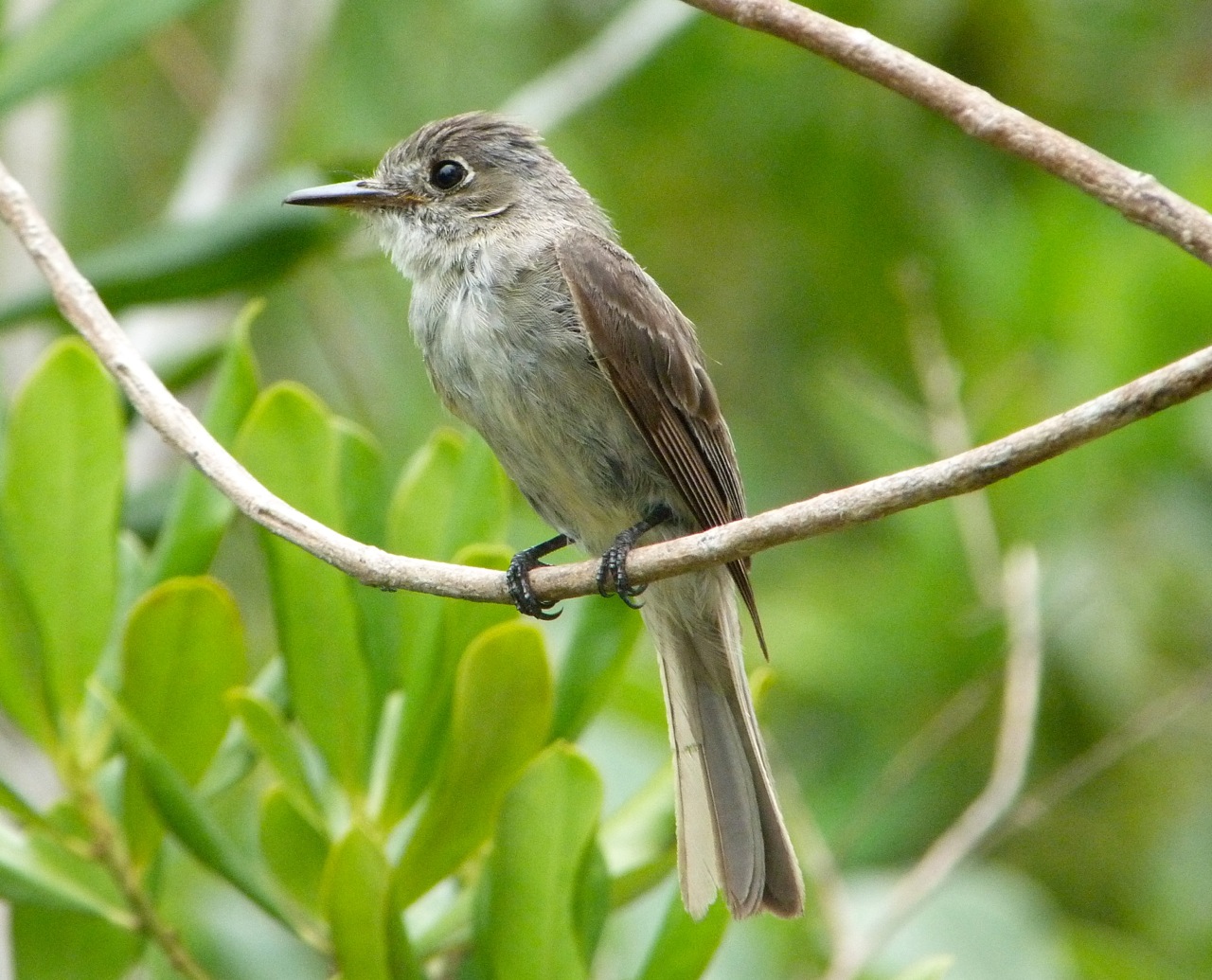
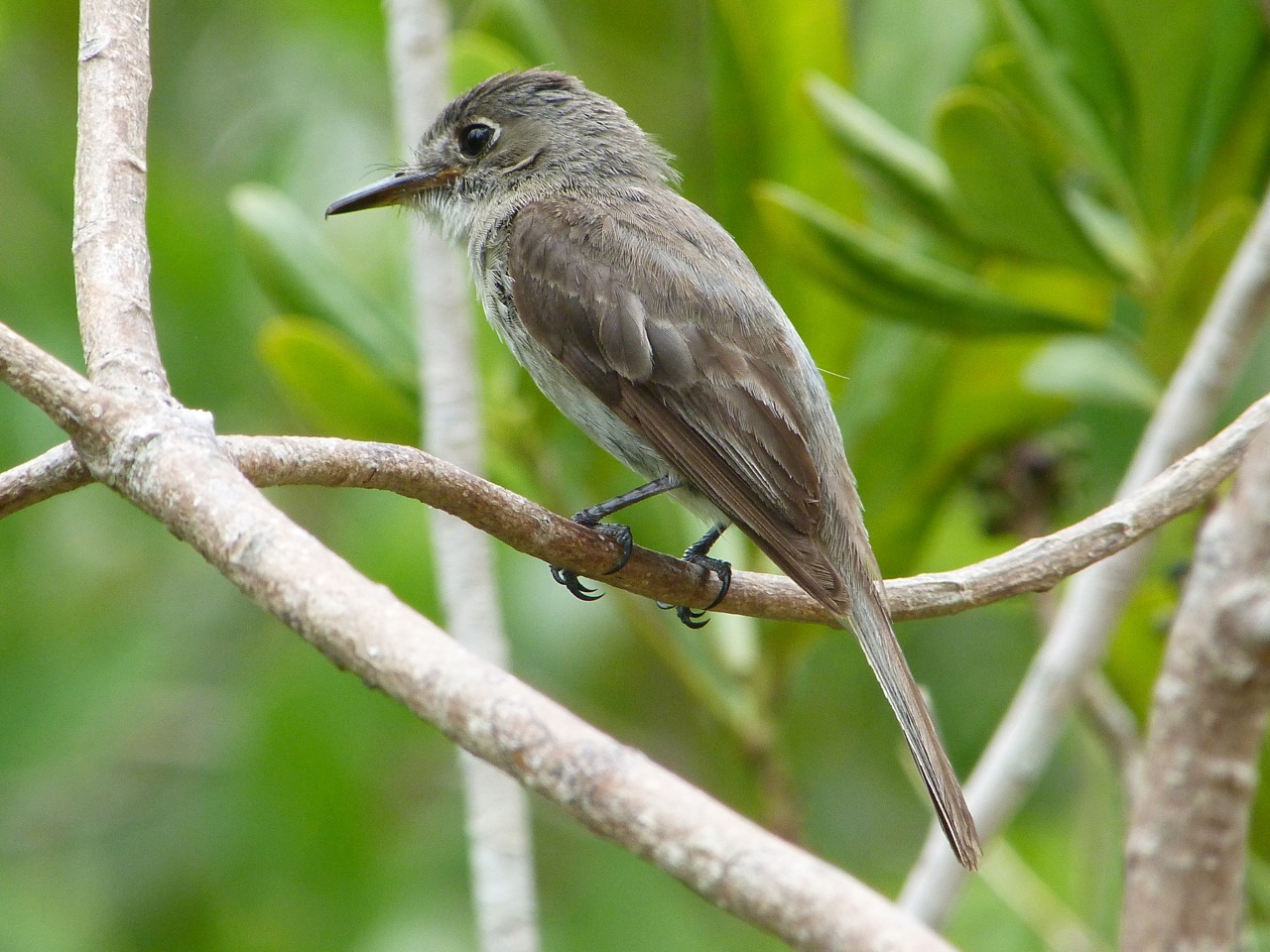
One of the prettiest small birds to photograph on Abaco is the Crescent-eyed, or Cuban, Pewee Contopus caribaeus. These small flycatchers are as interested in your struggles with your camera settings and your ‘stealthy’ (yet clumsy) approach, as you are in their cute poses. It’s a symbiotic relationship – you may get nice pictures, they have a benign laugh at your efforts.
This bird was one of a pair we found at a magical corner of scrubland at a crossroad of tracks between the edge of the pine forest and a backcountry of derelict and overgrown sugar cane fields – the perfect habitat for a wide variety of species. The pewees had a nest hidden deep in the undergrowth, but were tame enough to be untroubled by our presence. They kept calm and carried on as usual.
These little birds are resident in Cuba and the Northern Bahamas. I have previously posted photos of them, taken by the beach at Casuarina, HERE. They are the smallest flycatchers – tyrannidae – on Abaco, a family that includes LA SAGRA’S FLYCATCHER, and the larger Loggerhead & Gray Kingbirds. Here’s a recording of cuban pewees made on Abaco (credit: Jesse Fagan / Xeno-Canto)
They often have a charmingly quizzical or watchful expression
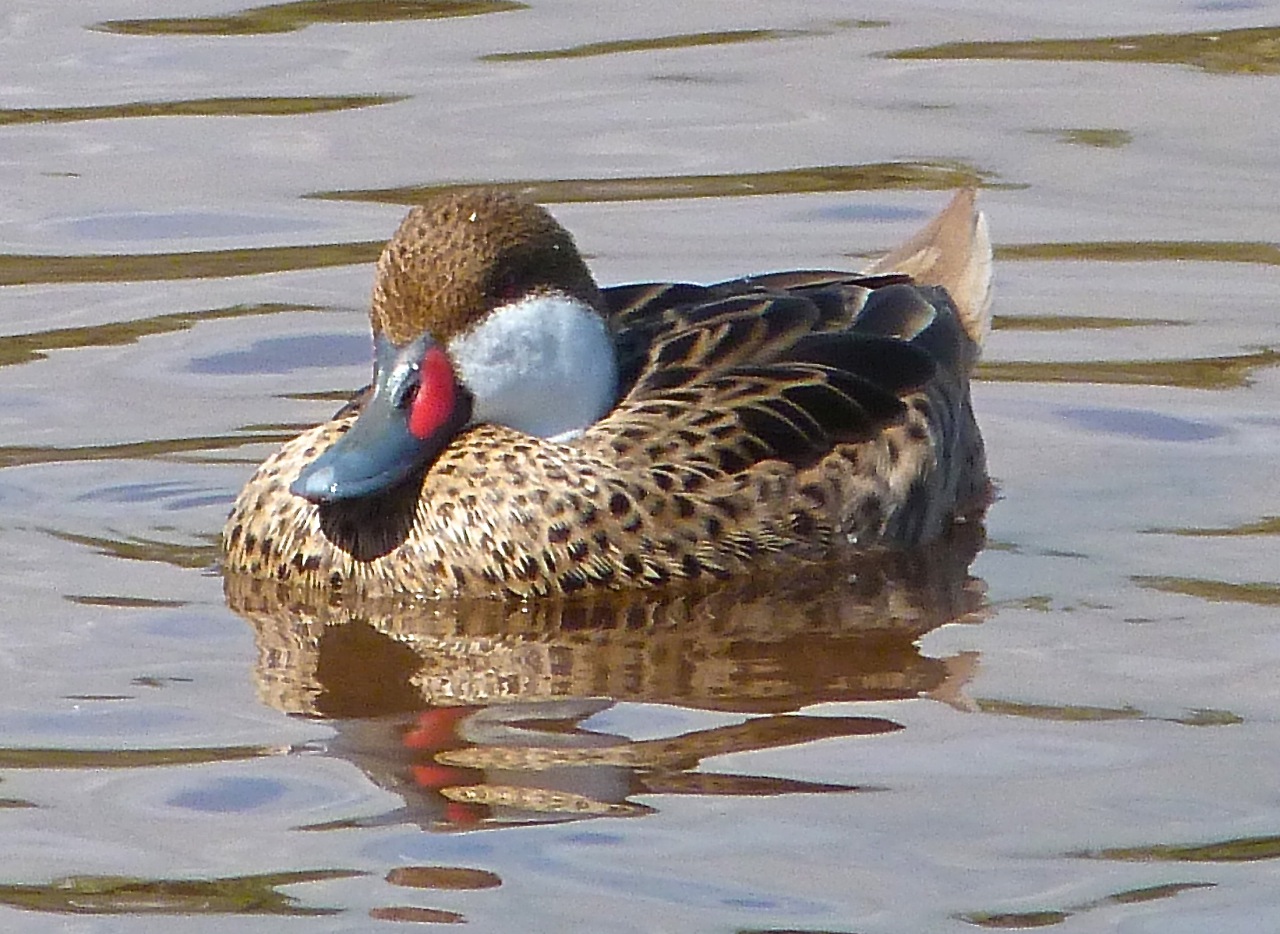
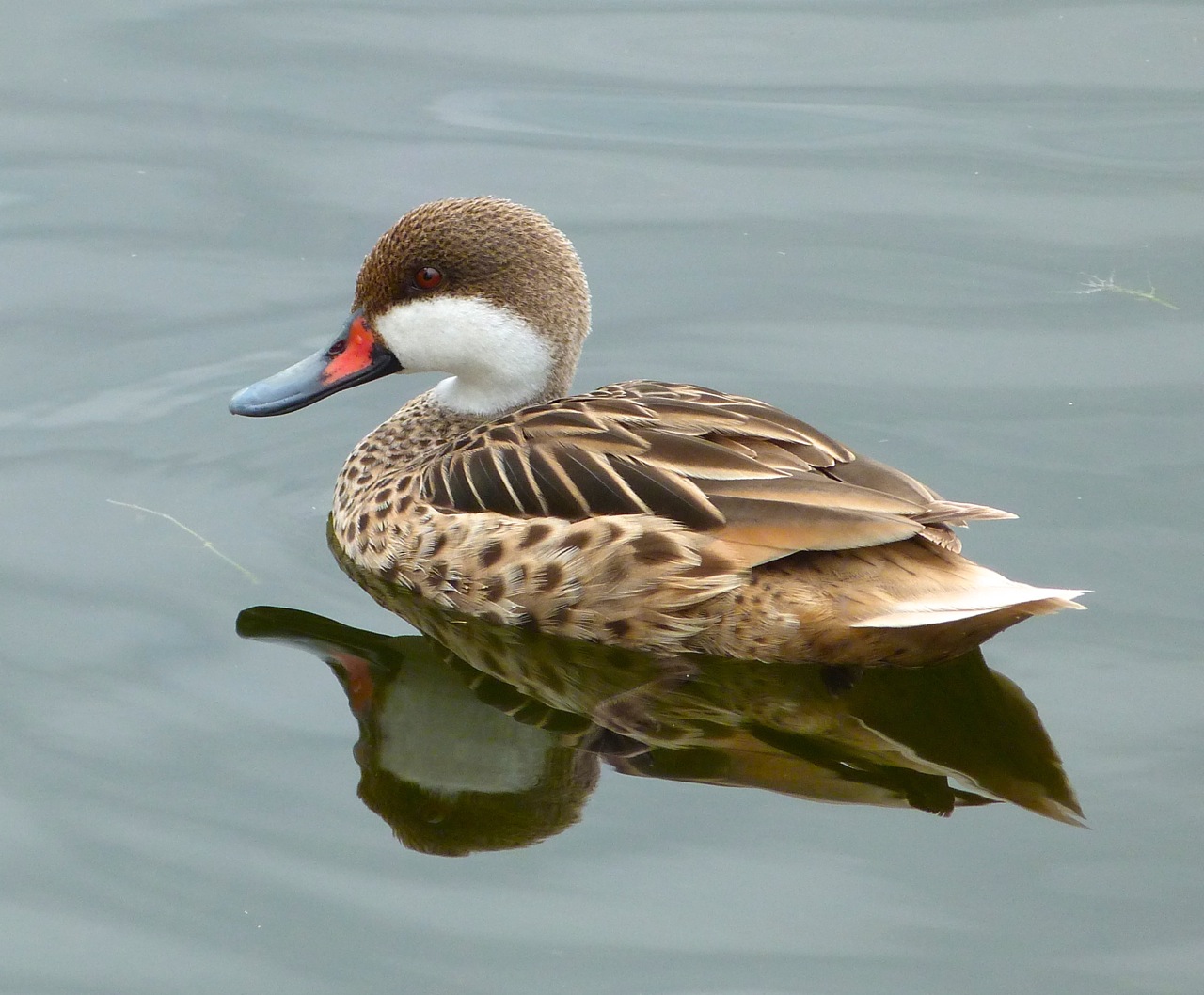
OUT FOR A DUCK: FINDING WHITE-CHEEKED (BAHAMA) PINTAILS ON ABACO
Hunt them. Then when you have found them, shoot them. But only with a camera, obviously… These attractive dabbling ducks are far too pretty for anything more controversial than watching and enjoying. Many moons ago I posted about them HERE, but I’m a bit cannier since then, and even have my own photos now…
NOTEWithin hours of posting this, I was alerted (thanks, Tony W) to the inadvisability of (a) using the word ‘hunting’ in the title; and (b) the opening 2 sentences. (a) has been changed to the neutrally vanilla ‘finding’. (b) remain but with this warning: “It is illegal to shoot white-cheeked pintail in the Bahamas“. While I don’t imagine the readers of a blog like this will already have rushed to the gun cabinet, packed up a cartridge bag, added a couple of Kaliks and headed off with extreme pintail population decrease in mind, I expect a g**gle search for ‘hunting & shooting sweet small ducks’ could indeed provoke the odd (to very odd) person to assume it is open season for pintails.It isn’t. It never is.
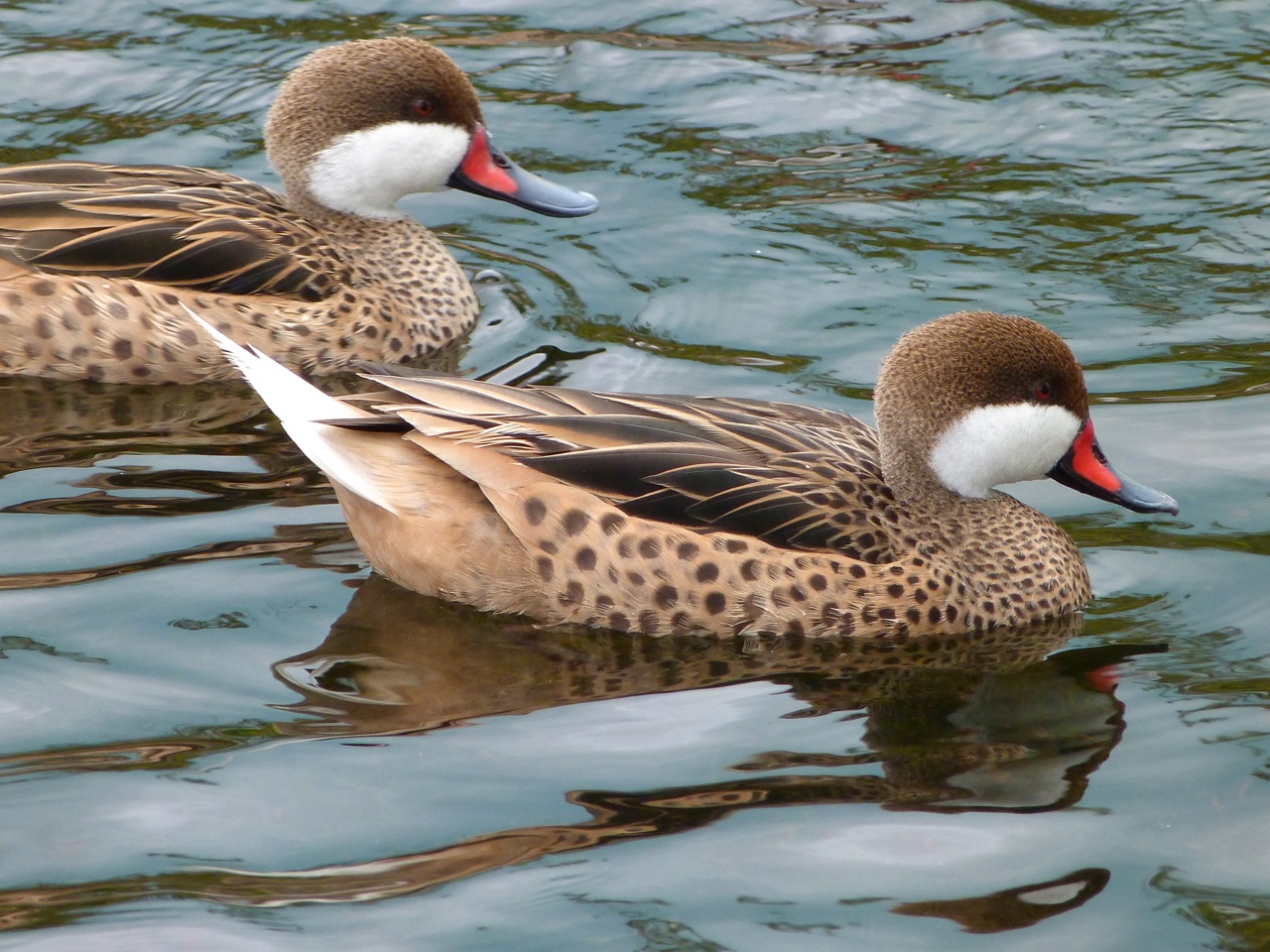
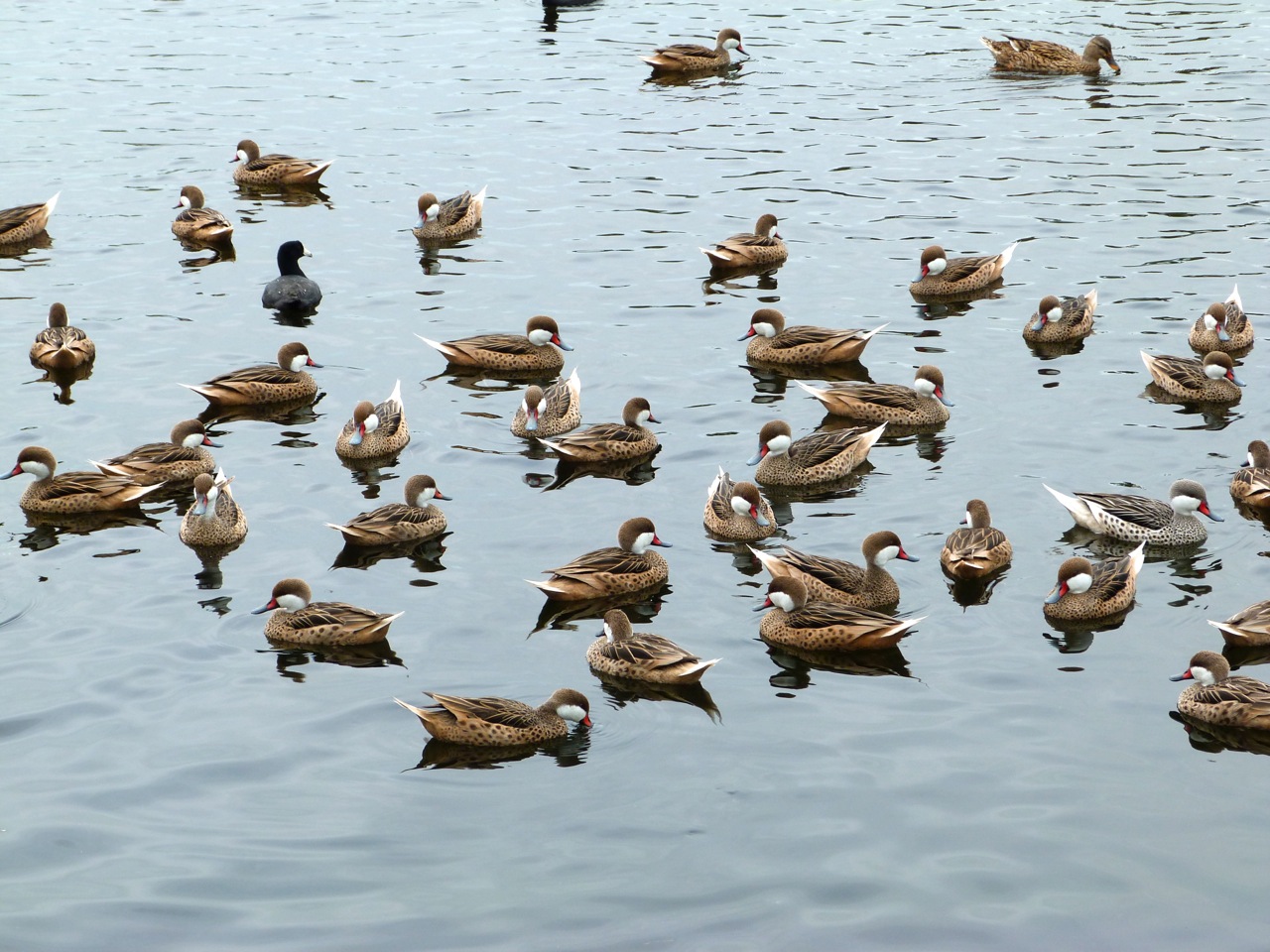
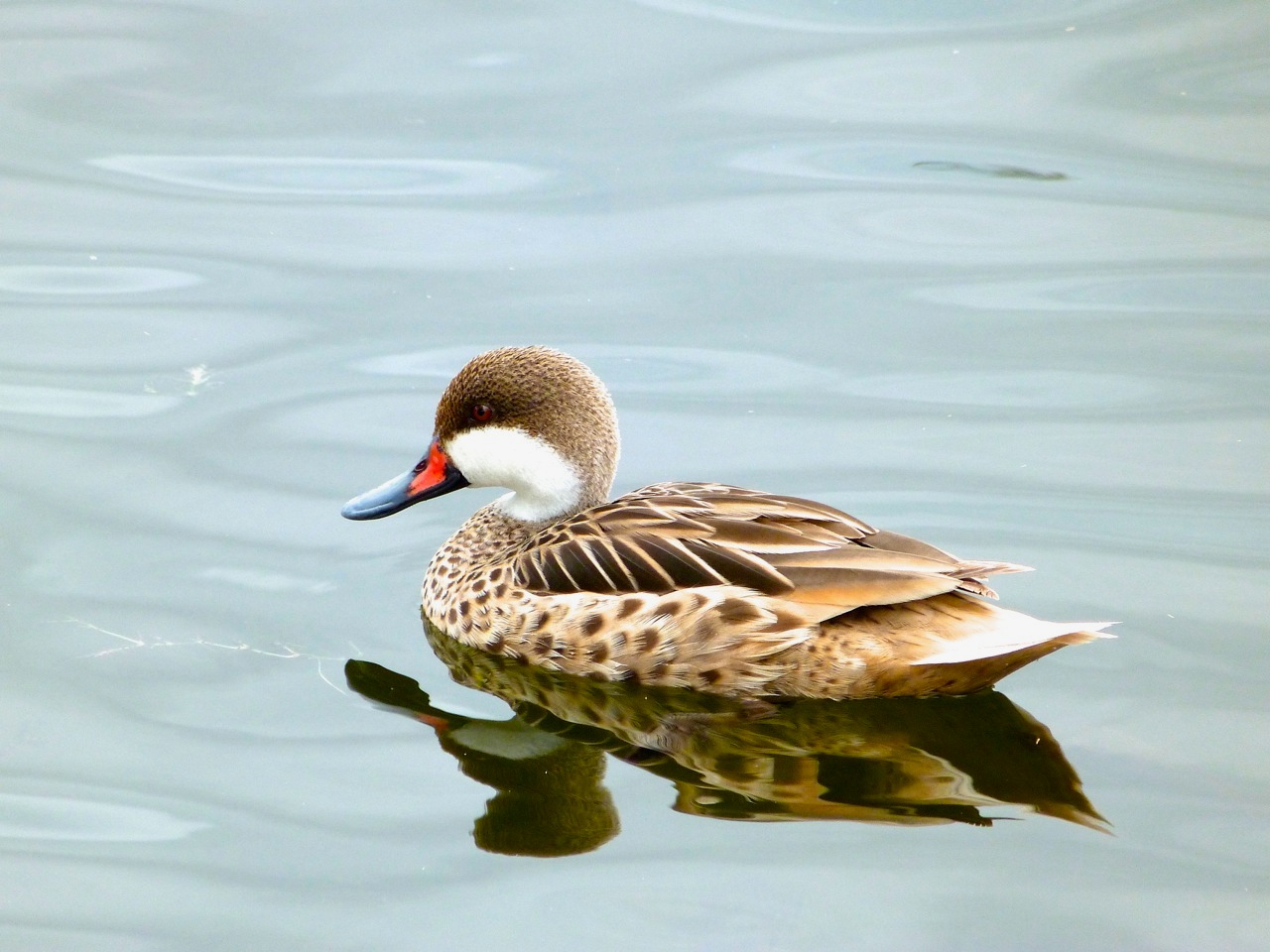
The white-cheeked pintail Anas Bahamensis is also known as the Bahama Pintail. It is a gregarious species, often found in large numbers on lakes and ponds. An excellent place to see them on Abaco is at the pond by Hole 11 at Treasure Cay golf course. Don’t all rush at once – and if you do follow up the hint, check in at the Clubhouse to get permission – there may be a competition in progress… You’ll see many other waterbird species there, and I will do a follow-up post about them. Do mind your head – if someone yells ‘fore’ they will probably not be counting duck species.
The male and female of the species are very similar. However, in the image below there’s one bird that stands out from the others… and I don’t mean the American Coot. Near the bottom right is aLEUCISTICvariant of the Bahama Duck, a genetic condition similar to albinism.
Here is a close-up of the same duck on dry land. These variants are known as Silver Bahama Pintails. They are worth more than the standard version. You can see some good comparative pictures and find out more atMALLARD LANE FARMS
Here is a more extreme wiki-example of a silver bahama pintail
Another excellent place for pintails is in the Crossing Rocks area of South Abaco. Strictly, it is on private land. And legally too, for that matter. So I won’t pinpoint these pintails publicly. There is a wonderful variety of waterbird life there. I have seen great egrets, little blue herons, yellow-crowned night herons, belted kingfishers and elegantBLACK-NECKED STILTSthere, besides several duck species. I have also seen a sora there (twice), a small, furtive rail that skulks in the reeds and foliage at the edge of the water, profoundly hoping that you won’t notice it… If you are birding on Abaco from Delphi, ask Peter or Sandy for the location. Or else contact me.
“ELEGANT COOT CABARETS” (6,6,2,5 anag.): CATTLE EGRETS ON ABACO
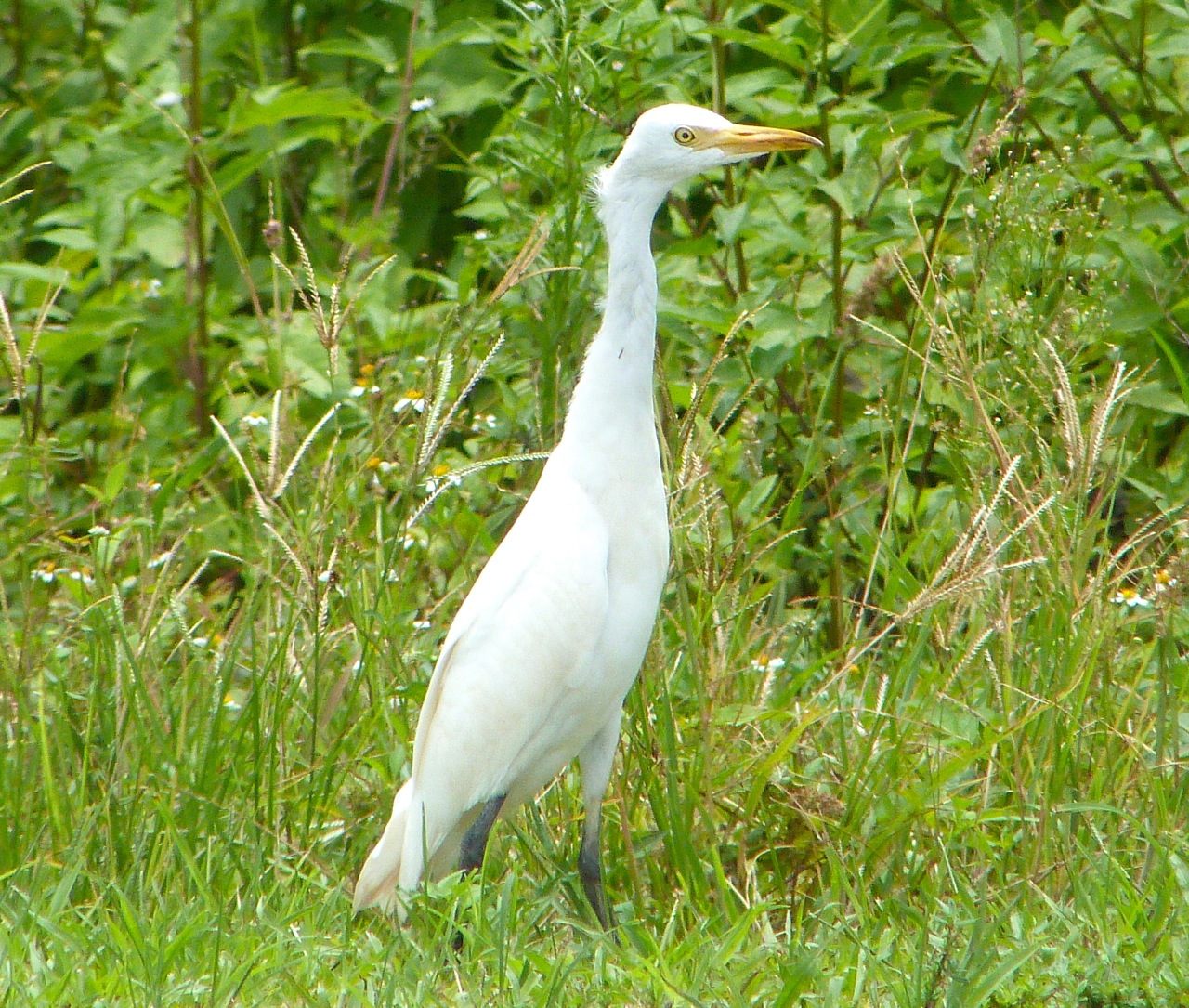
The CATTLE EGRET Bubulcus ibis is a species of heron with an affinity with cattle and other grazing animals. It’s a two-way thing – they relieve a cow of its ticks and flies, and get a ready meal return. Their name is the latin for ‘herdsman’.
Originating in Africa, these birds have proved to be one of the most successful and resilient bird species at expanding their breeding populations around the globe.
The first sightings in North America were in 1941, then assumed to be escapees. Far from it. They flew in and multiplied. By 1953 they were breeding in Florida; in Canada in 1962; and in the Bahamas in the 1960s. Now they are everywhere – though (depending, like, how old you are) your grandparents might never have seen one… Here’s a helpful wiki-graphic
Range expansion in the Americas
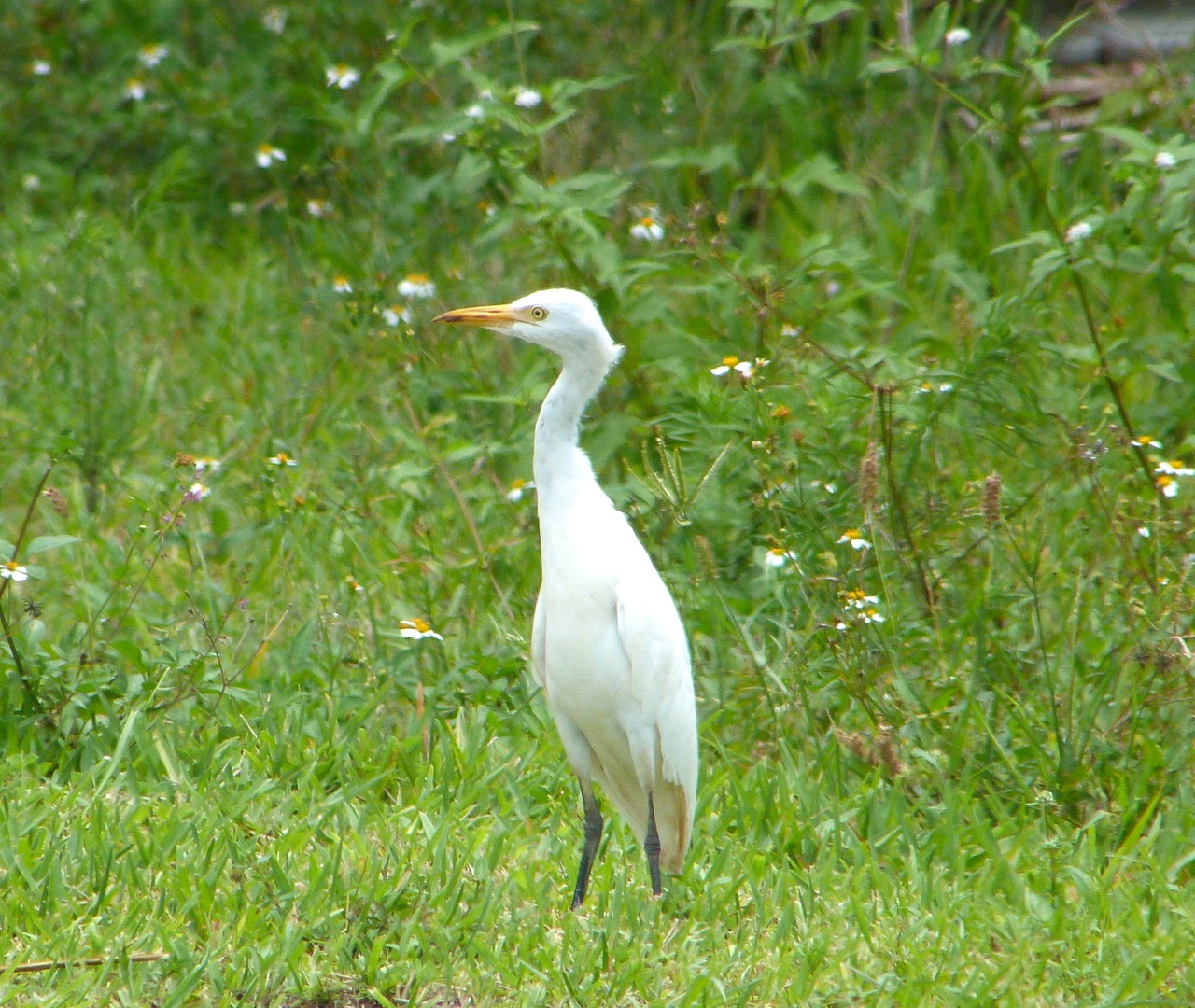
In the breeding season, cattle egrets develop pinkish-buff patches on their front, back and crown, and grow matching head-plumes
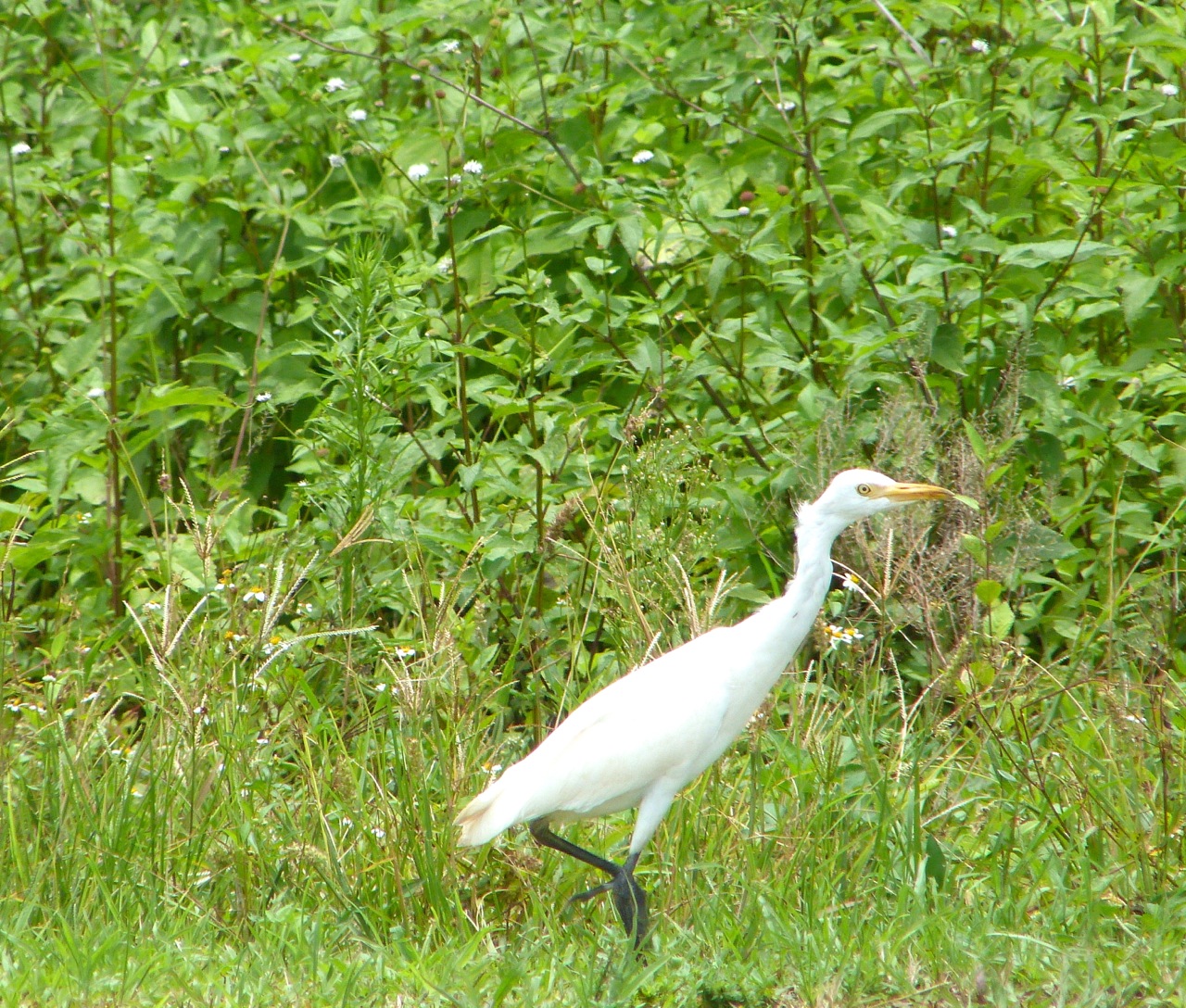
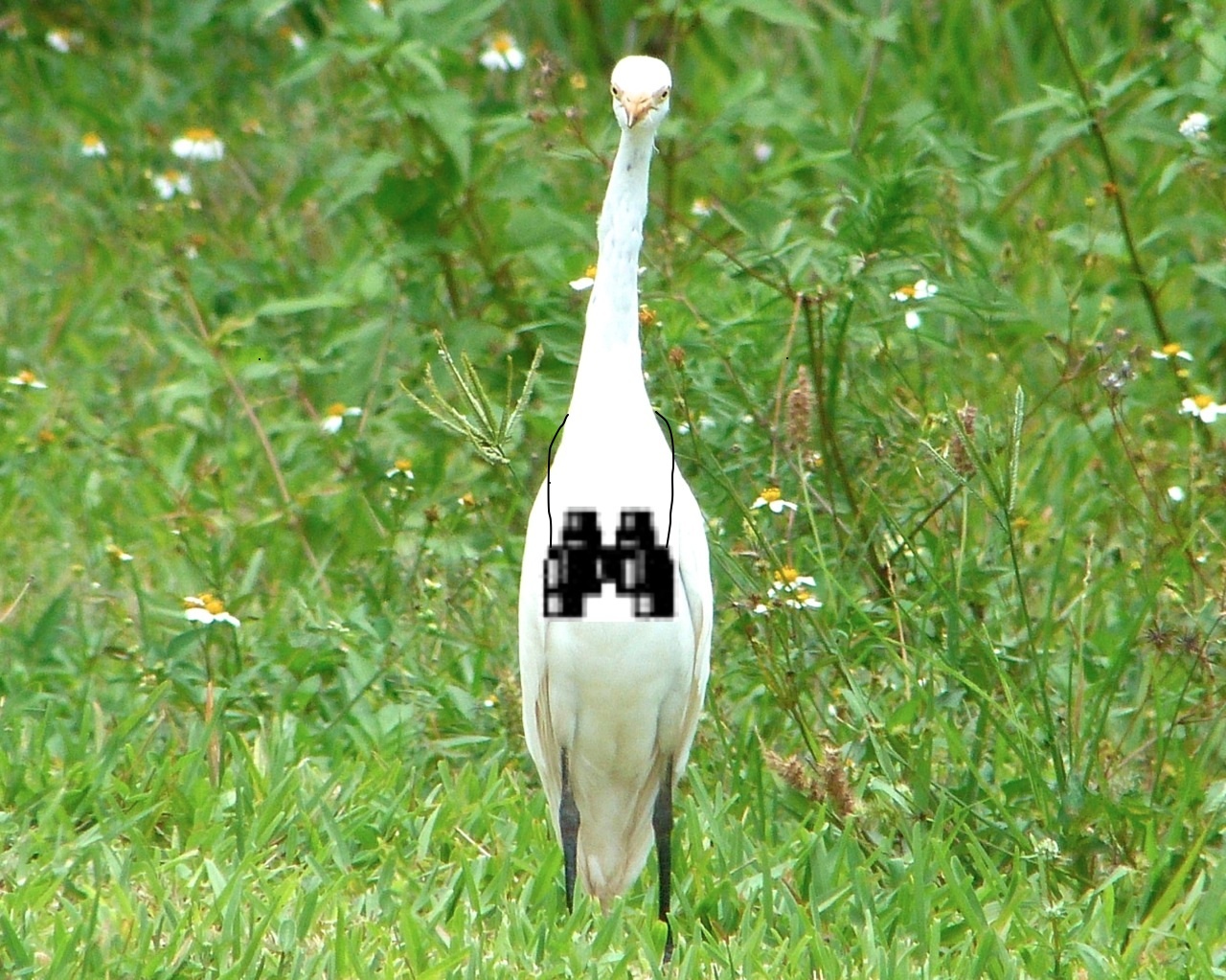
Recently we saw one at Sandy Point when photographing kestrels. It’s no longer in full breeding plumage, but traces of a pinkish tinge can still be seen.The cattle egret’s eyes are positioned so that while they are feeding they have binocular vision. I’m not quite sure why that would be advantageous; you might think they’d prefer one eye on their food, and one on the look out for predators
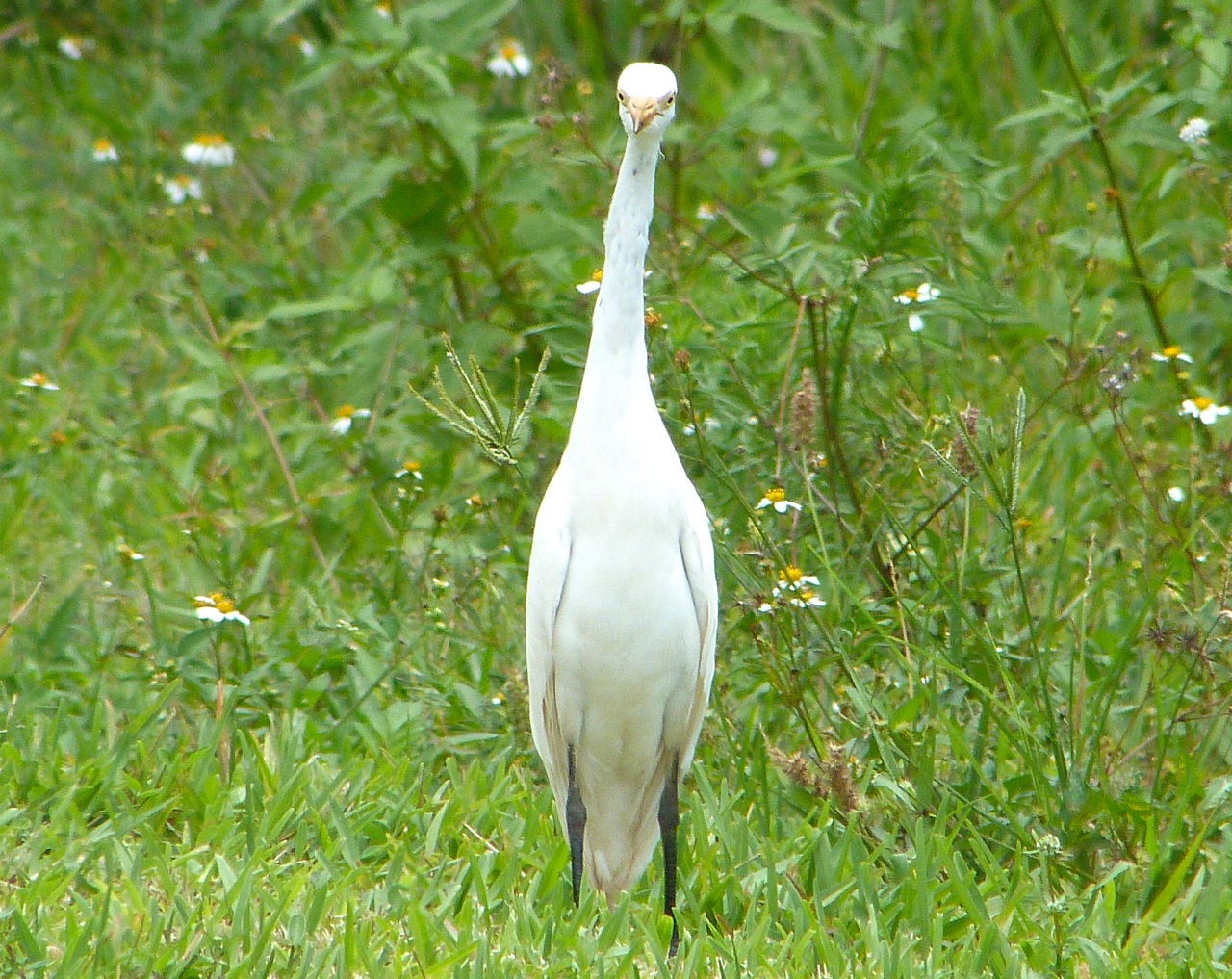
When on the move the egrets may adopt a stooping, creeping stance
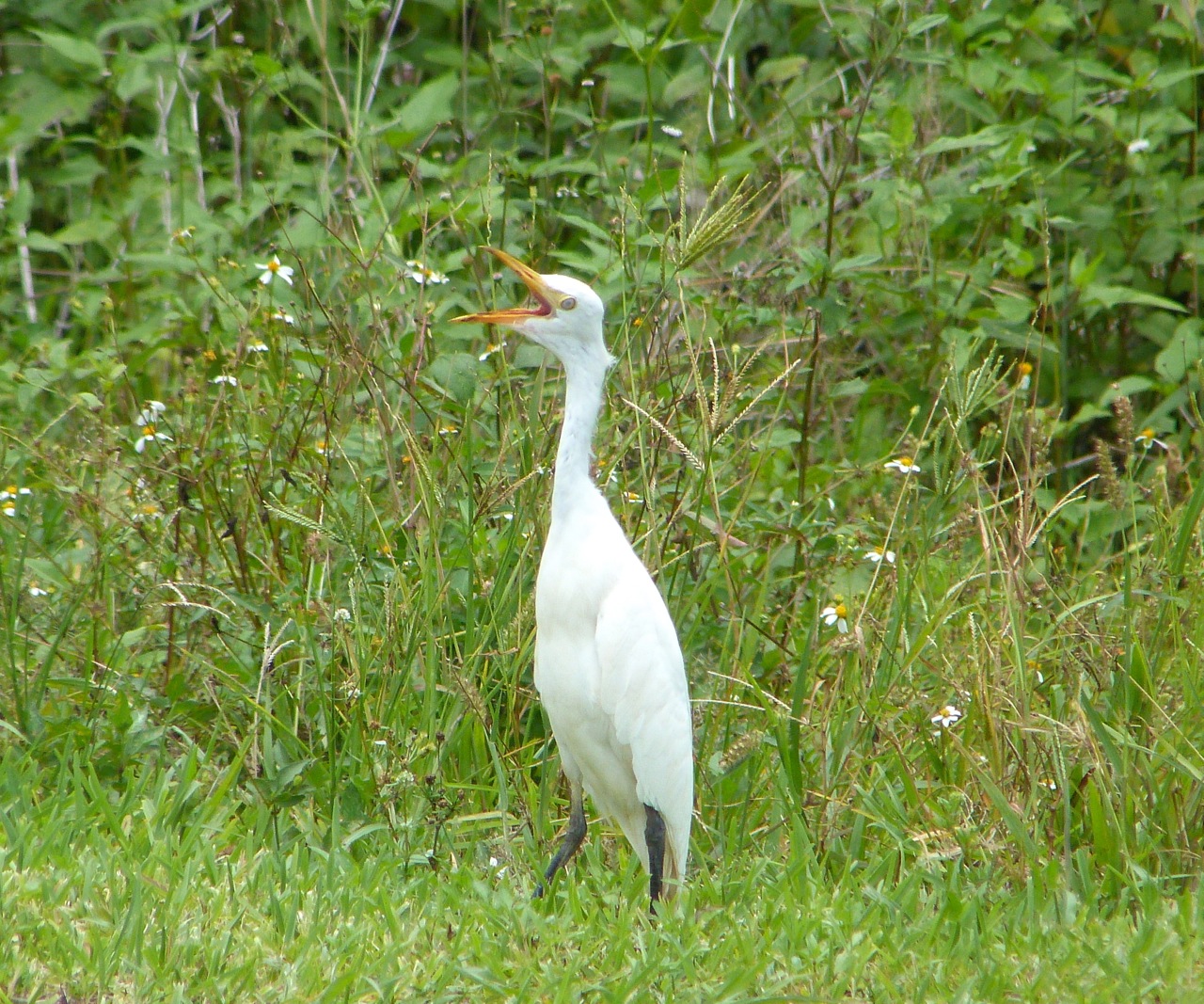
These birds have capacious mouths, which enable them to vary their diet from small maggoty things to larger insects, then through snails to small frogs and the like
Although the neck generally looks slim, they appear to have an expandable gullet which no doubt helps with larger food items
ADDENDUM The redoubtable dou dou, creator of tiny and cute handmade bird models, has been inspired by these fine creatures to make a handsome pair. Check out her site with the link above… and you can even buy your very own cattle egrets there
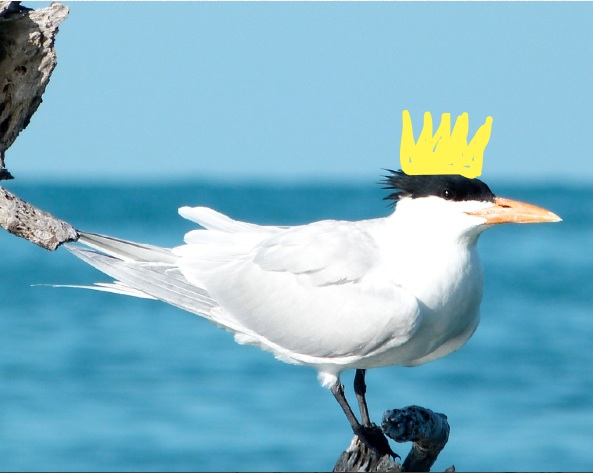
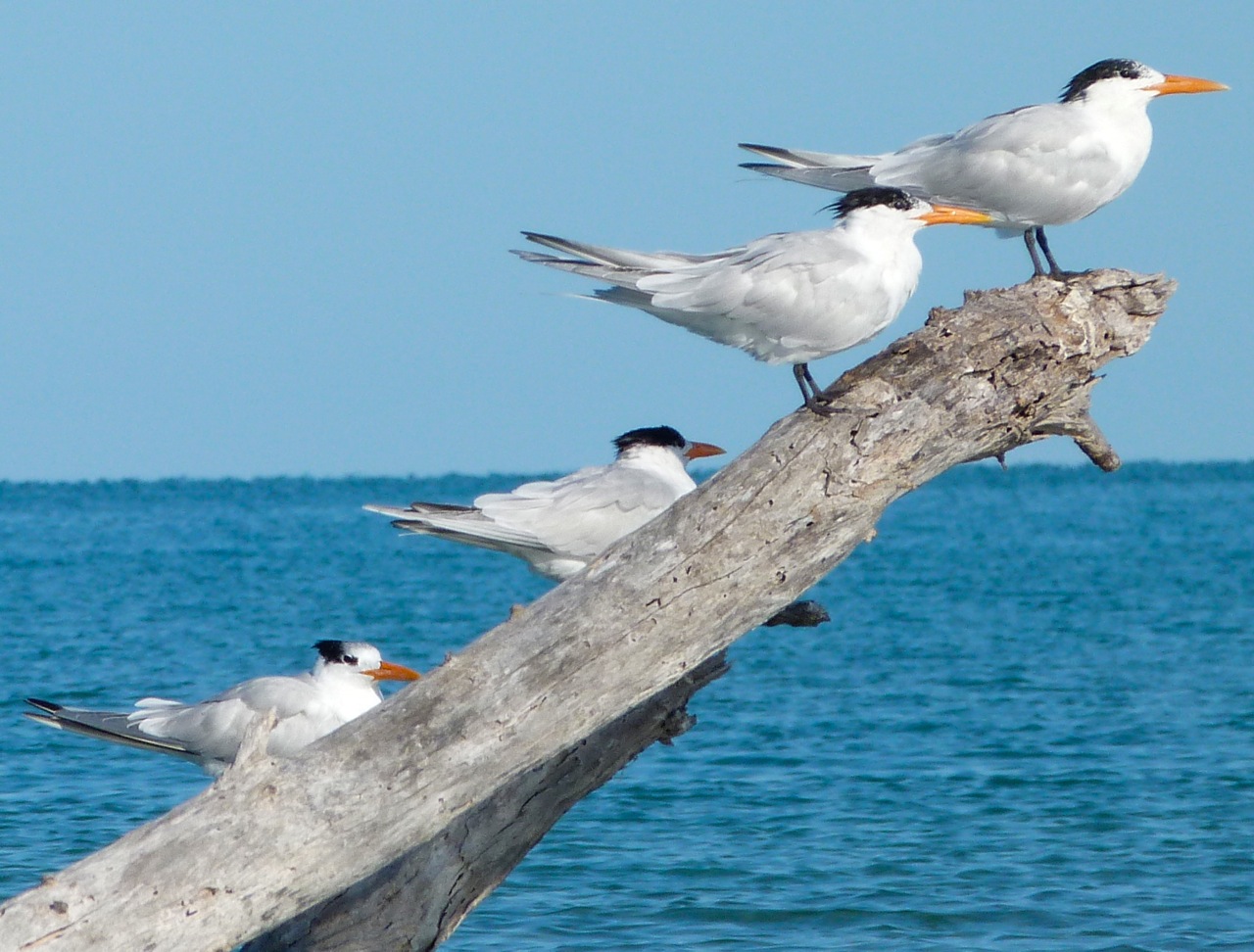
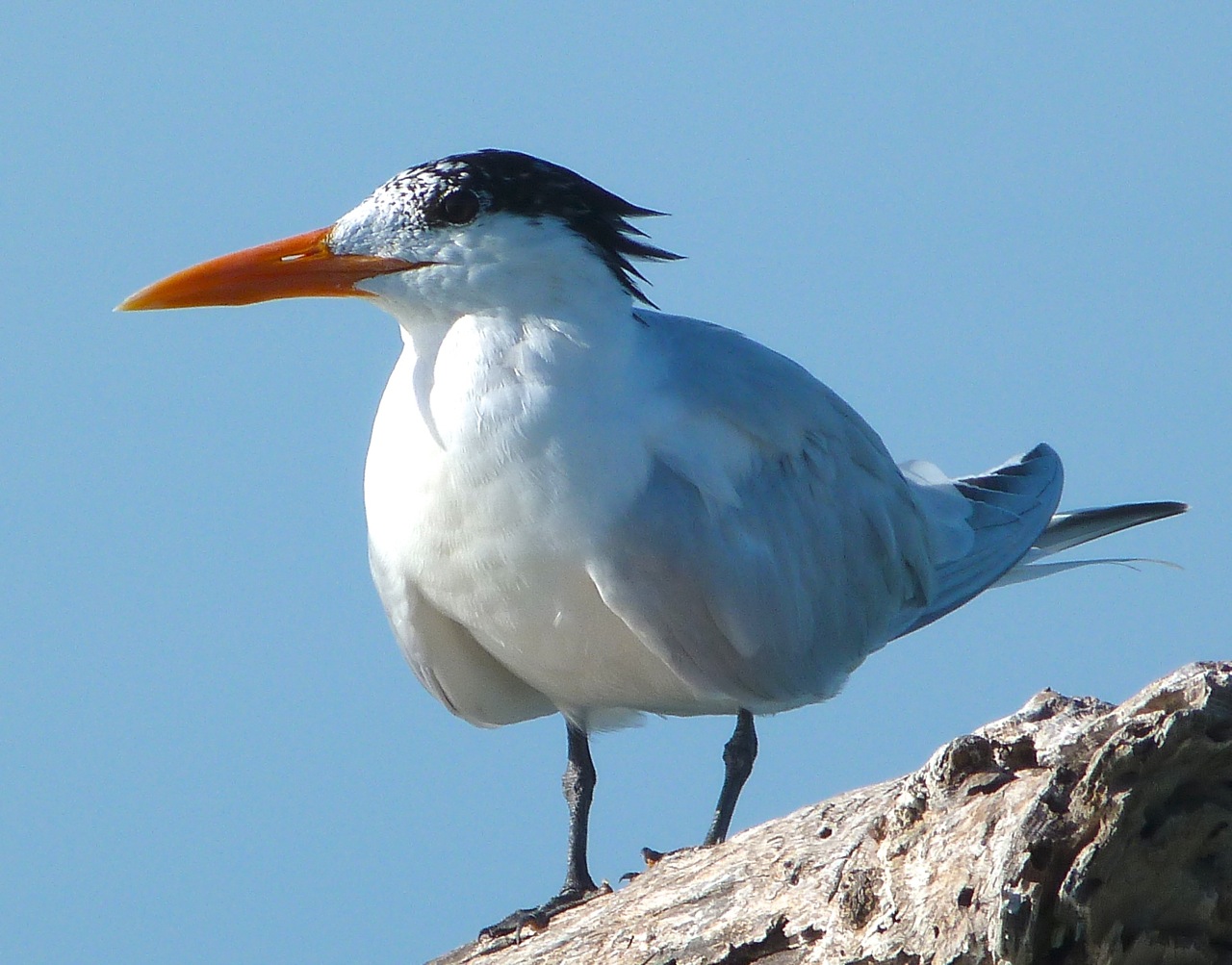
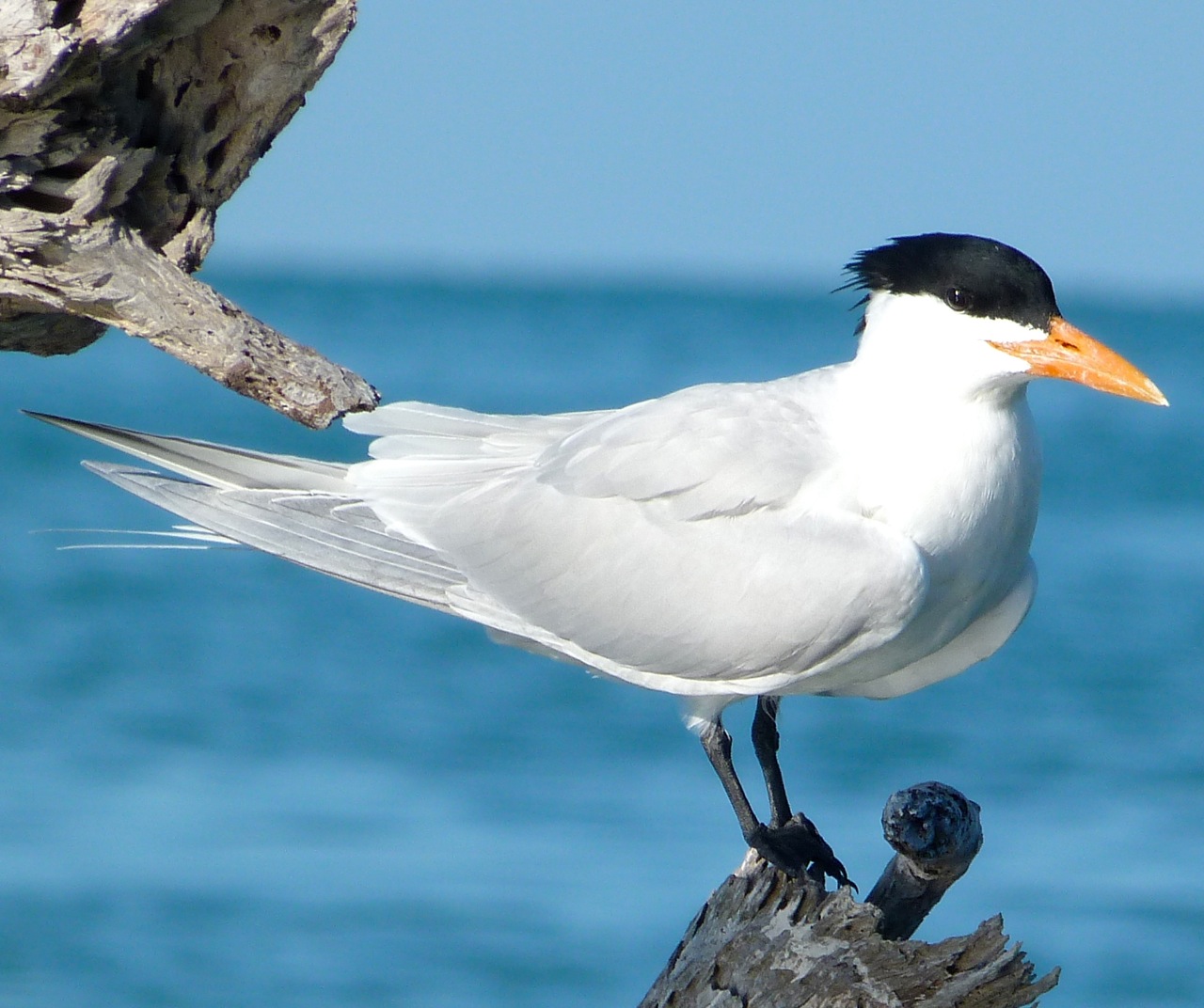
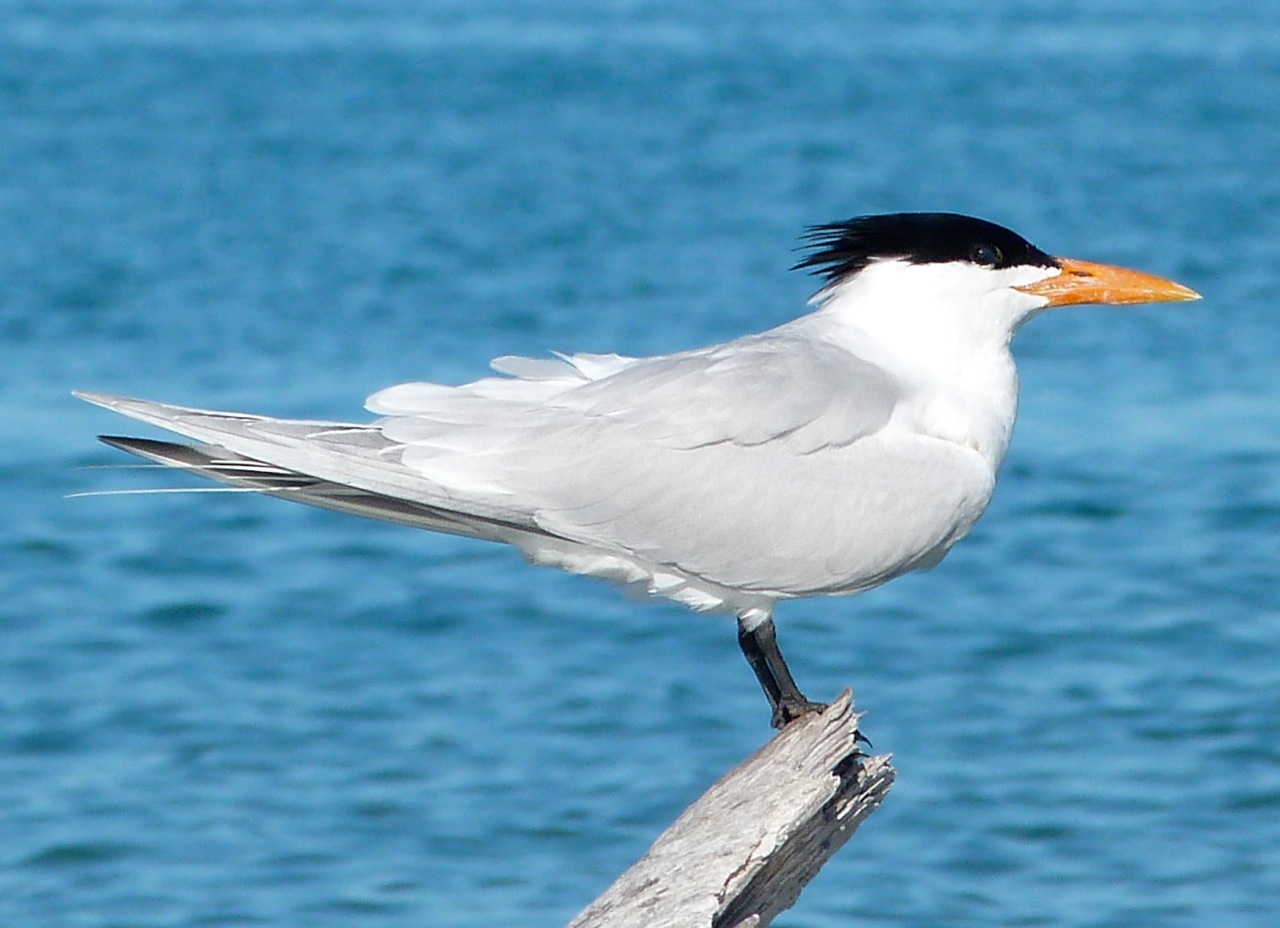
I posted briefly about ROYAL TERNS (Thalasseus maximus) on the Abaco Marls earlier this year HERE. Yesterday’s news from the Lindo Wing (anti-Monarchists look away now) surely justifies a few more photos of these fine and noble seabirds. Everyone else is using the event to sell newspapers / magazines / products (‘Royal’ Baby Lotion – so gentle, so soft – fit for a future King’s delicate…’ etc etc). If there’s a cheerful bandwagon passing, why not just hop on? I’ll skip the info about the range and nesting arrangements of these birds and show some them in all their glory, posing in the sunshine on a dead tree way out in the Abaco Marls.
PS No terns were hurt trying to get the yellow crown to fit one of them. In fact, they rather enjoyed it…
The LEAST TERN (Sternula antillarum, as it is now designated) is a small tern of the Americas and Caribbean, a very pretty, delicate little bird. It is a rare a vagrant to Europe, with a single example recorded in Great Britain. It is quick and manoeuvrable in flight, slightly hunched and ready to assume the position shown below after hovering over a likely spot for small fish. This image shows the bird coming out of its hover, and at the very start of its rapid plunge to the water. It’s here for illustrative purposes only – I realise it is somewhat inept as a photograph, but frankly you can never be sure when the dive is going to happen. Unless you have lightning reactions, a refrangible apex lens and a zircon-encrusted focal-zone flange, you’ll be lucky to do much better. Oh, and steady hands.
I had a lucky break on the Delphi beach one day, when I was taking photos of Wilson’s plovers and their new chicks (soon to feature here). A least tern appeared from nowhere and landed at the water’s edge within a few yards of me. I had no time to rethink my settings – a perennial problem at the best of times – and I simply aimed the camera and managed to squeeze off 3 shots before the bird took off again. One was a blurry fail, one is the header picture… and the 3rd captured the bird as it turned its head. You can see that, even though this is a small and light bird, its feet have sunk right into the soft, damp white sand.
Another day on the beach produced a more measured opportunity. A least tern landed quite close to me, and was so preoccupied with its preening routine that it let me creep closer, all the while keeping a beady black eye on me. In the top shot, it has just become aware of me behind it. I was lucky it chose to stay and let me watch.
TURKEY VULTURES (Cathartes aura) are a familiar sight, wheeling effortlessly overhead on thermals or gliding with the wind in singles, pairs or flocks. Statistically, 83% of all photographs of turkey vultures are taken from below and look like this
Of those, 57% are taken in unhelpful light, and look like the one below. On the positive side, this picture show the extreme delicacy of the wing-tip feathering that enables these birds to adjust their direction and speed (this is not the bird above; it was taken by someone else at a different time. But 100% of TV in-flight photos are indistinguishable).
TVs have a wide range in the Americas and the Caribbean, and can prosper in almost any type of habitat. This is probably because these large birds are almost exclusively carrion feeders, and carrion is everywhere. They spend their days scavenging, or thinking about scavenging. They do not kill live creatures.
The word ‘vulture’ derives from the latin word ‘vulturus’ meaning ‘ripper’, ‘shredder’, or ‘very loud Metallica song’. TVs have very good eyesight, and an acute sense of smell that enables them to detect the scent of decay from some distance. A breeding pair will raise two chicks which revoltingly are fed by the regurgitation of all the rank… excuse me a moment while I… I feel a little bit…
When they are not flying, feeding, breeding or feeding young, TVs like best to perch on a vantage point – a utility post is ideal. But unusually for a bird, you won’t ever hear them sing or call. They lack aSYRINX(the avian equivalent of a larynx), and their vocalisation is confined to grunting or hissing sounds. Here’s a hiss (at 10 / 15 secs).
These vultures are often seen in a spread-winged stance, which is believed to serve multiple functions: drying the wings, warming the body, and baking bacteria.
They are equally happy to spread their wings on the ground, the shoreline being ideal
10 SCAVENGED TURKEY VULTURE FACTS FOR YOU TO PICK OVER
One local name for TVs is ‘John Crow’
An adult has a wingspan of up to 6 feet
Sexes are identical in appearance, although the female is slightly larger
The eye has a single row of eyelashes on the upper lid and two on the lower lid
TVs live about 20 years. One named Nero had a confirmed age of 37
LEUCISTIC (pale, often mistakenly called “albino”) variants are sometimes seen
The Turkey Vulture is gregarious and roosts in large community groups
The Turkey Vulture has few natural predators
Though elegant in flight, they are ungainly on the ground and in take-off
The nostrils are not divided by a septum, but are perforated; from the side one can see through the beak [some humans also suffer from MSS (missing septum syndrome). They tend to sniff a lot]
REVOLTING CORNER / TOO MUCH INFORMATION
SQUEAMISH? LOOK AWAY NOW
UNATTRACTIVE HABITS The Turkey Vulture“often defecates on its own legs, using the evaporation of the water in the feces and/or urine to cool itself, a process known asUROHIDROSIS.This cools the blood vessels in the unfeathered tarsi and feet, and causes white uric acid to streak the legs”. The droppings produced by Turkey Vultures can harm or kill trees and other vegetation.
HORRIBLE DEFENCES The main form of defence is“regurgitating semi-digested meat, a foul-smelling substance which deters most creatures intent on raiding a vulture nest. It will also sting if the predator is close enough to get the vomit in its face or eyes. In some cases, the vulture must rid its crop of a heavy, undigested meal in order to take flight to flee from a potential predator”
DIETARY NOTESTVs tend to prefer recently dead creatures, avoiding carcasses that have reached the point of putrefaction. They will occasionally resort to vegetable matter – plants and fruit (you could view this as their salad). They rarely, if ever, kill prey – vehicles do this for them, and you’ll see them on roadsides feeding on roadkill. They also hang around water, feeding on dead fish or fish stranded in shallow water.
ECO-USES If you did not have birds like this, your world would be a smellier and less pleasant place, with higher chance of diseases from polluted water and bacterial spread.
FORAGING TVs forage by smell, which is uncommon in birds. They fly low to the ground to pick up the scent of ethyl mercaptan, a gas produced by the beginnings of decay in dead animals. Their olfactory lobe in the brain is particularly large compared to that of other animals.
SEX TIPS Courtship rituals of the Turkey Vulture involve several individuals gathering in a circle, where they perform hopping movements around the perimeter of the circle with wings partially spread. In humans, similar occasions are called ‘Dances’. In the air, one bird closely follows another while flapping & diving.
For more about Turkey Vultures, including cool videos, visitDEAR KITTY
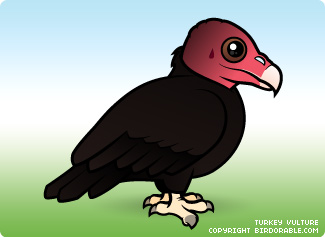
It’s possible you may enjoy a visit to max-out-cute Birdorable. Click TV below for link
And if you’d prefer something TV but less cute, depressingnature.com has the thing for you…
Credits: Photos mainly RH, 2 by Clare L, small ones Wiki; Info – cheers Wiki & random pickings
Oh. Ok. Here’s the Metallica thing referenced above. Sweaty. Not my taste these days.
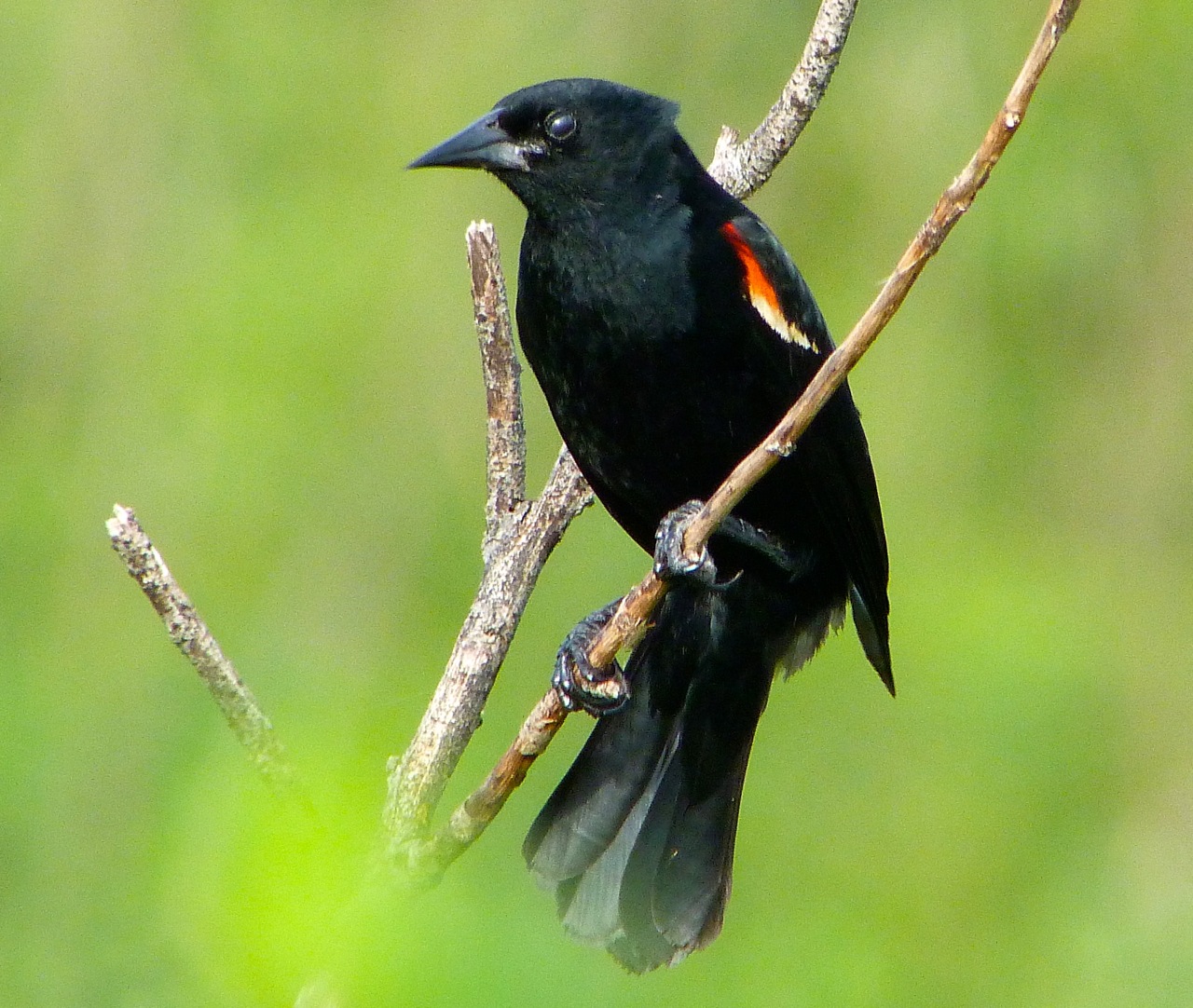
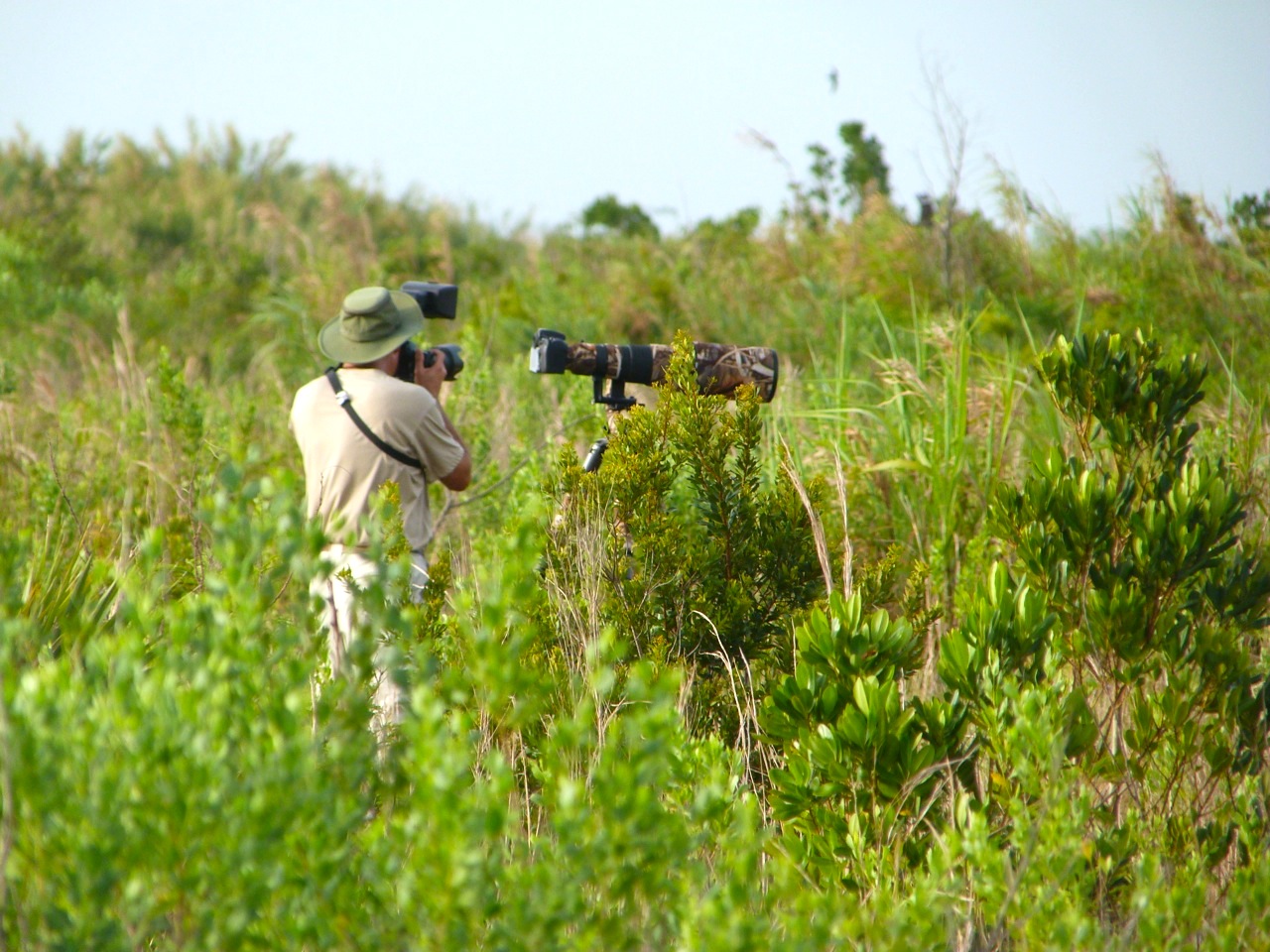
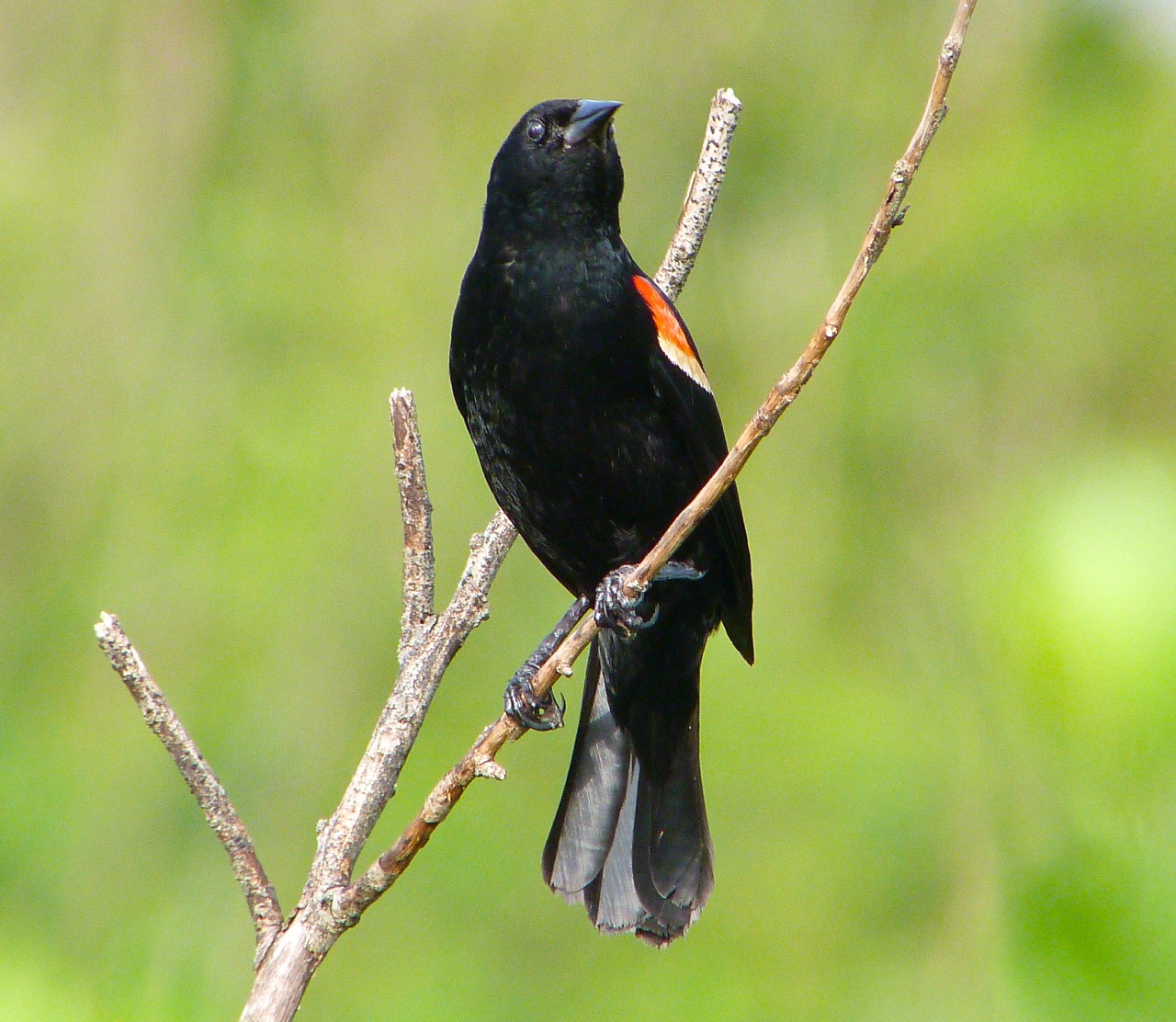
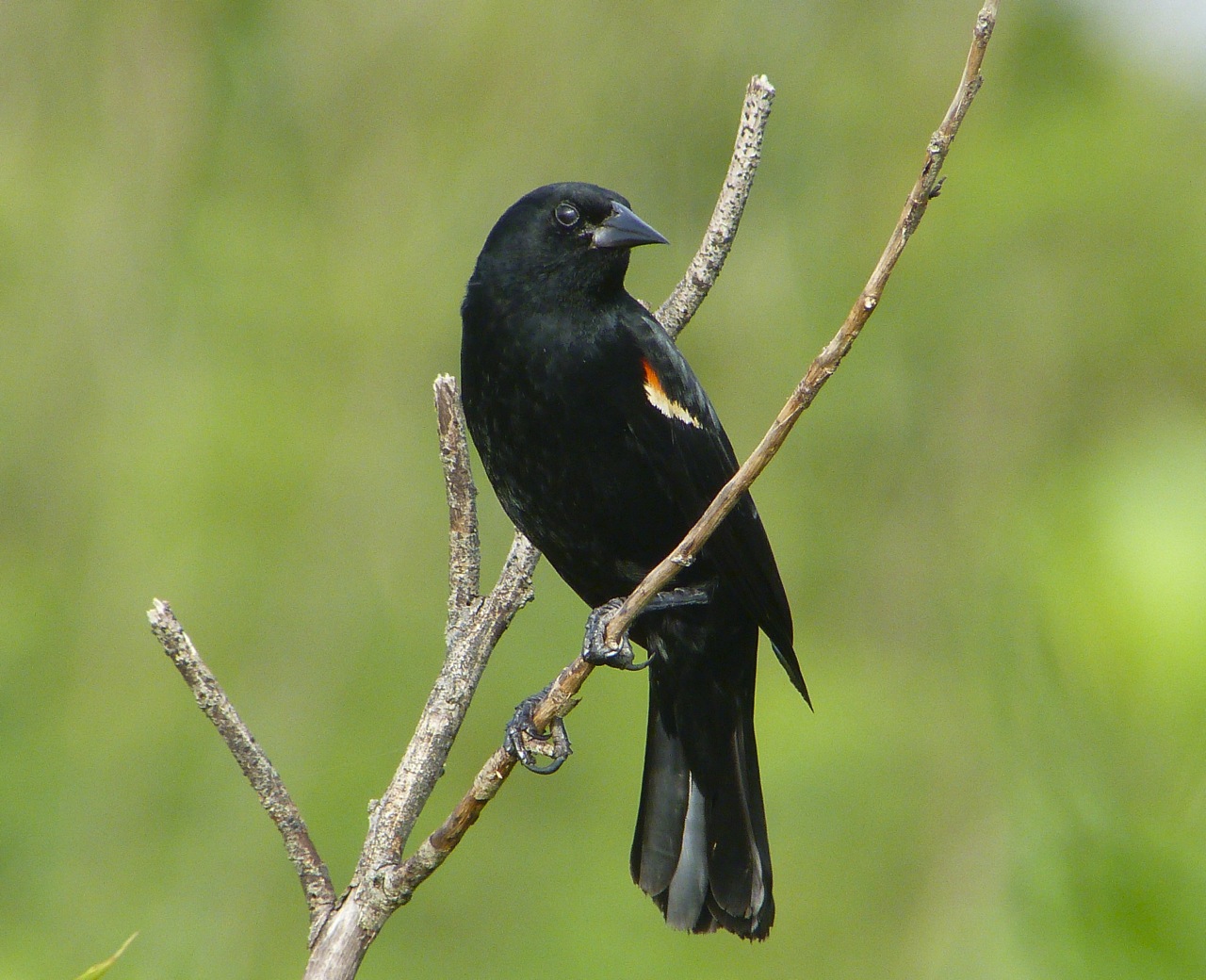
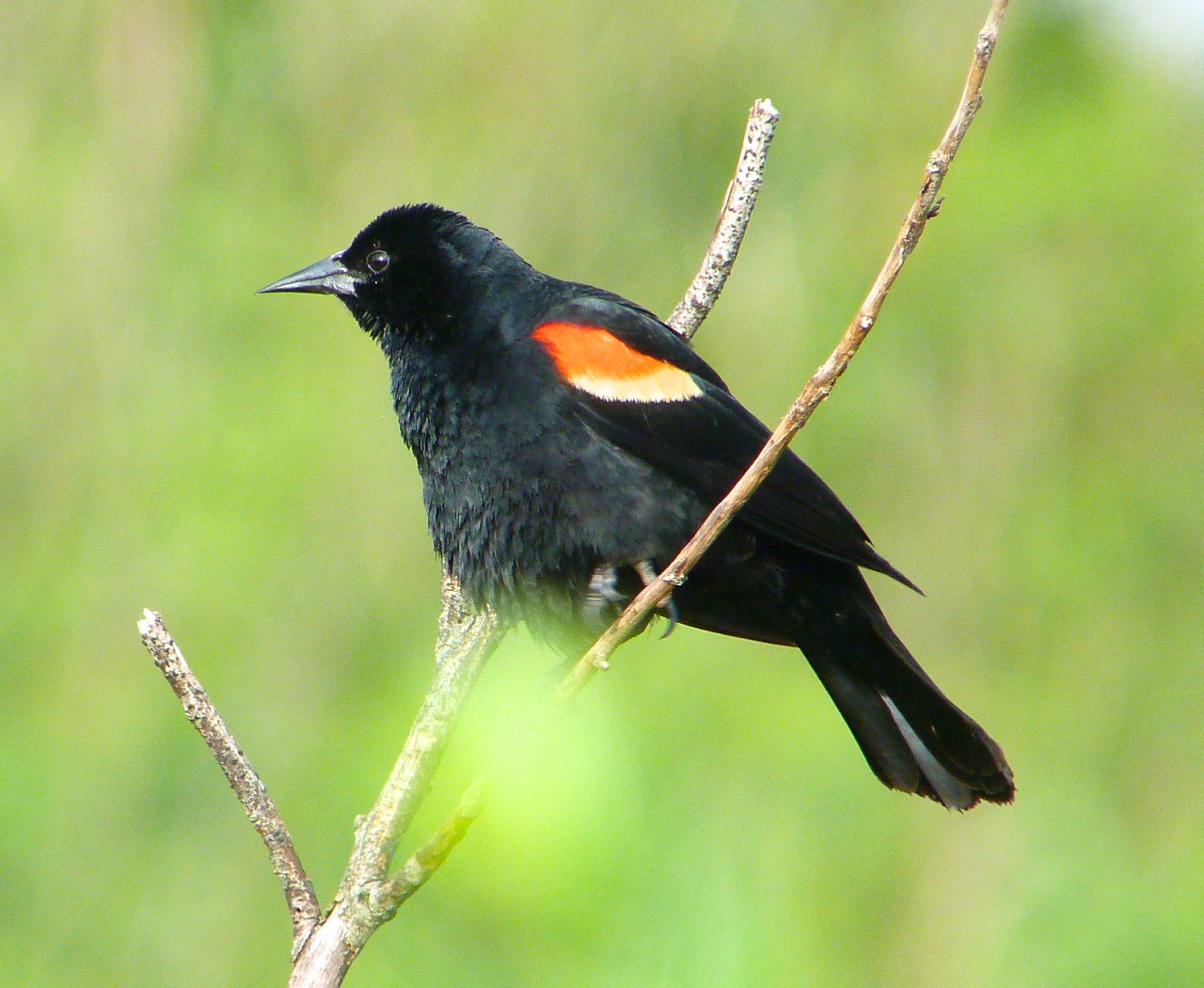
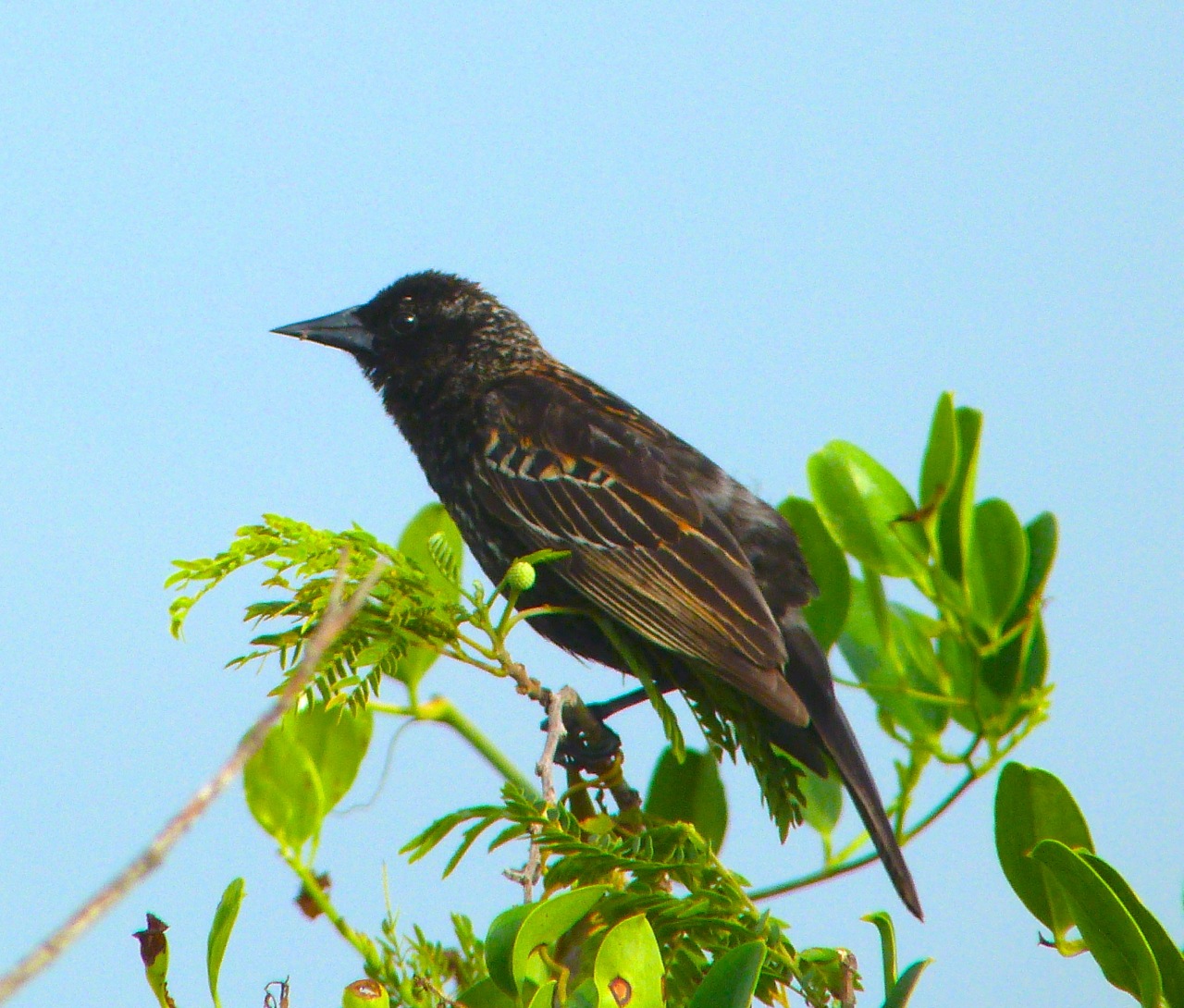
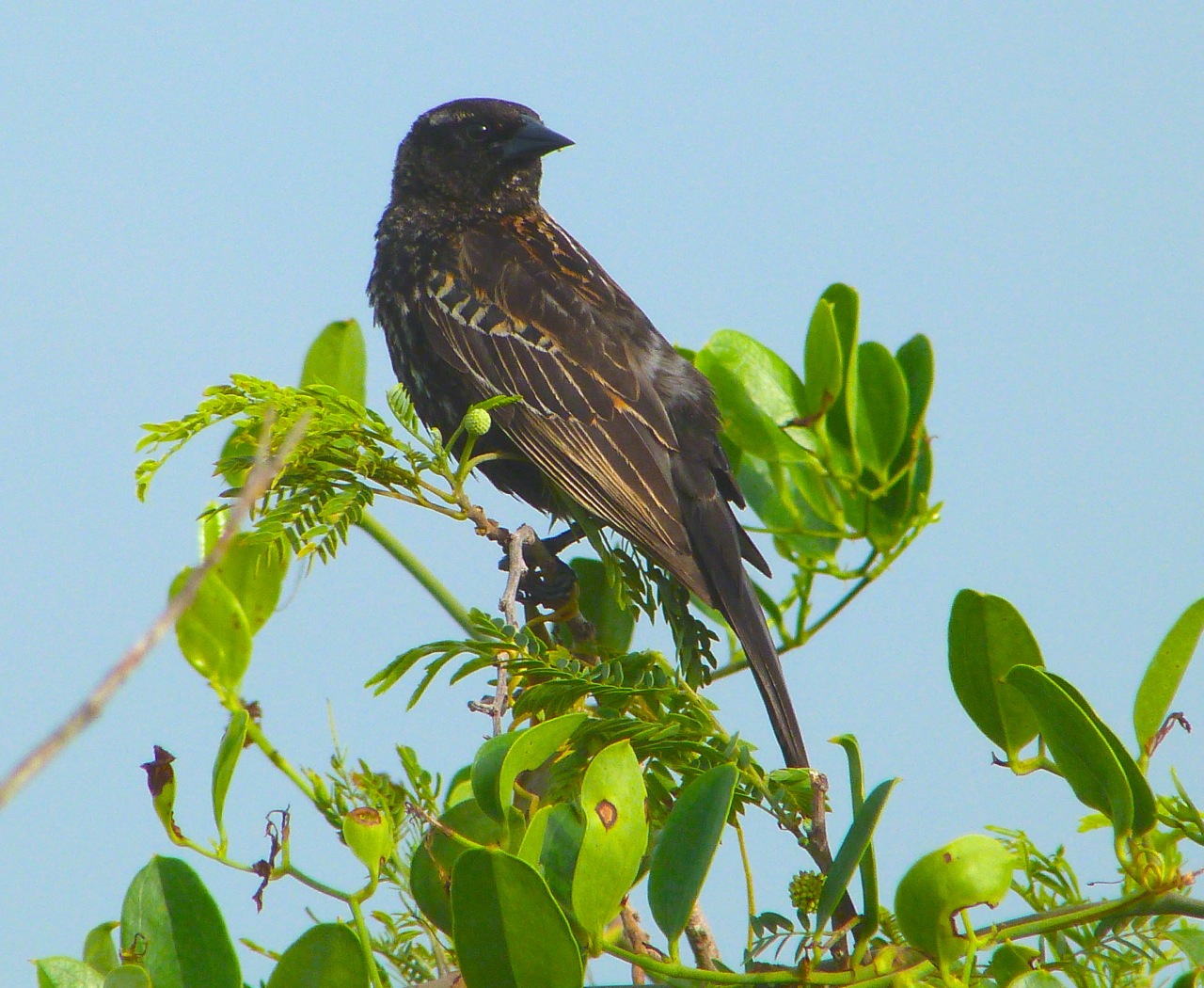
The red-winged blackbird (Agelaius phoeniceus) has previously hopped around these pages in the context of a (my!) simple way to RECORD BIRDS using a smart-phone, trim the result and convert it into an mp3 (or even a ring-tone – I have a great Abaco parrot one to startle friends, family and indeed complete strangers). Now we move on to a more important topic, namely courtship and so forth. And boy, don’t male RWBs fancy themselves when trying to impress the laydeez…We had taken a truck into backcountry between the pine forest and the Marls, with Tom and his impressive camo-camera with its 10 foot lens.
We found formerly cultivated fields – evidence of the defunct sugar cane industry – and then we came unexpectedly to a large expanse of open scrubland, with the track straggling through the middle.
And there, on carefully chosen vantage points, was an array of RWBs.
This bird was within range of my comparatively puny camera, and I watched as it arranged itself into various elegant poses in the late afternoon sun. All around were their ‘rusty door hinge’ calls, of which this is an example (in fact a female, recorded at Casaurina, hence the background sound of lapping waves).
These acres of open land were not far inland, and there was a slight breeze to ease the heat. This caused the occasional ruffling of feathers, and the need to spruce up…
The purpose of all this was of course to impress the opposite sex (behaviour not confined to bird species). There were plenty of females around, also similarly perching on vantage points for similar display-with-view-to-dating-maybe-more reasons.
I didn’t see the phase in which the males may get quite worked-up, but luckily Y**T*b* has perfect example of a male RWB in full song. Credits as shown on the video.
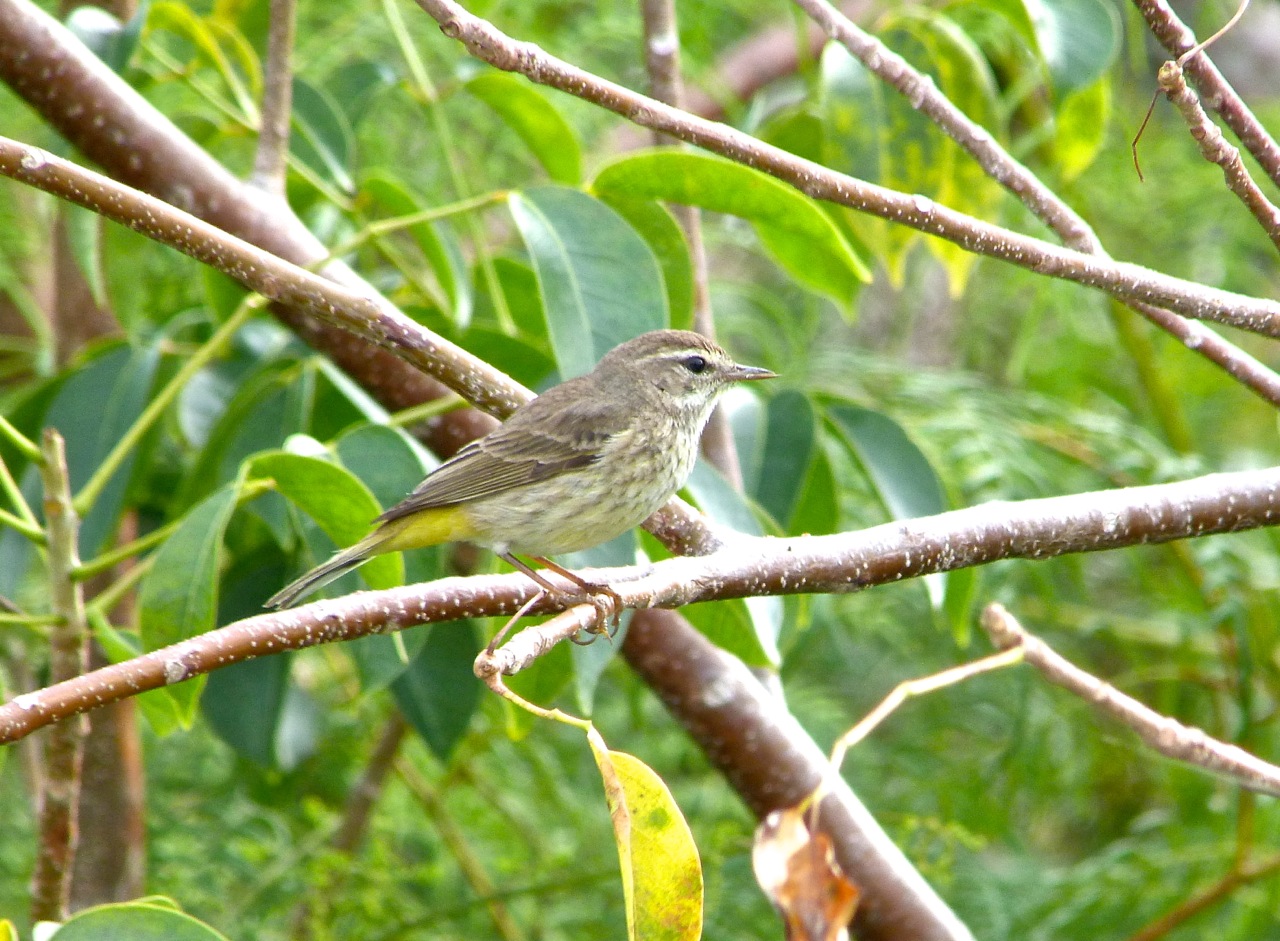
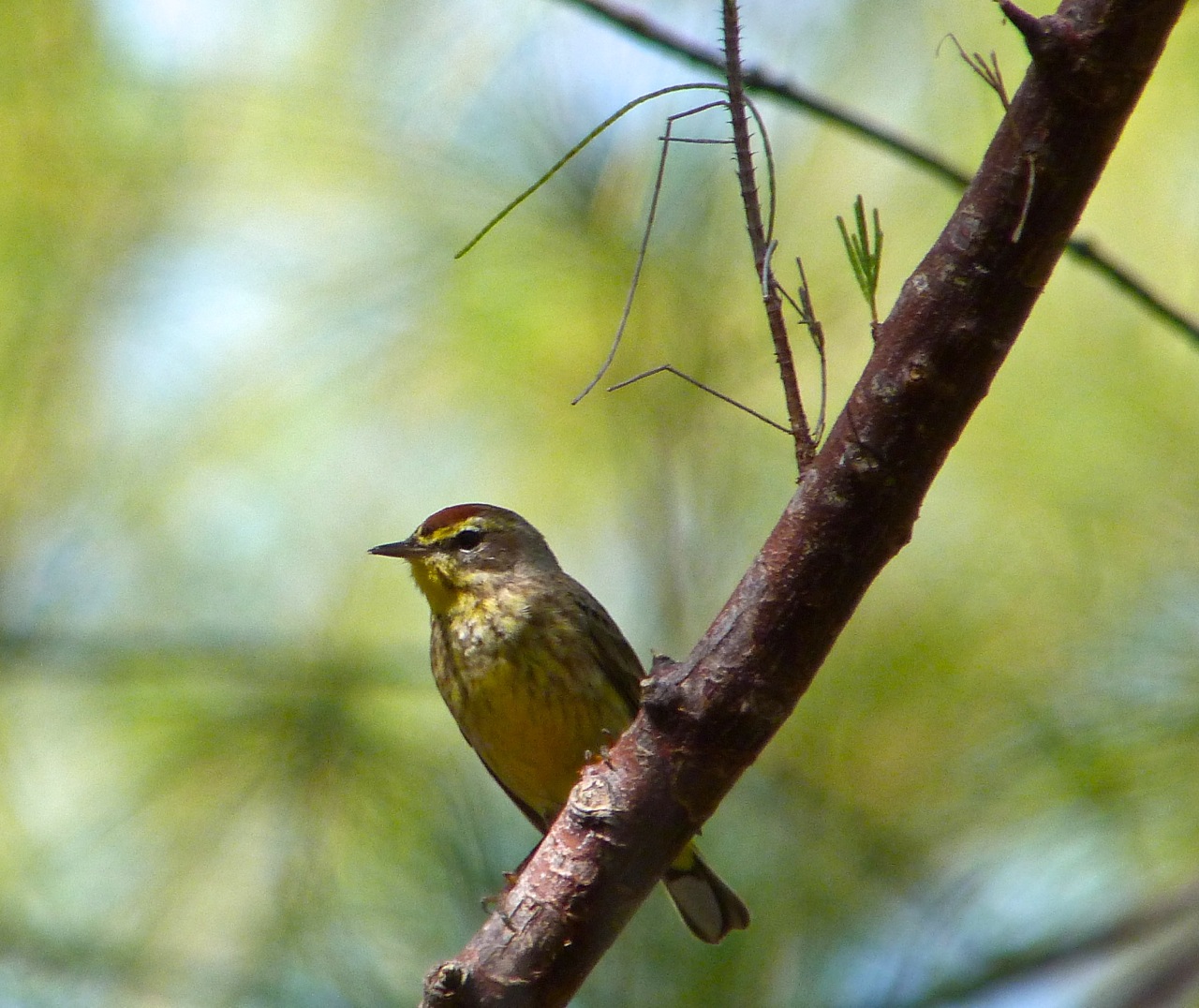
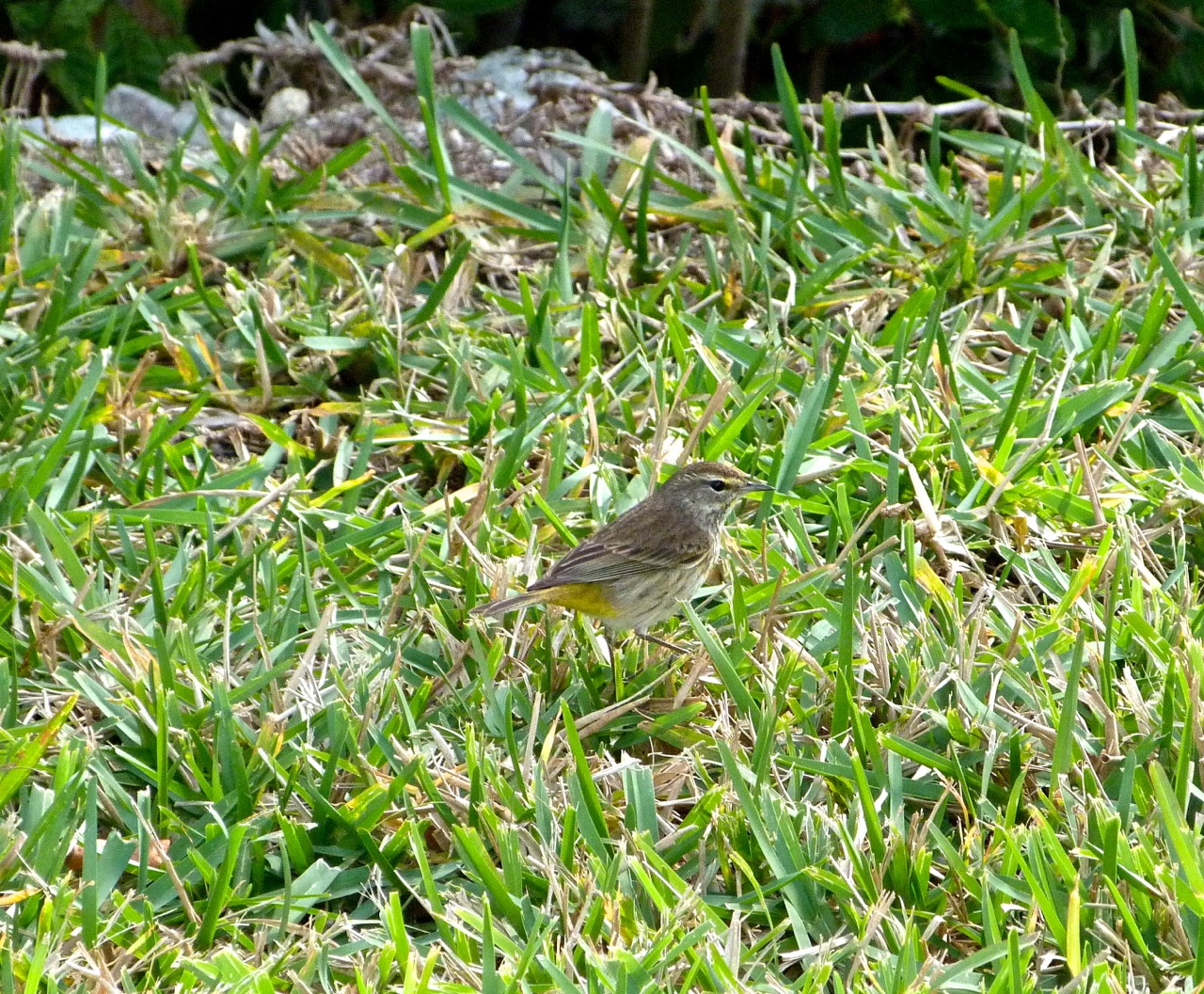
Palm Warblers Setophaga palmarum are cheerful little birds. Keen feeders, foraging around on the ground, in the coppice, or where there are pines. They are one of only 3 warbler species that bobs its tail, not just when it’s happy but much of the time. Maybe it is happy much of the time. The other 2 species are the relatively familiar Prairie Warbler; and the vanishingly rare – on Abaco, at least – Kirtland’s Warbler, the avian Holy Grail for birdwatchers on the island.
The male palm warbler in breeding plumage has a smart chestnut cap and what might be described as a ‘buttery’ BTM, to use a polite text-abbrev. The females are paler and have less yellow on them. The photos below were taken in March this year, mostly by Mrs RH (I can’t now recall who took what so I’ll give a general credit until she claims her ones). You’ll see the wide variety of types of place you might encounter one of these little birds. The last picture isn’t great as a photograph… but it’s a classic bit of acrobatic personal grooming.



















.jpg)




















































You must be logged in to post a comment.