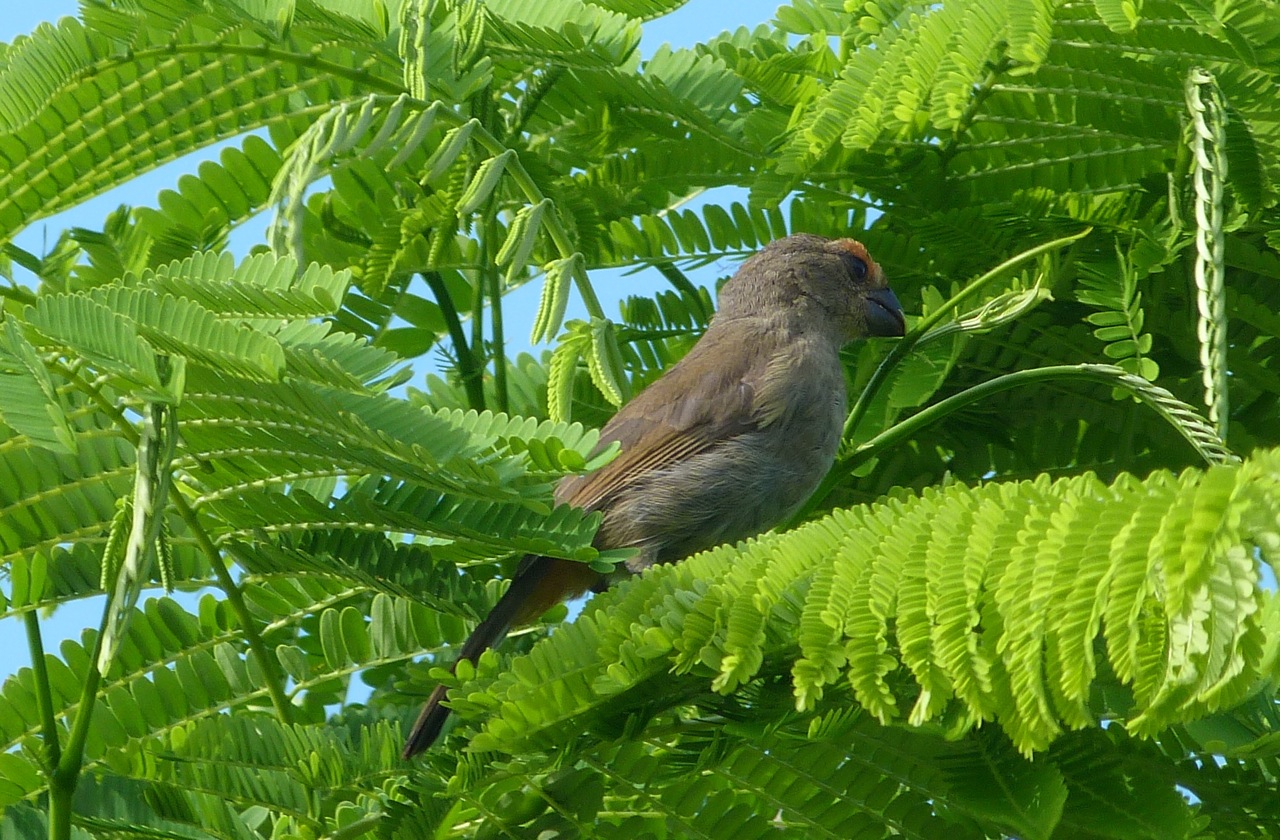
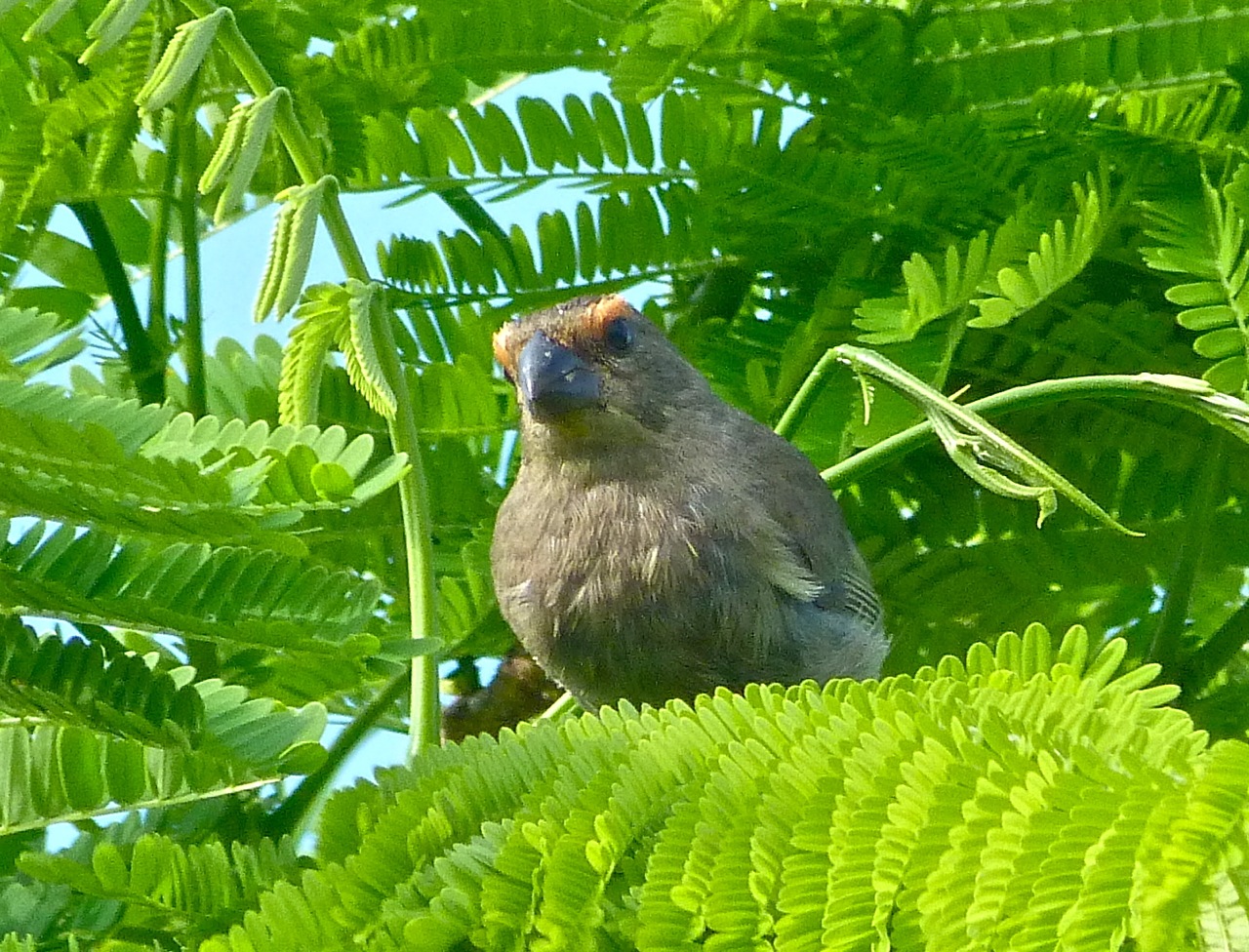
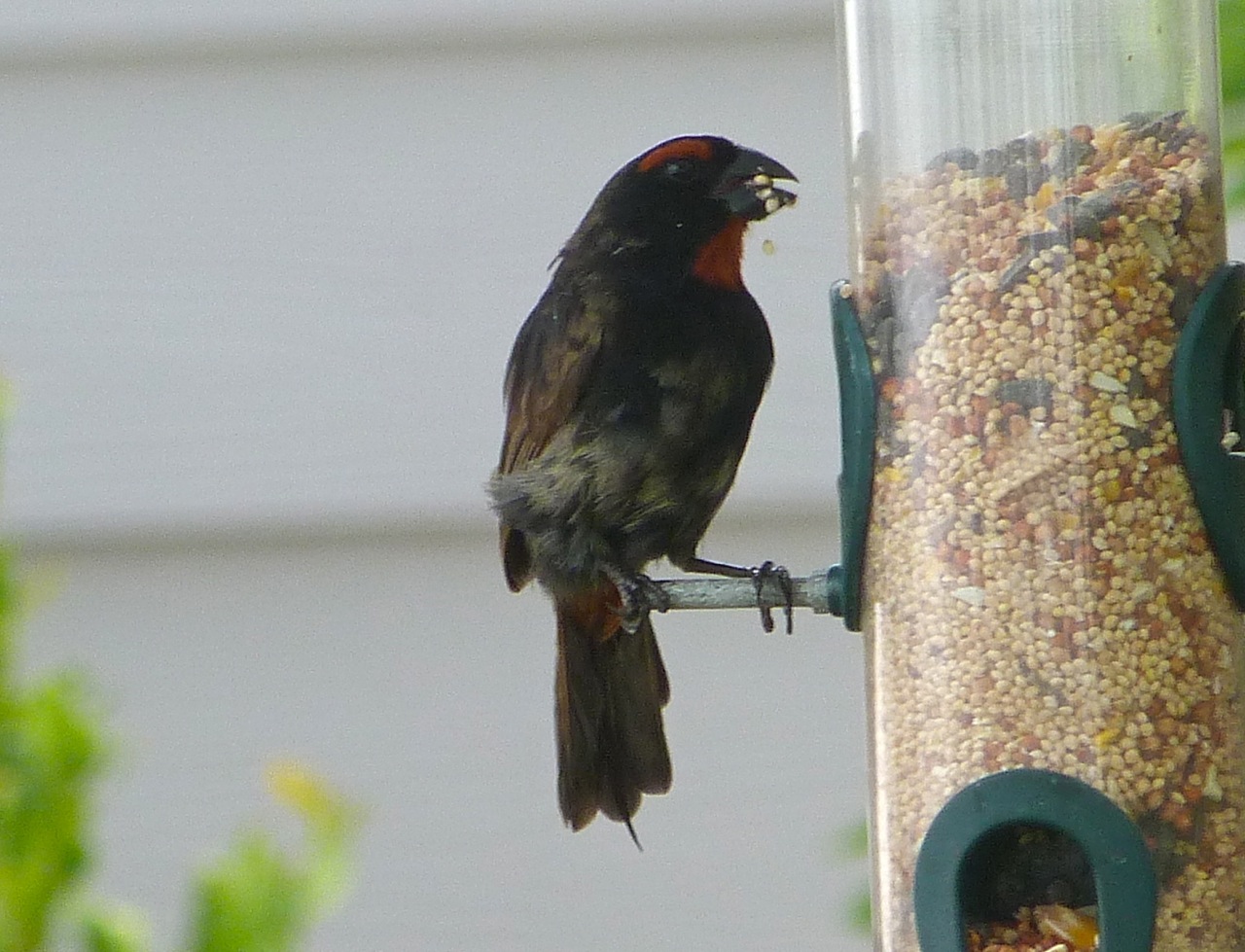
This is a well-know bird (Loxigilla violacea) that can be seen on Abaco all year round. With their scarlet bibs and eyebrows, the males are a cheerful sight in coppice or garden. The females are paler brown, with orange accessories.
While still officially rated as a species of ‘Least Concern’, a measurable fall in population in recent years has seen them nudging towards ‘Vulnerable’.
Greater Antillean Bullfinch song from Paul Driver at Xeno-Canto
Antillean Bullfinches enjoy garden feeders – and their larger size means that they are higher up in the pecking order than the black-faced grassquits and other small birds
They are one of the many popular Bahamian bird species to have featured on postage stamps – in fact they scooped the high-value $10 stamp in 1991 and the $5 stamp in 2001
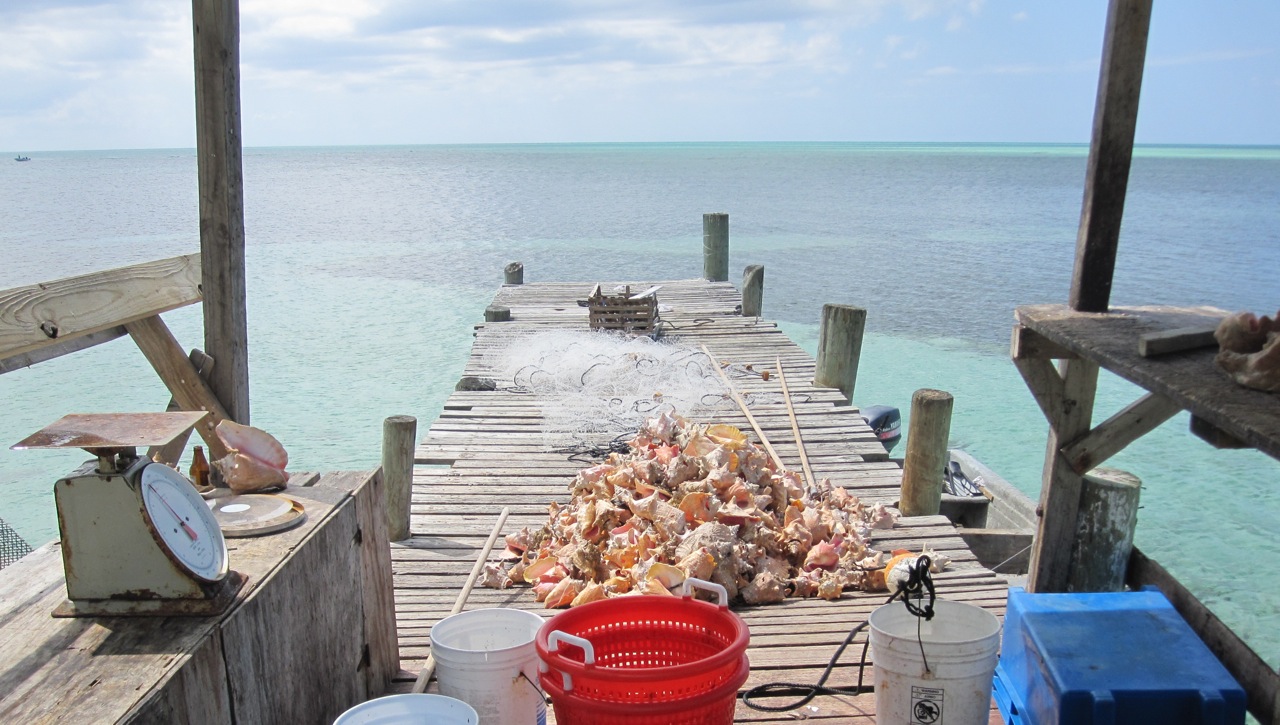
Conchs are among the most familiar of all shells. On Abaco they are everywhere: in the sea, on the beach, used ornamentally in gardens, piled up wherever conch is on the menu… (basically, anywhere serving food)
Conchs have other uses besides being a staple food. They provide sought-after pink pearls. Only about 1 conch in 10,000 has a pearl, so bear in mind that if you miss one during your search, you may have another 10,000 to wade through… Conchs can produce music, of a sort (such as when used enthusiastically by the famous ‘conch-blower’ home-team supporter during cricket Test Matches in the West Indies). They are undeniably decorative on a porch or on a shelf.
Conchs have featured in literature and film. In William Golding’s Lord of the Flies the conch represents power and order. A conch is blown to call meetings of the marooned boys. Its power is symbolised by the rule that you have to be holding it to speak at the meeting (an idea that many – all? – Parliaments could benefit from…)
Ian Fleming mentions conchs in several of the Bond books, all such references being totally eclipsed by the memory of the appearance, in the film Dr No, of Honeychile Rider emerging from the sea, conch in hand. Oh, I see. That’s just men is it? Or (good grief) just me? Anyway, may we all agree amicably that Ursula Andress was a most decorative conch carrier?
CONCH CONSERVATION
The supply of conchs is not infinite. Overfish them, take them before maturity or pollute their habitat and this valuable marine resource depletes – and conchs, as with so many marine species, will become threatened. Fortunately there is a Bahamas-wide conservation organisation with a website packed with interest.
COMMUNITY CONCH is “a nonprofit organization that aims to protect queen conchs in the Bahamas, a species of mollusk threatened by aggressive over-fishing. We promote sustainable harvest of queen conch through research, education and community-based conservation”
“Helping to sustain a way of life in the Bahamas”
Much of the research has been carried out in Berry Is, Andros and Exuma Cays. However the team has recently been based at Sandy point, Abaco. To see some of their work on AbacoCLICK LINK===>>ABACO EXPEDITION
In many past posts I have listed ’10 Essential Facts’ about the topic discussed. In that spirit I have borrowed and slightly edited CC’s conch facts; and added a CC video of a conch’s stately ‘full speed ahead’ progress. NB No zoom…
12 CONCH FACTS
The queen conch is a large edible sea snail native to the coasts of the Caribbean, the Florida Keys, the Bahamas, and Bermuda. Conchs are herbivores – they eat algae and other tiny marine plants
Main predators include nurse sharks, loggerhead turtles, other snail species, blue crabs, eagle rays, spiny lobsters, and other crustaceans
Mating aggregations may contain hundreds or even thousands of individual male and female conchs
Female conchs lay hundreds of thousands of tiny eggs in a sandy egg mass. The larvae emerge after 5 days and may drift on ocean currents for a month before settling in suitable habitat on the sea floor
In their first year conchs live under the sand during the day & come out to feed on the surface at night
A queen conch may take 5 years to reach maturity and can reproduce
They live an average of 7 years, but are known to live as long as 20 – 30 years
Conchs produce natural pearls that come in a range of hues, including white, brown, orange & pink
The conch is listed byCITESas a species which may become threatened with extinction if trade is not tightly controlled
It is now illegal to take queen conchs in the state of Florida due to severe overfishing
80% of legal internationally traded conch is consumed in the United States. The smuggling of conch meat into the U.S. is a significant challenge to conch management in The Bahamas
Queen conch are vulnerable to overfishing because they are (1) relatively slow to grow (2) late to mature (3) aggregate to mate (4) easily harvested in shallow waters
A SPEEDY CONCH
(Conch photos taken by RH / Mrs RH at Sandy Point, Abaco)
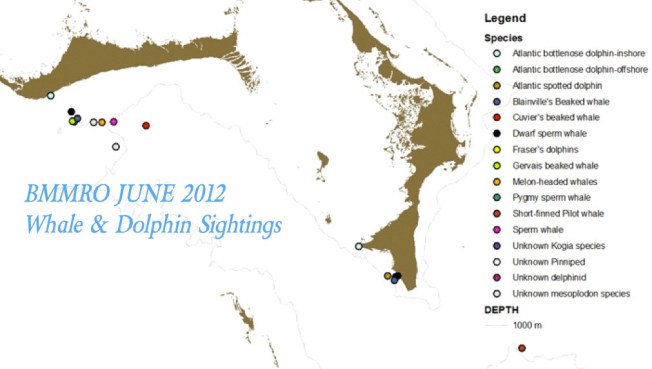
Actually, I say ‘Abaco’ but the most activity – and the most varied, species-wise – is off the southern coast of Grand Bahama. Abaco sightings are also confined to the south, with shows from aPIGMY SPERM WHALEand aBLAINVILLE’S BEAKED WHALEand dolphins in the arc between Rocky Point and Hole-in-the-Wall. To see recent aerial photos of this section of coast CLICK===>>>HERE
The manatees of the Berry Is. are no longer shown on this map. Their happy story (and their fame) has spread and they now have their own entries on the BMMRO FACEBOOK PAGE, like any self-respecting stars. You can reach it anytime direct from the Sidebar if you you want to keep track of the story of Rita and her calf Georgie’s rehabilitation – and the other manatees they have encountered as they get used to their freedom.
ADDEDThe latest BMMRO quarterly newsletter has just been published – highly recommended for anyone with an interest in active whale / dolphin research, or in the latest news of the manatees of Berry Is. To see itCLICK===>>> BMMRO NEWSLETTER JULY 2012
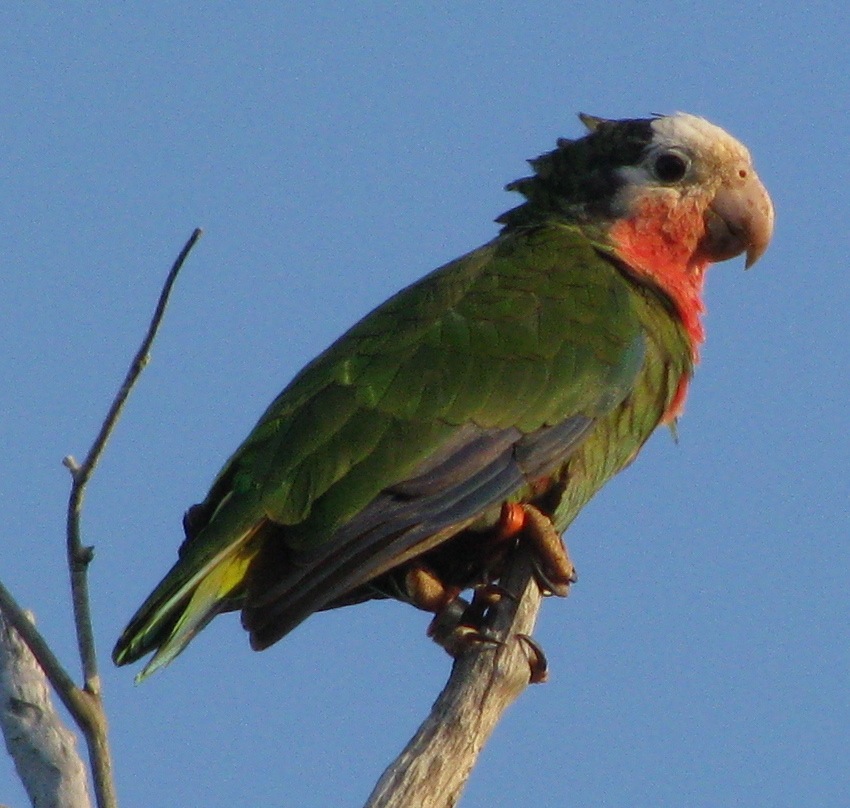
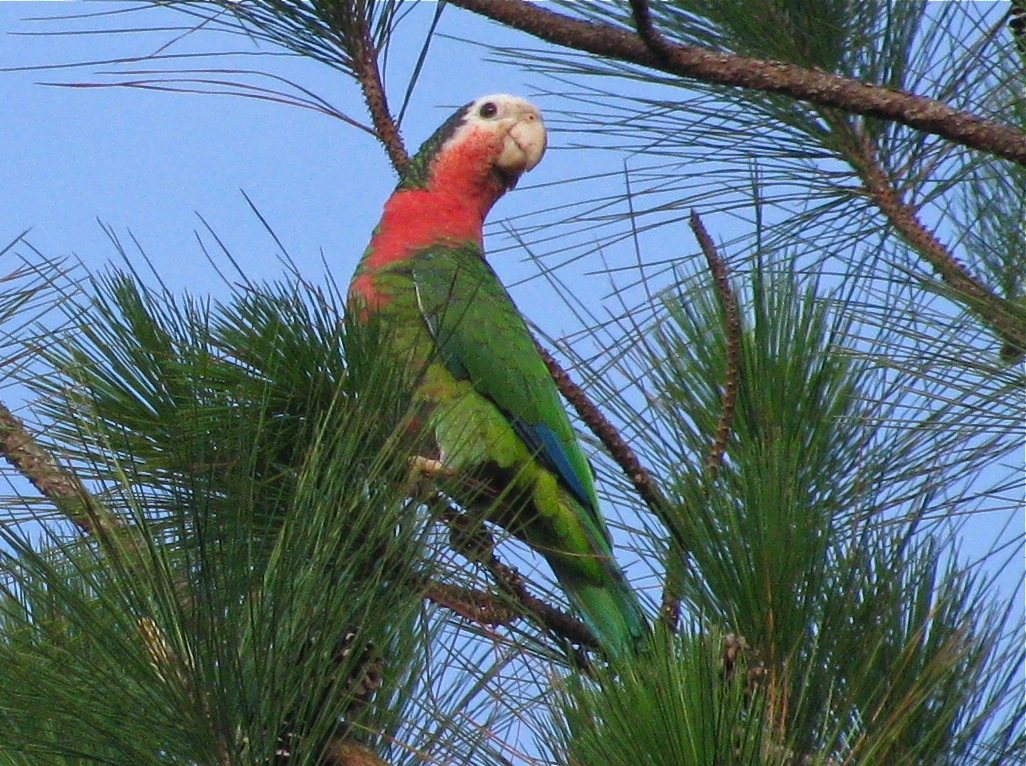
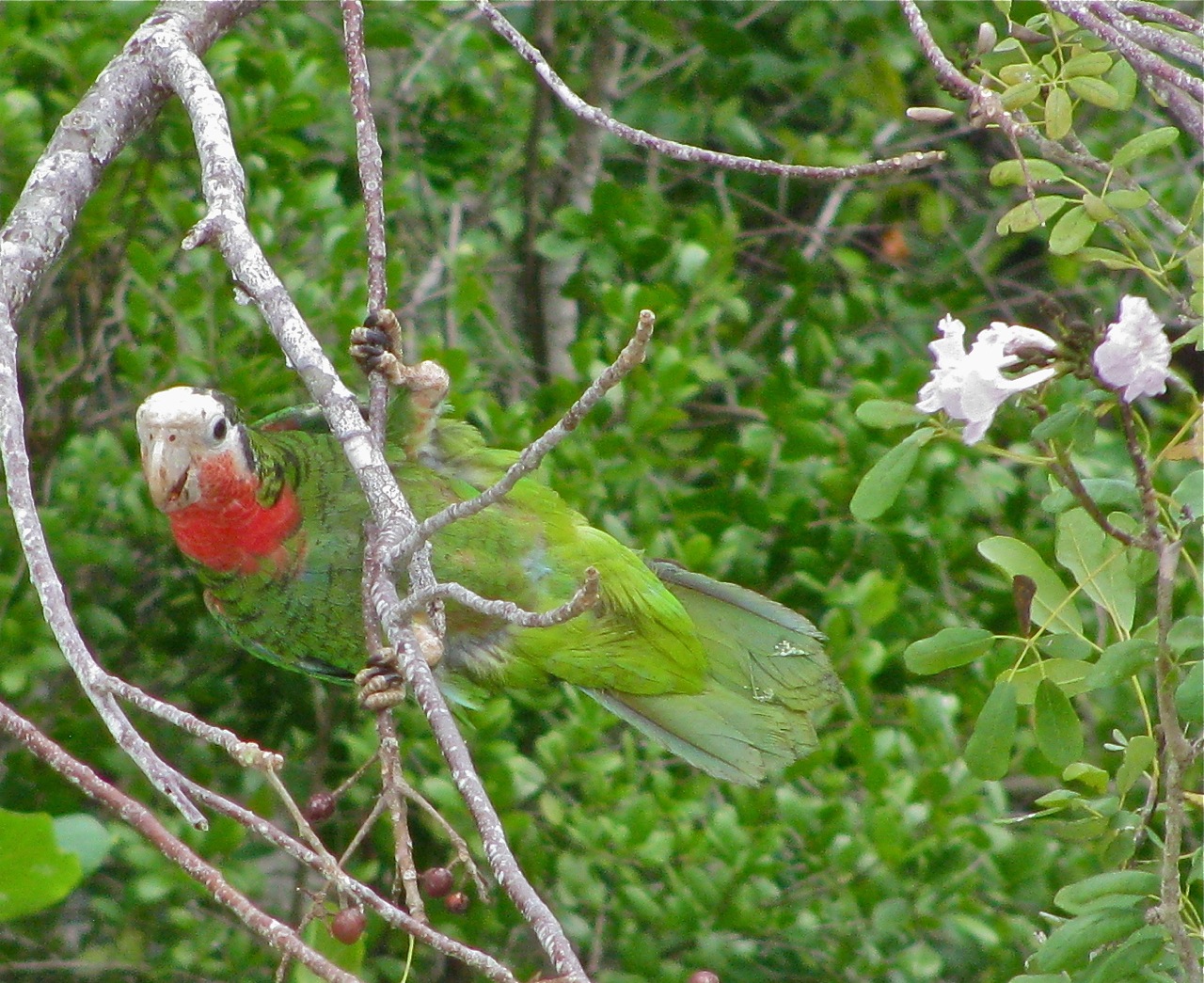
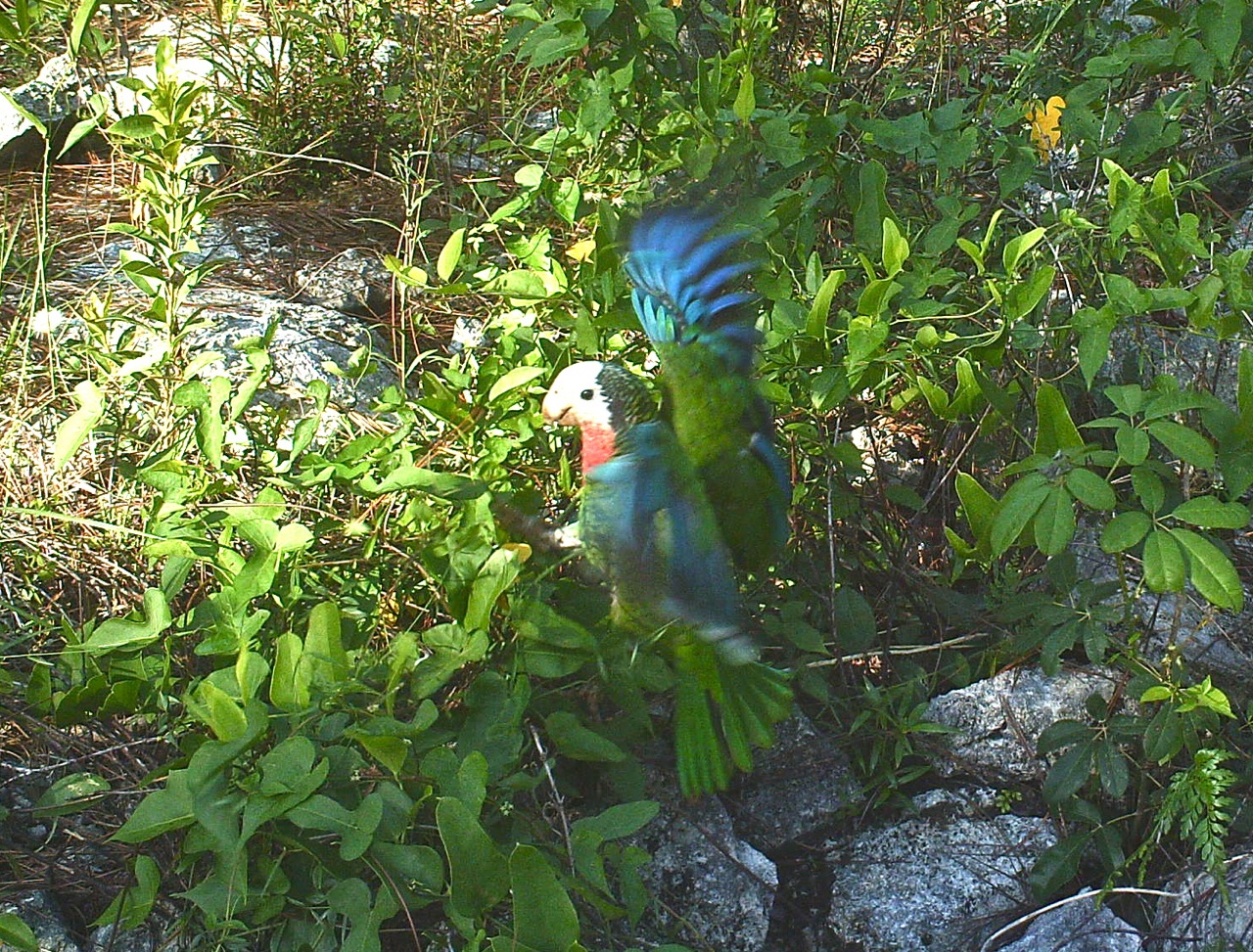
The wild parrots of Abaco are very special birds. Uniquely they nest underground in limestone holes which provides protection, not least from forest fires. Thanks to a program of intensive research over the last few years, far more is now known about these birds and their breeding habits. Investigations into predation have led to effective predator controls. The evidence this year is that the population numbers, having stabilised, are gradually rising to a sustainable level of some 4000 birds. The parrot below has been ringed as a chick as part of the continuing monitoring program.
I will soon be posting about the current breeding season – the parrots are in their limestone cavity nests now, the eggs are laid, the chicks will soon be hatching. Caroline Stahala, the Abaco parrot expert familiar to those who follow this blog (seeABACOPARROTS), will soon be reporting on this years breeding and chick-ringing program. In the meantime, here are some of Caroline’s pictures taken during the past season of the parrots in all their glory…
The parrots mainly live and breed in the pine forest of the Abaco National Park
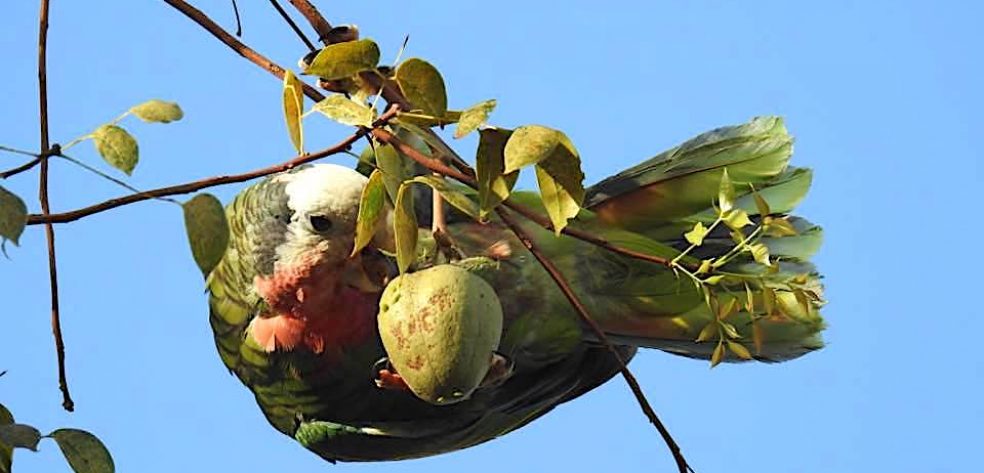
During the day they fly northwards, often in large noisy groups, where they feed. One of their favourite treats is the fruit of the Gumbo Limbo tree. This sometimes requires acrobatic skill
The sunshine brings out their bright colouring. When they fly, the blue on their wings is wonderful
Besides Gumbo Limbo berries, the parrots enjoy feeding on seeds
A parrot takes flight near a nest cavity. There’ll be more photos of parrot nests later this month
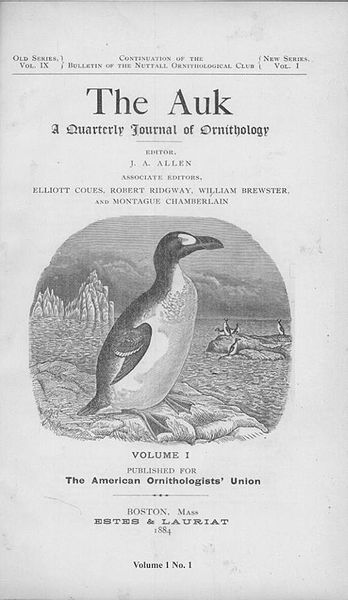
THE AUK is a quarterly journal published by the AOU specialising in promoting the scientific study of birds by means of original peer-reviewed reports. It has been in continuous publication since 1884, and can lay claim to be a (the?) foremost journal in its field. Here is the front page of the first volume of the journal
The 1905 Vol 22 No. 2 contains a 22 page study by Glover M Allen entitled SUMMER BIRDS IN THE BAHAMAS. If you aren’t a particularly dedicated birder, my advice is ‘look away now’ and move on to a page, post or other occupation that interests you more. For the remaining 2 of you, stay tuned in. I thank you both. It will be worth it…
The article was published at a time when ornithological survey of the Bahamas was in its infancy. Cory’s famous list of birds collected from the islands had been published a mere 15 years earlier. Allen details his time spent with 2 companions – much of it on Abaco – as they investigated birdlife and recorded their findings. That aspect comprises the first part of the article. The second part is equally fascinating: their list of bird species, with commentary, remarks and comparisons thrown in, together with some of the local names for the birds. Some of these are still in use, others perhaps long-forgotten. Is a Least Tern still known as a ‘Kill-’em-Polly’? Here are some highlights for busy people:
FLAMINGO / SPOONBILL Of particular interest is the recording of the apparently imminent loss of the flamingo (“fillymingo”) from the Northern Bahamas – a single colony only still surviving on the Abaco Marls by 1905. Allen and his group found only one roseate spoonbill, also on the Marls (we were also lucky enough to see a single spoonbill on the Marls in June)
BAHAMA PARROT Those who follow the fortunes of these fine birds on this blog or elsewhere will be especially interested in the following extract, which suggest that at the start of the c20, the species had all but died out on Abaco:“Amazona bahamensis (Bryant). We were interested to learn through the captain of our schooner, that a few parrots still exist on Great Abaco. He told us of having seen a flock near Marsh Harbor the year before (1903) and in previous years had some- times observed a flock in late summer at that part of the island. We learned that at Acklin’s Island about 14o miles south of Nassau, parrots still nest in numbers and the young birds are regularly taken from the nest when fledged,and bronght to Nassau to be sold as pets” I will be posting about the parrots later this month, but suffice to say here that the current estimate for Abaco parrots is now around 4000 birds, a significant increase since conservation measures and a predator control program were started some years ago.
BAHAMA WOODSTAR These endemic hummingbirds, now taking second place to the in-comer Cuban Emerald, were plainly everywhere then: “On all the islands and cays, wherever there was bush or tree growth, this humming- bird occurred”
“PARAKEETS” There seems to have been a significant population of these, known then as ‘Bahama Grassquits’. What species were – or are -these? The description doesn’t quite match the ‘quit family candidates we are familiar with today.
OTHER SPECIES Avian taxononomy, with its frequent official changes of classification, is a confusing area… but it seems that in 1905 there were then 2 distinct species of Spindalis (now, one); and 3 Mockingbird varieties (now, two). But of course there may simply have been a naming adjustment since the article was published…
For those who have stayed awake till now, your prize is the following link to the whole 22-page (small pages!) article
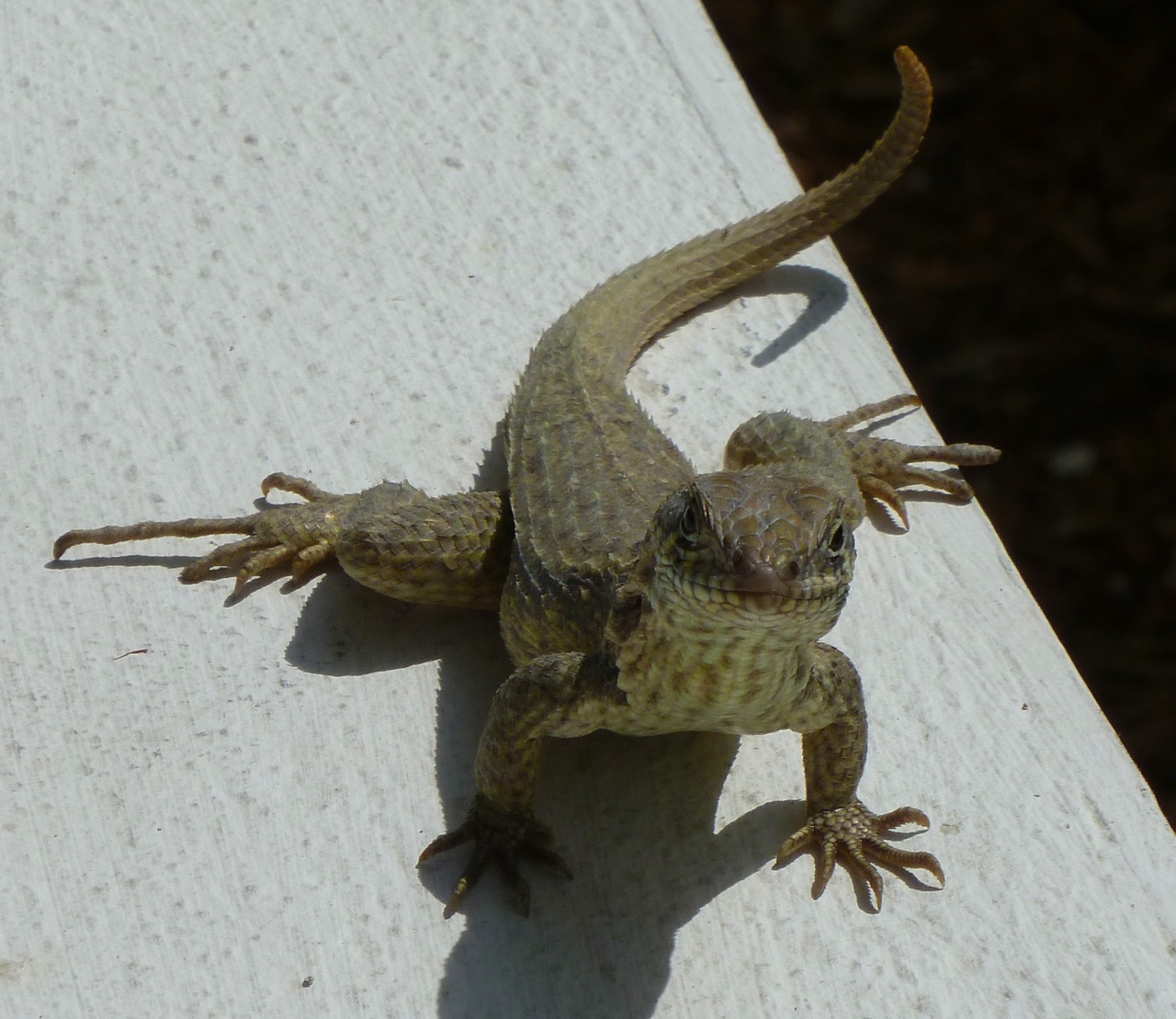
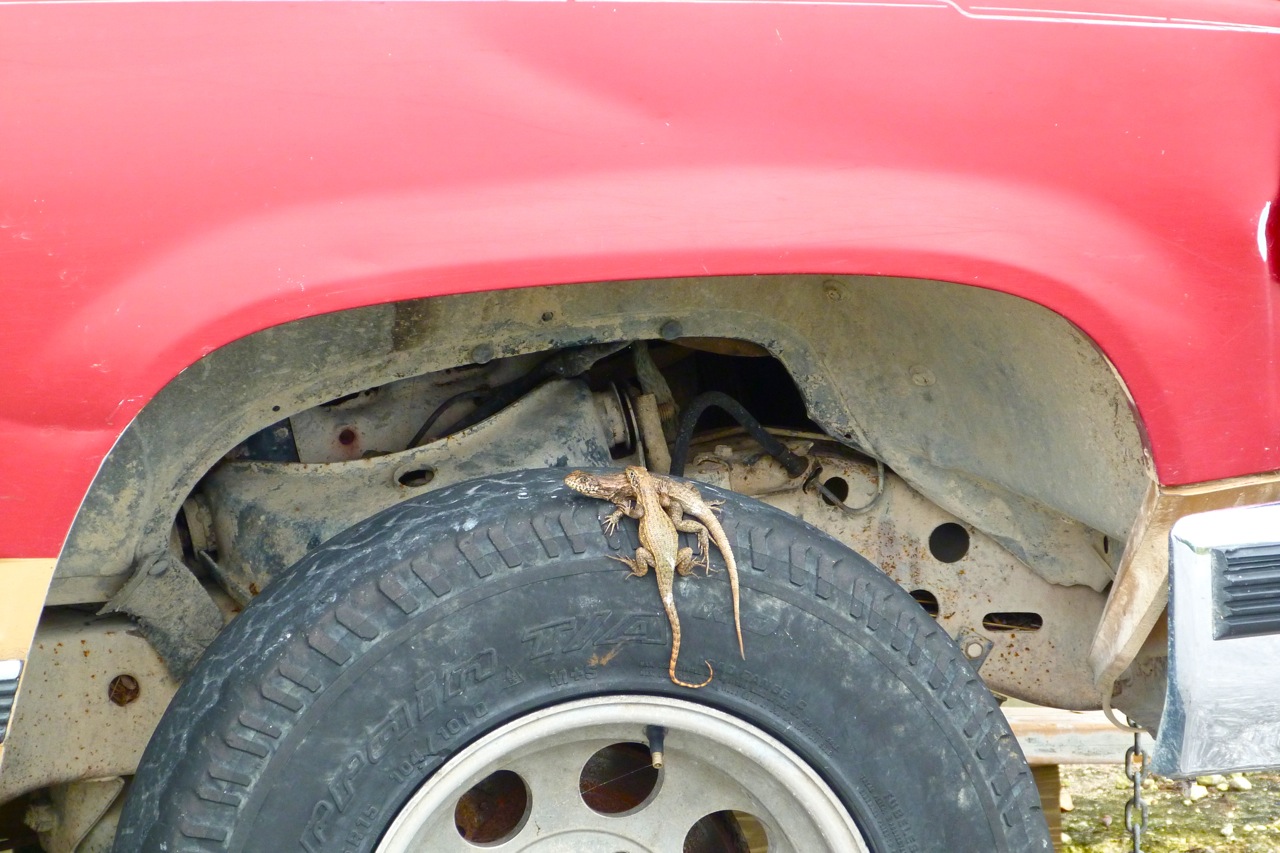
I have previously posted about these cute creatures that lie sunning themselves and occasionally blinking; or scuttle away when they see you. SeeCURLY TAILS for photos and details about these lizards and their habits. Here are a few more recent images. The first three were taken at the Delphi Club, where they seem to enjoy the pool area in particular. The top one has one extraordinarily long finger. It’s worth clicking on these 2x to enlarge them to see the structure of their skin / overlapping scales
An impressive “complete double curly”
This pair of curly tails was at Crossing Rocks, where we were trying to locate Bahama Woodstar hummingbirds in the scrubland. We rather felt that we might be interrupting something… They look endearingly affectionate.
WARBLER IDENTIFICATION – A LIGHT-HEARTED CHALLENGE
SPECIES ID NOW SOLVED! CUT TO THE CHASE BENEATH THE PHOTOS FOR DETAILS. A LATE ENTRY NOW DISPUTES THE GENDER ID, SO THE SEX CHALLENGE IS REOPENED, SO TO SPEAK
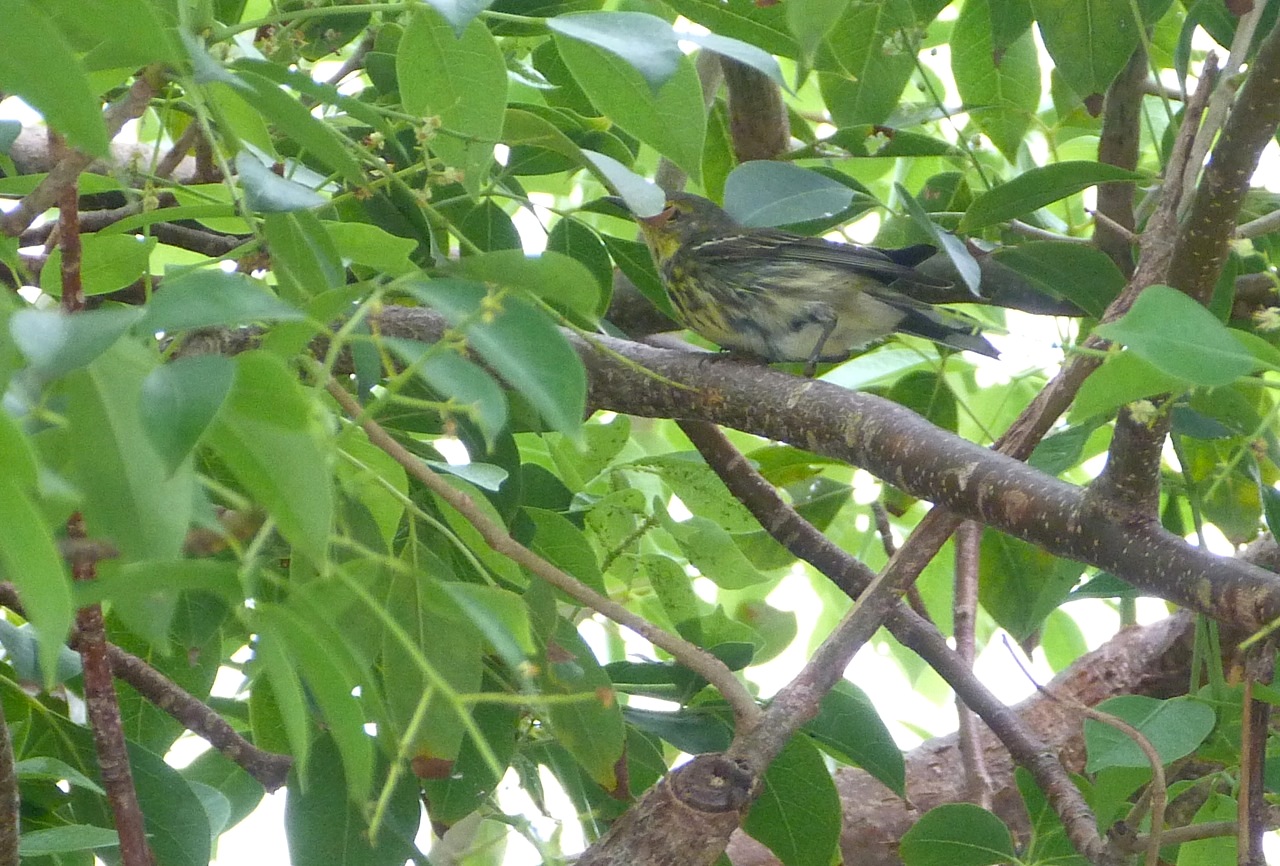
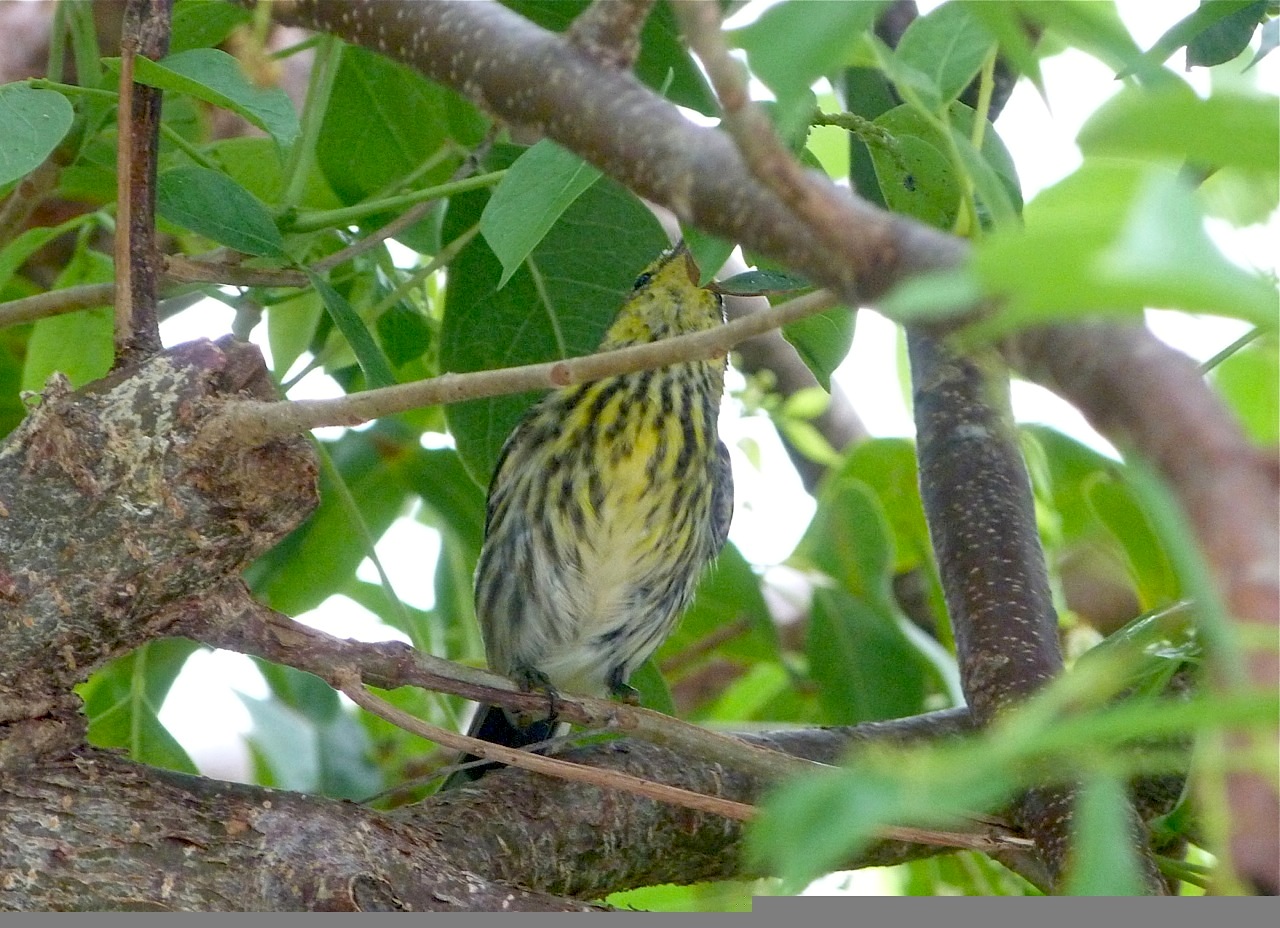
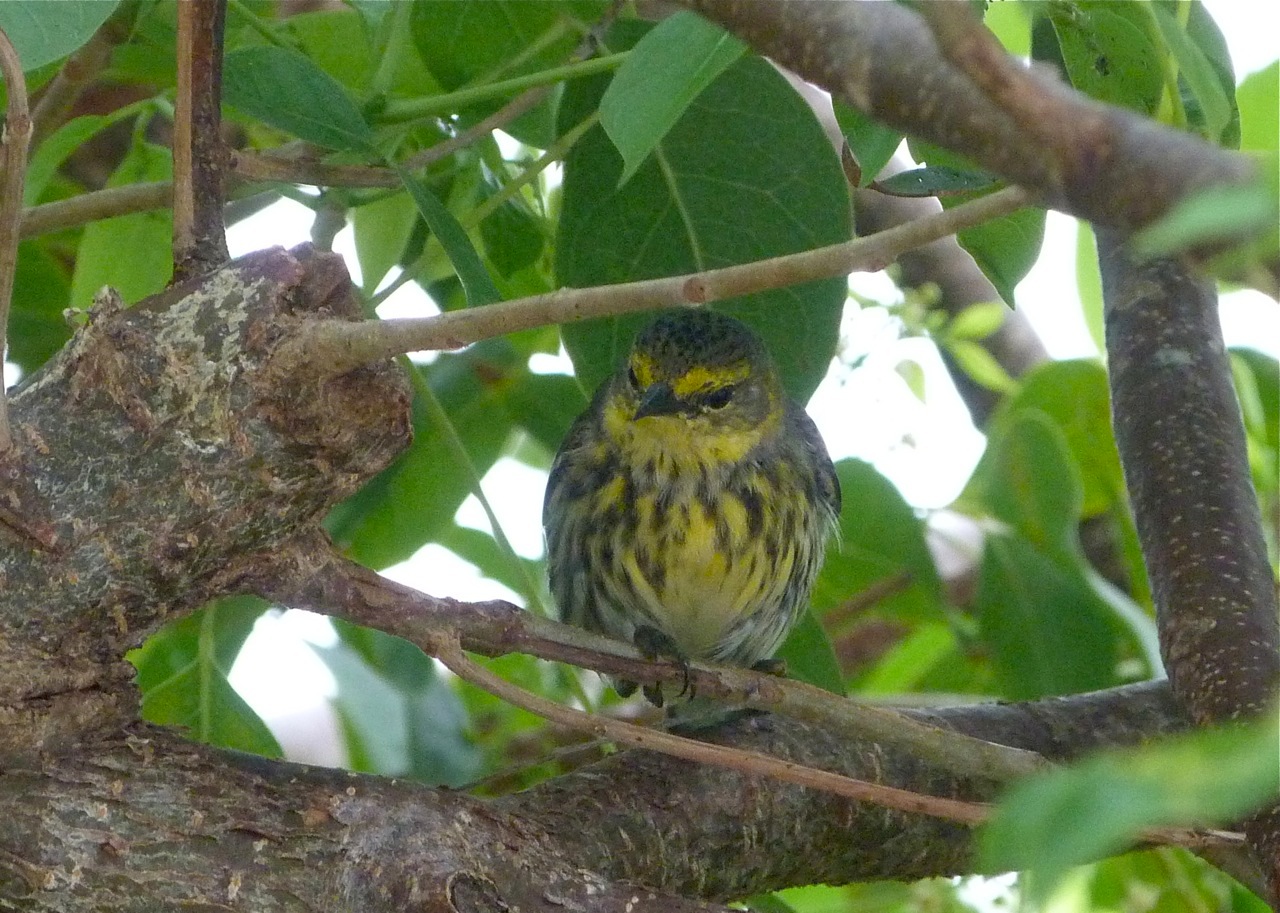
I have previously posted aids to WARBLER ID (1); WARBLER ID (2), a pitfall-fraught area that continues to baffle me despite books, online resources, futile stabs in the dark etc. For each species the male differs from the female, and both differ from juvenile / maturing birds. And this all depends to some extent on the season. Here’s a speckled warbler photographed recently at the Delphi Club, Abaco, for which there are various candidates ranging from the distinctly possible to the frankly completely-unlikely-but-astounding-if-it-turned-out-to-be-true Kirtland’s Warbler. These are seen and positively identified vanishingly rarely on Abaco – maybe one or two a year, and invariably in winter. But what if one decided to stay behind for the summer… And to those who say “Prairie, dimwit”, I reply “…but their speckles don’t cover their entire fronts”.
I’m throwing this open, because although I have a view I’d like to see what others come up with. Craig? Avian101? Avian3? Margaret H? Other birding followers? Are you out there? Leave a comment (see small-print blurb at the bottom of the post) or email me at rollingharbour.delphi@gmail.com The bird was a bit reluctant to be photographed, but I managed to get a side view, a ‘full-frontal’ and a head shot. Any ideas?
UPDATEThanks to all who came up with suggestions – it’s interesting how opinion on warbler species varies, even with quite clear close-ups to judge from. The first past the post is… Dr Elwood D Bracey (Fl), to whom many thanks. It’s a female CAPE MAY WARBLERDendroica tigrina. The runner-up is (amazingly) myself – I had it down for a Cape May juvenile, because I thought it looked a bit on the fluffy side… Also, its eye-patches (photo 3) are grey rather than brown, and I took their colouring to be a work in progress. There’ll be some more ID queries from our recent batch of Abaco photos – not just birds, but flowers & shells as well. All contributions will be welcome…
Oh no! What’s happening here? A late challenge has come in from Margaret H (see comments), who contends that the clearly shown patch on the bird’s cheek indicates that it is a male, not a female, Cape May. So the challenge was ended and the award given prematurely… The species is now definite, but the gender ID remains unresolved…
I’ve now heard from Alex Hughes, who writes “[I am] one of Caroline Stahala’s field techs on the parrot project this summer. She forwarded me the photos of the warbler taken recently on Abaco. The photos I saw are of a female Cape May Warbler, which is a great find in June! She is certainly not going to make it to her breeding grounds, unfortunately, but still fascinating to see a boreal forest bird in the Bahamas during summer.
In a follow-up, Alex adds “I’d be very surprised if this was a male bird, due to the plumage lined up with the time of year. This year’s juvenile birds are not big enough to make the flight south from breeding grounds yet, and wouldn’t anyways if they could. Therefore, it would have to be adult non-breeding plumage if it were a male, also meaning this bird already molted from alternate plumage from spring, and flew south. This seems far more unlikely to me than a female who simply didn’t make the flight, probably due to some handicap. Either way, very cool!”
So I think that wraps it up. A female Cape May, in the right place at the wrong time. How lucky to have got close to one in the off-season. It just goes to show, eager Kirtland hunters, that any of the migratory warbler species might choose to stay behind for the summer…
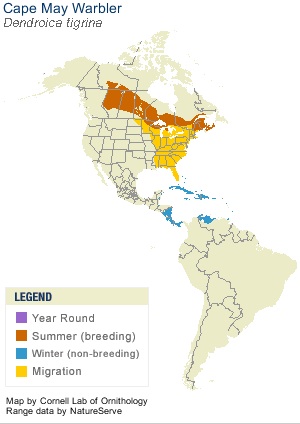
CORNELL LAB OF ORNITHOLOGY IMAGE & BLURB
“The Cape May Warbler breeds across the boreal forest of Canada and the northern United States, where the fortunes of its populations are largely tied to the availability of spruce budworms, its preferred food. Striking in appearance but poorly understood, the species spends its winters in the West Indies, collecting nectar with its unique curled, semitubular tongue”.
It is presumably using its ‘unique… tongue’ in Photo 2, inconveniently concealed by foliage so we will never know
(RH COMMENT My one obviously liked the Delphi Club – and its feeders – so much that it decided to stay for the summer…)
(Credit: Steve Pelikan for Xeno-Canto)
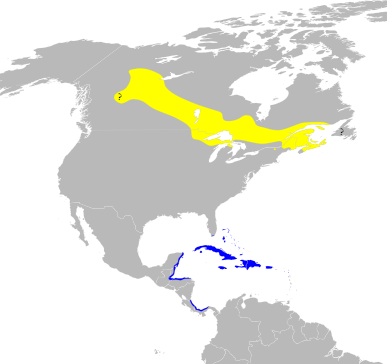
CAPE MAY WARBLER RANGE MAP (Wiki) (left)
As a warbler-muddler, I am interested to see how extremely selective this species is in its preferred summer and winter latitudes. The banding is very distinct. Are they never tempted by New York? Have they never tried Disneyland?
CORNELL LAB OF ORNITHOLOGY RANGE MAP(below)
The more sophisticated range map below shows the migration areas between the summer breeding and winter non-breeding areas. It looks as though a Cape May warbler on Abaco in June is an unexpected sighting.
BONEFISH CATCH & RELEASE: 5 COUNSELS OF PERFECTION*
1. FISH BARBLESS (OR FLATTEN THAT BARB)
2. WET YOUR HANDS BEFORE TOUCHING THE FISH
3. KEEP THE FISH IN THE WATER AS MUCH AS POSSIBLE
4. MINIMAL TOUCHING OF THE FISH – ITS PROTECTIVE COATING IS EASILY REMOVED
5. DO IT ALL AS QUICKLY AS POSSIBLE
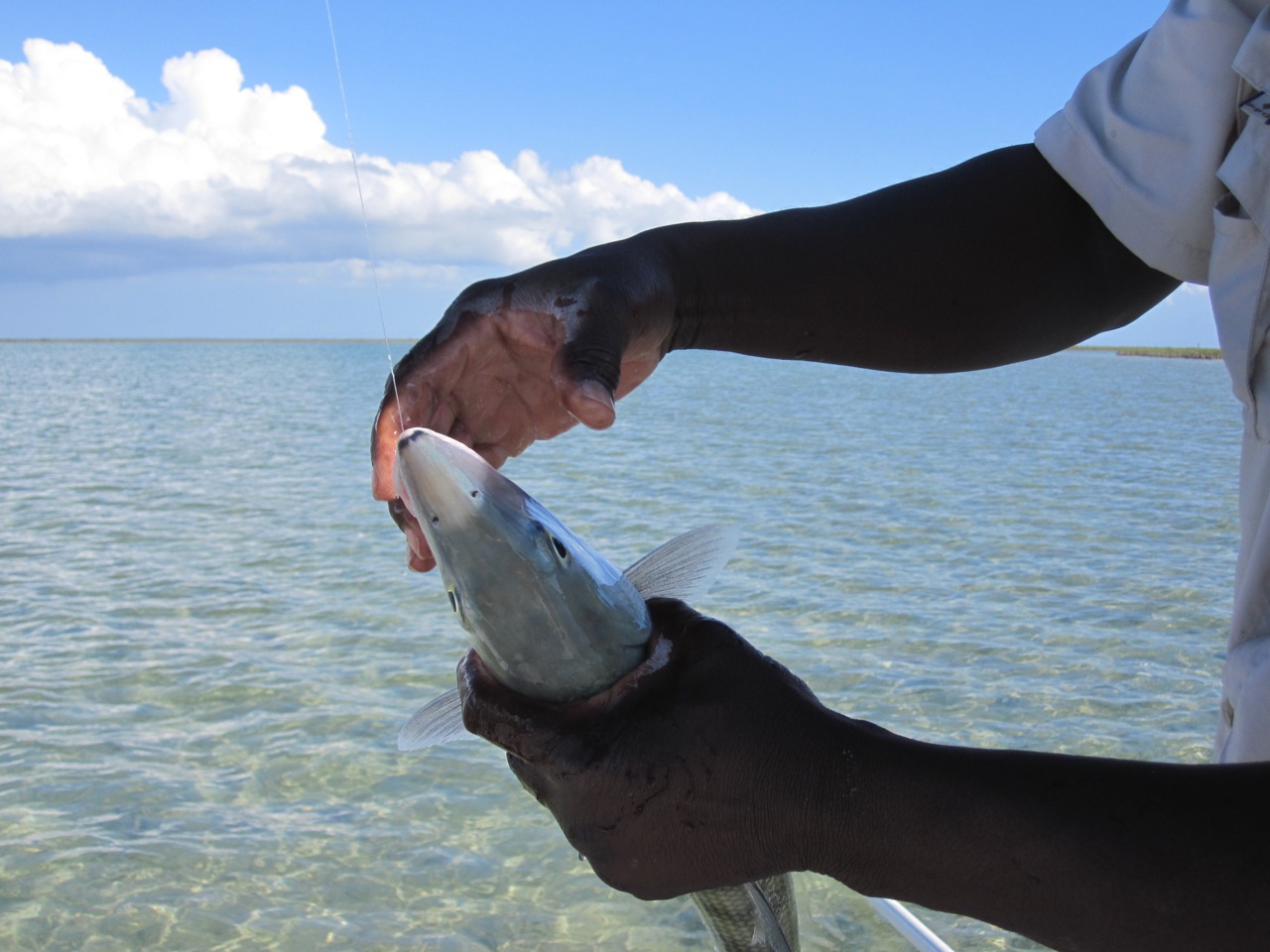
This post follows on from my recent oneBONEFISH RESEARCH: THE IMPACT OF HOOK RETENTIONHere’s an example of swift C&R by my boat partner Martin of a small bonefish caught on the Abaco Marls. I say ‘small’ because it was his fish, not mine, so I can! Release is achieved, barely touching the fish, by twisting and loosening the barbless hook while the fish is in the water, and quickly flicking it off the hook without touching the fish’s sides. This preserves its protective coating, which if removed makes it vulnerable to predation and disease. He has in fact omitted Counsel 2 (above), because he has needed no significant contact with the fish. Apologies for the inevitable accompaniments to using Youtube – ads, 20 other vids on offer etc [Later: Mrs RH has spotted that my reef fish Blue Tang movie is amongst them. So have a look. It’s a bit iffy, frankly, but the music is nice, and helps drown out my snorkel-wheezing]
* I have avoided the dread words ‘GOLDEN RULES’ in recognition of the fact that the lofty ideals don’t always work out in practice. The fish itself can dictate the proceedings…
(And apologies for yet another ‘premature release’ (a bit like much of my fishing) of a nearly blank document. I’ve got the ‘Save’ and ‘Publish’ buttons yips)
A short time ago I posted in some detail about the poisonousLIONFISH. I included material about the rapid increase of this Pacific species in Caribbean and Floridian waters following accidental / deliberate releases in recent years. I also included videos from Grand Bahama scuba-expert FRED RIGER to balance the anti-lionfish orthodoxy, showing that the fish in fact do some good on the reefs. The post provoked a few comments, and had a surprising number of hits. Here is some further research courtesy of the excellent SEA MONSTERwhich adds a dimension to the debate and concludes with a very good point… Incidentally, in a recent morning snorkelling at Fowl Cay Marine Preserve, Abaco, I did not encounter a single one of these creatures (Mrs RH was unluckily stung by a jellyfish, though…). But I guess the Preserve is well policed against such intrusive species, which are otherwise found in large numbers in the area.
Why are lionfish populations exploding across the Caribbean?
Author: John Bruno on June 6, 2012
Lionfish are an exotic fish now found throughout the Greater Caribbean and eastern Atlantic that have become incredibly abundant on many reefs, especially in the Bahamas and off North Carolina. Lionfish are piscivores (fish that eat other fish) and were introduced from the Indo-Pacific by the aquarium trade in the late 1990s off Florida. Mostly likely, someone got tired of their fish and released them purposefully.
One hypothesis explaining their great success is the absence of natural enemies; predators, parasites and competitors. This is probably compounded by the fact that few Caribbean reefs have any predators left that could eat them (thanks to overfishing).
Another – and I think much more likely explanation – is because there is so much to eat in the Caribbean! Not because there are more fish, but because it is so much easier to catch them. Unlike fish in the Indo-Pacific, native Caribbean fishes do not appear to recognize lionfish as a potential threat. So the lionfish gobble them up, grow faster, make more babies, spread to new islands, etc.
Case in point: My lab group was working in Belize last week on the lionfish invasion. One of the things we were doing was collecting the otoliths and gonads from lionfish that we speared on a number of reefs to compare their fitness across the Caribbean (e.g., on reefs with and without native predators, etc). We also looked at stomach contents and many of them had parrotfishes in their tummies or still in their throats! The photo above is of the eggs from one lionfish we caught near Glovers Reef Atoll and the partial contents of it’s stomach (a juvenile striped parrotfish)!
Lionfish appear to be little more than machines that convert parrotfishes to baby lionfishes. Which is pretty much the purpose of all animals (consuming others and transforming them into your own genotype and species). But jeez, couldn’t those aquarium hobbyists have released a herbivore that could be converting macroalgae to fish biomass? That would have been much more useful.
We rebooked our storm-tossed flights. We spent an extra night at Delphi and one in Marsh Harbour. We went to check in online. Zilch. Nada. Niente. No trace of Mr & Mrs Harbour. One hour on the phone and it’s sorted, and with an upgrade to World International Club Class Traveller Special Plus or similar ( = more leg room? An extra bacon roll? We’ll see…)
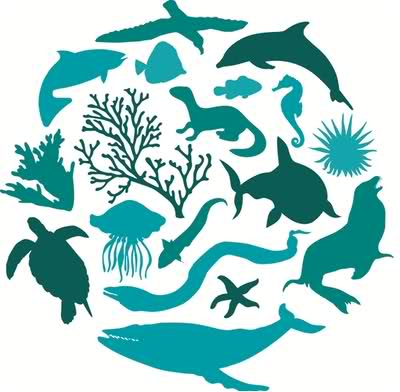
More importantly, though, today is WORLD OCEANS DAY
You can find 100 Ocean-related quotes to sprinkle into your conversation if you tune in to the excellent BEACH CHAIR SCIENTISTfrom whom I have ‘borrowed’ this sea-loving image
Quote 33 is slightly disturbing…
Apologies for premature publication omitting title and later tweaks. Posting on an iPhone is a fiddly business.
Yesterday was an important day in the marine conservation and research calendar. Me neither! I had a heads up from the redoubtable SEAMONSTER late last night. So at least I found out on the right day. I am posting the excellent logo to help to raise awareness retrospectively… I ‘get’ everything depicted in this clever sea creature globe – except for the tiny dinosaur… or is it a sea otter?
CLICK this large logo to link the the relevant website, where there are articles catering for every conceivable marine interest
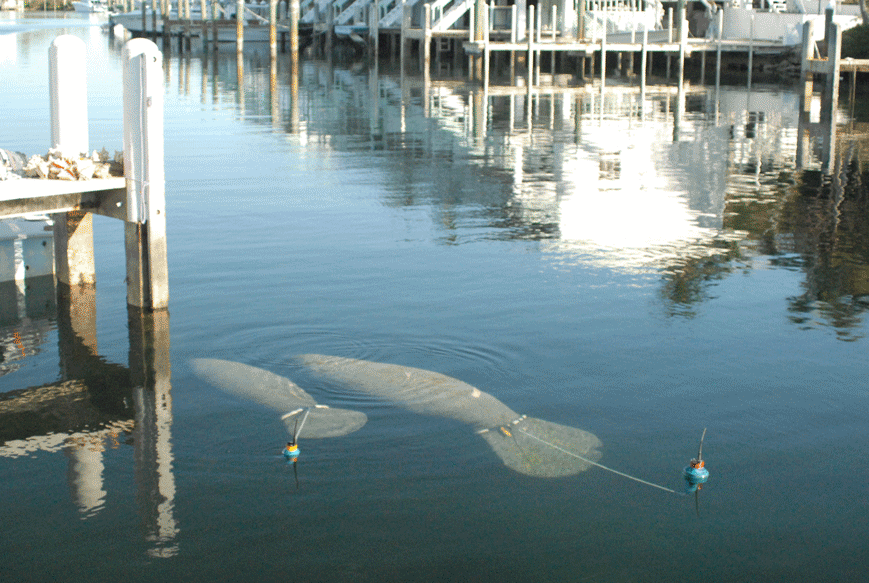
It’s Week 4 since mother and calf were released. Since then, they have made some manatee friends and gradually increased their range of exploration as their confidence continues to grow. The week’s big news is that in five days, Rita and Georgie travelled over 70 miles around Great Harbour Cay, extending their interest further south than ever before. Here are the other mother and calf pair from the area, Gina & JJ
The logo at the top is clickable straight through to the excellent BMMRO weekly reports of the lives of these gentle creatures, where you will find all the details of their progress. I have also add a click-thru’ logo near the top of the sidebar so that manatee-watchers can go straight there from this blog at any time.
So may I encourage all you nice followers out there to keep an eye on the developing story; and remind you in a subtle – oh, ok then, rather direct way – that this kind of vital conservation research in our oceans can only be carried out with support. That could include direct support for the BMMRO’s work… and / or maybe even adopting a manatee (details on the Manatee blog)
I recently put some lionfish details and images on my MARINE LIFE page. I wrote: “…their existence and rapid increase in the waters of the Bahamas is a cause of great concern, and they are keenly hunted. Last year’s inaugural Lionfish Derby on Green Turtle Cay brought in more than 1400 of these creatures in the day, ranging in size from a 57mm juvenile to a 349mm fish. Here, fromTHE ABACO SCIENTISTis where in the world the 2 species of Lionfish ought by rights to be. Well away from the Caribbean, that’s where!
Photo credit: Brigitte Carey of Tilloo Cay
Two great lionfish photos from GRAND BAHAMA SCUBA (thanks to Fred & Melinda Riger )
———————————————————
LIONFISHPterois
1o UNCOMFORTABLE LIONFISH FACTS
A genus of spiny venomous fish indigenous to the Indo-Pacific area, of which there are 9 species
In the mid 1990s 2 species were introduced to the US Atlantic coast and Caribbean (see below)
Unaccountably popular as aquarium fish; cooked and eaten by people (though not by me)
An adult can weigh 1/2 kilo and may live up to 15 years
They have ‘complex courtship and mating behaviour’, presumably to avoid each other’s spines
Females release two egg cluster bombs every month containing up to fifteen thousand eggs…
Lionfish prey voraciously on small fish, invertebrates and molluscs which they gooble up in one gulp
They have bilateral swim-bladder muscles to alter their centre of gravity to attack their prey better
Apart from a tendency to species cannibalism, they have very few predators. The spines work well…
Sharks are not affected by the venom, and attempts have been made to train them to feed on lionfish
LIONFISH STINGS are painful and can take several days to resolve. Tests on frogs, clams and rabbits… well, you don’t want to hear about those. In humans the venom causes systemic symptoms ranging from nausea, vomiting, fever, breathing difficulties and dizziness to convulsions and paralysis. For the very young, the elderly, the allergic or those with immune system weakness the sting can be fatal. TREATMENT: If stung it is recommended that you remove the spine(s) if possible and immerse the wound in hot water for at least 15 minutes… and seek medical treatment as soon as possible
THE CARIBBEAN INVASION supposedly started in the mid-1990s, perhaps following hurricane damage to an aquarium in southern Florida. A few earlier sightings had been recorded, possibly the result of deliberate aquarium releases. Two of the 9 species are involved: the red lionfish P. volitans (93%) and the common lionfish P. miles (7%). It’s a measure of their rapid breeding, habitat adaptability and near-immunity from predation that the first recorded lionfish in the Bahamas was as recent as 2004. A mere 8 years later they’ve spread throughout the region.
POPULATION INCREASE AND CONTROL The population is increasing exponentially despite efforts at control. Their voraciousness and territorial aggression must certainly be affecting the indigenous populations of reef marine life. The problem is already extreme. It is now unlikely that lionfish can ever be eradicated. Even to confine the population to its current level would require more than a quarter of the adult population to be killed monthly. Lionfish are able to reproduce throughout the year, so there is no seasonal respite. In this conservation-minded era, official encouragement of organised hunting bucks the trend towards creature protection. Lionfish do have food value, if natural human reluctance to eat a venomous species can be overcome, and there are now many lionfish recipes. Whether killing lionfish for sport or for food, humans are their only effective predators. Below is an example, from Oceans Watch, of the sort of campaign that will surely become commonplace throughout the region. Time to reach for the speargun…
THE COUNTER-ARGUMENT
The above is the orthodox view, widely held throughout the region. Some will ask whether the arrival of the lionfish in the Caribbean has any positives; whether they actually make a contribution to the ecology of the area; whether there is a convincing case to put forward in favour of the species; whether there is evidence to back it up. So to redress the balance I commend these 4 short videos from the enormously experienced Grand Bahama diver Fred Riger, in which he cogently demonstrates the value of this imported species. In short, the videos reveal that the adverse effect on endemic fish populations is not merely overstated but wrong; that the spreading menace to the coral reefs of choking algal growth is actually reversed by lionfish; and that important grazing crab species are thriving as a result.
I posted the bad lionfish stuff last night; by this morning Fred had rightly taken me to task for only giving one side of the story: “Far from being a pest, lionfish are solving a huge problem created by the mother of all invasive species HUMANS, who have over fished the ocean, wiped numerous species out of existence, killed most of the world’s coral, the very stuff we in the Bahamas live on. Targeting lionfish sets conservation efforts back thirty years or more and contributes to the decline of the coral reef”. So here are the videos giving the case in favour of lionfish, and they certainly provide a fresh perspective and plenty of food for thought…
The BMMRO’s brilliant newcharting the progress of mother Rita and calf Georgie after their release (and showing wonderful pictures) is becoming addictive. How far have they ventured this week? Are there any more out there?
Here, Rita and Georgie are wearing their tags. I really recommend a visit to thefor the full reports, but here’s a quick review of the highlights of weeks 2 and 3 since their release:
WEEK 2
Rita & Georgie are beginning to attract a bit of a following
During the week their confidence grew and they undertook a longer expedition (see map below)
During their travels they were joined by 2 other manatees, first a juvenile male, then an adult male
Rita’s tag became disconnected. It was retrieved, the data downloaded, and it was successfully reattached
Audio recordings were made of underwater manatee communication
At one stage there were six manatees seen together, with manatees Gina and JJ joining the 4 others
Rita nurses Georgie
WEEK 2 ADVENTURES
A far more complicated pattern than the simple explorations in WEEK 1
WEEK 3
Continued careful monitoring of more complex (= braver) exploration
A great deal of local interest generated.
A ‘Save the Manatee’ campaign started
Presentations for groups of school students, including involving them in actual monitoring.
The juvenile male has stayed with Rita and Georgie.
——————————
Rita examines the camera. Meanwhile Georgie checks out the bottom of the BMMRO boat…
A tender moment between calf and mother
WEEK 3 EXPEDITIONS
Confidence growing, and more interest in investigating to the south
BRIGHT & BEAUTIFUL: SUMMER BIRDS AT THE DELPHI CLUB, ABACO
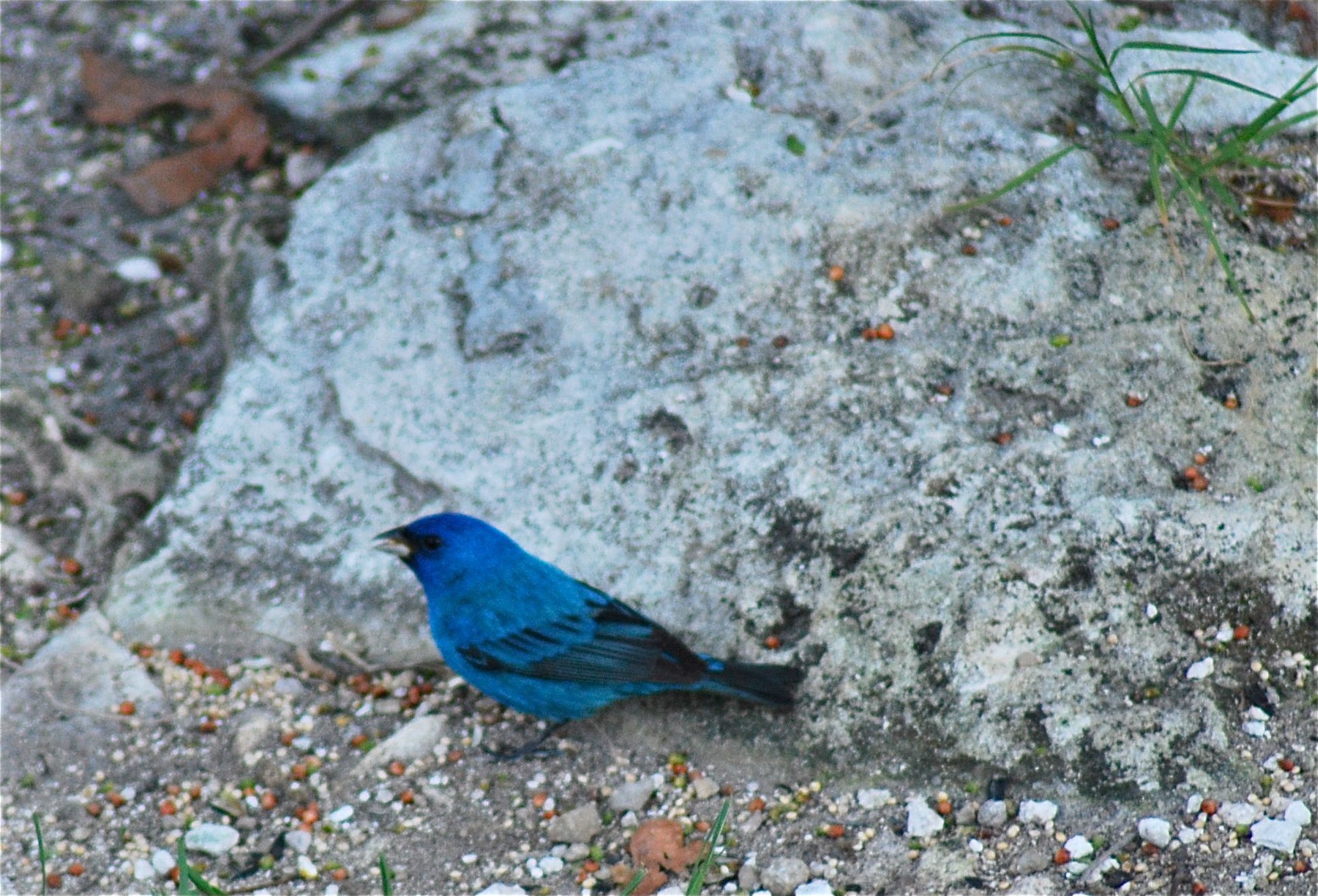
Peter Mantle reports that some colourful birds have arrived at Delphi to take advantage of the feeders and fresh water provided. Indigo Buntings have been around for a while, as they have been a little further north atBAHAMA PALM SHORES;and Rose-fronted / Red-breasted Grosbeaks (I’m not sure which is correct – the terms seem to be used interchangeably) have been seen all round the Club grounds for a week or more. They haven’t been recorded at Delphi before, so they have now been added to the ever-growing official list of the ‘Birds of Delphi’. How long before an elusive Kirtland’s Warbler puts in an appearance? And will anyone recognise it if it does..?
Anyone committed to catch and release for bonefish will have wondered about the hooks that from time to time are left in a fish. The issue has now been the subject of a detailed scientific report fromELSEVIERhighlighted in the ever-usefulTHE ABACO SCIENTIST(thanks to Craig Layman). The report’s main conclusions can be summarised as follows:
Hooks, especially shallow ones, are expelled fairly quickly
For deep-hooked fish, barbless hooks are significantly easier for the fish to deal with
The presence of a hook does not appear to interfere with feeding
Hook size is not a material factor
All the test sample fish survived
Overall, therefore, this is a vindication for the policy of barbless hook use for C&R. The report concludes that it’s best simply to leave a difficult-to-remove hook in the fish. Here, guide Ishi prepares to remove a barbless hook from one of my fish caught on the Abaco Marls.
I have included a clip of the report’s front page and Abstract; and the link to a PDF of the full report for those interested in checking out the detailed scientific aspects of this research. To go direct to the general Fisheries Research section clickELSEVIER. The astounding photo is courtesy of Abaco’s conservation organisationFRIENDS OF THE ENVIRONMENT
NEW in June 2012 see later post + video CATCH & RELEASE DEMO ON THE ABACO MARLSfor a quick release method with a barbless hook involving minimal contact with the fish. It isn’t suitable for deep-hooked fish or large ones, but it shows how quick the operation can be
I posted a while ago about a wonderful afternoon spent at BPS with nature guide and all-round Abaco knowledge mine Ricky Johnson. Three posts (Abaco Parrots; other birds; flower and plants) were later combined into the pageABACO ECO-TOUR(if you visit, apologies that the formatting is still out of whack after a blog format change)
Resident ANN CAPLING has kindly sent some photos of birds on her feeder, prompted by my post of her recent sighting of a PROTHONOTARY WARBLER, a bird not often encountered at BPS. The feeder photos were taken from indoors through glass, considering which they have come out very well. She also sent a brilliant photo of a tiny female Bahama Woodstar looking totally cute (not a word I normally use, but completely apt here, I think); and of 2 American Oystercatchers strutting along the BPS shoreline
Janene Roessler has kindly sent news of a sighting yesterday of a prothonotary warbler on a feeder at Bahama Palm Shores, Abaco [Later addition]Now, with thanks to Ann Capling, here is that very warbler on the feeder – a fine photo considering it was taken indoors through glass.Apparently there hasn’t been one recorded there since 2007. I know of one seen further south on the island near the Delphi Club in April 2010 (see photo and caption below). I’ve never seen one myself. It seems fitting to celebrate the news with a post about these little birds…
This very pretty species of warbler Protonotaria citrea is the only member of its genus. The male birds are very colourful, with the females and juveniles being a bit duller. In flight, the underside of their tails are white at the base, and dark at the tipPhoto Credit Craig Nash (Peregrine’s Blog) This fantastic photo was taken on the main drive of the Delphi Club, Abaco
STOP PRESS JULY 2018 this rather basic post was written in April 2012, in the earliest days of this blog when mistakes were (and undoubtedly still are) made. Tim Kalbach has just contacted me with the helpful observation “the Craig Nash photo is a Yellow Warbler, not a Prothonotary. Yellow – green tones in rump and tail don’t occur in Prothonotary; those areas would be blue-gray in color”. Which goes to show, I think, that after 6+ years I need to revisit this species in more detail and accuracy! Thanks for the comment, Tim.
These warblers are native to the eastern US where they breed, wintering further south in the West Indies and Central & South America. Their nesting arrangements are unusual:“It is the only eastern warbler that nests in natural or artificial cavities, sometimes using old downy woodpecker holes. The male often builds several incomplete, unused nests in his territory; the female builds the real nest”where she lays 3 – 7 eggs. So either the male is cleverly creating decoy nests away from the real nest; or maybe he is showing typically male behaviour in starting several home DIY projects at once and not getting round to finishing any of them…
Female Prothonotary Warbler(wiki)
I can never cope with those phonetic descriptions of bird calls… So many small birds are described as going ‘tseep’ or ‘tweep’ or ‘seeep’, yet in practice sound different from each other. So here, courtesy of the admirable Xeno-Canto and recordist Don Jones, is how they sound in real life
Listed as of ‘Least Concern’ (except in Canada, where they are ‘endangered’), the sad fact is that like so many species PNs are declining in numbers due to habitat loss. They are also bullied by other birds, in particular the brown-headed cowbird; and the house wren with which they compete for nest sites.
And the cumbersome name? Although at one time known by the helpful name ‘Golden Swamp Warbler’, the bird was renamed after senior Roman Catholic church officials calledPROTONOTARII whose robes were (are?) supposedly golden. For full but quite dull details click on the green word back there. Bizarrely, the wiki-link doesn’t seem to confirm the goldenness of the robes at all. I think I’ll vote for a return to the simpler description…
Male Prothonotary Warbler (wiki)
POST SCRIPT: By complete coincidence, the National Audubon Society posted this lovely PN picture on its Facebook page this very day, with the caption “Start your Monday morning off right with this cute Prothonotary Warbler peeking out of a heart shaped tree hole! Have you seen any of these birds yet? Photo by Mark Musselman”
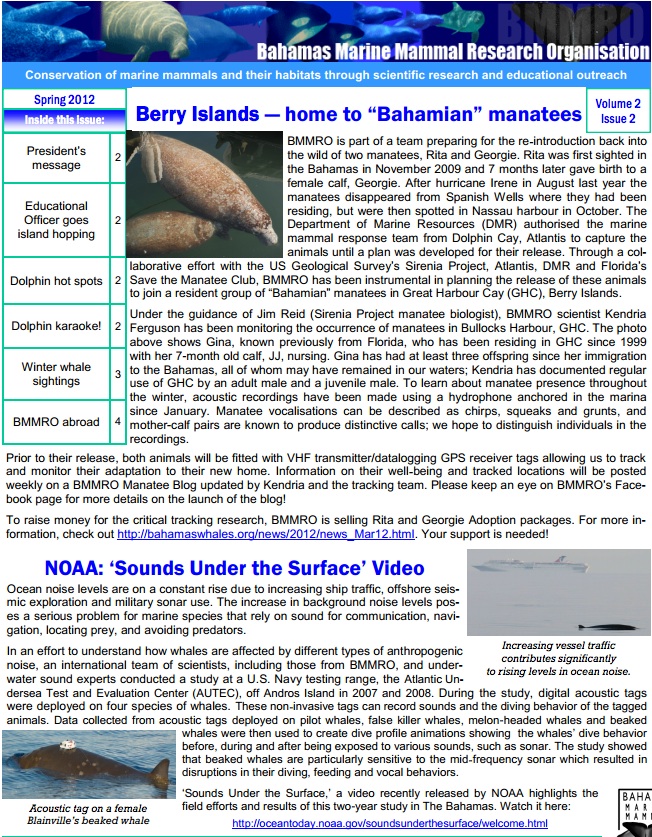
The BMMRO has just published two online reports that will interest anyone who follows the news about Whales, Dolphins and Manatees in the Bahamas.
The first concerns the reintroduction of manatees to the wild – and offers the opportunity to adopt one of them in order to support the continuing work of the conservation of the small manatee population of the Bahamas. You could have a guess now at the number of recently recorded manatees: the answer is right at the bottom of the page. If you have followed this blog’s cetacean posts, you will have noticed my own interest in the continuing monthly sightings (mainly off the Berry Is.) I have had to reduce the size of the article, but if you click on it once – or twice – it enlarges to make it more legible.
To see the article on the BMMRO websiteCLICK==>>BMMRO MANATEES
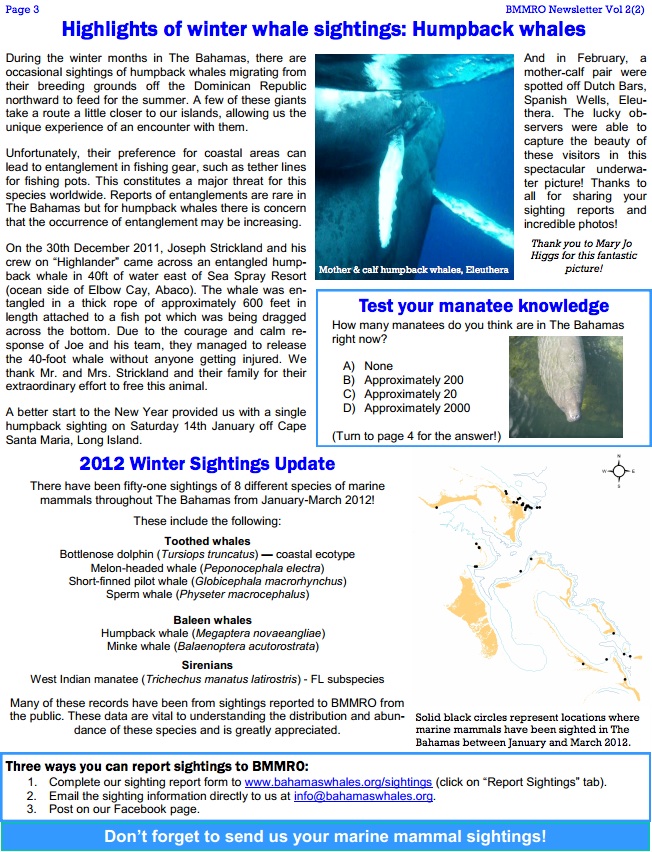
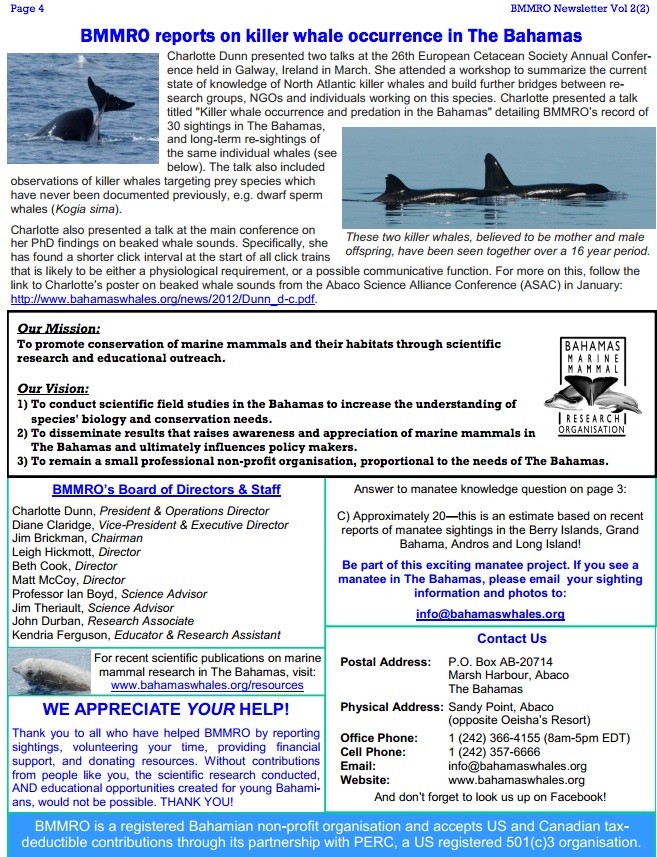
I have summarised past BMMRO quarterly reports, highlighting particular features and photos. This time I’ve put in the whole report in (I hope) legible format. To see it on the BMMRO site CLICK===>>>BMMRO SPRING 2012
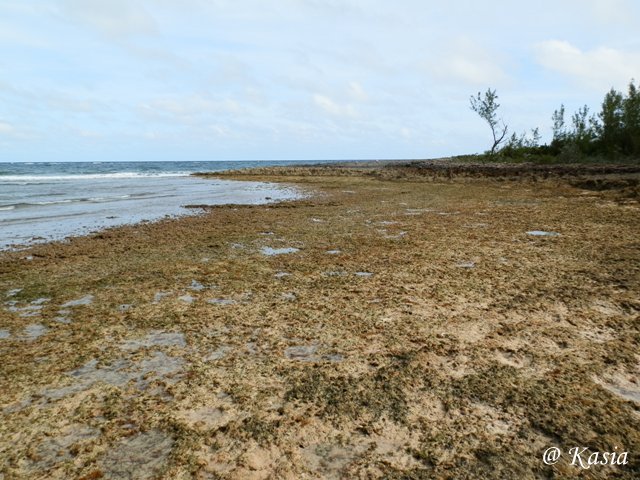
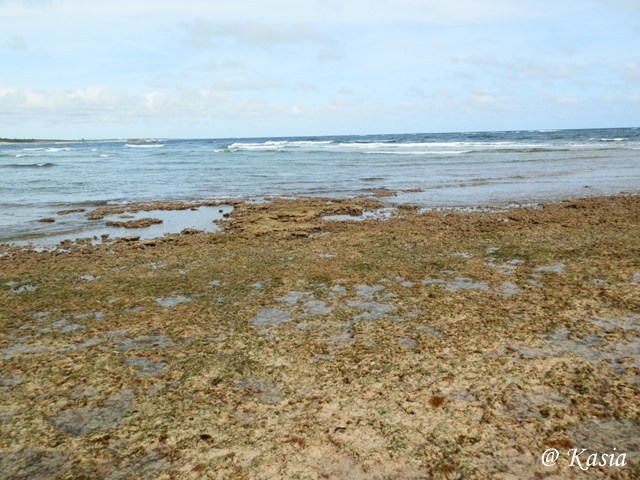
Kasia’s back! She recently explored a rather unpromising-looking stretch of Abaco coastline, and it proved to be anything but… Kasia writes: The story goes: one day I took myself for a walk and a bit of beachcombing. I usually don’t bring my camera with me but luckily this time I did. This particular beach looks very barren but on close inspection and a patient eye there are some lovely treasures to be found. Here are some of the treasures I captured!
A tangle of 3 bleached trees, with their roots apparently intertwined
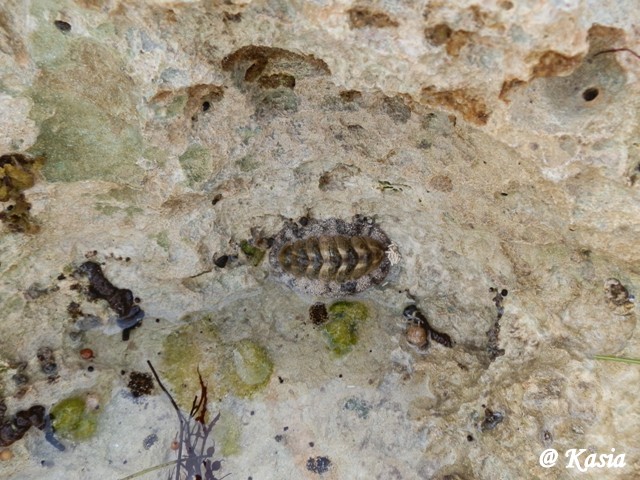
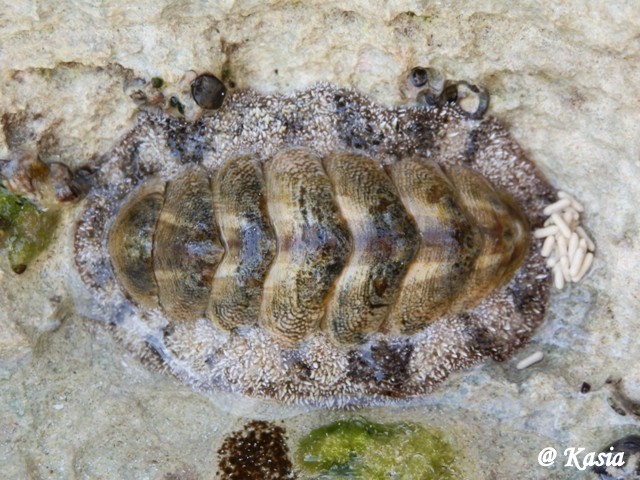
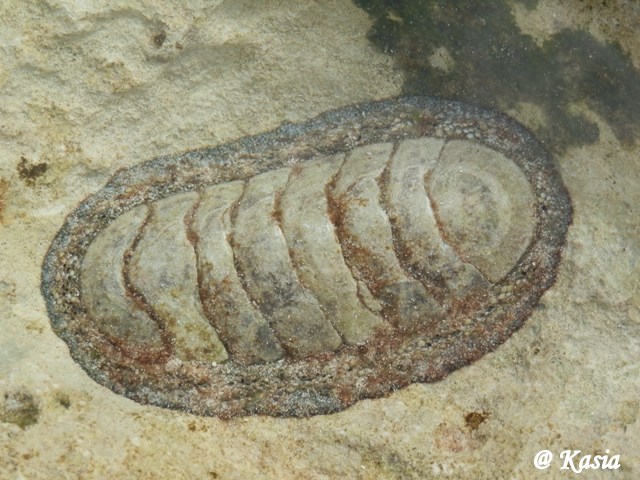
CHITONS
Great close-ups… are those eggs behind this first one? There’s a similar image in theMacmillan ‘Marine Life of the Caribbean’but unfortunately neither the caption nor the text refers to them. ADDENDUM: Colin Redfern writes: The “eggs” behind the chiton are fecal pellets
NERITES (Nerita)
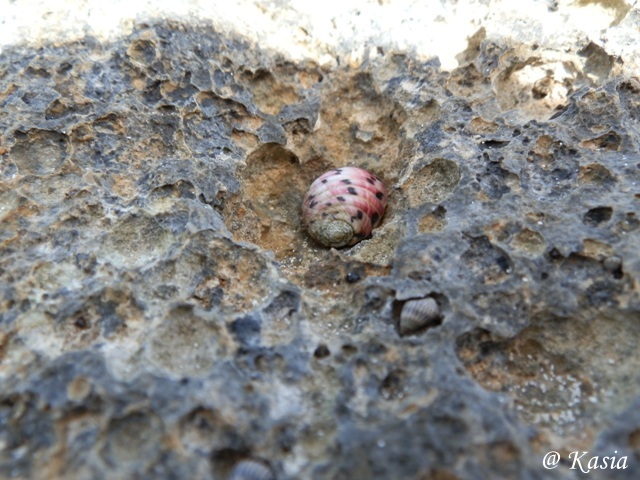
WEST INDIAN TOP-SHELLS(Cittarium Pica)
In this image, several very small chitons can also be seen on the rock
It looks as if someone… or something… has been having a Nerite feast on the shore. A bird maybe? I had taken the shells above and below to be another variety of Nerite, but as so often scientist and shell expert Colin Redfern has kindly corrected the error. He writes:“Very nice photos. The “nerite feast” is actually a pile of broken West Indian Top-shells (Cittarium pica). The photo immediately above shows a live group of the same species. This is what Bahamians call a whelk (or wilk), and in the lower photo they have been harvested, probably for a stew.
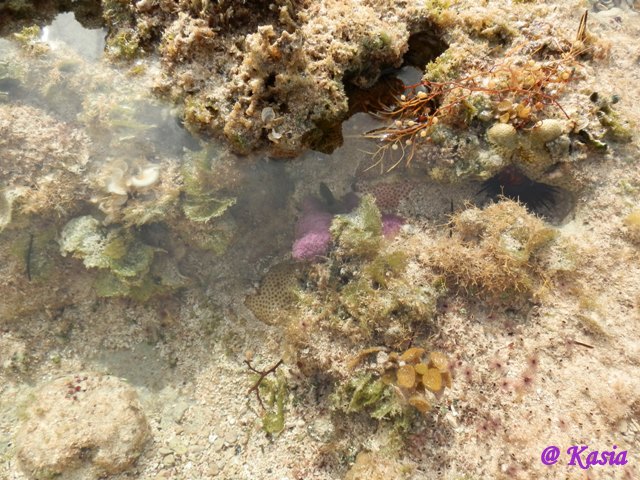
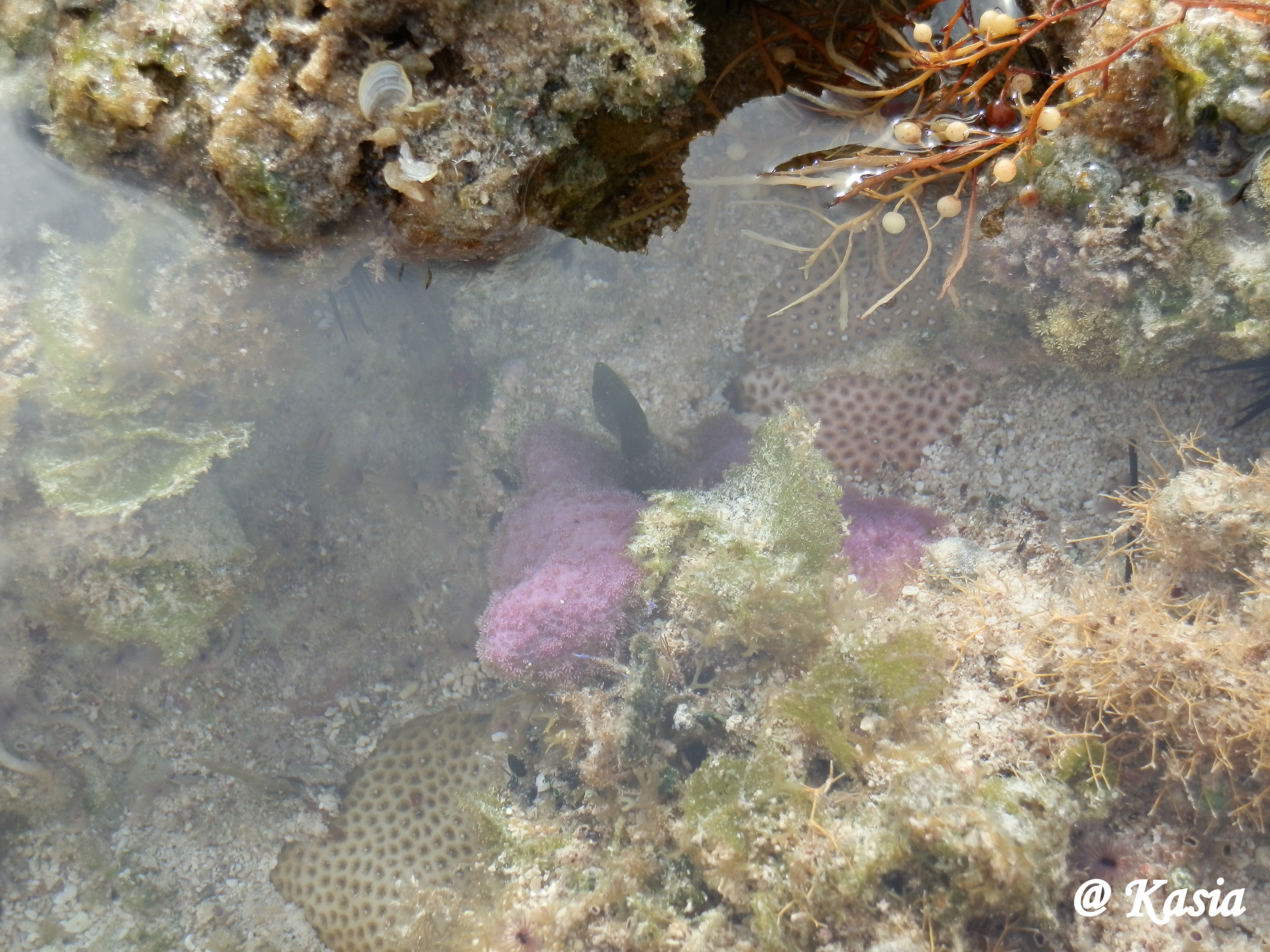
ROCK POOL MISCELLANY
I am trying to ID a much as I can in this pool. All suggestions welcome via ‘Leave a Comment’. So far, the corals are Brain Coral and Pink Coral (I think) but I am going see what else can be given a name…
These are my favourite! 🙂 Kasia
COMET SEA STAR (possibly juvenile, with 3 such short stubs?)
A SPONGE (?) OF SOME SORT (any help with ID appreciated…)











































 ROLLING HARBOUR ABACO
You must be logged in to post a comment.