BEACHCOMBING AT CASUARINA WITH KASIA COWRIE / PHALIUM & CONCH
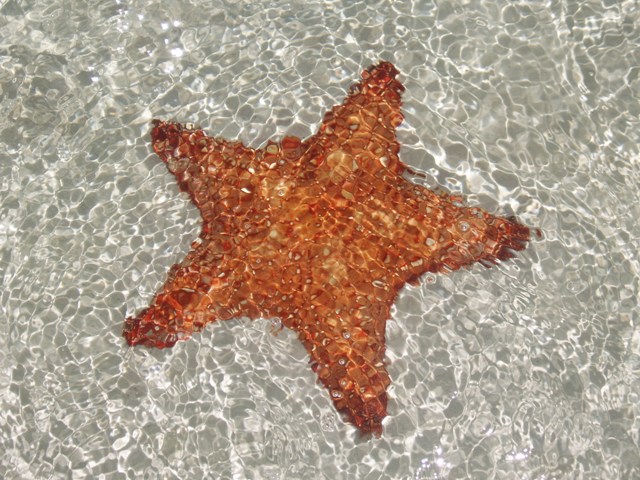
I recently posted some photos of starfish taken by Kasia at low tide near Casuarina point – seeKASIAS’S STARFISH.Now it’s time for some beachcombing news from there. The sandbanks and bars in the Casuarina / Cherokee Sound area are a rich source of conchs, sand dollar tests and shells of many varieties when the tide is out. The sandy areas revealed as the water slowly recedes are extensive, and it is a great place to hunt for specimens (and for a lunchtime break from bonefishing…)
COWRIES / PHALIUM
1. RETICULATED COWRIE-HELMET Cypraecassis testiculus Here is a pretty example of this shell, a relative of the large phalium family and originally misidentified by me as a Phalium granulatum
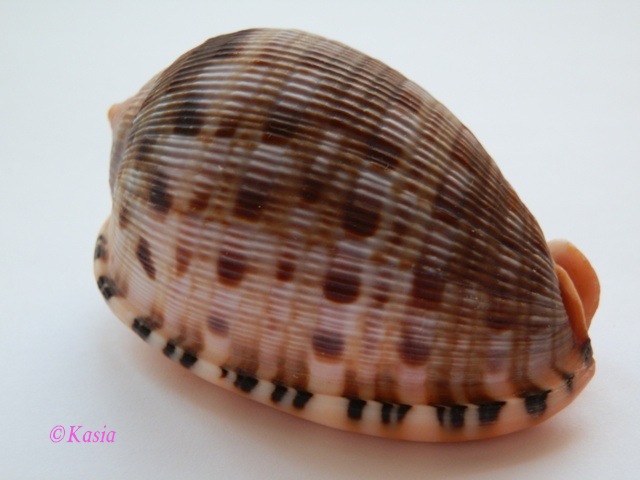
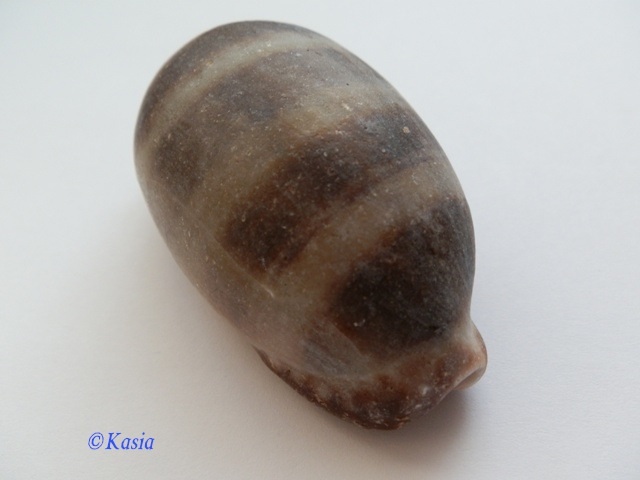
2. MEASLED COWRIE Macrocypraea zebra / Cypraea zebra Colin Redfern says of this example “Immature shells have transverse stripes that are later covered by a spotted layer (hence “measled”). It looks as if it’s beachworn rather than immature, so the outer layer has probably been worn away. You can see remnants of the spotted layer adjacent to the aperture.”
STOP PRESS: by coincidence, while looking for a completely different type of shell online I have just happened upon this early 1800s engraving of a Cypraea Vespa, which is very similar to Kasia’s one
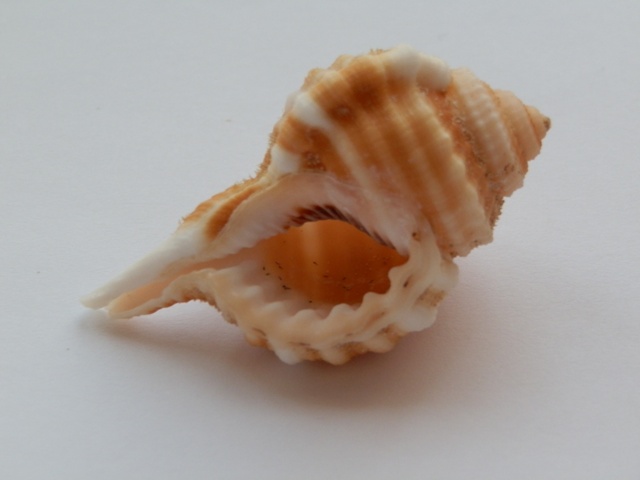
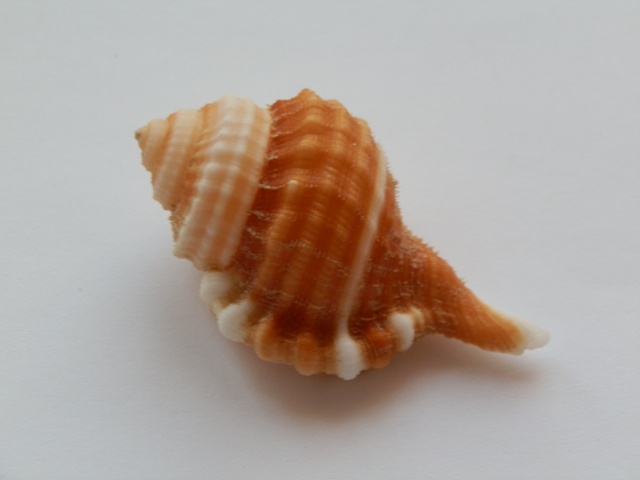
CONCH I’m trying not to overdo Conchs, which are probably everyone’s favourite shell to collect. But this one is a wonderful pink, and came with a surprise inhabitant… Is anyone at home?
Oh! A hermit crab seems to have moved in…
It’s shyer than this one (from an unnamed online source)
Finally, a useful method to transport one’s shell collection, maybe?
MARINE BROCHURE, ABACO, BAHAMAS A basic blueprint for environmental protection on Abaco
The various interested organisations have produced a simple 2-page brochure designed to promote responsible preservation of the island’s natural resources. If you click on a page below it will enlarge. If you want to go to the webpage to download the pdf for yourself (or pass it on) CLICK==>MARINE BROCHURE
Kasia, a vital contributor to this blog, has supplied a number of images taken at low tide in the Casuarina Point / Cherokee Sound area on Abaco, including these excellent starfish. I’m posting them right away because starfish haven’t so far featured at all in this enterprise. Whenever I have seen them from a skiff I have been otherwise (and mostly ineffectually) engaged at the sharp end of the boat…
Macmillan Natural History Series Alick Jones & Nancy Sefton – 2nd Ed 2002 rollingharbour rating ****
Another excellent volume in this series of slim books – see other book reviews for Birds, Reef Fish etc. The book is carefully structured. Opening with an overview of the region, it moves gradually from shoreline to open sea via mangrove swamps, sandy areas, seagrass beds, rocky areas, and coral reefs. The sections are informative without being overwhelmed by detail, and the many illustrations are useful. It’s possible to skim-read and still feel you have learnt something worthwhile. It is definitely a help with identification queries.
The marine life covered includes plants, fish, starfish etc, shell-dwellers of all makes, crabs etc, and corals – all sufficiently to be educational without being dull. Towards the end there’s an equally handy chapter on turtles, birds and marine mammals. Finally, there’s a good section on ecology and conservation (depressingly, the problems are now worse 10 years later)
A 6-page glossary, a bibliography and index round off a very helpful tome. Definitely worth getting if you want a working grasp of the subject in an easily assimilable format.
I got my copy for £5 on Amazon, but check out ABE as well, which is also very good for this sort of book – but watch the postage rates there…
Here is a clip from a report taken from the Guardian (UK) website, which lists threatened species world-wide. These include rhinos, various types of tuna, and (of particular interest to Abaco and the Bahamas generally) Manta Rays. Click on the image to enlarge it and make the caption legible… You’ll find the full article and species slideshow at
Here is an excellent short video showing a large Bahamas manta making its majestic way through the ocean
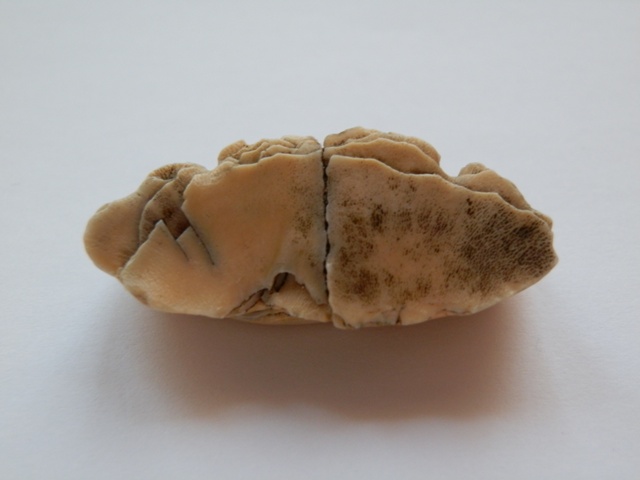
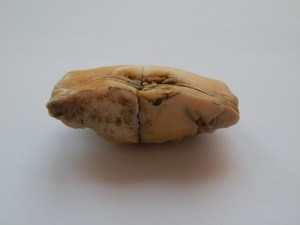
Here’s a strange item found by Kasia when she was beachcombing with Caroline Stahala
Their preliminary thought was that it formed some part of a turtle’s shell or skeletal anatomy
It is quite small (the coin above is 1 Euro) but amazingly intricate – developed in 2 symmetrical halves, with both delicate ridged surfaces and also distinctively layered bone plates
I sent the images to Charlotte Dunn and Diane Claridge of the BMMRO in case the object might have something to do with a dolphin or even a whale. In their opinion it is very probably part of a ray’s mouth plate. It would be very interesting to know if anyone else has found an object like this. If so please respond in the comment box. Many thanks to Charlotte and Diane for sparing the time to help with ID
STOP PRESSI have some done further investigations into the dental arrangements of rays. I turned to the really excellent website of the Florida Museum of Natural History. On the FLMNH page for SPOTTED EAGLE RAYS is a very interesting photo by Cathy Bester which she has kindly given me permission to use. It is captioned Spotted eagle ray dentition: open mouth showing tooth bands and floor and roof of mouth This photo seems to go a good way to confirming the ID of Kasia’s object, although obviously it might be a fragment from a different type of ray
For the FLMNH site CLICK LOGO
GO PRESS (or whatever an extra stop press may be): see comments from Black River Fossils for further confirmation as a ray palate
Kasia is an avid beachcomber on the sandy beaches of Abaco. Her collections include not only shells but also other marine debris such as sea glass. She has sent me some images with the comment “You can find a lot of sea glass in many different colours and shapes, from the most common green, brown and white through fairly hard to find colours like jadeite (one of the 2 forms of jade), citron, light blue, light green, honey and amber colored browns, to quite rare colors like cobalt, teal, periwinkle, aqua, amethyst & black”Here are some examples of Abaco sea glass from her collection. Shells and other items will follow as and when…
SEAGLASS COLOURS: THEVITREOUSSTATISTICS
Sea glass sources are many and varied. In general, these include old clear plates, glasses, windows etc; coloured drinks bottles – wine, spirits, beer, fruit, cola etc; soda bottles; medicine bottles (e.g. milk of magnesia / Vick’s blue); fruit jars; ink bottles; household goods (bleach, soda). The rarest colours (see below) come from very specific origins: teal / Mateus Rose bottles; red / car or nautical lights or Schlitz bottles; black / c18 gin, beer and wine bottles
GENERALCLASSIFICATIONOFSEAGLASSCOLOUROCCURRENCE
Most common (1 in every 1 – 25 pieces found): clear, Kelly (‘Irish’) green, brown, blue, purple
Less common (1 in every 25 – 100 pieces found): jade, amber, lime green, forest green, ice / soft blue
Uncommon (1 in every 50 – 100 pieces found): other green shades
Very uncommon 1 in every 200 – 1000 pieces found): citron, opaque white, cobalt, cornflower blue and aqua
Extremely rare (1 in every 1000 – 10,000 pieces found): grey, pink, teal, black, yellow, turquoise, red
Rarest of all (1 in every 10,000+ pieces found): orange
Info credit: Magpies, for collection of bright shiny glass data. Omni-thanks
JAN 2012I’ve noticed that there are several easily obtainable (eg from *M*Z*N) books on sea glass. I won’t be buying any to test-drive for you (as with birds, shells etc) – sorry – but they seem to be divided into the ‘pretty but uninformative and fairly cheap’ to the more instructive, more detailed and therefore more expensive books. It’s worth browsing online to find one that meets your interest level, whether passing or something more serious. The reviews are very useful here. The best – and it’s quite pricey – seems to be
ABACO DOLPHIN & WHALE SIGHTINGS OCTOBER 2011 TWO YOUNG DOLPHINS SEEN DURING RESEARCH TRIPS
The BMMRO has just published the Bahamas whale and dolphin map of reported sightings for last month, showing a significant amount of bottlenose dolphin activity in the Marsh Harbour area, extending north and south. Also new on the BMMRO website are details of recent research into the Abaco dolphin population. Here are two great dolphin images taking during the trips
Besides ‘living shells’ with occupants in residence and shiny recently-vacated shells, there is a third category of shell: the skeleton. I am sure there’s a better or more technical word for these. They aren’t fossils in the strict sense of remnants from a past geological age, but merely worn by the waves and bleached by the sun over time. Here are two examples (from different beaches) which show the intricacy of the part of the shell you don’t normally see: the interior
A shell skeleton from Little Harbour, in situ on the beach on a cloudy day
The same shell washed, with a wonderful pink tinge in sunlight
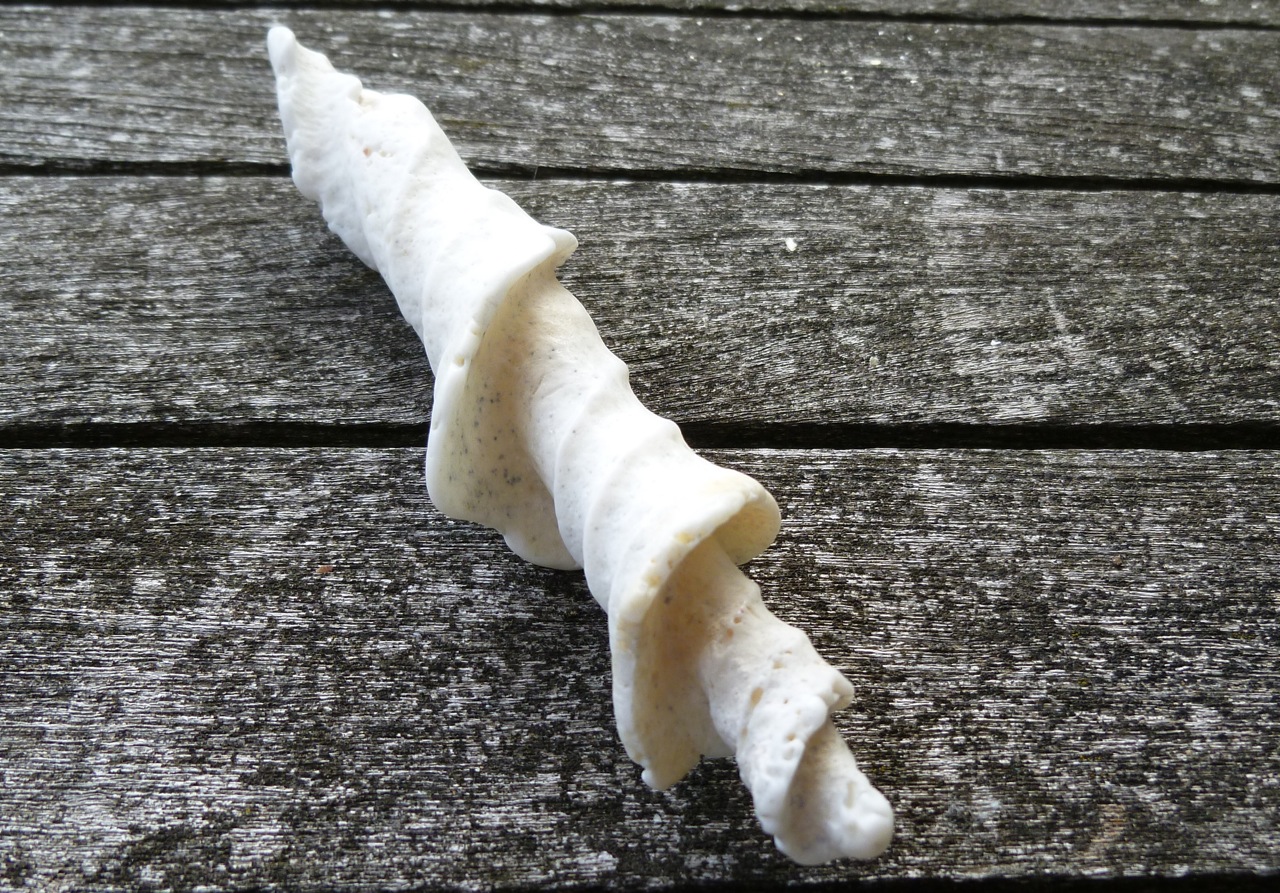
A strange corkscrew skeleton shell from Sandy Point. I’ve no idea what it is, nor how any creature can have lived in or around it, nor what it must have looked like when complete. Any ideas? Please use the comment box…Thanks, Kasia, for your ID of both as conch skeletons. The first obviously is, but the second puzzled me… until she pointed out that conchs build their own shells round themselves to their own designs rather than go to the one-stop conch shell shop. So if a conch starts wrapping itself comfortably round its own corkscrew, this is what you get
(Mrs rh quite rightly points out that my shell photos are unhelpful without a ruler to give an idea of size. Point taken. Too late. These are medium size…)
Scotch bonnets (or ‘ridged bonnets’)Semicassis granulata or Phalium granulatum are a medium-sized species of sea snail found in the tropical and subtropical western Atlantic from North Carolina to Uruguay. They are predators, foraging on sandy stretches of the ocean floor for echinoderms such as sand dollars, sea biscuits, and other sea urchins (Caution: ‘Oxford comma’)
SCOTCH BONNET FACTS
It takes approximately six years for a Scotch bonnet to mature
The shells grows 2 – 4 ins long (5 – 10 cm), showing distinct growth stages
Scotch bonnets live on sand, usually in fairly shallow water (but see below)
The more a Scotch bonnet eats the more elaborate its shell, the glossier its sheen & the brighter its colours (research suggests this doesn’t work for humans)
Divers frequently find Scotch bonnets at depths of 50 – 150 feet (15 to 46 m). Specimens have been found in depths up to 308 ft (94 m)
Shipwrecks provide a good habitat for this species
Crabs are its main predators, crushing the shell to get at the occupant. Since the snails’ main defence mechanism is to withdraw into their shells, they urgently need to evolve a new tactic
The empty shell of this sea species is often used by hermit crabs
In 1965 the state of North Carolina made the Scotch bonnet its official state shell, in honor of the Scottish settlers who founded the state
The ridge on my shell, below, may be somewhat unusual. I haven’t found any images showing such a very distinct dorsal growth, though many show a sort of fault line there. STOP PRESS shell expert Colin Redfern explains: “The dorsal ridge on your shell is a varix, indicating a previous position of the outer lip during the growth process. Varices on Scotch Bonnets are usually thicker (as in the image above).”
dear wiki: how kind to help
CASSIS RUFA (Cypraecassis rufa)
There are many different sorts of Phalium worldwide. By way of comparison, here is another type, Cassis Rufa, from the Pacific (commonly, east Africa to New Guinea). It’s colloquially known as a Bullmouth, Red Mouth or Grinning Mouth Helmet – and also as a ‘Cameo Shell’, because it is often used for making cameos (see eBay for examples)
[rh provenance / historical note: it’s not an area I’ve ever been to, nor am I likely to go. This shell was collected by my late father-in-law when he oversaw the building of the original Gan airstrip on Addu Atoll (Maldives) in… in…. many years ago, as a naval project. It is now ‘Gan International Airport’ and sells giant Toblerone & ‘Parfum de Jordan’ from the Katie Price ‘Scentsless’ range]
BAHAMAS MARINE MAMMAL RESEARCH ORGANISATION NEWSLETTER OCTOBER 2011
The BMMRO’s fully illustrated Fall Newsletter has just been published. The newletter is as always an eclectic mix of cetacean-centric material, with a headline article about the summer whale poop project. I have lived my life and had a professional career of sorts without once giving the remotest thought to whale poop, yet here I am immersed in the stuff yet again… But there’s plenty more besides that. The newsletter gives you an overview of the current work of the BMMRO and articles including the following:
A stranded Fin whale on the Berry Islands
News of the Irene effect at Whale HQ in Sandy Point
An Orca sighted off Eleuthera
Education program update
A quarterly chart of the summer whale and dolphin sightings – 82 reports for 10 species.
Thanks as ever to Charlotte Dunn for permission to link to BMMRO material. To see the newsletterCLICK LINK===>>>BMMRO newsletter Oct 2011
To visit the informative BMMRO websiteCLICK LOGO===>>>Supplementary info: without going into details of the consistency of the output etc, I’ve just found the suggestion online that whales can excrete 3% of their body weight in a day. And a large whale weighs..? Mind where you swim
It’s 7.15 and breakfast time at Delphi. At 8.00 the trucks, skiffs, guides and fishers will set off to the fishing grounds for the day, leaving you with an empty beach, shells, warm sea, the pool, the hammock and your book. For the moment, the talk is of the excellent ‘Full Abaco’ breakfast, the weather, ‘Delphi daddies’ & ‘crazy charlies’ and someone’s mislaid reel. Sandy enters to announce that there’s a place free on your partner’s skiff… and offers it to you. So what should you, a non-angler, expect of a day out on the flats?
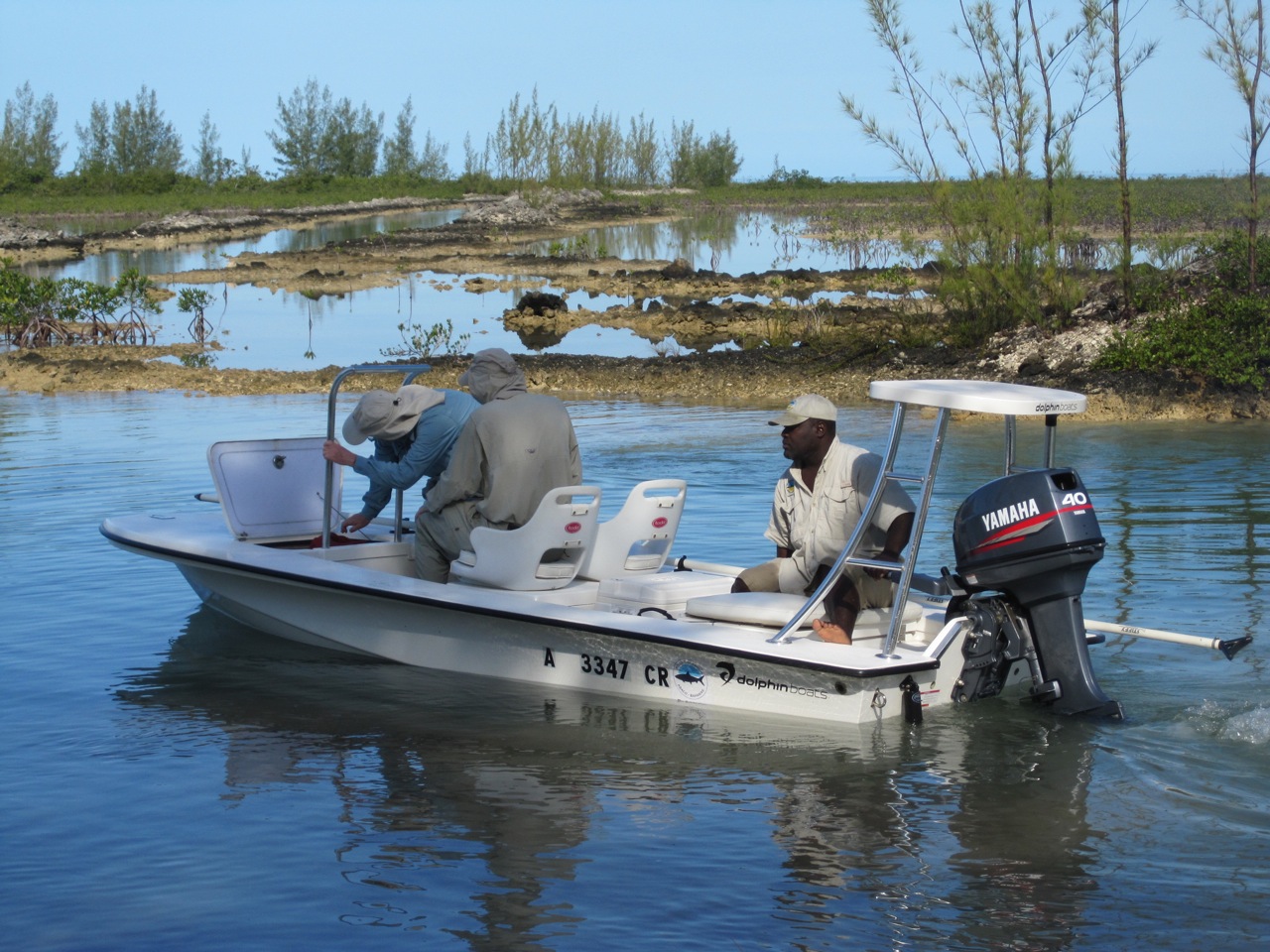
THE SKIFFS These are top-of-the range boats, capable of considerable speed getting out to the fishing grounds. The ride can be bumpy, splashy and even chilly in the early morning, so bring a fleece and a waterproof top. Camera? Essential. Here is a Delphi skiff on a sand bar in Cherokee Sound, parked for lunch and some quality conch and sand-dollar hunting. So for a start, the day isn’t ALL about fishing…
THE FISHING GROUNDS You will leave from one of three launch points and speed across the water to the bonefishing areas. The main one is “Nettie’s”, with access via a narrow man-made channel to the Marls…
… more than two hundred square miles of mangrove swamp, islets, channels and fish. The journey to Nettie’s may seem quite a long way as you bump along through the pine forest on a network of logging tracks. Watch out for small birds flickering all around as you pass.
———————————
Launching a skiff at Nettie’s
Plans are hatchedGood to go…
Stowing gear in the front (forrard?) locker. There’s also one behind the seats for the lunch cool boxes. And the fuel…
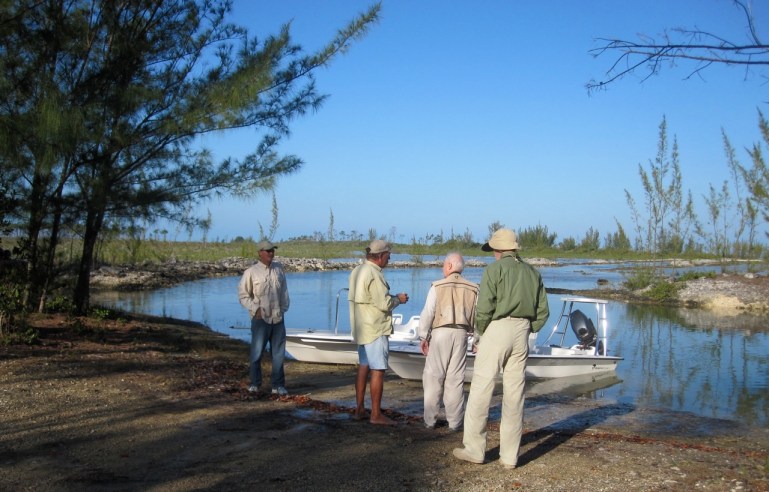
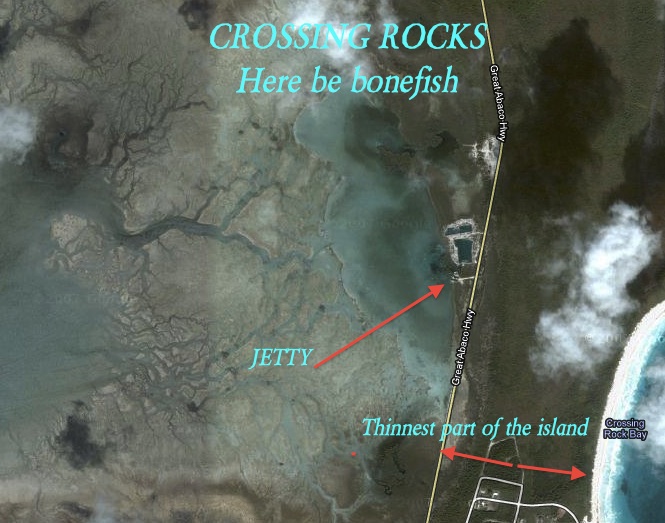
The other two launch areas are Crossing Rocks (a short drive south of DCB) or Casuarina Point for Cherokee Sound (a slightly longer drive north of DCB)
The jetty at Crossing Rocks – skiffs being prepared
The launch point at Casuarina. A channel leads out to Cherokee Sound
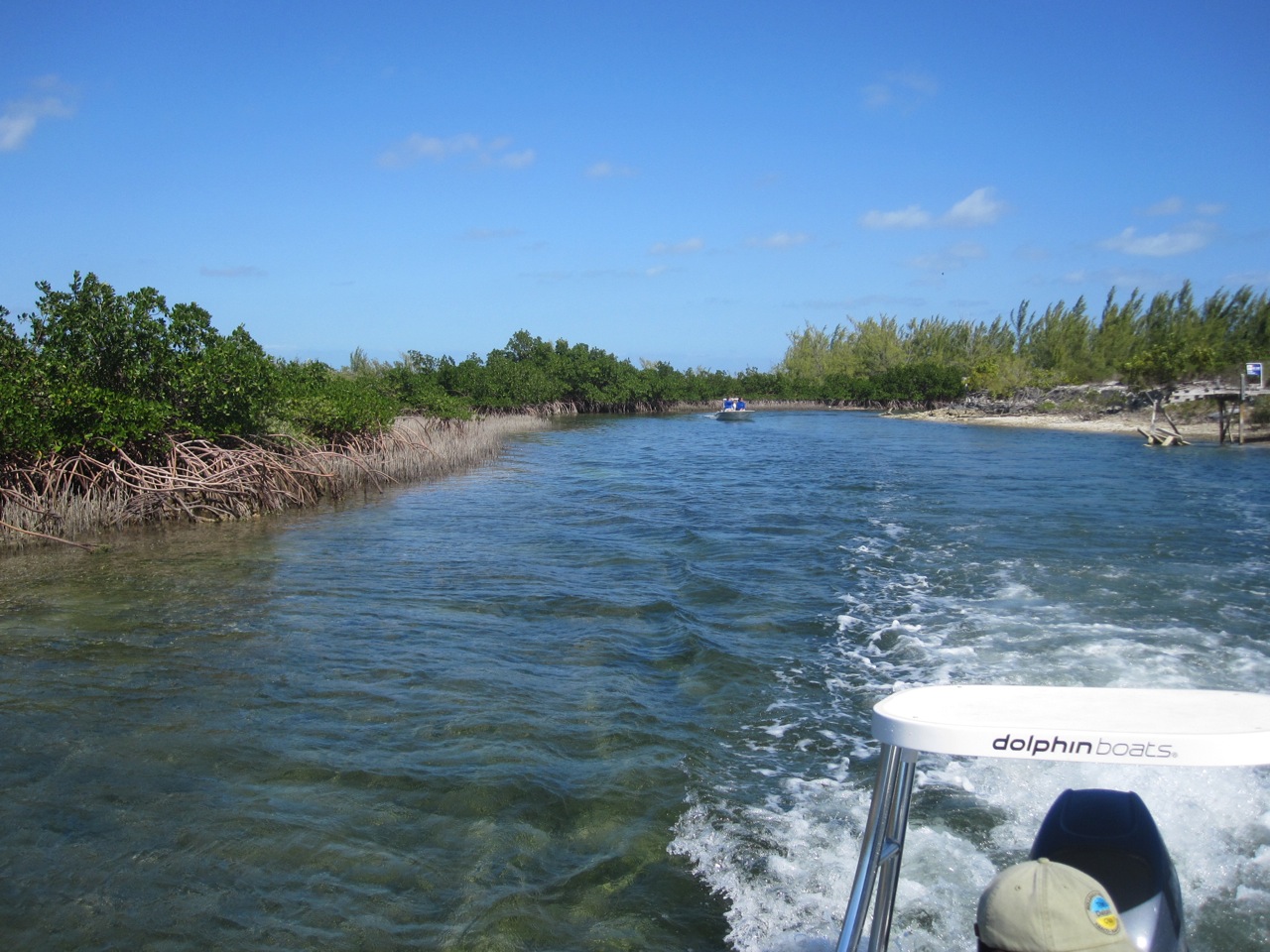
Two boats in the channel – the authentic James Bond chase experience
WHAT’S THE POINT? Bonefishing! You’ve heard all the Club talk, you’ve seen your partner fussing over all those bits and pieces in your room: now see it in action. Once you get out to a fishing area, the guide cuts the engine… and suddenly you are being poled very slowly and almost noiselessly across the shallow flats
The guide stands on the platform at the back of the skiff, using the advantage of height to scan the shallow water; the fisher stands at the front looking tensely for grey shadows underwater, waiting for the magic words…
“…hey, bonefish, 10 o’clock, 4 of them moving right, 30 feet… see them?”
And it’s ‘game on’. This isn’t the place for a discourse about casting technique and style – I have neither (Sandy, of me: “Muppet”) – but I promise that you will get completely caught up in the excitement when a fish takes the fly and takes off towards the horizon, stripping the line and backing from the reel… (I realise the image above may suggest… well he’s just fishing, OK?)
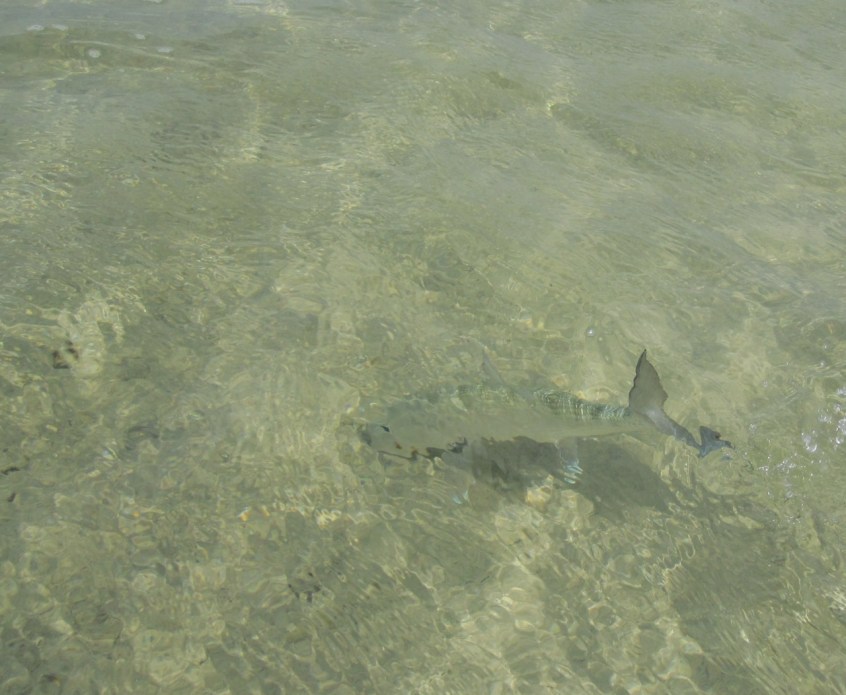
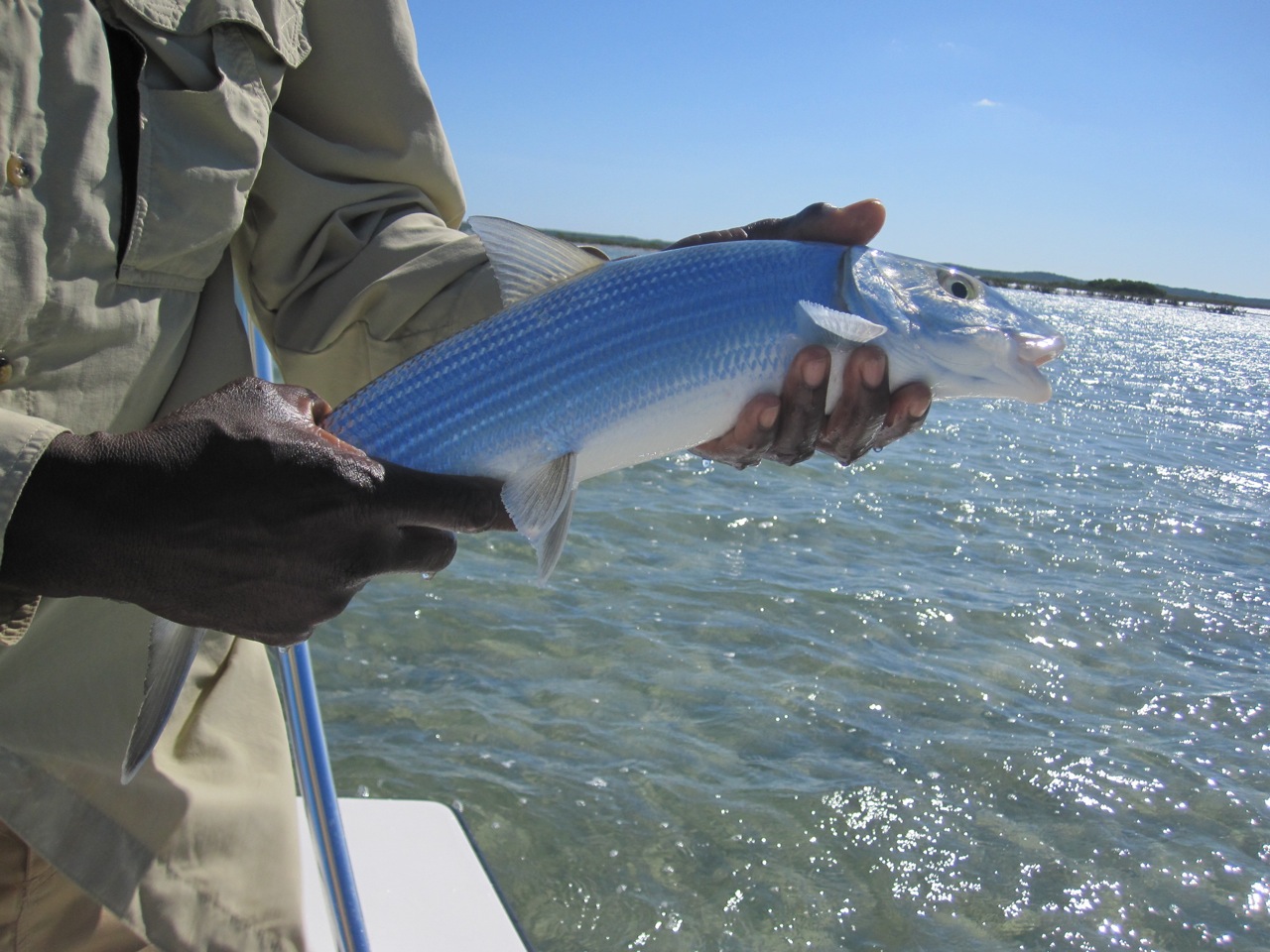
THE QUARRY – grey ghosts below water, bars of silver above. Caught on the ‘fly’ which are in fact shrimp or crab imitations, with barbless hooks to make the chance of losing a fish that much greater… This ensures that a boated fish can be returned to the water as easily and quickly as possible. It’s all ‘catch and release’, though some (me) find that mostly the fish very sensibly self-release long before they ever reach the boat…
Abaco bonefish off Crossing Rocks (just caught and released)Guide Ishi with Abaco bonefish caught on the MarlsGuide Robin Albury removes the barbless hook before returning the fishA good specimen‘Ishi’s Fishy’, as he would say
There is even the possibility that at some stage you may unexpectedly be handed a rod (even if you have never held one before, or wanted to) with ‘fish on’… Here, Robin has hooked a 2.5 lb fish and handed the rod to Mrs RH (then engrossed in eating a cheese roll) who successfully played and brought in her first ever fish…
PART 2 will deal with what else goes on during the day: the scenery, birdlife, sharks, turtles, blue holes and so forth. For now, here is a short clip of the skiff ride out to the Marls, to give you an idea. NB this was a very calm day – things can get a little bumpier and wetter at times. The seats are padded, but not very…
[Ultra-cautious music credit to Joe Satriani who sued Coldplay for alleged tune ‘borrowing’ saying “I felt like a dagger went right through my heart. It hurt so much”. Case dismissed + unspecified settlement… Way to go, Joe! Want to check? Cut ‘n’ paste this: http://www.youtube.com/watch?v=zjB024bZoB4&feature=fvwrel Then by way of counterbalance try John Lennon’s Imagine vs Coldplay’s ‘Fix you’ at (cut ‘n’ paste) http://www.youtube.com/watch?v=DksjpsAe3vk&feature=endscreen&NR=1]
A while ago, I posted stills from a reef-snorkelling video – my first ever underwater video attempt, and indeed my first snorkel for about 40 yearsCLICK===>>>REEF FISH I started with a stingray, producing some rather… ok, very… modest results, but it was at least identifiable if you looked carefully and felt benign.
I’ve learned a few tricks since then. Here is the whole clip, still hopeless in most respects but there’s something quite cute about the creature. Mercifully it is only 37 seconds long. I reserve the right to delete this post when I realise no one has actually watched it! [LATER: Oh! I find a few hardy souls have done so. It’s a democratic vote for the ray to stay, as I see it]
[Belated credit to the fairly litigious Joe Satriani (see JS v Coldplay 2009) for borrowing the intro to one of his songs. It’s a non-commercial tribute, Joe]
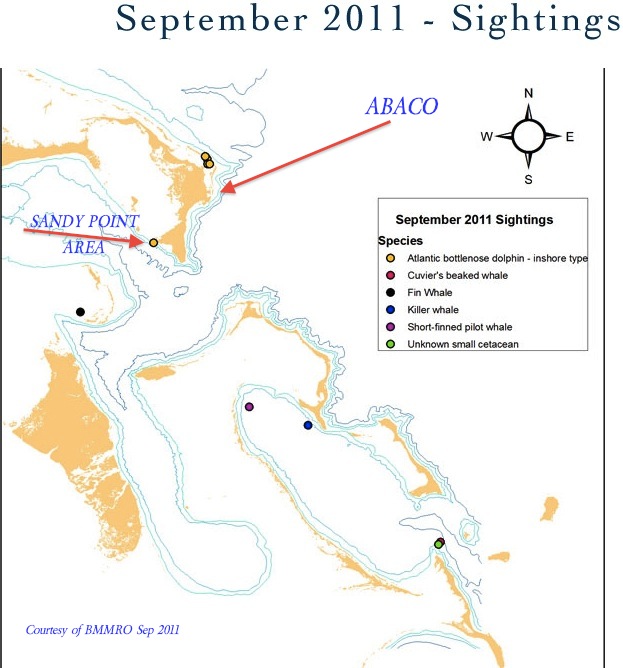
The BMMRO has just posted its sightings chart for September 2011. There are more sightings than in August (when the boats didn’t go out, and Irene interposed herself somewhat assertively). I am not sure that the research boats went out much last month, but Bahamas-wise there were clearly a few more reports of sightings, including another Fin whale. Here is the chart:-
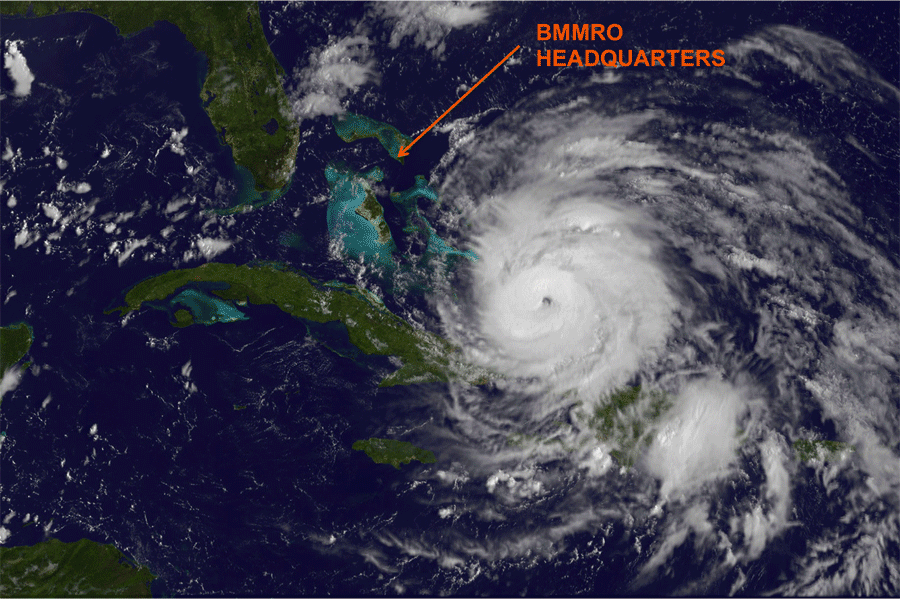
Charlotte Dunn has posted a report of events at Sandy Point in August on the BBMRO site. Her account includes photos of Hurricane Irene as it passed over Sandy Point, and of some of the damage in the aftermath
For the direct link to Charlotte’s blog CLICK DOLPHIN ===>>>
Hurricane Irene on its way towards Abaco, directly in its path …Image credit BMMRO
BAHAMAS MARINE MAMMAL RESEARCH ORGANISATION NEWSLETTER JULY 2011
The BMMRO, based at Sandy Point, Abaco, has published its latest newsletter: 4 pages of lavishly illustrated news and info about recent research and other cetacean-related matters. Thanks as ever to Charlotte Dunn for permission to link to / use material from the BMMRO website. To see the newsletterCLICK LINK===>>>BMMRO Newsletter_Jul11
If you want to immerse yourself in the extremely interesting details of past and ongoing research, with wonderful whale and dolphin photos and past sightings and stranding details, go to the main BMMRO websiteCLICK LOGO===>>>
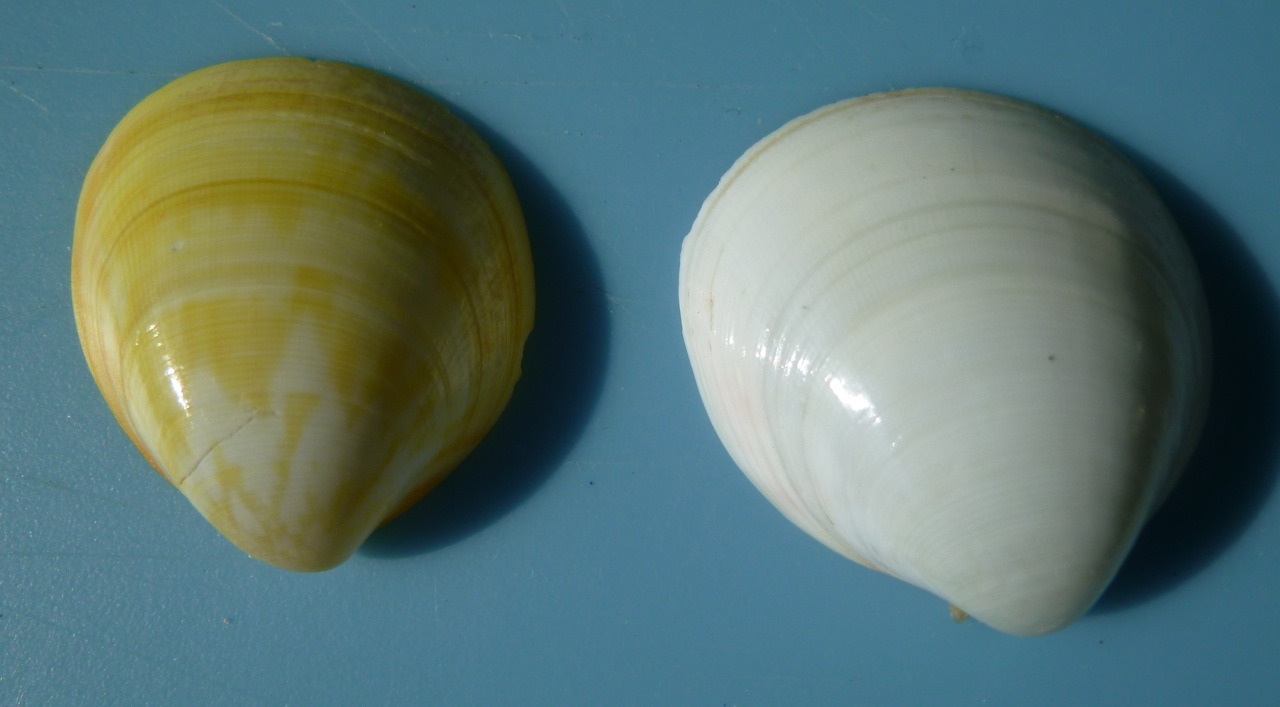
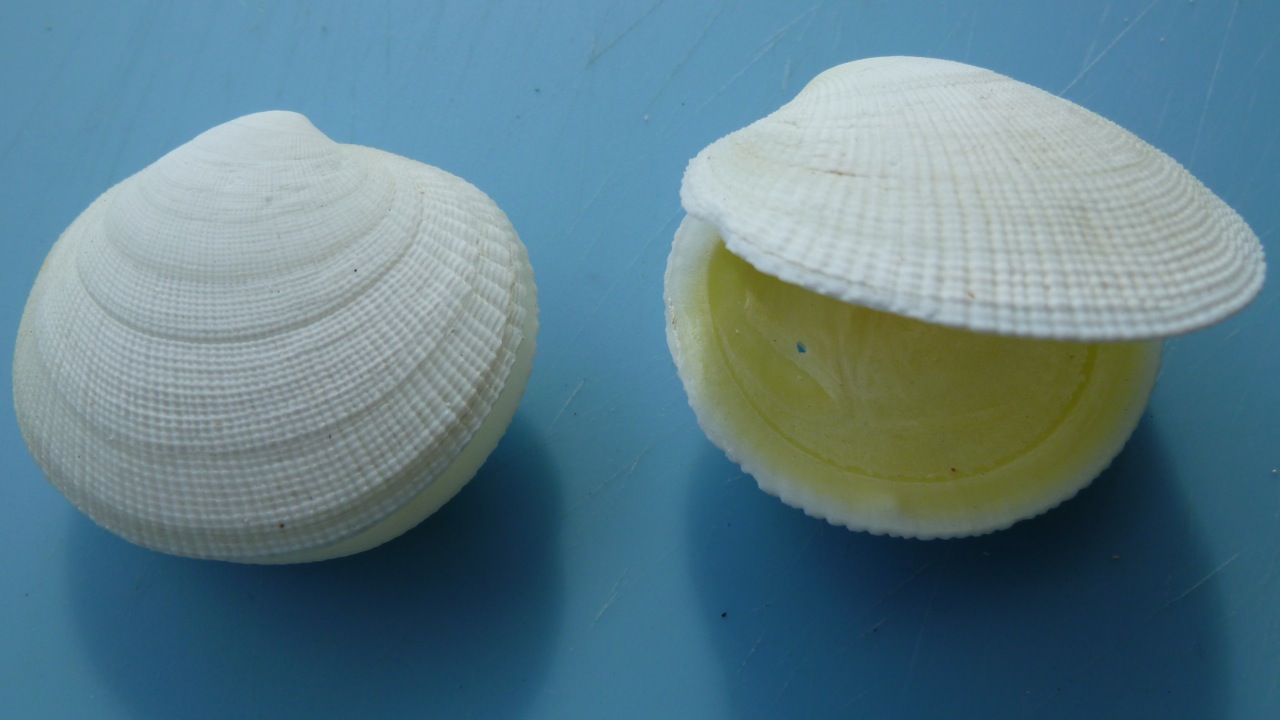
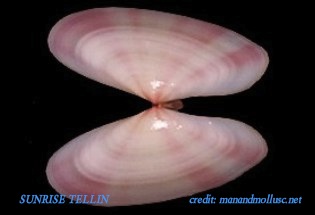
This is Part 2 of the ‘Delphi Beachcombing’ feature. The first dealt mainly with gastropods, and now I have got round to some bivalves. All the shells illustrated come from somewhere within half a mile of the Delphi Club beach steps, except for the sunrise tellin. We gave ours to our granddaughter (5) [she likes pink, but also mud] and it has… somehow come apart.
EGG COCKLES Unlike the vast majority of cockle types which have the familiar radial ribs, egg cockles are smooth and non-ribbed. They are apparently able to jump by flexing what passes for their leg – a feat I would enjoy seeing…
GAUDY ASAPHIS Asaphis Deflorata (formerly ID’d as COQUINA Donax)
SCALLOP / PECTEN This is not a ravenelli, as previously suggested by me – they are deep water molluscs. It’s hard to be sure exactly what species it is, in such a bleached state.The tiny shell half is surely the basis for the symbol of a petro-chemical giant that I decline to identify further. I thought this one was broken but a check shows that the asymmetry of the hinge is very common. Encrustation by worms, as here, is often found as well, but I wisely draw no parallel with the litigious petrochemical industry…
SUNRISE TELLIN (Tellina Radiata)Tellins are a genus with masses of variants worldwide. This species is common in the Caribbean. It is a really pretty shell, glossy with pink radials. They grow up to 7cms. As hinted above, if you find a complete one, the hinge is delicate. The most interesting fact I have discovered is that “in most countries it is illegal to bring back these shells from holidays” Whoops!
This video shows how the sand dollar is able to get around and to bury itself in the sand by using the hairs on its underside:
SAND DOLLAR IN A SPIN – TIME-LAPSE VIDEO
Another short time-lapse video of Sand Dollar manoeuvres lasting 15 – 25 minutes in real time, this time moving in circles before suddenly ‘zooming off’ into the distance…
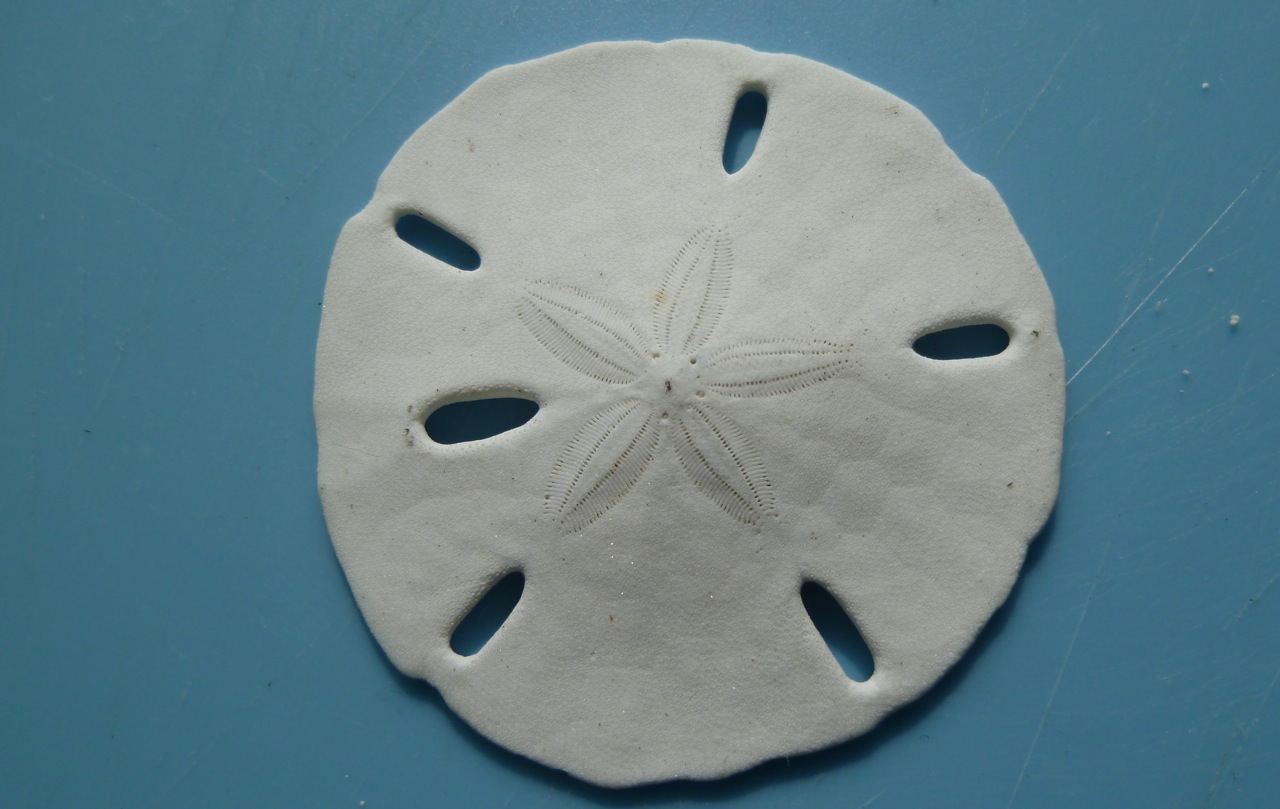
SAND DOLLARS FROM THE RH COLLECTION
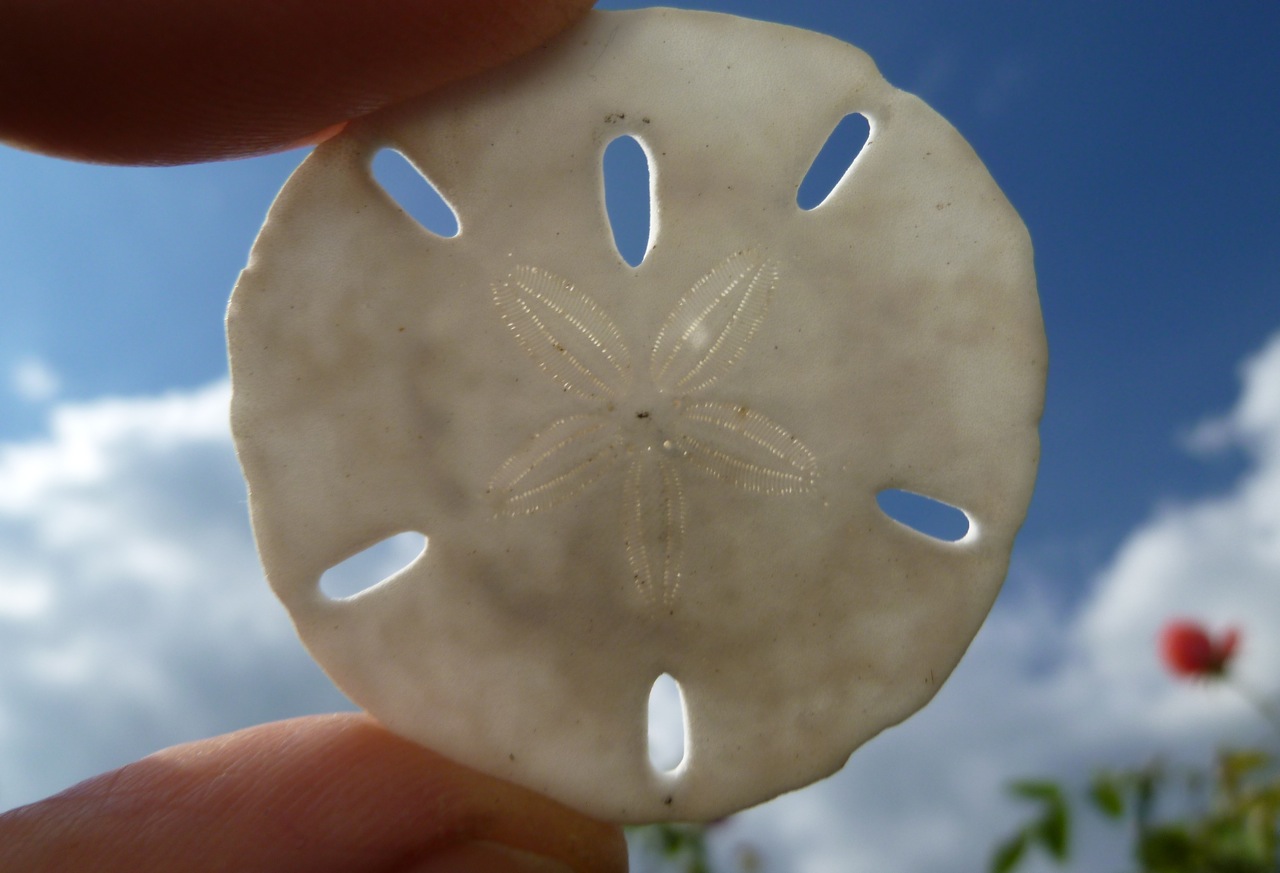
A small Sand Dollar test from Rocky Point beach near Sandy Point (top side, underside and see-through)
Large Sand Dollar tests from a sand bar in Cherokee Sound
These two different types of coral skeleton are from the northern end (and just beyond) of the Delphi beach. The red marking on the second coral is some kind of natural accretion, I think – I have temporarily lost the exact details somewhere on my hard drive, but doubtless they will turn up sooner or later… You will find these red patches on shells as well as coral
COMMON ROSE CORAL
ANY IDEAS – OR IS THIS WORM-RELATED?
Another dramatic coral you may come across – not least because there are usually one or two in the beach-harvested collection on the steps down to the beach – is Brain Coral (Diploria). Here is an example (Photo credit J. Stuby)
NERITES (Nerita)
Nerites are small sea-snails (gastropod molluscs) found in tropical waters around the world. Precise ID of the many types is confused by the different names used for many of them, both taxonomic and local. The majority of the black and white nerites in the pile below, all collected from the Delphi beach, are Checkered Nerites (Nerita Tessellata). In the heap there are a few larger whiter shells with red markings, which are the Four-Toothed Nerite (Nerita Versicolor).
Here are some of the above shells showing their varying patterns and sizes, seen with a few grains of sand for comparison. The 3 larger whiter ones with the flecks of red on them are the Four-Toothed Nerites.
Here are 3 example shells in close-up, together with a tiny, perfect Dwarf Atlantic Planaxis (Hinea lineata) at the end (previously misidentified as a Littorine). I didn’t notice it until I was sorting through the shells – in fact you can just see it towards the bottom right of the previous photo, above the small nerite that’s on its back. It may even have fallen out of a nerite, as did many of the sand grains.
These four upturned nerites show the dentate entrance, common (to a greater or lesser extent) to most nerites – maybe all. The top row are Four-toothed Nerites; the bottom row are Checkered Nerites. Another Nerite type found in the Bahamas is the Bleeding-tooth nerite (Nerita Peloronta). These are similar to the top ones, but have vivid orangey-red markings on the ‘teeth’ – hence their name.
Nerites, sand grains and the Planaxis: size comparison
A close up of the Planaxis, showing how amazingly detailed the pattern of such a tiny shell can be
All this may sound a bit learned and somewhat solemn. Dull even. In fact I had absolutely no idea about any of the above details until I got these shells out of their glass jar last week to photograph (apologies for using a chopping board) and did some digging… So if any shellologists or neritophiles read this and have corrections to suggest, be my guest… Use the comment box or the email address on theCONTACTpage. ADDENDUM: many thanks to Colin Redfern for confirming the small nerites as Checkered, as opposed to Zebra; and the ‘littorine’ as a Dwarf Atlantic Planaxis Hinea lineata
You must be logged in to post a comment.