Unknown's avatar

MELLOW YELLOW: HOODED WARBLERS ON ABACO


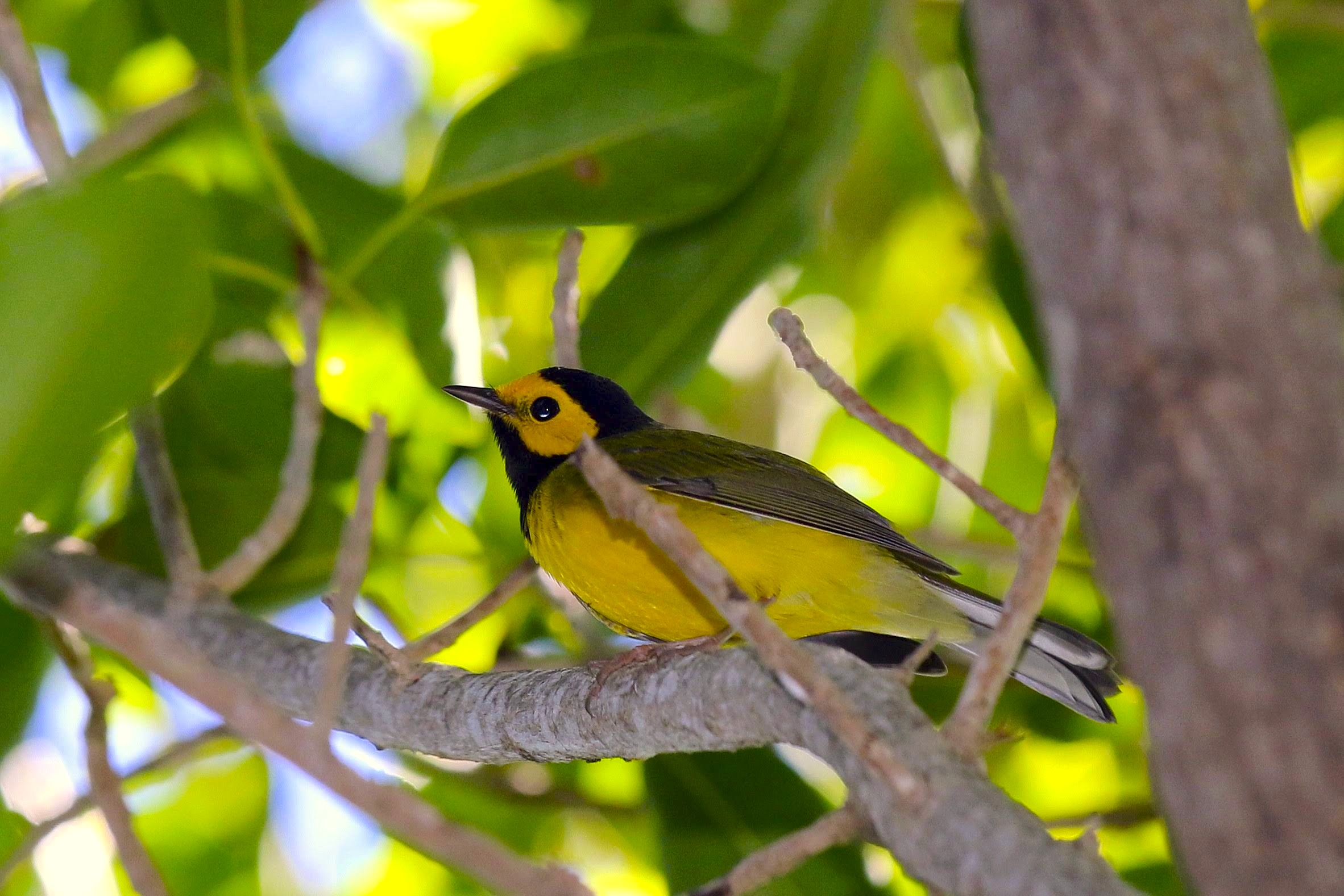
Hooded Warbler, Man-o-War Cay, Abaco (Charmaine Albury)

MELLOW YELLOW: HOODED WARBLERS ON ABACO

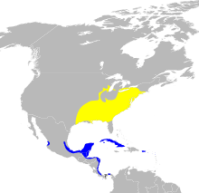
The Hooded Warbler (Setophaga citrina) breeds in eastern North America in summer, and winters in Central America and the West Indies. On Abaco they are classed as WR3, ‘uncommon winter residents’. The range map below reveals one strange aspect of their habitat. It looks as though they choose not to live in Florida either in summer or winter. I’m sure they must be found there as transients; and there must presumably be some small breeding or wintering populations in Florida. Or both. But it’s hard to understand why Florida does not seem to suit them.

220px-wilsonia_citrina_map-svg

ABACO WARBLER HOTSPOT

On Abaco, I have only ever had reports of Hooded Warblers from Man-o-War Cay, which seems to be a warbler hotspot every season. There are 37 WARBLER SPECIES recorded for Abaco. FIVE WARBLER SPECIES are year-round residents. Of the migratory 32, at least two dozen seem to favour Man-o-War for their winter break in the sun. MoW resident Charmaine Albury, who took the main photos in this post, has already counted 14 different warbler species before the end of September. She has found up to 5 species in a tree at the same time. 

Hooded Warbler, Man-o-War Cay, Abaco (Charmaine Albury)

WHAT’S IN A NAME?

There are periodic upheavals in Birdland which, following research, lead to an official reclassification of a particular bird species or genus. In 2011, many warblers that were cheerfully going about their business under the classification Dendroica found themselves merged into the older ‘priority’ genus Setophaga (Greek for ‘moth eating’). The Hooded Warbler, formerly Wilsonia, has found itself similarly merged into Setophaga – a kick in the teeth for the naturalist ALEXANDER WILSON, for whom the bird was named (along with many others – his plover being a well-known example on Abaco).

hooded-warbler-copy

WHY ‘CITRINA”? (FUN FACT!)

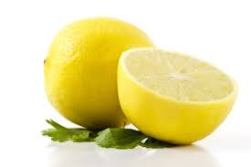
The word relates to lemons – citrus fruits – and their colour, and is undoubtedly apt for the hooded warbler. However the semi-precious calcite gem, ‘Citrine’ (same word origin) is not lemon coloured but (disappointingly) brownish.

                         imgresnatural-citrine-calcite

Hooded Warbler, Man-o-War Cay, Abaco (Charmaine Albury)

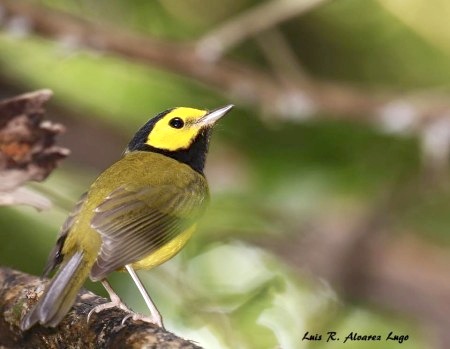
This little warbler has a plain olive / greeny-brown back, and a bright yellow face and underparts. There are white feathers on the outsides of their under-tail (I’m sure there’s a more technical word for this…) – see header image. Only males have the black hoods and bibs; females have an olive-green cap. 

hooded-warbler-luis-r-alvarez-lugo-450x349

Hoodies forage for insects in low vegetation and dense undergrowth, or catch them by HAWKING from a branch or twig. Sadly, they are one of the species that are targeted by brown-headed cowbirds, the cruel exponents of brood parasitismThese birds are rarely found transients on Abaco at present, but they are a robust species and there is evidence that their range is increasing. In some areas there are controlled (euphemism for… er… dispensed with). I’d favour that approach for Abaco, should they show signs of inflicting their evil ways on the resident breeding population of small birds.

Audubon plate-110-hooded-warbler-final

Hooded Warbler in Audubon’s Birds of America

WHAT DO THEY SOUND LIKE?

I am often at sea with the attempts to turn birdsong into to memorable words of phrases. Yes, a Bobwhite sounds a bit like a quizzical ‘Bob… White?‘. But I rarely ‘get’ the “I’d-like-a-Kalik-with-my-Conch” and suchlike. For what it is worth, I learn that for the Hooded Warbler “the song is a series of musical notes which sound like: wheeta wheeta whee-tee-oh, for which a common mnemonic is “The red, the red T-shirt” or “Come to the woods or you won’t see me“. See what I mean? Anyway, we can all agree that “the call of these birds is a loud chip.” As with so many species!  

So here’s what to listen out for (recording: FLMNH). Suggestions for a suitable phrase welcome!

1291c       3646

If you come across a bird that looks like a hooded warbler, but is motionless and makes no sound unless you squeeze it, you may have found the subspecies Audubonus stuffii, which is found mainly in the Amazon and E. Bay regions.51idfxzal

OPTIONAL MUSICAL DIVERSION

I haven’t had time to musically divert for a while. My title refers, of course, to the ‘psychedelic pop’ song by Donovan, released in the US in 1966 and the UK in early 1967. The theory is that the song relates to the supposed (but mythical) hallucinogenic high to be had from smoking dried banana skins. There are an explicit interpretation for the ‘electical banana’ which we need not go into in a family blog.  There was a rumour, now discredited, that Paul McCartney supplied the “quite rightly” in the chorus. Anyway, to chime in with the mood of the time, one of the first ‘coffee shops’ in Amsterdam was called Mellow Yellow. 

donovan_-_mellow_yellow

RELATED POSTS

ABACO’S 37 WARBLER SPECIES

ABACO’S 5 PERMANENT RESIDENT WARBLERS

hooded-warbler-copy

Credits: Charmaine Albury for the photos and her warbling work on Man-o-War Cay; Luis Alvarez-Lugo (Wikipici); random open source material; FLMNH (birdsong); my iTunes

Unknown's avatar

THINK PINK: A RUNCIBLE OF SPOONBILLS


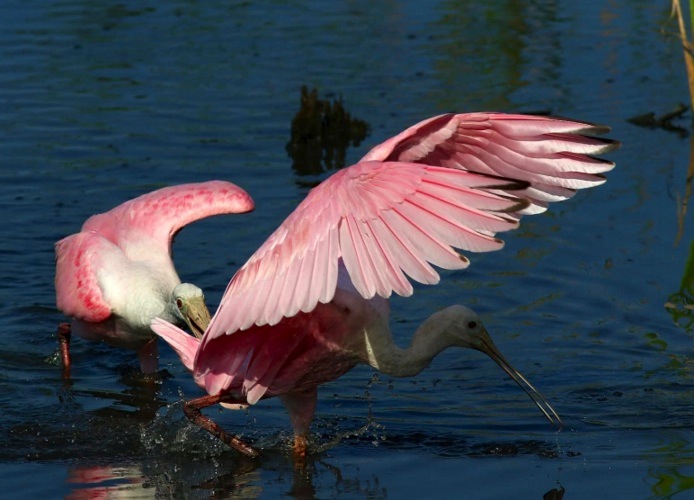
spoonbill-4-9-16-phil-lanoue

THINK PINK: A RUNCIBLE OF SPOONBILLS

Healthy happy hungry birds ‘in the pink’. Always a pleasure to see. And when there is a group of them, how often one reaches for the correct collective noun: a murder of crows, an exultation of larks, a murmuration of starlings, a parliament of owls and so forth. Many are historical terms, dating back to medieval times in Europe, and often linked to hunting and falconry. As a rule of thumb, the more recent the term, the more likely to have been invented – especially if there is a comedy undertone.

spoonbill-2-9-16-phil-lanoue

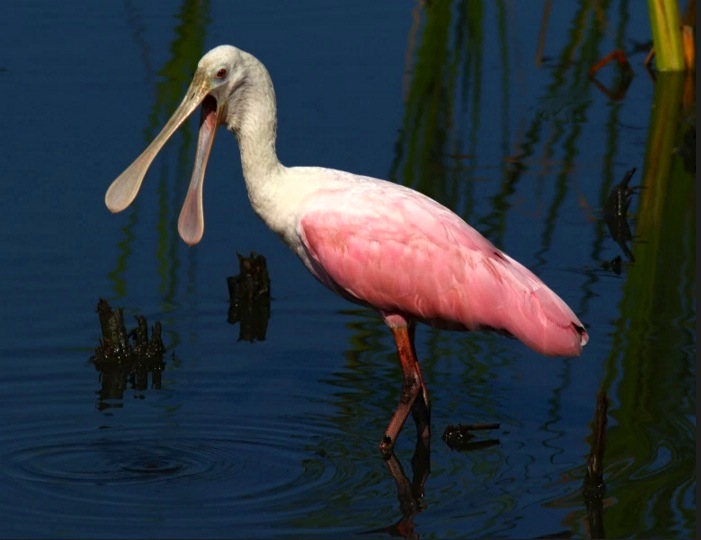
The trouble with spoonies is that there is no historic or traditional name for a group of them. In such circumstances, using the term ‘flock’ is generally the safest bet. A quick glance online suggests that modern suggestions are mainly jocularly cutlery-based: a canteen, a measurement, a service, and… a ‘runcible’ (a neat nod to Lewis Carroll). That’s the one I prefer.**

spoonbill-7-9-16-phil-lanouespoonbill-6-9-16-phil-lanoue

One thing is beyond dispute: Phil Lanoue takes some of the best bird action shots around, and I’m proud to be permitted to showcase them from time to time. Spoonbills are rare enough these days in the northern Bahamas, so it is good to know that they are thriving not so very far away to the west. Abaco still has occasional spoonbills dropping in – you can see the latest one, found at Gilpin Pond, HERE.

What are you guys looking at?spoonbill-5-9-16-phil-lanoue

Got to get every feather just right…spoonbill-3-9-16-phil-lanoue

**The slightly ill-tempered-sounding baldmonkeyseenabird suggests ‘a repugnance of spoonbills’ but I think he / she may have been having a difficult day…

All photos by Phil Lanoue. Check out his awesome website https://phillanoue.com

I must fly now… see ya!spoonbill-1-9-16-phil-lanoue

Unknown's avatar

WORLD SHOREBIRDS DAY? YAY! AN ABACO COMPETITION!


Piping Plover (Danny Sauvageau) 7

WORLD SHOREBIRDS DAY? YAY! AN ABACO COMPETITION!

In the past I have occasionally offered a Kalik™ (half in jest) for a ‘right answer’ or a nugget of info. Anyone who didn’t get their beer can still claim it, of course [no, no, not all at once please…]. But now I’m getting serious. World Shorebird day is on September 6th, and this weekend sees a global shorebird count in which, it is hoped, large numbers of people will scan their shorelines and post the results on the great and good resource that is eBird

13873031_859587794145299_7383541518099186659_n

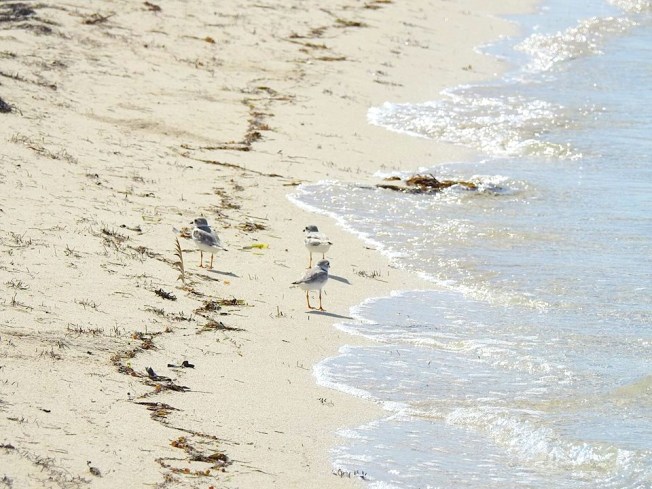
But you don’t need to go to those lengths. Here’s the deal. Is there a bit of beach near you (hint: on Abaco you’ll never be far from a beach or shoreline except in the National Park)? If the answer is yes, then can you spare an hour (or two?) to take a walk on the beach over the weekend?  Or Monday and Tuesday? If so, can you look for a particular rare bird that makes its home on Abaco for the winter? Great. You’re in the competition, then. And there’ll even be a PIPL-related prize…

Piping Plover (Danny Sauvageau) 1

THE (SOMEWHAT FLEXIBLE) RULES

  • go for a beach walk, taking a notebook, pen, a camera or even just a phone. Binoculars would be good.
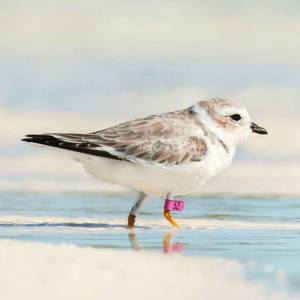
  • look for tiny shorebirds that look like the birds in this post
  • count how many you see at a time (watch out, they move quite fast). Maybe 1 or 2. A dozen is the likely max.
  • check their legs for coloured flags or bands and if possible note the colours and any numbers / letters
  • if possible, take photos of the bird(s), showing legs if banded. Don’t worry too much about quality – enhancement is possible
  • tell me about what you found and send me any photos (see below)

Piping Plover, Abaco - Charmaine Albury

HOW WILL I KNOW WHAT TO LOOK FOR?

  • Size – very small (6″ – 7″) and usually busy
  • Legs – orange
  • Beak – black, possibly with a hint of orange at the base
  • Eyes – black and beady, with a streak of white above
  • Front – white / very pale
  • Underside – ditto
  • Back – greyish / brownish-tinged
  • Head – ditto
  • Tail – darker feathers at the end
  • Neck ring – a greyish hint of a partial one (they are black in summer)

Piping Plover (Danny Sauvageau) 8

WHERE WILL I FIND ONE?

  • On a beach or maybe a rocky shoreline
  • Out in the open on the sand, anywhere from back of the beach to the shoreline
  • Foraging in the tide margins
  • Rushing round in a seemingly random way
  • Taking a dip in a sea-pool (see above)
  • On a rock near the sea

Piping Plover (nb), Abaco (Bruce Hallett)

WHAT DO YOU WANT TO KNOW?

In an ideal world, all the details below. But I’d be really pleased just to find that you had seen a piping plover on your chosen beach. Even the knowledge that a particular part of the shoreline is favoured by the birds is valuable for their conservation. The most useful info is:

  • Date, name of beach, approx location (‘north end’).  Time would be good too, and whether tide high, mid or low
  • Number of piping plovers seen (if any) and how many banded / flagged (if any).
  • Impression of bands if unclear: ‘I think it was… a green flag / an orange ring / a metal ring’ or if visible…
  • ‘One was green flag 2AN on it’ / ‘one had bands – left leg upper leg orange, right upper leg light blue…’
  • Take a photo. This will help eliminate other species of shorebird from the ID, and enable a close-up look

Piping Plovers, Delphi, Abaco A (Keith Salvesen)6

WHAT’S THE POINT OF BANDING & TRACKING THEM?

Marking a plover with coloured bands or flags (or a combo) gives a unique ID to each bird. Usually it will be done on the beach where they hatched, within a day or two. These adornments weigh nothing, do not impede the birds in foraging or in flight (or when mating…) and expand as they grow. The scientists who carry out the banding will have weighed and measured the hatchling and made a detailed record of the data collected. They need to get as much information as possible about the habits of each bird to help with conservation initiatives at both ends of the migrations.

piping-plover

Each fall the plovers travel south between 1000 and 2000 miles south from their summer breeding grounds. Tracking individual birds to where they overwinter enables scientists to build up a picture of the type and location of fragile habitat that these little birds prefer, and to compare the annual data for each banded bird. For example

  • A particular beach does not seem to attract piping plovers at all (there may be several good reasons for this)
  • A particular beach has single or small groups of piping plovers who come and go but don’t settle there
  • A particular beach usually has at least one or a few birds on it who show ‘beach fidelity’, eg Winding Bay
  • If birds are found in groups – more than 10, say – in a particular location, it means the beach suits the breed especially well. It is sheltered, has plenty of scope for good foraging, few predators, and has not been spoilt by humans. Long Beach (Island Homes) is a good example. Last December, groups of more than 60 were found there. It’s a *hotspot*!

Piping Plover Tuna. Abaco. Oct 10. Rhonda Pearce

GIVE US AN EXAMPLE, PLEASE

Last season a bird called Tuna (see photo above) arrived at Watching Bay (Cherokee) in at the end of August. He moved from time to time to the Cherokee mud flats and Winding Bay, but mostly he remained at Watching Bay until April. His unique banding colours and their positioning led to the following information

  • The precise coordinates of location of the nest where he hatched in New Jersey
  • The date of hatching, banding, fledging and the last date he was seen there before migrating to Abaco
  • The name of the banders, plus his weight and the length of his body, wings, legs and beak
  • Even the names of Tuna’s parents. In fact, mother Paula headed to the Bahamas too –  she was resighted on Joulter Cays, Andros last winter.

Tuna was not reported over this summer – he didn’t return to his ‘birth beach’ – but we believe Tuna is now back at Watching Bay The distant photos were not clear enough to make a positive and definite ID. On the next visit we may know for sure, and all because of the bands. And we’ll know that he likes Abaco enough to fly back 1200+ miles to the same beach as last year. We can conclude that Watching Bay provides a suitable and safe habitat for Piping Plovers.

Piping Plover 1, West End Grand Bahama (Linda Barry-Cooper)

WHAT’S IN IT FOR ME?

  • Potential ‘fun for all the family (nb best leave the dog at home for this adventure…)
  • Exercise in a lovely beach setting
  • Seeing a rare and vulnerable bird in its natural setting
  • Wonderment that such a tiny bird should fly many miles & choose Abaco to overwinter
  • Assisting in logging the beach presence of the birds so that researchers know where to look
  • Helping count the birds so that year-on-year comparisons of the population can be monitored
  • Getting appreciation and thanks
  • Being described as a ‘Citizen Scientist’
  • Winning a prize if your are the most successful finder of banded birds, as verified by photos

Piping Plover pair, Delphi Beach, Abaco (Keith Salvesen)

I’ll post details of sightings on ABACO PIPING PLOVER WATCH with credited photos. Later I’ll follow up with a ROLLING HARBOUR post summarising the results, listing the participants and their scores of both unbanded and banded birds, and naming the winner of the PIPL-themed prize to mark their glory…

Contact me via APPW, DM me on my FB page, or email me at rollingharbour.delphi [at] gmail.com

GOOD LUCK!

13873031_859587794145299_7383541518099186659_n

Credits: Danny Sauvageau, Charmaine Albury, Bruce Hallett, Keith Salvesen, Rhonda Pearce, Linda Barry-Cooper, Gyorgy Szimuly (WSD logo)

Unknown's avatar

HUNGRY MOUTHS TO FEED: W.I. WOODPECKER CHICKS (PT 2)


West Indian Woodpecker & Chicks, Abaco (Rhonda Pearce)

HUNGRY MOUTHS TO FEED: W.I. WOODPECKER CHICKS (PT 2)

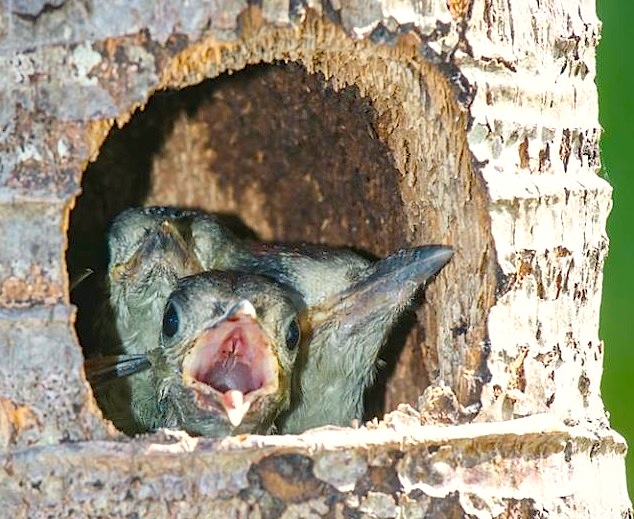
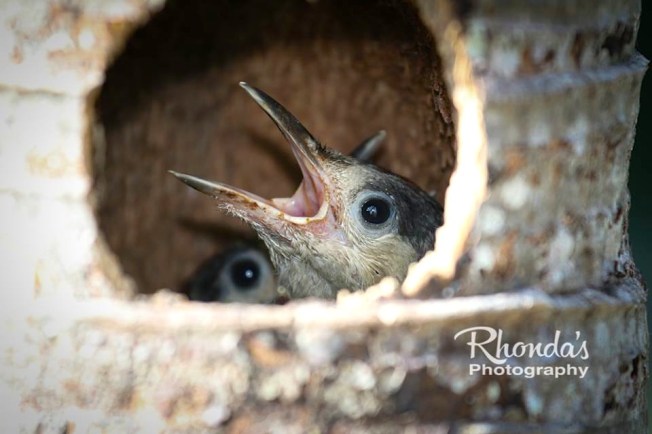
In just a few days, the West Indian WOODPECKER CHICKS have become bigger, noisier and much hungrier. Their heads are now tinged with red. They have started to compete for food: the first chick to push its way to the entrance hole gets the most food. Often there will be a smaller or weaker chick that gets rather left out in the frantic rush for grub (make that ‘grubs’ – see header image). But I suspect quite a lot of food shrapnel gets dropped and spread around inside the nest, so that in the end all the chicks are well sustained.

Rhonda Pearce has been taking photos of this growing family over the last few days, and if you saw my post last week, you will notice that the size of the chicks and the size of the food morsels jammed down their eager gullets has increased considerably…

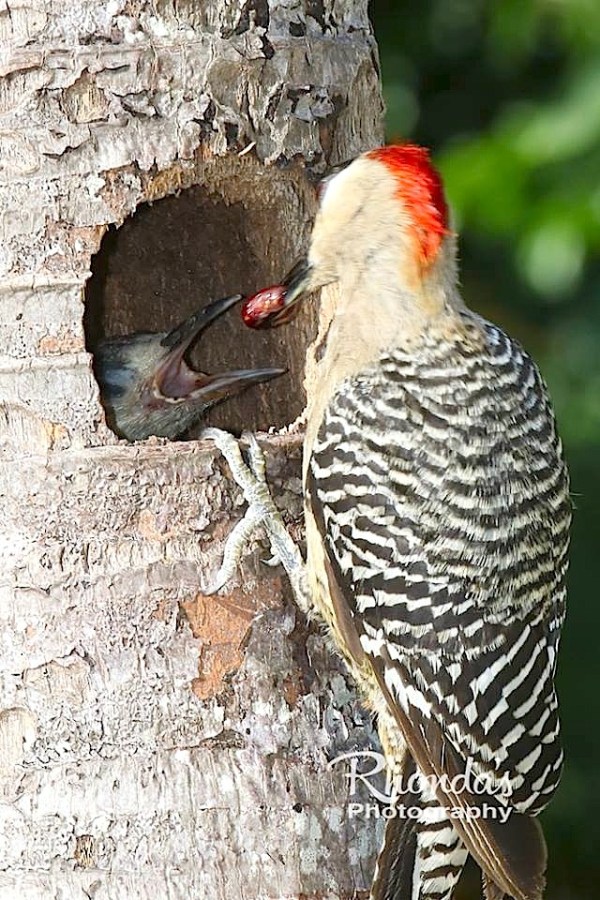
A lizard hangs on tightly to the parent’s beak… but sadly it is doomed to be dinner…West Indian Woodpecker & Chicks, Abaco (Rhonda Pearce)

Mmmmmmm. It’s so tasty, little one…. and even if it isn’t, it’s going inWest Indian Woodpecker & Chicks, Abaco (Rhonda Pearce)

Hey, kids, who wants a bug with wriggly legs and feelers?West Indian Woodpecker & Chicks, Abaco (Rhonda Pearce)

What do we want? Food! When do we want it? Now!West Indian Woodpecker & Chicks, Abaco (Rhonda Pearce)West Indian Woodpecker & Chicks, Abaco (Rhonda Pearce)

“Wishin’ and hopin’…”West Indian Woodpecker & Chicks, Abaco (Rhonda Pearce)

“Is there any left for me…?”West Indian Woodpecker & Chicks, Abaco (Rhonda Pearce)

RELATED POSTS

HUNGRY WIW CHICKS (PT 1)

WEST INDIAN WOODPECKERS

WIWs AT DELPHI

Credits: all photos, Rhonda Pearce

Unknown's avatar

HUNGRY MOUTHS TO FEED: WEST INDIAN WOODPECKER CHICKS


West Indian Woodpeckers & Chicks (Rhonda Pearce)

HUNGRY MOUTHS TO FEED: WEST INDIAN WOODPECKER CHICKS

West Indian Woodpeckers are special. So special that Abaco even has its own subspecies  Melanerpes superciliaris blakei. They are joyful and noisy. They noisily share parenting duties in an admirably modern way. And did I mention they are noisy?

West Indian Woodpeckers & Chicks (Rhonda Pearce)

The parents set up home together, with both partners taking their turns to choose the furnishings and fit out the nest. They share duties on the nest once the eggs have hatched. And they take turns to feed the nestlings as they grow into increasingly hungry and raucous fledglings. 

West Indian Woodpeckers & Chicks (Rhonda Pearce)

This feeding sequence was taken by Rhonda Pearce whose ravenous chick in the header photo is one of the best I have come across. I have never managed to get such a clear shot of desperate chick hunger…  

Here’s how a nest can sound when the chicks are young – a weird sort of insistent purring sound. As the chicks get larger – and more competitive – so the volume level increases.

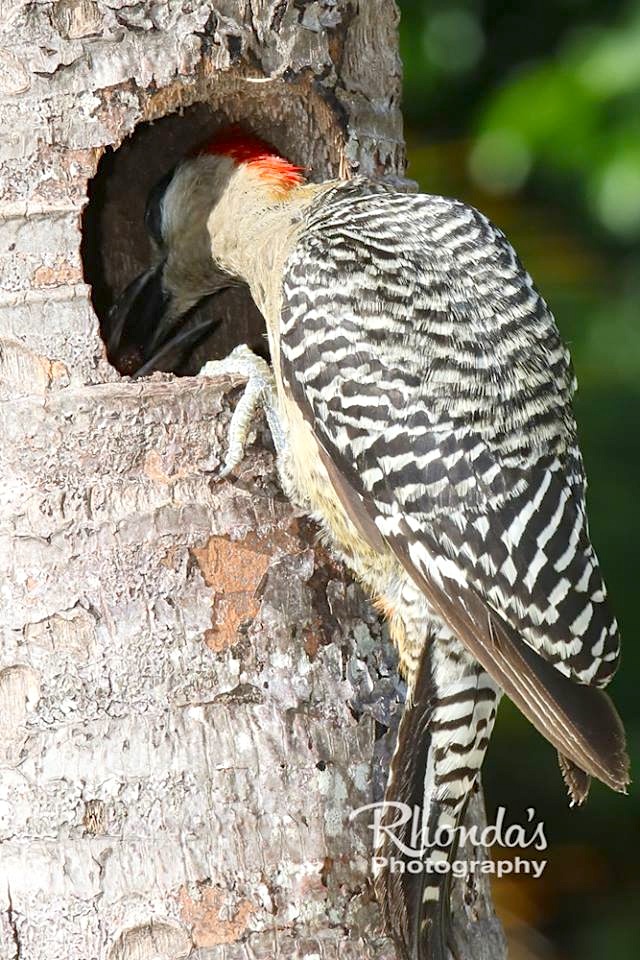
Get this down your throat, you pesky little rascal…West Indian Woodpeckers & Chicks (Rhonda Pearce)

RELATED POSTS

WEST INDIAN WOODPECKERS

WIWs AT DELPHI

Credits: all photos, Rhonda Pearce; audio recording RH @ Delphi Club nesting boxes

Unknown's avatar

SANDWICH TERNS: NO LINK TO BREAD SLICES, SAY SCIENTISTS


Sandwich Tern (Danny Sauvageau)

SANDWICH TERNS: NO LINK TO BREAD SLICES, SAY SCIENTISTS

Have you noticed how newspapers and periodicals increasingly seize every opportunity for a headline ending “…say Scientists”. It lends a spurious authority to any tenuous assertion, like “astronauts unlikely to find cheese on moon, say Scientists” (suggesting at least the faint possibility of some mature cheddar lodged in a crater). Or “Frooty-pops cereal may protect against ingrown toenails, say Scientists”.  To which the proper response is: “research reference please”. But it seems 37.9% of people are actually prepared to believe this tendencious stuff… say Scientists.

But I digress. To the business in hand. The Sandwich Tern (Thalasseus sandvicensis) is a smart-looking medium-sized tern. Its clearest ID signifier among terns is a sharp black beak with a yellow tip. Also, its black legs helpfully distinguish it from other tern species that have orange legs.Sandwich Tern (Sandy Point), Abaco - Bruce Hallett

The origin of the name for this species is an unexpected one. The Thaleasseus (formerly Sterna) simply refers to the sea (Gk). The Sandwich part is more complicated. It’s certainly nothing to do with a tasty filling for a sliced bread snack **. Other bird species such as Branta sandvicensis, an endemic Hawaiian goose, have the name because Hawaii was historically known as the Sandwich Islands. But Sandwich terns are not found there. In fact, the name comes from the town name of Sandwich, Kent UK (sand wic OE – ‘trading post by the sea’). The ornithologist who first described the bird in 1787, John Latham, just happened to live there. (And how fortunate for ornithology that he did not come from Pratts Bottom, also in Kent).

Sandwich Tern, Abaco (Woody Bracey)

Sandwich terns have a wide range around the world. As the range map below show, the most significant breeding area is Great Britain and northern Europe. On Abaco, the birds are uncommon summer residents. Both images above were taken on the main island, the top one at Sandy Point on the jetty (an excellent place for birdwatching, incidentally).Thalasseus_acuflavidus_and_Thalasseus_sandvicensis_map-location-2.svgSarnie Tern range

Like all the Thalasseus terns, the Sandwich tern plunge-dives for fish. I love the sight of diving terns. They hang high in the air as they scope out the water for fish, only to break free from the sky and smash down into the sea, often emerging with a silver prize. Here’s a wonderful photo of one that missed its meal – and one that succeeded.

Sandwich Tern (Danny Sauvageau)Sandwich Tern (Danny Sauvageau) An endearing characteristic of these terns can be seen during their courtship display. The male will catch a fish, then offer it to the female. Her acceptance of the gift signals her readiness to approve the male as a suitable mate. 

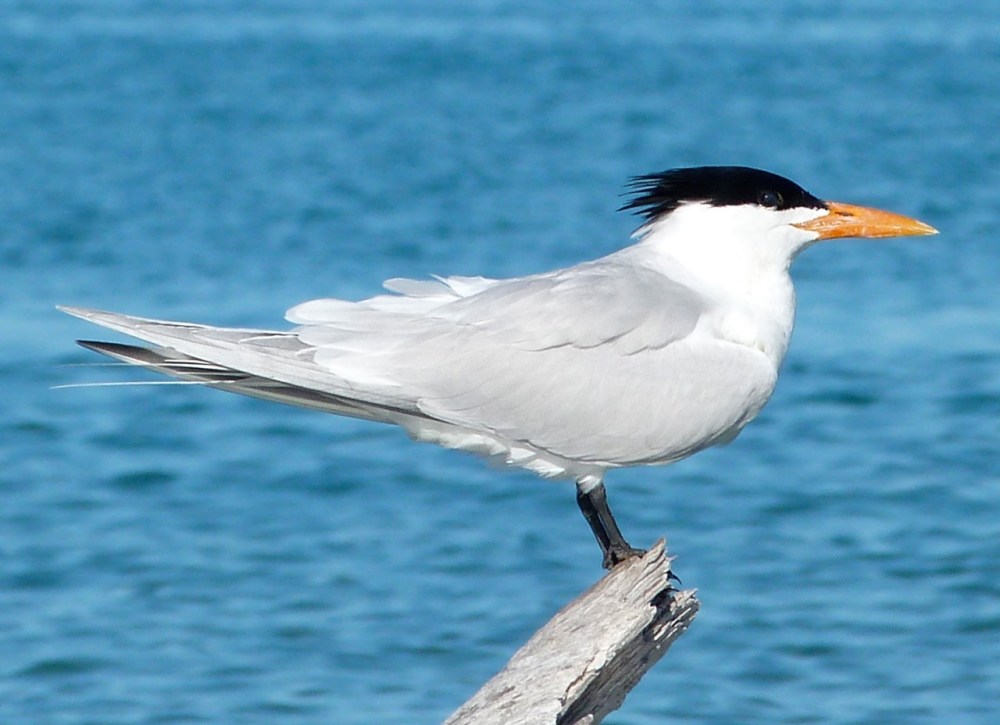
Of the  12 tern species recorded for Abaco most are summer residents, some of which breed on Abaco. The royals are the only permanent residents; and the Forster’s are the only winter residents. The other 4 species are transient in migration, or vagrant (arctic tern).

Tern Species on Abaco

As I have mentioned before, a very good source for easy ID to distinguish between different birds of the same family is to head off to BIRDORABLE. The drawings (cartoons!) may not be scientific, but they do highlight the most notable distinctions. Invaluable as a last resort. Or first resort, even! For similar-looking birds, compare the beaks and the legs. The composite below shows how simple it is.

91b5e2a19a20fb1eeace596efbac5a57

Noisy neighbours? Put this short recording of a sandwich tern colony in the breeding season on a continous loop, and you have the makings of a powerful retaliatory weapon. They’ll be out within a fortnight…

Alex Lees / Xeno-Canto

** The food we call a sandwich was named after the 4th Earl of Sandwich. He found eating while playing cards inconvenient, so asked his valet for two slices of bread, requesting “and squash a tern between them, if you’d be so very kind…” The Sandwich Islands were also named after his Lordship by Captain James Cook, as a compliment for financially supporting an expedition there, say Historians…

Sandwich_Tern_(Sterna_sandvicensis)_(Ken Billington)

Credits: Danny Sauvageau (1, 4, 5); Bruce Hallet (2); Woody Bracey (3); Ken Billington (6); Alex Lees @ Xeno-Canto, Birdorable, wiki for range map & info, other magpie pickings of glistening facts

Unknown's avatar

“ON THEIR WAY”: THE PIPING PLOVER MIGRATION HAS BEGUN…


PIPL adult & chick (Jordan Rutter)

“ON THEIR WAY”: THE PIPING PLOVER MIGRATION HAS BEGUN…

The last piping plover known to have left Abaco for the summer breeding grounds was the renowned ‘Tuna’, in early April. We can’t say where he ended up – there are no reported sighting of him this summer from the NJ beach where he was born, raised and banded – or from anywhere else. The unbanded Delphi contingent had left the beach by the end of March.

TunaPiping Plover Tuna. Abaco. Oct 10. Rhonda Pearce

Besides Tuna, of the named banded birds resighted on Abaco beaches last season (e.g. Harry Potter, Hermione Granger, Jonesy, Bahama Mama, Benny, Bess), only the most distant visitor Bahama Mama returned to her original beach in Muskegon State Park. Her mate from last year (‘Little Guy’) had already shacked up with another bird, so BM did likewise. Carol Cooper reports that all birds had left the beach by July 23.

Bahamas Pink Band 52PIPL Pink Band 52, Abaco (Walker Golder)

As for Bahamas ‘Pink Bands’ – winter-banded birds – the BAHAMAS SHOREBIRD CONSERVATION INITIATIVE has posted a wonderful interactive map produced by Audubon which shows the astonishing extent of the migration undertaken by these little birds. Unfortunately none of last winter’s Abaco ‘pink numbers’ are shown as resighted. You can reach this great resource by clicking the image below. This will take you to the original – I am trying to work out how best to embed the map in my sidebar.

Click me!Pink band PIPL map (Audubon : BSCI)

Reports of migrating PIPL are beginning to come in and will accelerate over the next few weeks. First with a Bahamas report is Linda Barry-Cooper (West End Ecology Tours), who spotted 3 at Sandy Cay, West End, Grand Bahama on July 21 (‘10.00 a.m., high water’). With a modest fanfare of greeting, here are those first Bahamas birds of the season.

Piping plovers, West End, Grand Bahama (Linda Barry-Cooper)Piping plovers, West End, Grand Bahama (Linda Barry-Cooper)Piping plovers, West End, Grand Bahama (Linda Barry-Cooper)

ABACO PIPING PLOVER WATCH

Last season was an important one for having a bird count on Abaco, with the four-yearly census taking place in January. I started The Watch rather nonchalantly, but it quickly picked up enthusiasm and momentum and in the end it was of significant use for the official bird count. Here are the compressed stats for the from the end of July 2105 to January 2016. You will see – possibly with some surprise – that in only 5 months 3.83% of the total presumed piping plover population in the world was found on Abaco. And of course that’s only a total from sightings on certain beaches, mostly easily accessible, by a relatively small number of monitors. How many more were there on the all the unexplored expanses of beach, or indeed out on the Marls?

12645249_238060709872861_4615782903299666904_n

The question is whether to continue the watch this coming season. If so, best to get it sorted before the first birds arrive any day now. I have decided  to carry on, but – since it isn’t a census year –  with a lighter touch this time (it’s a time-consuming process and there’s other stuff going on in my life.) Accordingly I would welcome reports of all Abaco sightings. If you are in doubt whether what you are seeing is a piping plover or some other shorebird, a photo or even a phone pic for ID would be great. The most helpful information to give is:

  • Date and time
  • Single bird or number of birds (if countable) or an estimate
  • Whether banded or not
  • If so, details of the banding: band or flag, colours, visible numbers etc
  • If at all possible, photos of the bird and its legs… I am able to enhance apparently dim or fuzzy pictures to some extent, so don’t worry if you don’t get a perfect shot.
  • If possible, state of tide – high, low, half-way, coming in, going out
  • Also, what the bird is doing – foraging, sleeping, rushing round in circles etc
  • Finally, location as accurately as possible. Area, name of beach, whereabouts (middle, east end, south end etc)

Piping Plover (juv) CT (Danny Sauvageau)

If you are one of the volunteer beach monitors from last year, I will be emailing you. If you’d like to monitor your own or a favourite beach, I’d love to hear from you.

CONTACT

Piping Plover, Abaco - Charmaine Albury

Photo Credits: Jordan Rutter, Rhonda Pearce, Linda Barry-Cooper x 3, Danny Sauvageau, Charmaine Albury


Unknown's avatar

“TUVU” (TURKEY VULTURE) ON LUBBERS QUARTERS, ABACO


Turkey Vulture, Lubbers Quarter, Abaco (Larry Towning)

“TUVU” (TURKEY VULTURE) ON LUBBERS QUARTERS, ABACO

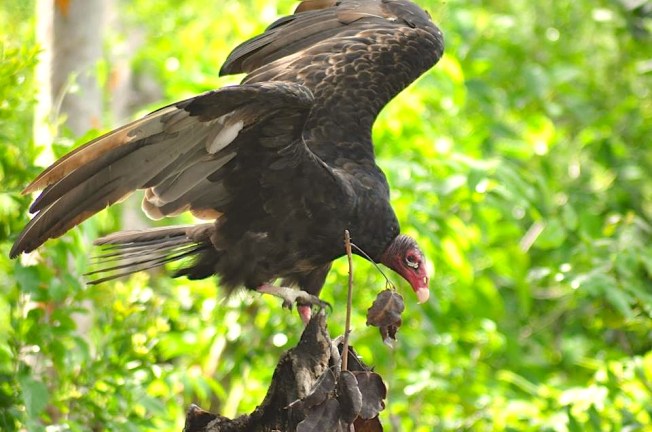
Lubbers Quarters is a Cay off the southern tip of Elbow Cay, and home to the excellent Cracker P’s restaurant. Also, home to Larry Towning, who takes terrific sunrise and sunset photos, among other subjects that include birds. He recently happened upon a Turkey Vulture sitting on a POISONWOOD stump (do not rush to try that – you may not sit down again for weeks). I like the immediacy of these. Most TUVU shots – by me, anyway – are (a) flying – usually coming out as silhouettes; or (b) atop a utility post with wires in the way, or (c) on the ground scavenging something revolting in the way of carrion. This bird is only dreaming about doing that.

“WARTS AND ALL…”Turkey Vulture, Lubbers Quarter, Abaco (Larry Towning)

The nostrils are not divided by a septum, but are perforated; from the side one can right see through (and as I have previously noted, some humans also suffer from MSS  – missing septum syndrome. They tend to sniff a lot)Turkey Vulture, Lubbers Quarter, Abaco (Larry Towning)

LUBBERS QUARTER CAY        Lubbers Quarters Map

NOT SAD… JUST THINKING ABOUT DEAD DECAYING THINGS TO EATTurkey Vulture, Lubbers Quarter, Abaco (Larry Towning)

To read much more about Turkey Vultures, find a bundle of interesting facts and learn about their sex lives and frankly disgusting habits with urine and vomit, check out ‘CARRION SCAVENGING‘.

Photo credit: Larry Towning; Tropicat (Poisonwood link)

Unknown's avatar

BAHAMA WOODSTARS: JEWELS IN ABACO’S CROWN


Bahama Woodstar Hummingbird, Abaco (Bruce Hallett)

BAHAMA WOODSTARS: JEWELS IN ABACO’S CROWN

Abaco is spoilt for birds. What other island in the word has its very own population of ground-nesting parrots? (Clue: none). How many others provide a secluded winter home for the rare Kirtland’s Warbler? Or a safe habitat for piping plovers – more than 300 individual birds recorded last year, nearly 4% of the total population? Or host 32 warbler species in the winter to supplement the 5 resident species? Or record a visit from a black-browed albatross? Or enjoy 4 out of 5 of the Bahamian endemic species (no longer the Bahama Oriole sadly, now confined to specific areas of Andros). 

Bahama Woodstar Hummingbird, Abaco (Bruce Hallett)

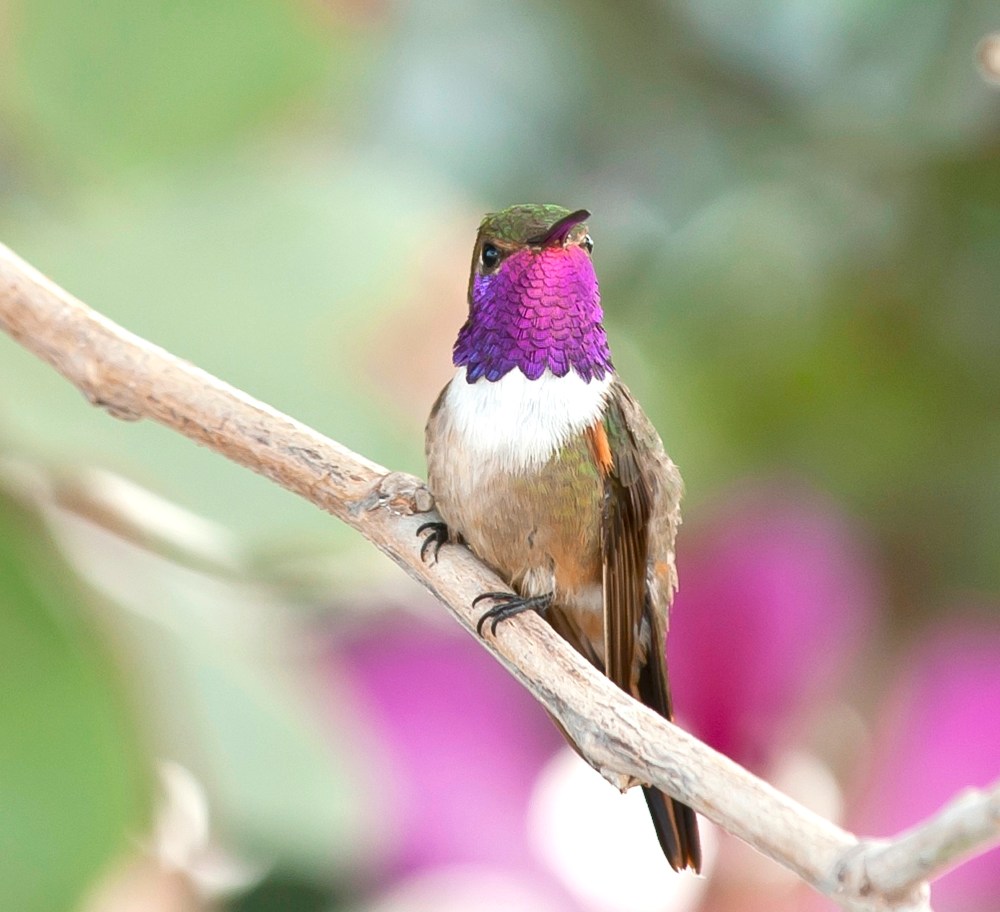
A while back I held a poll for Abaco’s favourite bird, with about 10 contenders. Some were quick to point out that their own personal favourite was not an option, but I had to take a fairly broad brush approach. On the podium, gold went to the Bahama Woodstar; silver to the parrot; and bronze to the western spindalis. I’m in a genial mood today, having caught a fair-sized wild brown trout on my third (part) day of stalking it (over 2 weeks), on the smallest fly in my box (size 18). I put it straight back of course. Respect! So in a spirit of cordiality, here are some epic shots of Abaco’s democratically elected favourite bird… at least according to the poll.

BIRD POLL FV2

The two images above were taken by the legendary Bruce Hallett, author of the go-to field guide for the Bahamas, which no birder should be without. Many of his wonderful photos  appear in THE BIRDS OF ABACO, and he was a steady guiding hand during the preparation of the book. 

This brilliant photo of a female woodstar was taken by Tara Lavallee of Bahama Palm Shores, and for composition, clarity, colour and sheer charm it was a must for inclusion in the book.

Bahama Woodstar, Abaco (Tara Lavallee)

Another major photographic contributor was Tom Sheley. I had the pleasure of spending time on Abaco with Tom during expeditions deep into backcountry to find and photograph birds. He had two cameras, one with a long lens. The other had a very long lens. The results he obtained – showcased in the book – were outstanding. His woodstar graces the front cover.

Bahama Woodstar male, Abaco, Bahamas (Tom Sheley)Bahama Woodstar male, Abaco, Bahamas (Tom Sheley)

Tom also took a delicate little study of a female woodstar feeding, one of my favourite photosBahama Woodstar female, Abaco, Bahamas (Tom Sheley)

Credits: Bruce Hallett, Tara Lavallee, Tom Sheley


Unknown's avatar

INDEPENDENCE DAY… FOR TINY FUZZY FLUFF BALLS


Piping Plover chick in the hand for banding (CWFNJ)

INDEPENDENCE DAY… FOR TINY PIPING FLUFF BALLS

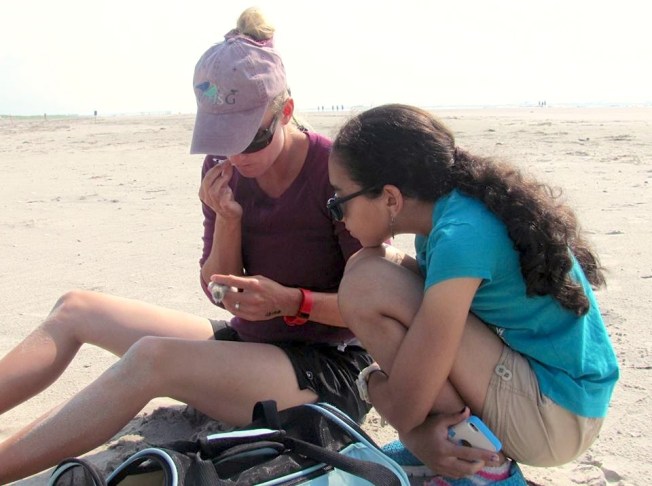
piping-ploverHappy July 4th to all those for whom the date has special significance (aside from it being plenty of people’s birthday). I’m celebrating the occasion by exercising my personal independence with a post that wrote itself. Mary Lenahan has done all the hard graft. Her photos and captions of a day in the field with her student Alex, in the company of CONSERVE WILDLIFE FOUNDATION NJ savants Todd Pover and Michelle Stantial merely needed to be arranged in traditional Rolling Harbour format, with a few additional comments.

    BIRDS IN THE HAND

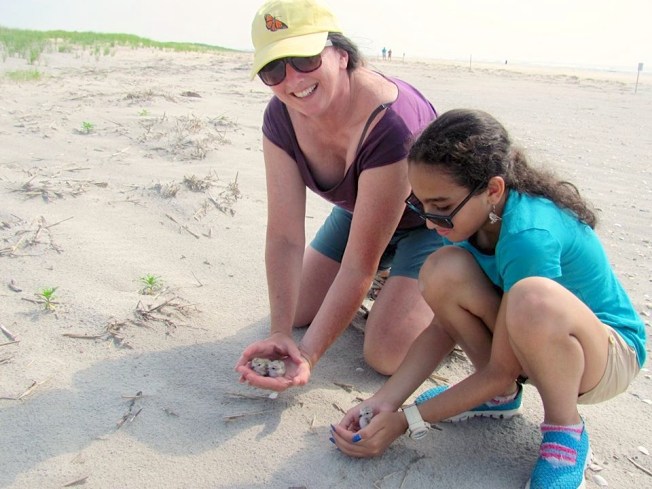
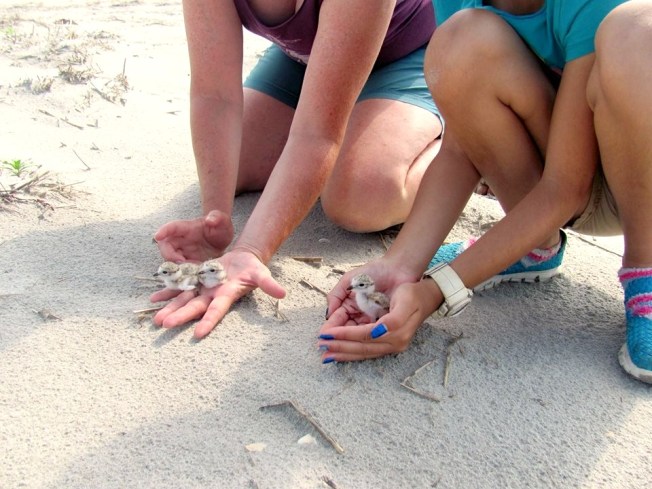
piping-plover“My student Alex and I were invited by Todd Pover (Conserve Wildlife of NJ Beach Nesting Bird Project Manager) to help out with some piping plover work in Avalon the other morning. We were lucky to observe the plover family from afar and close up as Michelle Stantial (Wildlife Biologist from SUNY College of Environmental Science and Forestry) and her technicians collected data on the week old plover chicks. What a thrill when we were able to release the fluffy chicks back to their parents in the Avalon dunes! Alex even took the time to help Todd take down a plover predator exclosure and to retrieve a balloon from the beach. What a fantastic and life changing experience for a budding scientist and her bird-nerd teacher. It is my hope that these endangered plovers overcome the many threats and obstacles they face and survive to migrate to their wintering grounds in the Bahamas”.

RH NOTE: 5 of the identified banded piping plovers that overwintered on Abaco were from NJ preserves. 2 of them (including the famous ‘Tuna’) were actually banded by Michelle herself last summer, with Emily Heiser.

Alex and Michelle Stantial discuss the bands on a piping plover chickPiping Plover chick in the hand for banding (CWFNJ)

Alex cradles a 1 week old chick before releasing him/her back to its parentsAlex and Michelle Stantial discuss the bands on the piping plover chick

Piping Plover chick in the hand for banding (CWFNJ)

Michelle Stantial places two fuzzy fluff balls into Mary’s hands for release!Piping Plover chick in the hand for banding (CWFNJ)

Fuzzy babiez!Piping Plover chick in the hand for banding (CWFNJ) Piping Plover chick in the hand for banding (CWFNJ)

Go find your parents! Piping Plover chick in the hand for banding (CWFNJ)

piping-ploverThese tiny birds, weighing a couple of grams maybe, were one week old. Already, they were nearing their own independence: still learning the arts of life from their parents, but fast becoming mini autonomous units too. To give you an idea how fast they develop, the first “fall” PIPL found on Abaco last year were spotted by Woody Bracey on July 31 on Green Turtle Cay mudflats – 6 birds in a group. Tuna, born in June, was first seen on Abaco in August, having undertaken a journey of well over 1000 miles.

ANSWERS the answers to the questions are as follows: ‘no’; ‘no’; and ‘not in the slightest’.

QUESTIONS the questions are: ‘don’t the parents reject a chick that has been handled during weighing, measuring and banding’?; ‘aren’t the chicks terrified and traumatised by the whole process’?; and ‘don’t the bands hamper their foraging / flying abilities or otherwise cause lifelong alarm and despondency’? 

The field work on the beach involves more than measuring and banding the chicks. Exclosures erected to exclude predators from the nest areas need to be regularly checked, and removed when the time is right (below)

Piping Plover nest exclosure, New Jersey (CWFNJ)

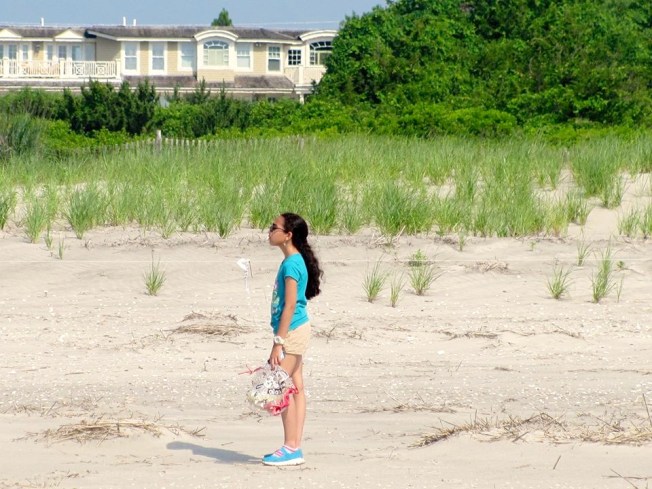
Alex finds a stray balloon very close to plover nest. BALLOONS BLOW and should never be released into the environment! This balloon could have been mistaken as food by a turtle or a whale, becoming trapped in the animal’s stomach, causing it to become very ill and die. The strings of balloons have been found tangled around the necks, bodies and legs of birds, causing pain, injury and death. Don’t release balloons or better yet, don’t buy them! Alex finds a deflated balloon on a plover beach

RELATED LINKS

ABACO PIPING PLOVER WATCH

CONSERVE WILDLIFE FOUNDATION NJ

BALLOONS BLOW

Many thanks to Mary Lenahan, Michelle Stantial, Todd Pover and of course Alex for being happy to share their experiences! And Birdorable for the little guys…

Unknown's avatar

BIRDS: BIG MOUTHFULS, VARIED DIETS & PLAYING WITH FOOD…


Anhinga eating fish (Phil Lanoue)

BIRDS: BIG MOUTHFULS, VARIED DIETS & PLAYING WITH FOOD…

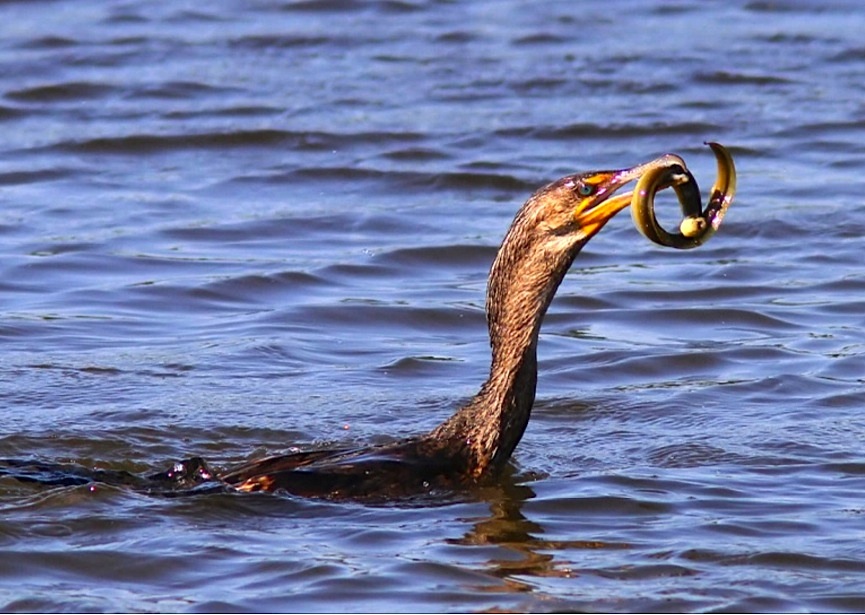
Anhingas are so-called ‘darters’. You won’t have seen one on Abaco. Or else, if you have, you’ve had a rare avian treat. These cormorant-like birds are far from unusual in Florida, all round the Gulf of Mexico, on Cuba and generally in the West Indies, and throughout the northern parts of South America. But somehow they have only very rarely bothered to wing their way across the relatively short expanse of water that separates their usual stamping ground in Florida and the northern Bahamas. I very rarely post about non-Abaco birds, unless for comparison. However, on the slender basis that one or two anhinga sightings have been made on Abaco since 1950 (they are classified as V5, i.e. vanishingly rare vagrants) , I am including PHIL LANOUE’S wonderful photo of one trying to get a gob-stoppingly large spiny fish down its throat. And making that an excuse to show more of his wonderful bird photos, including one of his renowned sequences.

BIG MOUTHFULS

By way of contrast to the anhinga above, this brown pelican has opened wide, but has disappointingly little to show for his huge gulp. Just a tiddler, and it really doesn’t look like it will manage to jump out of that capacious gullet…

Brown Pelican fishing (Phil Lanoue)

Here’s a better meal: a great egret has got hold of a massive shrimp. It won’t have any trouble getting it down…Great Egret eating fish (Phil Lanoue)

VARIED DIETS

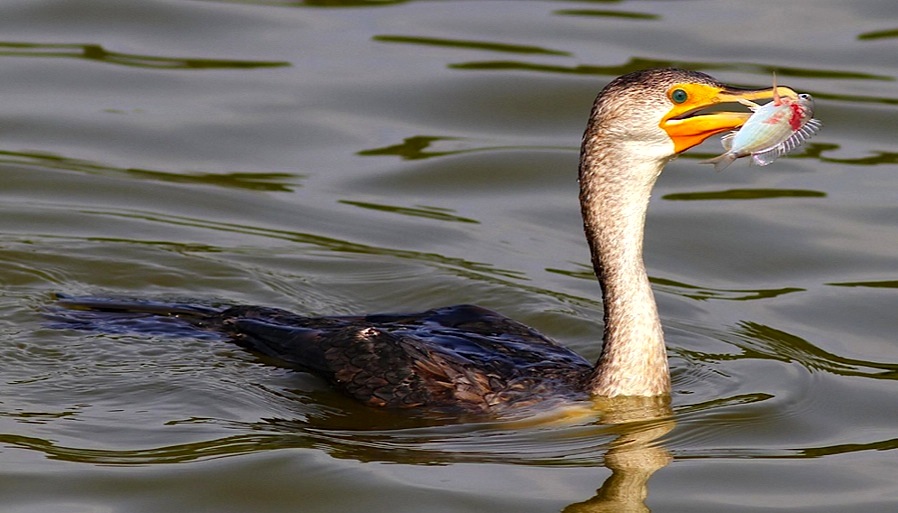
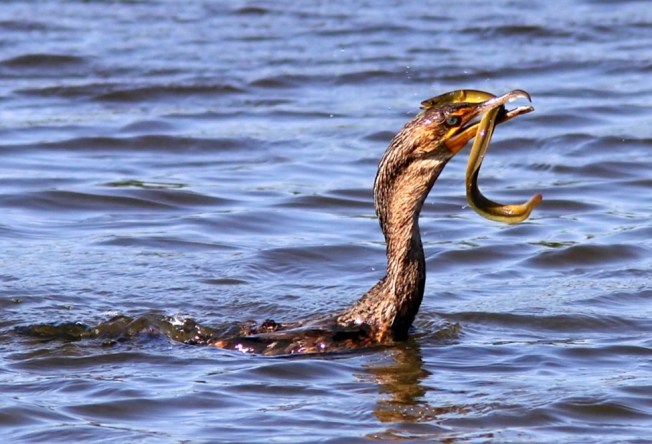
As the great egret above demonstrates, fish are not the only prey species for the ‘fish-eating’ birds. These cormorants are happily mixing up their diet.Cormorant - varied diet 1 (Phil Lanoue)Cormorant - varied diet 3 (Phil Lanoue)

I’ll take a side-order of salad with that…Cormorant feeding (Phil Lanoue)Cormorant - varied diet 5 (Phil Lanoue)

PLAYING WITH FOOD

Regrettably, the cormorant with the eel, above, decided to play with its food before eventually swallowing it. Here are three more images from Phil’s sequence of the Eel Meal.

Chucking my dinner around a bitCormorant - varied diet 4 (Phil Lanoue)

Wearing my food as a hatCormorant eating eel (Phil Lanoue)

My whole meal seems to have gone to my head…Cormorant - varied diet 6 (Phil Lanoue)

All phantastic photos by Phil. Check out his website https://phillanoue.com

Unknown's avatar

BANANAQUITS ON ABACO (GUEST PHOTOS)


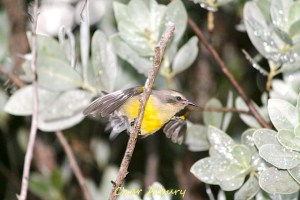
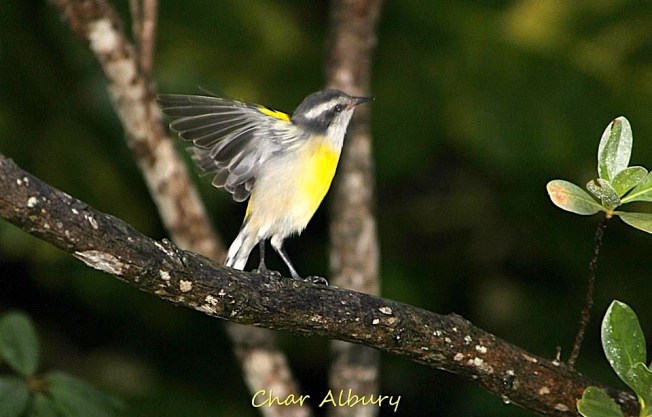
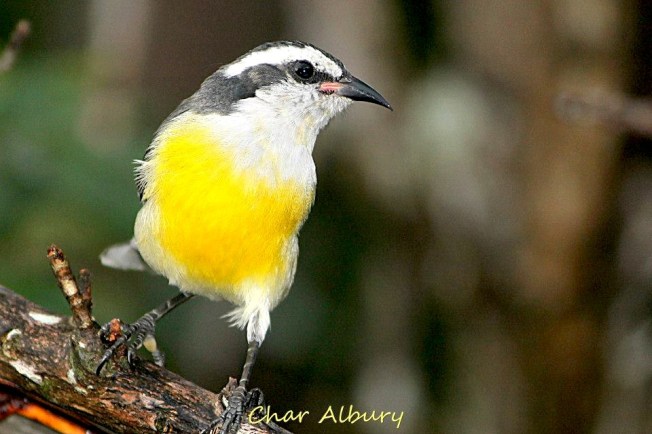
Bananaquit, Abaco (Char Albury)

BANANAQUITS ON ABACO (GUEST PHOTOS)

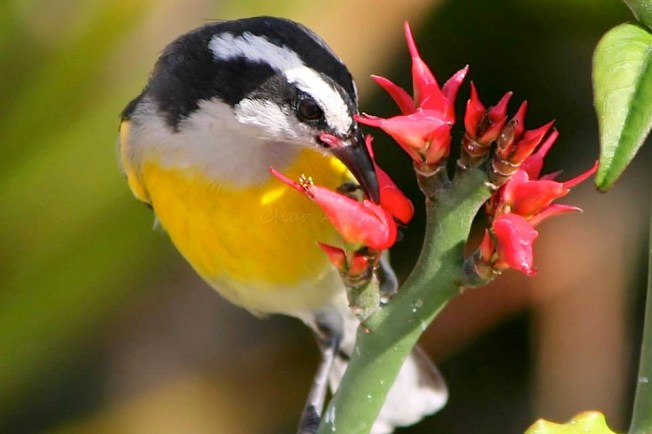
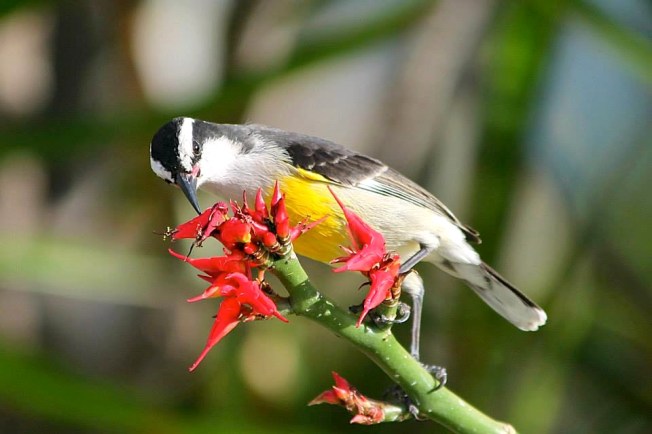
This is the best job in the world (#it’snotajob #it’sapastime #duh!yougetpaidinajob). I get to choose what to write about and what photos to use. And it’s all enjoyable, interesting, and totally new (to me) within the last 10 years. Bananaquits are another favourite small bird of mine. Charmaine Albury takes great Abaco wildlife photos – birds, butterflies, insects, shells and more – on Man-o-War Cay and beyond. It’s time to showcase some of her bananaquit photos. Let’s go!

Bananaquit, Abaco (Char Albury)Bananaquit, Abaco (Char Albury)Bananaquit, Abaco (Char Albury)

Juvenile bananaquits have their own totally adorbz qualities, as I have observed BEFORE.

Bananaquit juvenile, Abaco (Char Albury) Bananaquit juvenile, Abaco (Char Albury) Bananaquit juvenile, Abaco (Char Albury) Bananaquit juvenile, Abaco (Char Albury)

Bananaquit juvenile, Abaco (Char Albury)

As the juveniles grow, their colouring becomes stronger until eventually they are hardly distinguishable from their parentsBananaquit juvenile, Abaco (Char Albury)Bananaquit, Abaco (Char Albury)Bananaquit, Abaco (Char Albury)

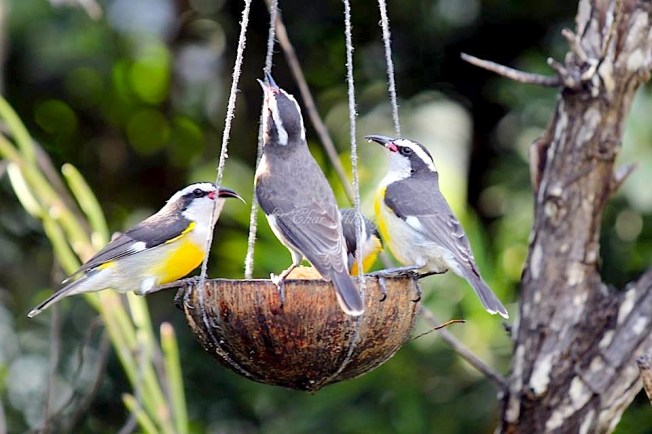
Bananaquits are readily attracted to gardens. They can used their sharp curved beaks to drink from hummingbird feeders. Or why not try Charmaine’s idea for a free-to-make bananaquit bar – look how successful it is!

Bananaquit, Abaco (Char Albury)

You’ll find several posts about bananaquits, none particularly recent. For an ‘in-house’ gallery of these bright little birds, click HERE

All photos Charmaine Albury, with thanks for use permission. You’ll notice that the images are watermarked or named, which is because Char’s images are available for sale. Let me know if you are interested in any of the photos featured here…

Unknown's avatar

CUBAN PEWEES AT THE NEEM FARM, ABACO


Cuban Pewee, Abbaco Neem Farm (Keith Salvesen) 5

CUBAN PEWEES AT THE NEEM FARM, ABACO

The Abaco Neem Farm just off the highway about 20 minutes south of The (one and only) Roundabout is about much more than the neem plants and the resultant products sold at the well-known shop in Marsh Harbour. The many varieties of fruit tree, the grasses and the wild flowers, the coppice, the pine forest, the open land and the pond that make up the extensive property provide a wonderful haven for birds, butterflies, moths and bees (there are hives too). It’s a great place for birding, and the owner Nick is rightly proud of the peaceful ambience of the farm. On a bright day, the place is alive with birdsong. 

Cuban Pewee, Abbaco Neem Farm (Keith Salvesen) 6

Among my favourite small birds found there are two species that are so tame and inquisitive that it is often possible to move slowly right up to them. The blue-gray gnatcatcher is one. The cuban pewee is another. This pewee was flitting about the edge of the coppice, hawking for insects and quite unconcerned by our presence. Sadly I only had ‘hated camera’ with me, having thrown ‘beloved camera’ into the sea a couple of days before, photographing shorebirds (and thence into the trash bin). So I’m not wholly pleased with the results, either for clarity or for colour. Needless to say, hated camera always has the last laugh…

Cuban Pewee, Abbaco Neem Farm (Keith Salvesen) 2

Identification of the various flycatcher species e.g. CUBAN PEWEE, LA SAGRA’S FLYCATCHER, LOGGERHEAD KINGBIRD and GRAY KINGBIRD can be tricky. The simplest way to distinguish the cuban pewee is to remember that it is a small bird (so, not a kingbird); and that its informal name is ‘crescent-eyed pewee’ due to the very noticeable white crescent behind the eye. And as Liann Key Kaighin reminds me in a comment, these little birds also answer to the name Tom Fool…

Cuban Pewee, Abbaco Neem Farm (Keith Salvesen)Cuban Pewee, Abbaco Neem Farm (Keith Salvesen) 3

A quick check of the sky for predators? Or maybe just for rain…Cuban Pewee, Abbaco Neem Farm (Keith Salvesen) 8

All photos: RH. Thanks to Nick Maoulis for his tolerance of people armed with cameras and binoculars.

PS I don’t go in much for beauty products (far far too late), but the Neem Salve is fantastic for minor injuries: cuts, grazes, bruises, small burns and so on. Well, it works for me.

Unknown's avatar

MUSCOVY DUCKS: THE MATING GAME…


Muscovy Duck, Abaco, Bahama (Gerlinde Taurer)

Muscovy Ducks, Gilpin Point, Abaco

MUSCOVY DUCKS: THE MATING GAME…

This is going to be a bit awkward for me. And for you. We are all going to have to be very adult about this. If you are sensitive about discussing… intimacies, then look away now. Because we are going to have to confront the facts with courage and fortitude. Ducks have sex. Oh, you didn’t quite catch that? They have Sex. SEX. SEX. Let’s call it something less.. well, I think mating is the correct word, although given the fact that the female suffers total submersion during the proceedings, ‘ducking’ would not be wholly out of place…

On Abaco, there are a number of muscovy ducks, all tame ones such as Perry Maillis’s at Gilpin Point shown in the Header image. They are not strictly an ‘official’ bird species of Abaco, but instead come into the classification “exotics”, in other words avian ‘also-rans’. This category also includes mallards, macaws and (for now) PEAFOWL – though I would fight to near-death to have these ranked as an established breeding introduced species (cf bobwhites), i.e. ‘proper’ Abaco birds. Many-time descendants of a few original tame birds, the population now is entirely feral and self-sustaining. 

Cairina_moschata_reproduction (Ianare Sevi wiki)

Muscovy ducks Cairina moschata turn out to be very interesting in the area of ‘Spring relationships’ (mallards and other ducks too, for that matter). A quick piece of research about them unearthed one unbeatable nugget of anatidaean anatomy: male muscovy ducks have spiralled penises which can become erect to 20 cm in one third of a second… Females have vaginas that spiral in the opposite direction to try to limit forced copulation by males, with ‘blind pouches’ if the female is unreceptive to advances…

So there you have it. Impressively rapid reactions from the male. And an equally clever response from the female. Something like this:

Male & Female Duck Corkscrewsimgres

NERVOUS DISPOSITION? STOP READING RIGHT NOW!

I once photographed the muscovy duck mating sequence (not on Abaco). Here are some images from the procedure. Until I looked at the images on my computer, I didn’t realise I had ‘caught’ (photo #2) the pink corkscrew in the process of inflation. So to speak. And with apologies for indelicacy.

SPRINGTIME. I THINK IT’S TIME TO FIND MYSELF… A LADY FRIEND

OH MY GOODNESS. THAT “1/3 OF A SECOND THING” IS STARTING TO HAPPEN…

QUICK! AHA! SHE LOOKS NICE. LET’S SEE HOW THINGS DEVELOP.

THAT SINKING FEELING…

THAT SUNKEN FEELING…

HEY! WHERE ON EARTH HAS SHE GOT TO?

OH! HELLO, DEAREST…

HOLD ON  AGAIN…. JUST A…. MOMENT…

YAY! I ENJOYED THAT

BLEURGHHHHHHH… ME TOO… I THINK?      

AH YES, ALL OK NOW. PLEASURE TO MEET YOU        

Credits: Header, Gelinde Taurer; Ianare Sevi; all other photos RH; infographic, scientist.com

Unknown's avatar

INTRODUCING ROSEATE SPOONBILLS TO ABACO?


Roseate Spoonbills 6 (Phil Lanoue) jpg

INTRODUCING ROSEATE SPOONBILLS TO ABACO?

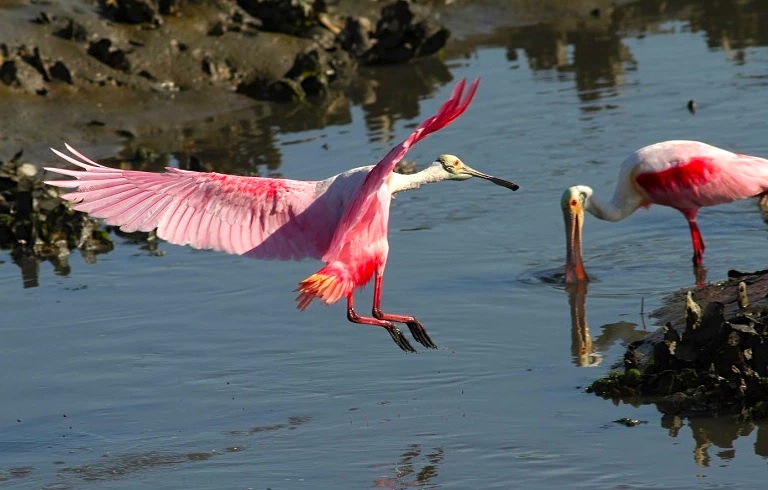
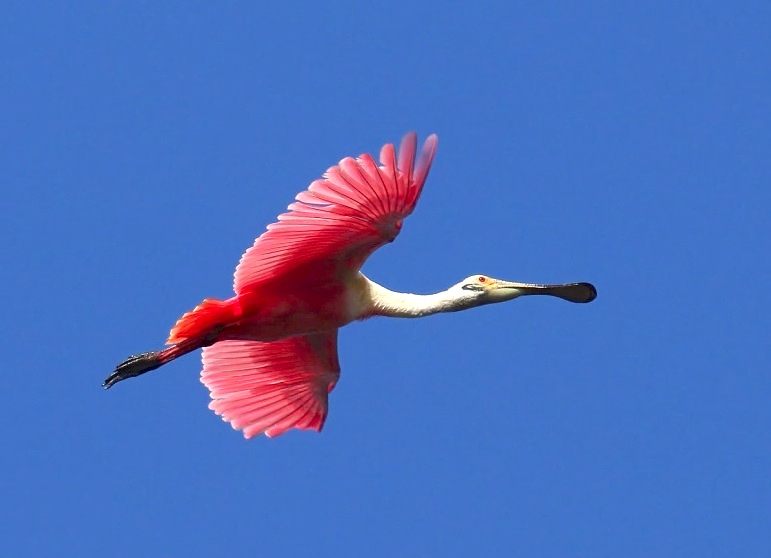
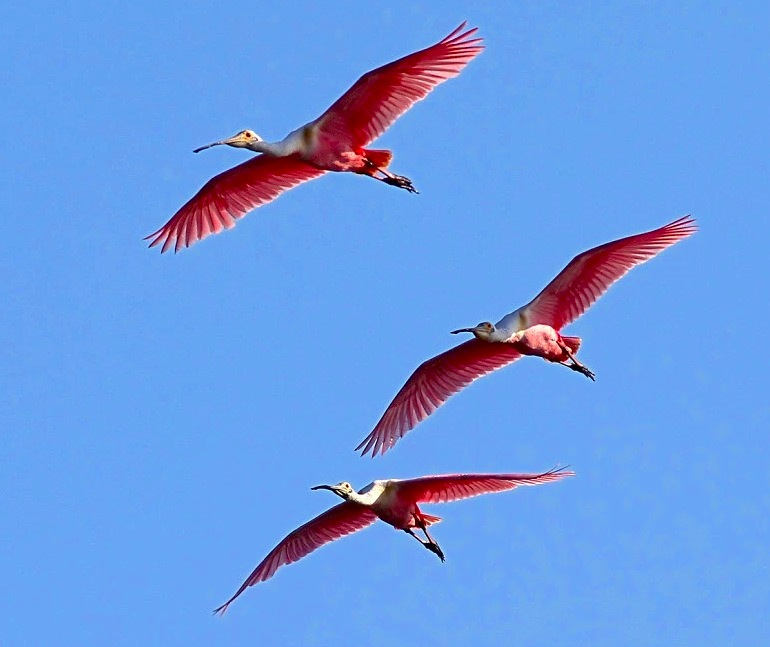
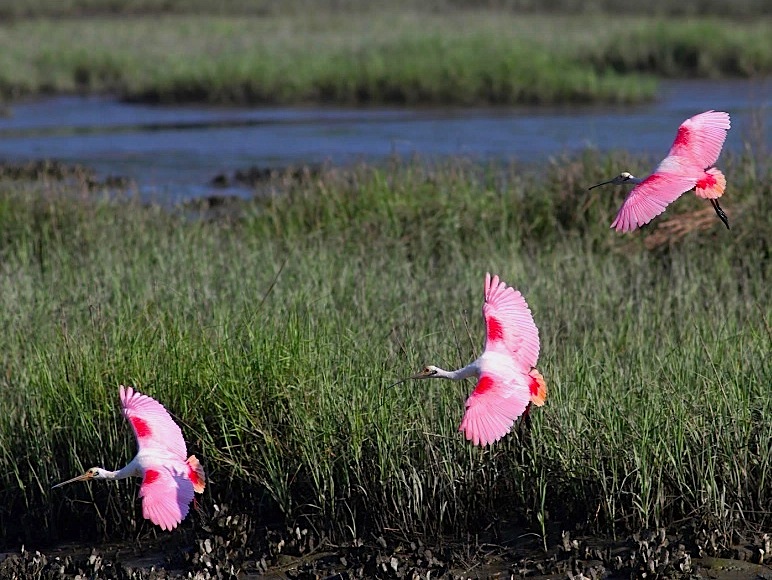
Roseate Spoonbills, this is Abaco. Abaco, meet Roseate Spoonbills. You guys should get on just fine together. What’s that, Abaco? You used to know the Roseate Spoonbills pretty well? Still see the occasional one? Like the one at GILPIN POND last autumn? Well then, Roseate Spoonbills, let’s re-introduce you as soon as possible. Just like the beautiful flamingos now absent from Abaco, you deserve to have a home there too…

Roseate Spoonbills 3 (Phil Lanoue) jpgRoseate Spoonbills 4 (Phil Lanoue) jpgRoseate Spoonbills 5 (Phil Lanoue) jpgRoseate Spoonbills 1 (Phil Lanoue) jpgRoseate Spoonbills 2 (Phil Lanoue) jpg

RELATED POSTS

SPOONBILLS AT GILPIN POINT

BAHAMAS SPOONBILLS

FLAMINGOS

All wonderful photos by PHIL LANOUE. Check out his website for astonishing image sequences of birds… and alligators (NOT just snaps…)

Unknown's avatar

*BIRDWATCHER ALERT* A BIG DAY FOR BIRDS EVERYWHERE!


Sanderling Trio, Delphi Beach, Abaco (Keith Salvesen) 5

Sanderling, Delphi Beach, Abaco

*BIRDWATCHER ALERT* A BIG DAY FOR BIRDS EVERYWHERE!

It’s here again – GBD, the second Global Big Day. A chance for anyone and everyone to participate in a worldwide celebration of birds at just the level you choose.

Global Big Day Flyer (Cornell Lab)

No need to try to cover 100 square miles in a day and record 300 species. Unless you want to, of course. You could as easily spend an hour or two in a garden. In a clearing in the coppice. Down a track in the pine forest. Sitting on the beach with a cooler full of beer. Whatever suits you. 

Western Spindalis, Delphi, AbacoWestern Spindalis, Delphi, Abaco (Keith Salvesen)

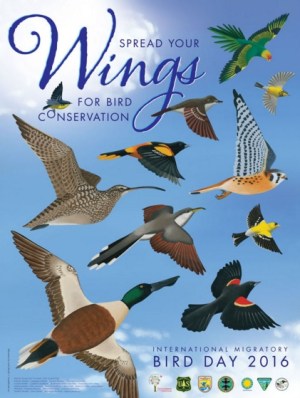
As the second Saturday in May, today also happens to be the official IMDB – International Migratory Bird Day – for the U.S. and Canada (the Caribbean is in October – reversed migration routes. Geddit?).

IMBD 2016 poster

However, this post is not primarily about that event, but rather an encouragement to people to join in with some easygoing birding today. And if you happened to want to do it tomorrow, that’s OK too! If you want to send me your checklist (iphone photo should be fine), please do. Or send 2 or 3 best photos, and I’ll post my favourites – though preferably rather than post to my FB page, email to rollingharbour.delphiATgmail.com .

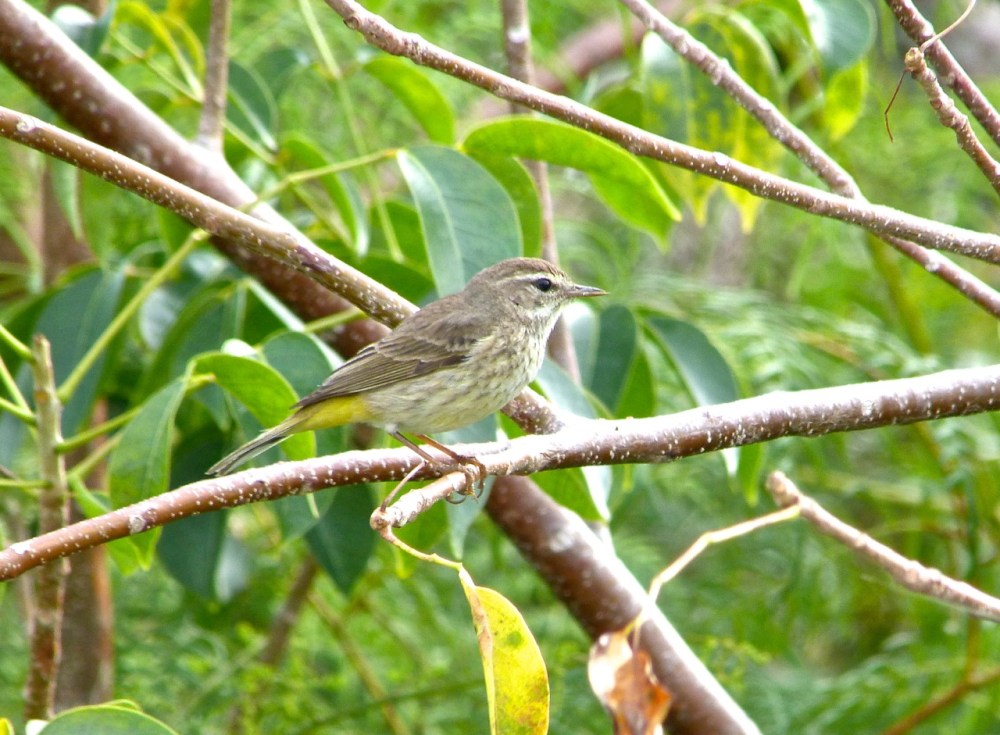
Palm Warbler, Delphi: a migratory warbler. Unlikely to be on Abaco – all hightailed north by nowPalm Warbler, Abaco 3 (Keith Salvesen)

Wherever you happen to be, just take a little time to look for some birds. There are plenty of places you can rule out straight away. Indoors for example. So it means being in the fresh air. And it’s probably best to set an hour or so as a minimum target time to spend on the task.

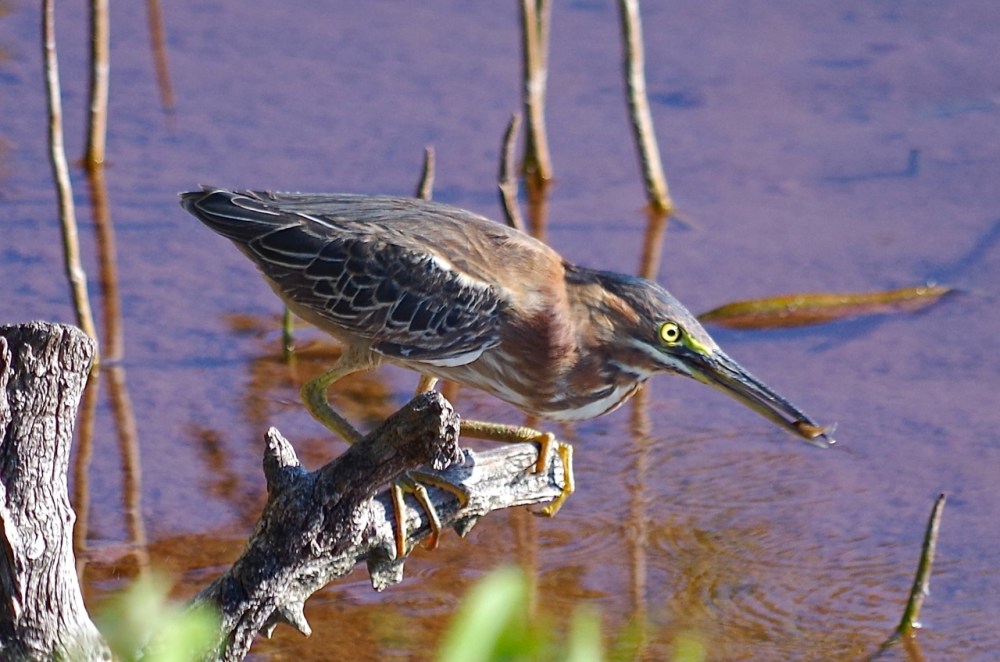
Green Heron hunting (successfully) – Gilpin Point pond, AbacoGreen Heron, Gilpin Point, Abaco (Keith Salvesen)05

WHAT DO I NEED?

Keep it simple. A pen that works. A spare pen just in case. A note book or even a large sheet of paper. Binoculars maybe. Camera if you are that way inclined. Sustenance. Maybe a friend for a joint effort. Possibly a bird book. If you have a North American one, it will help with most of the species you are likely to encounter. 

Antillean Bullfinch, Delphi, AbacoGreater Antillean Bullfinch, Abaco (Keith Salvesen)

In an ideal world you would then upload your checklist officially to eBird by May 17 so that your findings can be included in the global statistics. Or you could pass your record to a local birding group to upload for you. Or just have a bit of fun, why not, and see how many different birds you can find (even if you can’t put a name to them). Last year 268 Caribbean species were recorded. Imagine if one of yours was the only one of its kind to be seen?

Bananaquit, Delphi, AbacoBananaquit, Abaco 2 (Keith Salvesen)

WHY DO IT?

The stats gleaned from this initiative, and others like it (‘Shorebird Day’; ‘Warbler Day’ etc) are a good indicator of the state of health of the bird population both in general and by location. Perhaps an area previously having worrying low numbers for a particular species will show an encouraging upswing, indicating a successful breeding season and  / or effective habitat protection initiatives. Or maybe one species will show an unexpectedly low figure, indicating a need for research and the instigation of protection measures. 

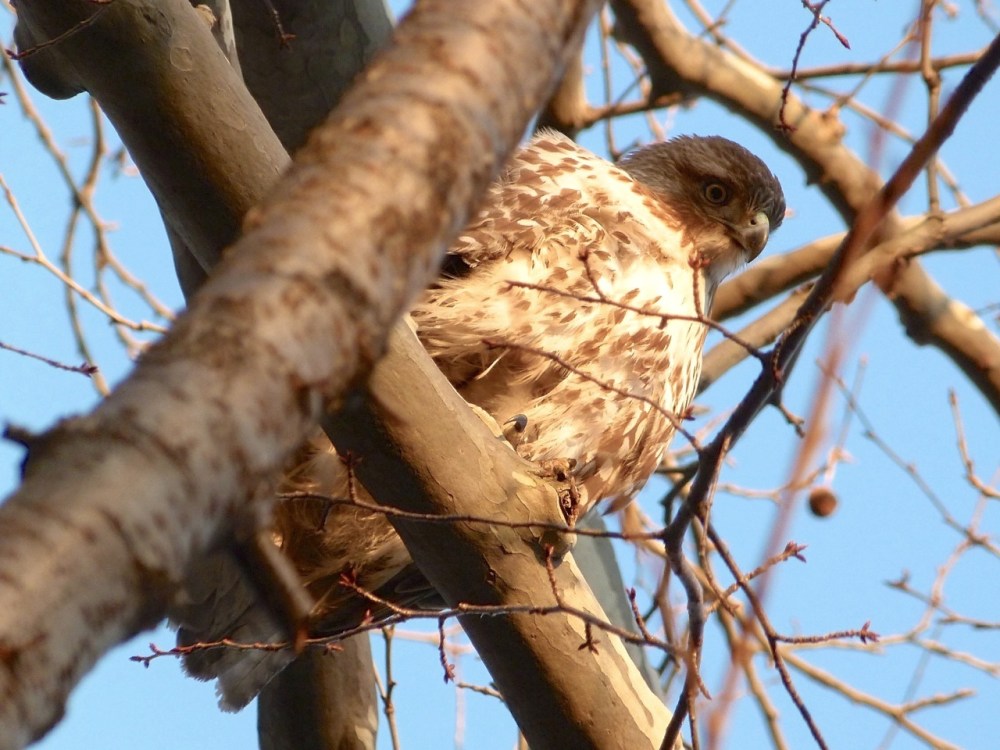
Red-tailed Hawk giving me ‘The Look’Red-tailed Hawk 2 NYC (Keith Salvesen)

So every return made for every region in the world is significant; and if you can add 20 species to the count, you will be adding to the vast fund of accumulated knowledge that in the long term helps to preserve the birds that surround us.

Let the count begin…

Royal Tern, The Marls, Abaco – taken while fishing. Camera + rod. Cool, huh?)Royal Terns Abaco (2) 2 (Keith Salvesen)

All photos: Keith Salvesen, taken on Abaco (ok, you got me there, not the red-tailed hawk, which is a cheat and was taken in Central Park NYC. Never got this close on Abaco. But I like it anyway)

Unknown's avatar

A GALLERY OF GORGEOUS: ABACO BIRDS ON DISPLAY


Abaco Parrot (Duncan Mullis)

A GALLERY OF GORGEOUS: ABACO BIRDS ON DISPLAY

Occasionally I feature birds photographed elsewhere than on Abaco – GRAND BAHAMA, for example. Almost always they are birds that are recorded for Abaco but are rarely encountered there (and even more rarely photographed). The ROSEATE SPOONBILL, for one. Or they may be birds that have come very close to Abaco but not quite reached the island… the WOOD STORK for example.

Today, I am showcasing some birds photographed on Abaco by Duncan Mullis during a trip from Grand Bahama. My selections from his trip are chosen to showcase colourful birds, endemic birds, and favourite birds of mine. Yours too, I hope. 

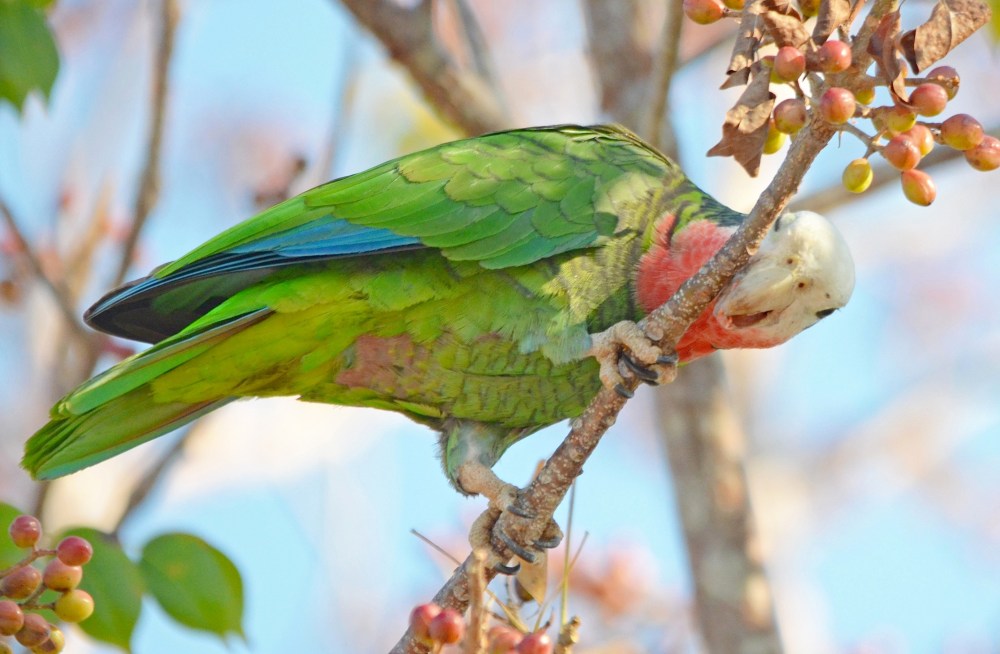
ABACO (CUBAN) PARROTSAbaco Parrot (Duncan Mullis)Abaco Parrot (Duncan Mullis)

Two of the species were new to Duncan. One was the Bahama Mockingbird.

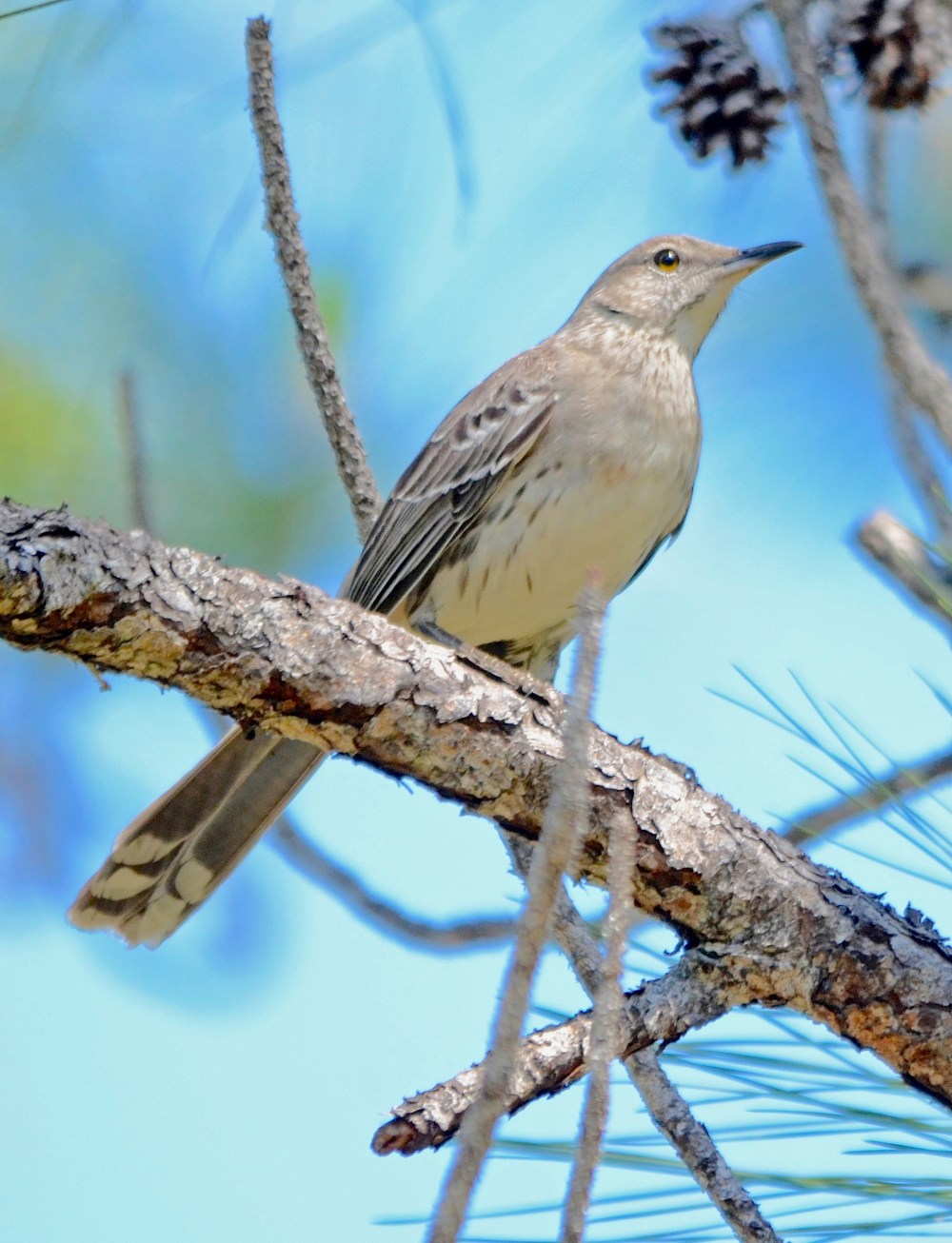
BAHAMA MOCKINGBIRDBahama Mockingbird, Abaco (Duncan Mullis)Bahama Mockingbird, Abaco (Duncan Mullis)

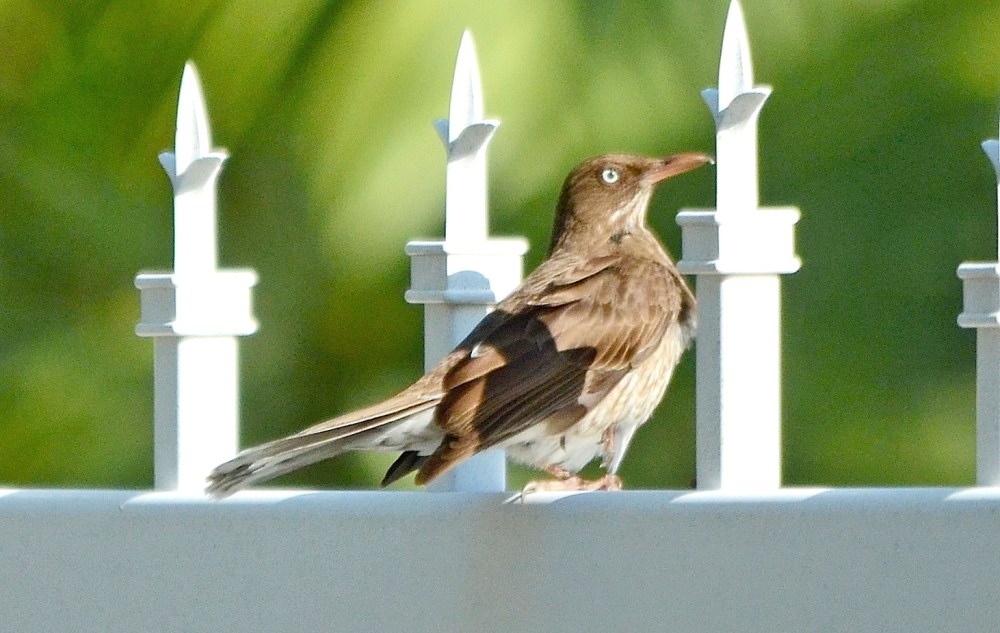
The other new species for Duncan was the PEARLY-EYED THRASHER. Until last March, this species had never been recorded on Abaco. Then one turned up in Treasure Cay and has stayed there ever since.  It is the latest of several ‘new species’ found on Abaco in the last couple of years. To read about the discovery by Woody Bracey click on the link above or below.

PEARLY-EYED THRASHERPearly-eyed Thrasher, Treasure Cay, Abaco (Duncan Mullis)

YELLOW-THROATED WARBLER Yellow-throated Warbler, Abaco (Duncan Mullis)

BAHAMA SWALLOW (ENDEMIC)Bahama Swallow, Abaco (endemic) (Duncan Mullis

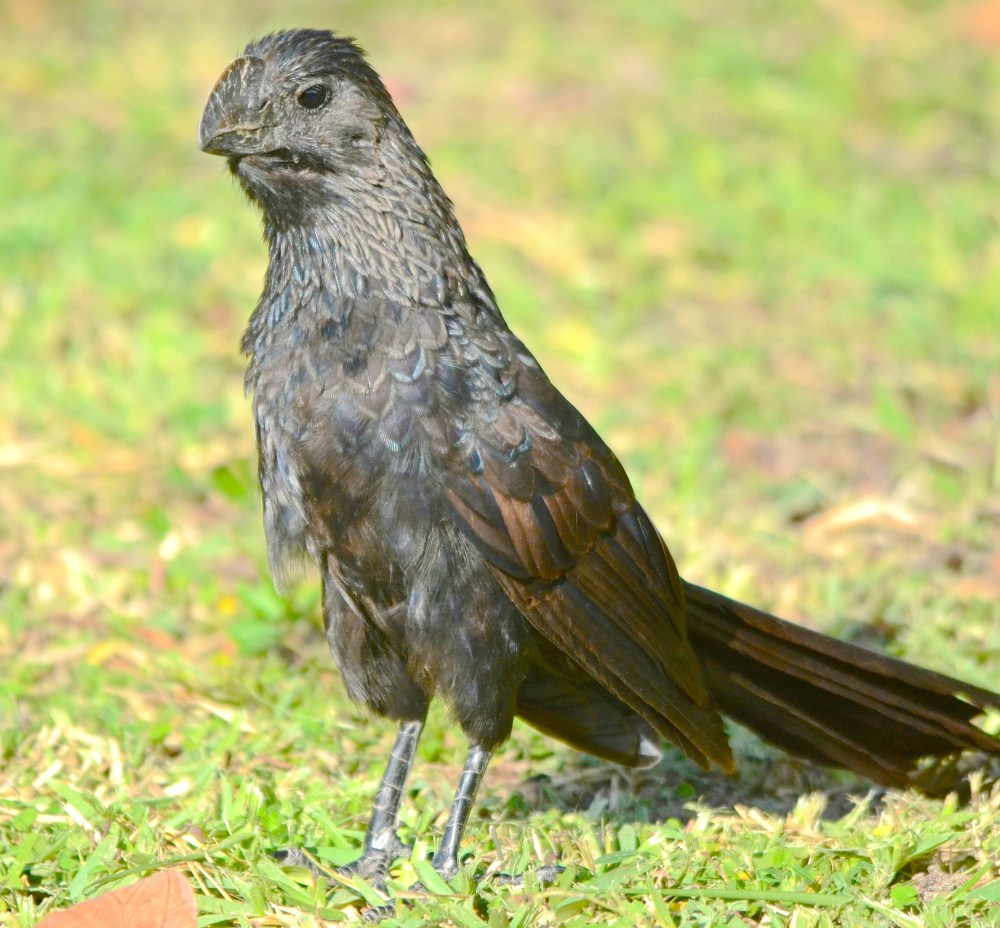
SMOOTH-BILLED ANISmooth-billed Ani, Treasure Cay, Abaco (Duncan Mullis)

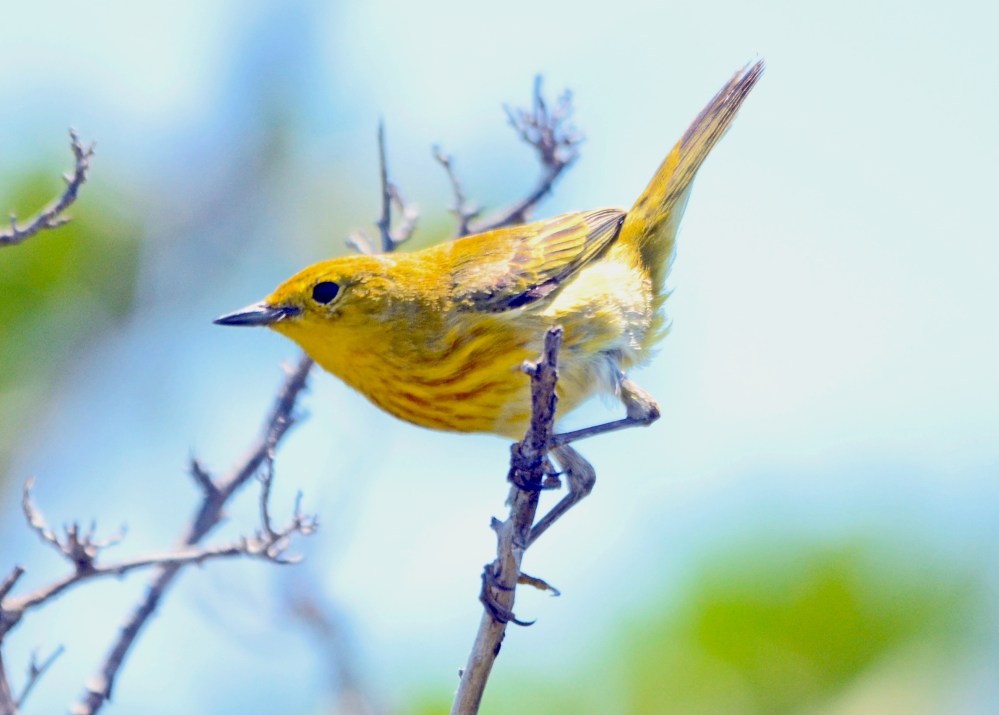
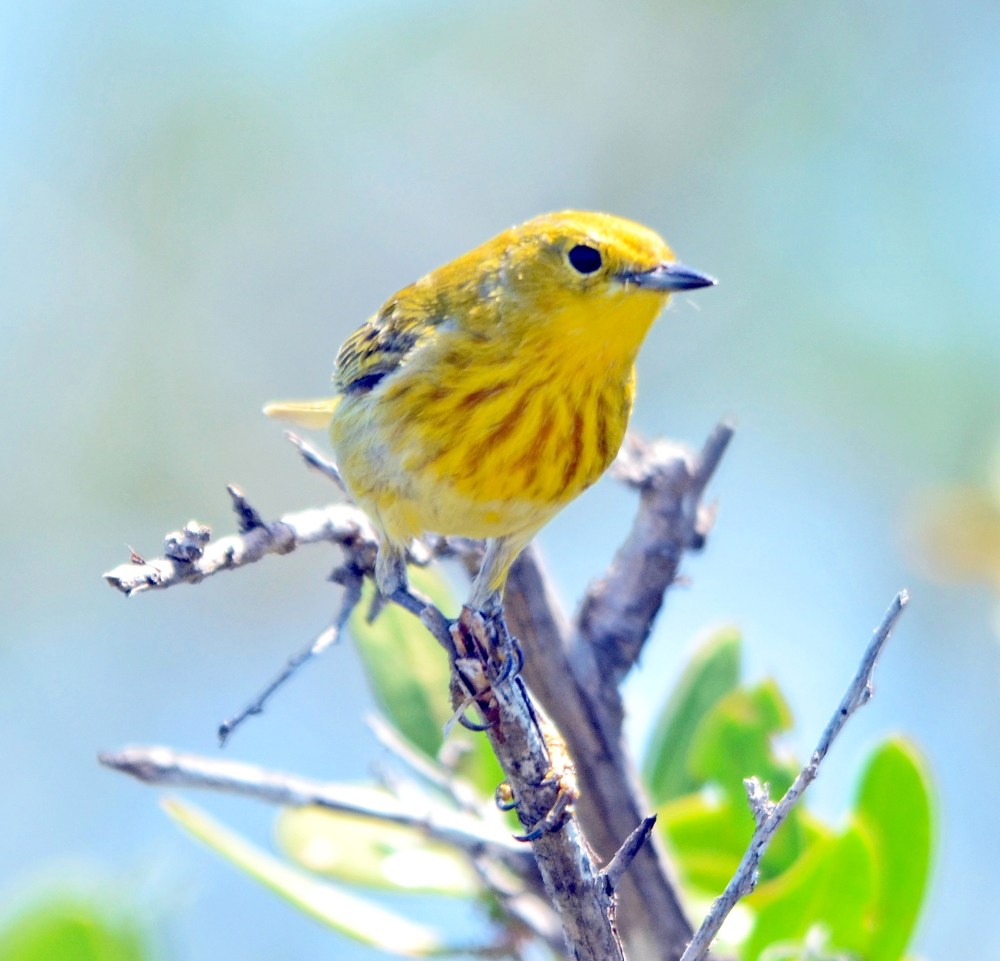
YELLOW WARBLERYellow Warbler, Abaco (Duncan Mullis)Yellow Warbler, Abaco (Duncan Mullis)

Credits: all photos by Duncan Mullis, with many thanks for use permission

Unknown's avatar

“AN OSTENTATION OF PEACOCKS”: FERAL BIRDS ON ABACO


Peahen, %22Different of Abaco%22 2 (Rhonda Pearce)

“AN OSTENTATION OF PEACOCKS”: FERAL BIRDS ON ABACO

A year or so ago I wrote a post entitled SOMETHING COMPLETELY “DIFFERENT (OF ABACO)”, a nod to Monty Python and to Nettica Symonette’s long-defunct fishing lodge on the road to Casuarina that it still proudly signposted on the Highway. You can click the link to see the full post and plenty of peacocks. Or, as I mentioned then, peafowl (only the males are peacocks; the females are peahens; and the little ones are peachicks).

Peacock, %22Different of Abaco%22 1 (Rhonda Pearce)

“Different of Abaco” is a great place for birding. An overgrown wilderness with brackish ponds and a *dangerous structure alert* dilapidated building, it was once home to Nettie’s flamingos, reintroduced by her in the hope of reinstating Abaco’s lost breeding population. The experiment did not come off, but another one did. The legacy of her introduction of a few peacocks is very evident today: they have bred very successfully and provide an exotic – and noisy – addition to the breeding bird species on Abaco.

Peacock, %22Different of Abaco%22 3 (Rhonda Pearce)

The evidence from reports suggests that the peafowl are spreading from their base at Different of Abaco and the local Casuarina area. Celia Rogers saw 2 males on the Cherokee road, some 3 or 4 miles to the north. And Rhonda Pearce has more recently found them at the entrance to Bahama Palm Shores, some way to the south (below).

 Peacock, Bahama Palm Shores Abaco 2 (Rhonda Pearce)    Peacock, Casuarina, Abaco 1 (Rhonda Pearce)

Extent of peafowl range from reported sightingsCasuarina, Abaco area map

As I wrote before, “In the wilderness that Different of Abaco has become for many years, the descendants of the original peacocks are breeding contentedly, expanding their population, and are wholly unreliant on human intervention. Verily feral, in fact”. If anyone has encountered peacocks elsewhere than in the DoA / Casuarina area, I’d love to hear about it. A photo would be a bonus!

Peacock, %22Different of Abaco%22 4 (Rhonda Pearce)

OPTIONAL FUN FACTS

The collective noun for peafowl is generally considered to be a “pride”, as with lions. But many bird species have been assigned more than one collective noun – and many of the more unusual ones are historic, dating back to medieval times, in particular The Boke of St Albans (1486) by a nun called Dame Juliana Berners, which included lists of collective nouns for ‘companys of beestys and fowlys’. These were known as ‘terms of venery’, and many related to falconry and hunting. She also wrote the presumed first fishing guide, A treatyse of fysshynge wyth an Angle (her catch records do not survive).

Anyway, apart from ‘pride’, peacocks are also collectively known as a ‘muster’; and far more descriptively as an ‘ostentation’.

D of A: the glory daysimg0049

Credits: All peafowl Rhonda Pearce; final image π “The Abacos” online

Unknown's avatar

“ONE OF A KIND”: LIMPKINS ON ABACO


Limpkin, Abaco (Tony Hepburn)

“ONE OF A KIND”: LIMPKINS ON ABACO

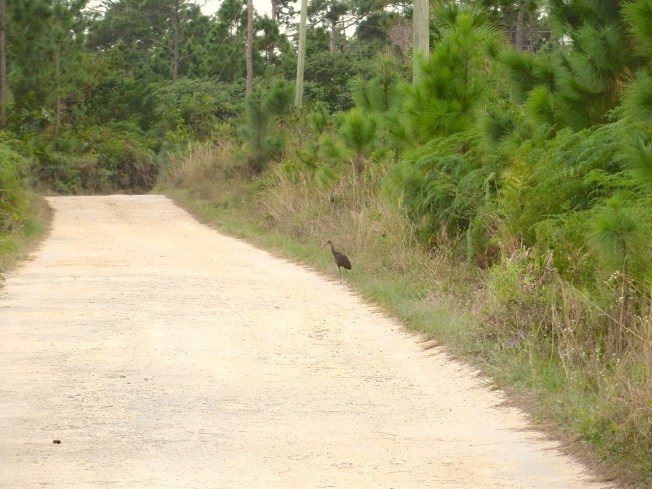
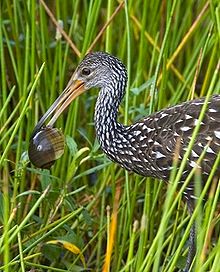
It’s 07.50 and we are trundling up the one-mile Delphi drive towards the highway in a truck towing the skiff for a day of fishing out on the Marls. We are ‘first boat out’, so the driveway has been peaceful for a while. Suddenly, some way ahead, a dark shape detaches itself from the margin of the coppice and steps into the roadway. Large. Dark brown. Kind of awkward looking. Long legs. Long decurved bill. And the bird I’ve been waiting to see for a long time. A limpkin.

My first sighting of one of the Delphi limpkinsLimpkin, Delphi, Abaco (RH) 1

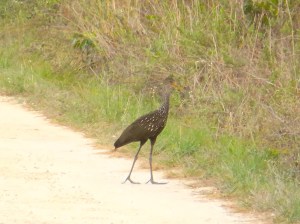
Grabbing the small point ‘n’ shoot I take fishing (far cheaper to drown than an iPh@ne), I leaned out of the open window and fired off some optimistic shoots at the bird, on full (yet feeble) zoom. For what they are worth**, here are a few – and will you look at the toes on the creature!

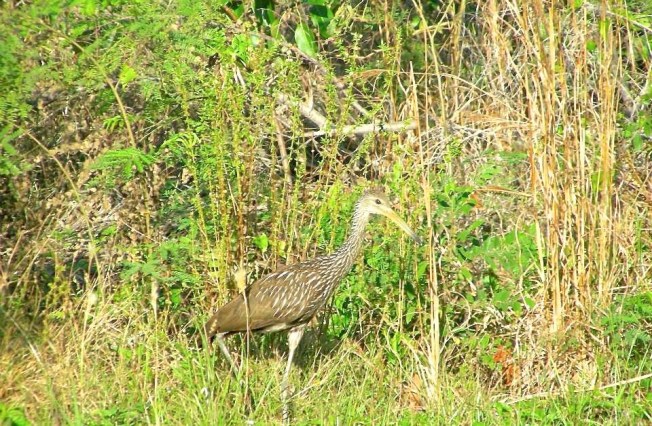
Limpkin, Delphi, Abaco (RH) 2  Limpkin, Delphi, Abaco (RH) 3Limpkin, Delphi, Abaco (RH) 4  Limpkin, Delphi, Abaco (RH) 6

Limpkins (Aramus guarauna) have lived near the top end of the Delphi drive for several seasons, but they and I have never coincided. I haven’t even heard their weird screaming call. The guides sometimes see them when they first arrive each day, but limpkins are very shy, unsociable birds that keep themselves to themselves. Unless you see them cross a track, you might never notice them. To make matters more difficult, they are mainly “nocturnally and crepuscular”, so they are not generally active during the day.

Limpkin at Gilpin PointLimpkin Gilpin Point, Abaco (Troy Mailis)

ONE OF A KIND

The limpkin is a species of long-billed, long-legged wading bird, and is unrelated to herons, cranes and rails despite appearances. In fact, it has the honour to be the sole member of its taxonomic family. They may be found near ponds, in mangroves, in dense coppice or on the edge of pinewoods. They move jerkily, with a flickering tail and, as with any ID-cooperative bird, to see one is to know one.

Juvenile limpkin220px-Limpkin_Juvenile

TEN LIMPID LIMPKIN FACTS TO ENTHRAL PUNTERS AT PETE’S PUB

  • The Limpkin has its own ‘monotypic’ family – a one-off species of bird
  • They eat snails and molluscs (also insects, worms & frogs), using their beaks to snatch them
  • They may leave piles of discarded shells in their favourite feeding sites
  • The birds are ungainly and awkward: “limpkin” probably derives from their limping gait
  • Males and females have the same plumage (males being slightly larger)
  • The beak acts like tweezers – slightly open and closing at the tip – for tweaking snails etc
  • Territory is defended aggressively, with ‘ritualized charging and wing-flapping’ at intruders
  • Sex lives: they are monogamous; or polyandrous (a male and more than one female. Tsk.)
  • They use ‘courtship feeding’ – males will catch and shell a snail and then feed it to a female
  • They are also known as the ‘Crying Bird’ for their bizarre shrieking call, as used in films (below)

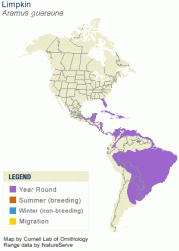
Range maparam_guar_AllAm_map

Olivia Patterson of Friends of the Environment kindly sent me this video that she posted on their FB page a while back with the comment: “Do you know what a limpkin sounds like? There are a pair of them which live around the FRIENDS office. Check out this video to hear them calling out for each other. See if you can spot the limpkin! (hint… look at the pine tree on the left). Limpkins typically live near wetlands and eat snails”.

Limpkins call mainly at dusk in the night, or at dawn. The frankly somewhat tedious and repetitive cry has been phonetically rendered as “kwEEEeeer orklAAAar“, if that helps you to remember it! The racket has even achieved fame in films: it has been used for jungle sound effects in Tarzan films; and more recently for the HIPPOGRIFF in the film Harry Potter and the Prisoner of Azkaban.

Favourite food – the apple snail220px-Limpkin-snail2

** I’m not ashamed to use my more pathetic photos when context permits…

Credits: Header, Tony Hepburn; 5 rubbish photos from a moving truck, RH; Gilpin Point, Troy Maillis; 3 other images wiki (uncredited); range map, Cornell; video, Olivia Patterson / FOTE; general long-billed rootling around for info, with a nod to wiki.

A good wing-shake

Unknown's avatar

LAUGHING GULLS ON ABACO: NOT SHARING THE JOKE?


Laughing Gulls, Sandy Point, Abaco (Keith Salvesen)

LAUGHING GULLS ON ABACO: NOT SHARING THE JOKE?

Sandy Point always promises well for birding. There are plenty of ‘good’ birds to see there, depending on the time of year: tropicbirds, frigatebirds, ospreys, brown pelicans, white ibis, cattle egrets, other egrets and herons, kestrels, and a variety of shorebirds. And gulls. We encountered a pair of Laughing Gulls perched on a piling. 
To begin with they were laughing merrily. Then they quietened down. Maybe one of them told a somewhat off-colour joke. In the sequence of photos below, you can see the left hand gull tensing and preparing to fly. Then it does – leaving his buddy all alone to contemplate the consequences of causing a sense of humour failure…
Laughing Gulls, Sandy Point, Abaco (Keith Salvesen)Laughing Gulls, Sandy Point, Abaco (Keith Salvesen)Laughing Gulls, Sandy Point, Abaco (Keith Salvesen)

This is the sound of a pair of laughing gulls on the Marls objecting as we slowly poled through the mangroves towards them. Not laughing, but complaining…

Photos and movie clip: RH