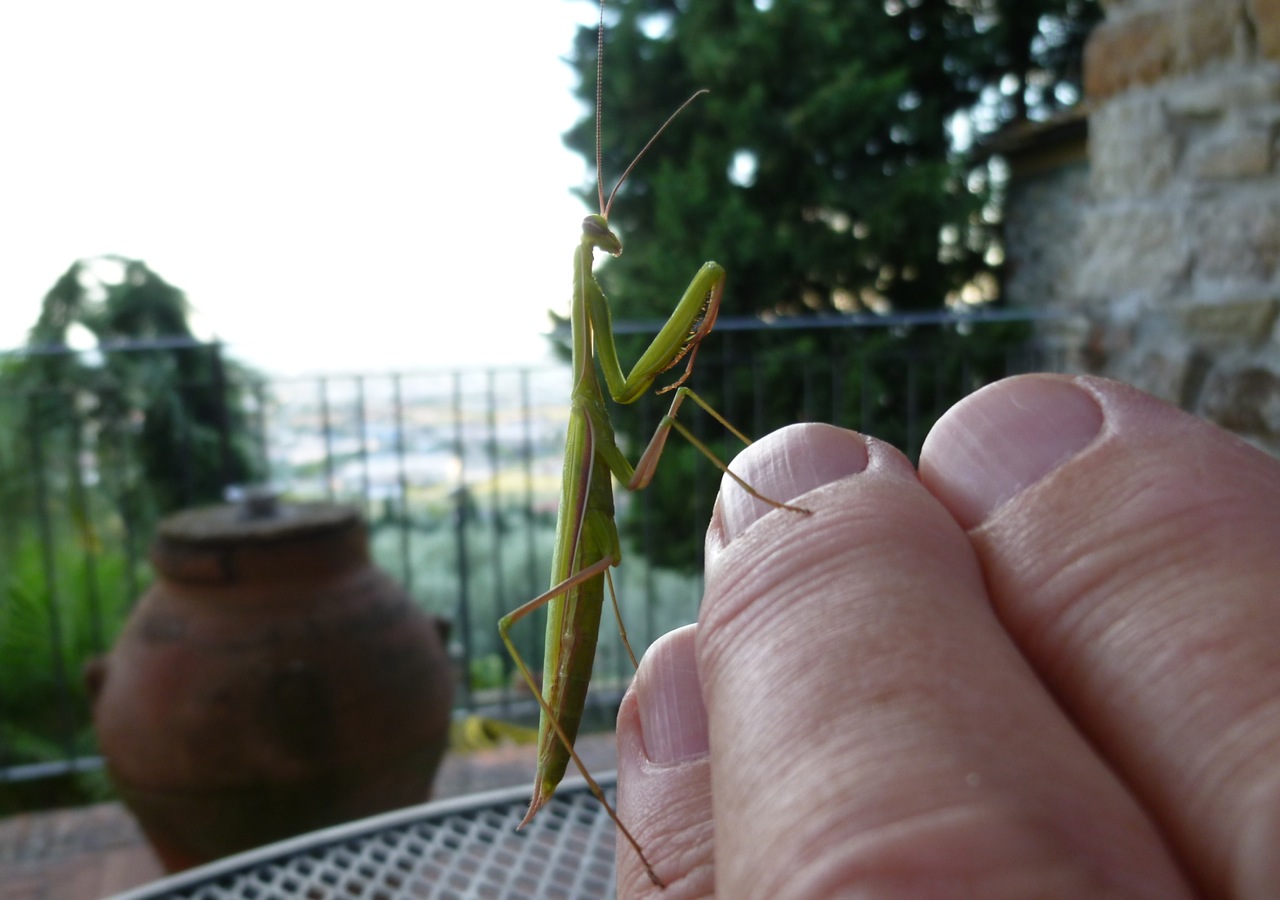
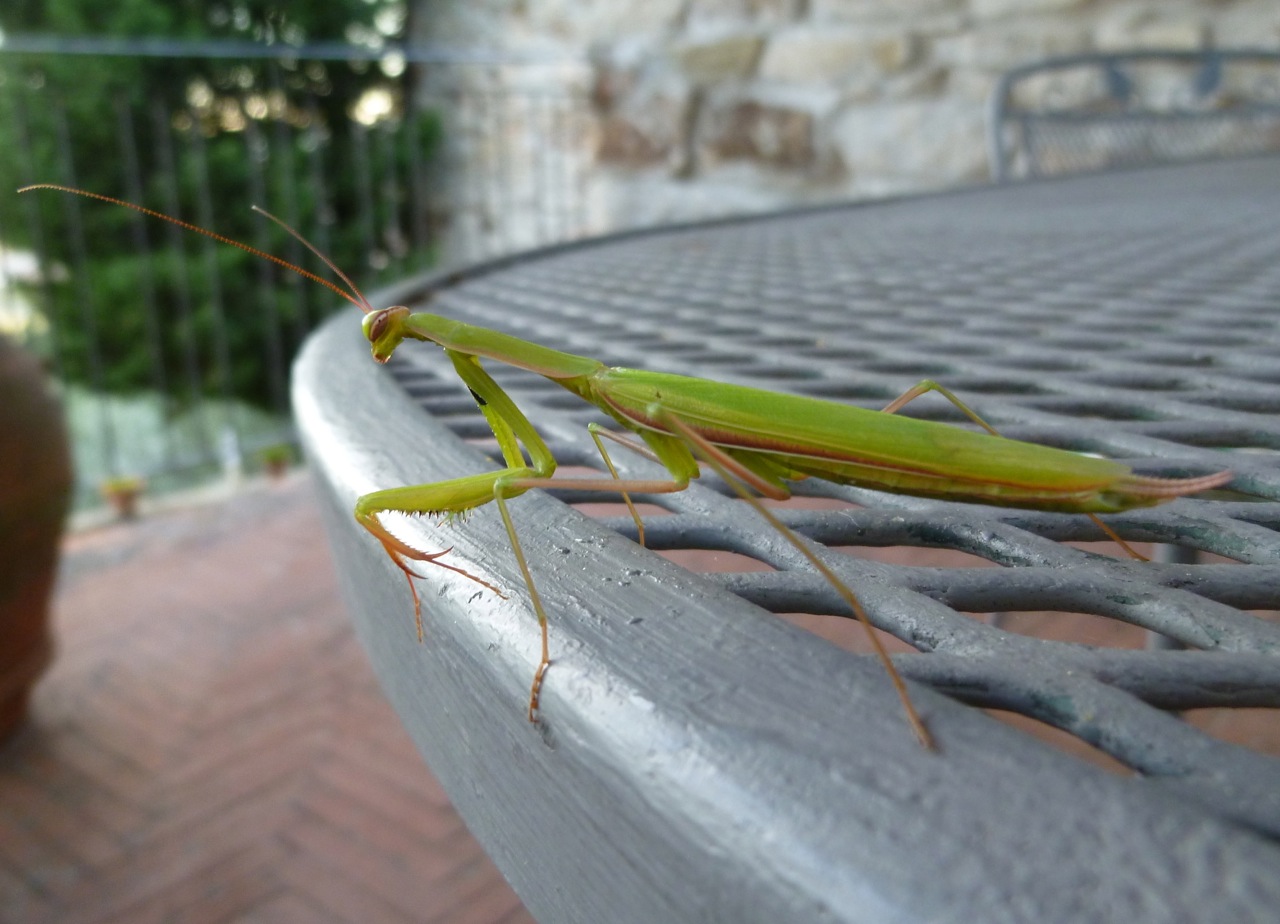
About a year ago, Sandy Walker encountered a praying mantis at the Delphi Club. For technical reasons his photo(s) of it didn’t work out. Undaunted (and because I’d never seen one outside an insectarium) I turned an essentially non-event into a short post SANDY’S PRAYING MANTIS, in the course of which I learnt a bit about these strange creatures. There isn’t a great deal of compelling information to pass on, to be honest. And I still don’t buy their supposed resemblance (for the sober observer) to Eleuthera.
We saw no mantises this summer on Abaco, and I forgot about them completely until a week ago… And there, nonchalantly strolling across an outdoor table where we were staying for a few days in Italy, was the very creature. It obligingly posed for some prayerful snaps, then I put it gently on a balcony railing where it clung upside down and apparently content overnight. It was still there at breakfast, gone by lunchtime, and we never saw it again. But the images live on…*
* Please note that the fingerprints in photo 1 are copyright…
Well, it’s a shame that in my homespun way I had to press ‘Publish’ when I meant to press ‘Preview’. I just wanted to check if these stills from a video of a massive storm over the Delphi Club at 3.00 a.m. one June night might be worth putting up. This item was for ‘in due course’ and not for now. I’d just decided that they aren’t really worth it, when I realised what I had done. So I may as well go ahead with it… Apologies to all those who are signed up and have got an email just saying “STORM”. I’ll have a word with the management.
Now that this gallery is out there, I should add this storm raged and rumbled for much of the night, with some spectacular rain, lightning and thunder – standing on a balcony watching it was quite an experience. At times the whole bay was momentarily as bright as day. Even brighter. Anyway, here’s the ‘before, during and after’ of a fork lightning bolt. I can’t make out if it’s true that lightning starts at the bottom, but I think it may be sky and earth near-instantaneously.
An informative ‘basic primer’ about lightning can be found at the National Severe Storms Laboratory (part of NOAA)CLICK===>>NSSL/NOAA
SEA URCHINS & SEA BISCUITS – BEACHCOMBING TREASURES ON ABACO
It’s time we had some more shells and other beach treasures on these pages. In the absence of star Abaco beachcomber and blog-contributor KASIA I have taken a closer look at the Delphi Club collection. This has been casually accumulated by the Club, its members and guests during the past 3 years whenever a good specimen has been encountered, and is displayed in the Great Room. The first items to catch my eye were the ECHINODERMS, a family that includes sea urchins, sand dollars, sea biscuits and star fish. Their sun-bleached tests are often found, though in my limited experience the larger they are, the rarer. The link above is to the Wiki-blurb, which has the unpromisingly daunting heading “This article may be too technical for most readers to understand…”. Now there’s a challenge!
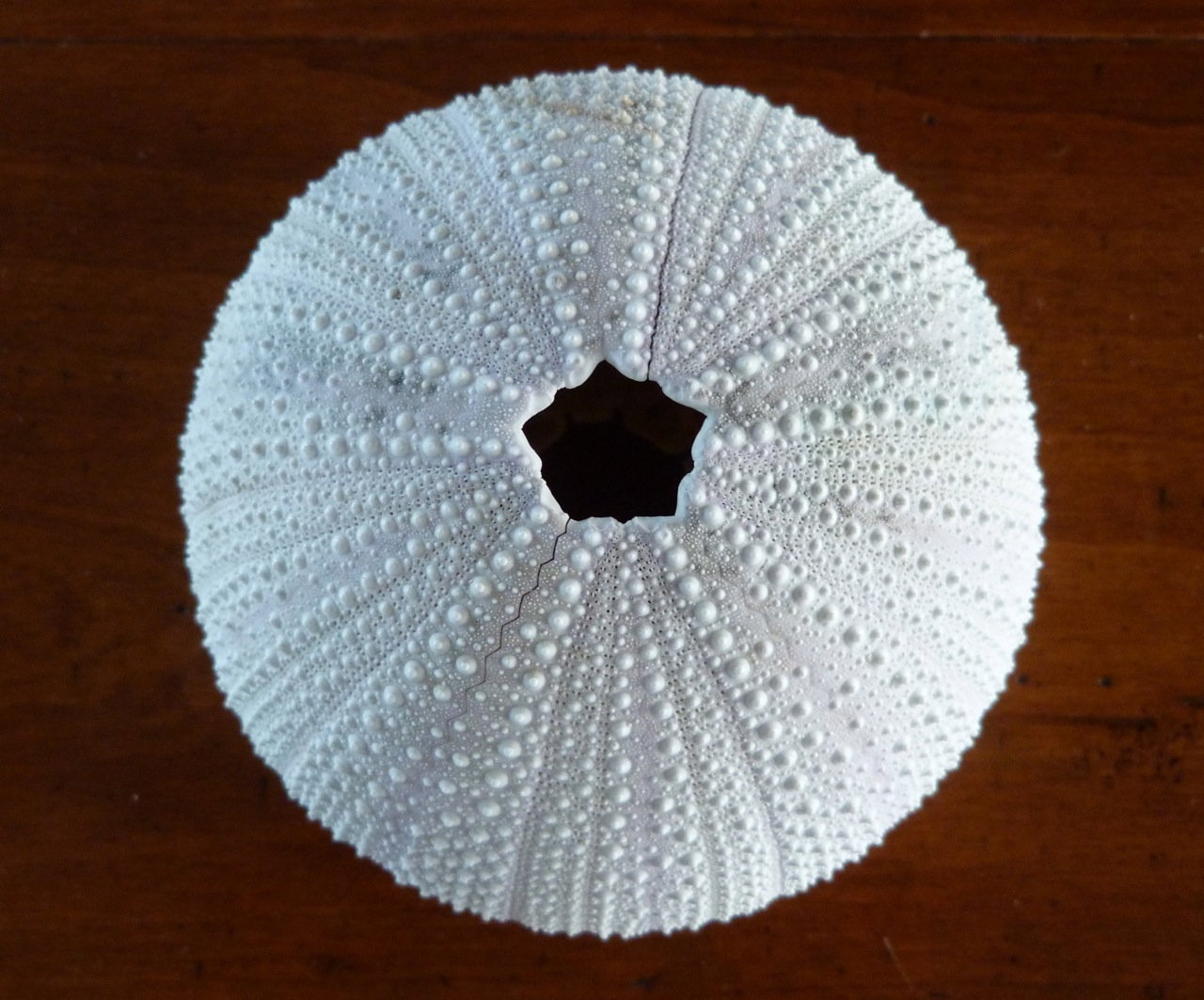
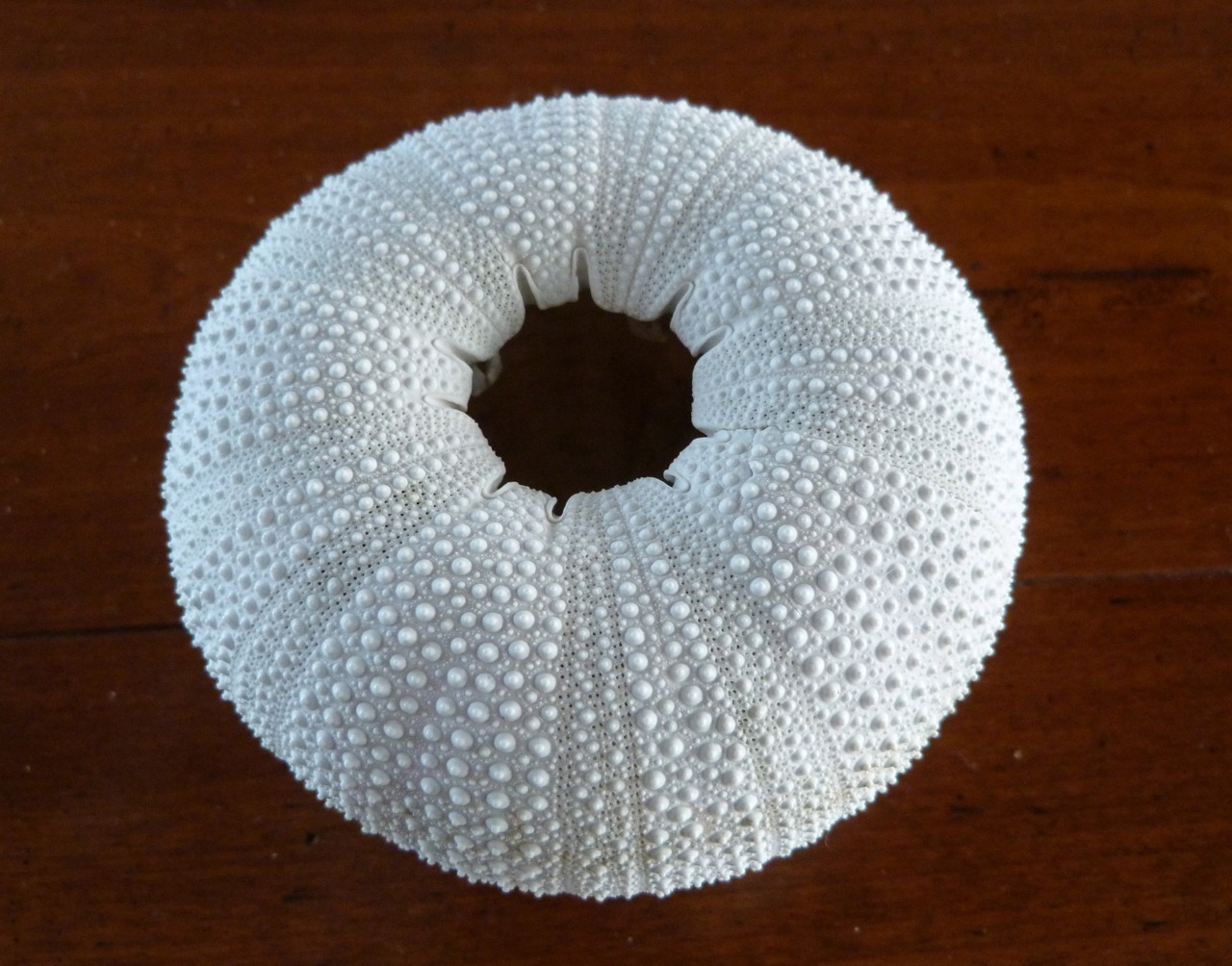
First up is a very large SEA URCHIN, a thing of great delicacy and fragility that weighs next to nothing. I have never seen a bigger one. Looking at the fine detail, it is hard to believe that such perfection of symmetry and intricacy can exist in a creature so very painful to tread on.
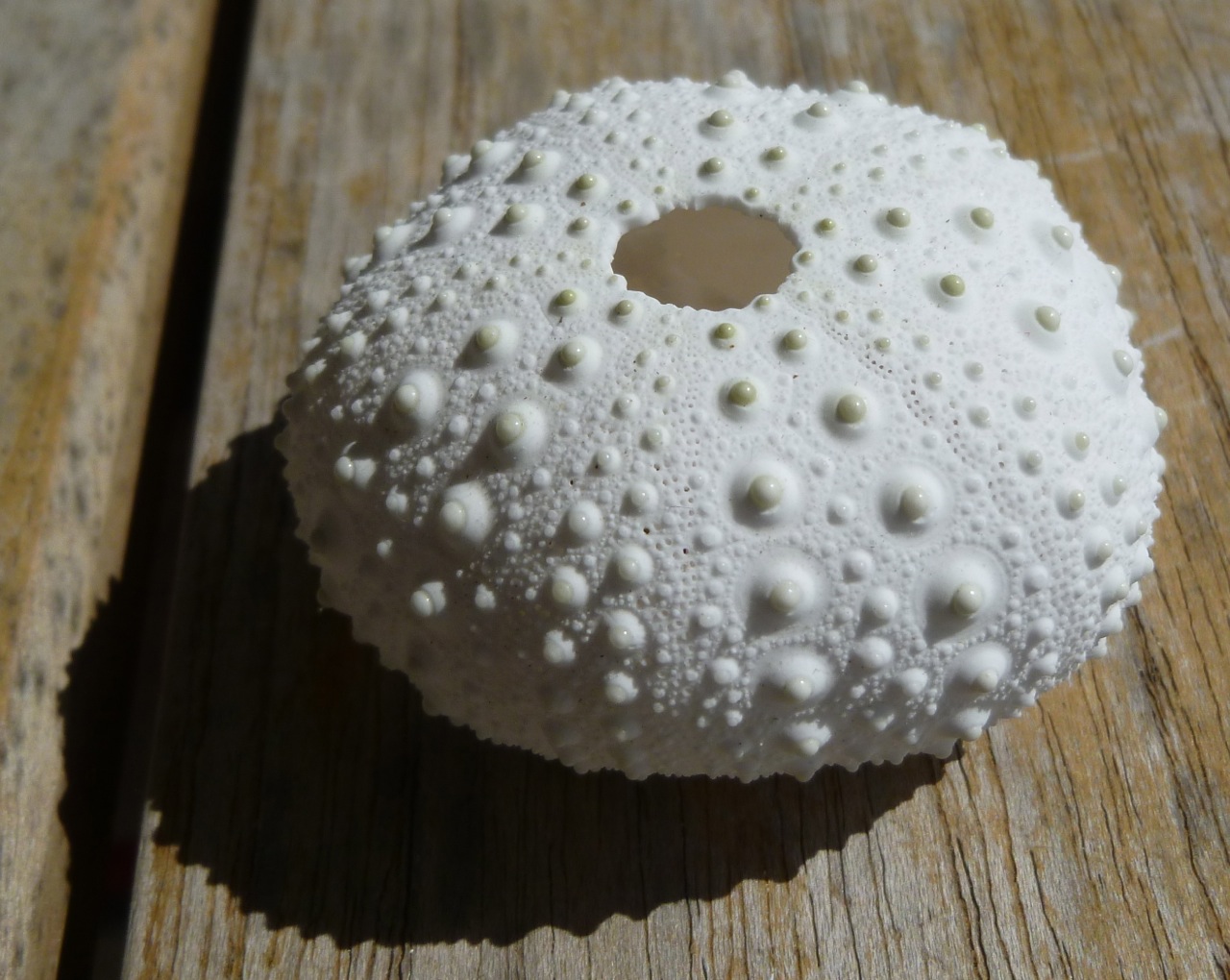
This SEA URCHIN is smaller, with more prominent nodules and a much more random pattern – reminiscent of a cartoon of some distant white planet. It has cast a fine knobbly shadow.
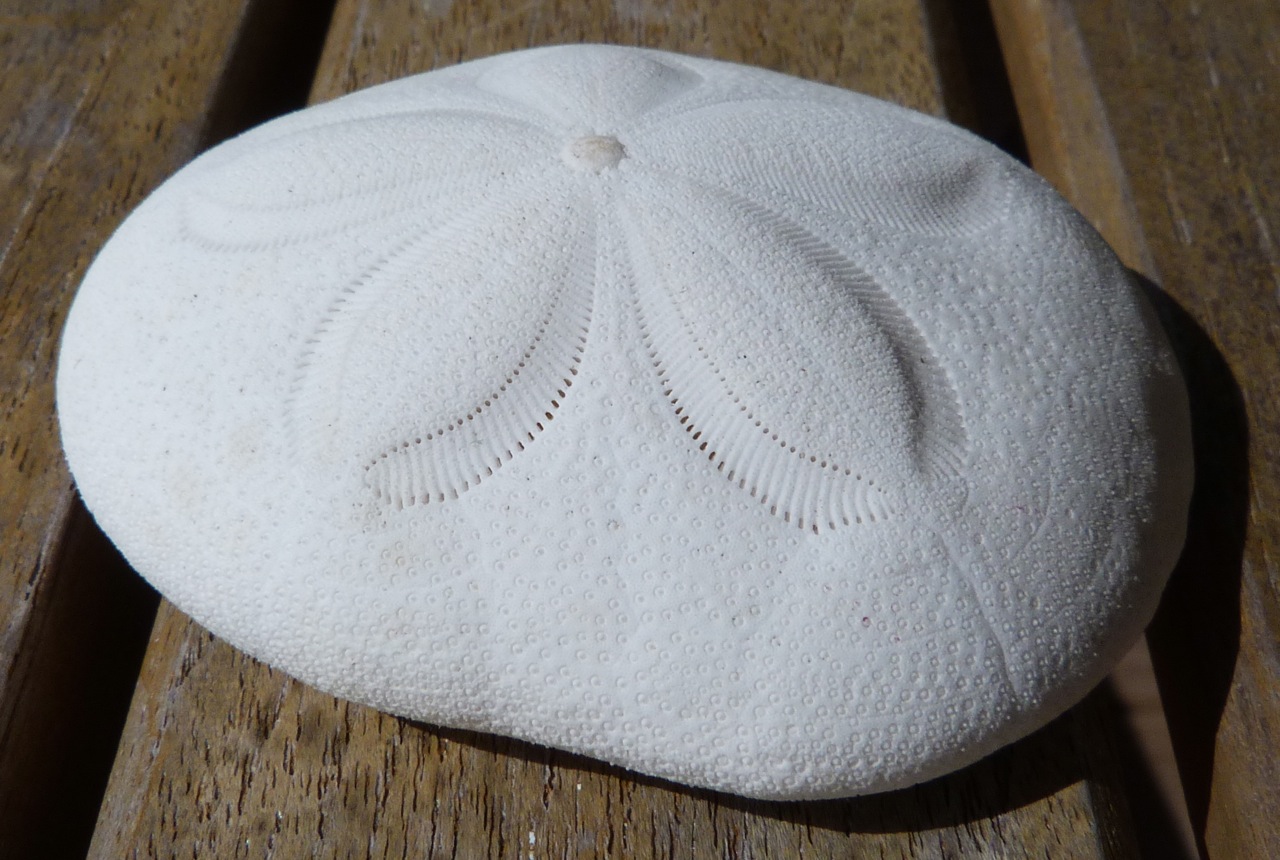
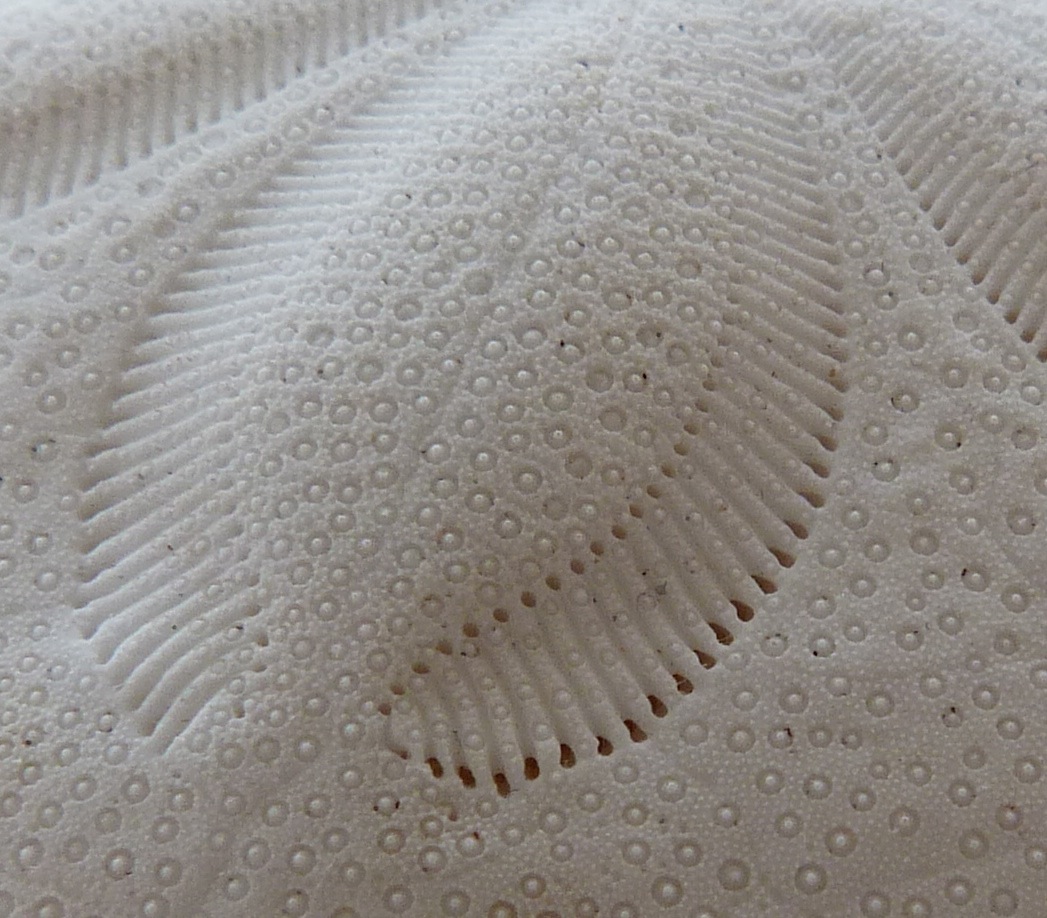
SEA BISCUITS have similar five-way symmetry to their first cousins SAND DOLLARSbut are generally pebble-shaped rather than disc-shaped. I have included 2 close-ups to show the fine details of the pattern – almost like lace-work
This SEA BISCUIT is a different type, with the 5 radials reaching right round it. For some reason it only has 4 and not 5 small holes (as one might expect) at the centre. Unlike SAND DOLLARS they tend to be more oblong than round.
One of the first colour images from the Mars rover Curiosity – a composite panorama 9 August 2012 (NASA)
STIMULATING CURIOSITY IN ABACO
THE DELPHI CLUB’S PART OF THE MARS ROVER MISSION
One of the first images from Mars
CURIOSITY landed on Mars today. This is the best chance yet of answering Ziggy Stardust’s rhetorical question “Is there life on Mars?”, and doffing an astronaut’s helmet to space pioneer Major Tom along the way… Assiduous readers of the blog will both recall that a while ago, the Delphi Club was privileged to be involved in a small part of the ‘Curiosity’ Mars Rover project. It’s a prime example of what one might call “extreme beachcombing…”
“One small part for a space program, one giant chunk of junk for the Delphi beach…” (S Walker)
Here are the links to the 3 short illustrated reports (rockets, boys!) in this blog from early 2012
1. ABACO BEACHCOMBING: MYSTERY OBJECT FROM THE DELPHI CLUB BEACH HERE 1
The discovery by Sandy Walker of the item above on the Delphi Club beach, Abaco: 12 feet of conical mystery
2. ‘SO LONG, ARIANE’: FROM ROCKS TO ROCKETS ON THE DELPHI CLUB BEACH, ABACOHERE 2
News of a positive ID by serial number as rocket débris from the Mars Program Curiosity Rover launch
3. BEACHCOMBING ‘CURIOSITY’ ON ABACO: OUT OF THIS WORLD TO THE RED PLANETHERE 3
Confirmation of this item as part of the booster rocket fairing of the Altas V rocket used to launch Curiosity in Nov 2011
◊ ◊ ◊ ◊ ◊ ◊ ◊ ◊ ◊ ◊ ◊
The episode had a slightly bathetic ending. Initial lack of official interest in the cone, which I personally hoped could then be planted deep in the coppice or pine forest for future generations to discover and wonder about, suddenly changed. In due course a team of astro-science persons (in a large black truck and white protective suits, I’d like to believe) came and took it away. This forestalled my other idea: cutting it up into hundreds – or thousands – of small pieces and selling them on eBay (possible in aid of the Abaco Parrots). A 12 foot cone of gleaming heat-resistant secret Abaconite space material. 5000 tiny pieces @ $100 each… Hmmmmmmmmm
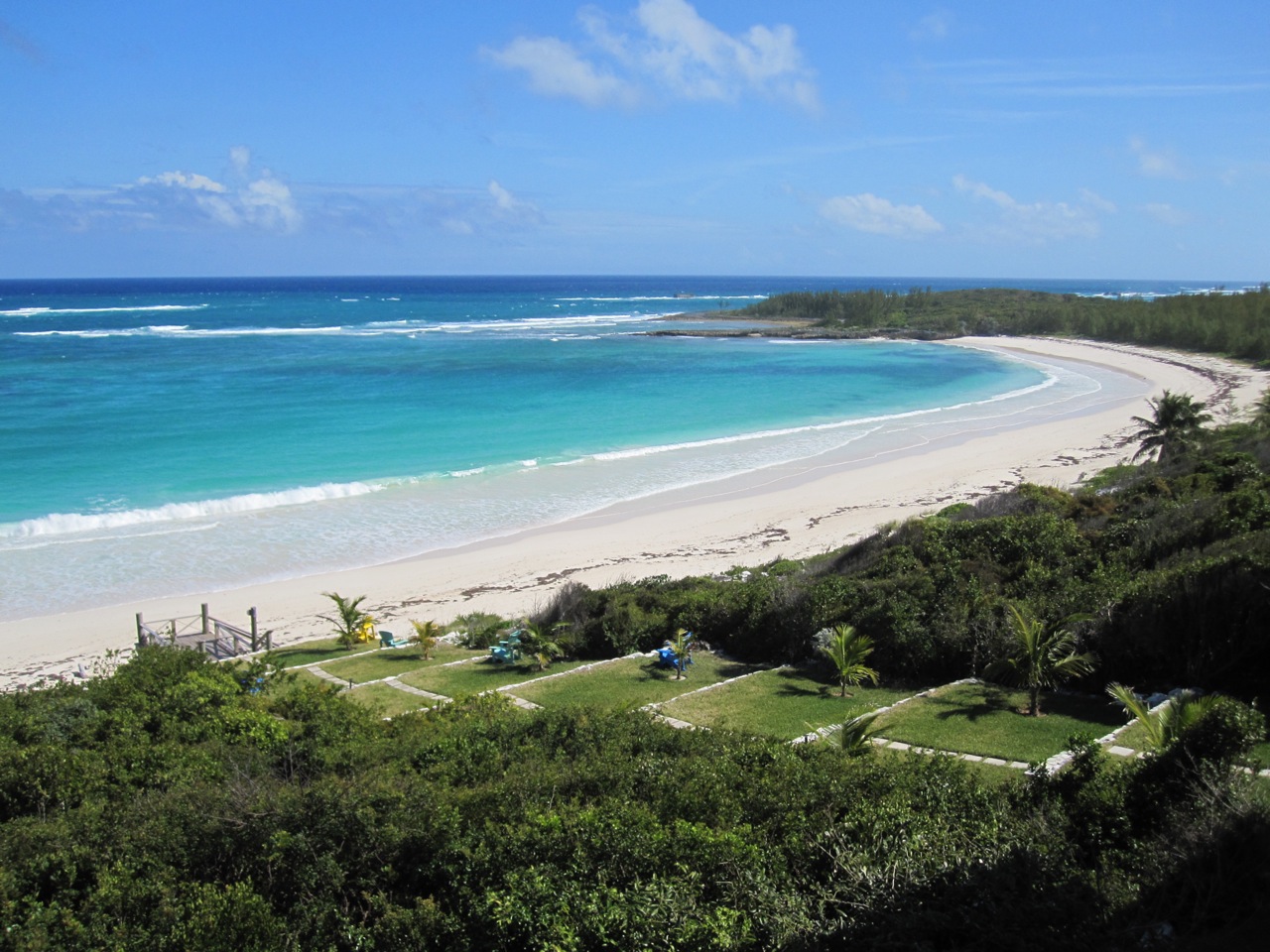
A new Header has arrived to grace the Home Page. It’s a wonderful wide-angle view of the 3/4 mile bay of white sand that is Rolling Harbour. It was taken by Michael Vaughn, a photographer and tarpon guide from Key West, and I have ‘borrowed’ it from the main DELPHI CLUBwebsite. You can immediately see the attraction of the blog name ‘Rolling Harbour’, an enterprise related to but editorially independent of HQ (though subject to benign scrutiny from Peter Mantle, who has so far resisted any temptation to behave in a ‘Murdochian’ fashion…)
The Delphi Club has just completed its third year in operation, with a record number of fish caught both out on the Marls and off the beach. There were records, too, for guest numbers; nourishment consumed in both the food and the drink categories; and for bird species spotted in the club grounds, the coppice and pine forest, and on the beach…
This aerial view shows the plantation-style club building and its minimal ‘footprint’ in the landscape
The Delphi Club from the beach
The view of the beach looking north from the Club verandahThe view of the beach looking south from the Club verandah
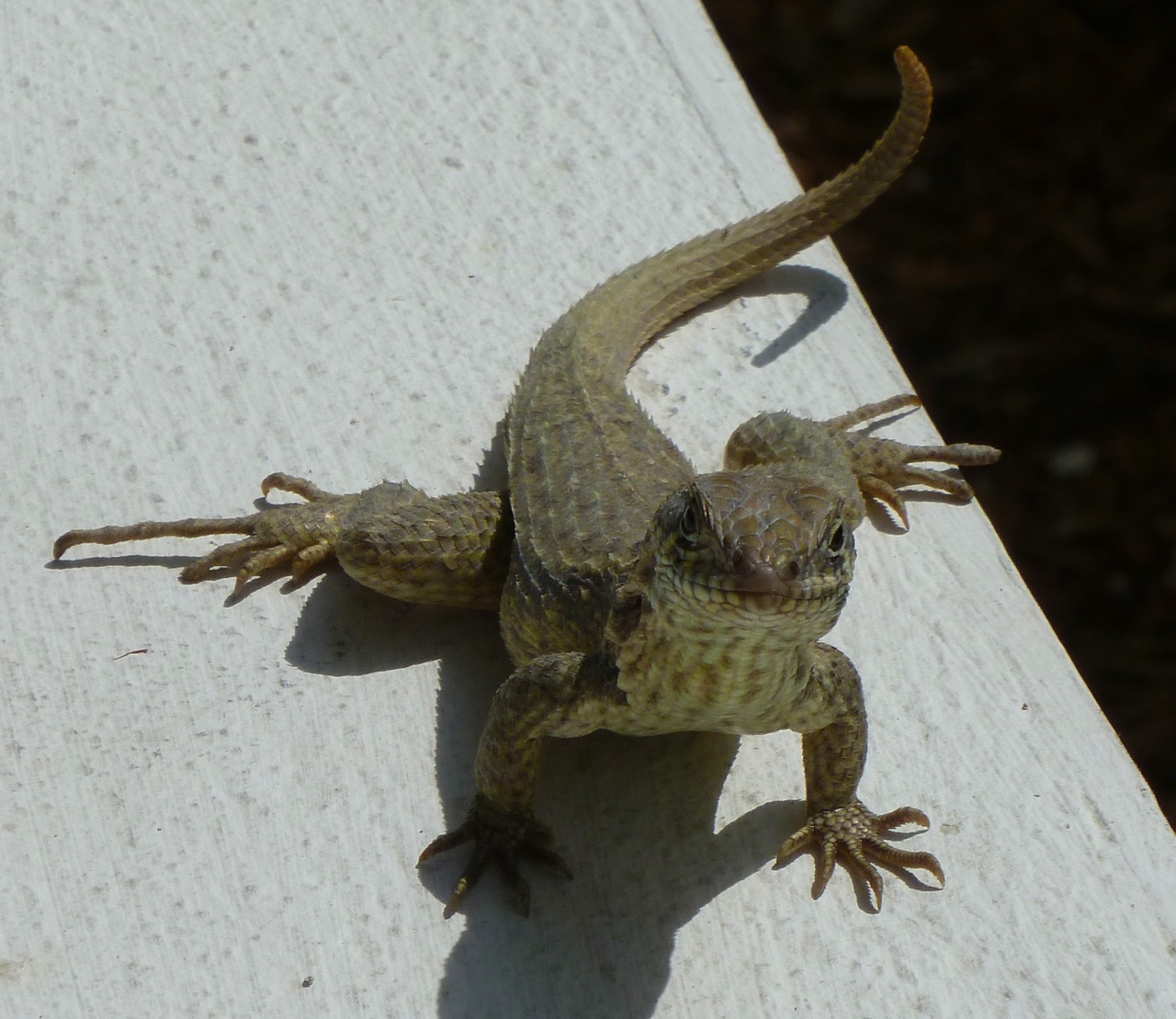
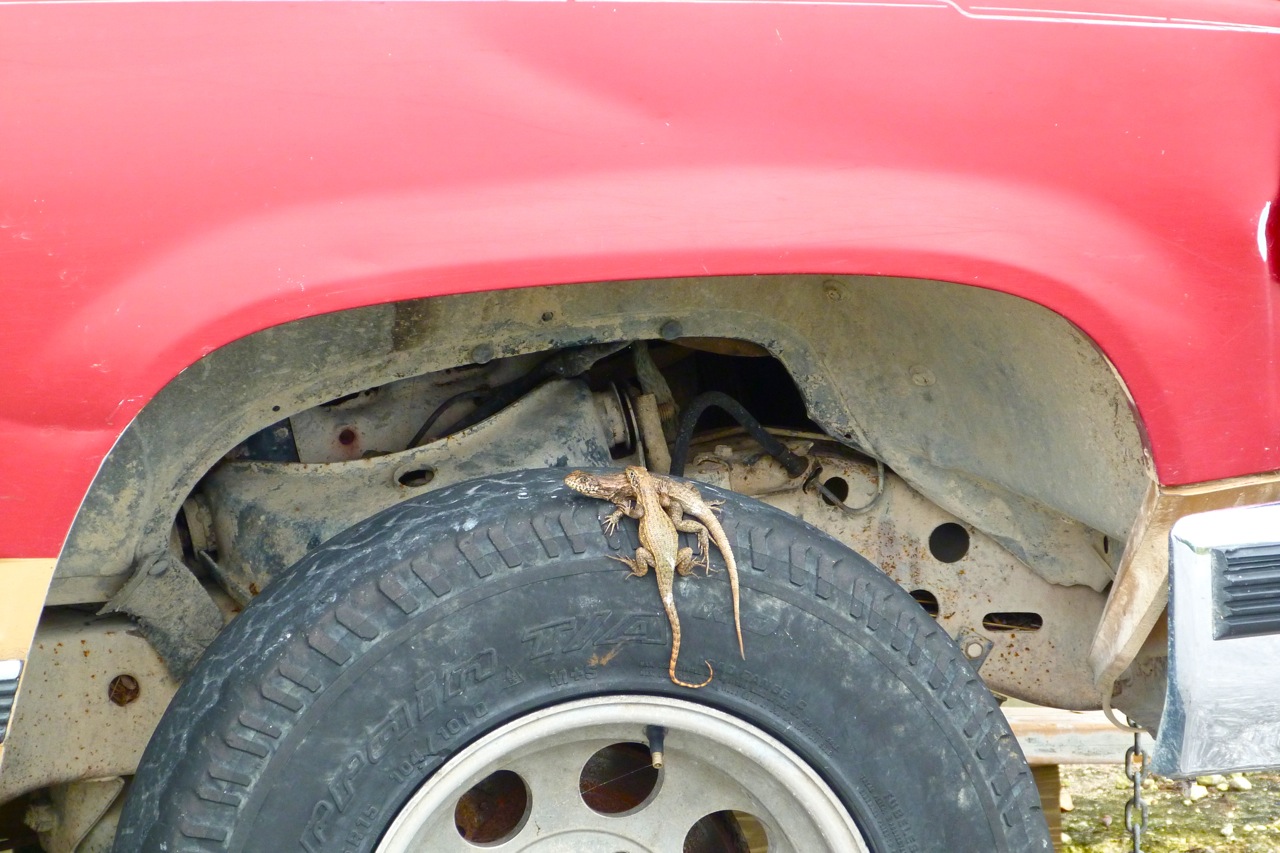
I have previously posted about these cute creatures that lie sunning themselves and occasionally blinking; or scuttle away when they see you. SeeCURLY TAILS for photos and details about these lizards and their habits. Here are a few more recent images. The first three were taken at the Delphi Club, where they seem to enjoy the pool area in particular. The top one has one extraordinarily long finger. It’s worth clicking on these 2x to enlarge them to see the structure of their skin / overlapping scales
An impressive “complete double curly”
This pair of curly tails was at Crossing Rocks, where we were trying to locate Bahama Woodstar hummingbirds in the scrubland. We rather felt that we might be interrupting something… They look endearingly affectionate.
WARBLER IDENTIFICATION – A LIGHT-HEARTED CHALLENGE
SPECIES ID NOW SOLVED! CUT TO THE CHASE BENEATH THE PHOTOS FOR DETAILS. A LATE ENTRY NOW DISPUTES THE GENDER ID, SO THE SEX CHALLENGE IS REOPENED, SO TO SPEAK
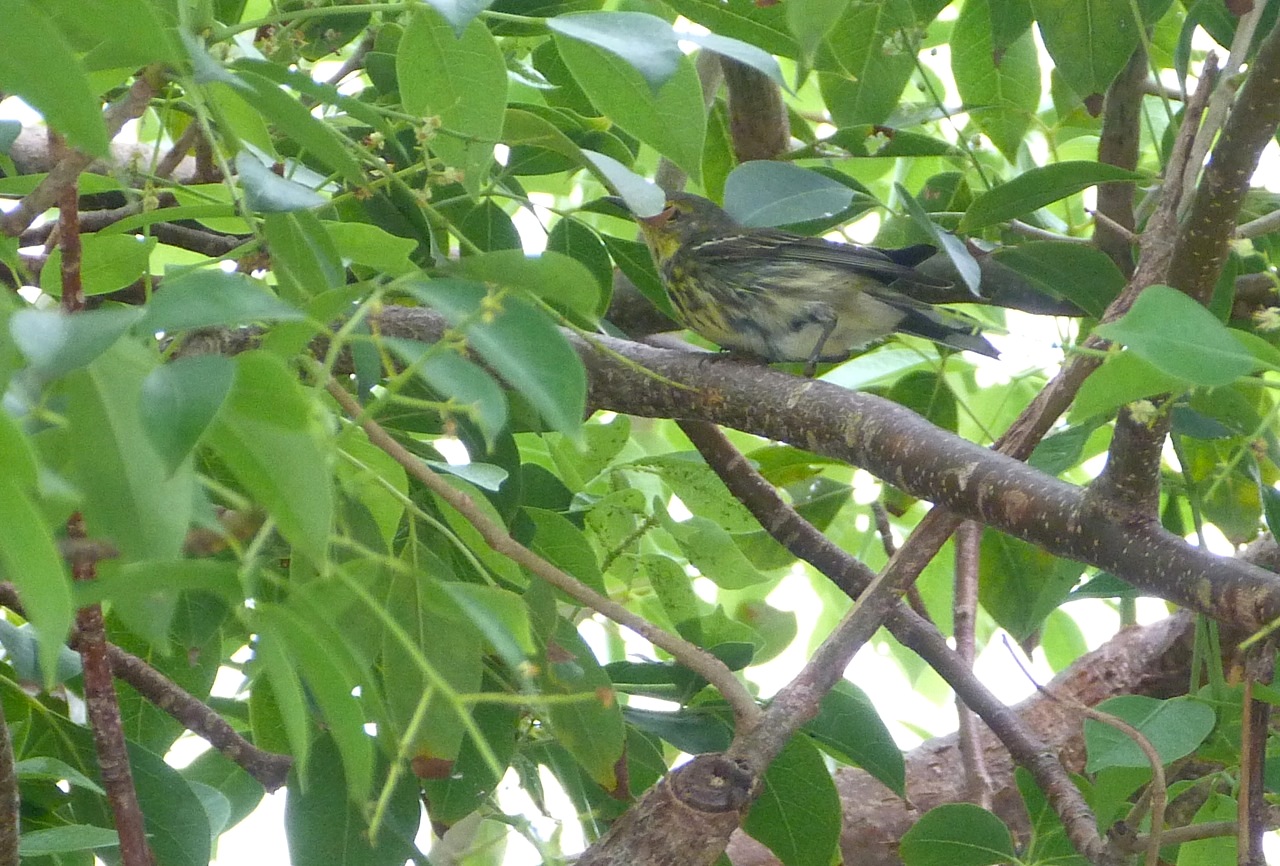
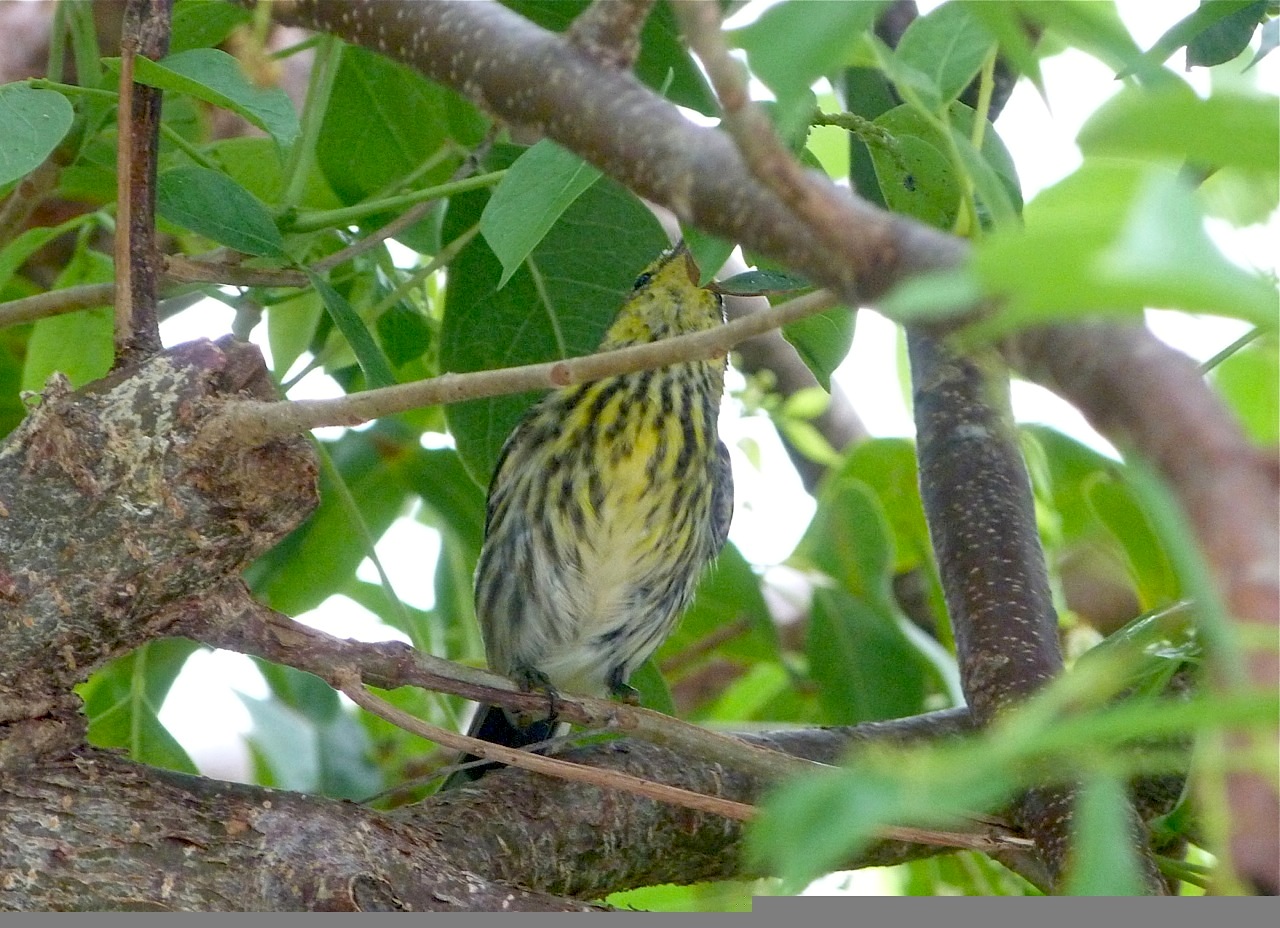
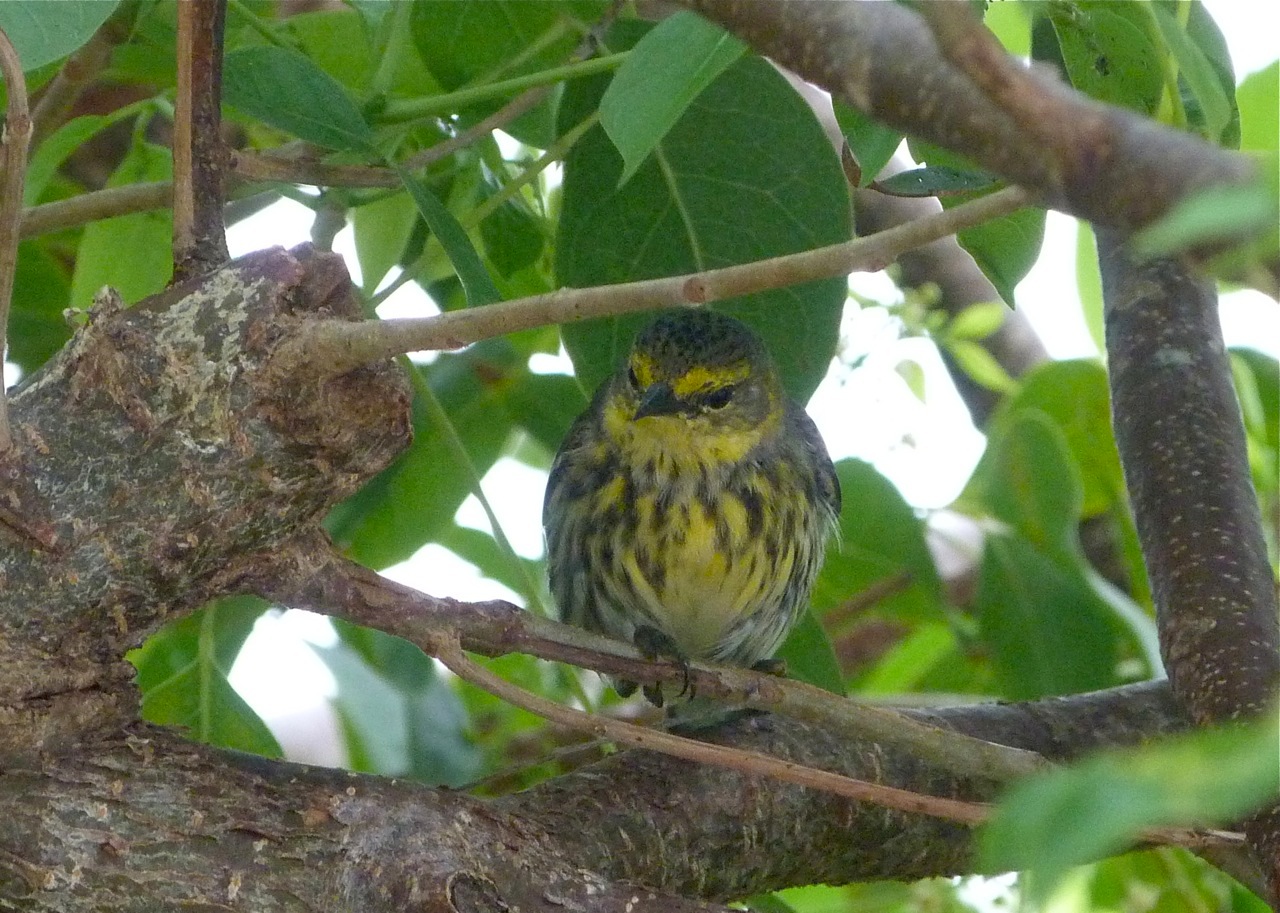
I have previously posted aids to WARBLER ID (1); WARBLER ID (2), a pitfall-fraught area that continues to baffle me despite books, online resources, futile stabs in the dark etc. For each species the male differs from the female, and both differ from juvenile / maturing birds. And this all depends to some extent on the season. Here’s a speckled warbler photographed recently at the Delphi Club, Abaco, for which there are various candidates ranging from the distinctly possible to the frankly completely-unlikely-but-astounding-if-it-turned-out-to-be-true Kirtland’s Warbler. These are seen and positively identified vanishingly rarely on Abaco – maybe one or two a year, and invariably in winter. But what if one decided to stay behind for the summer… And to those who say “Prairie, dimwit”, I reply “…but their speckles don’t cover their entire fronts”.
I’m throwing this open, because although I have a view I’d like to see what others come up with. Craig? Avian101? Avian3? Margaret H? Other birding followers? Are you out there? Leave a comment (see small-print blurb at the bottom of the post) or email me at rollingharbour.delphi@gmail.com The bird was a bit reluctant to be photographed, but I managed to get a side view, a ‘full-frontal’ and a head shot. Any ideas?
UPDATEThanks to all who came up with suggestions – it’s interesting how opinion on warbler species varies, even with quite clear close-ups to judge from. The first past the post is… Dr Elwood D Bracey (Fl), to whom many thanks. It’s a female CAPE MAY WARBLERDendroica tigrina. The runner-up is (amazingly) myself – I had it down for a Cape May juvenile, because I thought it looked a bit on the fluffy side… Also, its eye-patches (photo 3) are grey rather than brown, and I took their colouring to be a work in progress. There’ll be some more ID queries from our recent batch of Abaco photos – not just birds, but flowers & shells as well. All contributions will be welcome…
Oh no! What’s happening here? A late challenge has come in from Margaret H (see comments), who contends that the clearly shown patch on the bird’s cheek indicates that it is a male, not a female, Cape May. So the challenge was ended and the award given prematurely… The species is now definite, but the gender ID remains unresolved…
I’ve now heard from Alex Hughes, who writes “[I am] one of Caroline Stahala’s field techs on the parrot project this summer. She forwarded me the photos of the warbler taken recently on Abaco. The photos I saw are of a female Cape May Warbler, which is a great find in June! She is certainly not going to make it to her breeding grounds, unfortunately, but still fascinating to see a boreal forest bird in the Bahamas during summer.
In a follow-up, Alex adds “I’d be very surprised if this was a male bird, due to the plumage lined up with the time of year. This year’s juvenile birds are not big enough to make the flight south from breeding grounds yet, and wouldn’t anyways if they could. Therefore, it would have to be adult non-breeding plumage if it were a male, also meaning this bird already molted from alternate plumage from spring, and flew south. This seems far more unlikely to me than a female who simply didn’t make the flight, probably due to some handicap. Either way, very cool!”
So I think that wraps it up. A female Cape May, in the right place at the wrong time. How lucky to have got close to one in the off-season. It just goes to show, eager Kirtland hunters, that any of the migratory warbler species might choose to stay behind for the summer…
CORNELL LAB OF ORNITHOLOGY IMAGE & BLURB
“The Cape May Warbler breeds across the boreal forest of Canada and the northern United States, where the fortunes of its populations are largely tied to the availability of spruce budworms, its preferred food. Striking in appearance but poorly understood, the species spends its winters in the West Indies, collecting nectar with its unique curled, semitubular tongue”.
It is presumably using its ‘unique… tongue’ in Photo 2, inconveniently concealed by foliage so we will never know
(RH COMMENT My one obviously liked the Delphi Club – and its feeders – so much that it decided to stay for the summer…)
(Credit: Steve Pelikan for Xeno-Canto)
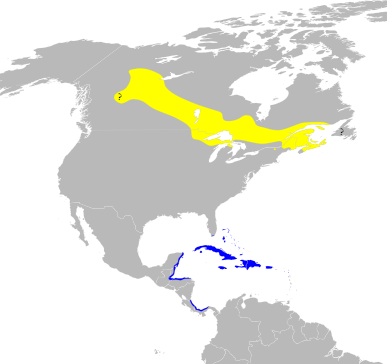
CAPE MAY WARBLER RANGE MAP (Wiki) (left)
As a warbler-muddler, I am interested to see how extremely selective this species is in its preferred summer and winter latitudes. The banding is very distinct. Are they never tempted by New York? Have they never tried Disneyland?
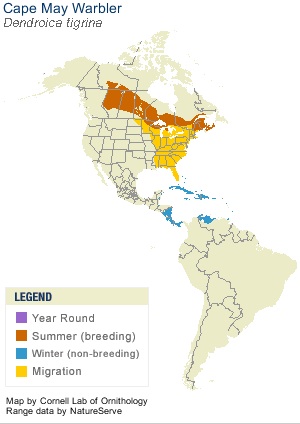
CORNELL LAB OF ORNITHOLOGY RANGE MAP(below)
The more sophisticated range map below shows the migration areas between the summer breeding and winter non-breeding areas. It looks as though a Cape May warbler on Abaco in June is an unexpected sighting.
THE RED-LEGGED THRUSH–A WELCOME GUEST AT THE DELPHI CLUB, ABACO
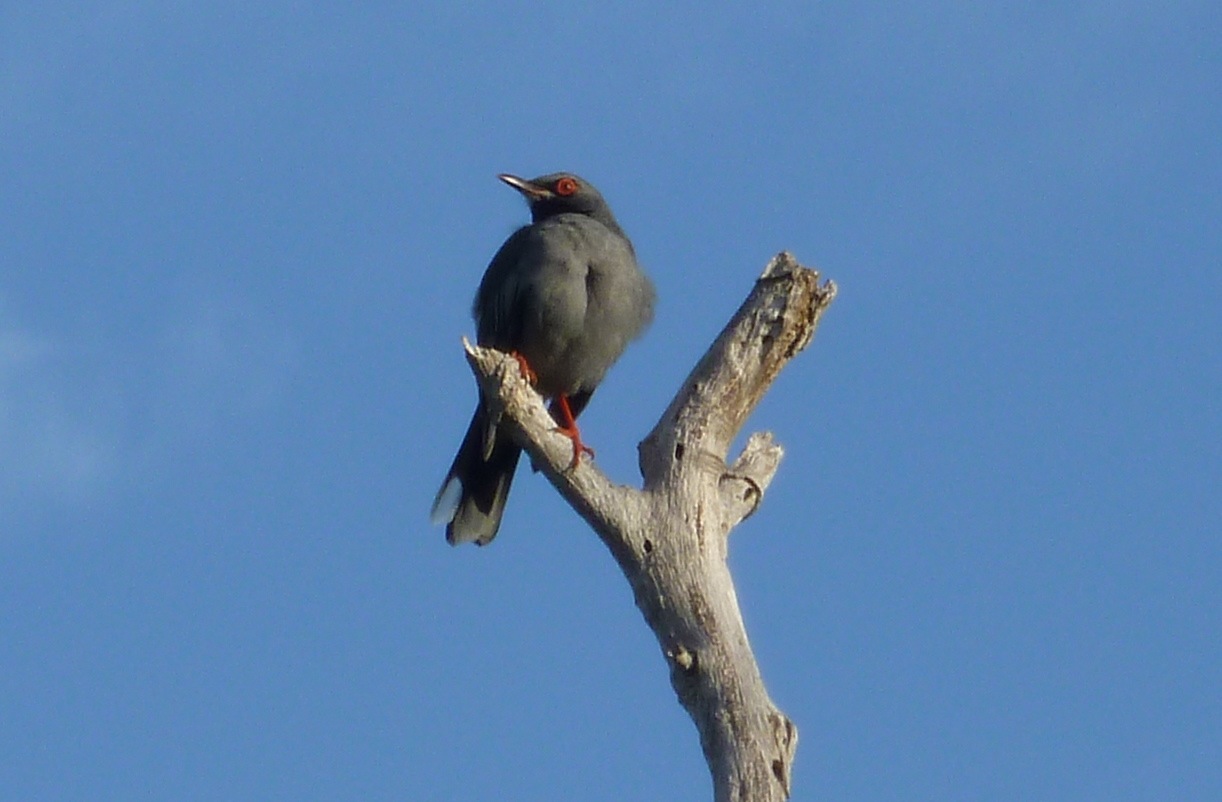
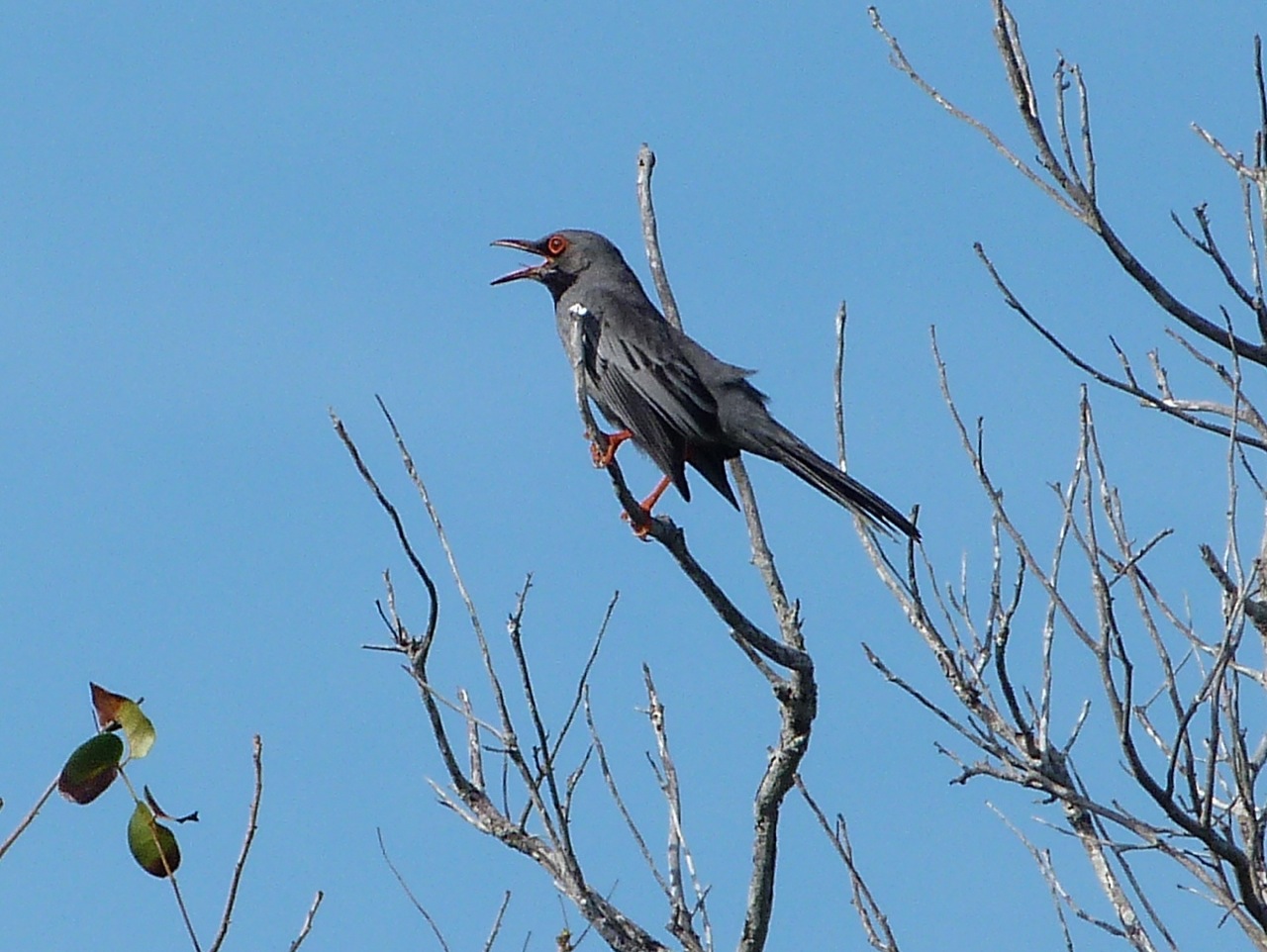
They are everywhere in May and June, with their eponymous limbs and their remarkable red eyes. In fact, ‘red-eyed thrush’ would be as apt a name, if somewhat lachrymose-sounding. This was our first Summer visit to Abaco and the difference in sightings was marked. Now, the thrushes tended to choose a high tree-perch to sing from, when not hopping around feeding on the ground. In March they seem more furtive, lurking in the coppice – presumably eyeing up the talent (or sizing up the opposition) with mating in mind.
There are 6 distinct regional variations on the species, which are found in the Bahamas, Caymans, Cuba, Dominica, Haiti and Puerto Rico. TURDUS PLUMBEUS is the subspecies specific to the Bahamas. Some view them as the Caribbean counterpart to theAMERICAN ROBIN. They eat fruit, insects and small creatures such as snails, lizards and caterpillars. Their song sounds like this (courtesy of Paul Driver at Xeno-Canto)
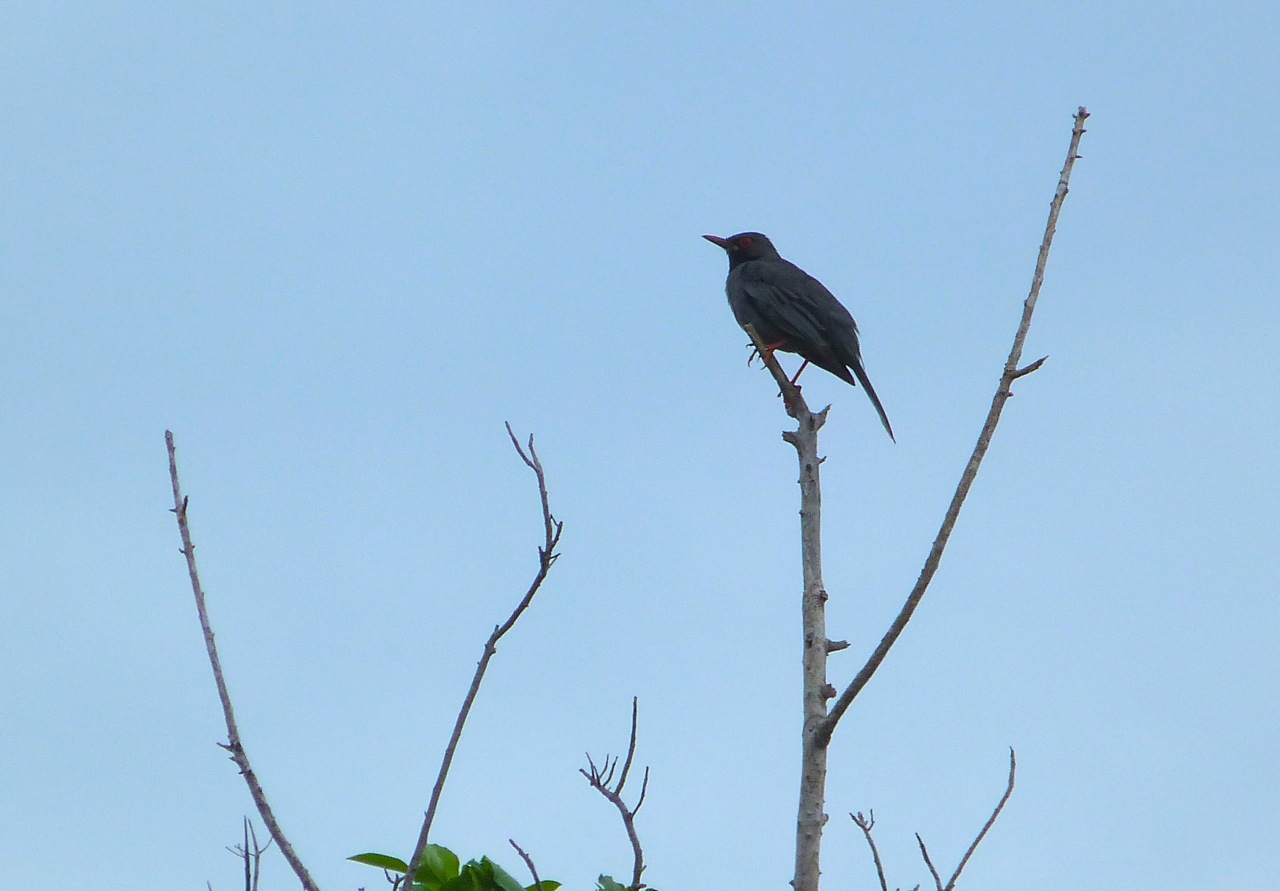
In a departure from the normal use of an ‘in-house’ logo, I’ve posted a silhouette of a Delphi RLT in the coppice close to the Club. The photo itself was dull, but I liked the pose and decided to turn it into logo-thrush
BIRDS IN THE DELPHI GOUNDS OR IN THE COPPICE NEARBY
1. This bird was at the top of a tree on the Delphi front drive close to the Club. It is singing cheerfully, and you can clearly see its tongue
2. This bird also chose a high vantage point near the front entrance gate. I managed to get gradually closer to it. Its feathers are quite fluffy and I wonder if it a juvenile / late teen?
3. Strike the pose! Two very characteristic poses by a bird on the guest drive. In the first image, you can also (just) see its tongue as it sings
4. Another high perch above the coppice alongside the drive
GROUND-FEEDING IN THE GARDEN ROUND THE POOL
Two very productive areas for thrush-fodder. The newly cut grass exposes insects, in particular ants. And the border beside the lawn has plenty of insect-life to feed on (Photo quality suspect – half-asleep by pool, grabbed camera)
A PRETTY EXAMPLE OF THE THRUSH TAKEN AT BAHAMA PALM SHORES
Checking out the precarious electricity infrastructure, Marsh Harbour, dusk
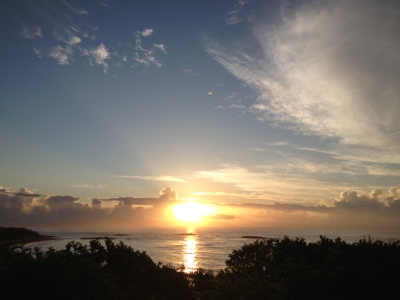
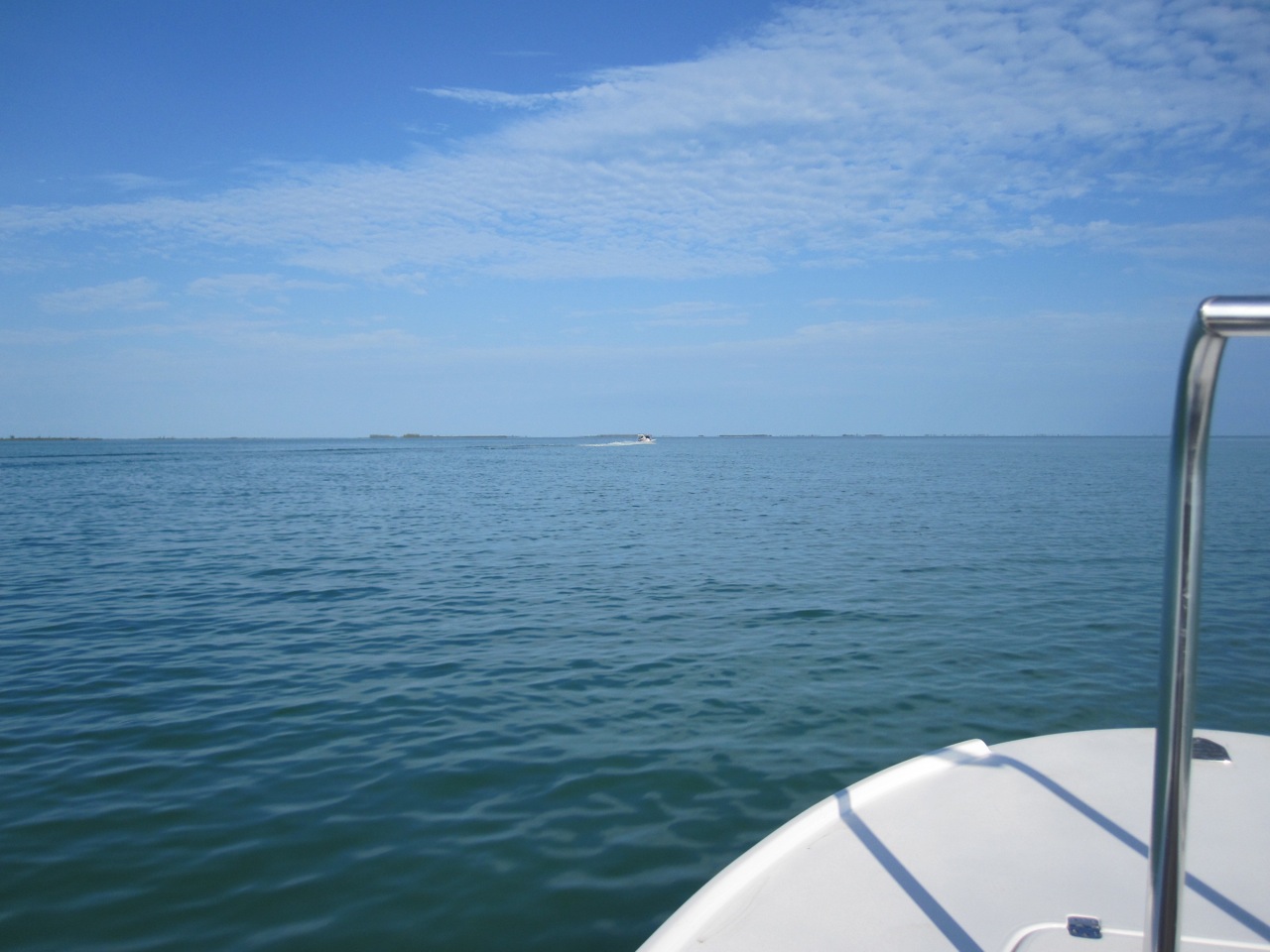
Good Morning at dawn. Looking good for bonefishing after a variable day yesterday. This is what dawn is looking like here. Bird life is busy so there’ll be some new species to add. RH
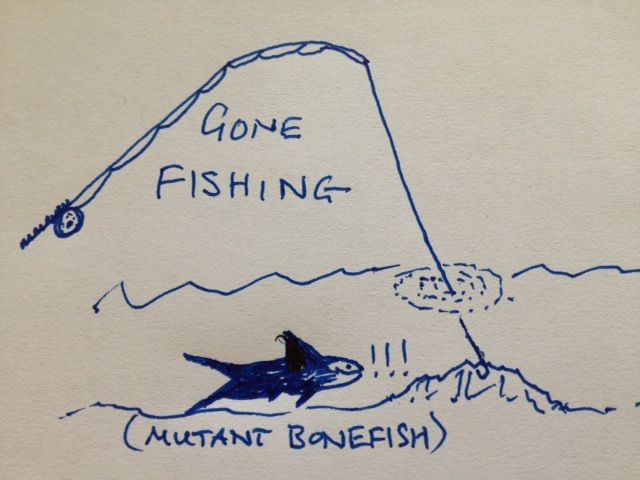
NORMAL SERVICE WILL BE RESUMED IN TWO WEEKS, IF YOU CAN EVER CALL IT ‘NORMAL’
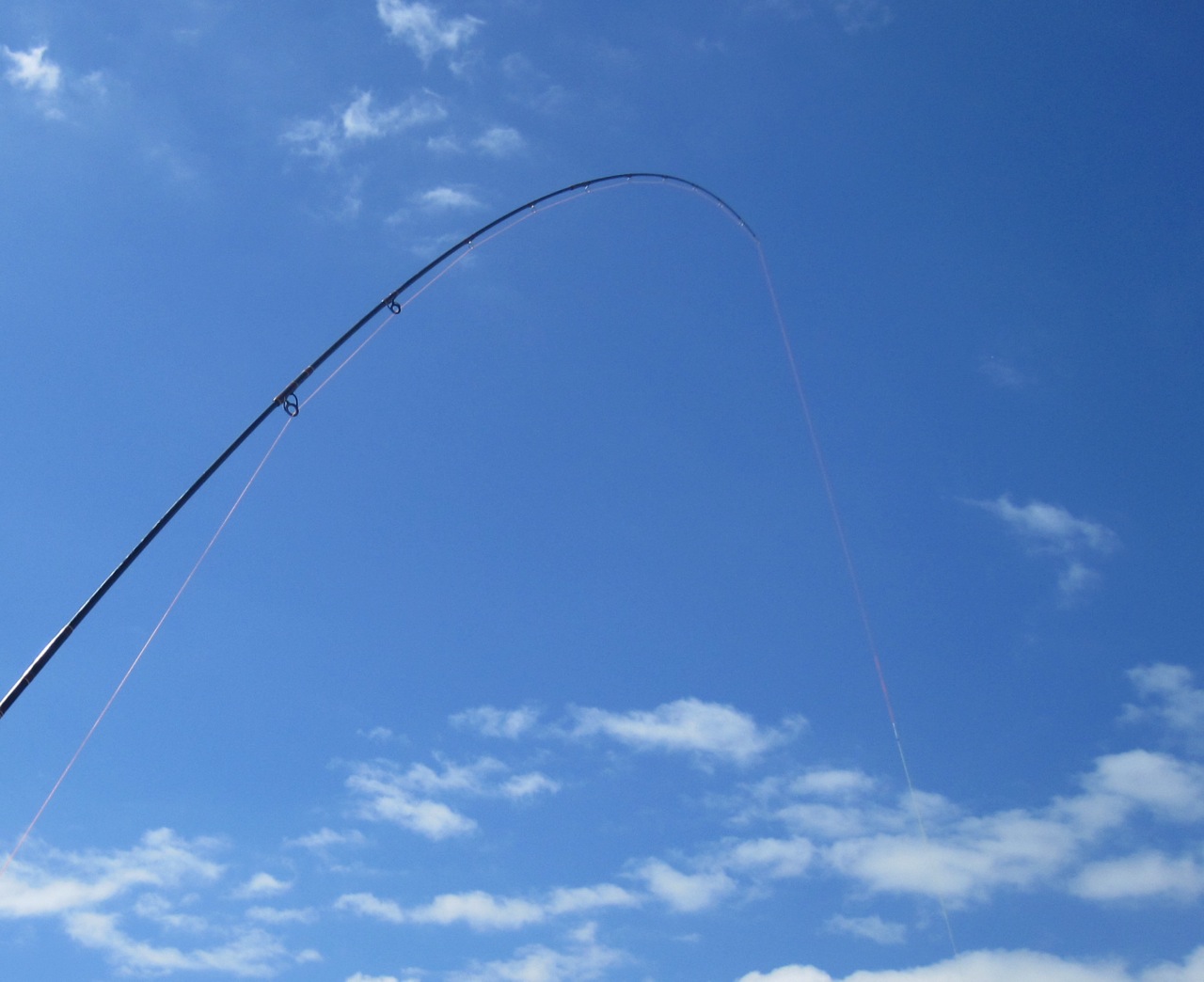
Actually, apologies for the drawing. No, really. At one time in this blog, I did say that I struggle to draw a stickman. And ain’t that the truth. Click on the Soundcloud thing below for suitable vacation music, composed and played by me (tip of the hat to an iPhone app). Oh good grief. It’s just as feeble as my drawing. Just as well I’m off to Abaco for R & R… Meanwhile, here’s what a bonefish really looks like – the weight / strength ratio makes it one of the world’s most powerful fishes. Hook one and prepare to have your reel stripped to the backing. All caught bones are quickly released to ensure stocks are not depleted.
Why thank you, nice Lubbers Quarters sign, I do believe we are…
BRIGHT & BEAUTIFUL: SUMMER BIRDS AT THE DELPHI CLUB, ABACO
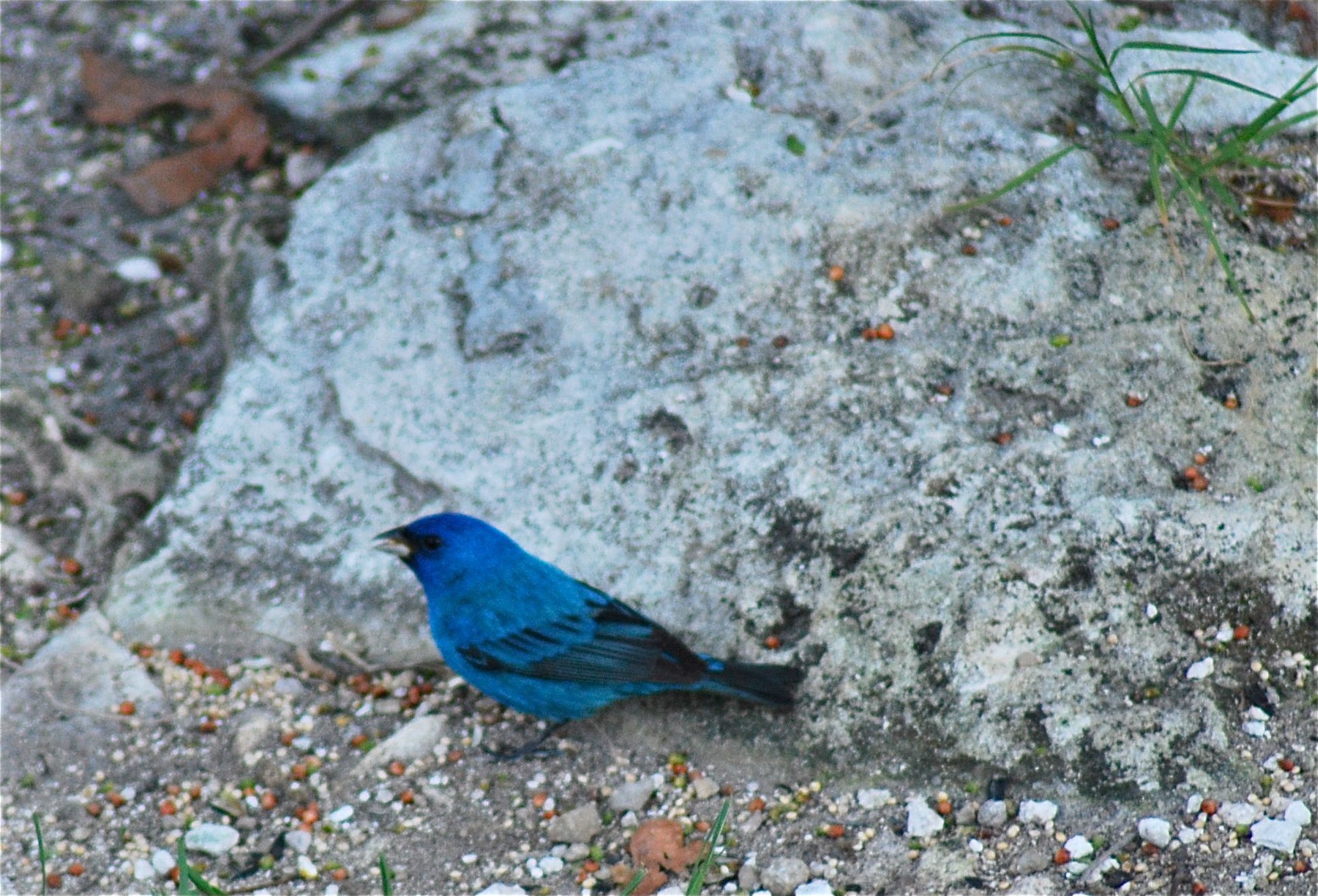
Peter Mantle reports that some colourful birds have arrived at Delphi to take advantage of the feeders and fresh water provided. Indigo Buntings have been around for a while, as they have been a little further north atBAHAMA PALM SHORES;and Rose-fronted / Red-breasted Grosbeaks (I’m not sure which is correct – the terms seem to be used interchangeably) have been seen all round the Club grounds for a week or more. They haven’t been recorded at Delphi before, so they have now been added to the ever-growing official list of the ‘Birds of Delphi’. How long before an elusive Kirtland’s Warbler puts in an appearance? And will anyone recognise it if it does..?
HOOKED! A FANATICAL FISHERMAN’S WIFE TAKES TO THE BONEFISH FLATS
I’m married to a Fanatical Fisherman. I have never shared his enthusiasm, though I have always loved the places where his fishing takes us. However the chance to spend two weeks at the Delphi Club Bahamas on Abaco every year has changed my perspective. This year I thought to myself (in non-fishing terminology, of course) ‘How about giving it a try?’
We waited for a day that was not windy and that would suit the FF’s own fishing convenience. One of the other guests was a kind and patient, not to say a highly eminent fisherperson and she gave me my first ever lesson on the lawn. With much encouragement I went forth. It was a lovely day with the sun beating down, so it was ‘sun block on and all parts covered’.
Skiffs on their way to the bonefishing grounds
We set out in the skiff and after an exhilarating ride we glided to a stop in shallow water. I sat enchanted for a moment, taking in the incredible beauty of the place. Guide Tony provided suitable footwear for me (his son’s); and the relative merits of a ‘Crazy Charlie or a ‘Delphi Special’ were debated. Soon I was wading on the flats, rod in hand. This was my first-ever experience of my husband’s lifetime obsession…
Poling to a good place for wading
Within minutes Tony pointed to a shoal of bonefish… I cast (in a manner of speaking)! I struck! I hooked! I played! And… I lost!
FISH ON!
But that was enough. From then on I was on a mission. I saw the ‘nervous water’ – great shoals of bonefish causing a subtle ripple 0n the surface of the water. When they turned and moved towards me I could hardly contain my excitement. I knew I had to tread carefully underfoot and to keep still as I cast. Silver flashes glinted in the sunlight as the fish started ‘tailing’.
Watch out for ‘Nervous Waters’
Meanwhile the sharks lazily circled us waiting for a chance to grab a prize before we could reel it in. I did hook another bone but it too managed to evade capture. And then suddenly the day was over. How did that happen? In the end I landed no fish but as the skiff sped back across the blue water I knew this was, for me, the start of something wholly absorbing. FF had better look to his laurels.
Lorna Jarman
(All illustrative photos by RH – Lorna was otherwise engaged!)
Janene Roessler has kindly sent news of a sighting yesterday of a prothonotary warbler on a feeder at Bahama Palm Shores, Abaco [Later addition]Now, with thanks to Ann Capling, here is that very warbler on the feeder – a fine photo considering it was taken indoors through glass.Apparently there hasn’t been one recorded there since 2007. I know of one seen further south on the island near the Delphi Club in April 2010 (see photo and caption below). I’ve never seen one myself. It seems fitting to celebrate the news with a post about these little birds…
This very pretty species of warbler Protonotaria citrea is the only member of its genus. The male birds are very colourful, with the females and juveniles being a bit duller. In flight, the underside of their tails are white at the base, and dark at the tipPhoto Credit Craig Nash (Peregrine’s Blog) This fantastic photo was taken on the main drive of the Delphi Club, Abaco
STOP PRESS JULY 2018 this rather basic post was written in April 2012, in the earliest days of this blog when mistakes were (and undoubtedly still are) made. Tim Kalbach has just contacted me with the helpful observation “the Craig Nash photo is a Yellow Warbler, not a Prothonotary. Yellow – green tones in rump and tail don’t occur in Prothonotary; those areas would be blue-gray in color”. Which goes to show, I think, that after 6+ years I need to revisit this species in more detail and accuracy! Thanks for the comment, Tim.
These warblers are native to the eastern US where they breed, wintering further south in the West Indies and Central & South America. Their nesting arrangements are unusual:“It is the only eastern warbler that nests in natural or artificial cavities, sometimes using old downy woodpecker holes. The male often builds several incomplete, unused nests in his territory; the female builds the real nest”where she lays 3 – 7 eggs. So either the male is cleverly creating decoy nests away from the real nest; or maybe he is showing typically male behaviour in starting several home DIY projects at once and not getting round to finishing any of them…
Female Prothonotary Warbler(wiki)
I can never cope with those phonetic descriptions of bird calls… So many small birds are described as going ‘tseep’ or ‘tweep’ or ‘seeep’, yet in practice sound different from each other. So here, courtesy of the admirable Xeno-Canto and recordist Don Jones, is how they sound in real life
Listed as of ‘Least Concern’ (except in Canada, where they are ‘endangered’), the sad fact is that like so many species PNs are declining in numbers due to habitat loss. They are also bullied by other birds, in particular the brown-headed cowbird; and the house wren with which they compete for nest sites.
And the cumbersome name? Although at one time known by the helpful name ‘Golden Swamp Warbler’, the bird was renamed after senior Roman Catholic church officials calledPROTONOTARII whose robes were (are?) supposedly golden. For full but quite dull details click on the green word back there. Bizarrely, the wiki-link doesn’t seem to confirm the goldenness of the robes at all. I think I’ll vote for a return to the simpler description…
Male Prothonotary Warbler (wiki)
POST SCRIPT: By complete coincidence, the National Audubon Society posted this lovely PN picture on its Facebook page this very day, with the caption “Start your Monday morning off right with this cute Prothonotary Warbler peeking out of a heart shaped tree hole! Have you seen any of these birds yet? Photo by Mark Musselman”
Apart from the plentiful bird species to found all around the Delphi Club, there’s the strange half-way house between insect and bird that is the HUMMINGBIRD MOTH Hemaris Thysbe, also known as Hummingbird Clearwings. These can be seen – and heard – especially at dusk hovering around the flowers in the garden, sipping nectar. In the half-light they are sometimes confused for tiny birds. I have seen them most clearly when they are busy among the flowers in the beds on either side of the lit main staircase. So far I have not managed to get a reasonable photo of one – a situation I hope to put right in May. Meanwhile, I have found some wonderful pictures, not from Abaco, on a website related to a Research Program at Miami University . They were taken by Dr Hays Cummins, to whom thanks for use permission. These and other outstanding images can be found at his comprehensive website, for which CLICK===>>>HERE
Caroline Stahala has emailed me with some excellent parrot news of daily sightings around the Club and in the coppice along the drives. It sounds as though, if we are very lucky, Caroline might take us to the nest sites when we are at Delphi in May…
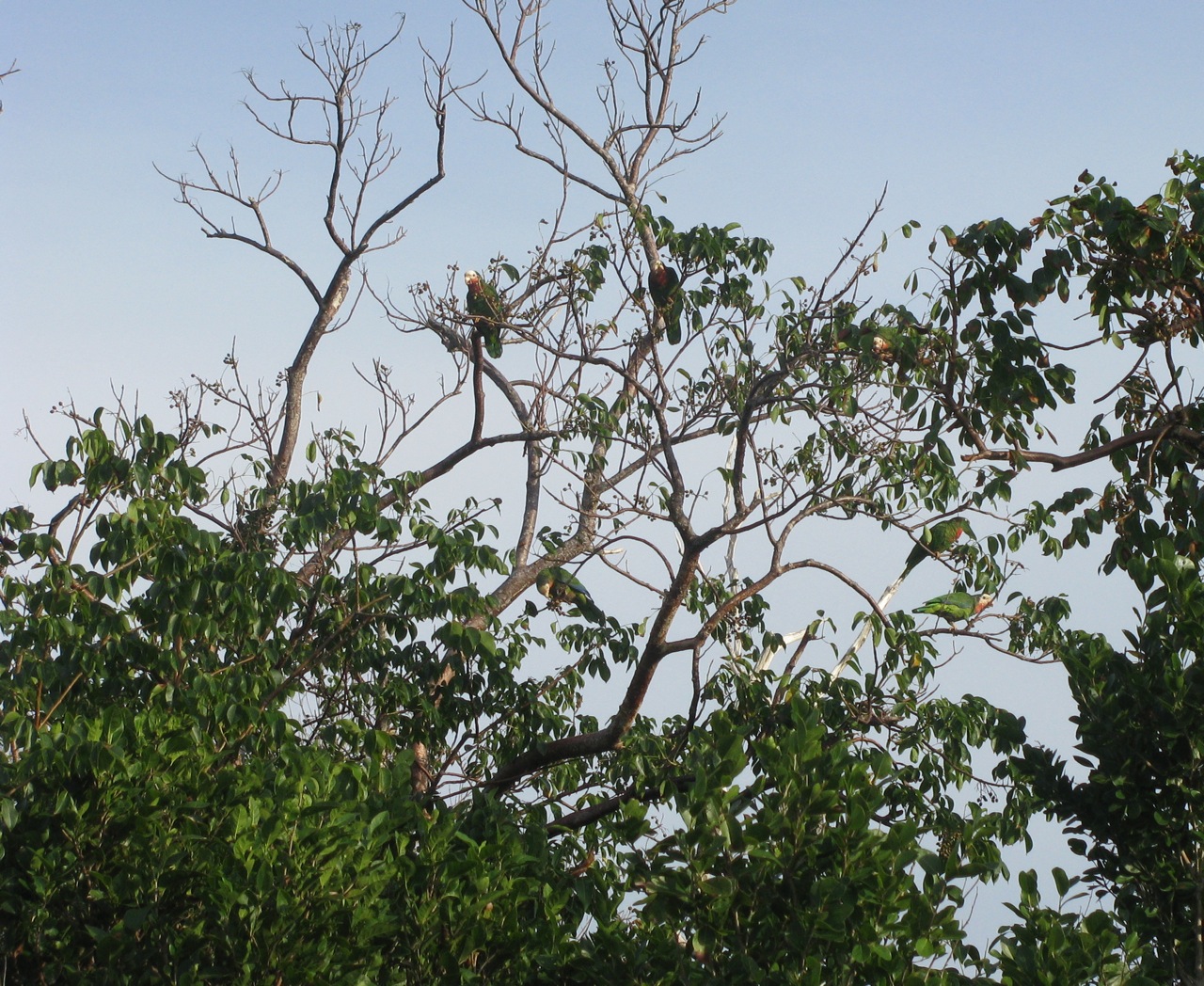
TWO ABACO PARROTS ON THE DEAD TREE BY THE DELPHI FRONT DRIVE
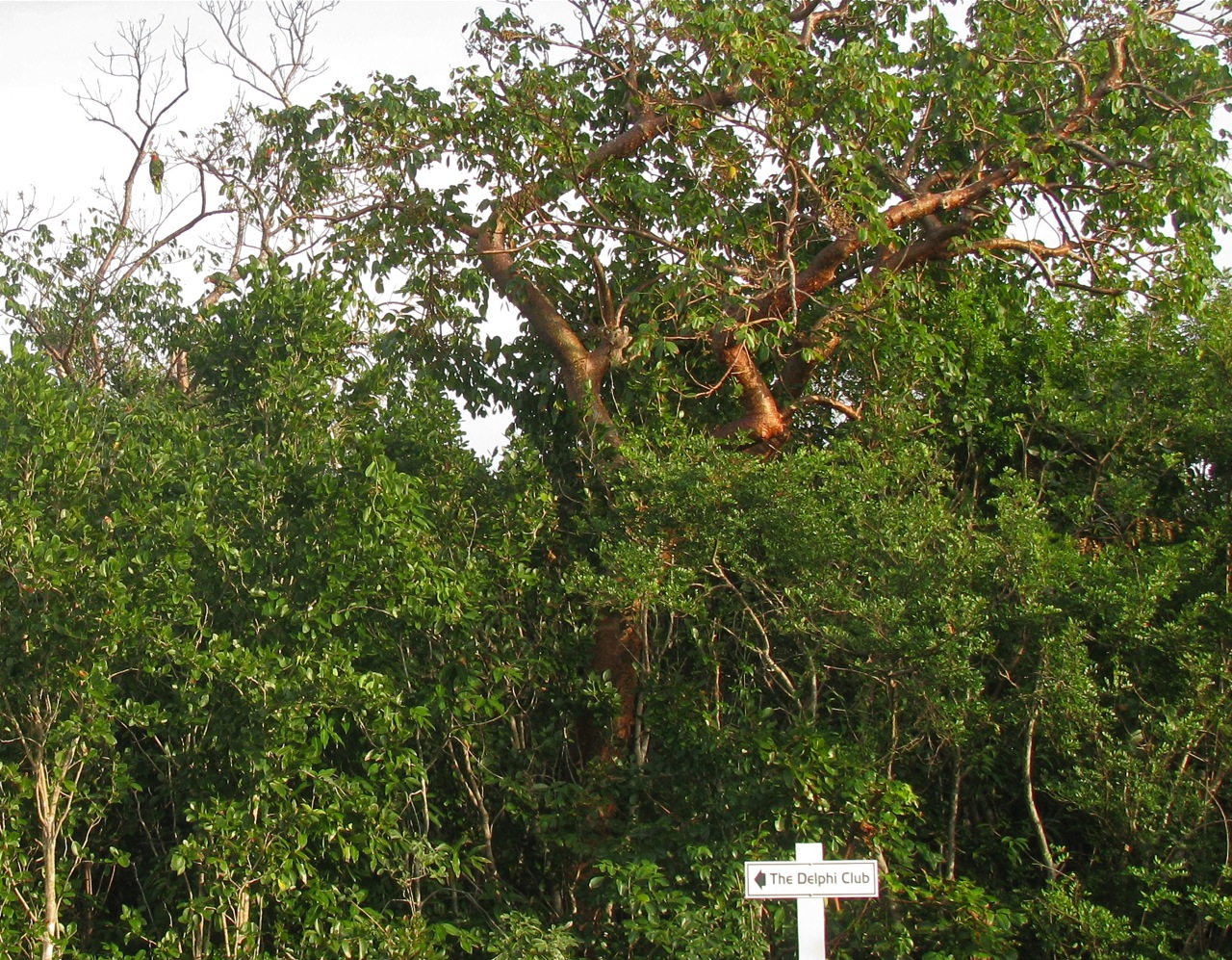
“As far as current parrot news. Well, they are all around the lodge at the moment. I can hear the parrots each day right on cue at 7:30 in the morning and then again just after 4pm. They have been foraging in the fruiting hardwoods in the area, especially the Gumbo Limbo (Bursera simaruba). I am attaching a picture of a small flock I saw right on the drive in front of the house. A couple of pictures are close up of the parrots and the ones with the Delphi signs do have parrots in them, see if you can find them. They have even been spotted just behind the pool. Let’s hope they decide to make this a habit. I am currently working on getting the summer field season organized… writing reports and grant applications is the necessary evil in order to have a summer field season”
PARROTS IN THE COPPICE BY THE DELPHI DRIVE (TOP LEFT)
A CLOSE-UP OF THE FLOCK – THERE ARE 6 VISIBLE (ONE IS PEEPING)
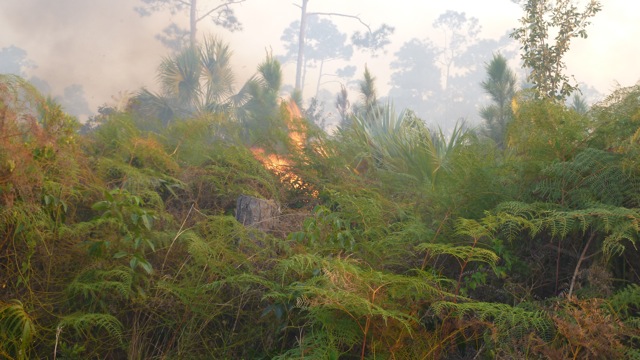
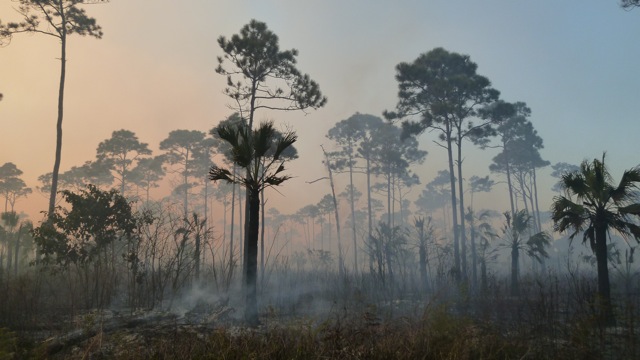
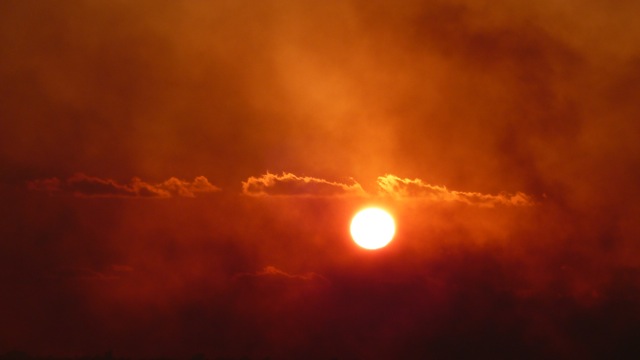
MARCH 2011 Fires swept through large areas of South Abaco, spreading rapidly and jumping the firebreak of the Highway in several places. At any one time, there were several ‘non-natural’ seats of fire. For 3 days the flames were uncomfortably close to the Delphi Club, halted only by the natural boundary between the flammable pine forest and the damper less combustible coppice. The smoke caused some amazing visual effects, especially at sunset. The first image was taken looking east from the Club verandah one evening as the fire got nearer
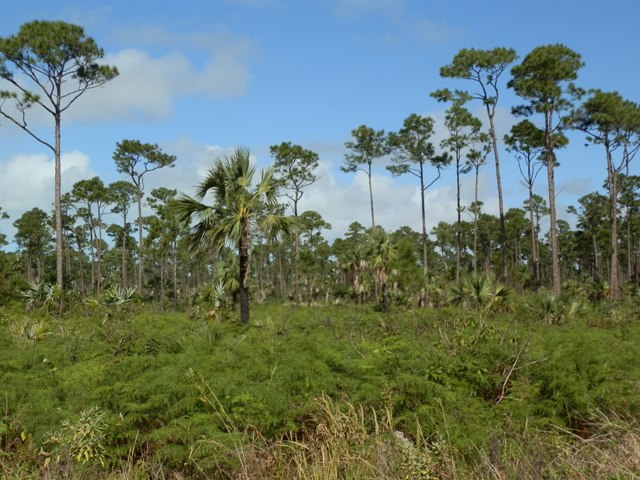
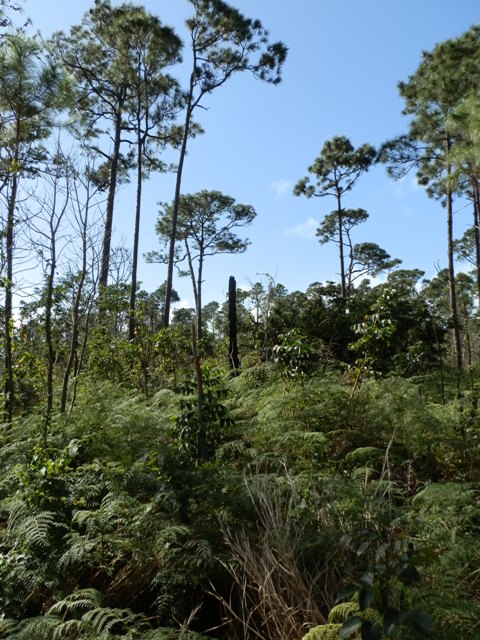
The vegetation alongside and between the drives was dense and lushly green before the fires. Here is a photo as fire began to take hold near the top of the drives towards the road, having jumped the Highway in the night…
As the fire rapidly spreads, this tall dead tree is actually flaming from the top
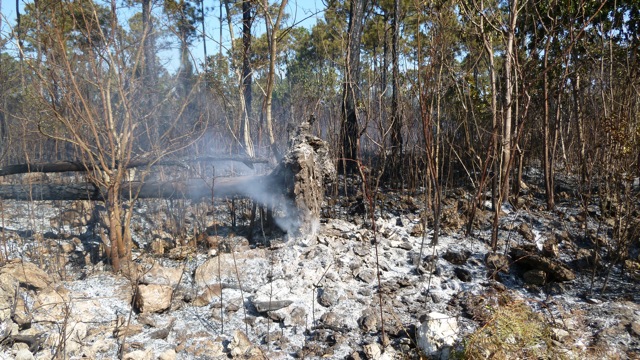
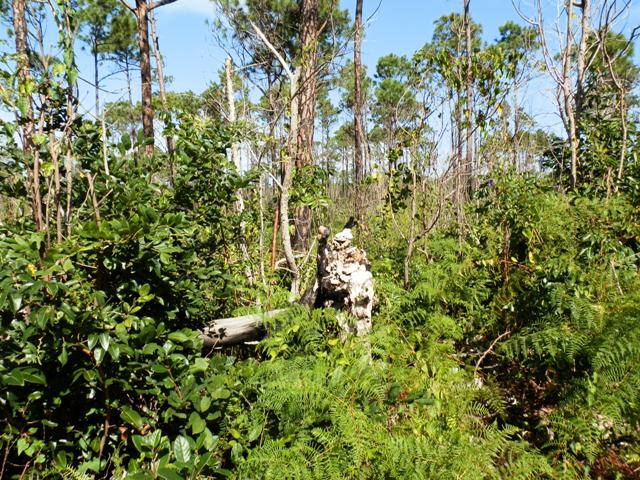
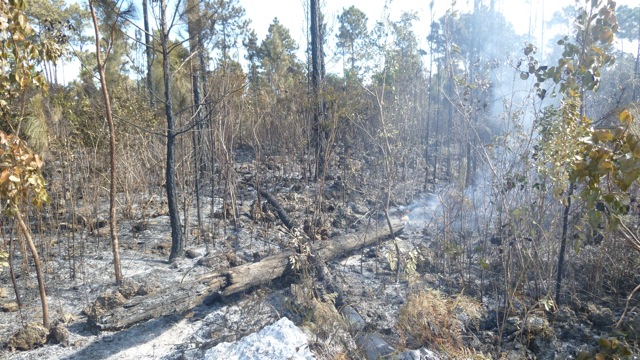
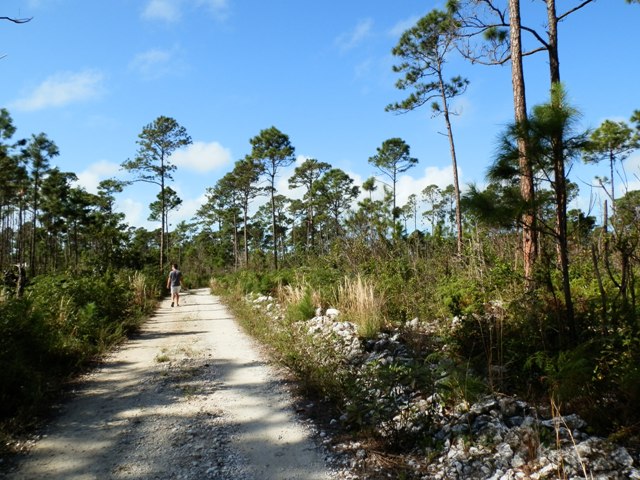
During the next couple of days, we took photographs along the drives of the apocalyptic scenes where there had so recently been impenetrable vegetation. Nearly a year later, indispensable beachcomber and photographer Kasia has taken some pictures of the drives as they are now. First, two ‘then and now’ views of the same scenes to illustrate the extent of forest regeneration
2011
2012
2011
2012
2011The burnt-out forest between the drives
2012A wander round the drive circuit
In some places the undergrowth has returned but trees have not recovered
Elsewhere, blackened stumps are visible in amongst the vigorous regrowth
More news about the the space rocket debris washed up on the Delphi Club beach, Abaco. The booster rocket fairing found by Sandy fortunately had a serial number on it. Various inquiries have been made and a definitive explanation of the item has now been given by the NTSB. It turns out that the fairing was not, after all, from the Ariane 5 launch in French Guyana. More exciting than that – it comes from a Mars Program launch to put the Space Rover Curiosity on Mars. There’s an excellent Wikipedia article on the mission to be found at WIKIMARS
Bob Swaim at the NTSB has emailed Sandy to say “The serial number of the fairing fragment is from a part that was on a Delta V [sic – it was in fact an Atlas V, see comments] rocket launch of November 26, 2011. In August, a new car-sized rover will touch down on Mars and you’ll have something from the mission!” He has kindly provided a link to the launch – see image below and direct linkHEREHe has also given a direct link to theNASA MARS PROGRAMsite from which I have taken the screen clip below. You will see an image of the Mars Rover Curiosity, and the time countdown until touch-down at the exact moment I took the shot…
I contacted Bill Ailor, Principal Scientist/Engineer, Center for Orbital and Reentry Debris Studies, The Aerospace Corporation AERO CORPthinking a booster fairing might be of interest for their rocket debris database. He writes
Thanks for the notification (and for your excellent web page – looks like a wonderful spot). On the website, we catalog debris that has reentered from orbit and don’t include payload fairings, solid and first stage rocket boosters, and other “range” debris, since these are suborbital and the launch is designed so that the debris impacts is in known safe areas. That debris can sometimes float outside of the safe area and wash ashore.I should mention that we recently reentered a small device that might one day float to your beach. I’ve attached a description. Let us know if you see that one
Although the device he mentions may have in fact have landed a long distance away (the South Pacific even), best keep an eye out for this…REBR Fact SheetBy a strange coincidence in a huge world, the Aerospace Database shows that in 1965 reentry debris was recovered from a beach on Abaco:
In early 1965 an object having the appearance of a space fragment was reported washed ashore on Abaco Island in the Bahamas
Possibly from the Atlas-Mariner I booster which was destroyed by the range safety officer shortly after launch on 22 July 1962, and landed in the designated ocean impact area
Apologies if I have got sidetracked from normal beachcombing duties – shells and stuff – but wildlife blogging doesn’t get more exciting than this – well, unless they find a colony of Abaco parrots on Mars…
STOP PRESS Rocket part now positively ID’d by serial number – and it’s not from Ariane 5. More exciting – it’s from the Mars Program launch of the the Mars Rover ‘Curioisty’. See latest post at CLICK IMAGE
Kasia’s mystery beachcombing item, posted yesterday, was solved within the day – basically a rock-like accretion of large tubular wormy molluscs of a somewhat unattractive sort. Sandy Walker has now sent me a photo of a baffling object he has found on the club beach to test your ingenuity, or patience. He’s sent it to the NTSB (air-crash investigation etc) for their view. For sure, it isn’t wildlife: however any nautical, aero-nautical, NASA-based or ‘strange white cone’ experts out there might like to contribute an opinion via the COMMENT box or email rollingharbour.delphiATgmail.com (spam guard: please convert AT to @)
My contenders, from most to least exciting (1) Rocket nose-cone. But no re-entry scorch marks – maybe it never got that far (2) Light aeroplane engine cowling or whatever the term is (3) Front end of a canoe-type vessel, with a standard Avery 5-slot for’ard rowlock stanchion clip (or maybe a bit of storm-tossed catamaran – Mrs rh)
STOP PRESS Jan 28 Peter Mantle’s latest bulletin from the Delphi Club… and I get to award myself the first prize of a Kalik beer for wild guess (1) above!
January 28th: Beachcombing at Rolling Harbour produces a great miscellany of shells, corals, beads, fishing floats and the occasional baseball. But a recent find by Sandy had everyone in a panic – a 12-foot chunk of superstructure that looked for all the world like a large piece of aeroplane. Sandy immediately contacted the US National Transportation Safety Board, who initially confirmed a strong resemblance to the tail section of an Airbus A320 passenger jet but wanted to run further investigations of the part numbers. All rather alarming.
But Sandy has just heard again from the NTSB, who now believe it may be part of the Ariane V space rocket, launched from French Guyana. Airbus say it’s not from one of their planes and suggest that it’s probably the nose fairing off an Ariane V booster. Looking at photos and drawings of the booster, this may be right and this would also fit for the eastern exposure of the beach where the part was found. You can see the booster here: http://esamultimedia.esa.int/docs/ATV/infokit/english/05_ATVLauncher.pdf
Ariane Space have been contacted and we will let you know what they say. We will also post a pic of the part. In the meantime, Sandy looks a bit, er, spaced out.
Comment: Since it appears to be made of cardboard, no wonder it fell off…
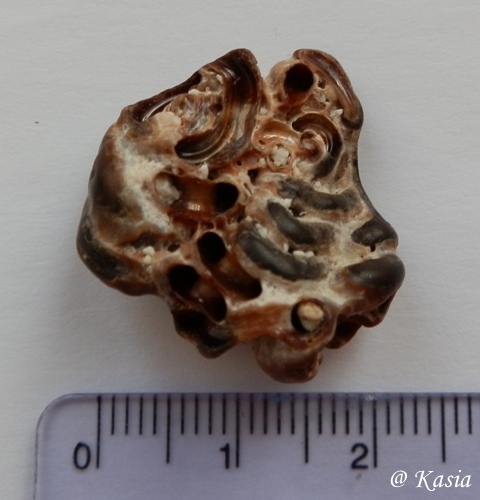
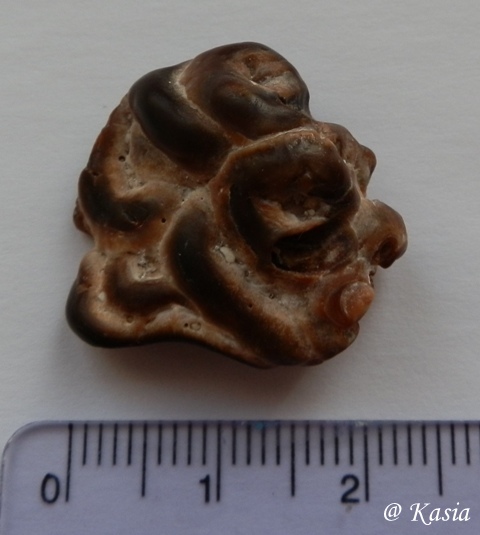
Kasia has returned to grace the blog with treasures from her Abaco beach-combing from the Delphi Club and further afield. Expect more shells, more sea glass… and more mystery objects. We have already had part of aRAY’S PALATEand aPACIFIC ANGARIA SHELL that had somehow arrived on the shores of Abaco. There’s a long thinWHITE BONE, as yet unidentified (no suggestions yet). And now this extraordinary item…
To which my answer is “not the faintest idea”. My guesses are (1) a fossilised vertebra of some medium-sized creature (2) a fossilised ‘soft’ rock that worms have been at (but why only on one side?) (3) a bread roll that went disastrously wrong in the baking…
All suggestions welcome, preferably via theCOMMENTbox (so others can view them); or to rollingharbour.delphiATgmail.com (spam guard: convert AT to @)
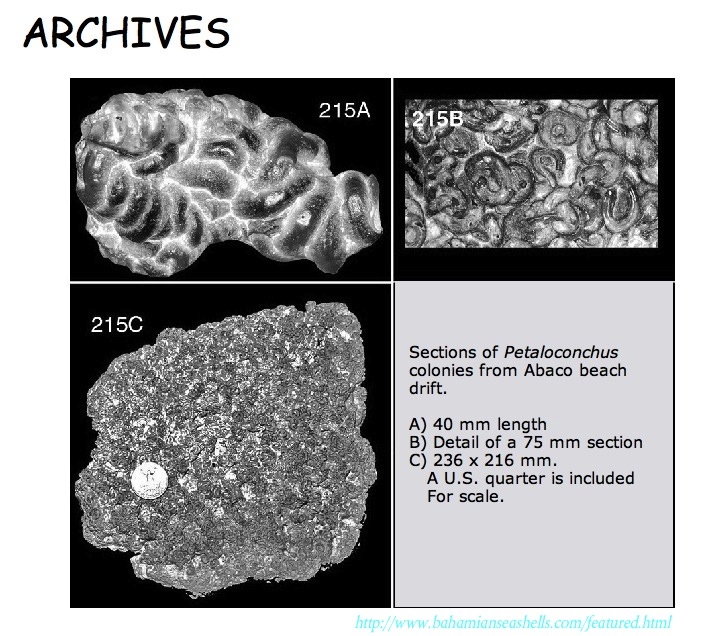
STOP PRESSMystery quickly solved, thanks to Colin Redfern who says“This is part of the remains of a colony of Petaloconchus worm-shells (molluscs). They attach to rock or coral, and the colonies can be quite large.” Colin’s website includes some examples from his archive, one chunk being very similar to Kasia’s
And here’s another chunk, top and bottom view Photos courtesy of James St. John (Geology, Ohio State University at Newark)
…and here is the worm that makes the vermi-accretion or whatever the term is
This is an expanded and rejigged post based on bits and pieces originally scattered around the MISC WILDLIFE page, written now partly because of various search queries recently – diet and so forth – which had not been covered.
First, the very dull scientific classification bit (wiki-debt): Kingdom – Animalia; Phylum – Chordata; Class – Sauropsida; Suborder – Iguania; Family – Leiocephalidae; Genus – Leiocephalus [Subspecies Carinatus?]
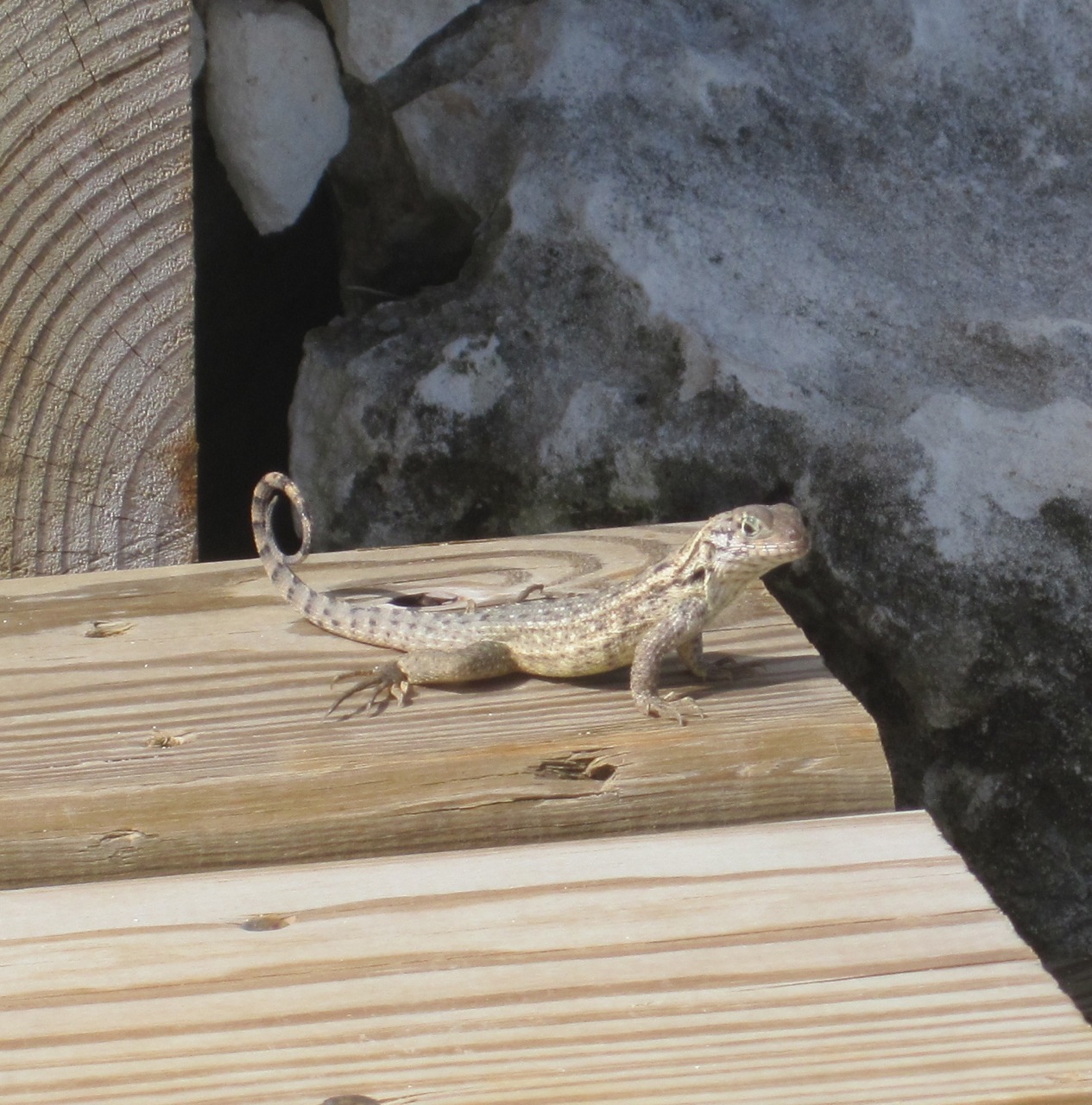
The ‘curly-tailed lizard’ family is widely found throughout the Caribbean but is apparently relatively unstudied (but why on earth not?). There are nearly 30 distinct varieties, many specific to individual islands. My completely uneducated guess is that the Abaco ones may be one of the several subspecies of ‘Cuban or Northern Curly-tailed Lizard’ carinatus, the ones found generally in the Bahamas. But who cares? By any standards they are totally cute! This photo was taken at the bottom of the steps down to the Delphi Club beach.
(Photo credit: Mrs RH)
(Photo credit: PM Himself)
NEW ADDITION April 2012 A fine Curly Tail from Brigitte Carey of Tilloo Cay
DEPLHI CLUB: ‘OFF-DUTY’ CURLY TAIL, OR A DIFFERENT TYPE OF LIZARD?
The CT is described as an active, robust lizard that is mostly terrestrial and will retreat into a burrow or cavity when frightened. It prefers sunny areas with loose rubble and rock. Bahamas curly tails were apparently released intentionally in Palm Beach, Florida, in the 1940s in an attempt to control sugar cane pests.
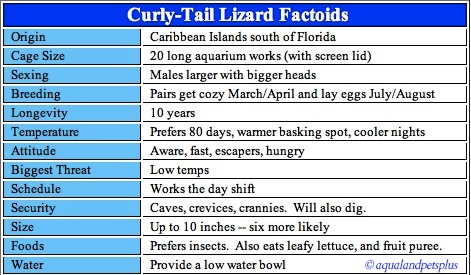
Jan 2012 update:Having had a number of hits over the last few months for ‘what do Curly Tails eat’ and other CT-related information, I checked out aqualandpetsplus.comof Des Moines, Iowa (the first Google hit, in fact). With kind permission (many thanks, Larry) here’s some more about these little lizards
THE CURLY TAIL DIET:“Considered insectivores, curly-tails scamper right after crickets. They’ll also learn to eat mealworms and superworms from your fingers. You can give them other insects like wax worms which they love but tend to over-eat. Roaches, houseflies, or any arthropods / bugs that accumulate around your porch light make a nice change of pace…OR…take a stroll down the baby food aisle. Think twice about the bananas. Bananas are not good for some lizards. Skip the bananas. Anyway, apple sauce works great. The best thing about baby food? You can add a Calcium/Vitamin D supplement to it. Much easier than dusting crickets (which start cleaning it off the second it gets on them). Curly-tails will also eat bits of leafy lettuce. Uneaten crickets in their cage will also eat the fruits and vegetables you offer your lizards” Larry Arnold
So I can’t answer someone’s specific query ‘do they eat tomatoes?’, save to say ‘why not try tomato sauce’ (and I don’t mean a well-known proprietary brand, one of 57 varieties). Maybe have a few crickets handy in case it is politely declined

 About a year ago, Sandy Walker encountered a praying mantis at the Delphi Club. For technical reasons his photo(s) of it didn’t work out. Undaunted (and because I’d never seen one outside an insectarium) I turned an essentially non-event into a short post SANDY’S PRAYING MANTIS, in the course of which I learnt a bit about these strange creatures. There isn’t a great deal of compelling information to pass on, to be honest. And I still don’t buy their supposed resemblance (for the sober observer) to Eleuthera.














































 ROLLING HARBOUR ABACO
_spacecraft_launches.jpg)
You must be logged in to post a comment.