Loggerhead Hatchling (Bimini’s Marine Protected Area Campaign)
A VISIT TO BIMINI’S MARINE ENVIRONMENT (1)
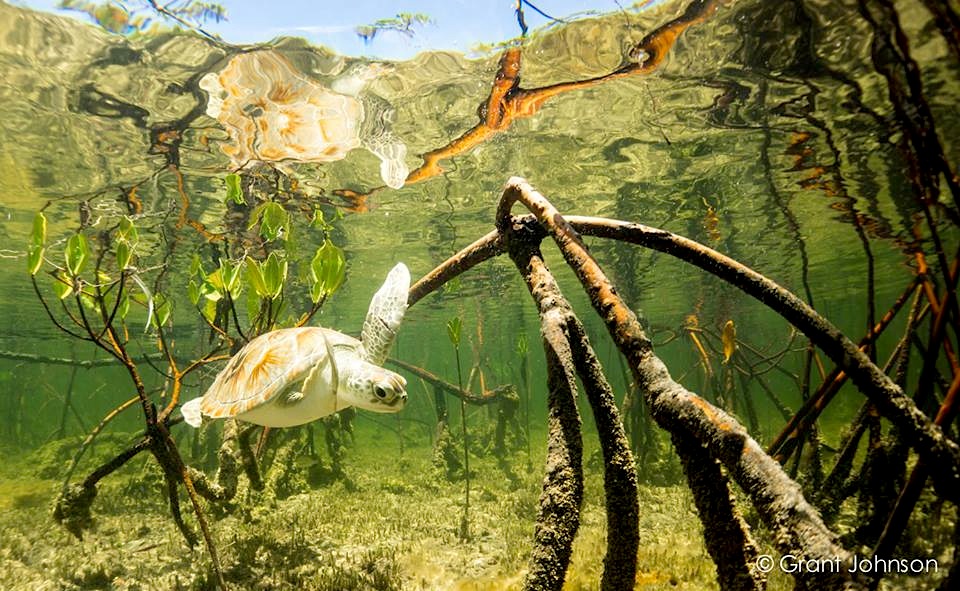
Abaco is fortunate already to have special conservation areas, both on land (e.g. the huge National Park) and at sea (e.g. Fowl Cay Marine Preserve). Other preserves are in active stages of development. Elsewhere in the Bahamas, where the natural life is equally wonderful, battles are being fought to protect pristine habitat from the encroachments of modern life such as unsuitable development (or development in unsuitable locations). For this first look at Bimini, I am most grateful toBimini’s Marine Protected Area Campaignfor permission to use some of their wonderful photographic archive that illustrates the vital importance of the mangroves, reefs, sea grass and pristine sea to marine life large and small. It’s worth checking out the background and surrounding context of these images to see the sort of habitat the creatures depicted prefer. This post features some of the larger species.
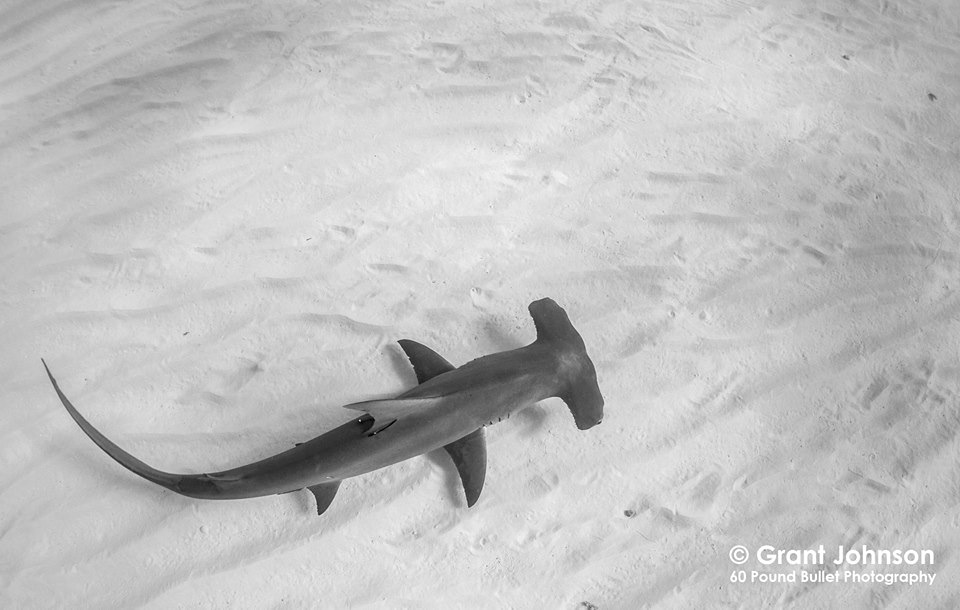
HAMMERHEAD SHARKS
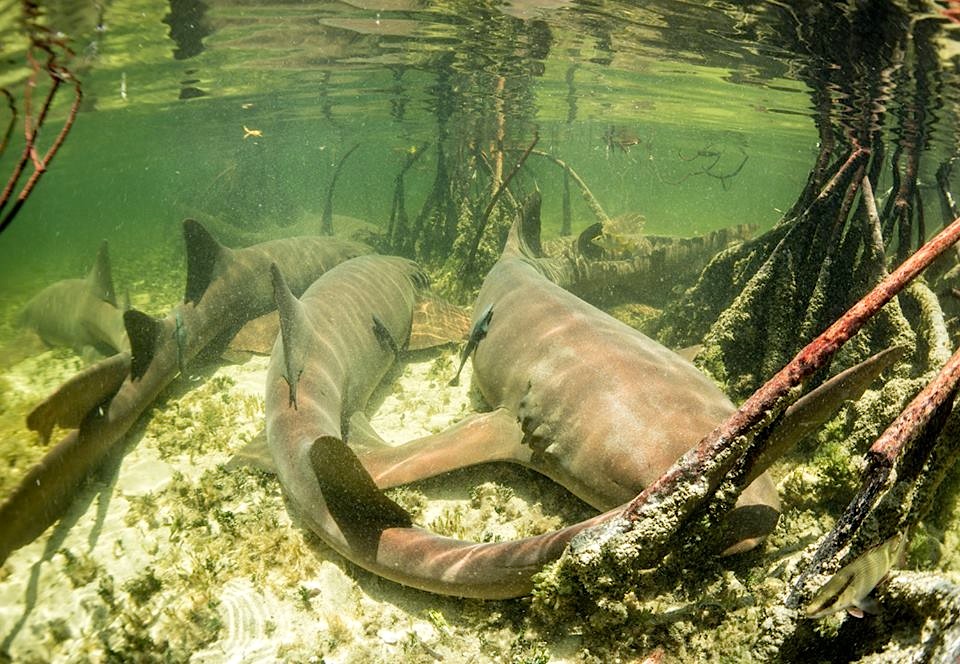
NURSE SHARK NURSERY IN THE MANGROVES
BOTTLENOSE DOLPHINS
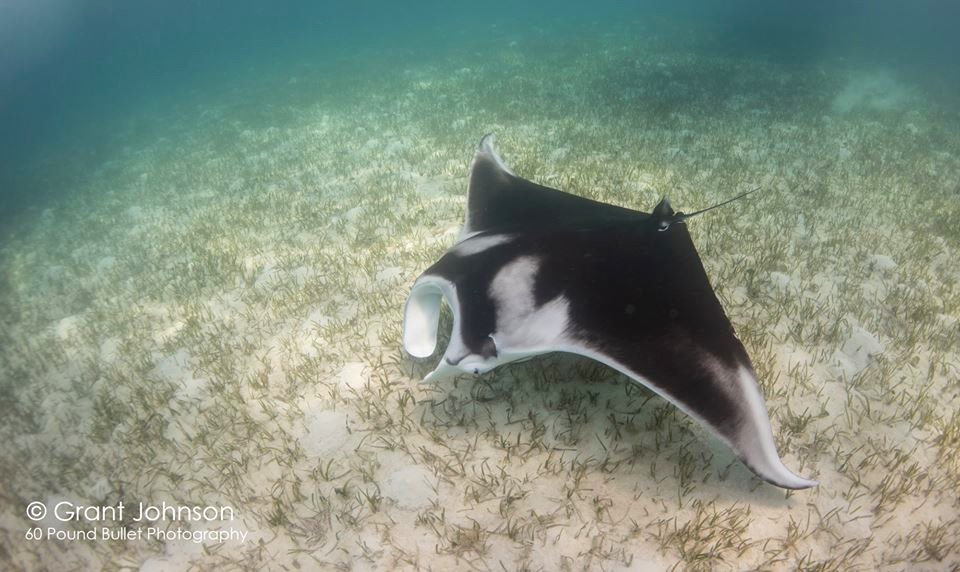
RAYS
A pregnant female southern stingray, seen from below
“ALIEN FROM THE DEEP”: ABACO’S SCALELESS BLACK DRAGONFISH
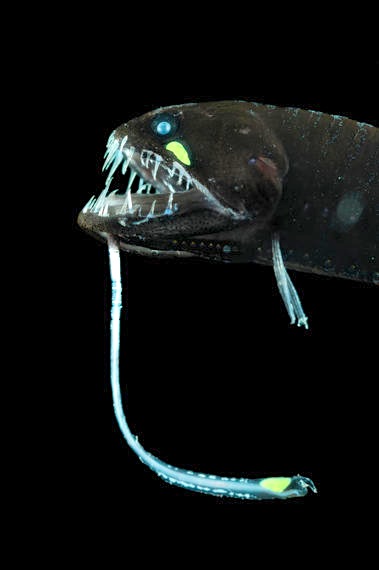
Prepared to be terrified. Beneath the placid turquoise waters of Abaco lurks a ruthless and implacable killer of hideous mien, armed with vicious teeth … Yes, as the music from Jaws begins to throb round your temples I bring you… THE SCALELESS BLACK DRAGONFISH, aka the Deep Sea Dragonfish or Viperfish (of which it is one type). Oh, and it’s about 8 inches/ 20 cms long.
The specimen shown here was found off Rocky Point, Abaco during a whale and dolphin research trip by the BMMRO. This is an area where typical low waters give way to the far deeper waters of an arm of the Great Bahama Canyon. It is an excellent place for whale watching, since one effect of the canyon is to provide plentiful food of the sort that cetaceans thrive on. The chances of you ever meeting a dragonfish are very slim indeed, since they live at depths up to 1500 metres.
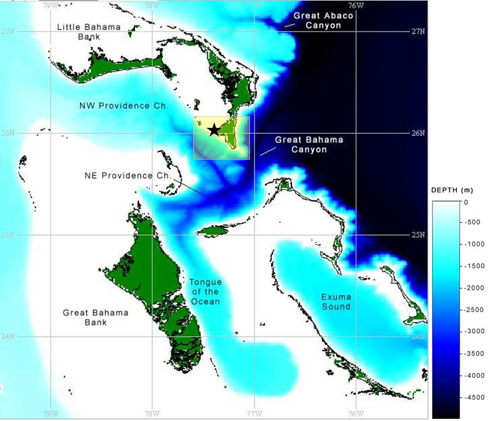
MAP to be added after posting, to avoid FB’s deranged random ‘feature photo’ selection The black star at the south end of Abaco (in the yellowish box) is where Rocky Point and Sandy Point are to be found.
Here is an account by BMMRO intern Luanettee Colebrooke who was lucky enough to be on the research vessel when this strange, vicious-looking creature was found. I have edited the material for present purposes, but I recommend reading the whole article which can be found on the BMMRO website HERE.You will get an excellent overview of a day’s research under the hot sun, and plenty about the collection of whale poop (a topic I have previously dwelt on HERE (“Familiar Feces“).
The crossing of this organism was by complete accident. It was something that none of us would have imagined finding floating along the surface of the water. For Dr Claridge, Jurique (another BMMRO summer intern from Cat Island) and I as Bahamians, who knew this creature even existed in our majestic waters? Who knew our waters were even that deep to hide this specimen? (I think Dr Claridge knew)
Our morning began as per the usual routine for a boat day. There are several research sites that we venture to regularly: Rocky Point for the coastal Bottlenose Dolphins, and an area about 2 miles south of Rocky Point for our very elusive and wary Blainville’s beaked whales, and the deep blue (a massive drop into waters that are 1500 metres deep) to listen for Sperm Whales.It is not that I do not believe that we have deep waters. The Tongue of the Ocean runs through the northern part of our country. My thought comes more from, ‘our waters are that deep’? To a point where light does not hit the bottom and organisms have to rely mainly on bioluminescence? It is a similar thought process I had when I saw a sperm whale for the first time. They are not small creatures of the sea. It is both an awe and scary thought that there are creatures out there we, as Bahamians, do not know exist in our waters.
“Our final activity of the day was tracking a sperm whale acoustically using a hydrophone…”There follows a graphic account of the technicalities of sperm whale poop collection and co-intern Jack’s “Faecal Dispersion Technique”. Then this: Jack stood up, Pringle in mouth and pointed to a black leather looking strap off of the port bow. “What is it?” Moving closer to the port, Jurique and I had our own thoughts. “It looks like a boxing glove strap,” he suggested. “More like an expensive underwater watch,” I mentioned. Dr. Claridge said, “It looks like a squid tentacle.” Jack added in, “More like the strap from a fin to me.” Our heads were turning with no closer answer. Taking it upon himself as the official sample collector, Jack popped back into the water to collect it. There were no sample pots large enough for it, so he had to use a large Ziplock bag to pick it up.
Letting out a surprised chorus when he got back on the boat, we wondered what the heck it was. It had a mouth and a weird white patch that at first, I thought was its eye. The ventral abdominal section seemed swollen as if it had expanded from the decreasing pressure rising from the sea. As we looked at it and took photos, we determined several characteristics of the deceased specimen without having to autopsy it. The first was that it had three rows of needle like teeth that turned inward. There was what we assumed to be an angler under its ‘chin’ that had a murky transparent color. Another deduction we came to was the white dots that ran along the body all the way to its tail could be bioluminescent in nature like an angler. The pectoral fins were small and thin like a tooth pick. The final detail we took note of was the silver patch underneath its eyes.It was a type of angler fish we hypothesized. And it somehow ended up on the surface. There were several questions we voiced to each other: if it is a deep angler fish, how did it end up here? Where did it come from? Was it stunned by the sperm whale’s echolocation and pulled upwards as it surfaced? Later that night as we went through our faecal samples, photo IDs and data entry, the search began for what exactly this organism was. Jack did some image trickery and overlapped the photos with an alien from Alien. I personally thought it looked more like Venom from Spiderman. As he did that, I took it upon myself to begin the search by looking up the most prominent feature: the angler on the anterior ventral side of the fish. By using this characteristic, I was able to narrow the organism down to a Scaleless Black Dragonfish by using several online scientific key identification guides and forums. The species we are still unsure about. The mystery continues…
This creature is one of a number of dragonfish species found worldwide. This one might to be one of the genus Melanostomias (says he, hesitantly…). Like many deep sea creatures, its customary depths are pitch black, or nearly so; and so it is equipped with its own light source (bioluminescence), including the item dangling down from its lower jaw, called a barbel. The fish’s glow and no doubt the gleam of the barbel swaying around in the water act as a lure to attract prey that swim up to investigate and then.. snap! Those teeth start to do their work.
I’ll end with an amazing short (2:28) video posted in early 2014 by ‘Indoona’. The accompanying description is the most authoritative account of the species and its little ways that I have come across, complete with useful links. I include it before the video, noting only that the creature featured is a Pacific one from off the coast of California, and therefore not identical to the Abaco one.
THE DEEP SEA DRAGONFISH OR VIPER FISH is an awesome looking creature from the middle depths of the ocean (this one comes from 600 metres or about 1000 feet deep). Also called the scaleless dragonfish, they are ferocious predators, with extremely large teeth compared to their body size. And they have one of nature’s most amazing tricks to give them the edge over their prey (more below).
There are several different species of dragonfish (one estimate is 67 species – all from the fish family known as Family Stomidae) and they are quite difficult to tell apart but this one is from the pacific depths of California and is likely Tactostoma macropus, the longfin dragonfish. Idiacanthus antrostomus is an Atlantic species that looks very similar – at least I think that’s the case correct me if I’m wrong.
They hunt with a bioluminescent barbel or lure. It is not glowing here but under the different lighting regimes I used – some of the darker images – you can see how much the lure stands out.
Sadly fish like this do not survive long on the surface, mainly because of temperature differences and mechanical damage in the net rather than pressure problems I think. It was caught in a cod-end trawl and filmed in a special tank (a kreisal aquarium). But is great to be able to share another wonder of the oceans on YouTube.
And their amazing trick? Unlike most other deep sea creatures which are sensitive to blue light – the dragonfish also produces a red light beam (see the organ to the rear of the eye) – it is also very sensitive to red light. Although red light does not travel very far underwater it allows them to see when other animals cannot and to sneak up on their prey – especially shrimps that glow in the red light. For more detail see: http://www.science-frontiers.com/sf10…and the work of Ron Douglas and Julian Partridge,http://blog.wellcomecollection.org/ta…(these images were filmed with the help of Julian and Ron). Oh and this dragon is not big – about 20 cm or just under a foot!
Credits: Luanettee Colebrooke, ‘Jack’ & BMMRO (to whom thanks as ever), imagesource.com, Indoona , and 2 sites I came across during my investigations – seasky.org & strangesounds.org
If you can’t get enough of dragonfish, check out this Tumblr site for dozens of images including photos, drawings, cartoons, and enough strange dragonfish-based characters to weird you out utterly…HERE
CETACEAN SENSATION: SPERM WHALES & DOLPHINS ON ABACO
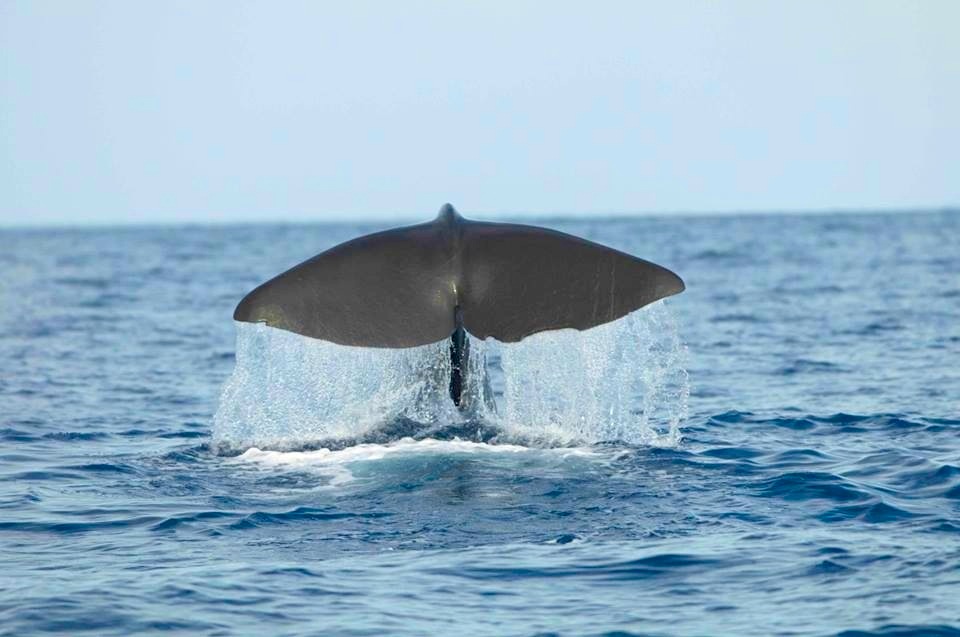
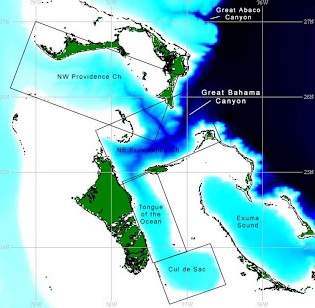
July has been ‘Whale Camp’ month for the BMMRO, when a small group of lucky youngsters get to spend time out at sea searching for whales and dolphins, and learning the intricacies of data recording and research. One target was the sperm whale, a species that may be found off the coasts of South Abaco. This is a favoured place because the deep trench of the Great Bahama Canyon throws up the food these whales need (see map below).
After some time spent searching, the BMMRO reported “the sperm whales are back! We found a single animal yesterday, and finally in the evening found the rest of the group, 10+ animals including 3 mother-calf pairs, and dolphins at Rocky Point!” Here are some of the photos from the trip.
This map of the northern Bahamas shows the V-shaped tails of the Great Bahama Canyon, and explains why the east coast and (in particular) the shallower south-west coast between Hole-in-the-Wall and Rocky Point is so attractive to feeding whale species.
The dolphins were quite prolific in July, in particular bottlenose and spotted dolphins. These photos were mostly taken while the search for sperm whales was going on: the BMMRO posted“lots of dolphins up at Gorda Cay yesterday… still not hearing any sperm whales in the area, has been a couple of weeks without sign of them so they should be showing up again soon…”As they obligingly did!
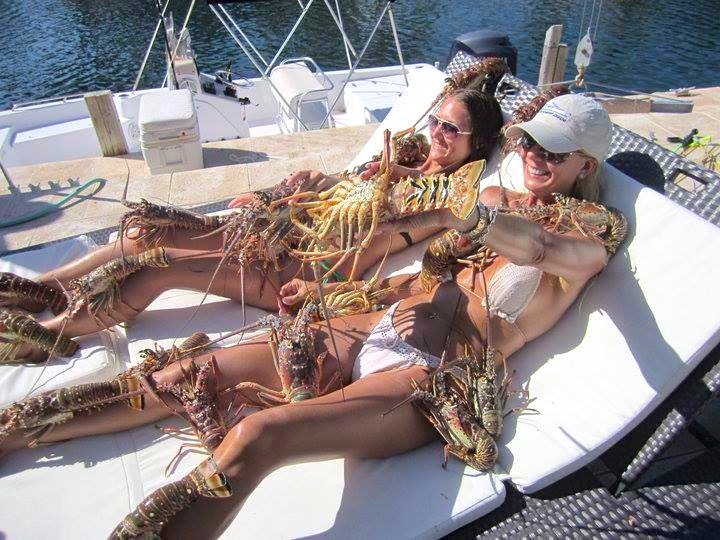
Today is the first day of the crawfish season and Facebook Abaco has been crawling with crawfish for a couple of days in feverish anticipation. So I decided to stick with whales and dolphins instead because there are enough crawfish images out there to keep anyone happy. However I did particularly like this offering today from Albury’s Ferry Services, always a byword for tastefulness and decorum. I’ve borrowed their picture (they borrow mine sometimes) – I wondered if it need a little more exposure, then decided there was probably quite enough already….
The Marls of Abaco are prime bonefishing grounds, a vast area of labyrinthine mangrove swamps, sandy islets, channels and shallow flats on the west side of the main island. The fish are wily and powerful, the fly hooks are barbless, and each one caught, retained, boated and swiftly released is a prize. There’s plenty of other wildlife to be seen. Heron and egrets, ospreys, belted kingfishers, wading birds and many other bird species make the Marls their home. In the water, there are snappers, jacks, barracuda, and sharks of various kinds and sizes. These latter range from small black tip, lemon and hammerhead sharks to more substantial contenders, with the occasional massive bull shark to add a frisson for those on a suddenly fragile-seeming skiff…
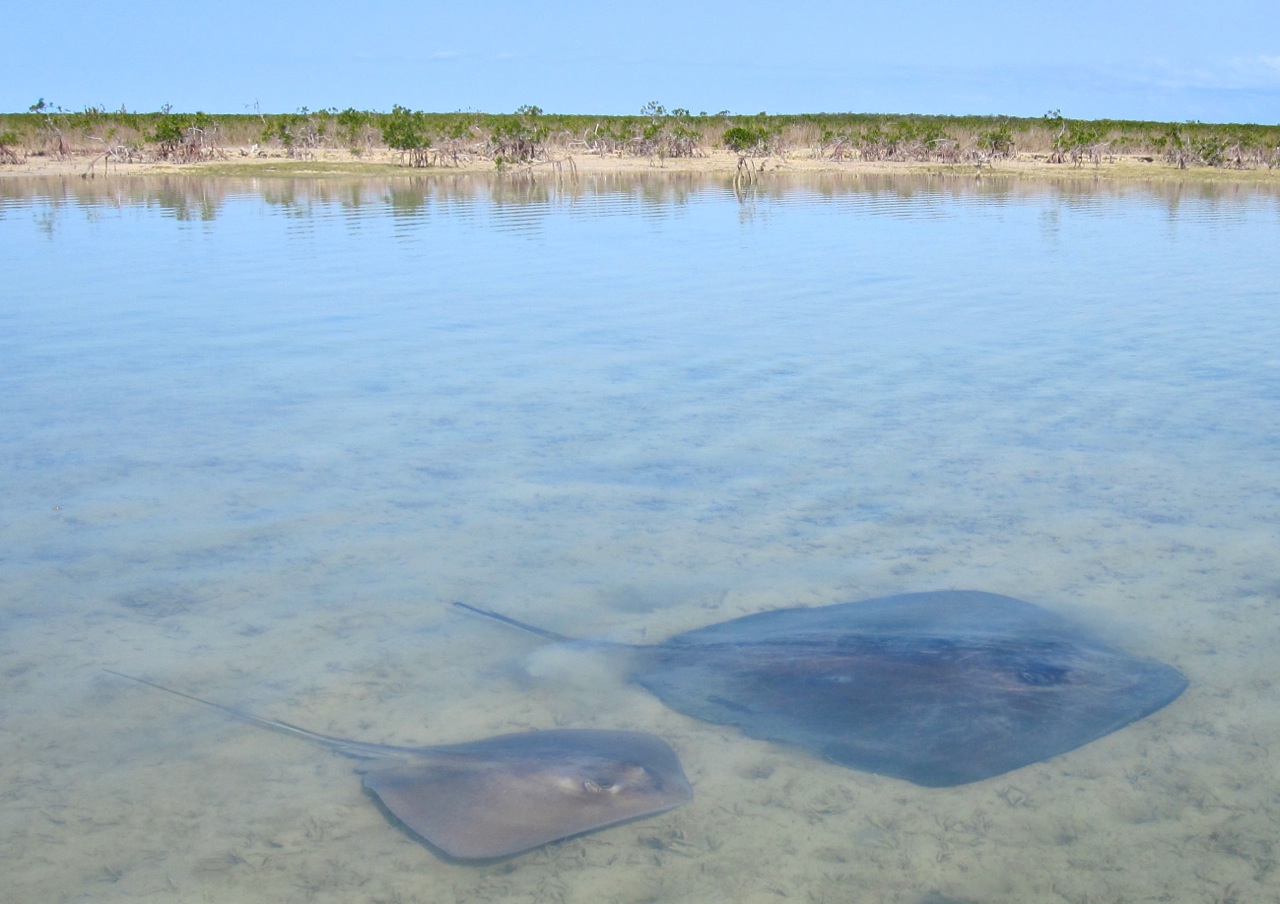
There are also rays. I have posted before about the SOUTHERN STINGRAYand theYELLOW STINGRAY. Out on the Marls I have mainly seen Southerns as they move serenely and unhurriedly through the warm shallow water. A couple of weeks ago, we were out with the rods when we had a completely new Ray experience. I’m not overly given to anthropomorphism and getting too emotional about encounters, but we all found this one quite moving – even our very experienced guide.
Gliding to our right side, a pair of stingrays slowed as they neared the skiff
The adult paused very close to us, allowing the little ray to catch up
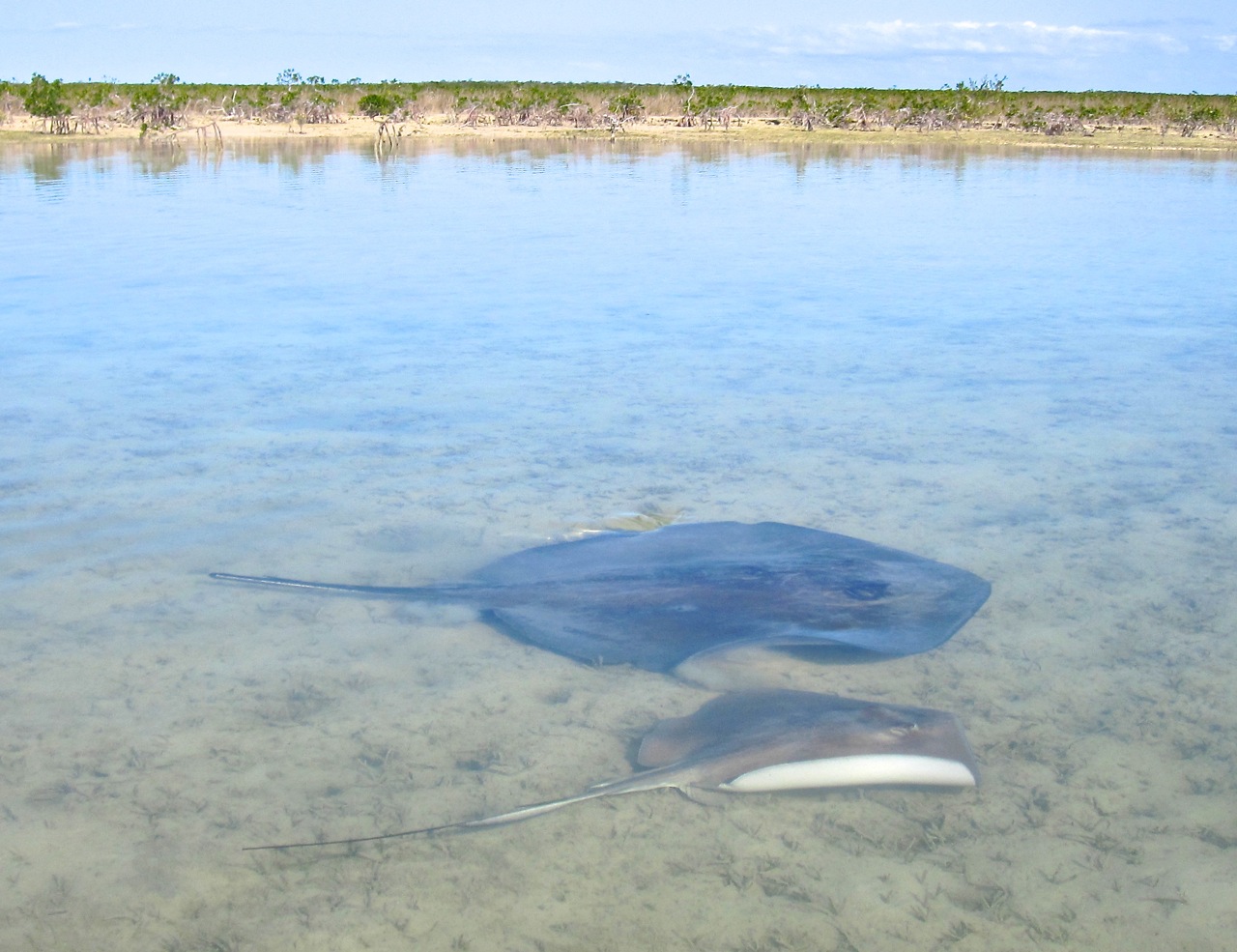
Lifting a wing slightly the adult let the juvenile creep under, while keeping a beady eye on us
The large ray was missing the tip of its tail, presumably from some adverse encounter
The creatures examined us carefully for 2 or 3 minutes, before separating
Then they slowly drifted away across the sand…
According to our guide, this gently protective behaviour is not uncommon. They may well have been completely unrelated, the large ray tolerating the smaller one accompanying it through the waters and offering a kindly wing in the presence of danger or suspicious objects like us.
Photo Credits: Mrs RH (I was too entranced at the sharp end, with a bird’s eye view, to get a camera out)
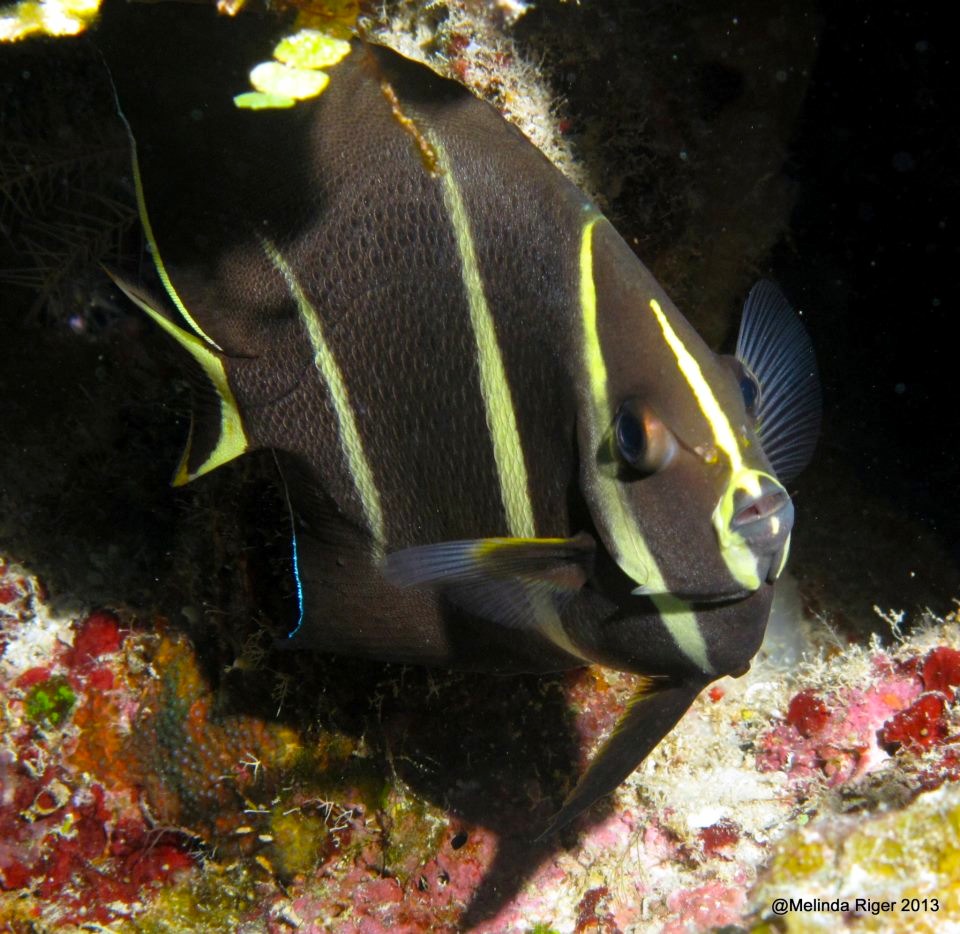
JUVENILE FRENCH ANGELFISH – BLACK WITH YELLOW BANDS
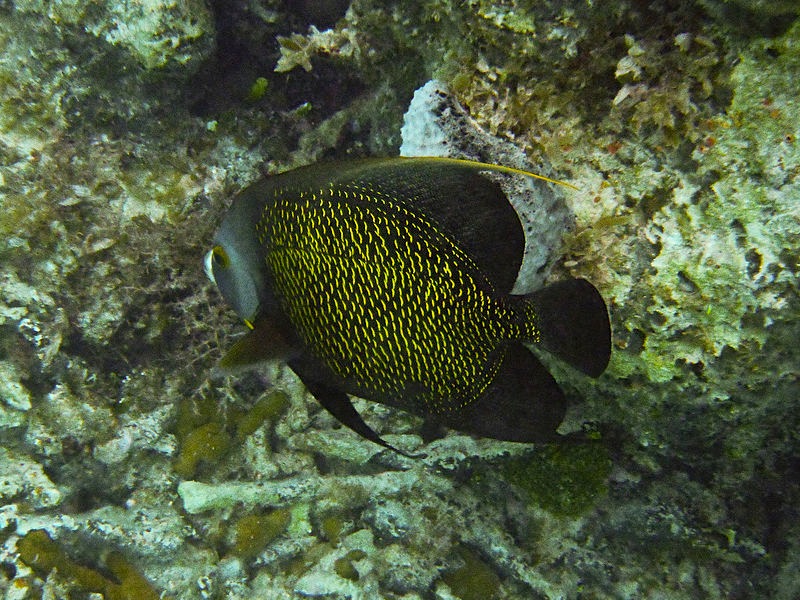
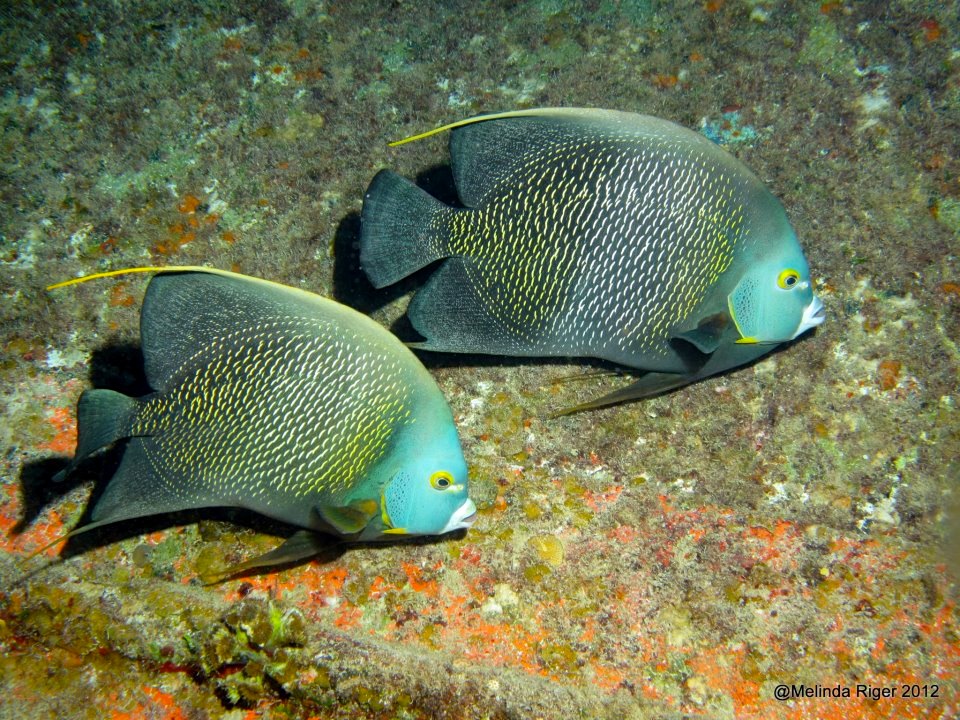
The French angelfish Pomacanthus paru is found in the western Atlantic and in parts of the eastern Atlantic. They are mainly seen around shallow reefs, often in pairs. They feed on sponges, algae, soft corals and small invertebrates.
ADULT FRENCH ANGELFISH
Juveniles are extremely useful members of the reef fish community, providing cleaning stations. They service many species including jacks, snappers, morays, grunts, surgeonfishes, and wrasses, removing parasites.
Angelfish are monogamous, and defend their territory robustly. They swim around the reef during the day but at night they shelter in so-called ‘hiding spots’, which they return to each evening.
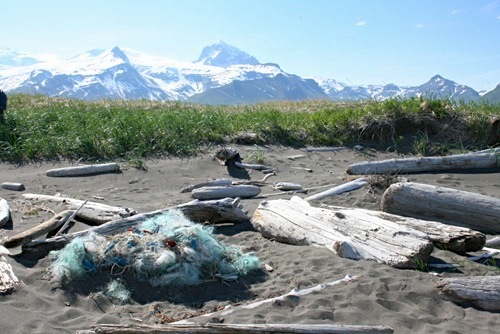
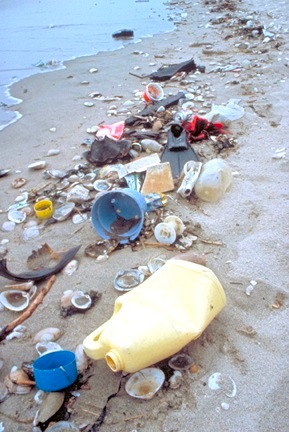
Our waterways are littered with stuff that doesn’t belong in them. Plastic bags, cigarette butts, fishing nets, sunken vessels, glass bottles, abandoned crab traps…the list is endless. Some of this marine debris comes from human activity at sea, and some of it makes its way into our waterways from land.
While we know that marine debris is bad for the environment, harms wildlife, and threatens human health and navigation, there is much we don’t know. How much marine debris is in our environment? How long does it last? How harmful is it to natural resources or human health and safety? How long does it take to break down in the water? The NOAA Marine Debris Program is finding answers to these questions.
1. It doesn’t stay put
While a lot of debris sinks, much also floats. Once this marine debris enters the ocean, it moves via oceanic currents and atmospheric winds. Factors that affect currents and winds (for example, El Niño and seasonal changes) also affect the movement of marine debris in the ocean. Debris is often carried far from its origin, which makes it difficult to determine exactly where an item came from.
2. It comes in many forms
Marine debris comes in many forms, ranging from small plastic cigarette butts to 4,000-pound derelict fishing nets. Plastic bags, glass, metal, Styrofoam, tires, derelict fishing gear, and abandoned vessels are all examples of debris that often ends up in our waterways.
3. It’s your problem, too
Marine debris is a problem for all of us. It affects everything from the environment to the economy; from fishing and navigation to human health and safety; from the tiniest coral polyps to giant blue whales.
4. NOAA is fighting this problem
The NOAA Marine Debris Program works in the U.S. and around the world to research, reduce, and prevent debris in our oceans and coastal waterways. Much of this work is done in partnership with other agencies, non-governmental organizations, academia, industry, and private businesses.TheMarine Debris Research, Prevention, and Reduction Act, signed into law in 2006, formally created the Marine Debris Program. The Act directs NOAA to map, identify, measure impacts of, remove, and prevent marine debris.
5. Some debris is being turned into energy
Abandoned and lost fishing gear is a big problem. It entangles and kills marine life and is a hazard to navigation. Based on a model program in Hawaii, the Fishing for Energy program was formed in 2008 to tackle this problem with creative new ideas. The program is a partnership between NOAA, Covanta Energy Corporation, National Fish and Wildlife Foundation, and Schnitzer Steel.This program offers the fishing community a no-cost way to dispose of old or derelict fishing gear. Once removed from the environment, the gear is transported to the nearest Covanta Energy-from-Waste facility. About one ton of derelict nets creates enough electricity to power one home for 25 days!
6. Marine debris can hurt or kill animals
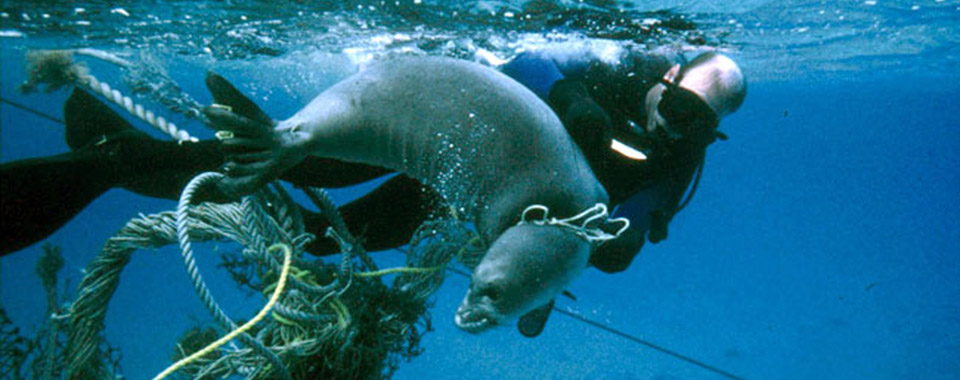
Marine debris may be mistaken by some animals for food or eaten accidently. Often, larger items like nets, fishing line, and abandoned crab pots snare or trap animals. Entanglement can lead to injury, illness, suffocation, starvation, and even death. NOAA is working with many partners to tackle this problem by reducing and preventing marine debris in our oceans and waterways.
7. There’s a lot to learn about this problem
We know that marine debris is a big problem, but there’s much we need to learn. NOAA funds projects across the country and works with scientists and experts around the globe to better understand how marine debris moves, where it comes from, and how it affects the environment. This knowledge will help us find better ways to tackle the problem.
8. You can help us get the word out!
The NOAA Marine Debris Program offers a heap of creative products to get the word out about marine debris. Looking for brochures, posters, fact sheets, or guidebooks? We’ve got those. Like videos? We’ve got those, too. We even have a blog! You’ll find it all online.
9. This is a global problem.
Marine debris is a global problem that requires global solutions. NOAA experts work with scientists and organizations around the world to share lessons learned, discover what programs work best, and map out future strategies to fight this problem.
10. Small steps lead to big results
Fighting the marine debris problem begins at home.
– Try to cut back on the amount of trash you produce.
– Opt for reusable items instead of single-use products.
– Recycle as much of your trash as you can.
– Join local efforts to pick up trash.
– Keep streets, sidewalks, parking lots, and storm drains free of trash—they can empty into our oceans and waterways.
Click to link
Minorly adapted from an NOAA article, with added illustrative NOAA images
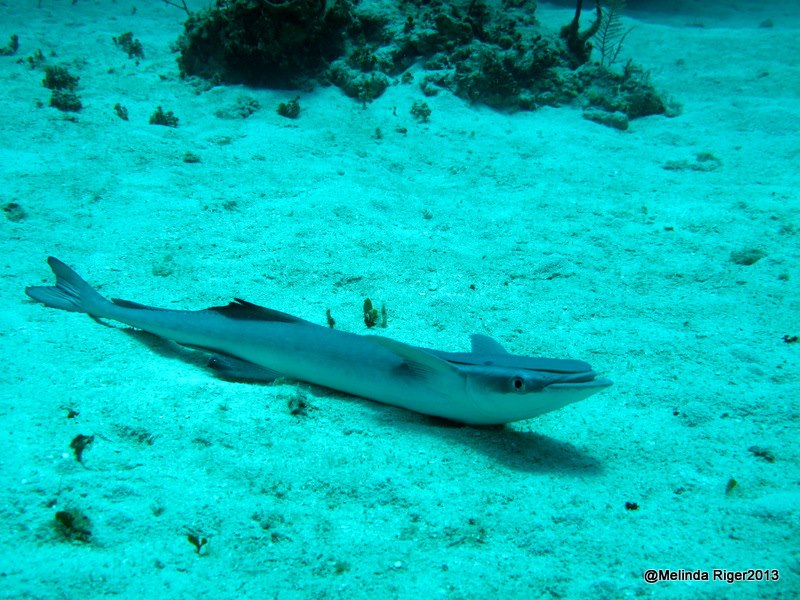
Remoras (Echeneidae), also known as Sharksuckers, Whalesuckers or Suckerfishes, are ray-finned fish that grow up to 3 feet long.
You may have noticed them in pictures of sharks and wondered briefly why they hang out with such dangerous creatures. There is filmed evidence that remoras do occasionally get eaten by their hosts…
WHAT DO THEY DO?
Remoras have remarkable dorsal fins that form a sucker-like organ with a ribbed structure. It looks a bit like the sole of a trainer or beach shoe.This bizarre organ can open and close to create or release suction, enabling it can latch onto larger marine creatures. The remora can increase suction by sliding backward, or it can release itself by swimming forward – the ‘slats’ are smooth in one direction, and rough the other way. They have been known to attach themselves to boats. And scuba divers. Even with hairy legs…
WHAT KIND OF CREATURES DO THEY GET ATTACHED TO?
Remoras associate with specific host species. They commonly attach themselves to sharks, manta rays, whales, turtles, and manatees / dugongs. Smaller remoras may latch onto fish such as tuna and swordfish, and some travel in the mouths or gills of large manta rays, ocean sunfish, swordfish, and sailfish.
WHY WOULD THEY WANT TO DO THAT?
The relationship between a remora and its host is known as Commensalism, specifically ‘Phoresy‘.The host to which it attaches for transport gains nothing from the relationship, but also loses little. The remora benefits by using the host as transport and protection, and also feeds on morsels dropped by the host. Controversy surrounds whether a remora’s diet is primarily leftover fragments, or the feces of the host. Maybe it’s a healthy mix of both.
WHERE CAN I FIND ONE?
Remoras are found in tropical, sub-tropical and temperate waters, including the mediterranean. You will definitely find them in the Bahamas. Melinda’s photos were all taken in the waters south of Grand Bahama.
CAN YOU CATCH ONE?
YES! This late addition (Nov 2016) comes courtesy of Cinda Parks… a remora caught in Cherokee Sound. It’s the first image of a live one out of the water that I’ve come across!
ARE THEY USEFUL TO MANKIND IN ANY WAY?
Yes, but not in a good way, some may think. Some cultures use remoras to catch turtles. A cord or rope is fastened to the remora’s tail, and when a turtle is sighted, the fish is released from the boat; it usually heads directly for the turtle and fastens itself to the turtle’s shell, and then both remora and turtle are hauled in. Smaller turtles can be pulled completely into the boat by this method, while larger ones are hauled within harpooning range. This practice has been reported throughout the Indian Ocean, especially from eastern Africa near Zanzibar and Mozambique, from northern Australia, Japan and even the Americas.
Because of the shape of the jaws, appearance of the sucker, and coloration of the remora, it sometimes appears to be swimming upside down (see above). This probably led to an older name reversus, although this might also derive from the fact that the remora frequently attaches itself to the tops of manta rays or other fish, so that the remora is upside down while attached.
THANKS FOR THAT. BUT WHERE CAN I GET MORE INFO ON THESE SUCKERS?
RIGHT HERE – AN EXCELLENT VIDEO WITH PLENTY OF LIVE REMORA ACTION
OH! FINAL QUESTION. ARE REMORAS EDIBLE?
I though someone might ask that, so I’ve checked it out. Here is the best recipe I have found, expanded slightly from a blokey Australian chat thread:
Recipe for cooking Remora
put a 12 ltr pot on to boil
when the pot is bubbling violently, add 2 whole remora, 2 garden rocks, 1 carrot & a large turnip
add grandfather’s boots to taste, and turn heat down after 3 hours
simmer for a further 6 hours
turn off heat and drain carefully
remove and discard remora, and serve the rest on a bed of tin tacks
Credits: Melinda Riger, Grand Bahama Scuba; Cinda Parks for the freshly caught remora 2016; Wikimedia; meaty Wiki chunks & assorted pickings
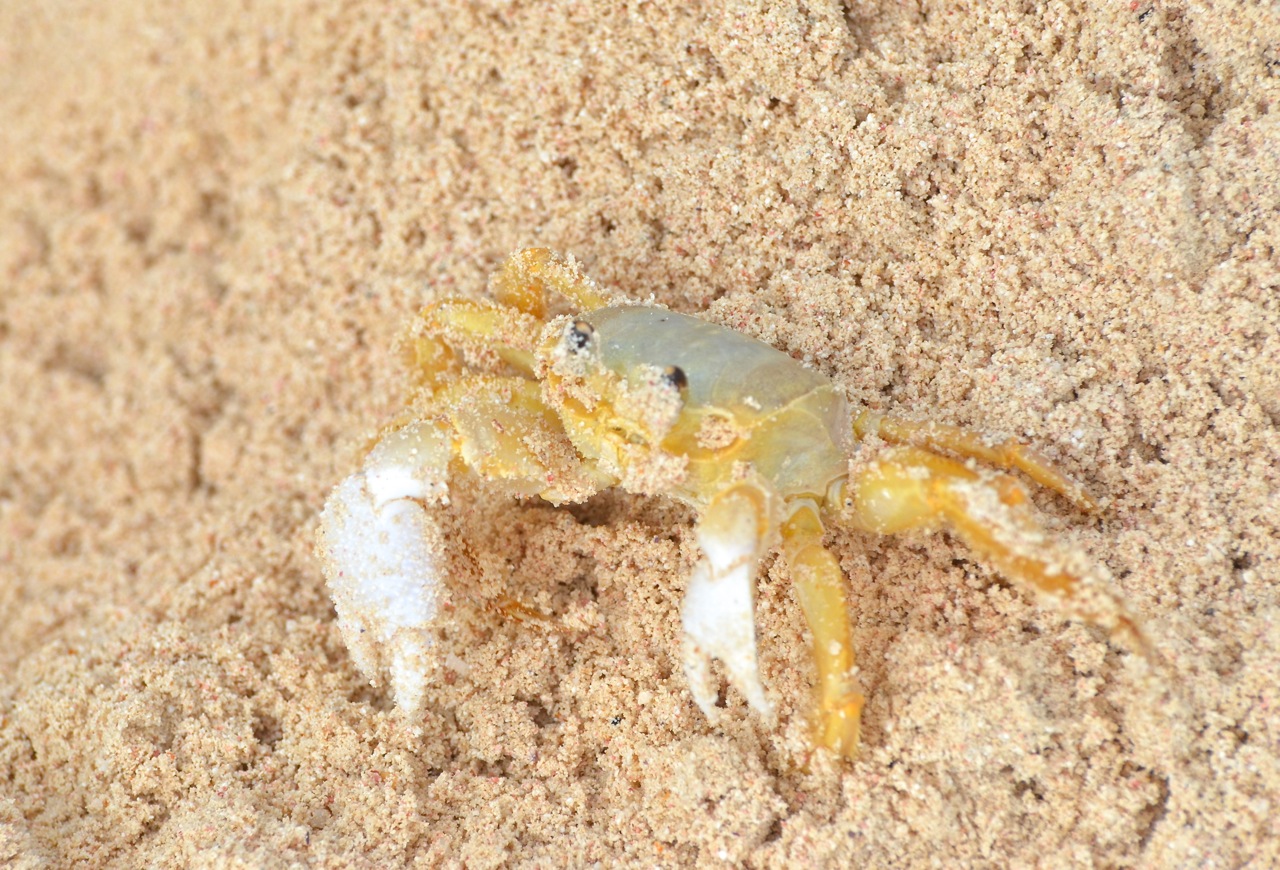
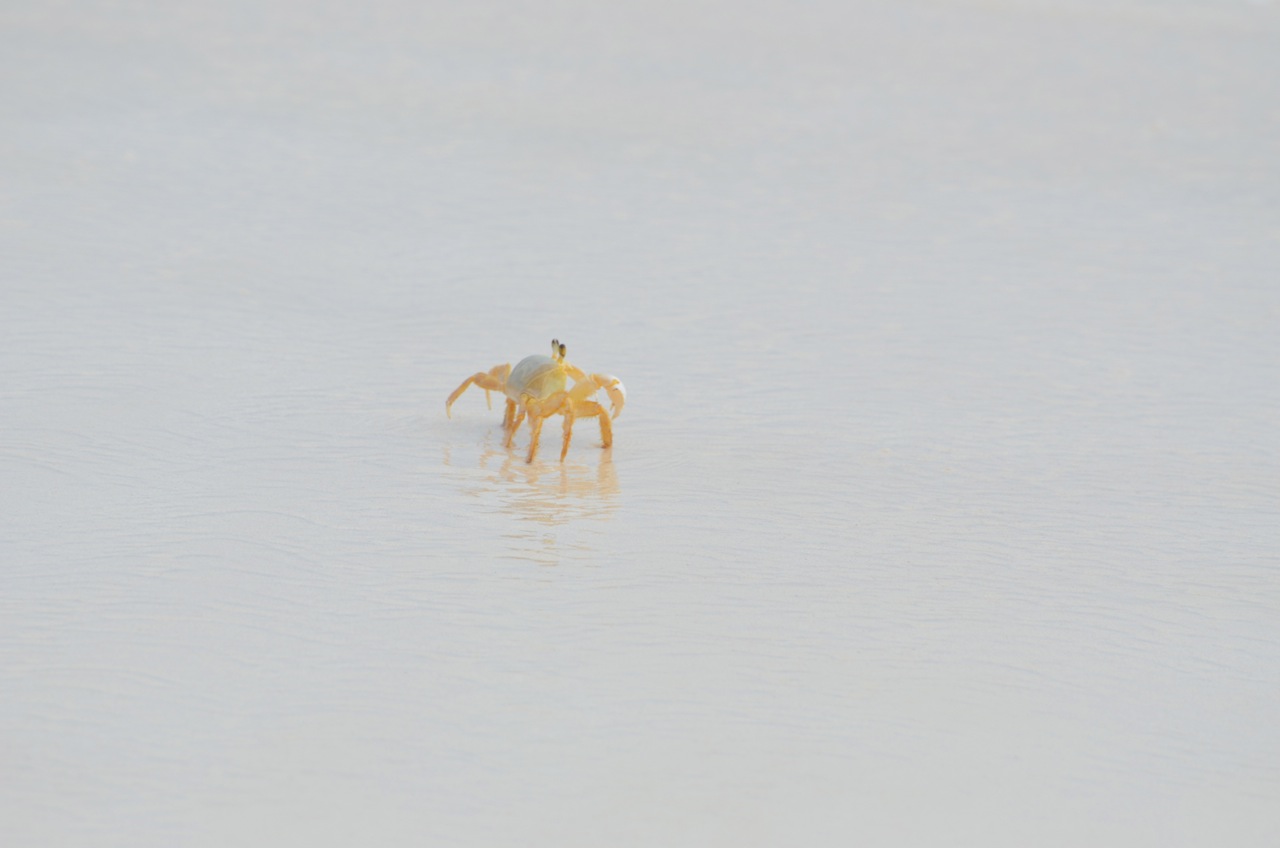
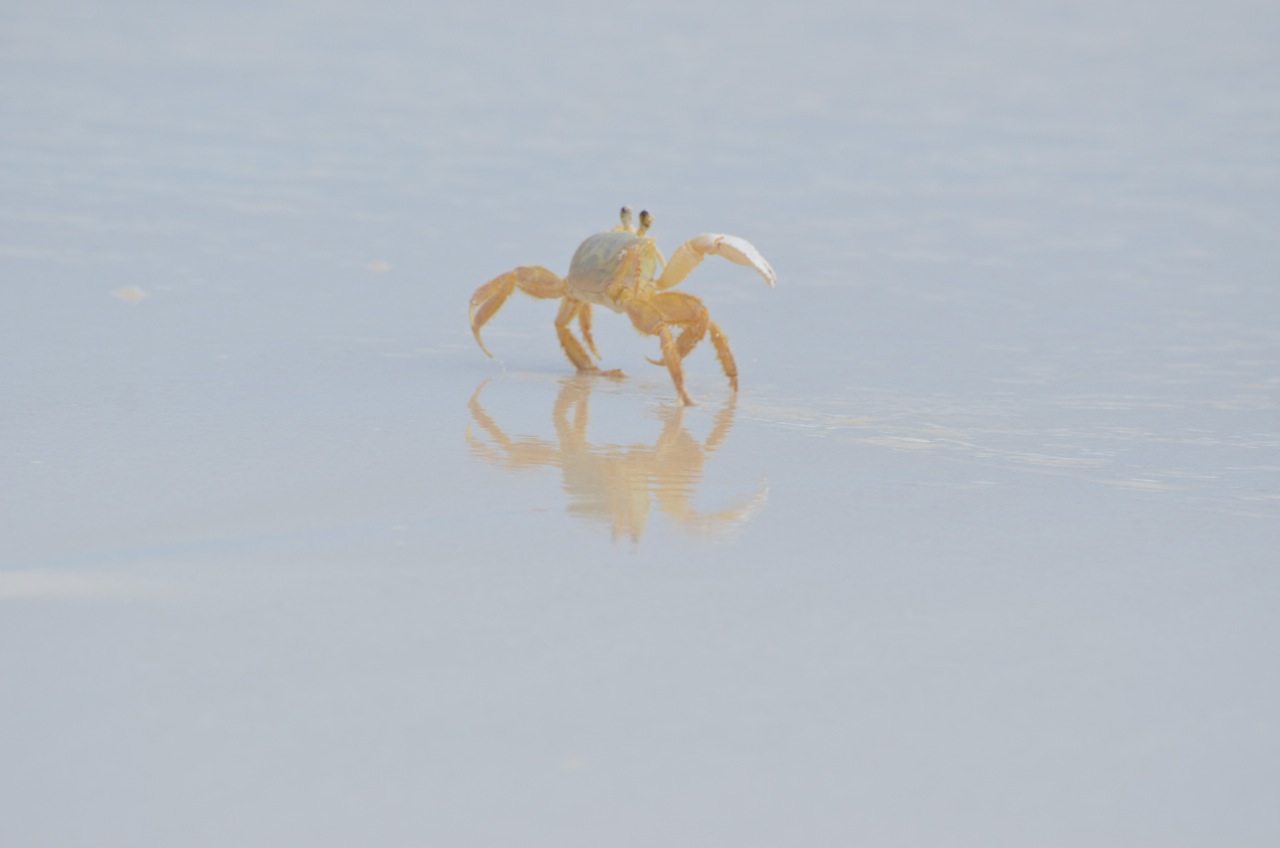
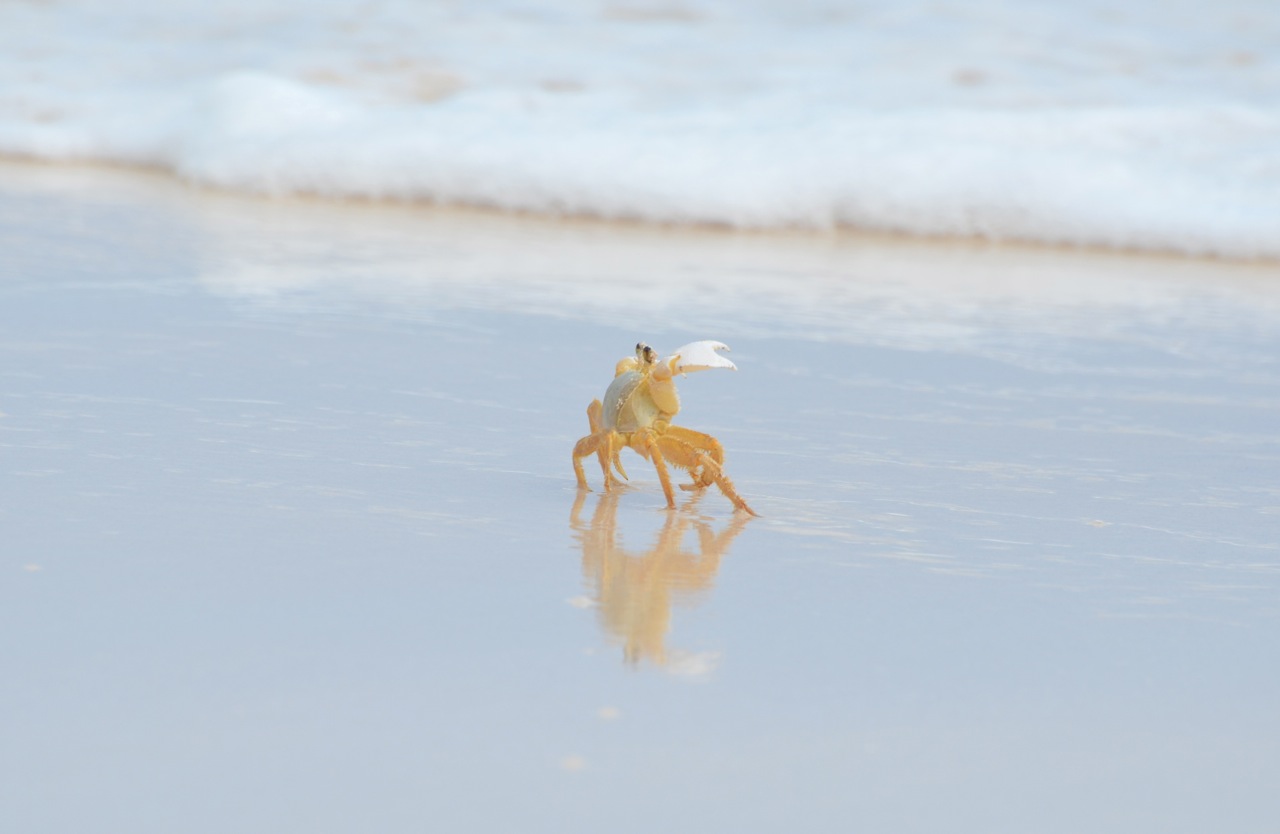
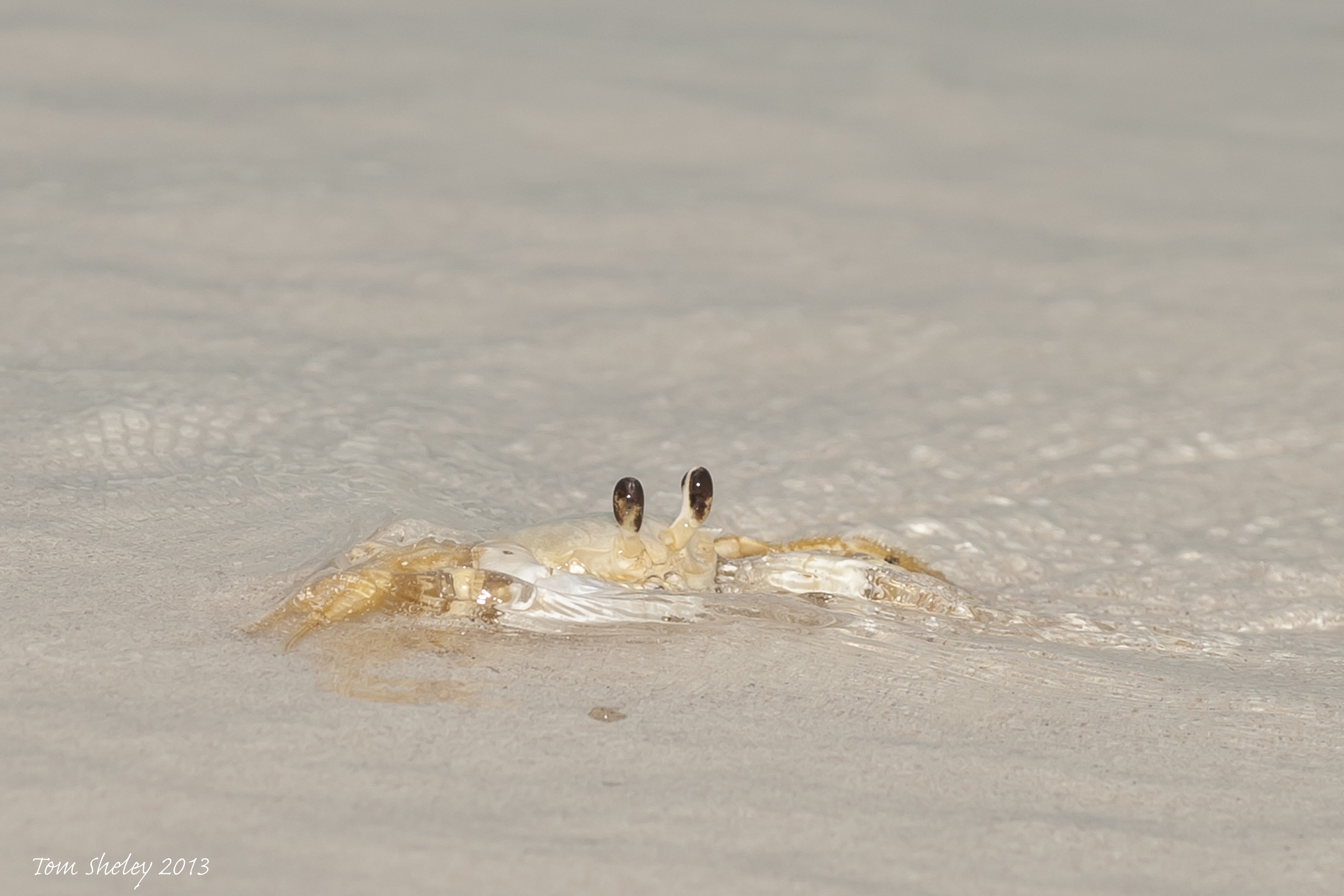
A GHOST CRAB’S DAY AT THE SEASIDE AT DELPHI, ABACO
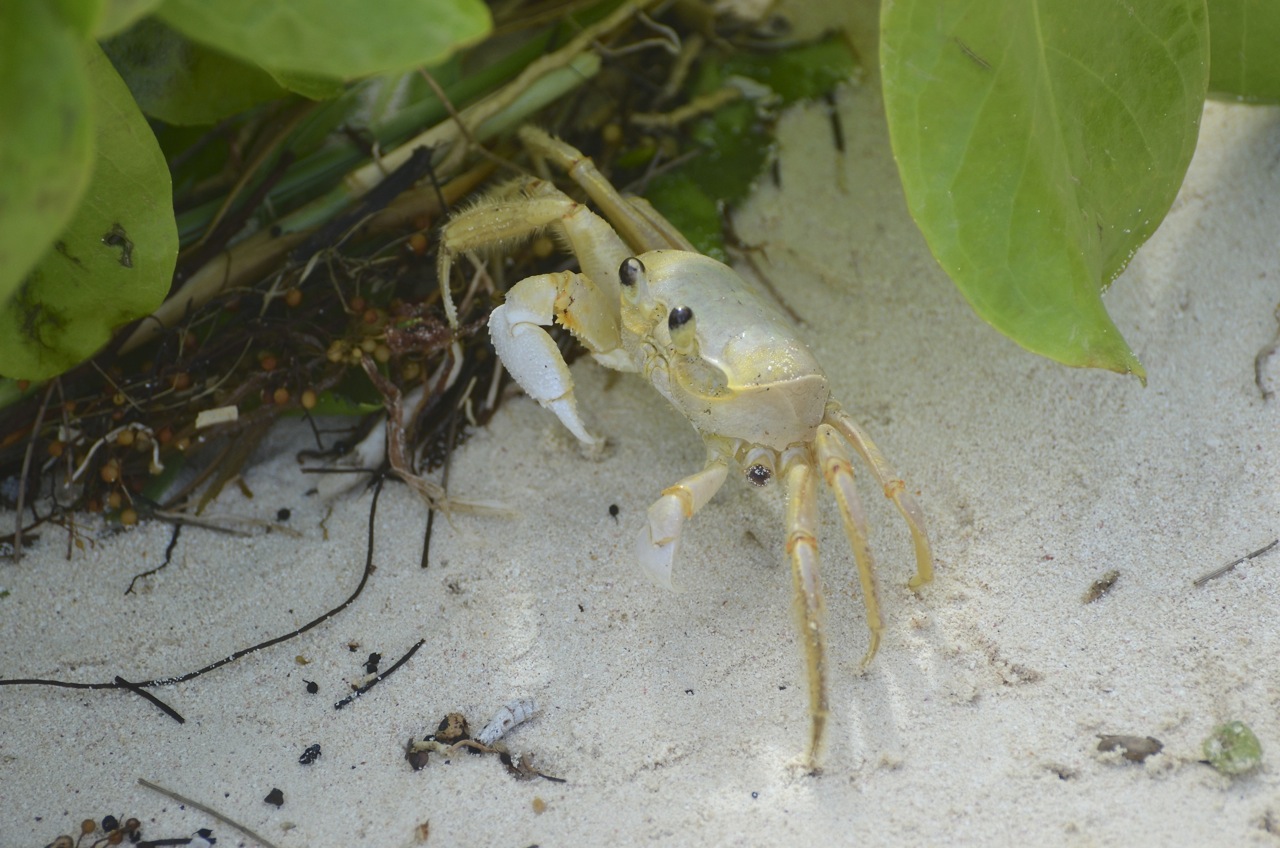
Crabby the Crab lived amongst the greenery at the very back of the Delphi Club Beach
It was a very beautiful beach indeed. Lucky Crabby!
One day Crabby decided to go down to the sea for a swim
He scuttled across the sand towards the sound of the waves
He passed the burrow of his friend Sandy. Sandy was very busy tidying his house.
“Would you like to come for a paddle?” asked Crabby. “No thanks”, said Sandy, “I’m busy today”
So Crabby carried on towards the water’s edge. He got closer, to where the sand was wet…
…and closer, to where the water tickled his toes…
…and closer, to where the tide ripples reached. Crabby waved his claws with excitement
Finally, he was paddling in the warm water. It was just perfect. Whoops! Don’t fall in, Crabby!
Very soon Crabby was in the water, right up to his eyes. What a beautiful day for a swim!
See ‘Crab Run: The Movie’, starring Crabby the Crab
CREDITS: header & beach, RH; last image, Tom Sheley; the rest, Charlie Skinner. DEBITS: pre-Christmas nauseatingly anthropomorphic tomfoolery and video – blame me. No crabs were harmed or even mildly embarrassed during this photoshoot.
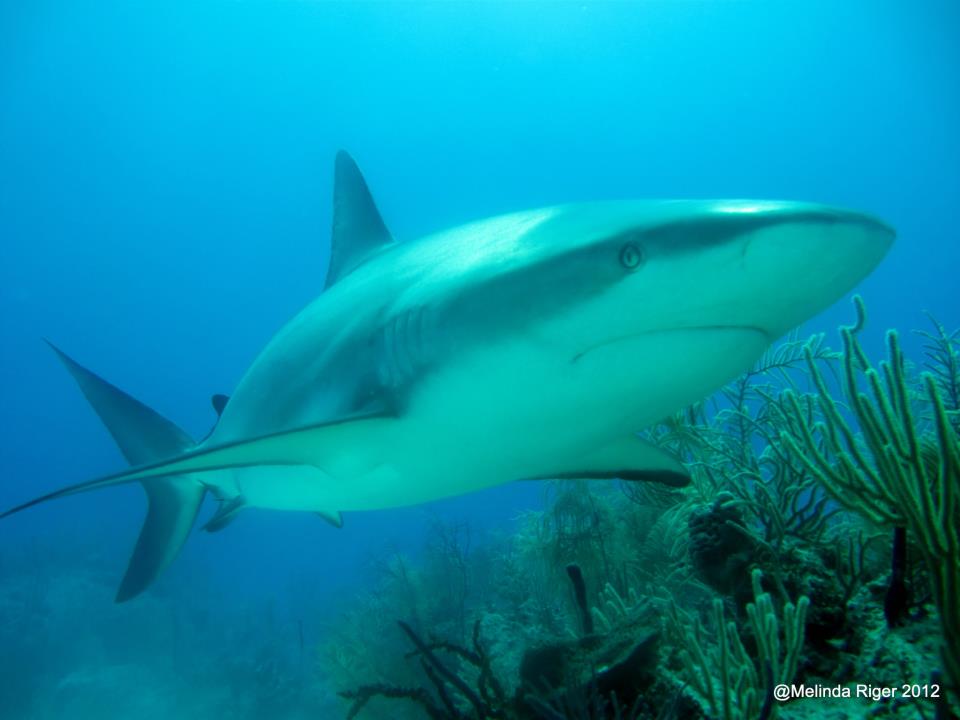
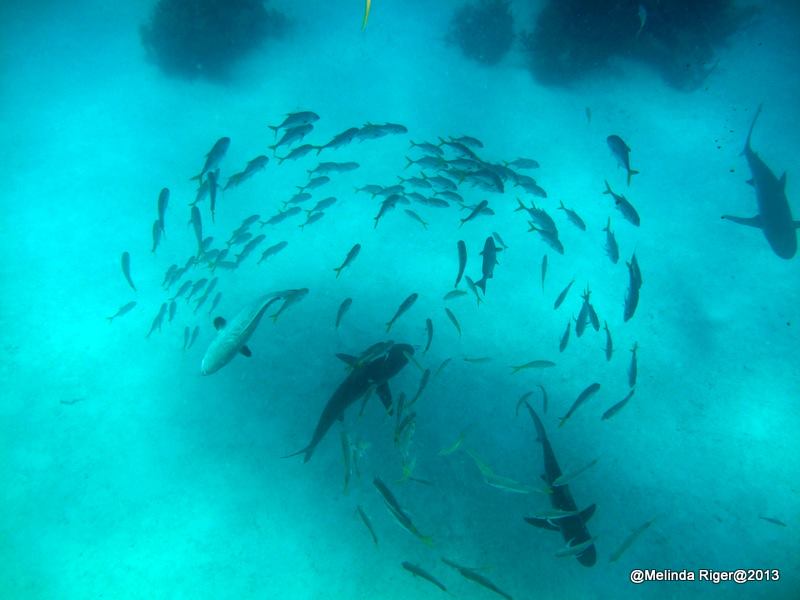
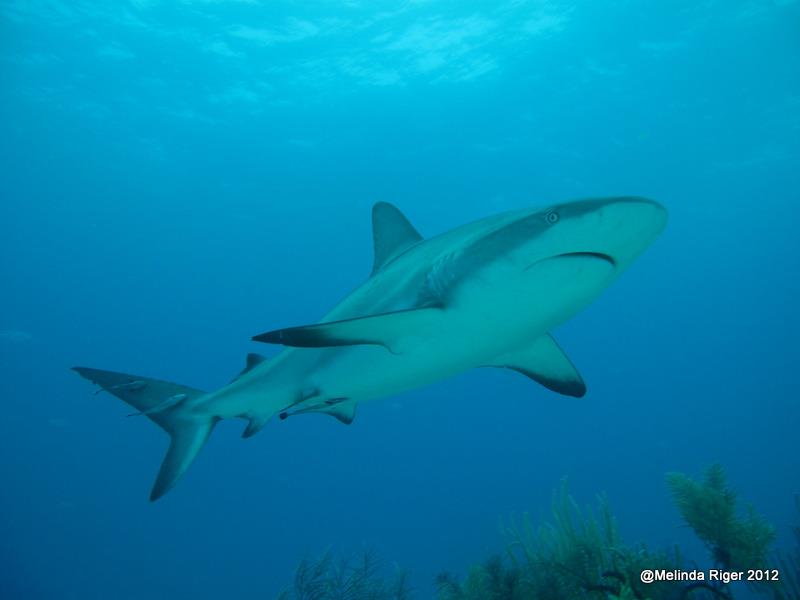
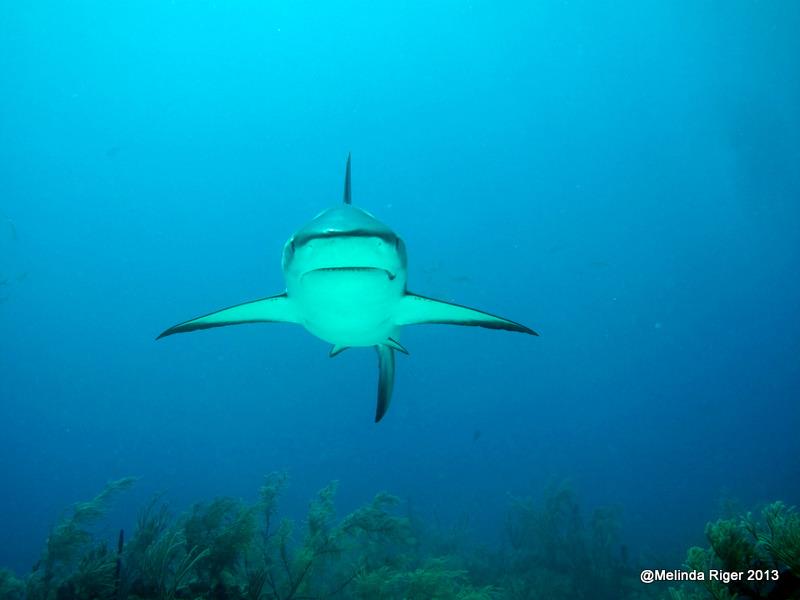
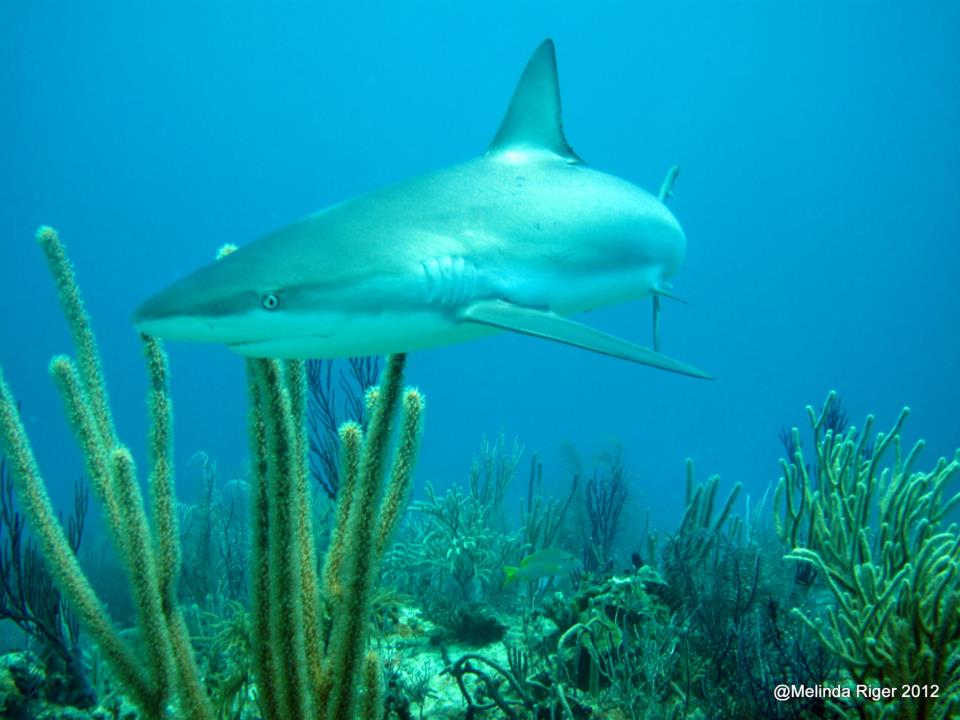
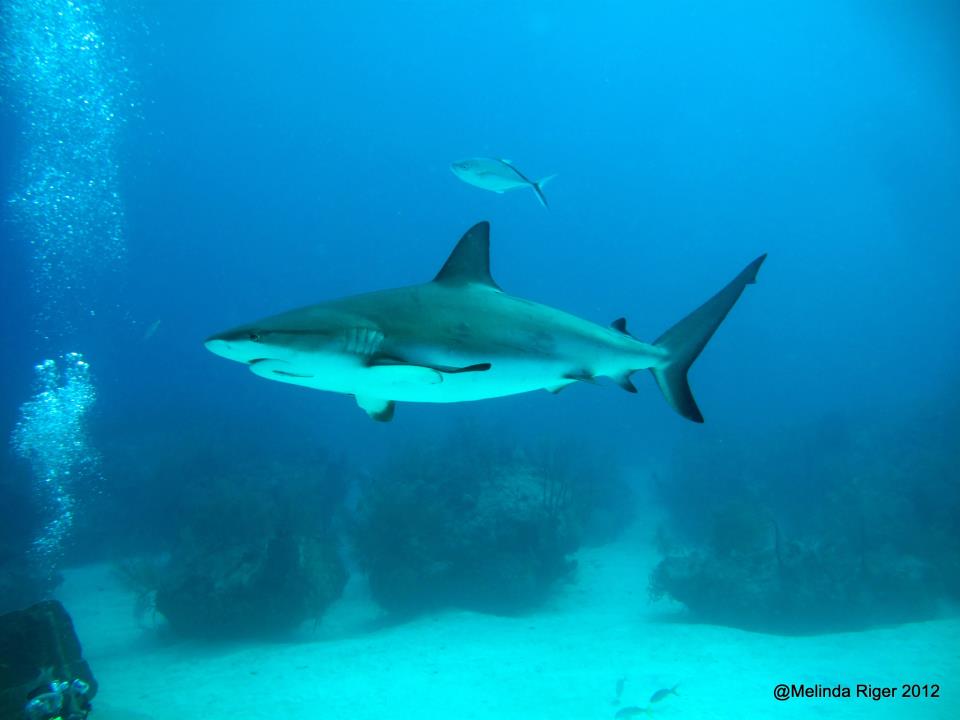
…along came some friendly sharks to swim with… and to photograph
There’s no escaping… the fact that there are sharks in the Bahamas
Take comfort from the fact that no fatalities and only half a dozen injuries from shark attacks have been recorded in Abaco waters for over 250 years (since 1749). Risk assessors and the nervous, take note.
By way of comparison, in the last 150 years there have been 36 recorded shark attacks in the Mediterranean, of which 18 have been fatal…
Since 1845 there have been a number of shark attacks in British waters, with one fatality. There were two more fatalities in an incident in 1956 , but this was an ‘own-goal’ arising from an attempt to blow up a shark with dynamite. It can hardly be blamed on the shark.
WEIRD NON-SHARK RELATED STATISTIC: Amazingly, in the 3 years 2007 – 09 in England and Wales, 42 people died from being bitten by animals, only a few of which were dogs.
CONCLUSION You are statistically far safer to spend 250 years swimming off Abaco than spending 3 years stroking a cat in Manchester. Or Swansea.
LEAVE SHARKS ALONE AND THEY’LL LEAVE YOU ALONE
All fantastic images by Melinda Riger of Grand Bahama Scuba who swims with sharks all the time!
Albert King, Lead Belly and Mike Bloomfield are prime examples of foremost bluesmen guitar-slingers who, in their own distinctive styles, favoured the key of… I’m sorry, what did you say? Oh yes, quite right. My misunderstanding. Apologies, I’ll take it from the top…
Deep blue sea. Deep blue fish. *Deep breath*. All better now. The fish below may all readily be found nosing around the coral reefs of the Bahamas in a leisurely manner. Mostly, they are feeding. Fowl Cay Marine Preserve, Abaco, is a great place for watching them. No need to have all the gear – a simple snorkel, mask and flippers, and an ability to float a bit, would be sufficient.
BLUE CHROMIS Chromis cyanea
These dazzling little blue fish will be one of the first you’ll meet (along with the omnipresent yellow and black striped sergeant majors, so friendly they will come right up to your mask). You can’t miss them. Though very small, their electric blue colouring cuts through the water even on the dullest of days up-top. They can reach 5 inches in length, but most that you see will be tiddlers. They are frequently seen in the company of larger fish.
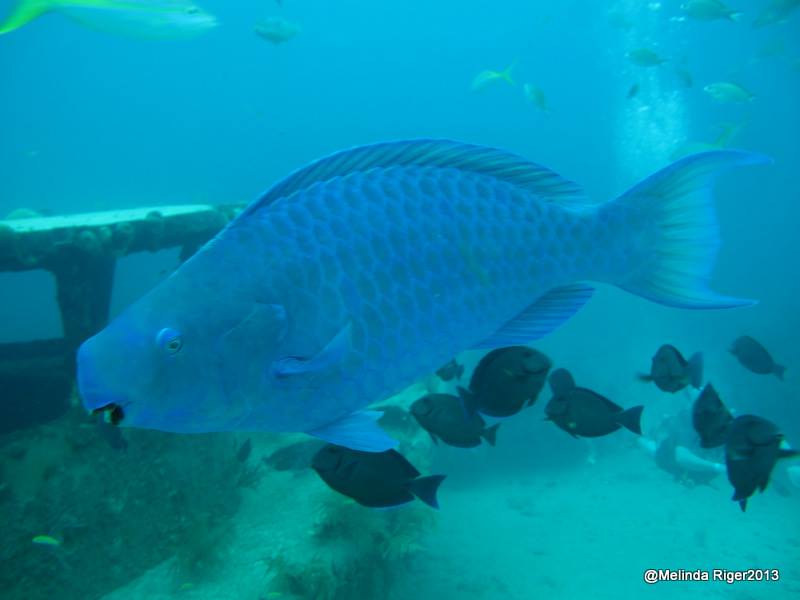
BLUE PARROTFISH Scarus coeruleus
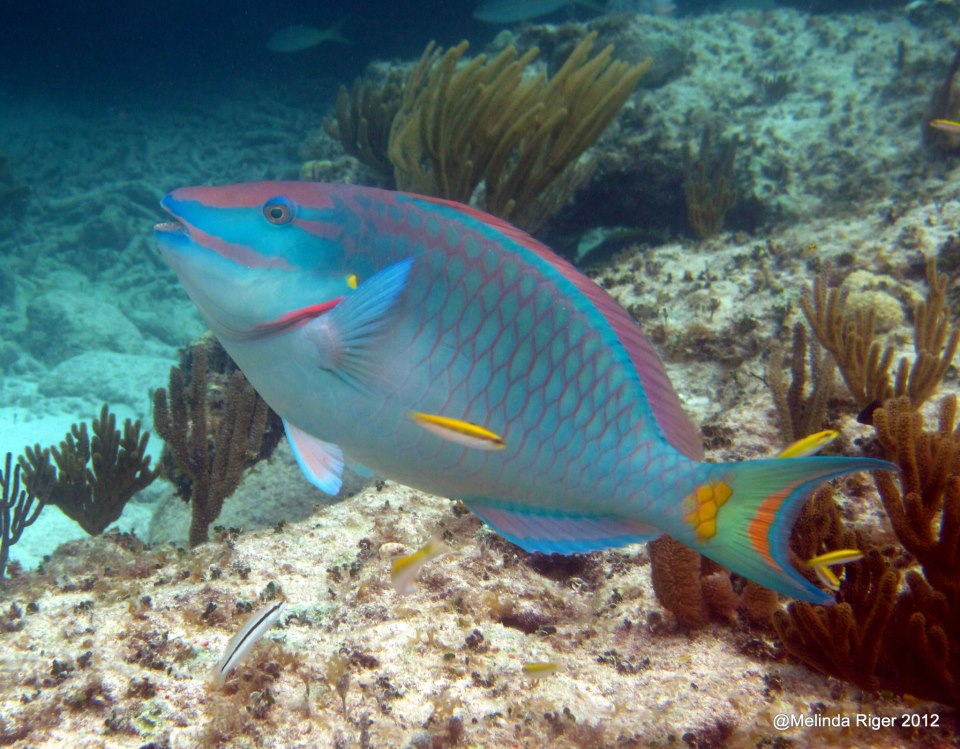
Parrotfish play a vital part in the ecology and health of the coral reef. They graze on algae, cleaning the coral and grinding the surface with their teeth. They take the nutrients and excrete the rest as… sand. This helps to form your beach! To find out more about their uses and habits, click PARROTFISH. You’ll find a great deal of interesting info about the species, conveniently compressed into factual bullet points.
BLUE TANG Acanthurus coeruleus
The blue tang is a type of surgeonfish, all-blue except for a yellow spot near the tail. The blueness can vary considerably, from very pale to dark. They tend to swim elegantly around in large groups.
Here are some images of schools of blue tang that I took with a cheapo underwater camera at Fowl Cay. They are a lovely sight as they drift slowly past alongside the reef. The top one also has a sergeant major (see above).
CREOLE WRASSE Clepticus parrae
This wrasse can grow up to a foot long, and may be found at considerable depths on deep-water reefs – 300 feet or more. They are active by day, and hide in rock clefts at night. This species is sociable, moving around in shoals. They develop yellow markings with age.
QUEEN TRIGGERFISH Balistes vetula
There are several species of triggerfish. The queen is capable of changing colour to match its surroundings, or (it is said) if subjected to stress. I think we have all been there. It is an aggressive and territorial fish, and its favourite prey is the sea urchin, a testament to its courage…
QUEEN ANGELFISH (JUVENILE)
I have featured this species before HERE, and strictly it as much yellow as blue. But the blue earns double points, surely, for its startling vividness. Anyway, I like the way it hangs casually upside down, and the bubbles in this photo.
Credits: Good photos – Melinda Riger of Grand Bahama Scuba; Poor photos – RH
From time to time I end a post with something musical. Just for fun (toxic concept). So here is a real “Slow Blues in C” from the fantastic guitarist Stefan Grossman off his eclectic ‘Yazoo Basin Boogie’ album. 22 quality tracks. Buy from Am*z*n – much cheaper than iT*nes.
The Mangrove Jellyfish Cassiopea, also called the ‘upside-down jellyfish’ for reasons I needn’t dwell on, is the only member of its particular jellyfish family. These creatures prefer warm waters, and typically live upside-down on the sea-bottom, which no doubt makes catching prey very simple. They can be found individually, though more likely in large groups, with individuals displaying different shades and colours.
NEWAn excellent video by Melinda Riger of Grand Bahama Scuba
The Mangrove Jellyfish has one of the milder stings of the numerous species, though human reactions to the sting will vary with the individual. A greater problem may come from swimming around or over a mass of these creatures. Their stinging cells are excreted in a transparent mucus which may invisibly cover the unwary swimmer. Apart from skin-irritation and a rash, the stings are apparently very itchy. My guess is that scratching can only make things worse (cf No-see-ums…). The first of the two videos below was taken recently by Sarah Bedard (to whom thanks) who “found a great tidal pool full of them at the end of Rock Point Road, Treasure Cay (Abaco)”. The second is short, but with some amazing footage of the Jellyfish in action.
BAHAMAS REEF FISH (6) PARROTFISH: COLOURFUL CORAL CHARACTERS
The term ‘PARROTFISH’ comprises many related species (80) around the world inhabiting shallow tropical and subtropical waters. They are commonly found in coral reefs and seagrass beds, and along rocky coasts. They play a significant role inBIOEROSION. Here are some examples of 5 of this species that inhabit the waters of the Northern Bahamas
BLUE PARROTFISH
PARROTFISH FACTS TO ASTOUND AND IMPRESS YOUR FRIENDS WITH
A. FEEDING HABITS
1. Named for their dental arrangements – a mouthful of teeth, forming the characteristic ‘beak’
2. Primarily herbivore but not above snacking on small creatures / organisms or even molluscs
3. Their teeth grow continuously, replacing ones worn away by feeding on coral
4. As they feed on algae etc, their teeth grind up the coral, which they ingest
5. Then (get this!) they digest it and excrete it as sand… it’s a component of your favourite beach!
6. “One parrotfish can produce 90 kilograms (200 lb) of sand each year”. Wiki says so – it must be true
7. They are a vital species in preventing algae from choking coral
1. Some species secrete a protective mucous cocoon to sleep in or to conceal themselves from predators
2. A mucous substance also helps heal damage, repel parasites, & protect them from UV light
3. As they develop, most species change colour significantly to become vivid adults – “polychromatism”
4. Some juveniles can change colour temporarily to mimic other species as a protection
5. Most are “sequential hermaphrodites”, turning from female to male (a few change vice versa)
6. They tend to hang out in groups of similarly-sized / -developed fish
7. Single males tend to have several lady friends, and aggressively defend their love rights
8. Parrotfish arePELAGIC SPAWNERS. Females release many tiny buoyant eggs into the water, which float freely and settle into the coral until they hatch
9. Unlike other fishes, they use their pectoral fins to propel themselves
10. Their feeding behaviour makes them unsuitable for marine aquariums
RAINBOW PARROTFISH
Anyone interested in getting more information about Parrotfishes – maybe about that whole female / male transformation thing? – is recommended to look at an article by Tim Smith of Miami University, Ohio entitled THE BAHAMAS: A CLOSER LOOK AT THE COLORFUL AND UNIQUE PARROTFISH Click on the P-word to get to it directly.
If you are pressed for time, here is the article conveniently digested into bullet points:
a superior competitor among herbivorous reef fishes
large, heavy scales in regular rows on head and body, with teeth fused together to form a beak-like jaw
unique pharyngeal dentition: upper interlocking pharyngeal bones located above the gills rest plush against the lower pharyngeal bone to form the pharyngeal mill (molar-like teeth in their throats) used to grind up the hard coral skeleton that contains microscopic algae
the crushed calcareous material travels through the fish’s digestive system and is voided on the reef as white coral sand
some fish will return to the same location to deposit this calcareous powder resulting in the formation of small hills over time
most parrotfish live on reefs from which they rarely wander far
rainbow parrotfish are thought to use the sun for navigation to travel from its nocturnal cave in deeper water to the shore to feed
all parrotfish uniquely use the pectoral fins located behind the gills for propulsion (not their caudal or tail fins)
in addition to scraping algae from substrate, some parrotfish browse on sea grasses
at night, each fish separates to search for a suitable place within the reef to sleep.
the large, thick scales of the parrotfish are strong enough to stop a spear in some species
the flesh is soft and spoils quickly, the parrotfish is not known as a food fish in the Bahamas
in Hawaii they are eaten raw and at one time were reserved for royalty
the blue parrotfish may carry ciguatera-producing toxins that result in illness when consumed
it’s high time for another picture or two
REDBAND PARROTFISH
Some more bullet points from Tim Smith’s article:
at night some species simply burrow into the sand
others secrete a filmy mucus cocoon in 30 minutes which masks its scent, affording the parrotfish protection from coral reef night predators such as sharks and moray eels.
the parrotfish has the ability to undergo sex reversal in which female fish become males
parrotfish born male remain male throughout their lives and are called primary males.
female born fish may change sex & color to become male – secondary males or referred to as supermales or terminal males.
some parrotfish are chameleon-like, changing their colors to match their surroundings.
parrotfish spawn throughout the year
there are 80 species of parrotfish
the vibrantly colored parrotfish plays a major role in maintaining the cycle of reef growth and erosion
“Do not be alarmed if you experience a sudden drift of sediment or hear the crunching sound of coral the next time you are snorkeling or diving along a coral reef in the Bahamas. It is just a parrotfish doing its job.”
I sense a stoplight is about to interrupt the proceedings… and here it is
STOPLIGHT PARROTFISH (adult and, below, juvenile form)Thanks to Melinda ofGrand Bahama Scuba for her fantastic illustrative pics; the header is mine own
It’s possible that I won’t be quite as attentive with posts / replies to comments etc over the next couple of weeks or so. I’ve a few things in the pipeline, but it may depend on wifi access… I’m giving up trying to use an iPhone to post while on the move – fine for snaps, but not for anything more complicated. So apologies in advance, and like Arnie, I’m afraid I’ll be back…
SHARK FINS – OOOP! A MODEL USE OF HUMOUR
TO CONVEY A SERIOUS MESSAGE
(VIDEO)
TheCAPE ELEUTHERAFOUNDATIONhas produced a short video about sharks and shark fins that manages to be both amusing and to carry a powerful conservation message. It’s a hard trick to pull off successfully. Attempts to use humour to leaven a serious message or to modify earnestness in presentation so often trespass into the no-man’s land known as ‘Meh’ (twinned with ‘Wotevah’). I’m grateful to the always-interesting ABACOSCIENTIST for sharing this item. Photo credit: Melinda Riger, with thanks for use permission [I am posting this from NYC via iPhone, so any weird formatting or typos will have to be dealt with next week]
GRAY ANGELFISH (Pomacanthus arcuatus) BAHAMAS REEF FISH (3)
I recently posted about the highly colouredQUEEN ANGELFISH, a striking coral reef resident glowing with fluorescent blues and yellows. It’s the Angelfish that went into showbiz and succeeded. Its close cousin the Gray Angelfish is a more sedate creature, with the appearance of a professional – law, possibly, or medicine. That thin blue fin-edging suggests a flamboyant streak. Slightly mean mouth? Lawyer.**
This species is found in the warm waters of Florida, and south through the Bahamas and Caribbean as far as Brazil. They are found at depths from 2 m. down to 30 m. You are most likely to encounter one on a coral reef feeding on sponges, its main diet. The fish below with the bluer face is a teenager, in transition between juvenile and adult.
SPOTTED DRUM FISH Equetus punctatusBAHAMAS REEF FISH(1)
This post is the first of a planned series on Bahamian reef fish. Those who follow this blog (I thank you both) may recall with horror (or worse, pity) my own efforts with reef fish, using a tiny cellphone-sized video camera. Misty stills culled from video footage. Enthusiastically wobbly movies as I struggle to swim and breathe simultaneously in an alien element. I am more underwater CLOUSEAU thanCOUSTEAU. However, thanks to Melinda Riger, who with husband Fred runsGRAND BAHAMA SCUBA, I have kind permission to borrow and display images from her stock of wonderful reef fish photographs.
The spotted drum fish (related to two other Caribbean drumfish, the High-Hat and the Jack-knife fish) belongs to a large worldwide family, the Sciaenidae. Besides other drum varieties, the family includes ‘croakers’. These species are all named for the repetitive throbbing or drumming sounds they make. This involves the fish beating its abdominal muscles against its swim bladder. If I find out the reason for this (Species communication? Food call? Alarm? Warning? A piscine ‘advance’? Happiness?) I will add it here in due course. Here an example of an atlantic croaker from the excellent DOSITS site (Discovery of Sounds in the Sea)
The spotted drum is one of the few fish of the species to inhabit coral reefs – most are bottom-dwellers (often in estuaries), avoiding clear water. These fish tend to be nocturnal feeders, feeding on small crabs, shrimp and small invertebrates. As far as I can make out they are solely (or primarily) carnivore, and do not graze on algae of other reef plant life.
The photos above are of adult spotted drums. The ones below are of juveniles, and show the remarkable growth-pattern of these fish, from the fragile slender creature in the top image, through the intermediate phase of the one below it (with the amazing brain coral), to the striking adult versions above. People like to keep these pretty fish in aquariums; fine, I’m sure there are plenty to go round, but these ones look pretty happy to me in their natural reef environment…
Juvenile Drum Fish (pre-school)
Juvenile drum fish (school-age)
(Header image credit: Wiki-Cheers)
Finally, I’ve just come across this short video from a “Florida Aquarium”, showing how these fish swim. It rather looks as though it has been fin-clipped for some reason… or just damaged, maybe















































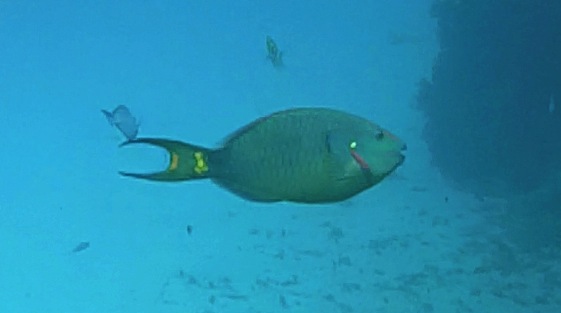


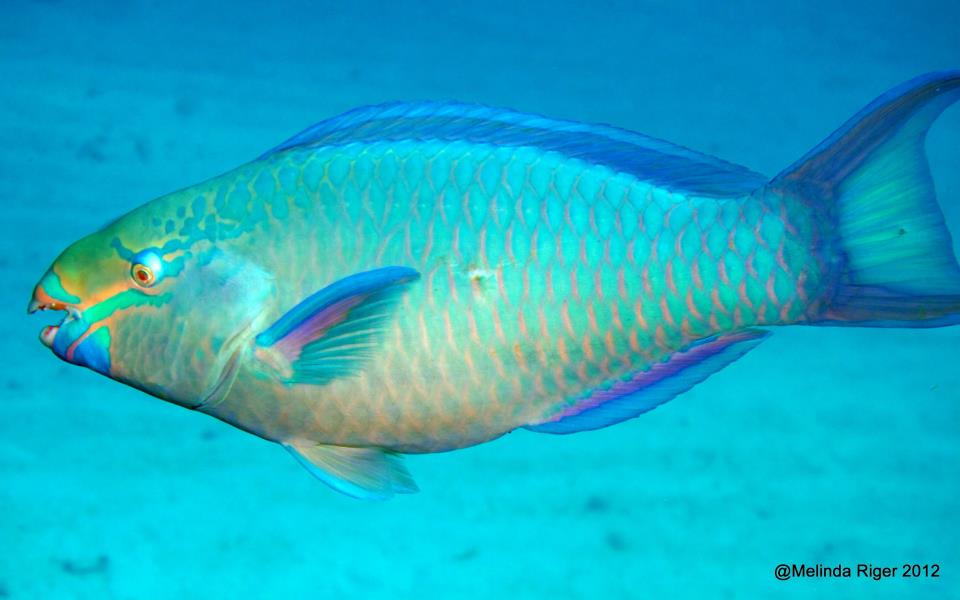
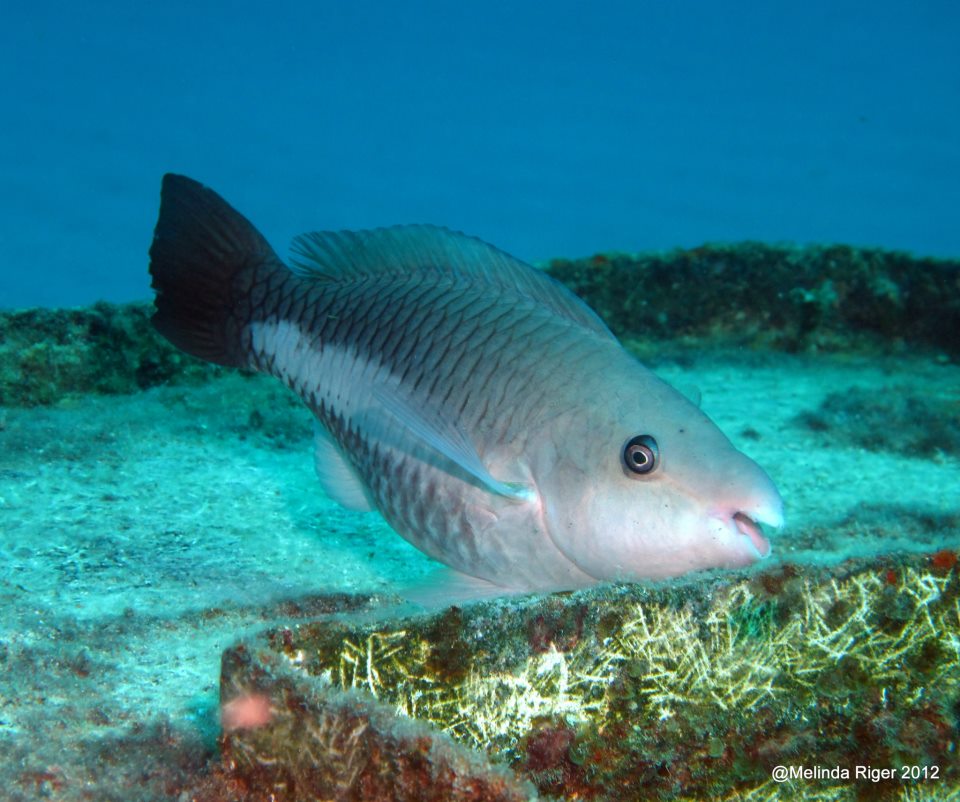

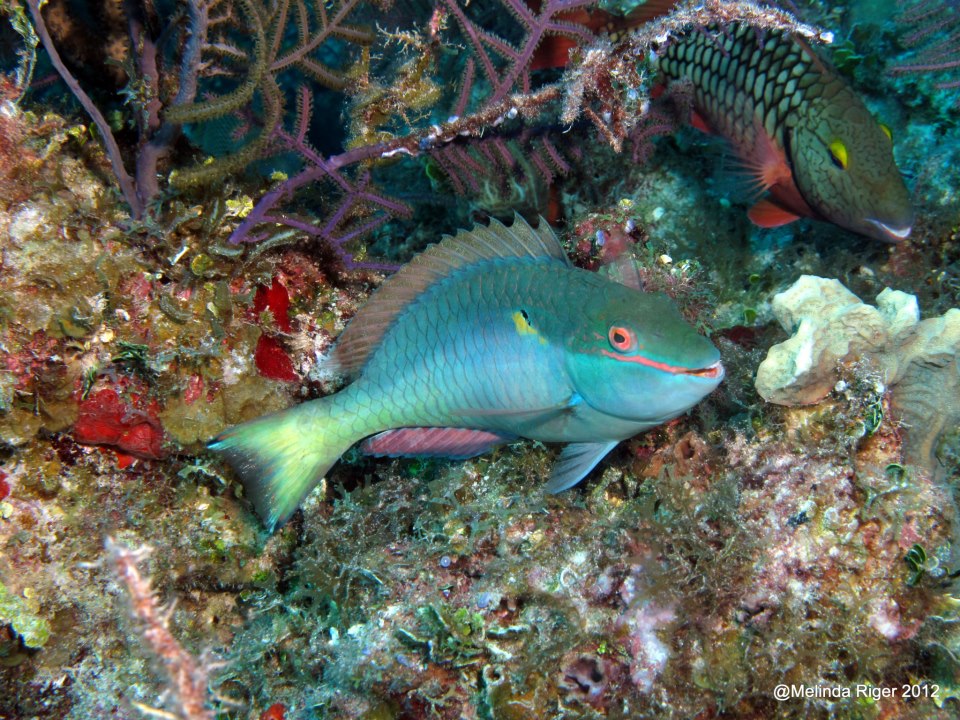






 ROLLING HARBOUR ABACO
You must be logged in to post a comment.