BUNTING(S) FOR AN ABACO CHRISTMAS: AN OLD TRADITION
BUNTING /ˈbʌntɪŋ/ (Noun)
[A Christmas gift of a puntastic avian / festive double-meaning]
A small New World songbird of the cardinal subfamily
Flags and other colourful festive decorations
PAINTED BUNTING
One of the Winterval traditions at Rolling Harbour HQ – that haven of unreliable natural science powered by lazy insouciance and characterised by a regrettably unserious approach – is to break the rule that (mostly) forbids reposting old material without good reason (which there occasionally is). This means marking the imminence of Christmas with bunting. And indeed buntings, those lovely birds beautifully painted by nature. Nothing says ‘Happy Christmas’ better than a flock of PABU!
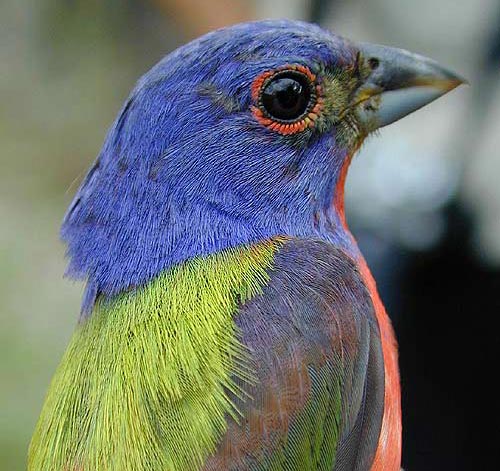
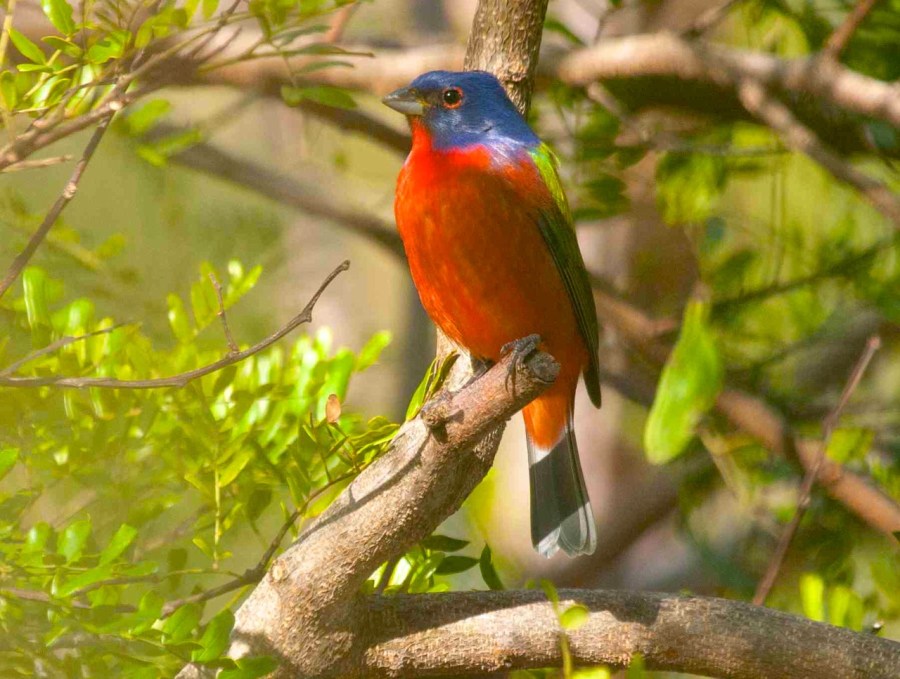
It’s hard to imagine a more Christmassy little bird than the Painted Bunting. Bright blue, red, green primary colours straight from a child’s paintbox make for a spectacular bird to grace the festive season. These are migratory winter residents, and the first reports of the bright and beautiful males on Abaco started to appear in late October. Some will stay around until March.
A female & a male PABU feeding together, and a male with a pair of black-faced grassquits
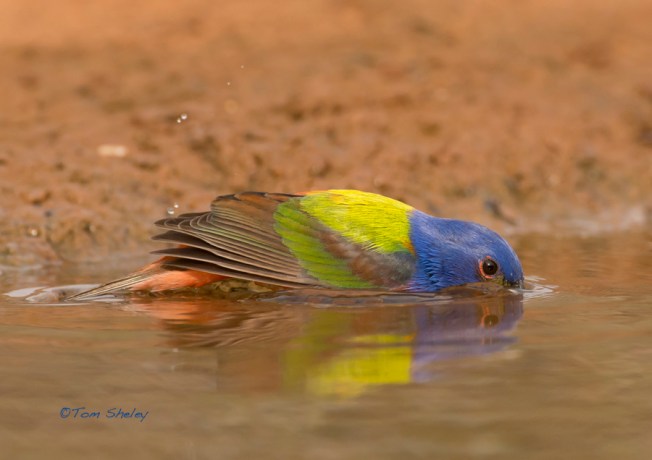
The two wonderful photos below are by Tom Sheley, a major photographic contributor to THE BIRDS OF ABACO. They were actually taken in Texas, but I include them because of Tom’s strong connection with the birdlife of Abaco; and also because they are fantastic shots…
This is my opportunity to wish a very Happy Christmas or [insert preferred seasonal appellation] to everyone who visits Rolling Harbour and especially those who, having done so, return for more! There could of course be anything from 600,000+ individuals who called in once, were put-off and never came back… to one sadly crazed person who has been pressing the ‘read’ button 600,000+ times over the last few years. If the former, thanks for trying, sorry to disappoint. If the latter, keep up the good work, buddy.
Credits: Tom Sheley (1, 7, 8), Erik Gauger (2), Tara Lavallee (3, 4), Keith Salvesen (5); Sandy Walker (6); Birdorable Cartoons
SANDHILL CRANE: ANOTHER NEW BIRD FOR ABACO, BAHAMAS
Still they keep arriving, the new birds that have never before graced the shores of Abaco Recently it was a Canada warbler, at the lower end of the size scale. The elegant sandhill crane (Antigone canadensis) is the 10th new species for Abaco since the publication of The Birds of Abaco in March 2014. If you are wondering why the bird is not called Grus canadensis any longer, it’s because the genus of the bird was reclassified by the ABA in 2016. Out with dreary old Grus and in with exciting Oedipus’s daughter (or was she his half-sister? They… erm… had the same mother… Discuss, using both sides of the exam paper) in Greek mythology…
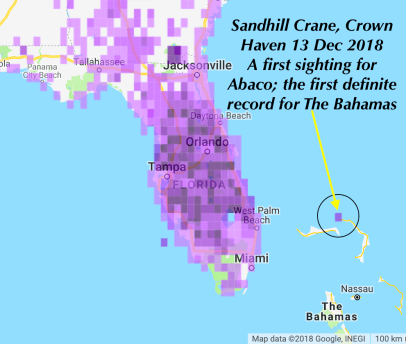
As the crane’s canadensis suggests and as range map shows, these are birds of North America, breeding mainly in Canada. In winter they head south to the warmth, reaching Florida as winter migrants. As you can see, the northern part of Florida and also Cuba have small year-round breeding populations. Zero zilch zip nada in the Bahamas.
THE ABACO SIGHTINGS, DECEMBER 2018
At 9.00 am on December 13, the bird above was photographed by Kaderin Mills (of the Bahamas National Trust) on Little Abaco, at the Fox Town Primary School, Crown Haven. The day before, the 12th, the school Principal Mrs Curry had seen the bird in the school grounds feeding on the grass. A couple of phone ‘sighting shots’ were taken before it flew off. Next day it returned, word spread and Kadie Mills recorded the bird officially and put it on eBird to give the newcomer some due publicity. By the early afternoon, Woody Bracey had been told about the bird, and went to take photos. He saw it in the same place the next day too.
OK, FIRST FOR ABACO – AND THE BAHAMAS TOO?
The strict answer is, no. Many years ago, there was a single report of a Sandhill Crane on Andros. It’s not known if the sighting was officially confirmed, but according to expert Bruce Hallett there was a photograph, and the late Tony White, then ‘recorder’ for the Bahamas, saw it. There are no available records, but Tony’s authority on issues around Bahamas birds was (and remains) absolute.
12 CAREFULLY SELECTED SANDHILL CRANE FACTS
These cranes are social birds, usually living in pairs or in family groups
Their calls are loud and far-reaching, like a huge crows with a sore throat (below)
Mated pairs engage in ‘unison calling’, standing close and duetting amorously
Hatchlings are fully-formed and can leave the nest within a day.
Juveniles are known as colts (whichever their gender, it seems)
They have an impressive wingspan as adults, from about 5′ to 7′ 6″
They are able to soar in flight, using thermals to obtain lift and stay aloft for hours
Flocks of cranes may be huge – sometimes estimated at over 10,000 individuals
Their ancestors are among the oldest fossils of any bird species, at around 2.5 M years
Vagrants have been found as far off piste as Britain (1981, 1991 only), China and Japan
Many predators call them dinner; but they can kick and stab with their bills in defence
The sandhills of Cuba form the smallest breeding population, around 300
(Ian Cruickshank / Xeno Canto)
On the map: Abaco’s first ever sandhill crane
Adult with its cutely ungainly, yellow-legged colt
Credits: firstly, to School Principal Mrs Curry for a truly excellent spot; Kaderin Mills (2) – the 1st usable image; Elwood ‘Woody’ Bracey (1, 3, 4, 6); http://www.birdphotos.com / wiki (5); Cornell (range map); Ian Cruickshank / Xeno Canto (audio); Birdorable (cartoon)
The Smooth-billed Ani (Crotophaga ani) – aka Cemetery Bird – is the third member of the cuckoo family found on Abaco, the others being the MANGROVE CUCKOOand theYELLOW-BILLED CUCKOO. You can (it’s voluntary) find out more about them in an earlier articleHERE.
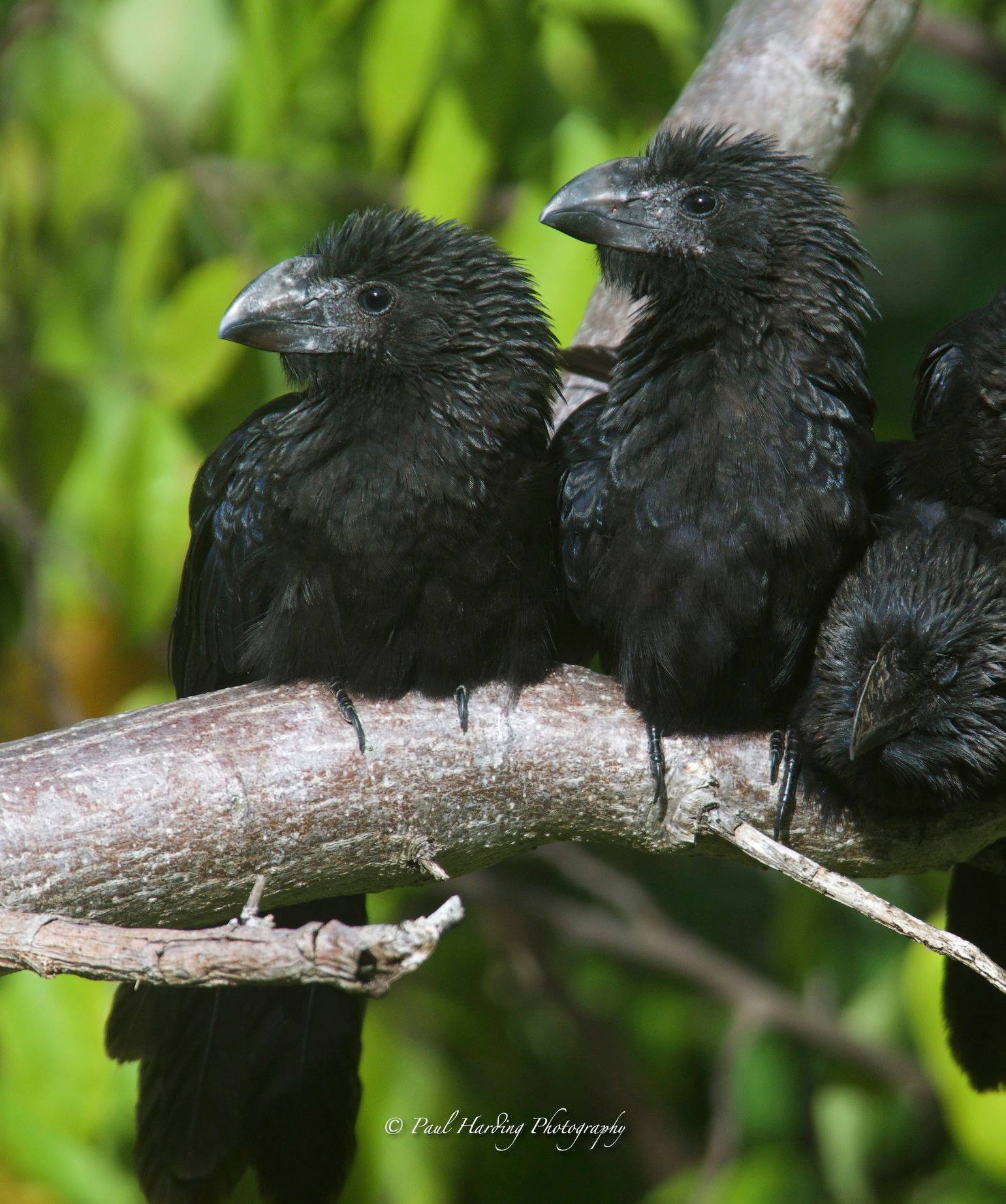
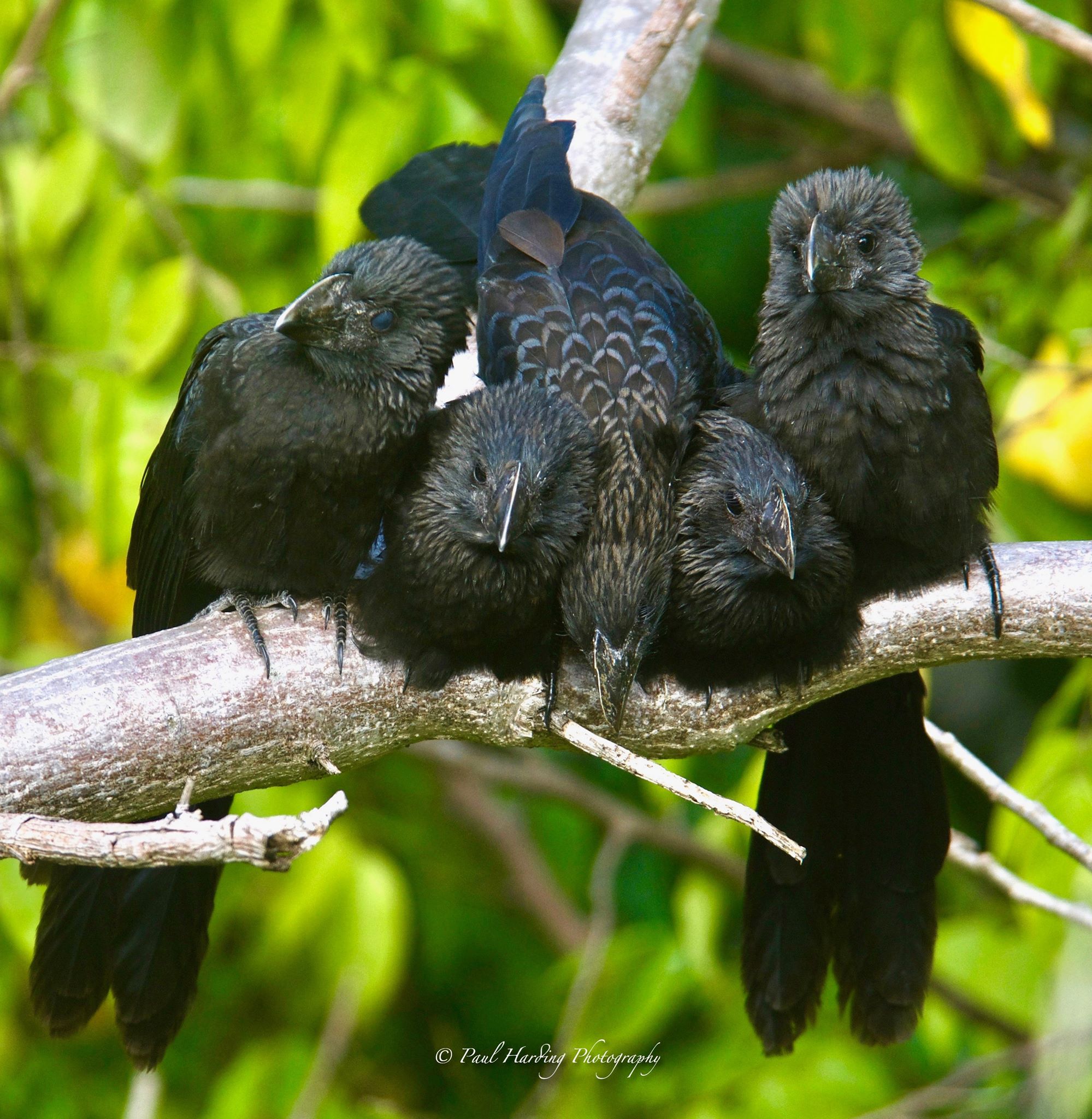
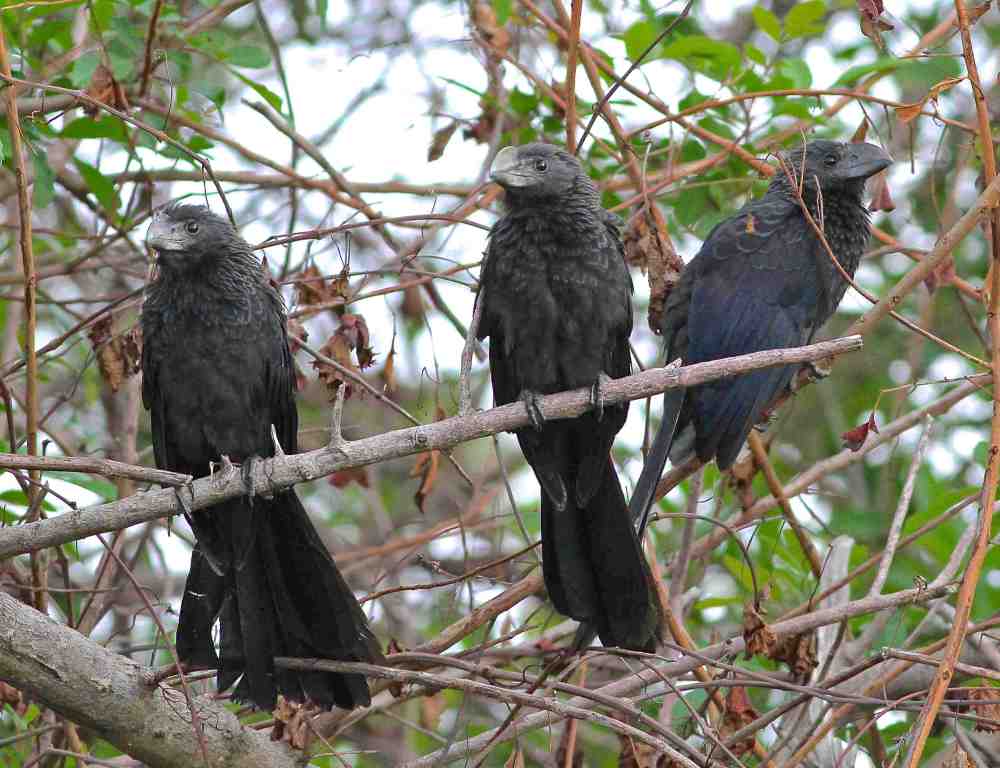
I have returned to these engagingly gregarious birds and their raucous ways because Paul Harding has recently captured a sequence of a small group of anis behaving so endearingly that they are irresistible. Not for them the oddly incompetent fluttering flight, nor the disorganised, unbalanced landing technique. It’s simply a matter of getting settled on a branch, and then making room for one more in the middle (or perhaps resisting it…).
‘A COMMOTION OF ANIS’
There were 4 on the branch…
Hey – make room for another one…
Budge up, guys, I mean C’mon…
Yay, I’m in… a bit squished but…
Um… guys, I can’t breathe…
That’s better… all settled now….
Let the racket begin!
Credits: all terrific pics, Paul Harding; sound files, Xeno Canto
KIRTLAND’S WARBLERS ON ABACO: A FIRST FOR THE CAYS
I last wrote in April about the rare Kirtland’s warbler Setophaga kirtlandii that, in very small isolated numbers, overwinters on Abaco. You can get to the article HERE. You’ll find plenty of information, a range map, notes about the eponymous Mr Kirtland, and lots of good photos (none mine except the joke one – I messed up my one chance out of 4 birds encountered in the National Park). So I won’t go over the ground again…
I’m returning to this near-threatened species now because there has been a very exciting development for Abaco for the KIWA. Towards the end of last month, 2 birds were found over a couple of days at a location on Green Turtle Cay. Having now checked all reported sightings for Abaco since time immemorial (or at least from when eBird began), I believe that this may be the first time a Kirtland’s warbler has been reported on any of the cays. Certainly when we were researching The Birds of Abaco, we found no evidence of KIWA reports from the cays. Sightings are anyway few and far between (not even annual), and mostly on a ‘right place right time a hunch and a large slice of luck’ basis.
The first sighting of the season, on Ocotober 27, was (surprisingly) at Sandy Point, when Woody Bracey took a party of 3 birding for the day. Most KIWA sightings are in south Abaco, with selected areas of the huge National Forest being much the most likely places. There were in fact 2 birds seen – here’s a photograph of one of them. Sandy Point was an unexpected location, but they were on the mainland and in the south – a great ‘get’ by any standards, but not unique for the area.
AN EXCITING SIGHTING
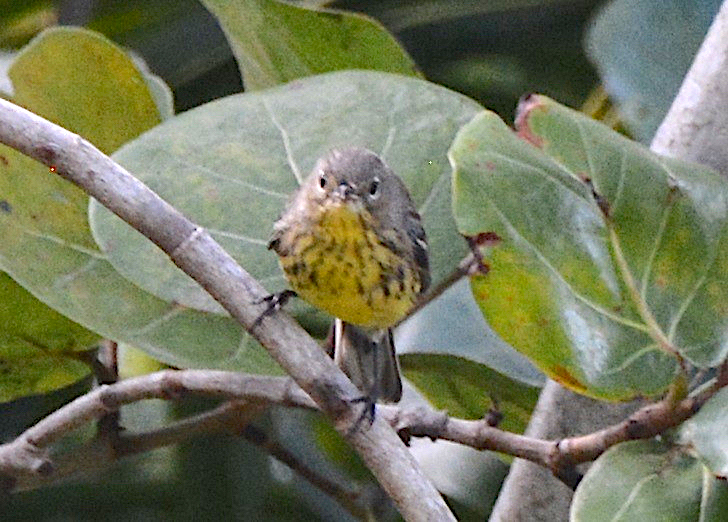
On November 22 at 08.30, Sally Chisholm was birdwatching on GTC when she suddenly came across an unmistakeable KIWA, seeing it closely and clearly: “gray back with dark striping, gray head with white broken eye ring, pale yellow breast with small dark spots”. It was pumping its tail (‘tail-wagging’ J. Bond) characteristically, and eating the berries from a palm tree (see header image). Sally heard its repeated “chip” call, typical of the KIWA. Furthermore, a second bird was returning the call, though she could not see it.
KIWA CHIP CALL Paul Driver / Xeno Canto
Two days later, in the early morning on November 24, Sally returned to the same location and saw a single bird, clearly one (or perhaps the other) of the two birds already seen / heard. She got a fine clear shot this time, too.
I’m not by any stretch of the imagination a Kirtland’s expert (not even a bird expert, if I’m honest). The photos seem to me to show a young bird (compared with ones I have seen) and I wonder if they are juvenile adults (as it were) on their first migration from the jack pines of Michigan. Comments on this remark invited and welcomed… No matter: the great thing is that, whatever the age of the bird, photo #1 is, as far as I can tell, the first visual confirmation of a KIWA sighting on an Abaco cay. It’s a privilege to be able to give it a wider audience.
WHAT ARE THE MAIN THREATS TO THE SPECIES?
Mankind is the primary threat. The breeding areas are particularly vulnerable from deforestation and clearance of the jack pines that are essential for successful nesting and breeding – and therefore the survival of the species
Encroachment of development is another threat, as with so many species
There is a further threat of nest parasitism by brown-headed cowbirds, to which KIWAs are especially vulnerable
In the winter grounds where the habitat is mostly remote or in protected areas, there is rather less of a problem from these factors – for now at least
Overall, habitat degradation at one end of the migration – in particular the breeding grounds – poses a serious risk; at both ends, extinction could loom again. Check out the very limited range of the KIWA and you’ll see the point at once
Credits: Sally Chisholm (1, 2, 4, 5) with special thanks for use permission for her terrific photos; Rodger Neilson (3); Paul Driver / Xeno Canto, sound file; Birdorable, cartoon; Usual (range map); BPS (stamp)
It is axiomatic that people tend towards birding – if at all – in later life. Not the scientists, of course: they must commit themselves to the study of natural history at an early age, collecting qualifications by degrees (as it were), through Masters, Field Work, their first posts, PhDs and beyond.
American Redstart (m)
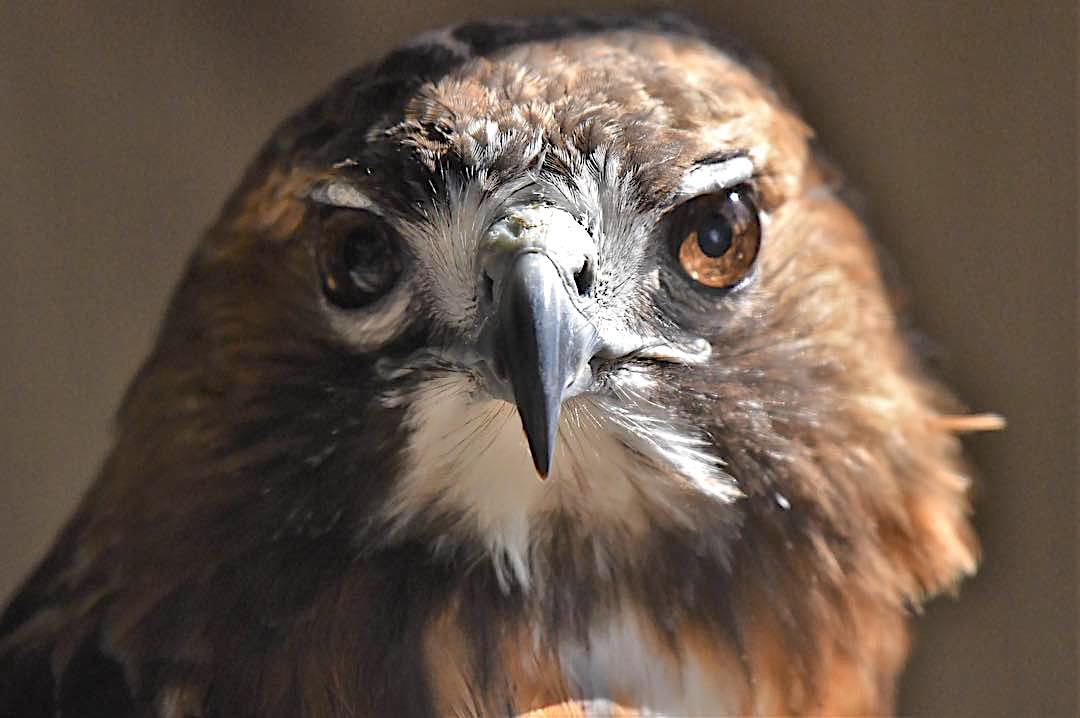
I didn’t take a very active interest in birds until the first time I investigated Central Park NYC and saw a blue jay. Followed by a cardinal… a red-tailed hawk… chickadees… American robins (or ‘Mercan rubbins‘, as I was informed). These were alien species for a European, and they awoke my interest.
Brown Pelican
On later trips to NYC I have always spent a day in CP, wandering from end to end, spending time in the hotspots like The Ramble, the JO Reservoir, and the pretty Loch trail to the north, and wondering at the huge and expensive birding hardware toted by those around me (while knowing I didn’t want it). And then a visit to Prospect Park Brooklyn too, if I have the time. More recently came Abaco, and a whole new world of wildlife that has captivated me…
Hermit Thrush
This reminiscence by an oldster brings me to Chris Johnson, a young Bahamian man who will be familiar to many readers of this blog. I first encountered him when I was researching the Bahama Oriole and discovered that he, in his early teens, had found one on a trip to Andros and photographed it. It was a pleasure to be able to include the image in my article.
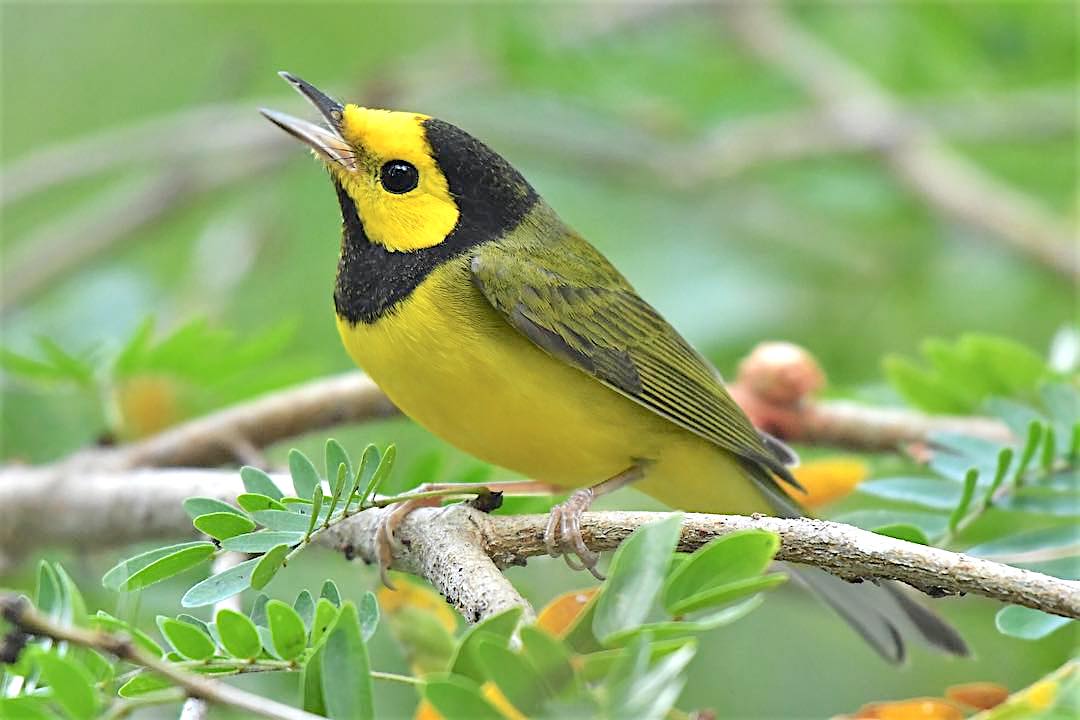
Hooded Warbler
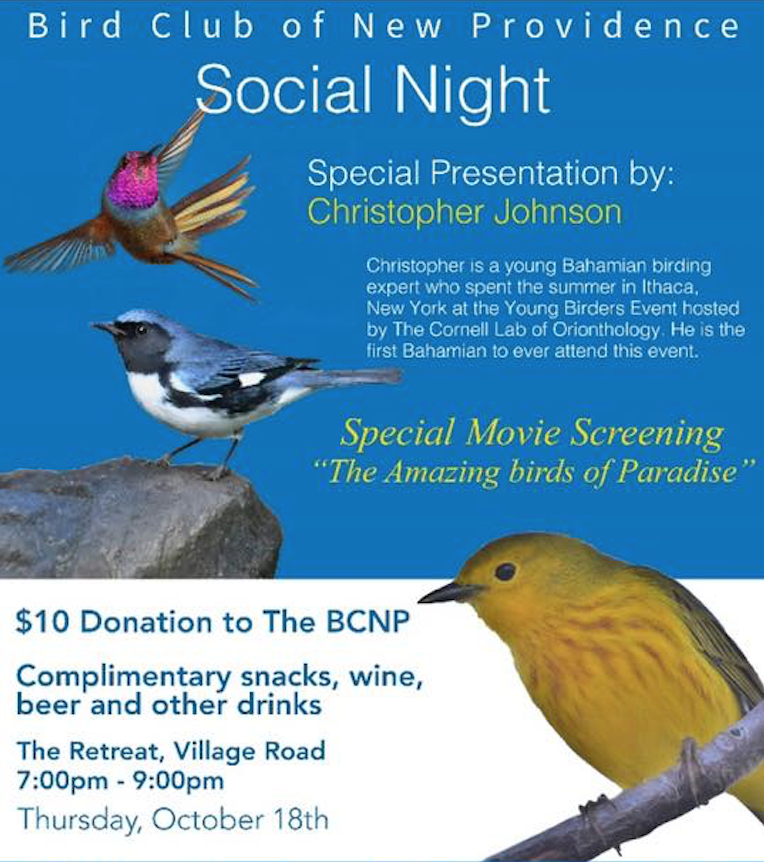
Since then, Chris’s birding and photographic skills have rapidly developed and his reputation is growing too. This summer he was one of 12 students chosen to attend Cornell University Lab of Ornithology for their Young Birder’s Event in Ithaca NY, a great tribute to his accomplishments and a wonderful opportunity too. It is worth noting that Chris is the first Bahamian to be invited to attend this event.
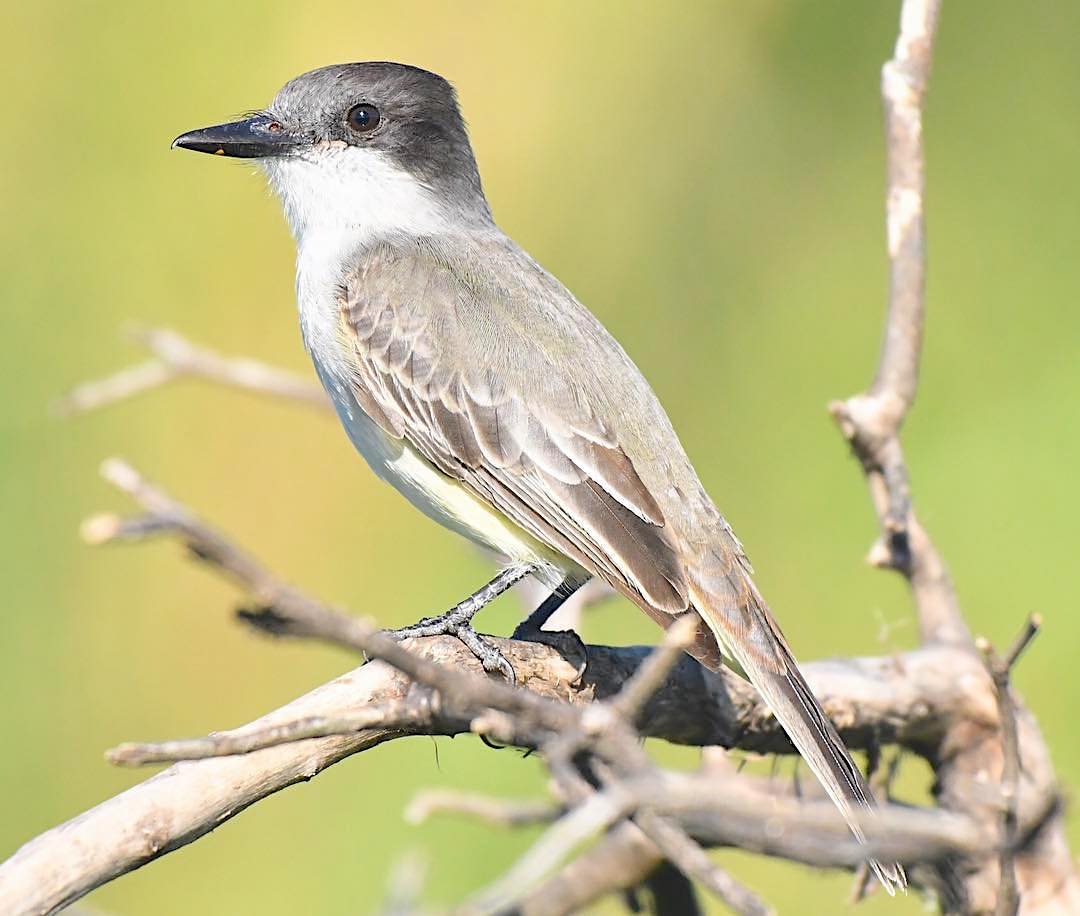
Loggerhead Kingbird
Chris is also beginning to make his own presentations, as he did recently to the Bird Club of New Providence. It won’t be long before he is leading bird groups – in fact, he is probably doing this already.
Another impressive feature of Chris’s birding is his photography. I have watched the progression online with interest. The crispness of his images, the composition and the right ‘take’ to make the best of each bird is wonderful, and he has a great eye for a neat shot – for example in the header image I have chosen, with its awareness of the effective use of dark and light.
Black-and-white Warbler
I should say that I have never met Chris, although we have occasionally been in touch. I am featuring him because I believe he and other young people of his age – Chris is 17 – are the future for birding, for wildlife, for species protection and for habitat conservation. The older generation will move on and the ‘middles’ may begin to take an interest in the birds around them. But Chris’s generation are the ones who can make a difference in the future. As things stand right now, they may have to. It’s a huge responsibility for them, but it’s one our generation is in the process of transferring to them.
Red-legged Thrush
I hope you have enjoyed the small gallery of Chris’s photographs displayed here. If you are interested in the birds of the Bahamas, keep an eye on him and others like him. They need all the encouragement we can give them.
All photos: Chris Johnson, with thanks for use permission. Please do not ‘borrow’ any of these images without asking first. That would only be fair.
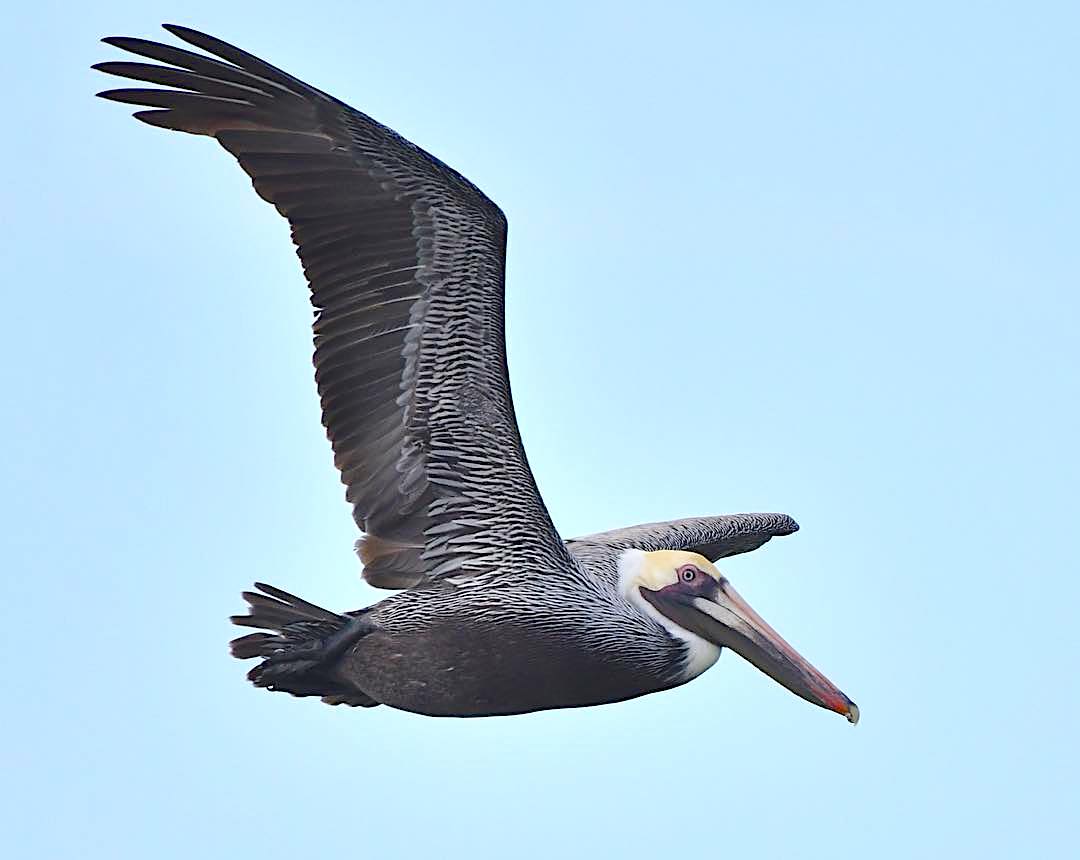
Brown Pelicans are permanent breeding residents on Abaco, and not uncommon in certain areas though not be any means throughout the island and the cays. If you come across a pair of them – or preferably a group – it’s well worth spending some time watching them in action. These are magnificent birds, unafraid of humans and happy to carry on fishing / plunge diving with an audience.
The most reliable place I know of to watch the pelicans on Abaco is Sandy Point. You may find them on the dock, drying their wings on the pilings or diving off it for fish. At other times, they will be further out to sea where the sandbars stretch out into the ocean, taking off and gaining height before smashing straight down into the water.
These wonderful images of pelicans taking off and landing are the work of professional photographer Phil Lanoue, whose work I am always excited to feature. He has the skills, the equipment and the eye to produce outstanding photographs, freezing birds in motion with complete clarity.
If anyone reading this knows of other locations on Abaco where pelicans can reliably be found, I’d be very pleased to hear more!
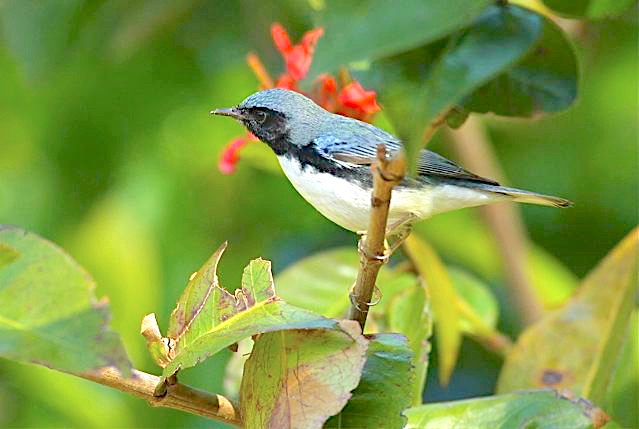
It’s warbler time of year on Abaco, and a good time to take a look at the Black-throated blue warbler Setophaga caerulescens. This small warbler has very particular breeding and overwintering ranges. In the summer they are found in the forests and woods of eastern North America. As the Fall approaches, they start to migrate south to the Caribbean and Central America. Abaco is one of their winter homes, as well as a likely transit stop on their way further south. Right now sightings are being reported on the mainland and the Cays.
WHAT DO I LOOK OUT FOR?
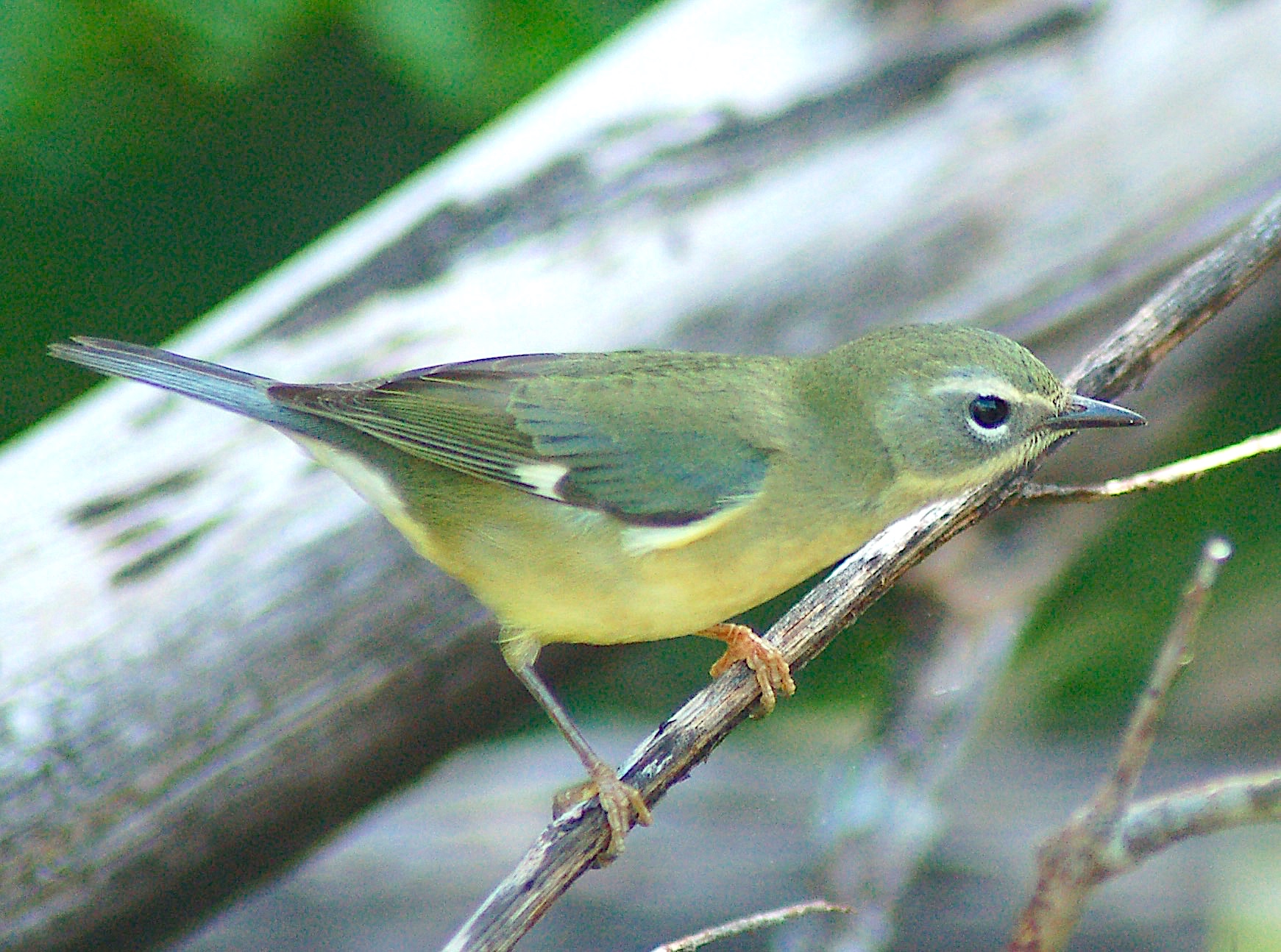
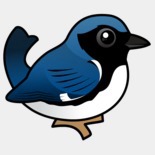
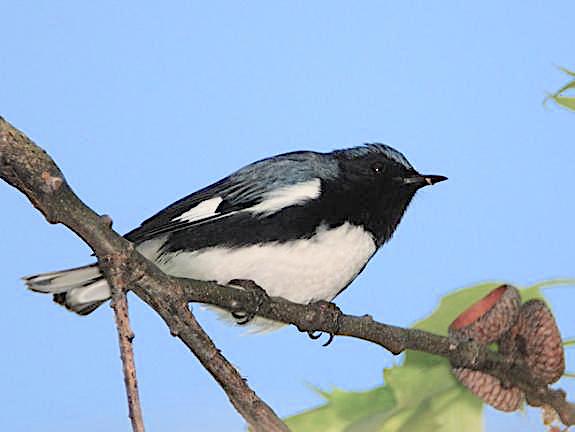
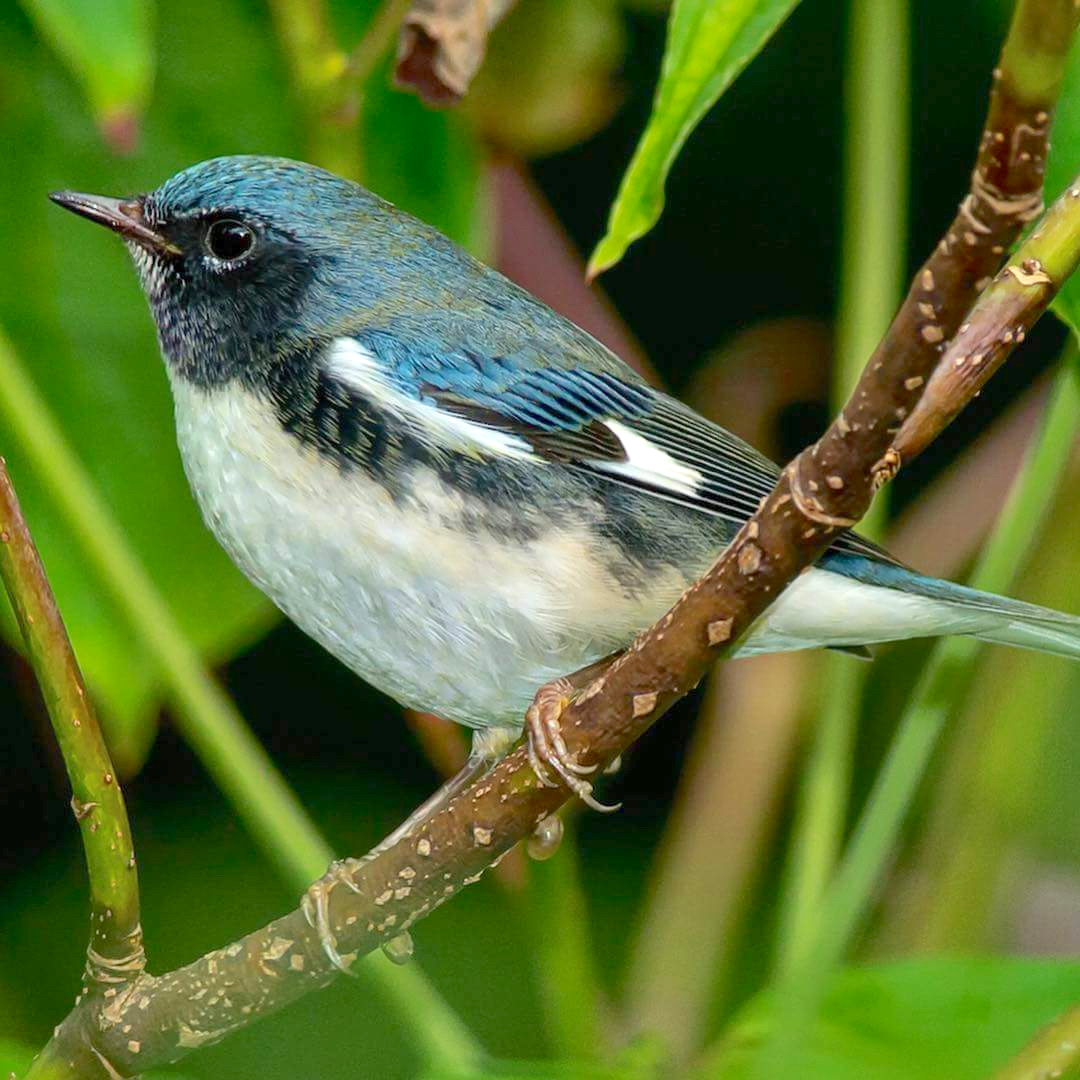
Males and females are quite different in appearance (‘sexually dimorphic’), and could even be mistaken for distinct species. Males are a deep slate-blue above (hence caerulescens) with a striking black face and throat, and white underparts. They are unmistakeable, and unlikely to be confused with any other warbler. Females are basically grayish-olive above and pale yellow underneath. For ID, look for a white stripe above the eye, a pale arc below it. In addition, both sexes have a diagnostic white patch on the the wing, that I have seen referred to as a ‘handkerchief‘.**
The legendary bird cartoon website Birdorable, featured often in these pages, as usual has a spot-on comparison of the sexes. TBH, this is a great resource for nailing a bird’s essential characteristics. You should check out its warblers in particular! Here’s their inimitably charming take on the BTBW gender comparison.
These pretty warblers can be seen in gardens, coppice, and woodland. Although mainly insect-eaters, sometimes catching them in flight, they also eat fruit and seeds especially in winter. BTBWs are territorial, and will defend their chosen space against all-comers, including their own species.
WHAT DO I LISTEN OUT FOR?
As I have mentioned before, I tend to find phonetic transcriptions of bird sounds rather baffling – and often not really how I hear them myself. This is especially with the ‘Oh-dear-oh-dear-I’ve-run-out-of-beer’ and ‘Have-a-little-Kalik-at-Pete’s’ kind. One source asserts:“The bird’s song can be described as a buzzed zee-zee-zeeee with an upward inflection. Its call is a flat ctuk”. You be the judge…
SONG Etienne Leroy / Xeno-Canto
CALL Paul Marvin / Xeno-Canto
BTBW SEX LIFE – ANY GOOD GOSS?
Black-throated blue warblers are – and I say this with considerable reservations – mainly a monogamous species. However it turns out that they have complex patterns of vocalisations and behaviours at breeding time, including very promising-sounding ‘extra-pair copulation’ involving ‘heterospecific cuckoldry’. However, despite all my efforts in researching this phenomenon more thoroughly, merely reading the intricacies quickly crossed my boredom threshold, and my own ‘call’ soon became a ‘sonoroussaw-like Zzzzzzzzzzzzzzz‘. Anyway these birds don’t breed on Abaco so I’ll spare you the details and move on.
IS MANKIND MASHING UP THEIR HABITAT?
BTBWs are fairly common birds within their range, with a large population. The usual stuff is happening with them in terms of habitat destruction & co at both ends of their migration. For some already threatened species (e.g. Kirtland’s Warblers), habitat degradation at either end of the migration (let alone both) presages a downward spiral in population. With BTBWs, I have read both that the population is decreasing; and in another source, slightly increasing. For now, let’s regard the welfare of the species as being stable. However, the current causes of species decline will doubtless continue, and many regard increasingly evident climate change as being a determining factor for the well-being of migratory species. The birds are not yet out of the woods, so to speak… and maybe never will be.
**anyone remember those?
CREDITSPhotos: Gerlinde Taurer (1, 2); Becky Marvil (3); Bruce Hallett (4); Blaine Rothauser / CWFNJ (5); @daxroman / Birds Caribbean (7); Paul Reeves / Birds Caribbean (8). Range Map, Wiki; Cartoons, Birdorable; Video, Cornell Lab for Ornithology
Melissa Maura is well-known to many in the Bahamas, not least because of the wonderful work she does with injured or orphaned creatures. Thanks to the skills and compassion of Melissa and those who work with her, animals and birds of all kinds are saved from death or incapacitating injury. In the saddest cases, they are gently cared for until the inevitable occurs.
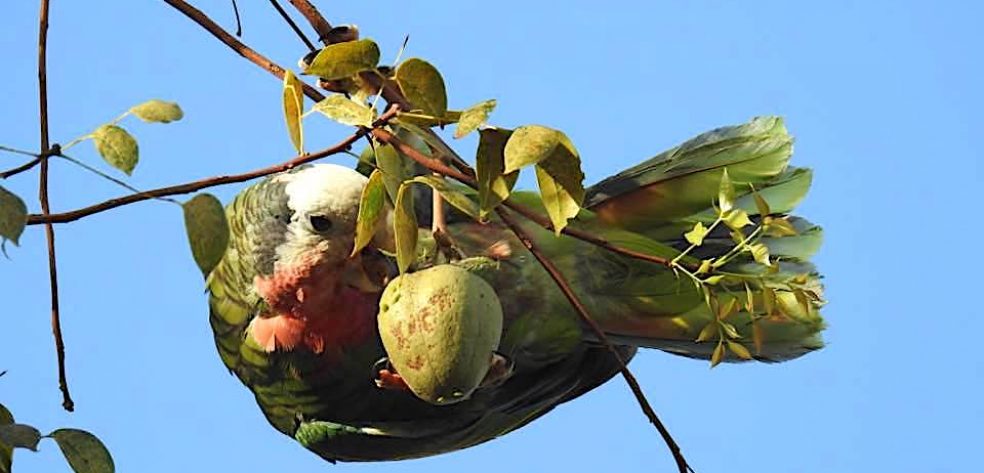
Melissa also takes terrific bird photographs, some of which I have featured in the past. Indeed my blog headline photograph is one of her parrots. I used to change the header from time to time, but this one is so cheerful that I decided to keep it in place. It always makes me smile.
Parrots are acrobatic creatures, happy to eat at all angles including completely upside down. Not just eat, though. Also bicker, flirt, play-fight, and see off rivals via inverted aggression. With the Abaco parrots, one of the benefits for the bystander is that the balancing act and consequent fluttering often reveals the spectacular blue of the birds’ wings.
In a row, it’s not unusual to see a parrot taking up a dominant position on a branch, leaving its opponent hanging on in an uncomfortably precarious position…
People often ask where on Abaco they are most likely to see the parrots. First, there are no parrots north of Marsh Harbour – they are all in South Abaco. Secondly, although they live and nest in the National Park at the southern end of the island, in practice it covers a very large area, much of it inaccessible and with the only ‘road’ something of a challenge for an ordinary vehicle (described HERE). I’d say that the single most reliable place to see the parrots is at Bahama Palm Shores. Simple turn into the north entrance, drive straight down to the end with the windows down, park up – and listen. If they are there, you’ll hear them for sure!
All photos Melissa Maura except #5, Keith Salvesen (also the sound file of parrots at BPS)
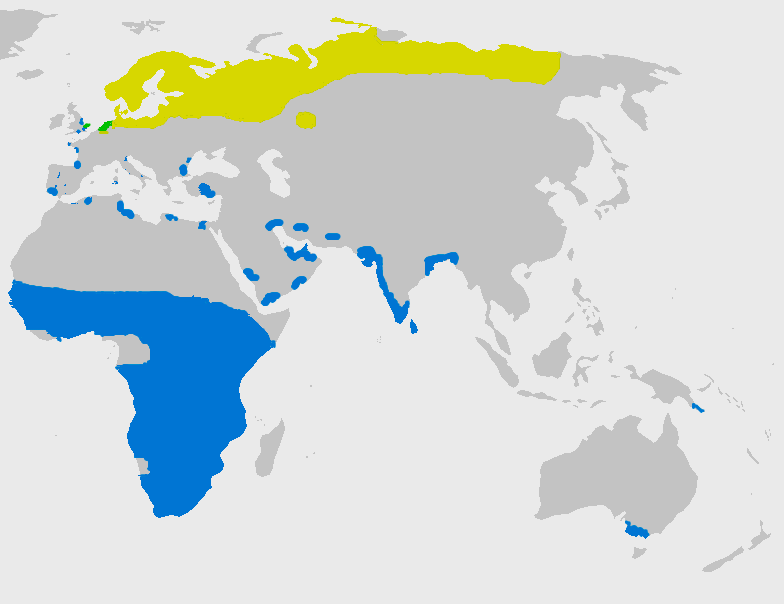
The list of new bird species recorded for the Bahamas in general and Abaco in particular continues to grow longer. At the end of August it was aCANADA WARBLER(now also recently seen on Grand Bahama and possibly New Providence). Now, a mere 4 weeks later, it’s a Ruff (Calidris pugnax), a mid-sized Eurasian shorebird that, it seems, has a tendency to ‘vagrate’ across the Atlantic from time to time.
Ruffs: the normal range
You have to take new birds as you find them, of course. First, you may not have a camera with you to record the sighting for posterity. Secondly, the bird may not be perched prettily on a twig or a small rock. In this instance the legendary Woody Bracey found his Ruff in the prosaic and arguably unattractive setting of the Treasure Cay dump. He didn’t have a camera, and when he next went back with a camera to check for the bird the ruff had gone…
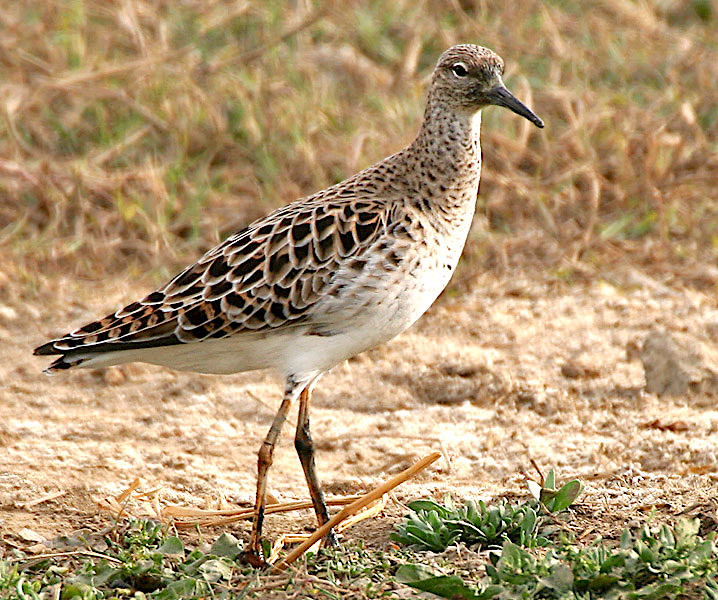
Woody’s bird, a female (known as a Reeve), was standing next to a Lesser Yellowlegs. They are much the same height, but there the similarity ends – Ruffs are unmistakably plumper and with a shorter bill. Woody has good reason to recognise these rare and occasional transatlantic visitors, having often seen Ruffs both during his time living in the UK, and also in Africa. I’ve seen the appearance described as “like a gravy-boat”, which is well up there with the least useful descriptions of a bird’s appearance I have come across. Looked at another way, we have a couple of gravy boats that have an occasional outing. Neither looks remotely like a ruff.
IS THE ABACO RUFF A NEW SPECIES FOR THE WHOLE BAHAMAS?
Very nearly… but not quite. Only two previous Ruff sightings are recorded, in 2015 and 2018, and both in the same area on Grand Bahama, towards West End. And the only photo is from birder Duncan Mullis, who in 2015 took the first and maybe only one of a Reeve with a bunch of much smaller sanderlings (see also header image close-up).
The first ruff in the Bahamas
WHAT SHOULD WE KNOW ABOUT RUFFS?
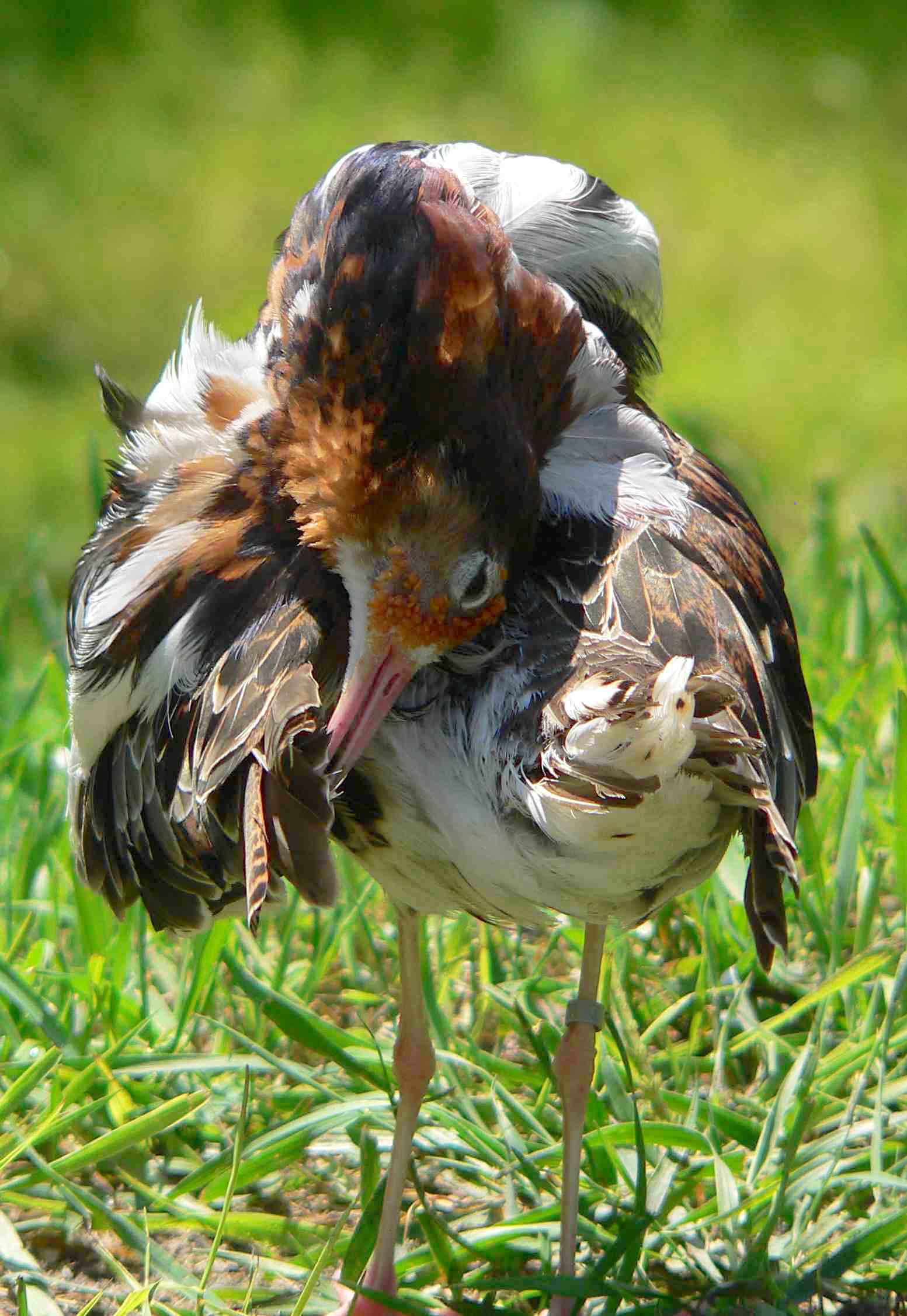
In the breeding season in particular, male ruffs are very different from the smaller reeves. They acquire a spectacular colourful plumage that includes a sort of ornamental collar (hence the name). They enhance their courtship rituals with elaborate displays designed to impress the reeves. These occur in chosen areas known as leks, places where strutting, preening and general competitive showing off occur to attract a mate. Such arenas are also created by a few other bird species – grouse, blackcock and peafowl, for example. The ruff’s lekking behaviour has some complex variations – including same-sex ‘copulation’ and polyandry – but sadly this isn’t the place to explore them in detail.
WHAT DOES A LEK LOOK LIKE?
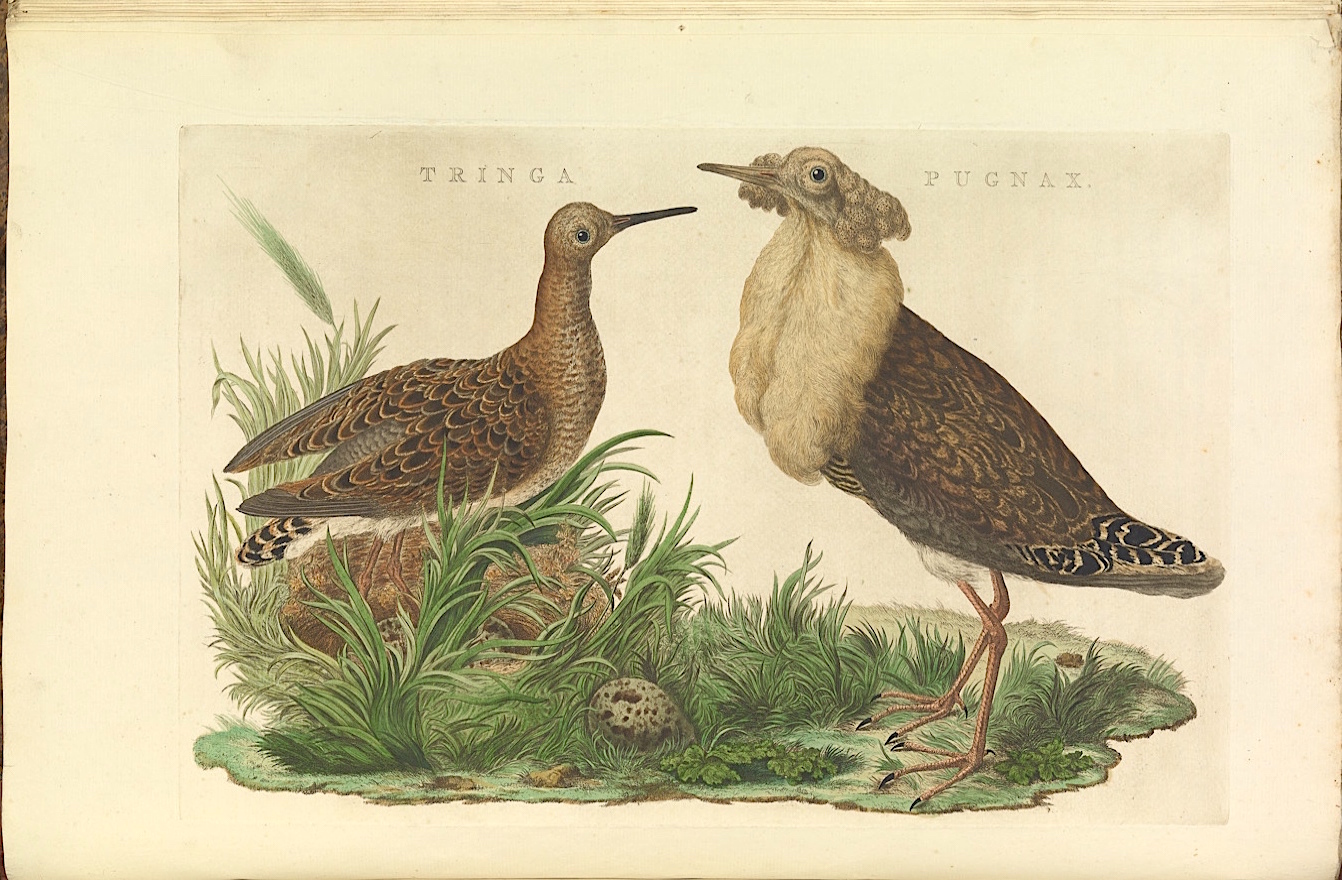
Here are two males with very different breeding plumages, giving it their all at the lek… When Carl Linnaeus described the ruff in his Systema Naturae, he gave it the binomial name Tringa pugnax, the latter word meaning ‘aggressive’ – the lek can also become a combat zone between competing males.
This male has decided to vogue it and ‘strike the pose’ as it preens
Writing inThe Spruce, a new multi-interest resource I discovered in researching this article, Melissa Mayntz describes succinctly some of the common behaviour seen at leks. This includes some (or all) of the following (baby-boomers and dad-dancers may recognise some of these moves):
Bowing, dipping, or bending
Head bobbing or quick turns and nods
Strutting, stomping, kicks, or similar footwork
Exaggerated wing postures, such as fluttering, drooping, or spreading wings
Tails fanned, flared, cocked, or spread
Chests puffed out, often to reveal air sacs or distinct plumage
Calling, songs, drumming, or booming sounds
Dance-like sequences with multiple movements, possibly coordinated between partners after a female shows an interest in a specific mate
To which I’d add aggressive male territorial rivalry within the lek, leading to physical attacks with beak, claws and wings. Meanwhile the females watch from the edge to assess their chosen mates. The illustration below shows this rather charmingly.
Illustration of a lek by Johann Friedrich Naumann (1780–1857)
There’s a lot to be described about how ruff’s moult, but it’s not especially interesting for anyone but a moult specialist, so instead you can have a reminder of Ogden Nash’s last word on the topic: ‘The song of canaries / Never varies / And when they are moulting / They are pretty revolting…’ And we’ll leave migration as well, since basically that factor is N/A for our particular part of the world.
♦ ♦ ♦ ♦ ♦
JUST OUT OF CURIOSITY, CAN YOU EAT RUFFS / REEVES?
In former times ruffs were considered a delicacy and were eaten in large numbers. Often they would be fattened in pens in preparation for the table. I’ll finish with an old description:
…if expedition is required, sugar is added, which will make them in a fortnight’s time a lump of fat: they then sell for two shillings or half-a-crown a piece… The method of killing them is by cutting off their head with a pair of ‘scissars’, the quantity of blood that issues is very great, considering the size of the bird. They are dressed like the Woodcock, with their intestines; and, when killed at the critical time, say the Epicures, are reckoned the most delicious of all morsels. Not a 21st century culinary trend I hope…
Credits: Woody Bracey (sighting smarts); Duncan Mullis (1, 5); Dick Daniels (2); J.M.Garg (3, 9); Open Source / Wiki, prints (4, 8); Arjan Haverkamp (6); B.S.Thurner-hof (7); Melissa Mayntz / The Spruce re Leks; debt to Wiki (and other O/S) for source material, photos, range map etc
Just like the Beach Boys who like to ‘Get Around…’, so do birds. It gives them excitations. Me too. We have ended up in France, not so much migratory as ‘occasional rare visitors’ and anyway not as vagrants. The habitat is wonderful, the foraging is excellent, but the wi-fi is a crockful of merde.
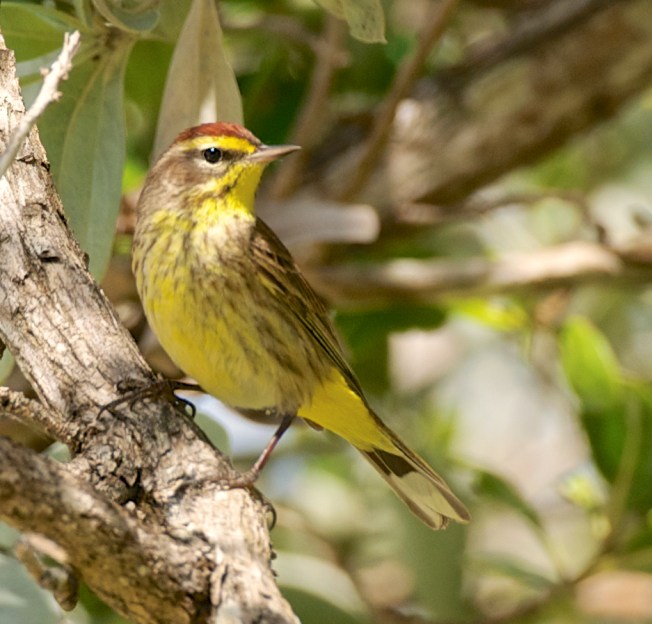
PALM WARBLER
Images take an age to upload so I am taking emergency measures. Today, it’s going to be a quick look at 4 common winter warblers you can easily find on Abaco. Then I’m back to the vin.
BLACK-AND-WHITE WARBLER
If you’d like to know more about Abaco’s 37 warbler species (not including the very recent discovery of a Canada Warbler) click on this PDF and all shall be revealed.
THE THREATS ARE REAL AND THESE PHOTOS SHOULD ALARM YOU!
I rarely – in fact almost never – lift an entire article from elsewhere and plant it wholesale here. I make an exception today. Ben’s article is so relevant, so well put together, so compelling and so scary in its implications that it can’t be ignored. No individual is to blame. We all are. Mankind generally – and pretty much all of it in my lifetime. Walk any beach in Abaco, however secluded. There it all is, under your feet. Find a dead seabird? Chances are it will have significant amounts of plastic inside it. Seen those wretched images of turtles with plastic bags hanging out of their mouths? It’s going to get worse…
Now see how things are with our bird partners in New Jersey and their beautiful ospreys.
DOCUMENTING THE PRESENCE OF PLASTICS IN OSPREY NESTS
U.S. Coast Guard assists NJ Fish & Wildlife with recovering an entangled osprey on a channel marker in Cape May Harbor, Summer 2018. photo by Kathy Clark/ENSP
The alarming trend is also becoming more deadly for ospreys, and other marine life who ingest it. While it might not seem like a lot, this year a total of four young ospreys were found dead from being entangled in plastic. In my books, one dead osprey is too many! This is not a natural cause of death! Luckily, there were several other entanglements that were prevented, but this trend is likely to get worse. We hope that these photos will help you to do all that you can to help prevent it from becoming a growing threat to ospreys and other marine wildlife, who might ingest plastics.
Ospreys are an indicator species. We can’t stress that enough. The health of their population can be directly linked to their surrounding environment. When we poisoned the land with persistent pesticides, the ospreys told us. When we overfished menhaden, the primary prey item of ospreys during the nestling period, the ospreys told us. When we use and discard plastics with no care, the ospreys will tell us…
From the land, where they collect nesting material, to the water, where they forage for prey. The growing presence of plastics on land and in water, highlights need to restrict single use plastics, balloon releases, and for any single use plastic fee to directly fund cleanups of plastic waste. It’s no surprise that ospreys use plastic items in their nests. It’s now become a common resource for them which looks similar to natural nesting material and collects in the same areas where they gather nest material. The more plastics in the world means more plastics in osprey nests!
Sadly, this is only the beginning. Plastics don’t biodegrade and this is becoming a chronic issue. Almost all osprey nests in New Jersey contain some type of plastic (next year we are planning to add data fields to our nest survey datasheets to keep better track of how many nests contain plastic). It’s still too early to see the effects of plastics as as they bioaccumulate in the food chain of predatory animals, like the osprey, but we hope that we can prevent this. We can all help by reducing our use of single use plastics. Here are some simple ways that you can help:
Never release balloons! Talk to your friends/family about where balloons actually wind up.
Reduce your dependence/consumption of single use plastics: bring your own reusable bag, water bottle, and coffee cups. Buy beverages in glass or aluminum containers. When eating out or getting take out, ask for no single use plastic items and/or bring your own container for leftovers. Support a Surfrider Foundation Ocean Friendly Restaurant!
CREDIT: Ben Wurst and his team at http://www.conservewildlifenj.org for the article. Photos as credited in the text. We are Bahamas partners of this organisation in Piping Plover research on the shores of Abaco and our annual Abaco Piping Watch
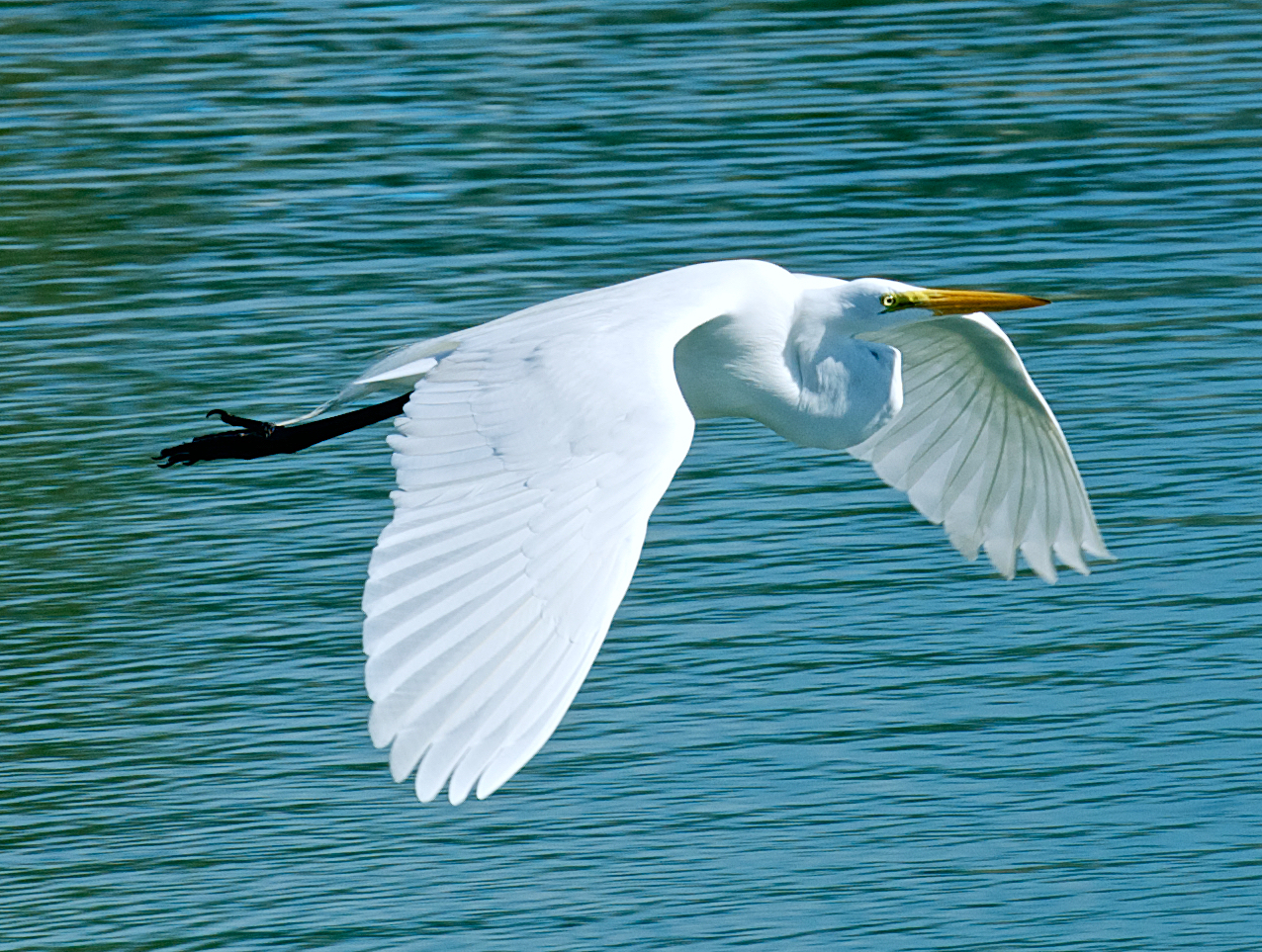
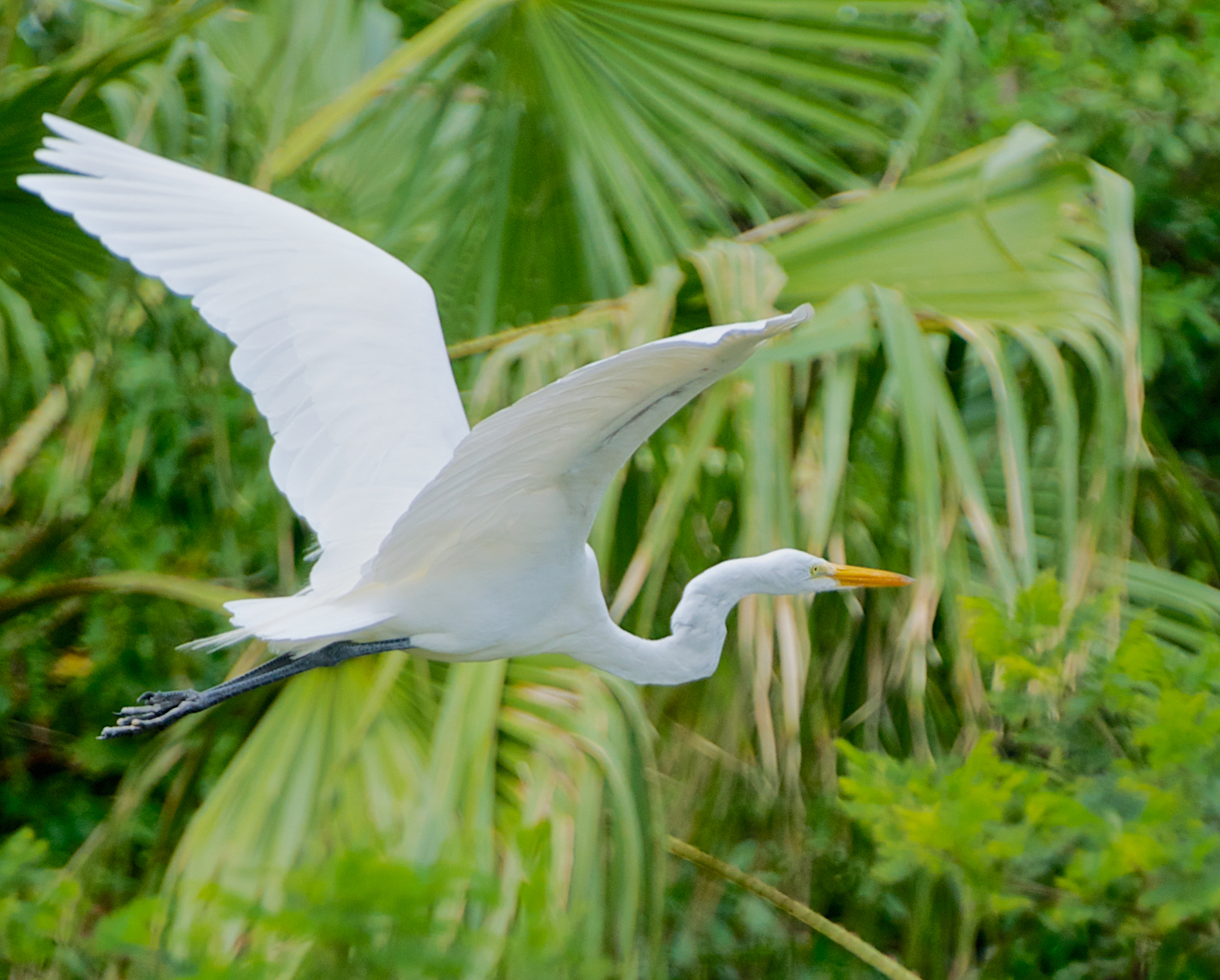
The Great Egret is actually a heron rather than an egret. It’s a Great Heron. All egrets are members of the heron family Ardeidae, but the converse is not true. As long ago as 1758,Linnaeus awarded the bird the binomial name Ardea alba i.e. ‘Heron white‘. Why it should have been so hard to stick to that authoritative nomenclature, I can’t imagine. Perhaps in time all heron and egret species became so hopelessly confusing for people that it ceased to matter much what they were called.
Maybe it was that type of carelessness that led to people from the mid-c19 onwards eyeing up GREGs as a source of hat feathers and other decorative necessities. As with flamingos and many other beautiful avian species, mankind’s millinery and other fashion needs were satisfied at the expense of gorgeous plumage. Actually, at the cost of the birds’ lives: they were simply shot in huge numbers.
Healthy populations were decimated; for some species they never recovered. For others, the great egret among them, the passage of time and the passing of fashions – backed in many cases with conservation programs – have successfully restored the populations. In 1953 theNational Audubon Society, which was formed at least in part to discourage the killing of birds for their feathers, took a decisive step in the cause of the great egret by making the bird the emblem of the organisation.
Photo Credit: Nina Henry photographed all the egrets in this post. Her wonderful images made a significant contribution to the “BIRDS OF ABACO” project.
Today, September 6th, is World Shorebirds Day. Every year, a Shorebird of the Yearis selected by the organisers of this global event, and this year they have gone ‘large’. Perhaps in response to the declining populations of curlew species, they have chosen a fine representative – the whimbrel. Inconveniently – and although the whimbrel is a worldwide species – it is extremely rare on Abaco. In the definitive Abaco Checklist (see below), it is coded a TR4, i.e. a very uncommon transient with a handful of sporadic reports. Until last year, sightings were very few and far between. Then suddenly last autumn, they made a small migratory comeback. You can read about it HERE.
BLACK-NECKED STILT Himantopus mexicanus PR B 3
Abaco is home to 33 shorebird species. Like the human residents of the main island and cays, some are permanent; some are winter residents arriving from the north to enjoy a warmer climate; and some are transients – visitors that pass through a couple of times a year on their way from and to their nesting habitats.
CHECKLIST OF ALL 33 SHOREBIRDS
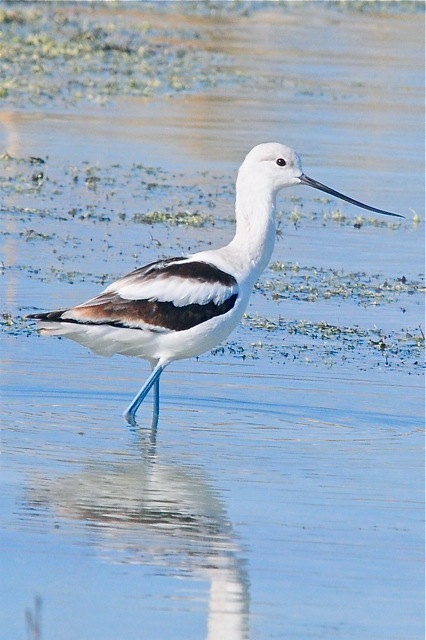
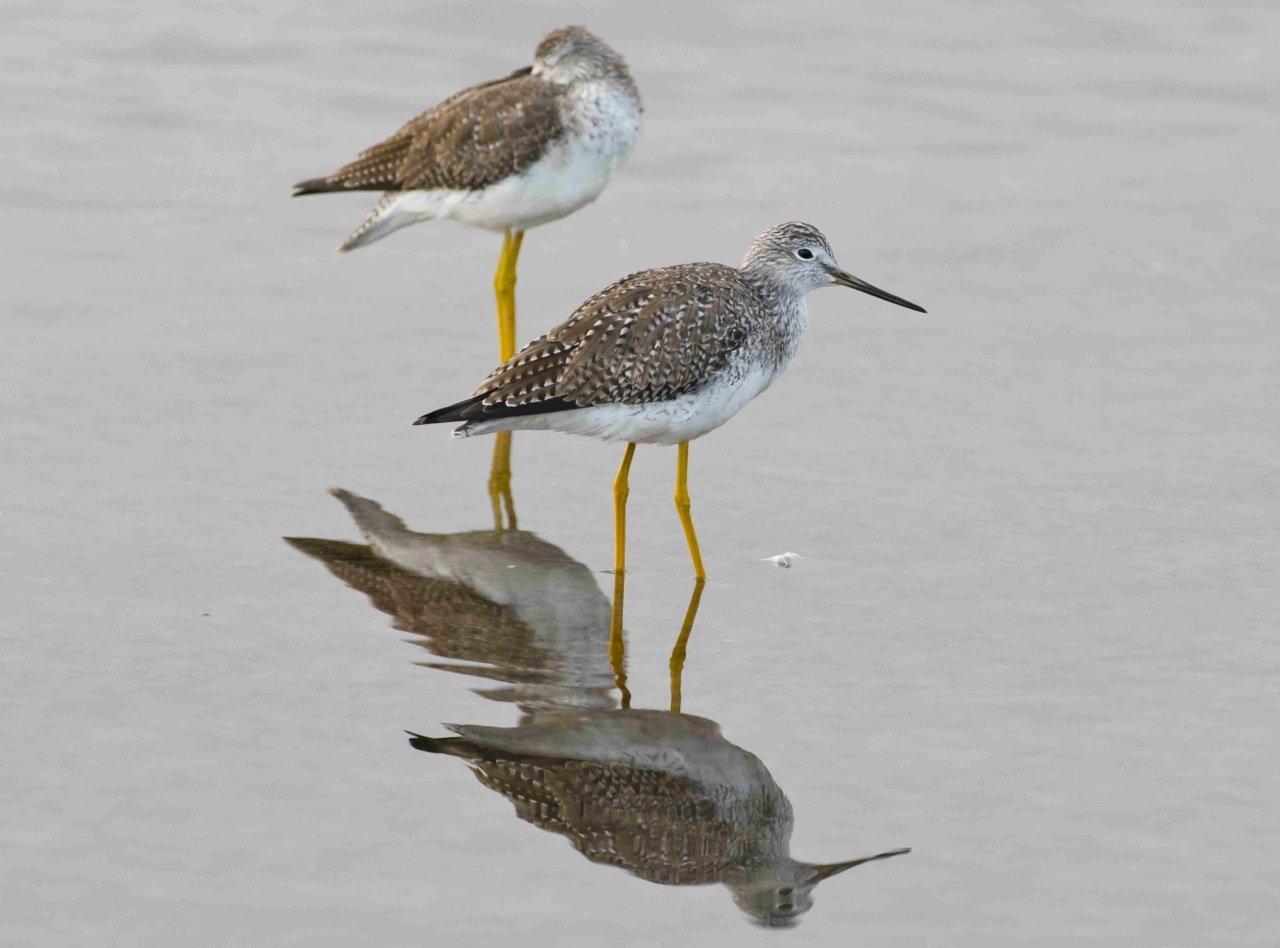
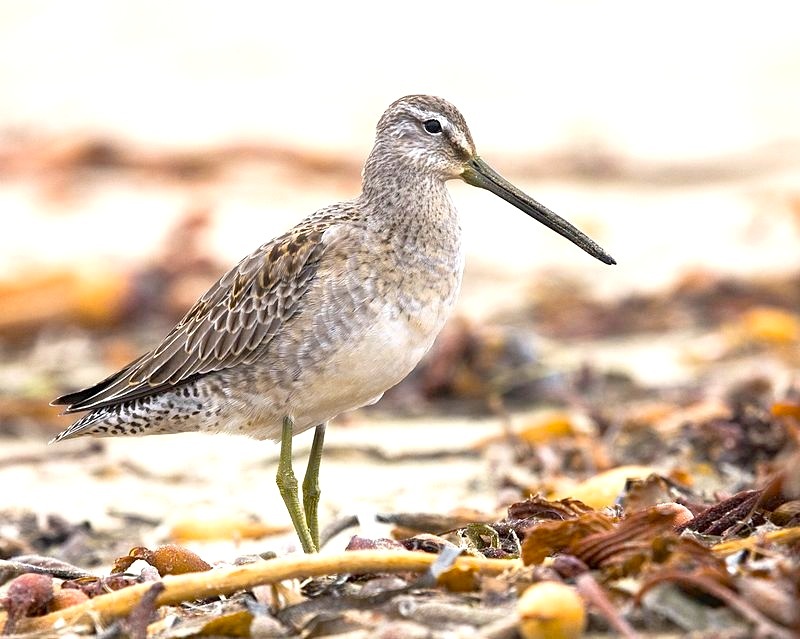
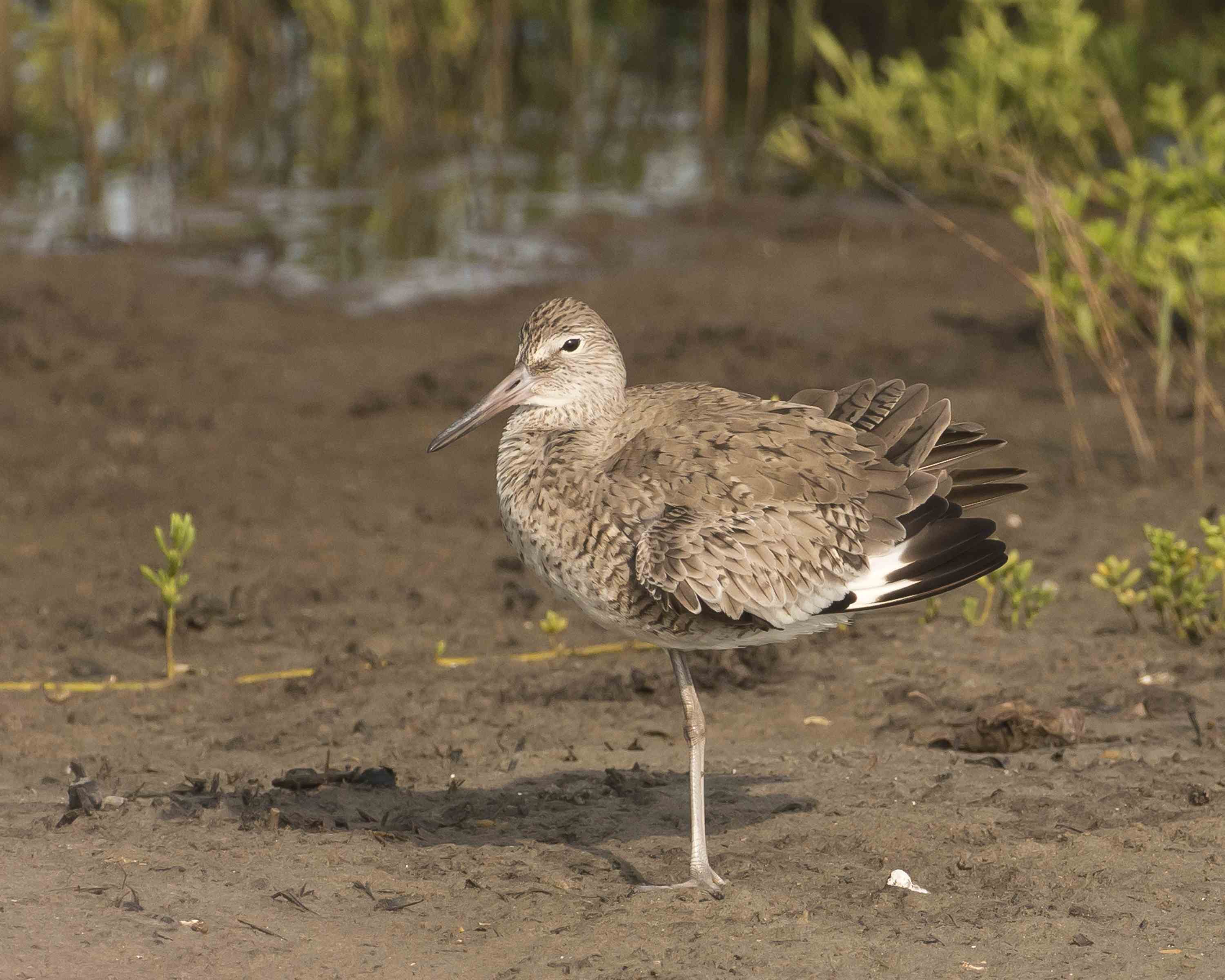
The definitive checklist of Abaco’s birds was compiled especially for the BIRDS OF ABACO by Bahamas Birding author and authority, the late and much missed Tony White, with Abaco’s bird expert Elwood Bracey. Below is the shorebird list, with a photographic selection of the larger and/or longer-billed shorebirds in checklist order. Yes, including an Abaco whimbrel.
The codes will tell you, for any particular bird, when you may see it (P = permanent, WR = winter resident, TR = transient, V = vagrant); whether it breeds (B) on Abaco; and your chance of seeing it, graded from easy (1) to vanishingly unlikely (5).
AMERICAN AVOCET Recurvirostra americana WR 4
AMERICAN OYSTERCATCHER Haematopus palliatus PR B 2
GREATER YELLOWLEGS Tringa melanoleuca WR 2
LESSER YELLOWLEGS Tringa flavipes WR 3
WHIMBREL Numenius phaeopus TR4 (an Abaco one)
HUDSONIAN GODWIT Limosa haemastica [V5]
Like the whimbrel, this bird is another special bird to be able to include. Until last October, it was categorised as a V5, meaning that one or perhaps 2 vagrants had ever been seen on Abaco. Then one appeared on a pond and was spotted by Woody Bracey and, a few days later, by Keith Kemp – who even took confirmatory photos. You can read the storyHERE.
Photo Credits: Andreas Trepte / Wiki (1);Tom Sheley (2, 5, 6, 7, 13); Alex Hughes (3);Tony Hepburn (4); Charmaine Albury (8, 9); Stewart Neilson / Wiki (10); Bruce Hallett (11); Mike Baird / Wiki (12); Woody Bracey (14)
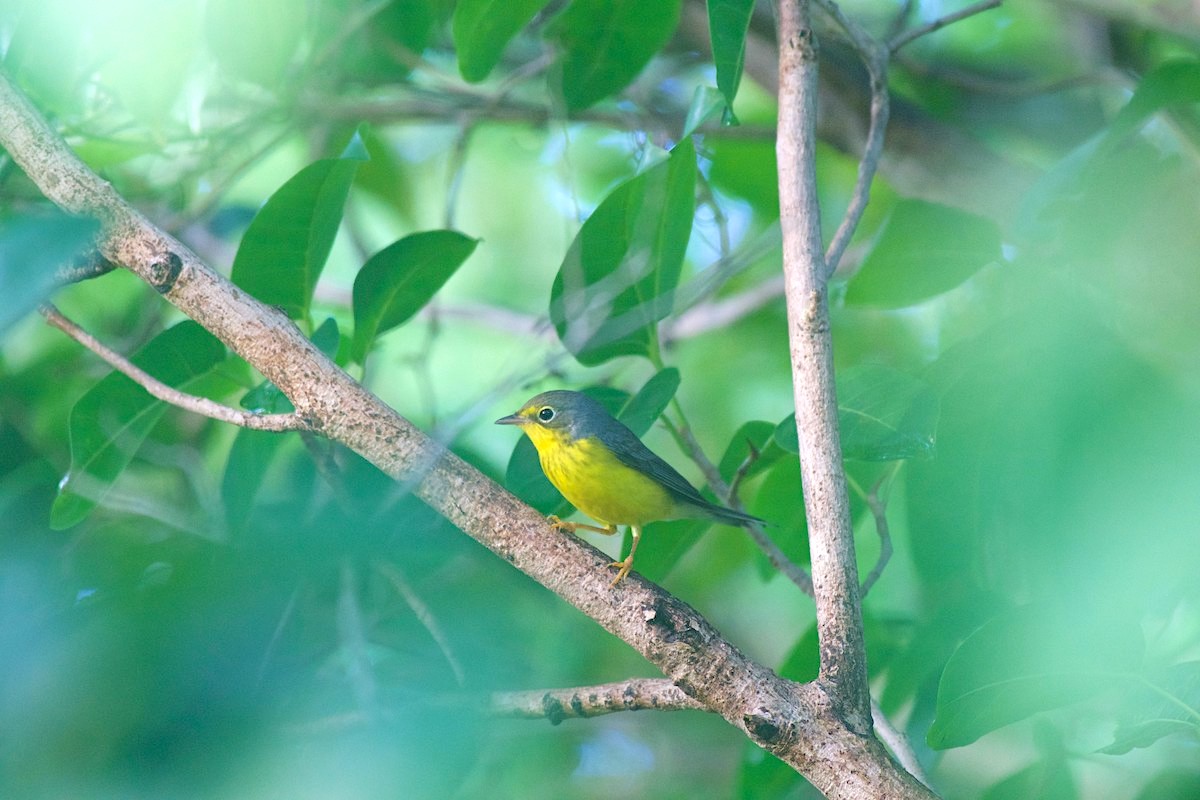
The first Canada Warbler recorded for Abaco AND Bahamas (Christopher Johnson)
CANADA WARBLER: A NEW BIRD FOR ABACO & BAHAMAS
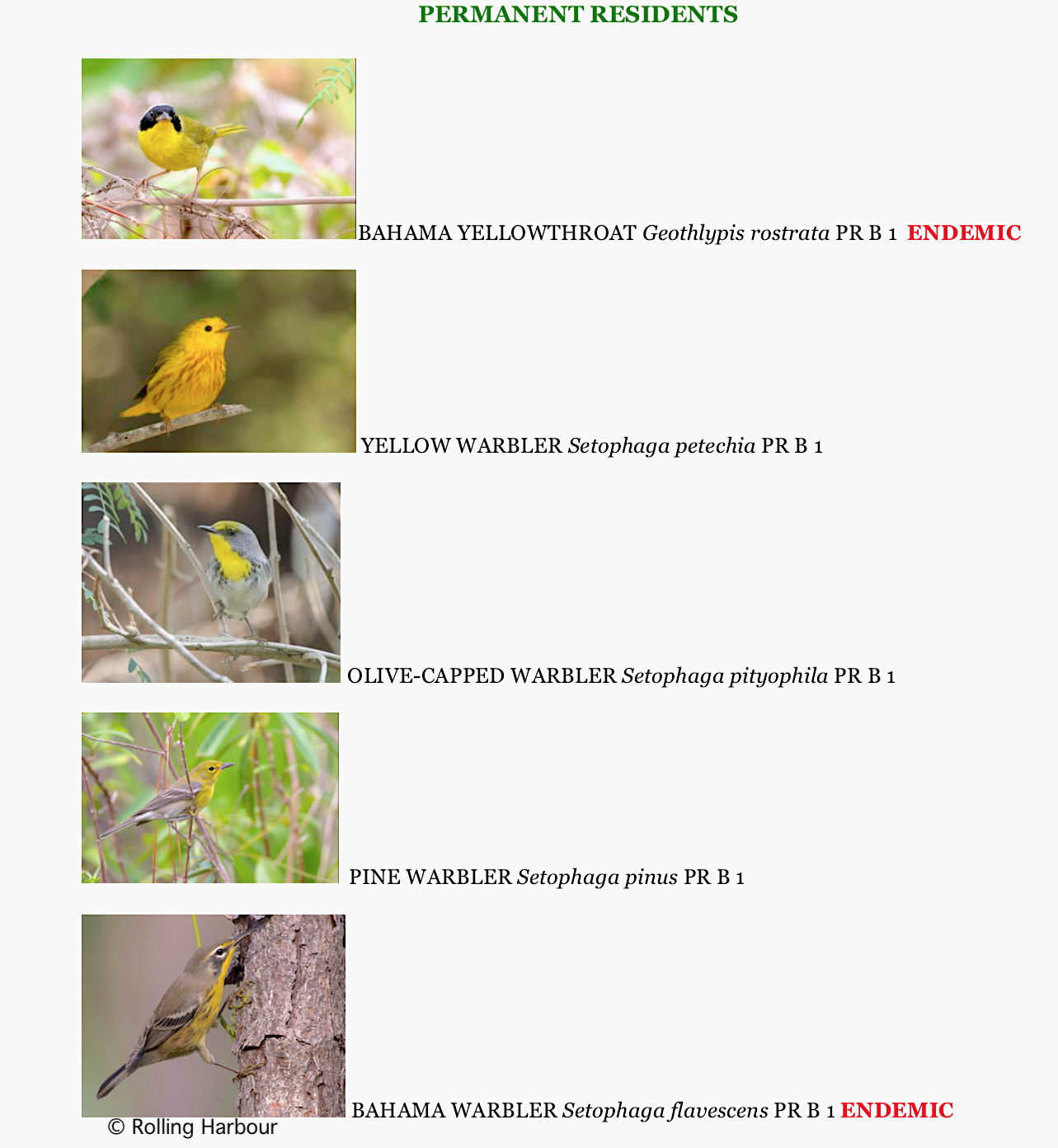
As reliable as seasonal clockwork, the migratory warblers are swarming south from their summer breeding grounds to warmer climes for the winter. In the case of Abaco, this amounts to 32 warbler species to add to the 5 resident breeding species (Bahama Yellowthroat, Yellow Warbler, Olive-capped Warbler, Pine Warbler & Bahama Warbler. 37 warblers in total.
Well, now make that 38. On August 28th, young birder Christopher Johnson was out with well-known birding sage Woody Bracey when he saw something small and yellow hopping about in the coppice. On closer examination – and he took the photos to prove it – it was not just one of the many familiar yellowy winter warblers, but a completely new species recorded for Abaco and (more significantly) the entire Bahamas. It was a Canada Warbler, Cardellina canadensis (Linn. 1766) aka Wilsonia canadensis.
The photo above is one of 3 that Christopher managed to take. In many respects it is typical of a field photograph: a small bird, at a distance, zero’d into focus through a small gap in the leaves and branches of thick coppice. Sharp bird, blurry surroundings. The trick is not to end up with a wonderful clear shot of a green leaf on its twig, with a small yellow blur in the background. (I perfected this ill-advised technique with my only photo of a Kirtland’s warbler).
WHERE WAS THIS BIRD DISCOVERED?
One of the features of the excellent birding to be found on Abaco is that some of it can be carried out in unexpected places. Town dumps are a classic example, though photos have to be taken with care to avoid unsightly rubbish-based settings. The Abaco Big Bird Poultry Farm area is another. This little bird was found there.
SO WHERE WOULD IT NORMALLY BE FOUND?
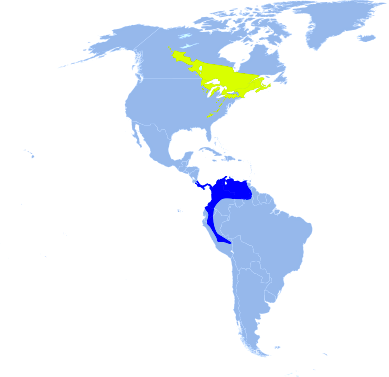
In summer, roughly 80% of CAWAs live and breed in Canada; 20% in the northern US. They spend a relatively short summer there. In the early Fall they fly down to South America. From the range map below, it looks as though their flight path would naturally take them right over the Bahamas to get to their destination. In fact, their journey is quite different. Following the central ‘bend’ of the Americas, they fly at night along a southwesterly route to the Texas coast, then on to southern Mexico and beyond.
I suspect that, as with many migratory birds, the occasional specimen takes a wrong turn on its route south, or is blown off-course by a storm. Maybe a few such vagrants pass through further east – even over the Bahamas perhaps – each year, as ‘vagrants’. But in reality their tiny size in the dense foliage of the land masses means that only a fluke sighting could result. So Christopher’s sighting will be recorded as a V5 – a vanishingly rare vagrant with only a single sighting (cf Abaco’s BLACK-BROWED ALBATROSS).
Q. DO MALES & FEMALES LOOK MUCH THE SAME? A. NO
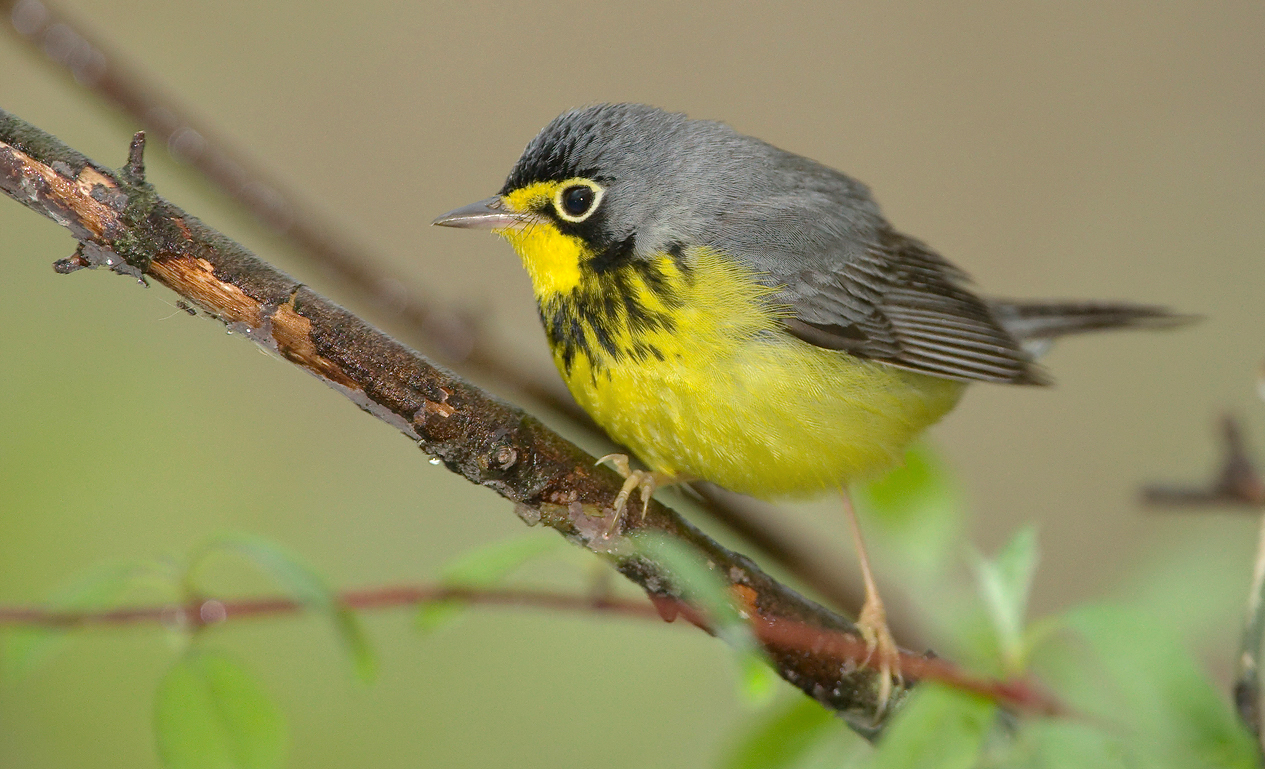
Based on the Macaulay Library pictures below, the Abaco CAWA must be a female or an immature male. In comparing photos of this species (which I had never come across before) I have noticed one thing. The yellow lore (the area between the base of the beak and the eye) extends to include the top of the bird’s otherwise white eye-ring. This is found in both the male and the female. Now I need to check other eye-ringed species to see if this feature is a unique identifier or not…
WHAT DO I LISTEN FOR (JUST IN CASE…)?
The two sounds to listen for are the chirpy scrap of song and the ‘chip’ call.
WHAT IS THE CAWA’S CONSERVATION STATUS?
The CAWA is IUCN-listed as being of ‘least concern’. That of course is very far from saying it is of no concern at all. Surveys are already showing a gradual population decline in the breeding grounds. The Committee on the Status of Endangered Wildlife in Canada has assessed the CAWA as ‘threatened’. Dull as it is to keep repeating the point, this species like most others faces all the usual threats to its existence, mostly man-made and during my lifetime…
Deforestation, habitat destruction and intrusion, development etc etc
Problems arising from acid rain and pollution
The uncontrolled spread of the tree-destroying woolly adelgid, an import from Asia
Oh, and all those damn deer browsing the understory a bit. Blame them!
ARE THERE ANY FUN FACTS ABOUT THIS BIRD?
Well, confusion about its name, maybe, though that’s more ‘interesting’ than ‘fun’, I think. In 1760, a French zoologist named Brisson gave a name to a warbler specimen from Canada. It was “Le gobe-mouche cendré de Canada”, ie ‘The Canadian Ash-gray Flycatcher’. Because he needed a conventional Latin name for the bird, he put together the name Muscicapa Canadensis Cinerea. This did not fit in with the binomial system of taxonomy (nor was it a very good description of the bird), and the name was accordingly rejected by the wonderfully named International Commission on Zoological Nomenclature. Linnaeus (to cut a longer story short) sorted it all out in his next edition of Systema Naturae in 1766, with the binomial name Muscicapa canadensis. In due course the genus Muscicapa was changed to Cardellina.
THAT WASN’T A WHOLE LOT OF FUN. IS THERE MORE?
Well, there were more naming shenanigans when John James Audubon illustrated a female Canada warbler in Birds of America nearly a century later. Plate 73 (below) was entitled “Bonaparte’s Flycatching-Warbler—Muscicapa bonapartii.” He’d slipped in the name of ornithologist (and nephew of the more famous Emperor) CHARLES BONAPARTE,he of the BONAPARTE’S GULL. This version did not stick. However the CAWA acquired another ‘tribute’ name, an alternative that is still in use: Wilsonia canadensis. This tip of the hat is to another ornithologist ALEXANDER WILSON, of Wilson’s Plover fame.
Photo Credits: Christopher Johnson (1, 2, 3); Emmet Hume / Wiki (4); Male / Female CAWAs, David Turgeon & Bob Edelen, Macaulay Library; Audubon Plate 73, OS; William H Majoros / Wiki. Sound Files, Ian Davies & Andrew Spencer / Xeno-Canto; Abaco Resident Warbler Chart, Keith Salvesen;, Cartoon by Birdorable; Range Map, Cornell U.
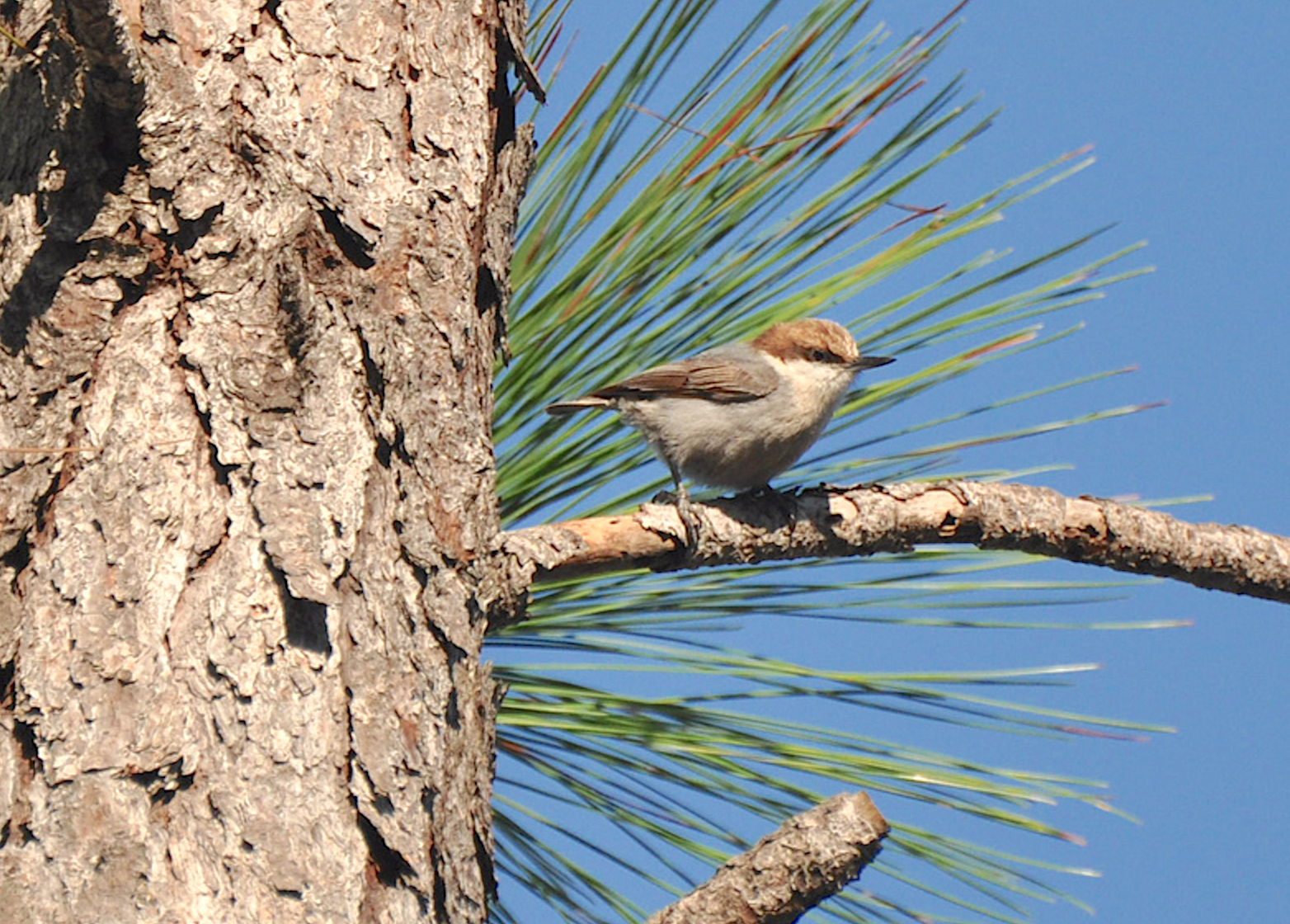
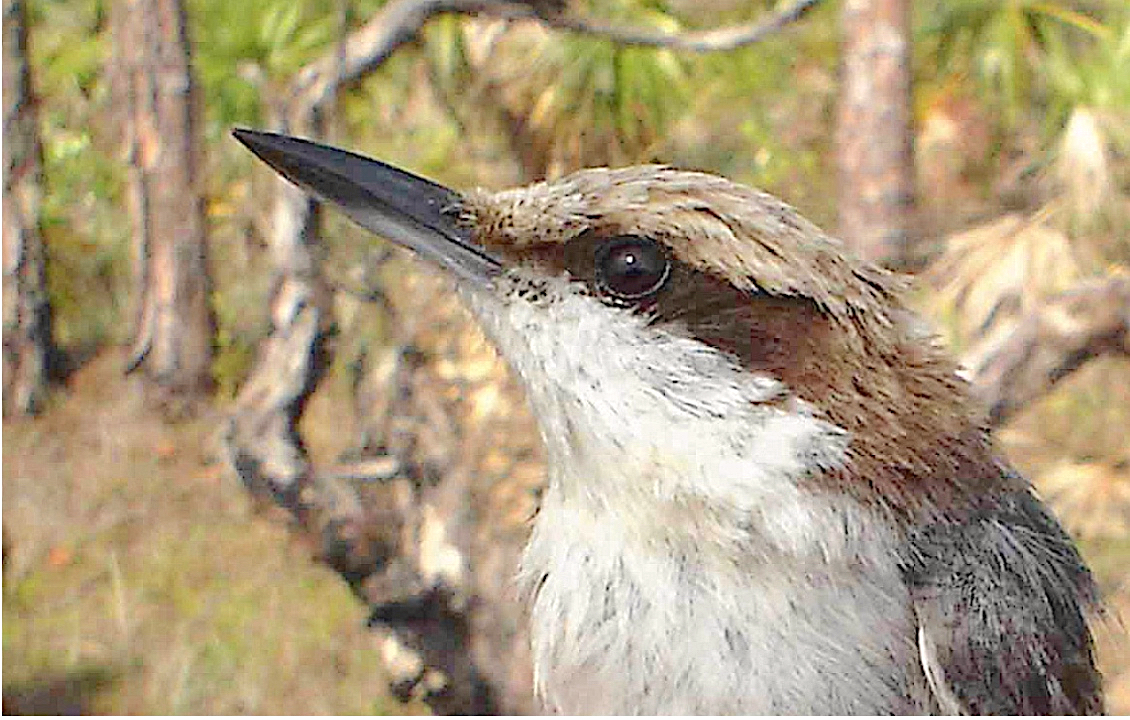
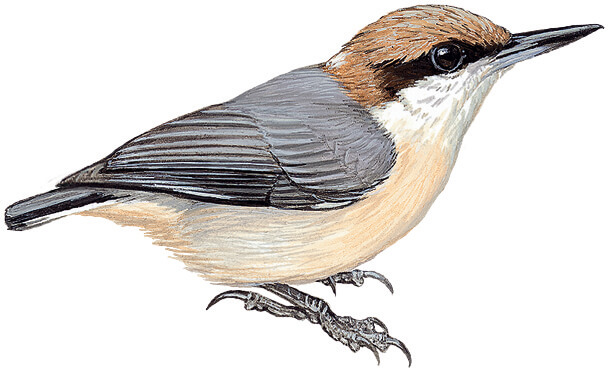
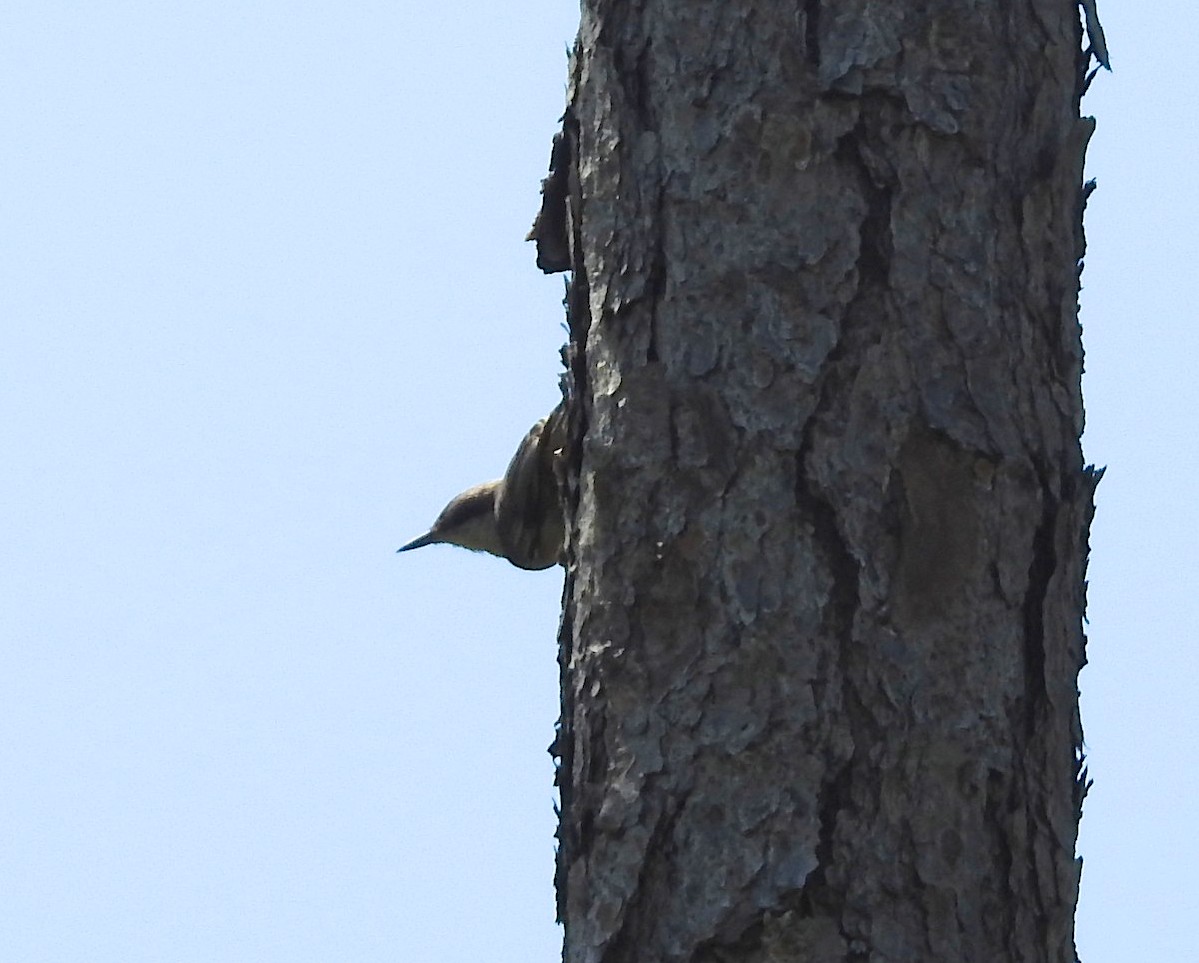
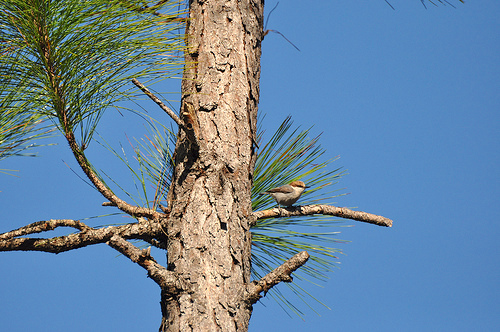
It’s quite a while since I posted about the Bahama Nuthatch (Sitta pusilla insularis) and the separation of its status from its cousin the Brown-headed Nuthatch HERE. I started by saying that it was one of the rarest birds in the Bahamas (or indeed anywhere), with a tiny population living only on Grand Bahama. It’s extraordinary to think that until the 1960s, these birds were common on the island. Then, for all the usual reasons, the population began to decline “precipitously” (Tony White). By the 2000s, the most optimistic estimates suggested that about 1000 – 1200 mature birds might inhabit the pine forests. Other surveys showed far lower numbers. By now, the species had become highly vulnerable. Reports dwindled annually, and in some years only a handful sightings were recorded.
Then in October 2016, Grand Bahama received a direct hit from Hurricane Matthew. It was as destructive as you might expect a violent Cat 5 storm could be. Without in any way seeking to diminish the far-reaching and devastating impact of the hurricane on the island (and elsewhere), I have to stick to the matter in hand here. The fact is that for nearly 2 years after Matthew and its trashing of the habitat, not a single BANU was sighted – this, despite many efforts to track one down in the known hotspot areas. It began to seem likely that the little bird had simply been wiped out of existence. Since it is known nowhere else – not even on nearby Abaco – the Bahama Nuthatch had very probably become extinct.
Fast forward nearly two years and suddenly there is the first hint of a glimmer on the horizon for these little birds. Finding one is already a needle-in-a-haystack quest. The target is shy and tiny – about 4 ins long and 10 grams; and the search area is vast – more than 30,000 hectares. Yet this summer, amazingly, some Bahama Nuthatches have been found and photographed, a most happy – and perhaps optimistic – outcome, and a deserved return for some serious survey work. Excited publicity has spread well beyond the usual online birding resources and into the mainstream press.
THE KEY SIGHTINGS
JUNE 2016
The last recorded sighting of the Bahama Nuthatch (2 birds) before Hurricane Matthew was made in June 2016 by well-known Grand Bahama bird expert and guide, Erika Gates.
The first team eventually made a sighting in May 2018, and the elusive bird was captured by Matthew Garner of UEA on camera. They also obtained brief and tantalising video footage (below). In all, the UEA team made six nuthatch sightings, and Bahamian team independently made five sightings (including seeing what appeared to be two together).
JULY 2018
Erika Gates, with Martha Cartwright and Zeko McKenzie, again managed to locate a single nuthatch to add to the earlier 2018 sightings. She too managed to get some photos of the bird.
WHAT OF THE FUTURE?
Among the May birds – however many there were in total – one was a juvenile. Combined with 2 adults seen at one time, that makes 3 birds. The extent of the period of study and search area of the May sightings (11 in all) make it likely that more than 3 birds were seen overall. Erika’s July bird, in a slightly different location, suggests another. Perhaps no more can be said than that there may be half-a-dozen Bahama Nuthatches extant in the world. It’s some comfort.
However, as the May operation noted, ‘We also don’t know the sex of the birds. In many cases when birds dwindle to such small numbers, any remaining birds are usually male.’The consensus of the articles I have read is that the handful of birds seen this summer, while a thrilling discovery, should not be seen as any guarantee against extinction. Further habitat degradation, more development, another hurricane, any one of these could be fatal to the species. The recent sightings are cause for some optimism but these little, highly vulnerable birds remain on the very brink of extinction. Those few people who have seen one in the wild have had a precious experience.
THREATS TO THE SPECIES
Habitat loss / degradation from development, logging, forest fires & hurricanes
Invasive / introduced / feral species such as corn snakes, raccoons & cats
Competition from other more prolific species in a limited habitat
The Bahamas National Trust has produced an excellent video account of the whole story from Shelley Cant-Woodside HERE
Photo credits: Bruce Purdy (1, 11); Gary Slater / Birdlife.org (2); Erika Gates / Bahamas Weekly (3); Erika Gates (4, 5, 7, 8, 9, 10); Matthew Gardner (6); Birdlife International (drawing); UEA & team (video)
Research credits include: Birdlife International / Birdlife.org; Lisa Sorenson; Tony White; Research Gate; IUCN; Bahamas National Trust; The Bahamas Weekly / Erika Gates; eBird; Loma Linda U; Science News; Sundry online publications; American Birding Association (and a bonus point for its brown-headed nuthatch behaviour article wittily entitled “Sex in the Sitta”)
The Smooth-billed Ani (Crotophaga ani) is the third member of the cuckoo family found on Abaco, the others being theMANGROVE CUCKOOand theYELLOW-BILLED CUCKOO. Anis range from Florida and the Bahamas in the north, down through the Caribbean to South America, where they are widespread.
Unlike their shy and retiring cuckoo cousins, anis are extrovert shouty birds that like to hang out in noisy gangs and family groups. They can often be found in low scrub, bickering and squawking, and fluttering around. You’ll probably hear them from some way off, sounding like this:
Anis have advanced social, parenting and chick-rearing skills. They build a communal nest for the group, and all share in egg incubation and chick-feeding duties They may raise up to three broods in a season, which keeps the numbers up. Rather touchingly, the young of earlier broods help to feed more recent chicks.
It follows from this that unlike many other cuckoo species, the ani is not a brood parasite. So the species does not lay its eggs in the nests of other, smaller birds which then unwittingly rear the interloper(s), who in turn push the legitimate hatchlings out of the nest and get all the food and attention.
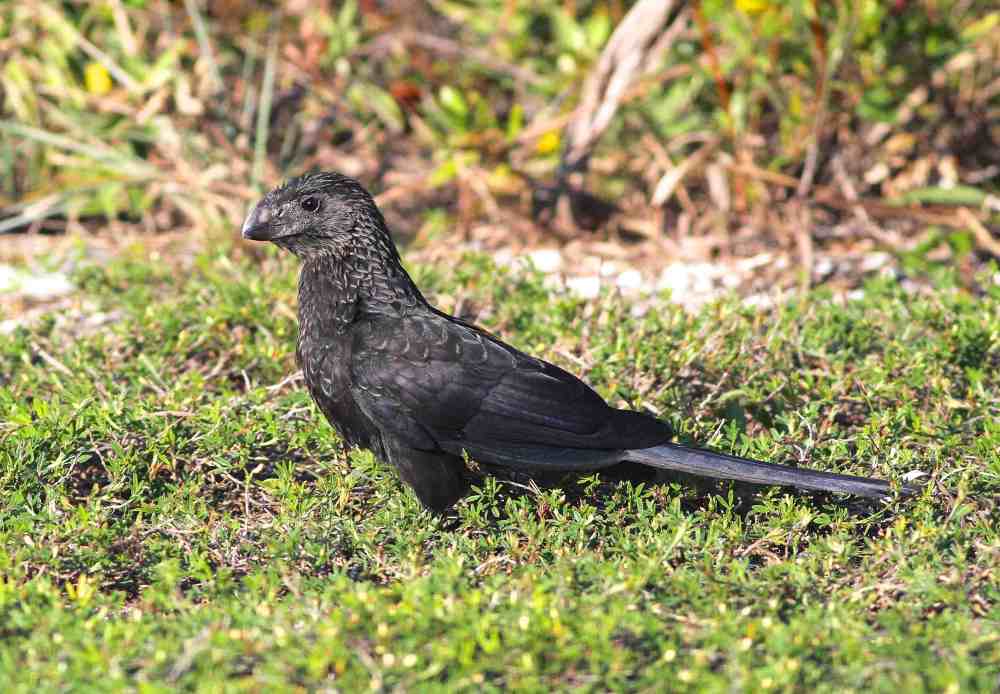
I have tried to discover why an ani’s beak is as it is, without much success. Very often beak shape relates directly to the feeding habits and preferences of a species, but it is hard to see how a diet consisting mainly of insects and small reptiles such as lizards would account for such a prominently protuberant proboscis. Here is a close-up of the item in question.
On Abaco (and indeed elsewhere) Anis are sometimes known as ‘Cemetery Birds’, no doubt because of their all-black appearance (though their raucous tendencies would be quite inappropriate for a graveyard). However although at a distance these birds may look completely black, catch one in the sun at the right angle, and you’ll find that the plumage is far more varied, and with some intricate patterning.
Look for Anis in low scrubland and coppice, cultivated areas, perched in unsteady noisy rows on utility lines, or foraging on the ground.
The appearance and flying abilities of Anis are wonders to behold. As I wrote in The Birds of Abaco, “Their curious heavy beaks, their clumsy flight and their untidy take-off and landing routines suggest a design fault”.
“One… is the loneliest number…” Oh, hang on a moment…
…”two of us…standing solo in the sun…”
The Philatelic Bureau of the Bahamas Postal Service is commendably committed to featuring the natural history of the Bahamas. Although probably not in the top-ten of anyone’s bird list, the ani nevertheless got its own stamp in a 1991 bird issue.
As far as I know, there is not yet a collective noun for a group of anis. There should be. Any suggestions welcome. Meanwhile I put forward “A Commotion of Anis”
Credits (all photos taken on Abaco): Becky Marvil, Nina Henry, Tony Hepburn, Gerlinde Taurer, Roselyn Pierce, Tom Sheley, Bruce Hallett, Keith Salvesen; sound files from Xeno Canto and FMNH; range map from IUCN; hat tip to the always excellent Aimee Mann.
This post is a revised, corrected and expanded version of one I wrote nearly 4 years ago.
The Northern Parula is one of 37 warbler species recorded for Abaco. The vast majority of these species are migratory, arriving in the Fall and leaving in the Spring to fly north to the breeding grounds. When I’m back at HQ from my computer-free break, I’ll be writing more about these little birds. Meanwhile, this post is a reminder that the influx will begin very soon. The Northern Parula, with the distinctive green patch on its back, is sure to be among them.
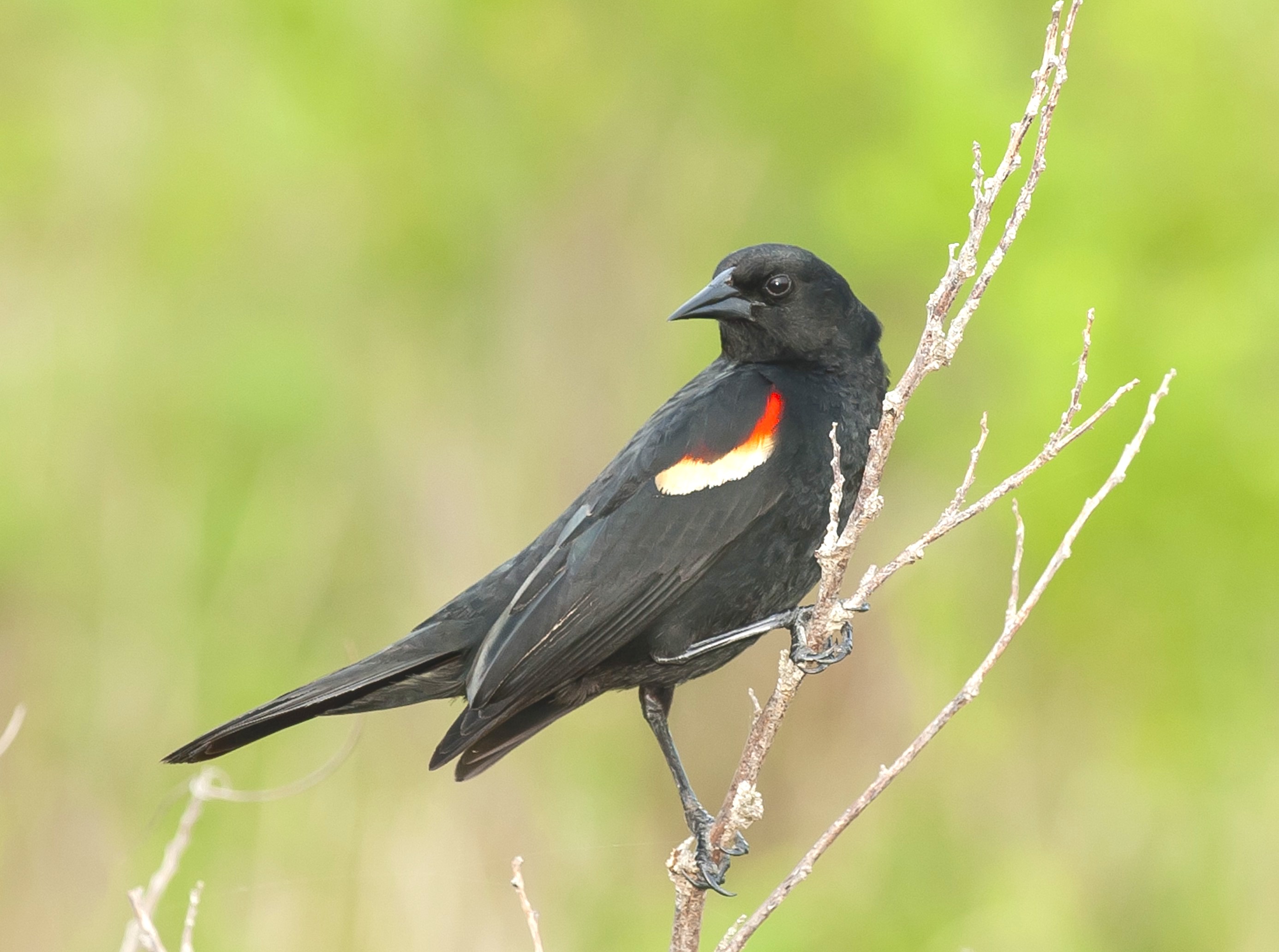
I’m away for a few days on the Emerald Isle, leaving my trusty computer many miles away (on purpose, I mean). I’ve just got my iPhone, but writing posts and inserting images on such a small screen / keyboard is a fool’s errand. So I’ve pre-loaded a couple of beautiful bird images to post this week. Here is a wonderful red-winged blackbird male taken by photographer Tom Sheley while we were getting together some images forThe Birds of Abacodeep in Abaco backcountry.
‘Casting’ is one of those words with multiple meanings, some archaic but most in use today. You can probably think of half-a-dozen straight off *. ‘Casting about’ is one of the specific usages and derives from hunting, eg hounds casting about for a scent. By extension, it has come to mean something like searching intently or thoroughly for something you need, or want, or are having difficulty in finding. Which is where this tricolored heron comes into the picture.
It’s always entertaining to watch a heron or egret fishing. Their methods range from standing stock still and suddenly stabbing downwards to slowly wading to the crazy dash that reddish egrets sometimes do on the edge of the mangroves. This one is hooding its wings, sometimes called ‘canopy feeding’. The theory is that this attracts small fish by providing shade. I also wonder if this method is used to reduce glare from the surface of the water.
The bird in this sequence is a juvenile, and not yet the lethal hunter that it will soon become. It has seen a fish moving but has temporarily lost it (fishermen will be familiar with the mild feeling of annoyance when this happens). So it is casting about, slowly zig-zagging through the water, looking from a height, crouching down, trying to get a good view of its elusive snack. I can’t say that this little episode ended in success. Sometimes, the fish you sight and then lose has gone for good. But as fishermen often say when they lose one (and by extension the phrase is now applied to other areas of human life), there are always plenty more fish in the sea.
* Even without considering Mr Weinstein and his allegedly unusual casting methods
Photo credit: Phil Lanoue, a photographer who specialises in patiently taking sequences of bird activity
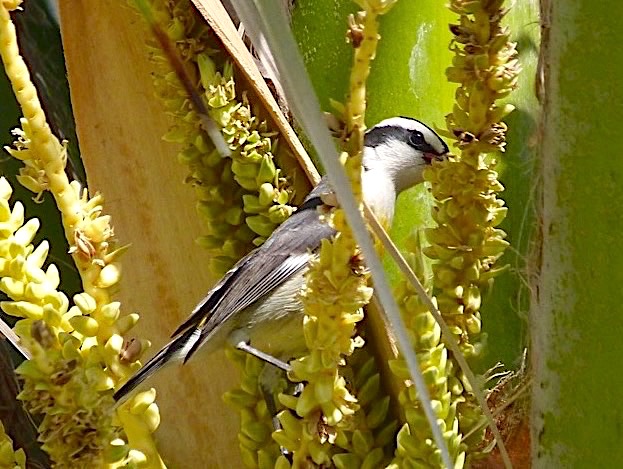
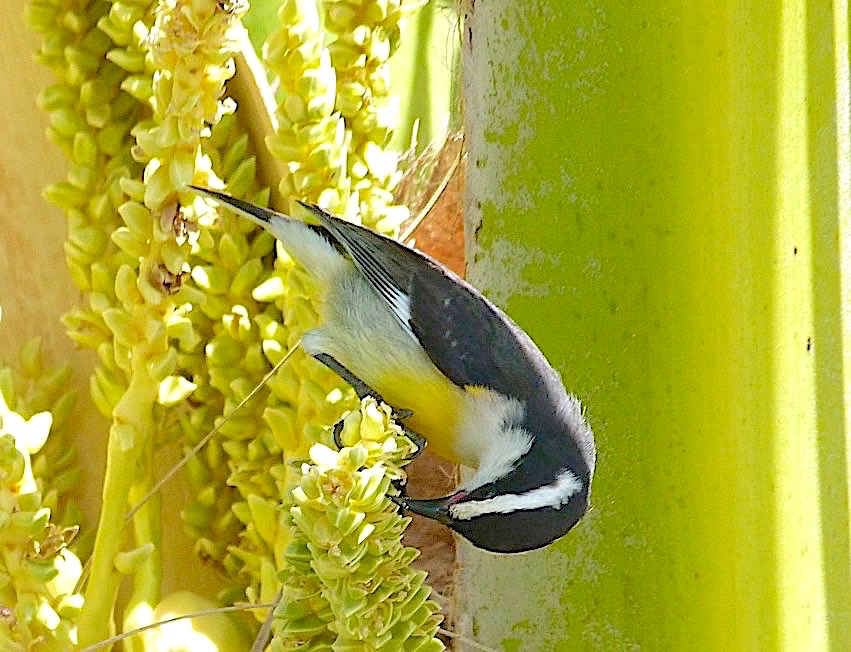
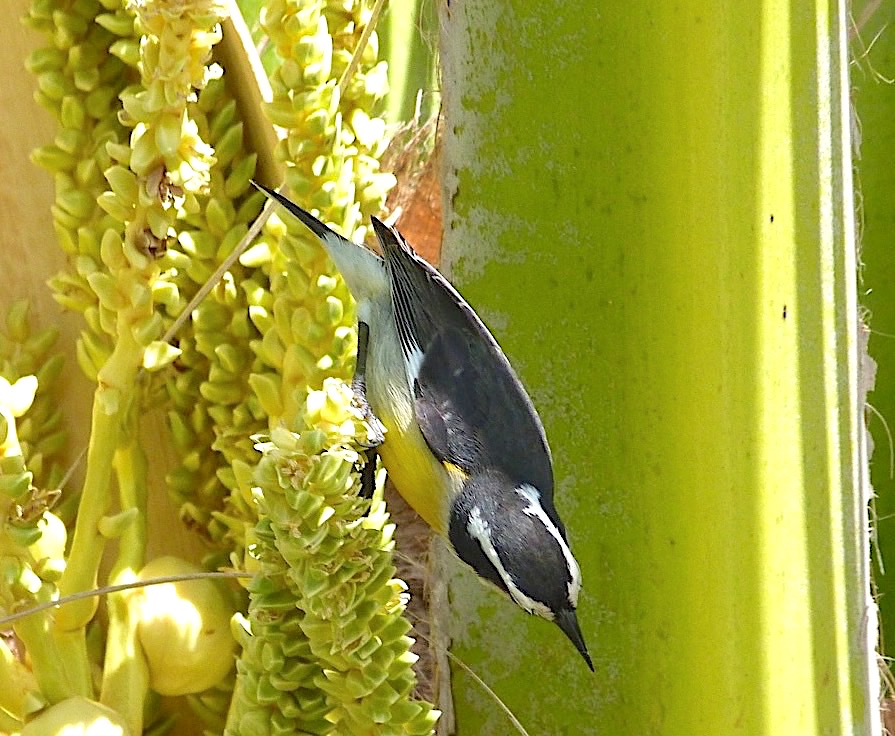
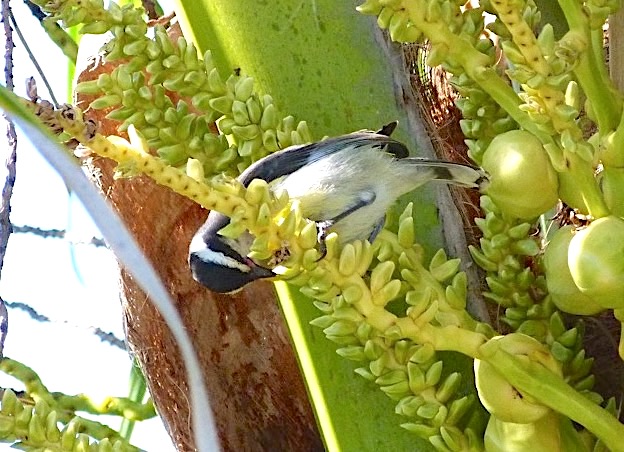
Bananaquits are smart. They look smart, of course, and they act smart too. Their diet consists mainly of nectar and fruit, so you’ll find them where there are flowering or fruiting trees and shrubs. Their sharp little beak curves slightly, enabling them to get right into where the good things are, as shown in this sequence of not-especially-good-so-I’ll-call-them-illustrative photos. And that beak gives then another method of reaching nectar – they can pierce the base of a flower and use the beak as a sort of probe to get at the nectar that way. And soft fruit? Easy!
All photos: Header, Craig Nash; the rest, Keith Salvesen – all at Delphi, Abaco Bahamas



























































 ROLLING HARBOUR ABACO
You must be logged in to post a comment.