CHRISTMAS TREE WORMS Spirobranchus giganteus
“PROBABLY THE MOST CHEERILY FESTIVE WORMS IN THE WORLD…”


![]()
![]()
![]()
![]()
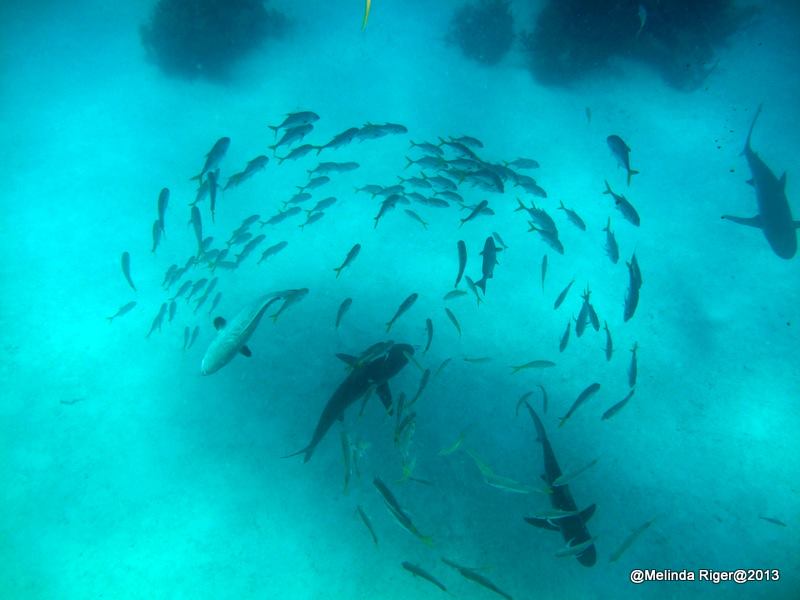
Credits: Melinda Riger of Grand Bahama Scuba, Wiki-Reef & RH

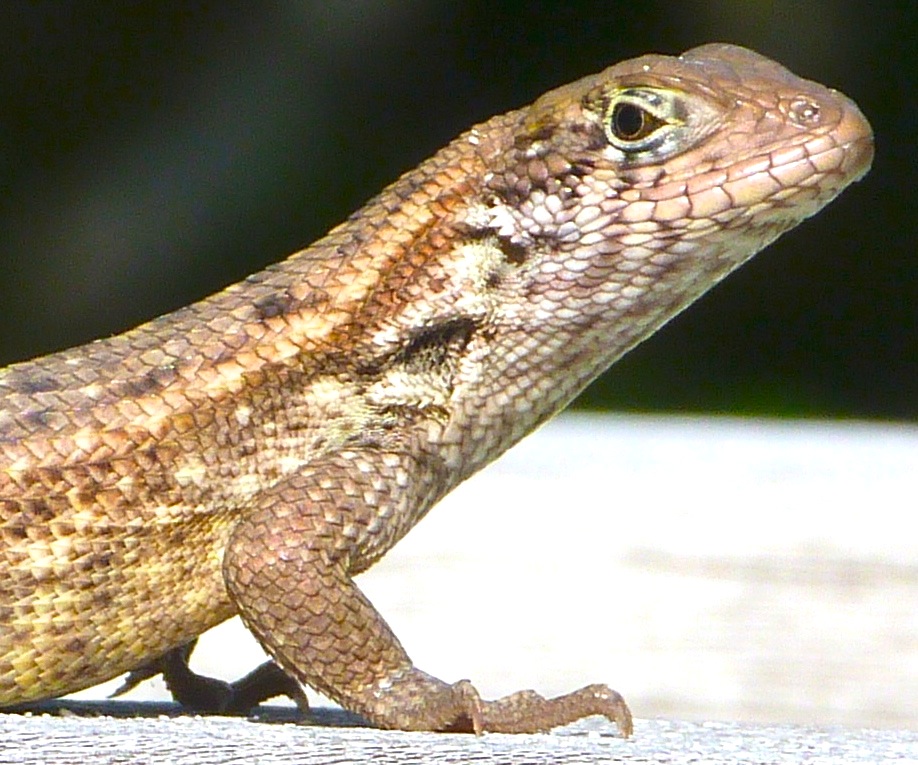
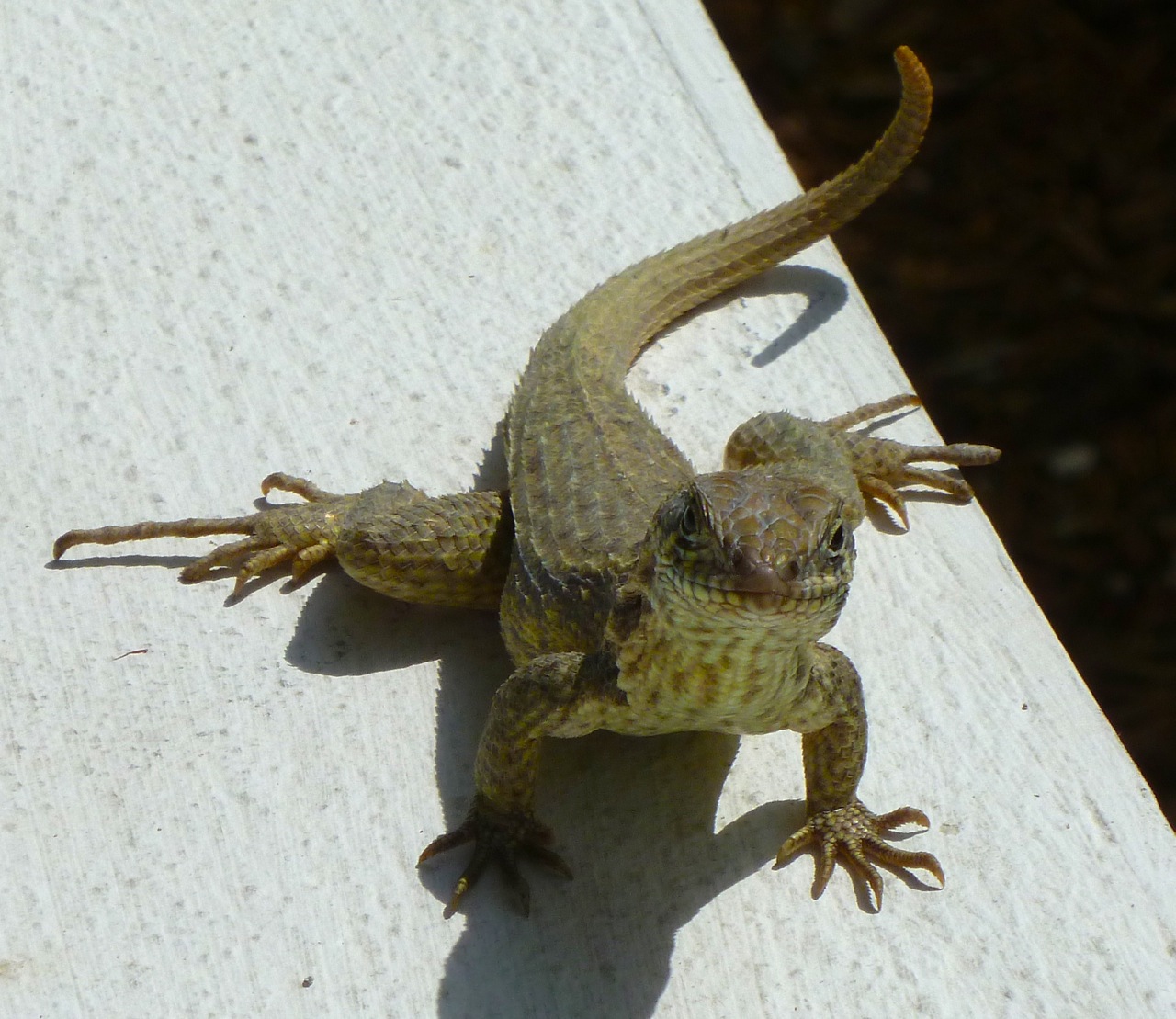
There is no known connection between ‘curly tails’ and the festive season. So trotting out a few of these charming little creatures in any season is a good idea. Are reptiles inherently repellent? Not these ones, for sure.


I AM A DRAGON… GRRRRRRRRRRR (note the remarkable finger length)
AWWWWW… A VERY HAPPY CHRISTMAS TO YOU TOO!
Credits: Charlie Skinner (including the sloughed skin) & RH (including the ‘tired’ pair)

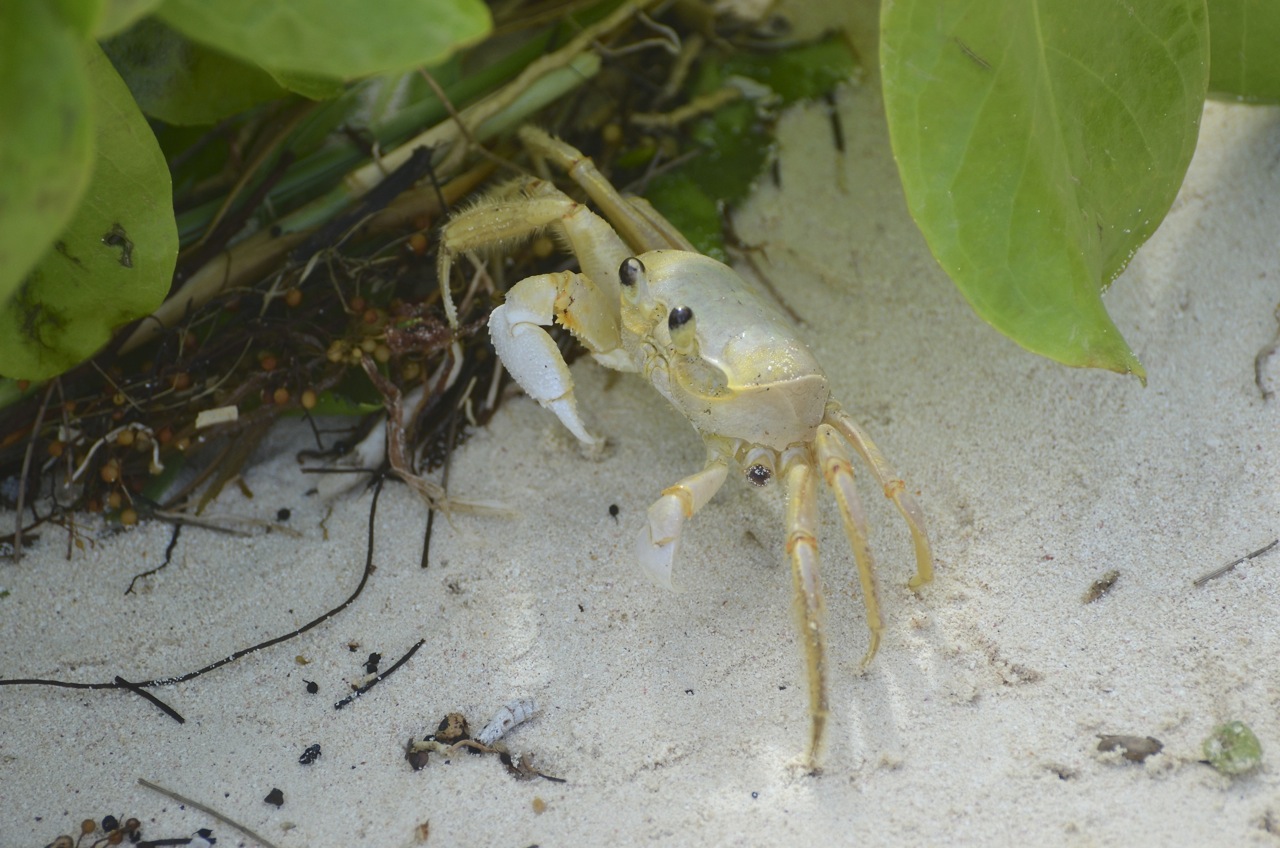
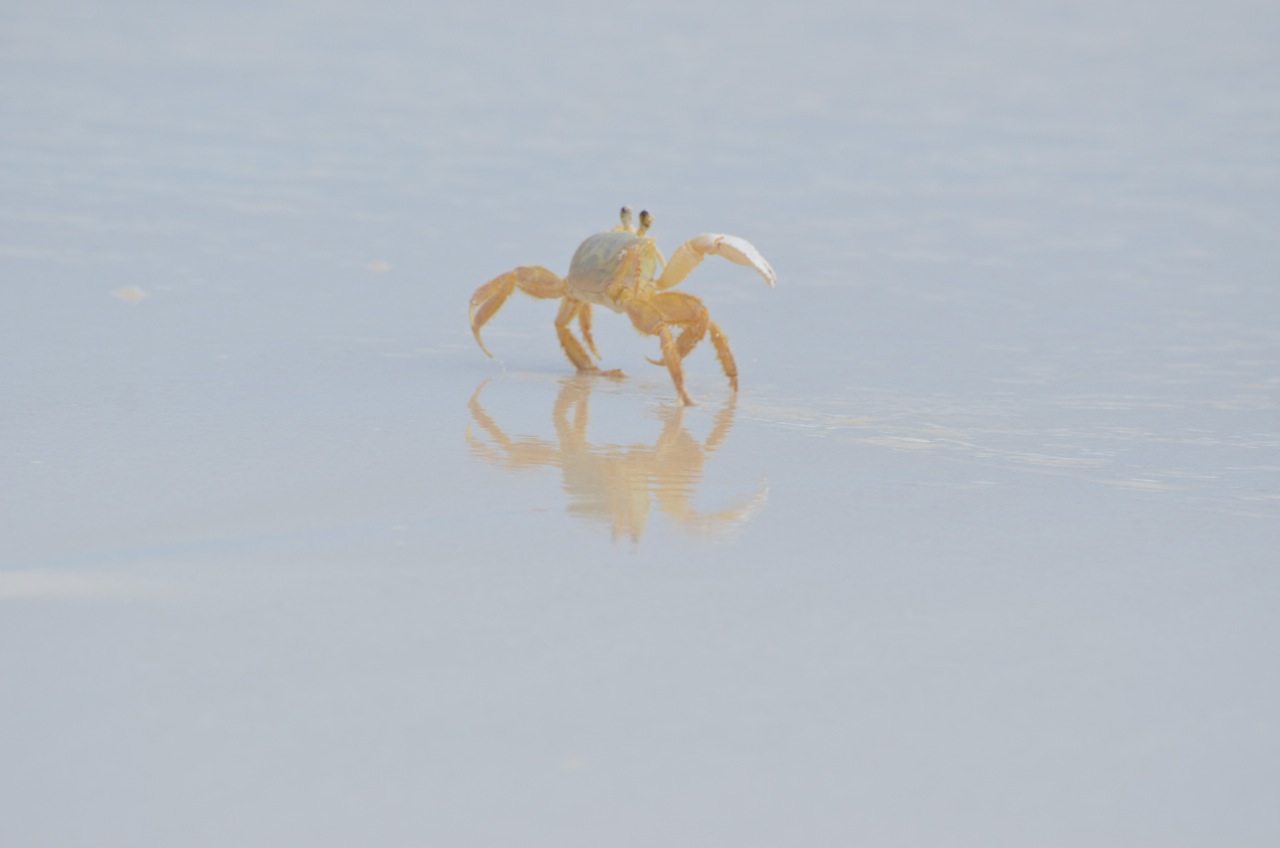
Crabby the Crab lived amongst the greenery at the very back of the Delphi Club Beach
It was a very beautiful beach indeed. Lucky Crabby!
One day Crabby decided to go down to the sea for a swim
He scuttled across the sand towards the sound of the waves
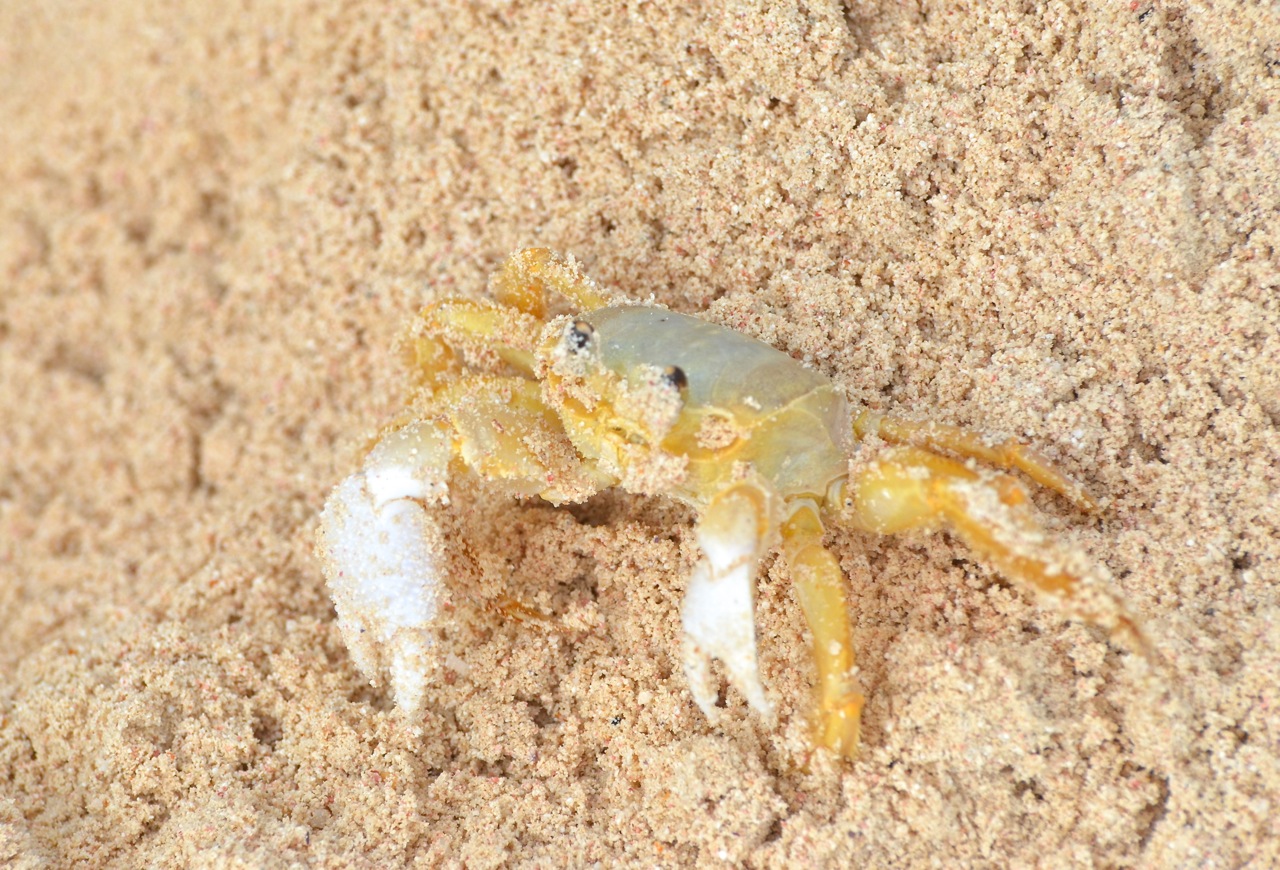
He passed the burrow of his friend Sandy. Sandy was very busy tidying his house.
“Would you like to come for a paddle?” asked Crabby. “No thanks”, said Sandy, “I’m busy today”
So Crabby carried on towards the water’s edge. He got closer, to where the sand was wet…
…and closer, to where the water tickled his toes…
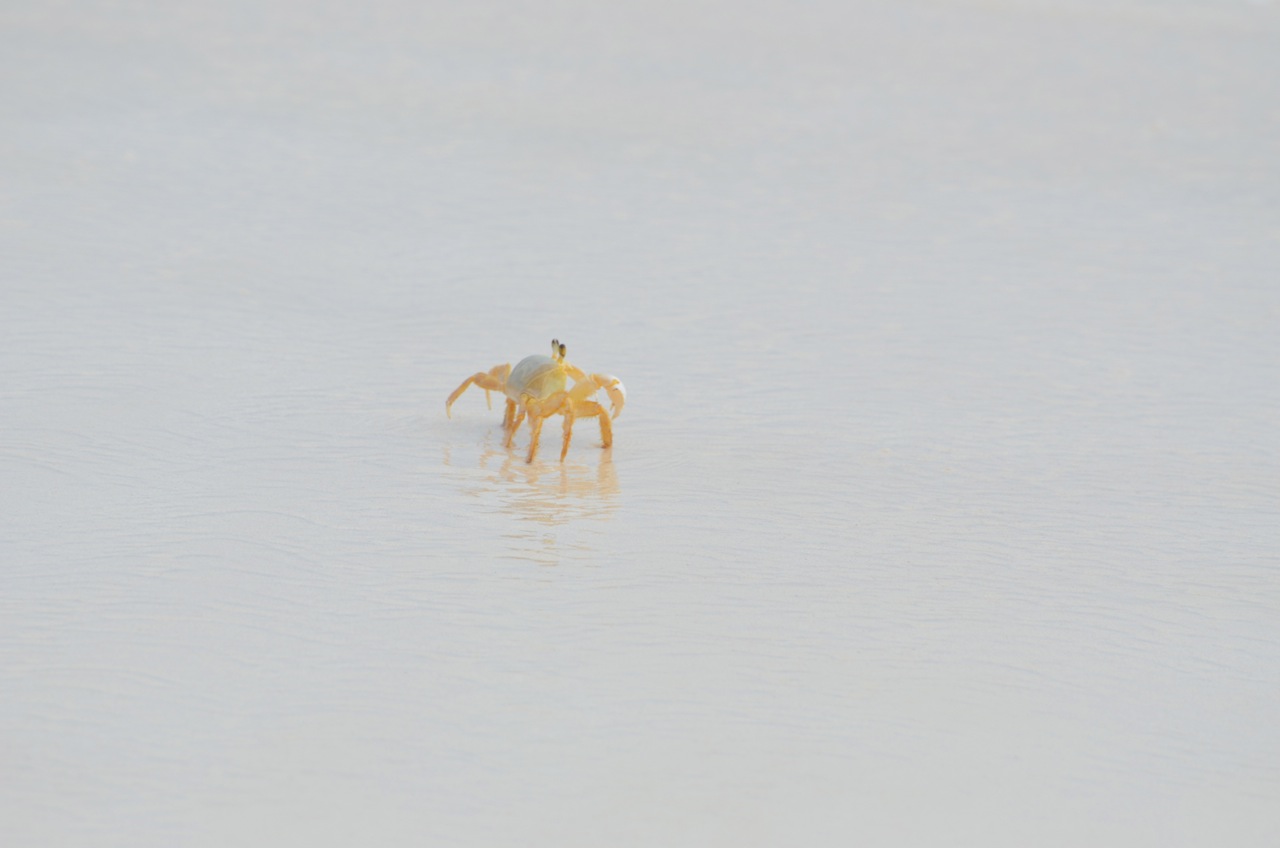
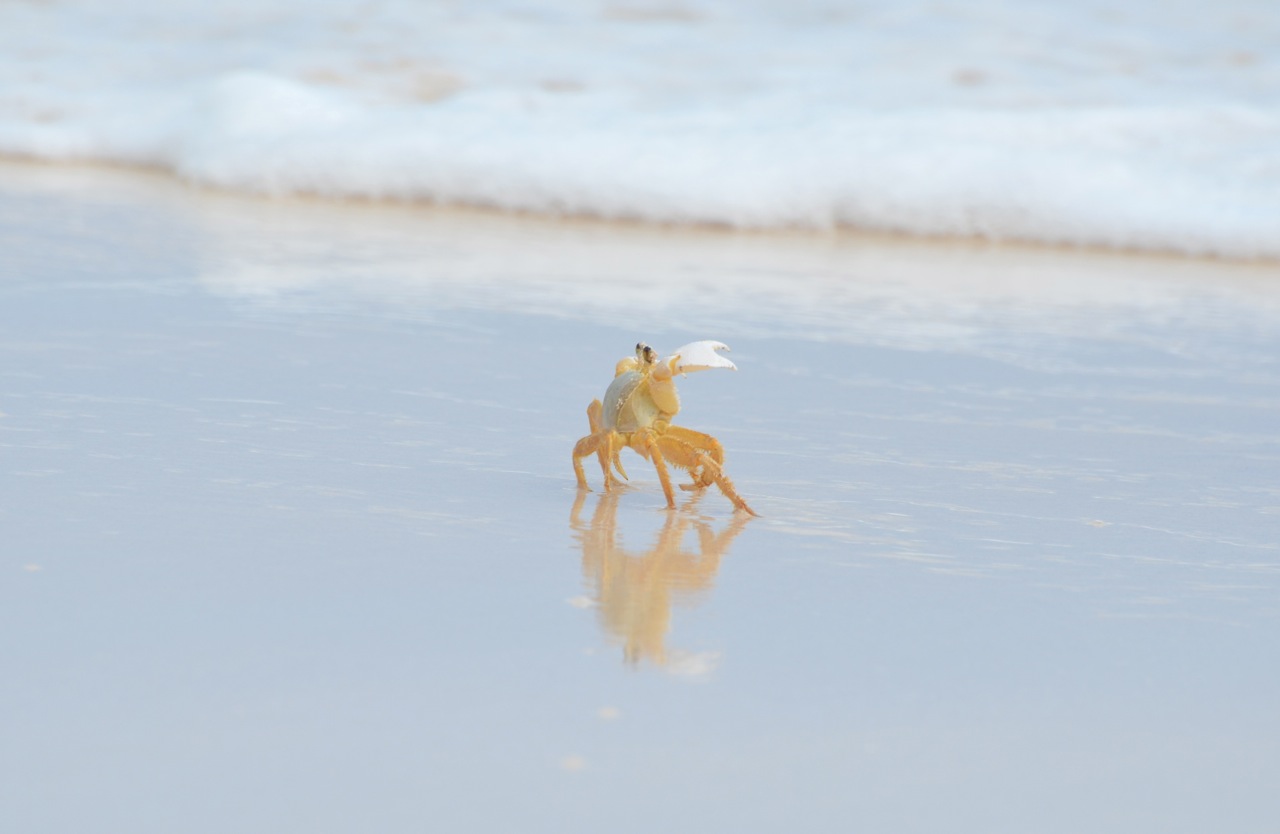
…and closer, to where the tide ripples reached. Crabby waved his claws with excitement
Finally, he was paddling in the warm water. It was just perfect. Whoops! Don’t fall in, Crabby!
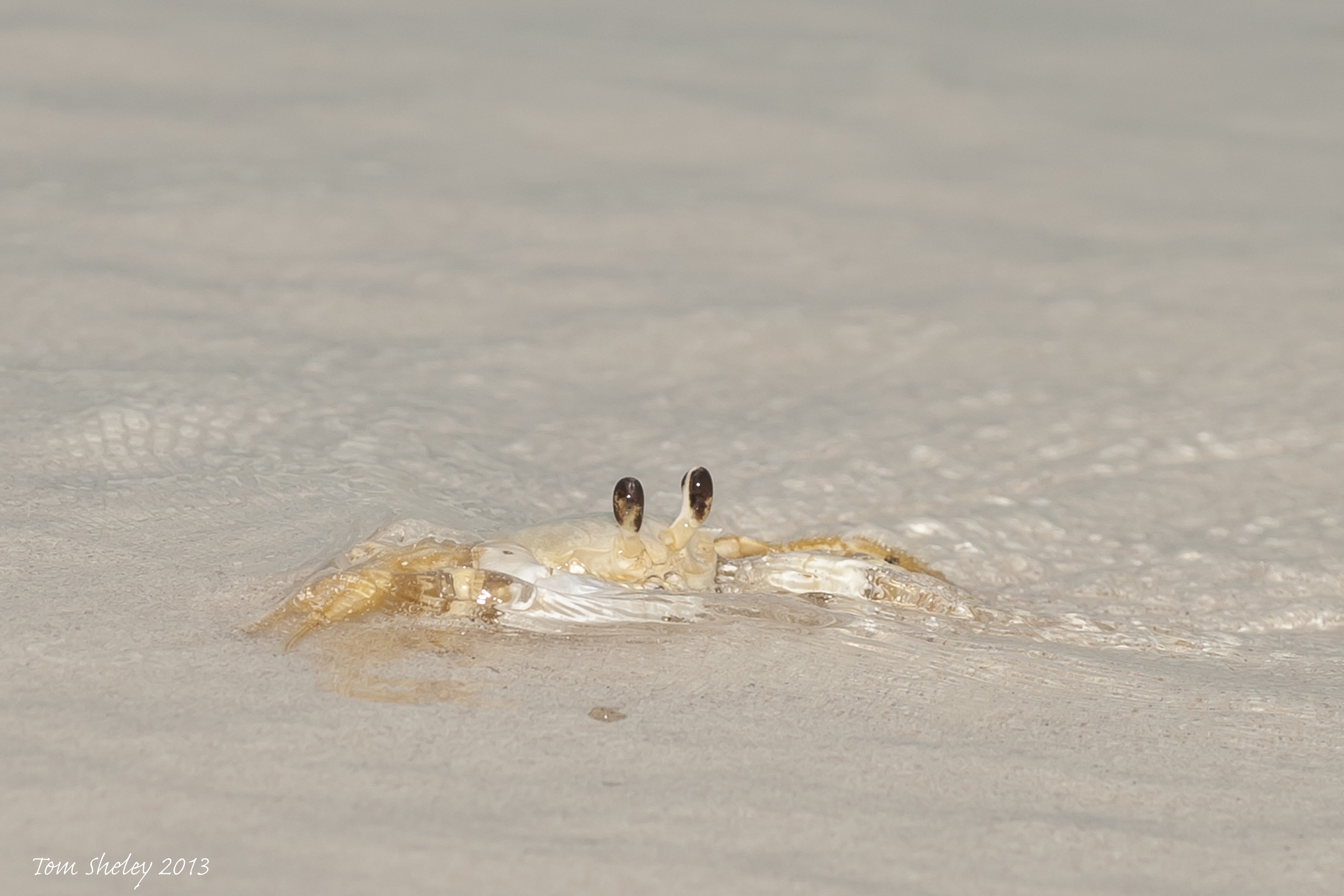
Very soon Crabby was in the water, right up to his eyes. What a beautiful day for a swim!
See ‘Crab Run: The Movie’, starring Crabby the Crab
CREDITS: header & beach, RH; last image, Tom Sheley; the rest, Charlie Skinner. DEBITS: pre-Christmas nauseatingly anthropomorphic tomfoolery and video – blame me. No crabs were harmed or even mildly embarrassed during this photoshoot.

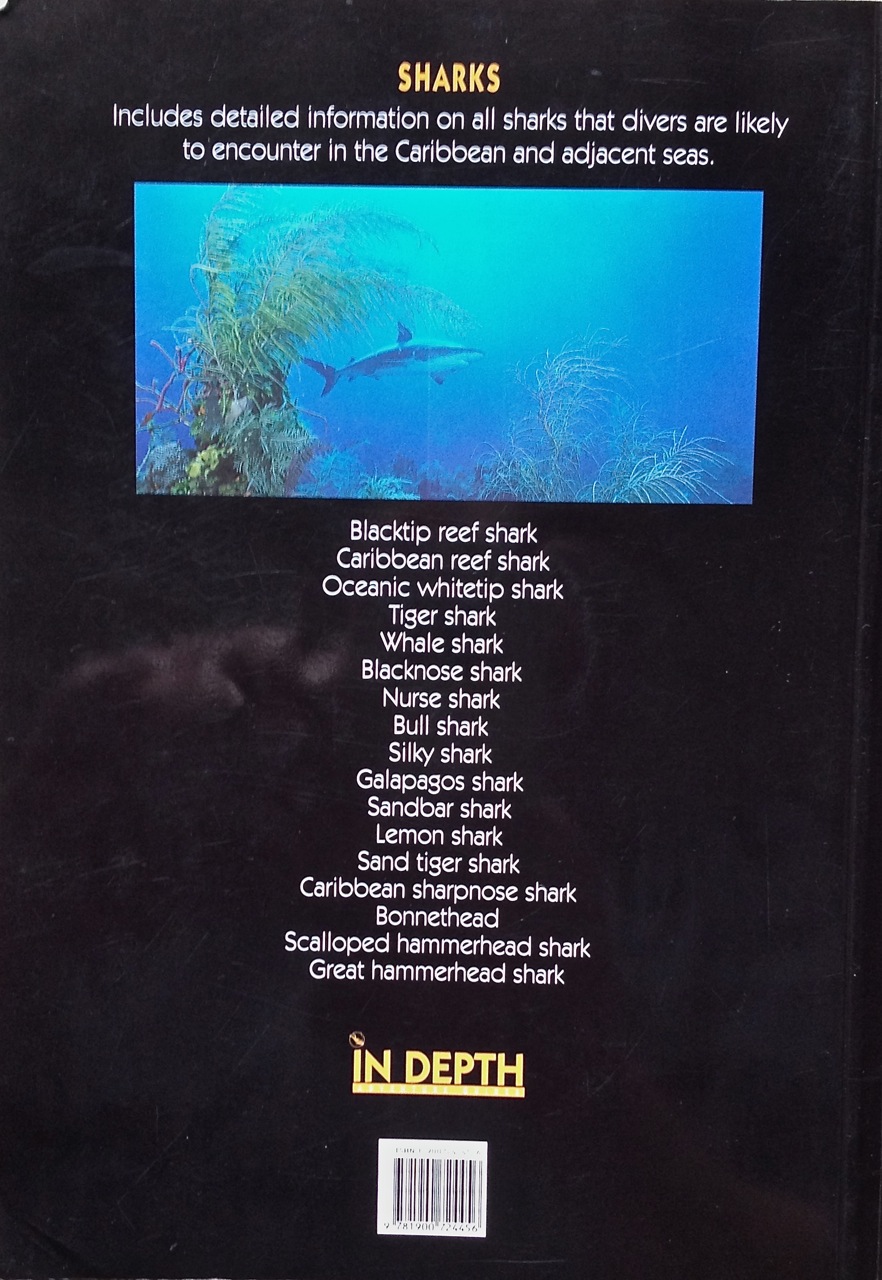
THE IDENTIFICATION, BEHAVIOUR & NATURAL HISTORY OF THE SHARKS OF FLORIDA, THE BAHAMAS, THE CARIBBEAN & GULF OF MEXICO
Jeremy Stafford-Deitsch, Trident Press 2000 (95 pp)
Occasionally I review books, apps, ‘meeja’ and so on, of general relevance to Abaco wildlife and ecology. You can find all this under the heading BOOKS ETC and its drop-down sub-menus. You’ll see comparative recommendations, mostly positive, with some frankly snidey comments on a few things not to waste your ‘hard-earned’ on.
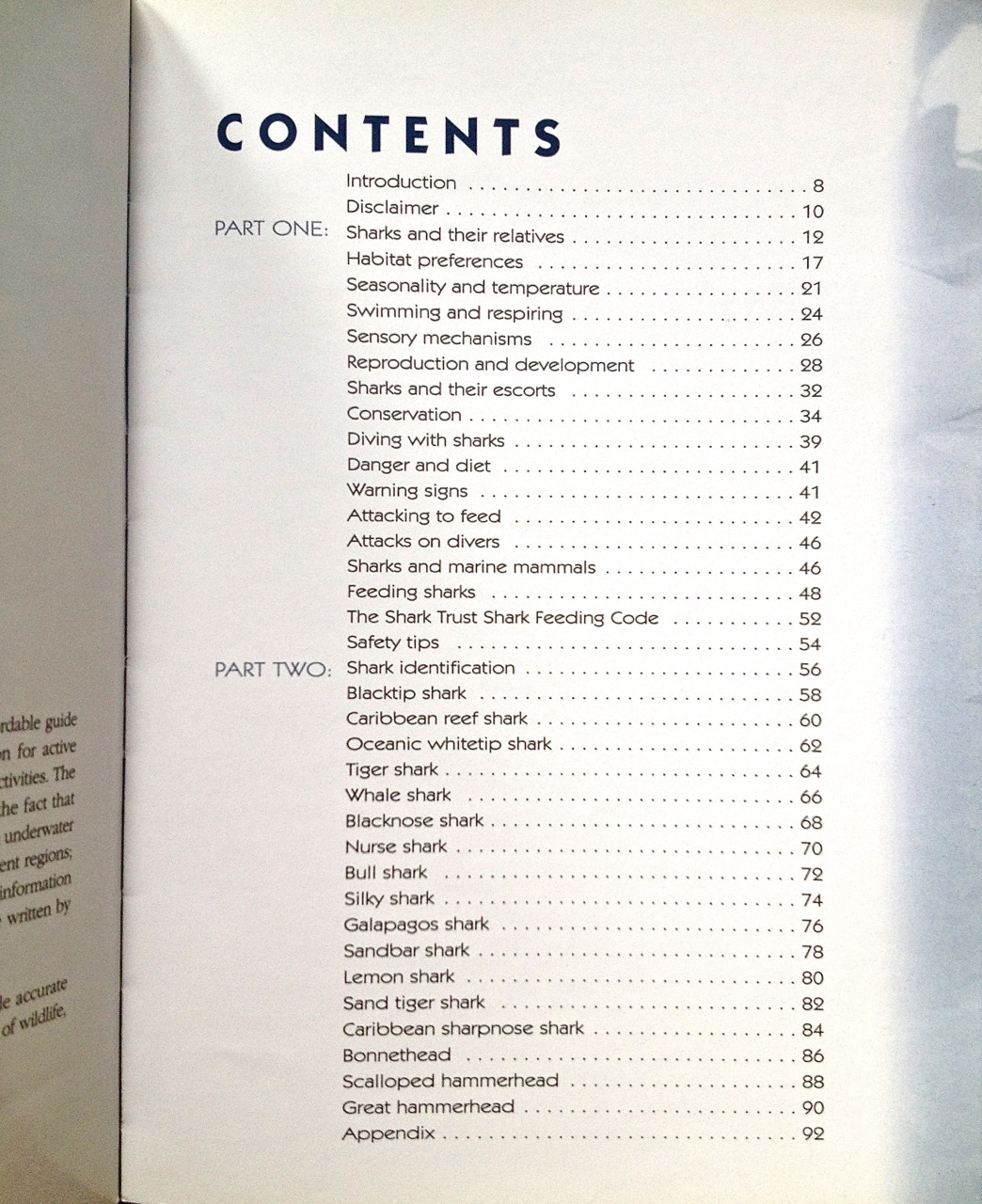
Here’s a book I bought on @m@z@n for a few coins + p&p (less than $5 total) just to see what it might have to offer. The answer is, a great deal. It’s not the book for those who want a detailed exploration the intricate mesopathy of selachimorphic exo-cartilege, if such a thing exists. But it has a mass of useful information, brief but helpful identification pages for many different shark species, and good illustrations, all compressed into a slim tome.
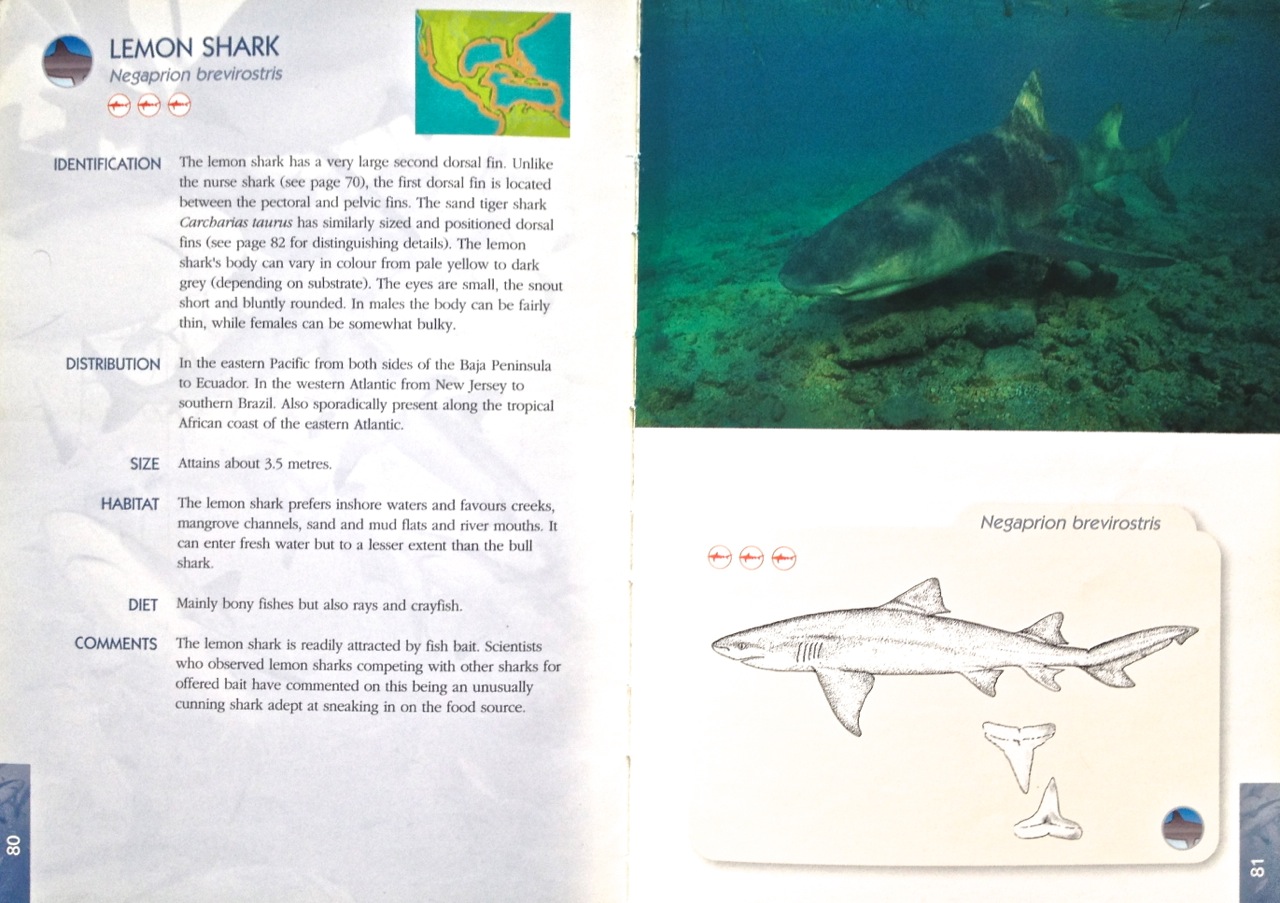
Although this book was published in 2000, sharks haven’t changed noticeably since then, so the contents still hold good. Here are a few pages to give an idea of how simple yet informative this book is.
The Contents page gives a very clear idea of the scope of the book. Pages 34 to 54 are of particular interest for anyone intending to dive, spearfish, snorkel or indeed take a dip.
The entries for the Blacktip Shark and the Lemon Shark. Each entry features a useful range map, and an even more useful ‘potential danger rating’ for each species. It’s worth remembering, however, that there are sharks worldwide, and they all have teeth. Thousands of people dive and swim with many of the species every day in complete safety. There are simply some does and don’ts, mostly completely obvious, that will make the difference between enjoying their company (and they, yours); and pushing your luck with a wild creature when you have intruded into its habitat…

THE SHARK TRUST FEEDING CODE
This page interested me in the light of the chumming debate. Plenty of basic common sense here.
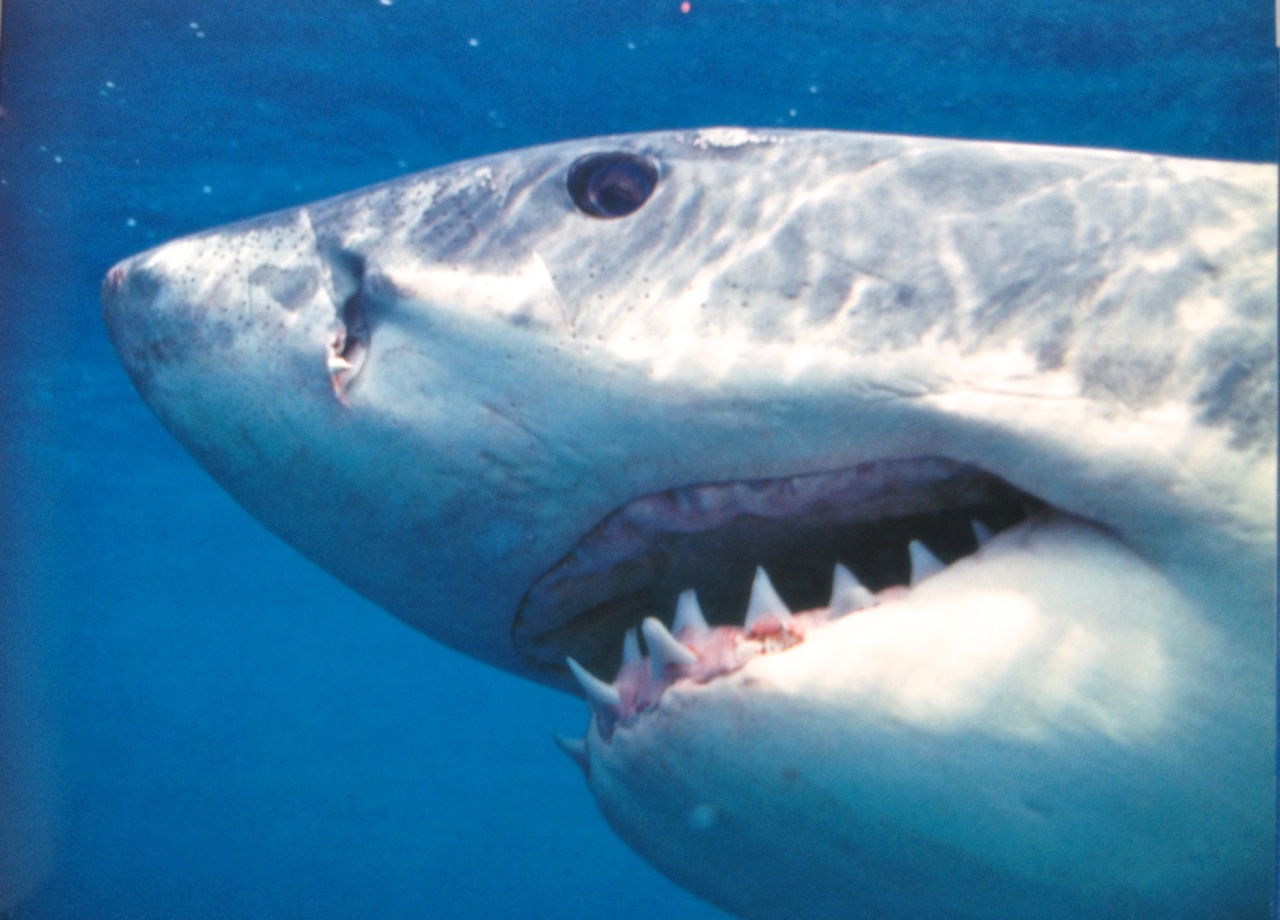
A useful illustration to help you understand what the book is all about
More shark information and some amazing images can be found HERE .
As I wrote elsewhere: “Take comfort from the fact that no fatalities and fewer than 10 injuries from shark attacks have been recorded in Abaco waters for over 250 years (since 1749)… By way of comparison, in the last 150 years there have been 36 recorded shark attacks in the Mediterranean, of which 18 have been fatal… Since 1845 there have been a number of shark attacks in British waters, with one fatality. There were two more fatalities in an incident in 1956 , but this was an ‘own-goal’ arising from an attempt to blow up a shark with dynamite. It can hardly be blamed on the shark.
WEIRD NON-SHARK RELATED STATISTIC: Amazingly, in the 3 years 2007 – 09 in England and Wales, 42 people died from being bitten by animals, only a few of which were dogs.
CONCLUSION You are statistically far safer to spend 250 years swimming off Abaco than spending 3 years stroking a cat in Manchester. Or Swansea.”

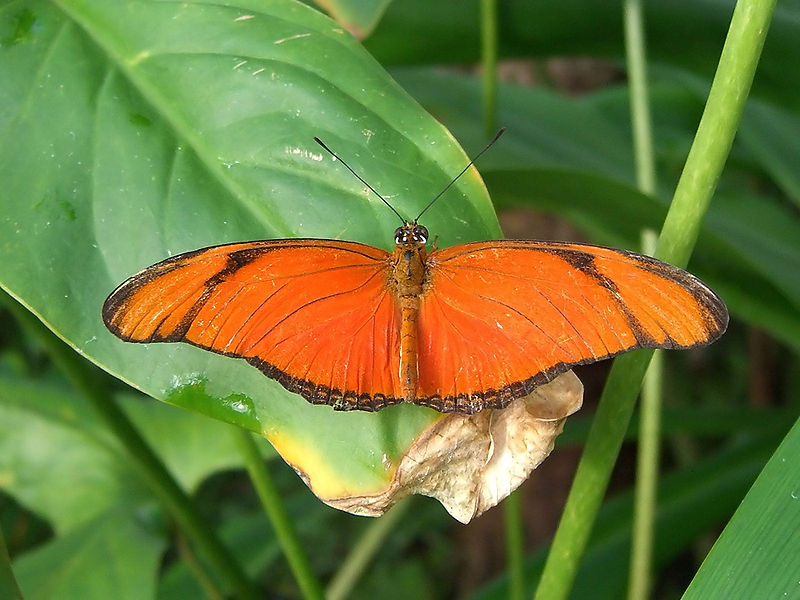
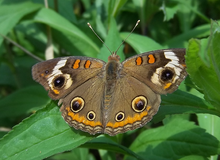
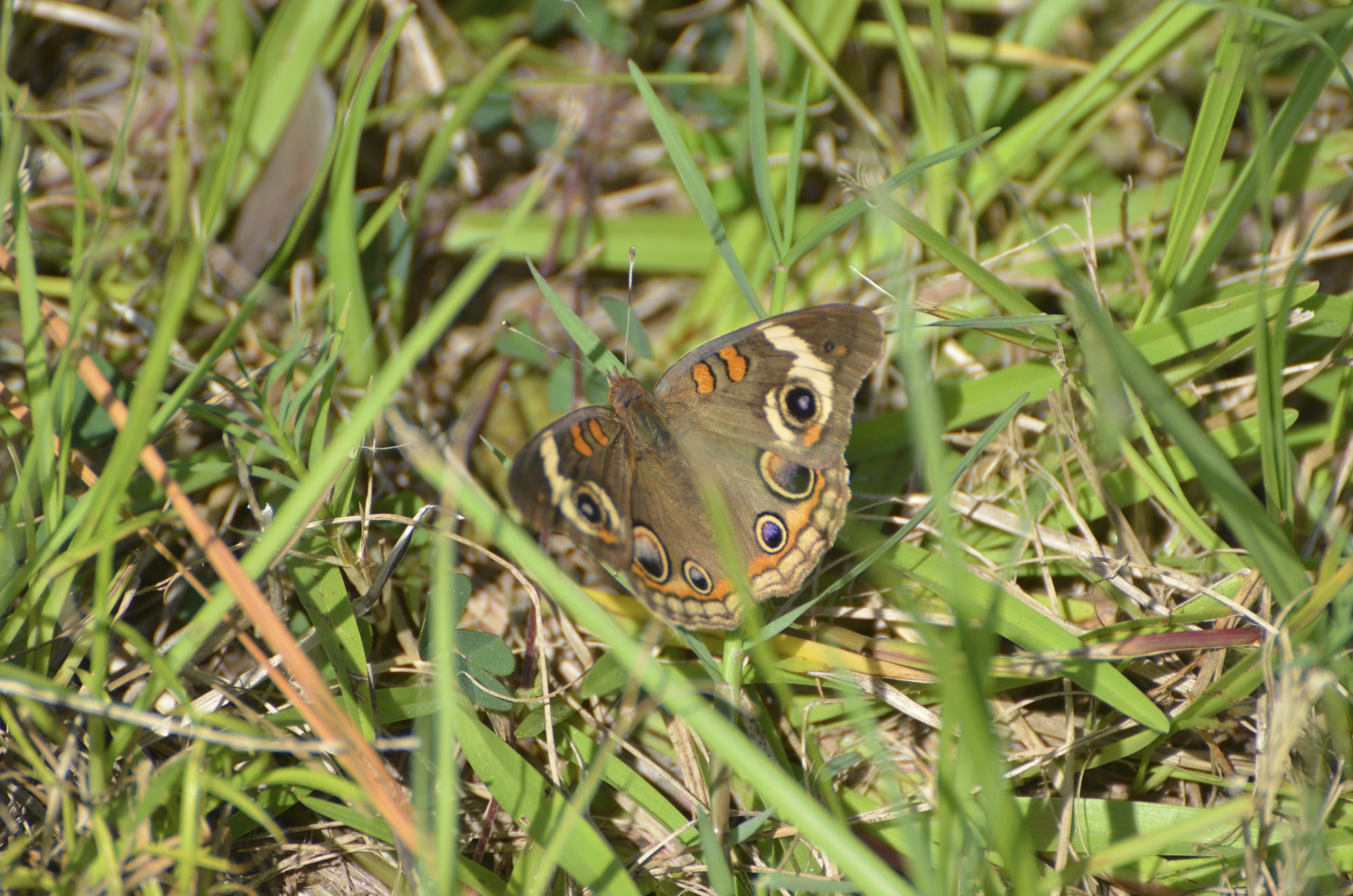
At first glance the Common Buckeye Butterfly Junonia coenia looks unpromisingly drab. However, like many butterfly species, the outside appearance is only one side of the story, a facade to enable it to blend in with the scenery. As the header image suggests, this creature has a more more flamboyant and colourful side to it – a feature not confined to butterflies, and extending even to humans…
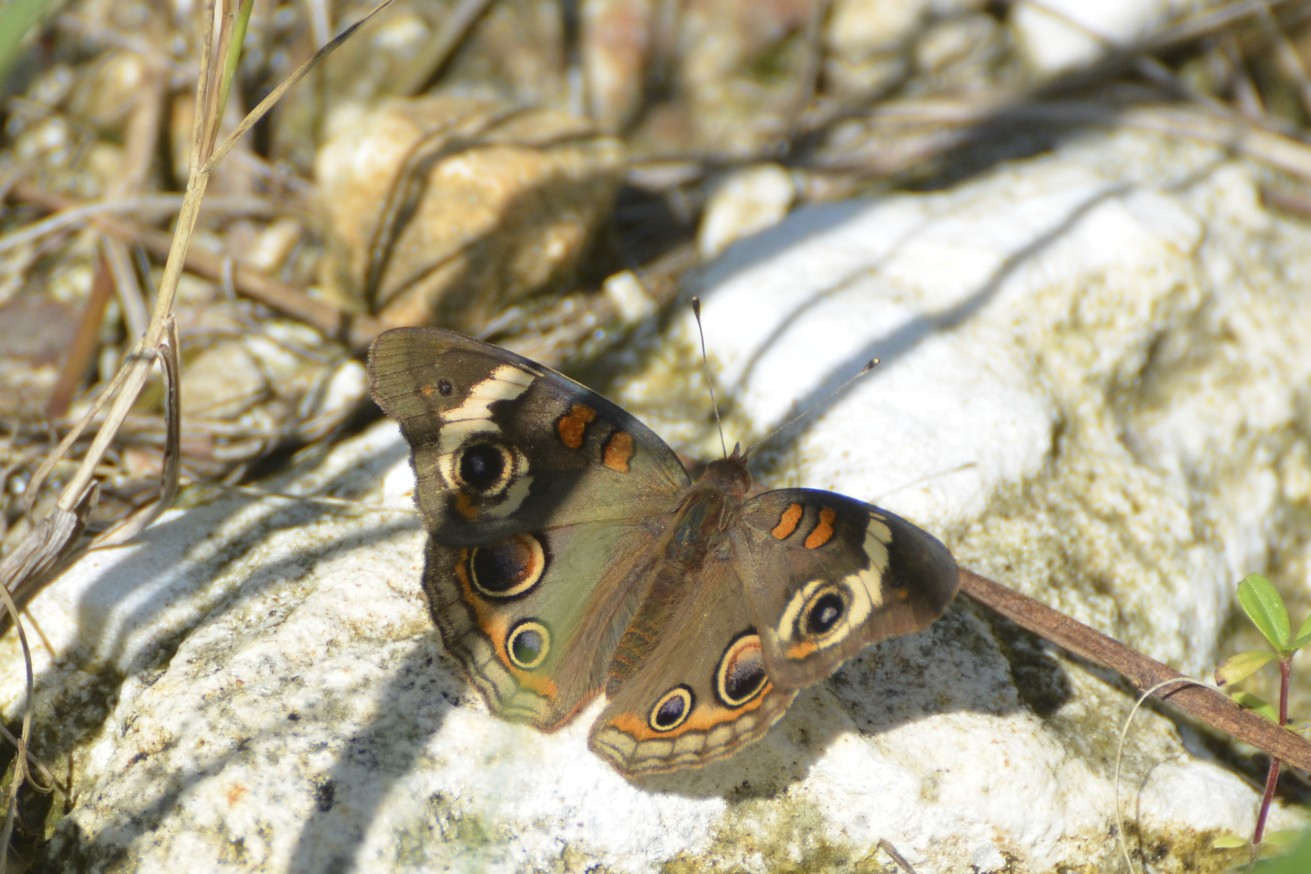
As it feeds, or as the sun warms its wings, the buckeye will start to reveal itself 


The bright eye-spots of the buckeye, for which it is named, are designed to deter predators, as much as for decorative purposes. Birds, in particular, are thought to be put off by a creature apparently possessing 3 pairs of eyes.


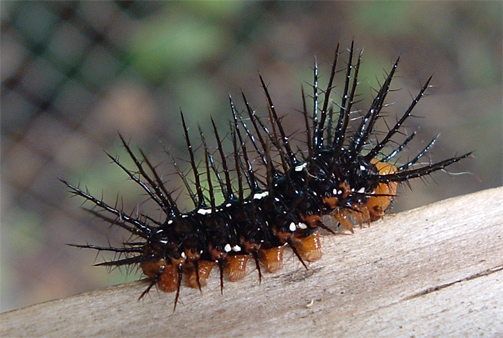
The caterpillars and chrysalis of this species look like this

This rather charming illustration of the buckeye species is by Jacob Hübner from his Sammlung exotischer Schmetterlinge Vol. 2 ([1819] – [1827] (Plate32)![Jacob Hübner Sammlung exotischer Schmetterlinge Vol. 2 ([1819] - [1827] Plate32 442px-Hubner1821SammlExotSchmett2Plate32](https://rollingharbour.com/wp-content/uploads/2013/12/442px-hubner1821sammlexotschmett2plate32.jpg?w=652)
Also in this series: ZEBRA HELICONIANS and GULF FRITILLARIES
Photo Credits: Butterflies by Charlie Skinner (except header, Wiki); Caterpillars & Chrysalis by Megan McCarty via Common Licence
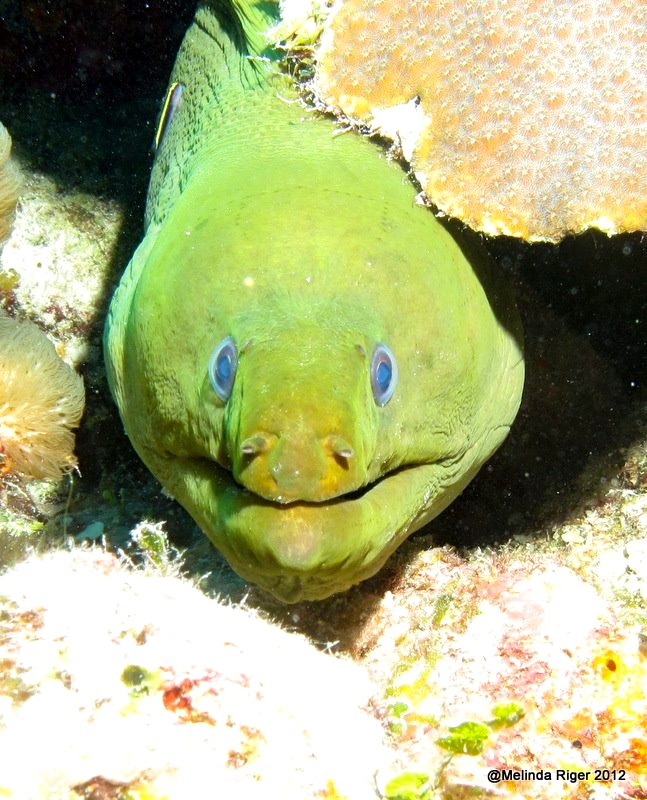
I have been idly filing away some stunning close-up reef denizen images by Melinda Riger. A Monday morning is the perfect time to showcase some pouts, poses and glad eyes from the ‘catfish walk’, starting with my absolute favourite…
A GREEN MORAY EEL SMILES STRAIGHT TO CAMERA
THE QUEEN ANGELFISH ‘LOVES’ THE LENS
A GROUPER DOES THE ‘OPEN-MOUTH’ GAPE
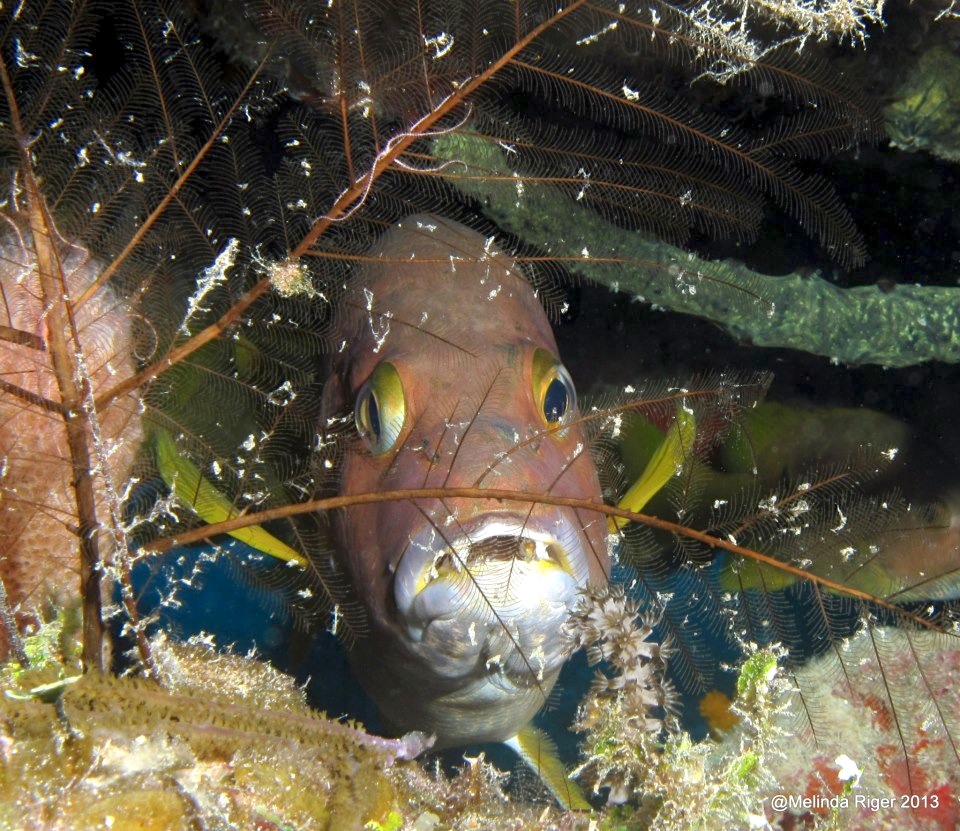
THIS SCHOOLMASTER SNAPPER MAY NOT HAVE GOT QUITE WHAT IT TAKES
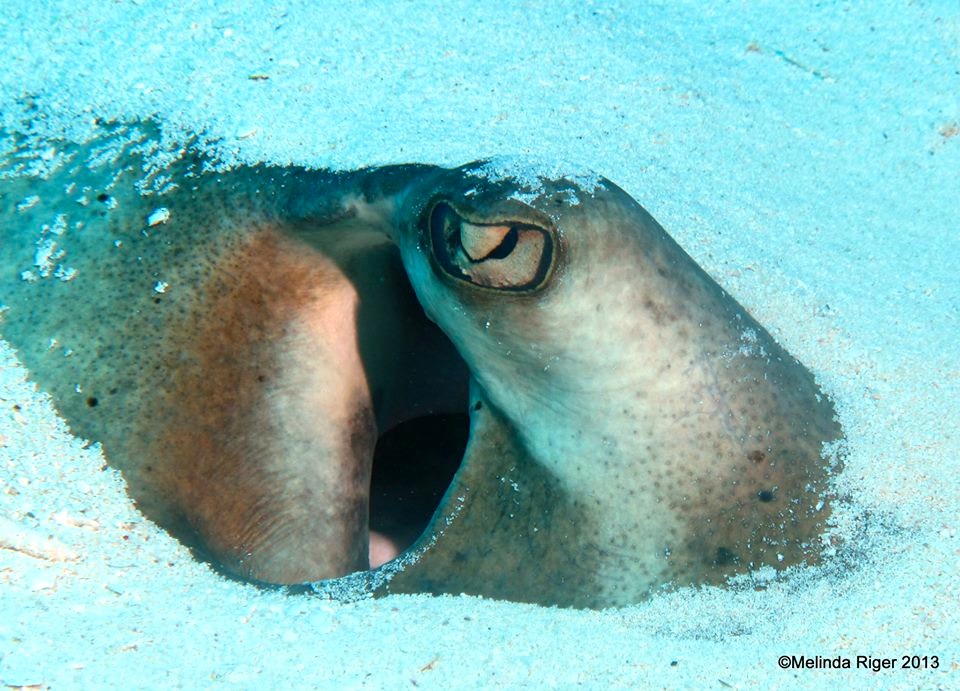
NICE EYES, BUT THE PETITE SAND-DIVER NEEDS TO BE A LITTLE MORE OUTGOING
HOWEVER THE PEACOCK FLOUNDER IS ROCKING THE MAKE-UP BOX
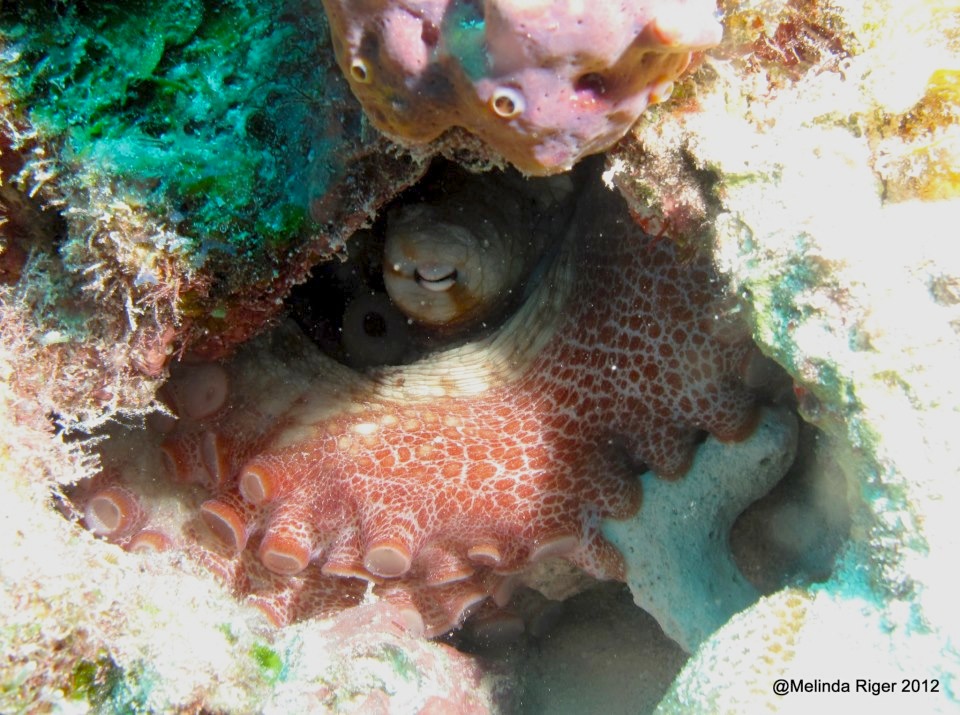
THE OCTOPUS IS MOODY & WON’T GET OUT OF BED FOR LESS THAN 20 MOLLUSCS
AND REGRETTABLY THE POOR CONCH HAS A BAD STAGE FRIGHT
For more octopus information and a discussion of the correct plural (choice of 3) CLICK HERE
For a post about underwater species camouflage CLICK HERE
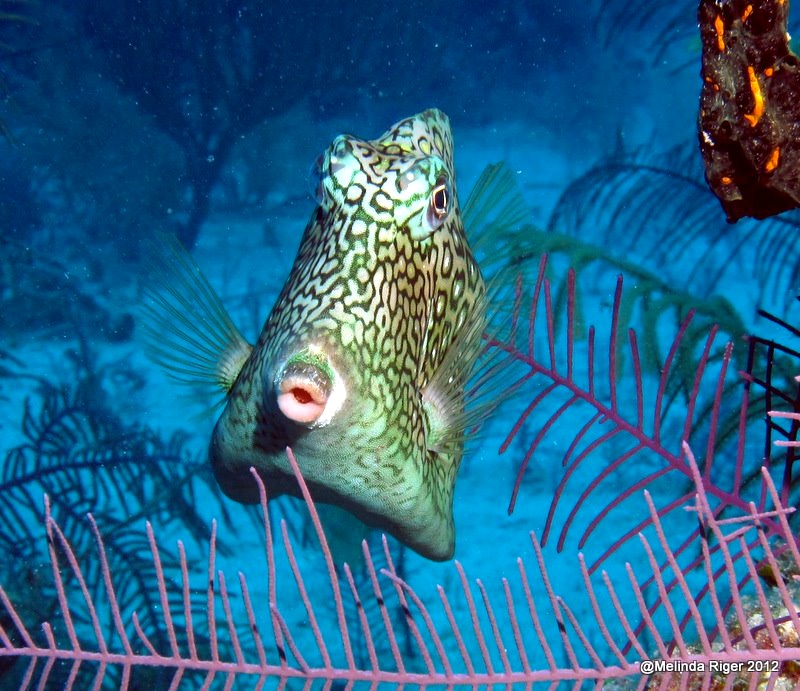
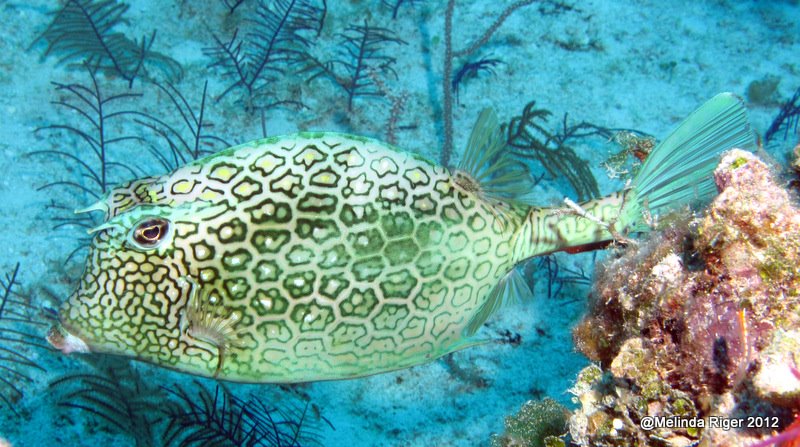
**Since I posted this earlier today, I have been asked (re photo 1) what the… the… heck a Cowfish looks like, when it’s not puckering up while facing you. The answer is: stunningly glamorous…
Thanks as ever to Melinda Riger of Grand Bahama Scuba for use permission for her fab photos; tip of the dorsal fin to Wiki for the shark eye header pic
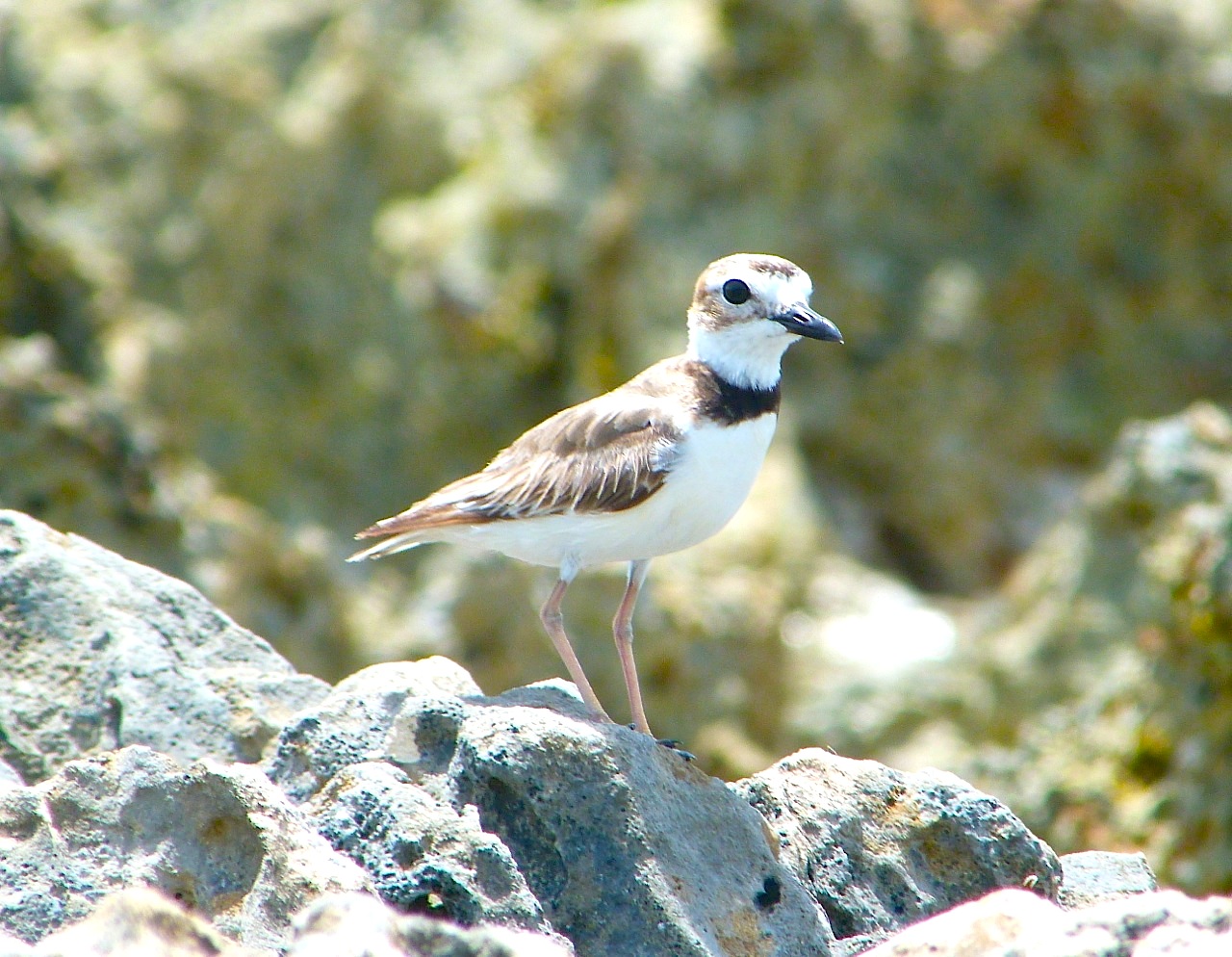
SCRAPES, CHICKS & BROKEN WINGS: WILSON’S PLOVERS ON ABACO (3)The male plover above is keeping watch from a rocky vantage point over an area at the north end of the beach at Delphi. And with good reason. It’s the summer breeding season, and on the sand are some nests. One of them is his.
This is a ‘scrape’ – not the carefully constructed nest that most birds make, but a shore bird’s collection of sticks and twigs – sometimes stones or shells – clumped together on the sand to provide a comfortable place for the mother to sit until the eggs have hatched.
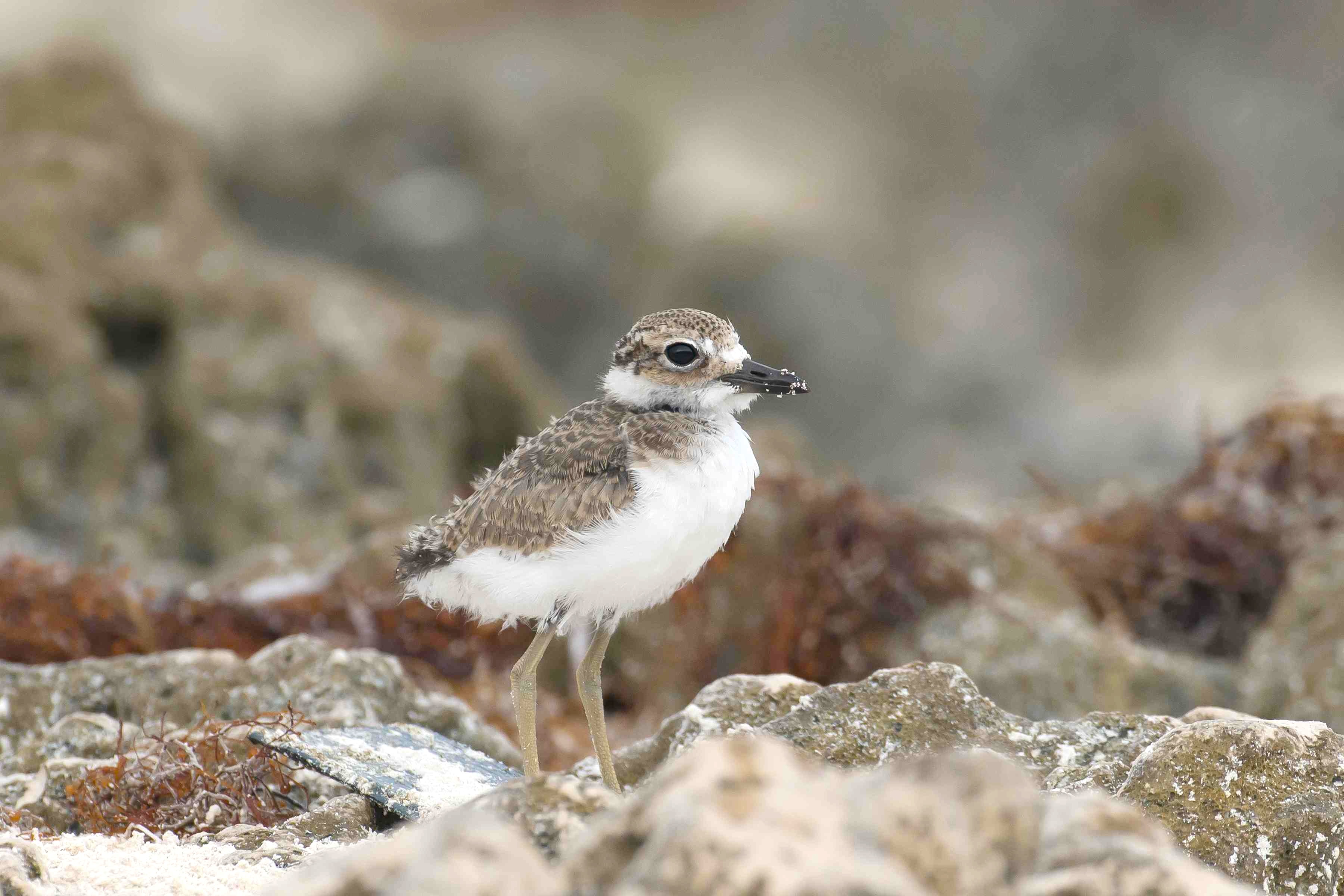
Though tiny at first, the chicks soon become independent enough to explore their surroundings
Usually, there will be a pair of chicks, maybe more. The two in the photo below have scuttled to the back of the beach for safety because the adults thought I was getting a bit close, and sent them to hide in the pine needles
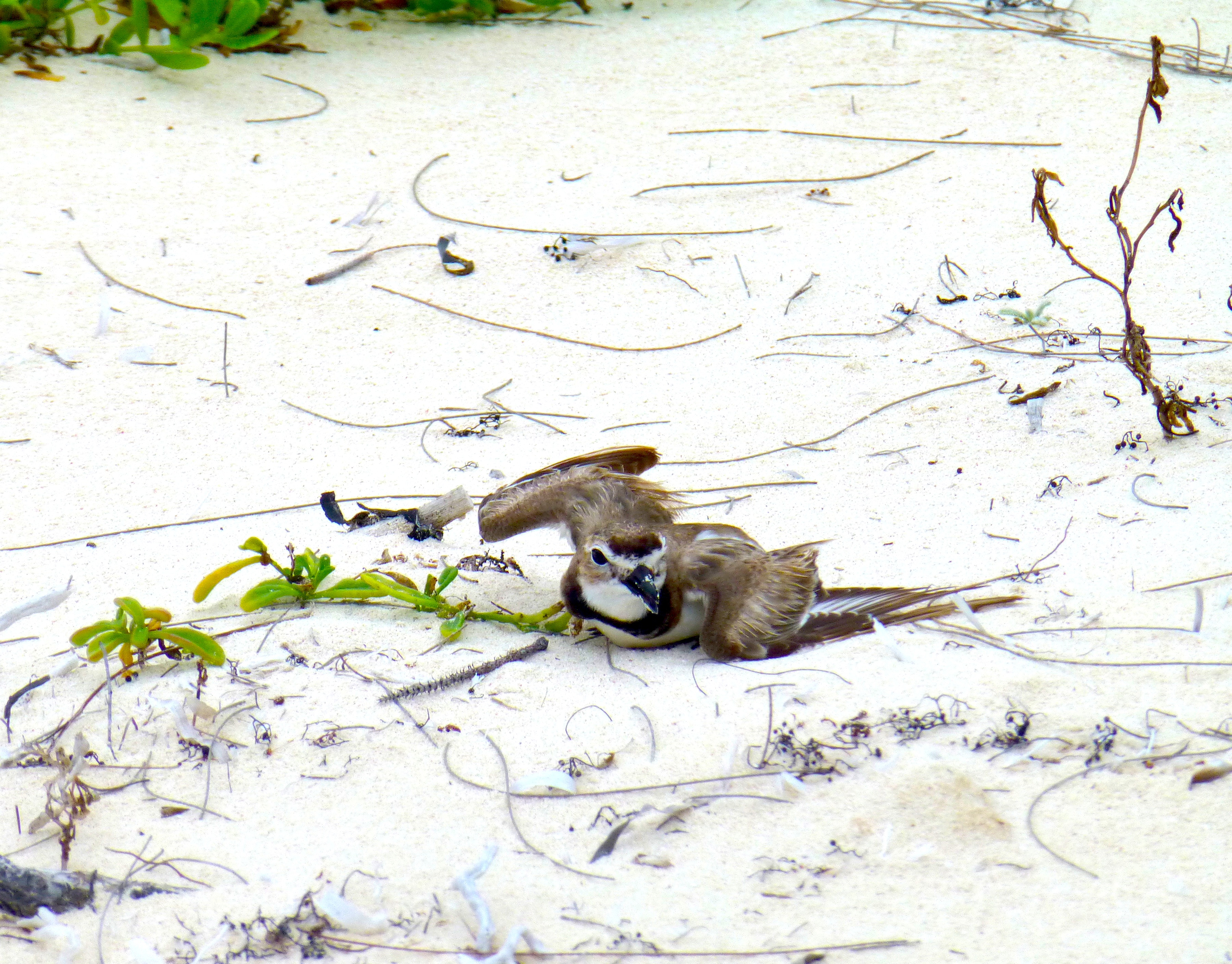
When a nest is threatened by a predator, Wilson’s plovers have a defensive technique that is remarkable to watch. Other shore birds, for example Killdeer, resort to this method as well. A parent will flutter about pathetically on the sand, apparently with one or both wings broken, attracting the predator by its faked vulnerability. The plover will gradually draw the threat away from the nest area, protecting the eggs or allowing chicks to make themselves scarce. Here are some examples of the ‘broken wing display’, all photographed on the beach at Delphi. The first 2 images show a female; the third, a male.

Athough the little chicks are vulnerable, they grow quickly
Before very long, they are able to get onto the same rocky vantage point as their parents to practise surveying the scene. Next summer, they will be keeping watch over nests and chicks of their own.
The previous posts in the series are WILSON’S PLOVERS (1) showing the adults; and WILSON’S PLOVERS (2) that shows how plovers nesting on the shore at Nettie’s Point were protected from human activity in the boat-launching area.
“I’m off now. See you next year”
Credits: scrape & broken wing display, Clare Latimer; last (and best) chick image, Tom Sheley; the rest, RH

I’ve been keeping this little bird up my capacious avian-friendly sleeve for a while. In June we took a truck and headed for deep backcountry to the edge of the pine forests and beyond to see what we could find in the way of birdlife. Good choice – the answer was ‘plenty’.
Among the birds we encountered were the endemic Bahama swallows, hairy woodpeckers, red-tailed hawks, kingbirds, red-legged thrushes, red-winged blackbirds, western spindalises, tobacco doves, La Sagra’s flycatchers, crescent-eyed pewees with a nest and eggs, a wonderful ‘booming display’ by antillean nighthawks courting during an early evening fly hatch**… and Bahama yellowthroats Geothlypis rostrata.
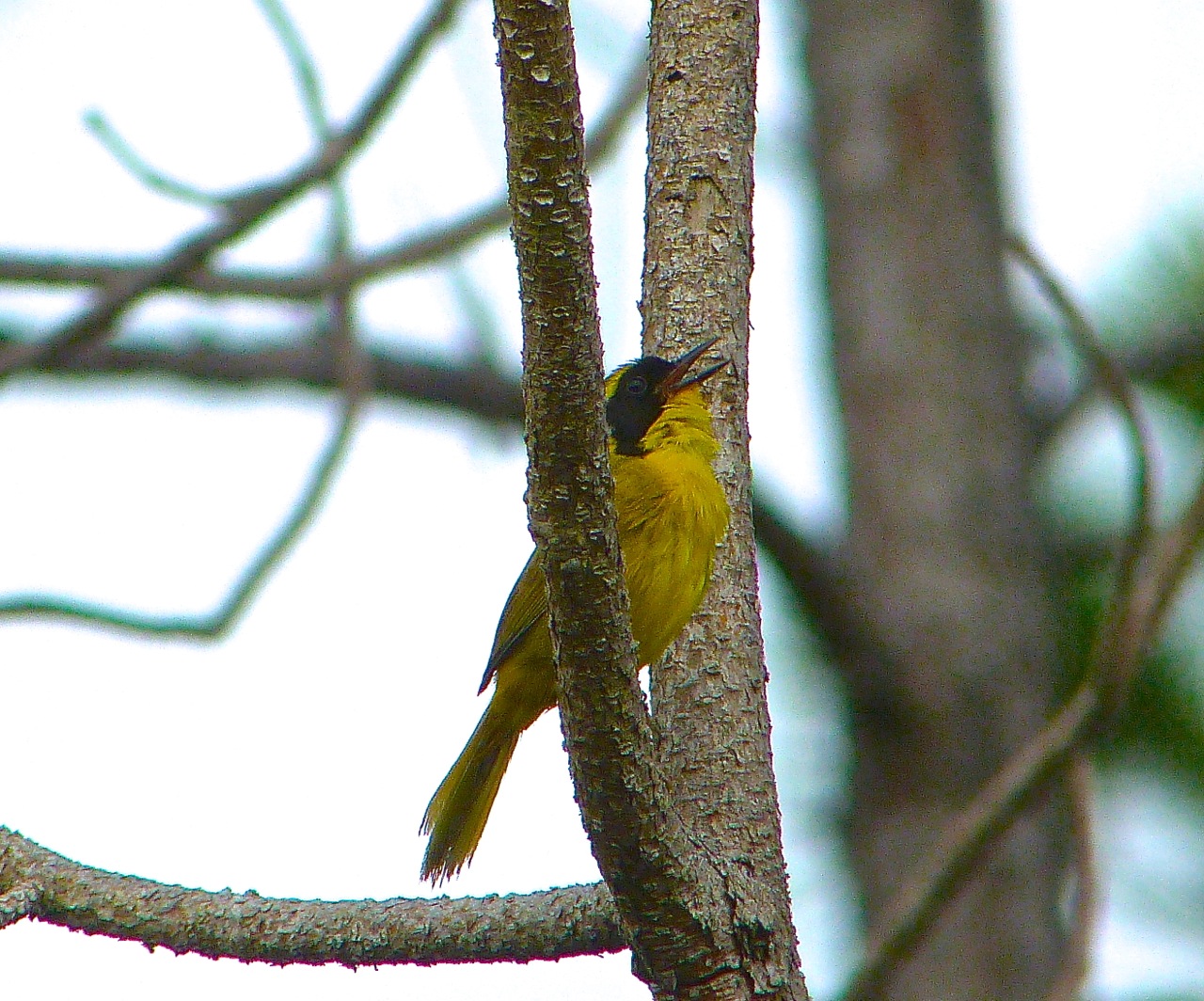
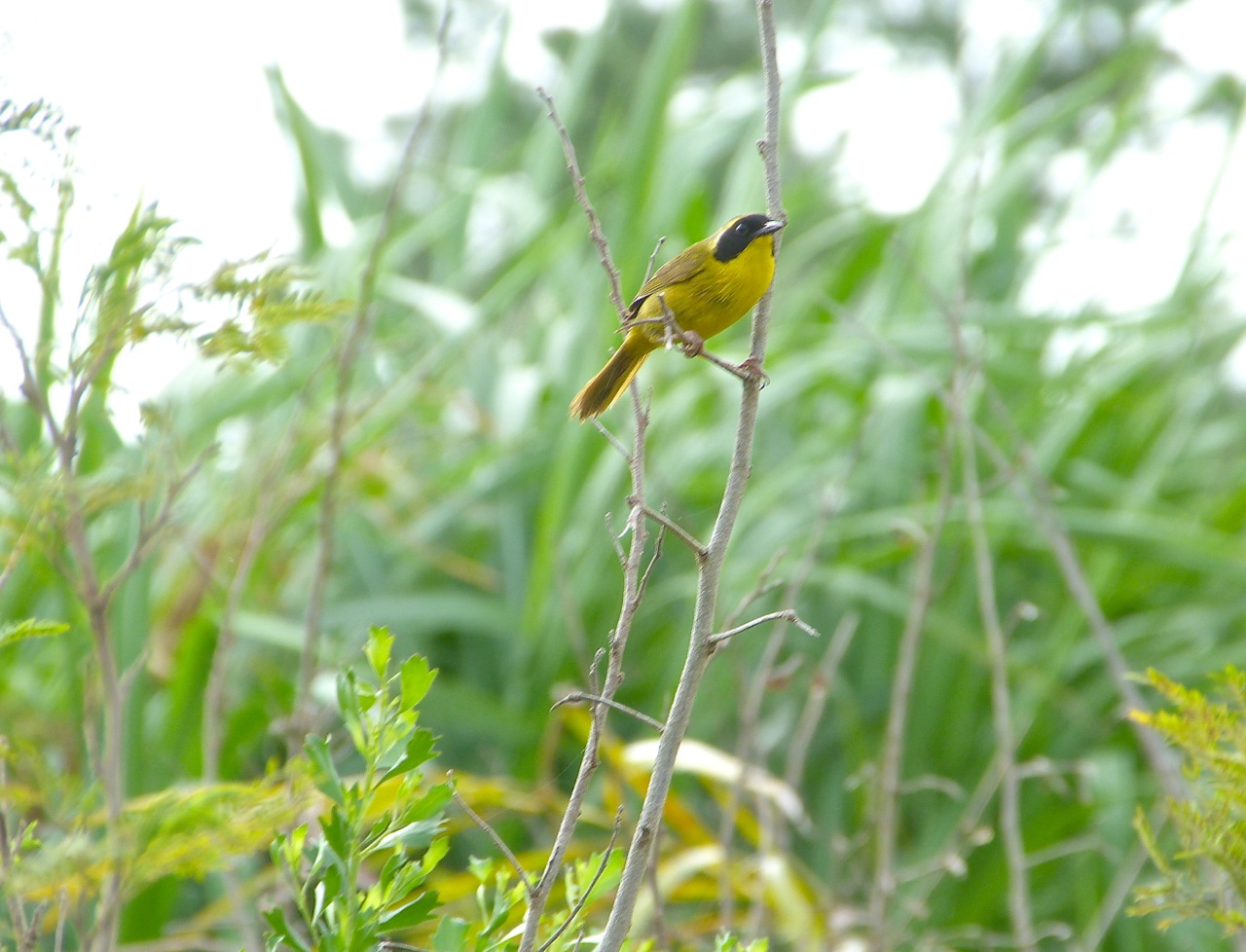
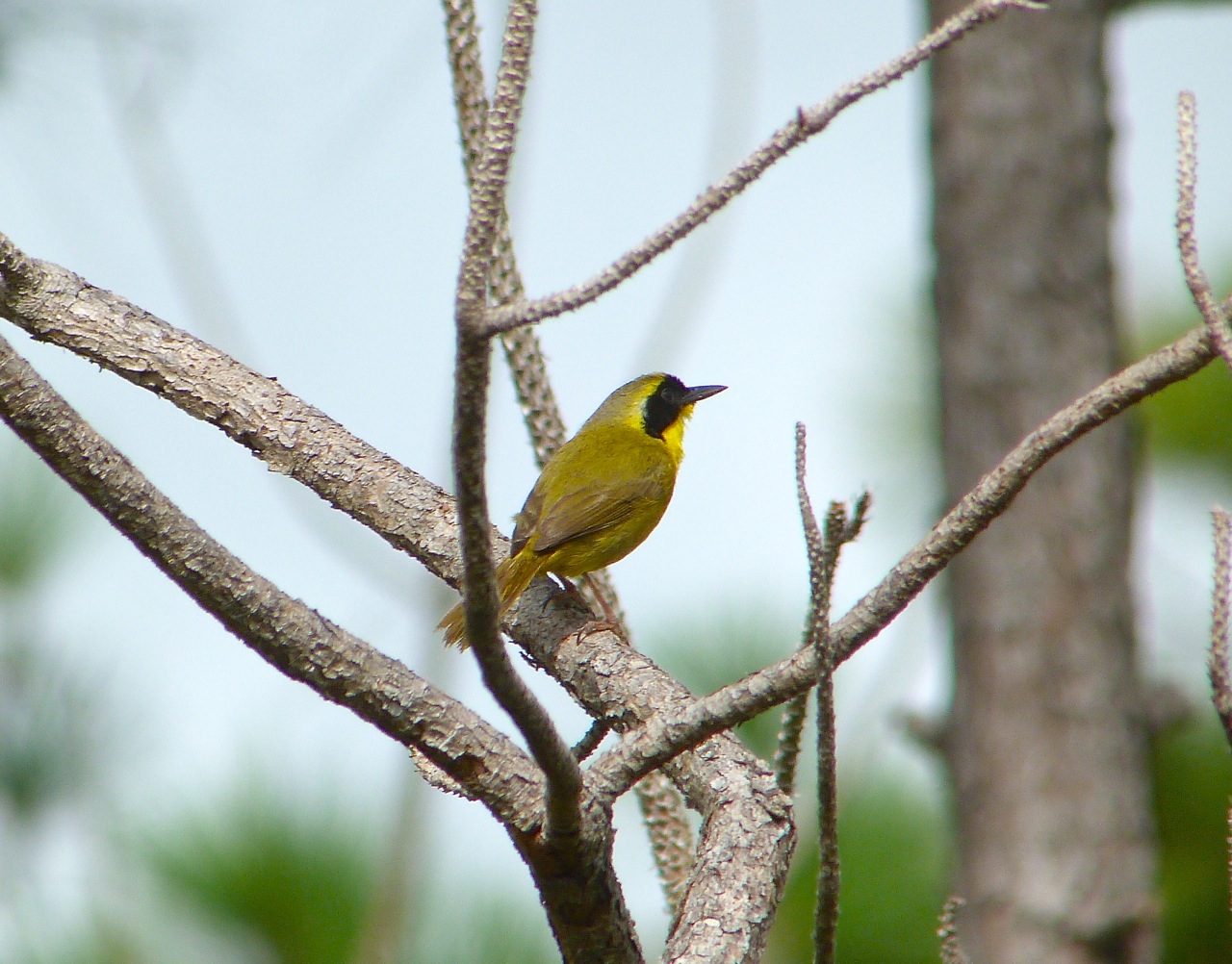
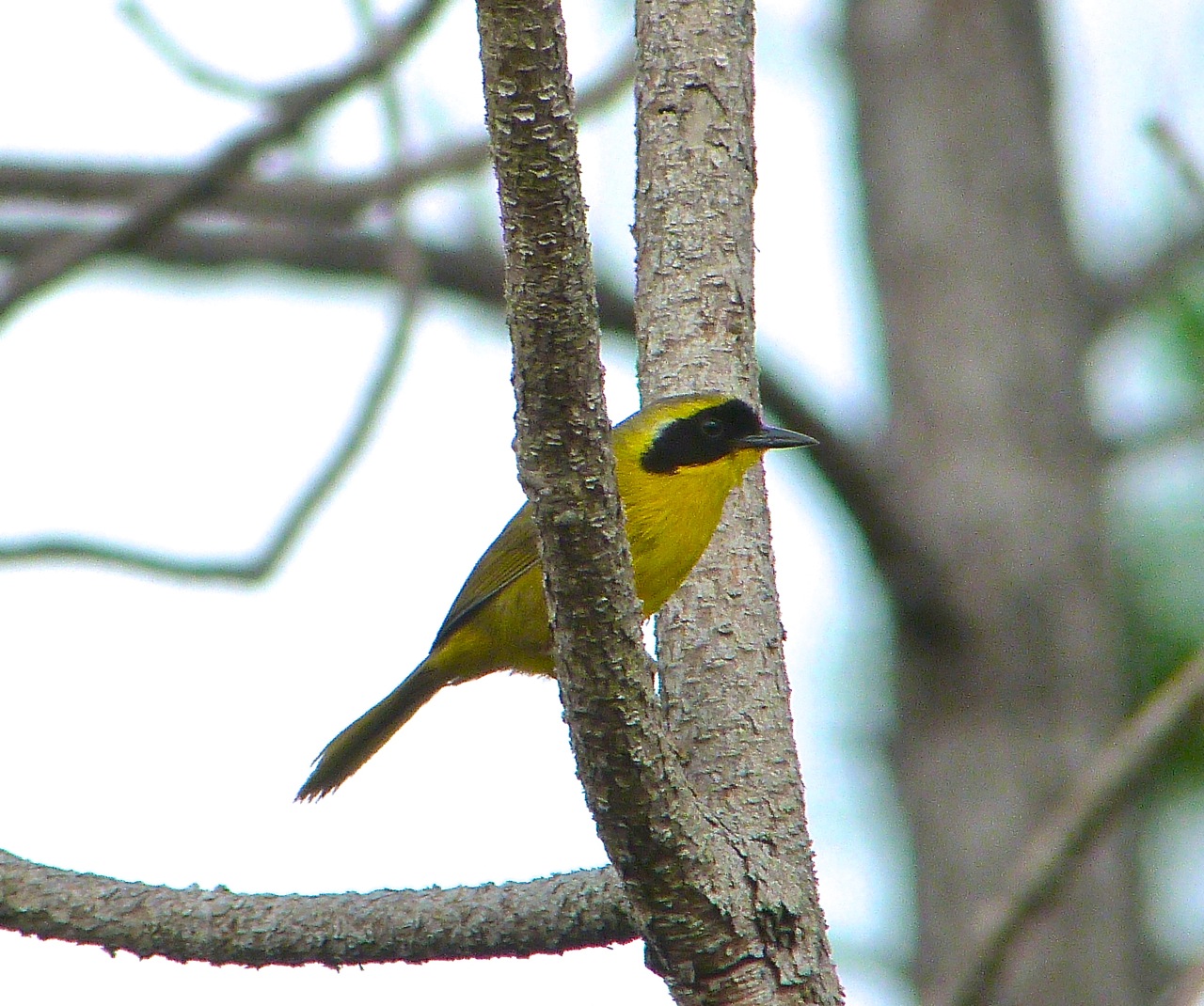
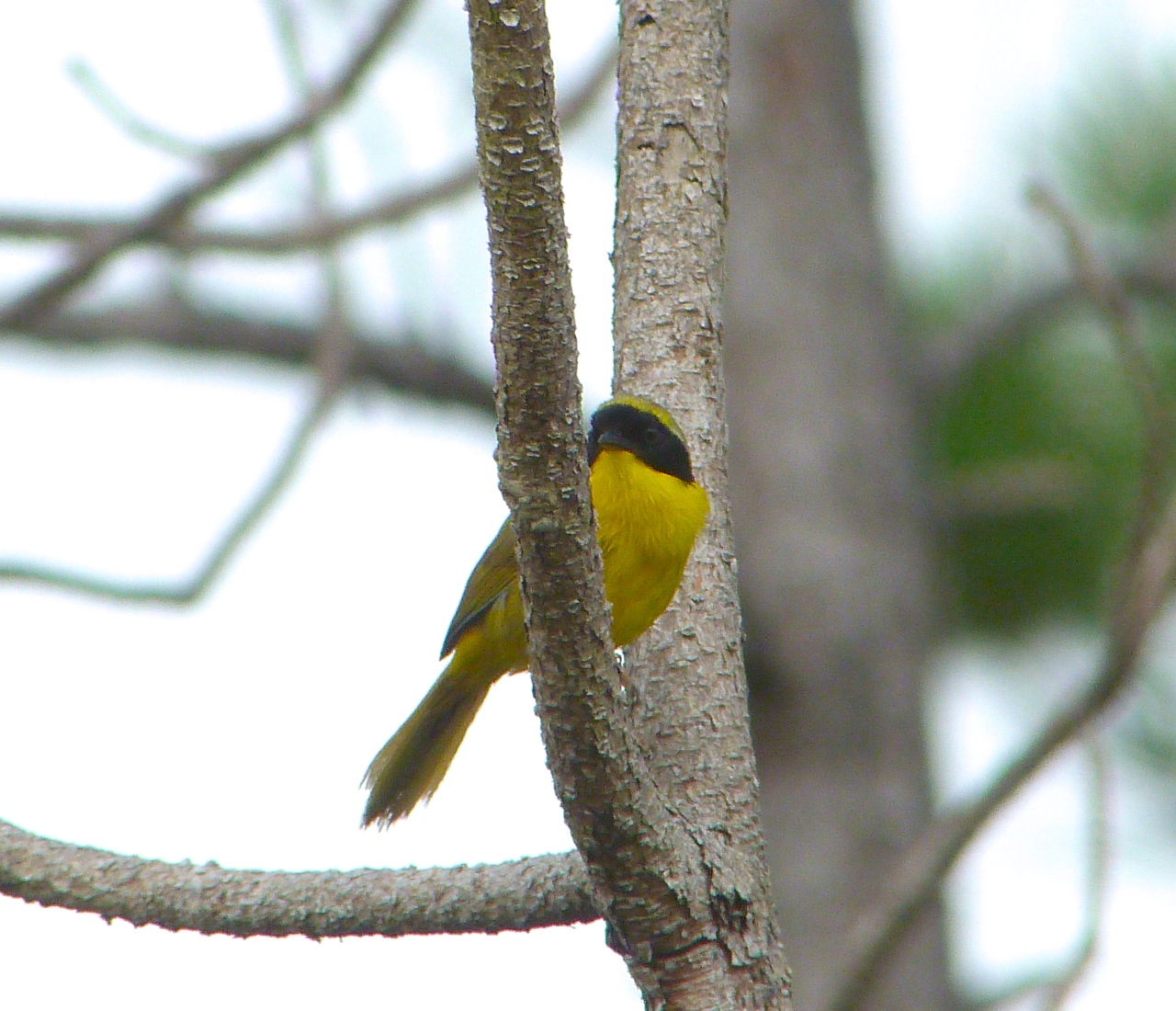
The illustrative photos are of poor quality, but rather than blame my camera (as I am only too ready to do), I plead ‘overexcitement’ in mitigation. Of the 4 endemic species on Abaco, this was the only one I’d never seen. There was a tweeting noise on the edge of an abandoned sugar cane field (above), followed by some rustling… and out fluttered this bird, crossing the track right by us and landing quite close to inspect us. 
This striking bird, with its Zorro mask and bright yellow body, is an endearing mix of shy and inquisitive. Only the males have the mask – the females are less colourful, though naturally equally interesting… 
Yellowthroats are responsive to pishing, and once lured from cover they may happily remain on low-to-medium height branches or on a shrub, watching you watching them.
Their song is quite easily imitated, and that may also bring them into the open – a source of immense satisfaction to the amateur (me) if it works. Here’s an example, courtesy of my iPH@NE METHOD for bird recording. It’s the call at the start and the end.
The one we watched had plenty to sing about – it’s just a shame that my images are so poor, because in some you can see its tiny tongue. A bit too blurry, though, even by my own moderate standards for inclusion.
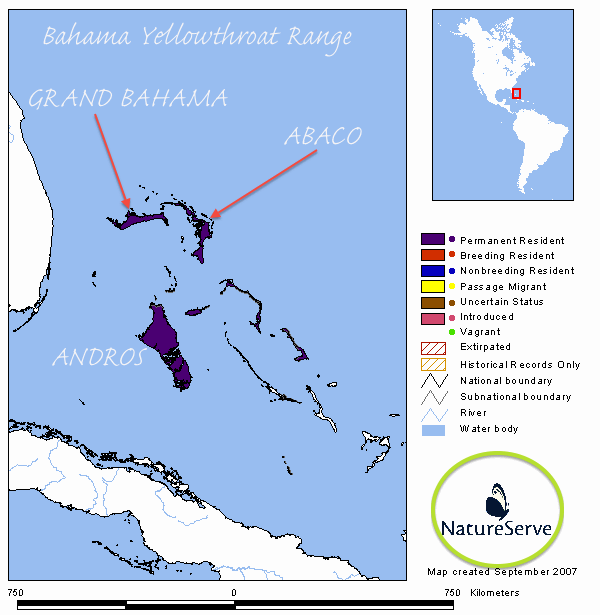
At a formative stage of this blog, I did a short post about the endemic Bahama Yellowthroat and its comparisons with the similar and better-known Common Yellowthroat, which is also found in the Bahamas. You can read it HERE. There’s a female shown, a video, and an unacknowledged debt to Wiki or similar source, I can’t help but notice…
**ANTILLEAN NIGHTHAWKS AND THE ‘BOOMING DISPLAY’
“On summer evenings, keep an eye and an ear out for the male Nighthawk’s dramatic “booming” display flight. Flying at a height slightly above the treetops, he abruptly dives for the ground. As he peels out of his dive (sometimes just a few meters from the ground) he flexes his wings downward, and the air rushing across his wingtips makes a deep booming or whooshing sound, as if a racecar has just passed by. The dives may be directed at females, territorial intruders, and even people.” We found ourselves right in the middle of one of these astounding displays, with maybe 100 birds behaving exactly as described, often whooshing within inches of our heads. I’ll post some more about it in due course. Credits: Philip Simmons; All About Birds (Cornell Lab)
![]()
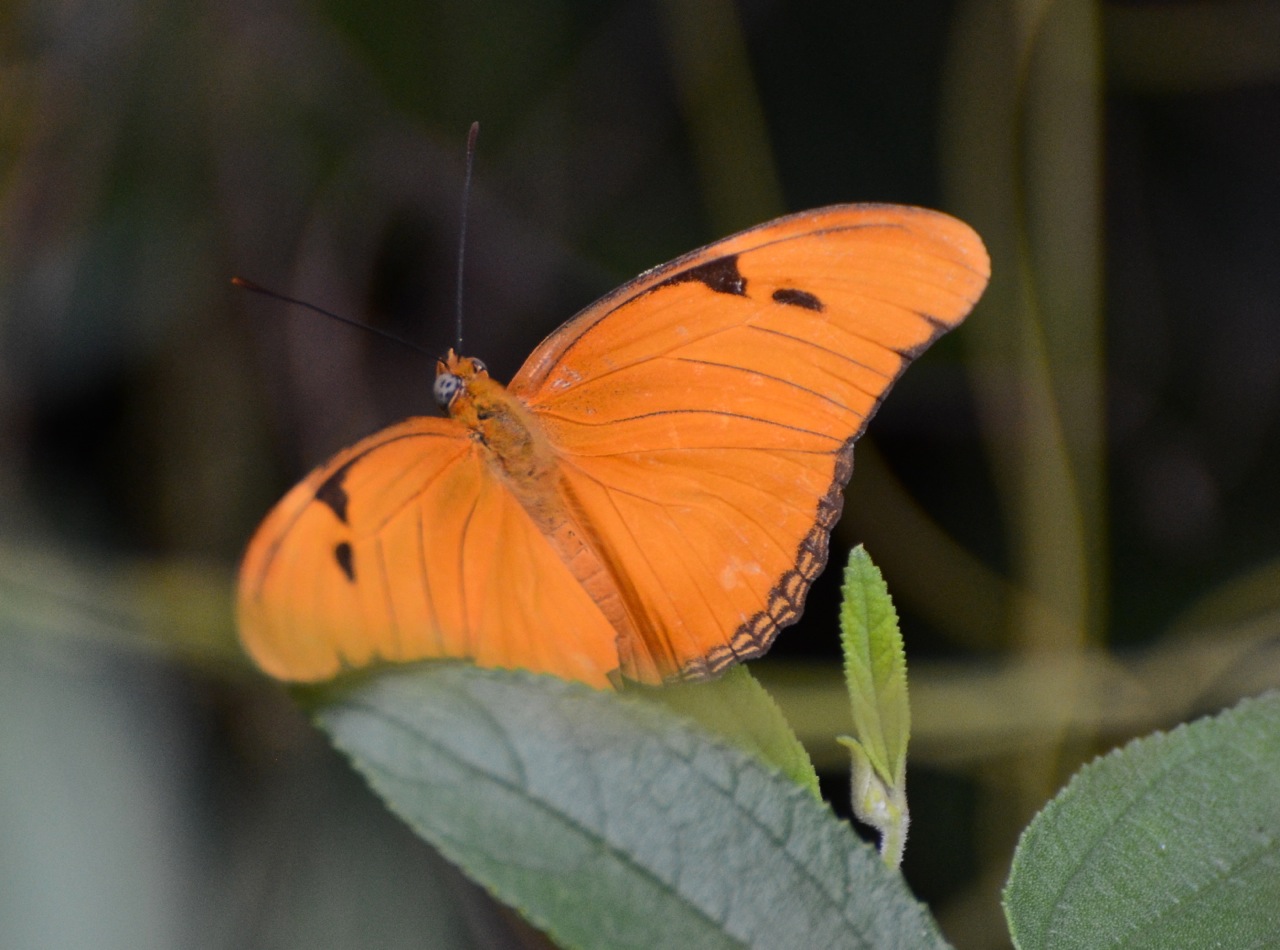
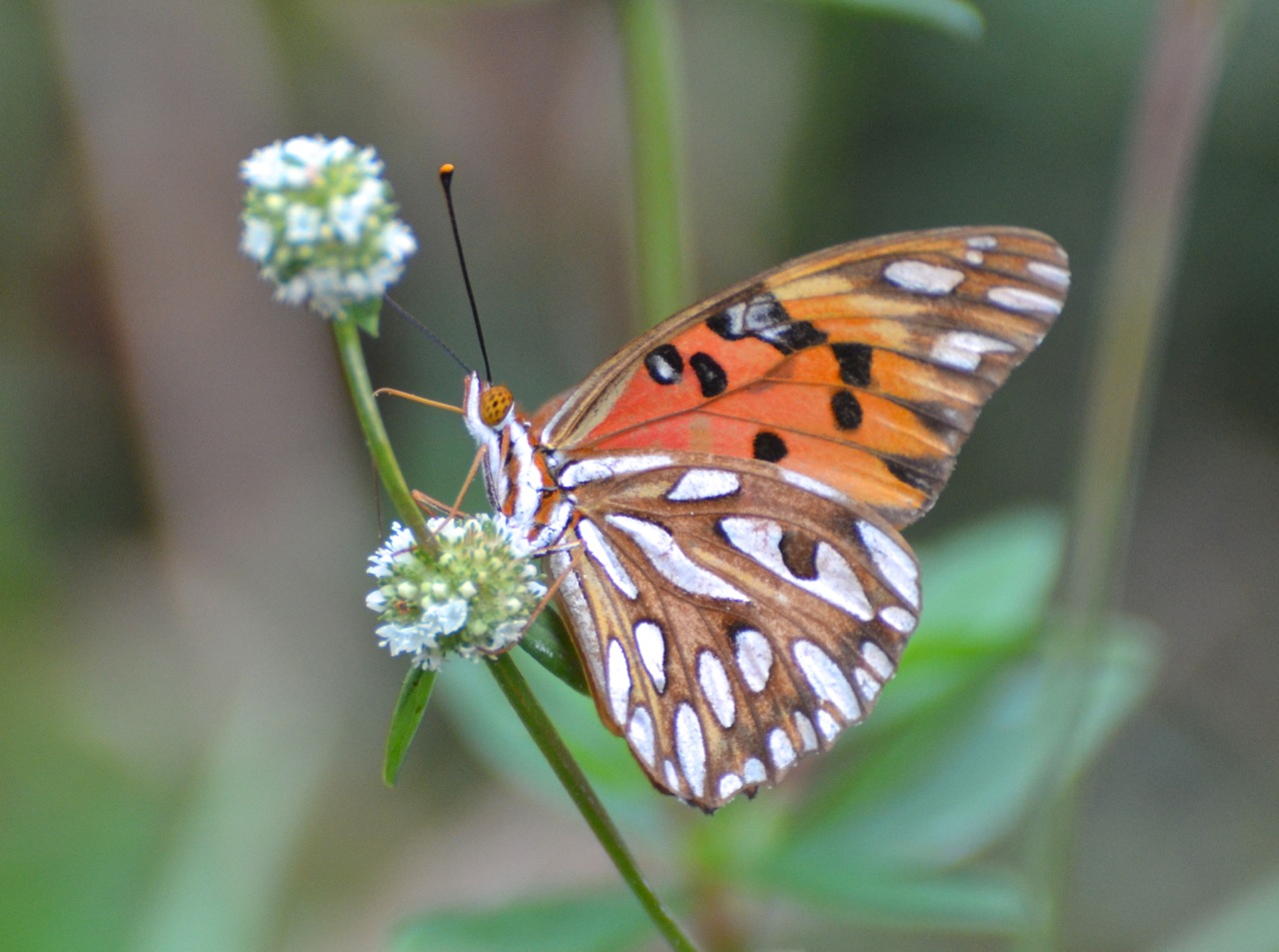
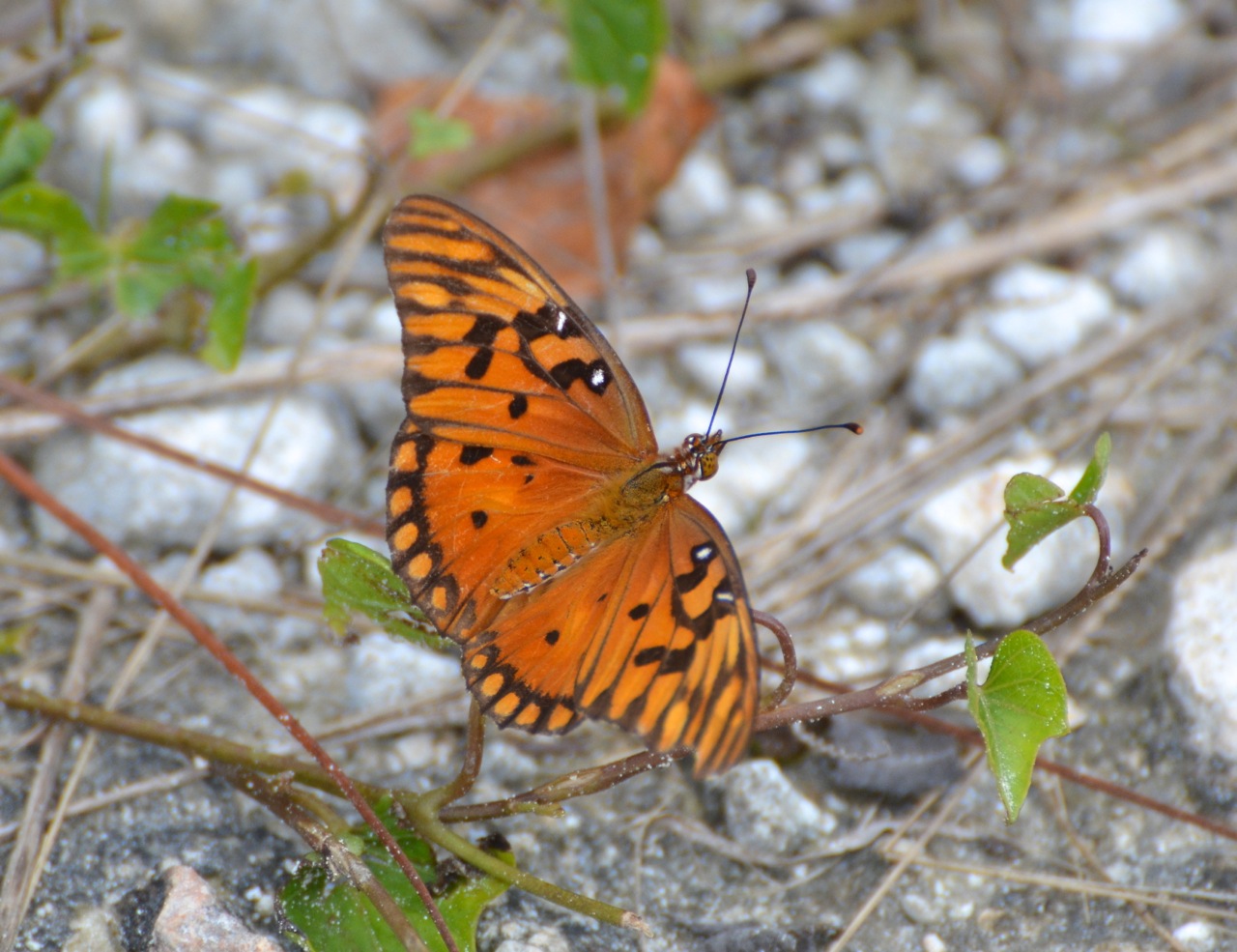
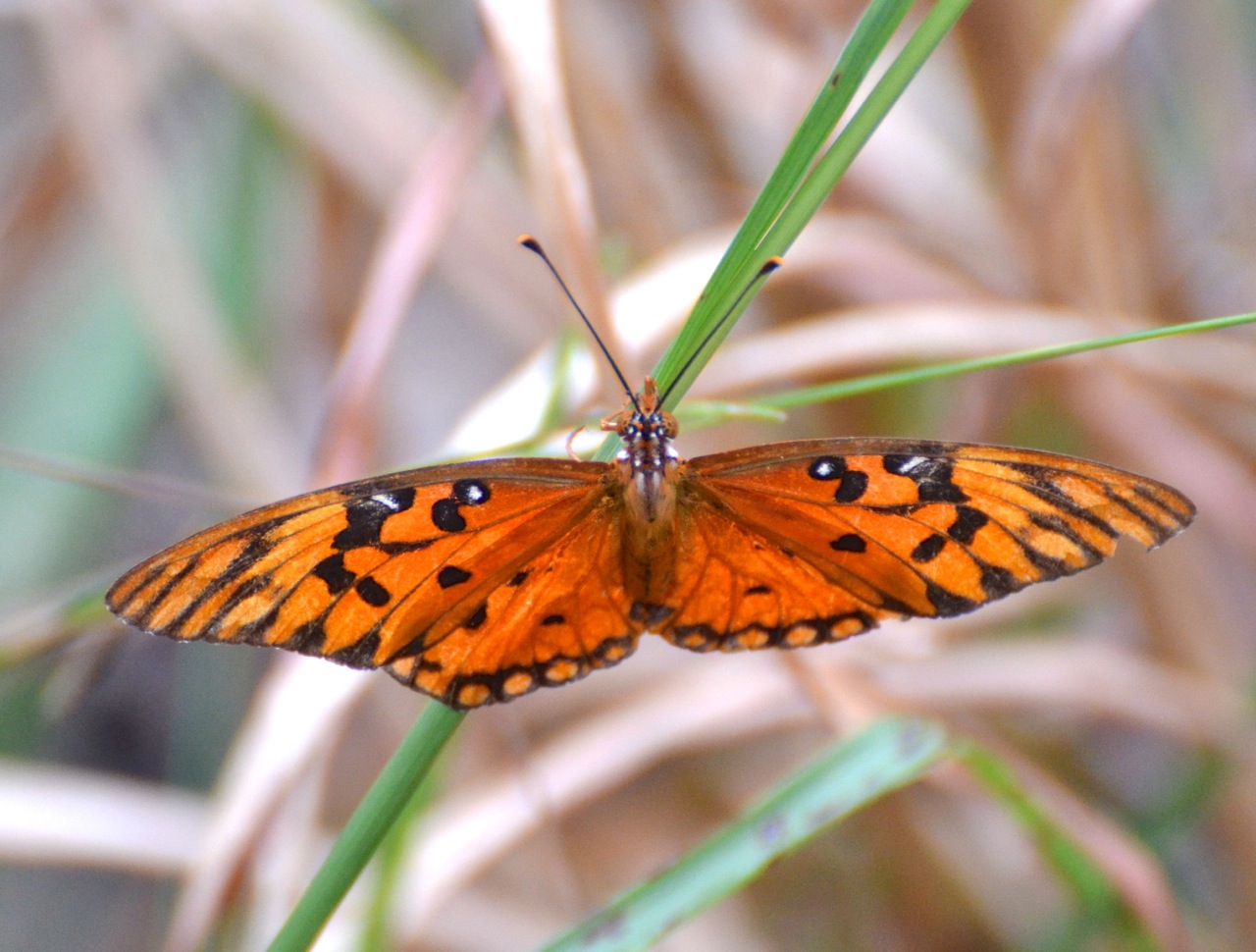
The GULF FRITILLARY Agraulis vanillae is a so-called ‘longwing’ butterfly species found from South America to central North America, named for its migration route over the Gulf of Mexico.

The black and orange patterns of this butterfly are a reminder to predators of the toxicidity of its stripy caterpillar and birds tend to leave them alone. Just in case. The markings are also similar to other butterflies that are poisonous – for example the Monarch. Tip of the hat to Wiki for the information that “this species belongs to the ‘orange’ Batesian mimicry complex”. Me neither! It is where an innocuous species resembles a noxious one in order to discourage predators without going to the bother of actually developing its own ‘on-board’ toxins.
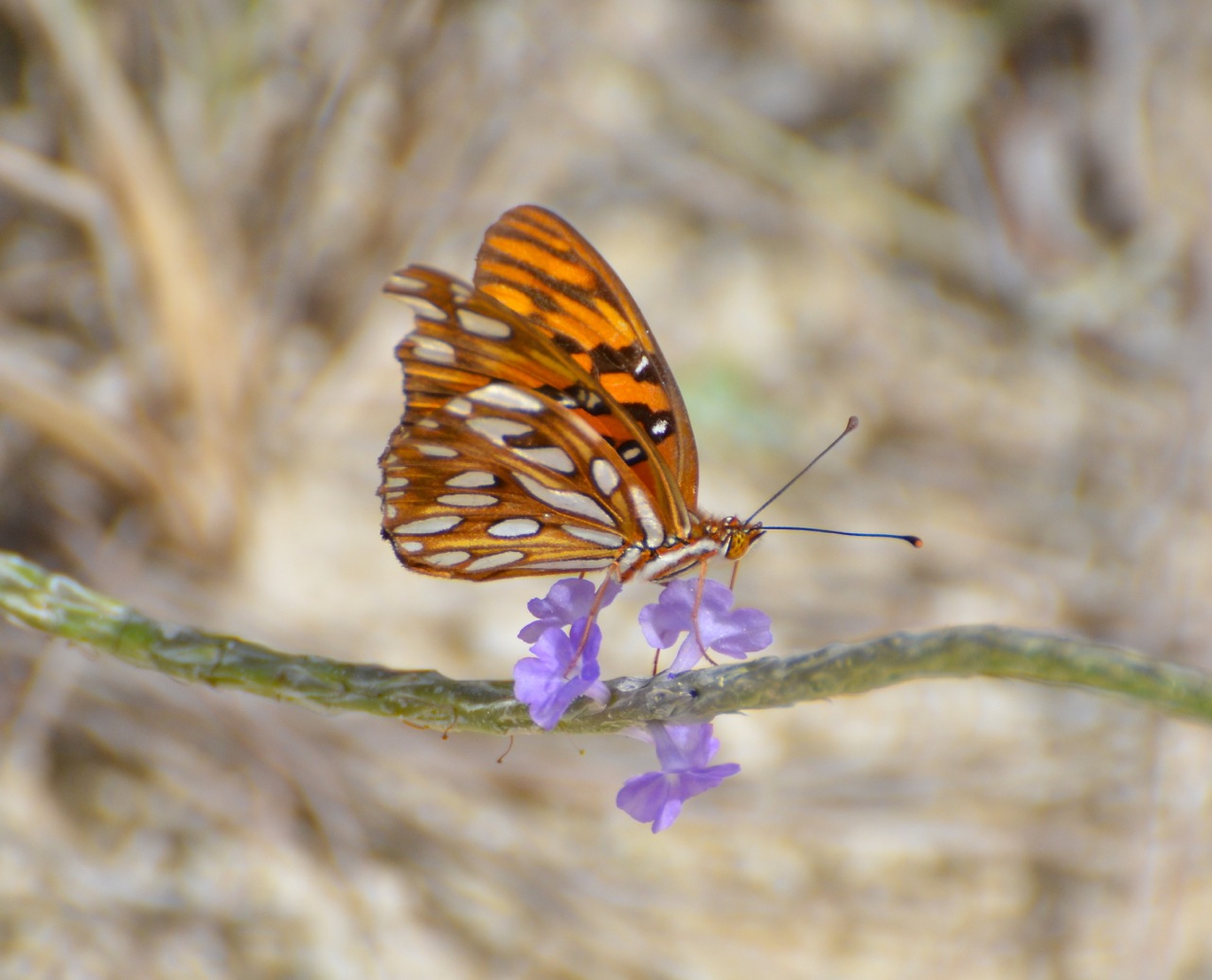
The gulf fritillary is common on Abaco, as elsewhere in the Bahamas. I particularly fond of the photo below, in which the whole feeding apparatus can be seen. I haven’t done my homework, I’m afraid. If anyone wants to provide the technical terms (mouth? proboscis? tongue-thing?), that would be welcome. Please use the comment box to spread enlightenment.
FURTHER BUTTERFLIES YOU MAY ENJOY
ATALA HAIRSTREAKS and LIFECYCLE OF THE ATALA HAIRSTREAK
Credits: all amazing photos by Charlie Skinner, except header image Wiki – to which credit also for the graphic and some info in particular ‘Batesian Mimicry complex’, which is definitely one to drop lightly into conversation…

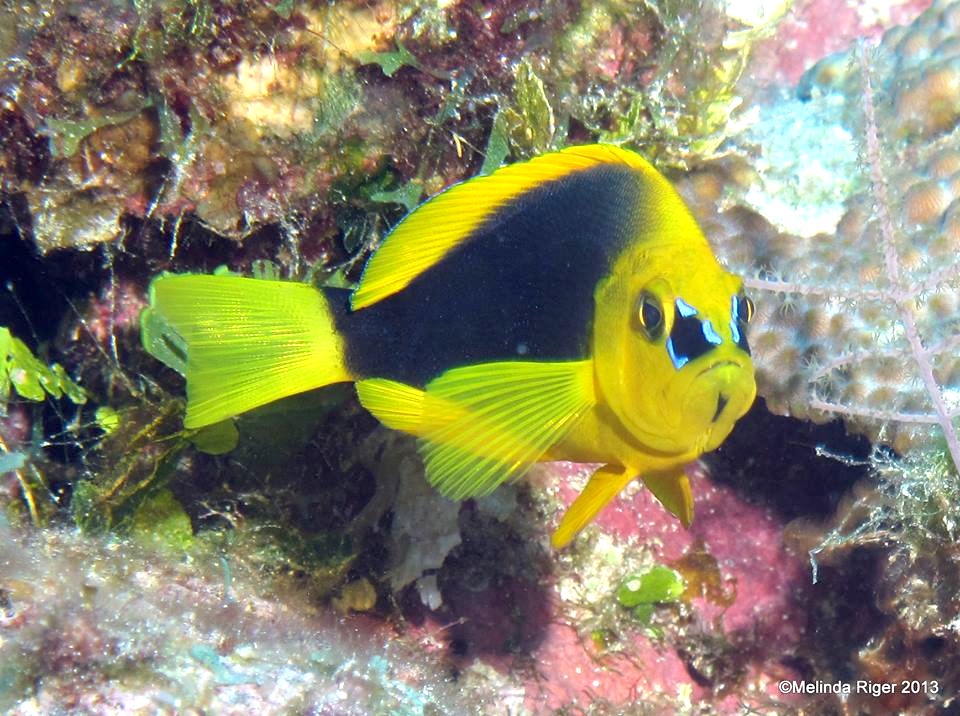
“Oh, that this too too solid flesh would melt, thaw and…” Ah! Sorry. I’m soliloquising again. Must be Thursday. And the merest mention of Hamlet is enough to set anyone off. But I speak not of noble yet gloomy Danes of Elsinore and of discernibly introspective aspect. These ones are pretty reef fish of the Caribbean seas, mainly in the Bahamas and along the Florida coast. There are a number of different types of hamlet, of which the 4 featured below in Melinda’s amazing underwater images were were encountered in one dive.
Hamlets have outstandingly interesting reproductive skills, being ‘synchronous hermaphrodites’. They have the unusual benefit of having both male and female sexual organs as adults, permitting imaginative combinations of pairings (though not including self-fertilization). When they find a mate, “the pair takes turns between which one acts as the male and which acts as the female through multiple matings, usually over the course of several nights”. I don’t dare check whether there are websites that cater for this sort of energetic coupling. The wonder is that Hamlets preferentially mate with individuals of their same colour pattern, and that they are not more wanton with their attentions and sexual flexibility.
OPTIONAL CULTURAL, HISTORICAL & MUSICAL DIVERSION INSPIRED BY HAMLET
The other notable Hamlet is, of course, the mild cigar equated in the famed commercials with happiness, accompanied by an excerpt from a jazzy version of Bach’s ‘Air on the G String’. Here is one of the best – and possibly the only advert to my knowledge to feature not one, but two excellent Sir Walter Raleigh jokes.
Bach’s well-known descending chord sequence of was of course shamelessly ripped off by ingeniously adapted by Procol Harum for ‘A Whiter Shade of Pale’, their first single in 1967. Relive the Summer of Love right here and now. Is this the music that might even put those versatile hamlets in the mood…
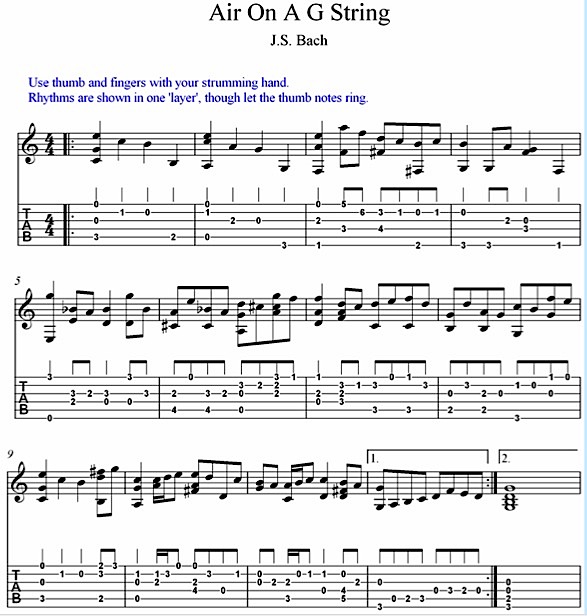
Any fret-tweakers might like to see the sheet music of the Air for guitar – you could even play it on air guitar – which is relatively easy, being in C major.
Credits: All fish pics Melinda Riger of Grand Bahama Scuba, except wiki-header; open-source online material; my mp3, dammit – I can’t get the wretched tune out of my mind…
LAND CRABS: THE ILLUSTRATED ‘WHAT, WHERE, HOW, & WHY’The Loxahatchee River District organisation produces excellent informative posters on wildlife and environmental themes. With their approval, I have a dedicated page for these: CLICK LOXAHATCHEE. You will find posters about Bonefish, Tarpon, Lionfish, Nassau Grouper, Spiny Lobster, Coral Reefs, Elkhorn Coral, and Seagrasses. I’d be surprised if each one didn’t contain at least one interesting factual nugget that you didn’t know before. The range of subjects is gradually being expanded and one of the latest concerns the Land Crab. Click the poster twice to enlarge it and make it legible.
My factoid nugget from this poster is that juvenile bonefish predate on larval crabs. I suppose it’s obvious, but I hadn’t thought about it. From the fisherman’s angle a very good reason to protect, and ensure the proliferation of, adult land crabs!
For photos of these crabs and a short video demo of how they use their claws, here are links to two previous posts about them
LAND CRABS ON ABACO HOW TO STALK AND WRESTLE THEM
ABACO LAND CRAB vs RICKY JOHNSON ROUND 2 (VIDEO)
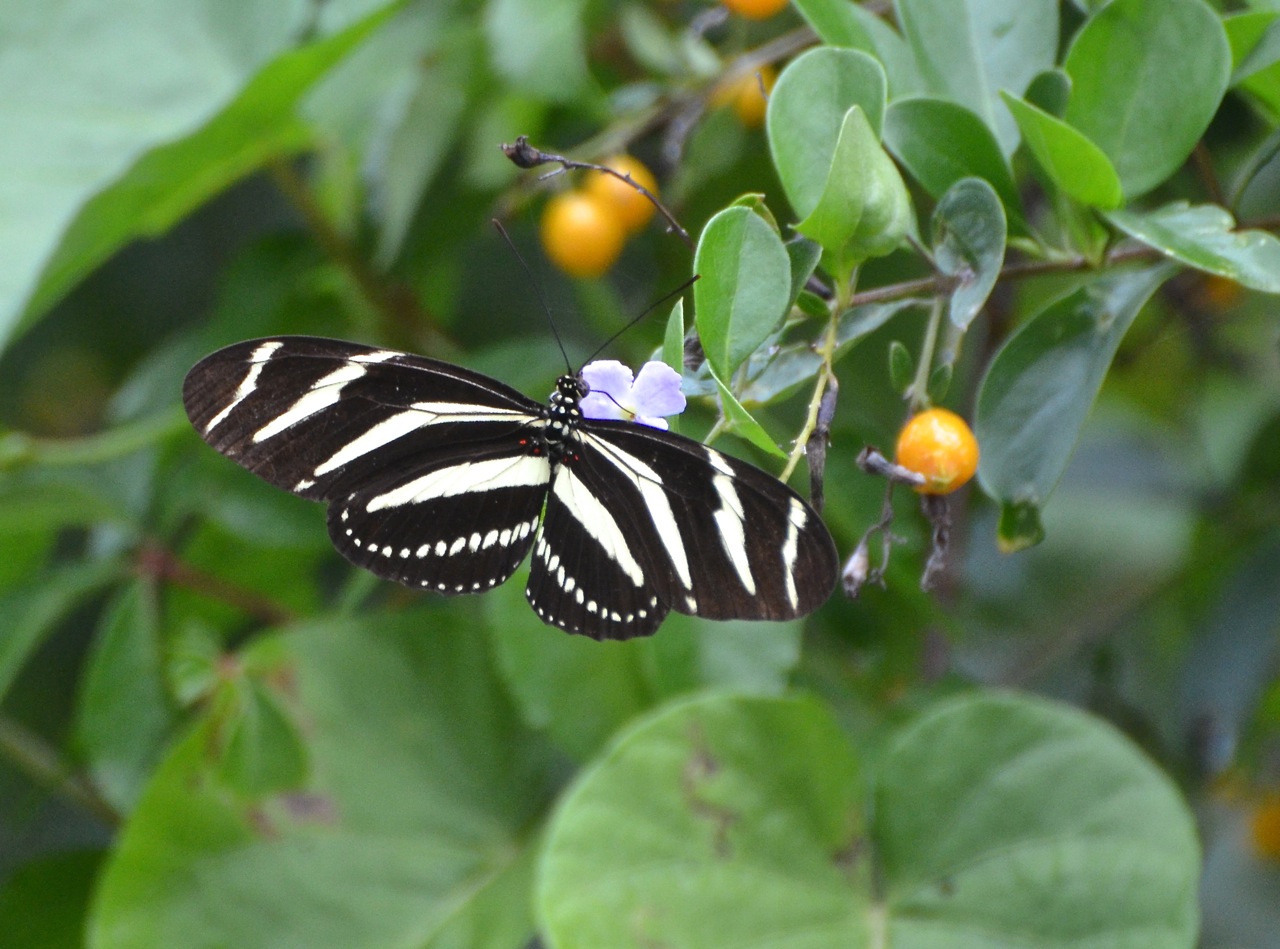
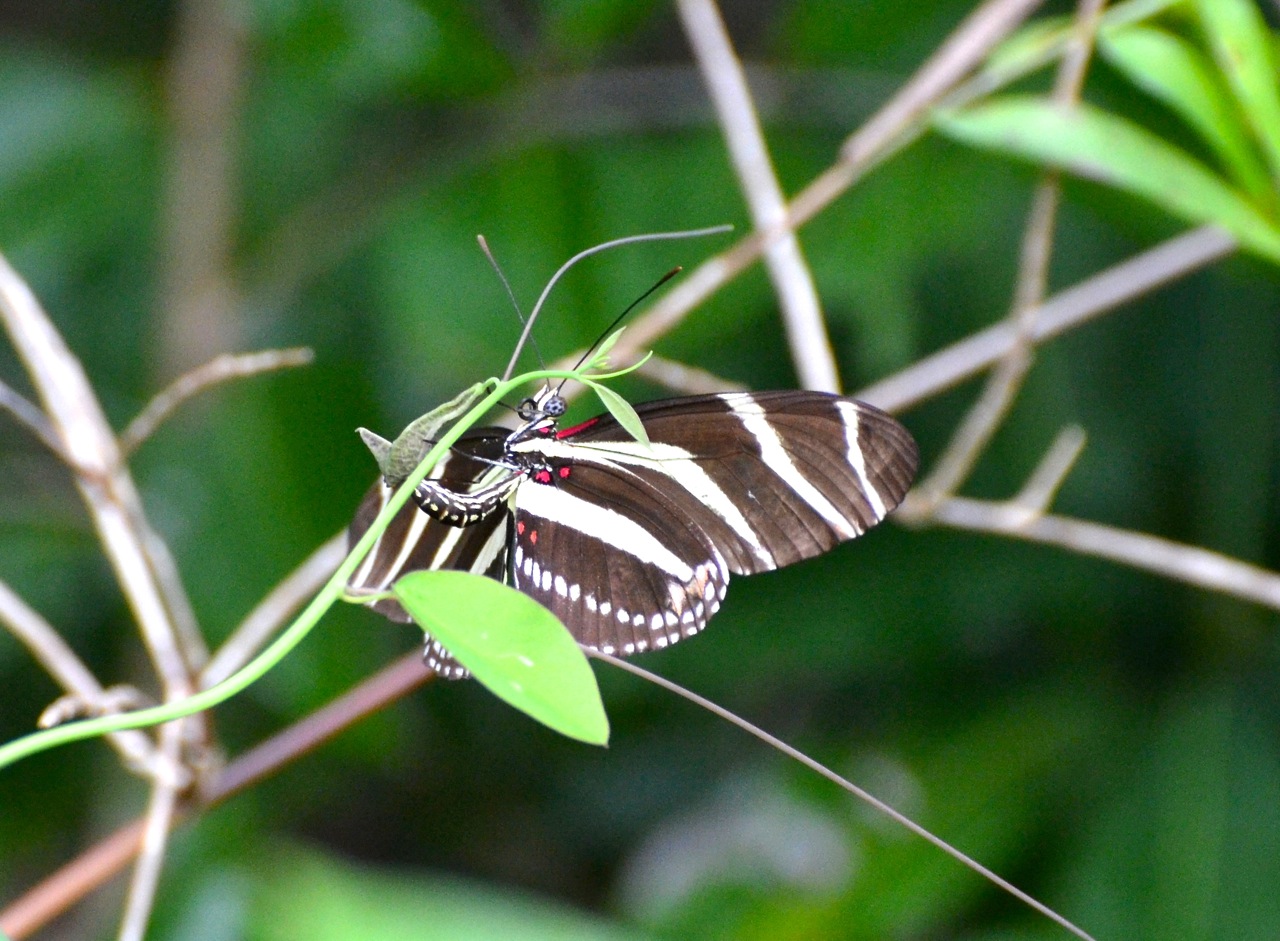
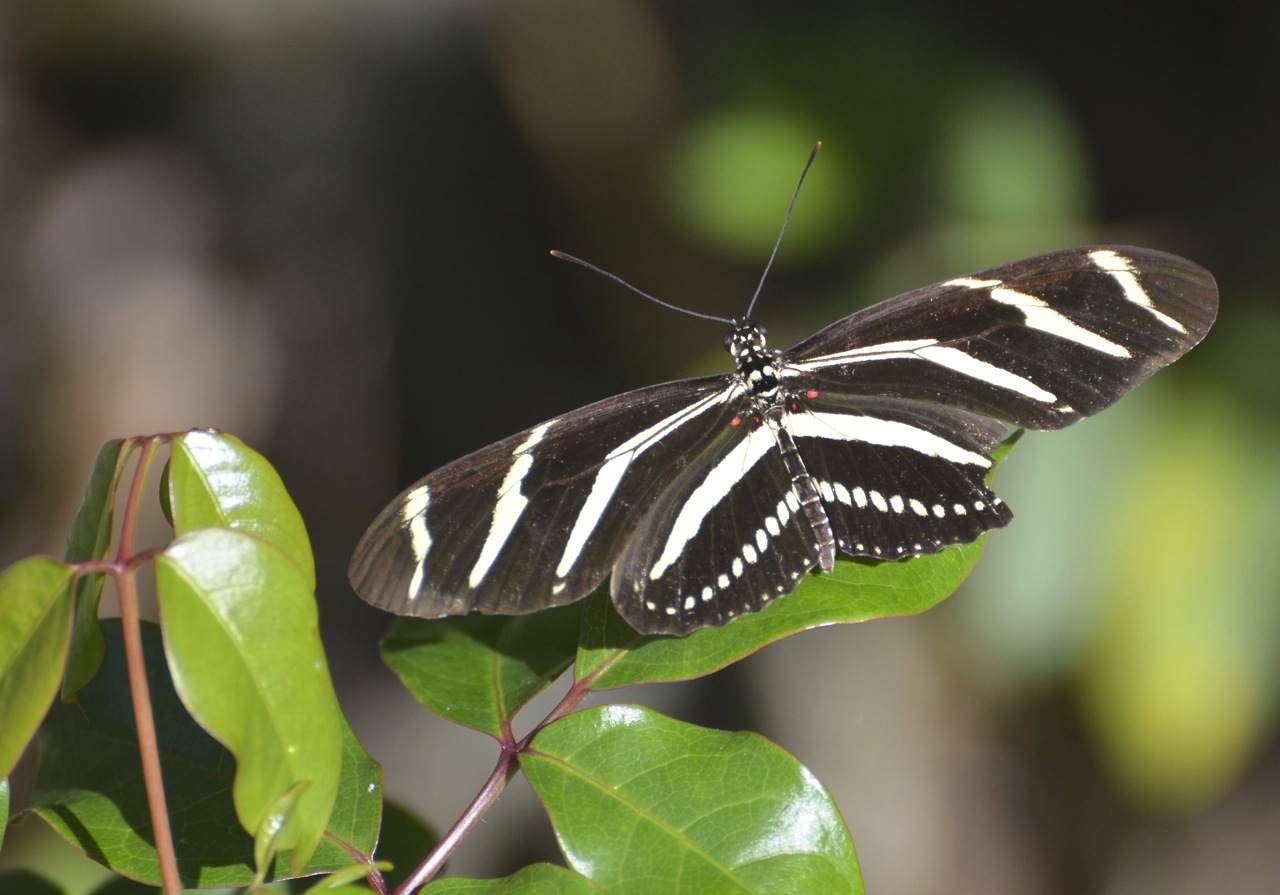
The Zebra Heliconian butterfly Heliconius charithonia is also know as the Zebra Longwing. These striking butterflies roost nightly in large colonies, a species behaviour that is believed to be a protective measure against predation, providing safety in numbers (or at least reducing the probabilities that you will be the one to be eaten). In 1996 the Zebra Longwing was appointed the State Butterfly of Florida.
![]()
![]()
![]()
![]()
![]()
Credits: all images by Charles Skinner, taken in the vicinity of the Delphi Club, Abaco

This is the second of three vaguely planned posts about these delightful shore birds. They aren’t rare but they are approachable and fun to watch. During the nesting and hatching season, there may even be some gorgeous chicks on a beach near you (a phrase I never thought I’d find myself using). PART ONE identified the typical male and female adults found on the Delphi beach almost any day.
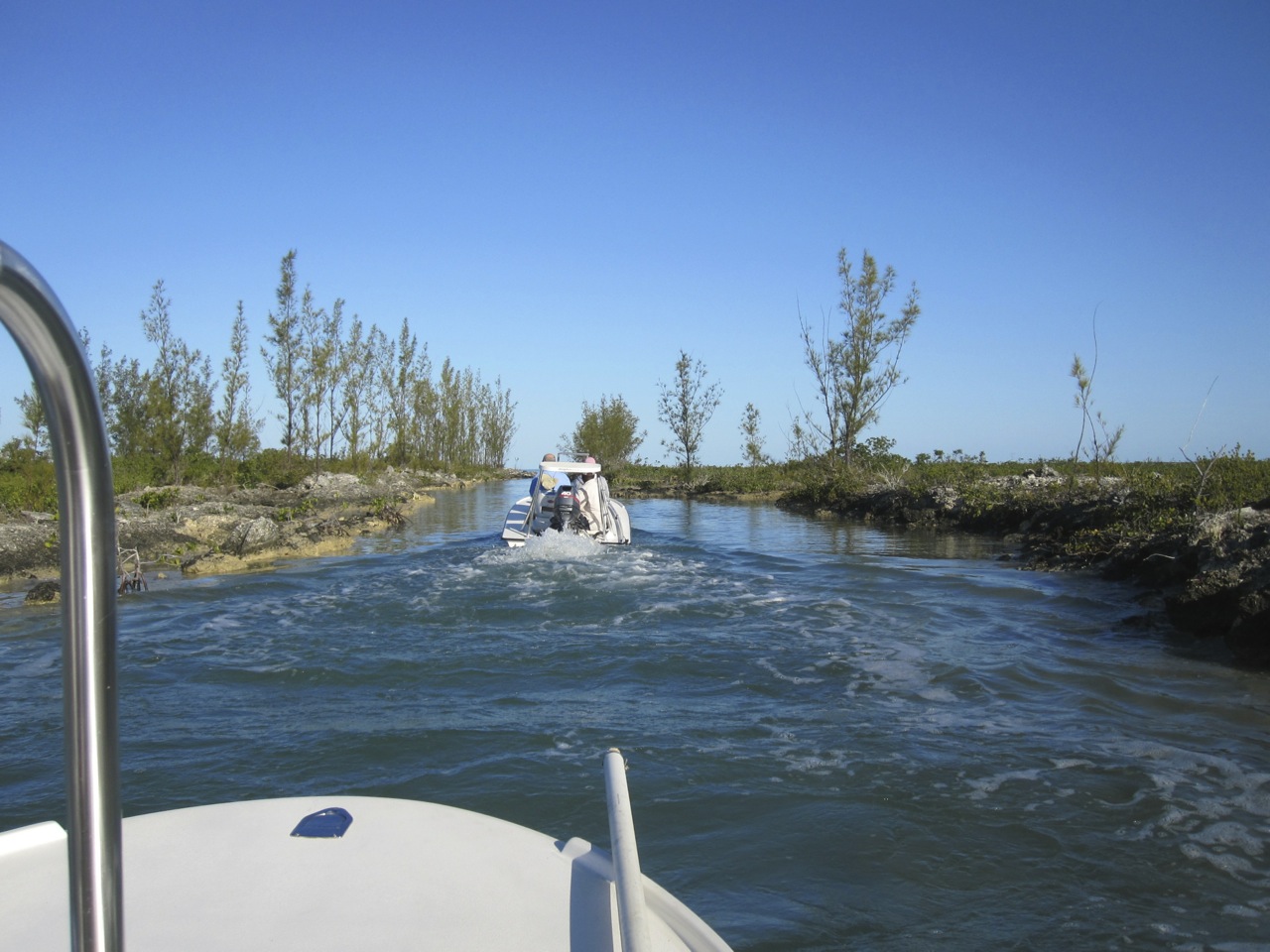
This post is about nest protection. Not the ingenious methods of the birds themselves, that will come next time. This is a story of protection by humans. The photograph above shows Nettie’s Point, one of the launching points for bonefishing skiffs being taken out to the Marls, a vast area of sea, low sand banks and mangroves where the fish are found. You hope. The skiffs gain access to open sea via an artificial channel carved out of rock. The early morning trip along it is one of the most exciting part of a fisherman’s day, as he or she sets out with a clean score sheet, a rod and a box of flies. And a cooler box with some food and maybe a Kalik beer or three.
This June, a pair of plovers decided to locate their nesting ‘scrape’ right in the middle of the cleared area where the trucks normally turn. This was by no means a wise home-planning decision, and they might well have found themselves being promptly relocated. Or (worst case scenario) ending up under a large Toyota. But not a bit of it. Instead, these small birds were looked after by the guides like this: 
A makeshift castle was built all round the nest to protect it from any inadvertent truck-related tragedies. Meanwhile the male plover stood guard outside the castle, amiably watching the human activities. 
I kept my distance but in fact he was quite unperturbed, perhaps sensing that we were not a threat. He still kept a beady eye on the proceedings, though.
Meanwhile, what of the wooden enclosure itself? At first glance, there didn’t look much to report. However, if you look in the centre of the picture, you’ll see the female peeping out from the nest.
I very slowly moved nearer, prepared to stop if the male became agitated, or if the female shifted her position. Both seemed quite relaxed, so I took a couple of shots and walked away to leave the birds in peace. Then I went fishing.

As a postscript, Nettie’s Point is the location of a remarkable geographical phenomenon, possibly the result of the cutting of the channel. Along one part of the cut, for about 30 feet, the water level sinks alarming in the middle, while remaining normal at each side. Then it levels out again. This remarkable mid-stream aquatic depression is quite disconcerting to motor through on a skiff, though eventually one gets used to it.
(Note: not every fact in this post is 100% true. If you have some salt handy, take a pinch)

with guest expert PHIL LATTERLY
The Bahamas ‘does’ extremely nice stamps, in particular ones featuring the rich and varied wildlife of the islands. The islands spread from the subtropical climates of the north, on a level with Florida, to the near-tropical islands of the south. This ensures plenty of scope for designing pretty sticky bits of paper to stick onto other bits of paper. One of the small pleasures in life, near-lost to the tyranny of the email…
The sets of wildlife stamps are issued by the Bahamas Post Office. I’ll add to this collection piecemeal (including some from my own modest collection). The very latest commemorative issue heads the display.
1. SEA CREATURES
BREEF 20th Anniversary Issue – November 2013
2. BIRDS
February 2012: WWF Flamingo Issue
Best seen on Inagua, the island where they breed. Less often found elsewhere, and sadly now only as occasional ‘vagrants’ on Abaco. Flamingo post with wonderful pictures of adults, babies and nests HERE
PARROT POST
Found mainly on Abaco (the resident underground nesting variety) and Inagua (conventional nesters), where they breed. Small groups are now found elsewhere, e.g. Nassau, where there is a local monitoring programme, but I’m not sure that there is evidence of breeding there. Any info welcome… One (of several) lavishly illustrated parrot posts HERE
Impressive commemorative issues for the BAHAMAS NATIONAL TRUST


OTHER BIRD SPECIES
The KIRTLAND’S WARBLER is one of the rarest birds of the Bahamas, a winter resident that breeds only in a small area of Michigan. The entire population is numbers only a few thousand birds. The number of sightings annually on Abaco is very small – fewer than a dozen, and in some years none at all. Increasing knowledge about their favourite haunts is now improving the recording rate. I know of two seen this year, on the same day… a birder’s lifetime achievement.
This swallow is endemic to the Bahamas
Found on Abaco only as an occasional visitor.
3. ANIMALS
Credits: A compendious credit to sundry online sources including Bahamas PO, Bahamas Weekly, eBay and other sales / promotional sources, ads and the like, and unknown sources. I rarely find myself having to use this broad sweep approach: if your pic is here and you are upset, apologies, contact me to express your displeasure &co and I’ll take it down of course. But these are only non-rare small bits of paper; and this is a humble non-profit making info site of limited appeal in a Big Wide World. OK with that?
QUEEN ANGELFISH: COLOURFUL CORAL ROYALTY – BAHAMAS REEF FISH (13)
One of the earliest posts in the Bahamas Reef Fish series was about Queen Angelfish Holacanthus ciliaris, and you can see it HERE. I make no apology for returning with some more recent photos from Melinda Riger – these fish deserve plenty of attention for their wonderful bright presence that stands out even amongst the colourful corals of the reef.
This first image is remarkable for its clarity and composition. What, I wonder, is the fish saying to Melinda as she presses the camera button? All caption suggestions welcome…
Angelfish are quite happy to swim round either way up

The juvenile of the species, nosing around the coral for tasty morsels, is equally colourful


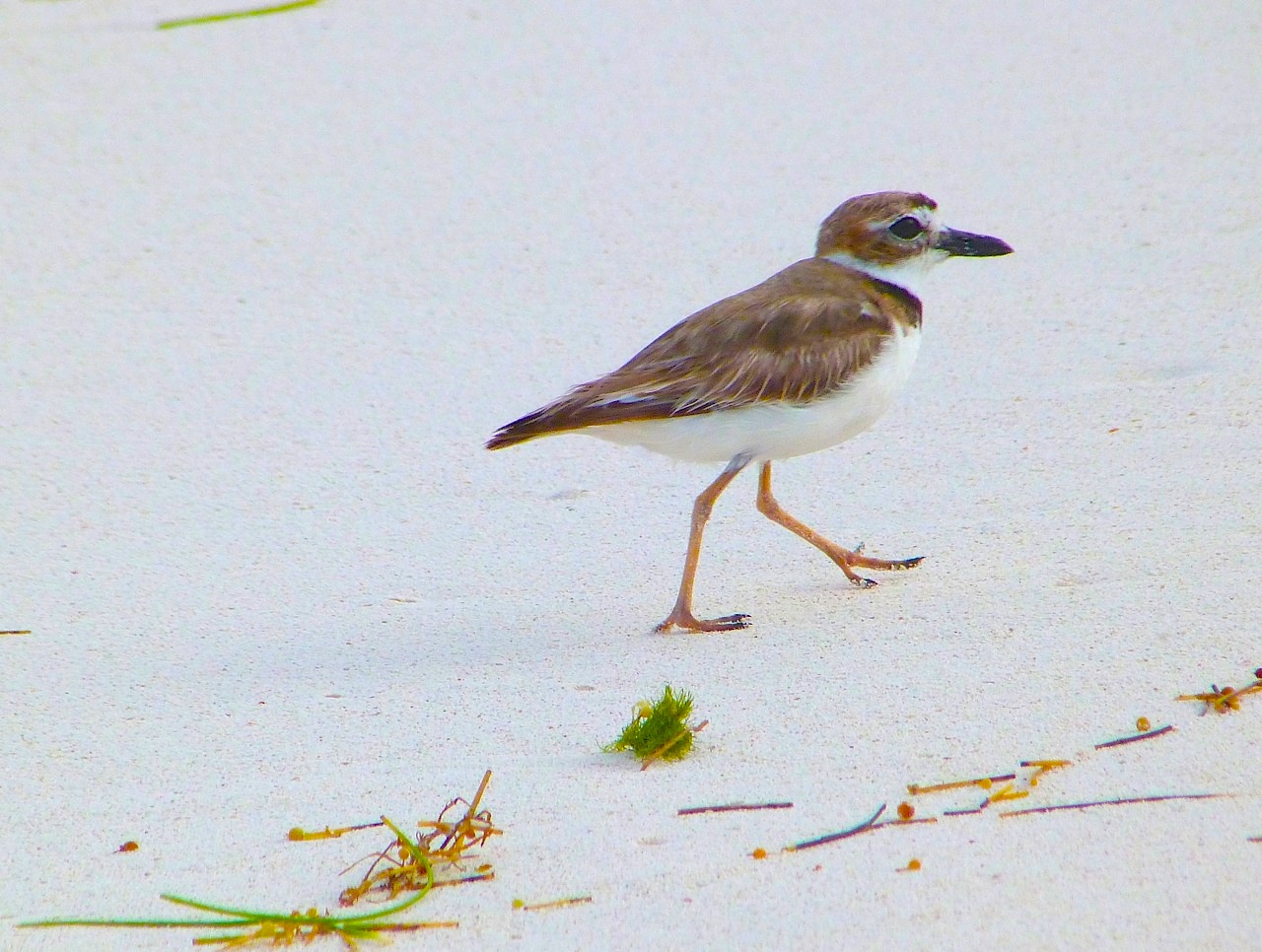
Dream Plover? Well, granted, not quite as adorable as the tiny surf-chasers, the Piping Plovers Charadrius melodus. But Wilson’s Plovers Charadrius wilsonia live on Abaco all year round, and may readily be seen on a beach near you. They breed on Abaco, and in the summer you’ll see their tiny puffball chicks scampering round. And if you approach a nest, you’ll very likely see the amazing ‘broken wing display’ by a parent, who will lurch strickenly and pathetically across the sand… leading a predator gradually further away from the nest or her chicks. Part 2 will include photos of this fascinating protective performance, and of some chicks on the Delphi beach.
And who was the Wilson who lent his name not only to a plover, but also to a snipe, a warbler, a storm-petrel and a phalarope, all birds that have been recorded for Abaco?
ALEXANDER WILSON (1766- 1813)
Wilson was Scottish poet. Besides traditional ballads, he also wrote satirical commentary on the conditions of mill weavers. One vicious tirade against a particular mill owner resulted in Wilson’s arrest. He was sentenced to burn the work in public, and imprisoned. After his release, he sensibly emigrated to America in 1794.
Wilson became a teacher in Pennsylvania, where he developed an interest in ornithology and painting. He ambitiously decided to publish a collection of illustrations of all the birds of North America. He spent several years travelling, collecting material and painting, eventually publishing the nine-volume American Ornithology. Of the 268 species of birds illustrated there, 26 had never previously been described.
SIDE-ON AND FRONT VIEWS OF THE SAME MALE PLOVER 

FRONT AND SIDE VIEW OF THE SAME FEMALE PLOVER
All birds on this page were photographed on the Delphi Beach. They happily coexist there with other shore bird species that include Least Sandpipers, Ruddy Turnstones and Killdeer. Here is a taster for Part 2, the family life of the Wilson’s plover. 

BAHAMA YELLOW – COLOUR OF CHOICE FOR SMOOTH CARS (MOSTLY)
Bahama Yellow has its place in the history of motoring, especially in the sixties and early seventies. Maybe it was considered swinging. It is undoubtedly groovy, verging on ‘far-out’ or even ‘outasight’. It seems to have made its first appearance on motor manufacturers’ colour palettes in the mid-sixties. It differs slightly in shade from ‘New York Taxi’ yellow (and indeed ‘Banana Yellow’). The colour’s association with speed, cool, expense and hip hasn’t prevented its later use for somewhat less sleek private cars and taxis in eastern Europe… This post is an expansion of an existing page on the RANDOM drop-down menus, and is (1) nothing to do with wildlife (2) only very tenuously linked to the Bahamas and (3) meant to be a mere light-hearted digression…
PORSCHE 912

1968 Model (The Motoring Journal)
In the mid-60s Bahama Yellow was very far from the favourite colour choice , perhaps making it more elite… On the other hand, the colour palette shown here isn’t very tempting – if those were the true colours on offer, I might have considered a different car altogether… I’m particularly unimpressed by the nasty mud-coloured one that 9.5% people apparently selected for their classy sports car.
ASTON MARTIN DBS – JAMES BOND’S FAVOURITE ‘WHEELS’
A DBS with Sir Roger Moore KBE, 007 carefully examining his fingernails for ‘bugs’ in his “Persuaders” days, before his eyebrows got themselves an agent and took up an independent acting career. Sharp suit, Rog! A bit on the… er… fashionably tight side, maybe?
ASTON MARTIN AS A PRICEY DIECAST MODEL
DODGE PLYMOUTH 340 ROAD RUNNER
Is it just me, or did this model (1969) have a serious design defect in the hood / trunk catch department?

This one has regrettably done a ‘Tiger Woods’ with a fire hydrant…
While this one never really got going at all…
LOTUS EUROPA TWIN-CAM (1972)
Described in ads (Car and Classics; Pistonheads) as Bahama Yellow. It’s not really though is it?
CORVETTE BARRACUDA
(yes, I realise it’s a toy, but it will do for present illustrative purposes)
Aha! At last I’ve found a real one – 1971 Model (MCG Motors). Still looks like a toy, though…
POLONEZ c1980
Credits: as annotated or general ad / promotion /unattributed images
NEW ENTRY NOV 2013 I recently stopped at a motorway “petrol station” (in England, where no one says “diesel station”. Or “gas…”. Or even the all-embracing “fuel…”) for a leg stretch and to be honest, some revoltingly delicious crisps. Next to me was a sort of sporty-ish looking Bahama Yellow car. I neither knew nor cared what make it was, but I had to photograph it (iPh*ne). It turned out on inspection to be the unmemorably-named ‘Ford ST’, apparently a brand new model (though this one looked as though it had been round the block a few times, and possibly made contact with the block in the process). I found a gleaming stock image too. This question is, would someone (not me, obviously) look ‘cool’ in this car? Would Roger Moore happily get behind the wheel? It looks quite fun to drive; but then, so does a tractor.
RH note: I am not a car expert. I can remember only the colour / shape of our cars from day to day: estate, dark blue; small, ‘arrest-me’ red. I couldn’t care less about the models or indeed registrations (until I have to tax them. Then I go outside and take a look). Please don’t email me with well-meant histories of classic cars of the ’60s… this post is just a motor ignoramus’s survey for ‘fun’ (toxic concept…)
FRIENDS OF THE ENVIRONMENT, ABACO
Join Friends in support of the Abaco Cancer Society and Friends of the Environment for Abaco’s third annual Kayak Challenge on November 9th at Pete’s Pub in Little Harbour.
“Any craft you can paddle will be welcome, from kayaks, paddle boards and canoes – just no engines! There will be 3 courses to choose from: 5 miles, 8 miles, or 13 miles that will take paddlers into and through the scenic Bight of Old Robinson, part of the proposed East Abaco Creeks National Park. Paddlers will be welcomed back with a Beach party at Pete’s Pub.”
Pete’s Pub: “Thirst come, thirst served…”
THE THREE COURSES
5 Mile Course
8 Mile Course
13 Mile Course
SUPPORT FRIENDS & BMMRO INTERN OSCAR WARD AS HE NEGOTIATES THE PERILS OF THE “BIG ONE”; AND FOLLOW HIS INTERN’S BLOG HERE
“Support boats will be available to assist, but paddlers should plan to bring adequate water and snacks for the trip. Remember, the sun in The Bahamas is hot, so pack your sunscreen, sunglasses, hat and if you burn easily, clothing to cover yourself up with along the way. Kayaking is a water activity, so be aware that anything that goes in the kayak with you will get wet whether it be from a splash from passing boat wake, drops from paddles, or a quick rain storm. Kayaking is a physical activity, remember the further you venture, the further the paddle to return.”
There will be a beach barbeque & party for spectators to cheer the paddlers on as they come in from their journey.
For more information call the FRIENDS office at 367-2721 or email info@friendsoftheenvironment.org
Registration form, sponsorship form and waiver
Sponsorship donations can be made on-line
Kayak Challenge event page on Facebook
Kayak Challenge Sponsors Cherokee Air, Hope Town Harbour Lodge, The Paint Place, Lightbourne Marine, Pete’s Pub and Gallery, Shirley Enterprises, Bon Secours Medical Group, Sands Marine Surveying & Consulting, Marsh Exporters and Importers, Ltd, Abaco Petroleum Company Ltd, Abaco Family Medicine, Abaco Tourist Office
Non-participatory support from a respectful distance (4250 miles) from
Highly competitive and vigorous kayak practice off the Delphi Club beach, Rolling Harbour

We are back in the realm of ‘animal, vegetable or mineral?’. Dive down a few feet – inches, even – to the reef, and… is this thing waving about here a plant or a creature? And is that colourful lump over there a bit of inanimate rock or a living thing?
1. FEATHER DUSTERS
Not in fact pretty frilly-fringed plants, but worms among the coral. The tiny electric blue fish are Blue Chromis, ubiquitous around the reefs.
Here the feather dusters have attached themselves to a sea fan, a ‘gorgonian’ coral
Moored on part of an old wreck
A different form of duster with remarkable feathered tentacles
2. BASKET STARS Creatures in the same family group as brittle stars. Take a close look at the remarkable transformation in the two photographs. The top image is taken in daylight. The star is off duty and enjoying some downtime. However the second image is the same view at night, with the star fully open and waiting to harvest whatever micro-morsels come its way. The star has truly ‘come out at night’.
3. CORKY SEA FINGER Another form of gorgonian coral, sometimes known as dead man’s fingers… **
4. GOLDEN ZOANTHIDS Coral forms living on a Green Rope Sponge. Some zoanthids contain a deadly poisin called palytoxin, which may do unspeakable things to your heart. Like stop it. Luckily, none so unpleasant live in the Bahamas (or so the Bahamian Tourist Board would no doubt wish me to make clear).
I realise that calling this occasional series ‘Reef Gardens’ is a bit of a misnomer. They are in fact Reef Zoos. The previous posts are as follows:
REEF GARDENS 1 Anemones, Basket Stars & Christmas Trees
REEF GARDENS 2 (Corals)
Image credits, with thanks: Melinda Riger @ Grand Bahama Scuba
** I knew this image reminded me of something… or someone. And (superannuated British rockers out there), is it not exactly like the hairdo of one of the guys in Mott the Hoople, a band lifted from relative obscurity to fame by being gifted a song by David Bowie? Guitarist. Ian Hunter. Take a look at him now… and just imagine then

Mostly, the Cuban Emeralds at Delphi spend their days perching briefly on twigs before zooming like tiny green rockets to their next appointment – an inviting sugar-water feeder, a promising flower or maybe yet another tempting twig. Sometimes, pairs will put on an acrobatic mid-air display, flitting around each other at high speed, chittering, before disappearing into the coppice together. Avian speed-dating. Occasionally, they are more contemplative. I recently posted HERE about one that had let me get (very slowly) right up to it. Emeralds may be quite hard to spot in amongst the green leaves, but often they are there, quietly watching you go by. Here is one that stayed put when I stopped to admire it.
I’ll tuck my wing in neatly if you are going to take pics of me
Uh-oh! Close-ups. This is my better side.

That’s enough, human. I’ve stopped the posing. Now push off and leave me alone.
In close-up, the feathers look like tiny iridescent pine needle fans
The Delphi Club: a hive of activity for birds (to mangle a metaphor)
You must be logged in to post a comment.