It is an ill-concealed secret that I don’t have an artistic bone in my body – I get acute angst if asked to draw a stickman. As I was looking through photos of large pink flamingo groups, I suddenly realised that I was getting some sort of abstract vision of them. Whoooh! Art-talk. Anyway, I wondered how a legion of flamingos might look in B&W. Add a bit of highlight and… does it work at all? Whether yes or no, this may be the only B&W photo of flamingos since the invention of colour film. Why would you? [Impatient reader: ‘Why did you?]
All great photos courtesy of Melissa Maura (1, 2, 3, 9, 10); Mary Kay Beach (4, 5, 6, 7, 8); Michael Vaughn (11), with many thanks for use permission; Cartoon, Birdorable
I was always taught ‘keep your mind open and your mouth closed’. Bad advice. Such bad advice. The worst. So many reasons to be exactly the opposite in these troubled times…
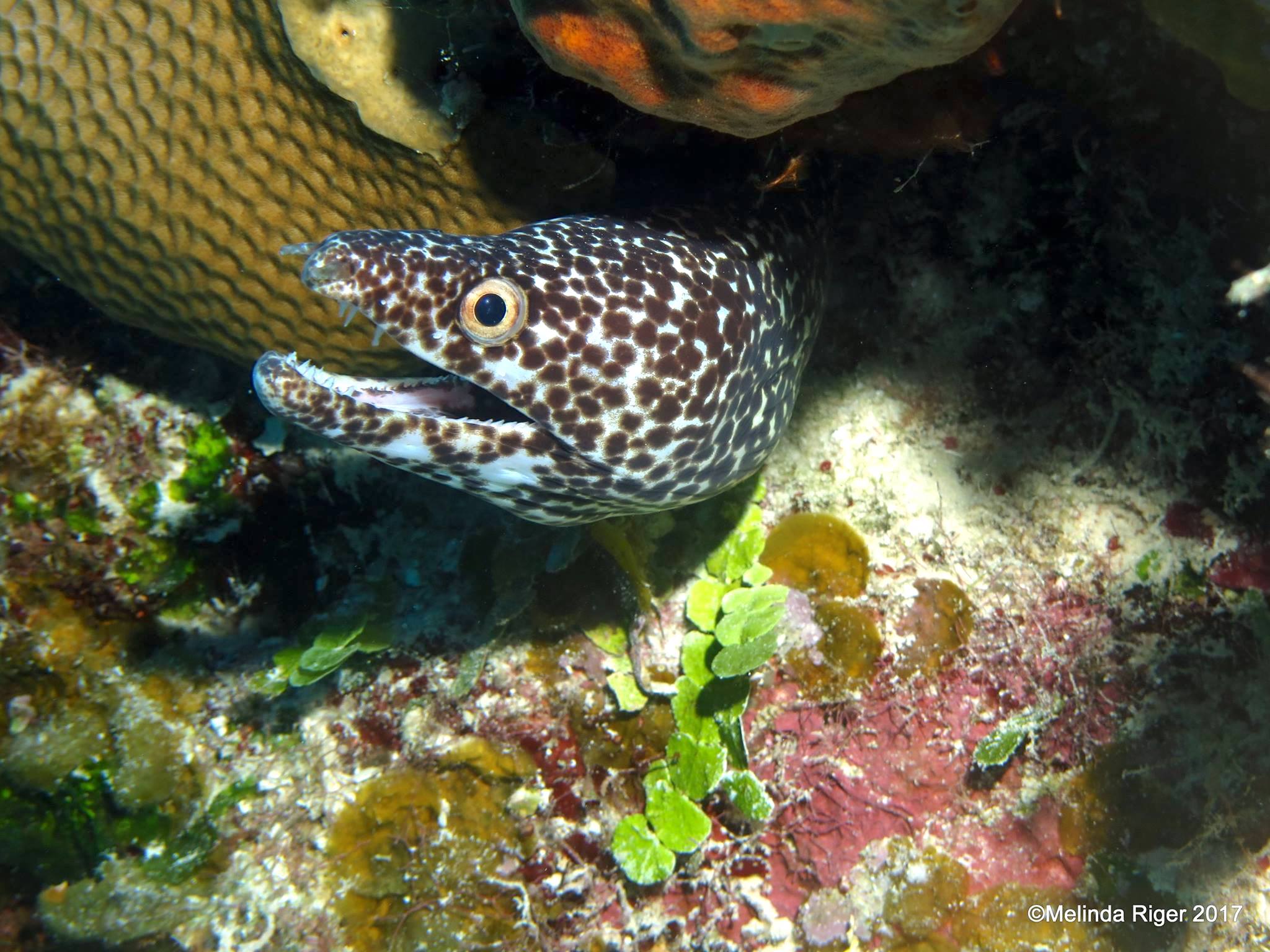
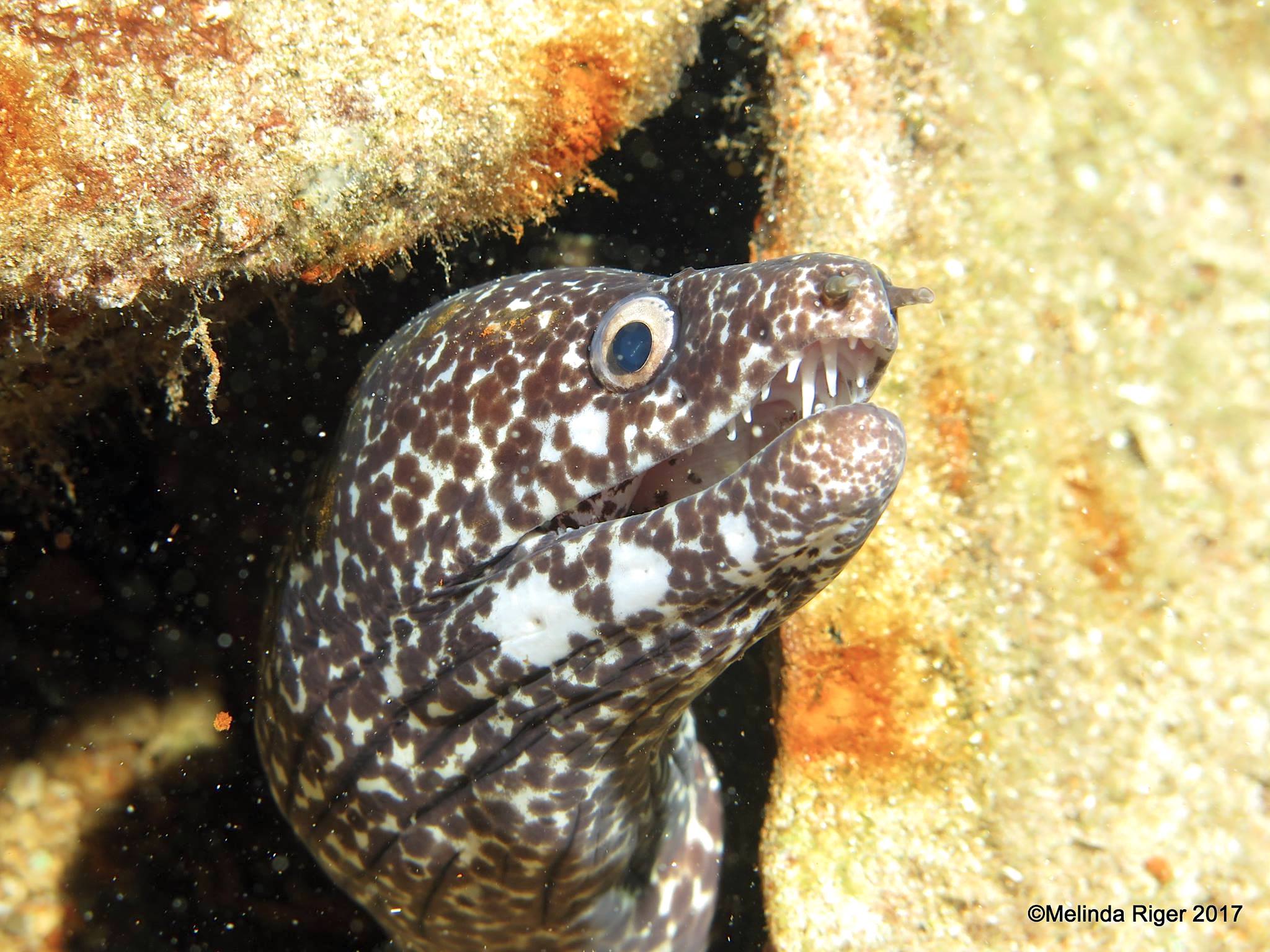
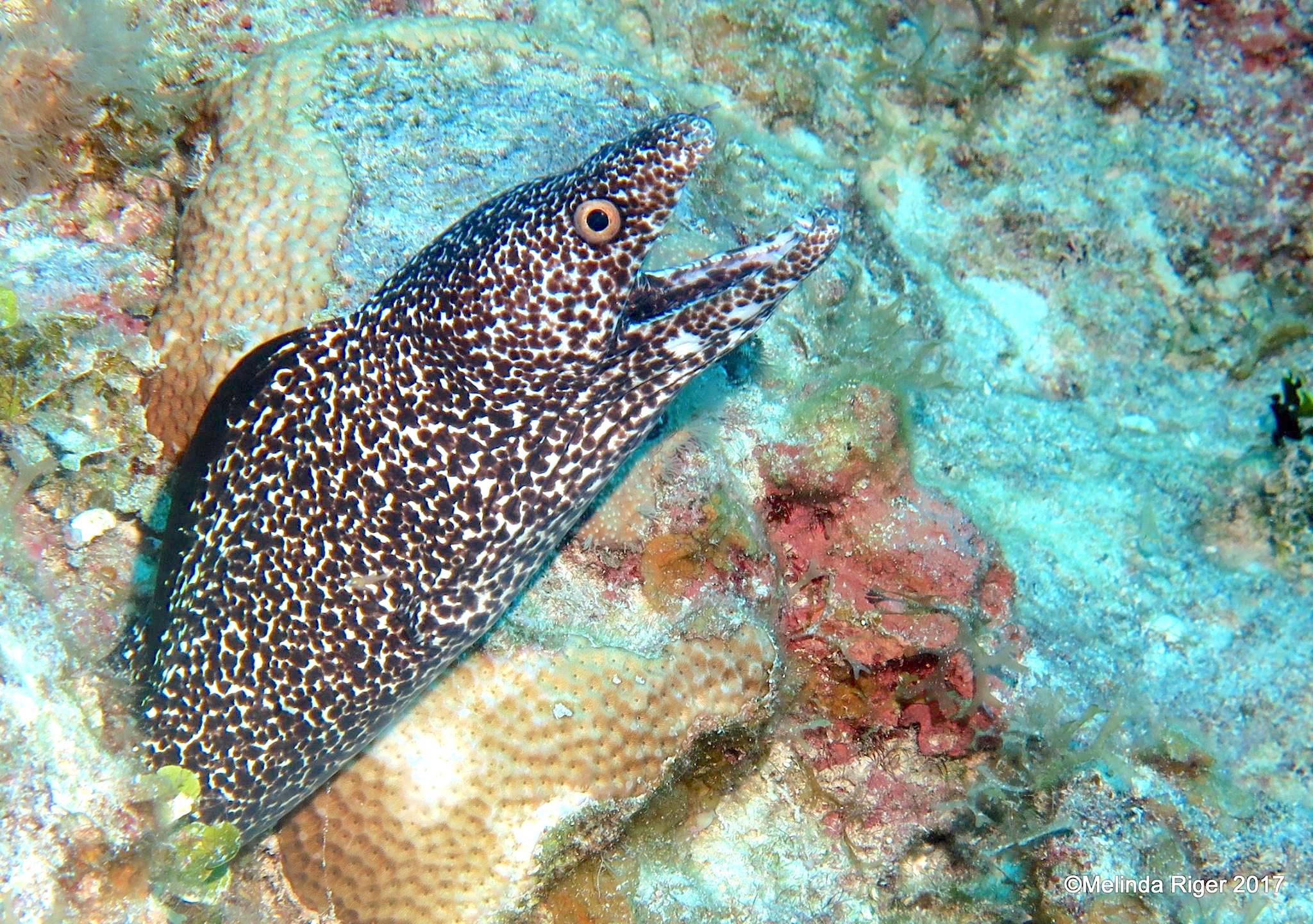
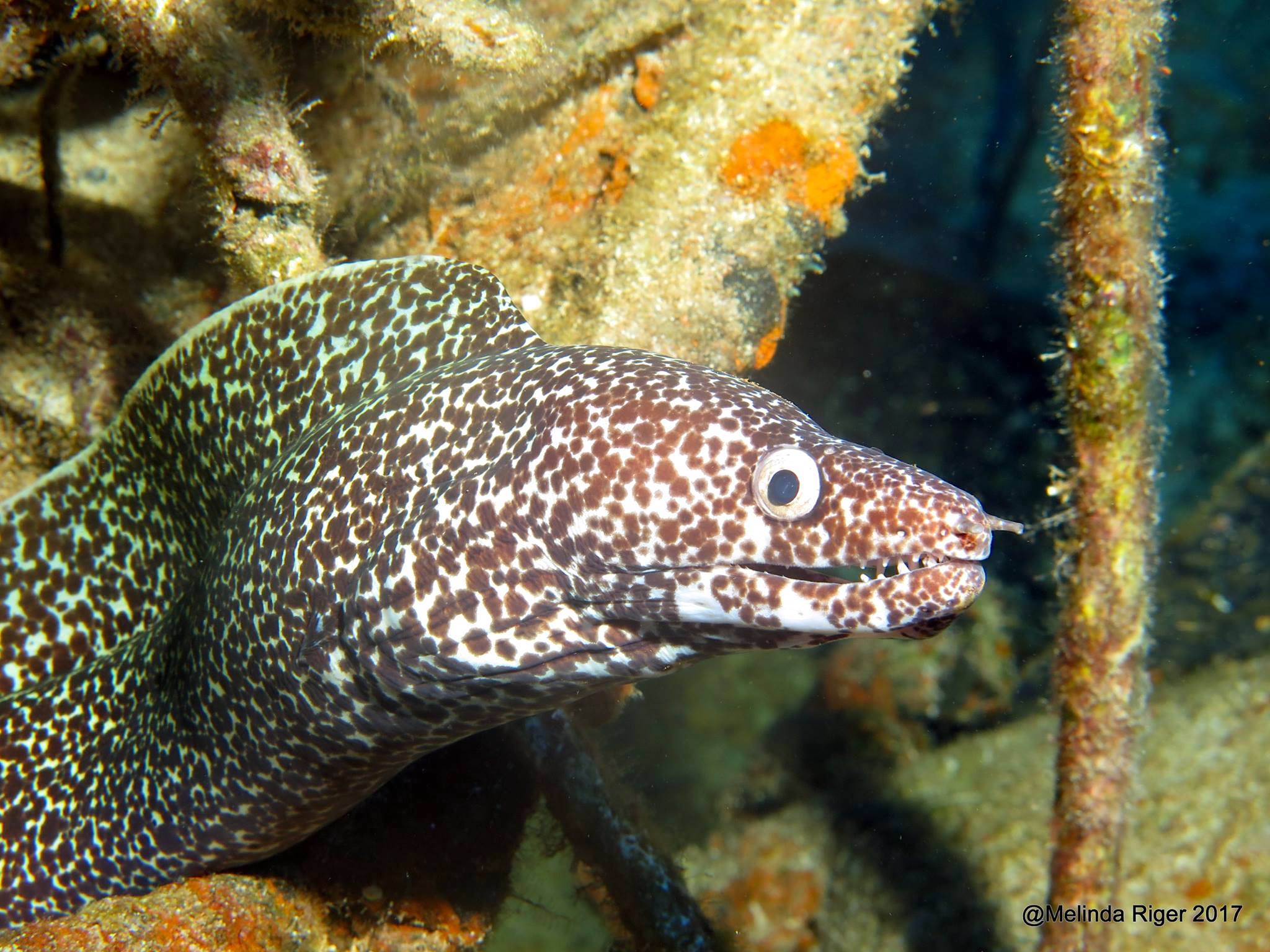
Spotted Moray eels Gymnothorax moringa, however, seem to have their own rules to live by. They appear to be open-minded and fairly sensible creatures around the reef. They tend to keep themselves to themselves, hanging out unassumingly in holes and crevices in the coral.
They do tend to stick their necks out a bit, but unless provoked (see below) they seem to be reasonably amiable (except maybe to the small fish and crustaceans that make up their diet).
They do keep their mouths open a lot, though. And as you can see, they have sharp-looking teeth that you mightn’t want too near to you. I say that because their bite can be dangerous and should be avoided. To start with, the teeth are slightly backward-facing, so that when they bite there is a ‘pull-back’ effect when you react (not unlike a barb on a fish hook). They are not aggressive as such, but they know how to deal with unwanted interference in their lives…
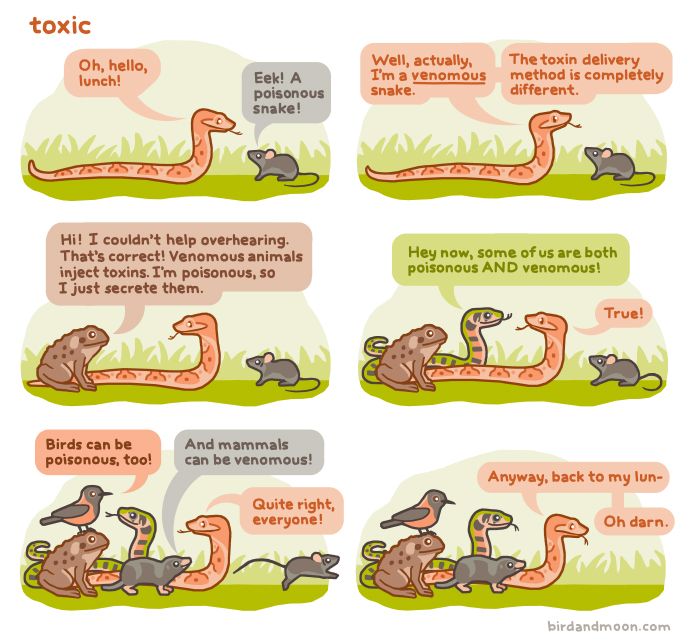
Apart from the unpleasant bite and associated pain that moray eels can inflict in defence, they are also poisonous (as opposed to venomous). Specifically they can release toxins into the wound; and in some species their skin contains toxins as well**. Serious infection may result.
CAN YOU GIVE THE POISONOUS / VENOMOUS DISTINCTION AGAIN
I could, but ace natural history cartoonist Rosemary Mosco makes a better job than I can:
**Before I leave the topic, maybe I ought to mention one bit of research I have just come across at Dove Med, from which I take away the message that you definitely don’t want to annoy a moray eel or get bitten by one. Ever. They are fine and interesting denizens of the reef, to be admired from a respectful distance…
Photo credits: all amazing photos courtesy of Melinda Riger, Grand Bahama Scuba; cute yet educative cartoon by Rosemary Mosco. Check out her website HERE – and birders, she v good on your specialist subject…
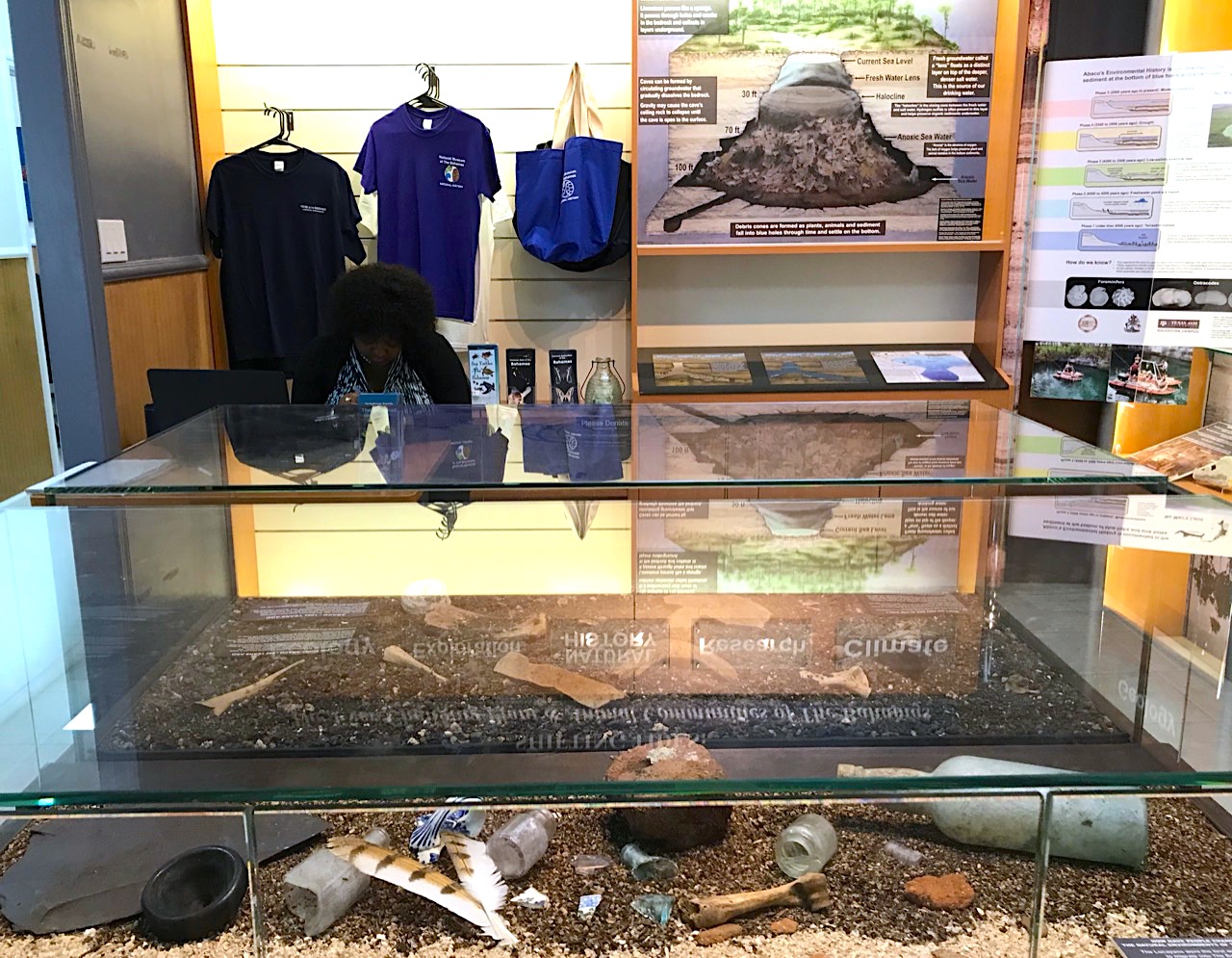
The Abaco Field Office of the AMMC is located at Friends of the Environment in Marsh Harbour. Primarily geared toward the study and research of the natural history and prehistory of The Bahamas, the expanding collection makes a huge contribution to the knowledge and understanding of the environment from both before and after the arrival of people to the archipelago.
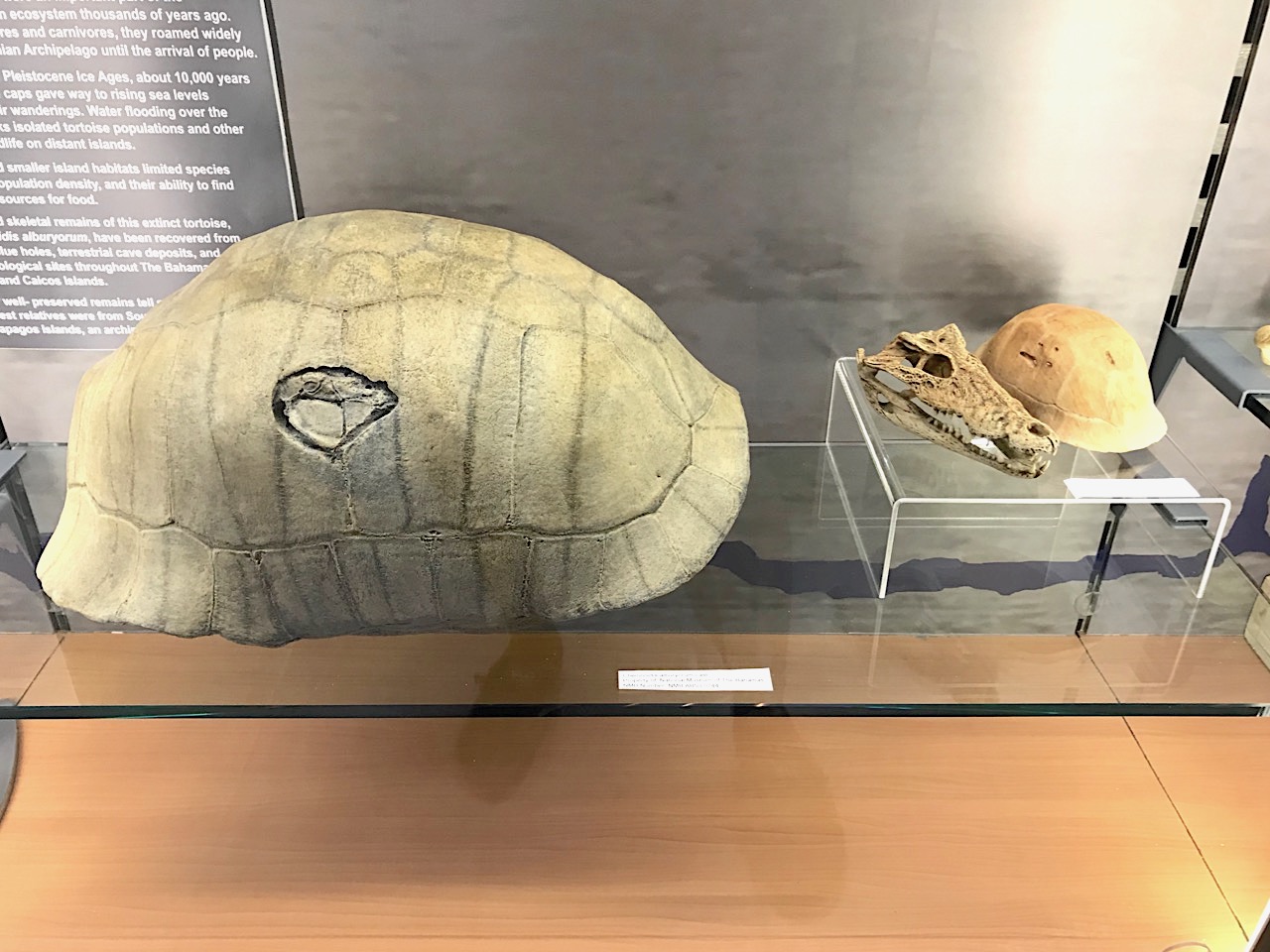
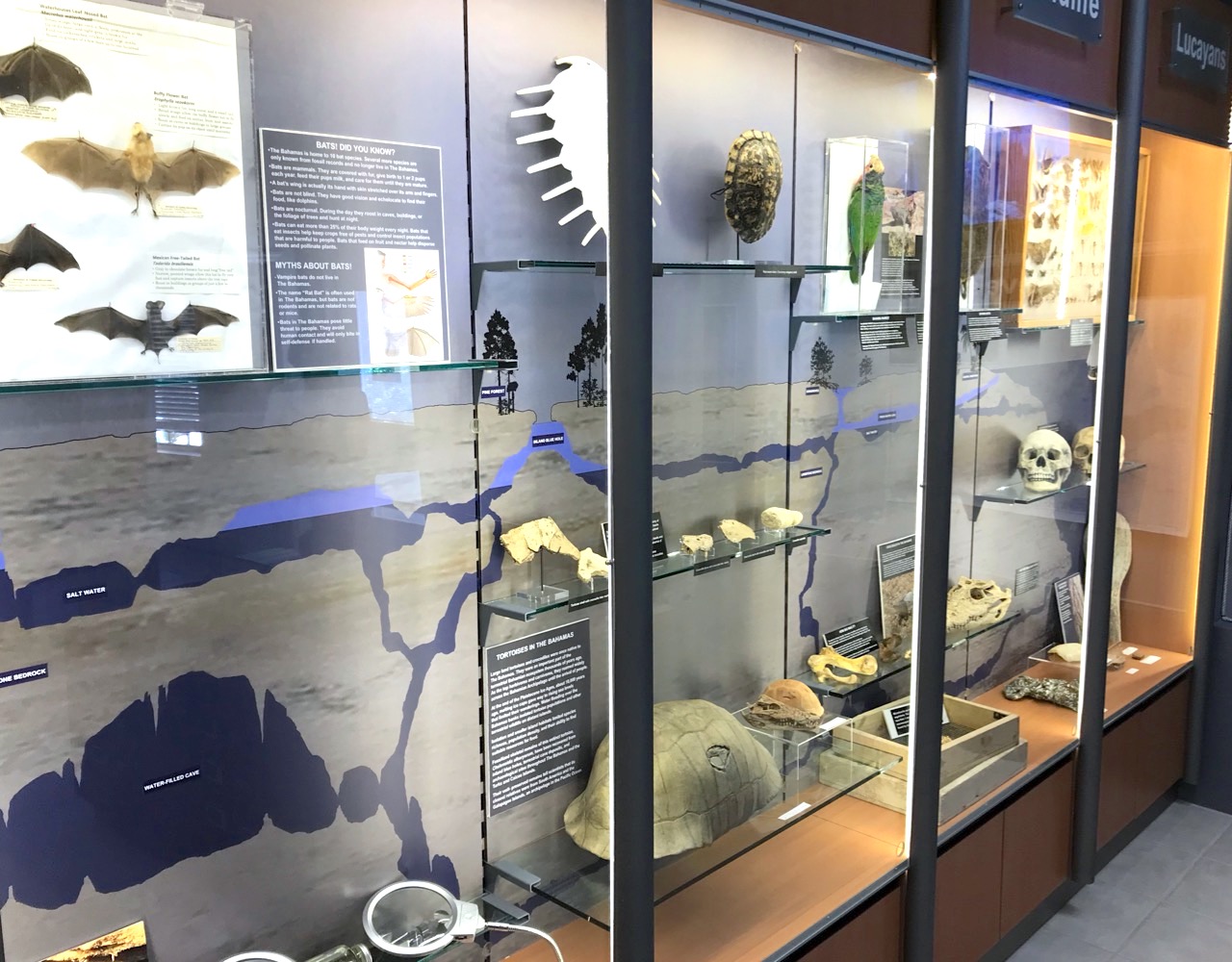
The cases shown below hold carefully labelled exhibits, against a background showing the structure of the cave systems and blue holes of the island. Prehistoric fossils and turtle shells, early lucayan human skulls, a HUTIA(extirpated from Abaco in times past), a deceased parrot, bats, butterflies, and a whole lot more are on display.
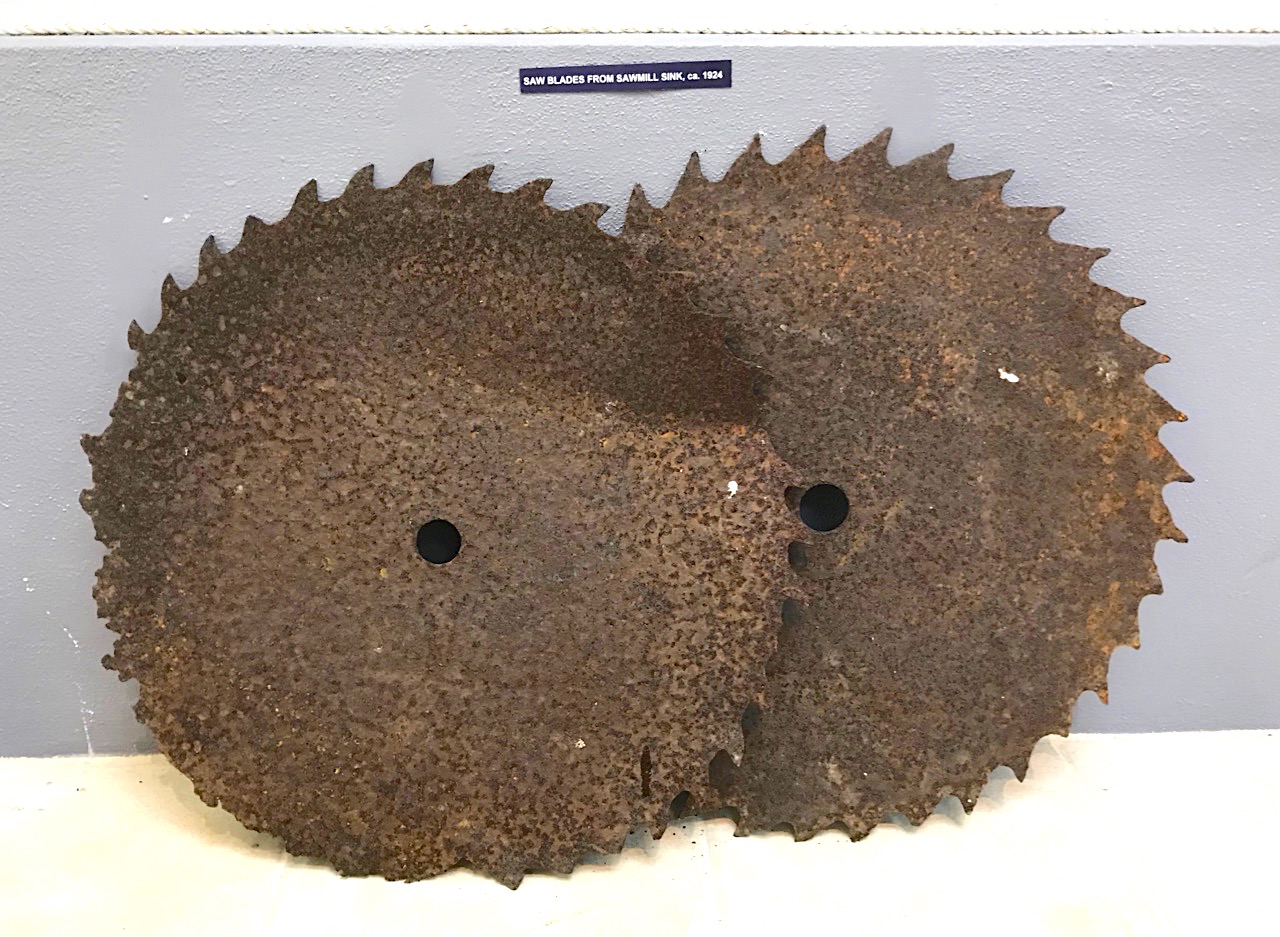
There is even a small reminder of Abaco’s once-thriving logging industry, in the shape of two circular blades from the area around the Sawmill Sink blue hole. For more of the ‘industrial archeology’ at the site (with photos,) check out what was revealed by a still-smouldering forest fireHERE. The activities conducted through the office include site surveys, excavation and documentation, collection, the conservation and curation of artifacts and fossil material, and public outreach. .
Specialised scientific activities include researching the blue holes and cave systems of Abaco. The explorations have discovered the prehistoric remains of now-extinct vertebrate species; geologic anomalies; evidence of prehistoric storm and fluctuating sea levels; and valuable data about the biodiversity of cave-adapted fauna and vegetation.
Dry caves and blue holes also provide evidence the arrival of the first humans that migrated to the Bahamas, beginning with the early Lucayan Amerindians, as well as the plant and animal communities during their initial occupation more than 1000 years ago. One skull (r) demonstrates graphically the effect of the Lucayan practice of (deliberate) cranial deformation.
The Field Office’s collaborative research involves a number of scientific organisations; and the educative outreach includes schools, universities, scientific conferences and public forums. As importantly, the valuable community resource of a first-rate small museum that contains many fascinating exhibits it right there in Marsh Harbour. And it is free to all.
Some of the cave bats of Abaco. In Ralph’s Cave, to this day there’s a fossilised bat entombed forever on the floor of the cave.
The museum is located at the Abaco offices of the AMMC and Friends of the Environment. It is open for viewing during 9am to 5pm, Monday through Friday. There is no admission fee, but donations for exhibit development are gratefully accepted. School groups should call in advance to arrange a tour. LOCATION: just drive up the hill past Maxwell’s, to the junction at the top and turn left. If you want to know about Abaco’s past in the broadest sense, this should be your first stop. You can even ‘get the t-shirt’ to complete the experience and support the institution…
This strange, ill-clad male is either (a) trying to give an authentic traditional Lucayan greeting or (b) trying to high-five Nancy Albury (who is ignoring it) or (c) just behaving bizarrely. I go for (c).
Credits: first and foremost, curator Nancy Albury and her team; Friends of the Environment; AMMC. All photos are mine (with plenty of excuses for poor indoor colour, display glass reflections etc), except the tragically entombed cave-bat in the bat-cave from well-known diving and cave-system exploration expert Brian Kakuk / Bahamas Cave Research Foundation; and the wonderful photo below of a Barn Owl flying out of a dry cave on Abaco, by kind permission of Nan Woodbury.
Turkey Vultures Cathartes aura [TUVUs, to use their Alpha Bird Code for brevity]are a familiar sight flying over Abaco, wheeling effortlessly overhead on thermals or gliding with the wind in singles, pairs, or flocks. Statistically, 83% of all photographs of turkey vultures are taken from below and look like this:
A very good cameraman with a very good camera and very good luck might catch this
Of in-flight shots, 57% are taken in unhelpful light or conditions, and look like the image below (mea maxima culpa). On a positive note, this picture shows the extreme delicacy of the wing-tip feathering (starboard wing, anyway) that enables these birds to adjust their direction and speed with minimal effort.
TUVUs have a wide range in the Americas and the Caribbean, and will prosper in almost any type of habitat. This is mainly because these large birds are almost exclusively carrion feeders, and carrion is everywhere. They spend their days scavenging, or thinking about scavenging, or recalling successful locations to re-scavenge. They do not generally kill live creatures.
The word ‘vulture’ derives from the latin word ‘vulturus‘ meaning ‘ripper’, ‘shredder’, or in more recent times, ‘very loud Metallica song*‘. TUVUs have very good eyesight, and an acute sense of smell that enables them to detect from a considerable distance the scent of decay and consequent release of the chemical ethyl mercaptan. The smell is variously described as ‘persistent penetrating decayed cabbage’ or a ‘pungent malodorous skunk-like odour’. A breeding pair will raise two chicks, which revoltingly are fed by the regurgitation of all the rank and foul… excuse me a moment while I… I feel a little bit… ~~~~~~~~~~~ …alright, fine again now.
When they are not flying, feeding, breeding or nourishing their young, TUVUs like best to perch on a vantage point – a utility post is ideal. But unusually for a bird, you won’t ever hear them sing or call. They lack aSYRINX(the avian equivalent of a larynx), and their vocalisation is confined to grunting or hissing sounds. Here’s a single hiss (at 10 / 15 secs).
These vultures are often seen in a spread-winged stance, which has several functions that include drying the wings, warming the body, and baking bacteria. Possibly it also reduces the miasma of rotting meat that may surround them after a good meal.
Equally happy to spread their wings on a debris-strewn shoreline
10 SCAVENGED TURKEY VULTURE FACTS FOR YOU TO PICK OVER
One local name for a TUVU is ‘John Crow’
An adult has a wingspan of up to 6 feet
Sexes are identical in appearance, although the female is slightly larger
The eye has a single row of eyelashes on the upper lid and two on the lower lid
TUVUs live about 20 years. One named Nero had a confirmed age of 37
LEUCISTIC (pale, often mistakenly called “albino”) variants are sometimes seen
The TUVU is gregarious and roosts in large community groups
The TUVU has few natural predators
Though elegant in flight, they are ungainly on the ground and in take-off
The nostrils are not divided by a septum, but are perforated – from the side one can see through the beak [some humans also suffer from this condition. They tend to ‘sniff’ a lot]
REVOLTING CORNER / DEPT OF ‘WAY TOO MUCH INFORMATION’
SQUEAMISH? THEN LOOK AWAY NOW
UNATTRACTIVE HABITS The Turkey Vulture“often defecates on its own legs, using the evaporation of the water in the feces and/or urine to cool itself, a process known asUROHIDROSIS.This cools the blood vessels in the unfeathered tarsi and feet, and causes white uric acid to streak the legs”. The droppings produced by Turkey Vultures can harm or kill trees and other vegetation. Maybe don’t park your nice car under one of their perching posts…
HORRIBLE DEFENCES The main form of defence is“regurgitating semi-digested meat, a foul-smelling substance which deters most creatures intent on raiding a vulture nest. It will also sting if the predator is close enough to get the vomit in its face or eyes. In some cases, the vulture must rid its crop of a heavy, undigested meal in order to take flight to flee from a potential predator”
DIETARY NOTES TUVUs tend to prefer recently dead creatures, avoiding carcasses that have reached the point of putrefaction. They will occasionally resort to vegetable matter – plants and fruit (you could view this as their side-salad). They rarely, if ever, kill prey – vehicles do this for them, and you’ll often see them on roadsides feeding on roadkill. They also hang around water, feeding on dead fish or fish stranded in shallow water.
ECO-USES If you did not have birds like this, your world would be a great deal smellier and less pleasant place, with higher chance of diseases from polluted water and bacterial spread. TUVUs kept the highways clear and work their way round the town dumps recycling noisome items.
FORAGING TUVUs forage by smell, which is uncommon in birds. They fly low to the ground to pick up the scent of ethyl mercaptan, a gas produced by the beginnings of decay in dead animals. Their olfactory lobe in the brain is particularly large compared to that of other animals.
SEX TIPS Courtship rituals of the Turkey Vulture involve several individuals gathering in a circle, where they perform hopping movements around the perimeter of the circle with wings partially spread. In humans, similar occasions are called ‘Dances’. A pair will fly, with the female closely following the male while they flap & dive… then they land somewhere private and we draw the veil…
My favourite graphic of all time
Credits: Nina Henry (1); Bruce Hallett (2); Keith Salvesen (3, 4, 5, 11); Clare Latimer (4, 6); amy-at-poweredbybirds (7); Wiki, small pics 8, 9); Charlie Skinner (10); Craig Nash (12); Xeno-Canto / Alvaric (sound file); Info, magpie pickings; Birdorable (cartoon); RH (Keep Calm…); depressingnature.com (puking TUVU)
*As Metallica so appropriately wrote and sweatily sang (luckily there’s no verse referencing urination, defecation and puking). ALERT don’t actually play the video – the song hasn’t aged well! In fact… it’s terrible. Woe woe indeed…
The vultures come See the vultures come for me Fly around the sun But now too late for me Just sit and stare Wait ’til I hit the ground Little vultures tear Little vultures tear at flesh
Warts and all… the gorgeous, hygienic, roadkill-ridding vulture, with a few dirty habits
Pliny the Elder (CE 23–79) was one of the earliest naturalists, besides being a philosopher, author and military commander. He wroteNaturalis Historia(Natural History), a wide-ranging work that became a model for later scholarly works, including forms of Encyclopedia. And, as he so nearly wrote, ‘si non amas testudines, vacua anima tua est’ (he that loves not sea turtles, has an empty mind)*.
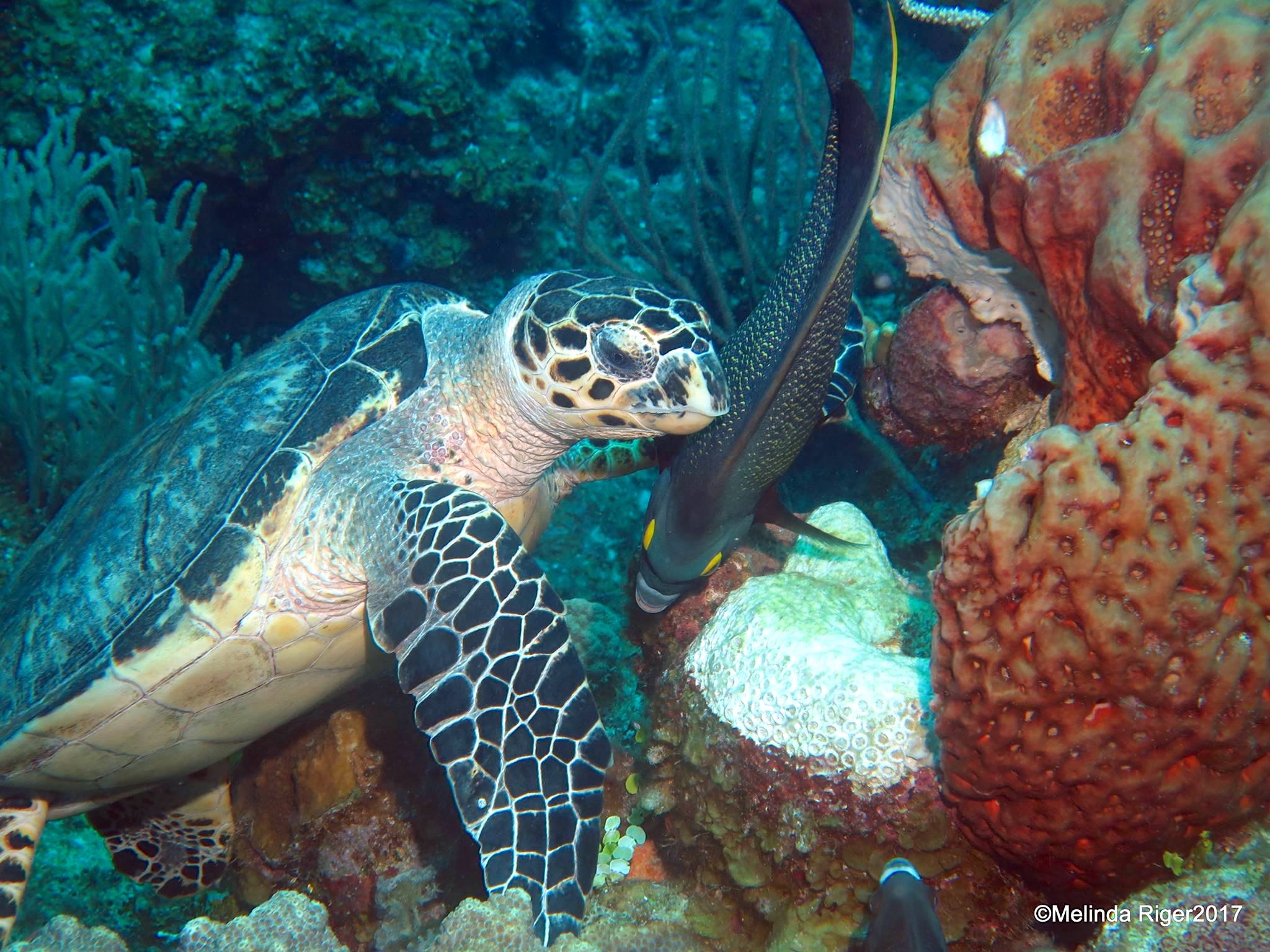
Hawksbill turtle grazing while a French angelfish looks on
There can be few better ways to start the New Year than with some gorgeous Hawksbill Turtles Eretmochelys imbricata, plus a sprinkling of turtle facts to give 2019 a good push into orbit. Fortunately still available in Bahamas waters, the continued existence of Hawksbills is under serious threat. Make the most of your opportunities.
Guesstimates of the world Hawksbill Turtle population suggest that there are 5 main groups in the oceans, with few enough individuals – especially breeding females – to warrant an IUCN listing of the species as critically endangered
I doubt that many will forget that the next IUCN category is… extinct (≠ ‘fun fact’)
The largest Hawksbill colony in the world nests on an island in Queensland Australia
Turtles leave the sea to lay eggs in a hole dug on the beach, before returning to the sea.
The eggs hatch after c60 days… the turtlings emerge and are then on their own
Hawksbills are omnivorous, mainly eating sponges (& immune from sponge toxins)
They also eat sea anemones, mollusks, and jellyfish
Their grazing lifestyle is an important component of a healthy coral reef ecosystem
Though their shells are hard, Hawksbills are prey for sharks, crocodiles, octopuses and “the biggest predator of all, humans“.
Despite international Hawkbill protection and conservation measures, they continue to be illegally hunted – including, in some places, for food.
Their lovely shells – tortoiseshell – are illegally traded for use for ornaments and jewellery
Japan makes its own rules (as with whales) for traditional & no doubt research purposes
‘Tortoiseshell’ is the illegal item most frequently confiscated by custom officials
Reef and beach degradation, development, light pollution (confuses the baby turtles trying to paddle to the sea), ocean pollution / marine debris, and illegal practices are among the greatest dangers to the survival of the species. All are caused, directly or indirectly, by you and indeed me
Credits: wonderful photos by Melinda Riger / Grand Bahama Scuba (1, 2, 5) & Adam Rees / Scuba Works (3, 4, 6); Widecast; Nature Conservancy; OneKind Planet
*Do not believe this – I invented it. The pretentious quote that props up the other stuff, that is – all the rest is true…
BUNTING(S) FOR AN ABACO CHRISTMAS: AN OLD TRADITION
BUNTING /ˈbʌntɪŋ/ (Noun)
[A Christmas gift of a puntastic avian / festive double-meaning]
A small New World songbird of the cardinal subfamily
Flags and other colourful festive decorations
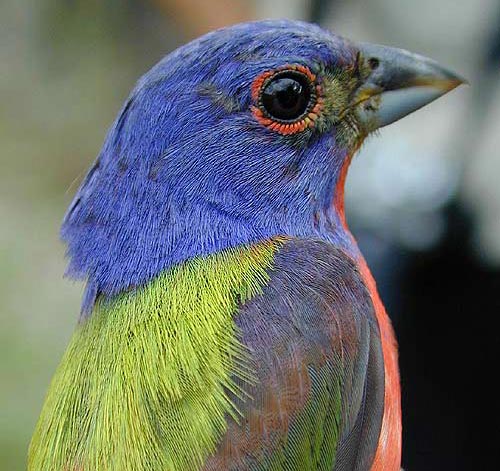
PAINTED BUNTING
One of the Winterval traditions at Rolling Harbour HQ – that haven of unreliable natural science powered by lazy insouciance and characterised by a regrettably unserious approach – is to break the rule that (mostly) forbids reposting old material without good reason (which there occasionally is). This means marking the imminence of Christmas with bunting. And indeed buntings, those lovely birds beautifully painted by nature. Nothing says ‘Happy Christmas’ better than a flock of PABU!
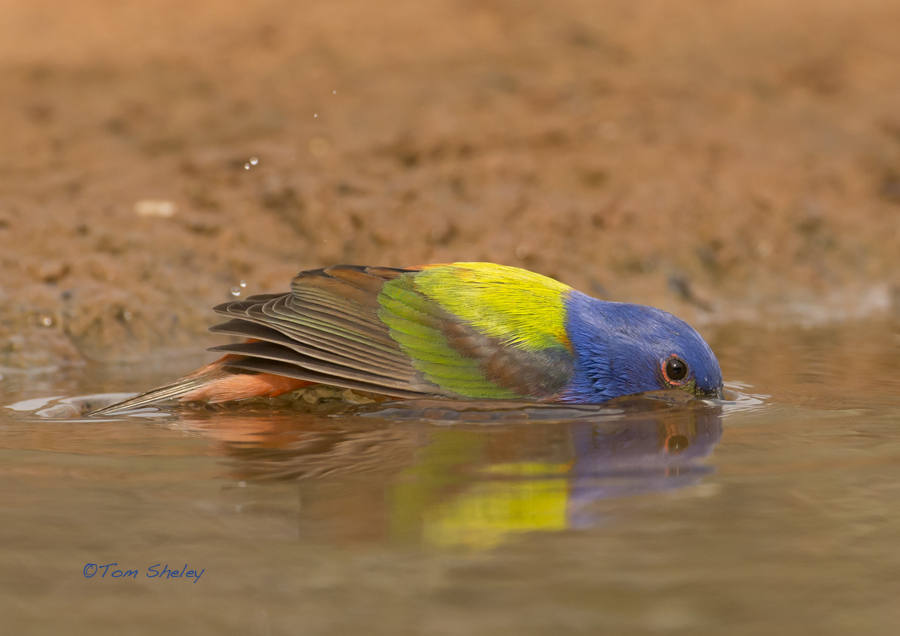
It’s hard to imagine a more Christmassy little bird than the Painted Bunting. Bright blue, red, green primary colours straight from a child’s paintbox make for a spectacular bird to grace the festive season. These are migratory winter residents, and the first reports of the bright and beautiful males on Abaco started to appear in late October. Some will stay around until March.
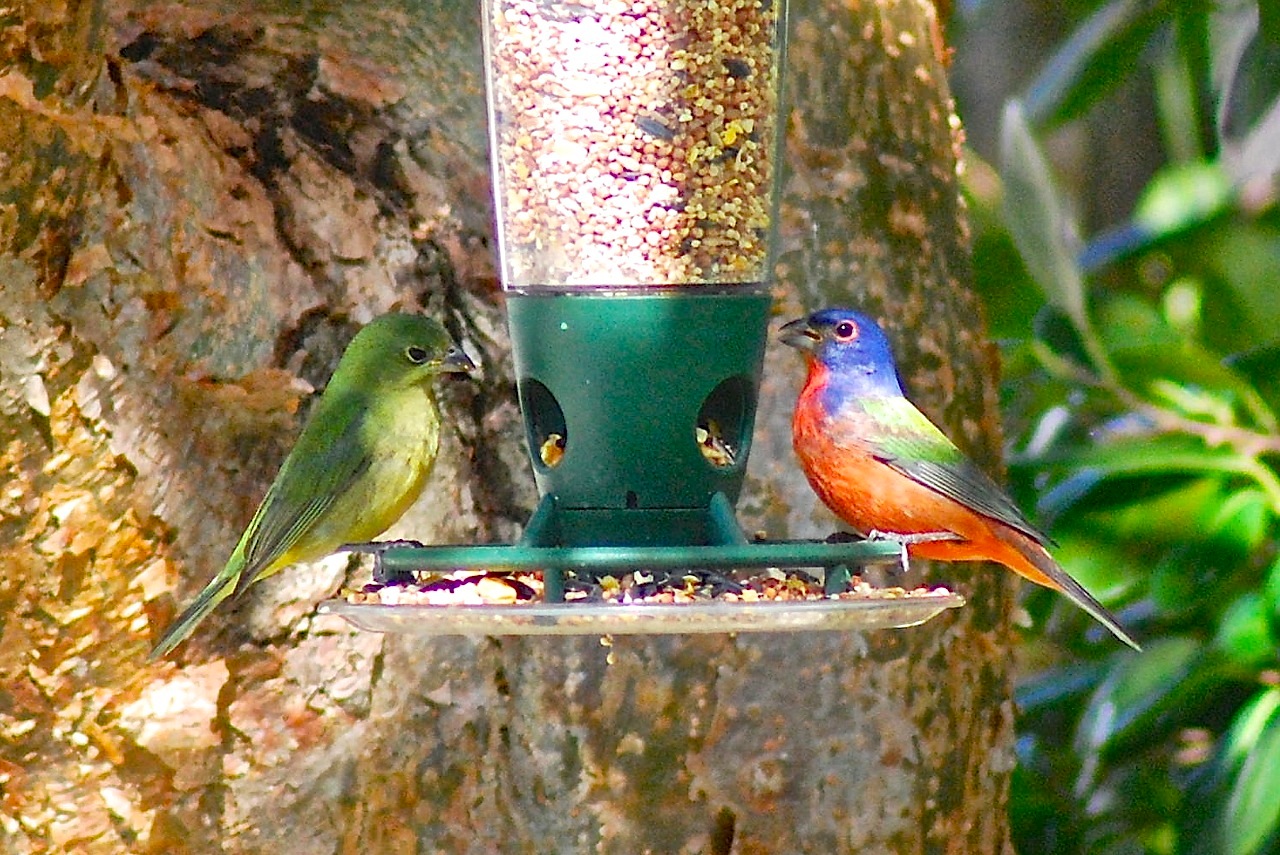
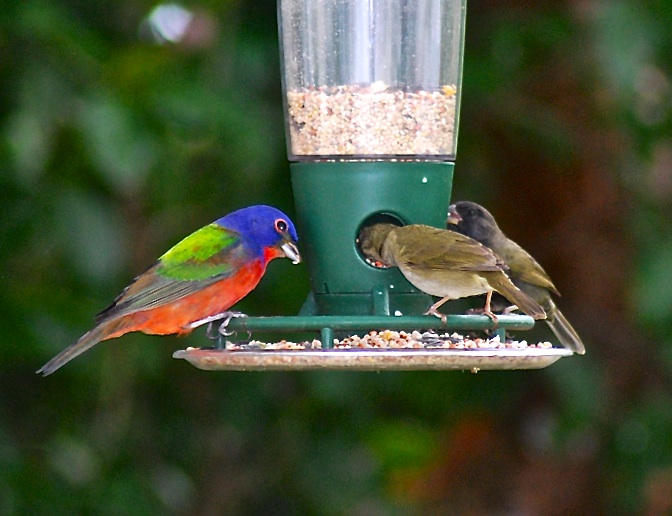
A female & a male PABU feeding together, and a male with a pair of black-faced grassquits
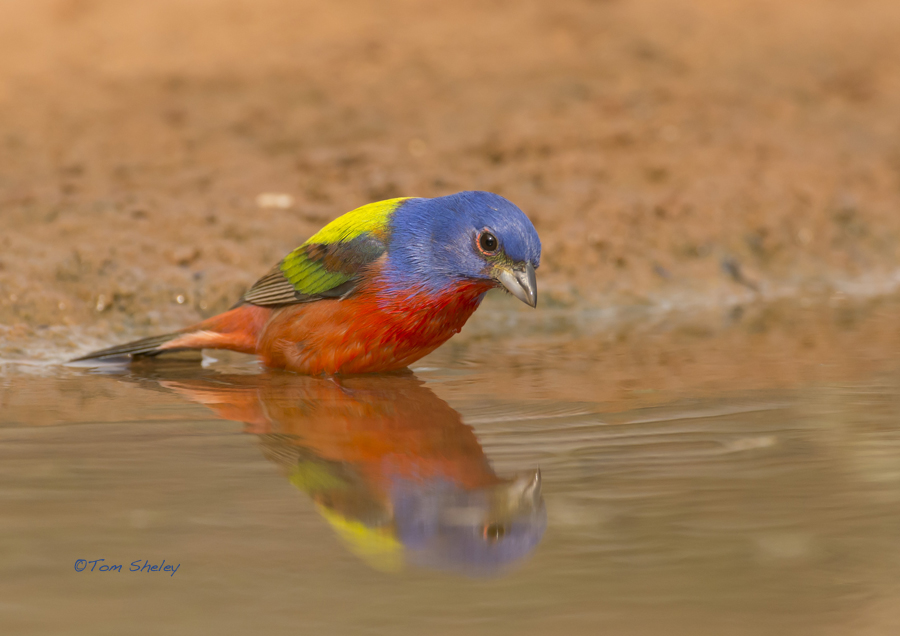
The two wonderful photos below are by Tom Sheley, a major photographic contributor to THE BIRDS OF ABACO. They were actually taken in Texas, but I include them because of Tom’s strong connection with the birdlife of Abaco; and also because they are fantastic shots…
This is my opportunity to wish a very Happy Christmas or [insert preferred seasonal appellation] to everyone who visits Rolling Harbour and especially those who, having done so, return for more! There could of course be anything from 600,000+ individuals who called in once, were put-off and never came back… to one sadly crazed person who has been pressing the ‘read’ button 600,000+ times over the last few years. If the former, thanks for trying, sorry to disappoint. If the latter, keep up the good work, buddy.
Credits: Tom Sheley (1, 7, 8), Erik Gauger (2), Tara Lavallee (3, 4), Keith Salvesen (5); Sandy Walker (6); Birdorable Cartoons
SANDHILL CRANE: ANOTHER NEW BIRD FOR ABACO, BAHAMAS
Still they keep arriving, the new birds that have never before graced the shores of Abaco Recently it was a Canada warbler, at the lower end of the size scale. The elegant sandhill crane (Antigone canadensis) is the 10th new species for Abaco since the publication of The Birds of Abaco in March 2014. If you are wondering why the bird is not called Grus canadensis any longer, it’s because the genus of the bird was reclassified by the ABA in 2016. Out with dreary old Grus and in with exciting Oedipus’s daughter (or was she his half-sister? They… erm… had the same mother… Discuss, using both sides of the exam paper) in Greek mythology…
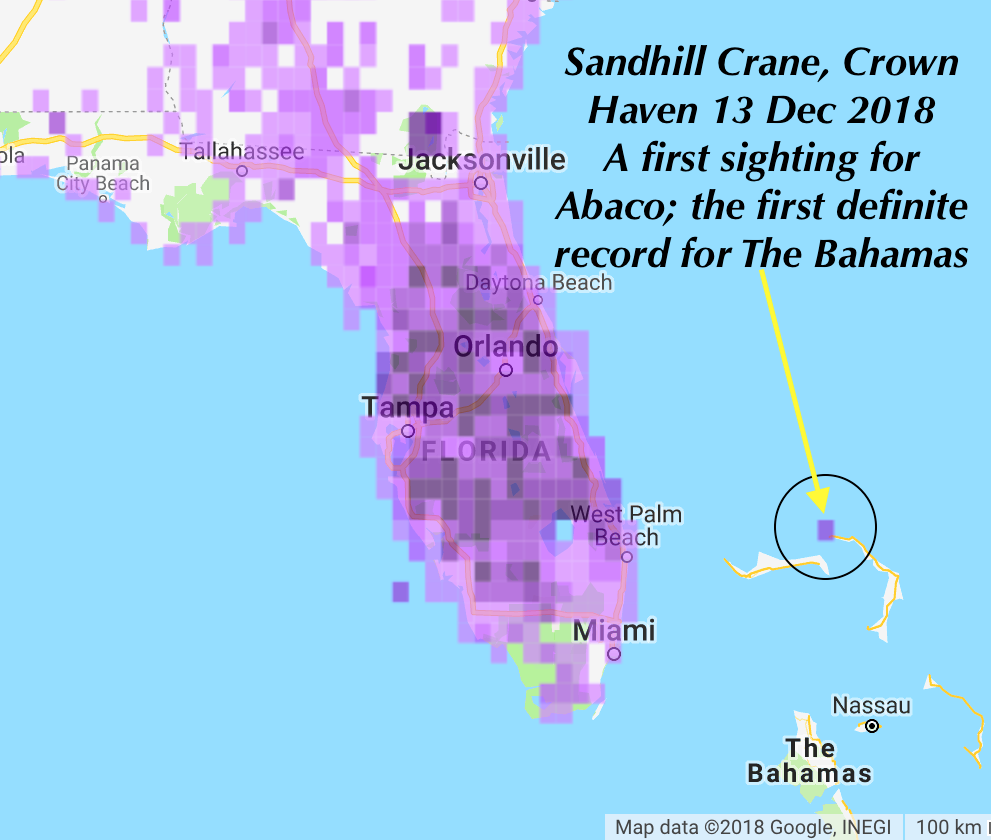
As the crane’s canadensis suggests and as range map shows, these are birds of North America, breeding mainly in Canada. In winter they head south to the warmth, reaching Florida as winter migrants. As you can see, the northern part of Florida and also Cuba have small year-round breeding populations. Zero zilch zip nada in the Bahamas.
THE ABACO SIGHTINGS, DECEMBER 2018
At 9.00 am on December 13, the bird above was photographed by Kaderin Mills (of the Bahamas National Trust) on Little Abaco, at the Fox Town Primary School, Crown Haven. The day before, the 12th, the school Principal Mrs Curry had seen the bird in the school grounds feeding on the grass. A couple of phone ‘sighting shots’ were taken before it flew off. Next day it returned, word spread and Kadie Mills recorded the bird officially and put it on eBird to give the newcomer some due publicity. By the early afternoon, Woody Bracey had been told about the bird, and went to take photos. He saw it in the same place the next day too.
OK, FIRST FOR ABACO – AND THE BAHAMAS TOO?
The strict answer is, no. Many years ago, there was a single report of a Sandhill Crane on Andros. It’s not known if the sighting was officially confirmed, but according to expert Bruce Hallett there was a photograph, and the late Tony White, then ‘recorder’ for the Bahamas, saw it. There are no available records, but Tony’s authority on issues around Bahamas birds was (and remains) absolute.
12 CAREFULLY SELECTED SANDHILL CRANE FACTS
These cranes are social birds, usually living in pairs or in family groups
Their calls are loud and far-reaching, like a huge crows with a sore throat (below)
Mated pairs engage in ‘unison calling’, standing close and duetting amorously
Hatchlings are fully-formed and can leave the nest within a day.
Juveniles are known as colts (whichever their gender, it seems)
They have an impressive wingspan as adults, from about 5′ to 7′ 6″
They are able to soar in flight, using thermals to obtain lift and stay aloft for hours
Flocks of cranes may be huge – sometimes estimated at over 10,000 individuals
Their ancestors are among the oldest fossils of any bird species, at around 2.5 M years
Vagrants have been found as far off piste as Britain (1981, 1991 only), China and Japan
Many predators call them dinner; but they can kick and stab with their bills in defence
The sandhills of Cuba form the smallest breeding population, around 300
(Ian Cruickshank / Xeno Canto)
On the map: Abaco’s first ever sandhill crane
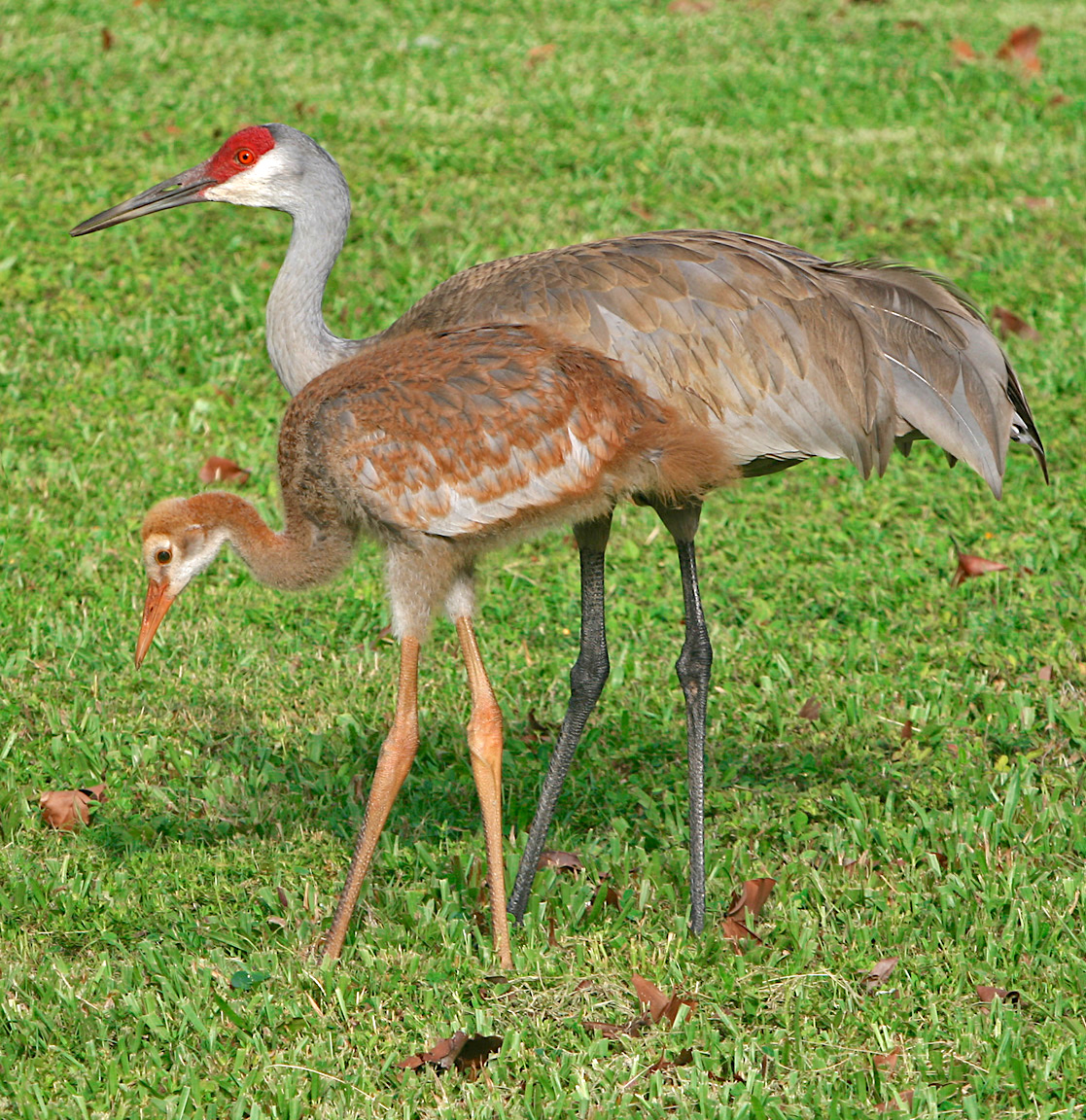
Adult with its cutely ungainly, yellow-legged colt
Credits: firstly, to School Principal Mrs Curry for a truly excellent spot; Kaderin Mills (2) – the 1st usable image; Elwood ‘Woody’ Bracey (1, 3, 4, 6); http://www.birdphotos.com / wiki (5); Cornell (range map); Ian Cruickshank / Xeno Canto (audio); Birdorable (cartoon)
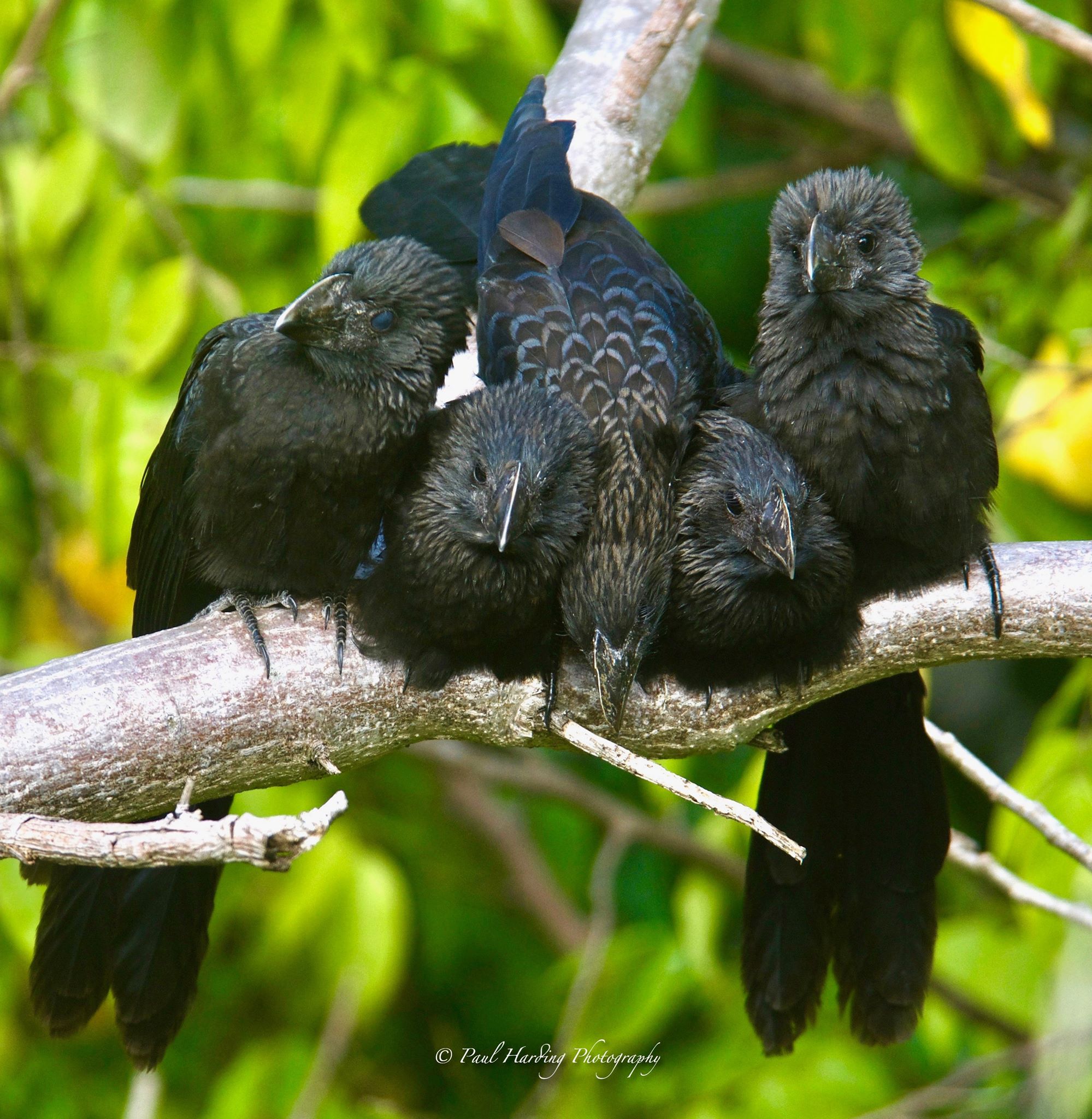
The Smooth-billed Ani (Crotophaga ani) – aka Cemetery Bird – is the third member of the cuckoo family found on Abaco, the others being the MANGROVE CUCKOOand theYELLOW-BILLED CUCKOO. You can (it’s voluntary) find out more about them in an earlier articleHERE.
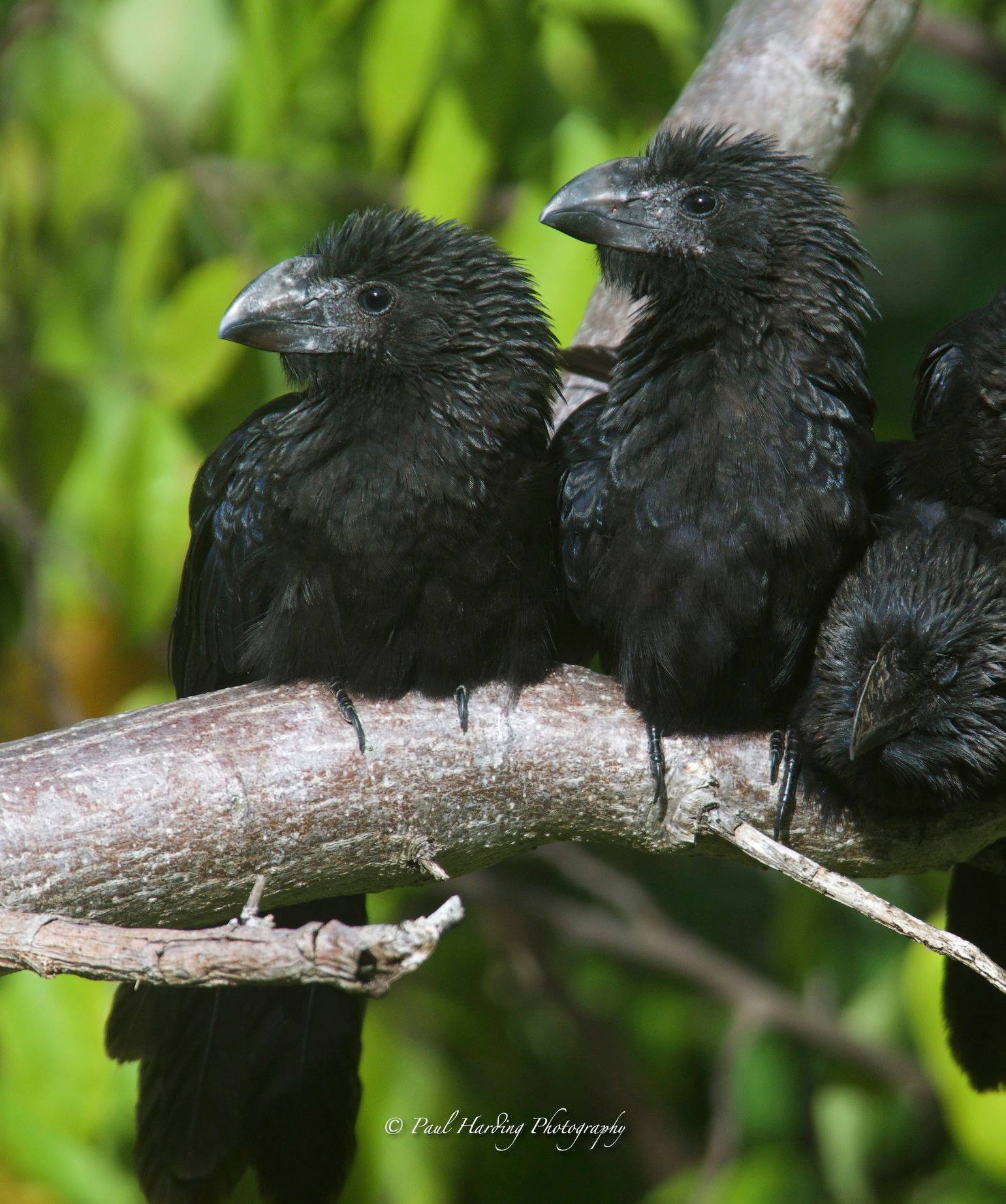
I have returned to these engagingly gregarious birds and their raucous ways because Paul Harding has recently captured a sequence of a small group of anis behaving so endearingly that they are irresistible. Not for them the oddly incompetent fluttering flight, nor the disorganised, unbalanced landing technique. It’s simply a matter of getting settled on a branch, and then making room for one more in the middle (or perhaps resisting it…).
‘A COMMOTION OF ANIS’
There were 4 on the branch…
Hey – make room for another one…
Budge up, guys, I mean C’mon…
Yay, I’m in… a bit squished but…
Um… guys, I can’t breathe…
That’s better… all settled now….
Let the racket begin!
Credits: all terrific pics, Paul Harding; sound files, Xeno Canto
KIRTLAND’S WARBLERS ON ABACO: A FIRST FOR THE CAYS
I last wrote in April about the rare Kirtland’s warbler Setophaga kirtlandii that, in very small isolated numbers, overwinters on Abaco. You can get to the article HERE. You’ll find plenty of information, a range map, notes about the eponymous Mr Kirtland, and lots of good photos (none mine except the joke one – I messed up my one chance out of 4 birds encountered in the National Park). So I won’t go over the ground again…
I’m returning to this near-threatened species now because there has been a very exciting development for Abaco for the KIWA. Towards the end of last month, 2 birds were found over a couple of days at a location on Green Turtle Cay. Having now checked all reported sightings for Abaco since time immemorial (or at least from when eBird began), I believe that this may be the first time a Kirtland’s warbler has been reported on any of the cays. Certainly when we were researching The Birds of Abaco, we found no evidence of KIWA reports from the cays. Sightings are anyway few and far between (not even annual), and mostly on a ‘right place right time a hunch and a large slice of luck’ basis.
The first sighting of the season, on Ocotober 27, was (surprisingly) at Sandy Point, when Woody Bracey took a party of 3 birding for the day. Most KIWA sightings are in south Abaco, with selected areas of the huge National Forest being much the most likely places. There were in fact 2 birds seen – here’s a photograph of one of them. Sandy Point was an unexpected location, but they were on the mainland and in the south – a great ‘get’ by any standards, but not unique for the area.
AN EXCITING SIGHTING
On November 22 at 08.30, Sally Chisholm was birdwatching on GTC when she suddenly came across an unmistakeable KIWA, seeing it closely and clearly: “gray back with dark striping, gray head with white broken eye ring, pale yellow breast with small dark spots”. It was pumping its tail (‘tail-wagging’ J. Bond) characteristically, and eating the berries from a palm tree (see header image). Sally heard its repeated “chip” call, typical of the KIWA. Furthermore, a second bird was returning the call, though she could not see it.
KIWA CHIP CALL Paul Driver / Xeno Canto
Two days later, in the early morning on November 24, Sally returned to the same location and saw a single bird, clearly one (or perhaps the other) of the two birds already seen / heard. She got a fine clear shot this time, too.
I’m not by any stretch of the imagination a Kirtland’s expert (not even a bird expert, if I’m honest). The photos seem to me to show a young bird (compared with ones I have seen) and I wonder if they are juvenile adults (as it were) on their first migration from the jack pines of Michigan. Comments on this remark invited and welcomed… No matter: the great thing is that, whatever the age of the bird, photo #1 is, as far as I can tell, the first visual confirmation of a KIWA sighting on an Abaco cay. It’s a privilege to be able to give it a wider audience.
WHAT ARE THE MAIN THREATS TO THE SPECIES?
Mankind is the primary threat. The breeding areas are particularly vulnerable from deforestation and clearance of the jack pines that are essential for successful nesting and breeding – and therefore the survival of the species
Encroachment of development is another threat, as with so many species
There is a further threat of nest parasitism by brown-headed cowbirds, to which KIWAs are especially vulnerable
In the winter grounds where the habitat is mostly remote or in protected areas, there is rather less of a problem from these factors – for now at least
Overall, habitat degradation at one end of the migration – in particular the breeding grounds – poses a serious risk; at both ends, extinction could loom again. Check out the very limited range of the KIWA and you’ll see the point at once
Credits: Sally Chisholm (1, 2, 4, 5) with special thanks for use permission for her terrific photos; Rodger Neilson (3); Paul Driver / Xeno Canto, sound file; Birdorable, cartoon; Usual (range map); BPS (stamp)
It is axiomatic that people tend towards birding – if at all – in later life. Not the scientists, of course: they must commit themselves to the study of natural history at an early age, collecting qualifications by degrees (as it were), through Masters, Field Work, their first posts, PhDs and beyond.
American Redstart (m)
I didn’t take a very active interest in birds until the first time I investigated Central Park NYC and saw a blue jay. Followed by a cardinal… a red-tailed hawk… chickadees… American robins (or ‘Mercan rubbins‘, as I was informed). These were alien species for a European, and they awoke my interest.
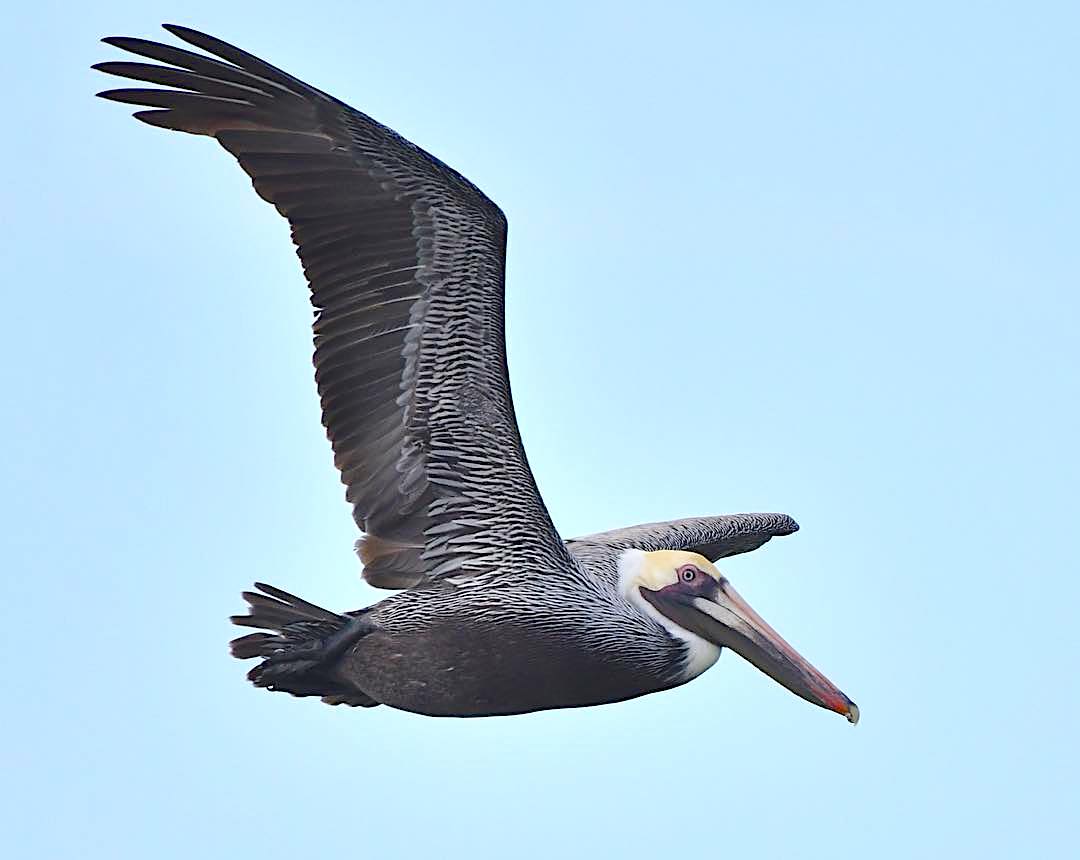
Brown Pelican
On later trips to NYC I have always spent a day in CP, wandering from end to end, spending time in the hotspots like The Ramble, the JO Reservoir, and the pretty Loch trail to the north, and wondering at the huge and expensive birding hardware toted by those around me (while knowing I didn’t want it). And then a visit to Prospect Park Brooklyn too, if I have the time. More recently came Abaco, and a whole new world of wildlife that has captivated me…
Hermit Thrush
This reminiscence by an oldster brings me to Chris Johnson, a young Bahamian man who will be familiar to many readers of this blog. I first encountered him when I was researching the Bahama Oriole and discovered that he, in his early teens, had found one on a trip to Andros and photographed it. It was a pleasure to be able to include the image in my article.
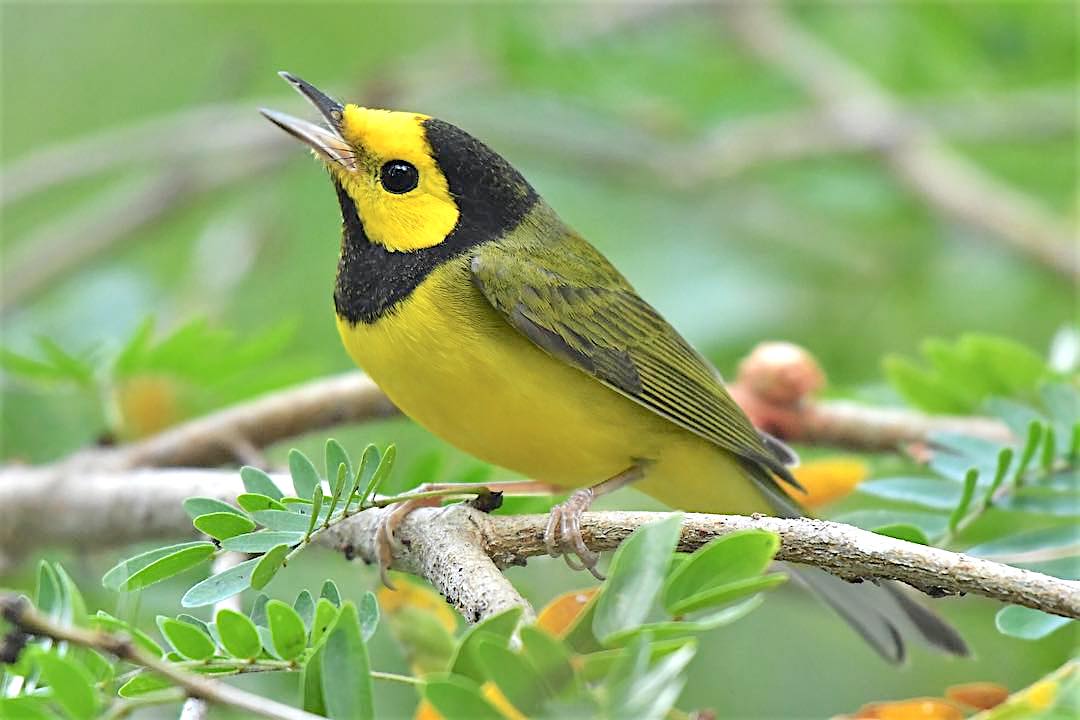
Hooded Warbler
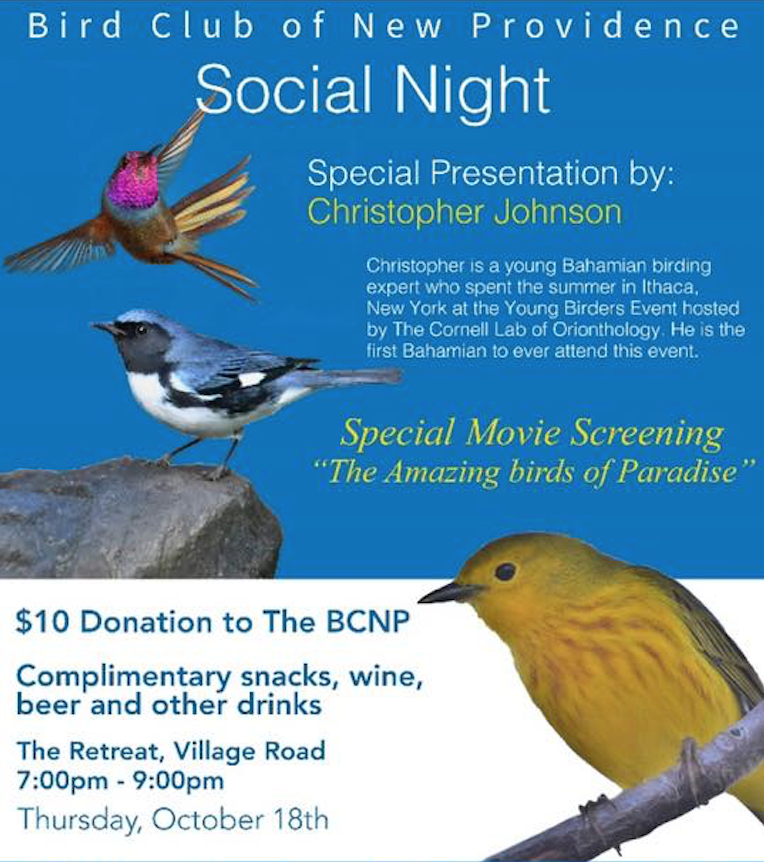
Since then, Chris’s birding and photographic skills have rapidly developed and his reputation is growing too. This summer he was one of 12 students chosen to attend Cornell University Lab of Ornithology for their Young Birder’s Event in Ithaca NY, a great tribute to his accomplishments and a wonderful opportunity too. It is worth noting that Chris is the first Bahamian to be invited to attend this event.
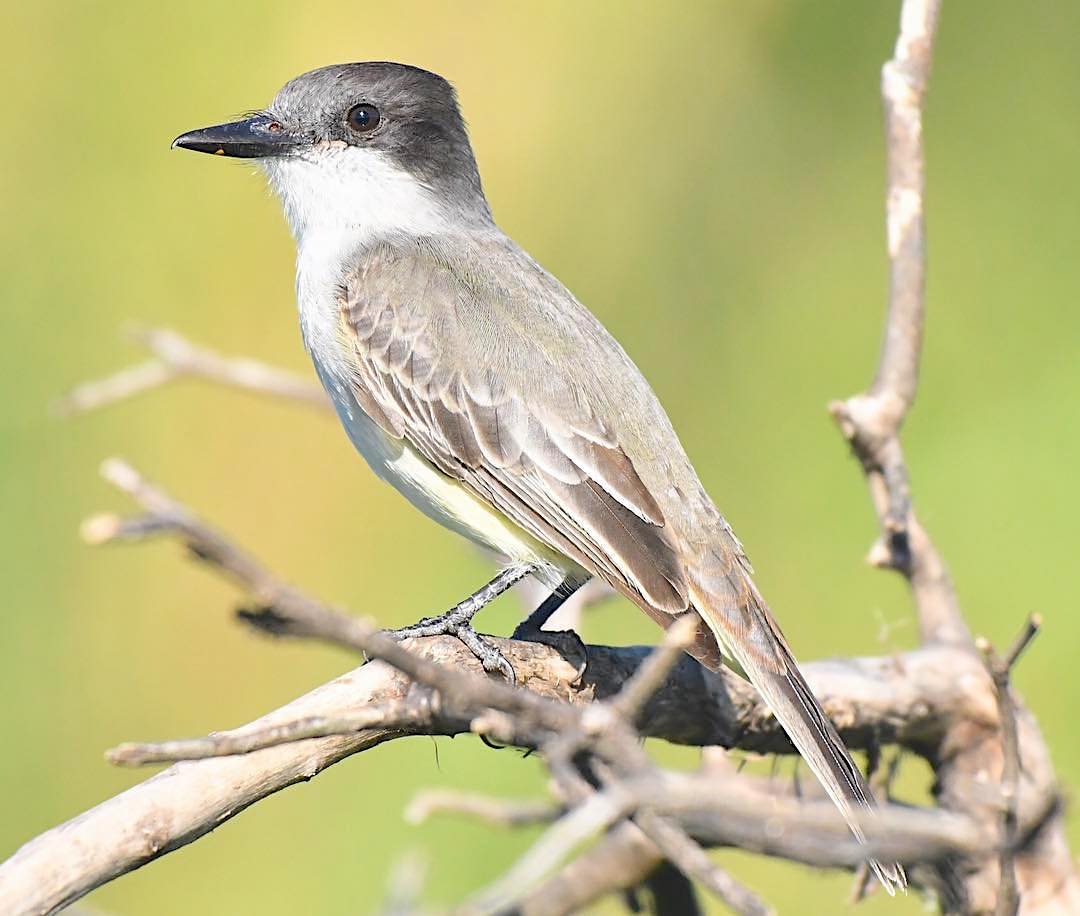
Loggerhead Kingbird
Chris is also beginning to make his own presentations, as he did recently to the Bird Club of New Providence. It won’t be long before he is leading bird groups – in fact, he is probably doing this already.
Another impressive feature of Chris’s birding is his photography. I have watched the progression online with interest. The crispness of his images, the composition and the right ‘take’ to make the best of each bird is wonderful, and he has a great eye for a neat shot – for example in the header image I have chosen, with its awareness of the effective use of dark and light.
Black-and-white Warbler
I should say that I have never met Chris, although we have occasionally been in touch. I am featuring him because I believe he and other young people of his age – Chris is 17 – are the future for birding, for wildlife, for species protection and for habitat conservation. The older generation will move on and the ‘middles’ may begin to take an interest in the birds around them. But Chris’s generation are the ones who can make a difference in the future. As things stand right now, they may have to. It’s a huge responsibility for them, but it’s one our generation is in the process of transferring to them.
Red-legged Thrush
I hope you have enjoyed the small gallery of Chris’s photographs displayed here. If you are interested in the birds of the Bahamas, keep an eye on him and others like him. They need all the encouragement we can give them.
All photos: Chris Johnson, with thanks for use permission. Please do not ‘borrow’ any of these images without asking first. That would only be fair.
ABACO BALD EAGLE(S): AN EYRIE COINCIDENCE (GEDDIT?)
I absolutely knew this would happen. In a sense, I rather wanted it to happen. And now it has, and I have got my comeuppance. Bigly. Hugely. No sooner had I pressed ‘send‘ on my post 2 days ago bemoaning the absence of bald eagles in 2018 than corrections began to come in.
Harsh Judgemental Reader: “Do you mean you were wrong?”
Contrite Writer: “Yes.”
HJR: “Did you check eBird before you fired off your intemperate post?”
CW (in a small apologetic voice): “No.”
HJR: Well then, what have you got to say for yourself?”
CW (*hangs head*): I’m very sorry, everyone. I’ll try to do better this time. Here goes:”
THE ABACO BALD EAGLE(S) OF 2018: IN NO WAY AWOL!
SIGHTING ONE
On October 25th legendary Bahamas birder Elwood Bracey and a party of 4 were looking out over the Marls from Sunset Ridge when they saw 4 birds flying high. Two were unmistakably turkey vultures; one was a magnificent frigatebird (ie totally non-eagle-ish); and the fourth was much larger, looking like a juvenile bald eagle. Any remaining doubts were dispelled when it dropped into a steep dive and smashed into the water, catching a fish in its talons, much like an osprey. There’s no room for confusion here: Woody has vast experience on Abaco and beyond – and besides, he had a powerful spotting scope and 4 birding witnesses. The ID is, as they say, solid. And it was posted on eBird. Which I should have checked. But didn’t. As Julia Roberts (qua Vivian Ward) actually did say, “Big Mistake. Huge!“
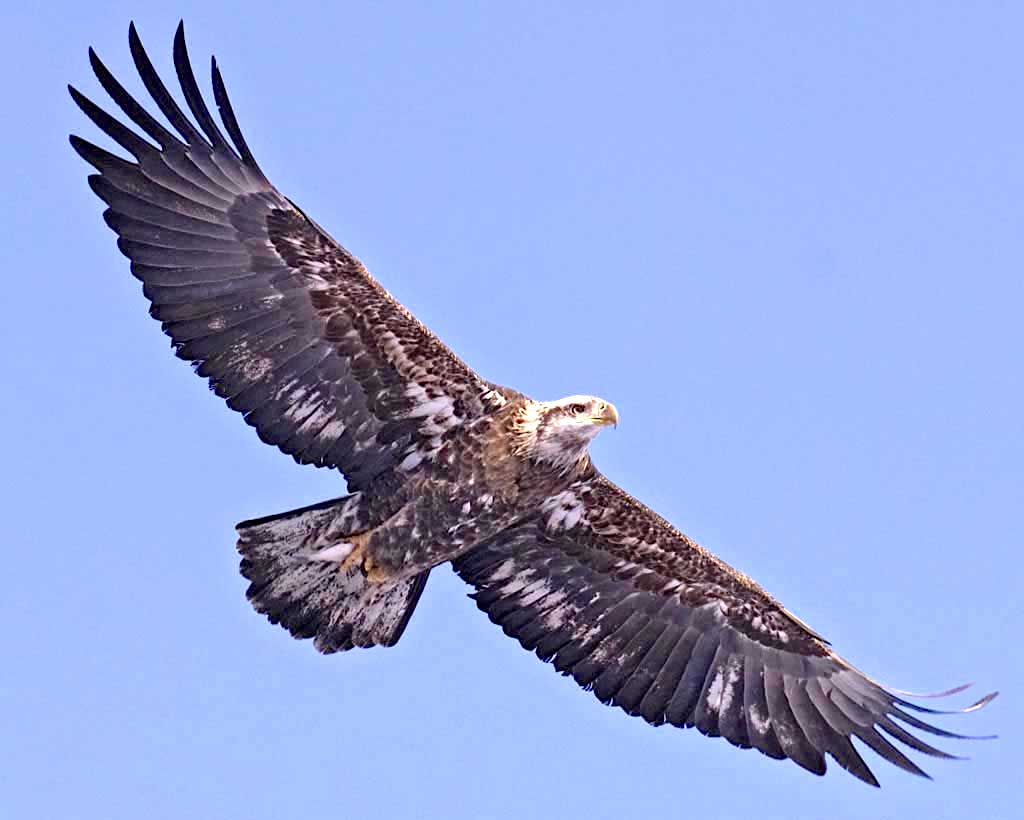
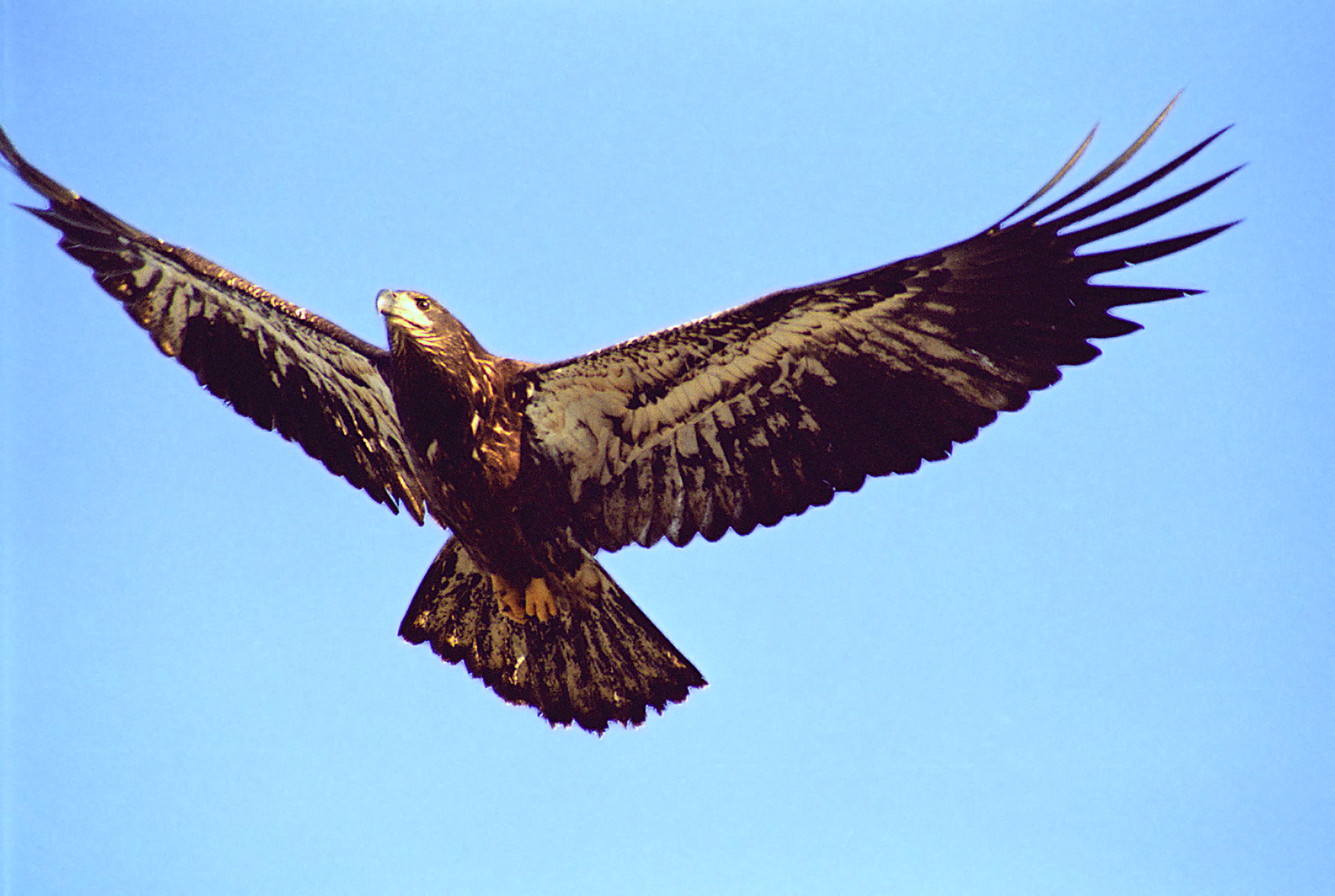
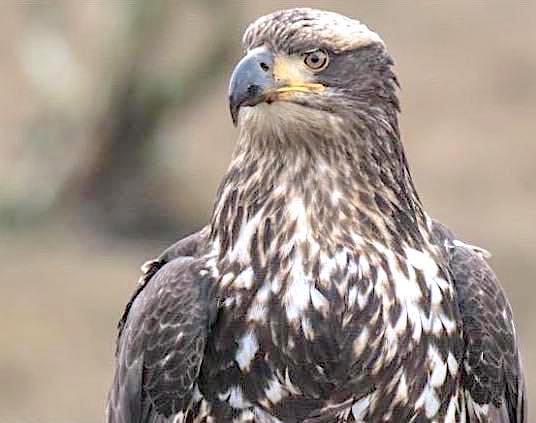
The problem here – you are ahead of me, aren’t you – is that a juvenile bald eagle does not resemble an adult. Rather than the familiar and symbolic look, they are dark brown with white flecks and mottling that changes as they grow older. A juvenile won’t even begin to look like a bald-headed adult until it is around 4 years old. Here are two comparisons of the confusing ages and stages.
SIGHTING 2
Within the last couple of weeks, a resident of Man-o-War Cay saw a huge brown bird – not an osprey, turkey vulture or red-tailed hawk – hunting chickens in the area. He told his family and identified the bird from looking at a photo of a juvenile bald eagle. I received this report – the first in time – from Charmaine Albury. Her brother was the sharp-eyed spotter. Had that been the only report, in the absence of a photo I might have had at least some doubt. Then Woody’s report arrived, a definite juvenile bald eagle only 3 weeks before, over the Marls. From there, with its spectacular eyesight it could practically have seen the individual chickens on Man-o-War. So it’s a good fit for ID.
WHAT’S THE CONCLUSION?
I’d say that right now on Abaco we have a single juvenile bald eagle. It’s a vagrant, away from its usual hunting ground but unchallenged in the skies where it has ended up. There has been the usual autumn extreme weather (though Abaco has dodged the worst of it) to throw a young bird of course in the last couple of months. So, rather late in the day, we really do have an Abaco Bald Eagle for 2018.
A juvenile bald eagle – not at all like its parents to look at
Credits: Woody and Char for the sighting reports; header image (1), Audubon; (2) wiki; (3) Allaboutbirds.com; comparative drawing, Birdwatchers’ Digest; (4) FB, source unknown (and a credit or take-down as you wish if it’s yours); cute cartoon, the most excellent Birdorable
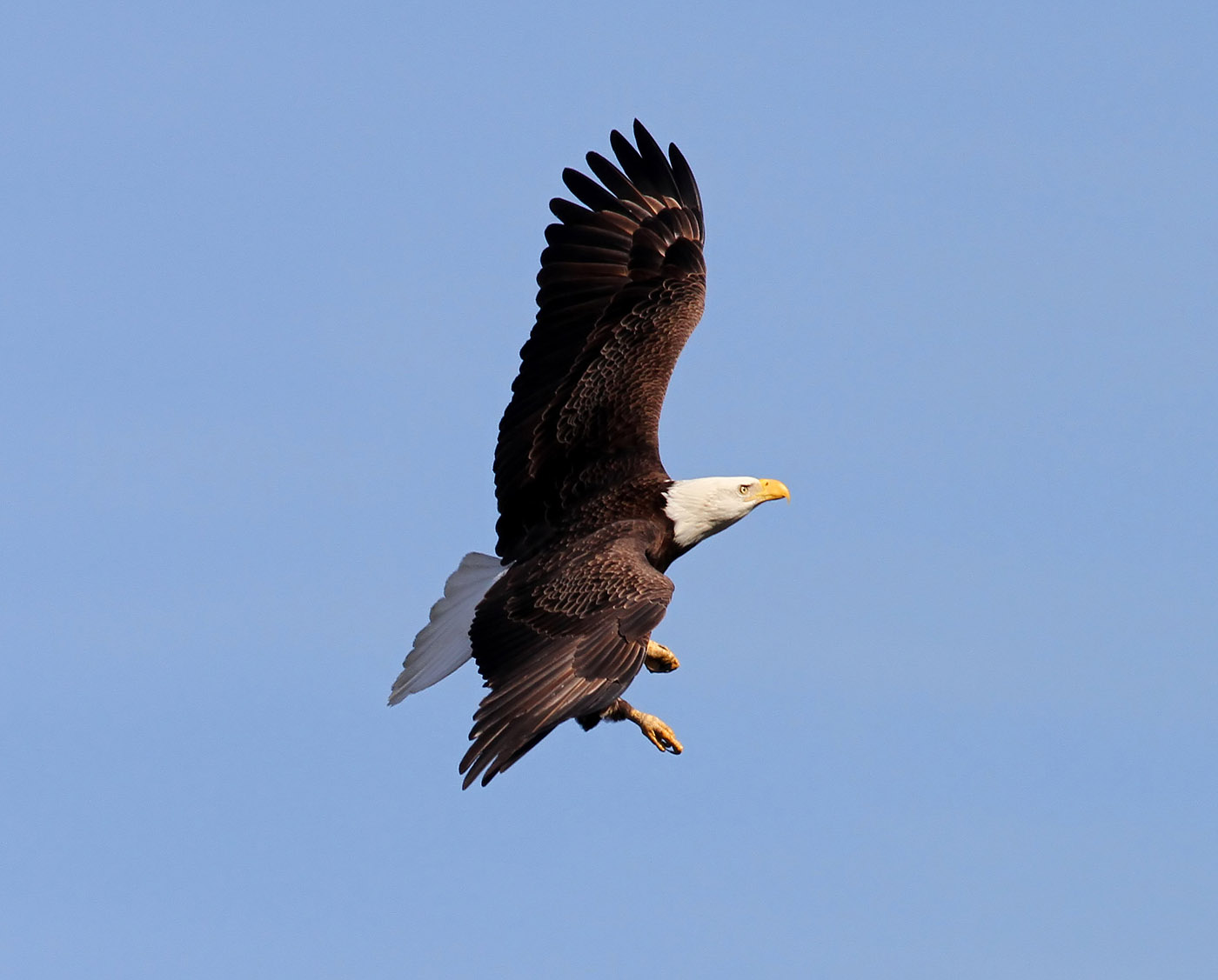
It is a year since I last wrote about the Abaco Bald Eagle(s) of 2017. The bracketed ‘s’ signifies the absence of firm evidence that there was just the one. Equally, there was no indication that there were ever two. All reported sightings were of a single bird, seen at a distance. The likelihood is that it was a lone visitor. The bald eagle is classified as a very rare vagrant on Abaco, and I gathered together as many reports since 2000 as I could find (see below). Not many, in summary, and never two.
Last year, a bald eagle was sighted around to coast of Abaco over a period of several months. There were 8 sightings in all, and I had hoped that the bird might stay around for 2018. Sadly, not so. The photos featured here come from a sequence by photographer Phil Lanoue. They were not taken on Abaco of course, so don’t be confused. But they illustrate the magnificence of this iconic bird as it prepares for its landing in a pine tree. We do have wonderful ospreys of course, but the occasional eagle makes for a rare treat.
As I said last year, the 2017 sightings were most likely all of the same lone bird that had somehow strayed over to Abaco and found the available prey good, and the location congenial. As undisputed king of the skies, its daily hunting range was a wide one which would explain the varied sighting locations. I ended: “I’m sticking with this theory unless and until 2 eagles are seen together”.
BALD EAGLE SIGHTINGS REPORTED ON ABACO SINCE c1950 (= ‘ever’)
Here is the list of sightings. They start in 2000, because there are no known reports for Abaco prior to that from when they started to be kept in the 1950s. If anyone has others, I’d be pleased to hear from you.
2000 December, location unknown – info from Woody Bracey
2001 December – Chicken Farm area – Betsy Bracey
2002 December – over Marls opposite Treasure Cay – Woody Bracey
2004 Autumn – south of Lynard Cay (after hurricane) – Cheryl Noice
2014 Date unknown – circling the power plant – LC
===================================
2017 March – Big Pine Point, Marls – James Cheesewright
2017 Early May – Power plant area – LC
2017 May – Marls – Danny Sawyer
2017 May – Lubbers / Tahiti Beach area – ‘Kelly’s mom’
2017 September – Cross Harbour – Carol Rivard Roberts (with photo)
2017 November – Cherokee Road – Howard Pitts
2017 November – Bahama Palm Shores / 8-mile beach – Steve Roessler
2017 November – Tilloo Bank – Laurie Schreiner (with photo)
Italics = report in comments on Danny Sawyer’s FB page; Blue = added reports to me
The first-ever bald eagle photo on Abaco Sept 2017
Carol Rivard Roberts
The last bald eagle photo on Abaco Nov 2017
Laurie Schreiner
Credits: all brilliant ‘eagle landing’ photos, Phil Lanoue with many thanks for use permission; Abaco eagles by Carol Rivard Roberts and Laurie Schreiner; amusing cartoon, Birdorable; thanks to all spotters and reporters.
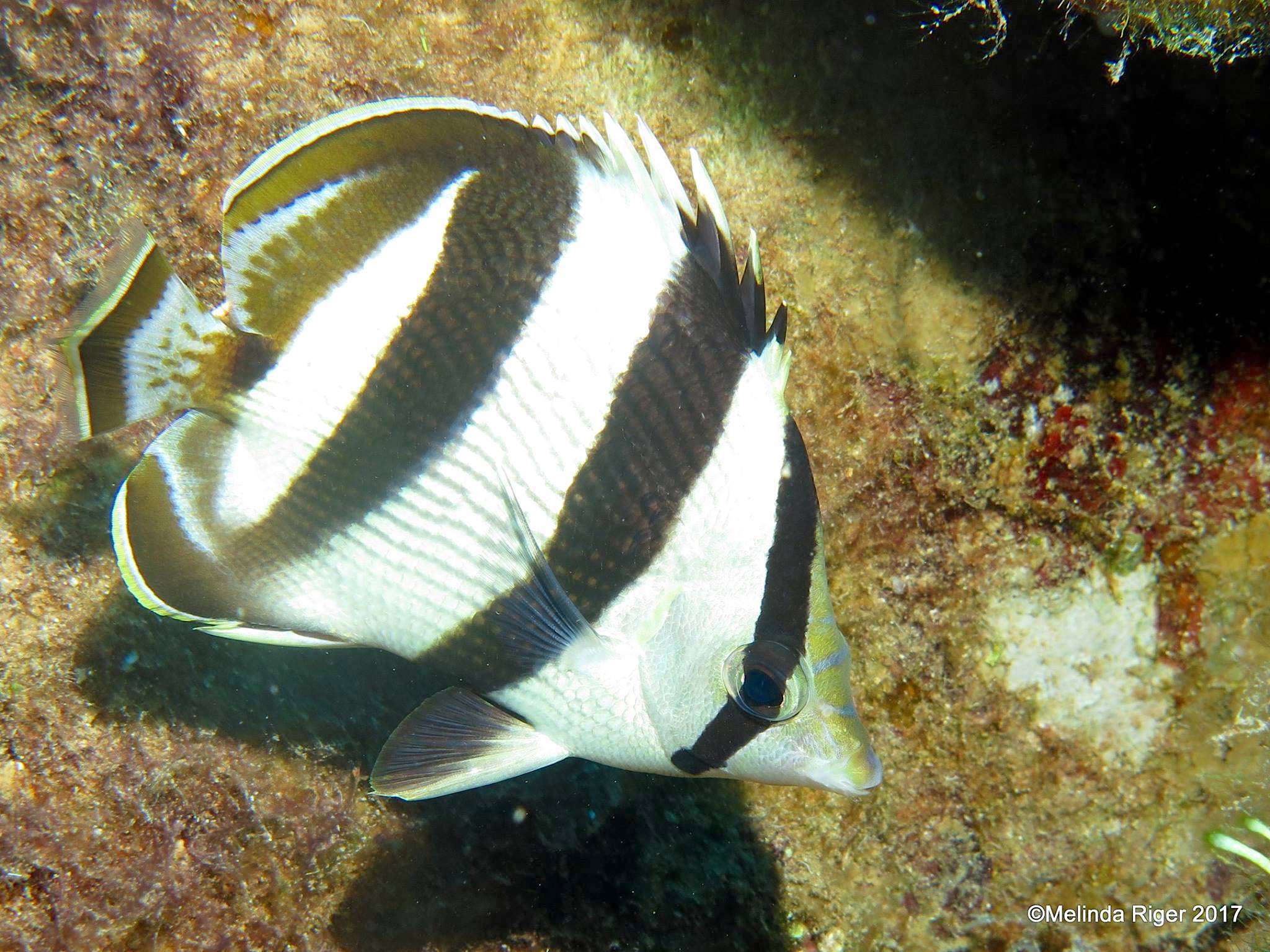
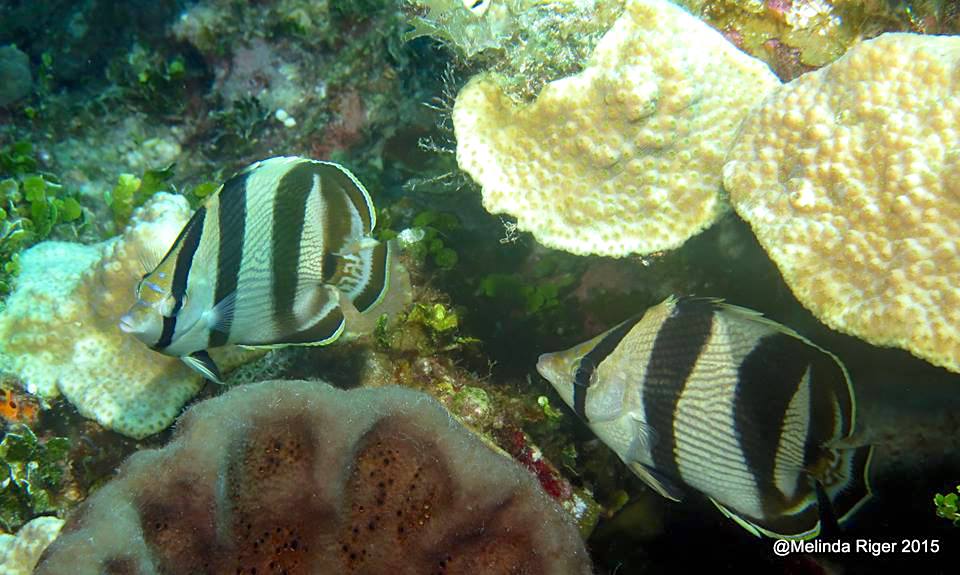
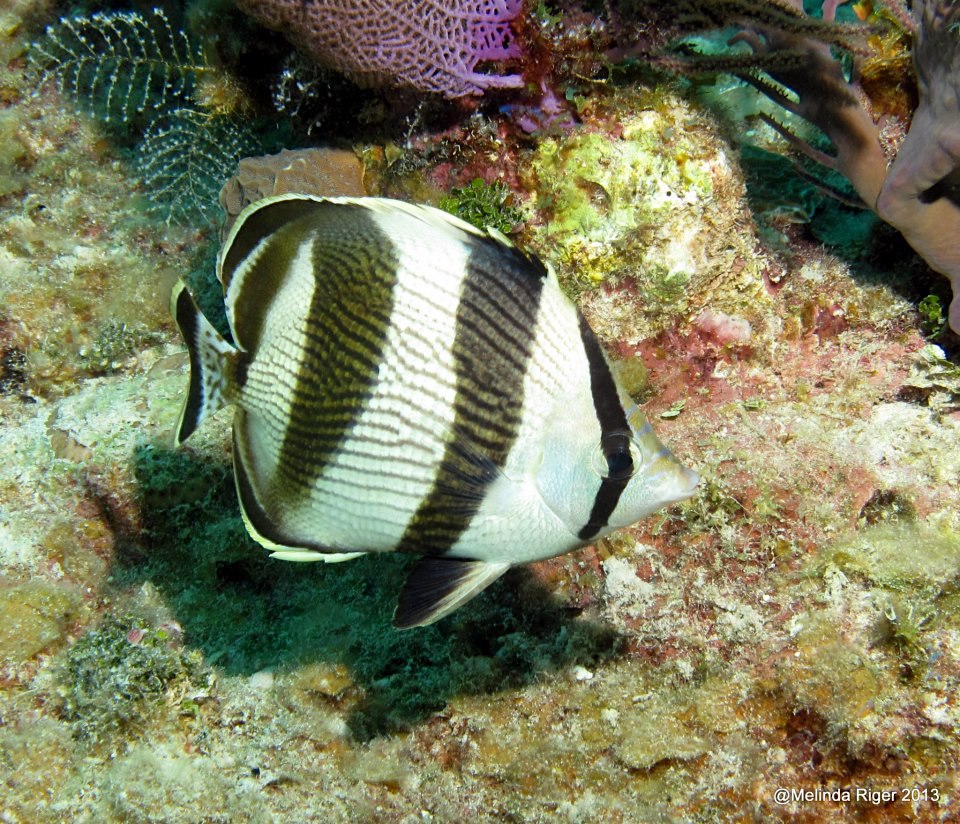
The banded butterflyfish (Chaetodon striatus) is one of several butterflyfish species found in Bahamas waters. There are links to some of the others at the end of this post. The reason for the name is obvious. The purpose of the patterning (striatus) is to act as an adaptive anti-predator defence when seen against the varied landscape of the coral reefs that are its home.
These little fish tend to be found either singly or in pairs. Two of them together may play a form of chase game among the corals and anemones of the reef.
Banded butterfishes, like their cousins, have a varied diet that includes small crustaceans, worms, and coral polyps. They also have a valuable role on the reef by acting a cleaner fish for larger species like grunts, tangs and parrot fish. This sort of relationship, where one party benefits from this kind of interaction , is known as ‘commensalism’, one of the 4 types of symbiotic relationship.
Brown Pelicans are permanent breeding residents on Abaco, and not uncommon in certain areas though not be any means throughout the island and the cays. If you come across a pair of them – or preferably a group – it’s well worth spending some time watching them in action. These are magnificent birds, unafraid of humans and happy to carry on fishing / plunge diving with an audience.
The most reliable place I know of to watch the pelicans on Abaco is Sandy Point. You may find them on the dock, drying their wings on the pilings or diving off it for fish. At other times, they will be further out to sea where the sandbars stretch out into the ocean, taking off and gaining height before smashing straight down into the water.
These wonderful images of pelicans taking off and landing are the work of professional photographer Phil Lanoue, whose work I am always excited to feature. He has the skills, the equipment and the eye to produce outstanding photographs, freezing birds in motion with complete clarity.
If anyone reading this knows of other locations on Abaco where pelicans can reliably be found, I’d be very pleased to hear more!
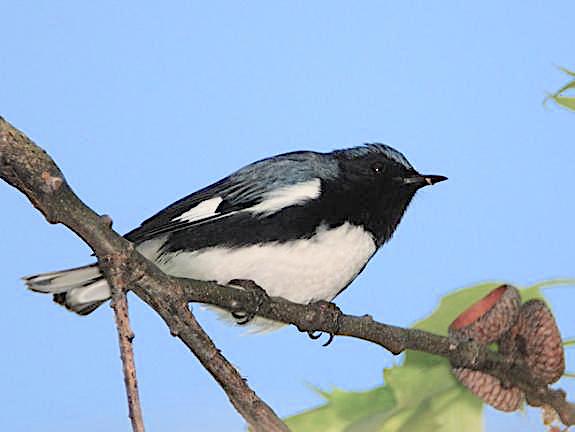
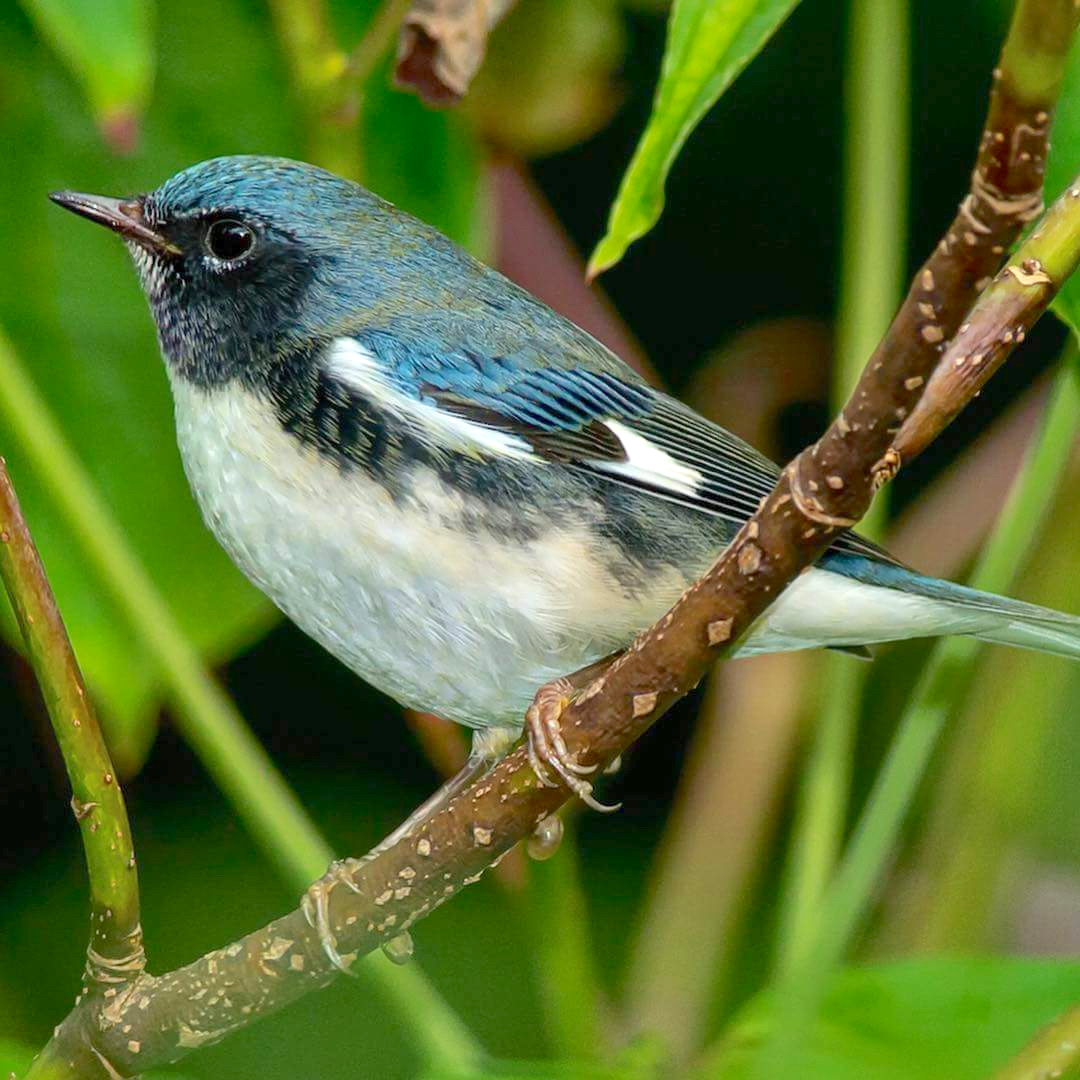
It’s warbler time of year on Abaco, and a good time to take a look at the Black-throated blue warbler Setophaga caerulescens. This small warbler has very particular breeding and overwintering ranges. In the summer they are found in the forests and woods of eastern North America. As the Fall approaches, they start to migrate south to the Caribbean and Central America. Abaco is one of their winter homes, as well as a likely transit stop on their way further south. Right now sightings are being reported on the mainland and the Cays.
WHAT DO I LOOK OUT FOR?
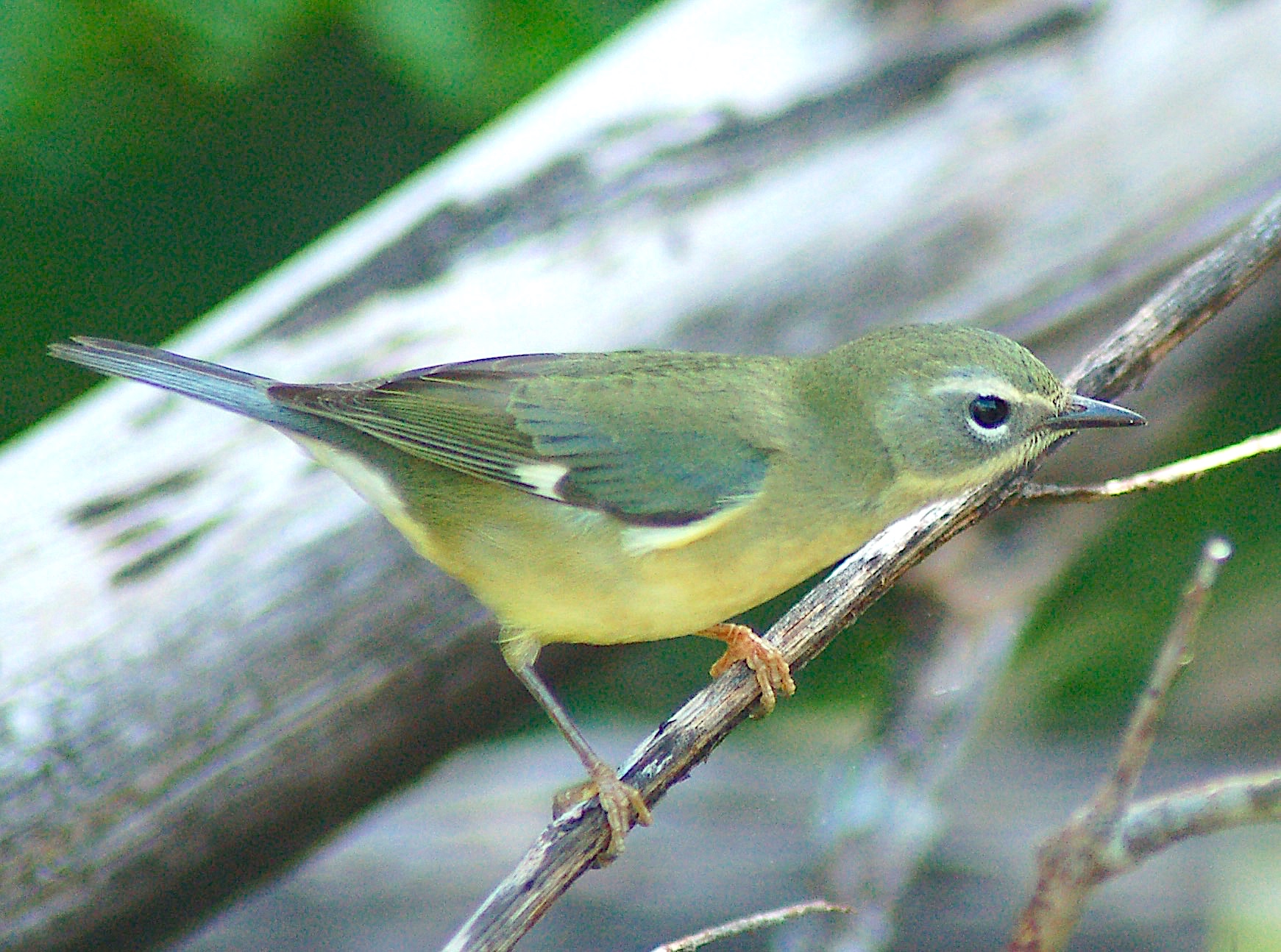
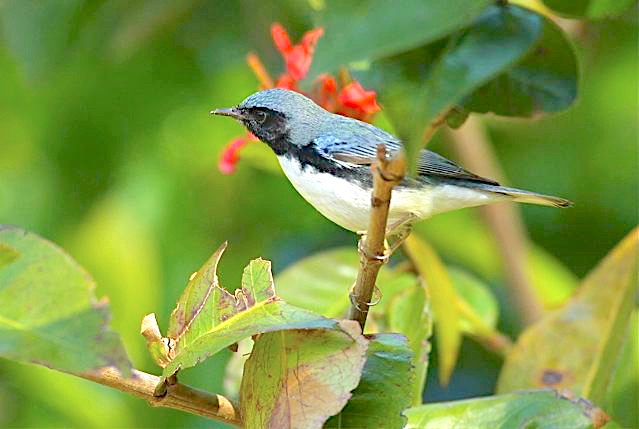
Males and females are quite different in appearance (‘sexually dimorphic’), and could even be mistaken for distinct species. Males are a deep slate-blue above (hence caerulescens) with a striking black face and throat, and white underparts. They are unmistakeable, and unlikely to be confused with any other warbler. Females are basically grayish-olive above and pale yellow underneath. For ID, look for a white stripe above the eye, a pale arc below it. In addition, both sexes have a diagnostic white patch on the the wing, that I have seen referred to as a ‘handkerchief‘.**
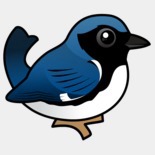
The legendary bird cartoon website Birdorable, featured often in these pages, as usual has a spot-on comparison of the sexes. TBH, this is a great resource for nailing a bird’s essential characteristics. You should check out its warblers in particular! Here’s their inimitably charming take on the BTBW gender comparison.
These pretty warblers can be seen in gardens, coppice, and woodland. Although mainly insect-eaters, sometimes catching them in flight, they also eat fruit and seeds especially in winter. BTBWs are territorial, and will defend their chosen space against all-comers, including their own species.
WHAT DO I LISTEN OUT FOR?
As I have mentioned before, I tend to find phonetic transcriptions of bird sounds rather baffling – and often not really how I hear them myself. This is especially with the ‘Oh-dear-oh-dear-I’ve-run-out-of-beer’ and ‘Have-a-little-Kalik-at-Pete’s’ kind. One source asserts:“The bird’s song can be described as a buzzed zee-zee-zeeee with an upward inflection. Its call is a flat ctuk”. You be the judge…
SONG Etienne Leroy / Xeno-Canto
CALL Paul Marvin / Xeno-Canto
BTBW SEX LIFE – ANY GOOD GOSS?
Black-throated blue warblers are – and I say this with considerable reservations – mainly a monogamous species. However it turns out that they have complex patterns of vocalisations and behaviours at breeding time, including very promising-sounding ‘extra-pair copulation’ involving ‘heterospecific cuckoldry’. However, despite all my efforts in researching this phenomenon more thoroughly, merely reading the intricacies quickly crossed my boredom threshold, and my own ‘call’ soon became a ‘sonoroussaw-like Zzzzzzzzzzzzzzz‘. Anyway these birds don’t breed on Abaco so I’ll spare you the details and move on.
IS MANKIND MASHING UP THEIR HABITAT?
BTBWs are fairly common birds within their range, with a large population. The usual stuff is happening with them in terms of habitat destruction & co at both ends of their migration. For some already threatened species (e.g. Kirtland’s Warblers), habitat degradation at either end of the migration (let alone both) presages a downward spiral in population. With BTBWs, I have read both that the population is decreasing; and in another source, slightly increasing. For now, let’s regard the welfare of the species as being stable. However, the current causes of species decline will doubtless continue, and many regard increasingly evident climate change as being a determining factor for the well-being of migratory species. The birds are not yet out of the woods, so to speak… and maybe never will be.
**anyone remember those?
CREDITSPhotos: Gerlinde Taurer (1, 2); Becky Marvil (3); Bruce Hallett (4); Blaine Rothauser / CWFNJ (5); @daxroman / Birds Caribbean (7); Paul Reeves / Birds Caribbean (8). Range Map, Wiki; Cartoons, Birdorable; Video, Cornell Lab for Ornithology
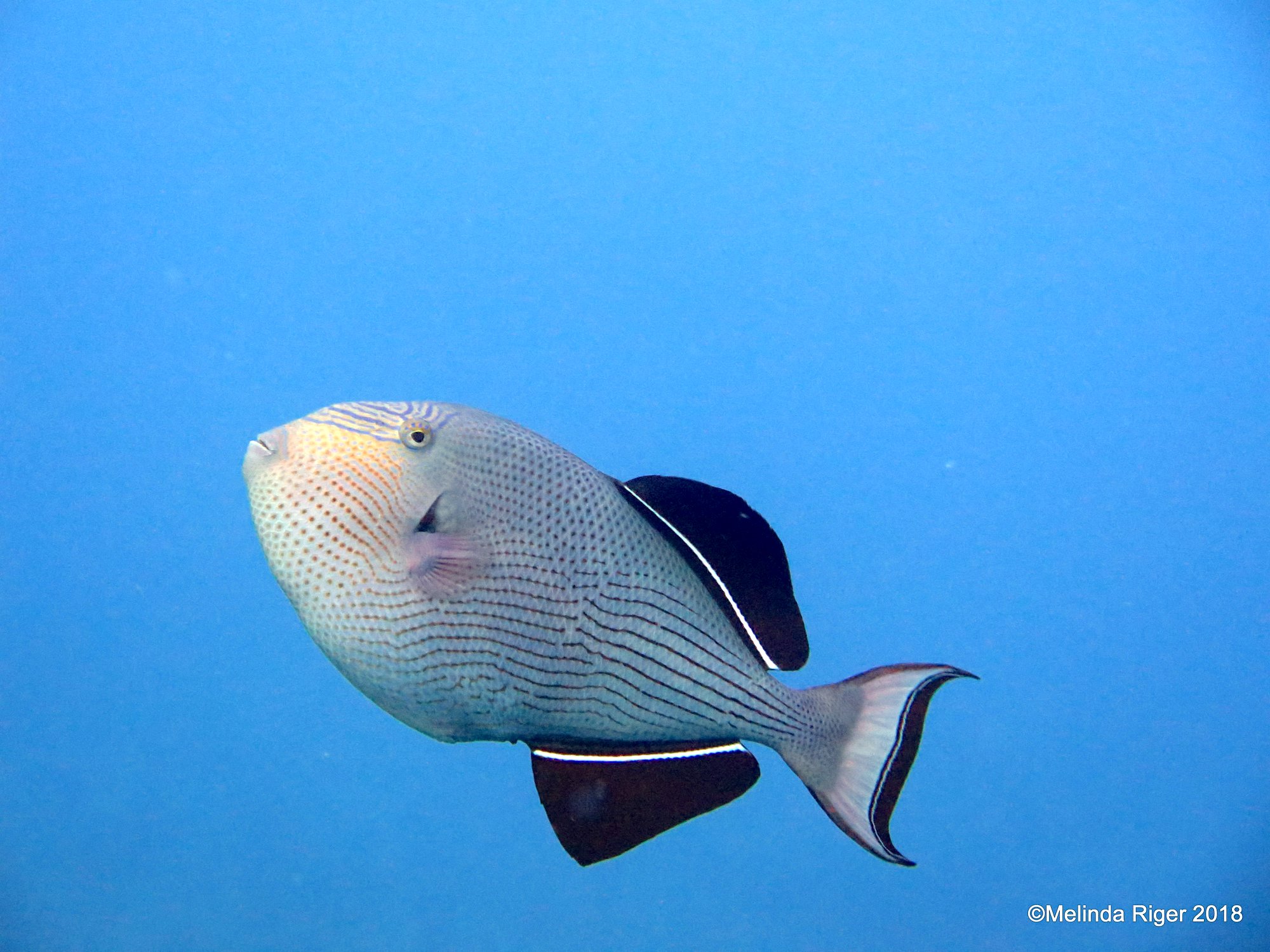
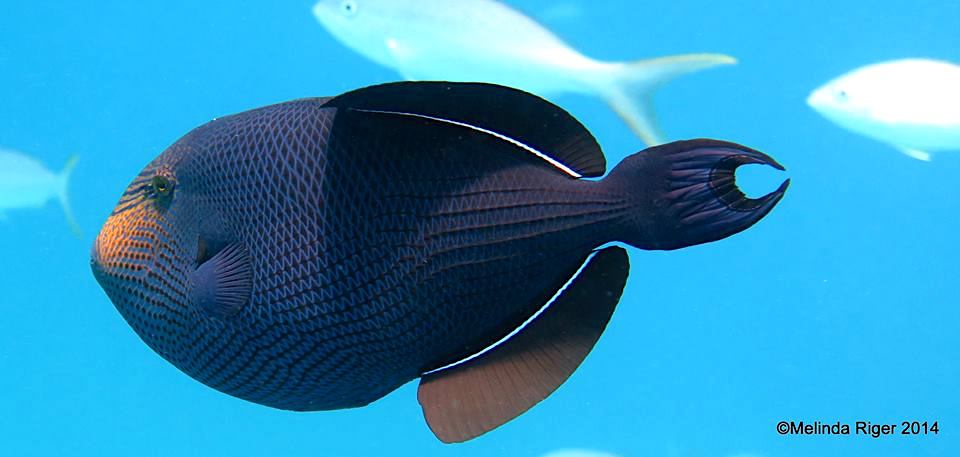
The Black Durgon (Black Triggerfish) seems to be a fairly rare triggerfish in Bahamas waters. I say that not because I know, but because there is very little mention of them in a Bahamas context. In fact, the (not especially profound) research I have done suggests it is not (originally?) really native to the Bahamas region at all. Correction of this impression welcome!
These fish have the ability to change colour, according to their surroundings. Mostly, they seem completely black. However they have intricate blue markings to the head, and regular patterning on their flanks that resembles the sort of thing one idly doodles during a long and less then attention-holding phone call (or the ‘hold music’) – see Header Image. They also have dramatic pale stripes where their fins join the body.
These fish have a varied diet that includes small fish, squid and shrimps, with side-helpings of algae, zooplankton and marine plants. And…
FUN FACT (REALLY!)
The Black Durgon has been studied, of course. One piece of research discovered that they… erm… ingested the feces and vomit of a species of dolphin. Other reef fish in the area did so too, but the Black Durgon was much the keenest on this distinctive diet. So these are ‘offal-eating’ fish… and welcome to it. Here’s a short video to take your mind off it all…
I’d be interested to hear from anyone who has encountered these fish in Abaco waters. I ought to look further into their prevalence. Maybe they just don’t get much publicity. They need a new agent.
Credits: Photos by Melinda Riger / Grand Bahama Scuba except #3, Getty Images; Kwik-Viddy, Cassandra-Tel; inadequate research, Author
Melissa Maura is well-known to many in the Bahamas, not least because of the wonderful work she does with injured or orphaned creatures. Thanks to the skills and compassion of Melissa and those who work with her, animals and birds of all kinds are saved from death or incapacitating injury. In the saddest cases, they are gently cared for until the inevitable occurs.
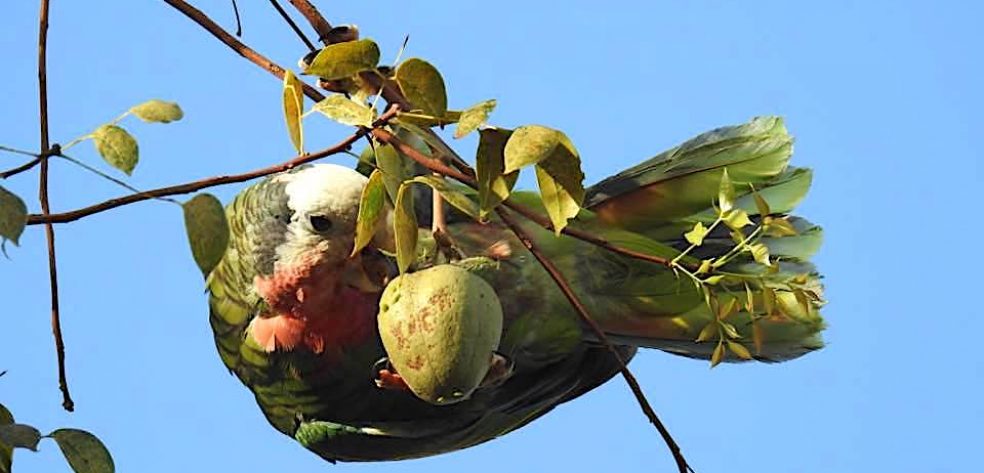
Melissa also takes terrific bird photographs, some of which I have featured in the past. Indeed my blog headline photograph is one of her parrots. I used to change the header from time to time, but this one is so cheerful that I decided to keep it in place. It always makes me smile.
Parrots are acrobatic creatures, happy to eat at all angles including completely upside down. Not just eat, though. Also bicker, flirt, play-fight, and see off rivals via inverted aggression. With the Abaco parrots, one of the benefits for the bystander is that the balancing act and consequent fluttering often reveals the spectacular blue of the birds’ wings.
In a row, it’s not unusual to see a parrot taking up a dominant position on a branch, leaving its opponent hanging on in an uncomfortably precarious position…
People often ask where on Abaco they are most likely to see the parrots. First, there are no parrots north of Marsh Harbour – they are all in South Abaco. Secondly, although they live and nest in the National Park at the southern end of the island, in practice it covers a very large area, much of it inaccessible and with the only ‘road’ something of a challenge for an ordinary vehicle (described HERE). I’d say that the single most reliable place to see the parrots is at Bahama Palm Shores. Simple turn into the north entrance, drive straight down to the end with the windows down, park up – and listen. If they are there, you’ll hear them for sure!
All photos Melissa Maura except #5, Keith Salvesen (also the sound file of parrots at BPS)
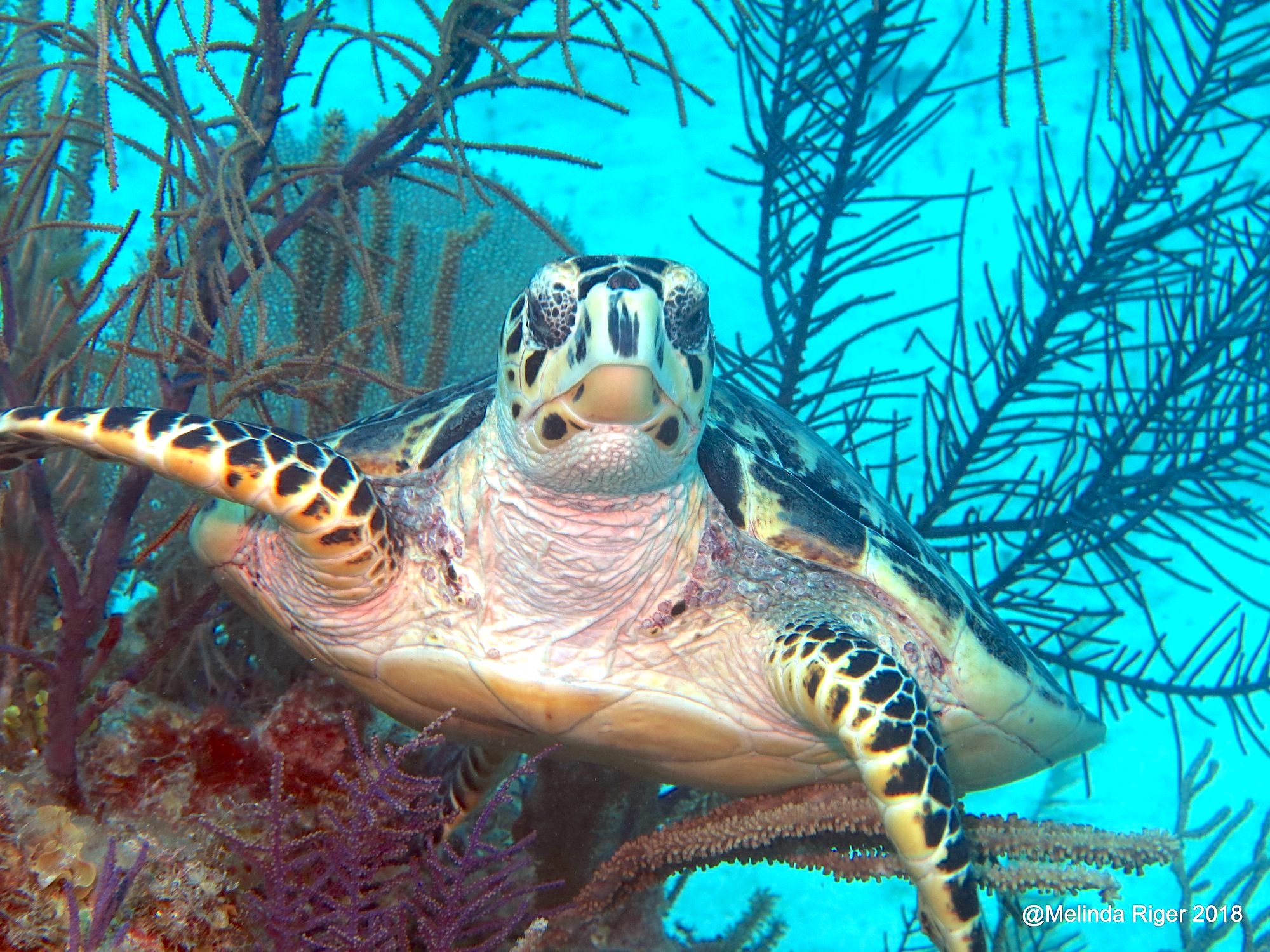
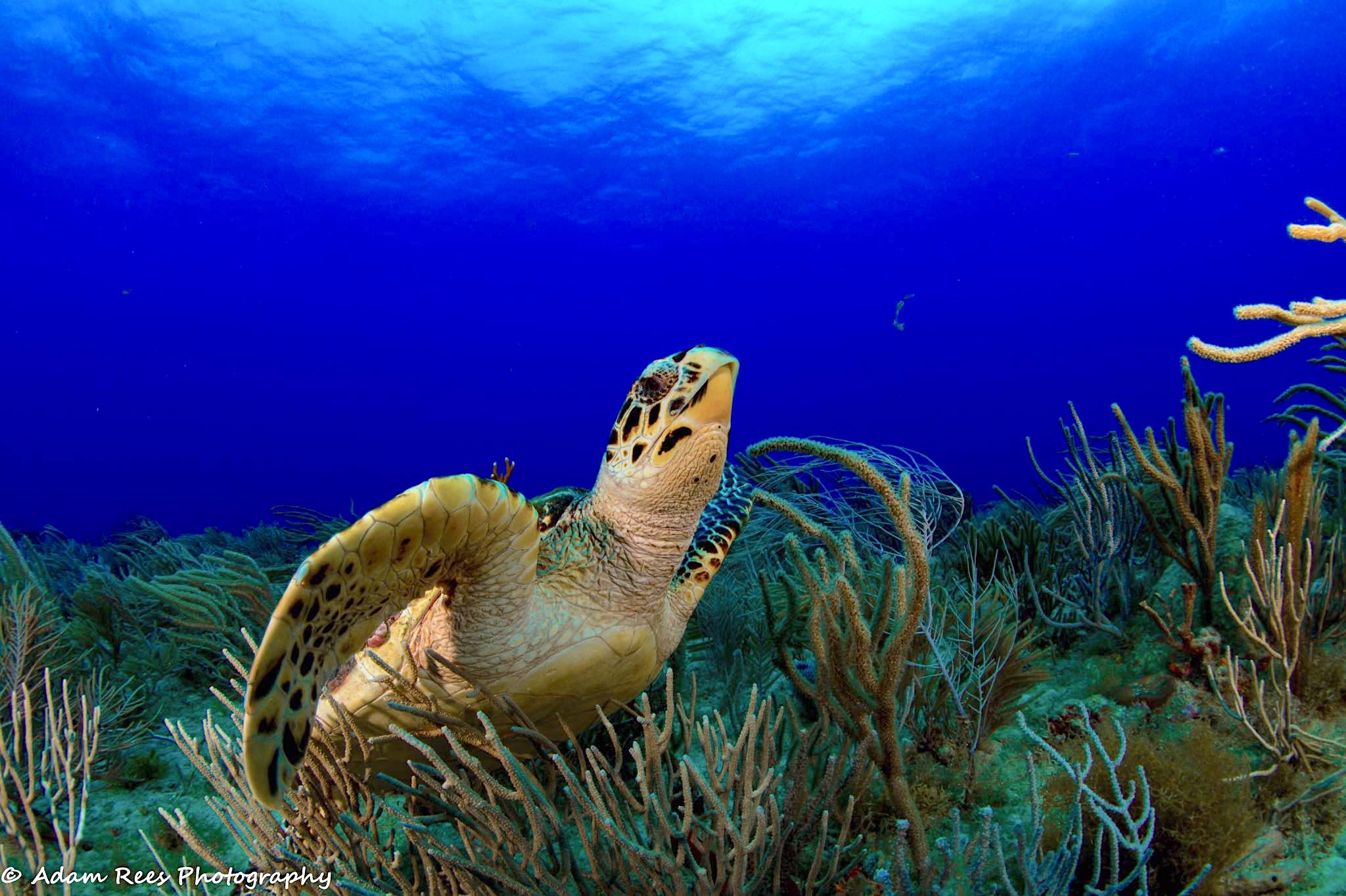
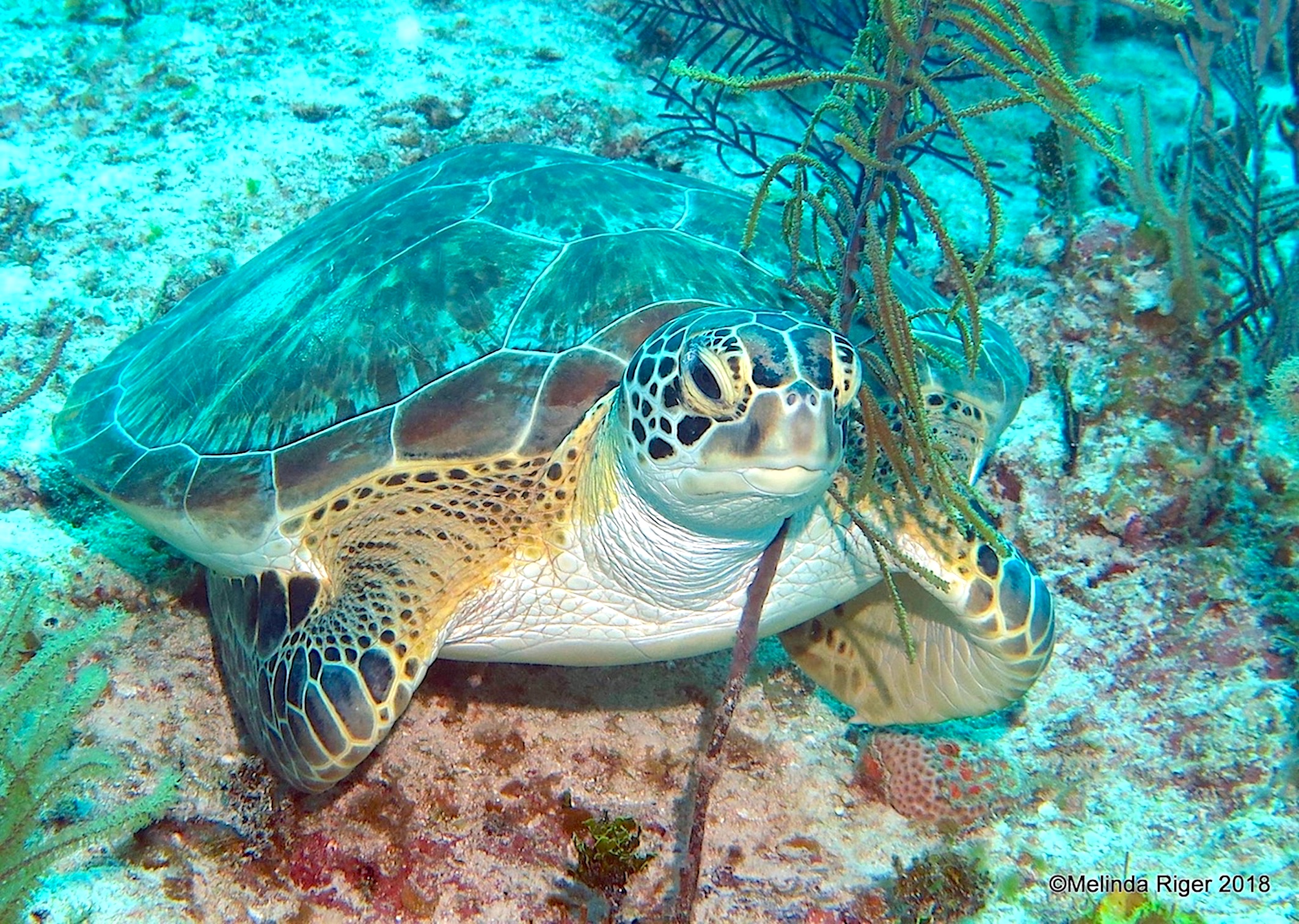
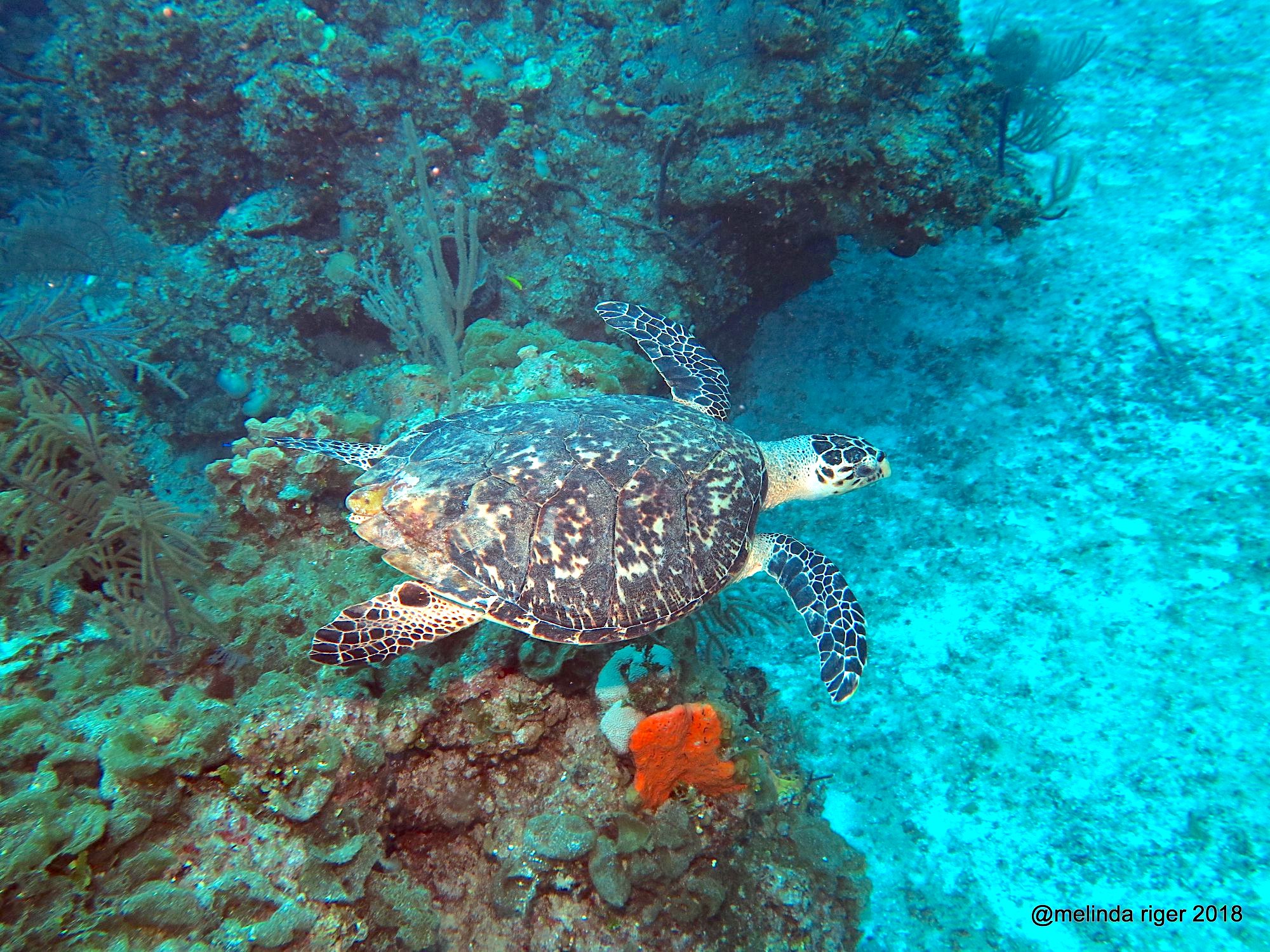
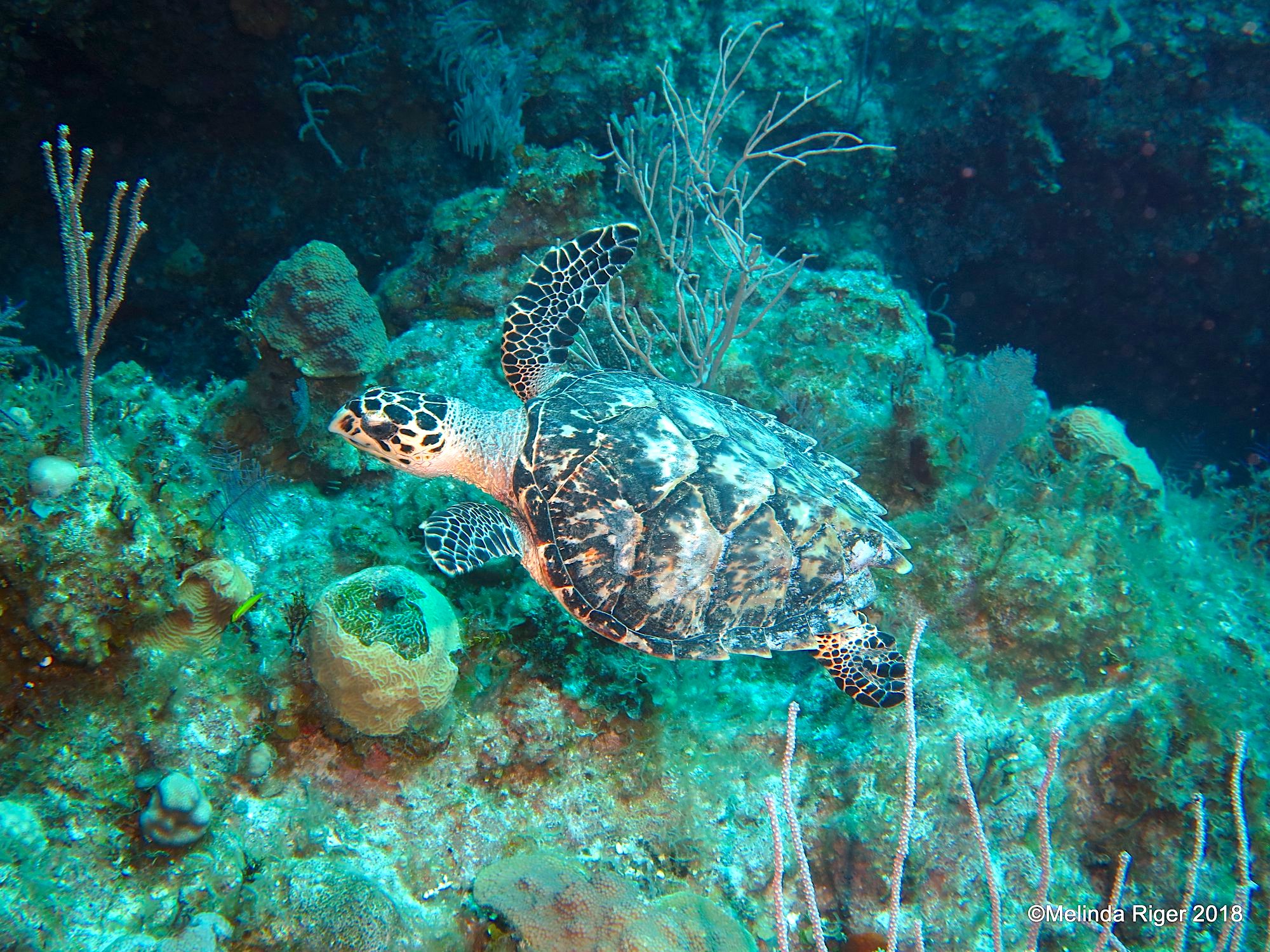
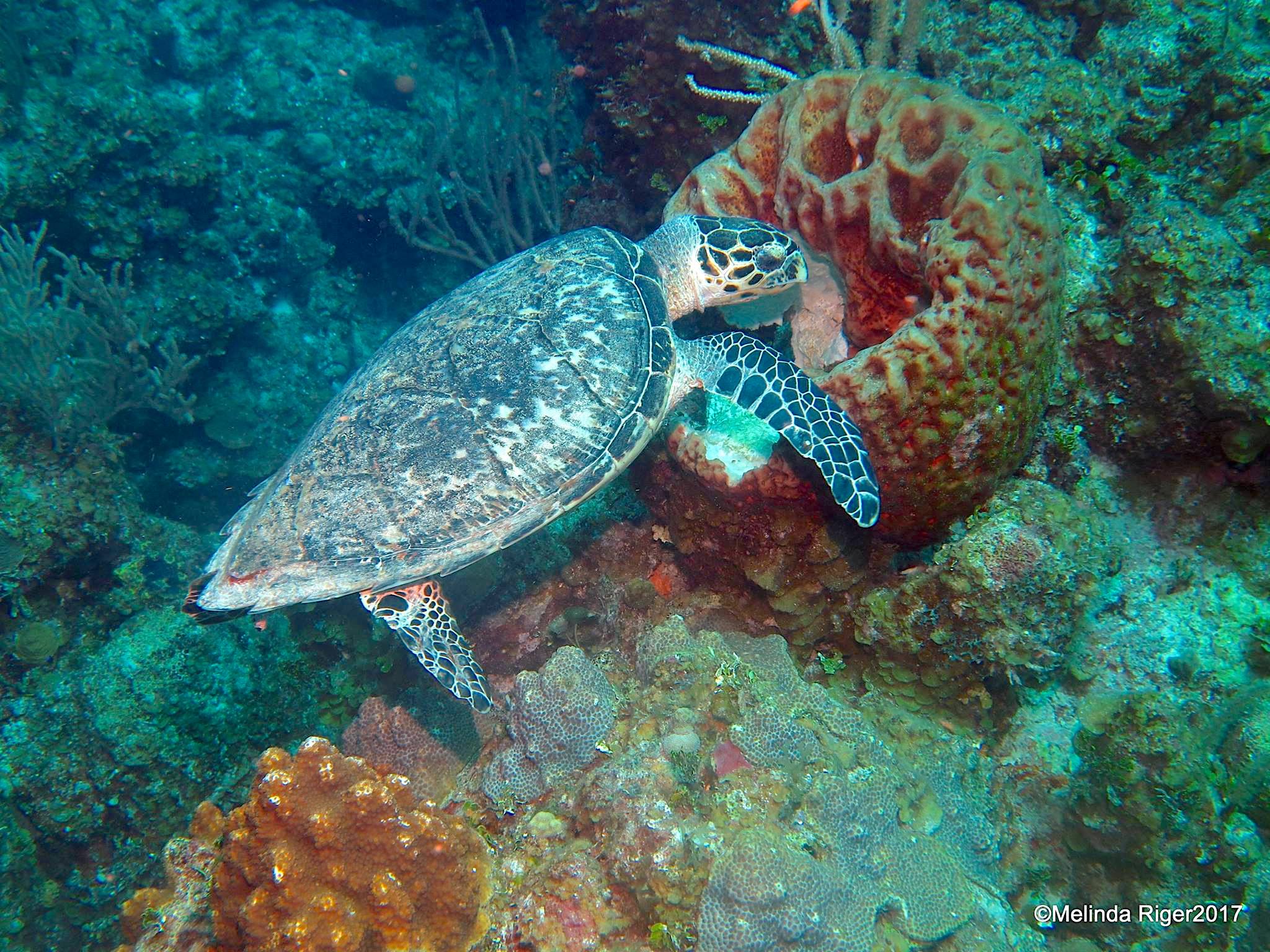
Of all the sea creatures in the limpid waters of the Bahamas, turtles are rightly among the most loved. These days, what with habitat degradation below the waves and the destruction of nesting sites on land, turtles have a hard time simply fighting for survival. And that’s before they have ingested the plastic garbage that mankind pours into their living quarters, by now probably beyond effective remedial action forever. So here are some gorgeous turtles to admire, while stocks last…
Hawksbill Turtles enjoying life around a still-healthy reef
A hawksbill snacking on a sponge
Interaction with other underwater species: gray angelfish and a rock beauty
If you are concerned about the plight of turtles and indeed other denizens of the thickening plastic soup we still call ‘ocean’, you could investigate the work some of the organisations that tackle the problem in the Bahamas and beyond. To name but a few, our own FRIENDS OF THE ENVIRONMENT; the BAHAMAS NATIONAL TRUST; the Bahamas Reef Environmental, Educational Foundation BREEF; the CAPE ELEUTHERA FOUNDATION; and the SEA TURTLE CONSERVANCY.
Photo credits: all great photos by Melinda Riger / Grand Bahama Scuba
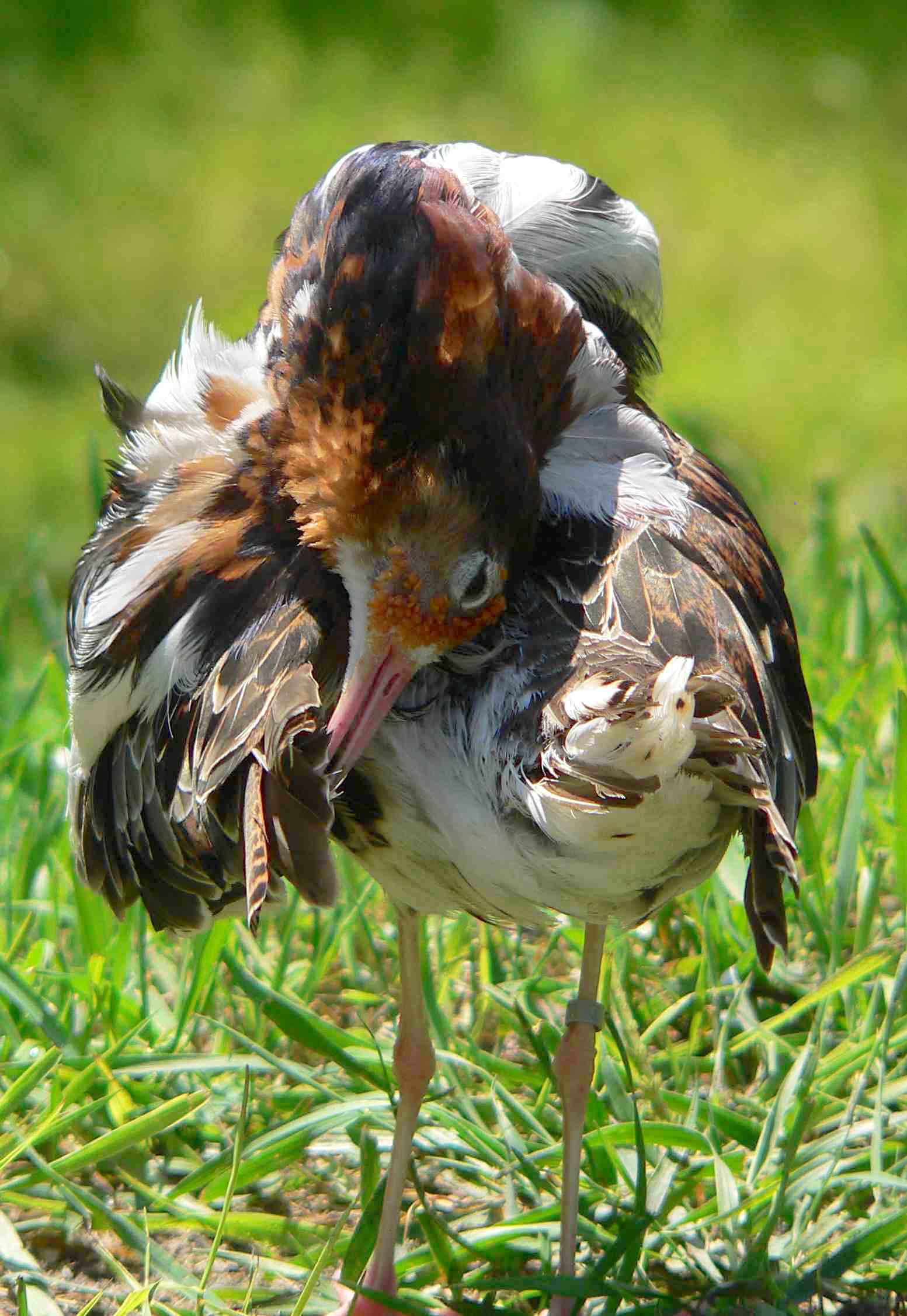
The list of new bird species recorded for the Bahamas in general and Abaco in particular continues to grow longer. At the end of August it was aCANADA WARBLER(now also recently seen on Grand Bahama and possibly New Providence). Now, a mere 4 weeks later, it’s a Ruff (Calidris pugnax), a mid-sized Eurasian shorebird that, it seems, has a tendency to ‘vagrate’ across the Atlantic from time to time.
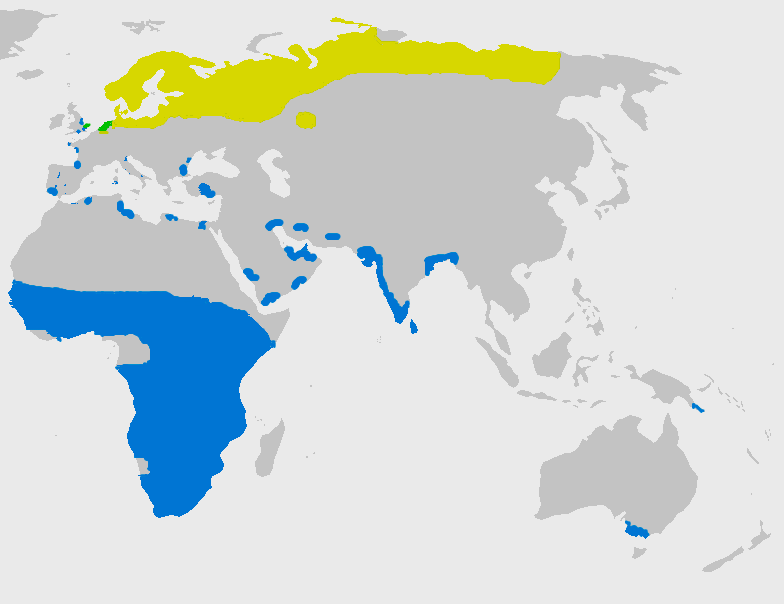
Ruffs: the normal range
You have to take new birds as you find them, of course. First, you may not have a camera with you to record the sighting for posterity. Secondly, the bird may not be perched prettily on a twig or a small rock. In this instance the legendary Woody Bracey found his Ruff in the prosaic and arguably unattractive setting of the Treasure Cay dump. He didn’t have a camera, and when he next went back with a camera to check for the bird the ruff had gone…
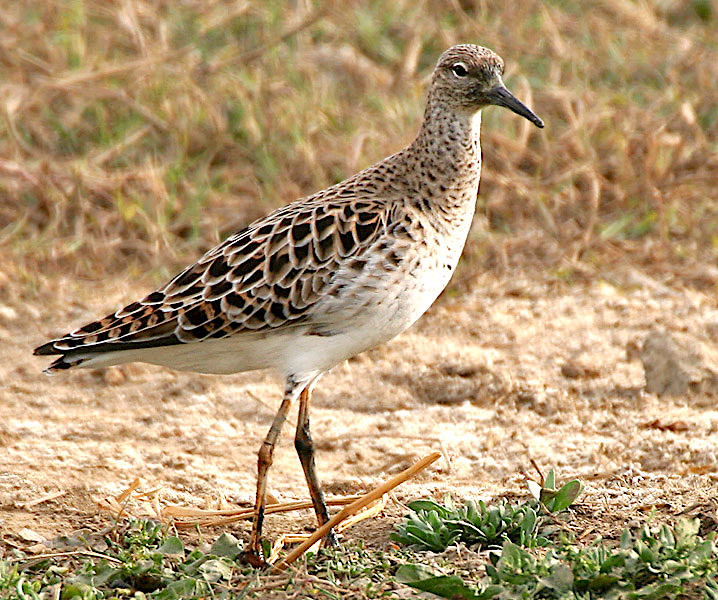
Woody’s bird, a female (known as a Reeve), was standing next to a Lesser Yellowlegs. They are much the same height, but there the similarity ends – Ruffs are unmistakably plumper and with a shorter bill. Woody has good reason to recognise these rare and occasional transatlantic visitors, having often seen Ruffs both during his time living in the UK, and also in Africa. I’ve seen the appearance described as “like a gravy-boat”, which is well up there with the least useful descriptions of a bird’s appearance I have come across. Looked at another way, we have a couple of gravy boats that have an occasional outing. Neither looks remotely like a ruff.
IS THE ABACO RUFF A NEW SPECIES FOR THE WHOLE BAHAMAS?
Very nearly… but not quite. Only two previous Ruff sightings are recorded, in 2015 and 2018, and both in the same area on Grand Bahama, towards West End. And the only photo is from birder Duncan Mullis, who in 2015 took the first and maybe only one of a Reeve with a bunch of much smaller sanderlings (see also header image close-up).
The first ruff in the Bahamas
WHAT SHOULD WE KNOW ABOUT RUFFS?
In the breeding season in particular, male ruffs are very different from the smaller reeves. They acquire a spectacular colourful plumage that includes a sort of ornamental collar (hence the name). They enhance their courtship rituals with elaborate displays designed to impress the reeves. These occur in chosen areas known as leks, places where strutting, preening and general competitive showing off occur to attract a mate. Such arenas are also created by a few other bird species – grouse, blackcock and peafowl, for example. The ruff’s lekking behaviour has some complex variations – including same-sex ‘copulation’ and polyandry – but sadly this isn’t the place to explore them in detail.
WHAT DOES A LEK LOOK LIKE?
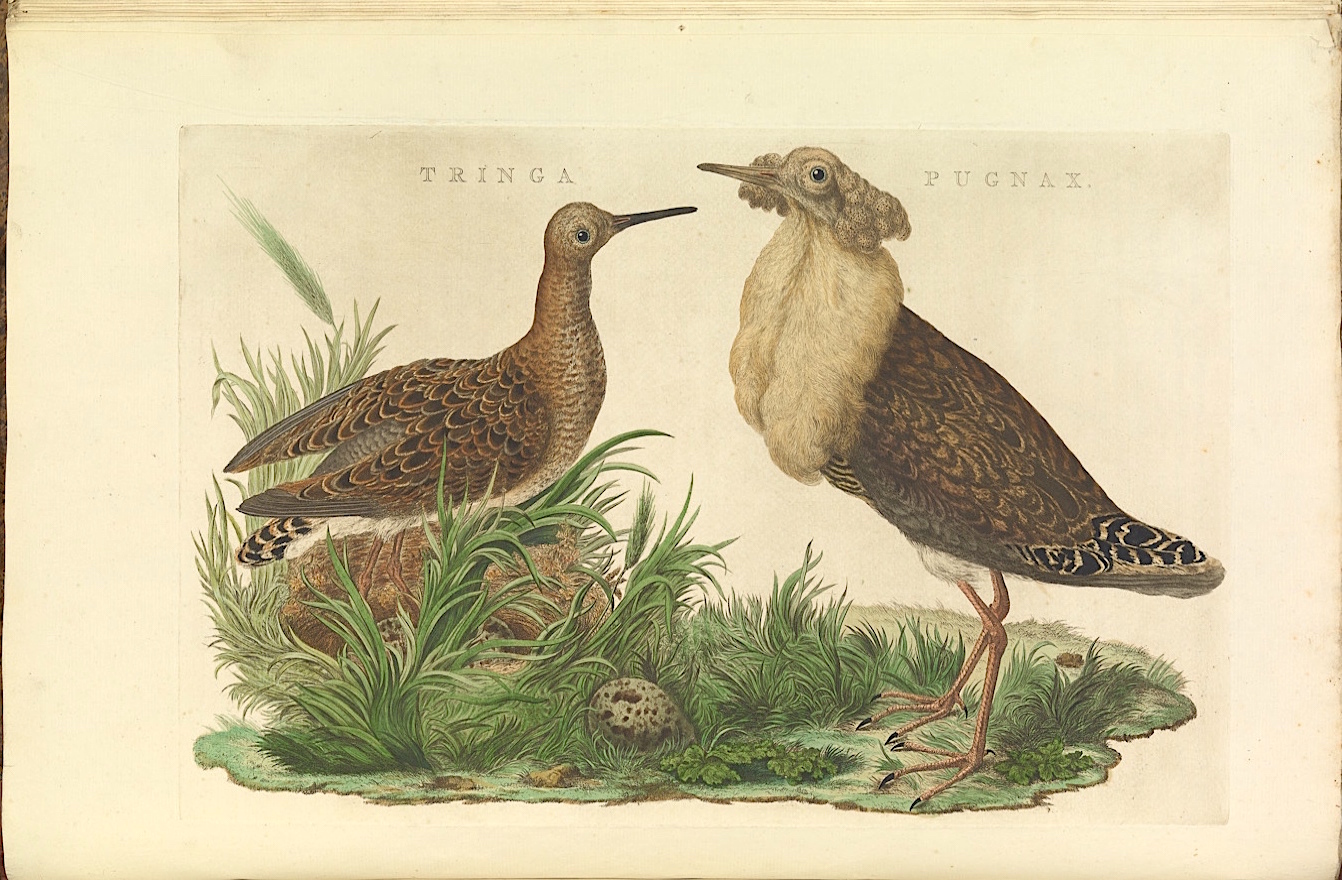
Here are two males with very different breeding plumages, giving it their all at the lek… When Carl Linnaeus described the ruff in his Systema Naturae, he gave it the binomial name Tringa pugnax, the latter word meaning ‘aggressive’ – the lek can also become a combat zone between competing males.
This male has decided to vogue it and ‘strike the pose’ as it preens
Writing inThe Spruce, a new multi-interest resource I discovered in researching this article, Melissa Mayntz describes succinctly some of the common behaviour seen at leks. This includes some (or all) of the following (baby-boomers and dad-dancers may recognise some of these moves):
Bowing, dipping, or bending
Head bobbing or quick turns and nods
Strutting, stomping, kicks, or similar footwork
Exaggerated wing postures, such as fluttering, drooping, or spreading wings
Tails fanned, flared, cocked, or spread
Chests puffed out, often to reveal air sacs or distinct plumage
Calling, songs, drumming, or booming sounds
Dance-like sequences with multiple movements, possibly coordinated between partners after a female shows an interest in a specific mate
To which I’d add aggressive male territorial rivalry within the lek, leading to physical attacks with beak, claws and wings. Meanwhile the females watch from the edge to assess their chosen mates. The illustration below shows this rather charmingly.
Illustration of a lek by Johann Friedrich Naumann (1780–1857)
There’s a lot to be described about how ruff’s moult, but it’s not especially interesting for anyone but a moult specialist, so instead you can have a reminder of Ogden Nash’s last word on the topic: ‘The song of canaries / Never varies / And when they are moulting / They are pretty revolting…’ And we’ll leave migration as well, since basically that factor is N/A for our particular part of the world.
♦ ♦ ♦ ♦ ♦
JUST OUT OF CURIOSITY, CAN YOU EAT RUFFS / REEVES?
In former times ruffs were considered a delicacy and were eaten in large numbers. Often they would be fattened in pens in preparation for the table. I’ll finish with an old description:
…if expedition is required, sugar is added, which will make them in a fortnight’s time a lump of fat: they then sell for two shillings or half-a-crown a piece… The method of killing them is by cutting off their head with a pair of ‘scissars’, the quantity of blood that issues is very great, considering the size of the bird. They are dressed like the Woodcock, with their intestines; and, when killed at the critical time, say the Epicures, are reckoned the most delicious of all morsels. Not a 21st century culinary trend I hope…
Credits: Woody Bracey (sighting smarts); Duncan Mullis (1, 5); Dick Daniels (2); J.M.Garg (3, 9); Open Source / Wiki, prints (4, 8); Arjan Haverkamp (6); B.S.Thurner-hof (7); Melissa Mayntz / The Spruce re Leks; debt to Wiki (and other O/S) for source material, photos, range map etc
THE THREATS ARE REAL AND THESE PHOTOS SHOULD ALARM YOU!
I rarely – in fact almost never – lift an entire article from elsewhere and plant it wholesale here. I make an exception today. Ben’s article is so relevant, so well put together, so compelling and so scary in its implications that it can’t be ignored. No individual is to blame. We all are. Mankind generally – and pretty much all of it in my lifetime. Walk any beach in Abaco, however secluded. There it all is, under your feet. Find a dead seabird? Chances are it will have significant amounts of plastic inside it. Seen those wretched images of turtles with plastic bags hanging out of their mouths? It’s going to get worse…
Now see how things are with our bird partners in New Jersey and their beautiful ospreys.
DOCUMENTING THE PRESENCE OF PLASTICS IN OSPREY NESTS
U.S. Coast Guard assists NJ Fish & Wildlife with recovering an entangled osprey on a channel marker in Cape May Harbor, Summer 2018. photo by Kathy Clark/ENSP
The alarming trend is also becoming more deadly for ospreys, and other marine life who ingest it. While it might not seem like a lot, this year a total of four young ospreys were found dead from being entangled in plastic. In my books, one dead osprey is too many! This is not a natural cause of death! Luckily, there were several other entanglements that were prevented, but this trend is likely to get worse. We hope that these photos will help you to do all that you can to help prevent it from becoming a growing threat to ospreys and other marine wildlife, who might ingest plastics.
Ospreys are an indicator species. We can’t stress that enough. The health of their population can be directly linked to their surrounding environment. When we poisoned the land with persistent pesticides, the ospreys told us. When we overfished menhaden, the primary prey item of ospreys during the nestling period, the ospreys told us. When we use and discard plastics with no care, the ospreys will tell us…
From the land, where they collect nesting material, to the water, where they forage for prey. The growing presence of plastics on land and in water, highlights need to restrict single use plastics, balloon releases, and for any single use plastic fee to directly fund cleanups of plastic waste. It’s no surprise that ospreys use plastic items in their nests. It’s now become a common resource for them which looks similar to natural nesting material and collects in the same areas where they gather nest material. The more plastics in the world means more plastics in osprey nests!
Sadly, this is only the beginning. Plastics don’t biodegrade and this is becoming a chronic issue. Almost all osprey nests in New Jersey contain some type of plastic (next year we are planning to add data fields to our nest survey datasheets to keep better track of how many nests contain plastic). It’s still too early to see the effects of plastics as as they bioaccumulate in the food chain of predatory animals, like the osprey, but we hope that we can prevent this. We can all help by reducing our use of single use plastics. Here are some simple ways that you can help:
Never release balloons! Talk to your friends/family about where balloons actually wind up.
Reduce your dependence/consumption of single use plastics: bring your own reusable bag, water bottle, and coffee cups. Buy beverages in glass or aluminum containers. When eating out or getting take out, ask for no single use plastic items and/or bring your own container for leftovers. Support a Surfrider Foundation Ocean Friendly Restaurant!
CREDIT: Ben Wurst and his team at http://www.conservewildlifenj.org for the article. Photos as credited in the text. We are Bahamas partners of this organisation in Piping Plover research on the shores of Abaco and our annual Abaco Piping Watch






























































 ROLLING HARBOUR ABACO
You must be logged in to post a comment.