DOLPHINS OF ABACO: WONDERFUL PHOTOS FROM THE BMMRO
The BMMRO (Bahamas Marine Research Organisation) is based at Sandy Point, Abaco. It is dedicated to researching, monitoring, and protecting the marine mammals of a very large area. Not just cetaceans – the dolphins and whales. Recently, a small number of West Indian manatees (sirenians) have been making the northern Bahamas their home. I’ve written plenty about Georgie the adventurous manatee in the past – and in April she returned to her favourite place, Cherokee, after a bit of time away from Abaco.
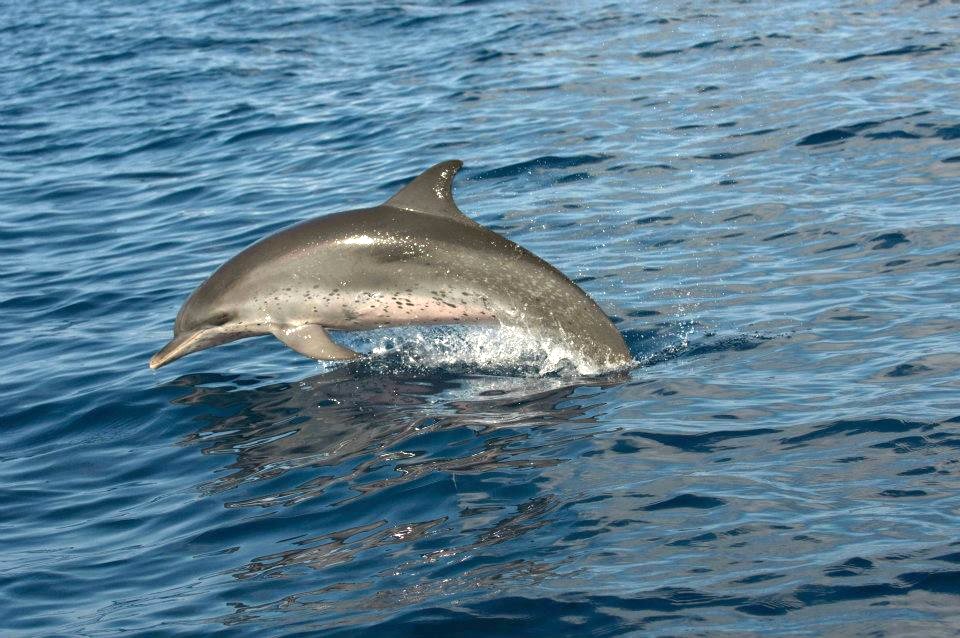
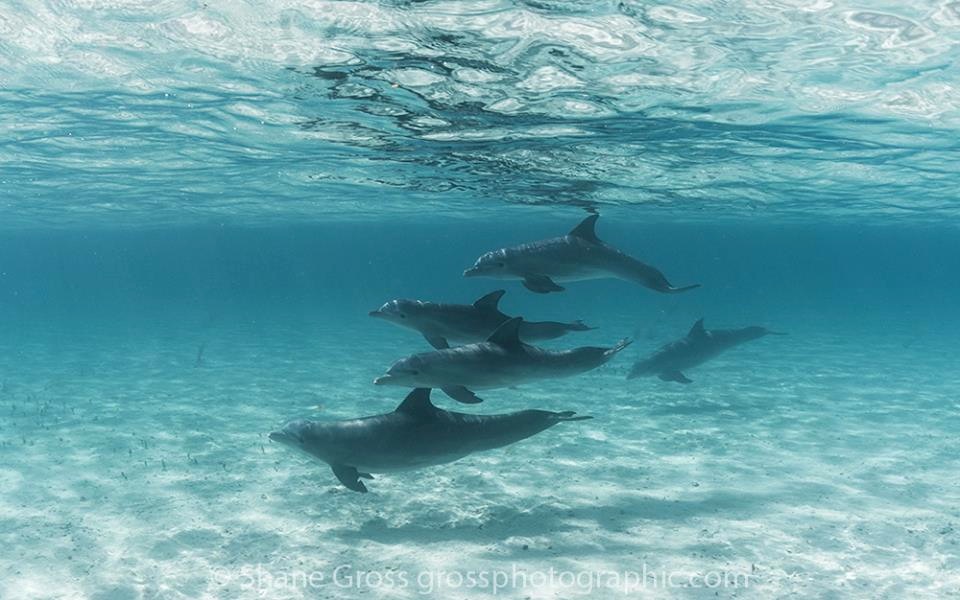
Recently, photographer Shane Gross spent some time with the BMMRO and took stunning photos of dolphins. It’s impossible to say, or think, anything unpleasant about these lovely, intelligent, playful creatures. Say you ‘don’t much care for dolphins’, and you’d be more than halfway to having a down on kittens. Here are some magnificent images that deserve a wide audience.
Thanks as ever to Charlotte & Diane at the BMMRO for ongoing use permission of material including the header pic; and to Shane for his outstanding photos
‘Furtive’. ‘Secretive’. ‘Skulking’. These are harsh epithets to chuck at a small inoffensive bird that just goes about its daily routine in watery places. And look at it from the Sora’s point of view: ‘intrusive’; ‘prying’; invasive’; ‘nosy’… That’s you with your camera, disturbing its quiet life in the reeds and on the margins of marsh and lake. And for that matter your careful attempts to get close to the shy sora without startling it could also be described as furtive, secretive and skulking. See how it feels?
The Sora Porzana carolina is a species of rail, a winter resident on Abaco. The island also has the CLAPPER RAIL, Virginia Rail and the Black Rail. There are no recorded sightings of this last one, and certainly no photographs. But their distinctive call has been heard in several locations over the last few years – for example, by two people in different places last June when we were in full bird mode for “THE BIRDS OF ABACO”.
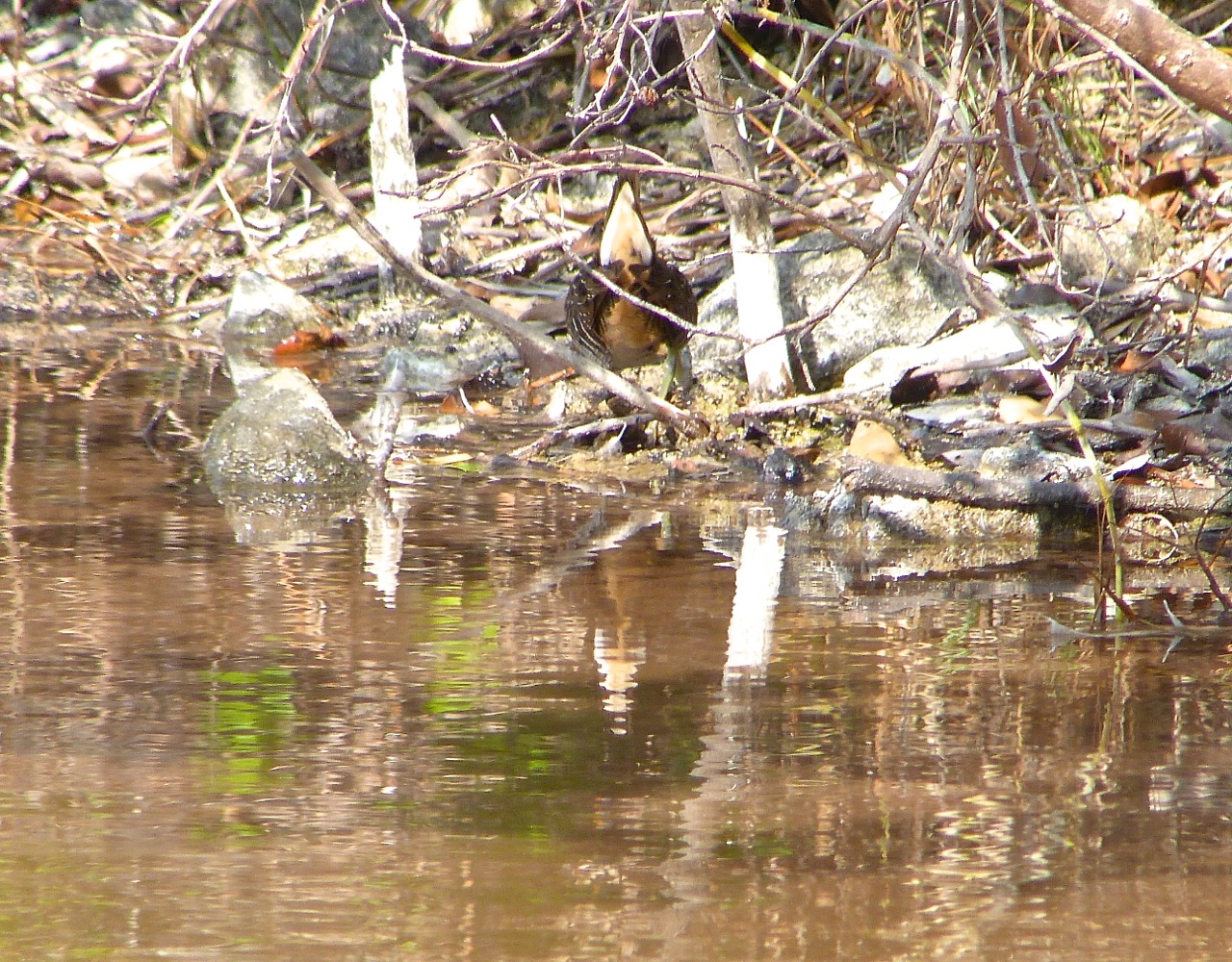
Although not uncommon, the sora is relatively hard to find; and if found, to photograph. As I wrote in the book, ‘these are most inconspicuous birds, so it is quite a coup if you manage to locate one. Their creamy beak and upturned tail may give their presence away as they work their way along the water’s edge, feeding intently’. Tom Sheley took the magnificent photo above of a sora peering out from cover – he’s a very patient man. Often, the best sight you’ll get is of the bird half-hidden in the reeds at a distance, as in my feeble effort above. Spot the Sora… I tracked the same bird, and later got a more open shot as the sora picked its way along the edge of a pond before disappearing again into the reeds. The bird was moving away from me. I was crouched on a small jetty, with a little blue heron nearby looking at me in puzzlement. Or sympathy. My best (ha!) shot below (beak and tail both visible? Check!) is followed by much the most usual view of a sora in my experience, the less photogenic end with the white… stern.
I can’t improve on good old Wiki in summarising the diet of this little rail: “Soras are omnivores, eating seeds, insects and snails. Animals that are commonly reported as sora food items include snails, crustaceans, spiders, and insects – mainly beetles, grasshoppers, flies, and dragonflies. Soras often eat plant seeds. Plants in the sora’s diet include duckweed, pondweeds, and grasses.” Wiki’s own image is shown next.
We were with our friend the ornithological scientist Caroline Stahala* when we – I should say she – saw my first sora at the pond at Gilpin Point near Crossing Rocks. She grabbed my camera and plunged into the rather thick undergrowth at the water’s edge. Actually, she had to plunge into the water itself at one stage. Here are 2 shots that further demonstrate how hard it can be to photograph these wretched creatures. They don’t pose prettily on a branch in the sunshine like a Spindalis, for example. They forage about in places where low light and thick vegetation combine to make focus and clarity difficult to achieve. *’The Parrot Lady’ The remarkable calls of the sora can be heard in the very short clips below, from the invaluable Xeno-Canto archive. They make three distinct types of sound, one described as “a descending whinny”. Apparently the use of ‘call broadcasts’ greatly increases the chances of hearing a sora. They also increase the chances of seeing a sora, as the bird will often investigate the source of the call. The propriety of using a recording to attract a bird is open to debate, but there’s no doubt that it can be far more effective than simply going ‘pish-wish’ repeatedly…CALL Ted Floyd ‘WHINNY’ CALL Micah Riegner ‘WEEP CALL’ Todd Wilson This is a second Wiki image of a sora foraging in water. I like the fact that, as with Tom’s photo, you can see the feet.“SORA”. Where does the word come from? What does it mean? It sounds like some uninviting butter-style spread. Or is that ‘Flora’? I did some research and for a start it means ‘Sky’ in Japanese and ‘Seashell’ in Korean – both used as names. Six countries worldwide have places called Sora. There are various obscure usages (e.g. a little-known video game). Disappointingly, however, the best etymology I can find in a birding context is that the origin is ‘unknown’. I was too disheartened to explore the derivation of ‘Porzana’. Could so easily be a second-tier female character in a Shakespeare comedy: “Haply, Porzana, hast seen the Sora of the Prince, withal?”. Having started this post with a header shot by Becky Marvil, I’ll end with the etymological mystery and another photo by Becky of the same bird going for some underwater delicacy.
STOP PRESS Uli Nowlan has kindly sent a photo of a Sora taken at ponds north of Treasure Cay (below). It’s a timely reminder to me that this blog is somewhat South Abaco oriented. More than somewhat, in fact. That’s inevitable I’m afraid, owing to my base camp being south of MH. Also, I think it’s generally accepted that South Abaco is the place to find the best birding. I do include birds from the TC area – the golf course ponds and the creeks – but perhaps not enough. Contributions welcome!
Credits: Header and last image – Becky Marvil; Tom Sheley, RH, Wiki, Caroline Stahala; Uli Nowlan. Wiki-nod for some info also.
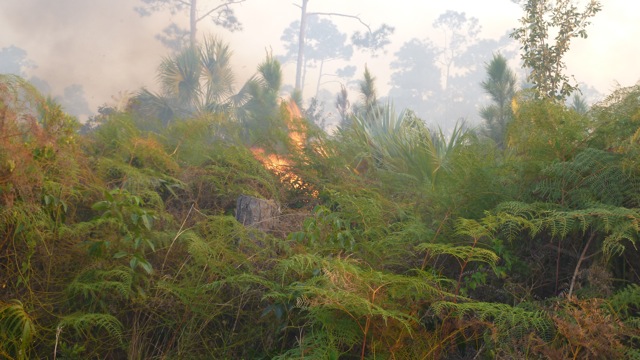
Every year Abaco has a number of forest fires, especially in the south of the island. The timing is variable – sometimes it’s March, right now it’s… right now. The fires are good in some respects for the forest, and regeneration is remarkably rapid. Links to previous posts on the topic are shown below. Many, or most, are (allegedly) started by hunters clearing scrub and undergrowth so that the dogs can chase the hogs. The rights and the wrongs are debatable, but what is beyond doubt is that a change of wind can cause fires set in forest on the unpopulated west side to jump the Highway across to the east side. There are farms and settlements there, and these are regularly put in peril. The Delphi Club has had a couple of close calls when the thick coppice between the house and the pinewoods failed adequately to deter the flames (in theory, it should!); Crossing Rocks had some nights last year when the whole community united to protect the settlement. Now it’s the turn of Bahama Palm Shores, where the fire service and volunteers have spent the last few days – and nights – trying to prevent fire reaching the houses. So far, so good. Abaco is a wonderful place, but the fires can be powerful and scary, spreading rapidly in the wind.
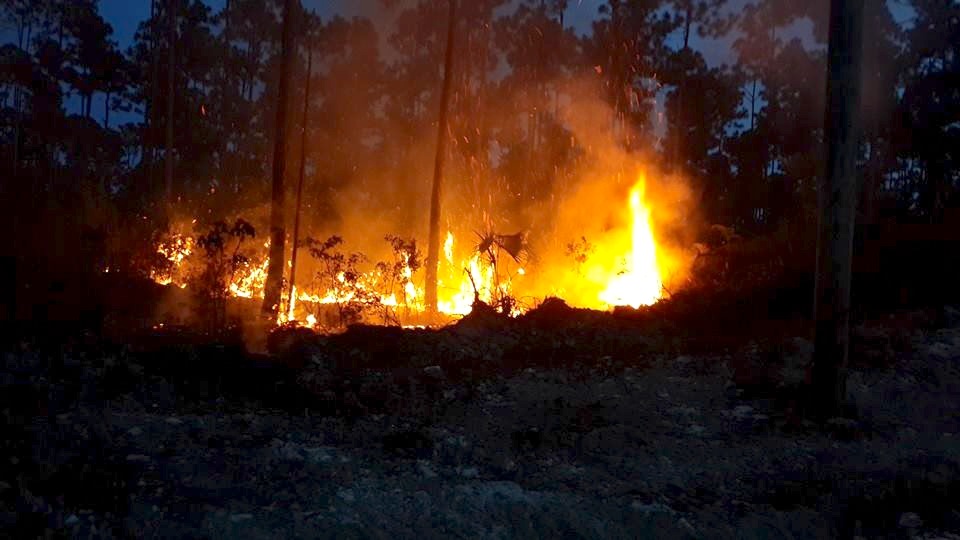
Luc Lavallee is one of the volunteers, and hasn’t had a lot of sleep recently. He has posted regular bulletins during the night on the BPS Facebook Page to keep everyone informed of the situation and the work in progress – for example creating firebreaks. Here are some of his photos over the last few days; the aerial shot is by photographer David Rees, who takes wonderful ‘drone’ photos.
This photo captures the fire raging in the middle of the night, making an almost abstract image
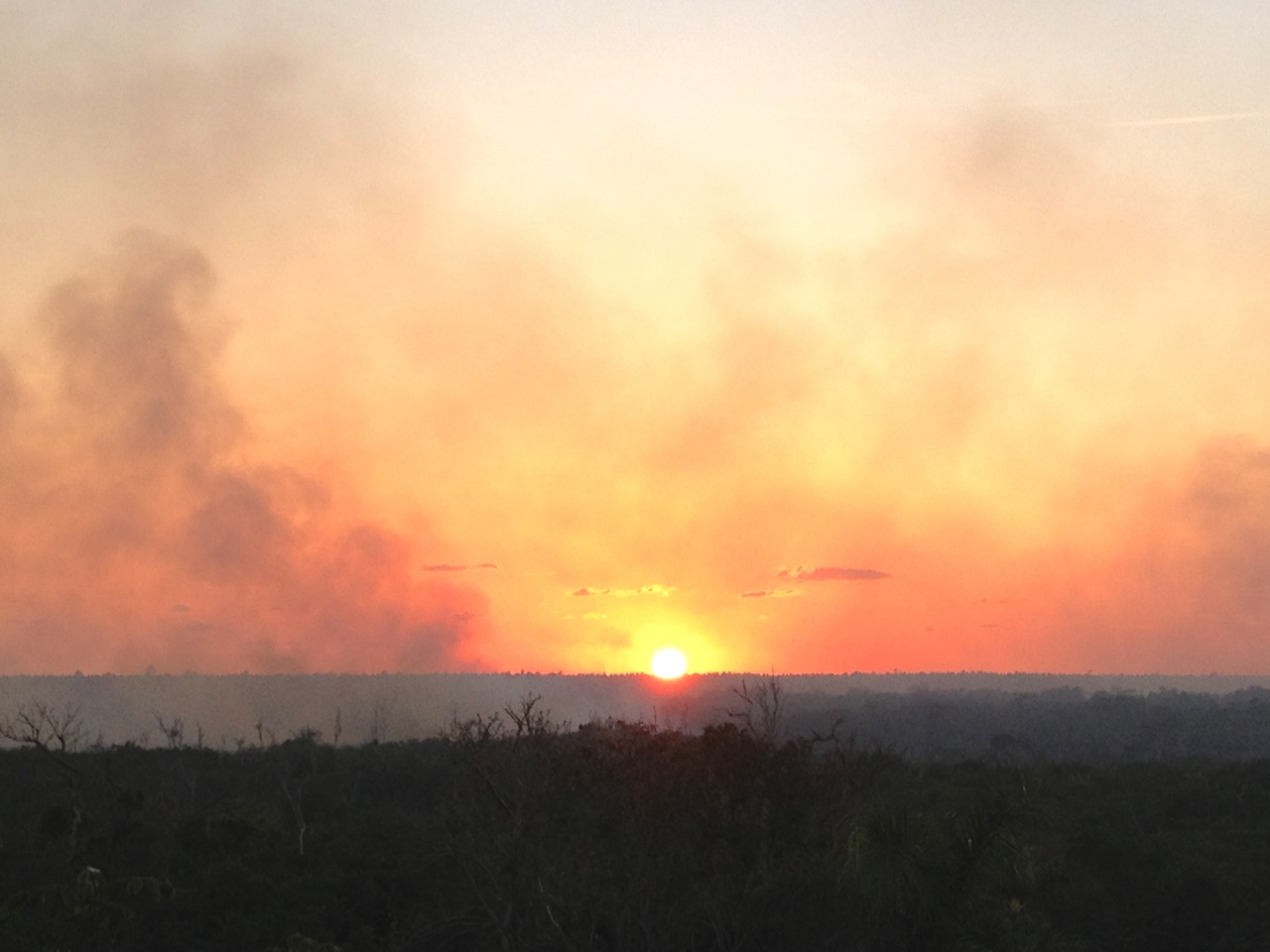
Finally, here is a shot I took last year from the Delphi balcony looking west to the sunset. The fires had burned for several days, and the suns rays in daytime had to penetrate clouds of smoke and ash. The effect was striking.
Credits: Header & last pic- RH at Delphi 2013; aerial shot – David Rees; other images – Luc Lavallee
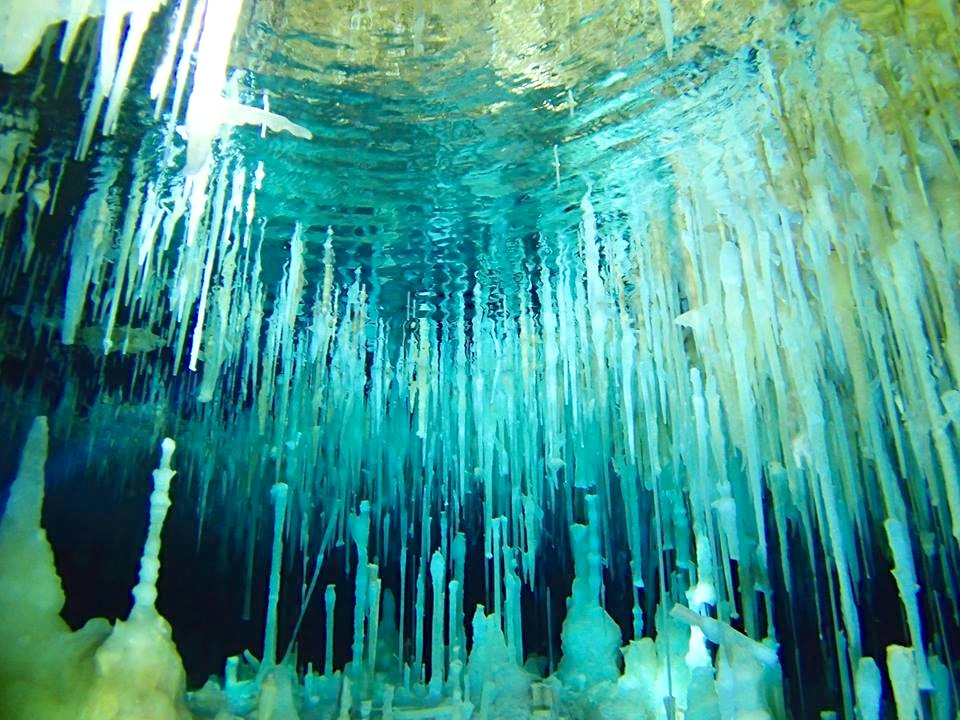
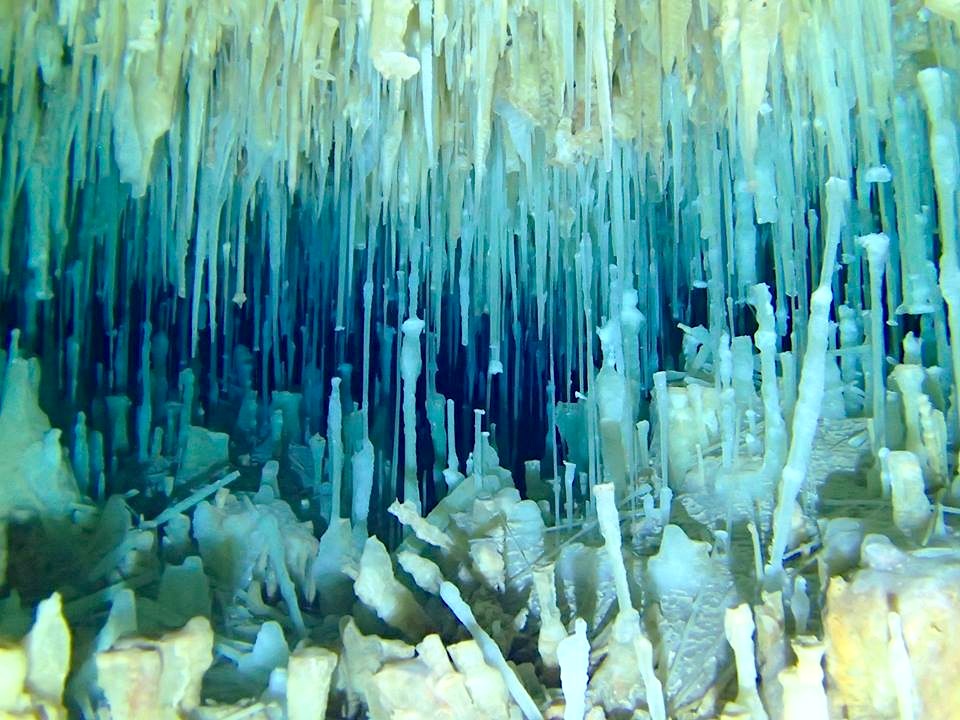
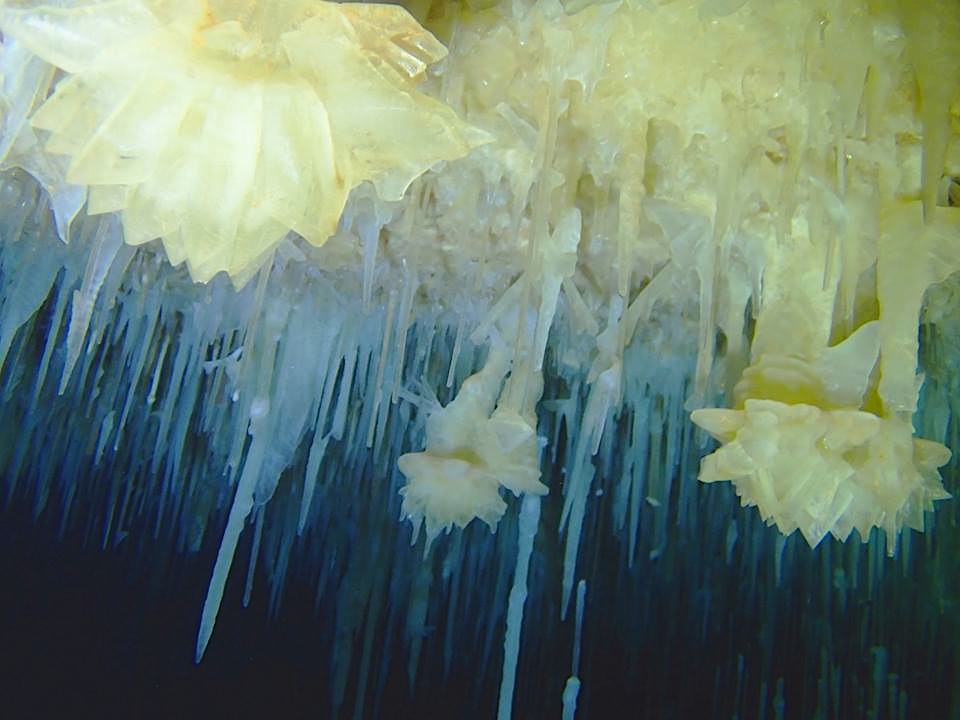
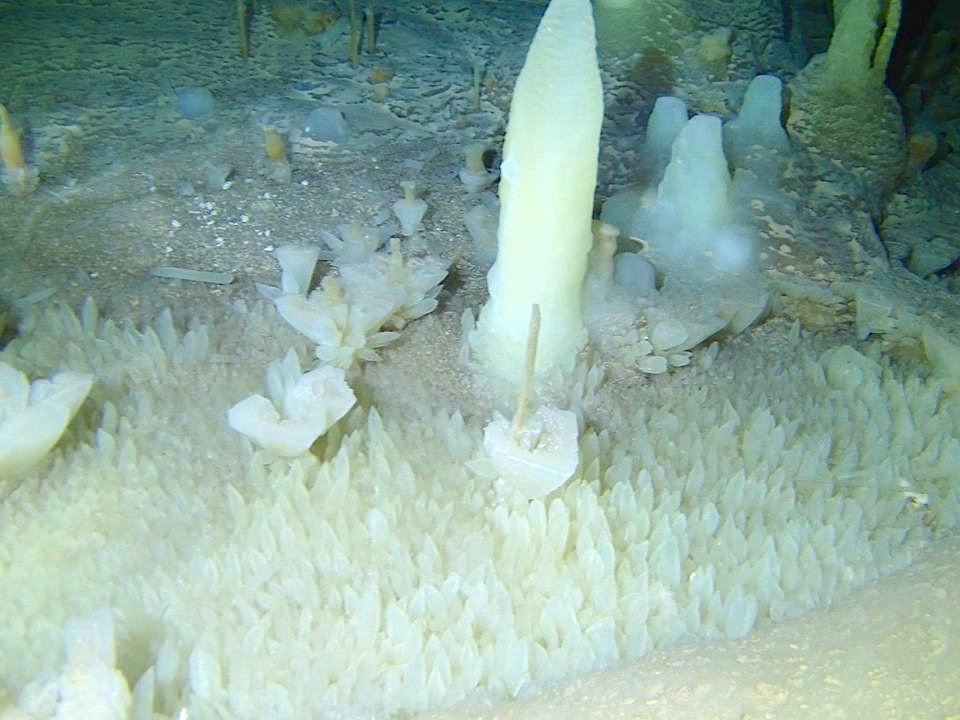
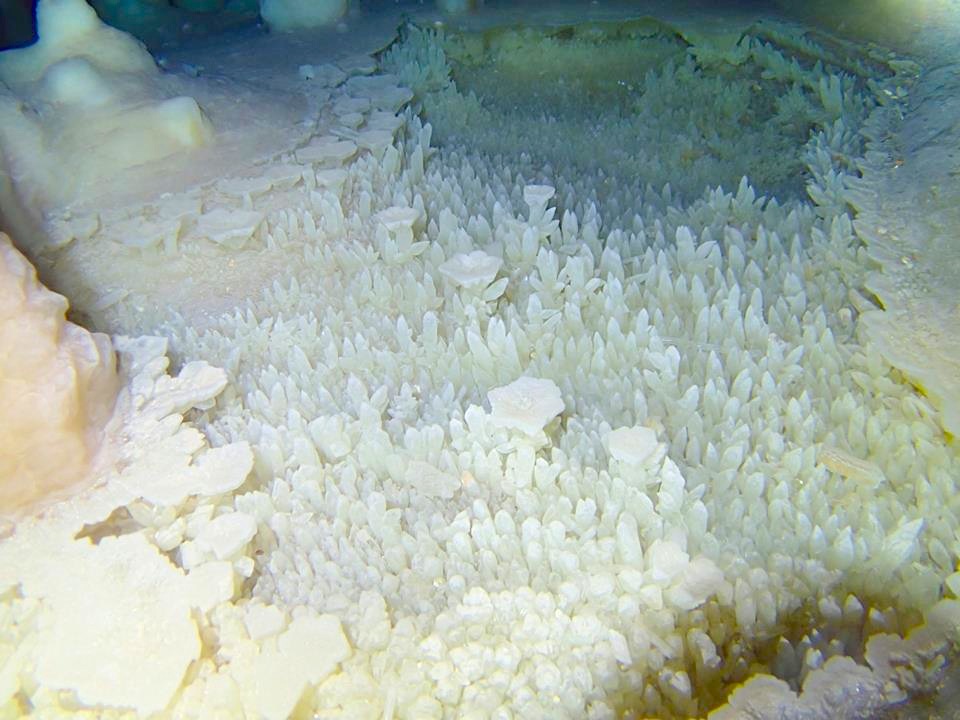
This is the second of a series of photos taken by diver Hitoshi Miho in the underground cave systems of Abaco in conjunction with the Bahamas Caves Research Foundation. This series forms part of a wider project for the blog in due course. With Hitoshi’s kind permission, here are a few more examples of his wonderful images of the silent and mysterious world that lies beneath Abaco. I’ve recently been lightly involved with marine pollution and the environmental effects of ill-considered development. One dreads to imagine the adverse effects on these caves and the blues holes that might result from a massive dredging project of the sort currently being contentiously and litigiously carried out in the pristine waters of Bimini. Thousands of years of crystal development could be lost in a comparative blink of an eye.
10 PUFFER FISH FACTS TO ASTONISH YOUR FAMILY & FRIENDS
1. Puffers can inflate their bodies in an instant by ingesting huge amounts of water and becoming water-filled balloons.
2. They need a startling form of defence like this (or ‘piscatorial superpower’) because they can’t swim very well.
3. However, a persistent predator will find that they contain a toxin (tetrodotoxin TTX) that is a hundred times stronger than cyanide. One puffer fish has enough toxin to kill quite a few humans. Agatha Christie was unaware of this – had she been, we might have had a classic multiple murder mystery based on the contents of a fish tank… “Poirot and a Fishy Tale of the Caribbean”
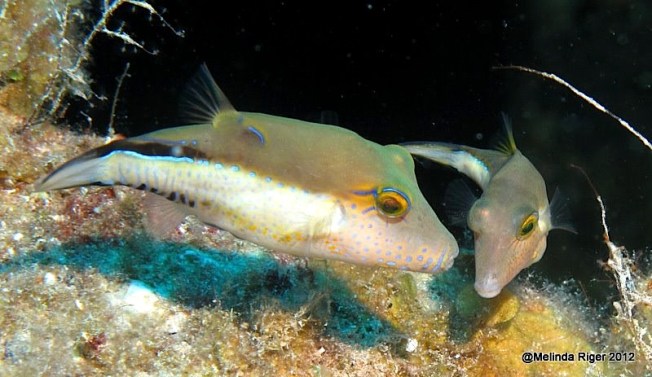
Sharpnose Puffer Fish
4. Selected parts of a puffer fish are a delicacy in some cultures (‘fugu’, in Japan). Trained chefs are used to avoid mass deaths among diners.
5. Sharks are the only species immune to the puffer fish and are not much bothered by a small fish that can blow itself up.
6. Puffers have skin, not scales; most have toxic spines of some sort. Bright coloured ones are probably more toxic than their duller cousins.
Sharpnose Puffer Fish
7. It’s worth knowing what an uninflated puffer looks like before you try to pet a passing fish and have a toxic encounter.
8. There are more than a hundred puffer species in the world, found where there are warm shallow waters.
9. Noy all puffers are toxic; and some are more toxic than others.
10. I have no idea of the relative toxicity of the 2 puffer species featured here. Sorry about that. Take care!
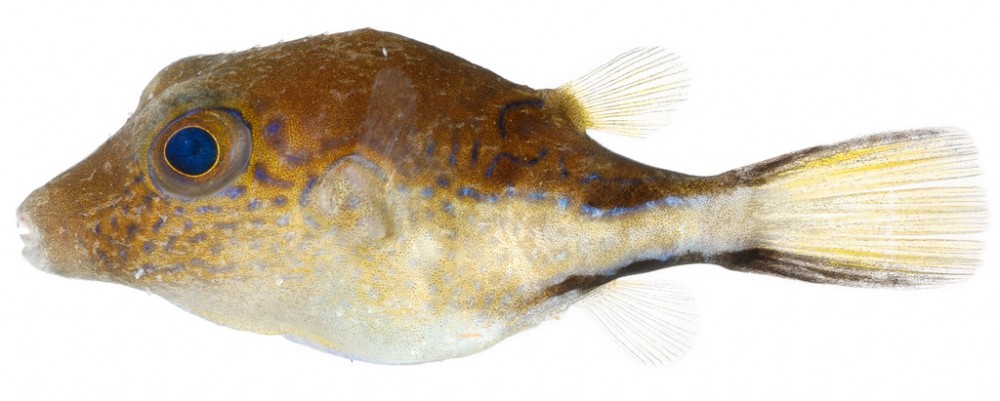
The fish above are all Sharpnose Puffer Fish taken by Melinda Riger of Grand Bahama Scuba; the rather nice drawings of the species are courtesy of the Smithsonian via ‘Vintage Printables’.
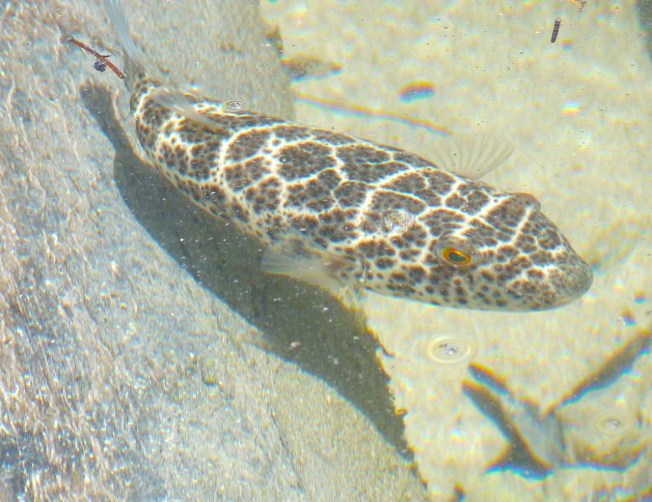
CHECKERED PUFFER FISH
I photographed some Checkered Puffers at Sandy Point, Abaco last summer. None was puffed up, and I wasn’t about to upset them. The following photos of a small group of puffers were taken from above and not underwater (“no fear”).
Checkered Puffer Fish, Sandy Point, Abaco
Checkered Puffer Fish, Sandy Point, Abaco
Checkered Puffer Fish, Sandy Point, Abaco
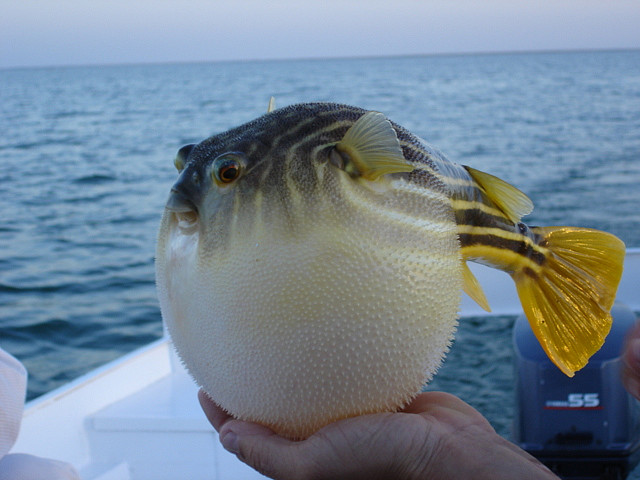
I don’t know what species of puffer the one below may be, but I do know I don’t want it in the palm of my hand. I include it from an ‘info for kids’ site to illustrate what the full balloon looks like. I’m wondering if all one needs to deal with them is a pin on the end of a long stick…
Puffer Fish at Full Puff
FURTHER READING about dodgy creatures you may encounter:
ABACO’S 5 ‘PERMANENT RESIDENT’ WARBLERS & A NEW WARBLER ID GUIDE
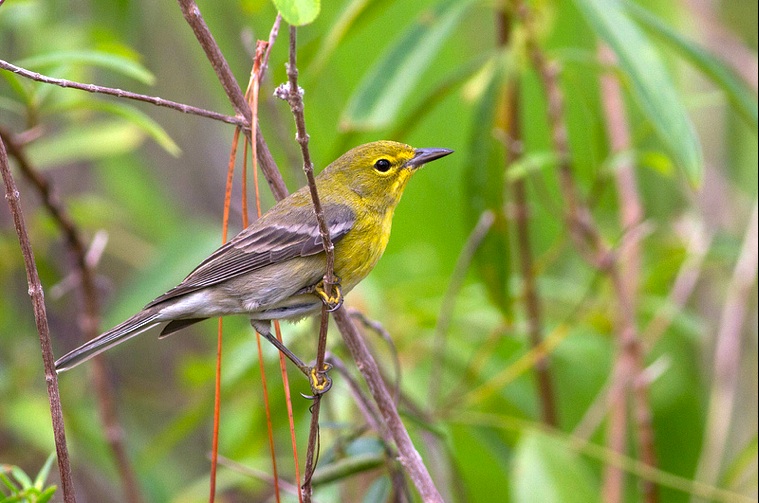
There are 37 Warbler species (Parulidae) recorded for Abaco. There is considerable scope for confusion between many of them. For a start, by no means all have the helpful word ‘warbler’ in their name. Secondly a great many of the species are to a greater or lesser extent yellow, with sub-variables for gender, age and season. It’s easy to get in muddle. A good place to start ID is with the warblers that are on Abaco all year round. Only 5 species are permanent residents on Abaco and the Cays: Bahama Warbler, Bahama Yellowthroat, Olive-capped Warbler, Pine warbler and Yellow Warbler. I have used images of these to illustrate this post.
Yellow Warbler (f) Abaco
The rest are mostly winter residents, with some being transient visitors passing through on their migration routes. Some are ‘everyday’ birds; some are unusual; and a few are extremely hard to find, the Kirtland’s warbler being the rarest and therefore the most prized sighting of all. I will be returning to the Kirtland’s in more detail in due course.
Pine Warbler, Abaco
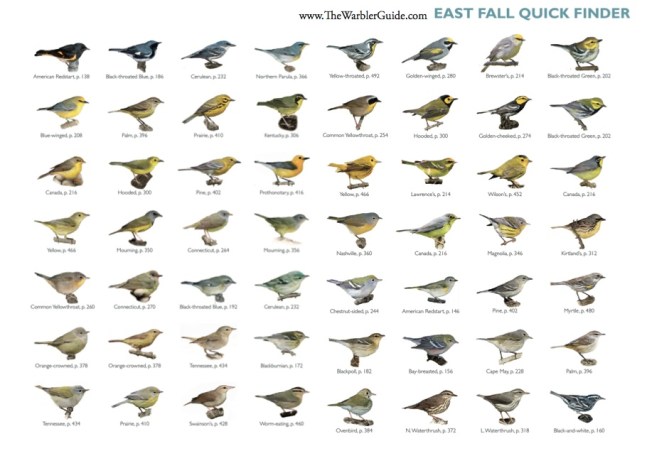
At the bottom of this post is a complete list of the Abaco warbler species, with Bahamas bird authority Tony White’s excellent codes indicating (a) when they may be seen; and (b) the likelihood of seeing a particular species (from 1 – 5). First however, news of a great resource for aiding warbler ID, produced by The Warbler Guide. Click on the blue link below to open a pdf with illustrative views of warbler species from several angles, spread of 8 pages. These are the warblers of North America, but you’ll find that almost all the Abaco warblers are featured.
ABACO’S ENDEMIC BIRDS: MAKING A CASE FOR PROTECTION
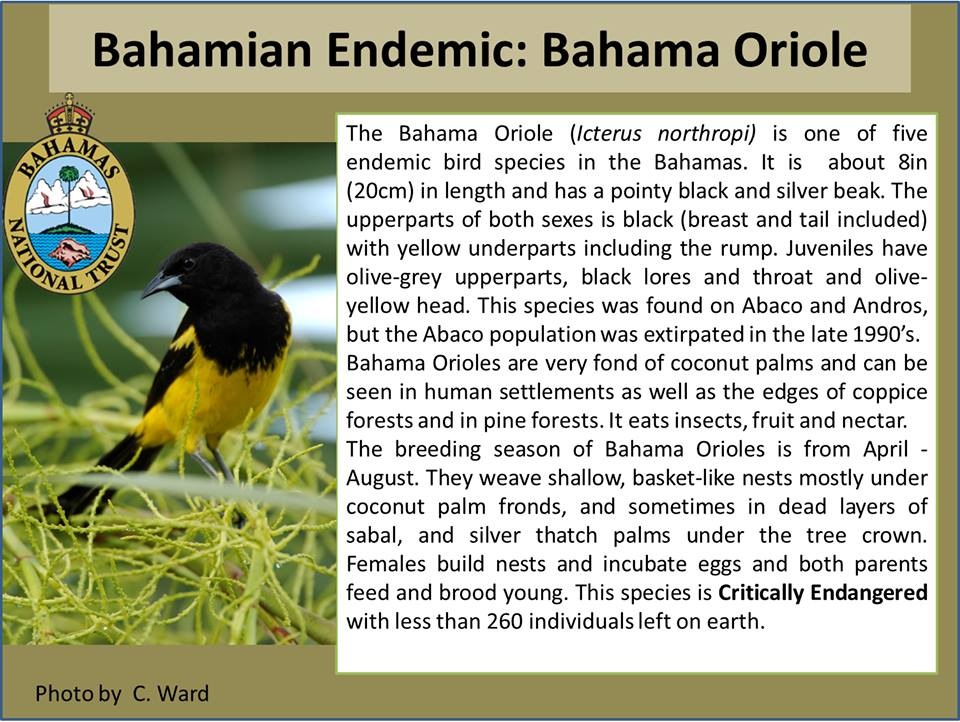
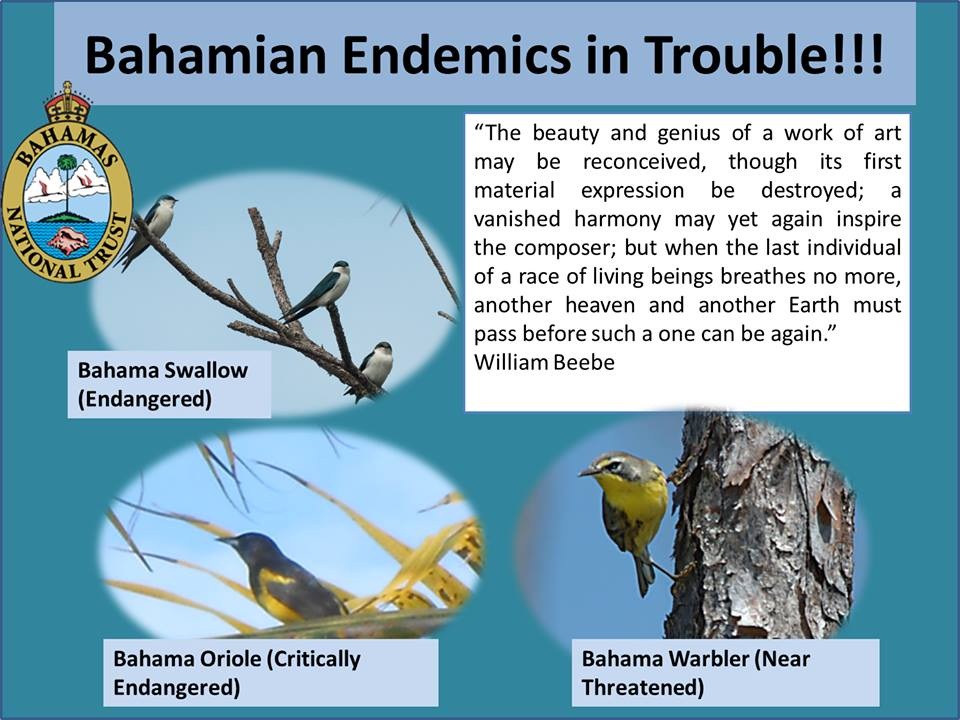
I recently wrote a post showcasing the 4 Bahamas endemic bird species found on Abaco: swallow, warbler, woodstar hummingbird, and yellowthroat. You can read it and see some great photosHERE. Sadly, the magnificent oriole, extant on Abaco for centuries, was extirpated in the 1990s. You can still see them but only on Andros; and the population there is barely sustainable – there are only 260 remaining. Still, on Abaco there remain four of the endemic species to conserve and care for.
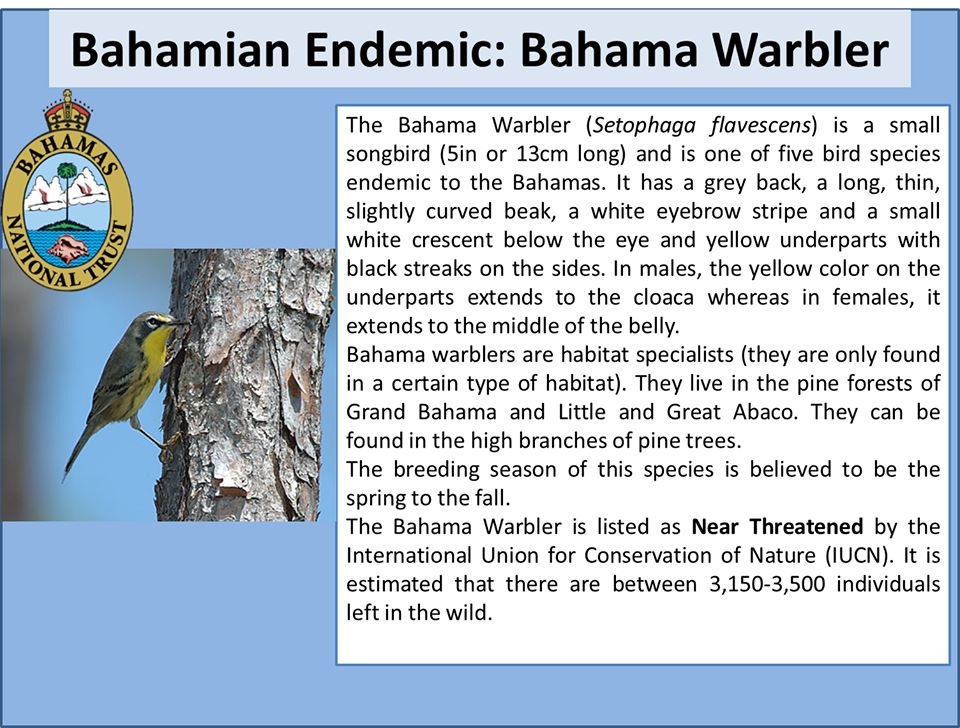
The Bahamas National TrustBNThas produced 6 brief but informative illustrated ‘cards’ about the Bahamas endemics. They deserve a wide audience, especially in view of the threats to some species for reasons that include habitat loss and increasing development. New Providence lost its subspecies of Bahama Yellowthroat within the last 20 years. Let’s hope that Abaco can hold onto its speciality birds for the future.
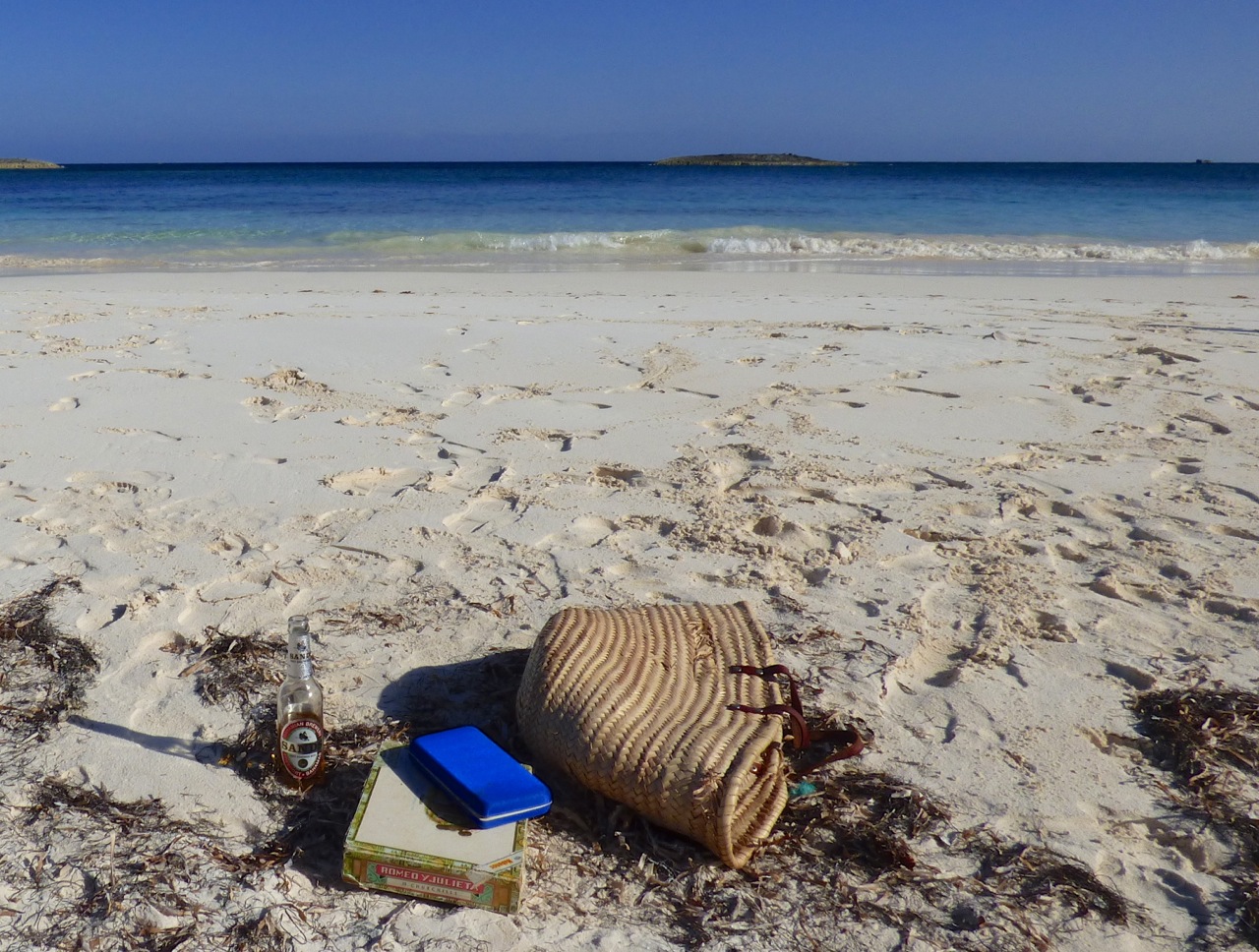
Strangely, our time on Abaco is usually punctuated at regular intervals by the ingestion of libations of an intoxicating variety. Basically, wine and beer. This has many positive benefits: for example, it has a tendency to make ones own jokes seem a great deal funnier; and it can definitely aid casting confidence for an afternoon of bonefishing… Looking back over some recent photos, I found one I took on the Delphi beach during the ‘Permit Bagging’ week at the north end. I was amused by the sophistication of this shoreline collection of “essentials” belonging to one of the permit casters (RF – you!). The beer was an unsurprising beach-fishing accompaniment – the box of Romeo y Julietas was the main item of interest.
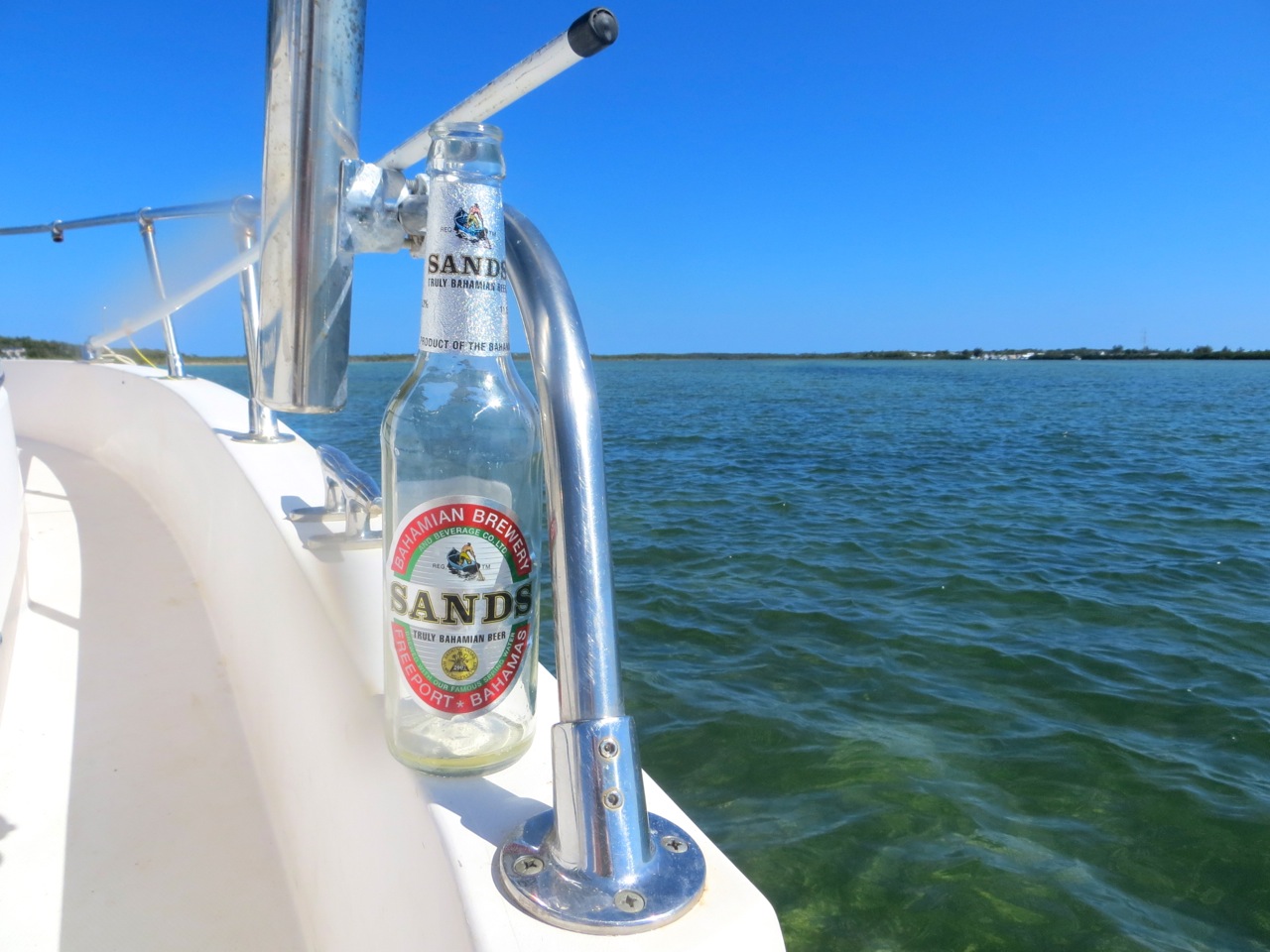
There can be few beers more perfectly named for its surroundings than Sands, although it can be drunk out at sea just as easily…
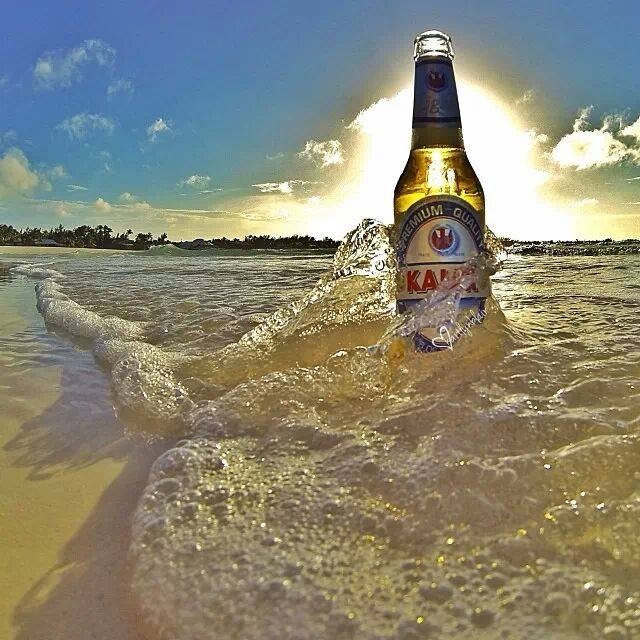
My own favourite is Kalik – though admittedly after a while my discernment of the subtle differences between the 2 brands may become somewhat dulled
This guy seems to be enjoying his lunch on a perfect day out fishing offshore… Oh! Wait – it’s me…
I enjoyed this imaginative beer-based image posted by Kaitlyn Blair on FB
The title from this post comes from a slogan for Double Diamond beer circa 1970 and the associated excruciating advertising. It caught on, and in almost any social situation at least three people were likely to say “I’m only here for the beer”. Even Garden Parties at Buckingham Palace (where one of the droll wags was, by royal prerogative, Prince Phillip). Here, in all its glory, is the ‘fons et origo’ of the expression…
BANANAQUITS ARE UBIQUITS ON ABACO – AND ÜBERCUTE TOO
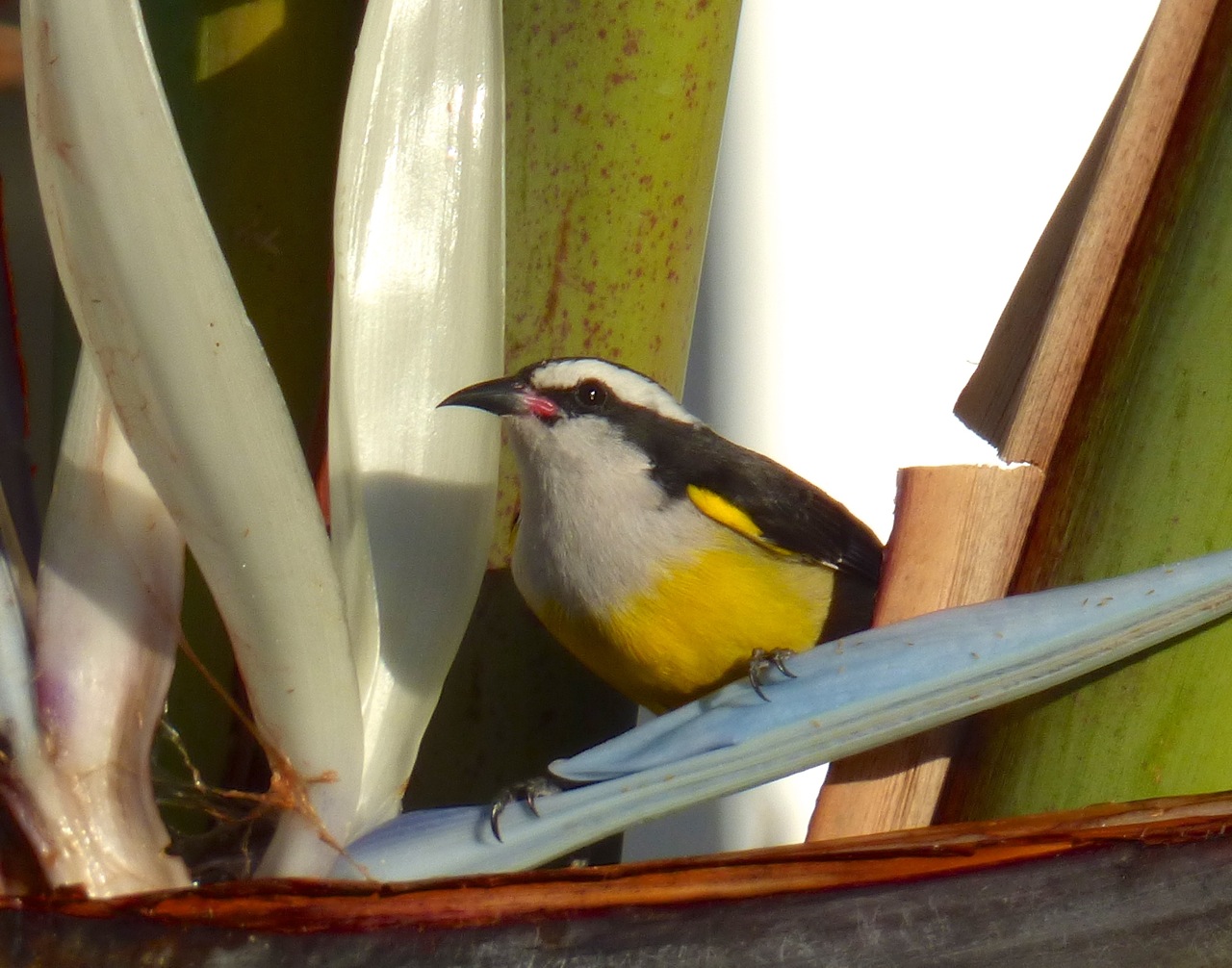
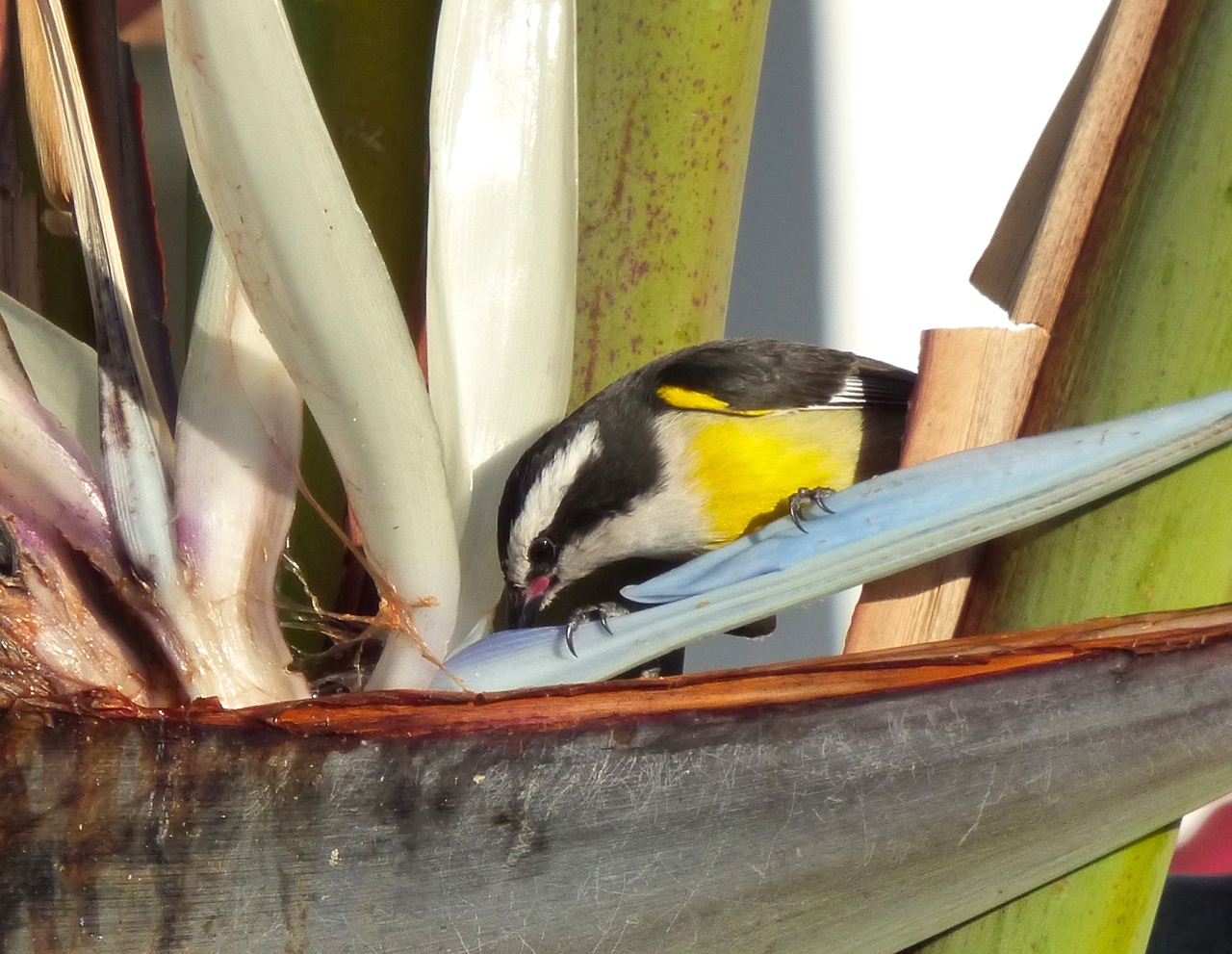
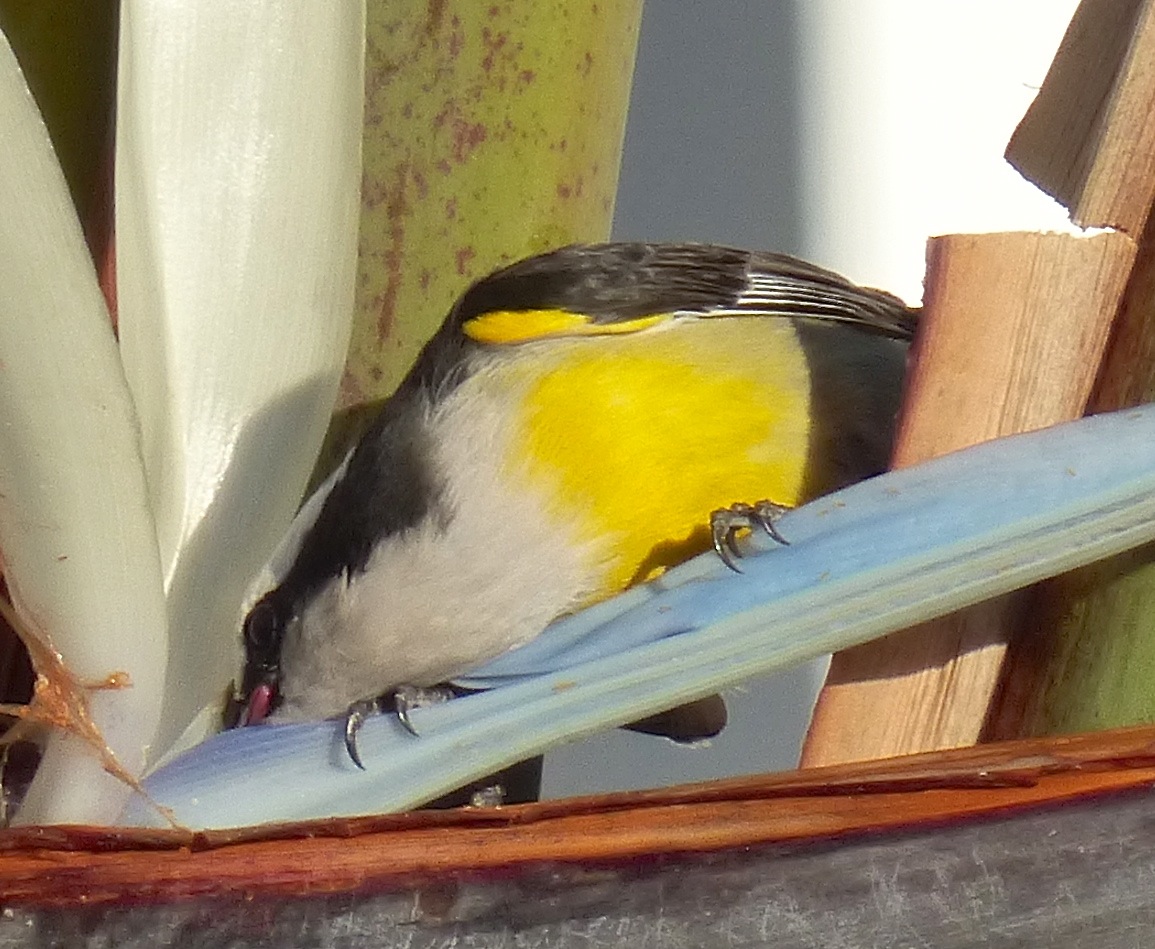
The Bananaquit Coereba flaveola. Permanently resident on Abaco, at the Delphi Club, and in my top ten favourite birds. And everyone else’s, I shouldn’t wonder. With their handsome livery and their cheeky chirping, they can be found almost anywhere. They could equally well be called ubiquits. I had been going to post some recent images of one feasting at a hummingbird feeder, but I found this thirsty palm-forager in my photo folder first, so here he is in all his glory…
Here’s the song of a bananaquit from Xeno-Canto (Paul Driver, Andros) (and there’s a thick-billed vireo in the background)
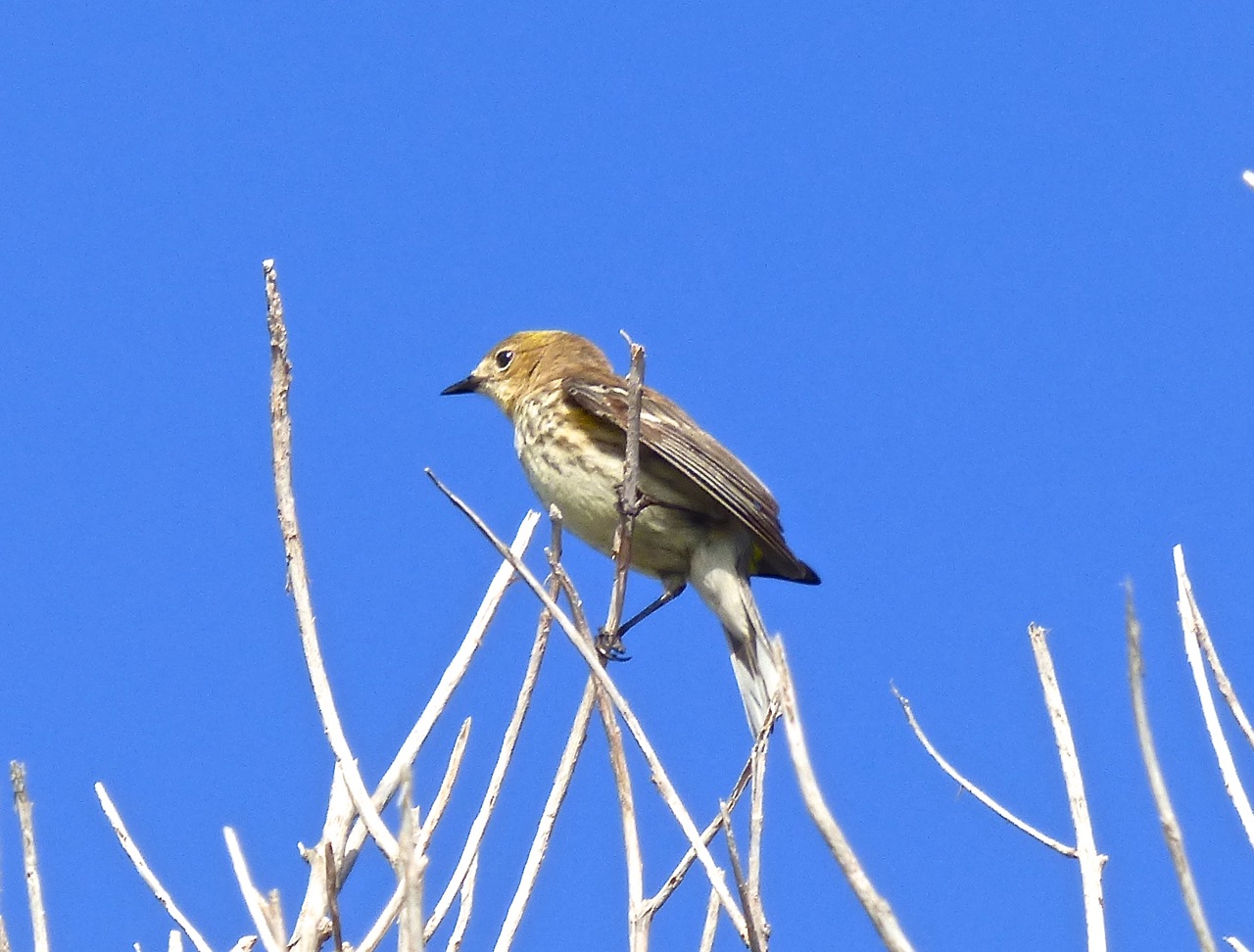
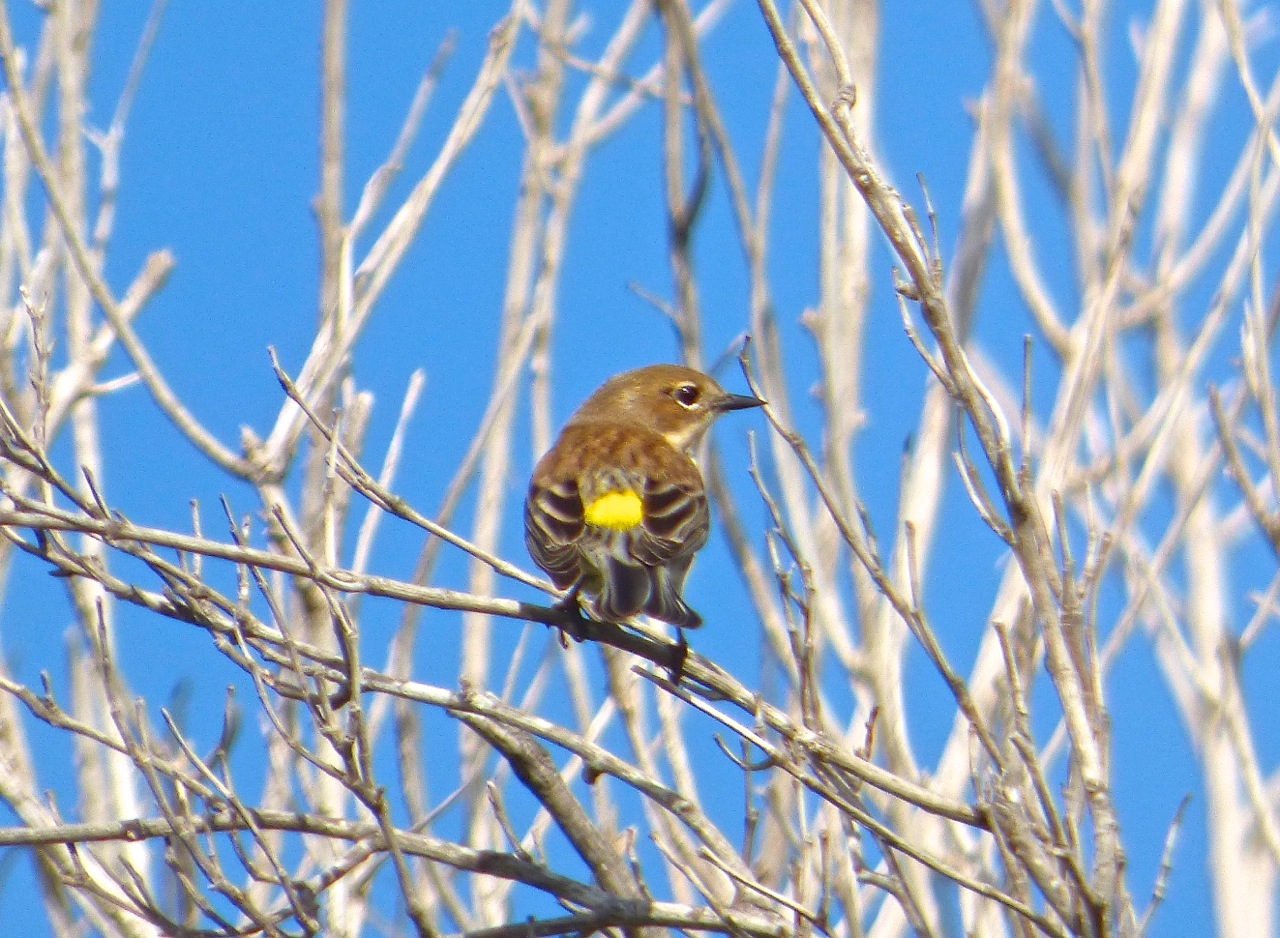
I haven’t been very lucky with yellow rumps in the past. This is not normally something one likes to talk about in a public forum… but to be honest I have been longing to get hold of a yellow rump of my own. The warbler Setophaga coronata, that is, a fairly common winter resident on Abaco. I’ve seen them of course. I’ve glimpsed a passing flash of yellow rump. But no YRW has stayed parked in tree with its backside towards me for long enough to permit me to photograph its posterior glory. Ideally I’d have liked a clear, attractive shot like the header image (Dan Pancamo, Wiki). But desperation leads to lowered expectations and plummeting standards. Frankly, this year I’d have been satisfied with any yellow rump. Abandoning my initial plan to apply a yellow highlighter pen to a compliant female grassquit, I bided my time. And suddenly there, at the very top of a tree near the swimming pool at Delphi, was my chance… A pair of YRWs were in evidence.
The tree wasn’t very close to me, and the birds stayed near the very top. My photos were never going to be great. Especially since each bird was meticulous in keeping its rear end out of sight. Then they flew away! However quite soon one was back. This time there were twigs in the way, one of the those little variables that makes camera focussing so enjoyable. But this time I managed to ‘pap’ its derrière… Feeble shots but mine own. As an avian ‘Holy Grail’, a mere yellow rump leaves quite a lot to be desired, I can quite see. It’s on no one’s ‘bucket list’ of birding musts. But now I can move on, release that poor female grassquit and chuck out the highlighter pen.
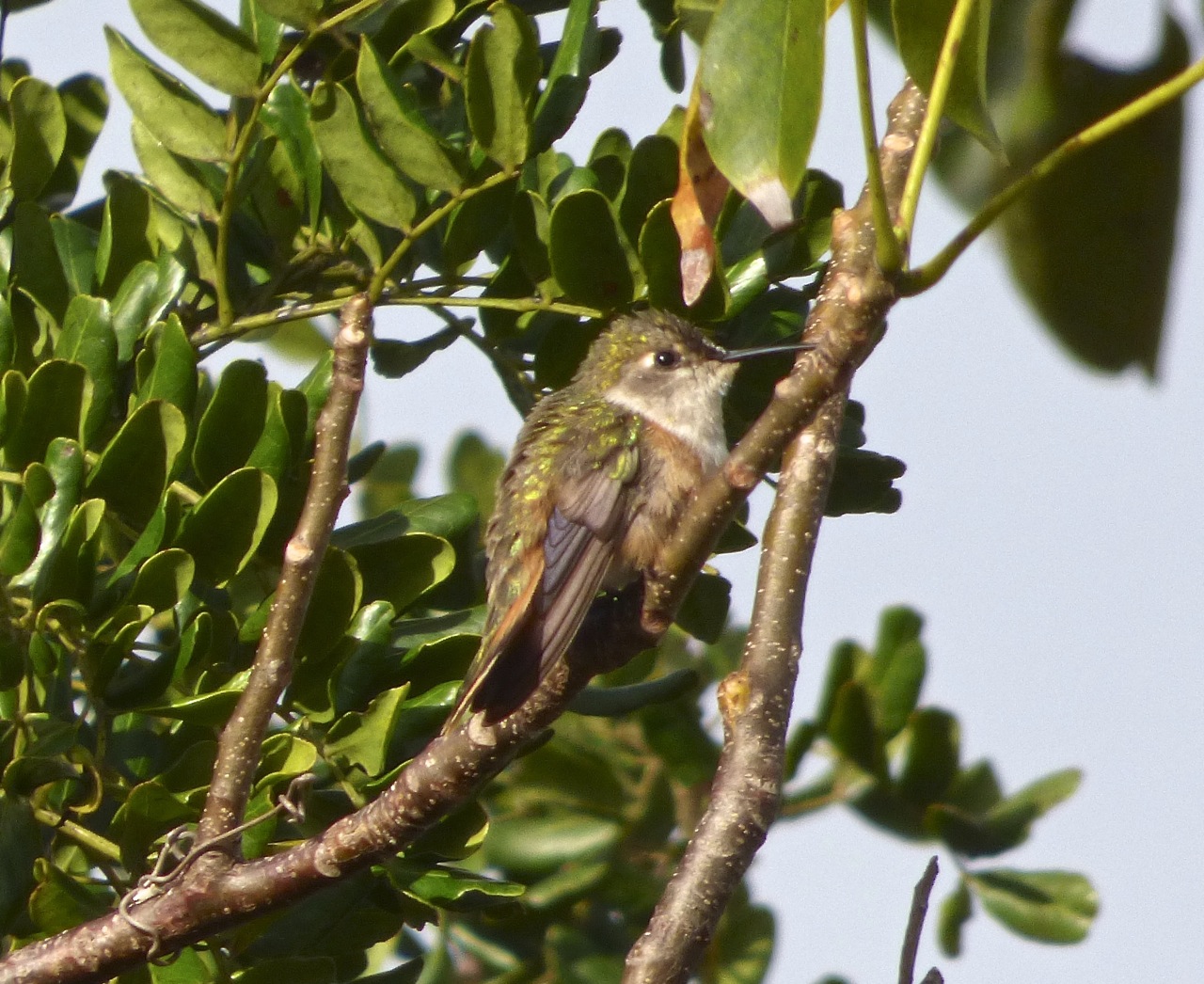
I’ve written before about the somewhat fraught relationship between the 2 hummingbird species of Abaco, the endemic Bahama Woodstar and the resident but non-indigenous Cuban Emerald. They tend not to mix, and the Woodstars tend to fade to areas where there are no Emeralds. Both are found at Delphi, but I suspect the sugar water feeders may play a part in that. Even there, the Emeralds predominate. This is my best recent shot of a female Woodstar on the Delphi drive. I had about 30 seconds to see it, whip out the camera, remove the lens cap and fire off some shots. Then it flicked away into the coppice. All images were useless bar one, which almost worked but won’t stand close scrutiny.
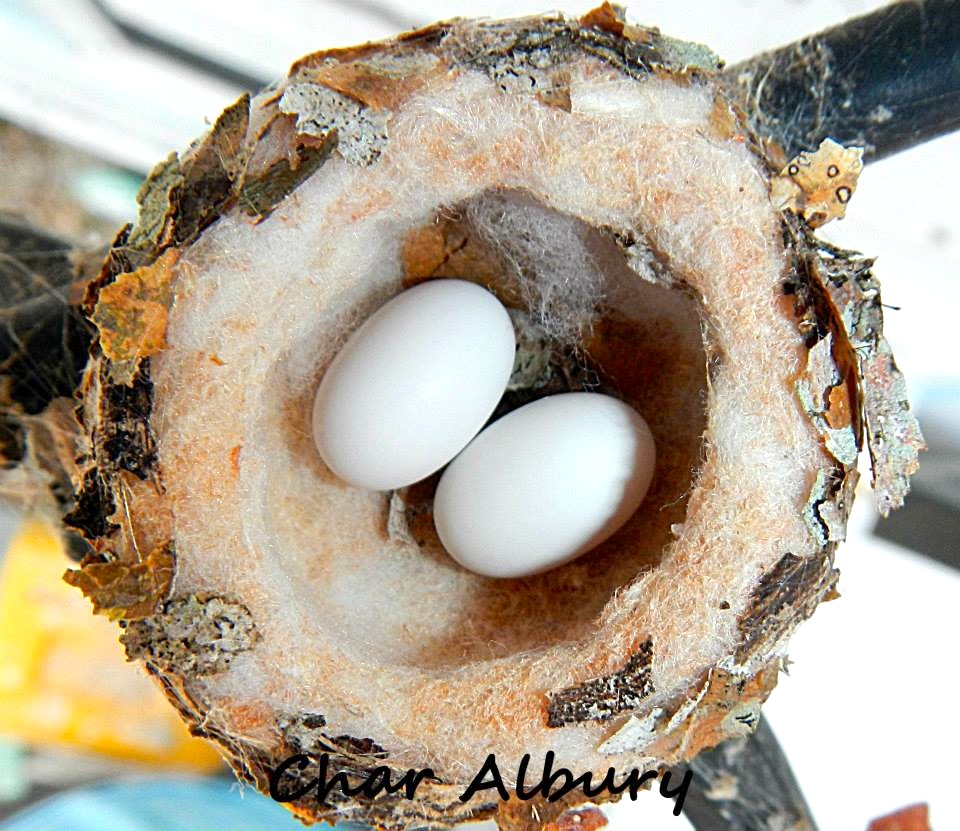
Man-o-War Cay may be quite small, but it seems to be blessed with plenty of Woodstars. They are often quite tame and Charmaine Albury has them nesting round her house annually. I posted about her baby Woodstars from last year HERE. This year they have returned, making their tiny cup nests rather precariously amid the domestic wiring. Here are a few of Charmaine’s nest photos (for which thanks!) for this season.
A female Woodstar on the nest. They lay 2 eggs, which are incubated for around 2 weeks
A fledgling takes flight for the first time, leaving more room for the remaining chick. Note the stumpy little tail
Two eggs that seem far too big for such a tiny nest
Within the last couple of days, the first egg hatched. This hatchling is a few hours old at most
Credits: Header pic of male BAWO Bruce Hallett; RH (Delphi); Charmaine Albury (nests); BNT info sheet
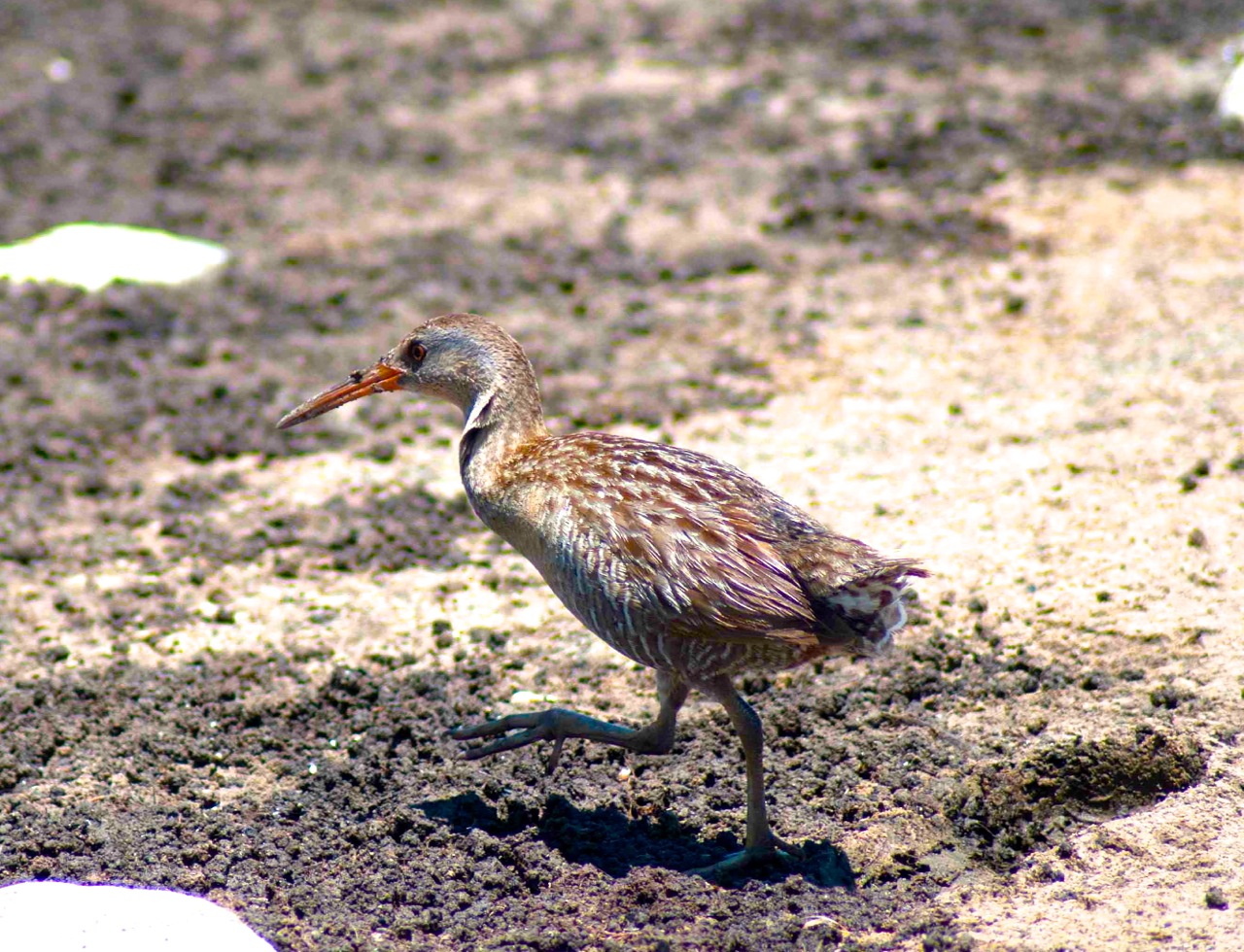
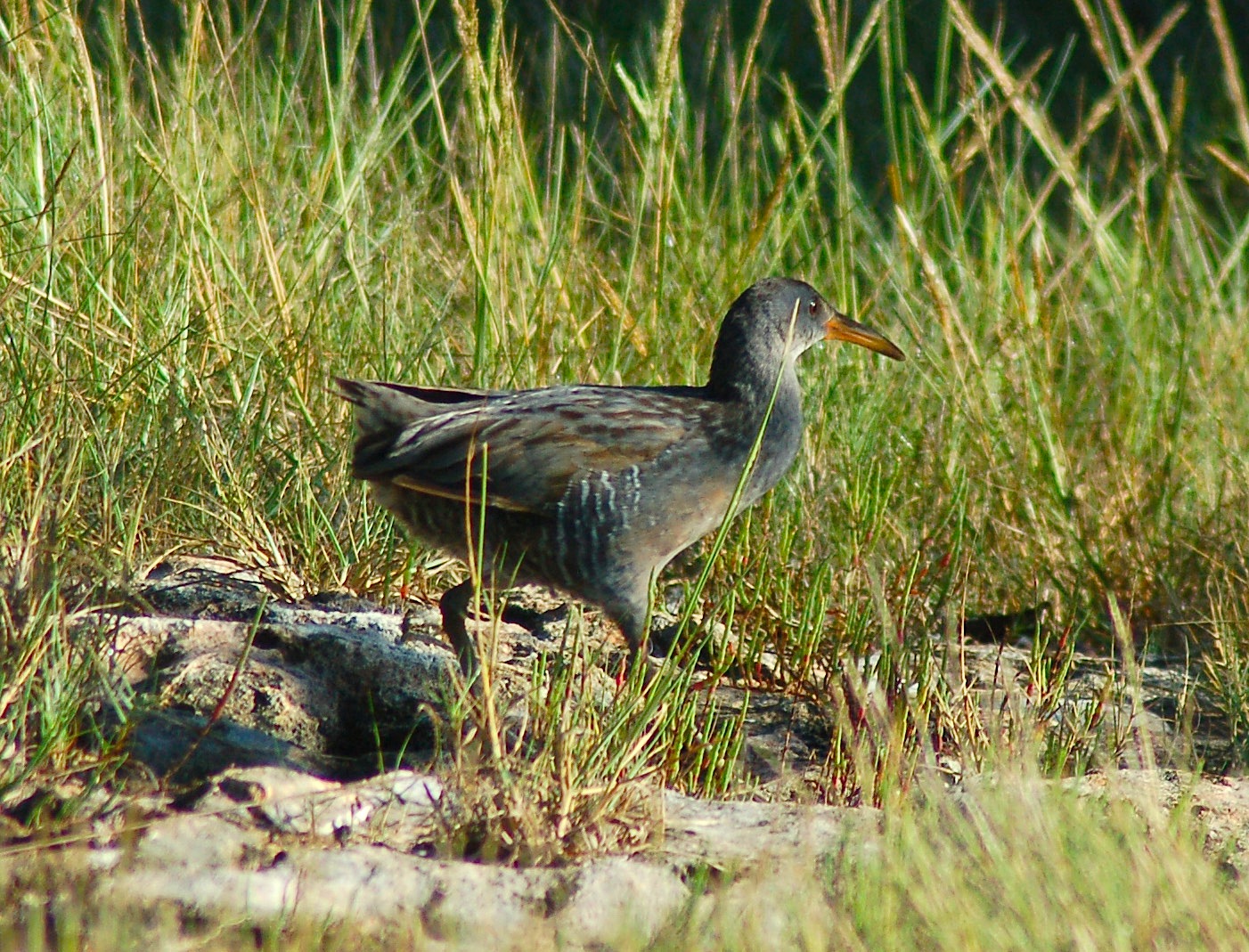
That is, essentially, because they are indeed Clappers. Rallus longirostris to be precise, or Clapper Rails. There are 4 rail species on Abaco, the Clapper being a permanent resident and not particularly uncommon. The others are the Virginia Rail and the Sora, both winter residents and less common (or in the Sora’s case, perhaps more furtive and less easy to find); and the Black Rail, which is generally agreed to be a ‘hypothetical’ for Abaco. That means they are believed to exist on Abaco but there are no confirmed sightings let alone any photos of one. However, last summer while we were taking a truck into the backcountry of South Abaco to locate hard-to-find birds for “The Birds of Abaco” book, the distinctive call of a Black Rail call was heard independently by two people on two different days in two different locations. I’ve heard another report since then. So they are out there somewhere, but keeping their heads down. The first to find one will have a considerable avian scoop!
Let’s start with some fabulous photographs by Tom Sheley. We used the first one in the book. By being patient, Tom managed to capture this bird having a quality preening session. Here are 4 shots from the sequence, including a rare one of the bird calling. To get the full glory of the detail, click on each image twice.
Clapper Rails are elusive birds of mangrove swamp and marsh, more frequently heard than seen. They tend to lurk around in foliage and are easy to overlook. You may come across one foraging secretively in the mud. Although they can both swim and fly, they prefer to keep both feet on the ground.When running, these rails look endearingly comical.
It almost goes without saying nowadays, but the biggest threat to these rather charming inoffensive birds is habitat loss. That is to say, mankind. Drive the bulldozers through the mangroves and marshland of sub-tropical coastal areas, chuck down a few acres of concrete… and the clappers will very soon become clapped out.
“TO RUN LIKE THE CLAPPERS”. This phrase seems to be fairly recent, probably dating from early in WW2. Some suggest it is a rhyming slam bowdlerisation of ‘run like hell’ with ‘clapper(s)’ standing for ‘bell’, along the lines of the Cockney “I bought a brand new whistle” (whistle and flute = suit). Almost all plausible explanations relate to bells, and some argue that it simply reflects the rapid speed of the clapper of a vigorously rung handbell.
STOP PRESS Uli Nowlan has sent her photo of a Clapper Rail, taken at the ponds north of Treasure Cay – a reminder that there is good birding to be done in that area of North Abaco – the bird action is not confined to South Abaco below MH…
Photo credits:Tom Sheley, Sandy Walker, Erik Gauger and Becky Marvil – plus Uli Nowlan
The Clapper Rail features in “The Delphi Club Guide to the Birds of Abaco” by Keith Salvesen pp 80 – 81
Hitoshi Miho is a diver and photographer who takes amazing photographs of the underground caves he explores. These include some of the cave systems on Abaco, where he has recently accompanied renowned Abaco diver Brian Kakuk of the Bahamas Caves Research Foundation. In due course I hope to produce a page dedicated to the Caves and Blue Holes of Abaco including maps but that’s a project in the mind for now. Meantime, with Hitoshi’s kind permission, here are a few preliminary examples of his fabulous work that showcases the wondrous crystal palaces that lie deep beneath Abaco.
Constructive feedback is a wonderful inspirer. Esteemed fellow blogger and author of a stunning Bird book, RH (of rollingharbour.com) painstakingly limited his catch rate on my behalf during his last sojourn in the Abaco Marls. Persisting long after his wiser companions abandoned the JLM Special in favour of their tried and tested stalwarts, RH very kindly gathered all the empirical evidence he needed to tell me the following:
These flies don’t work in Abaco! Not even by accident! (These are my own words – RH is far more generous and polite :-))
RH went on to provide constructive insights to help me refine my approach:
“Basically, much too dark for the waters of Abaco, too bushy, no streamer tail, no sparkle.”
My first creative reaction is to take care of the colour tones…
Prototype1 – this albino variant is made by combining arctic fox tail with ginger (yes ginger!) elk…
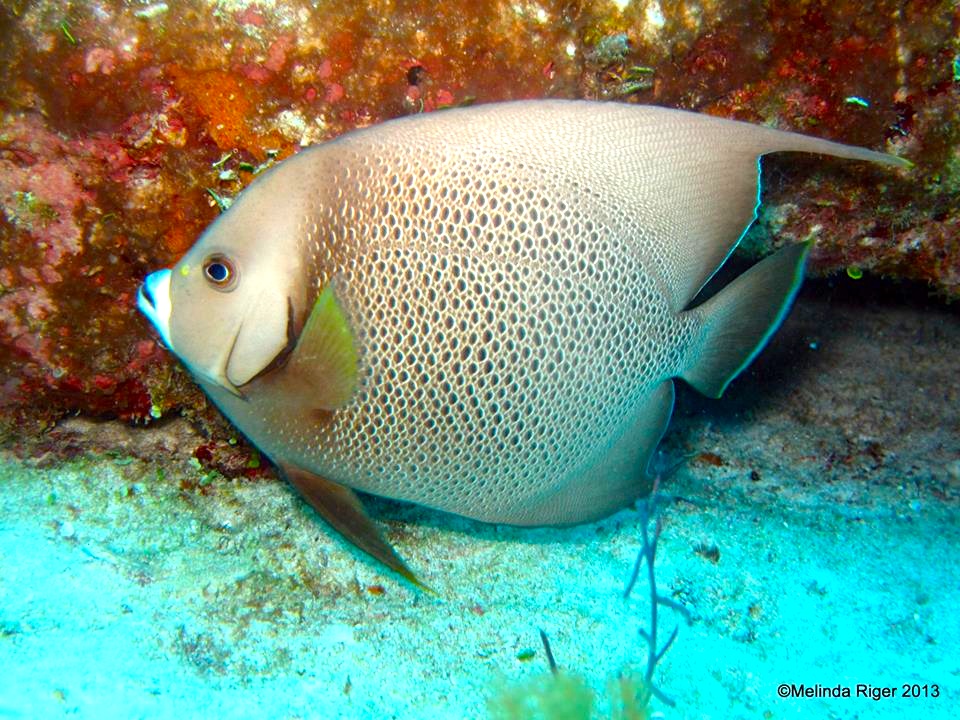
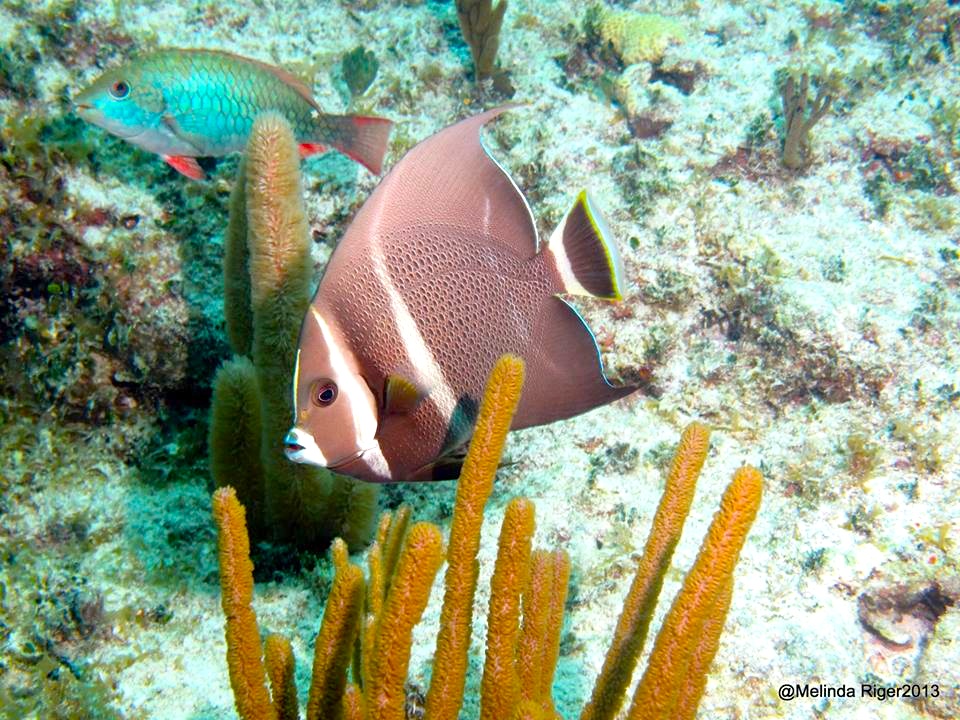
Some time ago I posted aboutGRAY ANGELFISHPomocanthus arcuatus. They are the more dowdy cousins of the flashy QUEEN ANGELFISH. They are not without their own beauty, though, and I have collected a few more photos of this species taken by Melinda Riger of Grand Bahama Scuba. I’m always pleased to feature her amazing reef photos, with their vivid colours and clear detail, so I hope you enjoy these. The last one – with the stripes – is a juvenile.
This post concerns the bees of Abaco, with little or no apology for the cultural cross-reference to the dread mid-70’s musical era. If you wish to experience the full horror, scroll straight to the bottom of the page and relive those heady days of Barry, Robin & Maurice…
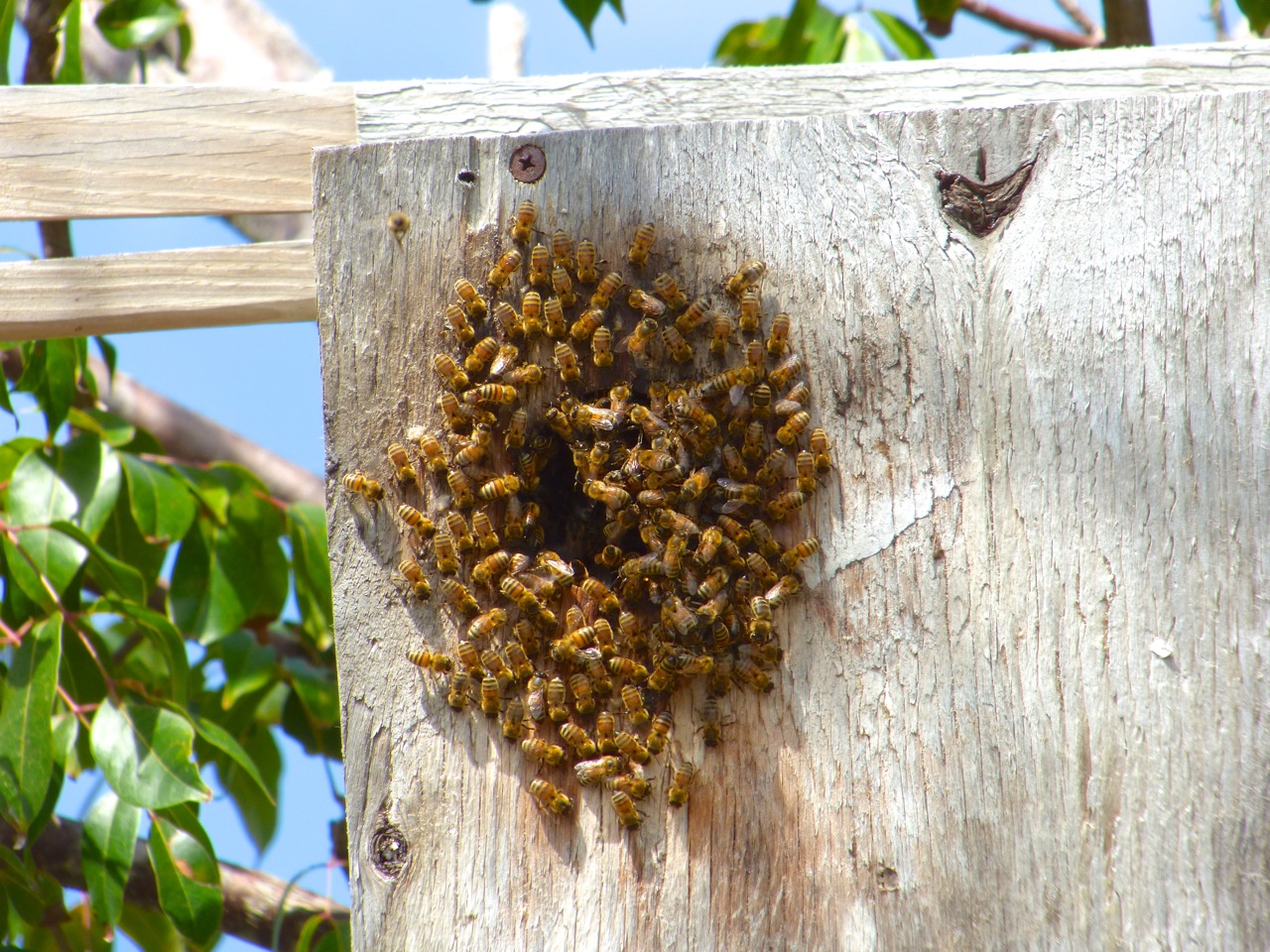
The bees on Abaco south of Marsh Harbour are mostly wild. The header photo shows the West Indian Woodpecker nest box near the skiff park at Delphi that has become the exclusive residence of bees. They have a profusion of flowers in the Delphi Club gardens to choose from, but it is not practical to keep hives for them. So they are left to do their own thing. Here they were last month, being busy.
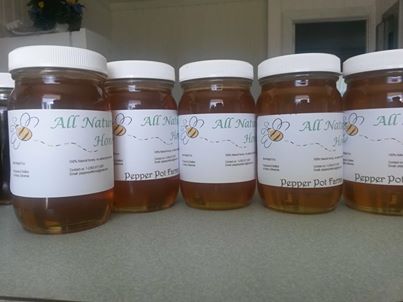
During the past year I have found 2 places between Delphi and MH that keep hives. One is PEPPER POT FARMS – click the name to reach their FB page. You can get their honey direct or in MH for $6.75 a pot. I enjoyed their evidence of why bees are called ‘workers’…
5 FUN BEE FACTS
Bees must visit approximately 2 million flowers to make 1 lb. of honey.
Bees have to fly over 55,000 miles to make 1 lb. of honey.
On average a worker bee will make 1/12 teaspoon of honey in her lifetime.
Two tablespoons of honey would fuel a honey bee flying once around the world.
Honey bees will visit between 50-100 flowers during one nectar collection trip.
The other place with hives is ABACO NEEM FARMS, the base for the production of the stock at the Abaco Neem shop on the way into MH from the roundabout . The owner Nick has installed 2 hives which we had a look at when we took up his invitation to bird-watch there. It is something of a birding hotspot, benefitting from pine woods, coppice, fruit trees and open land over a large area.
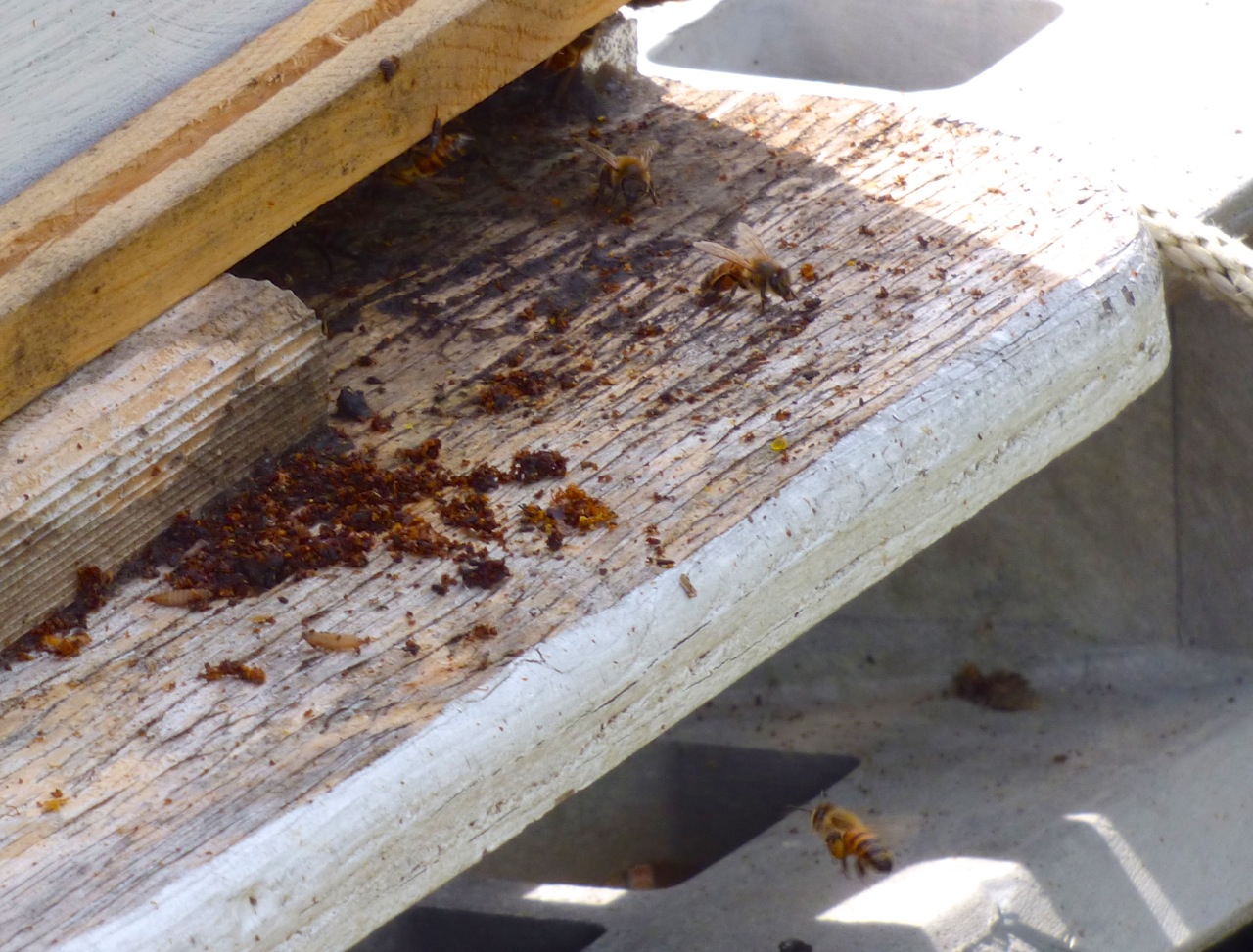
There was plenty of bee action around the hives on a warm sunny day and plenty of plants for them to feed from. We watched them come and go, the returning bees having filled their trouser pockets with pollen.
There are both cultivated and wild flowers all over the place, with bees feasting on plants and fruit trees of many kinds. I liked the bright flower chosen by this bee.
I’ll be posting more about the birds and plants of the Neem Farm in a while. Meanwhile, here are a couple of links to previous relevant links.
Finally, here is your chance to roll back the years with the Brothers Gibb. And below it, an excellent corrective!
This excellent Bee Gee parody by the “Hee Bee Gee Bees” called “Meaningless Songs in Very High Voices” is live from Sweden. Well, it still makes me laugh anyway (they also ripped off and ripped into Bowie, Jackson, The Police, Status Quo & many more).
FIVE STARS: BAHAMAS ENDEMIC BIRDS (FOUR FROM ABACO)
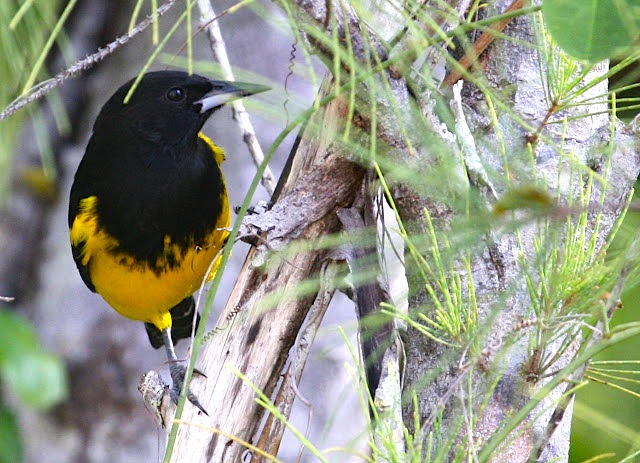
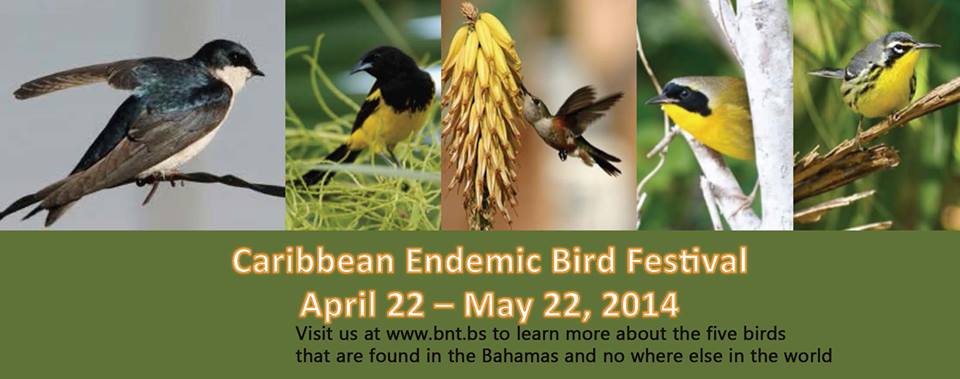
The Caribbean Endemic Bird Festival is underway. You can find out more on the CARIBBEAN BIRDS FESTIVALSFacebook page. Abaco is fortunate to be home to 4 of the 5 endemic Bahamas species. The fifth, the beautiful BAHAMA ORIOLE Icterus northropi, was found on both Abaco and Andros until the 1990s, when it sadly became extirpated from Abaco. Now found only on Andros, there are thought to be fewer than 300 Orioles left – a barely sustainable number. The species is unsurprisingly IUCN listed as critically endangered. Here’s a picture of one as a reminder of what Abaco is now missing…
Bahama Oriole
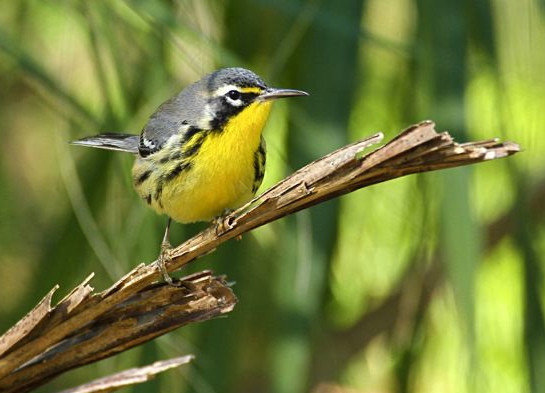
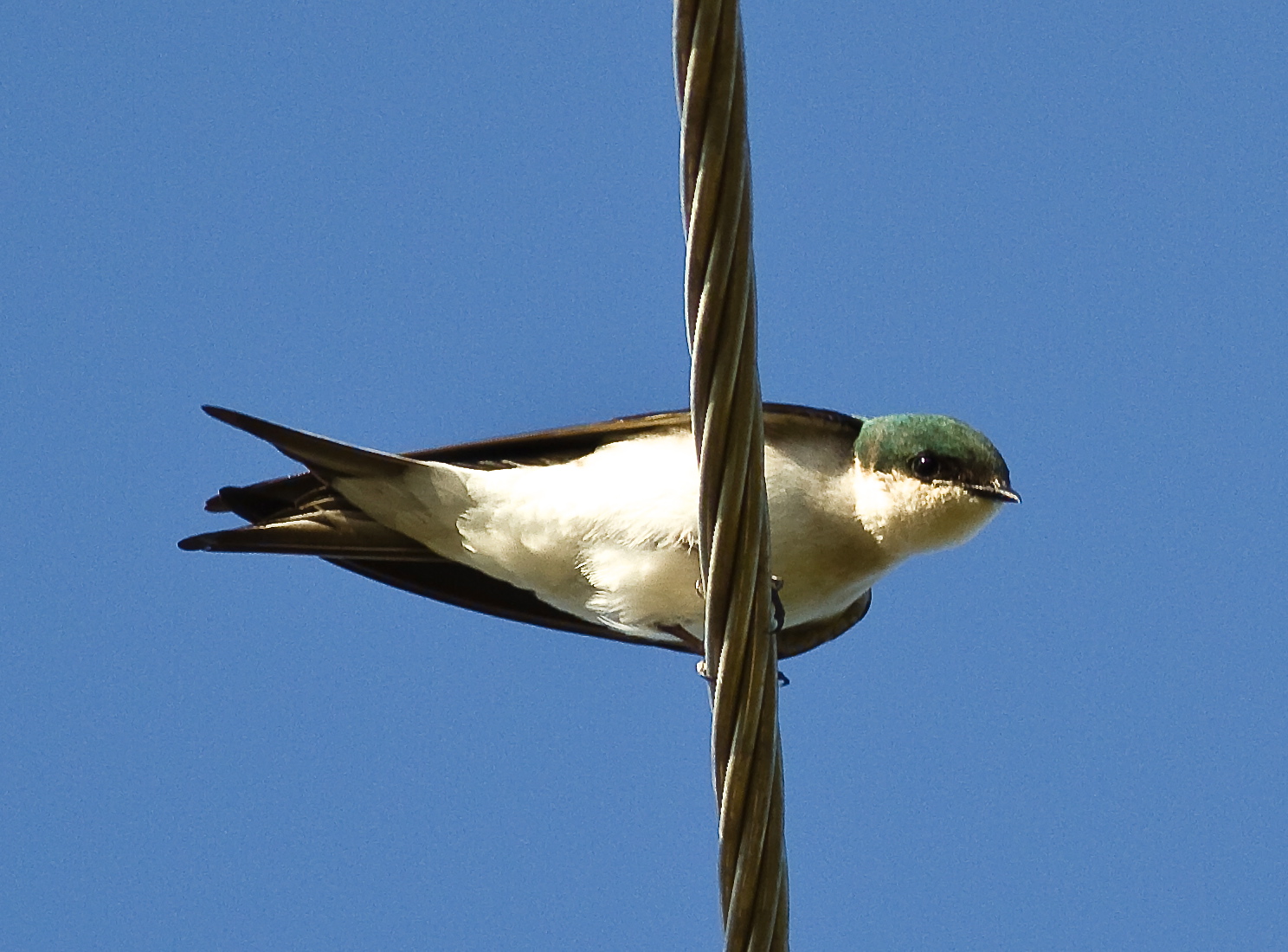
Abaco’s four endemic species are the tiny Bahama Woodstar hummingbird, the Bahama Yellowthroat, the Bahama Warbler (since 2011), and the Bahama Swallow. All are of course permanent breeding residents on Abaco and its outer Cays. None is exclusive to Abaco; all are relatively plentiful. The Woodstar is perhaps the hardest to find, not least because it competes territorially with the Cuban Emerald hummingbird. Even Woodstars can be found easily in some areas – Man-o-War Cay is a good place for them, for example. Here are some striking images of these four endemic bird species taken from the archives for “The Birds of Abaco” published last month.
BAHAMA WOODSTARCalliphlox evelynae
Bahama Woodstar (m) (Tom Sheley)
Bahama Woodstar (f) Tara Lavallee
BAHAMA YELLOWTHROAT Geothlypis rostrata
Bahama Yellowthroat (Tom Sheley)
Bahama Yellowthroat (Bruce Hallett)
BAHAMA WARBLERSetophaga flavescens
Bahama Warbler (Bruce Hallett)
Bahama Warbler (Woody Bracey)
BAHAMA SWALLOW Tachycineta cyaneoviridis
Bahama Swallow (Craig Nash)
Bahama Swallow (Erik Gauger)
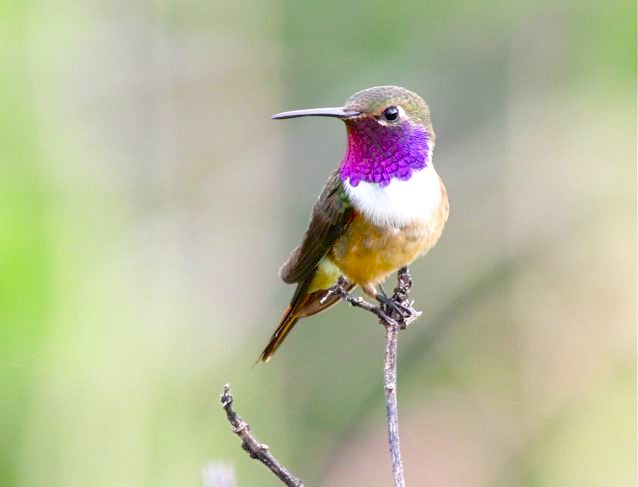
“The Delphi Club Guide to the Birds of Abaco” was published as limited edition of 500 and has only been for sale for 8 weeks or so exclusively through the Delphi Club. Yesterday, we passed a happy milestone in that short time as the 250th copy was sold. Complimentary copies have also been donated to every school and relevant education department on Abaco to tie in with the excellent policy of teaching children from an early age the value of the natural world around them, the importance of its ecology, and the need for its conservation. The cover bird for the book was easy to choose – it just had to be a male Woodstar in all his glory with his splendid purple ‘gorget’.
Bahama Woodstar (m) Bruce Hallett
Image credits as shown; otherwise, ‘cover bird’ by Tom Sheley, Bahama Oriole from Wiki and CEBF flyer from the Bahamas National Trust
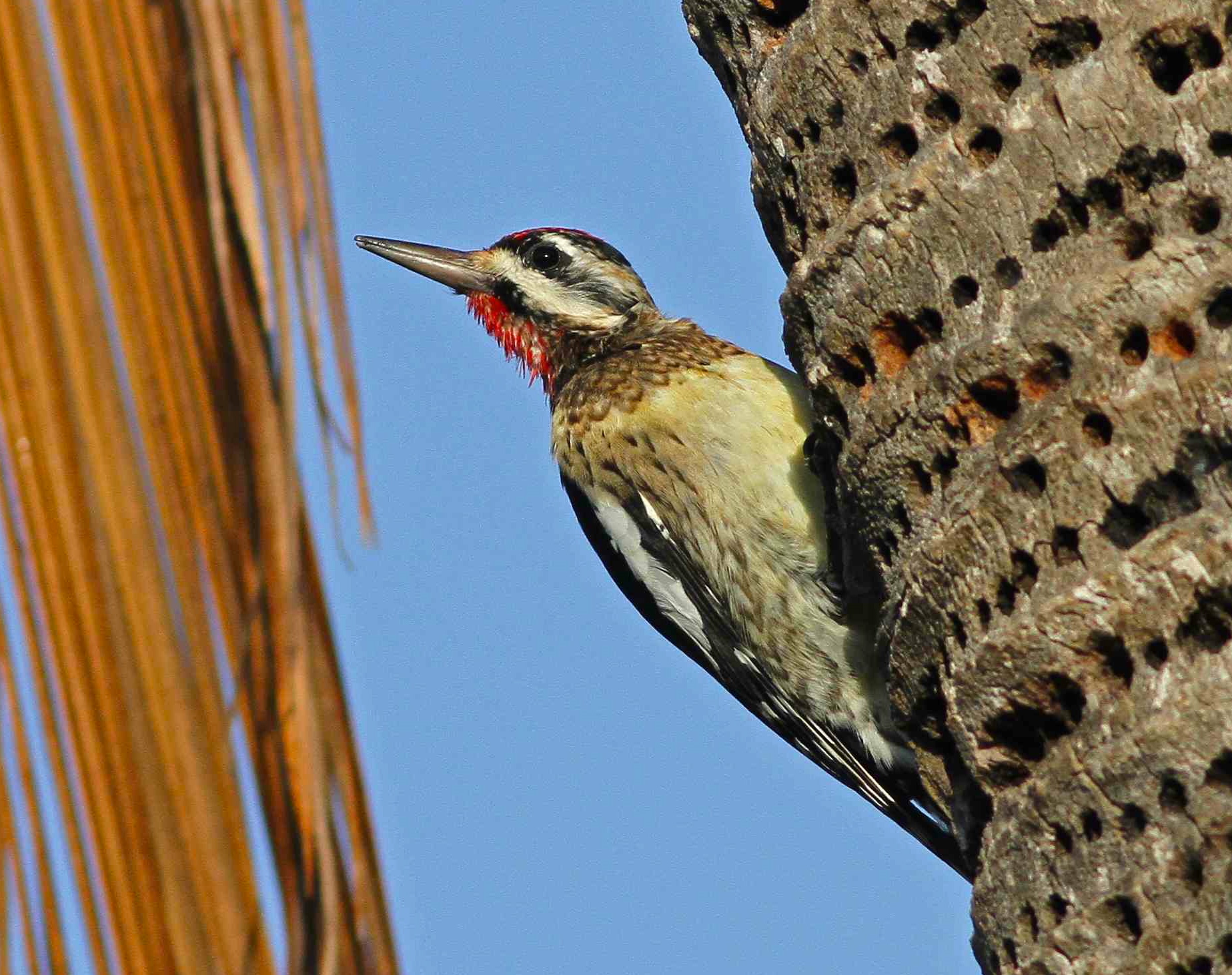
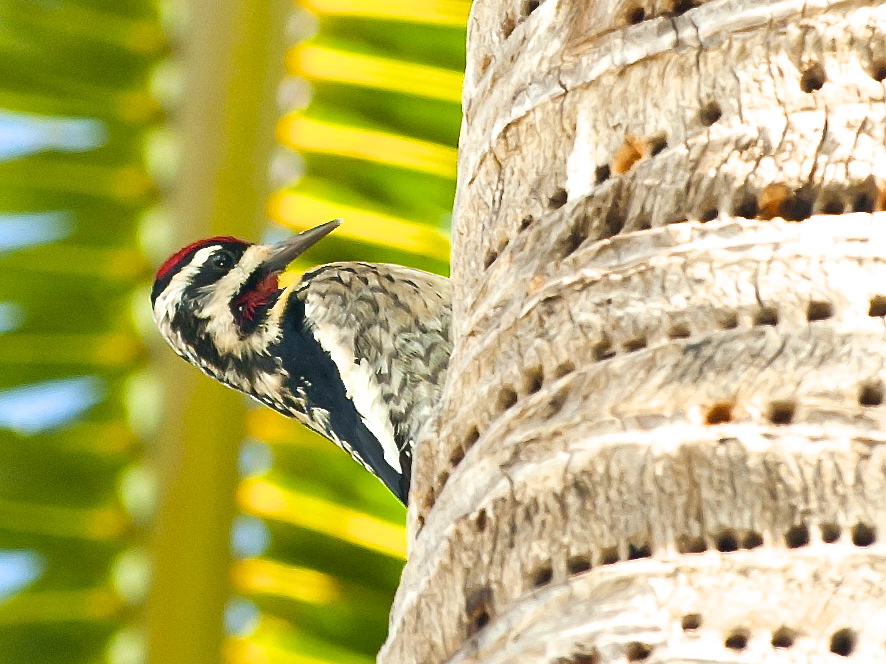
You’re ahead of me here, aren’t you? The answer of course is… Sphyrapicus varius. Abaco has two permanently resident woodpecker species, theWEST INDIAN WOODPECKERand the HAIRY WOODPECKER. There is a third, migratory woodpecker species that is a fairly common winter resident, the yellow-bellied sapsucker.Like its woodpecker cousins, the sapsucker drills holes in trees (see below). The dual purpose is to release the sap, which it eats, and to attract insects that it also eats. A two-course meal, if you like. They’ll also eat insects on an undrilled tree, and even ‘hawk’ for them in flight. They balance their diet with fruit and berries.
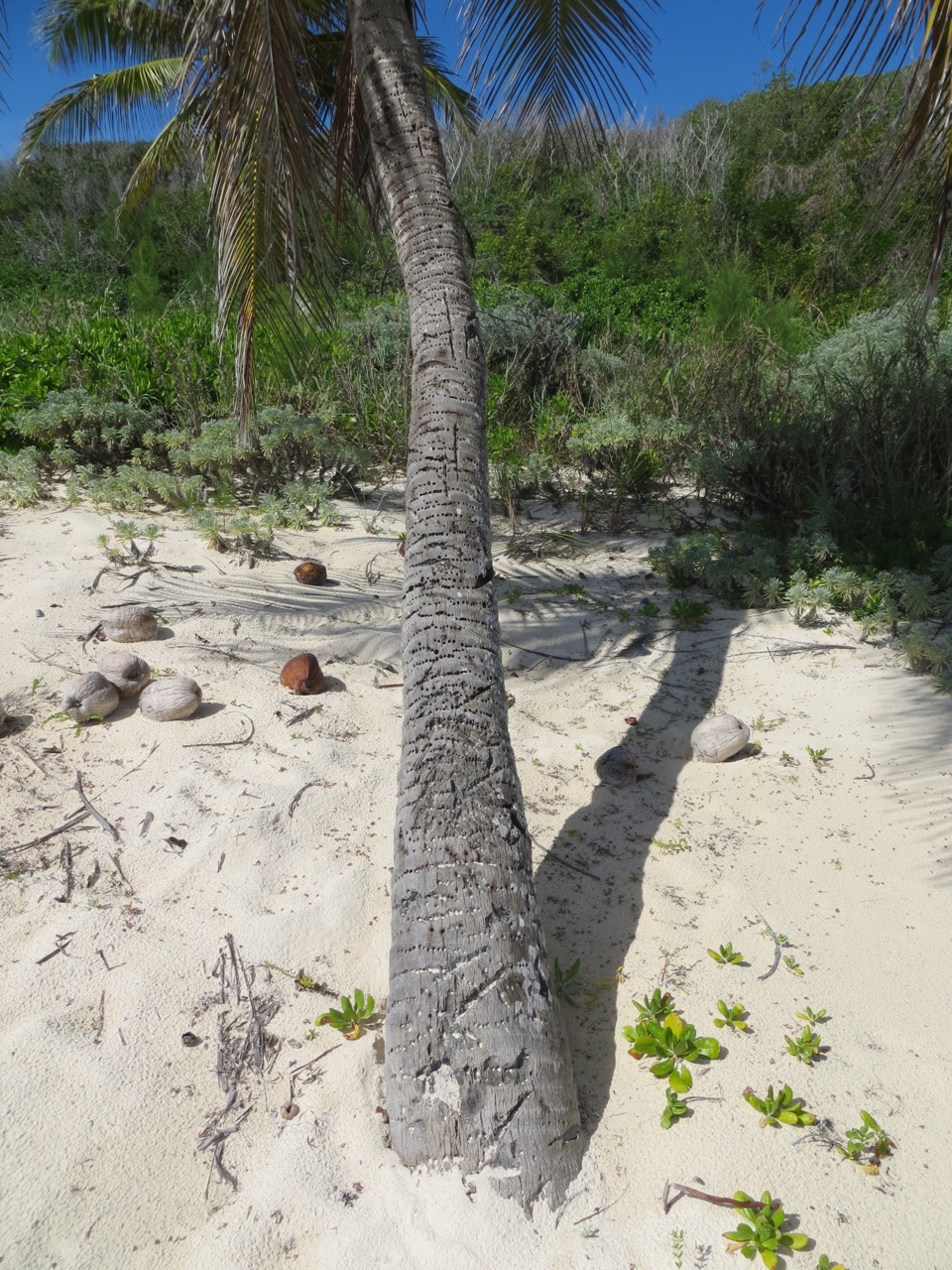
The distinctive patterns of sapsucker holes may completely encircle the trunk of a tree with almost mathematical precision. This is sometimes described as ‘girdling’ and may have a damaging effect on a tree, sometimes even killing it if the bark is severely harmed. This may require preventive measures in orchards for example, though note that in the US Yellow-bellied Sapsuckers are listed and protected under the Migratory Bird Treaty Act so radical action is prohibited.
YELLOW-BELLIED SAPSUCKER SOUNDS
DRUMMING(Xeno-Canto / Richard Hoyer)
CALL(Xeno-Canto / Jonathon Jogsma)
On Abaco, palms are a favourite tree for the sapsuckers. There are several palms along the Delphi beach, and this year I noted that one coconut palm in particular had seen plenty of sapsucker action, with the drill holes girdling the entire trunk from top to bottom.
In their breeding grounds yellow-bellied sapsuckers excavate a large cavity in a softwood tree as a nest. They mate for life, and often return to the same nest year every year, with the pair sharing nesting duties. I have no idea whether the pair migrate south for the winter together, or whether they agree to take a break from each other. I’d like to think it’s the former…
Credits: Photos Gerlinde Taurer, Tom Sheley, RH + John Harrison & Dominic Sherony (Wiki); Cornell Lab (Range Map) & Xeno-Canto (YBS recordings as credited above)
Species featured in ‘The Delphi Club Guide to the Birds of Abaco’ by Keith Salvesen, pp 242-3
BIRDS, PLASTIC & CONSERVATION: A CONTROVERSIAL AD…
Rolling Harbour is a broadly neutral territory. We occasionally do ‘opinionated’ round here. We are not afraid to express views. But we try to avoid controversy and in particular, politics in its broadest sense. There have been occasional lapses into outrage – one example was the huge cruise ship taking a shortcut (allegedly, I had better add) that trashed significant areas of irreplaceable coral reef and smeared poisonous anti-fouling paint along the seabed, affecting reef life for decades and… Stop me right there!
The most sensitive area is conservation. Some issues are straightforward; with others the balance of what is right and wrong is more debatable. One particular aspect that can be problematic is in the presentation of information. We are all familiar with charity appeals that cajole with images of happy children or sweet puppies. We also see the ones with horrific images that are uncomfortable or even downright unpleasant to look at. Both can be powerful and valid ways to raise awareness and attract support. Some of the more extreme images used may actually have the effect of repelling people. The same is true with conservation projects. There are ones illustrated with images that make you go ‘ahhhh’ and smile; others are undeniably distressing and will make you wince with uneasiness.
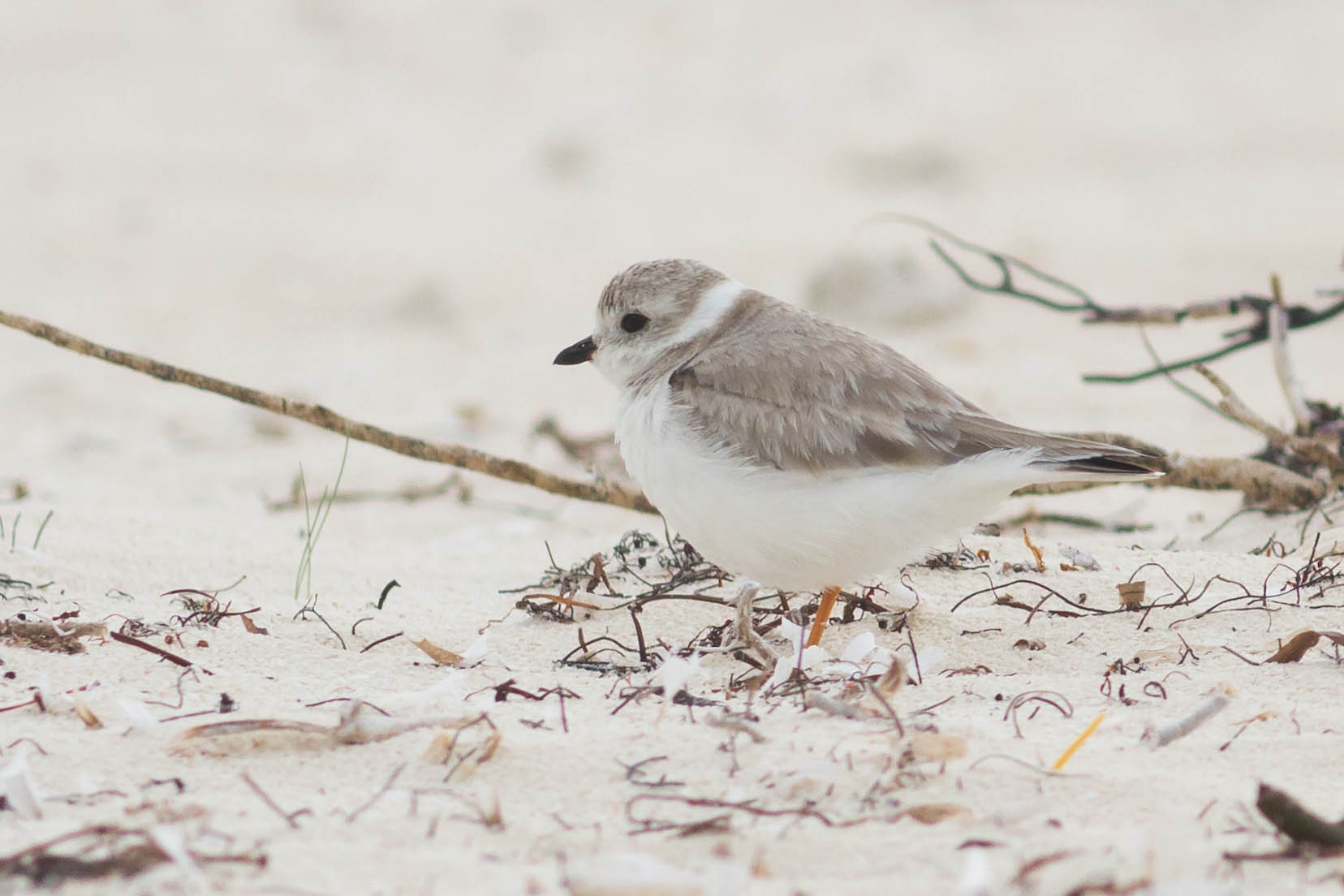
Piping Plover photo taken at GTC Abaco by Tom Reed for Conserve Wildlife NJ
A graphic image by Ian Hutton (UW) of a dead shearwater crammed with plastic debris
See how you react to this 45 second video from Australia. It is made by Greenpeace – itself a controversial organisation in some eyes – and concerns Coke, plastic and birds. I had no idea what to expect, and it gave me a jolt. It has been the subject of legal action, of alleged censorship and interference from powerful lobbies, and a sizzling amount of anger. It won’t take you long to watch it. Compare how you feel during the first ten seconds with how you feel 30 seconds later…


































 Prototype1 – this albino variant is made by combining arctic fox tail with ginger (yes ginger!) elk…















 ROLLING HARBOUR ABACO
You must be logged in to post a comment.