Unknown's avatar

BAHAMA ORIOLE: ABACO’S LOST ENDEMIC SPECIES


Bahama Oriole ABC : D. Belasco

BAHAMA ORIOLE: ABACO’S LOST ENDEMIC SPECIES

FEWER THAN 300 LEFT IN THE WORLD – AND ALL ON ANDROS

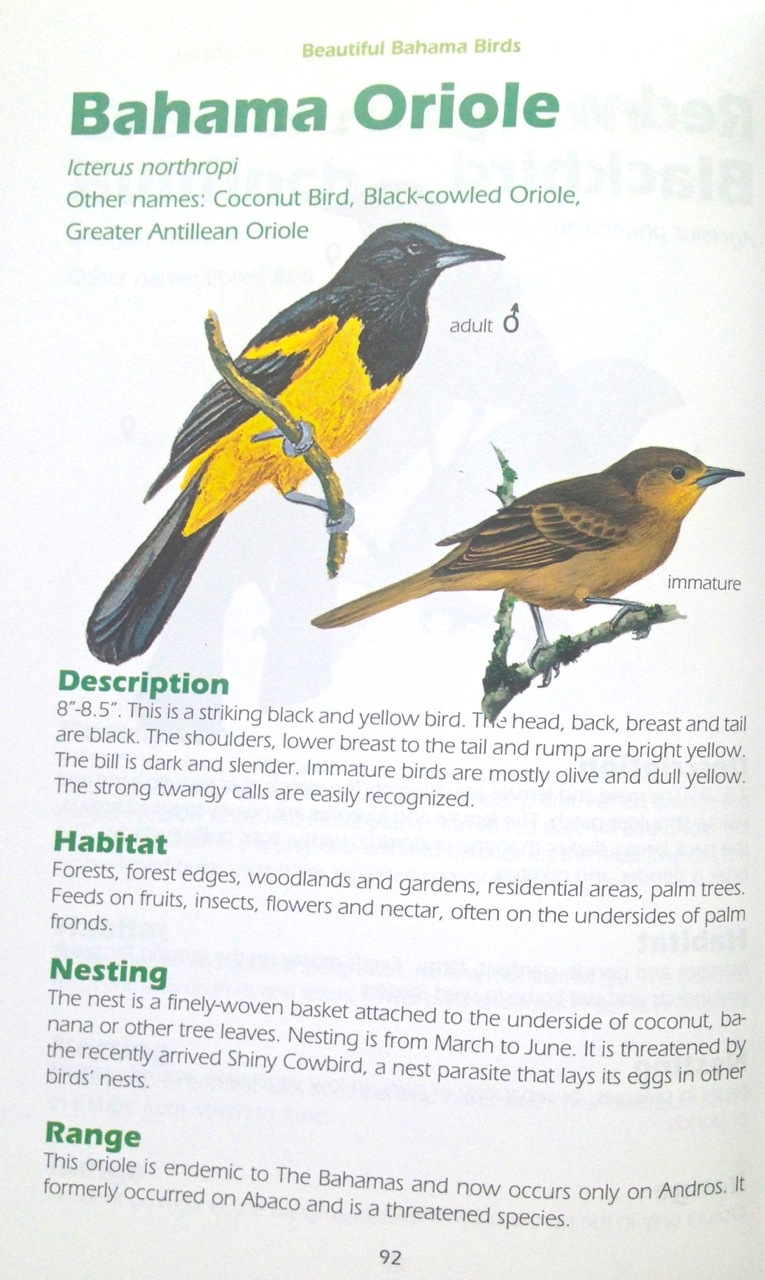
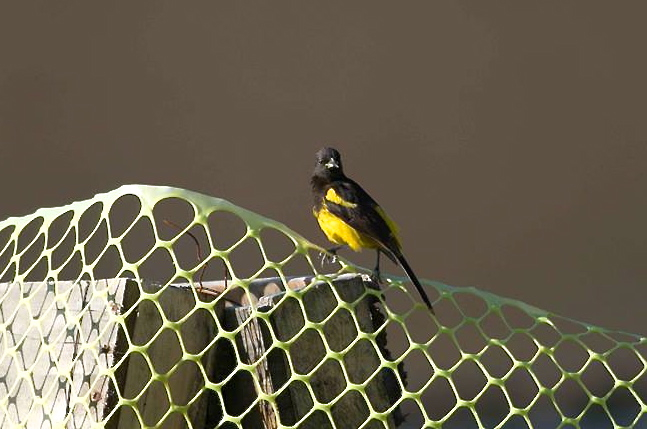
Having just posted about the endangered NASSAU GROUPER and its protection by the introduction of a 3-month closed season, it’s time to focus on a rare, beautiful and vulnerable bird, the Bahama Oriole (Icterus northropi). It is IUCN Red Listed as ‘Critically Endangered’. ENDEMIC to the Bahamas, this bird lived only on Abaco and Andros. Not any more. Now you’ll only find them on Andros, the species having been lost to Abaco in very recent memory. The 1990s, in fact. And on Andros, this lovely bird is now struggling against the threat of extinction and is found only in limited areas in very small numbers. The most optimistic population estimate I have found puts the total as fewer than 300 individuals… the consensus puts the likely total in the region of 250. Bahamas Oriole, Andros (Binkie Van Es)1 Bahamas Oriole, Andros (Binkie Van Es)2
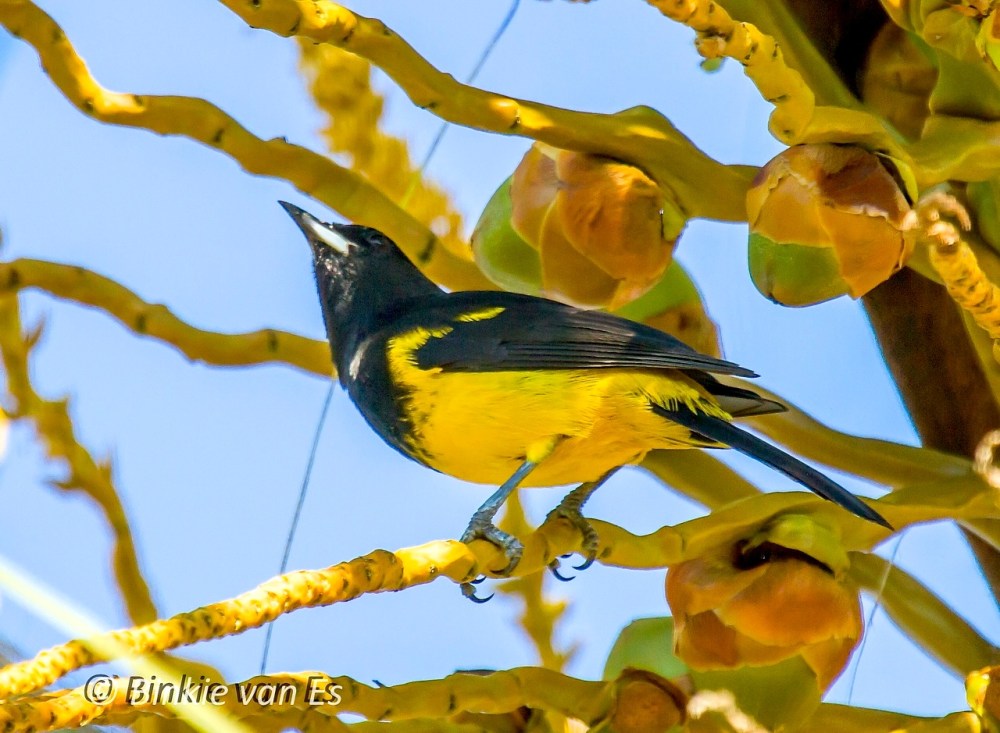
THE SPECIES

In 2010, the Greater Antillean Oriole Icterus dominicensis was separated by the AMERICAN ORNOTHOLOGISTS’ UNION into 4 species, one being the Bahama Oriole. As the BNT wryly put it, “New species are always a source of excitement… but in this case the intrigue is overshadowed by a sense of alarm and urgency”. For by then this new species ‘in its own right’ was limited to certain parts of Andros, in small and diminishing numbers. It had already vanished from some areas – especially in North Andros – were it had formerly been abundant. The best estimates suggested 250 individual birds. Bahama Oriole - Harold Brewer (via PM) - Version 3
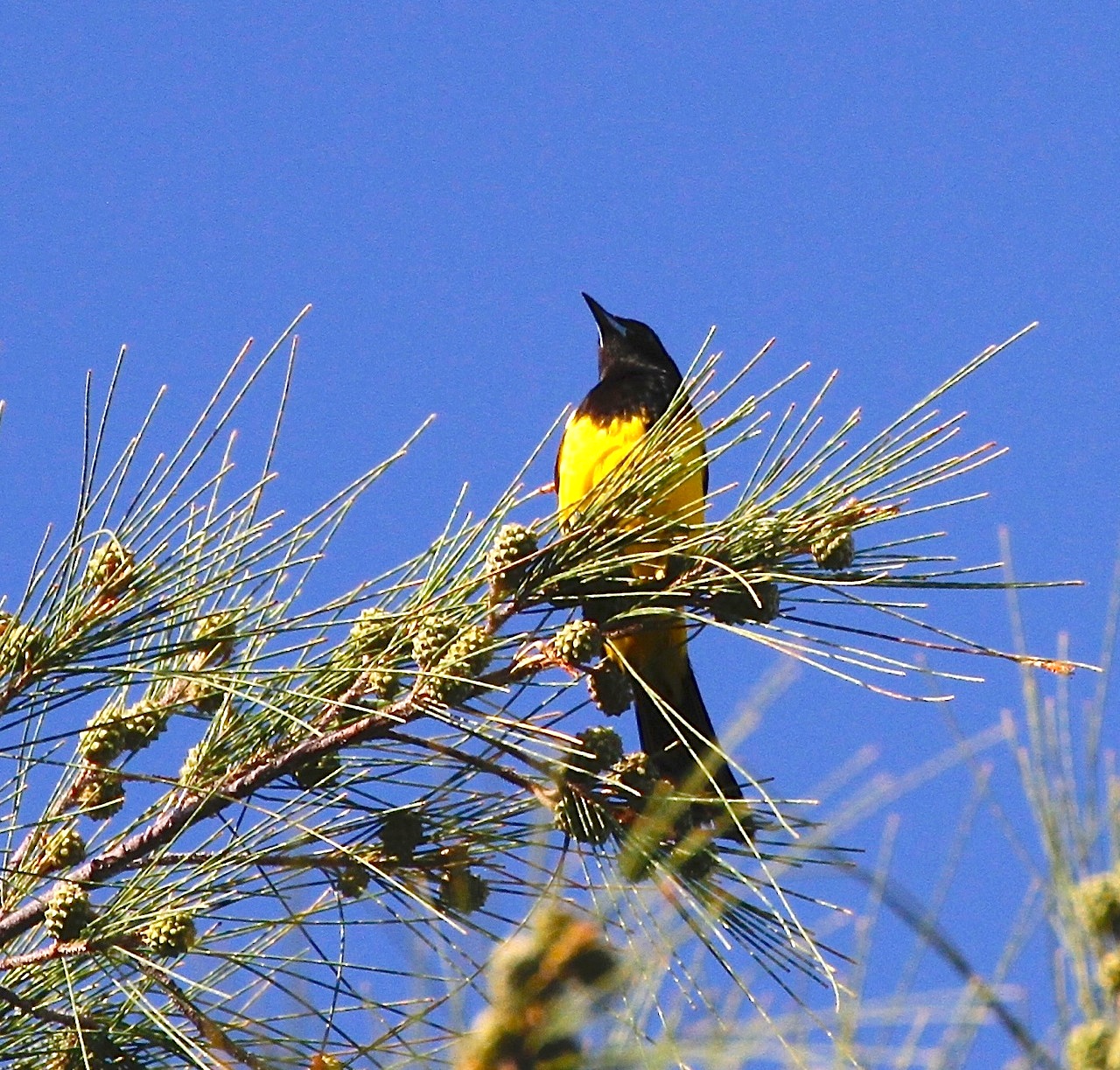
WHEN & WHY DID THEY VANISH FROM ABACO?

This is a classic ‘riddle wrapped in a mystery inside an enigma’. Various sources I have looked at use a formula such as “…became extirpated from Abaco in the 1990s”, or “disappeared for unknown reasons in the 1990s”. I’ve found no clear clue as to the cause – nor even when the last sighting of an oriole on Abaco was made. I haven’t found a photo of one taken on Abaco, although to be fair the option of snapping everything with wings several times using a digital camera with a large chip didn’t exist then. In the next para a number of crucial factors in the more recent decline of the Andros population are given; but as far as I can determine, some at least did not apply in the 1990s, or certainly not to the same extent. Maybe it was a combination of a degree of habitat loss and the gradual decline of a small population that could not breed prolifically enough to sustain the future population **. Bahama_Oriole (Mxmerce Wiki)

THE MAIN CAUSES OF THE CRITICAL DECLINE ON ANDROS

Lethal Yellowing Disease of the coconut palm, prime nesting habitat for the oriole. In some areas on Andros (e.g. Staniard Creek), the palm has been all but wiped out. 

The arrival and spread of the Shiny Cowbird Molothrus bonariensis, a brood parasite that lays its eggs in the nests of other bird species such as the yellow warbler, the black-whiskered vireo… and the oriole. The cowbird reached Andros in the mid-1990s. The first Abaco report that I have found is from 1999 (so presumably, as the oriole was already gone from the island by then, they were not a factor).  The cowbird is a summer resident on Abaco, though still relatively uncommon; and its range continues to expand northwards. Some might argue that the cowbird should be discouraged from spreading on Abaco right now for the sake of the indigenous warbler and vireo populations – before it is too late.

Habitat loss / island development (although Birdlife International notes “…the planting of coconut palms in residential areas has allowed the species to spread into human settlements”). Other factors put forward include forestry work, forest fires, diseases, rodents and feral cats – problems that affect many other birds such as the Abaco parrot. Bahamas Oriole (BNT / Carlton Ward) The photo below is a pleasure to include in this post. It was taken earlier this year on Andros by Christopher Johnson of Nassau. And here’s the thing. He is 13, and an avid birder. I’m sure he likes his X-Box time, but he certainly knows plenty about birds too. He’s quick off the mark with offering IDs – correct ones – for birds online, and when he saw this bird he knew the significance of it and managed to get some good shots too. This is my favourite, the oriole ‘vocalising’. See below for its song. Here is Christopher’s brief but enthusiastic field report: Awesome trip to Andros this past weekend! Was amazed to see the Bahama Oriole and its nest — feeling great”. Bahama Oriole, Andros (Christopher Johnson) 2
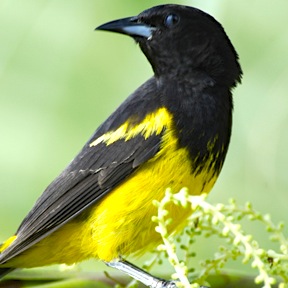
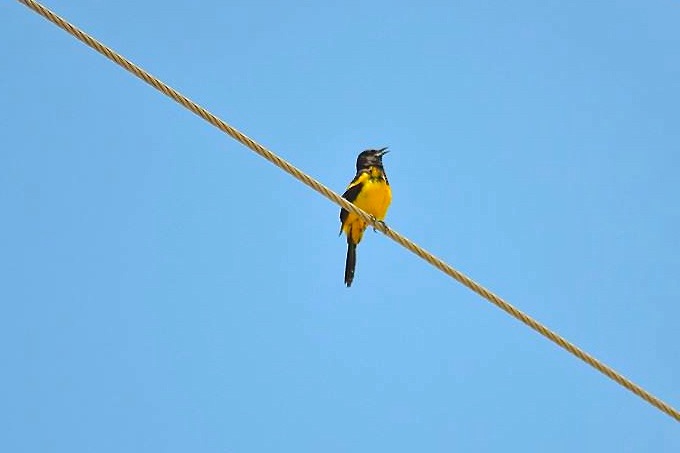
Bahama Oriole taken during a BMMRO research trip on AndrosBahama Oriole, Andros (BMMRO)
 Paul Driver / Xeno Canto

A GLIMMER OF HOPE?

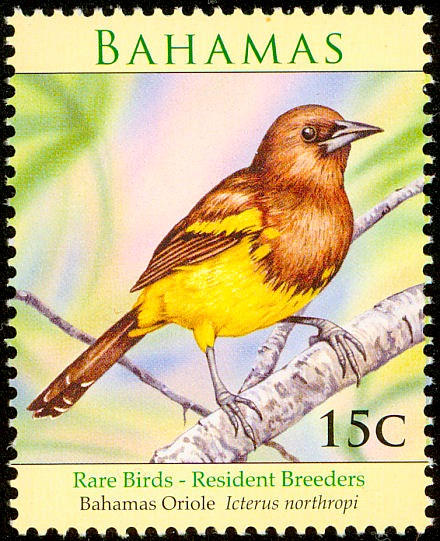
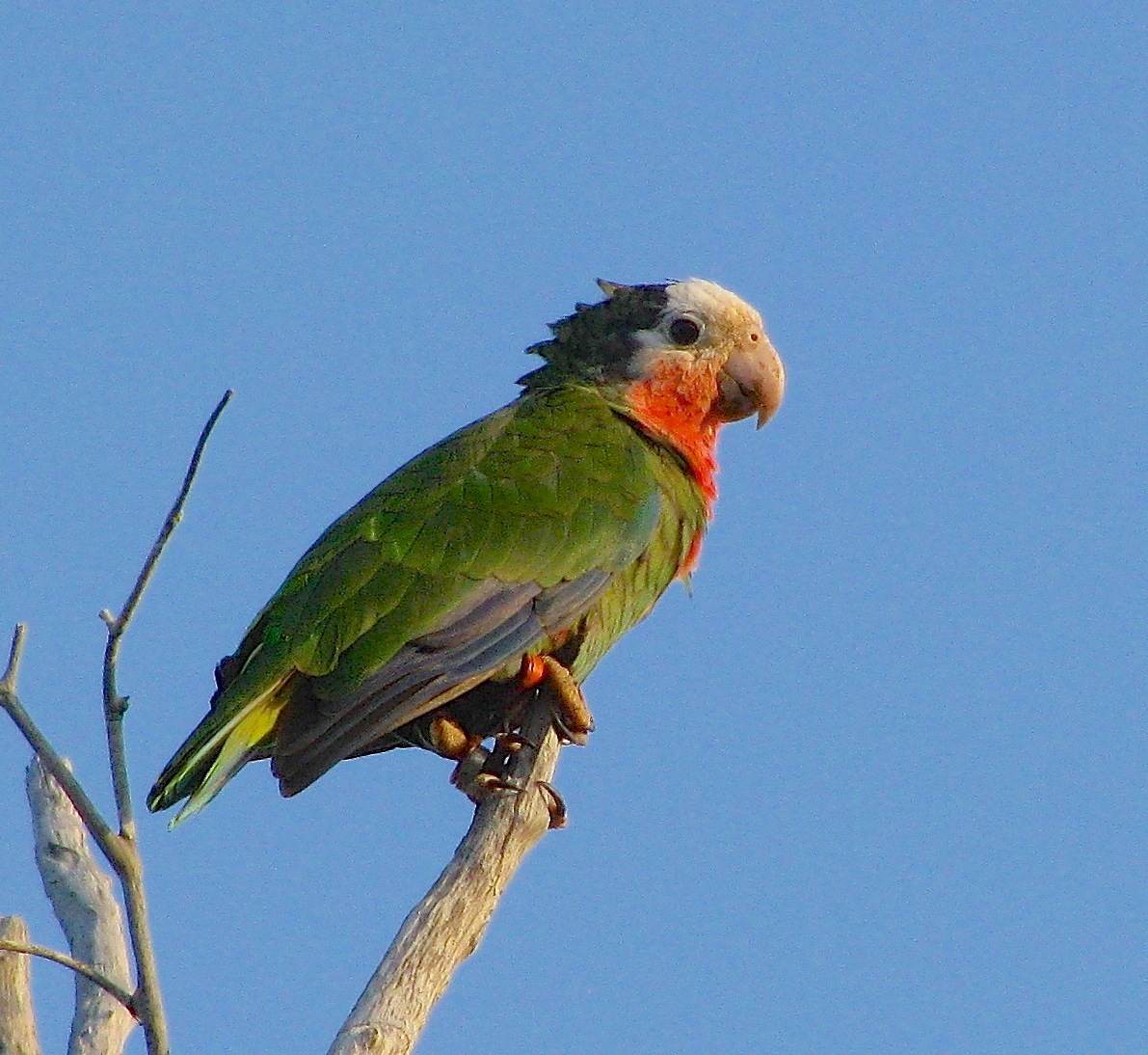
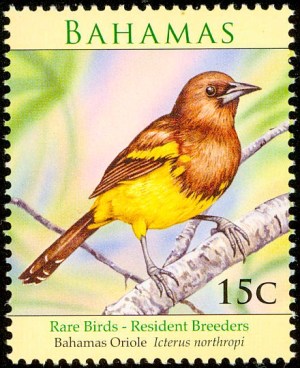
In the same way that urgent conservation measures were put in place to halt and then reverse the critical decline of the Abaco parrot population, similar projects are in place for the Bahama Oriole on Andros. One proposal is to establish a ‘captive breeding’ program leading to reintroduction and reinforcement of the wild population. According to the American Bird Conservancy, this could even include reintroduction on Abaco… So perhaps in a decade or two, this fine bird will once again become firmly established as one of the birds of Abaco. Bahamas Oriole, Andros (Binkie Van Es)3 As I said in my Nassau Grouper post, a country’s attitude can to a degree be gauged by the pride with which it features its wildlife and natural resources in its stamps (I used North Korea for adverse comparison). In 2009 The Bahamas Postal Service even issued a ‘Rare Birds’ set featuring the Bahama Oriole.. I rest my case. Bahama Oriole Stamp birdtheme.org
♦    ♦    ♦    ♦    ♦    ♦    ♦    ♦    ♦    ♦    ♦    ♦    ♦

WHO WAS THE EPONYMOUS MR NORTHROP?

640px-Picture_of_John_Isaiah_Northrop

The comprehensive answer is provided by the University of Glasgow Library Research Annexe in relation to a fine  illustration from A Naturalist in the Bahamas (1910), reprinted in The Auk journal (below) at a time when Icterus northropi was still a mere subspecies: The yellow and black Bahama Oriole (Icterus Northropi) is a bird species unique to the Bahamas. The bird was named for American ornithologist and zoologist, John Isiah Northrop (1861–91); the illustration comes from an account of the trip Northrop and his botanist wife, Alice, took to the Bahamas in 1889 which was published in his memory: A Naturalist in the Bahamas: John I. Northrop, October 12 1861-June 25, 1891; a memorial volume (New York: Columbia University Press, 1910). It was edited and introduced by Henry Fairfield Osborn, professor of zoology at Columbia University where Northrop worked as a tutor and was killed in a laboratory explosion shortly (9 days) before the birth of his son John Howard Northrop (who became a Nobel prize-winning chemist). Icterus Northropi illustrated in A Naturalist in the Bahamas (plate 1)

RELATED MATERIAL

“Rediscovering the Bahama Oriole” Erik Gauger, author of the excellent Notes from the Road and photographic contributor to the Birds of Abaco has a good tale of the pursuit of the apparent sighting of a Bahama Oriole on Abaco 2o years after its (supposed?) extirpation. You can read it HERE The Auk Read more about this journal and the birding history of the Bahamas HERE There is a Care2Action ‘Save the Bahama Oriole Before It Is Too Late’ petition HERE. It seems to have stalled somewhat, so it would be good to generate some more signatories. ** Mathematically inclined? Find out about the application of the stochastic process to the oriole’s situation. In a nutshell, this concerns the combined effect of several random adverse factors on sustainability, given that the oriole’s already very small population, very limited range and particular habitat requirements militate against breeding expansion, and therefore increase the likelihood of extinction. We can only hope this is not an inevitability…

Image, audio and research credits: American Bird Conservancy, Binkie van Es, BNT / Carlton Ward, Birdlife International, Christopher Johnson, Cornell Neotropical, Harold Brewer, MxMerce, birdtheme.org, Wiki, Xeno Canto / Paul Driver; Uni of Glasgow / Roger Herriott
Unknown's avatar

NASSAU GROUPER: VULNERABLE, ENDANGERED… & NOW PROTECTED


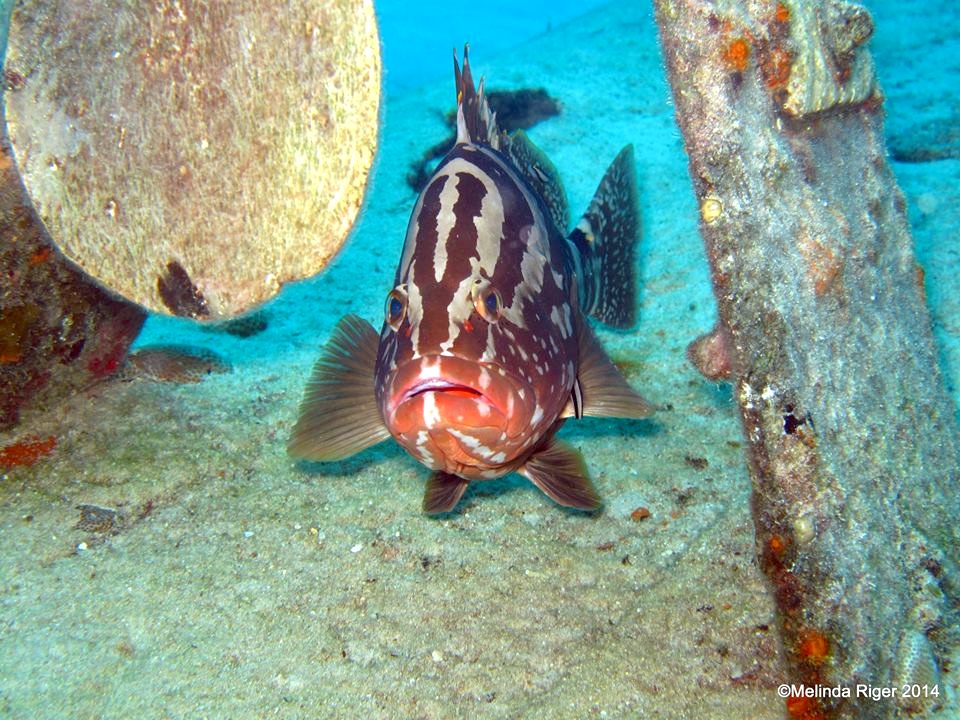
Nassau Grouper ©Melinda Riger @ GB Scuba copy

NASSAU GROUPER: VULNERABLE, ENDANGERED… & NOW PROTECTED

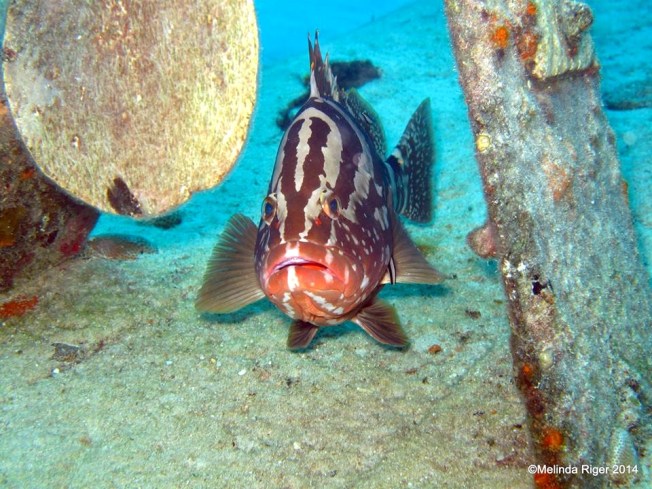
The Nassau grouper Epinephelus striatus is one of a number of Caribbean grouper species found generally in the Northern Bahamas and specifically in Abaco waters. Others include the Black, Tiger, and Yellowfin groupers, the Red Hind,and the Graysby. The Nassau grouper is special, however, not least because (unlike the others) it is on the IUCN Red List as an Endangered Species and is also a US National Marine Fisheries Service Species of Concern. It is considered the most important of the groupers for commercial fishing in the Caribbean, and the IUCN listing data suggests that a population decline of 60% occurred over the last three generations (27-30 years), a startling rate. The current population size is estimated at >10,000 mature individuals.

Nassau Grouper ©Melinda Riger @ G B Scuba copy 2

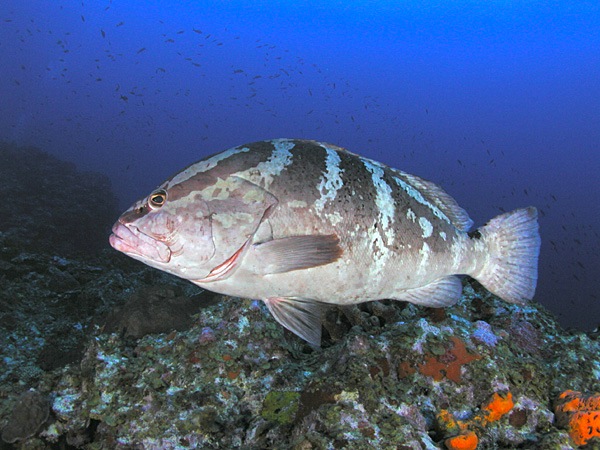
The Nassau Grouper is a creature of the coral reefs in the Caribbean and adjacent seas, though it can also be found in deep water. It feeds in the daytime on small fish and small crustaceans such as shrimps, crabs and lobsters. It lurks in caves and recesses in the reef, sucking in the prey that passes unsuspecting by. The coloration of an individual fish may vary considerably with conditions, and it can adapt its colour to its surroundings as camouflage.  

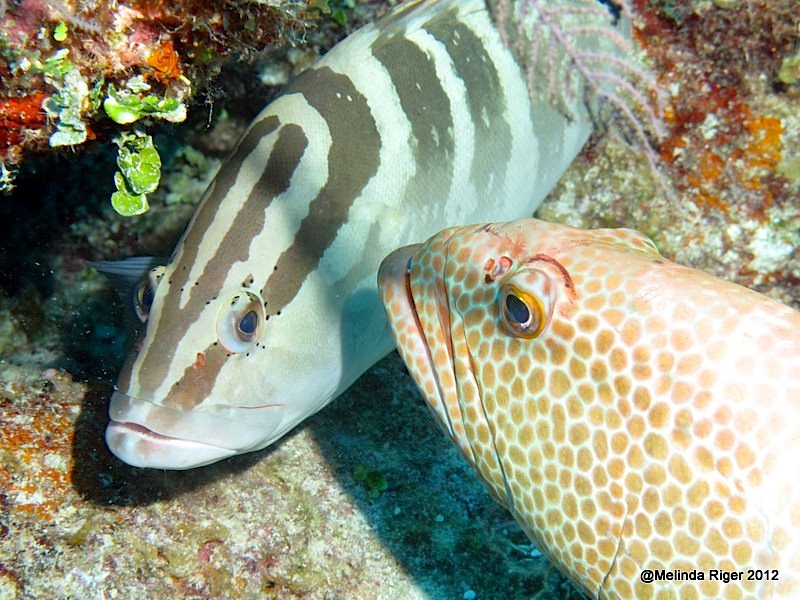
Tiger grouper meets Nassau grouperNassau & Tiger Grouper ©Melinda Riger @ Grand Bahama Scuba  copy

Spawning takes place in December and January as the seawater cools, always at full moon, and always in the same place. In the moonlight, huge numbers of the grouper gather together to mate in a mass spawning aggregation. This may continue for several days. However, the species is slow breeder, which is why overfishing is particularly damaging to the population as the depleted stock cannot readily be replaced.

3846_aquaimages Wiki

CONSERVATION ISSUES

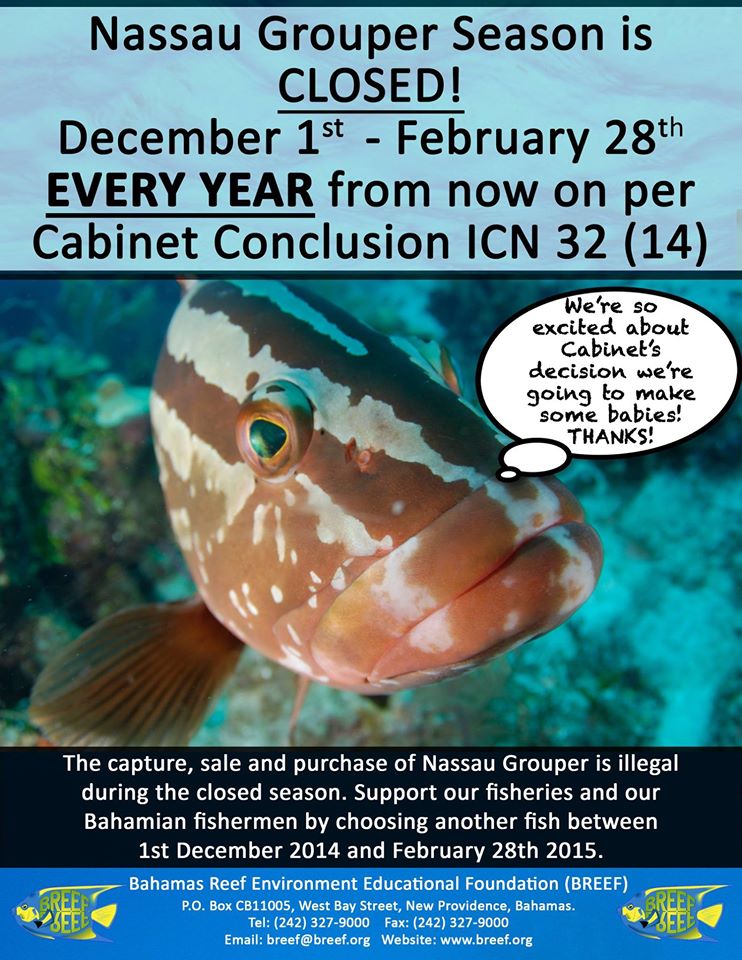
There are other besides factors commercial overfishing that make the Nassau grouper so vulnerable, including fishing during the breeding season; taking undersized fish; pollution and reef decline; habitat loss; and invasive species. The spawning areas are especially vulnerable to exploitation. In the Bahamas, as elsewhere,  the government has now instituted a closed fishing season for the Nassau grouper. Here is the BREEF  flyer, just circulated – and in fact the reason for this post, which reminded me that I had planned to write about this fish! 10382222_10152869346685953_7443797899832698038_o

THREATS

The Bahamas National Trust sums up the multiple threats in this uncompromising way:

Nassau grouper is eaten by barracudas, lizard fish, dolphins, sharks and other large predators of the reef community. But the predators that have the biggest impact on the grouper population are humansPeople are fishing groupers before they can grow to maturity and reproduce. Sex change may also cause a problem. In undisturbed areas there are usually equal numbers of male and females. In heavily fished areas there are often three or more times more females than males. This means many eggs will not be fertilized during spawning. Other threats include, habitat destruction, coral breakage from divers, siltation from construction, runoff from logging and agriculture, dredging, sewage, oil spills and other contaminants that harm coral reefs where Nassau Groupers live.

grouperEpinephelus_striatus_2

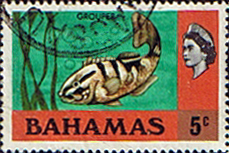
There’s an extent to which a country can be judged on its attitude to wildlife from the stamps it chooses to issue. It’s something to do with appreciation and promotion of the country’s natural resources. For example, North Korea rates nil in this respect, with stamps involving scary weaponry, flags, marching and eerily glowing leaders – not a single sparrow to be seen.  By fortunate contrast the Bahamas and its Postal Service score very highly in celebrating the diversity of the wildlife of the islands. The Nassau Grouper was first featured on Bahamas stamps as long ago as 1971, some 25 years before the IUCN Red Listing, and probably before the sharp decline in population numbers had even begun.

bahamas-1971-nassau-grouper-sg-363-fine-used-19448-p

In 2012 the Bahamas Postal Service released ‘a new definitive 16 stamp series’ depicting the marine life of The Bahamas. The Nassau has been promoted from 5c in 1971 to 70c in 2012. That’s inflation for you.

bahamas-marine-life-stamps2

Finally in 2013 BREEF’s 20 years of marine conservation was commemorated with a distinguished and colourful set of 8 stamps, noting in their release: ‘Two of the new stamps feature the Nassau Grouper, a now endangered species that has experienced severe population decline throughout the region… BREEF is well known as an advocate for an annual closed season for the iconic Nassau Grouper during its winter breeding period. The push for the closed season was based on scientific evidence of population collapses throughout the region due to overfishing. BREEF is calling on the government to implement a fixed closed season for the Nassau Grouper in order to protect the species and the fishing industry. The closed season traditionally runs during the spawning season from December 1st until February 28th, to allow the fish to reproduce.  BREEF is calling urgently for the announcement of this year’s Nassau Grouper closed season….’ And so it came to pass… Not only is the Nassau grouper now worth 2 x 65c; it is strictly protected for 3 months during its breeding season. Maybe philately even had a hand in getting somewhere…

BREEF_Comemorative_stamps_PastedGraphic-3

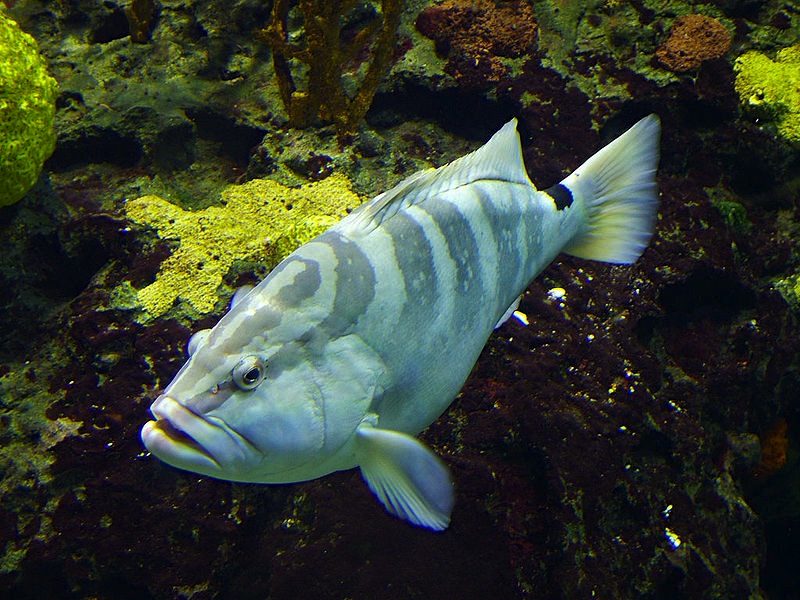
Nassau Grouper (Rick Smit wiki)

Credits: Melinda Riger, Rick Smit, Open Source, BNT, BREEF, Wikimedia, Bahamas Postal Service

Unknown's avatar

COMMON YELLOWTHROATS ON ABACO: CHEERFUL WINTER WARBLERS


Common-yellowthroat, Abaco (Erik Gauger)

COMMON YELLOWTHROATS ON ABACO: CHEERFUL WINTER WARBLERS

Abaco is fortunate to be home to the endemic BAHAMA YELLOWTHROAT Geothlypis rostrata, a striking bird with a dashing black mask and bright yellow body in the male. You can see it with its fellow endemics HERE. But there is similar winter resident species, the COMMON YELLOWTHROAT Geothlypis trichas, that can be seen on Abaco between October and March. Now is a very good time to look out for them. However, the two species are easy to confuse.

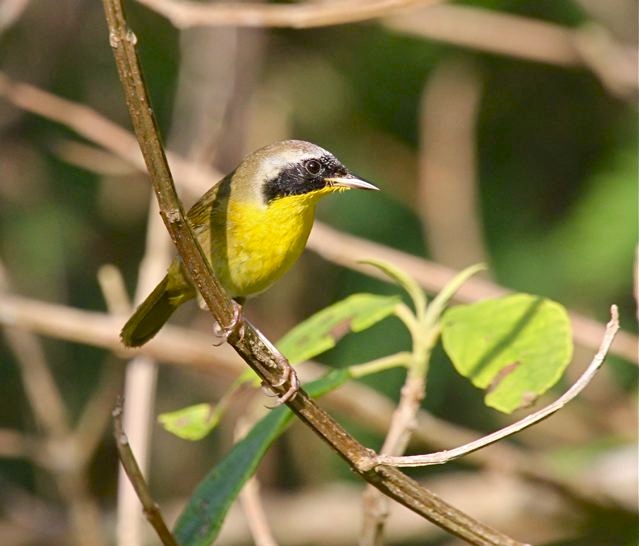
Common Yellowthroat (male)Common Yellowthroat, Gilpin Pond, Abaco Bahamas (Tom Sheley)

Bahama Yellowthroat (male)Bahama Yellowthroat (M) BH IMG_0675 copy

WHAT’S THE DIFFERENCE?

  • SIZE – the BW is slightly larger and sturdier than the CW
  • BEAK – larger in the BW, and some might say it tends to be decurved
  • COLOUR – the BW is more colourful, with more extensive yellow underparts and mask
  • FEMALES – both species lack the mask and are duller; the female BW has a greyer head
  • HABITAT – both are found in the same areas; the CW prefers denser vegetation near water
  • DEBATEABLE – it seems to me the pale stripe behind the mask is usually less prominent in the BW

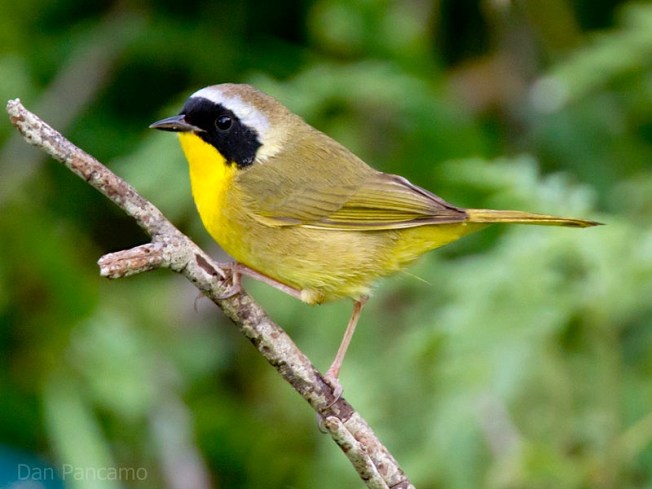
Common Yellowthroat male with conspicuous pale head-stripe800px-Common_Yellowthroat_by_Dan_Pancamo

Both yellowthroat species are an endearing mix of shy and inquisitive. These birds are responsive to ‘pishing’, and once lured from cover they may remain nearby on low branches or shrubs watching you with interest as you watch them. Their song – similar in both species – is fairly easily imitated (or at least approximated), which may also bring them into the open – a source of great satisfaction to the amateur birder when it works. Unless it’s just coincidence, of course… The songs of the two species recorded below sound almost indistinguishable (except that the first one is professional and the second notably amateur…).

COMMON YELLOWTHROAT 

Todd Wilson / Xeno Canto

BAHAMA YELLOWTHROAT

RH own recording

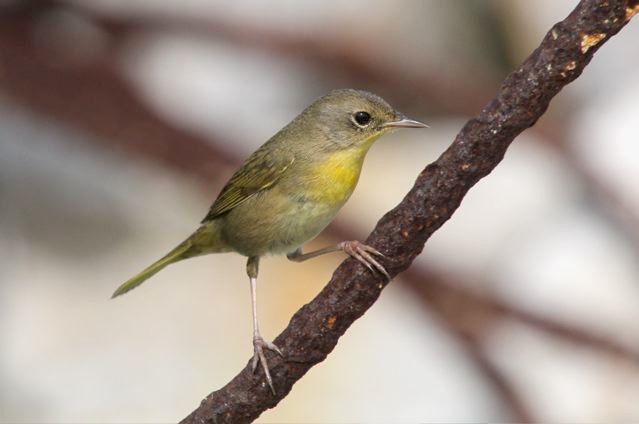
Female Common Yellowthroats are unassuming and quite delicate little birds. The first of these two images shows an immature bird, with its front beginning to become yellow. The second is a mature female.Common Yellowthroat (f, imm) Bruce Hallett IMG_9435Common Yellowthroat (f) Bruce Hallett IMG_4057

Two more male Common Yellowthroats to admire…Common Yellowthroat (m) Bruce Hallett IMG_4232  Common Yellow-throat, Abaco (Becky Marvil)

Photo Credits: Erik Gauger (1); Tom Sheley (2); Bruce Hallett (3, 5, 6, 7); Dan Pancamo /Wiki (4); Becky Marvil (8) Audio: Xeno Canto; RH

Unknown's avatar

DIVERS VIEWS: ABACO’S ASTOUNDING UNDERGROUND CAVES (4)


10523986_851437394891179_2536186235813665049_n

DIVERS VIEWS: ABACO’S ASTOUNDING UNDERGROUND CAVES (4)

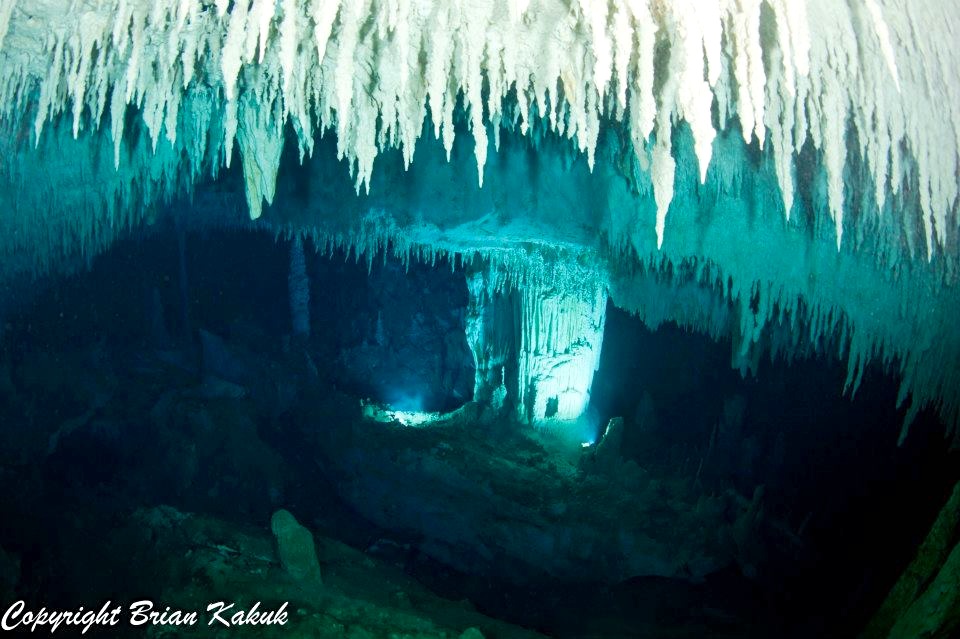
The birds have had a very fair share of posts for the month so I am returning to some of Brian Kakuk’s astonishing images from his dives of the underground cave systems of Abaco.

Abaco caves map jpg

Here, he explores Dan’s Cave, one of several huge caves beneath the pine forests of the west side of South Abaco. This complex cave system is within the proposed South Abaco Blue Holes Conservation Area, one of four designated Protected Areas that I wrote about recently HERE SABHCA.

Abaco Caves Ralph & Dan jpg

You get a good idea of the massive size of this column in comparison with the diversDan's Cave, Abaco (©Brian Kakuk) Dan's Cave, Abaco (©Brian Kakuk)

‘Rooms’ are connected by narrow tunnels or passagesDan's Cave, Abaco (©Brian Kakuk) Dan's Cave, Abaco (©Brian Kakuk) Dan's Cave, Abaco (©Brian Kakuk)

Individual caves have memorable names. This is the ‘Fanghorn Forest’ full of HelictitesHelictites, Fanghorn Forest, Dan's Cave, Abaco

Stalagmites or stalagtites? ‘Tites’ hang tight to the ceiling so they don’t fall off…Dan's Cave, Abaco (©Brian Kakuk)

All photos © Brian Kakuk, with thanks for use permission

Unknown's avatar

A NEW BIRD SPECIES FOR ABACO: BROWN THRASHER


 Brown Thrasher, Judy Howle / DigiDiva - WunderPhotos

A NEW BIRD SPECIES FOR ABACO: BROWN THRASHER

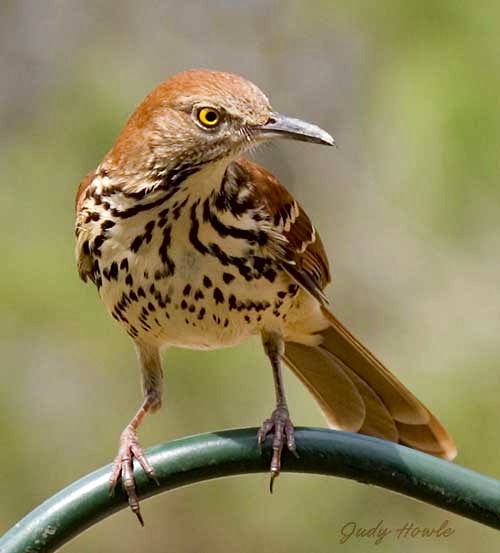
The third new bird species this year has been found on Abaco by bird authority Woody Bracey.  After the excitement of 6 BLACK-BELLIED WHISTLING DUCKS in June and a FORK-TAILED FLYCATCHER in October comes the very recent sighting (with photos) of a BROWN THRASHER, hitherto unrecorded for Abaco. It was seen near Treasure Cay, at the site of a derelict restaurant.

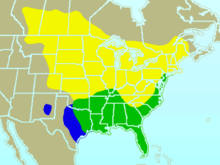
The Brown Thrasher (Toxostoma rufum) belongs to the same family that includes mockingbirds and the catbird – Mimidae. Its normal range includes Florida where it is resident,  so there’s only 200 miles of ocean to cross to reach Abaco. Easier still with a stop-over on Grand Bahama. However I’ve checked for other Bahamas sightings, and so far I have found one recorded for Grand Bahama, and one for Eleuthera. So this first sighting on Abaco is possibly only the third for the Bahamas, suggesting that the Thrasher is generally not a great adventurer.  

220px-Brown-Thrasher-rangemap

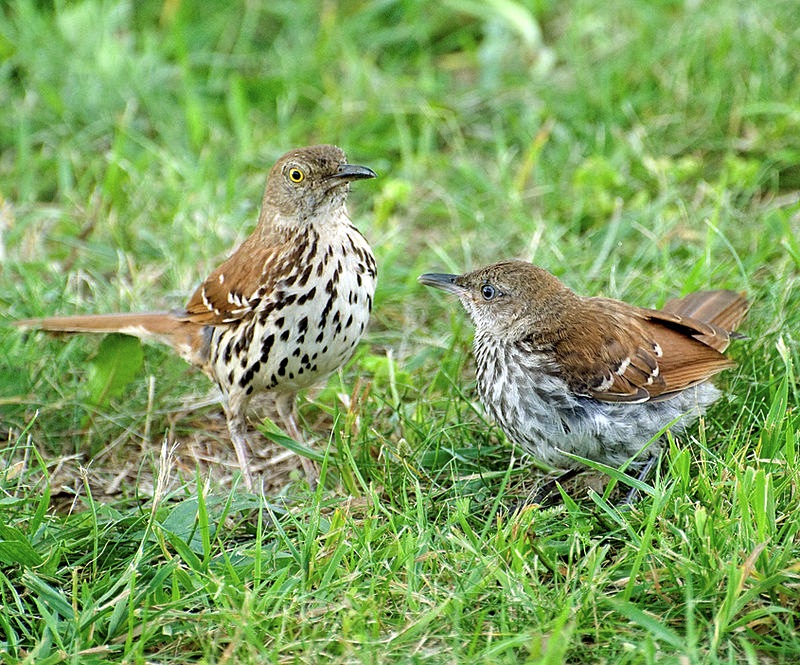
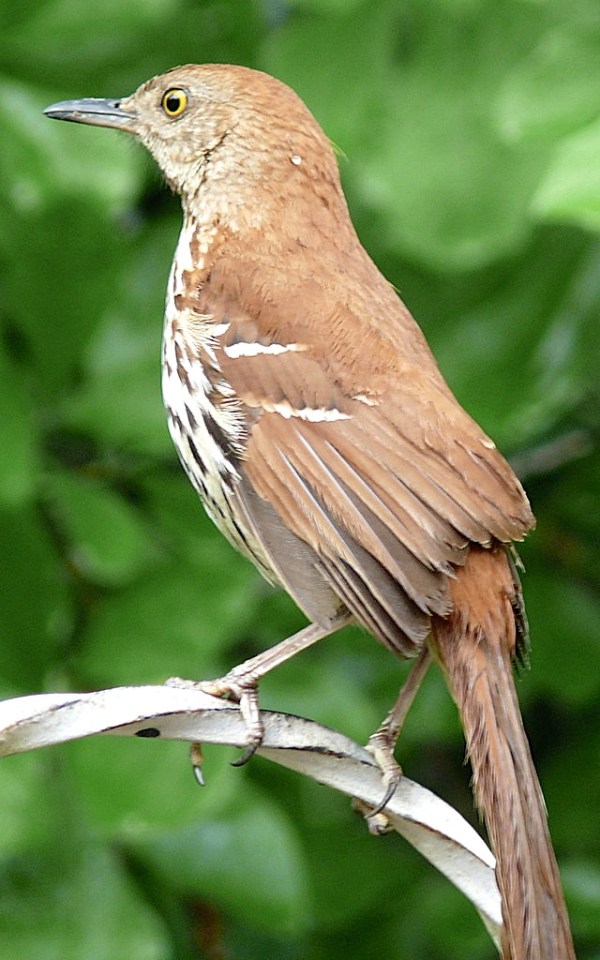
Here are some images in case you happen to see a strange brown speckled bird…Brown Thrasher (Manjith Kainickara wiki)

ADULT AND JUVENILE
Brown Thrasher Toxostoma rufum, Virginia - cbgrfx123 wiki

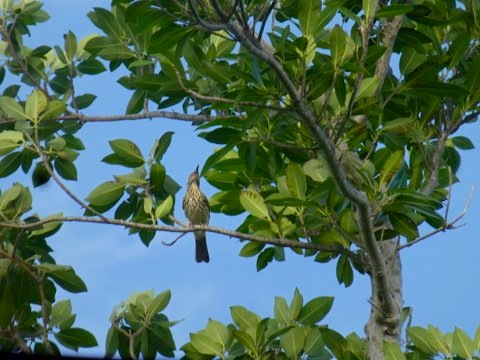
And here are Woody’s evidential images of his sighting. They may not be such close shots as the others but they are conclusive for the record.P1070843P1070844

BESIDES ONE BIRD VISITING ABACO, WHAT’S  INTERESTING ABOUT THE THRASHER?

  • They are known to have more than 1000 types of song, one of the largest bird repertoires
  • They repeat phrases 2 or 3 times before moving on to another (somewhat like Mockingbirds)

Rick Wigh / Xeno Canto

  • They are omnivorous, eating insects, snails, worms etc; and balancing that with fruit, seeds and nuts
  • They are shy birds, but can be very aggressive when defending territory or a nest site
  • They used their slightly decurved beaks to thrash around under leaves and ground debris as they forage – hence the name

YES INDEED, BUT IS THERE ONE REALLY MEMORABLE FACT ABOUT THEM?

  • OK. Their necks are extremely flexible and they have more vertebrae than camels or (get this!) giraffes.
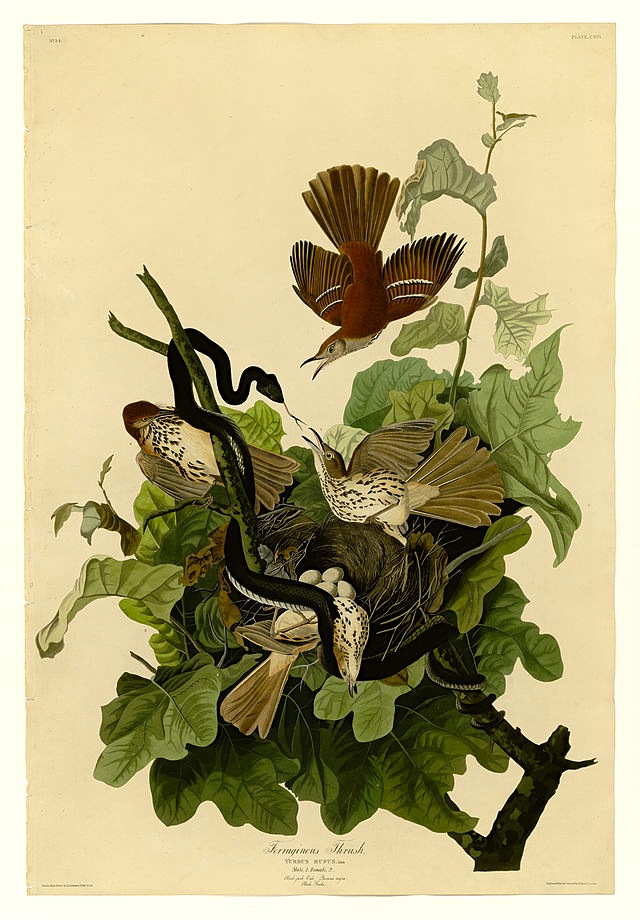
Brown_Thrasher (Ken Thomas wiki)AUDUBON’S DEPICTION OF A ‘FERRUGINOUS THRUSH’, AS IT WAS THEN KNOWNJohn James Audubon - Ferruginous Thrush

Credits: Judi Howle, Manjith Kainickara, Anon (wiki), Woody Bracey, Ken Thomas; Wunderphoto, Wiki, Xeno Canto

Unknown's avatar

“ABACO’S GOT TALONS”: THE OSPREY


Osprey, Abaco (Jim Todd 2)

“ABACO’S GOT TALONS”: THE OSPREY

The magnificent Osprey Pandion haliaetus is one of the world’s most successful raptors and can be found on every continent except Antarctica.

220px-Pandion_haliaetus_global_range.svg

Osprey, Abaco Bahamas (Tom Sheley)

On Abaco the Osprey is a permanent breeding resident, and while certainly not an ‘every day bird’, the chances of seeing one are reasonable. They are fairly often seen flying over the bay at Delphi, or out on the Marls. A pair recently nested at Sandy Point close to Nancy’s restaurant.

Ospreys, Abaco (Jim Todd)

There are few more exhilarating sights in the world of birds than an osprey swooping from a great height into the sea, emerging with a large fish held characteristically ‘fore and aft’ in its talons, and flying into the distance with heavy wing-beats. This wonderful close-up by wildlife photographer PHIL LANOUE shows an osprey that has actually managed to grab dinner for two…

osprey-flight-with-two-fish-03

This bird looks as if it is poised to dive onto some hapless fishOsprey in flight (Lake Wylie, S Carolina) - Gareth Rasberry

 10 PANDION POINTS TO PONDER

  • Ospreys are also known as sea hawks, fish hawks or fish eagles. They are almost exclusively fish-eating
  • A mature adult’s wingspan may reach 6 feet
  • They are the only members of their taxonomic family, genus and species
  • Ospreys & owls are the only raptors with reversible outer toes to grasp prey firmly
  • They can carry fish weighing more than 4 lbs
  • They dive into water feet first to grab its prey; their nostrils can close up to keep out water
  • Osprey-watch.org is a global site for mapping osprey nest locations / logging nesting observations
  • A New Jersey group has designed the optimum artificial nest platform, now an accepted standard
  • Ospreys usually mate for life
  • Osprey populations in many areas have been affected by pesticides and by egg trophy-hunters

PUTTING THE ‘PREY’ INTO ‘OSPREY’
Osprey, Florida (Danny Sauvageau)

A utility post makes a perfect perch for a bonefish snackOsprey, Abaco (Woody Bracey) copy

CHECK OUT THE TALON…Osprey (Danny Sauvageau)

The impressive wingspan of an Abaco ospreyOsprey, Abaco (Craig Nash) copy

An osprey far out on the Marls. I managed to get some distance shots of it despite having a fishing rod in my hand…Osprey - Abaco Marls 4 Osprey - Abaco Marls 1Osprey - Abaco Marls 2Osprey - Abaco Marls 3

Osprey, by John James AudubonOsprey - John James Audubon

The Osprey is a prolific symbol in national, cultural and sporting themes, and has been depicted on Bahamas stamps. And quite right too.

Bahamas Wildlife Stamp Osprey copy

Wm Shakespeare Coriolanus

I think he [Coriolanus] will be to Rome
As is the osprey to the fish, who takes it
By sovereignty of nature… 

Credits: Jim Todd (1, 3), Tom Sheley (2), Phil Lanoue (4), Gareth Rasberry / Wiki (5), Danny Sauvageau (6, 8), Woody Bracey (7), Craig Nash (9), RH (Marls pics) – thanks for all image use permissions

Unknown's avatar

ABACO’S FOUR PROTECTED AREAS: THE PROPOSALS


ABACO (CUBAN) PARROT (Caroline Stahala)

ABACO’S FOUR PROTECTED AREAS: THE PROPOSALS

The latest version of the 40TH ANNIVERSARY OF THE BAHAMAS PROPOSAL FOR THE EXPANSION OF THE PROTECTED AREA SYSTEM OF THE COMMONWEALTH OF THE BAHAMAS has been published. It is a joint proposal by the Bahamas Government, The Nature Conservancy and the Bahamas National Trust. The breadth of the scheme is very ambitious, affecting all the principal Bahama Islands. To understand the objectives and scope of the project, you can see the whole 34-page project by clicking BAHAMAS PROPOSED PROTECTED AREAS 2014 It is in pdf format, so you should be able to save it if you wish to.

Many people will be familiar with the proposals as they affect Abaco. However since the latest version appears to be a final draft, I thought it might be helpful to show the 4 proposed areas of protection and conservation in their present form. These are, in summary:

  1. THE ABACO MARLS NATIONAL RESERVE A vast area of nearly 200,000 acres (300 square miles) of mangrove flats, sandbanks, creeks and wetland habitat
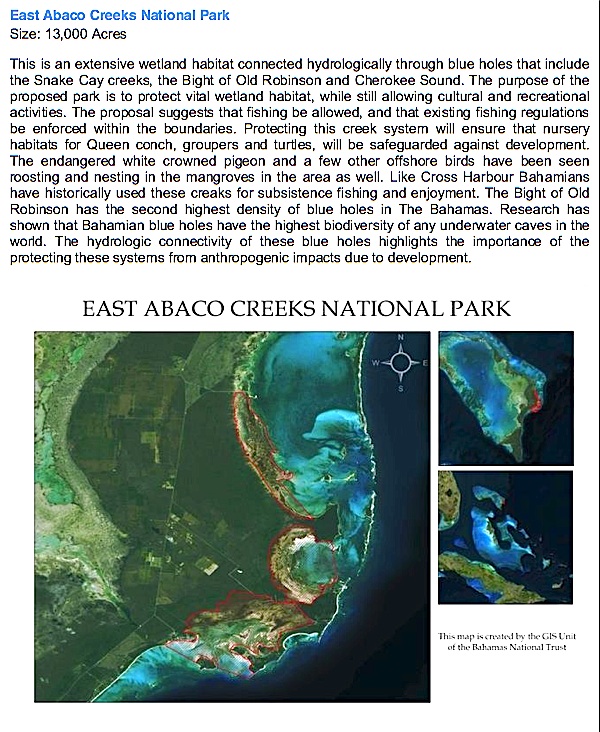
  2. EAST ABACO CREEKS NATIONAL PARK 13,000 acres (20 square miles) of wetland habitat that provides a vital wildlife nursery, and includes blue holes, creeks and a significant area for recreational activities (though Pete’s Pub at Little Harbour may be just outside the zone…)
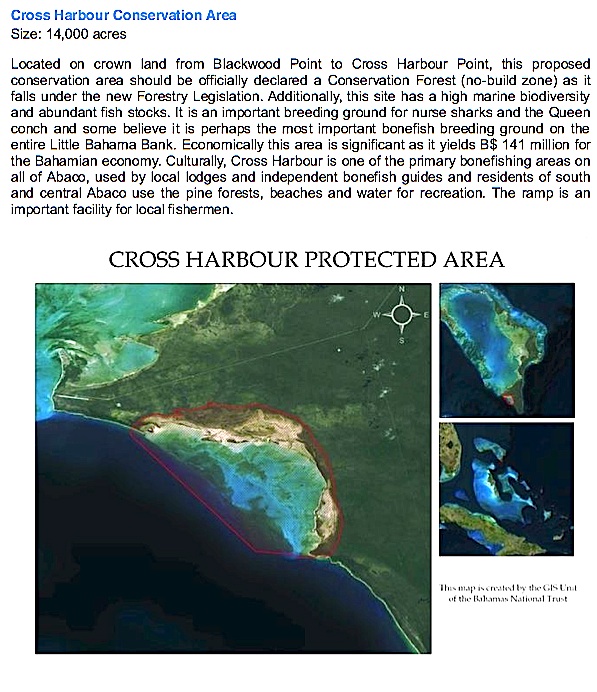
  3. CROSS HARBOUR PROTECTED AREA 14,000 acres (21 square miles) in South West Abaco, a crucial breeding area for a number of species,including bonefish
  4. SOUTH ABACO BLUE HOLES CONSERVATION AREA  A huge 34,000 acre (53 square miles) swathe of South Abaco to the west of the E D Highway, incorporating 4 inland blue holes and important cave systems, and 13 offshore blue holes. This is an area of mainly pine forest on land and low waters at sea, with an anticipated value for eco-tourism

Here are the BNT maps showing the extent of each area. Far more information will be found via the link to the report given above. 

THE ABACO PROPOSALS

Abaco Preserves 1 copy

Abaco Preserves 2 copyjpg Abaco Preserves 3 copyjpg Abaco Preserves 4 copyjpg

Credits: Parrot, (ex-)parrot protector Caroline Stahala; Maps, BNT; acres to sq m conversion, Gizmo!

Unknown's avatar

ABACO ROAD TRIP: CHEROKEE SOUND


ABACO ROAD TRIP: CHEROKEE SOUND

A Guest Post by Amanda Diedrick of GTC – check out 

“Several years back, on a family road trip to the south end of the Abaco mainland, we took a quick swing through the settlement of Cherokee Sound. Though our stop was brief, I was enchanted by the beauty of the tiny town and its breathtaking beach.

bahamas, abaco, cherokee sound, marsh harbour

Earlier this year, I finally got the chance to get back to Cherokee. I spent an afternoon wandering through this small fishing village that, by comparison, makes sedate Green Turtle Cay seem like a lively metropolis.

Similar to Green Turtle, Cherokee was originally settled by Loyalist descendants who supported their families by fishing or building boats. Today, fewer than 200 residents — most of whom commute to other parts of Abaco for work — call Cherokee Sound home.

Though Cherokee’s streets were virtually deserted on the hot June afternoon I visited, I did spot a group of primary school students enjoying recess, and I met a few locals while photographing their quaint, colourful homes.

bahamas, abaco, cherokee sound

And then there’s that beach. That stunning, unspoiled beach. And jutting 700 feet out into the clear water, a beautiful old dock which, according to the sign posted nearby, is the longest wooden pier in the Bahamas.

bahamas, abaco, cherokee sound, pier Until a few decades ago, the only way into Cherokee Sound was by sea. And given the shallow waters surrounding the settlement, an extended pier was a necessity. These days, with a paved road connecting Cherokee to the rest of the Abaco mainland, the dock functions primarily as a tourist attraction.

Casuarina Old Jetty

The Old Jetty at Casuarina, Abaco – the pre-road shortcut to Cherokee (RH)

To get to Cherokee Sound from Marsh Harbour, head south on the main highway and turn left when you reach the sign below:

bahamas, abaco, cherokee sound, pete's pub

Follow the winding road until it ends at Cherokee Sound. The drive from Marsh Harbour takes 30-45 minutes or so.

Cherokee Sound jpg

Between the highway and Cherokee, there are two key points of interest and they could not be more different. Pete’s Pub and Gallery is a rustic, off-the-grid, on-the-sand restaurant that serves up local seafood and stunning ocean views, while the Abaco Club at Winding Bay is a manicured beachfront resort with a spa and fitness center, full-size golf course and pro shop.

If it’s meal time or you’re in need of refreshments, I’d suggest stopping at Pete’s or the Abaco Club, as there are no restaurants in Cherokee Sound. Nor are there any hotels, though a quick online search reveals nearly a dozen vacation homes for rent in or near the village.

bahamas, abaco, cherokee sound

Below are a few of the photos I shot that afternoon. And if you’d like to know more about Cherokee Sound and its history, here’s a great article by Abaco Life editor, Jim Kerr.

Unknown's avatar

“BEAUTIFUL BAHAMA BIRDS”: NEW BAHAMAS BIRD BOOK REVIEW


ABACO PARROTS MM 2

“Over the Moon” (Abaco Parrot / Melissa Maura)

“BEAUTIFUL BAHAMA BIRDS”: NEW BOOK REVIEW

Published 2014 ~ 128pp ~ $20, available from the BNT

A fine new book on the birds of the Bahamas has recently been published by the BAHAMAS NATIONAL TRUST and BIRDSCARIBBEAN. Compiled and edited by well-known Bahamas bird guide CAROLYN WARDLE  with the BNT’s Lynn Gape and Predensa Moore, this slim book is packed with valuable information. It doesn’t set out to be an exhaustive field guide, a task already fully covered by Bruce Hallett’s indispensable Birds of the Bahamas and the TCI. Nor is it anything like my own photographic tome ‘Birds of Abaco’, differing in scope and intention, and weighing a mere 225 gms as opposed to 2 kilos! Beautiful Bahama Birds is eminently a book for the pocket, day bag or backback, to be carried along with your Hallett.

I have illustrated this review with photos of sample pages of the book, invariably the best way to give a clear impression of this kind of publication. Apologies that some of my images are a bit wonky, my copy being new and individual pages being hard to keep flat…

Beautiful Bahama Birds 1 Beautiful Bahama Birds 2

The photographs throughout the book are mainly the work of Linda Huber and the late Tony Hepburn. I was fortunate enough to be able to use some of Tony’s photographs for my own book, given with unreserved generosity; it is a fitting tribute to him that his images have now been published in Beautiful Bahama Birds, and that it  is dedicated to him.Beautiful Bahama Birds 3

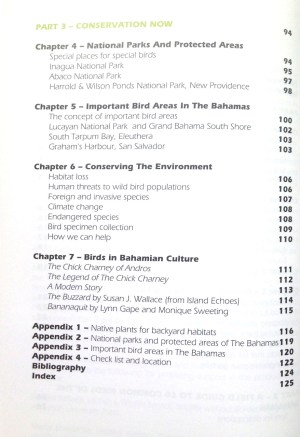
An idea of the broad scope and of the book and its usefulness to the birder can be gained from the contents pages, which I reproduce here. Click to enlarge them. The book is arranged in 3 parts: Let’s Go Birding; Field Guide to 60 Common Birds; and Conservation Now.

Beautiful Bahama Birds 4Beautiful Bahama Birds 5b

PART 1 offers plenty of useful information and practical advice about birding in general (I wish I could have read this before I started my own book!). Anyone who loves birds will benefit from this whole section, even if they would not call themselves a birder – especially Chapter 3 ‘Getting Closer to Bird Life’.

Beautiful Bahama Birds 6  Beautiful Bahama Birds 7

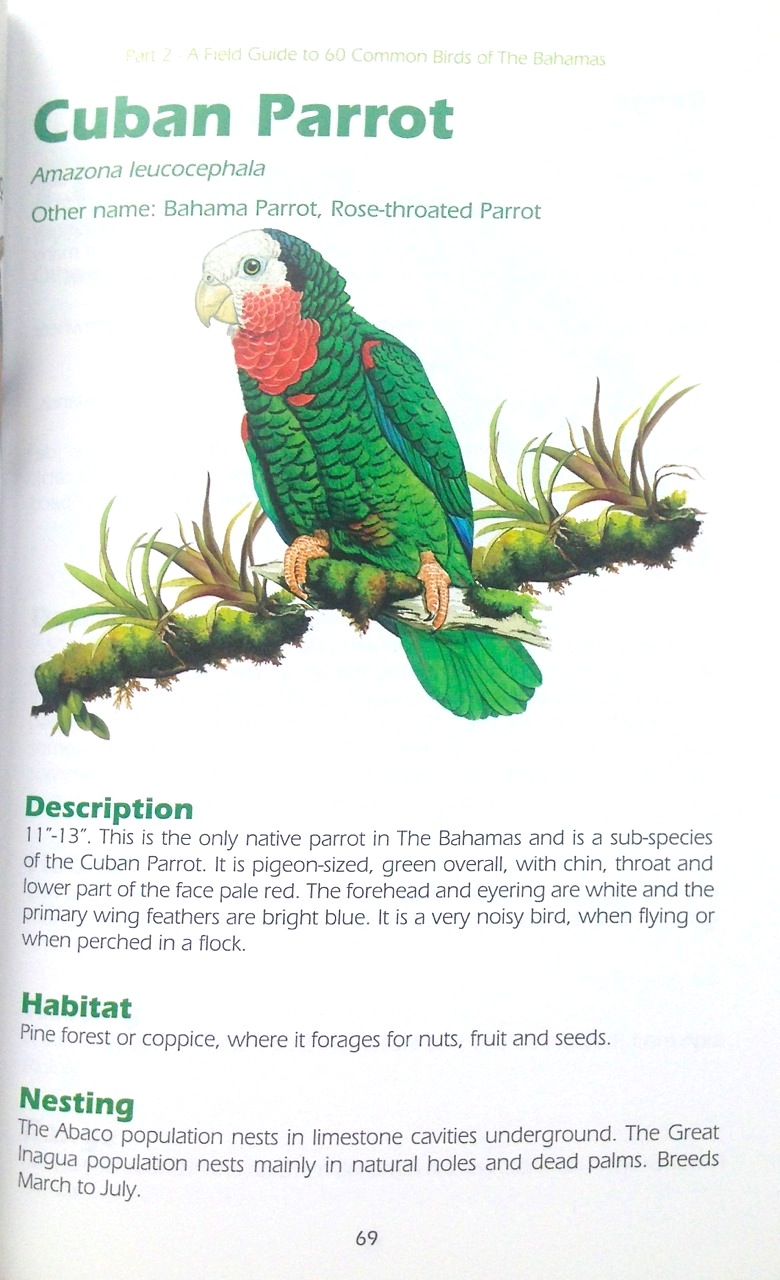
PART 2 All 5 Bahama endemics are featured in the main section, which is handily divided  very broadly into ‘waterbirds’ and ‘land birds’. Some birds are commonly found on most islands; some have more limited range: for example the Bahama Oriole is now found only on Andros; and breeding populations of the Cuban Parrot are found only on Abaco and Inagua (the increasing number of sightings on New Providence give some hope for a breeding population there too). I’ve chosen the parrot because the underground-nesting subspecies on Abaco is so special; and the Flamingo and Bahama Oriole, both very sadly extirpated from Abaco in recent memory.

The illustrations by Tracy Pederson and Kristin Willams are clear and highlight well the identifiers for each species. Where necessary, species variations are shown, for example between sexes, breeding / non-breeding plumage and adult / immature. This can be a confusing and even fraught area (as I constantly find), which this book usefully addresses.  Some birds in flight are also shown to aid ID.

   Beautiful Bahama Birds 8 Beautiful Bahama Birds 9

Beautiful Bahama Birds 10

PART 3 covers the National Parks, important birding areas of the Bahamas, conservation matters, and a charming section on birds in Bahamian culture. Appendices include lists of Bahamas native plants and their importance for wildlife; National Parks and Protected Areas; important birding areas of the Bahamas; a Checklist; a Bibliography; and a user-friendly Index (not all are…).

 Beautiful Bahama Birds 13 Beautiful Bahama Birds 12

A good Checklist is a vital ingredient for any birder, whether visitor or local. Here, all the species occurring on the islands are shown on the left and their residential status and range throughout the islands across the top. Thus at a glance you can tell whether a given species is found on a particular island and when it may be found there. You would know not to look for Turkey Vultures on Eleuthera at any time; and that the black-bellied plover is a winter resident throughout the region and not to be seen during your trip in June…  I also like the tick-boxes on the left for species collectors.

Beautiful Bahama Birds 11

Overall I have thoroughly enjoyed this small book and unreservedly recommend it. It does not replace Hallett, but it complements it. Furthermore, I’m sure the straightforward style and presentation will appeal to bird-loving non-birders and also to younger birders – it may even encourage some out into the field! On p.20 the recommended reading list includes books that would appeal to young readers and links to appropriate websites, a thoughtful touch. I have learnt, or been reminded of, much from reading this book a couple of times. It is a welcome addition to the relatively sparse avian literature for the Bahamas, a prime birding region that is home to an astonishingly wide variety of birds including rare, threatened and vulnerable species like the Parrots, the Kirtland’s Warbler and the Piping Plover.

BOOK LINKS

RH BOOK REVIEW PAGE

BIRDER’S GUIDE TO THE BAHAMA ISLANDS (Tony White)

JAMES BOND (LICENSED TO WATCH BIRDS…)

SAN SALVADOR BIRDS

DELPHI CLUB GUIDE TO THE BIRDS OF ABACO

Unknown's avatar

RING-BILLED GULLS ON ABACO


Ring-billed Gull ACH DSC_0451 copy

RING-BILLED GULLS ON ABACO

The Ring-billed Gull Larus delawarensis is a common winter gull, familiar to all in its adult form because of its… er… ringed bill that distinguishes it from all the other gull species found in the northern Bahamas. There are other differences, obviously, but this beak-related signifier provides the easiest method of ID. To be honest, you may find one anywhere – out to sea, on the shore, inland, or perhaps hanging out at one of the dumps that they are attracted to. This last preference is one shared with many species, but while the dumps may provide good birding venues, the photographic backgrounds and general ambience may be somewhat unattractive… Here are 3 great photos by Nina Henry of these gulls where they look best, near the shoreline.

STOP PRESS Nov 18 Woody Bracey reports from Treasure Cay “I had my first for the fall here in Treasure cay yesterday – one adult and 1 immature. It’s nice to have them back”. So keep an eye out – the ring-billeds are back on Abaco…

Ring-Billed Gull, Abaco (Nina Henry)Ring-Billed Gull, Abaco (Nina Henry)Ring-Billed Gull, Abaco (Nina Henry)

The Latin name of these gulls refers to the Delaware River, Pennsylvania, which is on their migration route. But there must have been dozens of other towns along the route with equal claim to have a bird named after them. Why Delaware took the honours, I cannot explain… and thinking about it has inserted the old song in my brain “What did Delaware, boys? What did Delaware? She wore a brand New Jersey…” etc etc**. So I’ll get on and show some more RBGs to get it out of my head. Here are 3 stages of development from Bruce Hallett.

JuvenileRing-billed Gull (juv), Abaco (Bruce Hallett)

First winterRing-billed Gull (1st winter), Abaco (Bruce Hallett)

AdultRing-billed Gull, Abaco (Bruce Hallett)

Laughing Gulls are gregarious creatures, and are quite often found in a group with some other seabird in the middle of the crowd – often a larger one. Here is a ring-billed gull standing proudly in the throng, while the laughing gulls snooze in the sun on the jetty. Ring-billed Gull + Laughing Gulls, Abaco (Peter Mantle)

Photo Credits: Tony Hepburn (1), Nina Henry (2,3,4), Bruce Hallett (5,6,7), Peter Mantle (8)

** If you want to remind yourself – or inflict on yourself for the first time – the entire US-State-related pun-encrusted jingle CLICK DELAWARE DITTY

Unknown's avatar

VIREOS ON ABACO (2): THE PHILADELPHIA VIREO


Vireo_philadelphicus Brian Mcclure (wiki) CROP

VIREOS ON ABACO (2): THE PHILADELPHIA VIREO

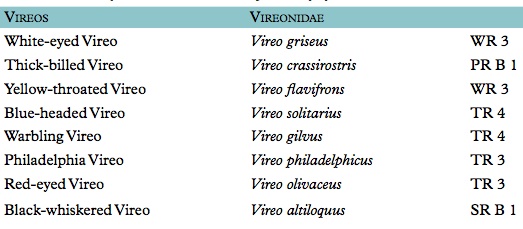
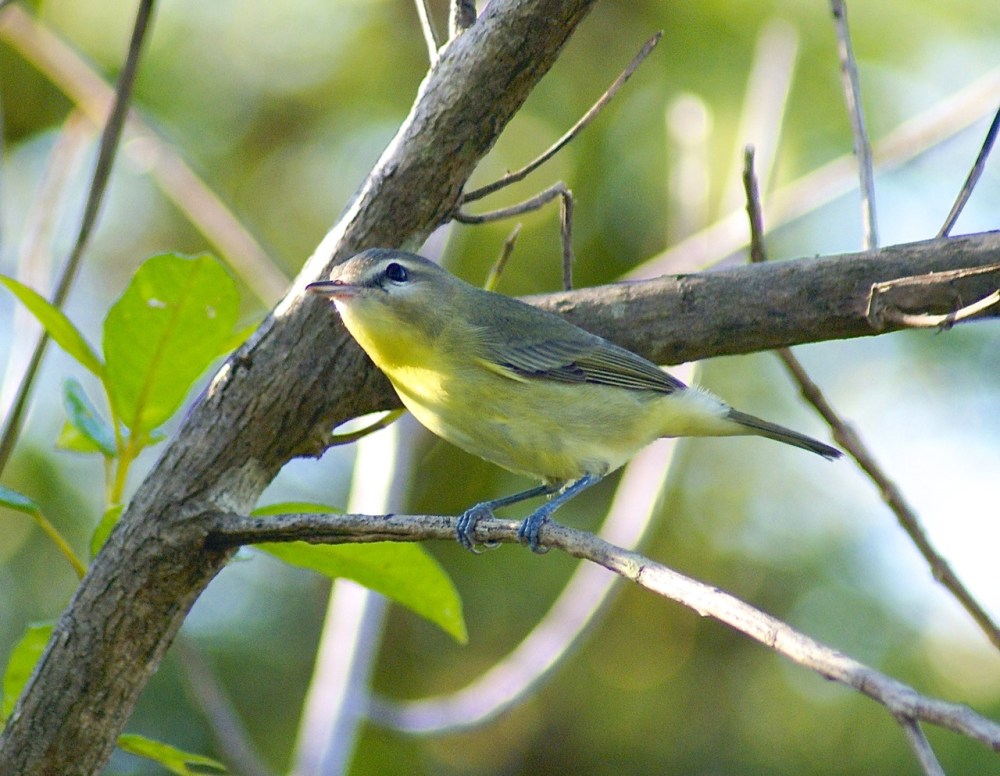
Vireos haven’t had as much attention as they deserve hereabouts. I have posted about the BLACK-WHISKERED VIREO, but the 7 other vireo species found on Abaco haven’t had much of a look in. It’s a wrong that I shall right at once by featuring the rather shy Philadelphia Vireo Vireo philadelphicus. Here is the full list of the vireos recorded for Abaco, from which you will see that only the Thick-billed Vireo is a common permanent resident. The Black-whiskered vireo is a common summer breeding resident; there are 2 uncommon winter residents; and the other 4 are transients that chose Abaco as a resting place on their migrations.

Taken from ‘The Birds of Abaco’ checklist by Tony White with Woody BraceyVIREO CHECKLIST

SONY DSC

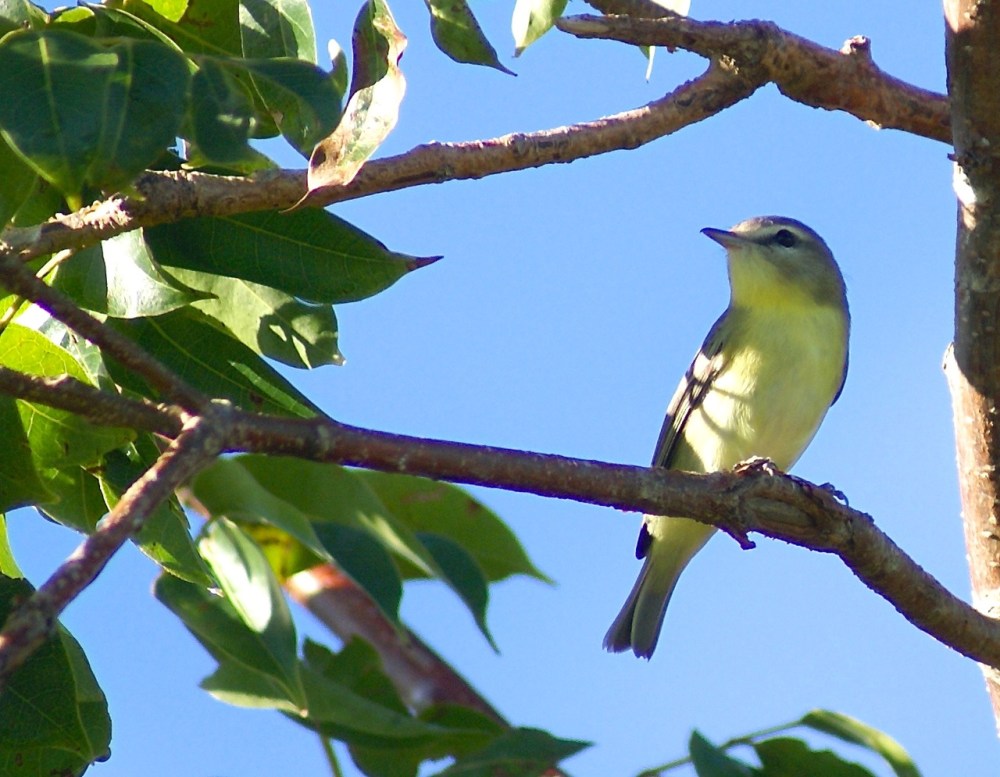
This little bird tends  to be described with such unkind adjectives as ‘drab’, ‘dull’ and ‘plain’, but  like many under-appreciated species it has its own charm. The header image and the one above give excellent close-up views. The signifiers include the dark eyes, white eyebrows, the dark line through the eyes, the yellow underparts, and in the negative sense the complete absence of eye rings, wing bars or tail markings. And the thick bill is one quick way to distinguish it from similar-looking warbler species, with their generally smaller, pointy beaks. SONY DSC

The Philadelphia Vireo has a wide range, from its summer breeding grounds as far north as Canada down to its winter quarters in Mexico and South America. They have even, very rarely, been seen in Europe. The connection with Philadelphia is somewhat tenuous and arises because the bird was first identified in 1842 from a specimen collected near Philadelphia. However their visits there are brief, since at best it is only a stopover on their migration route…vire_phil_AllAm_map

Philadelphia Vireo (Vireo philadelphicus Dominic Sherony wiki

Here is the song comparison between (in order) the Philly, the familiar TBV whose song accompanies everyday life on Abaco, and the Black-whiskered vireo. My TBV recording is rather quieter than the other 2.

 Andrew Spencer / Xeno Canto

RH at Delphi

 Brian Cox / Xeno-Canto

Philadelphia Vireo William H. Majoros wiki If you want to know how to record birdsong easily using an iPhone or equivalent CLICK HERE 

Credits: Woody Bracey (2, 3); Brian McClure, Dominic Sherony, William H. Majoros, Xeno Canto, Wiki, Cornell Lab

Unknown's avatar

BUTTERFLIES ON ABACO (5): THE UNUSUAL MARTIAL SCRUB-HAIRSTREAK


BUTTERFLIES ON ABACO (5): THE UNUSUAL MARTIAL SCRUB-HAIRSTREAK

I wish I could tell you something useful about this butterfly, but frankly there’s not a lot of info about it to be found. In part that may be because it is not a mainstream American butterfly, being found only in southern Florida. However it is found in the West Indies, and indeed on Abaco – this one was photographed by Nina Henry at Little Harbour. She was walking from Pete’s Pub to the OLD LIGHTHOUSE when she came across this butterfly. She sent it to me as a query and it took me an hour to nail the ID – there are other very similar and more common hairstreaks that threw me off track for a while (I thought it might be a female… oh, ever  mind, it wasn’t).

The Martial Scrub-Hairstreak Strymon martialis ranges from the southern tip of Florida, throughout the Bahamas and Greater Antilles. I’ve never seen one on Abaco, and I’d be very interested to hear from anyone who has. As far as I can make out this creature’s range tends to be further south, so I’m guessing they are unusual  for Abaco. Prove me wrong!

Martial Scrub-Hairstreak Strymon martialis (Nina Henry) 3 sm

Martial Scrub-Hairstreak Strymon martialis (Nina Henry) 2 sm

Photo Credit: Nina Henry

Unknown's avatar

FLAMINGO TONGUE SNAILS: ALL YOU NEED TO KNOW


Cyphoma_gibbosum Clark Anderson - Aquaimages

FLAMINGO TONGUE SNAILS: ALL YOU NEED TO KNOW

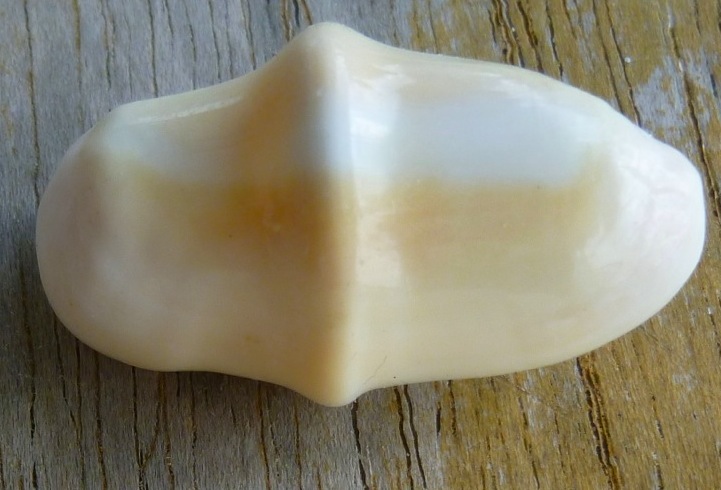
I wrote about FLAMINGO TONGUE SNAILS Cyphoma gibbous more than two years ago. They have not changed noticeably since then but this site has – in scope, available material and audience. So I am revisiting these small marine gastropod molluscs, which are related to cowries. The live animal is brightly coloured and strikingly patterned, but that colour only exists in the ‘live’ parts – the ‘mantle’. The shell itself is usually pale and characterised by  a thick ridge round the middle. These snails live in the tropical waters of the Caribbean and the wider western Atlantic. Whether alive or dead, they are gratifyingly easy to identify.

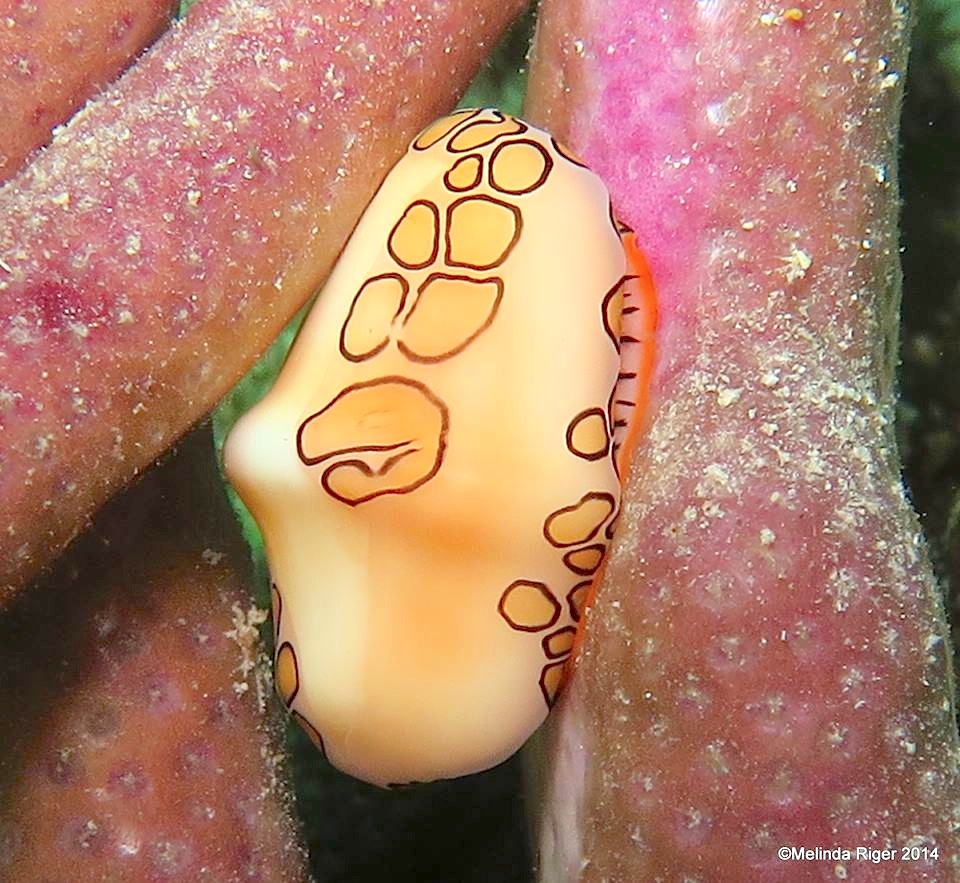
FLAMINGO TONGUE SNAIL ON A PURPLE ROPE SPONGEFlamingo Tongue on purple rope sponge ©Melinda Riger @ GB Scuba copy

FEEDING ON A CORAL STEM

This snail is snacking on a coral stem, leaving a feeding track behind it. The structural shell ridge is clearly visible beneath the distinctively marked live tissue of these creatures.

Flamingo Tongue LASZLO ILYES Cyphoma_gibbosum_(living)_2

The flamingo tongue feeds by browsing on soft corals. Adult females attach eggs to coral which they have recently fed upon. About 10 days later, the larvae hatch. They eventually settle onto other gorgonian corals such as Sea Fans. Juveniles tend to live on the underside of coral branches, while adults are far more visible and mobile. Where the snail leaves a feeding scar, the corals can regrow the polyps, and therefore the snail’s feeding preference is generally not harmful to the coral.

Flamingo_Tongue_Snail_on_Soft_Coral_LASZLO ILYES

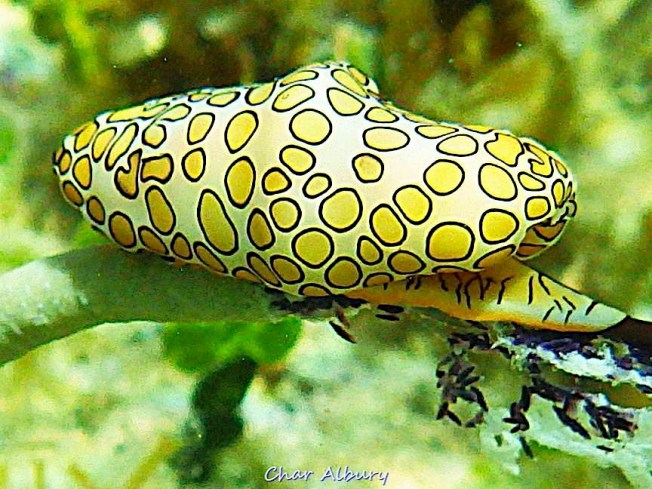
The principal purpose of the mantle of  tissue over the shell is as the creature’s breathing apparatus.  The tissue absorbs oxygen and releases carbon dioxide. As I have seen it described (unkindly?) “it’s basically their lungs, stretched out over their rather boring-looking shell”. 

Flamingo Tongue, Abaco (Char Albury)

This snail species, once common, is becoming rarer. The natural predators include Hogfish, Pufferfish and Spiny Lobsters, though the spotted mantle provides some defence by being rather unpalatable. Gorgonian corals contain natural toxins and instead of secreting these, the snail stores them. This supplements the defence provided by its APOSEMATIC COLORATION, the vivid colour and /or pattern warning sign to predators found in many species.

It comes as little surprise to learn that man is now considered to be the greatest menace to these little  creatures, and the reason for their significant decline in numbers. The threat comes from snorkelers and divers who mistakenly / ignorantly think that the colour of the mantle is the shell of the animal, collect up a whole bunch from the reef, and in due course are left with… “boring-looking shells” (see photos below). Don’t be a collector; be a protector…
Flamingo Tongue, Abaco (Char Albury)

These photos are of flamingo tongue shells from the Delphi Club Collection. Until I read the ‘boring-looking shell’ comment, I believed everyone thought they were rather lovely… I did, anyway. You decide!

Flamingo Tongue Snail Shell, Keith Salvesen AbacoFlamingo Tongue Snail Shell, Keith Salvesen AbacoFlamingo Tongue Snail Shell, Keith Salvesen Abaco

Finally, a couple of videos. The first is rather charmingly titled ‘FLAMINGO TONGUES DOING…. SOMETHING’. Any (printable but amusing) suggestions via the Comment box are welcome. The second punchily summarises this post in 30 seconds. Maybe that’s all that was needed!

Image Credits: Clark Anderson, Melinda Riger, Laszlo Ilyes, Charmaine Albury, RH

Doh! Reading through this after posting I can’t remove from my mind the likeness of Homer Simpson on the snail in Melinda’s photo (2). I had to  check it out and… it’s uncanny!

Homer Simpson Flamingo Tongue copy images

Unknown's avatar

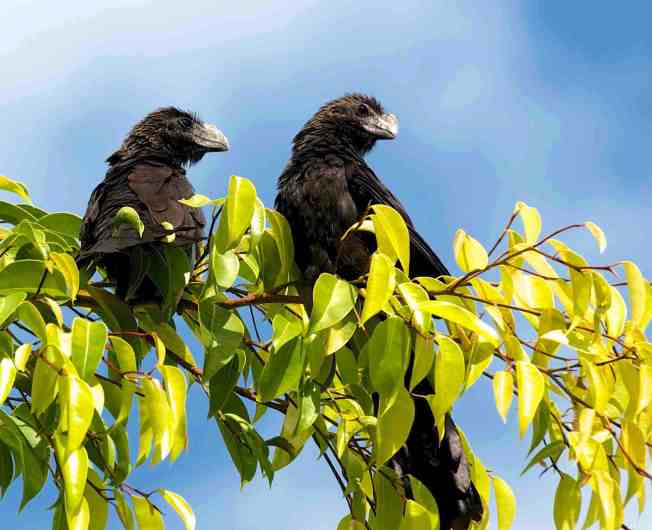
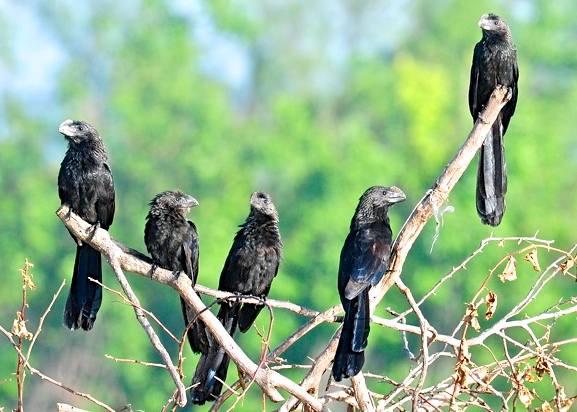
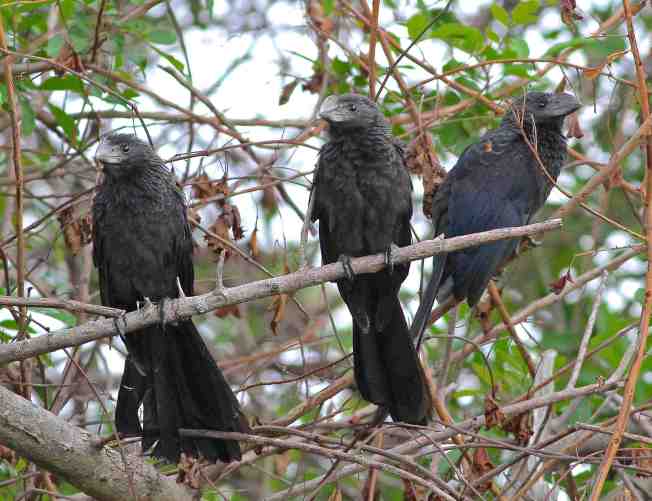
“STAR ANIS”: ENTERTAININGLY GREGARIOUS CUCKOOS ON ABACO


Smooth-billed Ani, TCGC Hole 11 - Becky Marvil

“STAR ANIS”: ENTERTAININGLY GREGARIOUS CUCKOOS ON ABACO 

The Smooth-billed Ani (Crotophaga ani) is the third member of the cuckoo family found on Abaco, the others being the MANGROVE CUCKOO and the YELLOW-BILLED CUCKOO. Anis range from Florida and the Bahamas in the north, down through the Caribbean to South America, where they are widespread.

Ani Range Map (Xeno-Canto) jpg

Smooth Billed Ani, Abaco - Nina Henry 2a

Unlike their shy and retiring cuckoo cousins, anis are extrovert shouty birds that like to hang out in noisy gangs. Large groups can quite often be found in the low scrub at the Highway end of the Delphi drive; and you may well find a posse of them in settlements such as Sandy Point. You’ll probably hear them from some way off, sounding like this:

Leonardo Ordóñez-Delgado / Xeno Canto

Smooth-billed Anis_Abaco - Tony Hepburn

Anis have advanced parenting and chick-rearing skills, sharing not only communal nesting sites but also egg incubation and feeding the chicks. They are also what my mother might have called ‘fast’, raising up to three broods in a season. Rather touchingly, the young of earlier broods help to feed more recent chicks.

Smooth-billed Anis Abaco - Gerlinde Taurer d

I have tried to discover why an ani’s beak is as it is, without much success. Very often beak shape relates directly to the feeding habits and preferences of a species, but it is hard to see how a diet consisting mainly of insects and small reptiles such as lizards would account for such a prominent proboscis. Here is a close-up of the item in question (thanks, Roselyn Pierce).
On Abaco (and indeed elsewhere) Anis are sometimes known as ‘Cemetery Birds’, no doubt because of their all-black appearance (their raucous tendencies would be quite inappropriate for a graveyard…). [Nicolette Russell has contacted me to say that she has always known them as Rain Crows] However although at a distance these birds may look completely black, catch one in the sun at the right angle, and you’ll find that the plumage is far more varied, and with some intricate patterning.

Smooth-billed Ani. Abaco Bahamas Tom Sheley

Look for Anis in low scrubland and coppice, cultivated areas, perched in unsteady bickering rows on utility lines… and on the ground.

Smooth-billed Ani, Abaco. Gerlinde Taurer c

The appearance and flying abilities of Anis are wonders to behold. As I wrote in The Birds of Abaco, “Their curious heavy beaks, their clumsy flight and their untidy take-off and landing routines suggest a design fault”.

Smooth Billed Ani, Abaco - Nina Henry 1a

“One… is the loneliest number…” oh, hang on a moment…Smooth-billed Ani Abaco - Gerlinde Taurer a

…”two of us…standing solo in the sun…”Smooth-billed Ani, Abaco (Gerlinde Taurer) b

As far as I know, there is not yet a collective noun for a group of anis. There should be. Any suggestions welcome via the comment box. Meanwhile I put forward A Commotion of Anis”

Smooth-biled Ani, Abaco - Bruce Hallett

Credits: Becky Marvil, Nina Henry, Tony Hepburn, Gerlinde Taurer, Roselyn Pierce, Tom Shelley, Bruce Hallett; Xeno Canto for range map & sound file; Hat tip to Aimee Mann.

“Star Anis” – do not confuse with Star Anise. One can fly, the other cannotStar Anise Spice (Tesco)

Unknown's avatar

TURTLEY AMAZING: HAWKSBILL TURTLES IN THE BAHAMAS


Hawksbill Turtle © Melinda Riger @ G B Scuba

TURTLEY AMAZING: HAWKSBILL TURTLES IN THE BAHAMAS

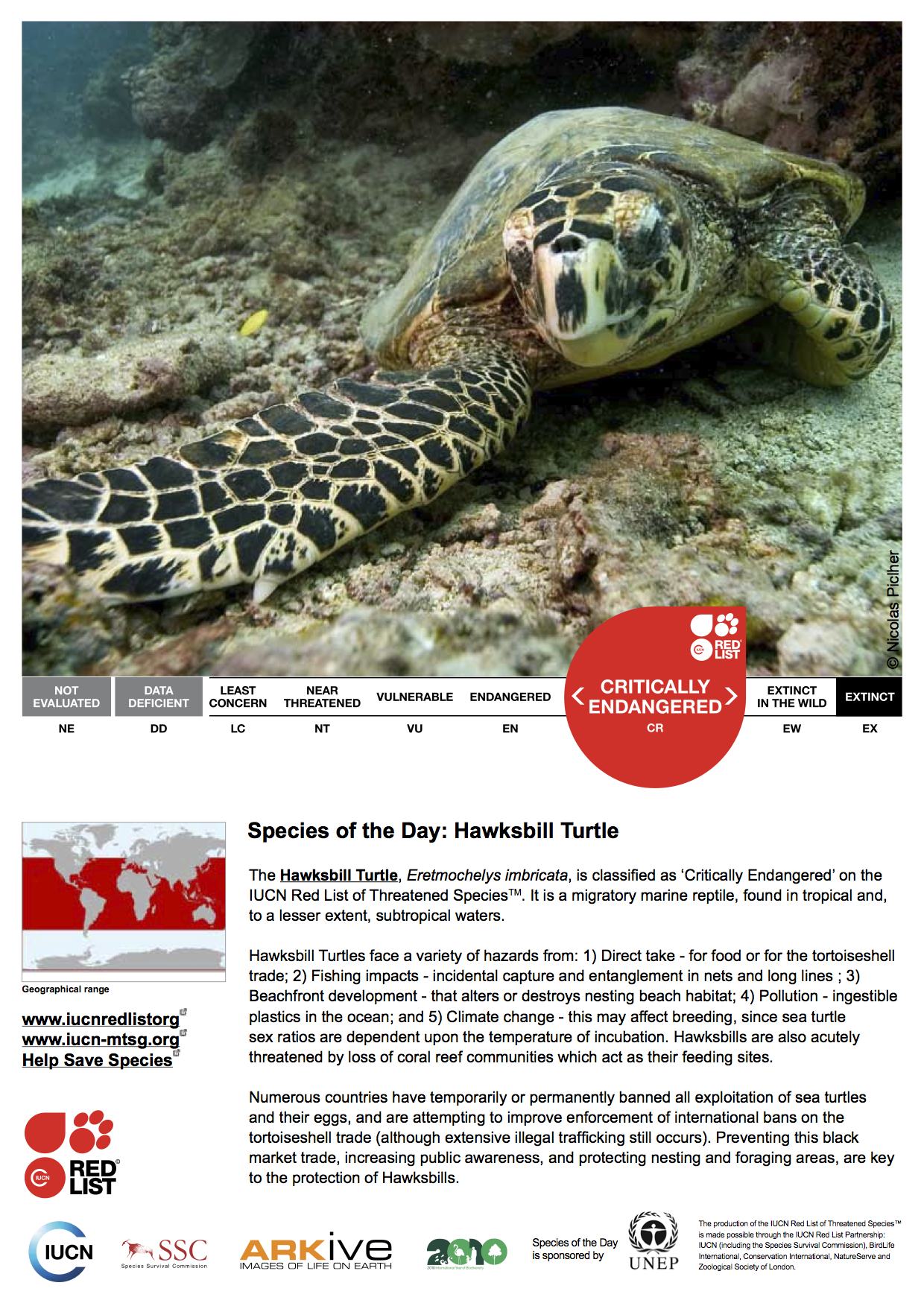
The Bahamas has breeding populations of 5 of the world’s 7 sea turtle species – Green, Loggerhead, Hawksbill, Leatherback and Kemp’s Ridley turtles (the other two are Olive Ridley – occasionally found in the Bahamas – and Flatback turtles). All are endangered. There’s no getting away from the fact that Man and Man’s activities are now the primary threats. The IUCN ratings below make for sad reading. To see some of the problems, check out THREATS TO SEA TURTLES

Admire the photos here of Hawksbill Turtles Eretmochelys imbricata while you can – the species is IUCN red-listed and I can’t improve on this explanatory display…Hawksbill Turtle Eretmochelys imbricata (IUCN Red List)

HAWKSBILL TURTLE GALLERY

(thanks as ever to Melinda Riger of Grand Bahama Scuba, but for whom etc)Hawksbill Turtle ©Melinda Riger @ G B Scuba Hawksbill Turtle ©Melinda Riger @ G B Scuba copy Hawksbill  Turtle ©Melinda Riger @ Grand Bahama Scuba copyHawksbill Turtle ©Melinda Riger @ GB Scuba copy

I did ask myself whether including this shot might show a lack of sensitivity for the essential dignity of a fine species, infringing its Testudinal rights. But overall, I feel the public interest is best  served by showing it. Anyway, it has plainly discovered something very tasty to get stuck into, so it won’t be unduly bothered. The pair of French Angelfish aren’t going to get a look-in…Hawksbill Turtle ©Melinda Riger @ G B Scuba copy 3

 The SEA TURTLE CONSERVANCY has produced an outstanding series of posters similar to the LOXAHATCHEE posters about corals, conchs, sea grass, bonefish etc. Here is their Hawksbill one, with illustrations by artist DAWN WITHERINGTON. Click the link to reach her website and see her excellent scientific drawings and a lot more besides. This excellent poster contains pretty much all the details you need to hold your own in any hawksbill-related conversation. You can enlarge it by doing that thing with 2 fingers on your track pad thingy.

HawksbillLifeHistoryPoster-STC-DWitherington

I rather like this video from Andros, with the turtle’s gentle tolerance while being approached by a photographer until at last  it decides to move slowly off. The music’s a bit annoying though – it doesn’t really fit the scene IMO. 

Credits: IUCN, Melinda for the fab photos, Sea Turtle Conservancy

Unknown's avatar

CORMORANTS: RAPACIOUS PESCATARIAN SEA-RAVENS


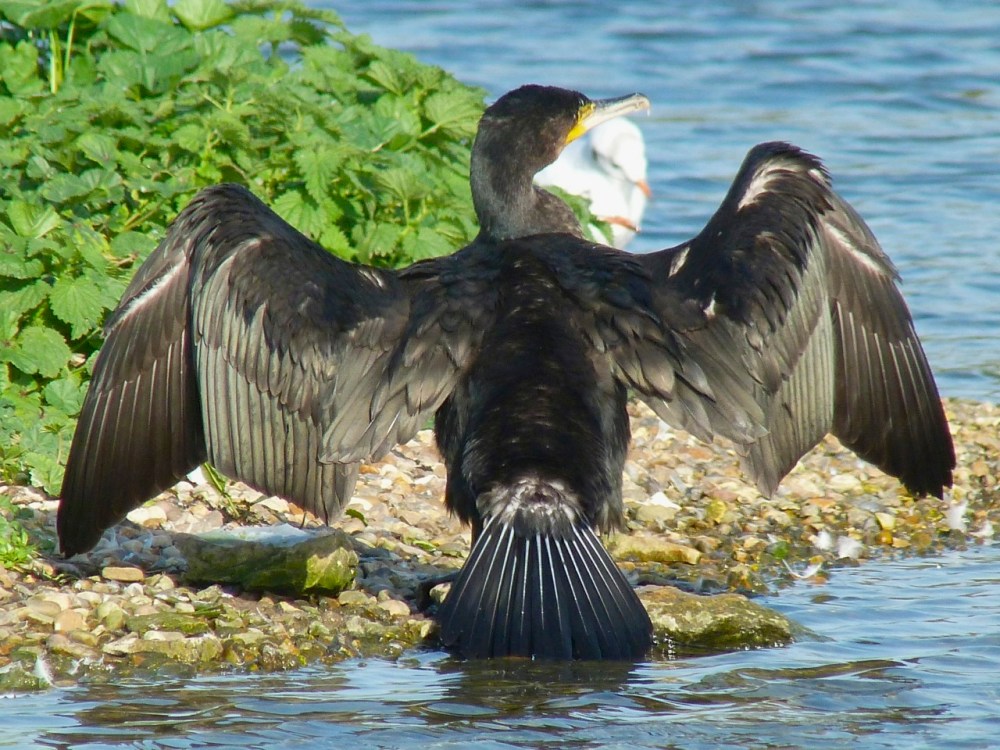
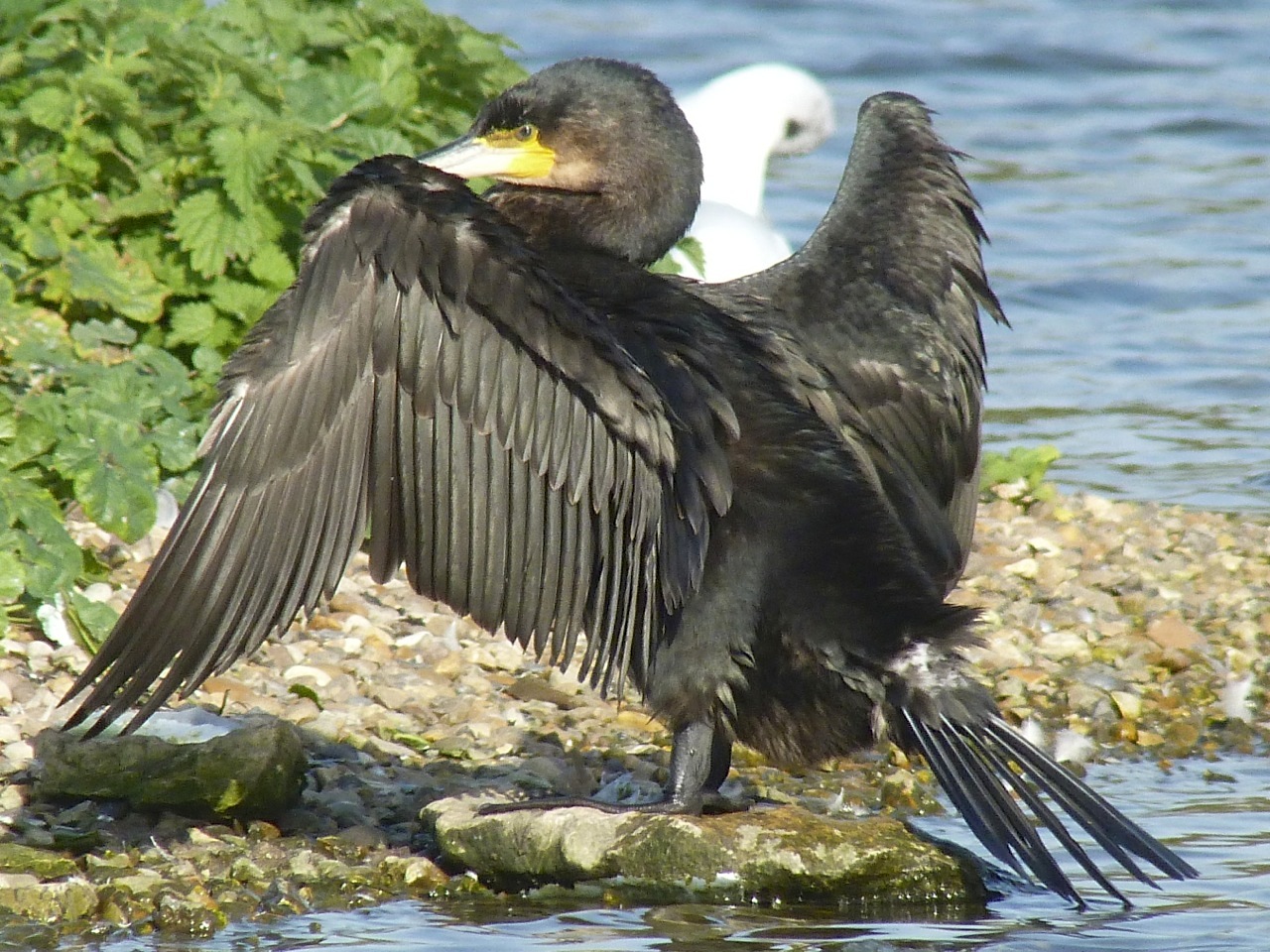
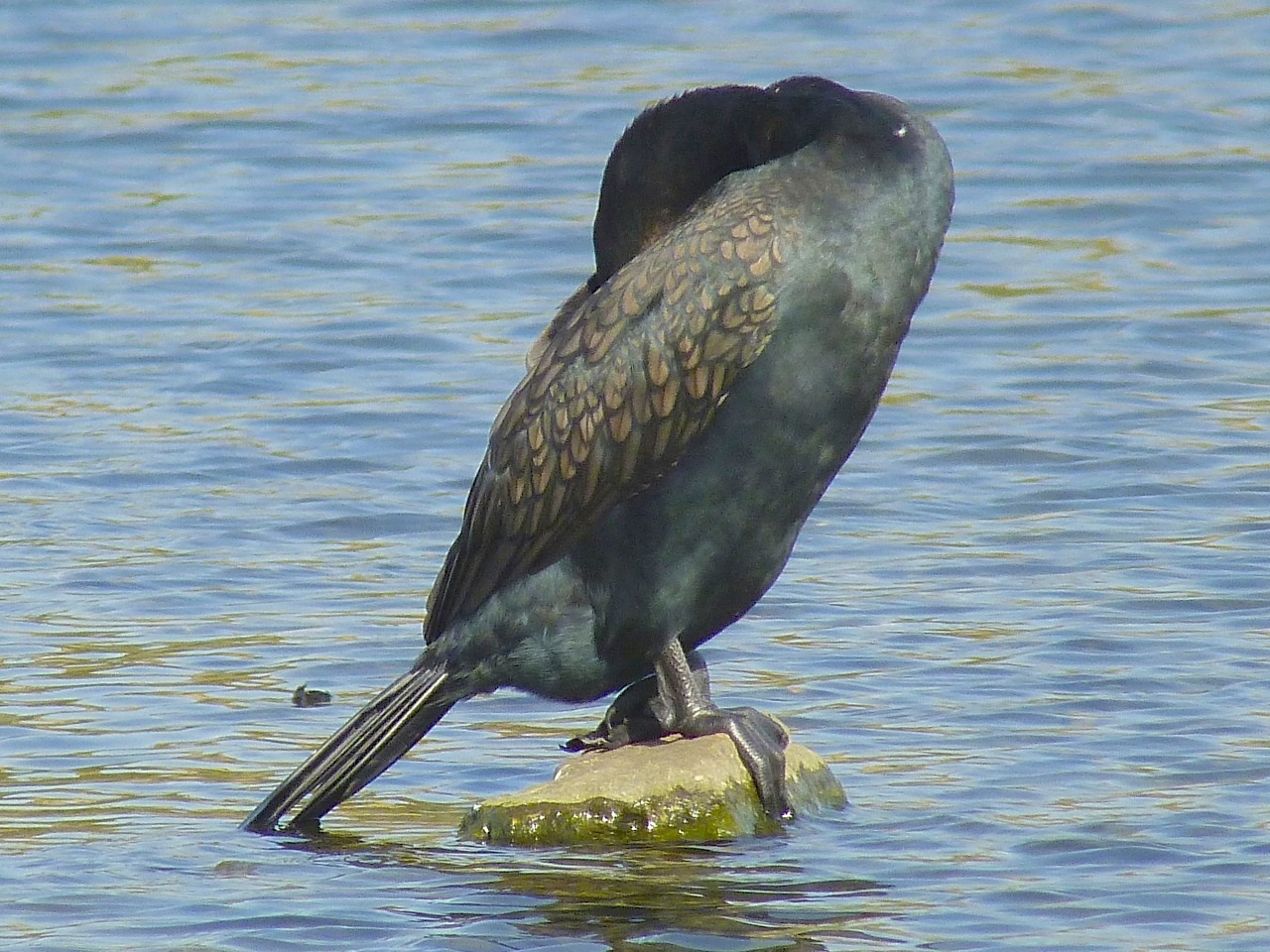
Cormorant WWT 12

CORMORANTS: RAPACIOUS PESCATARIAN SEA-RAVENS

Cormorants are strange creatures. Strange to look at. Strange in their relationship with humans – love / hate in fishing terms and good / evil in mythology. Strangely useless for poetry, since – like the words ‘purple’ and ‘orange’ – there is no pure rhyme for the word cormorant. But they are undeniably striking, and a cormorant on the Abaco Marls effortlessly gliding inches above the water is an impressive sight.

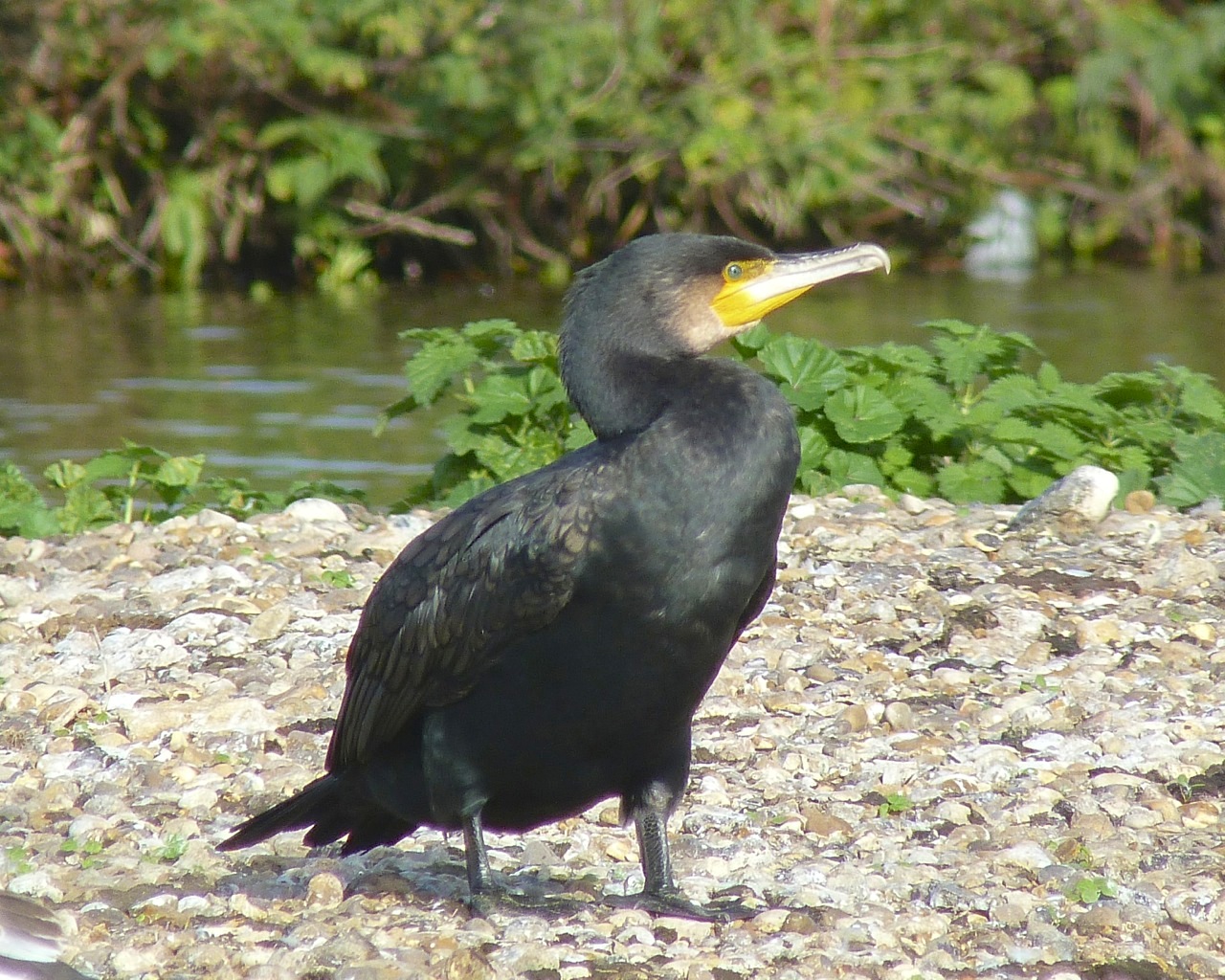
Cormorant WWT 1Cormorant WWT 5

The cormorant’s name originates from the Latin name ‘Corvus Marinus’, the Sea Raven. Cormorants belong to the ‘Pelican’ order of birds known as the pelecaniformes that also encompasses tropicbirds, frigatebirds and anhingas. Worldwide, there are around 40 different species of cormorant. In many parts of the world, this seabird has established itself inland. Angling communities are increasingly concerned by the spread of this bird along productive fishing rivers, often far from the sea shore. In the UK as elsewhere they are very bad news for prime fishing rivers.

Cormorant WWT 8

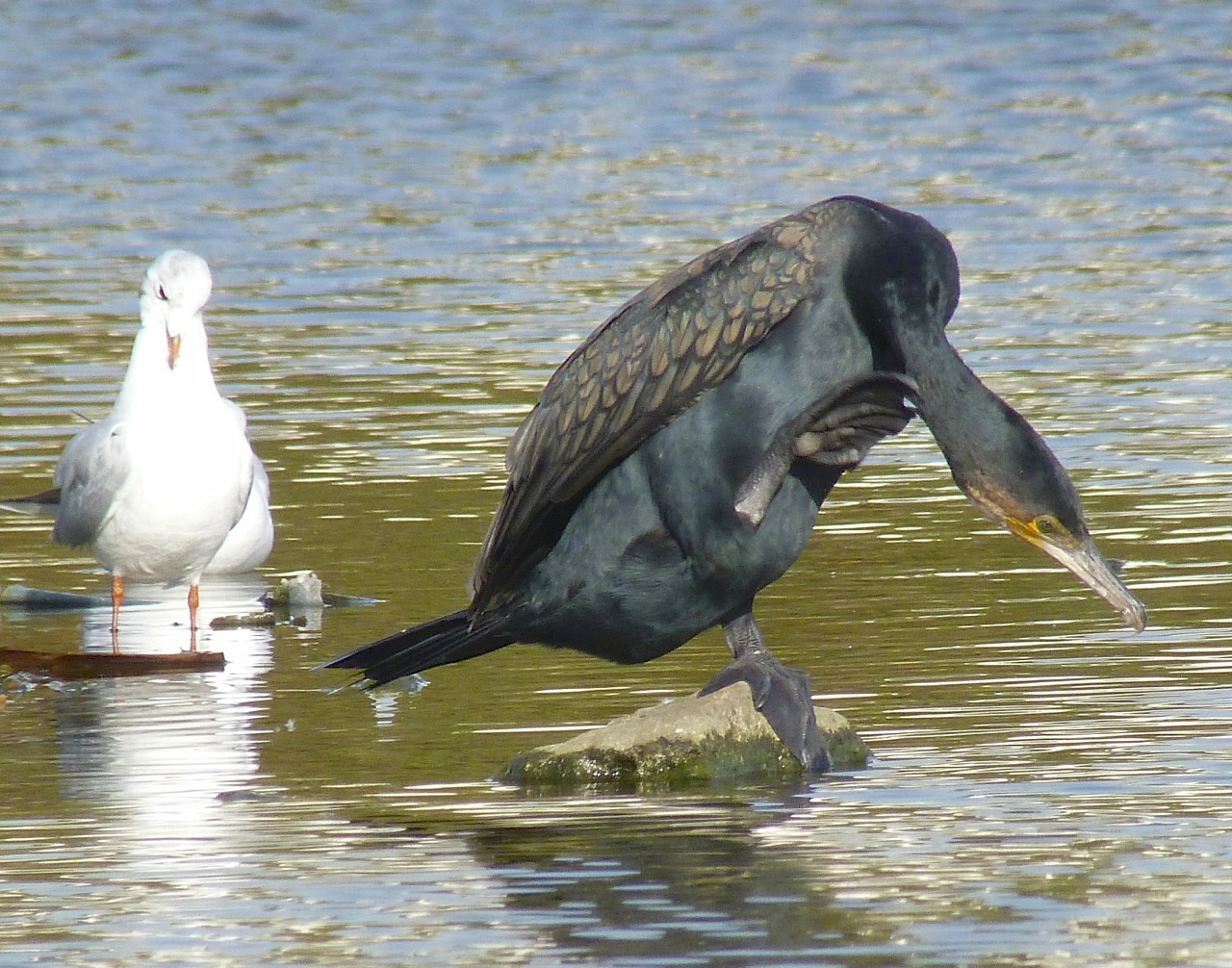
Splosh! Gull Photobomb! It wasn’t there when I decided to press the trigger…Cormorant WWT 4 (gull photobomb)Itchy neck? You just have to scratch it…Cormorant WWT 6Relaxed now, thanks…Cormorant WWT 7

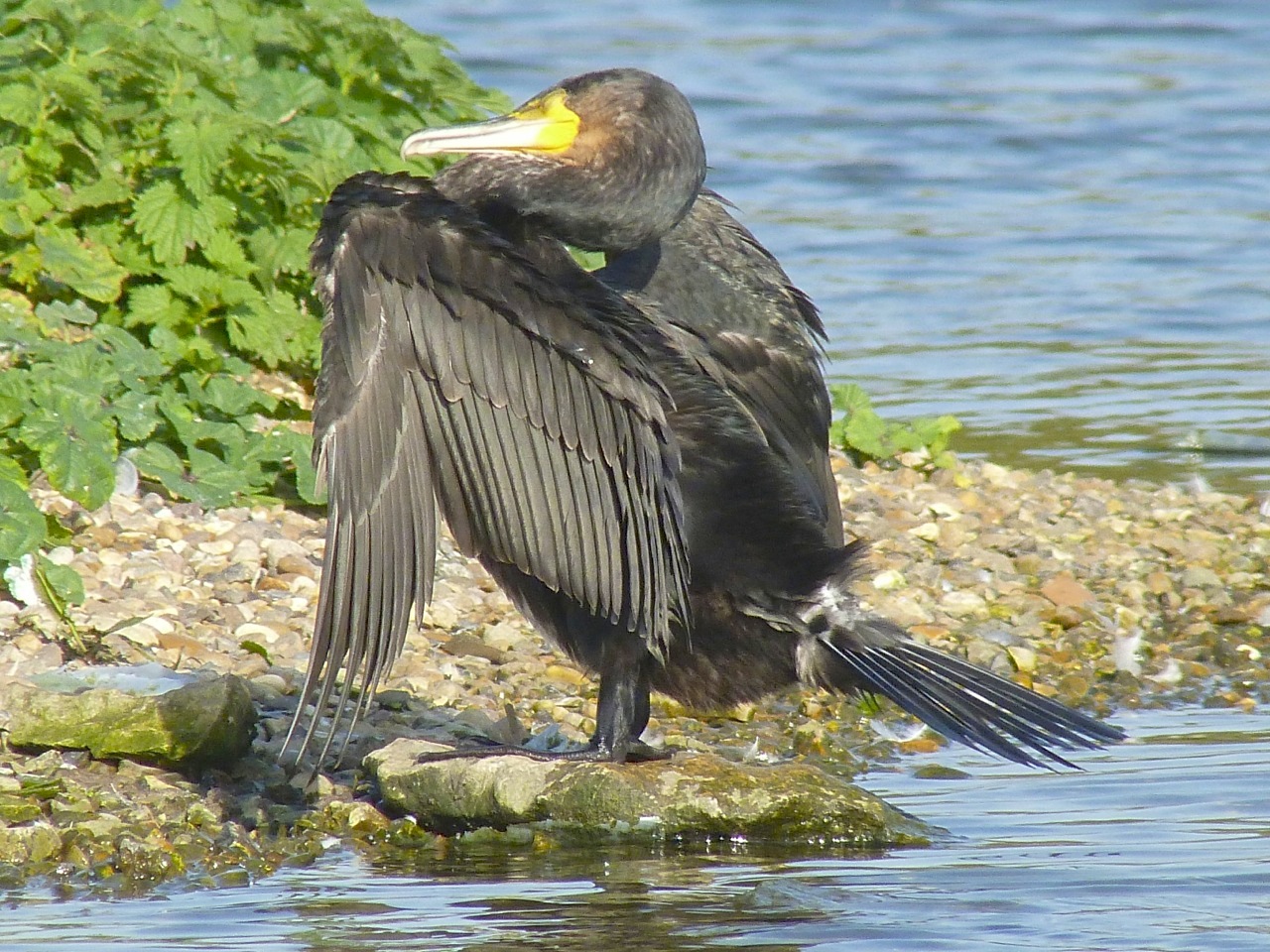
The birds here were photographed in the UK on Halloween. While the world was preparing to immerse up to its neck in blood, guts, gore and spider webs, I was out armed only with a camera in unseasonably warm sunshine. So these are Great Cormorants Phalacrocorax carbo, the species found in the UK. They a remarkably similar to the Double-crested Cormorants Phalacrocorax auritus found on Abaco but larger and with a pale cheek and upper neck. This was a perfect day for the cormorants to enjoy their preening and wing-drying routines.

Cormorant WWT 9 Cormorant WWT 10 Cormorant WWT 11  Cormorant WWT 13

Last sight of the one on the small rock: “Hey, photographer, for !@£$%&* sake leave me alone, ok?”Cormorant WWT 14

I will be writing about Neotopic Cormorants Phalacrocorax brasilianus on Abaco in detail soon, but for comparative purposes here is one from Bruce Hallett taken on Teasure Cay Golf Course, where the ponds are usually a productive birding resource (check in at the clubhouse for permission first).

Neotropic Cormorant, Treasure Cay, Abaco - Bruce Hallett

And as for the very familiar double-crested cormorant, here is a great photo taken on Abaco by Jim Todd of three chicks growing up fast in their unusual double-decker nest…OLYMPUS DIGITAL CAMERA

Credits: All photos RH except the last 2, Bruce Hallett and Jim Todd

Unknown's avatar

‘ATALA FASCINATING’: THE LIFECYCLE OF THE ATALA HAIRSTREAK ON ABACO


Atala Hairstreak Butterfly, Abaco 6

‘ATALA FASCINATING’: THE LIFECYCLE OF THE ATALA  HAIRSTREAK ON ABACO

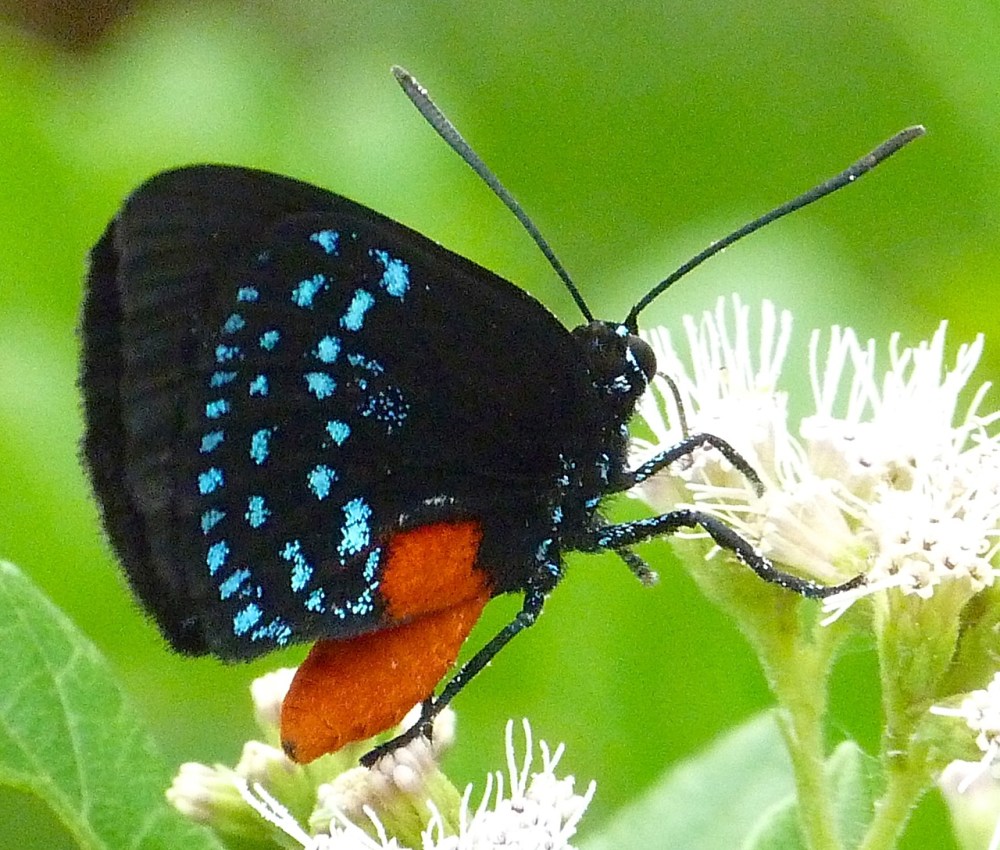
I have posted about several of the wonderful butterfly species the live on Abaco, but my favourite will always be the small but beautiful Atala Hairstreak Eumaeus atala. Its ‘look-at-me’ bright orange abdomen, black wings and the curious luminescent bright blue spots that even cover its legs and head are unmistakeable. These butterflies favour the coontie plant – especially for egg-laying – but they can be seen almost anywhere as far as I can see, though I have never seen one right by a beach. 

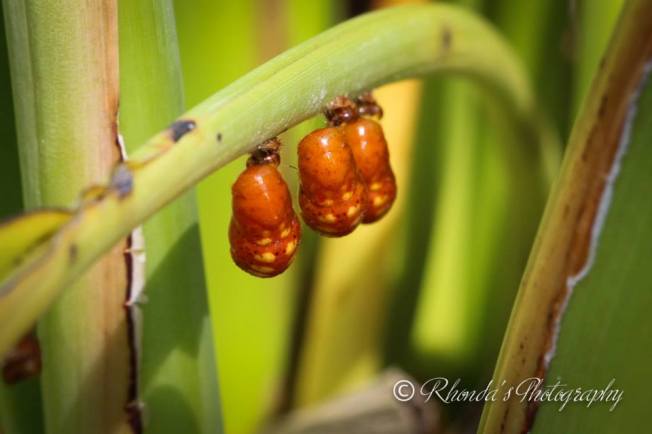
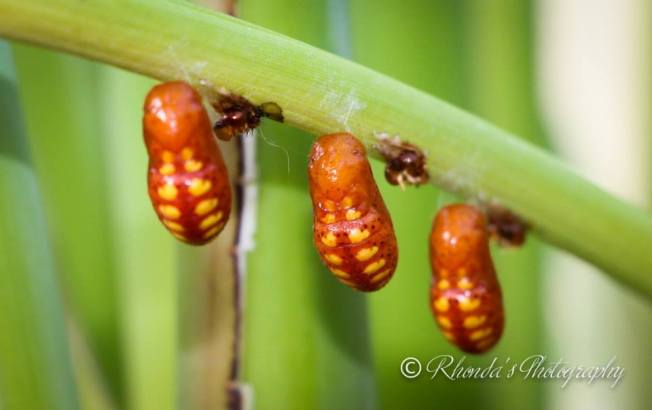
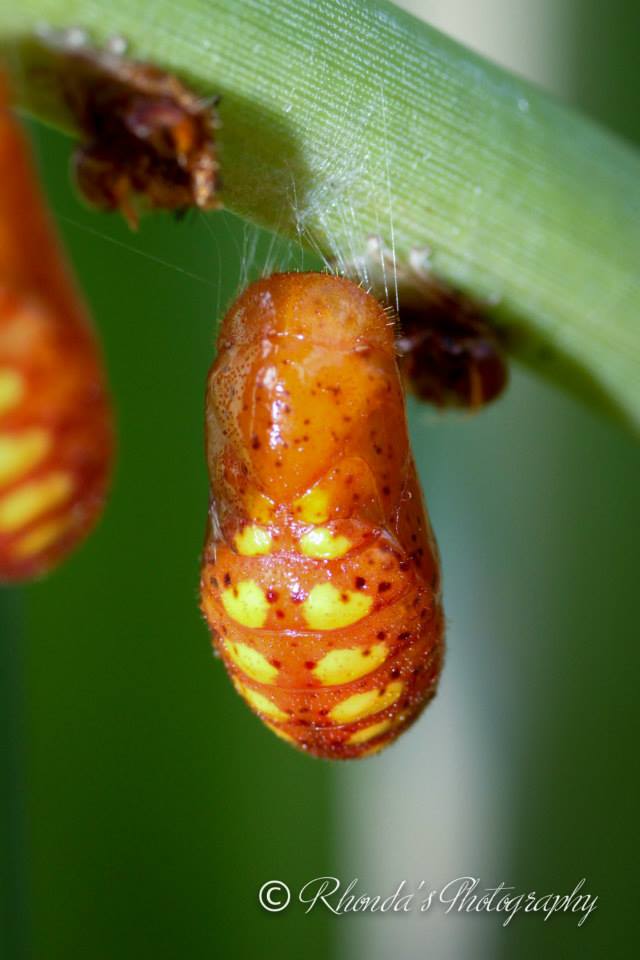
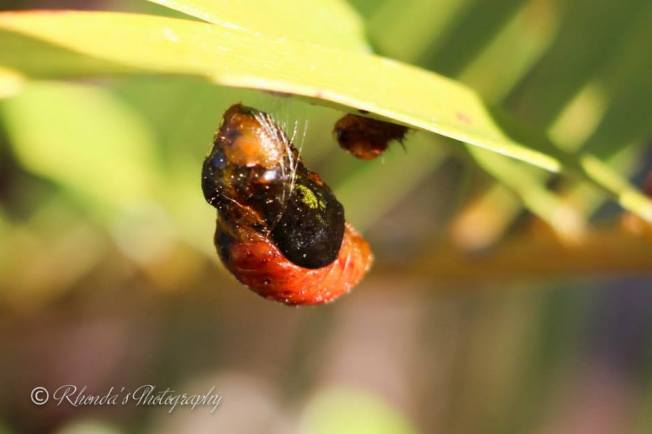
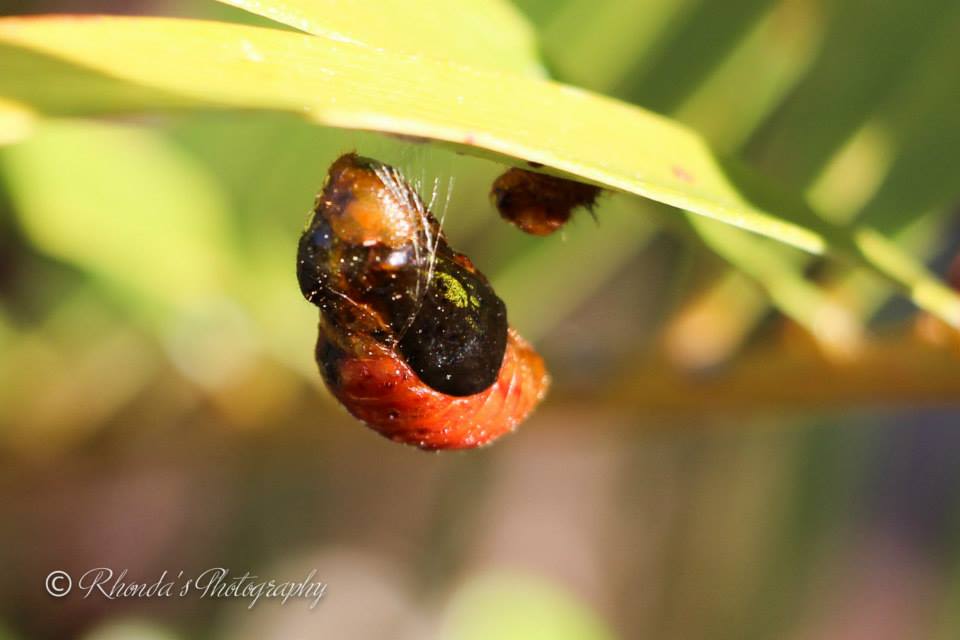
I’ve posted before about the lifecycle of the Atala, but I have never had a chance to show the complete post-egg process from caterpillar to triumphantly emergent butterfly actually recorded on Abaco until now. Thanks to Rhonda Pearce, her patience and her skill with a camera, the following sequence of photos shows in detail the various stages of metamorphosis.

THINGS TO LOOK OUT FOR

  • The little hairs on the caterpillars (larvae)
  • The dark gluey-looking shed skins
  • The delicate silky threads as the chrysalis forms
  • The butterfly emerges upside down, enabling it to uncrumple & spread its wings to dry

1964966_10152506740213720_6039769522835749460_n10516815_10152518719448720_8042135533496504376_n10460336_10152513042213720_1749266799385283727_n10329065_10152513052483720_1278639048660950997_n10636149_10152513103088720_95745605012112261_n10670036_10152537482408720_2714379949813709137_n

10173638_10152536424683720_8837746952198646203_n10703931_10152539084318720_4254043938657181472_n      10530805_10152539181538720_7306525148033947757_n1800474_10152539184718720_2160773318941097404_n1904051_10152539181463720_3683578272660806029_n10410511_10152536410758720_8834582183802288185_n


RELATED POSTS

ATALA HAIRSTREAK LIFECYCLE (you’ll find more info about the process here)

FLUTTER BY, BUTTERFLY

ABACO’S LOVELIEST BUTTERFLY

ABACO BUTTERFLY PAGE (other species found on Abaco)

Photo Credits: All Rhonda Pearce except the header of a full adult imago, RH

PS Sorry, I’ve been very po-faced and not mentioned Halloween. Everyone else is covered in blood, guts and gore, so I reckon the market is saturated. Also I get the wrong end of the ‘Trick or Treat’ stick. I carefully prepare 2 lots of choccy-based sweets. One is delicious. The other contains chilli. If the callers are nice, they get the Treat. If not, they get the Trick. That must be right, surely. I can listen to them hawking and barfing as they run off into the night…. [No children were hurt in the making of this story…]

Unknown's avatar

PLOVER LOVER? PIPING PLOVERS ON ABACO (3)


Piping Plover (Danny Sauvageau) 4

PLOVER LOVER? PIPING PLOVERS ON ABACO (3)

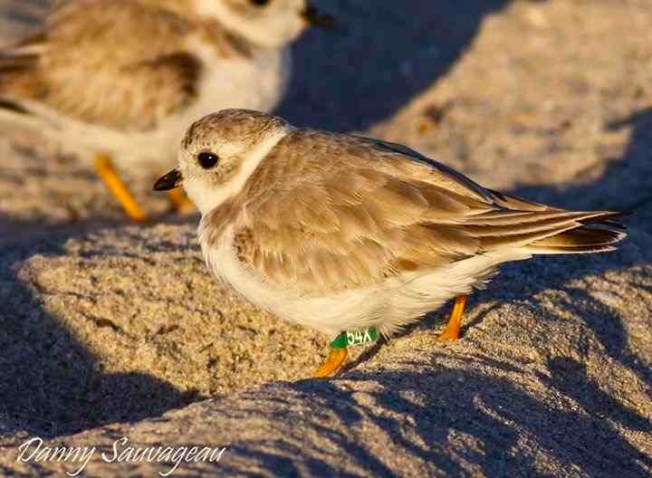
So much to post about – what to choose? Well, the fall migration is still in full swing, with warblers hurtling across land and sea to Abaco in large numbers for their overwintering. Palm warblers are currently arriving. However I’m going to stick with shorebirds for now, and one of the rarer winter visitors, the Piping Plover. I have some more great photos from Danny Sauvageau in Florida, who tirelessly patrols the plover resting areas to record the banded ones so that their origin can be determined. This research assists with vital habitat conservation programs at each end of the migration. There are only 8000 of these little birds left in the world and without protection there’ll be none before you can say “oh dear, very pretty, they’re gone, what a pity…”
PIPING PLOVERS IN THE EARLY MORNING SUNPiping Plover (Danny Sauvageau) 6Piping Plover (Danny Sauvageau) 5Piping Plover (Danny Sauvageau) 3

RING BLING & FLAG TAGS

The postions, colours and numbering of the rings and tags on these plovers identify individual birds, the location of their summer breeding grounds and so on. Dispersal and migration patterns of each bird can be recorded and specific facts – age for example – can be monitored.Piping Plover (Danny Sauvageau) 2
Piping Plover (Danny Sauvageau) 7Piping Plover (Danny Sauvageau) 8Piping Plover (Danny Sauvageau) 9Piping Plover (Danny Sauvageau) 1

PIPL IN FLIGHT – AN AMAZING IMAGE

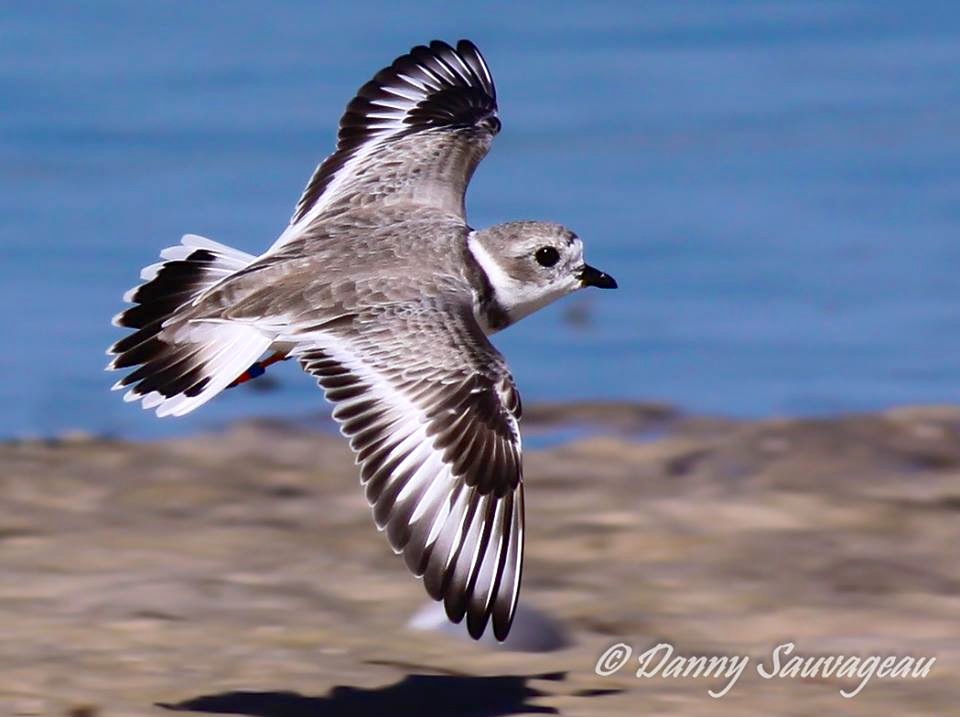
On the very day I was about to press the ‘publish’ button on this post, look what just flew in from Danny’s beach in Fl.! This is an outstanding photo of a PIPL in flight – you can even see its shadow on the sand. I have a few shots of these birds flying in groups over the sea but apart from a general impression of PIPL-ness, they could really be any small shorebirds travelling fast on the wing. This one is special. Piping Plover in flight (Fl., Danny Sauvageau)

ABACO PIPL NEWS

Piping plovers have already arrived on Abaco. Casuarina beach is a promising place to look. Rhonda Pearce sent me this nice photo taken on the point (see my map). This pretty bird looks as though it has a black tag. However Todd Pover of CONSERVE WILDLIFE NEW JERSEY who also monitors the Abaco end of the migration thinks it may just be a piece of wrack – black tags are not usually used.

If anyone sees a piping plover and has a camera handy, I’d be very pleased to receive any photos, especially showing rings if possible – or indeed ringless legs, which is also informative to the monitors. If it turns out to be a Wilson’s Plover, no matter: they are fine birds in their own right!

PIPL Casuarina Oct 14 Rhonda Pearce via RHCasuarina Map jpg

Finally a quick reminder about Danny’s Kickstarter project “Saving Endangered Piping Plovers through Photography” and his presentation explaining how his photography in PIPL resting areas during their migrations can help to map and complete the picture of this vulnerable species to enable their protection.
You can reach Danny’s film by clicking the link DANNY’S FILM and you will see some fabulous footage of these little birds scuttling around on the beach, looking enchanting; and the commentary will explain the importance of the the birds and the research into their conservation.

RELATED POSTS

RARE GEMS: PIPL ON ABACO 1

50 WAYS TO PLEASE YOUR PLOVER

And finally – what are the good people of Massachusetts doing to help? (great plover skitterings on the shoreline here!)

[youtube https://www.youtube.com/watch?v=tWxema5pef4&app=desktop]

Credits: All photos, Danny Sauvageau except the last, Rhonda Pearce

Piping-Plover Artmagenta          Piping-Plover Artmagenta          Piping-Plover Artmagenta          Piping-Plover Artmagenta          Piping-Plover Artmagenta          Piping-Plover Artmagenta        Piping-Plover Artmagenta

Unknown's avatar

‘WTF?’ IN BAHAMAS WATERS (3) : LETTUCE SEA SLUG


Lettuce Sea Slug ©Melinda Riger @ Grand Bahama Scuba copy

  ‘WTF?’ IN BAHAMAS WATERS (3): LETTUCE SEA SLUG

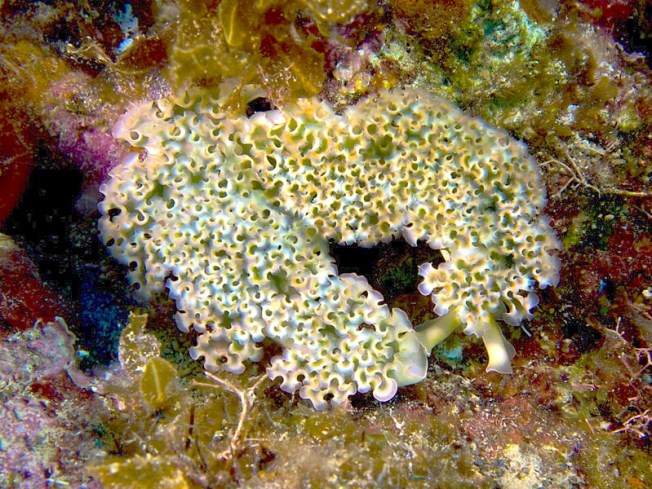
The ‘WTF’ series so far has covered Bahamas reef fish on the bizarre end of the unusual-to-completely-weird appearance spectrum. And it has stood, of course, for ‘What’s That Fish?’. Today, it doesn’t. The feature creature isn’t a fish at all; it looks like a plant; it is in fact a SACOGLOSSAN – specifically the Lettuce Sea Slug Elysia crispata

The head end is on the left…Lettuce Sea Slug ©Melinda Riger @ G B Scuba copy

The name ‘sacoglossan’ literally means ‘sap-sucker’ (the sapsucker bird has a different latin name, however). And the slug’s frilly edges supposedly resemble certain types of curly lettuce. I’ve no idea where the ‘crispata’ comes from, but I am sure it doesn’t relate to crisp lettuce. These are creatures of shallow, clear waters such as the sub-tropical reefs of the Bahamas.

Lettuce_Sea_Slug_LASZLO ILYES

 ‘SOLAR POWERED SLUGS’

This isn’t a technical forum and too much science hurts my head. This species primarily lives off algae. However I give you the word KLEPTOPLASTY to drop into your conversation. In a sentence, algae is eaten but only partially digested; certain elements are stored to produce photosynthesis by which light is converted to energy and the slug can live without food. But baffle your neighbour at dinner, why not, by summarising the process as “chloroplast symbiosis”. Meanwhile, I’m fetching a beer.

Lettuce Sea Slug ©Melinda Riger @ GB Scuba copy

My research suggests that very little is known about the mating behaviour of these slugs. The pair shown below may be exploring the possibilities, or at least trying to work out which end is which. One is easy to tell, but the other? Time to make our excuses and leave…

Elysia_crispata_(Lettuce_Sea_Slug_pair) Nick Hobgood

HOW FAST, EXACTLY, DOES A LETTUCE SEA SLUG MOVE?

This rather beautiful video from ‘CORAL MORPHOLOGIC’ will reveal all. You’ll soon see that progress is very slow. I recommend watching the first 30 seconds and you’ll get the idea. If you choose to persist, you will see the slug sort of turn a corner to the left.

Credits: Melinda @ Grand Bahama Scuba, Laszlo Ilyes, Nick Hobgood, Coral Morphologic, Wiki

Unknown's avatar

STANDIN’ ON THE DOCK OF THE BAY: GREAT BLUE HERON ON ABACO


Great Blue Heron, Sandy Point, Abaco - Keith Salvesen 2

STANDIN’ ON THE DOCK OF THE BAY: GREAT BLUE HERON ON ABACO

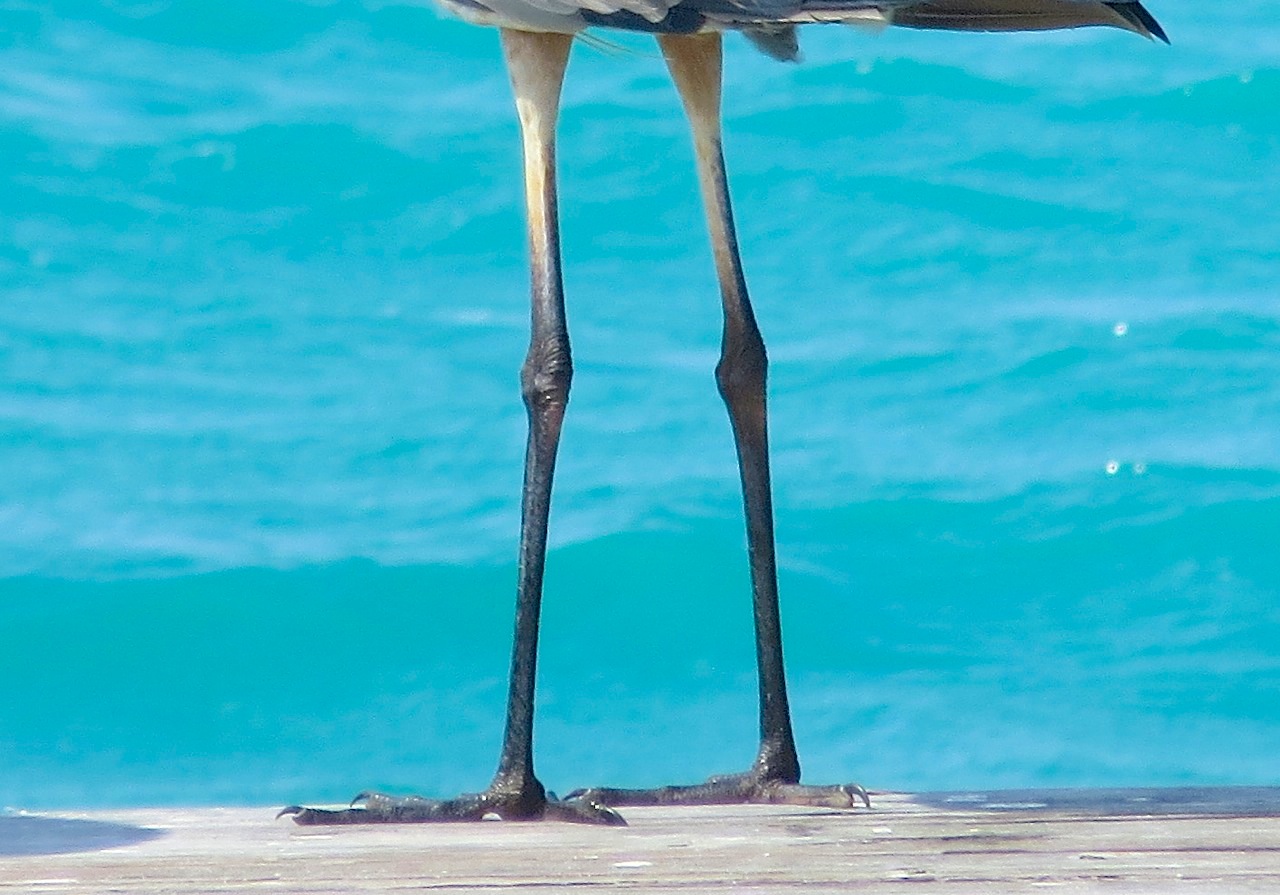
The occasion: a trip to Sandy Point for a lunch party at the legendary Nancy’s in honour of  Sandy Walker at the end of his 5 years as manager of the Delphi Club. A pair of brown pelicans on the nearby dock were clumsily flying around, diving, perching, drying their feathers, then repeating the cycle. In a quiet moment I slipped away to watch them – and a Great Blue Heron landed quite close by me. So as well as taking photos of the pelicans, I pointed the camera at the heron from time to time. My favourite view is of it standing proudly on the edge of the dock, with the truly azure sea behind it (header and final image).

Great Blue Heron, Sandy Point, Abaco - Keith Salvesen 6

THE PERILS OF A CAMERA UPGRADE

[PHOTOGRAPHIC INTERLUDE – SKIP IF EASILY BORED BY SUCH THINGS]

I don’t have a fancy camera. I would never get the settings right before the bird had flown. Or died, even. So I had been using a Panasonic Lumix FZ45 kindly given to me by Mrs RH in a benign moment, possibly Christmas. Then I made a classic error of upgrading to an FZ72 with an alleged massive 60X zoom. Brilliant, I thought. Big mistake. My old camera has a Leica lens. Used with care and a lens extension (zeugma score!), it is / I am occasionally capable of taking pin-sharp photos. The upgrade camera’s lens turned out not to be a Leica. Almost all the shots I took were ‘soft’, the more so using the zoom. A soft photo taken with a less good lens, zoomed 60X, will never be a better photo. Just an even softer one. I wish I’d had Old Faithful with me instead. When we got home, I immediately dug out OF and sold 60X disappointment. OF is now reinstated as my BF.  

The shots of this heron mostly turned out fairly well, largely because it stayed quite close to me. It flew off a couple of times, then returned to the edge of the dock. Here are a few close-up views of the heron selected from the various pics I took, showing some of the details of this fine bird. Great Blue Heron, Sandy Point, Abaco - Keith Salvesen 3 Great Blue Heron, Sandy Point, Abaco - Keith Salvesen 4 Great Blue Heron, Sandy Point, Abaco - Keith Salvesen 5Great Blue Heron, Sandy Point, Abaco - Keith Salvesen 7Great Blue Heron, Sandy Point, Abaco - Keith Salvesen 10 Then I remembered why I was meant to be at Sandy Point, and went back to Nancy’s for conch fritters and a Kalik or two well OK make that three… Great Blue Heron, Sandy Point, Abaco - Keith Salvesen 11

ROLLING HARBOUR MUSICAL DIGRESSION

Otis Redding recorded ‘Sittin’ on the Dock of the Bay’, arguably his greatest moment, in 1967 a matter of days before he died in a plane crash. The record became the first ever posthumous US Chart #1 (#3 in UK). I’ve dug out a video compo by the excellent Rhino outfit that disinters or at least recycles gems from our musical heritage. It’s not just the voice of Otis Redding that makes this song so poignant and so good – Steve Cropper’s guitar is outstanding too.

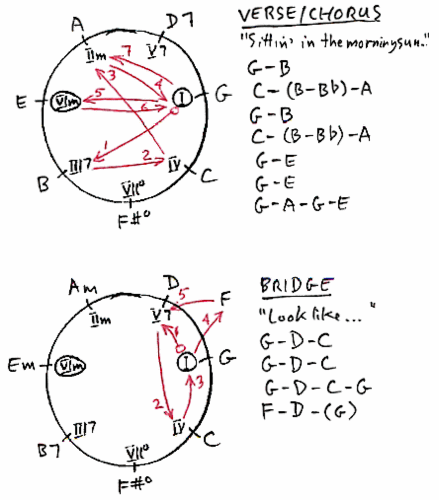
Guitarists out there – you want a ‘Chase Chart’, don’t you?

Ch_6_Fig_114http://www.howmusicreallyworks.com

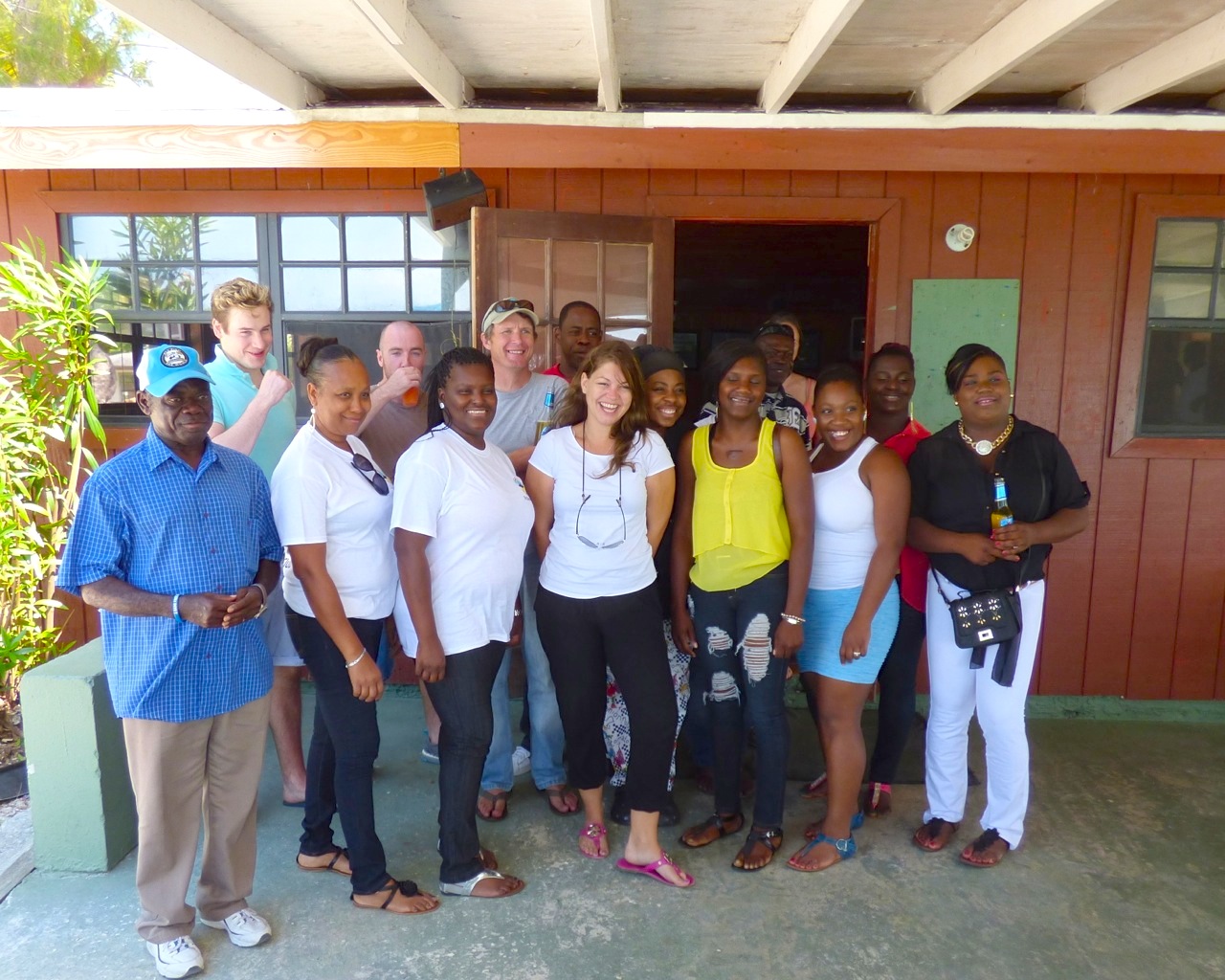
A rare photo of Sandy (centre back row, sunnies on cap) smilingSandy at Sandy Point

Photo Credits: RH, er… that it…