Unknown's avatar

THE LIFE CYCLE OF THE ATALA HAIRSTREAK BUTTERFLY (Eumaeus atala)


Atala butterfly on chrysalisAtala Hairstreak Logo

THE LIFE CYCLE OF THE ATALA BUTTERFLY Eumaeus atala

I’ve been planning a post about this lovely small butterfly for some time. I posted a close-up photo of one taken last summer at ATLALA PICS  (worth clicking to enlarge to see its cute curly tongue) but I wanted to find out more about them and their strikingly-coloured abdomens. This led me to the excellent butterfly (& co) website of STEPHANIE SANCHEZ. Click her name to be transported to her intriguingly and Greekly named HEURISTRON pages for a wealth of Florida-based lepidoptera information. With Steph’s kind approval, the following post is based on her Atala work, and includes her amazing images of the life cycle of the Atala with captions. The blue links below will take you  to the relevant pages of Steph’s site, where you will find plenty of advice about Atala-friendly plants.

THE STAGES FROM EGG TO BUTTERFLY

Atala Butterfly lays eggs on Coontie

 EGGS are laid on COONTIE the Atala Butterfly HOST PLANT (clusters of 10 – 50)

LARVAE Red caterpillars with yellow markings, hatch from the eggs and eat the host plant. They shed their skin several times while they’re growing up. (You can look up “larval instar” if you want to get more technical than that.)

CHRYSALIS The caterpillars eat, and grow, and then they hang from the bottom of a leaf on the Coontie, shed their skin one last time, and turn into a chrysalis.

BUTTERFLY Inside the chrysalis, the caterpillar turns into the butterfly. When it’s done, it crawls out and hangs upside-down to extend and dry its wings before it flies away.

==========================

Up close, the white rounded eggs have tiny hairs on them

Atala Butterflies lay eggs on Coontie        Atala Eggs on Coontie

COONTIE (Zamia floridana or pumila)

Coontie

The eggs hatch into these bright red and yellow caterpillars

Atala larvae on Coontie                                                          Atala butterfly larvae (caterpillar)

When the caterpillars have eaten and grown enough, they hang under the leaf, shed their skin a final time, and turn into a chrysalis. The one below is undergoing the change; you can see how different it looks from the bright red caterpillars

Atala butterfly larvae making a chrysalis

On a very new chrysalis the yellow dots on the back of the caterpillar are still visible

Atala butterfly chrysalides

Then as it ages, the chrysalis darkens to a more opaque soft brown that darkens more the older it gets

 Atala butterfly chrysalis

Finally, a day or so before the butterfly is ready to emerge, you can start to see the red abdomen through the bottom of the chrysalisAtala butterfly chrysalides

 The little spiky brown splotches near the chrysalides are the shed skins of the larvaeAtala butterfly chrysalis

When they first crawl out of their chrysalis, their abdomen is swollen with fluid and their wings are squished and tiny. They hang upside-down and excrete fluid, and also pump fluid into their wings to expand them

Atala butterfly emerging from chrysalisAtala butterfly emerging

This is a good time to hold them; they can’t fly away. Be sure to let them hang upside-down though, or their wings will dry wrong and they will be unable to fly. Also watch out for the goo they poo because it can stain your clothes

Atala butterfly emerging

emerged Atala butterfly expanding wingsAtala butterfly on fingeremerged Atala butterfly expanding wings

All of these Atala Photographs were taken in Broward County, Florida by ©Stephanie SanchezAtala butterfly on chrysalis

WHY THE BRIGHT RED ABDOMEN? I suppose it’s obvious that this is one of nature’s warning signals. But are these insects inherently toxic, or are the toxins acquired by ingestion or some other process? Lifting wholesale from Wiki, which puts it as well as I could (+ useful links), “The host plants contains toxic chemicals, known as cycasins, and the bright coloration of the adult is believed to be aposematic. Birds and lizards attempt to prey on the adults, but find them distasteful and learn to avoid the brightly patterned butterflies.”

Steph advises “if you want Atala Butterflies in your butterfly garden, you’ll need at least a dozen Coontie plants to keep a colony alive; more is better. They tend to stay close to home, so they’re a fun butterfly to garden for because you can continue to enjoy watching them in your garden after they become butterflies. Some other butterflies tend to emerge and fly off.”

STEPH’S LINKS BUTTERFLIES -∞- ATALA NECTAR -∞- HOST PLANTS

RH LINKS BUTTERFLIES -∞- HEURISTIC  (because I didn’t know what ‘Heuristron’ means… we learn stuff here!)

OTHER LINKS LITTLE BUTTERFLIES (Atala etc page of Barbara Woodmasnsee’s butterfly website. Nice pics!)
Unknown's avatar

ART FOR THE [NATIONAL] PARKS: 3 DAY EVENT IN AID OF ABACO’S WILDLIFE


Atala Hairstreak LogoSUPPORT ABACO WILDLIFE CONSERVATION AND THE WORK OF THE BNT
LOCAL ARTISTS & ARTISANS; LECTURES; ENVIRONMENTAL GAMES; FRESH MARKET

(Help to make sure that the creatures pictured below stay off the IUCN ‘threatened species’ list) 

Art for the Parks: Abaco National Parks

Unknown's avatar

FAREWELL 2012… WELL HELLO, 2013, HERE’S LOOKING AT YOU, KID!


DCB GBG Cover Logo dolphin

FAREWELL 2012… WELL HELLO, 2013, HERE’S LOOKING AT YOU, KID!

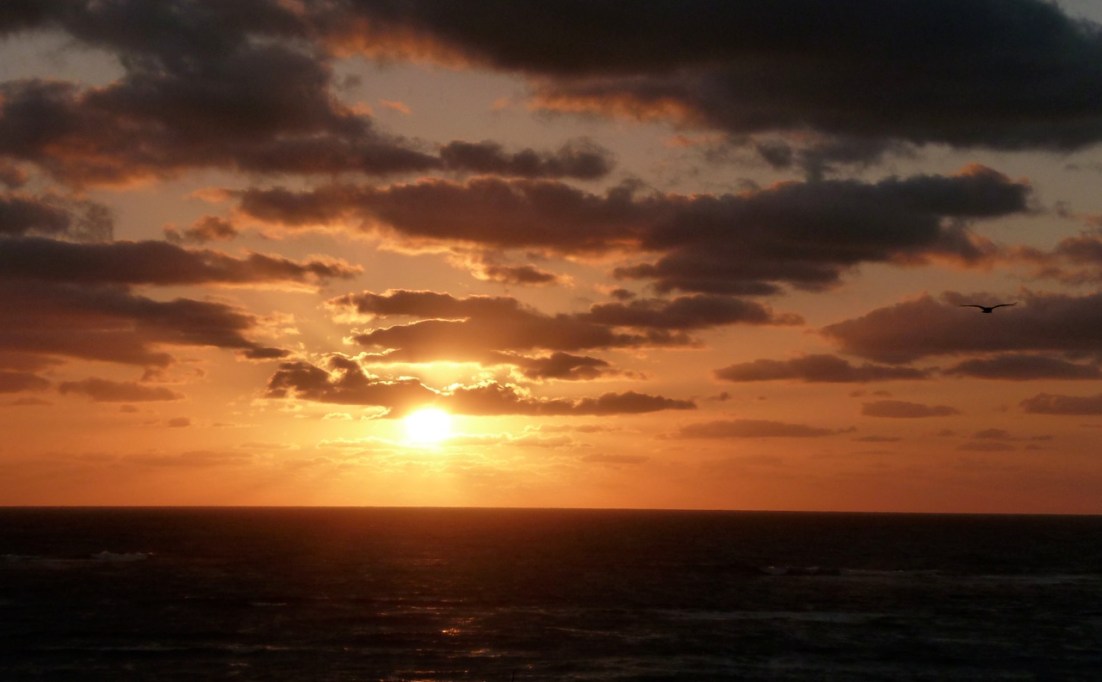
It’s sunset time for 2012, with all its ups, downs and vaguely sideways sways. Conveniently, by way of illustration, here is a not-untypical sunset taken from the balcony of the Delphi Club as the sun sinks down towards the horizon of coppice and pine forest. A moment of metaphorical magic… (& no Ph*t*sh*p)Sunset Delphi

However (Mayan calendar permitting), there is always a new day a few hours away. And with it, an extended (indeed, horribly overstretched) metaphor for the New Year. This photo was taken from our balcony on the other side of the building at around 6.30 a.m. The seagull on the right was not an intentional inclusion, though I may as well that pretend that it was… And yes, the sea on the east side of Abaco really does tilt slightly downhill to the south; the effect is caused by submarine reef vortices as the ocean floor deepens. Oh. Maybe not. It’s photographer error – I forgot to straighten the image.Sunrise DelphiDuring 2013 you will find much the same going on at Rolling Harbour as before. There’s some housework to be done on the blog, I notice. There will be the usual 10 or so posts a month on much the same themes – birds, fish, marine mammals, plants, shells, conservation and so forth, with photos to match. Maybe some more ill-conceived attempts at humour. The occasional ground-breaking scoop. 100,000 hits is now well within my sights (from being a distant dream)… so please don’t desert now!

For those with iPhones or iPads may I re-recommend the new app “Click242 Nature” (available FREE on iTunes), which is a Bahamas-based portal to all the types of thing this blog deals with, and the organisations that deal with them. For details click HERE (I shyly add that this blog features in the section ‘Science Blogs’).

So, Happy New Year, Good Luck in 2013, and see you around, I hope…

Unknown's avatar

BAHAMAS SATELLITE VIEW: 50 SHADES OF BLUE…


Wildcat MapBahamas-Satellite

BAHAMAS SATELLITE VIEW: 50 SHADES OF BLUE…

I’ve come across this dramatic view from space in several places online. I’ve recently been examining the shallows and underwater canyons of the Bahamas group of islands, and this NASA / ISSS map  perfectly illustrates, with natural colour shading, the greatly contrasting sea depths of the region. It also shows the extent of the long protective reefs, and clearly reveals underwater ‘high ground’ and ridges. There’s an almost abstract beauty about it, too, that’s worth sharing…

Bahamas Satellite Map (Wildcat)

Unknown's avatar

FLOTSAM, JETSAM, YELLOW PLASTIC DUCKS… AND 50 ft DUCKZILLA!


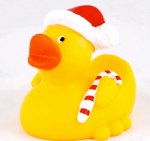
Xmas1s

FLOTSAM, JETSAM, YELLOW PLASTIC DUCKS… AND DUCKZILLA!

Is one allowed a little light “fun” (toxic concept) around Christmas time? I think one is. If it is strictly controlled and vaguely relevant to the usual issues dealt with around here. Or can be shoehorned into some apposite theme… I very recently posted about the Delphi Club beach and its 2012 BEAD INVASION  I cross-referred to my section called BOOKCOMBING, specifically a selection of book reviews concerning FLOTSAM & JETSAM and general beach debris. One book, well-known by now, is called MOBY DUCK (see what the author did there? Anyone would be pleased to come up with that). It is cumbrously subtitled “The True Story of 28,800 Bath Toys Lost at Sea, and of the Beachcombers, Oceanographers, Environmentalists, and Fools, including the Author, who went in search of Them”.  They were washed overboard in a container some years back, and have been dispersed by current, tide, wind and storm to all corners of the globe.

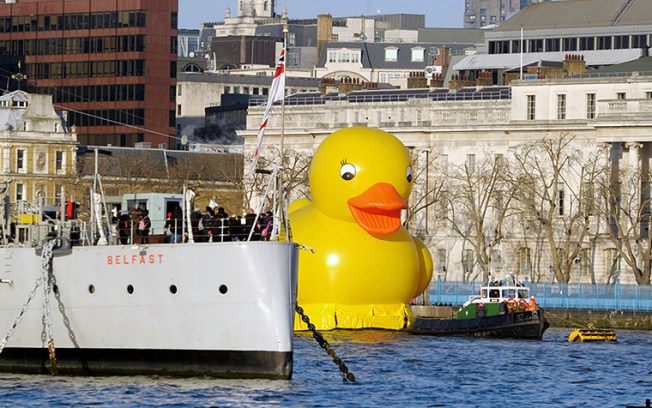
No sooner had I “published” the post (a posh way of saying “clicked on the blue button”), than an article appeared in the Guardian newspaper, replete with photos, that made me laugh. Quite immoderately. So here is the gallery of Duckzilla being towed up the River Thames in London past (or under) various iconic landmarks. Is this relevant? Apart from it being an avian-based fatuous yellow duck on saline water, not really. Is it fun? Well, you be the judge, but I bet you a Kalik that you crack at least a small smile…

1.  “A team of eight people spent more than 800 hours cutting and welding together parts for a giant duck to ensure it was airtight and didn’t sink (could duck tape have helped?).”Onto Canary Wharf

2. “The giant duck, towering 50ft high and weighing in at half a tonne, prepares to float up the River Thames from Canary Wharf [business centre] in east London” towards central London.A giant 50ft rubber duck being prepared

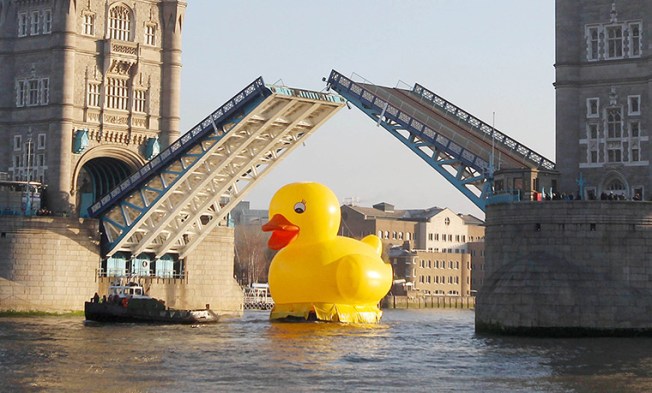
3. “The  giant-size quacker passes under Tower Bridge … but only just. The madcap paddle-past was part of the launch for a new £250,000 bursary funding quack ideas aimed at making Britons laugh…” [RH note: thus confirming at one stroke what other nations think about the British, including in Europe. Especially in Europe…]A giant 50 foot rubber duck floats down the Thames under Tower Bridge

4. The duck, having ducked under the bridge, continues upriver, still smiling serenelyA giant rubber duck sails down river Thames

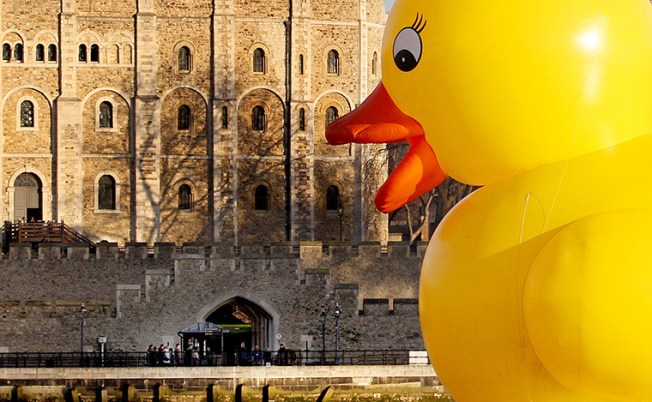
5. “Duckzilla floats past the Tower of London [dating from 1087] to the amazement of tourists”A giant 50 foot rubber duck floats past the Tower of London

6. “All hands on duck! The giant duck passes HMS Belfast – shame it couldn’t raise a wing in salute…”Past HMS BelfastPhoto credits and blame for the captions (mostly): The Guardian

Gore Vidal, once taken to task by a critic for “meretricious” writing, responded “Meretricious to You , and a Happy New Year”. On which literary note I will be taking a break for some quality family-based feasting and entertainment, followed by fasting and a long snooze. I probably won’t add any posts until after January 1st (unless a Kirtland’s Warbler on Abaco is reported!). Thanks to everyone who kindly called in at Rolling Harbour during 2012 – see you in 2013.

RH cheerfully prepares to blank on the Delphi Club Beach. Ambition – 10; Equipment – 10; Skill – 1Rolling Harbour 2

Unknown's avatar

“PROBABLY THE BEST BAHAMAS WILDLIFE & SCIENCE APP IN THE WORLD…”


Click242 Nature Logo

“PROBABLY THE BEST BAHAMAS WILDLIFE & SCIENCE APP IN THE WORLD…”

Actually, there’s no “probably” about it! This brand new app CLICK242 NATURE is undoubtedly the ‘ne plus ultra’ and ‘canine’s orchids’ of the Bahamas natural history app world. It’s available now on iTunes for iPad, iPhone, iTouch and iWotsit  – and it’s totally free, gratis, and owt for nowt. Some of you may have wandered onto my APPS REVIEW page, perhaps in error, where I have look at various sorts of useful app pertaining to wildlife or the Bahamas (or preferably both). Some are excellent, some a bit ‘ho hum’, and there’s been one shocker where no star rating was possible…

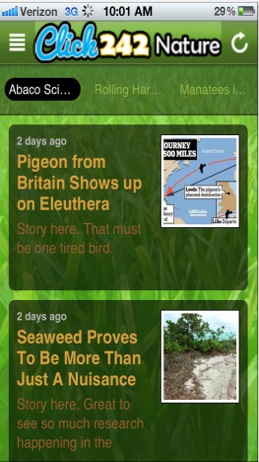
Click242 Screenshot

And now this shiny app has arrived just in time for you to give to yourself for Christmas, and at no personal cost. You can even afford to give it to family and friends and bathe in the warm glow of their happy smiling faces…

This app does a great deal – indeed it is a one-stop portal for many of the Abaco, Eleuthera and wider Bahamas organisations, NGOs, science & environmental sites, wildlife blogs etc that many follow. And with a photo section! It is designed to make sharing easy in all familiar formats. The official description will give you a pretty good idea of what is covered, so I will  add it in full below.

I can’t help but notice in the image to the left the words “Rolling Har…” in the top menu. And yes, astonishingly this frankly somewhat haphazard blog finds itself in exalted company on the Planet of the Apps. It’s a bit uncomfortable with that, but delighted to have been allowed a small part to play in the venture.

My minor participation in the project (and natural diffidence) inhibits me from giving this excellent resource the 5* rating it so obviously deserves, so I’ll simply say that I think the many people interested in the natural history, the science and the environmental issues of the Bahamas will welcome this new app as a valuable, constantly updated resource.

Piping Plover Charadrius melodus 1

CLICK242: NATURE

“The Click242 app is your daily dose of what is going on in the Bahamian environmental field. This FREE app is designed to increase public awareness about the Bahamian environment and the organizations which work to educate the public and manage the country’s natural resources, including protected areas.

It allows resource managers, users, scientists, students, teachers, visitors and interested persons to connect with various environmental groups and stay up to date with the latest blogs, activities, photos, videos and events within the environmental arena”.

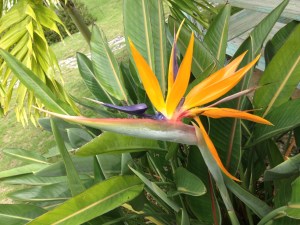
Bird of Paradise Flower (Strelitzia) Abaco

EASILY CONNECT WITH FEATURED ORGANIZATIONS

Andros Conservancy and Trust (ANCAT)
Bahamas National Trust (BNT)
Bahamas Reef Environment Education Foundation (BREEF)
Bahamas Marine Mammal Research Organisation (BMMRO)
Bahamas Sea Turtle Research (BSTR)
Bahamians Educated in Natural and Geographic Sciences (BEINGS)
Community Conch (CC)
Friends of the Environment (FRIENDS)
Gerace Research Centre (GRC)
Leon Levy Preserve (LLP)
Nature’s Hope for South Andros
One Eleuthera (1E)
Young Marine Explorers (YME)
and more…

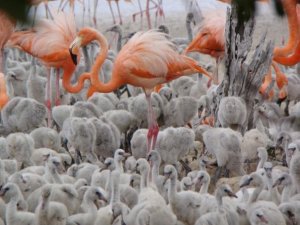
Inagua Flamingos MM 14

CLICK242: NATURE INCLUDES THE FOLLOWING FEATURES Science Blogs from the Abaco Scientist, Rolling Harbour and the Cape Eleuthera Institute. Featured Content covers projects and new efforts in the environmental arena.

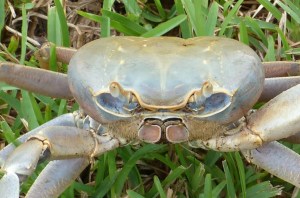
Land Crab BPS 5

HIGHLIGHTS Photos from across The Bahamas, posted by featured organizations; Current Facebook pages for various environmental organizations and groups; Easily navigate to and watch videos from featured groups and YouTube; Articles, news, blogs, photos and videos can be shared with your friends via facebook, twitter and email.

  Delphi Beach Shadows

Unknown's avatar

MOUNT EVEREST (29,029 ft ASL) versus ABACO (134 ft ASL)…


MOUNT EVEREST (29,029 ft ASL) versus ABACO (134 ft ASL)…

I only occasionally go completely off-piste and post something that has nothing whatsoever to do with Abaco, the Bahamas or indeed with wildlife in any of its many forms. This is one such occasion. The Guardian newspaper (online) has put up the most amazing interactive image of Mount Everest, which can be zoomed, panorama’d and 360˚’d. The highest point on Abaco is 134 feet above sea level, so best prepare for altitude sickness. I found this really fascinating, especially zooming in on the little pile of apparent litter – actually a base camp. Normal service will be resumed after Christmas…

CLICK  MOUNT EVEREST 

A still of the interactive Mount Everest gizmo (Credit: Guardian)Mount Everest : Guardian

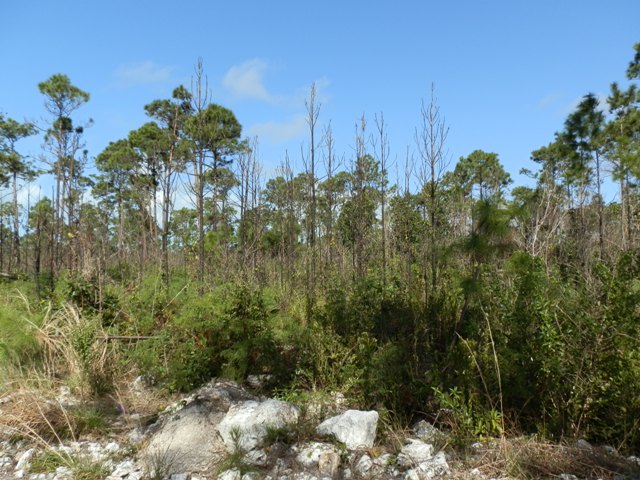
The soaring foothills of Abaco (c. 75 ft asl)                   Abaco Pine Forest Fire Regeneration  5

Unknown's avatar

BEACHCOMBING: AN INVASION OF BEADS AT ROLLING HARBOUR


DCB GBG Cover Logo dolphin

BEACHCOMBING: A BEAD INVASION AT ROLLING HARBOUR

The Delphi Club beach at Rolling Harbour is an undeniably beautiful 3/4 mile curve of white-sand bay, shelving gently into pale blue water. Many interesting things get washed up on the shore, besides shells, sea glass, and vast quantities of seaweed (with a fair amount of junk) that must be regularly cleared. It’s a good place for desultory beachcombing, and some of the finds have featured in earlier posts, with the help of KASIA

Delphi Club, Rolling Harbour, Abaco

Of course that is not in the least unusual in these parts, though Delphi can claim the unique distinction of a 12 foot booster rocket fairing from the Mars ‘Curiosity’ launch, washed up early in 2012 (see short posts on the developing story at ONE & TWO & THREE)

Sandy's Mystery Object

There are large glass and wooden floats. Things that might be car parts. Wooden pallets. Not, as yet, any of the yellow plastic ducks so often written about (see book review of MOBY DUCK). Now, we have an invasion of coloured beads. 2012 has been a prime year for bead beachcombing, a specialist field. At times, guests have had a field day (if you can have one of those on a beach?) collecting these small beads. One large flagon has already been filled and, as Peter Mantle observes, “our cup runneth over”.

An important Christmas task – and not a difficult one, I envisage – will be to empty another suitably large vessel. Drinking is likely to be involved. Meanwhile, an explanation for this beach bead influx over many months would be good to find. A container of children’s toys sadly washed overboard? Evidence of some arcane fishing method? An explosion in a necklace factory? Beads deemed unsuitable for rosaries? Rejects from the World Marbles Convention? Has anyone else experienced finding these multicoloured beads on their local beaches? I know that a few beachcombers follow this blog (thanks!) from other parts of the world. Any beads? All contributions by way of the COMMENT link, or an email to rolling harbour.delphi[at]gmail.com, welcome.

Some of the beads collected during the year – another container needed urgently
Beachcombing Beads

Unknown's avatar

KING HELMET SHELLS (Cassis tuberosa) MORE DELPHI CLUB SHELLS


KING HELMET SHELLS (Cassis tuberosa) FROM THE DELPHI COLLECTION

It’s time to look at another shell from Delphi. The club has glass jars displaying small shells in the Great Room. Larger shells like the ones below are displayed on shelves. The King Helmet is the largest of the helmet shells of the family Cassidae. They are found in the Western Atlantic from North Carolina through the Caribbean and the gulf of Mexico down to Brazil. They tend to bury themselves during the day, becoming active and feeding at night. In humans this behaviour is found mainly in students and in those involved in the music business and similar louche occupations.

King Helmet Shell 1 King Helmet Shell 2

King Helmets prey mainly on sea urchins and other echinoderms, using their foot to grip their meal. The dining arrangements are somewhat protracted. The snail makes a hole in the urchin through the combined action of a glandular secretion which is rich in sulphuric acid, while using its RADULA to rasp and dig through the shell to get at the trapped occupant, which it gradually consumes… That’s enough about that.
King Helmet Shell 3
King Helmet Shell 4

Unknown's avatar

“SO THIS IS CHRISTMAS…” ABACO WILDLIFE APPEALS TO EVERYONE!


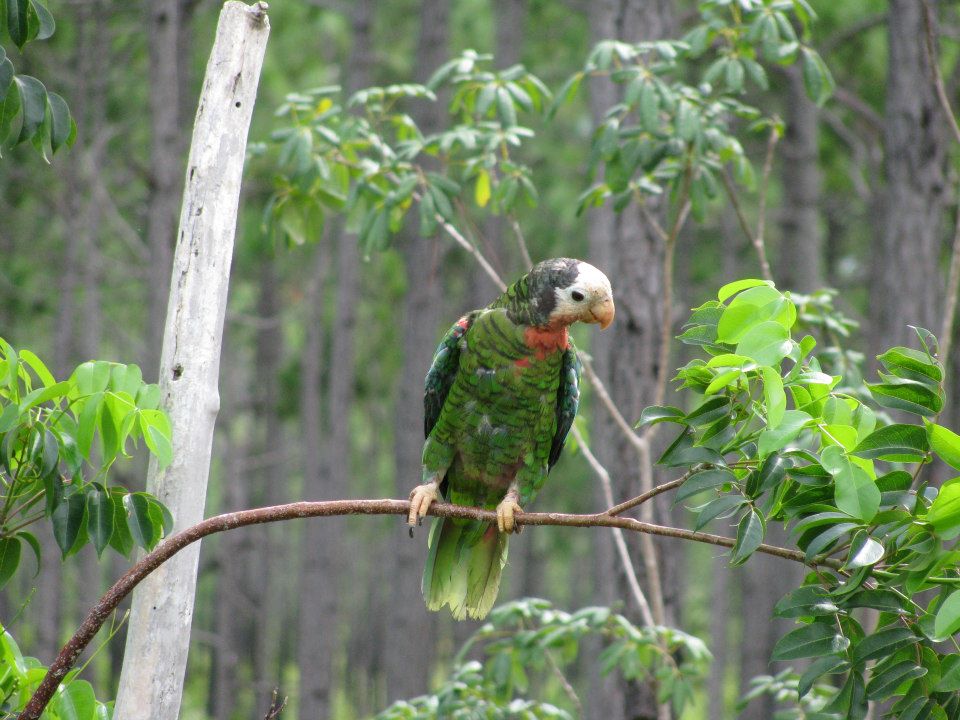
“SO THIS IS CHRISTMAS…” Abaco (Cuban) ParrotImage: ©RH

Christmas time. Holidays. Festive season. Yuletide. ġéohol*. Noel. Winterval. However you describe it, there’s a reassuring ritual each year. To many, the familiar religious carols and rites. To all, the cheerful sound of jingling tills. The exchange of presents happily bought and excitedly received. The groaning table weighted with victuals. Light and laughter. Glasses generously filled and refilled.  Sudden growing dizziness and a strange lack of coordination. Wondering what others are saying. Wondering what you are saying. Drowsiness. Overwhelming sleepiness. The passage of time. The groaning hangover as seven West Indian woodpeckers attack your skull with hammer-drills… Time for a soothing image.

BMMRO Dolphin Image copyImage ©BMMRO

Where was I? Oh yes. This is a very good time to draw attention to the various wildlife organisations based on Abaco and in the wider Bahamas. During the year they look after the birds, the marine mammals and so forth that help make Abaco such a very special place to be. I am simply going take the opportunity to post the link to my updated page for ABACO WILDLIFE CHARITIES. Oh. I just have. Well, is there one that appeals to you, I wonder? Just asking… Meanwhile, here’s the music of the heading to get you in the mood

Delphi Xmas + lights* Old English / Anglo-Saxon origin of “Yule”

Unknown's avatar

HOLE-IN-THE-WALL, ABACO: THE ‘HOLE’ THAT’S NO LONGER A WHOLE


DCB GBG Cover Logo curly

HOLE-IN-THE-WALL, ABACO: THE ‘HOLE’ THAT’S NO LONGER A WHOLE

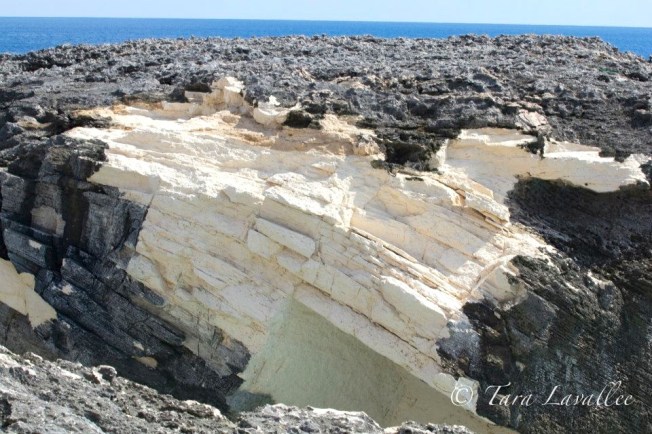
I recently posted 3 items from different perspectives about Hole-in-the-Wall, the destruction of its “roof” by Hurricane Sandy, and the consequent creation of a small islet (provisional names suggested include ‘Holey Isle’ & ‘Sandy Isle’). I also showed what were apparently the last images of the Hole with its roof on (Jack Bowers); and the first of the new post-Sandy geology taken on November 6th (John Haestad) CLICK HERE. It now transpires that some excellent photos were in fact taken a the previous day, November 5th, when Tara Lavalle and her family went to HitW for an outing and to investigate the reports about the Hole. So the pictures below taken by Tara and Luc (to whom many thanks for use permission) now stand as the first post-Sandy images of the ‘Gap’. Unless anyone knows better…

The lighthouse and outbuildings looking back from the Hole-in-the-Wall routeHOLE-IN-THE-WALL LIGHTHOUSE ABACO post Sandy

OMG! Surveying the new scenery           HOLE-IN-THE-WALL ABACO post Sandy 2

The  water still boils through as before…HOLE-IN-THE-WALL ABACO post Sandy 1

The northern end of the new islet, showing the bright new rock-face. Beyond, Nassau… HOLE-IN-THE-WALL ABACO post Sandy 3

Unknown's avatar

THREATS TO SEA TURTLES: ABACO, BAHAMAS… IN FACT, EVERYWHERE


Hawksbill Turtle © Melinda Riger @ G B ScubaDCB GBG Cover Logo dolphin

THREATS TO SEA TURTLES: ABACO, BAHAMAS… IN FACT, EVERYWHERE

The Bahamas has breeding populations of 5 of the world’s 7 sea turtle species – Green, Loggerhead, Hawksbill, Leatherback and Kemp’s Ridley turtles (the other two are Olive Ridley – occasionally found in the Bahamas – and Flatback turtles). All are endangered. There’s no getting away from the fact that Man and Man’s activities are now the primary threats. The IUCN ratings below make for sad reading.

GREEN TURTLE  (Chelonia mydas)

.Photo of turtle swimming towards surface with diver in background

HAWKSBILL TURTLE (Eretmochelys imbricata)

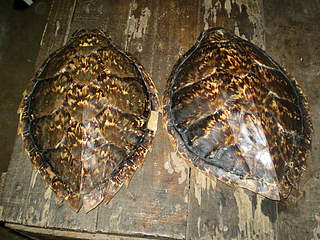
Hunted almost to extinction for their shells

Photo of swimming turtle

LOGGERHEAD TURTLE (Caretta caretta)

A loggerhead sea turtle in an aquarium tank swims overhead.  The underside is visible. Photo of a loggerhead swimming above a reef.

LEATHERBACK TURTLE  (Dermochelys coriacea)

The largest sea turtle

A leatherback sea turtle digging in the sand

KEMP’S RIDLEY TURTLE (Lepidochelys kempii)

The smallest sea turtle


A helpful source of information about sea turtles and their protection is the BAHAMAS SEA TURTLE CONSERVATION GROUP Their excellent summary of the multiple threats to these creatures (below) puts the critical situation very well. Anyone who has watched a TV program about sea turtles and their breeding will be familiar with the vulnerability of turtle nests and hatchlings to predation – and that’s before they ever get to the sea. Despite that, all the species managed to flourish until human intervention (direct or indirect) tipped the balance of survival much further against them. So if we lose one or more of these wonderful species, at least we’ll know who to blame.

1. NATURAL THREATS
In nature, sea turtles face a host of life and death obstacles to their survival. Predators such as raccoons, crabs and ants raid eggs and hatchlings still in the nest. Once they emerge, hatchlings make bite-sized meals for birds, crabs and a host of predators in the ocean. After reaching adulthood, sea turtles are relatively immune to predation, except for the occasional shark attack. These natural threats, however, are not the reasons sea turtle populations have plummeted toward extinction. To understand what really threatens sea turtle survival, we must look at the actions of humans.

2. HUMAN-CAUSED THREATS
In many cultures around the world, people still harvest sea turtle eggs for consumption. Most countries forbid the taking of eggs, but enforcement is lax, poaching is rampant, and the eggs can often be found for sale in local markets. In these same areas, adult sea turtles are harvested for their meat. Turtle products, such as jewelry made from hawksbill shells, also create a direct threat to sea turtles. Lack of information about sea turtles leads many Americans to unwittingly support the international trade in these endangered species. Buying and selling turtle products within the U.S. is strictly prohibited by law, but turtle shell jewelry and souvenirs are the most frequent contraband seized by customs officials from tourists returning from the Caribbean. Indirect threats are harder to quantify, but they are likely causing the greatest harm to sea turtle survival.

Illegal turtle shells (IUCN)IUCN: illegal turtle shells

3. COMMERCIAL FISHING
The waters of the Gulf of Mexico and west Atlantic coast are a major habitat for turtles, but are also the main shrimping grounds in the U.S. Each year, thousands of turtles become entangled in fishing nets and drown. Worldwide, shrimp trawling probably accounts for the incidental death of more juvenile and adult sea turtles than any other source. At one time, as many as 55,000 sea turtles were killed each year in shrimp nets in the southeastern United States alone. Today, all U.S. shrimpers are required to put Turtle Excluder Devices (TEDs) in their trawl nets. Unfortunately, not all fishermen comply with the law, and sea turtles continue to drown in shrimp nets.

Sea turtle entangled in a ghost net

4. INGESTION OF DEBRIS AND PLASTIC
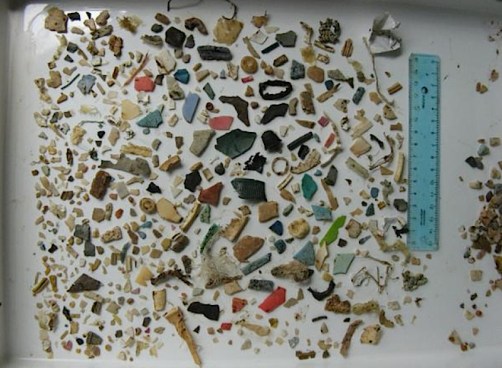
Thousands of sea turtles die from eating or becoming entangled in non-degradable debris each year, including packing bands, balloons, pellets, bottles, vinyl films, tar balls, and styrofoam. Trash, particularly plastic bags thrown overboard from boats or dumped near beaches and swept out to sea, is eaten by turtles and becomes a deadly meal. Leatherbacks especially, cannot distinguish between floating jellyfish — a main component of their diet — and floating plastic bags (my italics).

One sea turtle’s accumulated ingested plastichttp://www.wired.com/wiredscience/2011/03/sea-turtle-plastic/Credit: http://www.wired.com/wiredscience

5. ARTIFICIAL LIGHTING
Nesting turtles once had no trouble finding a quiet, dark beach on which to nest, but now they must compete with tourists, businesses and coastal residents for use of the beach. U.S. beaches are rapidly being lined with seaside condominiums, houses and hotels. Lights from these developments discourage females from nesting and cause hatchlings to become disoriented and wander inland, where they often die of dehydration or predation.

Florida at night- NASA : ISSS

6. COASTAL ARMORING 
Coastal armoring includes structures such as sea walls, rock revetments and sandbags that are installed in an attempt to protect beachfront property from erosion. These structures often block female turtles from reaching suitable nesting habitat and accelerate erosion down the beach. Armoring is especially problematic along the east coast of Florida, where beach development is occurring in the very places where sea turtles come to nest by the thousands.

ProTec-Godfrey

7. BEACH NOURISHMENT
Beach nourishment consists of pumping, trucking or otherwise depositing sand on a beach to replace what has been lost to erosion. While beach nourishment is often preferable to armoring, it can negatively impact sea turtles if the sand is too compacted for turtles to nest in or if the sand imported is drastically different from native beach sediments, thereby potentially affecting nest-site selection, digging behavior, incubation temperature and the moisture content of nests. If renourishment is allowed to proceed during nesting season, nests can also be buried far beneath the surface or run over by heavy machinery.

Beach restoration WIKI

8. POLLUTION
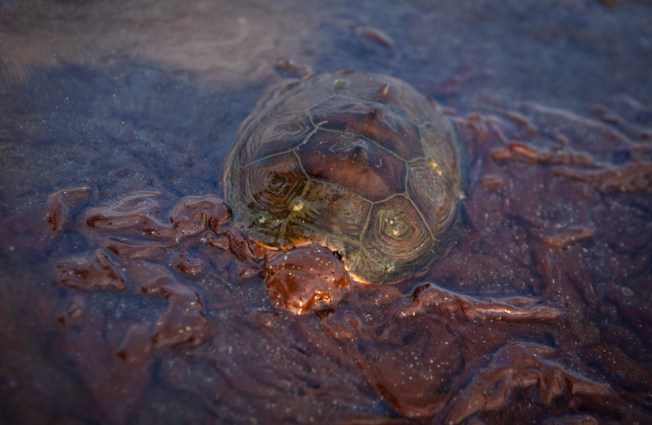
Pollution can have serious impacts on both sea turtles and the food they eat. New research suggests that a disease now killing many sea turtles (fibropapillomas) may be linked to pollution in the oceans and in nearshore waters. When pollution kills aquatic plant and animal life, it also takes away the food sea turtles eat. Oil spills, urban runoff of chemicals, fertilizers and petroleum all contribute to water pollution.
Although the problems of habitat destruction and exploitation seem almost too big to overcome, there are many things within our control that can be changed. Greater public awareness and support for sea turtle conservation is the first priority. By learning more about sea turtles and the threats they face, you can help by alerting decision-makers when various issues need to be addressed.

“Look on thy works, ye Humans, and despair…”  [Gulf of Mexico]Sea Turtle / Oil Pollution Boston.com / ReutersCredits boston.com / Reuters
FURTHER REFERENCES (click logos)

 Bahamas Sea Turtle Research Logo            BAHAMAS SEA TURTLE RESEARCH

BSTCG logo green sea turtles       BAHAMAS SEA TURTLE CONSERVATION GROUP

Bahamas National Trust Logo                BAHAMAS NATIONAL TRUST (Factsheets)

seaturtle.org         SEATURTLE.ORG (image library)

Sea Turtle Conservancy http-:www.conserveturtles.org        SEA TURTLE CONSERVANCY

article-1369438-0B529C0E00000578-415_306x220

Credits: BSTCG; Wiki (images / IUCN tables); wire.com / wiredscience; Boston.com; Reuters; NASA; STC

Unknown's avatar

MANATEES AND BONEFISH: THE BEST OF TWO WORLDS ON ABACO


DCB GBG Cover Logo dolphin

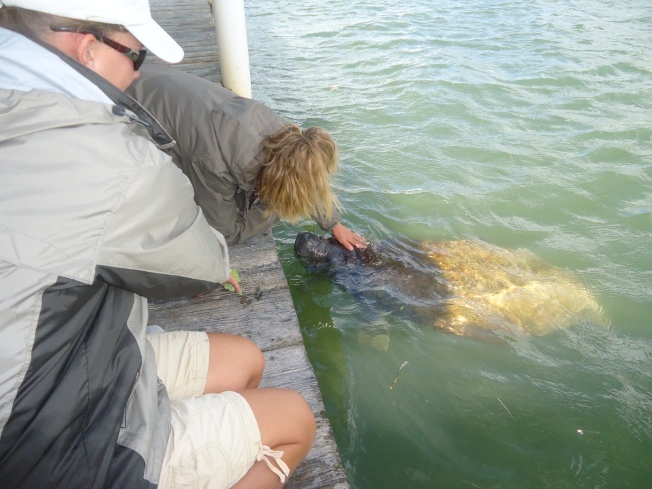
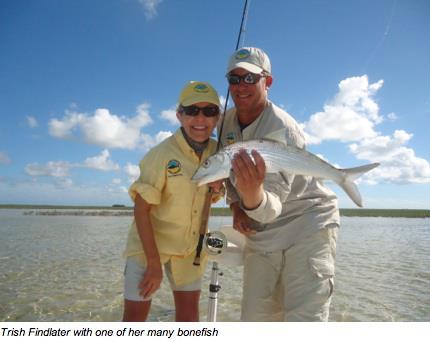
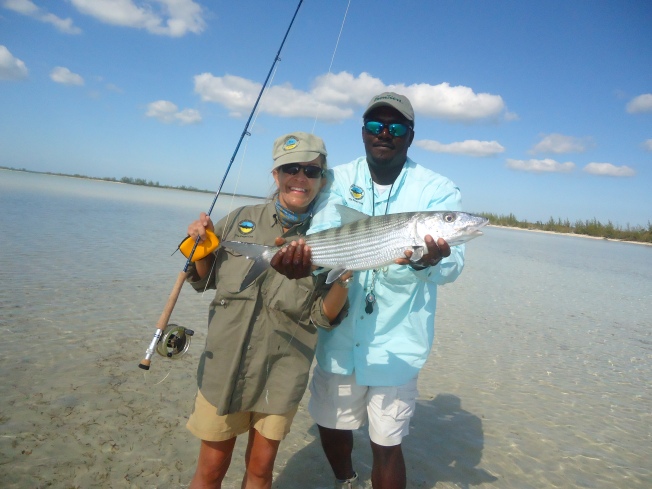
Trish has featured before in this blog, in particular recounting a day’s bonefishing at CHEROKEE. She and Alex have just returned from a gratifyingly successful bonefishing trip at the Delphi Club, Abaco (see below). She also went with guide Dana Lowe to see Georgie the manatee, who likes it so much at Cherokee that she has made it her home. She (Trish, I mean…) has sent me two very recent images, adding “…it was so brilliant seeing such an animal in reality and feeding her cabbage.” DANA & TRISH FEEDING GEORGIE (2)Dana & Trish greeting Georgie Manatee

Delphi Bonefish Logo

Trish and Alex also got among some large bones during their stay. She boated a fine fish when out with guide Robin Albury…

405022_10151177586874482_1500147974_n

…only to surpass herself a few days later with what is reckoned to be the Delphi Club guest record with a 9 lb+ fish when out with guide Tony. As I am still way short of that myself, I can only look at the fish with wonder and resolve to do better in 2013…TRISH WITH GUIDE TONY & THE BIG FISH

Unknown's avatar

THE CORALS OF FOWL CAY MARINE PRESERVE, ABACO [VIDEO]


DCB GBG Cover Logo dolphin

THE CORALS OF FOWL CAY MARINE PRESERVE, ABACO

coral6

I usually have 3 or 4 planned posts on the go. Some are quick to compose, some are not. Especially those requiring technical input from the technically unsound – downloading a video, changing the file format, editing and polishing, uploading to a compatible ‘carrier’ etc. I’ve been meaning to get round to making some fish and reef videos from footage of a trip with Kay Politano of Abaco Above & Below. Now I have…coral8

If you are tolerant enough to at least start this one, which focusses on coral, can I restate the excuses? I swim like a panicking cat. I hadn’t snorkelled for a great many decades years until 2011. I was a stranger to underwater scenery, let alone photography. I wave my tiny camera around too excitedly, though not deliberately to inflict seasickness on hapless viewers… It is a bit less bad this time round, however. Luckily I can tell from my stats if anyone has bothered to click on the video below, and you can rely on me to trash the thing if I find a paltry (or non-existent) response. Best just to watch on the small screen, though.coral14

With those dire warnings, here is the video. I would be very interested to ID all the corals that can be seen. There are the easy ones like sea fan, elkhorn, mustard hill, brain… but what’s that one over there? No, behind the waving one…? Comments / suggestions welcome. And if you don’t much care for coral, there are some pretty fish to look at…

Music Credit: Adrian Legg’s ‘Old Friends’, from ‘Guitar Bones’

ADDENDUM JAN 13 I am really grateful to Capt Rick Guest for taking the time to view the video, and the trouble to analyse the contents. He has very helpfully highlighted many points of interest in the film, both as to coral and as to fish, so I’ll post his commentary in full, with my thanks. Of both interest and concern are Rick’s remarks about the Elkhorn Coral. I had wondered about its bleached look. It’s dying…

CORALS ETC

  • At 0:36 a lavender Sea Fan…(Gorgonia ventalina).
  • At 0:52 Yellow “Leaf”,or “Letuce Coral”. Agaricia species growing around a living soft coral called a “Sea Rod”. Soft Corals have living polyps which feed on plankton just like the hard corals.
  • At 1:02 More Agaricia, and a small Brain Coral at bottom. Either a Diploria, or Colpophylia species.
  • At 1:10 A Sergent Major fish, (Abedefduf saxatilus). One of my favorite Taxanomic names! Behind is mostly dead, Elkhorn Coral. The white areas being indicative of “White Plague”. A disease responsible for Coral Whiting…..Death!
  • At 1:37 A Blue Tang swims over some “Mustard Coral”… Porites porites.
  • At 1:55 A chubby “Chub” swims by. Likes caves and caverns and edible, but not palatable.  
  • At 2:33-38  Much coral bleaching damage here on these Elkhorn Corals.  
  • At 2:40-48 A Thalassoma bifaciatum,or “Blue Headed Wrasse” is swimmin’ about. This guy used to be a lady,but he’s a product of Protandric Hermaphrodism! When there’s a paucity of males in the area, a yellow female will step up and become a male for the school.
  • At 3:29 Lower right: a fine example of Millepora complanata,”Fire Coral”. Fire Coral is more related to Man-O-War, and jellyfish than Corals.
  • At 3:50 More Elkhorn Coral with White Plague  
  • At 4:23 Brain Coral, probably Diploria clivosa 
Unknown's avatar

“AIMING AT THE MOON” – A LUCKY SHOT!


“AIMING AT THE MOON” – A LUCKY SHOT!

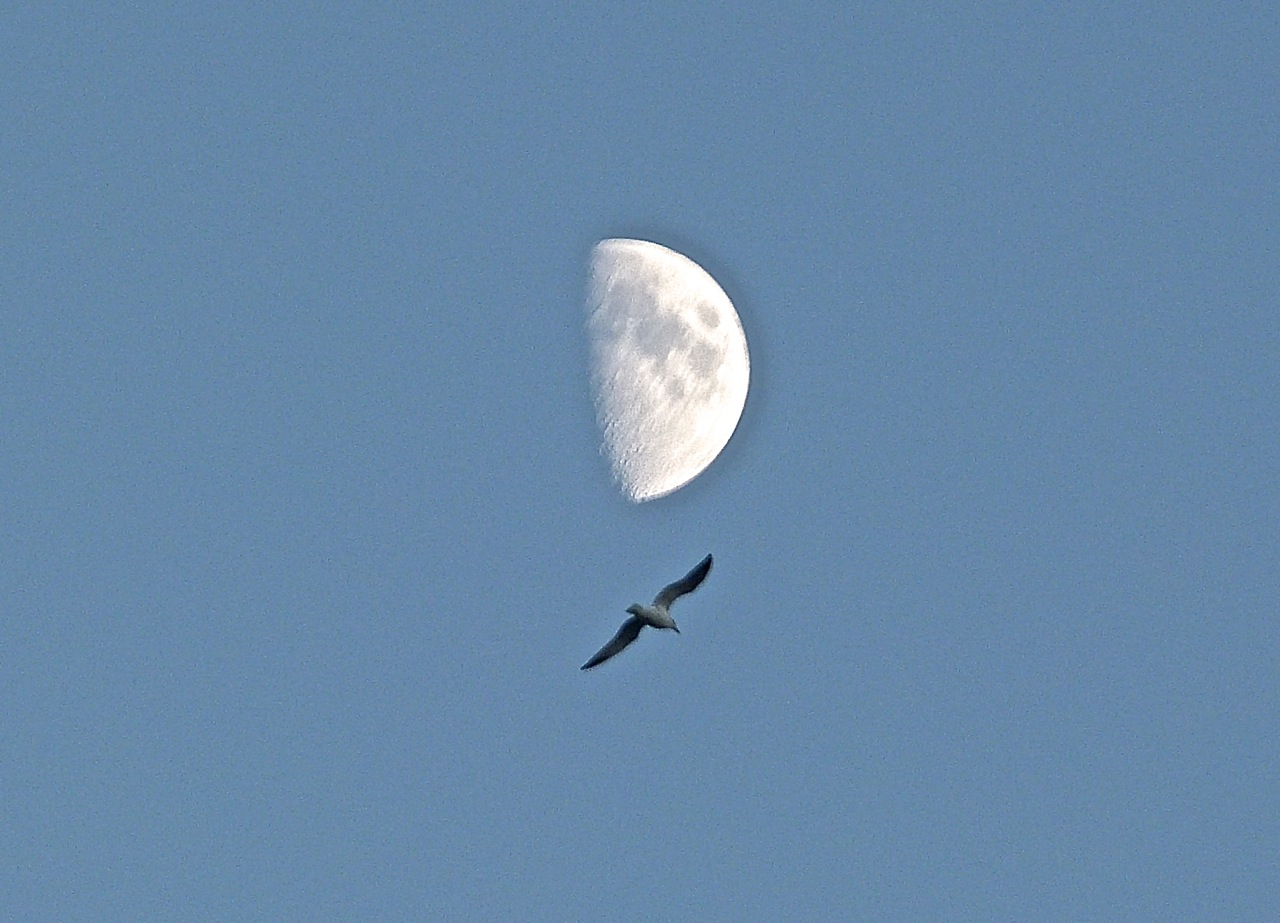
I took this in the late evening because I noticed the gull flying directly towards the moon. I had a point and shoot camera, and very little time to fire it up and take aim. I was hoping the bird would actually cross the face of the moon (“Homage to E.T.”) as I clicked… In many respects it’s a bad picture – unsharp in the fading light – and yet… there are the craters, the seas, the mountains of the moon clearly visible. And one blurry seagull on its way home. So I am going to inflict it on you. Think of it as a misguidedly poetic offering from an essentially prosaic person…

Unknown's avatar

ABACO PARROTS & CHICKS – A 2012 BREEDING SEASON PICTURE GALLERY


Limestone Holes & Abaco Parrots 09

DCB GBG Cover Logo

ABACO PARROTS & CHICKS

A 2012 BREEDING SEASON PICTURE GALLERY

Time to write some more about Abaco’s most famous bird, the unique ground-nesting Amazon / Cuban parrot sub-species that makes Abaco its home, and breeds in the pine forests of the Abaco National Park in the south of the island. You’ll find lots of information and photos on the dedicated page ABACO PARROTS.

This post covers the 2012 breeding season, and highlights the success of scientist Caroline Stahala and her team in helping to secure the future of these rare endangered birds. The population had shrunk to around 2500 (or fewer) some years ago. More recently it had risen to 3000. An intensive conservation program, including anti-predation measures, has proved effective; and a systematic ringing program has enabled the team to keep a close eye on recovering parrot numbers. Caroline says that the population is now in the region of 4000, confirming an encouraging reversal of a dismal decline towards extinction for these beautiful birds.

ABACO PARROTS IN THE PINE FOREST

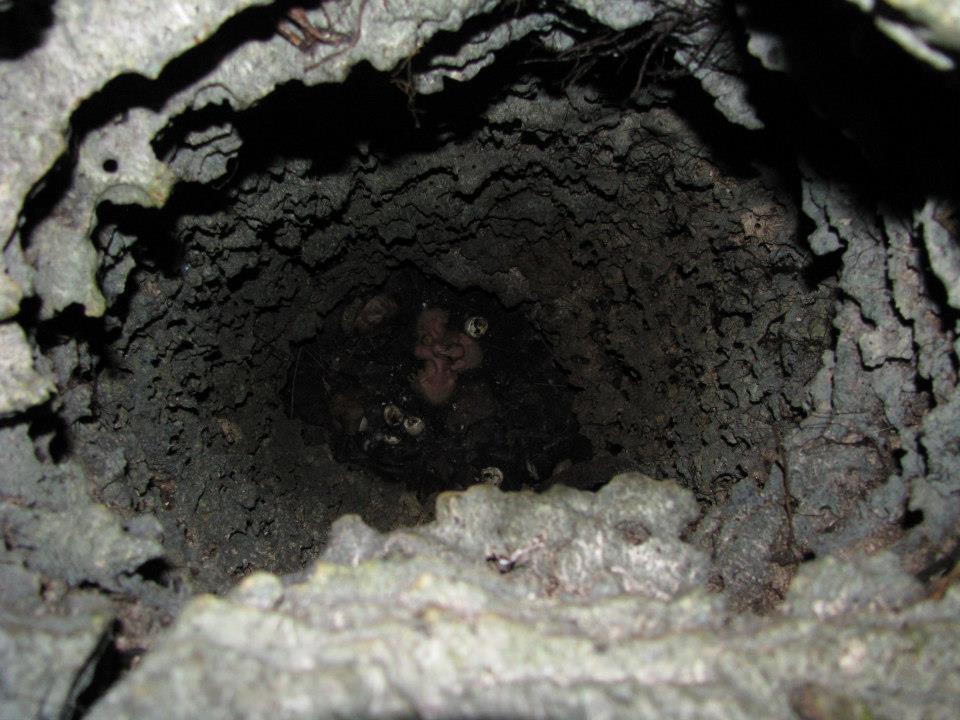
The parrots breed only in the pine forest, where they nest in quite deep holes in the limestone rock. This makes the nests and the areas round them vulnerable to predation from feral cats and rodents etc; but conversely it offers protection from the forest fires that would destroy tree nests. 

The holes are often well concealed in the undergrowth and take some searching for…

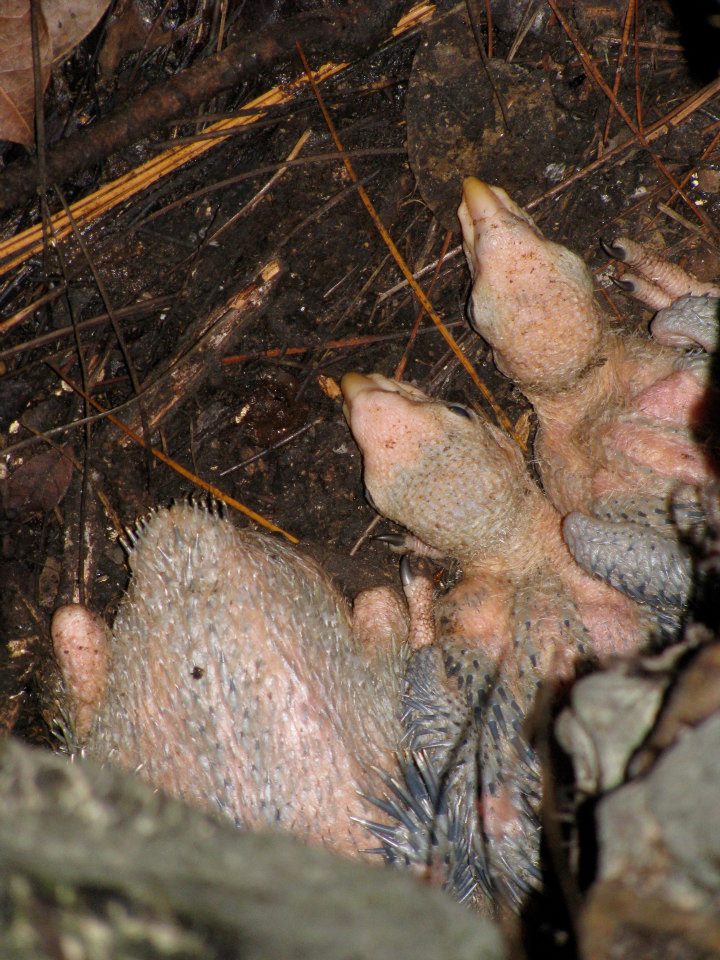
Both parents are involved in the nesting and later chick care. The female lays 2 – 4 eggs.

The chicks hatch after an incubation period of around 26 days

Some of the nest holes are remarkably deep: the parent parrots clamber up and down the sides

The chicks grow the beginnings of feathers, remaining quite unattractive except to their parents

The parent parrots share feeding and care duties

The chicks / fledglings stage are ringed so they can be identified – see ABACO PARROT CHICKS

By coincidence, as I was producing the post above, Craig Layman at THE ABACO SCIENTIST was also ruminating on the topic of Abaco parrot breeding. He posted the comments below, which raise the very interesting question whether the Abaco parrots, with their increased population, may be starting to breed outside the National park. Caroline can probably answer this (see COMMENTS), but does anyone have any direct evidence to suggest a wider breeding habitat? I guess there would need to be a suitably pitted rock structure for the nests, and an absence of the usual cat- and rat-type predators that one might find nearer human populations. Answers welcomed via the comment box…

(Sort of) A Bahama Parrot Study

Posted by laymanc 26 Nov 2012

It isn’t really much of a study, but the only “science” I have been able to do over the last week with the continued turbidity of  nearshore waters.

The Bahama parrot (more information HERE and HERE) is one of the iconic Bahamas animals, and the main factor behind the establishment of the ABACO NATIONAL PARK in southern Abaco.  But my study has been conducted instead from my desk in Little Harbour.  My main finding is simple: the range of the parrot has clearly expanded; it has now been a full calendar in which parrots have been in the area.  Just a few days ago two dozen were squawking around the harbour.  The key will be whether they begin nesting here as well – I havent heard reports of that yet.  But if they do, the expanding nesting range will substantially increase long term viability of the parrot on Abaco.  That ends my first ever Bahama parrot study (I really need more time in the water when I come back).

Unknown's avatar

ABACO: WHALES, DOLPHINS & MANATEES – BMMRO POST-SANDY REPORT


HURRICANE SANDY – AND AFTER

A report by Kendria Ferguson on the impact of Hurricanes Sandy for the BMMRO

After all the exciting but unexpected events of October, slowly life is returning to normal. As the whimsical but intimidating winds of Hurricane Sandy encompassed the research center, we felt a few limited blockbuster hits. Without power for four days and no contact with the world outside of Sandy Point, we felt like we were in a twilight zone! Hurricane force winds crept up on Abaco during the wee hours on Thursday, October 25th; predicted to be a Category 1, Hurricane Sandy surely made her presence felt! Luckily, we only had a few minor leaks at the research center but the community of Sandy Point and other parts of Abaco had severe flooding and extensive damage. 

Trapped in a house for four days with a hurricane that refused to leave, our concern for Georgie (the Christopher Columbus of our Bahamian manatees) began to grow. Georgie recently separated from her mother (Rita) in June of this year, and shortly thereafter decided to take a detour to Abaco, over 70 miles from the Berry Islands, Northern Bahamas, where she previously resided with a small population of manatees. Having travelled a tremendous distance around Abaco, she finally settled in at a small community called Cherokee Sound, located on the eastern side of Abaco. During Hurricane Irene, October 2011, Georgie and her mother swam from Spanish Wells, Eleuthera to Nassau. Whether this shift in locations was entirely due to the passing of a hurricane is unknown but scientists feared that Georgie could possibly get confused during the storm and take off to an unknown location.

Last sighted on the 24th of October, Georgie wasn’t seen again until November 4th, almost a week after Sandy had passed the community of Cherokee. She returned with a back covered in moss, an outstandingly healthy looking figure and thankfully no visible injuries/wounds as a result of the storm (these photos were taken on November 5th).

After hurricanes, an increase in shark bites has been documented amongst the dolphin population that inhabit the Little Bahama Bank (Fearnbach et al. 2012). Scientists believe that hurricanes may be the driving force for the relocation of dolphins to waters deeper than their preferred habitat which therefore makes them more accessible to predators such as oceanic sharks. Increase in wave height, storm surge, sediment erosion and deposition can make these once tranquil shallow habitats confusing for dolphins and manatees to navigate.

Photograph of a juvenile dolphin with a fresh and severe shark-bite wound on its flank

In the 1980’s and 1990’s, a decline in adult survival rate after the passing of major hurricanes (Category 3 and higher) among manatee populations in Florida were attributed to possible injury from debris, strandings and displacement of animals as a result of habitat loss and strong water currents (Langtimm et al. 2003).

As we hoped, Georgie appeared to have tucked herself into the nearby mangroves and returned within eyesight when she felt it was safe enough to leave the shelter she sought out during hurricane Sandy. Now that the storm has passed, falling debris has been cleared and our shallow water habitats have returned to the calm and often crystal clear waters we remembered them to be. We can all now let out a huge sigh of relief! We all survived Super-Storm-Sandy!

Fearnbach, H. D. (2012). Seasonality of calving and predation risk in bottlenose dolphins on Little Bahama Bank. . Marine Mammal Science, 28(2), 402-411. 
Langtimm, C. A. (2003). Lower survival probabilities for adult Florida manatees in years with intense coastal storms. Ecological Applications, 13:257-268.

Story by Kedria Ferguson, BMMRO’s education officer and manatee expert

The End

Unknown's avatar

GEORGIE THE ABACO MANATEE: IS SHE RELATED TO AN ELEPHANT?


GEORGIE THE ABACO MANATEE: IS SHE RELATED TO AN ELEPHANT?

Georgie, having returned to Cherokee after Hurricane Sandy, is still around there and seems to have made it her home. While she was missing, it was thought she had headed off instinctively for the protection of the mangroves. However a number of sighting reports made since Sandy suggest that she had sensibly swum up the canal at Casuarina, where she was able to keep her head down until the storm had safely cleared northwards, and she was able to return to base. Because she had shed her tag, we’ll never know the full story… 

Georgie safely back at Cherokee after Hurricane Sandy

Recently an interesting article by BEACH CHAIR SCIENTIST considered the relationship between sirenians and pachyderms, and added some handy comparative facts (you can seen more manatee facts on this blog HERE). Thanks, BCS, for use permission (the relevant credits are contained in the article).

Are manatees and elephants related?

by Beach Chair Scientist

It might be very difficult to imagine, but manatees (also known as ‘sea cows’) share a common ancestor with elephants which might come as a surprise if you thought manatees shared a common ancestor with other marine mammals such as dolphins, whales, or sea lions. Here are 10 facts that link manatees and elephants are long-lost relatives.

1. Scientifically, manatees and elephants are classified as subungulates. Other mammals in the Subungulata superorder are hyraxes and aardvarks.
2.Manatees and elephants have an uncommon-shaped heart that is spherical. To compare, most mammals have a single-pointed tip at the base (i.e., “heart”—shaped).
3. The West Indian and West African manatee have three or four fingernail-like structures on the tip of their flippers, just like that of the toenails on the feet of elephants.
4. Manatees and elephants both have a thick, gray skin with very sparse hair.
5. Manatees and elephants have molars which move toward the front of the mouth, eventually break off, and are restored by those at the rear. Elephants have a limited number while manatees are never-ending.
6. Manatees have two incisors that bear a resemblance to elephant tusks.
7. Manatees use their large, flexible muscular lips to break apart vegetation in the water and skillfully steer food to their mouths. This is very similar to the action of the elephant eating with his trunk.
8. Manatees and elephants are herbivores. Manatees tend to feast on sea grass and freshwater plants and consume up to 100-150 pounds a day. Elephants tend to feast on small plants, bushes, fruit, twigs, tree bark, and roots and consume up to 330-375 pounds a day.
9. Male manatees and elephants are known as bulls. Female manatee and elephants are known as cows. Young manatee and elephants are known as calves.
10. Manatees and elephants are both endangered. Their numbers have dropped due in a large part to human activities.

Manatee image (c) cruisenaplesflorida.com, elephant image (c) gallery.hd.org

Here is a fantastic TEACHING RESOURCE from the University of Florida and Se Grant extension I uncovered while pulling this post together.

Credit: SavetheManatee.org

To whom thanks also for this: WHAT DO MANATEES SOUND LIKE? 

[audio http://www.savethemanatee.org/Manatee%20Sounds/Track03mp3.mp3]