Unknown's avatar

HURRICANE SANDY AFTERMATH: ABACO PICTURES, NEWS FROM DELPHI CLUB, BAHAMAS & MANATEE UPDATE


DAMAGE FROM HURRICANE SANDY AT THE DELPHI CLUB, ABACO

The storm has passed from the Bahamas and the clear-up is underway – but further north communities are bracing themselves for the onslaught. The news today  from contacts, from Facebook and the web generally, is of thankfully little lasting damage, with power and comms restored in many places. There’s been plenty of flooding – eg Sandy Point – and tree / plant mayhem.

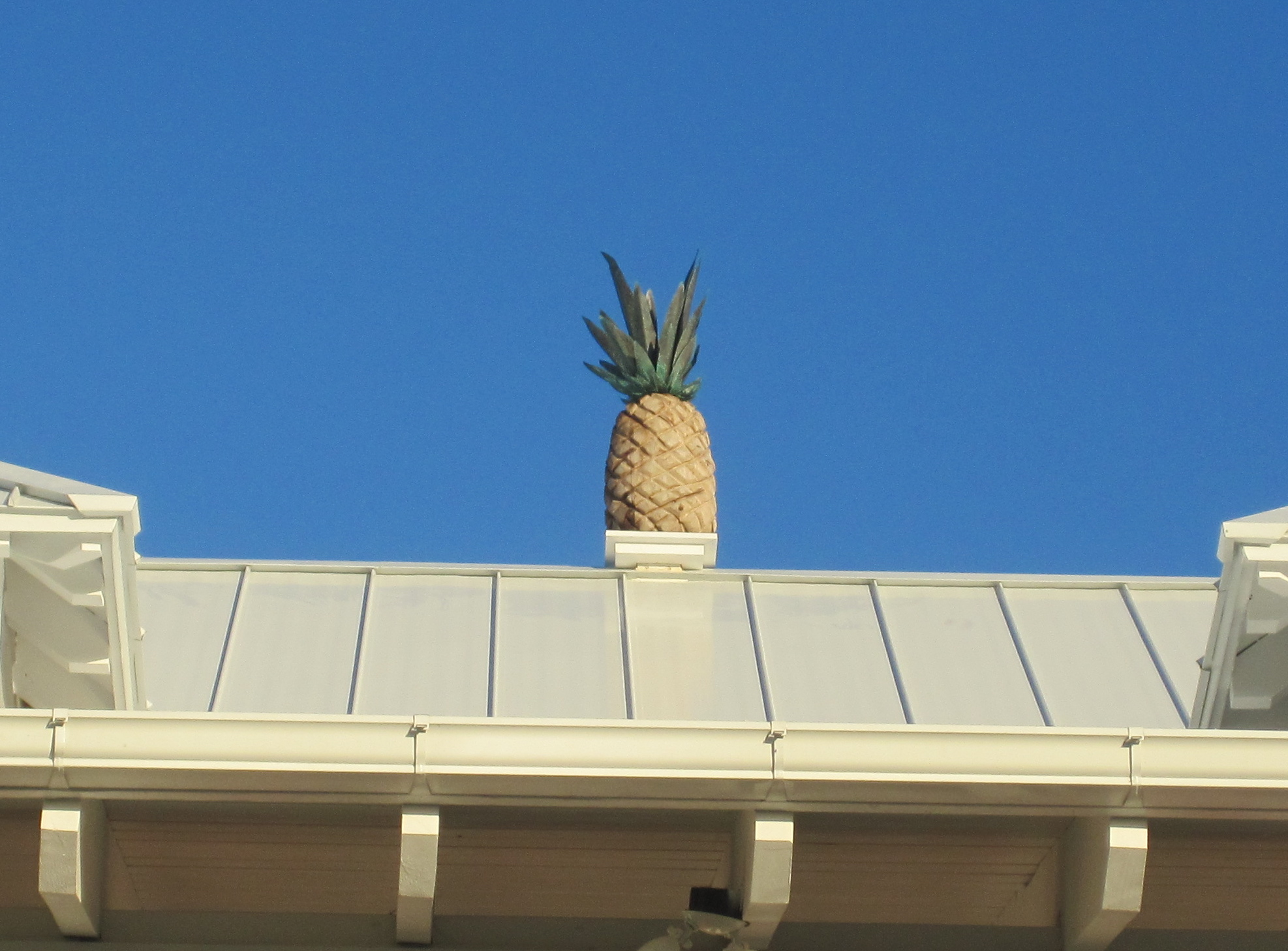
The Delphi Club was again, as with Irene last year, almost directly beneath the eye of the storm. Then, a couple of leaves were lost from the pineapple crown (above), a few fittings were smashed, and the gardens were unceremoniously rearranged. Peter Mantle, Delphi Club supremo, has posted his record of the last few days at the club – the approach of Sandy, the storm, and the aftermath. I am posting extracts below, to be read (chronologically) from the bottom entry to the top of the page. For those who haven’t experienced a storm of this violence, Peter’s account gives a vivid picture of the before, the during and the after…

Apologies for having posted about Sandy in detail with maps etc, and at the crucial time tailing off  while I was away and had only an iPhone™  and a sporadic connection…

STOP PRESS: AMERICAN OYSTERCATCHERS – BRAVE OR FOOLISH? 29 October

Peter Mantle has just sent me a ‘Sandy’ photo from the Delphi Club beach, showing a group of oystercatchers on the rocks at one end of Rolling Harbour. Storm detritus already festoons the rocks. Have the birds seen what’s about to hit them? Are they waterproof? 

STOP PRESS: BMMRO MANATEE UPDATE 29 October

The BMMRO has posted news from Sandy Point and for those who have been asking after manatee Georgie’s welfare, an update:

“Hi Everyone, everything is ok here at the research center! We are working on getting information on Georgie’s whereabouts and we will happily update everyone as soon as we hear anything. There’s still a bit of damage here in Abaco that is preventing travel but hopefully we will be able to get up to Georgie soon”.

STOP PRESS: SOME ABACO IMAGES 28 October
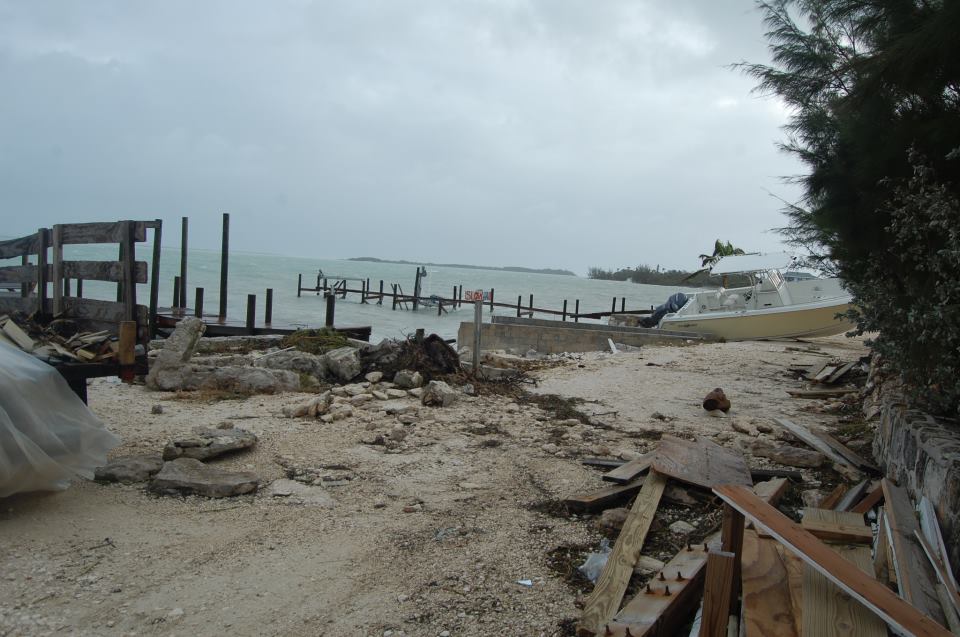
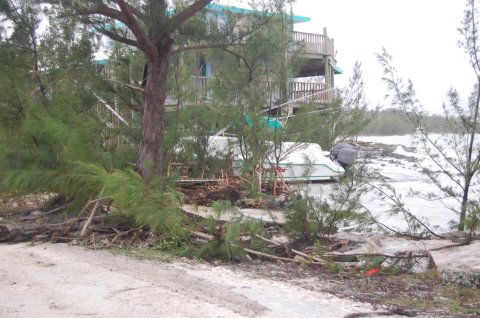
(credits to Timothy Roberts & Cindy James Pinder and their facebook posts)

SANDY TAKES BONEFISH; DARK HUMOUR ON DARK DAYS

OCTOBER 27th Among the many bits of minor damage caused by Hurricane Sandy was the destruction of our bonefish weather vane. This had been hand-made by the other Sandy, our general manager, and stood atop his lodgings. Snapped off, the copper creation was found nearby, bruised and dented, rather like ourselves.

Yet again, we have been very fortunate – staff and guests are all well. And most of the damage caused by the 100mph winds was minor. The storm had its moments, but the worst bits were at nighttime when many people were huddled safe in bed. Lots of bumps and bangs provided a spooky soundtrack, but it was more of a B movie than a full-blown Hollywood epic. That said, I hate to think what a really big Category 3, 4 or 5 hurricane would be like.

We still have no mains electricity; thank God for the gennie. We have no phones or mobile connection, so we have little idea of what is going on elsewhere on the island. We hope for the best but fear not all will have escaped as lightly as we did. Some of the staff from Crossing Rocks are stranded here by flooding. But the wireless internet is back so all will soon be revealed.

Yet again, the gardens have been shredded. The banana trees have been snapped off mid-fruiting. My favorite banyan tree has broken in half again, having nearly bounced back from Irene. The big Bismark ferns are banjaxed, the bougainvillea is blasted leafless and the pool is a mess. But who cares. We are fine. Dunkirk spirit? Well, very black humour and spirits of a different kind have seen us through.

“I survived Sandy” T-shirts are now in preparation, but that’s a staff joke about their hyperactive and heroic boss…..

A BAD HAIR DAY…

OCTOBER 25th It is getting distinctly breezy here, with winds as bad as any Irish gale. But Hurricane Sandy, now upgraded to a Category 2 hurricane, is still some 18 hours away and currently features average winds of 105mph with higher gusts. It may get even worse, they say. So no fishing today. More guests have made it in. Bahamasair even ran a plane out of Nassau at first light this morning.

While we still have power and phones, the lines are buzzing and we are glued to the internet. It seems odd to see that Sandy is the lead news story on the BBC. Non-technical guests have adjourned to the library (where “A Perfect Storm” and “Winnie the Poo and the Blustery Day” are current favourites). The air of gloom is more attributable to the fact that Arsenal lost at home last night than to any fears for personal safety.

We may go quiet for a while.

NOTHING VERY FEMININE ABOUT THIS SANDY

OCTOBER 24th, noon Tropical storms are now given boys’ and girls’ names alternately; in the old days they were all girls. The one that currently threatens us is Sandy, a name that is more commonly applied to females in this part of the world. But there is nothing too feminine about this storm; as the forecast deteriorates and Sandy intensifies into a hurricane over Jamaica, we are becoming more and more concerned by its macho capabilities.

The National Hurricane Centre now predicts that Sandy will pass very close to Abaco – the predicted path having shifted overnight. As it now looks, the eye may pass just 25 miles from us, which would basically be a direct hit since damaging winds spread far out from the centre. We are going to have to keep a very close on on this little girl over the next 48 hours.

ALL EYES ON SANDY

OCTOBER 23rd No sooner has the Club reopened for the new season than a tropical storm appears on the horizon. And, in a twist of divine humour, it’s been christened after our general manager, Sandy.

Sandy (the mostly human version) is tracking Sandy (the swirling tempest) on an hourly basis. As it now stands, we are in the “cone” of the likely track of the storm over coming days. Currently south of Jamaica, TS Sandy is turning north and could yet morph into a hurricane. It’s expected to be over or near us by Friday night, with “average” winds of nearly 60mph and gusts of up to 90mph.

Hatches will therefore be battened, outdoor furniture put back indoors and supplies of grog reinforced. The lucky fishers in residence will have to take a breather, while the new chef, John, will receive a special form of baptism.

Tropical storms this late in the year are a great rarity. Somehow that is not very reassuring just now. But the forecast for the following week is rather better… 

Click image to visit the Delphi Club

Unknown's avatar

HAIRY WOODPECKERS IN THE ABACO COPPICE


HAIRY WOODPECKERS IN THE ABACO COPPICE

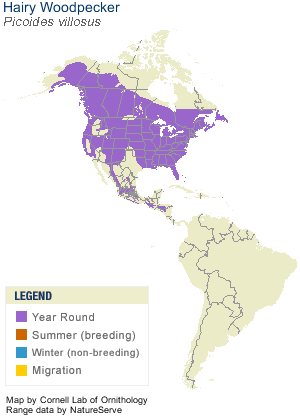
The hairy woodpecker (Picoides villosus) inhabits forest, woodland or coppice over a wide area of the North American continent and the islands to the east, including the Bahamas. They are mostly permanent residents, though there is a degree of migration within their territorial area.

They are a very familiar sight on Abaco, along with their larger cousins the West Indian Woodpecker. These birds forage on trees for insects, turning over bark or excavating deeper. They also feed on fruits, berries and nuts. It’s not unusual for them  to attack the woodwork on houses in a search for bugs…

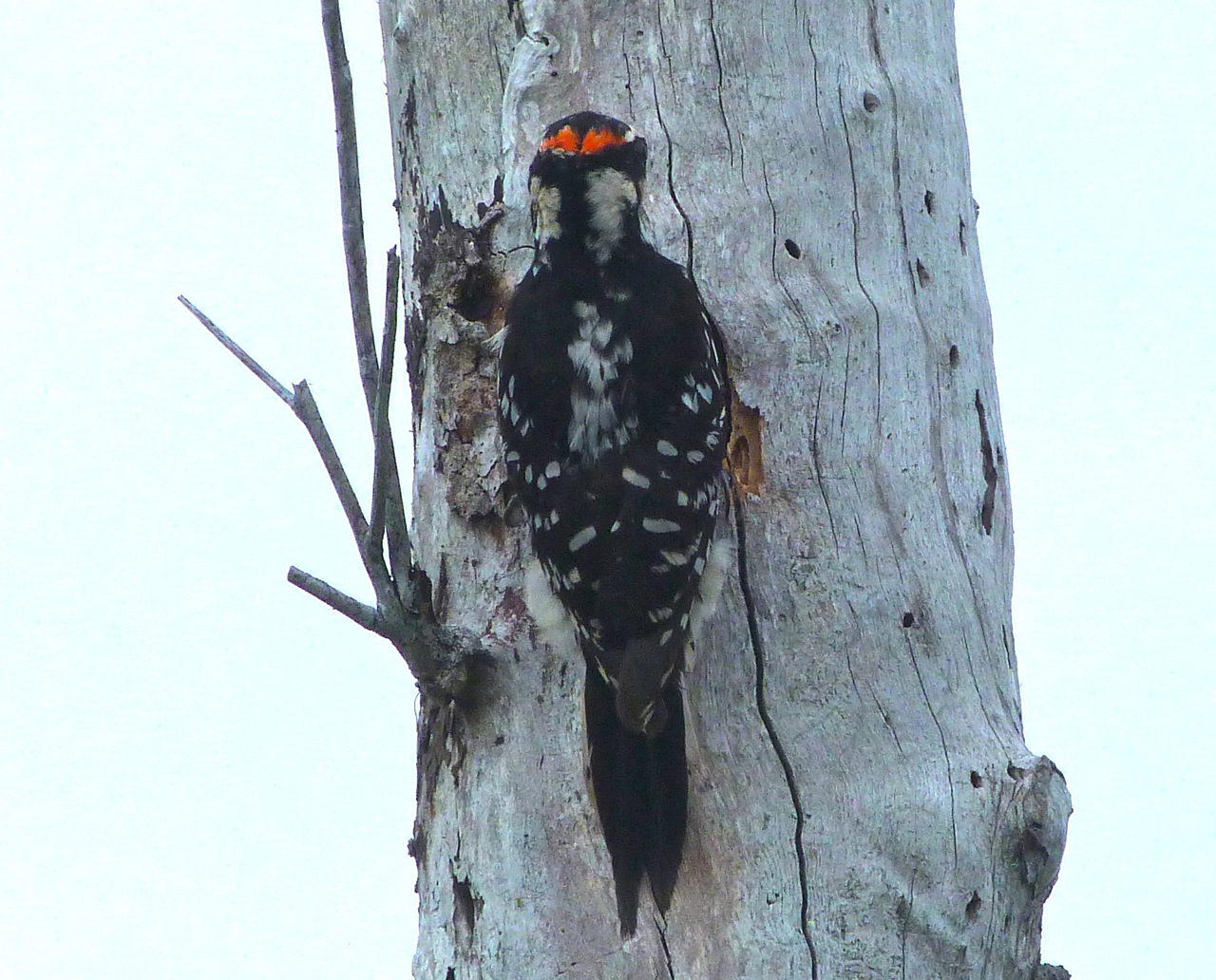
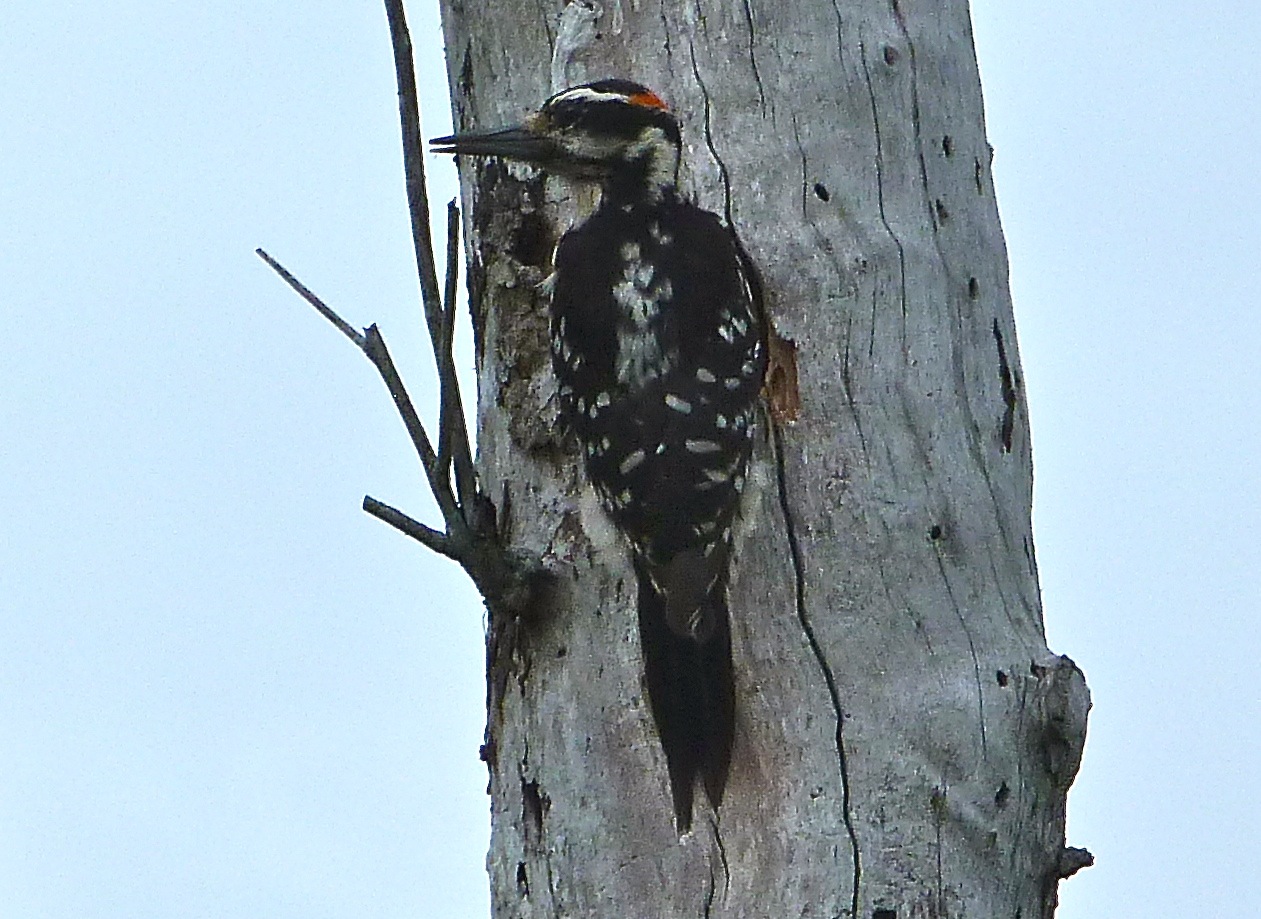
This male hairy woodpecker is prospecting a promising hole near the Delphi Club guest driveThe marks at the bottom of the hole suggest this may be a nesting hole – past, present or futureIt’s certainly deemed worth further investigation… if only he had someone to share it with

He may be in luck! This female hairy woodpecker was in the coppice not far away… A female HW is smaller than the male and lacks the male’s distinctive red head marking. They nest in a tree hole like the one above, where the female usually produces four white eggs. 

Unknown's avatar

CHILLIN’ ON ABACO VS CHILLY IN ENGLAND


CHILLIN’ ON ABACO VS CHILLY IN ENGLAND

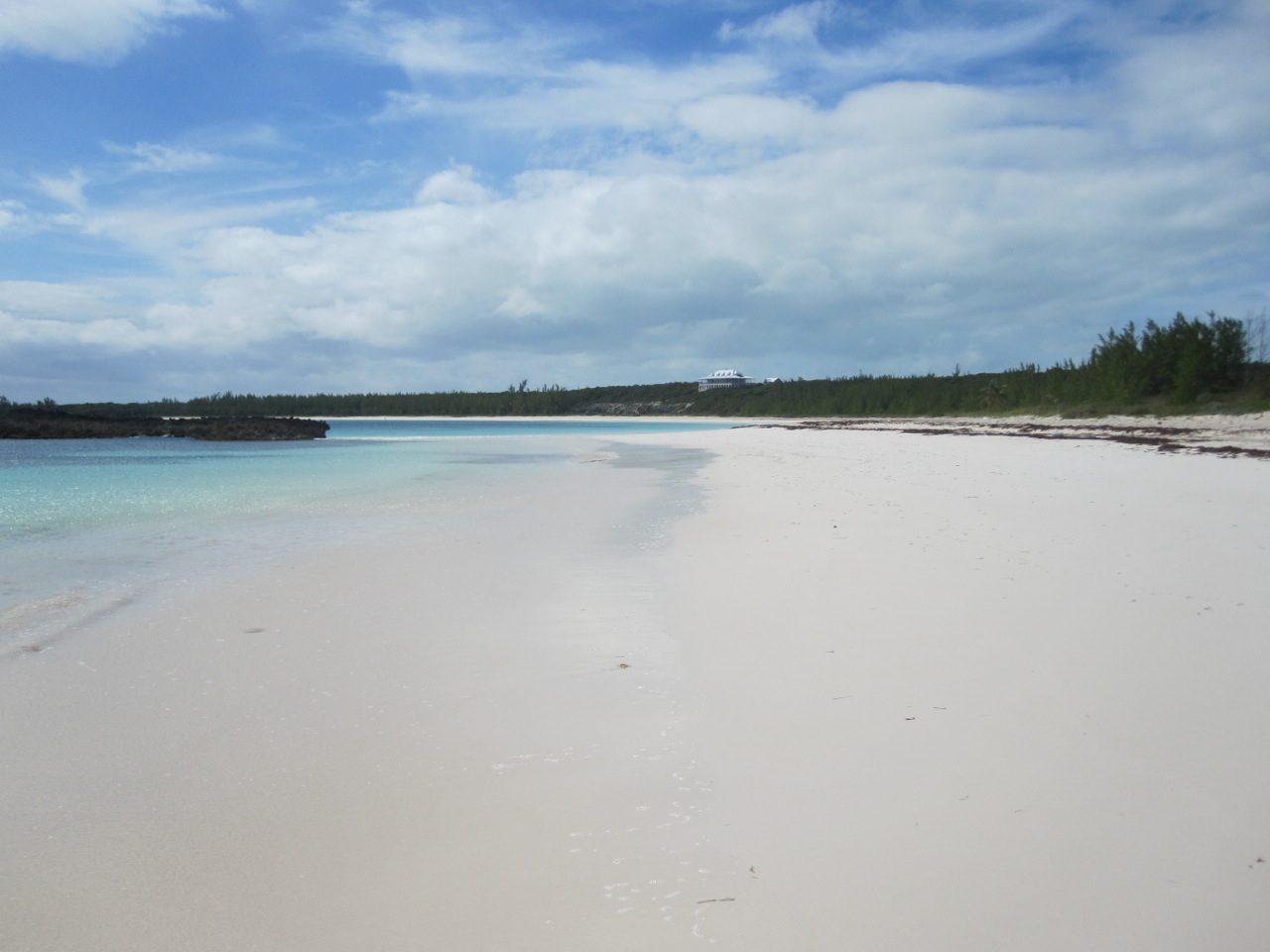
“Life’s a beach”, it is said. On Abaco, a new season is starting at the Delphi Club, and the first guests will be sorting out their fishing tackle, reaching for the sun cream and abandoning pre-Delphi diet boot-camp. If they have been eating Marmite™ sandwiches for a week before their arrival, they won’t need  to waste energy slapping no-see-ums. The day-dreaming becomes reality, perhaps involving his ‘n’ hers rods near the rocks at one end of the beach

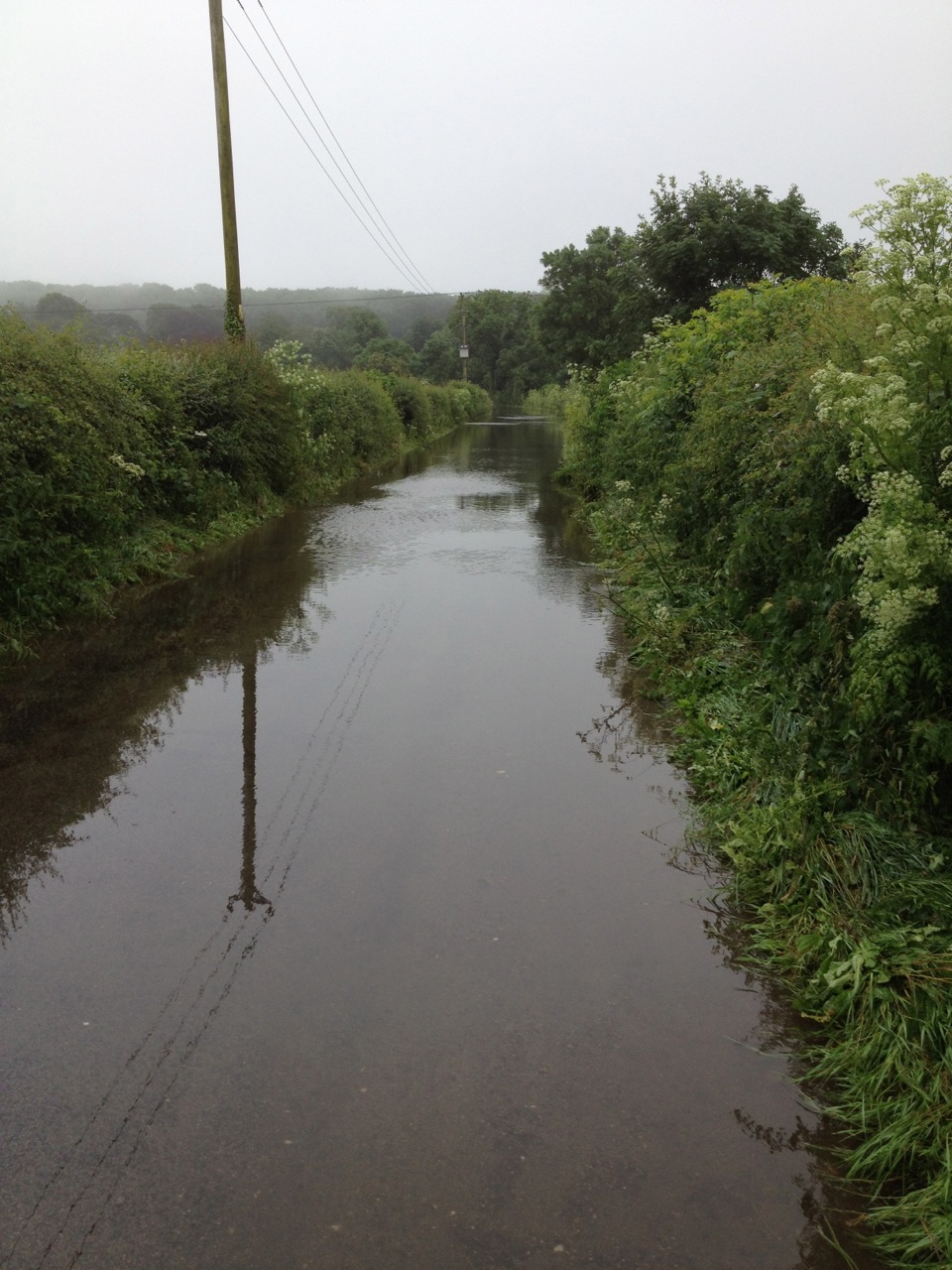
That’s all well and good. But in more northern latitudes the slide from summer via autumn to winter is accelerating. The trout fishing season has just ended, with my final efforts washed away by heavy rain and flooding – this photo is the road leading to one of the beats, a sure meteorological sign that a visit to the local pub would be sensible… 

A pint of beer in front of a log fire soon puts things into perspective, and the mind can wander to warmer climates, the bonefishing prospects for the season, and the calm beauty of Rolling Harbour…

Two days ago, the UK temperature dropped sharply, the skies began to clear and the sun came back. Ah! Autumn – season of tum-ti-tum and mellow wotsit… 

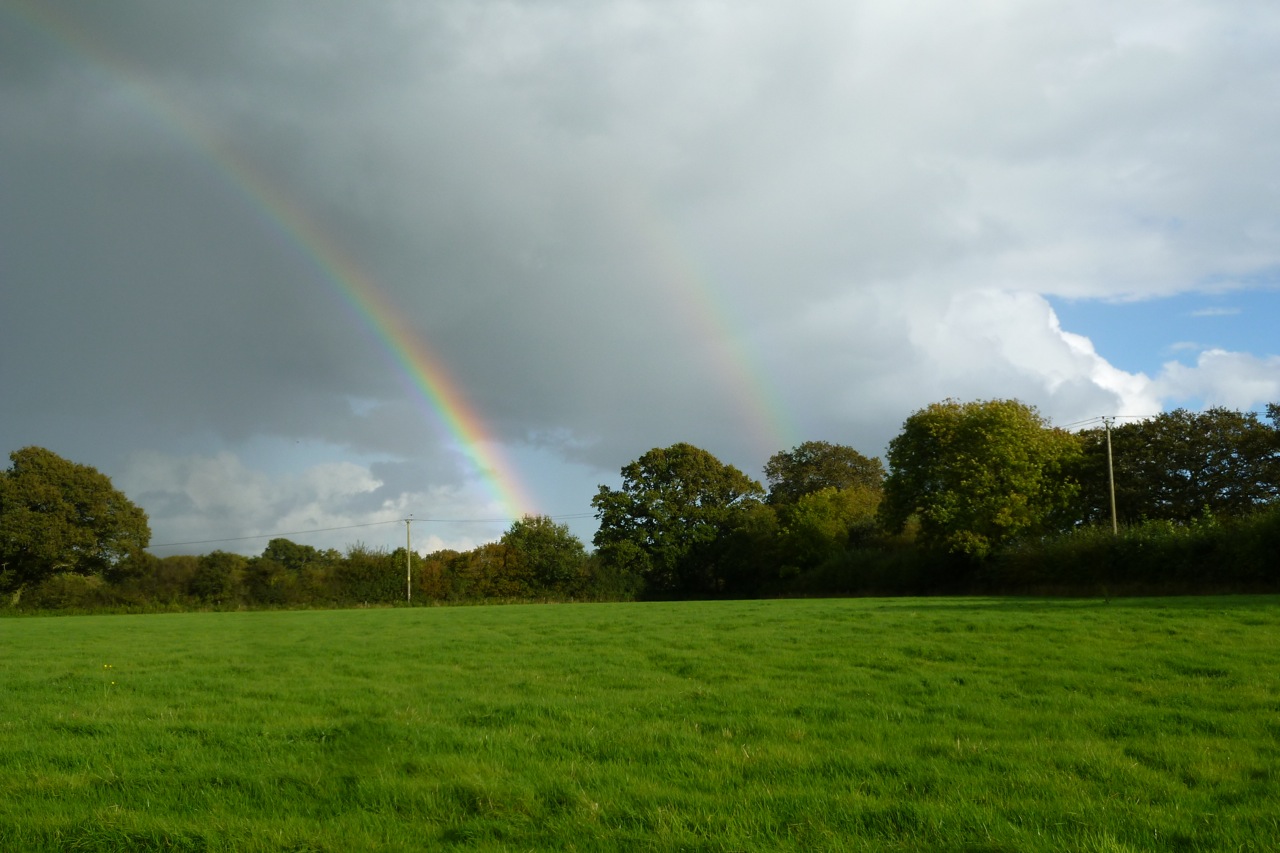
At one moment there was a wonderful double rainbow across the fields

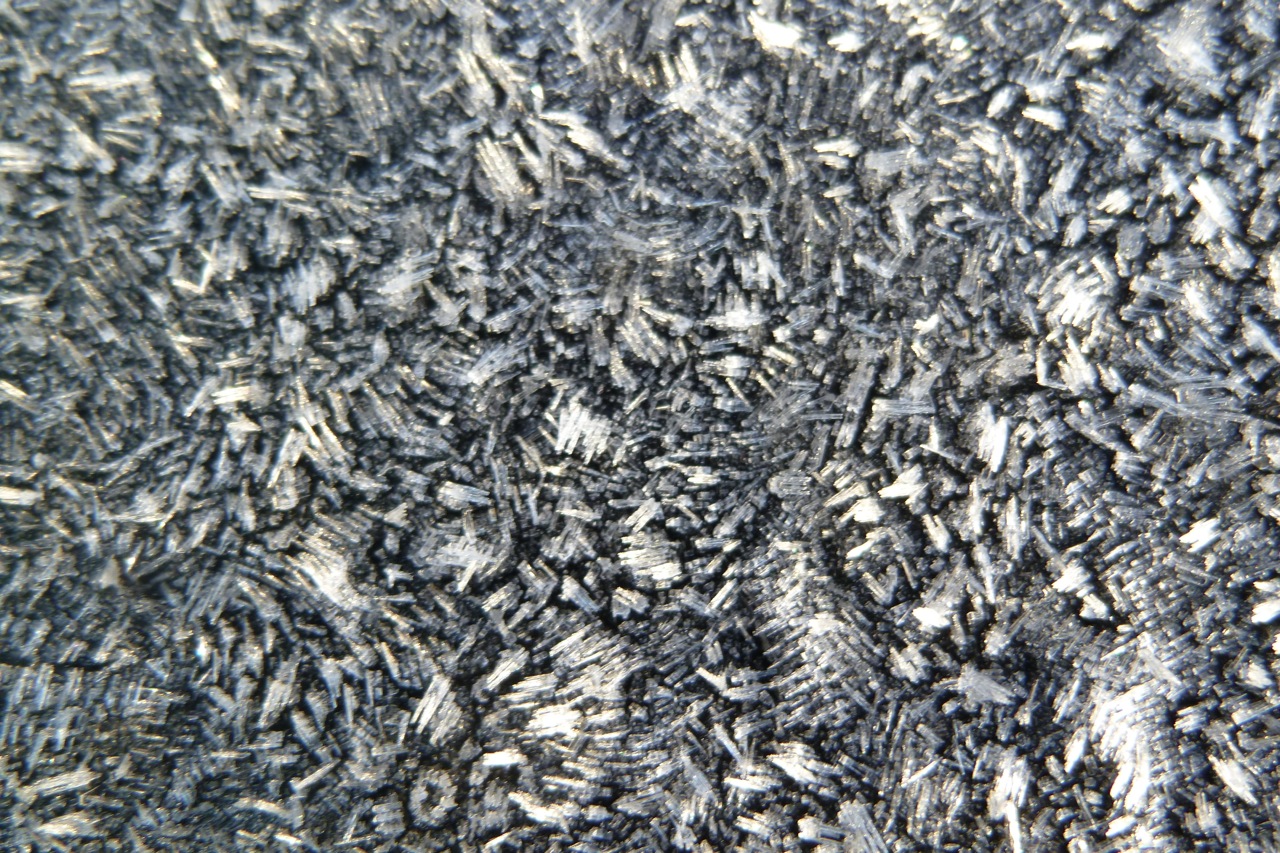
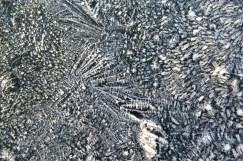
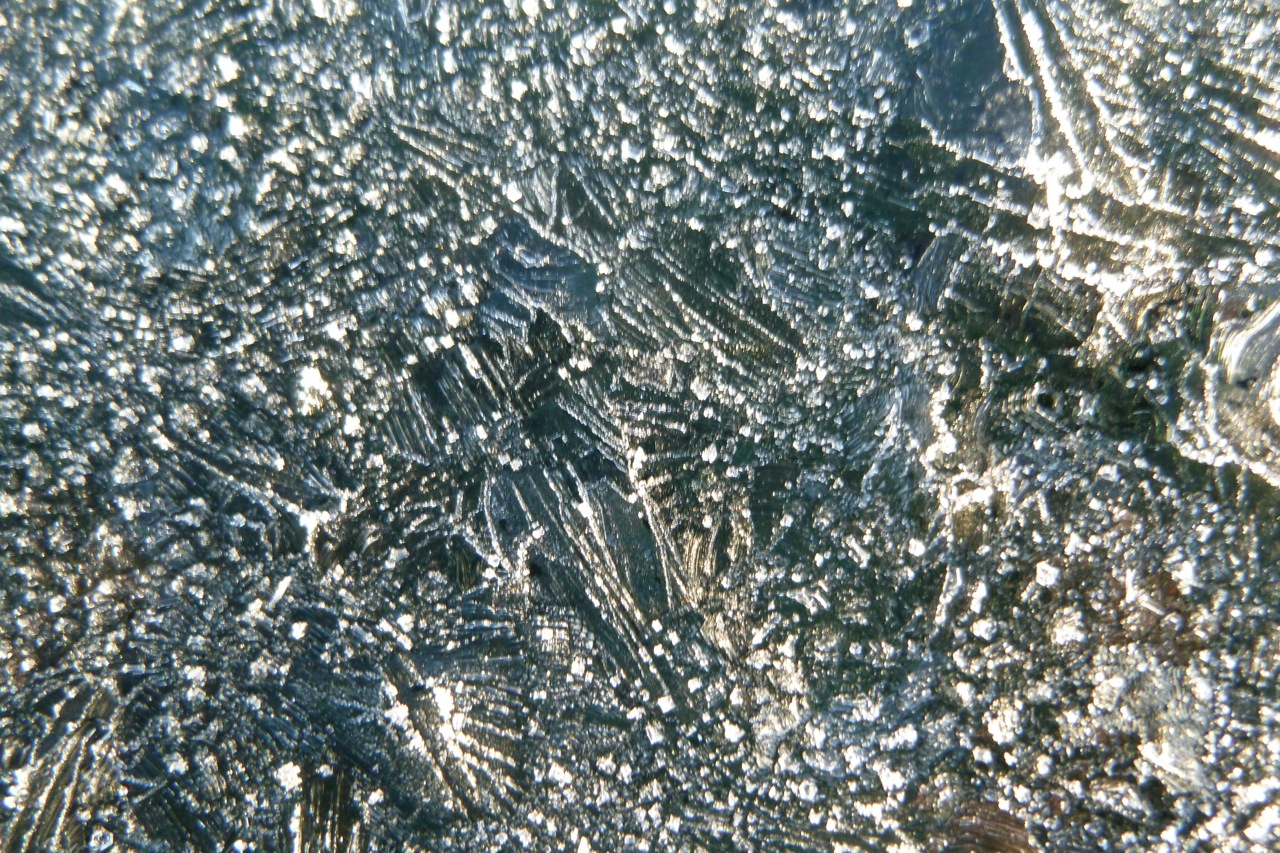
This was followed by a bright starry night & the thermometer dropping abruptly to -6˚F. And then this – the first frost of the year…

  These photos are of patterns on the car roof & windscreen, before the sun thawed the ice


Brrrrrrrrr. Best not to end on a freezing note. Back to Rolling Harbour for some warmth

Unknown's avatar

BEDRAGGLED ABACO PARROTS, & AN AMERICAN KESTREL TAKES OFF…


BEDRAGGLED ABACO PARROTS, & AN AMERICAN KESTREL TAKES OFF…

It’s a fine June day. Perfect for a morning out with Ricky Johnson, the omniscient leader of  ABACO NATURE TOURS. Want parrots? He’ll take you to them. Want a Bahama Woodstar ‘pished’ from its deep cover into the open? He’s your man. And as for wrassling land crabs – see LANDCRAB and LANDCRAB: THE SEQUEL We set off from the Delphi Club in sunshine and hope…

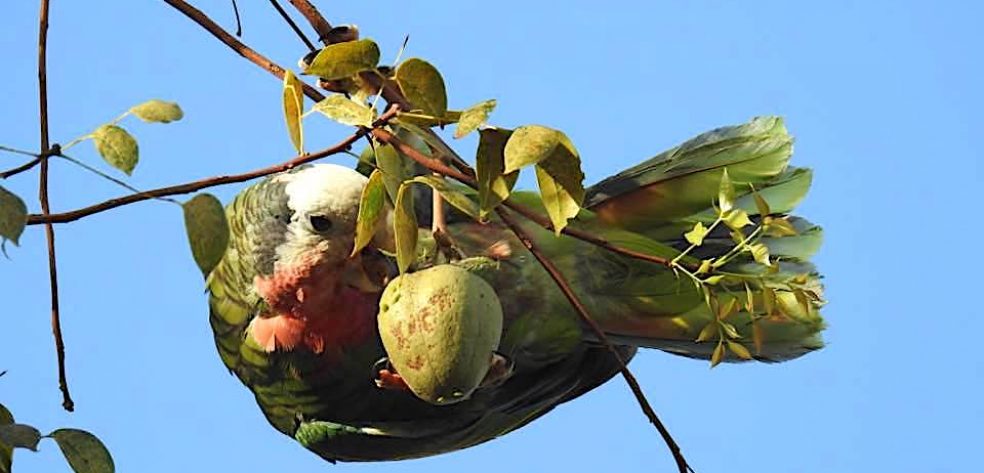
Sure enough, we found the parrots at Bahama Palm Shores, so often a good bet. This was (Ricky said) a non-breeding flock, the breeders all being otherwise detained in the National Park with their nests and eggs. Out of nowhere, a sudden short, sharp downpour arrived, and 5 minutes later, everything – everyone – was soaked. And so, of course, were the parrots. At first I discounted the resulting photos for use. These lovely, rare birds are made to be seen in their bright cheerful livery of green, red and blue. These wet ones looked… black. I usually try to avoid doing much (or any) ‘work’ on my photos, but for these I tried changing the contrast a bit and realised that they looked rather appealing with their dark, damp feathers and unkempt appearance. So I’ve decided to use a few images. Here they are, then: some sodden parrots!

While we were damply watching the parrots, Ricky spotted an American Kestrel near the top of a tree. Heads swivelled. It was some way away, but we could see it looking a bit dejected, huddled in the palm fronds. Then suddenly, just as I pressed the camera button, the kestrel stretched itself upright, raised its wings, and launched itself into the sky. The two photos below are frankly of marginal quality (on a high “blur setting”, as you might say) but the second one has caught the rain-drenched kestrel’s take-off about as well as a point ‘n’ shoot at that distance could… 

Unknown's avatar

ABACO BONEFISHING Pt 1: A NON-ANGLER’S SKIFF-VIEW – WHAT, HOW, WHERE & WHY?


             BE NATURAL (YET SHARP) ON THE FLATS – PART 1  

WHAT, HOW, WHERE AND WHY?

[I published the original of this post a year ago. I discovered that it had been put badly out of kilter by recent blog format change, so I have amended and to an extent updated it, with larger photos (NB the video was my first feeble foray).  So yes, it’s a retread, which I rarely do; but I wasn’t tooled up with Facebook & Twitter then, and thankfully a couple more people now read this thing, so it possibly deserves a fresh outing. No? Well I’m doing it, regardless]

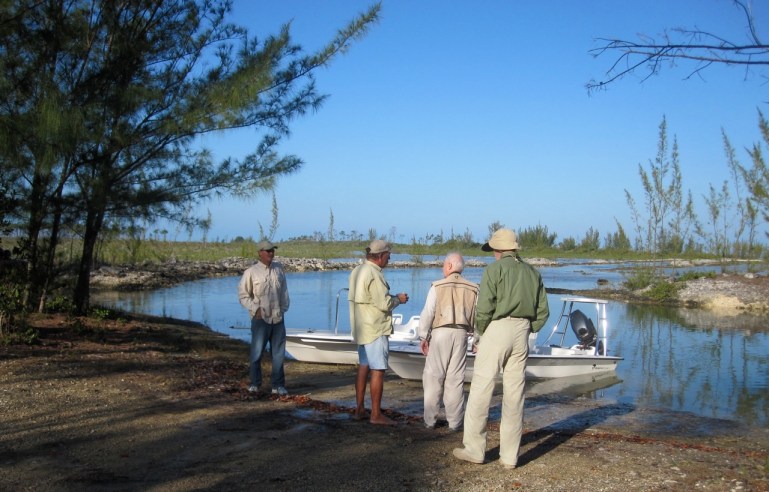
It’s 7.15 and breakfast time at Delphi. At 8.00 the trucks, skiffs, guides and fishers will set off to the fishing grounds for the day, leaving you with an empty beach, shells, warm sea, the pool, the hammock and your book. For the moment, the talk is of the excellent ‘Full Abaco’ breakfast, the weather, ‘Delphi daddies’ & ‘crazy charlies’ and someone’s mislaid reel. Sandy enters to announce that there’s a place free on your partner’s skiff… and offers it to you. So what should you, a non-angler, expect of a day out on the flats?

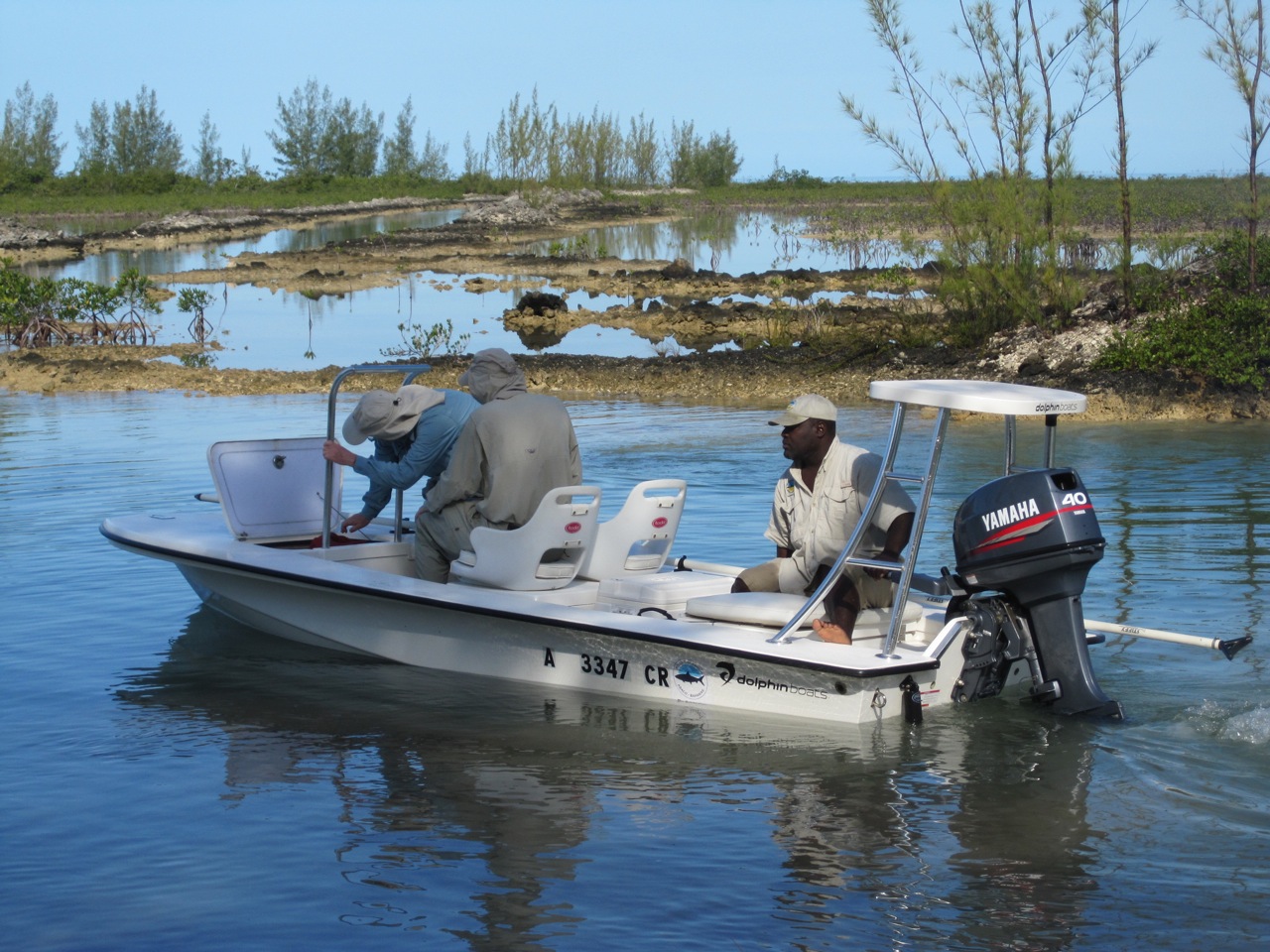
THE SKIFFS These are top-of-the range boats, capable of considerable speed getting out to the fishing grounds. The ride can be bumpy, splashy and even chilly in the early morning, so bring a fleece and a waterproof top. Camera? Essential. Here is a Delphi skiff on a sand bar in Cherokee Sound, parked for lunch and some quality conch and sand-dollar hunting. So for a start, the day isn’t ALL about fishing…

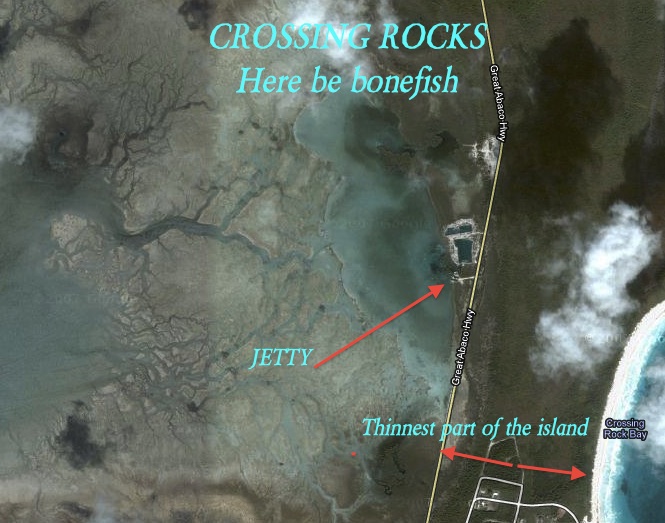
THE FISHING GROUNDS You will leave from one of three launch points and speed across the water to the bonefishing areas. The main one is “Nettie’s”, with access via a narrow man-made channel to the Marls…

… more than two hundred square miles of mangrove swamp, islets, channels and fish. The journey to Nettie’s may seem quite a long way as you bump along through the pine forest on a network of logging tracks. Watch out for small birds flickering all around as you pass.


———————————

Launching a skiff at Nettie’s

Plans are hatchedGood to go…

Stowing gear in the front (forrard?) locker. There’s also one behind the seats for the lunch cool boxes. And the fuel…

The other two launch areas are Crossing Rocks (a short drive south of DCB) or Casuarina Point for Cherokee Sound (a slightly longer drive north of DCB)

The jetty at Crossing Rocks – skiffs being prepared

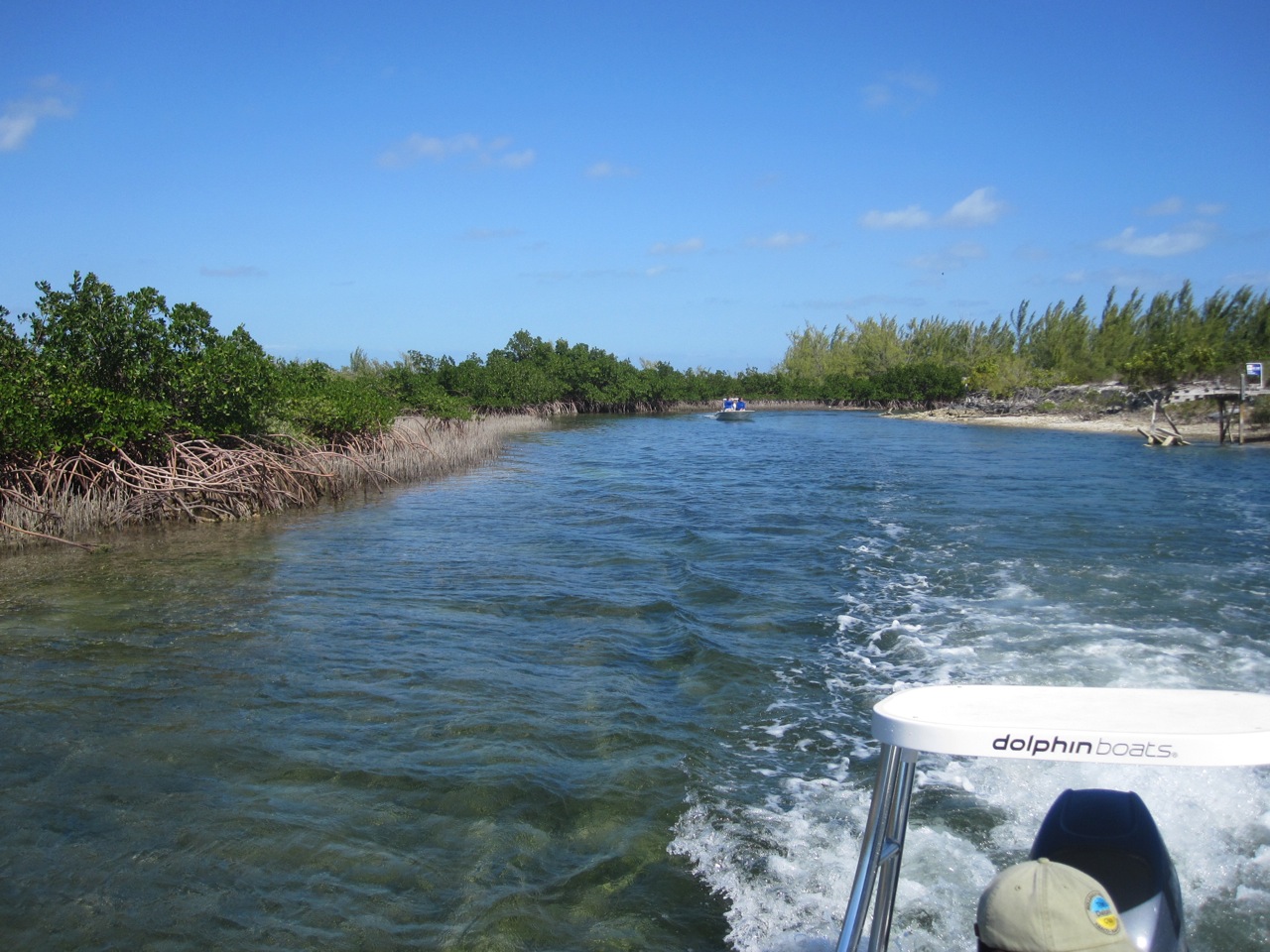
The launch point at Casuarina. A channel leads out to Cherokee Sound

Two boats in the channel – the authentic James Bond chase experience

WHAT’S THE POINT? Bonefishing! You’ve heard all the Club talk, you’ve seen your partner fussing over all those bits and pieces in your room: now see it in action. Once you get out to a fishing area, the guide cuts the engine… and suddenly you are being poled very slowly and almost noiselessly across the shallow flats

The guide stands on the platform at the back of the skiff, using the advantage of height to scan the shallow water; the fisher stands at the front looking tensely for grey shadows underwater, waiting for the magic words…

 “…hey, bonefish, 10 o’clock, 4 of them moving right, 30 feet… see them?” 

And it’s ‘game on’. This isn’t the place for a discourse about casting technique and style – I have neither (Sandy, of me: “Muppet”) – but I promise that you will get completely caught up in the excitement when a fish takes the fly and takes off towards the horizon, stripping the line and backing from the reel… (I realise the image above may suggest… well he’s just fishing, OK?)

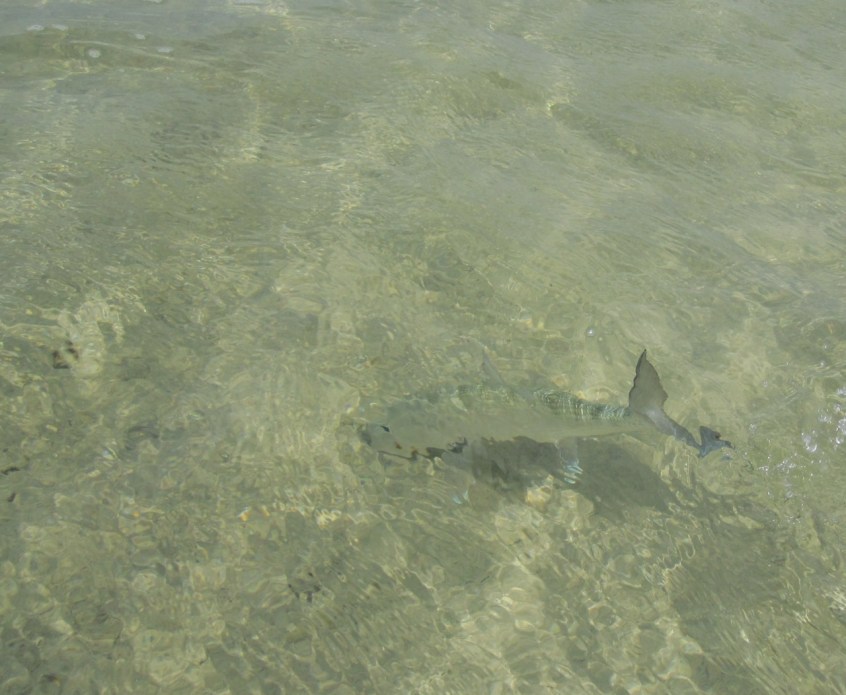
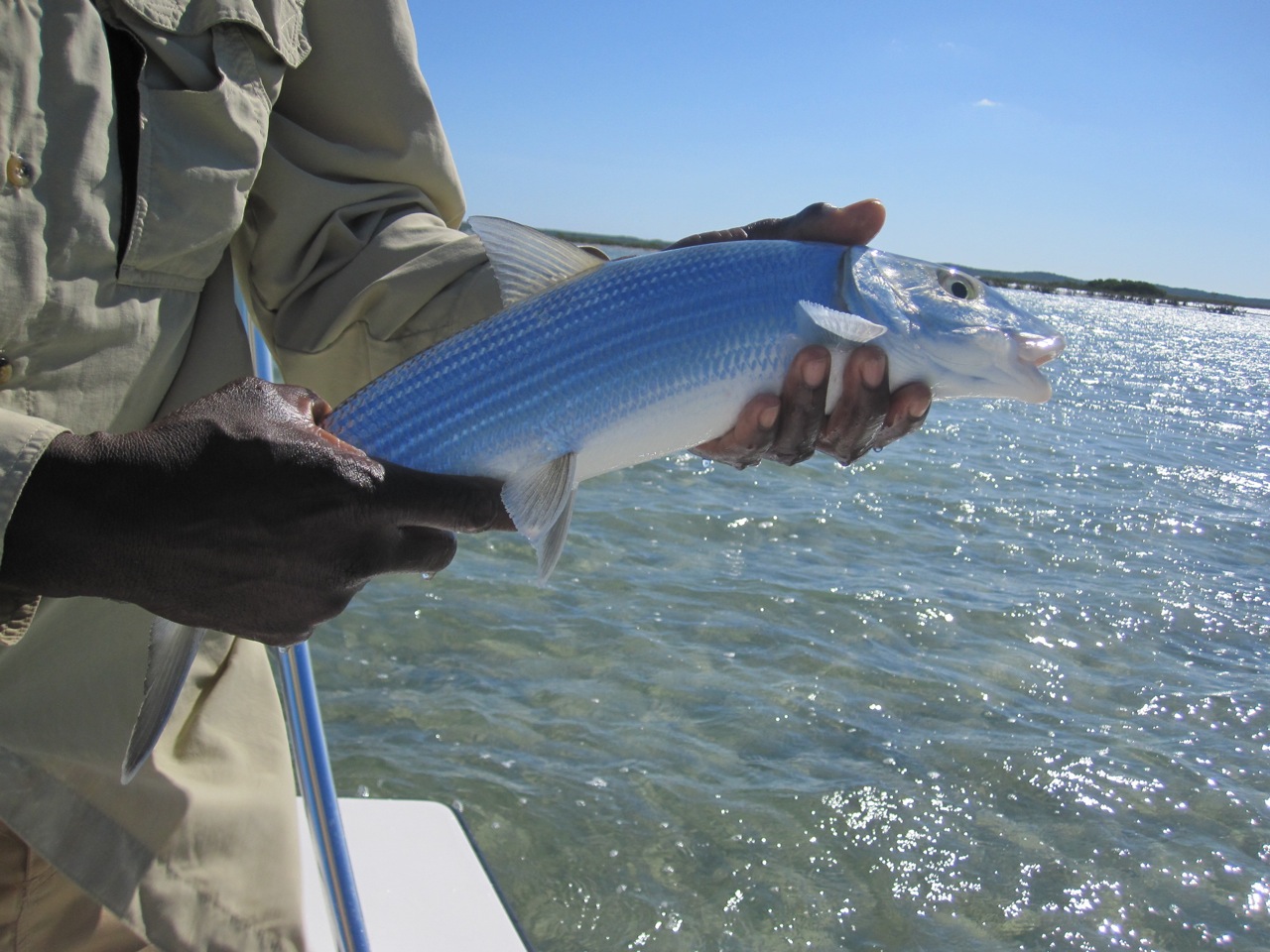
THE QUARRY – grey ghosts below water, bars of silver above. Caught on the ‘fly’ which are in fact shrimp or crab imitations, with barbless hooks to make the chance of losing a fish that much greater… This ensures that a boated fish can be returned to the water as easily and quickly as possible. It’s all ‘catch and release’, though some (me) find that mostly the fish very sensibly self-release long before they ever reach the boat…

Abaco bonefish off Crossing Rocks (just caught and released)Guide Ishi with Abaco bonefish caught on the MarlsGuide Robin Albury removes the barbless hook before returning the fishgood specimen‘Ishi’s Fishy’, as he would say

All images, and indeed fish, ©RH

There is even the possibility that at some stage you may unexpectedly be handed a rod (even if you have never held one before, or wanted to) with ‘fish on’… Here, Robin has hooked a 2.5 lb fish and handed the rod to Mrs RH (then engrossed in eating a cheese roll) who successfully played and brought in her first ever fish…

PART 2 will deal with what else goes on during the day: the scenery, birdlife, sharks, turtles, blue holes and so forth. For now, here is a short clip of the skiff ride out to the Marls, to give you an idea. NB this was a very calm day – things can get a little bumpier and wetter at times. The seats are padded, but not very… 

 [Ultra-cautious music credit to Joe Satriani who sued Coldplay for alleged tune ‘borrowing’ saying “I felt like a dagger went right through my heart. It hurt so much”. Case dismissed + unspecified settlement…  Way to go, Joe! Want to check? Cut ‘n’ paste this: http://www.youtube.com/watch?v=zjB024bZoB4&feature=fvwrel Then by way of counterbalance try John Lennon’s Imagine vs Coldplay’s ‘Fix you’ at (cut ‘n’ paste)  http://www.youtube.com/watch?v=DksjpsAe3vk&feature=endscreen&NR=1]                

CLICK LOGO for the Bonefish & Tarpon Trust


Unknown's avatar

ABACO SHELLS: 3 MORE FROM THE DELPHI CLUB COLLECTION


ABACO SHELLS: 3 MORE FROM THE DELPHI CLUB COLLECTION

I have recently featured some of the shells from the collection amassed at Delphi –  see SHELLS 1 and SHELLS 2. They are kept in vases or bowls for display and examination. They may not all come from the immediate vicinity, but they are all, for sure, from South Abaco. It’s time for some more.

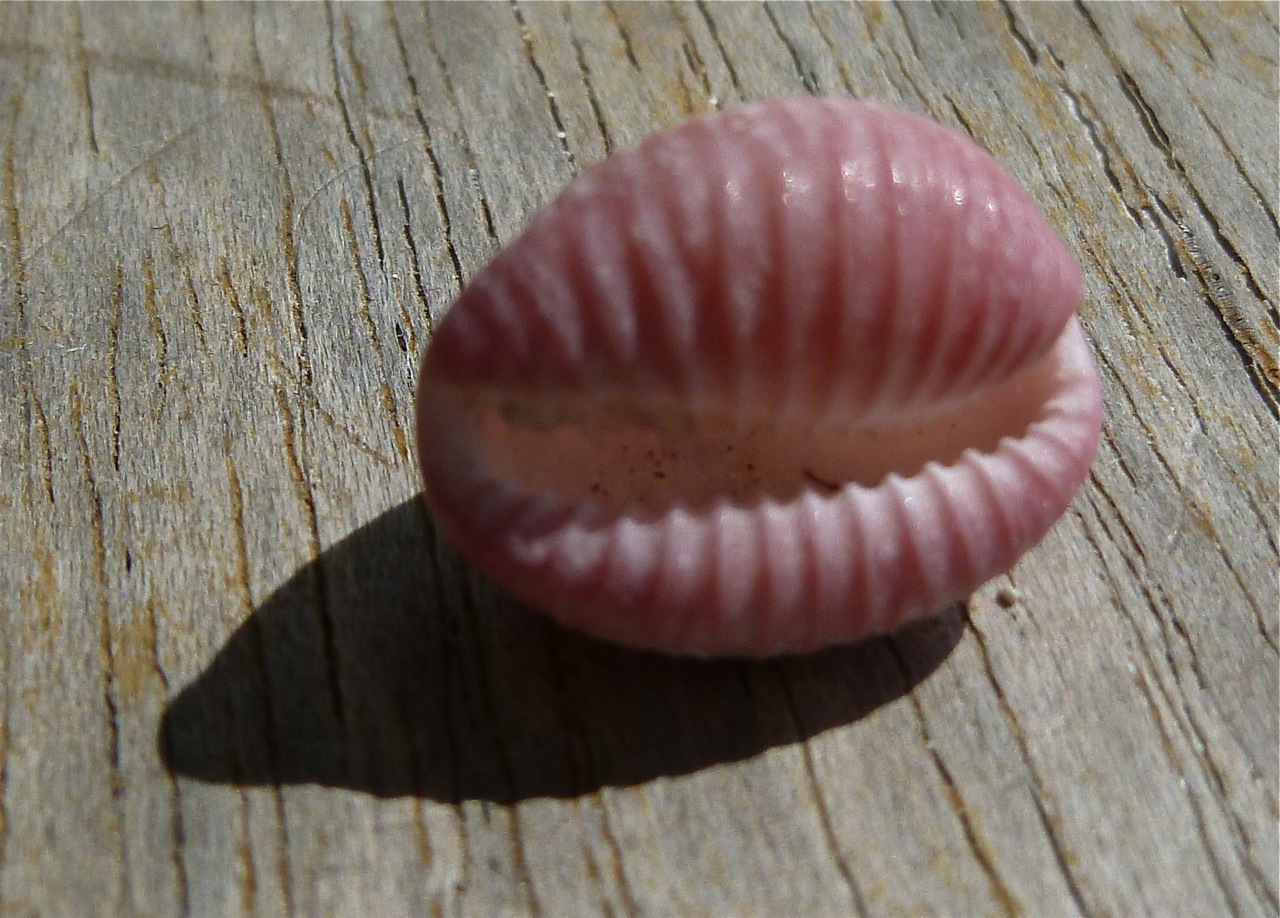
PINK TRIVIA SHELL


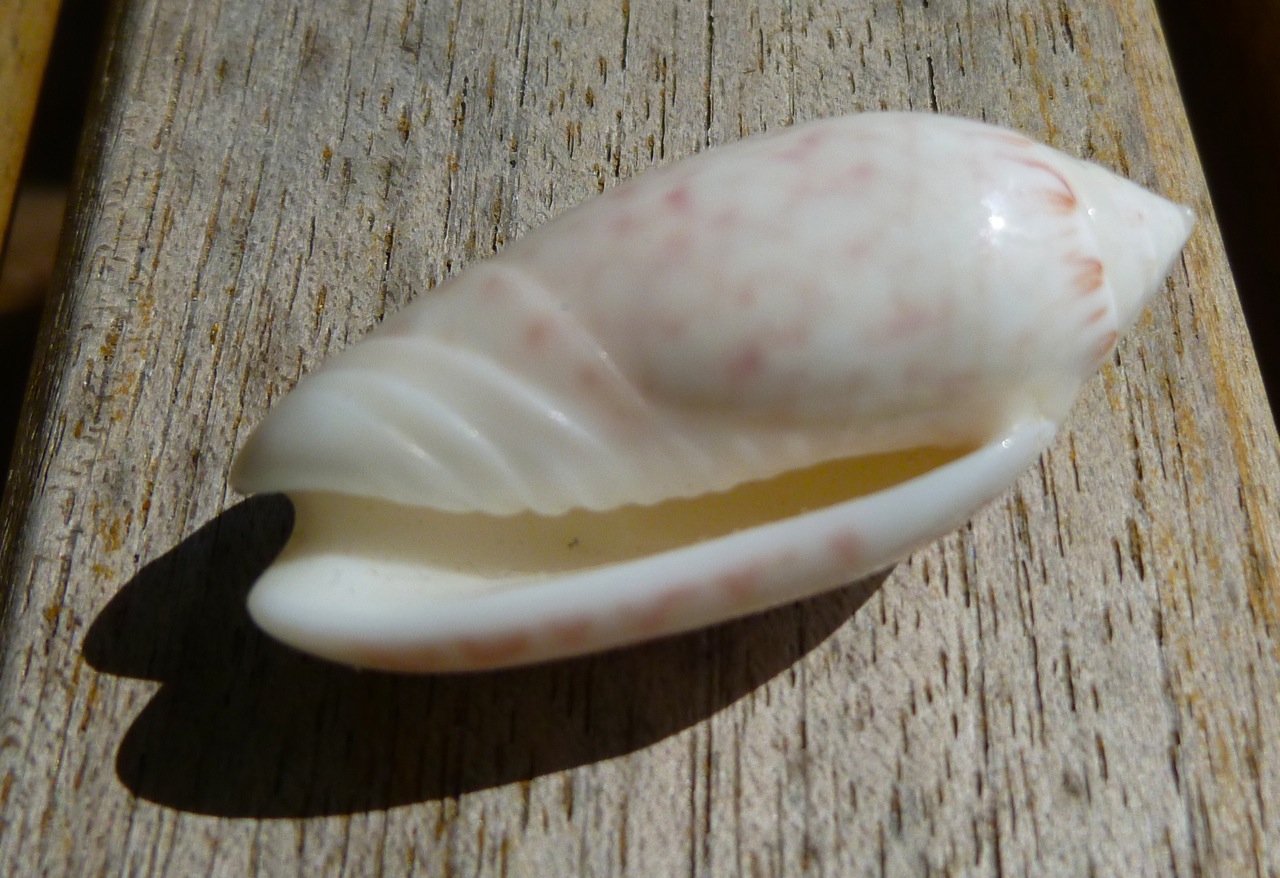
LETTERED OLIVE  SHELL


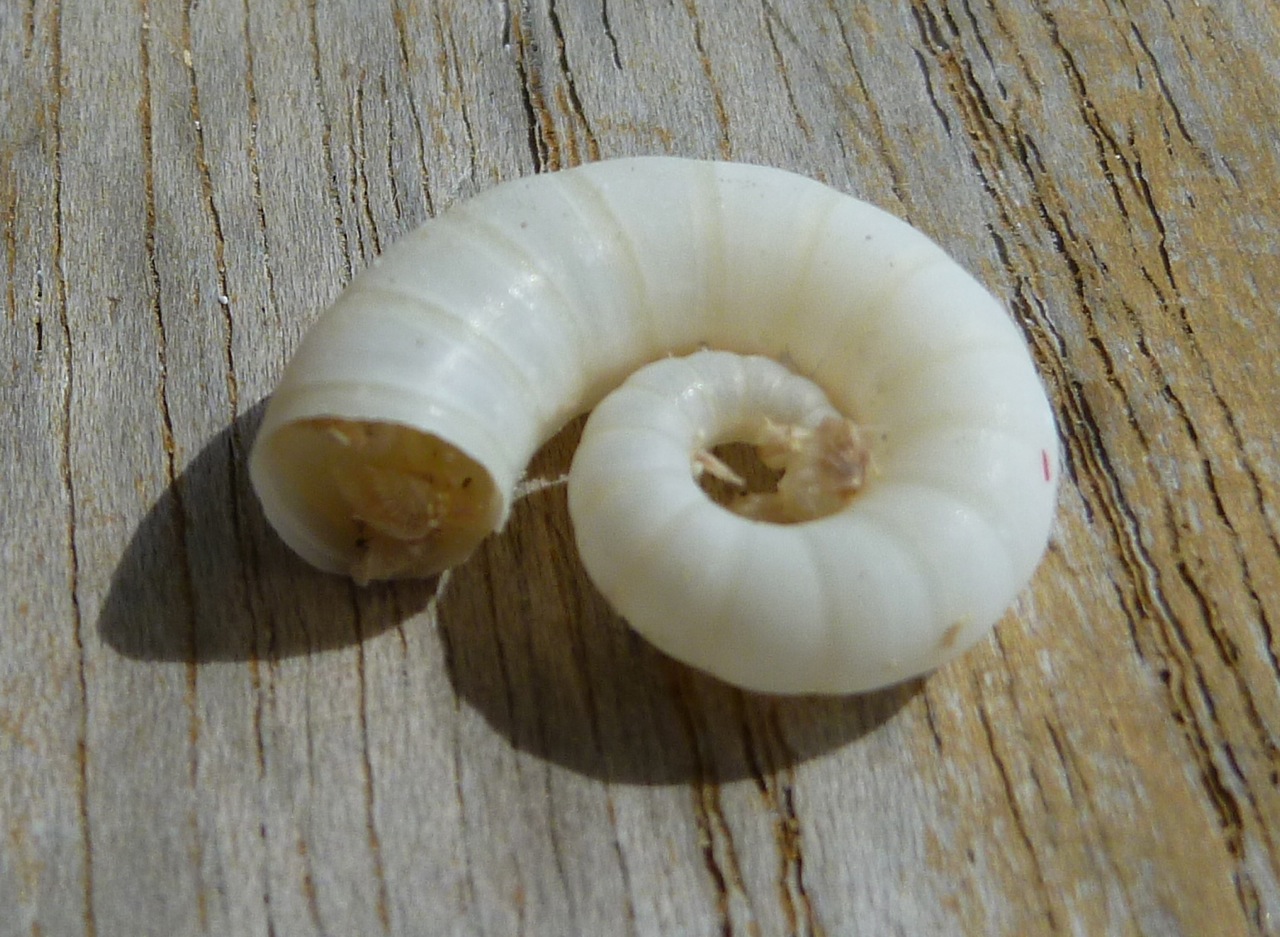
COMMON SPIRULA  

For further details about Spirula(e), please see the comment box where Capt Rick Guest gives a lot of fascinating info about them and related marine cast-offs. You’ll also find out which are the real prize ones to look out for…

  A vignette of RH examining shells on the balcony at Delphi 


Unknown's avatar

A BUNCH OF FLOWERS (& PLANTS) FROM ABACO, BAHAMAS


Royal Poinciana (Poinsettia) Abaco DCB 1.10A BUNCH OF FLOWERS (& PLANTS) FROM ABACO, BAHAMAS

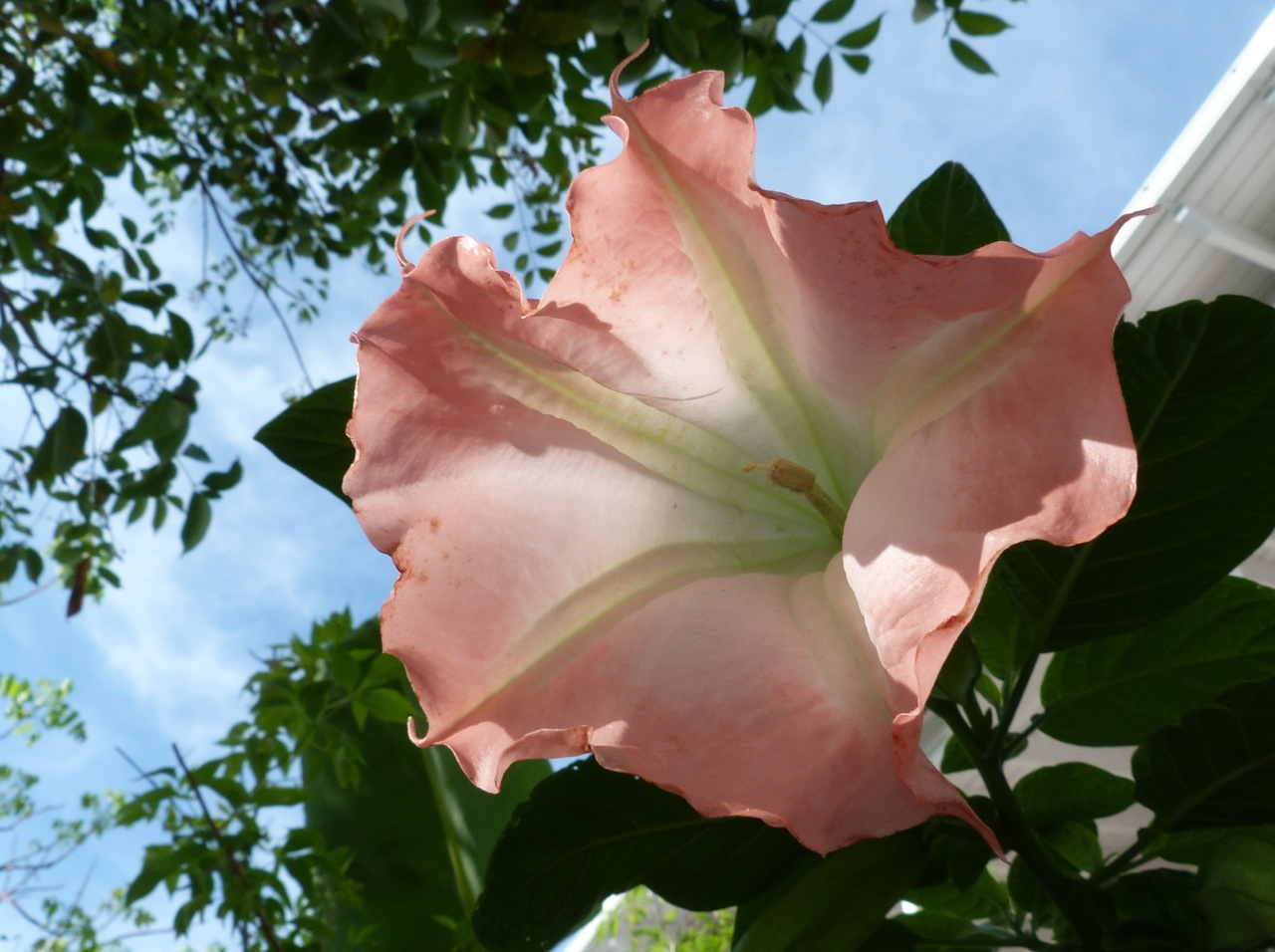
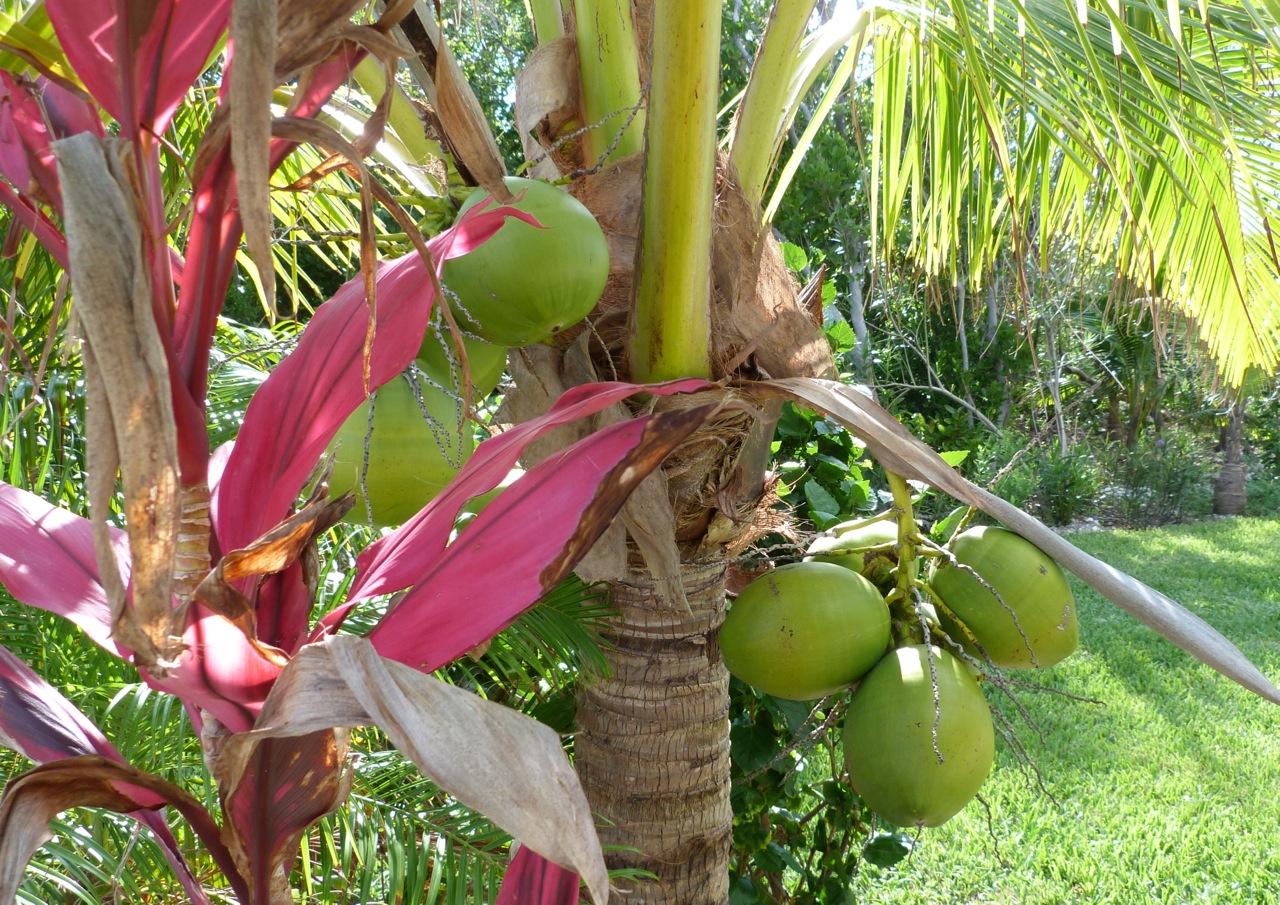
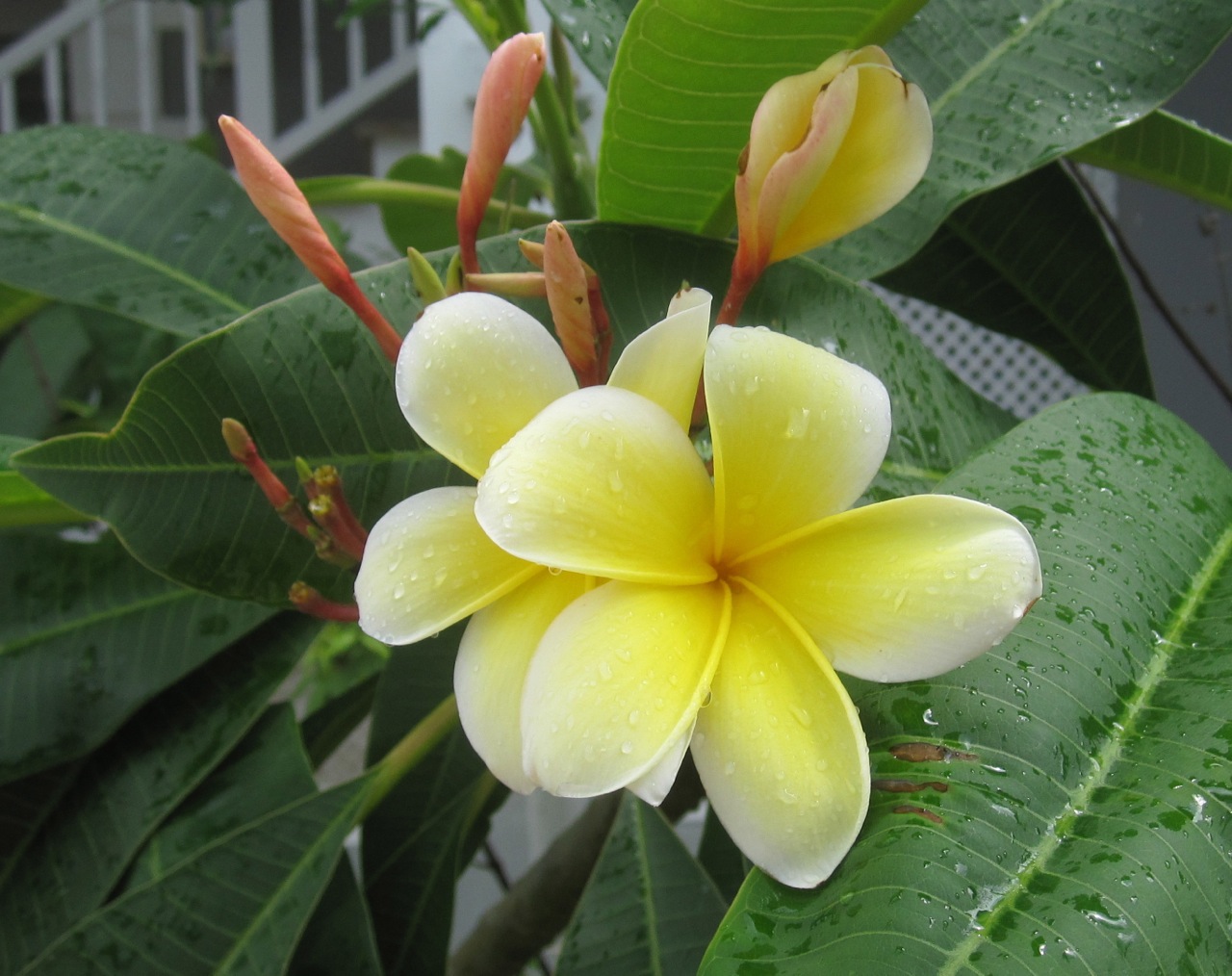
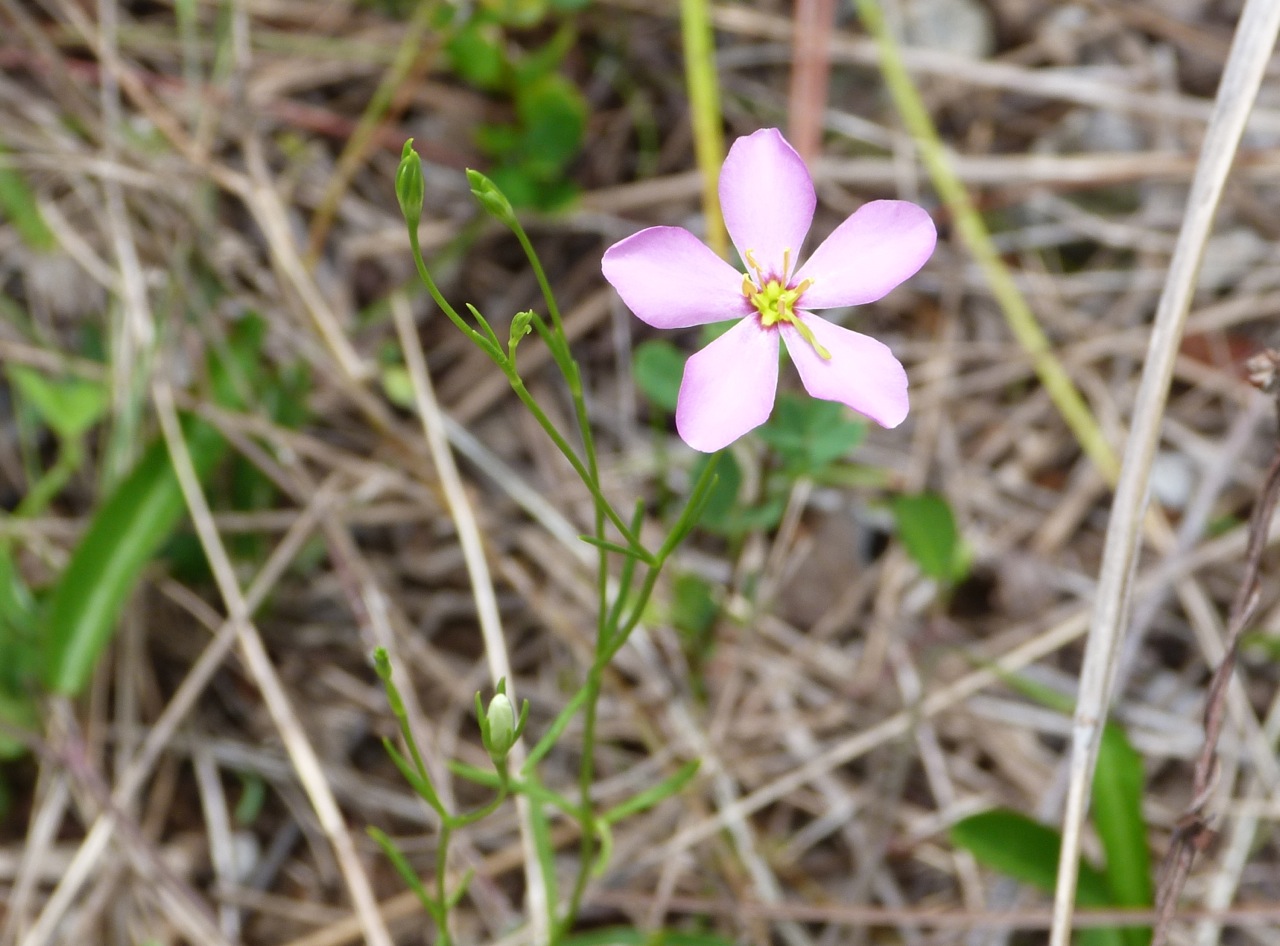
Time to face up. Time for flora. This post has been… er… post-poned several times. When I first started this blog, it was an adventure into the unknown. Basic computer skills. Zero blog experience. Scant knowledge about  much (any?) of the subject matter. Looking back at early posts there is evidence – plenty – of floundering and general incompetence while I gradually learnt more. The birds and other wildlife came quite easily; the flora not so. Apparently I even carry a bunch of flowers in an odd way (opines Mrs RH), under one arm like a rugby ball. Don’t all men? Oh! Just me, then. Anyway, it’s time to try again and brave the land of petal, stamen and pistils at dawn. Here are 20 plants that you will come across on Abaco. Many were photographed at Delphi or in the nearby coppice and pine forest. A couple were in Marsh Harbour, 2 more were at Sawmill Sink Blue Hole. The beautiful Cannas are from Hope Town, with thanks to Abaco Island Artist Brigitte Carey. Some will be known locally by different names – I’d be interested to hear them via the ‘comment’ box.

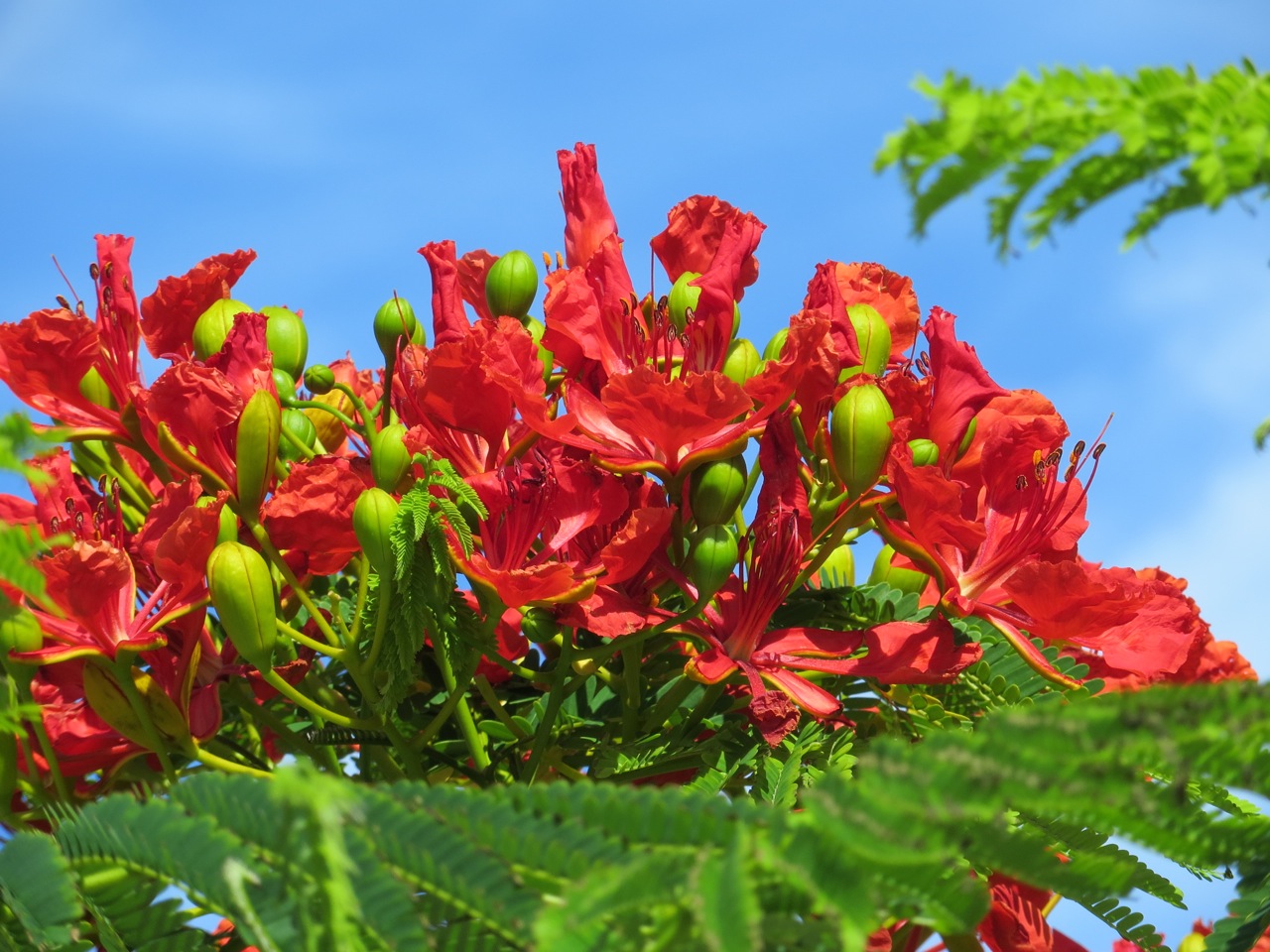
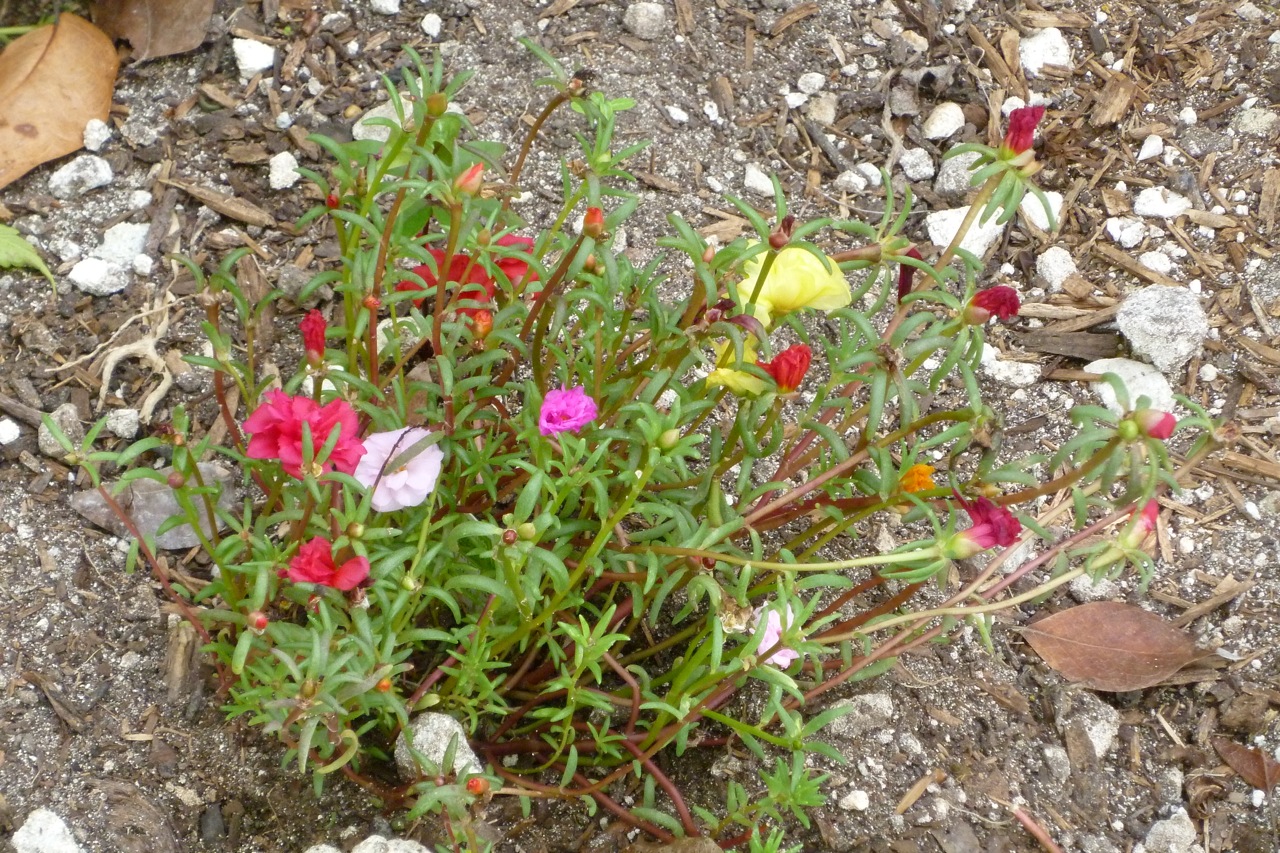
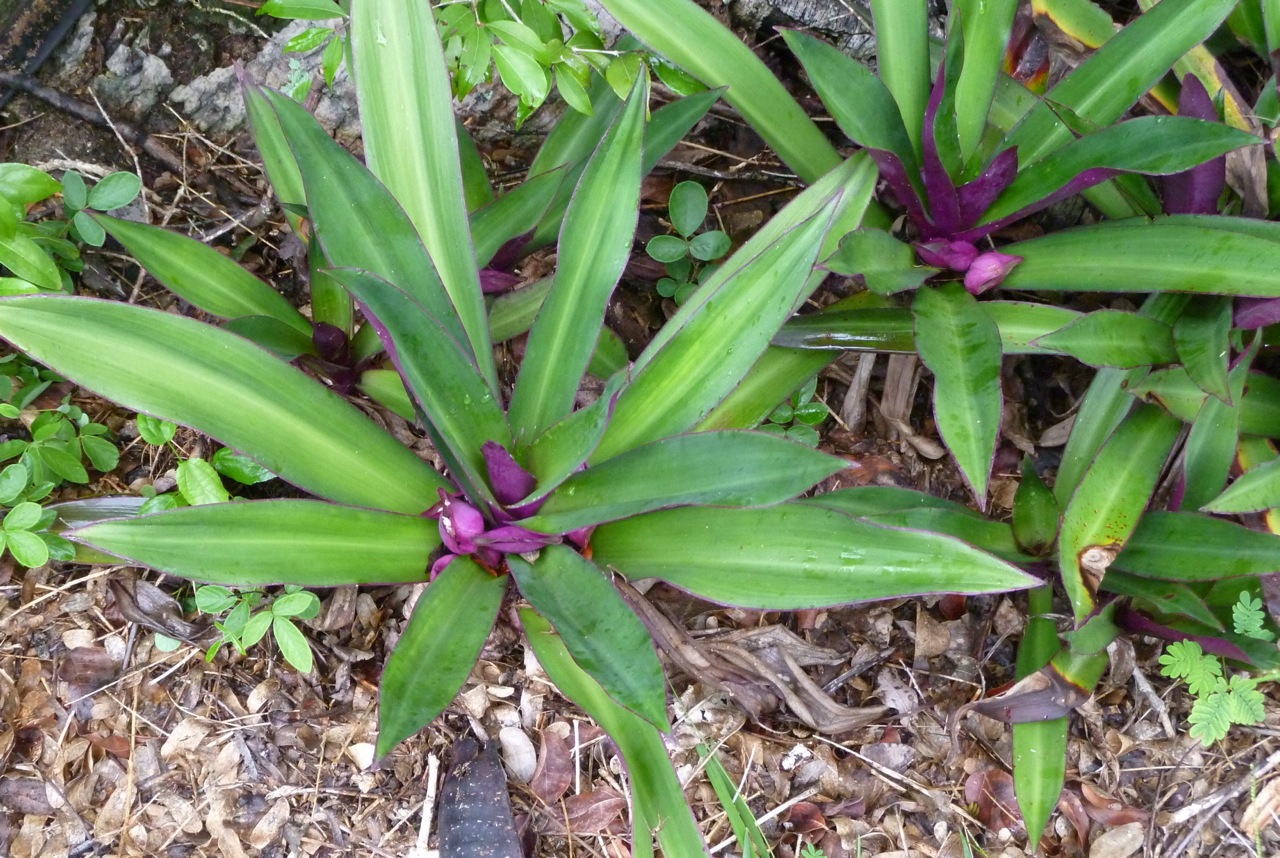
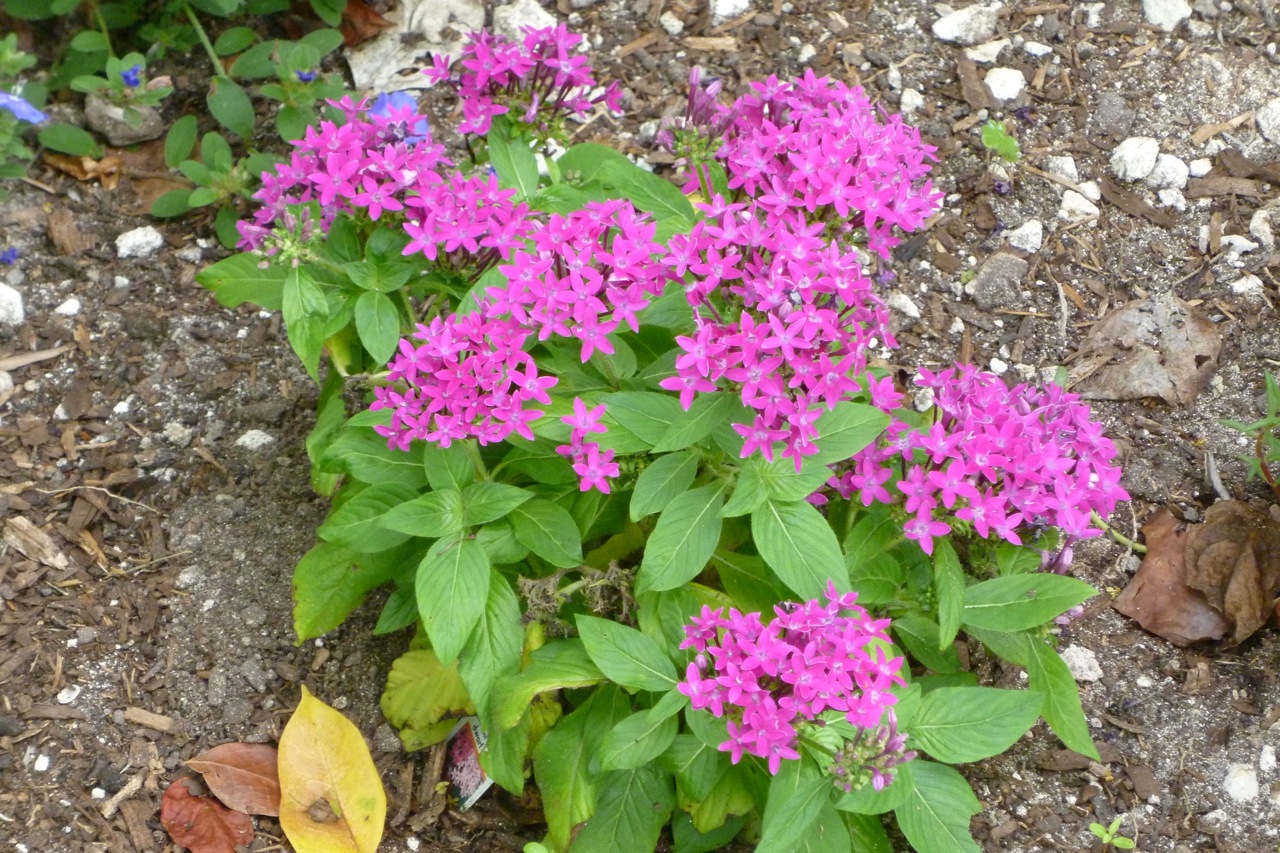
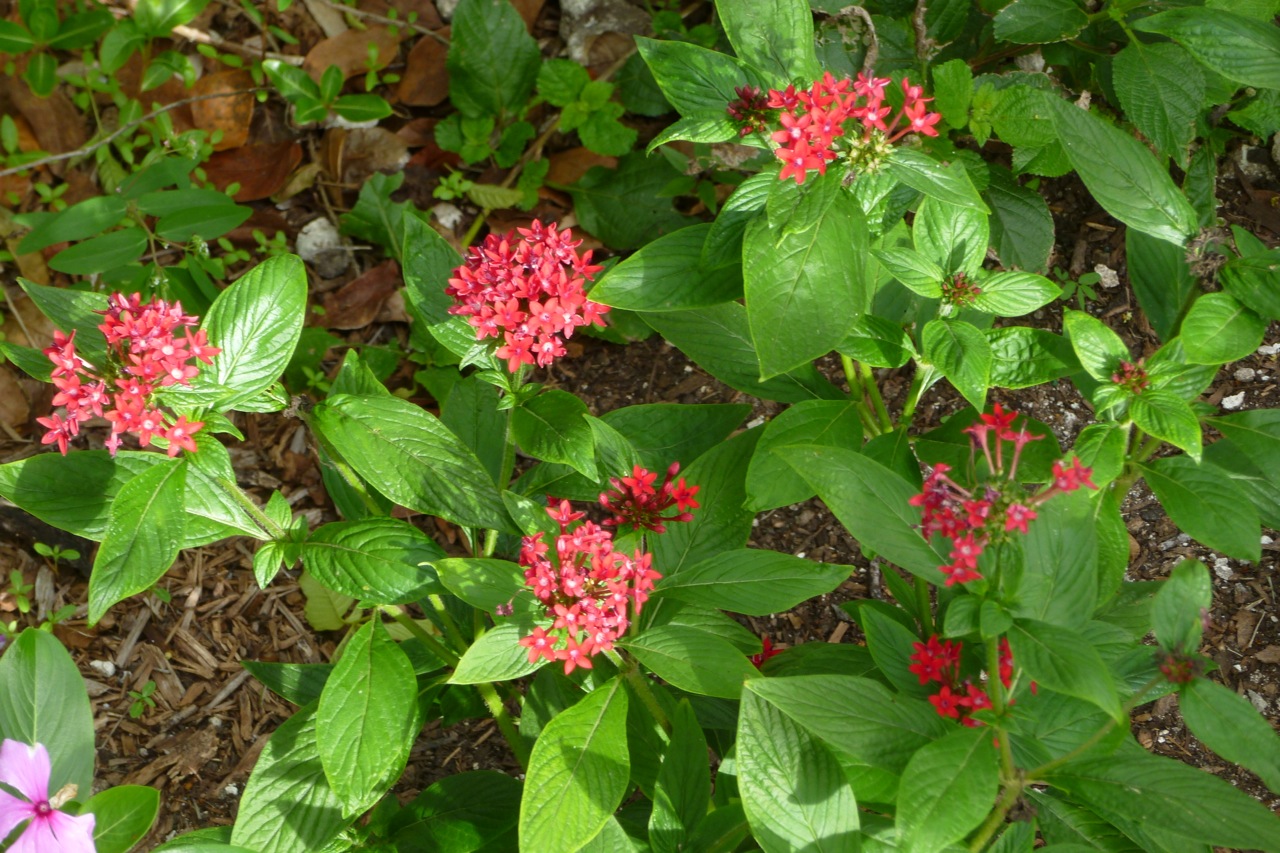
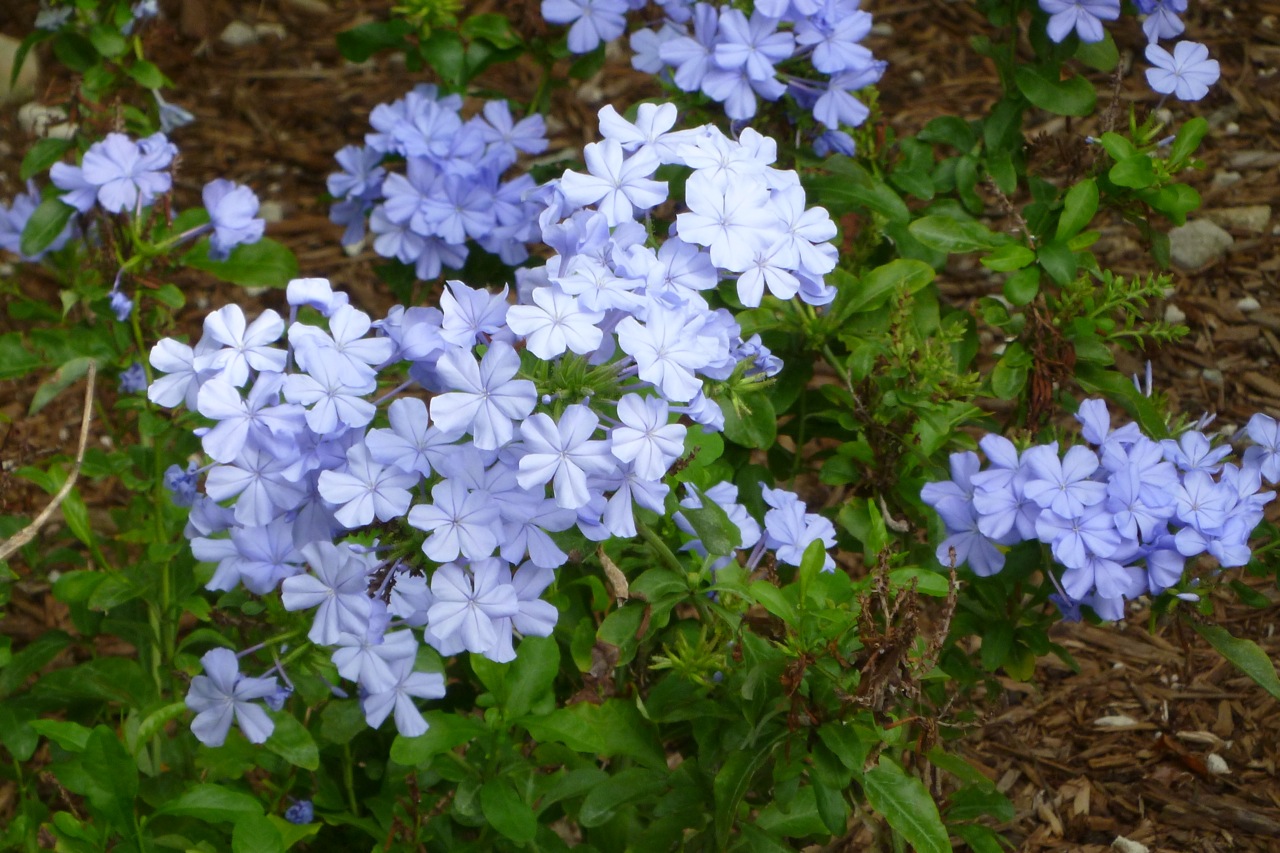
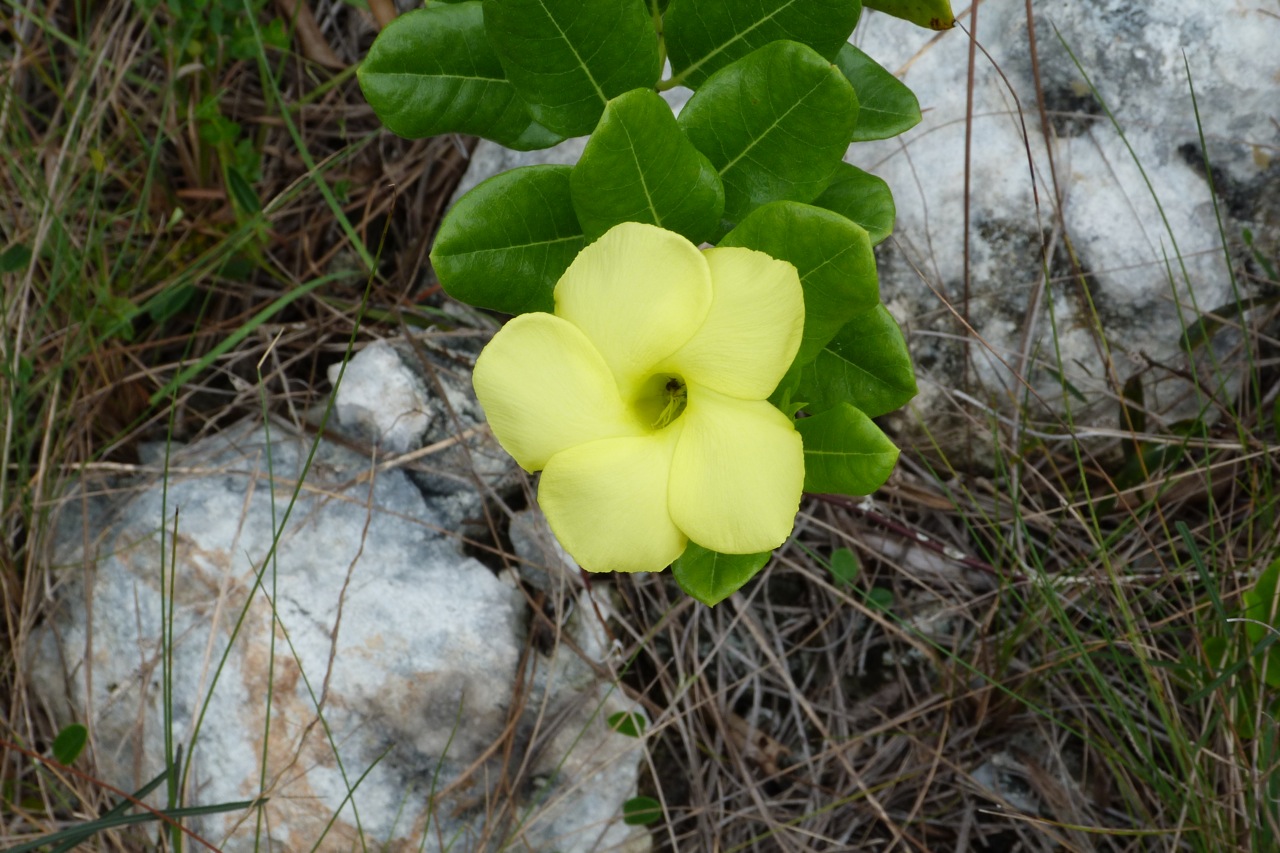
ANGEL’S TRUMPET (Datura Candida) CANNASCOCONUT WHITE FRANGIPANI (Plumeria)YELLOW FRANGIPANI (Plumeria)YELLOW FRANGIPANI (Plumeria)MARSH PINK (Stellatia Maris)MORNING GLORY (Convolvulus)MOSS ROSES (Portulaca)OYSTER PLANTRED HIBISCUSPINK CORAL (FRINGED) HIBISCUSPINK PENTAS (Pentas lanceolata)RED PENTAS (Pentas lanceolata)PLUMBAGO / CAPE LEADWORT (Plumbago auriculata)ROYAL POINCIANA / FLAME TREE (Dolonix regia)SPIDER LILY (Hymenocallis littoralis)THATCH PALMWILD ALLAMANDA (Urechites lutea)BIRD OF PARADISE FLOWER (Strelizia)BANANAS at the Delphi Club

Unknown's avatar

A PRAYING MANTIS – AT LAST, MY VERY OWN MANTODEA PHOTOS…


About a year ago, Sandy Walker encountered a praying mantis at the Delphi Club. For technical reasons his photo(s) of it didn’t work out. Undaunted (and because I’d never seen one outside an insectarium) I turned an essentially non-event into a short post SANDY’S PRAYING MANTIS, in the course of which I learnt a bit about these strange creatures. There isn’t a great deal of compelling information to pass on, to be honest. And I still don’t buy their supposed resemblance (for the sober observer) to Eleuthera.

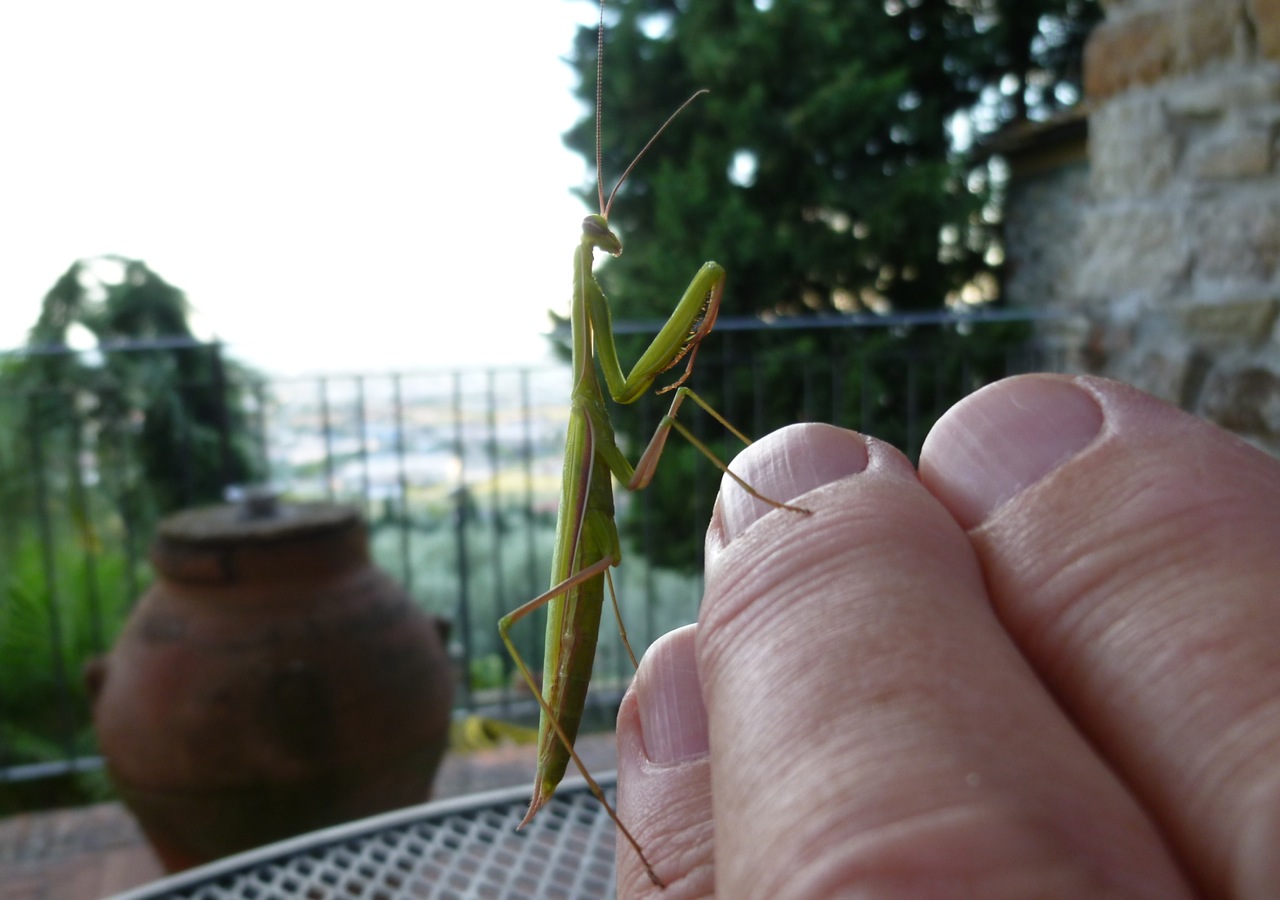
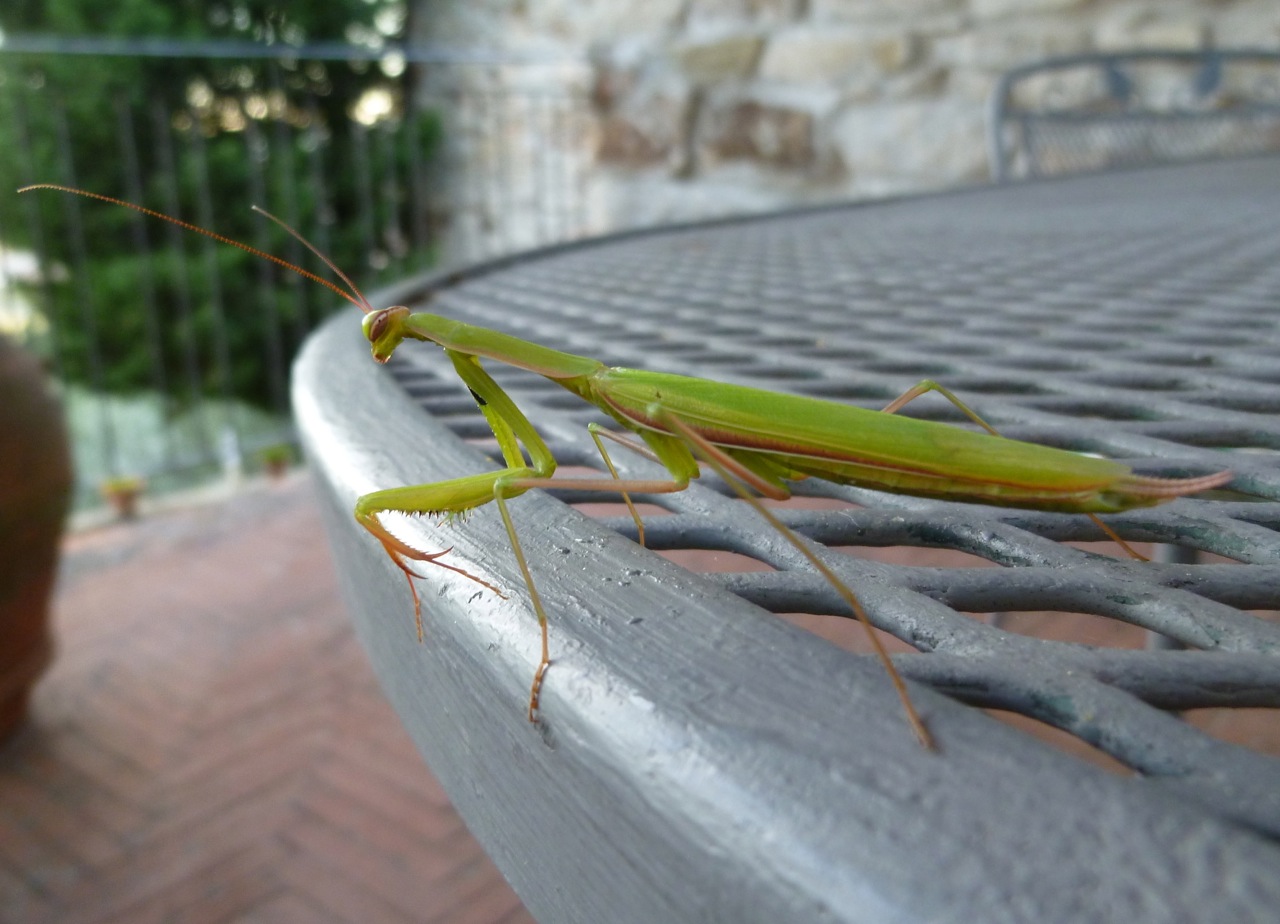
We saw no mantises this summer on Abaco, and I forgot about them completely until a week ago… And there, nonchalantly strolling across an outdoor table where we were staying for a few days in Italy, was the very creature. It obligingly posed for some prayerful snaps, then I put it gently on a balcony railing where it clung upside down and apparently content overnight. It was still there at breakfast, gone by lunchtime, and we never saw it again. But the images live on…*

Please note that the fingerprints in photo 1 are copyright…

Unknown's avatar

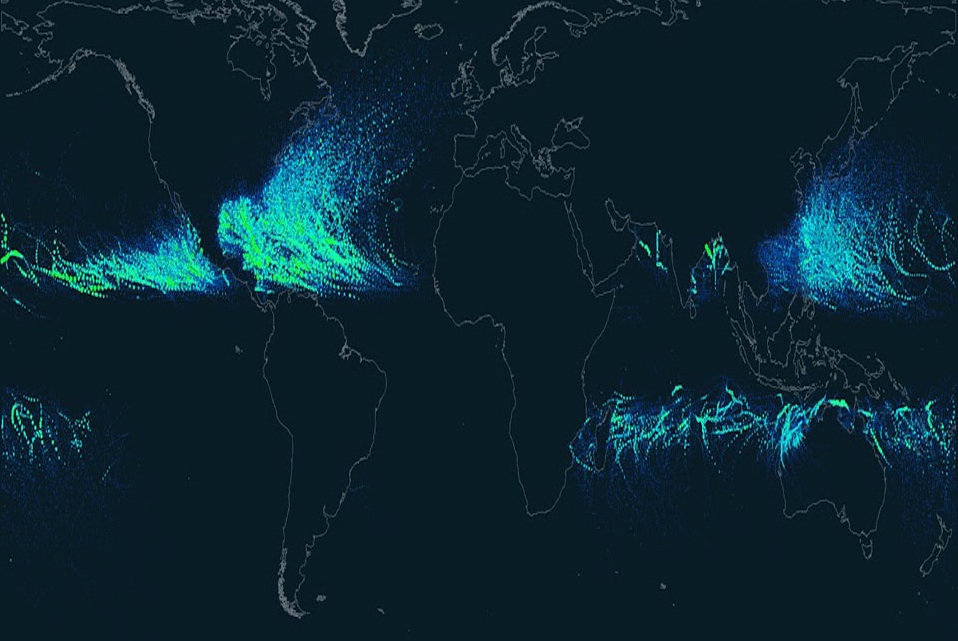
A MAP OF HURRICANES WORLDWIDE SINCE 1851: THE PLANET’S HOT-SPOTS


HURRICANE PATHS ON PLANET EARTH

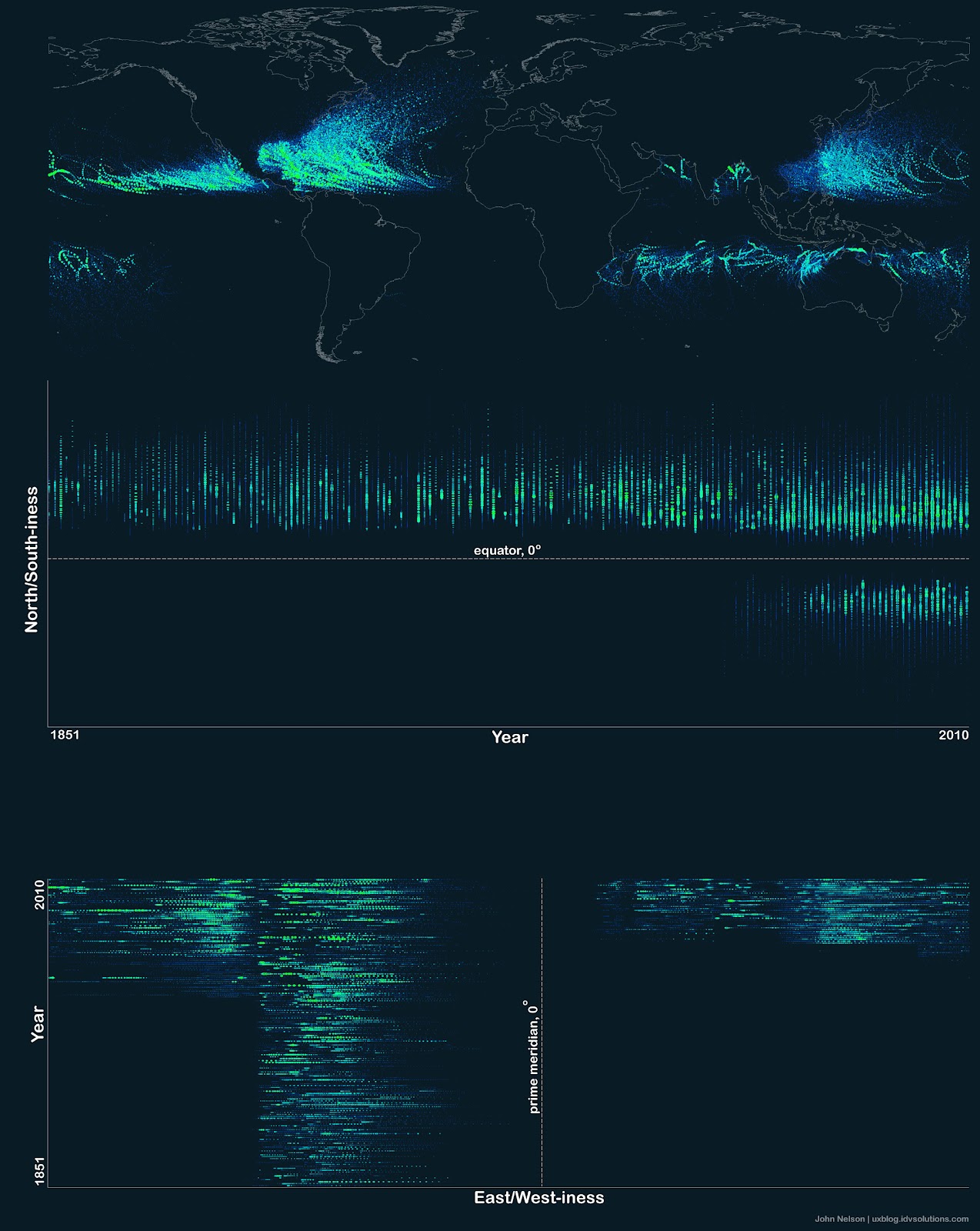
Hurricanes. Extreme weather events that can strike anywhere in the world’s vulnerable zones. But where are these to be found? And in those zones, is there any historical evidence demonstrating that particular areas of the world are more vulnerable than others? A recent post on the very informative ABACO SCIENTIST website includes a comprehensive map of all hurricanes recorded since 1851. This map gives a clear picture of the hot-spots and danger areas. 

Delphi Club Abaco 25 Aug 2011 / Hurricane Irene: Looking south from the balcony

The source is NASA and the article may be found HERE. I reproduce the map and explanation, with acknowledgement to John Nelson and IDV Solutions. Each blue link in the explanation below will take you to a new source of hurricane information, so the article is a valuable resource as a gateway to further hurricane knowledge.

EXPLANATION AND WORLD MAP

“Should you be worried about hurricanes? To find out, it is useful to know where hurricanes have gone in the past. The Earth map shows the path of every hurricane reported since 1851, Although striking, a growing incompleteness exists in the data the further one looks back in time. The Earth map graphically indicates that hurricanes — sometimes called cyclones or typhoons depending on where they form — usually occur over water, which makes sense since evaporating warm water gives them energy. The map also shows that hurricanes never cross — or even occur very near — the Earth’s equator, since the Coriolis effect goes to zero there, and hurricanes need the Coriolis force to circulate. The Coriolis force also causes hurricane paths to arc away from the equator. Although incompleteness fogs long term trends and the prevalence of hurricanes remains a topic of research, evidence is accumulating that hurricanes are, on the average, more common and more powerful in the North Atlantic Ocean over the past 20 years.”

Image Credit & Copyright: John Nelson, IDV Solutions

The eye of Hurricane Irene passes directly over the Delphi Club, Abaco 26 August 2011

The image below was shared on Facebook, but I don’t have the inventor’s name. I’m sorry not to be able to identify the originator of this ingenious hurricane warning. Every home should have one… 

Unknown's avatar

ABACO BANANAQUITS – MORE DISPATCHES FROM ‘CUTE BIRD’ CENTRAL


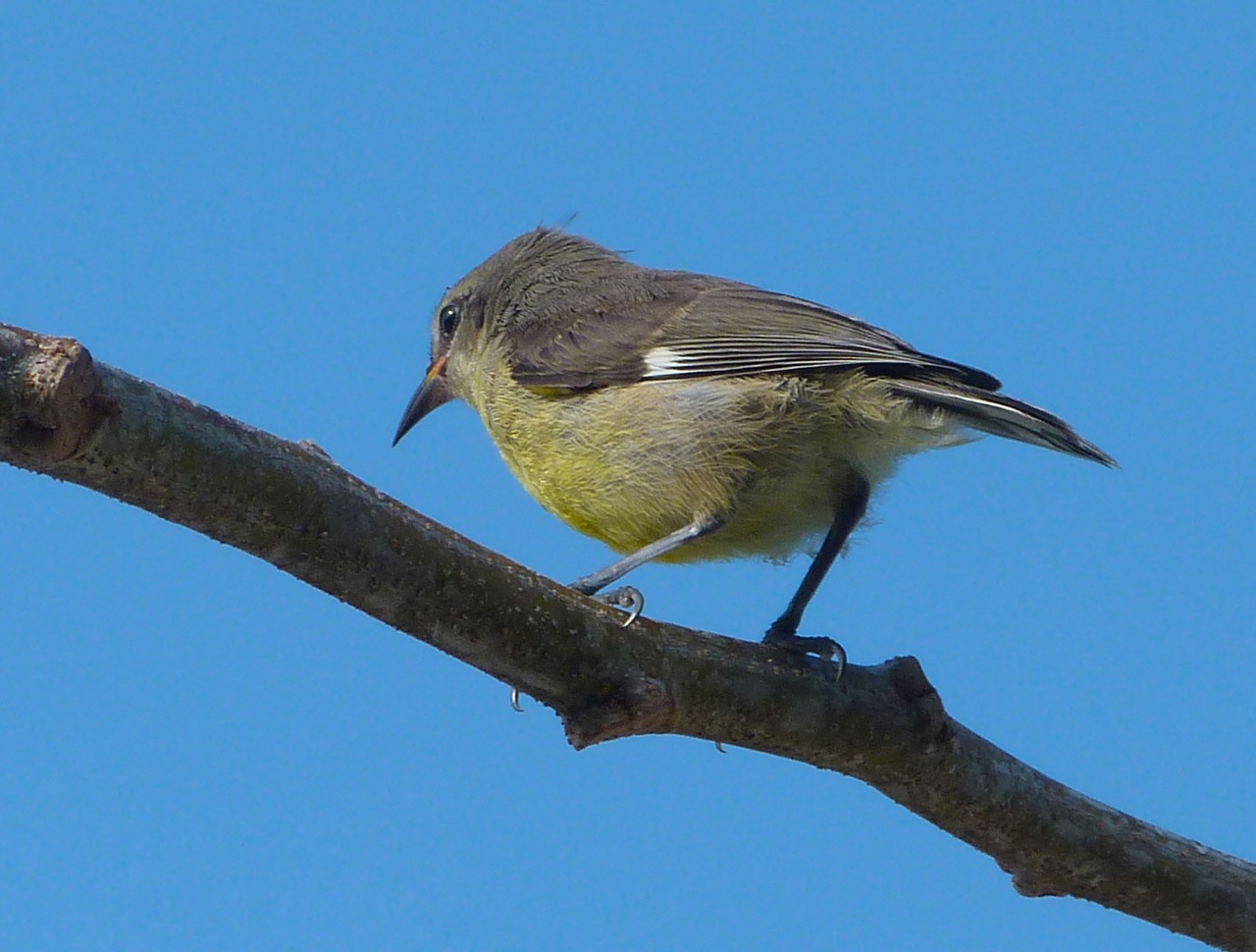
A couple of months back I posted about Bananaquits on Abaco – specifically, at the Delphi Club. I featured images of a recently fledged bird, still with its ‘too big for my face’ orange-based beak. You’ll find other bananaquit information there, including audio of their call. I won’t repeat it all here – to see that post CLICK BANANAQUIT 

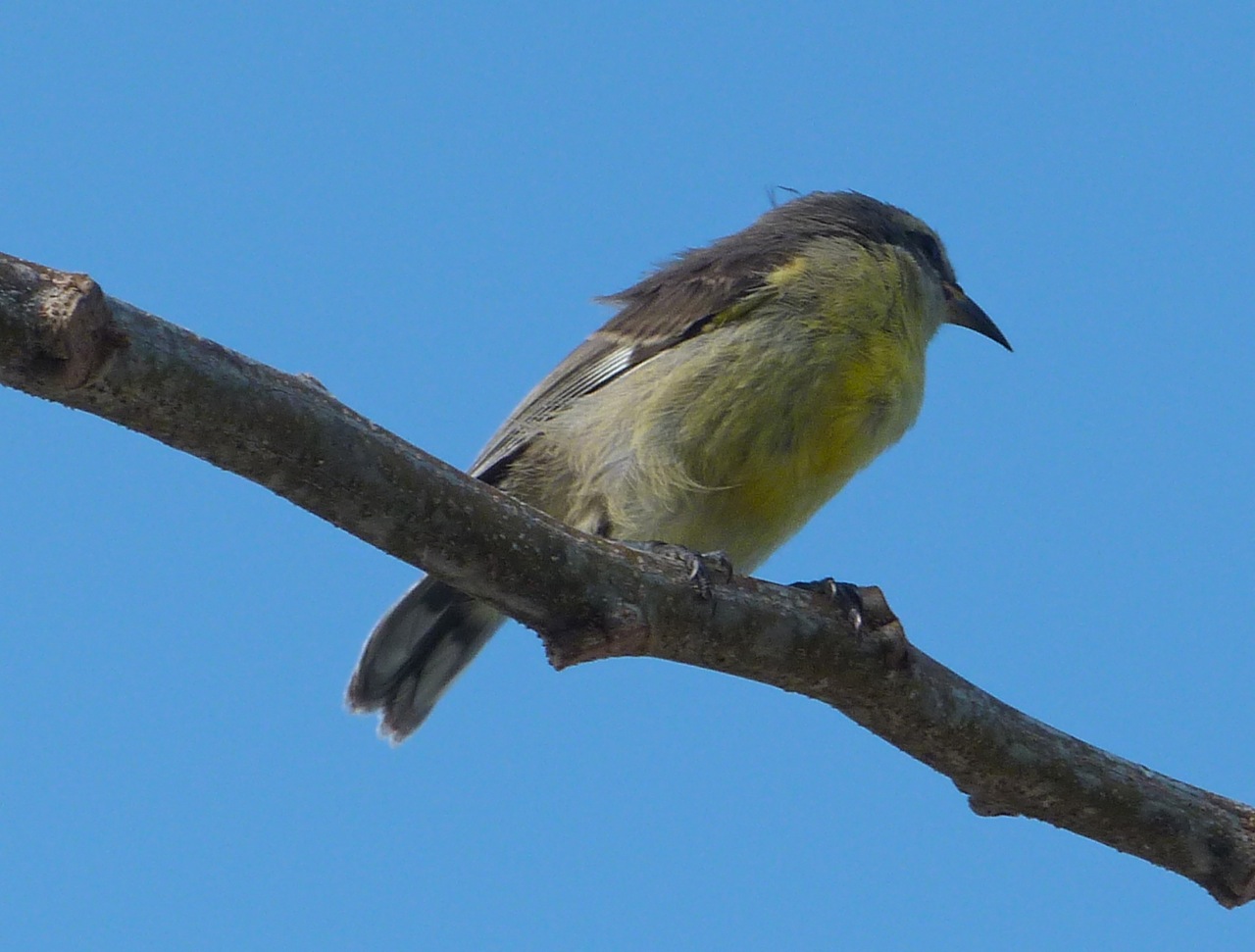
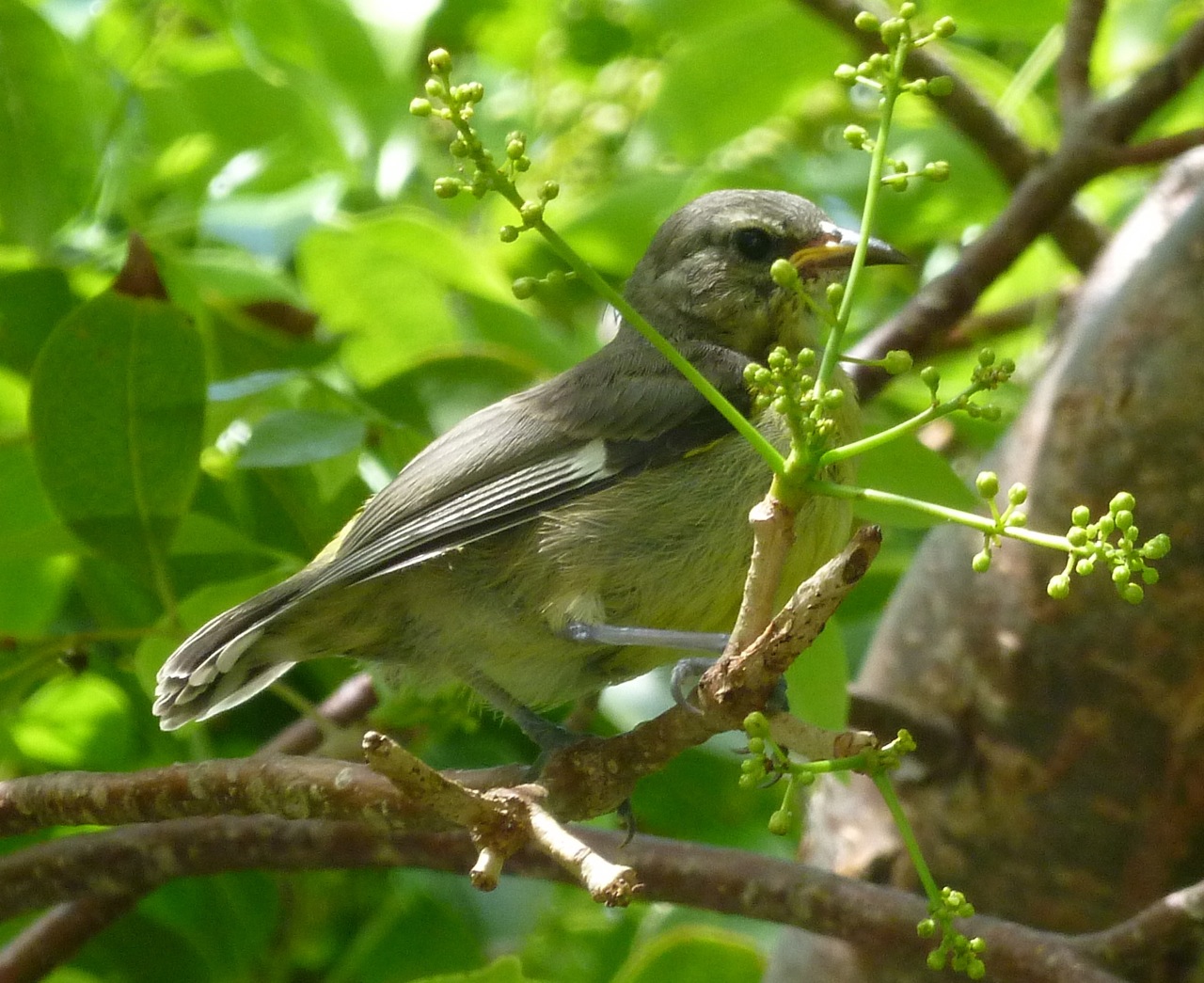
The small bird below looks like a slightly older juvenile – an early teen, let’s say, before the troublesome stage. There’s something very sweet about its feathers. It’s still more like fluff. This one is growing into its beak, which has also lost the very bright orange at the base.

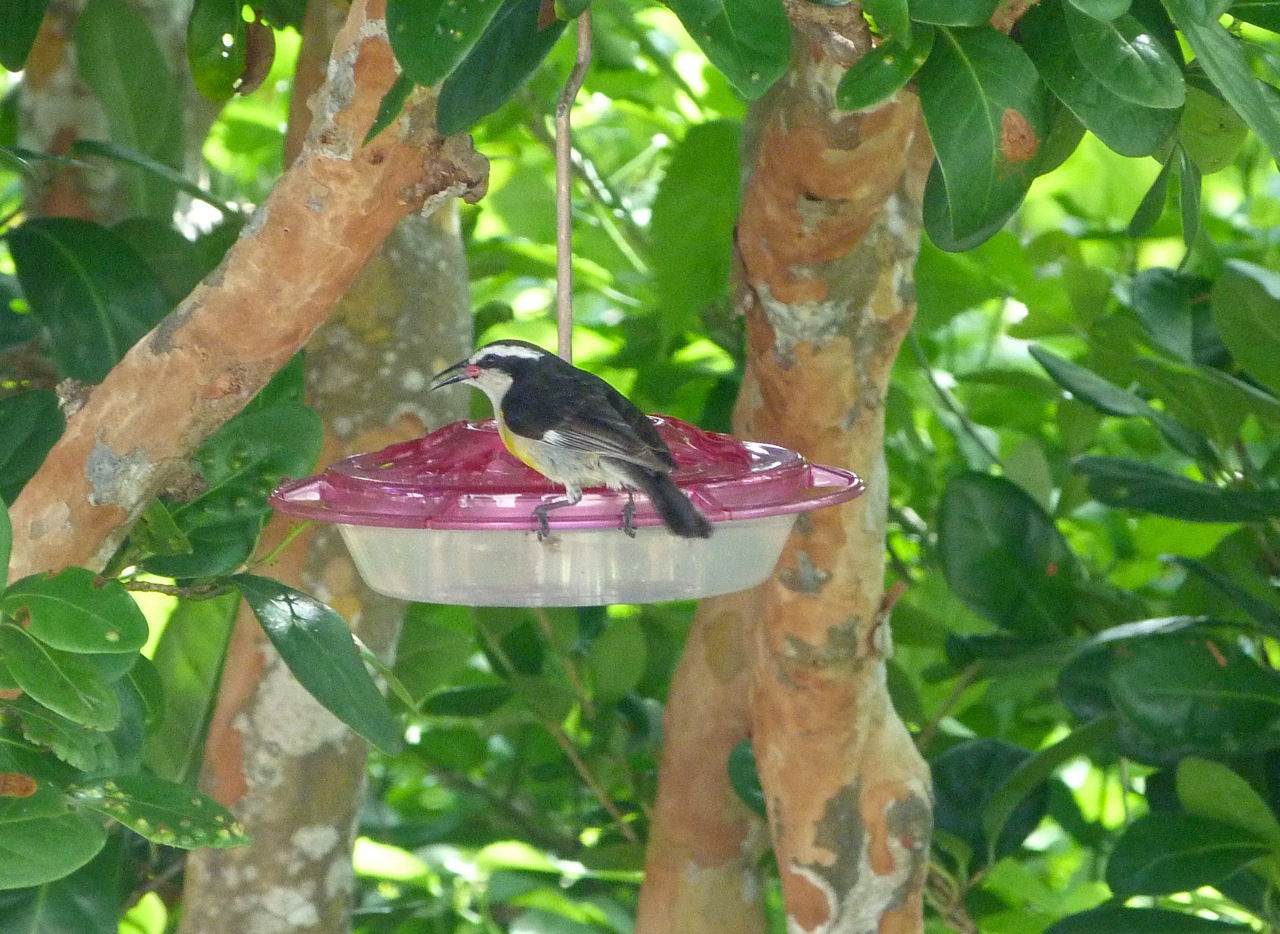
This handsome adult was a regular at one of the feeders at Delphi. The base of its beak is red as opposed to orange (I don’t know the technical term  for this bird part. Is ‘mouth’ too simple? Someone tell me, by all means, via the comment  box). Bananaquits enjoy the hummingbird feeders, which their narrow curved beaks seem to manage. There, they are not pestered by the (very greedy) black-faced grassquits and the larger Greater Antillean Bullfinches who enjoy the other types of feeder available and take priority in the pecking order.

Finally, this bird was a distance shot. At the time, it looked  larger than a bananaquit – more Loggerhead Kingbird-sized. Before I had downloaded the image and could see it clearly, I’d wondered about a mangrove cuckoo. Then I saw at once that it didn’t tick the right boxes. So I decided it must just be a huge bananaquit with an orange rather than yellow front. If it’s anything else (a rare hybrid spindalisquit?), please say so!

Unknown's avatar

STORM AT ROLLING HARBOUR, ABACO JUNE 2012


STORM AT ROLLING HARBOUR, ABACO JUNE 2012

Well, it’s a shame that in my homespun way I had to press ‘Publish’ when I meant to press ‘Preview’. I just wanted to check if these stills from a video of a massive storm over the Delphi Club at 3.00 a.m. one June night might be worth putting up. This item was for ‘in due course’ and not for now. I’d just decided that they aren’t really worth it, when I realised what I had done. So I may as well go ahead with it… Apologies to all those who are signed up and have got an email just saying “STORM”. I’ll have a word with the management.
Now that this gallery is out there, I should add this storm raged and rumbled for much of the night, with some spectacular rain, lightning and thunder – standing on a balcony watching it was quite an experience. At times the whole bay was momentarily as bright as day. Even brighter. Anyway, here’s the ‘before, during and after’ of a fork lightning bolt. I can’t make out if it’s true that lightning starts at the bottom, but I think it may be sky and earth near-instantaneously.

An informative ‘basic primer’ about lightning can be found at the National Severe Storms Laboratory (part of NOAA) CLICK===>> NSSL/NOAA

This slideshow requires JavaScript.

Unknown's avatar

TULIP SHELLS & SUNRISE TELLINS: MORE BEACHCOMBING TREASURES FROM ABACO


TULIP SHELLS & SUNRISE TELLINS: MORE SHELL TREASURES FROM ABACO

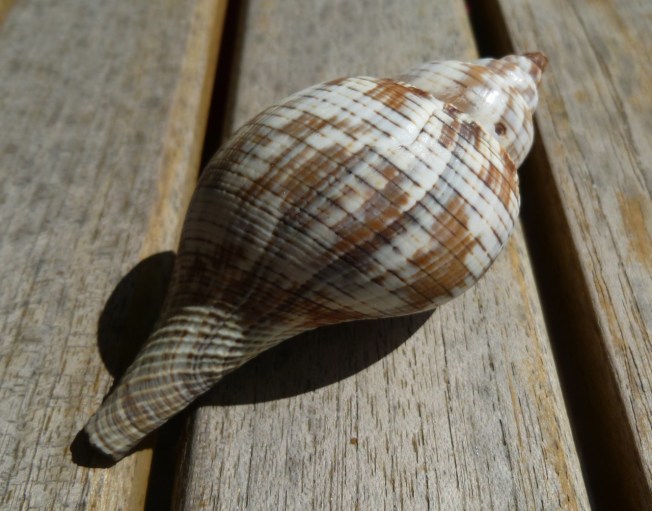
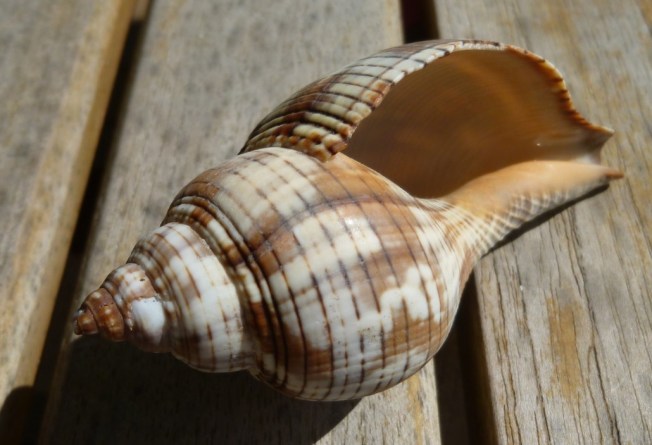
Here are two contrasting shells from the Delphi Club collection that has been haphazardly accumulated over the last 3 years or so. The first post in this shell series was about SEA URCHINS & SEA BISCUITS

TULIP SHELLS Fasciolaria tulipa

The term ‘Tulip snail’  includes 3 related species of sub-tropical gastropod worldwide, of the genus Fasciolaria. They are medium-sized predatory molluscs that breed throughout the year in warm waters. Their reproductive lives deserve some attention, if they will pardon the intrusion. 

Research by the Smithsonian Marine Station Fl. reveals that the male’s penis is to be found on the right side of its body, directly behind its head… When they mate the (larger) female stays in an upright position on the sand while the male ‘flips over’ to align the apertures of both shells, before inserting the penis into the female (RH comment: the research is not specific about precisely where the female keeps her own genitals). Once joined, snail pairs may remain locked together for up to 2 hours, even when being watched by researchers. They have plenty of stamina: mating may occur several times in one season, and individual tulip snails have been observed to mate up to 3 times in a single week. Respect!

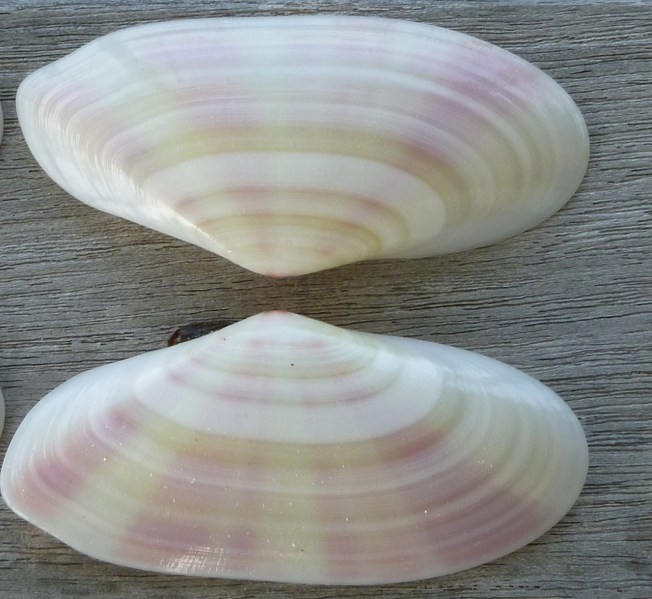
SUNRISE TELLINS Tellina Radiata

I included these pretty shells, with their striking pink radials, in an earlier post BEACHCOMBING BIVALVES The ones shown here are larger specimens. The hinges (muscles) are very delicate, and in these shells the two halves of the shells have separated. STs are not uncommon, but these are the largest I have come across (I realised after I had taken the photos that I should have used a coin for comparison…). They grow up to about 7 cms, and  these ones were that length, or very nearly so.

I can’t assist with their sex lives I’m afraid, which may well be completely conventional, dull even. However, as I discovered when I previously researched these shells,  “in most countries it is illegal to bring back these shells from holidays”. To which I can only repeat my comment: Whoops!

Unknown's avatar

SEA URCHINS & SEA BISCUITS – BEACHCOMBING TREASURES ON ABACO


Sea Urchin Delphi Abaco 2

SEA URCHINS & SEA BISCUITS – BEACHCOMBING TREASURES ON ABACO 

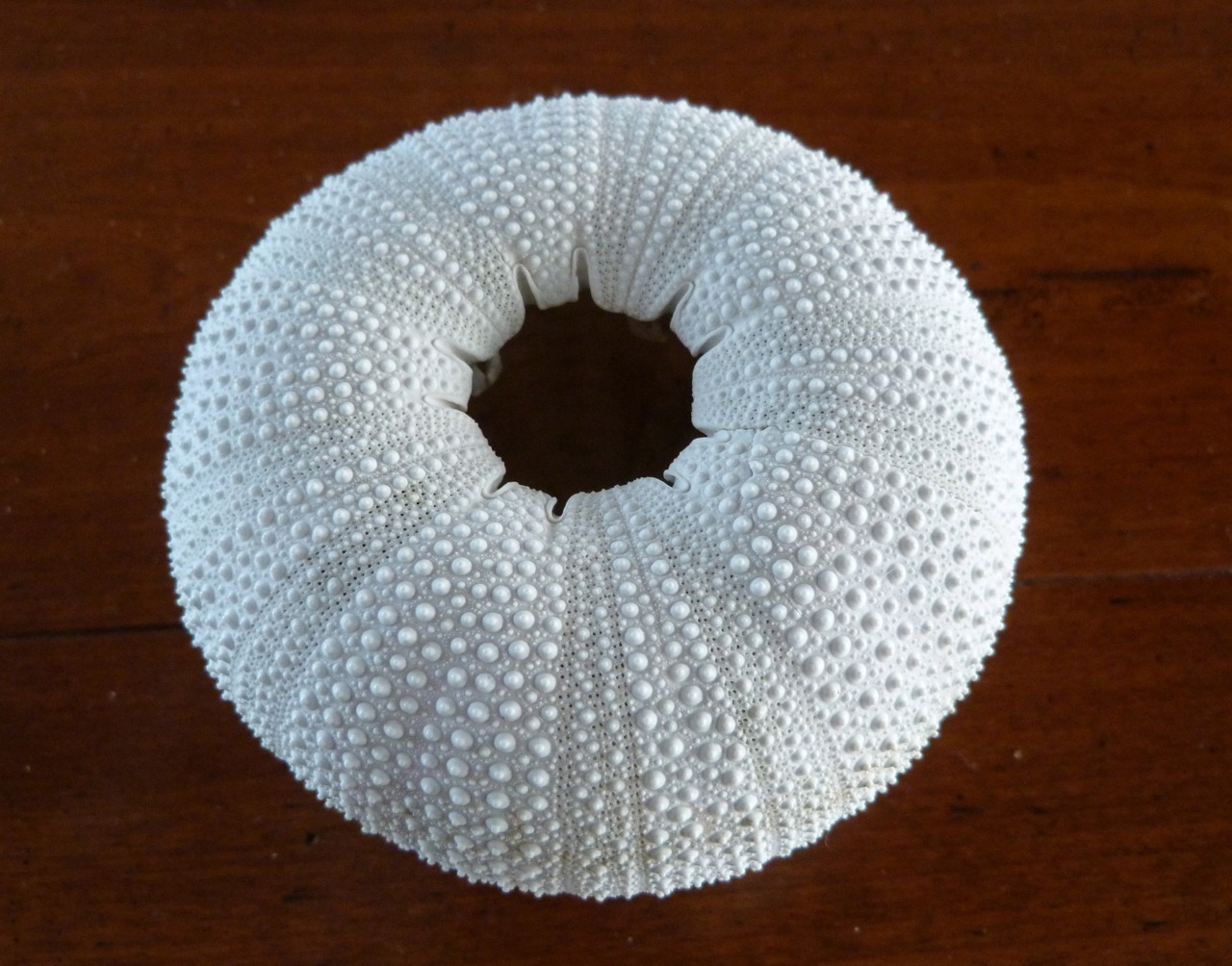
It’s time we had some more shells and other beach treasures on these pages. In the absence of star Abaco beachcomber and blog-contributor KASIA I have taken a closer look at the Delphi Club collection. This has been casually accumulated by the Club, its members and guests during the past 3 years whenever a good specimen has been encountered, and is displayed in the Great Room. The first items to catch my eye were the ECHINODERMS, a family that includes sea urchins, sand dollars, sea biscuits and star fish. Their sun-bleached tests are often found, though in my limited experience the larger they are, the rarer.  The link above is to the Wiki-blurb, which has the unpromisingly daunting heading  “This article may be too technical for most readers to understand…”. Now there’s a challenge!

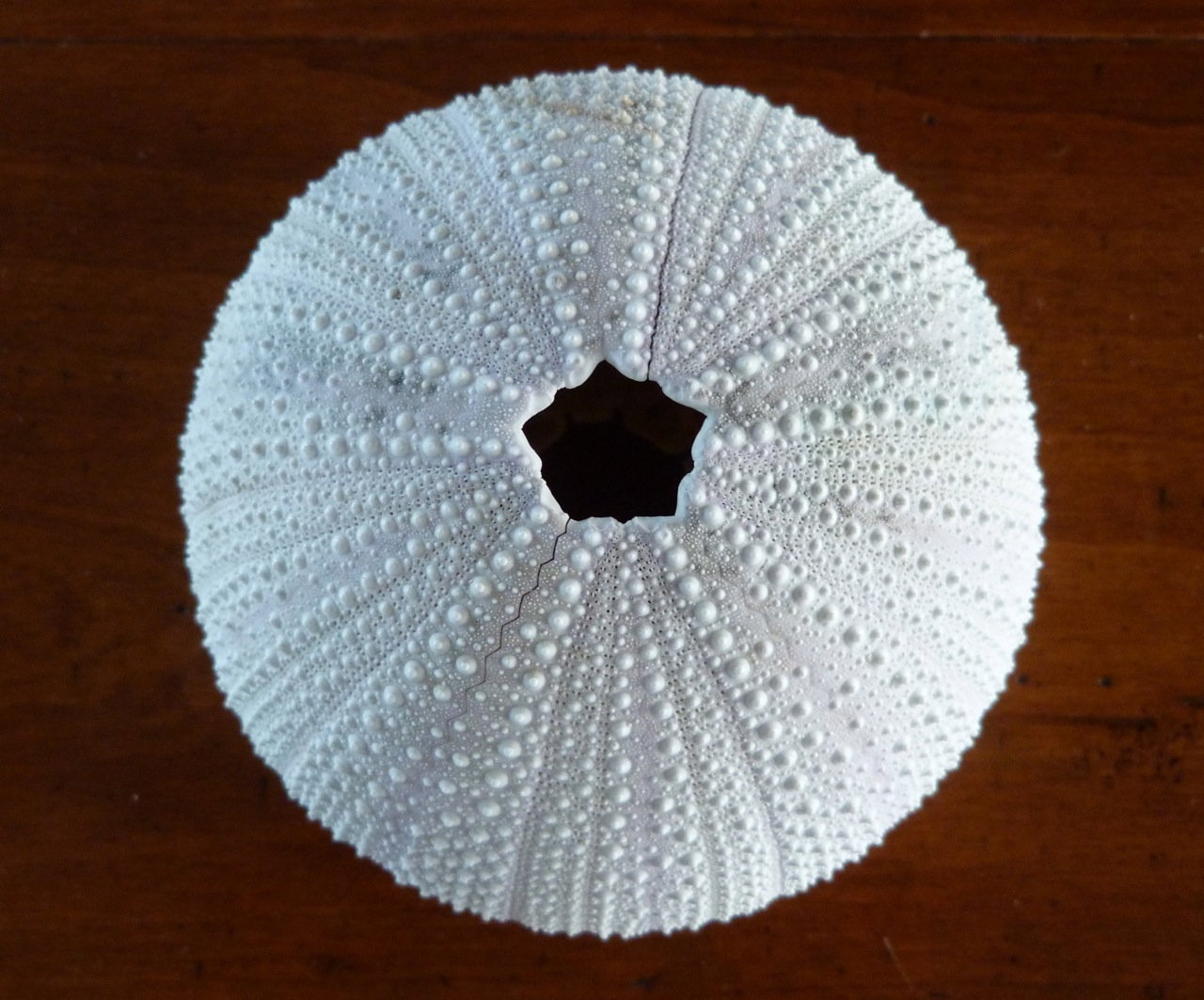
First up is a very large SEA URCHIN, a thing of great delicacy and fragility that weighs next to nothing. I have never seen a bigger one. Looking at the fine detail, it is hard to believe that such perfection of symmetry and intricacy can exist in a creature so very painful to tread on. 

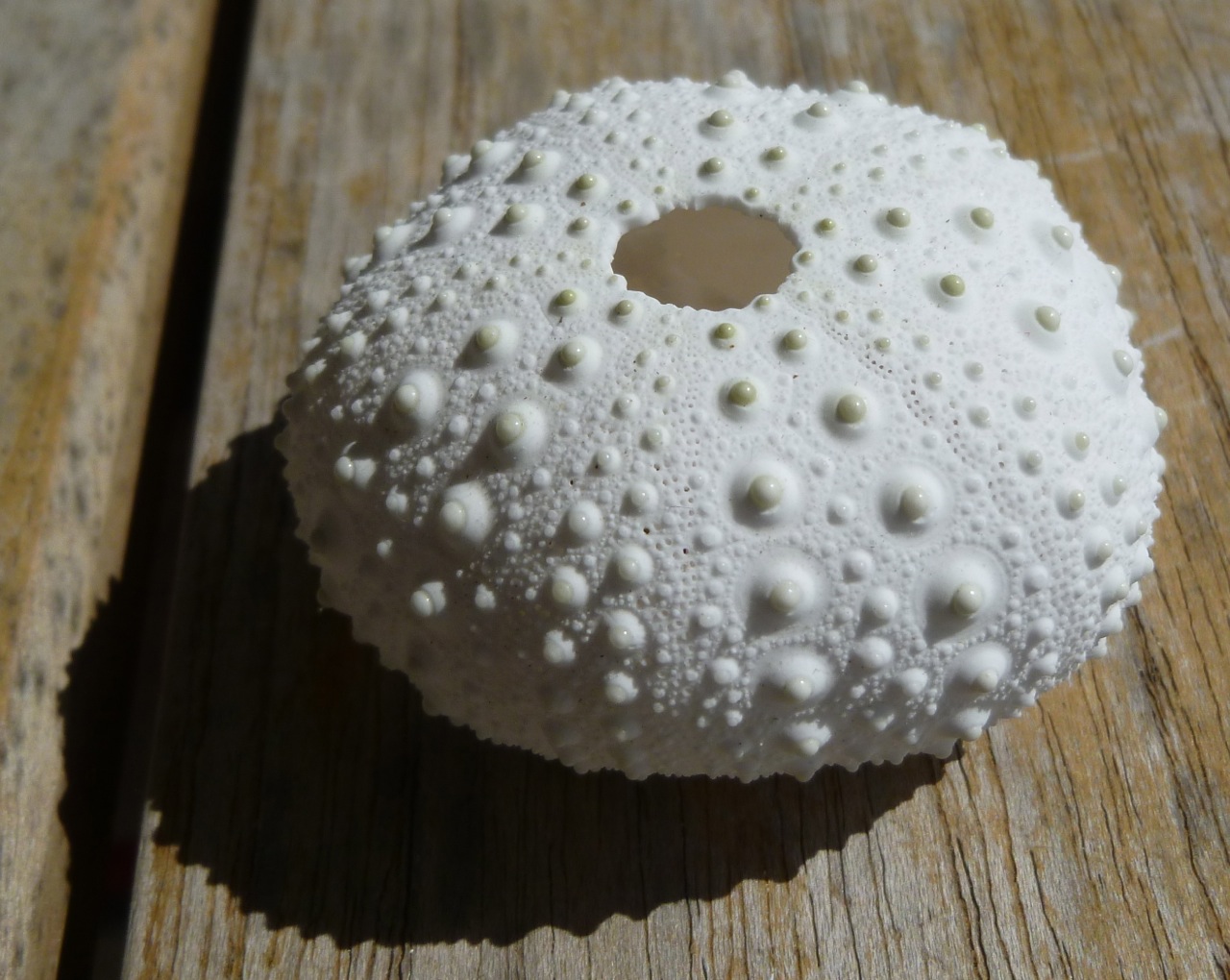
This SEA URCHIN is smaller, with more prominent nodules and a much more random pattern – reminiscent of a cartoon of some distant white planet. It has cast a fine knobbly shadow.

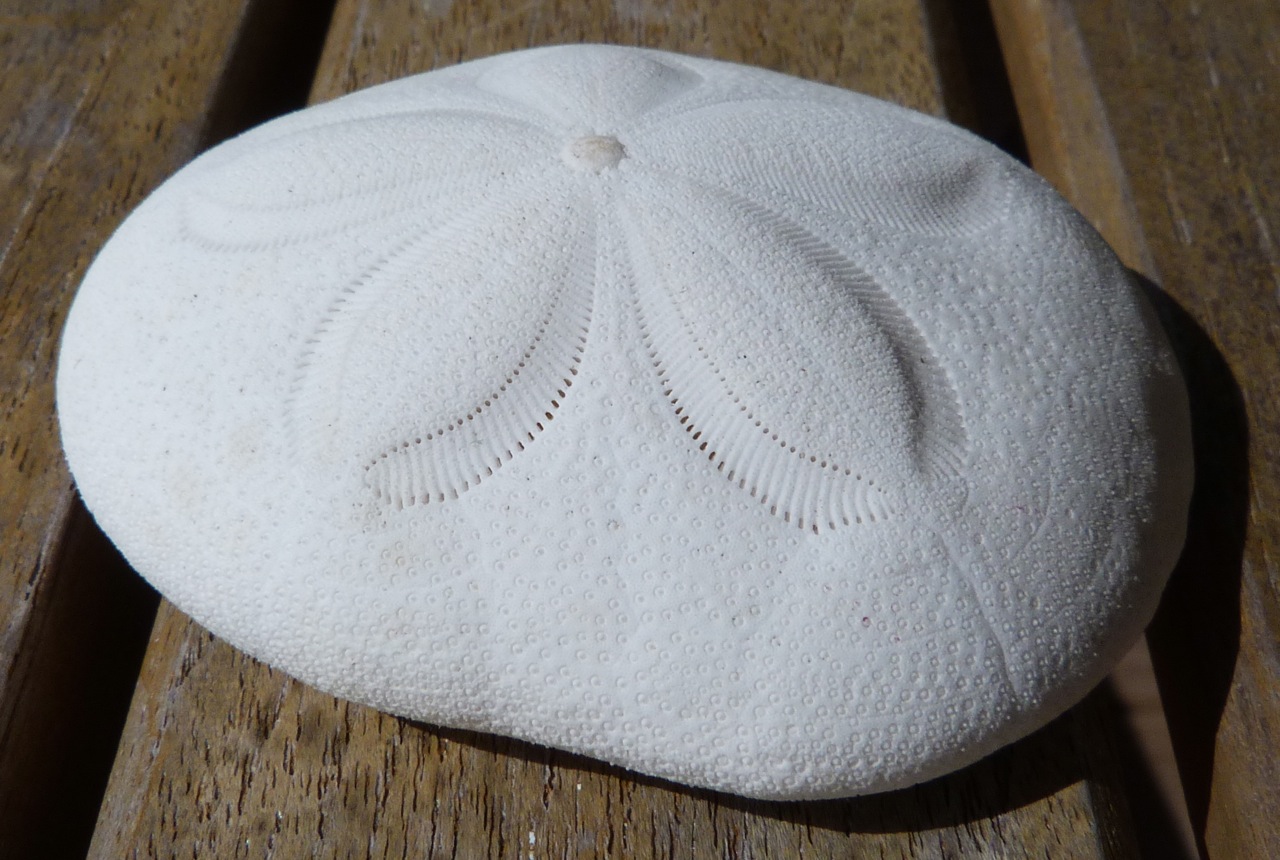
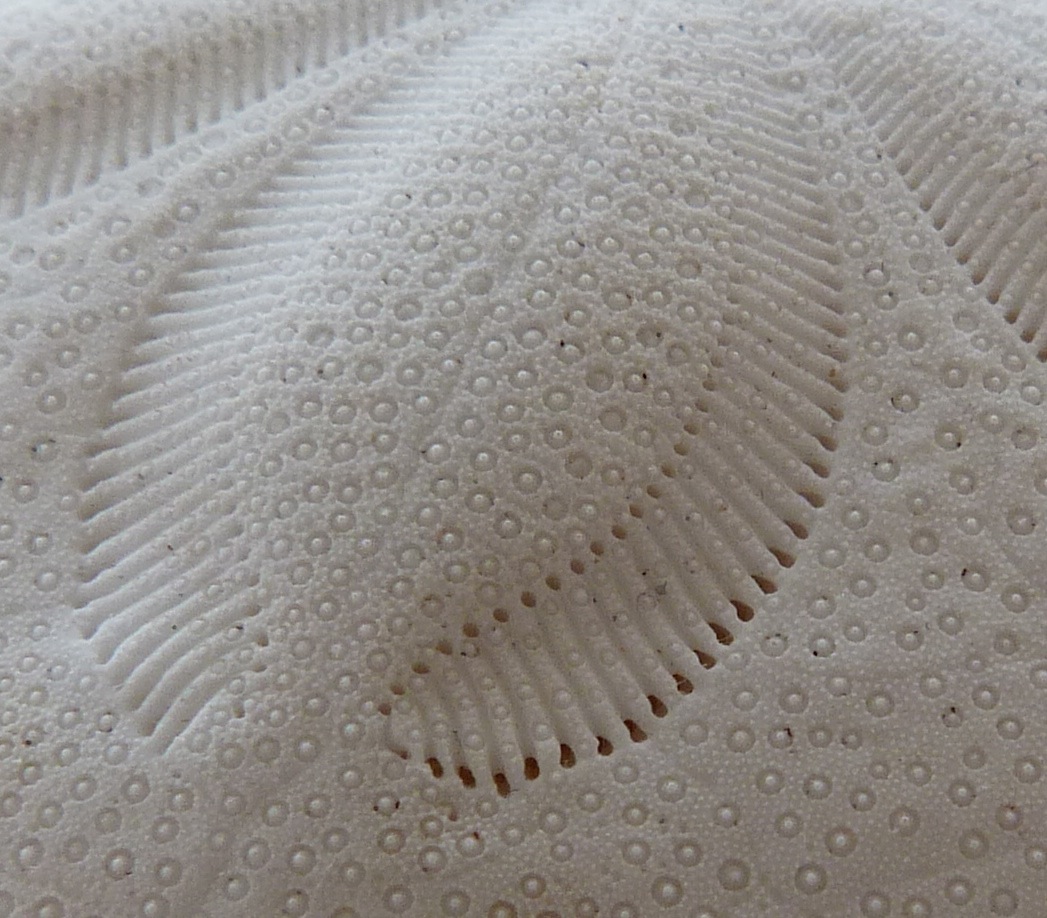
SEA BISCUITS have similar five-way symmetry to their first cousins SAND DOLLARS but are generally pebble-shaped rather than disc-shaped. I have included 2 close-ups to show the fine details of the pattern – almost like lace-work

This SEA BISCUIT is a different type, with the 5 radials reaching right round it. For some reason it only has 4 and not 5 small holes (as one might expect) at the centre. Unlike SAND DOLLARS they tend to be more oblong than round.

Unknown's avatar

STIMULATING CURIOSITY IN ABACO: DELPHI CLUB’S SMALL PART OF THE MARS MISSION


One of the first colour images from the Mars rover Curiosity – a composite panorama 9 August 2012 (NASA)

STIMULATING CURIOSITY IN ABACO

THE DELPHI CLUB’S PART OF THE MARS ROVER MISSION

One of the first images from Mars

CURIOSITY landed on Mars today. This is the best chance yet of answering Ziggy Stardust’s rhetorical question “Is there life on Mars?”, and doffing an astronaut’s helmet to space pioneer Major Tom along the way… Assiduous readers of the blog will both recall that a while ago, the Delphi Club was privileged to be involved in a small part of the ‘Curiosity’ Mars Rover project. It’s a prime example of what one might call “extreme beachcombing…”

“One small part for a space program, one giant chunk of junk for the Delphi beach…” (S Walker)

Here are the links to the 3 short illustrated reports (rockets, boys!) in this blog from early 2012

1. ABACO BEACHCOMBING: MYSTERY OBJECT FROM THE DELPHI CLUB BEACH HERE 1 

The discovery by Sandy Walker of the item above on the Delphi Club beach, Abaco: 12 feet of conical mystery

2. ‘SO LONG, ARIANE’: FROM ROCKS TO ROCKETS ON THE DELPHI CLUB BEACH, ABACO HERE 2 

News of a positive ID by serial number as rocket débris from the Mars Program Curiosity Rover launch

3. BEACHCOMBING ‘CURIOSITY’ ON ABACO: OUT OF THIS WORLD TO THE RED PLANET HERE 3

Confirmation of this item as part of the booster rocket fairing of the Altas V rocket used to launch Curiosity in Nov 2011 

◊  ◊  ◊  ◊  ◊  ◊  ◊  ◊  ◊  ◊  ◊ 

The episode had a slightly bathetic ending. Initial lack of official interest in the cone, which I personally hoped could then be planted deep in the coppice or pine forest for future generations to discover and wonder about, suddenly changed. In due course a team of astro-science persons (in a large black truck and white protective suits, I’d like to believe) came and took it away. This forestalled my other idea: cutting it up into hundreds – or thousands –  of small pieces and selling them on eBay (possible in aid of the Abaco Parrots). A 12 foot cone of gleaming heat-resistant secret Abaconite space material. 5000 tiny pieces @ $100 each… Hmmmmmmmmm

Here are some links to play with

OFFICIAL MARS EXPLORATION PROGRAM SITE

WIKI-DETAILS

(Oh come on, admit it, you enjoyed those just a bit?)

Credit NASA / Telegraph


Unknown's avatar

PINEAPPLES: SYMBOLS OF WELCOME & WEALTH (ALSO, DELICIOUS)


PINEAPPLES – A SHORT BUT FRUITY HISTORY

This post is intended in part as a celebration of passing the 50,000 hits mark today. So much interest in the wildlife of one small island – thanks to all those who have visited during the last year or so

The first image below is of the handsome locally hand-carved pineapple that surmounts the roof of the Delphi Club, Abaco. The fruit lost a few leaves in Hurricane Irene last August, which scored a direct hit on the Club. As posted on the ABACO FACTS page (under RANDOM main menu) “the precise Longitude & Latitude coordinates of the Pineapple [on] the Delphi Club roof are respectively 77.1787834167480  &  26.20450323936187 “. But why is it there? Time for a Short Voyage around the Pineapple…

PINEAPPLE FACTS TO ENLIVEN YOUR CONVERSATION

HISTORICAL & SOCIAL CONTEXT

  • Brought back to Europe by Christopher Columbus in 1493 on his return from his second voyage
  • Taken on long voyages as a protection against scurvy and because of its long life
  • By the c17 royalty & aristocracy grew them in hot-houses (or rather, their gardeners did). King Charles II tried one, an event so important it was recorded by the Court painter Hendrik Danckerts 
  • By c18 considered a great delicacy and a status symbol of wealth, often the centre-piece of a feast.
  • If you couldn’t afford to buy one, you could rent one and return it afterwards. Someone richer than you would then buy it.
  • Pineapples were grown in pits of fermenting manure. In England Queen Victoria was not amused and soon put an end to that unpleasant nonsense
  • In the c19 pineapples were one of the most significant exports from Abaco
  • The Earl of Dunmore built a huge pineapple folly in Scotland in 1761, which you can stay in (We have. It’s a lot of fun)


CULTURAL SYMBOLISM

  • Pineapples symbolise welcome and hospitality, placed at the entrance to villages or plantations. The tradition spread to Europe where they were carved as gateposts; staircase finials; and incorporated into wooden furniture (including bedposts at the Delphi Club)

  • Seafarers put pineapples outside their homes on their return to show that they were back from their travels and ‘at home’ to visitors
  • An expensive fruit to grow & to transport; remained a luxury until the arrival of steamships
  • Their costliness made them status symbols / indicators of wealth and rank. Displaying or serving pineapple showed that guests were honoured
  • In the 1920s the grandest dinners apparently needed both “a pineapple and Lady Curzon” (I have been asked whether this is Interwar Period code for some sort of disreputable activity… I need to check)
  • The future Queen Elizabeth was sent 500 cases of canned pineapple as a wedding present from Australia. She asked them “Hev you come far?” Prince Phillip’s reaction was – apart from the word ‘pineapple’ – unprintable
  • In the play Abigail’s Party (Mike Leigh) pineapple chunks on cocktail sticks were used as a plot device to highlight the desperate social ambitions of a hellish hostess trying to impress & outclass her guests
  • A 1930s ad promised that by baking a pineapple pie a wife would make her man “smack his lips in real he-man enjoyment” (NB This may not work so well in the 2010s) 

By Appointment to HM the Queen

ARTS & CRAFTS

  • Used on Wedgwood pottery designs as early as the 1760s; others soon followed suit
  • Became widely used decoratively as a motif for gateposts, weather vanes, door lintels, wallpaper, table linen & curtains, and incorporated into furniture
  • Featured in still life paintings as a crowning example of opulence


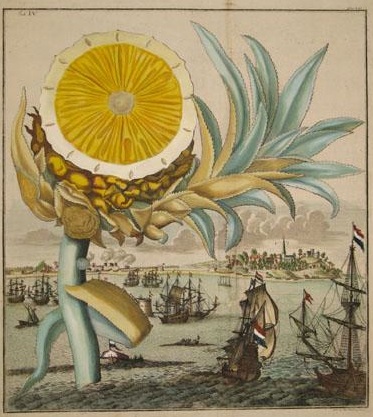
  • Depicted in plant and fruit studies, for example these by Johann Christoph Volckamer, very early c18        
  • Featured in music e.g. Pineapple Rag (Scott Joplin); Pineapple Head (Crowded House); Escape – The Piña Colada Song (Rupert Holmes); Pineapple Express (Huey Lewis); Pineapple (Sparks) 
  • Used as a motif on shutters in Marsh Harbour 
  • The Men’s Singles Trophy at  Wimbledon is a silver gilt cup with a gilded pineapple on top of the lid. These days its meaning is “Welcome back, Roger!”

10 MISCELLANEOUS PINEAPPLE CHUNKS

  • The cocktail Afterglow is 1 part grenadine, 4 parts orange juice & 4 parts pineapple juice on ice
  • Piña Colada is rum, coconut milk & crushed pineapple. Omit the rum for a Virgin Colada
  • It is impossible, for chemical reasons, to make jelly with fresh pineapple
  • “Pineapple heat” was once a standard marking on thermometers
  • A pineapple grows as two interlocking helixes (8 one way, 13 the other – each being a Fibonacci number)
  • A pineapple will never become any riper than it was when harvested
  • Workers who cut up pineapples eventually have no fingerprints – a gift fact for crime writers
  • Pineapple stems are being tested for anti-cancer properties
  • Pine Apple, a small Alabama town full of pineapple symbols, was originally named “Friendship” but there turned out to be another town called that, so they changed it
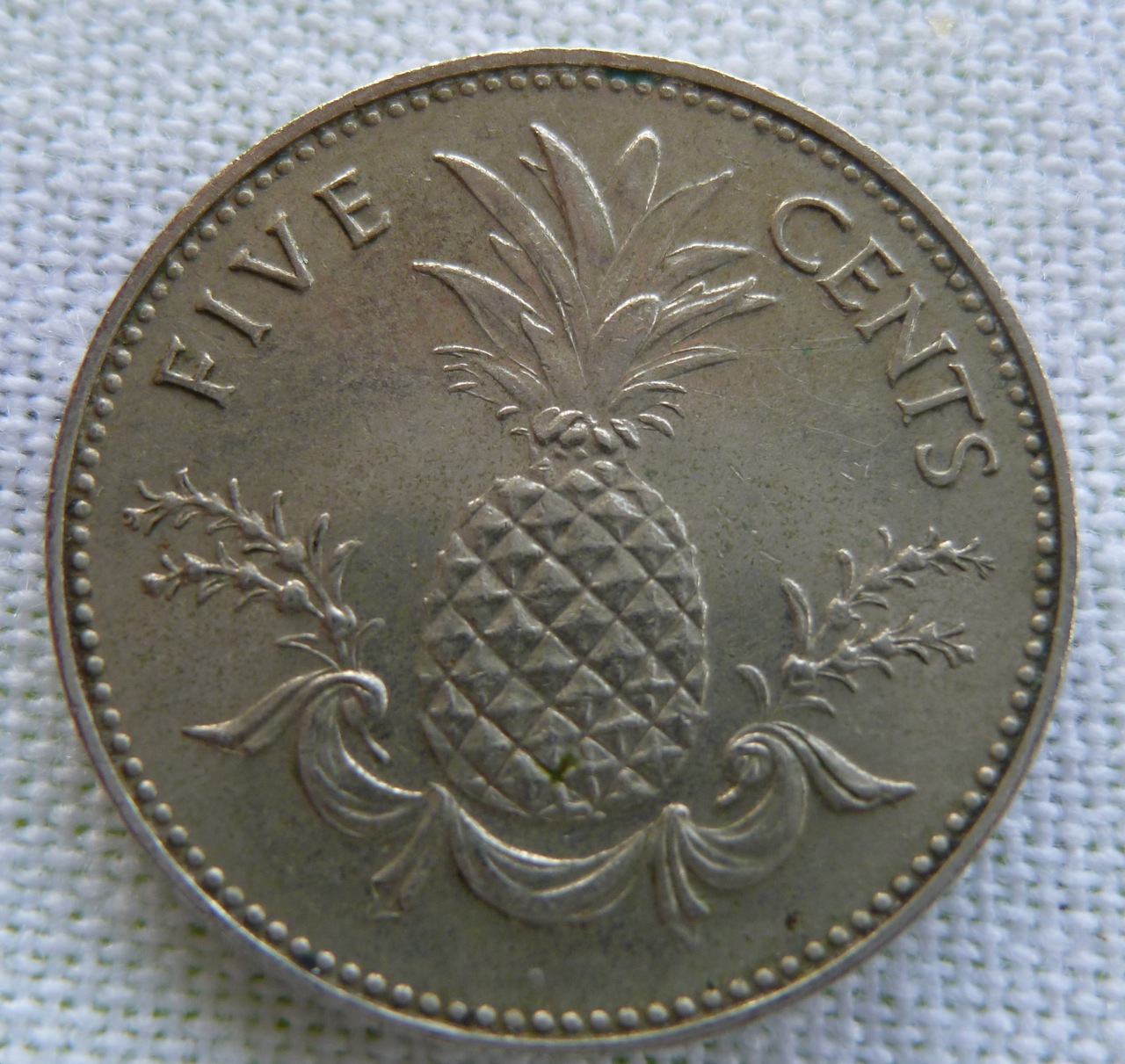
  • Features on the Bahamian 5 cents coin…

  • …and (later addition) a $1 stamp

BAHAMAS PINEAPPLE STAMP

STOP PRESS read Jim Kerr’s interesting article in ABACO LIFE on Abaco’s pineapple past HERE

FRANCESCA BEAUMAN 2006

THE PINEAPPLE – KING OF FRUITS

If you want to find out more about pineapples, their  history and social significance, you should be able to pick up a copy of this book on Am@z%n, Abe or ALibris for a few dollars

“What?” I hear you cry, “you’ve managed a whole page about pineapples without mentioning modern advertising”. Shall I do so now? The man from Del Monte, he says YES

[youtube http://www.youtube.com/watch?v=YqmpVWzH4FM]

THIS POST HAS BEEN REVISED AND UPDATED HERE

Sources: Own ideas + some magpie-thieving-borrowing from a variety of online sources, many of which contain identical info and / or quote from the above book. Hope everyone is comfortable with that…

NB Not every fact above is strictly 100% true, so expect to be challenged if you roll one out. In particular Prince Phillip is of course naturally docile and gentle-mouthed…

POST SCRIPT The first 21 Fibonacci numbers (just add 2 successive numbers to produce the next) are

F0 F1 F2 F3 F4 F5 F6 F7 F8 F9 F10 F11 F12 F13 F14 F15 F16 F17 F18 F19 F20
0 1 1 2 3 5 8 13 21 34 55 89 144 233 377 610 987 1597 2584 4181 6765


Unknown's avatar

AN ABACO INSECT IS BUGGING ME – WHAT IS THIS CREATURE?


AN ABACO INSECT IS BUGGING ME – WHAT IS THIS CREATURE?

There I was, walking slowly along the Delphi drive trying to locate some small chirruping bird in the coppice – close at hand, chatty, but invisible among the leaves. Then I saw this creature. It’s not an insect I have ever seen before, and I haven’t been able to find out what it is. It’s probably something elementary – an ‘Abaco Black Orange-Feeler Beetle’ – that is familiar to everyone. Except me. I’d just like to know. Any help out there? A response via the Comment box below would be appreciated!

This insect has some interesting features. The feelers are segmented, with 9 joints, so that in close-up the apparent smooth curve is not a perfect one but an articulated series of ‘straights’. It has 4 toes for gripping, and leg spines. It appears to be a voracious leaf-eater. And it can scratch its head. Overall, it looks aggressive and somewhat alien. Imagine if these things were the size of a potcake. Coming at you…

Unknown's avatar

BLUE-GRAY GNATCATCHER ‘ON SONG’ IN THE ABACO COPPICE


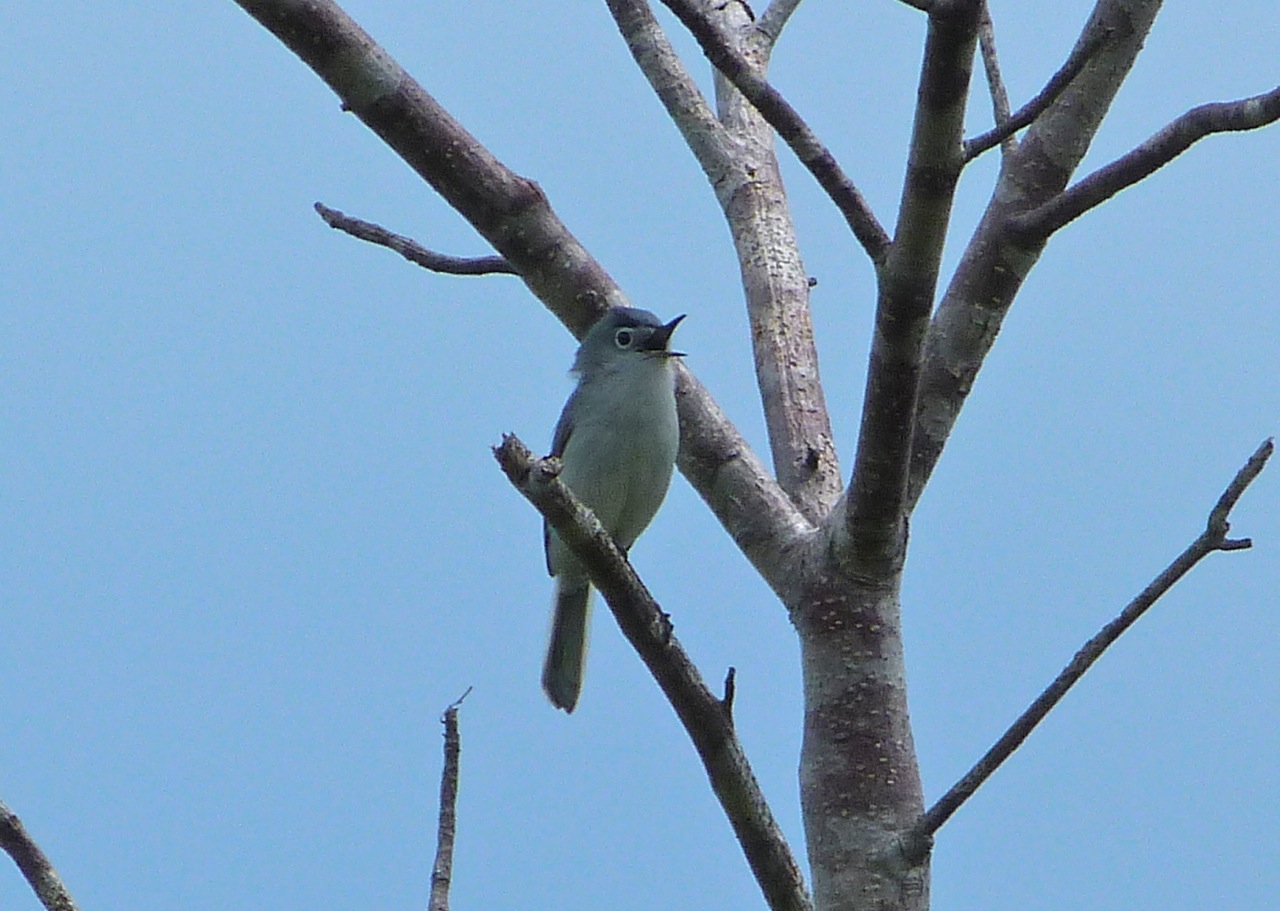
BLUE-GRAY GNATCATCHER Polioptila caerulea

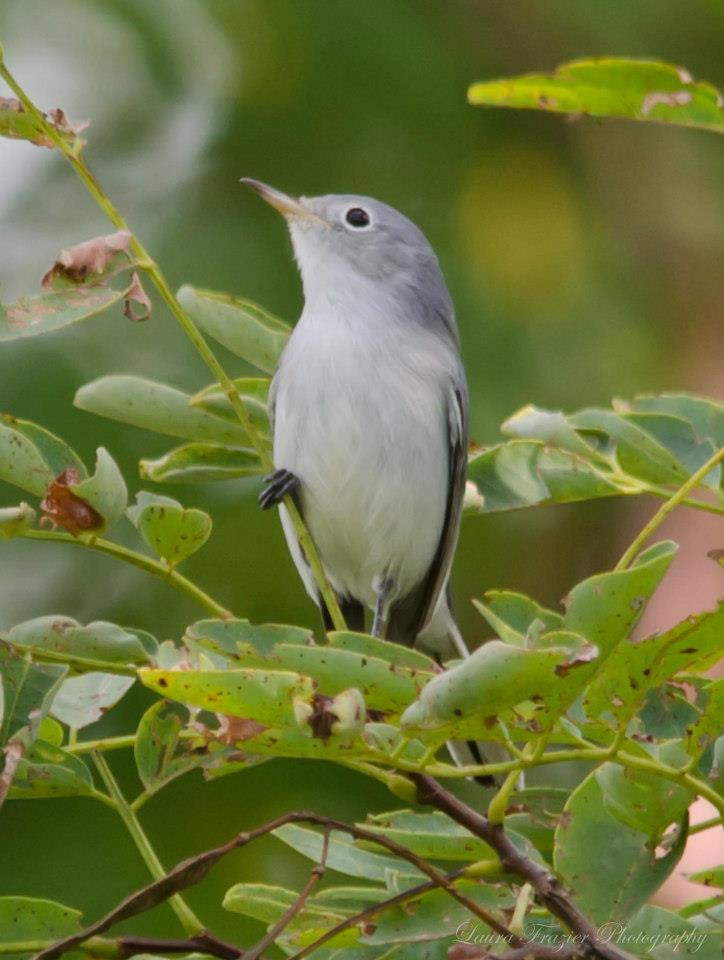
This small bird was quite far back – and high up – in the coppice on the Delphi guest drive. The photos were distance shots, so not the best quality, but they do capture the little bird in full song. BGGs have complete white eye rings; males have a dark ‘monobrow’ which can just about be seen in the photo above. In a word, ‘cute’. They sound like this (you may need to wait for the clip (credit: Cornell Lab / RH) to load – or hurry it along by clicking ‘Play’ as it loads):

[audio http://www.fileden.com/files/2012/7/14/3325949/Blue-gray%20Gnatcatcher%20Cornell.m4a]

They build a cup nest on a horizontal tree branch. It’s a modern family unit – both parents make the nest, tend the eggs, feed the young, and teach them manners. They may raise two broods in a season.

BGGs eat insects and spiders, feeding in trees and shrubs. They can hover very briefly, but mainly they catch insects on the wing (‘hawking’). The tail is often held upright while defending territory. Or sometimes just because they can.

All the information you could want on this species can be found at the excellent OISEAUX-BIRDS.COM 

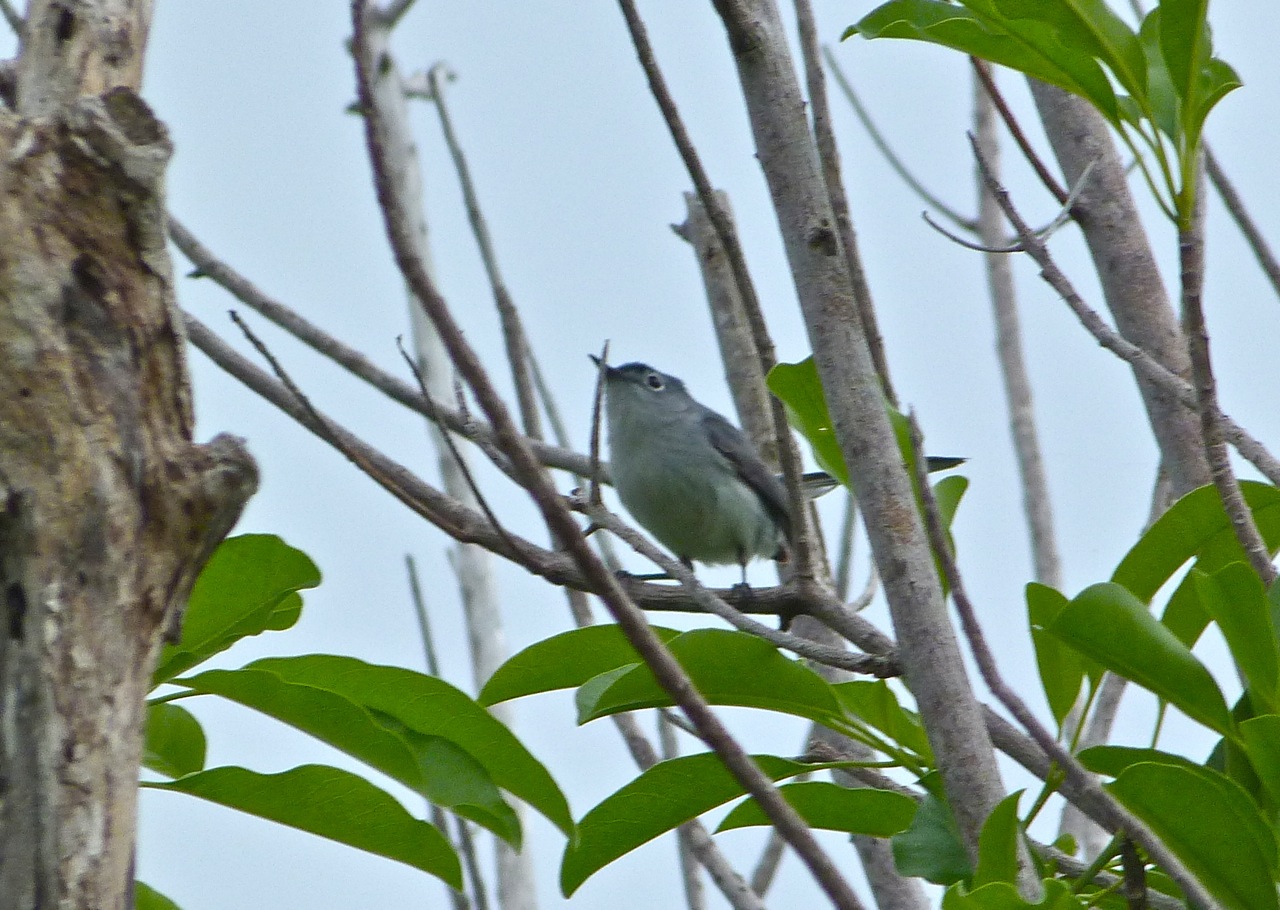
STOP PRESS checking back through my photos, I’ve found a (slightly blurry) distance shot of a BGG. I am adding it because it shows the bird with its characteristically cocked tail, often seen when perching (the bird, I mean) 

A very pretty BGG has recently been published on the superb Cornell Lab website, credited to Laura Frazier. It’s so cute – and such a clear image – that it deserves inclusion here 


Unknown's avatar

ROLLING HARBOUR, ABACO: A WIDE-ANGLE VIEW


ROLLING HARBOUR, ABACO: A WIDE-ANGLE VIEW

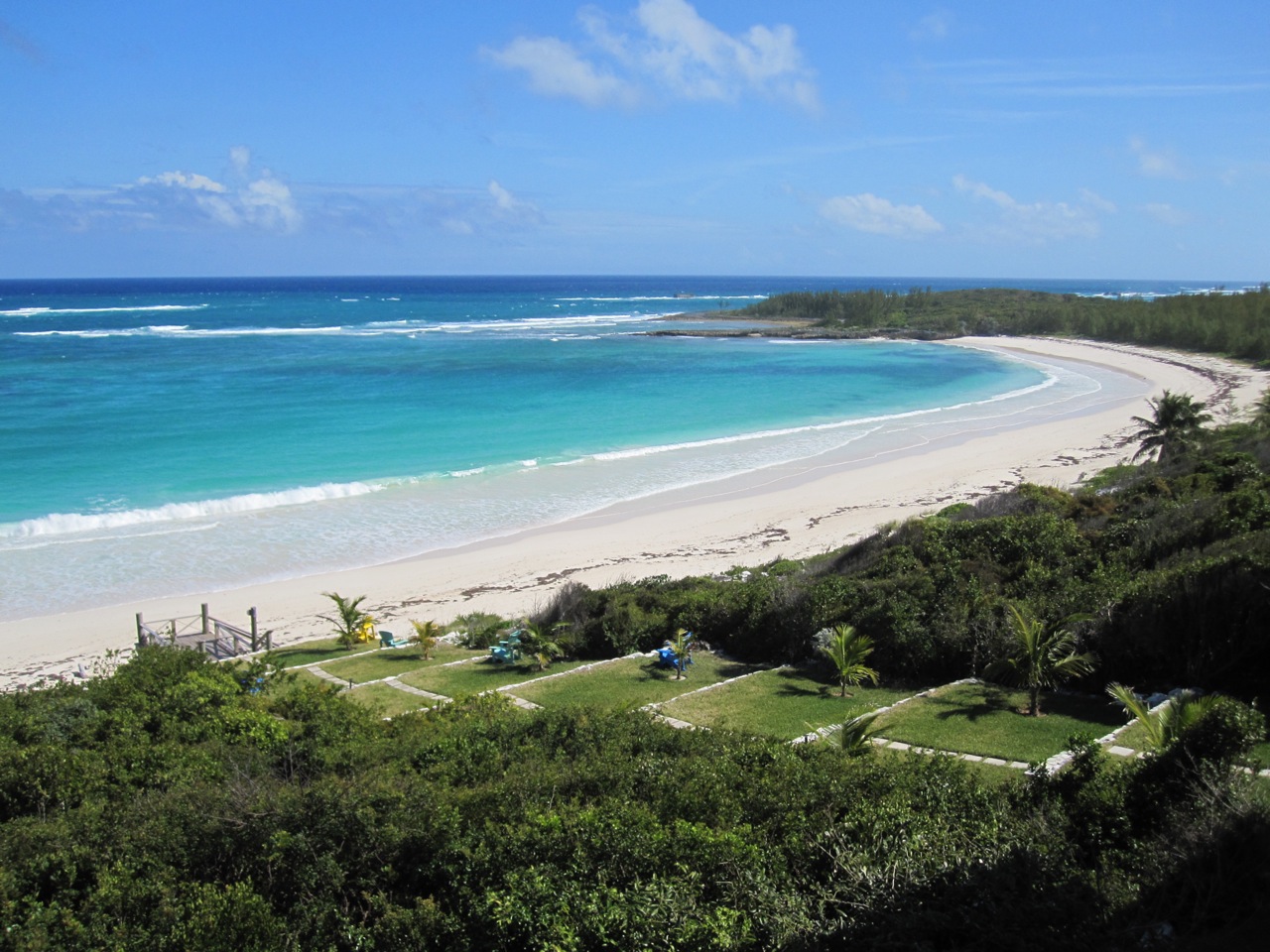
A new Header has arrived to grace the Home Page. It’s a wonderful wide-angle view of the 3/4 mile bay of white sand that is Rolling Harbour. It was taken by Michael Vaughn, a photographer  and tarpon guide from Key West, and I have ‘borrowed’ it from the main DELPHI CLUB website. You can immediately see the attraction of the blog name ‘Rolling Harbour’, an enterprise related to but editorially independent of HQ (though subject to benign scrutiny from Peter Mantle, who has so far resisted any temptation to behave in a ‘Murdochian’ fashion…)

The Delphi Club has just completed its third year in operation, with a record number of fish caught both out on the Marls and off the beach. There were records, too, for guest numbers; nourishment consumed in both the food and the drink categories; and for bird species spotted in the club grounds, the coppice and pine forest, and on the beach…

This aerial view shows the plantation-style club building and its minimal ‘footprint’ in the landscape

The Delphi Club from the beach

The view of the beach looking north from the Club verandahThe view of the beach looking south from the Club verandah

Unknown's avatar

CURLY TAIL LIZARDS: ABACO’S CHARMING REPTILES


CURLY TAIL LIZARDS: ABACO’S CHARMING REPTILES

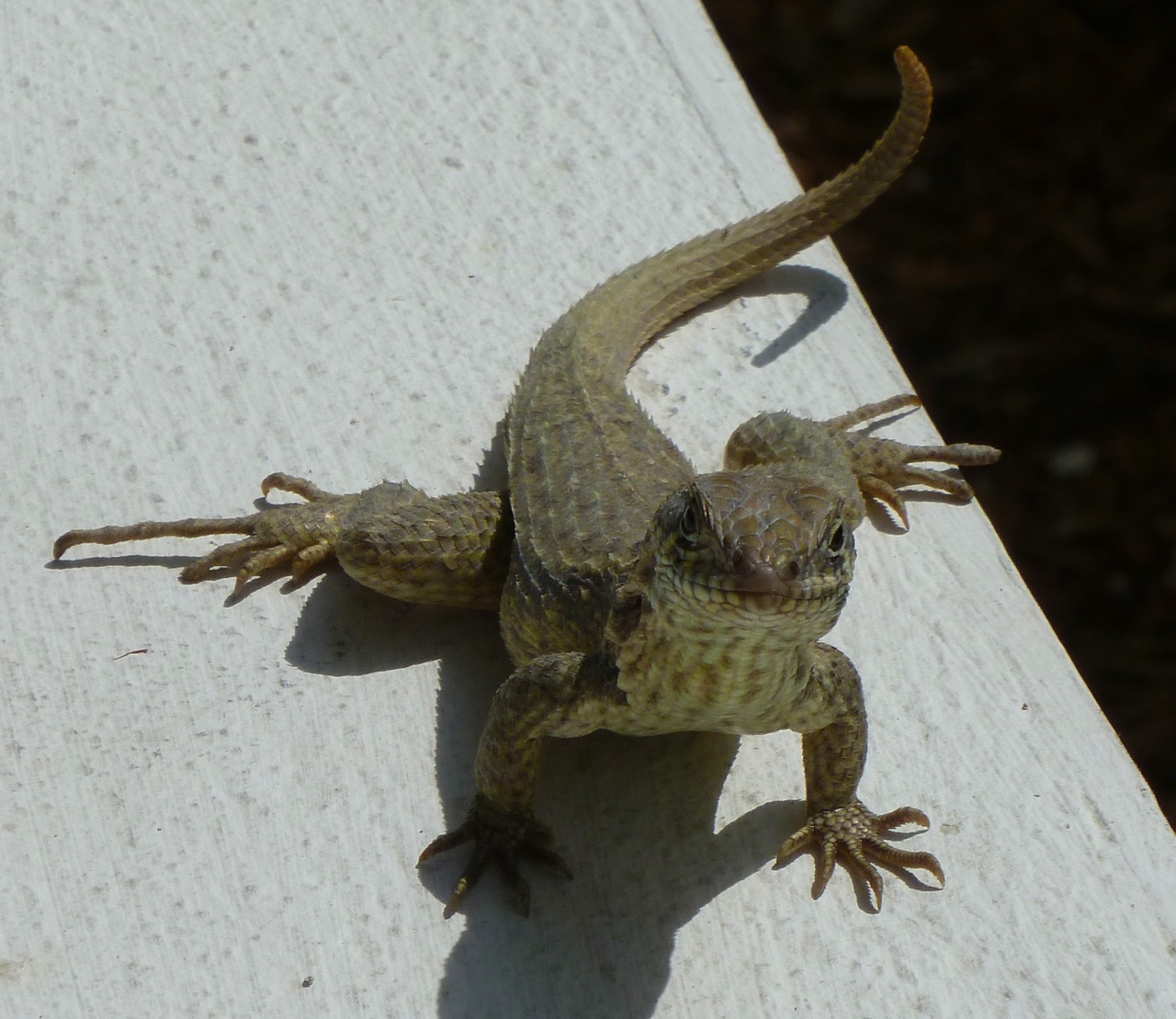
I have previously posted about these cute creatures that lie sunning themselves and occasionally blinking; or scuttle away when they see you. See CURLY TAILS for photos and details about these lizards and their habits. Here are a few more recent images. The first three were taken at the Delphi Club, where they seem to enjoy the pool area in particular. The top one has one extraordinarily long finger. It’s worth clicking on these 2x to enlarge them to see the structure of their skin / overlapping scales

An impressive “complete double curly”

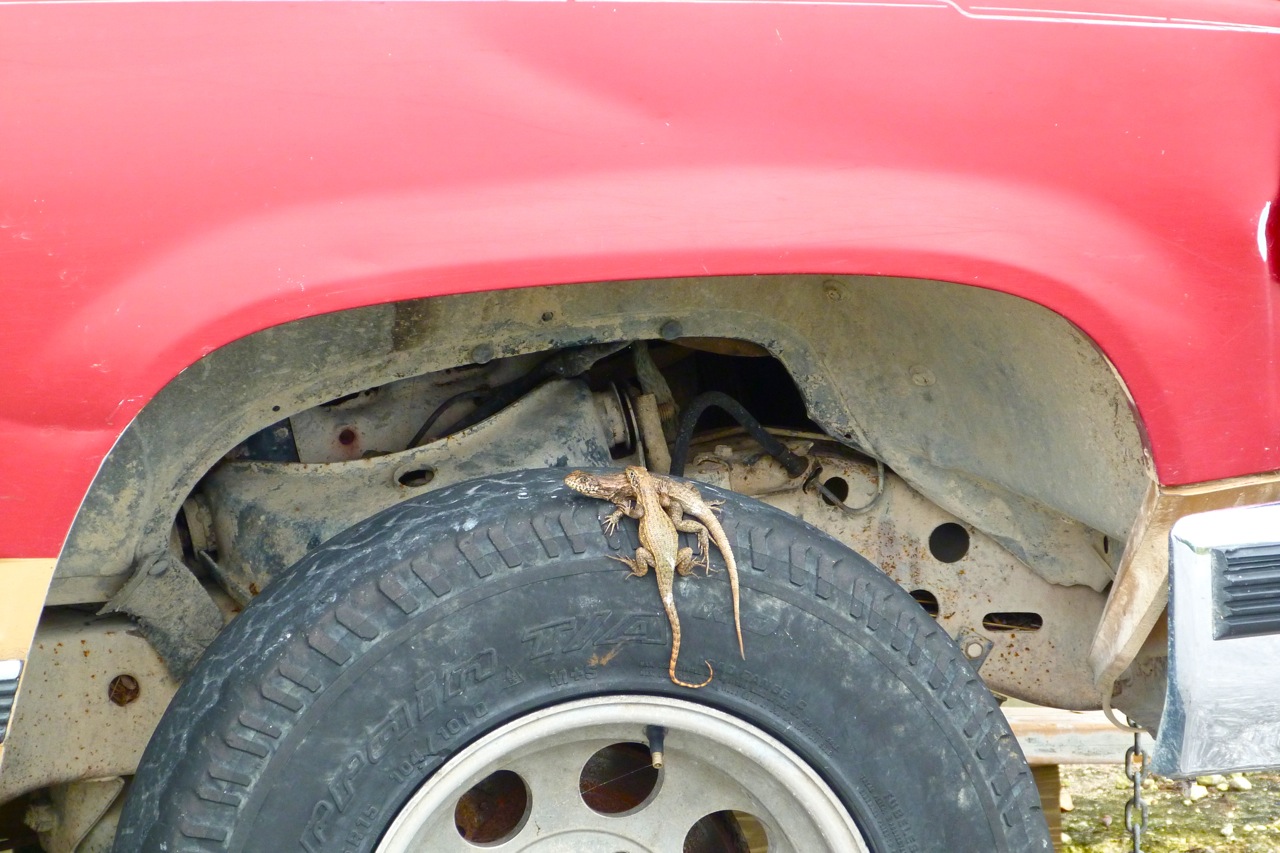
This pair of curly tails was at Crossing Rocks, where we were trying to locate Bahama Woodstar hummingbirds in the scrubland. We rather felt that we might be interrupting something… They look endearingly affectionate.

Unknown's avatar

A JUVENILE BANANAQUIT ON ABACO – HOW CUTE CAN A SMALL BIRD BE?


BANANAQUITS Coereba flaveola

These small birds are a favourite of mine. They flicker around, cheeping cheerfully, yet are often quite hard to see in the coppice even if you think you are looking exactly where the sound is coming from.

Bananaquits are passerines, with an uncertain species designation. Over the years they have been officially reclassified three times. Some include them loosely with tanagers; others put them in their own family group; others argue that there are 3 distinct species. Basically, there is no universal consensus. There is some satisfaction, in a vastly over-classified world, in one small bird resisting man’s pigeon-holing (so to speak). It’s a tiny taxonomic enigma.

Among the islands of the West Indies there are several subspecies of bananaquit, with marked variations of appearance and size too tedious to relate. The best news is that “…the Bahamas Bananaquit with a whitish throat and upper chest may be a separate species…”.

The Bananaquit’s slender, curved bill is designed for taking nectar from flowers. It can pierce flowers from the side to reach the nectar, or use its bill to puncture fruit. It also eats small insects. The birds are tame, and love feeders, especially hummingbird feeders filled with sugar-water – hence their nickname “sugar bird”. They breed all year round. This is the characteristic chirrup of the Bahamas Bananaquit (credit: Xeno-Canto)

This small juvenile was happily feeding by itself near the Delphi Club, Abaco. Its mother then flew onto a nearby branch, and I’m afraid to say that the child indulged in a shameful charade of “Hungry! Feed Me! Now!”