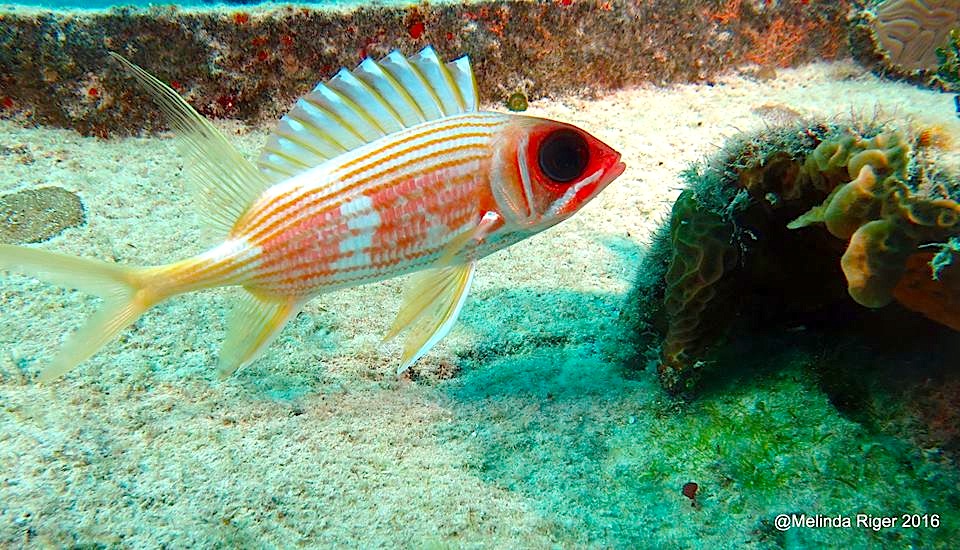
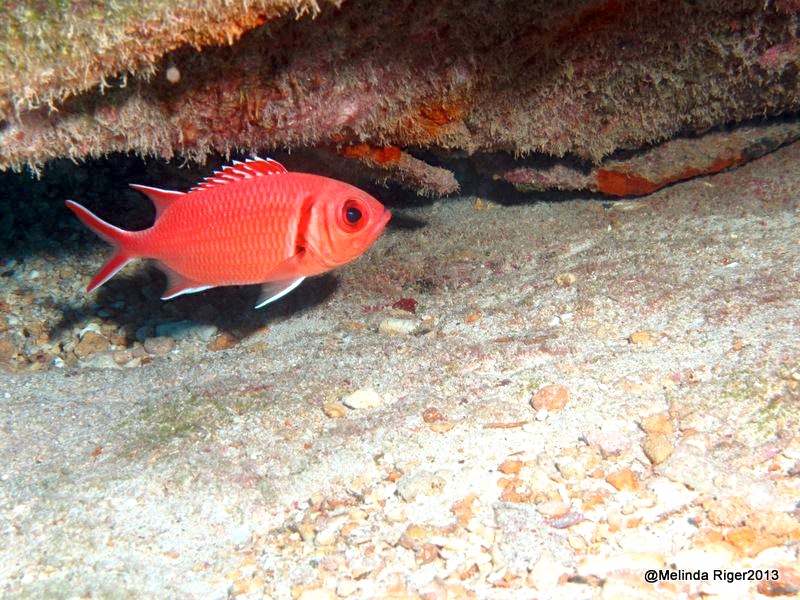
How proud The King would be to know that his name lives on in the form of an attractive though sadly unmusical Bahamian squirrelfish. This little guy is at least 5 years old. What is more, he has lived at the same address all that time, defending it against usurpers and protecting himself from predators in its safe depths. Here is the loveable little Elvis photographed at home between 2012 and 2016 (header image), the master of his own underwater Graceland…
The reason that Elvis has such large eyes is that these fish are mostly nocturnal, and (apart from when Melinda is out with her camera), he and his friends spend most of the day either at home, or in crevices, small rock caves, or under ledges. However, here are a couple of shots of Elvis out and about, enjoying some quality time among the corals.
ROLLING HARBOUR MUSICAL DIGRESSION
I so wanted to add a specific Elvis catalogue ‘Musical Digression’, but try as I might, there is no title in The King’s discography that has any potential for finny nuance or piscine pun value. However, here’s a track from the now tragically unhip Dire Straits on their follow-up album to the phenomenal ‘Brothers-in-Arms’, the much under-rated ‘On Every Street’. I give you… Calling Elvis, a song that cunningly contains as many titles of Presley hits as anyone could ever wish for.
All images: Melinda Riger at Grand Bahama Scuba; cartoon from a sequence on the excellent BCCR Defenses page – learn about camouflage and other fishy self-protection techniques
Nocturnal squirrelfish checks out a parrotfish’s sleeping arrangements
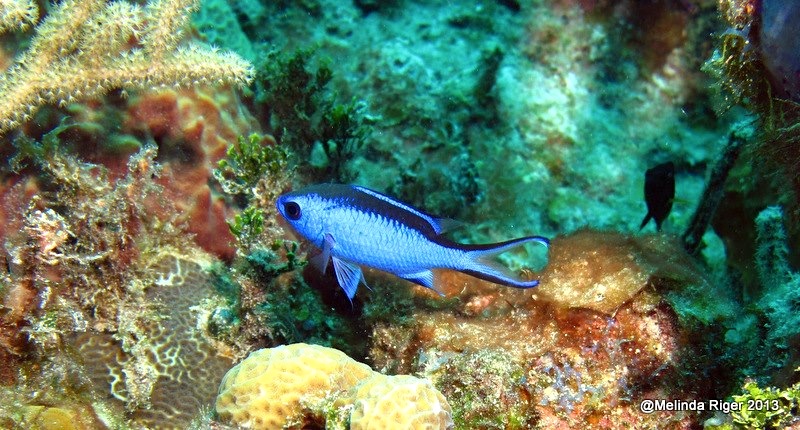
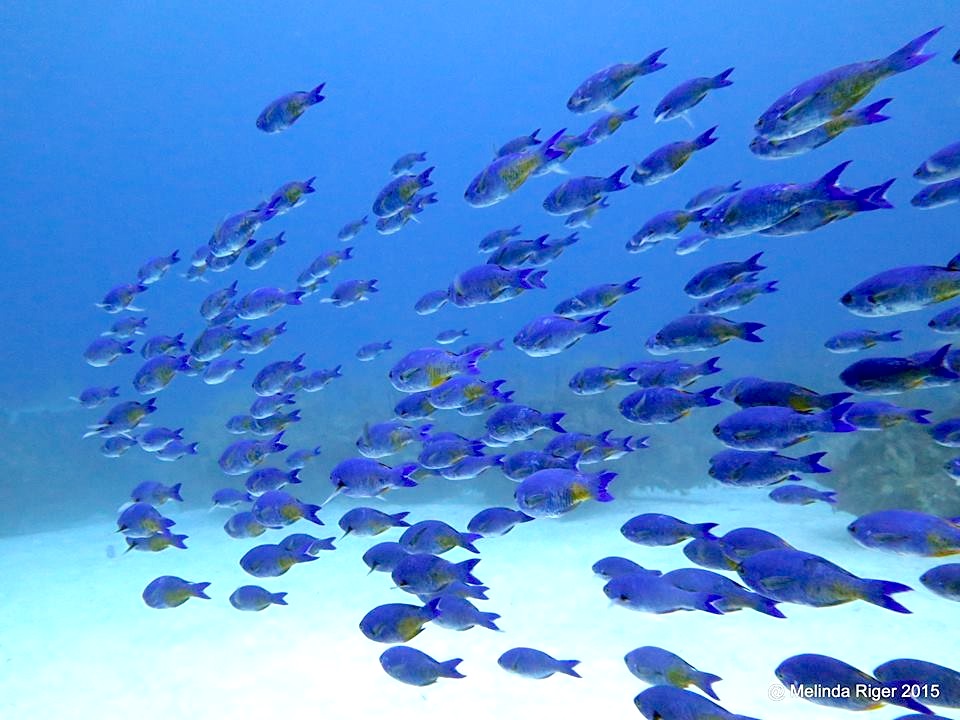
The little blue chromis Chromis cyanea will be instantly familiar to any snorkeler or scuba diver on the coral reefs of the Bahamas. These ever-present small fish – 6 inches long at most – are remarkable for their iridescent deep blue colour that flashes as they dart in and out of the coral and anemones of the reef.
Although at first sight this chromis species – one of many – looks blue all over, adults have a black dorsal stripe and black edging to their fins. They make colourful additions to aquariums, though to my mind they look far more attractive nosing about the reefs foraging for the zooplankton upon which they feed (see header image for details…)
The blue chromis was the second fish species I encountered on my first ever reef dive, at Fowl Cay Marine Preserve with Kay Politano. The first fish was the endearingly inquisitive sergeant major with its smart black and yellow stripes which came right up to my googles to eyeball me. I loved that, even though my pitiful swimming technique meant that I had plenty of other distractions, not least remembering to breathe. Air, that is, rather than water.
SO JUST HOW BIG ARE THESE FISH, COMPARED, SAY, TO A BLUE TANG?
Blue Tang with blue chromis in its wake
All photos Melinda Riger of Grand Bahama Scube, except the penultimate by James St John, taken in San Salvador
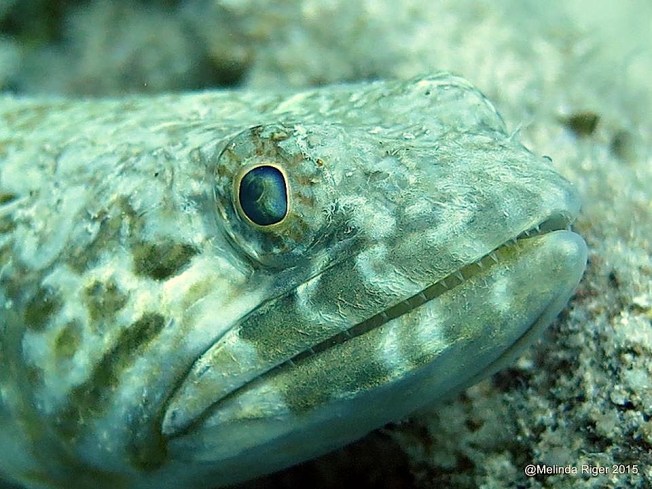
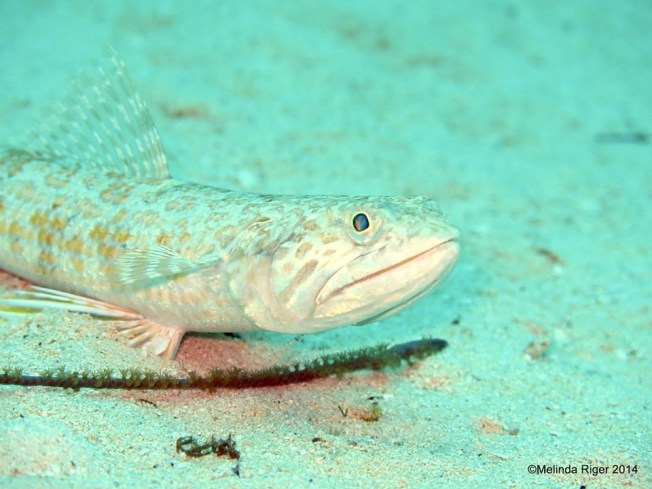
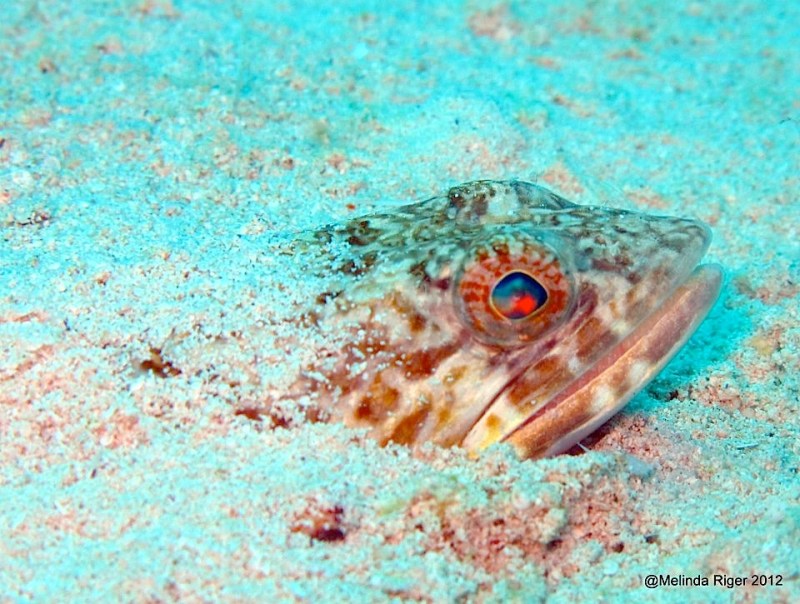
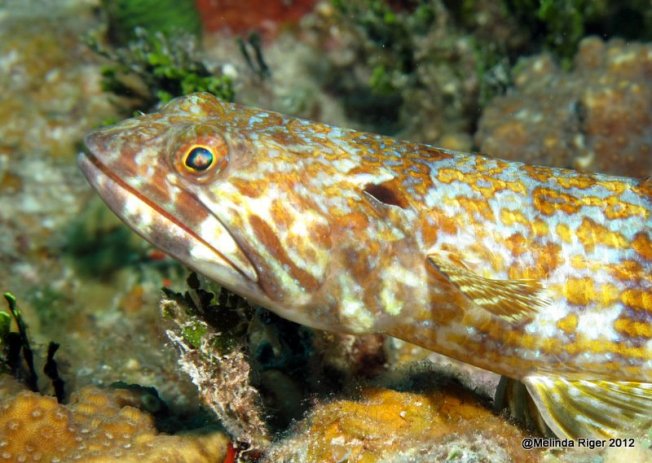
Time for another in the WTF? series, featuring weird (begging their pardons) or not very fish-like fish. The Sand Diver Synodus intermedius is a type of lizardfish found in subtropical waters and often around coral reefs. They can grow up to about 18 inches long and a prime specimen might weigh a couple of pounds. The markings are quite variable but one common characteristic seems to be a tendency to look somewhat down in the mouth; and to possess jaws full of tiny sharp teeth.
Sand divers have two rows of teeth on their upper jaw and three rows on their lower jaw. Not content with that, they also have rows of teeth on the palate and tongue. Were they 50 times the size, they would be truly awesome.
The rather primitive appearance of the sand diver is explicable from fossils, which show that their forbears were active in the Jurassic / Cretacean periods.
HOW DO THEY GET THEIR NAME?
Sand divers often bury themselves in the sand with only their head showing. They are so-called ‘ambush predators’, and burial is one method they use. Another is simply to lie on the sandy bottom, or on reef surfaces and wait for passing prey. Their colouring provides very good camouflage.
WHAT’S ON A SAND DIVER MENU?
A good mix of small reef fishes. Bar jacks, blue chromis, wrasses, fairy basslets, small grunts and so forth. At their own level they are quite fearsome predators.
ARE THEY ON THE HUMAN MENU?
Well, I knew someone would ask that, so I carried out a search. The answer seems to be no. I have found nothing to suggest that they are edible, or that anyone has tried (or if they have, survived to tell the tale). Incidentally, the best way to find out if something is edible by humans is to search for a recipe. There are no sand diver recipes.
STOP PRESSJason Knight has drawn my attention to a comment in WhatsThatFish.com(no relation) by one ‘Jenny’, who commends Sand Divers as food (“they cook up just as good as hogfish!”). So yes, they are edible and there is one recipe…
The jocularly-named WTF? series is designed to shed an underwater spotlight on some of the odder denizens of the coral reefs and surrounding waters. I don’t want to earn a reputation for being ‘lookist’, but frankly the appearance of some of these creatures – I give you BATFISH or FROGFISH or REMORAS as examples – is baffling. The filefish group is not as extreme as some in the downright weird category, but if you see one you might just find yourself muttering into your facemask “wtf?”
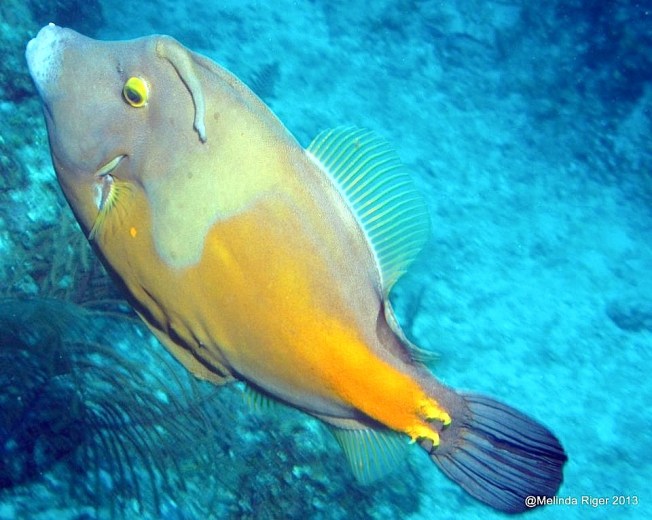
Filefish (Monacanthidae) are found in tropical and subtropical oceans worldwide. They are related to triggerfish, trunkfish and pufferfish, and have regional names that include leatherjacket, foolfish, and shingle. There are more than 100 species of filefish, of which only a few are found in Bahamian waters. The species featured here are a mix of scrawled, white-spotted and orange-spotted filefish.
HOW DID THEY GET THE NAME?
In the image above, you can just see a flattened spine on top, above the eye and pointing backwards. This is the ‘retracted’ state. There is a small secondary spine that serves to prop up the main spine when it is in the upright position. This is it seems, the file – although the Greek-derived family name Monacanthidae literally means ‘one thorn’. So why isn’t it a thornfish, you may well ask. And I may well not respond.
This filefish’s ‘spine’ seems to have flopped over to one side
These fish have snouts with small mouths and specialized teeth with an inner and outer set on each jaw. They are to an extent shapeshifters, and can quickly make themselves appear larger for defensive purposes. In some individual species, there are marked differences in body shape and coloration.
An orange-spotted filefish with its spine erect, making for a cave – a place of safety
The fins of a filefish are small, and they are rather sedate swimmers. Sometimes they simply like to drift with their heads pointed downwards, eyeing patches of seagrass or seaweed for prey. Some species are largely vegetarian. Others eat small invertebrates. Some even feed on corals. Their predators – especially the juveniles – include tuna and dolphins (mahi-mahi).
ADDITIONCapt Rick Guest has helpfully expanded on juvenile filefish:“The juveniles hang under sea weed and flotsam eating small shrimps and crabs there. They, in turn become food for Mahi and other pelagic fish. The main thing with these guys is that the bigger they are, the more likely they are to be Ciguateric”.
At his suggestion I will write a post about the problem of the Ciguatera disease when I have had some time to do the research.
ARE THEY EDIBLE?
Good question. The answer, broadly is yes, though I don’t know if that applies to all species of filefish. They are certainly eaten in large quantities in the Far East. I don’t know about the Bahamas or the wider Caribbean. If anyone does, could you very kindly add a comment to this post. Recipes welcome!
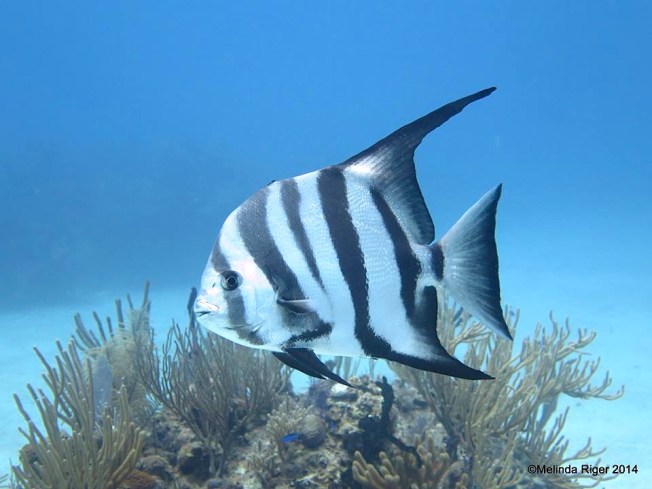
The Atlantic spadefish looks very much like an angelfish, and indeed it is called that – or ‘white angelfish’ – in some places. Actually, it has quite a collection of colloquial names of which ‘moonfish’ is the most attractive sounding. It is not a true angelfish, however, and despite appearances it has a kinship with the weird and wonderful BATFISH.
Unlike the batfish, the spadefish is demonstrably fishlike AND edible. They can grow up to 3 foot long and have become a popular gamefish for three good reasons: they are abundant; they fight hard; and they are dinner. The perfect combination.
All photos: Melinda Riger of Grand Bahama Scuba, with thanks
“OPHELIA READY FOR HAMLET”: BAHAMAS REEF FISH (27)
It’s a couple of years since I originally posted about the various species of HAMLET that inhabit the reefs of the Bahamas. I feel you are (geddit?) ready to see some more of these colourful little fish. Last time out, I worked over the Shakespearean possibilities quite thoroughly so I’ll spare you a repeat (apart from the inevitable title pun). If you really want to revisit the famous Hamlet Cigar ad or hear the theme music (Bach’s Air on a G String, shamelessly ‘borrowed’ by Procol Harum for ‘A Whiter Shade of Pale), you’ll find them HERE. Or just move straight on to 5 related but very different looking Hamlets cruising the Bahamas coral reefs.
INDIGO HAMLET
BARRED HAMLET
BLACK HAMLET
SHY HAMLET
BUTTER HAMLET
Credits: all photos Melinda Riger of Grand Bahama Scuba
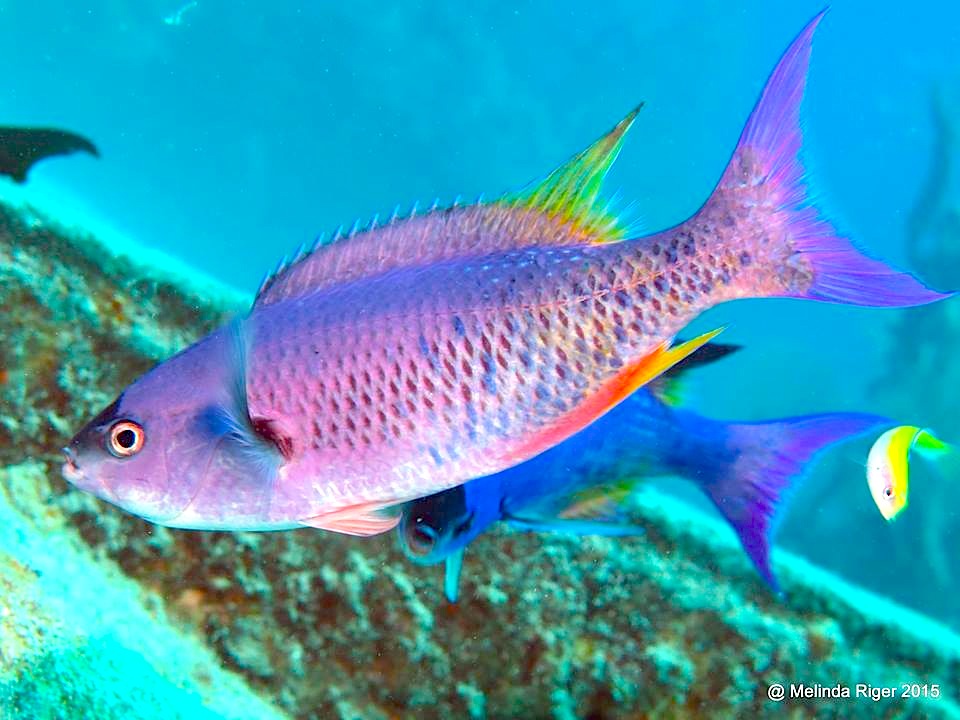
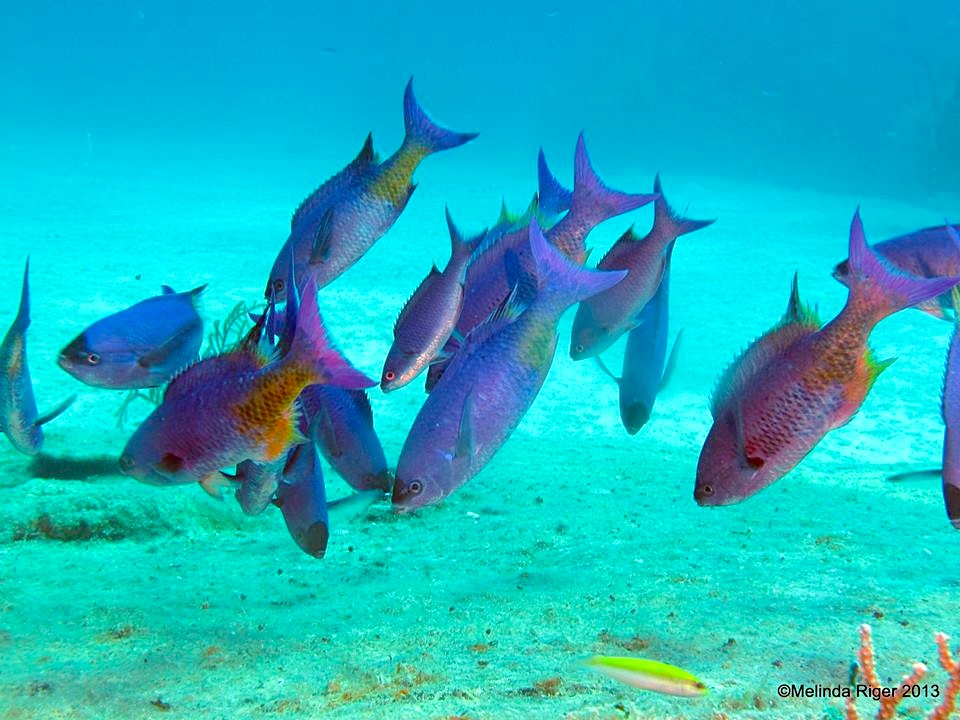
The creole wrasse is a small wrasse species, with adult males reaching about 12 inches long. During its life, a creole wrasse changes colour significantly. A juvenile is almost completely violet-purple. As it matures, it develops patches of yellow on the rear part of its body.
Creole wrasse are found throughout the tropical and subtropical waters of the western Atlantic from Florida south to Brazil. The habitat includes Bermuda, the Caribbean Sea, and the Gulf of Mexico.
Creole wrasse are social fish that live in groups around coral reefs. They are found in shallow water, but may also be seen as deep as 100m.
The groups of wrasse feed on plankton, small jellyfish, pelagicTUNICATES, and invertebrate larvae. These fish are active in groups by day. At night each fish finds its own safe crevice in the reef to sleep.
ANYTHING ELSE WE NEED TO KNOW?
Yes indeed. Their intriguing breeding regime – how unlike our own dear species. The creole wrasse is aprotogynous hermaphrodite. The largest fish in a group is a dominant breeding male, while smaller fish remain female. If the dominant male dies, the largest female changes sex. The mature males congregate atleksto breed, at which they display and are approached by females before mating with them. [note: these leks are reminiscent of certain clubs in the less reputable parts of some towns and cities. Or so I am told]
It’s been a while since the last Rolling Harbour musical diversion, but the colour of this wrasse nudged my memory back to 1968 and DP’s first album (line-up Mk 1 of several hundred, or so it seems). Hence the post title. Anyone who remembers this ‘wasn’t there’. Anyone who doesn’t obviously wasn’t there either…
I don’t think this guy thinks much of that. And quite right too
All phish photos by Melinda; DP cover borrowed from Am@z@n; MP3 moi
Well here’s a rum do. About four years ago, this somewhat minority interest blog emerged ‘mewling and puking’¹ into the world, guided by an incompetent male midwife whose basic training had been about 4 weeks of exposure to Abaco, its fishing, its wildlife, its geography and its history. ‘Bananaquit’ might as well have meant taking up a plantain-free diet. ‘Grassquit’ might have been the local word for ‘keep off the lawn’. And that’s before all the flowers. And the reef fish. And everything else that turned up during the storm-wracked voyage of discovery via polydamus swallowtails, manatees, spider wasps and batfish that led slowly to the calmer waters of ‘rather better informed (if no wiser)’.
Anyway, at midnight last night some unknown person kindly made the 250,000th visit to the blog, a target that once seemed inconceivable. In the past month, the 1000th person also signed up as a follower, another source of amazement. The reality is that despite Abaco being a sparsely-populated microdot island in a huge world, there are a great many people on the island or associated with it who are passionate about it and its extraordinarily diverse natural history. That knowledge makes curating this blog both easy and pleasurable.
I checked my stats for the last year to find out where hits from the top 10 countries – and for fun the bottom 1o – came from. Here’s the answer. Rather shamefully there was also a country I had never knowingly heard of, Palau (Micronesia). There follows a selection of a few photographs that have been popular over the years, mostly my own but the underwater ones are from Melinda Riger and Virginia Cooper of Grand Bahama Scuba.
Top 10 Bottom 10
SEARCH TERMS
The most popular searches – omitting posts about hurricanes, which always generate a lot of traffic – have concerned Abaco Parrots, Lignum Vitae, Sea Glass, the Loxahatchee poster series, Tarantula Hawk Wasps, Sea Biscuits / Urchins, Yellow Elder, Parrotfish, Shipwrecks, Hutias, Hole-in-the-Wall, Lionfish, Remora, and Abaco Maps. The most leftfield search of all was‘How dispose of dead bodies?’, by someone who had clearly strayed into the wrong category of website…
It would be strange to end this little celebration without a tip of the hat to Peter Mantle, old friend and genial doyen of the Delphi Club, for his wholehearted encouragement and support for the production and publication of THE DELPHI CLUB GUIDE TO THE BIRDS OF ABACO. This hefty tome, published in March 2014, showcases the wonderful and varied avian life on Abaco and has proved very popular – indeed well beyond our expectations. Although I appear nominally as author on the cover, it is in fact an extraordinary collaborative effort by some 30 people. The book’s success further demonstrates the commitment of Abaconians and other who love the island to Abaco’s rich natural heritage in an age of rapid change; and provides another good incentive for me to continue with the blog. Next stop: 500,000!
“CLINGING TO THE WRECKAGE”: BAHAMAS CLINGING CRABS
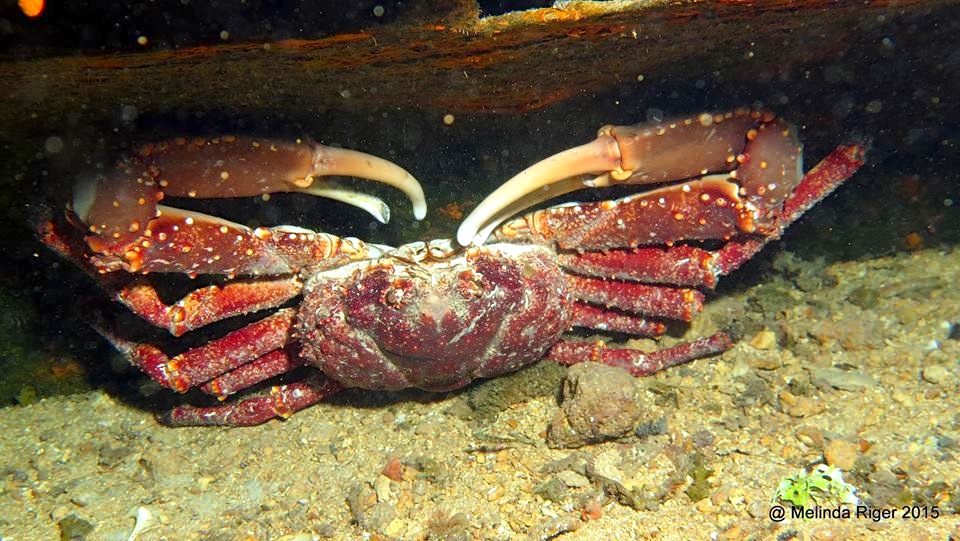
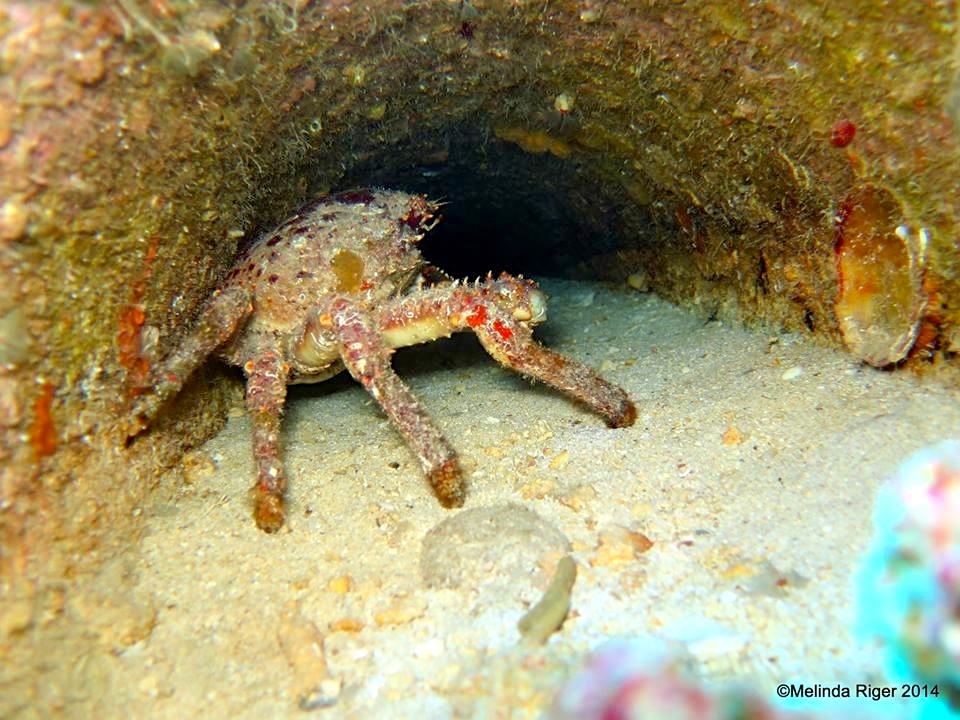
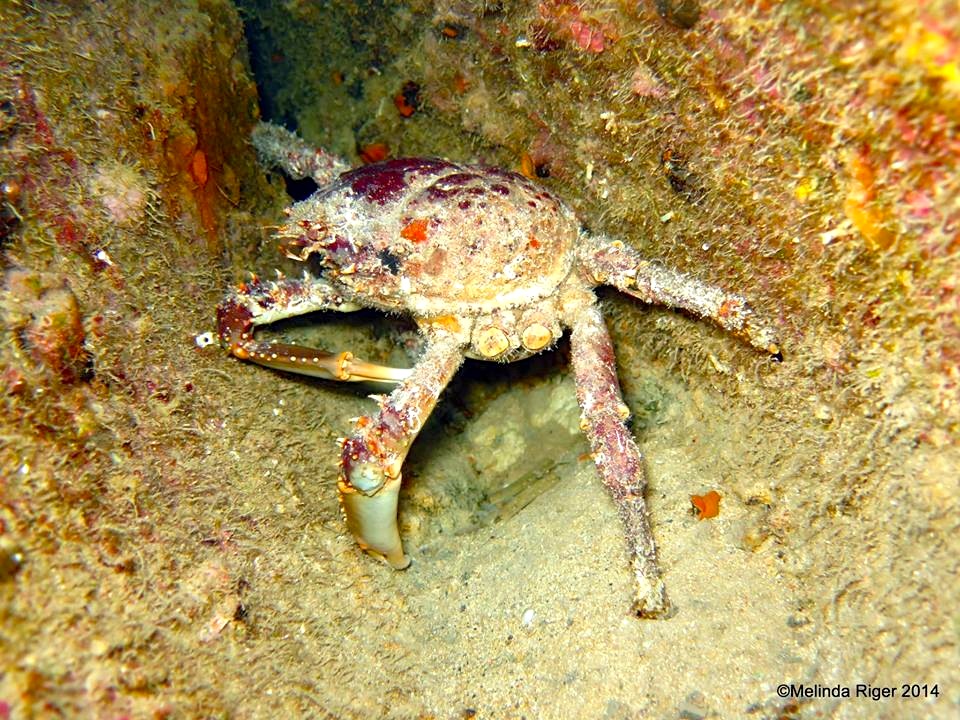
The Clinging Crab Mithrax spinosissimusanswers to a number of names: West Indian spider crab, channel clinging crab, reef or spiny spider crab, or coral crab. It is found throughout the waters of South Florida and the Caribbean.
These are crabs of the reef, or indeed of the wrecks that may be found around reefs. Some of the crabs in this post have chosen wrecks as their home – in the header image the crab is living inside the smoke stack of ‘Theo’s Wreck’, Grand Bahama.
The clinging crab is believed to be omniverous, its main diet being algae and carrion. They can grow to 2 kg, and it is the largest species of reef crab found in the Caribbean.
The clinging crab / West Indian spider crab is (apparently) not commercially harvested for its meat. Although I read somewhere that they are delicious, I would be very reluctant to test the theory.
Life on the reef can be dangerous. This crab has lost some legs: its clinging powers are somewhat curtailed…
This guy has some missing parts, but seems quite laid back about it…
Credits: Melinda Riger of Grand Bahama Scuba (all photos), with thanks as always
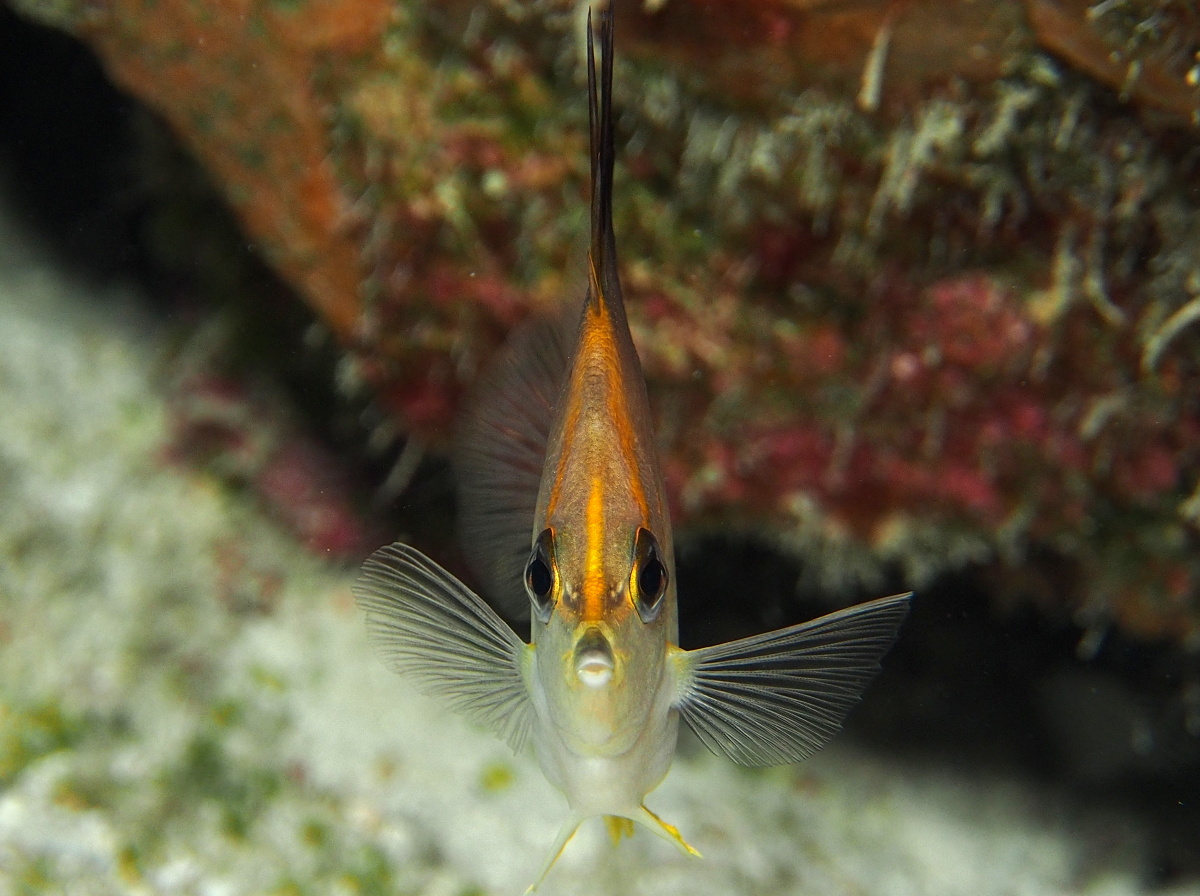
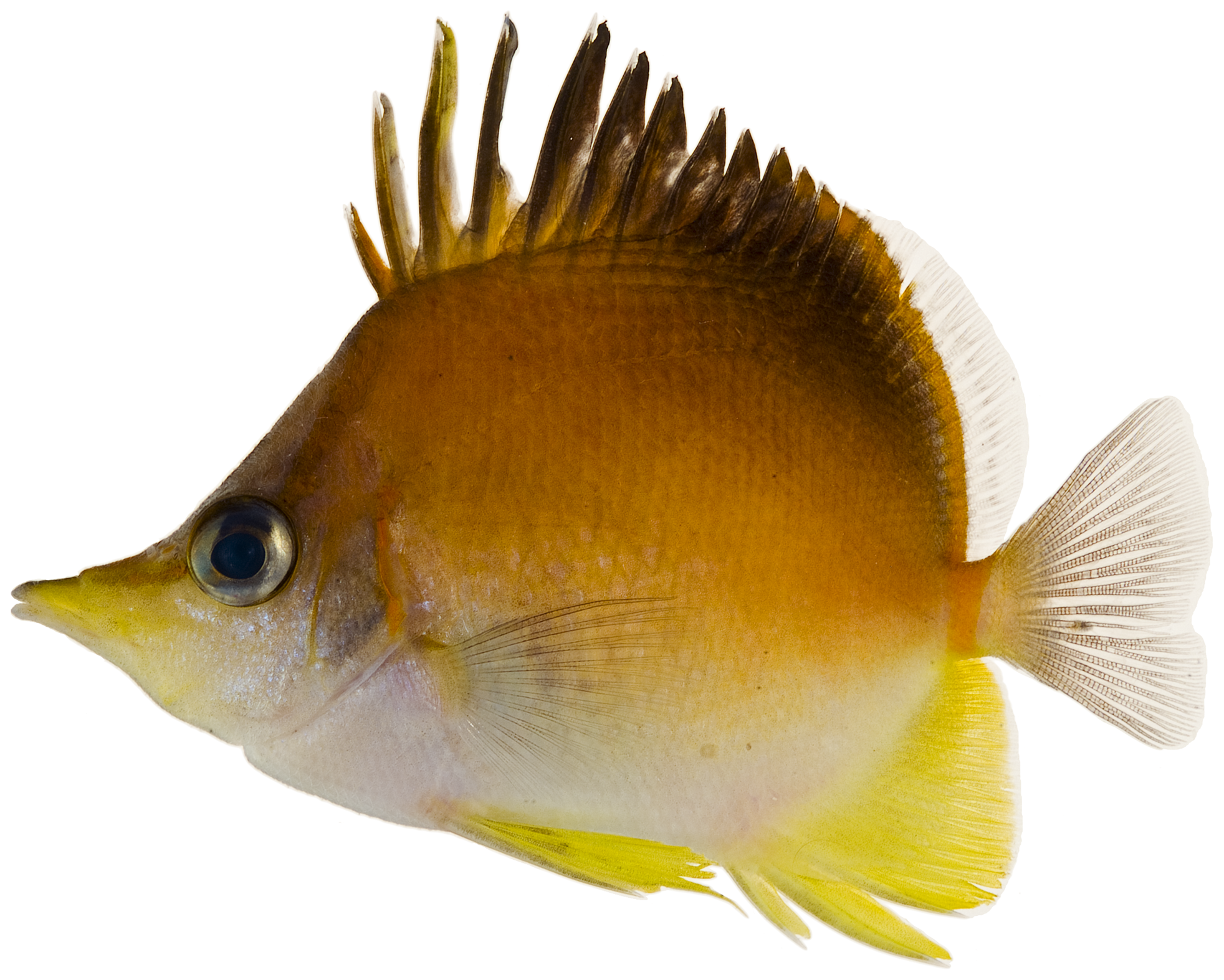
The Atlantic/ Caribbean Longsnout Butterflyfish Prognathodes aculeatus is sometimes known locally as the Longnose (not to be confused with the bright yellow Indo-Pacific Longnose Butterflyfish). The affectionate name for it is ‘Butterbun’. A more scientific name is ‘Poey’s Butterflyfish’, named for the man who first identified the species in 1841.
Mr Felipe Poey
These little fish, 2 0r 3 inches long, are commonly found on reefs from Florida down to Venezuela. Unlike most butterflyfishes, they prefer deeper water and have been found at 200 ft; and they tend to be solitary rather than gregarious.
BUTTERBUN. THAT SUGGESTS THEY ARE PLUMP?
NOPE!
RELATED LINKS
BUTTERFLYFISHES(RH guide to reef, banded, four-eyed & spotfin)
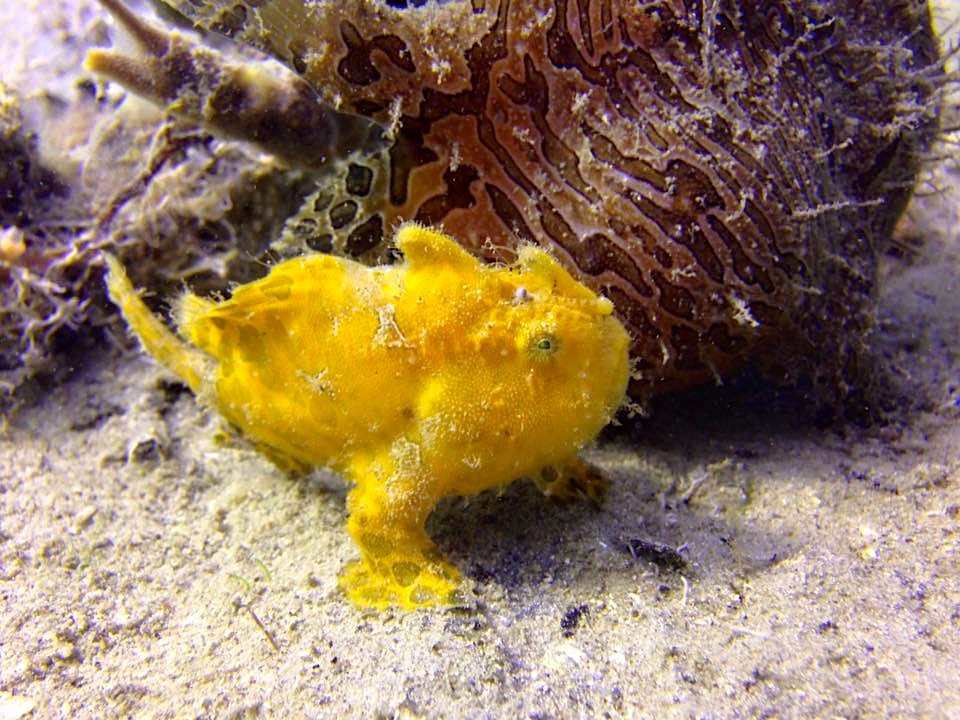
This ‘WTF?’ series started with a relatively conventional species, the REMORA. It has been getting progressively more bizarre. We moved onto an omnium gatherum of WEIRDO FISHES, then the remarkable LETTUCE SEA SLUG, and most recently the BATFISH. Time to ramp up the stakes: with many thanks to scuba expert Adam Rees for use permission for his terrific photos, I present… the FROGFISH.
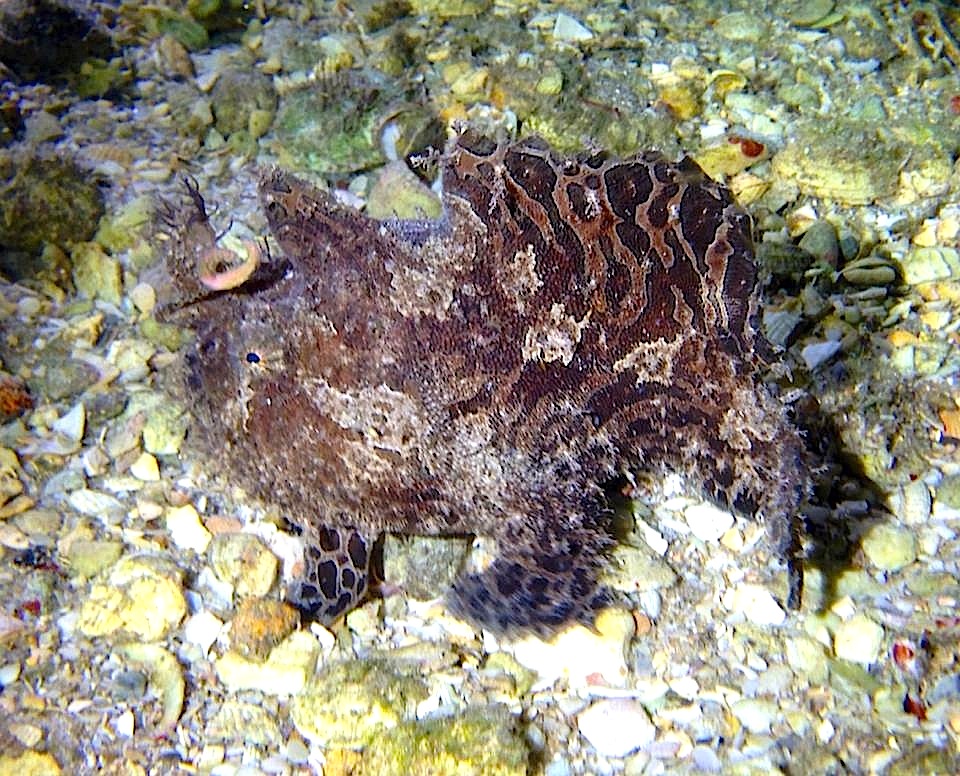
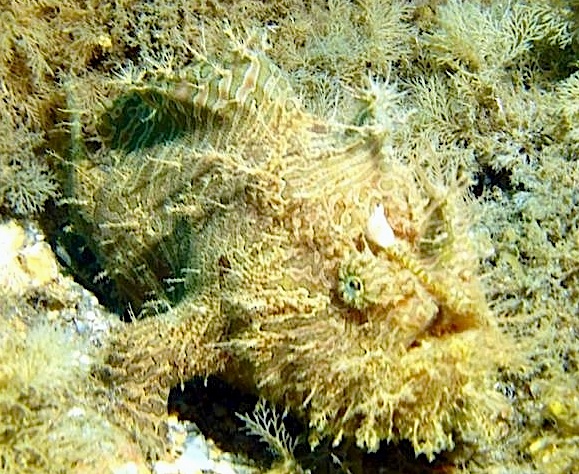
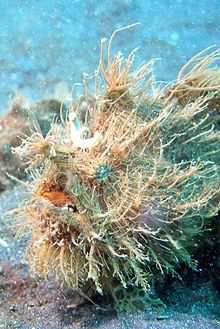
The frogfish is a kind of anglerfish found in almost all tropical and subtropical oceans and seas. There are about 50 different species worldwide, covering an astonishing range of strange appearances. They generally live on the sea floor around coral or rock reefs. In size they vary from tiny to about 15 inches long – although ‘long’ is a flexible concept because they are to an extent shape-changers in height and width.
FROGFISH SUPERPOWERS YOU MAY WISH TO HAVE
INVISIBILITY CLOAK . Frogfish are masters of disguise and camouflage. This enables them to catch their prey with minimal effort and also to avoid predators. Their camouflage methods – broadly known as ‘aggressive mimicry’ – include
Ability to change colour for days or even weeks to mimic their surroundings
Getting covered in algae and other organic matter that matches their habitat or
Looking inherently like a plump rock or in some cases, plant
Fear for the life of the spider crab…
IRRESISTIBLE ATTRACTION (just like that nice Mr Grey)
A sort of frontal dorsal fin called an illicium to which is attached a
Lure called an esca which may mimic a worm, shrimp or small fish etc and which is
Retractable in many species and
Regenerates if it gets mislaid
The ‘dollop of cream’ thing is the esca. Note the characteristic large mouth
Spot the esca…
BUOYANCY CONTROL & SHAPE-SHIFTING
Most frogfish have a ‘gas bladder’ to control their buoyancy.
Some species can change shape or even inflate themselves by sucking in quantities of water in a so-called defensive ‘threat display’.
HOW DO FROGFISH REPRODUCE?
Although not conventionally attractive creatures, frogfish clearly manage to reproduce. Little is known about the techniques in the wild, but one is probably ‘with care’, especially for a male frogfish who may not survive for long if he hangs around after fertilisation has taken place. It has been noted that females tend to select far smaller males to fertilise their huge numbers of eggs, perhaps for that very reason.
FROGFISH FEEDING SKILLS – GOOD OR BAD?
When deploying the lure, potential prey that comes too close to that wide mouth stands no chance. A frogfish will strike in a fraction of a second. Frogfishes have voracious appetites for crustaceans, other fish, and even each other. I can do no better than borrow this vivid description of a feeding frogfish:
“When potential prey is first spotted, the frogfish follows it with its eyes. Then, when it approaches within roughly seven body-lengths, the frogfish begins to move its illicium in such a way that the esca mimics the motions of the animal it resembles. As the prey approaches, the frogfish slowly moves to prepare for its attack; sometimes this involves approaching the prey or “stalking” while sometimes it is simply adjusting its mouth angle. The catch itself is made by the sudden opening of the jaws, which enlarges the volume of the mouth cavity up to twelve-fold, pulling the prey into the mouth along with water. The attack can be as fast as 6 milliseconds. The water flows out through the gills, while the prey is swallowed and the oesophagus closed with a special muscle to keep the victim from escaping. In addition to expanding their mouths, frogfish can also expand their stomachs to swallow animals up to twice their size.“
HOW DO FROGFISHES GET AROUND? SWIM? WALK? CRAWL?
Frogfishes do not in fact move around a great deal. Using their camo advantages, they prefer to lie on the sea floor and wait for prey to come to them. As mentioned in the quote above, they may slowly approach prey using their pectoral and pelvic fins to “walk” along the sea bottom. They can swim using their tail fin (or in some species by simple ‘jet propulsion’ by forcing water out of their gills) but rarely do so – they don’t feed on the move, and they are adapted to the sea floor environment where they food is readily available. However their “walking” ability is limited to short distances.
DO FROGFISH HAVE OTHER COLOUR SCHEMES?
Indeed they do. In stark contrast to the camo species, some frogfishes are highlighter bright. Here are two of my favourite photos by Adam that show this clearly. I’ve no idea if these are a male and female. I suspect they are different species. I think the brown one is a striated frogfish and the other is… a yellow frogfish. Some people keep these creatures in aquaria, but apparently it is impossible to sex them, and they have to be kept on their own for everyone’s peace of mind…
FROGFISH INFOGRAPHICS
FROGFISH VIDEOS
These two videos, from Lester Knutsen and Daan Van Wijk respectively, show some of the characteristics I have written about above. Both are short and both are fascinating.
To read more about frogfishes and for some fabulous photos I highly recommend the websiteFROGFISH.CHYou can reach the main page(s) but the link seem to be broken so I have not been able to contact Teresa Zubi, whose site it is. She clearly has a sense of humour and uses a neat pair of gifs which I hope she won’t mind my using…
Credits: All main photos, Adam Rees of Scuba Works with many thanks; wiki for ‘spot the esca’, red quote & basic info; videos Lester Knutsen & Daan Van Wijk; Teresa Zubi for website & gifs; infographics, authors u/k
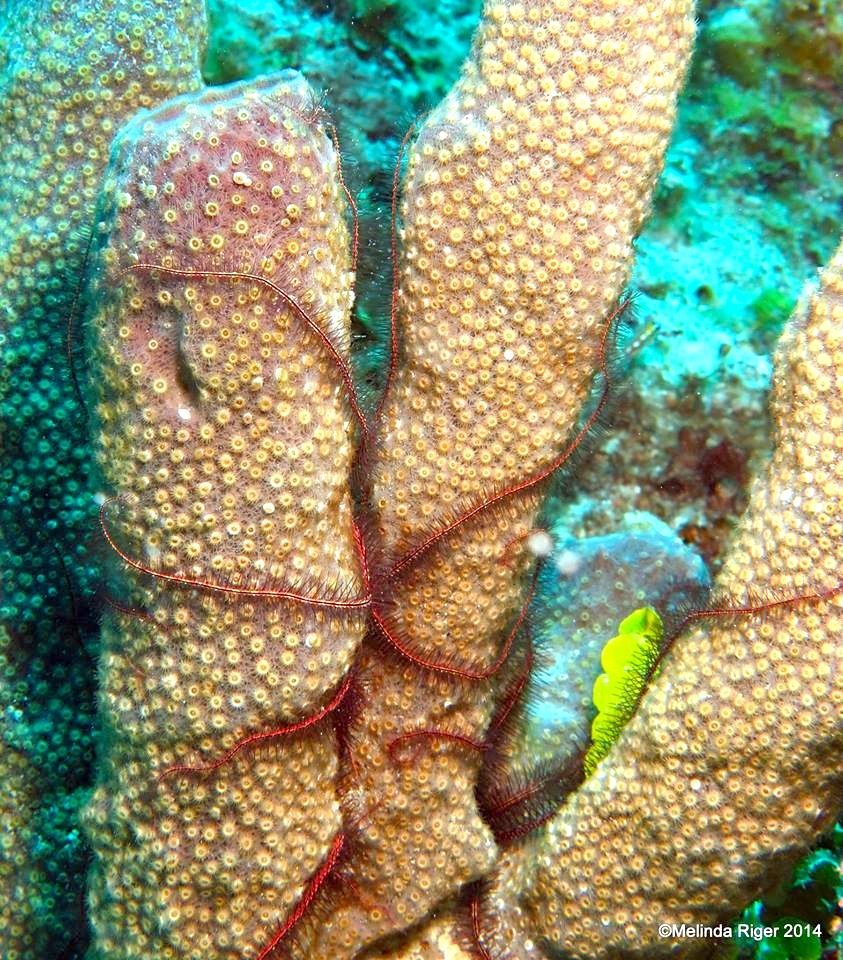
BRITTLE STARS are closely related to starfish, and in particular to Basket Stars. They are commonly known as “serpent stars”, having 5 long, thin arms that may grow as long as 2 feet long. There are lots of different types of brittle star – at least 2000 – and they are found in every ocean on earth from the poles to the tropics. In Bahamian waters they a commonly found living on reefs.
Although these creatures look primitive, their structure, nervous systems, respiratory systems, digestive systems, sex lives and transportation methods are incredibly complex. Take it from me – I’ve just read about it all. So I’ve decided to pick a few aspects of these creatures to highlight rather than discuss the minutiae of their ossicles (tiny bones), madroporites (a sort of water filter / pressure balancer) and viscera.
You are most likely to see Brittle Stars clinging to coral or sponges
A DOZEN BRITTLE STAR FACTS TO PLAY WITH
The star has no eyes and no sense organs as we know them, but can detect light chemically; and (why would they need this?) sense smell through their ‘feet’… [Not a superpower I would prize, but still]
The mouth is on the underside of the central disc (‘body’) of 5 segments, each with a toothed jaw
The mouth is used both for ingestion and, putting it delicately, egestion. [Nor that superpower]
Stars eat tiny organisms suspended in the water or mini-worms, gathering them with their arms
If I have understood this, they breathe through their armpits, and can excrete from here also
The arms fit the main part with ball and socket joints, and are flexible in all directions
The genitals seem to be located in or between the armpits (lucky we are not descended from stars)
Stars readily regenerate lost arms until they lose the 5th – then they are in real trouble
This enables them to shed an arm in a predator attack, like a lizard its tail
Trials indicate that a jettisoned arm cannot regenerate from itself
They use only 4 arms to move along, with the fifth ‘steering’ out in front or trailing behind
Brittle Stars are inedible but non-toxic
Often, brittle stars will cling on inside a sponge
Here is a great video from Neptune Canada of a brittle star fight on the ocean floor over the remains of a shrimp. If you watch the ones joining the fight, you will clearly see the locomotion method described above, with one limb pathfinding and the other four ‘walking’.
I’m not renowned for extreme sensitivity, so I feel no shame in showing mating brittle stars, courtesy of Channel Banks. It’s not exactly Lady Chatterley and Mellors, but the entwined arms are rather romantic, no?
Credits: all wonderful photos by Melinda Riger of Grand Bahama Scuba; BS infographic and viddys as credited
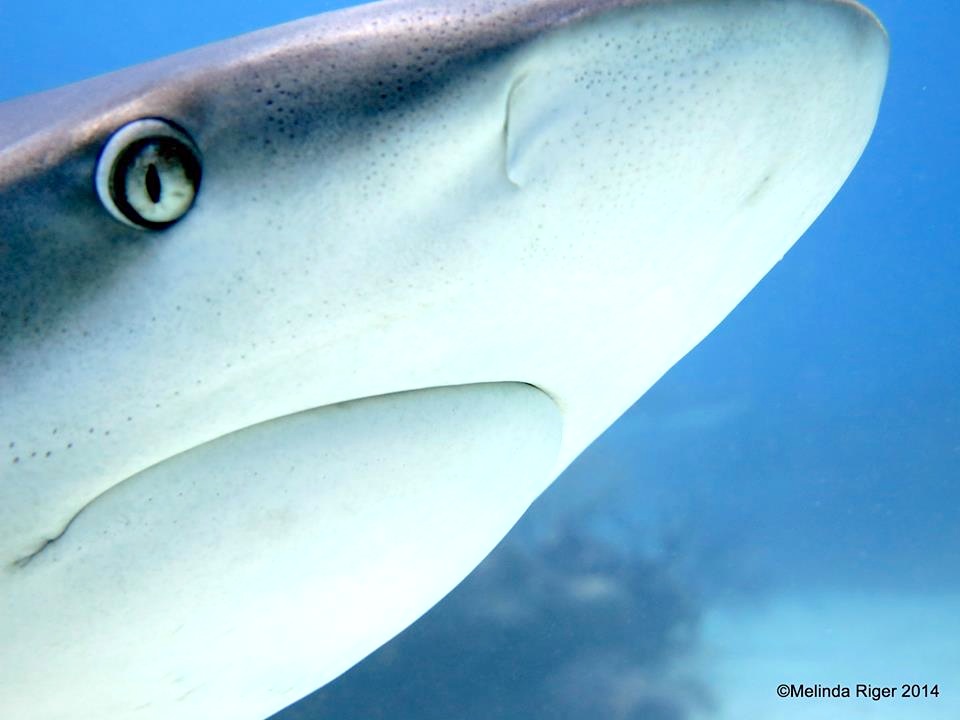
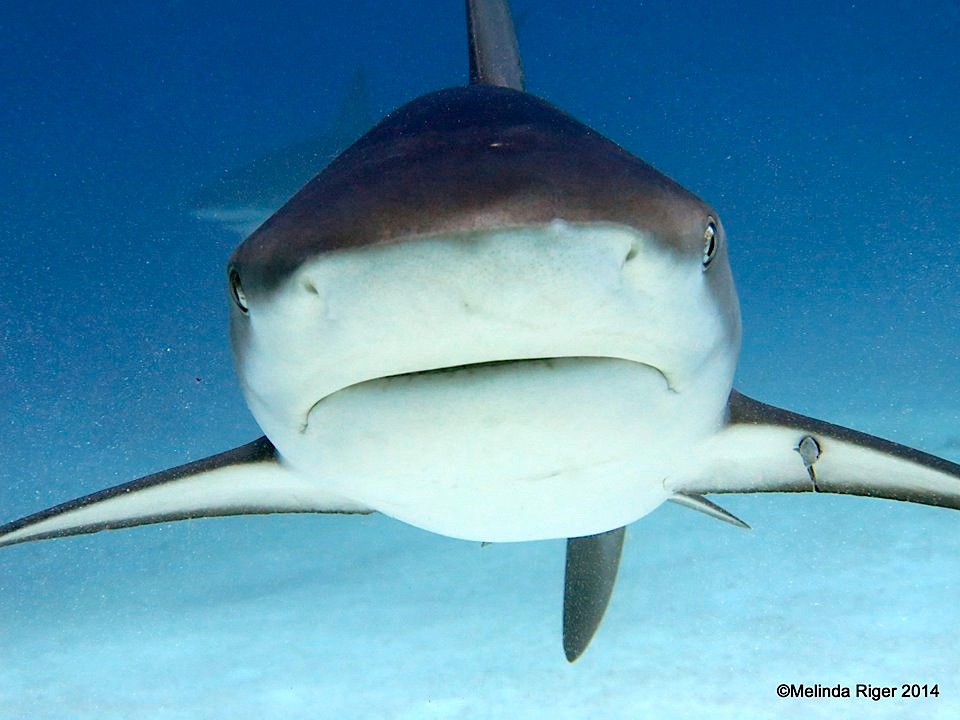
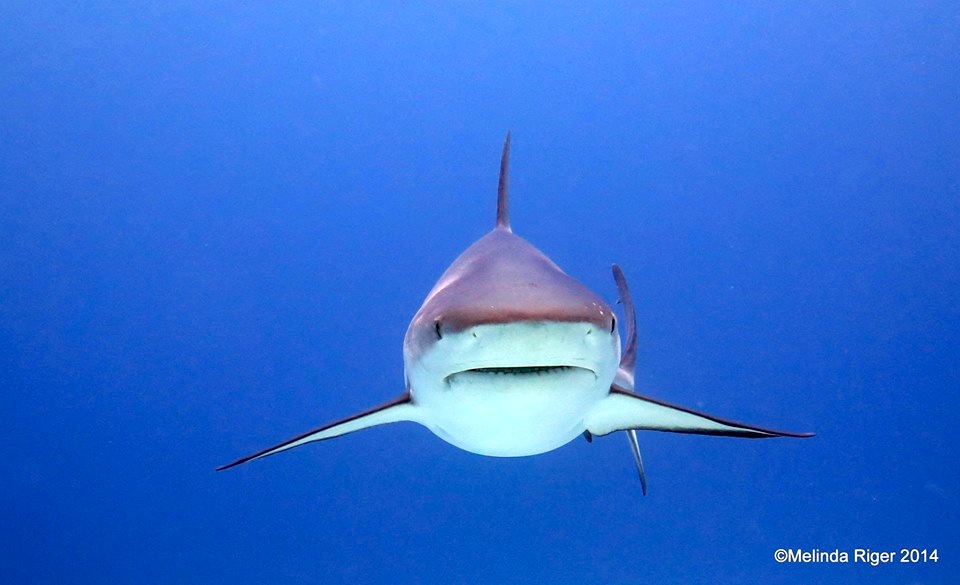
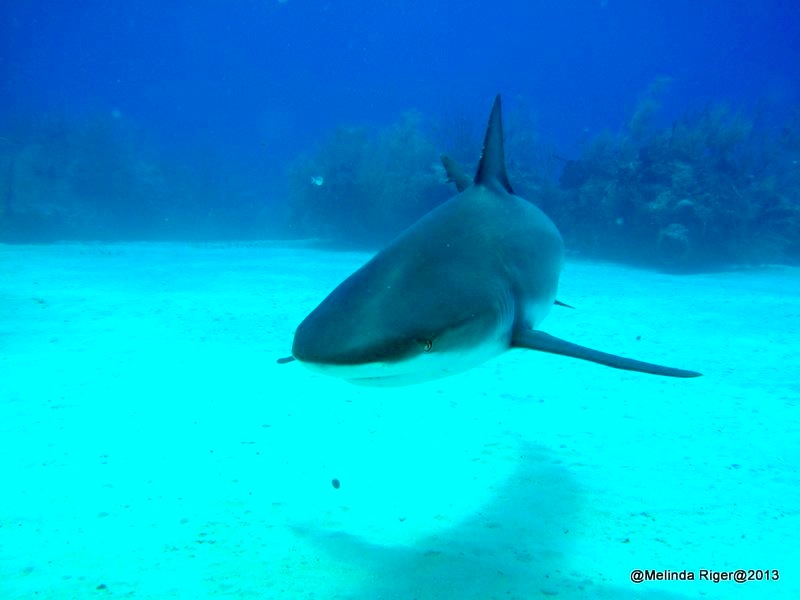
From time to time I wonder about the naming of animals. I know about the problems that can arise when people name their chickens Henny, Penny, Denny & Lenny, and the time comes to (please look away now). And how a slavering dog coming towards you (not on a lead) that the owner calls ‘Tyson’ or ‘Killer’ is possibly one to cross the street for. And that the owner of a cat called ‘The Reverend Wenceslas Muff’ (Sir Roy Strong, in fact) may not take kindly to you referring to it facetiously as ‘Puddy-tat’. But does it make things any better to know that the shark that is eyeballing you is called Lucy? I don’t know the names of the others, but I am sure they would all like to be introduced…
REMORAS Some of the photos show a strange creature attached to the underside of the shark. For more info about these weird shark passengers, and some great images, click HERE
All the fabulous photographs above were taken by Melinda Riger and Virginia Cooper of Grand Bahama Scuba, on whom I rely entirely for subaqueous material, being a pathetic swimmer, a gnarly ancient, and a certified scaredy-cat (‘highly commended’). My thanks as always to them for use permission
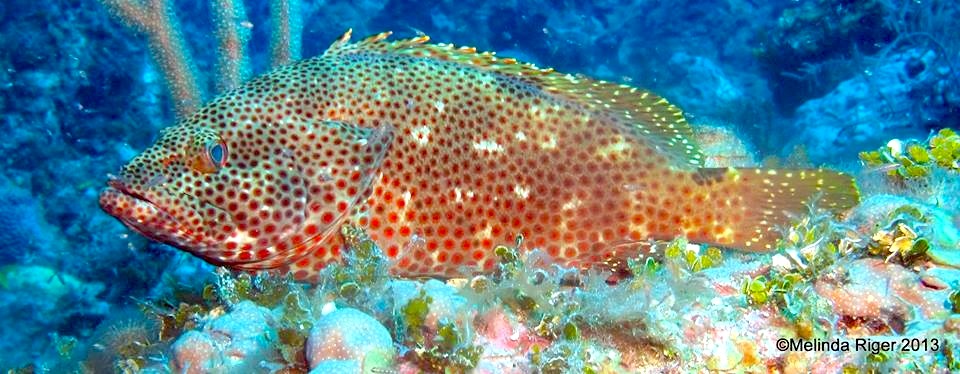
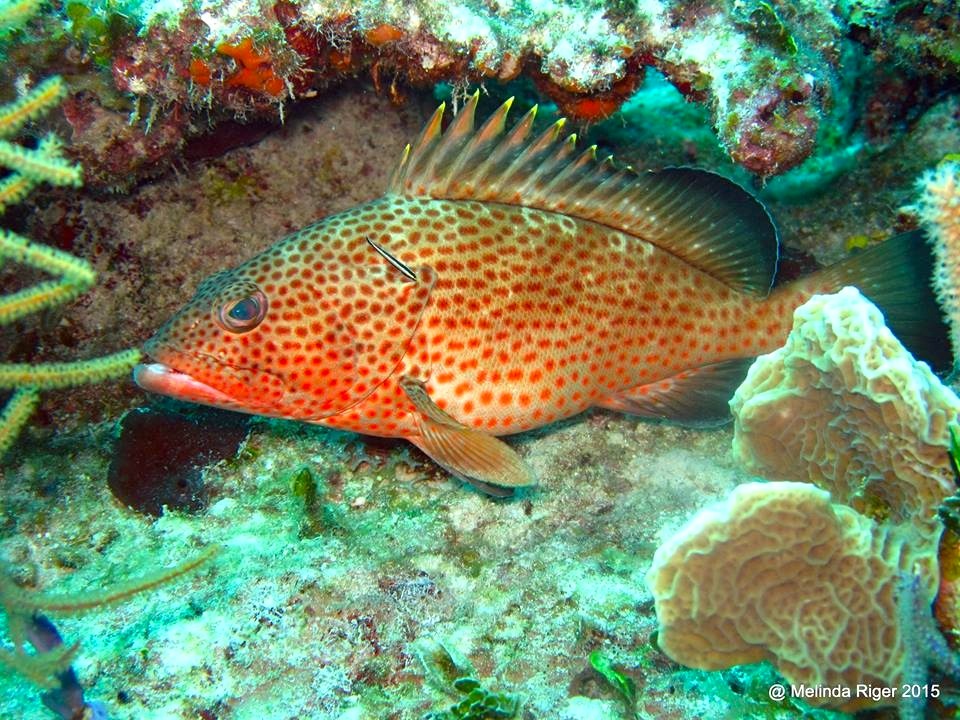
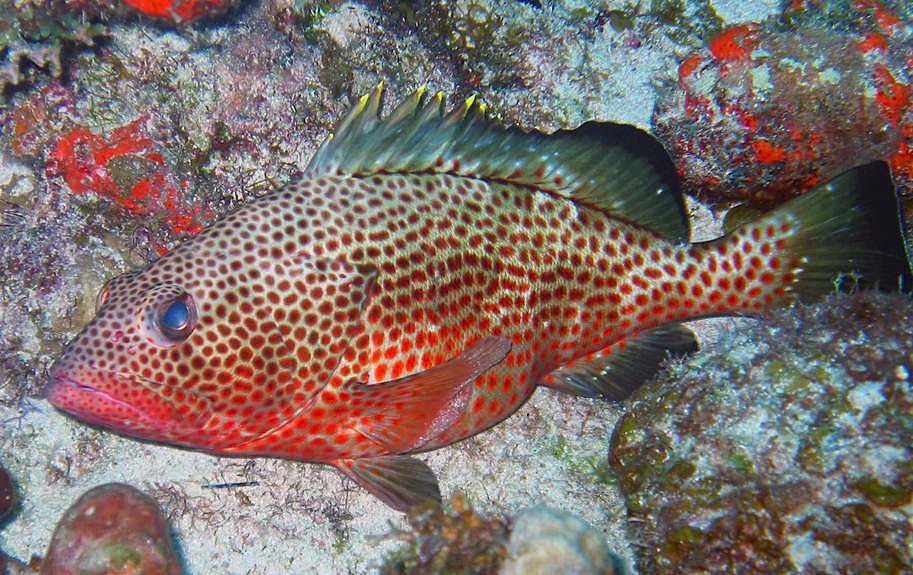
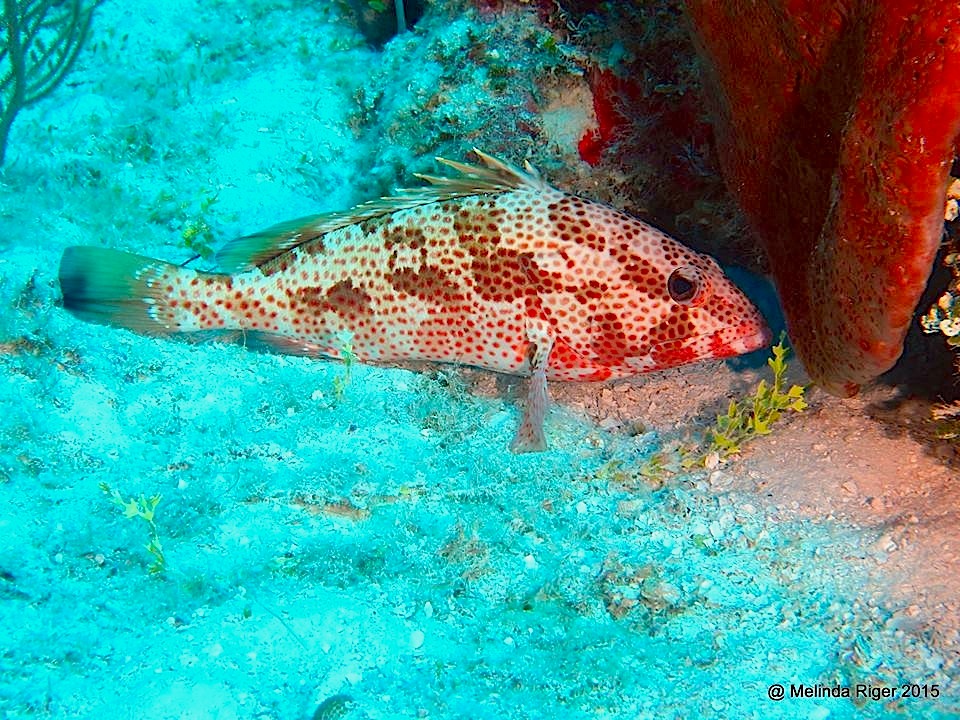
The Red Hind is one of several grouper species commonly found in Bahamas waters. Commonly for now, anyway. There is less information available about this species compared with other groupers, but sources seem agreed that it is (a) abundant and (b) IUCN listed ‘least concern’ but (c) heavily fished and (d) delicious.
One problem arises from the fact that Red Hinds form spawning aggregations in particular areas, making them vulnerable to fishing exploitation in those locations, and consequent population decline. Already, some of their spawning areas are protected.
Another threat comes from the degradation of coastal habitats coupled with increasing commercial and recreational fishing. Red Hinds are targeted with speargun, hook and line, fish traps and nets. They may also be by-catch of other fishing operations. Fortunately Marine Protected Areas such as the ones in Abaco waters provide localised protection but these are not found throughout the Red Hind’s range. Closed seasons have been imposed in a few areas, another conservation method that has recently been introduced in the Bahamas for the Nassau grouper.
Getting the right balance between traditional fishing for food, and stock conservation is inevitably a tricky calculation. For the Red Hind, the factors that may result in the population decline of a plentiful species are in plain sight and will continue to be monitored by the various scientific research organisations involved…
CHERUBFISH (PYGMY ANGELFISH): BAHAMAS REEF FISH (23)
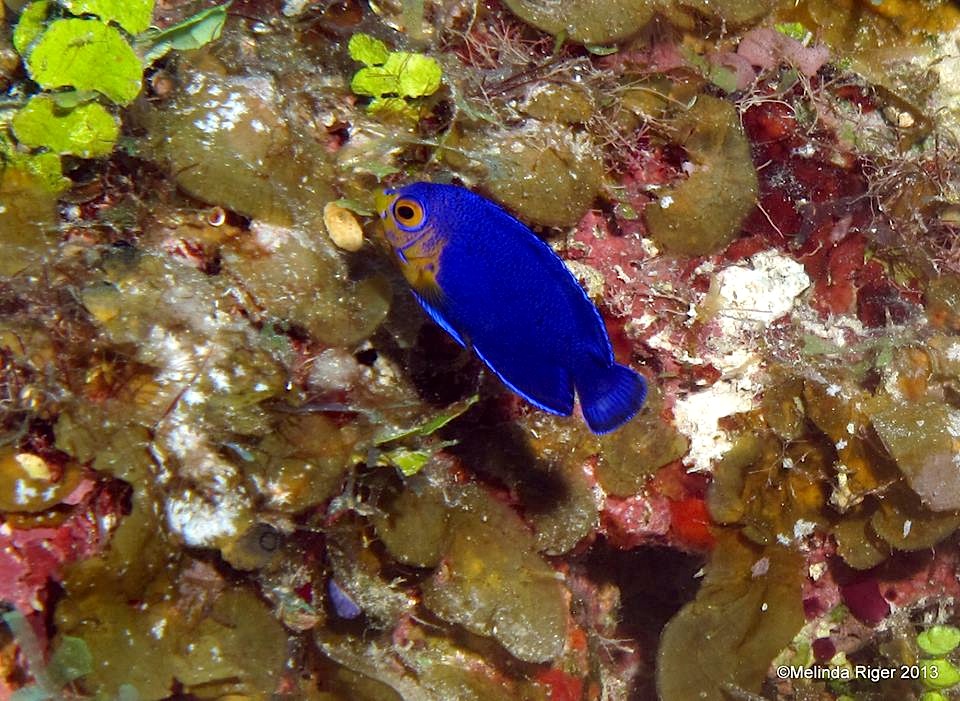
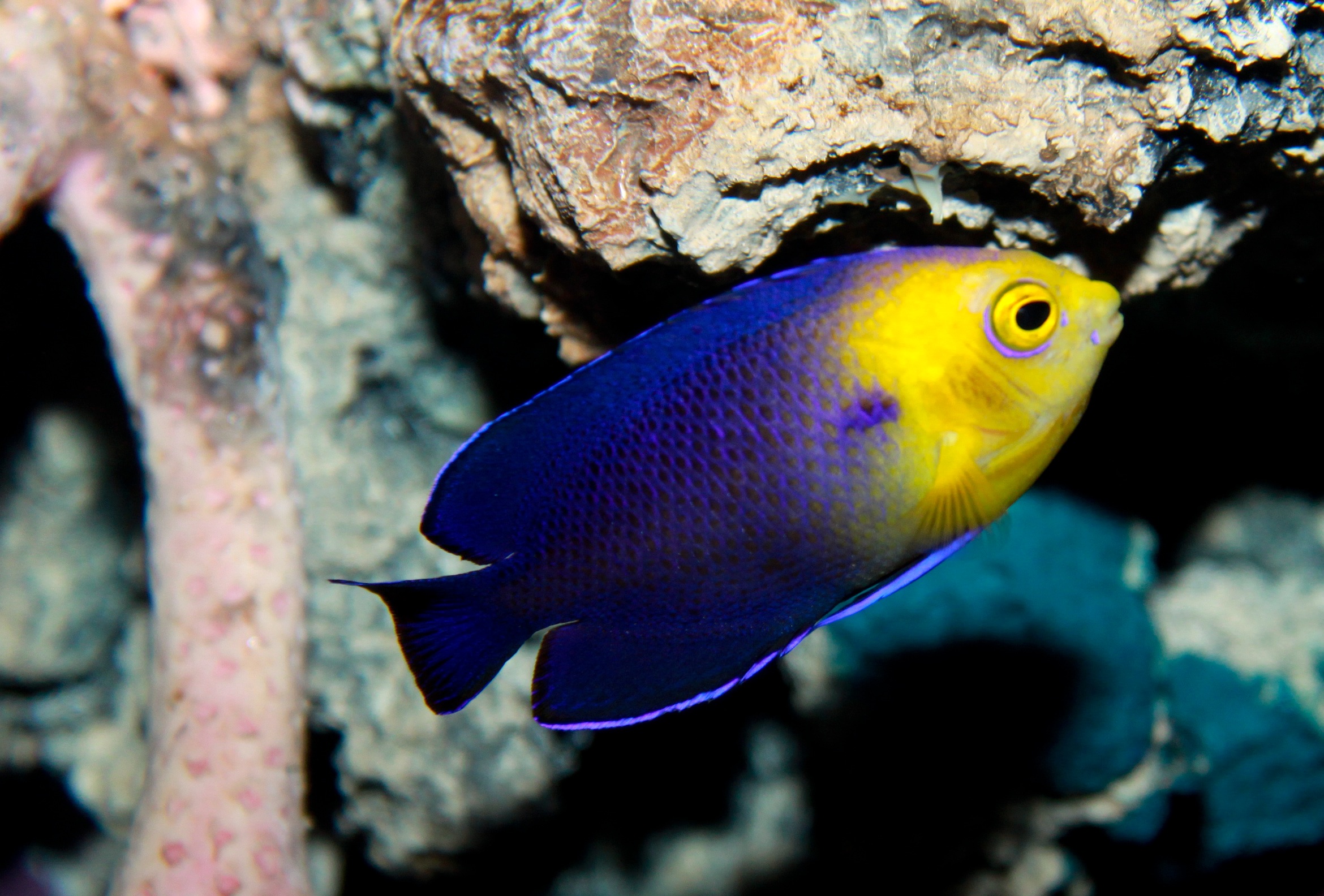
Time for a bright little denizen of the not-so-deep. The Cherubfish Centropyge argi or pygmy angelfish is a very small (8cm) and distinctively coloured angelfish species. These fish are native to the Caribbean and Gulf of Mexico, and flicker round the coral reefs happily feeding as they go (see the video below to see how busily they forage). Or maybe they are just having a good time…
The Cherubfish is unsurprisingly a popular aquarium species. Don’t rush straight out and buy some though: a typical warning says “like other angel fish, they are not completely 100% reef-safe. Results vary among individual fish and tank qualities (size, feeding, tankmates, etc.), so caution is recommended when adding this fish to a coral tank“. You can read the whys and the wherefores HERE – sadly I lack the vibrant interest in aquaria to go into it myself…
Looking beyond Melinda’s lovely images of the species, I have found that these creatures will often show more yellow at the nose end. Here’s an example of a more two-tone Cherubfish in case you come across one.
I mentioned that Cherubfish flicker around the reefs instead of proceeding serenely and in an orderly fashion. Have a look at this short video to see what active little fish they are.
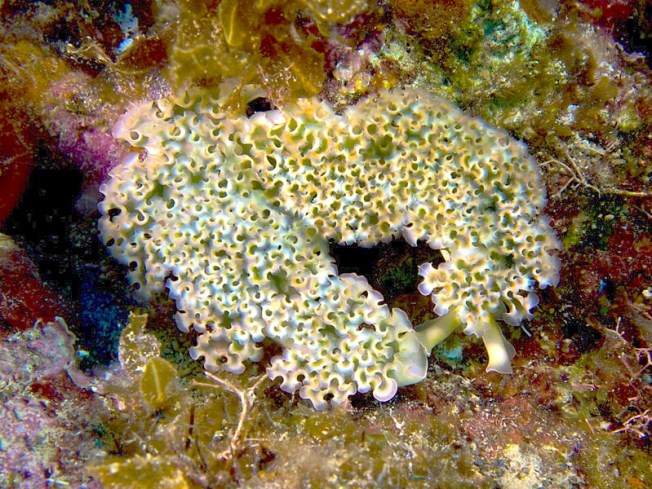
The ‘WTF’ series so far has covered Bahamas reef fish on the bizarre end of the unusual-to-completely-weird appearance spectrum. And it has stood, of course, for ‘What’s That Fish?’. Today, it doesn’t. The feature creature isn’t a fish at all; it looks like a plant; it is in fact a SACOGLOSSAN – specifically the Lettuce Sea Slug Elysia crispata.
The head end is on the left…
The name ‘sacoglossan’ literally means ‘sap-sucker’ (the sapsucker bird has a different latin name, however). And the slug’s frilly edges supposedly resemble certain types of curly lettuce. I’ve no idea where the ‘crispata’ comes from, but I am sure it doesn’t relate to crisp lettuce. These are creatures of shallow, clear waters such as the sub-tropical reefs of the Bahamas.
‘SOLAR POWERED SLUGS’
This isn’t a technical forum and too much science hurts my head. This species primarily lives off algae. However I give you the word KLEPTOPLASTY to drop into your conversation. In a sentence, algae is eaten but only partially digested; certain elements are stored to produce photosynthesis by which light is converted to energy and the slug can live without food. But baffle your neighbour at dinner, why not, by summarising the process as “chloroplast symbiosis”. Meanwhile, I’m fetching a beer.
My research suggests that very little is known about the mating behaviour of these slugs. The pair shown below may be exploring the possibilities, or at least trying to work out which end is which. One is easy to tell, but the other? Time to make our excuses and leave…
HOW FAST, EXACTLY, DOES A LETTUCE SEA SLUG MOVE?
This rather beautiful video from ‘CORAL MORPHOLOGIC’ will reveal all. You’ll soon see that progress is very slow. I recommend watching the first 30 seconds and you’ll get the idea. If you choose to persist, you will see the slug sort of turn a corner to the left.
Credits: Melinda @ Grand Bahama Scuba, Laszlo Ilyes, Nick Hobgood, Coral Morphologic, Wiki
WTF? (WHAT’S THAT FISH?) 2: STRANGE BAHAMAS REEF FISH
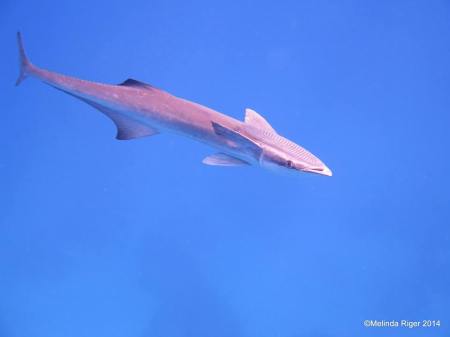
WTF 1 concerned the REMORA, the upside-down looking fish with the trainer-sole sucker on its head with which it attaches itself to sharks and other large undersea creatures. If you’ve ever seen a picture of a shark with one or more grey passengers hitching a ride, those are these.
WTF 2 features some creatures found in the reef waters of the Bahamas that make you wonder just how and why they are as they are. They look unnecessarily complicated, and the design is somewhat outlandish. See what you think of these…
BURRFISH
SLIPPER LOBSTER
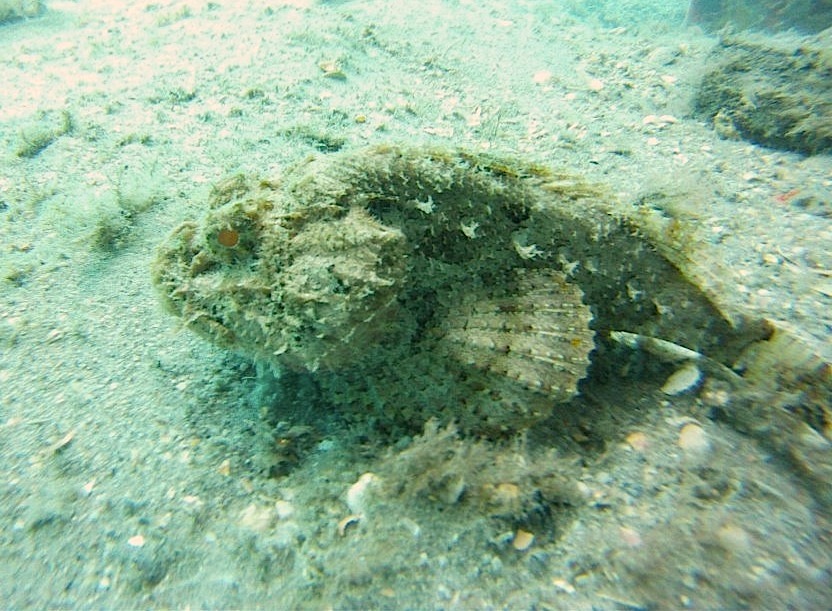
SCORPIONFISH (& header image) camouflaged against coral
COWFISH
TRUNKFISH
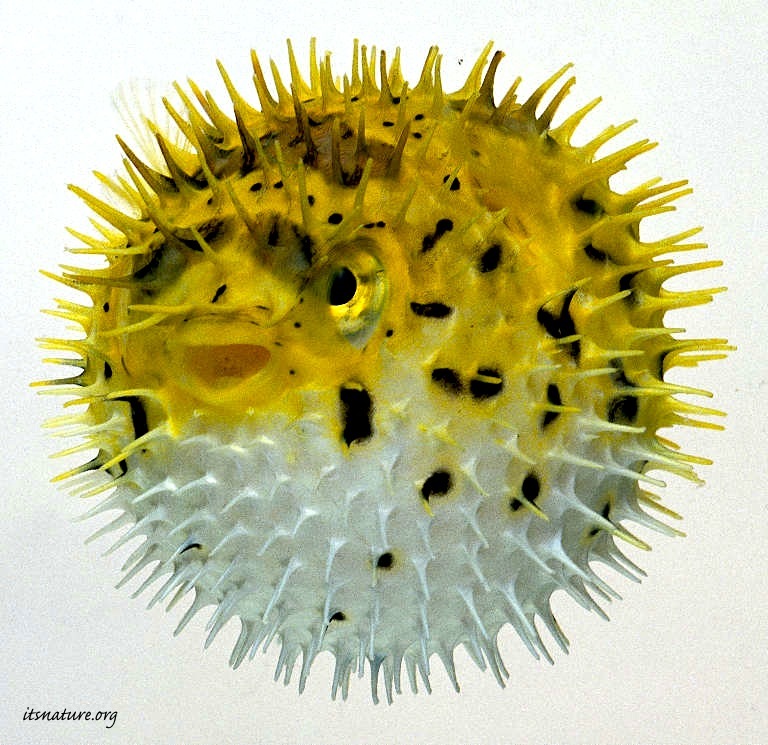
PORCUPINE FISH
“Watch this…”
“Ta Daaaaaa”
AIRPLANEFISH*
*Well, it’s really airplane wreckage. Besides a few other planes and a variety of ships that can be explored underwater, there are also two locomotives in Abaco waters that “fell off” a ship while being transported. Now recreate in your mind the subsequent conversation with an insurance company…
APOLOGIES Header image repeated to sort out FB visuals problem that’s driving me nuts
Credits: Melinda Riger, Grand Bahama Scuba;Virginia Cooper; itsnature.org
‘TREAT WITH PATIENCE…’ – NURSE SHARKS IN THE BAHAMAS
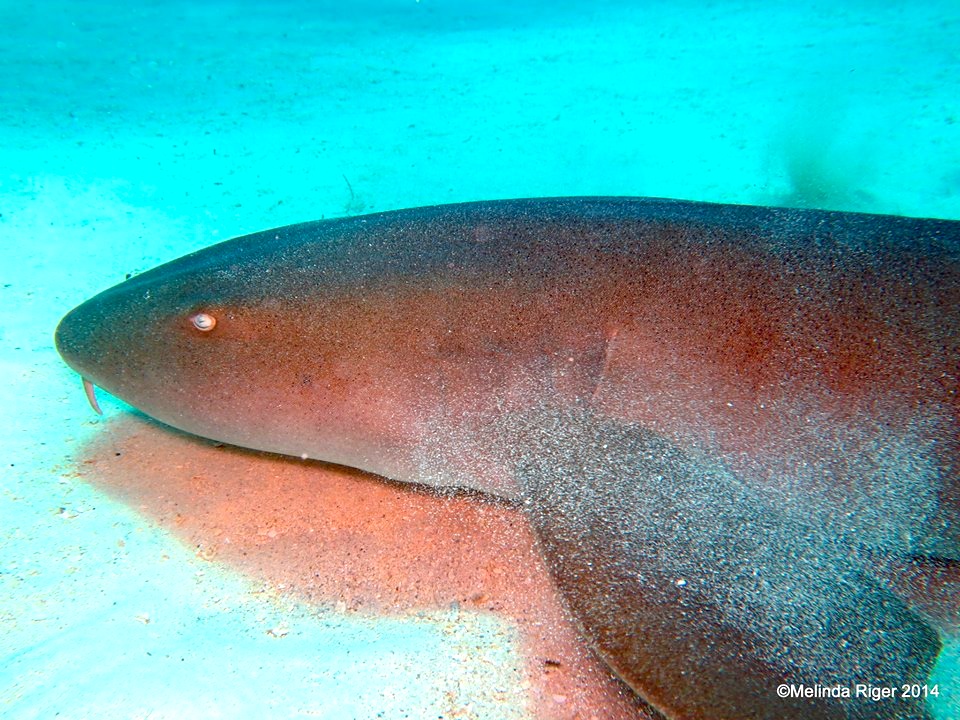
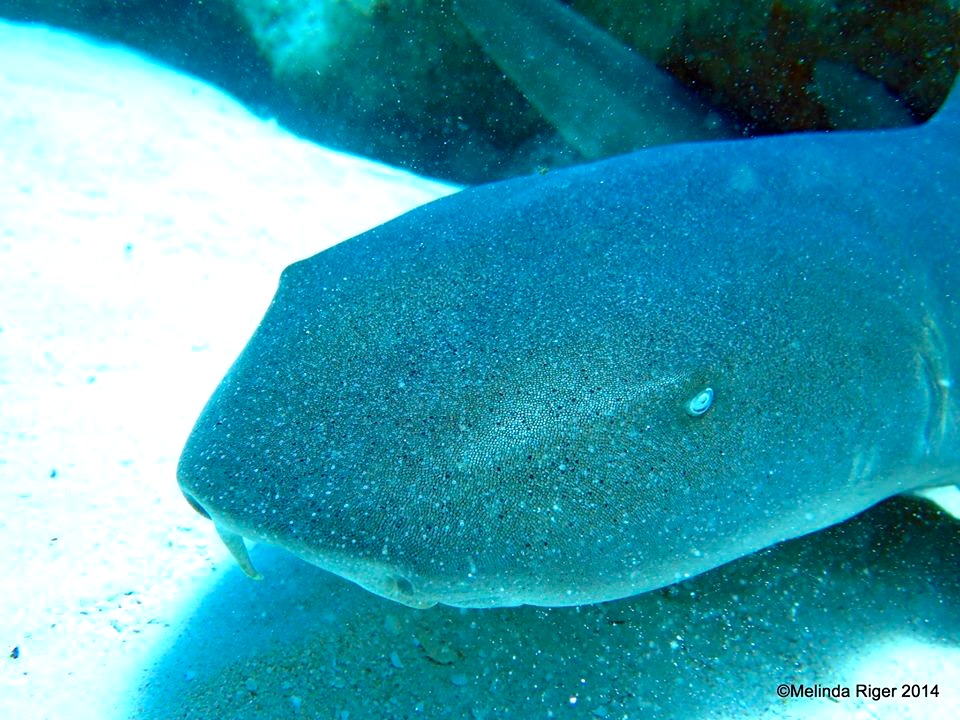
The scientific name for the nurse shark sounds like something Bilbo Baggins might have said to summon elves to his rescue: Ginglymostoma cirratum. Actually the name is a mix of Greek and Latin and means “curled, hinged mouth” to describe this shark’s somewhat puckered appearance. The origin of the name “nurse shark” is unclear. It may come from the sucking sound they make when hunting for prey in the sand, which vaguely resembles that of a nursing baby. Or it may derive from an archaic word, nusse, meaning cat shark. The most likely theory though is that the name comes from the Old English word for sea-floor shark: hurse.
Nurse sharks are slow-moving bottom-dwellers and are, for the most part, harmless to humans. However, they can be huge—up to 14 feet (4.3 meters)—and have very strong jaws filled with thousands of tiny, serrated teeth, and will bite defensively if stepped on or bothered by divers who assume they’re docile.[There are recorded instances of injuries caused to divers who have tried to pull nurse sharks by the tail. And serve them right, I say. Treat them with patience – and respect!]
Notice that the nurse shark in the above photo, and in the header image, is being attended by REMORAS. Click the link to find out more about the strange relationship these ‘weird suckers’ have with larger marine creatures.
They use their strong jaws to crush and eat shellfish and even coral, but prefer to dine on fish, shrimp, and squid. [And also stingrays, apparently. They have been observed resting on the bottom with their bodies supported on their fins, possibly providing a false shelter for crustaceans which they then ambush and eat.] They are gray-brown and have distinctive tail fins that can be up to one-fourth their total length. Unlike most other sharks, nurses are smooth to the touch.
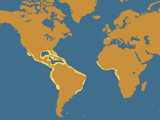
Nurse sharks are found in the warm, shallow waters of the western Atlantic and eastern Pacific oceans. They are abundant throughout their range and have no special conservation status, although the closeness of their habit to human activities is putting pressure on the species.
Nurse sharks are nocturnal and will often rest on the sea floor during the day in groups of up to 40 sharks, sometimes piled on top of each other.
FAST FACTS
Type: Fish
Diet: Carnivore
Size: 7.5 to 9.75 ft (2.2 to 3 m)
Weight: 200 to 330 lbs (90 to 150 kg)
Size relative to a 6-ft (2-m) man:
Credits: All photos Melinda Riger, Grand Bahama Scuba; range map and text mostly NATIONAL GEOGRAPHIC filled out with other pickings
RED REEF RESIDENTS: A RUFOUS ROUND-UP IN THE BAHAMAS
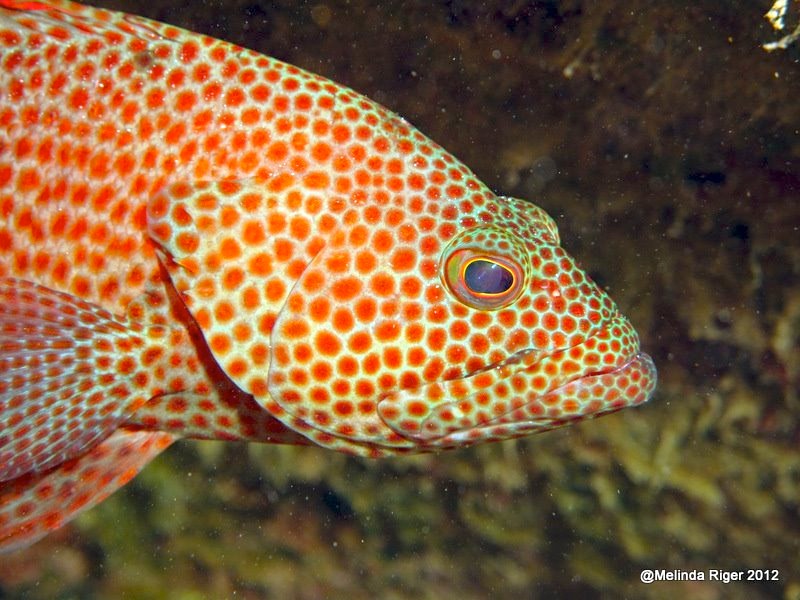
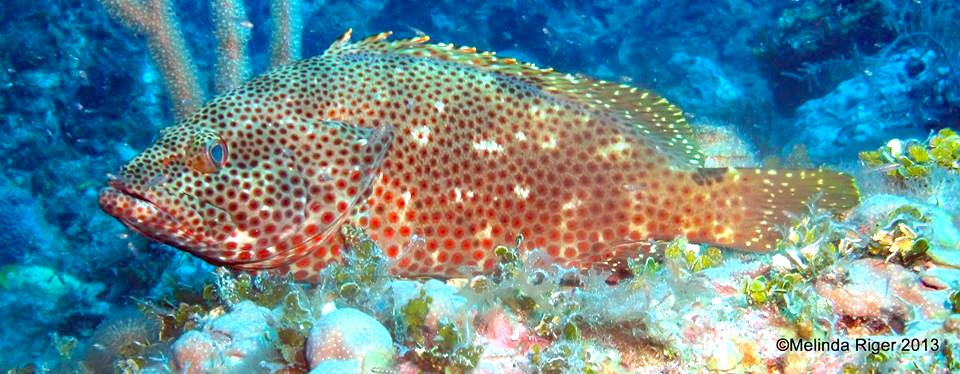
It’s sunny and very hot. Time to take another dive with Melinda to see what is going on under water around the reefs. Here are some residents, a somewhat loose description since some of the denizens featured are not especially active. But they are alive, so they qualify by my wide rules. And please may we not get into a discussion about where precisely red and orange overlap. It’s a grey area. And it’s too hot to argue about it… Let’s start with three types of GROUPER that may be spotted in the northern Bahamas. In fact, they are always spotted. One of my favourite pictures is the Graysby – it’s such a great expression, and he really rocks the spots!
GRAYSBY
TIGER GROUPER AT A CLEANING STATION with Peterson Cleaning Shrimps & a GobyRED HIND
BLACKBAR SOLDIERFISH
HOGFISH
SQUIRRELFISH
But red fish are not the only red reef residents. Here are some that won’t swim away from you as you swim towards them to admire them…
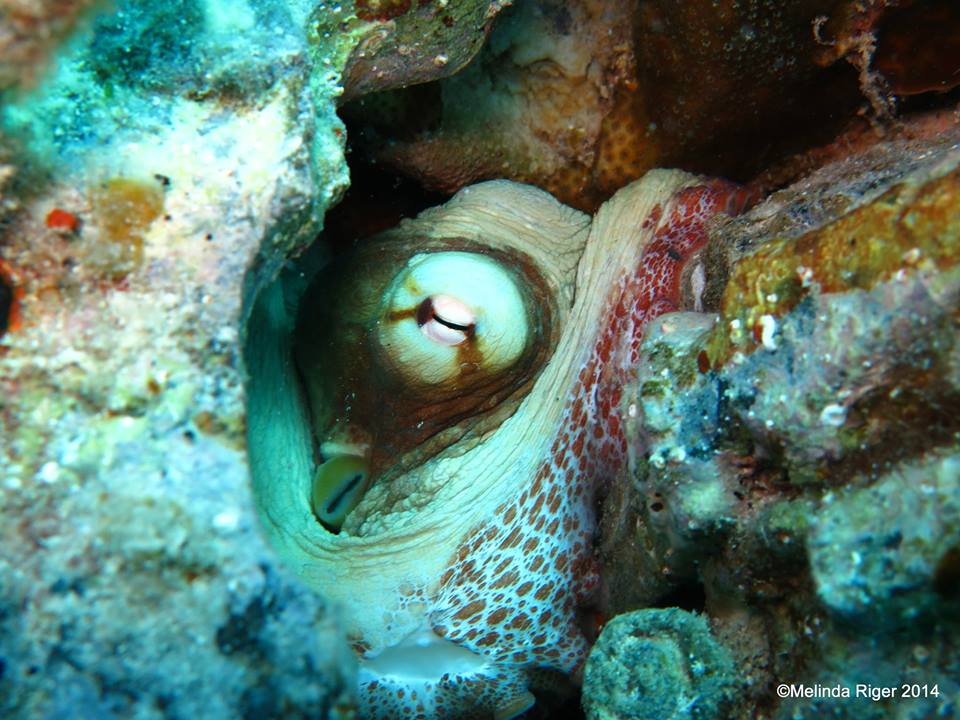
Few people know that, by international law, it is unlawful to fail to be fascinated by Octopuses… Octopi… Octopodes… Octopotomi… Whatever. For a learned dissertation on the correct plural form for these creatures – bear with me, there are strict rules that apply here – you’ll find out the right way atTHE PLURAL OF OCTOPUS. I won’t go into it all now, because it’s time to showcase some more wonderful underwater photography by Melinda Riger of Grand Bahama Scuba. Strictly, these are not Abacos Octos, but they share the same reef system and are therefore close cousins. Of such tenuous links are blog posts formed.
My favourite octopus photo
Settling down to a take-away
The all-seeing eye…
On the move… so long suckers!
Octopus InkAll photos: Melinda Riger
The Rare Scottish Tartan Octopus
SAD POST SCRIPT: As a Scot out of Norway (did you ever?) my father learnt to play the bagpipes. Indeed had a set. They lived in a cellar I wasn’t allowed into. The bag was allegedly preserved in treacle (don’t ask). I still have the ‘Chanter’ (a single pipe practice instrument), the sound of which is akin to trying to strangle one cat with another cat. I was fobbed off with that. Then one day as a treat the cellar was unlocked and a large wooden box was dragged out. The bagpipes! The lid was opened and… OMG! the bag had rotted away completely, the pipes looked pathetic and very disappointing, and the whole thing stank of nameless dead creatures… I can’t hear the sound of the pipes to this day without finding it (a) stirring yet (b) enough after a short time and (c ) a reminder of a broken dream… The end.



































































 ROLLING HARBOUR ABACO

You must be logged in to post a comment.