Unknown's avatar

BRAIN WAVES: UNDERSEA CORAL MAZES & LABYRINTHS


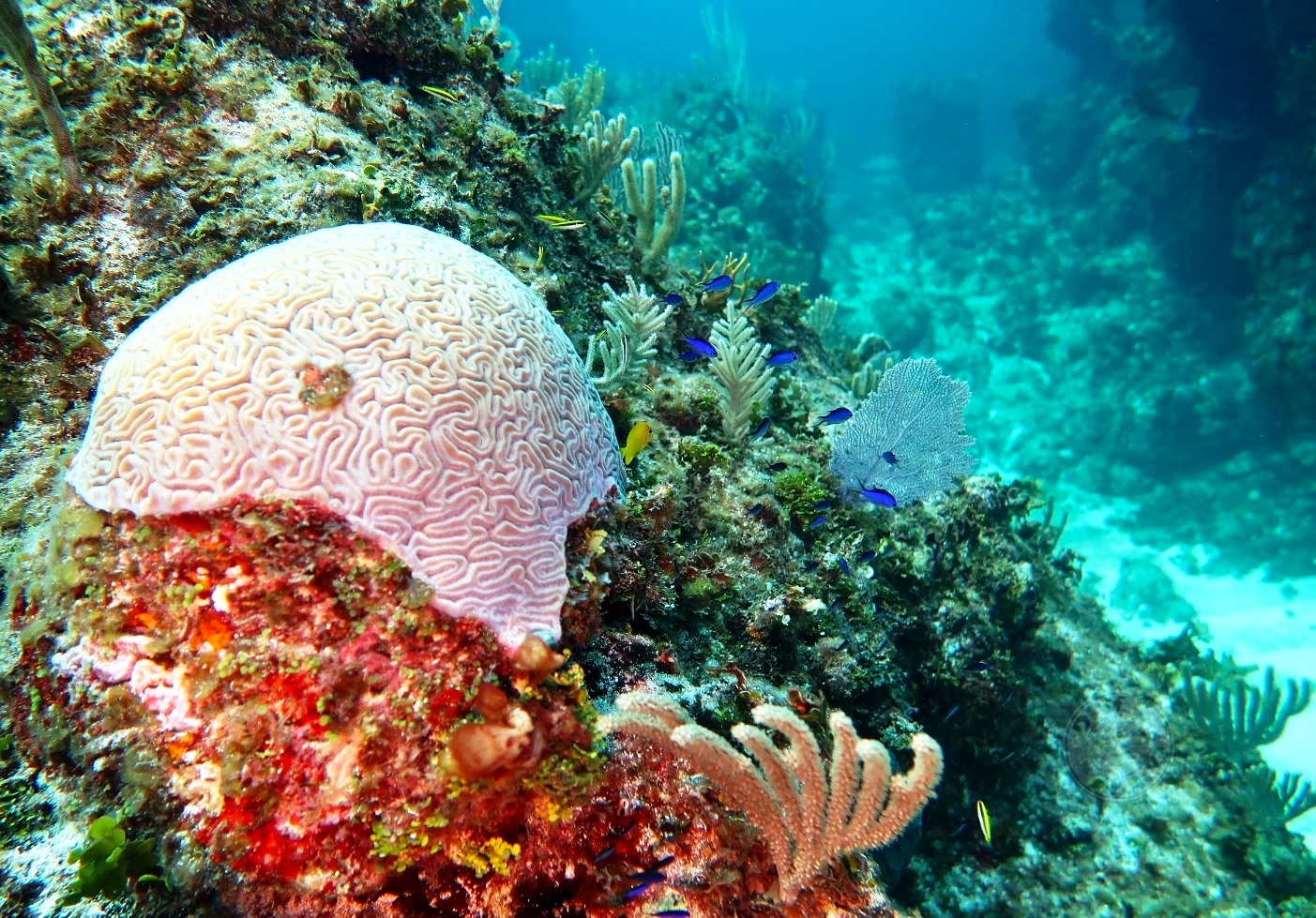
BRAIN CORAL Abaco Bahamas (Melinda Rogers / Dive Abaco)

BRAIN WAVES: UNDERSEA CORAL MAZES & LABYRINTHS

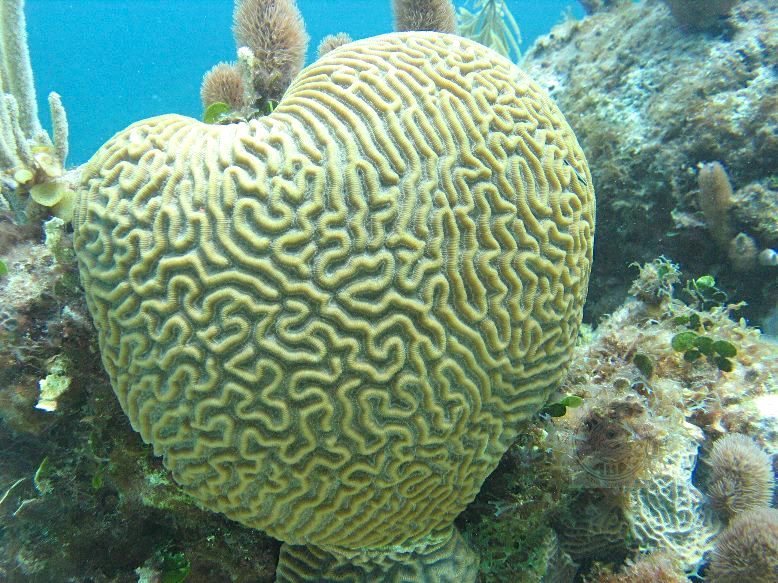
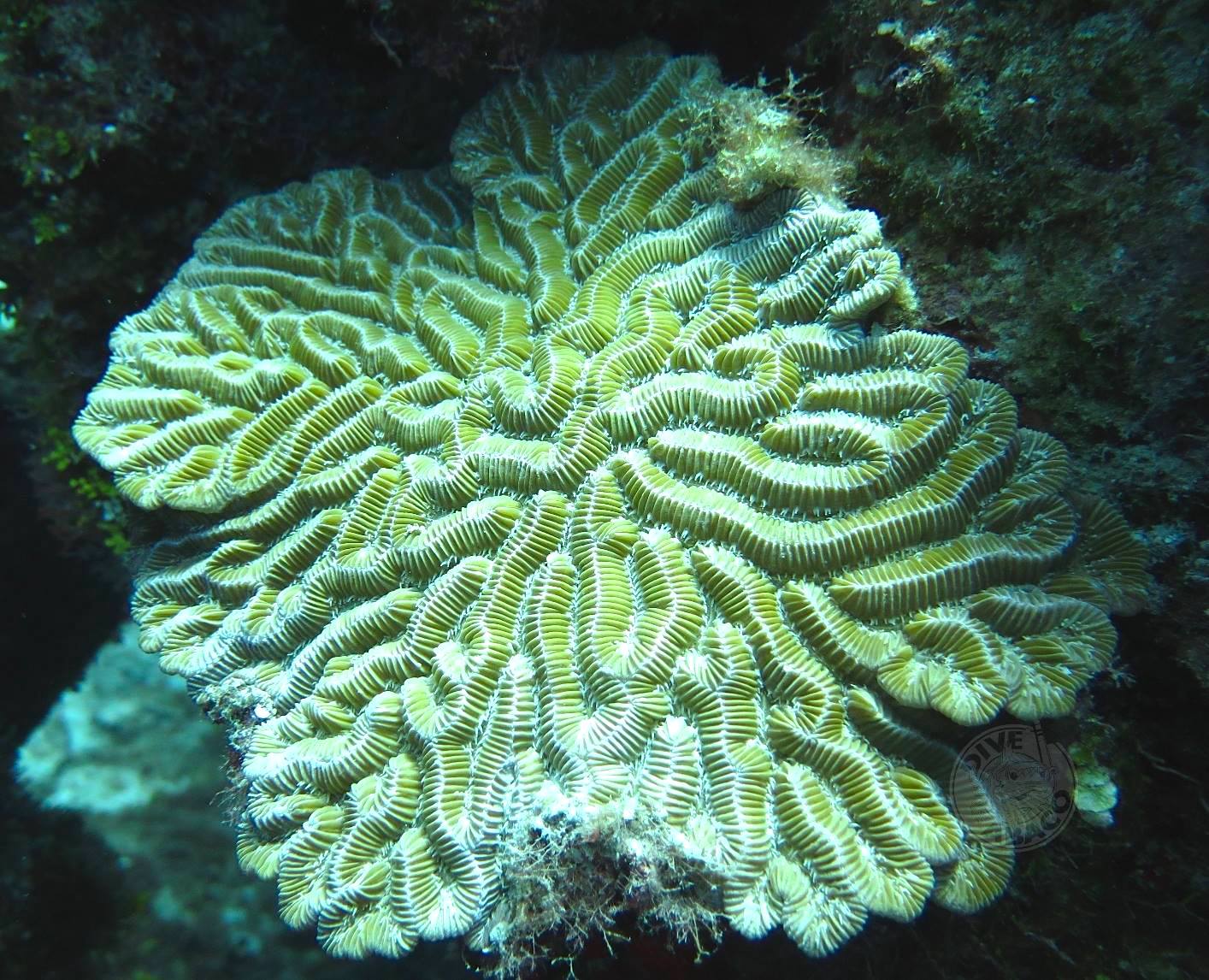
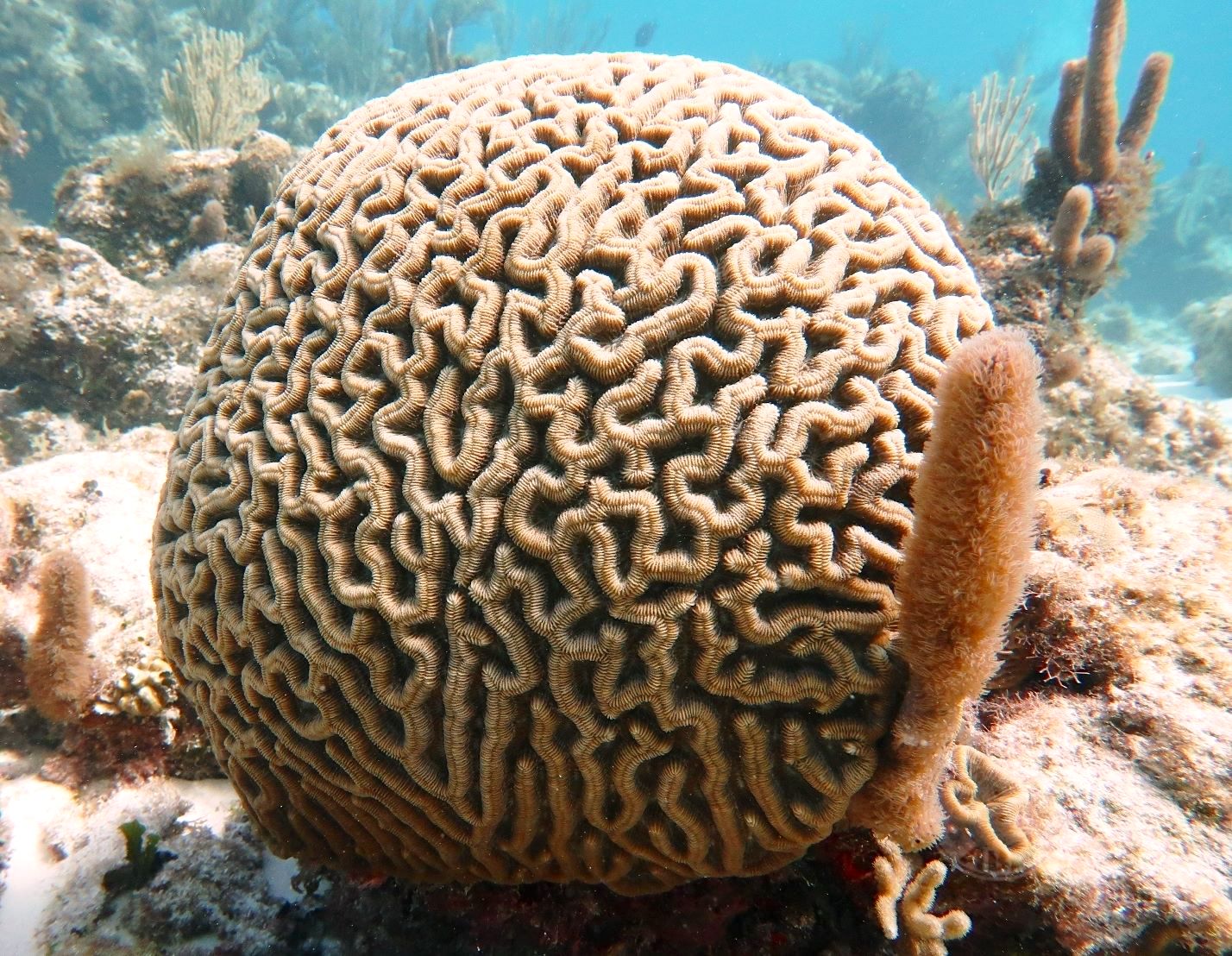
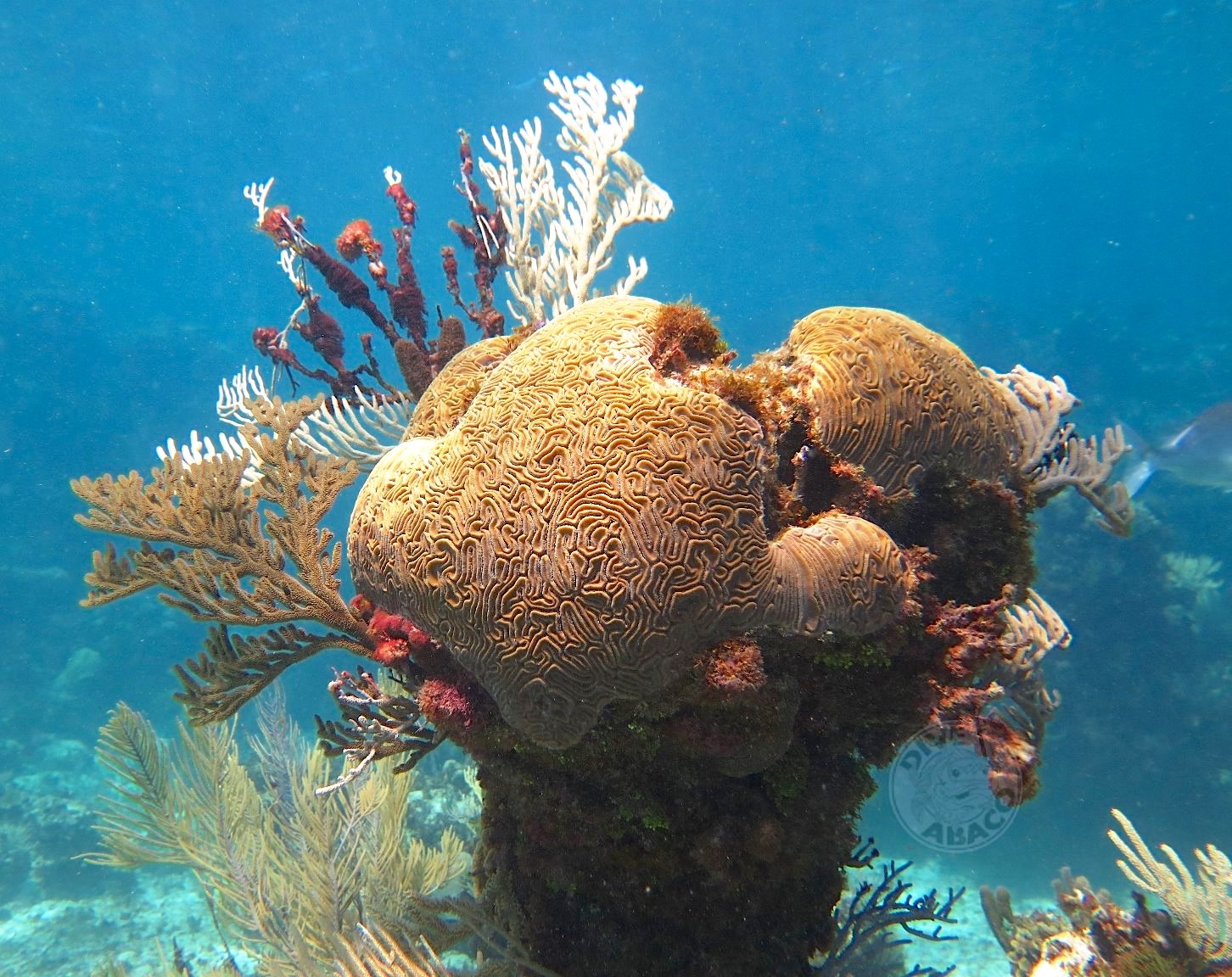
The name ‘brain coral’ is essentially a no-brainer. How could you not call the creatures on this page anything else. These corals come in wide varieties of colour, shape and – well, braininess – and are divided into two main families worldwide. 

BRAIN CORAL Abaco Bahamas (Melinda Rogers / Dive Abaco)

Each ‘brain’ is in fact a complex colony consisting of genetically similar polyps. These secrete CALCIUM CARBONATE which forms a hard carapace. This chemical compound is found in minerals, the shells of sea creatures, eggs, and even pearls. In human terms it has many industrial applications and widespread medicinal use, most familiarly in the treatment of gastric problems. 

BRAIN CORAL Abaco Bahamas (Melinda Rogers / Dive Abaco)

BRAIN CORAL Abaco Bahamas (Melinda Rogers / Dive Abaco)

The hardness of this type of coral makes it a important component of reefs throughout warm water zones world-wide. The dense protection also guarantees (or did until our generation began systematically to dismantle the earth) –  extraordinary longevity. The largest brain corals develop to a height of almost 2 meters, and are believed to be several hundred years old.

BRAIN CORAL Abaco Bahamas (Melinda Rogers / Dive Abaco)

BRAIN CORAL Abaco Bahamas (Melinda Rogers / Dive Abaco)

HOW ON EARTH DO THEY LIVE?

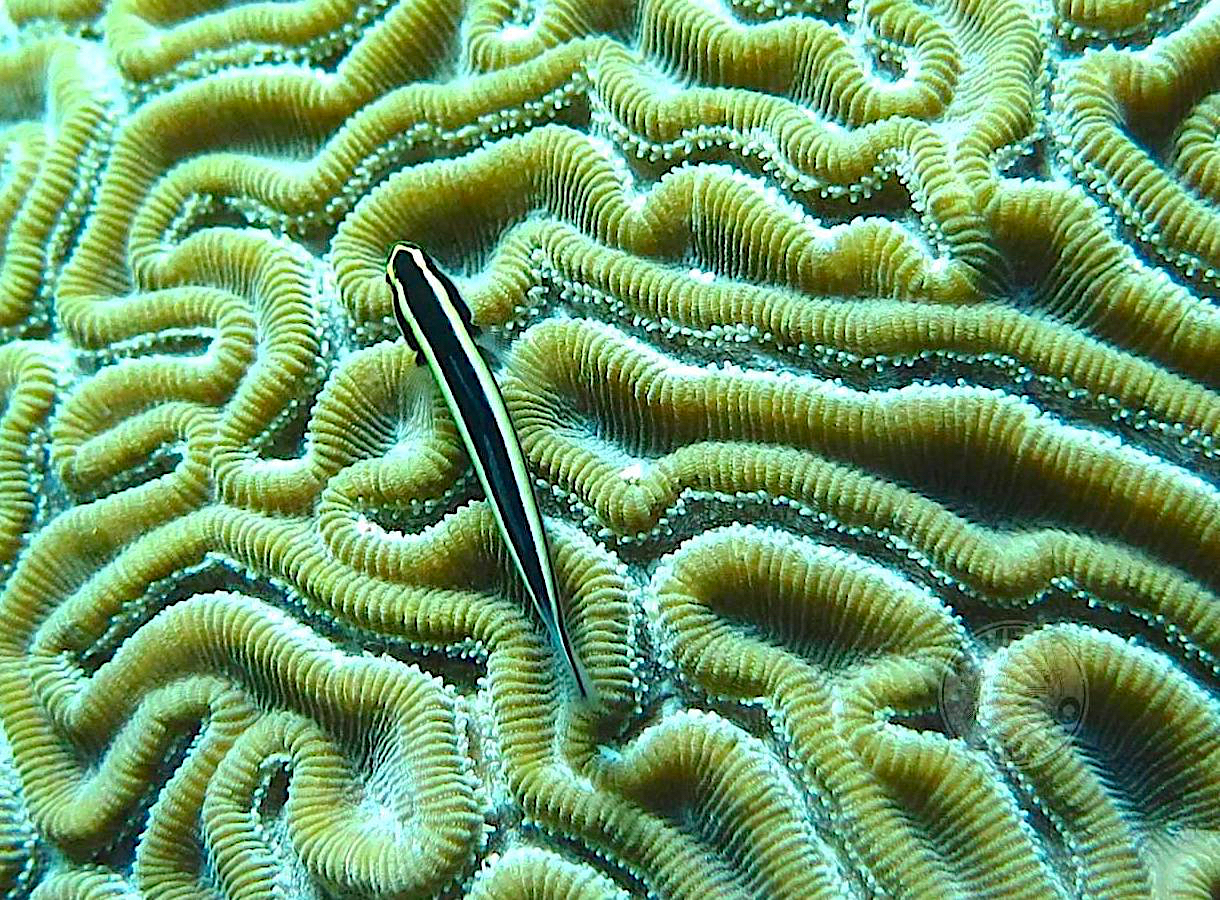
If you look closely at the cropped image below and other images on this page, you will see hundreds of little tentacles nestled in the trenches on the surface. These corals feed at night, deploying their tentacles to catch food. This consists of tiny creatures and their algal contents. During the day, the tentacles are retracted into the sinuous grooves. Some brain corals have developed tentacles with defensive stings. 

BRAIN CORAL Abaco Bahamas (Melinda Rogers / Dive Abaco)

THE TRACKS LOOKS LIKE MAZES OR DO I MEAN LABYRINTHS?

Mazes, I think. The difference between mazes and labyrinths is that labyrinths have a single continuous path which leads to the centre. As long as you keep going forward, you will get there eventually. You can’t get lost. Mazes have multiple paths which branch off and will not necessarily lead to the centre. There are dead ends. Therefore, you can get lost. Check out which type of puzzle occurs on brain coral. Answer below…**

BRAIN CORAL Abaco Bahamas (Melinda Rogers / Dive Abaco)

CREDIT: all amazing underwater brain-work thanks to Melinda Rogers / Dive Abaco; Lucca Labyrinth, Keith Salvesen / Rolling Harbour

** On the coral I got lost straight away in blind alleys. Therefore these are mazes. Here is a beautiful inscribed labyrinth dating from c12 or c13 from the porch of St Martin Cathedral in Lucca, Italy. Very beautiful but not such a challenge.

Labyrinth (Maze), Porch Lucca Cathedral (Keith Salvesen)

BRAIN CORAL Abaco Bahamas (Melinda Rogers / Dive Abaco)

Unknown's avatar

‘DEEP DIVERS IN DIVERS DEEPS’: CUVIER’S BEAKED WHALES


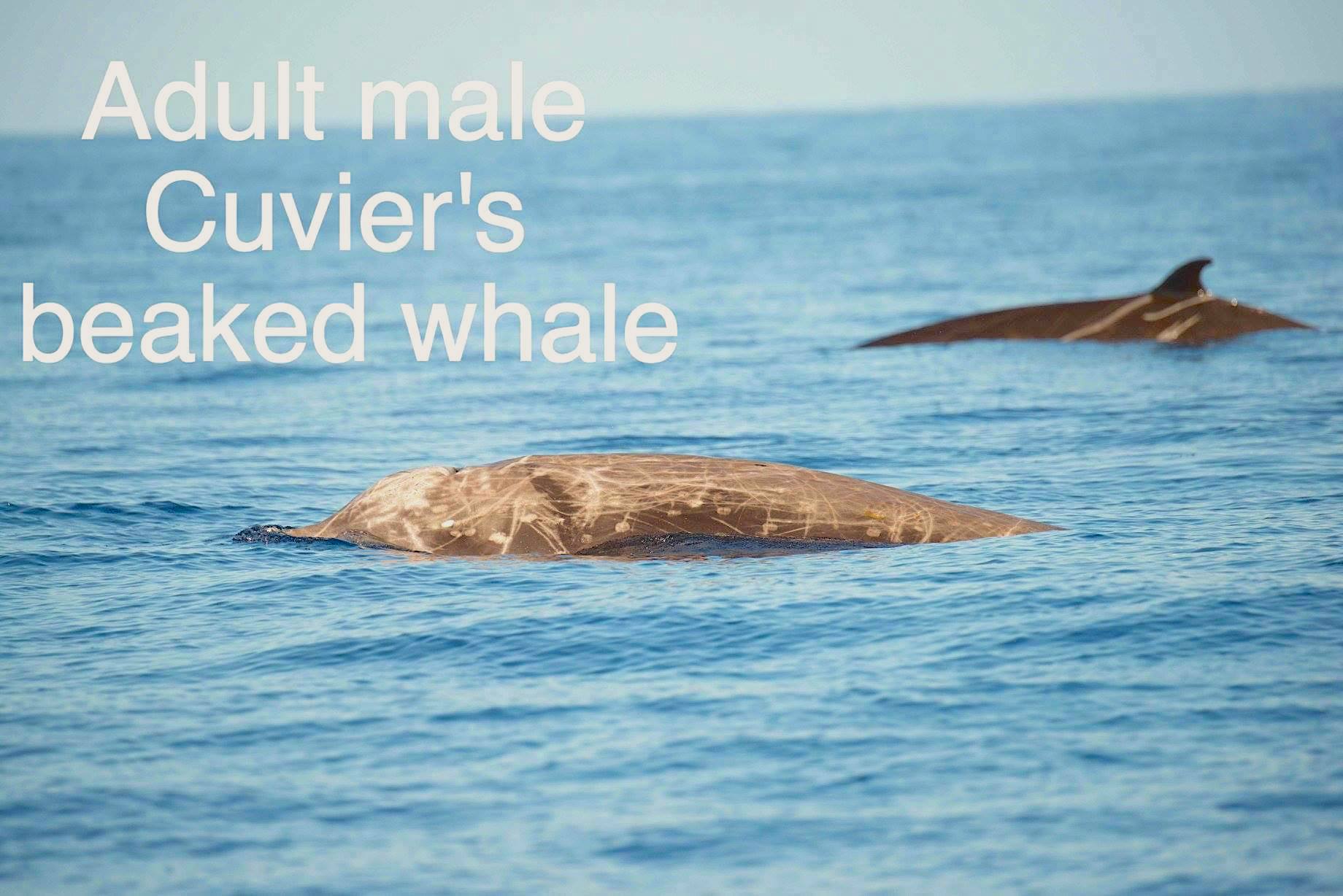
Cuvier's Beaked Whale, Bahamas (BMMRO / Charlotte Dunn)

‘DEEP DIVERS IN DIVERS DEEPS’: CUVIER’S BEAKED WHALES

JOURNEY TO THE WORLD’S MIDNIGHT ZONE

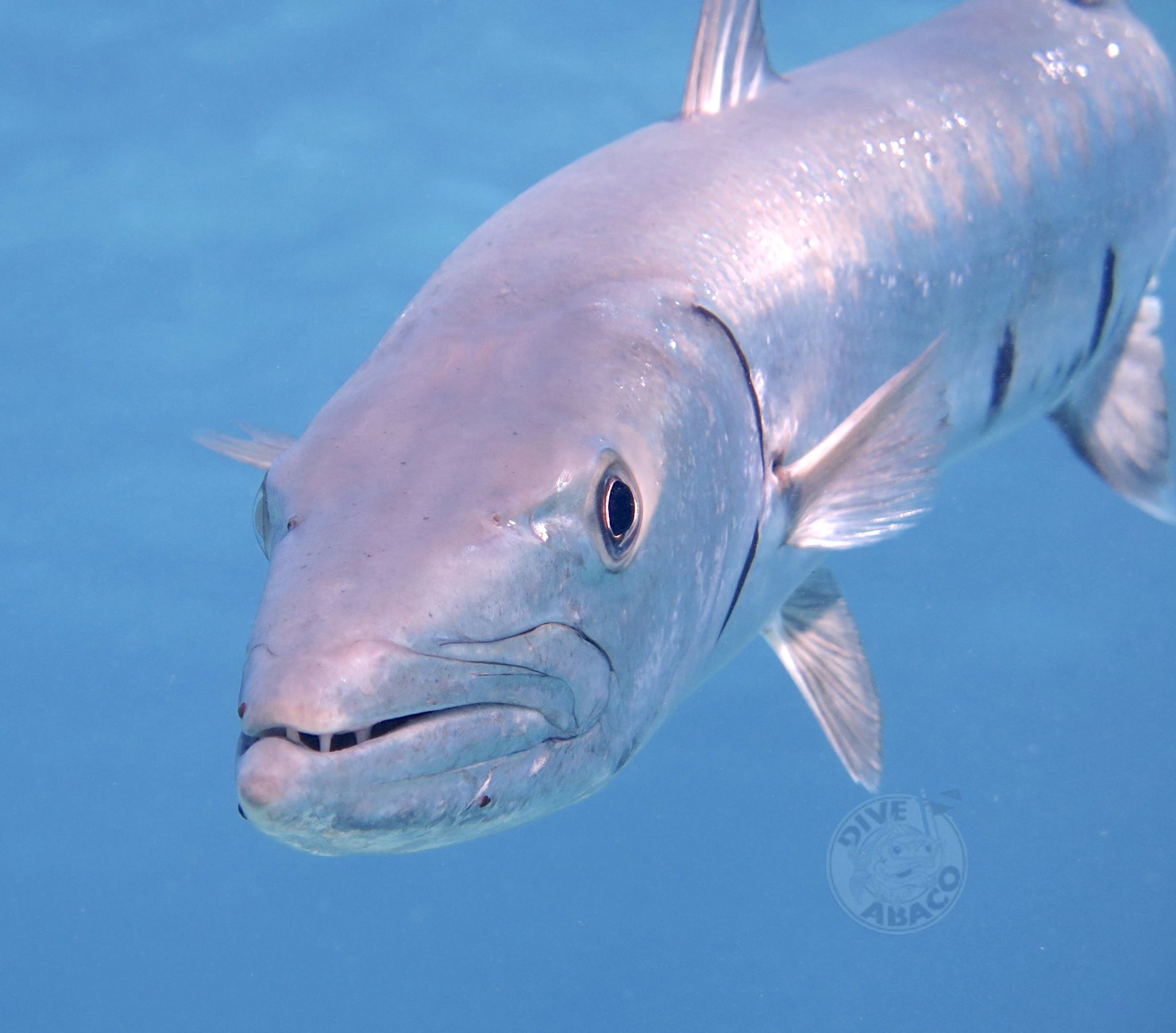
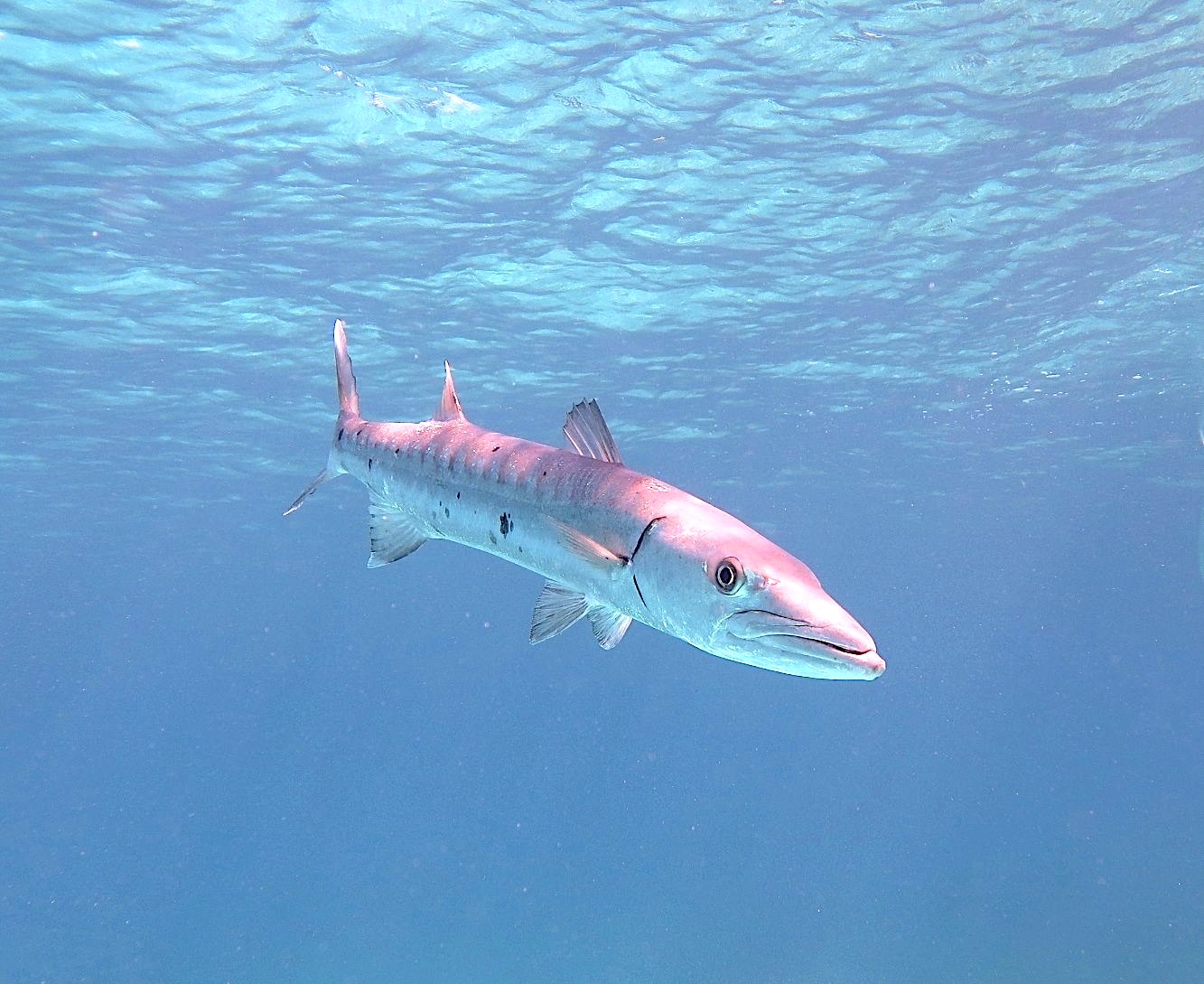
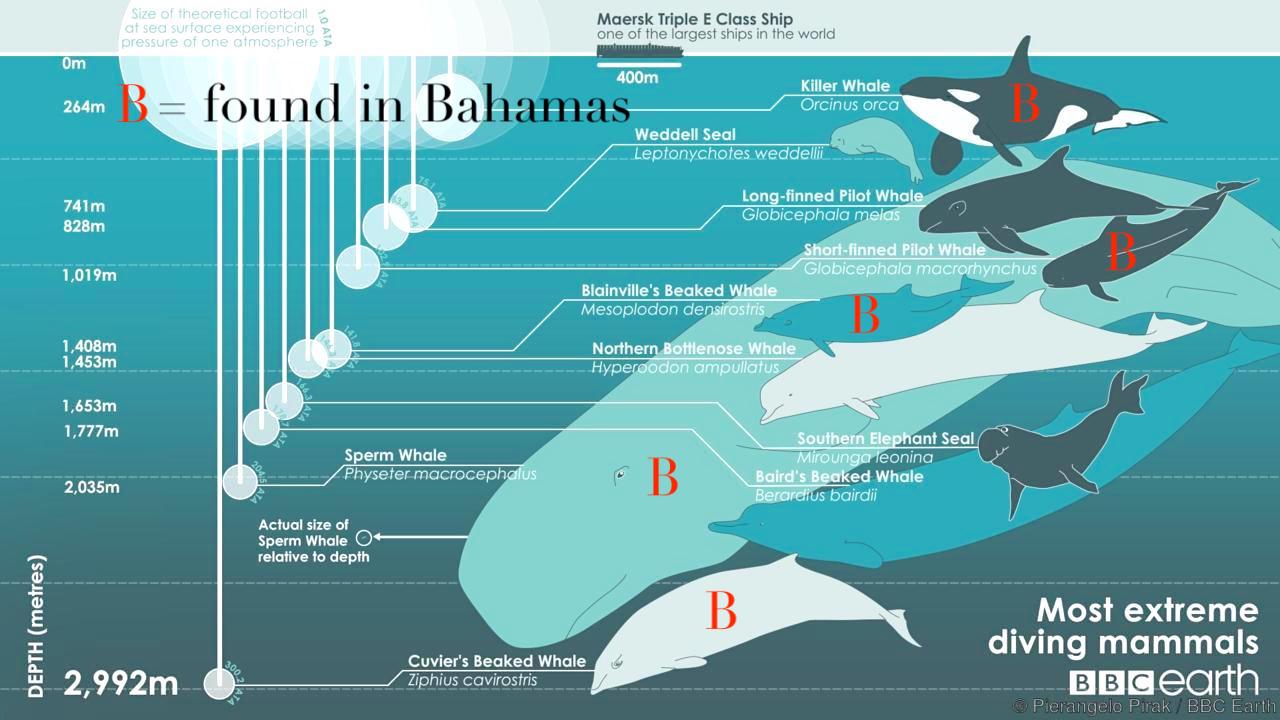
Please join me in a dive down from the sparkling surface of the turquoise sea to the twilight zone at 200 meters. You’ll pass plenty of sea-life on the way: manatees grazing on seagrass just below the surface; reef fish, barracudas, reef sharks, mahi-mahi, maybe an orca at 100 meters. Other familiar creatures that are found even lower include a few reef fish, some shark species and green sea turtles. You are now running out of clear light.
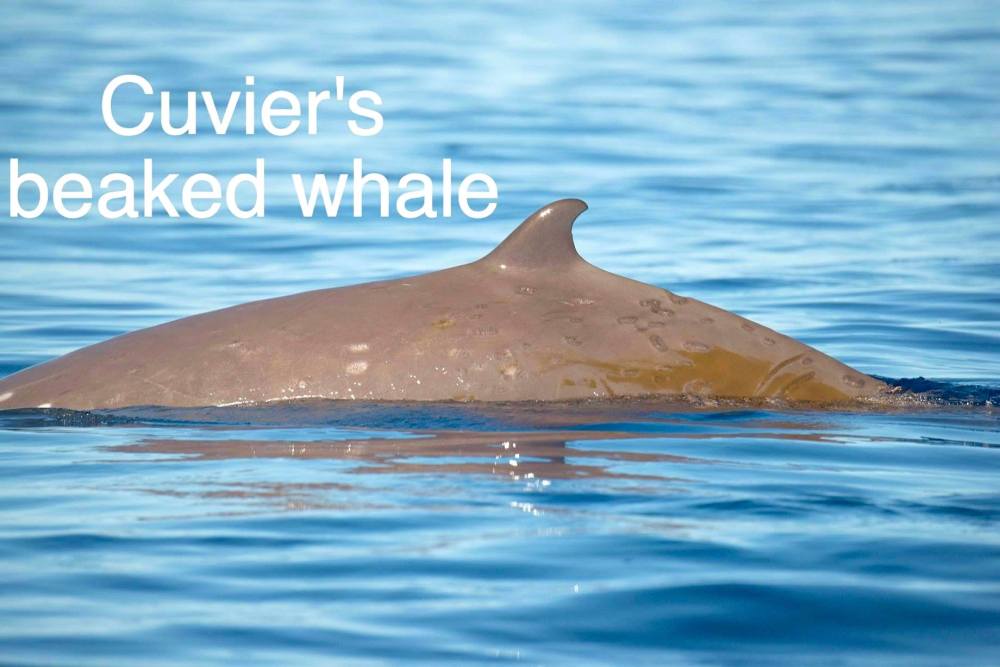
Cuvier's Beaked Whale, Bahamas (BMMRO / Charlotte Dunn)

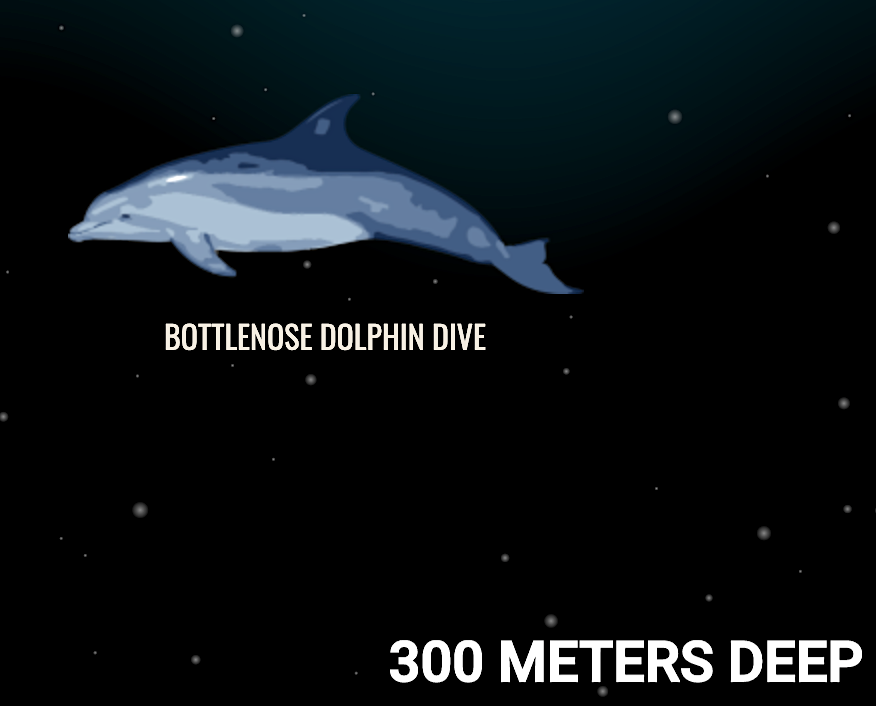
As you descend from 200 meters the waters become murky, then inky. The variety of inhabitants and their numbers are gradually decreasing. There are eels, some sharks, squid, stranger deep-water creatures. You may be surprised to see familiar bottlenose dolphins, recorded as diving nearly 300 meters. At 332 meters you will equal the deepest point any human being has ever scuba-dived (Ahmed Gabr 2014). There is little light, but you still have a long way to go to reach your goal.
Dolphin dive depth (Neal)

Descending still deeper, species and numbers continue to thin out. Around the world the limits of larger recognisable species is being reached – more shark species, tuna, chinook salmon, emperor penguins, swordfish, the few corals that can survive the depth. As the light fades to black, giant creatures and strange fish abound. Huge crabs. Sunfish. The (no-longer-extinct) Coelocanth. Massive octopuses. 
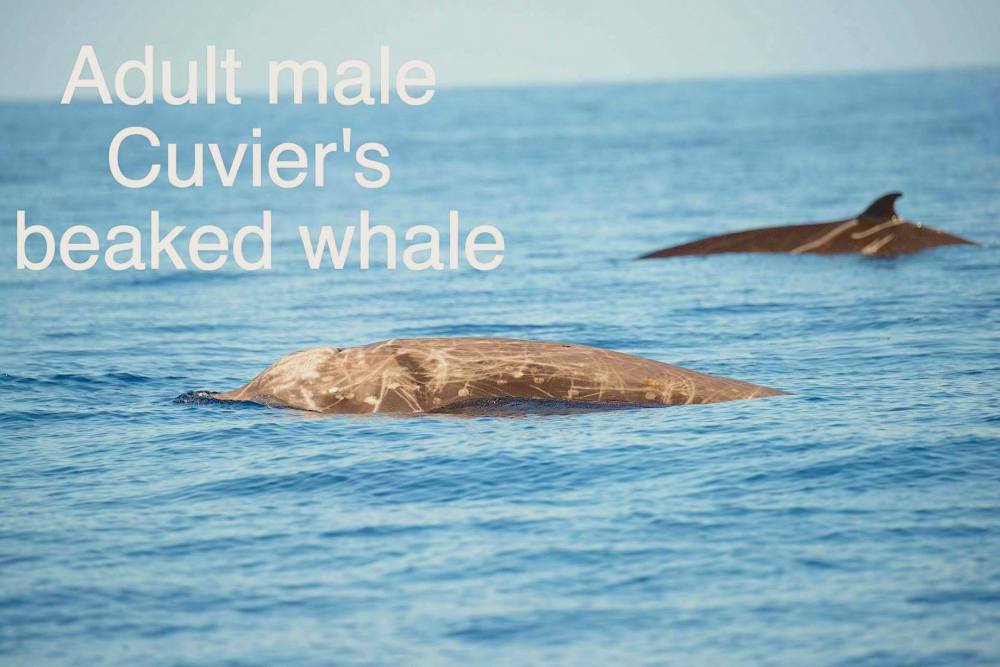
Cuvier's Beaked Whale, Bahamas (BMMRO / Charlotte Dunn)

Deeper down, nearing 1000 meters now, there are still some familiar species. Leatherback turtles; Baird’s beaked whales (nb not in the Atlantic); and at 920 meters, the deepest recorded sperm whale dive. It’s pitch dark: you have reached the level that sunlight never penetrates. You are in the Midnight Zone.

Sperm whale dive depth (Neal)

DEEP OCEAN DWELLERS

In black depths below 1000 meters, creatures have adpated to create their own light sources – so-called bioluminescence. This is the realm of the self-lit anglerfish, the blobfish and the goblin shark. It’s the Attenborough world of deep sea exploration. The geology is changing: there are hypervents, volcanic rocks, heavy metals. Below are the deep ocean-floor trenches. Yet there are still recognisable species down here, diving astonishingly deep to 1800 meters to feed – not least the narwhal which makes this trip several times a day to feed.

We need to quicken up the descent now – we have to get down nearly twice as far as this to reach our destination…

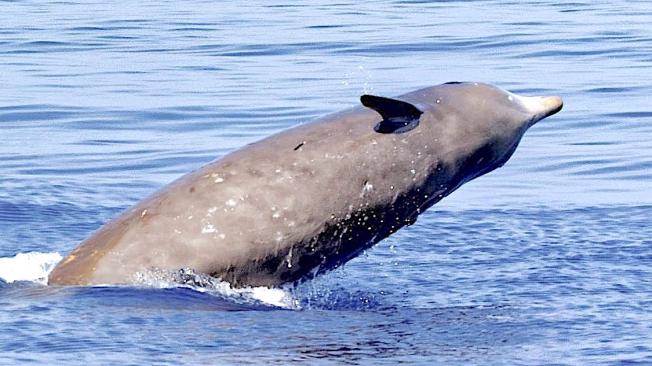
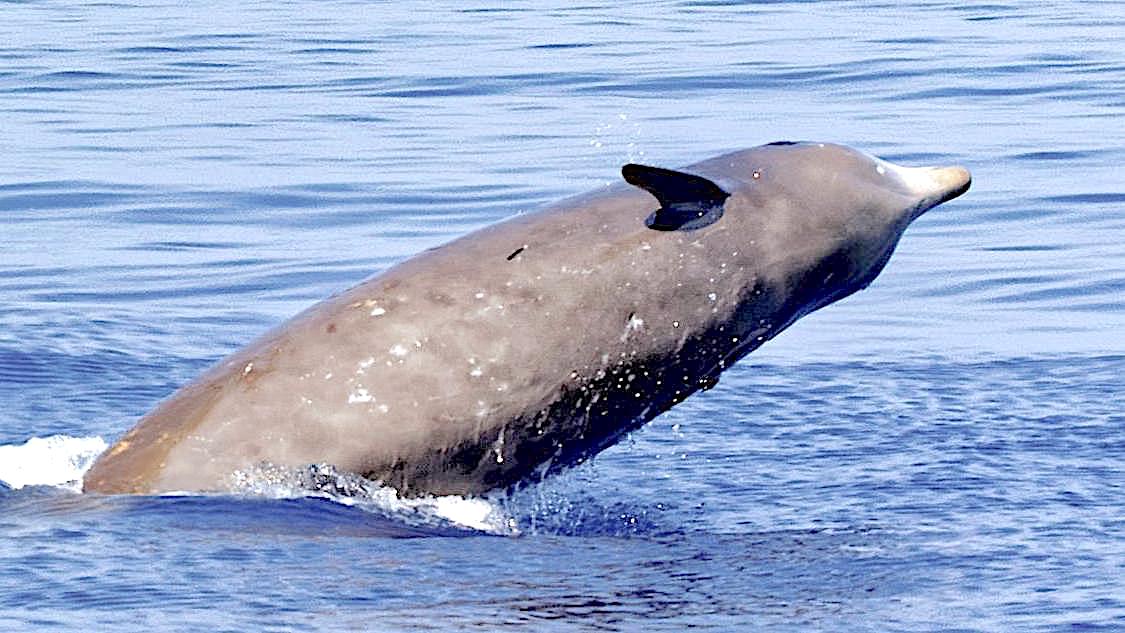
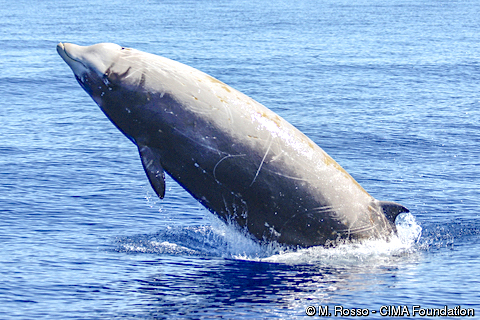
Cuvier's Beaked Whale leap (M.Rosso GIMA - IUCN)

We pass large squid and isopods, the deepest diving shark – the Greenland, the 10 meter-long 700 kilo colossal squid – yet amazingly there are marine mammals yet to be encountered: at 2400 meters we drift past a huge elephant seal. There are evil-looking creatures down here with names to match – devilfish, viperfish, black swallowers that can eat a larger fish whole, vampire squid and zombie worms. 

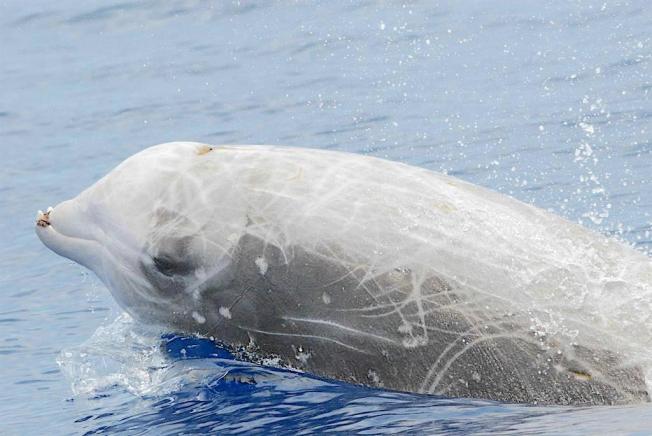
At 3000 feet, we finally end our quest. We have reached the depth to which the world’s deepest diving mammal has been recorded: the Cuvier’s beaked whale Ziphius cavirostris
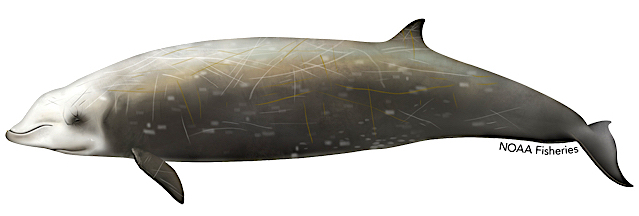
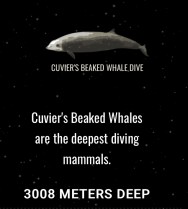
Cuvier's Beaked Whale (NOAA Fisheries)

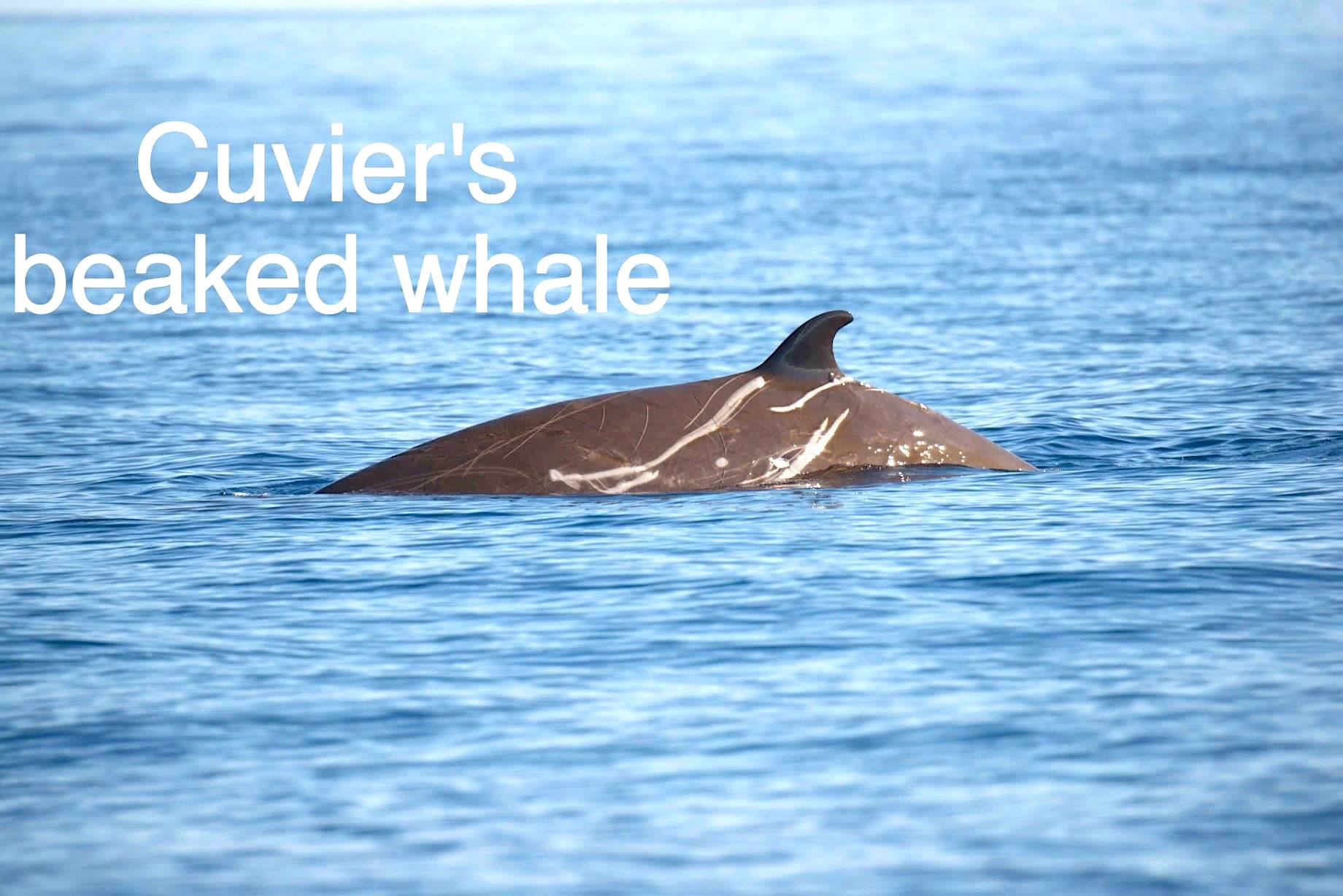
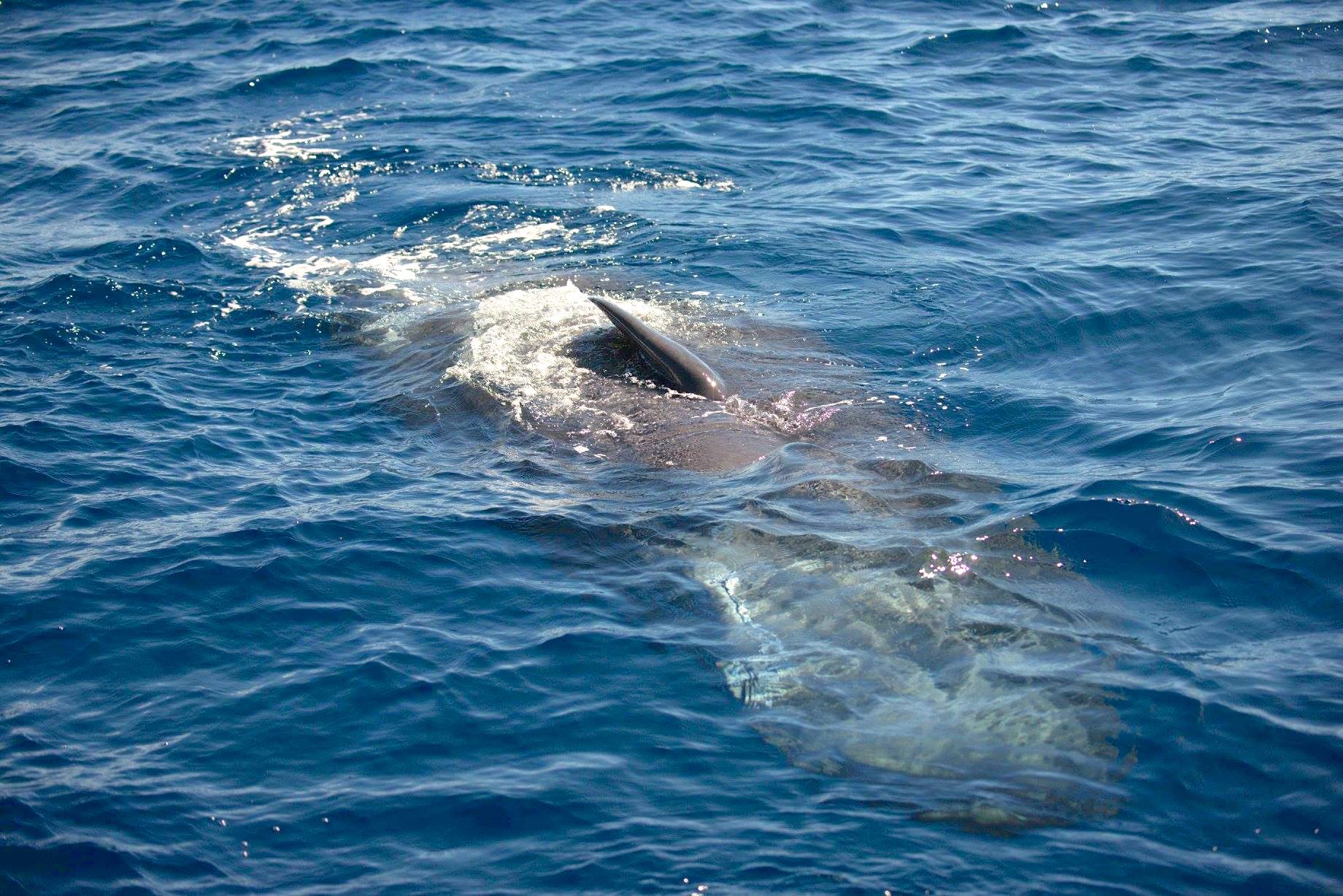
Cuvier’s beaked whales, or “goose-beaked whales,” are not rare. For a start, unlike many beaked whale species, they inhabit most oceans and seas in the world and have the most extensive range. Unsurprisingly therefore, they are one of the most often sighted beaked whale species and one of the best studied. 
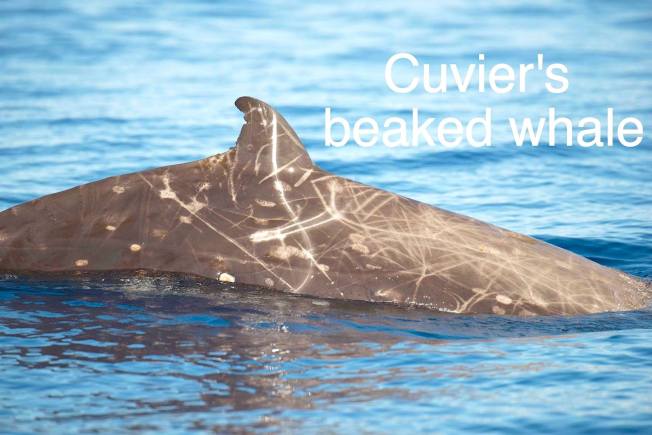
Cuvier's Beaked Whale Bahamas (BMMRO / Charlotte Dunn)

FIN FACT

You may be wondering about the pressure exerted on a creature at a depth of 3000 meters. The answer is, an astounding 300 atm (atmospheres), enough to crush all but the hardiest and best adapted of species. The question how these whales manage to survive at such a depth is one for the future…

The Cuvier’s is one of the 3 beaked whale species found in Bahamas waters. Like the rarer Blainville’s and Gervais’s beaked whales, the Cuvier’s is the subject of ongoing research by the BAHAMAS MARINE MAMMAL RESEARCH ORGANISATION BMMRO

Cuvier's Beaked Whale leap (BW - Getty - Times)

The research into marine mammal populations in the Bahamas and far beyond is focussed on the massive increase in single and mass strandings, including recently in a remote area of Scotland (Hebrides) where more than 40 Cuvier’s were washed ashore.

One significant area of research examines the effect on marine mammals of man-made noise. There is plenty of it in the world’s oceans caused by noise pollution in and around shipping channels that traverse marine mammal migration, feeding and breeding grounds; naval surface and submarine exercises; seismic surveys, sonar waves and undersea resource investigations. The evidence of sound / acoustic damage as an additional hazard for marine mammals is starting to look very clear.
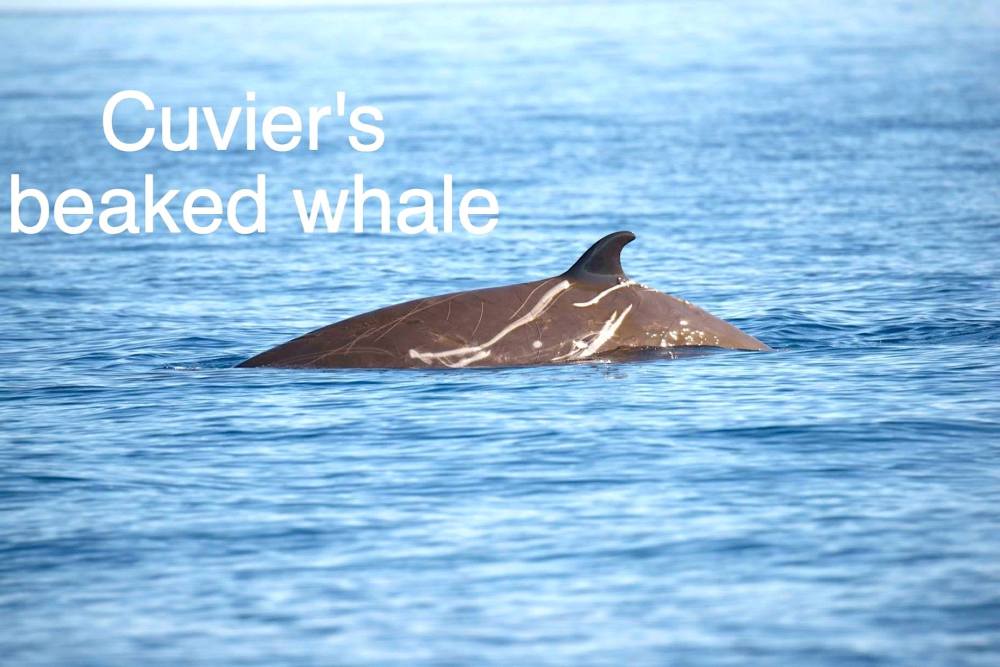
Cuvier's Beaked Whale Bahamas (BMMRO / Charlotte Dunn)

DEEP WATER INFOGRAPHIC

Do not miss this wonderful work by Neal Agarwal. This article is based around it and includes facts and images derived from his incredibly complex structure that has resulted in a remarkably simple resource for layman and ocean-lover alike (I realise these categories may overlap). To see the entire masterpiece, double click of the box below – “it will be worth it”.

CREDITS: Neal Agarwal; BMMRO / Charlotte Dunn; M.Rosso GIMA – IUCN; NOAA Fisheries; BW – Getty – Times; Pierangelo Pirak / BBC Earth (depth infographic), general sources – BMMRO, IUCN, NOAA, WDC

As ever, the Bahamas Philatelic Bureau has produced a wonderful stamp special issue
Unknown's avatar

EEL-SPOTTING: FORAYS WITH MORAYS (7)


Spotted Moray Eel, Bahamas (Melinda Riger / G B Scuba)

EEL-SPOTTING: FORAYS WITH MORAYS (7)

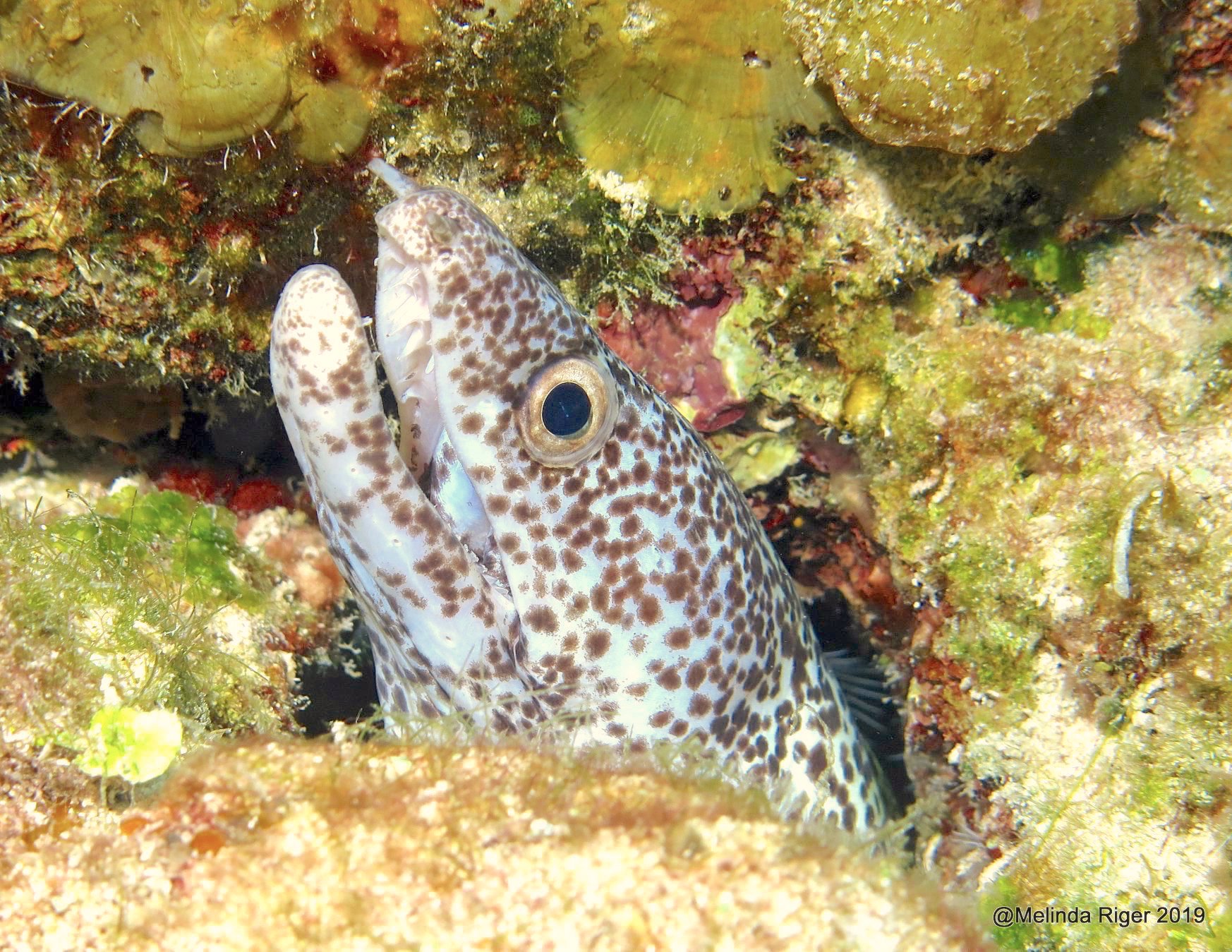
MORAY EELS are plentiful around the reefs of the Bahamas. Some species, anyway. The ones you are most likely to encounter are green morays, and the spotted morays shown here. Less common are chain and golden-tail morays and, rarer still I suspect (because I have only  one image in the archive…) is the ‘purple-mouth’.  

Spotted Moray Eel, Bahamas (Melinda Riger / G B Scuba)

Despite their moderately intimidating appearance – an adult may grow to 1.5 meters or more, with sharp teeth at the front end – these eels are not especially aggressive unless provoked. Best to assume that all humans will behave respectfully around them and remember that people are the intruders in the eels’ domain. 

Spotted Moray Eel, Bahamas (Melinda Riger / G B Scuba)

Morays tend to be loners of the reefs, but they do gather in groups from time to time. And as shown below, they will also hunt with other species, for example this tiger grouper.

Spotted Moray Eel, Bahamas (Melinda Riger / G B Scuba)

Sharp-eyed, sharp-toothed

Spotted Moray Eel, Bahamas (Melinda Riger / G B Scuba)

Looks friendly enough…

Spotted Moray Eel, Bahamas (Melinda Riger / G B Scuba)

A long and surprisingly large body, generally concealed in the crevices of the reef

Spotted Moray Eel, Bahamas (Melinda Riger / G B Scuba)

Credits: Melinda Riger / Grand Bahama Scuba

Lurkin’ GoodSpotted Moray Eel, Bahamas (Melinda Riger / G B Scuba)

Unknown's avatar

BAHAMAS MARINE MAMMAL RESEARCH: 20/20 VISIONS


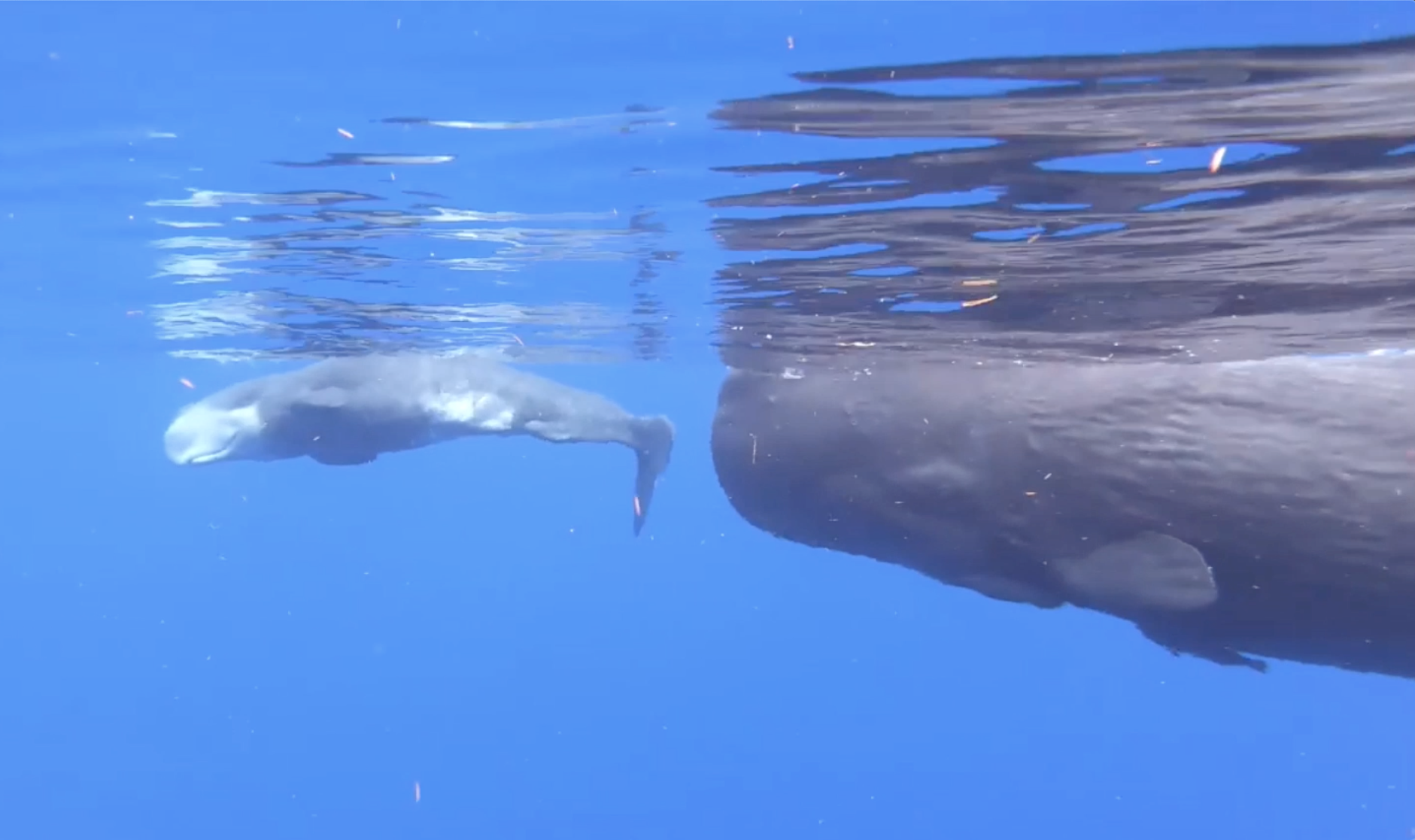
Sperm Whale Calf, Abaco Bahamas (BMMRO)

Neonate Sperm Whale Calf, Abaco Bahamas

BAHAMAS MARINE MAMMAL RESEARCH: 20/20 VISIONS

Change is in the air. And in the sea. Above, you will notice the brand new logo of the Bahamas Marine Mammal Research Organisation BMMRO based in Sandy point, Abaco. Several major Bahamas-wide projects are in progress or in preparation, and as we approach 2020, this is the perfect time for some marine mammal news, illustrated with great images from BMMRO research trips.

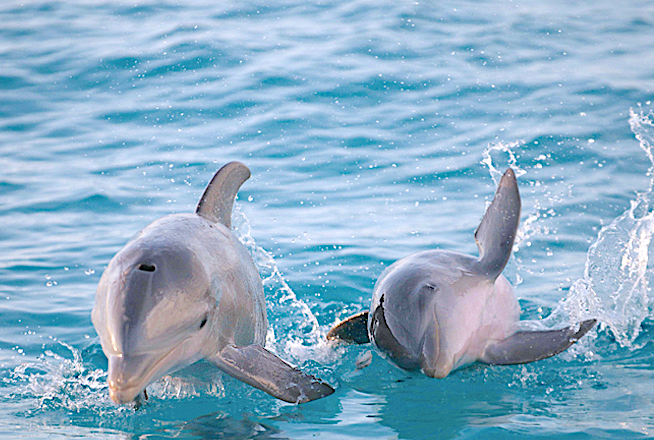
Bottlenose Dolphins, Abaco Bahamas (BMMRO)

Bottlenose Dolphins

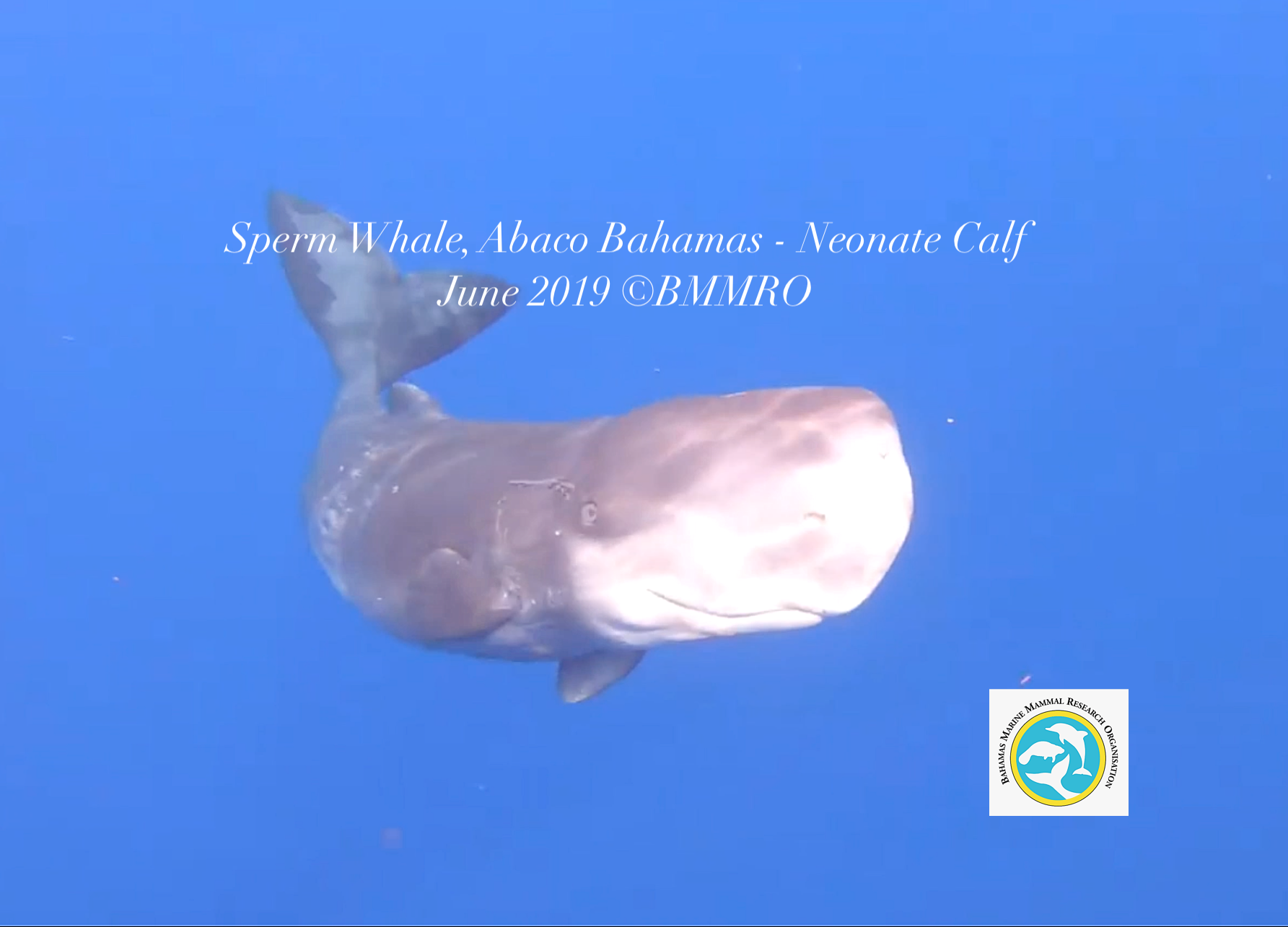
BMMRO’s scientific research over many years is a prime reason why we all have the privilege of seeing the neonate sperm whale calf in the header image. It was photographed with its mother off South Abaco last Spring. Much-appreciated support of the essential research and conservation work of the organisation helps to ensure that the whales, dolphins and manatees in Bahamas waters are watched over, documented in minute detail (even their calls) and protected. The marine mammals of the Bahamas have a promising future looking ahead to 2020, and well beyond.

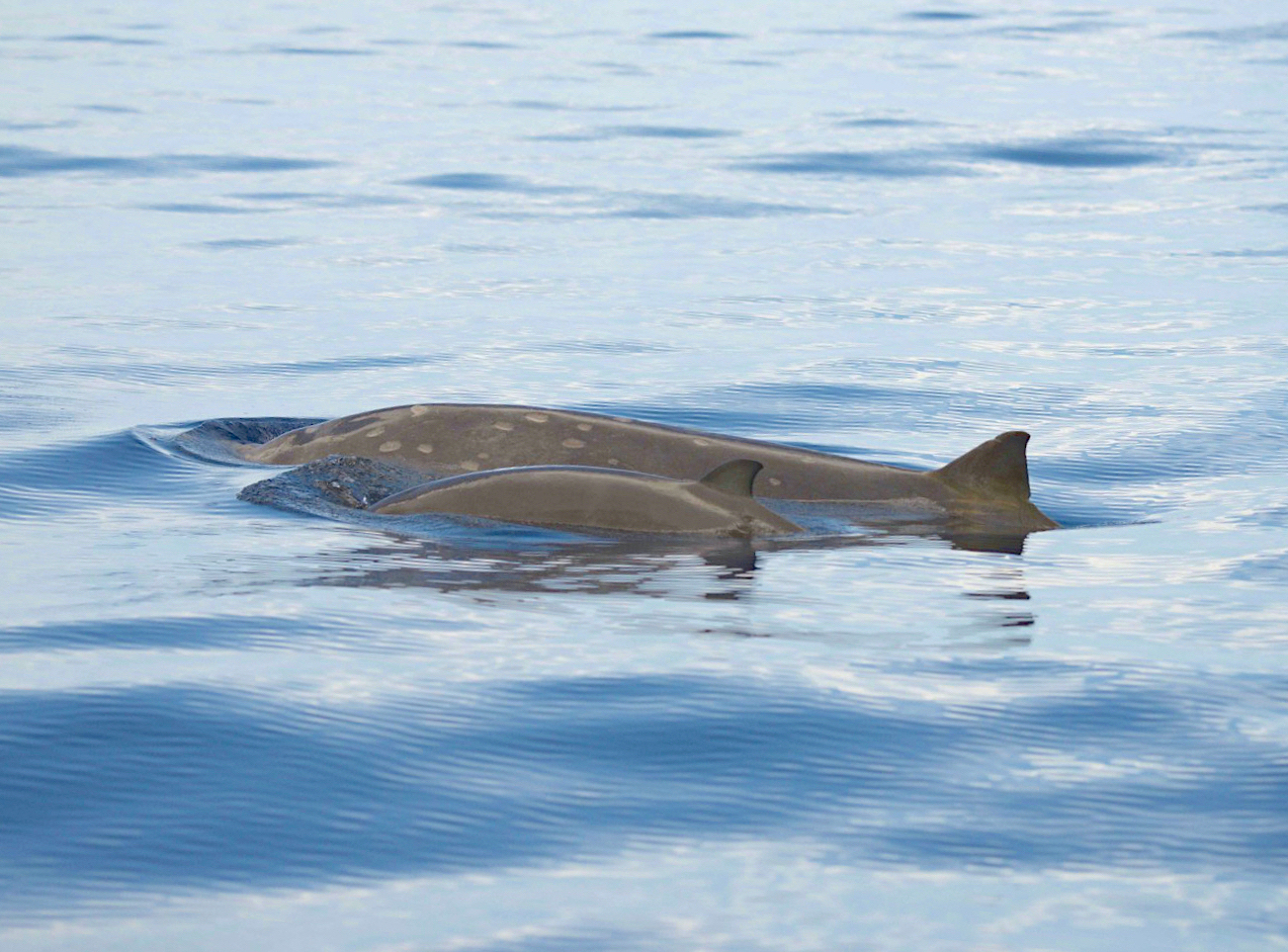
Blainville's Beaked Whale, Abaco Bahamas (BMMRO)

Blainville’s Beaked Whale and young calf

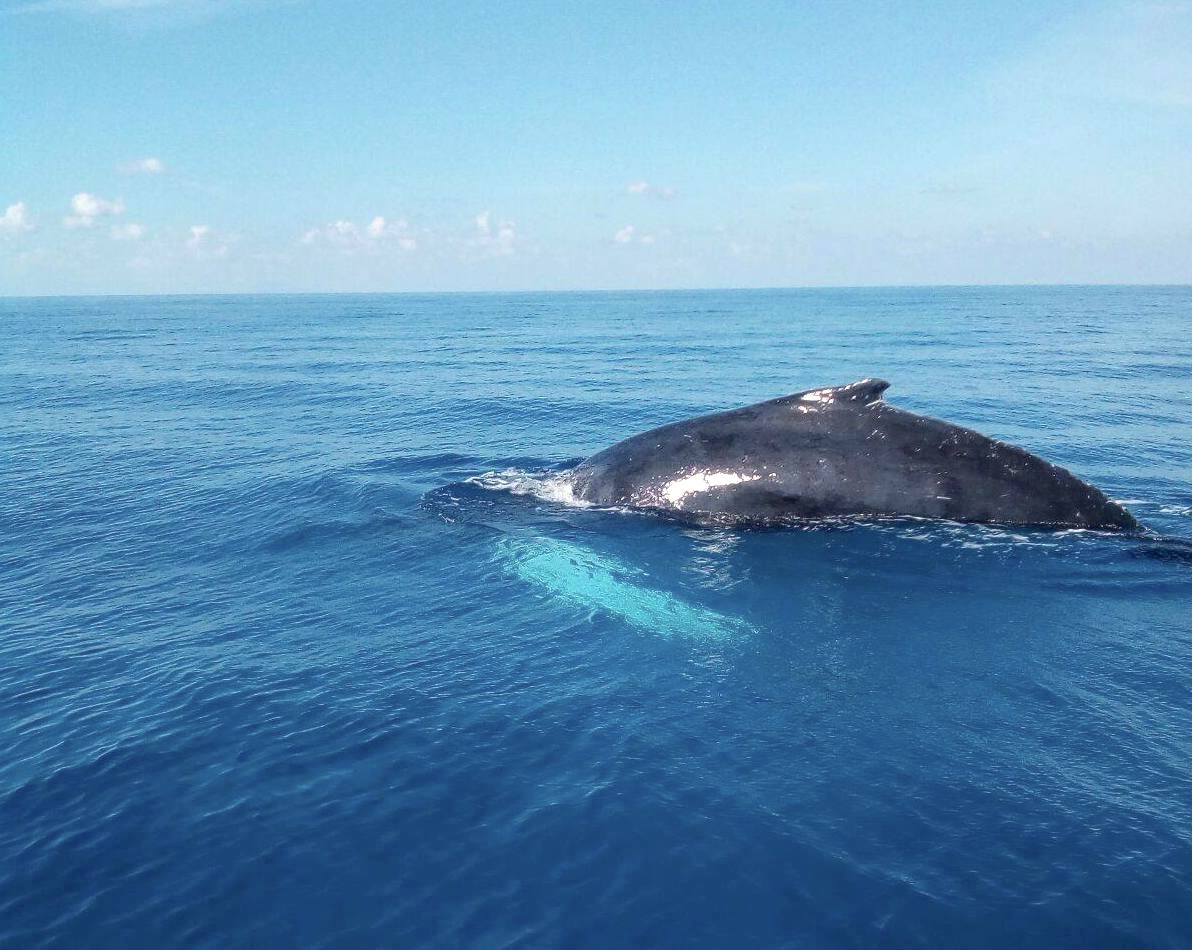
Humpback Whale, Bahamas (BMMRO)

Humpback Whale

ATLANTIC SPOTTED DOLPHINS

WEST INDIAN MANATEES – GINA and RANDY

West Indian Manatee, Bahamas - Gina (BMMRO)  West Indian Manatee, Bahamas - Randy (BMMRO)

All photographs and video footage: BMMRO

Sperm Whale tailing, Abaco Bahamas (BMMRO)

Sperm Whale Tailing, Bahamas

Unknown's avatar

ELKHORN CORAL, ABACO BAHAMAS (DORIAN UPDATE)


Elkhorn Coral, Abaco Bahamas (Melinda Rogers / Dive Abaco)

ELKHORN CORAL, ABACO BAHAMAS (DORIAN UPDATE)

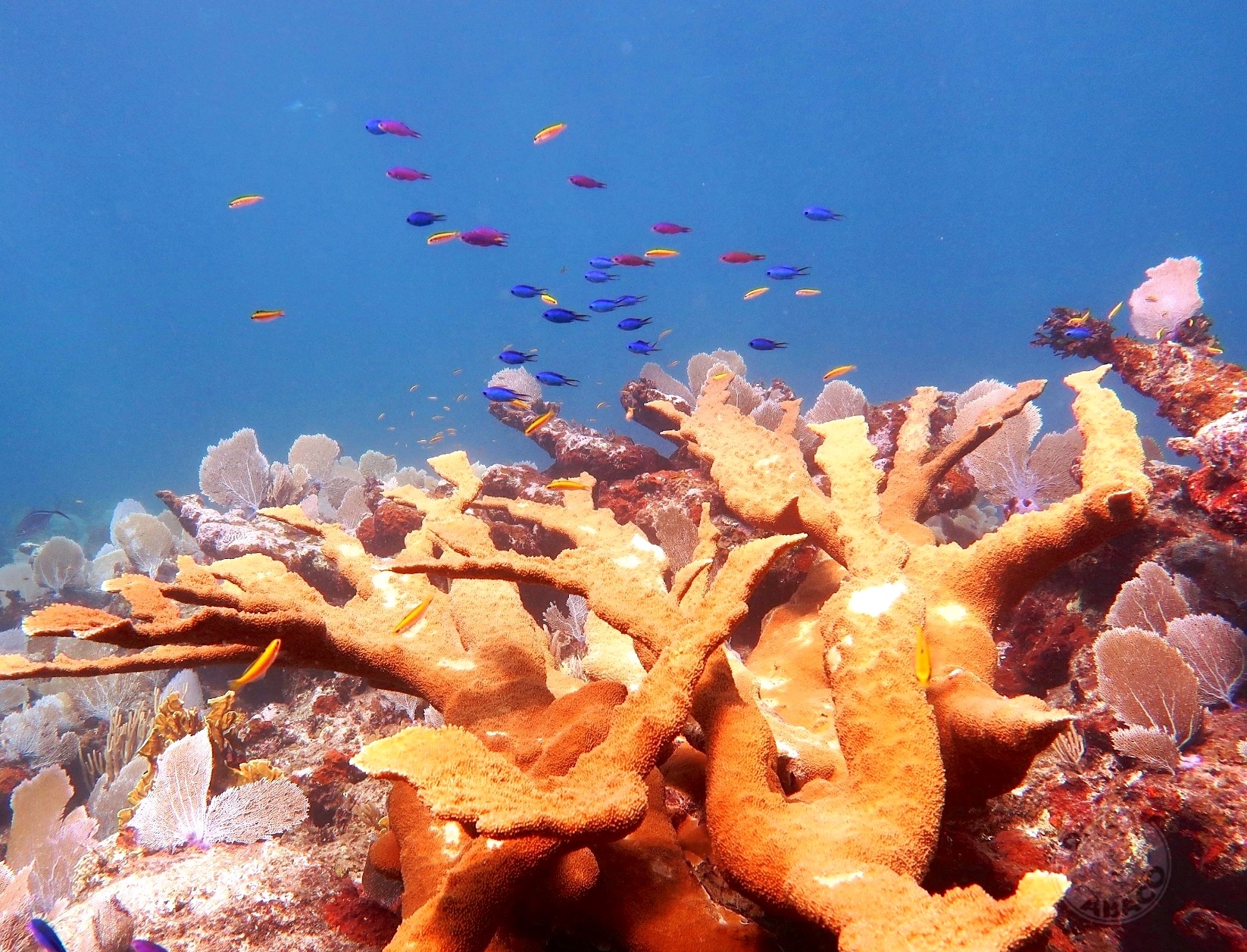
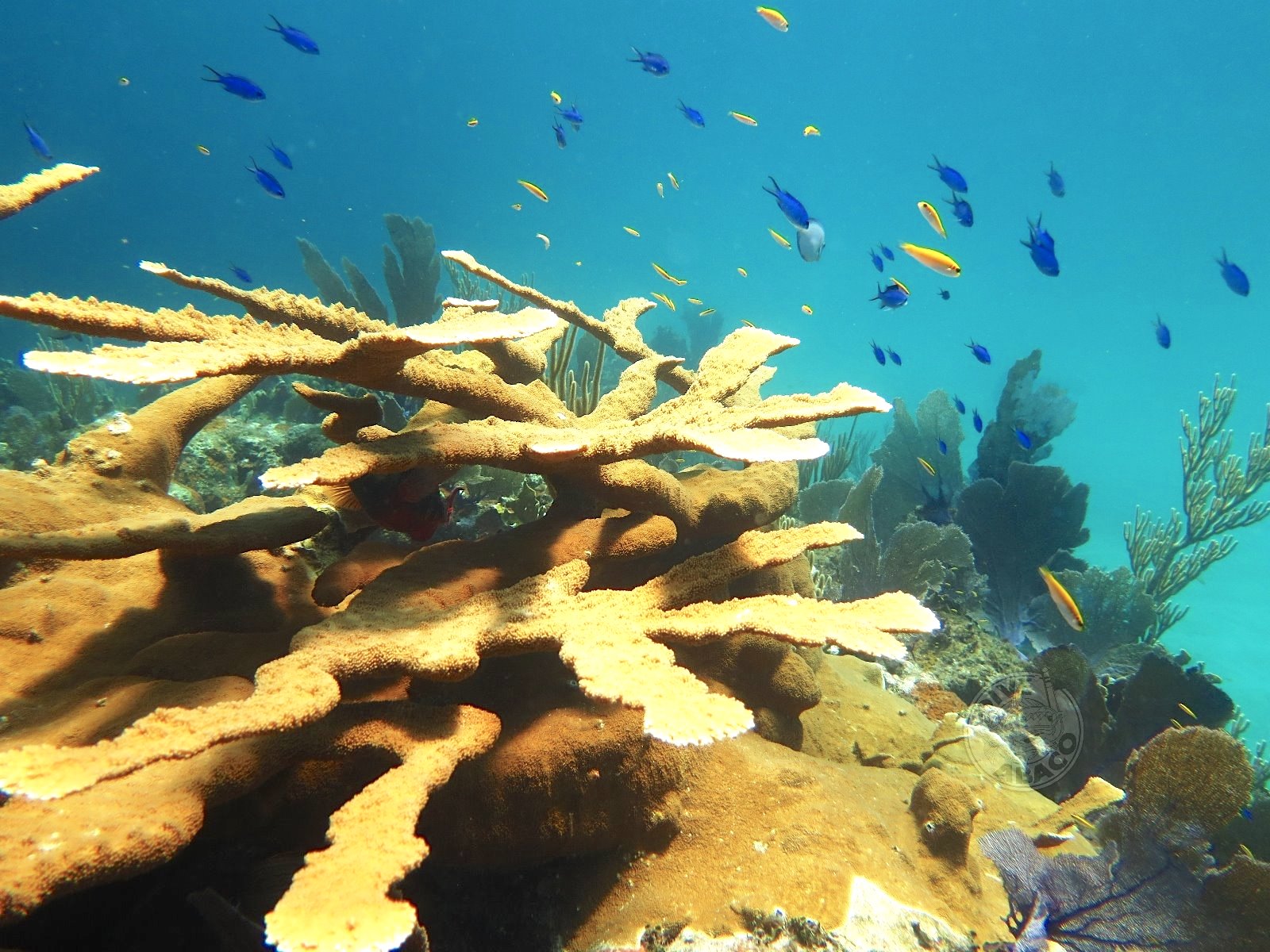
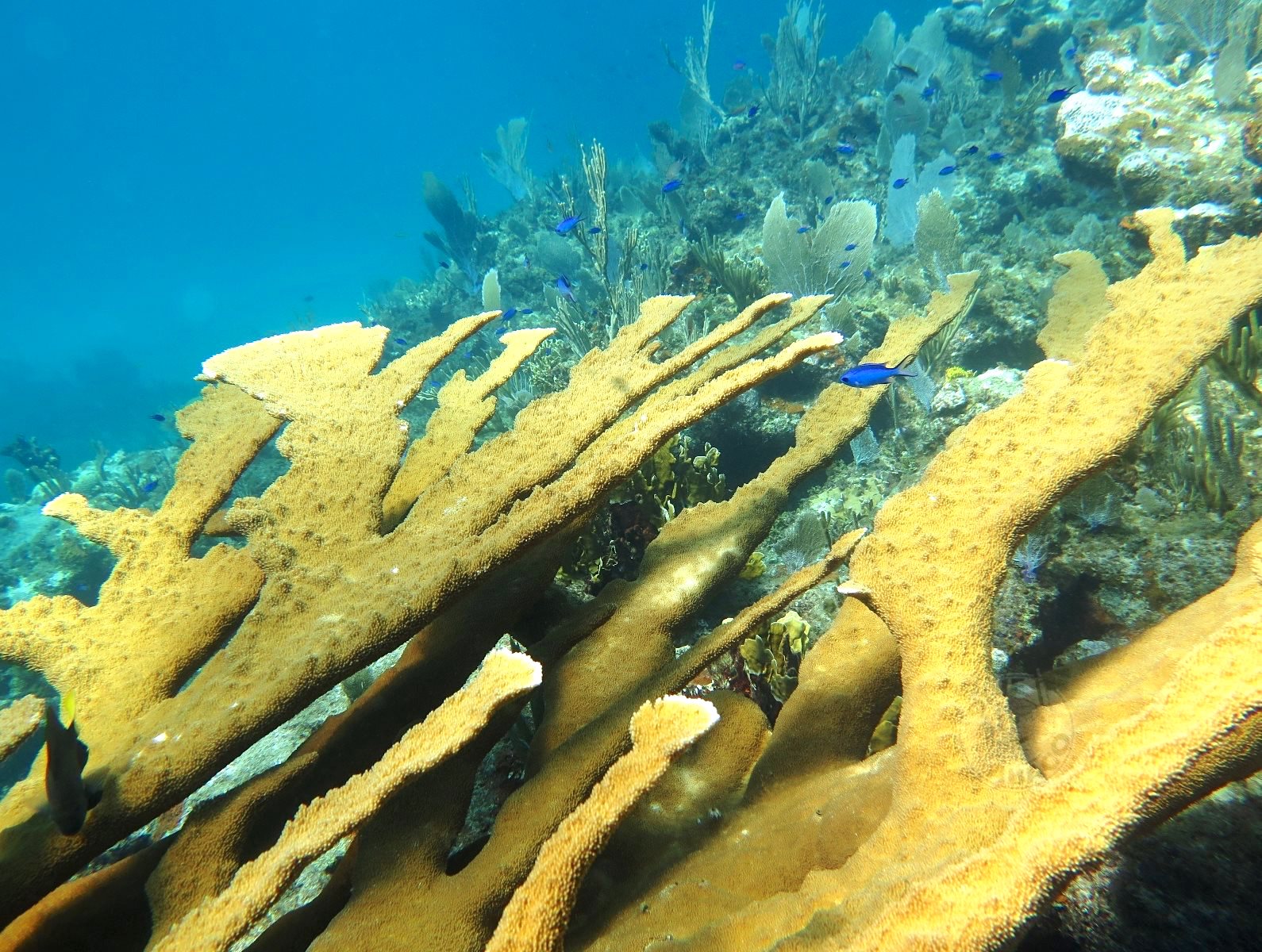
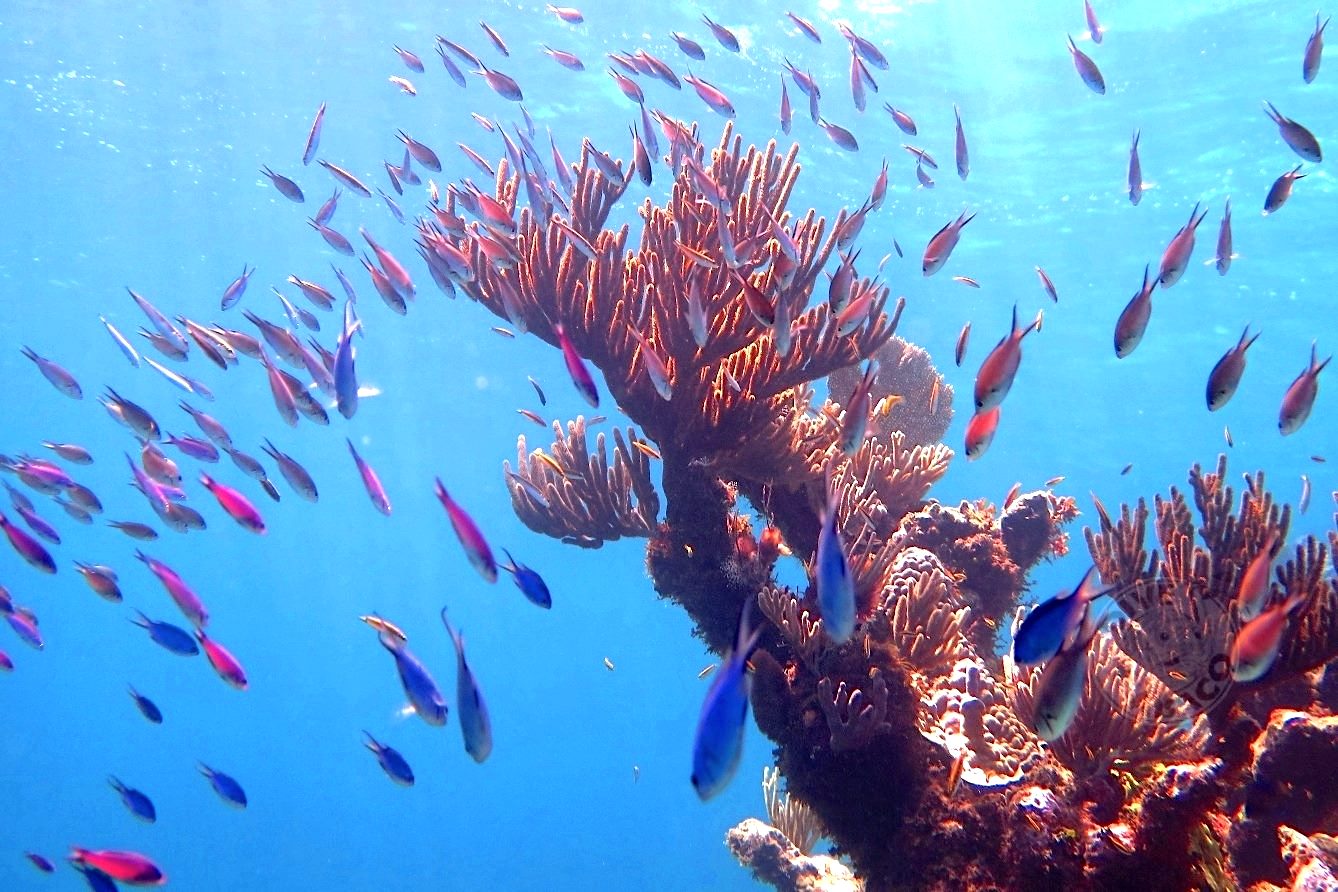
Elkhorn coral (Acropora palmata) is a widespread reef coral, an unmistakeable species with large branches that resemble elk antlers. The dense growths create an ideal shady habitat for many reef creatures. These include reef fishes of all shapes and sizes, lobsters, shrimps and many more besides. Some of these are essential for the wellbeing of the reef and also its denizens.

Elkhorn Coral, Abaco Bahamas (Melinda Rogers / Dive Abaco)

GOOD POST-DORIAN NEWS ABOUT ABACORAL

A recent report from FRIENDS OF THE ENVIRONMENT brings encouraging news about the reefs of  Abaco post-hurricane, and an indication of the resilience of the coral to extreme conditions (with one exception for a reef too close to the shore to avoid damage from debris).

Shortly before Dorian hit, The Perry Institute for Marine Science and its partners surveyed reefs across Grand Bahama and Abaco to assess their health. Following Dorian, they were able to reassess these areas and the impact of the hurricane. Over the 370 miles that the surveys covered, minimal damage was found on the majority of reefs. Unfortunately Mermaid Reef, where FRIENDS does most of our educational field trips, sustained extensive damage due to debris from its close proximity to the shoreline. We are looking into how we can help with logistics to get the debris removed, and hopefully the recovery will begin soon.
Elkhorn Coral, Pelican Cays, Abaco Bahamas (Friends of the Environment)

Elkhorn coral standing strong post-Dorian at Sandy Cay Reef, Pelican Shores, Abaco

The scientists were also able to visit four of the Reef Rescue Network’s coral nurseries and assess out-planted corals in national parks in both Grand Bahama and Abaco. The great news is that all of the corals on these nurseries survived the storm and will be used to support reef restoration. Also from the surveys, it appears that our offshore reefs around Abaco sustained minimal damage, including Sandy Cay Reef in Pelican Cays Land and Sea Park (pictured above). This gives us hope for the recovery of our oceans post-Dorian and proves how resilient these amazing ecosystems are.

Elkhorn Coral, Abaco Bahamas (Melinda Rogers / Dive Abaco)

Examples of species vital for healthy corals include several types of PARROTFISH, the colourful and voracious herbivores that spend most of their time eating algae off the coral reefs using their beak-like teeth. This algal diet is digested, and the remains excreted as sand. Tread with care on your favourite beach; in part at least, it will consist of parrotfish poop.

Elkhorn Coral, Abaco Bahamas (Melinda Rogers / Dive Abaco)

Other vital reef species living in the shelter of elkhorn and other corals are the CLEANERS, little fish and shrimps that cater for the wellbeing and grooming of large and even predatory fishes. Gobies, wrasse, Pedersen shrimps and many others pick dead skin and parasites from the ‘client’ fish including their gills, and even from between the teeth of predators. This service is an excellent example of MUTUALISM, a symbiotic relationship in which both parties benefit: close grooming in return for rich pickings of food.

Elkhorn Coral, Abaco Bahamas (Melinda Rogers / Dive Abaco)

VULNERABILITY TO OFFICIALLY NON-EXISTENT CLIMATE CRISIS

Formally abundant, over just a couple of decades elkhorn coral has been massively affected by [climate change, human activity and habitat destruction] inexplicable natural attrition in many areas. One cause of decline that is incontrovertible is damage from storms, which are empirically increasing in both frequency and intensity, though apparently for no known reason.

Elkhorn Coral, Abaco Bahamas (Melinda Rogers / Dive Abaco)

Physical damage to corals may seriously impact on reproductive success; elkhorn coral is no exception. The effects of a reduction of reef fertility are compounded by the fact that natural recovery is in any case inevitably a slow process. The worse the problem gets, the harder it becomes even to survive let alone recover. 

Elkhorn Coral, Abaco Bahamas (Melinda Rogers / Dive Abaco)

SO HOW DOES ELKHORN CORAL REPRODUCE?

There are two types of reproduction, which one might call asexual and sexual:

  1. Elkhorn coral reproduction occurs when a branch breaks off and attaches to the substrate, forming a the start of a new colony. This process is known as fragmentation and accounts for roughly half of coral spread. Considerable success is being achieved now with many coral species by in effect farming fragments and cloning colonies (see above, Reef Rescue Network’s coral nurseries)
  2. Sexual reproduction occurs once a year in August or September, when coral colonies release millions of gametes by broadcast spawning (there’s much more to be said on this interesting topic, and one day I will)

Elkhorn Coral, Abaco Bahamas (Melinda Rogers / Dive Abaco)

THE FEATURED PHOTOGRAPHS

You may have wondered in which healthily coral-infested waters these superb elkhorn coral photographs were taken. Did I perhaps source them from a National Geographic coral reef special edition? In fact, every image featured was obtained among the reefs of Abaco.

All except the recent Perry Institute / Friends of the Environment photo were taken by Melinda Rogers of Dive Abaco, Marsh Harbour. The long-established and highly regarded Dive Shop she and her husband Keith run was obliterated (see above) less than 3 months ago by Hurricane Dorian, along with most of the rest of the town. It’s a pleasure to be able to showcase these images taken in sunnier times.

Elkhorn Coral, Abaco Bahamas (Melinda Rogers / Dive Abaco)

Unknown's avatar

AN OCTOPUS’S GARDEN, BAHAMAS


Octopus on coral reef, Bahamas (Melinda Riger / GB Scuba)

AN OCTOPUS’S GARDEN, BAHAMAS

Many of us, from time to time, might like to be under the sea, warm below the storm, swimming about the coral that lies beneath the ocean waves. Though possibly not resting their heads on the seabed. This undeniably idyllic experience would be perfected by the presence of an octopus and the notional garden he lives in. Enough to make any person shout and swim about – and quite excessively at that.

Octopus on the coral reef, Bahamas (Melinda Riger / GB Scuba)

The extra ingredient here is that these photographs were taken on the reef off the southern coast of Grand Bahama last week, less than 2 months after the island (along with Abaco) was smashed up by Hurricane Dorian. Thankfully, Grand Bahama Scuba has been able to return to relative normality and run diving trips again. Moreover, fears for the reefs have proved relatively unfounded. These images suggest little damage from the massive storm. The Abaco reefs have not yet been able to be assessed in any detail.

Octopus on the coral reef, Bahamas (Melinda Riger / GB Scuba)

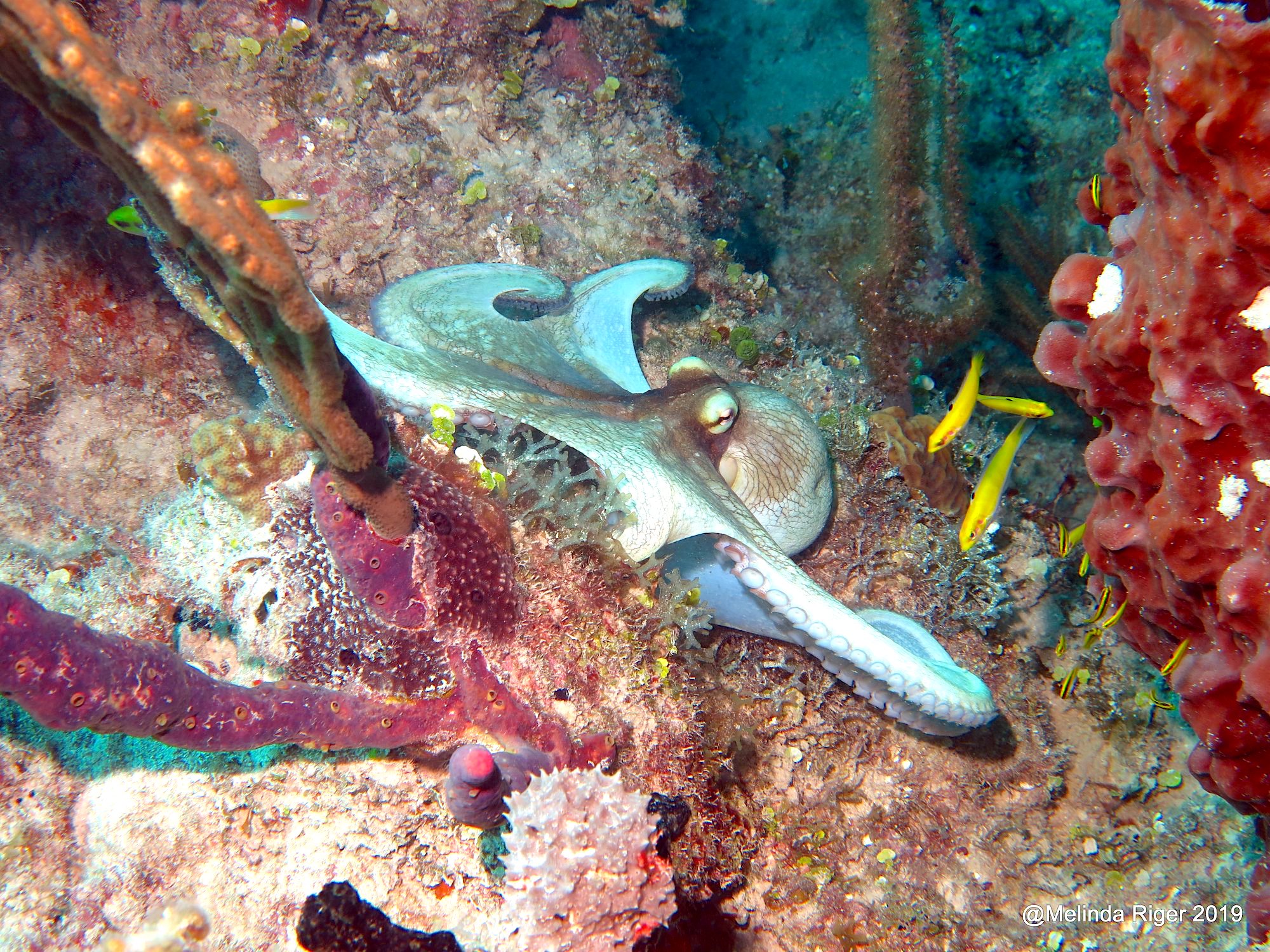
The feature creature here was observed and photographed as it took it a octopodic wander round the reef. The vivid small fishes are out and about. The reef and its static (technically ‘sessile’) life forms –  corals, anemones and sponges –  look in good order. The octopus takes a pause to assess its surroundings before moving on to another part of the reef.

Octopus on the coral reef, Bahamas (Melinda Riger / GB Scuba)

THE PLURAL(S) OF OCTOPUS REVISITED

A long time ago I wrote a quasi-learned disquisition on the correct plural for the octopus. There were at least 3 possibilities derived from Greek and Latin, all arguable but none so sensible or normal-sounding as ‘octopuses‘. The other 2 are octopi and octopodes. If you want the bother with the details check out THE PLURAL OF OCTOPUS

There’s an aspect I missed then, through rank ignorance I’d say: I didn’t check the details of the Scientific Classification. Now that I am more ‘Linnaeus-woke’, I have two further plural candidates with impeccable credentials. Octopuses are cephalpods (‘headfeet’) of the Order Octopoda and the Family Octopodidae. These names have existed since naturalist GEORGES CUVIER (he of the beaked whale found in Bahamas waters) classified them thus in 1797.  

RH ADVICE stick with ‘octopuses’ and (a) you won’t be wrong (b) you won’t get into an un-winnable argument with a pedant and (3) you won’t sound pretentious

Octopus on the coral reef, Bahamas (Melinda Riger / GB Scuba)

OPTIONAL MUSICAL DIGRESSION

Whether you are 9 or 90, you can never have too much of this one. If you are somewhere in the middle – or having Ringo Starr free-styling vocals doesn’t appeal – you can. Step back from the vid.

All fabulous photos by Melinda Riger, Grand Bahama Scuba, Nov 2019

Octopus on the coral reef, Bahamas (Melinda Riger / GB Scuba)

Unknown's avatar

BAHAMAS REEF LIFE (1): FRENCH ANGELFISH


French Angelfish, Grand Bahama (Melinda Riger/ G B Scuba)

BAHAMAS REEF LIFE (1): FRENCH ANGELFISH

The massive destruction and dislocation caused on both Abaco and Grand Bahama by Hurricane Dorian is well-documented. The regeneration of both islands is making unsteady progress towards a stability that still seems many months away. In many locations it is still ‘two steps forward, one step back’. It remains a moot point whether ‘normality’, as it was just over 2 months ago, will ever be quite the same again.

French Angelfish, Grand Bahama (Melinda Riger/ G B Scuba)

We know how things are on land. As far as Abaco is concerned, few people can say how the coral reefs have been affected by the massive storms. Boats that were not flung ashore were sunk instead. Marinas and their infrastructure all but disappeared. 

French Angelfish, Grand Bahama (Melinda Riger/ G B Scuba)

Dive Shops, like so many thriving businesses in MH, have been reduced to rubble by this cruellest of extreme tropical storms. For the time being at least, they are damaged beyond use. I have seen no reports about the conditions in – for example – Fowl Cays National Park, a coral and reef-life rich marine preserve that was directly in the hurricane’s path. It may be weeks before an assessment can be made.

French Angelfish juv, Grand Bahama (Melinda Riger/ G B Scuba)

Happily, Melinda and Fred Riger of Grand Bahama Scuba have very recently been able to reopen their business. Melinda is, as regular readers will know, a wonderful underwater photographer. She kindly gives me the freedom of her extensive photo archive, accumulated over many years. The focus today is on French angelfish on the reefs of Grand Bahama.

French Angelfish, Grand Bahama (Melinda Riger/ G B Scuba)

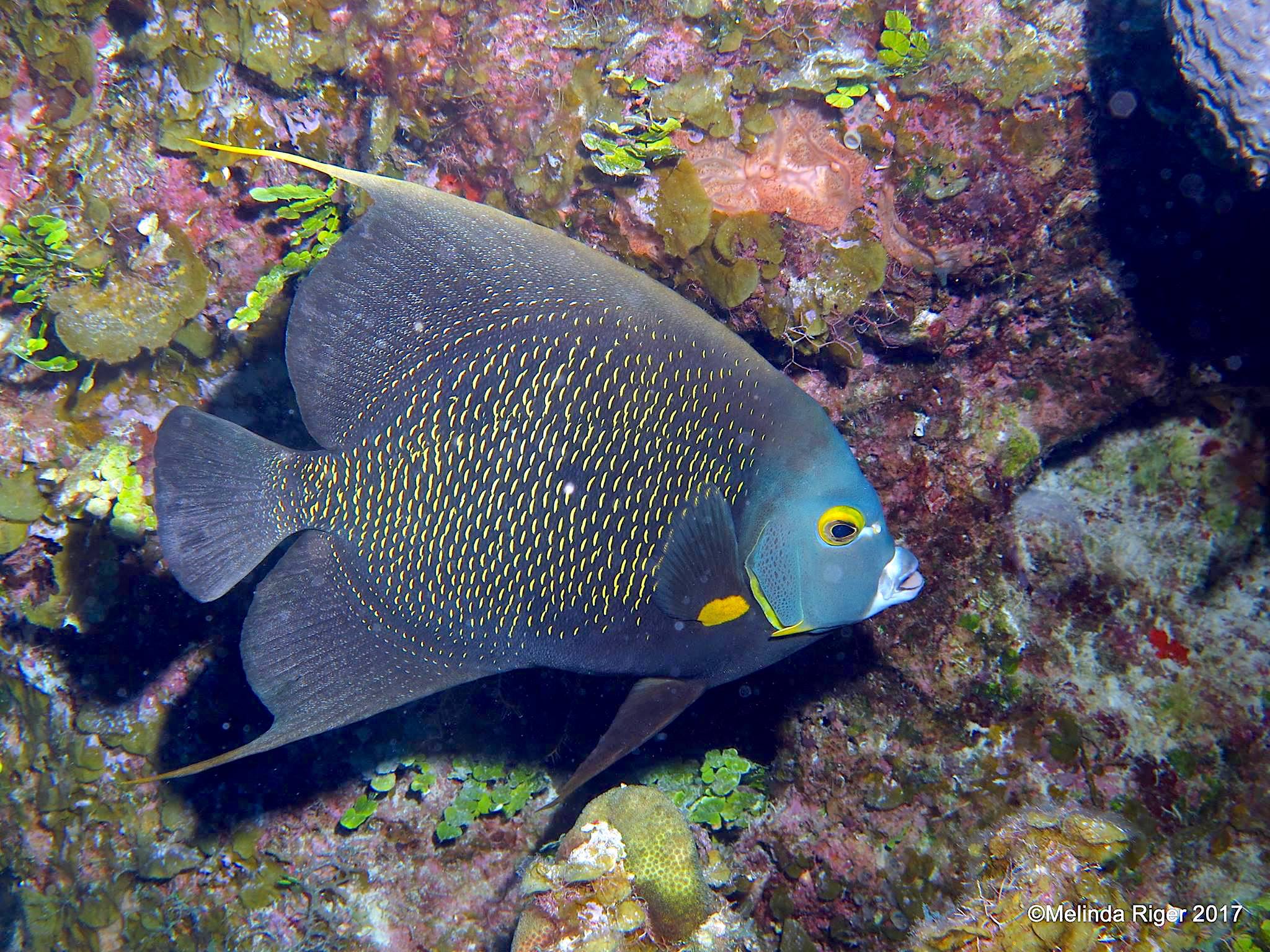
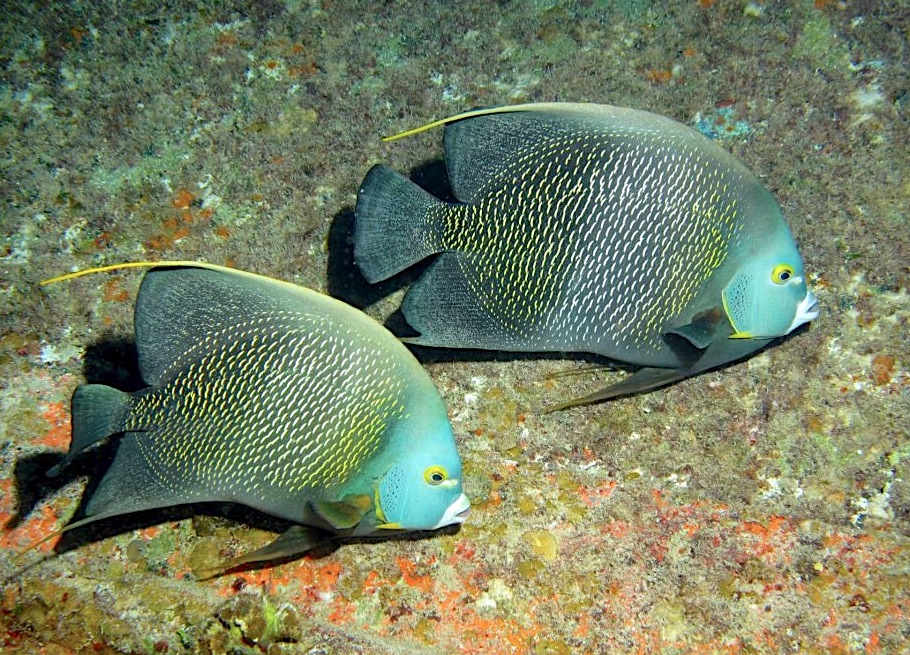
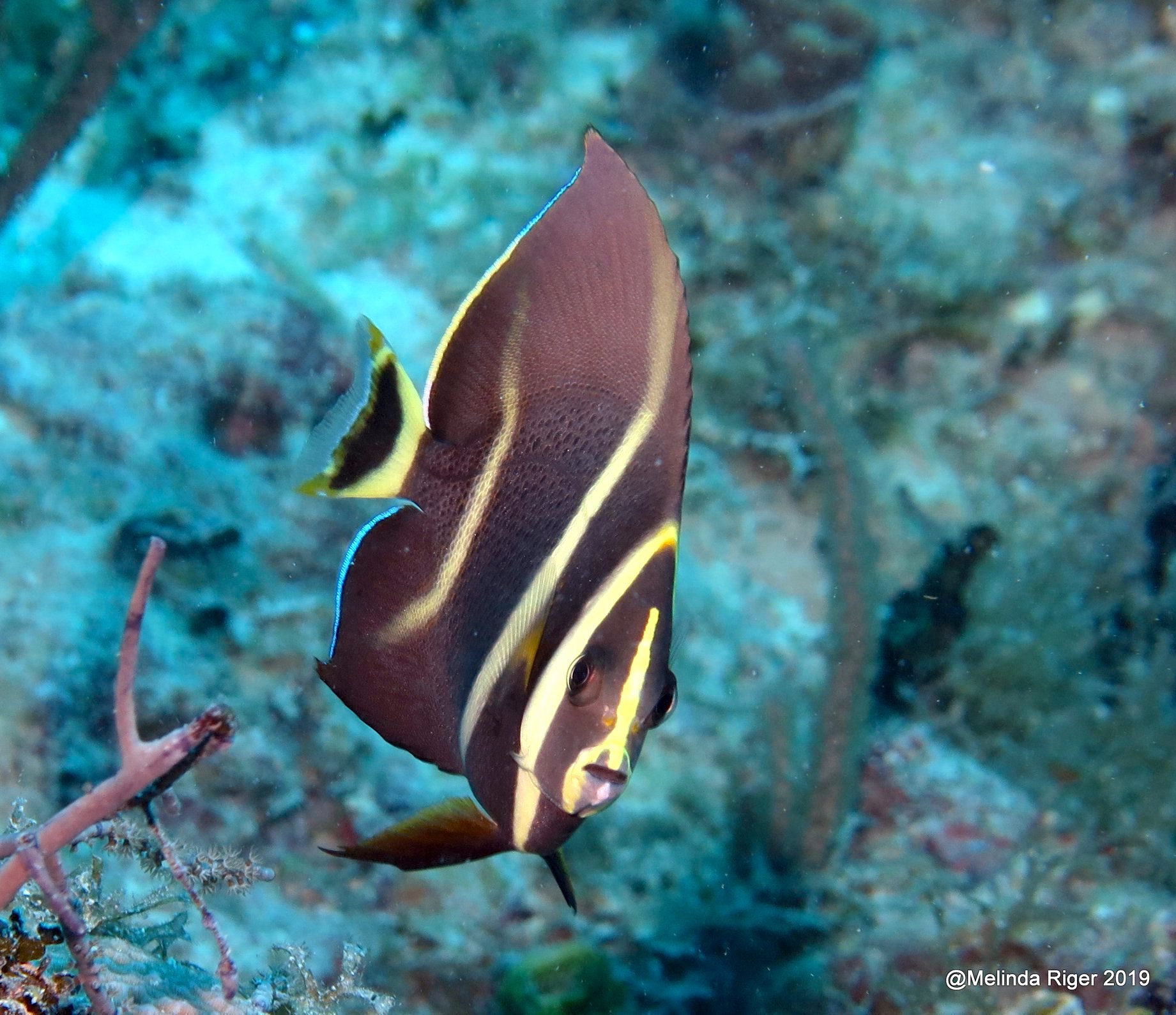
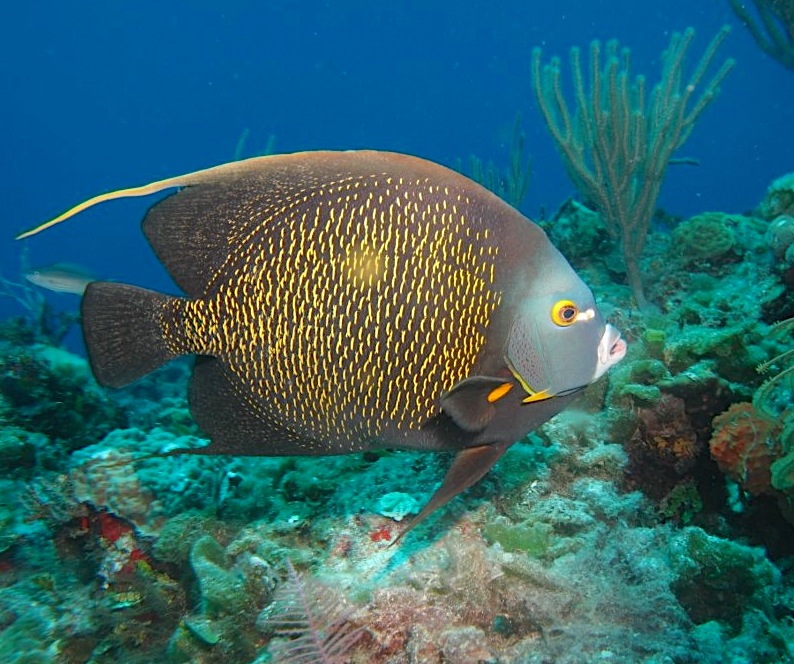
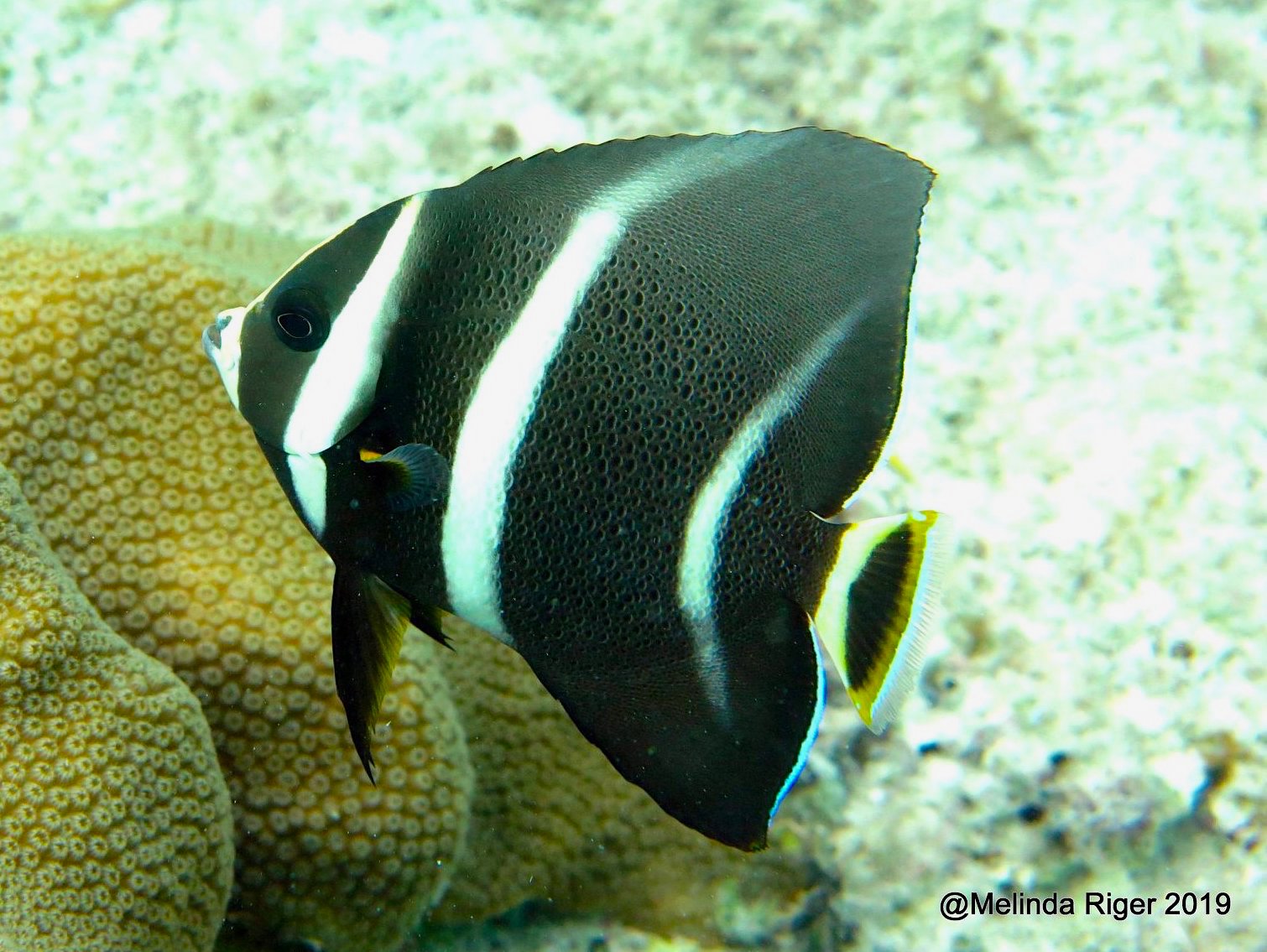
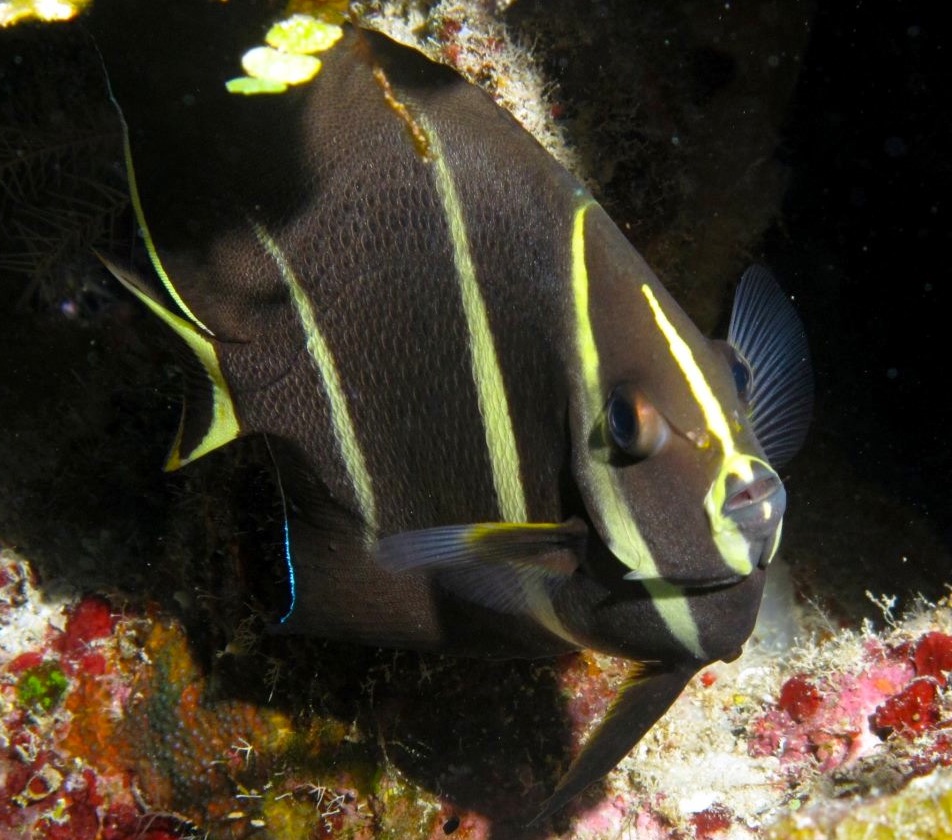
Many of the photos here have been taken during the last 3 weeks or so, as diving becomes more of a daily exercise and customers are able to return to explore the underwater world of the reefs. Adult French angelfish have handsomely decorated flanks and golden eye-rings. The small striped ones with blue flashes on their fins are juveniles.

French Angelfish, Grand Bahama (Melinda Riger/ G B Scuba)

There are three angelfish species in the northern Bahamas – Queen, Gray and French. I have chosen to feature French angelfish because as it happens the juveniles of the species found since Dorian by Melinda and Fred may provide some insight into the subsurface effects of this huge storm.

French Angelfish, Grand Bahama (Melinda Riger/ G B Scuba)

As is evident from Melinda’s recent photos, the reefs off the south coast of Grand Bahama are relatively unscathed. Corals that she and Fred planted after the last hurricane have ‘taken’ and remain in place. However the juvenile fish now being seen nosing around the reefs in quantity may tell a story of disruption elsewhere.

French Angelfish, Grand Bahama (Melinda Riger/ G B Scuba)

The juvenile angelfish – as with the young of many other species – tend to live in the relative safety of the mangroves as they grow towards adulthood and are ready to move to the reefs. However, the unusual numbers of juveniles seen in the open during recent weeks suggest that the storm-damage to mangrove swamps in shallower water has unexpectedly displaced the juveniles to the reefs. 

French Angelfish, Grand Bahama (Melinda Riger/ G B Scuba)

This theory seems to apply to juveniles of other species recently encountered. What can be said is that, if even if displaced, there are plenty of healthy juvenile as well as adult fish around. And the justifiable  fears of serious damage to the corals have not been borne out. It remains to be seen whether a similar situation exists in Abaco waters.

French Angelfish juv, Grand Bahama (Melinda Riger/ G B Scuba)

Credits: all fantastic photos, Melinda Riger / Dive Abaco. It’s great that you have been able to reopen the business and restart having been forced to suspend operations completely.

French Angelfish juv, Grand Bahama (Melinda Riger/ G B Scuba)

Unknown's avatar

WTF? (WHAT’S THAT FISH?): THE FROGFISH


Frogfish (Adam Rees / Scuba Works)

The Astoundingly 5* Strange Frogfish (Adam Rees / Scuba Works)

WTF? (WHAT’S THAT FISH?)

A COMPENDIUM OF SUBSURFACE WEIRDNESS

A SERIES OF 15 OF THE STRANGEST SEA CREATURES IN BAHAMAS WATERS

INTRODUCTION

WTF? stands for ‘What’s That Fish’? But it might also be your exclamation when you come across one of these creatures. The WTF? series highlights some of the unusual, curious, weird and downright extraordinary fishes that inhabit the waters of the northern Bahamas. Some represent local forms of a species found elsewhere in the world; others are in their own evolutionary cul-de-sac. Just as I think I have seen it all, so another oddity crops up somewhere that demands inclusion. 

The WTF? series, put together over several years, is intended to be the most direct route to an underwater menagerie of piscine strangeness, with some great photos to whet your appetite to learn more about these fascinating denizens of the ocean. 

1. THE FROGFISH

* CLICK ON THIS TITLE TO BE TRANSPORTED TO THE STRANGE WORLD OF THE FROGFISH *

Frogfish (Adam Rees, Scuba Works)Credits are given in the individual articles. Thanks to all those that have provide the photos, without which this type of illustrated, unscientifically scientific poke around in the ocean depths would not be possible.

Unknown's avatar

IS THIS THE REAL LIFE? OR IS THIS JUST FANS AT SEA?


Purple sea fan, Bahamas (Melinda Riger / Grand Bahama Scuba)

IS THIS THE REAL LIFE? OR IS THIS JUST FANS AT SEA?

I wrote the original post on this theme, with its somewhat Bohemian and rhapsodic title, a while back. It was put together at a time of sunshine, normality and optimism. The 2019 hurricane season was far in the future, and the prospect of one – let alone two – of the finest islands in the Bahamas being virtually eradicated overnight was unthinkable.

Purple Sea Fans, Abaco, Bahamas (Dive Abaco / Keith & Melinda Rogers)

Right now, in the aftermath of the devastation wrought by Hurricane Dorian, and as the communities gradually start on the long road to recovery, the priorities remain personal and community safety, food, fresh water, medical supplies and access to all the other necessities that the major relief operation has so effectively enabled. However, as gradual improvements to daily life are achieved, so a degree of interest in the natural world is returning.

Purple sea fan, Bahamas (Melinda Riger / Grand Bahama Scuba)

The despoliation of the land is there for all to see, visible even from space. As yet – as far as I know – no one has had the time or opportunity, or even a boat and the right equipment to investigate below the surface of the sea. What of the reefs: the bright darting reef fish; the larger denizens of the deep; the corals, sponges and anemones? The massive Cat 5 storm caused an unprecedented 23′ surge. It’s hard to see how the reefs can have remained unaffected, and there must be the possibility that the THIRD LARGEST BARRIER REEF in the world will have been altered irrevocably.

Purple sea fan, Bahamas (Melinda Riger / Grand Bahama Scuba)

Since Dorian, the related organisations have been unable to operate. Abaco’s ‘Dive Abaco’ was virtually annihilated along with the rest of Marsh Harbour. Grand Bahama Scuba has just reopened, although it may take a while before dive trips are anywhere back to normal. This post contains beautiful photos from both the Melindas concerned, taken in happier times before the dark cloud swept over the islands just one month ago.

Purple sea fan, Bahamas (Melinda Riger / Grand Bahama Scuba)

NOTES FROM THE PRE-DORIAN PAST

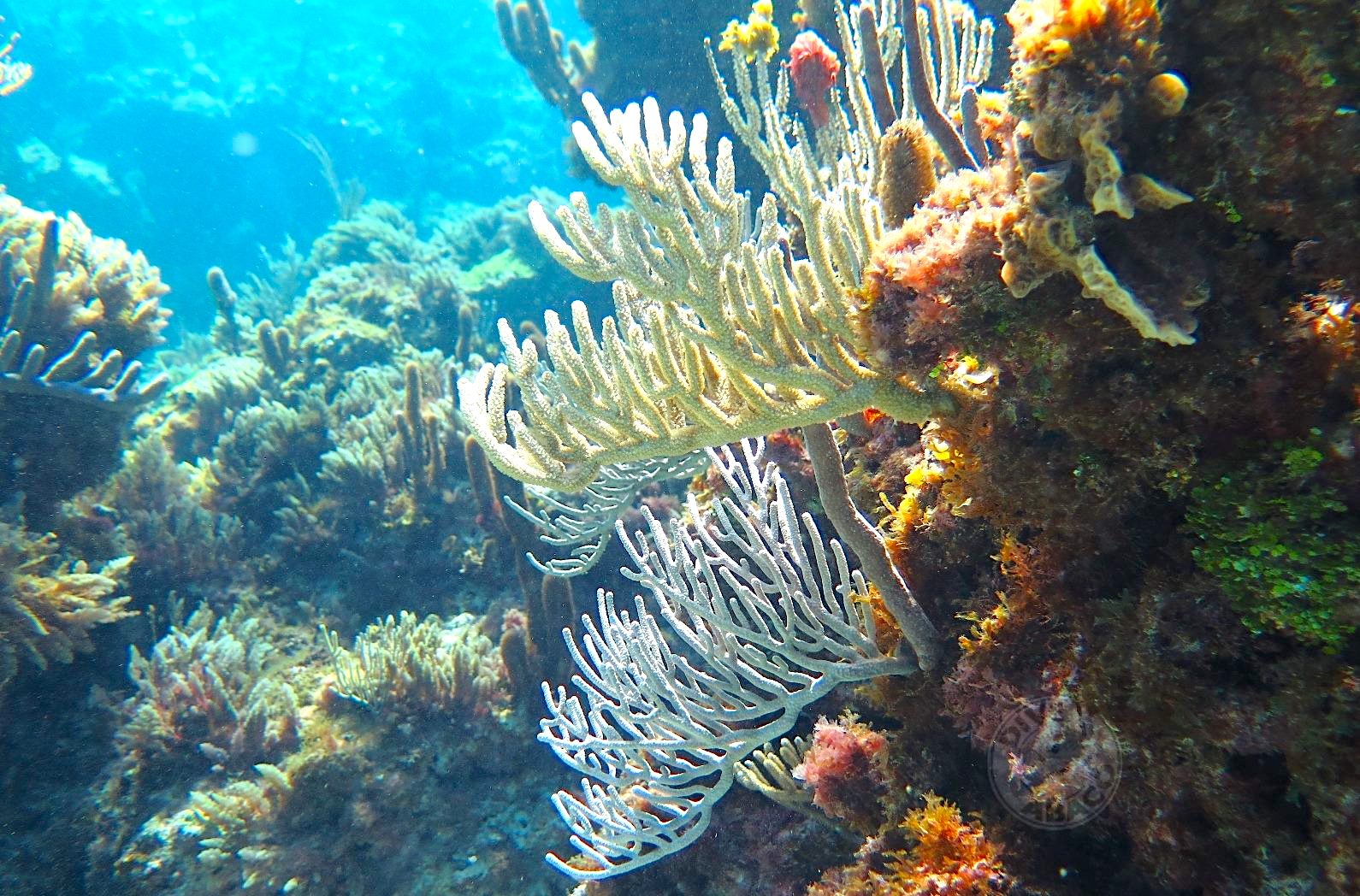
The waters of Abaco teem with myriads of fish that depend on the coral reefs for shelter and safety, for breeding, for growing up in, and for nourishment. Sea fans (or gorgonians, to use the technical name) are animals too. They may look like plants and stay rooted to the spot, but like anemones these ‘soft corals’ are creatures of the reef and essential indicators of its health.

Purple Sea Fans, Abaco, Bahamas (Dive Abaco / Keith & Melinda Rogers)

At the moment it can still be said that the static (‘sessile’) members of the Abaco reef community are relatively unscathed by the impact of (and I don’t want to get into any arguments here) whatever causes mass bleaching and the death of reefs elsewhere in the world.

Purple Sea Fans, Abaco, Bahamas (Dive Abaco / Keith & Melinda Rogers)

Purple Sea Fans, Abaco, Bahamas (Dive Abaco / Keith & Melinda Rogers)  Purple Sea Fans, Abaco, Bahamas (Dive Abaco / Keith & Melinda Rogers)

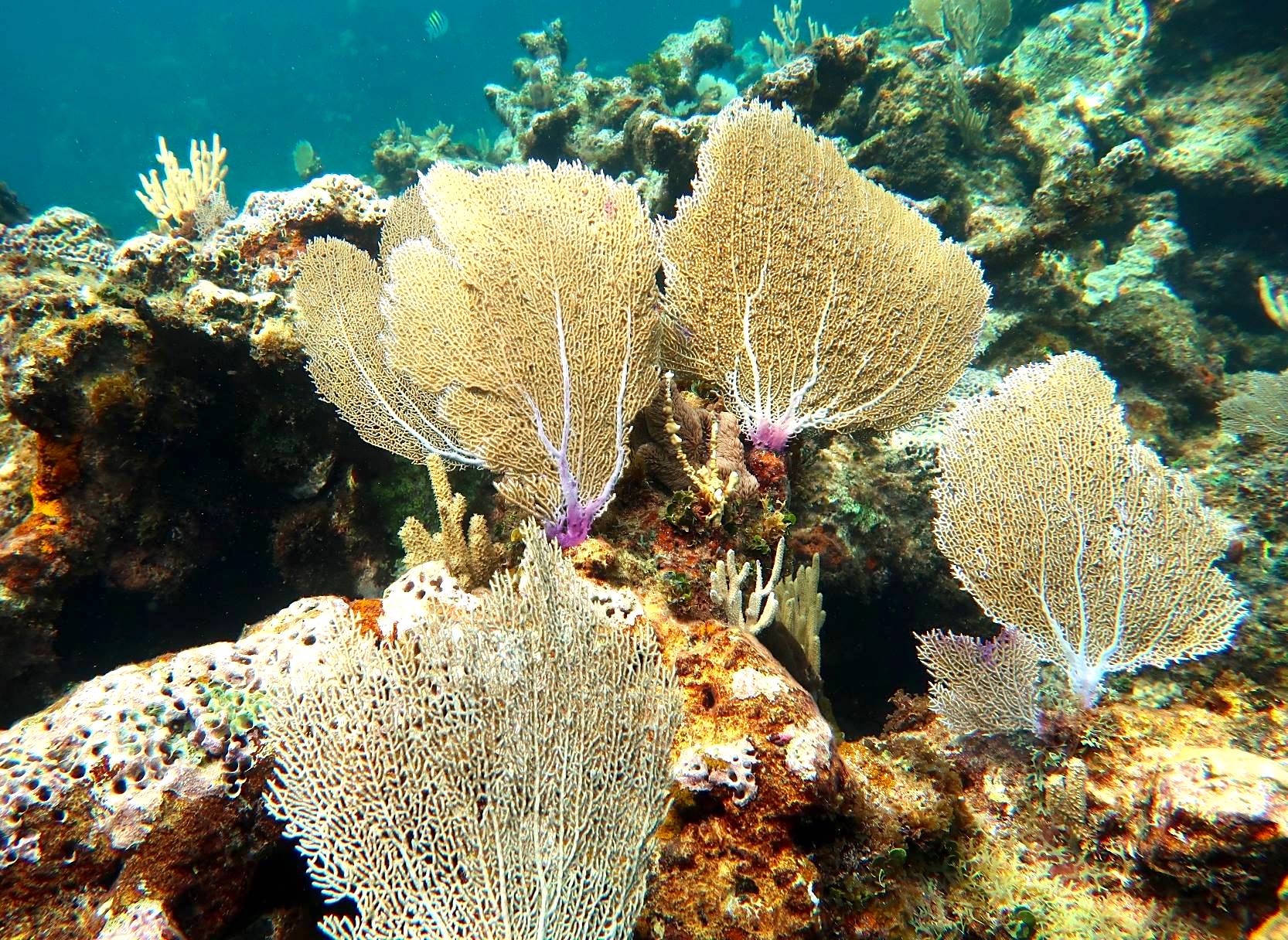
The purple sea fan Gorgonia ventalina (classified by Linnaeus in 1785) is one of the most common species of sea fan, and a spectacular one at that. The main branches are linked by a lattice of smaller branches. Below the ‘skin’ is a skeleton made of calcite compounded with a form of collagen. 

Purple Sea Fans, Abaco, Bahamas (Dive Abaco / Keith & Melinda Rogers)

Sea fans are filter-feeders, and have polyps with eight tiny tentacles that catch plankton as it drifts past. They develop so that their orientation is across the prevailing current. This maximises the water passing by and consequently the supply of food as the fans gently wave in the flow.

Purple Sea Fans, Abaco, Bahamas (Dive Abaco / Keith & Melinda Rogers)  Purple Sea Fans, Abaco, Bahamas (Dive Abaco / Keith & Melinda Rogers)

Gorgonians have a chemical defence mechanism that protects against potential troublemakers. The main effect is to make themselves unpleasant to nibble or uproot.

Purple Sea Fans, Abaco, Bahamas (Dive Abaco / Keith & Melinda Rogers)

One species impervious to this deterrent is the fascinating FLAMINGO TONGUE SNAIL (more of which quite soon). Other ‘safe’ species include the fireworm and BUTTERFLYFISHES.

Purple Sea Fans, Abaco, Bahamas (Dive Abaco / Keith & Melinda Rogers)

One benefit of sea fans to mankind is that their defensive chemicals have been discovered to provide the basis for drug research and development, specifically in the field of  anti-inflammatories. Another benefit, of course, is that they are very beautiful to look at. And in bad times, that can only be good .

Purple Sea Fans, Abaco, Bahamas (Dive Abaco / Keith & Melinda Rogers)

Purple Sea Fans, Abaco, Bahamas (Dive Abaco / Keith & Melinda Rogers)    Purple Sea Fans, Abaco, Bahamas (Dive Abaco / Keith & Melinda Rogers)

Most of the photos featured are by courtesy of Capt. Keith and Melinda Rogers of the well-known local scuba dive and snorkel centre DIVE ABACO, located in central Marsh Harbour. As prime enablers of reef exploration in Abaco waters, it can truly be said that they too have plenty of fans.

Purple Sea Fans, Abaco, Bahamas (Dive Abaco / Keith & Melinda Rogers)

Credits: Melinda and Keith Rodgers / Dive Abaco, Marsh Harbour; Melinda and Fred Riger / Grand Bahama Scuba (1, 3, 4, 5)

** The answer to the questions in the Title is… it’s both!

FINALLY, A SPECIAL FAN FOR ABACO AND GRAND BAHAMA

Purple Sea Fans, Abaco, Bahamas (Dive Abaco / Keith & Melinda Rogers)

Unknown's avatar

HIDDEN DEPTHS: LIFE ON ABACO’S CORAL REEFS


Reef Coral Abaco Bahamas (Melinda Rodgers / Dive Abaco)

HIDDEN DEPTHS: LIFE ON ABACO’S CORAL REEFS

Nearly 4 weeks after the devastation of Hurricane Dorian, the island and its cays are beginning to emerge gradually from the wreckage and the desolation. The extent of the disaster on the ground is clear, not least from the aerial photos – first drone, then plane, and now Google – of ‘before’ and ‘after’. 

Reef Coral Abaco Bahamas (Melinda Rodgers / Dive Abaco)Reef Coral Abaco Bahamas (Melinda Rodgers / Dive Abaco)

At the stage, it isn’t possible to determine the extent to which the underwater world has been affected. The storm surge was huge and the waves were savage. The progress of the storm was slow (and it went on to stall over equally damaged Grand Bahama). Who knows the effect on the corals and other reef life for which Abaco is renowned.

Reef Coral Abaco Bahamas (Melinda Rodgers / Dive Abaco) Reef Coral Abaco Bahamas (Melinda Rodgers / Dive Abaco)

This pictorial post is a reminder of how things were below the surface of Abaco waters before Dorian struck. If it lifts spirits to any degree, I shall be glad.

Reef Coral Abaco Bahamas (Melinda Rodgers / Dive Abaco) Reef Coral Abaco Bahamas (Melinda Rodgers / Dive Abaco)

All these photos are by Melinda Rodgers who, with Capt Keith, are DIVE ABACO. Many will know how badly they have fared, being in the heart of Marsh Harbour. We wish them a speedy return to the wonderful enterprise they have run for many years. I’m pleased to be able to show the beauty of the reefs in happier times from their archive.

Reef Coral Abaco Bahamas (Melinda Rodgers / Dive Abaco)Reef Coral Abaco Bahamas (Melinda Rodgers / Dive Abaco)

Credits: Melinda Rodgers /  Dive Abaco

Reef Coral Abaco Bahamas (Melinda Rodgers / Dive Abaco)

Unknown's avatar

SEAL: THE REAL DEAL


Harbour Seal, Gairloch Scotland (Keith Salvesen / Rolling Harbour)

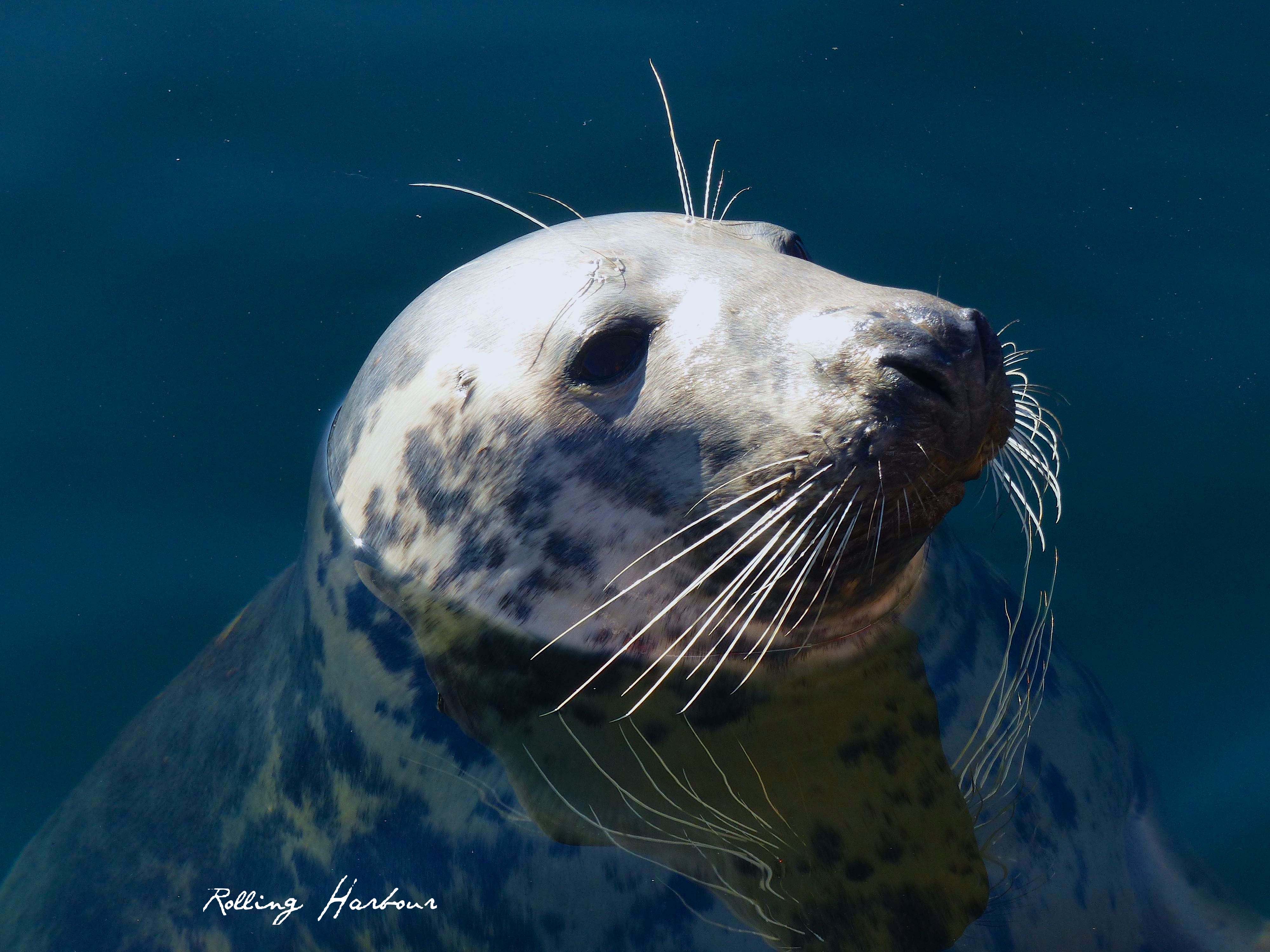
As Abaco starts to rebuild from the unimagined severity of its destruction, it’s not a great moment for discursive writing about the astonishing richness of wildlife there, both above and below the sea. So here’s a photo of a Harbour Seal that I took this afternoon. If it gives you something to smile about, I’d be very glad. RH

Unknown's avatar

URCHIN RESEARCHIN’: SEA HEDGEHOGS OF THE REEF


Long-spined sea urchin Diadema antillarum (Melinda Rodgers / Dive Abaco)

URCHIN RESEARCHIN’: SEA HEDGEHOGS OF THE REEF

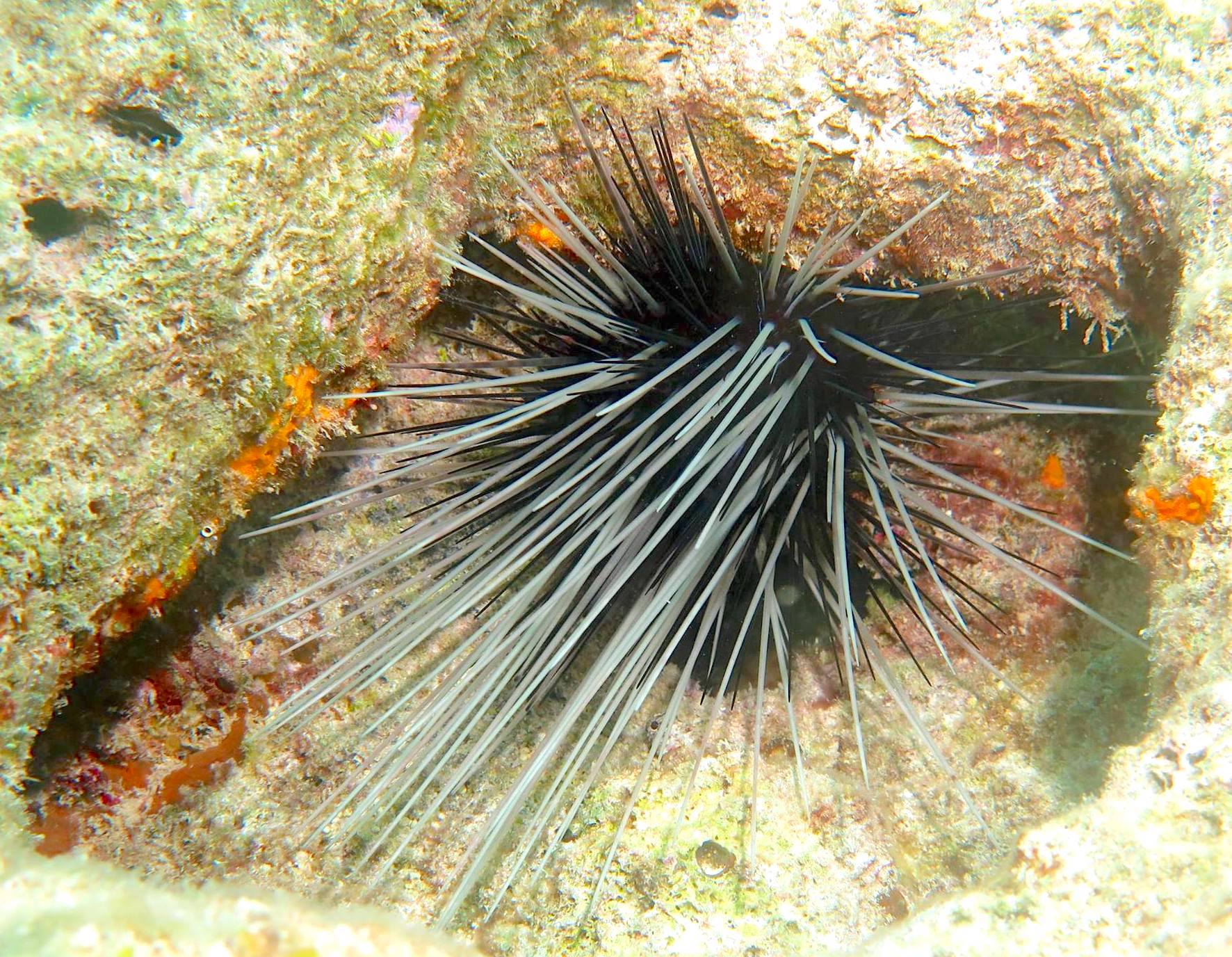
The long-spined sea urchin Diadema antillarum featured in this post is one of those creatures that handily offers its USP in its name, so you know what you are dealing with. Something prickly, for a start. These are creatures of the reef, and many places in the Caribbean and in the western Atlantic generally sustain healthy populations.

Long-spined sea urchin Diadema antillarum (Melinda Rodgers / Dive Abaco)

These animals are essentially herbivores, and their value to vulnerable coral reefs cannot be overstated. Where there is a healthy population of these urchins, the reef will be kept clean from smothering algae by their methodical grazing. They also eat sea grass.

Long-spined sea urchin Diadema antillarum (Melinda Rodgers / Dive Abaco)

HOW DO THE SPINES OF DIFFERENT KINDS OF URCHIN COMPARE?

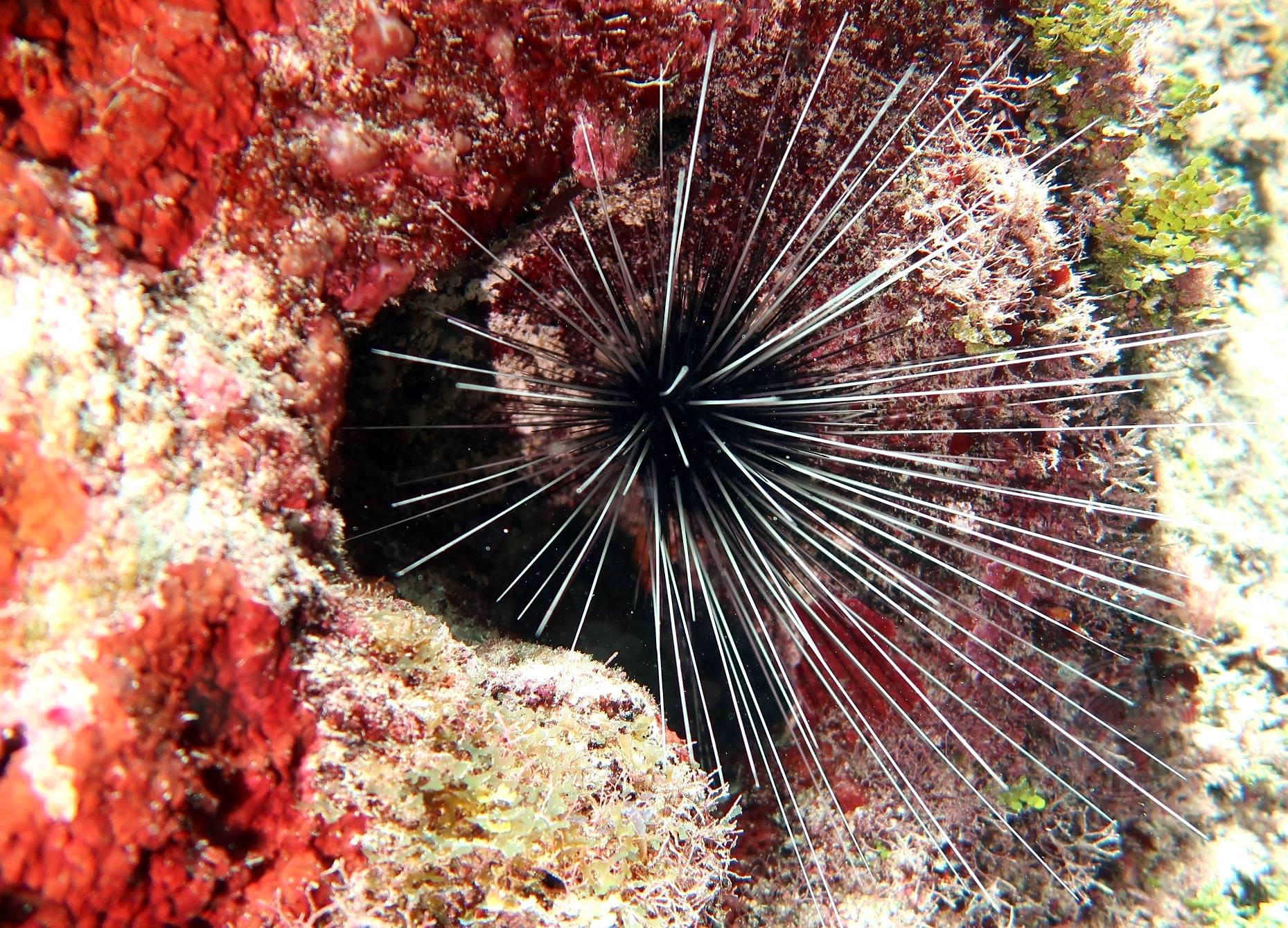
Small sea urchins species have spines a few cms long at most. The long-spine variety exceed 10 cms, and the largest may have spines up to 30 cms (= 1 foot) long. The length, as shown here, means that when the creatures are safely lodged in crevices near their algae supply, their spines remain very visible.
Long-spined sea urchin Diadema antillarum (Melinda Riger / G B Scuba)
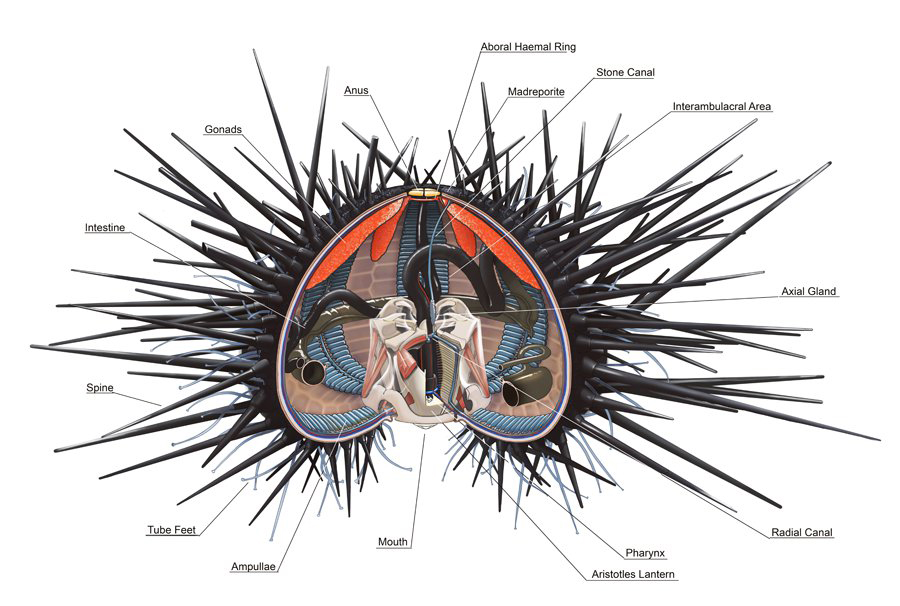
Anatomy of a long-spined sea urchin. You may possess a few of these organs yourself…

Long-spined sea urchin Diadema antillarum anatomy diagram (wiki)

Long-spined sea urchin Diadema antillarum (Melinda Rodgers / Dive Abaco)

CAN YOU GIVE US A TEST, PLEASE?

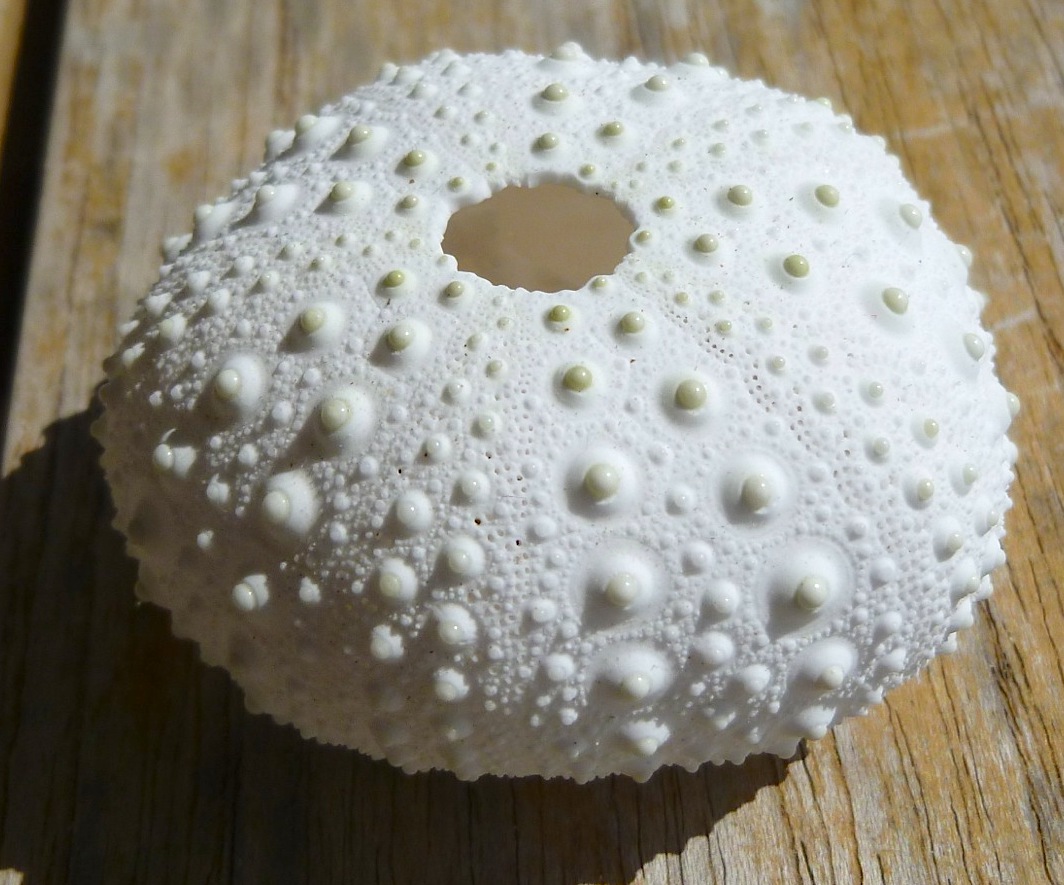
As with SAND DOLLARS and similar creatures, the skeleton of a sea urchin is known as a ‘test’. Urchin tests are remarkably beautiful, especially seen in sunlight. Here are 2 examples I photographed a while ago. You’ll immediately notice the delicate colours and the amazing complexity of the pattern and symmetry. The top one is (or is most like) a long-spined urchin test.
Long-spined sea urchin Test / Skeleton Diadema antillarum (Keith Salvesen / Rolling Harbour) Long-spined sea urchin Test / Skeleton Diadema antillarum (Keith Salvesen / Rolling Harbour)

A BIT ABOUT SYMMETRY

Sea urchins are born with bilateral symmetry – in effect, you could fold one in half. As they grow to adulthood, they retain symmetry but develop so-called ‘fivefold symmetry’, rather as if an orange contained 5 equal-sized segments. The graphic above gives a good idea of how the interior is arranged inside the segments.

Long-spined sea urchin Diadema antillarum (Melinda Rodgers / Dive Abaco)

A FEW FACTS TO HAND DOWN TO YOUR CHILDREN

  • Urchin fossil records date the species back to the Ordivician period, c 40m years ago
  • In the ’90s the population was decimated and still has not recovered fully
  • Urchins feel stress: a bad sign that the spines here are white rather than black
  • Urchins are not only warm water creatures: some kinds live in polar regions
  • Urchins are of particular use in scientific research, including genome studies
  • Some urchins end up in aquariums / aquaria, where I doubt the algae is so tasty
  • Kindest not to prod or tread on them
  • Their nearest relative (surprisingly) is said to be the Sea Cucumber 

Sea Cucumber (Melinda Riger / G B Scuba)

ARE THEY EDIBLE?

Apparently they are eaten in some parts of the world; their gonads and roe are considered a delicacy. As far as I know, they are not generally on the menu in the Bahamas. Correction invited. Personally, I could leave them or leave them.

CREDITS: Melinda Rodgers / Dive Abaco (1, 2, 3, 6, 9) taken Abaco; Melinda Riger / G B Scuba (4, 10, 11) taken Grand Bahama; Keith Salvesen / Rolling Harbour (7, 8) taken Abaco; Wiki graphic (5) taken from internet. RESEARCH Fred Riger for detailed  information; otherwise the usual magpie pickings…

Long-spined sea urchin Diadema antillarum (Melinda Riger / G B Scuba)

Unknown's avatar

BLUE CHROMIS: A FLASH OF COLOUR ON THE REEF


BLUE CHROMIS: A FLASH OF COLOUR ON THE REEF

I’ve gone pictorial for today because I have only got my phone with me while we are away. Composition is slow, close to decomposition – and the comms connection is close to disconnection

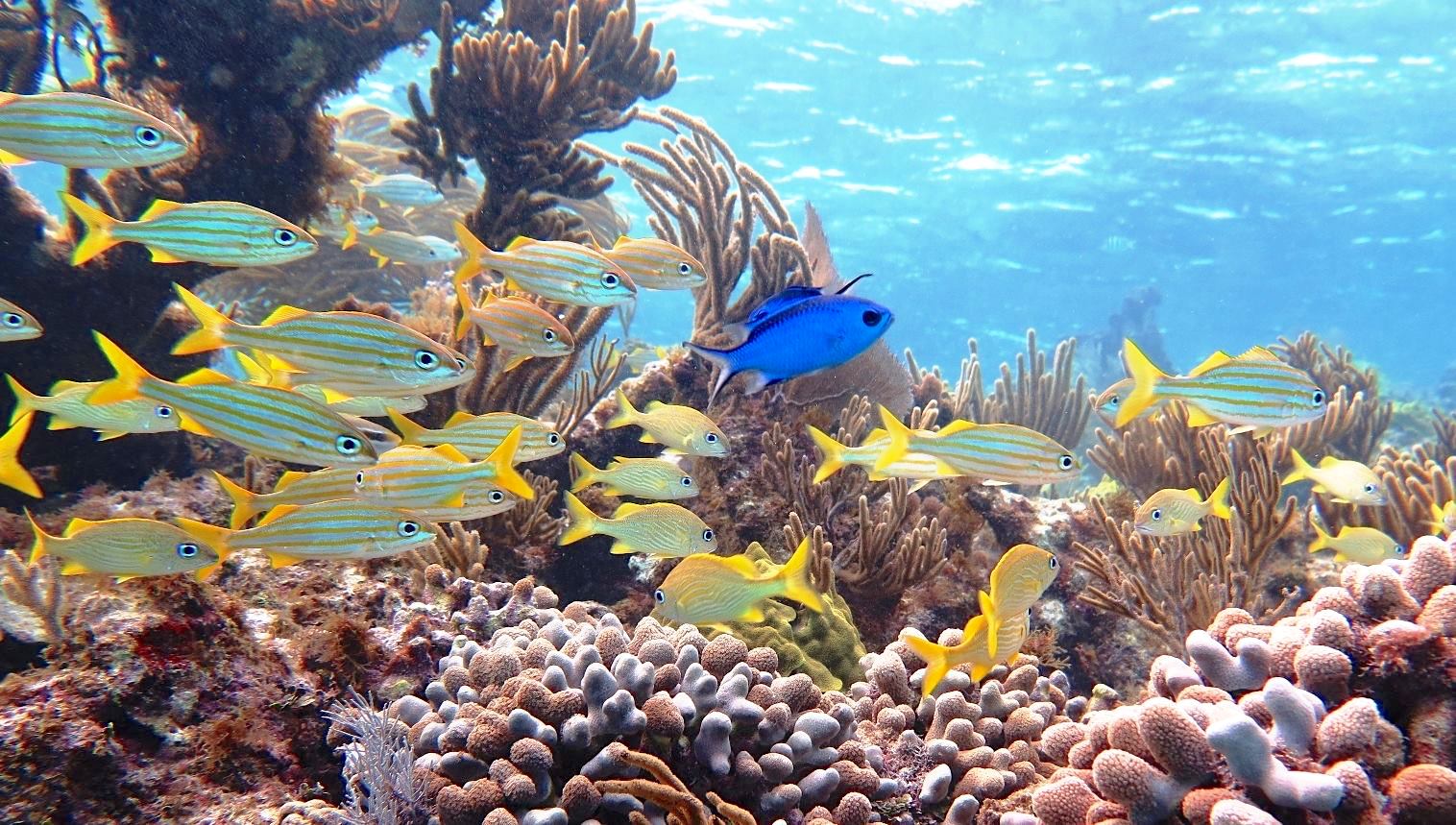
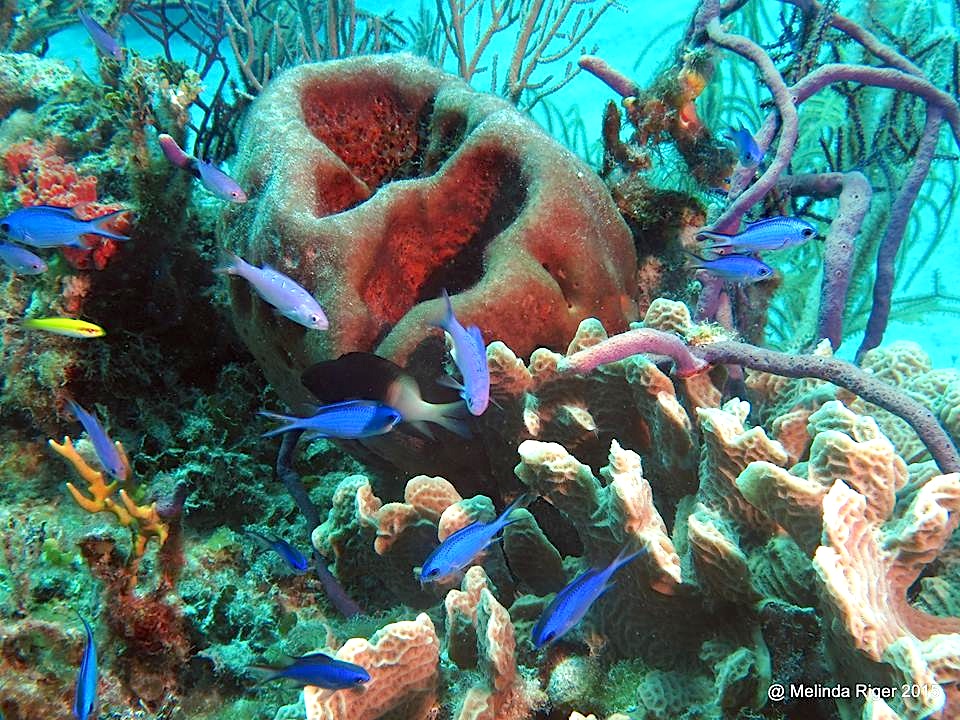
Blue chromis (Chromis cyaneus) belong to the same group of fishes as damselfishes. These unmistakeable, bright reef denizens are very visible despite their tiny size. These fish are shoalers, so out on the reef you can enjoy them flickering around you as you swim along or hang in the water to admire the corals.

Like many a pretty and easily captured small fish that can be monetised once removed from its natural home environment, the blue chromis is popular for aquariums, and for humans to keep in their own home environments, unselfishly feeding them concocted food.

Blue chromis are adaptable and sociable, and will happily swim with other small reef fishes (as above). My own favourite combo is chromis mixed in with sergeant majors. But a shoal of them (mostly) alone is pretty special too….

I cynically mentioned ‘concocted’ food earlier. Here is one online care instruction for looking after them: “They are omnivores, meaning that they eat both meaty and plant based foods. They are not difficult to feed and will eat a variety of regular aquarium fare, frozen, live, and sometimes even dry food. Feeding them a variety of foods will help them retain their color in captivity. They sometimes feed on the algae in the tank”. 

If you are tempted to rescue some from their reef habitat, rest assured that: They have been known to spawn in captivity. Blue chromis can usually be obtained for about $10-15. And don’t hold back on the frozen food (though maybe warm it up a bit before feeding time).

Credits: Melinda Rodgers / Dive Abaco; Melinda Riger / G B Scuba

Unknown's avatar

INTERNATIONAL SHARK WEEK? IT’S SO OVER… EXCEPT HERE


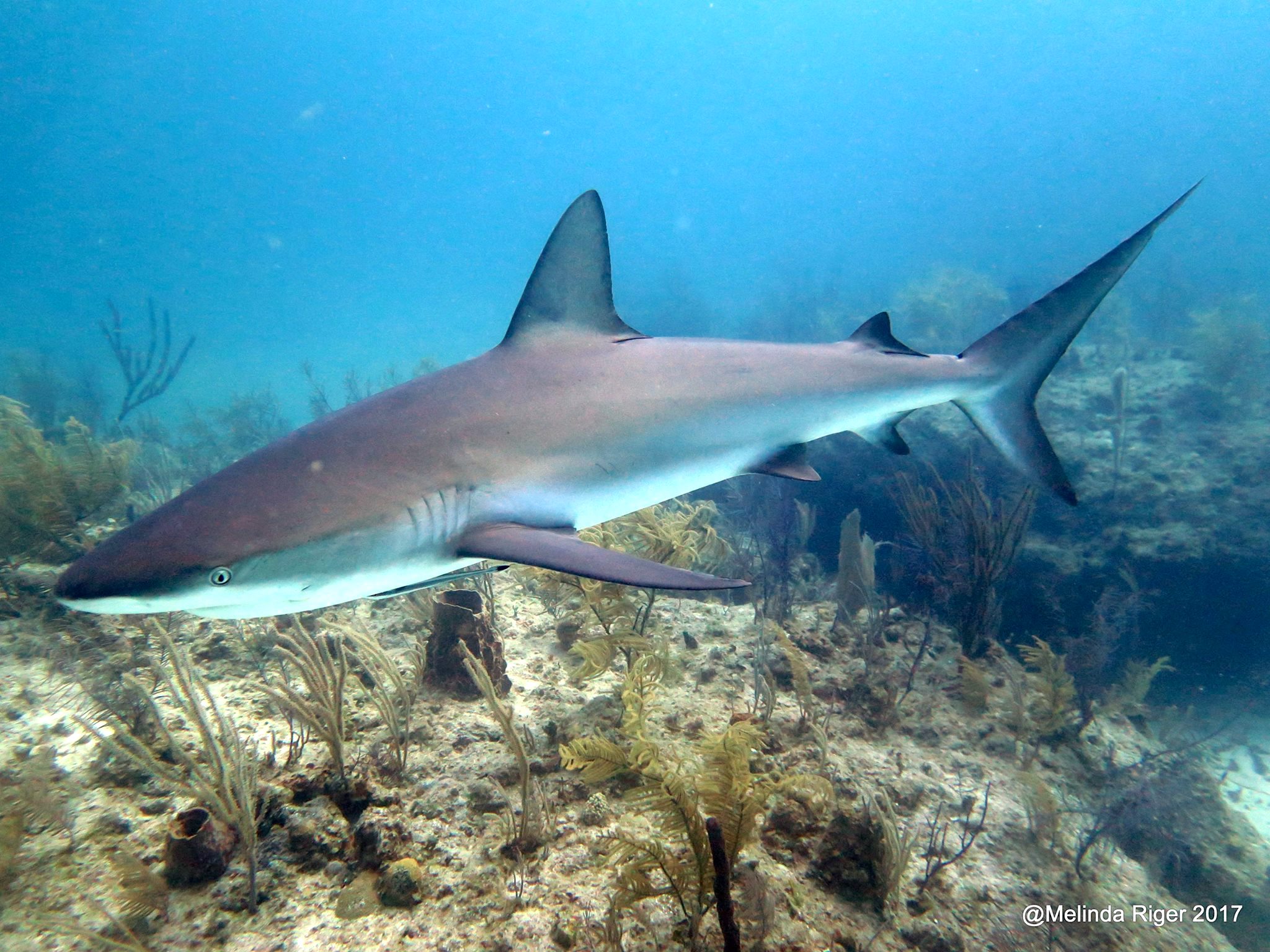
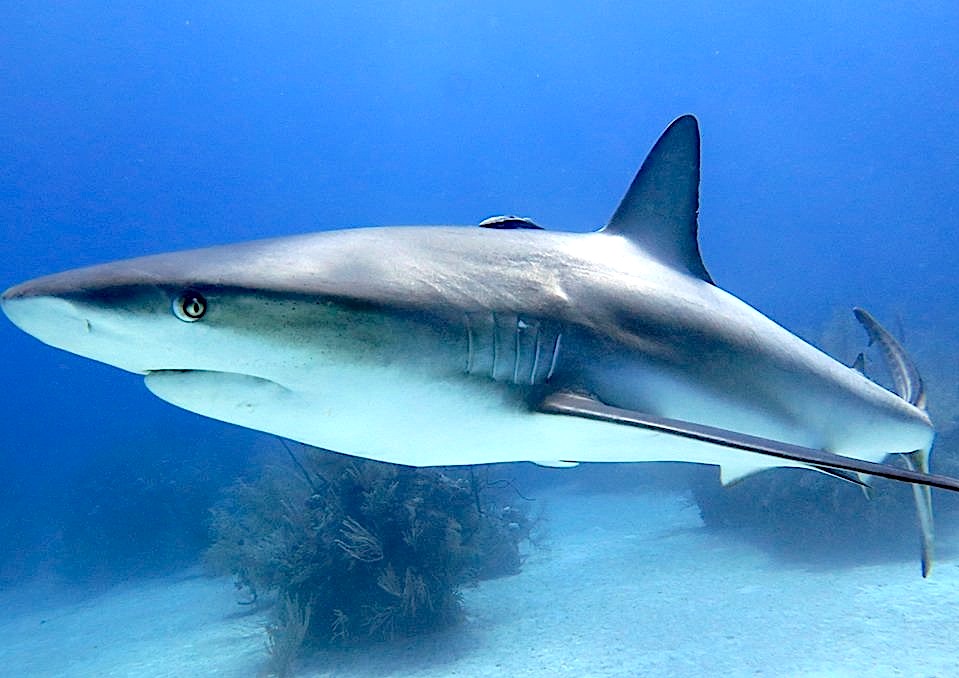
Sharks in Bahamas - Melinda Riger / Grand Bahama Scuba

INTERNATIONAL SHARK WEEK? IT’S SO OVER… EXCEPT HERE

There’s never a day without a ‘Day’, nor a week without a ‘Week’. Almost all creatures under the sun are celebrated in some regular calendar-based time-frame. With the exception of No-see-ums: I’ve checked – there is no national or international Ceratopogonidae Day in any online calendar. 

Sharks in Bahamas - Melinda Riger / Grand Bahama Scuba

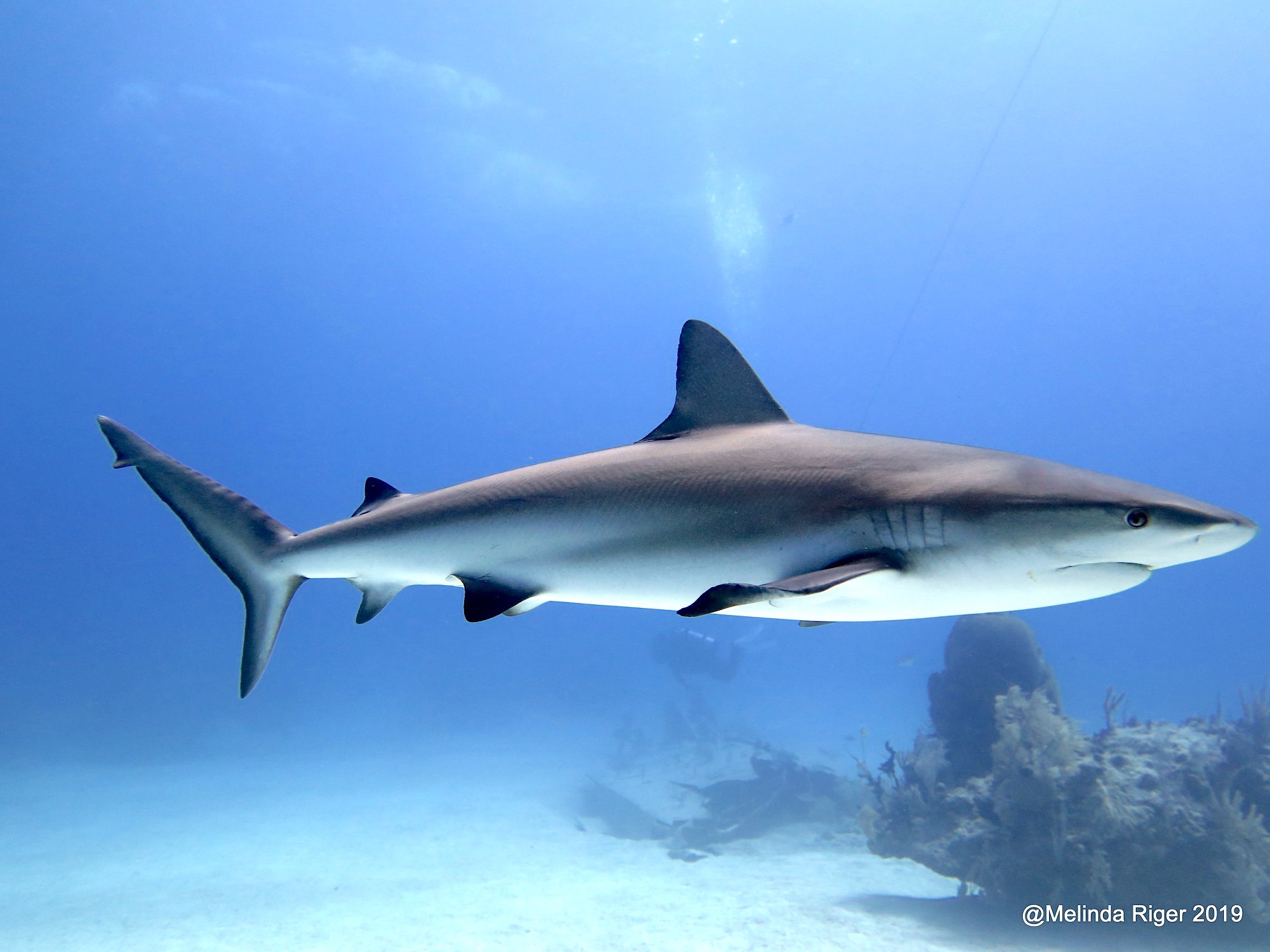
By a mere 2 days, I have missed Shark Week, a happening tied in with the Discovery Channel, and heralded by an amusing trailer that features no actual sharks… So, belatedly, here are some cool shark photos to enjoy, in case you didn’t get enough of them last week, or (like me) had other fish to fry.

Sharks in Bahamas - Melinda Riger / Grand Bahama Scuba“I’m so glad we agreed to watch each other’s backs…”

Sharks in Bahamas - Melinda Riger / Grand Bahama Scuba

 Meet Nurse Betty, as she is known to diversSharks in Bahamas - Melinda Riger / Grand Bahama Scuba

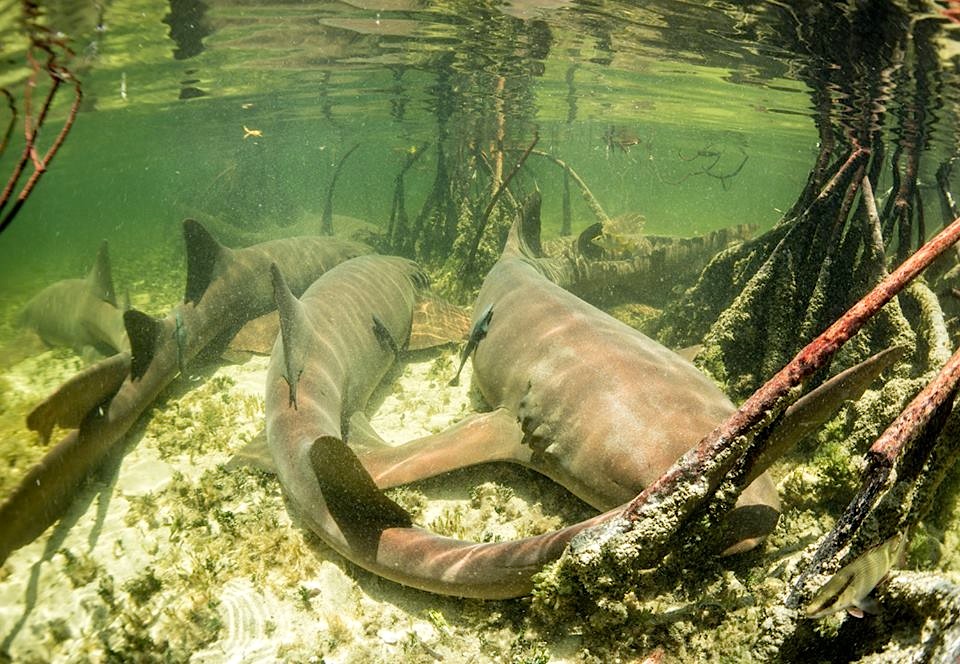
MANGROVES: THE SHARK NURSERY

As all children are taught and some adults know, the mangroves that grow in the shallow waters around the islands of the Bahamas are of enormous ecological significance. This isn’t the place to expand on that now, but it is worth mentioning that the mangrove swamps are the nurseries of young sharks (‘pups’) until, as juveniles, they are old enough to leave the safely of their home for deeper waters. Check out the short video below.

Sharks in Bimini Bahamas - biminis-marine-protected-areaSharks in Bimini Bahamas - biminis-marine-protected-area

Spot the REMORA hitching a ride on this shark’s backSharks in Bahamas - Melinda Riger / Grand Bahama Scuba

Nurse shark – note the twin barbels (cf recent Goatfish article)Sharks in Bahamas - Melinda Riger / Grand Bahama Scuba

Sharks in Bahamas - Melinda Riger / Grand Bahama Scuba

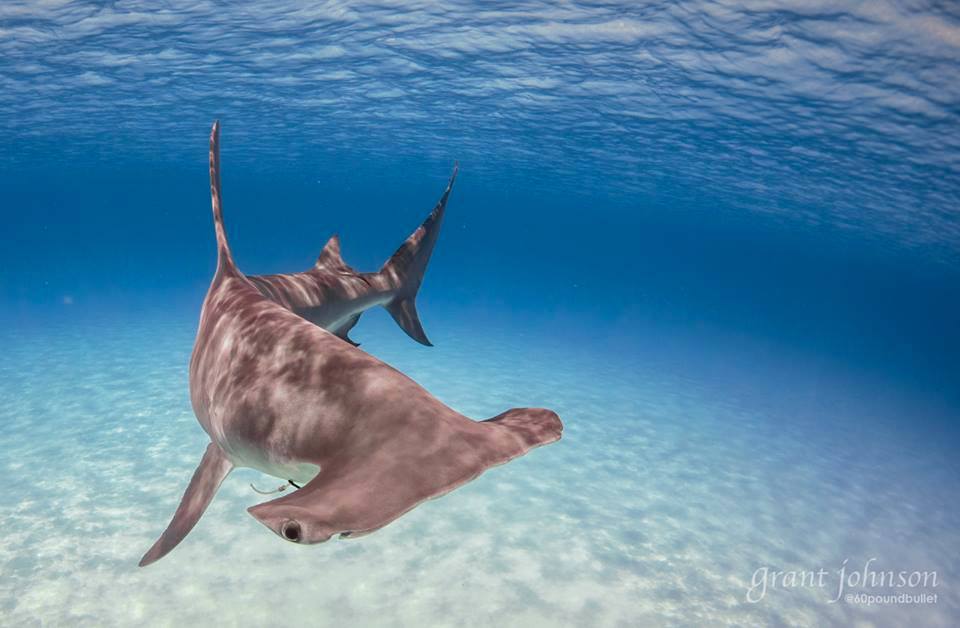
HAMMERHEADS FROM BIMINI Sharks in Bimini Bahamas - Grant Johnson / 60 Pound Bullet   Sharks in Bimini Bahamas - Grant Johnson / 60 Pound Bullet

These wonderful photos were all taken in Bahamian waters. Melinda Riger of Grand Bahama Scuba is, as ever, the star snap-getter of sharks (and indeed all other marine creatures). Special thanks are also due to Grant Johnson / 60poundbullet and Neal Watson / Bimini Scuba Center for occasional use permission of photos – especially of hammerheads – that are, well, eye-popping. Video from ‘ZeroEye’

Sharks in Bimini Bahamas - Grant Johnson / 60 Pound Bullet

Unknown's avatar

BAHAMAS REEF FISH (53): YELLOW GOATFISH


Goatfish, Bahamas (Melinda Riger / G B Scuba)

BAHAMAS REEF FISH (53): YELLOW GOATFISH

GOATFISHES belong to the mullet family, a large group of species with a flexible membership. In other words, there is disagreement as to whether certain fish are mullet or not. For present purposes, it’s not our problem – no one doubts that the goatfish is a mullet.

Goatfish, Bahamas (Melinda Riger / G B Scuba)

SO WHY ARE THESE CALLED GOATFISH? WAS SOMEONE KIDDING?

These fish get their name for the pair of so-called ‘barbels’ below their mouths (see image below), thought to be reminiscent of a goatee beard. The name has Latin origin, ‘barbula‘, meaning a small beard. Linnaeus may have had a hand in this choice of description.

Goatfish, Bahamas (Melinda Riger / G B Scuba)

WHAT IS THE FUNCTION OF THE BARBELS?

The barbels are sensory organs which, depending on the creature, may be located on either side of the mouth, on the chin, or even extending from the nostrils. In broad terms, the barbels are where the taste buds are located. They help a fish to find food even when the water is stirred up or murky or at night, and are used to probe into sand or into holes in the reef for prey.  

Goatfish, Bahamas (Melinda Riger / G B Scuba)

WHY ARE THEY OFTEN SEEN WITH YELLOWTAIL SNAPPERS, GRUNTS & PORKFISH?

Goatfish have limited means of self-protection. They are not poisonous or venomous, they have no spines or razor-sharp teeth, nor ink to squirt. They do have an ability to change colour rapidly to blend into their surroundings – e.g. over pale sand – to make them less conspicuous to predators. Overall, however, they are docile and probably delicious to many other species. Their bright hues may have some function as aposematic colouring to warn, scare or repel potential predators, but this is possibly of limited use among the familiar reef denizens. So instead the goatfish goes in for so-called protective mimicry, as shown in the image above.

Goatfish, Bahamas (Melinda Riger / G B Scuba)

PROTECTIVE MIMICRY?

Goatfish and yellowtail snappers (in particular) are similar in size, appearance, coloration and behaviours, though the feeding patterns differ. The reason they are often found in mixed groups on the reef is for the individual protection they gain in a larger mixed school. This really amounts to taking advantage of safety in numbers (especially for the fishes in the middle). Here’s a very recent photo that shows exactly this scenario – a large mixed shoal of two almost indistinguishable fish species.

Goatfish & Yellowtail Snappers shoaling (Melinda Riger, GB Scuba)

IS THIS A ‘SPOT THE DIFFERENCE’ TEST?

If you’d like to make it so! (click on the image to enlarge it). Look out for the fish with the barbels (Goatfish); and the fish with the larger, more deeply forked tails (Snappers). A predator won’t take a great deal of notice of the finer points of difference of course, but overall this large mixed shoal gives a degree of protection to individual fish in the unit as a whole

Goatfish, Bahamas (Melinda Riger / G B Scuba)

ARE GOATFISH EDIBLE?

Goatfish are eaten in many ares of the world, though I can’t recall seeing it on a Bahamian menu. The Romans ate the local mullet / goatfish species, but then they ate many things that we do not now consider as permissible food – dormice in honey for example. Rather revoltingly, the goatfish were served live so that guests could watch them die and see the amazing change of colours in the process. Barbaric? But don’t we cook live… well, never mind that.

Goatfish, Bahamas (Melinda Riger / G B Scuba)

Photos: all great photos from Melinda Riger / Grand Bahama Scuba; magpie research pickings inc. the abstract of a scientific paper with about 23 authors; tip ‘o the hat to Wiki, no seriously

Goatfish, Bahamas (Melinda Riger / G B Scuba)

Unknown's avatar

PEACOCK FLOUNDERS REVISITED: NOW YOU SEE THEM…


Peacock Flounder (Melinda Riger / G B Scuba)

        PEACOCK FLOUNDERS (Part Deux)

MASTERS OF SUBAQUATIC CAMOUFLAGE

I featured the extraordinary, colour-transforming PEACOCK FLOUNDER Bothus lunatus about 3 years ago in the Bahamas Reef Fish series (No. 21 I think). These really are remarkable creatures, and I am pleased to be able to show some more wonderful illustrative photos. 

Peacock Flounder (Melinda Riger / G B Scuba)

ROVING EYES

In the fish shown here, you’ll see that – surprisingly – both eyes are on the upperside of the fish, above the rather grumpy mouth, whereas the head is horizontal to the ocean floor. Oddest of all, juveniles are constructed conventionally with bilateral eyes, and look like ‘normal’ fish rather than flatfish.

Peacock Flounder (Melinda Rogers / Dive Abaco)

As the fish matures, in some magic way the mechanics of which I can only guess at**, the right eye grows round to the topside and the flounder transforms from a ‘vertical’ fish to a flatfish. For this reason, the PF is known as a ‘lefteye’ flounder. Maybe in other flounder species in the world – the southern hemisphere maybe? – the eye that moves round to the upperside is the left eye.

Peacock Flounder (Virginia Cooper / G B Scuba)

The eyes of this fish have another special trick up their sleeves (so to speak). They operate completely independently. Thus the creature can look left and right, or forwards and backwards, simultaneously. It’s an excellent system for detecting predators coming from any angle. It’s a superpower we might all benefit from.

Peacock Flounder (Melinda Rogers / Dive Abaco)

DO THEY HAVE ANY OTHER TRICKS WE SHOULD KNOW ABOUT?

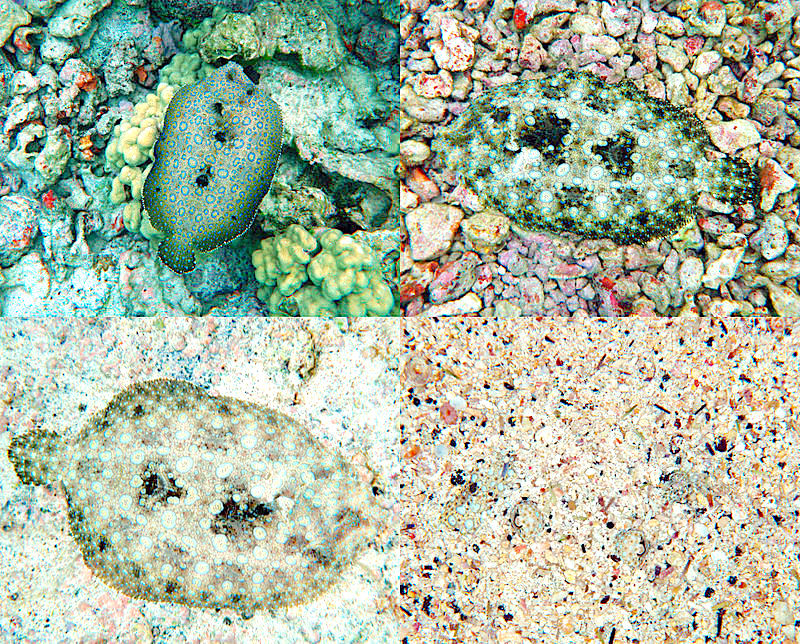
Yes they do indeed. If you have been admiring the fish shown so far, you’ll have noticed that the colour of each one differs from the others. In addition to the predator-protection that the eyes provide, the peacock flounder can make itself (near) invisible. They can rapidly change colour to match their surroundings. There are 3 reasons for this: to avoid / confuse predators; to conceal themselves on the sea-floor to catch passing prey; and, as dive expert Fred Riger has pointed out, “the male peacock flounder can, and does greatly intensify his colours to declare territory and attract females. When doing this the males will also signal with the left pectoral fin, sticking it straight up and waving it around.” 

The same fish, photographed over several minutes as it moves over the ocean floorPeacock Flounder (Wiki)

Matching the background happens as the fish swims, and in a few seconds. When they rest on the sea-floor, the camouflage may even become total. In #4 above you can just about make out the eyes. The whole effect is known as ‘cryptic coloration’ or CRYPSIS. In contrast, the image below shows just how adaptable the transformation can be. Note how the fish can even mimic the pinkish tinge of the sand perfectly. If threatened, the fish will bury itself in the sand, with just its eyes showing.

Peacock Flounder (Melinda Rogers / Dive Abaco)

HOW DO THEY MANAGE TO CHANGE COLOUR IN SECONDS?

It’s complicated! A simple answer is: a mix of hormones, pigment-cells and vision, all coordinating rapidly. The colour change works in two ways: pigments are selectively released to the skin cells; and other pignments can be selectively suppressed. An analogy might be image manipulation using variations in brightness, saturation etc. Not convinced? Then watch this short video and prepare to be impressed. Astonished, even.

WHAT IF A FLOUNDER CAN’T SEE CLEARLY FOR SOME REASON?

As with many (all?) superpowers, there is usually some kryptonite-style flaw. A flounder with a damaged eye, or one temporarily covered (by sand, for example) will have difficulty in changing colour – possibly at all, or at any rate with the swiftness it needs to have. 

Peacock Flounder (Melinda Riger / G B Scuba)

THESE SIDEWAYS FISH – HOW DO THEY… YOU KNOW…?

Take a look at the fish above with its top fin raised. It’s a ‘ready’ signal in a harem. Male flounders have a defined and defended territory within which live up to 6 females – a so-called ‘harem.’ I can do no better than borrow the description of the rituals from an article derived from scientific papers by Konstantinou, 1994Miller, et al., 1991 in the website animaldiversity.org/…ounts/Bothus_lunatus To which I can only add, ’15 seconds, eh?’

Peacock Flounder (Melinda Riger / G B Scuba)

“Mating activities usually begin just before dusk. At this time, a male and a female approach each other with the ocular pectoral fin erect. The two fish arch their backs and touch snouts. After this interaction the female swims away, and the male sometimes follows, approaching the female again from the left side. At this point the male pectoral fin is erect and the female pectoral fin moves up and down, possibly signalling willingness to mate. The male then positions himself underneath the female and mating begins. This process consists of a mating rise, during which the female and male rise in the water column together. On average, these rises last about 15 seconds. At the highest point of this rise, usually around 2 m above the substrate, gametes from both fish are simultaneously released, producing a cloud of sperm and eggs. Once the couple returns from the rise, the male “checks” to make sure mating was successful, and the pair separates quickly, swimming away from each other in opposite directions. Not all mating rises are successful, and the process of “checking” is thus important. The exact purpose of the mating rise in these flounders unknown; possible reasons for rising include better dispersal of gametes and predator avoidance.” 

Peacock Flounder – Kim Rody ArtPeacock Flounder (Kim Rody Art))

**This may in fact be through sheer laziness

Credits: Melinda Riger & Virginia Cooper / Grand Bahama Scuba; Melinda Rogers / Dive Abaco; Adam Rees / Scuba Works; Kim Rody; animaldiversity.org; magpie pickings and other credits in the text

Peacock Flounder (Melinda Riger / G B Scuba)

Unknown's avatar

BABY SPERM WHALE IN BAHAMAS WATERS: AMAZING FOOTAGE


Sperm Whale baby (neonate) Abaco Bahamas (Charlotte Dunn / BMMRO)

BABY SPERM WHALE IN BAHAMAS WATERS: AMAZING FOOTAGE

Over several years I have had the privilege of being able to feature wonderful photographs and video footage in this blog. Birds, course, and also reef fish, sharks, seahorses, coral and anemones and a whole lot more. I have also been involved throughout with the wonderful work of the Bahamas Marine Mammal Research Organisation (BMMRO), and have been a part of team since 2017. Abaco is lucky enough to have the HQ at Sandy Point, but we must keep in mind that the organisation’s remit extends throughout the entire Bahamas archipelago, and has firm links with research and conservation organisations on the other islands.

Sperm Whale baby (neonate) Abaco Bahamas (Charlotte Dunn / BMMRO)

The clear turquoise waters around the islands and their cays are well-known to, and appreciated by, all. This is the playground of the smaller marine mammals – the dolphins, smaller whales and the (now a significant presence) manatees.


Less well known are the denizens of the deeper waters and the immense depths of the GREAT BAHAMA CANYON of the northern Bahamas. This is the realm of the large marine animals, from the mysterious speciality beaked whales right up to massive sperm whales. 

Sperm Whale baby (neonate) Abaco Bahamas (Charlotte Dunn / BMMRO)

About 3 weeks ago, the BMMRO research team encountered something truly wondrous off the south Abaco coastline – something to quicken the pulse and gladden the heart – a newborn sperm whale investigating the underwater world it has just been born into. Hopefully it will flourish and live for decades. The hope is sadly tempered by the overwhelming – and increasing – evidence of the terrible effect that humans have caused in just one generation by the pollution of air, land and sea. 

Charlotte Dunn posted the footage of 2 separate sightings. Her first caption reads:

“Close encounter with a curious newborn (‘neonate’) sperm whale yesterday – reminding us of the importance of our Shared Waters project about the effects of ship traffic on resident sperm whales, http://www.bahamaswhales.org/research.aspx. The young individuals like this one will be the most impacted if we don’t make serious conservation changes. As this young whale matures, the policy changes we make in the Bahamas now will affect its survival”.

“While their mothers are feeding at depth (knocking sound in the background) this newborn is being cared for by a slightly older calf until the adults return.”

After the second encounter, Charlotte wrote: “Here’s another amazing short clip of the neonate sperm whale we videoed off south Abaco two weeks ago – thank you to the BEP Foundation and the Devereux Ocean Foundation for funding some of our important work with sperm whales in the Bahamas”.

Sperm Whale baby (neonate) Abaco Bahamas (Charlotte Dunn / BMMRO)

On Charlotte’s conservation points above, over the last 3 months or so I have been checking daily for posts and articles specifically related to stranded, dead, and killed whales, and their stomach contents as revealed by necropsies. I have collected images from around the world. I won’t wreck this marvellous find in Abaco waters by including any of these. This casual research reveals a horrifying attrition rate for marine mammals. Most animals were full of plastics, from micro through flip-flops all the way up to very large chunks. Some of this junk clearly was the actual cause of death rather than a contributing factor. A whale may take several weeks to die in this way. All of it is entirely the responsibility of mankind – and pretty much caused in the last 50 years.

So let’s enjoy this little sperm whale, and hope it grows to an adulthood that will have seen a radical change for the better in its birth environment – the one that should never have been considered ours to destroy.

Sperm Whale baby (neonate) Abaco Bahamas (Charlotte Dunn / BMMRO)

CREDITS: Brilliant close-up footage plus the clips I have taken from it – Charlotte Dunn / Diane Claridge / BMMRO.  

DONATE: If you are touched by the magic of this little Bahamas sperm whale, may I invite you to consider making a donation to BMMRO for its research and conservation work – a scientific commitment that reaches far beyond the waters of the Bahamas. The system is set up to process donations from just $10 upwards, and every cent is used to further the work of BMMRO. Please click the logo below to reach the right page directly.

Sperm Whale baby (neonate) Abaco Bahamas (Charlotte Dunn / BMMRO)

Baby sperm whale off south Abaco, Bahamas ©BMMRO

Unknown's avatar

DOLPHINS IN THE SEA OF ABACO: PLAYTIME


Dolphins, Sea of Abaco Bahamas (BMMRO / Charlotte Dunn / Keith Salvesen)

DOLPHINS IN THE SEA OF ABACO: PLAYTIME

Earlier this year, the team at Friends of the Environment in Marsh Harbour Abaco, in conjunction with BMMRO (Bahamas Marine Mammal Research Organisation), arranged a fundraising trip to look for whales and dolphins. On both counts, the guests’ hopes and expectations were amply fulfilled – in fact, almost certainly exceeded.

Dolphins, Sea of Abaco Bahamas (BMMRO / Charlotte Dunn / Keith Salvesen)

Where there is a single dolphin, there will almost invariably be others – and so it proved. The group of bottlenose dolphins turned out to be in a very playful mode, living up to their reputation as delightful, inquisitive, entertainers.

Dolphins, Sea of Abaco Bahamas (BMMRO / Charlotte Dunn / Keith Salvesen)

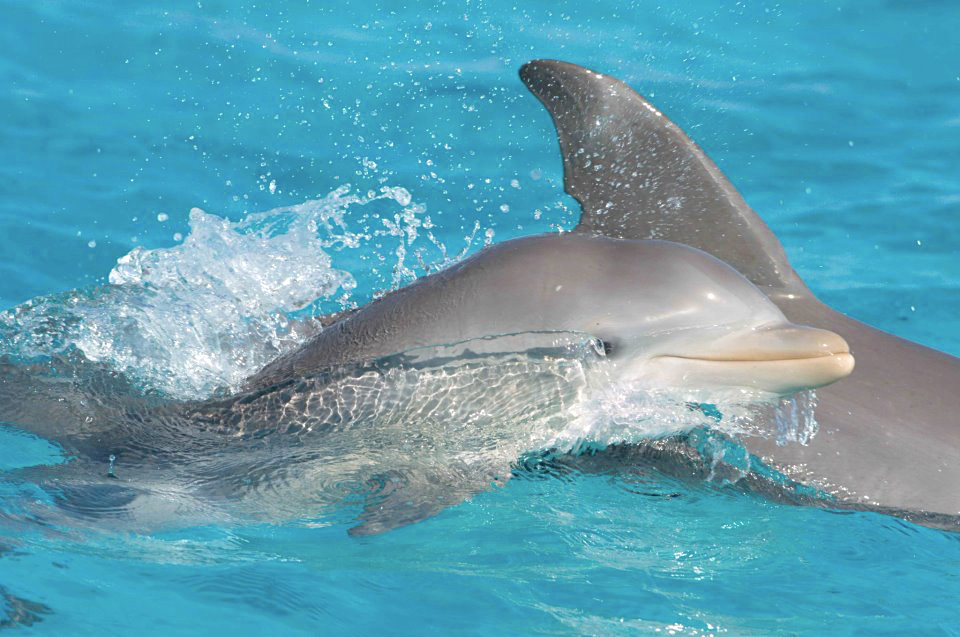
One of the dolphins turned out to be a young 3rd generation animal from the same family, recently weaned. The BMMRO has a large photographic library of dolphins and whales, collected over many years. In the photo above, you’ll see that the dorsal fin of the nearest one is ragged, especially near the top. This is the primary method by which individual animals are recorded to assist with subsequent identification in the field (= water) or back at base in Sandy Point by means of the photo archive.

Dolphins, Sea of Abaco Bahamas (BMMRO / Charlotte Dunn / Keith Salvesen)

The trip was perfected when a young female sperm whale came close to the boat… and then rolled onto her side, flipper up, to get a good look at the boat and its human contents. A wonderful experience for all those on board.

Dolphins, Sea of Abaco Bahamas (BMMRO / Charlotte Dunn / Keith Salvesen)

Credits: BMMRO / Charlotte Dunn; Friends of the Environment

Dolphins, Sea of Abaco Bahamas (BMMRO / Charlotte Dunn / Keith Salvesen)

Unknown's avatar

MEET ARNOLD: BE A BAHAMAS BLACK GROUPER GROUPIE


Black Grouper, Bahamas (Arnold) - Melinda Riger @ GB Scuba

MEET ARNOLD: BE A BAHAMAS BLACK GROUPER GROUPIE

The Black Grouper, like all its cousins, has the twin disadvantages of being fished for sport and fished for food. As demand for grouper on the menu rises, so does its vulnerability. The species is described as a ‘slow breeder’, so a depleting population has less chance of sustaining numbers. The consequence is an exponentially diminishing stock of the species. The equation is simple: fewer fish means less and less stock replenishment.

Black Grouper, Bahamas (Arnold) - Melinda Riger @ GB Scuba

Formerly plentiful, these groupers (like other grouper species) have moved from an IUCN listing of ‘Least Concern’ to ‘Near-Threatened’. Whatever effect climate change may be having on the oceans, stock depletion of this noble species also has more direct human causes.

Black Grouper, Bahamas (Arnold) - Melinda Riger @ GB Scuba

An adult black grouper’s diet consists of small fish and squid. Juveniles feed primarily on crustaceans. However, certain tiny reef fish – blennies and gobies for example – are important to the species as ‘cleaners’. You can read about their significance by clicking CLEANING STATIONS.

Black Grouper, Bahamas (Arnold) - Melinda Riger @ GB Scuba

The service performed by tiny fish on large ones (not only groupers) is an example of a symbiotic relationship known as ‘mutualism’**, in which both parties benefit (the little fishes get gacky bits of grouper to eat). The cleaners are able to do their work inside the gills and even the mouth of the host without being at risk.

Black Grouper, Bahamas (Arnold) - Melinda Riger @ GB Scuba

The NASSAU GROUPER has a defined and enforced closed season to help maintain numbers. It will be interesting to see if the same protection is eventually extended to the black grouper and indeed to other grouper species.

** The other two types of symbiotic relationship are commensalism, in which only one species benefits while the other is neither helped nor harmed; and parasitism, where one creature (the parasite) gains, while the other (the host) suffers.

RELATED POSTS

TIGER GROUPER

NASSAU GROUPER

RED HIND

GRAYSBY

Credits: all photos Melinda Riger of Grand Bahama Scuba 

Black Grouper, Bahamas (Arnold) - Melinda Riger @ GB Scuba

Unknown's avatar

‘TELLIN TIME’ – RISE AND SHINE: ABACO SEASHELLS


Sunrise Tellin Shell, Abaco Bahamas (Keith Salvesen Rolling Harbour)

‘TELLIN TIME’ – RISE AND SHINE: ABACO SEASHELLS

SUNRISE TELLINS Tellina Radiata

I included these pretty shells, with their striking pink radials, in a much earlier posBEACHCOMBING BIVALVES The ones shown here are larger specimens. Some call them ‘rose-petal shells’. The hinges (muscles) are very delicate, and for many of these shells that wash up on the beach, the two halves have separated naturally. 

Sunrise Tellin Shell, Abaco Bahamas (Keith Salvesen Rolling Harbour)

STs are not uncommon, and I recently found some beauties at Sandy Point. They can grow up to about 7 cms / 2.75 inches, and some of these ones were that length, or very nearly so. I realised after I had taken the photos that I should have used a coin for comparison.

Sunrise Tellin Shell, Abaco Bahamas (Keith Salvesen Rolling Harbour)

TELLIN: THE TRUTH

The occupant of each of these pretty shells is a type of very small clam. I have completely failed to find a photo of a nude one with its shell removed, but maybe these are never seen at all. The clams live on the sea-floor, often buried in the sand, and with the lid (mostly) shut. Then they die (or their shells are bored into by a predator and they are eaten) and the shells eventually wash up empty on the beach. There’s not much to say about them – they perform no tricks (some shell creatures do, such as backflips) and are believed to have vanilla sex lives (some shell creatures are quite inventive in this department).

Inside Story… not much to tell except (a) still very pretty & (b) possible predator bore-hole top rightSunrise Tellin Shell, Abaco Bahamas (Keith Salvesen Rolling Harbour)

WELL, WHAT ELSE IS THERE TO THEM, APART FROM BEING PRETTY & BEACHCOMB-ABLE?

  • The clams have 5 tiny teeth to chew up their staple diet, which is mainly plant material
  • These include one ‘strong’ tooth, and one ‘weak’ one, though how someone found it out remains a mystery
  • Tellins are native to the Caribbean and north as far as Florida.
  • They live mainly in quite shallow water, but can be found as deep as 60 foot
  • They have no particular rarity value, and are used for marine-based crafts

Sunrise Tellin Shell, Abaco Bahamas (Seashells . org)

PLEASE TRY HARDER TO HOLD MY ATTENTION

You know those lovely tellins you collected during your holiday on Abaco to take home to your loved ones? You may have committed a crime! You did take them, didn’t you? However the general rule – law, even – seems to be “in most countries it is illegal to bring back these shells from holidays”. However, you have been fortunate; the Bahamas has no specific prohibition on the removal of tellin shells, certainly not for personal use.

READER COMMENT: WHOOPS! ALSO, PHEW!

Sunrise Tellin Shell, Abaco Bahamas (Rhonda Pearce)


As ever, the very excellent Bahamas Philatelic Bureau has covered seashells along with all the other wildlife / natural history stamp sets they have produced regularly over the years. The sunrise tellin was featured in 1995. You can find more – much more – on my PHILATELY page.

Sunrise Tellin Shell 5c Stamp Bahamas (BPB)

All photos Keith Salvesen / Rolling Harbour; Rhonda Pearce Collection plus Seashells.Org, O/S Linnean Poster, O/S BPB stamp

Sunrise Tellin Shell, Abaco Bahamas (Keith Salvesen Rolling Harbour)